Cider and Donuts on Martha’s Vineyard

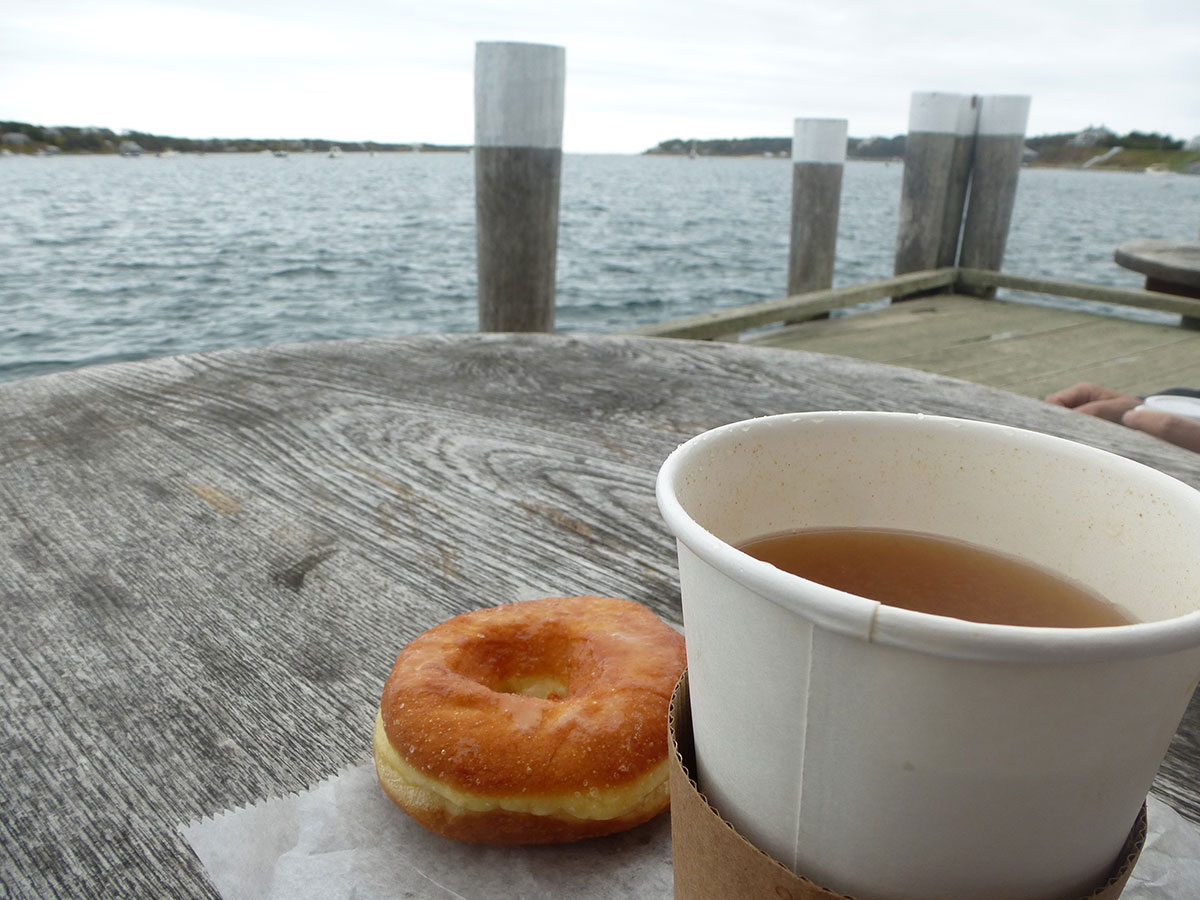
The cider stand on a street in Edgartown on Martha’s Vineyard smelled so good, there was no way we couldn’t stop our bikes and get some. The stand was operated by the Behind the Bookstore Cafe, and served coffee, fresh mulled cider, and homemade donuts. Neither the cider nor the donuts were overly sweet, counting on rich flavors instead of sugar to make it enjoyable. Which they both succeeded admirably in doing. The donut was the softest thing I have ever had in my mouth besides cotton candy. It was salted, which really brought out the sweetness of it. Any more flavor would have been overwhelming.

The mulled cider almost was overwhelming, and it looked almost as awesome as it tasted. It had little bits of apple floating in it, that rose to the surface then cooled and sank like a delicious lava lamp. Its taste was so intense that I couldn’t finish my whole cup then, I had to save it for later. A million spices I couldn’t even begin to identify covered my palate, in every taste except umami.P1040963

The stand is going to be open until December, so if you’re in the area, and can handle rich flavors, go get some cider. Seriously, even if you don’t like cider or are on a no-sugar diet, do it anyway. It is fantastic.

Jon Ehrmann

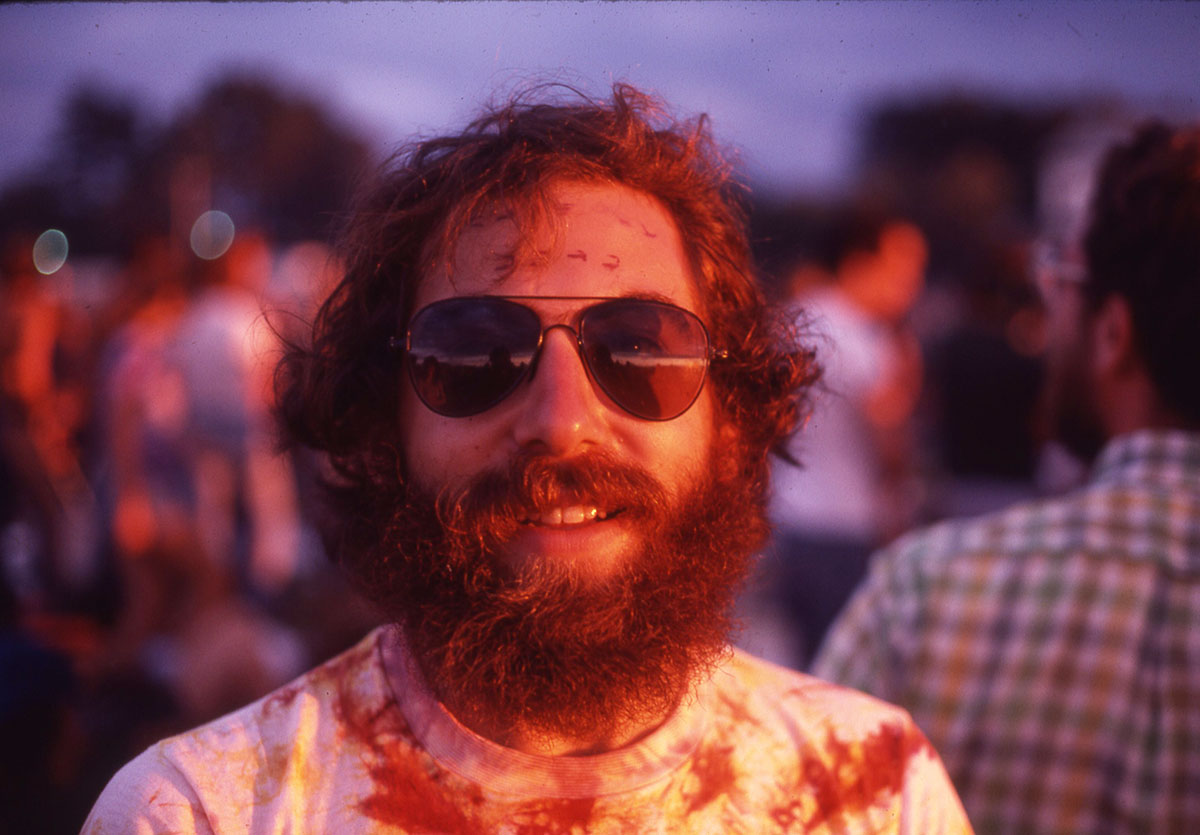
Jon and I have been friends since freshman year in college, when we both lived in Hurlbut Hall.  Even in a dorm full of eccentrics, misfits and savants, Jon was noticeable, as he seemed the antithesis of many Harvard stereotypes.  In a place where many are endlessly yakking, Jon was quiet, almost non-verbal, and extraordinarily gifted in dealing with the spatial / physical world. Surrounded by self-promoters who had been polishing their resumes since 8th grade, Jon just quietly did what he did, never calling attention to it.  And in an academic environment that valued linear processes and rationality above all else, Jon was the most intuitive person I had ever met.

Jon was an engineering major, but with a designer’s approach rather than a purely analytical one.  He played the guitar well, and was always sketching his ideas, rather than trying to explain them.  Jon was the person who got me into synergetics and that way of seeing the physical world, but his understanding of it went much deeper than mine.  I remember a lecture where a visitor was arguing how a modular system would be much more flexible and usable if based upon the Fibonacci series rather than a straight linear progression of 2, 4, 8, etc.  I thought it was compelling, but then I ran into Jon and our teacher, Arthur Loeb, who just shook their heads at the speaker’s naivete, and said well of course, any other irrational number series would work just as well.

Jon and I had both been in academically-oriented high school programs, where the manual arts were discouraged, and then we discovered the metal shop in the Science Center, which was for science students who needed to build apparatus for their experiments.  So we both took metal shop at Harvard, and Jon was quite talented at this, producing precise and elegantly-designed objects, many of which were not for strictly academic purposes.  When another student figured out how if you cut two tetrahedra off a cube of volume 3, you were left with a triangular antiprism of volume 2, Jon figured out that if you sliced that antiprism into 16 pieces, 8 of one shape and 8 of another, they could be recombined into a cube of volume 2.  Our professor was nonplussed, did the math and realized Jon was right, and came up with a grant to pay Jon to spend the summer machining these pieces out of plexiglass.

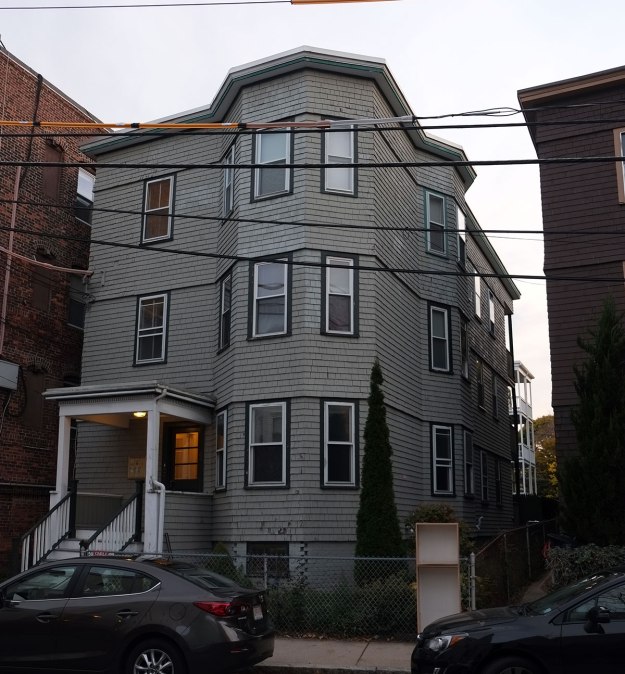
DSCF3624I lived with Jon, John Wenzel and Erec Koch for a year at 66 Dimick St. in Somerville, a true dive of an apartment that rented for $220 a month.  (I went by last week and can report that it is still a dive, but now it is an expensive one.)  The rest of us were working or in school, but Jon was enjoying his post-graduate hiatus, and was determined to stay unemployed for as long as possible.  He hung out with his friends, slept late, played the guitar, sketched and cooked fabulous Chinese food (as part of a Chinese cooking group four of us had formed).  When his money ran out, he got a job as a machinist making medical device parts, until the day he passed a sketch of an idea to his boss, who said, okay, you are now a designer.  Jon’s career took off from there, and since then he has spent his time at the interfaces of design and fabrication, digital and analogue, designing things that the rest of us don’t really understand.

EhrmannI moved to New York, and Jon and we stayed intermittently in touch, getting together for such events as a Grateful Dead concerts and weddings.

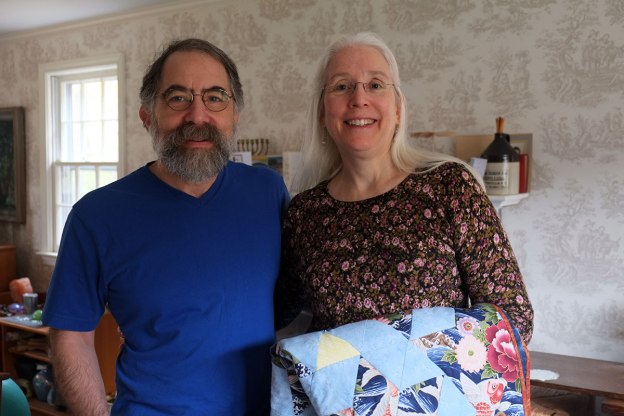
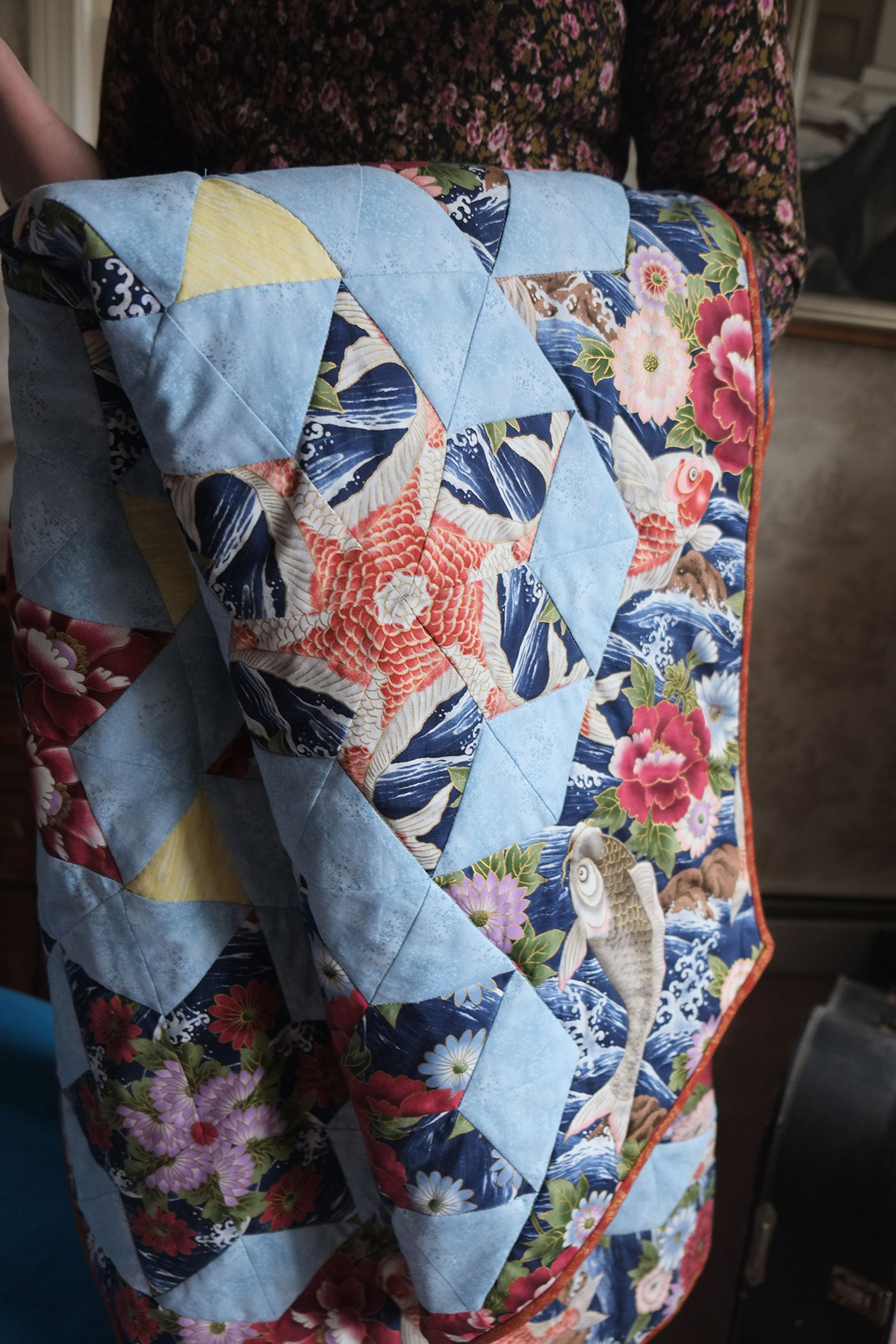
Jon and Debbie were married in the late 1980s, and it was striking to see that two people who shared many characteristics had somehow found each other.  Besides working and raising two children, Debbie creates amazing quiltsDSCF2972

which are technically and conceptually striking (I know something about this from watching Linda make quilts), while also being really beautiful.

Greta and I had a fun couple of days staying with Jon and Debbie in Sudbury, where Greta could satisfy her vicarious pet needs by hanging with the cat, the latest in a series of enormous cats Jon has always had around.  Jon and Debbie of course plied us with great food, either something Jon had invented, or in the best Chinese restaurant they had somehow found in  Framingham.  Once again, it was striking to me to see how old friends had come through the career- and child-focussed years of middle age, and were still the same people you knew long ago.


Hot Dogs Across America, Part One

I think it is well past time or a comprehensive list of hot dogs. Note: this page will either be edited, or I will make more additions for new hot dogs I eat.

Bison Dog
Wall Drug, Wall, SD
21-9-15
P1030774A hot dog made from bison meat. Nothing too spectacular. Its casing was a bit rubbery. Like the bison burger, I wouldn’t have been able to tell that it wasn’t beef if no one told me.

Chili Dog
Mory’s Deli
Chicago, IL
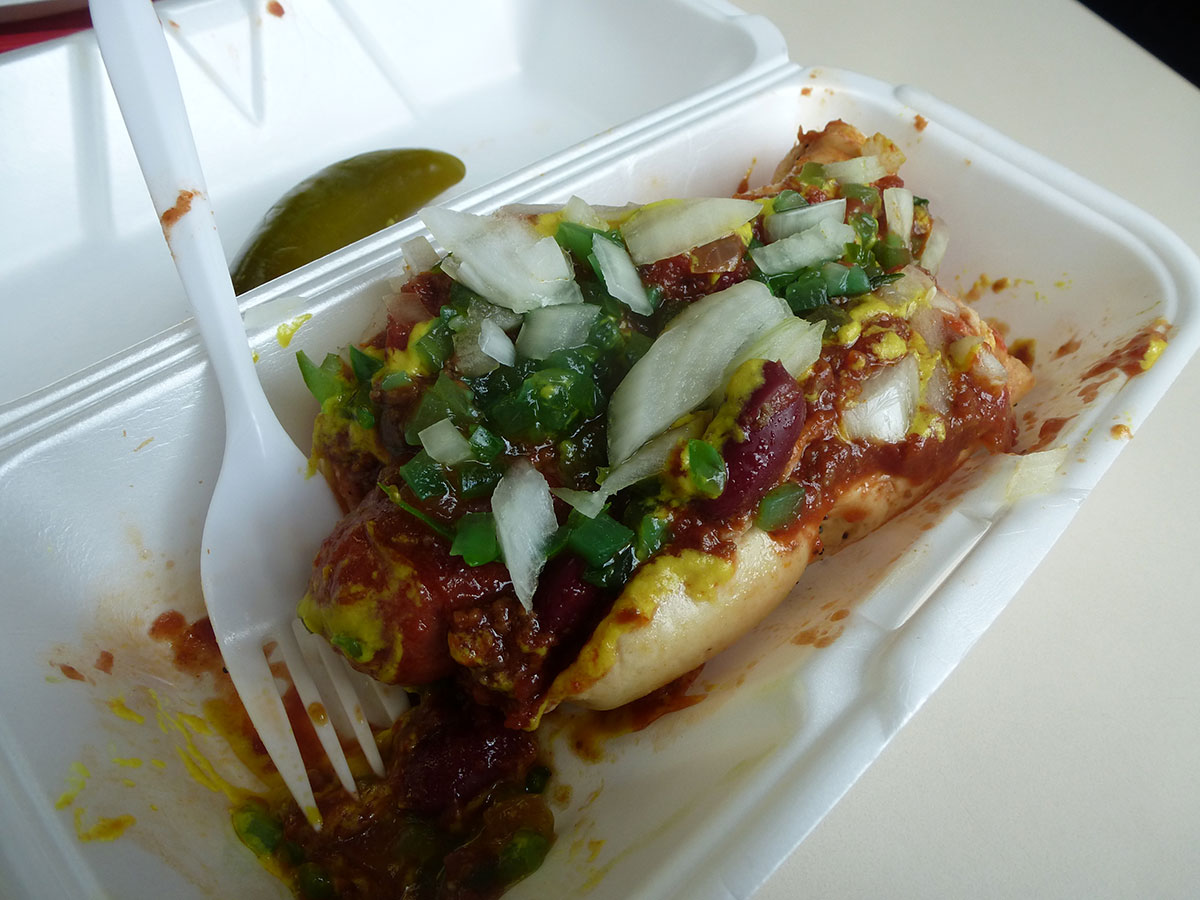
1-10-15P1040041It was about noon when we were going to head into the Museum of Science and Industry, and we decided that we didn’t want to eat museum cafe food, so we found Morry’s Deli. It was full of cops and construction workers, so we knew we’d be getting a good deal. I got a chili dog, and when Dad brought it to the table my reaction was “How in the world am I supposed to eat that?” It wasn’t as large as I expected, but it was piled with so much stuff that whenever I tried to pick it up it started shedding onions. It was good, and very filling.

Mac and Rings Dog
Ted’s Hot Dogs
Buffalo, NY
16-10-15
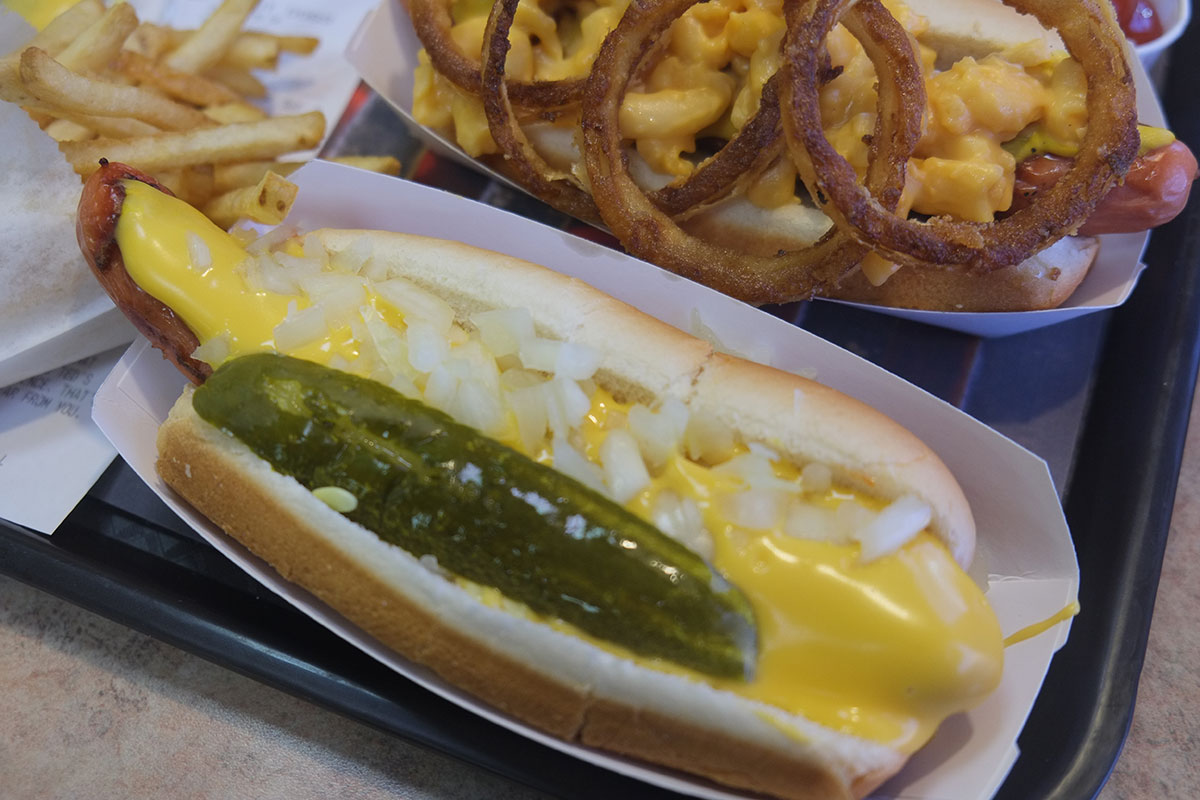
DSCF1749This post isn’t really going to be about the dog, which was okay, but about the onion rings. Which were fabulous. Unlike most rings you find nowadays, these were not overly processed and breaded, and actually contained real onions. Despite the fact that they made me sick the next day, they were totally worth it.

The Bulldog
Minneapolis, MN
25-9-15
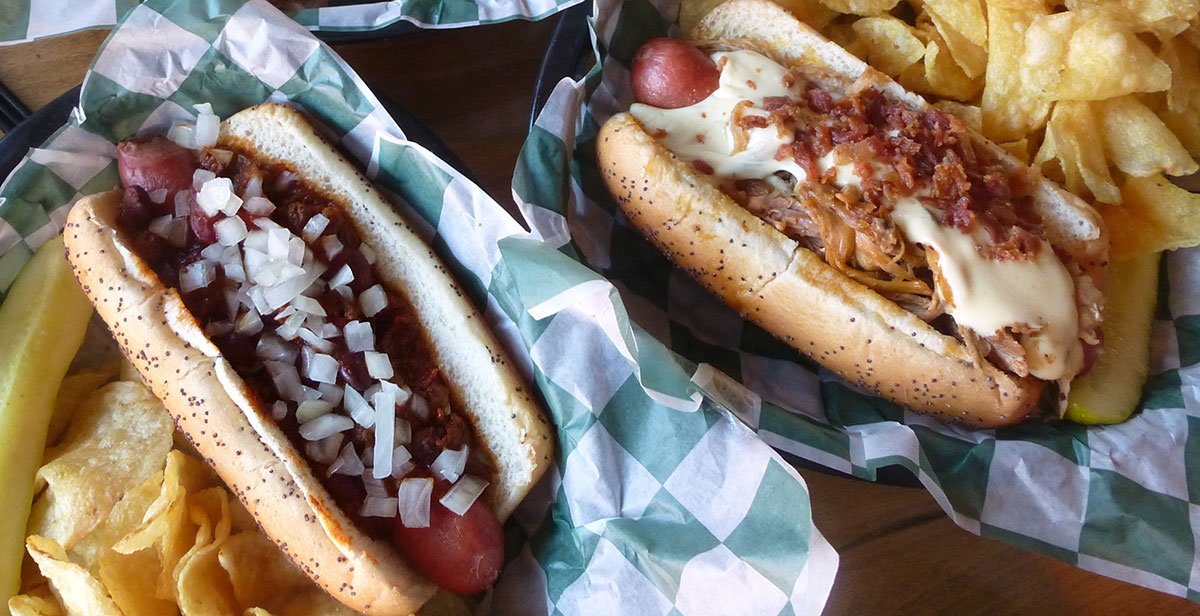
P1030902For a bar specializing in hot dogs, I was kind of dissapointed. It seems like many places professing to specialize in something make it mediocrely and just load it with extra stuff, which was the case here. Mine was a chili dog with onions, and Dad’s had pulled pork and bacon on it. Neither were fantastic, nor were they terrible.

Big Daddy’s Hot Dog Cart
Copley Square, Boston, MA
23-10-15
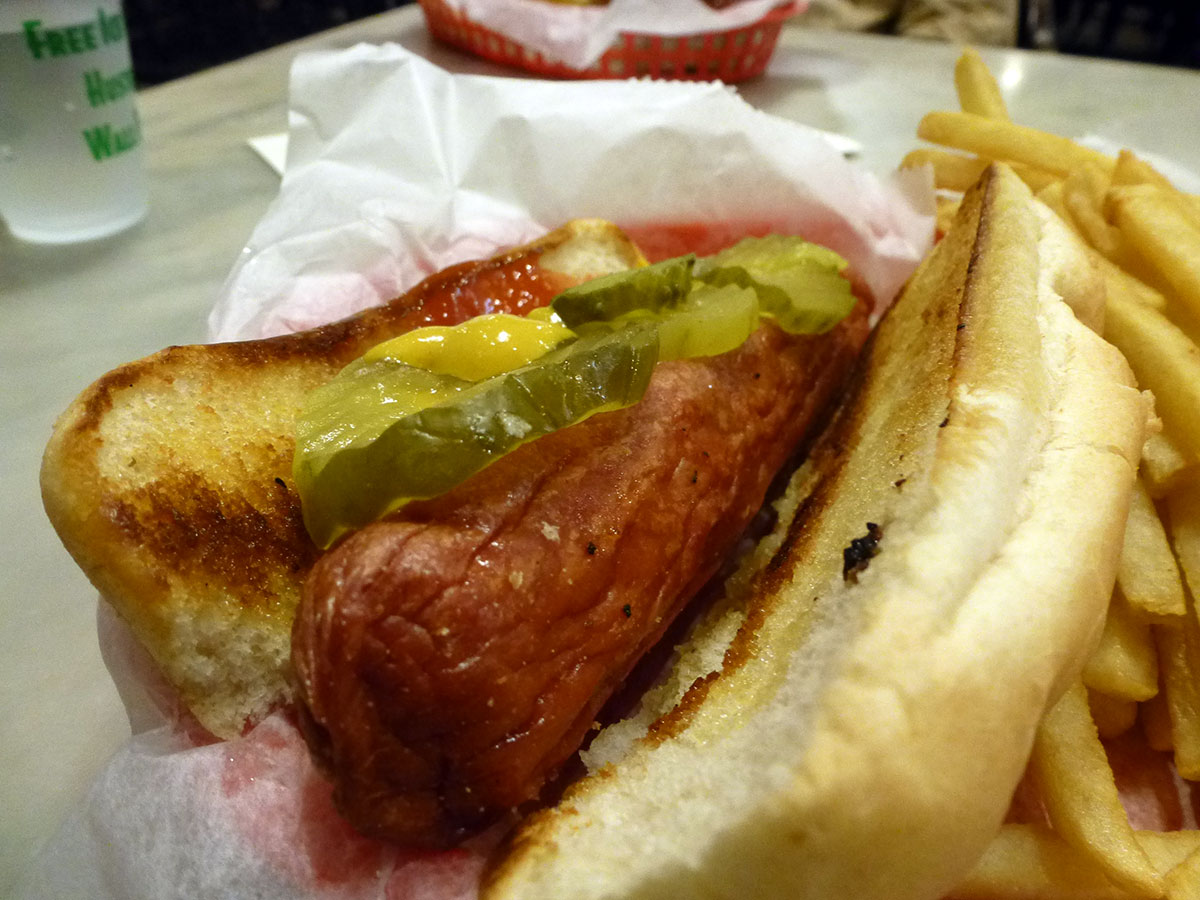
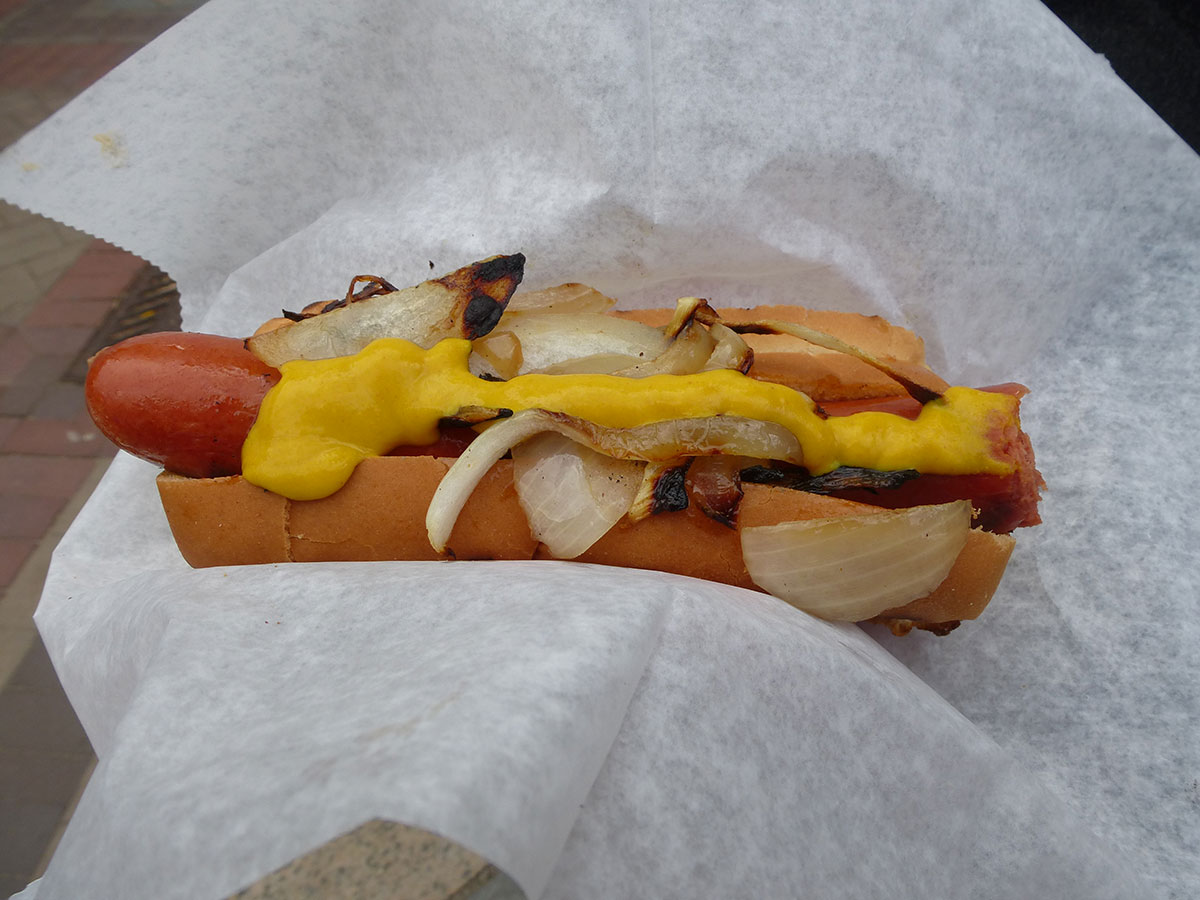
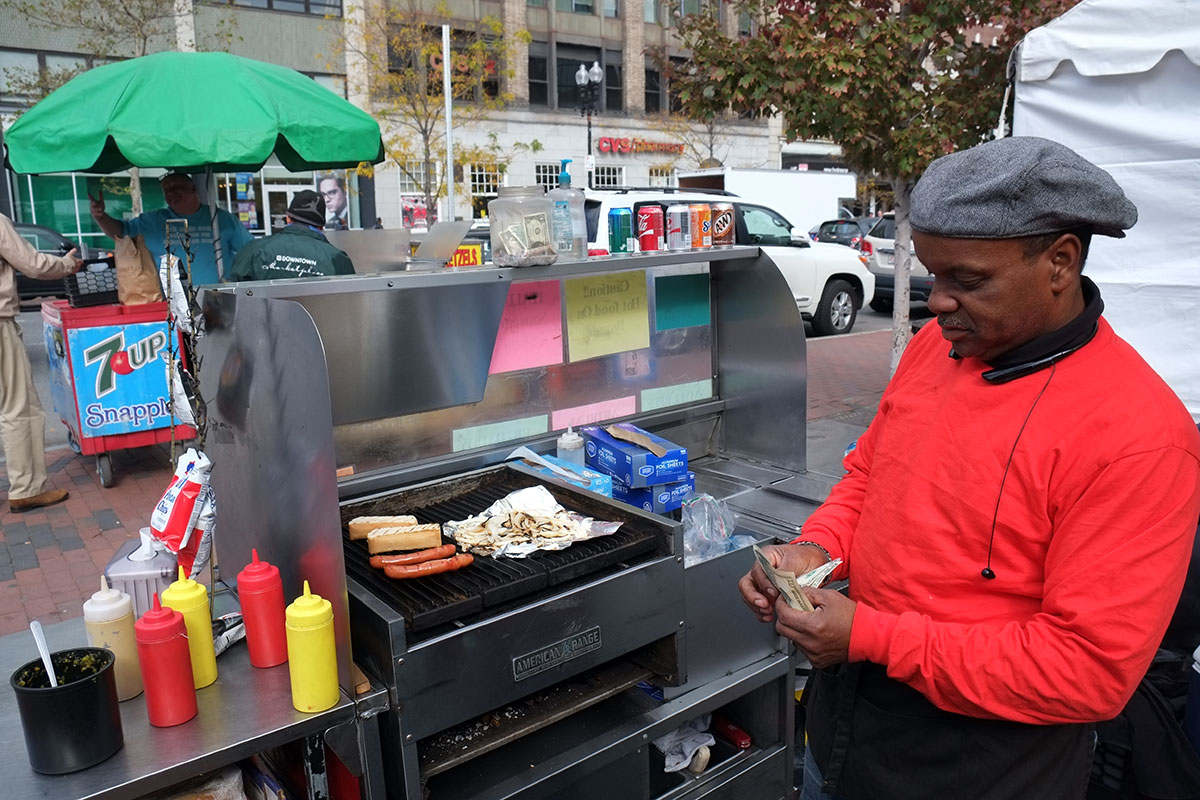
P1040935The simplest and best hot dog so far. A grilled dog, on a grilled bun, with grilled onions. The dog had a nice snap to it when bitten, and the onions were fresh grilled, right on the cart with the dogs and rolls. The flattened bun definitely improved it. I find flattened buns infinitely superior to found ones; they have a better surface to volume ratio, and are easier to hold. There’s also just something nice about street food the restaurants can’t replicate. Watching your meal cook while joking with the vendor in the cold only makes the dog all the more delicious when you get it.

Big Daddy

Big Daddy

More hot dog reviews are at Hot Dog Blog:  Part Two

Mass MOCA

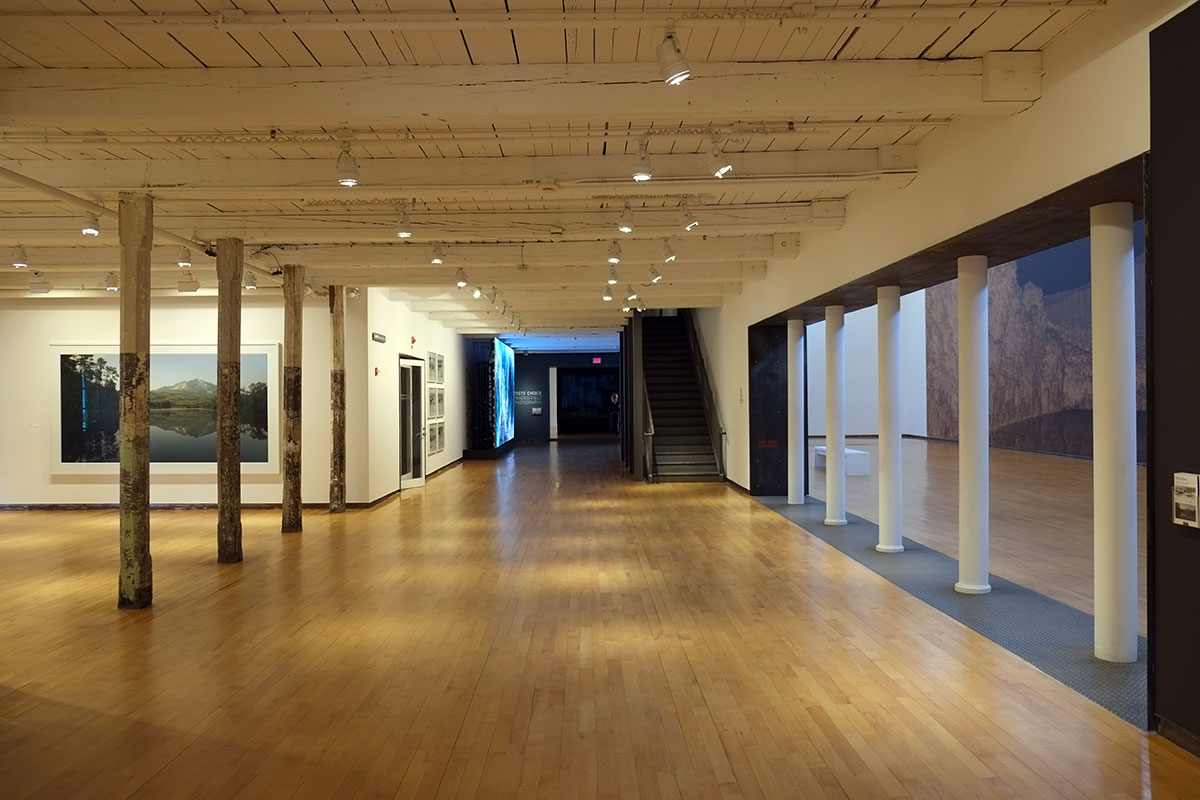
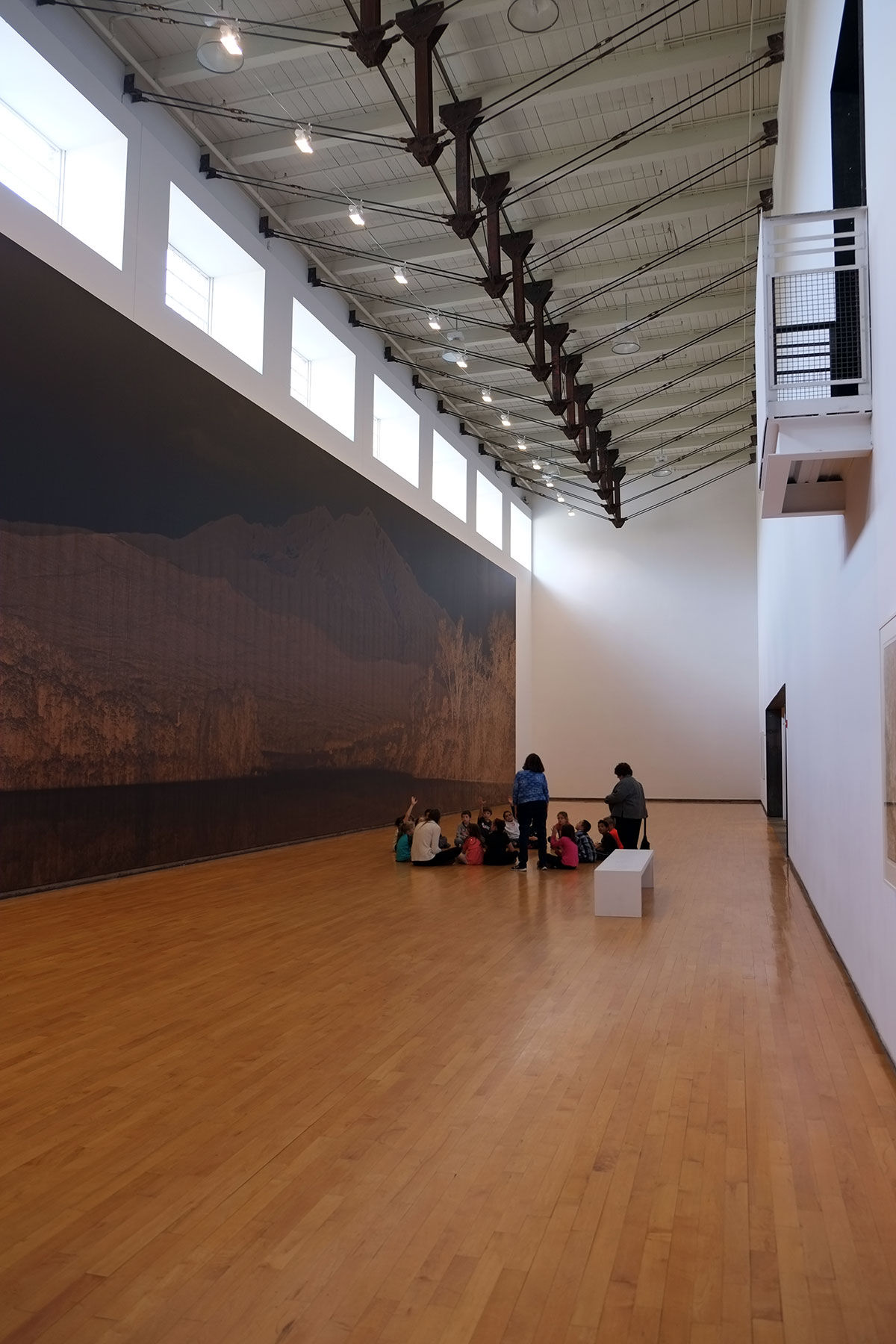
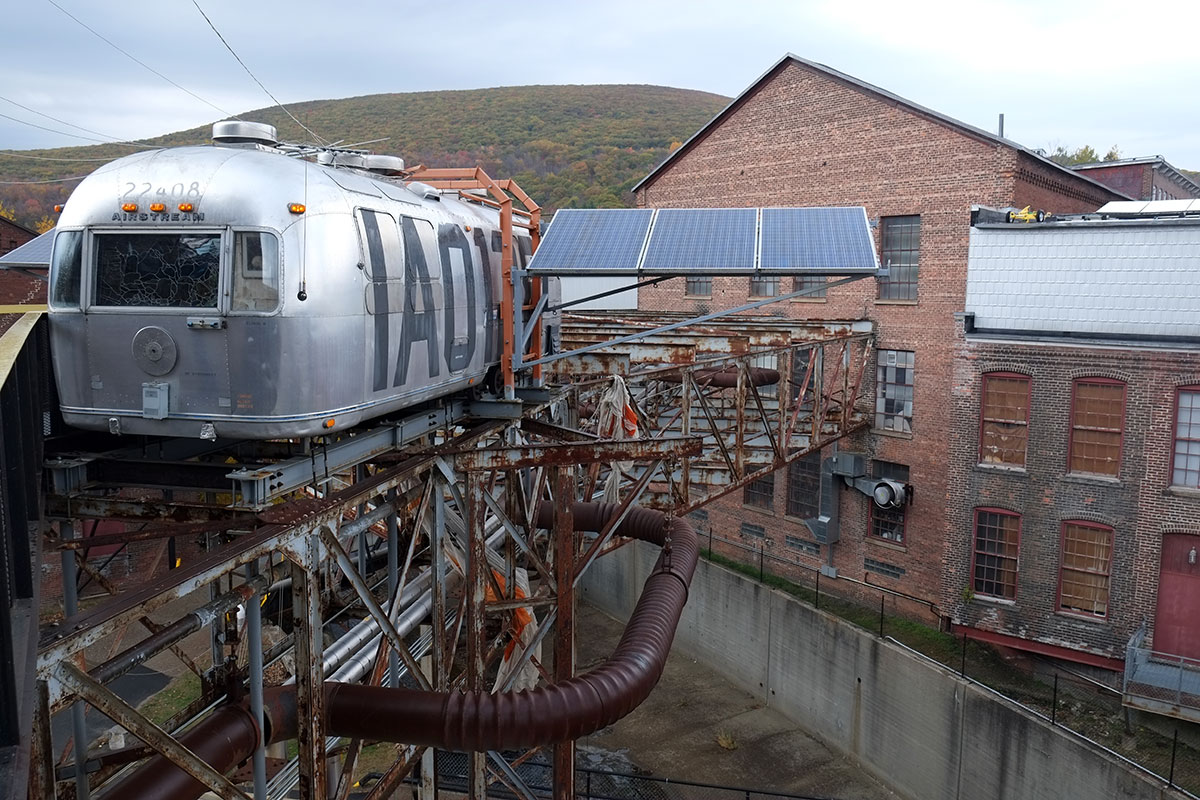
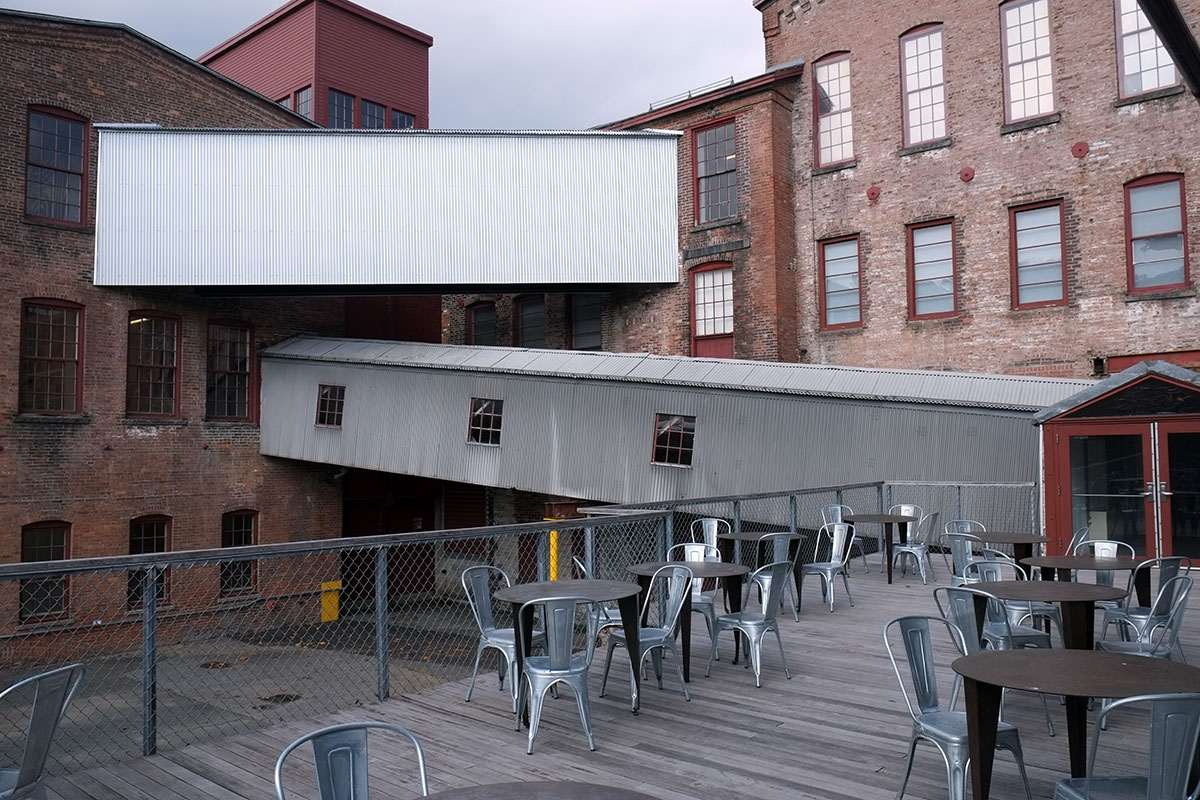
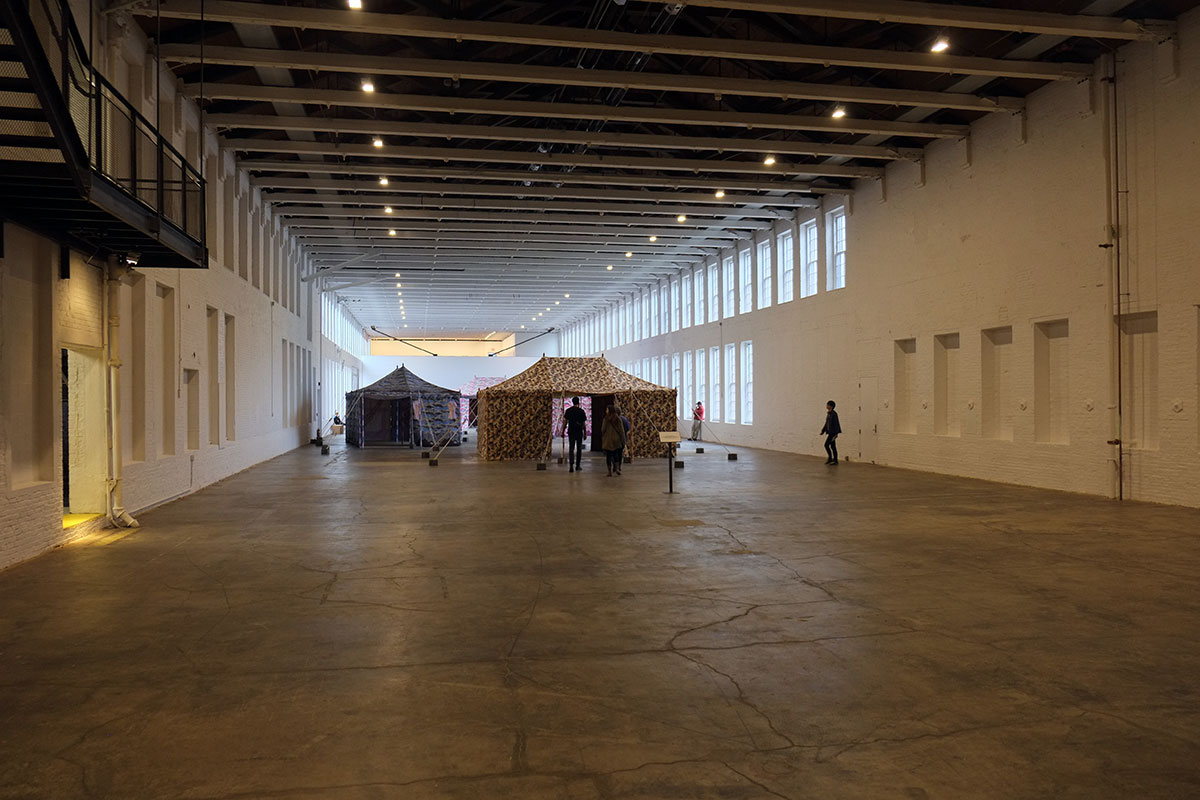
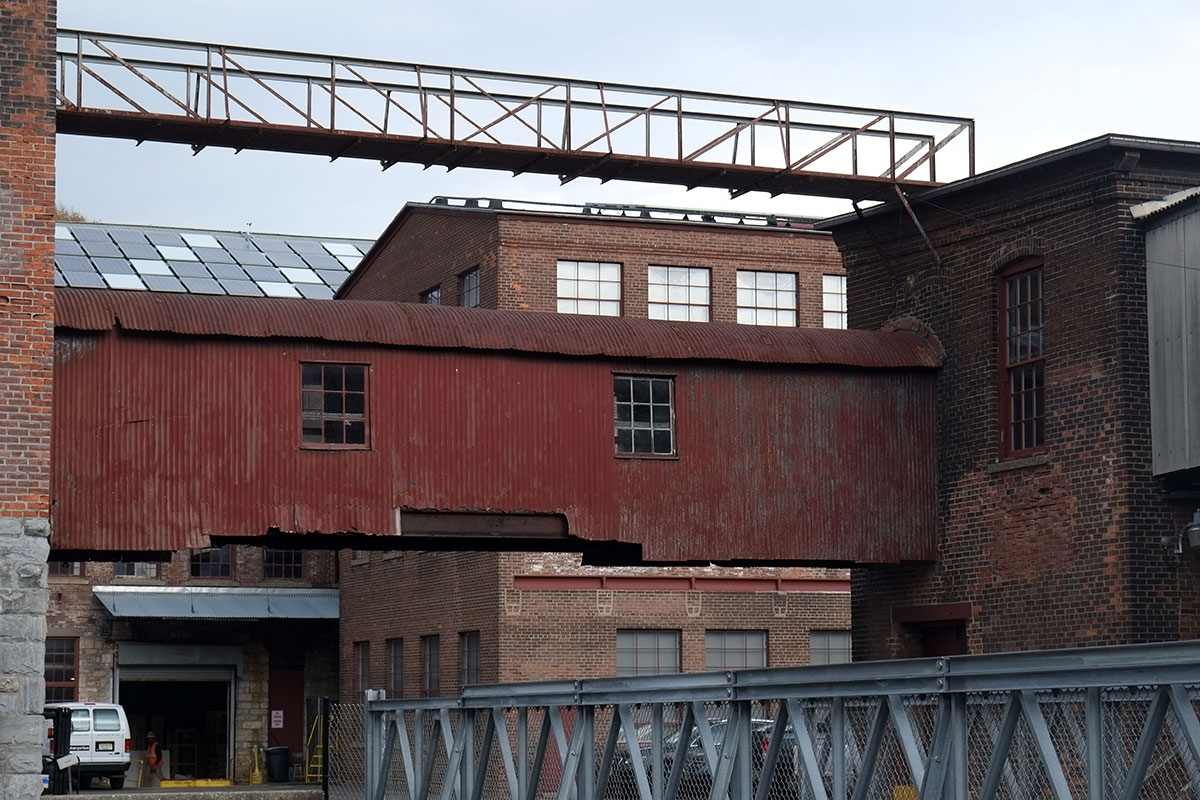
Mass MOCA is a contemporary art museum, which opened in North Adams, Massachusetts, in 1999.  Taking advantage of the old mill buildings on the site, there are almost four acres of galleries, enormous rooms in which they can show enormous pieces.  I’ve become leery of dragging Greta into too many museums, but this was no problem, as it combined some of her current fascinations – conceptual art and industrial archaeology.  DSCF2429

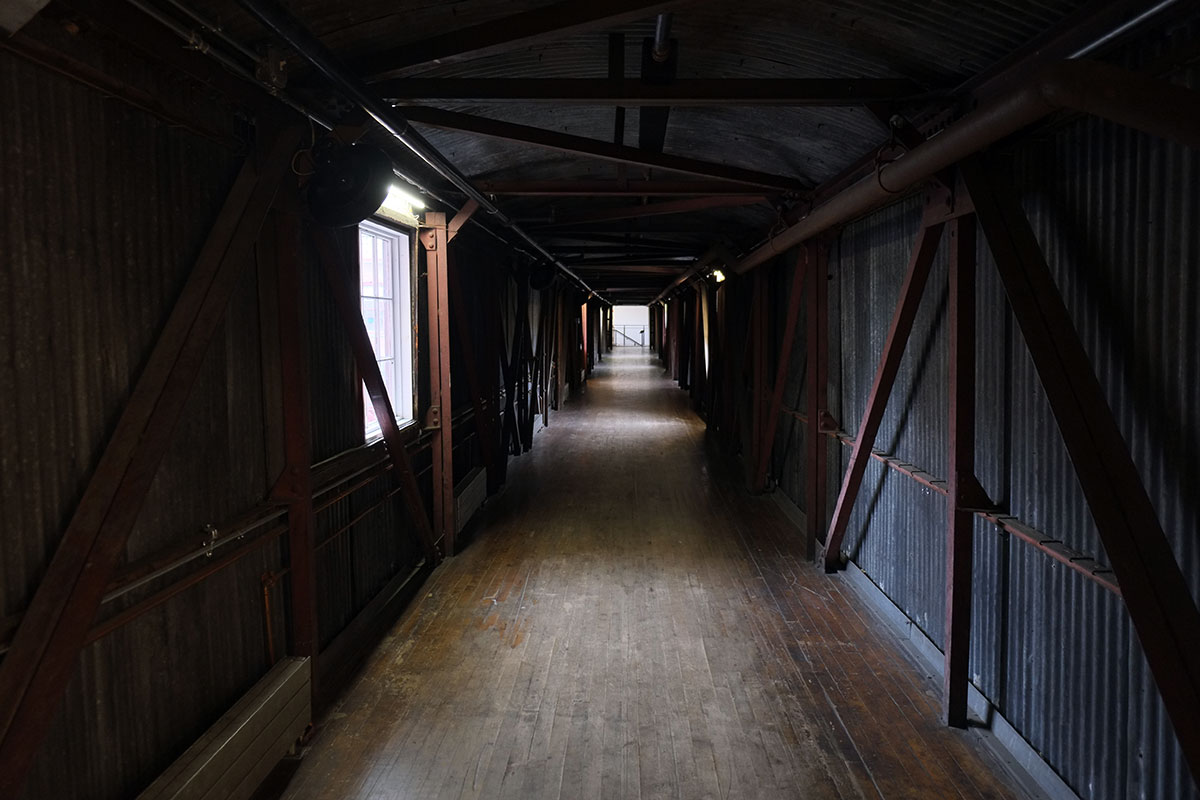
There are big rooms indoors, and there are spaces in between the buildings outside for art work.  We found the buildings to be as compelling as the art.  The 1947 boiler plant has been left as-is, slowly rusting through the open roof, and Greta said it was her new favorite place in the world.  DSCF2534

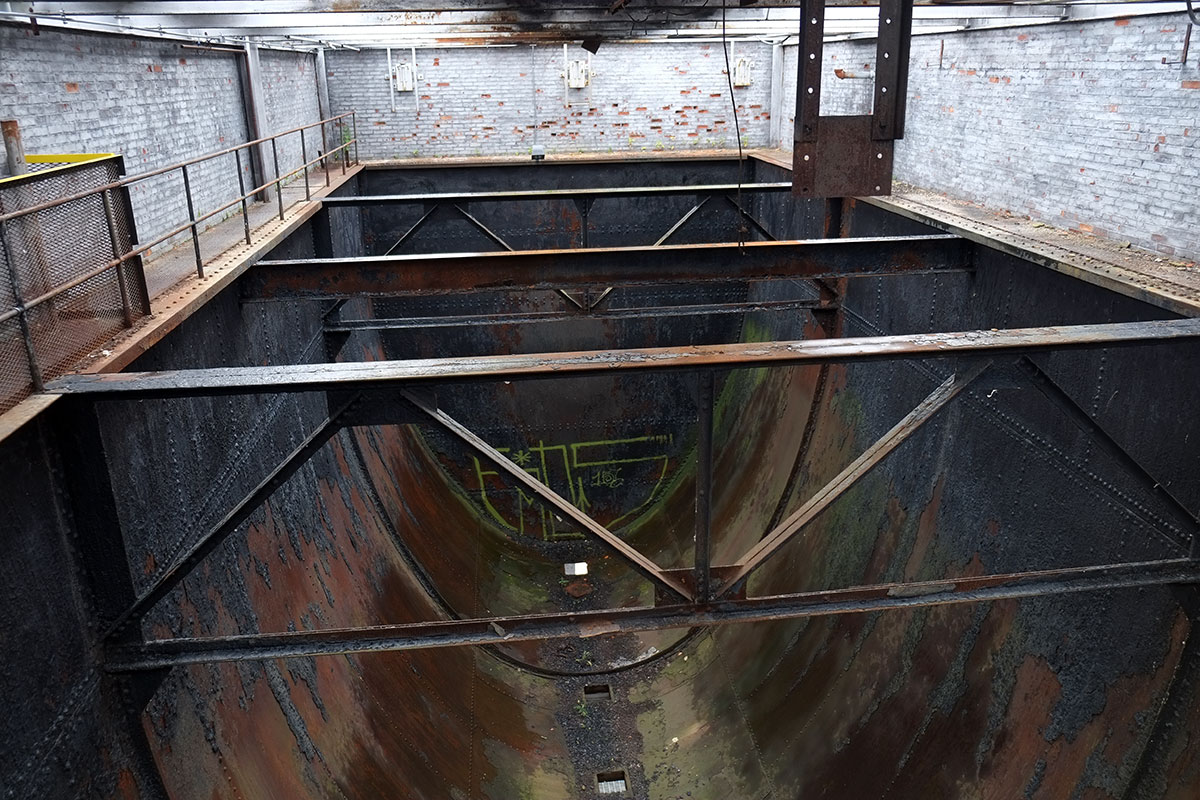
big tank in the boiler plant

big tank in the boiler plant

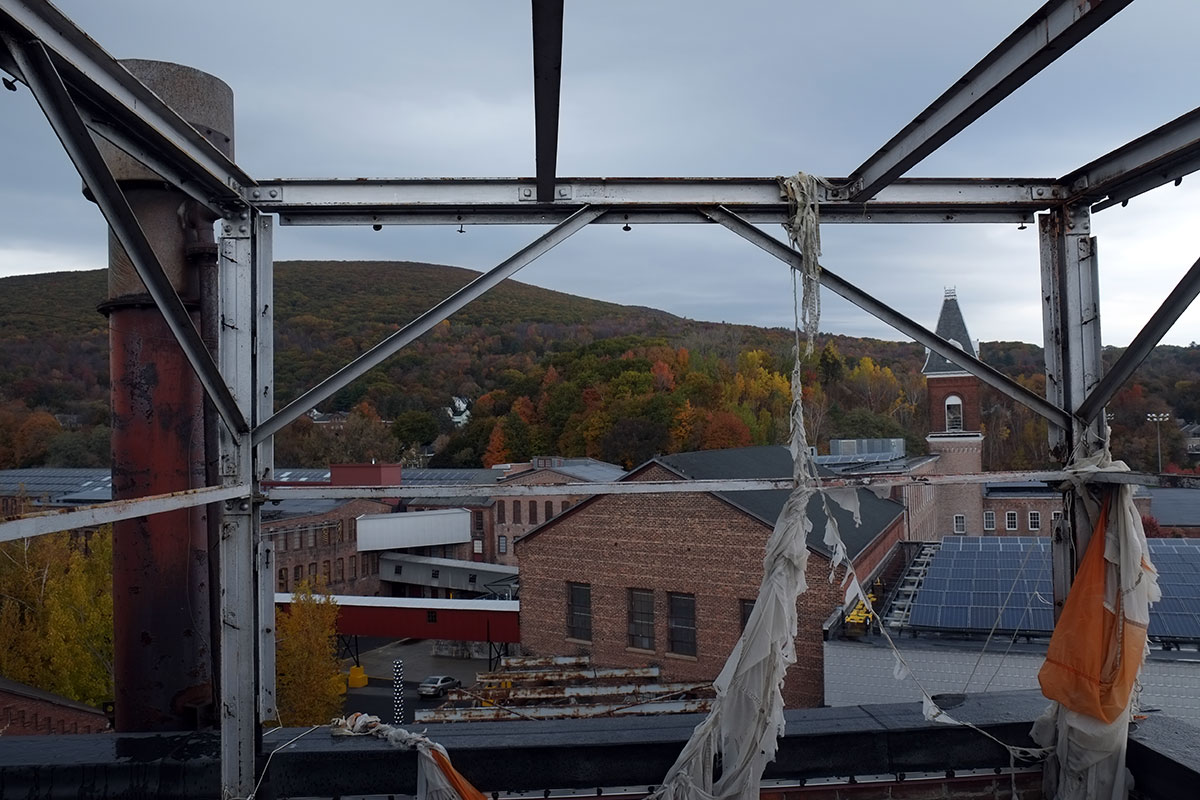
the view from the top of the boiler plant

the view from the top of the boiler plant

DSCF2434

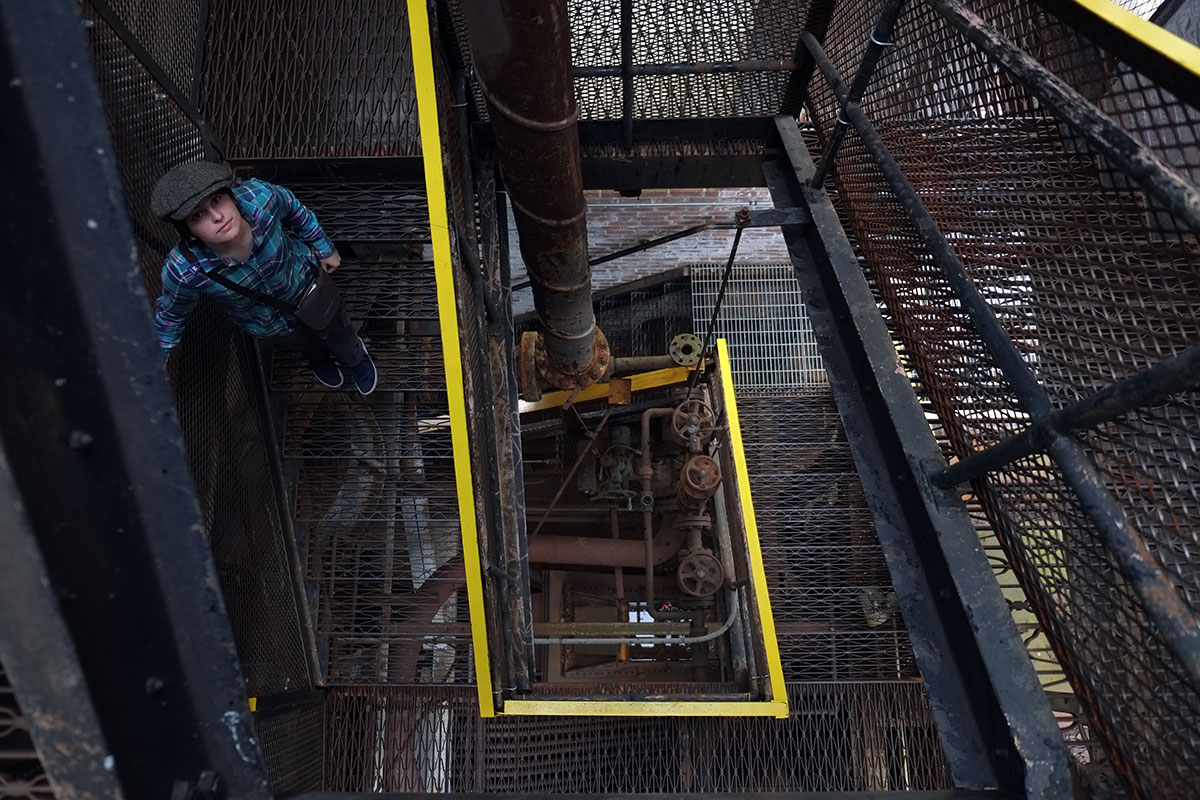
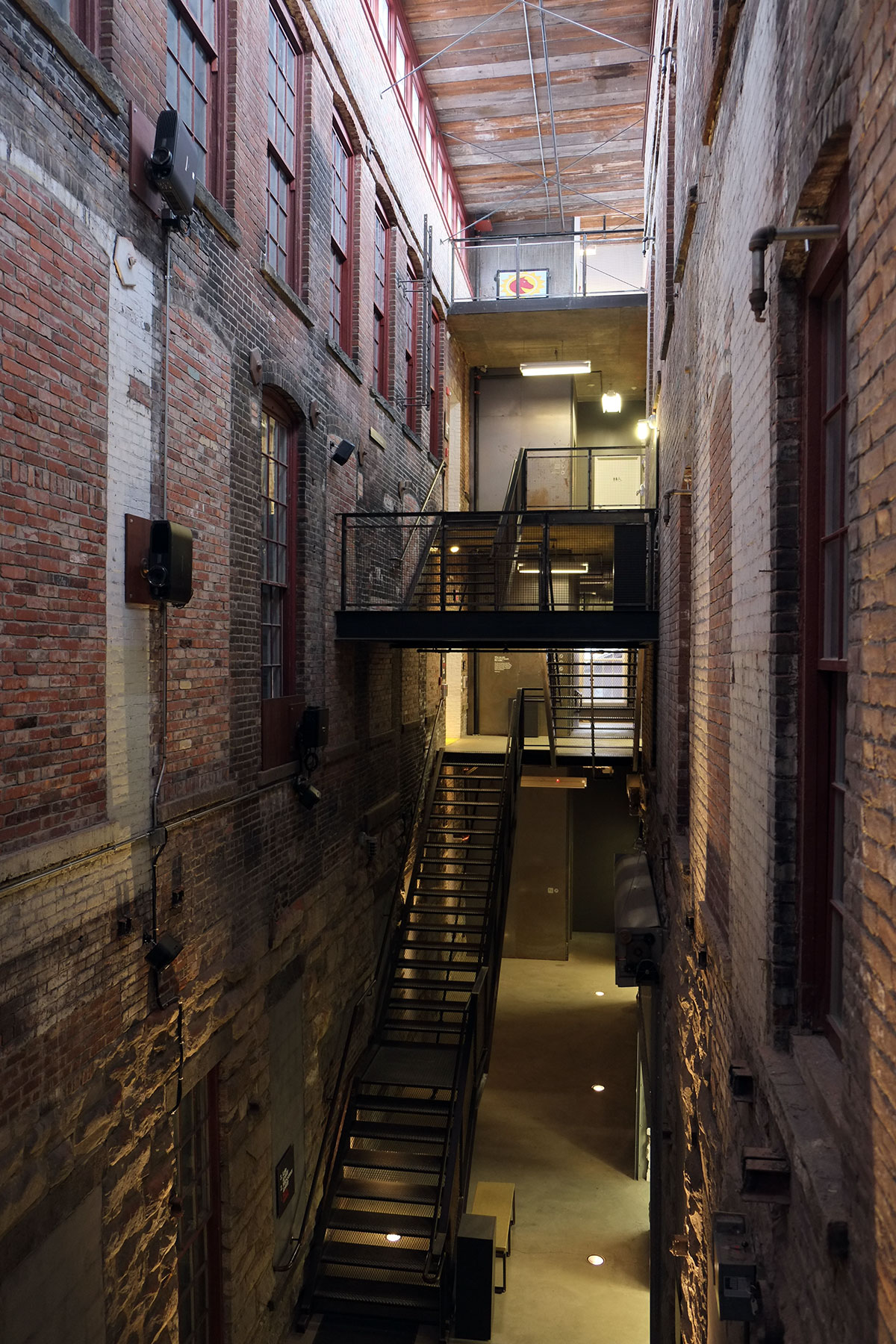
a stairwell between two buildings

a stairwell between two buildings

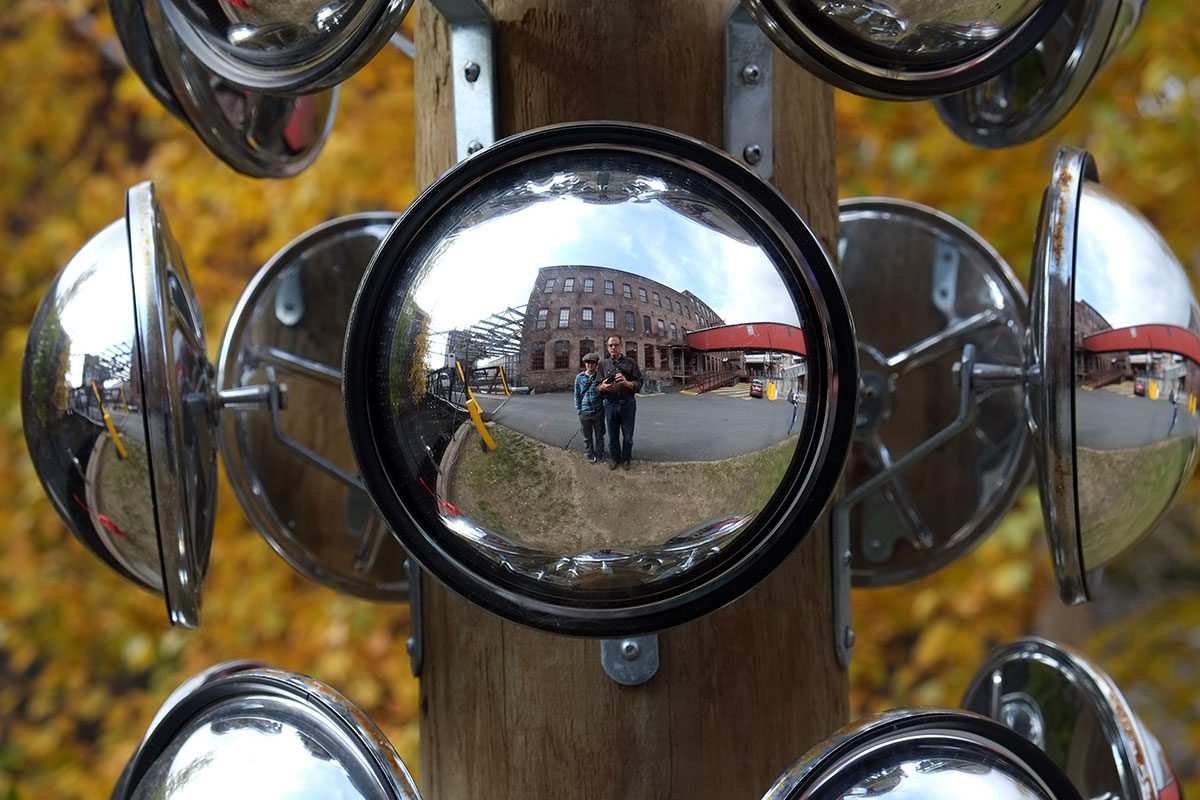
the art meta-selfie

the art meta-selfie

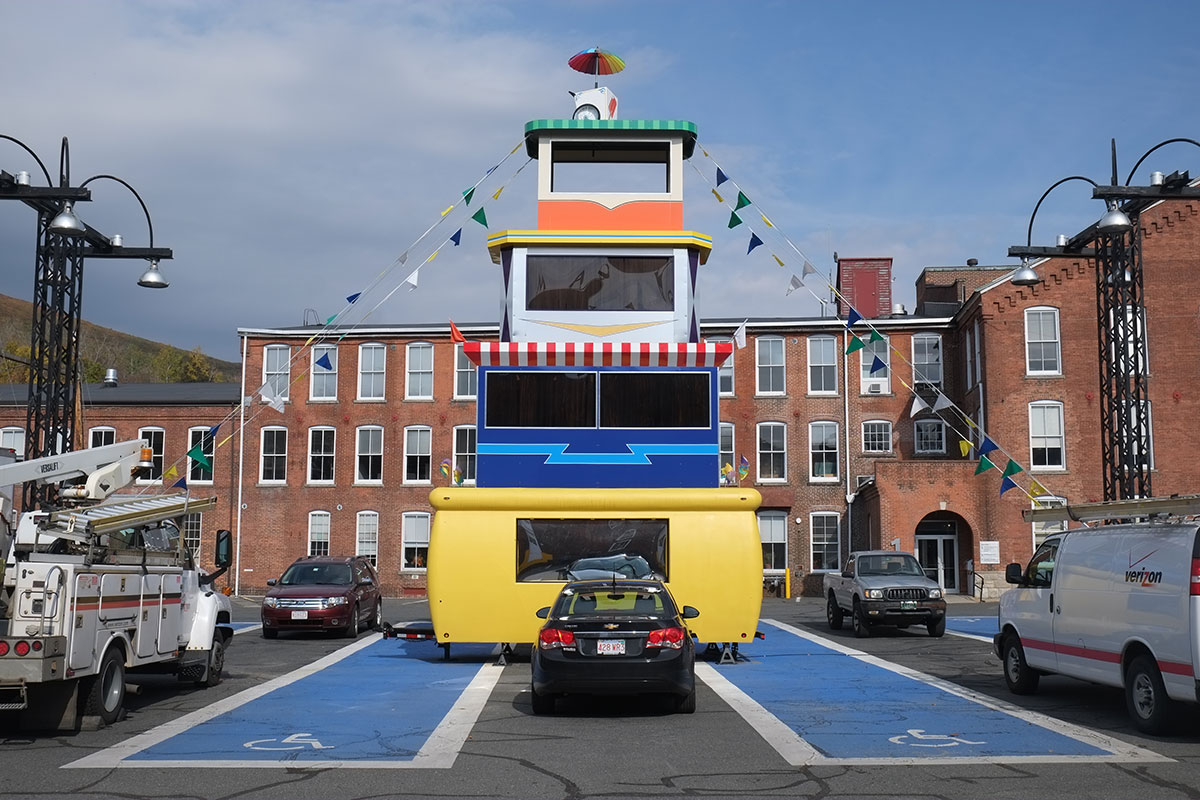
a take on plastic trailers that is a little different from ours, done by some folks from Seattle. We thought of moving our trailer next to it for a trailer-selfie.

a take on plastic trailers that is a little different from ours, done by some folks from Seattle. We thought of moving our trailer next to it for a trailer-selfie.

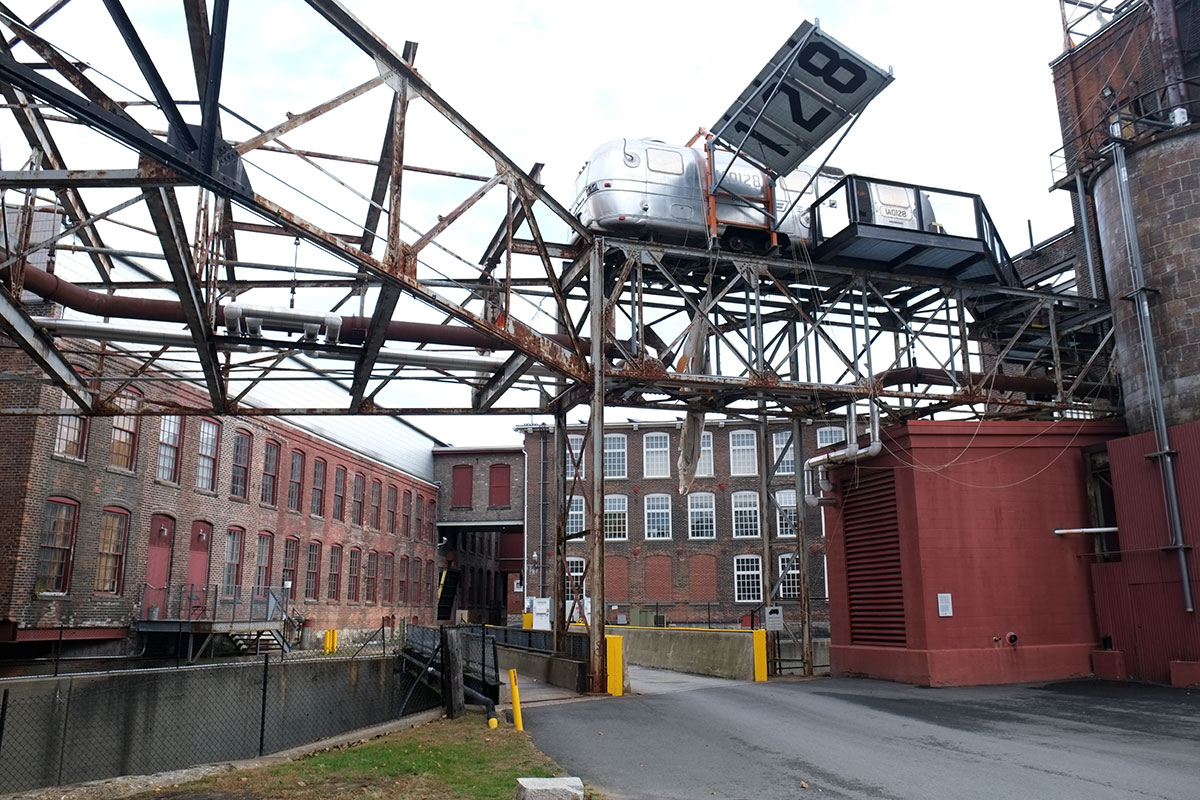
a project with an Airstream. We want this one for our next trip

a project with an Airstream. We want this one for our next trip

there's a theme emerging here

there’s a theme emerging here

some old ramps, some new

some old ramps, some new

a Francesco Clemente installation

a Francesco Clemente installation

a ramp

a ramp

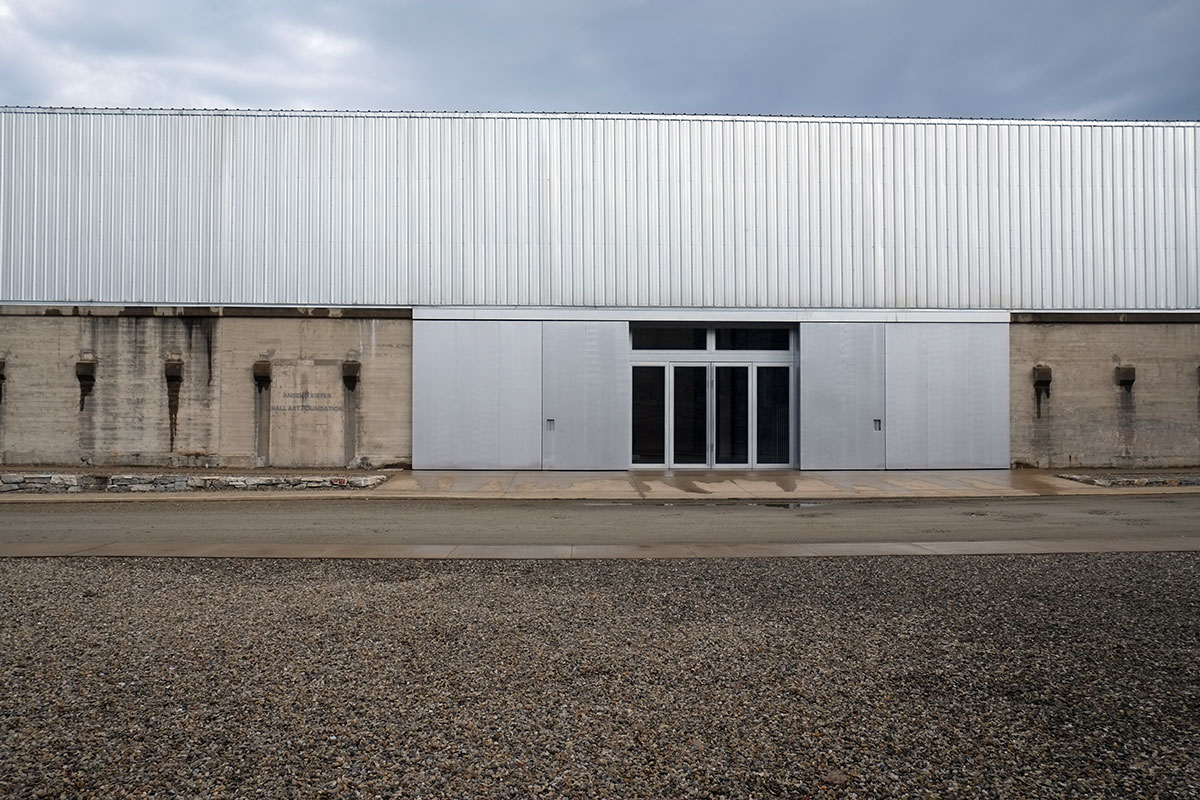
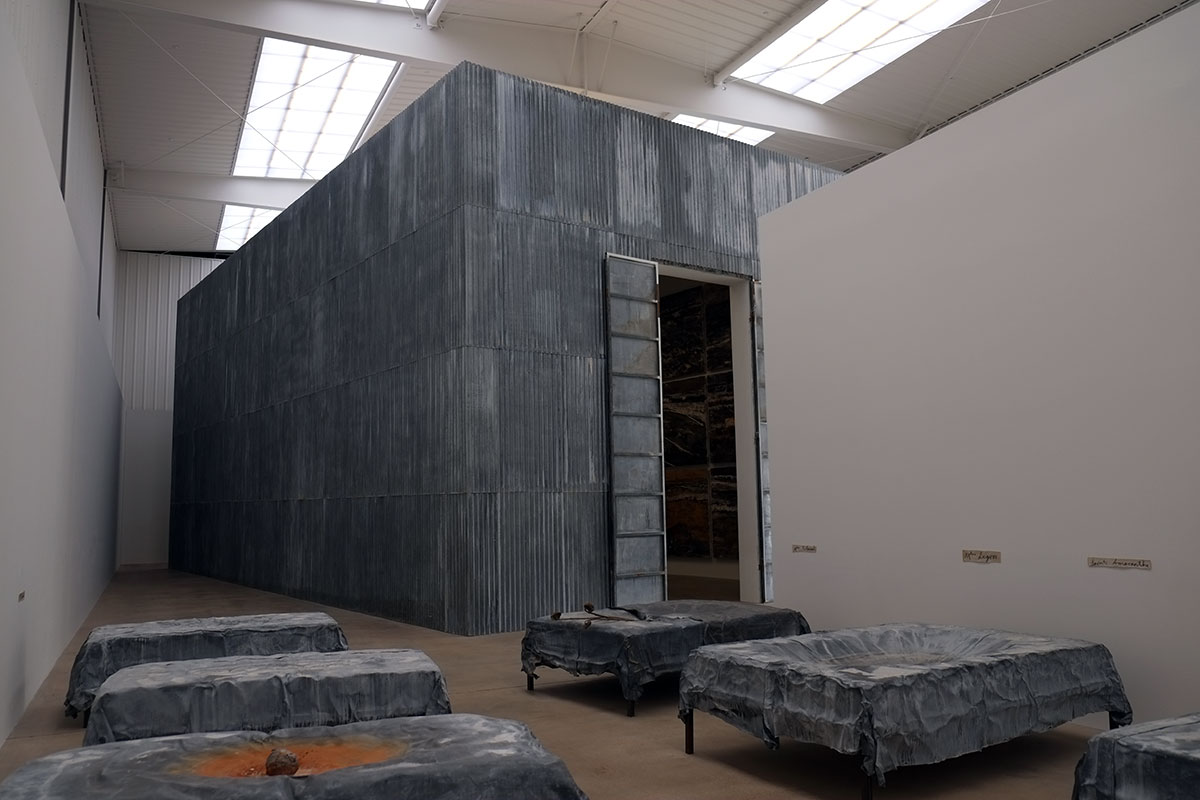
a building which houses Anselm Kiefers

a building which houses Anselm Kiefers

three big Kiefer installations

three big Kiefer installations

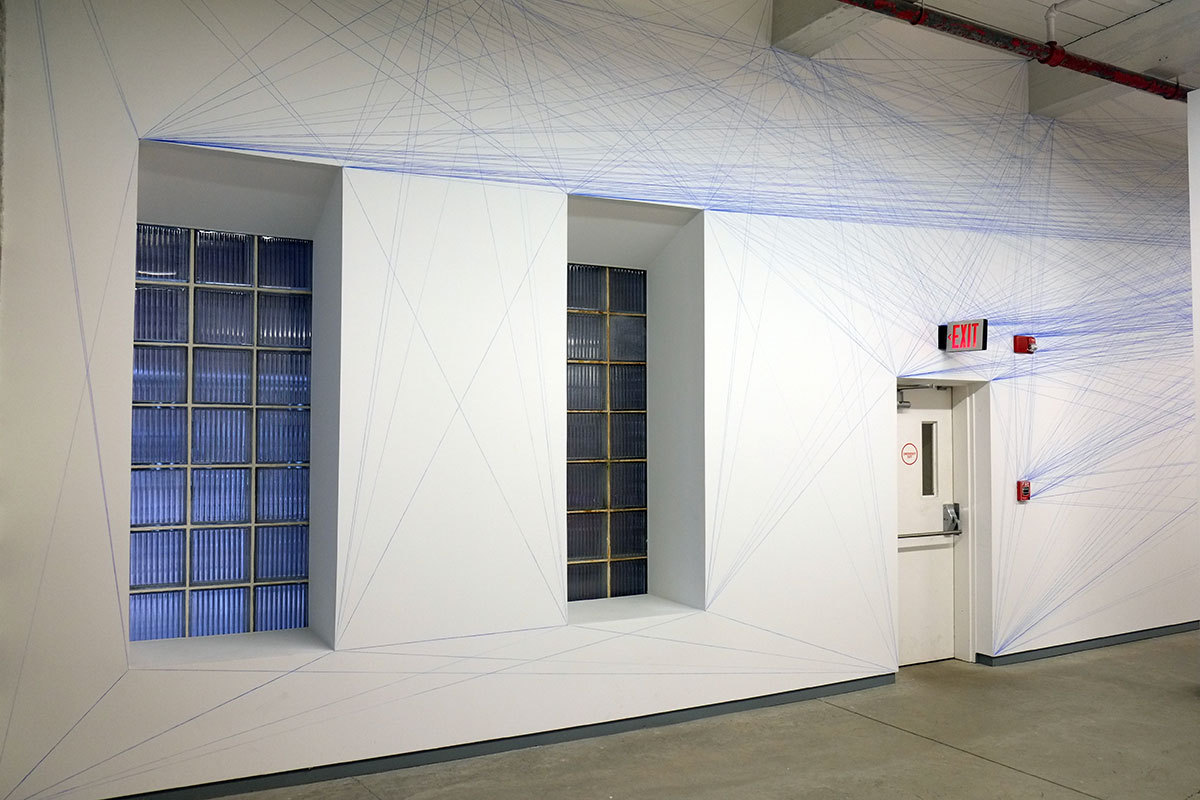
There is a comprehensive Sol Lewitt retrospective which occupies three floors.  I really enjoyed seeing so many in one place, as you can see the progression of ideas.

DSCF2607

Greta really liked the earlier ones, driven by explicit concepts/rules.DSCF2613

DSCF2472

growing tress and then turning them outside down. Apparently this is controversial with members of PETT.

growing trees and then turning them outside down. Apparently this is controversial with members of PETT.

This was way cooler than we thought it would be.  It’s only 150 miles from New York or Boston.

The Empire State Plaza Strikes Back

I’m a firm believer that you can’t really understand a work of architecture until you’ve seen it in person.  The Empire State Plaza in Albany bears this out. – photos can’t do it justice .  Going to Albany to see it is well worth the trip.

I had been there a few times in the past, most memorably at night in deep snow back in the 70s.  I had a few pictures of it which I used in my class, but I needed better ones.  More importantly, I had to see if my memories of it could possibly be real, or whether I had built it up out of proportion over the years.  I hadn’t – it exceeded my memories in many ways.

I think that the Empire State Plaza is the worst urban redevelopment project to ever be built in this country.  It is not nearly as well known as it should be – being in Albany, as New Yorkers famously ignores everything that happens in Albany.  If this project were in New York, it would be known world-wide.

It is terrible in at least three ways:  as a whole, as individual pieces, and for what it did to the city of Albany.

DSCF2245

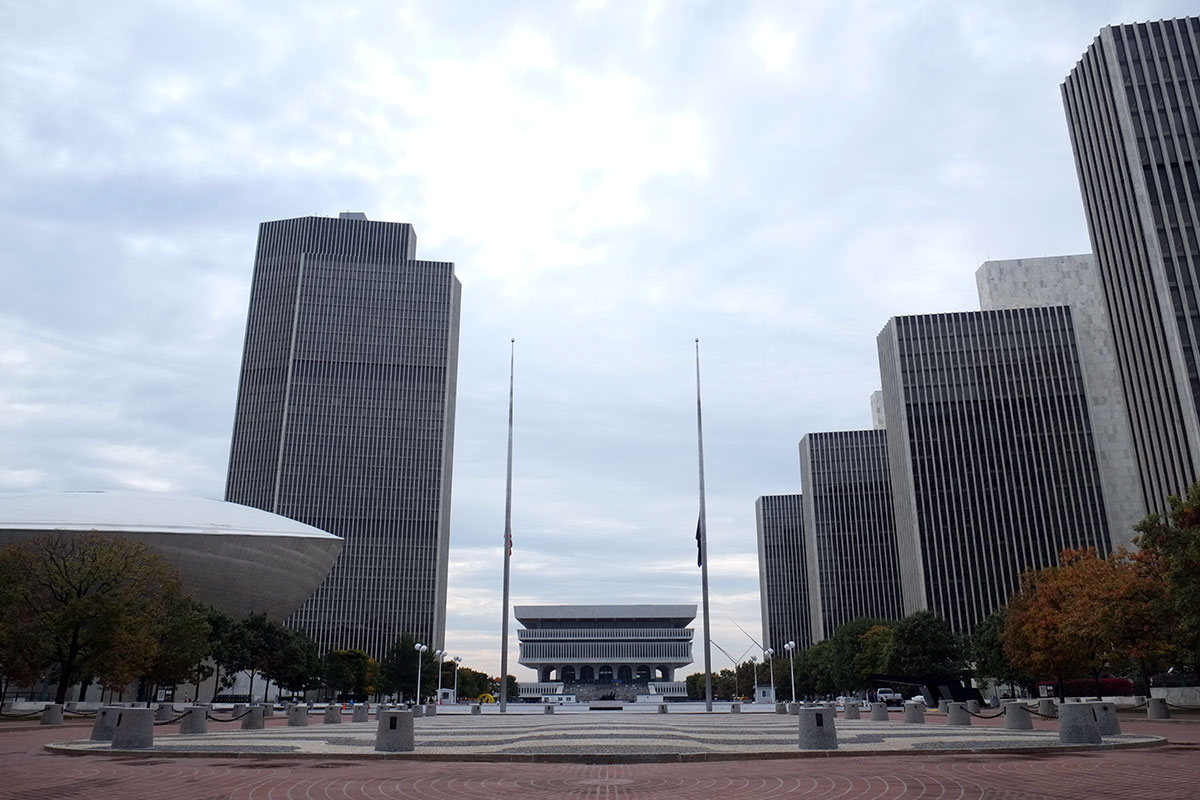
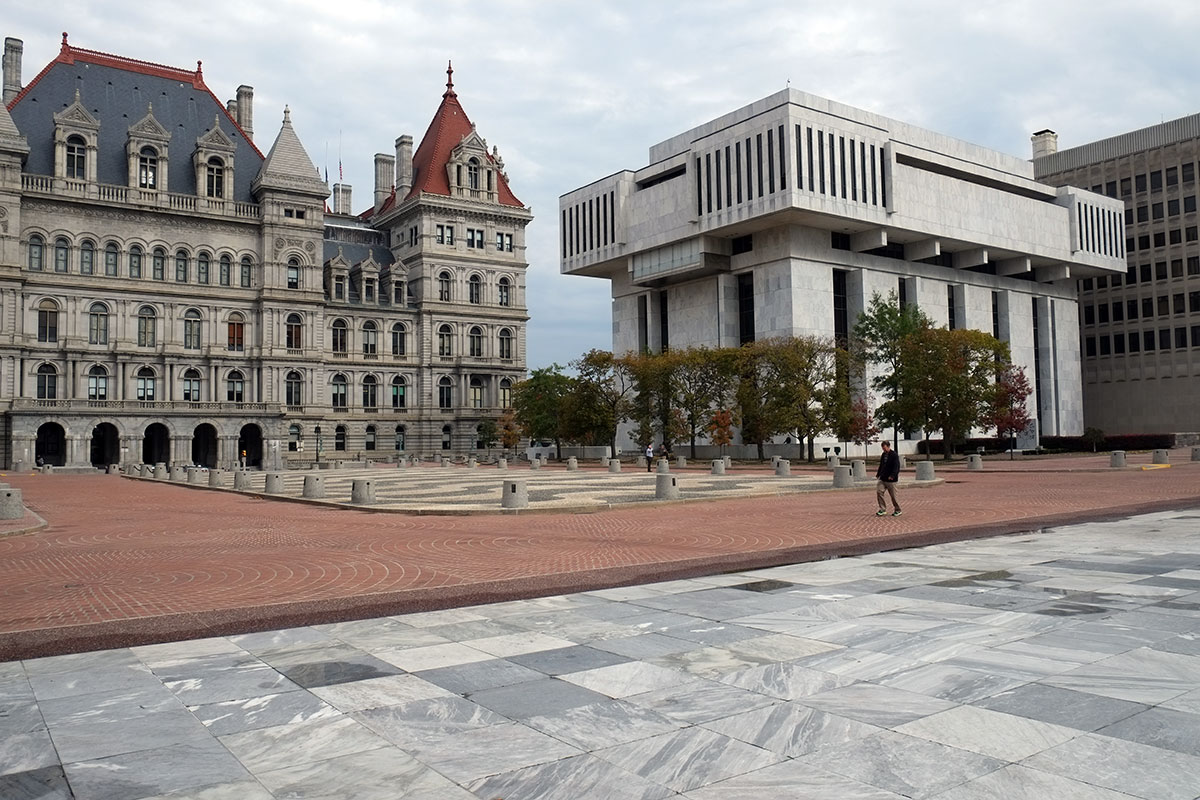
The scale of it is enormous – 4/10 of a mile (12 blocks) long, 1/4 of a mile wide.  It is a vast, empty plaza, devoid of all but smokers even on a warm day.  In the winter, I’m sure no one ever goes onto it, as there is a whole subterranean concourse level beneath, which connects all the buildings.  DSCF2254

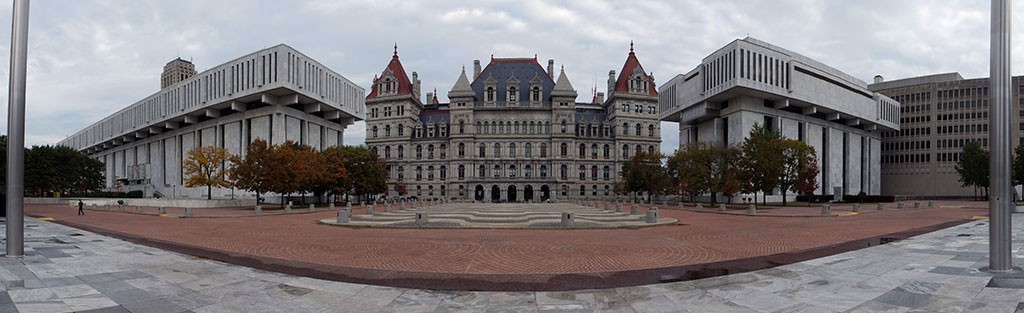
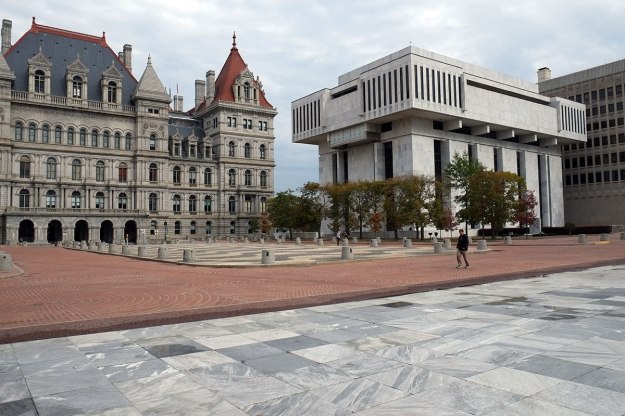
To walk into the plaza is to be humbled, to feel the power of the state poised to crush you.  Greta hummed the imperial march from Star Wars the whole time we were there. The newer buildings dwarf the Capitol, and their massive solidity seems about to crush the dainty Capitol between them.cropped-dscf2262.jpg

The State Capitol sits on the top of a hill, and the plaza has been built up to a slightly higher level – perhaps symbolizing that the power of the state lies not in the feckless legislature, but in the inertia of the bureaucracy?  DSCF2268

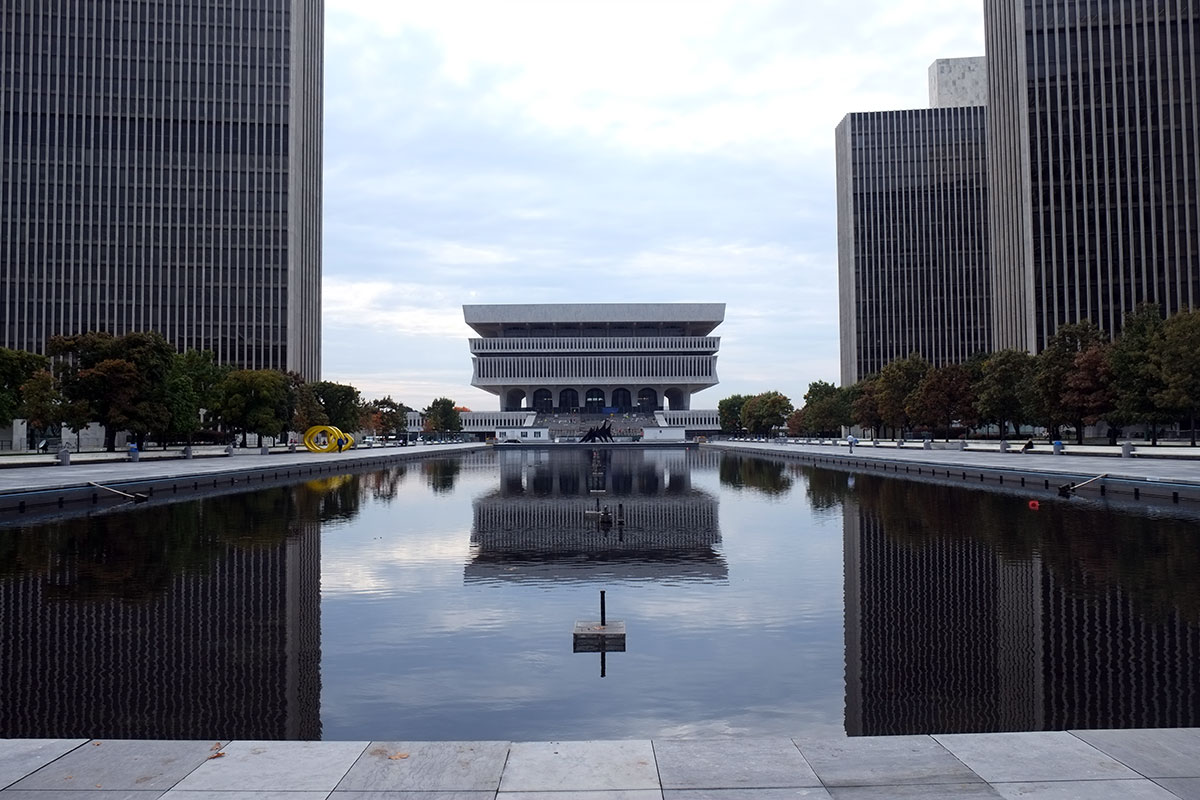
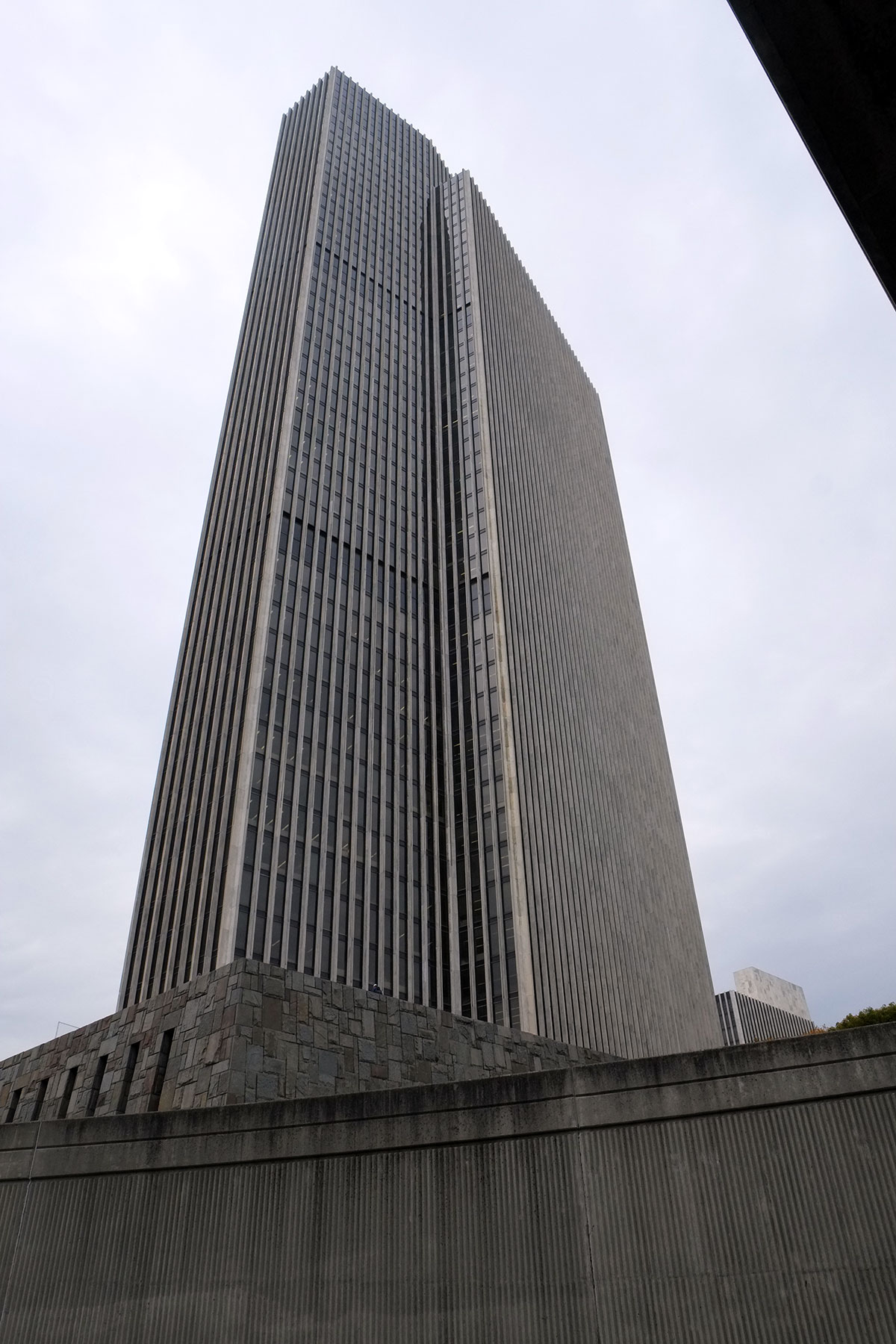
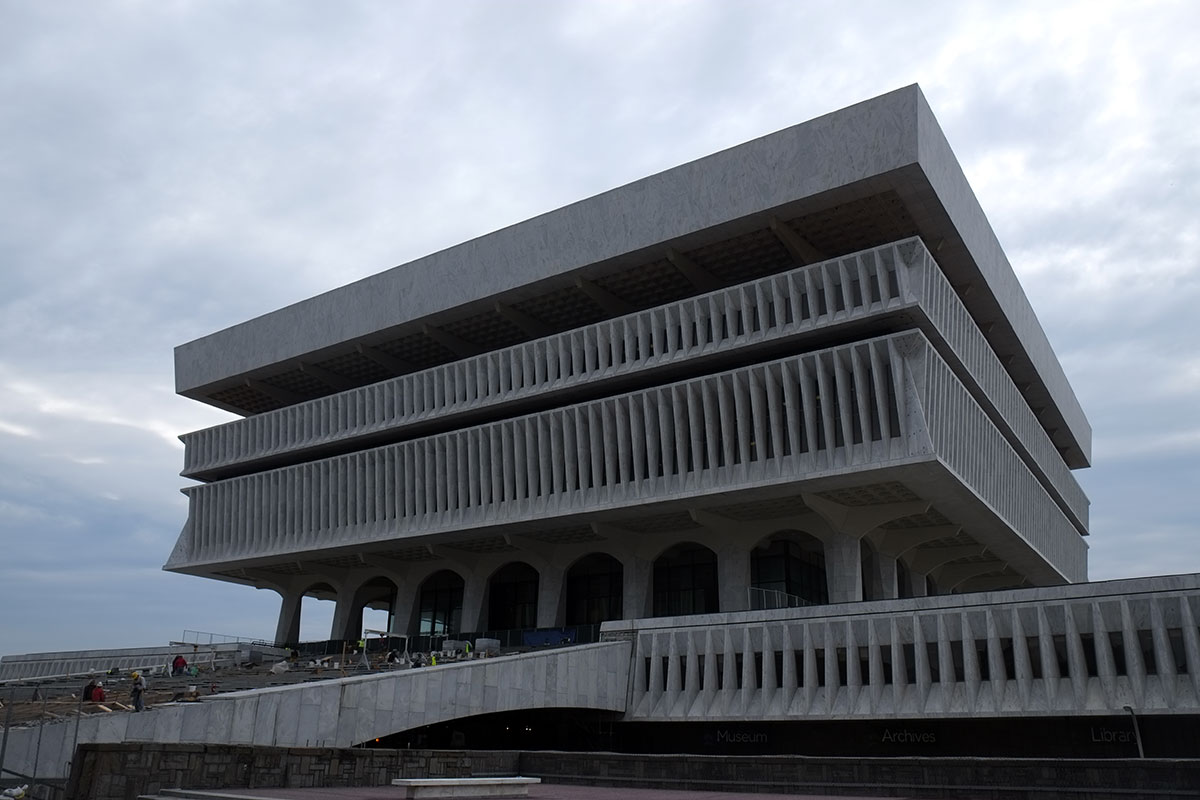
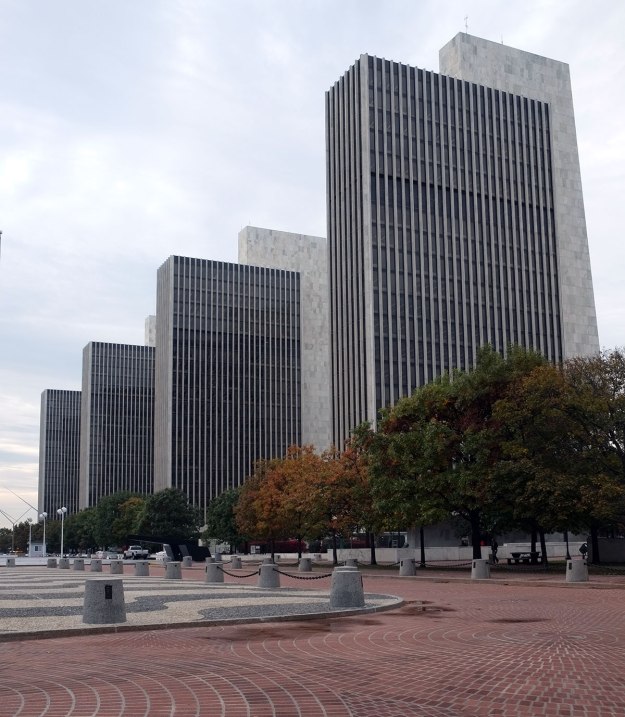
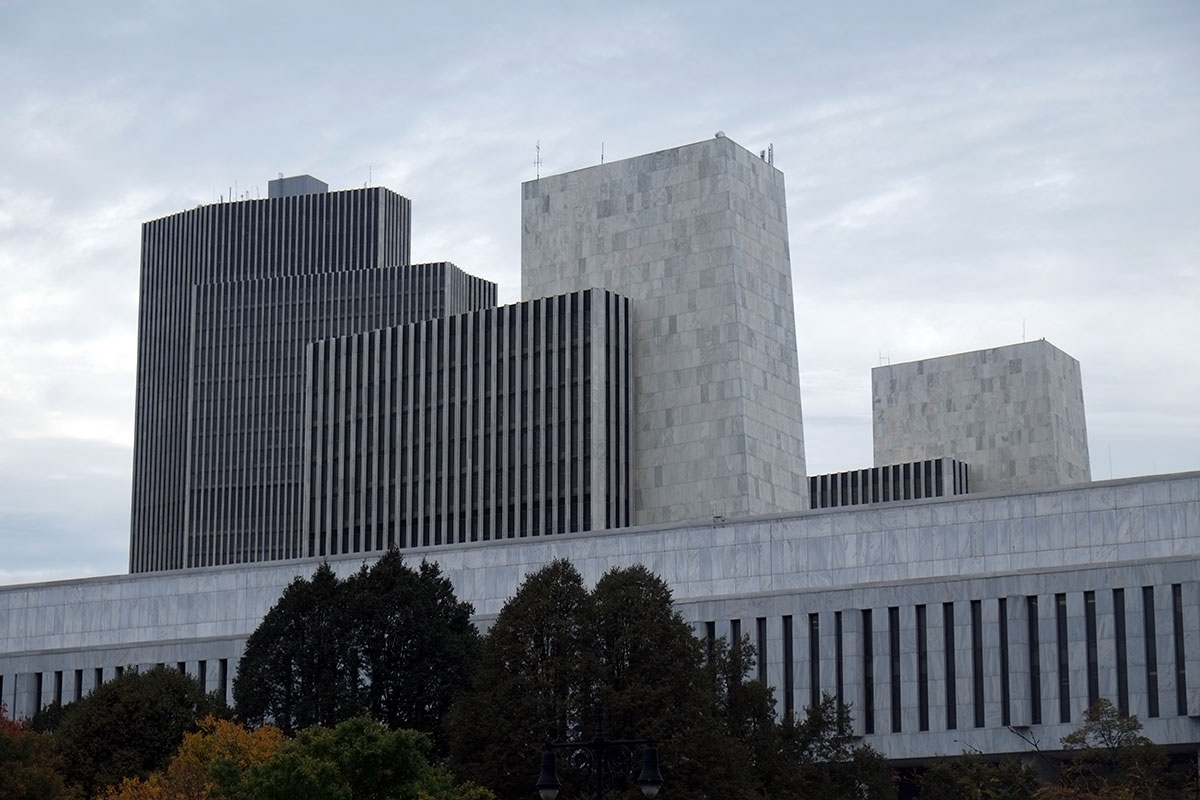
The buildings range from the banal to the truly awful.  Wallace K. Harrison was Nelson Rockefeller’s favorite architect, their association going back at least to the design of the UN (where Harrison first began copying Corbu).  He was of the grandiose modernist school (which is often detectable through the excessive use of marble), and in New York he was partially responsible for Lincoln Center.  The buildings fit into the simple parti of the plaza design – a museum facing the Capitol at the end of the axis, four smallish towers on one side facing a large tower and the “Egg” on theater, with a couple of bookends near the Capitol.

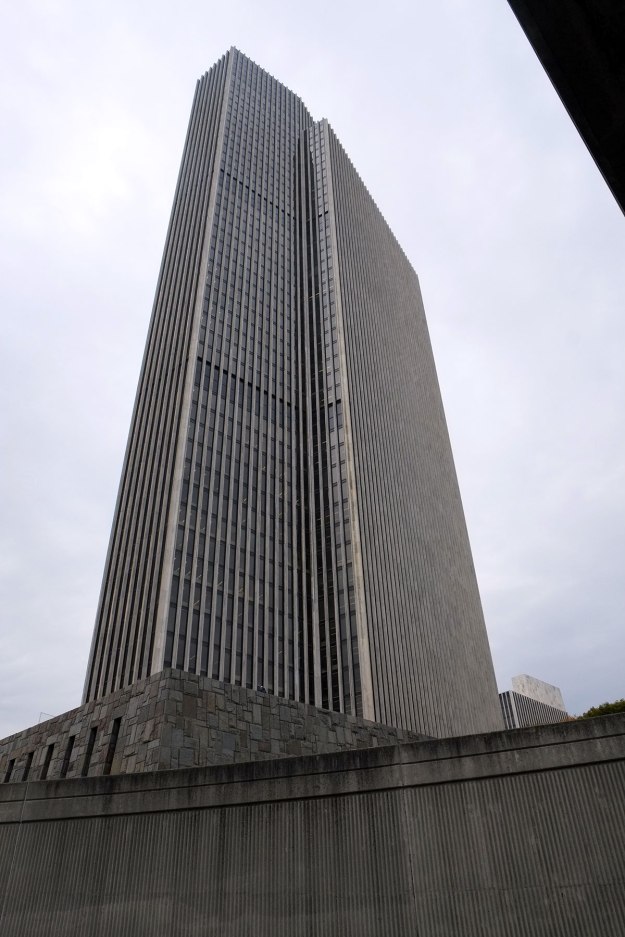
The towers are not so bad as objects.  Elegant and slim, there are two nested masses, expressing core and office floor area.  The idea of a series of identical towers works, and their footprints are actually quite small, with the potential for good daylighting.  The problem is all that empty space in between them.  The large tower refers to classic slabs such as the RCA Building, but in the extreme tower-in-the-park vein.DSCF2271DSCF2352
The Egg is rather funny.  Sometimes it looks like a boat, sometimes a duck, sometimes an egg. This is another element in the channeling-Corbu vocabulary – the expressive, playful highlight which contrast with the preponderant rationality (think of the stuff on the roof of the Unite).   I can’t imagine they named it the Egg to start with; I like it when a nickname is so perfect it has to be acknowledged.DSCF2255

The museum is ponderous and looming, at the top of a huge staircase that spans a street.  Most schoolchildren enter from the streets way below, so they don’t experience the whole effect.DSCF2241

The two building flanking the Capitol are the worst.  Massive, clunky, ill-proportioned.  (They are so ugly that I suspect Harrison’s even-less-talented partner, Max Abramowitz, must have had a hand in them.)  They try to articulate some aspects of their systems – such as the beams which support the overhanging upper stories – but the differentiation of parts doesn’t work if you just cover everything with marble.  Greta and I have been defining a few building types on this trip, related to popular culture, with the Barad-Dur type showing up pretty often.  Greta immediately classed this building in the Star Wars ATAT type.  DSCF2258
DSCF2276

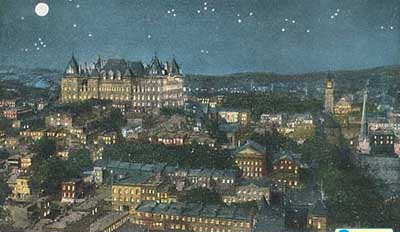
But the biggest problem with this project is what it did to the city.  The Capitol sits at the top of a hill, with the commercial and residential districts on the slopes below it.  Albany1

The neighborhood seen to the left in the old postcard above was obliterated, and the podium / plaza run straight out from the Capitol.  By the time you get to the south end of the museum, the edifice looms above the city.DSCF2237

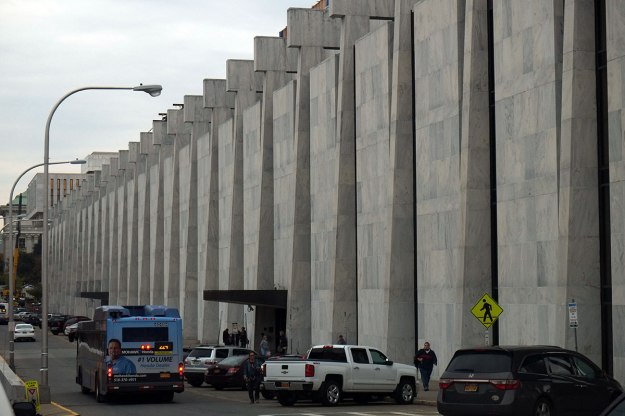
To the west, a long, lower building presents an impenetrable wall.DSCF2362
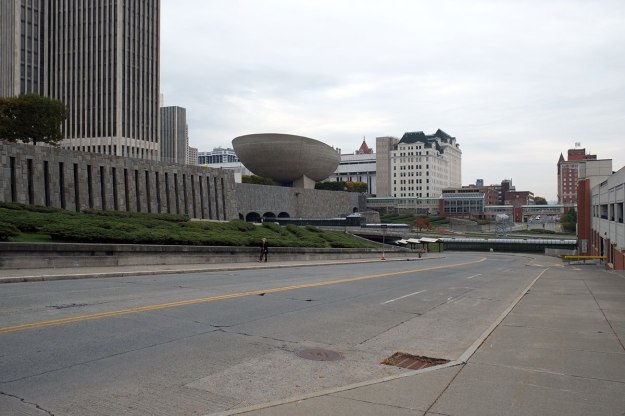
And to the east, facing the Hudson, there is a giant rampart, from whence the defenders can look down upon the populace.DSCF2246

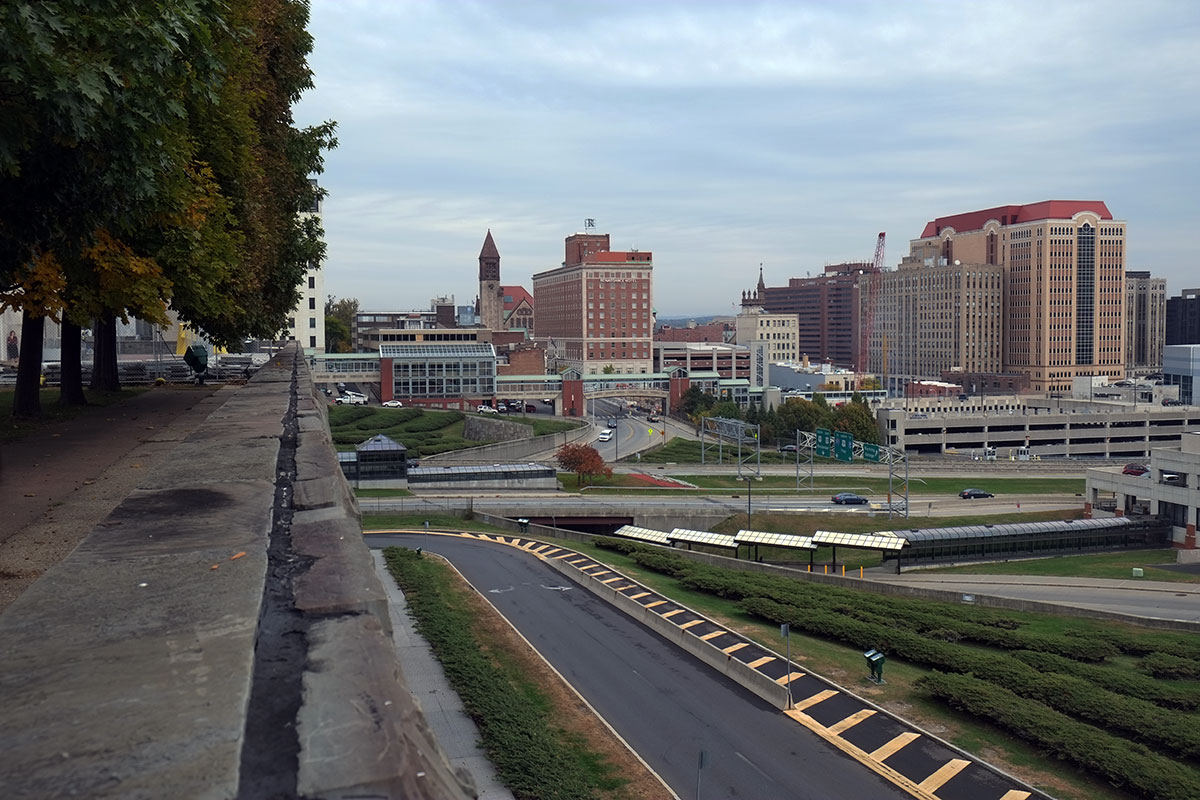
But there are no people here (except a few lost pedestrians), as the area has been cleared for approach ramps that lead to the parking garages in the podium below the plaza, and to the streets on the west side.DSCF2356
The relationship between the plaza and the Capitol may be problematic, but that edge is by far the most successful.  The imagery and message of the other three sides is clear:  the government is secure behind its defenses, and the danger and messiness of city life has been pushed far away.  There is a megalomania of architectural vision here that is seldom seen so clearly (the only other example that comes to mind is the Renaissance Center in Detroit).  Harrison, the lesser acolyte of Corbu, has achieved the complete destruction and negation of the city that the master was never able to fully carry out.
Dave McGann

Dave McGann was a good friend way back in high school, and we haven’t seen each other in almost 30 years. Dave is a year younger than me, and was the assistant editor / editor in training on the high school newspaper when I was editor.  What stands out in my memory of those days was how much effort we spent trying to sneak double entendres past the faculty advisor. Dave was smart and serious even back then, and as always, it’s been fun to see how your friends have gotten older but haven’t changed that much.

Dave attended SUNY Albany, and then stuck around the area, working at what seems to be the intersection of policy, research and media.  At his current position, he runs a group that deals with trainings, both live and online.  Dave says that if you’ve ever done an online training on harassment or something like that, there’s a good chance that they made it.  (I’ll be posting his email so you can send him comments.)

Greta and I spent a fun evening with Dave, his wife Louise, and their son Chris, who is about to head  off on a post-doc appointment near DC.  What really pre-occupied us was a discussion of beer.  I had been aware of Dave’s proclivities in this area from his Facebook postings;  actually, I’ve been aware of his proclivities since high school, so maybe now it’s more his accomplishments that are in the foreground.  Besides having rare microbrews that you have to drive to secret locations in Vermont to procure (and which can be sold at enormous markups in Brooklyn), Dave and his son have been brewing for ten years (it helps to have a PhD scientist in the family), and their beers were superb.  We drank great beer, ate fabulous Italian food (finally back in the part of the country which does real Italian), and talked about the vicissitudes of late middle age.
Dave and I had many of those heartfelt, serious conversations about the meaning of life in high school, and it’s wonderful to see how he has lived since then.  Like most of us, the facts of his life are pretty normal – career, marriage and two kids, suburban house – but it struck me that Dave has a keen appreciation of how good that has really been. Perhaps it’s partly due to Louise’s work as a social worker, where she deals with people much less fortunate every day.  But for whatever reason, Dave seemed really content, knowing that he’d made some good choices in his life, and that things had turned out better than we ever expected back in the day.

HH Richardson

Having left the midwest and arrived last night in the Boston area, the Architecture Greatest Hits tour moves along from FLW to Richardson.  Before I dive into the Richardson trove that is Boston, I think I’d better get the Richardson outliers to the west out of the way.

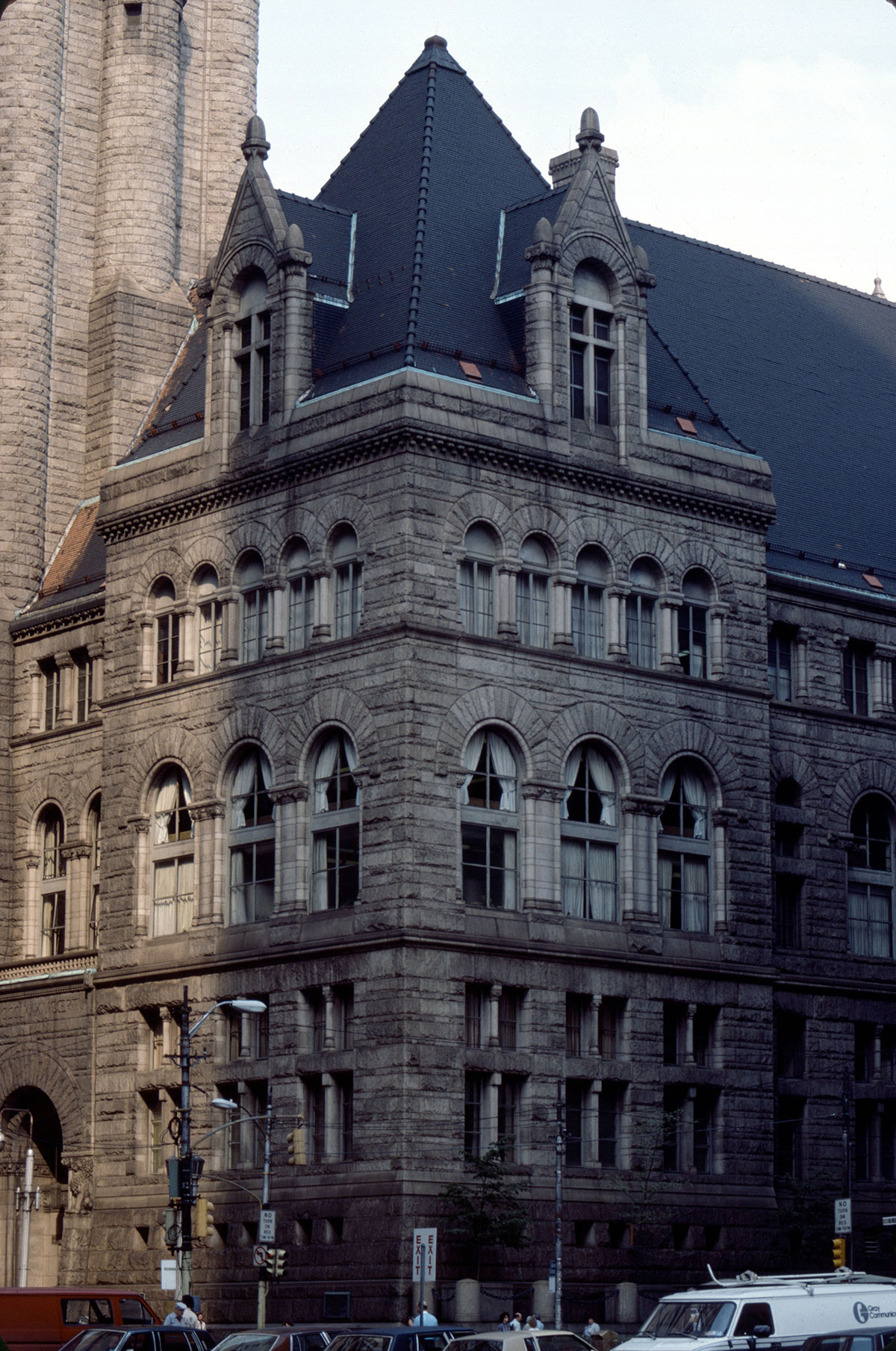
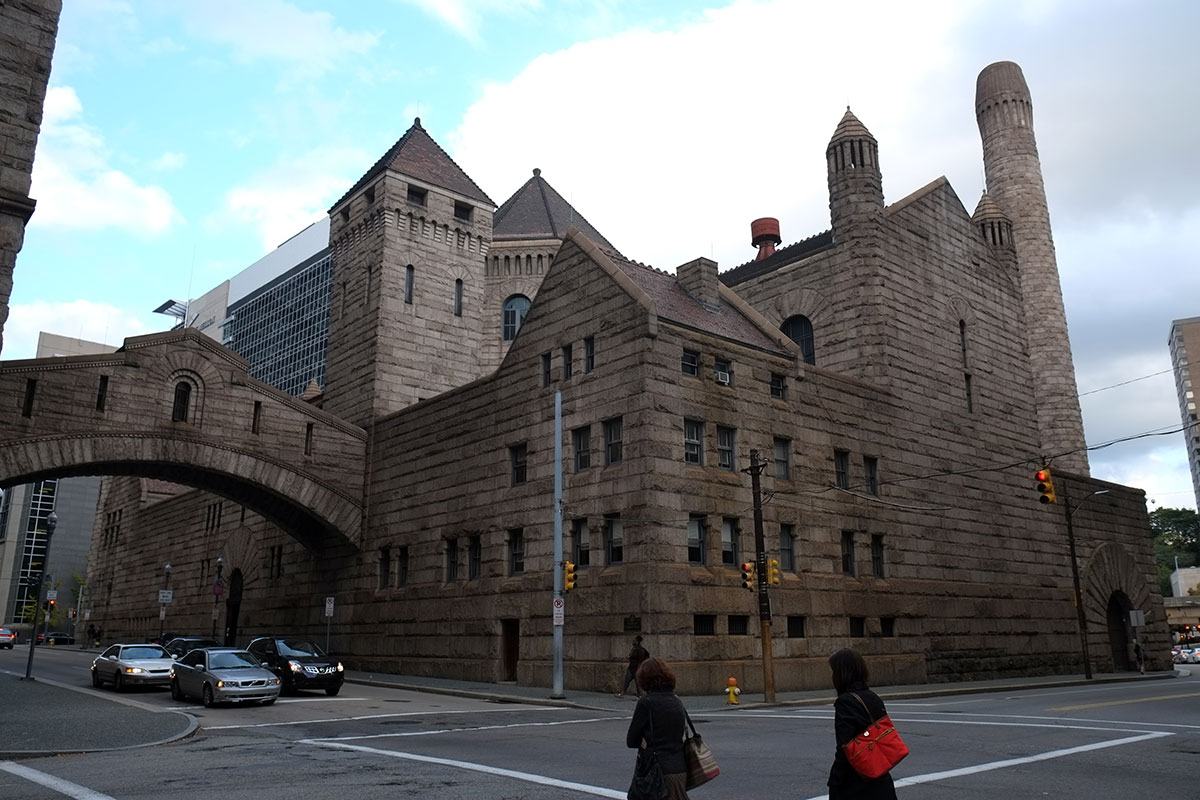
The Allegheny County Courthouse in Pittsburgh is one of his most complete, extended and perfect buildings.  In previous visits, I’d focused most on the courthouse itself, with its solid mass, beautiful tower, commodious entry and stair, etc. DSCF1221

Erie04 Erie08

Erie02

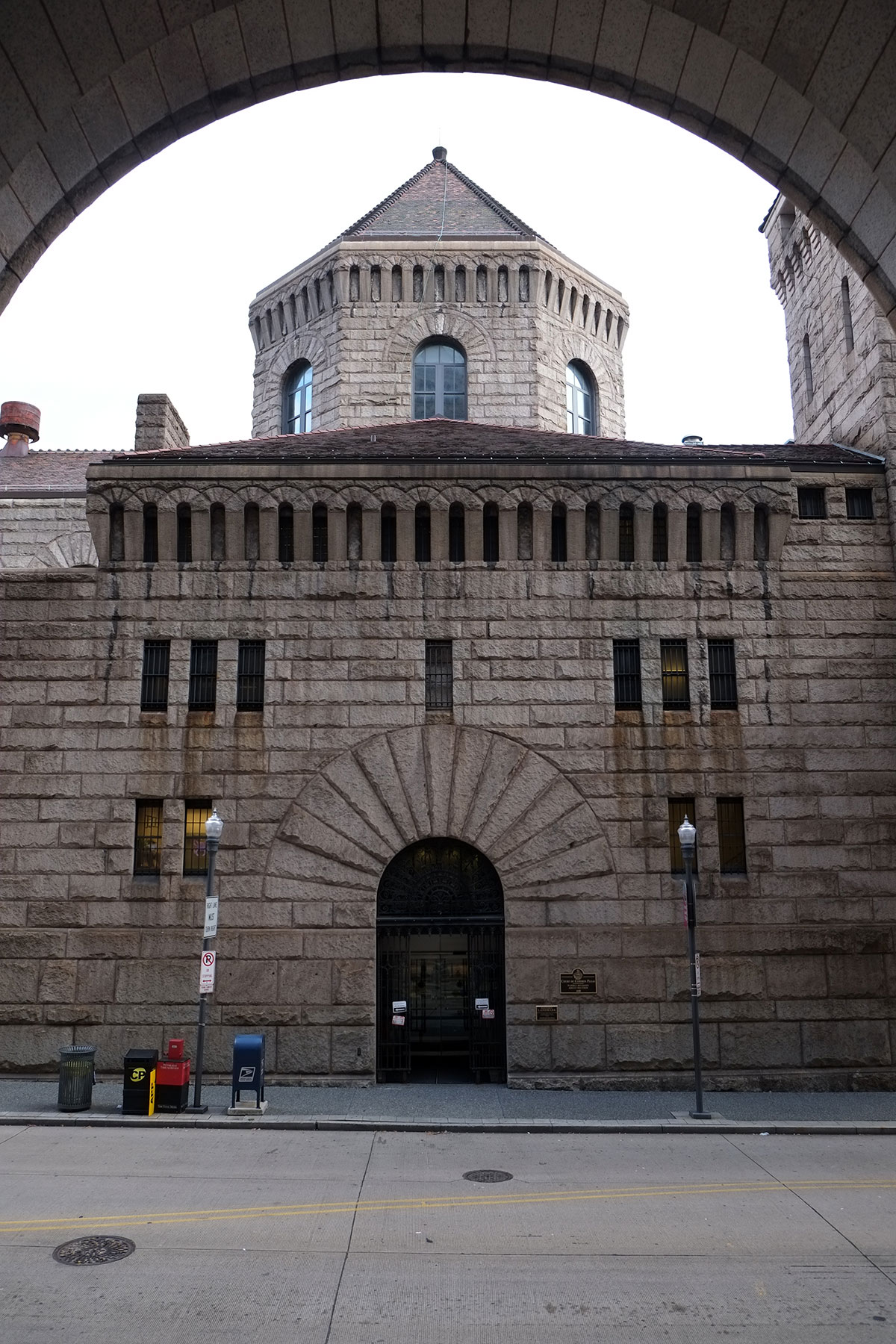
This trip we spent more time looking at the jail.  We often speak about Richardson as a proto-modernist, looking at the rationality of his planning, structural bays, how he led directly to Sullivan, etc.  But in the jail there are other elements at play that we would now regard as quite current – the play between order and disorder, symmetry vs. asymmetry, colliding grids and organizational systems.

DSCF1228

The site is irregular, but Richardson drops some axial, rectilinear volumes onto it, as if the site weren’t an issue.  Then he wraps all of this in a wall that addresses the streets.  Sometimes this is just a wall, and there are courtyards behind it,

DSCF1234

DSCF1275

and sometimes the wall becomes a building, with a whole different geometry.

DSCF1258

For formal entries and foci, symmetry is used to emphasize the centerDSCF1252

but in other areas, an asymmetrical  composition is made of the facade, tying into the field of the wall, but existing on its own terms.  DSCF1227

A building you can study for a long time, or as I pointed out in Minneapolis, you can just copy it.

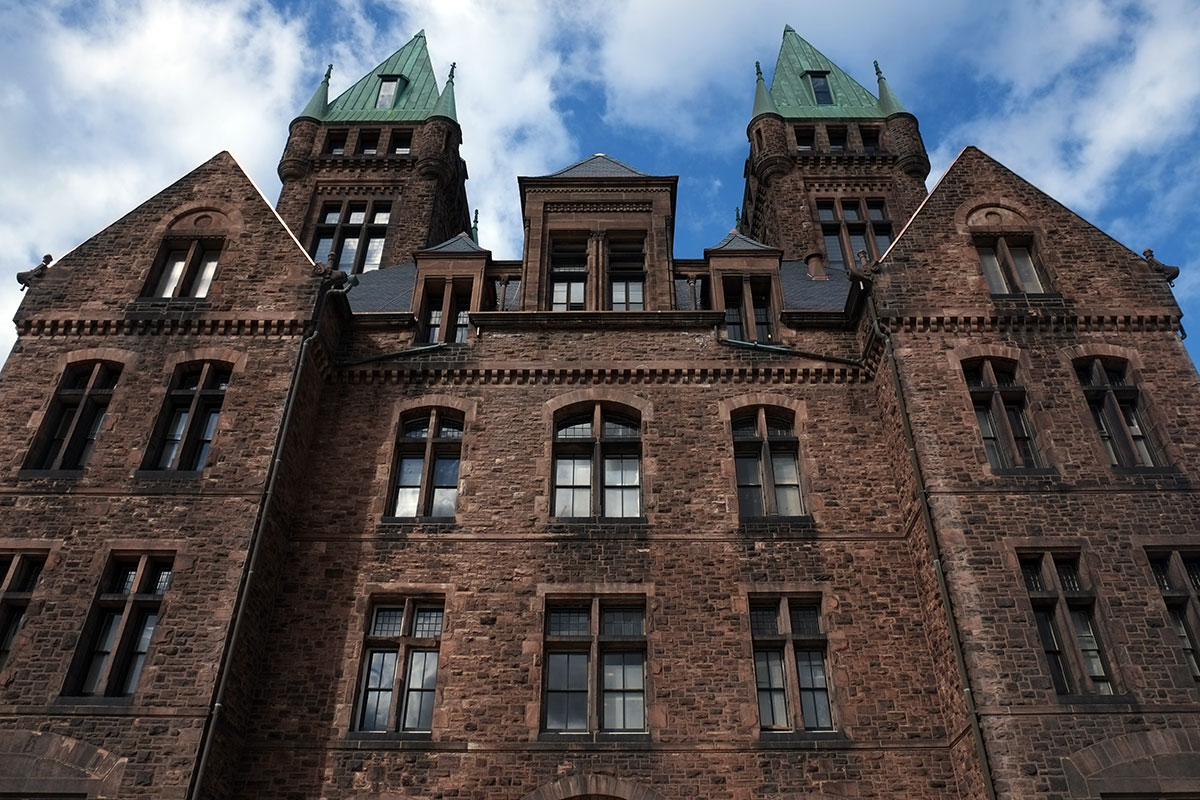
The psychiatric hospital complex in Buffalo is more conventional than this, and at first glance, it is one in a long line of buildings that might not be the most comforting for people having mental problems.   DSCF1897

It is a really large complex, with multiple pavilions and wings.  The central piece is very formal, establishing a clear hierarchy for a large building which rambles around.DSCF1877

but Richardson breaks down the scale nicely in the repetitive wings, each of which reads as a building (again, symmetry and asymmetry):DSCF1887

which are then linked by little connector pieces, and step back to form a series of open spaces.DSCF1886

In Albany we saw the city hall, a well-balanced exterior massing, with a simple, straightforward interior.DSCF2288

and the State capitol.  It’s hard to understand exactly what Richardson is responsible for here, as quite a few architects worked on it throughout a few decades.  However, he is generally given credit for the overall design of the elevations.DSCF2277

It seems that this massive exterior stair exists primarily to buttress the east facade, which started subsiding down the hill:

DSCF2286

DSCF2282

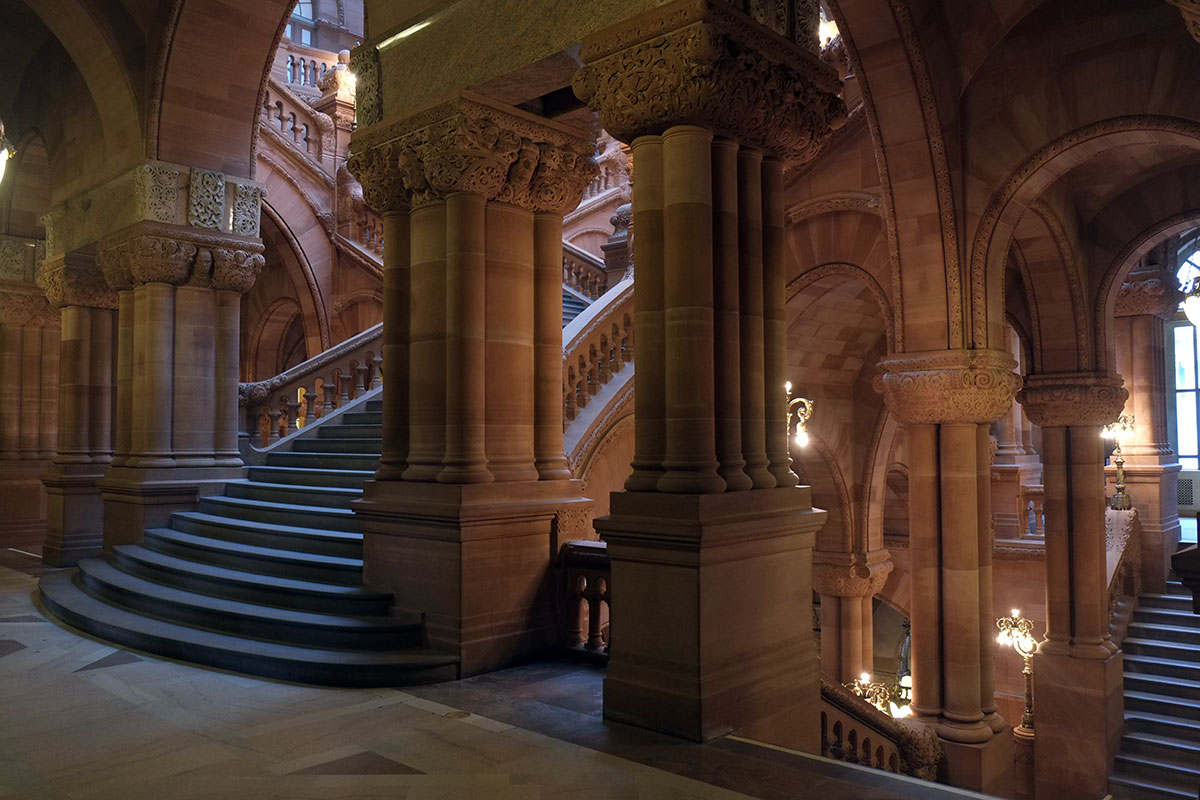
He also completed much of the interior planning, and the basic design for the over-the-top western stair.DSCF2312

This is truly the most extraordinary stair I’ve ever seen.   The space and procession are incredible, DSCF2302

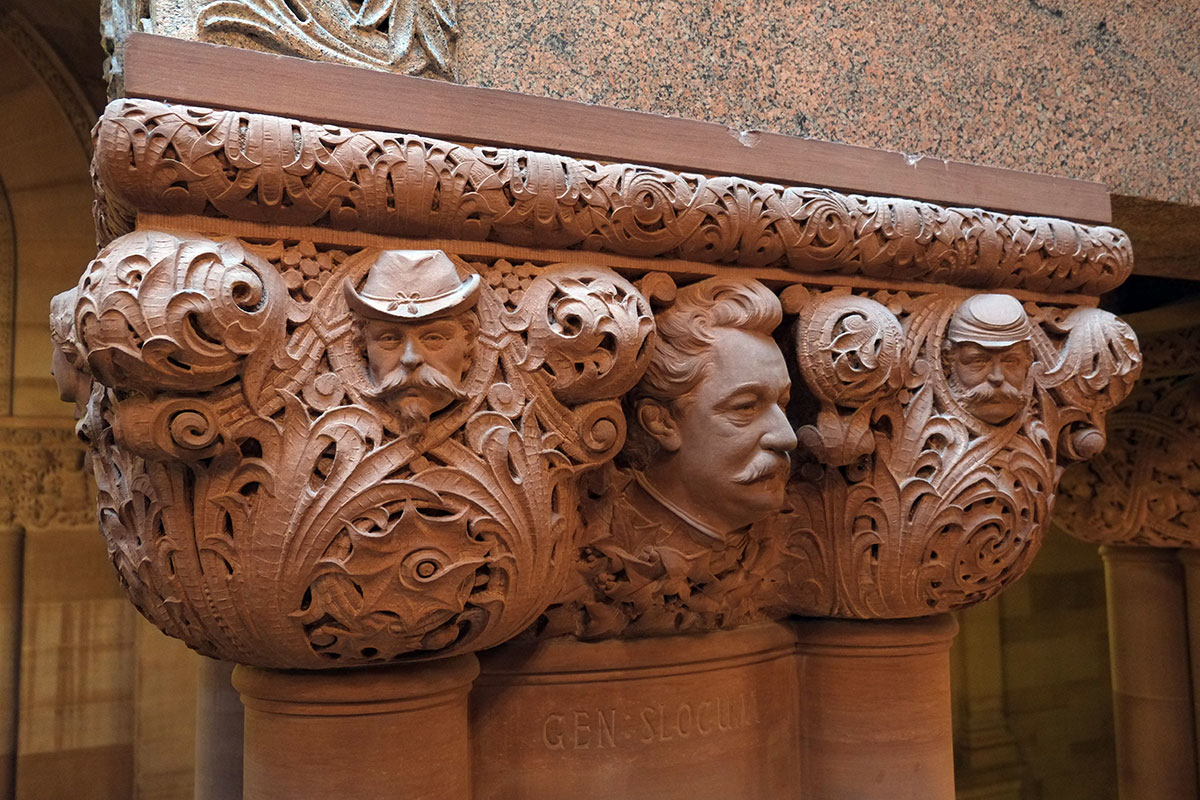
The detailing is insane, but apparently much of that was added by a later architect.DSCF2324

DSCF2331

DSCF2329

Albany is a place that is disdained (or more usually ignored) by downstaters, but this stair alone is worth the trip.  Beaux Arts planning meets Piranesi.

We now head into Boston, and more Richardson will follow, next week.

Terrance Goode and Carolyn Senft

Terrance Goode and Carolyn Sent were colleagues and good friends on the UO faculty back when I first arrived in 1990.  They were my informants in the culture:  when I was first applying for a position in academia, a mutual friend in New York told me to look them up, and they taught me everything a New Yorker needed to know about Eugene.  I would have been completely at sea without them.

I bought a house two doors down from them on 19th St., and we spent a lot of time together, cooking meals, discussing architecture, and trying to keep the cats from escaping.  They left town over 20 years ago, and have been happily ensconced in Syracuse for most of that time, where Terrance teaches architecture, and Carolyn has divided her time among teaching, designing, quilting, and raising their son Eli.

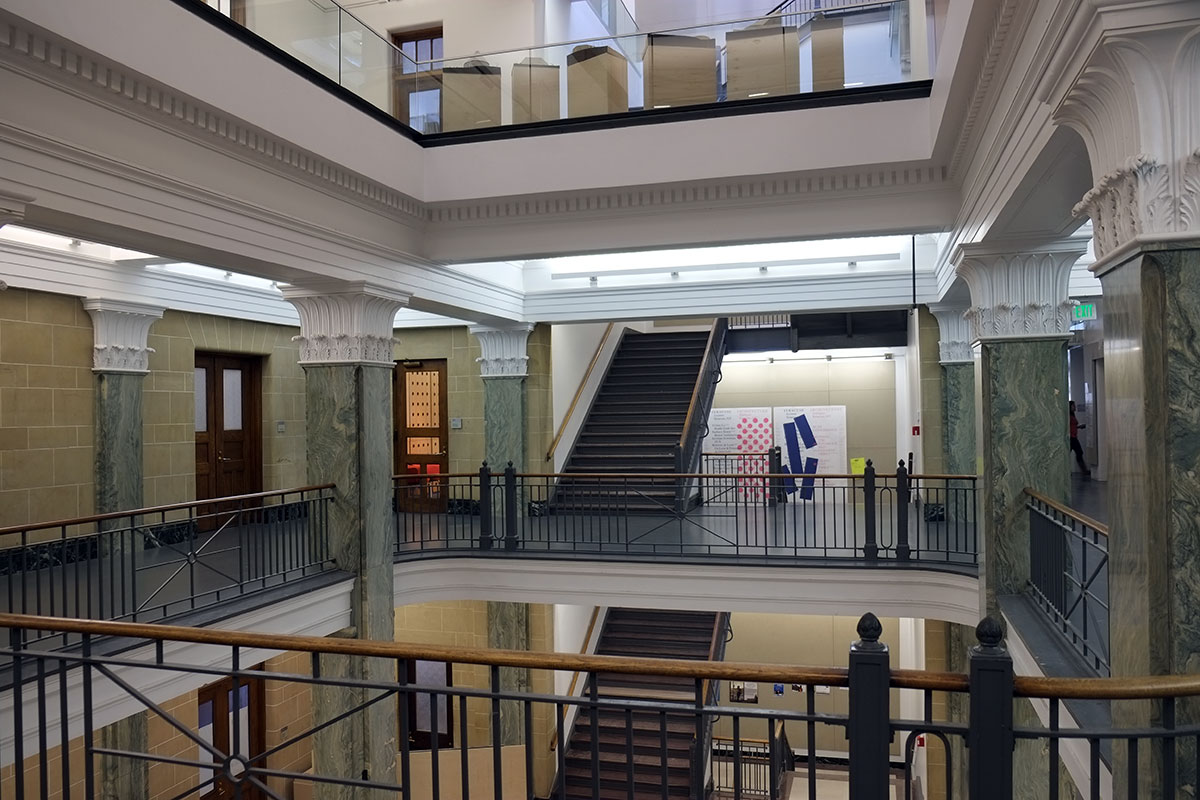
Greta and I spent a couple of days with them, where we once again spent a lot of time talking about architecture, driving both Greta and Eli to distraction.  We tooled around Syracuse seeing the sites, which include a commodious architecture building:DSCF2198

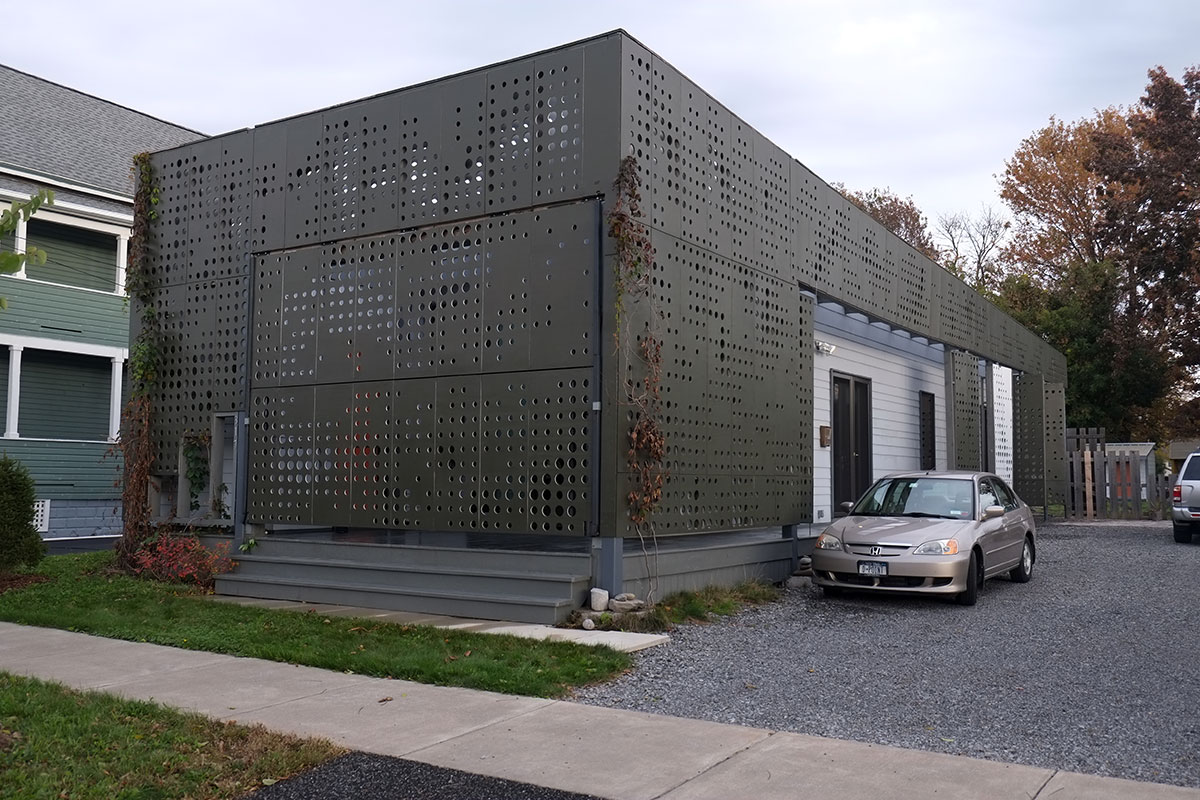
some student-designed housing which makes a statement DSCF2207

and evidence that football culture in Syracuse might be even a little more crazed than in Eugene (I haven’t seen any football banners hanging on churches in Eugene).  DSCF2167

We had a great time catching up after many years of long-distance communications.  T&C send their regards to their many friends in Eugene, who are probably wondering how I have managed to start this post with a photograph of them without a cat in it.  DSCF2216

Buffalo & Rochester

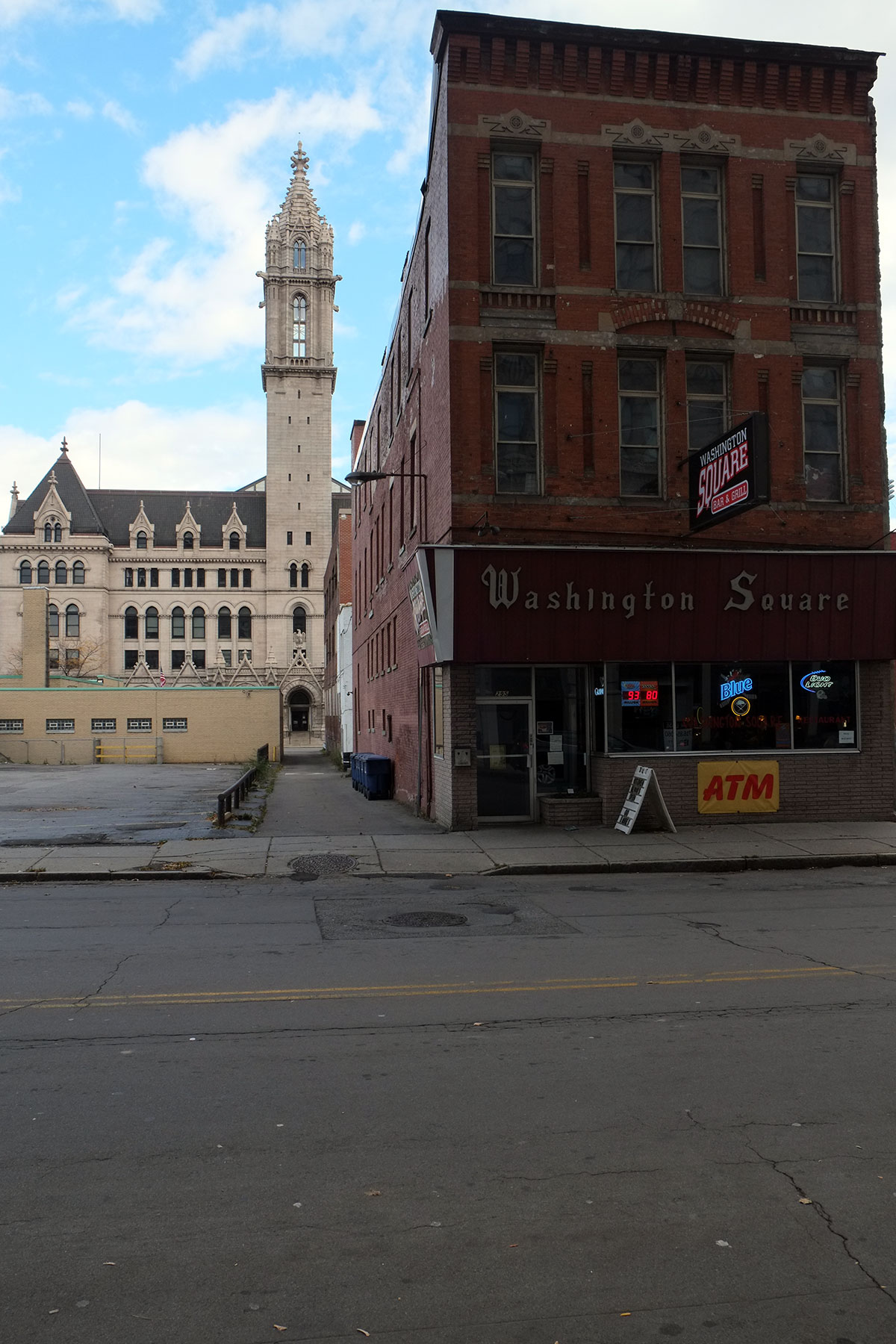
Continuing our tour of cities that were really important 100 years ago but not so much now, we cruised through downtown Buffalo and Rochester.  I think cities such as these are where you often find some of the best architecture and art in this country: they had a lot of money to spend back then, when you could still buy great European art, and when there seemed to be more clients who cared about architecture.

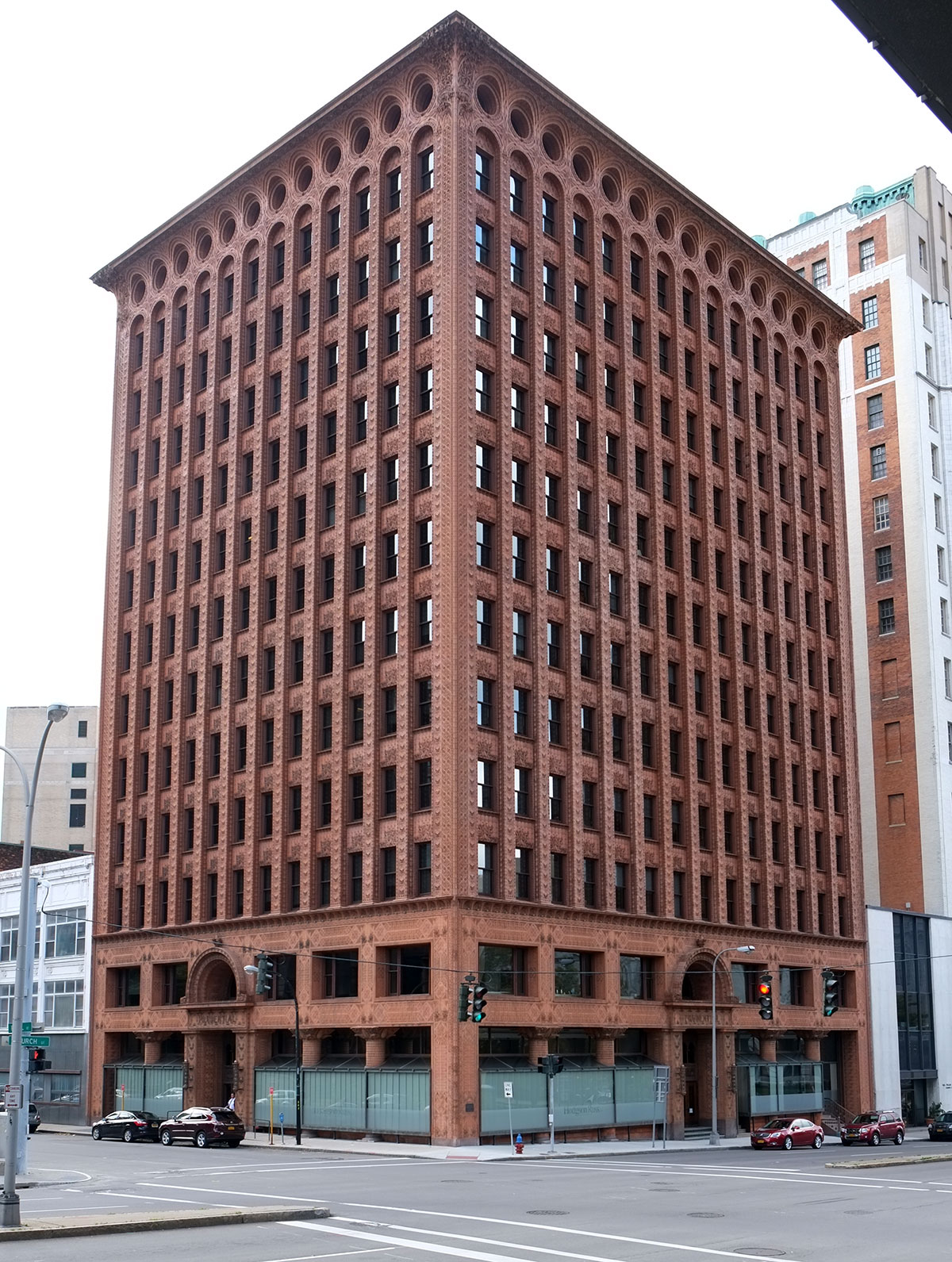
I’ve already posted the great Wright and Richardson buildings here, so the obvious completion of the architecture trifecta is the Guaranty Building, one of Sullivan’s best.  Simple, elegant, beautifully proportioned, it really stands out against the banal post-war buildings near it.  DSCF1913 DSCF1902

I was told to go see the Ellicott Square building by a few people – a full block building with a central skylit atrium.DSCF1924

DSCF1927

The train station, in context:DSCF1933

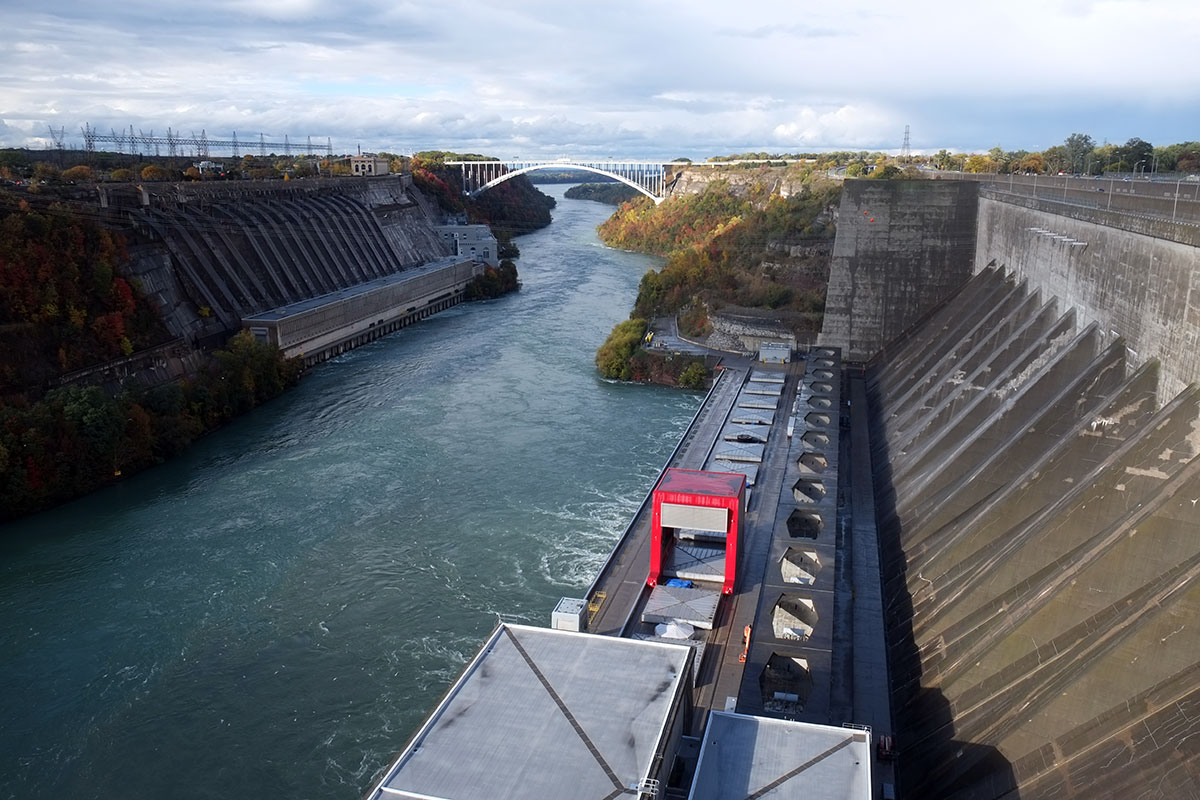
Down the Niagara River past the Falls, The New York State Power Vista is where the big American and Canadian hydropower plants face off against each other.  The sheer scale of these dams is worth a visit.DSCF1724

And inside the excellent visitors’ center, there is a surprise:  A Thomas Hart Benton mural, which is reminiscent of those in Kansas City.DSCF1737

Rochester doesn’t have a great reputation, and the downtown is not compelling – mainly mediocre buildings from all eras.  But there are highlights.

We came to Rochester to see the Kahn Unitarian Church, and the Broad Street Bridge, which when originally built, was an aqueduct which carried the Erie Canal over the Genesee River.  It was later used to carry the subway across, and with the addition of the top roadway level, converted to a vehicular bridge (also good for the parking of small trailers. DSCF1974

The Andrews Terrace apartment building started life in the 1970s as downtown luxury apartments which didn’t fly, and is now Section 8 housing.  What struck me is that many current architects are playing games with angles, and here is a 40-year-old building which anticipated many of the moves, quite elegantly and simply, since there were no computers to facilitate needless complications.  I can’t find who the architect was.DSCF1984

I think it’s pretty compelling when glimpsed from down the street.DSCF1949

Rochester has some buildings which I don’t think are very good, but they’re kind of fun:DSCF1990

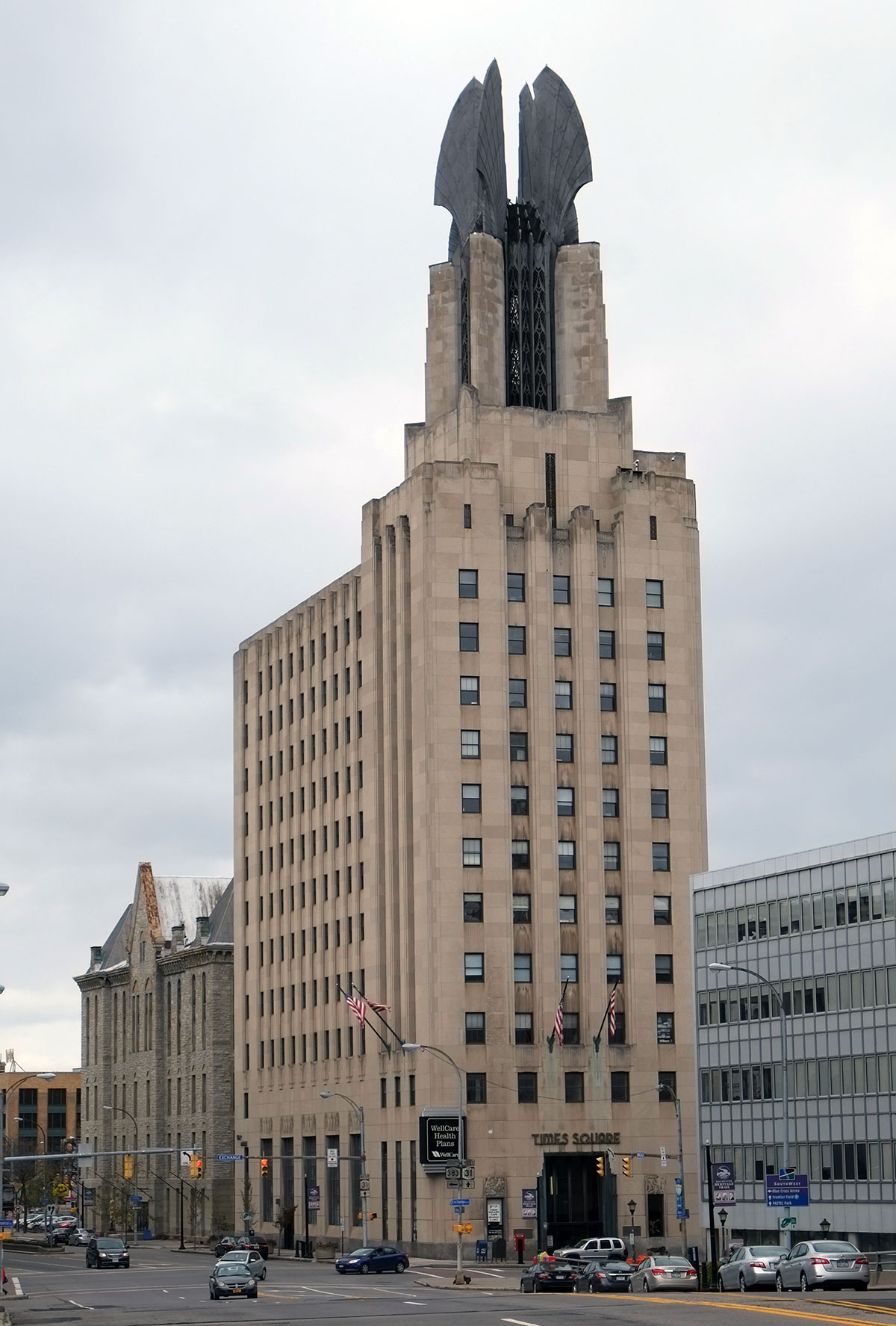
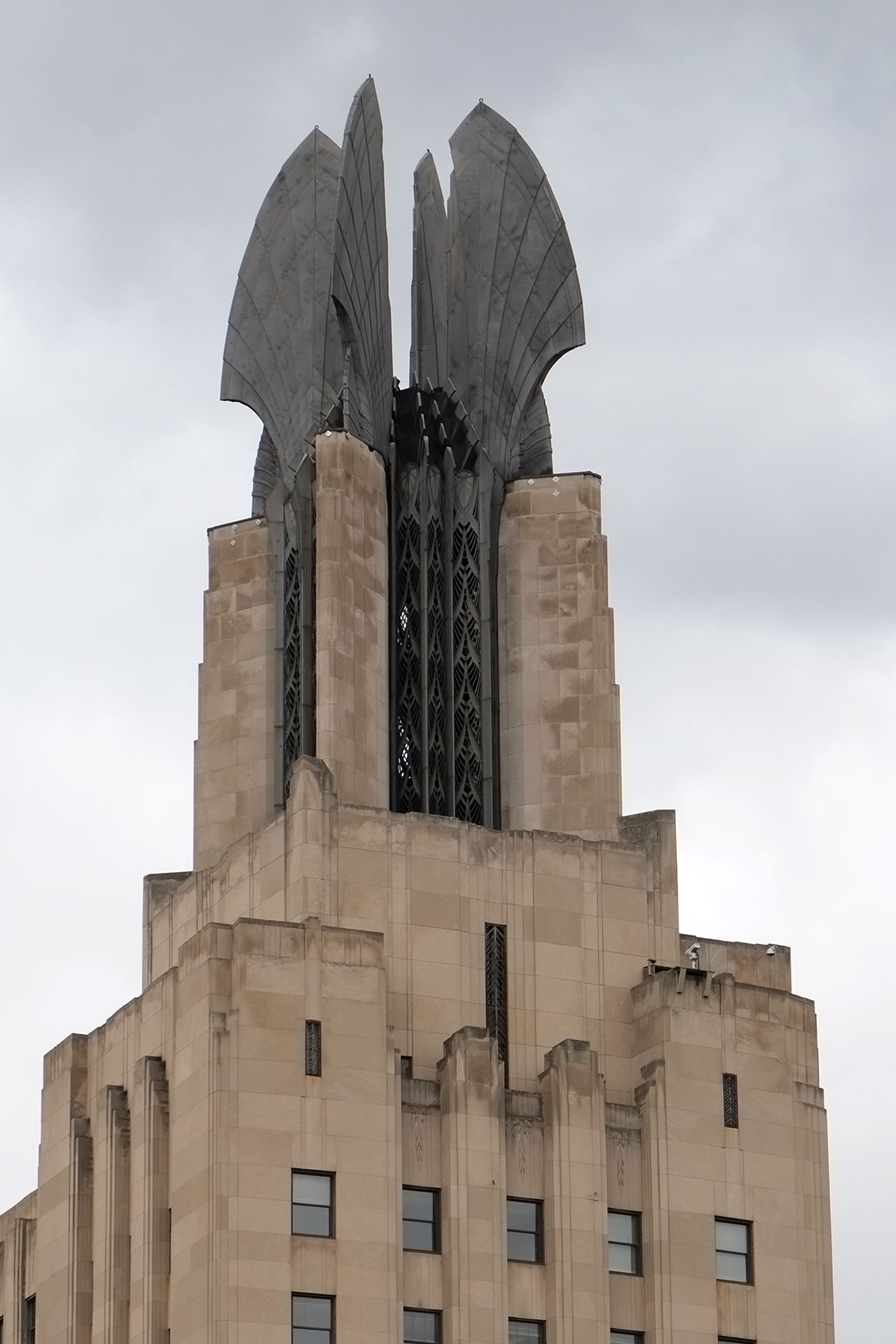
especially this one, which is open to many interpretations.  I thought Barad-dur, or maybe those fighters in Star Wars where the wings fold up.  Greta thought was Aragorn’s crown.  I have to admire the originality and chutzpah – never seen anything quite like it.DSCF1952

DSCF1956

Backroads

Since we reached Pennsylvania we’ve done a pretty good job of staying off interstates.  We travel a little more slowly, but we see things and places.  Here are few places that haven’t gotten their own posts.

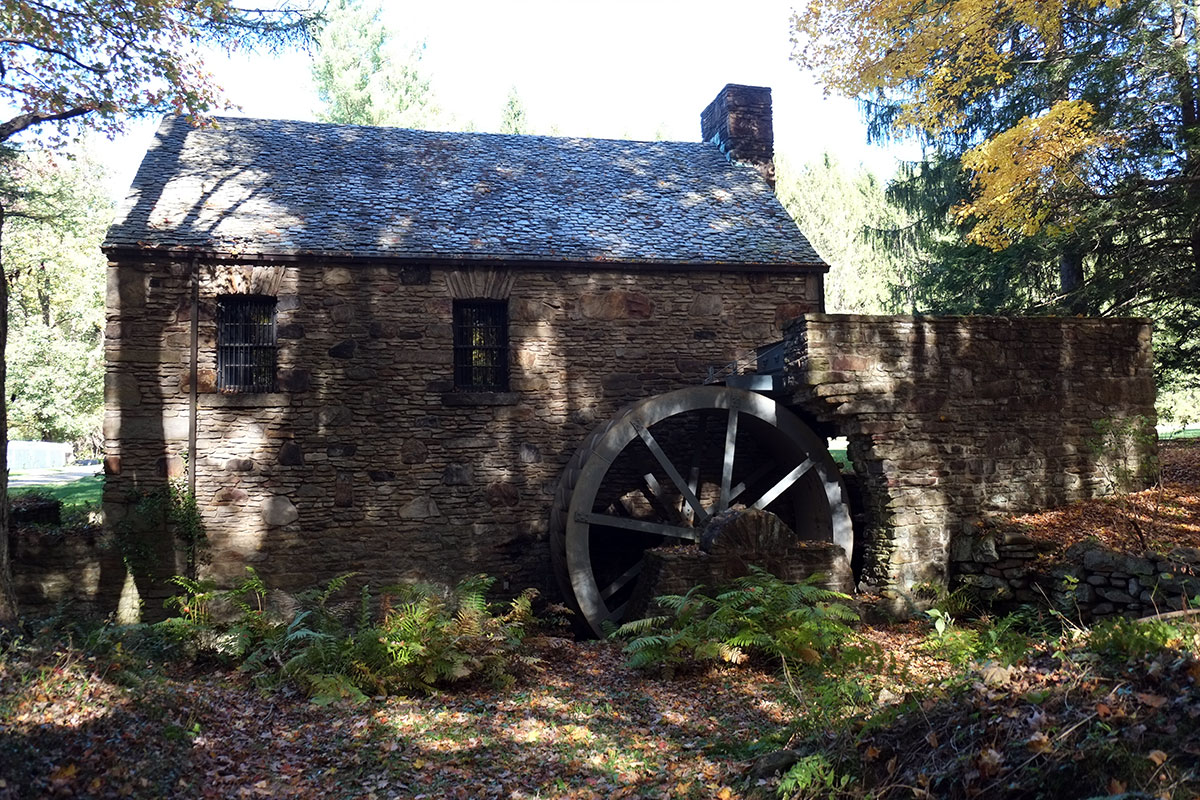
Once again John Wenzel was our guide around the Ligonier Valley, showing us things that we would never have found our own.  An 18th century grist mill.DSCF0790

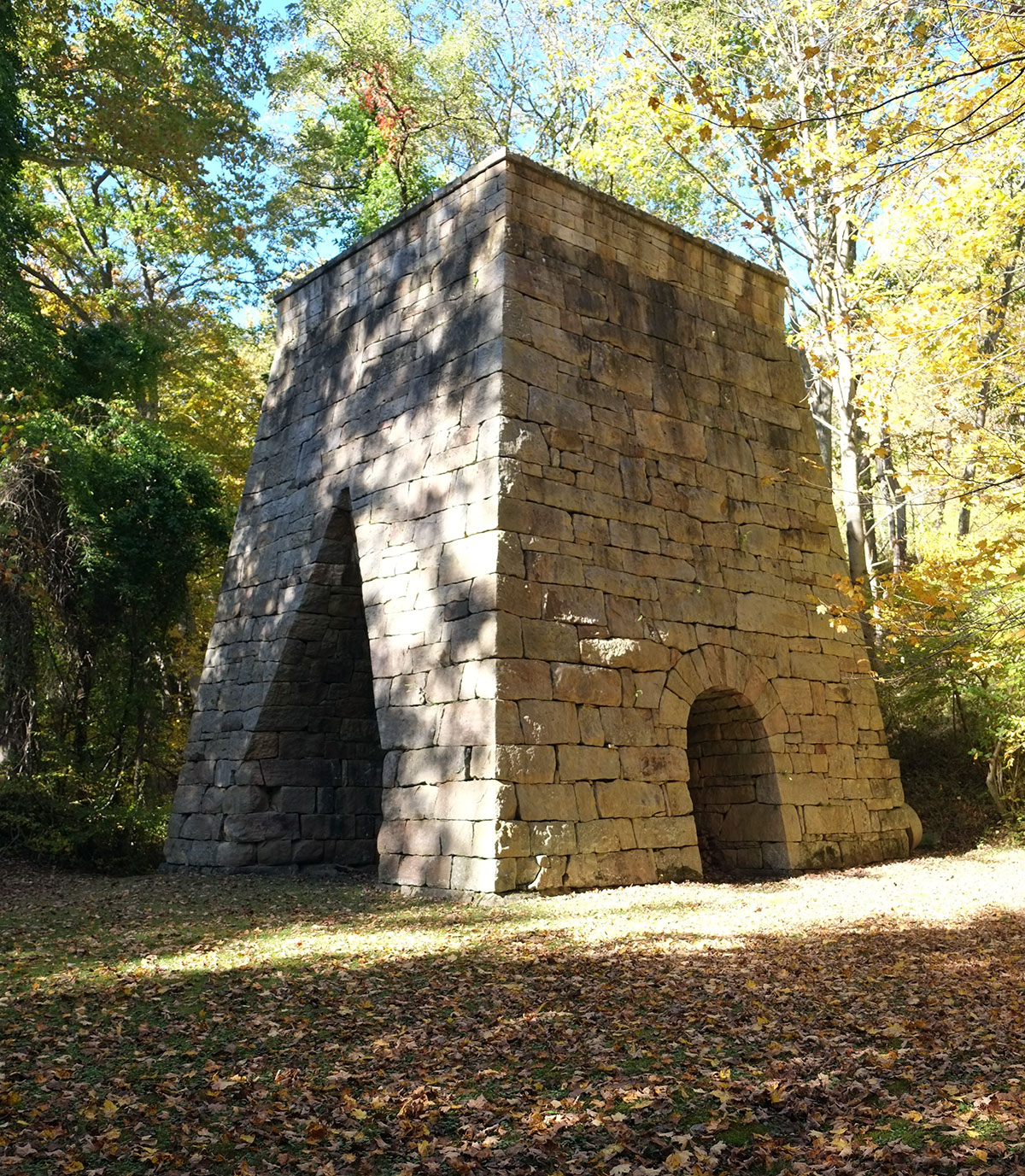
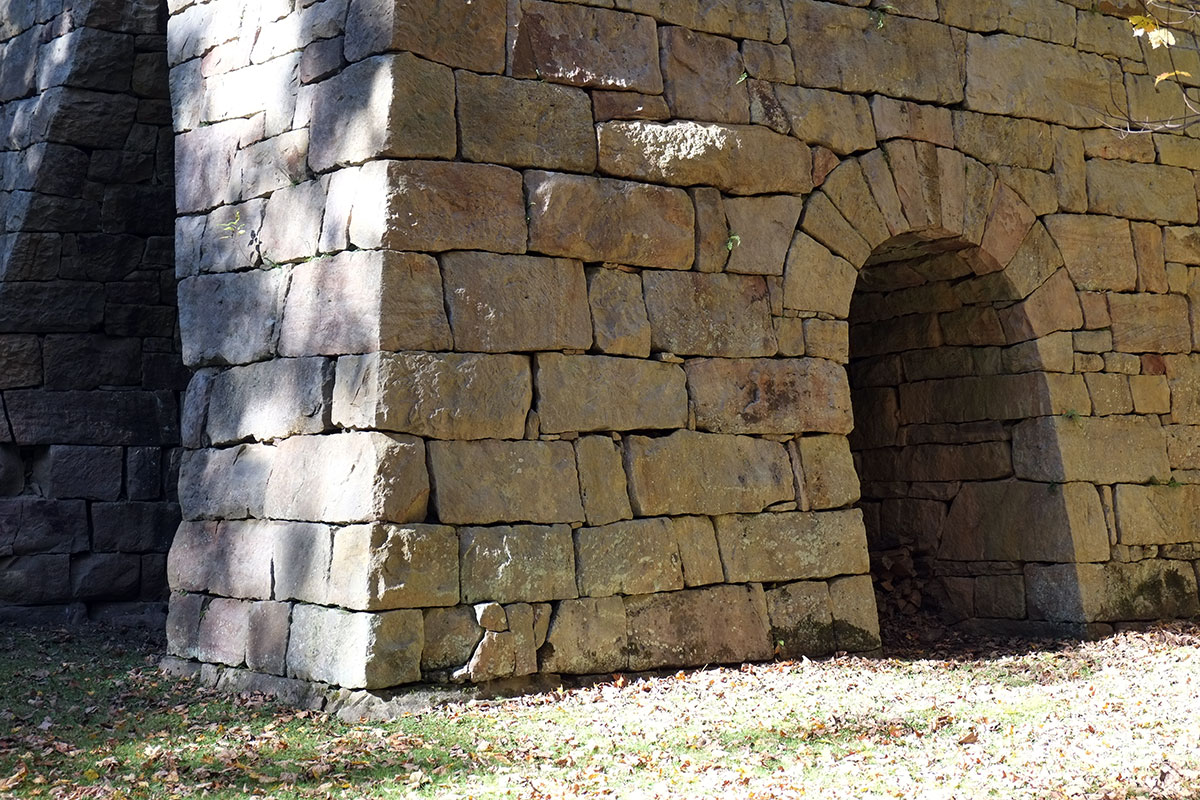
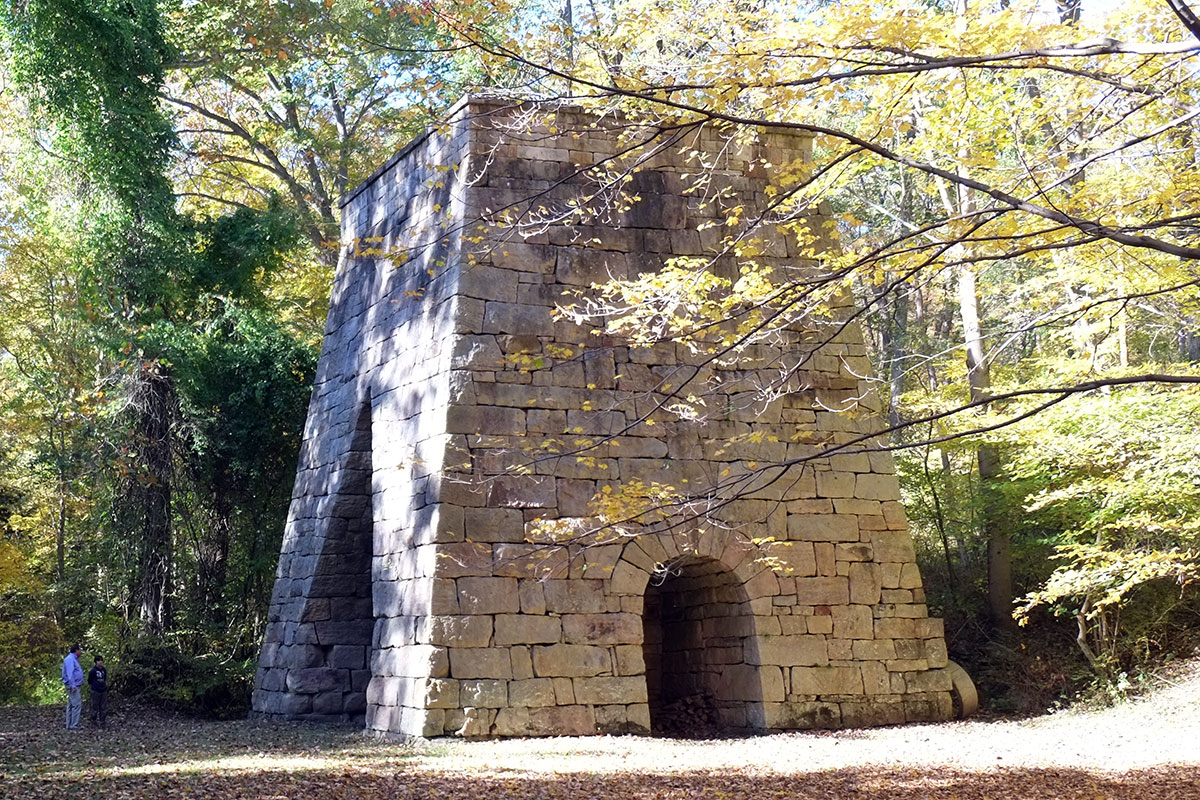
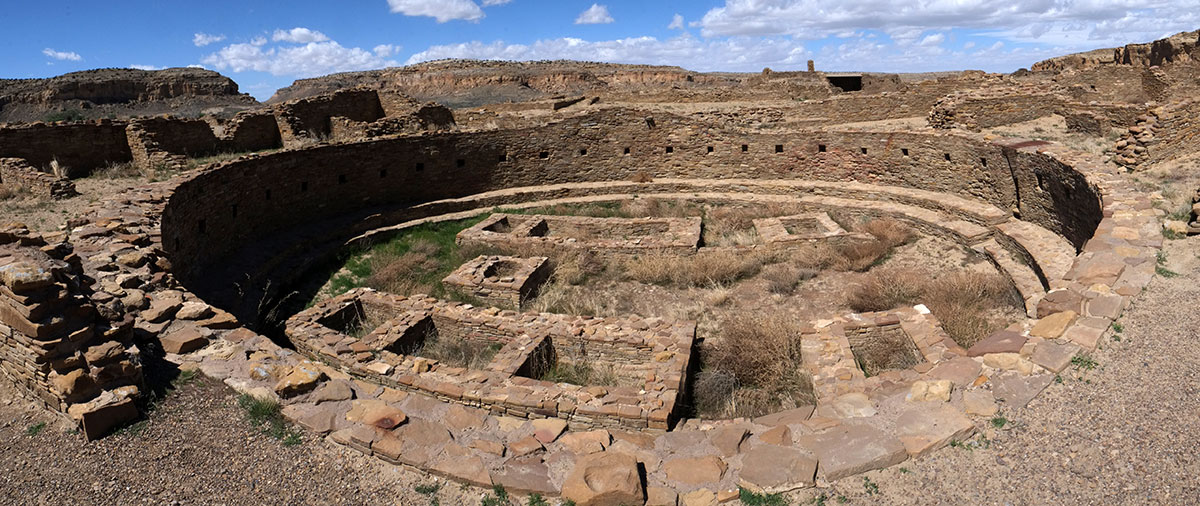
and the amazing California Furnace from 1850, an early iron furnace as the industrial revolution kicked into gear.  Boullee out in the woods. DSCF0820

DSCF0823

here John and Greta give it scale.   DSCF0822

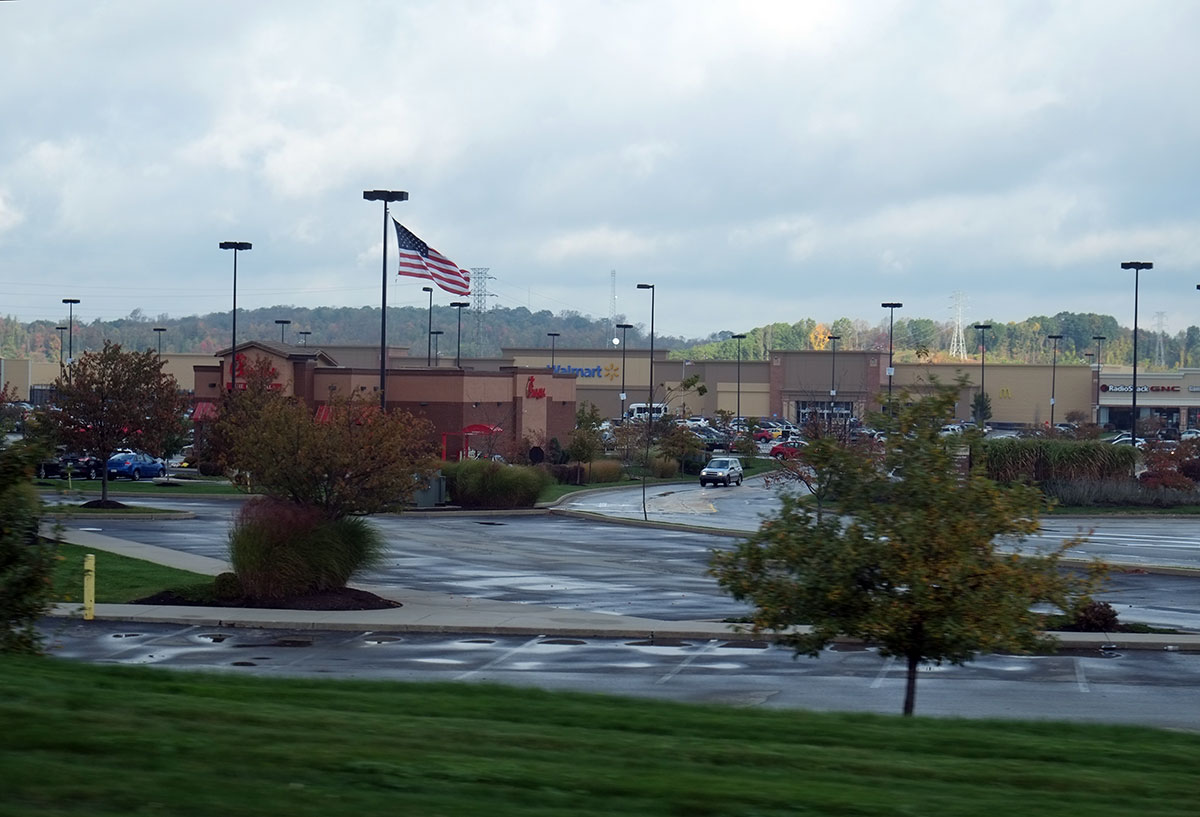
On the way into Pittsburgh, John pointed out where strip mine sites were now being filled and built upon.  We realized that strip mines become strip malls.DSCF1004

Heading north towards Buffalo, we arrived at Punxsatawney, home of Phil the groundhog.  We caught a glimpse of Phil (or who they say is Phil, along with a bunch of other groundhogs who may or may not be Phils).DSCF1544

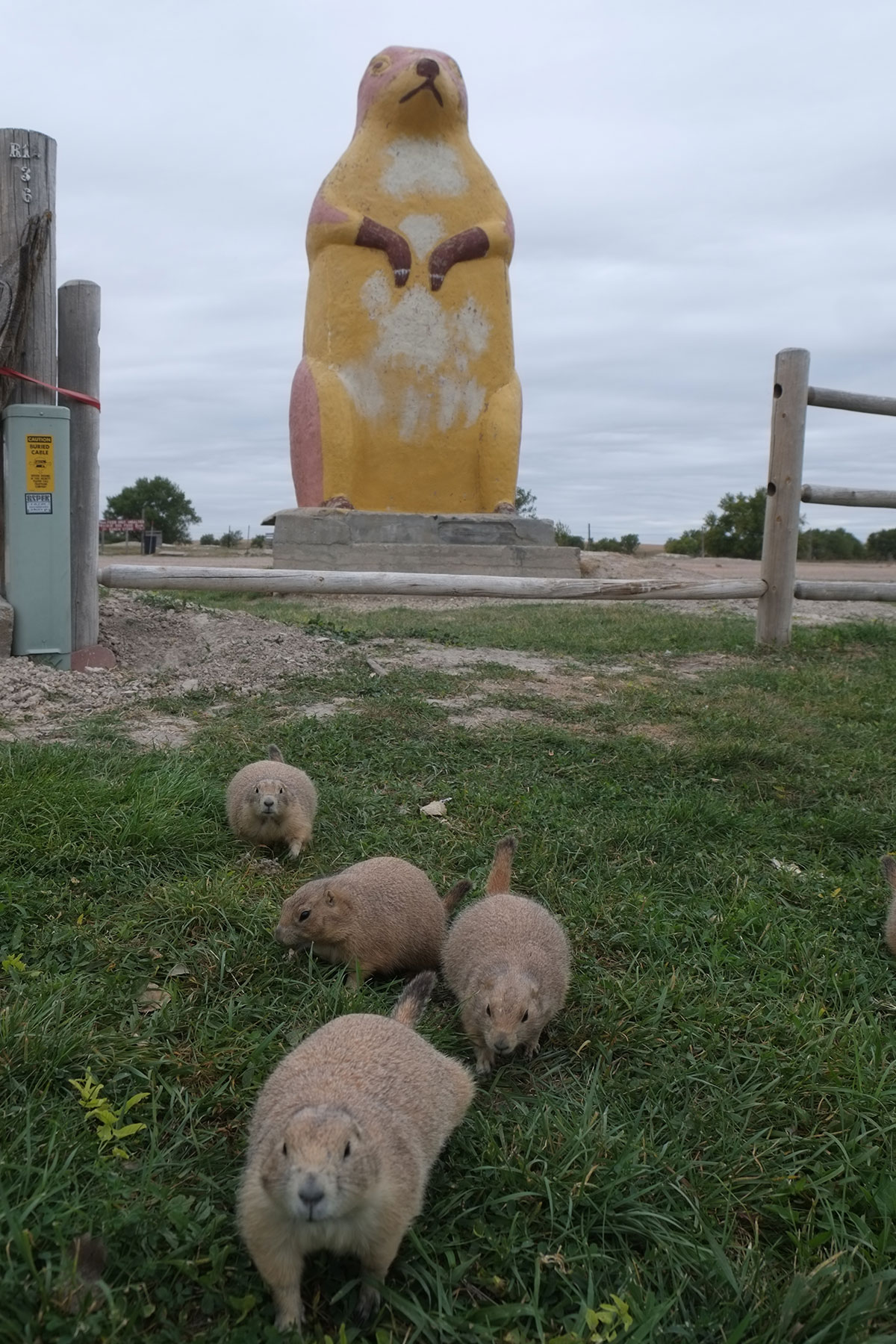
Among the many icons of Phil in the town, we noticed this one, which looked strangely familiar.DSCF1548 DSCF8616

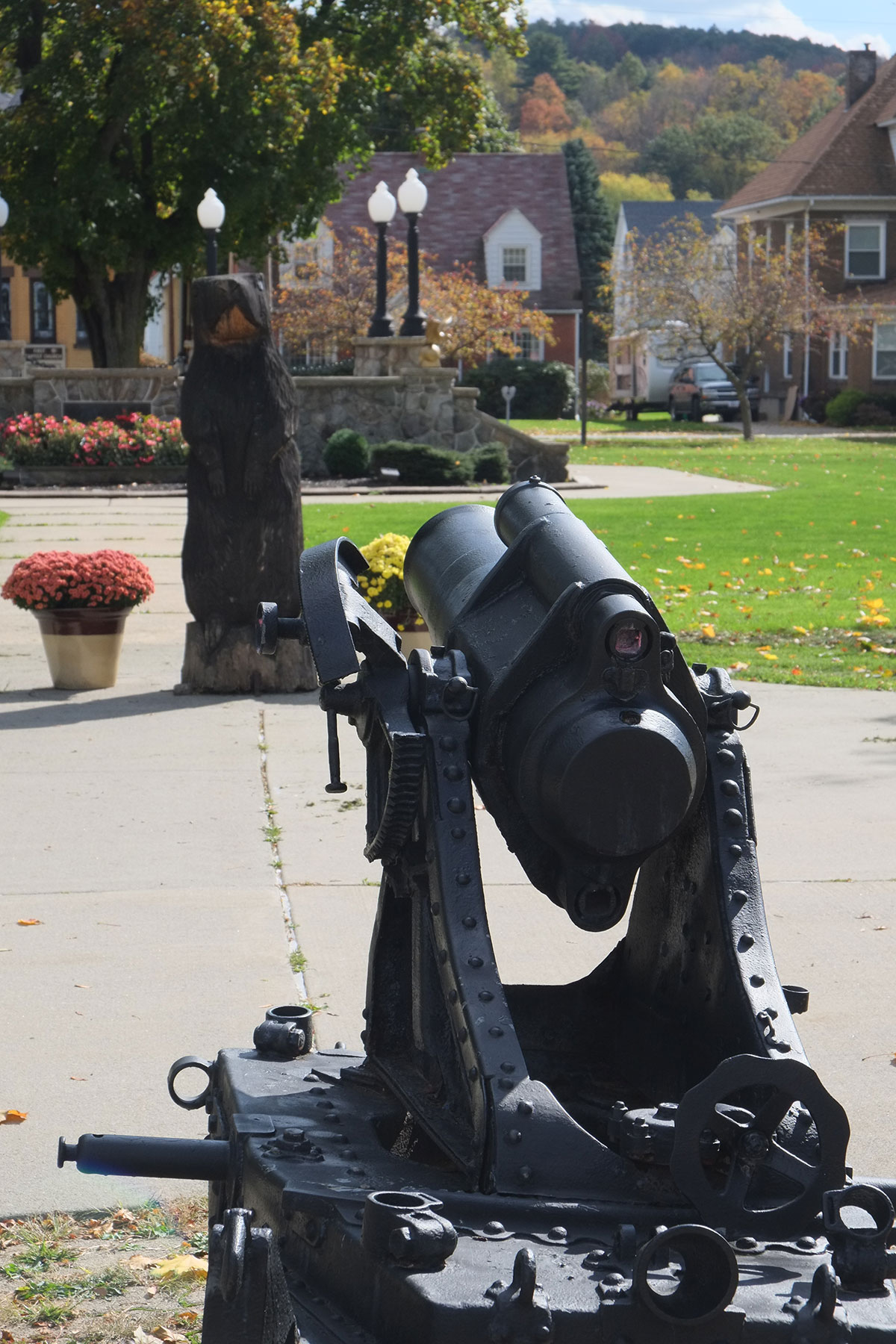
The large, adorable, rodent gods seem to be taking over the country, but in Punxsatawney, unlike South Dakota, they are fighting back:DSCF1549

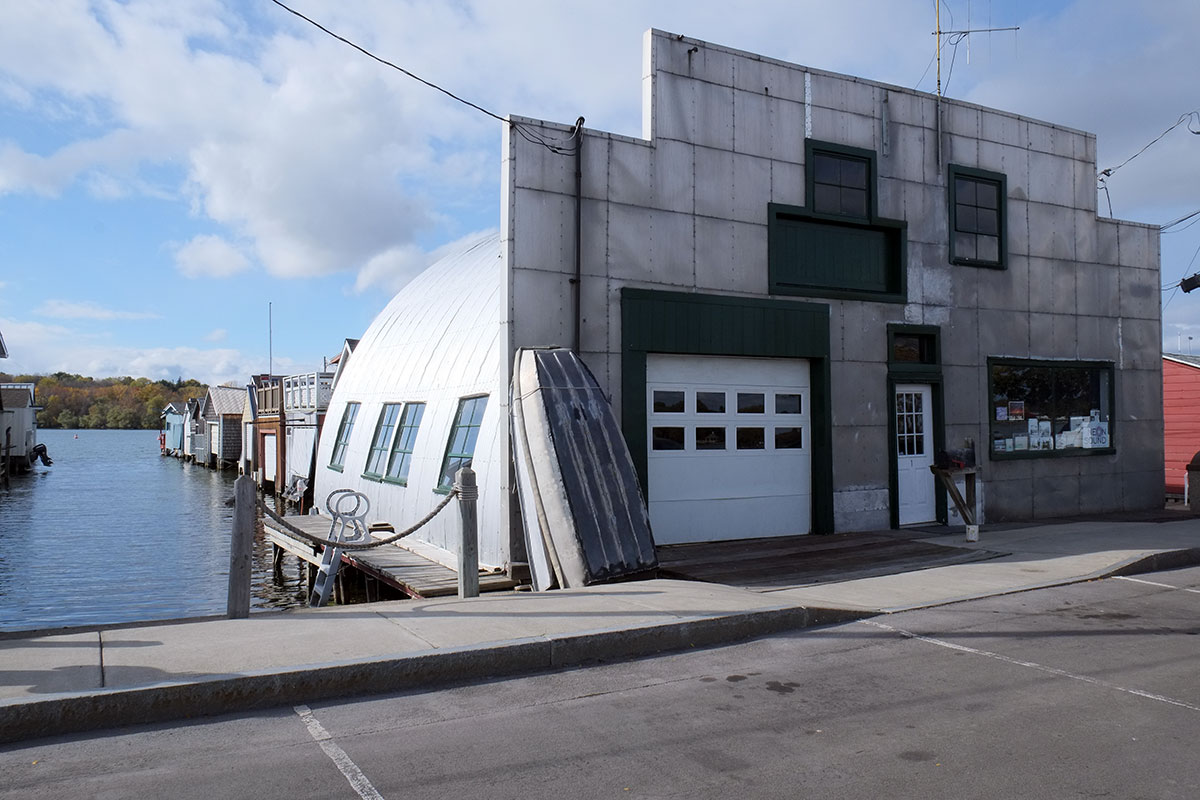
In upstate New York, we drove on Route 20, which hit the northern end of many of the Finger Lakes, a part of the state I (and most downstaters) had never visited.  Canandaigua had some cool houseboats DSCF2130
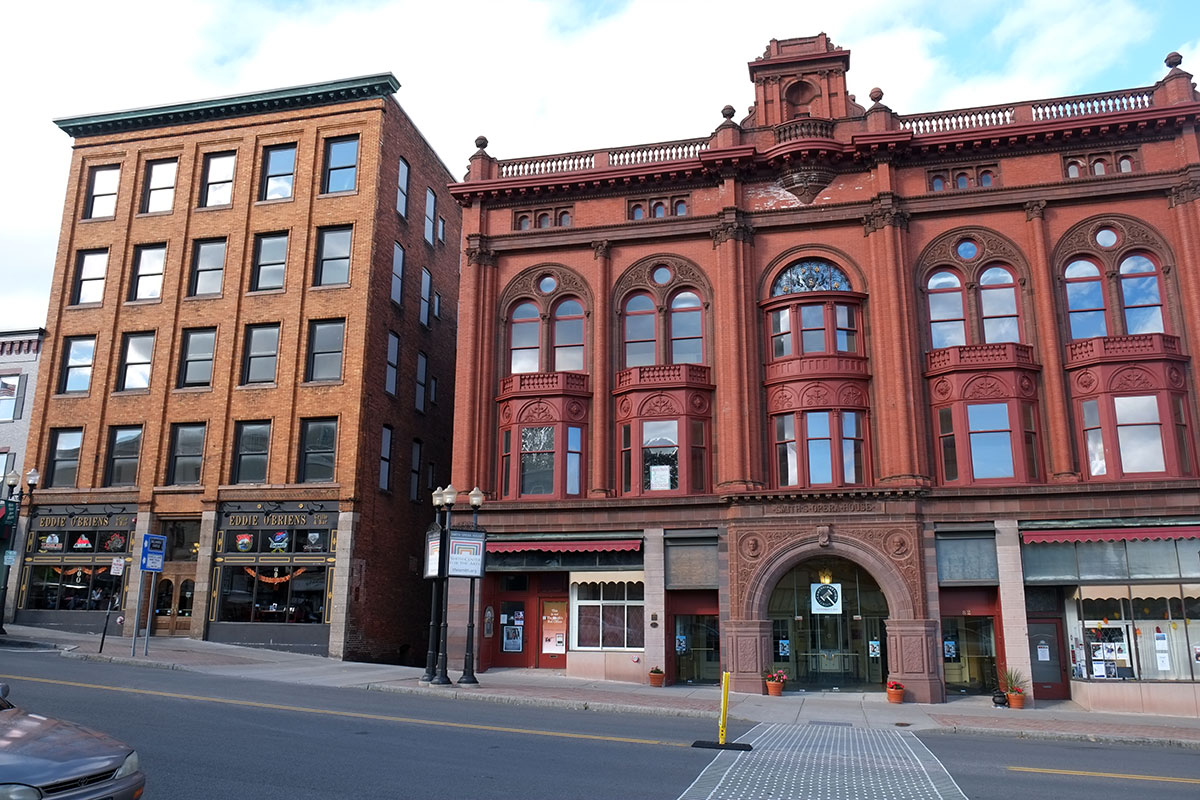
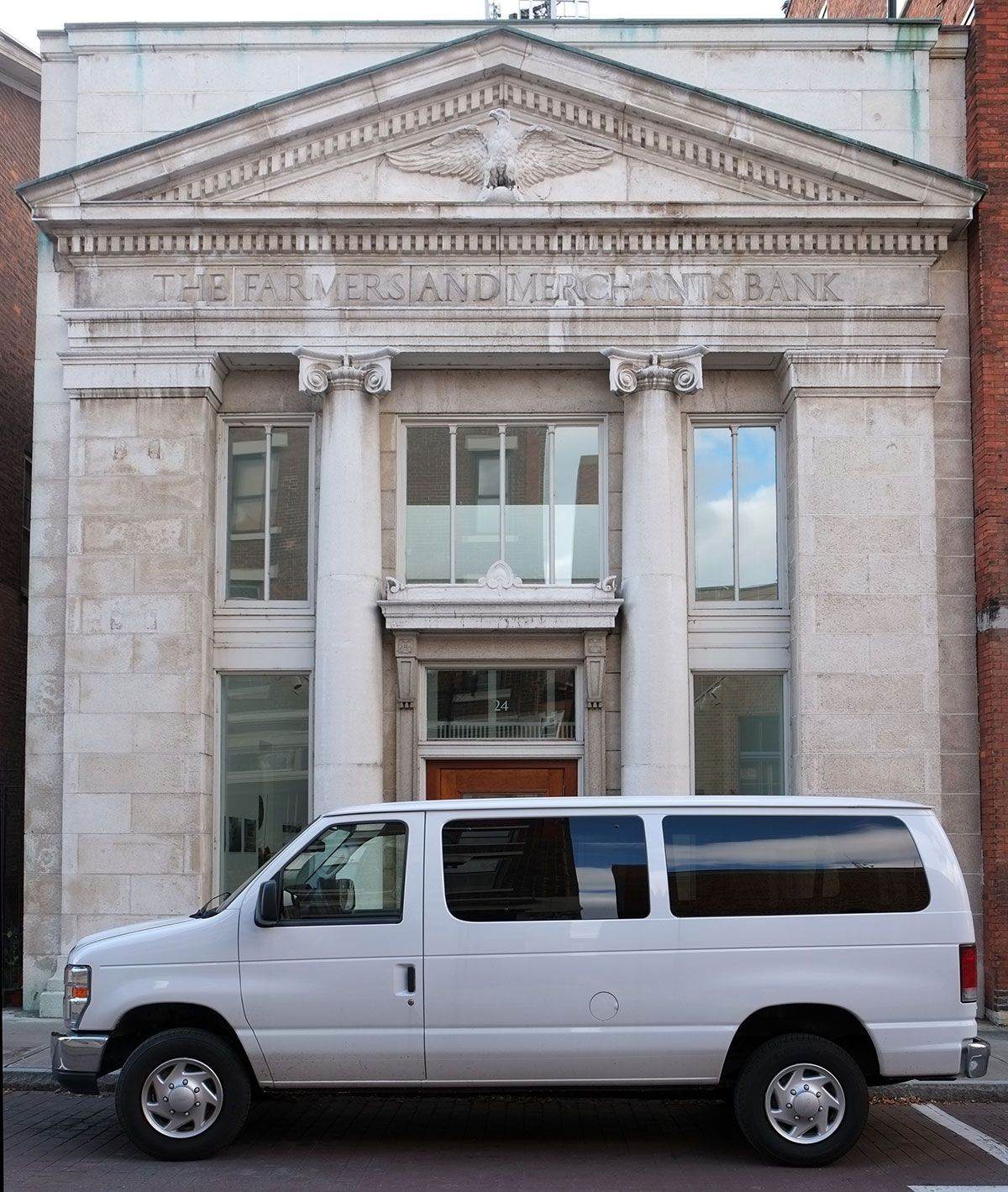
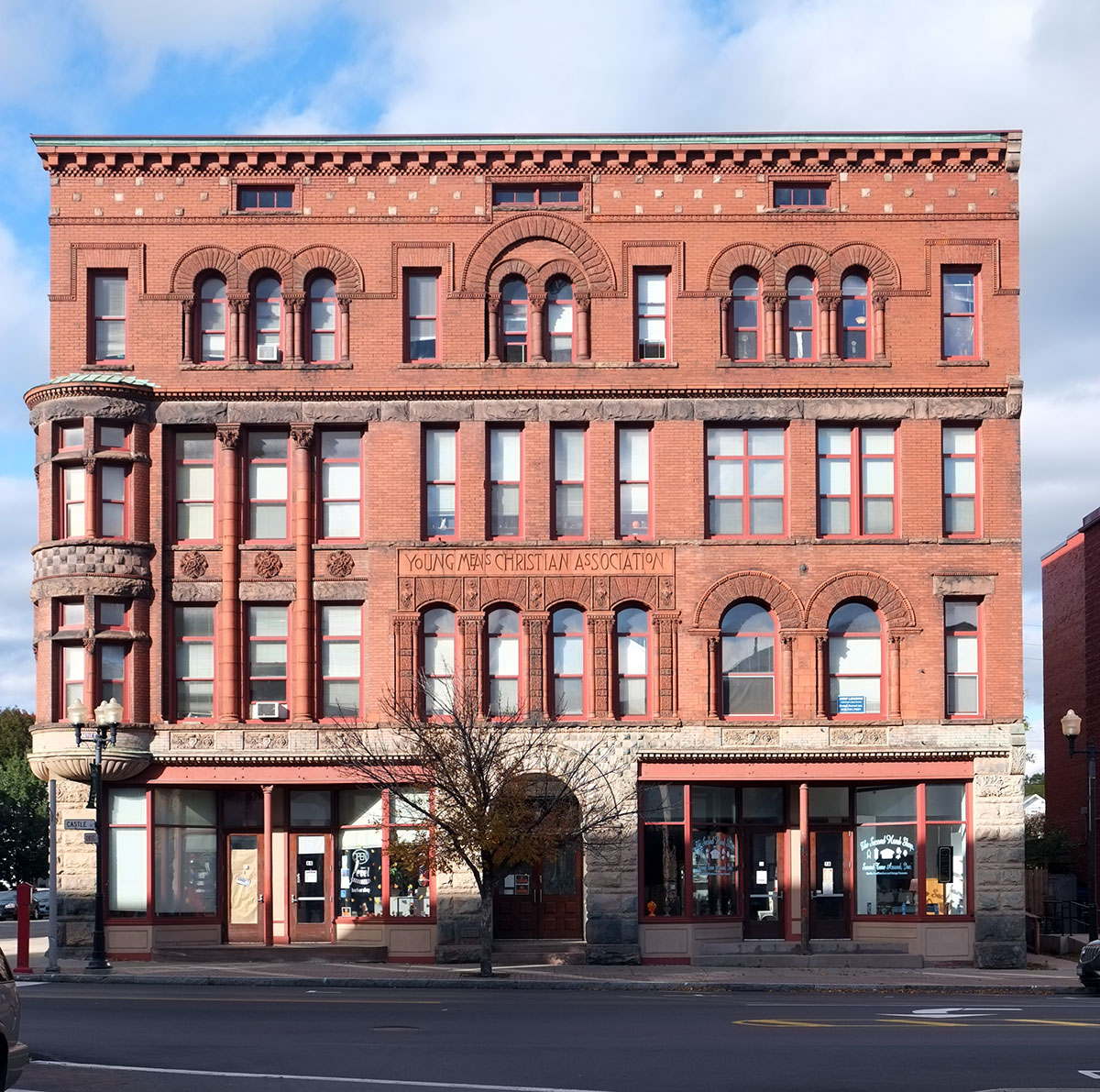
While Geneva fell into the recurring category of Places that Used to be Prosperous, but still had some interesting buildings.DSCF2145 DSCF2147 DSCF2148

Waterloo had some nice houses in various states of repair.DSCF2152

Skaneateles appears to be the prosperous resort town on the road, with beautifully restored houses, and a thriving main street – the first place we could find a cup of coffee, in the Land that Starbucks Forgot.DSCF2154 DSCF2155 DSCF2160

and in Sharon Springs, this highly-wrought and astoundingly maintained church.  Nice church, interesting steeple, but I’m not sure they’re getting along.DSCF2219
There we were, far away from the City and coastal civilization as know it, and Ithaca was still too far away to be worth visiting.  It really is the most isolated spot in the east.