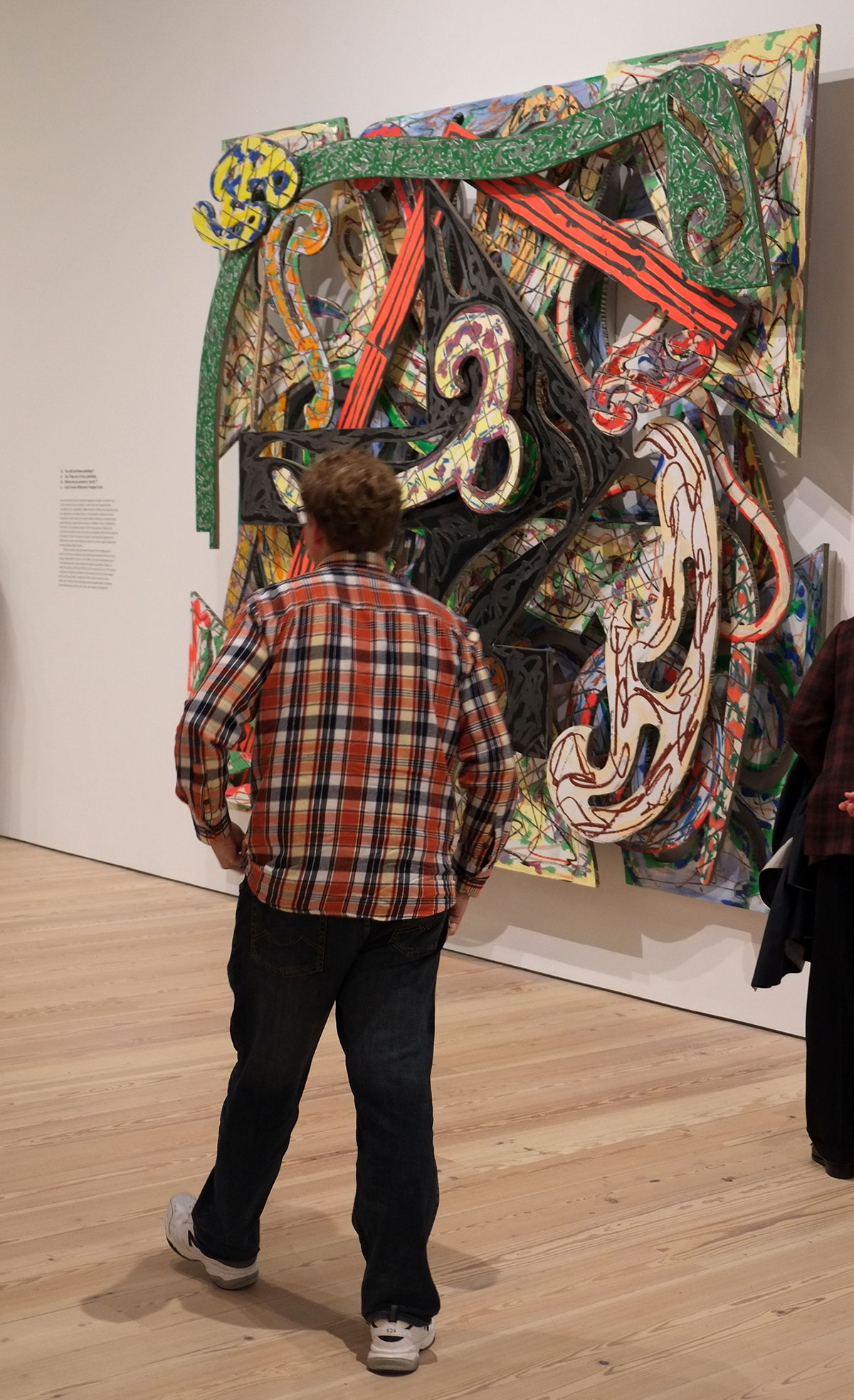
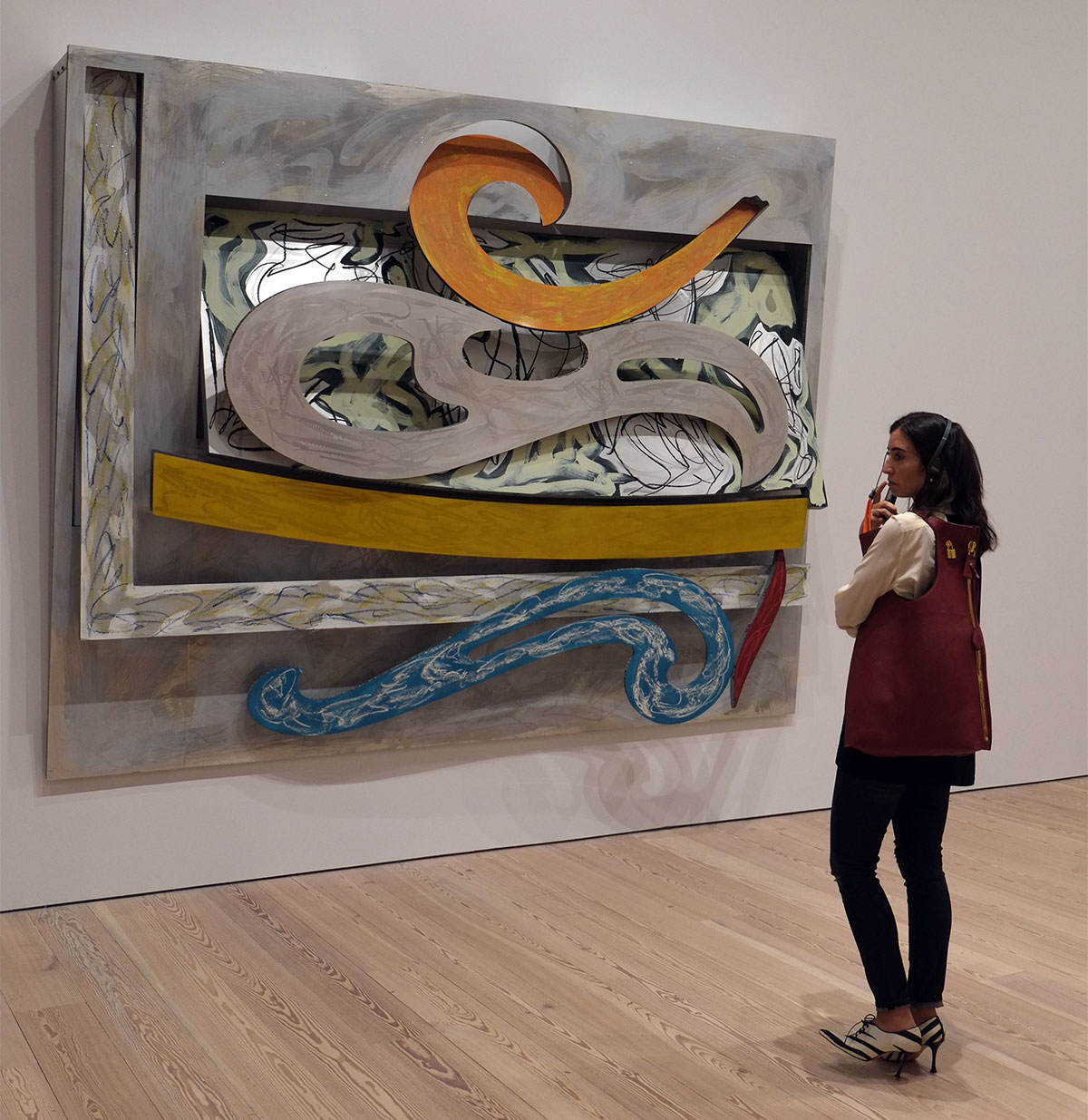
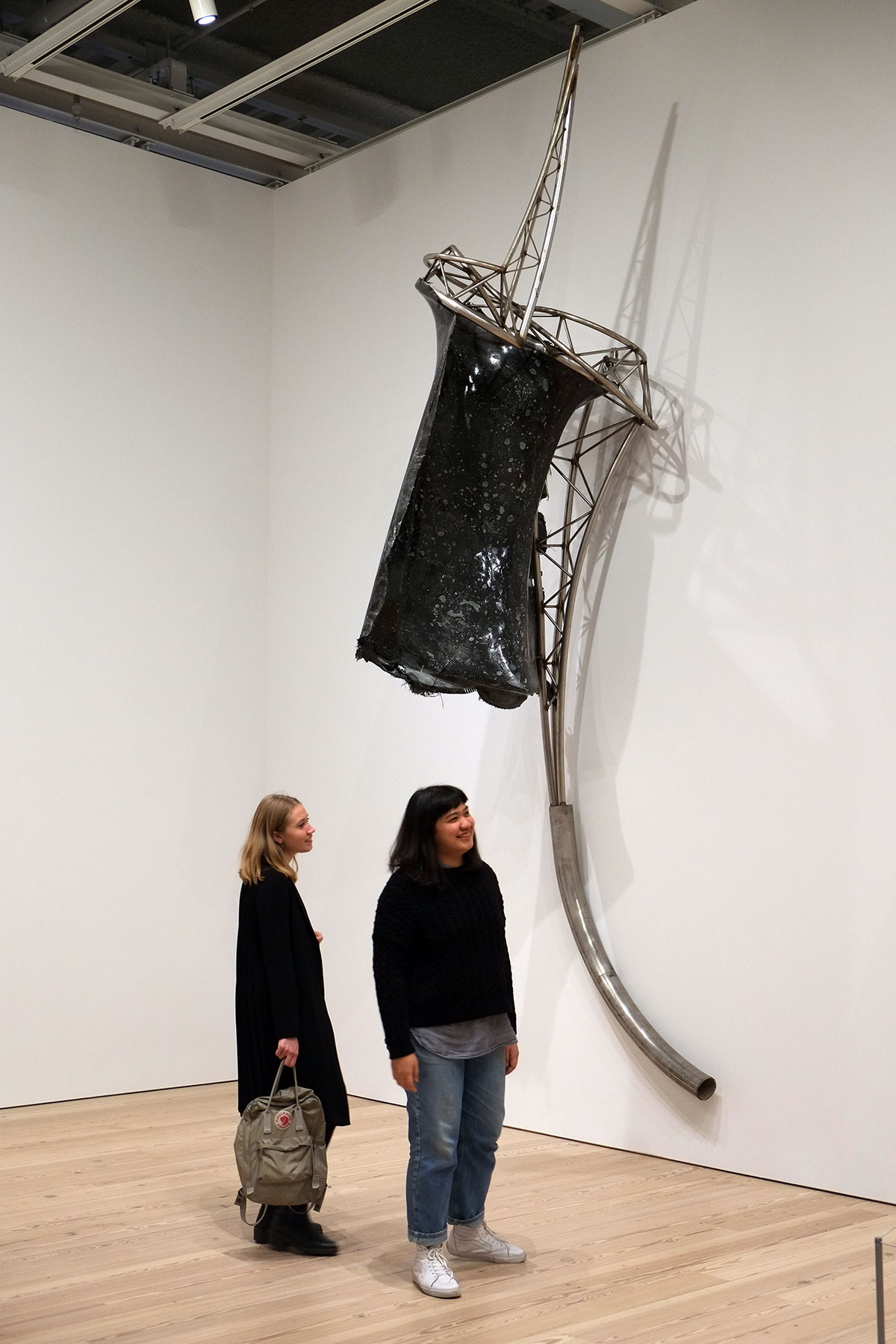
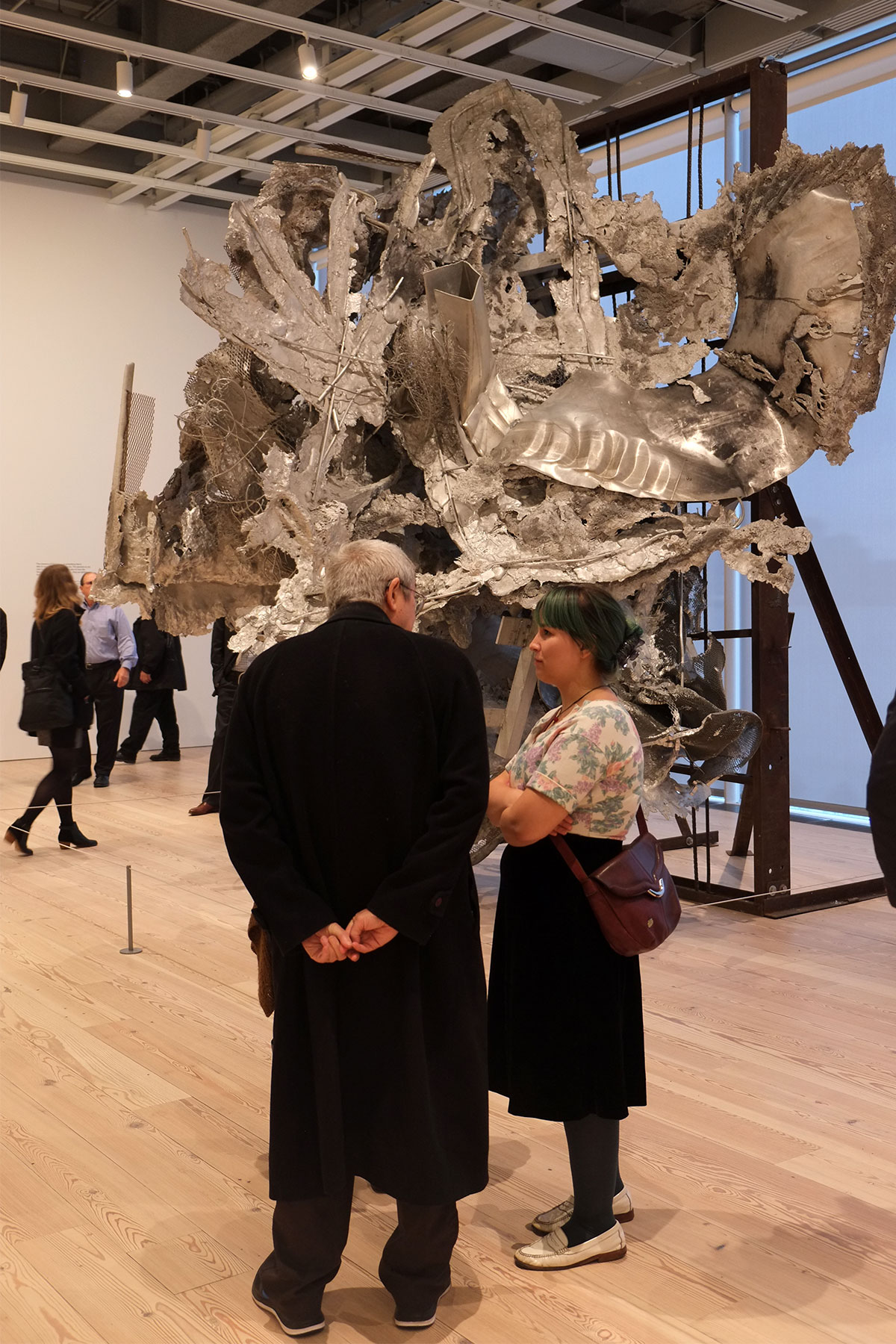
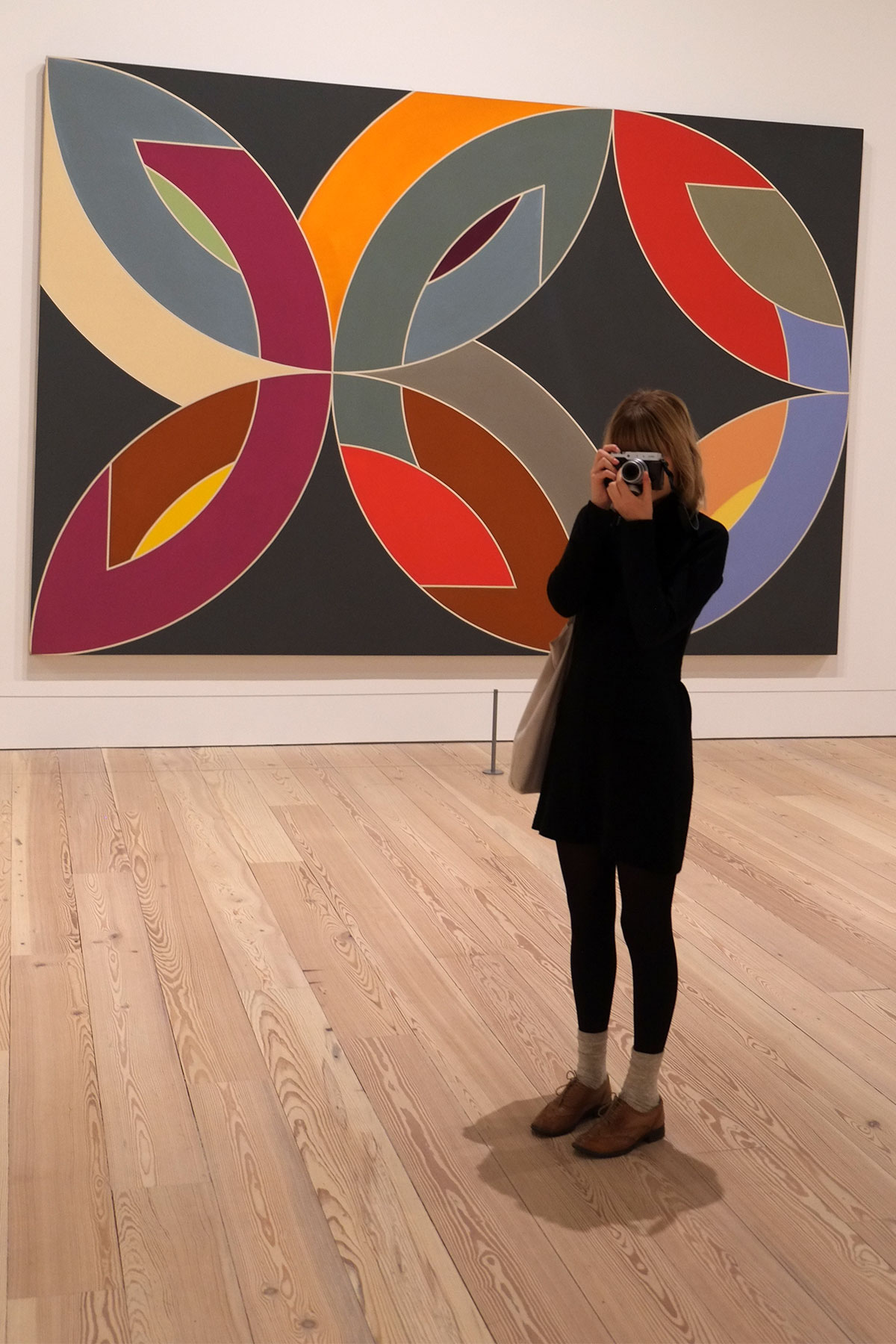
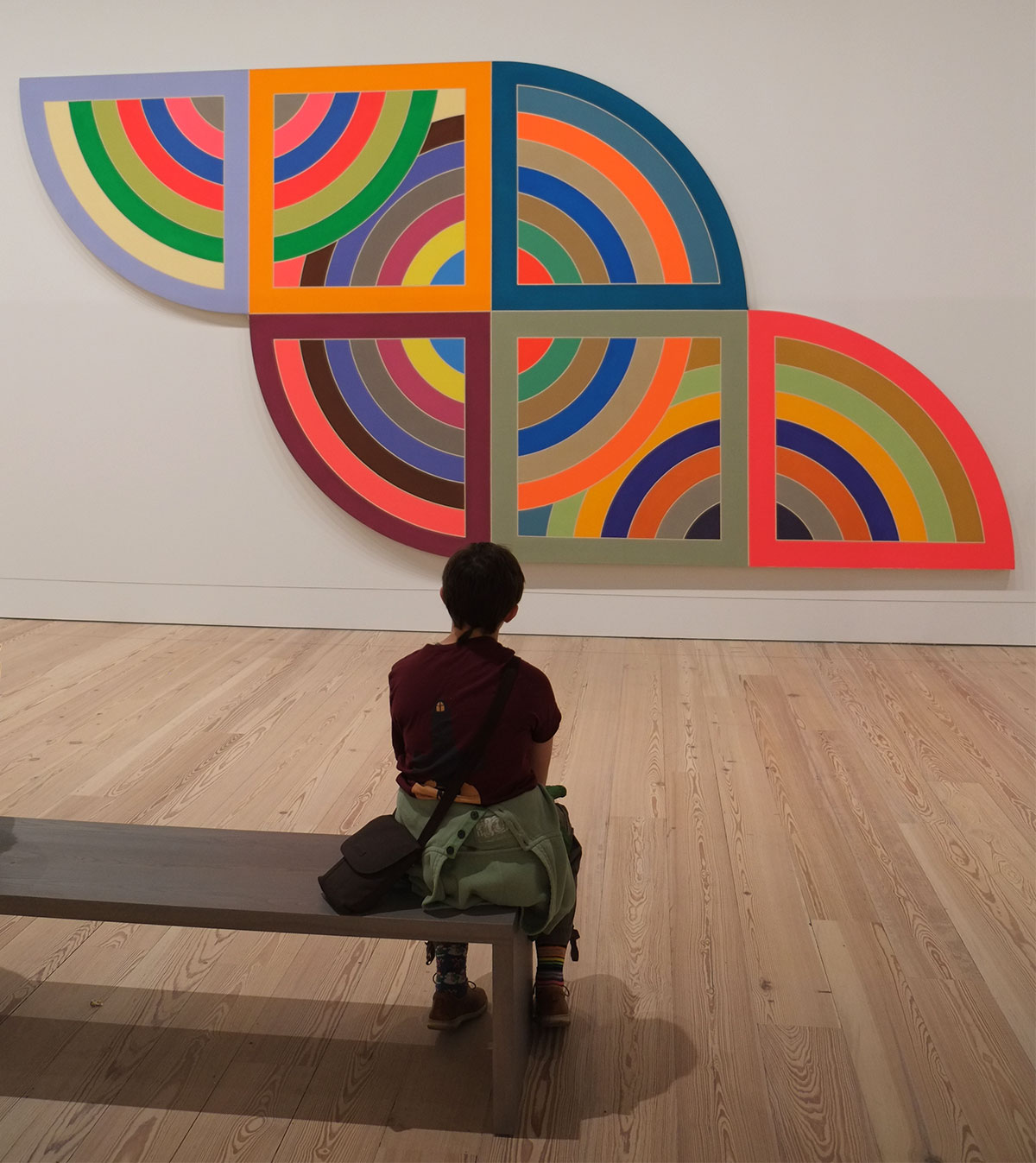
We saw the Frank Stella retrospective at the Whitney today, and it just seemed that many of the visitors had an uncanny formal relationship to the paintings. Even Greta.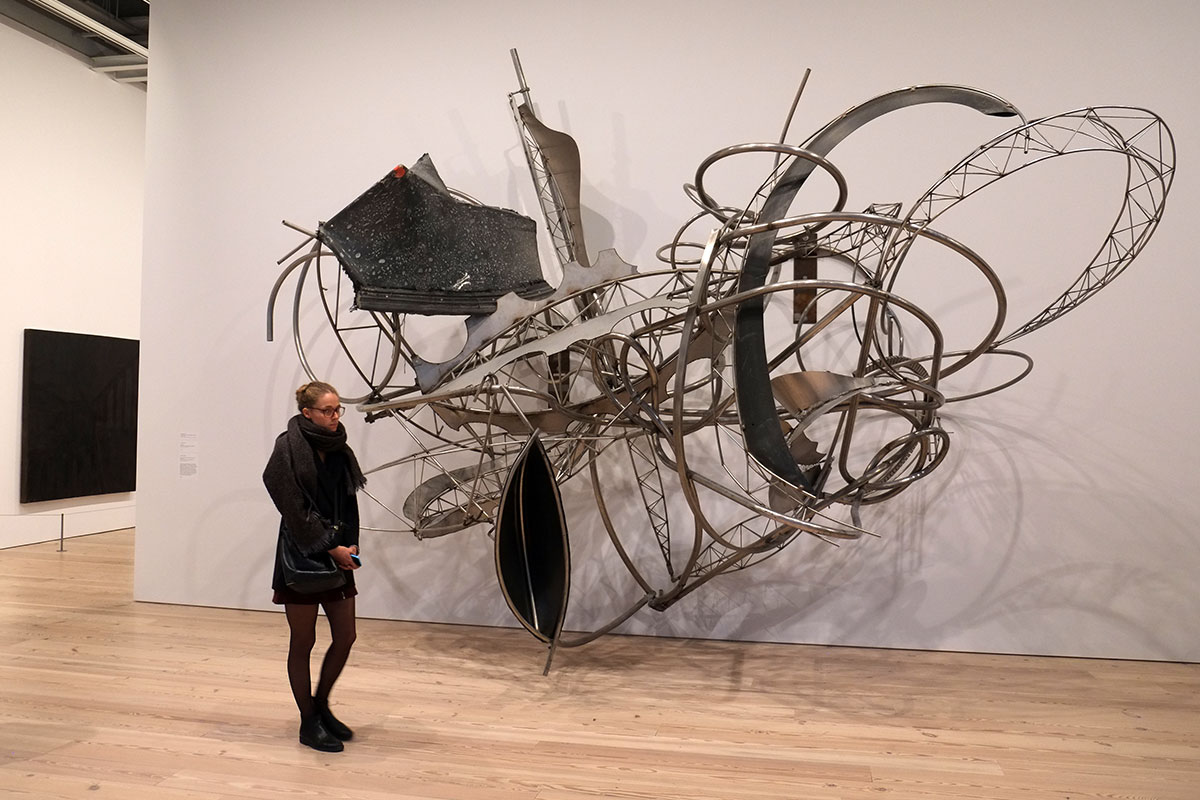
Fun with Frank
Leave a reply

We saw the Frank Stella retrospective at the Whitney today, and it just seemed that many of the visitors had an uncanny formal relationship to the paintings. Even Greta.
 In New York, we decided to focus on cool new stuff we hadn’t seen. And pastrami. Our pastrami quest was thwarted as we trekked up to Carnegie Deli, only to discover that it was closed for repairs. (And while we considered our next move, a dozen other people came along to be equally disappointed. Someone should set up a pastrami cart there.) We did see Alwyn Court (even if we couldn’t afford to eat at Petrossian).
 We only had two days to spend in New York, less than we did in Cincinnati. The focus on this trip has been on places where I haven’t been in a long time, places where we’re not likely to go to again soon, and places that you need a car to reach. We had just been in New York last winter, and it’s likely we’ll be back soon, since we have a lot of family and friends there. Then Greta and I came down with colds while staying with my brother in Mamaroneck, so our time in City got cut in half. We decided to not spread ourselves too thin, and missed a lot of places and people we wanted to see (including an abortive attempt to schedule a Facebook-based meet-up with a lot of friends). It was disappointing, but we’ll be back soon.
We wandered through the Park, and felt the full impact of the new residential tower at 57th and Park. It’s kind of unbelievable, the tallest residential building in the western hemisphere, and a portent of things to come. 
The Century used to be considered a tall building. 
On to some favorite blocks on the West Side.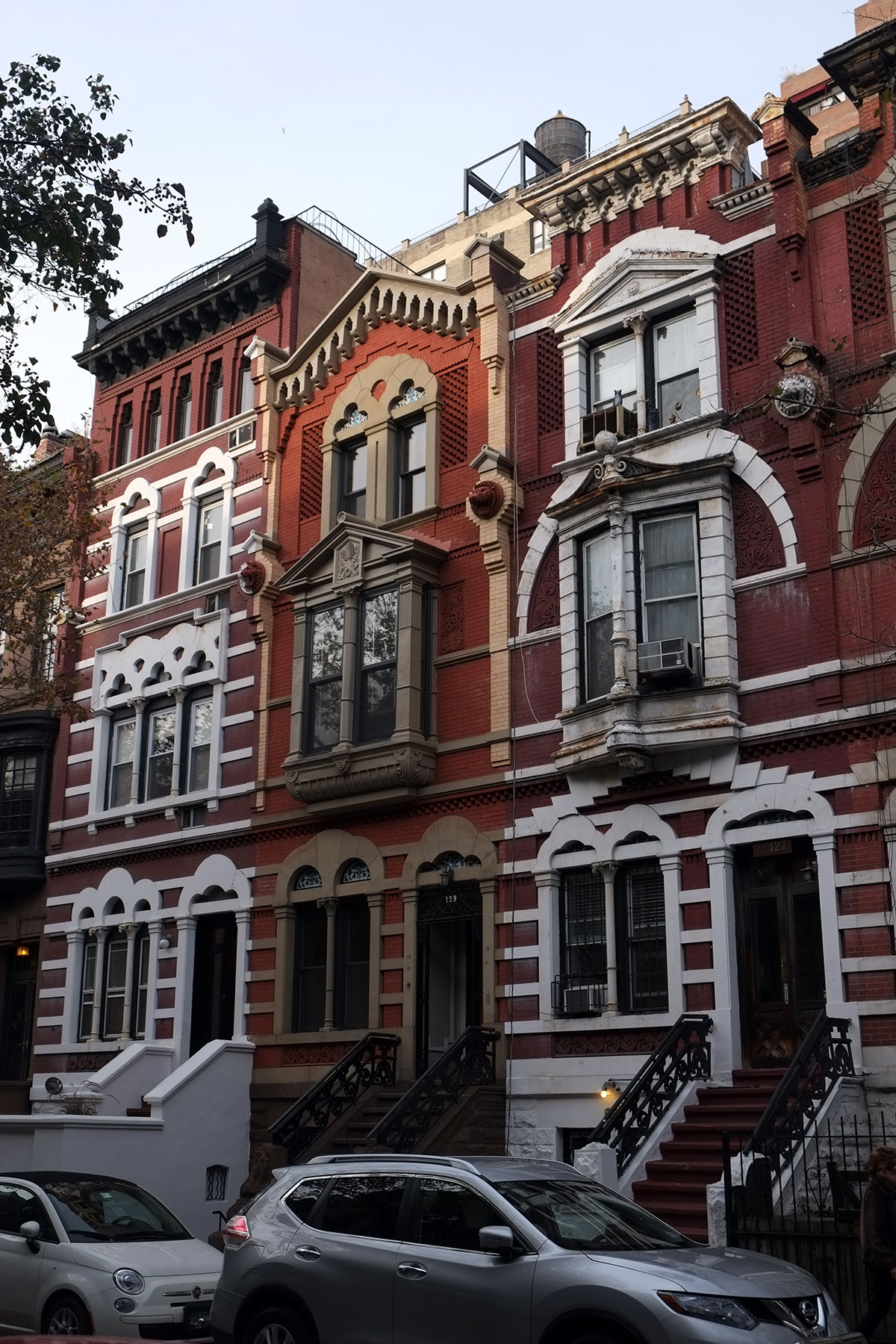
 And over the the 79th St.Boat Basin, where the rotunda is looking a lot spiffier than it did when I kept a boat there in the 80s.
The redevelopment and park extension at Riverside South was interesting. The new apartments were a tiny bit less banal than most of their era.
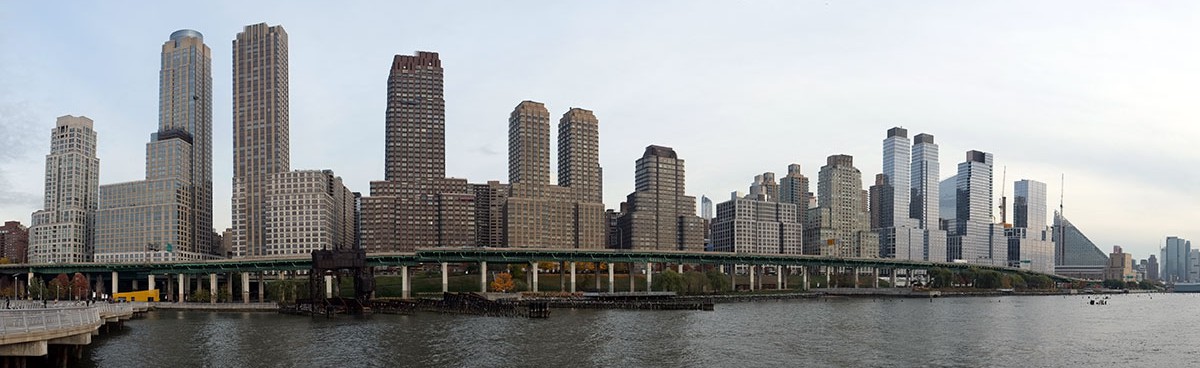
But the real pleasure was in the park. Back in the 80s, I was one of very few people who ever roamed into this territory – some homeless people managed to find gaps in the fence, and I would come from the river side in a row boat. I was especially drawn to the remnants of the wharves that were there, as seen in these photos from the late 80s:
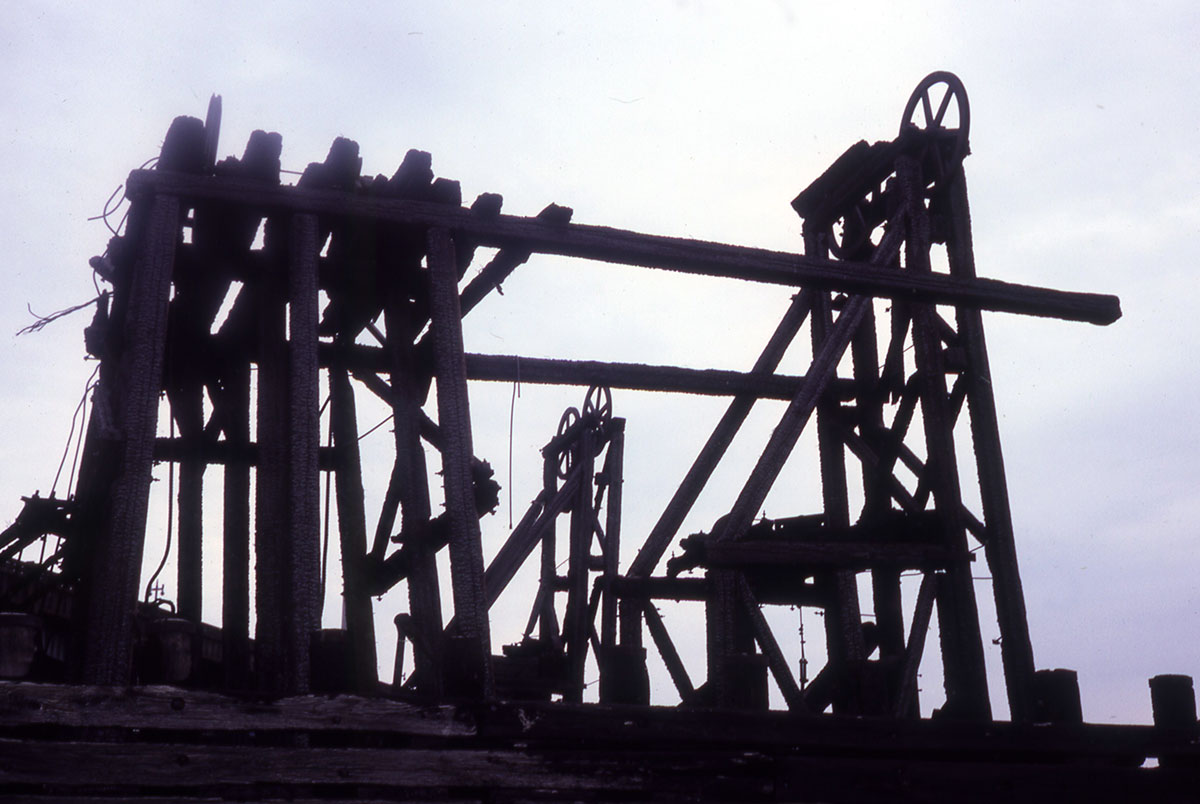 I expected that some day this would all get swept away in a real estate development, so I was pleasantly surprised to see that the park design, by Balsley Studio, incorporated these pieces into a sophisticated design that covers the range from hard to soft and industrial to natural.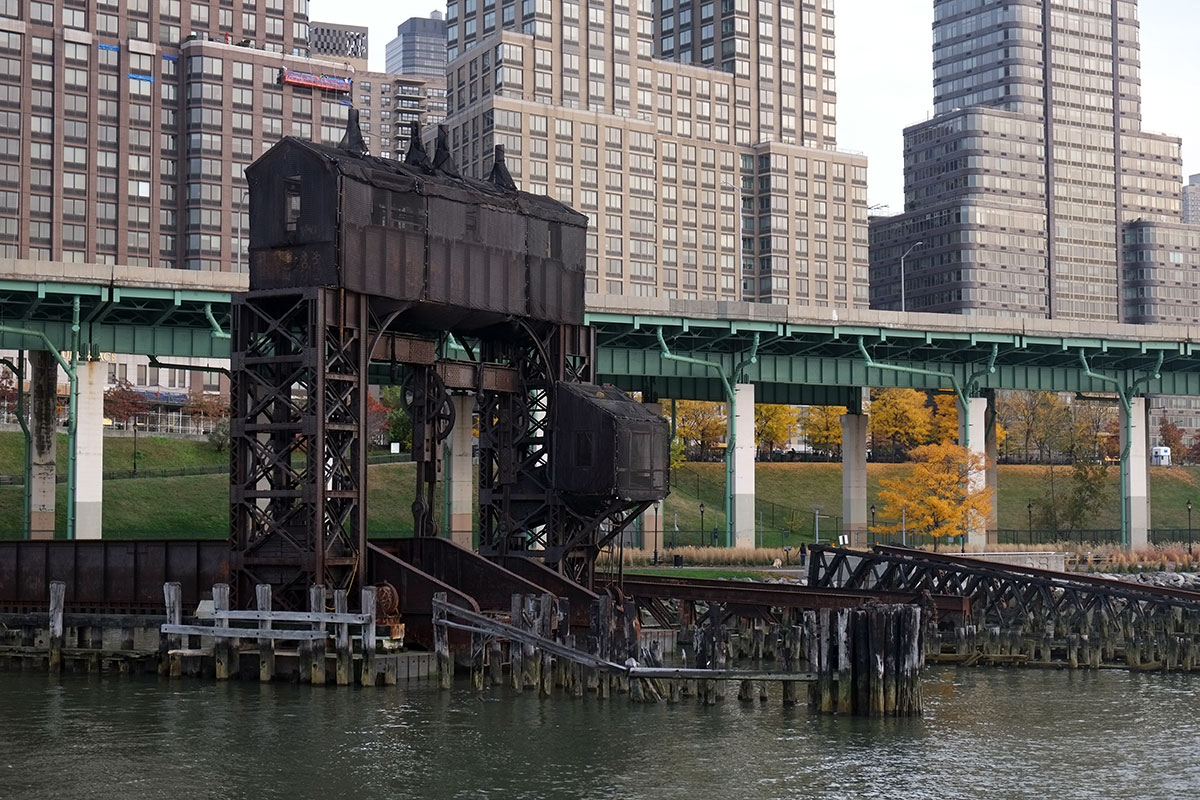
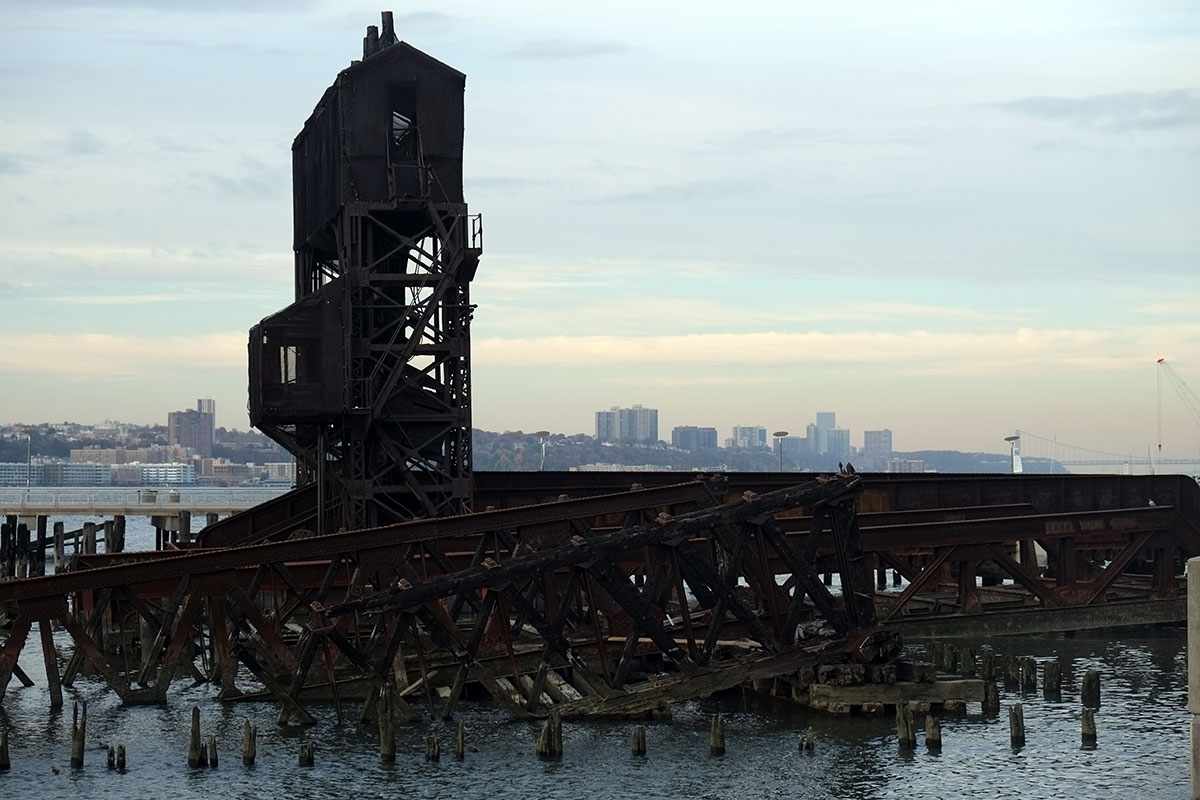


And at the end of the park, there’s something else new to see:
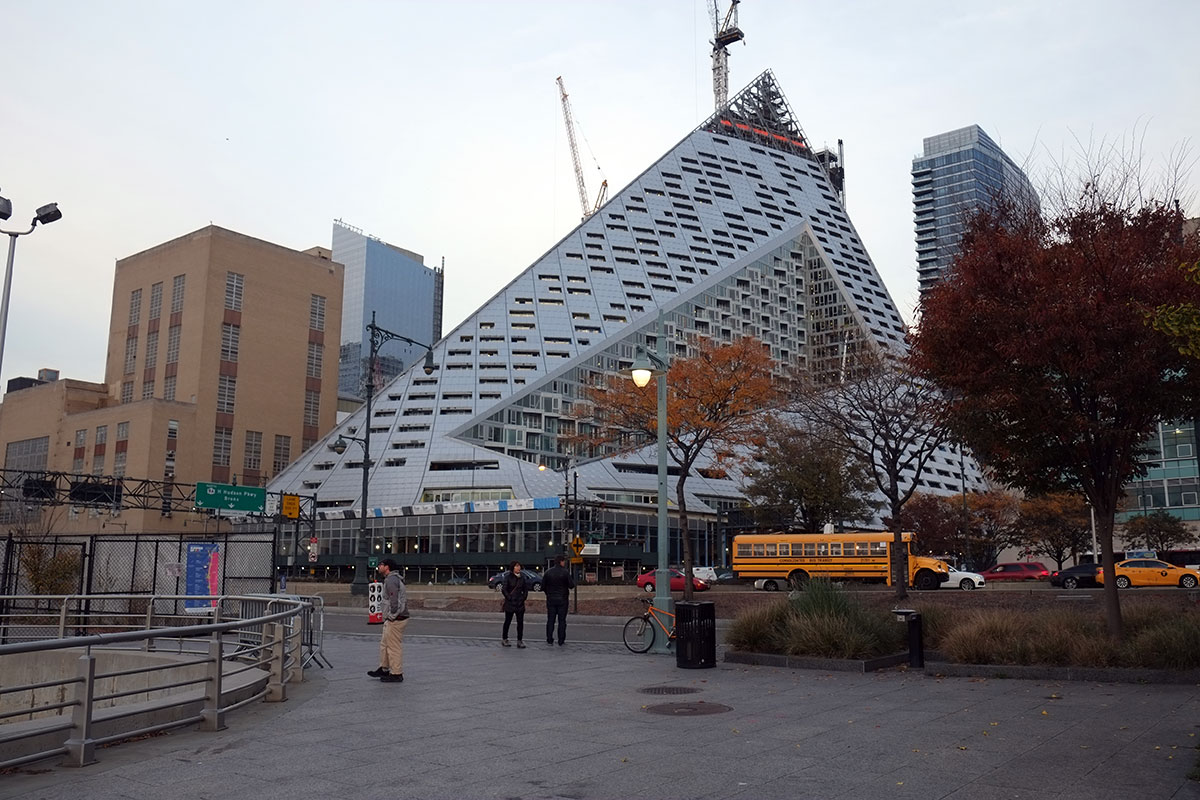 Bjarke Ingels’s new condo building is his usual showstopper. Once again, he lets the building form be driven by the site conditions, and doesn’t worry about conventional ways of making buildings. I think this has worked really well in some of his projects, such as the 8-house, and less well in some others, such as the Mountain, where the concept may be strong but the execution is flawed. It may be too early to tell with “Via 57West”, but I do wish they had hired a Danish branding consultant too and come up with a better name. (Maybe they’re trying to attract Italian residents, and want to distinguish it from the buildings full of Russian oligarchs down the street.) I haven’t seen the plans, but we spoke to a construction worker who said there were lots of weird, unusable spaces, which has certainly happened in some of his other projects, and seems like a natural result when you let the building volume drive the scheme. I’ll withhold judgment.
But I think this may be a real New York building at heart, with the form driven by real estate economics. One way to look at the massing is that it provides a graceful transition from the 57th St. canyon to the open space of the River:
Another interpretation arises when you find out that the whole block is being developed by the Durst organization. The more conventional building further back on 57th St., seen to the right in this photo,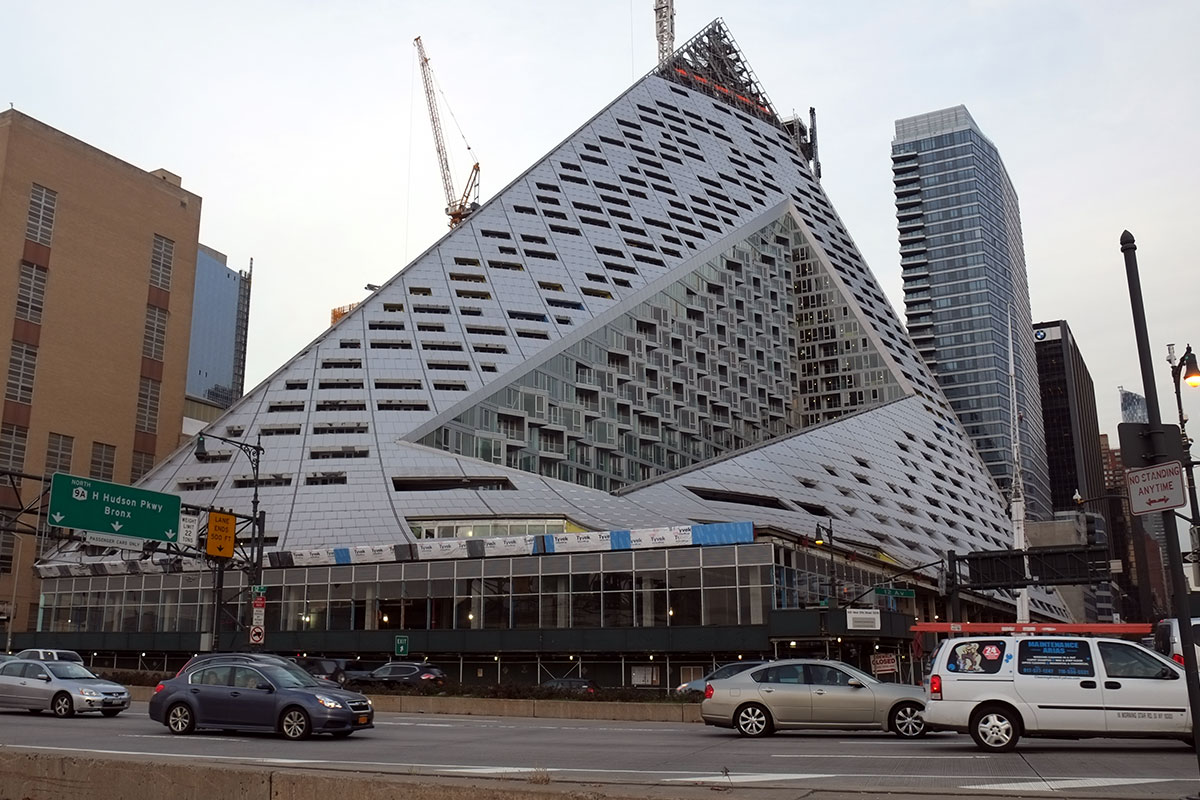 now has a view of the River because the Ingels building slopes back. So instead of one building with a view of the River and one with a view of 11th Avenue, you now have two buildings with river views. The first one may be inefficient, not maximizing its potential floor plates and with funny unit designs,, but you can sell the units to hipsters who want to be in the cool building with great views, regardless of functionality. Then you can have conventional units with normal floor plans in the second building, which will be bought by more pragmatic people. The origin of this building is similar to that of Central Park – it may be a good design, but it would never have happened without the financial rationale. I just wish it had a less cheesy name.
I thought the main capital-A Architecture focus of this trip was going to be out-of-the-way buildings by Lou Kahn, but then Renzo Piano hijacked our agenda. We’ve only seen one recent museum that wasn’t by Piano, and I think the MFA addition is really Norman Foster in Piano drag.
The new Whitney is superb. Anchoring the High Line at Gansevoort St., it consolidates Chelsea’s status as the new zone for hip galleries, since Soho became a shopping mall and the East Village seems to have gone back to being the East Village. Tectonically, the building picks up on the High Line and other buildings in the area – it stands out as an institution, but it complements the older technologies beautifully.
The superstructure at the top of the picture is the key to how the building fits into the context. Every other museum in New York is a solid box which you enter to view the treasures within. (The Met has some views of the city from the large atrium areas in the new wings by Roche Dinkeloo, but that is all.) In a museum of American art – which necessarily means lots of art in and about New York – the Whitney pulls in the City as an essential part of the experience. Being in Chelsea, surrounded by low buildings, the views of midtown and downtown are unobstructed, and going back and forth from the galleries to the city is exhilarating. 
I am a big fan of museums which allow easy access to large open areas where you can shift the focus of your eyes to a distance, get some spatial relief from the necessary introversion of galleries, and let your mind wander a bit; the Whitney does this better than any museum I’ve ever seen. The large space isn’t just a relief from the galleries, it is a complement which intensifies the experience while providing a change.
The parti is classic Piano – simple, legible and appropriate. Each level has a big east-west bar of galleries, with a fairly solid wall to the south, and filtered openings to the east and west. The staff spaces are mainly on the north side, accessible from the gallery levels, but tucked away behind the circulation core.
These filtered ends are tunable – allowing for a directly daylit space at the end for sculpture,  while using a series of screening elements to block direct light from reaching the galleries within. This layering strategy is being employed in many museums now, but this makes more sense to me than Foster’s MFA – it is both more flexible and less extravagant.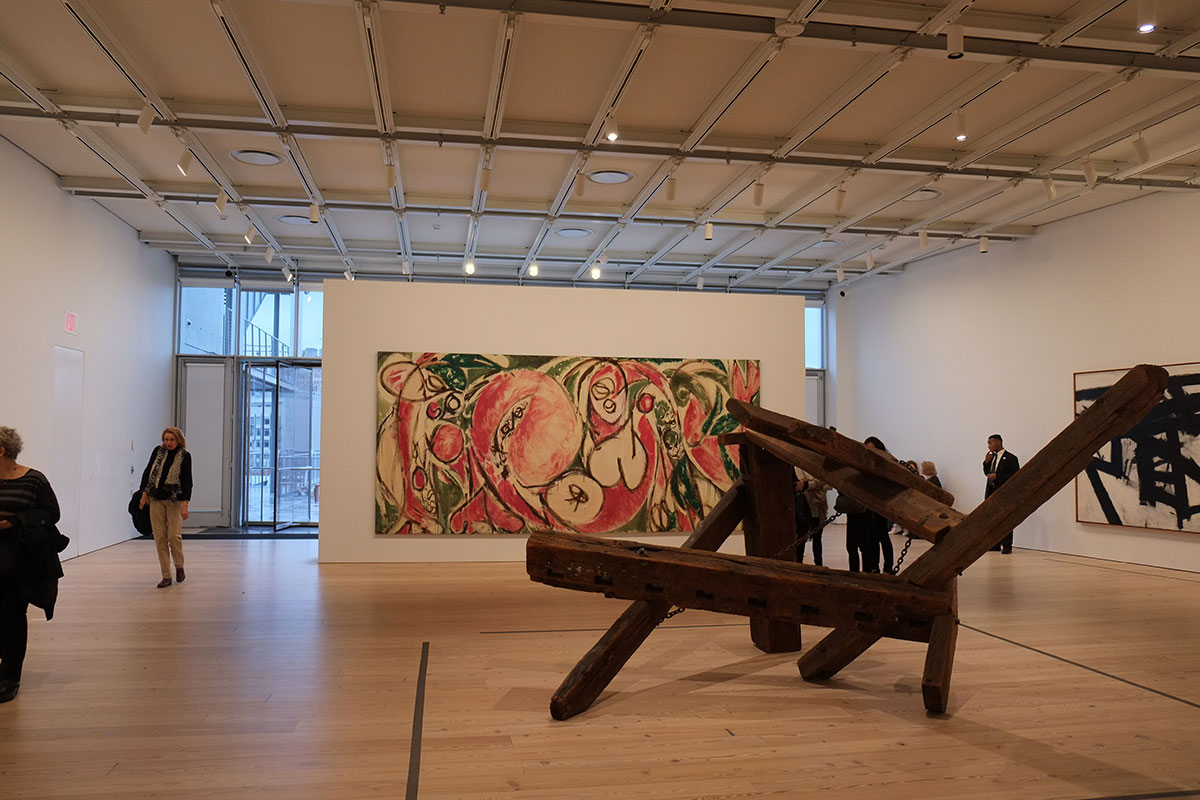
Movement through this building is directed, but not constrained. The staff suggests that you take the elevator to the top, and then walk down. Interestingly, this is the same processional as was suggested at the old Breuer Whitney. That building had gigantic elevators, which were also used as freight elevators after hours, and one notable interior stair, which was a sculptural and spatial experience, despite having only one window; Piano seems to pay homage to that. The elevators are the coolest glass elevators this side of Lloyds of London, and there is a central stair that is perfectly located and visible, a pleasure to use, again despite being completely internal. 

Every floor has an entry space at the top of the elevators and stair, orienting you and facilitating the introduction to the exhibit.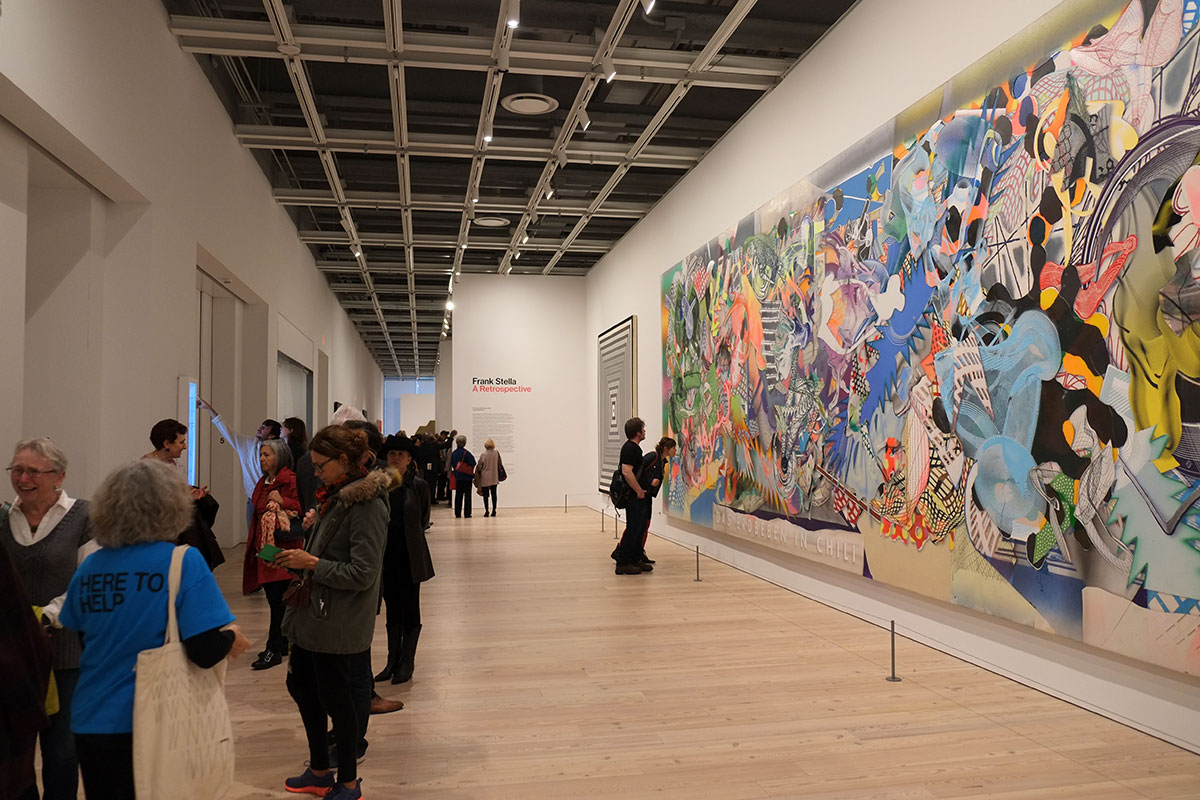
You can us this stair, but why wouldn’t you head outside? The steel structure relates to the High Line below, and contrasts with the slick envelope of the gallery volumes. 

The view to the north
and to the south
Museums can be disorienting rabbit warrens (Pelli’s remodel of MOMA was one of the worst, thankfully now somewhat mitigated.) This museum not only allows you to be oriented within the museum, but within the whole city. For a city with great views, it is remarkable how few of them are immediately accessible to the public. I took views for granted when I worked in the Empire State Building for seven years, but now returning as a tourist, I am annoyed at how I’m always in a canyon, only able to get the big view by standing in line for an hour and paying a lot of money. The Whitney offers a view of the City that is actually better (though less spectacular) than from the tower decks, and reflective of real life in the City, not the prospect of a master of the universe. 
The various spaces are all commodious and comfortable. The ground floor lobby is transparent and open to the street. The scale is wonderful, as opposed to the lobby at MOMA, which has the proportions of a parking garage. 

As in all Piano buildings, you can grasp the layout without looking at a plan, the main elements being visible from each other. 
The top floor galleries have Piano’s usual attention to daylighting, in this case a nice balancing of high-tech systems and traditional gallery room design. 
I left with the same feeling I get from many Piano museums – a wonderful museum experience, where the architecture didn’t scream for attention, but supported the art without being at all neutral.

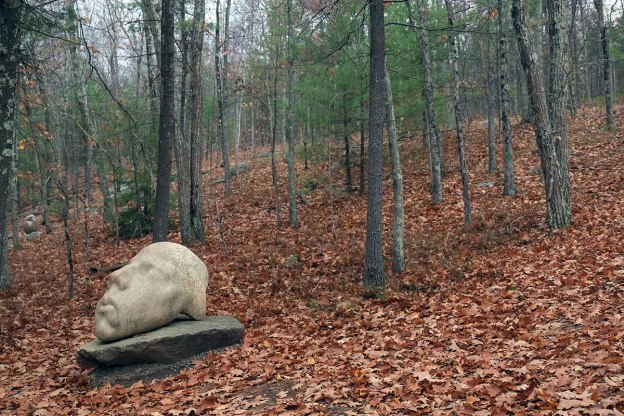
A sculpture park set on a hillside that had been a small ski resort in Brookline, NH. It was founded by an engineer and a sculptor in 1996. (http://andresinstitute.org), and they jump-started the park by inviting an international group of sculptors to live on the site and create works during a symposium. They have repeated this several times, and there are now 72 works in place.
We were struck by how simple and low-key the whole operation is. It is open and free to the public every day. You download a map onto your phone, and then you can wander trails all over the hillside. There are no Big Name artists involved whose works cost millions of dollars, simply good sculptors who seem to draw inspiration from the site and the group process.
Some of the work doesn’t seem very site-specific: objects which could be seen in a gallery with no loss of meaning. 

Others benefit from the wooded location, such as when you get a first , unsettling glimpse of something through the trees, and then close in to find that it is still unsettling when seen up close.

Our favorite works were those which seemed to be designed for a specific location, such as this weird beast-like thing:
or this bench/outpost/marker/tank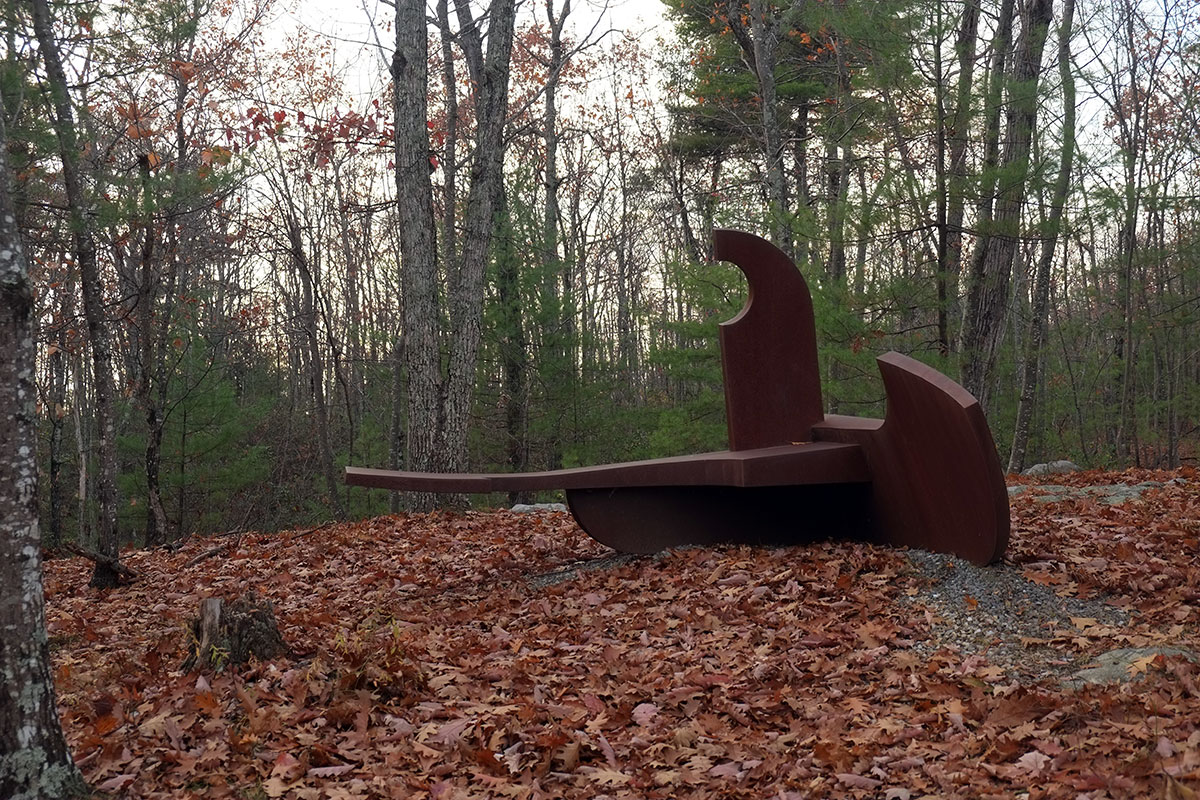
or sometimes the site provokes an association, as this piece reminded me of rotting totem poles as they are seen in the forests of the coastal northwest.
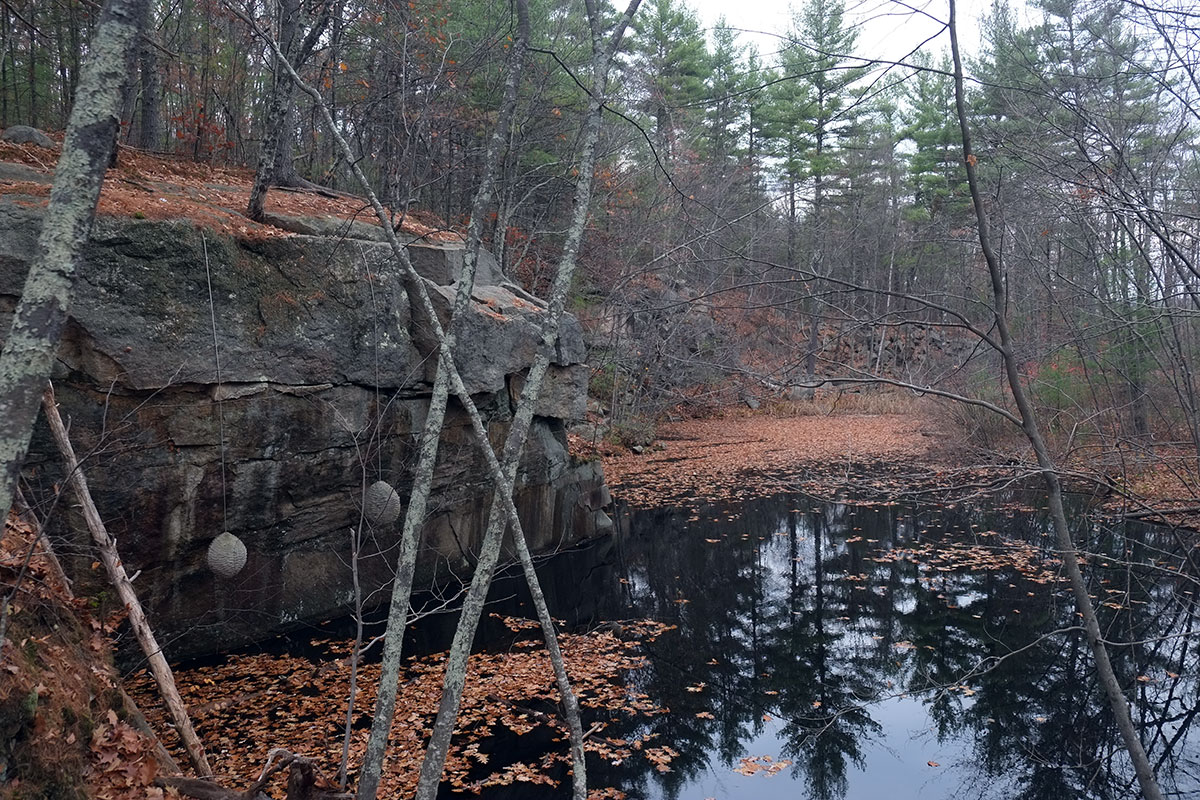
The quality of the artwork was high, but the landscape design could use some help. The trails don’t make much sense, and having an overall vision of sequence and procession would enhance the experience of the art. The one place where this was done, on the Quarry trail, was by far the most satisfying. Pieces picked up on spatial cues in the landscape, and moving along the trail led to an understanding that was larger than the sum of the parts.

At the top of the mountain the space opens up, and there is a view towards Mt.Monadnock and other small peaks in the distance. 
As we were leaving in the growing dusk, we could barely see dark forms ahead by the side of the road. Were they people, or sculptures, or just shadows that we were imagining to be forms? It put us on edge, clearly the artist’s intention, a brilliant example of the power of a well-executed piece.

This institute doesn’t appear to be that well-known; we really enjoyed seeing a good local, place, one that doesn’t appear on anyone’s list of major monuments of western civilization, but which shows that there are good artists out there, working for the sake of the art, and not just the blandishments of the art market.
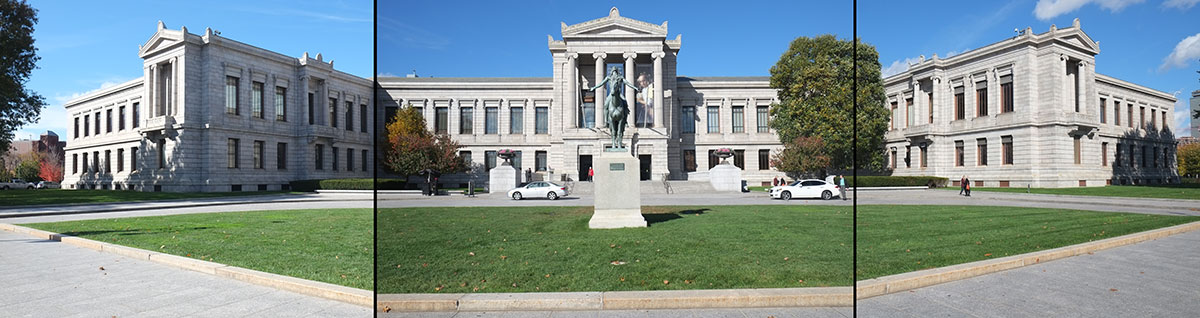
All of Boston’s venerable museums have had major renovations since I lived there – the Museum of Fine Arts by Foster + Partners, and the Gardner and Harvard’s Fogg, by Renzo Piano. I couldn’t get to the Gardner, but I was able to see the other two in some depth. As I ended up as an art history major in college, I knew both of these museums down to the smallest detail, and so have a good baseline for comparison.
The most impressive thing about the Foster remodel of the MFA is that they didn’t mess up the original Beaux Arts building. In fact, they significantly improved the overall organization. IM Pei’s addition from the early 1980s had confused the plan, shifting the main entry to the southern side facing a parking lot, and demoting the Huntington Avenue entry on the central axis. The current state opens up this axis from Huntington back to the Fenway, and once again the building makes sense.
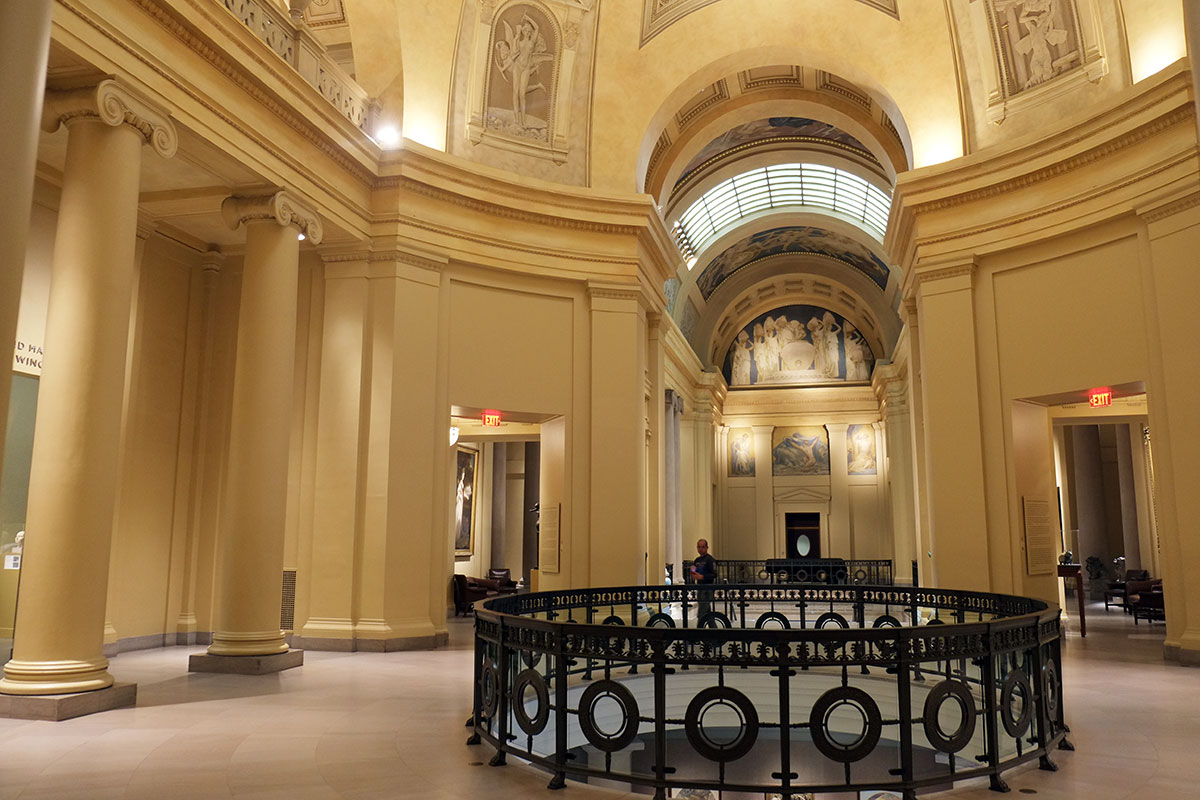
Pei’s addition is looking a little dated. There are some commodious spaces and good galleries, but the detailing seems overlay flat and gypsum-boardy. Mark Rylander just pointed out that the Pei buildings that are on the interface between late modernism and brutalism have worn better, with strong tectonic qualities (I had recently seen a good example of this at the Columbus Indiana library). The MFA wing is hiding all of its guts, covering all with a pure white surface.

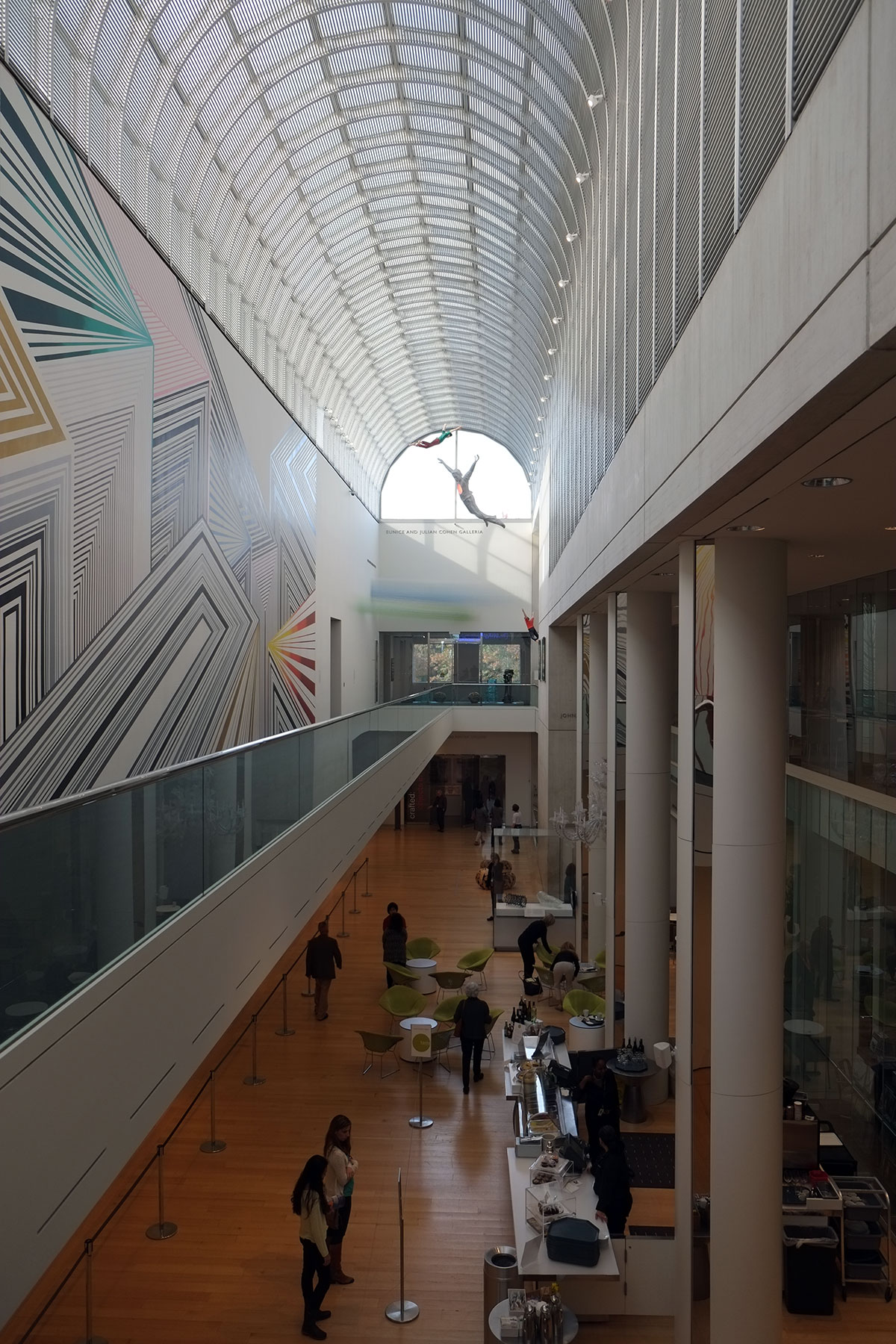
As the wing has been repurposed, it now includes an innovation that should become standard in museums: inside the high-end restaurant, there is a bar, where I repaired for a little pick-me-up after a long, intense afternoon looking at art. Refreshed by the best Manhattan I’d had in six weeks, I spent the rest of the evening checking in with all the galleries. 
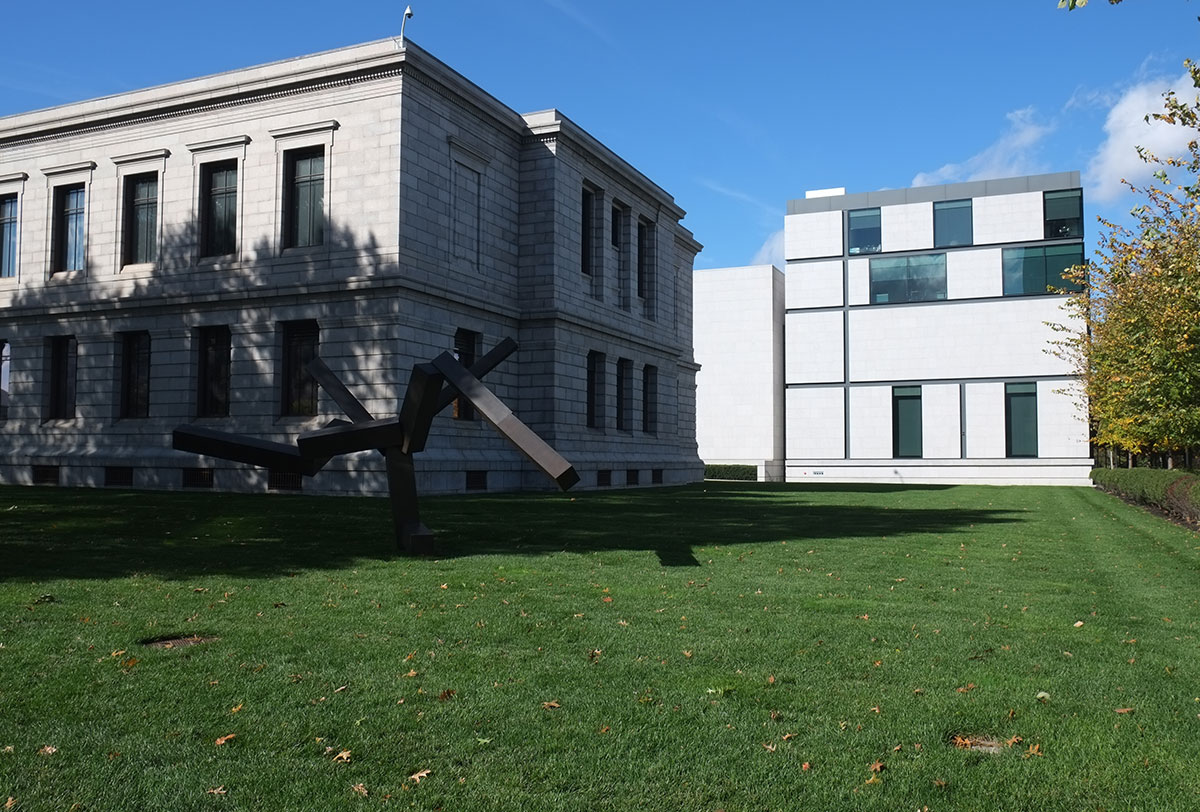
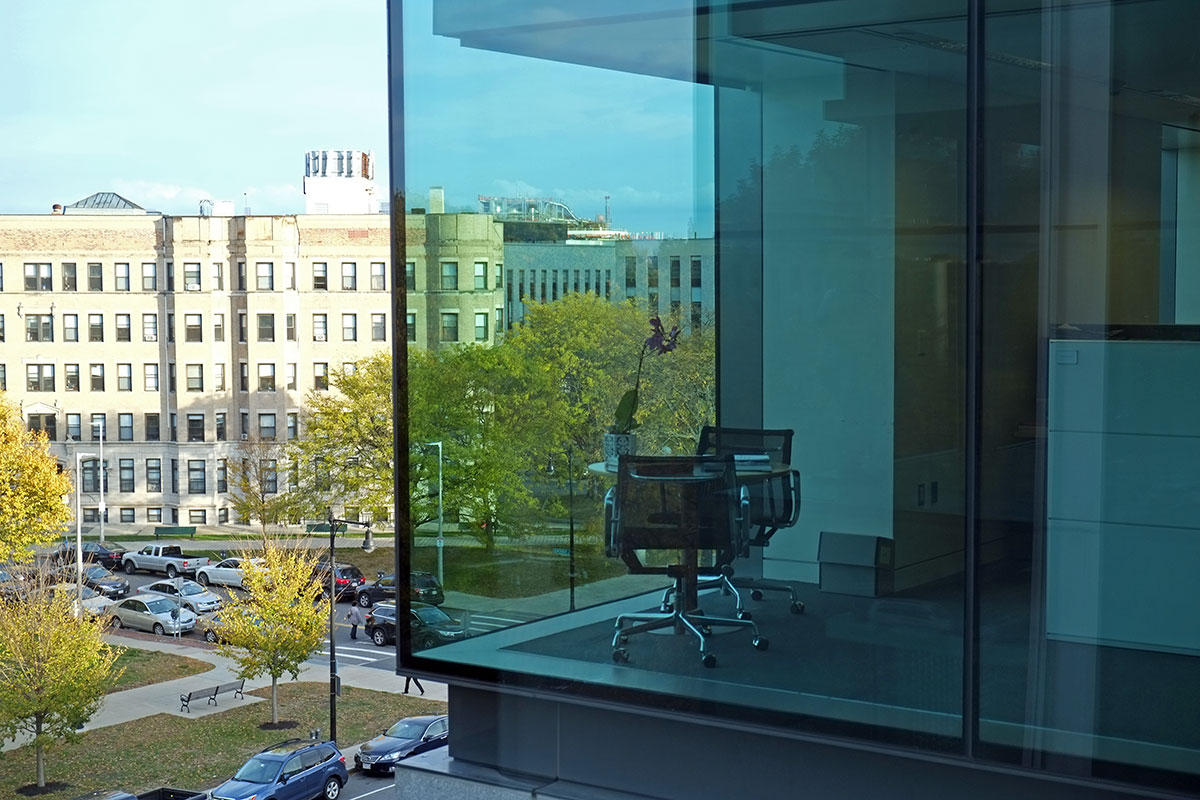
Foster’s addition includes administrative offices and a new wing for American art, which grow off the north end of the existing building. The exterior is an exercise in the current style – random variations within a grid. It’s very tight and crisp, with the solid/void relationships handled well.
The big move is a large glazed court/atrium set between two wings of the original building. It’s a huge space, with a scale that seems more like an exterior courtyard. There is a cafeteria set up, which was whisked away in the afternoon so the space could be used for an evening event. It connects the central axis of the museum with the entry to the new American wing, but is otherwise not accessible from the two flanking wings. It supplies a necessary function within the museum – a place of relief from the intensity of galleries, with light, space, and a way to let your focus wander. 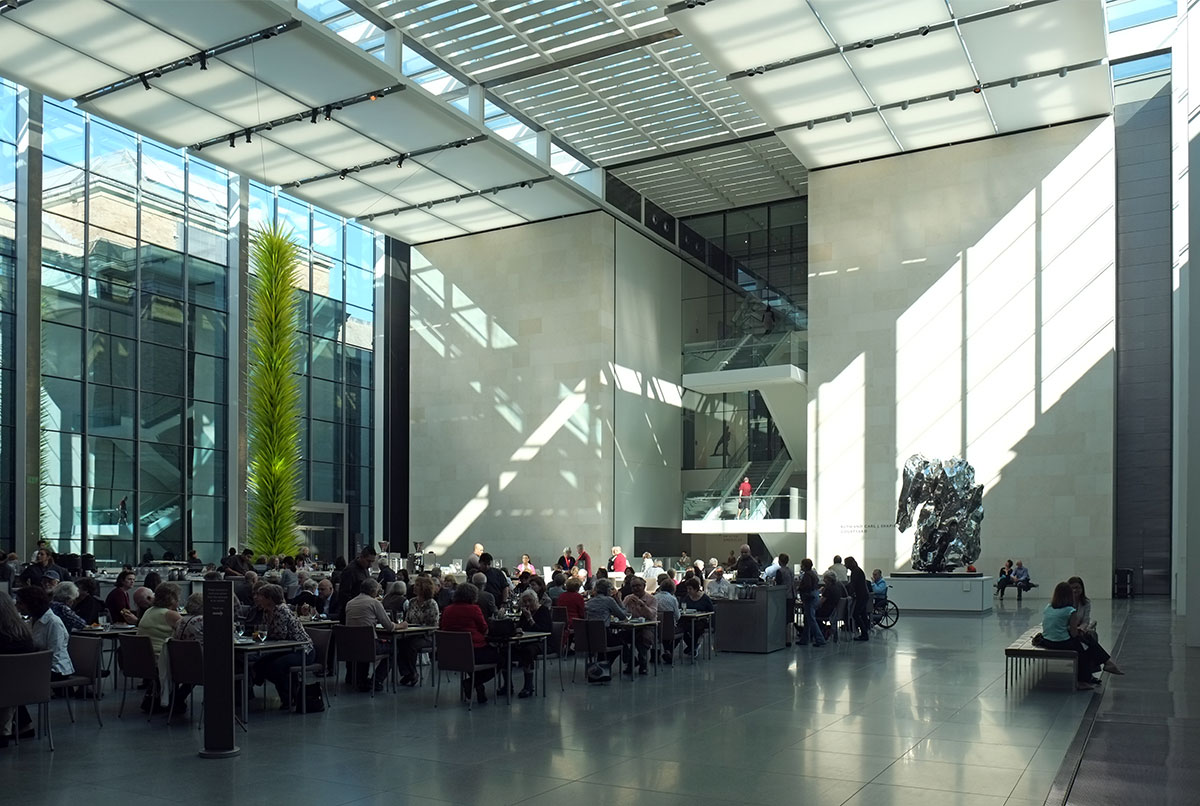
It reminded me of a modernist version the courtyard at the Nelson-Atkins in Kansas City.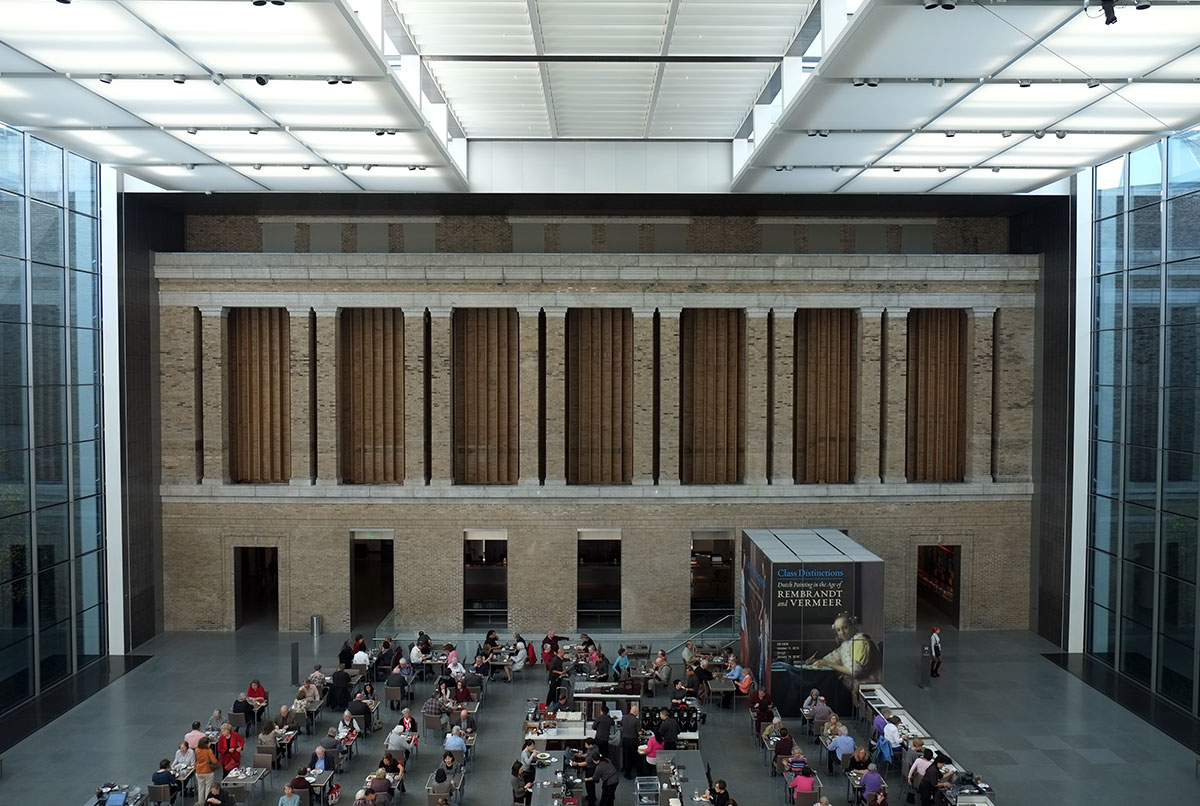

The big stair at the end of the atrium organizes the whole new wing. From some hallways on the sides you can see the clear differentiation between the old and the new.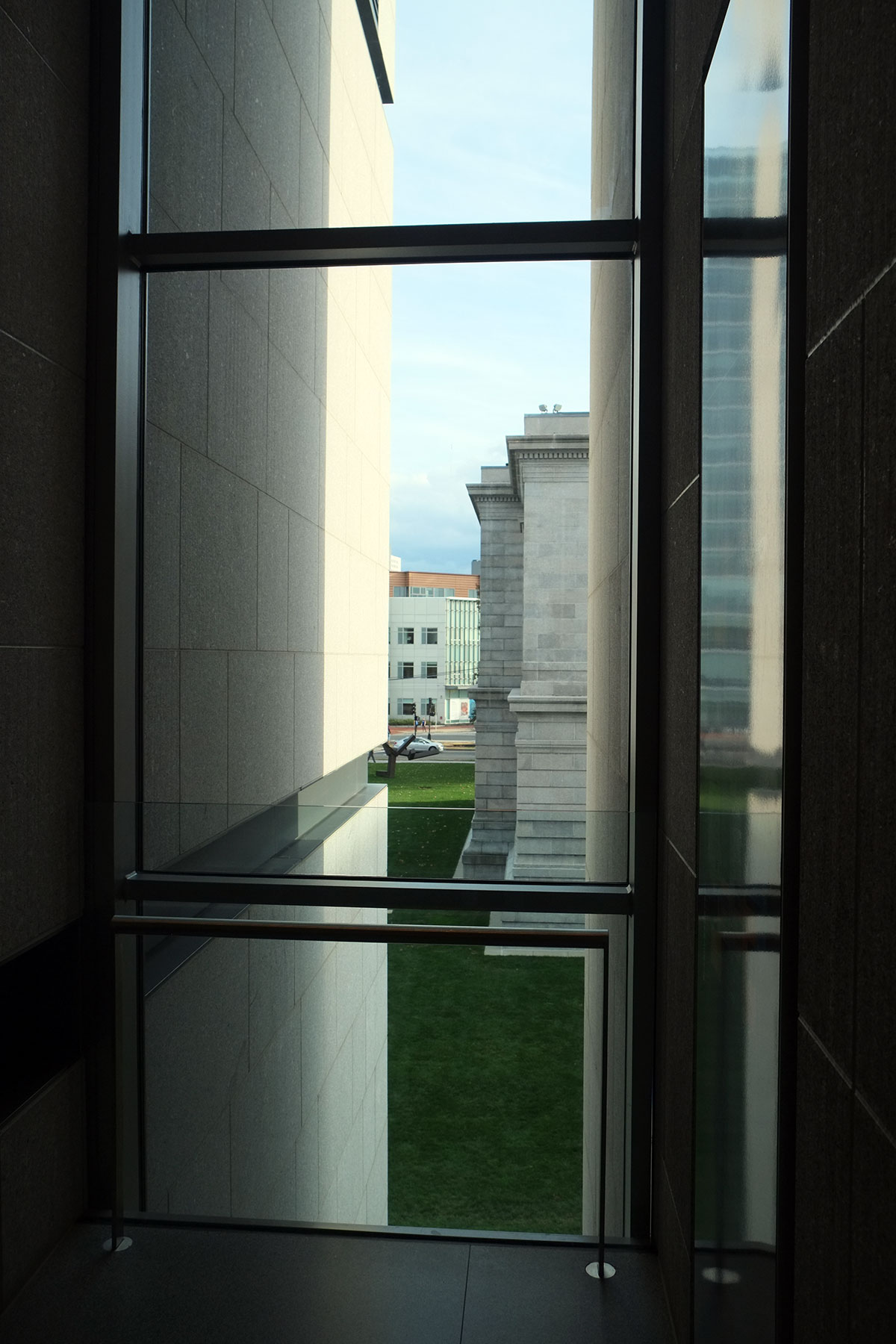
The new galleries are excellent – some are in the normal modernist vernacular of paintings floating on blank walls, but some are hung salon style, similar to 19th century practice. The light is controlled very well (the only mistake being the hanging of Sargent’s The Daughters of Edward Boit facing the atrium stair, where the glare makes it hard to see the dark painting). 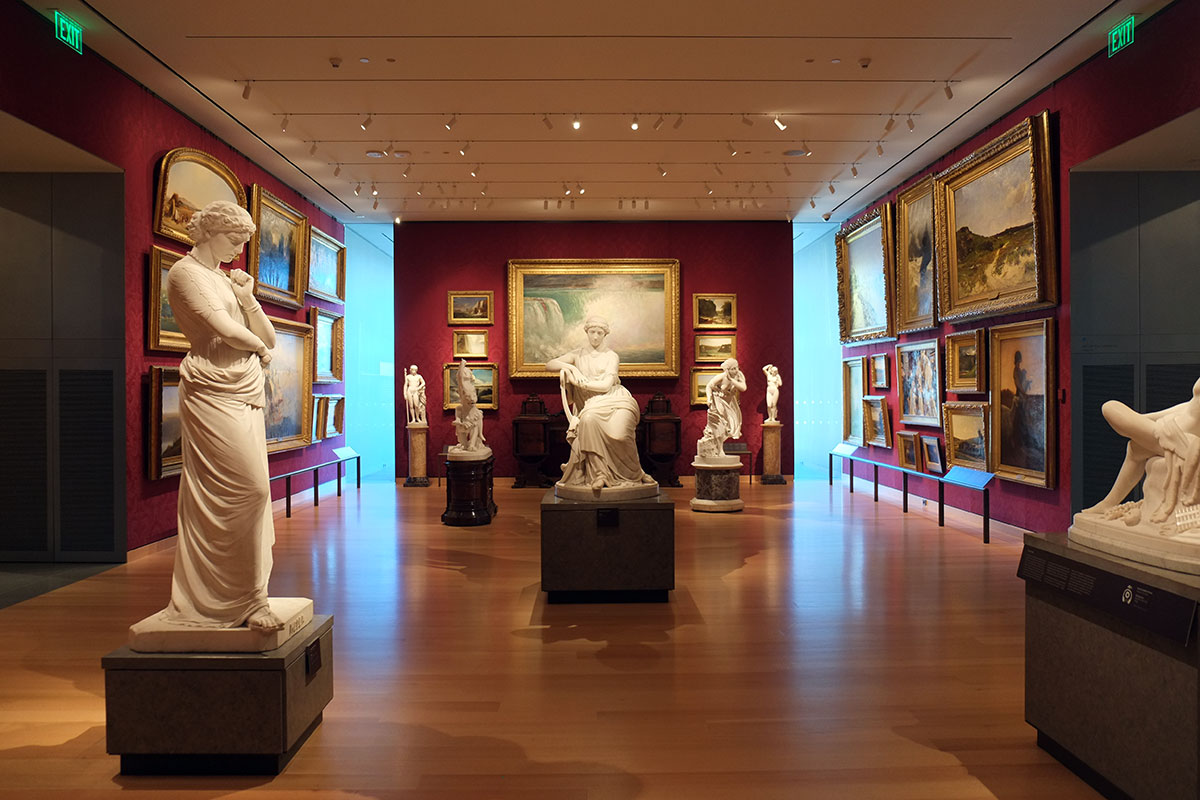
The gallery building is wrapped by a double-envelope / walkway on three sides. I’m not sure of the purpose of this – it has a few sculptures that can sit in the sunlight, but it seems like a lot of trouble for what it provides. 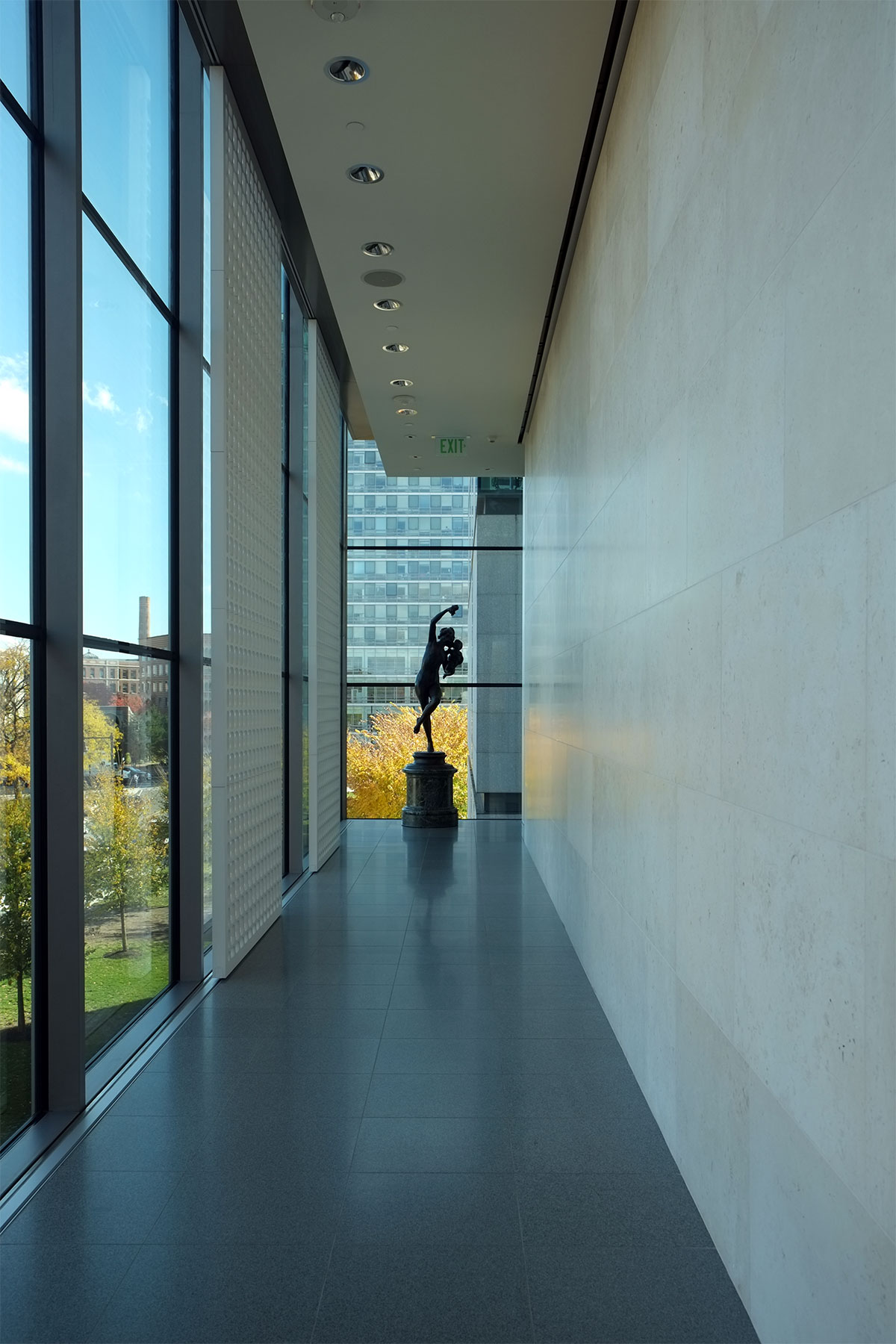
The top floor galleries are skylit, working very well for the large modernist work there.
Overall, it’s a very successful, sensitive and simple remodel. It seems more like a Piano building than a Foster.
Which brings us to the Piano building at Harvard. It is more than an addition to the Fogg. The Fogg used to house galleries, classrooms, the art history department (which they call Fine Arts, just to confuse people), and the art history library. Now the departmental spaces have moved over to the Stirling building across the street, and the collections from the Sackler and the Busch Reisinger have been consolidated, so it is now called the Harvard Art Museums, and is a much larger museum with an art study center.
From the street, the juxtaposition is striking, and not bad at all. Let’s face it, the large flat wall of the Fogg went beyond the limits to which Georgian should be pushed, and the addition provides a much higher degree of articulation which reads well.
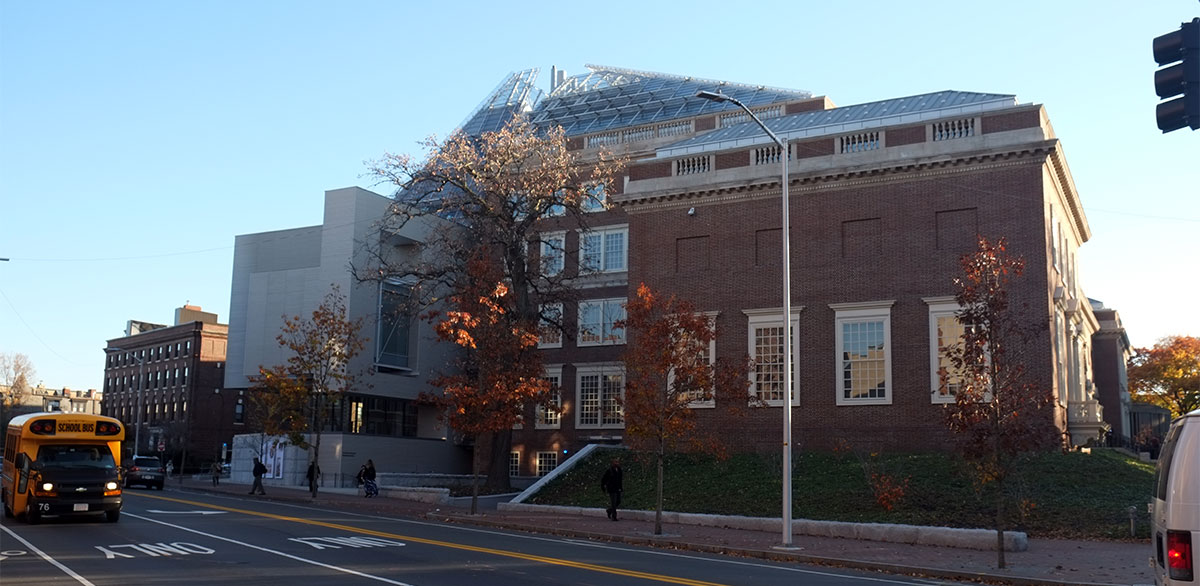
The reveal between the two is clear, while the big new roof ties them together. 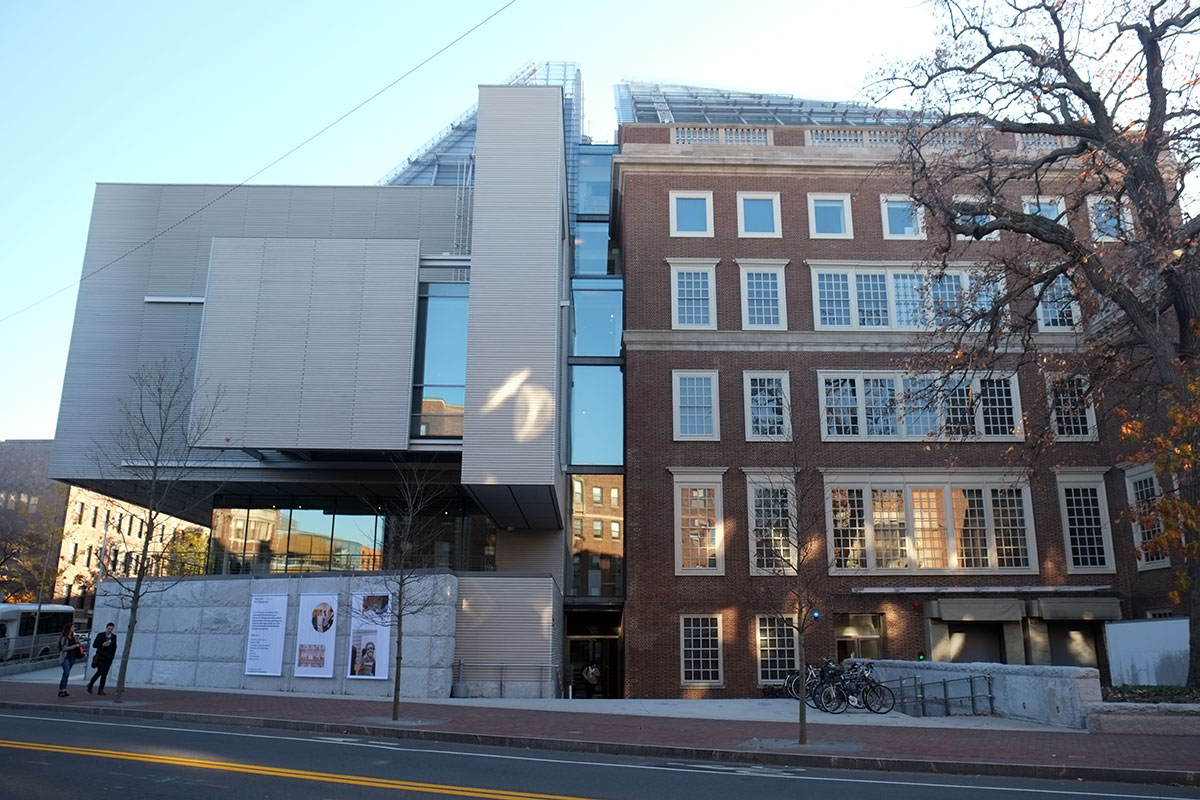
The Prescott St. corner is massive but pleasing. A wood(!) screen wall above a stone base. Robert Campbell thinks the base is clunky and not necessary, and I’m inclined to agree with him. 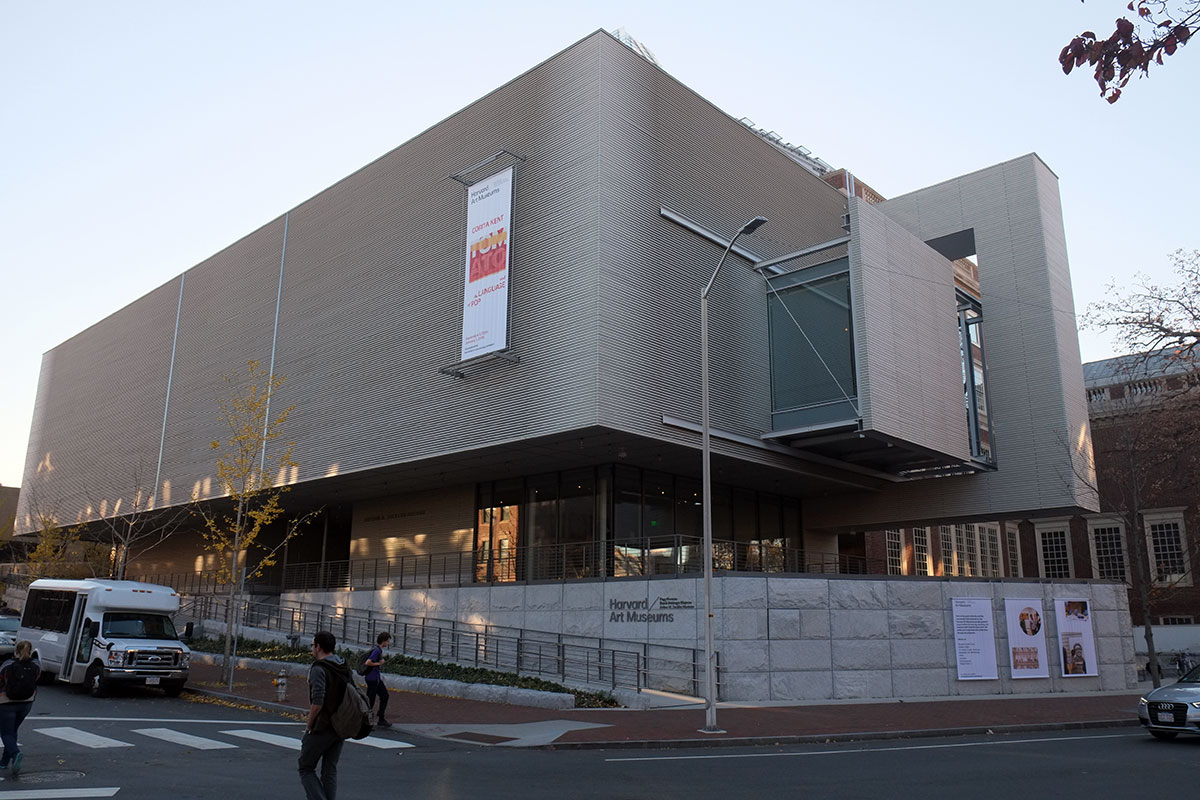
The big move is the central atrium. The Fogg had two levels of a Renaissance palazzo court, with a third attic story with small windows on a hallway. Piano always seems to respect these Beaux Arts schemes (such as at the California Academy of Sciences) and he does so here. The big question is how do you keep this parti, while doubling the height of the building, without making it a dark shaft. The masonry at the third level was removed, and that becomes the start of a glass curtain wall addition, exquisitely detailed. 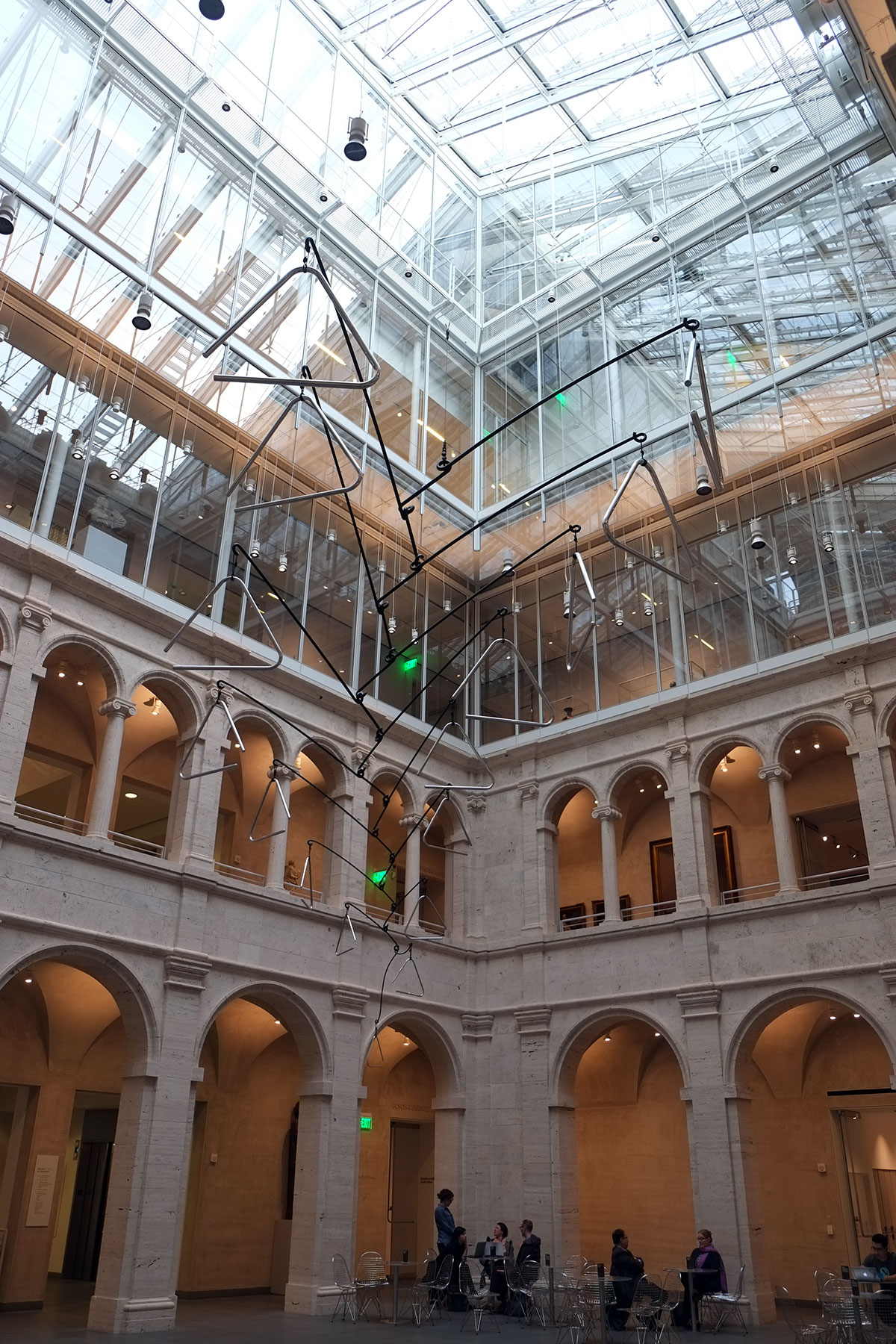
The third floor gallery circulation had been one of my favorite spaces – you got glimpses into the court through the small windows, as you were surrounded by pre-Raphaelite paintings on your way to class. It was fine, but I like the new corridors much better. Similar to the double envelope at the MFA, sculpture that can be in strong light is located here, with paintings set back in shielded galleries. 
The galleries are less spectacular, just plain rooms with track lighting. I think this quality is due more to the layout of the original Fogg – the footprint is not big, and these rooms are simply fit in. The circulation scheme relieves any possible claustrophobia – you’re not caught in an endless warren of galleries (as sometimes happens at MOMA), but can readily jump back to the atrium for light and space.
There are new galleries which pop through the solid wall of the museum and engage the streetscape. These also house sculpture, and the contrast with the painting galleries is strong. 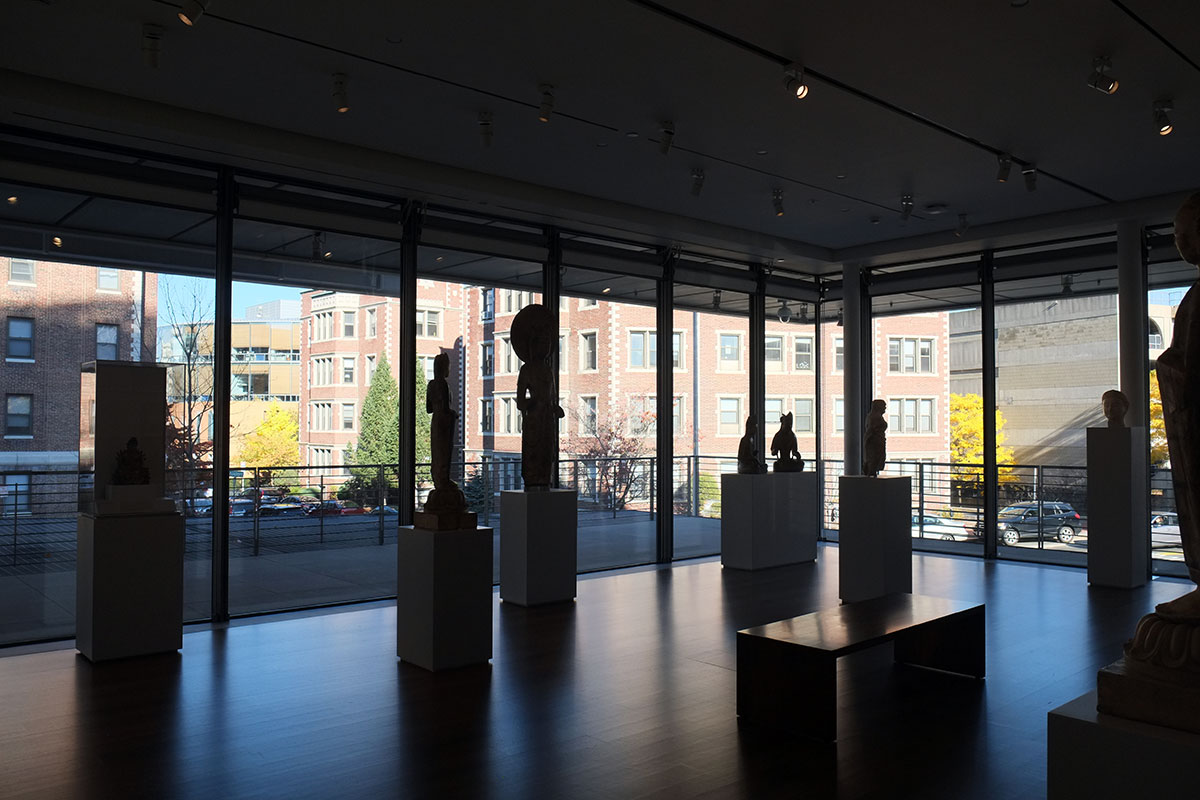

These also provide an excuse for the massively articulated, movable shading devices on the exterior. I’m not sure all of this was necessary; perhaps as with Foster’s double envelope, the alleged function just provides an excuse for doing something which looks really cool. 
On the fourth and fifth floors there is the conservation space and an art study center, with rooms which van be reserved so items in storage can be retrieved and examined.

There are quite a few big rooms like this, only one of which I saw being used. I asked about excessive daylighting, with its attendant glare and damage to art work, and was told that there are multiple levels of automatic and controllable shading devices in place. The rooms are beautiful, with great views of the city, but again I’m not convinced that this over-the-top high tech approach couldn’t have been accomplished with simpler and more passive techniques. 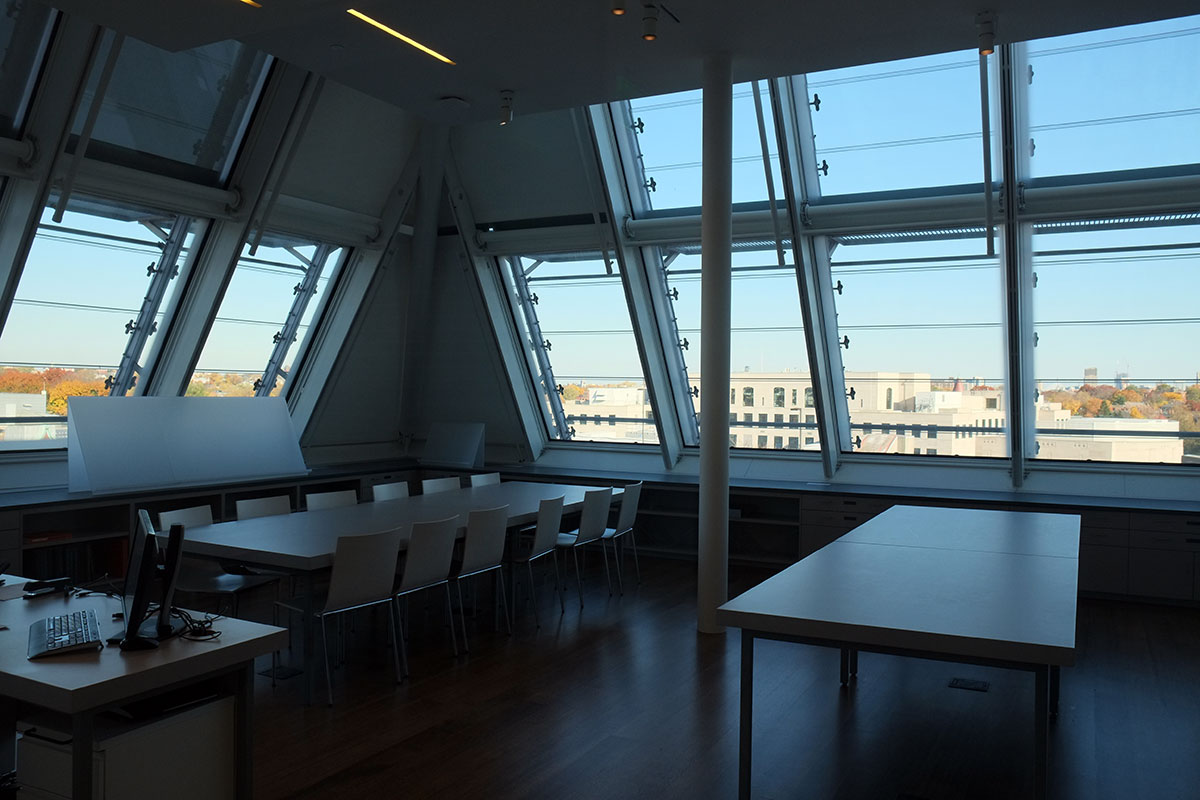
The relationship to th Carpenter Center is great. I’m not sure, but I think the whole Gwathmey Siegel remodel must have just been throw away. 
The ramp now plugs into the rear entrance to the museum.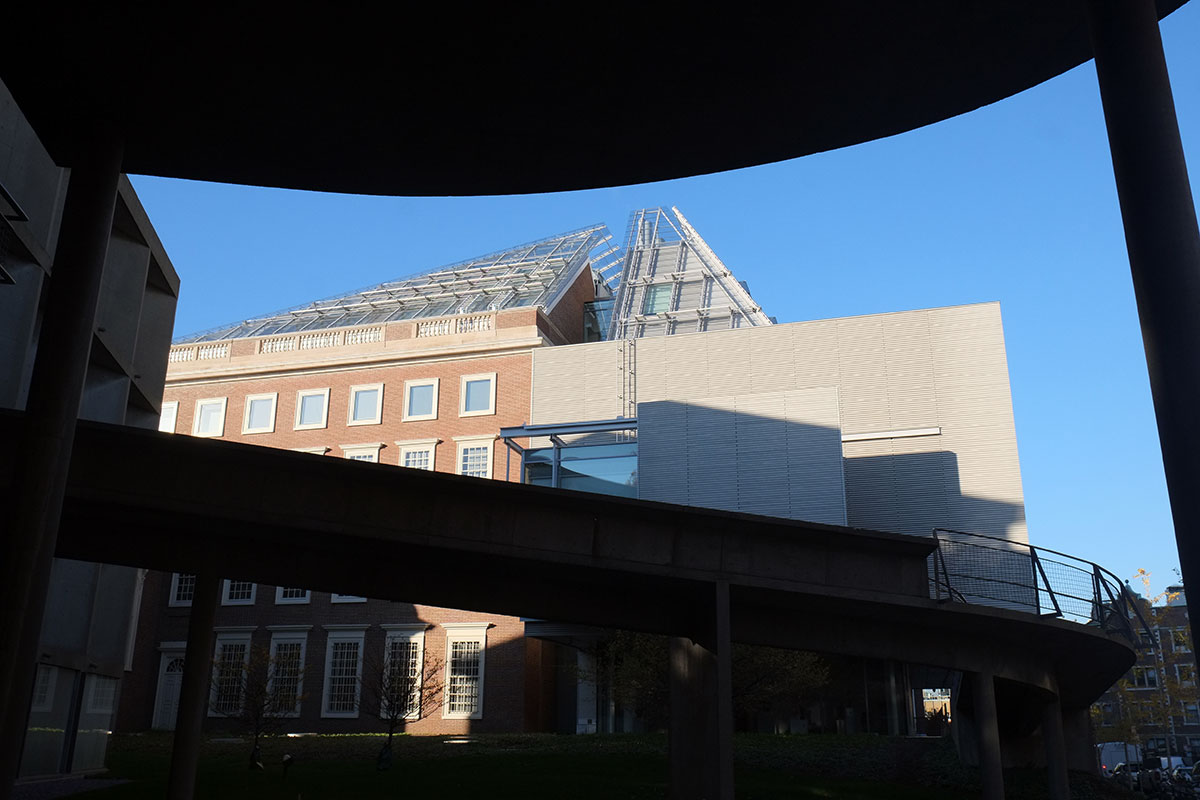
The top floor is an homage to Piano-tech (not to be confused with Pinakothek). The curtain wall starts at the third level, in a fairly simple manner, but it seems to accumulate more and more little metal pieces as it ascends, and the top is a high-tech apotheosis. At this point I don’t care if it is at all necessary – the dematerialization of structure, the play of light, the modularity and repetition, the transparency, it is all just gorgeous. No one can detail like Piano, and it’s nice when he’s able to just run amok.
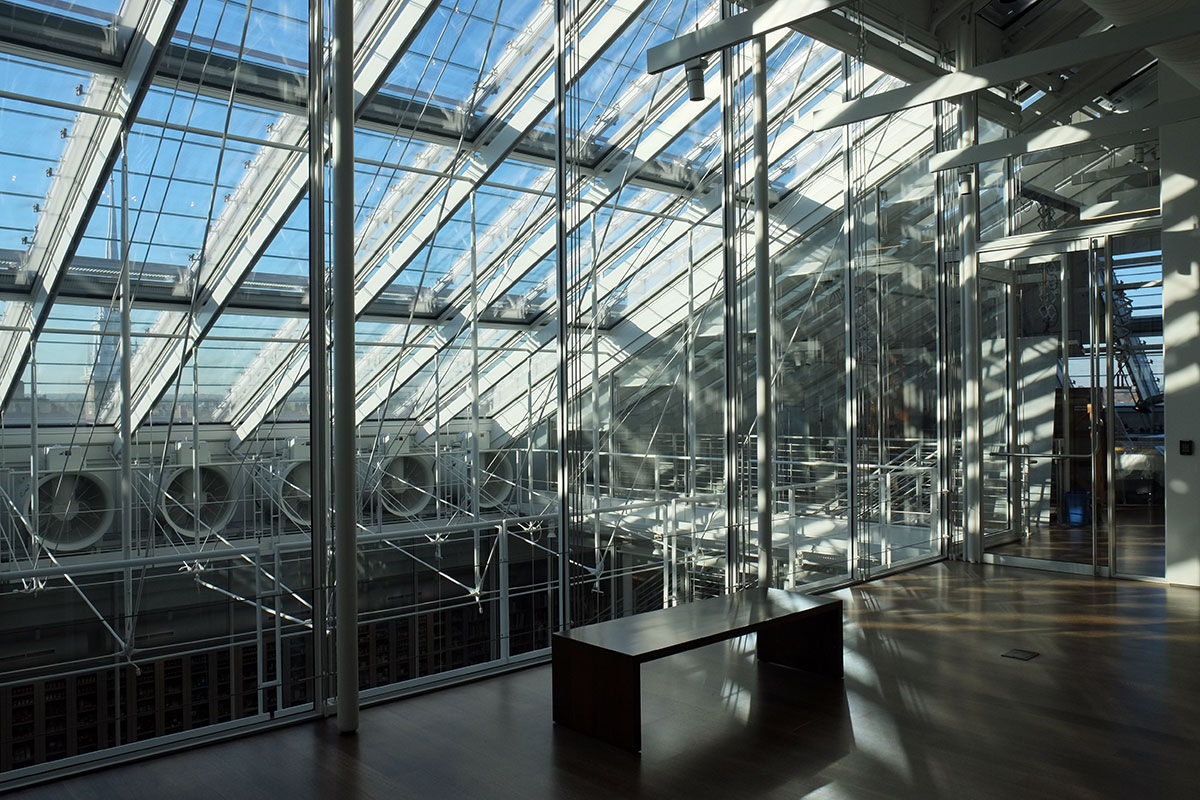
But I did find one embarrassing detail: I asked the brick what it wanted to be, and it said, an infill panel on an access door!
i’ve liked every Piano museum addition I’ve seen, mainly for their good sense, simple partis, contextual sensitivity, attention to the demands of the art and exquisite detailing, but in this museum, the architectural experience of the atrium is the dominant element. I found myself returning to it again and again, just to enjoy the light and the tectonics. It’s a very different museum from the one I knew, but the sensual and intellectual pleasure of the space more than made up for my displaced nostalgia.

If being in Boston felt familiar, Cambridge and Somerville felt much more so. I was at Harvard for four years, and then spent two years living in Somerville while I worked for an architecture firm in Boston. In retrospect, I spent the vast majority of my college years on campus, as it was intense and time-consuming, venturing into Boston for frequent field trips and museum visits related to my major in art history. After college I spent a lot more time wandering around Boston, due to more free time, being in Boston every day anyway, and living in a crummy apartment in Somerville that encouraged one to get out more.
If Boston seems to change less than other places, Cambridge is even more extreme. Returning alums bemoan the loss of old standbys like Cronins or Elsie’s, but there were certainly more than enough nostalgia-triggers around to drive Greta crazy, as she had to listen to stories in front of each (although I restrained myself from breaking into Illegitimum non Carborundum). Random highlights follow:
Harvard Square struck me as much the same, thought perhaps more sedate. Certainly the pedestrians are less militant than they were. 

While Joyce Chen’s was arguably one of the first restaurants to introduce authentic Chinese food to America, Yenching will always be remembered as the harbinger of the Great Szechuan Revolution in Cambridge, the place which inspired our subsequent lifelong predilection for excellent Chinese food.

Pinocchio’s pizza is still going strong, although it now has pictures of Mark Zuckerberg prominently displayed. I had forgotten how much Boston pizza differs from New York – not least in that it is made by Greeks – but I’ll leave the review of it to Greta. But perhaps the most inexplicable survivor was: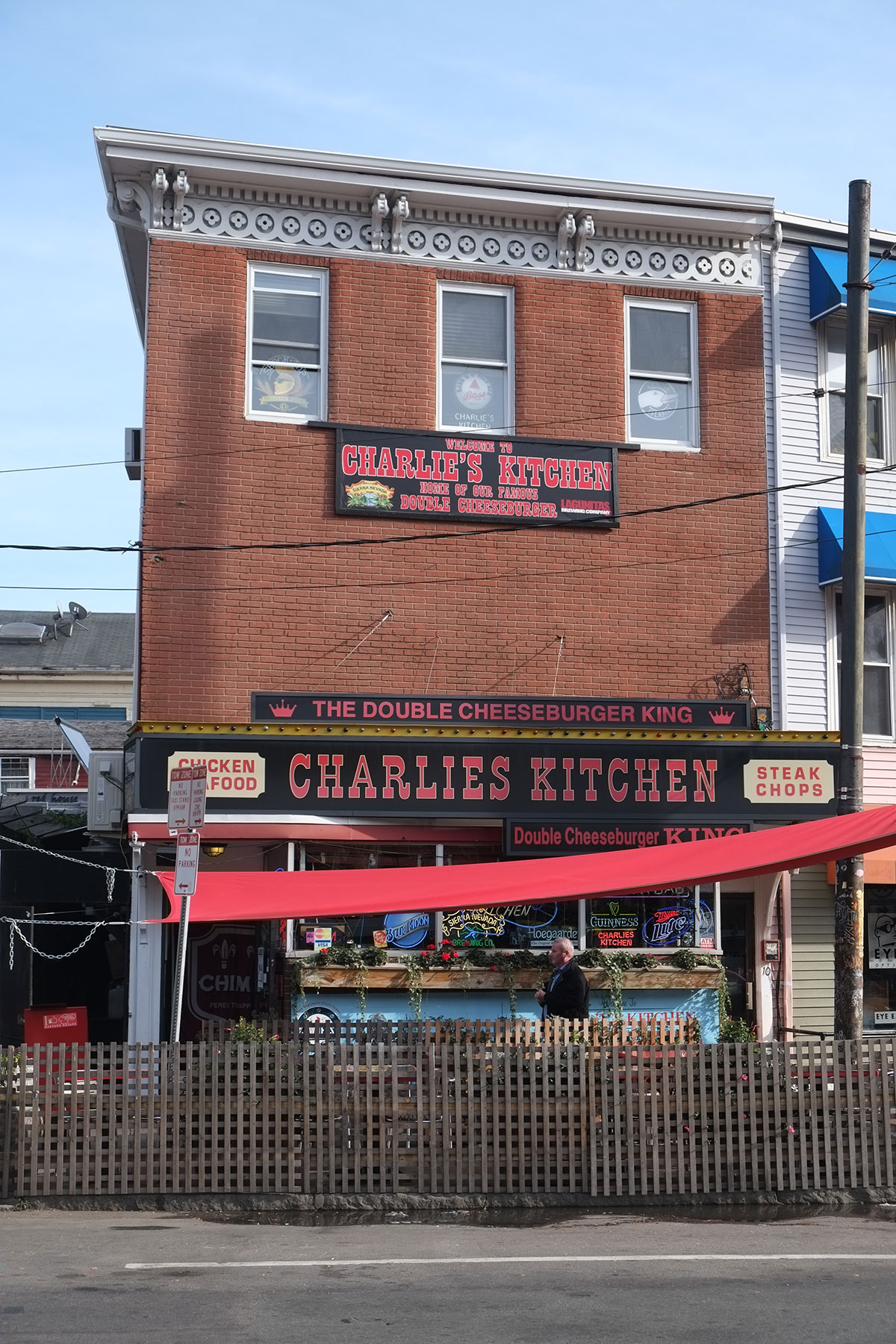
Charles Kitchen, purveyor of thoroughly mediocre double cheeseburger specials and cheap beer. I know that the culinary proclivities of undergraduates probably haven’t changed that much, but I was still surprised that it hadn’t been displaced by a higher-end establishment, until a local informant told me that it is owned by the Mafia and probably fills some other role in the underground economy.
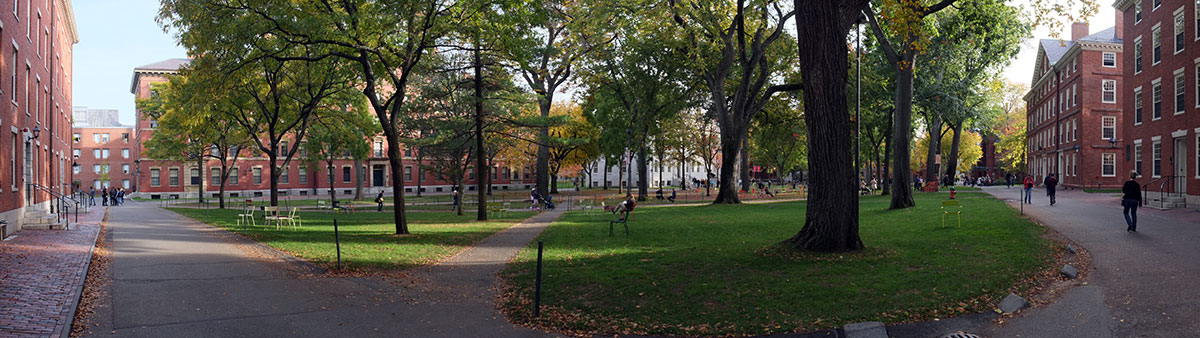
Harvard Yard is of course the same, except for the now huge crowds of international tourists and the chairs scattered around. Crowd control has become an issue, and there are signs everywhere telling you not to enter the buildings or bug the students. But once you get out of the Old Yard, the Tercentenary Theatre and the small courts are still relatively sedate.

Massachusetts Hall, the oldest academic building on campus, from 1720.
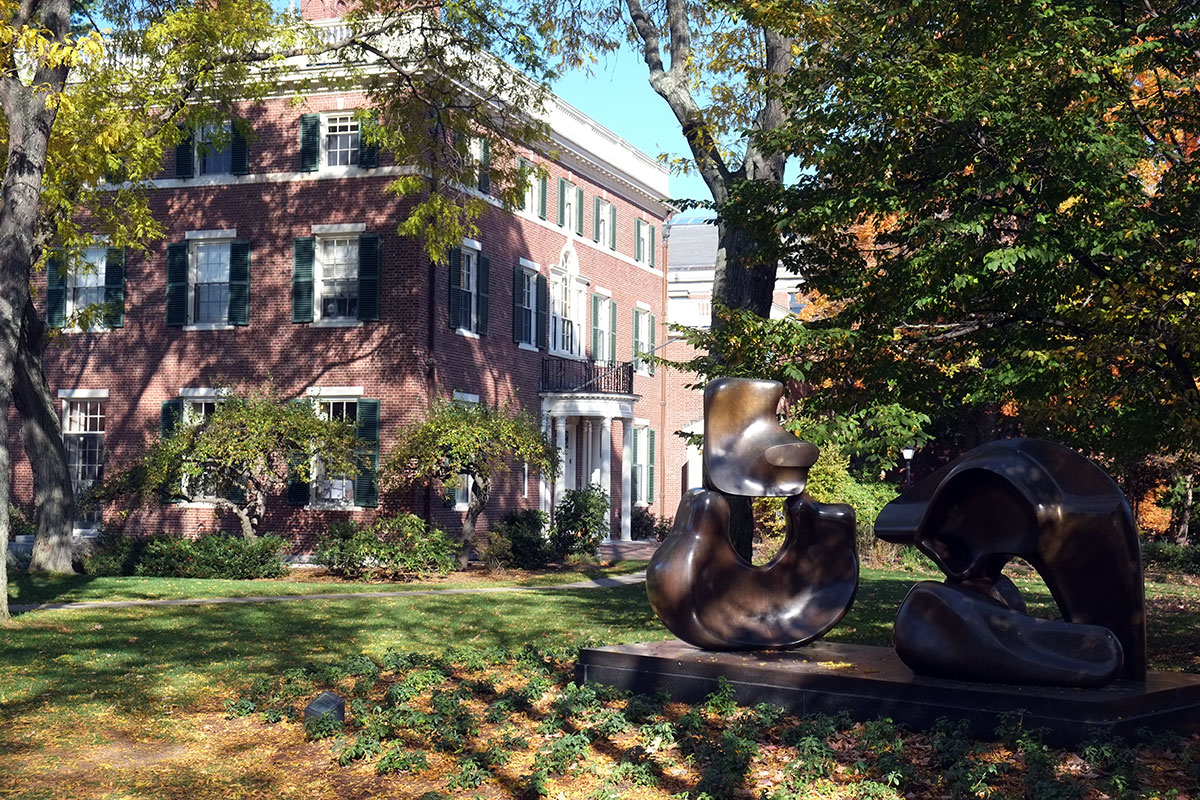
The President’s House
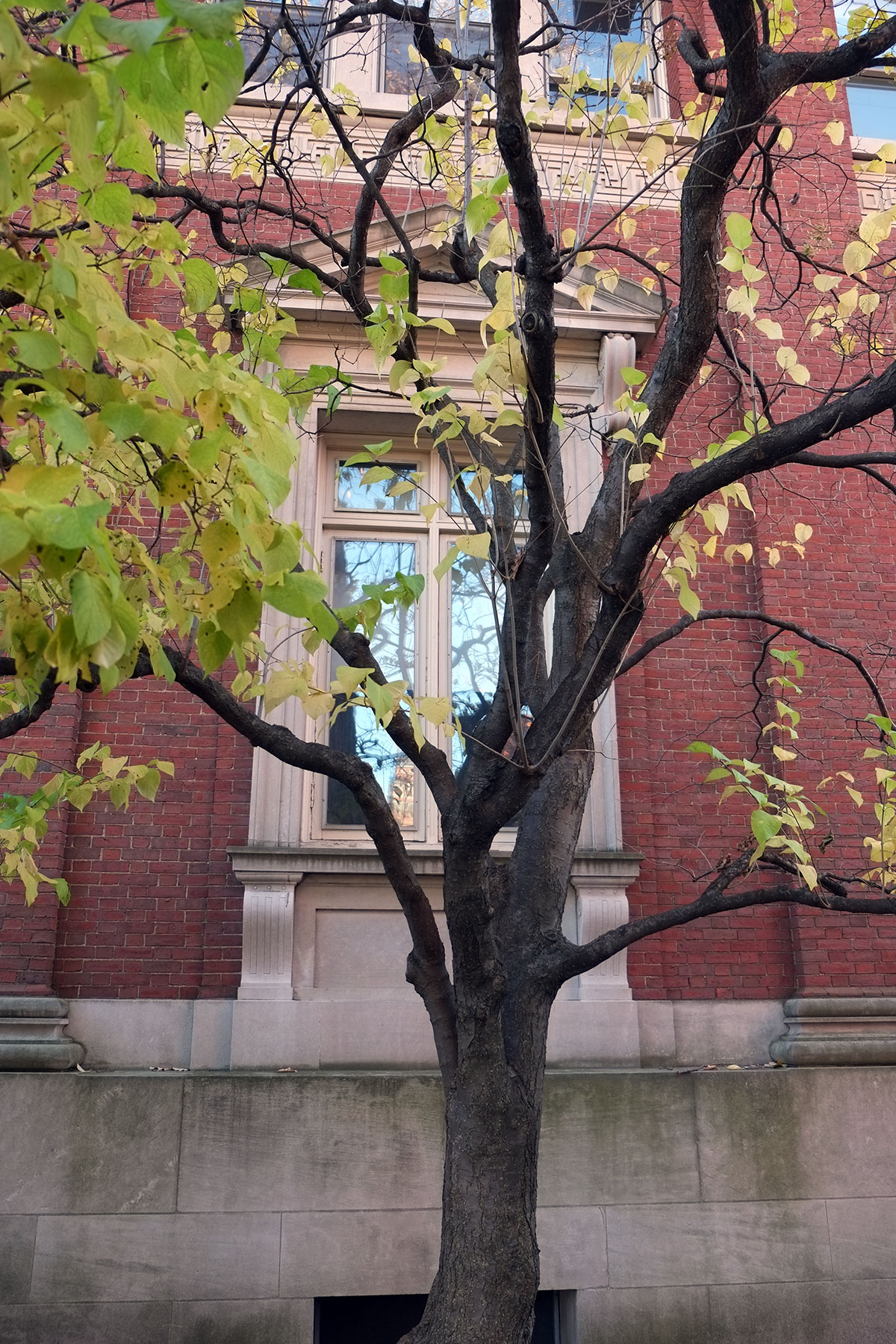
The window in Emerson, from which I gazed during Soc Stud 10 lectures on Marx (when I was a Soc Stud major before switching), and the tree I gazed upon.
Architecturally, we went by old favorites to photograph them, as I just hadn’t taken enough slides back in the pre-digital days.

the Lampoon and Adams House

the alley by Lowell House. An interesting development has been the replacement of the Fly Club garden by a new building for Hillel.

the view of Mem Hall from the GSD library, my preferred reading and late-afternoon dozing spot. The tower has been reconstructed, and it is now used as the freshman dining hall, after the desecration of the Freshman Union 20 years ago.
Becoming an architect has given me a new appreciation for buildings I didn’t particularly like as a student. I still understand their shortcomings as seen by laypeople, but as an architect I am bound to defend their architectonic qualities. First there is Sert:

the Science Center

Peabody Terrace, which I no longer feel the desire to bombard with paint balloons.

the Holyoke Street side of Holyoke Center, which is extremely nuanced in how it addresses its different orientations.
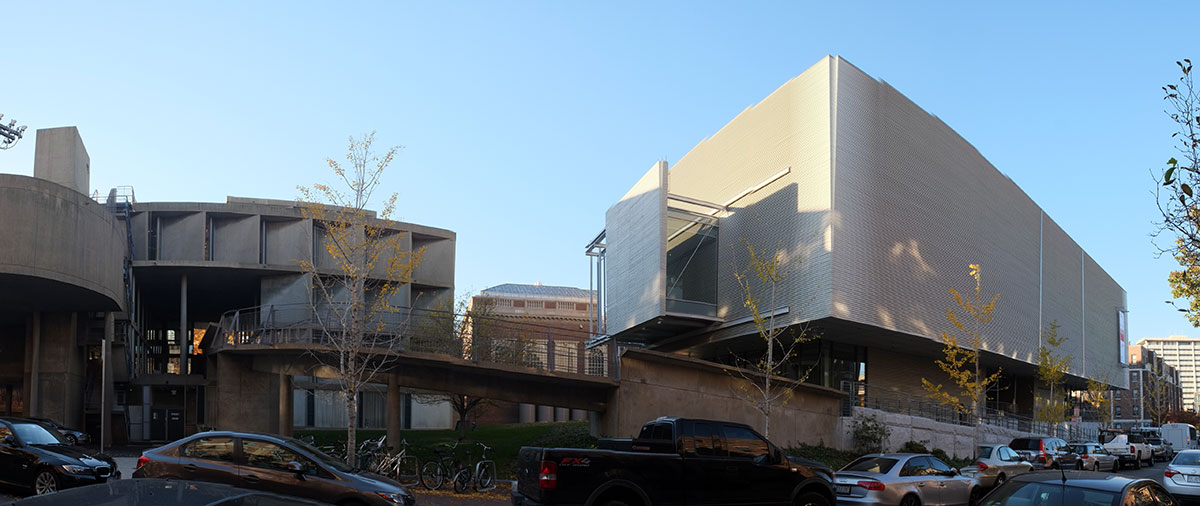
and of course Corbu’s Carpenter Center, which I now appreciate much more, and find its stand-off with Piano’s new museum quite entertaining (more on this to come).
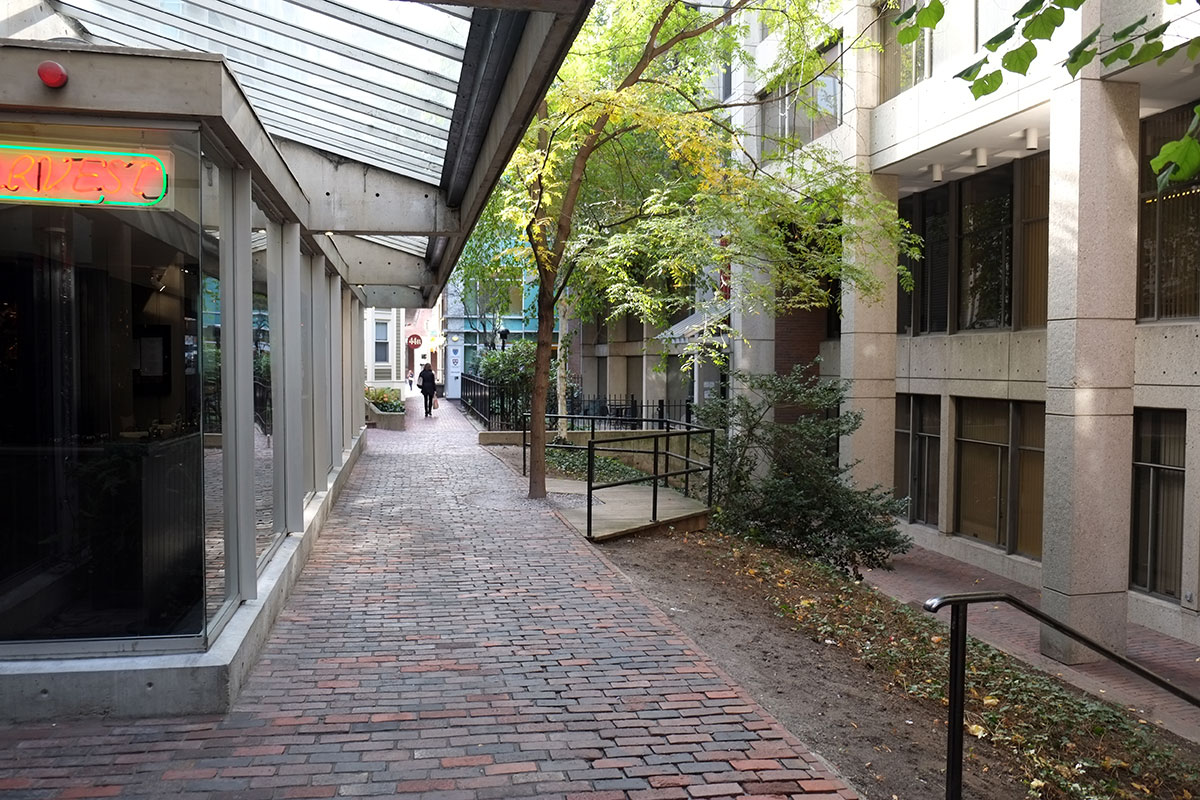
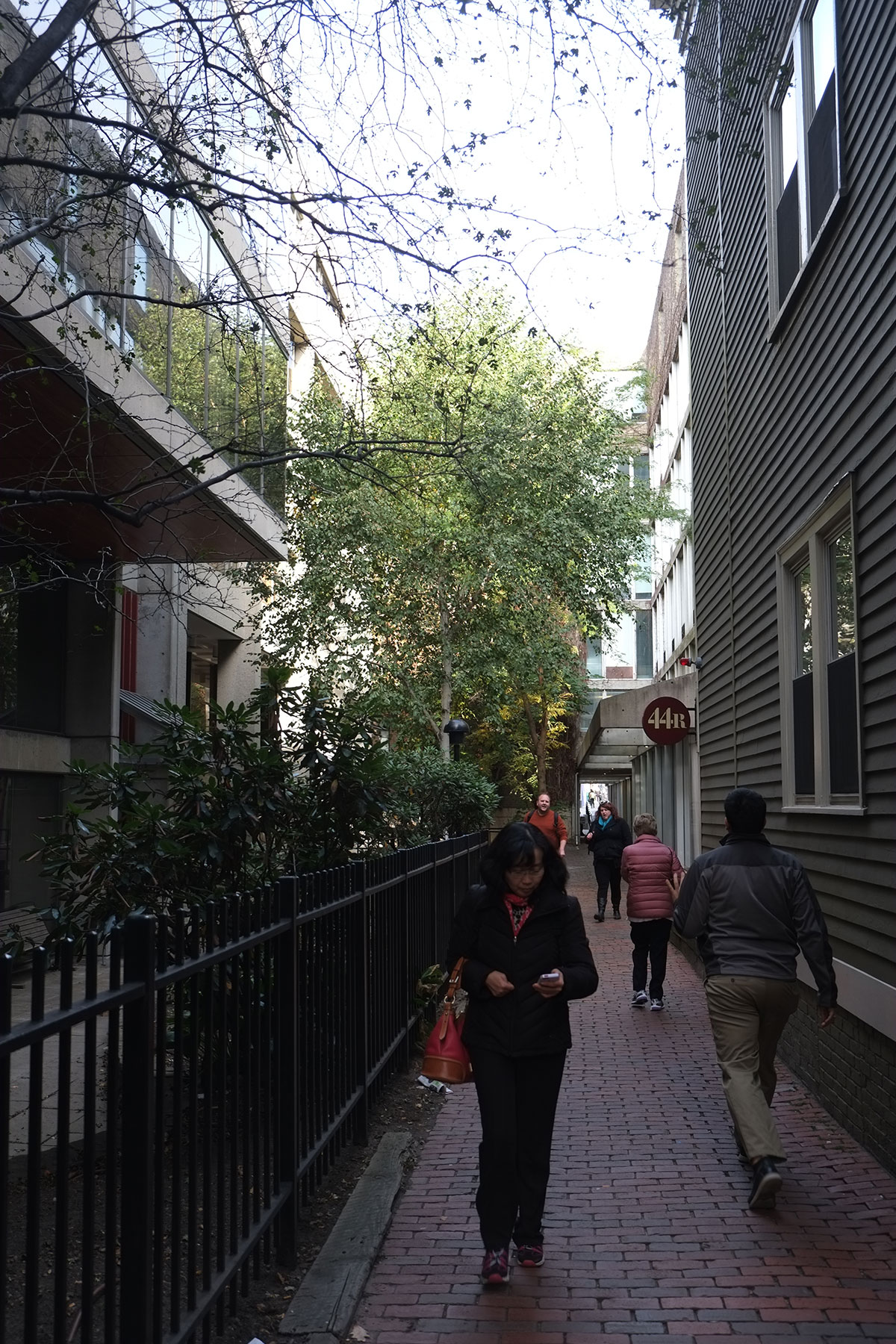
Perhaps the most striking place was the pedestrian alley and courtyard at 44 Brattle Street, (behind the Design Research building designed by Ben Thompson). The buildings were by Sert, Earl Flansburgh and TAC, who all had offices there, and collaborated on the design of the passage to the interior of the block. I have never seen another pedestrian passage in this country that is this successful – the materials, the scale, the spatial sequence – all have combined to create a vibrant, pleasant and well-used alley. It has become a commonplace that modernist object buildings ignored the context and destroyed the city; it is instructive to see spaces like this and understand how the best modernist architects were highly sensitive to these issues.
At the end of the day, Greta was more taken with Cambridge than she had thought she would be, and immediately fell into the role of serious author writing in a crowded cafe.
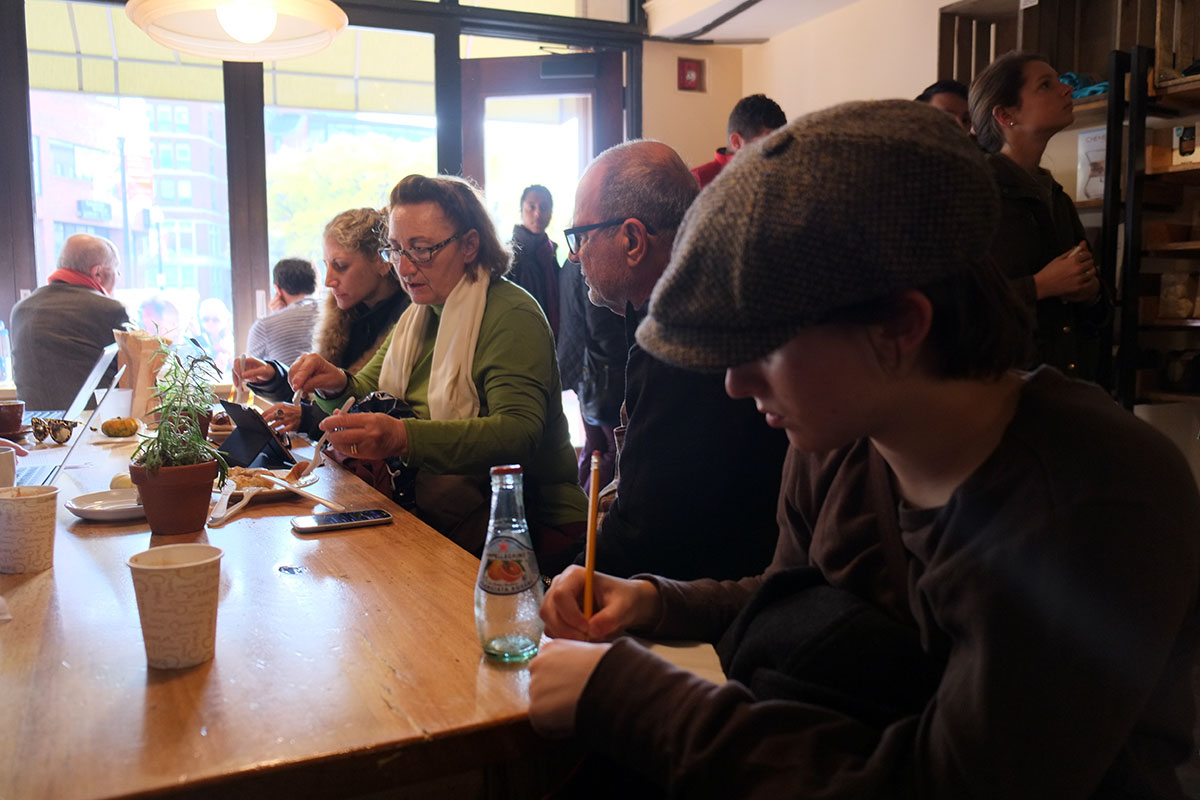
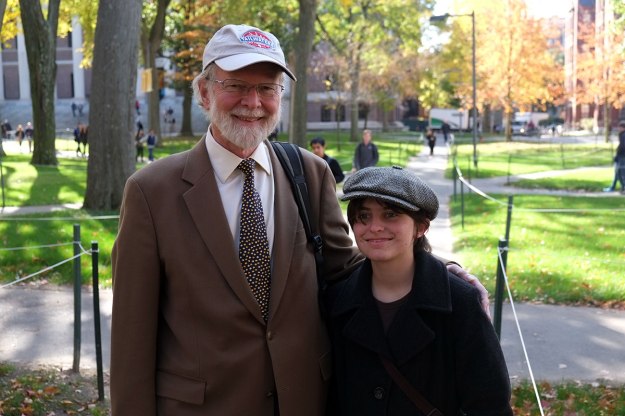 Jim McCarthy and I first met almost 40 years ago. I was in college and got a note from my mother, saying that my second cousin from Oregon was at the Bio Labs at Harvard and I should go meet him. I dropped in, we chatted for quite a while, and then I moved to New York and didn’t see him again. About 30 years later I was web-surfing and watching a Bill Moyers program on climate change on PBS, when this bearded Harvard biology professor named James J. McCarthy appeared. I emailed him to ask whether he was my cousin, and he replied yes, he had been on the Harvard faculty ever since, and by the way, he had grown up in Sweet Home, and all the rest of his family lived in or around Eugene.
In the intervening years, Jim would come to Eugene from time to time to visit his mother (who has since passed away), and we got to spend some time with him and meet more of his family. It was quite intriguing to get to know a branch of your family that you weren’t really aware of – certain looks or expressions seem improbably familiar; Jim actually looks a lot more like my grandfather than anyone in my immediate family does.
Jim has had an extraordinary academic career. I won’t list all the details (I don’t want to mimic those colleagues who introduce a visiting lecturer by spending 15 minutes reading their CVs), but he is the Alexander Agassiz Professor of Biological Oceanography at Harvard, and for twenty years was the Director of the Museum of Comparative Zoology (MCZ). Most importantly, he has been at the forefront of climate change research and action throughout his whole career as a key member of the Intergovernmental Panel on Climate Change, and currently is the chair of the Union of Concerned Scientists. (There are more details at http://www.oeb.harvard.edu/faculty/mccarthy/JJMpage.html). I’m frankly in awe of what he has accomplished in his career, as he embodies this ideal of the academic life – a cutting-edge researcher whose activism has had a great impact at the international scale, all while being very involved in university governance and caring deeply about teaching. (We at least have the last two characteristics in common.)
Throughout this trip I’ve visited many friends in academia, and it’s been revealing to discover how similar our concerns are about the direction in which universities are moving, even when our institutions are quite different. Jim and I also share an academic focus on climate change – his at the fundamental level of figuring out what is taking place in the global environment, mine at the more pragmatic level of how the architectural profession and building industry should respond to this most important challenge.
Greta and I were walking across Harvard Yard and ran into Jim (we were going to try to find his office later in the day), which I regard as payback for the time I was biking home in Eugene and unexpectedly ran into him as he headed to the Law School to meet with Mary Wood. We rendezvoused with him the next week for lunch, and then he took Greta on a behind-the-scenes tour of the collections at the MCZ, where she saw the marine specimens, supplementing what she’d seen of amphibians and reptiles with John Wenzel in Pittsburgh. (Meeting leading scientists and learning about their work wasn’t one of the planned goals of this trip, but it has emerged as one of the most important ones for her.) I sat in Jim’s office and Skyped into the thesis presentation of one of my honors college students back in Eugene, and I think the backdrop of his bookshelves and papers lent me an appropriate online academic gravity that calling in from a Starbucks wouldn’t have. (I’m currently thinking about how I might be able to bring this semblance of academic gravity back to Eugene with me.)
Greta and I both really enjoyed talking with Jim, and we appreciated how he let us barge into his busy academic life (the longer we’re on this trip, the harder it is for us to remember that most people have normal lives with commitments and job and schedules.) Greta got a glimpse into Harvard as it really is – an amazing collection of smart and engaged people working on serious issues – which was a good antidote to the old alumnus nostalgic sightseeing trip she was getting from me.
Boston does change, and it has probably added as many new buildings as other cities its size in the past 30 years, but the percentage of change seems smaller, since so many old buildings remain. There have been two big changes, and many more localized ones:
There are small changes to existing building, such as the art installation on the Hancock.
And at dusk you can see other changes, such as how the various tenants have designed their lighting:
Boston may preserve its pre-modern heritage, but its lack of affection for some modernist classics is becoming evident. Paul Rudolph’s complex at Government Center was never finished, and now it looks like it’s falling apart. We used to throw frisbees on the plaza, and watch in dismay as they fell through one of the large holes into the netherworld of the parking garage below. That plaza is now full of chain-link fences – perhaps in our insane post-9-11 security mania someone decided that the holes violated the security perimeter, so they have been enclosed. Between the fences, weeds and general lack of maintenance, the building looks like a wreck. Maybe it is Boston’s attempt to catch up with Detroit as a center for ruin porn.
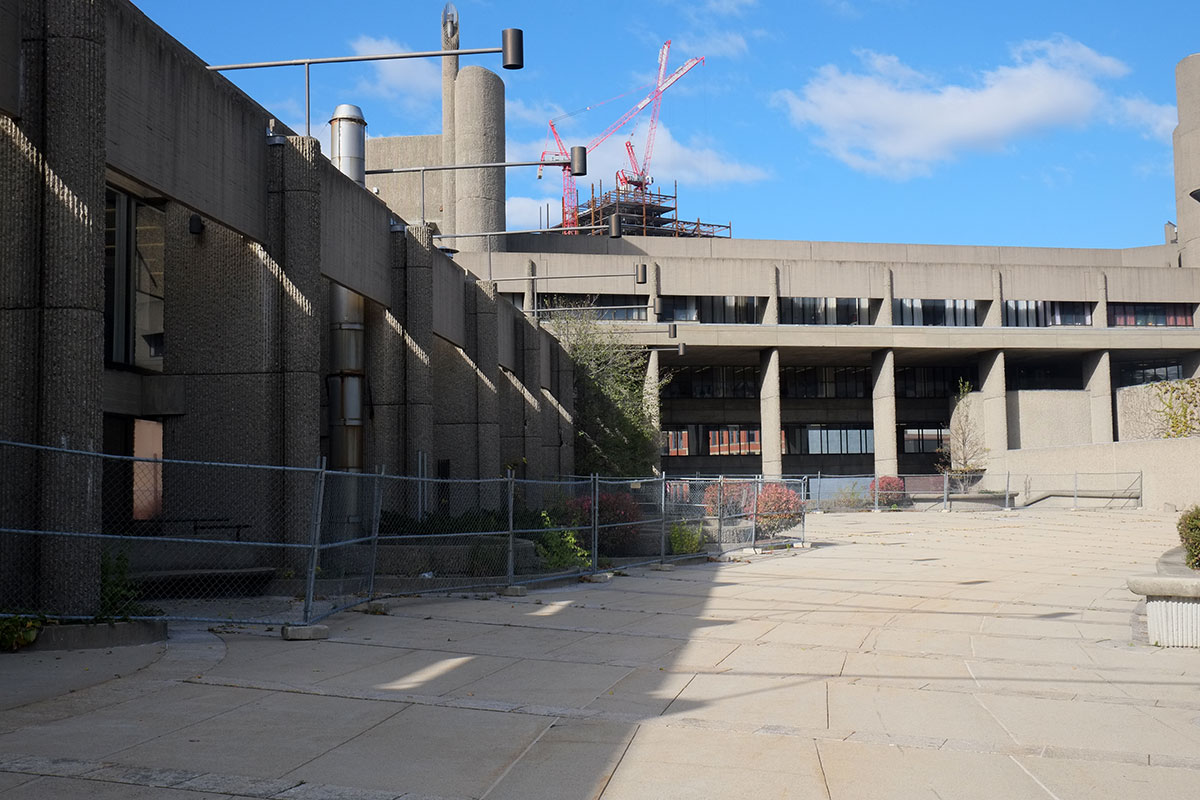
Even more surprising is what has been done to the City Hall. It is a building Bostonians love to hate, similar to our scorn for the Portland Building. I’ve always saved my scorn for the pointless, overscaled, empty plaza, thinking that the building itself is a pretty rigorous Brutalist icon. But it is now suffering the death of a thousand cuts. The big ramps and access points to the building have been closed off, no doubt in another security frenzy.
What was once an awe-inspiring interior formal stair hall has been strewn with junk – a random potted plant
garbage cans at important points, brightly colored tape on all the brick stairs, a painted blue tarp which obscures the stair to the council chamber, and a truly crappy coffee bar right in the middle.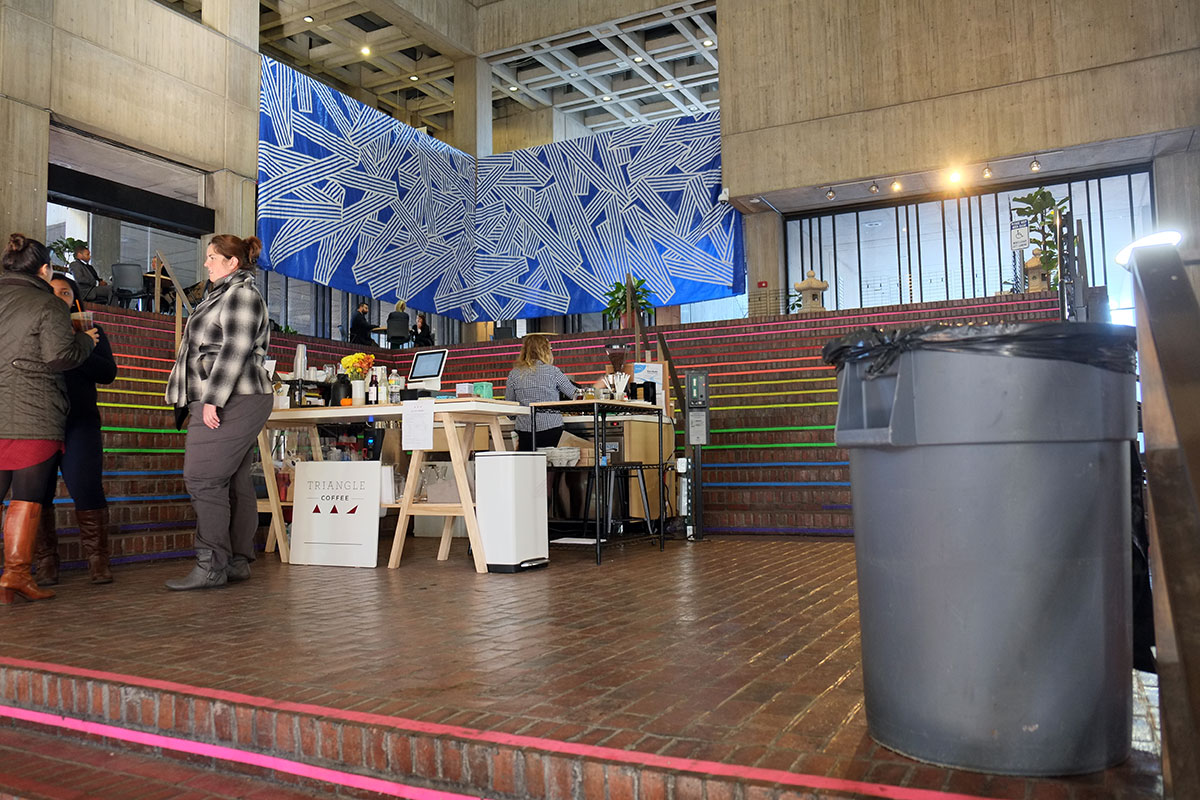
It’s just depressing. I know the building has problems, but it would be nice to deal with them in a systematic and thoughtful way, rather than letting everyone add whatever junk they wanted to.
And of course we can’t blog about crappy new things in Boston without revisiting the master of kitsch, Philip Johnson. HIs 500 Boylston building is appalling, the kind of embarrassing banality that caused the downfall of postmodernism. I can’t decide whether I hate this or his PPG Place more.
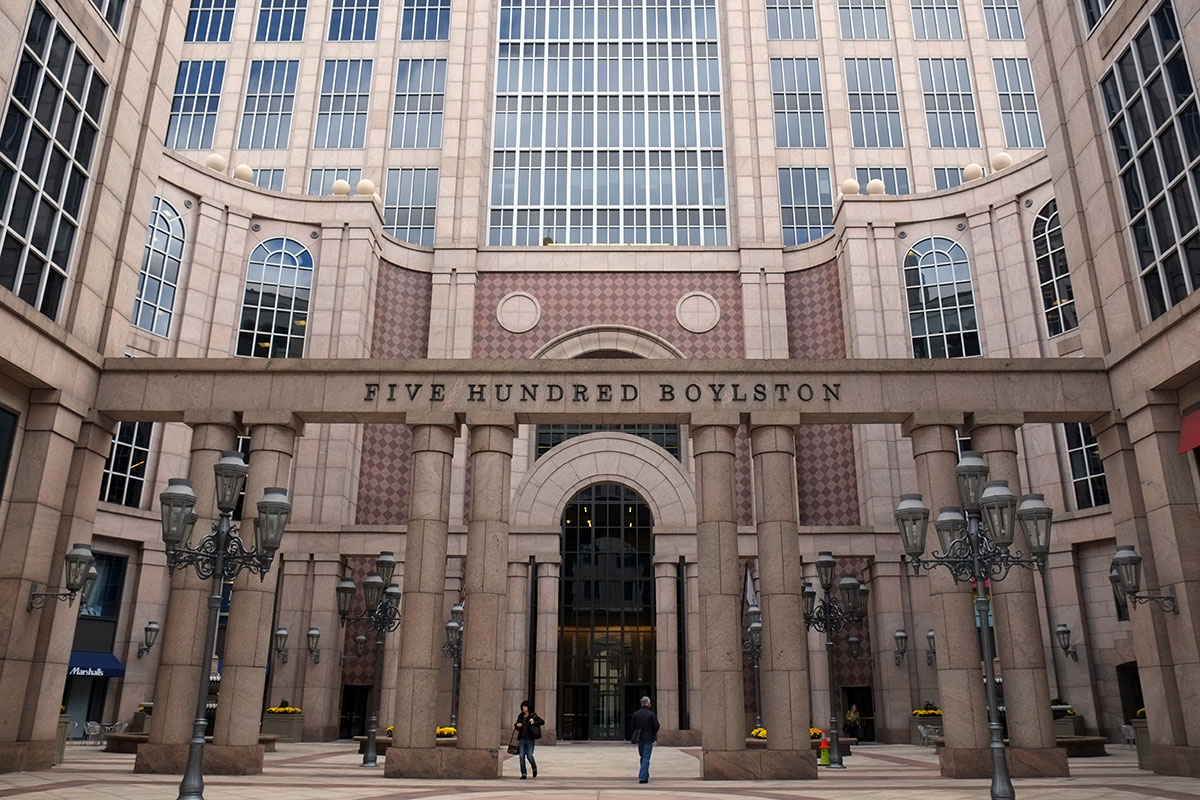
There have been many new towers built downtown in the past decades. Most of them are awful – under-detailed and overscaled, the same as has happened to every other big city. But once again Boston’s heritage comes to the rescue – there are enough good old buildings that the new ones don’t overwhelm it. The old ones certainly make the new ones look bad, but the counterpoint between them is not unpleasant.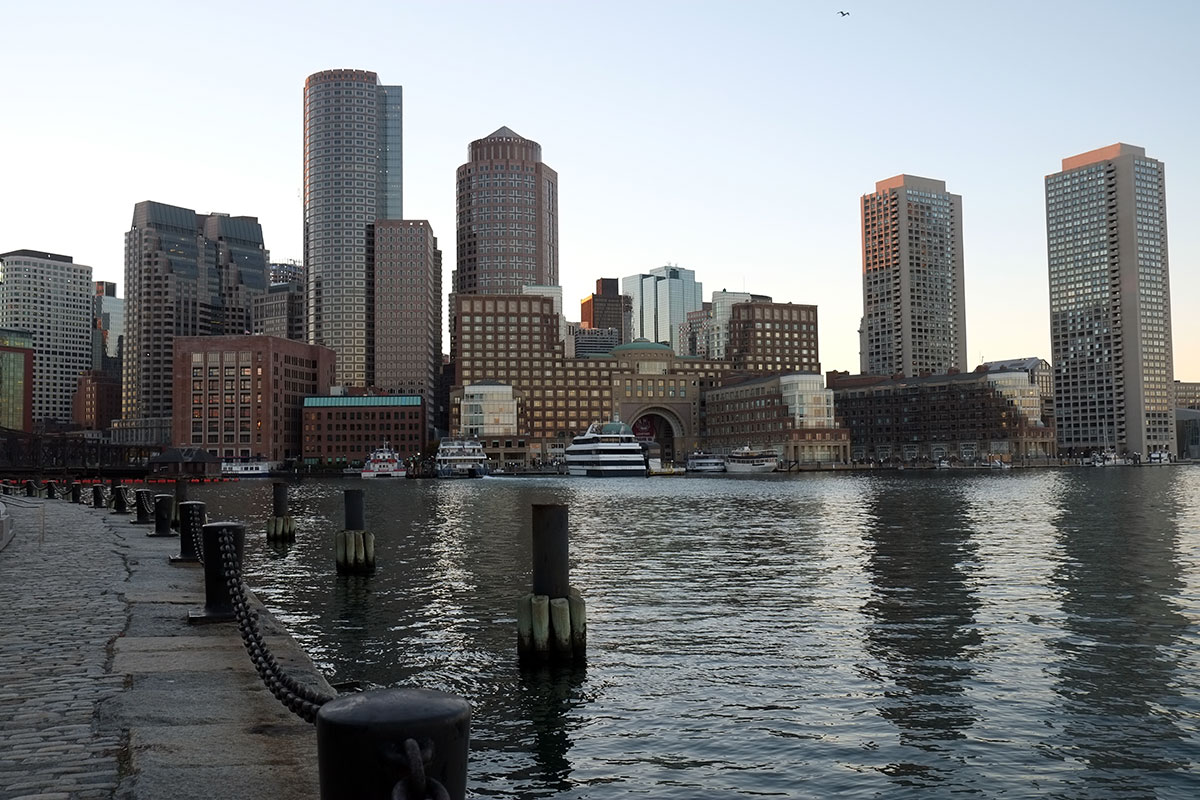
It does look much better at night.

One big new thing is the redevelopment of the harbor edge of Southie. This has a new meaningless developer name, the Seaport District, probably because SOuthie NOrth (SONO) was already in use somewhere else. There’s a new gargantuan convention center, a bunch of monstrous hotels, and now condos are popping up everywhere. 
The one good building is Pei’s federal courthouse. Not a stunner, but a simple parti with historicist leanings. It was the first new building in the area, but it had no impact upon what followed.

Diller Scofidio’s Institute of Contemporary Art is just trying too hard. 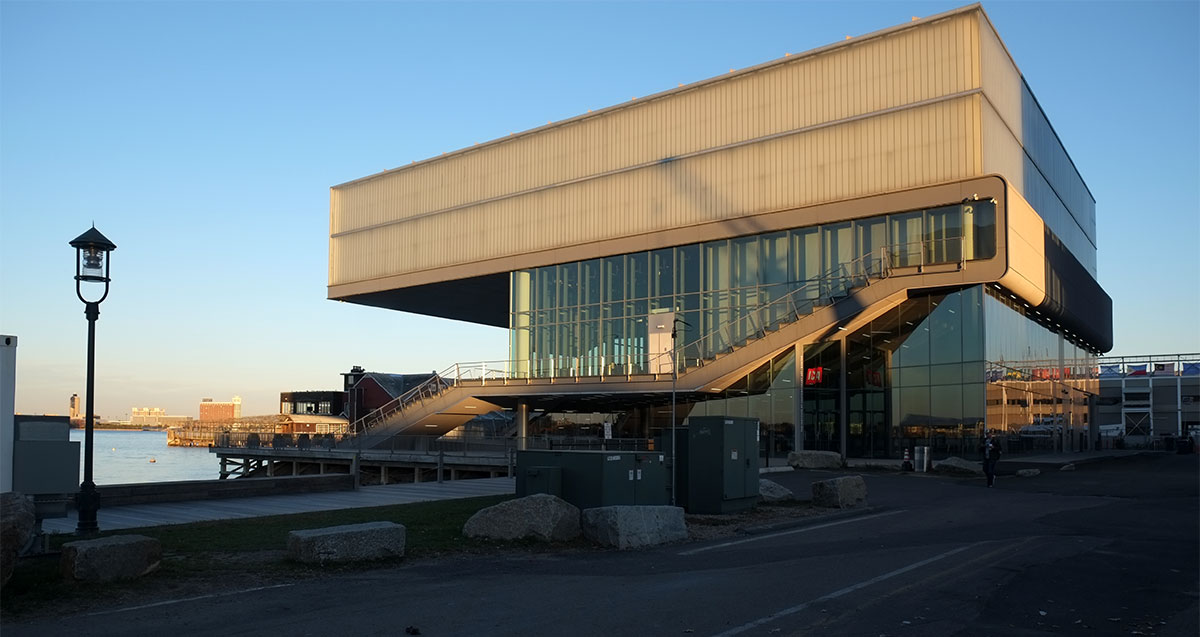 Is anyone else getting tired of giant cantilevers for no reason? I guess it shelters the seating below, an amphitheatre for Boston Harbor, but frankly, looking across the water to East Boston is not a view that should be emphasized. Maybe the district will grow up around it it, but right now it looks like every other piece of starchitect branding.
The general level of work in the district is not promising, but no worse than this stuff in every other city. And maybe that’s the saddest part – Boston has always been a distinct place, with its own character, style, history, etc. Even when it got its festival marketplace, Quincy Market, it made use of fabulous older buildings. But this Seaport District looks like it could be in Orlando, Dallas, Indianapolis, or Miami.


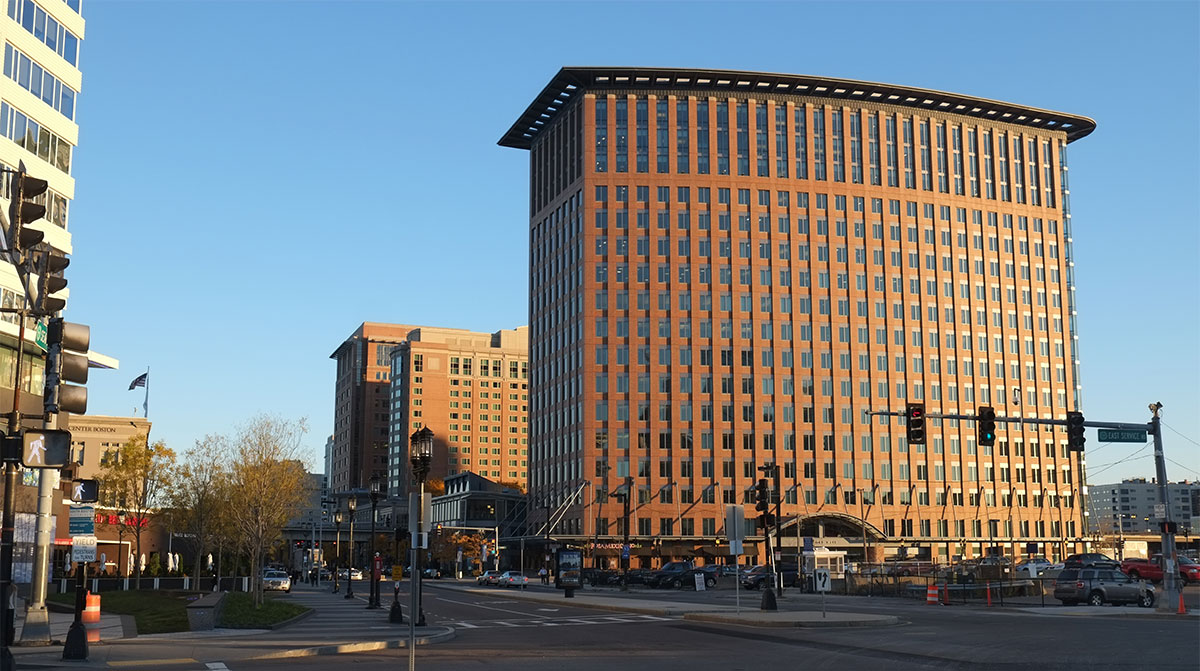
The other big new thing in Boston is the Big Dig – the removal of the Central Artery and its replacement with tunnels carrying the traffic. 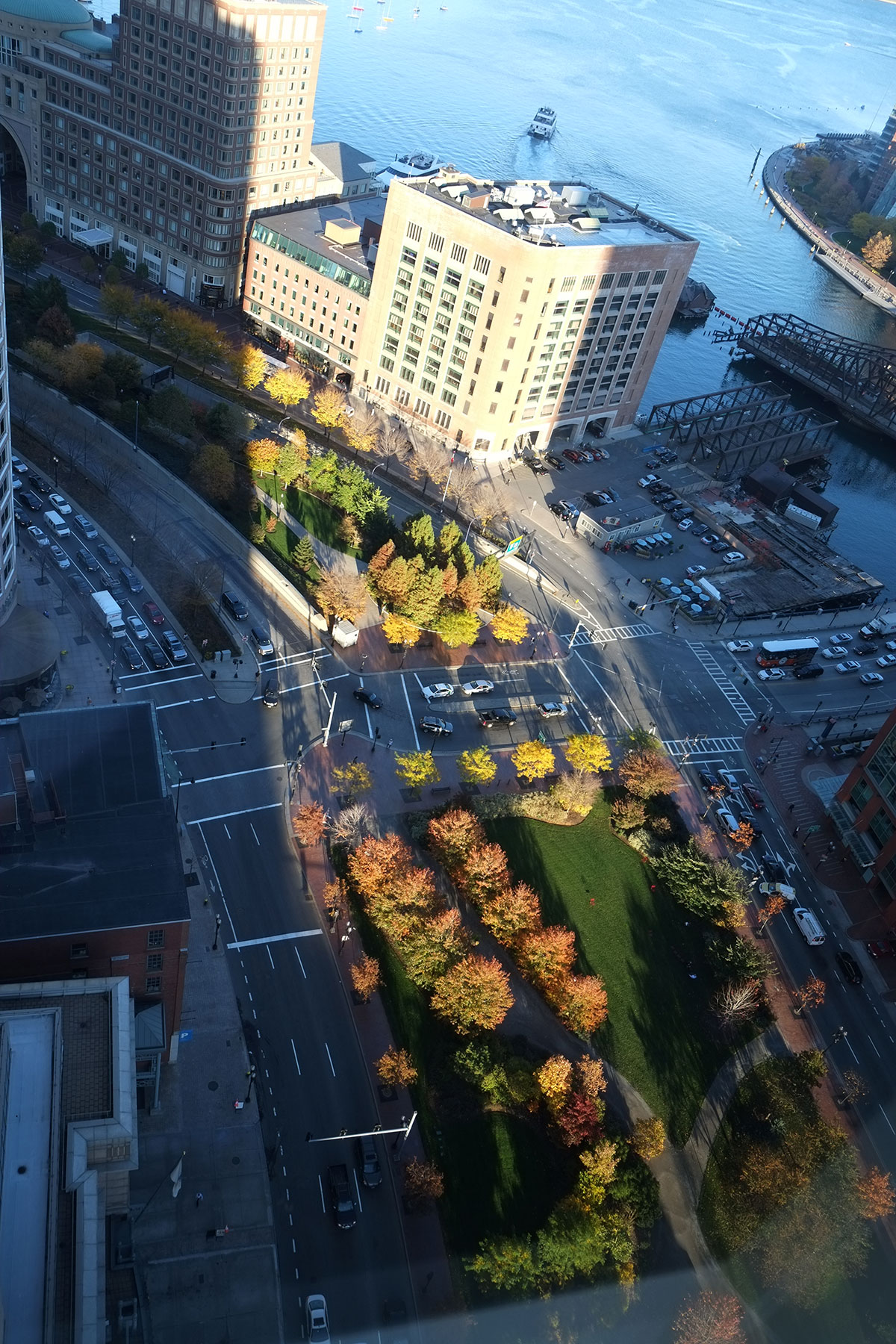 It is now called the (Rose Kennedy) Greenway, and it took me a while to get my head around it. You know how hard it is to remember what exactly was in a certain place when it’s gone? The Greenway is that to the nth degree. You recognize the old buildings and streets that were there before, but the relationship among them is totally different. You try to figure out where the nasty little tunnel to the North End was. Then you realize you have a view out to the harbor that was never there before.
The Greenway doesn’t seem to have much of an identity, and I mean that in a good way. There isn’t a grand formal vision for the whole. It is a series of connected, but not totally unified pieces; the whole is not necessarily greater than the sum of the parts. The Greenway is not a thing, it is the absence of the horrible thing that was there before. I think the designers wisely decided not to replace it with another thing, but rather to create a number of smaller-scale pieces, each of which can relate to its immediate context, and try to pull the pieces together. Once you get away from the Common, downtown Boston never had a lot of open space, and with the advent of giant new buildings, it might have been overwhelming, without the giant new open space. To be hurrying through the financial district’s winding canyons at rush hour is intense, then stepping out into the Greenway on the way to South Station is a contrast and a relief.
There are some very good parts.

Of course it was way over budget, and of course it took way longer than predicted and created a lot of controversy, but in the end, it is a Very Good Thing. Perhaps it says something about Boston – what other city would spend billions of dollars on a project that made the city better, but didn’t produce a big shiny object that jumps up and screams look at me! New York couldn’t do it – the urban design downtown at the World Trade Center is a disaster, with gigantic, pointless open space and preening object buildings. The Greenway is Boston at its best, a simple, understated, classy solution.
The towns on both the South and North Shores of Boston are some of the oldest settlements in the country, mostly founded in the 17th century. The centers of these towns preserve that original character and spatial arrangement, at the core of what have since become suburbs. The juxtapositions between old houses and modern strip development can be jarring, especially to someone from the West Coast, where everything has been built in a shorter time frame.

Cohasset
When I lived in the Boston area I never got to explore the environs as much as I wanted, as I didn’t have a car, So staying with friends both in Scituate on the South Shore and Boxford near Ipswich on the North Shore was a great opportunity to see these places. What made it even better was that my friends are long-time residents of these areas, and showed me around to places and buildings I would never have known about. (Greta missed most of this as she was back in Eugene visiting Linda.)

Scituate, Lighthouse Road
The South Shore has an intricately varied shoreline, with many small coves and larger harbors. The historic town cores are on the harbors, with later houses filling along the shore between them, and 20th century development spreading to the interior. Scituate has four “cliffs” that stick out into the bay (we have the northwesterner’s amusement for how topographical terms are used here) which have highly clustered houses on small lots by the water.

Scituate, Lighthouse Road
Places that are this old accumulate interesting artifacts, such as this former water tower that was made to look like a Rhenish tower, as the rich person living nearby didn’t like looking at the ugly water tower.
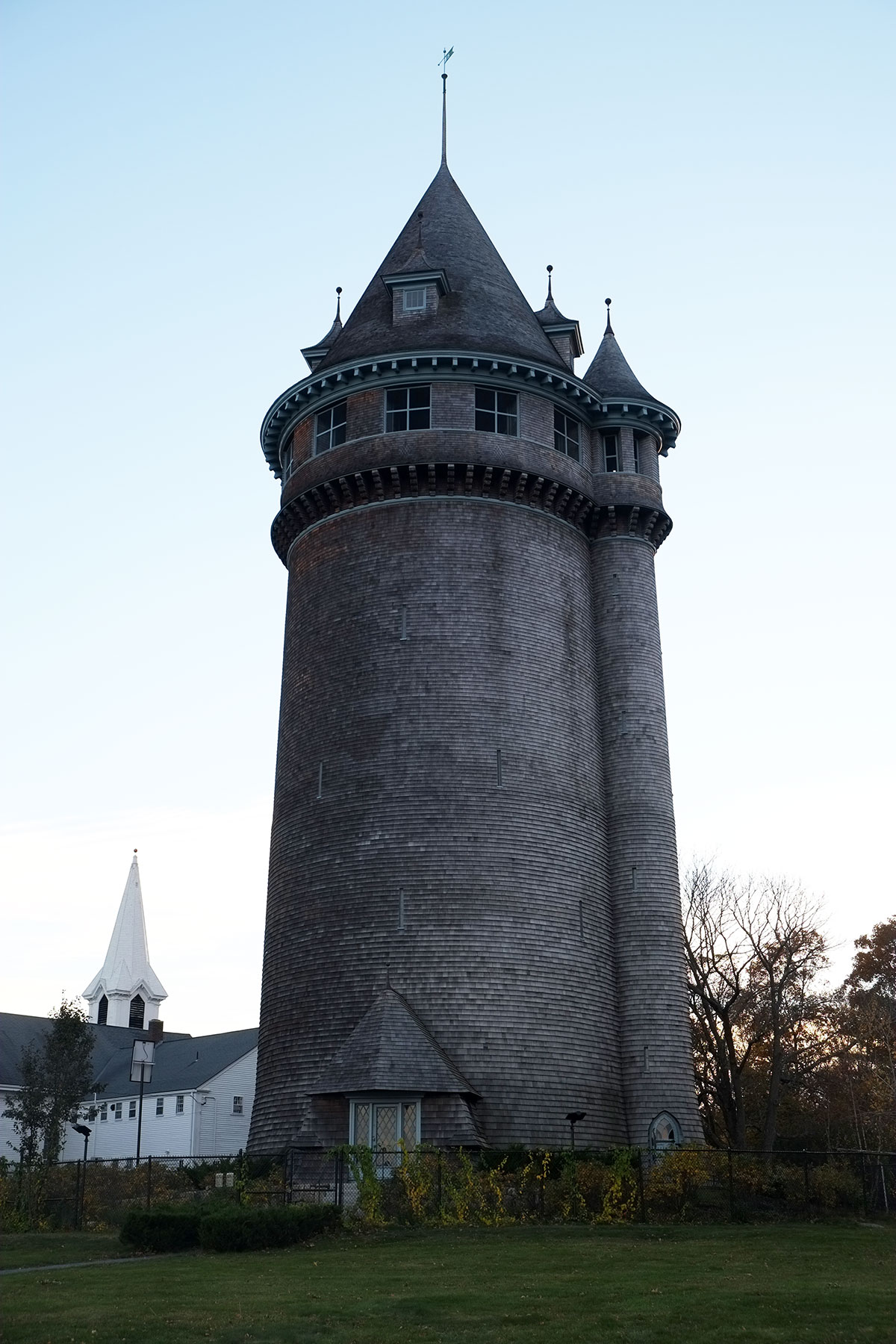
the very interesting water tower in Scituate
The Trustees of Reservations is an organization that owns more than 100 significant properties in Massachusetts, from the famous to the obscure. We visited World’s End, which Olmsted designed as a residential development on a neck in Hingham, but it was never built out. It is now an open space reserve owned by the Trustees.
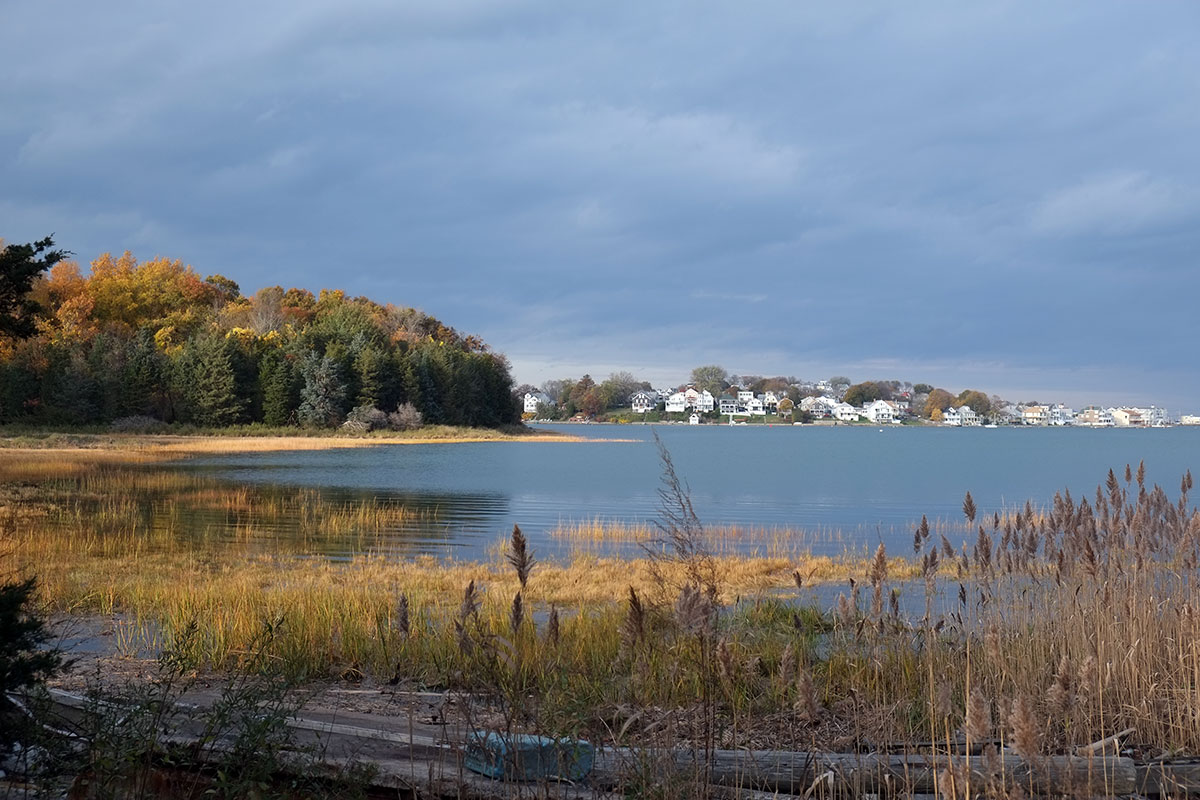

World’s End, with Boston in the distance.
We visited Ipswich (where Updike live and worked) and Topsfield on the North Shore, finally seeing the famous Parson Capen house from 1683, which is from that period when settlers built what were essentially English houses, having not yet adapted them to the New England conditions.

A Classical Revival church spotted on a trip north to Exeter, so technically not on the North Shore, but too good to not post.

Newburyport, at the mouth of the Merrimack River, with well-preserved downtown and residential areas.

Newburyport

Newburyport
Driving around on the winding roads, past the estates of the North Shore, we headed towards Crane’s Beach, a beautiful landscape of drumlins (there’s a word I want to find more opportunities to use) and marshes.
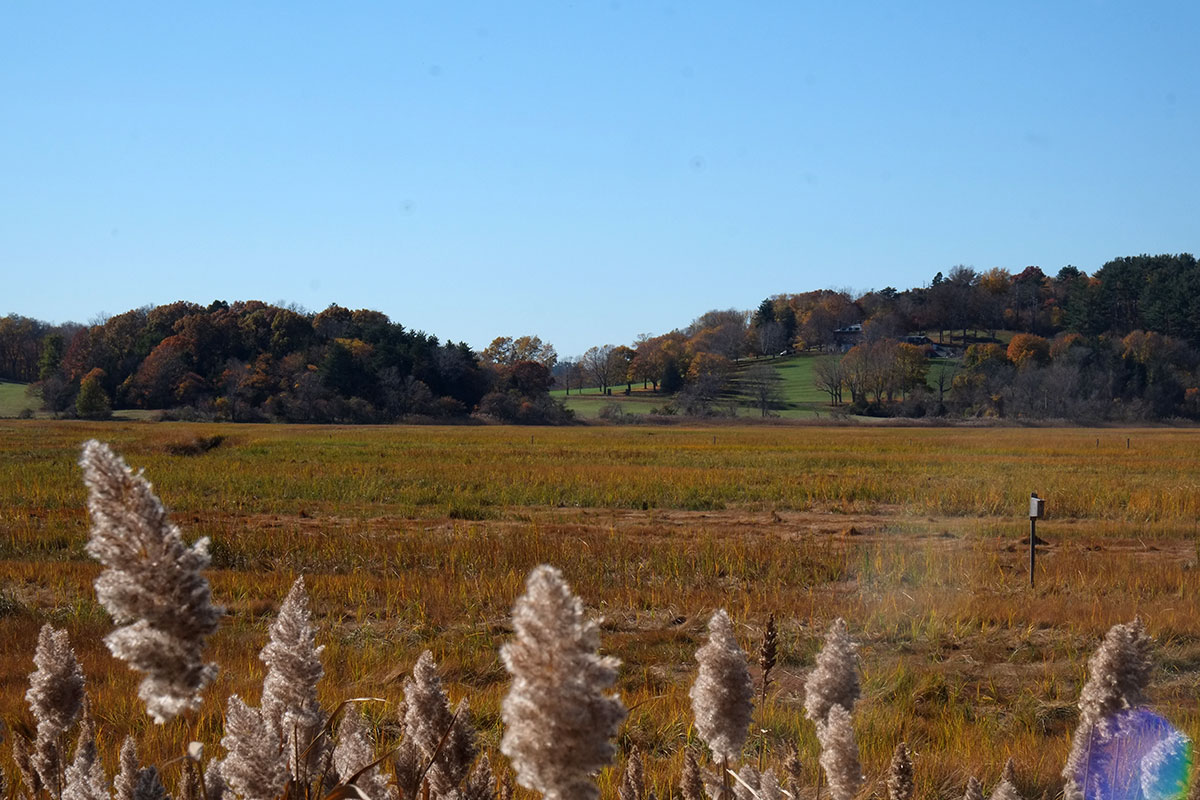
The Crane Estate, by Shepley Rutan Coolidge etc., sitting on top of Castle Hill, is the leading example of how much money there was to be made in plumbing fixtures.


The spectacular landscape was designed by the Olmsted brothers.

Notice the framed view on the axis.

the allee running north from the house. I don’t know what the flags signify, but I wish they weren’t there. Louis XIV had a nice allee too, but his just ended in a canal, not the Atlantic Ocean.
A few days of exploring these shores just wasn’t enough – I could have happily spent a day in each town. What struck me the most was just how many beautiful old towns there are, so close to Boston. The summer resort venues of the Cape and the Islands tend to be better known, but these small towns in the Boston area are just as wonderful.
 Another building crossed off on the Lou Kahn’s Greatest Hits tour. Another building that exceeded my high expectations in every way. As with all Kahn buildings, a simple parti with extraordinary development and detailing. A visit to a Kahn building is always a sensual pleasure – light, materials, space – at the same time that is an intellectual satisfaction – your mind is racing as you see the relationships among the parts and the logic of the building drives all the smaller-scale elements.
The Exeter campus is in the standard Academic Georgian mode (we are seeing a lot of that these days), and it fits in beautifully, even though it is much taller, obviously modern, and has no pitched roof. It is a good illustration of Howard Davis’s idea that in order to fit in, a building needs to overlap 30% with its neighbors. (Howard now swears he said 50%, but I think he’s just getting more conservative in his advancing years.)


The exterior shows Kahn’s normal interplay between masonry and wood, within an ordered matrix that allows for much local variation.
The colonnade on the ground floor causes the periodical room and other secondary spaces to be set back from the facade. This raises the main body of the library up to the piano nobile, and the voids of the colonnade mirror those of the attic story at the top, while the facade of the main floors is relatively planar. 

This also helps the four walls read as brick planes, with the corners eroded and the screenwall extending above the building volume. The corners are the one part of the building I found not entirely convincing – they are inaccessible voids – strangely shaped terraces with locked doors – while continuing the brick across the corner on the diagonal obscures the contrast. Maybe those corner screenwalls could have been wood (but who am I to be telling Lou Kahn anything)? No one walks in the colonnade, except while entering the building. The entry is effectively hidden, not celebrated, as all four facades read exactly the same. References to everyone from Palladio to Wright abound.
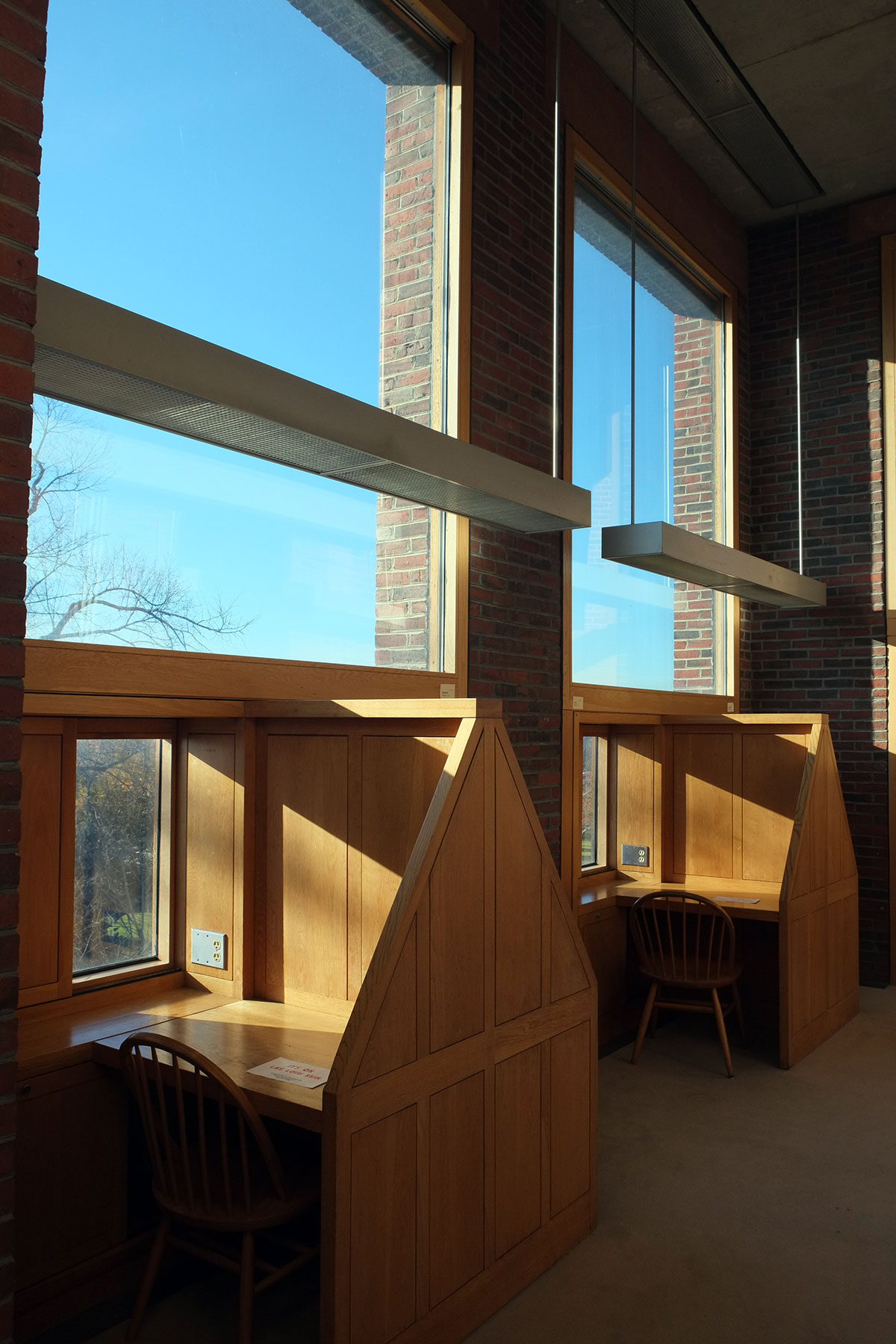
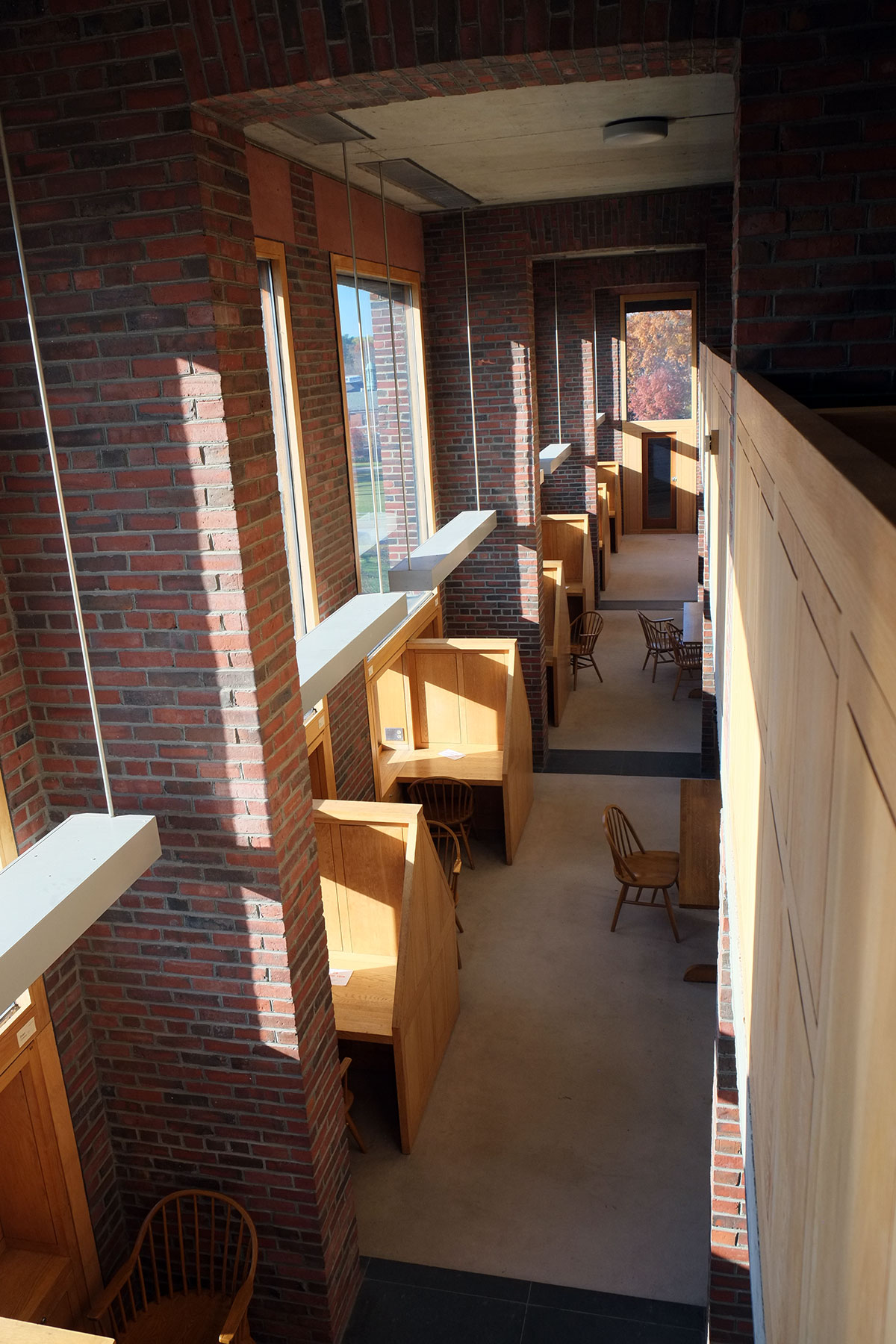
The concentric layering of the building drives everything. Right inside the thick exterior wall is the study zone, matching the depth of the colonnade below. Each student has a carrel, four in each bay between piers. The zone is double-height, with carrels on the mezzanines too.

Inside the ring of carrels is the ring of stacks, with the aisles perpendicular to the facades and leading into the center. This area has the highest structural loads, so the massive concrete structure is very evident, with the shifting of the structure towards the corners visible on the main floor. 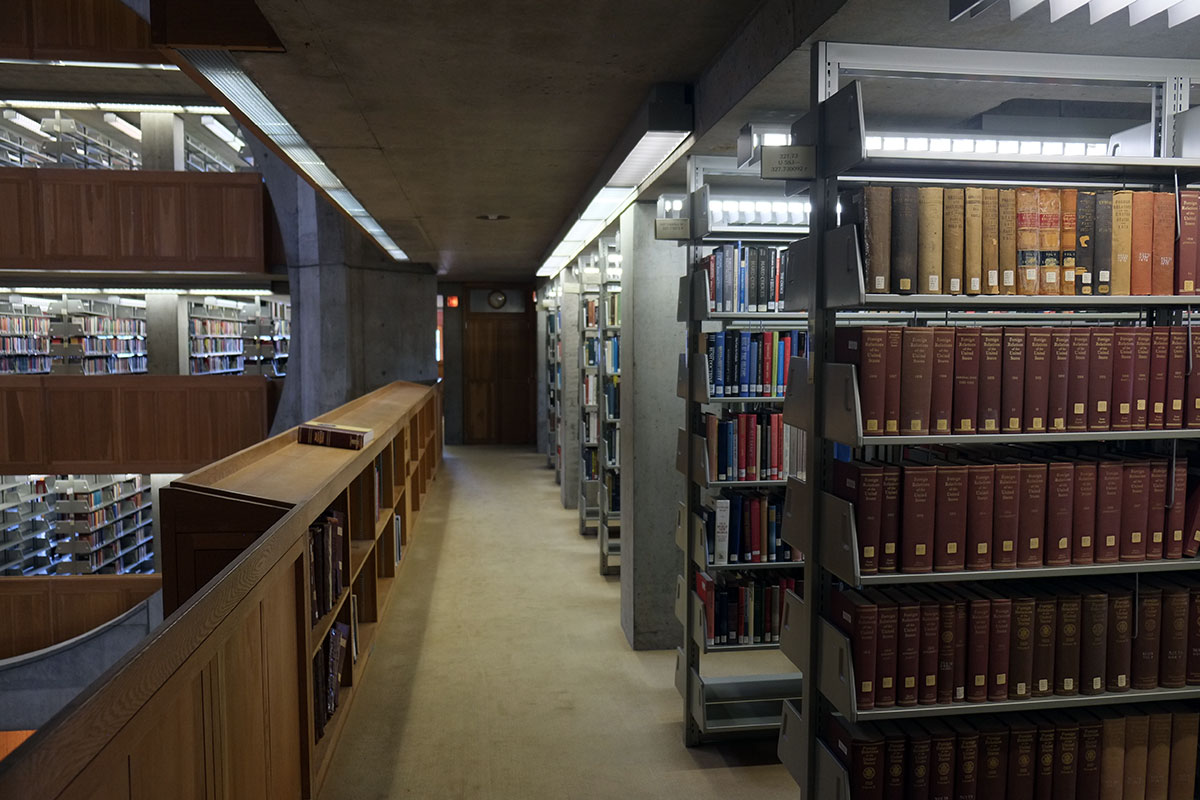
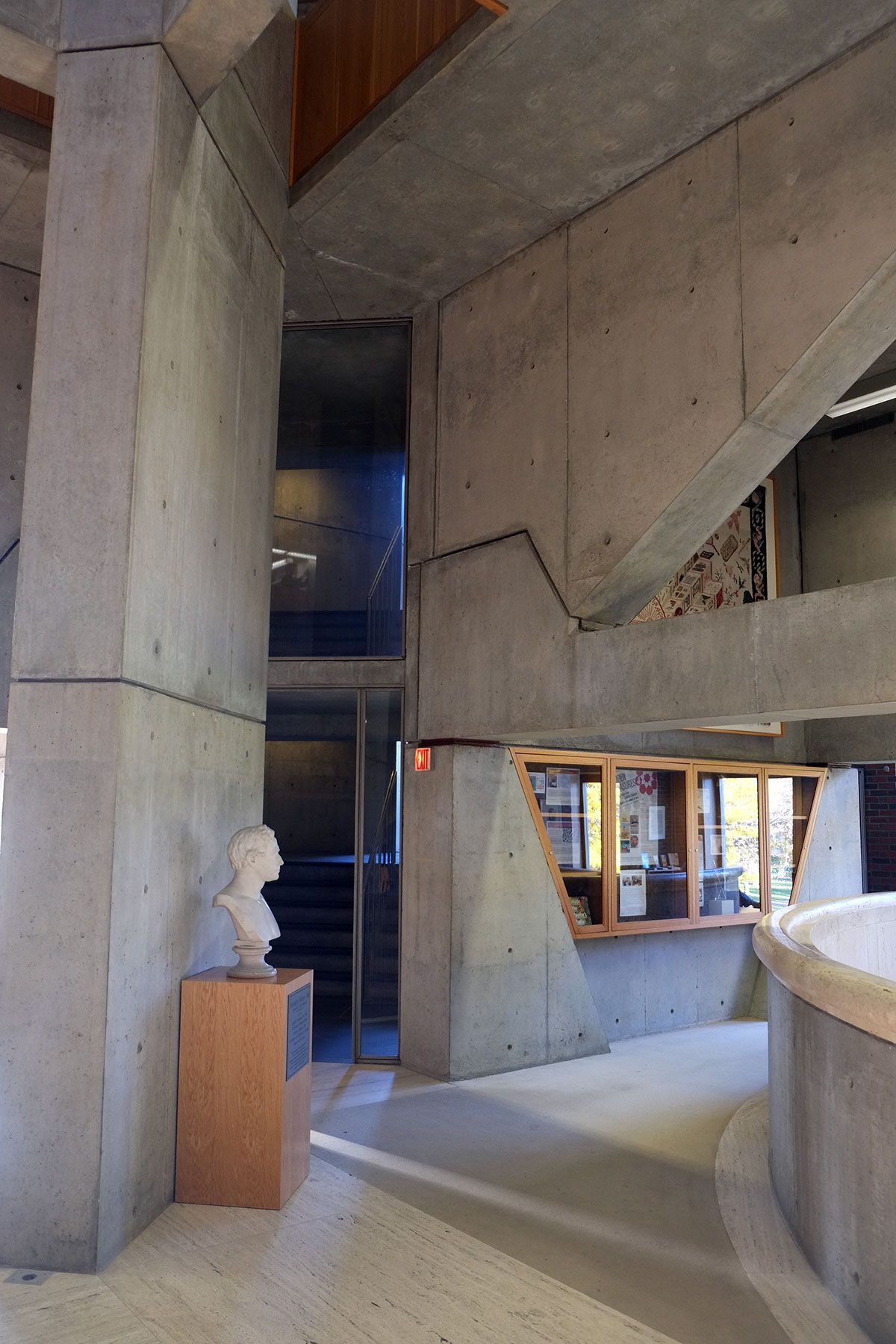
The next layer is palazzo-style circulation around the central atrium, but still within the stack structural system. The slab is pulled back from the atrium, and the guardrail is cabinetwork, a bookcases with a tilted reference book shelf above, a concept other architects have been imitating ineptly ever since. 
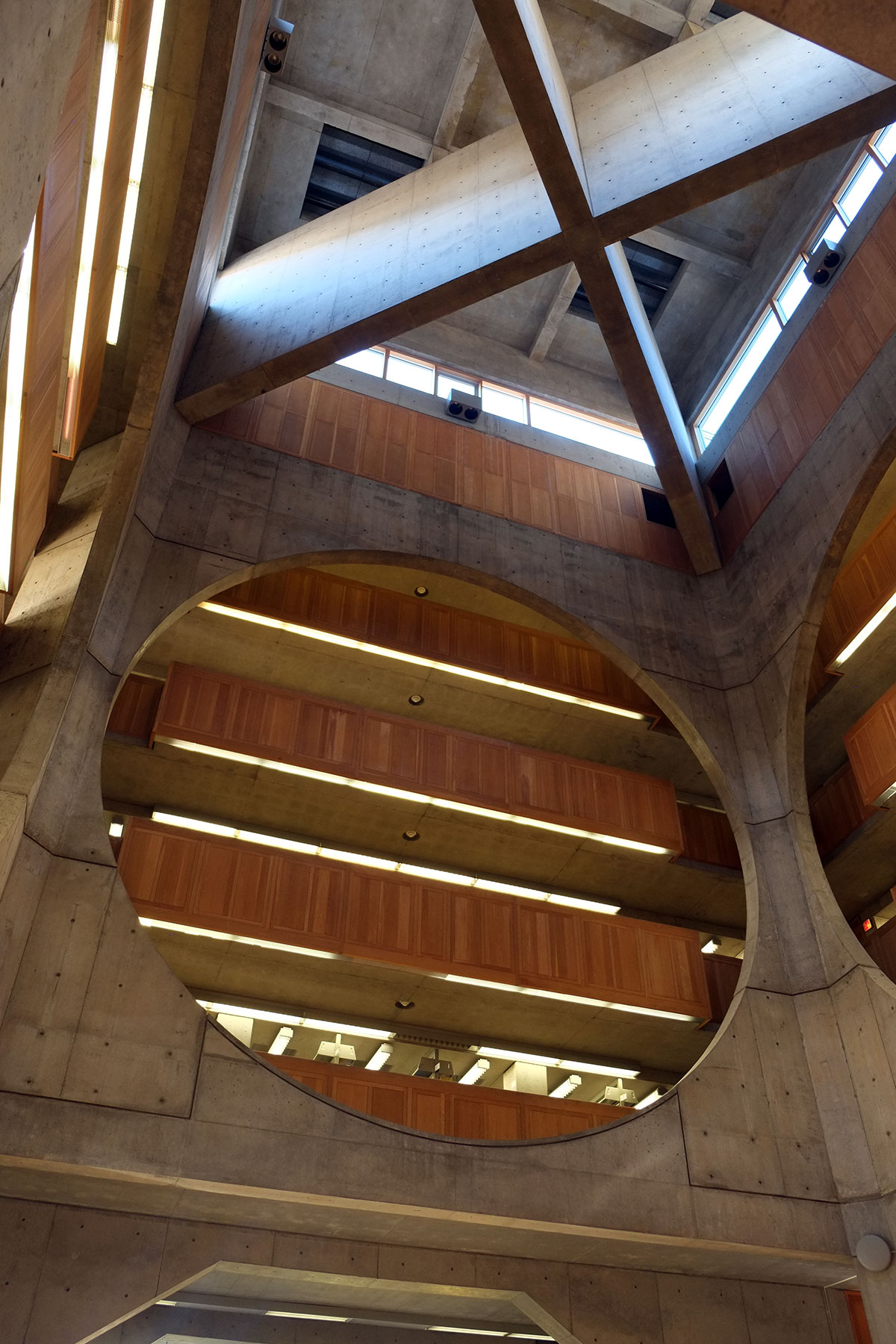
 The central atrium is magnificent. You ascend a curving travertine stair (the only curve in plan in the building) from the ground floor into the center of the building. The concrete walls pierced by enormous circles rise on four sides, leading up to the massive diagonal roof beams. Daylight from the clerestories bounces off these beams and floods the building below. I’m assuming that this concrete box acts as the trussed moment frame for the building, with the shear moving around the circular cut-outs. Structure and light, simple symbolic forms, color and materiality. It is simple and perfect, beautifully-proportioned, and you can sit and look at it endlessly.



Throughout the building, every detail is perfect. There are two fire stairs, this larger one is also the main circulation.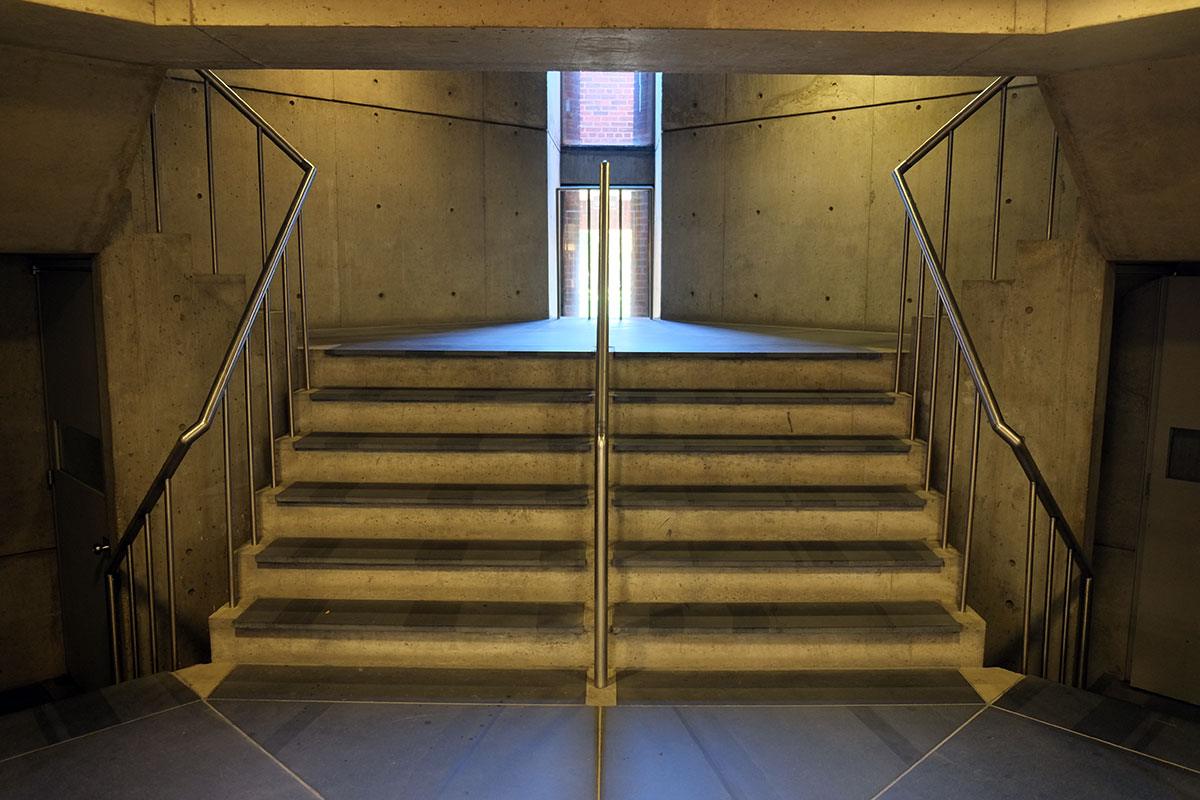
The best nosing detail I’ve ever seen.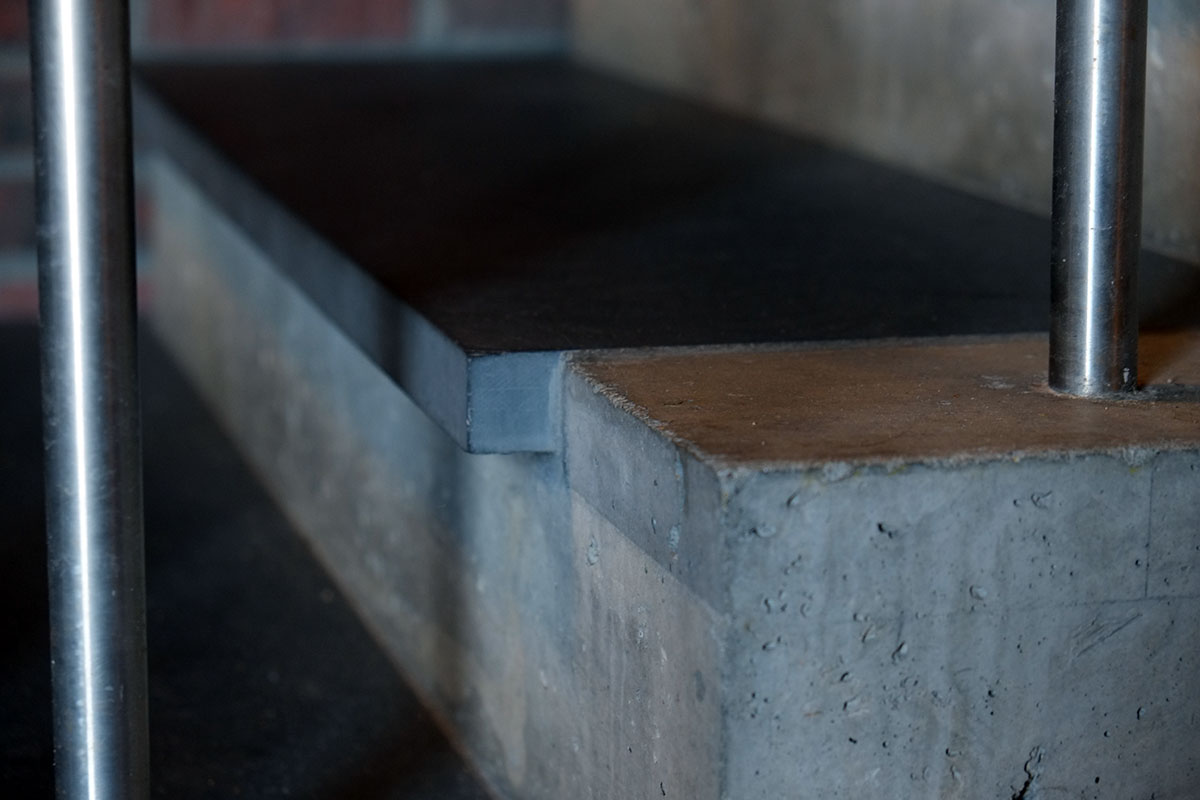
The walls around the entry staircase. Every function articulated and developed. 
The unity of the building is shocking. We’re now so used to buildings which are a collision of elements, where every piece is unto itself, and the intersections among them are simply managed by the architect. Here is a classical building where the complexity is integrated and purified, illustrating what Venturi calls The Responsibility to the Difficult Whole. It is seemingly simple, but everywhere you focus, there is more to see.
Visiting the library is a very easy and pleasant experience; Exeter just asks visitors to sign in, and not photograph the students. Other than that there are no restrictions and you can wander around freely.
 Peregrine nation