Monthly Archives: November 2015

National Zoo

Giant Panda (I can't remember who this one is)

Giant Panda (I can’t remember who this one is)

The National Zoo in Washington, DC is known for it’s pandas, but I found many of the other animals more fasinating, like the fishing cat below. I caught her at the perfect moment, in the middle of a yawn.

Fishing cat turned into a yawning cat

Fishing cat turned into a yawning cat

If you have to get stabbed by a porcupine (I’m not sure why you would…), do not pick an American Porcupine. They have all these nasty barbs on the end of their spines that make it hard and painful to pull them out. Even though they look nastier, pick an African Crested Porcupine.

American Porcupine

American Porcupine

Red ruffed lemurs are one of the most endangered animals in the world, because their forests are being cut down and burned for crop fields. They are also some of the largest lemurs, apart from Indris and diademed sifakas, with eyes that look like they’re peering into your soul.

Red Ruffed Lemur

Red Ruffed Lemur

Meanwhile, this monkey’s eyes make it look like he’s been possessed by a demon.

Golden Lion Tamarin

Golden Lion Tamarin

Black footed ferrets are one of my favorite animals, and this was the first time I’d ever seen one alive and in person. Unfortunately, I never got to see it do anything but sleep, although it did turn itself around between the two times I went to go see it.
The population of these prairie dog-eating animals were once thought to be extinct, until a sheepdog found a population of only seventeen adults. Captive breeding programs brought them back, although they’re still endangered.

Black Footed Ferret

Black Footed Ferret

Meerkat

Meerkat

Mongeese (I refuse to call them mongooses) are close relatives of meerkats, and even cuter. This is a dwarf mongoose. They also had banded mongeese, which are another of my favorite animals, but they refused to come out of hiding.

Mongoose

Mongoose

I went through the reptile house rather quickly, because I am not a big fan of snakes.

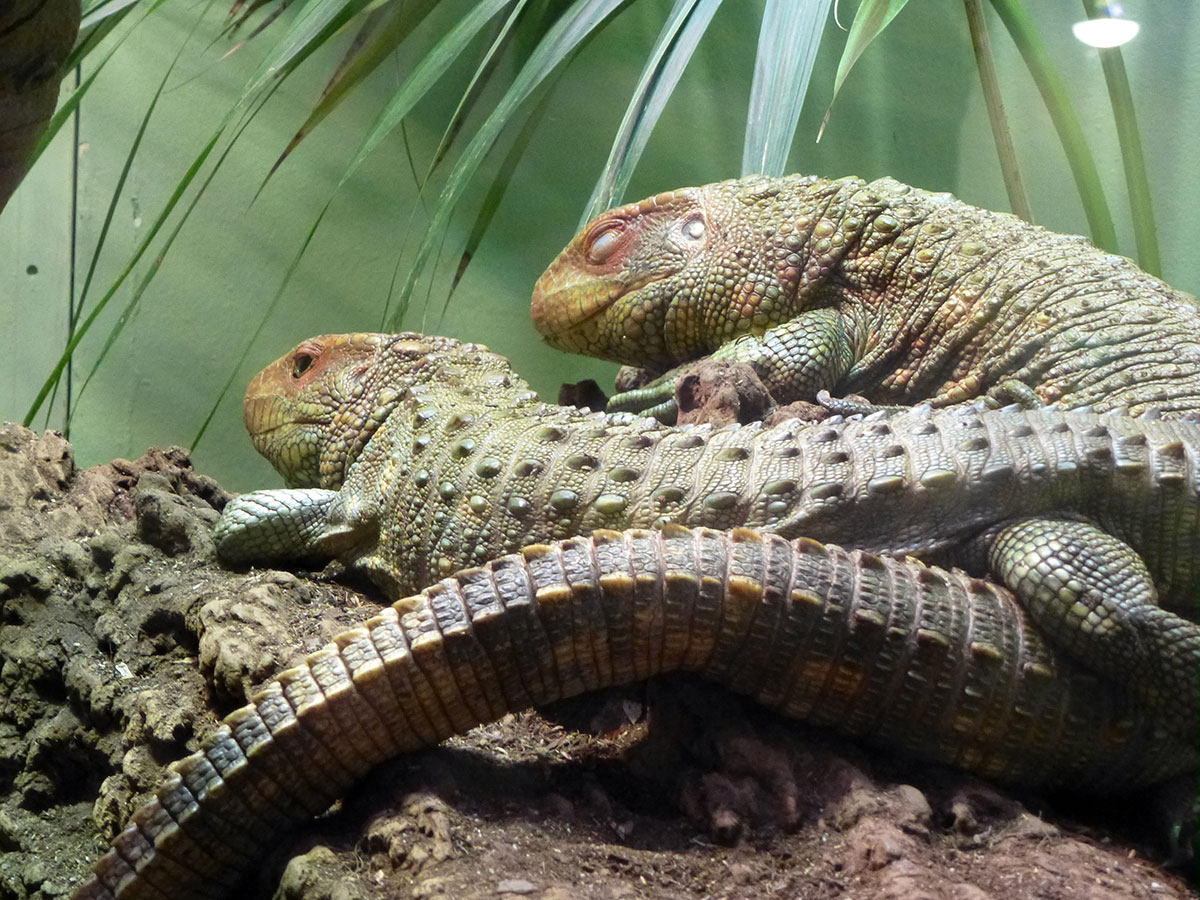
Happy Iguanas

Happy Iguanas

Peekaboo Turtle

Peekaboo Turtle

Some of the last animals we saw were the lions, just as the sun was going down. Mostly nocturnal, they heralded the night with a chorus of roars that would send shivers up your spine if they weren’t contained behind a fence.

Lions

Lions

Annapolis

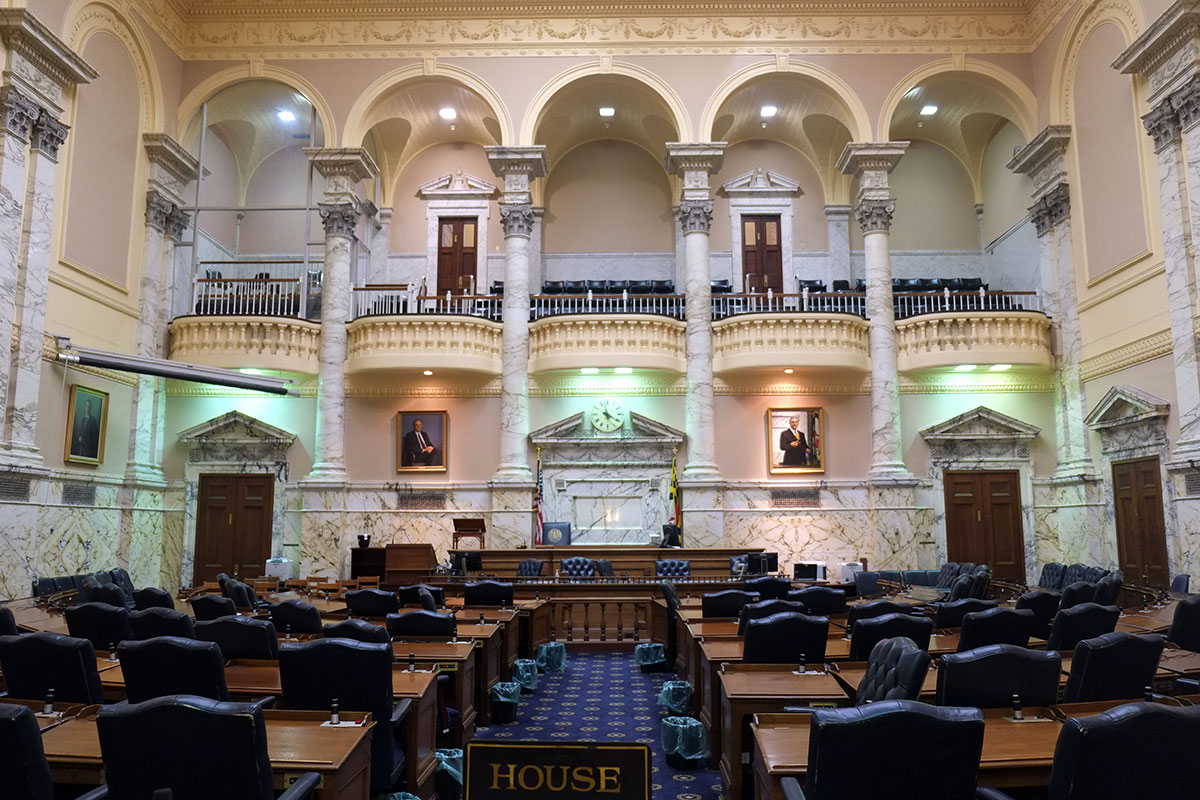
DSCF5932Visiting state capitols was not a goal of this trip, but we’ve come across eight so far.  The architectural quality of them, and the others I’ve seen, has been very good.  (The only truly embarrassing one being Oregon’s, which looks like a salt shaker designed by Albert Speer.)  But in every case, the quality of the capitol is overwhelmed by the mind-numbing banality of the state administration buildings which surround it.  They reflect the growth of state government in the mid-20th century, and the architecture  is always modernistic-pretentious, with lots of marble and “timeless” elevations.  Albany is obviously the most extreme, but it is not fun walking around any other state capital district either.  With the exception of Annapolis.

A beautiful, well-preserved, 18th-century state house, surrounded by a district which is still largely 18th- and 19th-century.  How can this be?  Where are all the soul-less boxes of bureaucrats?  Baltimore.  Maryland had the good sense to realize there’s no real reason why all the functions of state government have to be in the same neighborhood, and those large boxes were placed in a large city which was better able to accommodate their scale, both architecturally, and in terms of how many employees would have to work there.

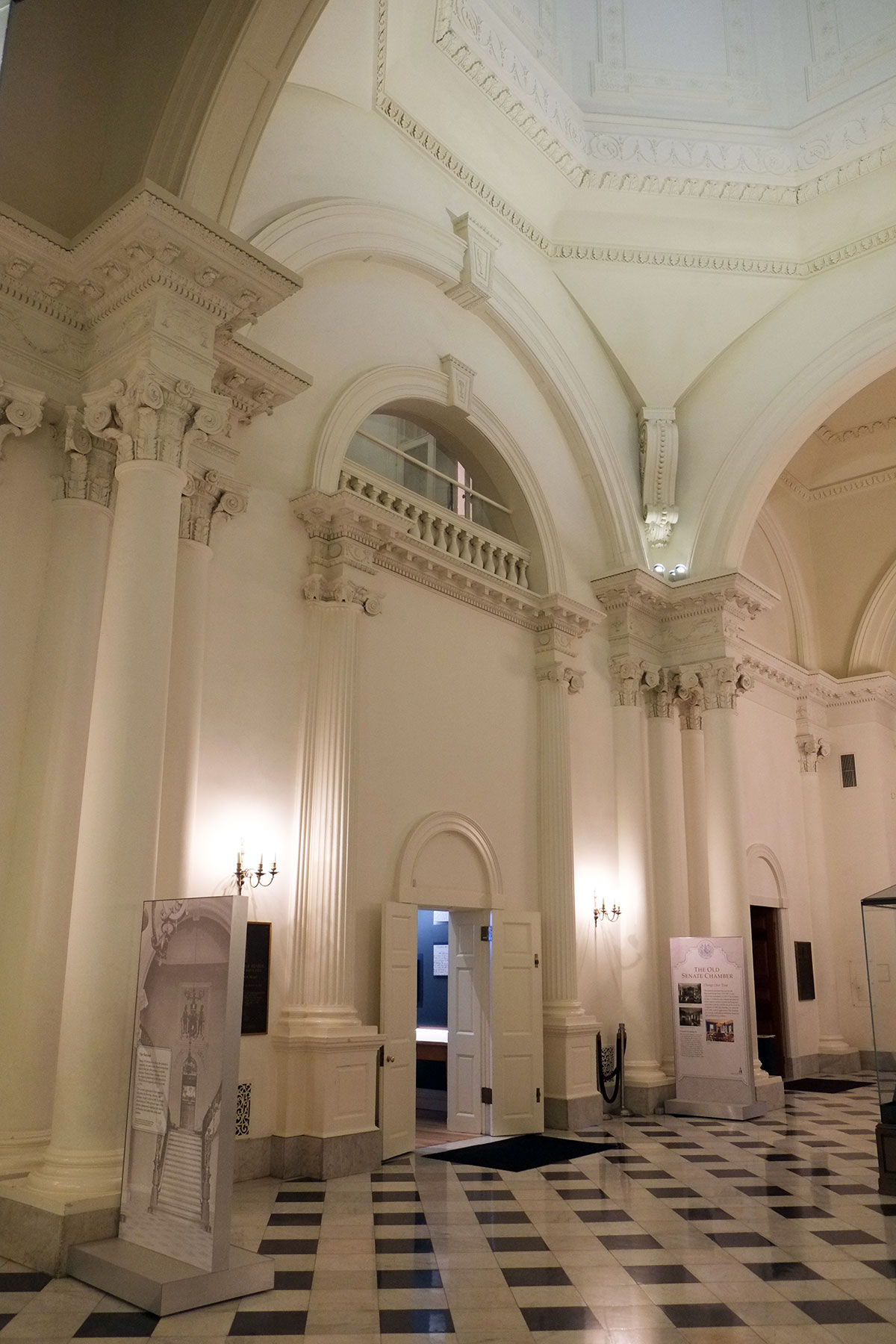
The building itself is fine, the oldest continuously operating state house in the country, and was the temporary home of the US government in 1783-84.  George Washington resigned from the Army there, which is nicely reenacted by bronze statues (so much more satisfying than living reenacters).  DSCF5952

A beautiful central hall and domeDSCF5956

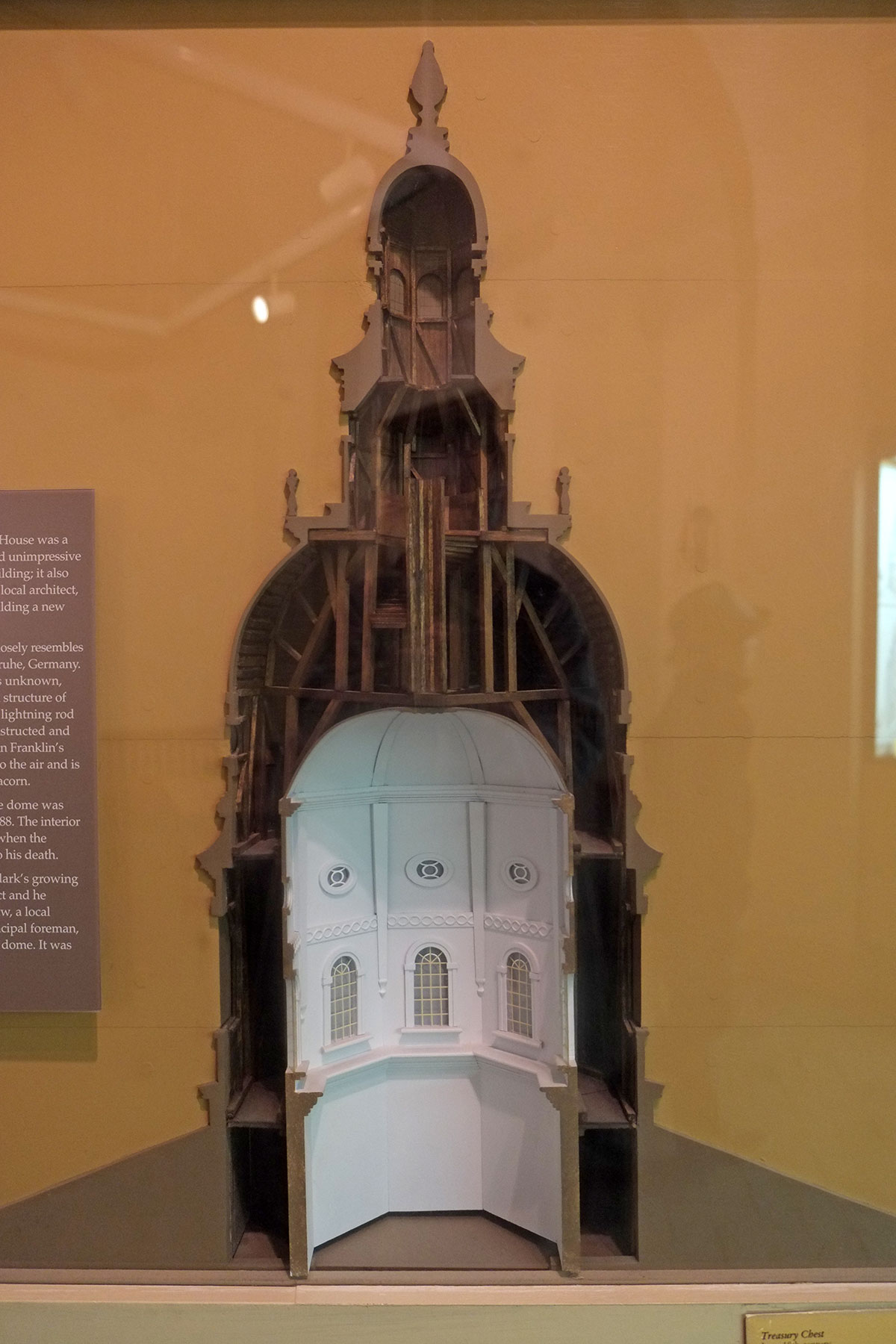
with an excellent sectional model to satisfy the architect-geeks.DSCF5959

The legislative chambers are accessible, and show their later remodelingDSCF5953and other period rooms are well-restored.DSCF5944

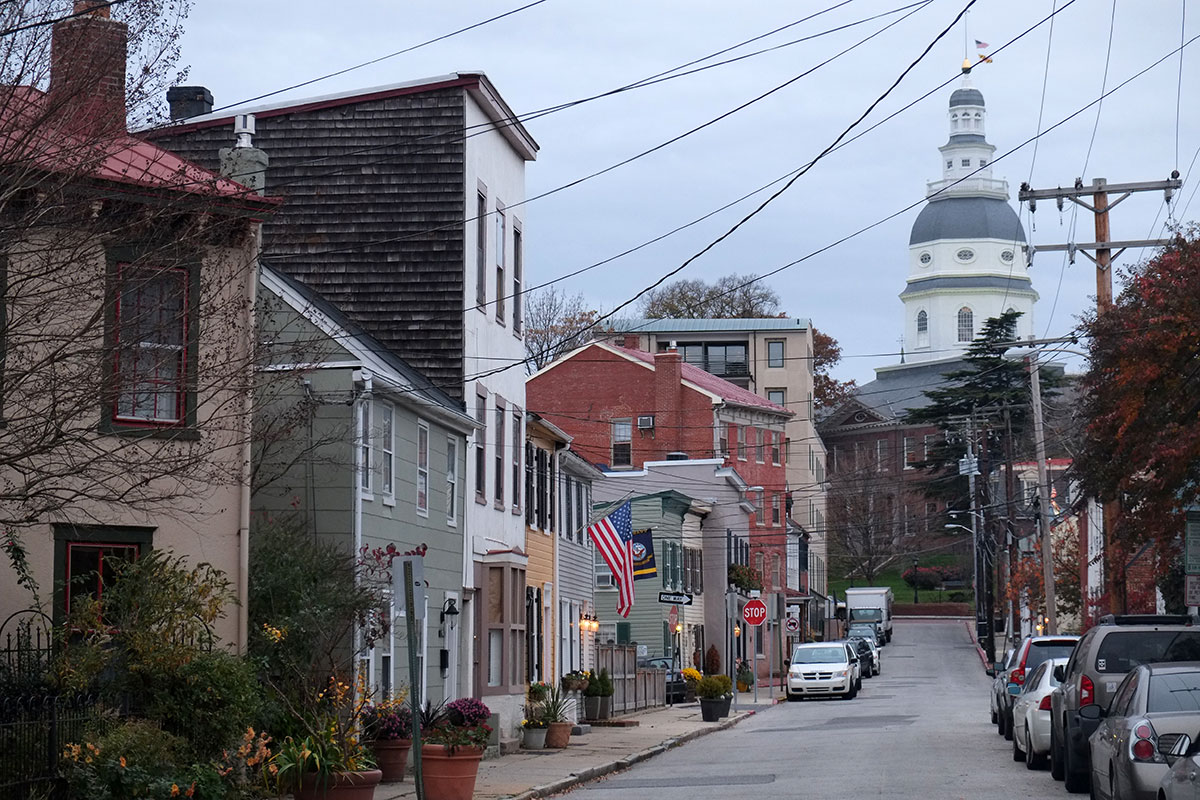
But the best thing about the capitol is how is situated, on top of a hill, providing a focus for views from all over the city.  DSCF6018

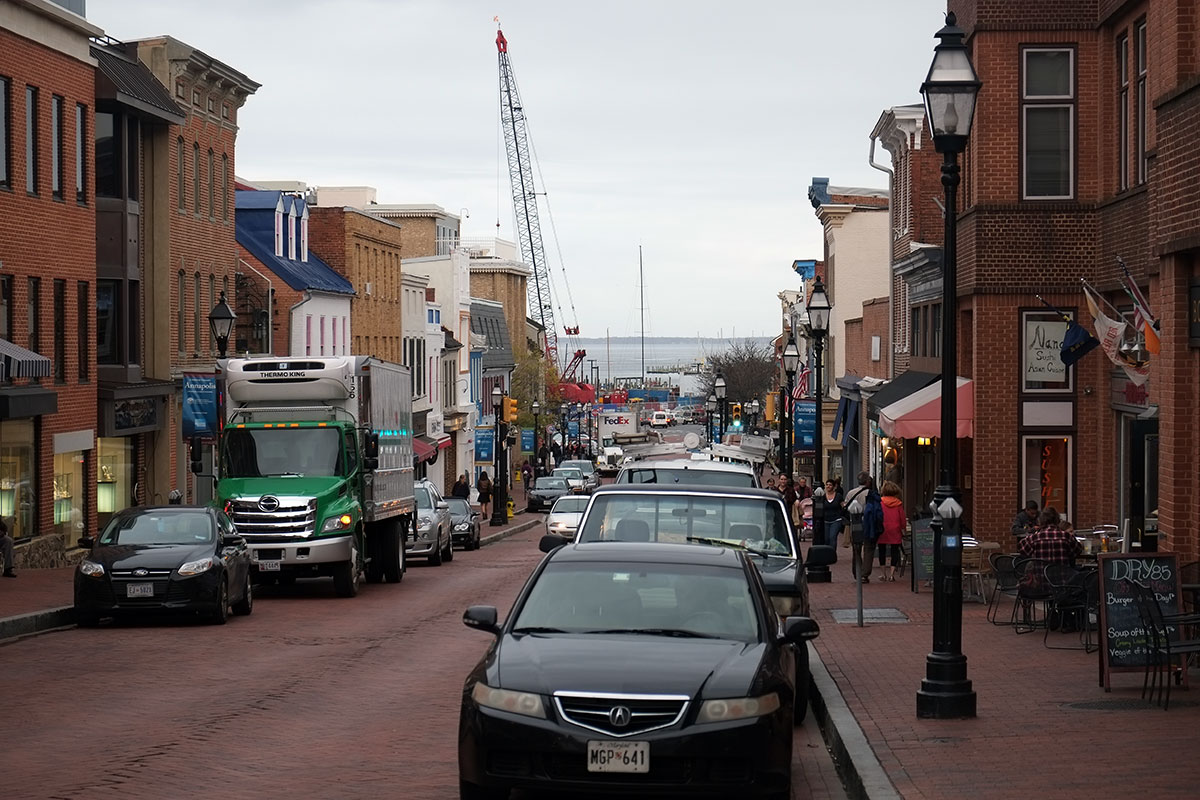
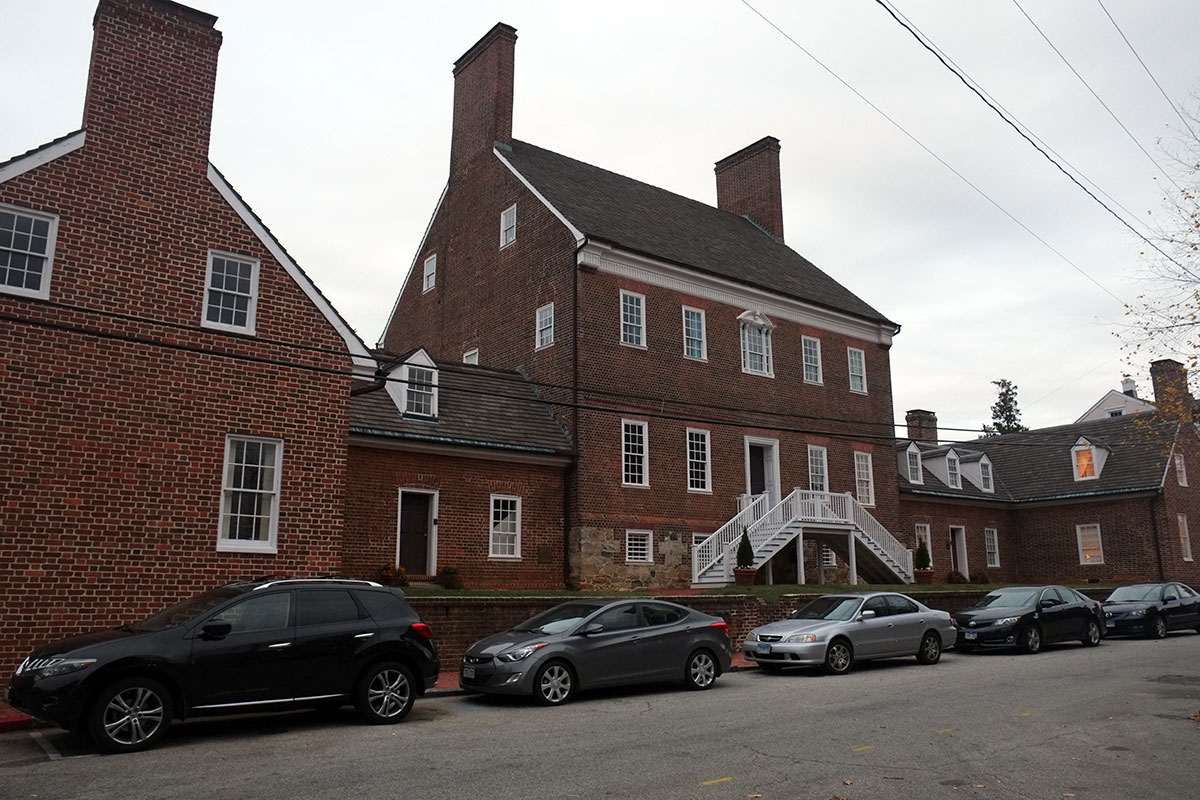
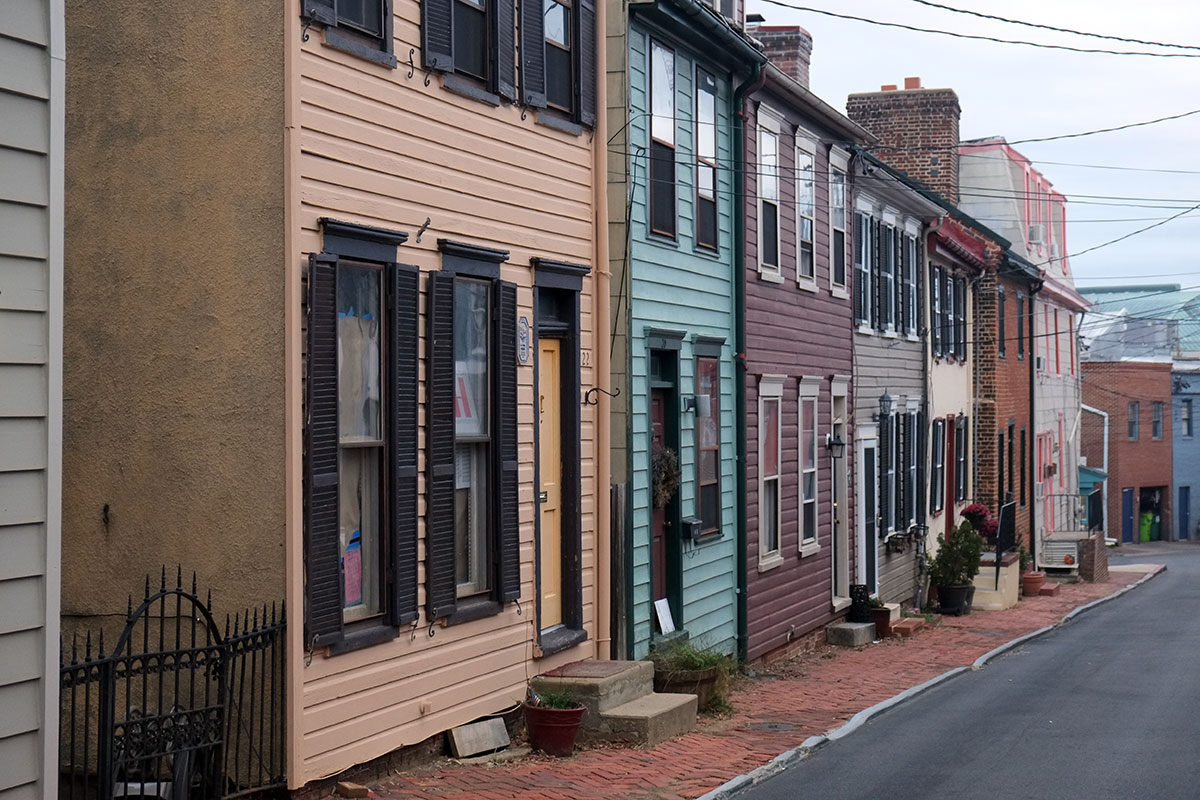
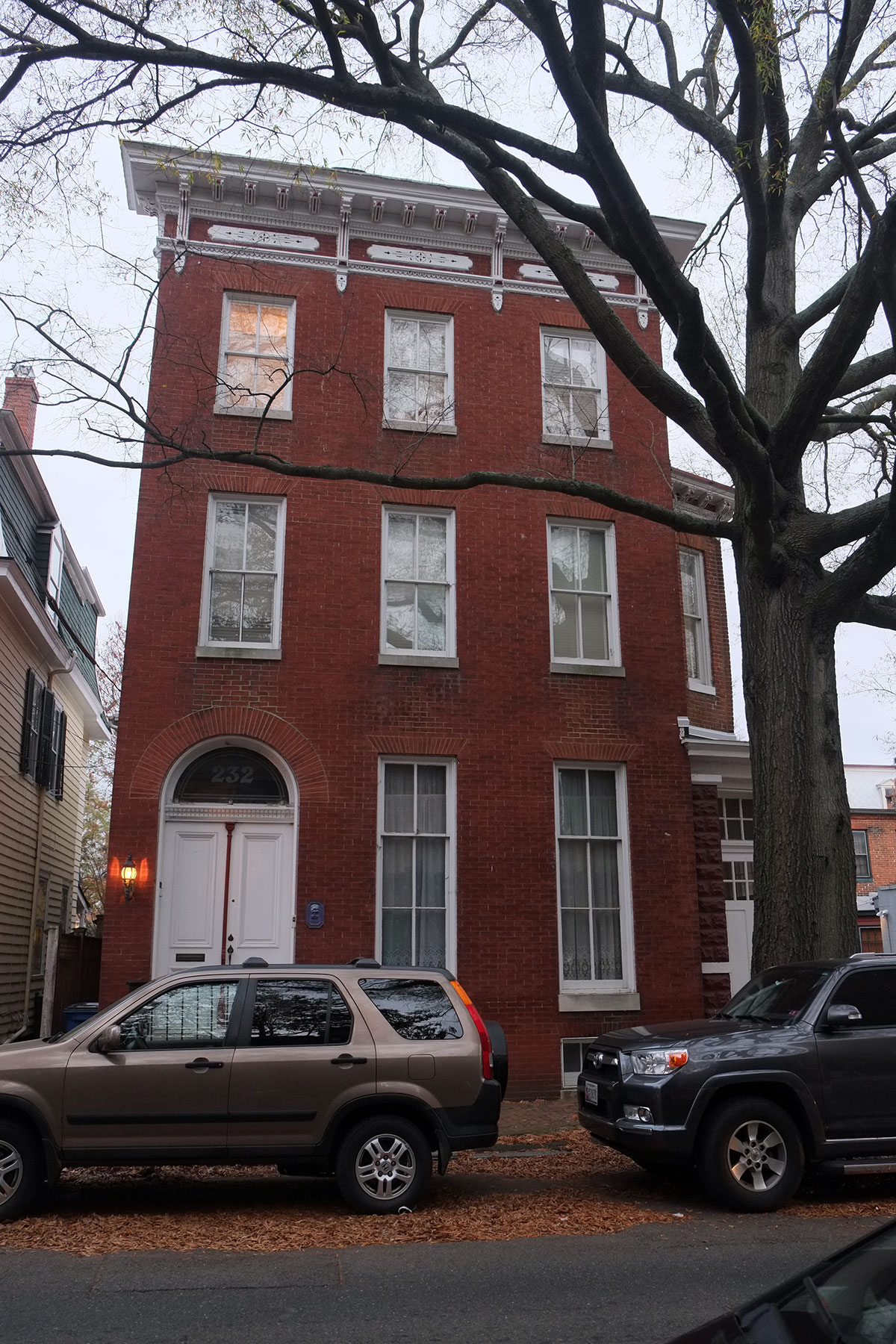
There’s a wonderful balance of the formal and the vernacular, what Krier calls the res publica and the res privata.  The state house is of central importance, but it is not the only important thing. Views down the main streets end in the harbor, as they should. DSCF5933There are grand houses (I’m not used to seeing Palladian villas in a city and not in the country) DSCF6019

and small row houses and shops from the same period.DSCF5968

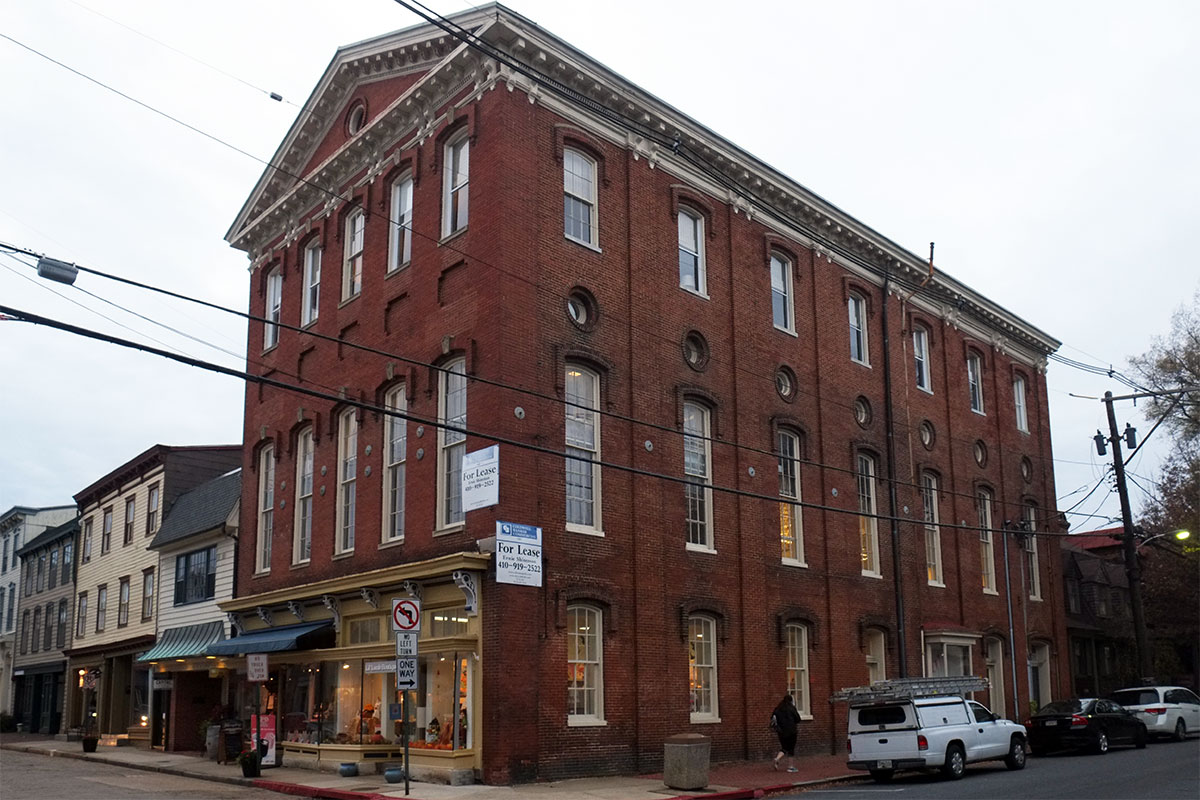
Some prominent locations are downright funkyDSCF5969

and the buildings from different eras and of different scales are juxtaposed.DSCF5934

Some irregularity in siting is quite welcome, relieving the fairly uniform street walls. (I took this same photo 26 years ago.  It’s nice they got around to fixing the porch.)  DSCF5973

and there are just fine, elegant buildings from many periods.DSCF6009DSCF6004DSCF5998DSCF5989

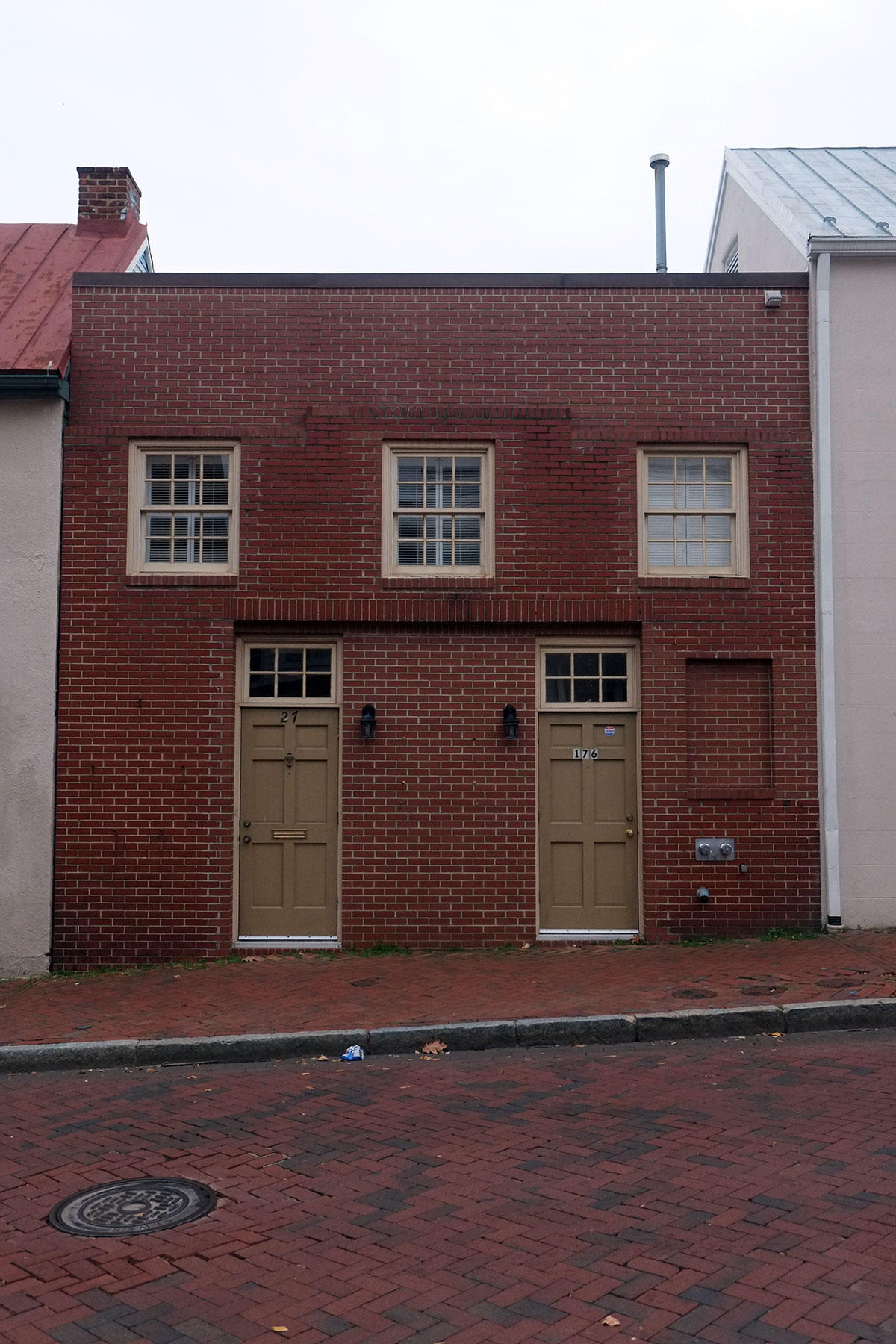
and some quirks:  three steps, four materials.DSCF5984

Annapolis is this very historic town, full of historic buildings, yet it doesn’t feel precious, or forced (although some of the stores do).  I think this is because they’ve avoided the ye-olde self-consciousness.  It feels like an old city that has people living in it.  They haven’t tried to iron out the anachronisms – it is not a city frozen at one moment in time, but comfortable with many.

They were also smart (or lucky) enough to not have many bad 20th-century intruders.  (I don’t think it’s at all impossible for there to be excellent modern buildings in a context such as this – there are many examples in Europe and a few in this country.  It’s just highly unlikely.)   Annapolis avoided the modernist disrupters (of course, if you go a few miles to the edge of town, it’s just like the rest of America), and also the faux-historical imitators.  It avoided urban renewal, and apparently it avoided grand redevelopment schemes.  Being in such a coherent urban environment makes you realize how rare they are in this country, and how we managed to dodge a bullet a few times.  DSCF5995

Baltimore

DSCF5725In this age of media-cooption of direct experience, how truly can we see a place, without our understanding being overwhelmed by previously-seen portrayals of that place?  This obviously comes up with New York, and L.A., and many tourist destinations, but for me it also came up with Baltimore.  I had been there several times before, but to be honest, my deepest understanding of Baltimore has come from repeated viewings of Homicide and The Wire.  This preconception had its negative effects – I was worried about walking down an alley, expecting that ferocious black-and-white dog from the Homicide credits to hurl itself against the fence at me – but it also had positive effects.  It reinforced my interest in the fabric of the city, spending time walking through neighborhoods, rather than just seeking out the architectural highlights.  This coincides with Greta’s predispositions too, as she’d much rather people-watch and see day-to-day life than look at major monuments of architectural culture.

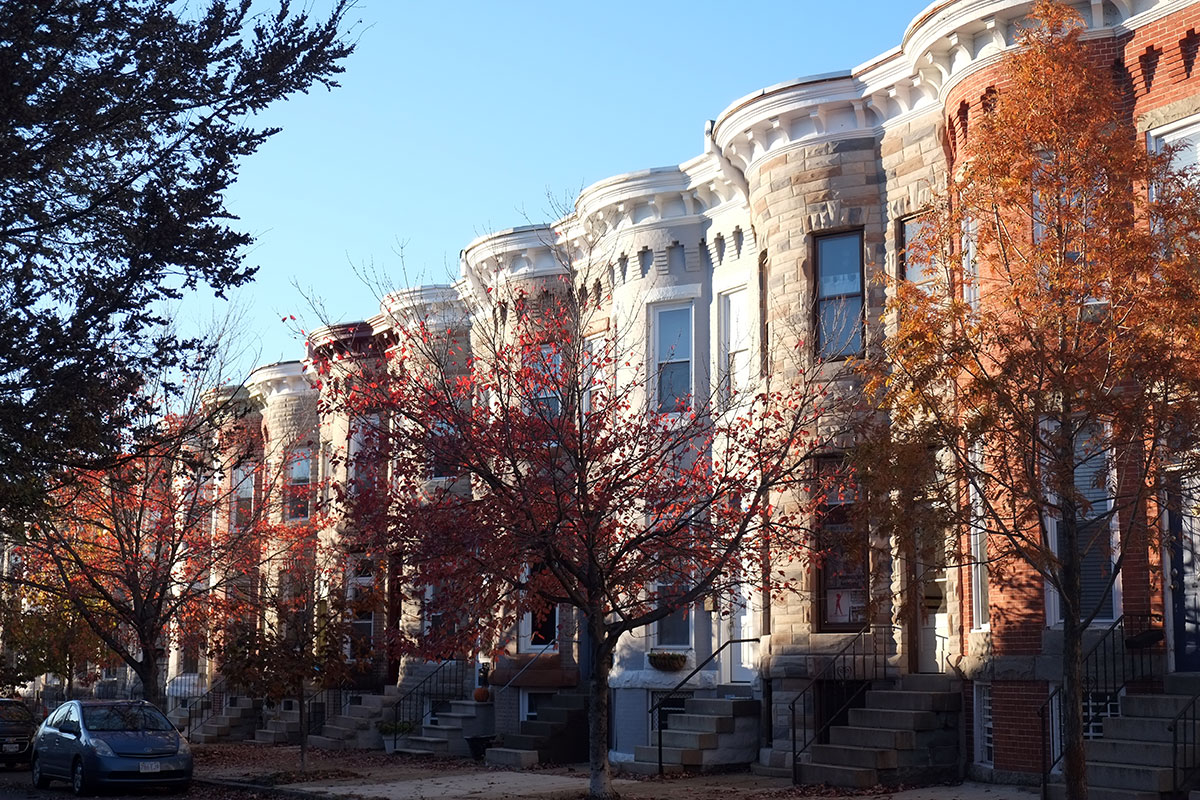
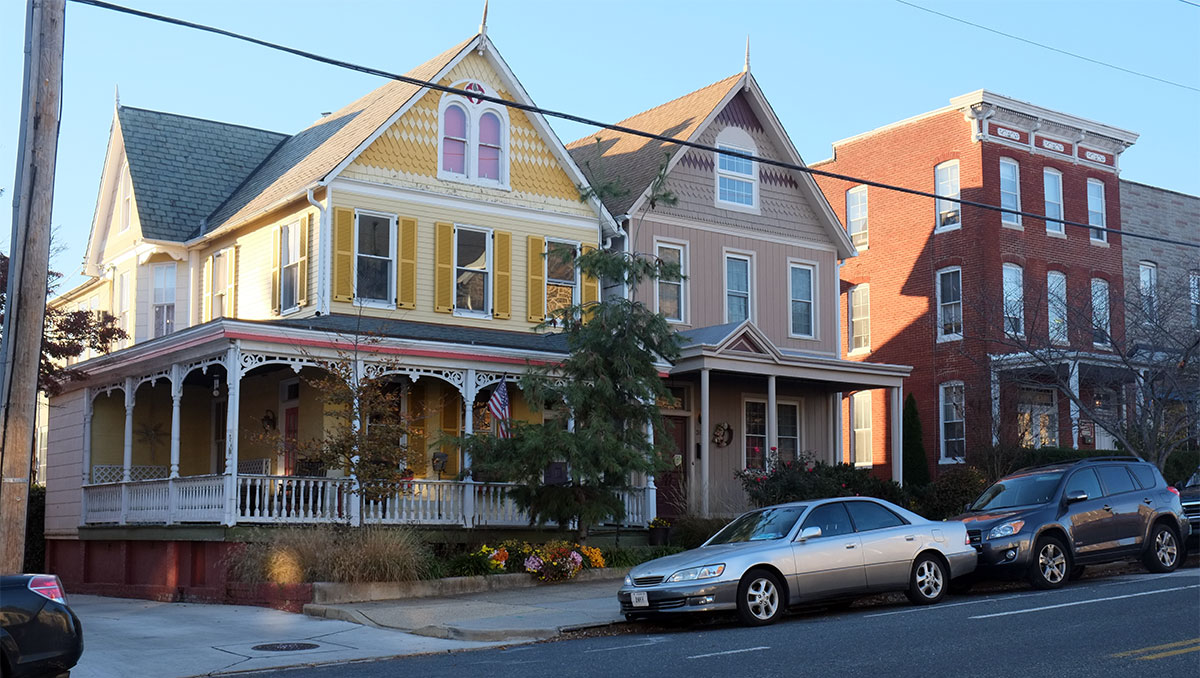
We were staying with our former student Neelab, who lives on the north side, a couple of miles from downtown, so our limited explorations fanned out from there.  (Plus my Wire-based geographic understanding led me to think that wandering around the North side was preferable to the East or West.)  We walked up through the Hampden neighborhood, a straightforward place which seems to be gentrifying at this moment, judging from the presence of a frites shop and other yuppie establishments.  Everyone understands the Baltimore rowhouse as the building block of the city, but what most struck me was the variety of designs, sizes, and styles within this simple type.  There were the obviously high-quality masonry houses,DSCF5716

the simple ones enlivened by coordinated colorDSCF5737

the ones enlivened by the lack of coordinationDSCF5714

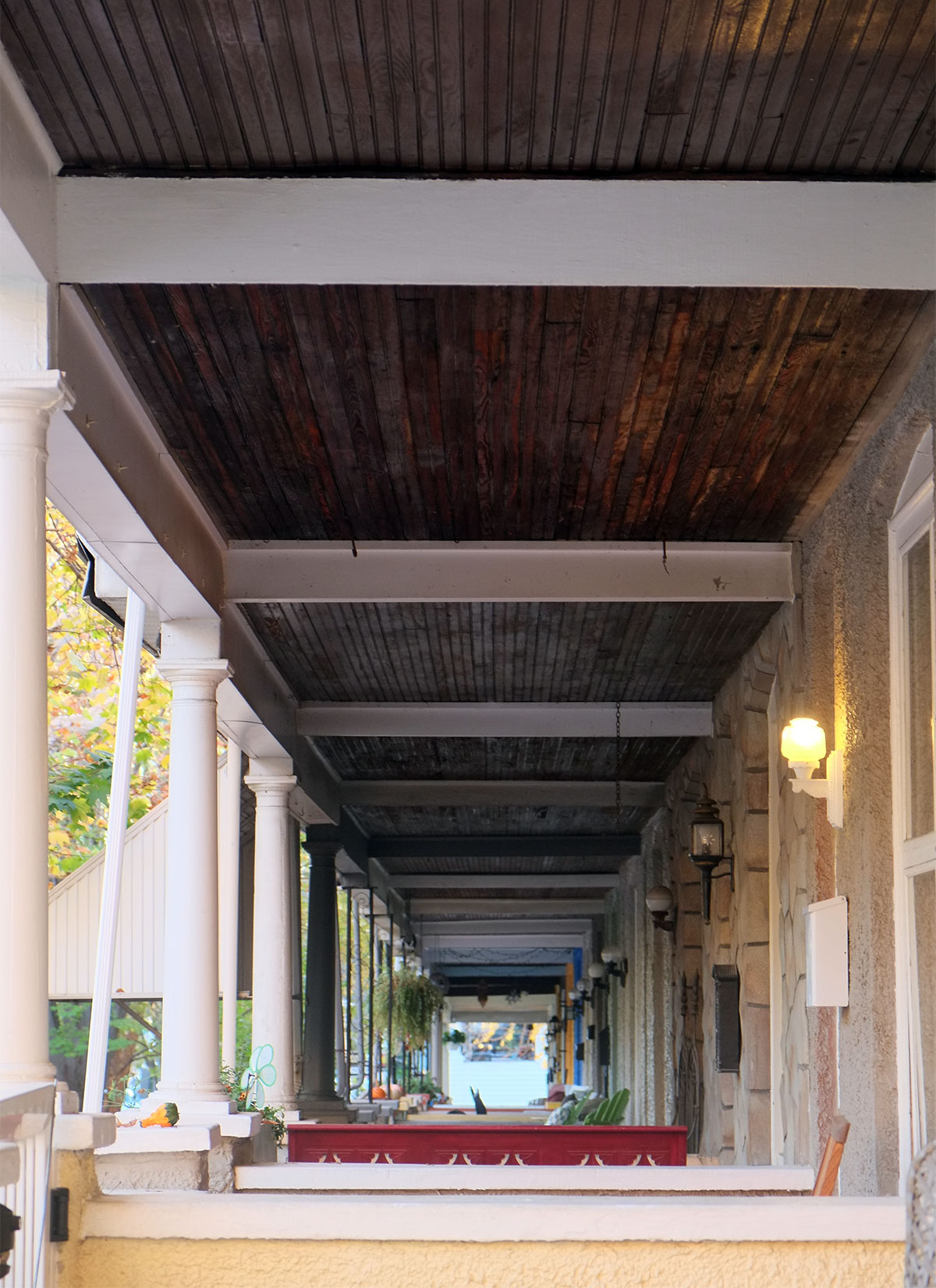
the ones with classic porches instead of stoopsDSCF5741

and the deeply idiosyncratic.DSCF5747

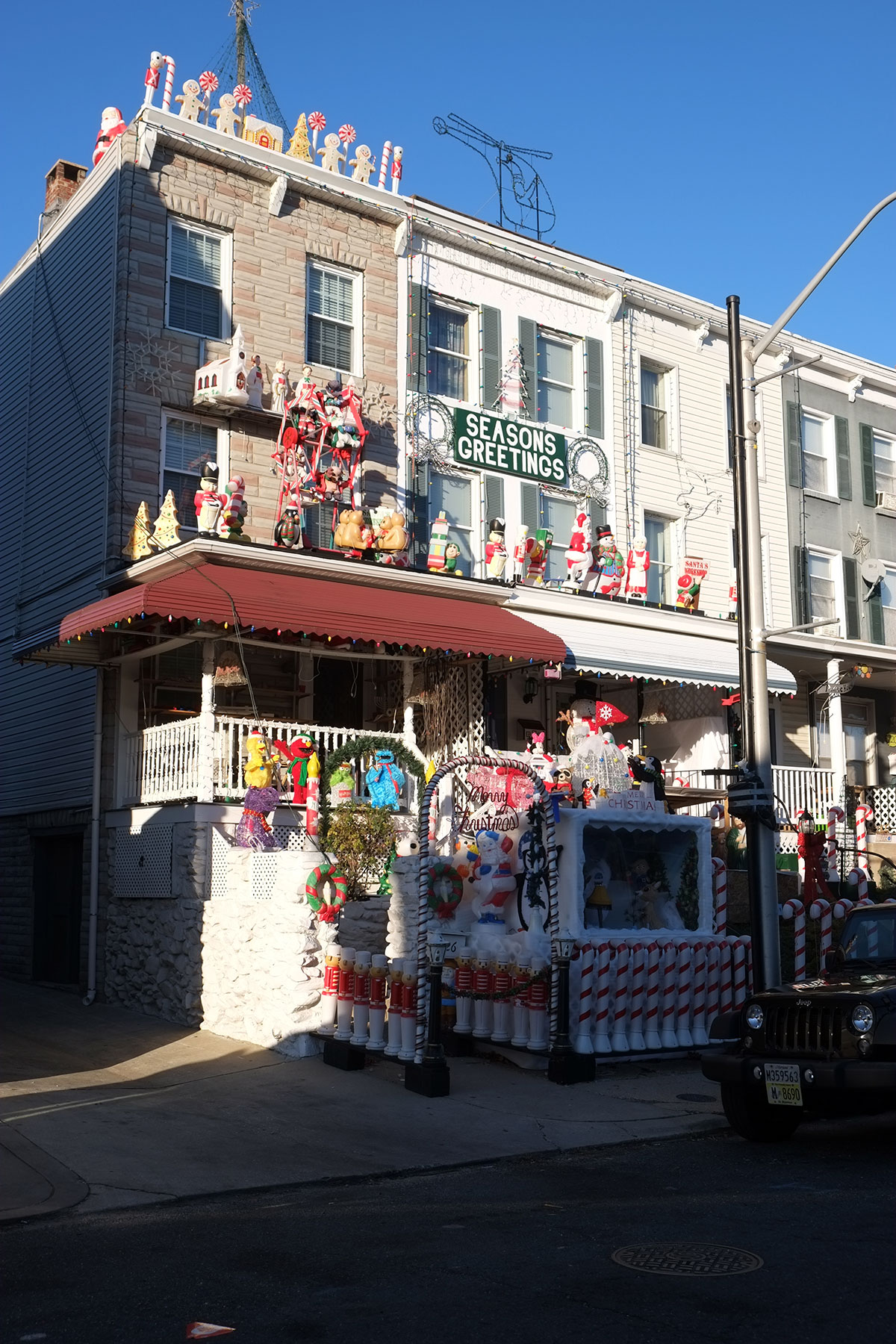
It was also cool to see traditions that we think of as primarily suburban – such as holiday decoration – running amok in the city:DSCF5709

While most blocks are uniformly rowhousing, there were also freestanding houses, semi-detached and narrow lot houses breaking it up:DSCF5730

and some unique houses, such as this one built by a local sculptor about 100 years ago.DSCF5802

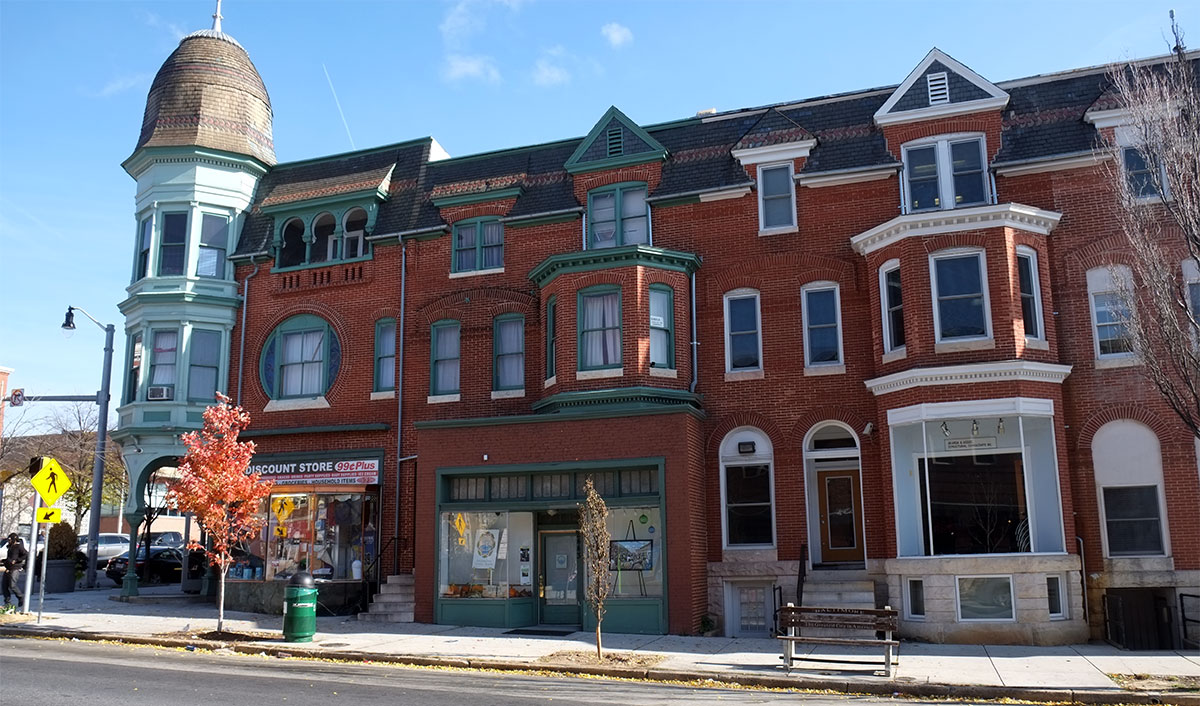
And as with any good neighborhood fabric, there were the mixed use and commercial buildings, and local institutions mixed in with the housing.DSCF5707DSCF5794

We saw Johns Hopkins, a not especially unusual campus where the hegemony of academic Georgian is once again strongly in evidence.DSCF5777

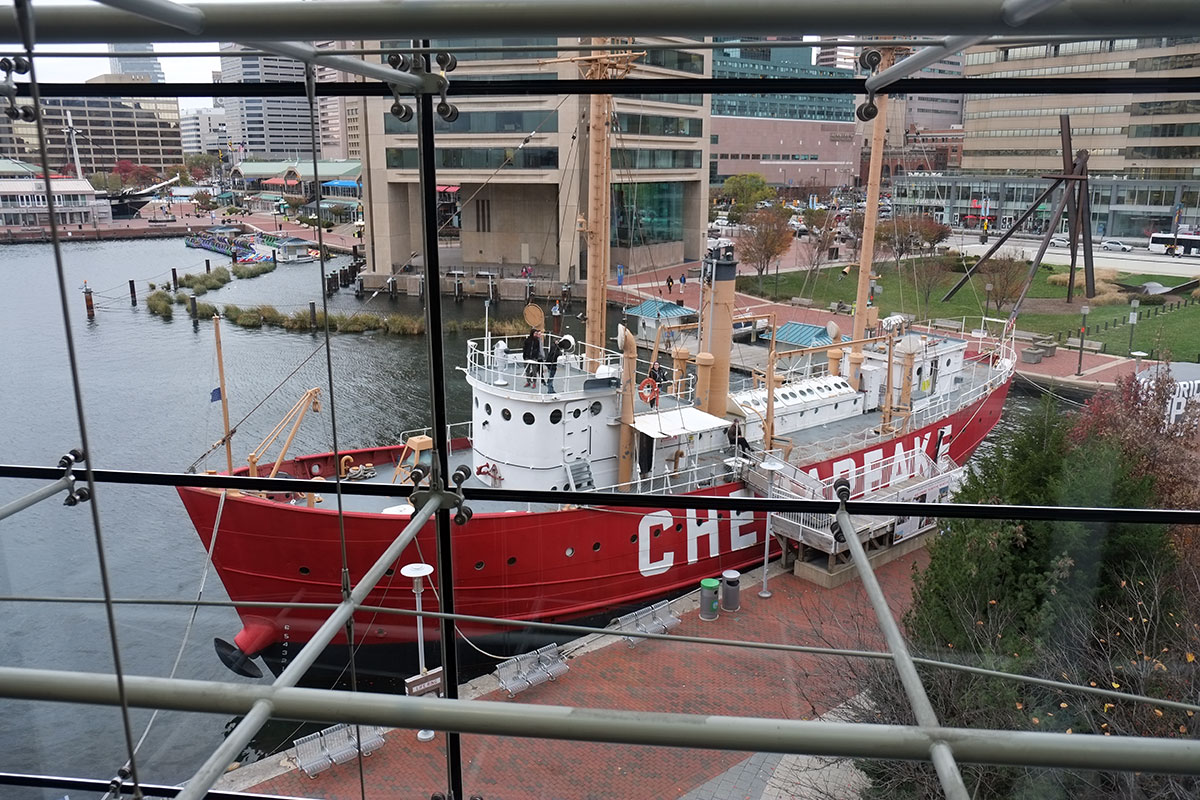
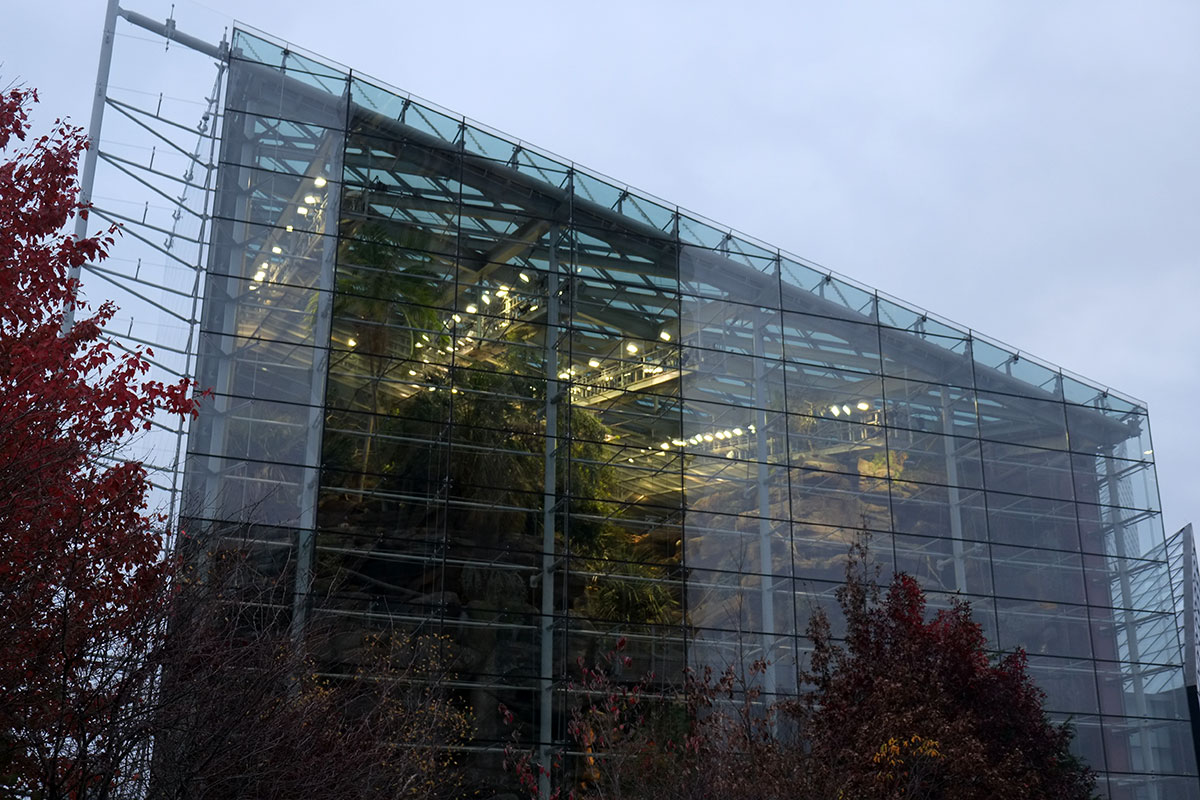
We walked to the downtown to get a better sense of the range of neighborhoods, and made it to the Inner Harbor, the redevelopment that put the city on the tourist map, with the groundbreaking aquarium and the Inner Harbor.  The Aquarium took up a lot of our time, as Greta’s architecture-quota had maxed out and we needed to see more animals.  Designed in the 70s by Cambridge Seven, it was the first to offer extreme spatial variety, huge tanks, and what feels like an immersive experience.  The interior spaces and experience are great,DSCF5859 DSCF5880

and the exterior conveys that this is a unique building, adding a focus to the waterfront.DSCF5834 DSCF5848

To some extent, aquariums need to be black boxes, to control light and marine growth, but this aquarium connects the inside to the outside as much as possible.DSCF5888 DSCF5906Overall, a very good building, though not quite up the Monterey Bay Aquarium, according to our family aquarium expert ( who has written a post about the aquarium qua aquarium and not architecture).

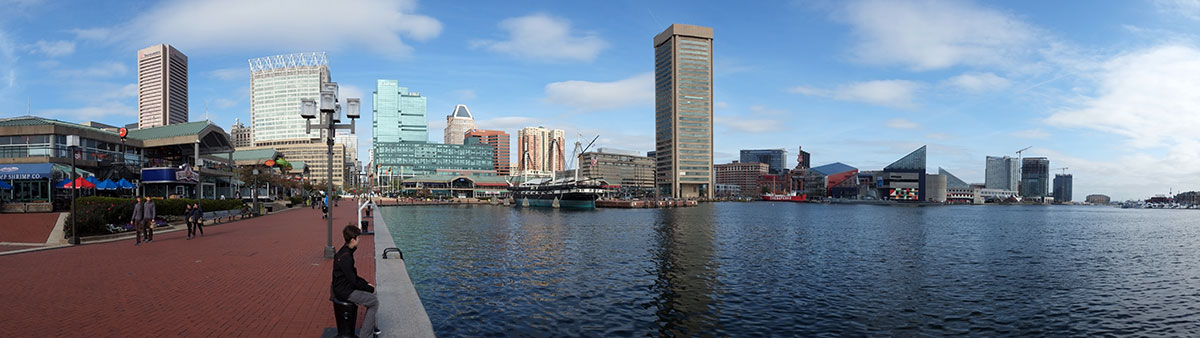
The Inner Harbor was one of the first “festival marketplace” developments by James Rouse, whose company was based in Baltimore.DSCF5832It’s a pretty convincing, nicely-scaled area which obviously opened up the view of the harbor, replacing the waterfront uses that were in decline.  It started a trend to bring suburbanites back into the city, by convincing them that it could be safe and fun.  We saw it on a November weekday afternoon, not prime tourist season, so it was clear that the spaces were scaled for the tourists who must throng it in the summer.  With the exception of a repurposed power plant with giant Hard Rock Cafe guitar on top, it doesn’t try too hard;  it all seems to be related to Baltimore somehow, and isn’t just the latest manifestation of a market-tested, globally-repeated, Disneyfied, ersatz urban branding extravaganza.  That is probably because it is now so old – a more recent development would look more like Vegas.

The issue of eras of building is important in another way in Baltimore.  If you zoom in on the picture above, you’ll notice that there aren’t really many new skyscrapers.  Baltimore has its share of crappy skyscrapers from the 60s and 70s, but very few from later decades.  I think this is a good thing.  Probably since it is a relative economic backwater, and not a global city, Baltimore has been spared the crush of banal behemoths that dominate so many other cities on the ascendant, such as Dallas, New York, Charlotte, etc.  These new skyscrapers may not be any worse than the older ones, but they are much bigger (in both height and floorplate) and they completely change the character of the downtown.  Cities such as Boston, which have preserved a lot of older buildings, can survive the onslaught with a semblance of balance, but newer cities, such as Seattle, become all too much of one era, and unfortunately not a very good one.  We’ve been visiting a lot of second and third-tier cities on this trip, and it strikes me that these cities, which are more embedded in the local rather than global economy, may be much better cities in which to live – reasonable housing costs, a sense of history, a slower pace.  The global cities are exciting and hip, but a city which has been spared the tsunami of global capital looking for a place to buy up real estate may provide a more grounded, balanced and satisfying life for a much wider range of residents.
Baltimore

Aquariums

Catfish

Catfish

Arapiama, the largest fish in the Amazon

Arapiama, the largest fish in the Amazon

Frogfish

Frogfish

So far on this trip, we have been to two aquariums; The Shedd in Chicago, and the National Aquarium in Baltimore. Though they were both cool, I don’t think that even added together they equal the Monterey Bay Aquarium. But that is so amazingly awesome that even less than half of it is still amazing.

P1050448

Piranhas

Both aquariums had green sea turtles. Nickel, named because a nickel was found in his stomach when he was rescued, was smaller, but he had all his flippers. The Baltimore turtle had only three, but I was so busy marvelling at her size that I didn’t notice until someone pointed it out to me. She was longer than the diver who was feeding her, and her shell was the size of a tire.

Baltimore Turtle

Baltimore Turtle

Another similarity was that they both had dolphin shows and stingray petting. At the National aquarium however, there was nothing telling you when the shows were, or even telling you that they had dolphins, so we missed that. I missed the show at the Shedd too, while I was looking for the stingray petting. I never found it. At the other aquarium however, they had a tank with skates, horseshoe crabs, and stingrays. The tail barbs on the stingrays were clipped, which is good, because a sting from one is so painful, fishermen in the Amazon call them “wish you were dead fish.” There was also a tank with moonjellies they let you poke, because unlike other jellyfish, their stings are so small you can’t even feel them.

The National Aquarium had more sharks. Shark alley, a three level exhibit where the sharks and sawfish were literally swimming all around you was awesome. I’d never seen a sawfish before, and they are the weirdest things. There were also a few giant pufferfish, who wore the silliest expressions. Zoe the leopard shark only swam in tight circles for the entire time we watched her.

Zoe

Zoe

The Shedd had more marine mammals, including sea otters, seals, and the beluga whale tank I once threw my ragdoll in when I was a baby. True story.

Happy Beluga

Happy Beluga

They also had a special exhibit about amphibians. It had a large variety of poison dart frogs, as well as a giant Japanese salamander.

Giant Salamander

Giant Salamander

Frog

But my favorite exhibit was the jellyfish in Baltimore. They had upside-down jellies, who, instead of floating around, affix their bells (the top part) to hard objects like rocks, and wave their tentacles around waiting for food to come to them. Brown blubber jellyfish look like the Oxiclean scrubbing bubbles things. I couldn’t stop laughing when I was watching them. Jellyfish are the living lava lamps of the animal world. There was another tank of moonjellies too. One cool thing about moon jellies is that they’re translucent, so you can see right into their stomachs, which look like flowers on the top of their bells. Usually full of orange or blue zooplankton, they range from having four to six “petals” or stomach compartments, and no one is sure what causes the variation. The aquarium obviously didn’t have any on display, but box jellies are the evil cousin of moon jellies. Clear and small, they live in Australian waters, and are the most poisonous animals in the world. A single sting from one can kill a human in less than twenty minutes. The more visible and less deadly Australian white-spotted jellyfish was on display, and looked nearly as ridiculous as the blubber bots.

Blubber Jellies

Blubber Jellies

moon jellies

moon jellies

Australian spotted jellyfish

Australian spotted jellyfish

Though both aquariums are expensive, over forty dollars a ticket, I think they were worth it. Be sure to manage your time wisely, and go see the dolphin shows we missed.

Family (northern edition)

DSCF6551-copyTraveling to the Northeast not only meant catching up with many old friends, but also seeing the family, in New York and Pennsylvania.  We didn’t get to see everyone, and we couldn’t stay as long as we wanted (as we could sense the change in weather closing in on us), but we shall return soon.

We stayed with my brother Jerry in Westchester, to which he has returned after a long hiatus in New Jersey.  Jerry is eight years older than me, but from the earliest age, we’ve always been pretty close.  PAK016a

And as is probably typical with most siblings, there are ways we are polar opposites (politics, musical taste), and ways in which we are pretty similar (sailing, traveling, dark sense of humor).  As we’ve been traveling down to the south in recent weeks, I realized we were going places that I first visited when Jerry was a teenager and took his little brother along on a road trip – the Shenandoah Valley, Charleston, etc.  Those were the first trips I made without a parent, and I think they planted the idea that one could just get in a car and go see the world.  In the past decade we’ve gotten together every summer, as jerry flies out to Whidbey Island, and we sail and hang out.
Sailboat-shots-017After a career in insurance and banking, Jerry retired two years ago, about 15 seconds after he was eligible, and retirement seems to suit him very well.  (For the last three years of his working life, his screensaver was a photo of his sailboat with a count-down calendar on it.)  His good friends Pam and Steve sold their house and bought a two-family house in Mamaroneck, and after a year of renovation, they live in the downstairs unit and Jerry lives upstairs.  They are three miles away from the boat club where they all spend much of their time, and one mile from the train station into the City.  It seems like a very good model for retirement.

After a day in New York, Greta and I both caught a cold, and spent two days hunkered down at Jerry’s, where we caught up on all the 1960s sitcoms that I hadn’t watched since the 1960s.  (My brother has an encyclopedic knowledge of the classic shows of the past 60 years, but it was good to see that he has expanded his repertoire to include more recent television.)

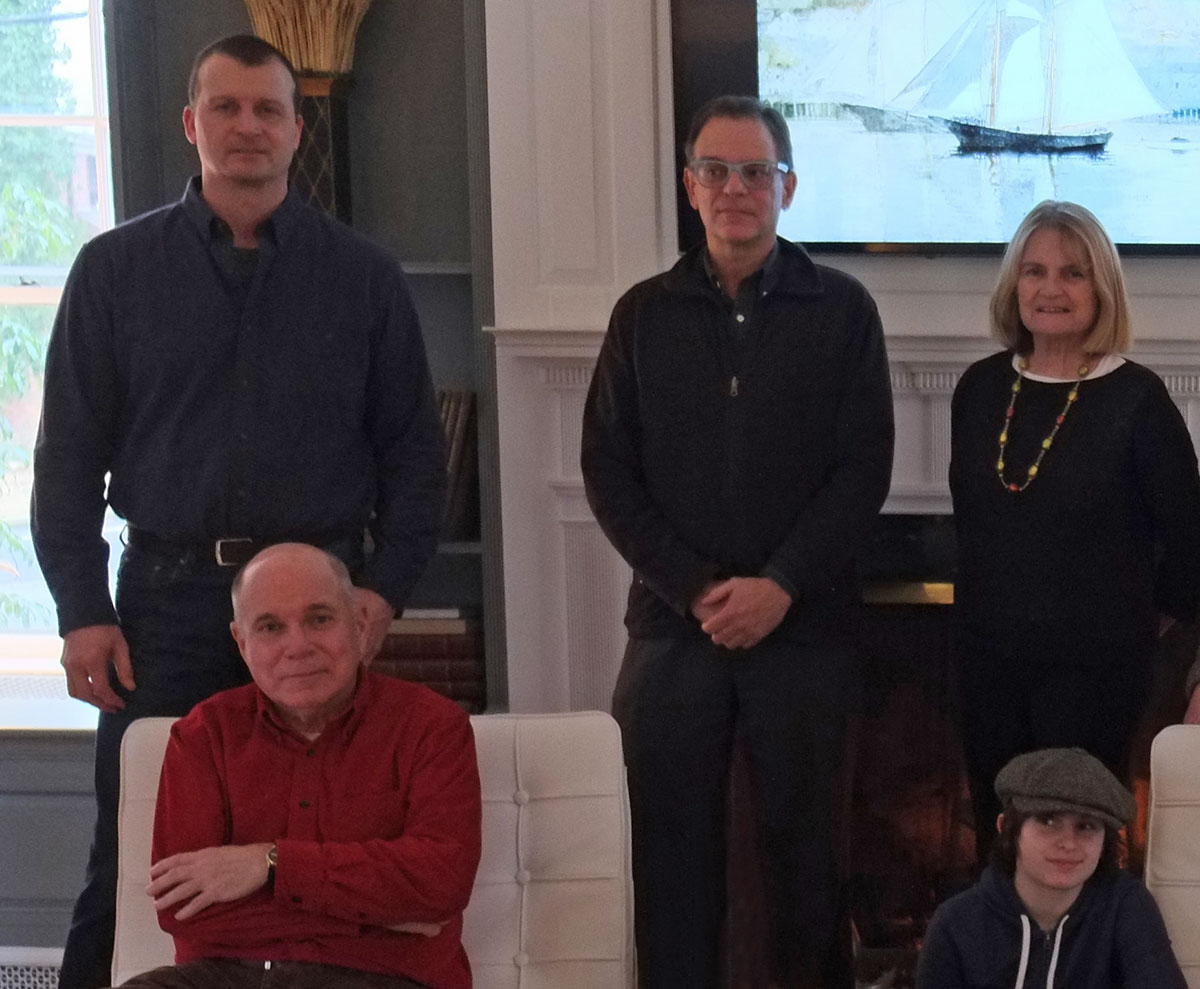
While we were killing time, my nephew Sean (upper left in the top photo taken last Christmas) showed up with pizza and soup, and to entertain us for the day.  Sean grew up nearby in Larchmont, and now lives in Connecticut.  He is Greta’s first cousin – although 34 years older than her – so she really thinks of his three fantastic kids (Connor, Eleanor and and Alexandra) as being more her cousins.  Sean was always athletic, and in college he started the crew team at SUNY Oswego;  in recent years he has kept up this rowing, while also adding marathon running to his portfolio.  (He has also generously shared his rowing insights with Greta, suggesting “more forward body angle at the catch” when she was eight.)

Sean has one of those  jobs that I don’t really understand what it is he does (it is interesting how many more of those jobs I run into every year as I get older and more clueless).  I at least can tell that it involves advertising and the internet.  Somehow between the job in the City and athletic endeavors he still manages to be a great dad, and arguably the funniest person in the family.

My sister Pat is the oldest of us five, seen here in the first known picture of us together.  I was clearly the practice child for her raising four kids, including Sean.
1956aDec
Once her kids reached a certain age, Pat went to work as a pre-school teacher, for a couple of good reasons:  she enjoyed the company of little kids, and she really enjoyed having summers off to sit in the back yard and read non-stop; over her lifetime, Pat has probably been one of the steadiest supporters of the Strand bookstore, frequently hauling shopping bags full back to Larchmont on the train.  I sometimes have students ask me how I acquired the wide range of random facts that I seem to know, but I am nothing compared to my sister. (She also talks faster than I do.)    She not only retains facts, but she somehow always stays abreast of what everyone is doing, and what they are interested in.  Over the years, I’ve often been surprised by some gift from Pat that tied in perfectly with an interest of mine that I didn’t know she was aware of. This year’s Christmas present was no exception.  DSCF8973Pat retired a few years ago, and so she too was able to come by Jerry’s and spend the afternoon entertaining us when we were sick.  This trip has been rather intense for me and Greta – it seems that every day is dense with new experiences, usually of new places and things that are not that familiar to us.  But this one afternoon spent with Jerry, Pat and Sean was definitely the most dense with talking, joking and reminiscing, and we were really grateful to them all for dropping everything to do it.

Leaving New York, we headed to the Philadelphia Main Line to stay with my nephew Justin and his family.  Justin was a remarkably cute kid, but also a scarily smart one, memorably besting me in an argument when he was three.  He was always precocious, seeming much more mature than his age.
1972April3
With that background, and his current career managing a mutual fund company, it is hard to believe that in an intermediate incarnation he spent some time following the Grateful Dead and supporting the trip by selling peanut butter and jelly sandwiches.

In recent years, Justin has also turned into a serious weekend warrior athlete – marathons, triathlons, mountain biking, etc.  But like Sean and all his other cousins, Justin has become this super family guy.  His wife Joanie is perhaps the most energetic person I’ve ever known – raising two kids while working as a kindergarten teacher with an expertise in special education – and somehow fitting me and Greta into her agenda, making us feel right at home and then sending us on our way with enough food to snack on for a week.  Their daughter Abby is a charming high school senior, but being a high school senior she’s completely over-committed, charging around with her friends, but managing to join us for dinner one night.
DSCF5699
Although Tyler is a only year older than Greta, living on opposite coasts they’ve only met each other a few times in their lives.  But getting together over the past couple of years, they’ve realized they have a lot in common – they’re both kind of quirky, willing to follow their own inclinations rather than the crowd, and they share a wide range of nerdy, fan-boy interests.  Tyler immediately roped Greta into multiple rounds of backgammon, and we spent a really fun day with him, at the Mercer Museum and then the new James Bond movie, as he guided us through the intricacies of Main Line geography.
DSCF5687We’ve gotten a little homesick from time to time on this extended trip, and it was really good to stop in places where we were at home, with family who love us and welcomed us in.

Lancaster, Pennsylvania

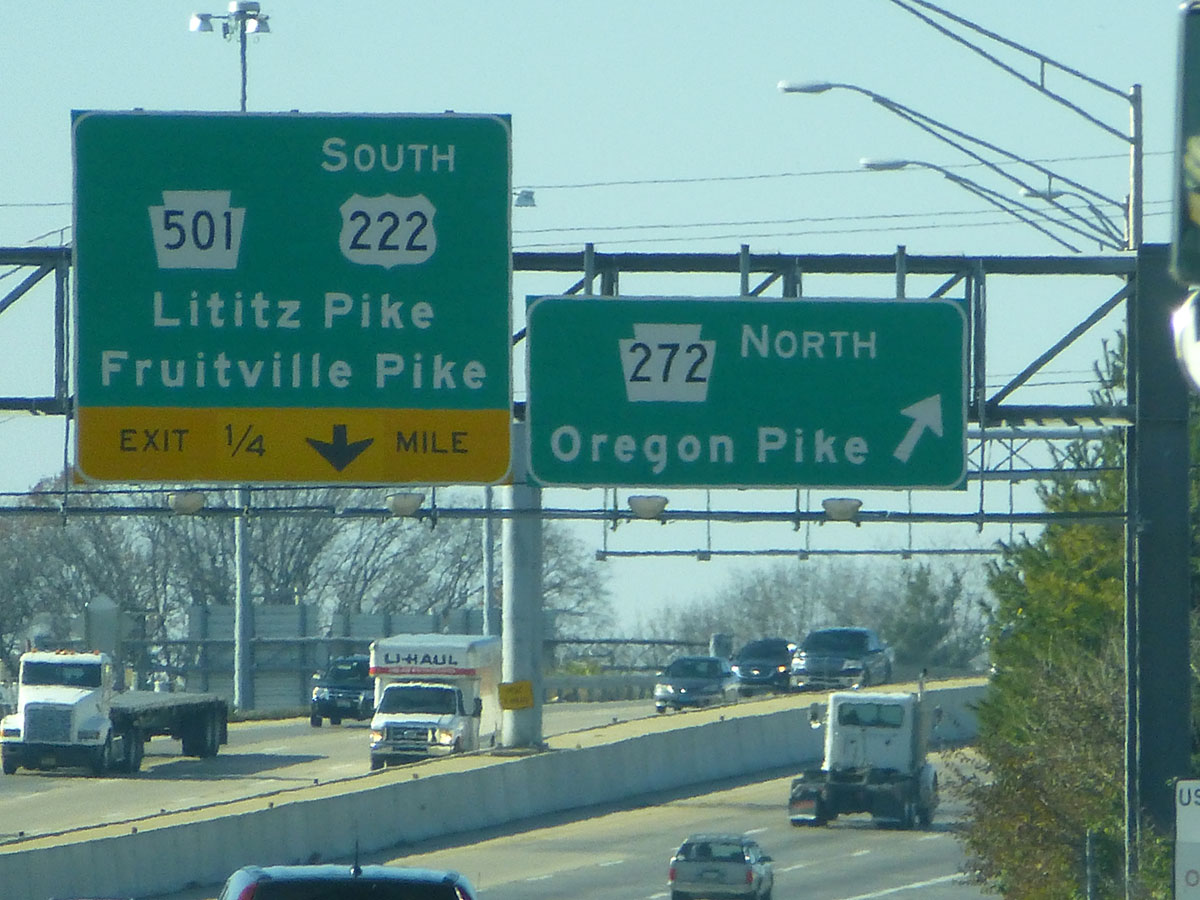
A year ago today we drove west from the Philadelphia Main Line, through Lancaster and York, Pennsylvania, and then south to Baltimore.  Strangely, I had never travelled through the Amish country before, and Greta and I were both taken by the beauty of the landscape, and the singular culture that is centered there.

With a normal adolescent sensibility, Greta was highly amused that we were passing through Intercourse, p1050342

and her more detailed study of the map caused us to make a slight detour south to Fertility, which she was gratified to see was only a short distance from Intercourse.

The landscape showed a lovely amalgam of different eras of vernacular building.  Lancaster itself was a somewhat overwrought tourist destination, but once away from the bus parking lots, the lack of self-consciousness and tweeness was evident.  p1050344

As was extreme laundry-hanging. p1050343

We thought we had come across a wormhole in the space-time continuum, and that maybe we could zip home for a quick visit,p1050345

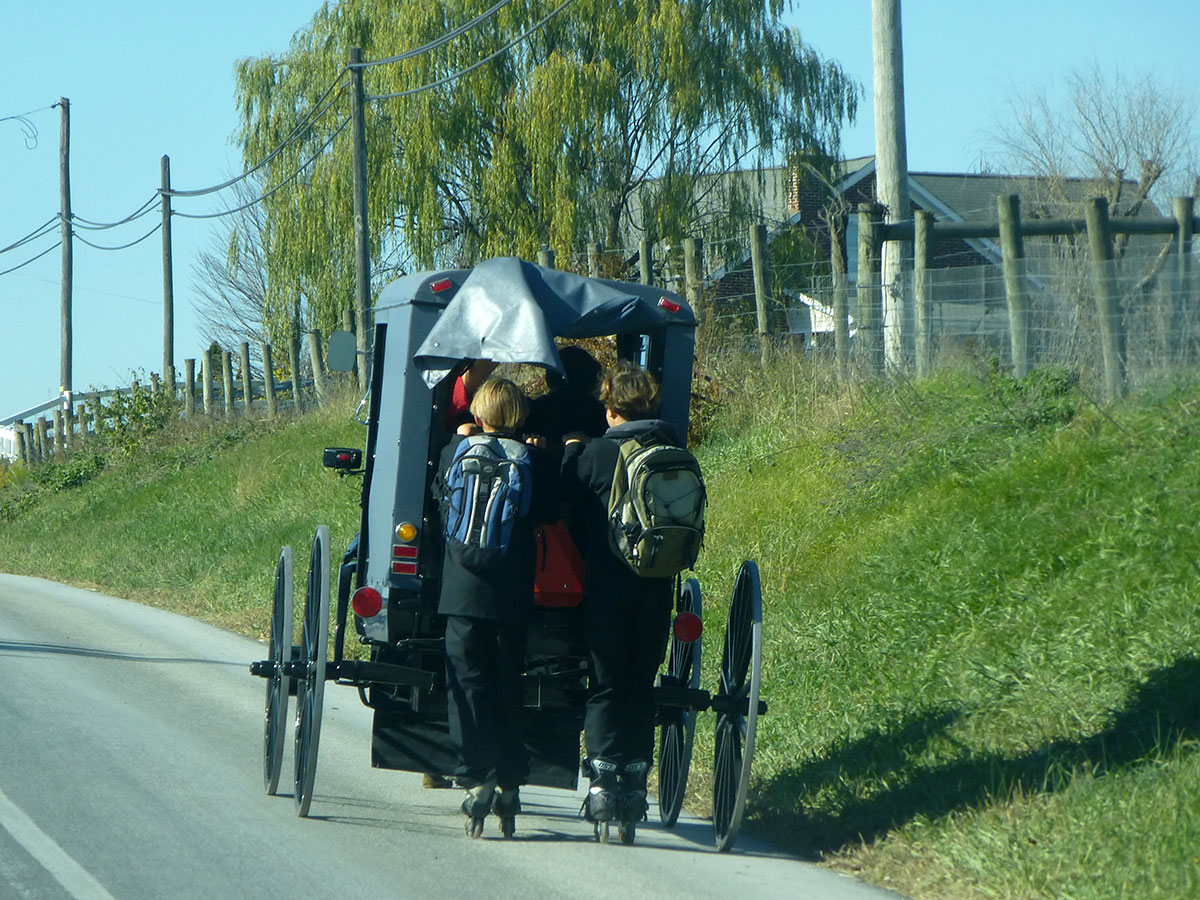
But the real dislocations were in the cultural anachronism category, especially this example of Amish skitching on the way to school.  p1050333

Philadelphia

One day in downtown Philadelphia, where once again the parental need to force Greta to view the major monuments of colonial America asserted itself.  Different cities have taken different approaches to this heritage.  Boston does it really well – with the exception of the Paul Revere Mall, the historic sites are still imbedded in the city.  New York more or less obliterated all the historic sites and their surrounding context.  Philadelphia kept all the historic buildings, but obliterated the city fabric around them, so you can view these icons as isolated objects, surrounded by pointless, overscaled open space and dreadful overscaled buildings.

I remember Independence Hall as a wonderful building.  It is not only important, but it is beautiful and says something about the city of the time.  The problem is this:  you can’t get anywhere near it anymore, without signing up for a tour over in the dreadful visitors’ center and waiting around to be shepherded through with throngs of tourists snapping iPhone photos.  You can’t even walk on the grounds near it, having to detour around the block.  DSCF5478

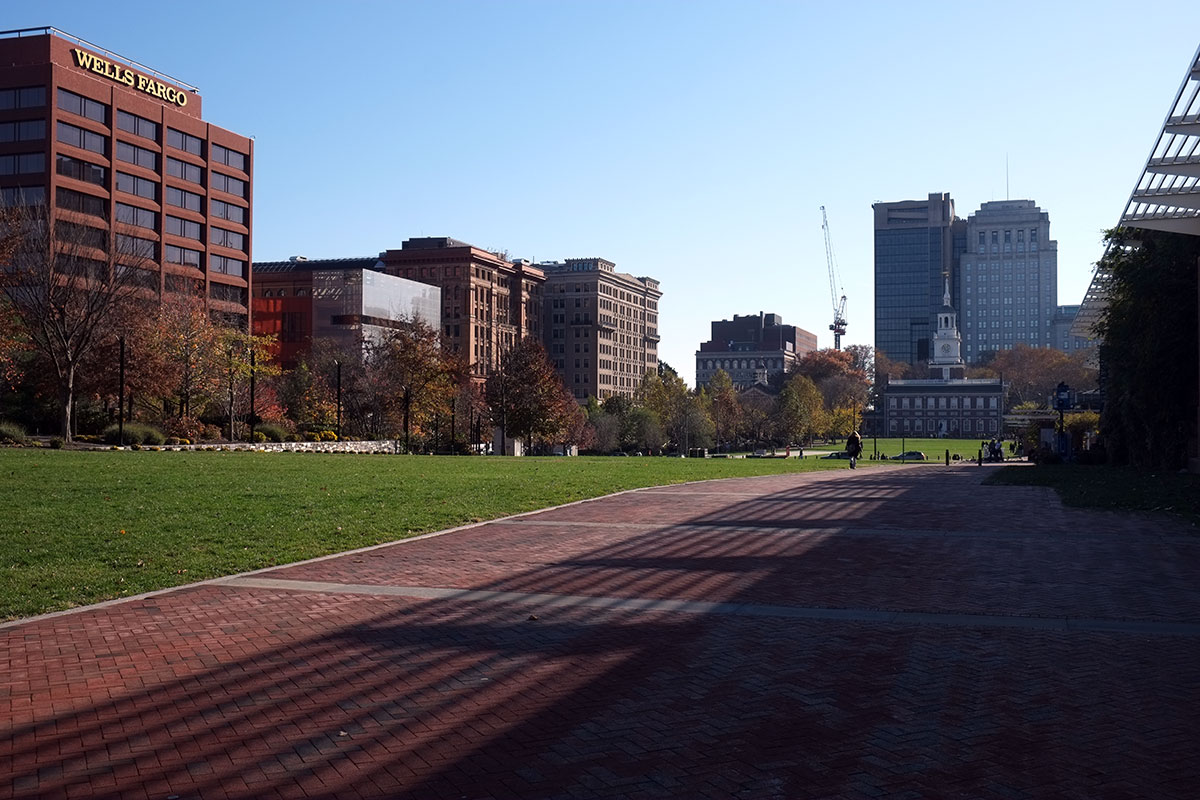
It gets even worse when you step back.  The Independence Hall Mall was proposed in the 1930s, and was implemented in the 1950s, when we thought knocking down old cities was a great idea.  Hundreds of buildings were destroyed, so that a giant open space would allow you to view Independence Hall from far away, looking puny and unimportant.  DSCF5496

Then big, bombastic buildings were built around that, symbolizing the might of large corporations in our national system.  It gets even worse behind Independence Hall, where this sterling example of historic preservation can be seen.  DSCF5464

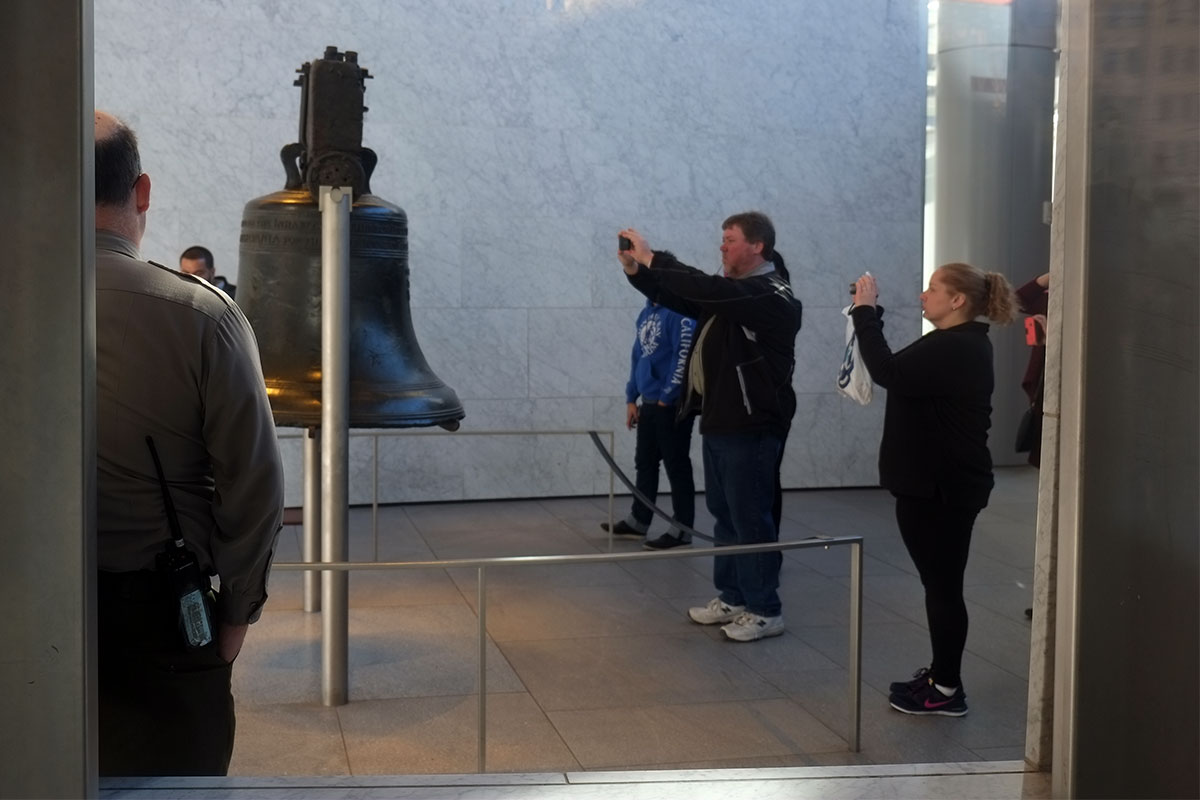
It declined further recently.  In 1976 the Liberty Bell was moved into its own viewing pavilion, part of a veneration of the minor icons of our history rather than the history itself (the recent Star Spangled Banner re-installation at the Smithsonian is another example of this).  But then this simple pavilion was destroyed (probably because it was modernist and minimal), and replaced by a more grandiose pavilion, just south of the visitors’ center.  DSCF5485

The experience is awful, reminding me of what has happened to Mt. Rushmore.  Where does this impulse come from, to remake everything in a phony, pretentious manner?  (By the way, some very good architects and planners were involved in many stages of this madness – Edmund Bcon, Dan Kiley, Venturi and Scott Brown, Cywnski, Laurie Olin!)  Philadelphia was not Versailles, but it had one of the most compelling plans of an early American city. Why can’t we leave it alone, and let visitors have an experience that in some way might evoke the 18th or 19th century, helping them to understand life in that era, rather than pedantically shaping their perceptions?  Boston looks better and better in this regard.

Luckily, the architects did preserve one of the best features of the earlier Liberty Bell pavilion – a window through which it could be seen, without going through the rigamarole.  We took the picture and got the hell out of there. DSCF5474

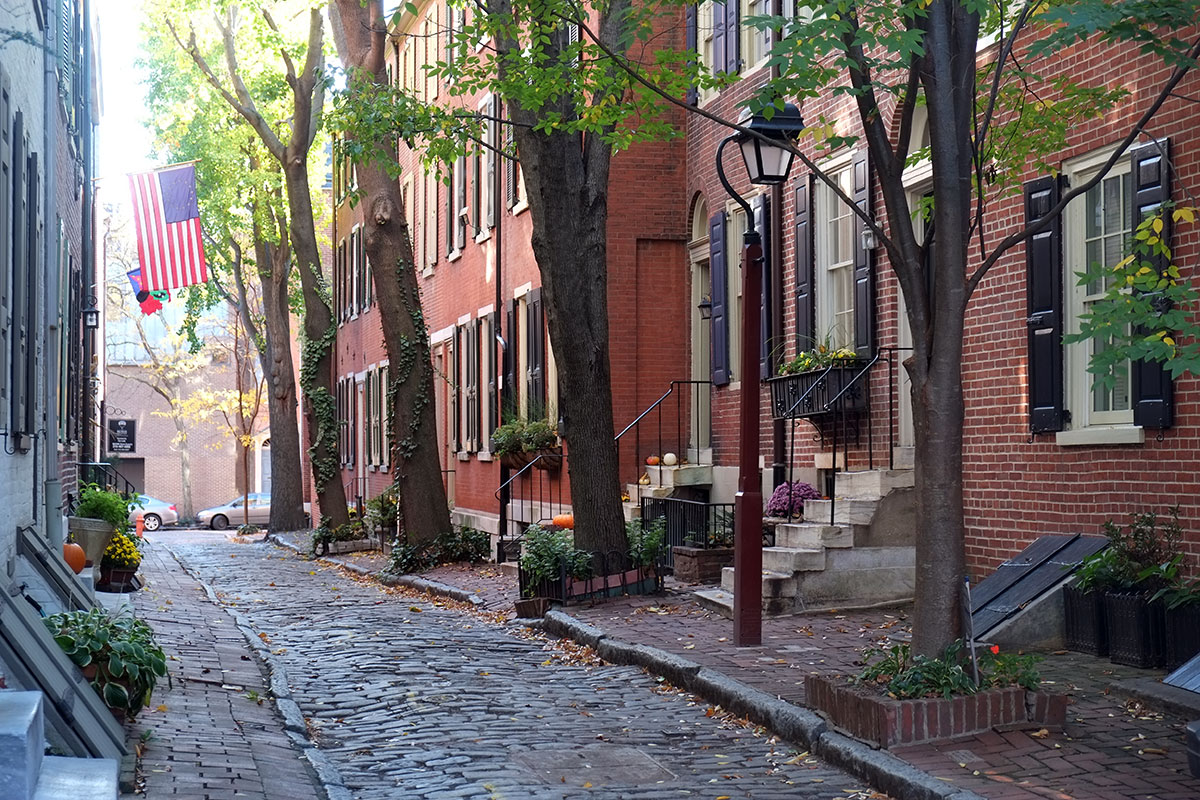
Once you get away from this, Society Hill and other older neighborhoods of Philadelphia are spectacular.  There are crazy renderings of the founding fathers,DSCF5466

fantastic Greek Revival buildings by Robert Mills and others,DSCF5503DSCF5525and streets which really maintain the experience of the 18th century city.DSCF5569DSCF5575DSCF5579DSCF5604

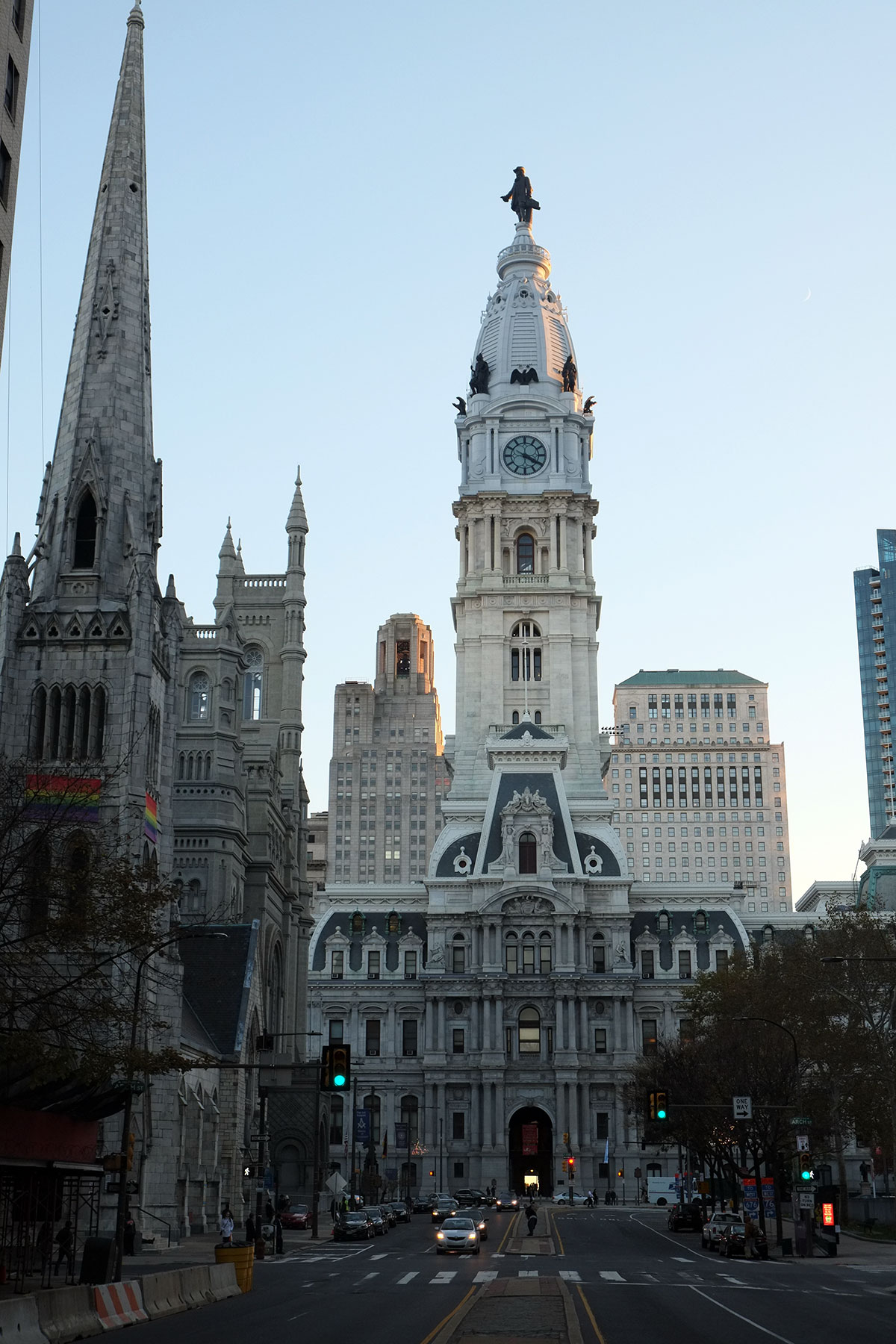
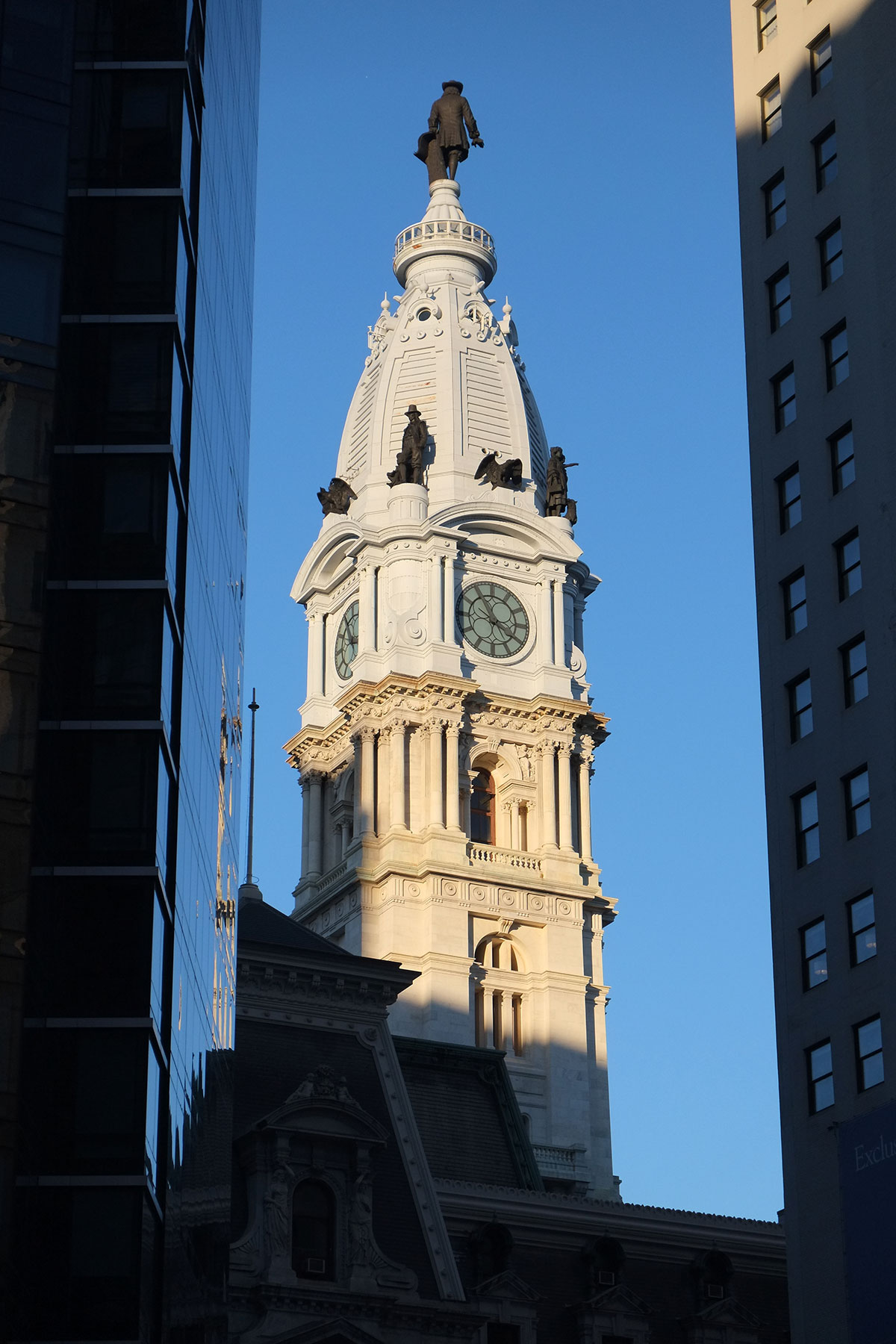
The Ciry Hall is magnificent, a good example of how a city plan can evolve positively. There was no building at the center point of the city in Penn’s plan, but having this icon visible on the axes works beautifully (with sculpture by Alexander Calder Sr.)DSCF5666DSCF5640

The Paul Cret Federal Reserve is fine (Cret being an employer of Kahn).DSCF5616

They seem to be having more fun at the Pennsylvania Academy these days, I think Furness might have approved?DSCF5671A truly dreadful “remuddling”DSCF5624and some fine urban buildings and juxtapositionsDSCF5662DSCF5672DSCF5664

As we were into checking things off our list, we grabbed a random cheesesteak, but not being in the right neighborhood, it was nothing to blog about.

Mercer Museum

DSCF5358When I began teaching at the University of Oregon, I found that one of my colleagues, Bill Kleinsasser, was fairly obsessed with Henry Mercer.  Mercer was an archaeologist, collector and amateur architect, who built three buildings and started the Moravian Tileworks in Doylestown, Pennsylvania.  I dragged two of my sisters to see Mercer’s house about 20 years ago, and Laurie’s response was great.  First room:  That’s pretty cool!  Second room:  Cool.  A lot like the first.  Third room:  I get the idea.

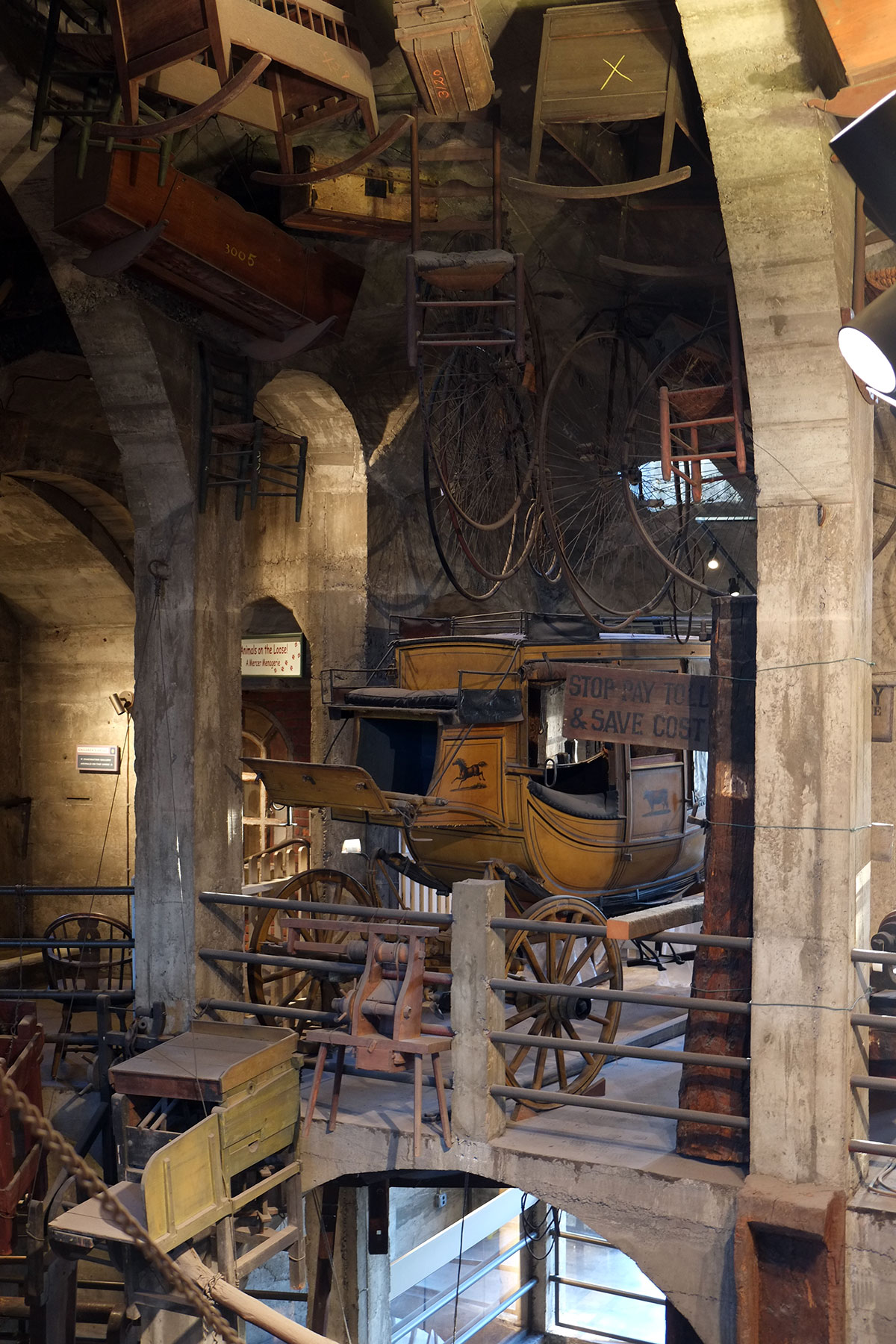
But Bill Kleinsasser was right – it’s just that the Mercer Museum is the building to see.  Mercer collected a comprehensive assortment of technological artifacts from pre-industrial America.  Then he built a museum to house and display them.  Concerned with fire destroying the artifacts, the museum was built of reinforced concrete, which is apparent on the outside, a strangely flat medievalist fantasia.DSCF5321It’s adorable, but a bit twee, with vernacular forms in a strange material.  The roofscape looks like a giant birdhouse, but somehow I love it.DSCF5378

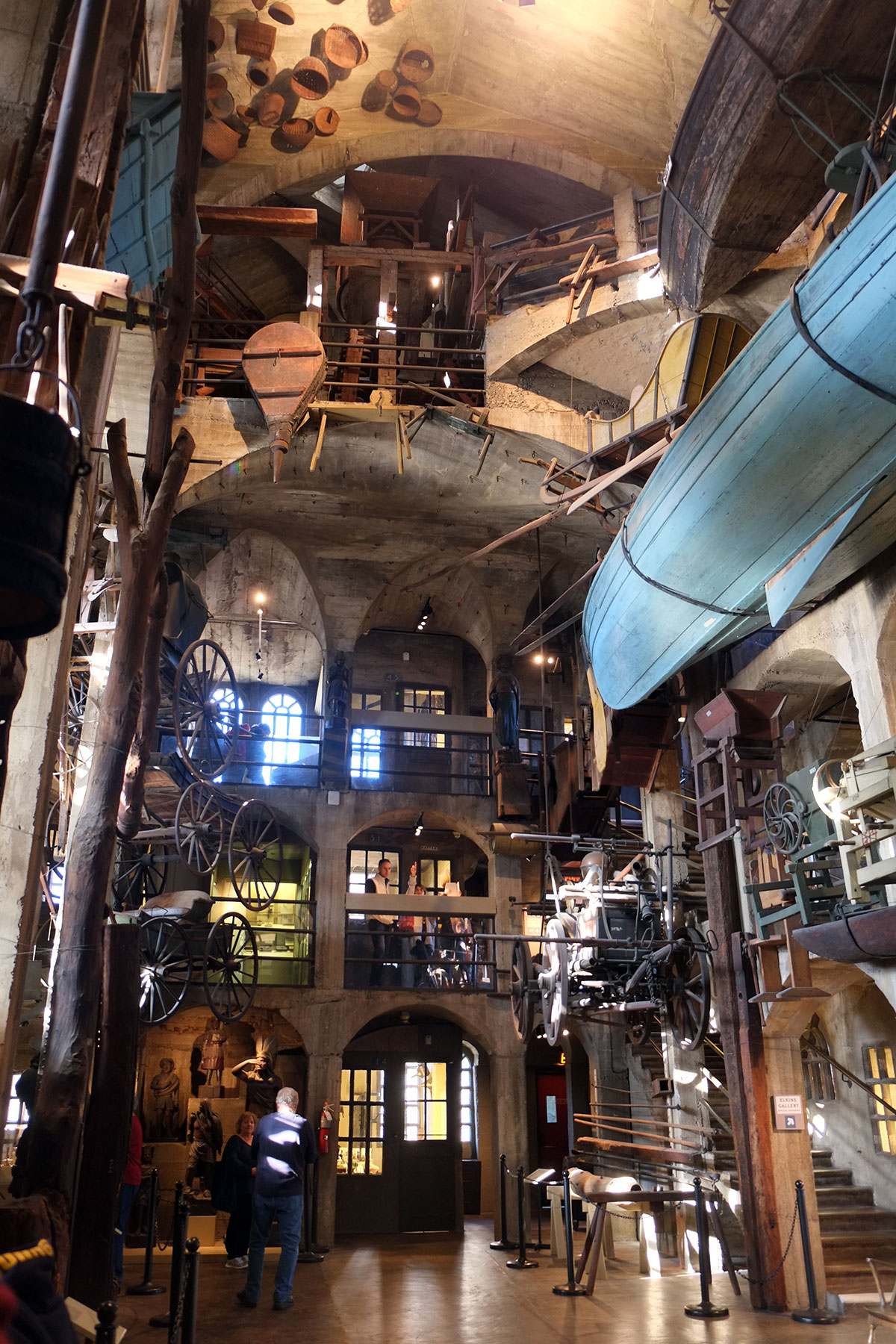
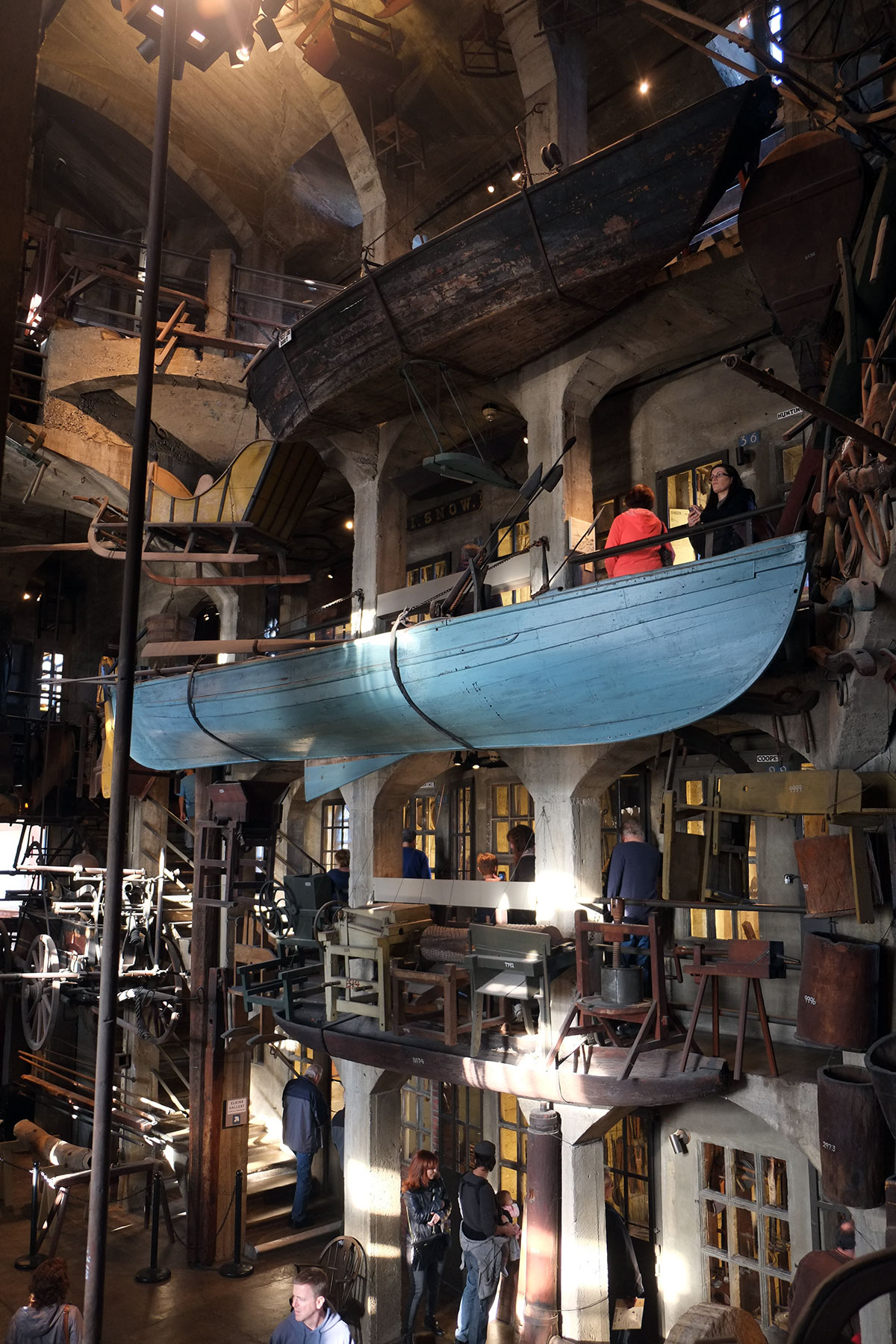
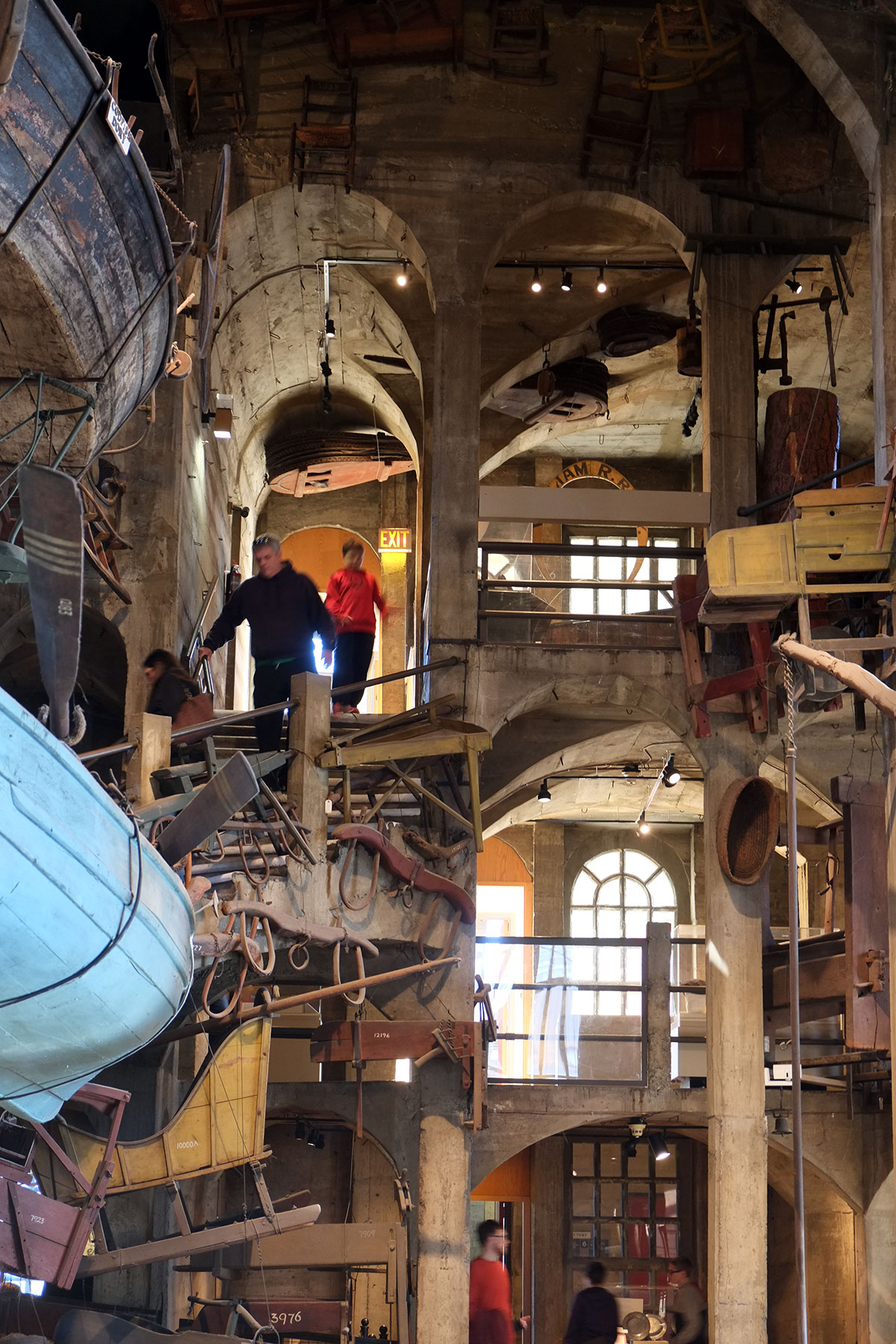
You enter through a new lobby wing, go up some winding stairs, and step out into this:DSCF5324a four-story atrium crammed with more stuff than seems possible.  It’s feverishly hallucinogenic.  Every surface is covered with stuff, even the ceilingDSCF5371

and then the really big stuff is hung out in space. DSCF5350

It is so far from our current model of what a museum should be like that it’s hard to process.  Where are the blank white walls?  Where are the wide open spaces across which we can contemplate an isolated, perfect object?  The Mercer Museum shows that a museum can work extremely well while not meeting our aesthetic preferences for abstract minimalism.  The central atrium is surrounded by vaulted side aisles, on the the outside of which there are niches, almost chapels, each of which explains and shows many artifacts pertaining to a specific technology, such as lighting:DSCF5353

or a cabinetmaker’s shop, with its molding planes:DSCF5417

The sidewalls are heavily glazed, and the light filters through the niches and side aisles into the atrium.DSCF5437DSCF5426

and there are other random artifacts scattered around.DSCF5340

as in a separate two-story space where there are perhaps thousands of panels from cast-iron wood stoves, along with firebacks, each which is highly wrought and decorative.  But the space itself grabs your attention, with its Orientalist detailing and complex spatial moves.DSCF5381DSCF5385

The exhibits are extremely clear – I now know a good amount about the practices of 18th century technologies – such as tinsmithing – which were just vague ideas to me before.  The layout of the building also supports this pedagogical approach – you may be looking at the small tools and labels in a niche exhibit, and the the label says, turn around and look behind you for a big artifact – like a whaleboat or a stagecoach – which is the product of this technology.DSCF5416

DSCF5343

DSCF5338It’s a museum which can be approached from many directions and found to be satisfying.  Kids love it, both the artifacts and exploring the space, with surprises around every corner.  Grown-ups just stare, not ever having been in a place like this before.  And some architects wonder why everything we do now has to be within such narrow parameters.  Or whether there can’t be a closer fit between the architecture and the contents.  Mercer’s buildings on their own are quirky and interesting, but not all that good.  But when you fill one up with amazing stuff, there is synergy, and the experience is fantastic.

Radburn, New Jersey

DSCF5178There are iconic buildings and places that everyone knows, but remarkably few people have actually visited.  In my lectures I try to stick to places where I have been, as the understanding one has of a place is greatly inferior if your whole knowledge of it comes only from books or media.  However, there are some places that are so important that you need to present them even if you’ve never seen them.  Radburn is such a place, one that I show to my students constantly, so actually seeing it was on the top of my list for this trip (even though I knew it would drive Greta crazy).  And I’m happy to say that it was an even better place than I expected it to be.

Planned communities, and planned suburbs, grew in importance and influence in the 19th and early 20th century.  A radical change came with the spread of the automobile to the middle class – how could the built environment cope with the spatial and organizational demands of cars?  Corbu’s various schemes pointed in one direction, but a more realistic and thoughtful approach was taken by progressive designers in the 20s.  Clarence Stein and Henry Wright collaborated on many important developments (such as Sunnyside in Queens), but Radburn laid out a new model for organizing suburban developments to emphasize community, safety and privacy.

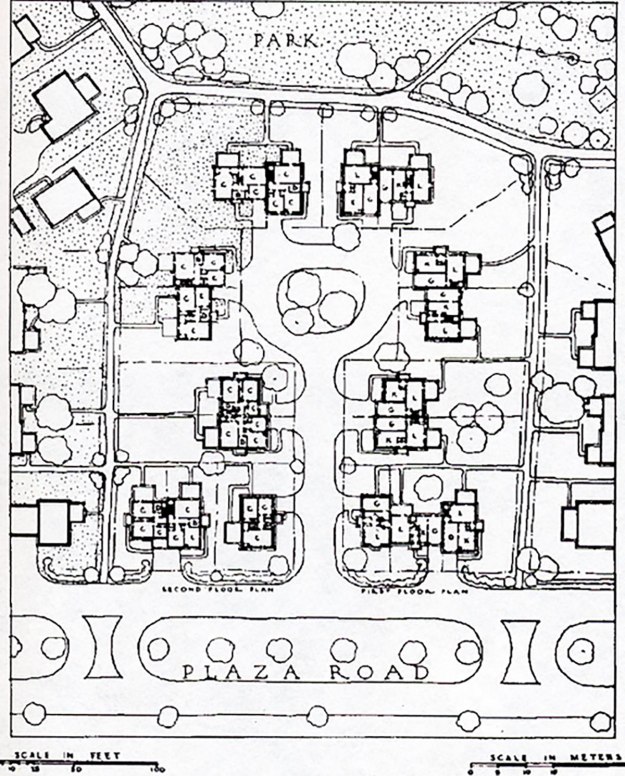
The basic premise was that pedestrian and car circulation should be separated, with the dwelling units situated between the two.  Children should be able to walk or bike safely around the neighborhood, and all the way to school, without having to cross a street.  It sounds difficult and expensive, but the solution turned out to be affordable and at a remarkably high density.  And like all great solutions, it was also elegant and beautiful.

The through streets in Radburn that connect to the larger street system are for cars only.  Notice that they have no sidewalks – they don’t need them.  Some houses enfront these streets, and they have modestly-scaled yet formal front yards.  DSCF5187

They look like village roads, although in the site plan below, they look quite large in comparison to everything else. site

Branching off these streets are the dead end streets for accessing the houses – courts, cul-de-sacs, whatever.  They are even smaller, and allow for car access to driveways and a small amount of on-street parking.DSCF5189
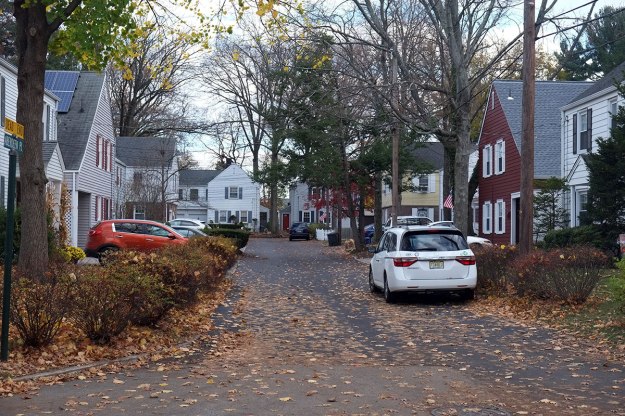
Units have their front doors on these streets, with a small yard setback for privacy, and driveways long enough for one car.DSCF5165

Some of the house are detached, and some are semi-detached (duplexes or two-family houses, depending on which coast you live on).  DSCF5170

There are carports and garages between the units.  At the end of the cul-de-sac, a sort of court is created, with detached houses tucked into the corners.DSCF5166
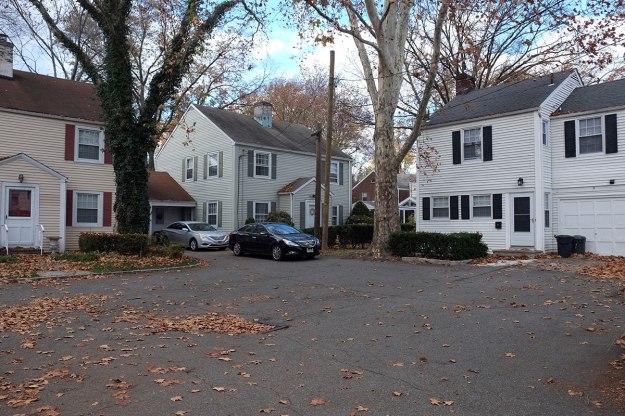
it is a remarkably efficient solution to the parking demands, and one that still seems to function well, almost 100 years later.cluster
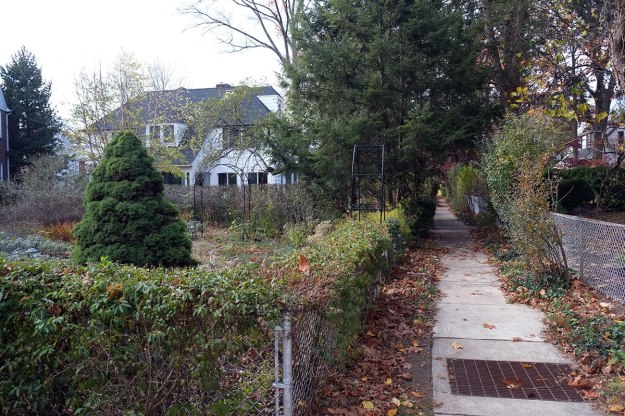
The next innovation is that on the other side of the houses, across pleasant backyards, there is a narrow pedestrian path that provides access from all houses to the common outdoor space.  These pedestrian paths are really quite agreeable – you can look into your neighbors’ backyards, but it’s not a large enough space where one would linger (although small children would probably find them to be a great environment for exploration).  This pedestrian path idea was later used by Duany and Plater-Zyberk in their design for Seaside, Florida.  DSCF5232
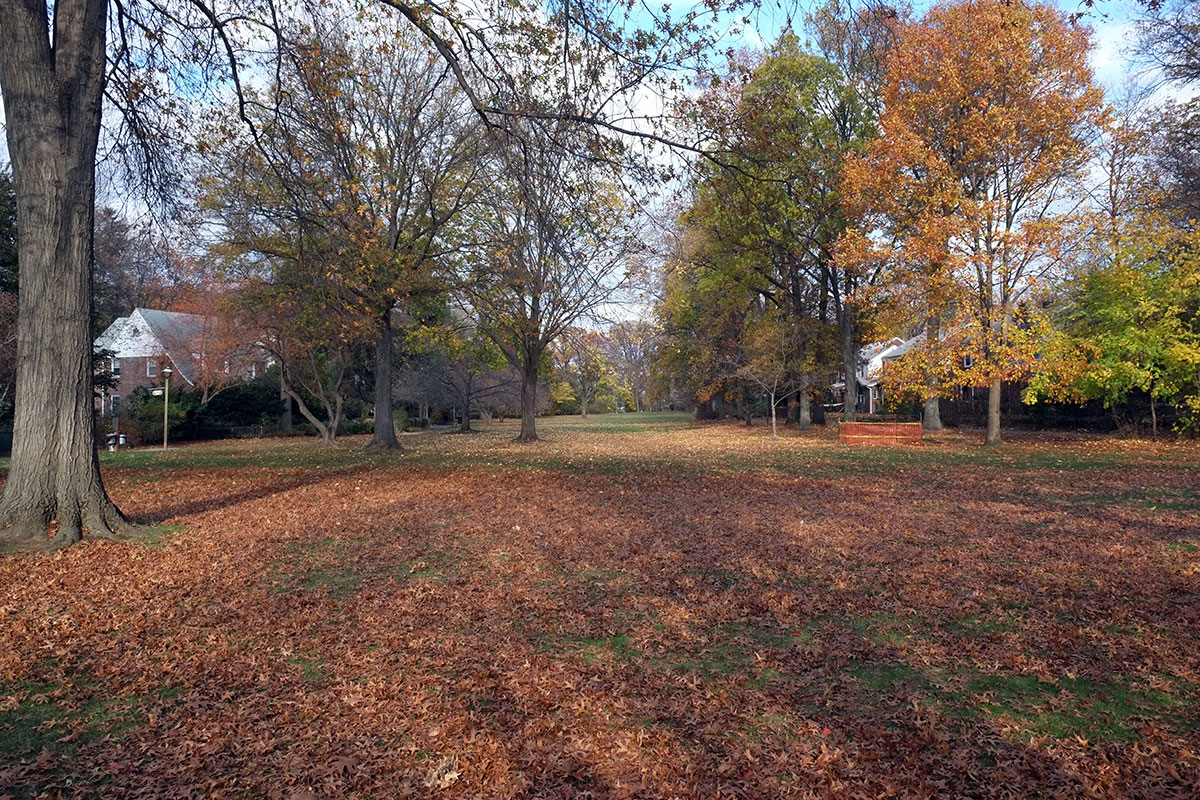
These paths connect out to a beautiful large field, where gatherings can be held, and games can be played.  DSCF5242

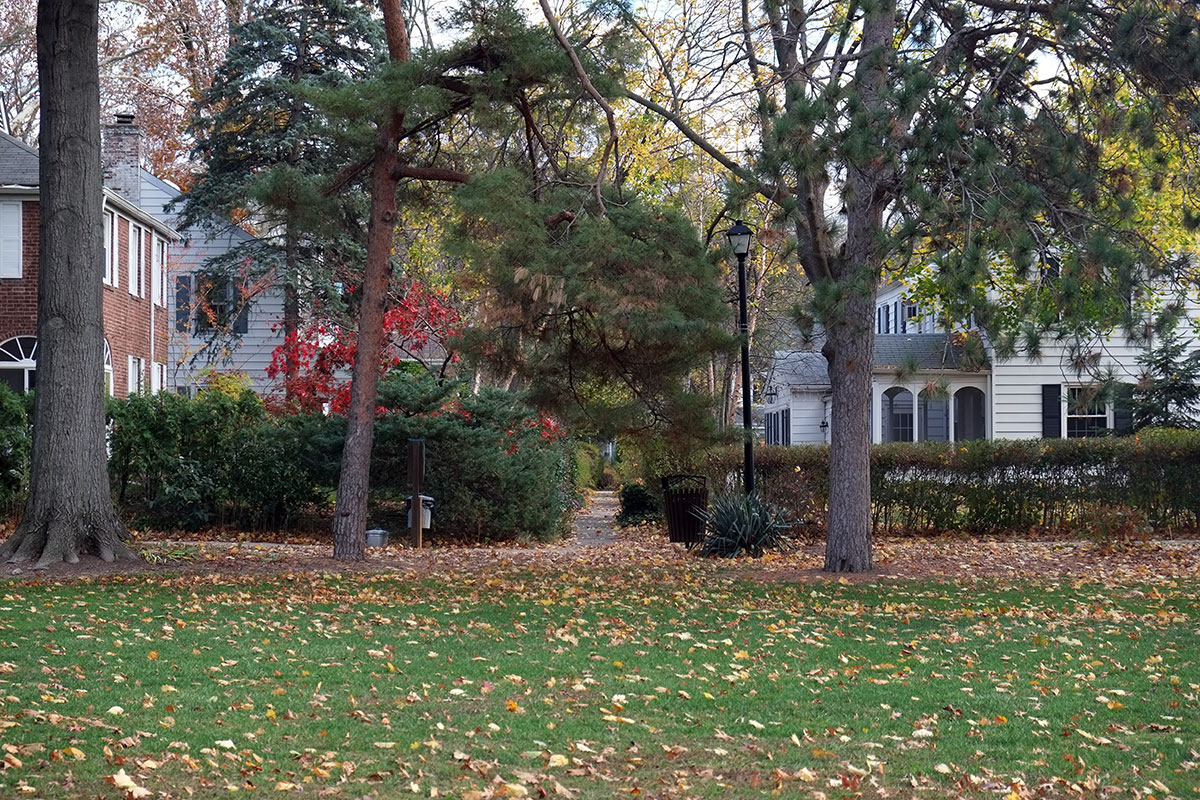
The paths connect to the field between houses.DSCF5230

There is actually another path system which doesn’t show up on the site plans – it runs parallel to the large common, one house in from it, and so connects the parking court and the pedestrian path systems.  I don’t know whether it was a later design revision, or whether it evolved organically, but it provides another layer of complexity and connection on the property.DSCF5240

The pathways on the common connect all the houses, and converge on tunnels beneath the through roads,DSCF5203

so that children may safely get to school.DSCF5195

The architectural style issue is intriguing.  The houses reflect the preferences of the 20s – there are many “early American” houses, some Craftsman-y, some Tudor-y, etc.  The houses vary from pretty small to pretty generous, DSCF5190DSCF5215illustrating that the concept of the site plan is independent of the architecture.  Like many good diagrams, it can assume a variety of scales and absolute dimensions, and accommodate a wide variety of needs and site conditions.

Greta did the normal zoning-out when confronted with yet another piece of architecture that her dad was running around excitedly photographing, but I tried to get her to imagine life in this  neighborhood.  Suppose that when you were a little kid, you didn’t have immediate access to just the one other kid who lived next door to you, having to rely on your parents to facilitate any other engagements?  Suppose your backyard connected to a world of kids, not just a private, fenced-off dead end?  Suppose you could safely wander out from your house at any time, and find your cohort, with your allowable range naturally increasing as you aged?  What if all the places where you could go were visible from your neightbors’ houses, and access to this shared world was pretty tightly overseen from those same houses?  She began to see that Radburn was designed to accommodate cars, intending to limit their damage, but at the same time fundamentally improving the quality of life in suburbia for all.

You’ve probably noticed that this fantastic model was not followed very often in the intervening century. What happened?  A Depression followed by a World War, and we really didn’t build much housing for 20 years.  Then during the postwar boom, all this knowledge was forgotten.  Market forces drove all development, and the emphasis was on quick, efficient construction and the amenities of the house.  These ideas were resurrected in the New Urbanism movement which started in the 80s, and there are a very few places where they are being implemented.  But if we ever get serious in the future about creating extremely attractive, higher-density residential neighborhoods, the Radburn model will always be there for us to copy.

History: Mill towns

DSCF4594Travelers are often obsessed with history.  Many major tourist attractions are historical sites, and we’ve noticed that people we’ve met on this trip often focus on historical minutiae.  But in planning out a truck-schooling curriculum for Greta this year, we ran into a problem:  history was Greta’s least-favorite subject.  I was taken aback – wasn’t it my responsibility, as a parent, to drag her on a tour of historical sites and monuments (everyone should see Gettysburg, dammit, even if I hadn’t)?  I asked her if there were any part of history she’d enjoyed, and she mentioned the history of the railroads.  Further discussion clarified that she was interested in seeing historical stuff, artifacts from the past that showed how things were made or economies and regions organized. She wasn’t at all interested in staring reverently at a field where a battle had taken place 150 years ago, and I realized, neither was I.  Being in a place where something happened long ago is kind of cool, but going out of your way to visit such a place didn’t make sense to either of us.  Our historical agenda derived from this insight;  we would visit historical places where there were substantial, tangible remnants of history (and preferably cool, Steampunk-looking ones with lots of gears and parts), and avoid places with people in period dress.
a carding machine in Lowell

a carding machine in Lowell

Mill towns jumped to the top  of this list.  Our friend Dan prepared an exhaustive map of every mill town in New England he could find, and we set out to find a few.  North Adams was interesting, especially as a large mill had been converted to the Mass MOCA museum.  But clearly the main goal was to be Lowell National Historical Park, which preserves the mill district  where the industrial revolution really took hold in America.  It was an early planned, industrial city – a group of Boston investors scoped out possible sites for development, and settled on Lowell because of the drop in elevation of the Merrimack River, and the opportunity to build canals and waterways off it. DSCF4611

Lowell also continued our trip theme of Cities Which Were Really Important 100 Years Ago, but Aren’t Anymore.  Except in this case it was 150 years.  At its peak Lowell had 55 major mills, and dozens of smaller ones.  Lowell took the cotton from the South and turned it  into cloth.  The original work force was New England farm girls, and a highly controlled, paternalistic system was put in place to ensure their respectability while living in the city.  Within a few decades the work force shifted to immigrants, and Lowell was the site of early labor organizing in this country.DSCF4619

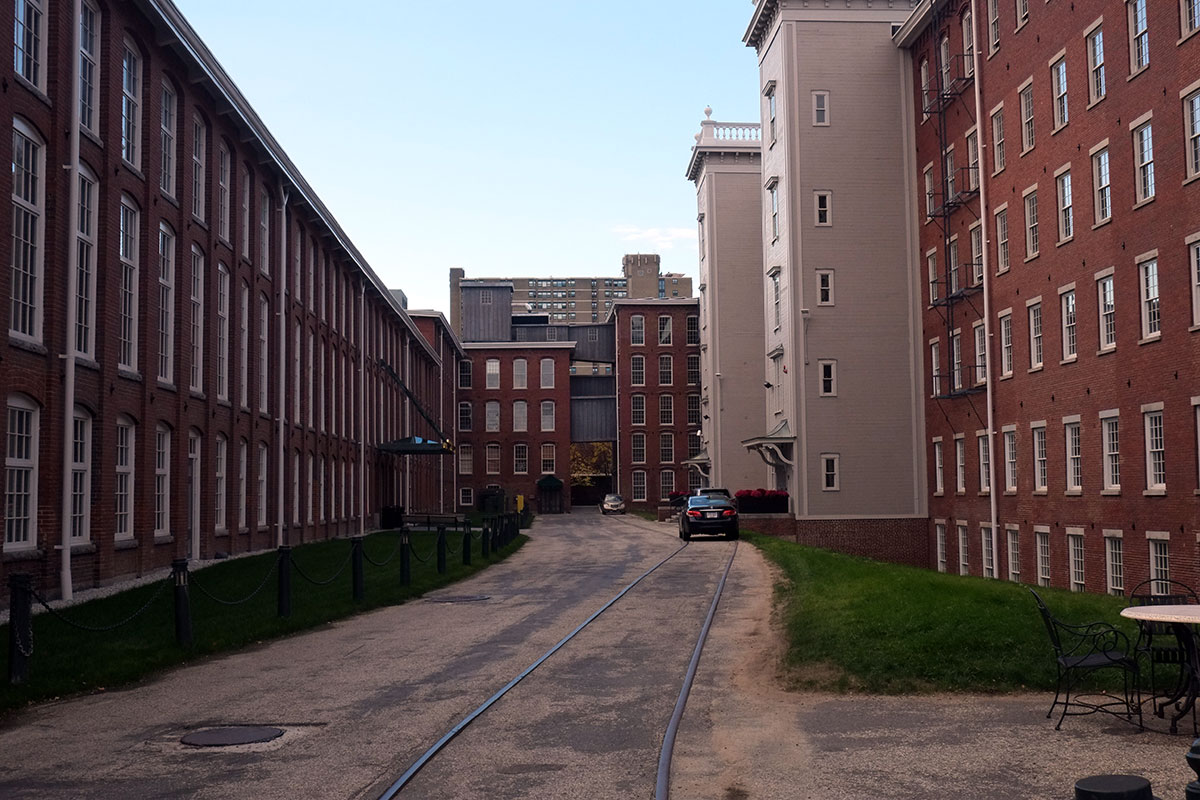
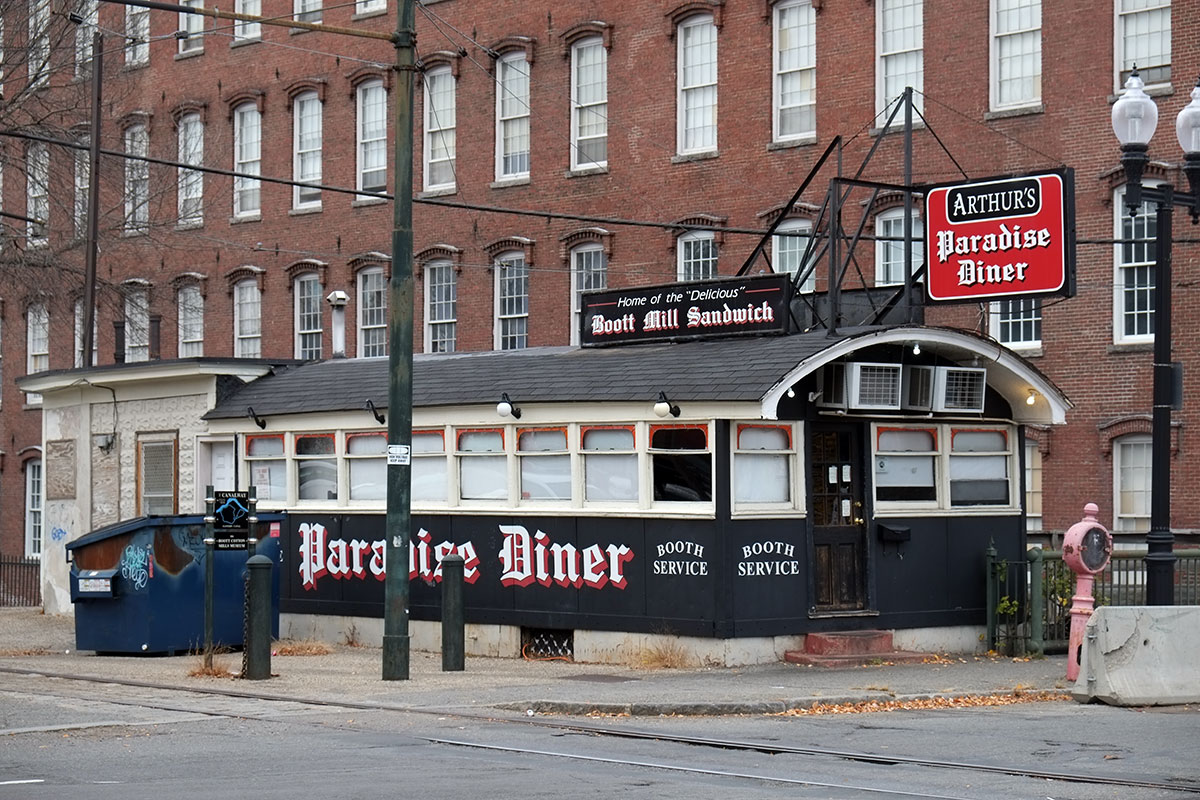
The National Park Service has preserved much  of this infrastructure.  The historical area is an interesting mix of remnants of the waterways, a few preserved mill buildings, such as the Boott Mill complex, where you can walk through rooms with operating looms:DSCF4666DSCF4648

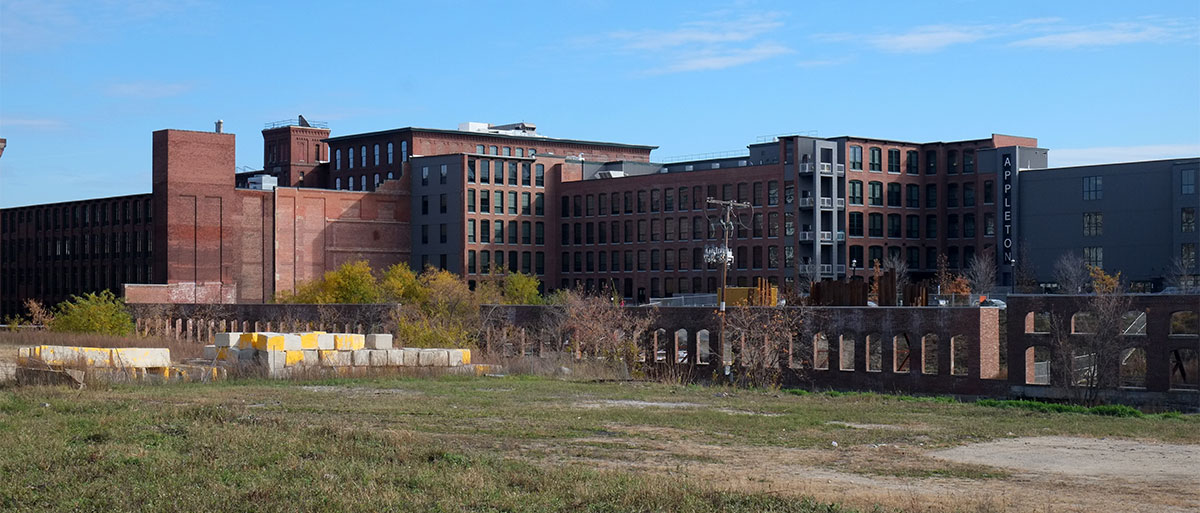
and other parts of the district, where privately owned sites sit vacant, or are available for redevelopment. DSCF4627DSCF4590

In this way, Lowell is similar to our experience at Ebey’s landing National Historical Reserve on Whidbey Island, where 90% of the land is in private ownership, and the Park Service provides an overall organization and focus.

DSCF4582Once you get away from the renovated buildings, Lowell is pretty depressed and depressing.  Some mill buildings have been turned to other uses – such as a large medical clinic or loft housing for artists and yuppies – but let’s face it, the supply of old mill sites is much greater than any foreseeable demand for redevelopment.  It’s a story we’ve seen repeatedly on this trip, cities which peaked economically 100 years ago, and there hasn’t been much new investment.  I remember an Atlantic article a few years ago, where Bernard-Henri Levy visited Buffalo and said that this was inconceivable to a European, that one of the most important cities from 100 years ago could be allowed to decline so precipitously.  But the economy moves on, technologies and transportation systems change, and when a city has lost its primary economic raison d’être, what really can be done?  Architects tend to focus on the potential of the amazing building stock left behind, but this supply-side view ignores the lack of demand to fill those buildings up.

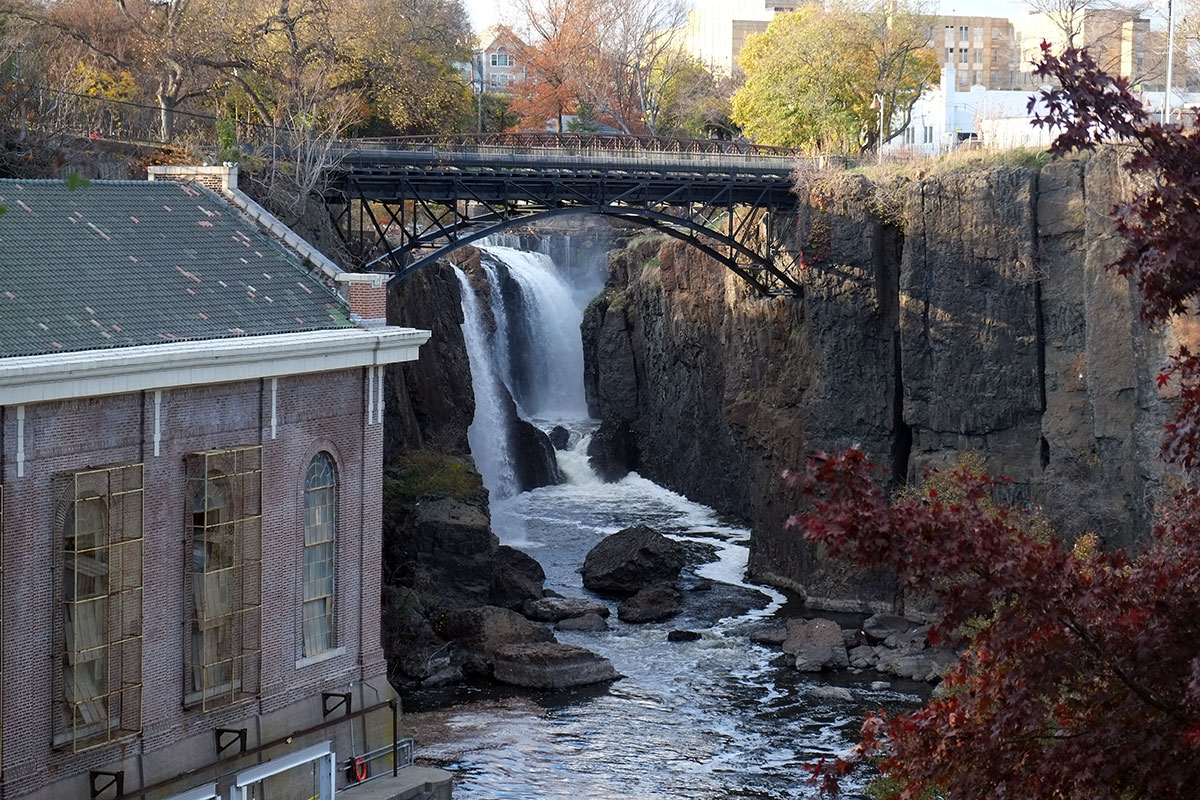
The next important mill town we visited was Paterson, New Jersey, located on the Falls of the Passaic River.  Although Paterson is a short trip from New York City, I had never been there before;  the average New Yorker just can’t conceive of voluntarily visiting New Jersey.  Paterson also didn’t have the best reputation – when I recently mentioned this visit to a friend, he was astonished that we drove through the center of Paterson without having our trailer stripped while waiting at a red light.  (This may be a slightly outdated view – we drove through the center of Paterson and it seemed like a depressed, but not necessarily dangerous place to me.)  DSCF5274

The Paterson mill district is even older than Lowell.  The initial group of developers included Alexander Hamilton and it was the first substantial manufacturing area in the country.  The mills centered around the Great Falls of the Passaic River, a 77-foot drop into a narrow canyon.  A very cool spot, and one that you might have seen in the Sopranos, as people sometimes get thrown off the bridge pictured here:DSCF5266

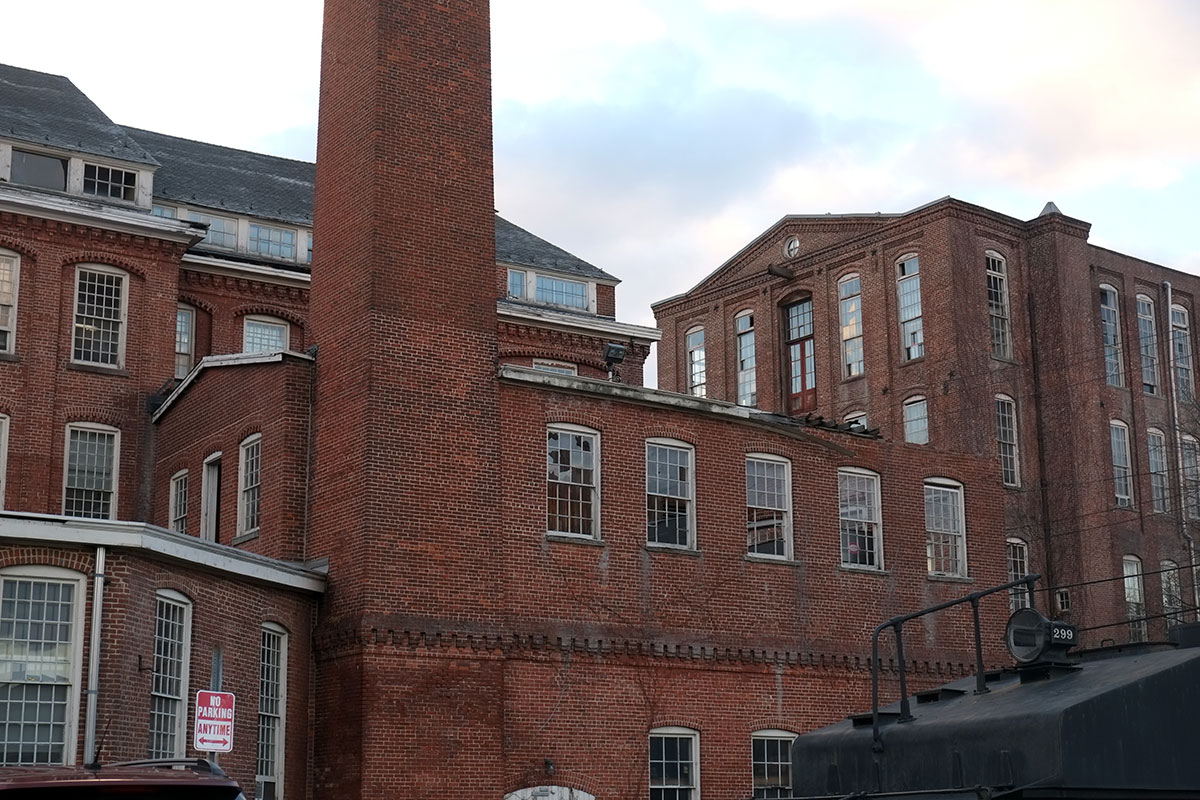
A really knowledgable historian who grew up in Paterson and now works for the NPS gave us the rundown on Paterson, which was surprisingly important – most of the early steam locomotives in the country were manufactured here, it was the center of the silk industry, an it was the site of the first Colt factory.  There are a few remaining mill buildings in the district near the Falls, as well as a museum (which we didn’t have time to visit, as we got stuck in horrific traffic jams in Paterson, and then missed a turn to the parking lot and had to circle around narrow streets with a trailer, and then ended up in front of an elementary school just as it let out).  DSCF5289DSCF5312DSCF5299Despite its gritty reputation, Paterson didn’t see as depressing as Lowell.  Perhaps we just saw a lot more street life, with a clearly vibrant immigrant population.  Perhaps it was because dreams of urban redevelopment don’t seem so unlikely when you’re within an hour of Manhattan and you have some great building stock.  We wished we had more time to investigate the city further, as the downtown has many remaining civic and cultural buildings from its era of prosperity.