Tag Archives: #vanlife

California coastal towns

107. Monterey002DSCF0671California is so big and diverse – in its landscapes, populations, economy – that even on an extended trip, you only get to see a narrow slice. When it became clear that the Sierras route wasn’t going to work for us, we switched over to the coast, as the landscape provides the most amazing contrast with the desert, and after two months on our own in the Southwest, we were looking forward to seeing a large concentration of friends in the area.

For a northeasterner, who is used to the coastline being uniformly densely built-up for hundreds of miles, the California coast is remarkably unpopulated. There are the big stretches of preserved land, such as Big Sur, but even the cities and towns are amazingly small. Compared to the East Coast, the West has very few good natural harbors, and those few became the nuclei for major metropolitan areas. In between, the cities seem to have developed as the service centers for a relatively low-density rural population, and so they are pretty far apart and small. Their growth in the late 20th century was based upon tourism, retirees, universities and other institutions, so basically an affluent population who has chosen to be there. They don’t have the problems of older, larger cities, and the general level of prosperity is noticeable.

San Luis Obispo is a beautiful small city (which I pretty much didn’t photograph, as we were in the downtown area mainly at night). The downtown core is well-preserved, with a blend of old and new commercial buildings, all around three stories tall.DSCF0614
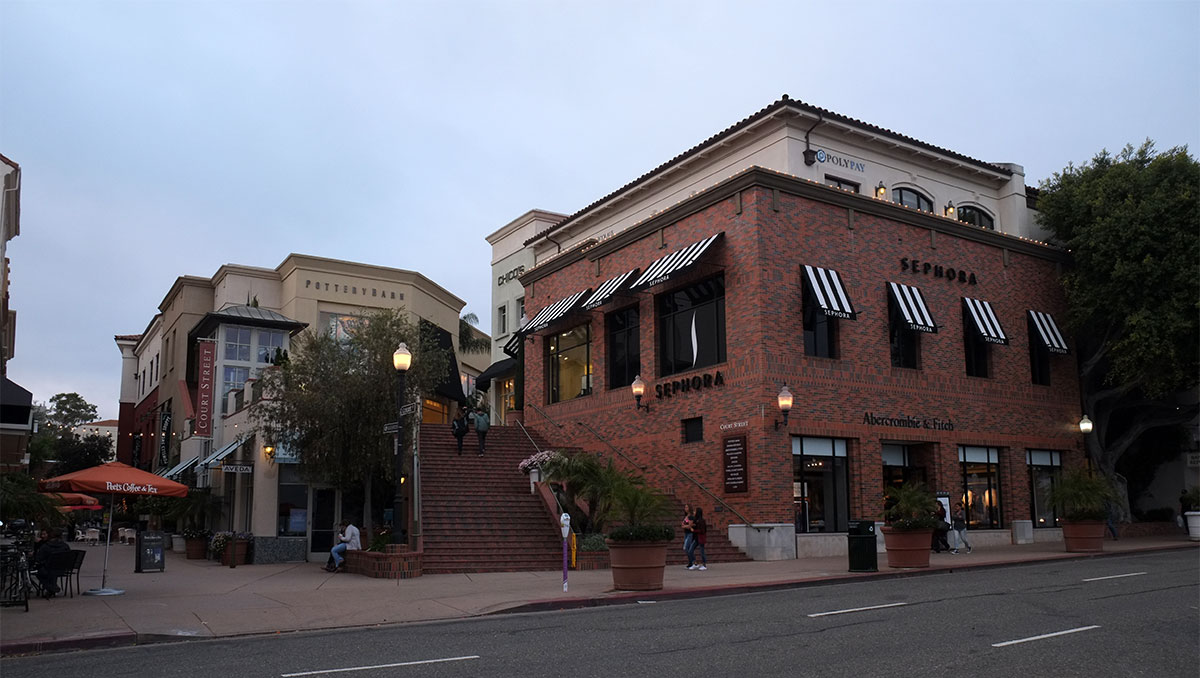
The streetscape is dominated by spectacular canopy of uniform, mature street trees that roof the space of the sidewalks. On a weekday evening the streets were full of people – both Cal Poly students and older folks – going to the many bars and restaurants. There are bungalow neighborhoods within walking distance, and not much noticeable sprawl in any direction, I’d assume partially because the city is hemmed in by hills and farmland. It’s a pretty nice scale for a city – big enough to have urban amenities and atmosphere, but small enough that you can escape out to the coast or countryside quickly.  SLO is about 1/3 the size of Eugene, but it feels a lot more urbane.

Monterey has different roots, as a fishing port and concentration of canneries. As that industry has died off, it has transitioned to being a tourist center. Cannery Row has been transformed into a normal tourist district of souvenir shops and places to eat. It was good to see the repurposing of all the old buildings, but there wasn’t much activity here to interest us.DSCF0666

Except of course, the Monterey Bay Aquarium, which anchors one end of the tourist drag (and which Greta has already blogged, about the fish parts.)  There’s not much I can add to what has already been written about this building – designed by EHDD, it recently won a 25th anniversary award from the AIA, which are given to those buildings which were notable when they were built, but have also stood the test of time. The Baltimore Aquarium changed the whole conception of aquaria, and Monterey Bay took the type to its highest level. The emphasis on the local coastal environment (rather than showcasing species from exotic locations) contributed to a fundamental change in the model for natural history exhibits nationwide (as we saw in many other places). It also worked with the local built environment, re-using a waterfront cannery building (rather than new black-box construction as with most aquaria), and kept many pieces of the cannery infrastructure as well as the shell.107. Monterey003DSCF0691

The gigantic kelp forest was a first, flushed constantly with seawater from Monterey Bay.DSCF0689
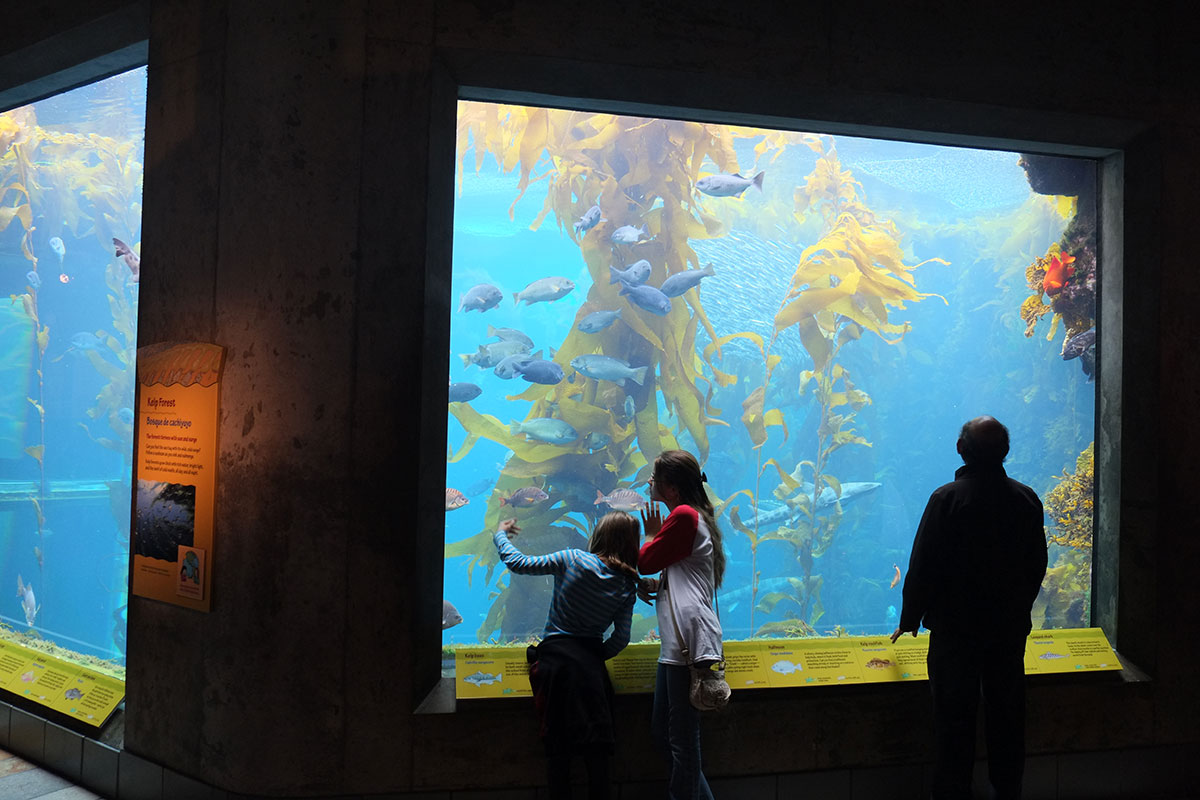
Whereas most aquarium exhibits have to be kept in relative darkness, the circulation areas of the aquarium are flooded with light, and open out to views of the bay. The new construction within is kept minimal, simple and industrial, in keeping with the nature of the existing building.DSCF0692

The programs are informative and fun, such as this one at the penguin tank.DSCF0686
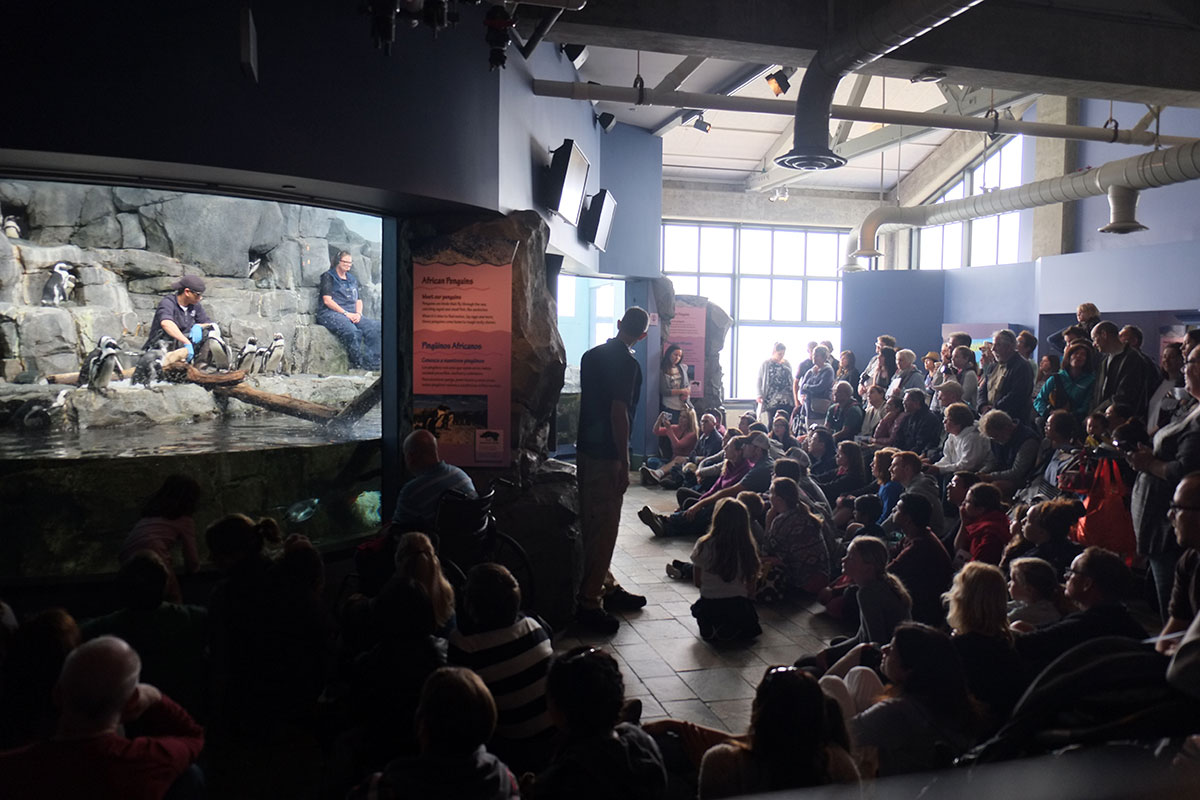
As we had known from our trip there six years earlier, the aquarium was exactly the best kind of building for us to visit on this trip – wildlife for Greta (including the adorable sea otters), and fantastic architecture for me.

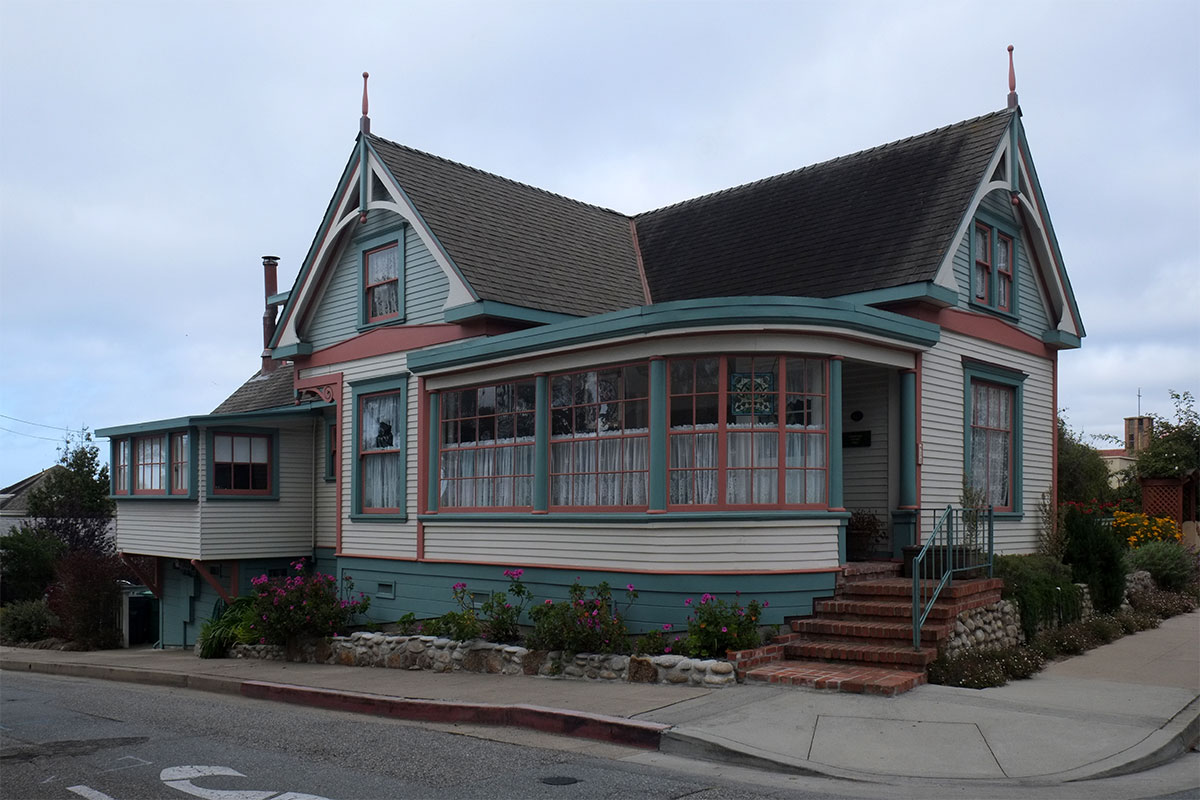
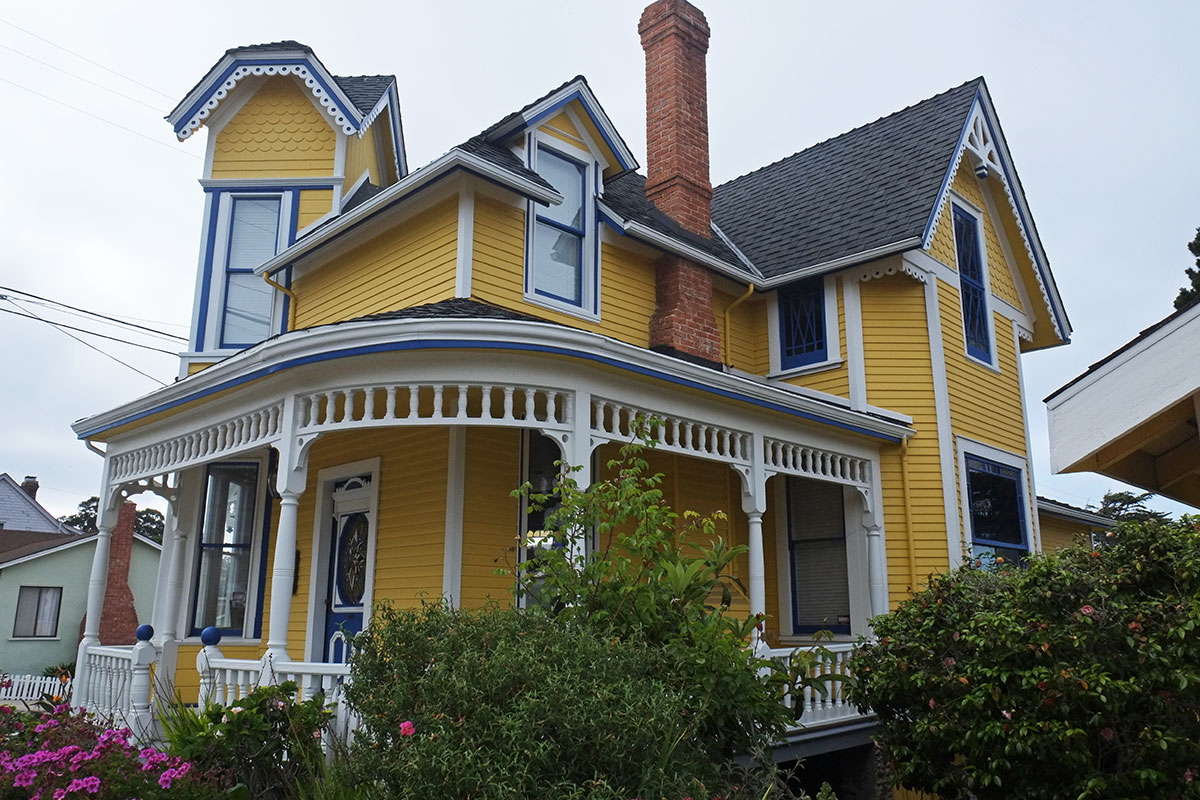
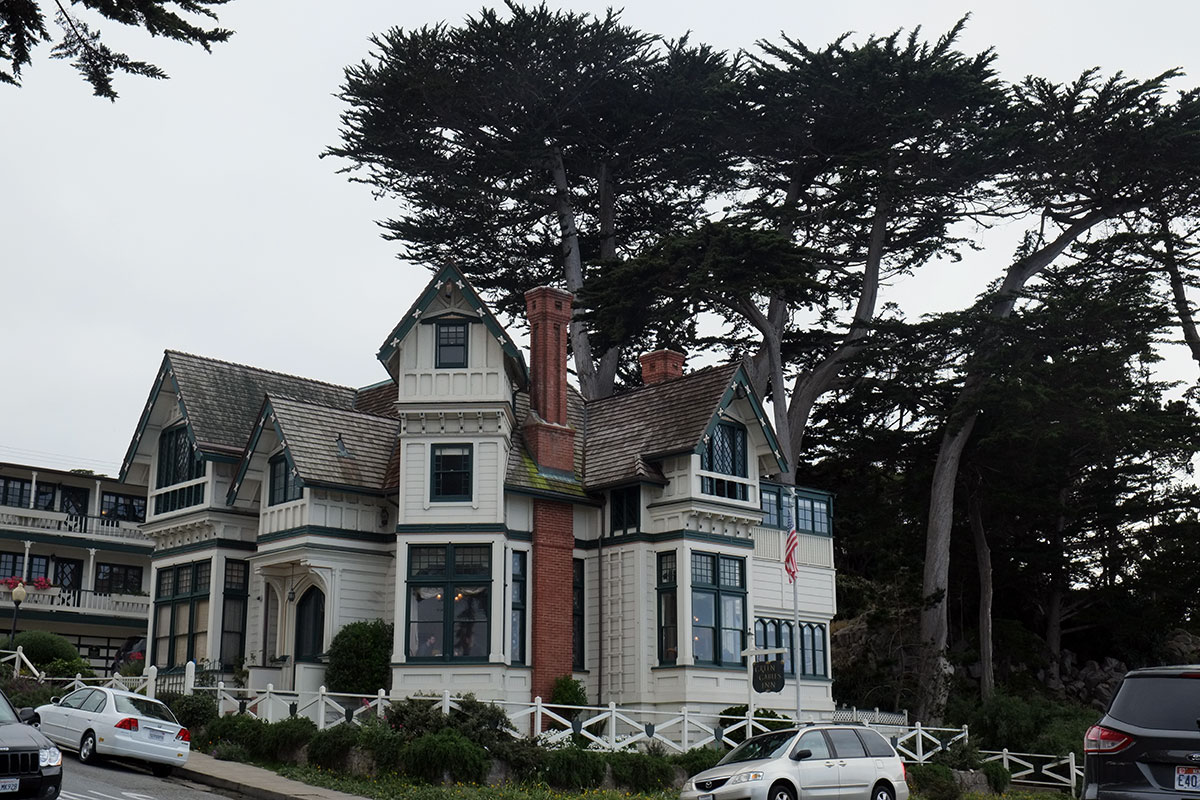
We wandered into the adjoining town of Pacific Grove, another one of those interesting seaside towns which had their origins as centers for religious revival camps, (or in this case, a Chautauqua type gathering), similar to Oak Bluffs on Martha’s Vineyard. The waterfront is lined with large Queen Anne houses,DSCF0712
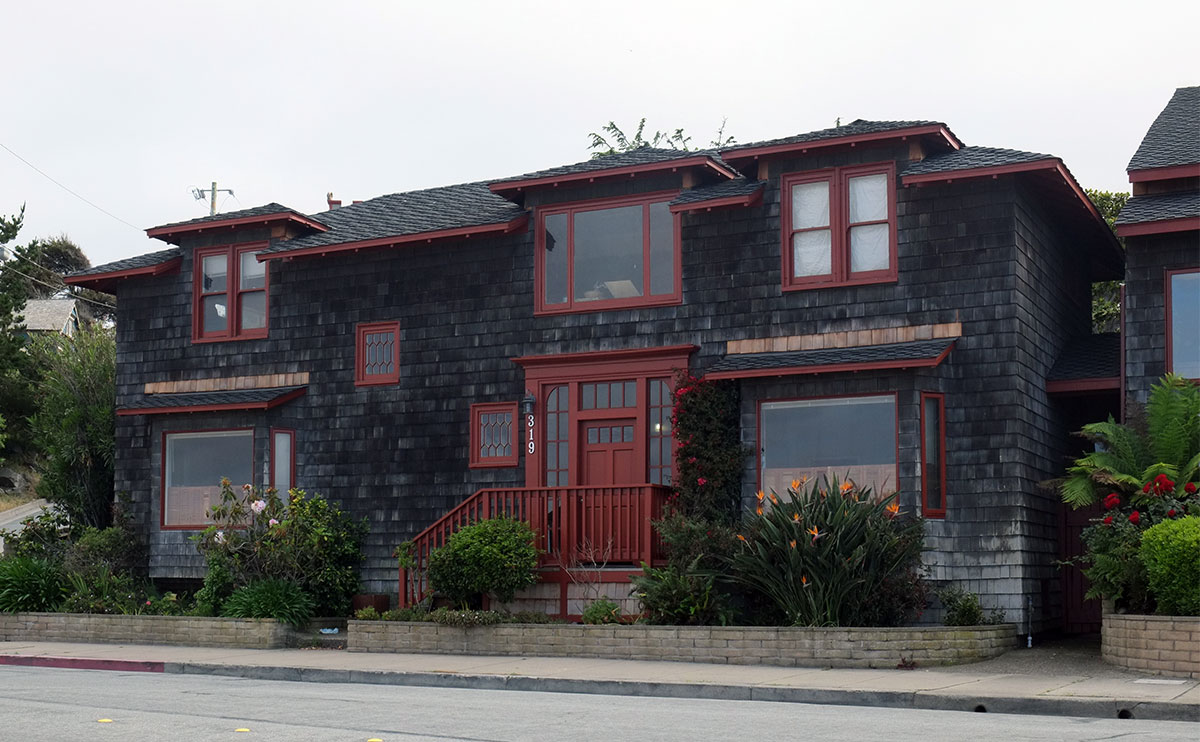
and a nice example of the Bay Area shingle style/craftsman,DSCF0717
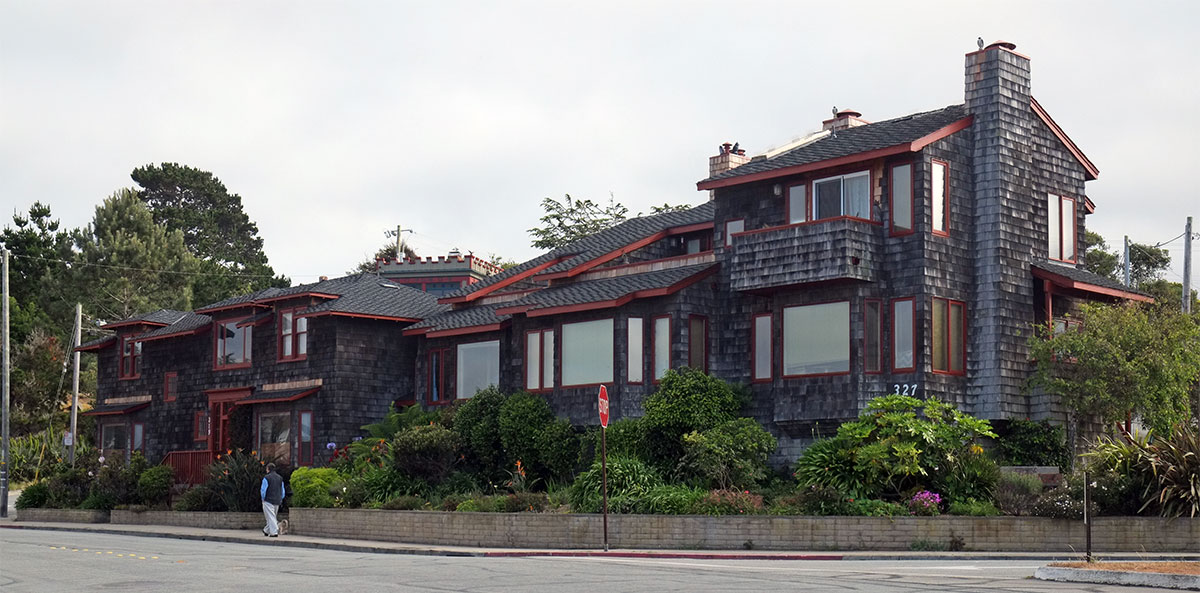
which also had a very sympathetic addition.DSCF0720
The old pavilion on the point has been restored.DSCF0723

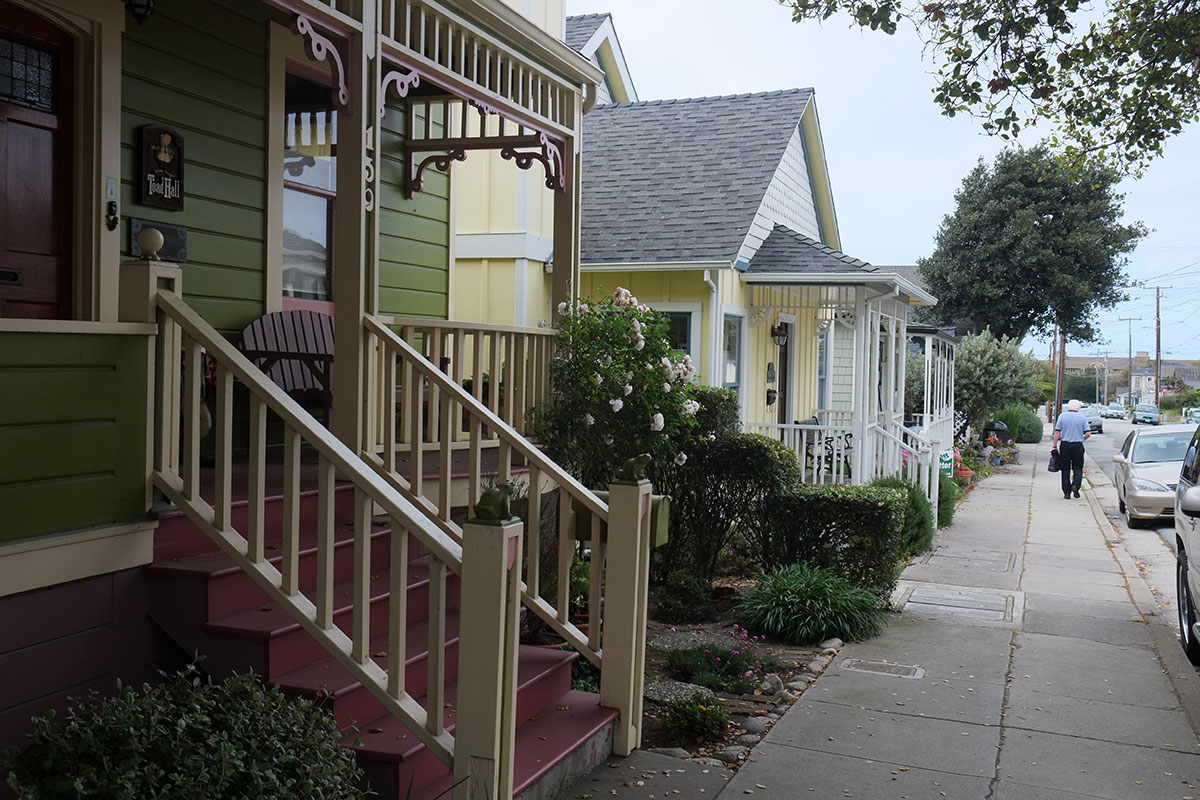
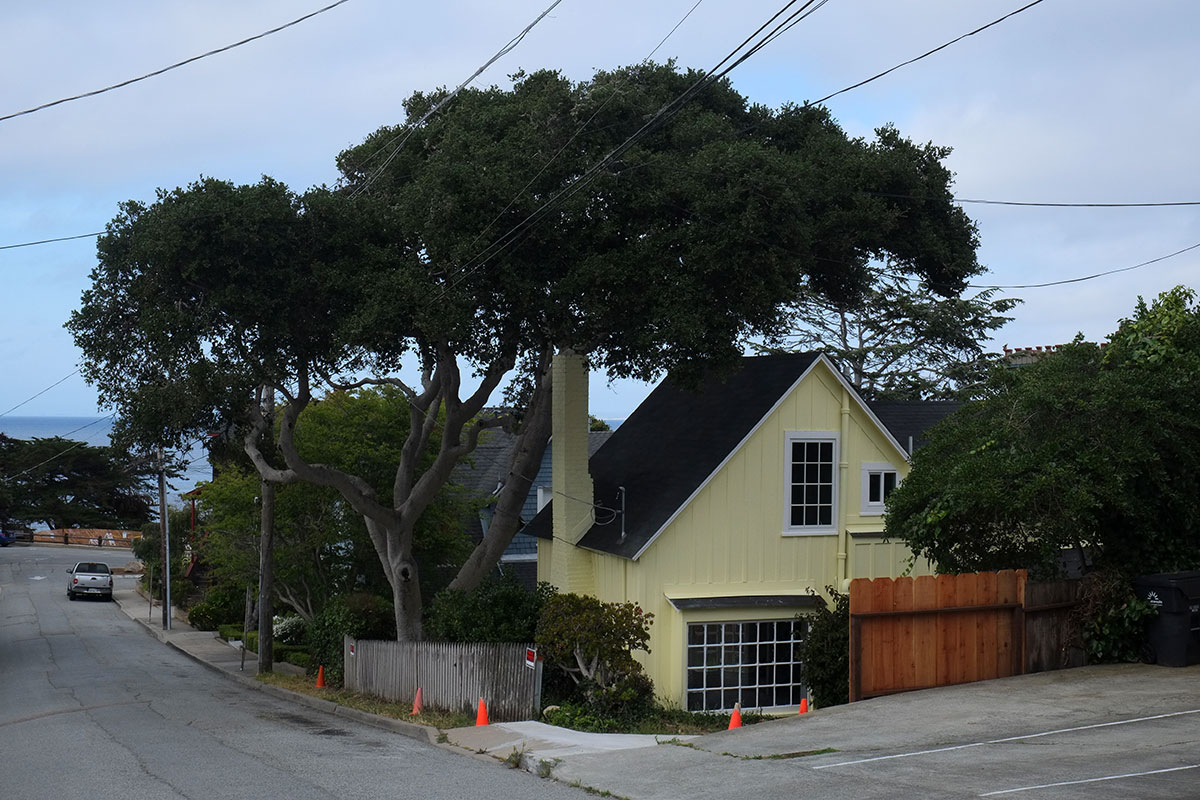
The streetscapes are full of big trees, little houses and great porches.DSCF0734

DSCF0735

107. Monterey006DSCF0751

DSCF0746

DSCF0750

107. Monterey005DSCF0732

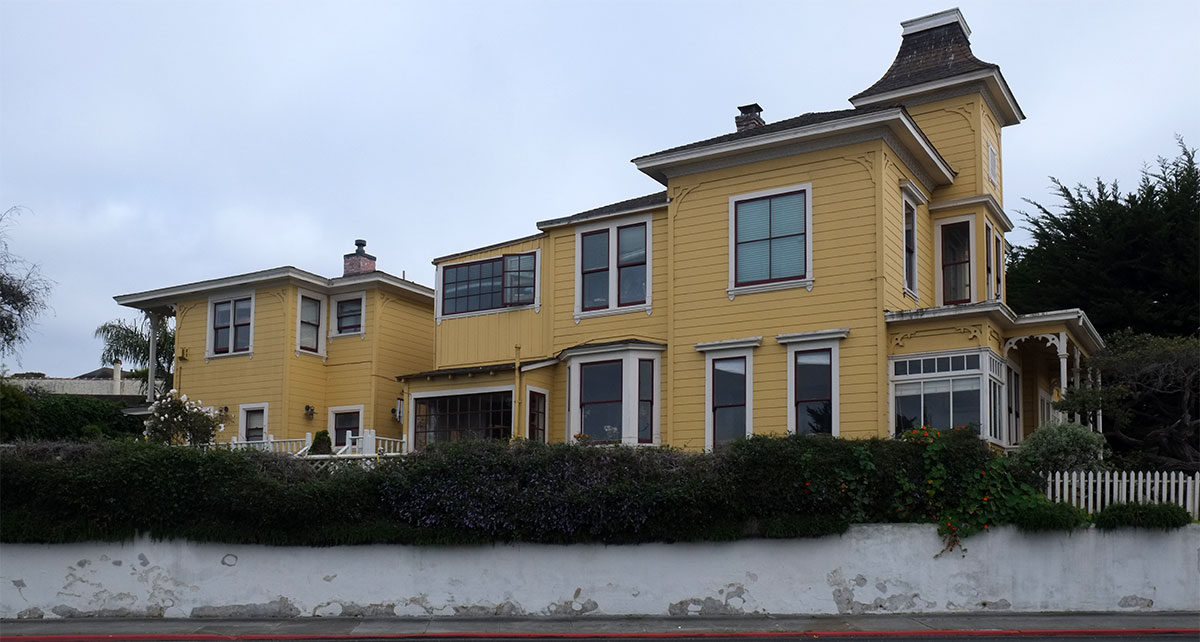
I especially liked the formality of this façade,DSCF0757

compared to the head-and-tail quality of the additions.DSCF0759
A very pleasant and quaint town, but it was also nice to be reminded that you are not back in the 19th century, this is very much 21st century California:DSCF0761
 

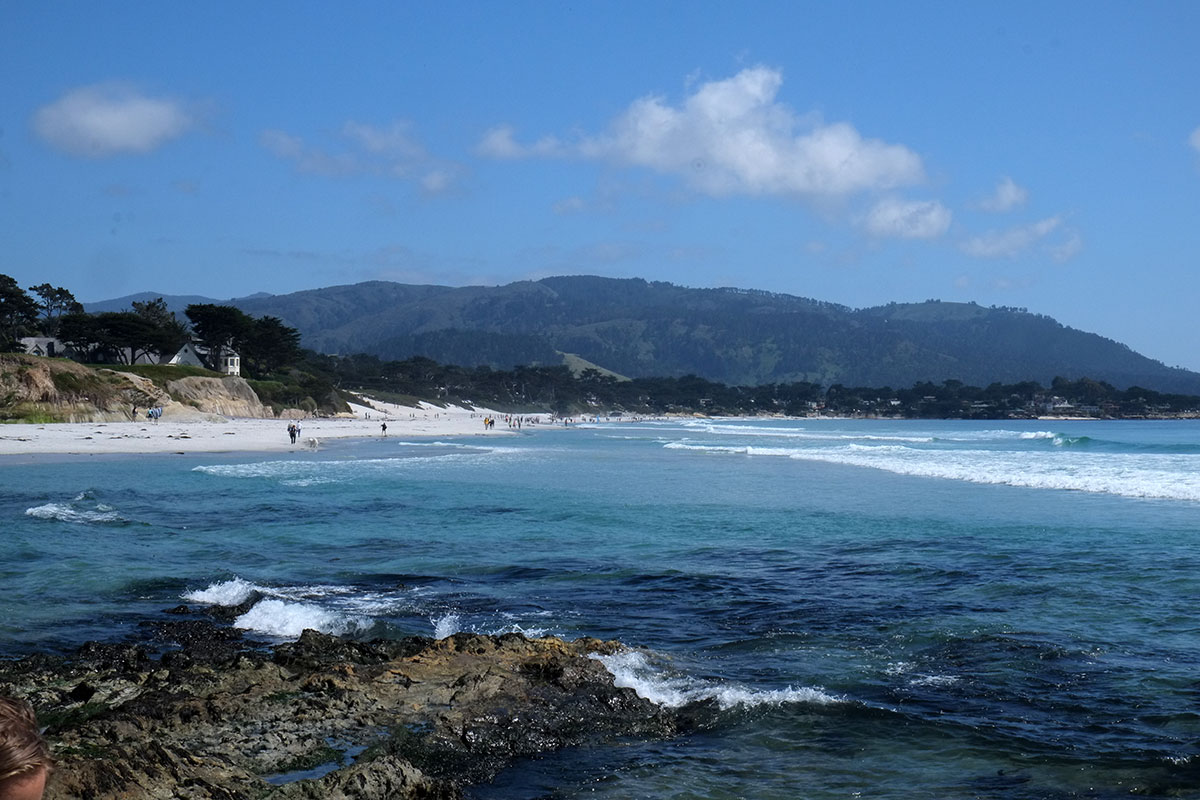
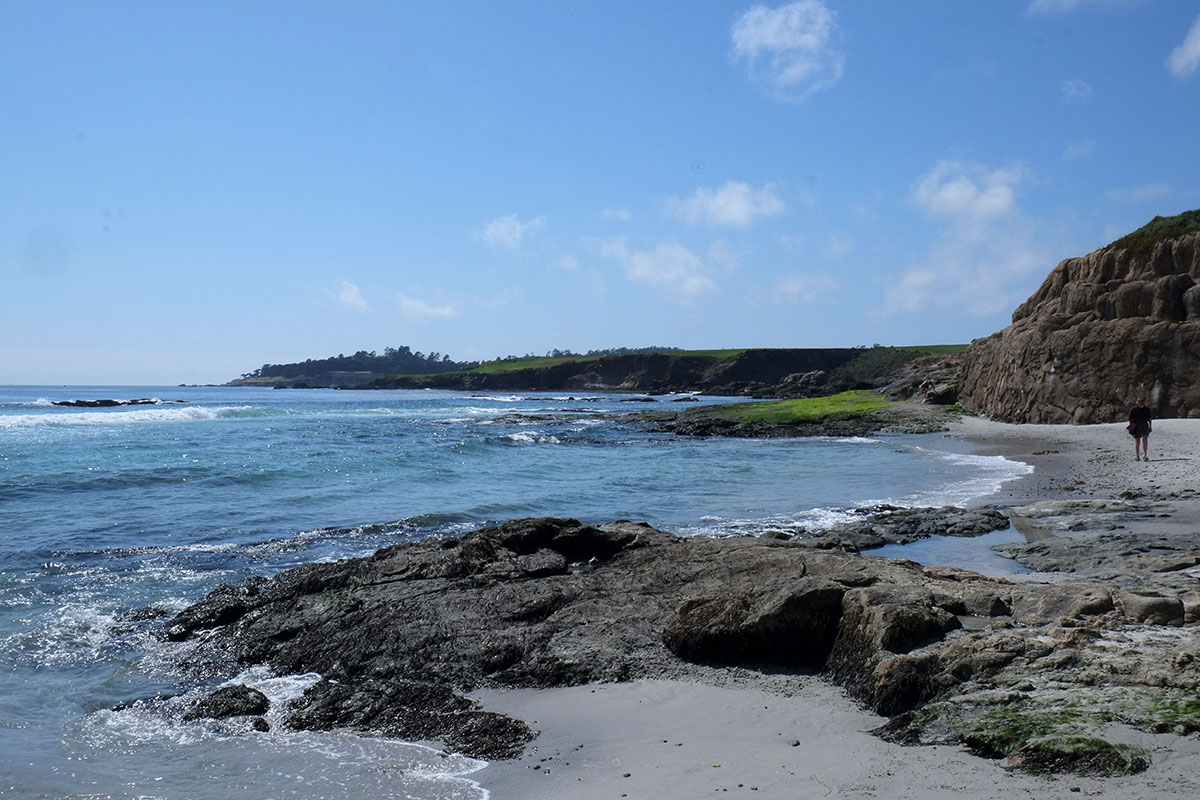
Carmel (which I guess is technically Carmel-by-the-Sea, but I just can’t bring myself to say that), looks like a stage set Norman village dropped on a seaside hill. The beach, which runs all along the bay from Pebble Beach golf course on the north to Point Lobos on the south, is breathtaking – sand, sun, surf, big rocks, and the relative shelter of the small bay. We were flabbergasted that we could just drive along Scenic Road, park our truck and go hang out on the beach – another sign that we weren’t on the East Coast anymore.DSCF0777
The downtown is quite a ways up the hillside from the water, and comprises a few streets of inns, restaurants and stores, which seem to be ratcheted up to an even higher economic level than Santa Fe. The overall affect of the town is that of an overgrown, Old World village, with a casual quality which belies the obvious wealth floating around.DSCF0792
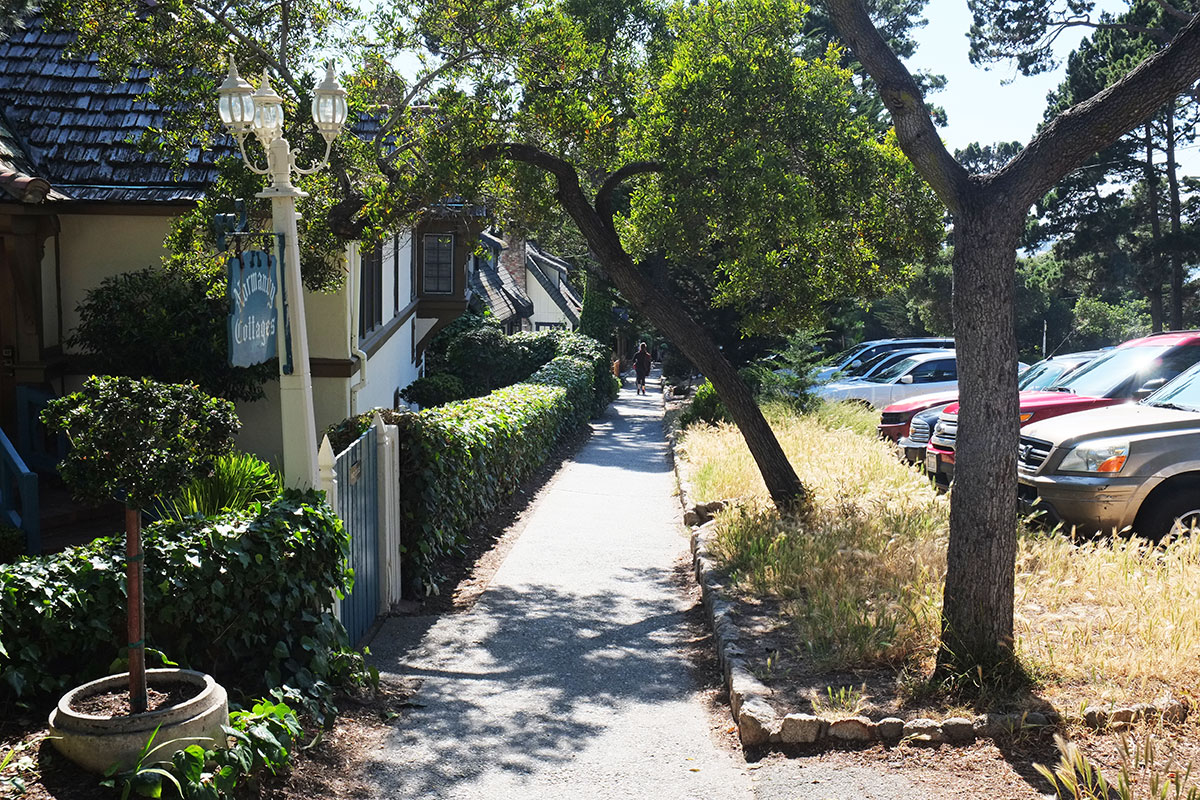
The buildings are handsome and competent,DSCF0784
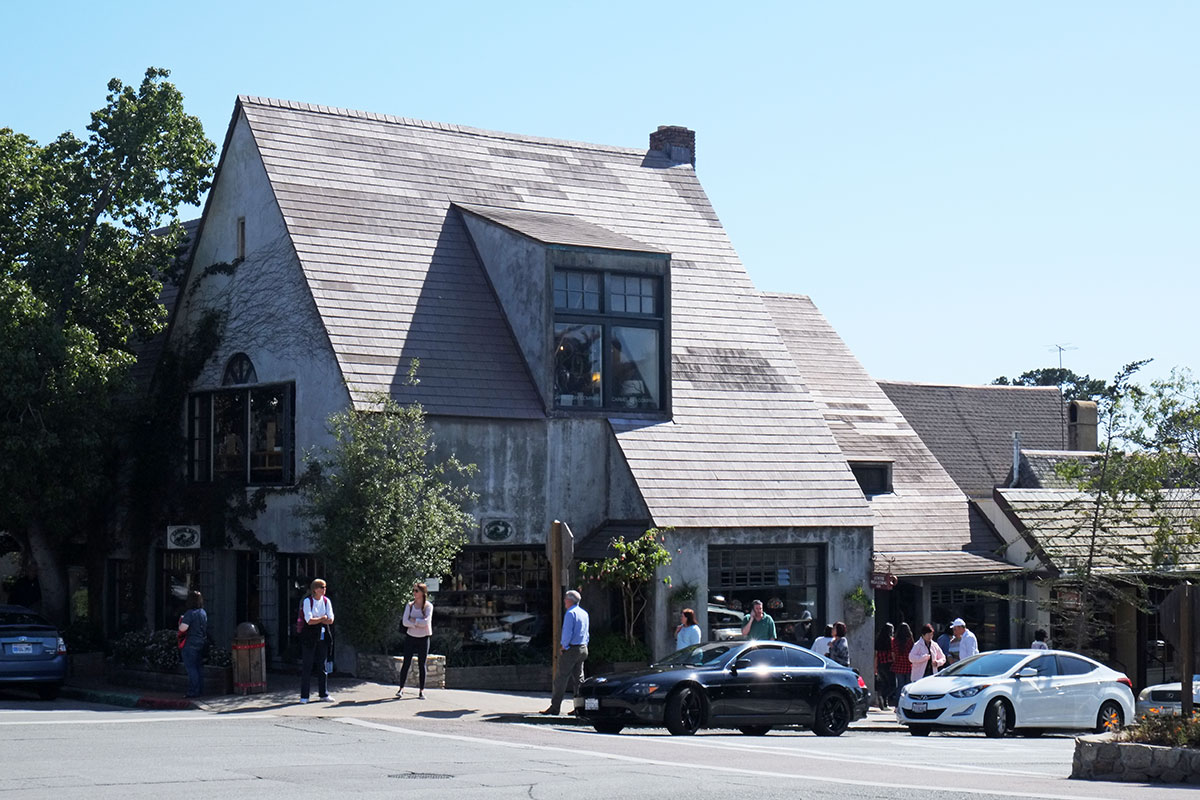
but they are achingly, self-consciously picturesque. I am usually pretty okay with places which have strict design guidelines which seek to maintain the historical continuity of the local vernacular (such as Santa Fe), but when the local vernacular seems to be a complete fabrication, it gets on my nerves. We certainly got used to this in the late 20th century, with all of our gated and covenanted “communities” in anachronistic styles, but Carmel seems to have been a pioneer in this movement.DSCF0789
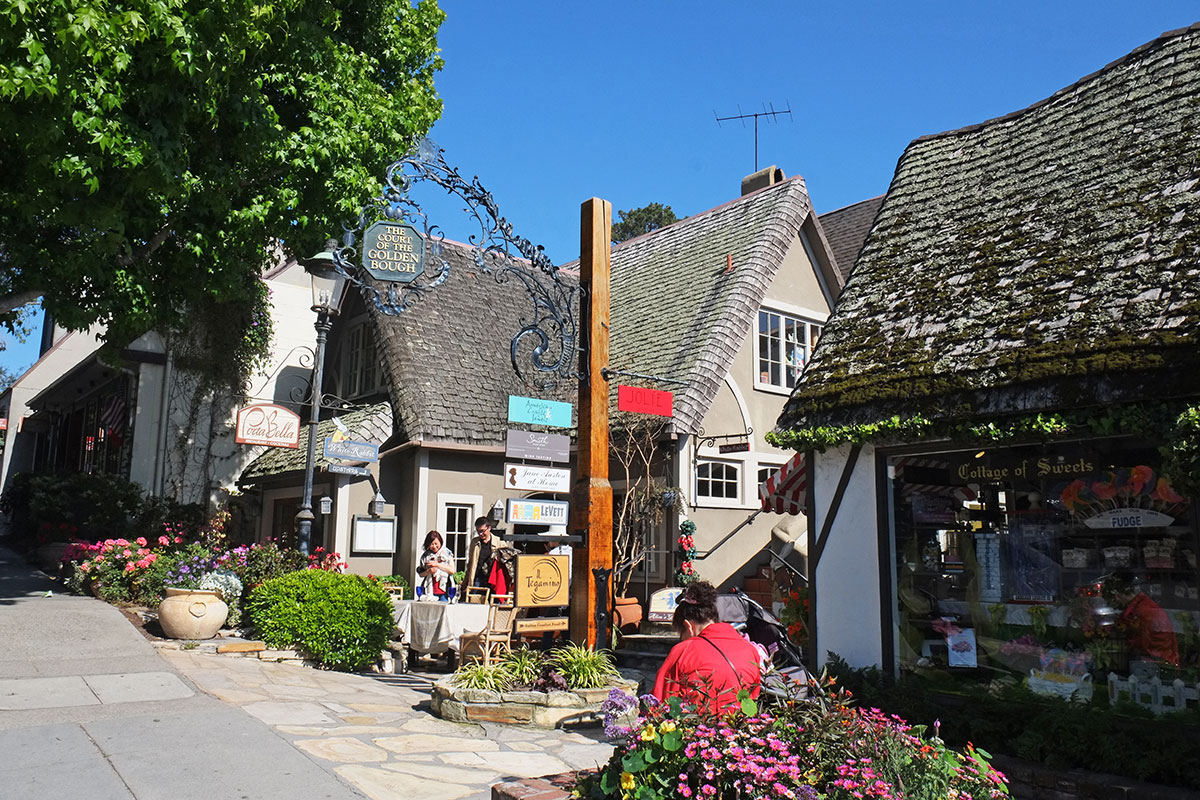
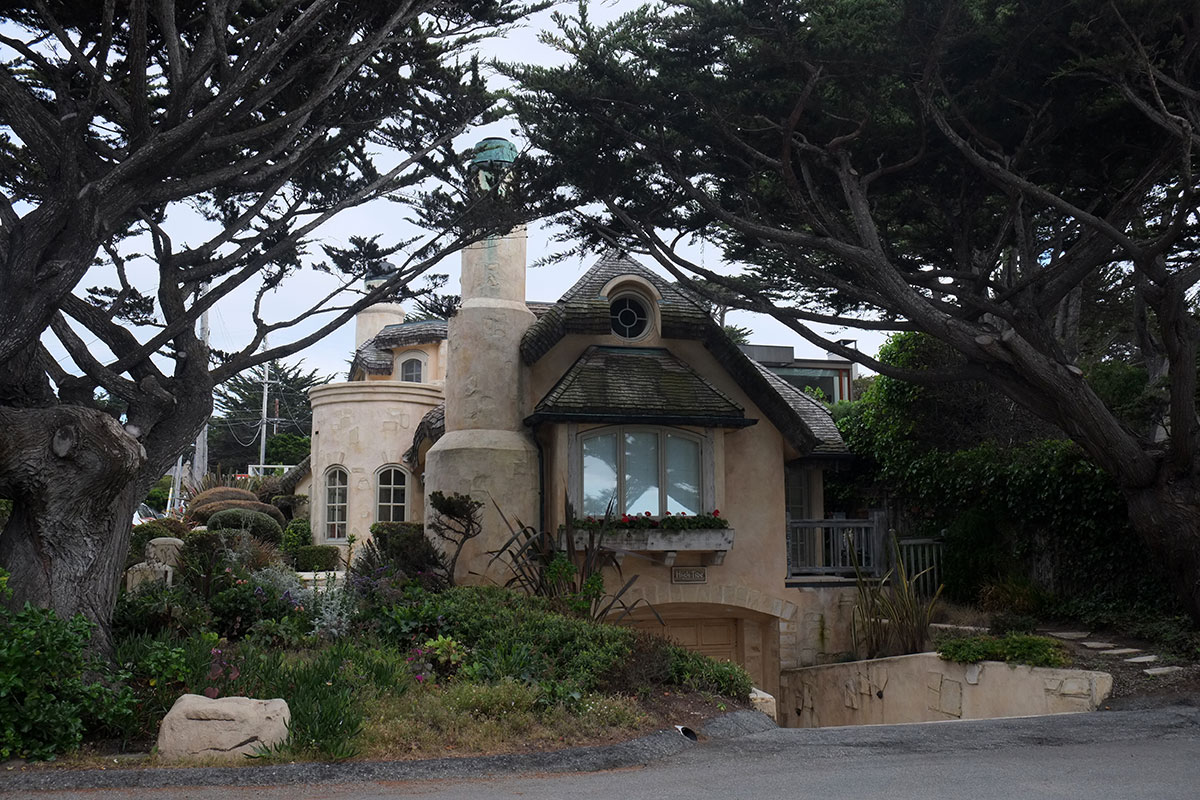
Away from the center of town, many of the houses are in what can only be described as Hansel and Gretel Style. It is life in a Thomas Kincaid painting, and I just wanted to see something seriously transgressive, like a Frank Gehry building, or more extreme.DSCF0793
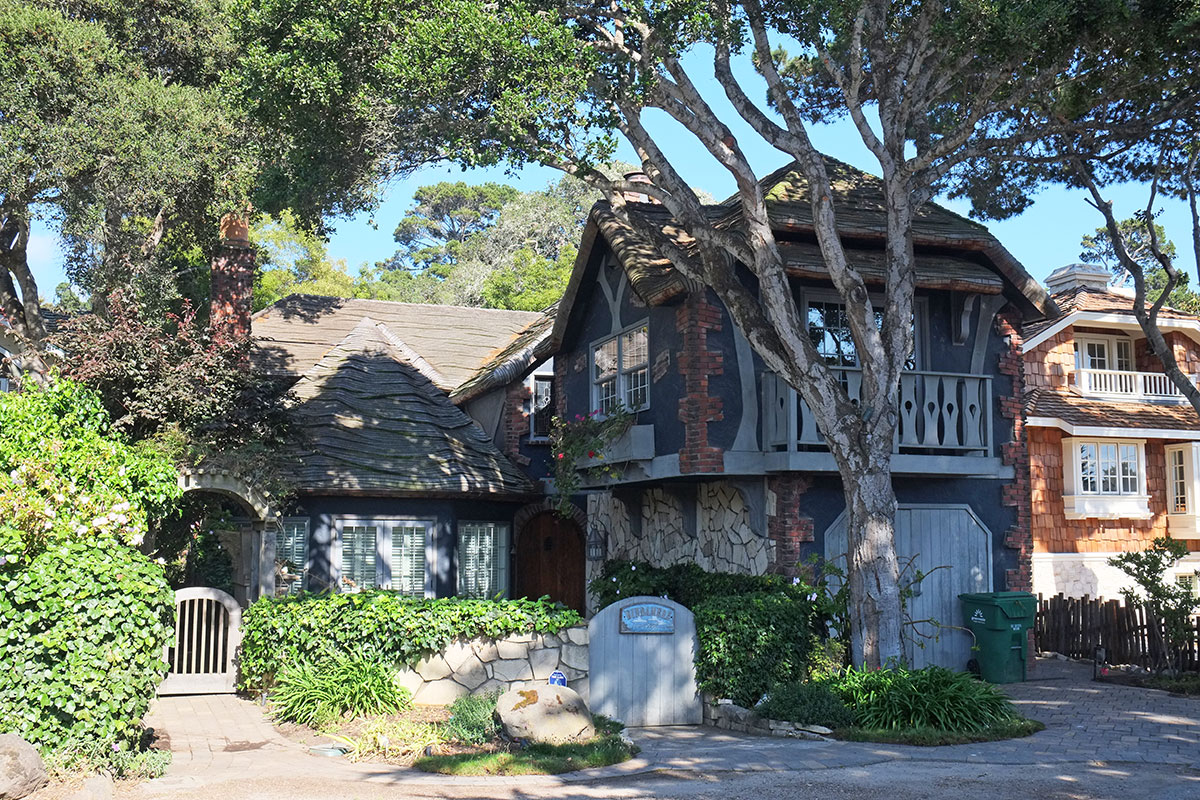
108. Carmel004DSCF0808

Most of the houses in Carmel are relatively modest, but then there are the houses that remind you of just how much wealth is really here. This house, which looks like a whole village by itself, is on the beach, right next to the Pebble Beach golf club. We wondered who might live there, and finally decided that it must be someone with so much money that we’d probably recognize their name.DSCF0775

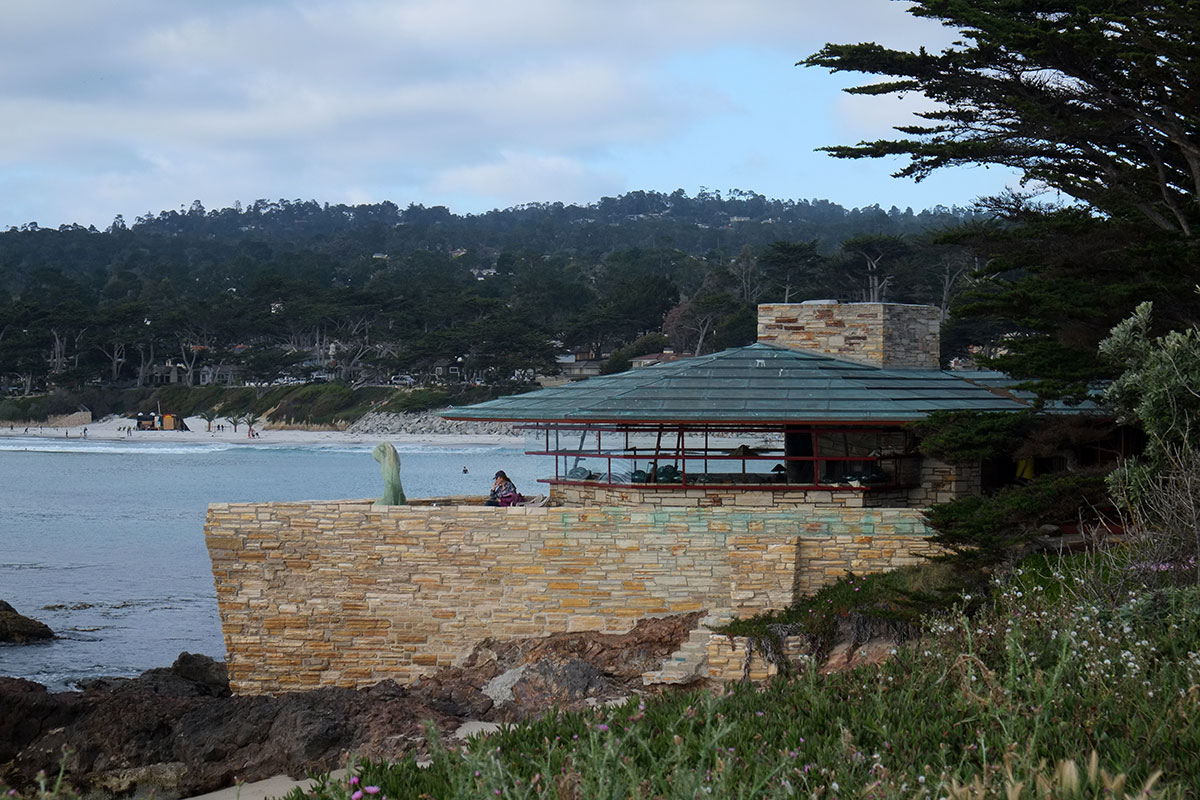
In this town of not especially creative anachronisms, the architectural highlight was this Frank Lloyd Wright house, right on the water.108. Carmel005DSCF0810
Beyond the general weirdness of the architecture, what struck us as strange about Carmel was the how it didn’t seem very walkable, even for such a small town. The residential streets don’t have sidewalks, probably trying to maintain that small-village atmosphere. All the commercial services are concentrated in the middle of town, the hillside is pretty steep, and it looks like people drive around – we didn’t see anyone out walking in the neighborhoods. We’ve visited many wealthy seaside towns on this trip, and Carmel is the first where we couldn’t figure out why you’d really want to live there. You could live in a beautiful yet chilly and foggy coastal microclimate, have a small, very expensive house, tightly packed with similar houses, but still have to drive everywhere. Greta and I preferred Carmel Valley, inland from Carmel. There is no real town, and you still have to drive everywhere, but the landscape is spectacular and the climate is warmer and drier. And it’s still a pretty short drive to the beach.


Santa Cruz is an unusual city – it isn’t that big, but for a small city, it seems to have a lot of very distinct districts, with really different characters. (I think there are also a similar number of subcultures, including the aging hippie-surfer demo). The university is obviously an important presence, but it so far out of town up in the hills that it’s hard to notice its impact on the physical environment. The downtown is not very memorable, and it doesn’t dominate, or even provide a very strong center for the city. However, here are some great older neighborhoods, each of which seems to have its own commercial core.IMG_3113
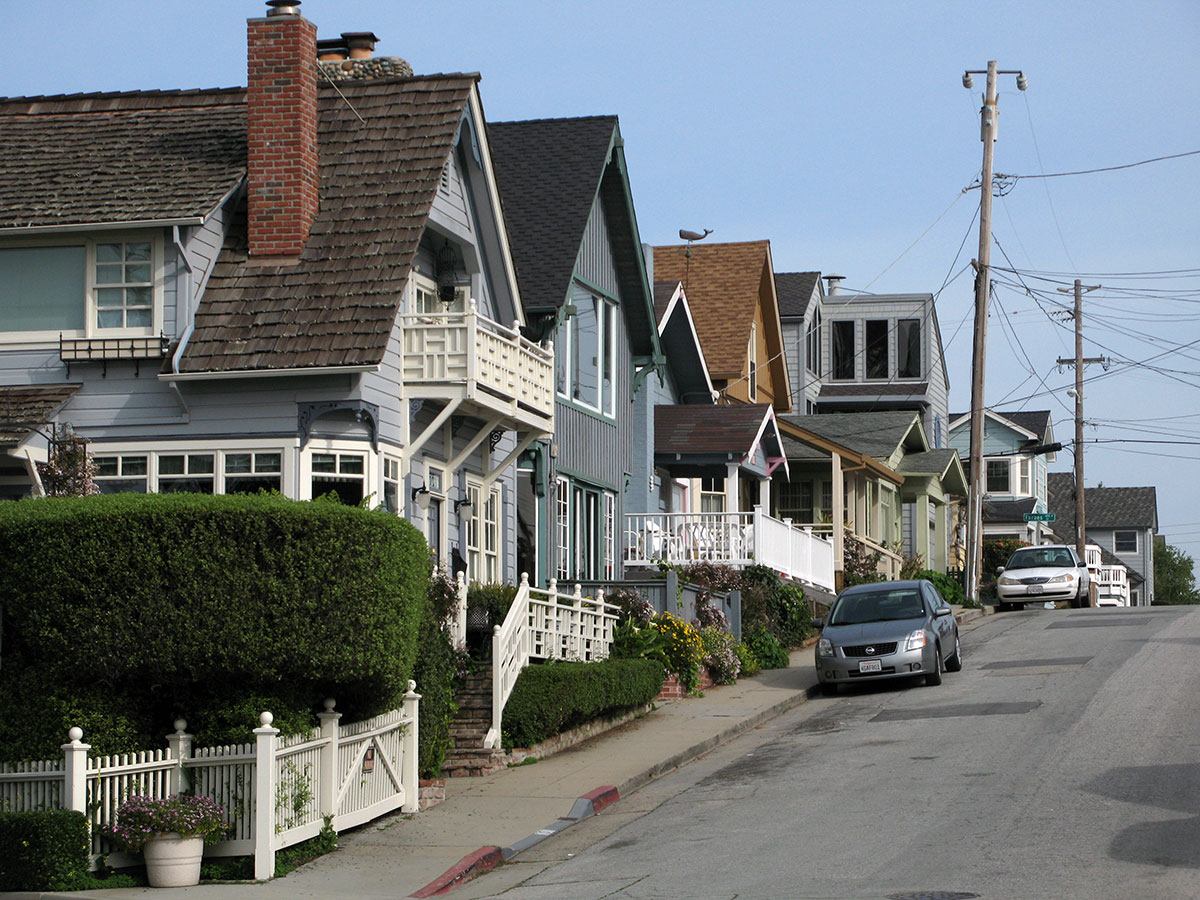
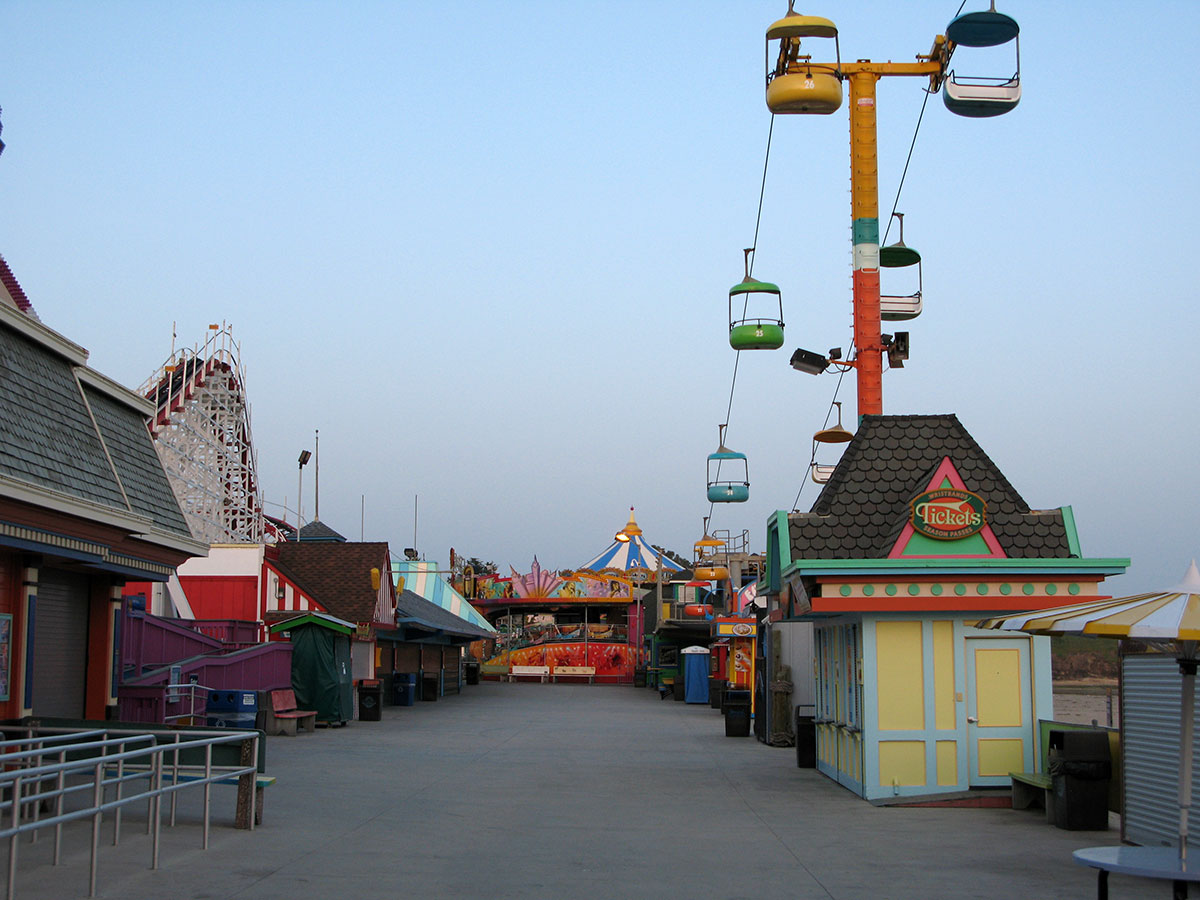
When we visited there six years ago, our favorite place was the seaside amusement park.IMG_3088
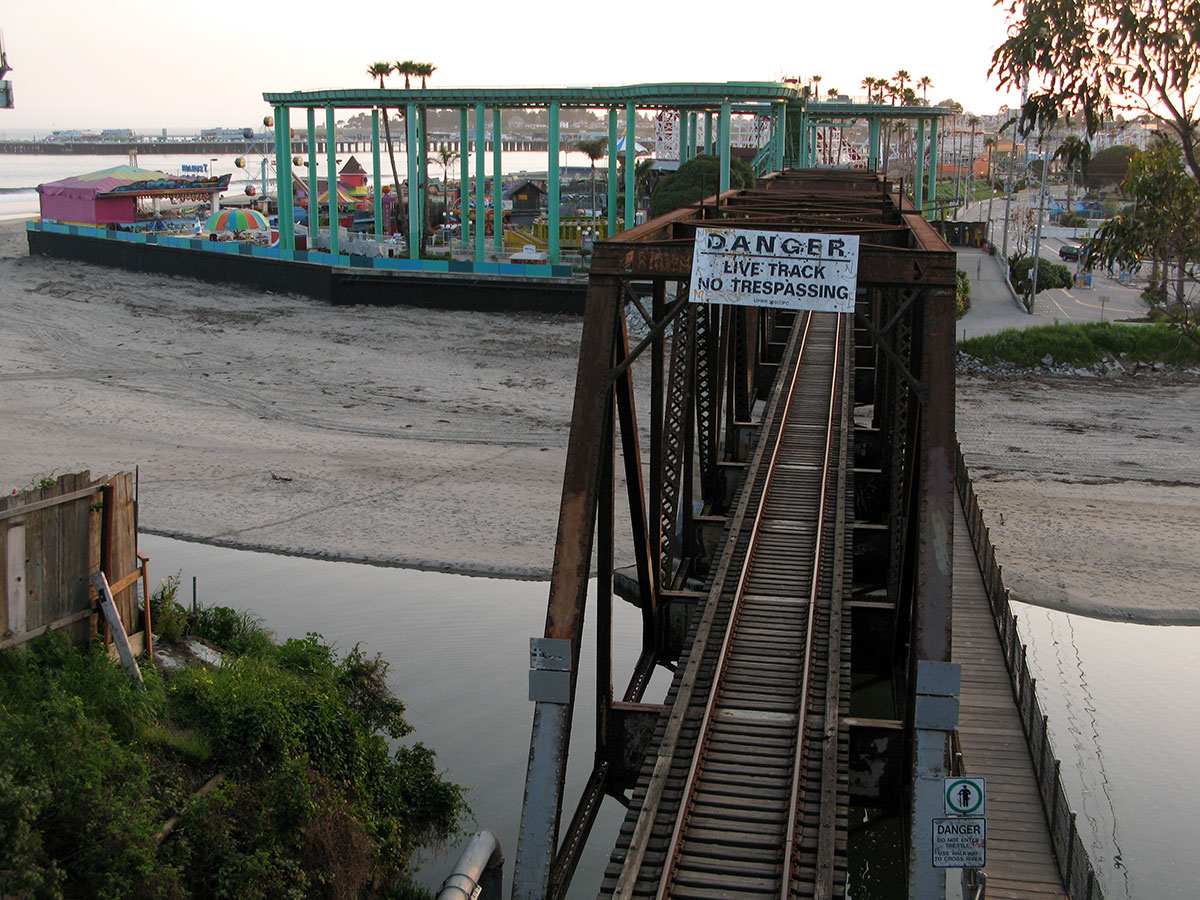
It was deserted when we walked through, and we thought we’d been dropped into a Fellini movie.IMG_3102
There is a big public wharf downtown, and this amazing arcade building:IMG_3131
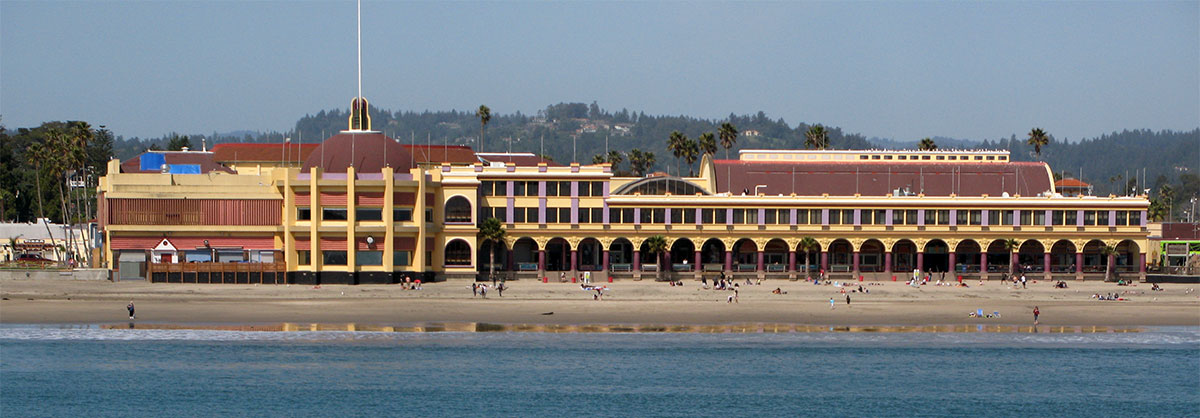
I remember being confused by the city at first – it was unlike any other single place I could think of, and then I figured it out – it’s Eugene meets Asbury Park, with the hippie nostalgia of the West Coast meeting the cheesy seaside attractions more typical of the East.

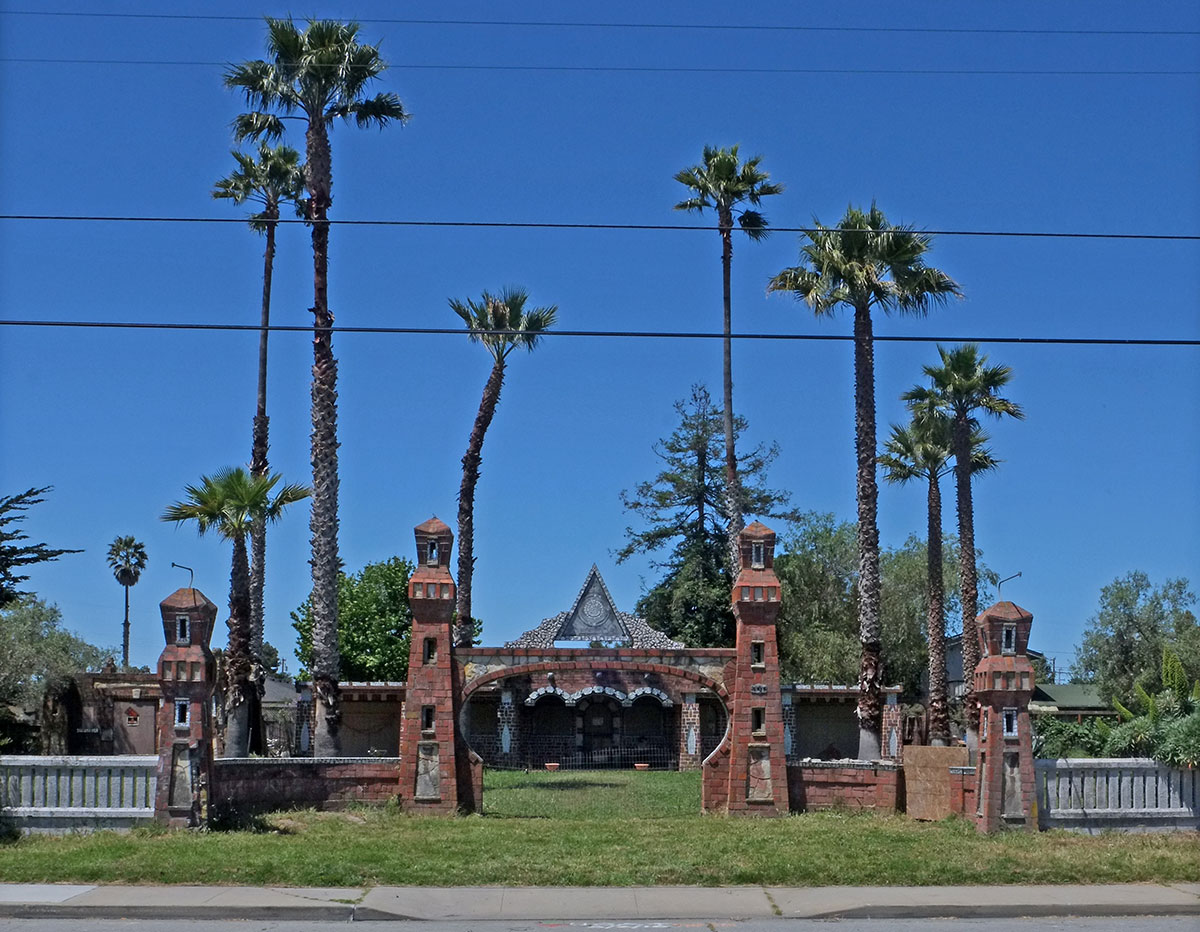
On this trip we knocked around the neighborhoods some more, coming across this gem, whose history we couldn’t even guess at:DSCF0935
An older industrial neighborhood is the location of current hipster gentrification, with the buildings turning into shops and (some quite good) restaurants.DSCF0936

We walked all along the shore to the west, where we were staying with the Finrows. It is a fantastic promenade – people walking, biking and driving along the top of the bluff, which undulates in and out around little coves, at the bottom of which there are surfers and sunbathers (sometime practicing naked yoga).DSCF0932

But mainly we decided to chill out. The Born boys (the Finrows’ grandsons) invited Greta to come along when they went surfing, so I hung out on the beach,DSCF0948
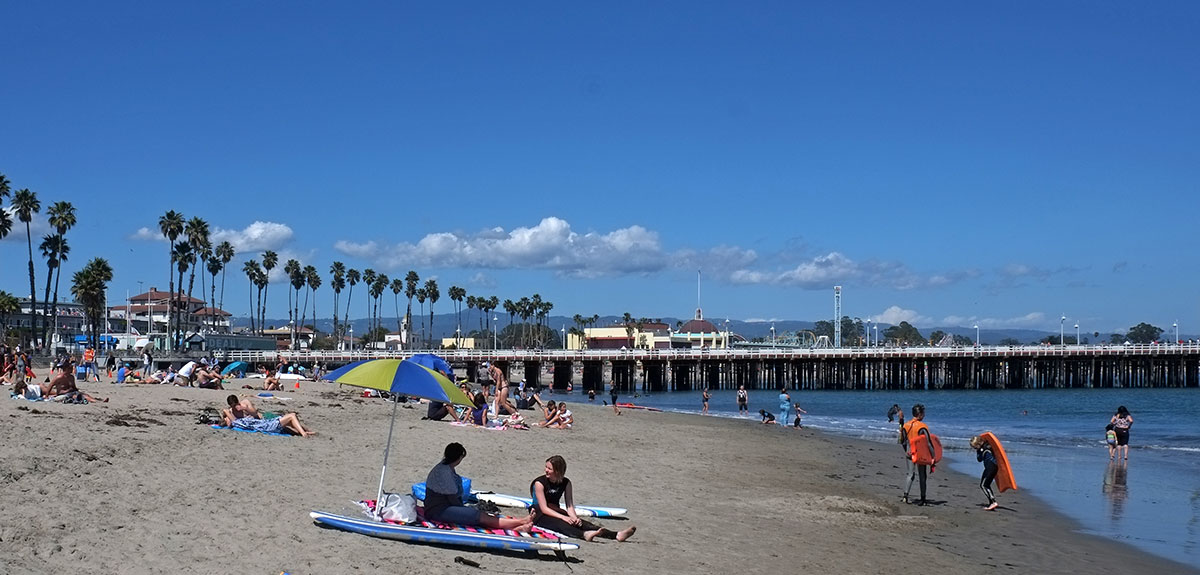
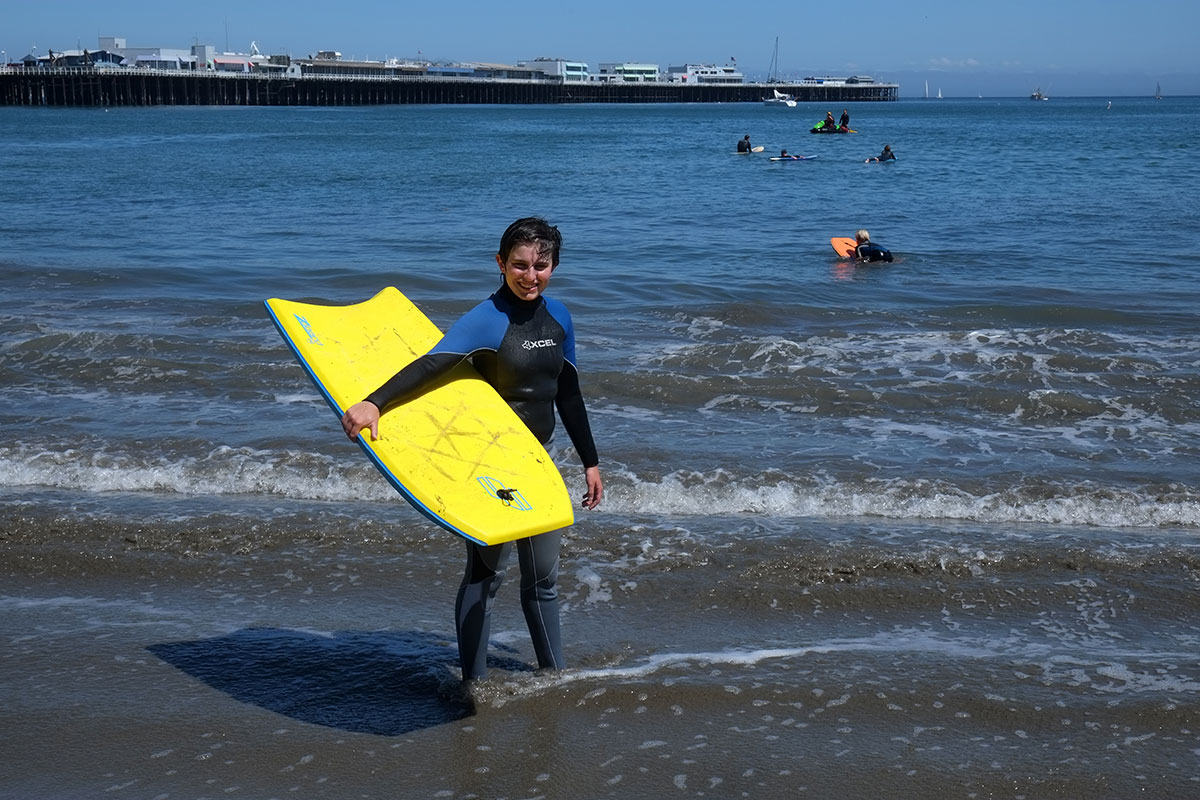
while Greta borrowed a wetsuit for some boogie-boarding.109. Santa Cruz006DSCF0946
Travelling in central California was an unusual part of our trip. Whereas most of the trip had been to far-away places to which we may never return, we had been to these places before, and we’ll probably get back to them relatively soon. We didn’t feel the need to be completely thorough, trying to see everything on the checklist for every place. And compared to many more challenging places we’d visited, these cities encouraged such sloth – they were completely relaxing and comfortable. You get pulled into that inimitable California lifestyle, strolling around and enjoying the weather, in between wonderful meals. The Promised Land experience continued.

The Finrows

DSCF0959

As I’ve written blog posts about all the friends we’ve visited and stayed with this past year, I’ve noticed a paradox – the more time I’ve spent with someone over the years, the harder it is to write about them. If it’s an old high school buddy whom I haven’t seen in 30 years, time (and age) acts as a filter. I remember certain stories from the distant past (and doubtless have forgotten many more) that frame the friendship, and then I can follow with the holiday-letter synopsis of their adult life. But if it’s someone with whom your friendship has evolved continually over the years, there are just too many aspects to cover, so these posts necessarily feel more cursory, or inadequate. This has certainly been true in writing about our family members, and with some close friends, such as Jerry and Gunilla Finrow.

I first spoke to Jerry in 1990, when I called about a job at the UO for which I had seen an ad in Architectural Record. Jerry surprised me when he said he had heard of the firm where I worked, and he strongly encouraged me to apply for the job. I did, and that pretty much set me on the course of my life since.

Jerry had grown up in eastern Washington, and attended the undergraduate architecture program at UW. He worked for some noted architects and landscape architects in Seattle, and then went off to graduate school at Berkeley in the 1960s. He was there for the intellectual and political foment that was Berkeley in that period, and he was actually in the Christopher Alexander seminar where they first began to develop the idea of the Pattern Language. Jerry and Gunilla met at Berkeley, as she was a graduate student also, after having grown up in Helsinki and gone to architecture school at the ETH in Switzerland. They left the Bay Area to move to Eugene, where Jerry became a faculty member (and later department head) in architecture, while Gunilla became a faculty member (and later program director) in interior architecture. They lived in a house on Fairmount which they beautifully remodelled, and where they raised their children Eric and Eva.

The year after I (and Linda) arrived in Eugene, Jerry became the dean of AAA. We had a great, but necessarily limited relationship, as deans are always travelling or busy, and don’t spend a lot of time just hanging out with junior faculty. But Jerry and I had a lot of overlapping interests (such as housing), and even while he was busy running the school, he always found time to track what I was doing, and give me excellent pointers and suggestions. Linda and Gunilla had a closer relationship, as they worked together in a much smaller program, although their relationship went back further: Gunilla had been Linda’s adviser when Linda was in graduate school at the UO, and Gunilla had been the one who encouraged her to apply for the faculty position back at the UO when it became open. So it’s very clear that without multiple interventions by the Finrows, Linda and I would never have met.

In 1995, Jerry accepted the job of dean at the University of Washington, and they moved to Seattle. We missed having them in Eugene, but visited them several times there while on work-related trips, including the summer of 2001, when Linda was pregnant. While we were there, they mentioned that they had started construction on a summer house on Whidbey Island, and did we want to run up to see it? We did, and fell in love with the place. The house was exquisite, a blend of vernacular, modernist and Scandinavian influences, simple and impeccably detailed.DSCF1128

We were also taken with the historic town of Coupeville, and the landscape of Ebey’s Landing. I remember eating lunch on the beach at Ft. Casey, and Gunilla relating how she had grown up on the water in Helsinki, but then had lived inland in Eugene for 25 years, and was never quite content. Now she would be able to see the water every day, and it felt right. I completely understood, as I had moved back to Eugene two years before after four years in Portland; Eugene was the only place I’d lived in my life that didn’t have salt water, and it didn’t feel right to me either. We visited them on the island several times after Greta was born, and eventually bought our own property in the town and built a house (often staying with the Finrows until it was occupiable). So once again the Finrows casually set us on a major life trajectoryDSC04104

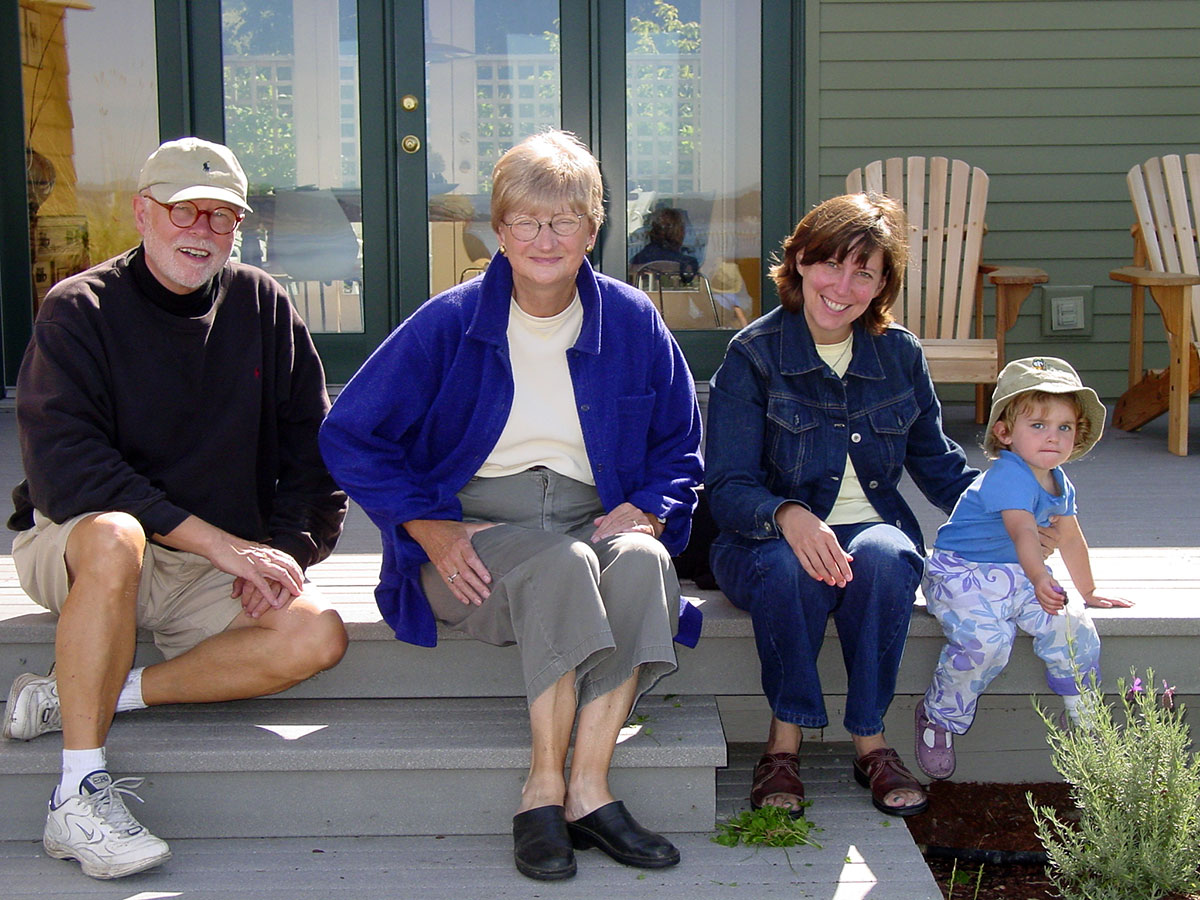
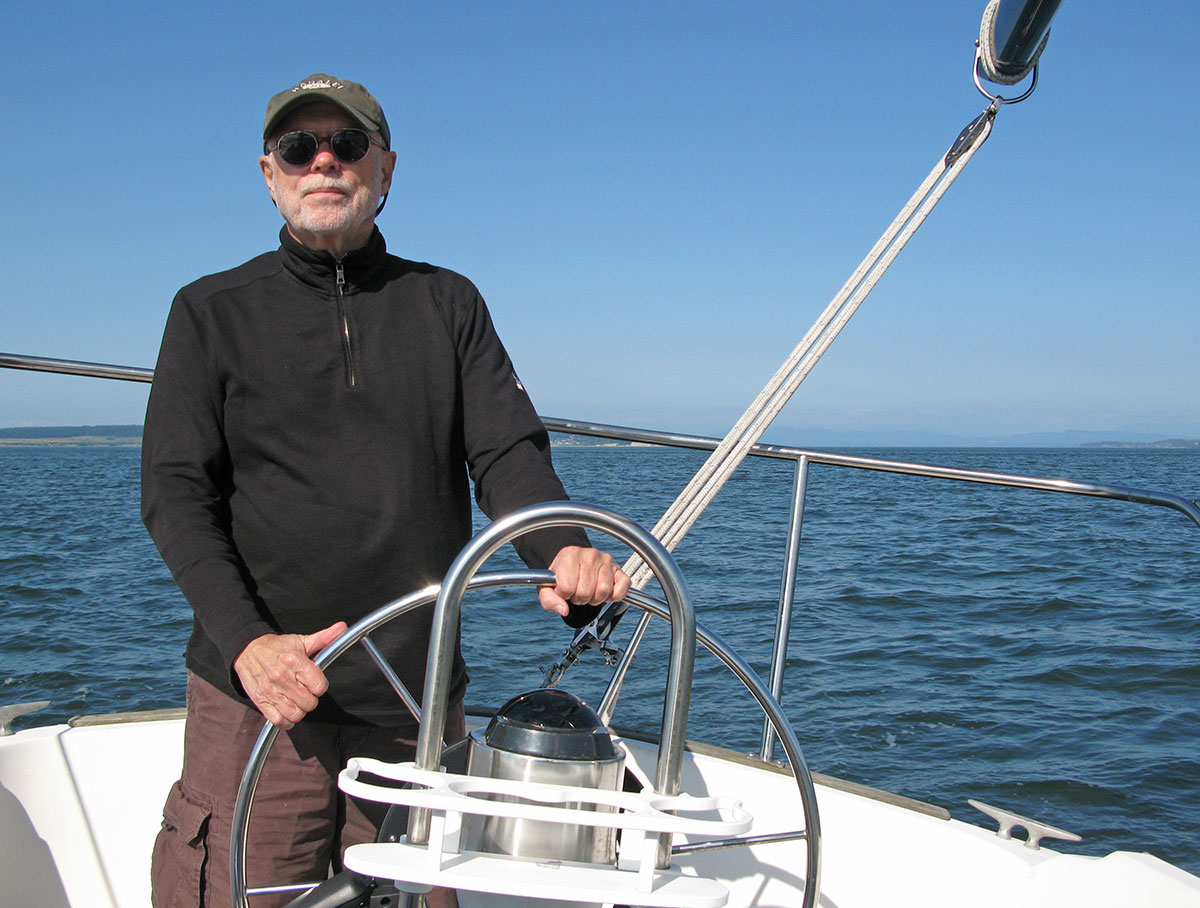
Linda and I managed to have Greta without any interventions by the Finrows, but they’ve been an important part of her life ever since. As all of Greta’s grandparents were much older and across the country, she didn’t get to see them very often, and the Finrows became her surrogate West Coast grandparents. We’ve been spending our summers on Whidbey for ten years now, a half mile from the Finrows, and being able to to spend time with them (as well as Bill and Mary Gilland, who built a house across Penn Cove), has been one of the things we most look forward to every year. Over the years Linda and Gunilla have spent a lot of time consulting on gardening, and I can sometimes drag Jerry out to be the helmsman on the boat.IMG_9341

Jerry and Gunilla are now both retired, living between downtown Seattle and Coupeville – spending their time gardening, cooking, going to the symphony, and relaxing after busy careers. They’ve also been travelling quite a bit – usually trips to visit Gunilla’s family in Finland, or garden tours in the UK. When we get together at the beginning of each summer, Bill and Jerry (both former deans of AAA) will ask me how things are going at the UO, and will listen attentively as I launch into a narrative about the latest administrative crises and outrages, etc. After a few minutes they both begin to grin, and one will say to the other, Boy I’m glad I don’t have to deal with any of that anymore. I have a few years to go, but I’m looking forward to joining them.

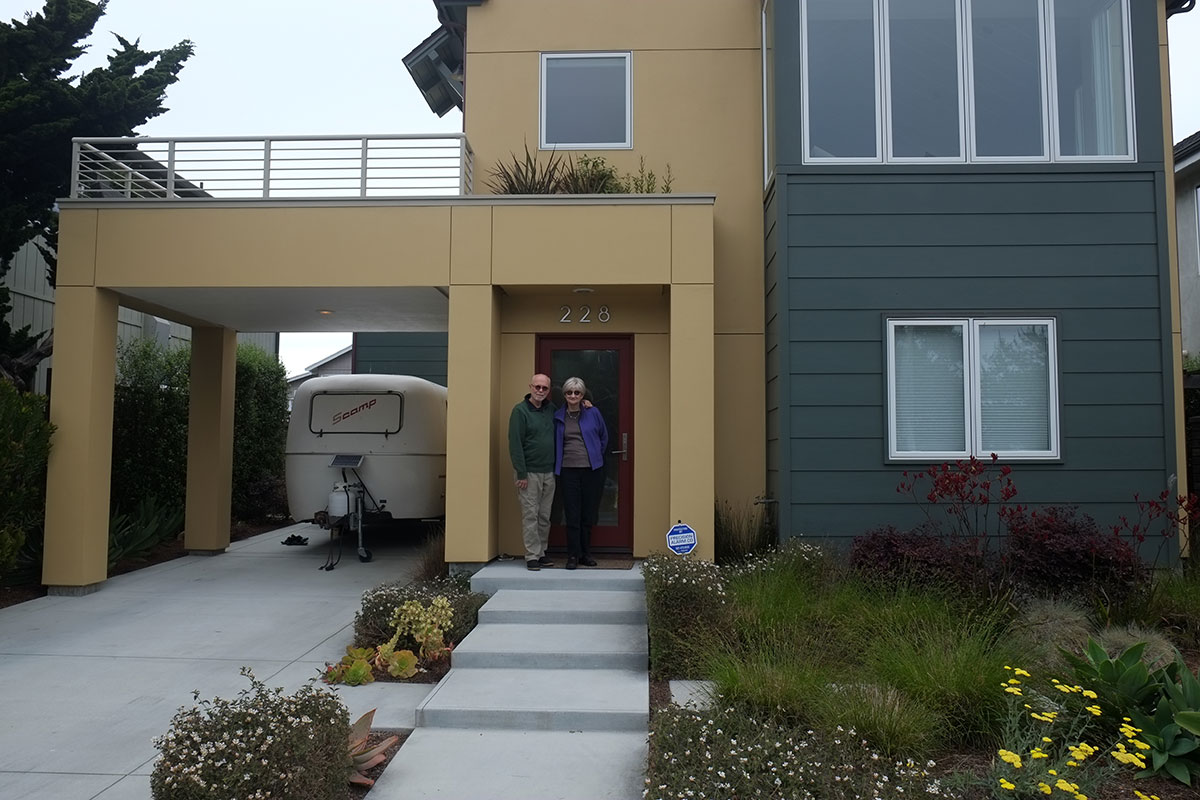
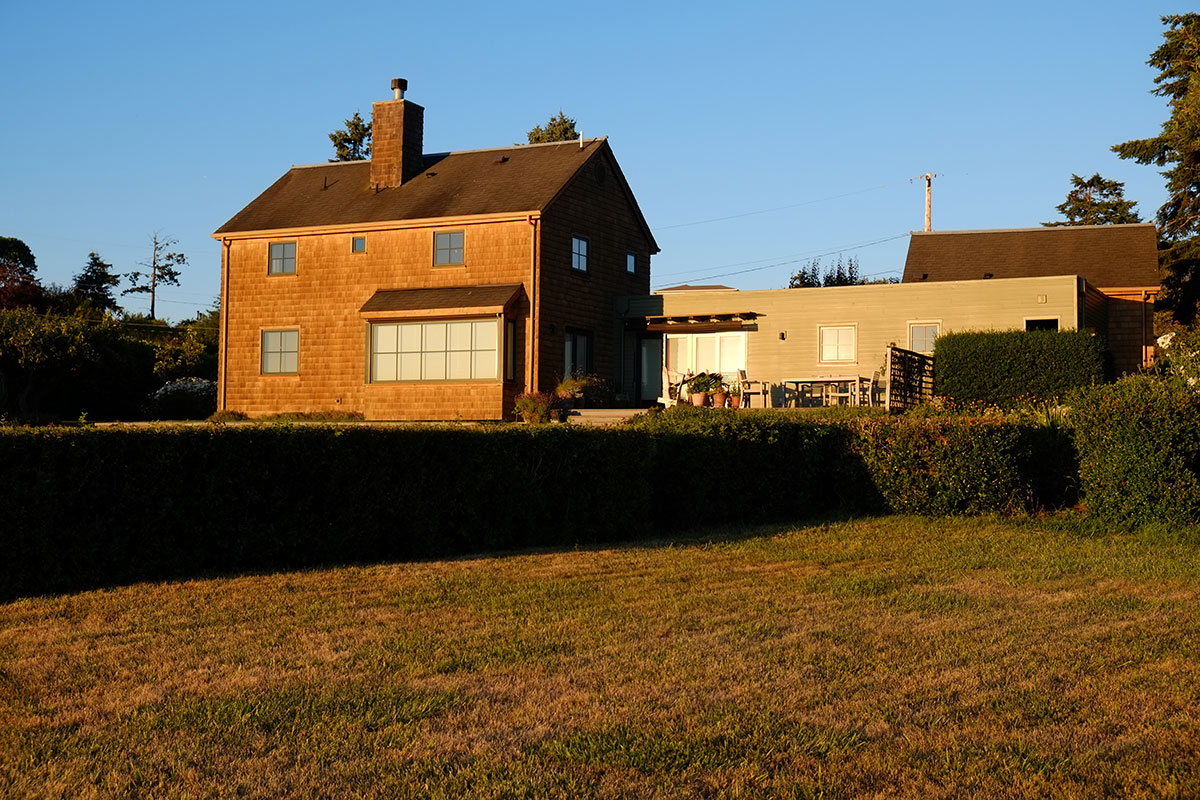
Jerry and Gunilla had been heading south for some time every winter, and a few years ago they decided they needed another architectural project, so they designed another great house in Santa Cruz. They use it as an intermittent vacation residence, and their daughter Eva and her family use it as a weekend house, coming over the hills from the Bay Area. It works really well as a multigenerational house, with the main living spaces and the Finrows on the upper level (with a view of the ocean), and the Born family occupying the ground floor. Something they didn’t plan on (but they must have grasped at some intuitive level) was that Keyes family would be showing up again someday, and the house has superb urban camping amenities, with a nicely secluded spot for our trailer behind the porte cochere.  109. Santa Cruz007DSCF0962

Our unplanned timing was great, as we not only got to see the Finrows, but also Eva’s family. (Greta has known the Born boys since she was little.) Eva’s husband Colin took Greta along to the beach, and six-year-old Peter taught her how to boogie-board while Colin and Ben were surfing. We also spent an evening talking about our travels with Colin, who would love to undertake such a trip someday, and who has also been the only person we’ve seen on our trip who has understood the central importance of making an Allman Brothers pilgrimage to Macon, Georgia.

By this stage we realized that were on the last leg of our trip, and were frankly a little exhausted, not feeling the impetus to do every single cool thing that could be done in every place. Just as the landscape was starting to feel more familiar, giving us some signs that we were home, staying with the Finrows was very familiar also. They’ve been such constant friends and wonderful hosts over the years that staying with them felt a lot like being at home, and we just relaxed after months on the go. And it was very thoughtful of them to build a house that fit in so well with our itinerary.

Kresge College / UC Santa Cruz

DSCF0842

How does one design a major university from scratch? The University of California system dealt with this question in the 1960s, as it expanded its number of campuses. The Santa Cruz campus is an interesting example, as it shows the influence of a few different strains of American campus design. The first American colleges were located in cities and towns, roughly following the urban European approach, but in America the campuses and towns usually grew simultaneously. In the 19th century, the model changed, partly reflecting the agrarian American distrust of the city, and benefitting from the land-grant system which provided support for state universities. The huge growth in universities after WWII reinforced this isolated campus approach, and most campuses reflected the same development pattern that was seen in suburbia – isolated buildings set in an open landscape, with much room set aside for cars. (This campus model was then adopted in the design of office, and even industrial “parks”.)  One aspect they all had in common was seeing the landscape as a fairly neutral, “natural” background for the buildings, and seldom designing the outdoor space as a bounded space; even the earlier campus planning strategies of quadrangles and malls were largely abandoned as being too formal.

The Santa Cruz campus reflects this trend – the site was a vast undeveloped area of forest and ranchland, up in the hills above Santa Cruz, but miles from the city center. The master plan reflects what was considered best practice planning then – separate clusters of development, linked by ring roads, with some accommodation for pedestrian movement among the clusters in the center. It was an overwhelmingly decentralized (or maybe multi-centralized) approach, one which responded to the anti-urban “environmentalism” of the day, and one which supposedly reflected the state government’s concerns about student revolts: student demonstrations would never be able to achieve a critical mass, as gatherings could be isolated in the different clusters by security forces. Dan Solomon has written about this development pattern (which he somewhat facetiously blames on Magic Markers) – he says that planners stopped drawing blocks and streets and just drew bubbles.

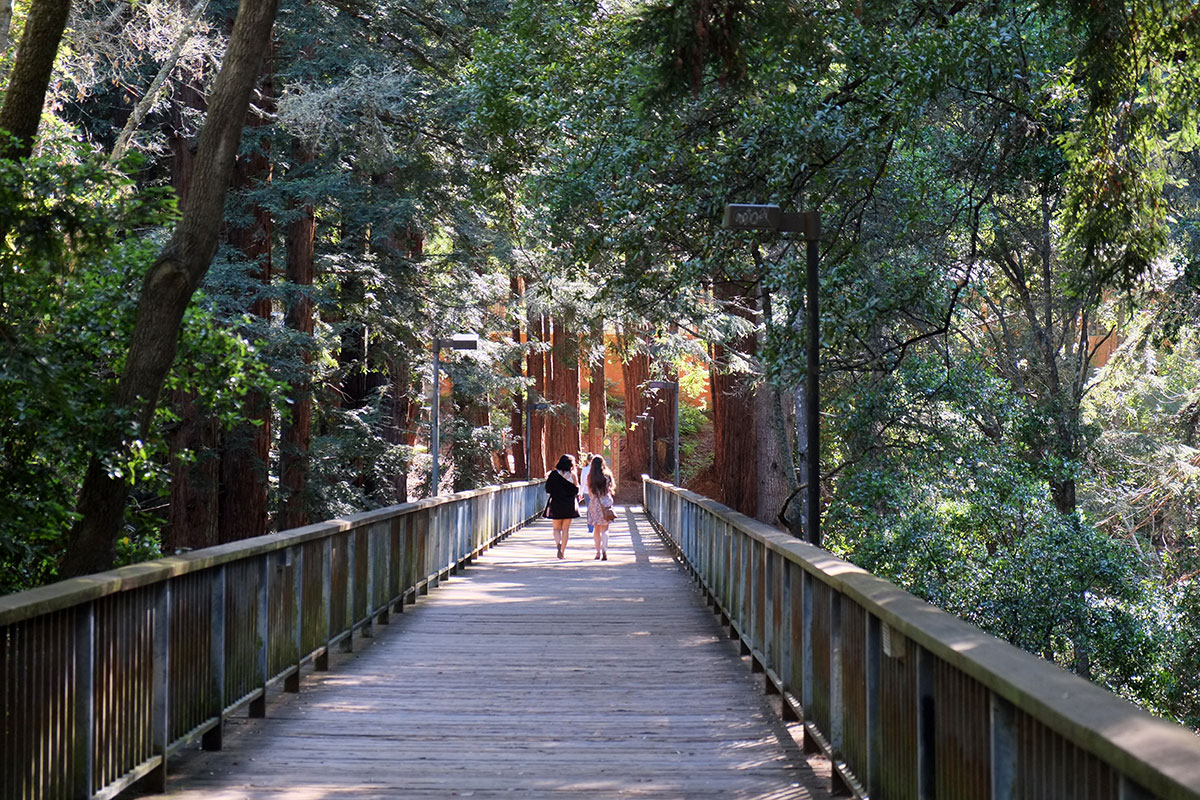
As we drove around the campus, this was indeed the feeling. We followed road signs and directions to the various clusters – it was impossible to intuitively grasp any spatial order, more like driving in the rural countryside than in a settled area. It reminded me of Columbia, Maryland, the new town built in the 1960s by the Rouse corporation, where you drive through the woods on curving roads, directed to the named residential clusters by signage, which are otherwise invisible in the woods as you pass. However, some of the pedestrian connections through the center of campus are quite amazing – you are often in a redwood forest, and ravines are bridged so that you are walking up in the tree canopy.DSCF0898

The campus does show the best side of cluster development, in its intention to preserve special natural open space by focussing higher densities in specific locations, rather than spreading density uniformly across the whole site.DSCF0899

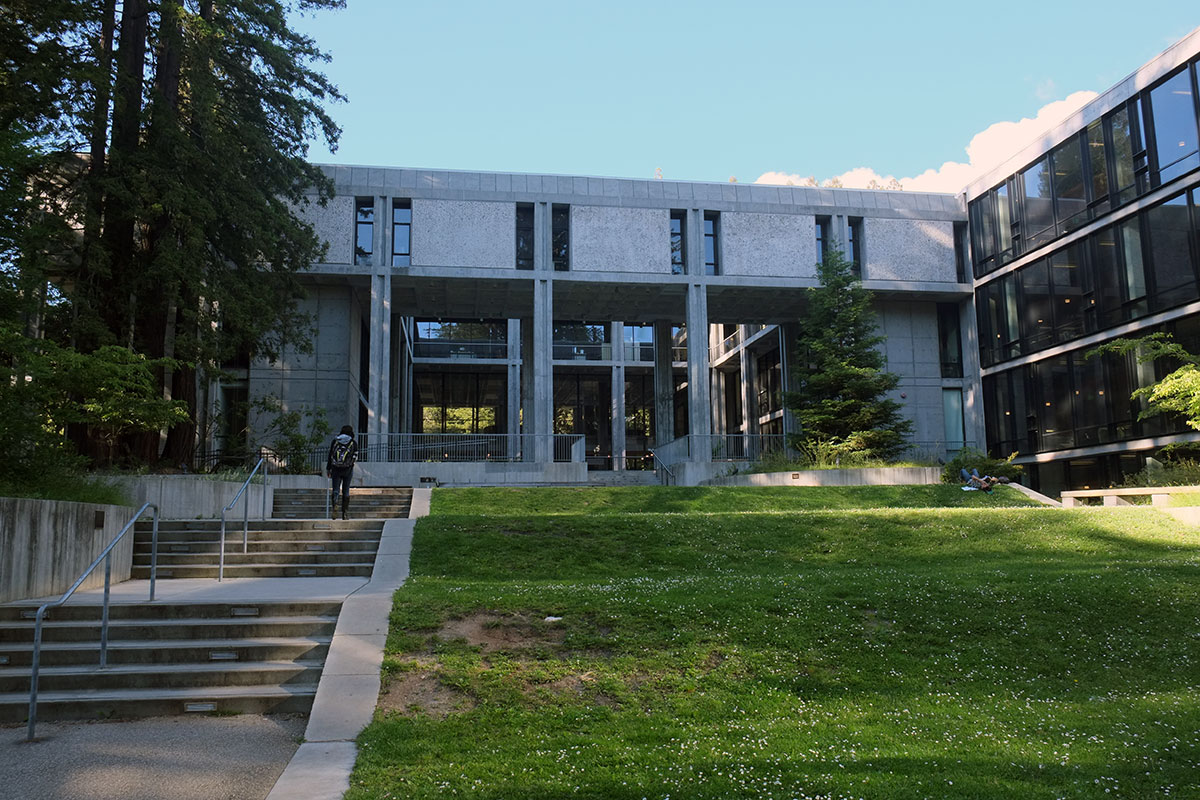
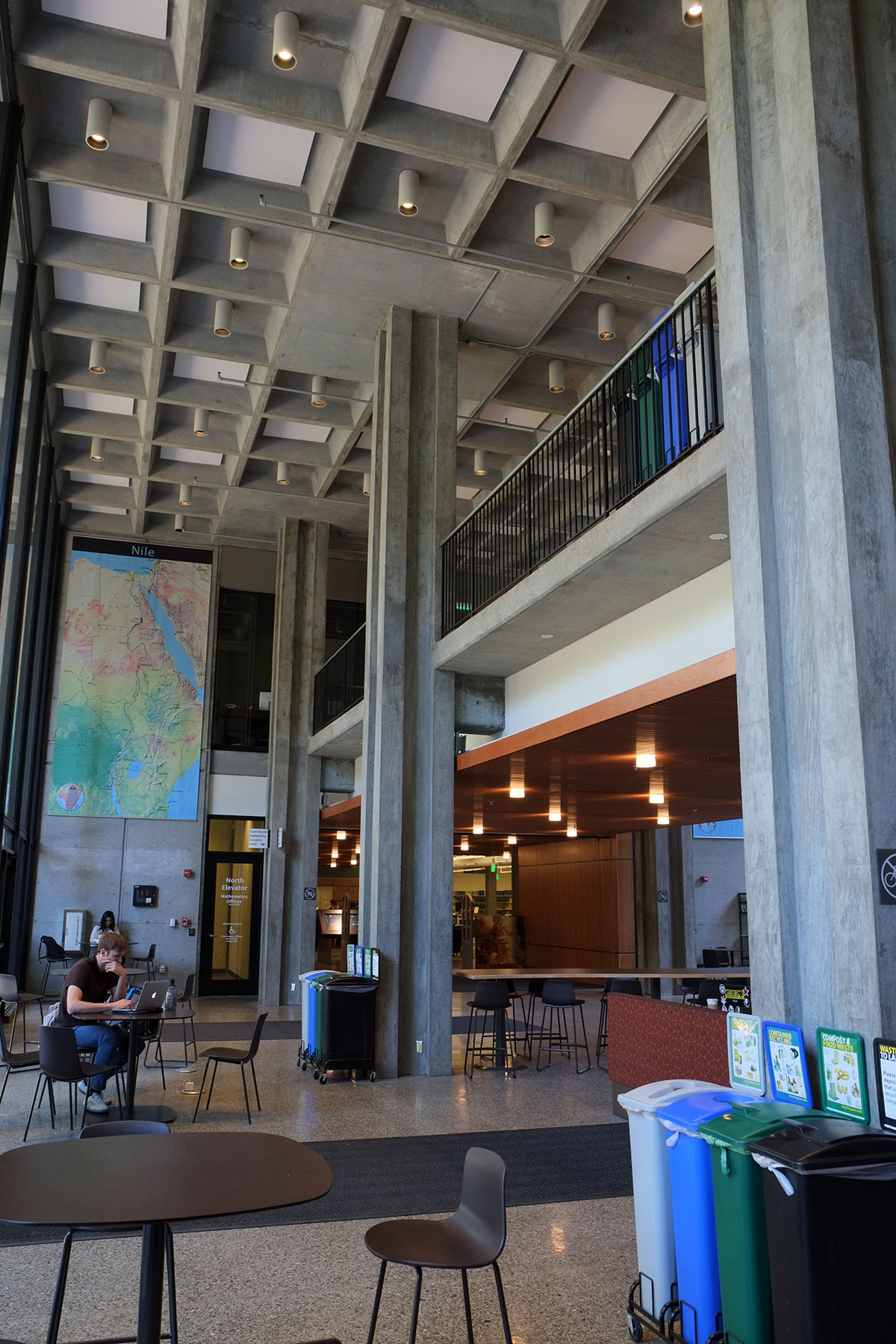
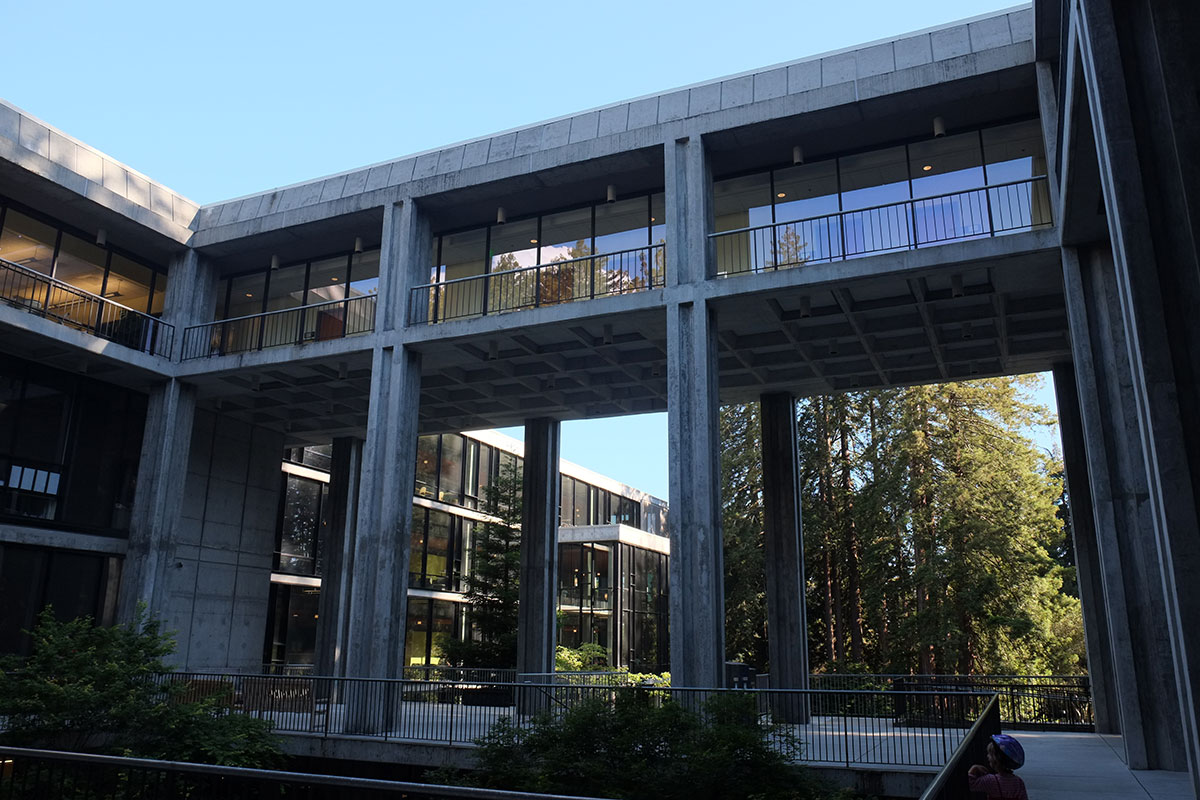
Some of the buildings from the period are quite fine. This is the main library, designed by John Carl Warnecke and later remodeled by BOORA. A classic Brutalist institution set in the landscape, but with the simplicity and clarity that typified the best work of the era.DSCF0911

DSCF0903

109. Santa Cruz004DSCF0908

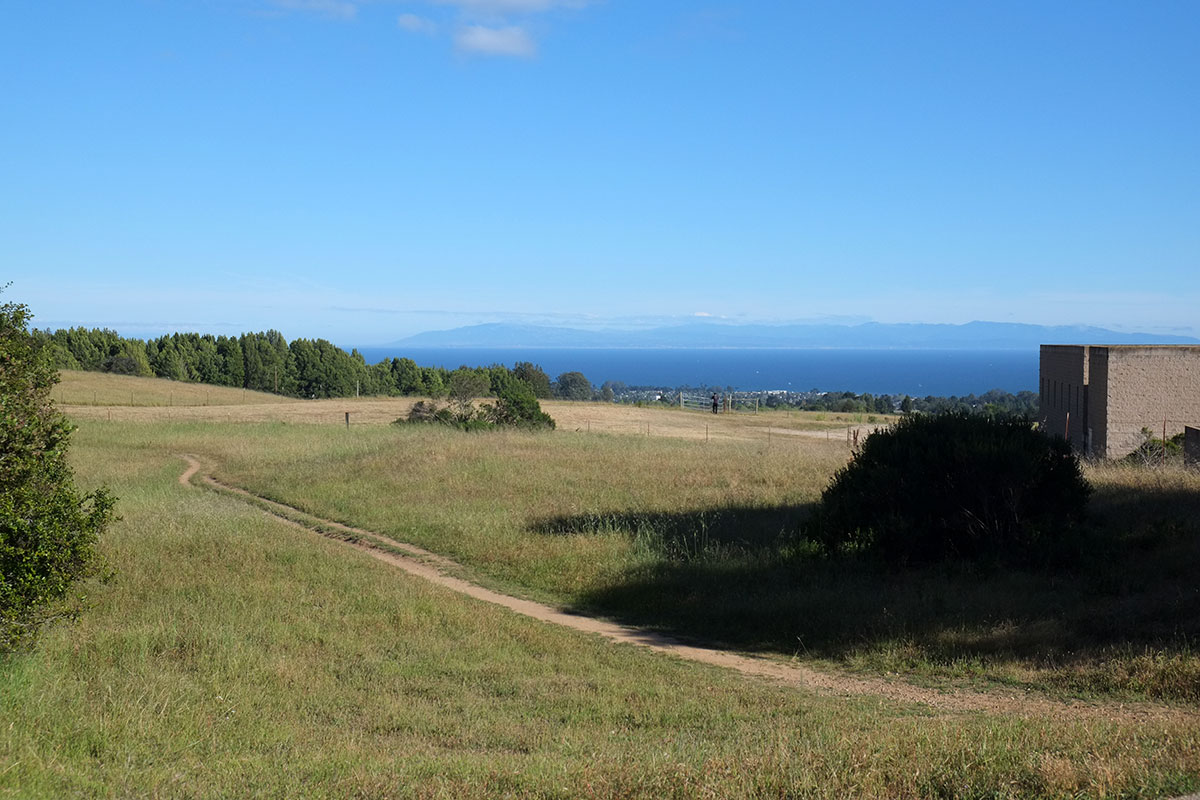
Jolie and Albert explained how as ideas on campus design have changed, recent projects have adapted. There is more of an academic center emerging, countering the initial scattering of buildings in the woods. It is also literally beginning to emerge, out of the woods and onto the meadow which has views over Santa Cruz out to Monterey Bay. This ecotone is magnificent, a spot in the landscape which captures what is unique in the spectacular California coastal landscape.DSCF0913
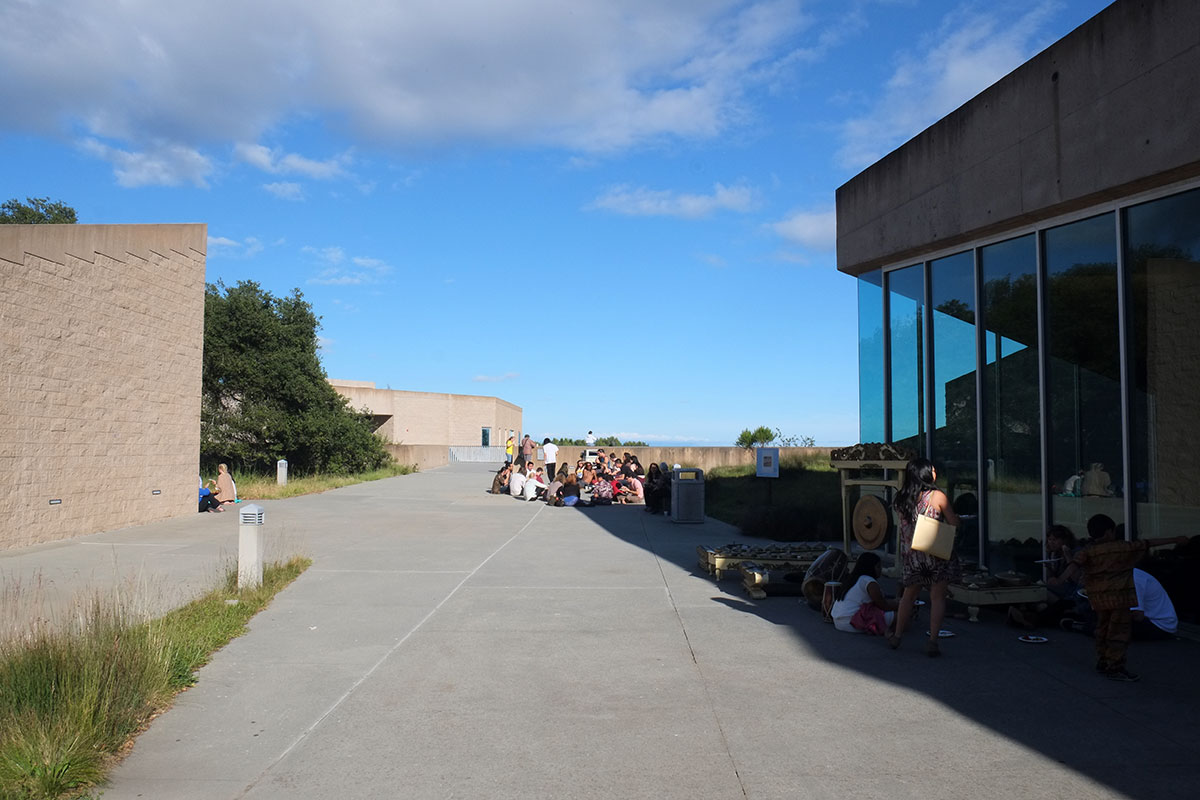
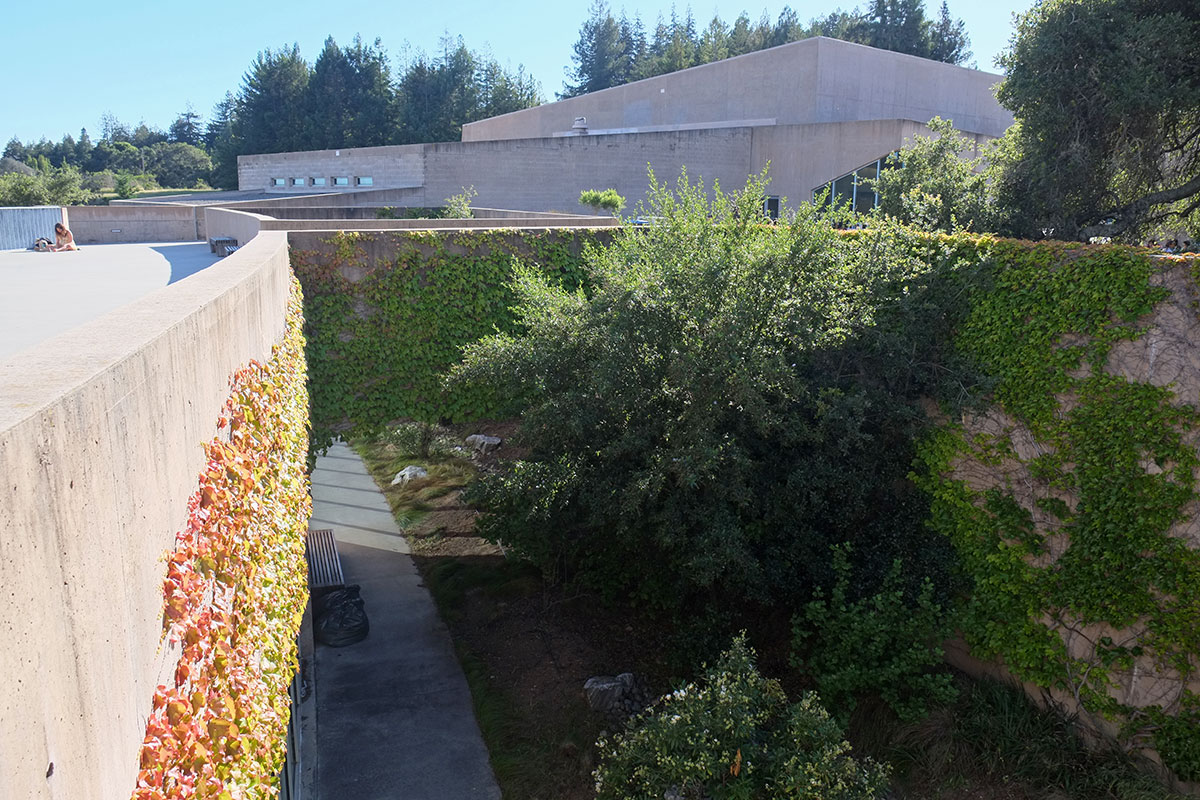
So I was perplexed by one of the more recent signature projects, a music complex by Antoine Predock. We had spent much of a day looking at some wonderful Predock buildings in Albuquerque, and he strikes me as one of the best regionalist modernist architects (similar to Erickson in the Northwest), able to integrate the universal imperatives of the modern movement with the peculiar qualities and demands of strong local context. The Predock buildings work beautifully in the desert, and I just couldn’t figure out how one had gotten to Santa Cruz. The open spaces were rather stark, preserving grand vistas, but not doing much for the humans huddled in the shade.DSCF0920

Rather than making a building in the landscape, Predock did one of his normal moves of making a building that is landscape, and you walk over and across and around the pieces. I glanced down into this oasis canyon. Was this his reference to Tsegi? Where were the horses?DSCF0918

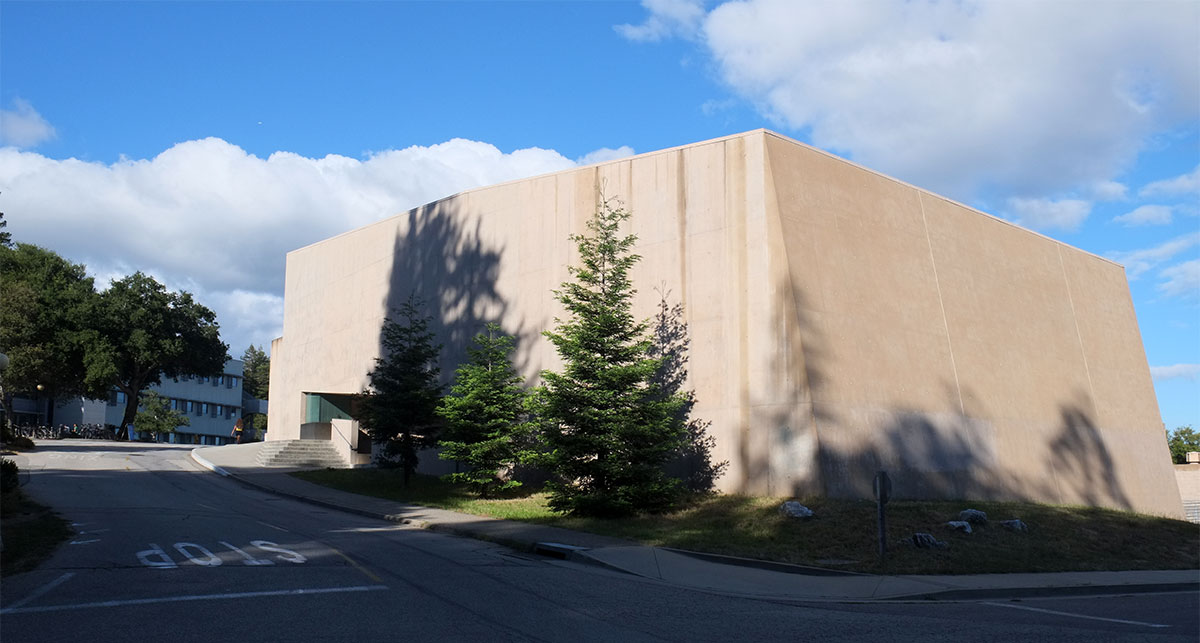
Then looming ahead of us was the mesa. I know that concert halls want to be blank boxes, but I just couldn’t see how this had anything to do with this site. I think this points out the problem as the campus tries to move away from the models of the 60s – they recognize the need for a center, an actual build-up of density at the core of the campus, but they’re still stuck in the 60s paradigm of the building as object, not creating the important public spaces between buildings. This is especially surprising, as right on their own campus they have one of the best precedents around which could show them how to proceed.DSCF0921

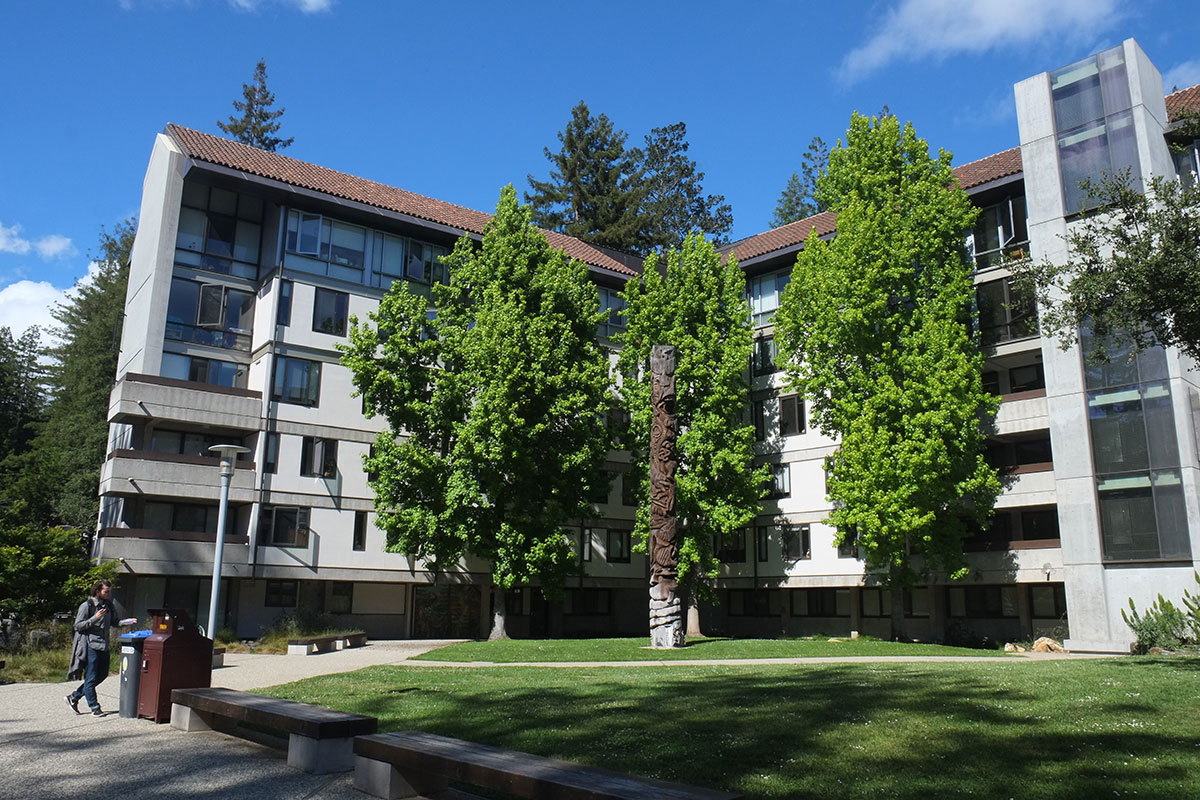
While the Santa Cruz campus took the mid-century, decentralized-in-nature, American campus approach to a new extreme, it then also circled back to the older, English university system of residential colleges, which had been adapted in the early 20th century by some American universities, such as Harvard and Yale. The college broke down the overall scale of the large university to a smaller unit, which would have its own identity, reinforced by its own physical location. A student supposedly isn’t just an individual floating around in a huge, impersonal institution, but has an affiliation with an intermediate-sized entity, which allows them to become part of a identifiable community. Each of the residential pods at Santa Cruz becomes its own village, in this case set out in the wilderness, versus the dense urban locations of its predecessors.

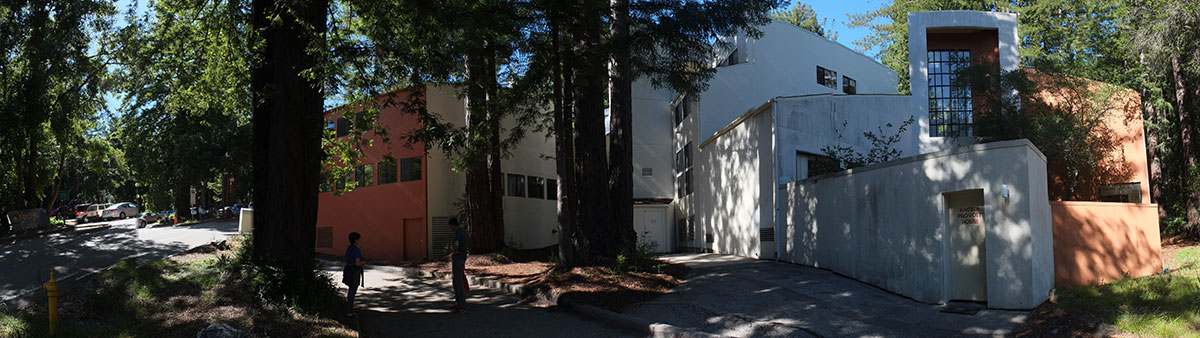
Charles Moore was at the peak of his renown in 1970, having designed many brilliant buildings in California as part of MLTW, and having taught at most of the distinguished design schools in the country, including his stint as dean at Yale. The design for Kresge college works within the campus concepts of open landscape and residential colleges, but then he brought in yet another precedent from the past – treating the college as a small piece of dense urban fabric, rather than as a collection of individual buildings in the landscape. The other residential colleges, designed by other architects, do often try to establish a spatial identity to reinforce the institutional one, using a hierarchy of courtyards, irregular quadrangles and common open spaces, as well as a consistent formal vocabulary for the buildings. But overall, they do look much like other college dorm districts from the era.DSCF0834

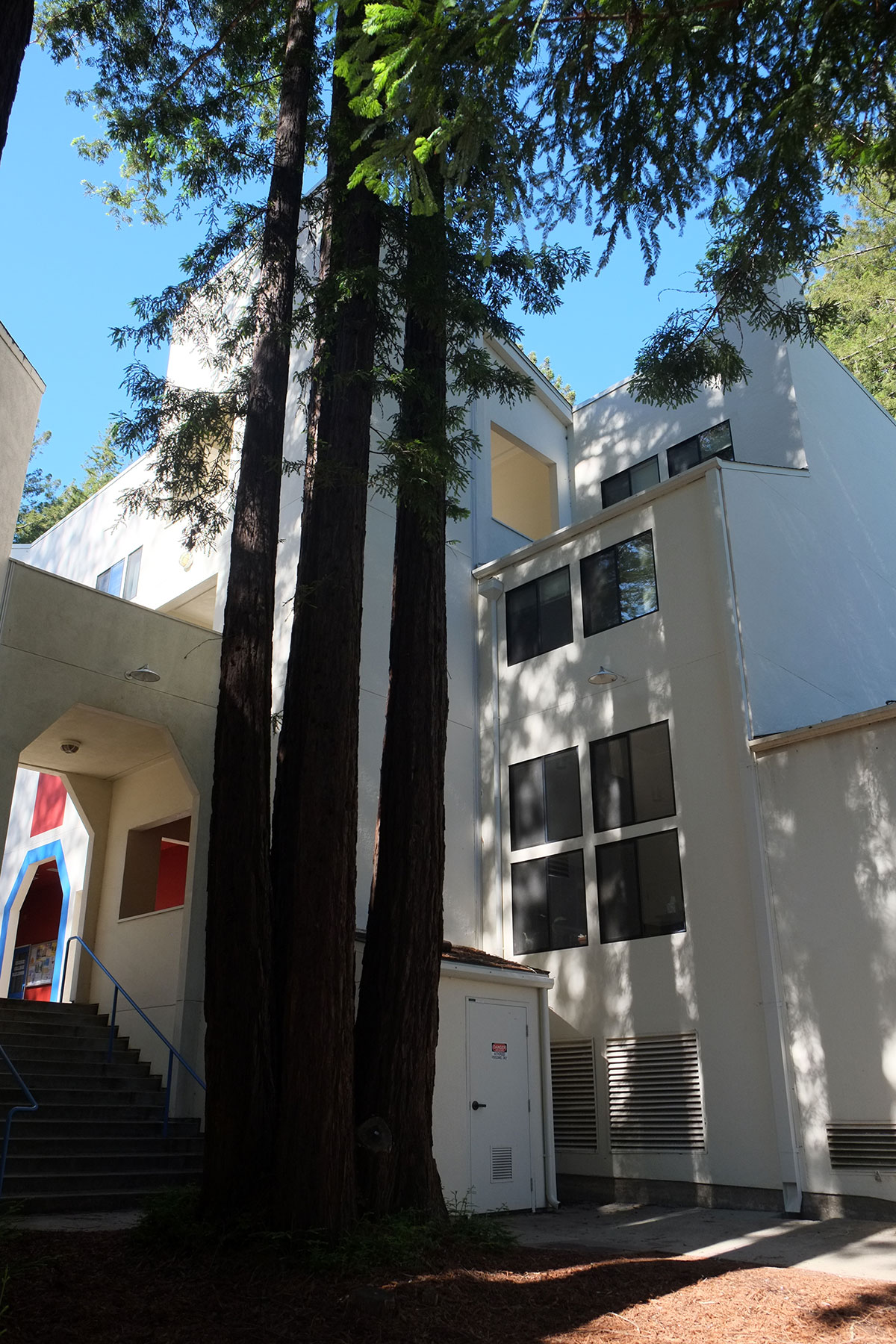
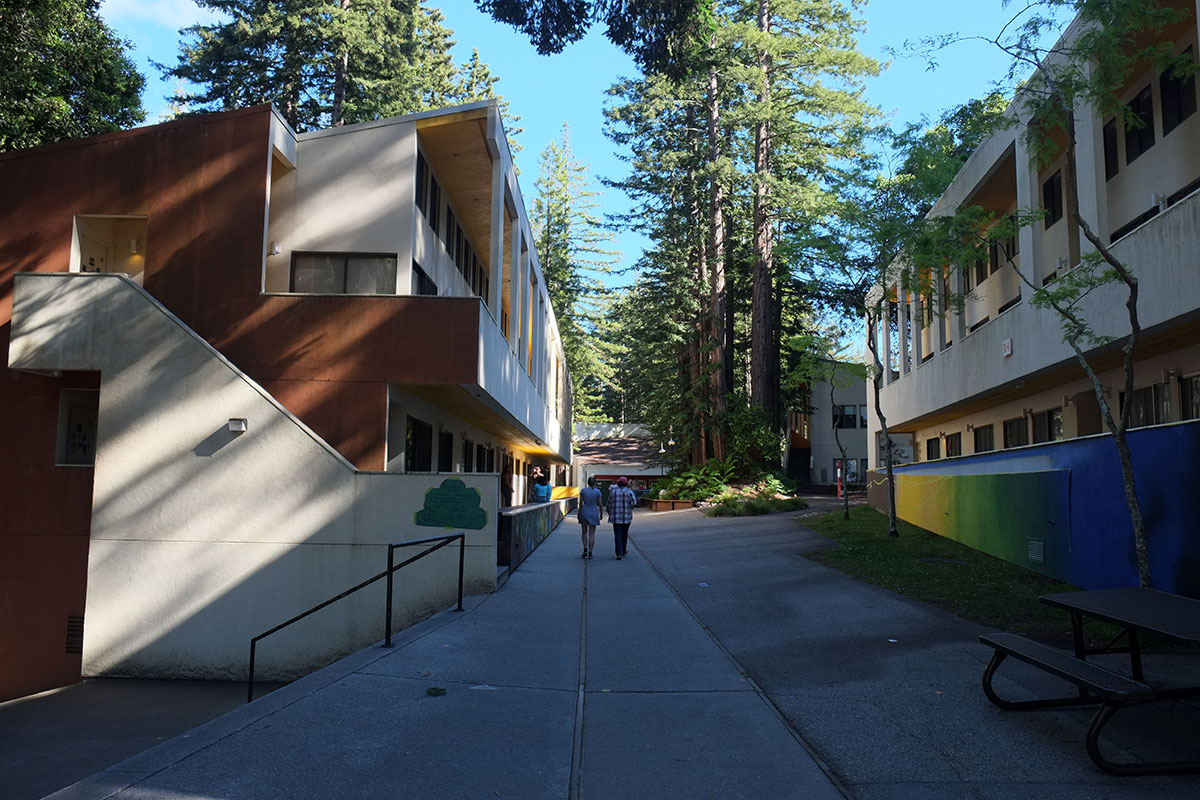
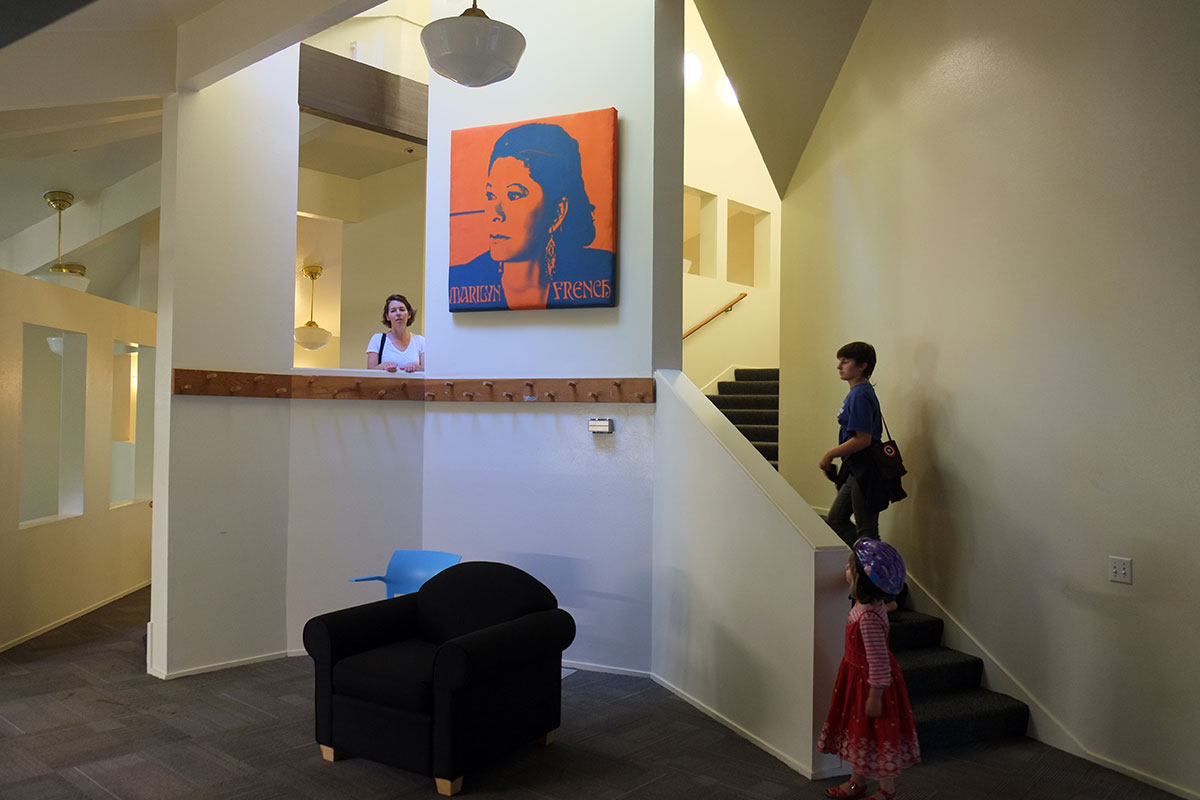
Kresge College is totally different. From the exterior, it presents as a walled village – the buildings form an assemblage for the enclosure of the residents within. To enter, you must walk along the perimeter to one of the gates. Architecturally it also reinforces this idea of being a village or town, rather than one large building – the various forms are juxtaposed, and even collide – it intentionally avoids the uniformity that you expect when seeing one large complex deigned by a single architect, even though the vocabulary is consistent.DSCF0841

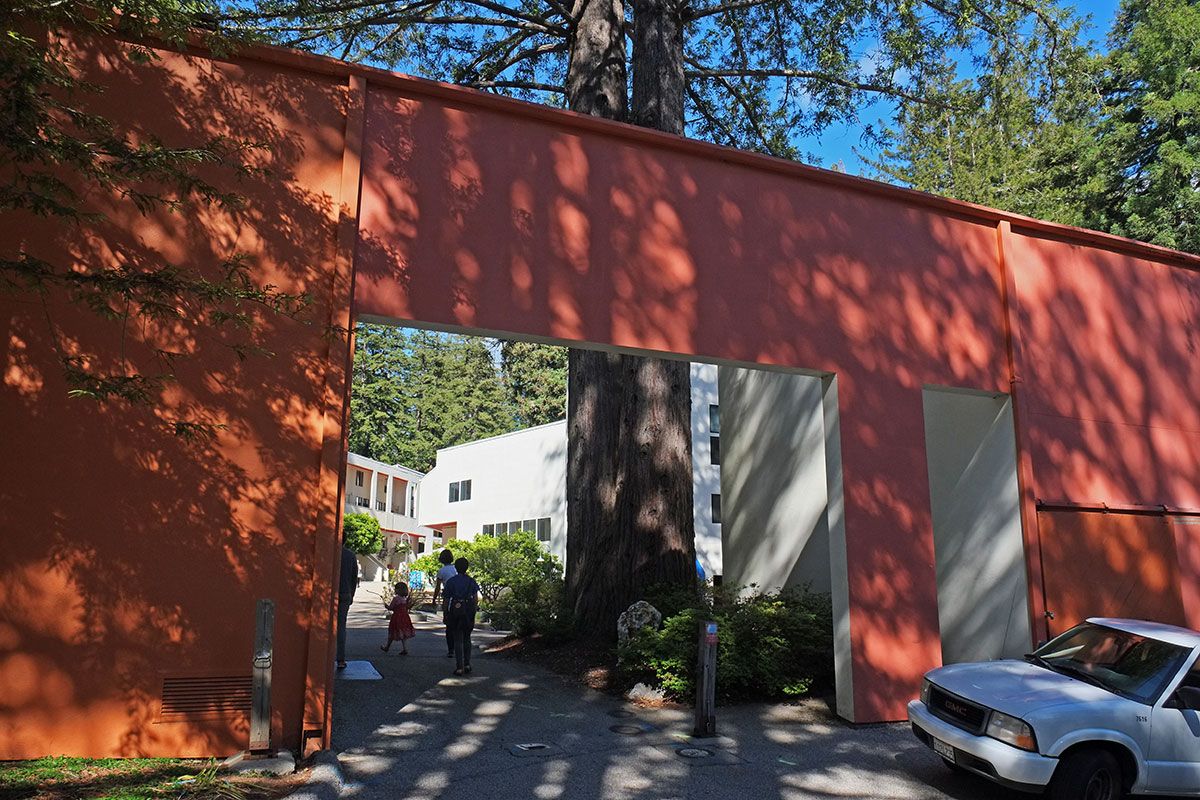
The boundaries and gates are emphasized, simply but powerfully. The wall plane is interrupted by a few large openings, through which you can glimpse the dense interior. Color plays an important role – on the exterior, there are often darker hues which allow the complex to recede into the forest. On the inside, white walls prevail, almost as in a Greek village. Though large trees have been preserved within the new townscape, it is clear that by crossing the threshold you have entered the domain of human settlement, protected from the dangers of the wild.DSCF0844

Your view is shaped by the frame of the gate and the tree, and you are presented with a forced perspective up the pedestrian street. As you proceed,DSCF0843

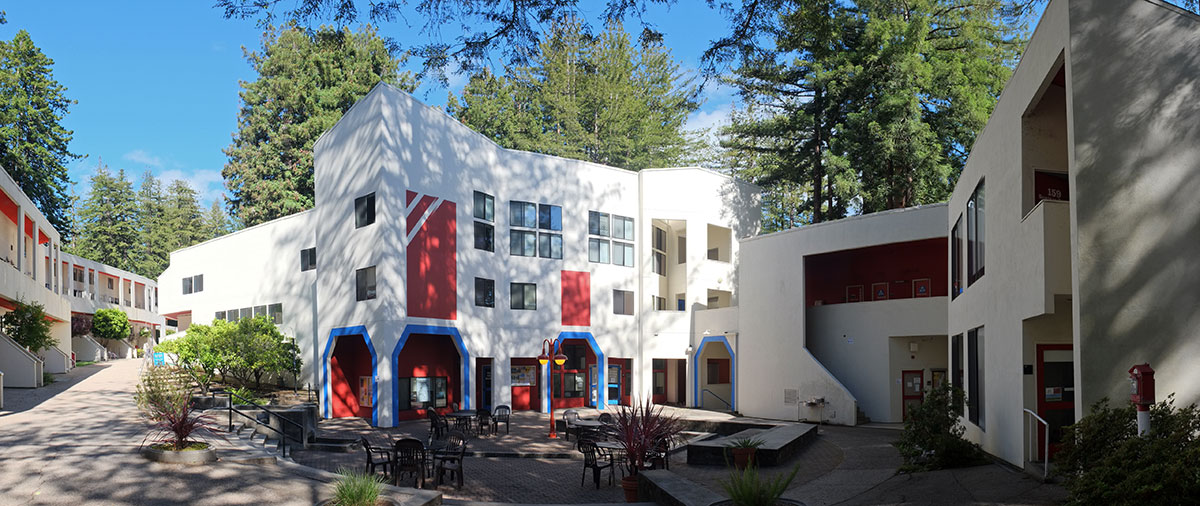
the view opens up, and you are greeted by an entry plaza. These two views set up the pattern for the rest of the complex – there are streets, and there are plazas – spaces through which you move bounded by linear buildings, and places where you are encouraged to gather. The architecture around the plazas is more imageable, with certain forms reading as iconic buildings, even as they maintain their role as part of the streetwall defining the plaza.DSCF0846

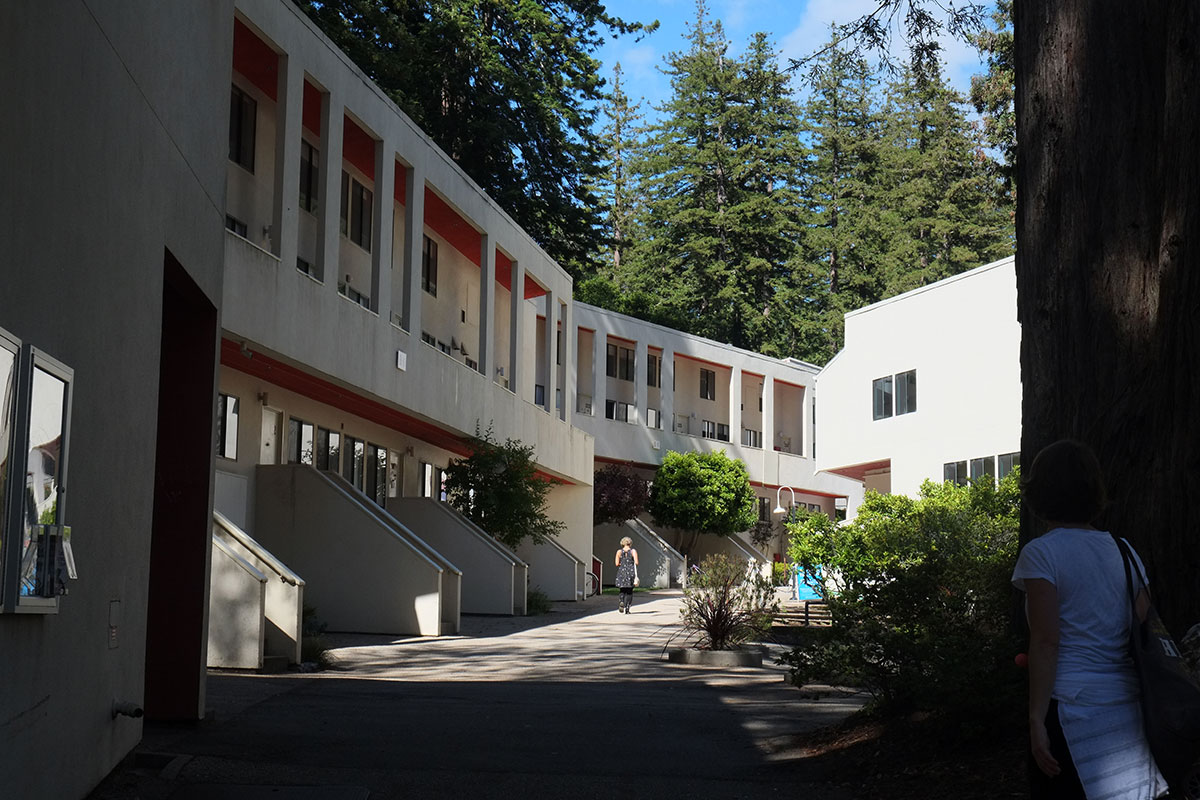
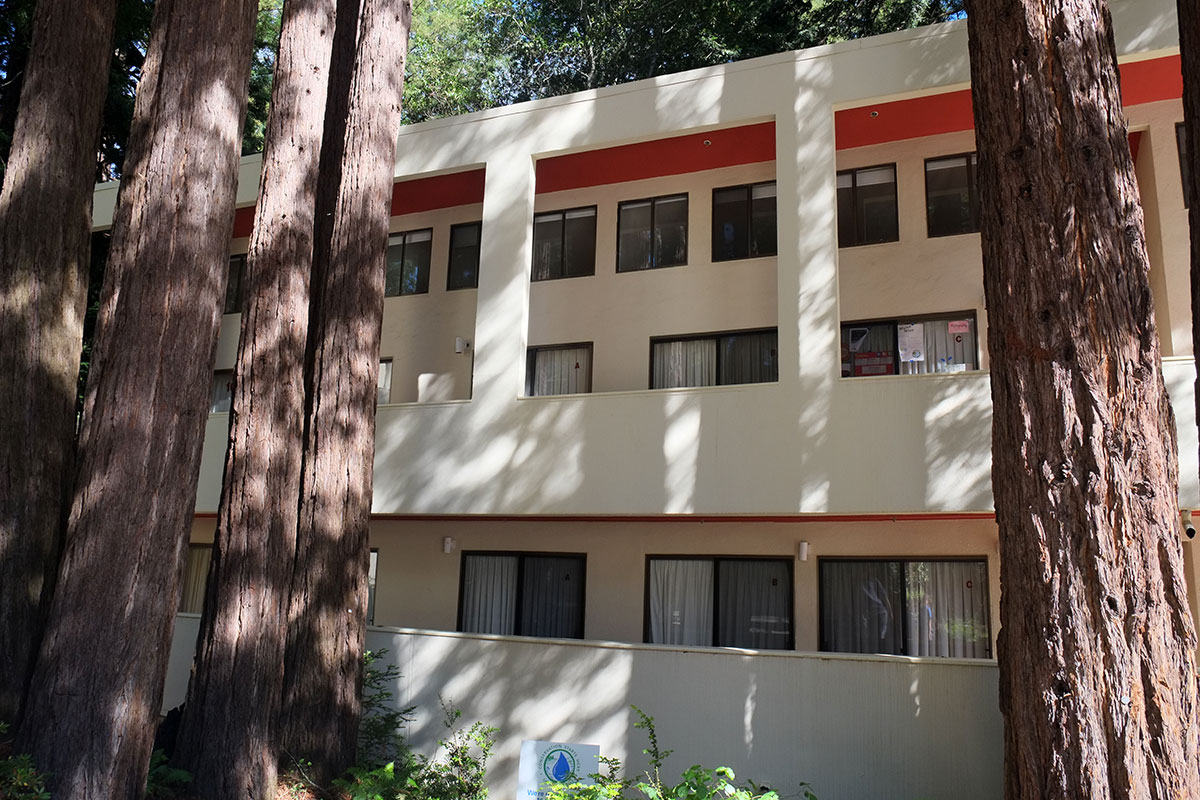
The architecture along the streets is more uniform, mainly rows of housing. Here again, there is a harkening back to older types – rather than the typical dorm type of rooms along corridors, there are suites and maisonette (rowhouse) units which are entered either off a porch zone, or from gallery circulation. The street becomes the hallway for the housing, and the buildings open to it, rather than being internally oriented. This also provides a pattern for the housing which is now sometimes seen in higher-density exurban housing – one side of the unit is oriented to the shared, public entry side, while the other faces out into the larger world. In this case, that larger world is the forest, which paradoxically, is quieter, darker and more private than the street side.DSCF0863
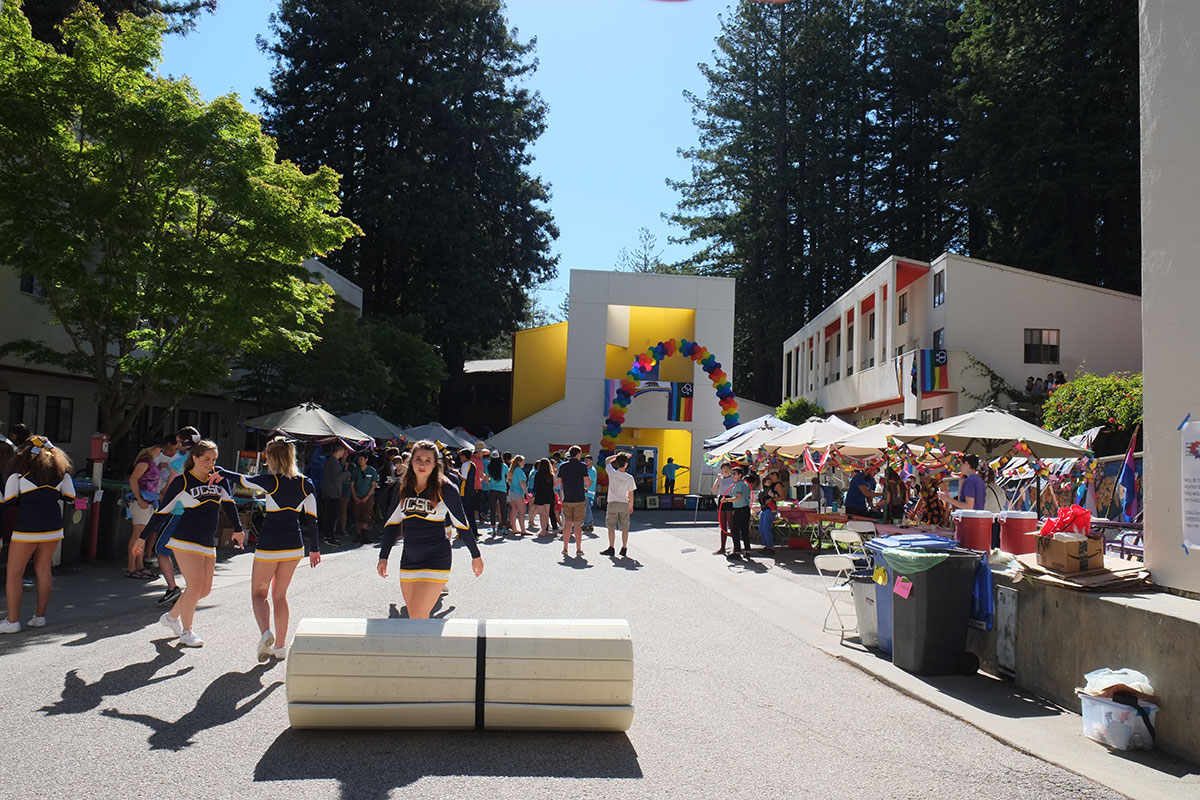
We were lucky to come across a large gathering on a Saturday afternoon, in this case, a university-wide gay pride event being held in one of the plazas. The containment within the space certainly contributed to the vitality of the festival, making it feel more intense than if it had been held in a large field somewhere else on campus. Jolie was interested to see this, as one of the current issues with the college is that the public spaces are not generally very lively (which I would guess is due to the students spending all their time indoors with the blinds drawn, surfing the internet).DSCF0859

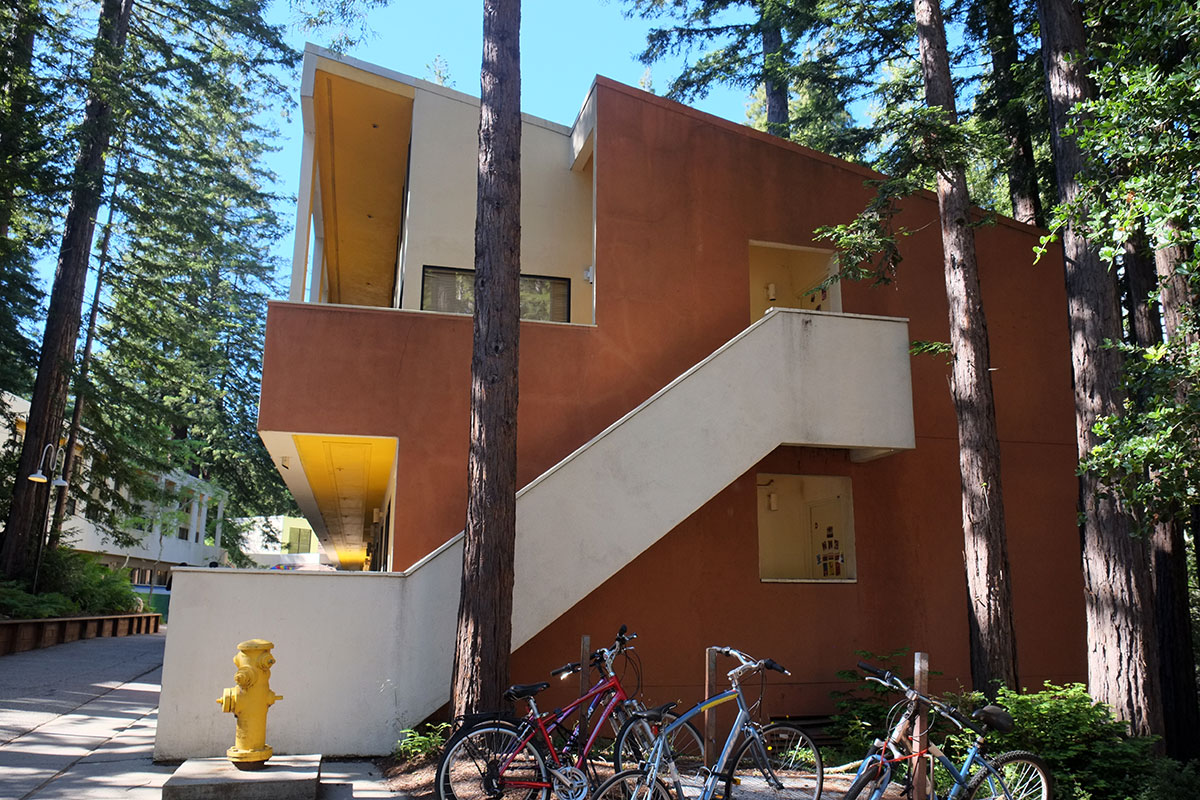
The architecture is straightforward, yet expressive of its nature. The construction is simple and cheap – lightweight wood frame, covered with stucco, and accented with color. The repetitive, modular housing doesn’t try to be anything it isn’t (such as trying to manufacture a picturesque cuteness, or agglomerating the pieces into some grandiose statement), and the simple rhythm of the units established a sense of order along the streets.DSCF0888

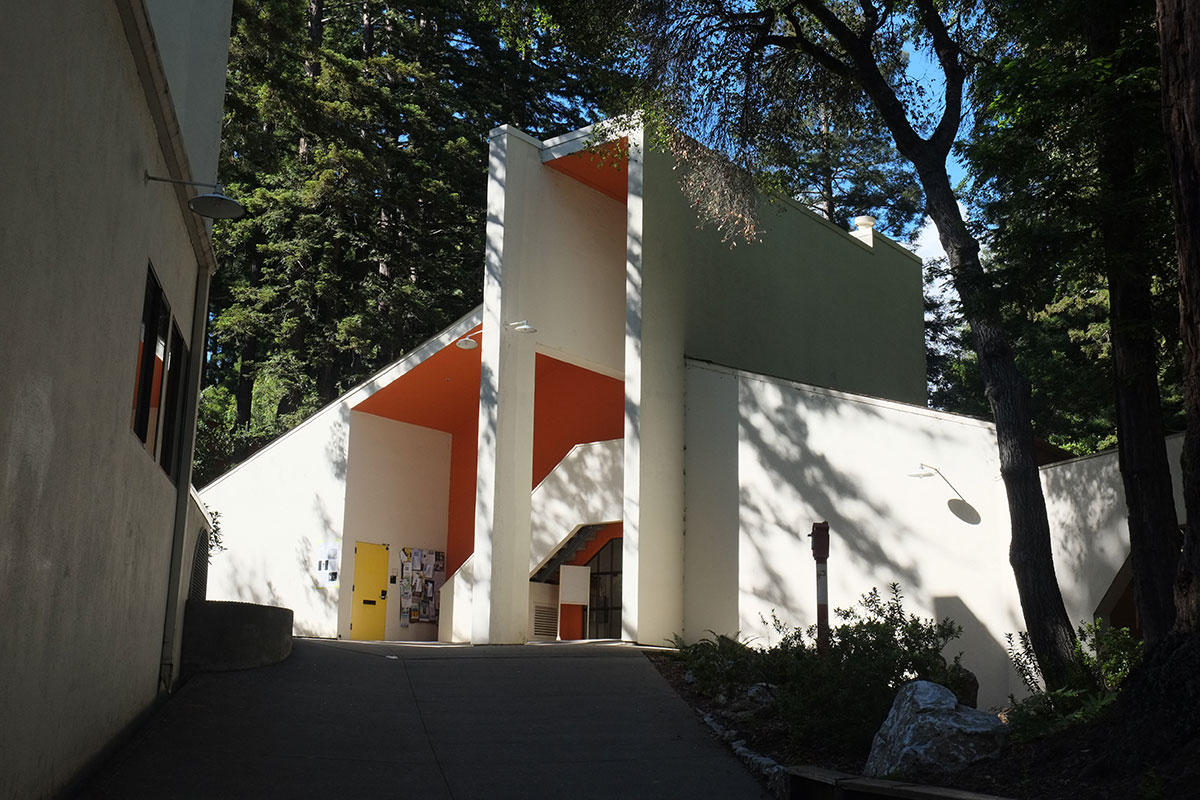
At the end of the linear buildings, the section becomes the façade, and a little bit of playing with planes and colors makes a vivid elevation, where the inside- and outside-the-village vocabularies are integrated.109. Santa Cruz003DSCF0869

These regular types set the stage for the special effects, the iconic buildings where their special function is emphasized by non-typical designs. This is the view up the street, where the vista is terminated by the library. The forms are simple, the symmetry is not rigid, yet by the location, perspective, hierarchy of tumbling forms, use of color, solid and void, light and shadow, the library is established as an important, unique building, one which stands out from the background buildings. Moore has clearly been paying attention to the Rationalists such as Rossi and Krier, whose analysis of historical urban fabric emphasized this distinction between the private and the public in constituting the city. He also catches a certain moment in architectural history, where the forms of modernism are being inflected towards what became known as postmodernism. Without the self-conscious copying of historical forms, which postmodernism quickly devolved to, the lessons of history are being incorporated here, with the design of individual buildings supporting the overall urban design intent.109. Santa Cruz002DSCF0867

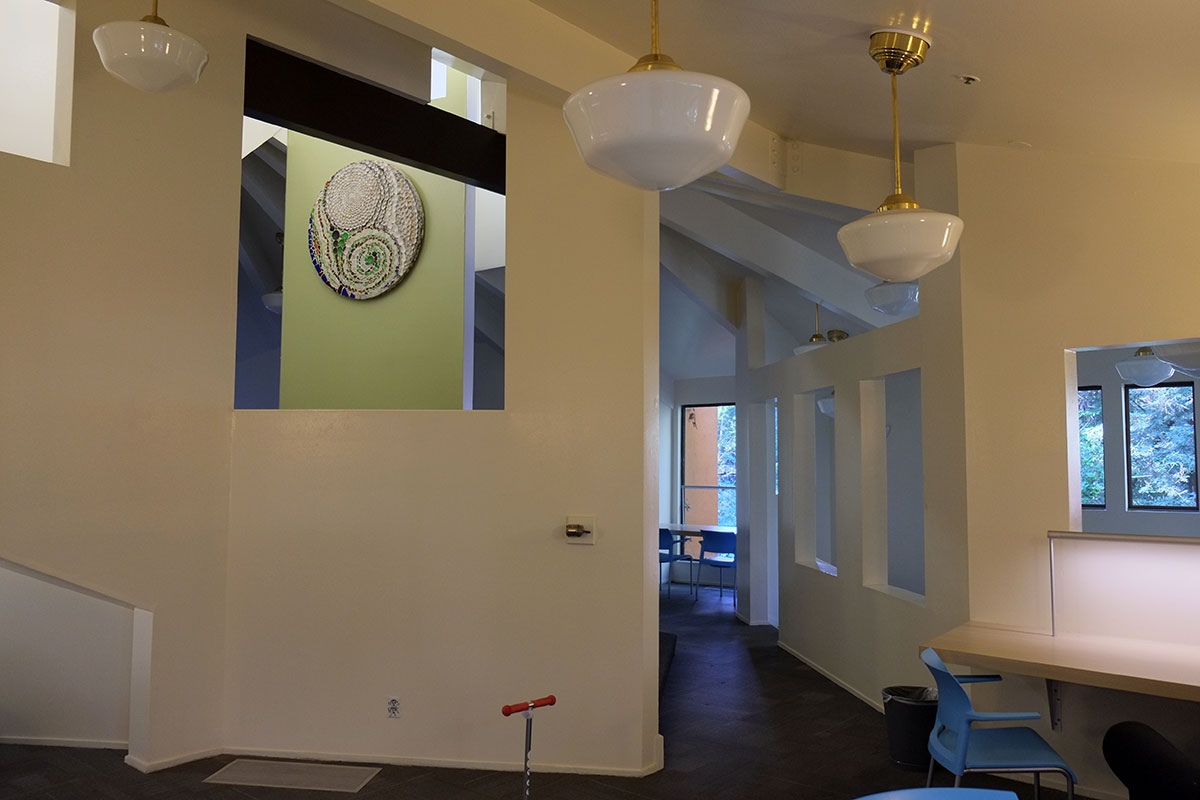
Inside, the building is defined by walls as relatively scale-less, abstract planes, crashing into each other to define spaces between, with relatively little structural expressiveness, but again with reference to iconic building elements, such as windows being cut into planes.DSCF0883

This building also emphasizes one of my favorite aspects of Moore’s design approach at this point. Lightweight wood frame is a remarkably flexible system. We tend to build in straight lines and repetitive dimensions with it, because that is simpler and cheaper, but we don’t have to. Here we can see Moore having fun within the parameters (not going to great lengths and expense to flout them) of the system, creating unexpected spaces and elements in an abstract spatial composition, which doesn’t mimic any historical or even conventional precedents. He is limited only by his spatial imagination, and the wood frame system gives him a wide degree of freedom.

Fifty years later, we find ourselves in a period where many architects feel the need for unrestricted and nontraditional spatial expression, but they achieve by very different means. Here is Gehry’s museum in Biloxi, which I think is achieving not dissimilar effects to Moore’s library (although on a grander scale):DSCF1285

Gehry’s building is made up of colliding brick and steel forms on the exterior, and seems to have an independently-framed interior of studs and gypsum board within that shell. This building probably cost ten times as much as Moore’s on a per square foot basis, and I’m not sure that the difference in cost is that noticeable in the final result. Many of today’s starchitects demand huge budgets to accomplish their visions (the late Zaha Hadid springs to mind), and much of that budget goes into cutting-edge technologires that let materials be twisted into forms that don’t come naturally to them. It is just very satisfying to see Charles Moore achieving his vision with some 2x6s and plywood sheathing.

Kresge College is almost fifty years old, and Jolie Kerns has the job of managing its renovation. It’s an interesting, yet daunting proposition, from many perspectives. An old woodframe building with stucco sheathing is definitely going to have issues with water and rot. The building was built under energy codes that are nothing like our current ones, and how could the envelope, including the windows, be brought up to code while maintaining any of the architectural character? College students now are pretty different form those in the 60s, much more used to more personal privacy, space and amenities, and more focussed on their online lives, rather than a collective existence in the analogue world. What are features of this college that can be preserved, and which will have to be adapted to modern life. The library also presents what might be the most difficult challenge: accessibility.DSCF0881

Here is a building whose whole premise is a series of levels and platforms and quirky little spaces. Can any of this character be preserved while making it accessible? If it can’t, it’s hard to see how in a strapped university system, spending the money to renovate it would be justifiable, or even legal. The university has hired Jeanne Gang’s office to come up with a master plan for the renovation of the college; Jolie was going off the next day to show her around the campus. I think that their approach will be a good fit; I recently saw her office’s proposal for a major remodel of the Baltimore aquarium, and it appeared to be a very good blending of new ideas and approaches (architectural, functional and environmental) with a recognition of the quality and importance of the existing buildings. I hope the same approach can work here. Kresge College is a really important and beautiful complex, and it illustrates a critical moment in our recent architectural history. It also has many lessons for our current world, as we still confront the problem of making humane places which draw from our traditions, within a largely placeless and soulless modern context.

Jolie Kerns and Albert Narath

109. Santa Cruz005DSCF0922

Albert Narath showed up at the end of our hallway about six years ago. Linda and I had offices on a hard-to-find, dead-end corridor in the upper reaches of Lawrence Hall, and one September we returned to find Albert ensconced in the one other nearby office. Actually, he was more tentatively perched than ensconced, in the midst of the standard new faculty experience at the UO, having been assigned an office only to discover that it didn’t come with any really useful furniture. We passed him some extra chairs, and alerted him to where on campus were the best scrounging spots for furniture. Albert took all of this with good humor, which is the essential quality for a new faculty member being able to survive at the UO.

Albert was the new architectural historian in our school, having gone to grad school at Columbia after growing up in Albuquerque and college at Bowdoin, a trajectory that seemed to reflect a desire for maximum geographical diversity as much as academic focus. He was notably funny and interesting, and was such an engaging neighbor that I eventually had to make myself deliberately walk past his office sometimes without stopping in to chat; he was too polite to throw me out, and I knew that if I kept distracting him he would never get enough work done to get tenure.

Soon thereafter we met Jolie Kerns, who had come from New York with Albert. Jolie had grown up in Sacramento, gone to Berkeley, worked in the building industry, and then gone to architecture school at Columbia, where she and Albert met. She had stayed in New York, working for some very notable small firms, such as those run by Bernard Tschumi (the dean at Columbia), and Toshiko Mori (the department chair at Harvard). Jolie was interested in establishing her own design practice in Eugene, and Linda and I had the moral dilemma of deciding whether we should try to save her a lot of grief by explaining the circumstances in Eugene which made this highly unlikely (and perhaps souring her on the place soon after her arrival), or letting her learn this on her own. (I think we gave her a few hints and answered direct questions, but really pursued the latter strategy.)

Both Albert and Jolie settled in to the school perfectly. Albert was an enormously engaging teacher, as could be seen by the constant lines of students sitting in the hall outside his office, waiting for a chance to talk to him. He taught courses in modern architecture and design, but began to inflect his work towards his new milieu. The architecture department at the UO has been at the forefront of environmentally-sensitive and energy-efficient design for decades, pushing sustainable design long before anyone started using that word. Albert dove into the history of this movement, and initiated a very popular course on it. (Albert informed me of what was known around the country as the “Oregon conspiracy”, the fact that almost everyone who teaches in this area elsewhere has a strong connection to the UO architecture department). Our students loved his classes, and I found them constantly referring to ideas they had gleaned from them.

Jolie began teaching studios as an adjunct in our department, which often brought her background and approach as an architect into the very different landscape she now found herself in. I reviewed some of those studios, and was struck by the conceptual clarity of the work, the rigor which her students exhibited. So I was later really pleased to be able to co-teach studios with Jolie a couple of times – both second-year undergraduate and first year graduate students. Teaching is usually a solitary pursuit, which just feels wrong to those of us with professional architectural experience – a good office is usually based upon the collaboration of colleagues with a wide range of talents and approaches, seldom just upon the insights of the sole design genius. Jolie had attended Columbia twenty years after I did – a period in which the conceptual approach of the profession had changed dramatically – and consequently her background and approach to design were very different from mine. We both sort of scratched our heads at first upon seeing how the other engaged a problem, but we were both open-minded and willing to try different methods, and the studios were richer and better because of it. It’s a commonplace in academia to say how we learn from our students, and how being exposed to energetic and idealistic young people keeps us from becoming too set in our ways, but I think the influx of younger colleagues is even more important. They have processed the new approaches of their youth and have integrated them into mature viewpoints, which they are then able to demonstrate to their older colleagues as well as their students. Jolie brought all this, plus she had the innate qualities of a great design instructor – insight, empathy, adaptability, humor, and the ability to think on her feet and react immediately.

Jolie and Albert also settled into life in Eugene. Their daughter, the adorable Willa, was born. They had a tres Eugene wedding out at Mt. Pisgah. They bought a cool modern house up in the hills. We figured they were around for the long run, but it was not to be. They ran into the trailing spouse problem which is widespread in Eugene – the non-tenure-track partner is usually unable to find professional employment commensurate with her prior experience and skills, and the UO has long been notable for not doing very much to help solve this problem (unless the employee in question is a member of the central administration); our department wasn’t able to make a commitment of sustained employment to Jolie. There was also the allure of life back in California, which had become more central after Willa’s birth, with Jolie’s family (and Willa’s young cousins) in the Bay Area. So Albert looked around for new positions, and was hired at UC Santa Cruz.

Greta and I spent a couple of entertaining days with them – Albert and Willa showed us the hip new commercial developments (especially the gourmet hot dog cart), and all of us toured around the UCSC campus together. Jolie is now working as a campus architect, in charge of building projects on the campus. Her most significant new project is the renovation of Kresge College, the very important residential complex designed by Charles Moore (more on this later).109. Santa Cruz002DSCF0867

Willa was a very different child than the one we knew (being 100% older than when she left Eugene) – still adorable, but with the self-possession of a happy four-year-old. (As we wandered around the campus, Greta pondered what would obviously be Willa’s familiar fate: being dragged around the world behind her parents, looking at architecture.) Albert and Jolie were just the same, and we immediately fell back into talking at great length. We were happy to see them so well, and how well life is working out for them in California, but we really wish they were still living in Eugene.

Beth Wilbur

DSCF0830

Greta got to meet many of my old friends on this trip, but only one old girlfriend. Beth and Greta had actually met once before, when Beth was in Eugene on a business trip and came over to our house for dinner, but Greta had no memory of this, as she was at an age where she was still playing happily in the bath tub, as Beth recalled.

Beth and I met in Boston in 1980 (a prime support of Bill McGowan’s claim that he had introduced me to all of my girlfriends on the East Coast). We lived a few blocks from each other across the Beacon Street Cambridge-Somerville border, (in that district which used to supply incredibly cheap housing to broke graduate students and recent college grads), in a ground floor apartment with a constantly-changing cast of roommates, all of whom were smart, young, beautiful and charming.DSCF3615

Beth had grown up in Concord, attended Bowdoin, and in Boston was leading a life revolving around involvement in the arts – she played the flute, sang in choirs, and seemed to spend all of her waking hours drinking coffee and reading books. This interest in the arts led her through a series of jobs – on the staff at Boston’s classical radio station, and then as manager for a number of performing arts ensembles. In later years she directed programs at the humanities center at MIT, and then worked in the education department at the Museum of Fine Arts.

I was working in an architect’s office in Boston, and we spent our spare time doing what young professionals in that demographic do – hanging out, eating brunch, talking about the meaning of life. Beth’s ancient VW Beetle allowed us to take day trips to beaches,Other054

and she even taught me how to drive a stick shift in that car with the miserable clutch. I met Beth’s mother early one Saturday morning, when she dropped in to visit while Beth and I were eating breakfast; she never dropped in unannounced again. Despite that inauspicious meeting, and the time that I almost capsized her dad’s Dark Harbor 17 sailing in Maine, her family was always wonderful to me, and getting to know them was a very nice part of the package.

We had met just after I had applied to architecture graduate schools, and in the fall I moved to New York to attend Columbia. So Beth and I had a commuter relationship for more than a year, taking Greyhound buses back and forth a couple of times a month. The older and wiser version of myself wishes I could have informed my younger self that this almost never works (a viewpoint confirmed by over 25 years observing young adult architecture students in relationships). We were both determined to make our way in our widely-separated career paths, and so we split up, contentiously, but not irrevocably so.

We stayed intermittently in touch, and I was pleased to receive reports from our mutual friends on what they knew about the not completely prepossessing guys Beth was seeing. (You may not want old girlfriends who’ve dumped you to be miserable, but you don’t want them to be too happy either.) This changed when I began to hear rumors about this Brian Donoghue, who was well-known as a theater director in Boston and around the country. He sounded impressive, the relationship sounded serious, and I eventually got to meet Brian at their wedding in 1991, during the Summer When All of My Old Girlfriends Got Married. The ex-boyfriend doesn’t get to spend a lot of time with the groom at a wedding, but I liked what I saw.

Brian had taken a job as the director of the performing arts center in Carmel, and they moved out to Carmel Valley, along with Brian’s son, Ryan. It was a radical change of life for Beth – her first home outside of New England, removal from the arts world where she’d spent her whole career, and raising a son through a high-intensity adolescence. Beth switched gears professionally, and entered the world of textbook publishing, where she is now a VP and editor-in-chief for biological and environmental science at Pearson. (All of her old friends find this astounding for a music and English major, someone whom the College Board wanted to study, as the spread between her verbal and math SAT scores was amongst the highest they’d ever recorded.)

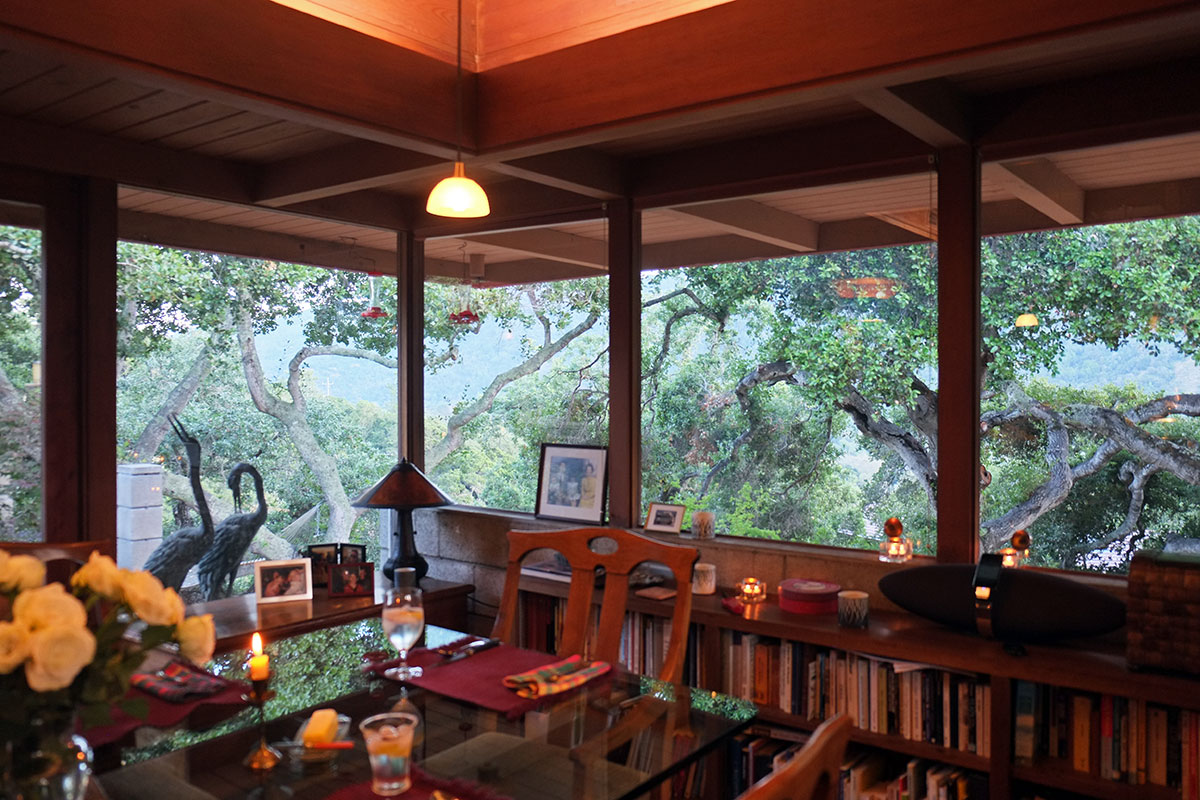
Brian retired about eight years ago, and Beth splits her time between working in the San Francisco office (and a small apartment in the Marina), and her home office in the backyard of their house in Carmel Valley. The house is spectacular – everything an iconic California house should be (even if the driveway did present the most extreme trailer-backing challenge of the trip, with an S-curve overlaid on two compound diagonal slopes with a gate in the middle).DSCF0824

It is built of concrete block, wood and glass, designed by Mark Mills, an employee of FL Wright’s who moved to Carmel to superintend the construction of the famous FLW house on the water, and then stayed on to start his own career. The detailing, materials, spaces, sequences and views out to the oak savannah hillside are amazing. Even more amazing is what Brian and Beth have done to restore it – when they bought it, there was wall-to-wall carpeting on the concrete slab floors, and three levels of window treatments obscuring the views. I am an incredible stickler when it comes to design decisions and workmanship in a project like this, but the work, which Brian has largely done himself, is sympathetic to the original design and impeccable. One bathroom, which Brian gut-remodeled with stone and a large skylight, beats out the campground in Apalachicola for our award for the most beautiful bathroom of the trip.

We had a wonderful time staying with Beth and Brian, in a beautiful environment where we felt at home and very comfortable, after months mainly spent in a tiny trailer. There were a few long, talk-filled dinners, including one where they had invited their lovely friends Kate and Richard, who had heard about our trip and wanted to meet us. It was great to see how good their life is, with a happy marriage and interesting careers, in a beautiful place surrounded by friends.

Brian didn’t know whether Greta had heard about our past history, so he was planning on being circumspect, until Beth told him it was okay. Beth and Brian now have two granddaughters, so they are well-attuned to teenage girls, and they and Greta hit it off instantly. As has happened before on this trip, I was pleased to see Greta make a good impression and acquire another surrogate aunt and uncle. For myself, it was wonderful to reconnect in a friendship with Beth that has lasted over half of our lives, and to spend enough time with Brian to figure out that we are now friends too.

The Promised Land

108. Carmel002DSCF0779

After two months in the desert, it was hard to believe that this scene was real.

California is the mythic landscape of America. Before we are even conscious of it as a real place, its landscapes and views and cities are implanted in our brains through movies and television. It has been such a magical place in our mass culture for so long, and through so many different versions, that it’s sometimes hard to remember it is actual.

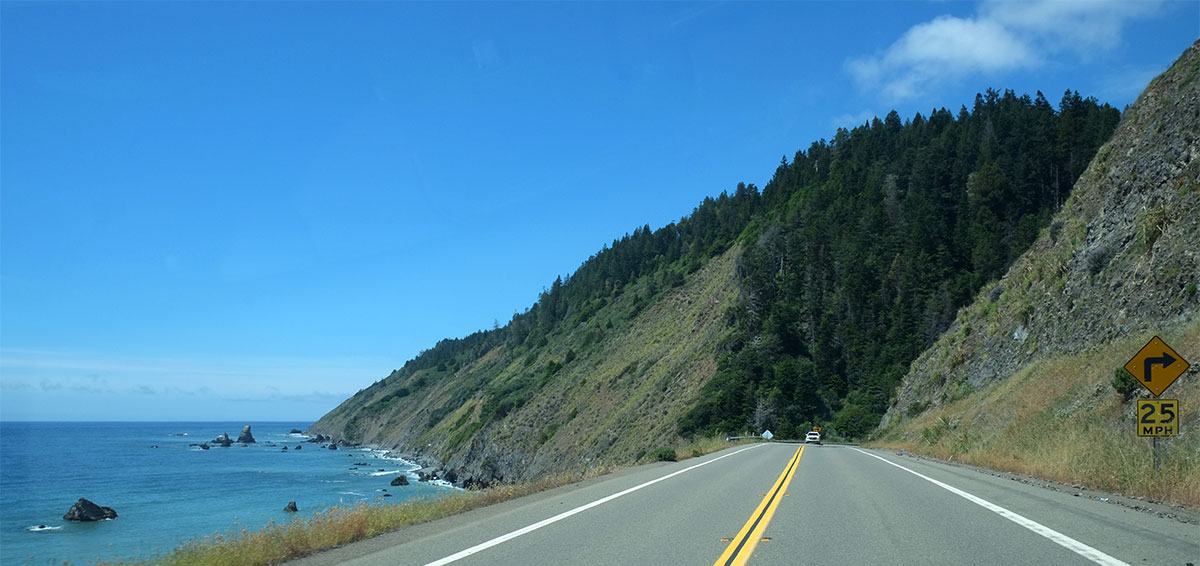
The first time I travelled to California was on the road trip with Norman and Dan after college. We drove down the Oregon coast and through Humboldt County (which is really Baja Oregon), then cut inland on 101 around the Lost Coast. At the first opportunity we got onto Highway 1, threaded our way through the coastal range (on what I can now reconfirm is indeed the twistiest highway in America), and returned to the Pacific Ocean, emerging from the hills and woods at this point:DSCF1837

I thought I was home. It was the most beautiful landscape I’d ever seen, even better than the imagery in the movies. Research in landscape preference has shown that for almost all people, no matter where they’re from, the two favorite landscape elements are water and savannah. Oregon had its awesome cliffs, but this landscape was more deeply appealing, a landscape where humans could imagine themselves dwelling, similar to the canyon oases in the desert. (Vancouver had a similar reaction to the landscape around Pt. Townsend on the Olympic Peninsula – the wild landscape seemed to embody the pastoral ideal, and was more welcoming than the alpine terrors of Desolation Sound.)

In later years, California maintained this magical aspect for me. I’d fly in from wintry New York on a business trip, and be met by friends in shirtsleeves who offered the options of wandering around San Francisco or driving up Mt. Tamalpais. When I moved to Oregon, suddenly California was just a day’s drive away, and I had some time to explore more of the vast landscape. Six years ago, Linda and Greta and I had spent two weeks of spring break driving around northern California, which was the best trip of my life, and the first time the then eight-year-old really got into travelling.

This landscape would be the penultimate destination on our trip this year – we had driven east until we ran into the Atlantic on Cape Cod, then south until we got to the Gulf of Mexico in southern Florida, then we were going to drive west until we hit the Pacific, at which point we’d turn north for home.

But first we had to get there. We didn’t finish our southwestern wanderings as we had originally anticipated, at Las Vegas – as we circled back and around, avoiding the wintry April weather on the Colorado Plateau, we’d ended up at Mesa Verde, 1000 miles from the Pacific. And while all our previous entries into California had been from an airport or from the north, this one meant driving across a succession of deserts almost all the way – a very different trajectory from which to approach California, but one that was probably closer to that of most historical visitors and migrants.

We plotted several routes, and had hoped to spend a little time in Death Valley, but the weather was already too hot in May, and with its proximity to the population centers of California, campgrounds had been booked solid way in advance. We also realized we had had enough desert for a while – we’d save Death Valley for a winter trip in a later year, when the ultimate desert experience could be better appreciated by soggy Oregonians. We tried to plot out an itinerary that would lead us by Sequoia and Yosemite, but the late winter conditions in the Sierras made that iffy, and the campground situation at Yosemite was even more ridiculous; our play-it-by-ear approach to this trip doesn’t mesh well with how most Americans plot out their vacations. So we chose a reasonably direct route west, one that would allow us to revisit some spots Greta had loved – the campground at Lake Powell with its jackrabbits, Oscar’s restaurant outside Zion – as well as some inevitable locations that are on no one’s bucket list, such as Bakersfield.

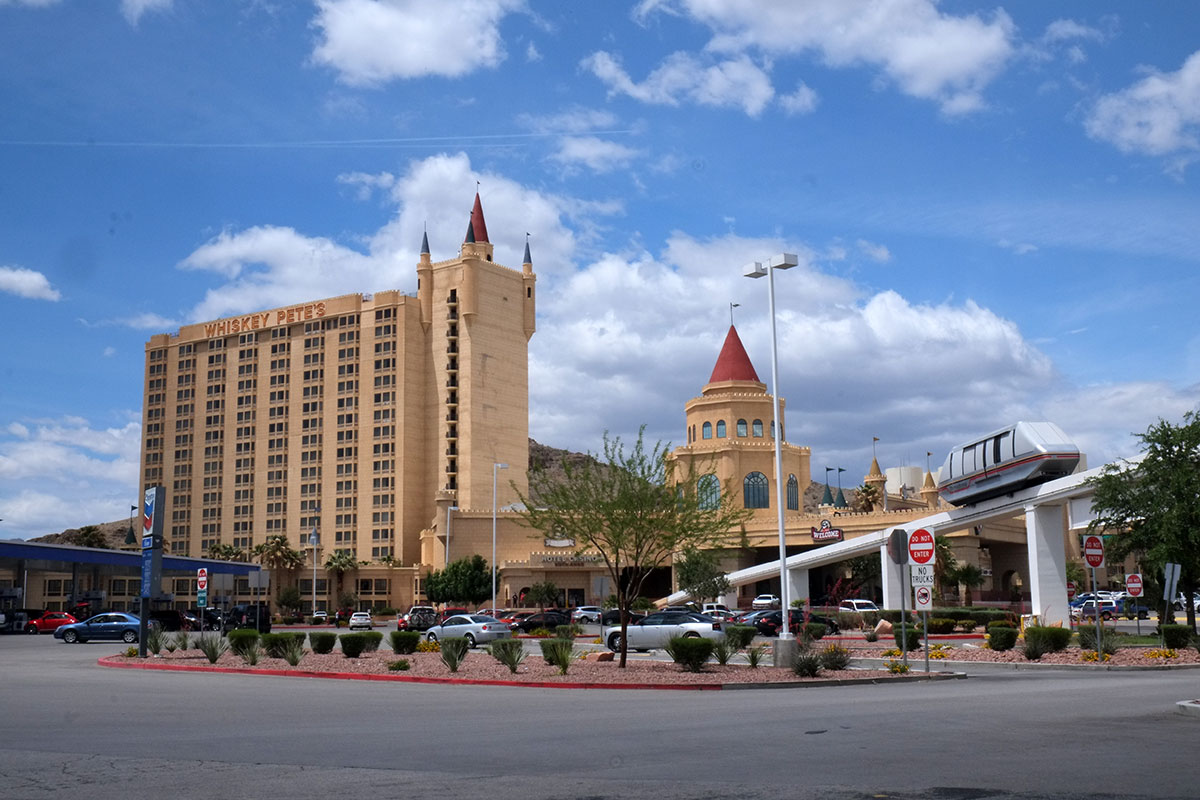
Things went well until we left Lake Mead to head into the Mojave Desert. We stopped for a bite in Primm, Nevada, which is really just a couple of casinos and an outlet mall located on the California border, a place so horrifying and soul-deadening that it makes you regret every decision you’ve made in your life that caused you to end up there.DSCF0589

Glad to be leaving this tawdry corner of Nevada, we slapped in the appropriate Joni Mitchell CD as we crossed the border, and entered the 36th state of our trip. We were in California, one of our favorite places, and there were giant solar collector farms on the side of the highway, harbingers of the progressive region where we belonged!

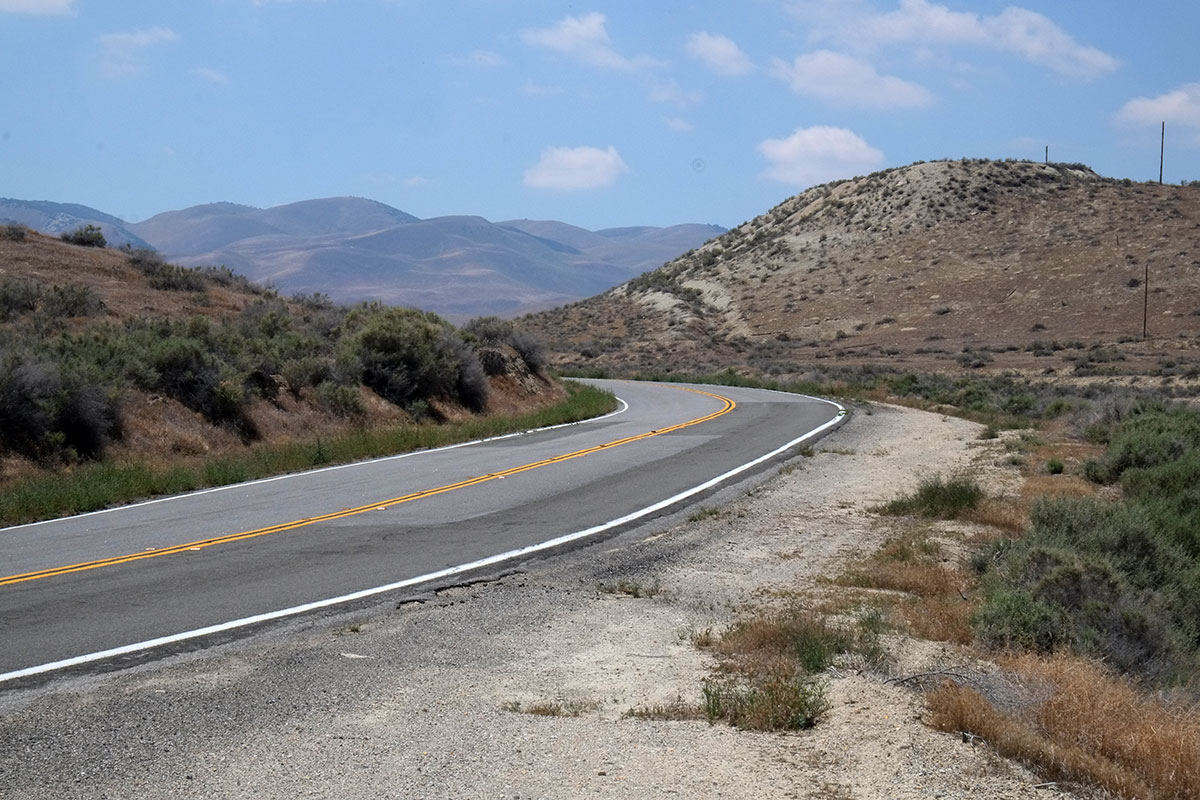
But once across the border, a different aspect of California emerged. We encountered the worst traffic jam of the whole trip, 100 miles of bumper-to-bumper driving across the Mojave, until Barstow, where the Angelenos turned south to go home. (When we eventually reached San Luis Obispo, Brian paled when he heard that we’d tried to drive west from Las Vegas on a Sunday afternoon.) We continued towards Bakersfield on Route 58, in a semi-industrialized desert landscape (mines and air bases) that rivaled the west Texas area around Pecos for Most Unpleasant Landscape of the trip. Then twelve miles west of Boron, we blew a tire on the truck (doubtless caused by the residual minimalist art juju from seeing Double Negative the day before). I changed the tire only to discover that the spare was too low on air to use, so we spent a couple of hours making phone calls, finally convincing some guys from a tire store to drive out and pump it up for us. We limped into Bakersfield quite late.

The next morning, I stepped out of the trailer right next to a rotting orange on the ground. I was surprised to see this garbage in what had seemed to be a rather well-groomed campground. Then as I walked to the bathroom, I spotted more oranges lying around. I looked up, and realized the campground was in an orange grove. In the dark we had crossed out of the Mojave and into the Central Valley, one of the places where human intention has had the most extreme effect upon the environment, turning an arid valley into the major food-producing region of the country. We knew that this was an artificial creation, and the Central Valley was on our checklist for the Climate Change Farewell Tour, as in the next century it will most likely be radically transformed by aquifer salinization, mega-drought and climate change. But at that moment, after two months in the arid Southwest, the orange grove looked pretty good.

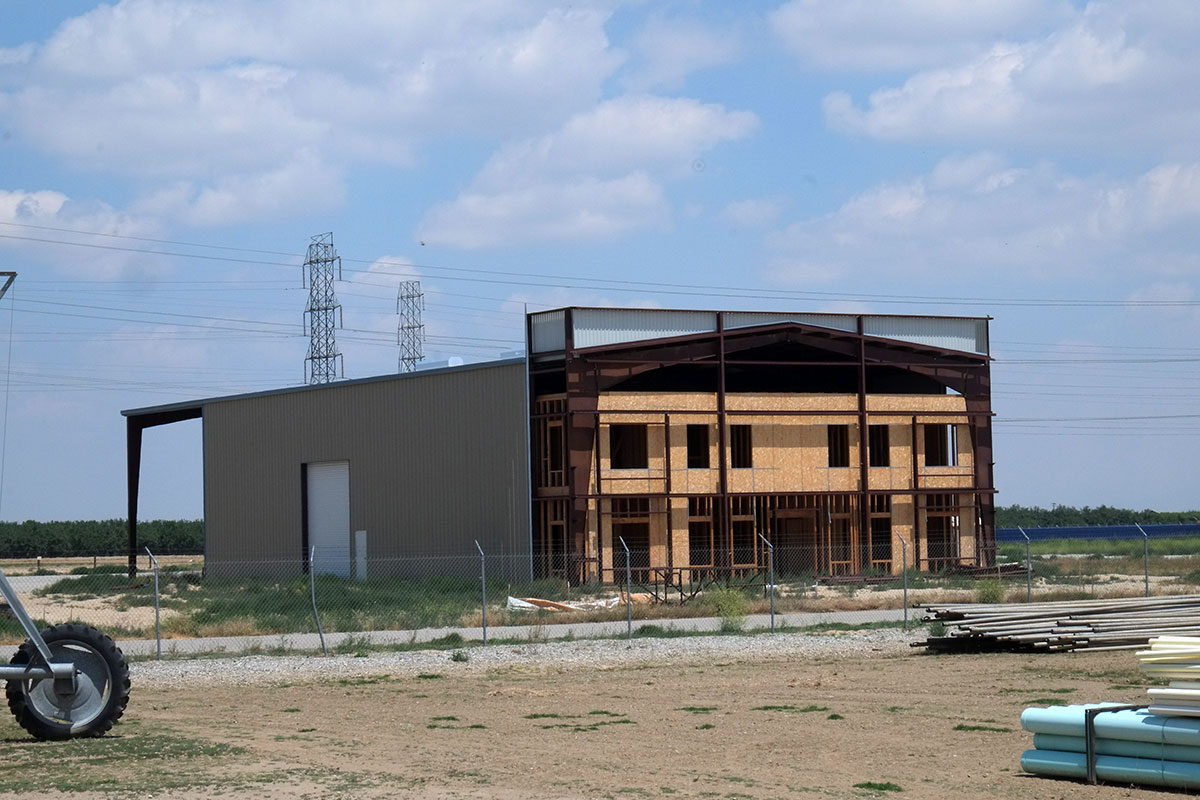
We drove under I-5, and realized we’d hit the bail-out point – for the first time in eight months, if we wanted to head home, it was just one long day’s drive away.  We spent the morning driving through the agricultural area, vast orchards of almond trees, and some of the strangest buildings we’d seen. DSCF0600

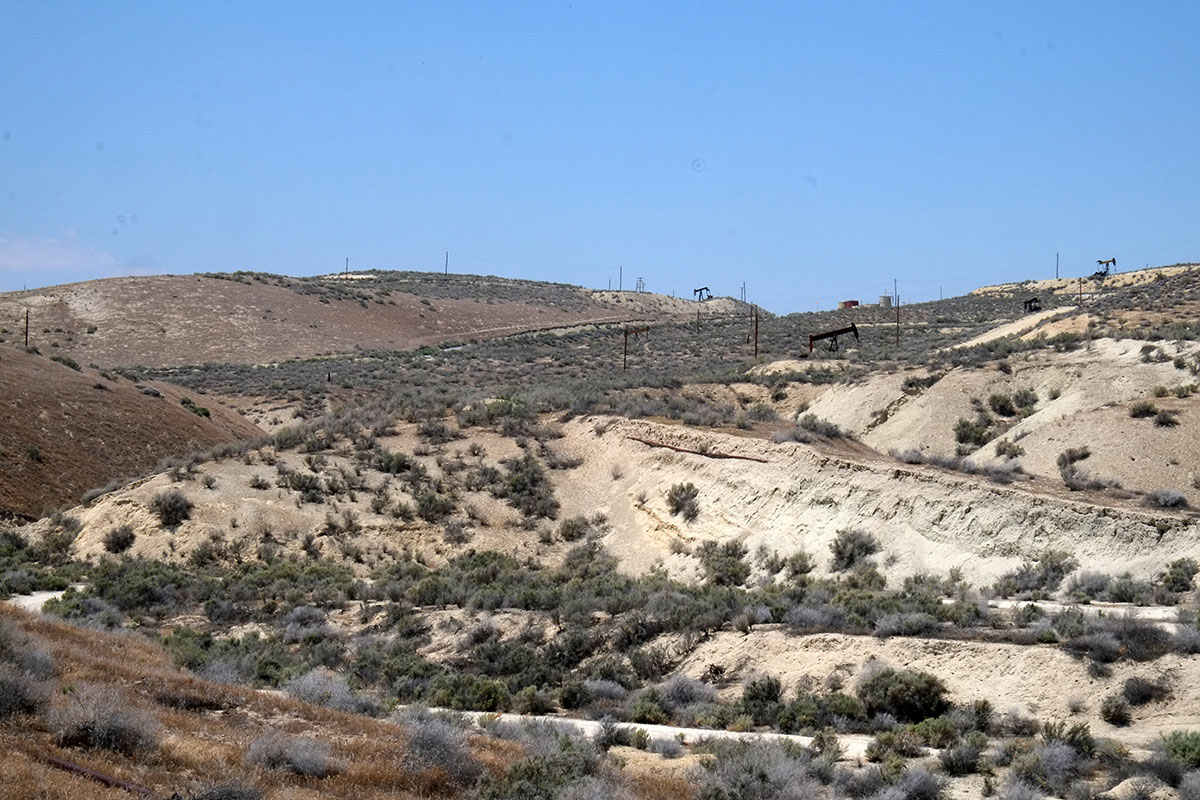
The highway climbed out of the valley, passing through a low-level petro-landscape (another part of California we lose sight of). The only other vehicles we passed were white pickups driven by guys working for oil or utility companies.DSCF0602

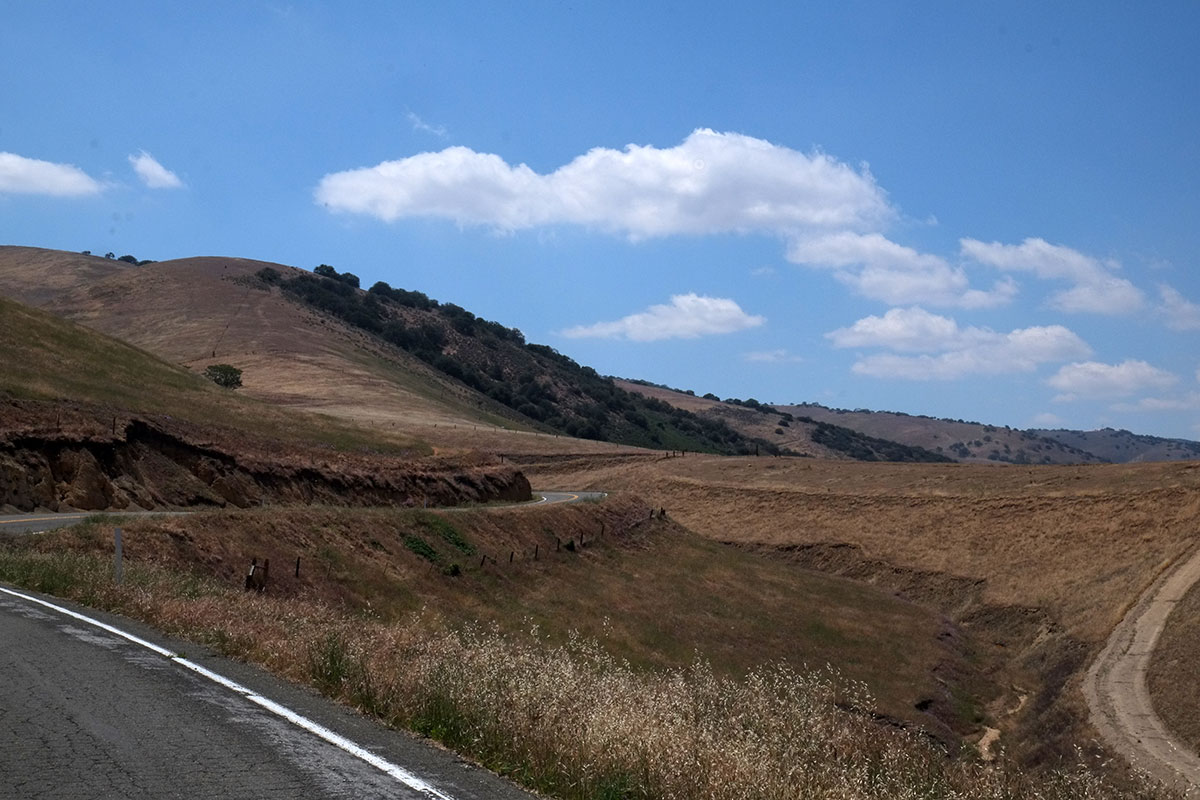
Finally, in the distance we could see hills covered with grasslands,DSCF0603

and even some trees.DSCF0611

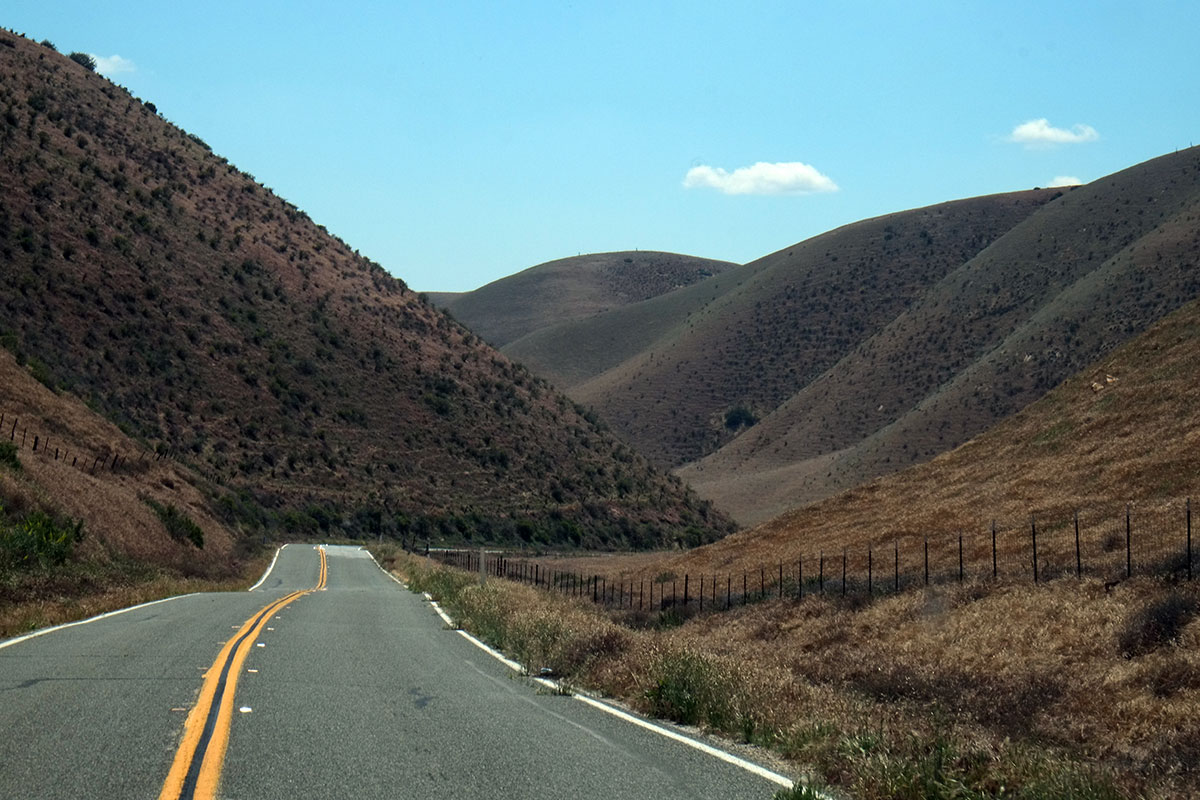
After the jagged slickrock canyons of the Southwest, this valley of gentle hills with grazing cattle was surreal – it looked like an illustration in a children’s book. Coming out of the desert, even this semi-arid landscape felt lush, a place where you could let down your guard and not worry that the environment had it in for you personally. We wondered about the feelings of the migrants coming into California this way, the Dust Bowl refugees spotting the first sign of the coast that lay ahead.DSCF0612

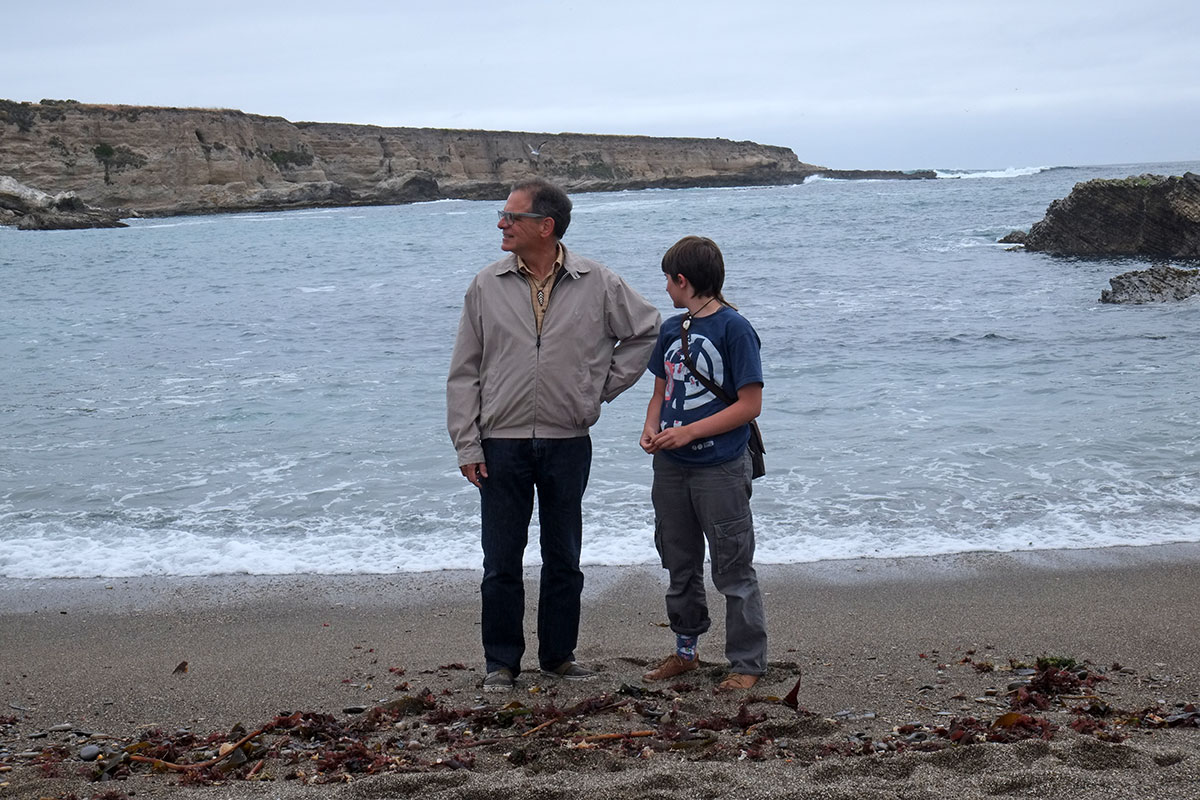
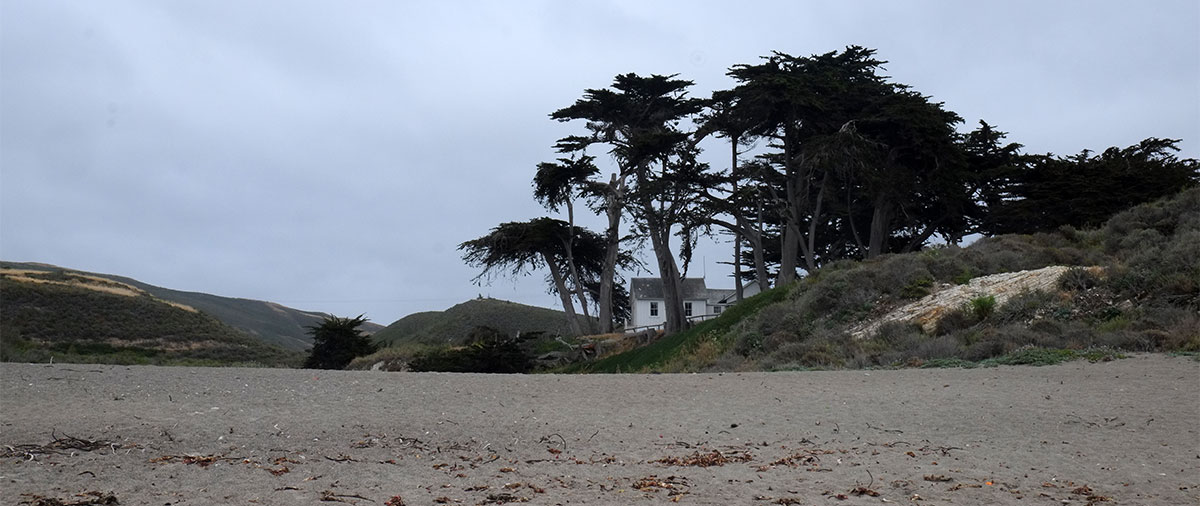
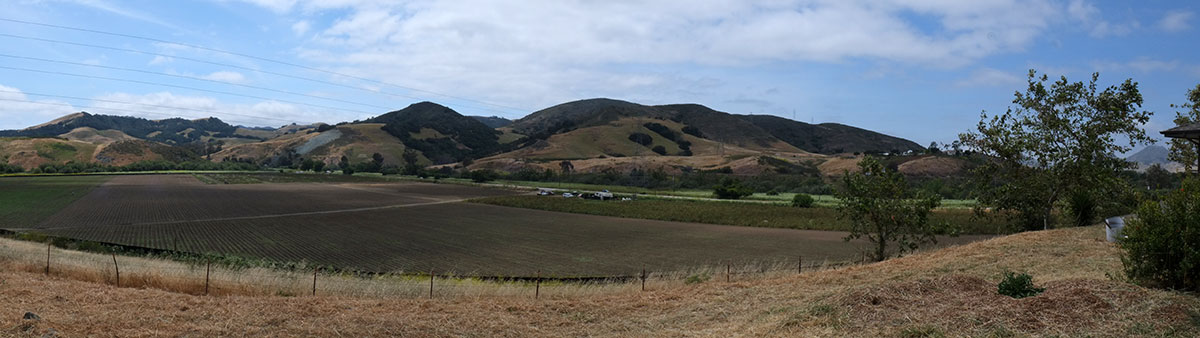
We crossed the hills into San Luis Obispo, and the next day Brian and Karen drove us to the Pacific. At Montaña de Oro State Park, we reached the ocean,105. San Luis Obispo002DSCF0622

and explored on a beach covered with small rocks which had had holes bored in them by piddocks , and which Greta realized would make excellent necklaces.DSCF0627

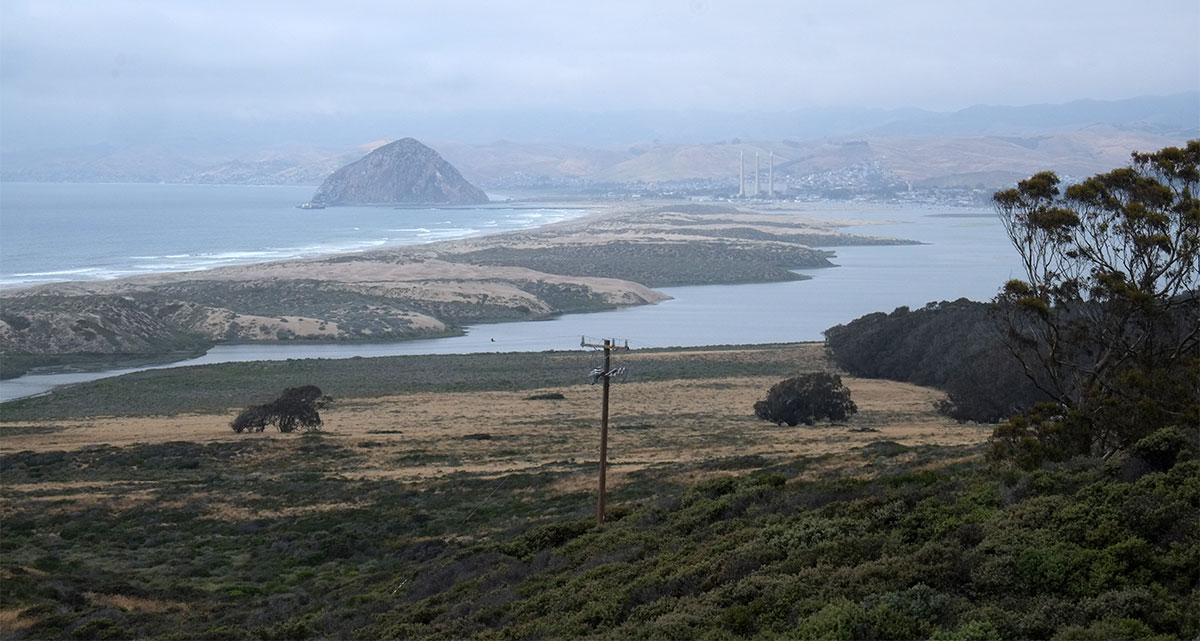
At Morro Bay, our first glimpse of the misty, overcast coast. It seemed so familiar to us, and we realized that coming home is a series of recognitions. We are so used to airplanes – where we travel great distances and pop out into a different world – that we think of returning as something that happens all at once. But when you travel great distances on land at a slower speed, there are incremental changes in the environment, each of which triggers a reaction, filling in pieces of the picture that you eventually recognize as home. Even though we were still 1100 miles from Eugene, this was the first place in eight months that fell within the outer circle of home, the first place that we felt was ours.105. San Luis Obispo003DSCF0632

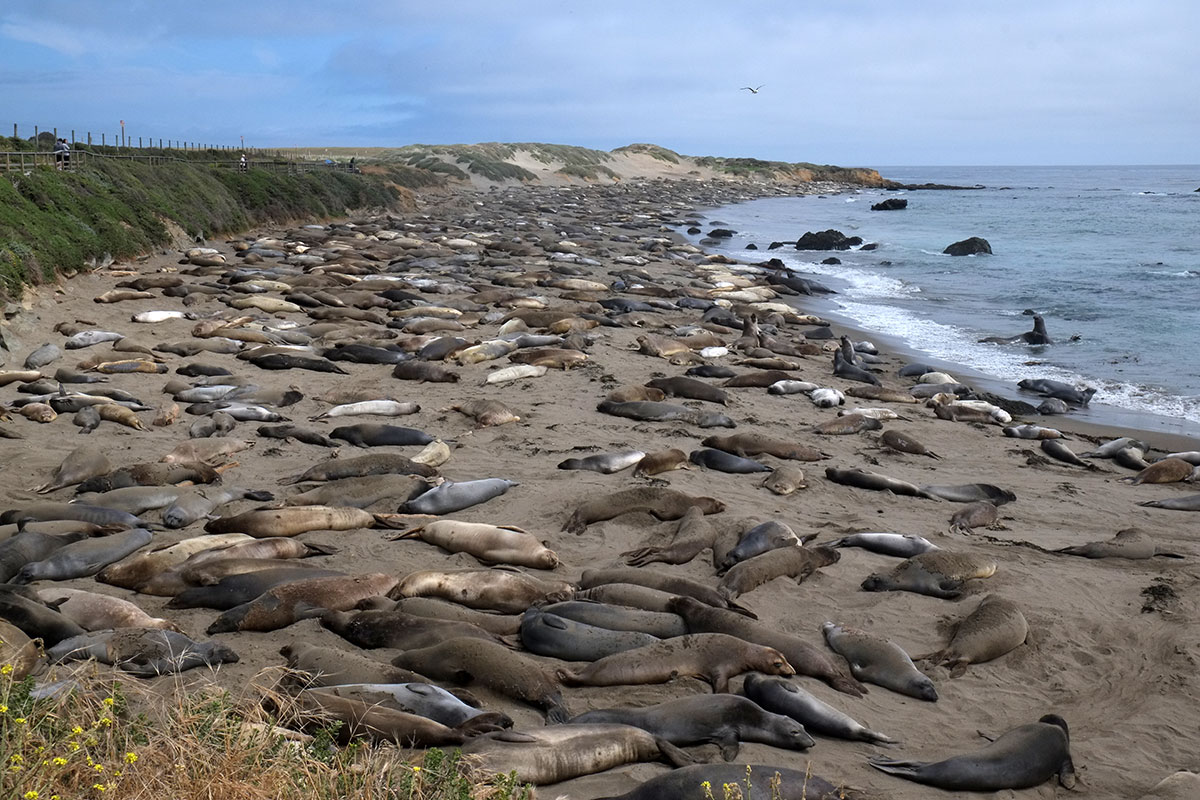
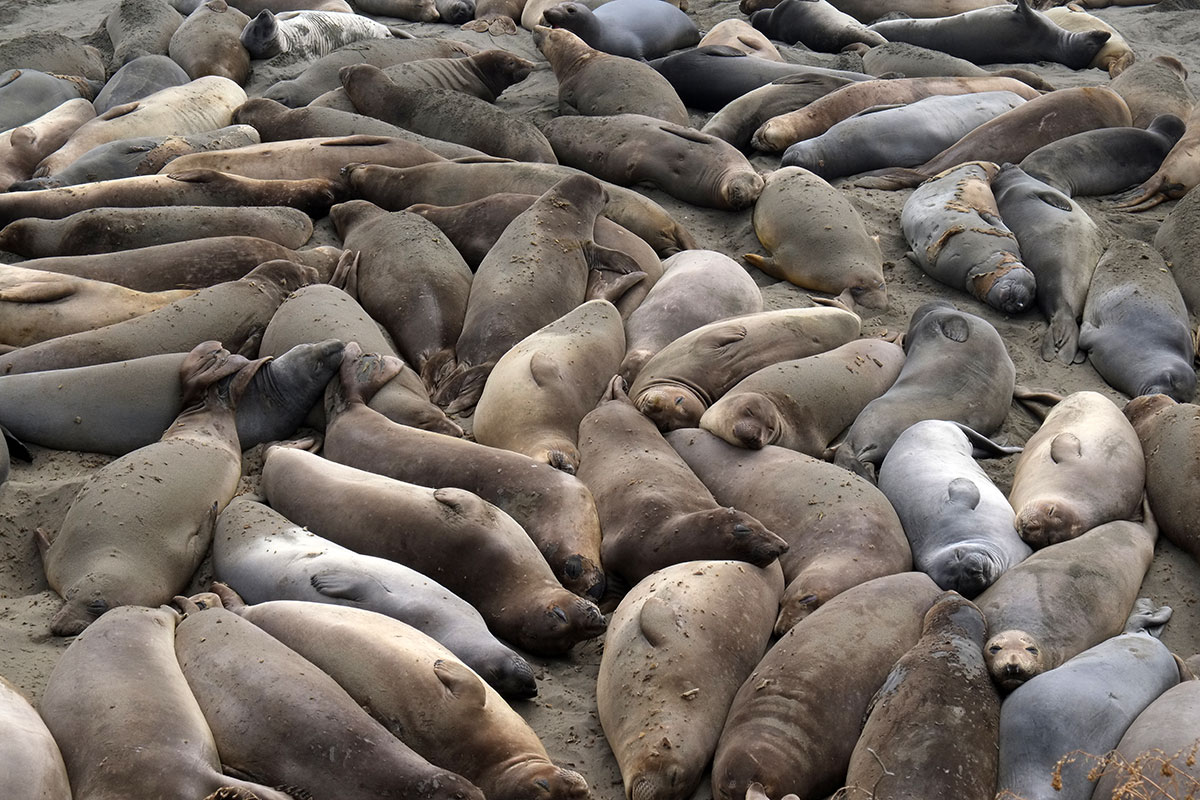
After a few days we headed north, to the elephant seal beach at San Simeon. Sea mammals, another familiar piece – although there were a lot more of them and they were all much bigger than we are used to in the Northwest.106. Coast050DSCF0651

106. Coast051DSCF0654

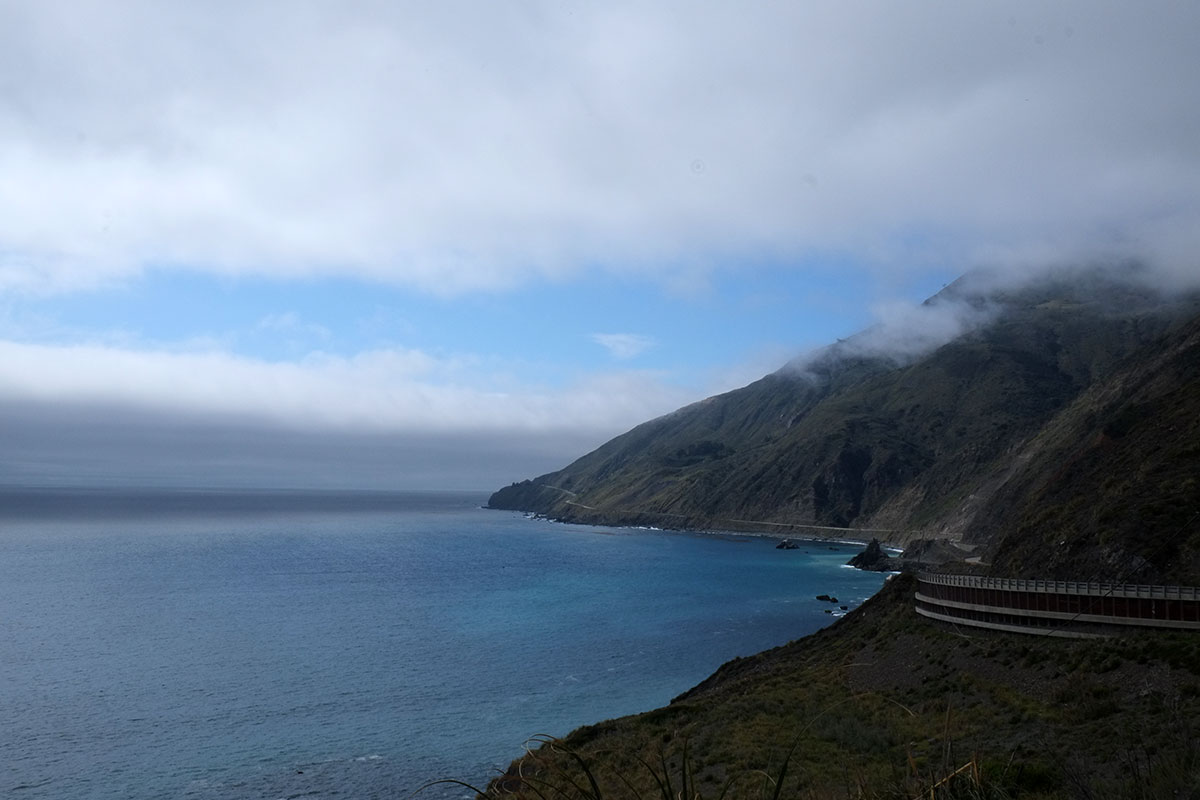
Big Sur, on an overcast day, had a different quality than we’d experienced on previous trips, but still astounding. After the washboard dirt roads of the Southwest, seeing such a smooth asphalt highway built in such impossible terrain was incredible; this must be a very rich place, we thought. We had just spent so much time in spectacular southwestern desert landscapes that we had a heightened awareness of both the contrasts and similarities – the landforms, the scale, the water, the sky, the vegetation, the humidity, the road itself. We wondered what the Hopi teenager we had met would make of this.106. Coast052DSCF0655

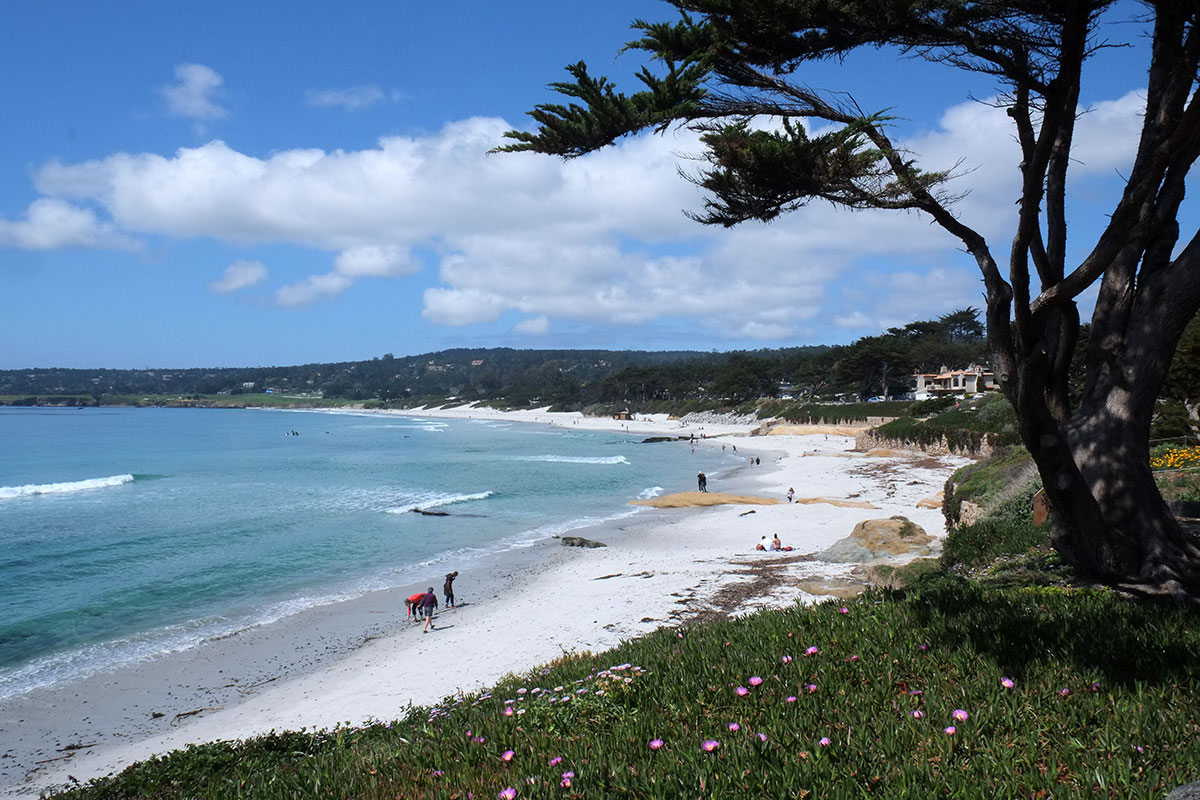
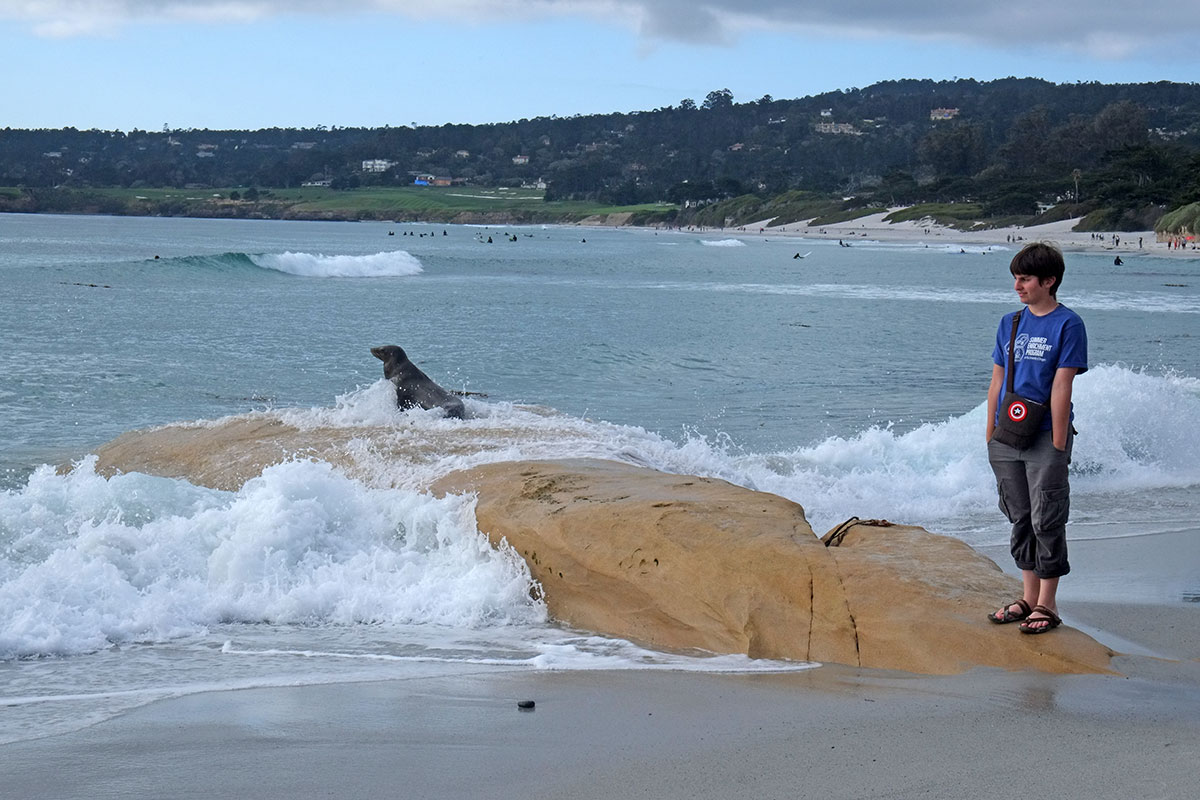
And at the end of Big Sur, the beach at Carmel. With the absence of cliffs, we were able to recognize this place as the antithesis of the southwestern desert in every way. Our acclimatization for the past week had been gradual, but here it hit us with full force. This was the promised land at the end of the road. Greta and I just sat and stared, not quite able to process the reality, beauty and meaning of such a place. Rob Peña and I used to talk about whether you could ever feel truly at home in a landscape that was completely unlike that where you had grown up, whether certain landscapes were imprinted on your brain. As he had grown up in Los Alamos, he feels at home in the Southwest in a way we never can. Greta and I had loved the desert, but it could only ever be as a visitor – it would never feel like home to us. Although I had grown up in the Northeast, there were enough common elements here – ocean, sky, beach, trees – that it felt familiar, and for Greta it was even closer to her ideal (although perhaps a bit too sunny).DSCF0769

We luxuriated in this benign environment, where the local wildlife isn’t something that can kill you, but instead is happy to pose for a photo. There’s a reason why California is the fabled land of America, why it was irresistible to so many people in the past century; we were almost giddy with its attractiveness. We wondered why, if this place actually exists, people live in places like Phoenix instead of here. And then we looked around Carmel and said, Oh yeah, you can’t afford to live here.108. Carmel003DSCF0802

Monterey Bay Aquarium

P1090708
P1090695
P1090694
P1090689
P1090684
P1090655
When I was little, my dad recorded Nature videos for me, including one about Monterey Bay. Having watched it a million times, I’m rather knowledgeable, and only a little obsessed.

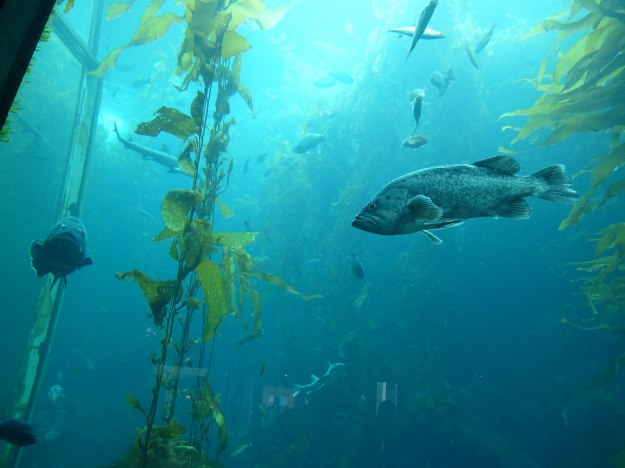
The most unique exhibit is the kelp forest. Kelp, thirty or more feet tall and capable of growing a foot a day in optimum conditions, is notoriously hard to keep, needing a constant supply of seawater. To combat this, they designed and installed a giant pump that continuously pushes water through the exhibit. P1090616
On the way out, it also goes through the tidal exhibits, and over the big tunnel that kids love to scream in.P1090651

The shark and tuna exhibit had the largest single pane of aquarium glass in the world until it was topped by one in Japan. Then that broke, raining broken glass and sharks down on onlookers, and the one in Monterey Bay was back to being the largest. Sitting there in front of that giant portal into another world, I was struck by how large tuna can grow, unconstrained by gravity. They were much larger than the sharks, although they didn’t look as funny as the hammerheads, or even this baby leopard shark.P1090741

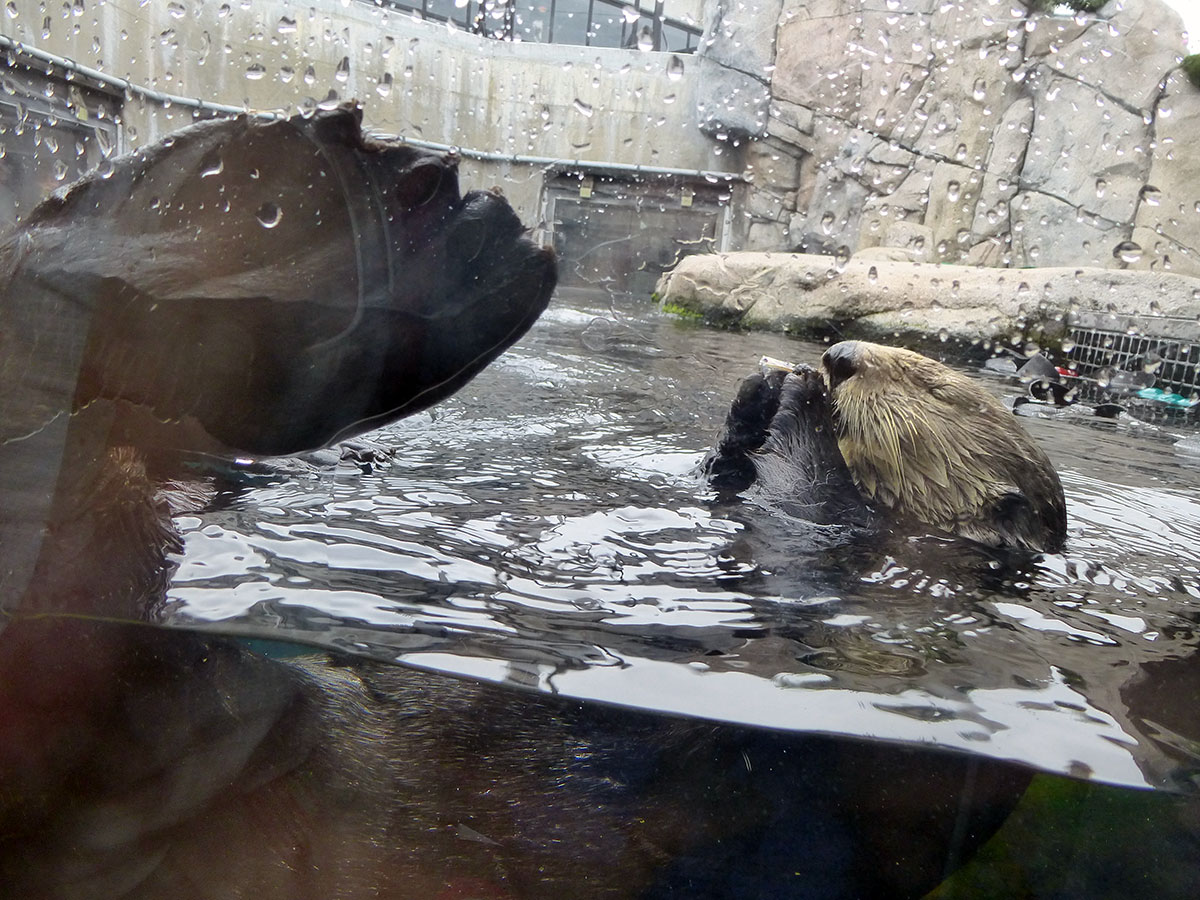
I was honestly less impressed with their jellyfish. Monterey Bay was the first aquarium to learn how to cultivate and display jellies, but they didn’t have the same variety as the special exhibit in Baltimore. That being said, the sea nettles were as beautifully backlit as always. P1090794The famous sea otters were the central exhibit, the first thing you see when you walk under the fiberglass orcas hanging from the ceiling. The four females, Rosa, Abby, Kit, and Gidget, frolic under the awed gaze of visitors. Their fur, thickest in the world with over a million hairs per square inch, more than humans have on our entire bodies, keeps them dry in the cold water, but without blubber, they still have to eat up to a quarter of their body weight each day to stay warm. I’d highly recommend going to watch when they’re fed, but if you want a good view, get there at least five minutes before the scheduled time.P1090771

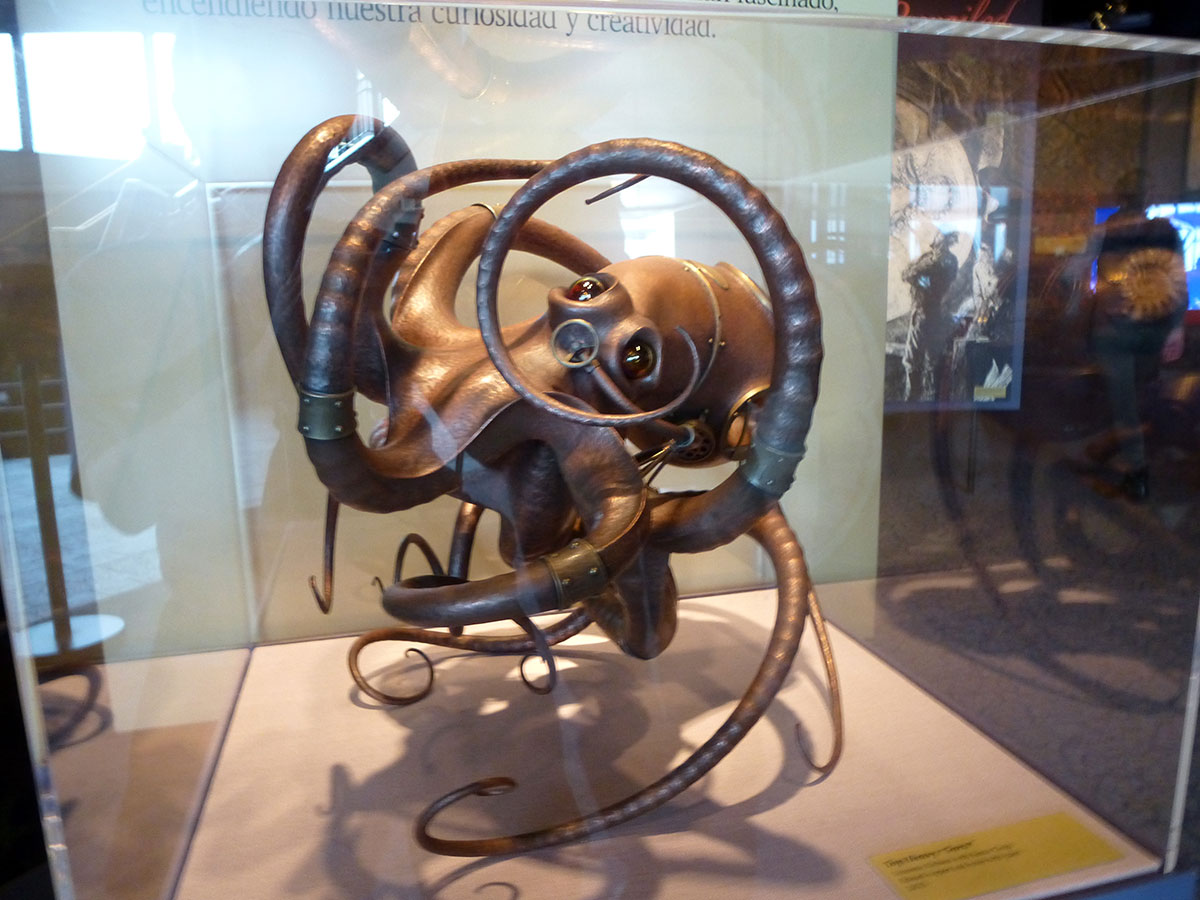
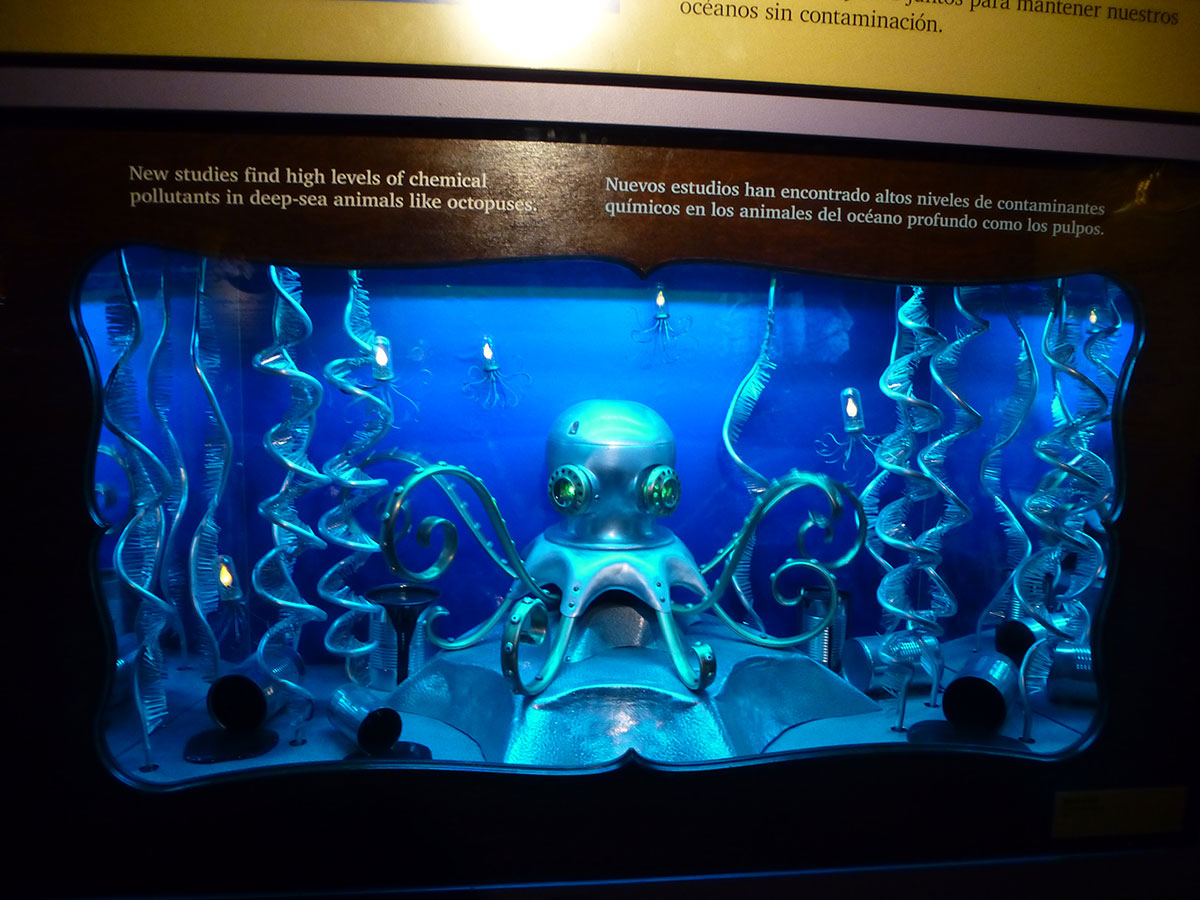
Despite their adorability, they weren’t my favorite exhibit. Once again, a temporary show takes the cake; Tentacles, the cephalopods. In the kelp forest area, the aquarium had two giant pacific octopodes (It isn’t octopi. That’s the Latin pluralization, and the word is Greek.), who weren’t hiding in some crevice for once, were cool, but paled in comparison to the variety of this exhibit. As well as the creatures themselves, it had art featuring the charismatic molluscs, including a drawing of the infamous ship-eating Kraken, painted octopus pots dating back to the twelfth century, and, personal favorite, an octopus shaped diving helmet.P1090817As cool as that was though, as soon as I spotted the squid tank at the end of the hall, I was lost to the air-breathing world. The only real squid I’d seen before were either dissected in fifth grade, or fried and delicious. Out of its class, squid are the masters of mobility. Streamlined bodies allow great speeds through the simple act of siphoning air in and shooting it back out into the ocean. There was even a fake tank where you could pump a handle and make a model squid spin around.P1090824

Nautiluses, the only shelled cehpalopod, haven’t changed much since the days when they were called ammonites. Large eyes allow them to see in the low light of the twilight zone, where they spend the daylight hours. At night, some ascend to the upper levels of the ocean, filling the pockets in their shell with air so they bob upward, and no one really knows why. Cephalopods are a mysterious group.P1090849

Octopuses (the most common and also correct pronunciation) are revered for their brains and their escape artist abilities. Sadly, I was not witness to any of this. My disappointment was lightened by the mimic octopus, whose long limbs and chromatophores allow it to disguise itself as almost any animal. Once again though, I was not privy to the octopuses’ secrets.P1090840Screen-Shot-2016-05-14-at-9.35.50-AM
P1090843

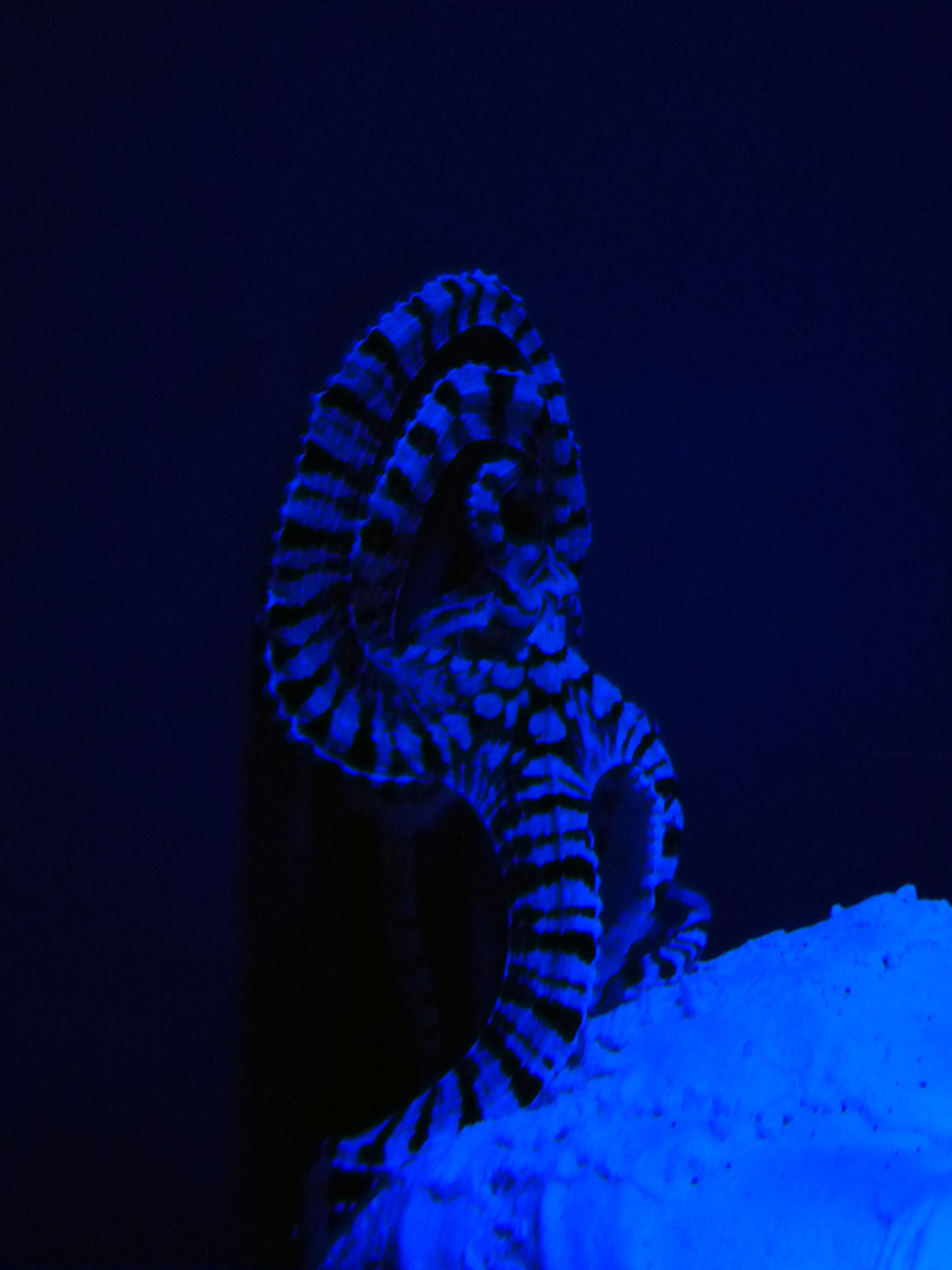
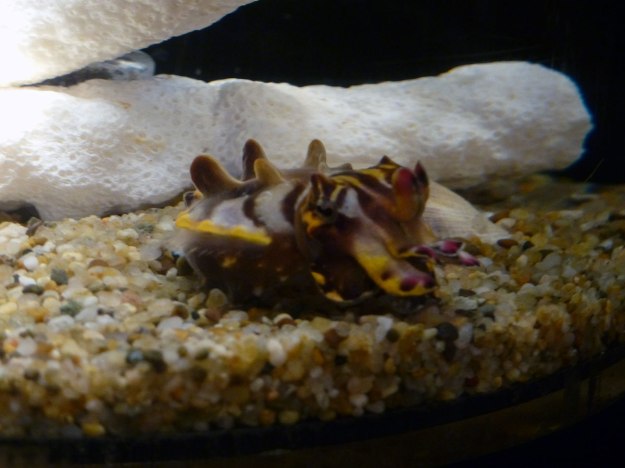
The cuttlefish though were proud to show off. Especially the appropriately-named flamboyants. Rainbow zebra stripes raced down their bodies from their mantle towards their rather stubby but no less colorful arms. P1090852Their eyes only added to the alien qualities, W-shaped pupils observing us as they wait patiently for the takeover. P1090867Flashing patterns can be used for communication, as well as hiding from predators andstunning potential prey, so it isn’t unreasonable to assume that cephalopods have an ocean-spanning network of spies and soldiers waiting to swarm into our cities when they flood.The most interesting things in the world are often also some of the scariest, and these ancient, plotting, shapeshifting buglers who can grow to enormous sizes are no exception. It’s no wonder to me that sailors feared the Kraken.

Even if the cephalopods have moved on by the time you go, don’t miss the Monterey Bay Aquarium if you’re ever in the area. Tickets are expensive, but for good reason. A single sea otter eats $15,000 worth of seafood every year, and the other exhibits aren’t cheap to maintain either. Don’t miss out on anything this aquarium has to offer, from otters to touch pools to penguins and octopuses and beyond.

Corkscrew

In my experience at least, Carmel Valley is prettier, less pretentious, and has better food than Carmel-by-the-Sea, although that macaroon we got after walking on the beach was delicious.  Despite its name, there is much more than wine to be enjoyed at Corkscrew.  A waiter greeted us while we were still admiring the brick pizza oven and the tantalizing aromas drifting out of it.  The best way to keep a customer, they seem to have found out, is to make your restaurant smell too good for them to even consider leaving.  Our table was by a bay window, from which we had views of both the green valley and the pizza oven door, which, for someone who likes being able to track their pizza like an impatient shopper will track an Amazon delivery, was a definite plus.

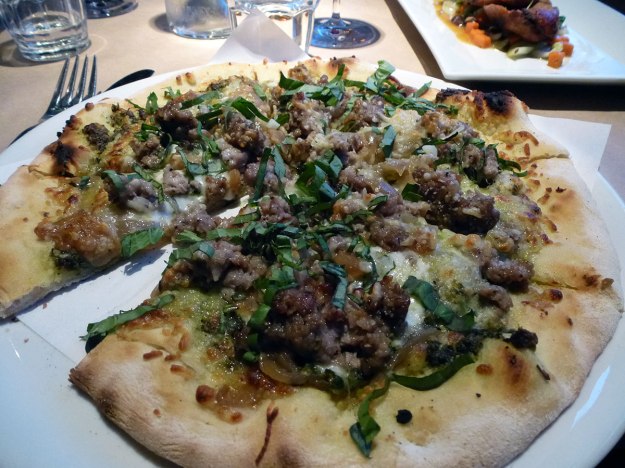
Pizza wasn’t the only thing on the menu, but for a teenager, there is really no other option.  And with ingredients like sausage, carmelized onions, and arugula, how could I resist?  The crust was crisp, and the meat flavorful, everything you want in a pizza.P1090888

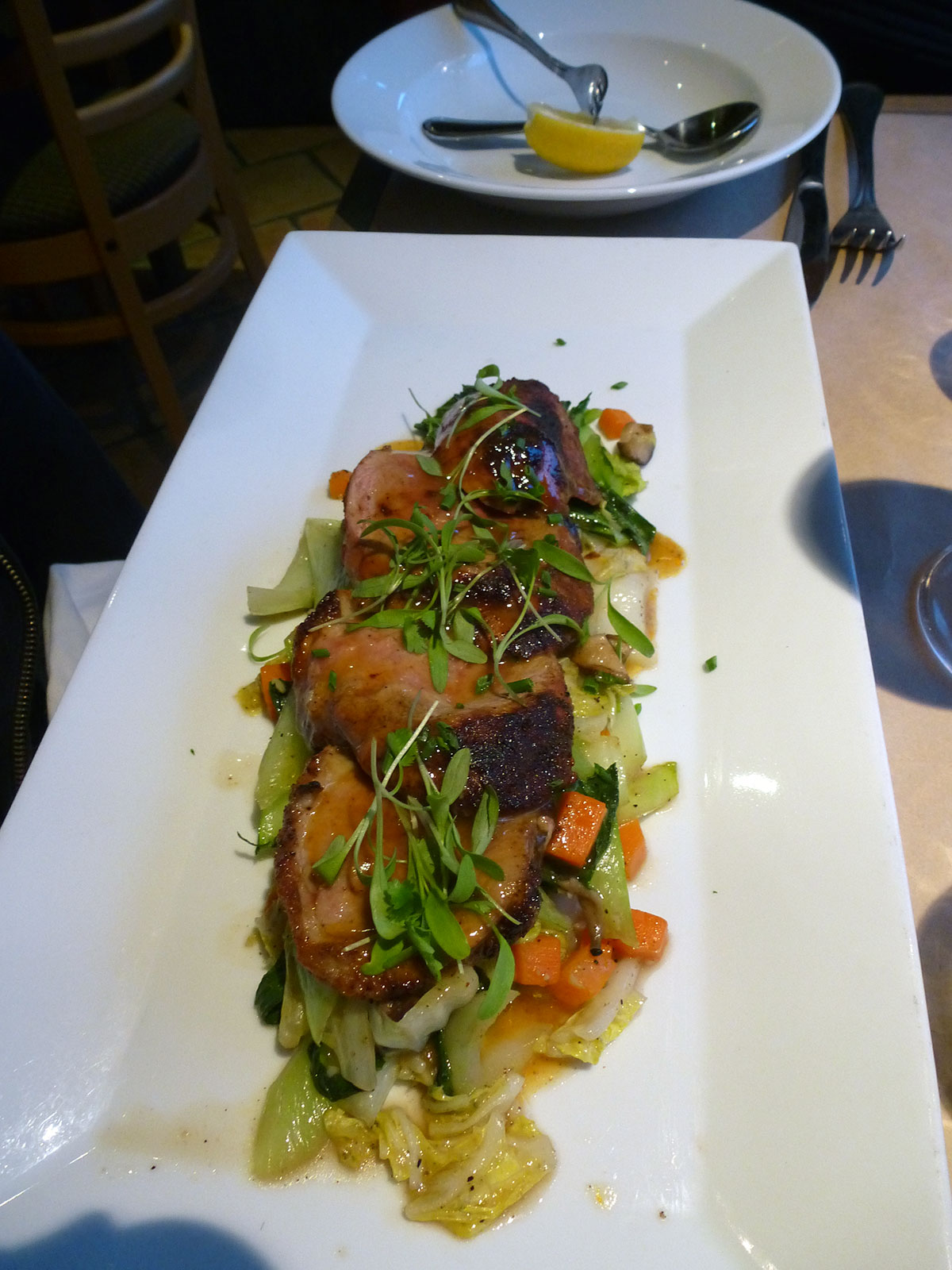
Two things I have learned to love on this trip: duck, and having a dad who lets me sample/devour some of his duck.  Smeared with a citrus glaze, which I’m finding is a common and good way to prepare it, it was deliciously moist and succulent. P1090887

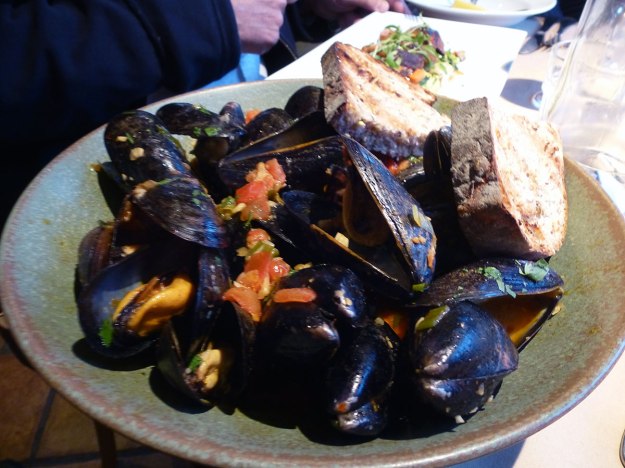
Despite being raised in Canada instead of Penn Cove, the mussels were fabulous. They were much larger than I was used to, but for their size they lost none of their flavor. Steamed and served in a simple broth with butter and garlic, much like we make them at home, they were delicious, and suffered little from being maybe not quite as fresh.P1090889

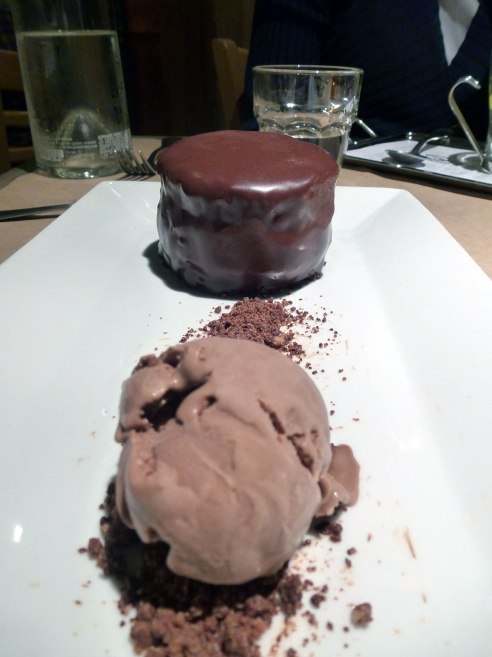
Our dessert experience was in no way undermined by already having had a slice of cafeteria chocolate cake at the aquarium for lunch.  I tried coffee ice cream for the first time in a few years, and actually liked it.  But the killer was this little tiny chocolate cake, smothered by more chocolate.  It somehow managed to be both rich and light and fluffy.P1090890

So if you’re in Carmel, don’t miss a drive down the valley.  And if you happen to be there around dinner time, well, now you know a good place to go.

Brian Leverich

105. San Luis Obispo005DSCF0646

The first Westerner I ever got to know was Brian Leverich. He lived down the hall from us in Hurlbut Hall, that “…dorm full of eccentrics, misfits and savants…” where I first encountered so many of my best college friends. Brian’s family was from Oklahoma, or Colorado, or some other vague place west of the Eastern Seaboard that I couldn’t quite place. Having spent my whole life in the New York metropolitan area, at first I couldn’t figure him out at all – he talked slowly and softly, with significant pauses, when you couldn’t tell if he was done speaking. In my world, talking in this manner was generally taken as an indication of mental deficiency, but after a little while hanging out with Brian, I realized that he was actually very smart, and often subtly funny. In retrospect, being friends with Brian was the beginning of the acculturation process that prepared me for marrying a woman from Kansas, and spending most of my adult life in Oregon.

The other weird thing about Brian was that he was a conservative, a Goldwater Republican. Even though I came from markedly Republican stock myself, this was the mid-1970s, at Harvard, where the acceptable range of Republicanism ran from the patrician Cabot Lodge pole to the liberal Edward Brooke end of the spectrum. I had never before met an actual, libertarian-leaning, Western Republican, and I began to suspect he might have fired a gun at some point in his life. But just as I came to understand his intellect, I also learned that his political beliefs were reasonable, in that they derived from reason, and not just a knee-jerk anti-gummint answer to every question in life. Brian didn’t unthinkingly parrot the beliefs of his tribe, in an era when dogmatic certainty was the norm. (Once, when I had the audacity to question some left-wing shibboleth in a letter to the Crimson, an angry response referred to me as the “Spiro Agnew of Harvard.”) Brian was comfortable and rational in his opinions, and enjoyed poking at the liberal verities with which he was surrounded.

Sophomore year we moved into different Houses, and saw each other intermittently throughout college, then completely lost touch afterwards. Brian continued his studies in engineering at Stanford, but after a few years there realized it wasn’t a good fit. However, while there he did meet his future wife, Karen Isaacson, who was also a grad student at Stanford, so those years were not wasted. Brian began a career which I can’t comprehend in detail, but it involved working as consultant on public policy / engineering-related issues (often defense policy), flitting in and out of the Rand Corporation, and at some point getting his PhD from the Rand Graduate School. These were the heady years of the Republican ascendancy, and Brian was there as the New World Order led to the End of History.

During this period, Karen had developed an interest in genealogy, and she and Brian were perfectly situated, as engineering nerds with a clear understanding of the potential of the emerging interwebs, to be among the first to see how genealogy could be brought into the modern world of technology. They were living in their little cabin up in the mountains of southern California, from where they were able to put their work up online. A major commercial genealogical venture, Ancestry.com, was developing at the same time, but Karen and Brian seemed to be able to do on their own just about what Ancestry was doing with a big company. Tired of the pesky little competitor, Ancestry bought out their company – Rootsweb.com – and Karen and Brian moved on.

105. San Luis Obispo004DSCF0635

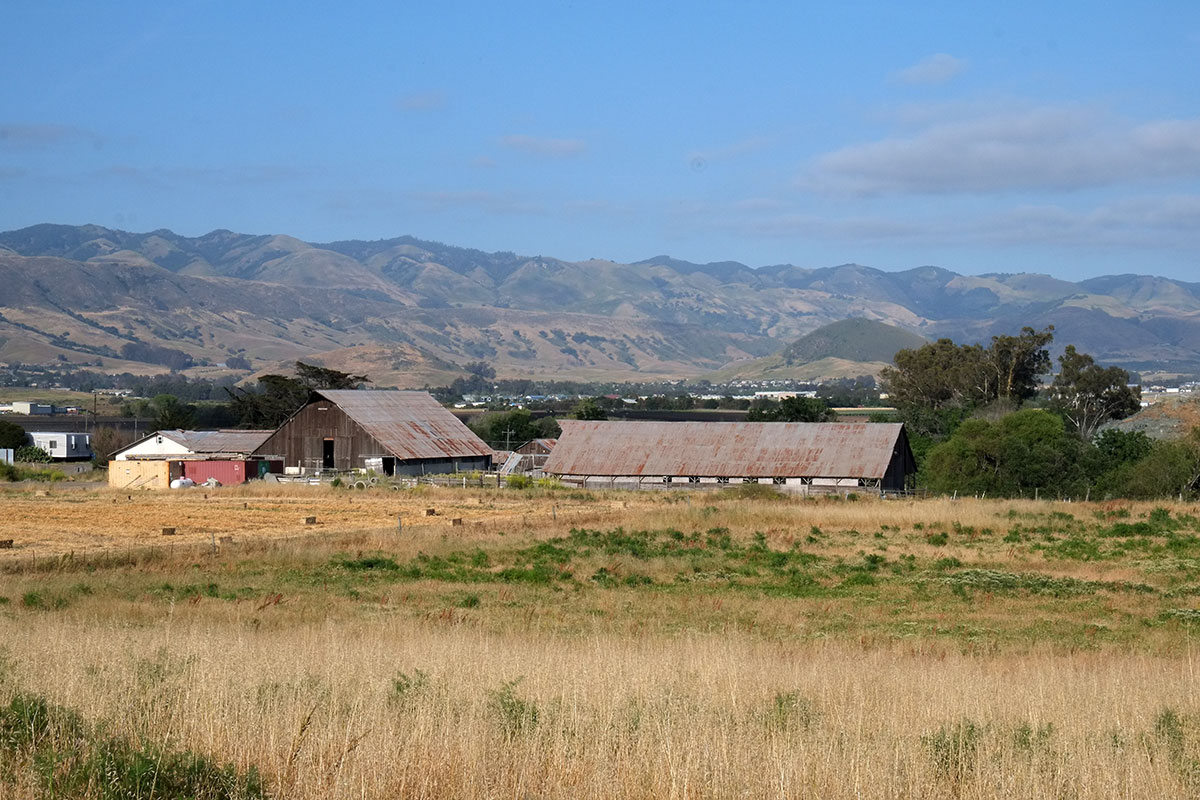
They eventually settled in San Luis Obispo, and a few years ago bought a fantastic place about two miles south of downtown. It sits up on a little ridge in the middle of farmland near the airport, with panoramic views in every direction.DSCF0617

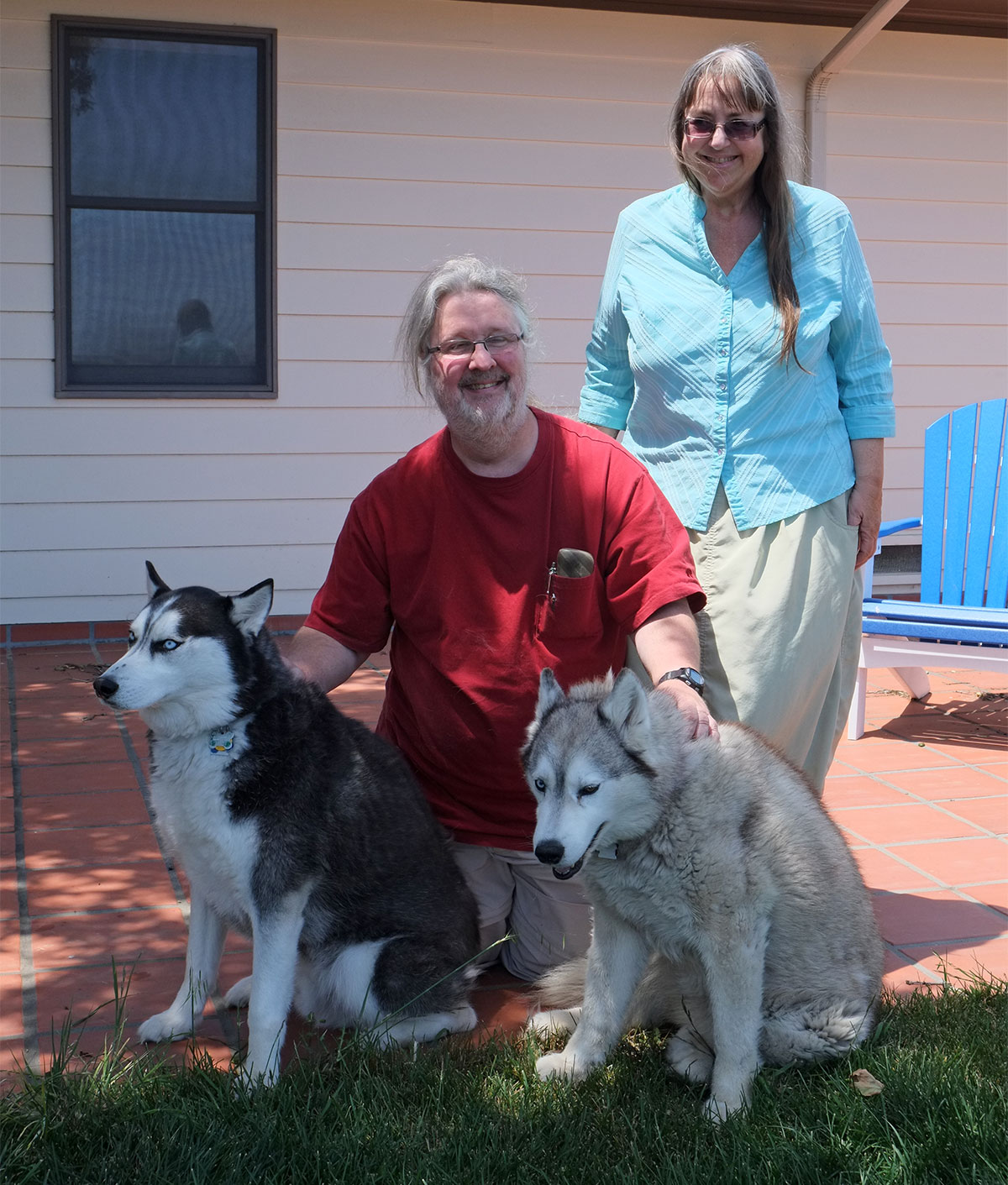
Here they continue to pursue their many interests – genealogy through their new venture, Linkpendium.com, and participation in genealogical associations, extensive hiking in the mountains of the West, ham radio activity (Brian is currently trying to figure out the precise best place for a 60-foot aerial on their ridge), and hanging out with their huskies. Pictured above are McKinley and Denali, two charming dogs who are very highly placed on Greta’s list of Best Vicarious Pets of the trip, for their combination of liveliness and calm. Unfortunately, Denali died suddenly shortly after our visit, and Brian and Karen are now up to their eyeballs with a new huskie puppy.

As with many of my long-lost friends whom we’ve visited on this trip, Brian and I reconnected through Facebook several years ago. I’ve really learned a lot from his posts in recent years – he understands the worlds of economics, public policy and politics as a professional, and amazingly after all his years in the trenches, he still has the same integrity and thoughtfulness I noticed over 40 years ago. Brian has stayed true to his core principles, and has been aghast as the Republican party has marched off the cliff into know-nothingness and licking the boots of the Masters of the Universe. His arguments are about the most cogent I’ve seen in any online discussion – not assertions of moral superiority and self-righteousness, but clearly-reasoned positions based upon a wide-ranging base of facts and knowledge. He hasn’t quite converted me to being a Goldwater Republican, although I have come to recognize that I’ve always been an Eisenhower Republican at heart (and hence almost a Socialist in our current mileu.) As a way out of our current horrific political polarization and stalemate, the best option I’ve been able to come up with is to put Brian in charge.

Greta has always enjoyed my nerdy and amusing college friends, so she was really looking forward to meeting Brian and Karen. We had a great time with them, hanging around drinking and eating, seeing the sights of the greater SLO area (including our first sight of the Pacific in eight months at Morro Bay and Montaña de Oro State Park). But perhaps the best group activity (certainly for the nerdy end of the spectrum) was going to the movies. Greta had been counting the days until the opening of the Captain America Civil War movie, but our plans to see it the opening weekend in Bakersfield were dashed by the blown-out tire in the Mojave. When we inquired about possible movie venues upon our arrival in SLO, Brian’s eyes lit up. He too had been eagerly anticipating the movie, but despaired of finding an appropriate viewing companion, one who would have the requisite detailed knowledge and appreciation of the complex Marvel movies universe (MCU), and so be able to meaningfully participate in the critical post-movie analysis and discussion. We all enjoyed the movie (sitting in our electrically-controlled chaise-lounges with drink and popcorn holders, ahh California!), but the young and the old nerd were in heaven, continuing the discussion into the next evening back at home, when other DVDs in the series were pulled out, to bring the complete experience to a sense of closure.

Karen grew up in Oregon, and her mom lives in Vancouver, Washington, so they do pass by our neck of the woods from time to time. We’re counting on seeing them again soon (just as we hope all of the friends we visited will now come see us), perhaps coordinated with the release of the next Marvel movie.

Christine Theodoropolous

photo from CAED

Christine Theodoropoulos joined our department in Eugene in the mid-1990s, coming from a prior teaching position in southern California.  Our department has an unusual criterion when we are searching for new faculty members: everyone who will teach courses in the department should also teach design studios.  We don’t want some faculty (especially those who teach technical courses) to be isolated in their specialties; since architecture is all about integrating an incredibly wide range of scales and issues into a design project, we think it is important that specialized knowledge and different approaches be brought into the studio, and we want our faculty to always be thinking about how their particular focus and expertise contributes to the design process.  Christine was a perfect faculty candidate from this perspective. She had an undergraduate engineering degree from Princeton, then a masters in architecture from Yale (where she was friends with Mark Rylander, another factor to her credit).  She left LA and moved to Eugene with her husband Mark (who had extensive experience working as a construction manager on the Getty, among other projects), and her two young sons.

From the beginning, working with Christine was a pleasure. She was a thoughtful and smart design teacher, and with her structural engineering colleagues, fundamentally changed the way we teach structures, shifting it more towards how architects actually apply structural concepts in the design process, rather than just the learning of abstract structural principles (which was certainly the way I was taught).  But more than that, she was a good friend and the definition of collegiality – someone who more than pulled her own weight, who was always searching for simple solutions, and who didn’t feel the need to belabor the obvious (not a common characteristic in academia).  Once when she and I were on a faculty search committee together, she walked into a meeting and said, These are the three candidates whom I think are clearly the best.  I said I completely agreed, and she said let’s just invite them to campus.  We then adjourned what was probably the shortest committee meeting ever held.

Given these qualities, she was a natural for the thankless job of being department head.  When we needed to find a new head in the early 2000s, Christine and I were both mid-career faculty and likely candidates, so I did a quick survey of our relative qualifications, which immediately convinced me that Christine was much better suited for the job.  Happily Christine and the rest of the faculty concurred, and Christine took on the position, eventually agreeing to re-up for two more three-year terms.

As always, these were years of tumult and straitened circumstances at the university, but Christine strategically navigated them with tremendous steadiness, integrity, and innovative thinking.  She had enough experience and wisdom to keep things in perspective, and she quietly accomplished a lot, with a minimum of fuss.  My favorite moment was when I had attended a meeting with many other faculty from across the university, and found that they were all freaking out about some directive out of the provost’s office.  They were having meetings, plotting strategies, writing memos and letters.  One colleague asked me how our department was dealing with this, and I said that I hadn’t heard anything about this before; she just stared at me in disbelief.  I went back to Lawrence Hall and asked Christine about this crisis.  She said, Oh, I just don’t think this has reached the level yet where we have to pay any attention to it.  She was right – it never became a big issue for us, and she saved us weeks of worry and unnecessary dithering by just quietly tracking it herself.

Christine’s sterling qualities were noticed not just by us, so four years ago she moved off to San Luis Obispo to be the dean of the School of Architecture and Environmental Design at Cal Poly.  It is an excellent school, with a very large undergraduate architecture program that is consistently ranked the best in the country.  Christine and Mark moved into a cool rowhouse/loft unit in a hip new mixed-use building downtown (their boys are grown and off on their own), where they are enjoying the down-sized simplicity and urban pleasures of life in SLO, after the years of suburban family domesticity in Eugene.

We had a lovely dinner visiting with Christine, catching up on family and friends, hearing about her life at Cal Poly and in the more general world of architectural education in the US, and some interesting adventures she’d had in consulting on architecture programs in the Mideast. But as always with Christine, much of the conversation was about how things and people were doing in Oregon, and how we had been faring on our trip; even after years in her new life, Christine still hasn’t let go of the habits of caring about and strategizing for all of us back in her old home.