Author Archives: Peter Keyes

Unknown's avatar

About Peter Keyes

A now-retired architecture professor who would like to get back out on the road if this pandemic ever ends.

High school friends

Grad74When I began planning this trip, the first thing I did was to map out where we had friends all across the country.  Reconnecting with old friends, often after decades of separation, has been one of the high points for me (although perhaps farther down on Greta’s list, below eating new foods and seeing cute animals).  What’s been most amazing is how these visits haven’t just been exercises in nostalgia;  these friends have grown up and changed, and I’ve found I like the new versions of them just as much as I did the older, familiar ones.  We’ve had great conversations, usually into the late hours, and I have learned a lot about their lives, the choices they’ve made, and how they’ve made sense of life as they’ve had careers, raised children, dealt with life’s inevitable crises, etc.

We visited friends across the country, but then in the northeast there was such a density that it’s been hard to see all of them (and even harder to blog about it, as we spend all our time talking).  Around Boston there were friends from every phase of my life – high school, college, grad school, New York, Eugene.  Perhaps the most surprising visits were with friends from high school whom I hadn’t seen in 41 years.  After so long you wonder whether you’re going to have anything in common anymore, whether you’ll even recognize each other; but that wasn’t the case at all.
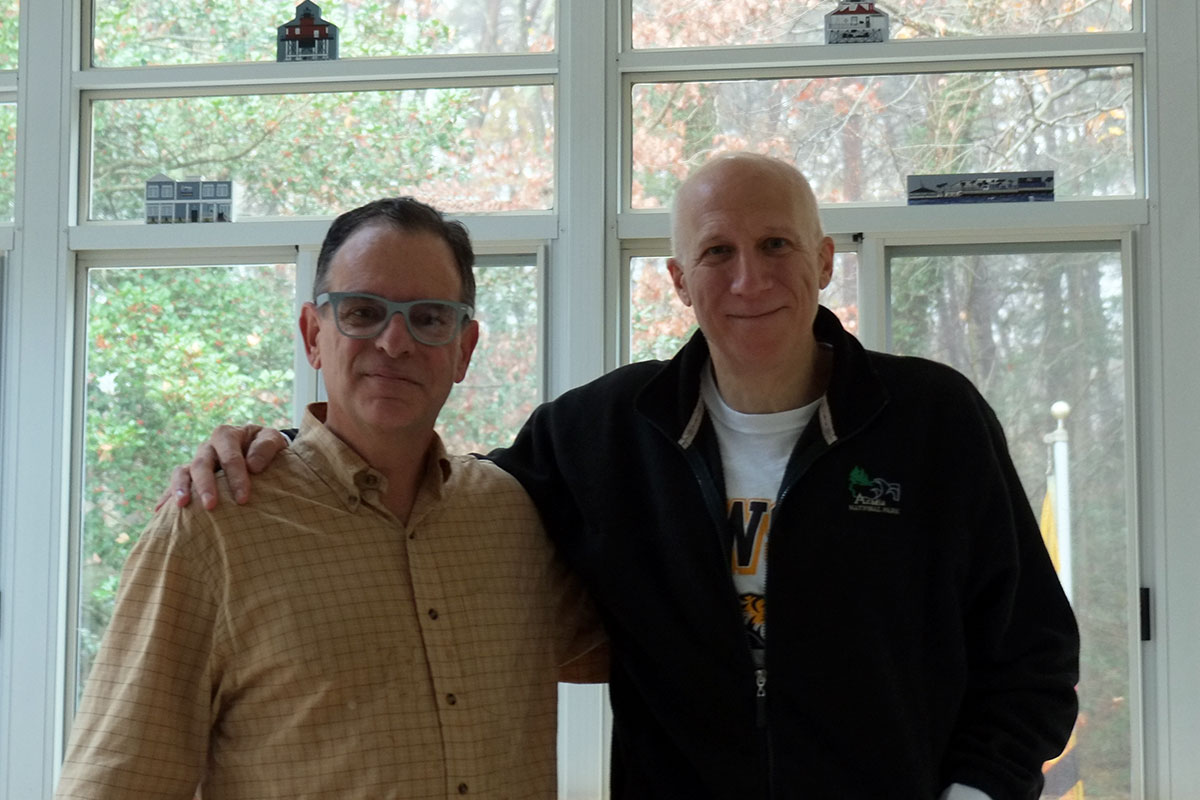
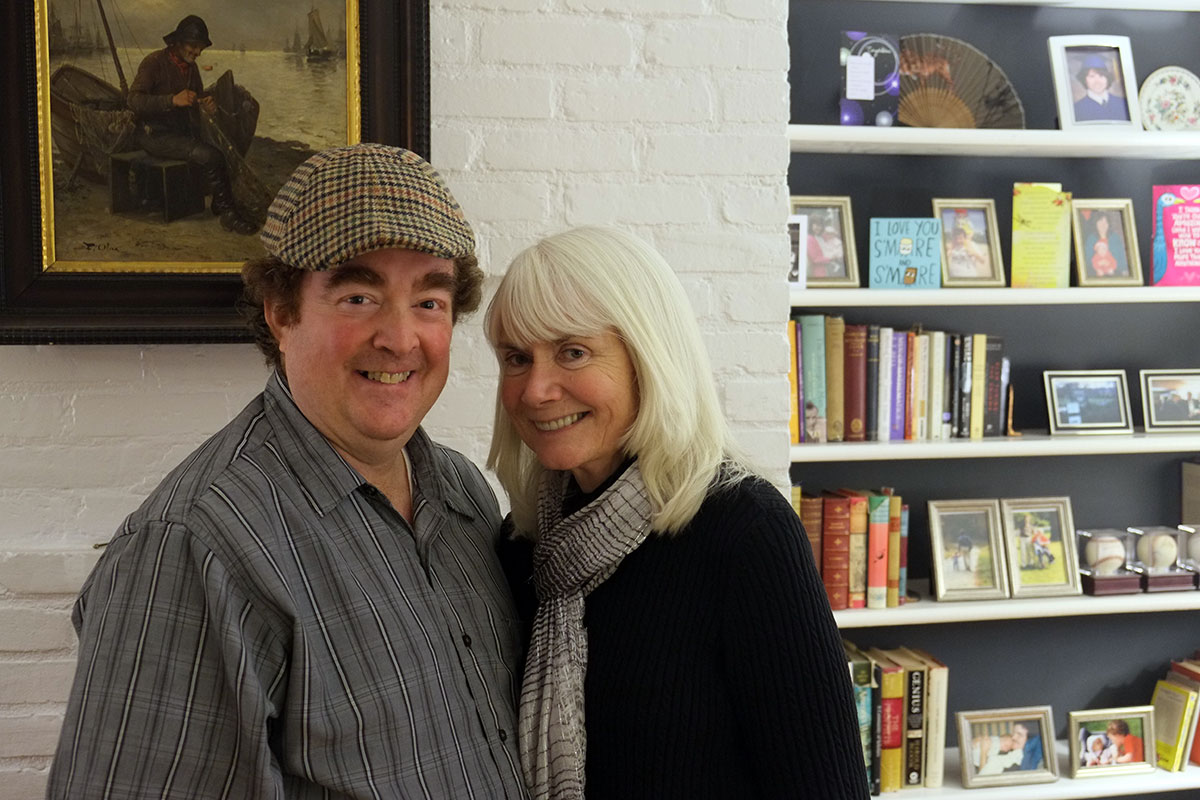
DSCF6027Cos Rappoccio and I spent a lot of time together in high school.  We shared many classes, and he was notable as the quiet one who always did well.  (He pulled out our yearbook, where my note to him then emphasized how he made us look bad in German class, getting good grades while the rest of us were goofing around.)  We weren’t in the same cliques – I was from White Plains, and he hung with his buddies from Port Chester – but one of the best things about our high school was that there was a lot of mixing among all the different groups.  Jocks, preppies, stoners, smart kids, greasers – at some level we all knew each other and got along well, with most of us belonging to a few different groups.  Cos and I did reminisce about those old days, catching each other up on those mutual friends with whom we’d lost contact.

After high school Cos went to Clarkson and then grad school at Johns Hopkins, with degrees in electrical engineering.  He married Mary, a computer scientist, and they settled outside Annapolis, where they raised two children – their son Dave (who lives in Portland), and their daughter Rachel, with whom Greta bonded instantly, when she realized that her dogs were named Merry and Pippin. (Greta has been picking up new friends on this trip – a lot of interesting nerdy girls, who range in age from 8 to 30, and it’s been cool for her to meet other girls with whom she’s felt an instant affinity.)

Cos went to work for Northrop Grummon, and as he puts it, he’s had the same office phone number for 37 years.  He’s been involved in projects I can’t really understand, mainly making really small cool things like sensors, but it was interesting how our discussion on our careers showed many parallels in processes, organizational challenges, and how to carve out an interesting niche within a large organization.

Cos has been a bicycling fanatic for years, making me jealous with his Facebook posts showing long rides through beautiful countrysides.  He’s recently had health issues which have slowed him down physically, but not in any other ways.  We had a great talk into the night, picking it up again in the morning, and he was the same sane, thoughtful guy I remembered.  At this point I should put in a plug for Facebook – Cos and I would never have reconnected without social media over the past decade, and it was great to have the opportunity to reconnect with a friend from so far back.  We decided to not wait another 41 years to get together again.
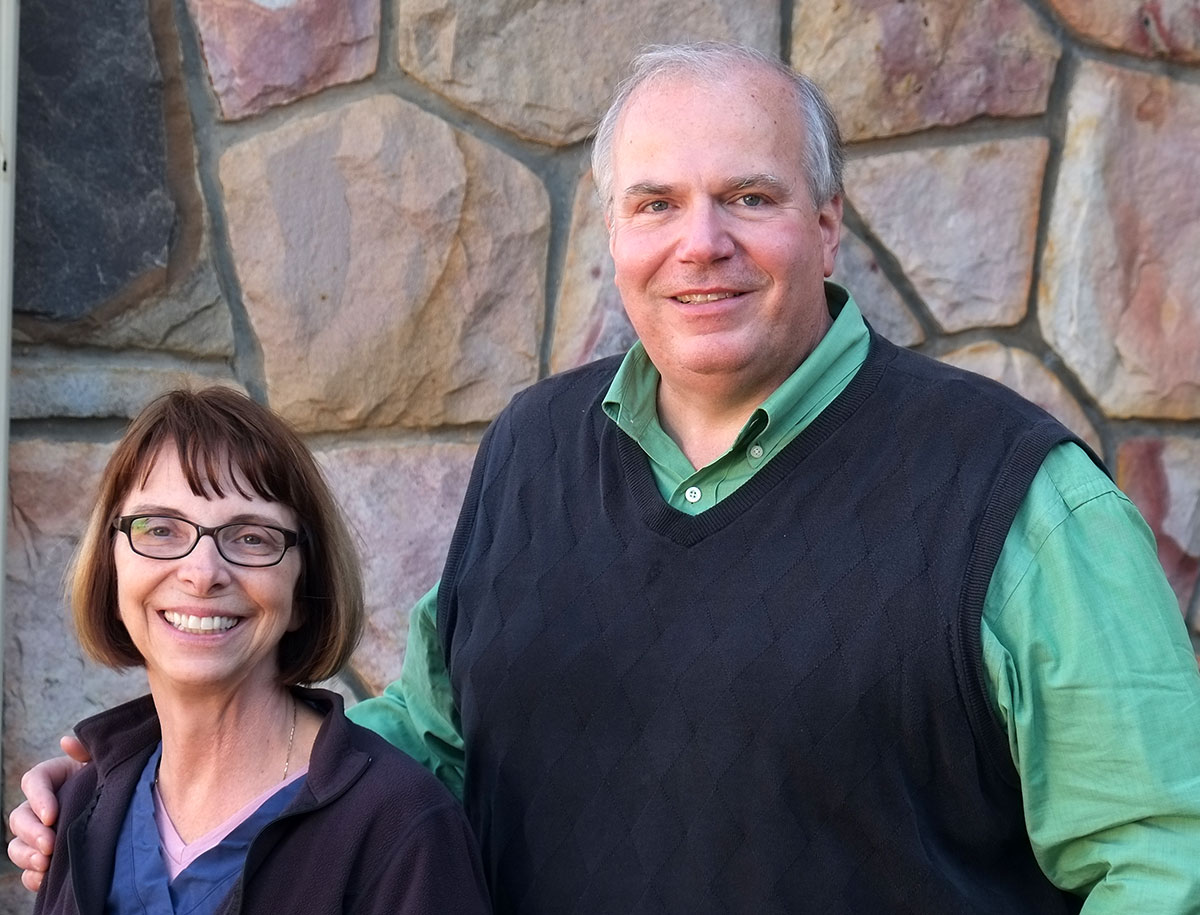
DSCF6713Ted Sudol was another of the Corpus Christi / Port Chester crowd in our high school.  We too shared a lot of classes, but also had extracurricular interests which put us in contact, perhaps even competition.  I was editor of the newspaper, and Ted was a mainstay of the yearbook, and traditionally these groups carried on a low-level war of pranks and other idiocies throughout the years.  The percentage of conversation among teenage boys that is sheer bantering is astounding, and Ted and I did our share of that.  But Ted was also interested in serious issues, and I remember the depth he brought to such conversations, both in class and out.  We spent many an evening drinking beer (the drinking age was lower then) and solving the world’s problems.

Ted went off to Georgetown and then law school at Temple, and we haven’t seen each other since.  He married his lovely wife Jill, and they somehow decided that her having twins was a sane thing to do while she was in medical school.  They had two more kids after that, and Ted remarked that his children’s accomplishments – an anesthesiologist (like her mom), a creative writing professor, a math-econ-data whiz, and a sports-marketing intern – disprove the concept of regression to the mean, as they all seem to be more accomplished than him.  Not that he has been much of a slouch – having had a career mainly in fundraising and development, working for non-profits and universities (James Madison), and now as managing director of a firm which provides development expertise and consulting services for non-profits.

Ted and his family have lived in a number of places, but for the last couple of decades in Harrisonburg, in the Shenandoah Valley.  Their kids are all out of the house, and their sixth grandchild is on the way.  (This is almost inconceivable to someone who is travelling the country with a 14-year-old, and I wonder how they managed to get this all out of the way so quickly.)  True to form, Ted and I talked almost non-stop while we were there;  the conversation didn’t even slow down for his cooking exertions (which included creme brûlée french toast, perhaps the most voluptuous  breakfast we’ve ever had).  It was a quick but intense visit, and we’re trying to convince them to visit us, since they don’t have the kids holding them back.

DSCF4561

Bob Ripp showed up during our third year in high school, his family having just moved from Long Island.  Despite the hard time we gave him about being from The ‘gIsland, Bob fit in immediately; he became one of our crowd as if he’d been there from the beginning.  Bob was always at the center of all teenage adventures, always up for a night out and for never turning in.

In the past few weeks, when I was sitting around reminiscing with the other classmates in this post, it was striking how they all said more or less the same thing about Bob – that he was the most genuinely engaging, friendly, outgoing and happy person they knew in high school.  He had a good word for everyone, and I think a lot of people left high school thinking that they were one of Bob’s best friends.  We’ve all known a lot of people who give that impression, but with Bob it’s never been superficial – he really is that positive, he really is a good guy, and you know he really is your friend, for life.

Bob had a large and entertaining family, and it became clear that this warmth and gregariousness flowed out from the whole group.  His mother and grandfather with their southern charm, his older siblings, his impish little sisters – they were all engaging and fun, and they immediately made you one of the family.  Bob’s little brother Michael was a couple of years younger than us, and also became a good friend.  Michael joined us for beers one night in Boston, and it was great to see him after all these years, a serious (somewhat), grown-up family man.  DSCF4380

Bob went off to Holy Cross for college, where he was a member of the rugby team and lived in the notorious rugby house across from the campus entrance.  Rumors reached us of their legendary exploits, and when we visited, the rumors were always proved true.  As in high school, Bob acquired a large set of great friends, and by extension, any time we saw Bob we were accepted into this boisterous crowd and dragged along on their adventures.  After college, Bob and most of his crew moved into Boston, getting jobs in finance and real estate, and the life continued as best it could, despite the inevitable attrition to marriage and families.

Bob has worked for a number of financial firms, having been at Morgan Stanley et al for quite a while now, ensconced in a tower downtown with a nice view of the harbor.  Bob and Beth got married, they settled on the North Shore in a very old town called Boxford, and they raised two girls, Annie and Katherine.  We didn’t get to meet them, as they are now off at college and boarding school, but there were so many pictures of them around the house that I’m pretty convinced that they exist.  We had met Beth once previously, at Linda’s and my wedding (which doesn’t really count as meeting someone since you’re a little preoccupied), where Beth kept getting mistaken for one of Linda’s sisters.  It was great to spend more time with her on this trip, and I enjoyed seeing Beth snap into “mom” mode when she met Greta, something Greta liked too, after being cooped up with just a dad.

Bob and I spent a bunch of time racking around – an amazing tour of the byways of Ipswich, Topsfield, and other beautiful towns, meals and drinks in a variety of locations, and most notably, Bob turning on the charm and talking our way into the Crane mansion when it was closed to the public.  In Oregon, I’m generally regarded as a pretty gregarious, funny and outgoing person (right?), but when I’m with Bob, by comparison I feel introverted and lugubrious.  After all these years, he still exudes warmth and engagement to everyone he’s with, from old friends to random people on the street.  Bob clearly loves the world, and it seems that the world loves him.
DSCF4931

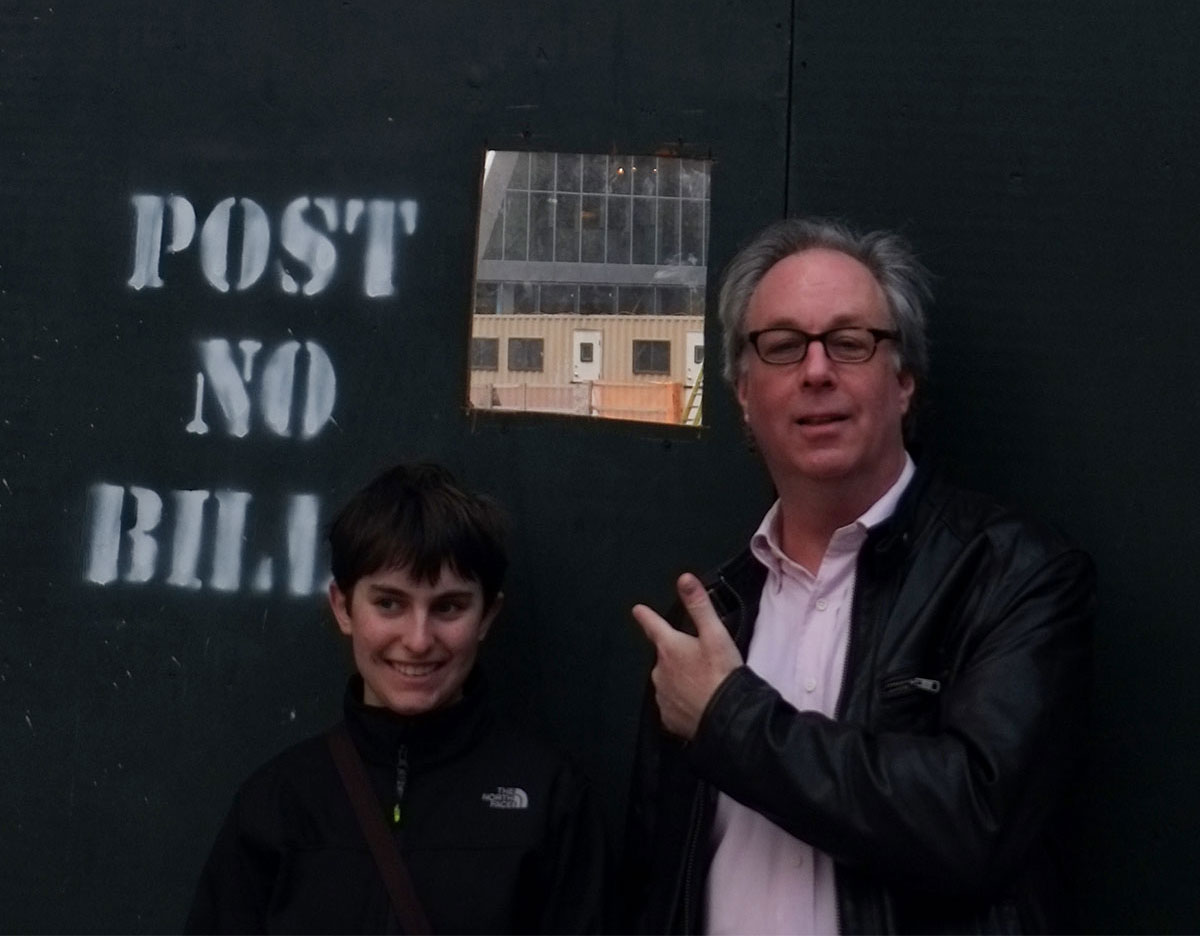
Some of these high school friends have been long-lost, but Bill McGowan and I have stayed  close throughout the past four decades.  Bill was one of the hard core of Croton boys in high school, and a few of us down-county types attached to that core.  After college at Middlebury, Bill pursued varied jobs such as scallop and conch fishing out of Nantucket, turning that experience into his first published article in the New York Times Magazine.  Bill and I moved back to New York at the same time, and we lived together in a tenement on 82nd and Amsterdam while I was in grad school.  Besides being a good friend in that challenging time, Bill was responsible for my having any social life at all, as he actually knew people who weren’t architecture students, and he would drag me along to get me out of the architecture rut for brief periods.  (Bill also claims responsibility for introducing me to all my girlfriends in the early 80s, which is mostly correct.)  After grad school I moved a whole block away, and Bill and I continued to hang out for the rest of the 80s.  Those were the days, when New York neighborhoods hadn’t all been homogenized yet, and we watched the wave of gentrification roll up Columbus Avenue.

I remember Bill having one office job in the past four decades, which he quickly abandoned to pursue the life of a freelance writer and journalist.  He has had a remarkable career in that time, publishing many articles in a wide range of journals, and also publishing three books:  Only Man Is Vile, a first-hand account of the Sri Lankan civil war;  Coloring the News, which documented how political bias distorts much supposed hard news reporting;  and Gray Lady Down, on the decline and fall of the NY Times.  He also has a blog at http://coloringthenews.blogspot.com, where he is not afraid to advance controversial ideas.

As I contemplated Bill’s career, it occurred to me that he’s managed to find the sweet spot of pissing off everyone on the right and everyone on the left.  Liberals find his questioning of accepted pieties and his association with such institutions as the Wall Street Journal to be anathema, while right-wingers are agitated by his unwillingness to toe the line drawn by the plutocrats who fund their think-tanks and magazines.  (Bill may be the only moderately conservative journalist in the country who isn’t living a lifestyle funded by the Kochs.)  Reading through his articles and blog posts, I find that he is willing to attack those of every political persuasion, based upon some pretty clear principles, and is seldom distracted by the current fads and conventional wisdom.  Orwell would have liked him.

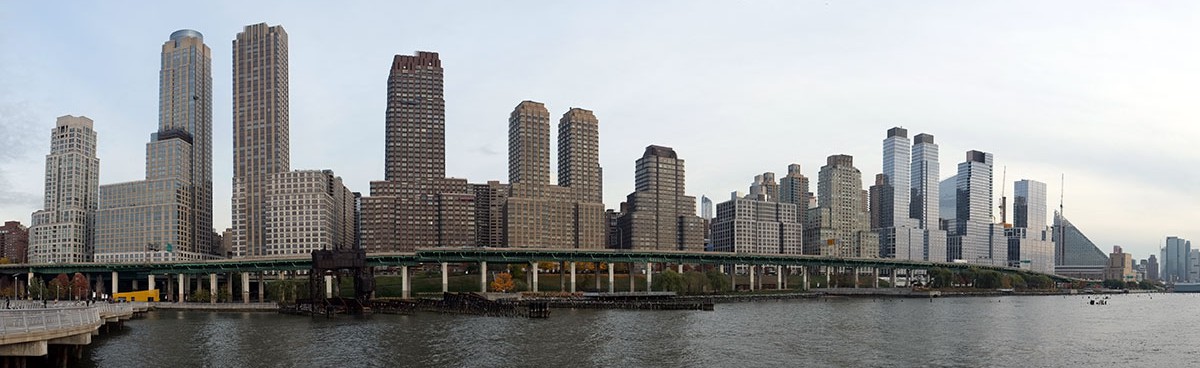
When I’d visit New York in recent years, Bill and I would always have an evening where I could pretend I was a bachelor, and we’d go barhopping downtown to all the places where hipsters and supermodels hang out.  This has become a little more problematic on recent trips with Greta in tow, but being with Bill still always conveys a sense of being in the middle of the action in the big city, which our little Oregonian finds very exciting.  On this trip we met by the Bjarke Ingels building and wandered through Hell’s Kitchen to a fine neighborhood Italian place and had the kind of pizza you don’t get in Eugene.  I’ve spent a lot of evenings eating and drinking with this man, and it doesn’t get old.

Harpers Ferry

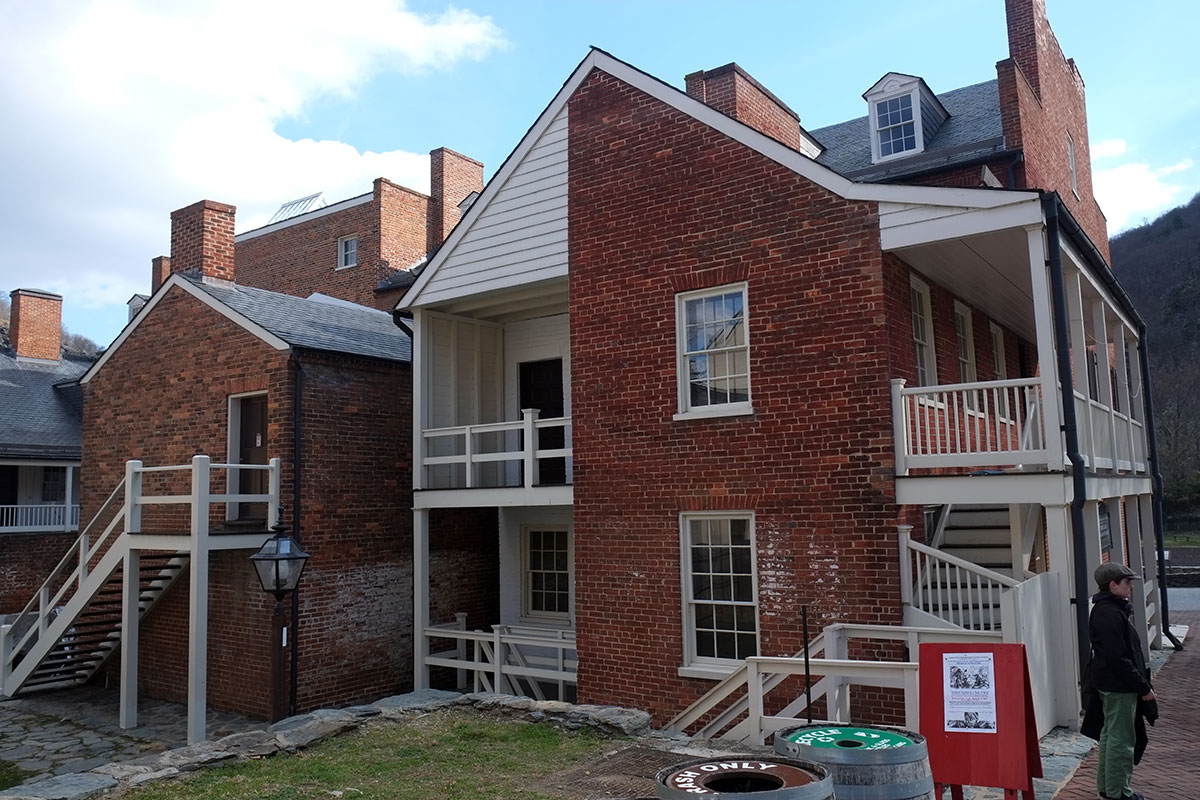
DSCF6561Harpers Ferry is a place I’d always heard about, but about which I had only a few random associations.  John Brown’s raid, battles, rivers, West Virginia (really, is that where West Virginia is?)  There wasn’t one clear narrative line about it, which now makes sense to me, as an incredible number of important things have happened in this one tiny place.  The history is extremely interesting, but the spatial / geographic / topographic / architectural character is astounding.  It’s my new favorite “place” in the country.

It all starts with the geography:

  • It’s where the Shenandoah joins the Potomac, one of the major passes through the Appalachians in that region.
  • Virginia, Maryland and West Virginia all meet at this one point.
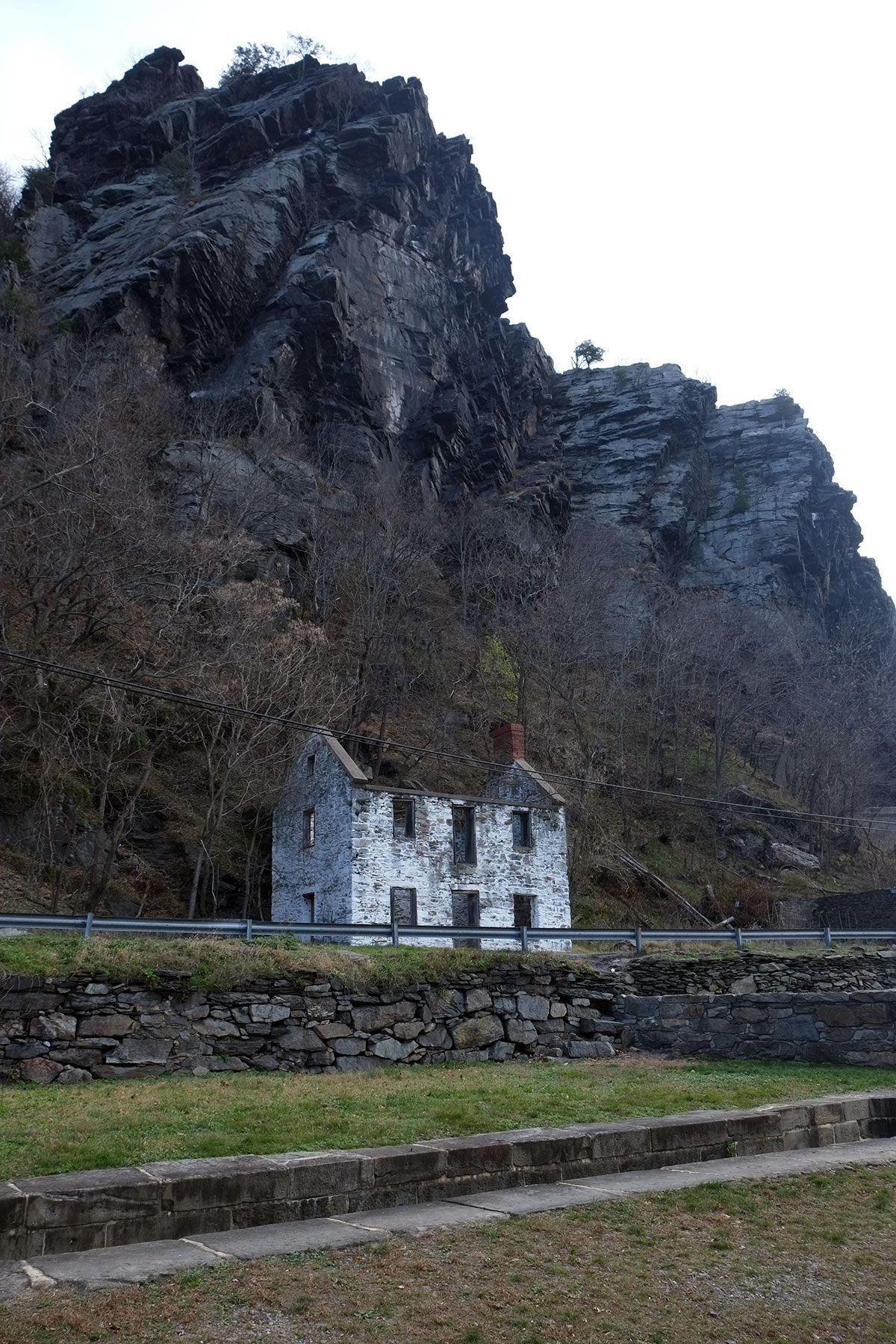
  • It is a gorge, similar to the Hudson River Highlands.  A big cliff of Maryland on one side, a big cliff of Virginia on the other, and a small, low area  at the base of a cliff in West Virginia in the middle, which is the town.
  • Because of this geography, important transportation systems cross here:  two rivers, one canal, and two railroads.
  • Because of the strategic importance of this crossing, lots of important battles and skirmishes happened here, mainly in the Civil War.
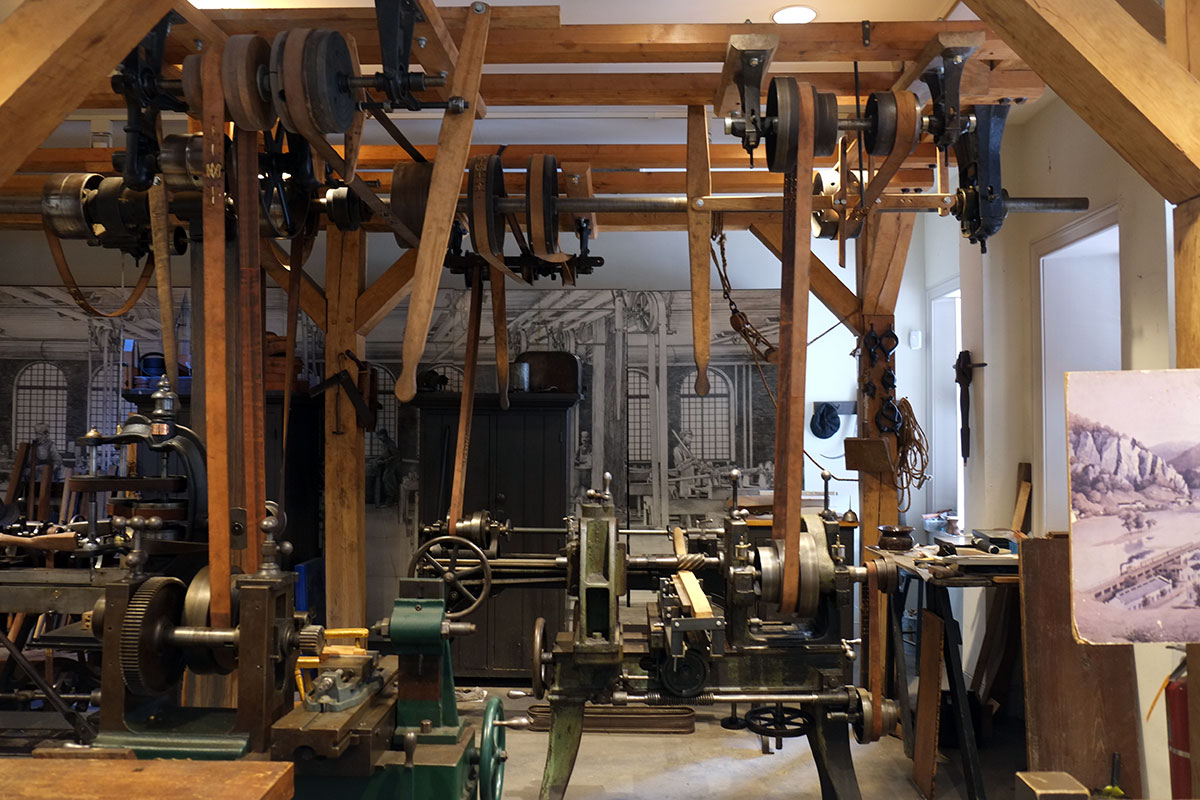
  • Due to this transportation hub, materials such as coal and iron moved through here, and it became the site for the US Armory, which pioneered manufacturing arms from interchangeable parts.
  • Since the armory was here, John Brown decided to take it over and take the weapons for an insurrection.

There are probably lots of other places in the country where a similar series of historical causes and events have taken place, and we haven’t paid much attention to them, because neither Greta nor I likes to stand at a field where something happened a long time ago and try to imagine it.  We like to see tangible stuff that remains from these events.  The visual evidence at Harpers Ferry is compressed, right there in front of you.  For this and other reasons, it is one of the most vivid and beautiful places we’ve been.

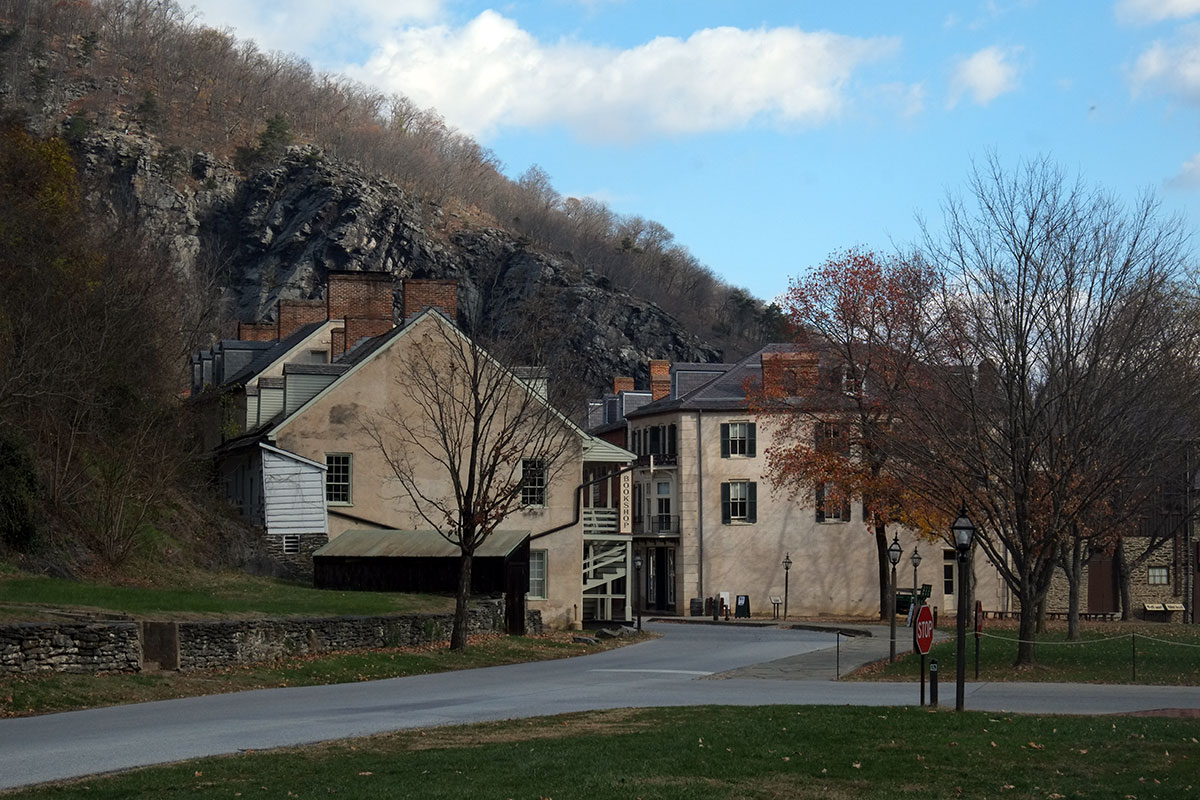
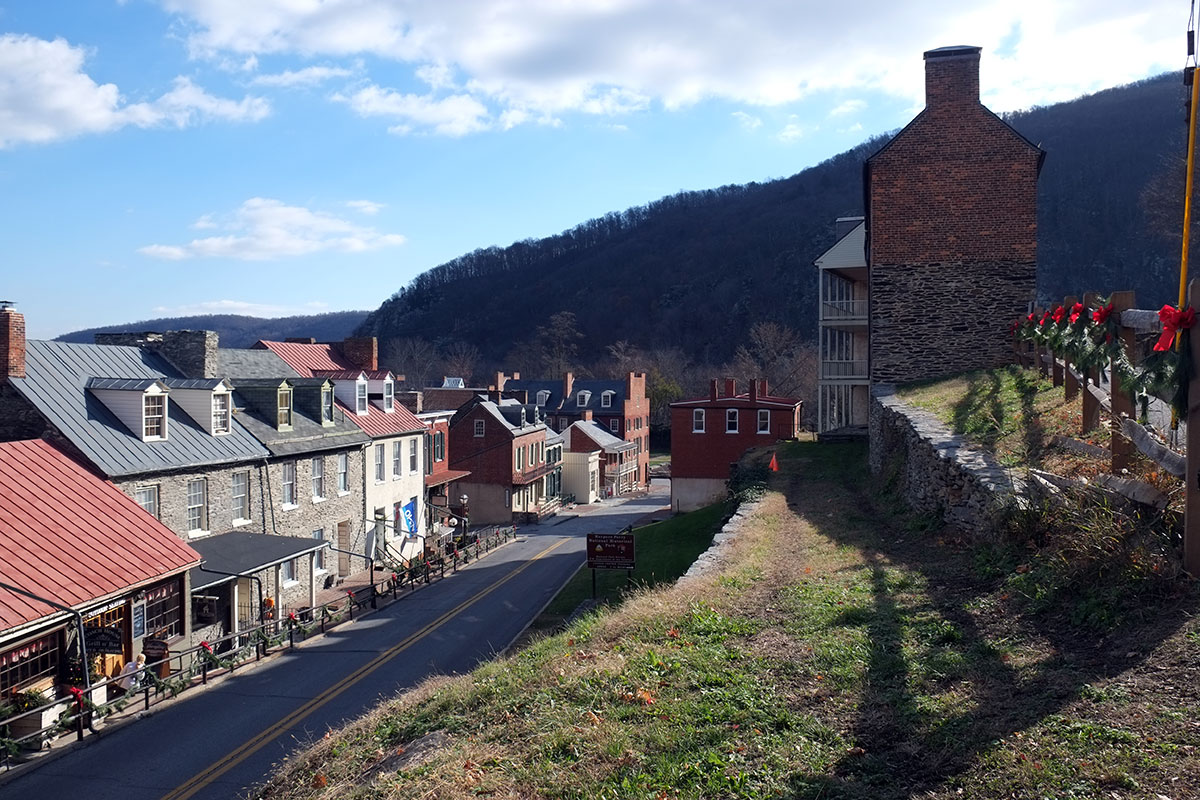
The first inkling as you arrive in the town, with the Maryland highlands rising up beyond the main street:
DSCF6631

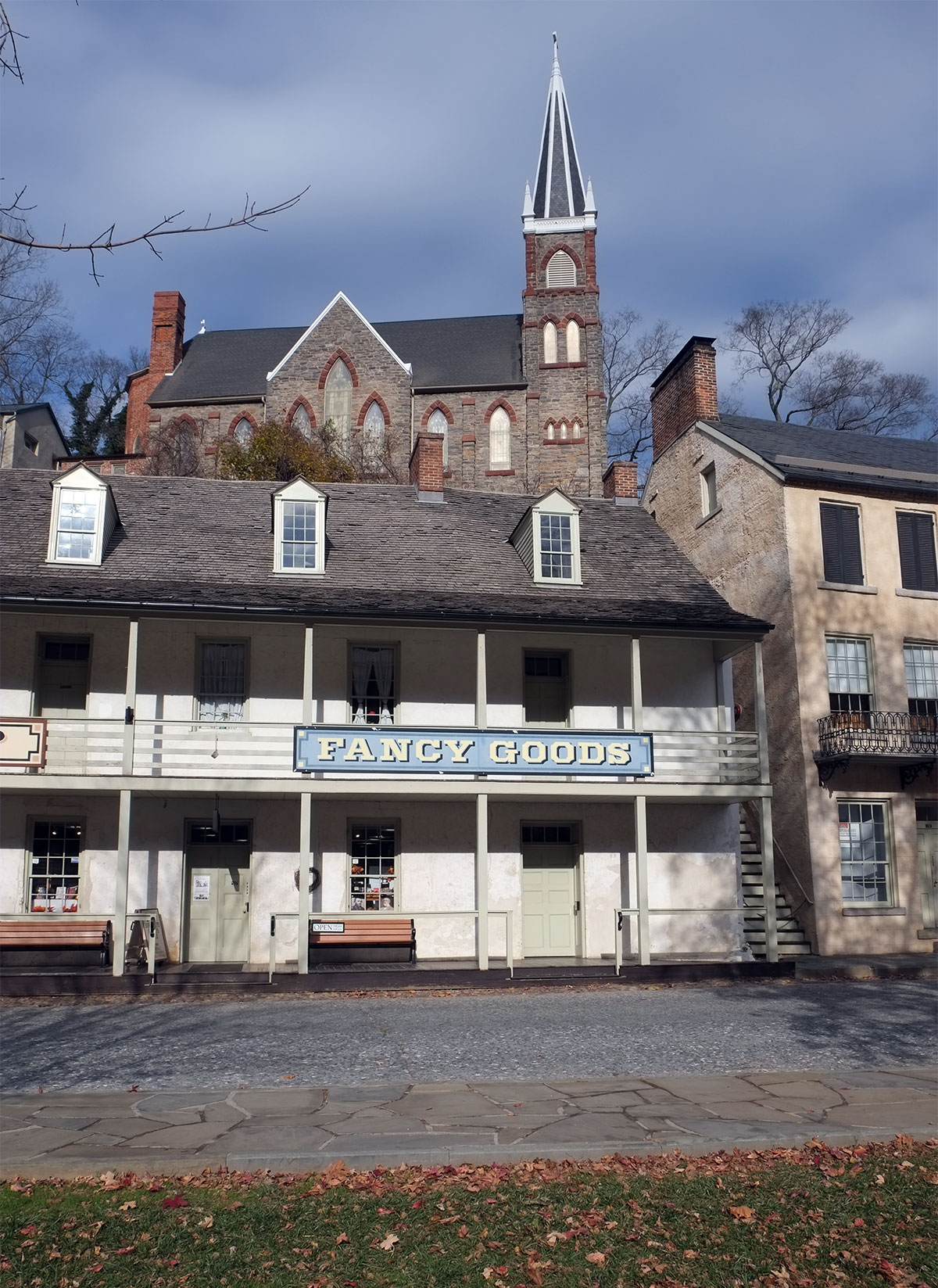
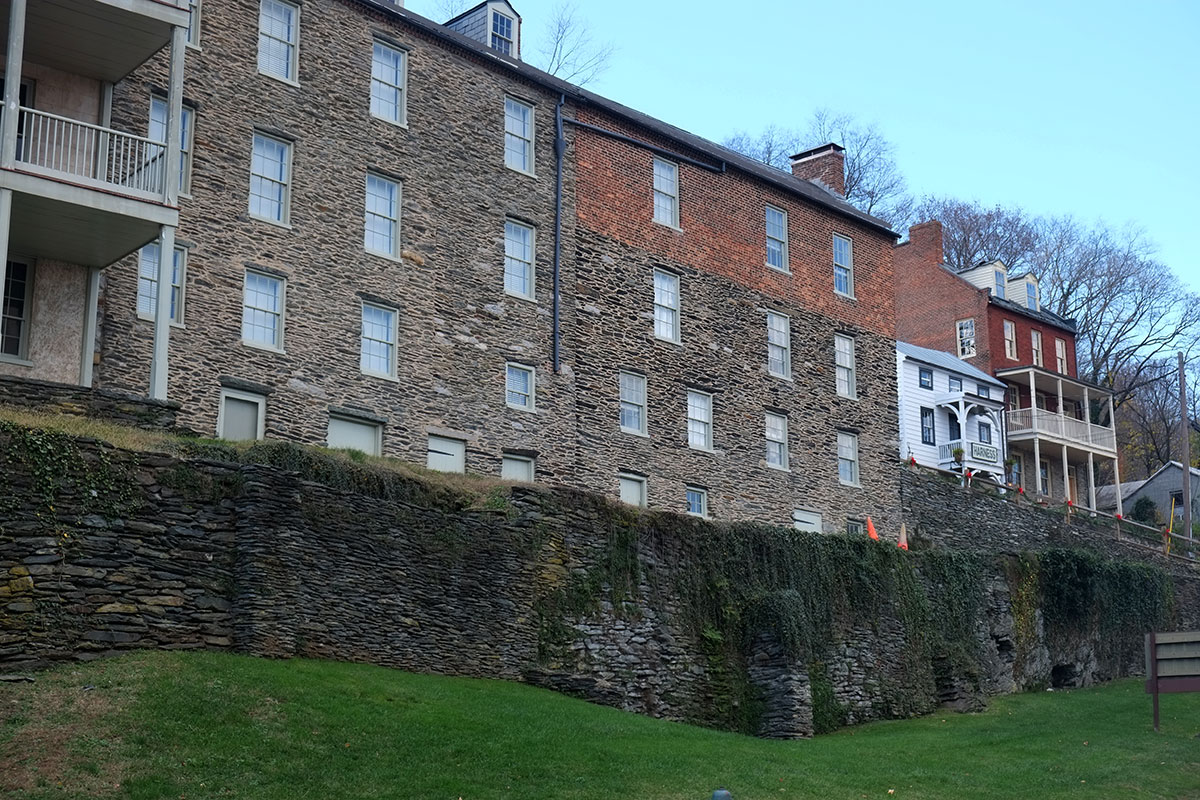
On the left the town rises, with a Catholic church (built for the Irish railroad workers) above.DSCF6477

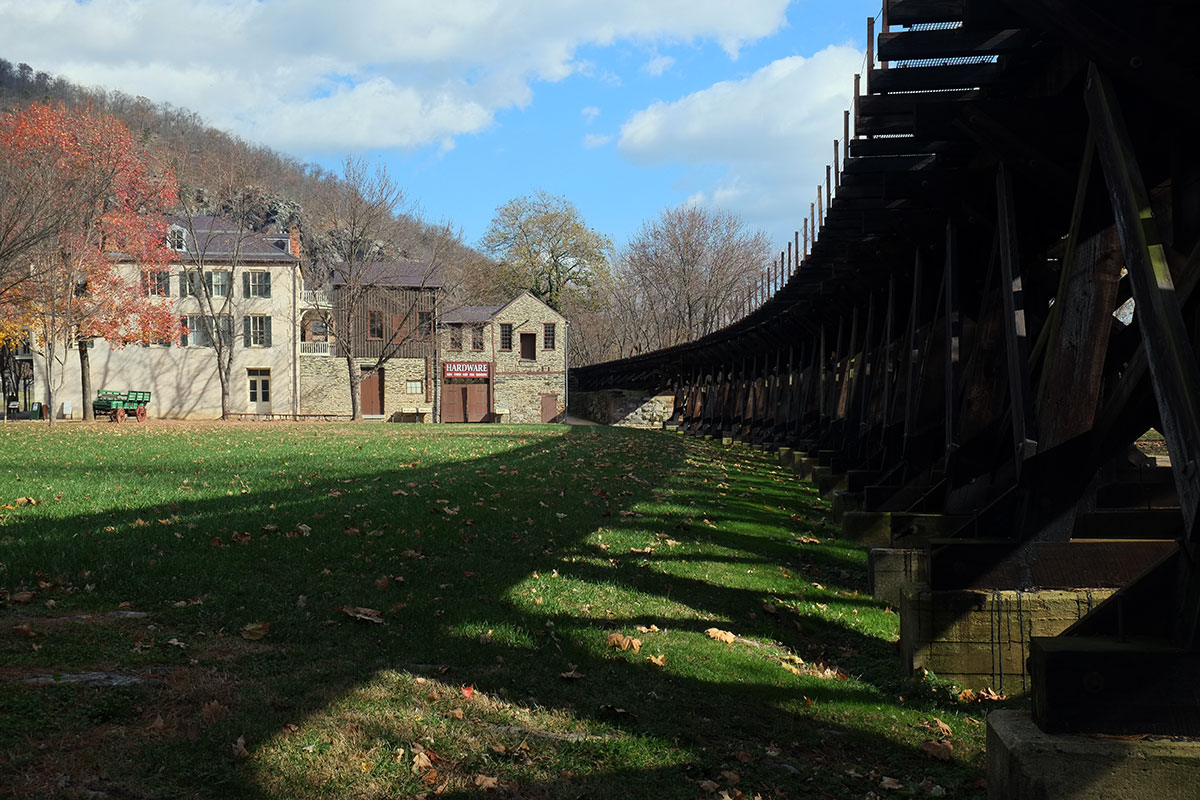
On the right, a railroad trestle parallels the Shenandoah.
DSCF6624

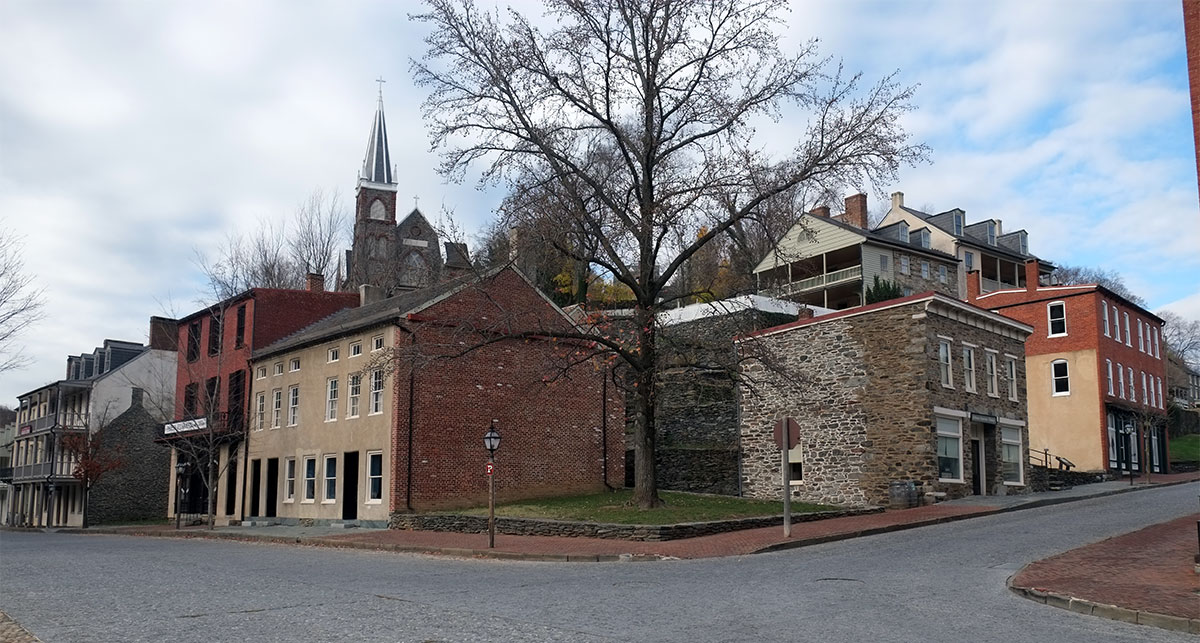
At the center of town, an intersection with a tree.DSCF6482

with a much larger space opening towards the river convergence.  The building where John Brown and his associates holed up used to be here.  DSCF6607

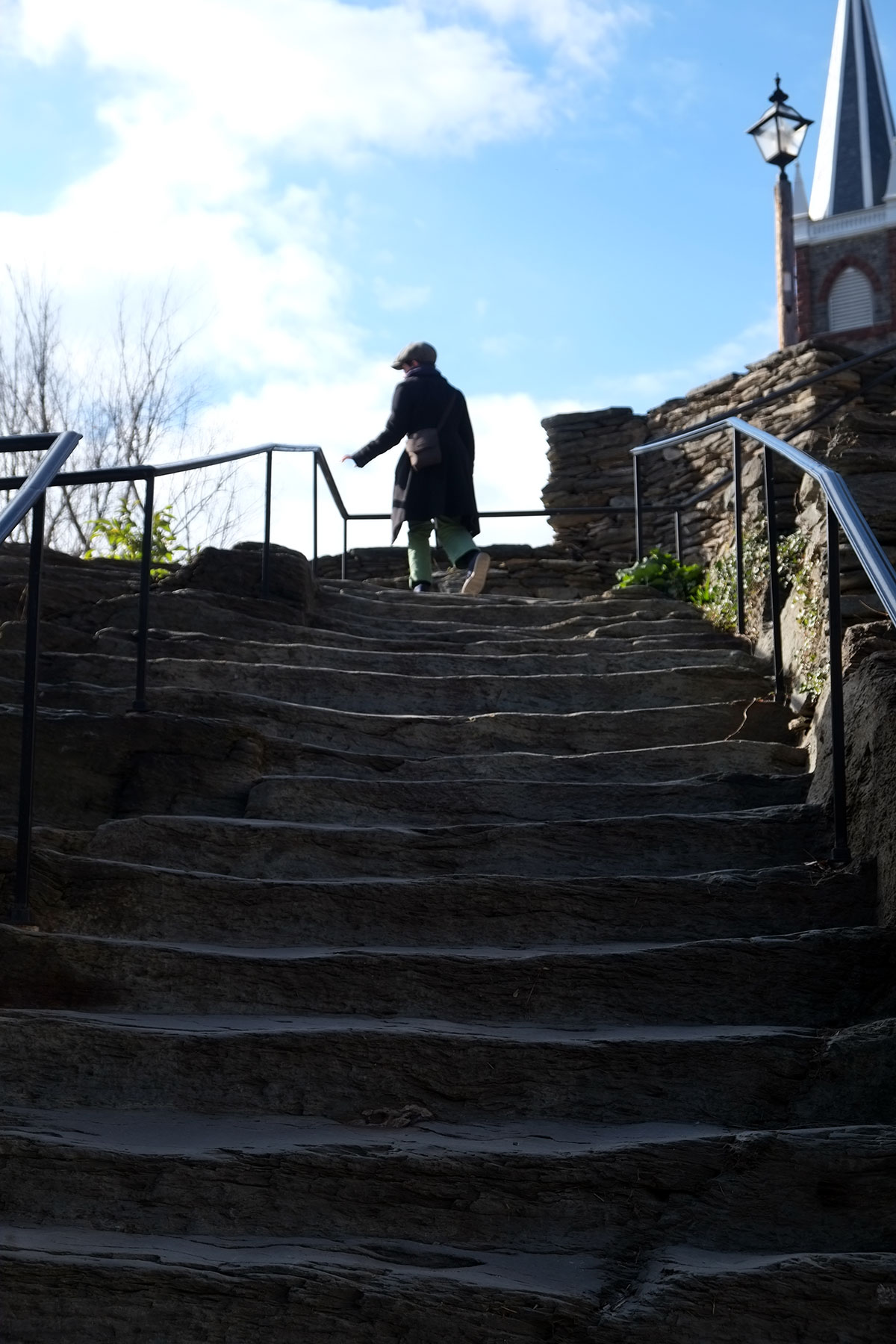
There are hewn stone stairs leading up the hill to the church.  At this point I’m wondering, is this West Virginia, or have we passed through a space/time hole and popped out in Scotland?
DSCF6524

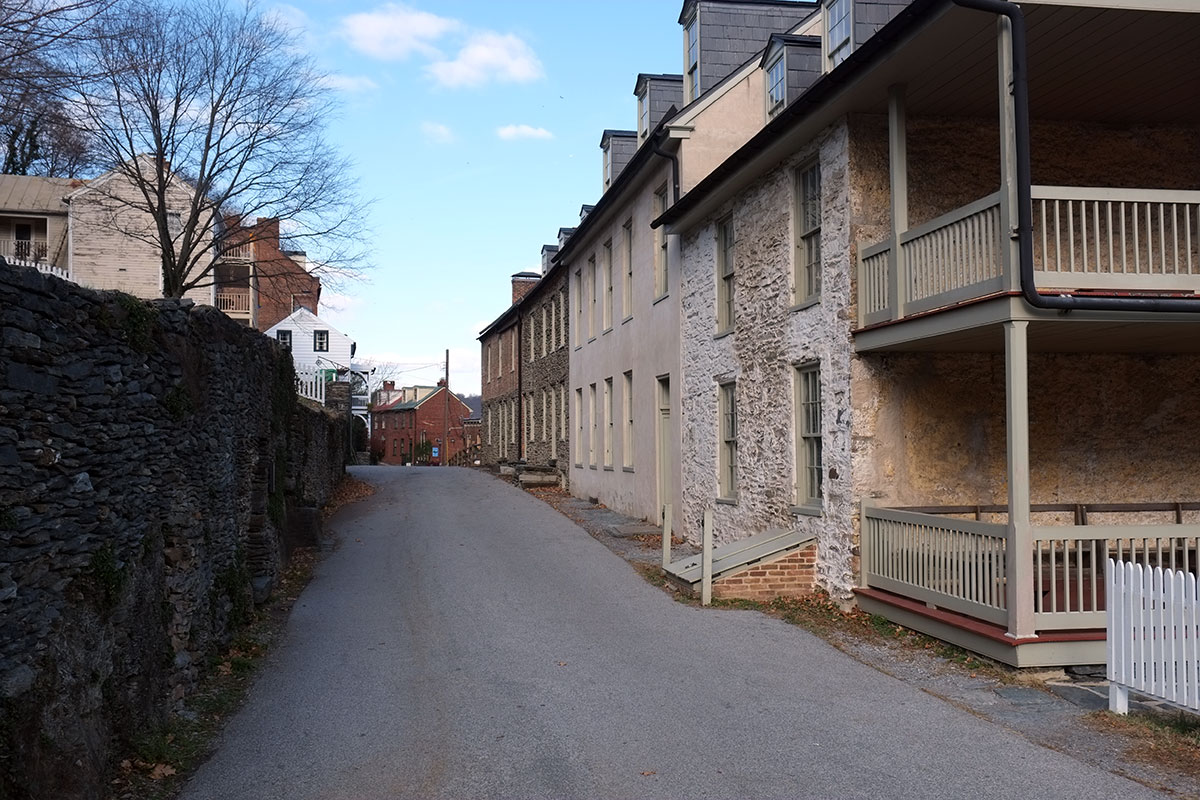
There is a road that slants up the hill.DSCF6573

And others that work with the topography.DSCF6560DSCF6570

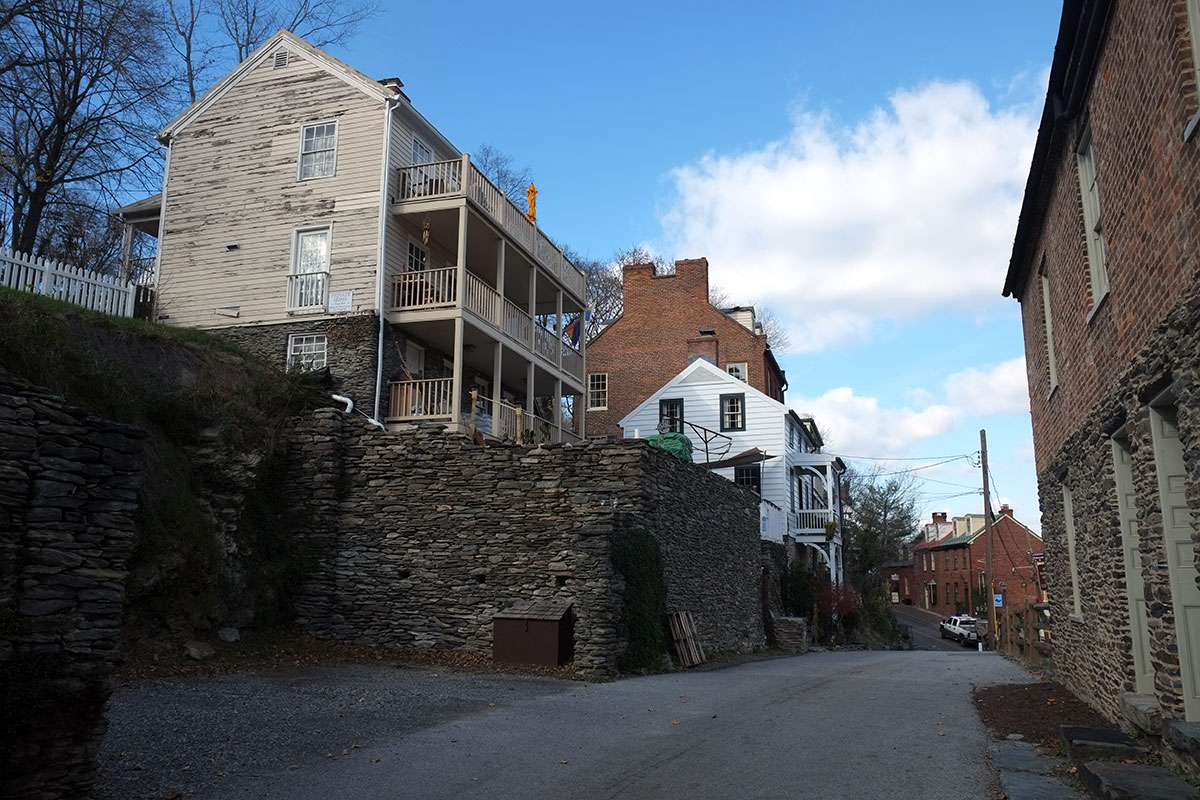
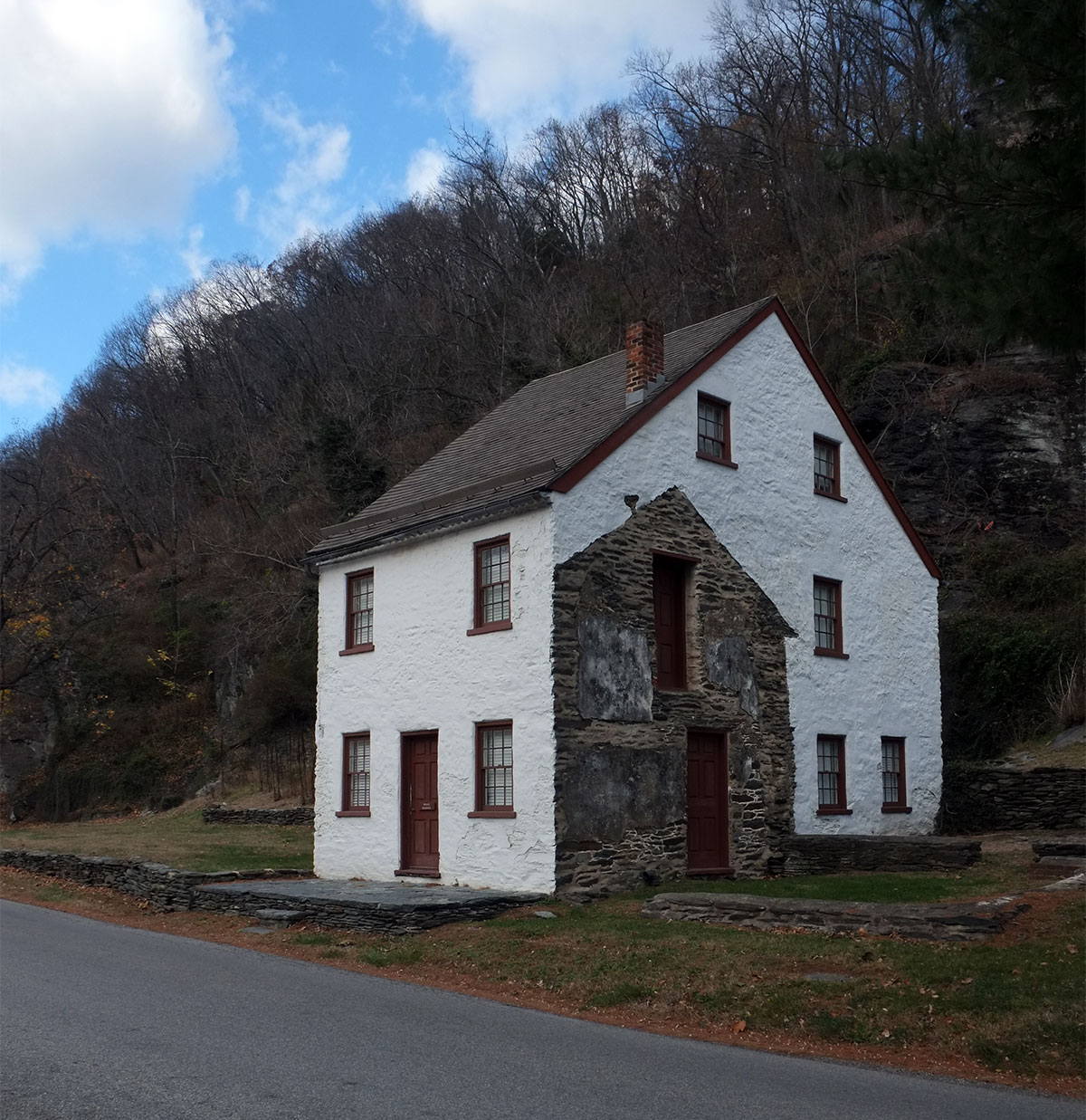
Everywhere, the vernacular buildings show the use of local materials – stone, wood and brick – with a clarity that is rare in this country.  DSCF6527DSCF6601DSCF6596

Across the Potomac in Virginia are the remains of the canal.DSCF6509

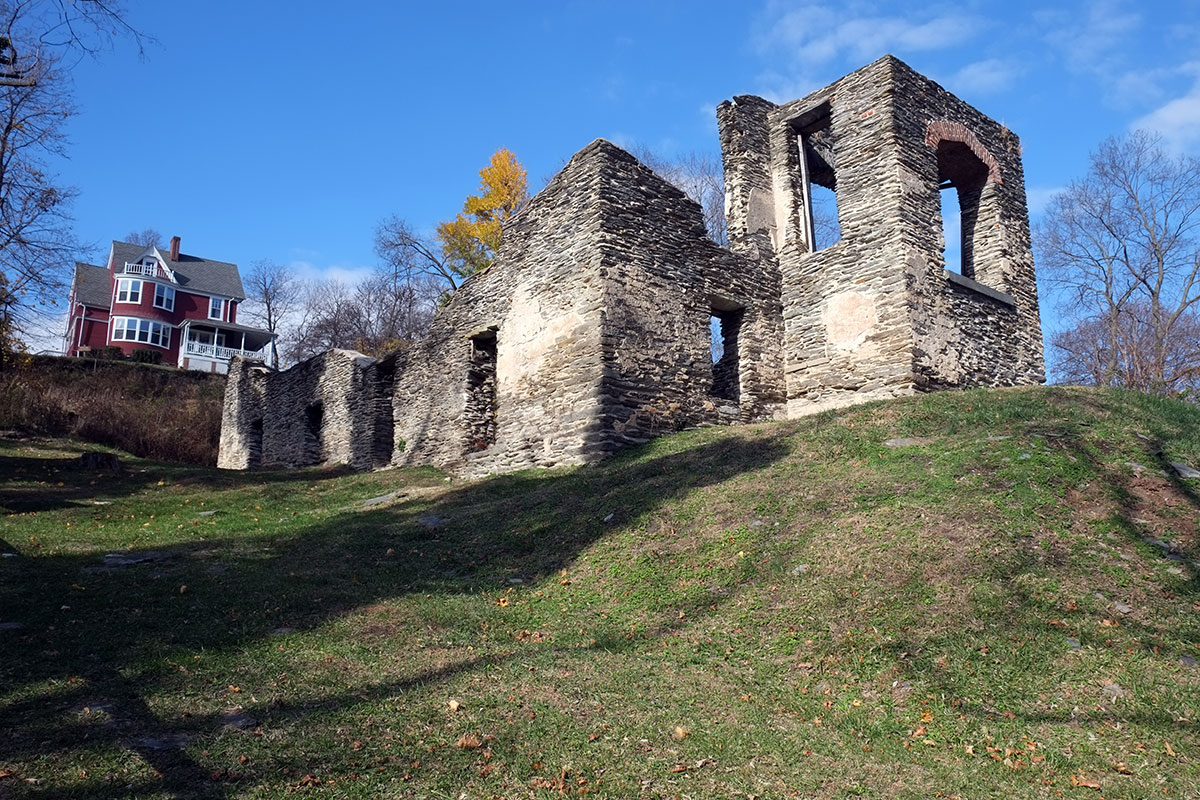
As you walk up the hill, there is the ruin of an Episcopal churchDSCF6530

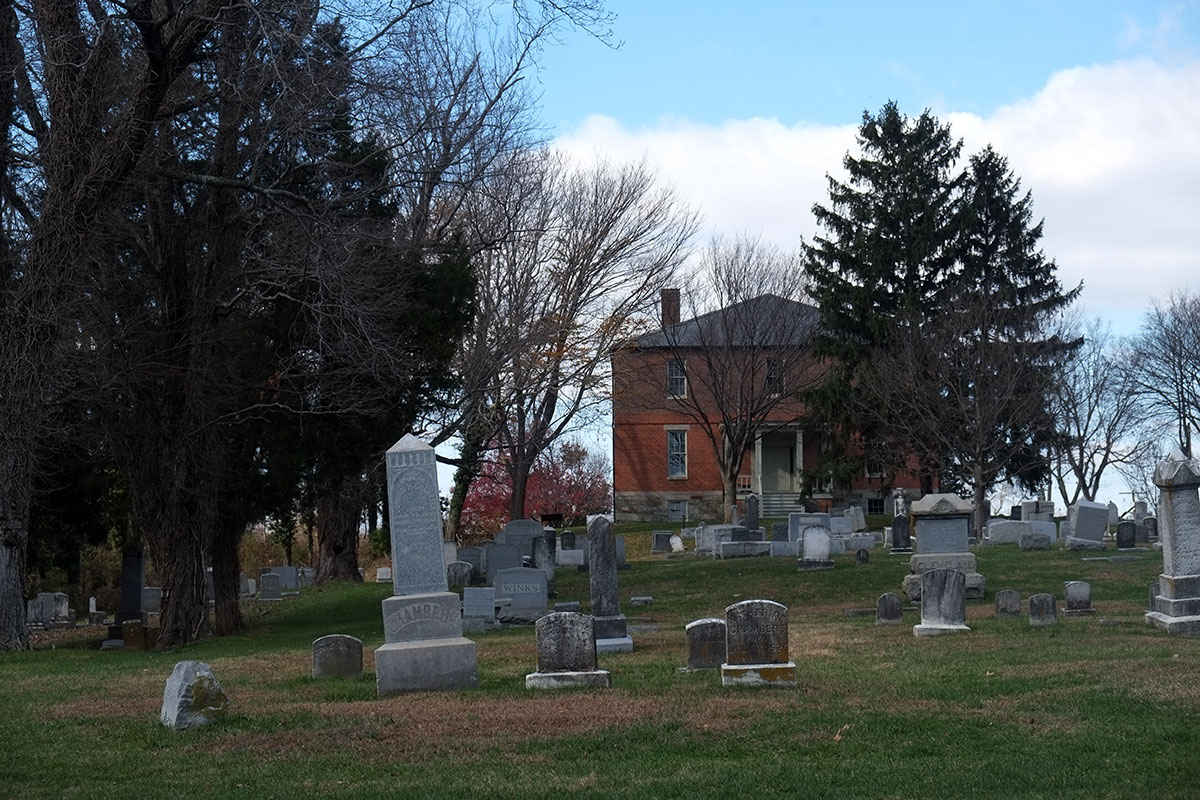
and the cemetery on top of the hill,  DSCF6545

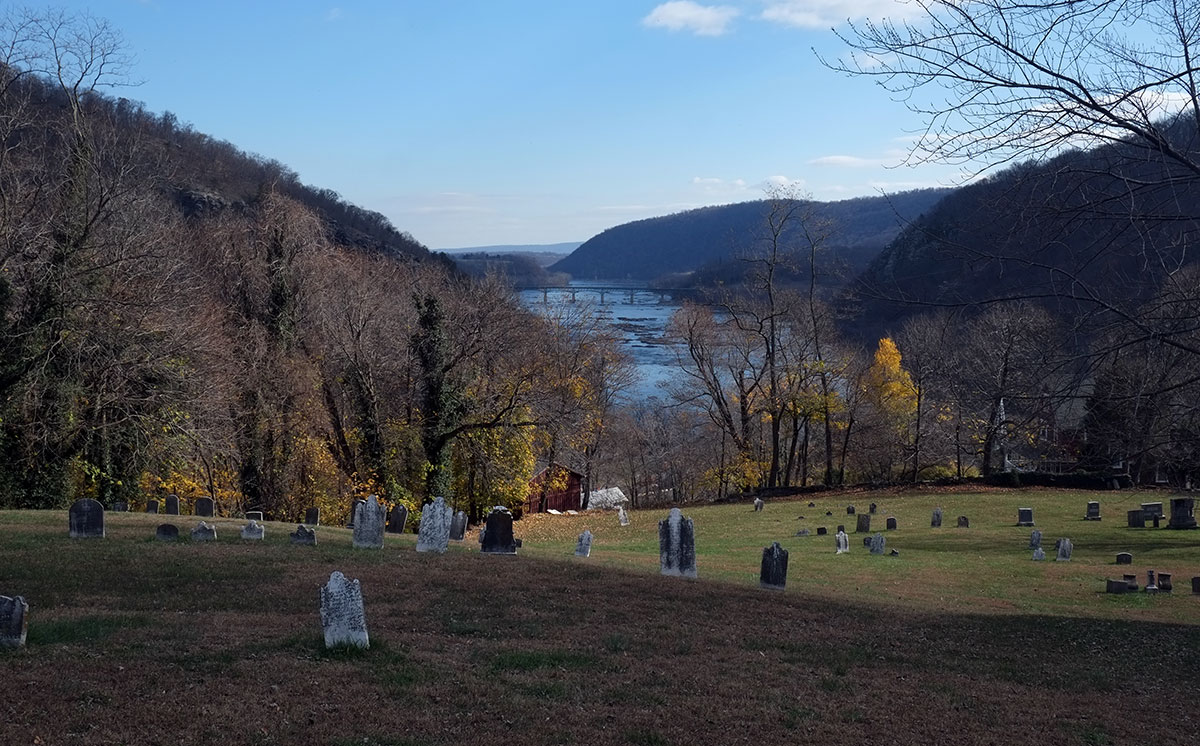
with a view down the Potomac.DSCF6547

The historic town center is run by the National Park Service, with beautifully restored buildings, showing the businesses and residences of the past.  None of it feels Disneyfied – it is all simple and direct and appropriate.  We were there on a cool autumn weekday – perhaps it is more of a circus in summer tourist season, but while we were there, it felt like we had stepped back in time to this perfectly-preserved ghost town.  DSCF6611

Harpers Ferry isn’t a reconstruction – there are lots of things from the past that have been destroyed and not replaced, such as the Armory.  There are aspects of it which do not contribute to the experience, such as some intrusive and probably unnecessary constructions by the railroad right in the center of town. It doesn’t try to be perfect, and so it feels authentic, which is probably why it felt like being in Europe rather than America.  We’ve been to many historic places on this trip where an either/or approach is evident – either the history is pretty much ignored, or else it been elaborated and “celebrated” in a way that destroys its integrity.  (Independence Mall come to mind.)  Harpers Ferry gets it just right.

I’ve only met a couple of other people who’ve ever been here, although it’s one hour from Washington.  It just seems like it’s farther because it’s in West Virginia.  We’re 2 1/2 months and 6000 miles into this trip, and this is my favorite place so far.

DSCF6632

Washington DC

DSCF6162When we started this trip in September, Greta had three main goals:  Yellowstone, barbecue, and the Smithsonian.  So our five days around DC were overwhelmingly biased towards museums.  I spent a reasonable amount of time in DC in the 80s and 90s, and I knew that with winter closing in I couldn’t do a comprehensive survey of what was now going on in this big city, so I just went with the flow.  However, I did manage to trick Greta into walking around Georgetown and Northwest on our way to and from museums.

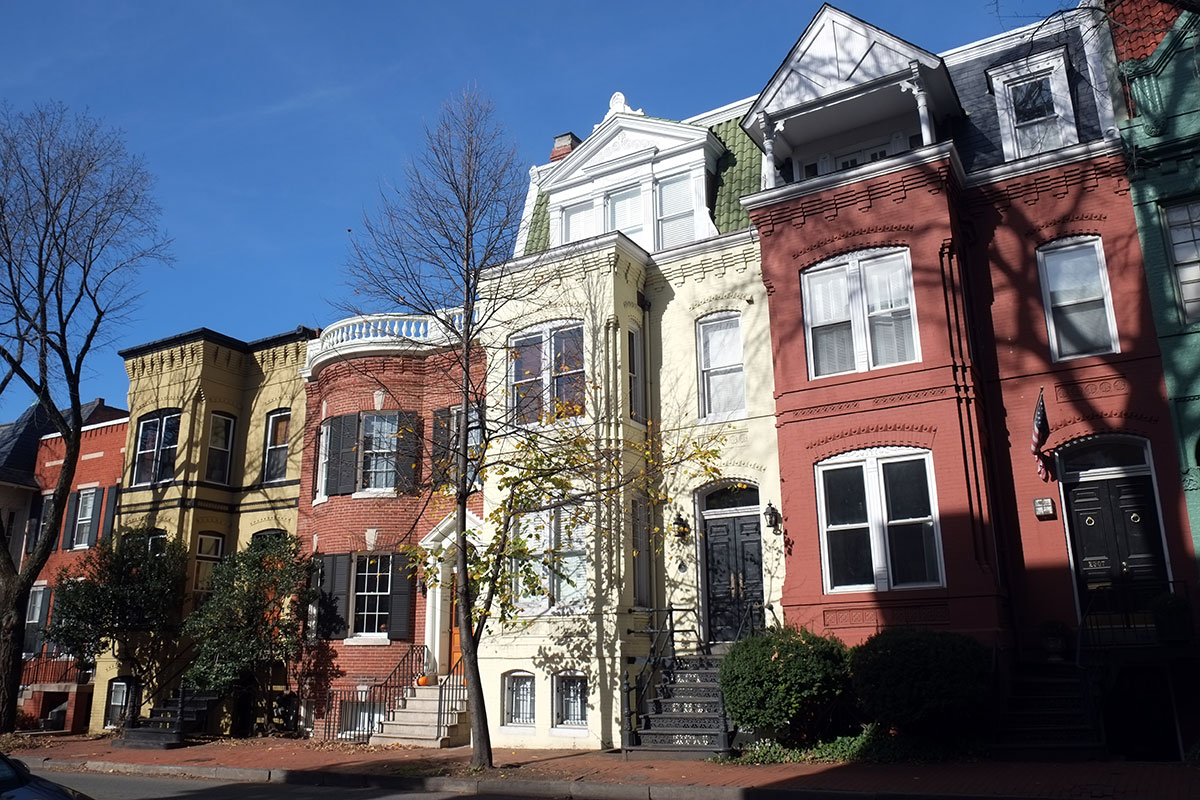
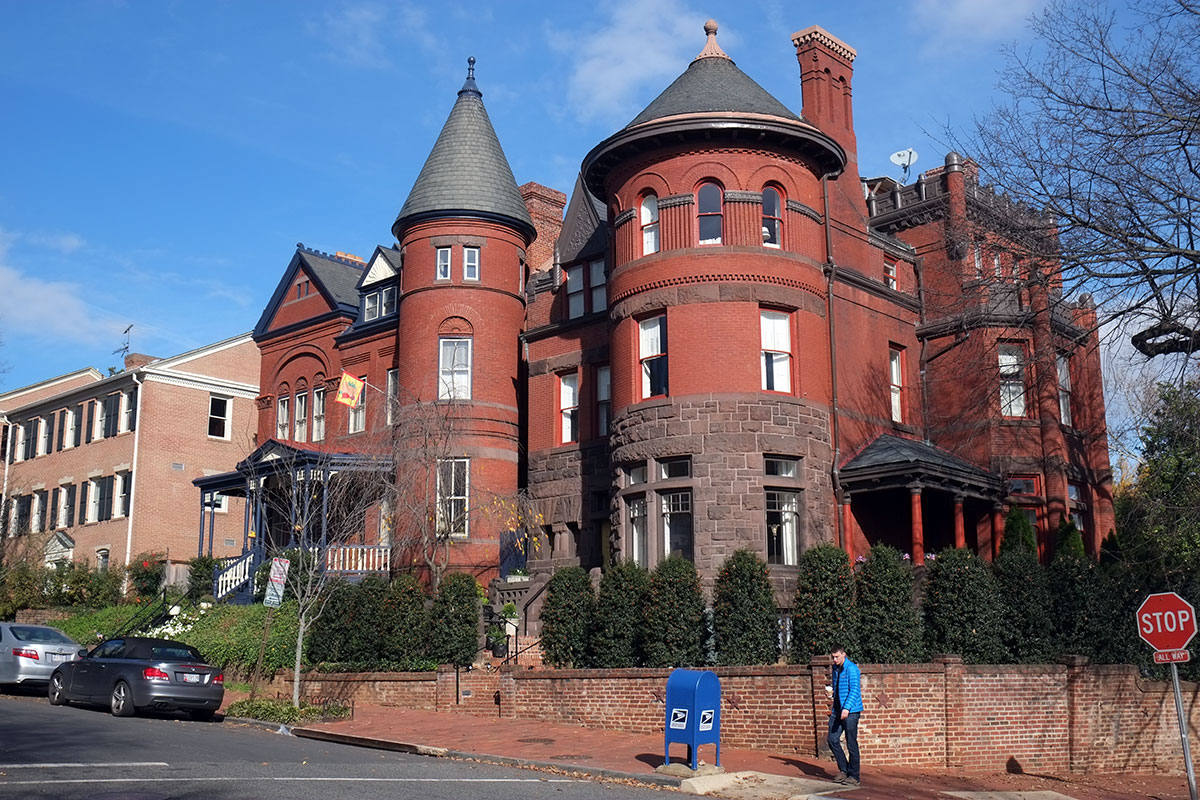
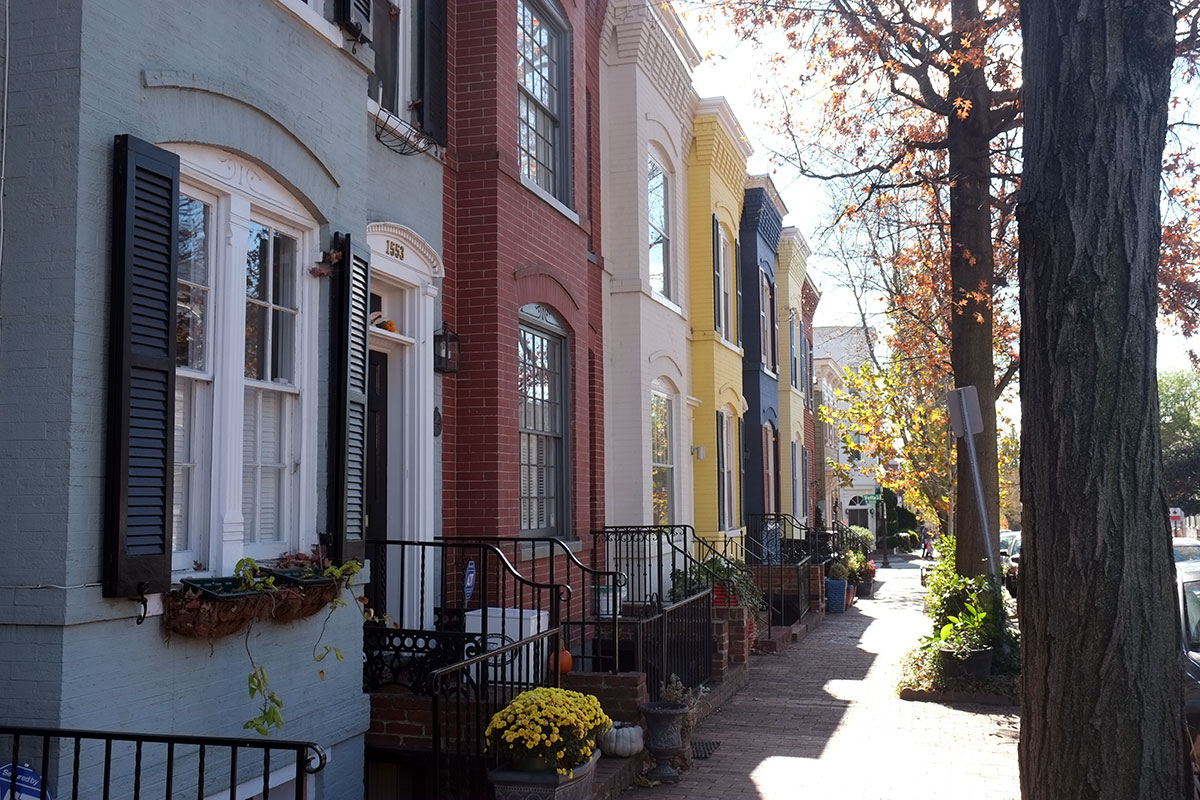
I probably hadn’t been in Georgetown in 30 years, and staying there with our friends Bob and Susan provided a good excuse for wandering the neighborhood, and back and forth to the Dupont Circle Metro stop.  DSCF6093

As has become the norm in older cities on this trip, the experience of architectural quality, neighborhood walkability and overall urbanity was remarkable.  DSCF6096It was also strange realizing that this is a neighborhood of the rich and powerful, and probably many of the houses we passed were occupied by people of whom we had heard.  (Bob did point out the black SUV in front of John Kerry’s house, which meant that he was home.)   I was totally enamored of the area, until one evening I decided to run out to pick up a couple of beers before dinner. Two miles later, nothing. Georgetown is a place where real estate values and rents are so high that normal businesses have been squeezed out by high-end clothing retailers and home design stores.  You can’t run down to the corner to meet any need of day-to-day life, so you probably just send your staffers out to run errands in the black SUV.

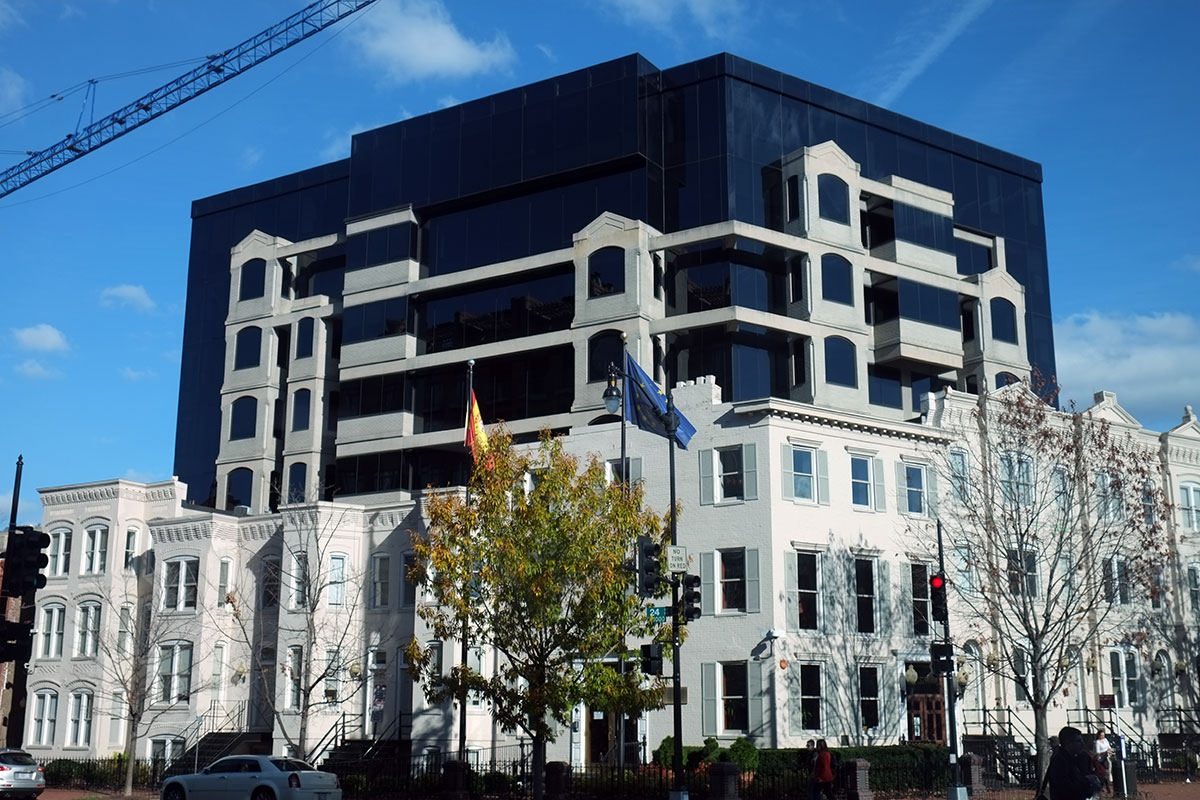
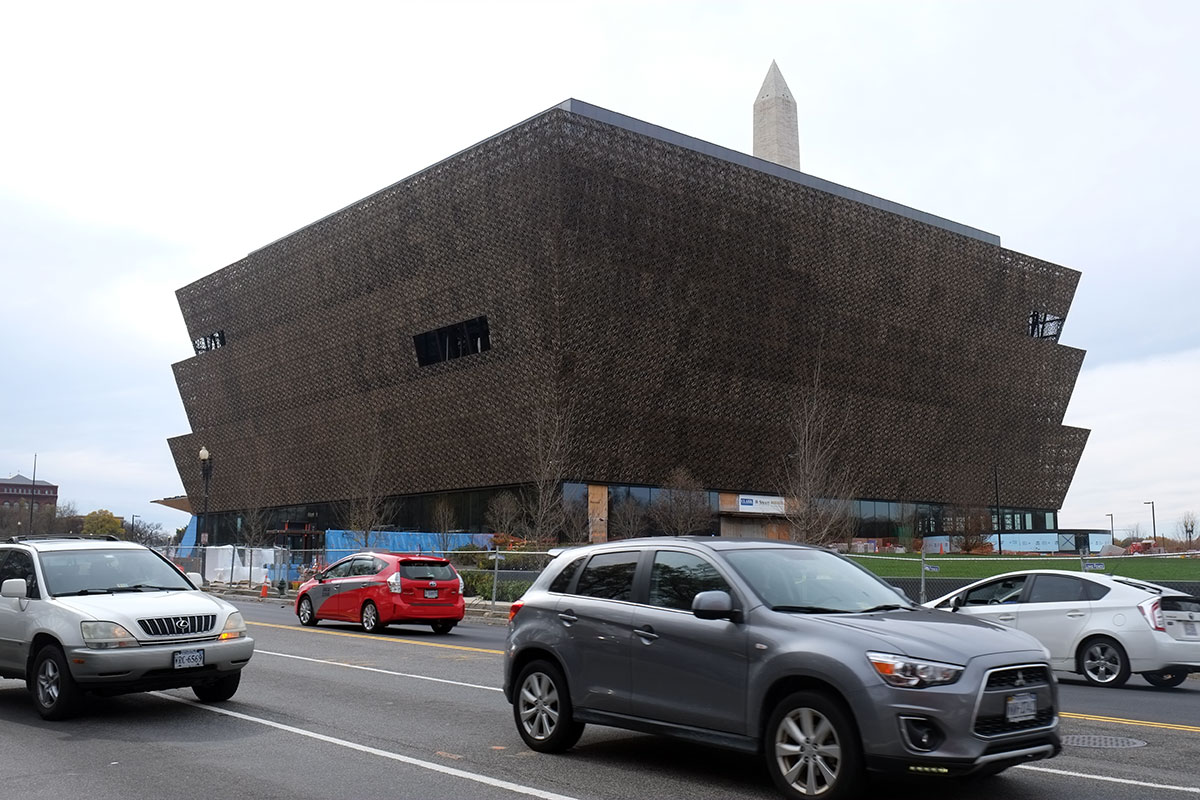
Downtown DC has never been known for its quality of modern buildings – too much respectful timelessness, height limits, classical obsessions, conservative tendencies, etc.  But even with that low a bar, this building is a standout.  DSCF6099

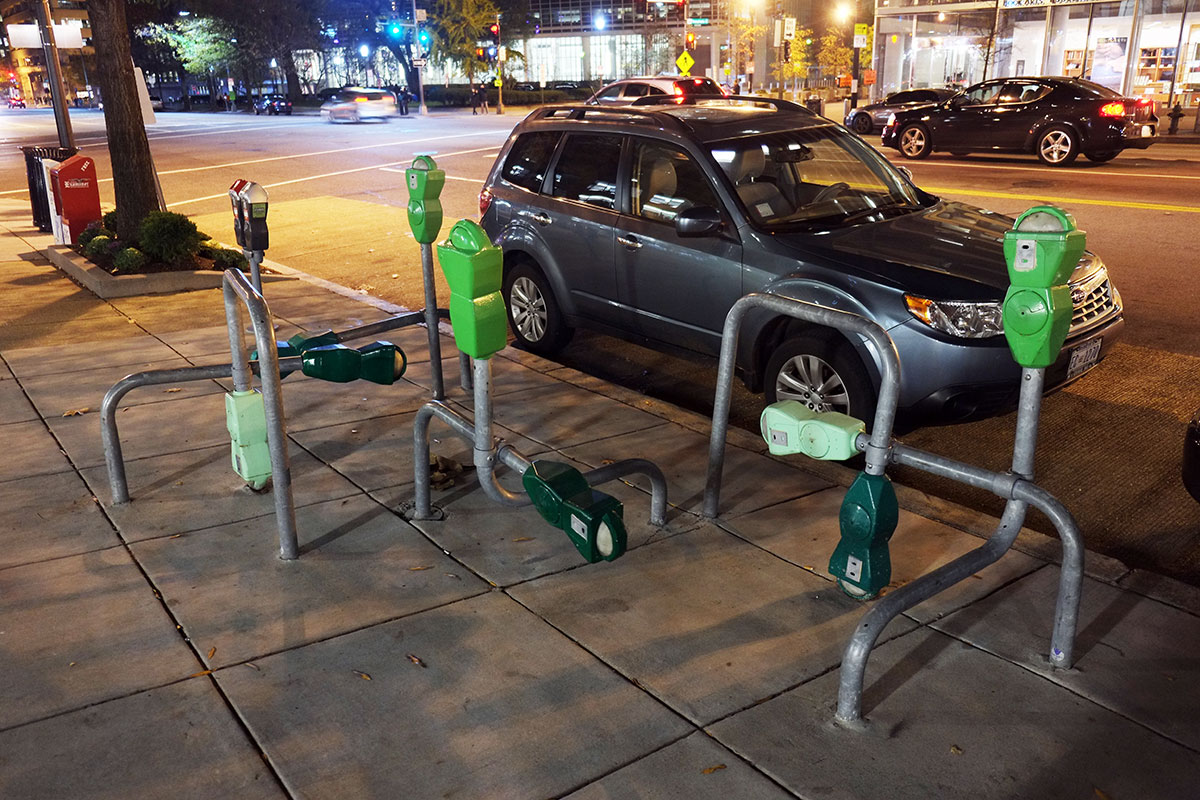
There is some nice street furniture / bike racksDSCF6166

David Adjaye’s museum is getting close to completion, but is already quite noticeable as not your typical building on the Mall.DSCF6172
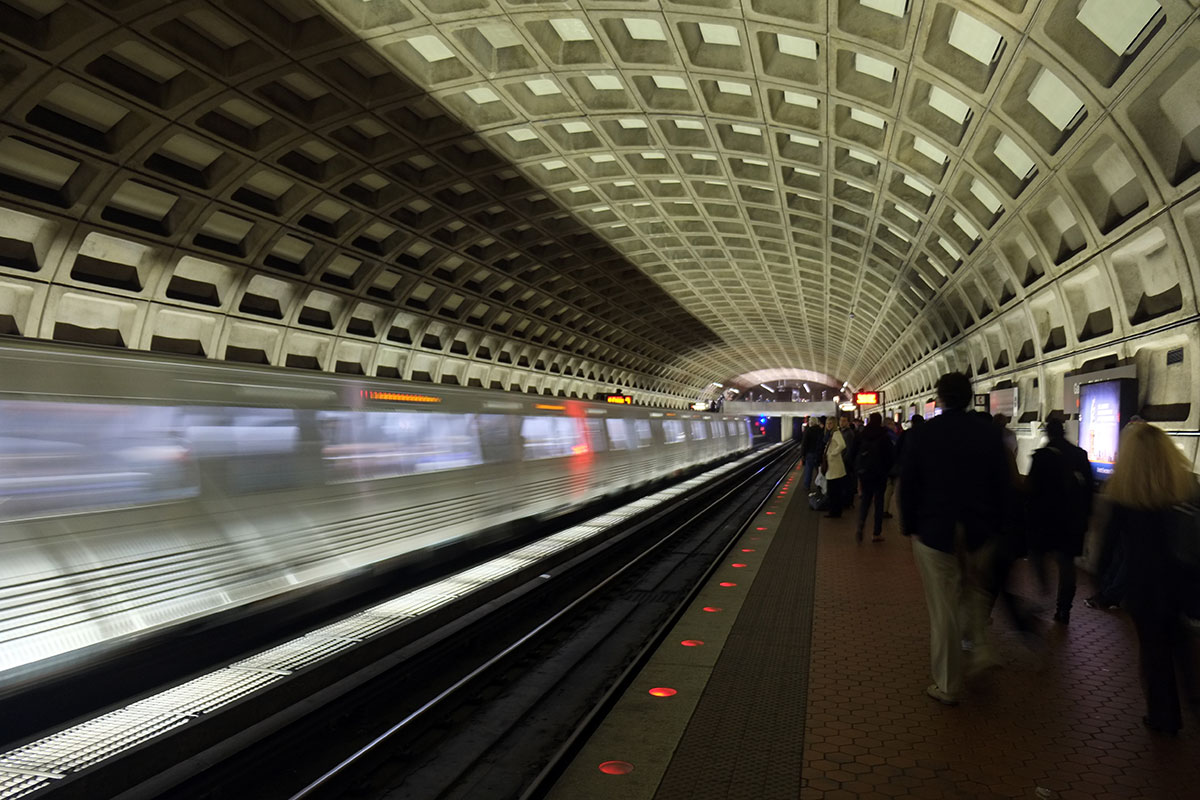
But the Metro is still my favorite architectural space in the city.

DSCF6462

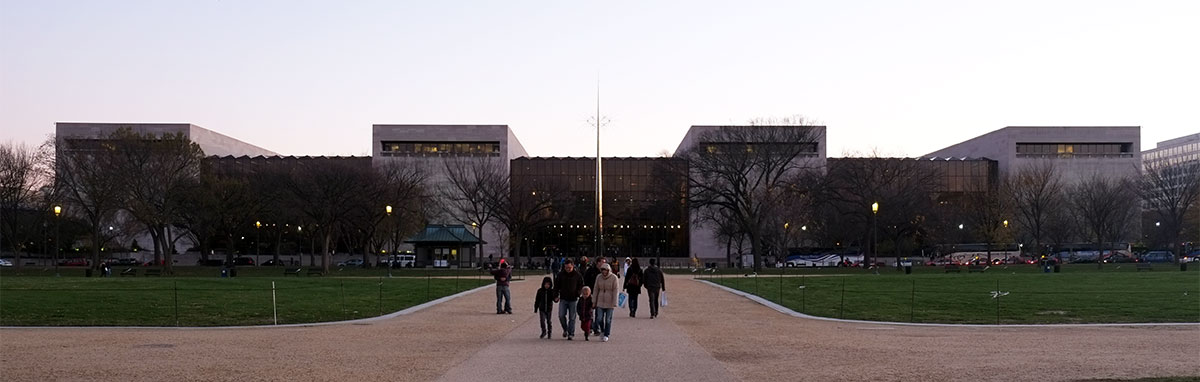
We spent most of a day at the Air and Space Museum, which is memorable for one of the most legible partis in a museum.
DSCF6447
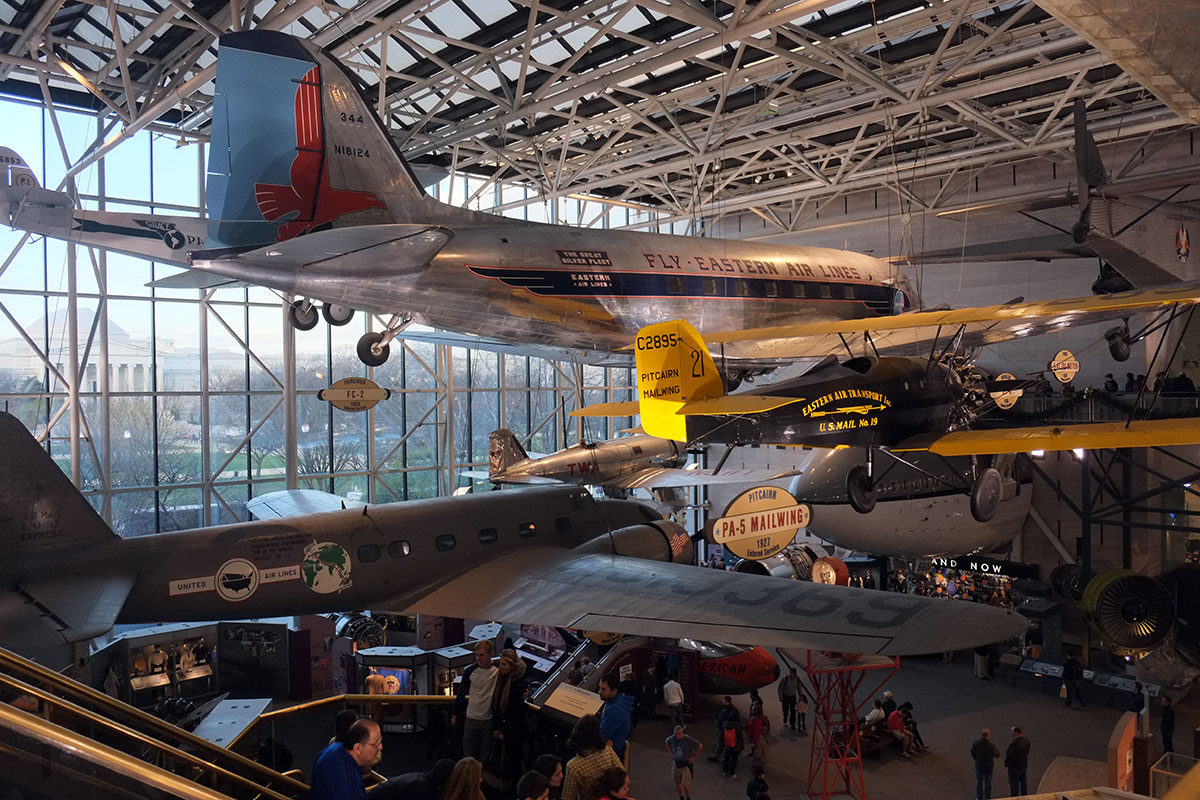
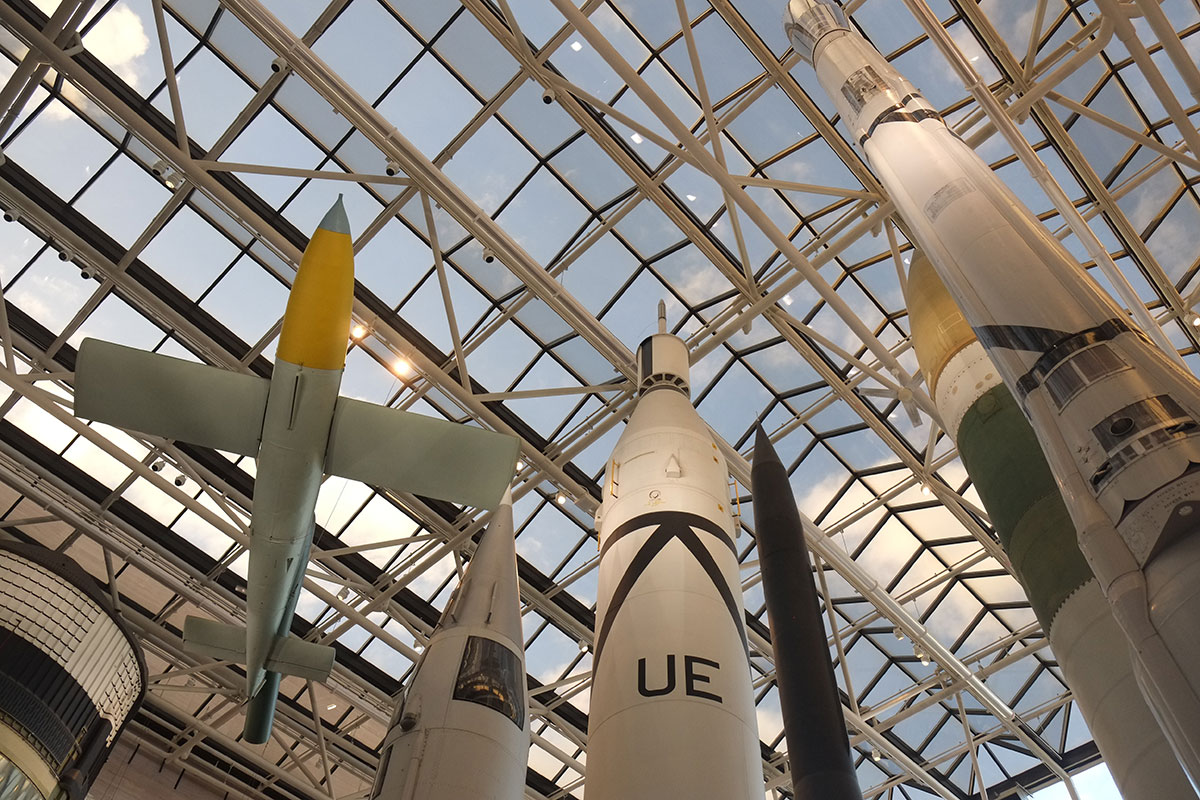
and also for meeting my main criterion for a great museum:  have lots of real stuff.  Not an interpretive center, not solely didactic, not creating a programmed visitor experience.  Have cool stuff that can’t be seen anywhere else, and all the other considerations are secondary.  The Air and Space may be the best example of this – Greta was constantly amazed that these were the real objects.
DSCF6147

Another aspect I really enjoy is having Very Large Things Inside Buildings.  Liverpool has a great, low-key museum called The Large Object Collection, and the A&S illustrates this principle nicely.DSCF6130

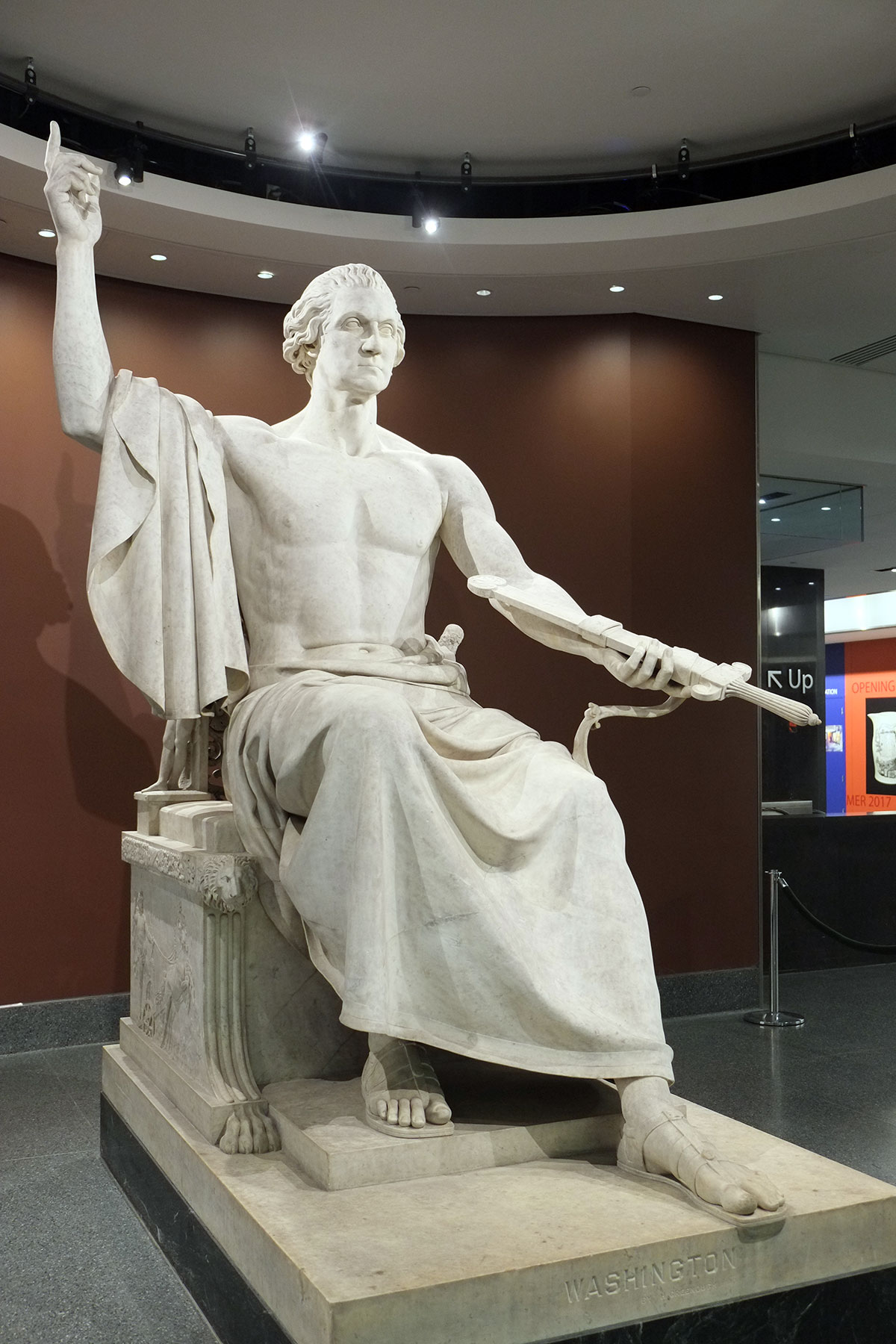
The American History Museum was much better than I remembered;  I think the new approaches to exhibit design of recent decades have been spectacular.  We checked off some iconic pieces, such as the Star Spangled Banner, the display of which unfortunately shows some of the same grandiosity and obsessive fetishism of objects which ruined the experience of Mt. Rushmore and the Liberty Bell.  We also caught the greatest of the slightly-nutty representations of a founding father as a Roman republican:
DSCF6205

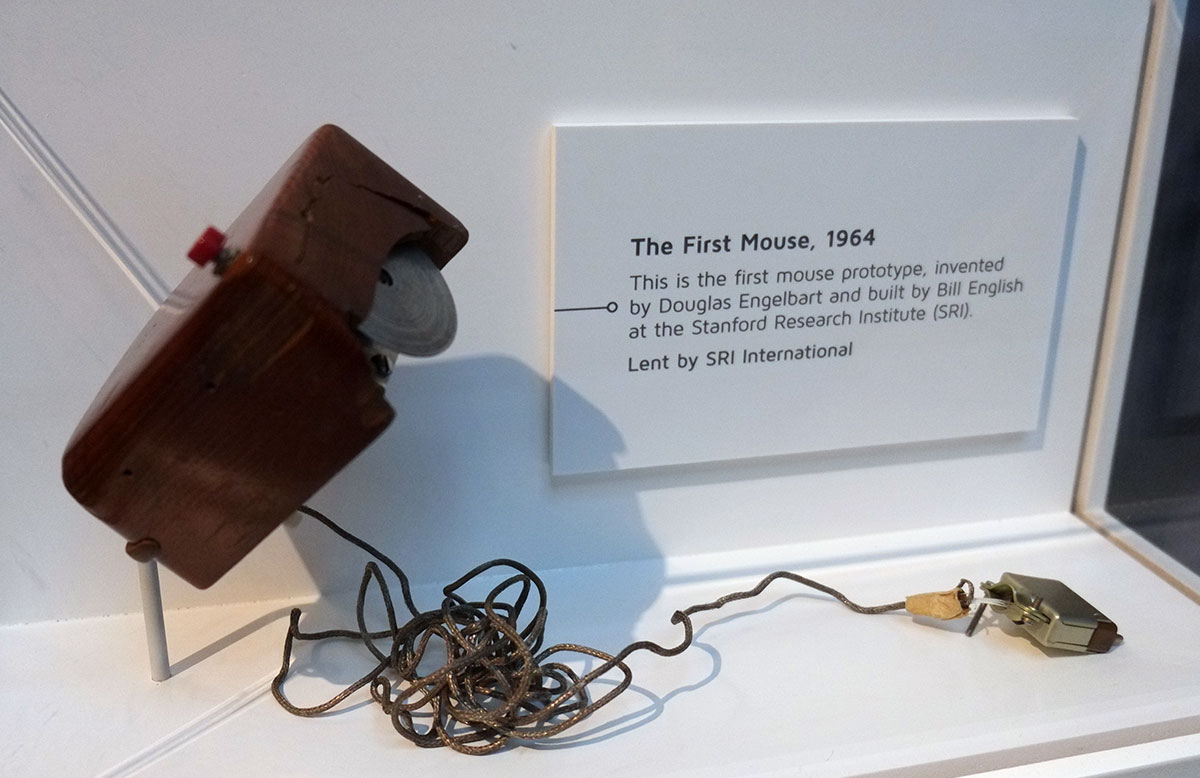
Like the A&S, the display of really cool actual stuff is paramount:DSCF6207

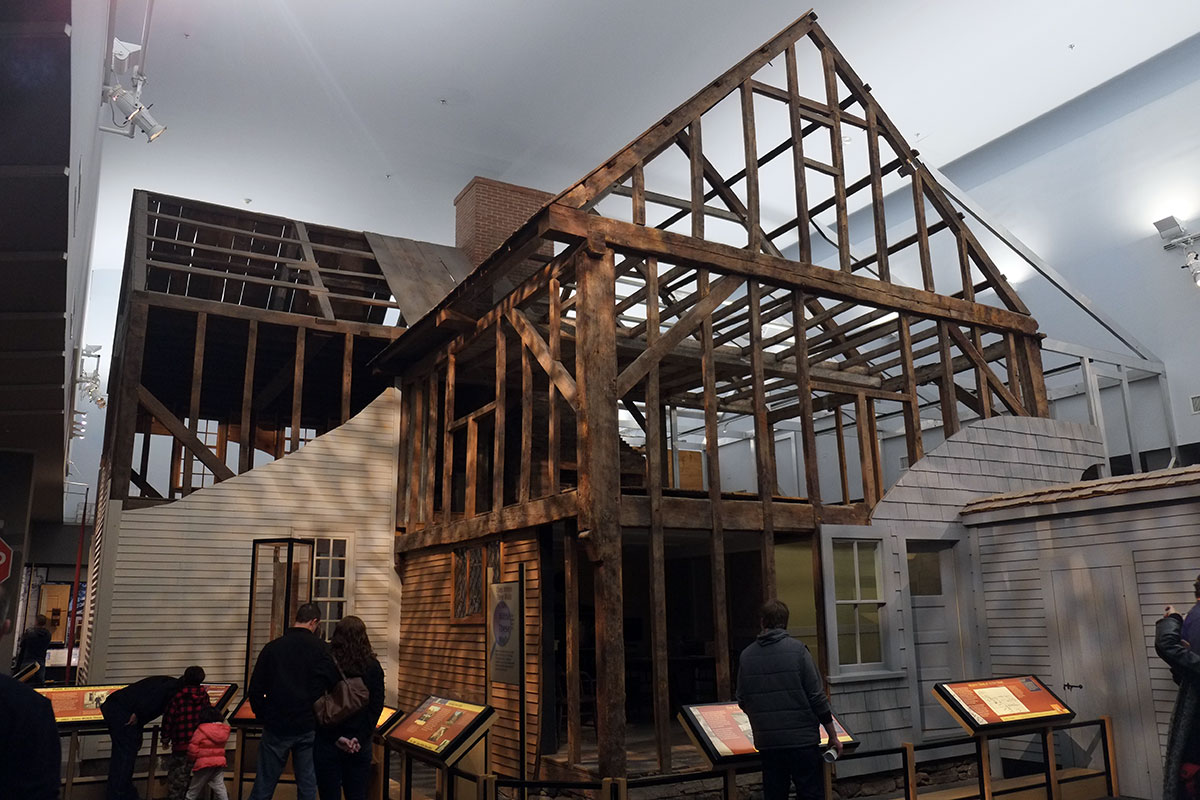
The partially-reconstructed display of an 18th century house from Ipswich is superb, detailing not just the technology of the building, but tracing its social history through the different households that occupied it for 200 years.
DSCF6202

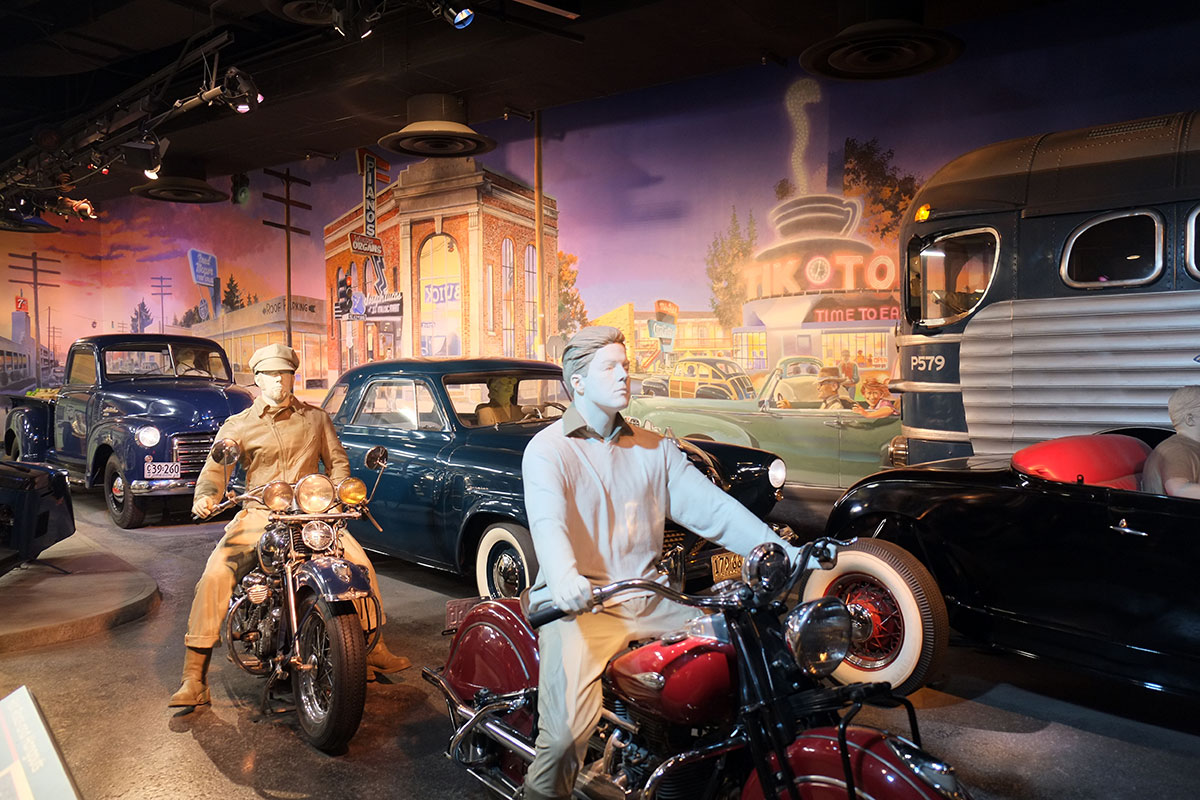
The ability of the installations to show the social, economic, technological and political context of the objects was really sophisticated.  The section on transportation clearly demonstrated the interactions between the changing transportation systems and the economy, making connections that I’d never fully understood (such as why the textile industry was able to shift to the south when it did).  And strangely enough, the section on post-war car culture focussed on Sandy Boulevard in Portland, with this tableau of cruising through Hollywood.  DSCF6243

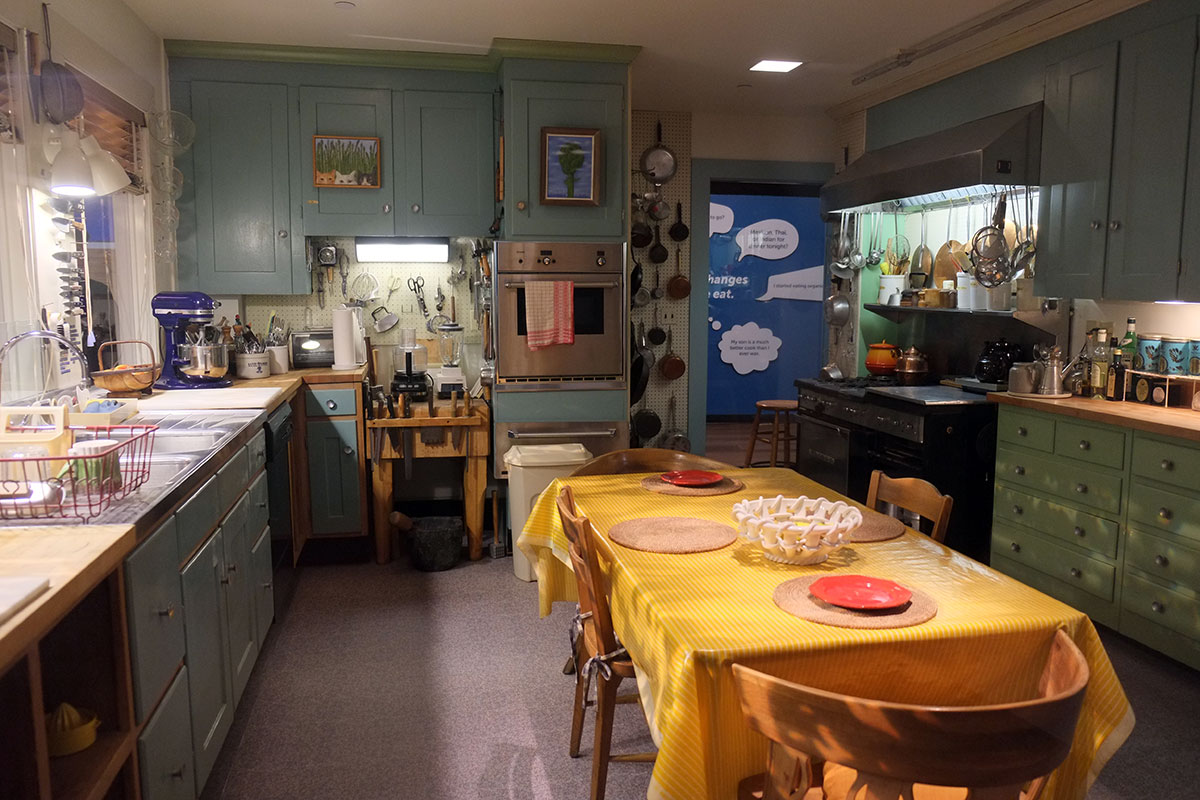
The food section was great, especially Julia Childs’s reconstructed kitchen.
DSCF6253

I started the Natural History museum with Greta, but my willingness to look at taxidermy animals is much lower than hers, especially when some of the greatest paintings in the world are across the street.  So I ditched her for the afternoon and went to the National Gallery.  Back in the 80s and mid-90s I’d always enjoyed business trips to DC, as I could spend the day in meetings and then run out to late hours at the art museums.  So an afternoon at the National Gallery was similar to my day at the MFA – a chance to revisit familiar and beloved works, plus notice a few things that were either newly displayed or had escaped my notice.

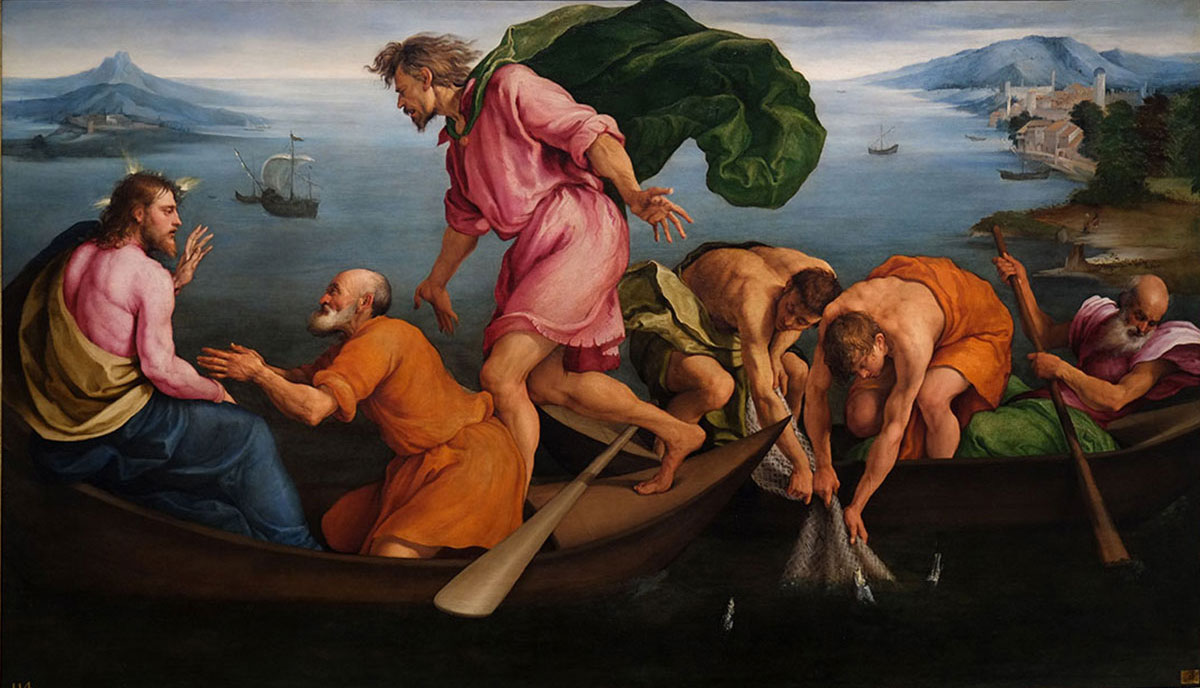
Highlights included one room full of large portraits by three of my favorite painters -Whistler, Eakins and Sargent – and being able to look back and forth amongst them rapidly, thinking about how different their approaches were.  The Italian Renaissance collection is the best in the country, how can such familiar works just knock you out every time you see them?  One new favorite is this piece by Jacopo Bassano, which seems to be Maritime Mannerism;  to the impossible poses, proportions and colors of Mannerism, we can add the unlikely stability and balance of figures leaping around on tiny boats.  DSCF6290

John F. Peto has always been quirky and entertaining, but I find this painting more satisfying than most:DSCF6422

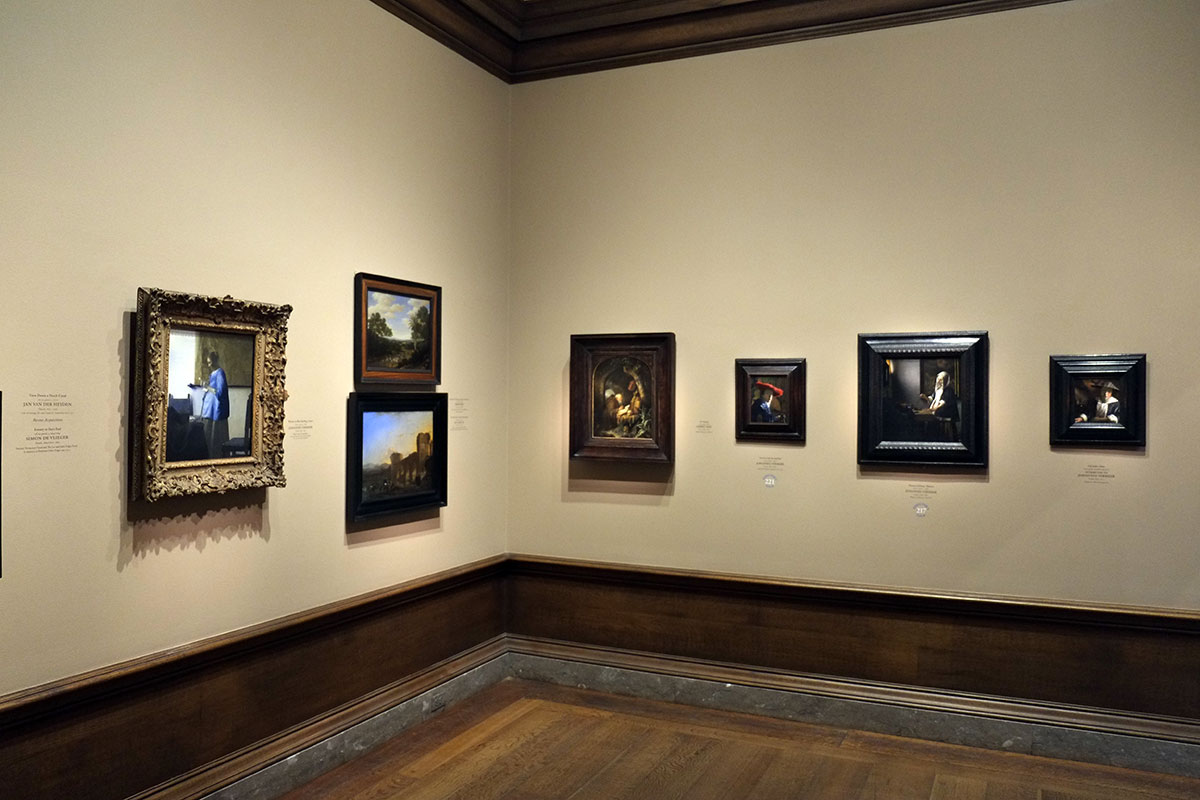
And what can you say to a room with four Vermeers?  One of the Vermeers in the permenant collection was on loan to the MFA, but they had thankfully replaced it with a loaner from the Rijksmuseum.  DSCF6284
Seeing them reminded me of the time that there was the big Vermeer retrospective in 1995, and the one weekend I was able to see it, Newt Gingrich shut down the Federal government and that was it.  There are many reasons to loathe what has happened to the Republican Party in the past 20 years, but that one tops my personal list.

Moving outside, the relatively new sculpture garden has some fun things, including this Lichtenstein 3-D optical illusion.  DSCF6454

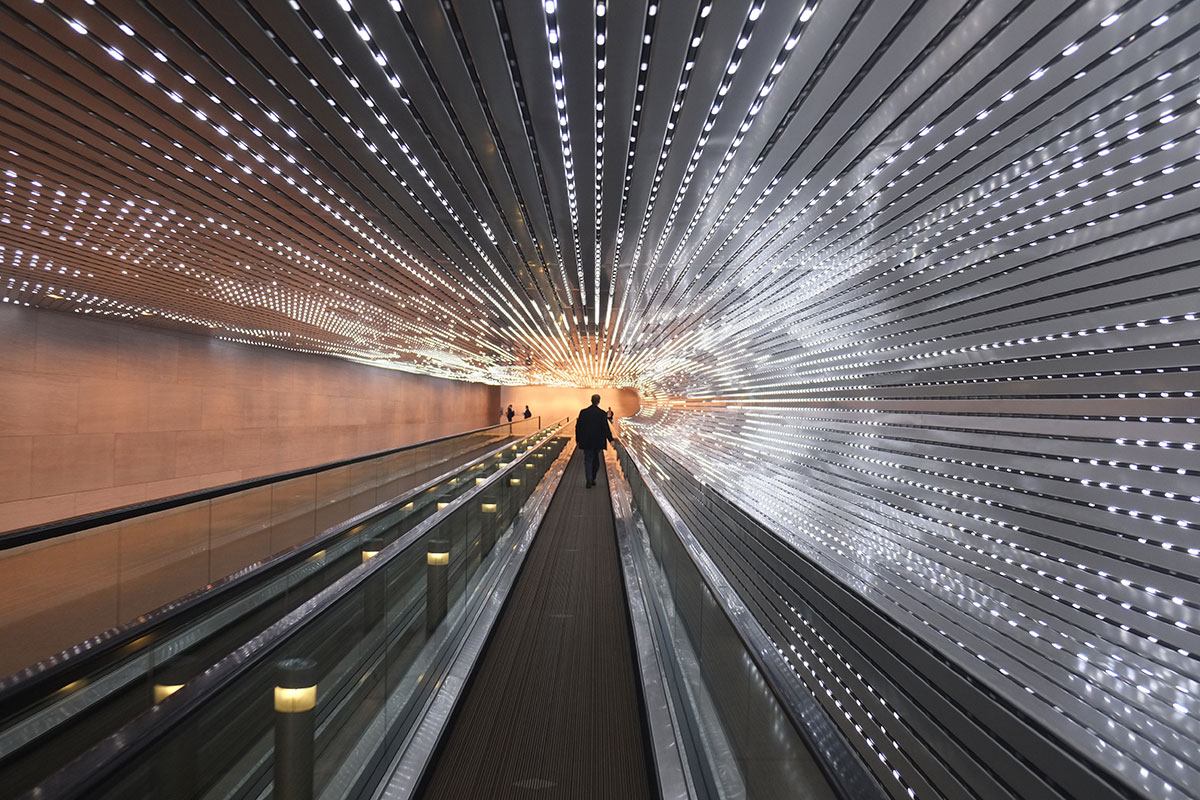
Or you can travel underground, heading towards a galaxy far, far away. DSCF6321

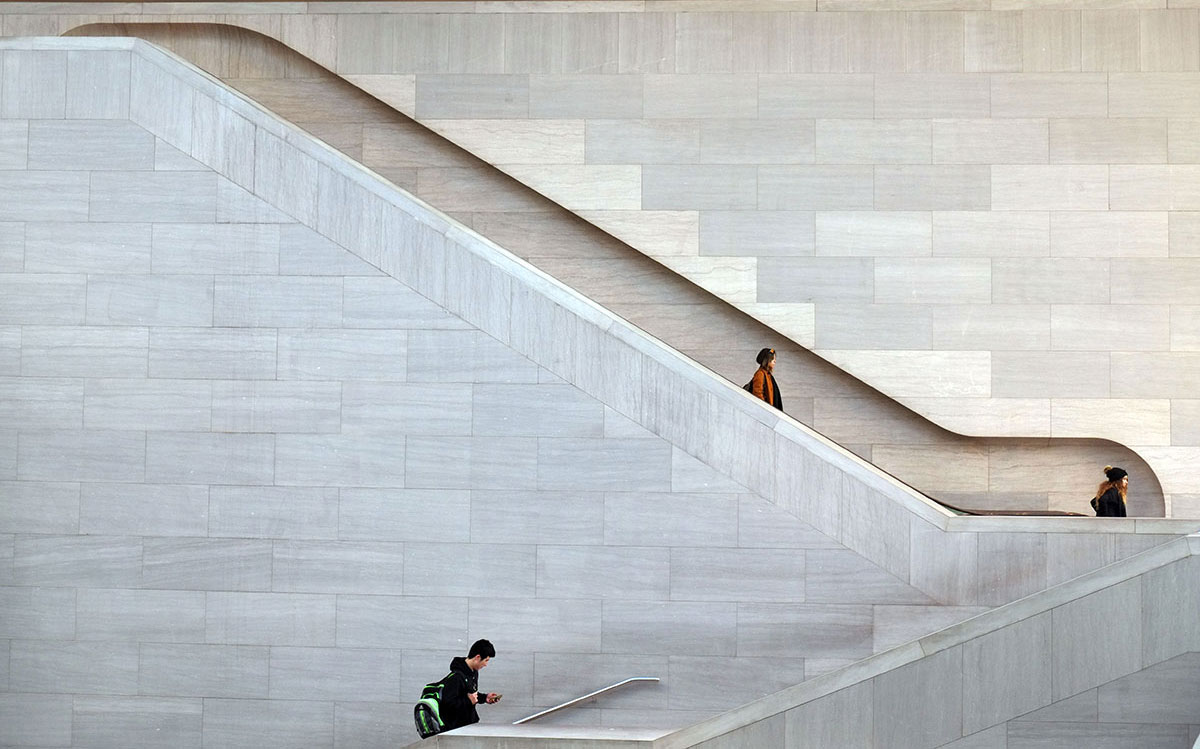
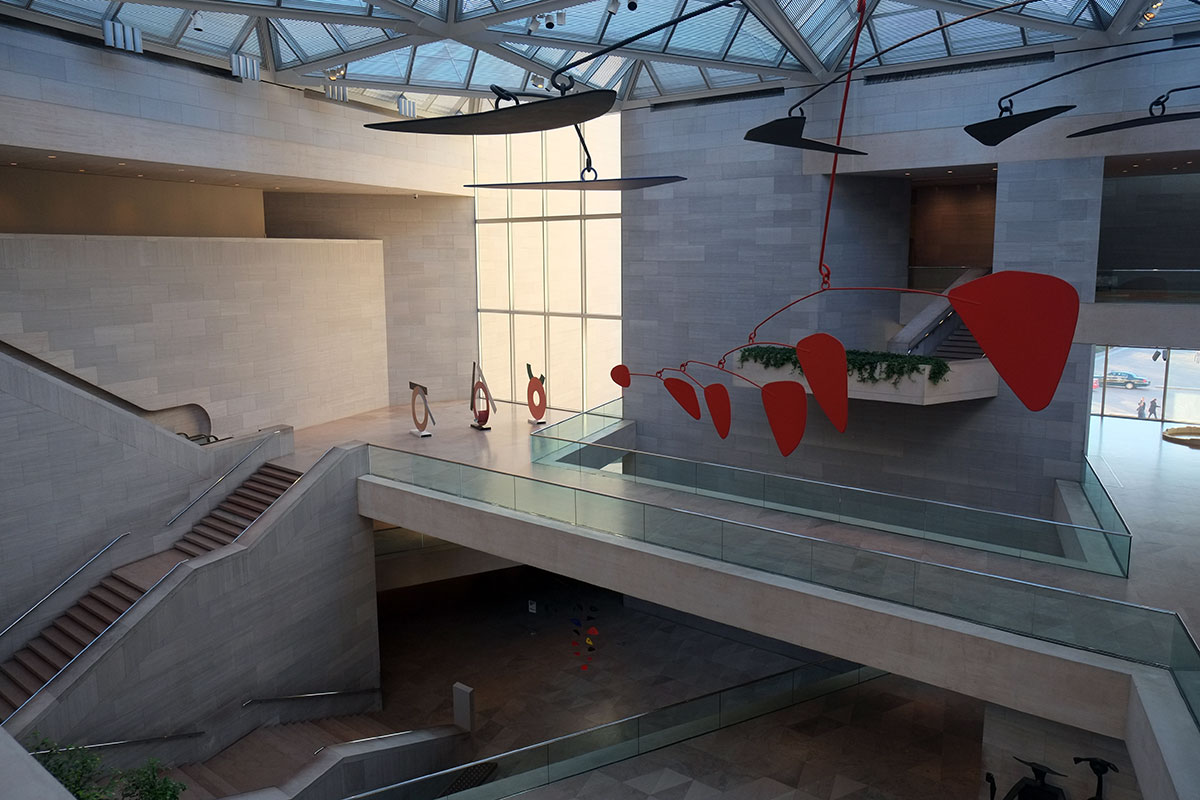
The galleries of the East Building are being remodeled, and an extra floor added on one of the corners, but the atrium remains open.  It is still one of Pei’s best buildings, perhaps as it avoids the usual gypsum board abstract detailing.  In this case, the Washington penchant for marble and grandiosity does pay off.  DSCF6346DSCF6372

And being to see a few Calder mobiles, of varying scales and ages, is great; although as usual, the guards freak out when you blow on them.  DSCF6375DSCF6354

It was wonderful seeing these amazing museums, but we had far too little time, skipping about a dozen other museums I wanted to visit.  When I was planning this trip, I realized we really needed two years to do it right, and that was very evident in Washington.

College friends

As I was planning this trip and listing all the old friends we’d be able to visit, I discovered, to my amazement, that Greta was actually interested in meeting more of my college friends. She knew Dan and Mike and Bob, and she found them really entertaining – smart and funny and very offbeat, so she assumed the others would be the same.

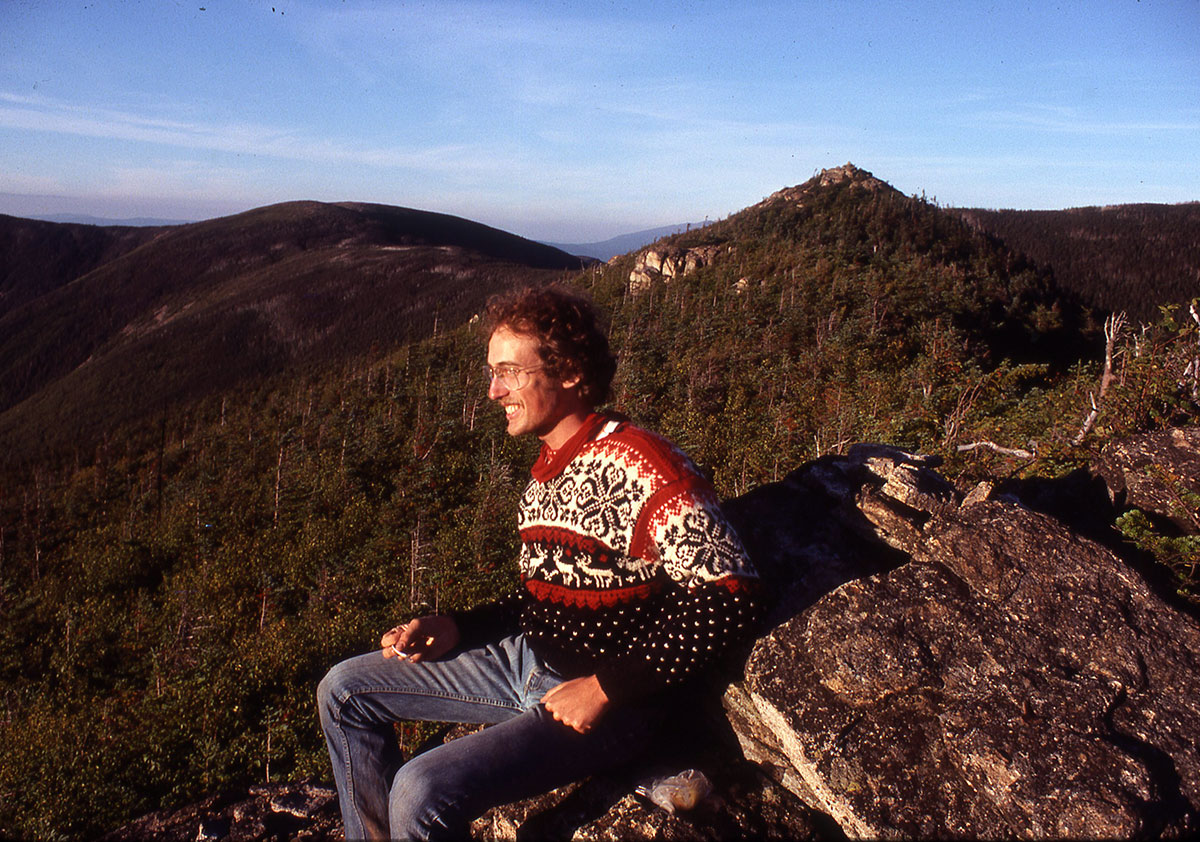
I met Isadore Katz because he went to prep school with Bill, one of my freshman roommates. I distinctly remember this very intense person showing up during freshman year, complaining about Rochester and its miserable weather, where he had made the mistake of deciding to go to college. The next year Iz rectified this by transferring to Wesleyan, and he would stop in to visit us when he was back in Boston. He lived with members of our crowd sometimes in summers, and back in 1977 he and I spent a week together hiking the ridgeline around the Pemigewasset Wilderness in the White Mountains.peeps019

Isadore moved back to Boston to work as a consultant after college, so we hung out for a couple of years until I moved to New York for grad school. Isadore started at the Sloane School at MIT at the same time, and when I asked him how business school was, he said, You’d be surprised at what passes for a concept around here. He lived with us in NY during a summer internship in 1983.  After school Iz worked in the expanding computer industry, and met his wife Chris, a very cool and laid-back architect who had the good sense to not marry another architect. They moved off to Silicon Valley in the mid-80s, and after I moved to Oregon in 1990, I would see them whenever I went down to the Bay Area. Iz and Chris raised three wild and crazy girls, who have now grown up to be in law school at Berkeley, working in tech in Silicon Valley, and in college at Barnard. (One of the secondary goals of this trip has been to reconnoiter the terrain on how smart and independent girl-children turn out.)

Isadore has always had another one of those jobs where we can never quite figure out what he does, although in this case it’s not due to the vagueness of the job description, but rather to the complexity of the technology involved. He’s mainly been in the management end of the high tech industry, although after the Crash, he spent a couple of years working as a consultant at the Veterans Administration, essentially reconfiguring their database operation. About a decade ago, back in Massachusetts, he started a company that, as far as I can tell, designs software for chip manufacturers to help them model real, versus theoretical, chip performance, before they put a design into production.DSCF4787Is and Chris live in Harvard, Mass, out in the woods past I-495, a short walk from Fruitlands, the transcendentalist utopian community started by the Alcotts and others.  Staying with them felt like being home – a modern house with lots of windows looking at the trees, a few days eating and drinking, and relentless storytelling and joking with two of the cleverest people I know. Isadore’s brother Seth, another friend from long ago, dropped in from his home in Florida, and we all got to reminisce about crummy apartments in Somerville and life before we became middle-aged.DSCF4791


Bob Beckman was one of my freshman roommates. I walked into our five-person suite, and saw that half of one room was already occupied, by someone who had left an olive-drab, gigantic filing cabinet, with a bar and padlock across the drawers. I immediately decided to take my chances on the other double room. Bob showed up and confirmed my take on him – a serious science nerd from the Philadelphia area, whose career orientation had been jumpstarted by his technocrat father (who had also supplied the government surplus file cabinet). In high school Bob had been a Westinghouse science competition national finalist with his research into sleep patterns, and this direction continued with his advanced standing concentration as a pre-med.

Bob’s seemed to conform to the absent-minded nerd stereotype: incredibly brilliant and relatively incompetent in dealing with the real world (manifested in such incidents as his first attempt to cook a hamburger, when it became clear he had no idea that you had to flip them). But contrary to type, Bob was one of the wittiest and most social people around. After graduating from college early, Bob worked in a lab for a year, and had weekly gatherings at his apartment for his college buddies, featuring endless guitar jams and truly awful spaghetti dinners.   He also began his association with a lab at UW, furthering his research into a mathematically-based approach to understanding cancer. (Yes, Bob has another one of those careers I can’t understand, despite his repeated efforts to explain it to me.) Bob then entered the Harvard-MIT joint MD-PhD program, sharing an apartment with Isadore throughout this period, as his cooking skills marginally improved after determined effort.  Bob moved off to California for his residency, where he met his wife Susan, a medical social worker from Rhode Island, whose good sense, unflappable disposition, and extreme competence have provided the bedrock upon which Bob could continue his stereotypical scientist life.DSCF6265Bob worked as a pediatric oncologist, but finally gave up on the clinical career when the unique American medical insurance situation made it impossible for him to practice medicine in the way he knew it should be practiced. He went to work on the East Coast for a succession of pharmaceutical companies over the next two decades, designing cancer drug trials, and trying to survive the corporate politics, while he and Susan raised two great kids, Daniel (now working for the NPS at Saguaro, whom we plan on visiting next month) and Laura, an artist in New York. Bob was appointed a fellow at the Institute for Advanced Study at Princeton, where he furthered his continued interest in cancer research, while still holding down his day job.

A few years ago Bob mentioned that with the kids grown and retirement money stashed away, he’d like to return to research full time, using the last decade of his career to consolidate his theoretical approach to cancer. I warned him that the institutional nuttiness of academia was different from, but not necessarily any better than that in large corporations, but he didn’t listen. So last fall Bob got an appointment as a professor at Georgetown. He works with some graduate students, but his main job is to secure funding and pursue his unique direction in cancer research. We stayed with Bob and Susan in the little rowhouse they’re renting in Georgetown, where they are thrilled with the possibilities of urban life, after a few decades in suburbia in the northeast.DSCF6267


Norman Rave was another resident of our freshman dorm of misfits and savants. He arrived as a relatively conservative graduate of a Jesuit high school in Cincinnati, and along with us other lapsed Catholics, left the trapping of that life behind fairly quickly. Going off to college allows you to reinvent yourself, and Norman took advantage of this in the best possible way, combining his academic interest in biochemistry with his other strong predilections for literature and philosophy. Long rambling conversations with Norman about the meaning of life were some of the highpoints of college for me.

Norman always wore a weirdly wide range of eclectic tee-shirts, which I at first took to be the expression of an extremely ironic viewpoint, but it turned out that he just shopped at a store in Cincinnati which sold remaindered and misprinted shirts really cheaply.  When this sartorial approach combined with Norman’s decision to stop cutting his hair or his beard, his appearance became the quintessence of the mid-70s college student, and he was known as Troll thereafter.
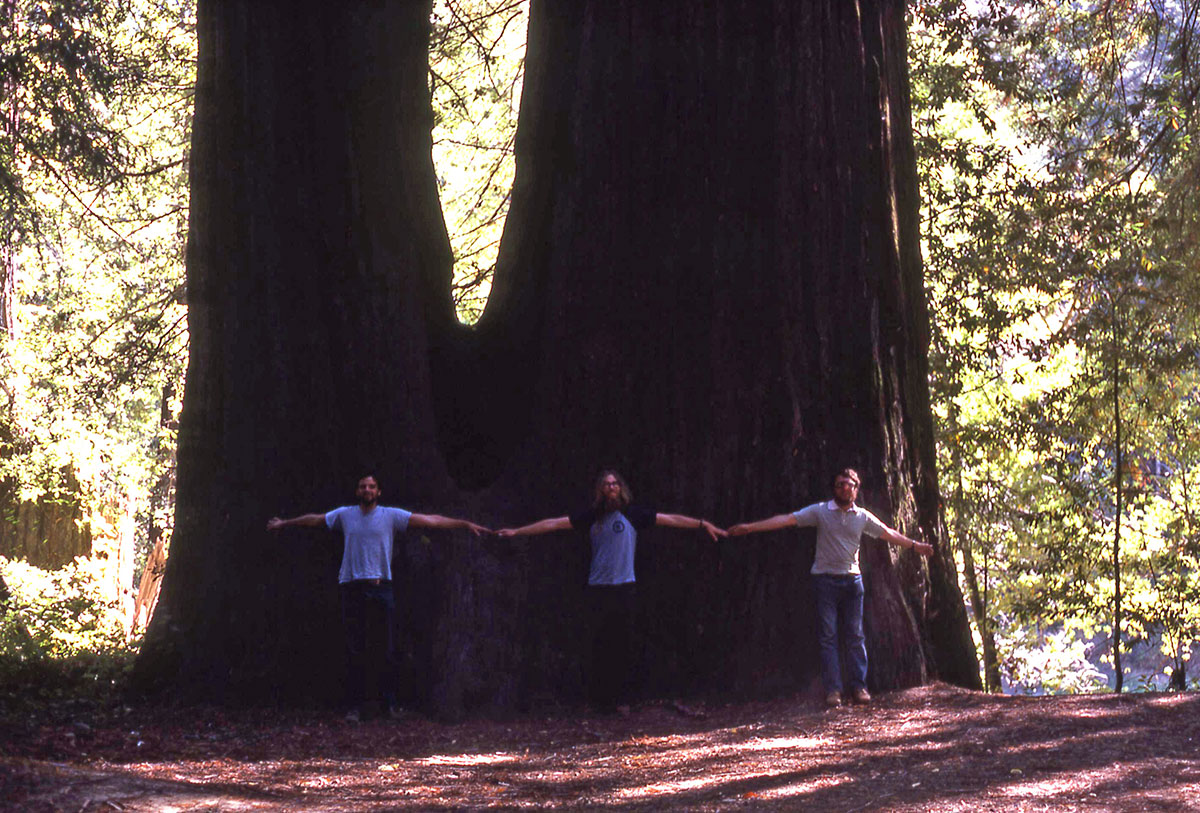
redwood021Norman got into grad school at Berkeley, so the summer after college, he and Dan Rabin and I drove across the country together, packed into an old Datsun B210 with all of Norman’s possessions. The person riding in the backseat was unable to move at all, and our overall appearance was such that we were shocked at the laxity of US law enforcement in that no one ever pulled us over. This was the first cross-country drive for any of us (I am in the middle of my 11th right now), but it just started a trend for Norman. He decided he didn’t like grad school, so he drove back to the east, and then back and forth a few times as he tried to figure out what to do with his life.

At some point he stumbled upon a position working in a lab at Princeton, which was of little long-term professional import, but where he met Ginny, a post doc in the lab, who would later become his wife.  (I didn’t get  a good photo of Norman and Ginny, but they still look remarkably like they did 35 years ago, except for the hair length.)  RavesThey lived in Boston and then DC, as Norman decided he was more interested in the policy side of environmental issues, and he attended Georgetown Law School. Norman eventually ended up at the DOJ, while he and Ginny raised three kids in Rockville. Ginny spent years as a full-time mom, but began teaching high school science about ten years ago, and recently led a group of students on a field trip to the Amazon (she is nothing like any of the science teachers I ever had.)

We got to meet Kate, who is living at home while considering grad school (maybe in Oregon), and Will, who attends George Washington University. (Greta realized she had picked up yet another member for her cool nerdy posse when Kate opened the front door wearing her Welcome to Nightvale tee shirt.) Helen is off at Harvard Law, where she has actually studied environmental law cases that were argued by her father. Greta and I had a great time hanging around with all of them; most of my friends are now empty-nesters, and eating family dinners and spending time with a crowd was a nice change on our trip. And Norman and I got to sit around drinking bourbon and yacking, which we hadn’t done in 20 years.

At one point I asked Greta what she thought about all these friends she’d now met. She said it was fun, but strange. Little kids largely grow up in the world their parents construct for them, listening to the stories their parents tell. Greta had heard stories about these people throughout her life – Bob Stories are an especially iconic category among my people – and long ago they had assumed almost mythical status in her cosmology.  So while it was nice to meet the real people, the legends were somewhat diminished now.  Greta enjoyed getting to know Norman, but she’ll never have the same innocent fascination with Troll that she had before.

Annapolis

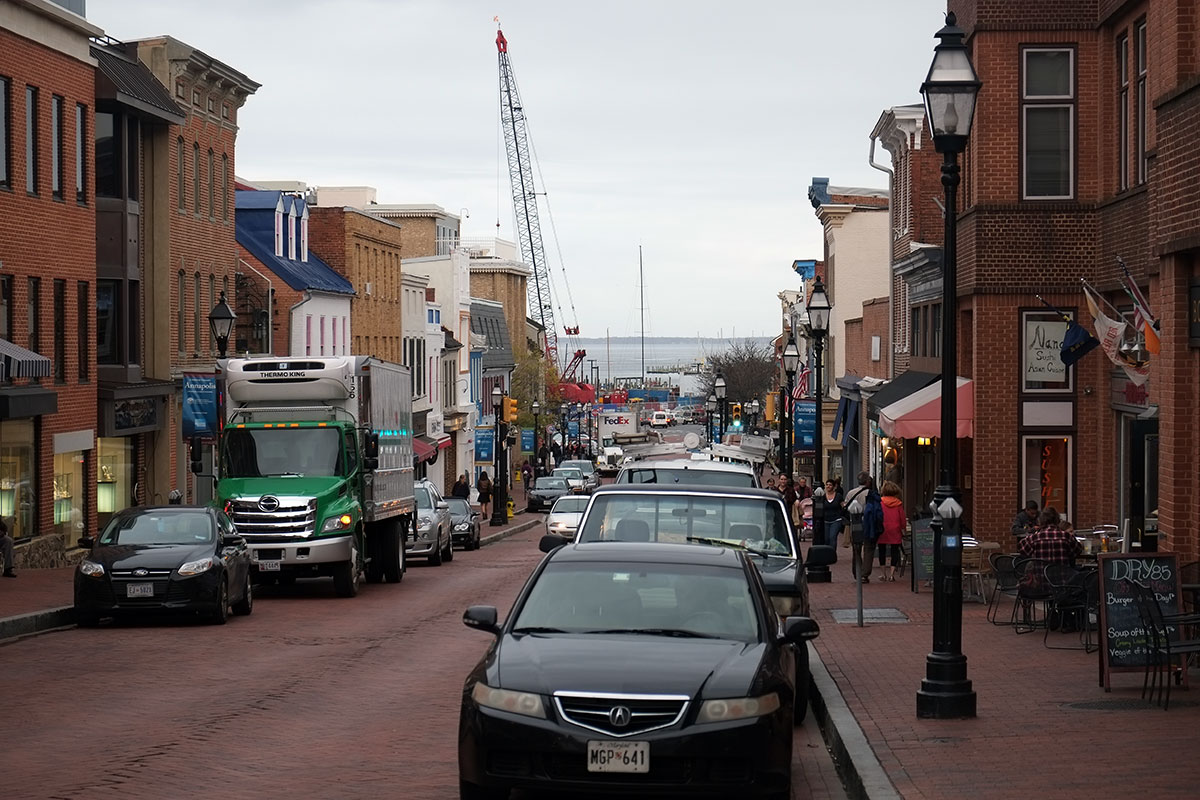
DSCF5932Visiting state capitols was not a goal of this trip, but we’ve come across eight so far.  The architectural quality of them, and the others I’ve seen, has been very good.  (The only truly embarrassing one being Oregon’s, which looks like a salt shaker designed by Albert Speer.)  But in every case, the quality of the capitol is overwhelmed by the mind-numbing banality of the state administration buildings which surround it.  They reflect the growth of state government in the mid-20th century, and the architecture  is always modernistic-pretentious, with lots of marble and “timeless” elevations.  Albany is obviously the most extreme, but it is not fun walking around any other state capital district either.  With the exception of Annapolis.

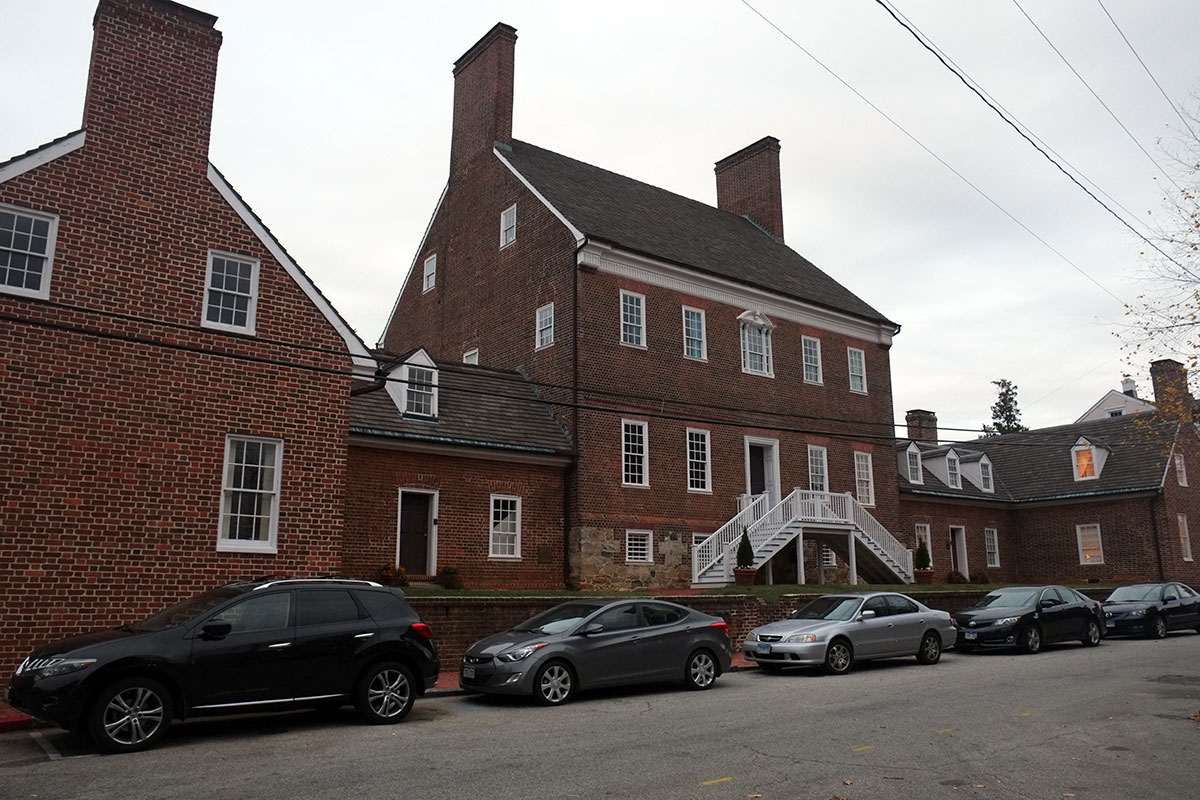
A beautiful, well-preserved, 18th-century state house, surrounded by a district which is still largely 18th- and 19th-century.  How can this be?  Where are all the soul-less boxes of bureaucrats?  Baltimore.  Maryland had the good sense to realize there’s no real reason why all the functions of state government have to be in the same neighborhood, and those large boxes were placed in a large city which was better able to accommodate their scale, both architecturally, and in terms of how many employees would have to work there.

The building itself is fine, the oldest continuously operating state house in the country, and was the temporary home of the US government in 1783-84.  George Washington resigned from the Army there, which is nicely reenacted by bronze statues (so much more satisfying than living reenacters).  DSCF5952

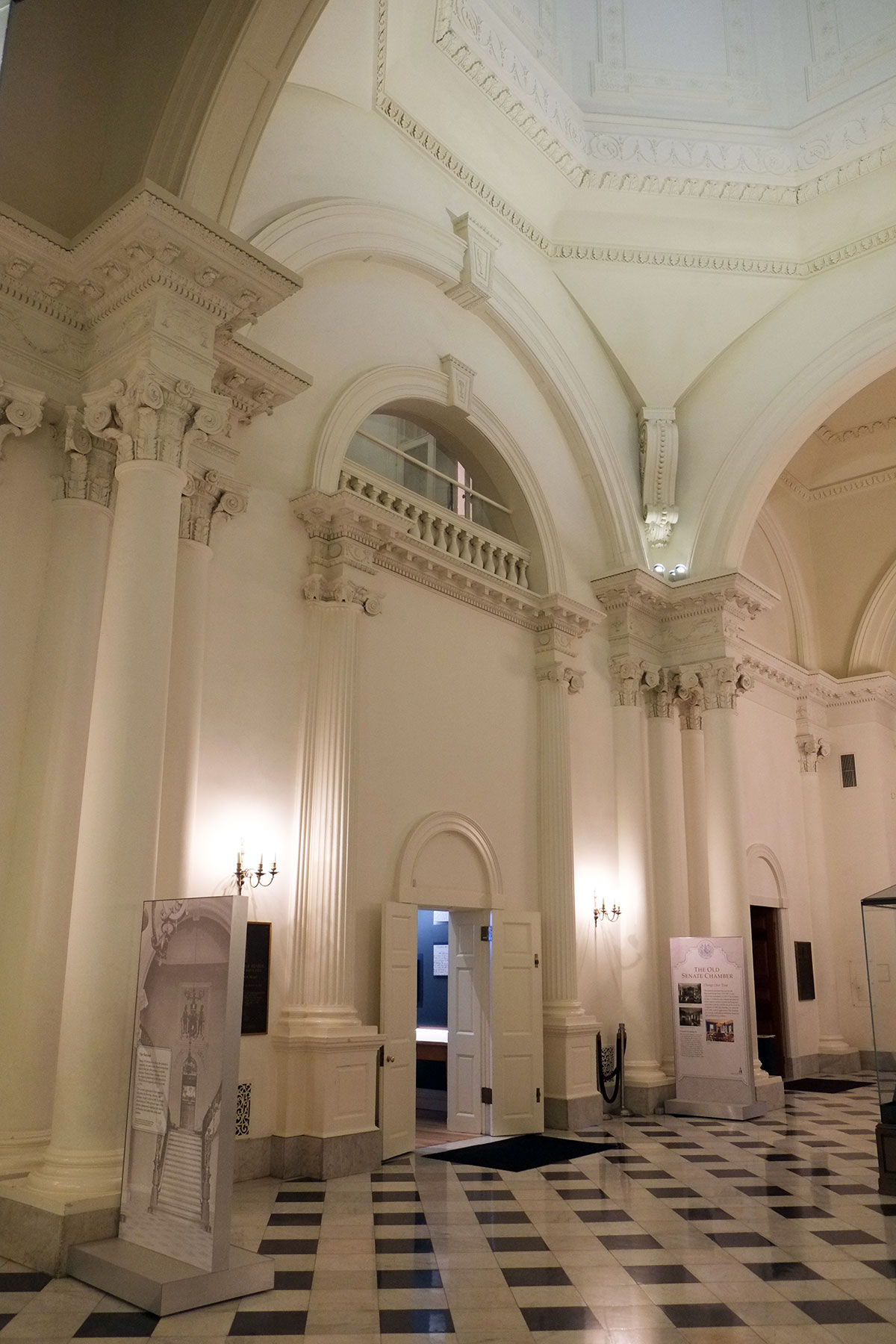
A beautiful central hall and domeDSCF5956

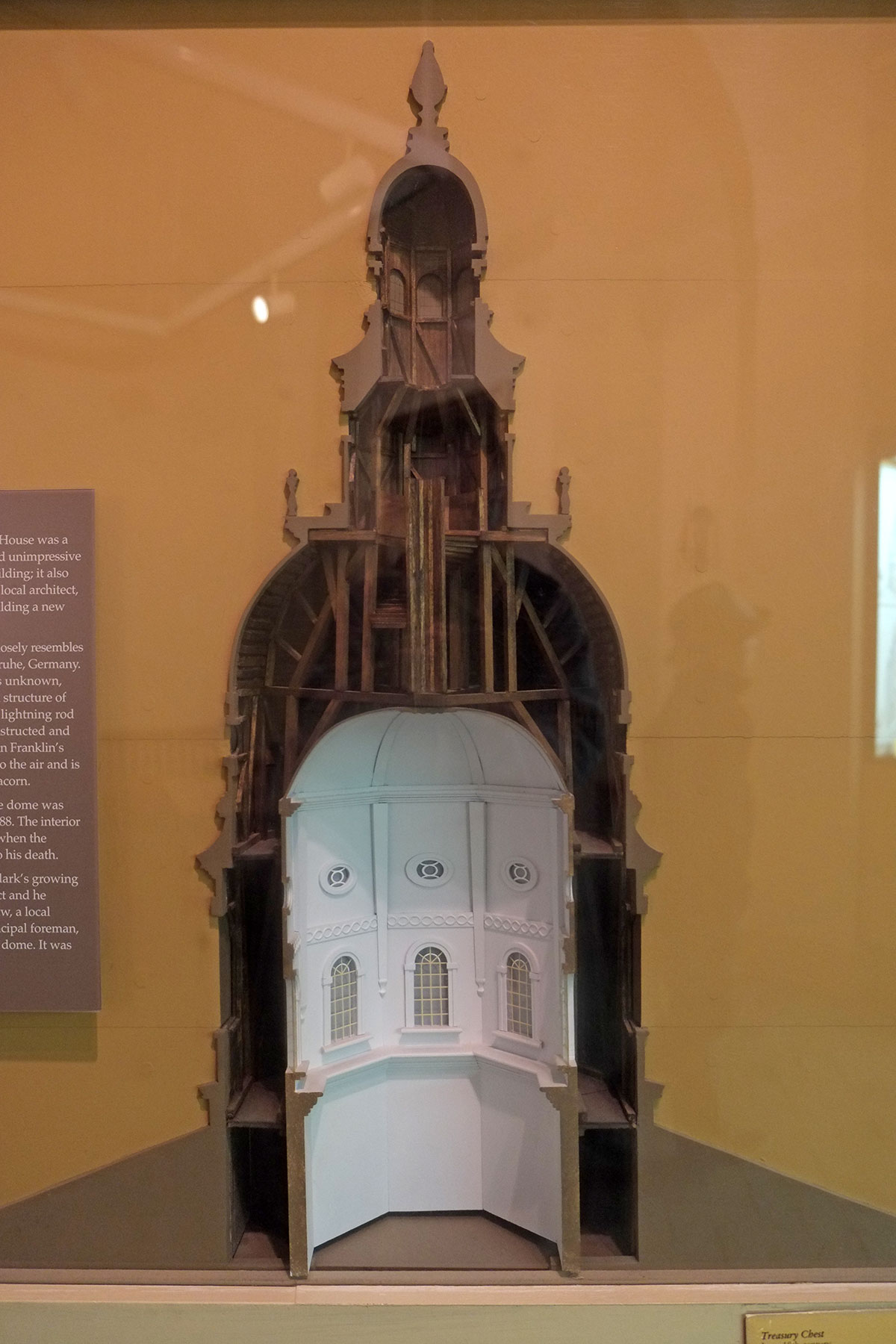
with an excellent sectional model to satisfy the architect-geeks.DSCF5959

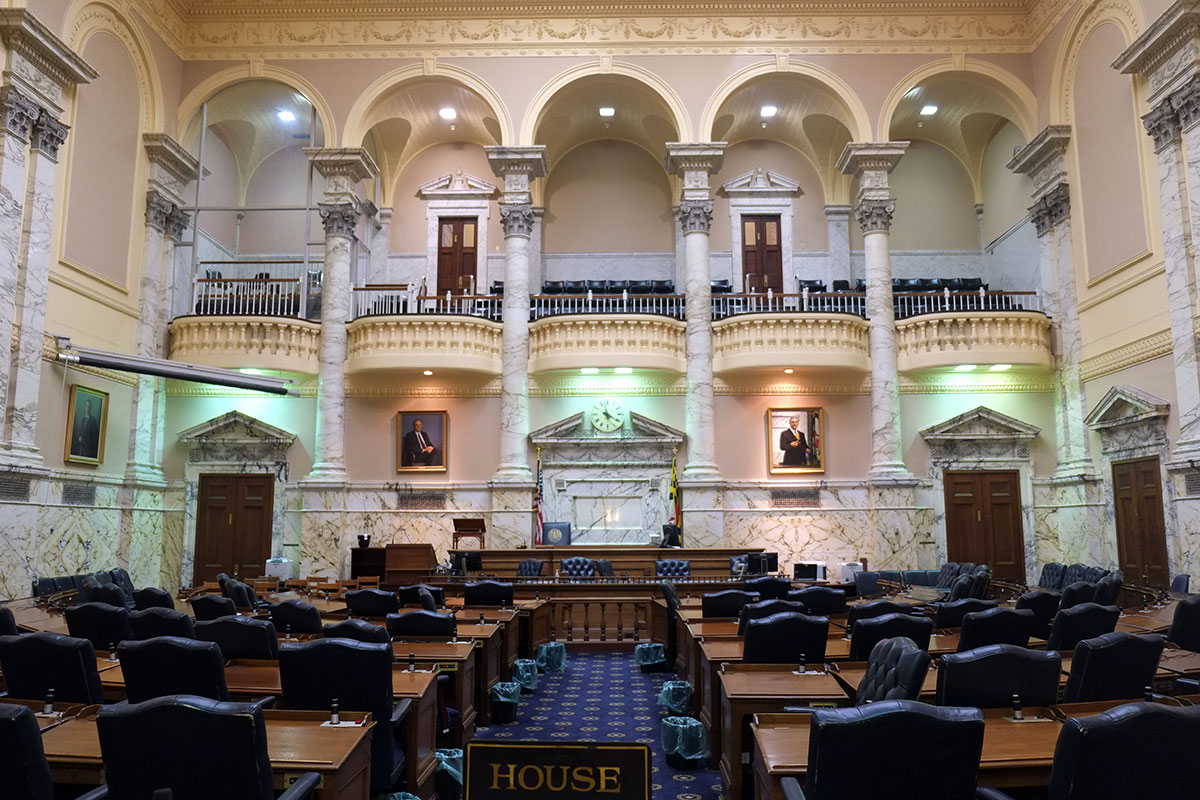
The legislative chambers are accessible, and show their later remodelingDSCF5953and other period rooms are well-restored.DSCF5944

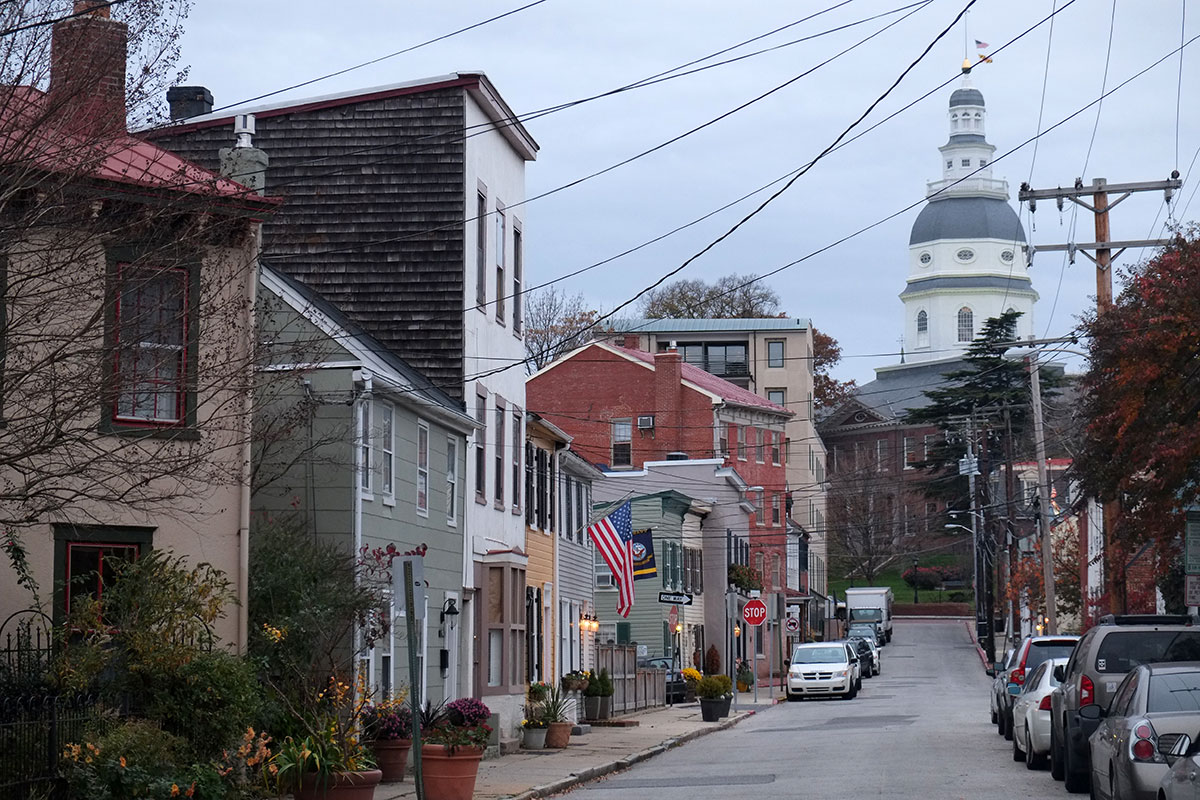
But the best thing about the capitol is how is situated, on top of a hill, providing a focus for views from all over the city.  DSCF6018

There’s a wonderful balance of the formal and the vernacular, what Krier calls the res publica and the res privata.  The state house is of central importance, but it is not the only important thing. Views down the main streets end in the harbor, as they should. DSCF5933There are grand houses (I’m not used to seeing Palladian villas in a city and not in the country) DSCF6019
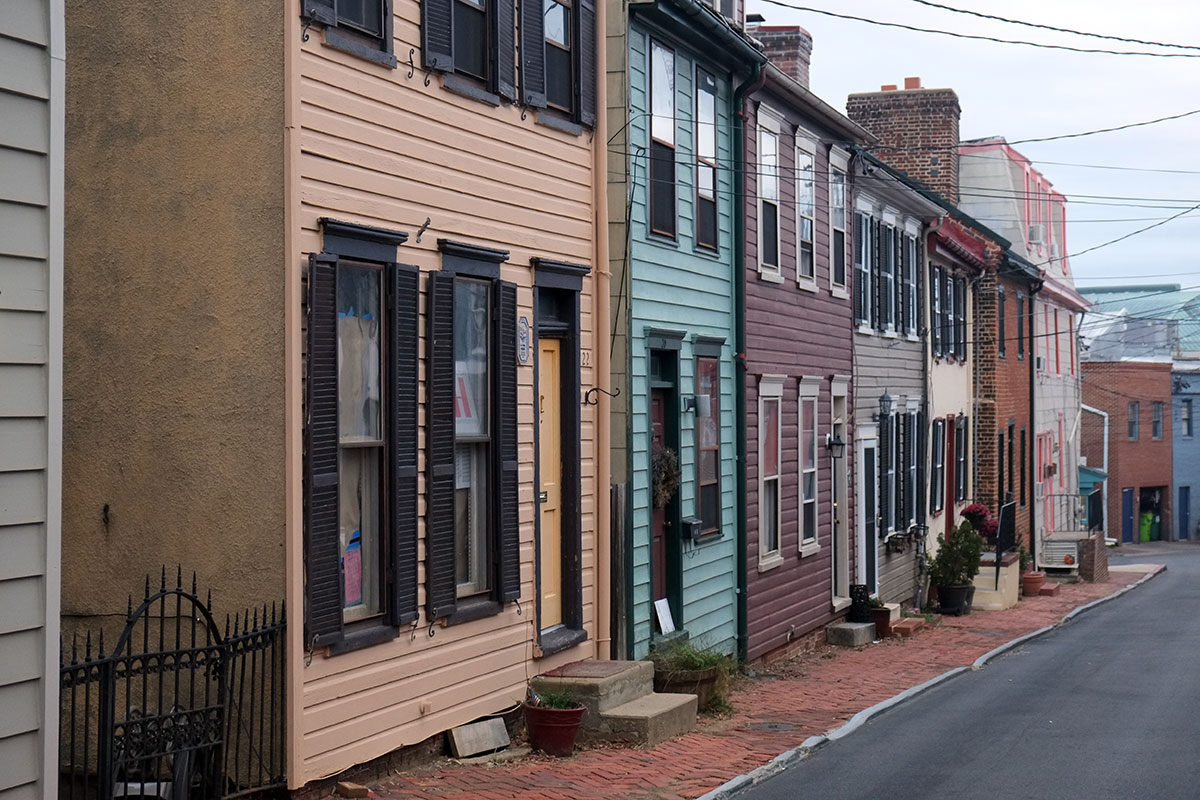
and small row houses and shops from the same period.DSCF5968

Some prominent locations are downright funkyDSCF5969

and the buildings from different eras and of different scales are juxtaposed.DSCF5934

Some irregularity in siting is quite welcome, relieving the fairly uniform street walls. (I took this same photo 26 years ago.  It’s nice they got around to fixing the porch.)  DSCF5973

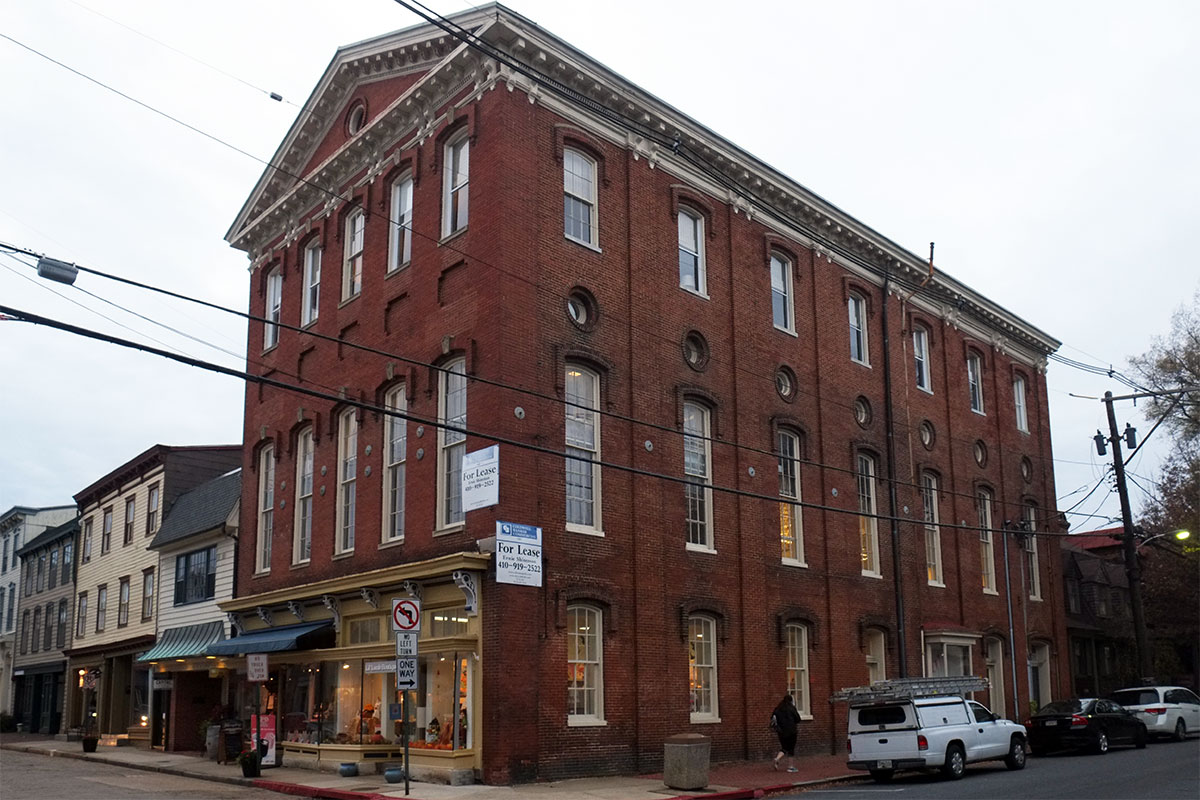
and there are just fine, elegant buildings from many periods.DSCF6009DSCF6004DSCF5998DSCF5989

and some quirks:  three steps, four materials.DSCF5984

Annapolis is this very historic town, full of historic buildings, yet it doesn’t feel precious, or forced (although some of the stores do).  I think this is because they’ve avoided the ye-olde self-consciousness.  It feels like an old city that has people living in it.  They haven’t tried to iron out the anachronisms – it is not a city frozen at one moment in time, but comfortable with many.

They were also smart (or lucky) enough to not have many bad 20th-century intruders.  (I don’t think it’s at all impossible for there to be excellent modern buildings in a context such as this – there are many examples in Europe and a few in this country.  It’s just highly unlikely.)   Annapolis avoided the modernist disrupters (of course, if you go a few miles to the edge of town, it’s just like the rest of America), and also the faux-historical imitators.  It avoided urban renewal, and apparently it avoided grand redevelopment schemes.  Being in such a coherent urban environment makes you realize how rare they are in this country, and how we managed to dodge a bullet a few times.  DSCF5995

Baltimore

DSCF5725In this age of media-cooption of direct experience, how truly can we see a place, without our understanding being overwhelmed by previously-seen portrayals of that place?  This obviously comes up with New York, and L.A., and many tourist destinations, but for me it also came up with Baltimore.  I had been there several times before, but to be honest, my deepest understanding of Baltimore has come from repeated viewings of Homicide and The Wire.  This preconception had its negative effects – I was worried about walking down an alley, expecting that ferocious black-and-white dog from the Homicide credits to hurl itself against the fence at me – but it also had positive effects.  It reinforced my interest in the fabric of the city, spending time walking through neighborhoods, rather than just seeking out the architectural highlights.  This coincides with Greta’s predispositions too, as she’d much rather people-watch and see day-to-day life than look at major monuments of architectural culture.

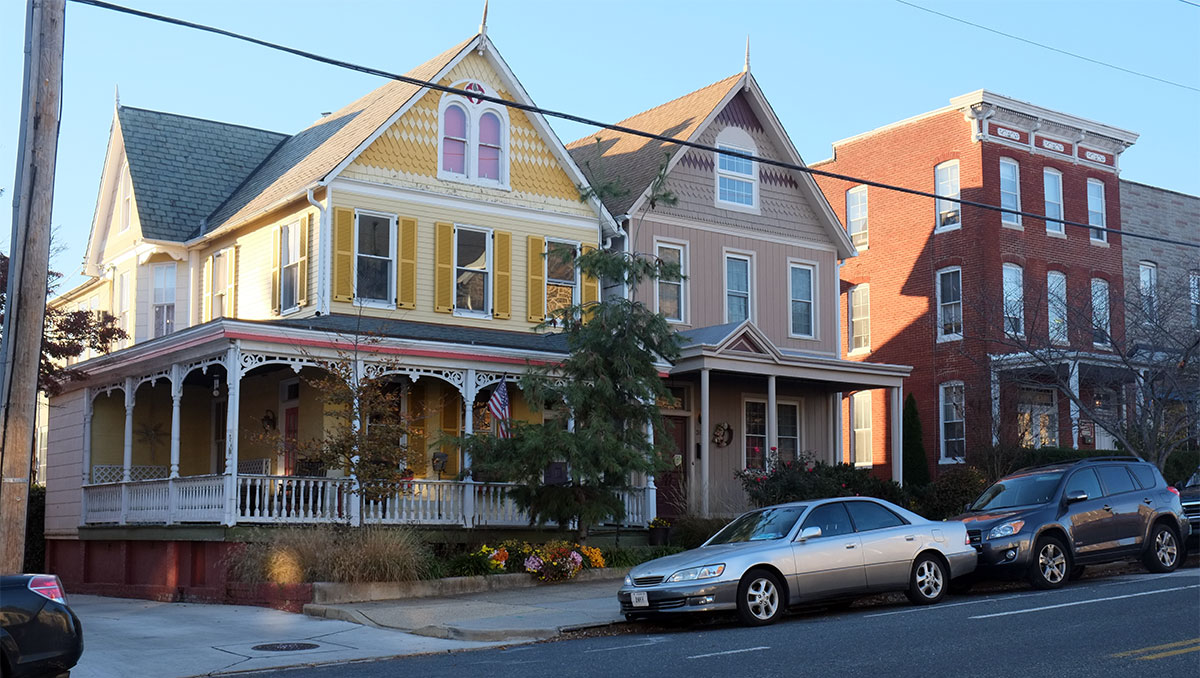
We were staying with our former student Neelab, who lives on the north side, a couple of miles from downtown, so our limited explorations fanned out from there.  (Plus my Wire-based geographic understanding led me to think that wandering around the North side was preferable to the East or West.)  We walked up through the Hampden neighborhood, a straightforward place which seems to be gentrifying at this moment, judging from the presence of a frites shop and other yuppie establishments.  Everyone understands the Baltimore rowhouse as the building block of the city, but what most struck me was the variety of designs, sizes, and styles within this simple type.  There were the obviously high-quality masonry houses,DSCF5716

the simple ones enlivened by coordinated colorDSCF5737

the ones enlivened by the lack of coordinationDSCF5714

the ones with classic porches instead of stoopsDSCF5741

and the deeply idiosyncratic.DSCF5747

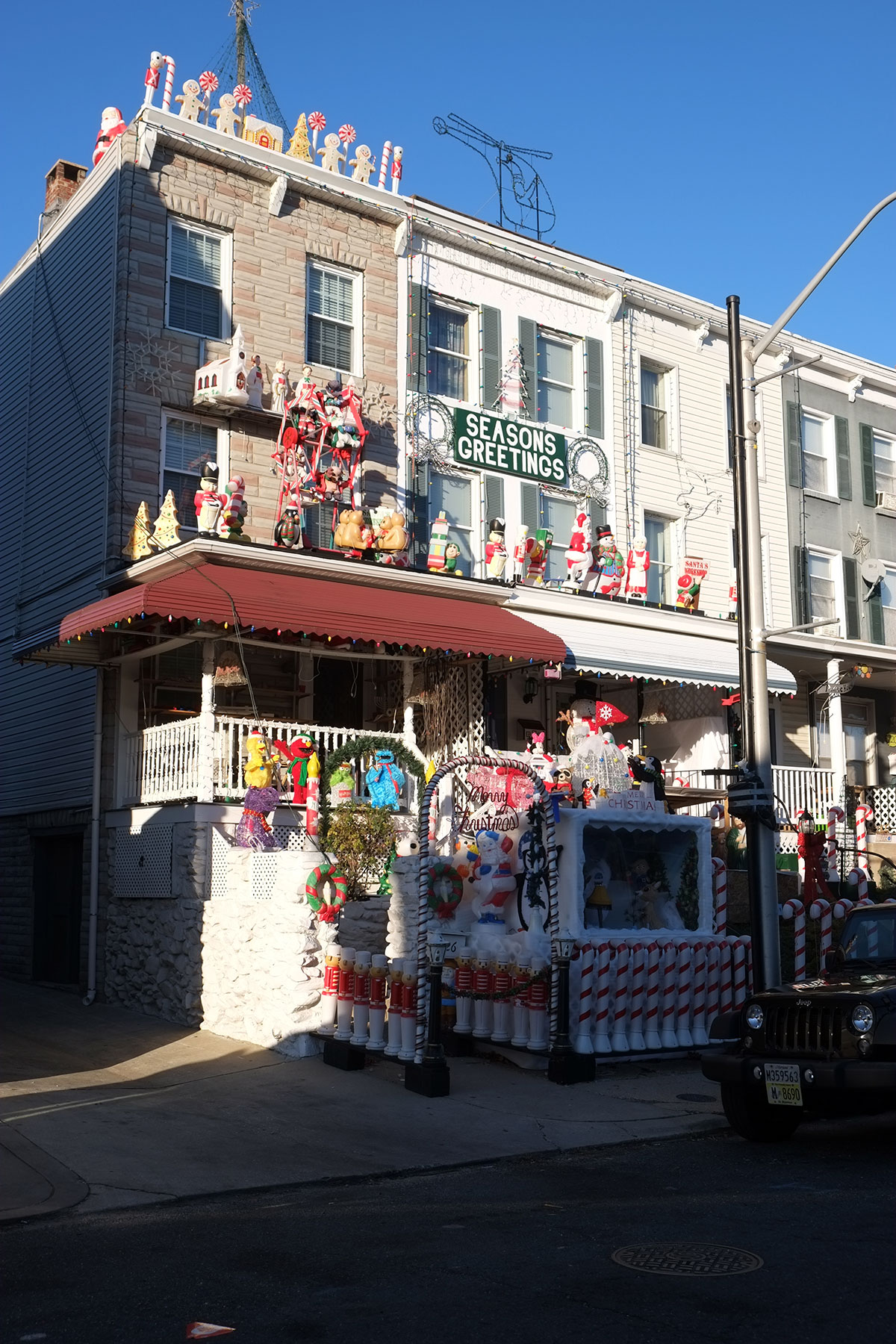
It was also cool to see traditions that we think of as primarily suburban – such as holiday decoration – running amok in the city:DSCF5709

While most blocks are uniformly rowhousing, there were also freestanding houses, semi-detached and narrow lot houses breaking it up:DSCF5730

and some unique houses, such as this one built by a local sculptor about 100 years ago.DSCF5802

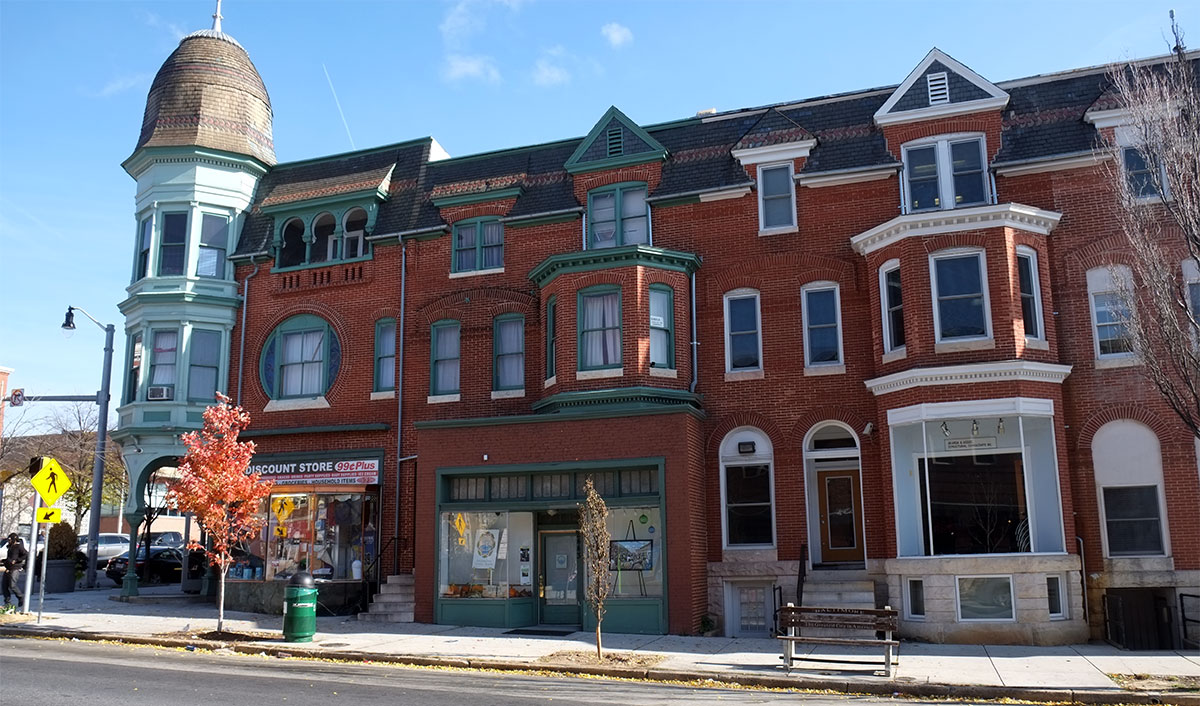
And as with any good neighborhood fabric, there were the mixed use and commercial buildings, and local institutions mixed in with the housing.DSCF5707DSCF5794

We saw Johns Hopkins, a not especially unusual campus where the hegemony of academic Georgian is once again strongly in evidence.DSCF5777

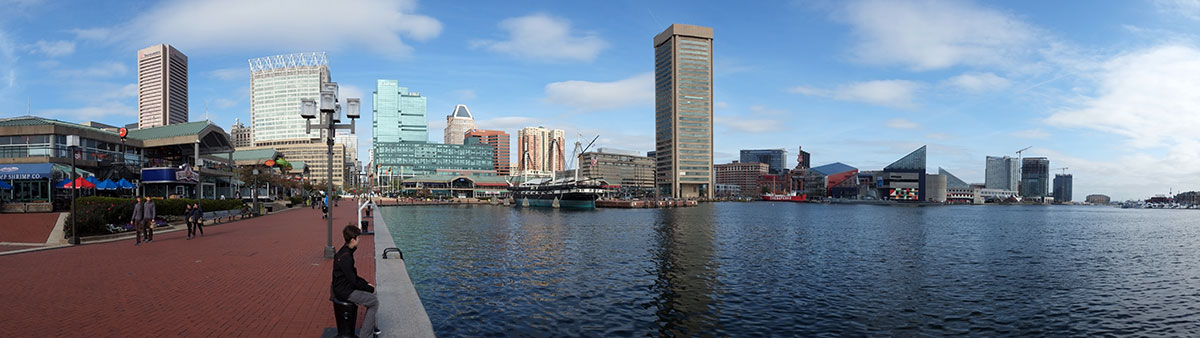
We walked to the downtown to get a better sense of the range of neighborhoods, and made it to the Inner Harbor, the redevelopment that put the city on the tourist map, with the groundbreaking aquarium and the Inner Harbor.  The Aquarium took up a lot of our time, as Greta’s architecture-quota had maxed out and we needed to see more animals.  Designed in the 70s by Cambridge Seven, it was the first to offer extreme spatial variety, huge tanks, and what feels like an immersive experience.  The interior spaces and experience are great,DSCF5859 DSCF5880

and the exterior conveys that this is a unique building, adding a focus to the waterfront.DSCF5834 DSCF5848

To some extent, aquariums need to be black boxes, to control light and marine growth, but this aquarium connects the inside to the outside as much as possible.DSCF5888 DSCF5906Overall, a very good building, though not quite up the Monterey Bay Aquarium, according to our family aquarium expert ( who has written a post about the aquarium qua aquarium and not architecture).

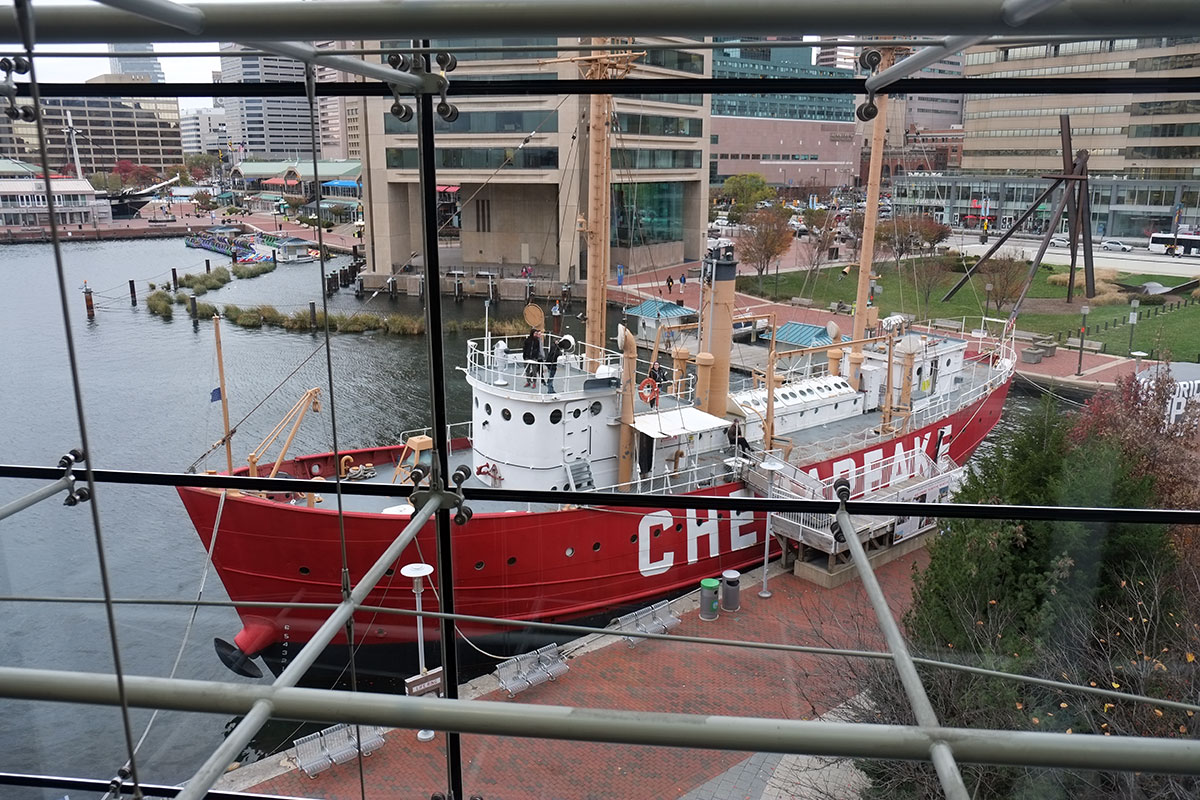
The Inner Harbor was one of the first “festival marketplace” developments by James Rouse, whose company was based in Baltimore.DSCF5832It’s a pretty convincing, nicely-scaled area which obviously opened up the view of the harbor, replacing the waterfront uses that were in decline.  It started a trend to bring suburbanites back into the city, by convincing them that it could be safe and fun.  We saw it on a November weekday afternoon, not prime tourist season, so it was clear that the spaces were scaled for the tourists who must throng it in the summer.  With the exception of a repurposed power plant with giant Hard Rock Cafe guitar on top, it doesn’t try too hard;  it all seems to be related to Baltimore somehow, and isn’t just the latest manifestation of a market-tested, globally-repeated, Disneyfied, ersatz urban branding extravaganza.  That is probably because it is now so old – a more recent development would look more like Vegas.

The issue of eras of building is important in another way in Baltimore.  If you zoom in on the picture above, you’ll notice that there aren’t really many new skyscrapers.  Baltimore has its share of crappy skyscrapers from the 60s and 70s, but very few from later decades.  I think this is a good thing.  Probably since it is a relative economic backwater, and not a global city, Baltimore has been spared the crush of banal behemoths that dominate so many other cities on the ascendant, such as Dallas, New York, Charlotte, etc.  These new skyscrapers may not be any worse than the older ones, but they are much bigger (in both height and floorplate) and they completely change the character of the downtown.  Cities such as Boston, which have preserved a lot of older buildings, can survive the onslaught with a semblance of balance, but newer cities, such as Seattle, become all too much of one era, and unfortunately not a very good one.  We’ve been visiting a lot of second and third-tier cities on this trip, and it strikes me that these cities, which are more embedded in the local rather than global economy, may be much better cities in which to live – reasonable housing costs, a sense of history, a slower pace.  The global cities are exciting and hip, but a city which has been spared the tsunami of global capital looking for a place to buy up real estate may provide a more grounded, balanced and satisfying life for a much wider range of residents.
Baltimore

Family (northern edition)

DSCF6551-copyTraveling to the Northeast not only meant catching up with many old friends, but also seeing the family, in New York and Pennsylvania.  We didn’t get to see everyone, and we couldn’t stay as long as we wanted (as we could sense the change in weather closing in on us), but we shall return soon.

We stayed with my brother Jerry in Westchester, to which he has returned after a long hiatus in New Jersey.  Jerry is eight years older than me, but from the earliest age, we’ve always been pretty close.  PAK016a

And as is probably typical with most siblings, there are ways we are polar opposites (politics, musical taste), and ways in which we are pretty similar (sailing, traveling, dark sense of humor).  As we’ve been traveling down to the south in recent weeks, I realized we were going places that I first visited when Jerry was a teenager and took his little brother along on a road trip – the Shenandoah Valley, Charleston, etc.  Those were the first trips I made without a parent, and I think they planted the idea that one could just get in a car and go see the world.  In the past decade we’ve gotten together every summer, as jerry flies out to Whidbey Island, and we sail and hang out.
Sailboat-shots-017After a career in insurance and banking, Jerry retired two years ago, about 15 seconds after he was eligible, and retirement seems to suit him very well.  (For the last three years of his working life, his screensaver was a photo of his sailboat with a count-down calendar on it.)  His good friends Pam and Steve sold their house and bought a two-family house in Mamaroneck, and after a year of renovation, they live in the downstairs unit and Jerry lives upstairs.  They are three miles away from the boat club where they all spend much of their time, and one mile from the train station into the City.  It seems like a very good model for retirement.
After a day in New York, Greta and I both caught a cold, and spent two days hunkered down at Jerry’s, where we caught up on all the 1960s sitcoms that I hadn’t watched since the 1960s.  (My brother has an encyclopedic knowledge of the classic shows of the past 60 years, but it was good to see that he has expanded his repertoire to include more recent television.)
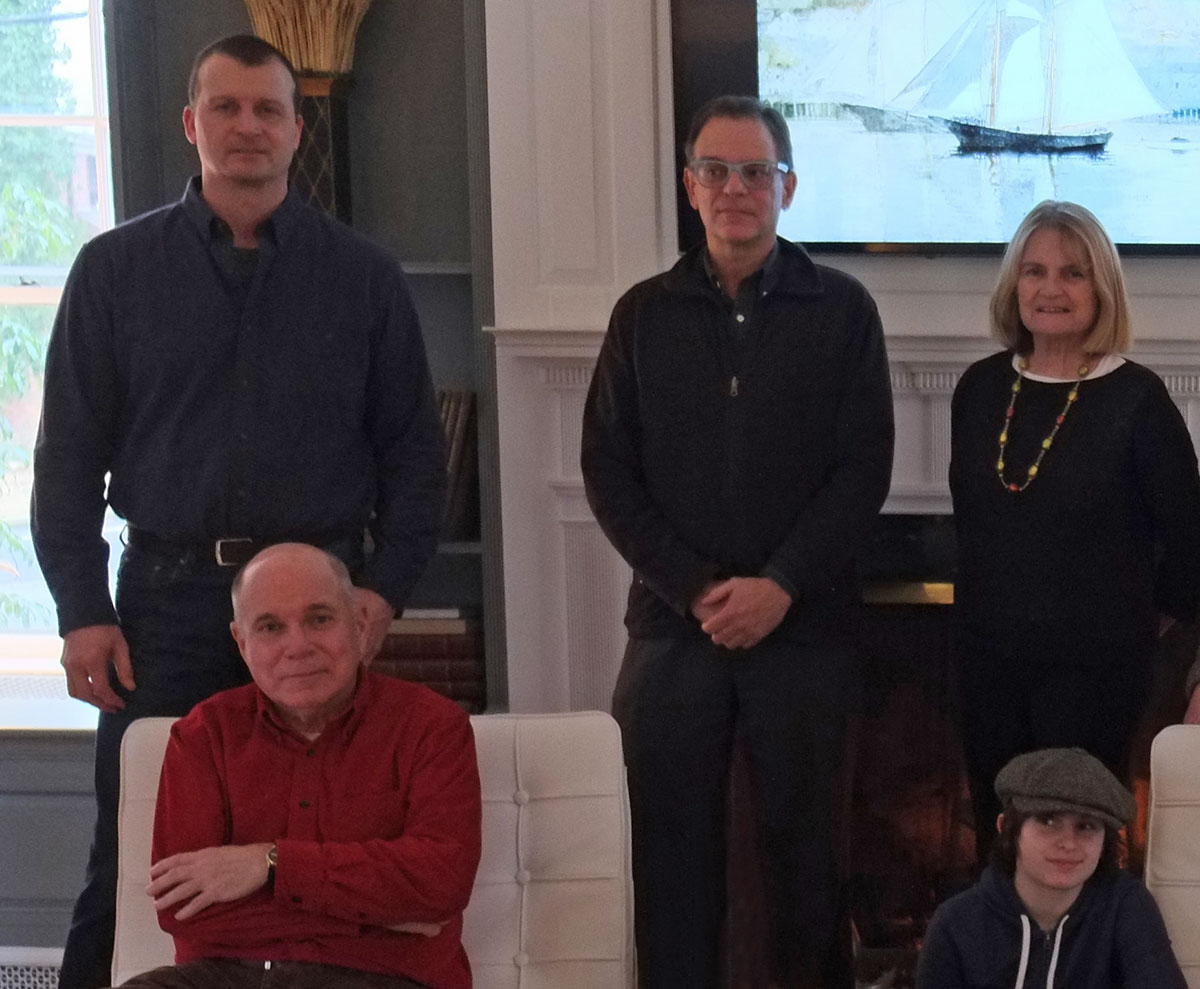
While we were killing time, my nephew Sean (upper left in the top photo taken last Christmas) showed up with pizza and soup, and to entertain us for the day.  Sean grew up nearby in Larchmont, and now lives in Connecticut.  He is Greta’s first cousin – although 34 years older than her – so she really thinks of his three fantastic kids (Connor, Eleanor and and Alexandra) as being more her cousins.  Sean was always athletic, and in college he started the crew team at SUNY Oswego;  in recent years he has kept up this rowing, while also adding marathon running to his portfolio.  (He has also generously shared his rowing insights with Greta, suggesting “more forward body angle at the catch” when she was eight.)

Sean has one of those  jobs that I don’t really understand what it is he does (it is interesting how many more of those jobs I run into every year as I get older and more clueless).  I at least can tell that it involves advertising and the internet.  Somehow between the job in the City and athletic endeavors he still manages to be a great dad, and arguably the funniest person in the family.

My sister Pat is the oldest of us five, seen here in the first known picture of us together.  I was clearly the practice child for her raising four kids, including Sean.
1956aDec
Once her kids reached a certain age, Pat went to work as a pre-school teacher, for a couple of good reasons:  she enjoyed the company of little kids, and she really enjoyed having summers off to sit in the back yard and read non-stop; over her lifetime, Pat has probably been one of the steadiest supporters of the Strand bookstore, frequently hauling shopping bags full back to Larchmont on the train.  I sometimes have students ask me how I acquired the wide range of random facts that I seem to know, but I am nothing compared to my sister. (She also talks faster than I do.)    She not only retains facts, but she somehow always stays abreast of what everyone is doing, and what they are interested in.  Over the years, I’ve often been surprised by some gift from Pat that tied in perfectly with an interest of mine that I didn’t know she was aware of. This year’s Christmas present was no exception.  DSCF8973Pat retired a few years ago, and so she too was able to come by Jerry’s and spend the afternoon entertaining us when we were sick.  This trip has been rather intense for me and Greta – it seems that every day is dense with new experiences, usually of new places and things that are not that familiar to us.  But this one afternoon spent with Jerry, Pat and Sean was definitely the most dense with talking, joking and reminiscing, and we were really grateful to them all for dropping everything to do it.

Leaving New York, we headed to the Philadelphia Main Line to stay with my nephew Justin and his family.  Justin was a remarkably cute kid, but also a scarily smart one, memorably besting me in an argument when he was three.  He was always precocious, seeming much more mature than his age.
1972April3
With that background, and his current career managing a mutual fund company, it is hard to believe that in an intermediate incarnation he spent some time following the Grateful Dead and supporting the trip by selling peanut butter and jelly sandwiches.

In recent years, Justin has also turned into a serious weekend warrior athlete – marathons, triathlons, mountain biking, etc.  But like Sean and all his other cousins, Justin has become this super family guy.  His wife Joanie is perhaps the most energetic person I’ve ever known – raising two kids while working as a kindergarten teacher with an expertise in special education – and somehow fitting me and Greta into her agenda, making us feel right at home and then sending us on our way with enough food to snack on for a week.  Their daughter Abby is a charming high school senior, but being a high school senior she’s completely over-committed, charging around with her friends, but managing to join us for dinner one night.
DSCF5699
Although Tyler is a only year older than Greta, living on opposite coasts they’ve only met each other a few times in their lives.  But getting together over the past couple of years, they’ve realized they have a lot in common – they’re both kind of quirky, willing to follow their own inclinations rather than the crowd, and they share a wide range of nerdy, fan-boy interests.  Tyler immediately roped Greta into multiple rounds of backgammon, and we spent a really fun day with him, at the Mercer Museum and then the new James Bond movie, as he guided us through the intricacies of Main Line geography.
DSCF5687We’ve gotten a little homesick from time to time on this extended trip, and it was really good to stop in places where we were at home, with family who love us and welcomed us in.

Lancaster, Pennsylvania

A year ago today we drove west from the Philadelphia Main Line, through Lancaster and York, Pennsylvania, and then south to Baltimore.  Strangely, I had never travelled through the Amish country before, and Greta and I were both taken by the beauty of the landscape, and the singular culture that is centered there.

With a normal adolescent sensibility, Greta was highly amused that we were passing through Intercourse, p1050342

and her more detailed study of the map caused us to make a slight detour south to Fertility, which she was gratified to see was only a short distance from Intercourse.

The landscape showed a lovely amalgam of different eras of vernacular building.  Lancaster itself was a somewhat overwrought tourist destination, but once away from the bus parking lots, the lack of self-consciousness and tweeness was evident.  p1050344

As was extreme laundry-hanging. p1050343

We thought we had come across a wormhole in the space-time continuum, and that maybe we could zip home for a quick visit,p1050345

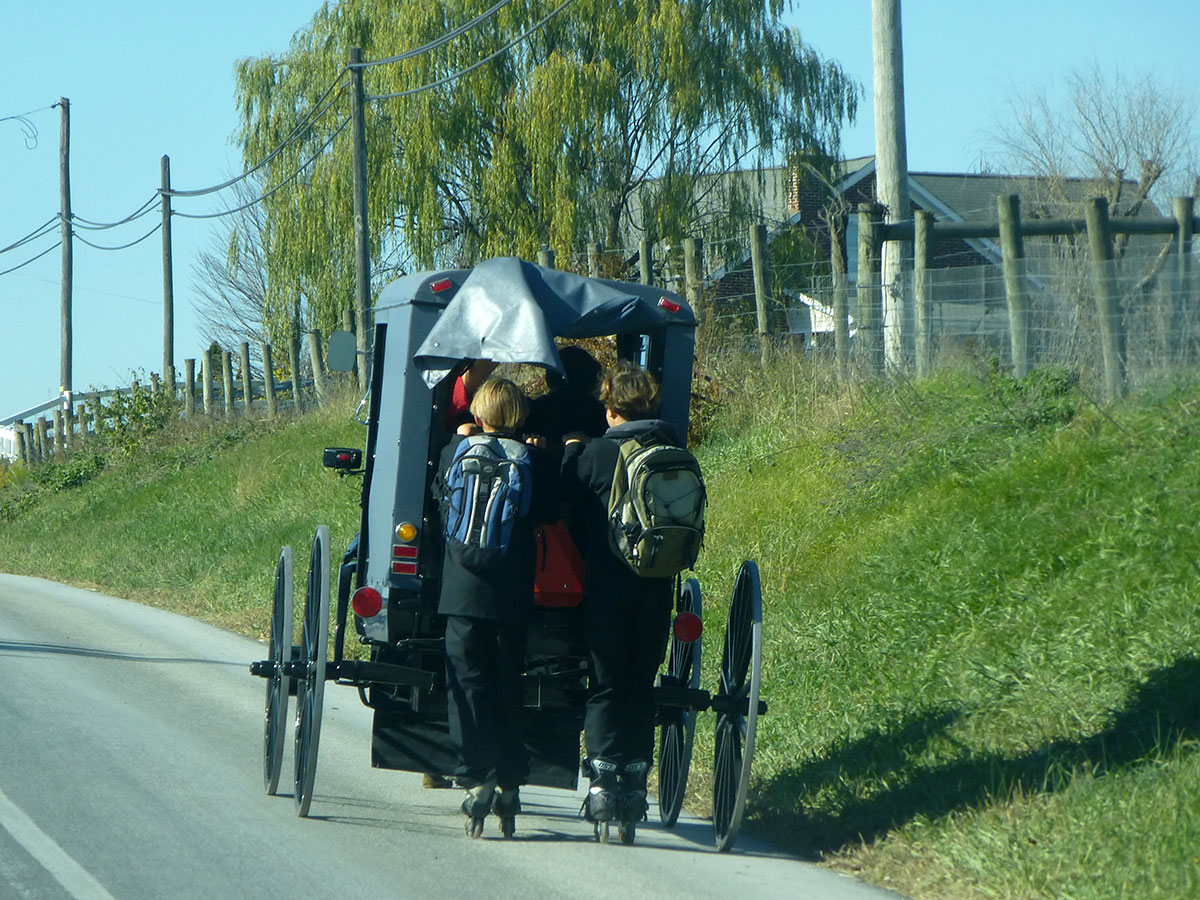
But the real dislocations were in the cultural anachronism category, especially this example of Amish skitching on the way to school.  p1050333

Philadelphia

One day in downtown Philadelphia, where once again the parental need to force Greta to view the major monuments of colonial America asserted itself.  Different cities have taken different approaches to this heritage.  Boston does it really well – with the exception of the Paul Revere Mall, the historic sites are still imbedded in the city.  New York more or less obliterated all the historic sites and their surrounding context.  Philadelphia kept all the historic buildings, but obliterated the city fabric around them, so you can view these icons as isolated objects, surrounded by pointless, overscaled open space and dreadful overscaled buildings.

I remember Independence Hall as a wonderful building.  It is not only important, but it is beautiful and says something about the city of the time.  The problem is this:  you can’t get anywhere near it anymore, without signing up for a tour over in the dreadful visitors’ center and waiting around to be shepherded through with throngs of tourists snapping iPhone photos.  You can’t even walk on the grounds near it, having to detour around the block.  DSCF5478

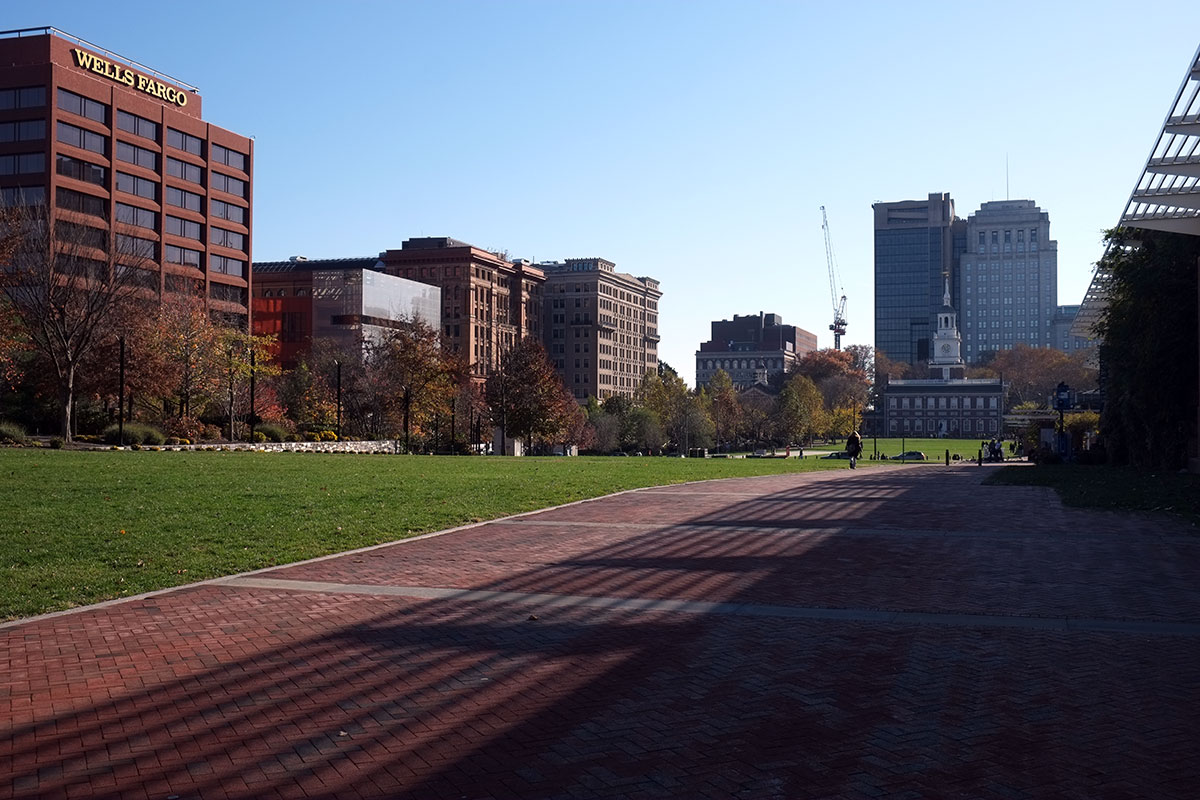
It gets even worse when you step back.  The Independence Hall Mall was proposed in the 1930s, and was implemented in the 1950s, when we thought knocking down old cities was a great idea.  Hundreds of buildings were destroyed, so that a giant open space would allow you to view Independence Hall from far away, looking puny and unimportant.  DSCF5496

Then big, bombastic buildings were built around that, symbolizing the might of large corporations in our national system.  It gets even worse behind Independence Hall, where this sterling example of historic preservation can be seen.  DSCF5464

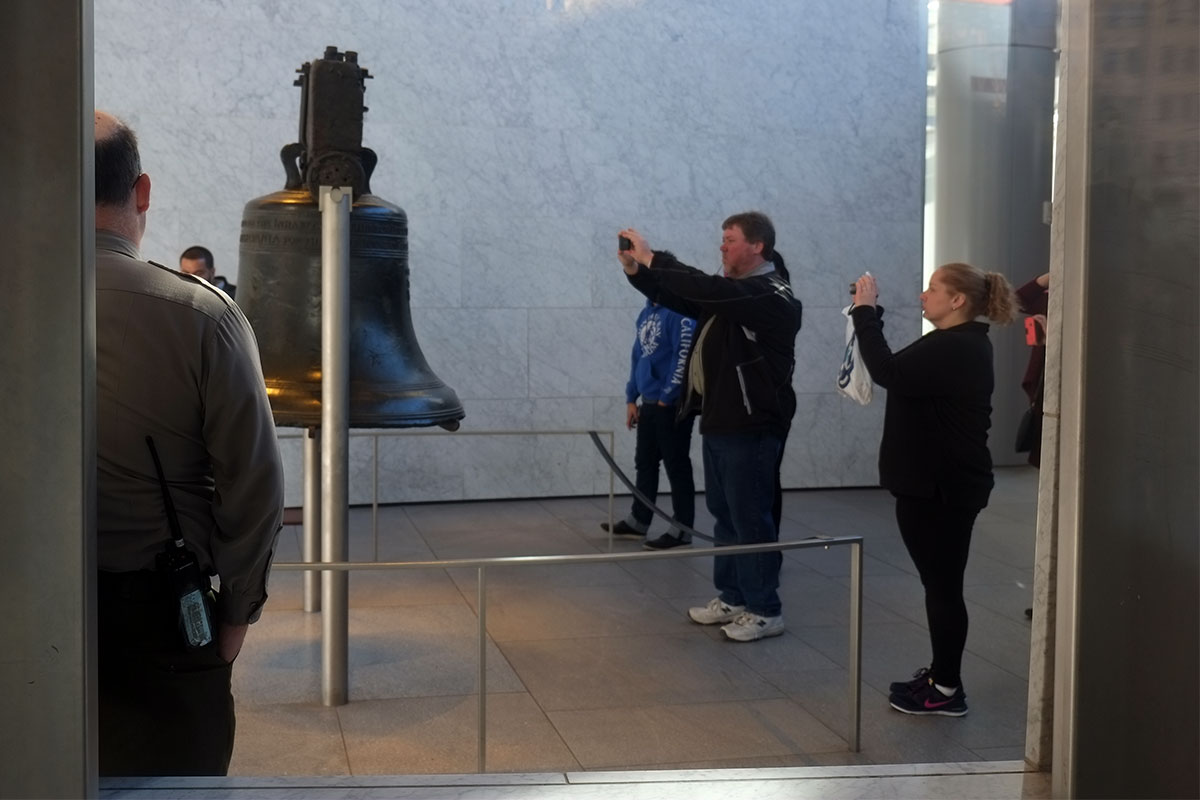
It declined further recently.  In 1976 the Liberty Bell was moved into its own viewing pavilion, part of a veneration of the minor icons of our history rather than the history itself (the recent Star Spangled Banner re-installation at the Smithsonian is another example of this).  But then this simple pavilion was destroyed (probably because it was modernist and minimal), and replaced by a more grandiose pavilion, just south of the visitors’ center.  DSCF5485

The experience is awful, reminding me of what has happened to Mt. Rushmore.  Where does this impulse come from, to remake everything in a phony, pretentious manner?  (By the way, some very good architects and planners were involved in many stages of this madness – Edmund Bcon, Dan Kiley, Venturi and Scott Brown, Cywnski, Laurie Olin!)  Philadelphia was not Versailles, but it had one of the most compelling plans of an early American city. Why can’t we leave it alone, and let visitors have an experience that in some way might evoke the 18th or 19th century, helping them to understand life in that era, rather than pedantically shaping their perceptions?  Boston looks better and better in this regard.

Luckily, the architects did preserve one of the best features of the earlier Liberty Bell pavilion – a window through which it could be seen, without going through the rigamarole.  We took the picture and got the hell out of there. DSCF5474

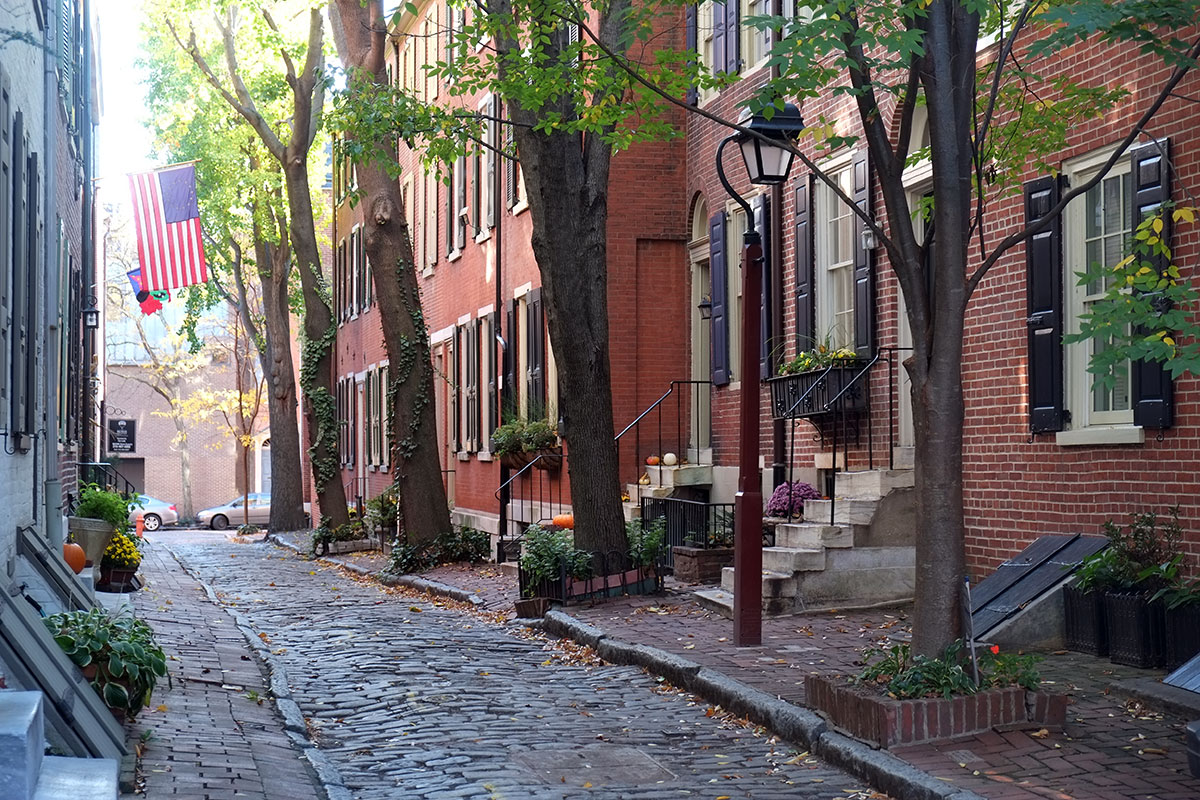
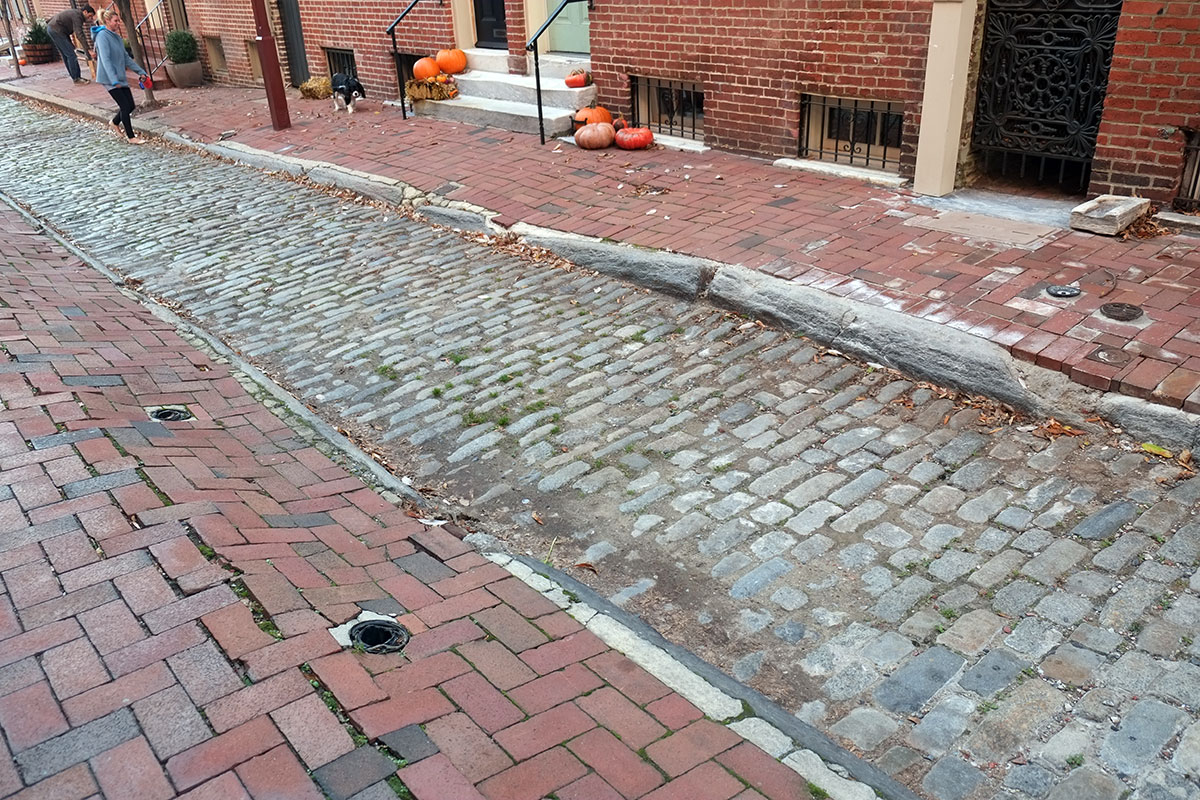
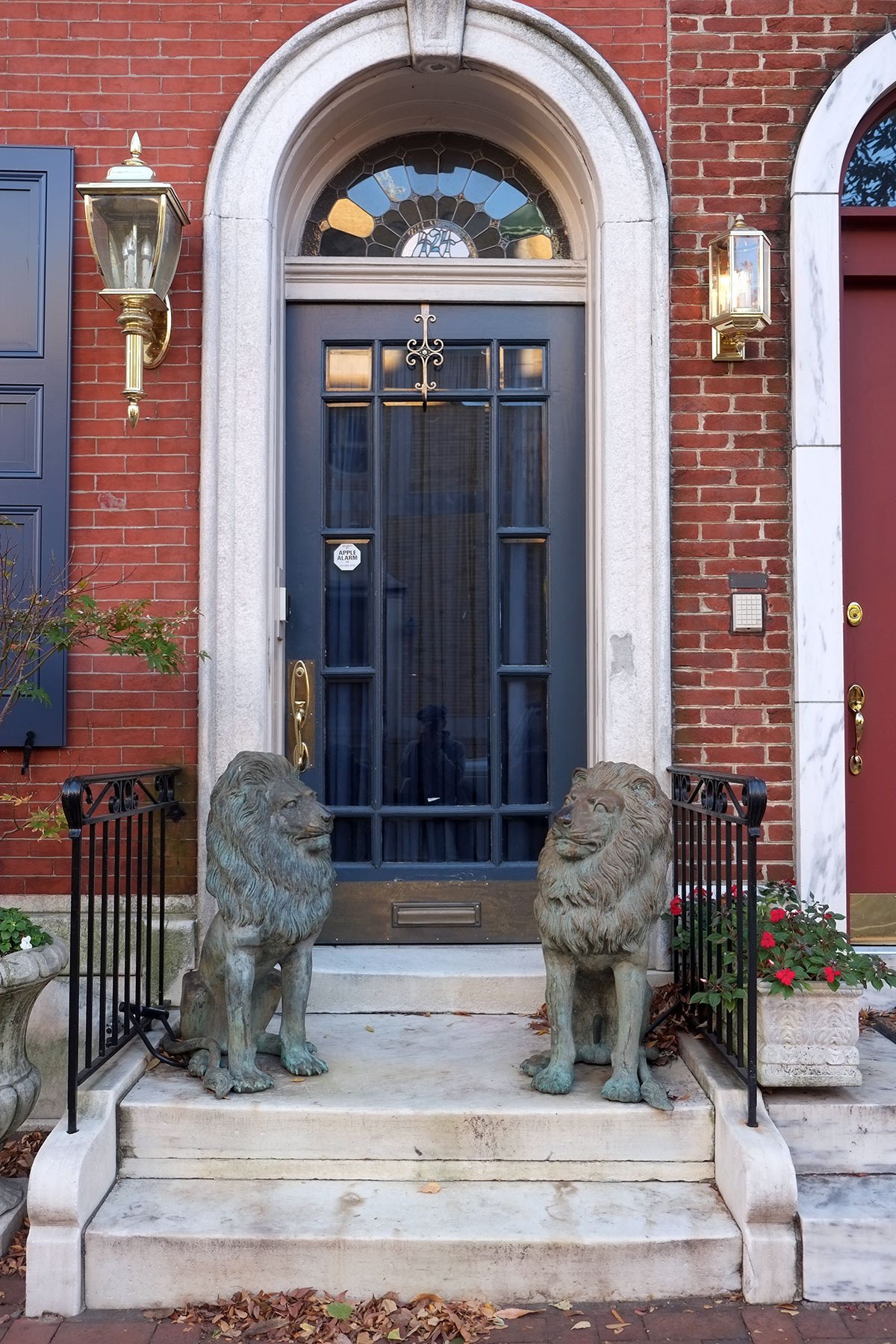
Once you get away from this, Society Hill and other older neighborhoods of Philadelphia are spectacular.  There are crazy renderings of the founding fathers,DSCF5466

fantastic Greek Revival buildings by Robert Mills and others,DSCF5503DSCF5525and streets which really maintain the experience of the 18th century city.DSCF5569DSCF5575DSCF5579DSCF5604

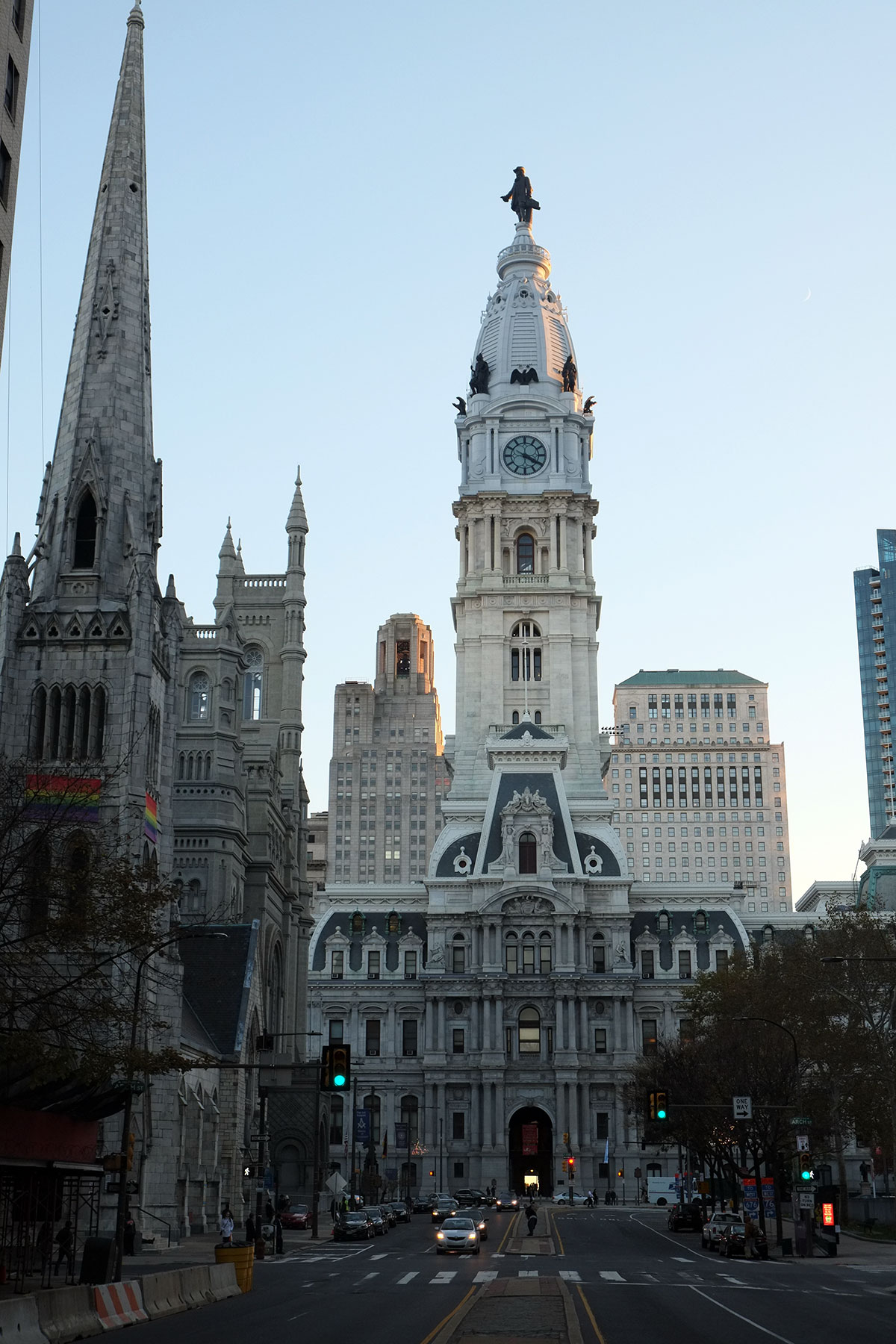
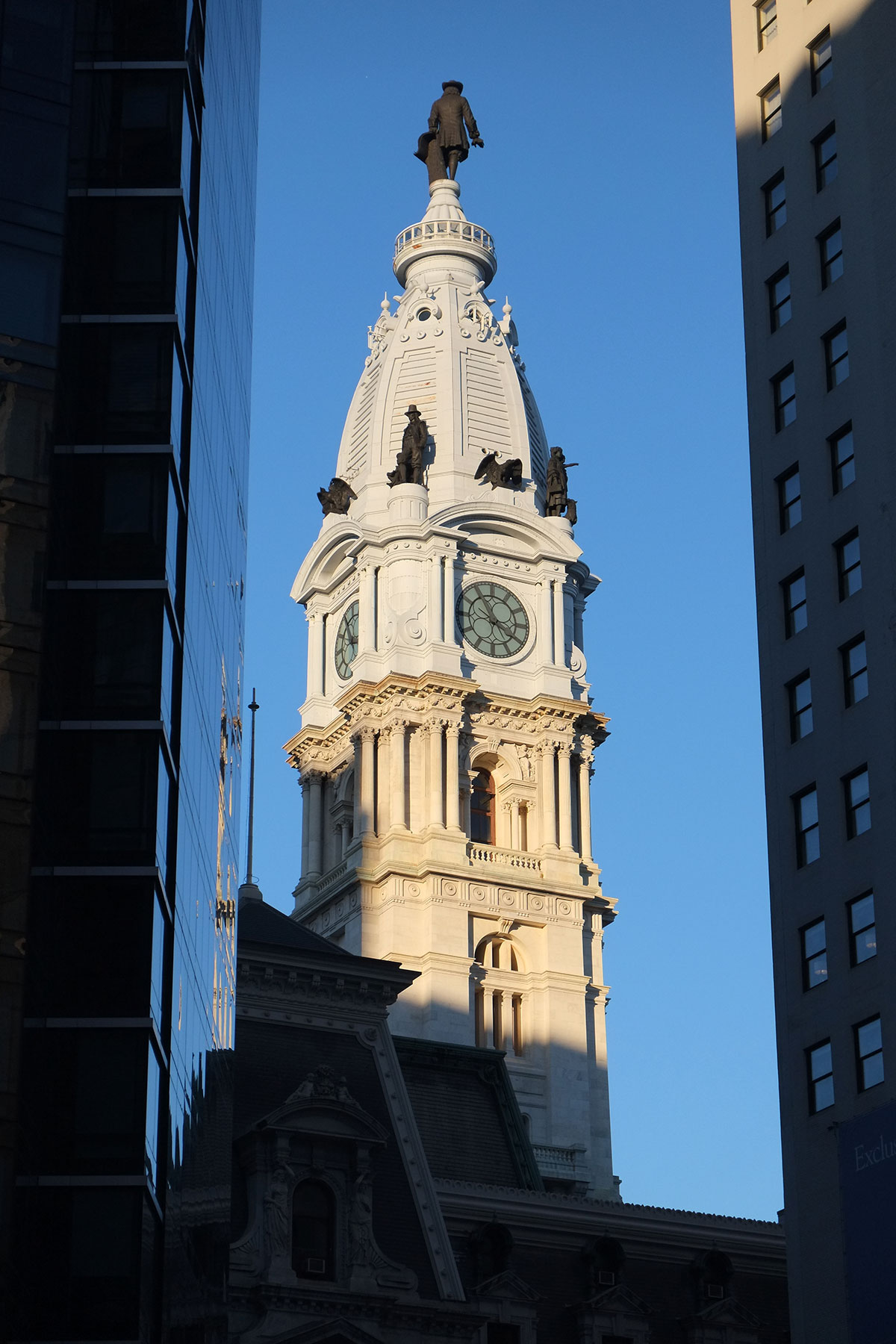
The Ciry Hall is magnificent, a good example of how a city plan can evolve positively. There was no building at the center point of the city in Penn’s plan, but having this icon visible on the axes works beautifully (with sculpture by Alexander Calder Sr.)DSCF5666DSCF5640

The Paul Cret Federal Reserve is fine (Cret being an employer of Kahn).DSCF5616

They seem to be having more fun at the Pennsylvania Academy these days, I think Furness might have approved?DSCF5671A truly dreadful “remuddling”DSCF5624and some fine urban buildings and juxtapositionsDSCF5662DSCF5672DSCF5664

As we were into checking things off our list, we grabbed a random cheesesteak, but not being in the right neighborhood, it was nothing to blog about.

Mercer Museum

DSCF5358When I began teaching at the University of Oregon, I found that one of my colleagues, Bill Kleinsasser, was fairly obsessed with Henry Mercer.  Mercer was an archaeologist, collector and amateur architect, who built three buildings and started the Moravian Tileworks in Doylestown, Pennsylvania.  I dragged two of my sisters to see Mercer’s house about 20 years ago, and Laurie’s response was great.  First room:  That’s pretty cool!  Second room:  Cool.  A lot like the first.  Third room:  I get the idea.

But Bill Kleinsasser was right – it’s just that the Mercer Museum is the building to see.  Mercer collected a comprehensive assortment of technological artifacts from pre-industrial America.  Then he built a museum to house and display them.  Concerned with fire destroying the artifacts, the museum was built of reinforced concrete, which is apparent on the outside, a strangely flat medievalist fantasia.DSCF5321It’s adorable, but a bit twee, with vernacular forms in a strange material.  The roofscape looks like a giant birdhouse, but somehow I love it.DSCF5378

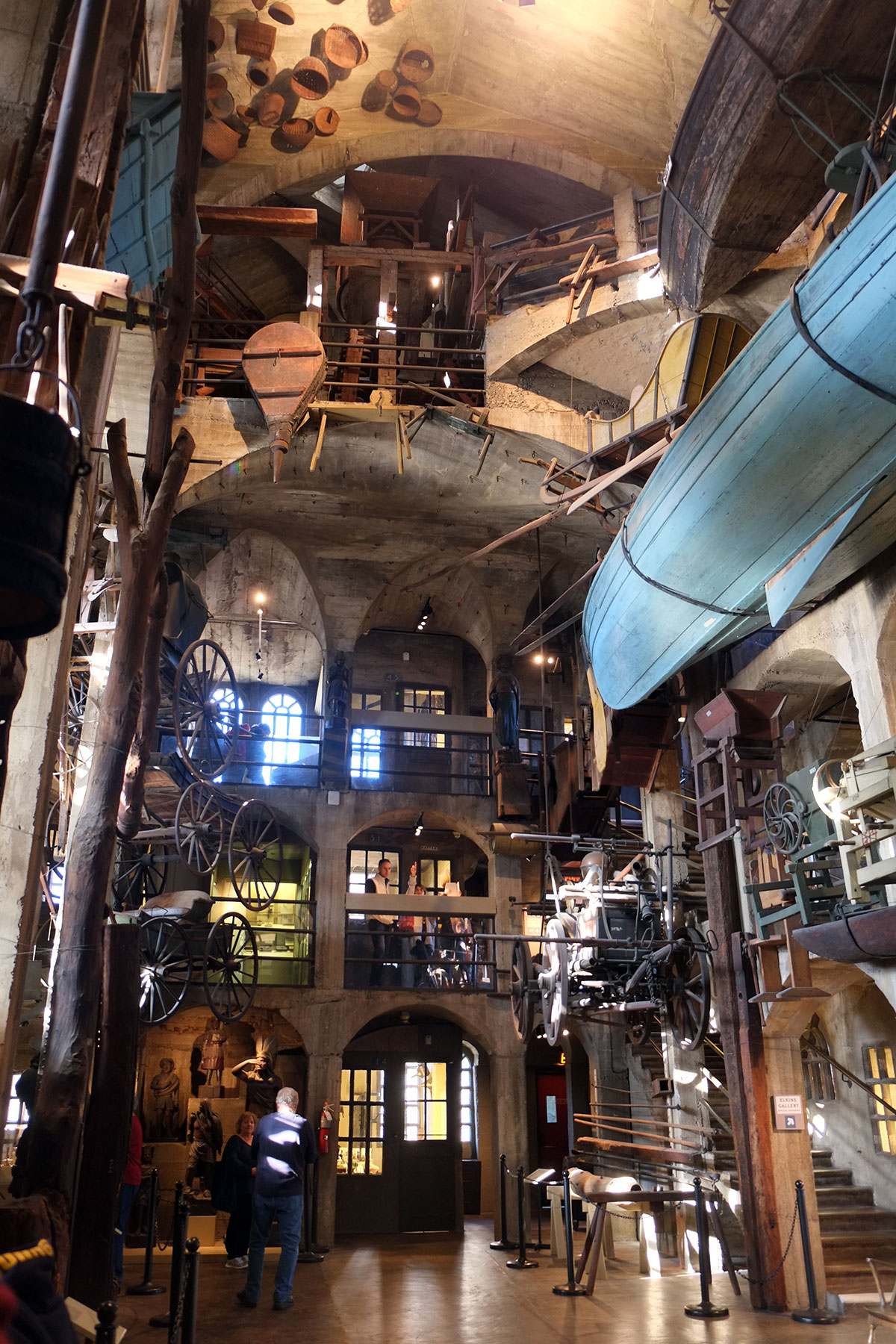
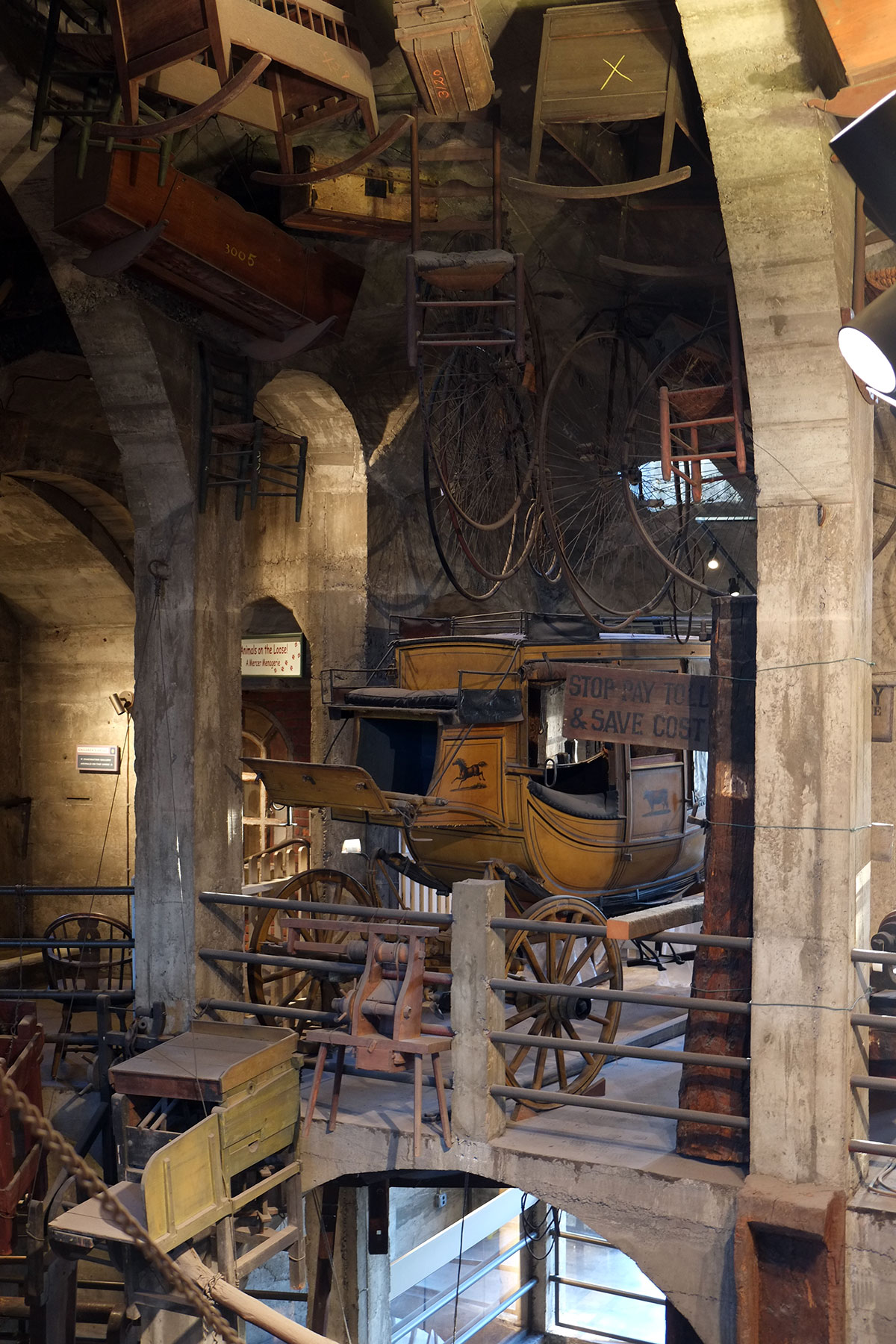
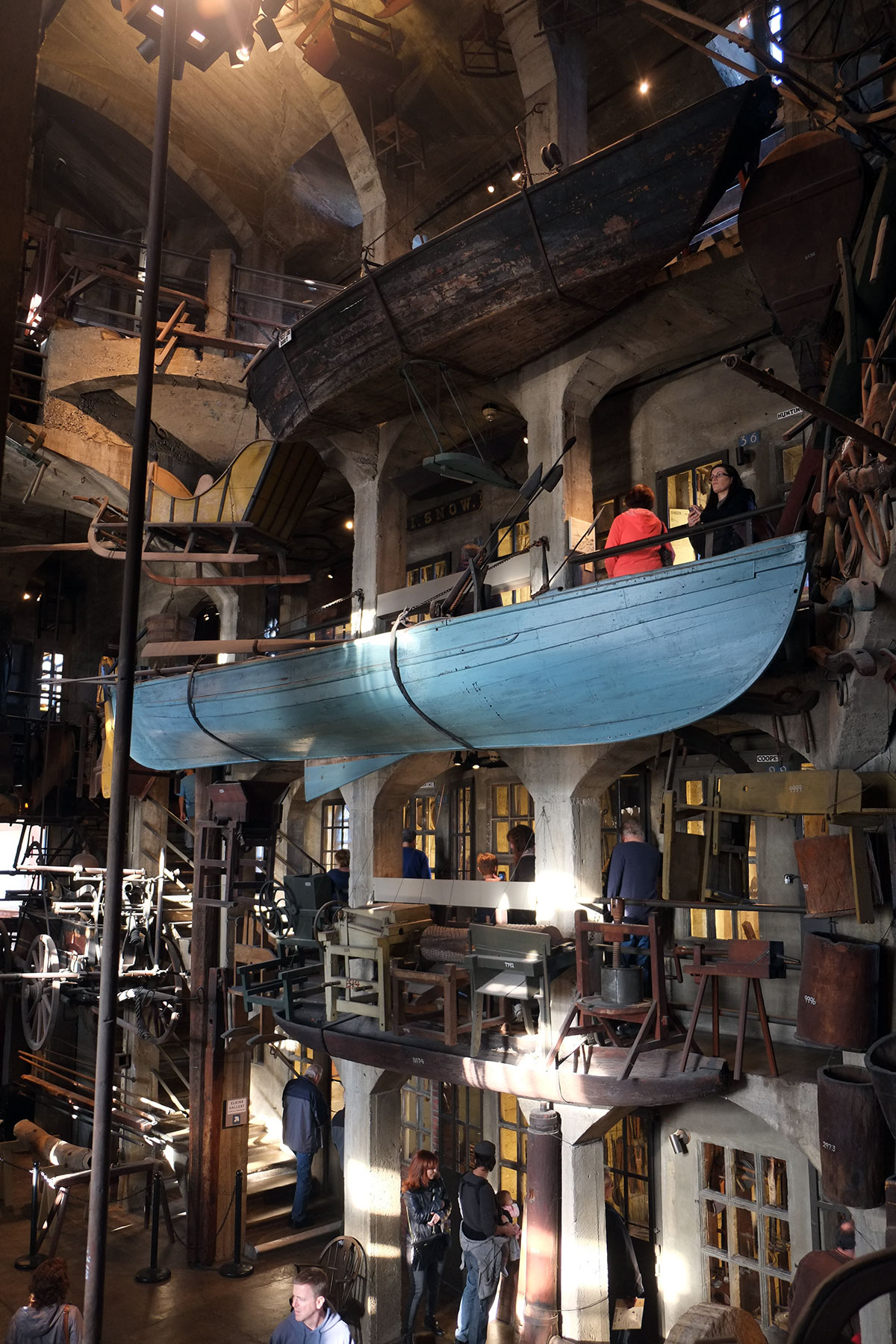
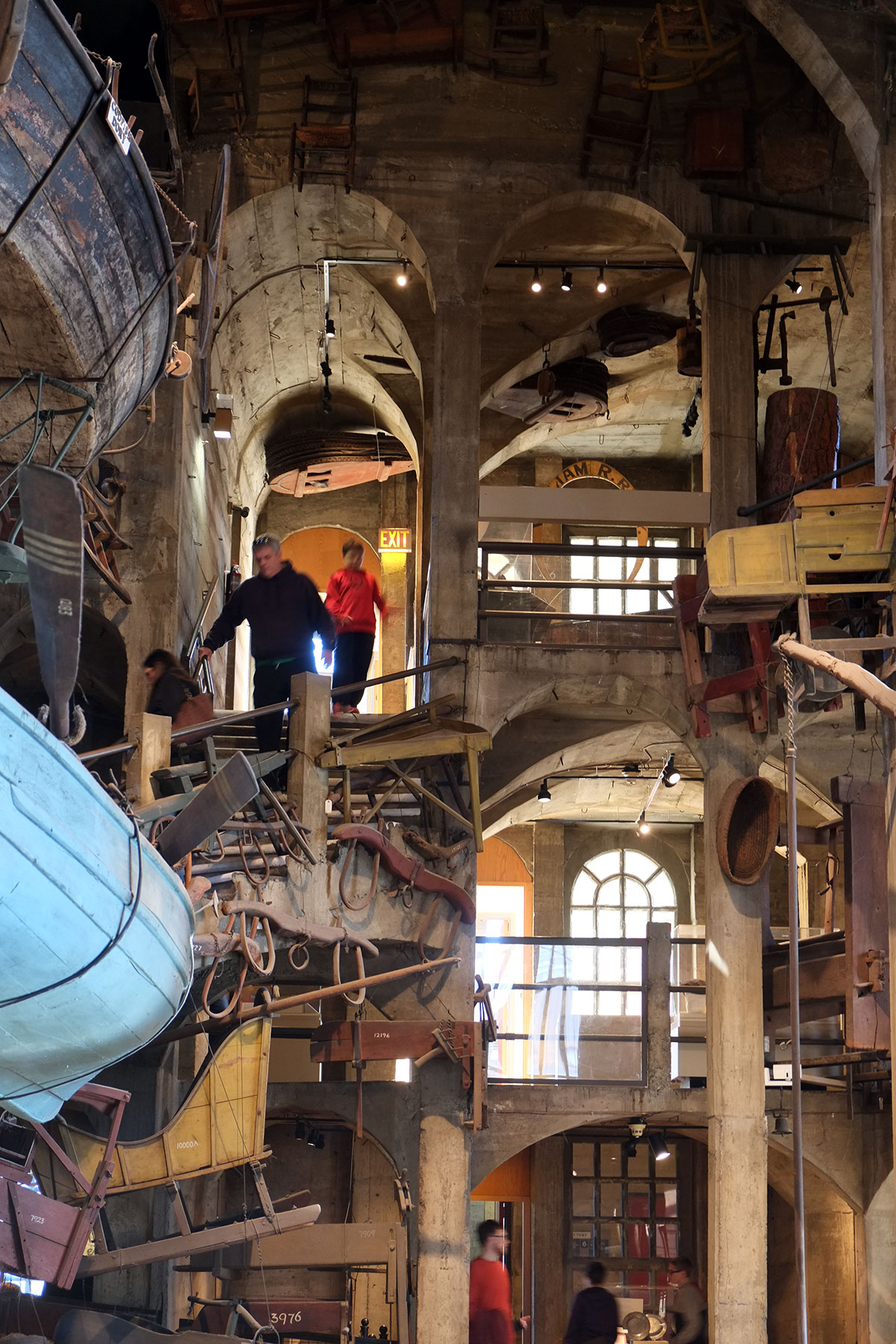
You enter through a new lobby wing, go up some winding stairs, and step out into this:DSCF5324a four-story atrium crammed with more stuff than seems possible.  It’s feverishly hallucinogenic.  Every surface is covered with stuff, even the ceilingDSCF5371

and then the really big stuff is hung out in space. DSCF5350

It is so far from our current model of what a museum should be like that it’s hard to process.  Where are the blank white walls?  Where are the wide open spaces across which we can contemplate an isolated, perfect object?  The Mercer Museum shows that a museum can work extremely well while not meeting our aesthetic preferences for abstract minimalism.  The central atrium is surrounded by vaulted side aisles, on the the outside of which there are niches, almost chapels, each of which explains and shows many artifacts pertaining to a specific technology, such as lighting:DSCF5353

or a cabinetmaker’s shop, with its molding planes:DSCF5417

The sidewalls are heavily glazed, and the light filters through the niches and side aisles into the atrium.DSCF5437DSCF5426

and there are other random artifacts scattered around.DSCF5340

as in a separate two-story space where there are perhaps thousands of panels from cast-iron wood stoves, along with firebacks, each which is highly wrought and decorative.  But the space itself grabs your attention, with its Orientalist detailing and complex spatial moves.DSCF5381DSCF5385

The exhibits are extremely clear – I now know a good amount about the practices of 18th century technologies – such as tinsmithing – which were just vague ideas to me before.  The layout of the building also supports this pedagogical approach – you may be looking at the small tools and labels in a niche exhibit, and the the label says, turn around and look behind you for a big artifact – like a whaleboat or a stagecoach – which is the product of this technology.DSCF5416

DSCF5343

DSCF5338It’s a museum which can be approached from many directions and found to be satisfying.  Kids love it, both the artifacts and exploring the space, with surprises around every corner.  Grown-ups just stare, not ever having been in a place like this before.  And some architects wonder why everything we do now has to be within such narrow parameters.  Or whether there can’t be a closer fit between the architecture and the contents.  Mercer’s buildings on their own are quirky and interesting, but not all that good.  But when you fill one up with amazing stuff, there is synergy, and the experience is fantastic.