Tag Archives: #vanlife

Seaside – thirty years later

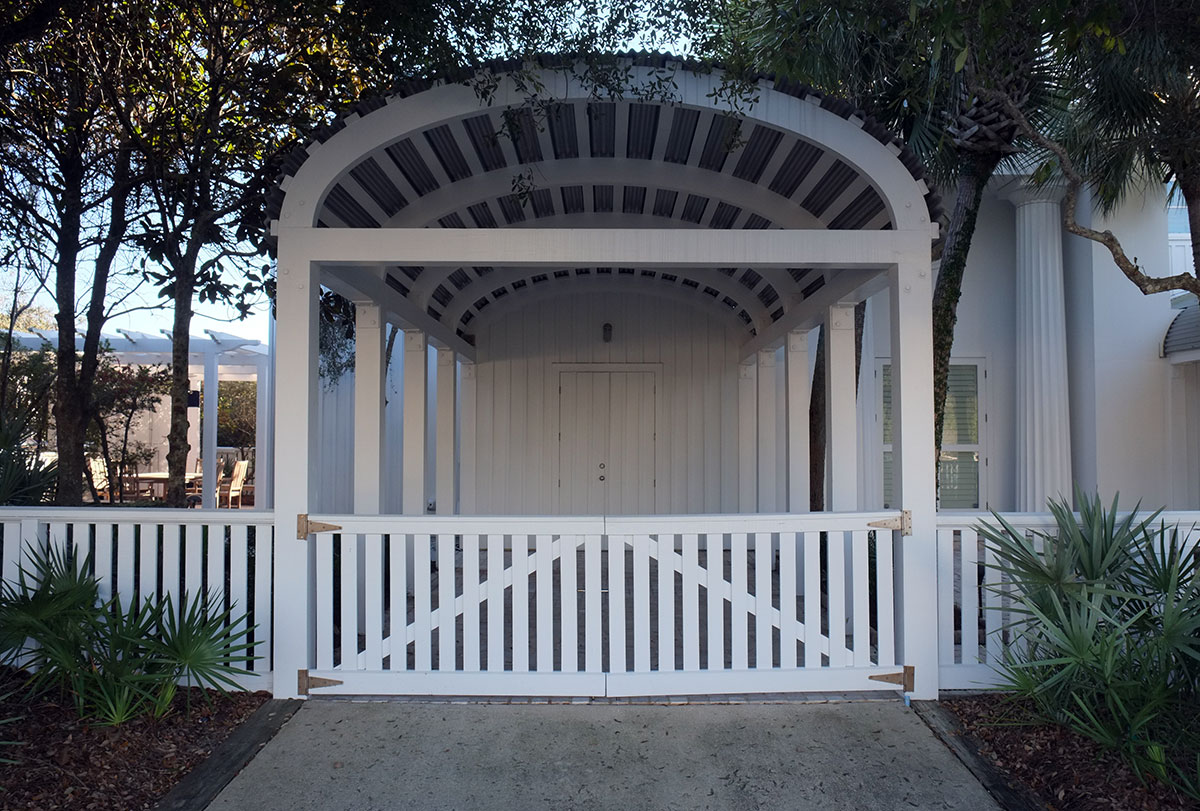
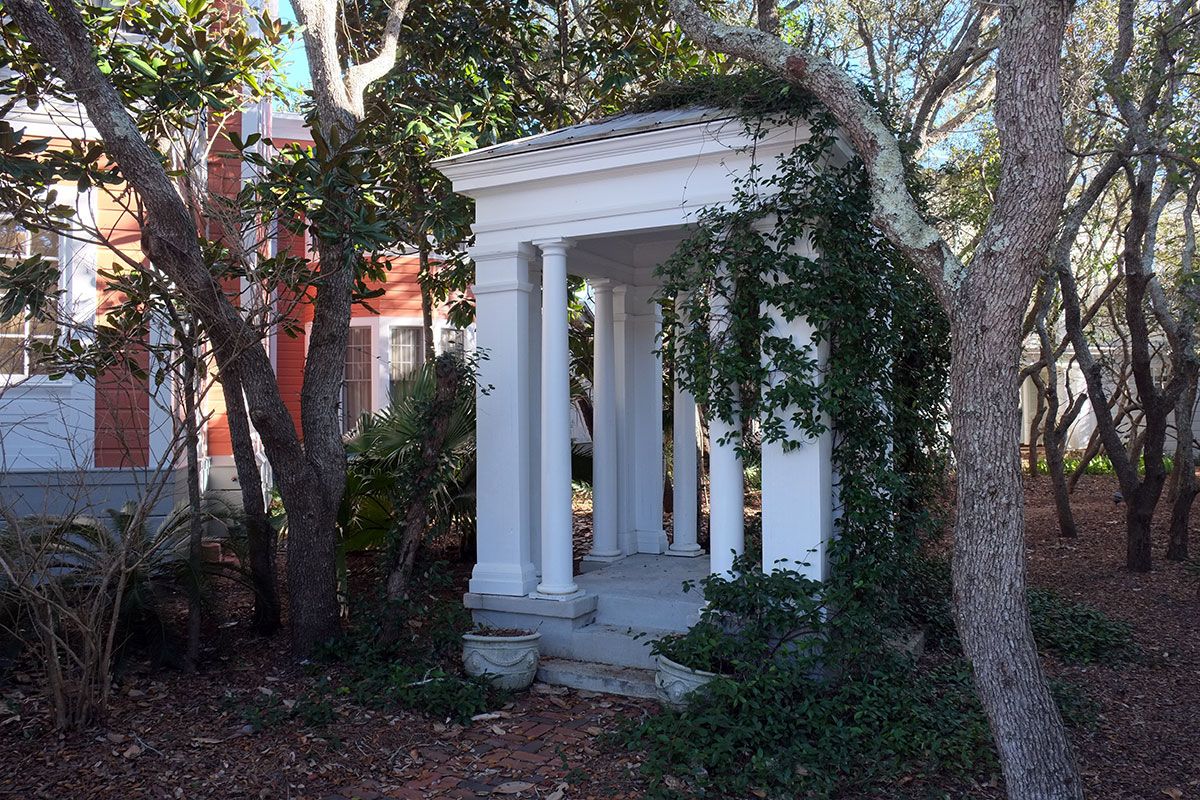
DSCF0747When Seaside, Florida was built on the Florida Panhandle in the 1980s, it was the groundbreaking demonstration of what later became known as New Urbanism.  The architects Andres Duany and Elizabeth Plater-Zyberk (DPZ) worked with the developer Robert Davis to create a beachfront resort town that would harken back to an earlier era, before Americans starting lining the coastlines with condos that segmented and privatized all contact with the sea.  While still in architecture school at Yale in the 70s, Duany and Plater-Zyberk saw through the pieties of modernist town planning, and pointed out how well the neighborhoods of 19th-century American cities worked;  they also drew inspiration from the extraordinary planning of the pre-war era (such as at Radburn:  https://peregrine-nation.com/2015/12/22/radburn-new-jersey).  While Postmodernism was in the ascendancy in the 1980s, making a case against doctrinaire modernist architecture that was strong theoretically but terribly compromised in practice, DPZ led the much more successful and enduring movement to change the way cities and neighborhoods were planned.  DPZ built upon theorists such as Leon Krier and Aldo Rossi, and were able to adapt these ideas to the American context, and even more amazingly, work with developers to put these ideas into practice.  The property for Seaside had been owned by Robert Davis’s family for decades, and luckily by the time he came to develop it, their design practice had caught up with his vision for a traditional town.

This is another blog post which parallels one of my pre-existing lectures.  In explaining the reactions to modernism in the late 20th-century, I use Seaside as an illustration, as it is very clear how the ideas were put into practice.  I visited Seaside for the first time in 1994, and on this trip I was most interested in seeing how it had evolved and changed in the intervening years.  I found that most of the original architectural and planning ideas had stood the test of time quite well, but at the same time I felt that the earlier promise and innocence of Seaside had been lost.  I don’t think the fault is with the design, but rather mainly reflects the direction in which our society has moved in the past thirty years.
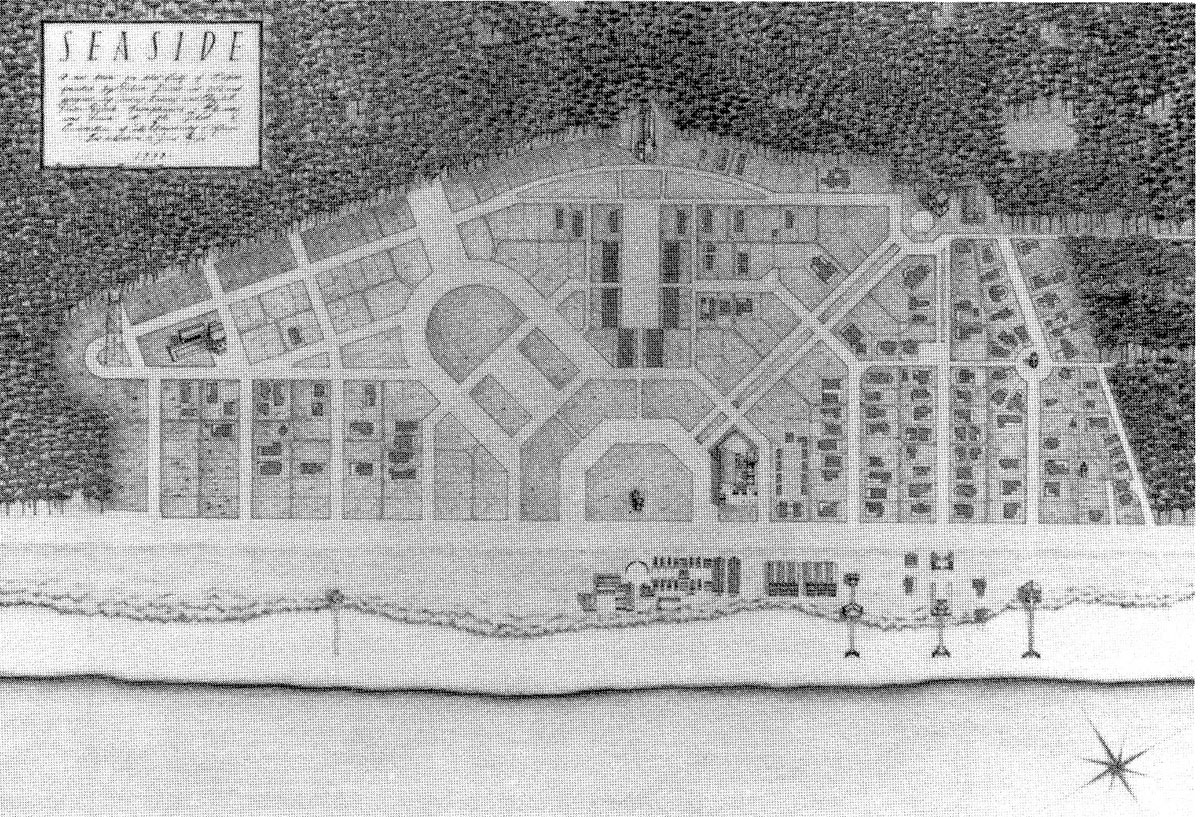
SeasideDwg009The first innovation at Seaside is the Plan.  It shows some of the major ideas:  a central commercial area on the state highway which runs along the shore, a combination of gridded and radial streets out into the neighborhoods, clear locations for the community, civic and other sacred uses, a hierarchy of street types which determines which building types go where, and a relative lack of buildings between the highway and the Gulf, allowing public views and access to the water rather than walling it off for the few.  Residential streets are shared by cars and pedestrians, plus there are walkways at the rear of all the residential lots, which lead to beach pavilions across the highway.

The second innovation at Seaside was the Code, which was a radical revamping of zoning.  Instead of specifying all the things and places where and how you couldn’t build, in every district house location and type was spelled out, and architects had a clear direction to follow.  This differs markedly in different places in the town, the intention being that the building designs support the overall character of the various public spaces.  There are small-scale streets, grander streets, streets where the houses determine a street wall, streets where the ambience is more that of small bungalows.

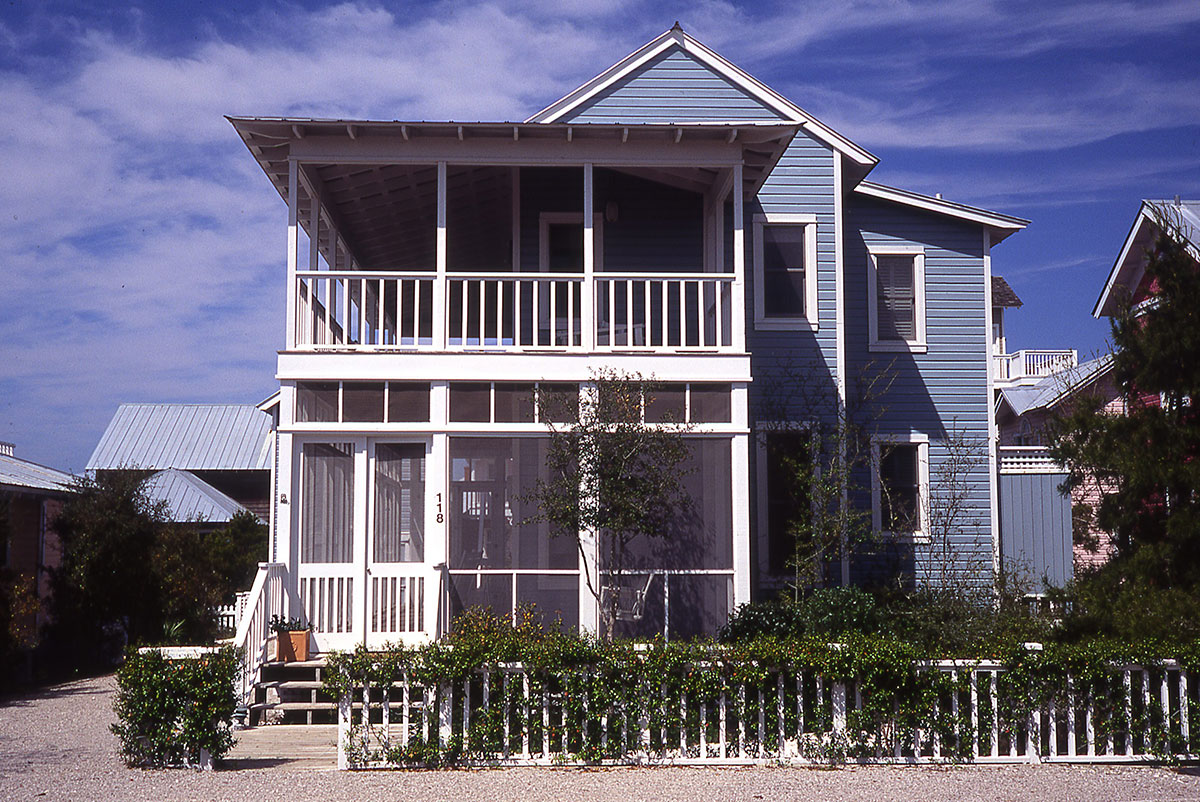
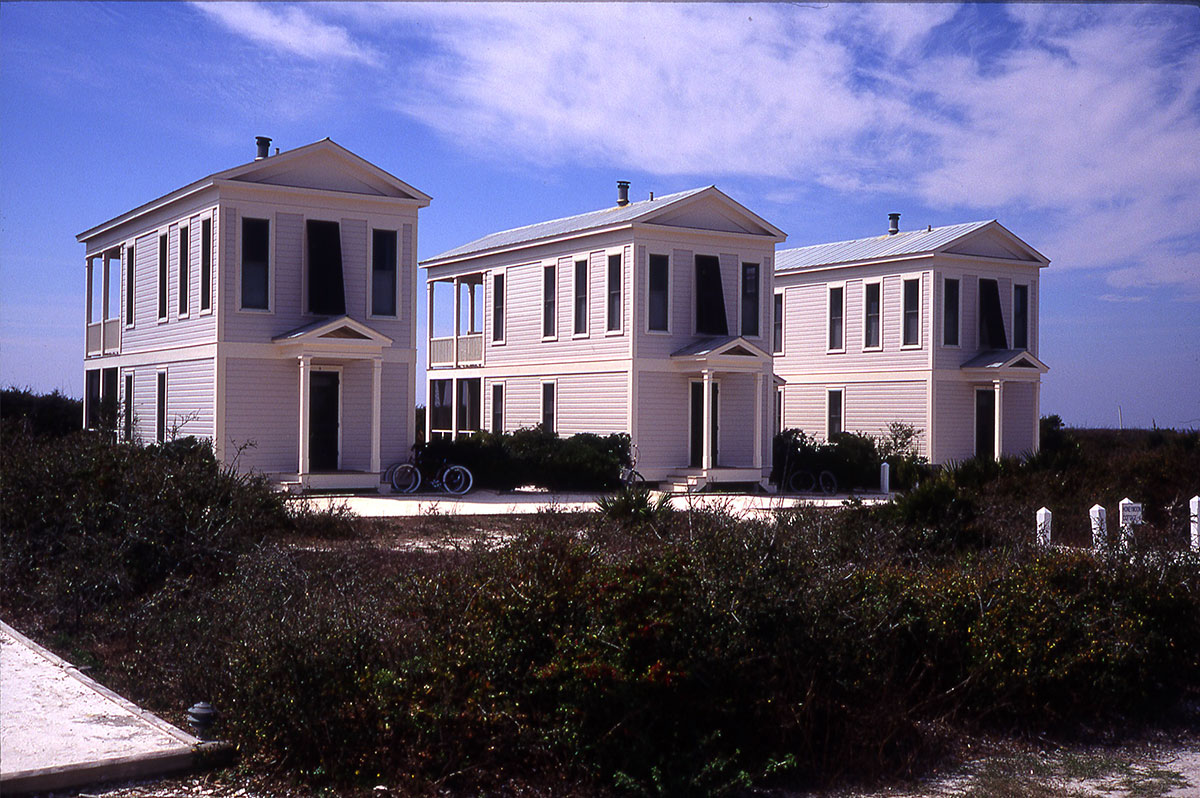
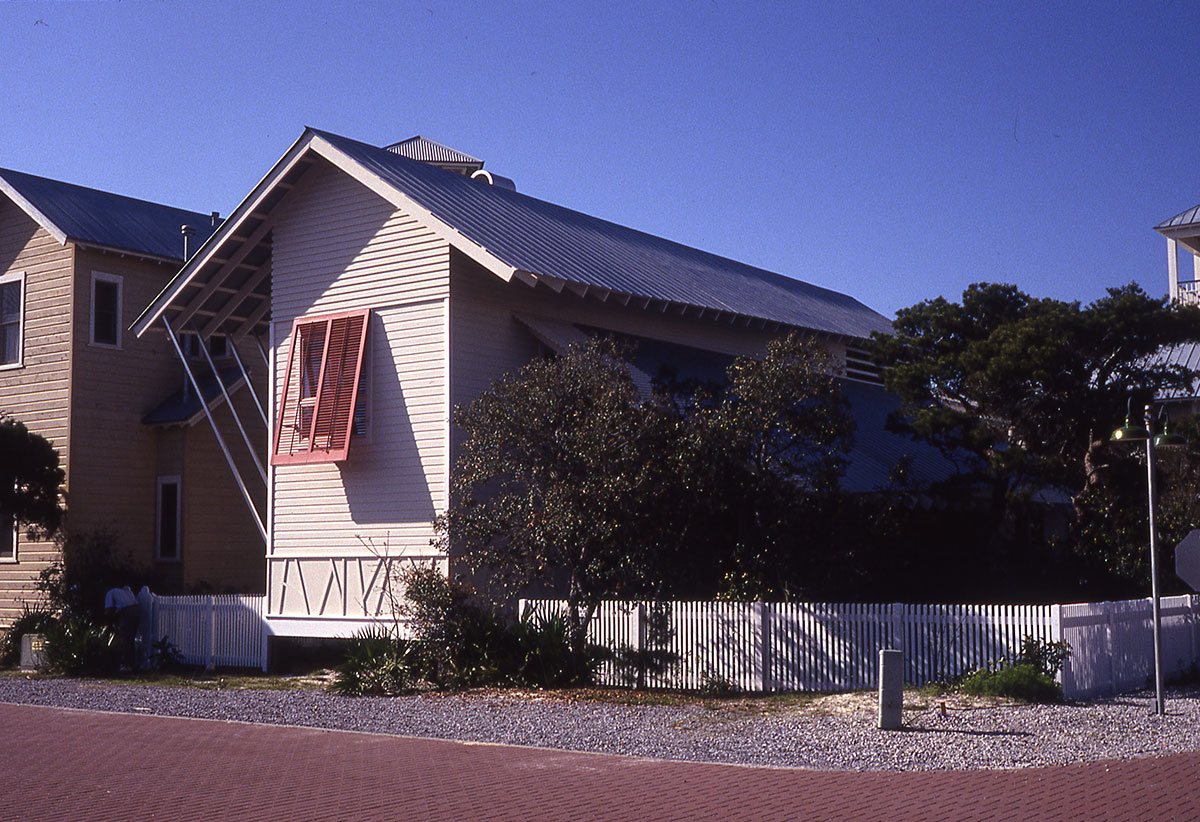
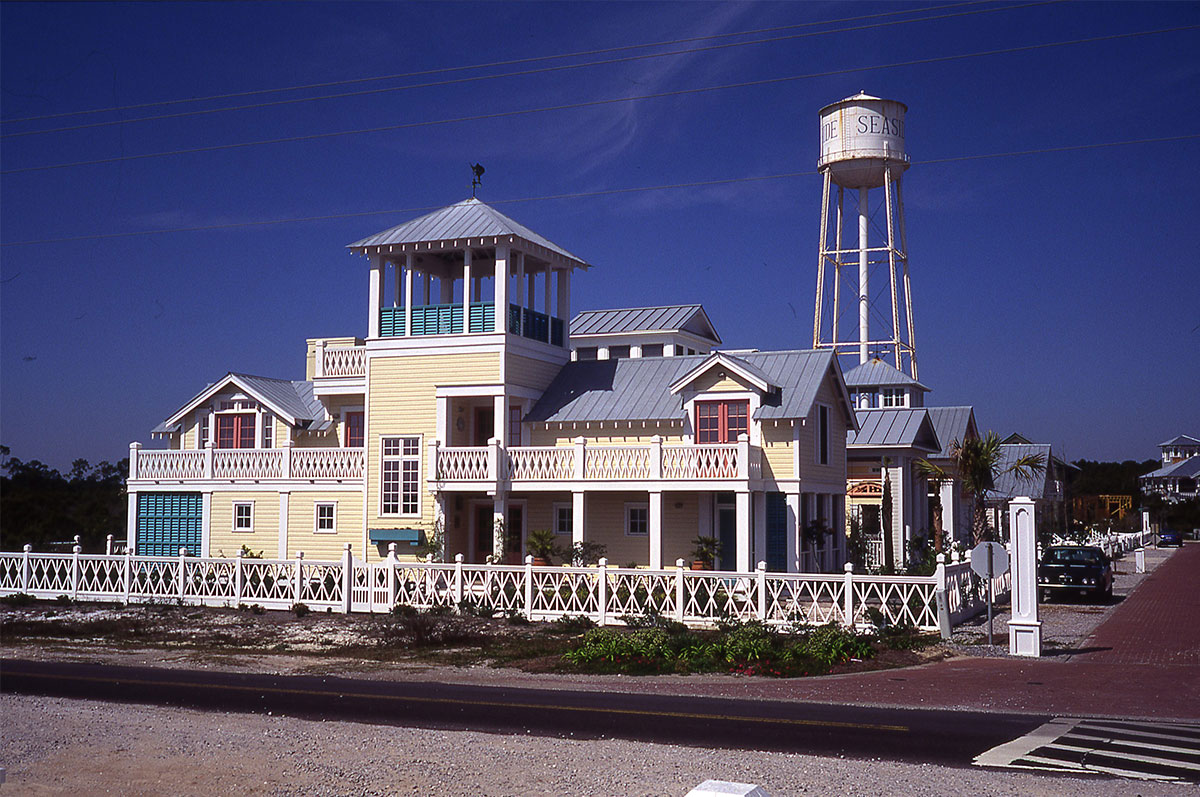
The first wave of very good architects who worked here got it.  Their designs are simple, relatively small, and respond to the historical and climatic context.  They were good buildings, but they clearly cared more about contributing to the overall character of the town than to any architectural grandstanding.  DSCF0884    Seaside100
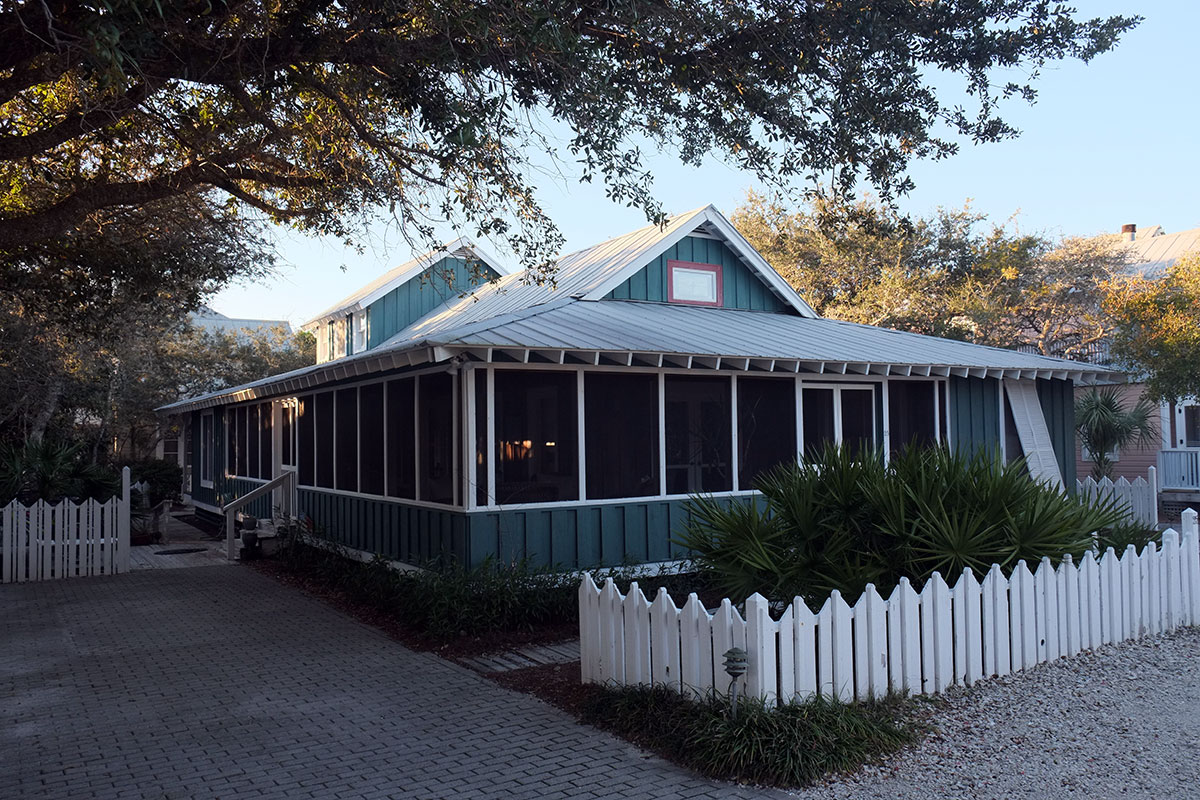
Both DPZ and Davis talked about the appropriateness of “cracker” buildings, with big screened porches, gables, picket fences, etc., and while the architects sometimes pushed the boundaries, they used these ideas as jumping-off point, as in this house by my classmate Victoria Casasco.  Seaside024
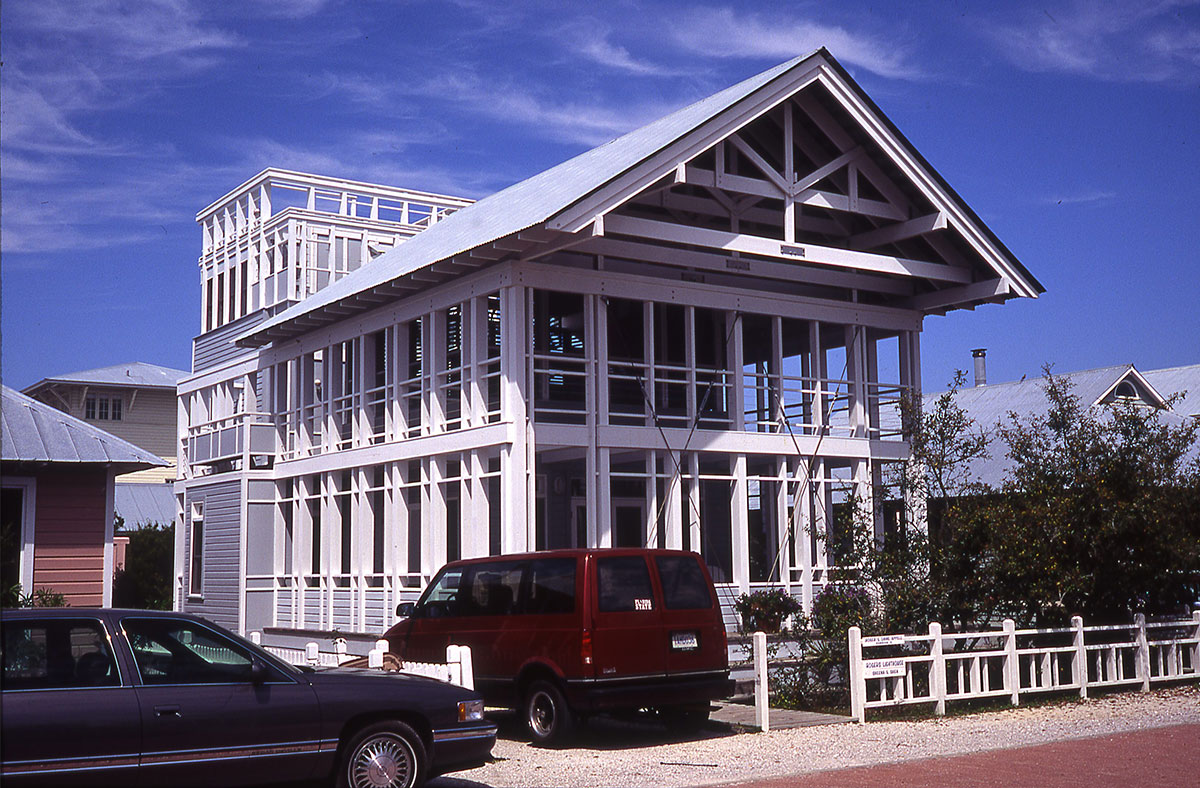
or this one by Sam Mockbee (of Rural Studio fame).  Seaside033
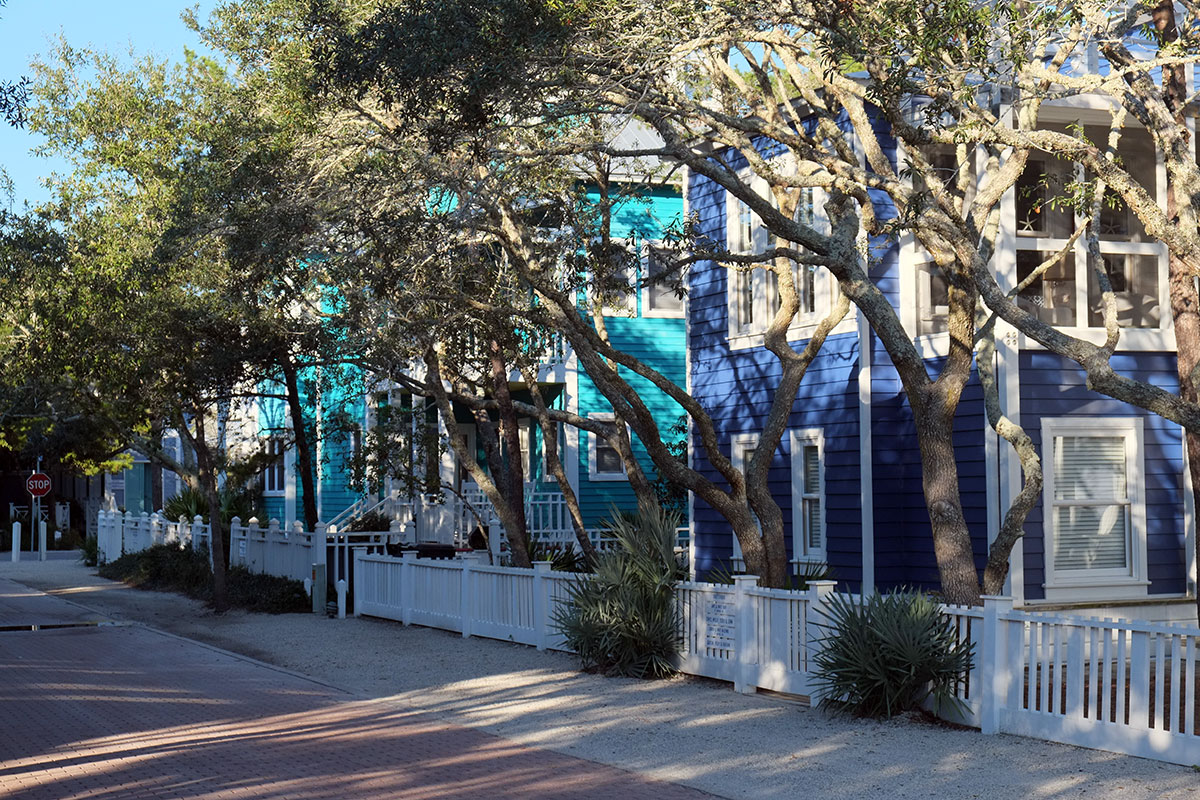
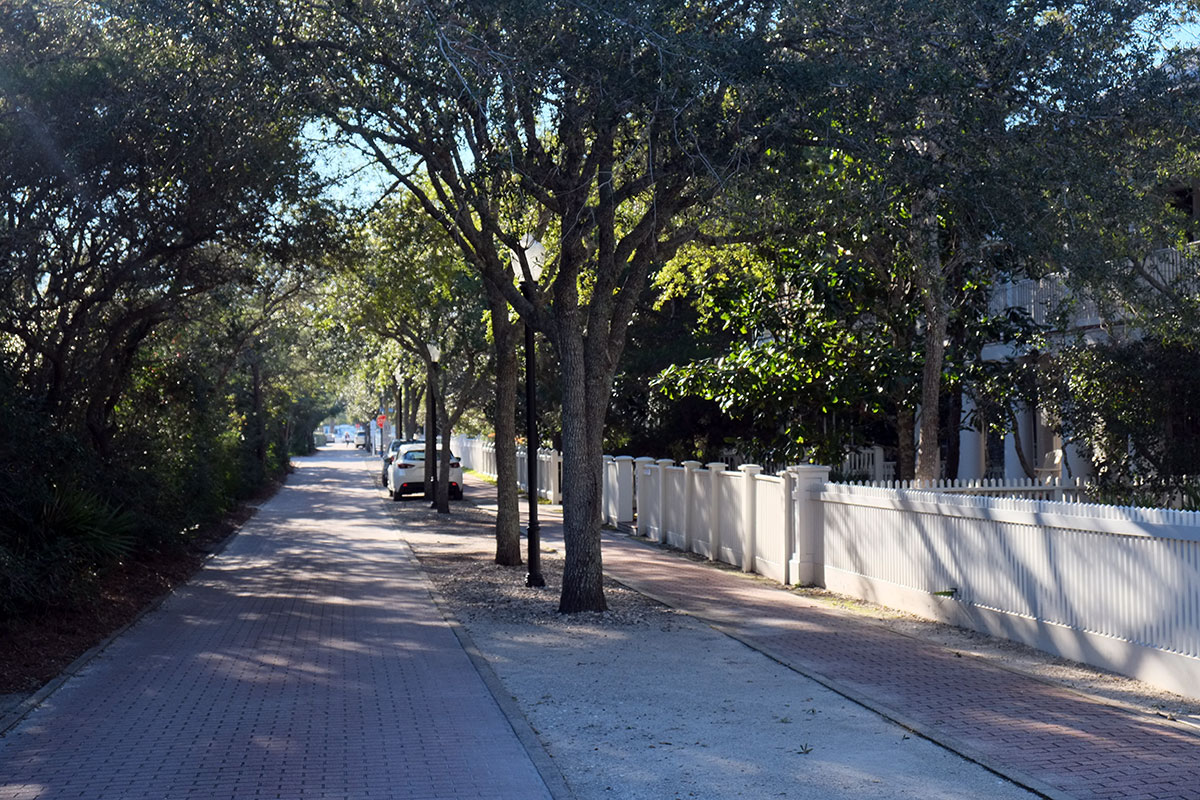
These neighborhoods have maintained their character, and have even improved, as the landscape has become mature.  The streets are beautifully-scaled and textured, functional for driving and a pleasure for walking.  DSCF0785
DSCF0836

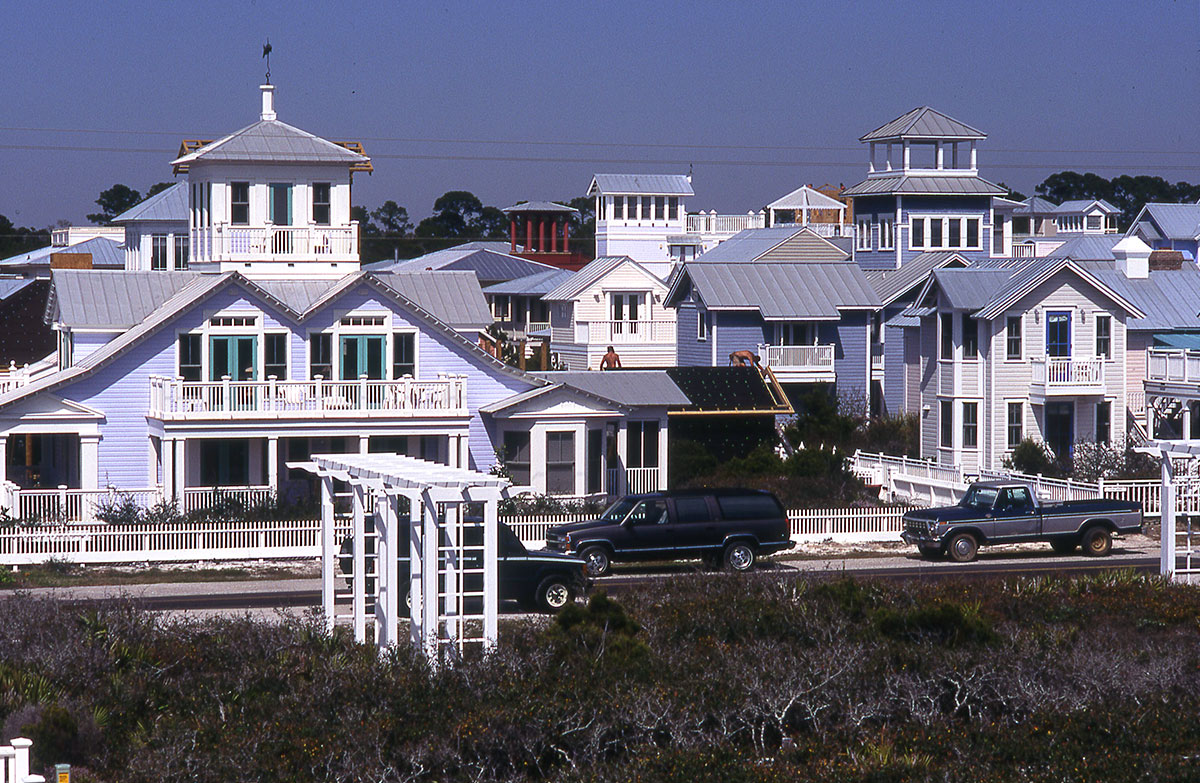
By the mid-1990s, this had already started to go awry.  Seaside was a victim of its own success.  It was so different from standard practice, and such a beautiful overall environment that it was splashed across the media and attracted the attention of the upper middle classes from places like Atlanta.  They arrived with money, ideas and intentions that didn’t reflect the initial ideas about simplicity.  They followed the explicit rules, but when they pushed the boundaries, it wasn’t in the direction of interesting architecture, it was in the direction of trying to build something as close to a suburban Atlanta McMansion as they could get away with (with a lot more historicist detail glued on).  The east side of town has most of the early, elegant buildings, while on the west side, the newer, more ostentatious houses appeared:  Seaside091  Seaside092
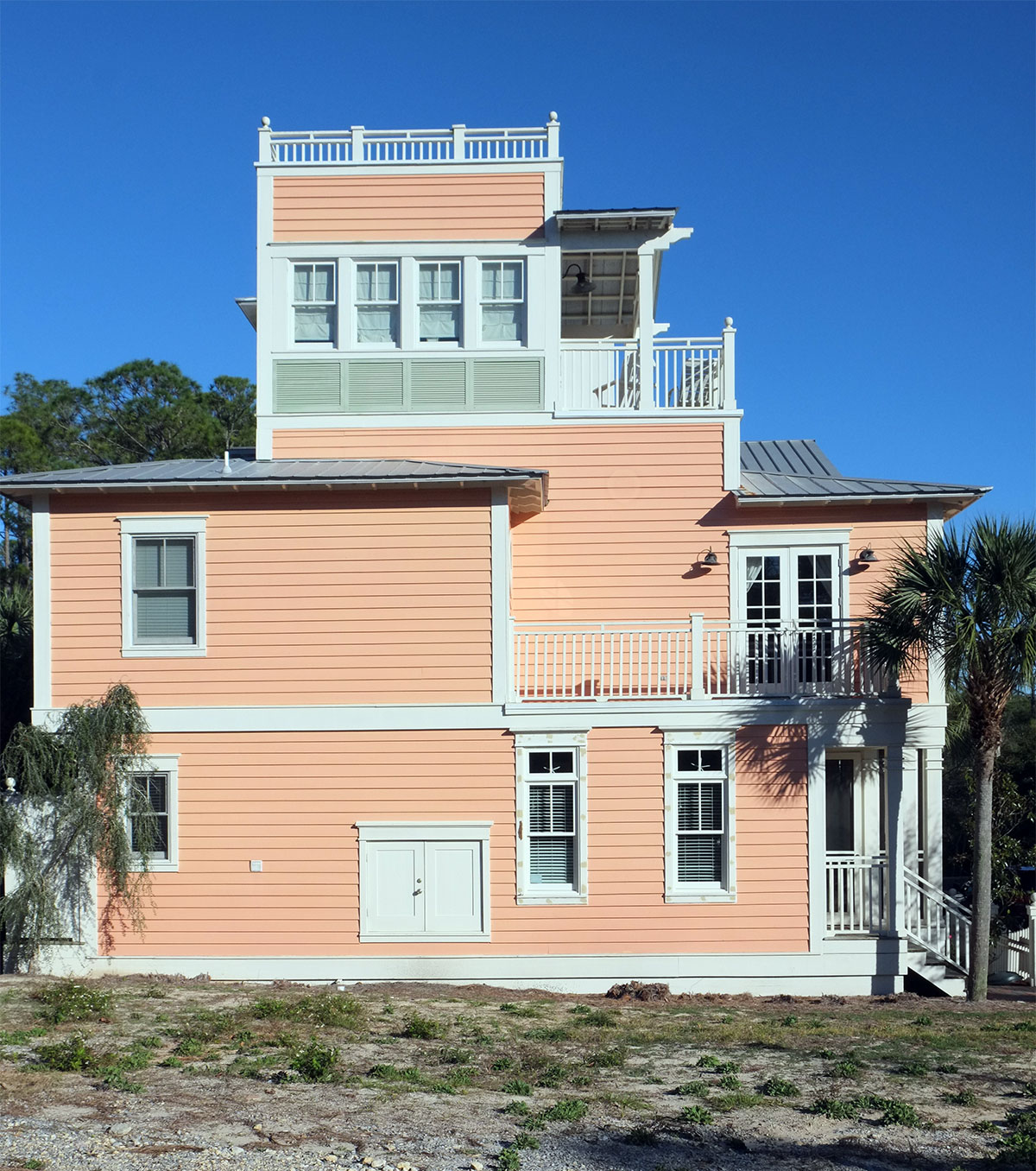
As happens to most innovative movements in this country, eventually Seaside became a style.  (This can be seen very clearly in newer developments on the Panhandle, such as “WaterColor” next door, where Seaside-style details and building forms are present, with very few of the ideas about making a town.)  Even within Seaside, in the past twenty years, the trend towards gigantism has prevailed.  New houses on the periphery are humongous (by Seaside standards), and the architects now have to mainly focus on how to mitigate their bulk, which just can’t be done very elegantly.  DSCF0774  DSCF0781The balance between architecture and the landscape has been lost in these areas.  They don’t resemble an older beachfront town, they most resemble 21st century Edge City suburbs for the upper middle class, where ever bigger houses are shoehorned onto ever smaller lots.  DSCF0770
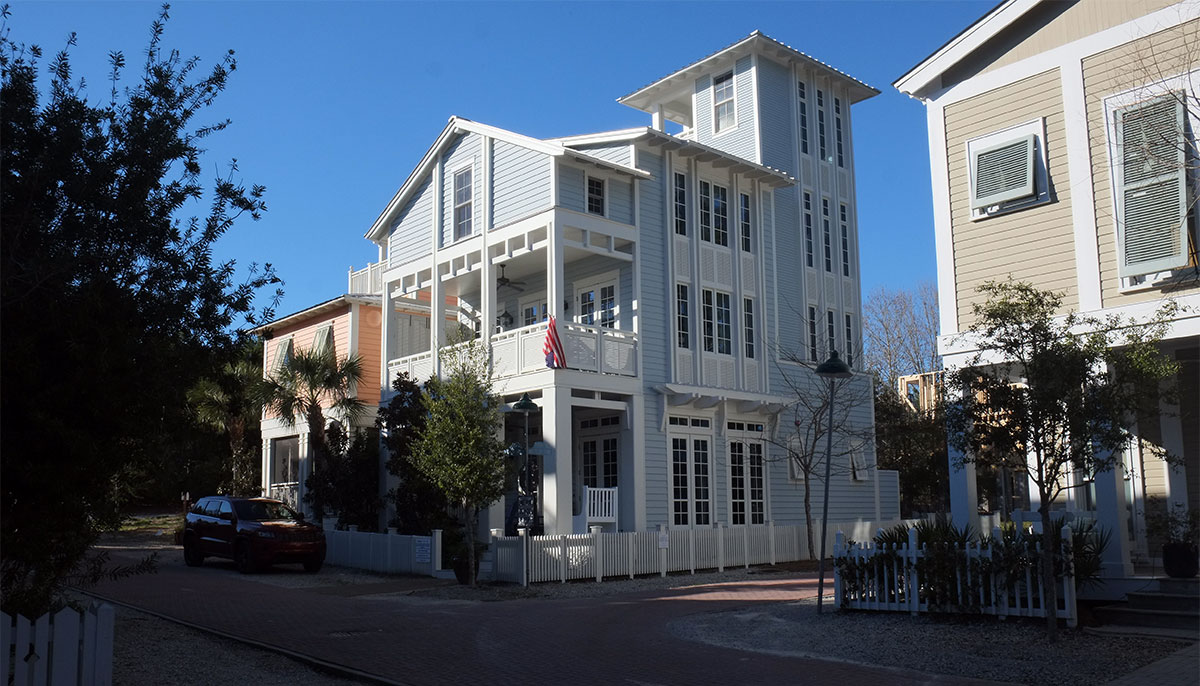
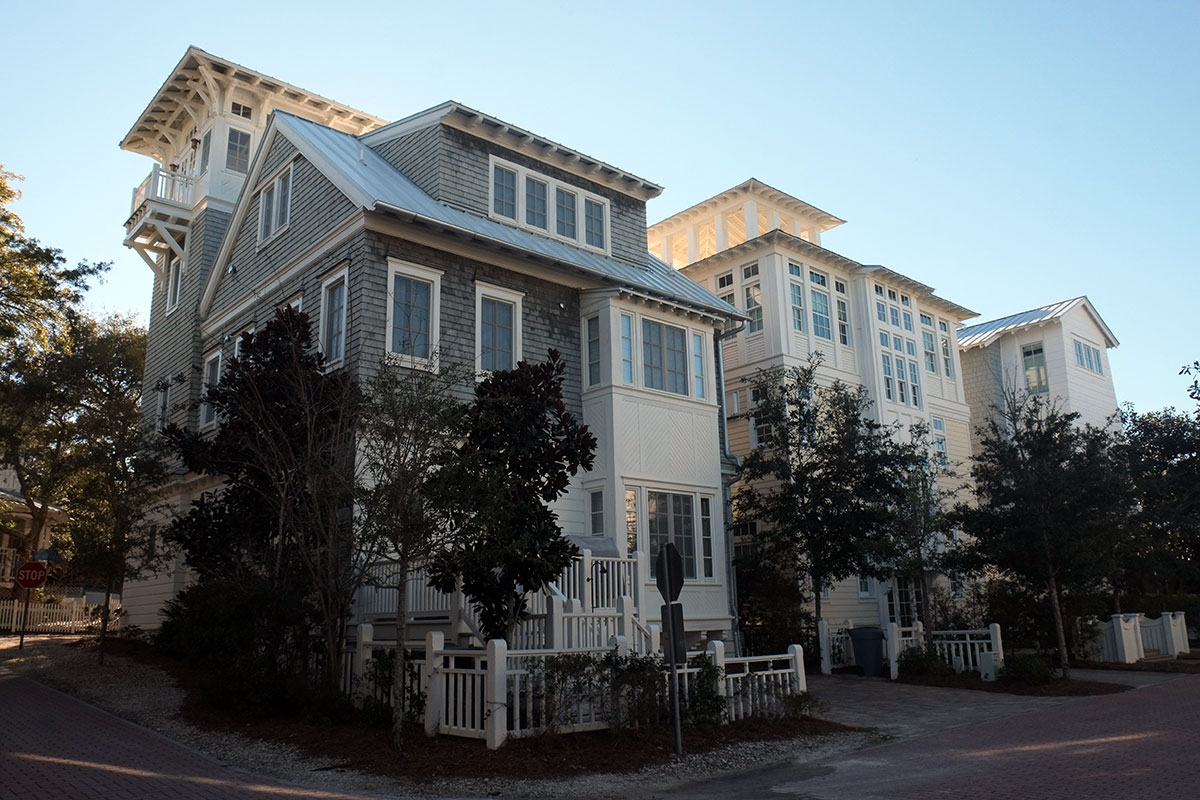
To be fair, if I’d been living in Bar Harbor or Newport in the late 19th century, I probably would have railed against the new, giant, ostentatious Shingle Style mansions which dwarfed the earlier, simpler cottages.  But in those places there is still a correspondence between the scale of the site and the house.  In Seaside, the town was planned with much smaller houses in mind, and somehow these new behemoths have appeared, overwhelming the streets.

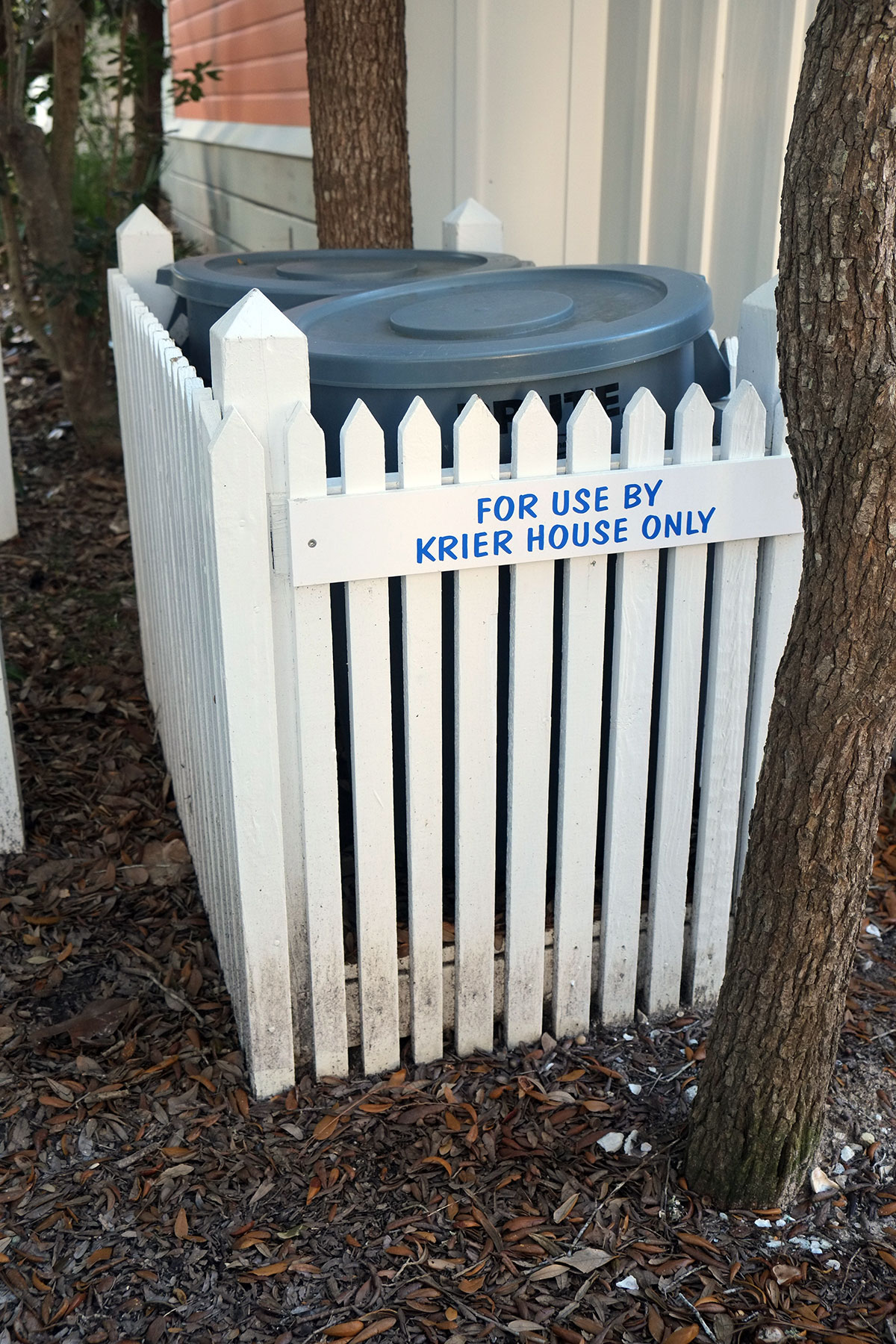
Other architectural trends have caught up with Seaside, such as starchitecture.  Early Seaside buildings were often designed by famous architects, but you usually couldn’t tell;  they worked together to create a coherent whole.  But in our brand-conscious era, these earlier buildings have now been routed.  Leon Krier designed the first house of his career in Seaside, which few of the residents back then seemed to know.  It has now been sold, and is known as the Krier House, and has its own exclusive garbage can.  DSCF0749
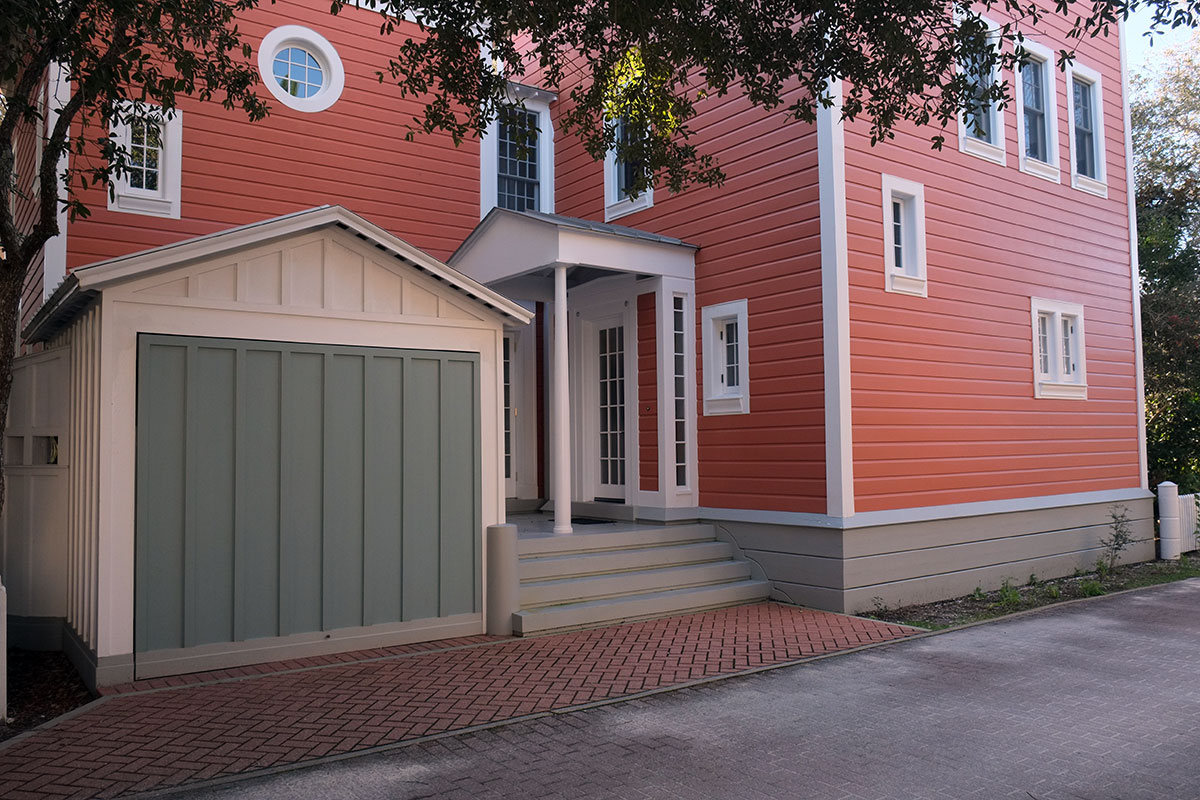
And in a major irony in this iconic pedestrian-oriented town, the house has been expanded, the entry porch enclosed, and a garage added.  Perhaps this was intentional – a demonstration of how in America every theoretical innovation will be subsumed and co-opted by the Invisible Hand of the Market.  DSCF0750
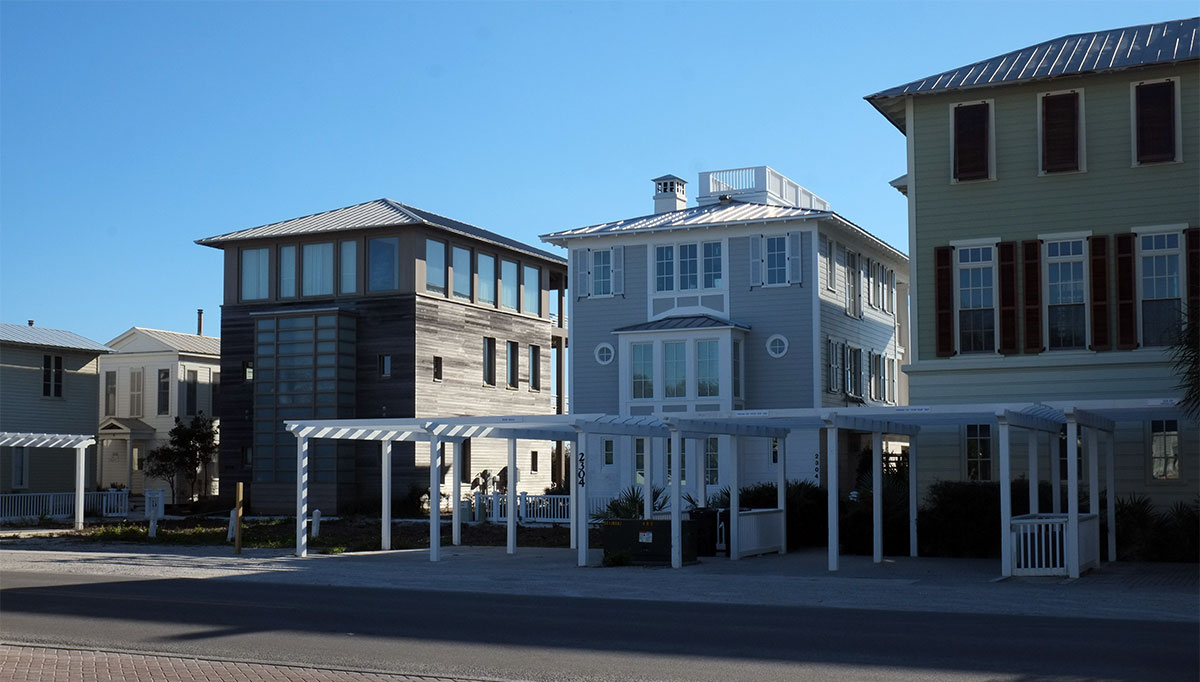
An Aldo Rossi house has been built the highway, and is currently on the market for $11 million.  DSCF0797
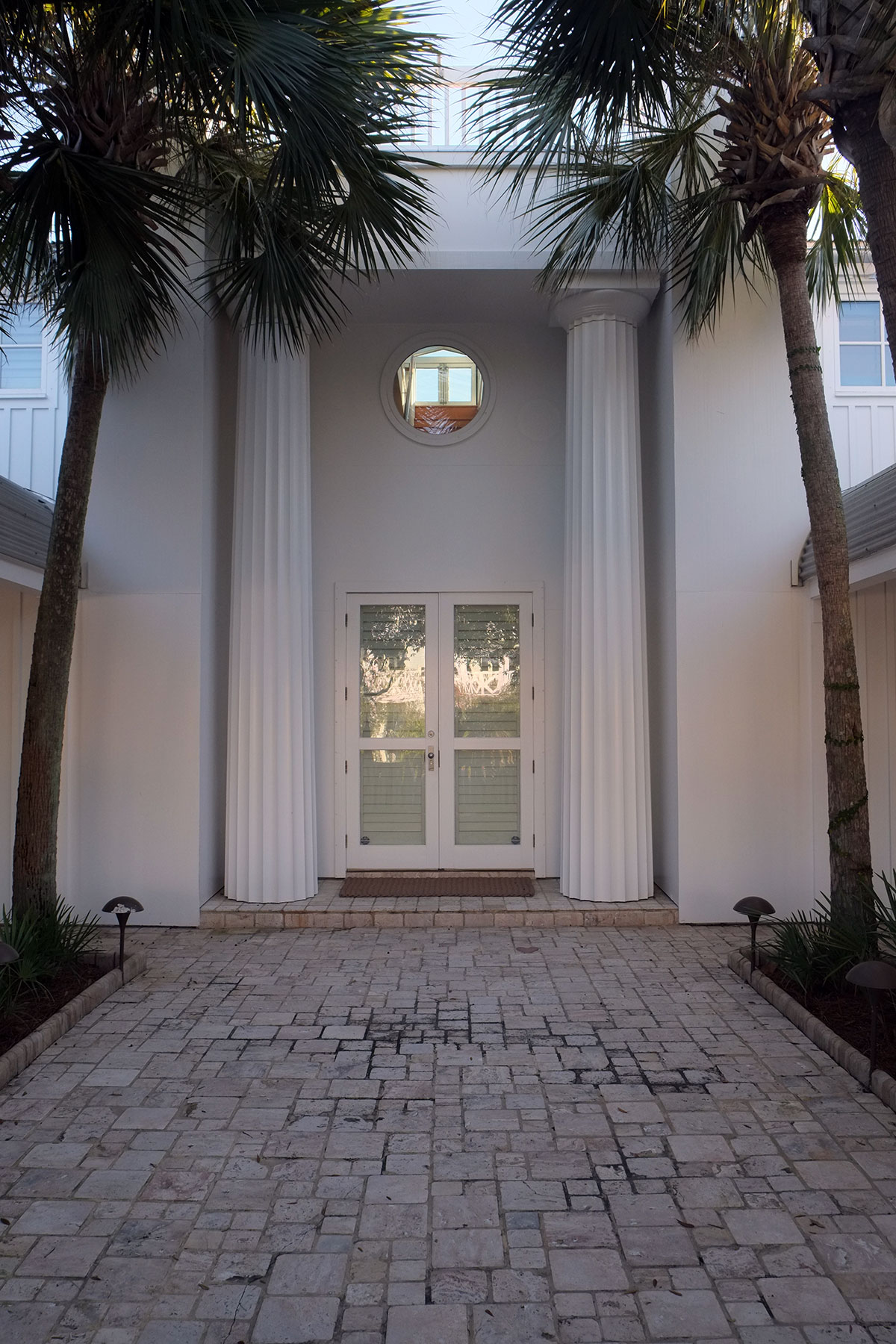
It has Aldo Rossi carports:DSCF0799

and a pergola backing up to the dunes, that while quite lovely, seems to have more to do with La Dolce Vita than Panhandle cracker architecture.  DSCF0810
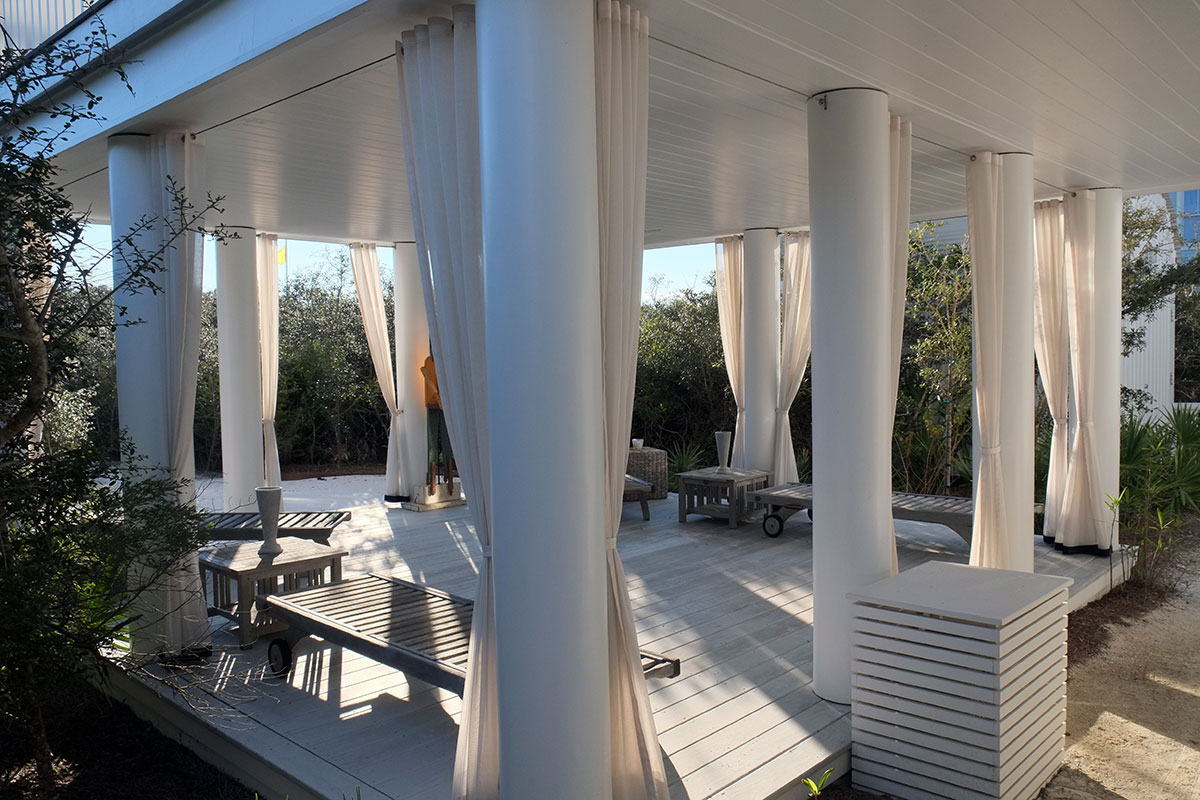
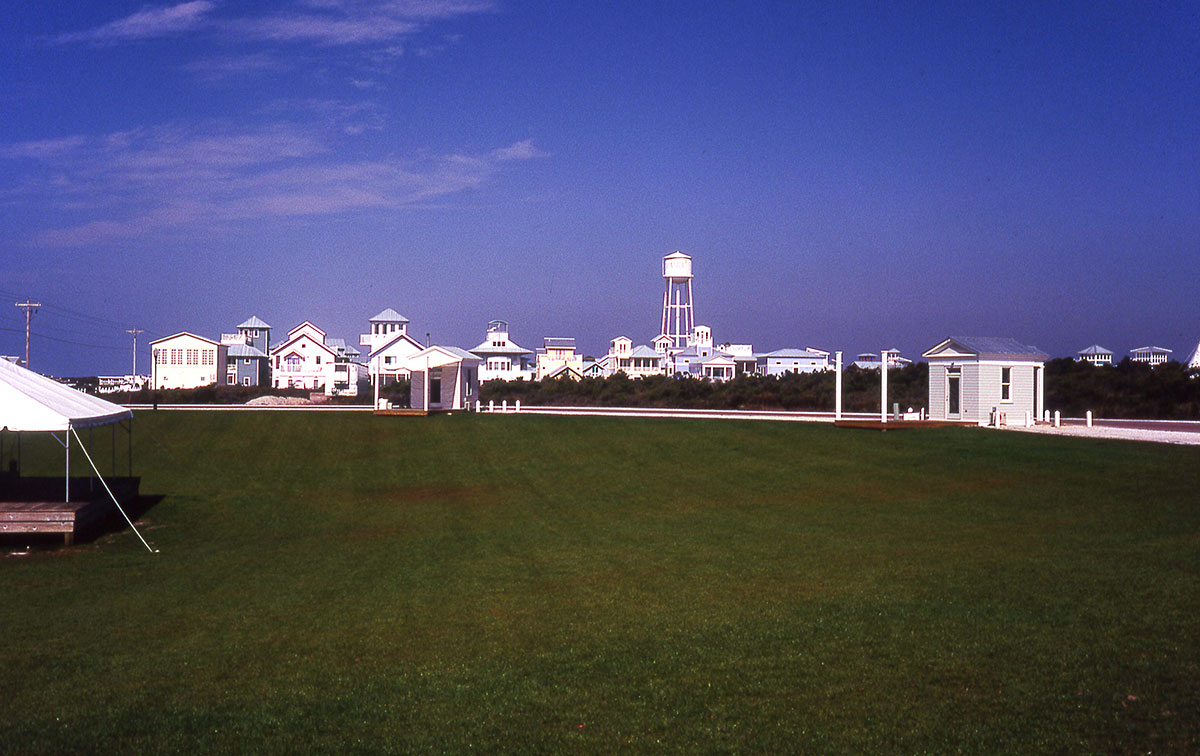
This last element points out another major change.  Even into the 1990s, there were very few buildings on the sea-side of the highway.  As you looked out from this lovely beach pavilion built by Steve Badanes, you saw other pavilions, dunes, a tiny beachfront restaurant, and a few small guest cottages.  Seaside084  Seaside061
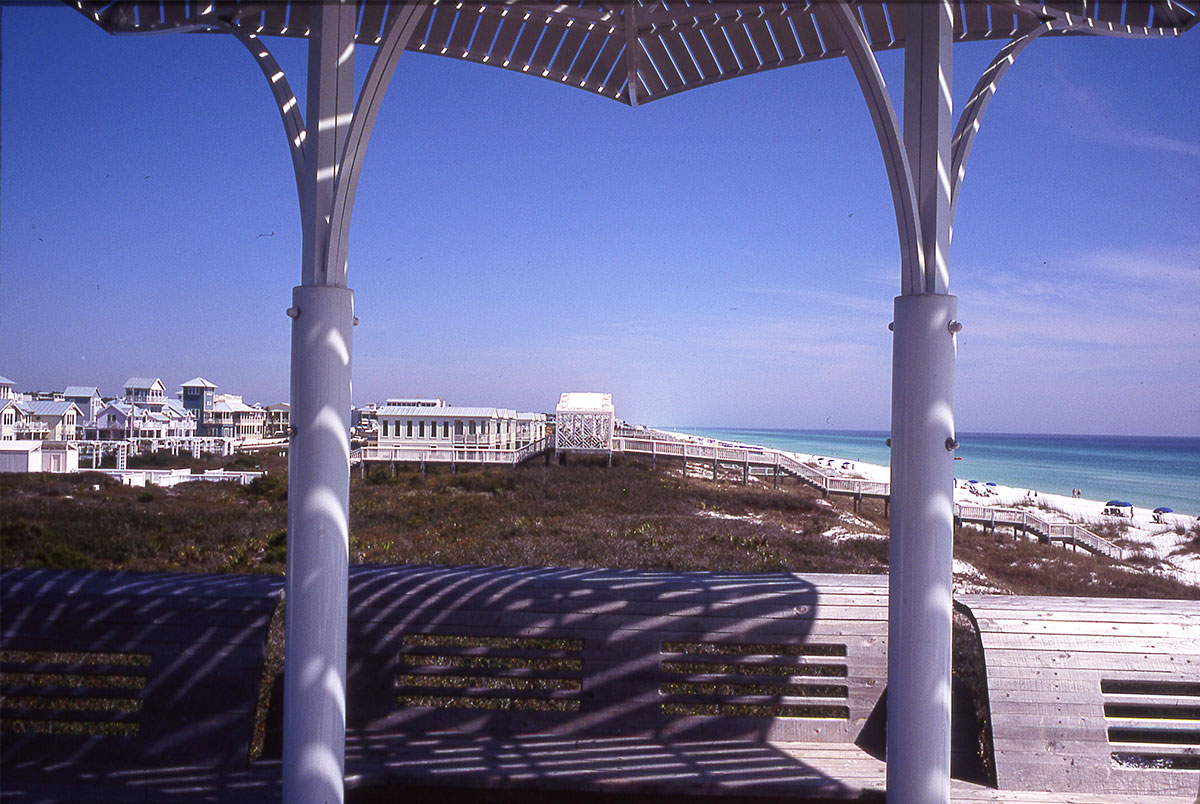
Now the area between the highway and the dunes has been subdivided and built up.  You can’t ever see the Gulf as you drive or walk by.  The houses may not be all that bad, but the seascape is gone, and the little classical cottages have been swallowed up. DSCF0714
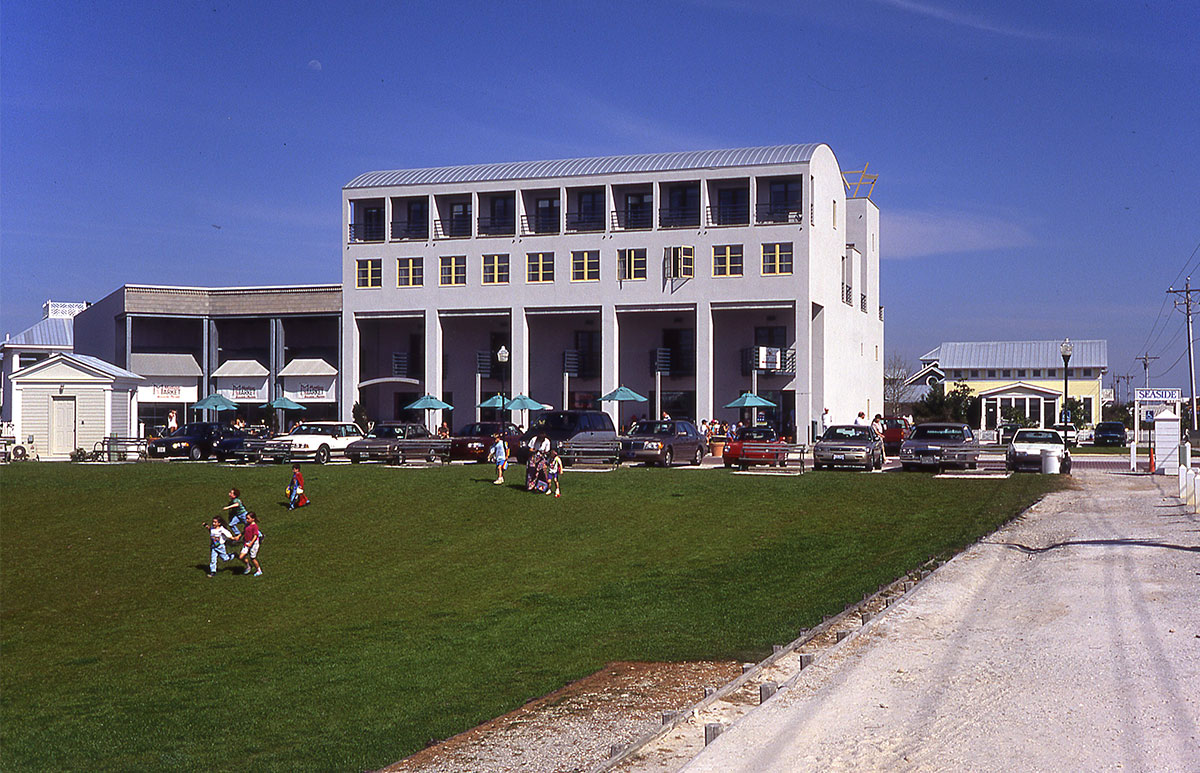
The downtown has undergone drastic changes.  In the 1990s there was a tiny Post Office, and one mixed-use building, one of the first major commissions for Steven Holl.  It was on the east side of the town green, while the west side was largely undeveloped.  Seaside106  Seaside104
The green is now ringed with commercial and mixed-use buildings, seen in this panorama from a newly-elaborated plinth and amphitheater-thingie.  DSCF0675

Having more activity, more people, and more businesses in the center is certainly a good thing, and the buildings are sometimes a little weird and sometimes fine.  DSCF0682  DSCF0673
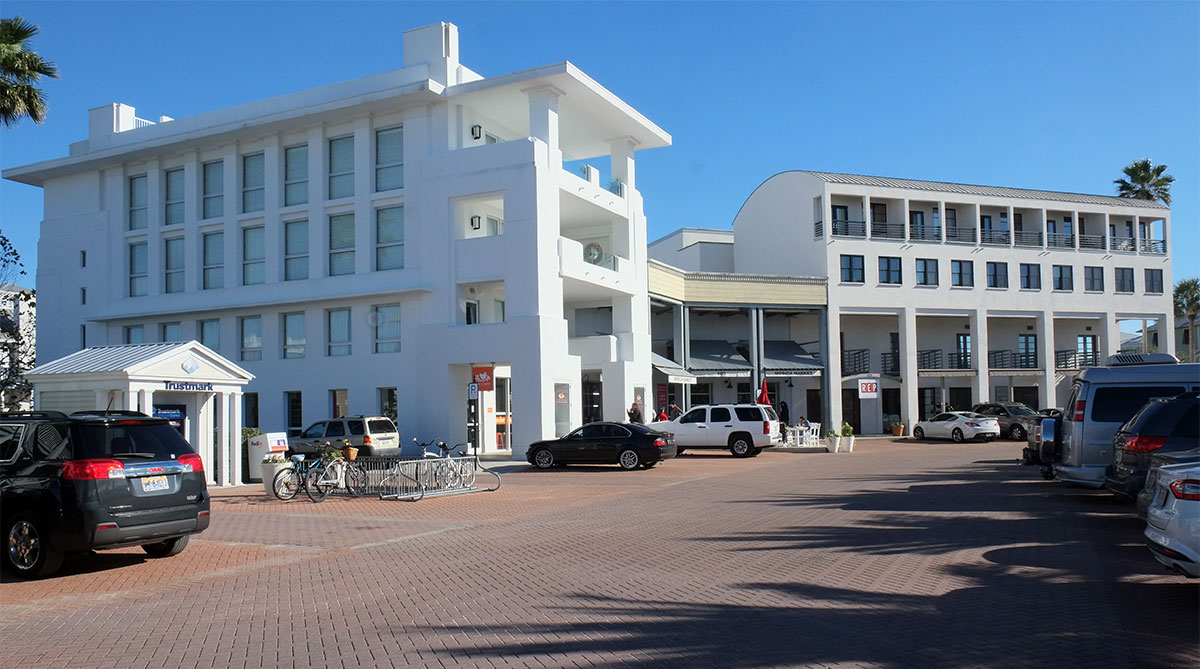
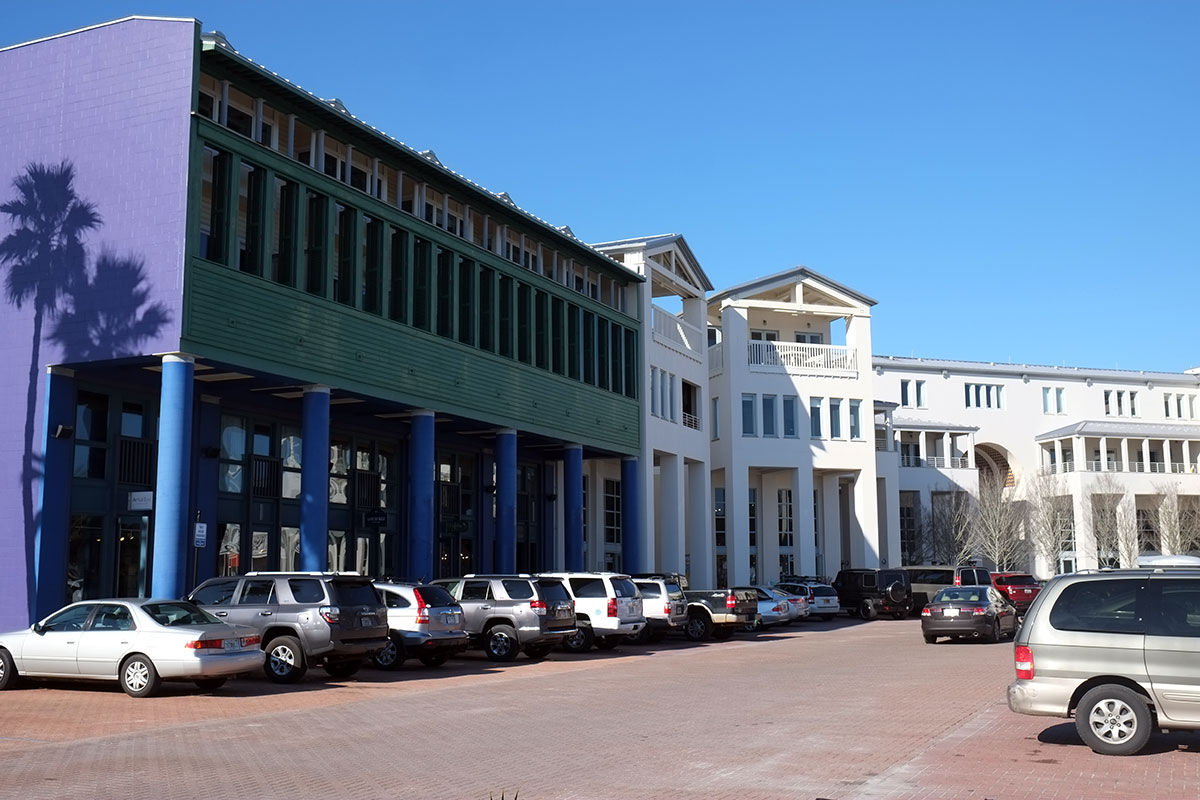
But the downtown is clearly now out-of-scale with the town.  Seaside must have become the restaurant-and-shopping destination for nearby developments, and the transition from the small-scaled residential districts to this downtown is jarring.  It’s not a casual place, it feels somewhat like the Panhandle version of South Beach.

But what it really feels like is a “town center” in Edge City, a strip shopping center which has been tarted up to look like traditional main street.  In the past, Seaside was accused of being a fake evocation of the past, a Disneyfied version of a town.  I didn’t think those criticisms were fair – it wasn’t about copying the image of an old town, it was about understanding the underlying structural relationships of a good town and building a new one.  The older residential neighborhoods still feel this way.  But the downtown feels off, and I think it’s due to the cars.  Seaside wasn’t designed for an influx of outsiders coming to shop and eat.  It now has them, and it now has their giant SUVs.  DSCF0695
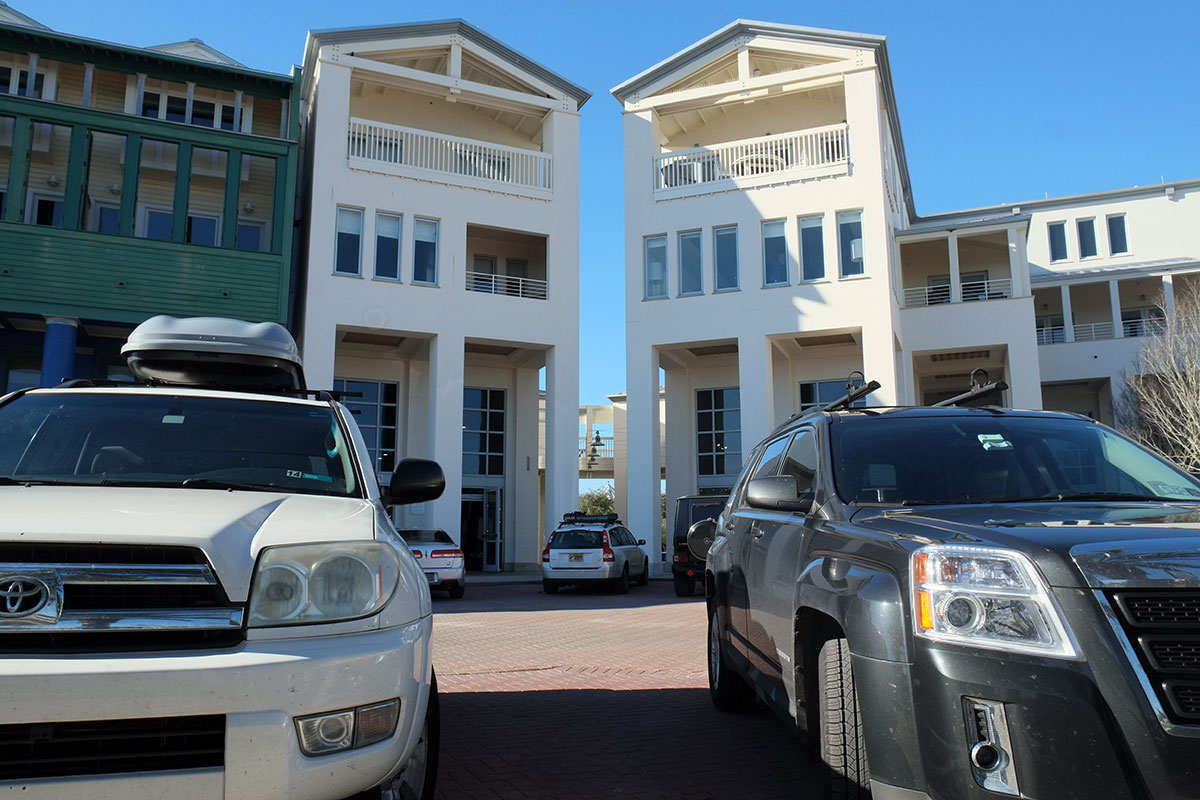
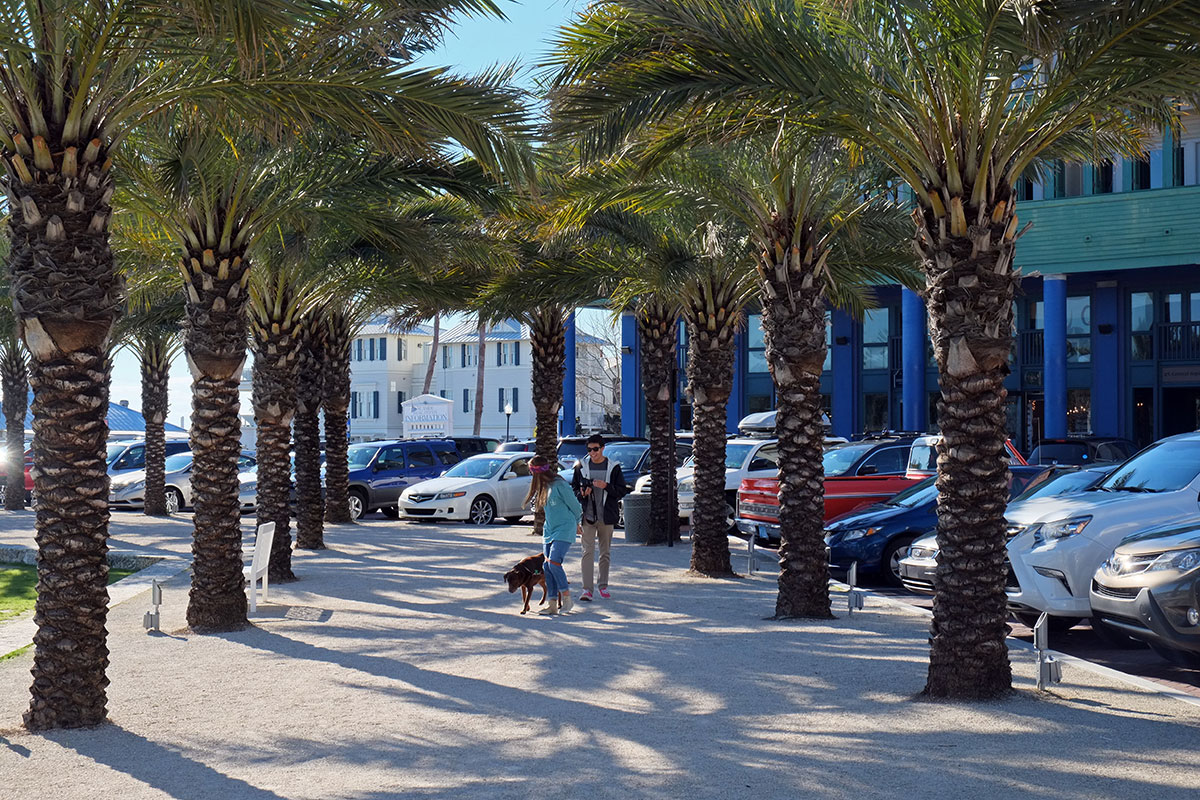
This isn’t really the designers’ fault.  Back in the early 1980s, no one anticipated that the vehicles of the future would dwarf all those of the past – we thought they’d continue to get smaller and more efficient.  In fact, one of the tenets of New Urbanism was that on-street parking was a good thing – it slowed down traffic, and it separated pedestrians on sidewalks from speeding cars.  But the huge vehicles of the present have overwhelmed the spatial design of the public sphere – when you look across the green at the center of town, you mainly see a wall of cars, and as you walk down the sidewalk, you feel boxed in by cars.  Perhaps this isn’t bad on a four-lane avenue in LA, but in what used to be a pedestrian-oriented town center in Seaside, it’s unpleasant.  It’s not a center or a street, it’s a parking lot.  DSCF0691
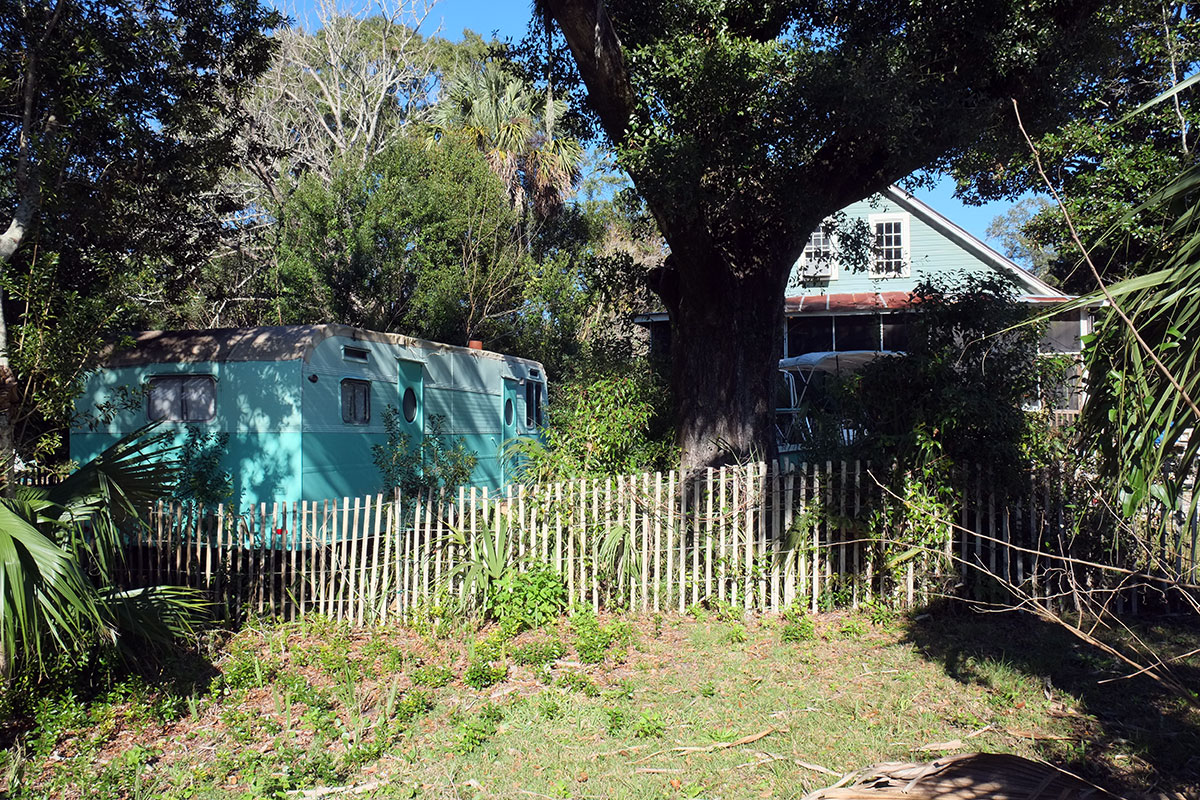
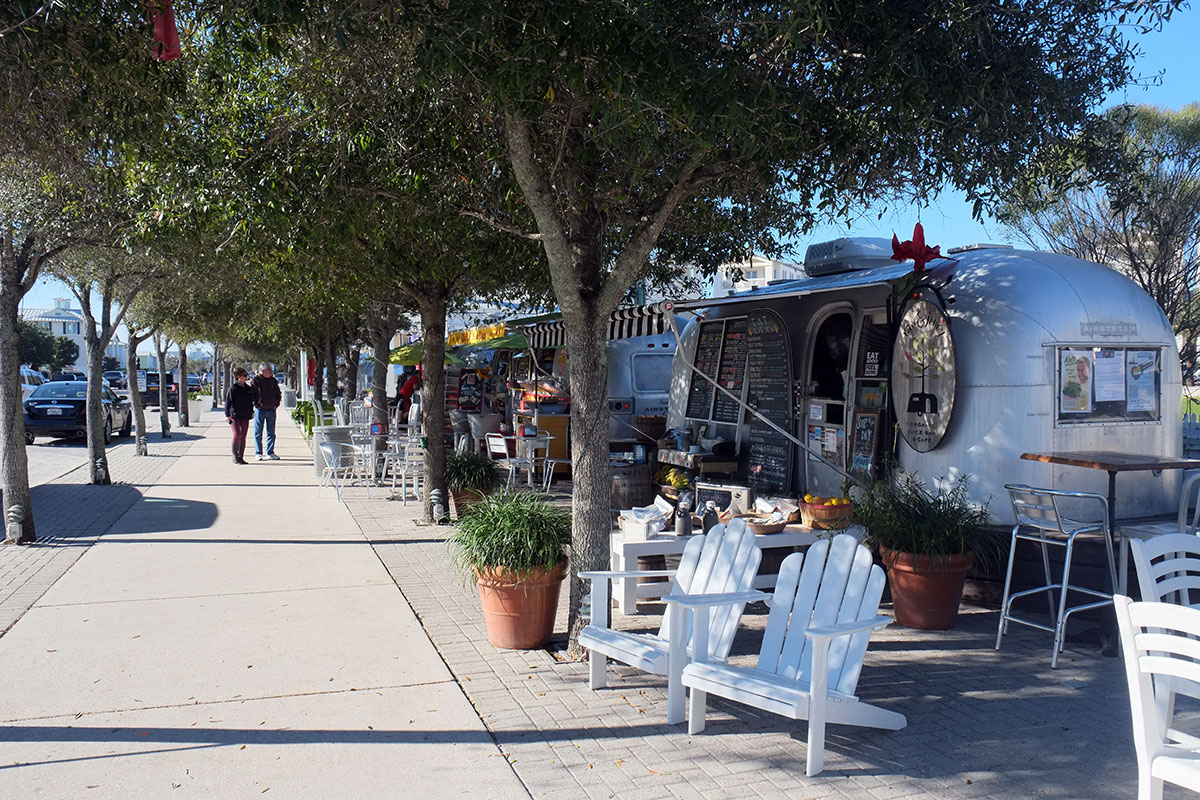
And the side of the green along the highway not only has cars, but it has the obligatory row of Airstream food carts, the sign of urban hipsterism.  DSCF0677
Most of Seaside still is great – if you get out of the center, avoid the newer houses and don’t try to get to the beach, the older streets still have the integrity they were meant to have  – they stand with the best residential districts of any era I’ve seen in the past six months.  And while some of the failings of the newer construction may be architectural, they are mainly social.  We live in an Age of Trump – everything should be big and ostentatious, showing the world how successful and rich we are.  Perhaps the most notable failing of Seaside’s codes was that they weren’t able to resist the same waves of pretension that can be seen in all wealthier developments of the past thirty years.  We’ve become a coarser and more boastful people, more focussed on our private needs – the hell with the public realm – and we seem to be unable to appreciate simplicity or elegance.

I was struck by the contrast between Cape Cod and Seaside.  When we visited Chatham, where we vacationed when I was a kid, it seemed that almost nothing had changed in in the past fifty years in this 18th-century town.  (https://peregrine-nation.com/2015/11/08/cape-cod/)  Many pieces of the past remained, and most new construction was carefully designed to fit in with the old.  But as I left Seaside, a town that is about thirty years old, I felt nostalgic for what it had been, and what has already been lost.
Apalachicola and the roots of the New South

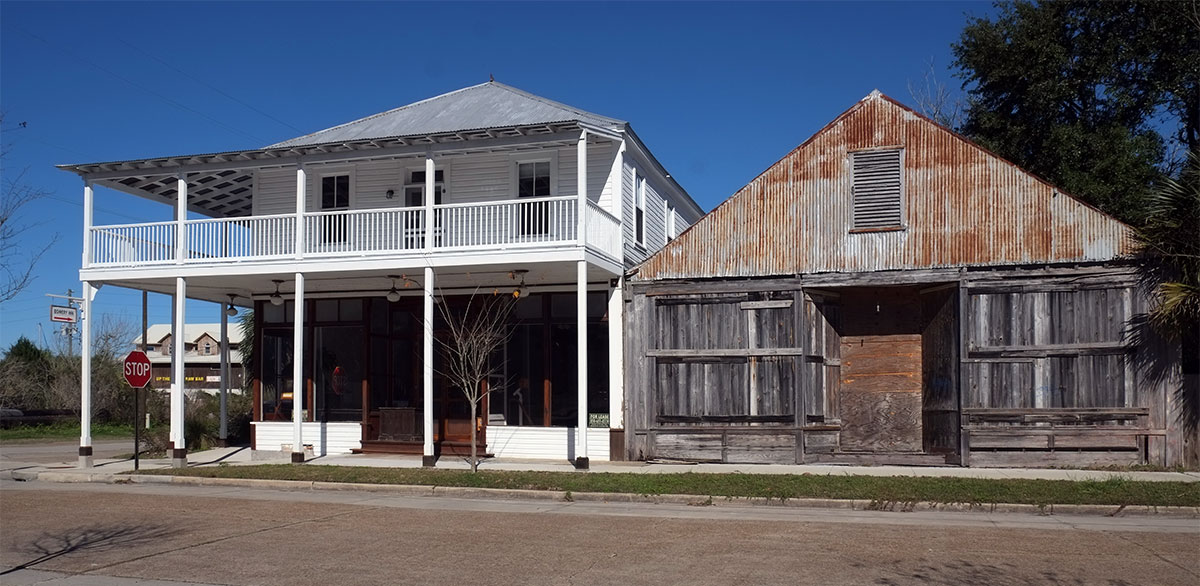
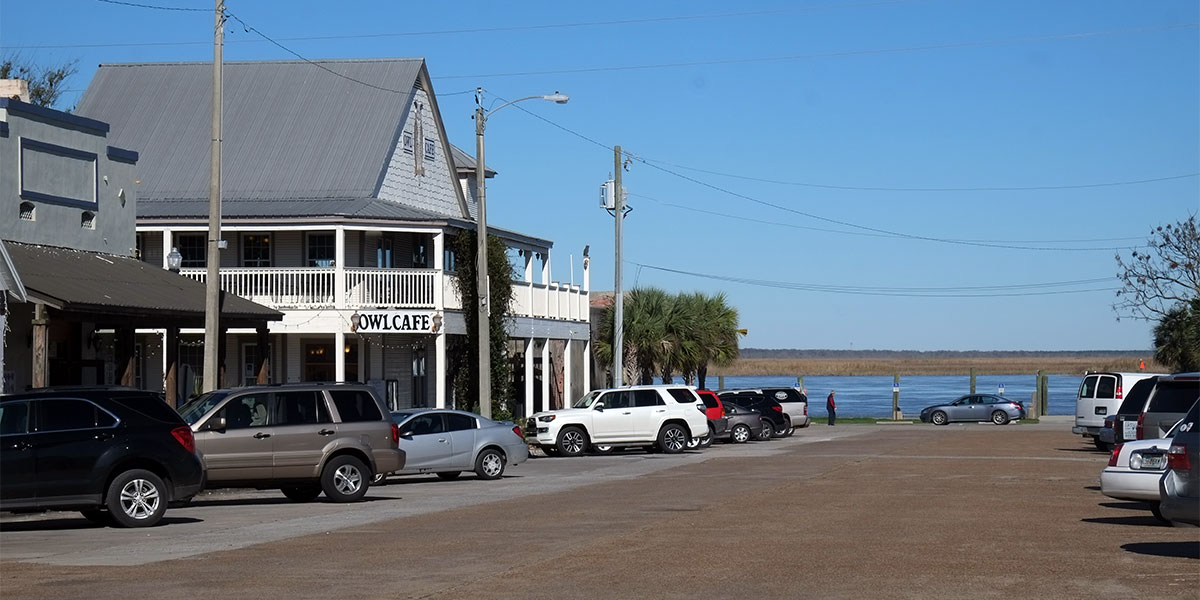
DSCF0467Apalachicola has more going for it than its cool name.  Like Fernandina Beach, it’s a place where a succession of industries has sustained the local economy, and each has left its mark on the form of the town.  And in a strange way, events that transpired in Apalachicola may be responsible for the manner in which our country (and much of the rest of the world) has developed in the postwar era, and possibly responsible for our current national political alignment.

Apalachicola was first an important cotton port.  But similar to the fate of New Orleans, with the opening of the Erie Canal and the advent of the railroad, that industry declined.  You can see its influence in the width of the downtown streets, which were to accommodate the movement of cotton bales.  DSCF0479

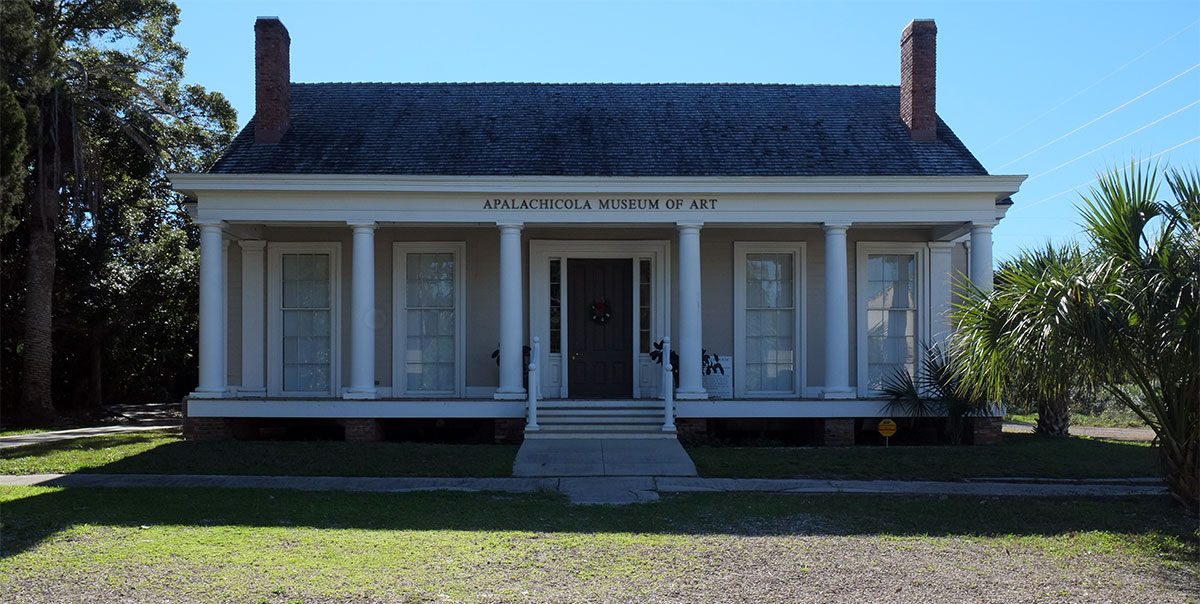
We are suckers for local museums, and Apalachicola has a good one.  We were particularly struck by this pre-digital interactive display, which shows the life of the port in this era.

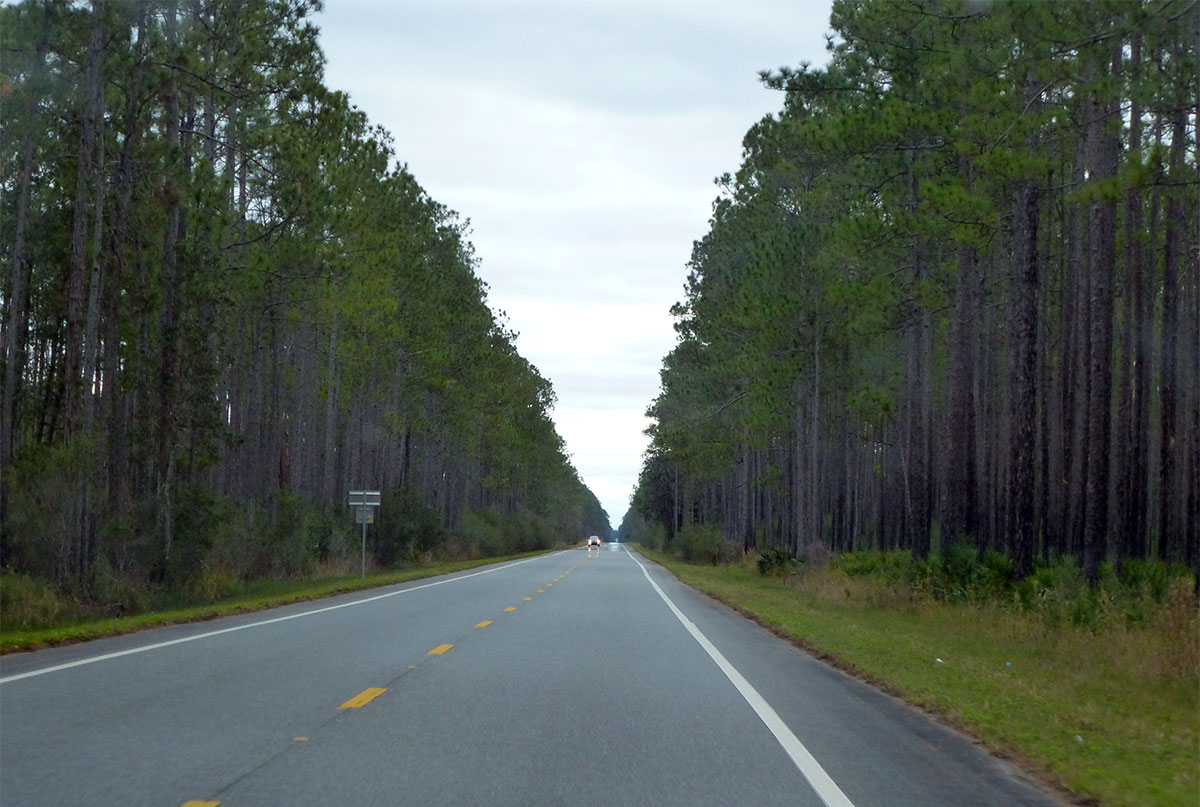
To get to Apalachicola, we drove through Tate’s Hell State Forest, the most appropriately named place we’ve ever been, the apotheosis of the relentlessly boring southern coastal plain pine forest.P1060708

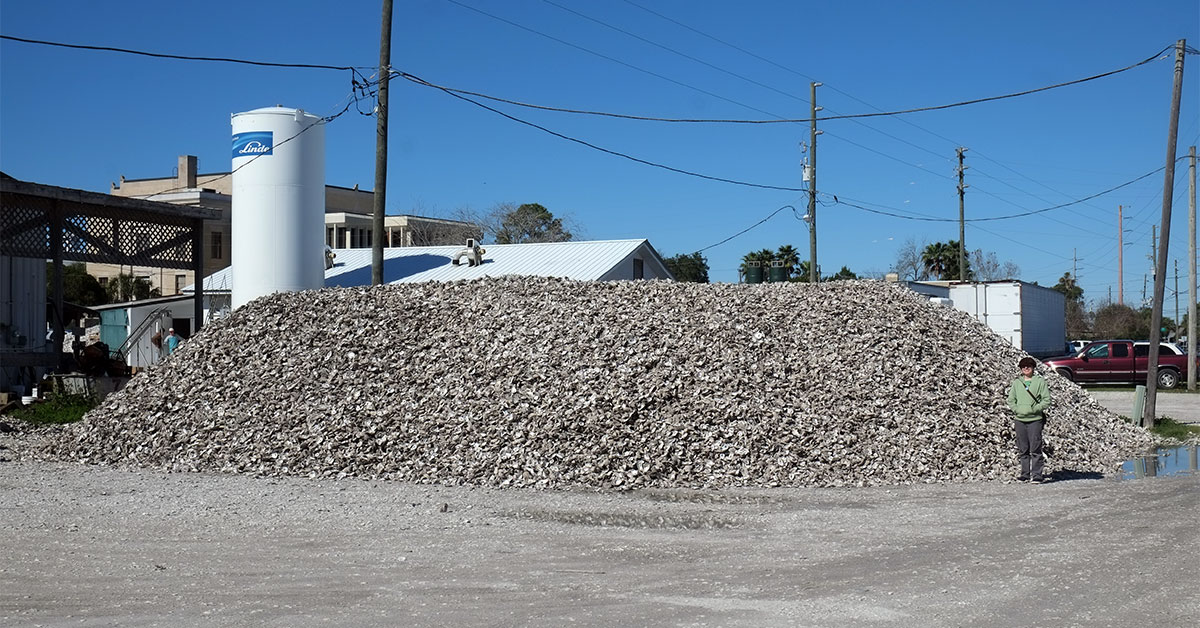
But it did bring the home the extent of the second of Apalachicola’s industries – as a port for shipping out the long leaf pine harvested upriver.  After the forests were logged off, economic activity shifted towards fishing, and especially oystering.  This industry, along with tourism, sustains the city today.  The oyster haul is impressive:  DSCF0442

and tasty.DSCF0611

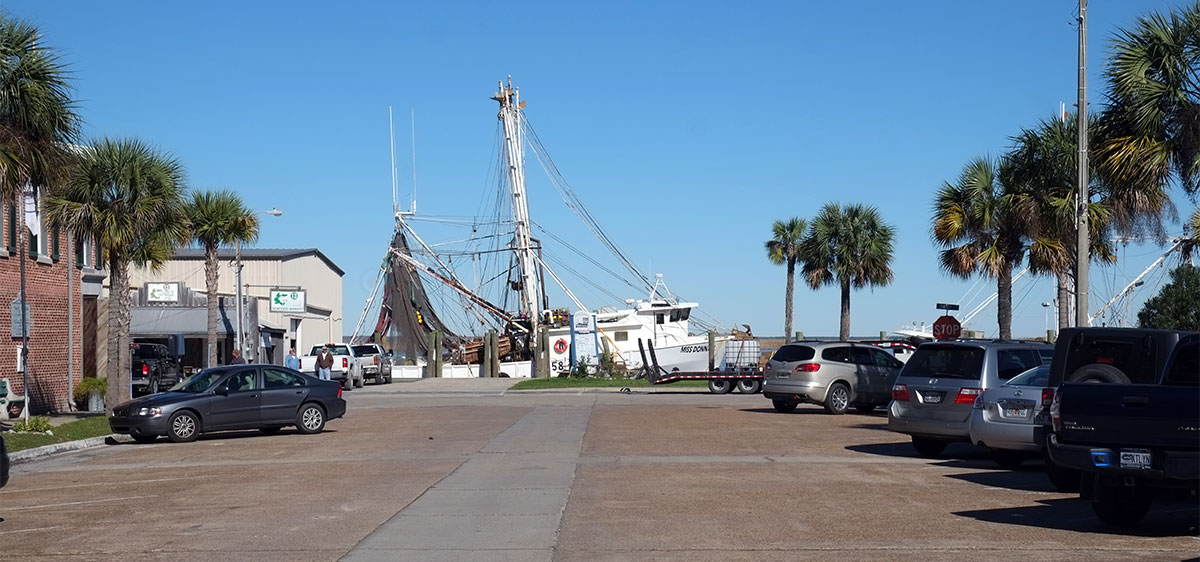
For me, one of the big attractions is seeing a town where the waterfront is still active, not just a show-piece for tourists.  Any place where there’s a boat at the end of the main street is a good thing.  DSCF0472

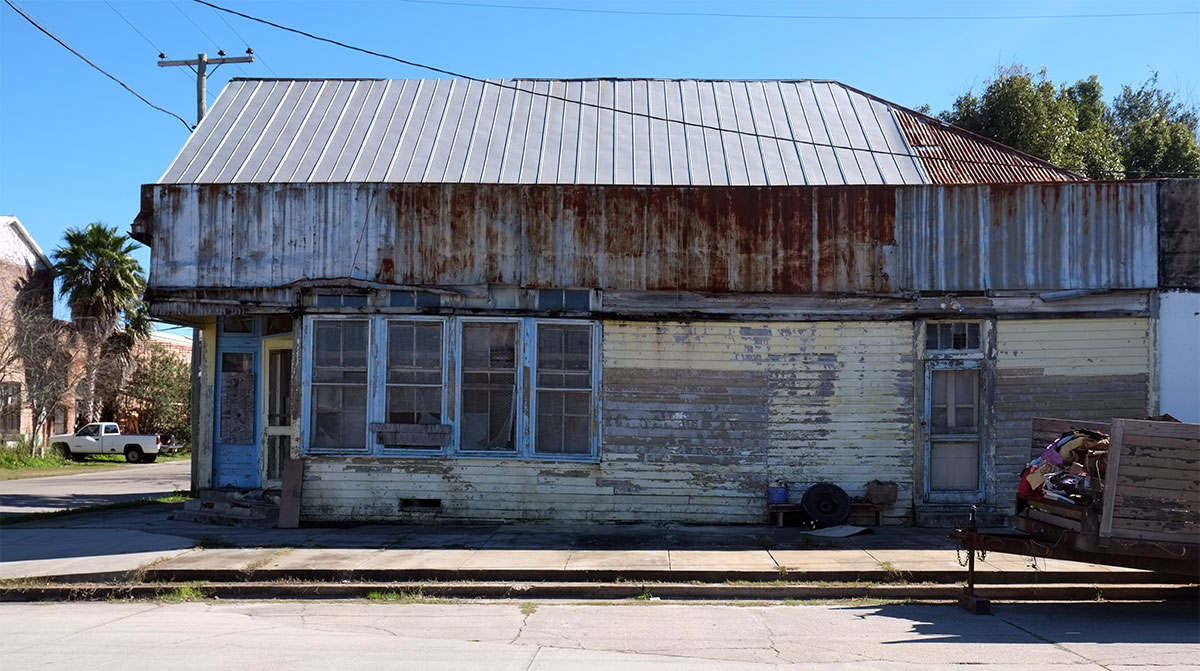
And there are lots of funky, functional buildings along the waterfront, not all turned into boutiques yet.  DSCF0465  DSCF0477

As well as a few interesting hybrid business ventures.  DSCF0463

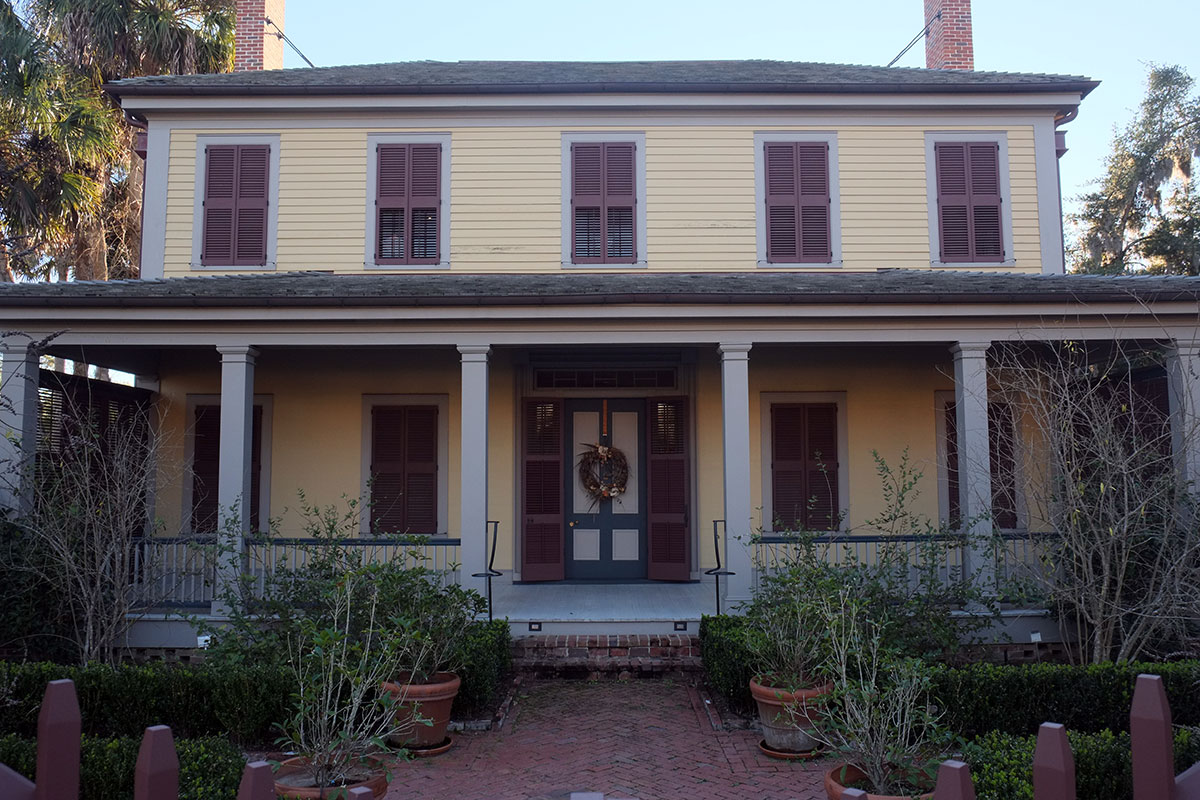
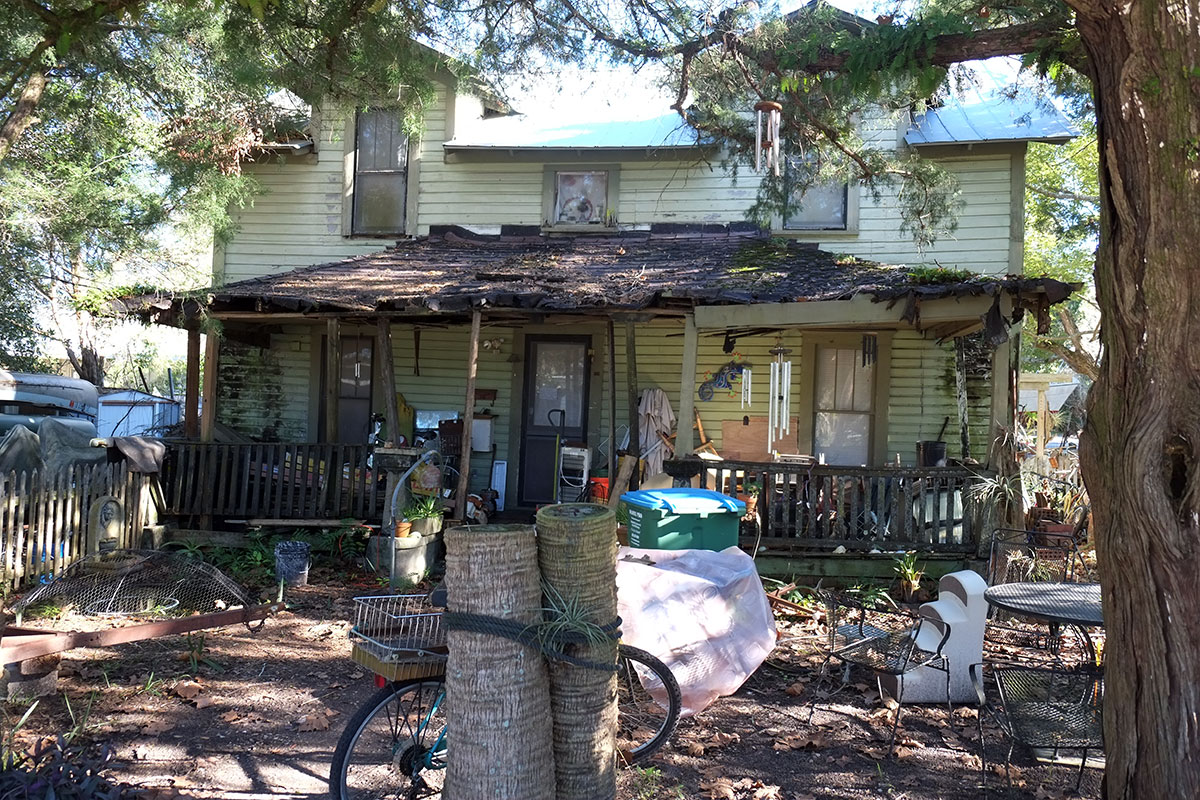
The residential districts are all 19th century wood frame, of varying styles, and again, the funky mixes with the hyper-restored.  DSCF0489  DSCF0603  DSCF0508  DSCF0493  DSCF0587  DSCF0505  DSCF0498

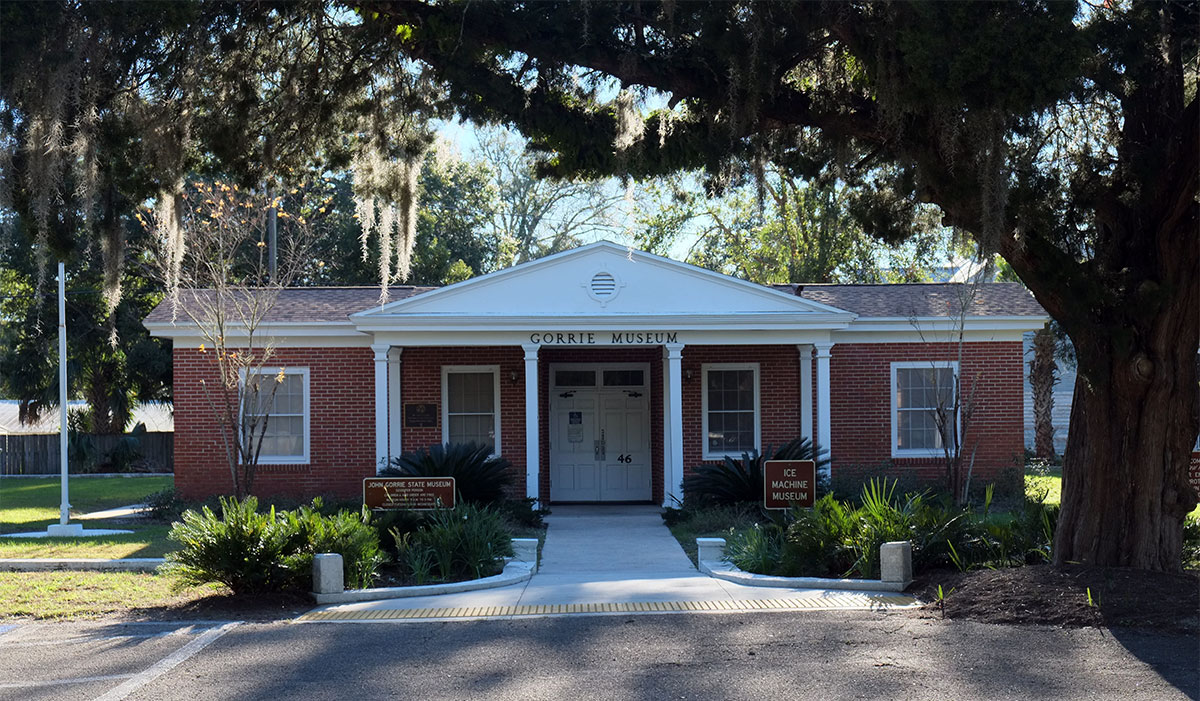
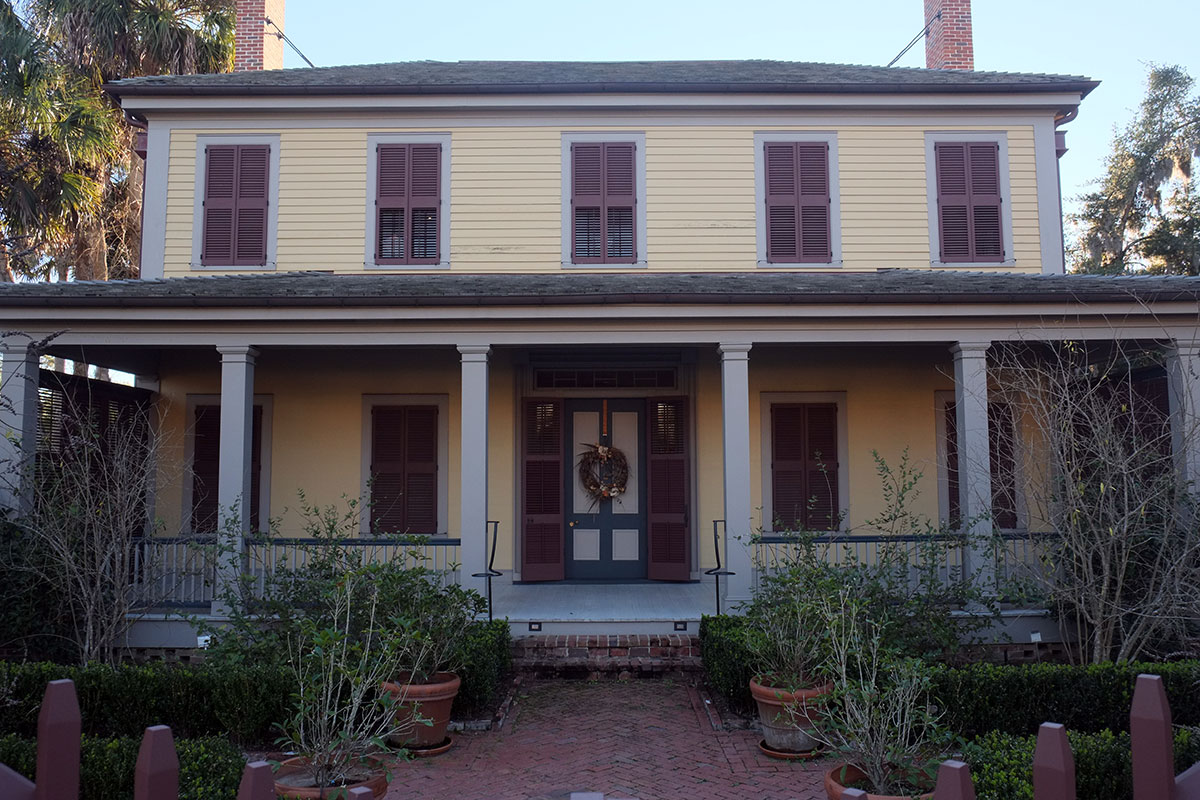
The crowning glory of Apalachicola (for us), is the aforementioned local museum, the Gorrie Museum.  Who is this Gorrie, you may ask?DSCF0529

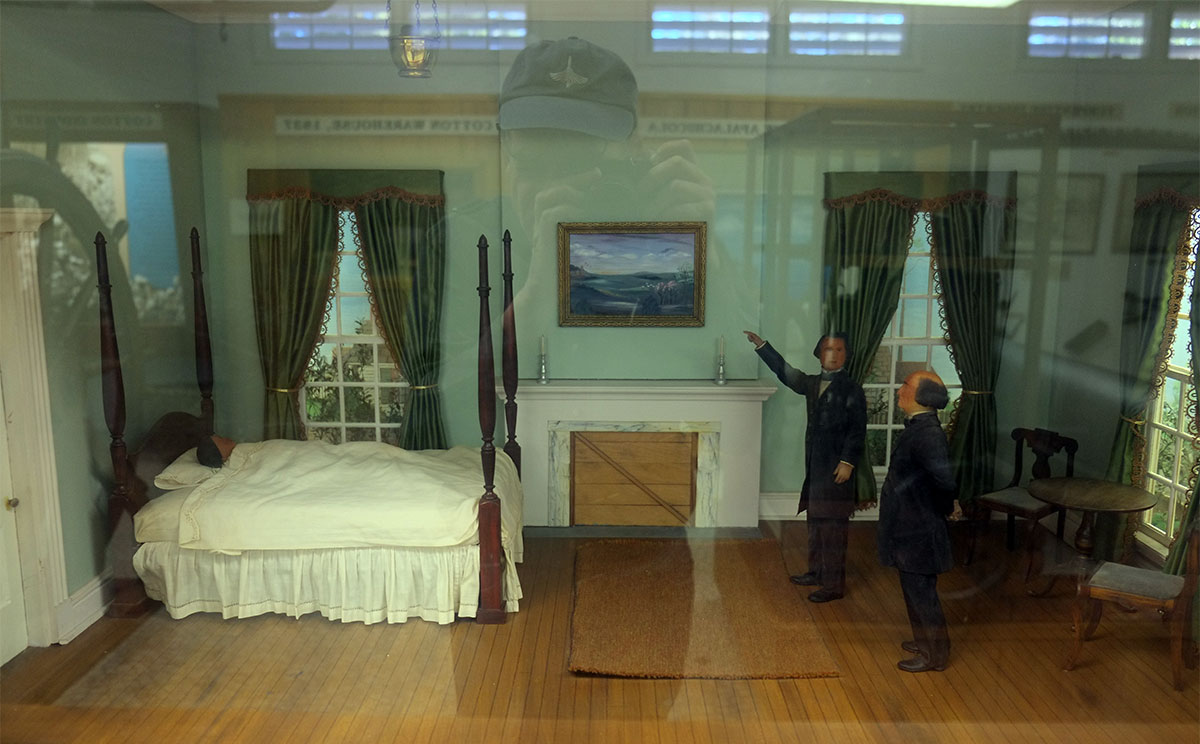
In the 19th century, Yellow Fever was a huge problem here, as it was in many other tropical locations.  John Gorrie, a local doctor, believed that if he could get his patients through the peak of the fever, they could be saved.  He devised a way to keep them cool, by hanging ice above the bed in a patient’s room and drawing air across it.DSCF0521

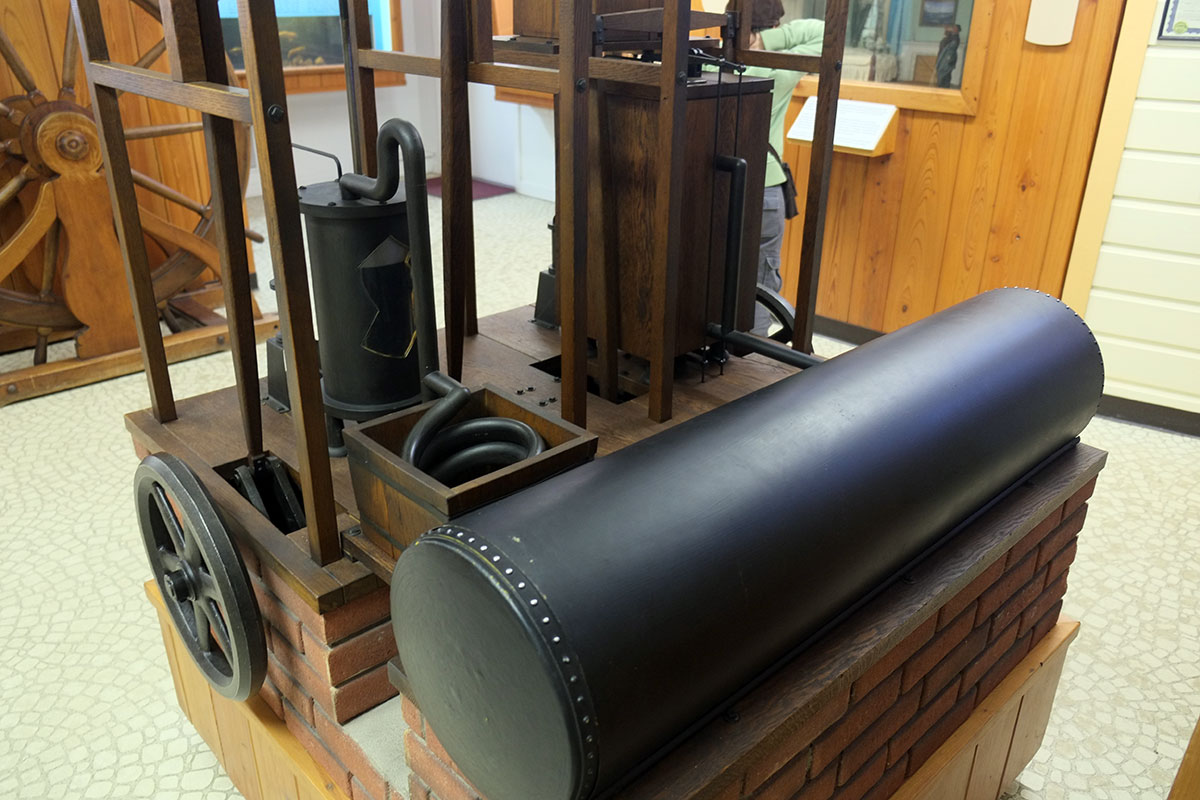
But where to get the ice in Florida?  Gorrie delved into research related to thermodynamics and the refrigeration cycle, and designed and built the first effective mechanical cooler.  He made ice to cool his patients, and on one notable occasion, cooled the champagne that was served by the French consul at his Bastille Day party.  DSCF0517

A model of his machine.  The original is in storage at the Smithsonian, and if this museum can upgrade its climate-control system (ironic, isn’t it?) to the Smithsonian’s standards, the original may return here.  DSCF0520

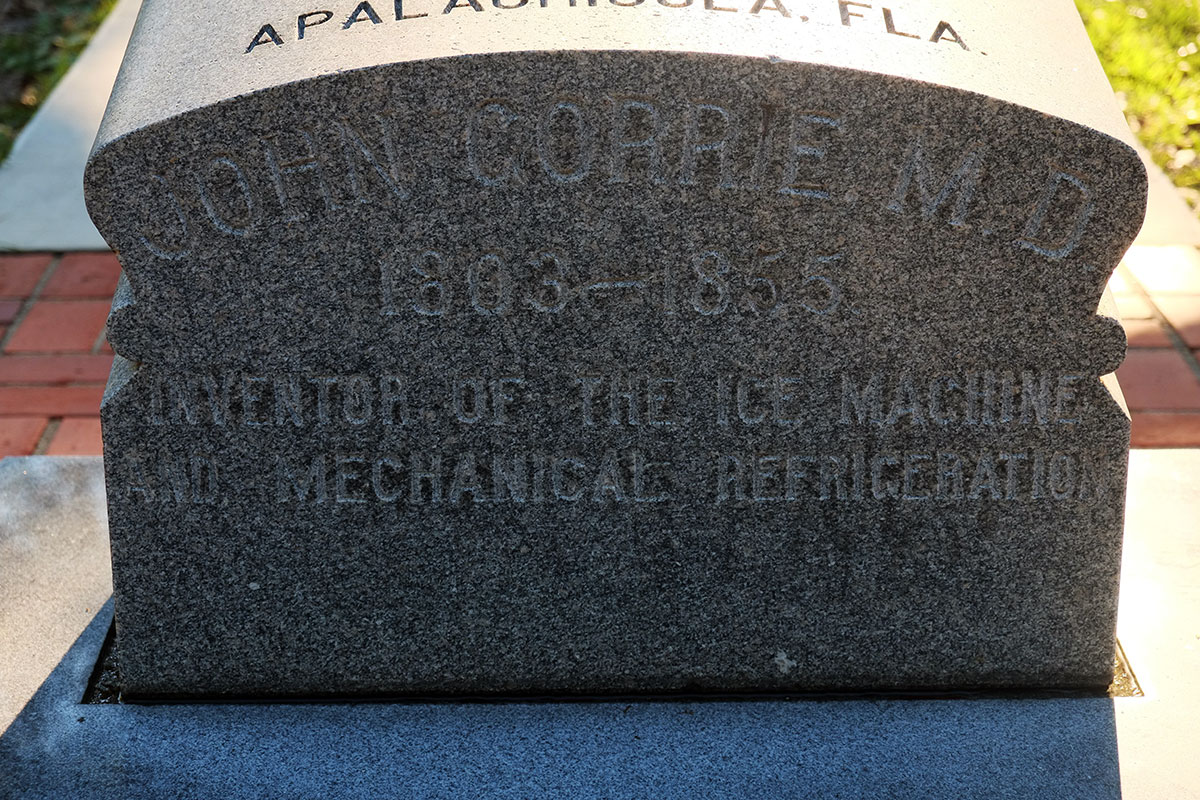
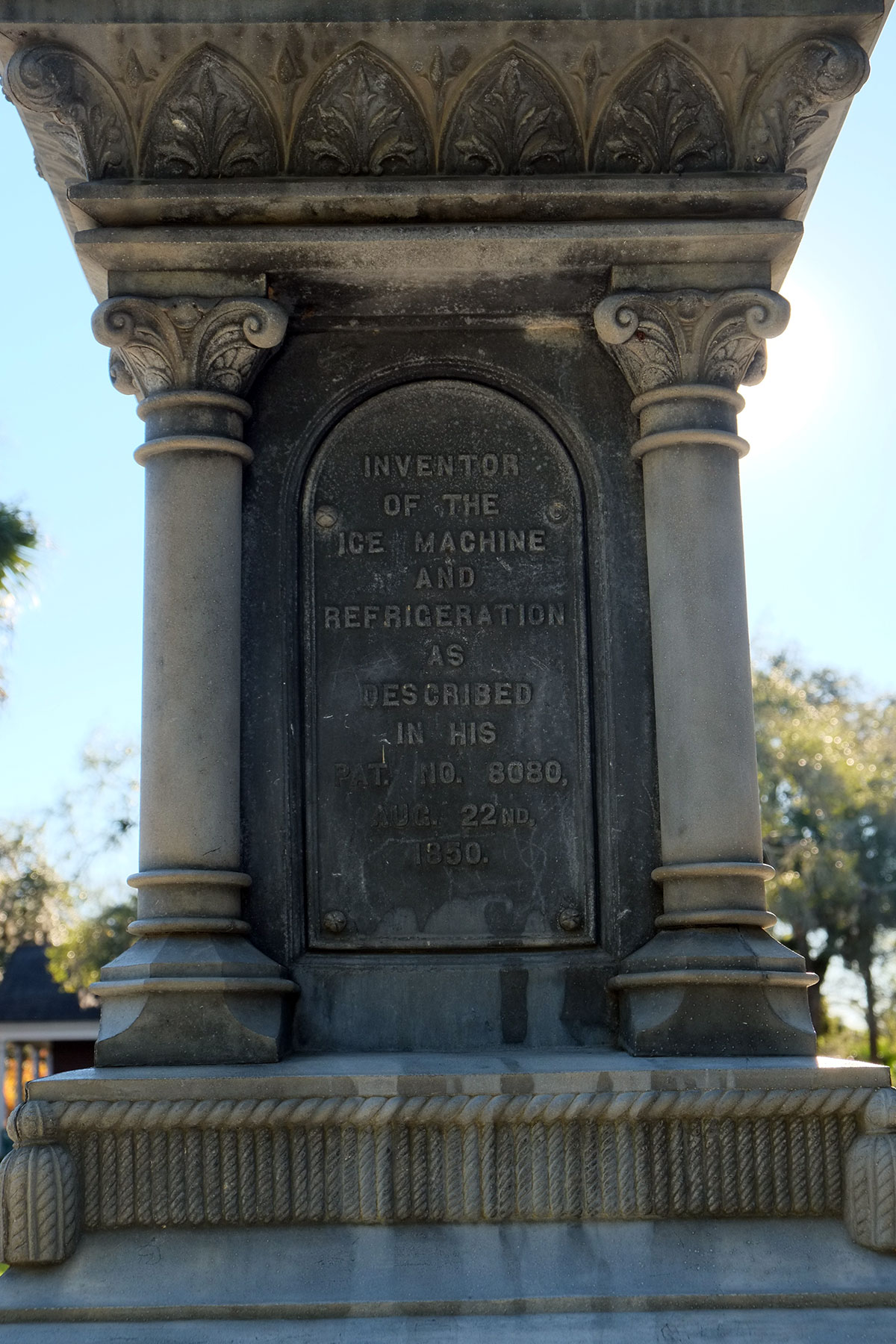
His headstone notes his accomplishment:DSCF0525

Another monument, erected by the Southern Ice Exchange in 1899.  I’ve never before seen a memorial with a patent number on it.  DSCF0538

The most amusing aspect of his story for me is that he wanted cool his patients, so he invented a machine to make ice to cool them.  Of course, he had just built an air conditioner, so the ice production was an unnecessary intermediate step.

But the most profound aspect of his invention is the effect it has had upon modern civilization.  There are obviously many positive aspects of refrigeration and air conditioning.  But without air conditioning, we wouldn’t have the development pattern of sprawl that we have today – people wouldn’t be willing to sit for hours in traffic.  We wouldn’t build low-mass wooden boxes for housing in hot climates.  There wouldn’t be massive office towers with giant floor plates, nor big box retailers.  Phoenix would still have about 20,000 residents.  In fact, the whole American south would be as sparsely populated as it was 100 years ago.  There would be no New South;  there would never have been the shift of economic and political power to the Sunbelt.  Power in this county would have remained in those areas which can actually be inhabited in the summer.  So while Dr. Gorrie may have alleviated his patients’ suffering and made our lives more pleasant, he must also be seen as fundamentally responsible for the rise of Ted Cruz and his ilk.  I’m not sure it was worth the trade-off.

The Allman Brothers Band – Macon, Georgia

DSCF0281Old people go to Graceland;  Elvis still looms large for those who grew up in the 50s.  But what about my musical generation, those who caught the tail end of the 60s but really came of age in the 70s – do we have an equivalent Mecca, a place of deep significance in the life of the musicians?  There’s the Grateful Dead house at 710 Ashbury.  The store in Seattle where Jimi Hendrix’s first guitar was purchased.  Abbey Road.  But I think if there’s one place that surpasses all others in the mythology of rock, it’s the intersection where Duane Allman died in a motorcycle crash in 1971.

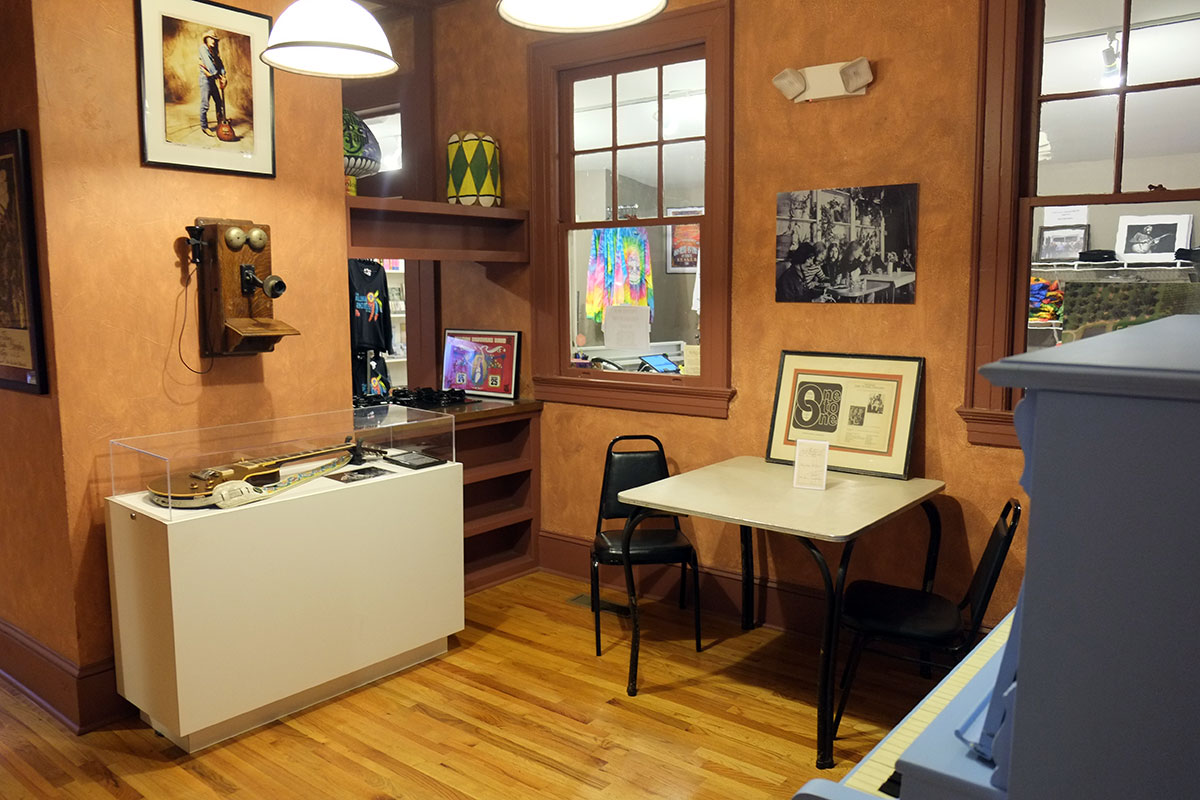
Traveling with a fourteen-year-old, I’ve been subjected to not-infrequent bouts of fan-girl behavior (mostly involving Star wars this year), so I didn’t feel too bad dragging her to Macon, Georgia, to visit the place where the Allmans lived and died.  We’ve been avoiding historical spots where something once happened, unless there’s really something physically there, and Macon provides this too:  there’s the Big House Museum, exhibiting vast amounts of Allman Brothers memorabilia, in the house where they lived together for a few years in the early 70s.

When I was young, the Allman Brothers were the benchmark band for us.  We could understand if people didn’t get the Grateful Dead – they were a complex band, a taste that could take years to acquire.  But if you didn’t like the Allman Brothers, there was just something wrong with you, and hanging out with you clearly was not going to be a good time.

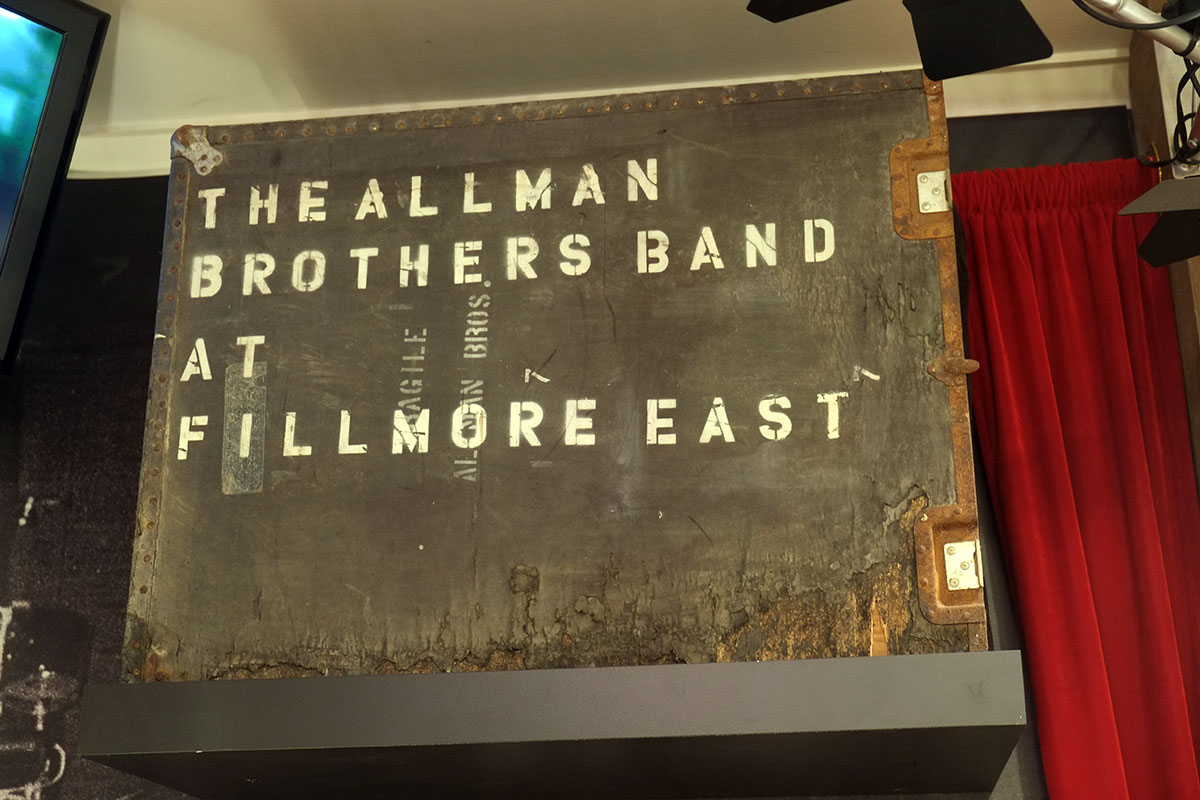
The Big House Museum was pretty overwhelming, even for a confirmed fan.  They say they have about 40% of their material on exhibit.  The box pictured above was for Berry Oakley’s bass, and is the one used in the iconic album cover for Fillmore East.  Then there’s this Les Paul, used by Duane on the first two albums, and when he played in the Layla sessions.DSCF0283

This is the first paycheck Duane got for playing in the band (signed by Greg).DSCF0285

And the dress worn by Brittany Oakley on the cover of Brothers and Sisters (displayed in the room where she lived as a child.)  DSCF0319

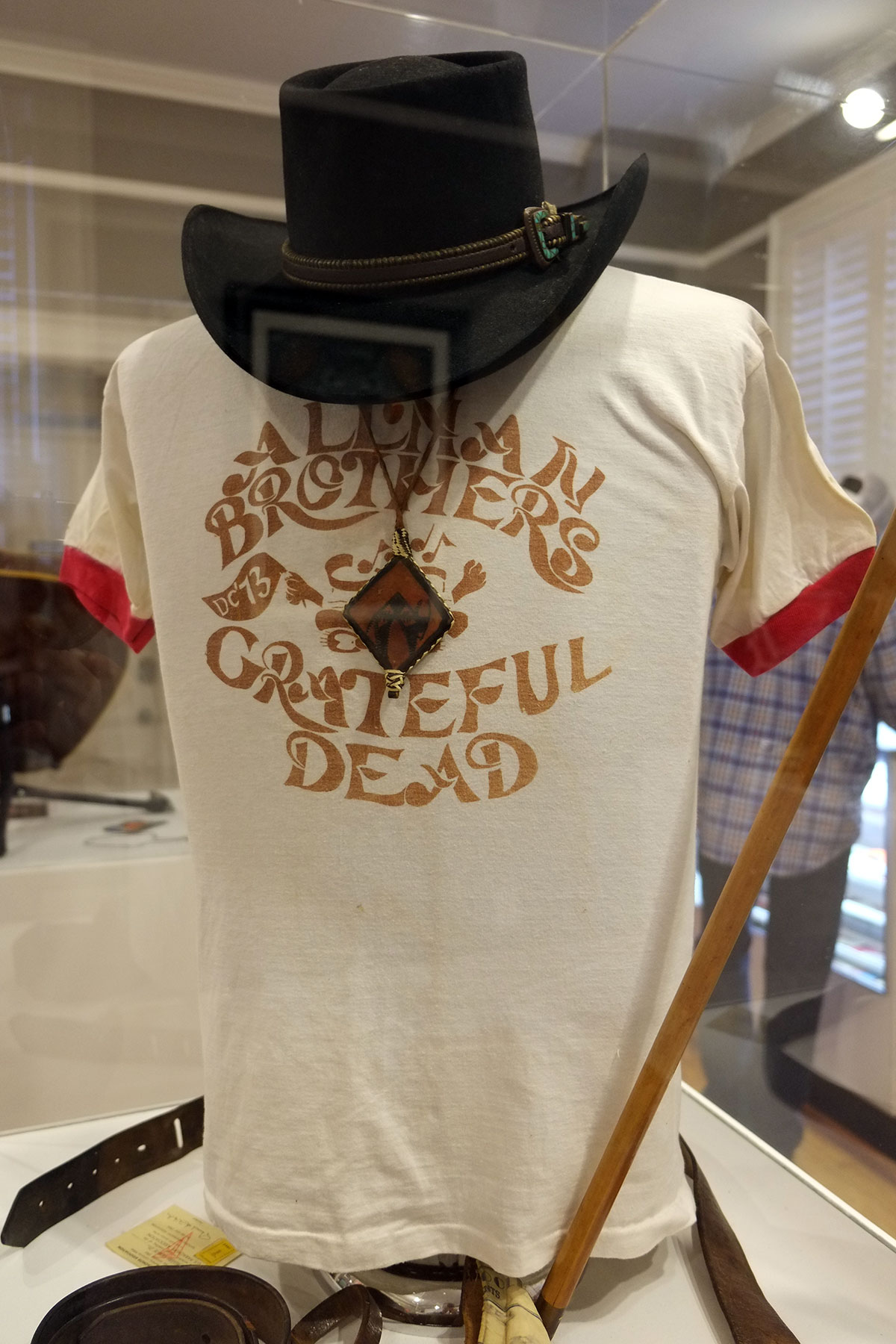
A tee shirt from a concert I wish I’d been at:DSCF0340

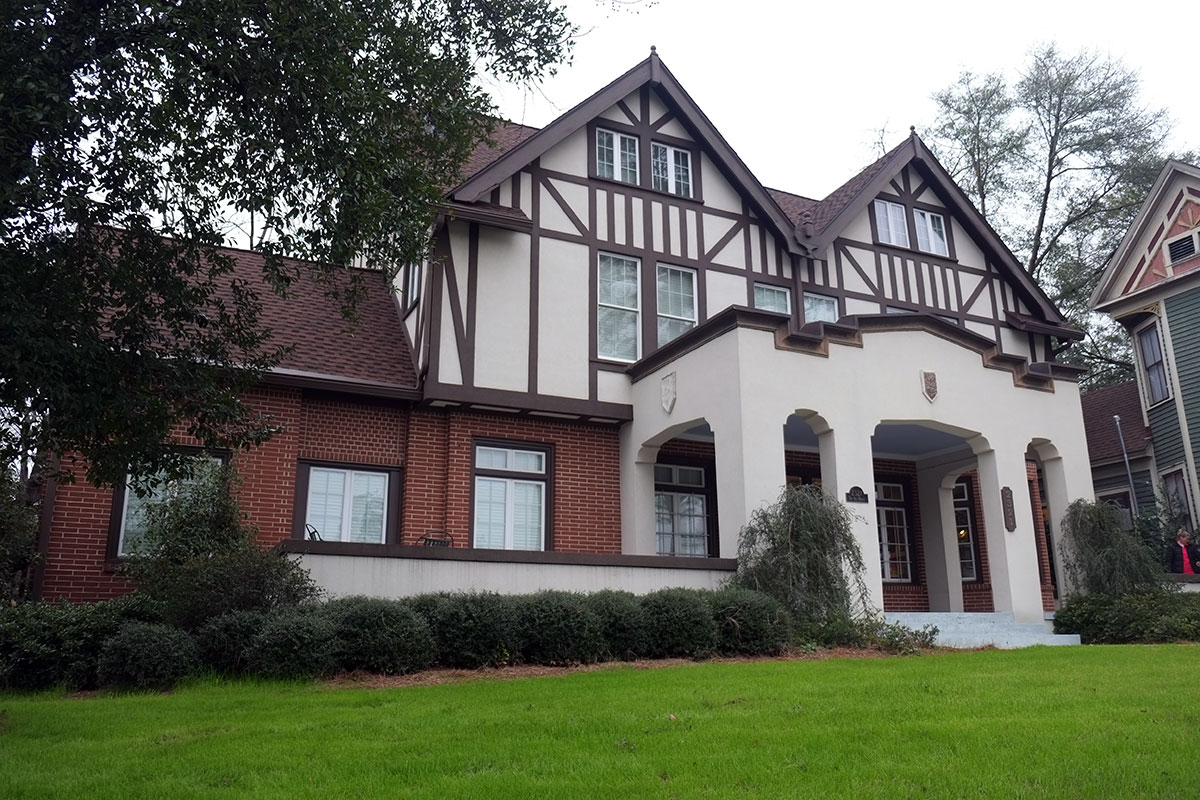
The house itself is much nicer than you would expect for a communal rock band in 1970;  maybe it’s been fixed up a lot.  It’s in a neighborhood of large, older houses, most of which seem to have been converted to apartments long ago.  DSCF0356

This is the front parlor room where Dickey Betts wrote Blue Sky for his fiance, sitting in the window bay.  I loved seeing this;  Blue Sky has always been one of my favorite songs, and we played it at our wedding.  DSCF0309

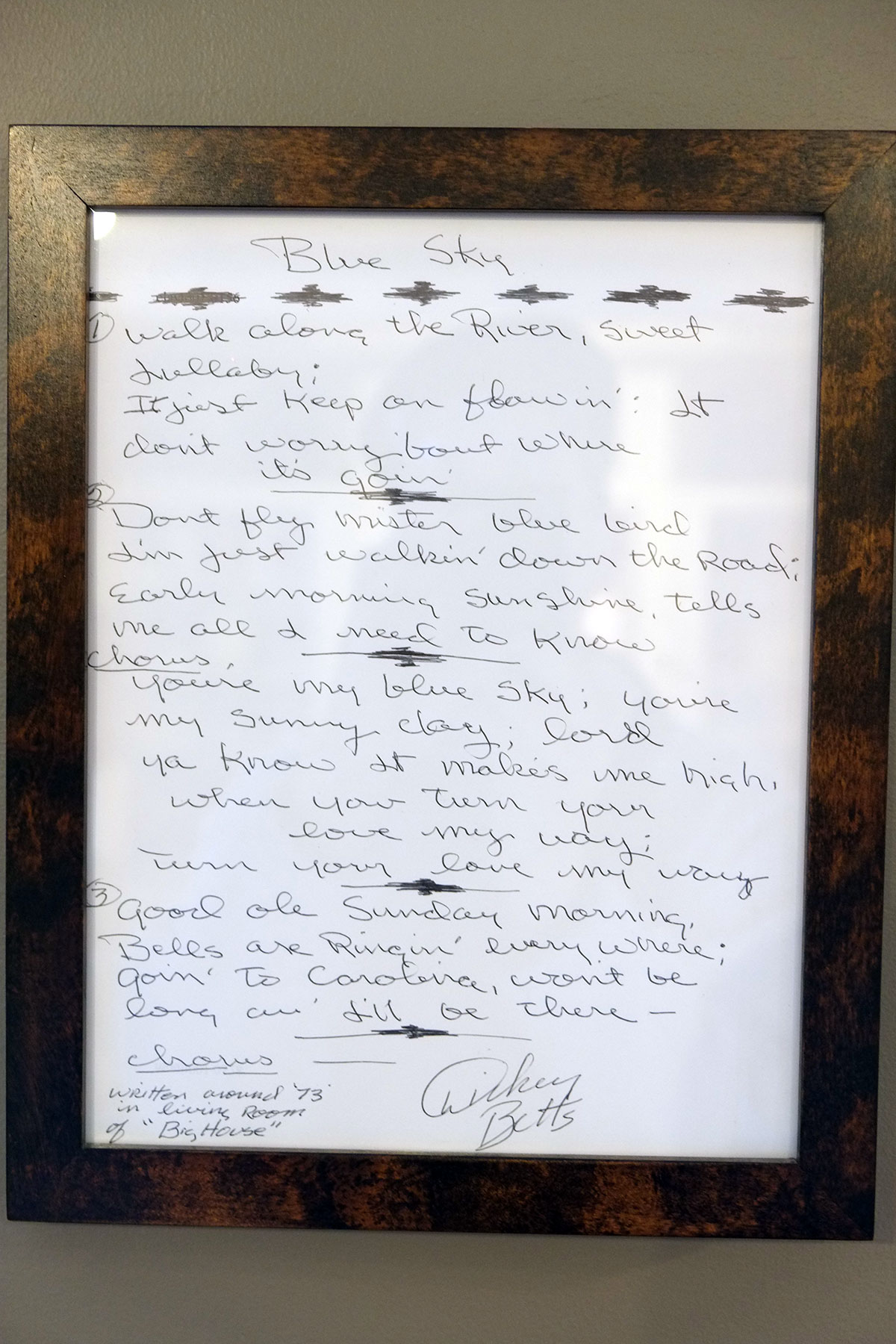
The handwritten lyrics to Blue Sky;  “…bells are ringing everywhere…” came from hearing the bells in the church across the street.DSCF0303

A Dickey Betts guitarDSCF0348

displayed in the kitchen where he wrote Ramblin’ Man (and we have just done a bunch of driving on Highway 41).DSCF0345

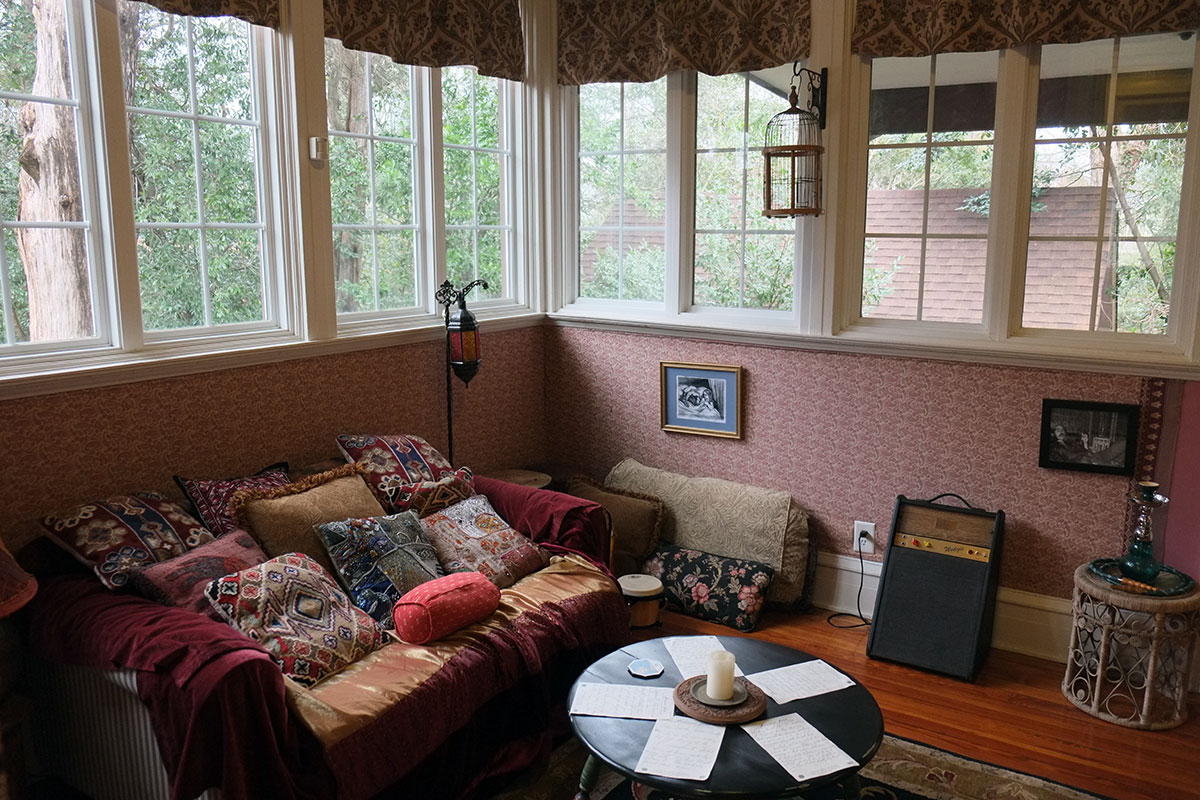
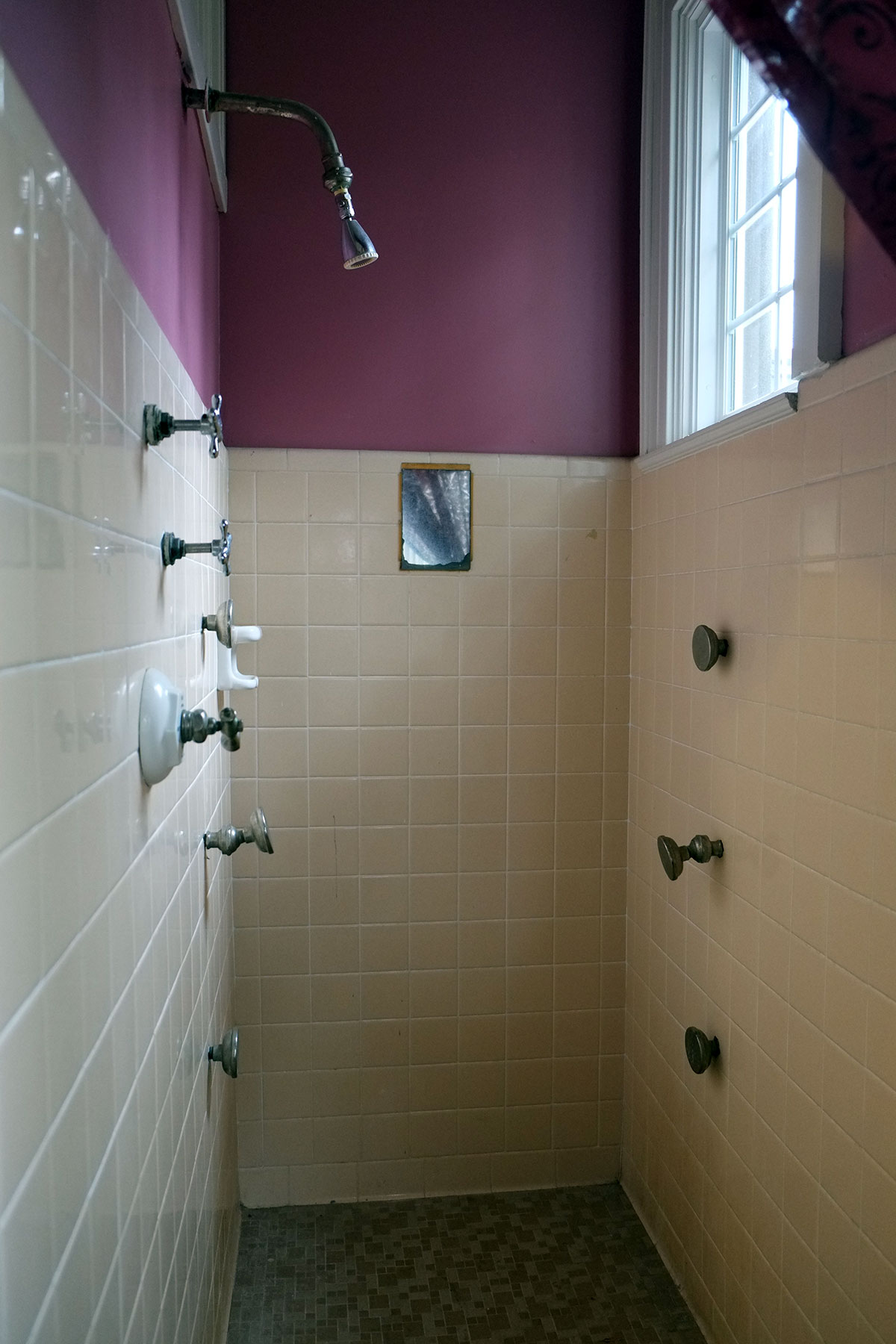
The “casbah” room upstairs, were they hung out and listened to music,DSCF0333I like imagining that they argued over who had to get up and change the album every 20 minutes.  DSCF0330and the apparently legendary shower, with the seven shower heads (a rarity in those simpler times).
DSCF0328

We visited the site of Duane’s crash on October 29, 1971, the intersection of Hillcrest and Bartlett.  Contrary to myth, it wasn’t a peach truck, but a lumber truck heading for the nearby lumber yard.  DSCF0360Duane was coming down the hill from the left, and hit the truck making a left turn from the right, into Bartlett where I am standing taking the picture.  He was 24 years old.

Berry Oakley died after a motorcycle crash too, one year later and four blocks from this intersection.  Duane and Berry are buried in Rose Hill Cemetery, a place along the river and railroad tracks near downtown where the band used to hang out a lot.  It was started in 1840, and hundreds of civil war casualties are buried there.  We walked past the grave of Elizabeth Reed (Napier), but we didn’t track down the tombstone for Little Martha.  Duane and Berry lie in a beautiful dell that slopes down to the river.DSCF0234

Two white stones side by side, with angels at their feet, representing their daughters.DSCF0239

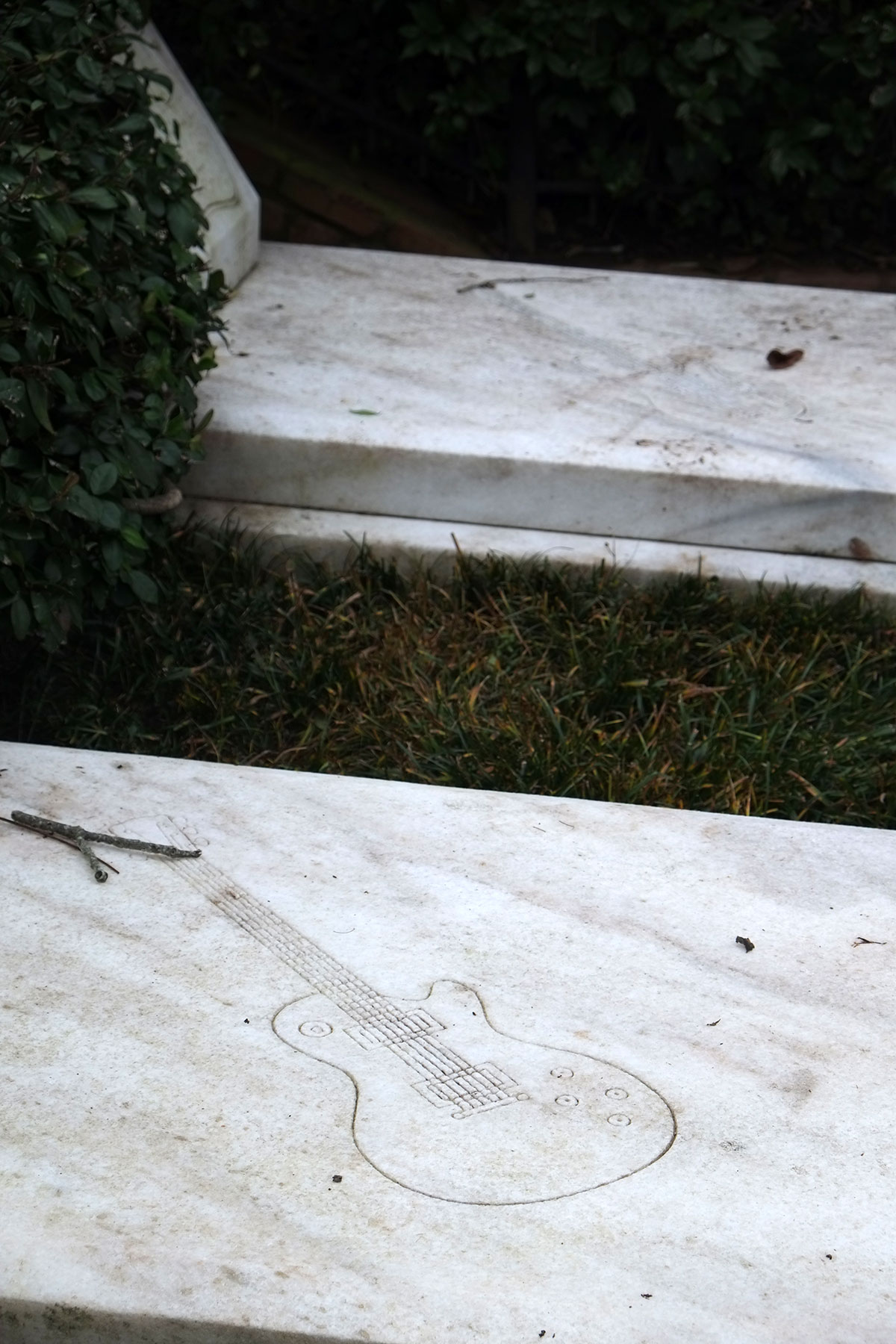
Their graves were recently enclosed by a fence; apparently the amount of partying taking place with drunken fans got to be too much.  DSCF0267You can see the Les Paul carved into Duane’s stone.
DSCF0243

The music around the perimeter is from Little Martha, and note the discreet mushroom on the side.  DSCF0242

One late night during my sophomore year in college, I walked back to my dorm after hanging out with friends.  As I passed the suite of some classmates I didn’t know too well, I heard Blue Sky being played very loudly.  I wasn’t ready to go to bed, so I knocked on their door.  The door opened on a darkened room, with a half dozen blissed-out, practically catatonic guys laying back in their chairs, while Eat a Peach spun on the turntable by the window under a single spotlight.  The song ended, Little Martha played, and they began to revive.  When the album was over, they began talking, and I discerned that they had an interesting take on the history and meaning of the universe.  There was a big bang, the universe expanded, gasses coalesced and formed planets, life appeared, species evolved, humans arrived, civilization began, and the arts and music were invented.  And the point of all this was that eventually Duane Allman would be born, so he would be there to play on Blue Sky.  (A corollary was that it was nice he was around for the Layla album too.)  This pretty much justified human existence for them,  and I realized that if you were looking for an eternal verity (like something on which to base a major religion), you’d have a hard time finding something more inarguable and certain than the perfection of the Allman Brothers.

Hushpuppies

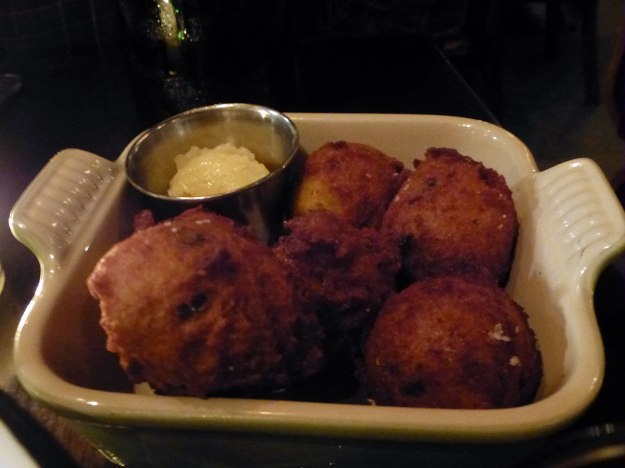
Despite never having tried or even heard of hushpuppies before this trip, I think I have come to know them quite well. They’re usually served as a side to something else (it can be anything in the South, from fried chicken to fish tacos), but I think they deserve their own post.

Wayside Takeout and Catering and Ole Virginia Fried Chicken
Charlottesville, VA
The first hushpuppies I ever tasted, and probably the worst, although I didn’t know that at the time. I thought they were good, but had to ask if they were traditionally eaten with ketchup, as they were a little bland. Also on the small side, only about an inch in diameter.

Clyde Cooper’s BBQ
Raleigh, NC
Unlike with the previous puppies, I could actually taste that they were made of cornmeal. They were also bigger, but not larger spheres. They were stangely extruded, in (I hate to say it) a form any three-year-old would immediately recognize. This made the surface to volume ratio a bit greater, which I think was good, despite the obvious flaws in the design.

Leon’s Fine Poultry and Oysters
Charleston, SC
Returned to round, but these were larger, about two inches in diameter instead of one. Definitely corny, though less so than Clyde Cooper’s. They also had peppers baked inside them, adding a dash of color and spice to an otherwise monochrome and occasionally bland food.
P1060677

Big G’s Barbecue and Catering
Allendale, GA
These had an interesting texture. Instead of having a thin crispy shell coating a mostly mealy inside, it was a bit more permeated. The two-inch spheres seemed more like small cornmeal balls wearing an almost crystalline coat of fried fat. It was full of little air pockets, making them much flakier than any other hushpuppies I’ve tried.P1060686

I think I’ve covered all the different variations upon hushpuppies, but if I find something new, it will definitely be added.

Charleston and the triumph of typology

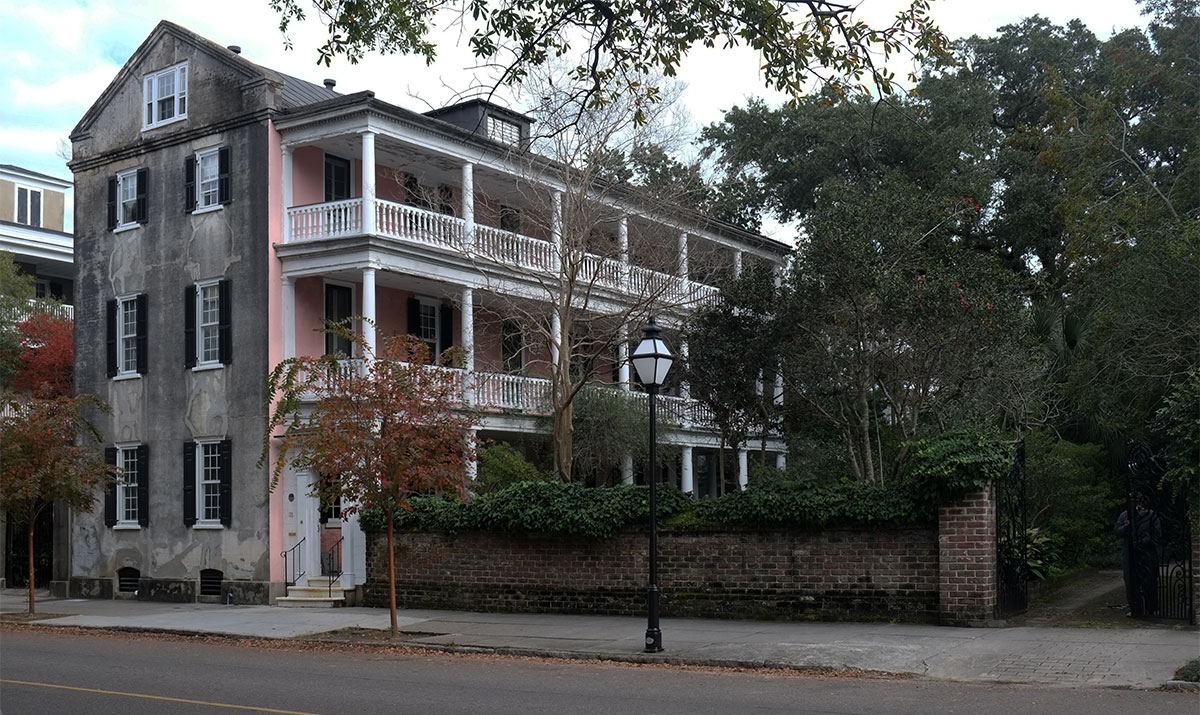
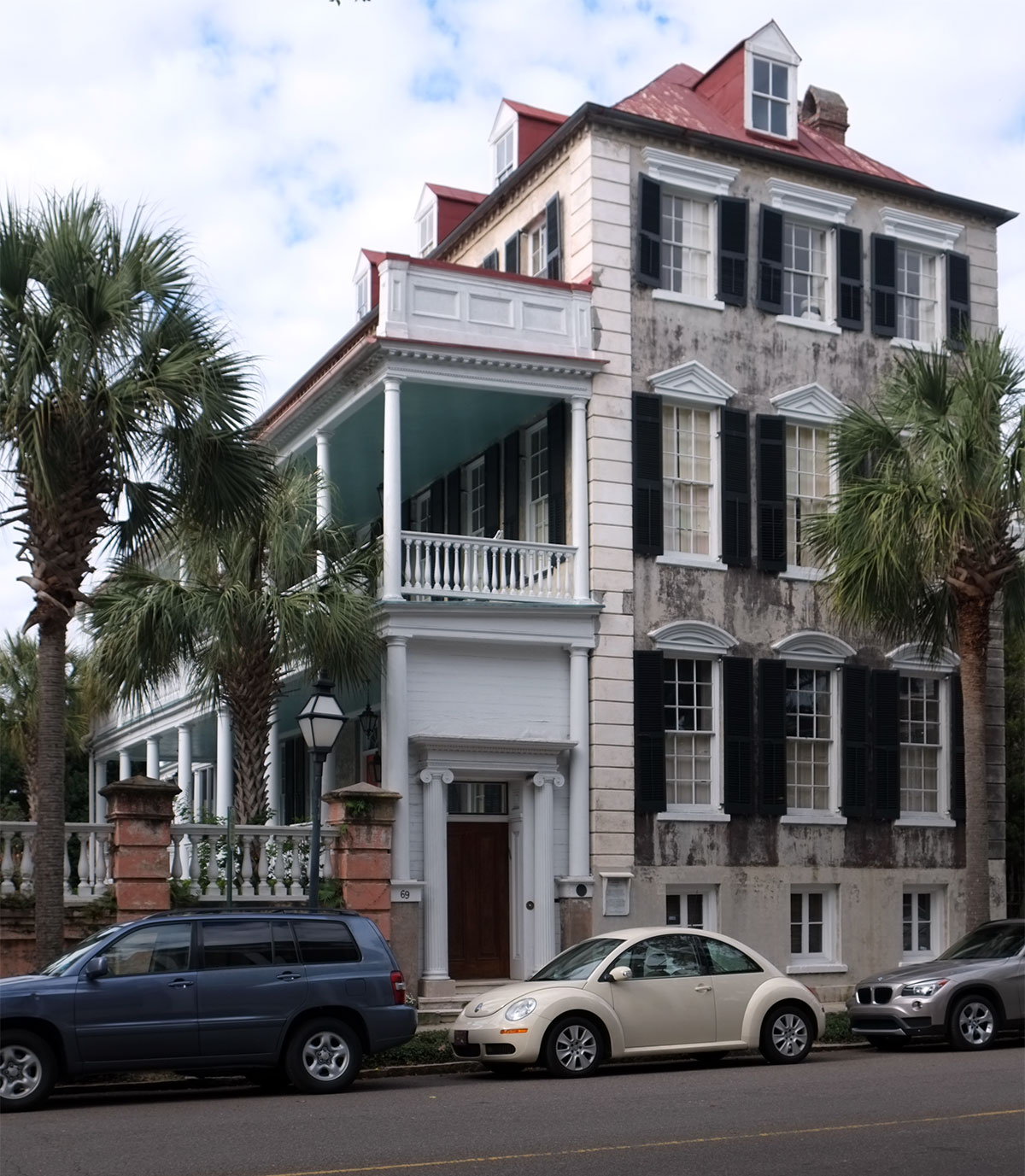
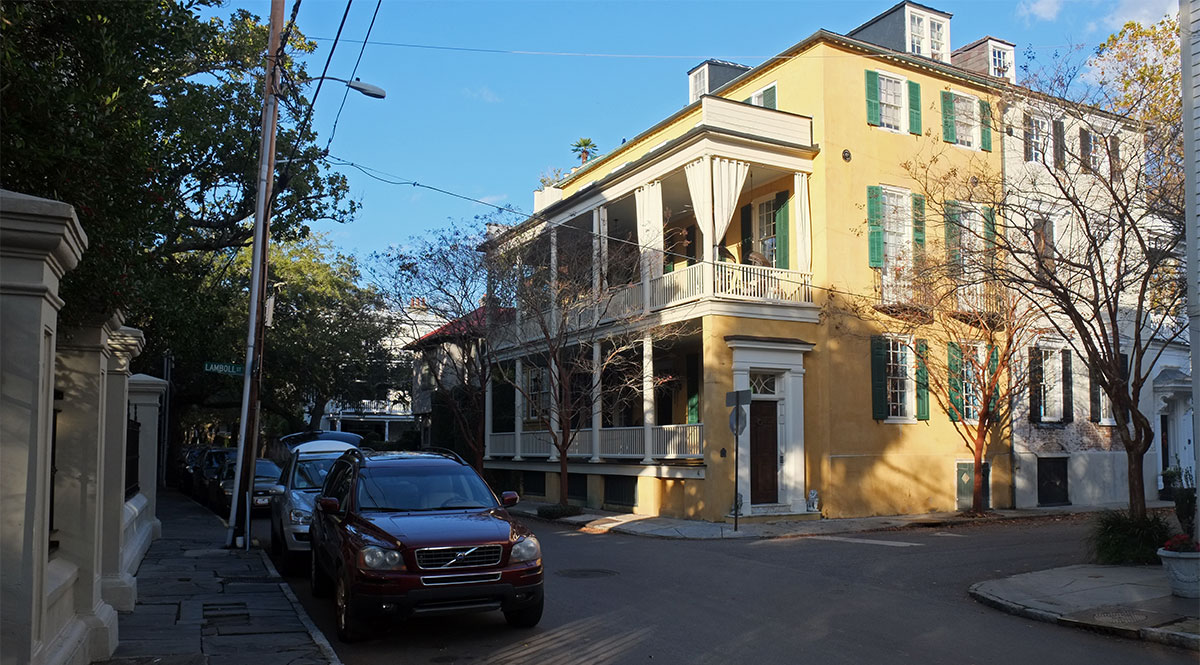
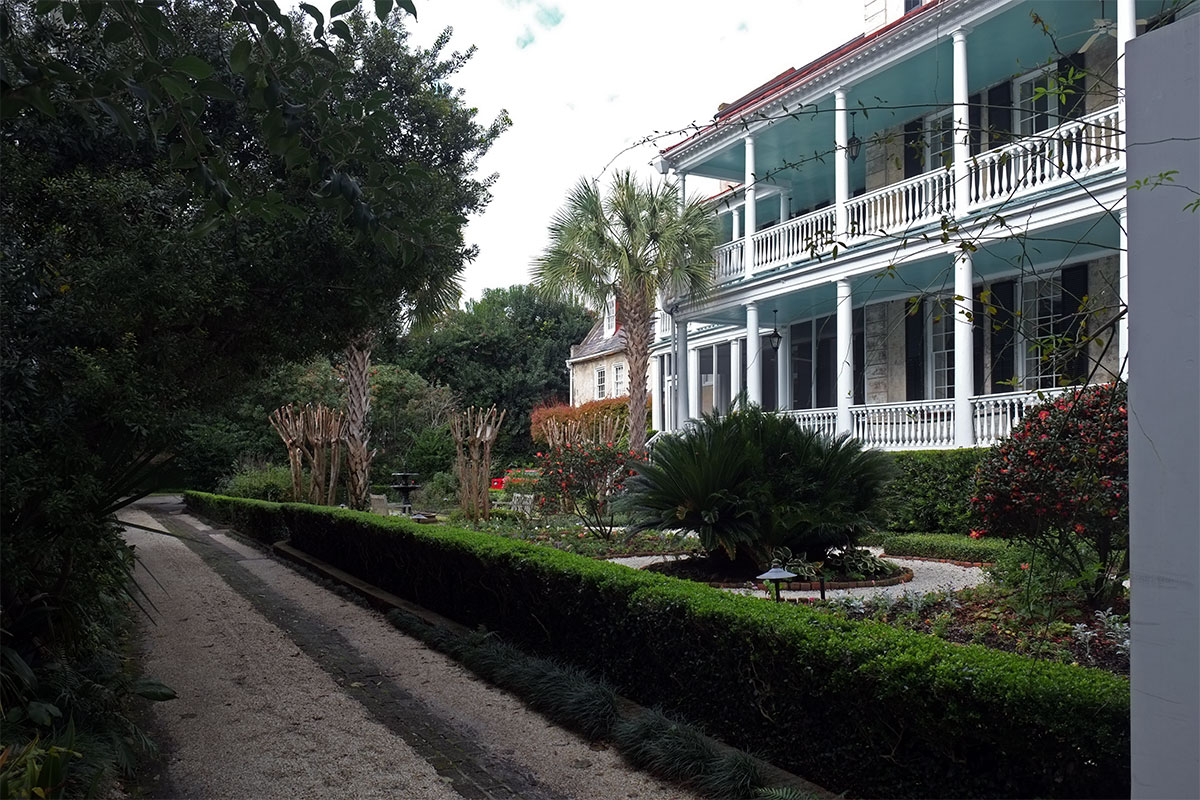
A critical index for appreciating a city on our trip is the cuisine / architecture ratio;  when it gets too low, Greta is miserable.  Charleston is a place where we might have run into serious trouble, as the first day we were there I dragged her all over the historic district looking at housing.  (Housing is even worse in her view than Architecture, as Architecture might involve museums which will have exhibits or art that might interest her.)  Luckily the food quality in Charleston was very high, so it kept the whining to a minimum while I made her look at housing.  And the intellectual payoff is that Greta now has a deeper understanding of typology than most architecture students do. DSCF7810

As we moved deeper into the South, certain cultural characteristics become ever more evident.  The discussion of any place or building revolved ever more around the history of what happened there, or even the intricacies of the family histories of the people who lived there.  We toured the Edmonston-Alston House, and the docent spent most of her time elaborating the interconnections of the various families who had owned it.  We didn’t care – we just wanted to see the house.
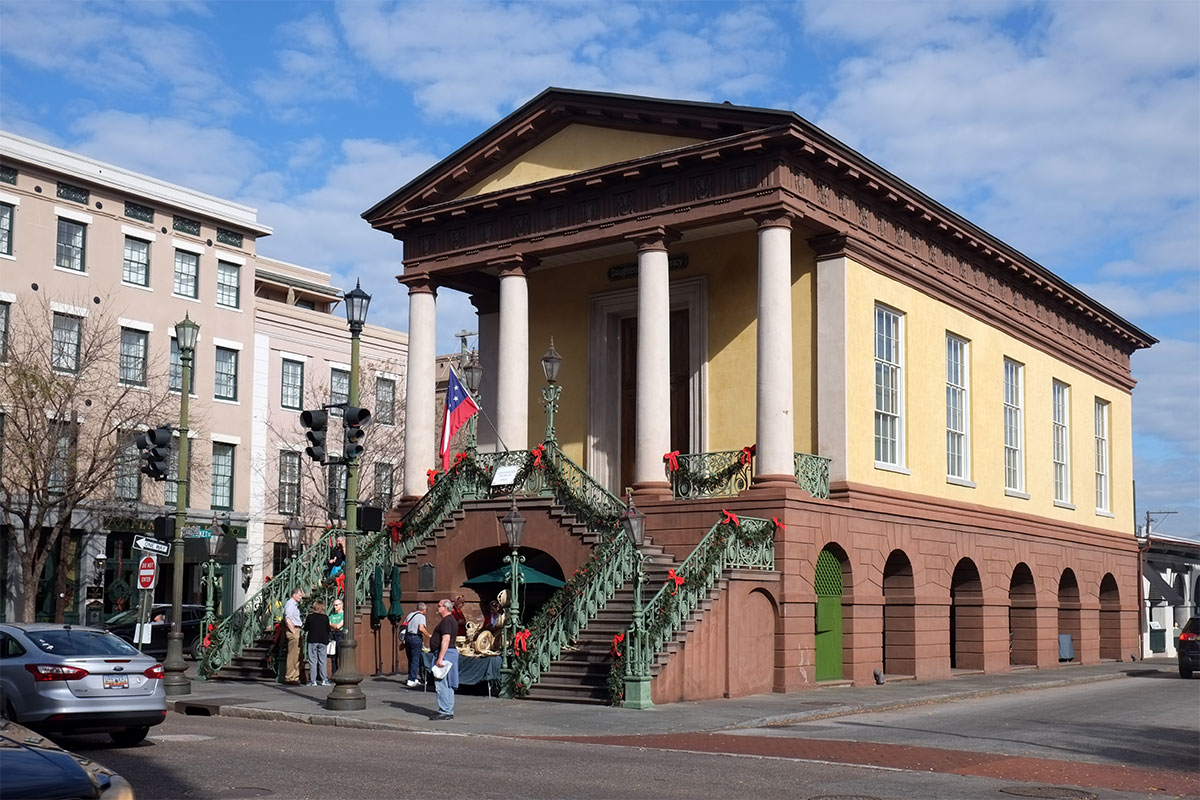
Charleston does have a long and interesting history – most famously as the place the Civil War started, but perhaps more important, it was the largest port for the slave trade in the country, with probably 40% of the enslaved people moving though it.  That fact is not emphasized or very visible in the preserved fabric of the city, which as in most places, showcases the buildings of the rich.  There are magnificent churches and public buildings.  The pavilion at the end of the public market now serves a museum of the Confederacy.
DSCF7870

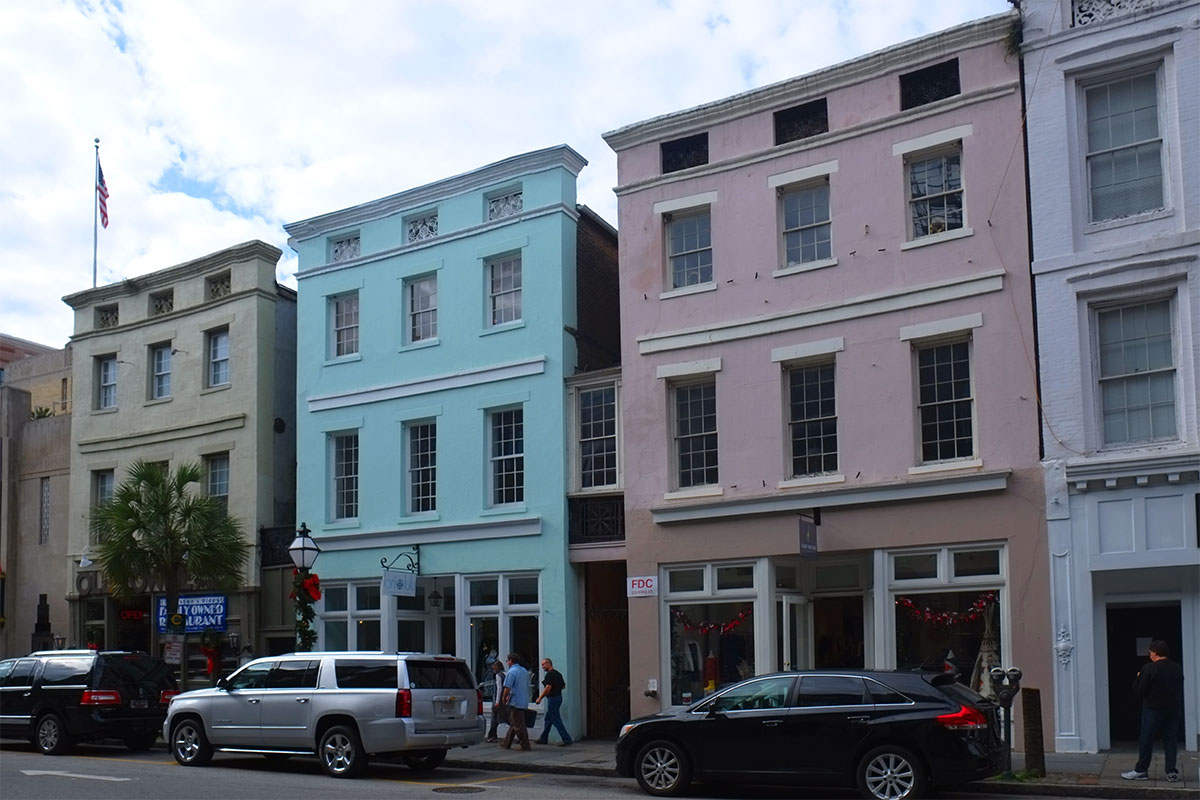
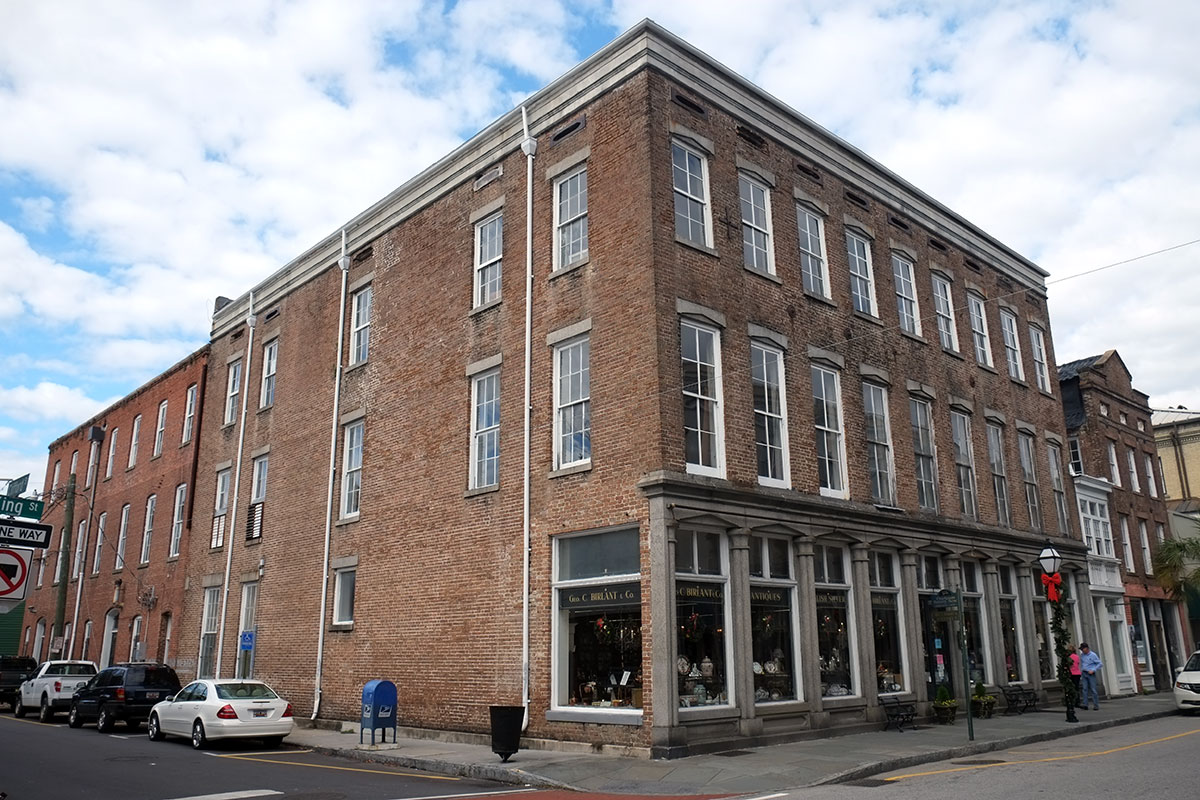
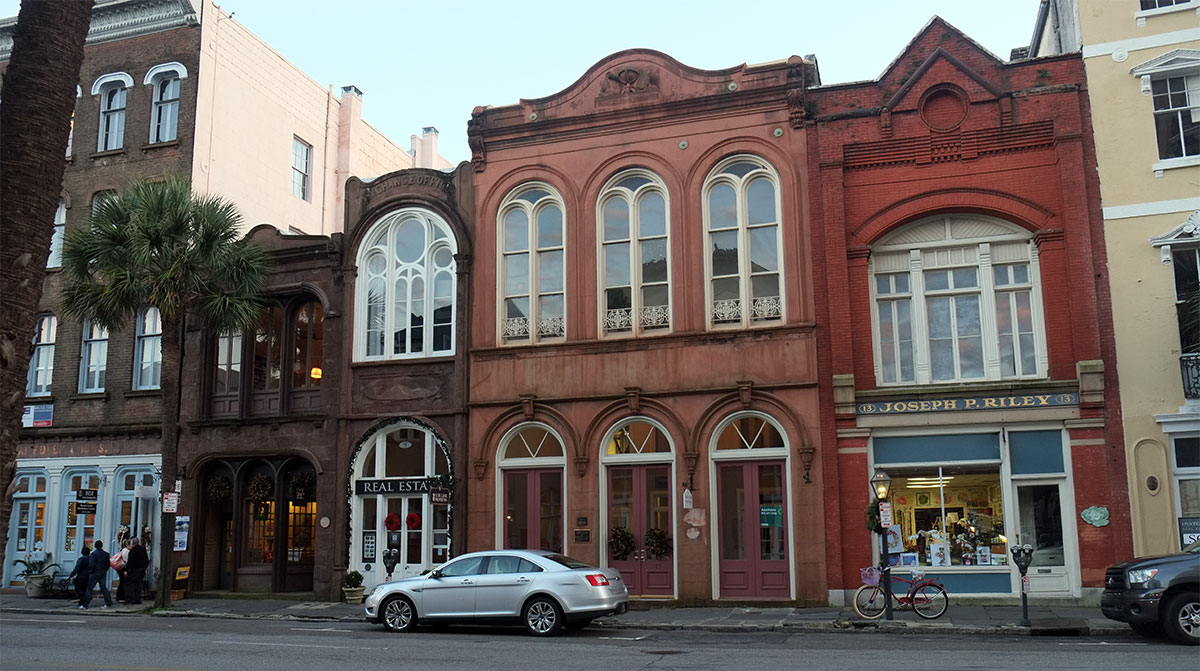
The main shopping street is King Street, which has fine commercial buildings from different eras and styles filled with boutiques for the well-off retirees who seem to form a lot of the populace.  (Charleston is also the best-dressed city we have visited, with the most men in suits and ties.) DSCF7756  DSCF7761

The street that organizes the map of Charleston is Broad:  the major east-west street.  Below it is the historic district, an almost perfectly-preserved area that is exclusively residential – no restaurants (and no public bathrooms).  DSCF8106

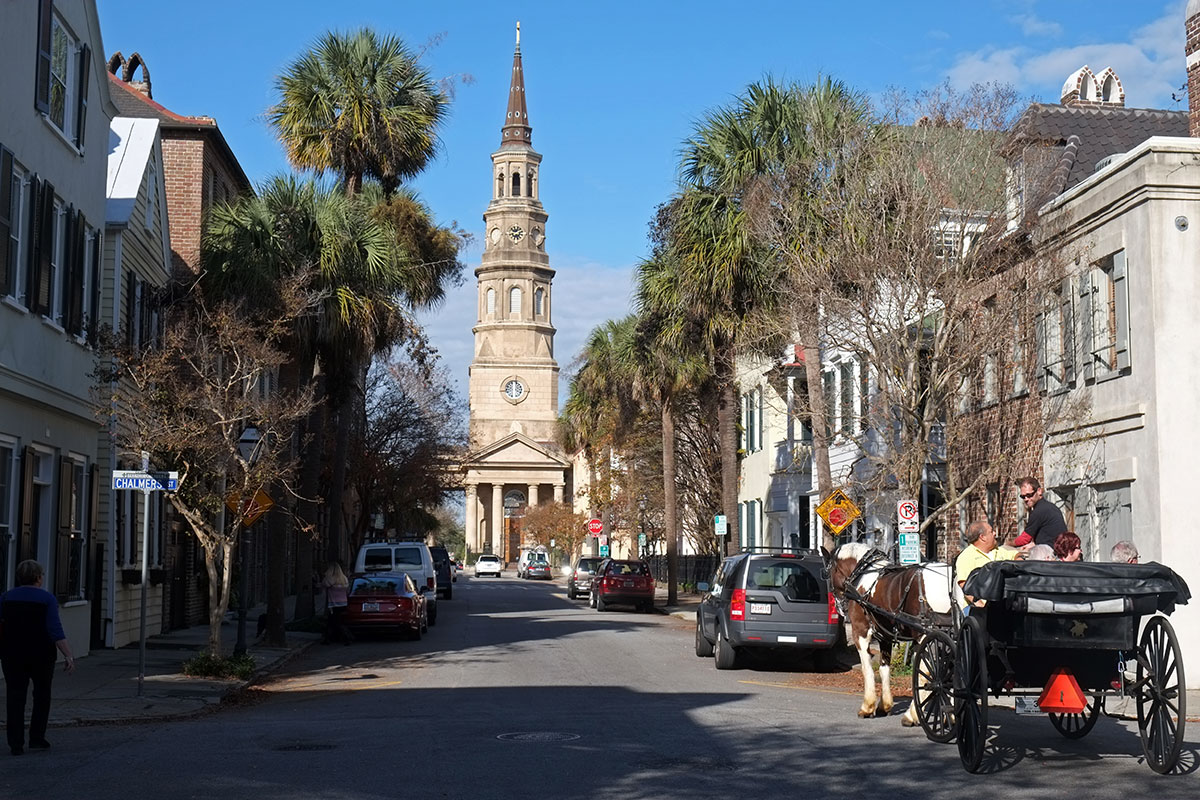
The churches of Charleston are widely varied in style too, and quite prominent.  There are not many cities I can think of where the dominant elements on the skyline are the spires – Charleston has a few tall hotels and office buildings, but they are mostly kept away from the historic core.  St. Philip’s Church is sited wonderfully – poking out into Church St., so it punctuates the vista from two directions.  DSCF7901

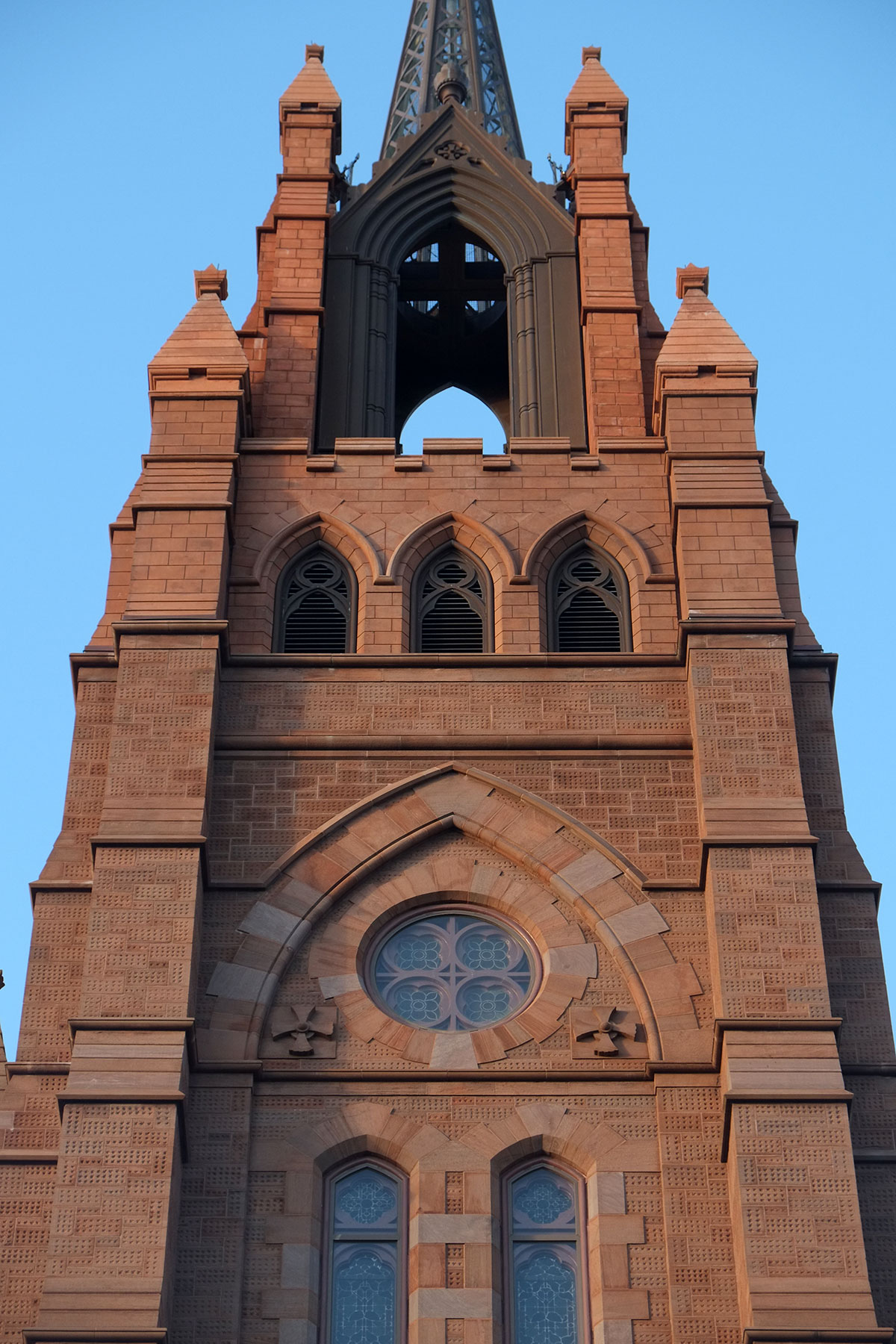
The Catholic cathedral is brownstone from Connecticut, something not seen often in the South. Fantastic masonry forms, I believe the spire was reconstructed later.  DSCF8071  DSCF8074

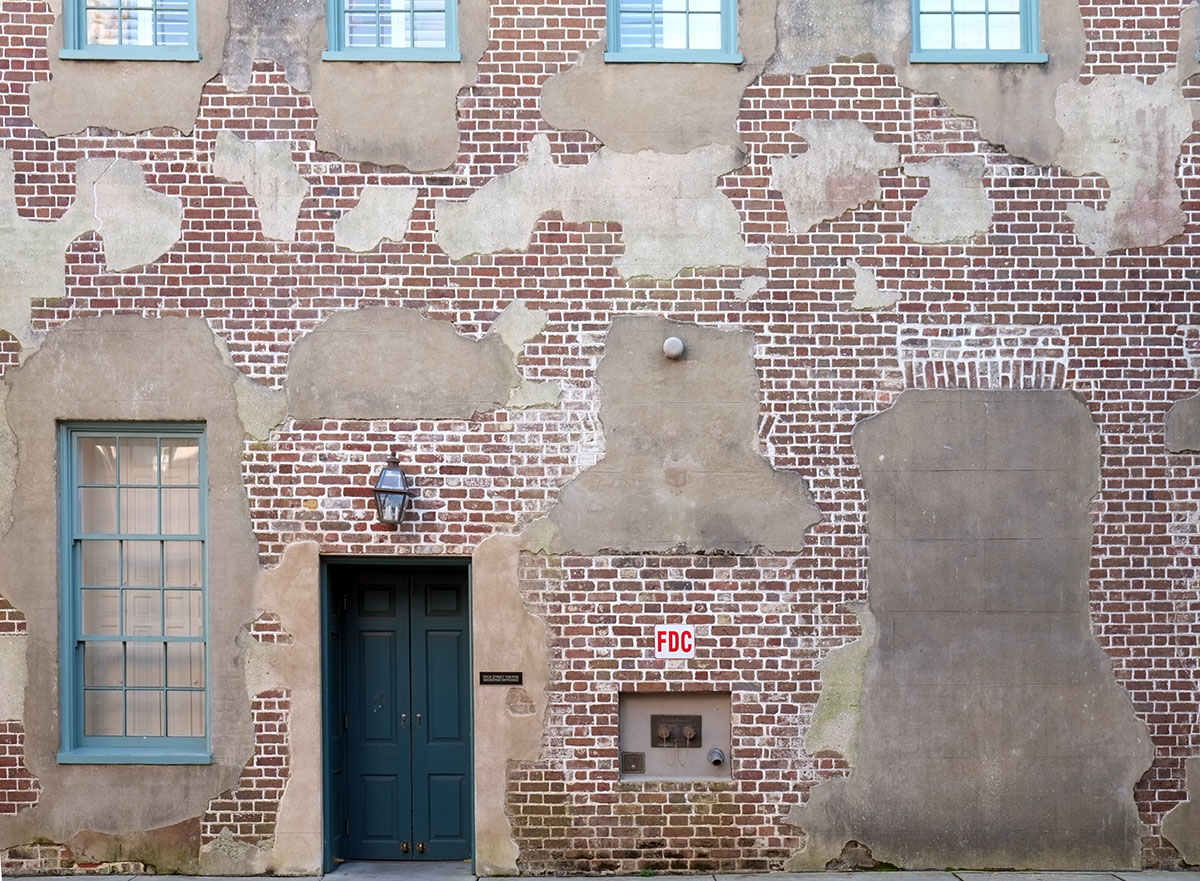
Most buildings are brick with stucco, which sometimes wears off.DSCF7889a

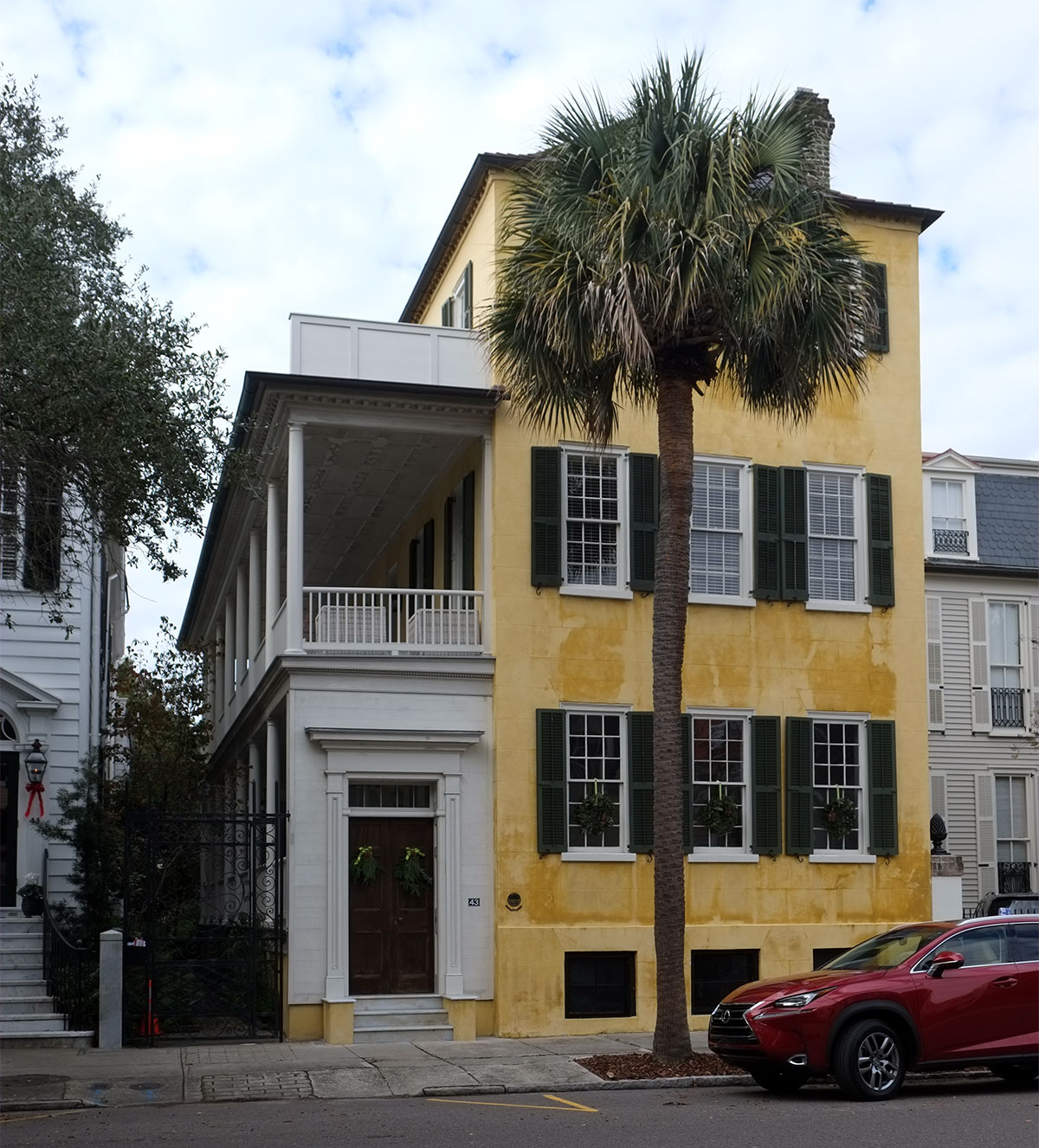
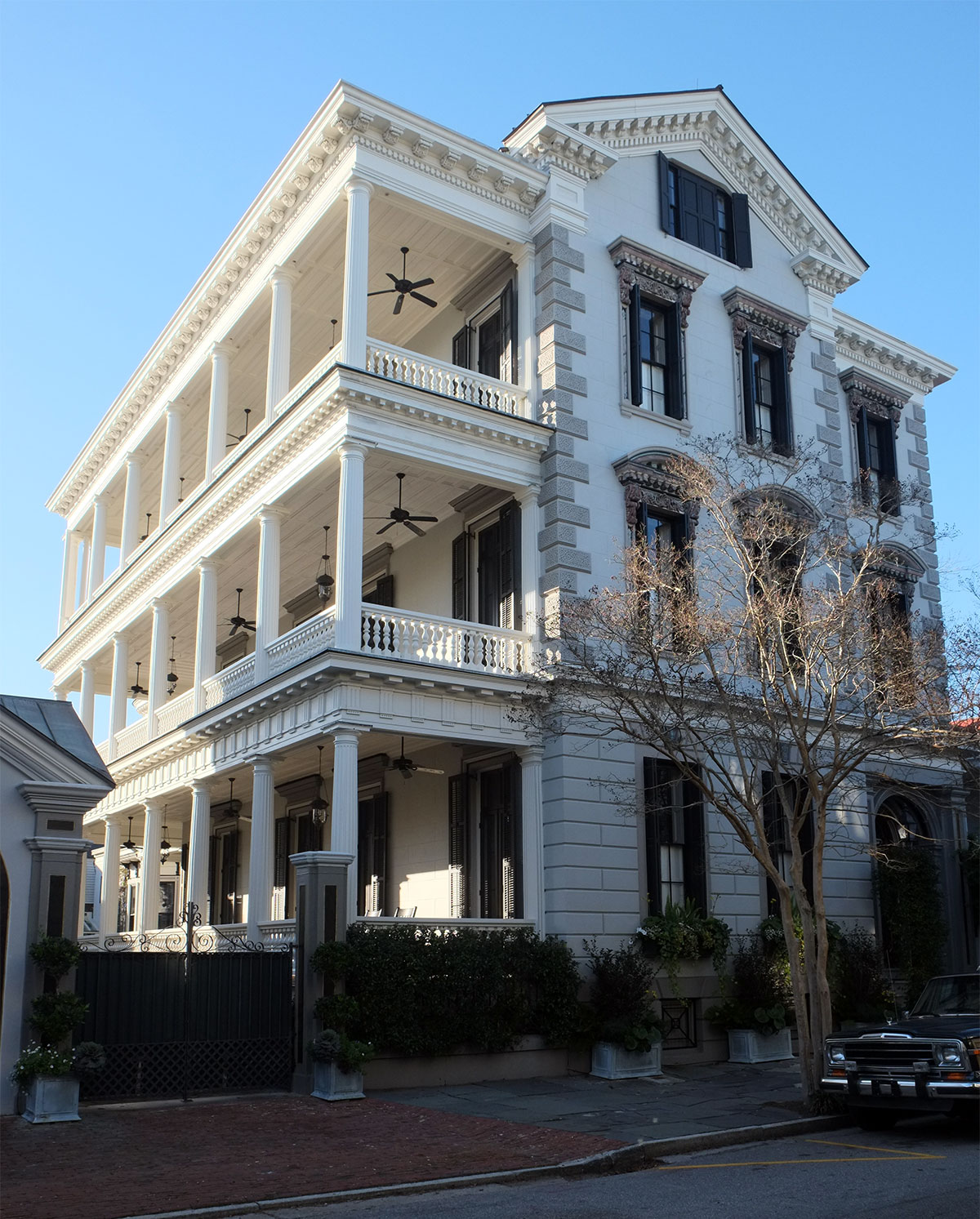
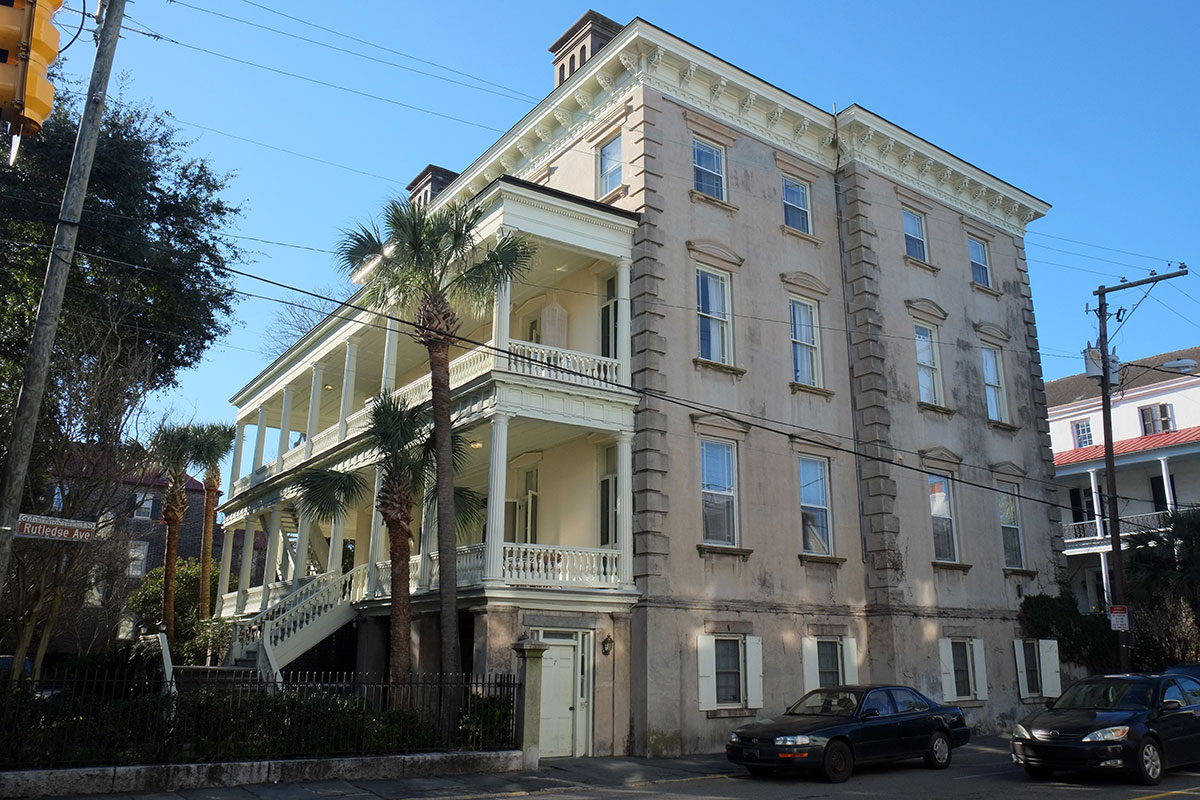
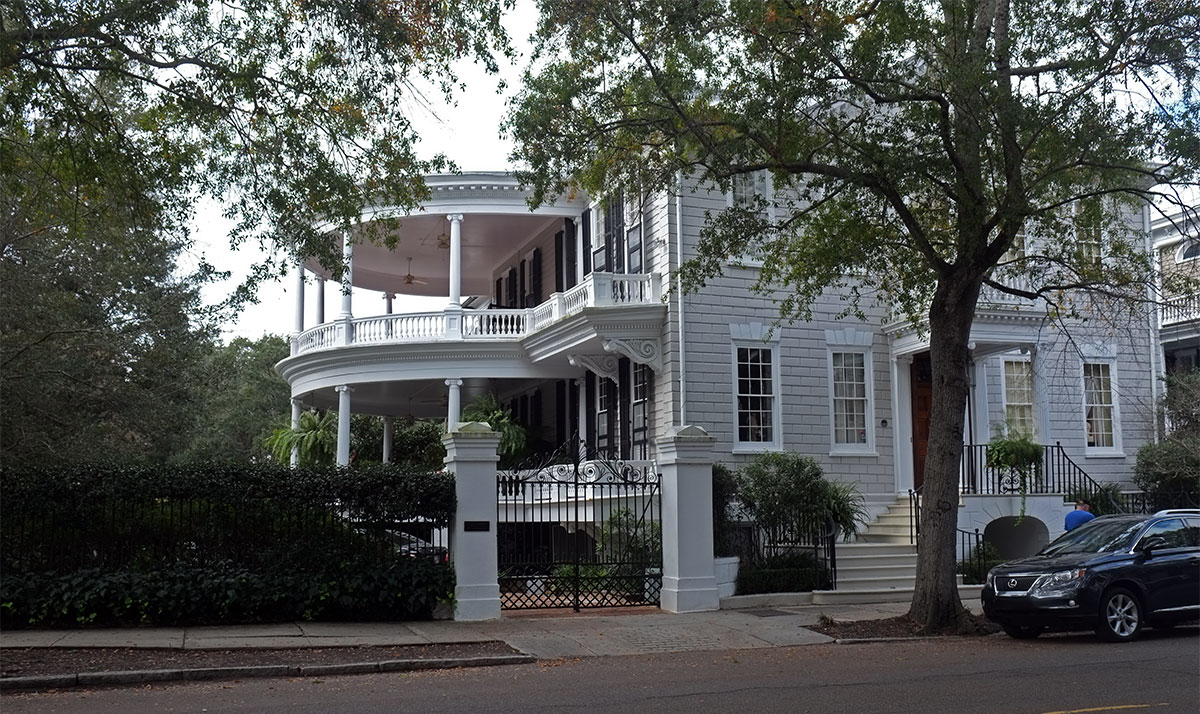
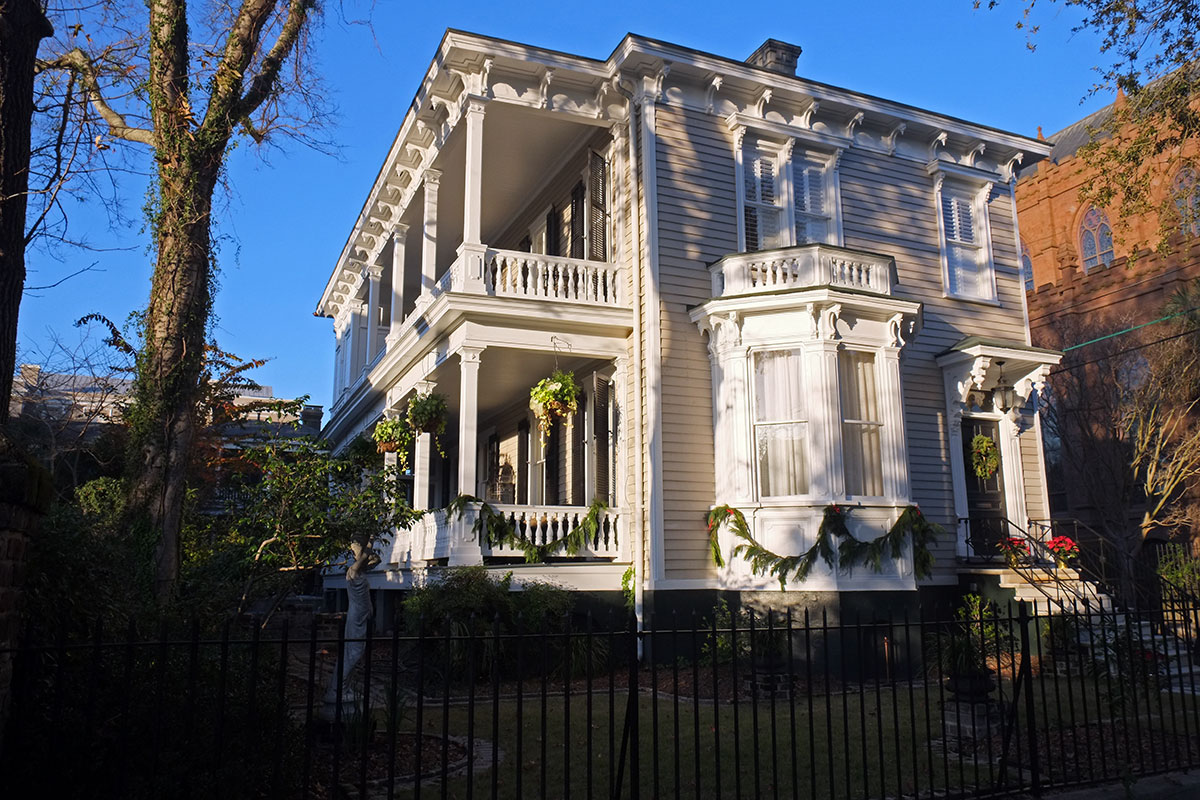
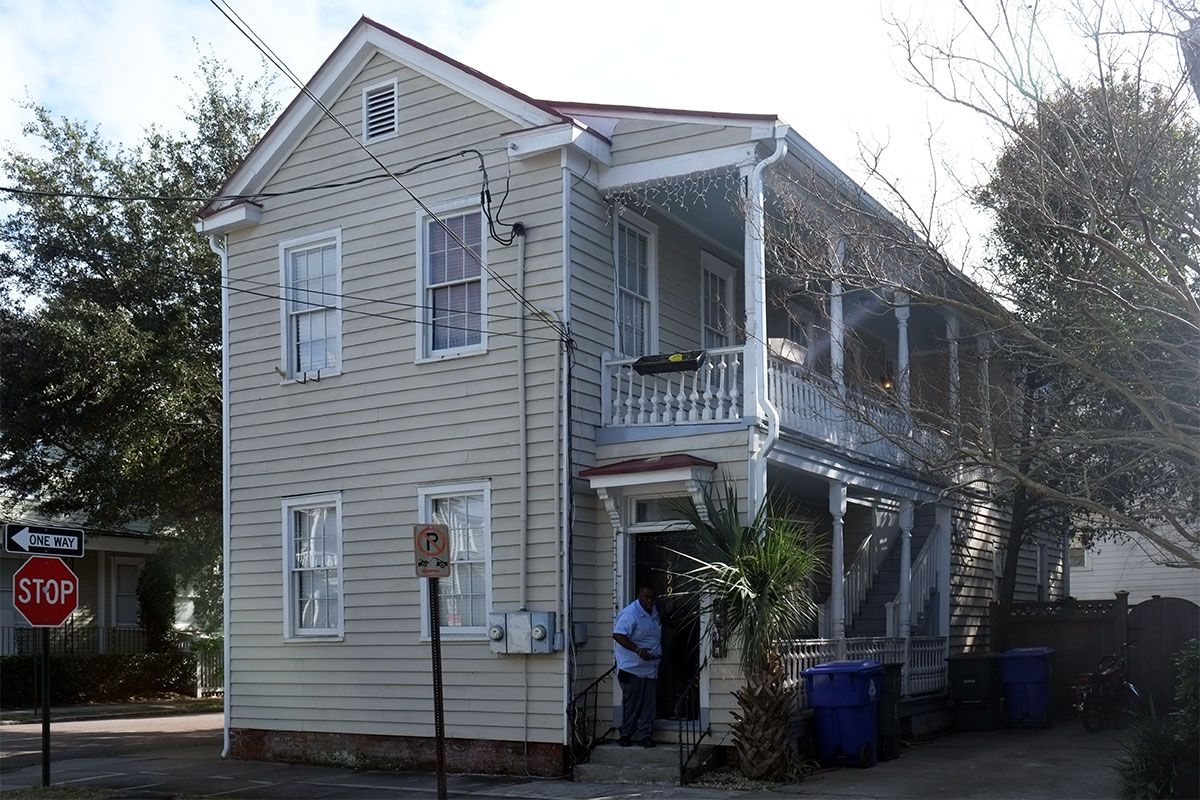
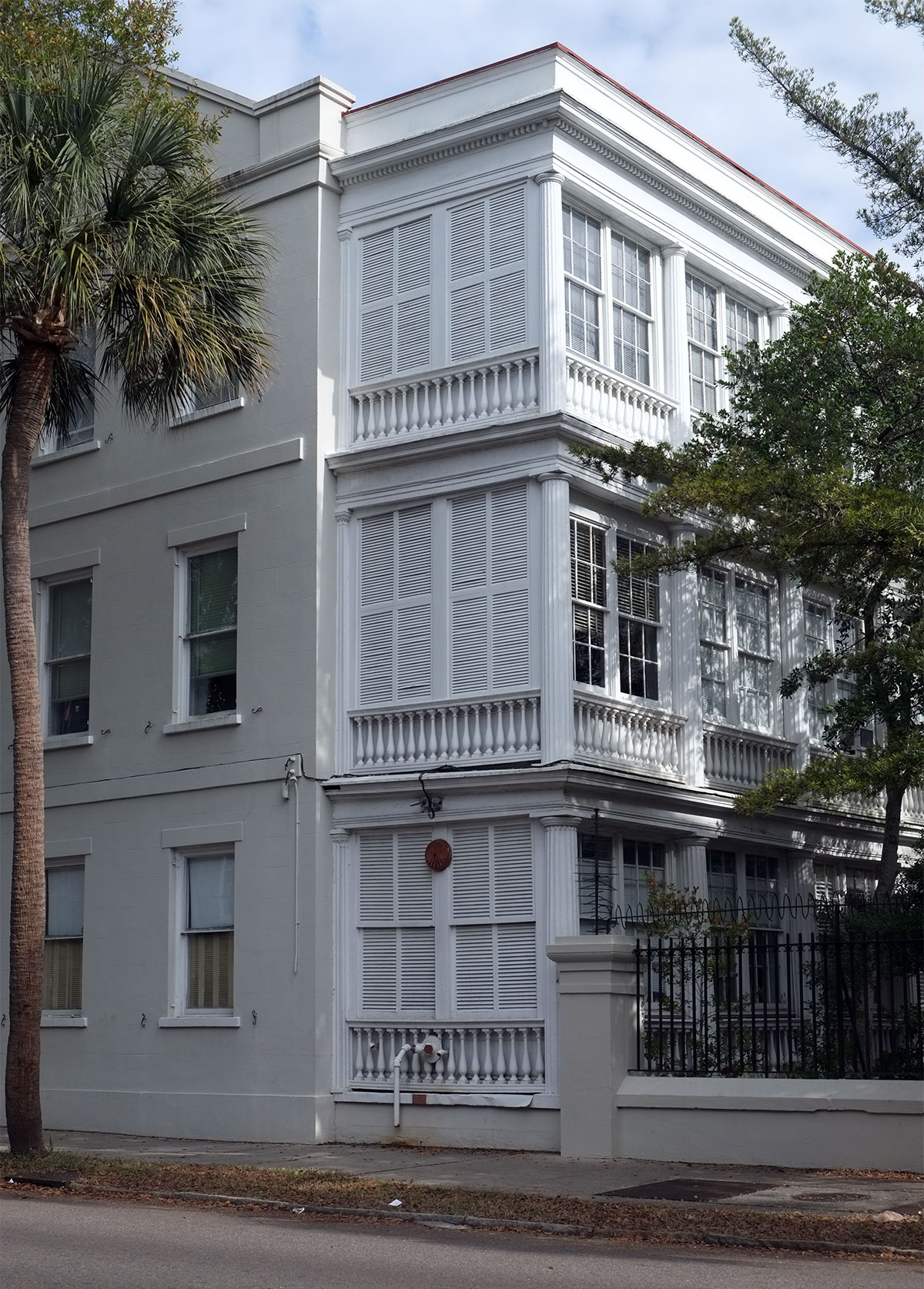
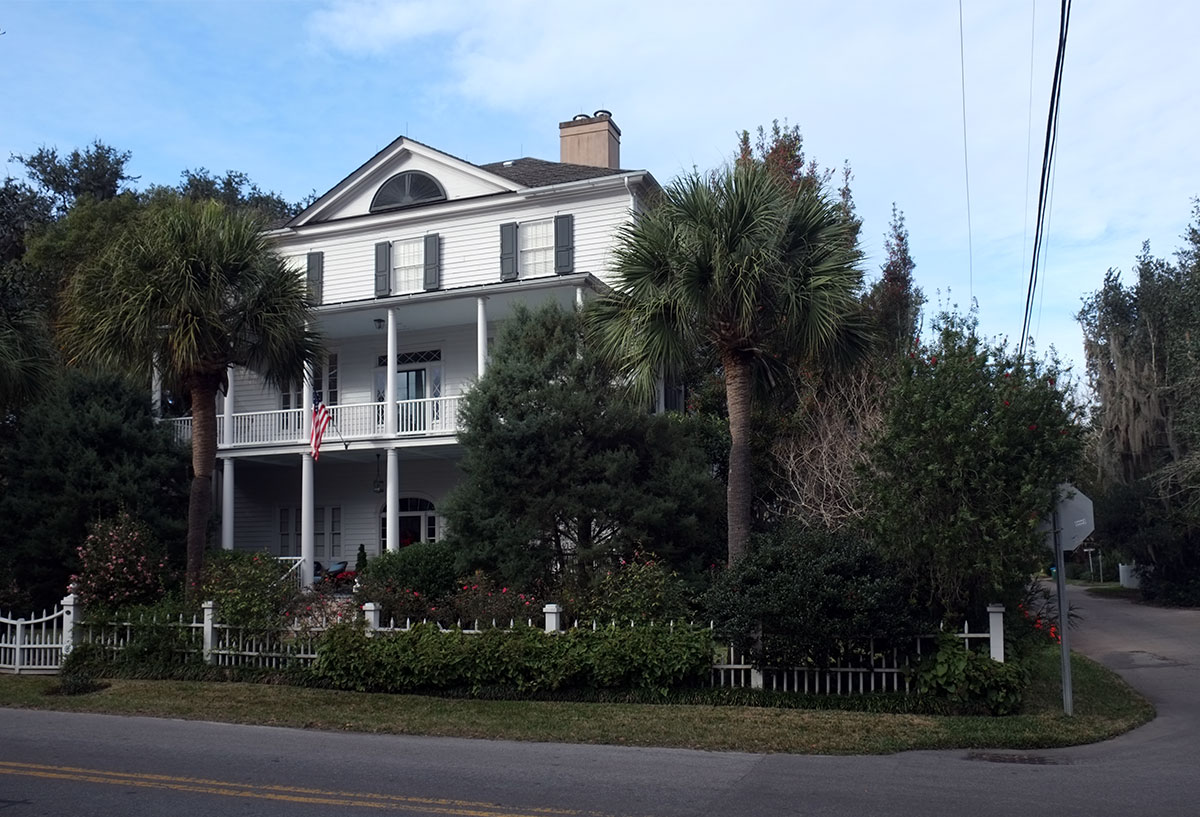
But for most architects, the main point of Charleston architecture is the housing – especially the single house, the type that was developed and used extensively in Charleston, being well-adapted to the hot, humid climate.  A narrow house built right out to the street.  Usually one room wide, with every room opening onto a porch, to facilitate cross-ventilation (an idea that probably migrated from the plantation house).  The porch almost always faces south, to shade the rooms, and opens to a side yard, which varies from minimal to grand.
DSCF7828

The entry from the street is into the porch zone, but there is usually a solid front door at this point for privacy.DSCF7788

Even when the porch itself might be open to the street.DSCF7989

The side yard is often screened with a high wall along the street, so it can function more as a private courtyard or garden (glimpsed here through the open carriage gate).  DSCF7790

That is the definition of the “type”, but as with all types, there are many variations on the theme, and for a typology geek such as me (and not Greta), the fun is in spotting the variants.  The basic type is fundamentally asymmetrical and skewed towards the southern orientation.  So what happens when architectural fashion favors symmetry?  You can add a bay on the north that balances the porch to the south:DSCF0088

or you could do that and disguise the porch altogether making the first bay in depth an enclosed room.DSCF7840

Or maybe enclose that bay without going symmetrical.
DSCF8082

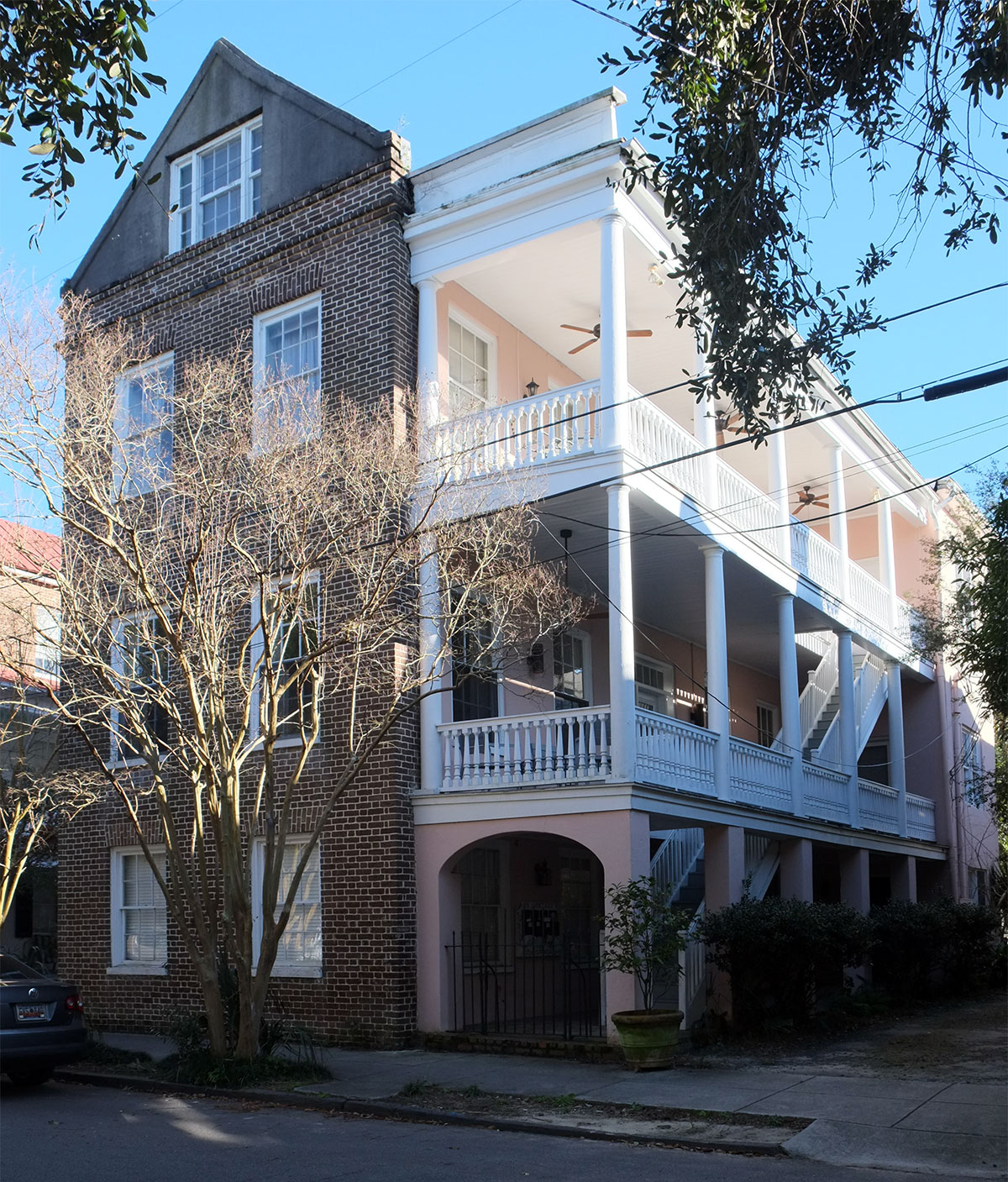
A stair is sometimes added in the porch zone, which allows the type to transform into a multi-family building of flats.DSCF0044

The desire for more space led to some houses becoming two rooms wide.DSCF0058

At what point does it stop being a single house?  When it is two rooms wide such as above, or when you do that and add a street entry into the house, and modify the linear nature of the porch?DSCF7836

Sometimes the urbanistic demands of the site led to a shift in orientation, such as here where the porch faces west, as the house addresses Broad St.DSCF8060

We were chatting with a builder one afternoon (there are builders and groundskeepers everywhere in Charleston – I’m not sure we ever saw an actual resident) – who directed us to Legare St. which has the most beautiful streetscape and the biggest houses.  (And the most pickups belonging to the contractors.)DSCF8014

Along the Battery there is a beautiful park.
DSCF7971

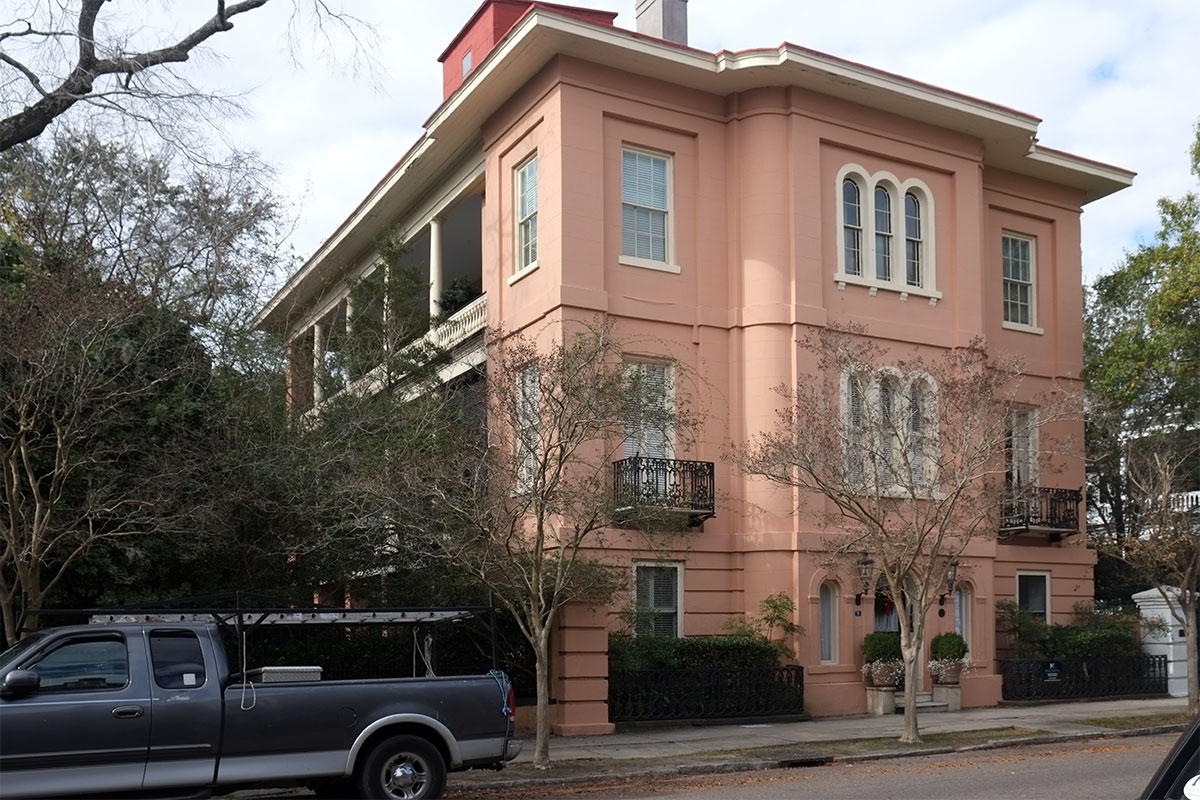
And the houses facing this are not single houses.  Here the site demands change the type instead of the orientation (the porches still face south), and ventilation was probably adequate as the houses faced onto a large open space and waterfront.DSCF7973

The east side of the Battery has a seawall / promenade.DSCF7948

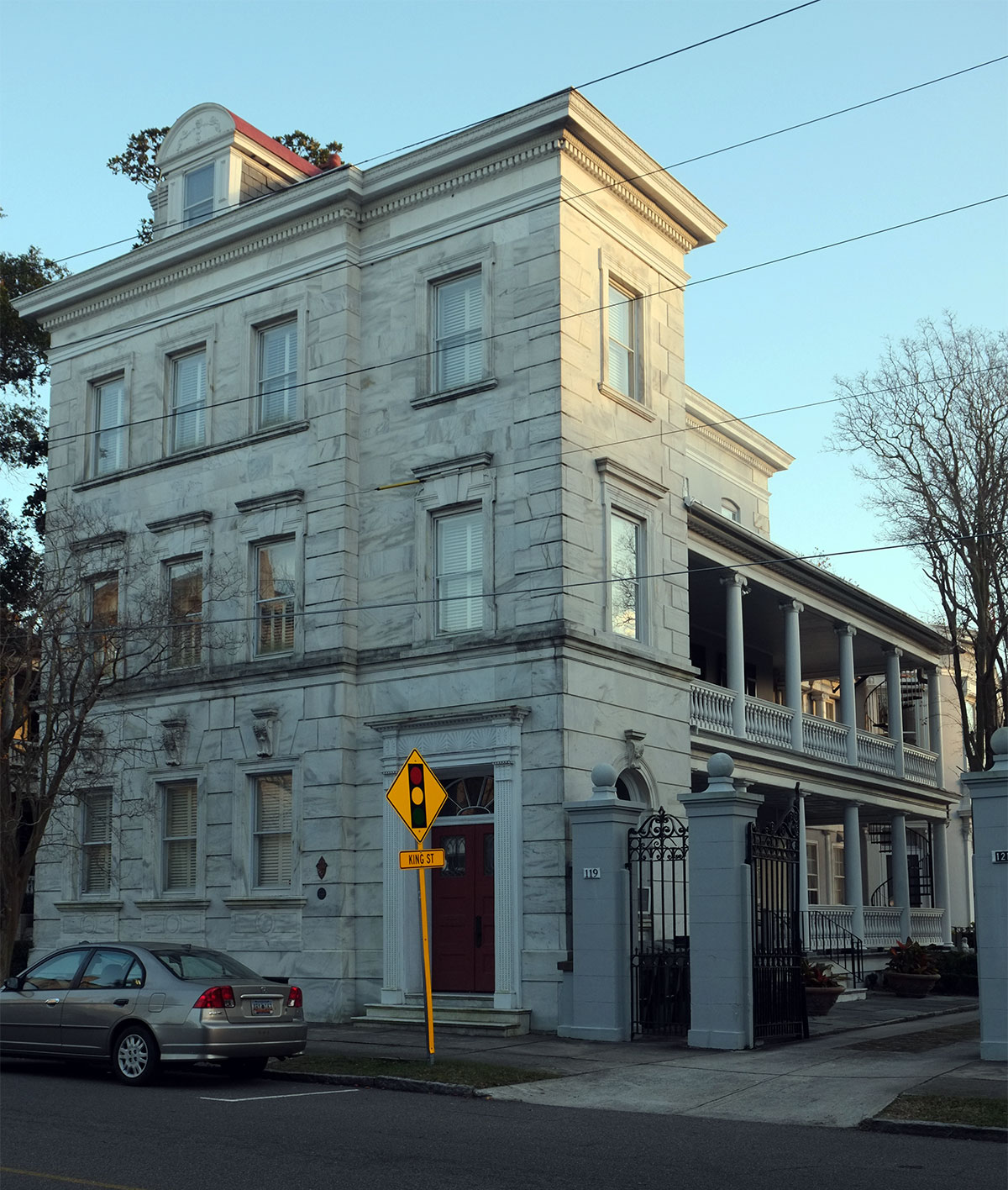
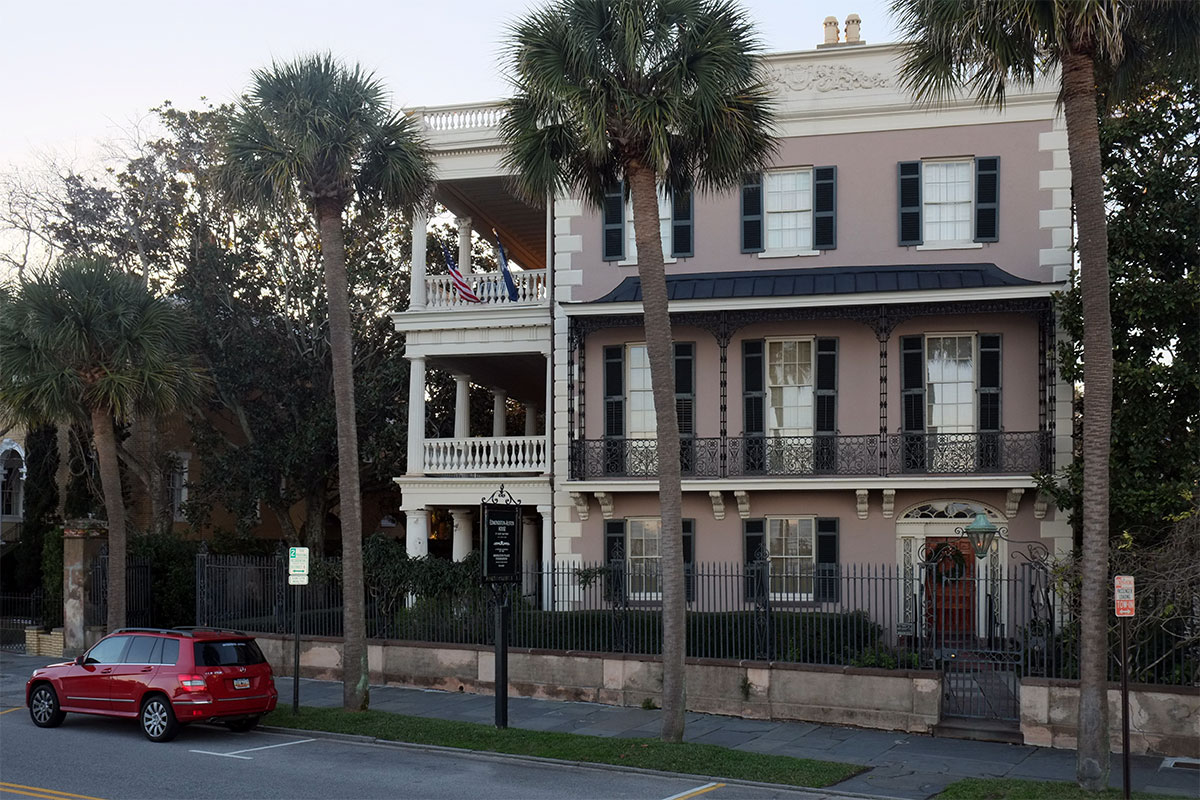
Lined with fantastic houses (such as this with a colossal order). DSCF7962and you can tour the Edmonston-Alston House, which shows an evolution in and out of type.  It started as a Federal style house, entered from the side yard into a central hall on the traverse axis.  However, an entry door off the street was a later modification (along with some truly ghastly pseudo-Empire interior detailing).  DSCF0139

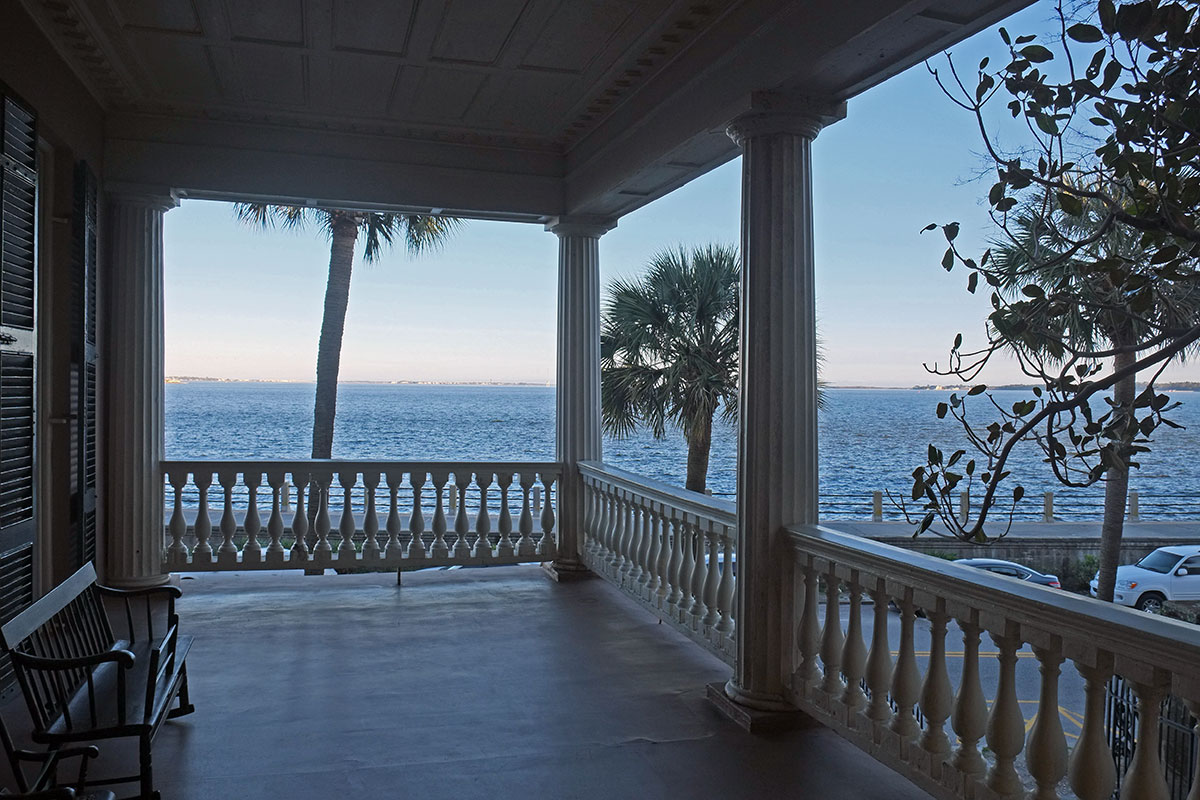
The porch at the piano nobile level, however, is where I’d like to spend my retirement sitting.DSCF0110

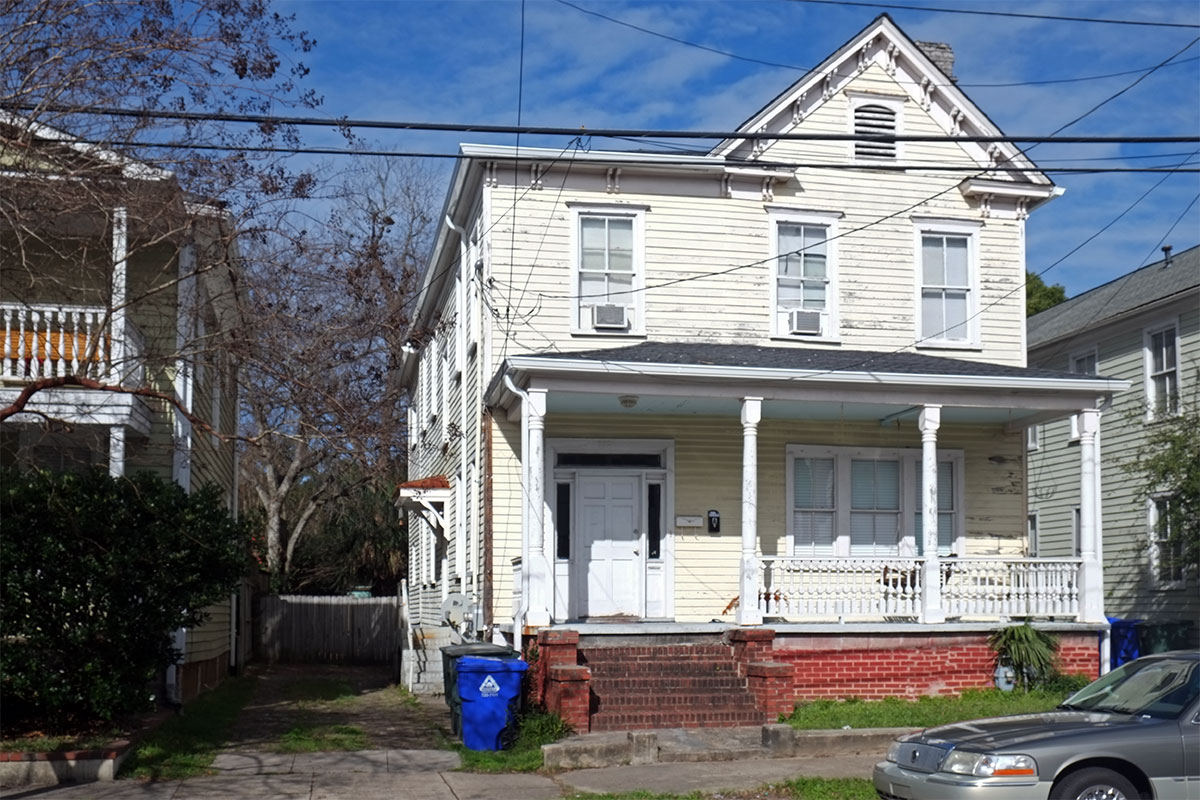
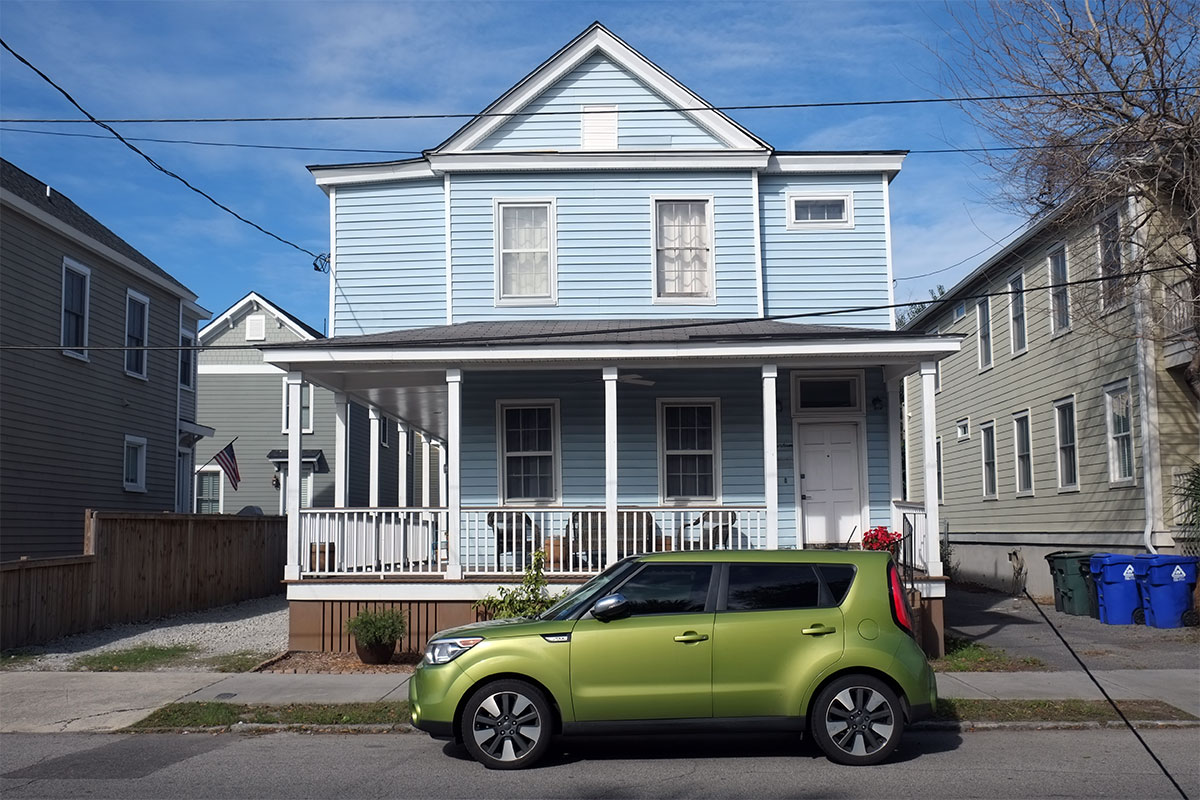
The single house was not just for the rich – as you wander through other neighborhoods, you can see perfectly-preserved vernacular examples.DSCF9983

Which sometimes are modified to enclose more space;  this is always an issue for commodious porches – eventually someone decides to add another room, and the side porch is gone.  DSCF9987

This happens with rich folks too, and probably would have become more common in the air-conditioning era if it weren’t for historic preservation ordinances. DSCF7806

And just as there are mansions which tried to finesse the symmetry issue, there are more modest houses that engaged it also.  DSCF9997

We visited Charleston on our way south, but when we headed north after Christmas, we decided to return for another couple of days.  I wanted to spend more time strolling the streets of this elegant and beautiful city, and Greta read the Washington Post article on America’s Ten Best Food Cities, and realized there was a place she had missed.


Beaufort, S.C.

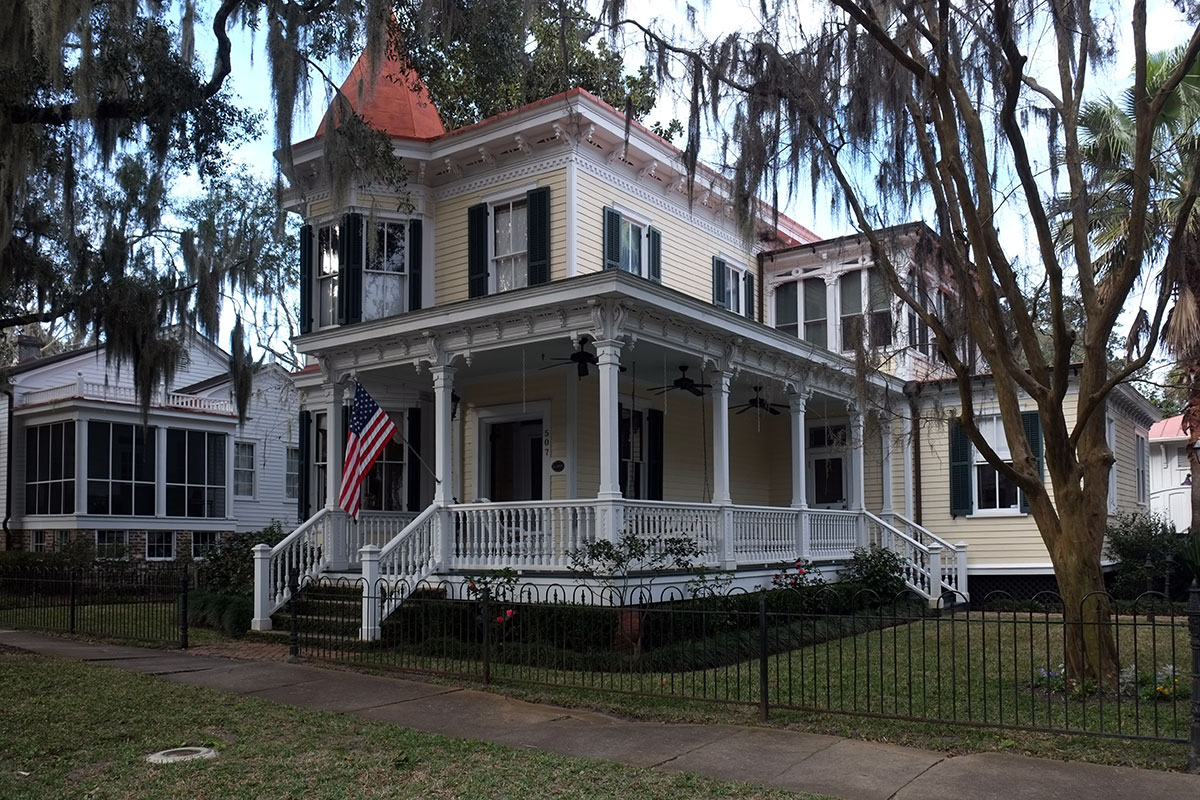
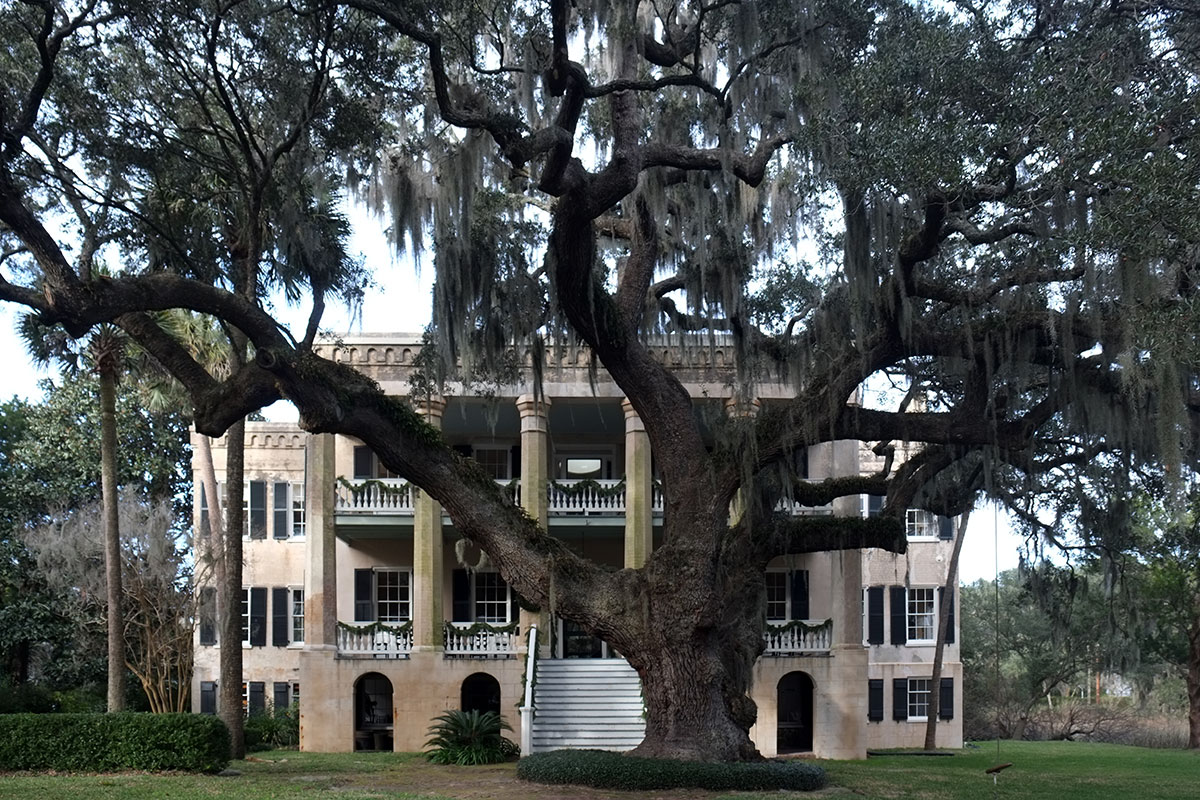
DSCF9932pLess well known than Charleston or Savannah, Beaufort is an extraordinary historic town.  It’s much smaller than those two cities, and harder to reach, so although it has been gentrified by what seem to be well-off retirees all reading Southern Living, it doesn’t feel as overrun by tourists.  The small downtown is very spiffy, and some of the adjoining residential areas clearly have been getting a lot of attention.DSCF9862p DSCF9968

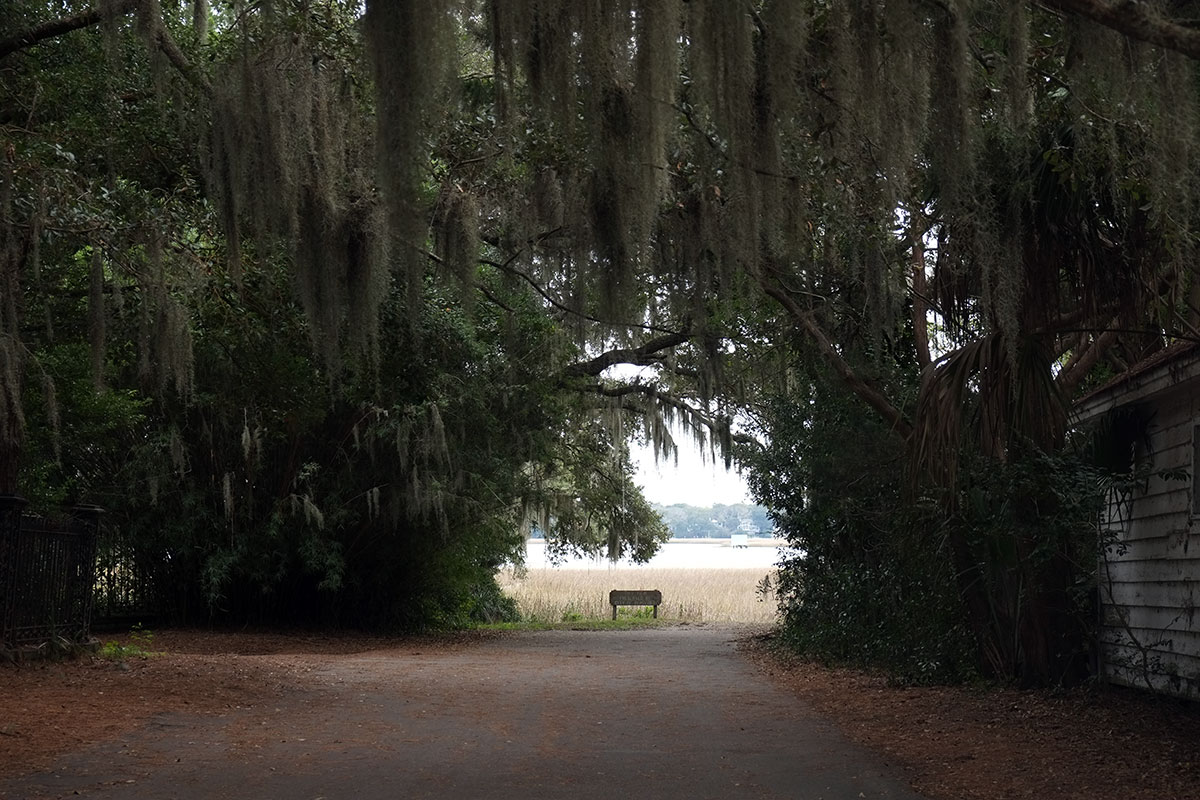
Streets end at the bay or looking out onto the salt marshes.DSCF9900

But what really struck us was the district known as The Point.  Many of the houses are large and spectacular, but it doesn’t seem that hedge fund managers have been pumping a few million into each one.  Perhaps they still belong to old families, or perhaps they are just too big and would cost too much to renovate.  Or maybe there aren’t any good golf courses nearby.  For whatever reason, the neighborhood exudes that atmosphere of Southern decay that we all know from black and white movies.  I kept expecting to see a fat old guy in a Panama hat and suspenders sitting on the porch drinking bourbon.  DSCF9891  DSCF9931p  DSCF9943p

The growth is unbelievable.  Giant live oaks everywhere, and Spanish moss practically down to the ground.  DSCF9865p        DSCF9887DSCF9872DSCF9913p  DSCF9947p

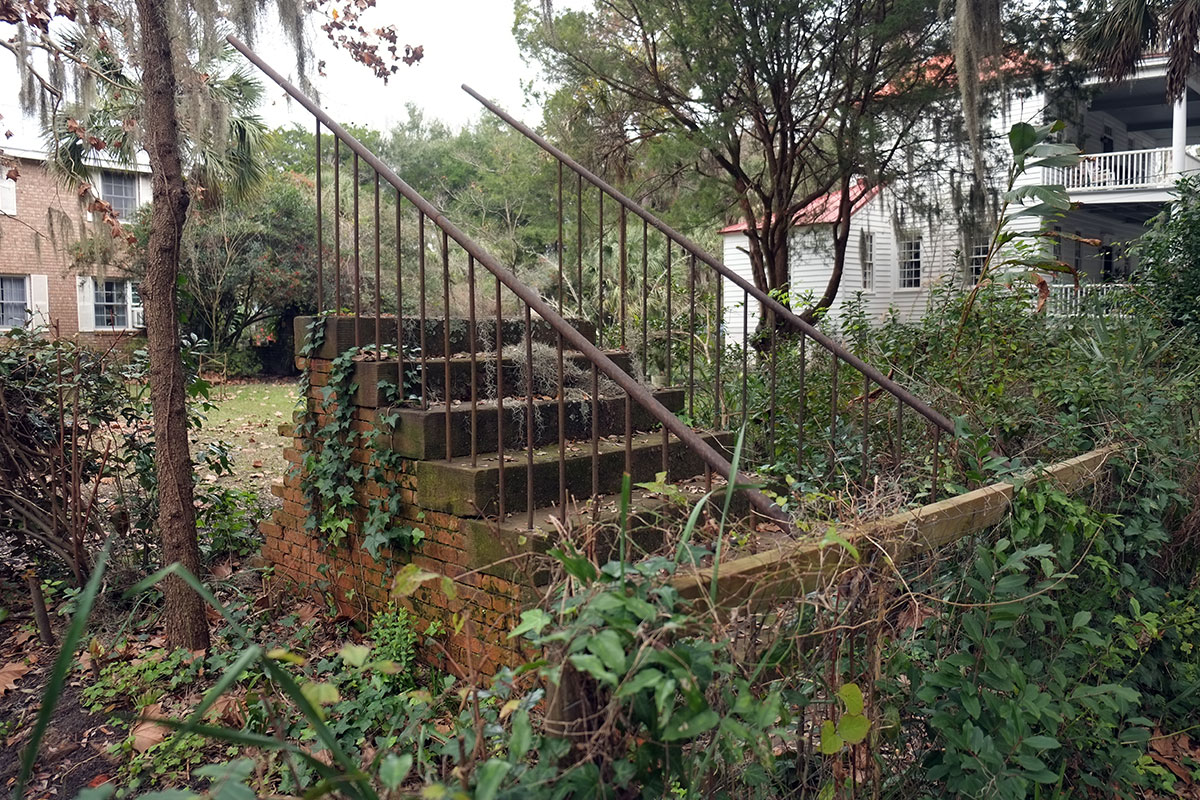
As much as I loved Charleston, eventually you get tired of everything being so perfect.   Beaufort has some ruins and some neglect – it doesn’t have the armies of gardeners ready to pounce on every weed that appears, or painters with their three levels of trim paint ready to go.
DSCF9921  DSCF9897p  DSCF9904

DSCF9880p

Traveling across the South, it’s been discouraging to see how much it has become like the rest of the country – every little town has five fast food places that have displaced the bbq joints and old diners.  The new houses look the same as in New Jersey or Texas.  Either things are really poor and dilapidated and depressing, or they are brand new and character-less.  Beaufort had a strong presence of the past, and it looked old.  It helped prepare us for New Orleans.

Savannah and the ascendancy of the Plan

DSCF9828Many of our readers have remarked that my blog posts are like architecture lectures.  Any of my students reading this can attest that what I have to say about Savannah already is a lecture.  I’ve been giving this lecture about Savannah for years, and on this trip we just returned there so I could get better photos.  Actually, we returned to Savannah four years after out last visit because it is one of our favorite cities – even Greta doesn’t get tired of walking through this beautiful and varied place.

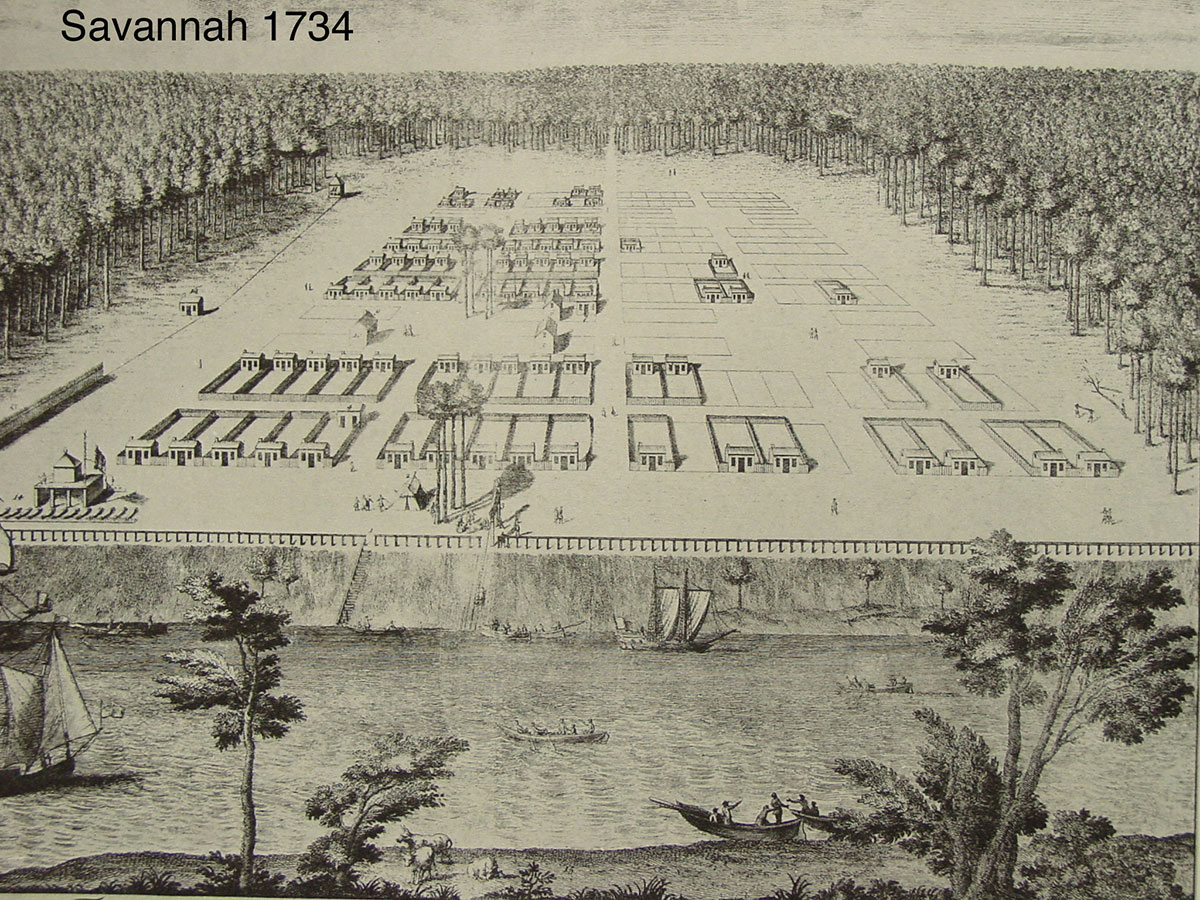
If the character of Charleston depends largely on the building type of the single house, the character of Savannah is wholly dependent upon the brilliance of its plan.  It was laid out by James Oglethorpe in 1734 as a military camp, and it is incredible to think that his ideas on the hierarchy of a camp filled with huts could lead to perhaps the most sophisticated town plan in the country.  This is the famous print of Oglethorpe’s original layout:  Savannah-1734

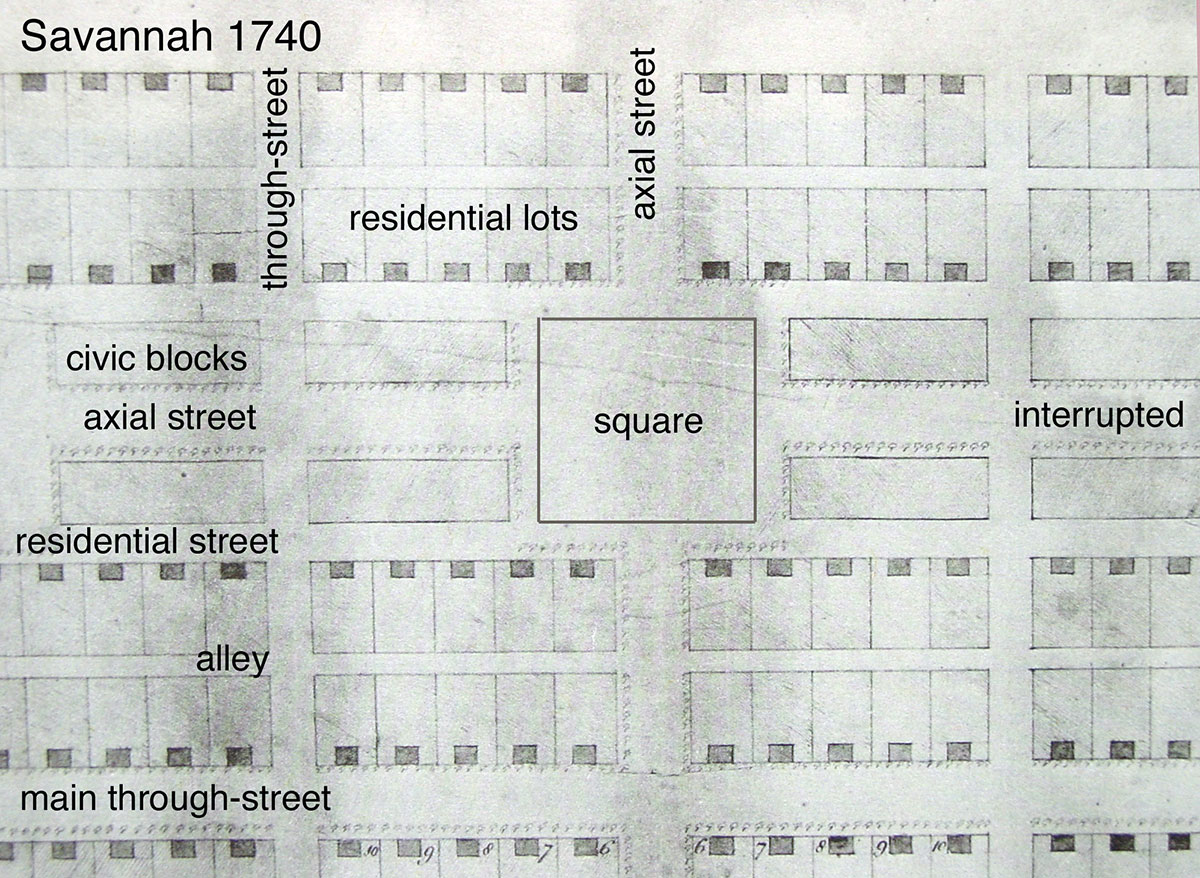
The basic module of Savannah’s plan is the “ward” – the repeating arrangement of streets that surround a square.  Most planned American cities are based upon a simple grid, where every street is the conceptual equivalent of any other, but in Savannah there is a hierarchy of major streets, through streets, formal streets, residential streets, and alleys. Savannah-module

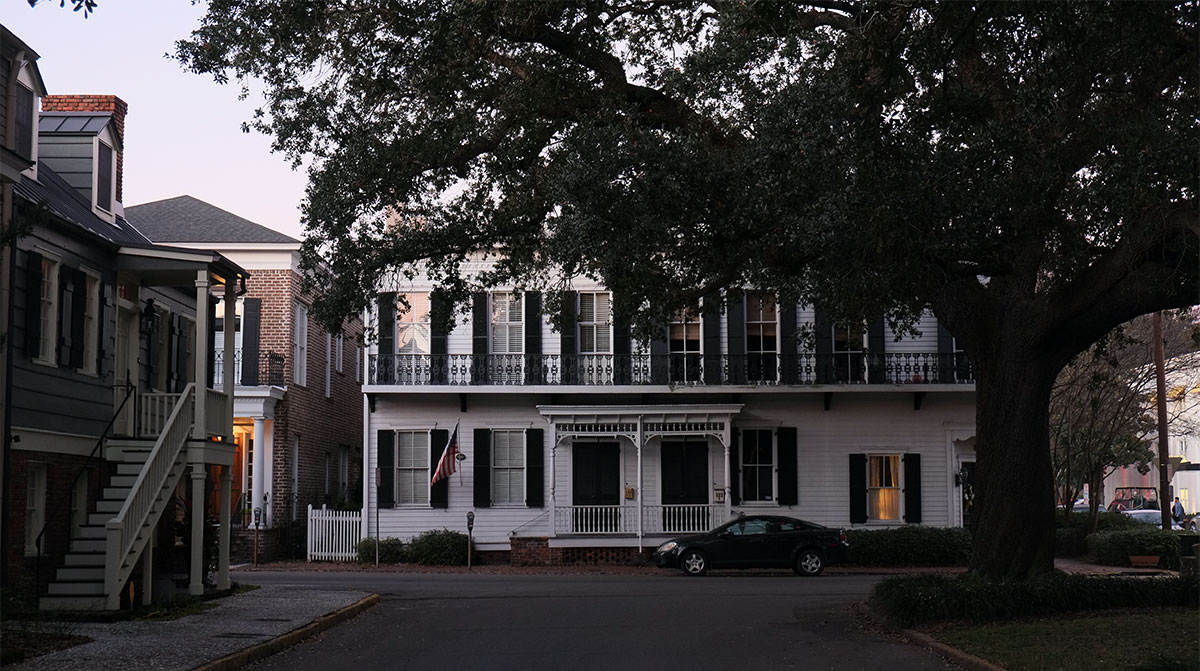
This hierarchy of streets dictates the qualities of the blocks and buildings, with the blocks to the east and west of the squares occupied by civic buildings and mansions.  The experience of being in the city is shaped by this hierarchy too – notice that the squares interrupt through traffic in both directions, so as a pedestrian you can stroll on these streets and though the squares, while the faster traffic moves on different streets.  DSCF9537

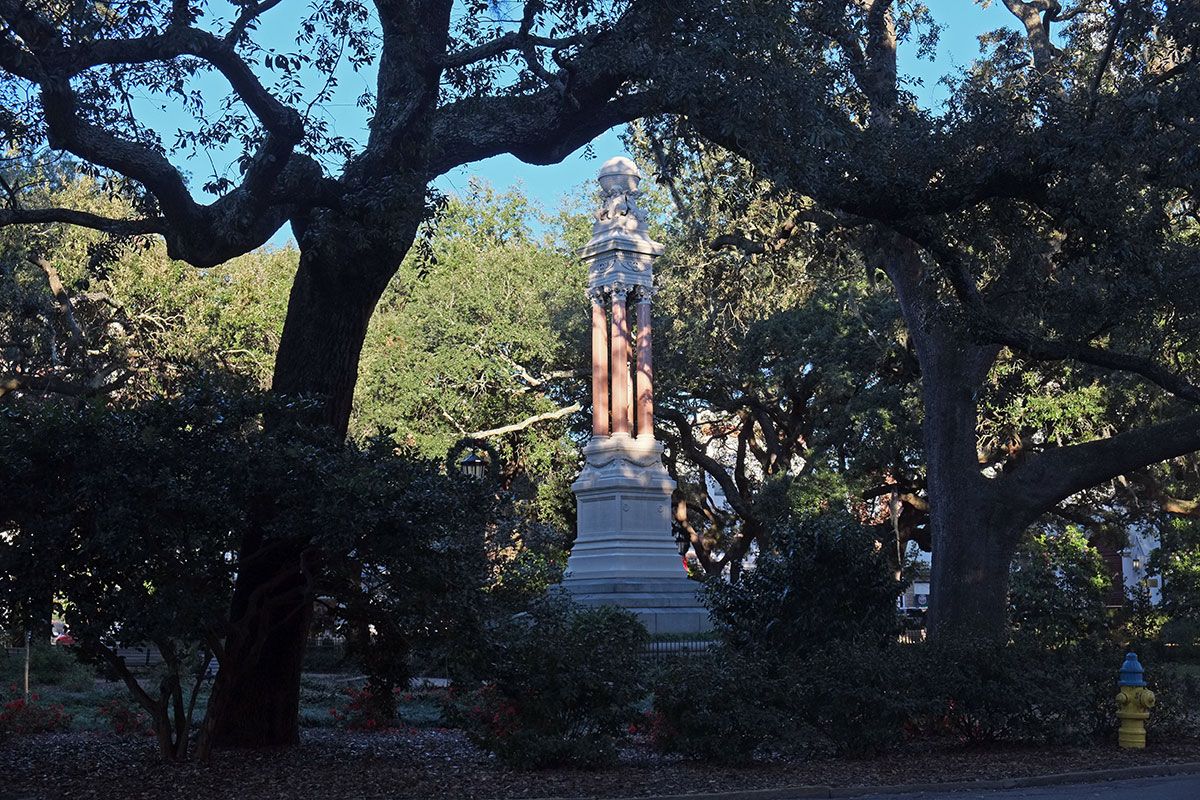
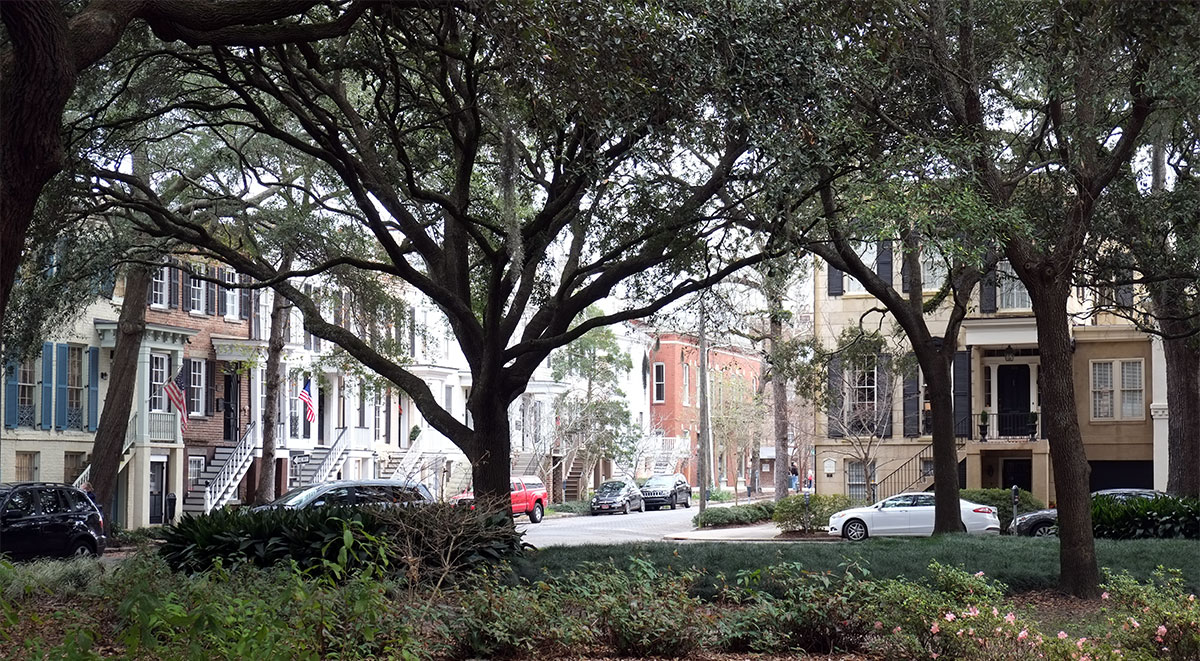
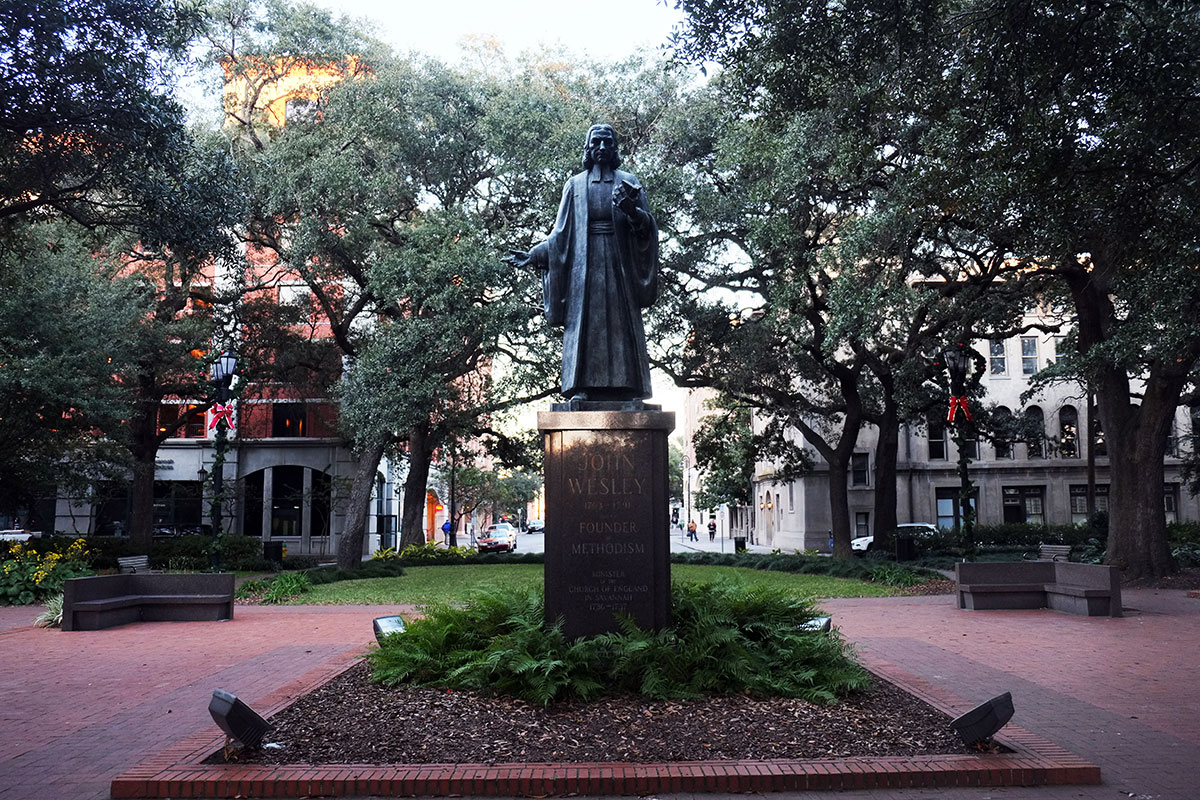
While the plan of each ward is the same, the development of the squares is very different.  Downtown squares, residential squares, rich neighborhoods, poor neighborhoods – they all have the same underlying pattern with an open space in the middle.  Most squares have a monument in the center, DSCF9769

and we noticed that the person memorialized in the center is never the same person after whom the square is named;  this is not Wesley Square.
DSCF9817

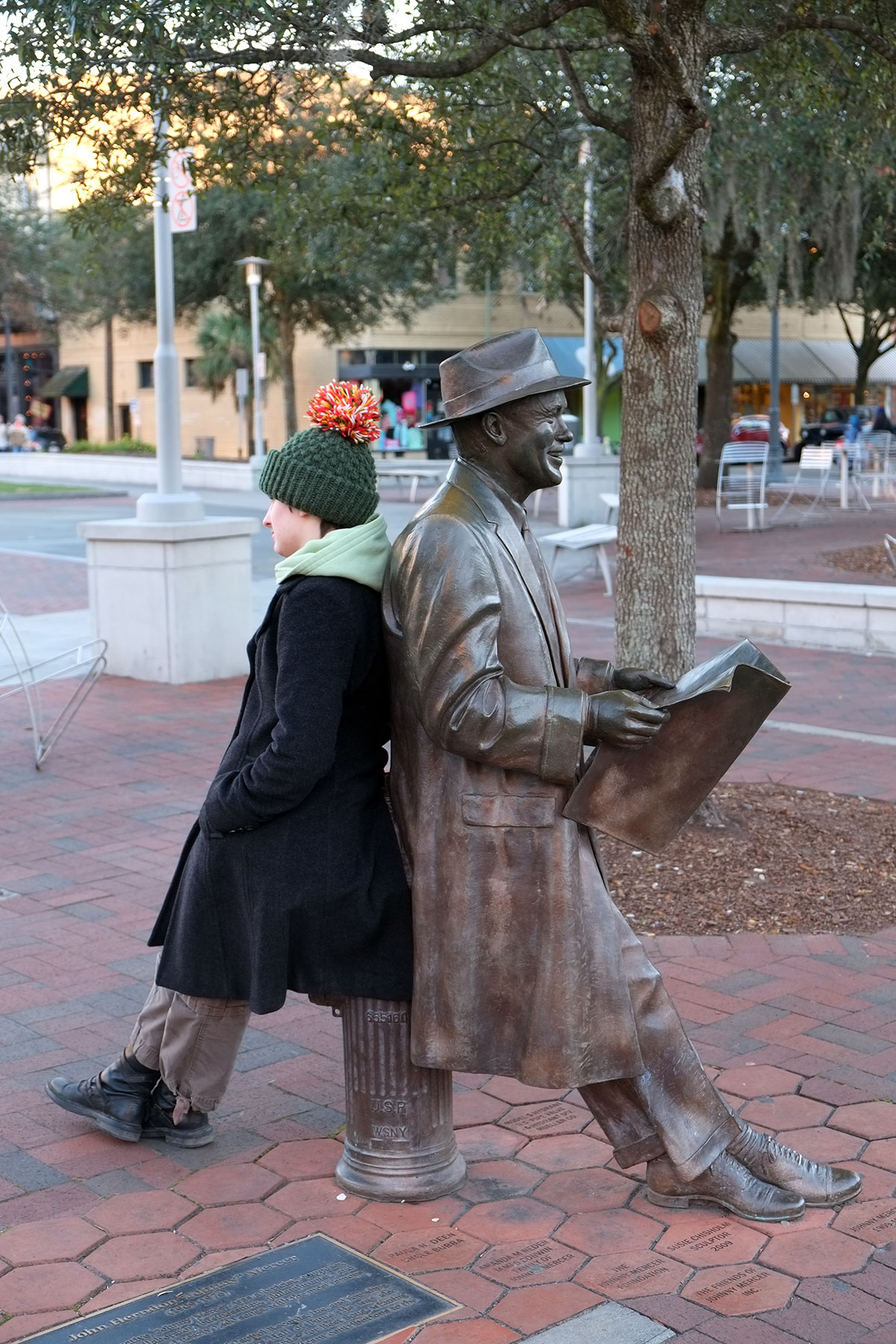
Some of the newer monuments are less formal, such as this statue of Savannah’s favorite son, the songwriter Johnny Mercer.DSCF9809

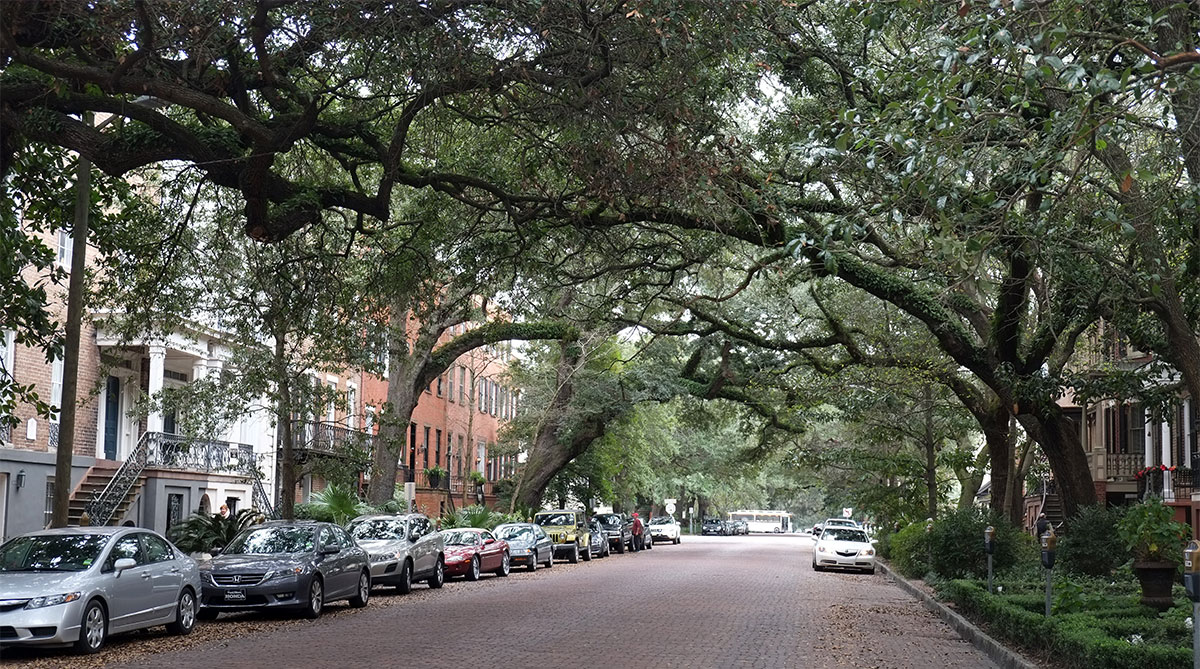
But it is really the spatial and experiential qualities of the squares that makes Savannah such a different place.  They are quiet and beautiful, and everyone in the center of the city is always with one block of an open space.  DSCF9514

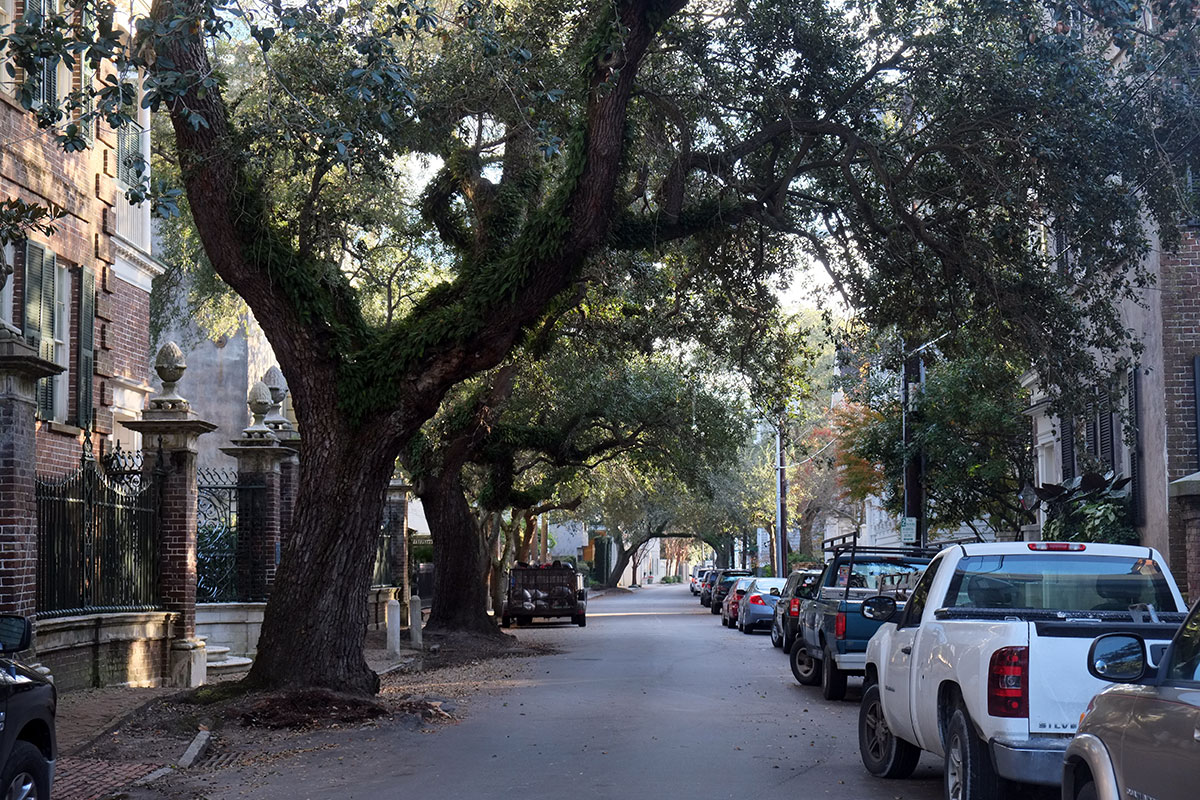
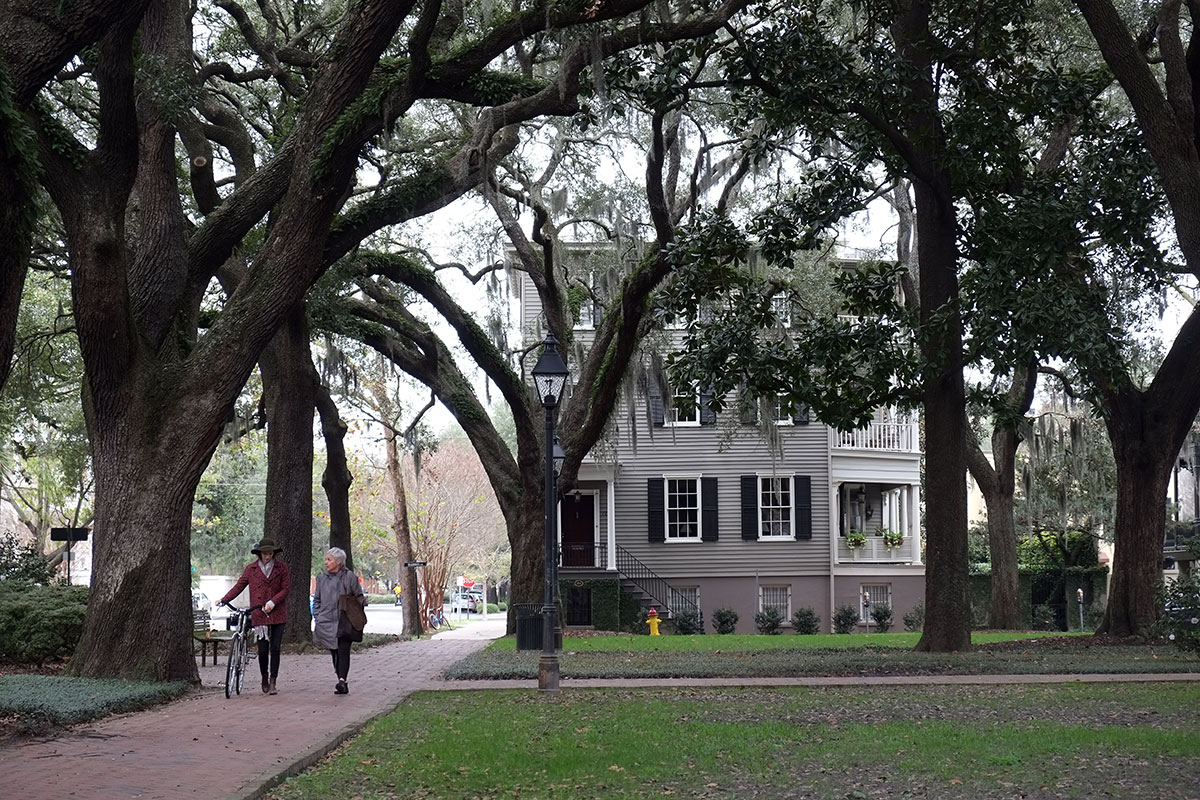
This isn’t to say that the through-streets are awful – they too are gracious and welcoming, with the live oaks and Spanish moss giving much of the character.  DSCF9517

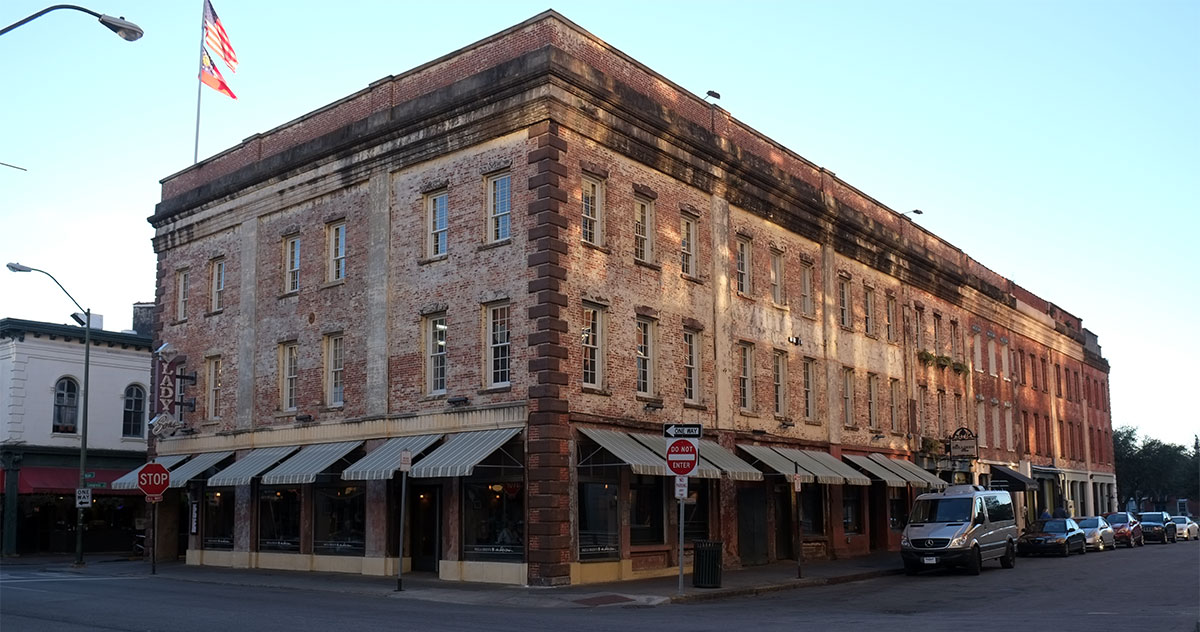
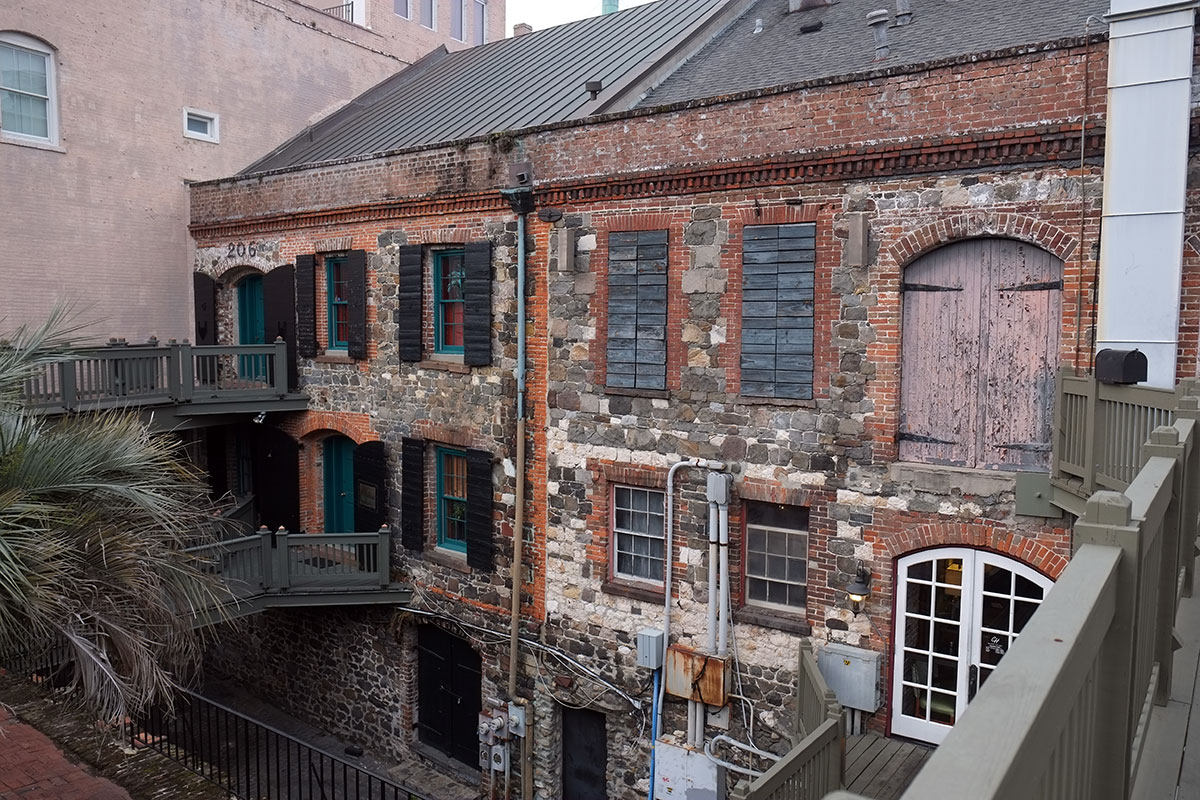
Savannah also has beautiful buildings surrounding these spaces.  There are a couple of squares that have been ruined by 1950s and 1960s buildings, but in reaction to these, Savannah was one of the birthplaces of the historic preservation movement, and the rest of the city core was spared the blight of bad buildings and bad city planning ideas.  There are excellent commercial buildings.DSCF9812warehouses by the river,DSCF9584

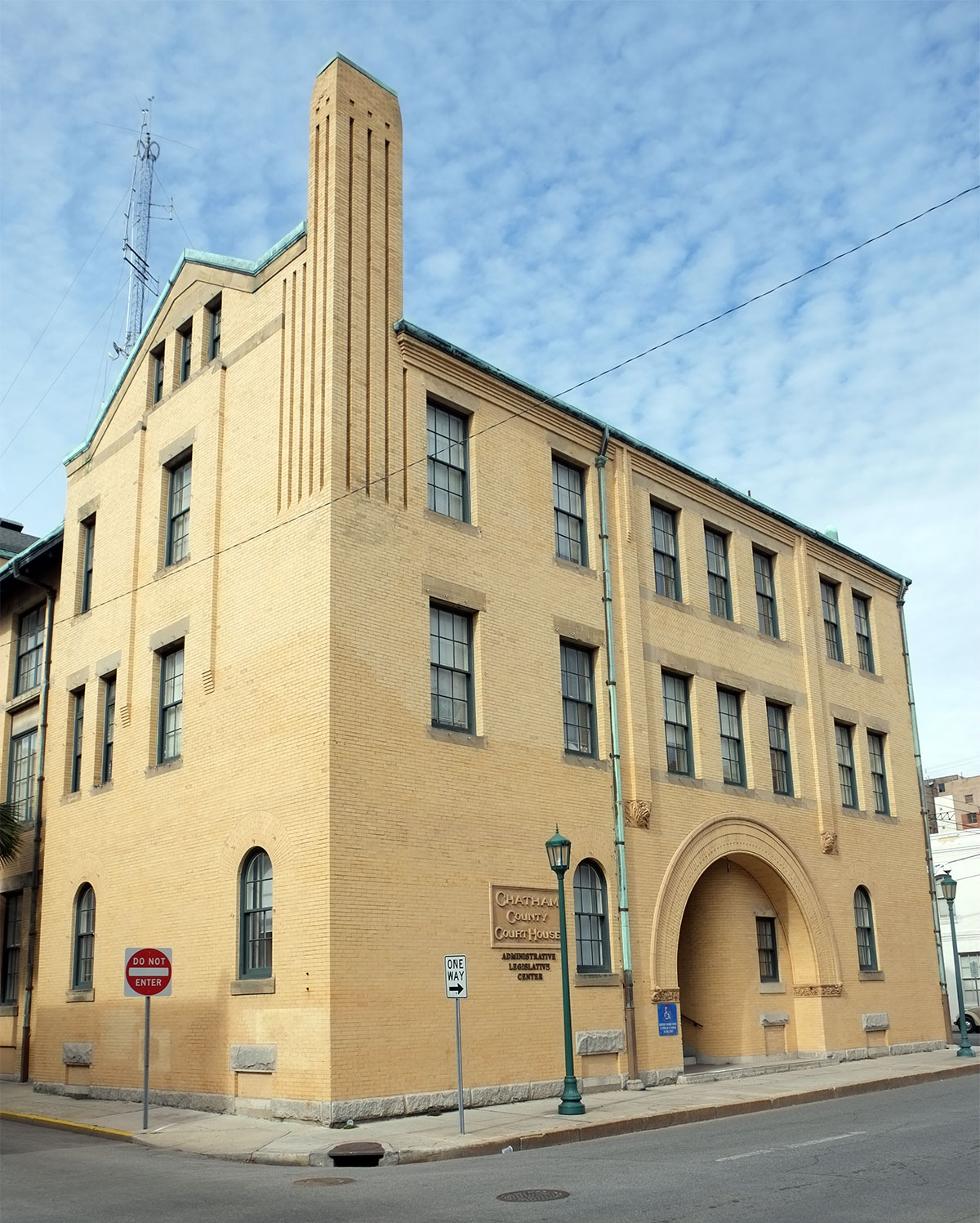
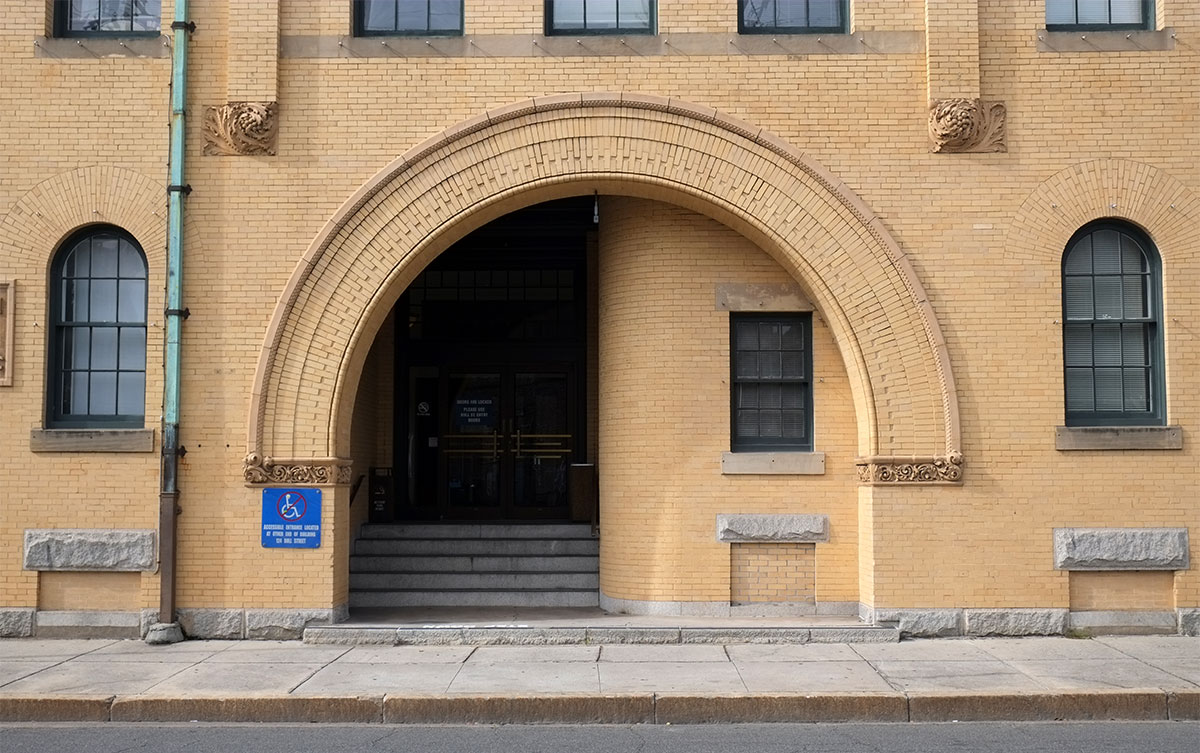
civic buildings (I don’t know the architect for this courthouse, but he was clearly influenced by Berlage and early European modernism).  DSCF9523  DSCF9524

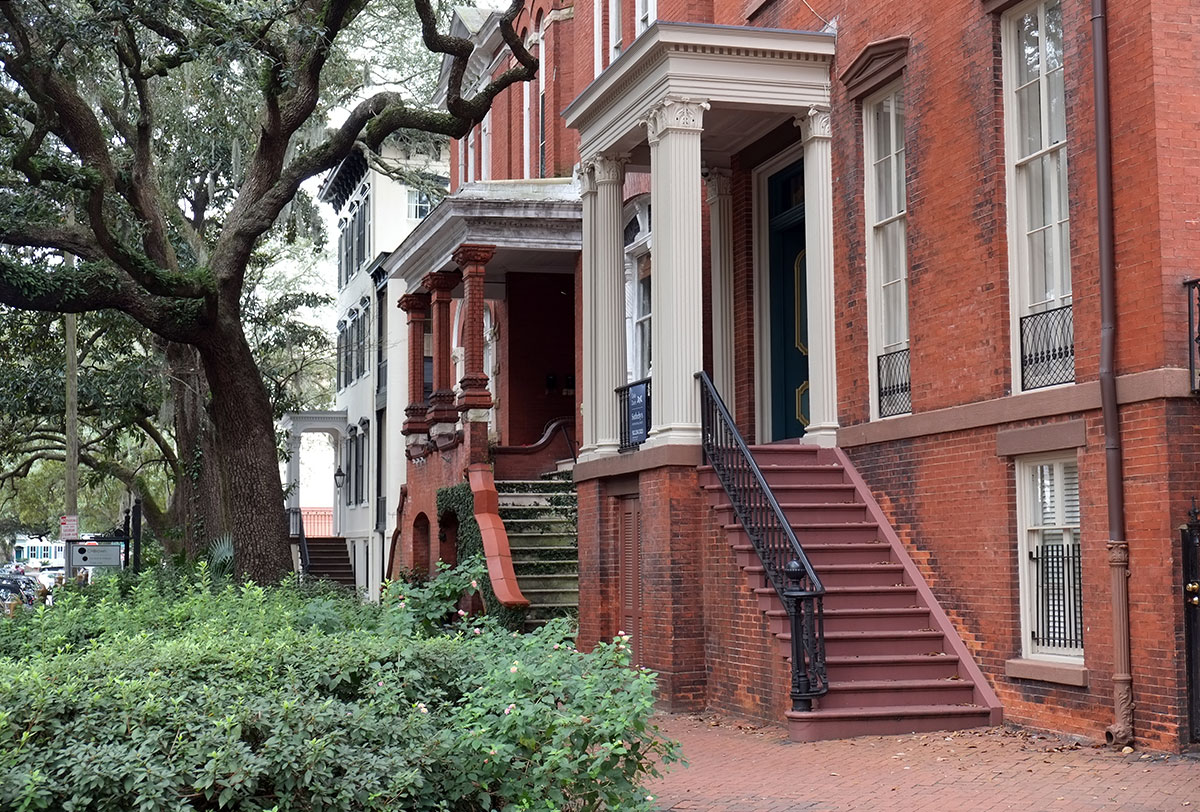
and of course beautiful houses.  DSCF9748  DSCF9461   DSCF9478

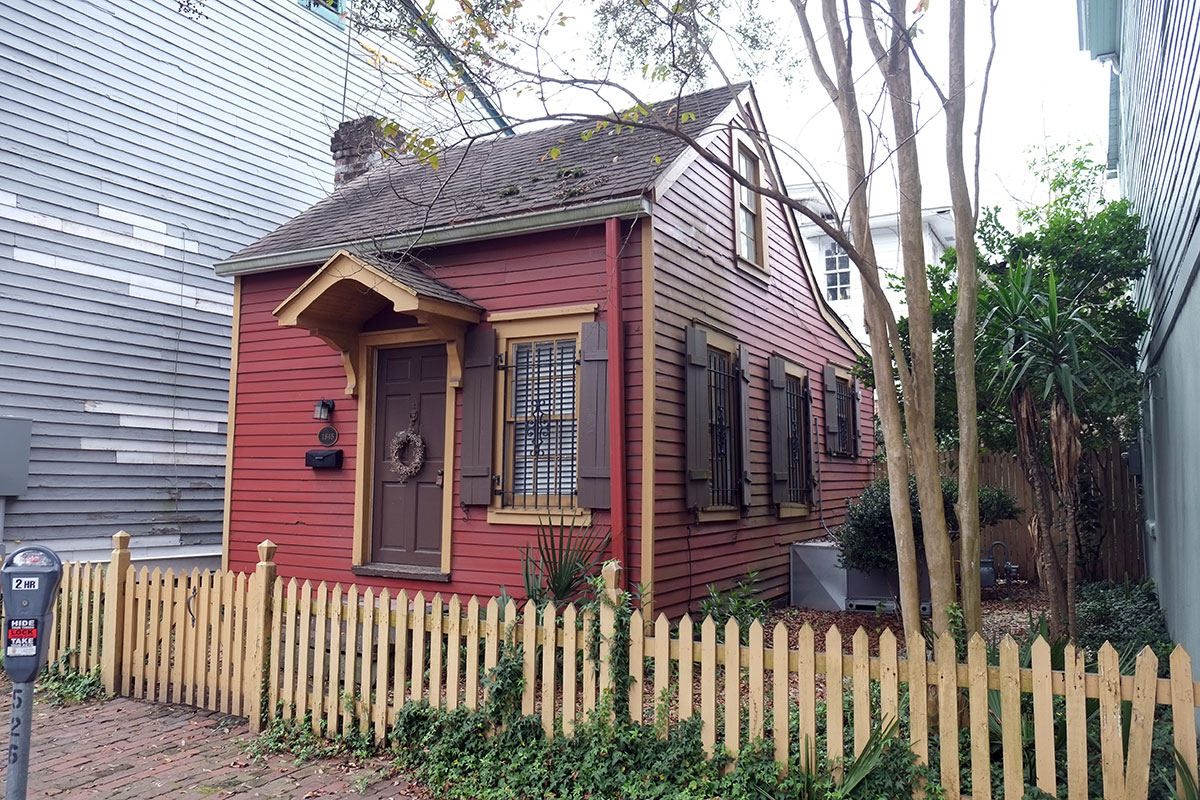
including some tiny old ones.  DSCF9567

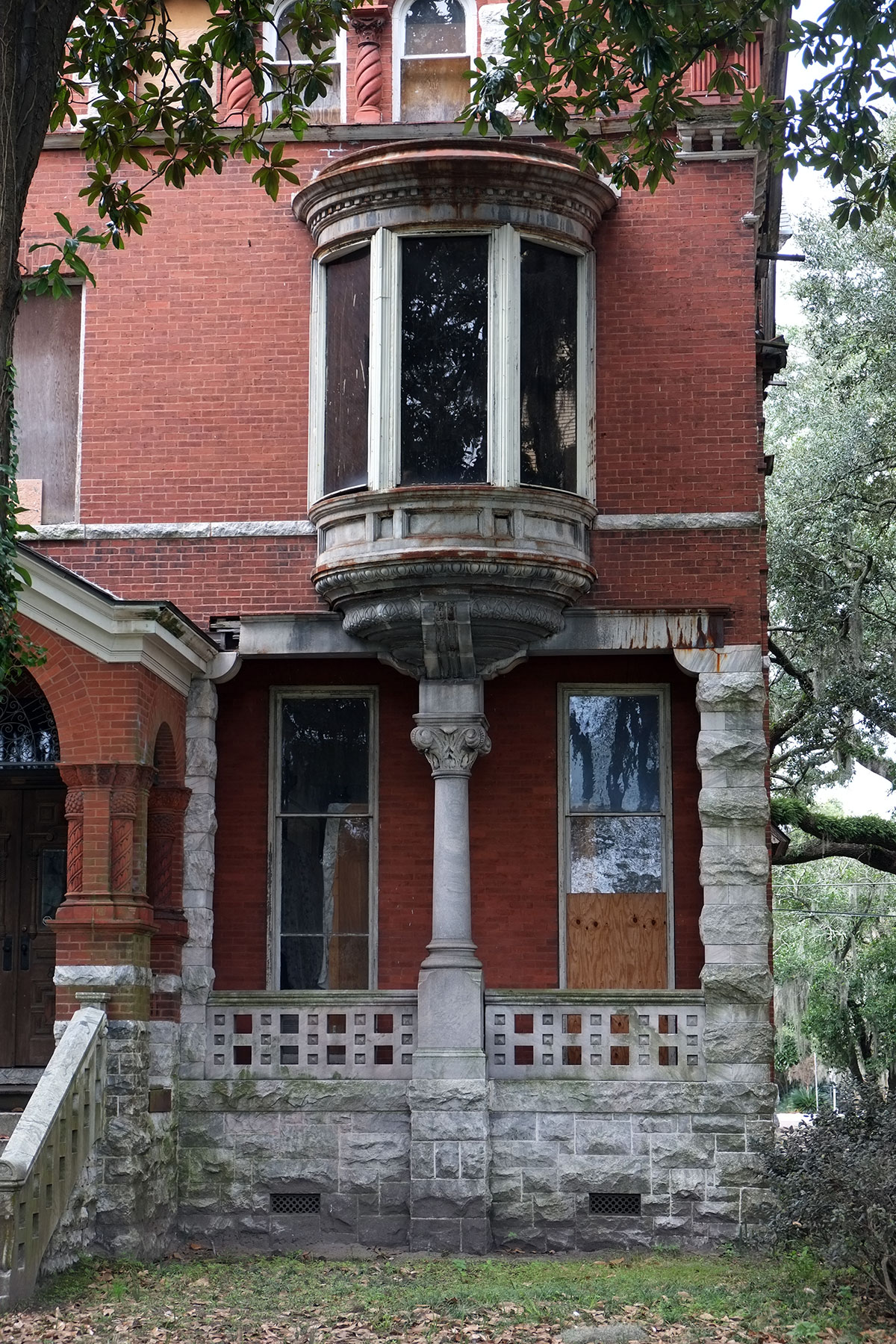
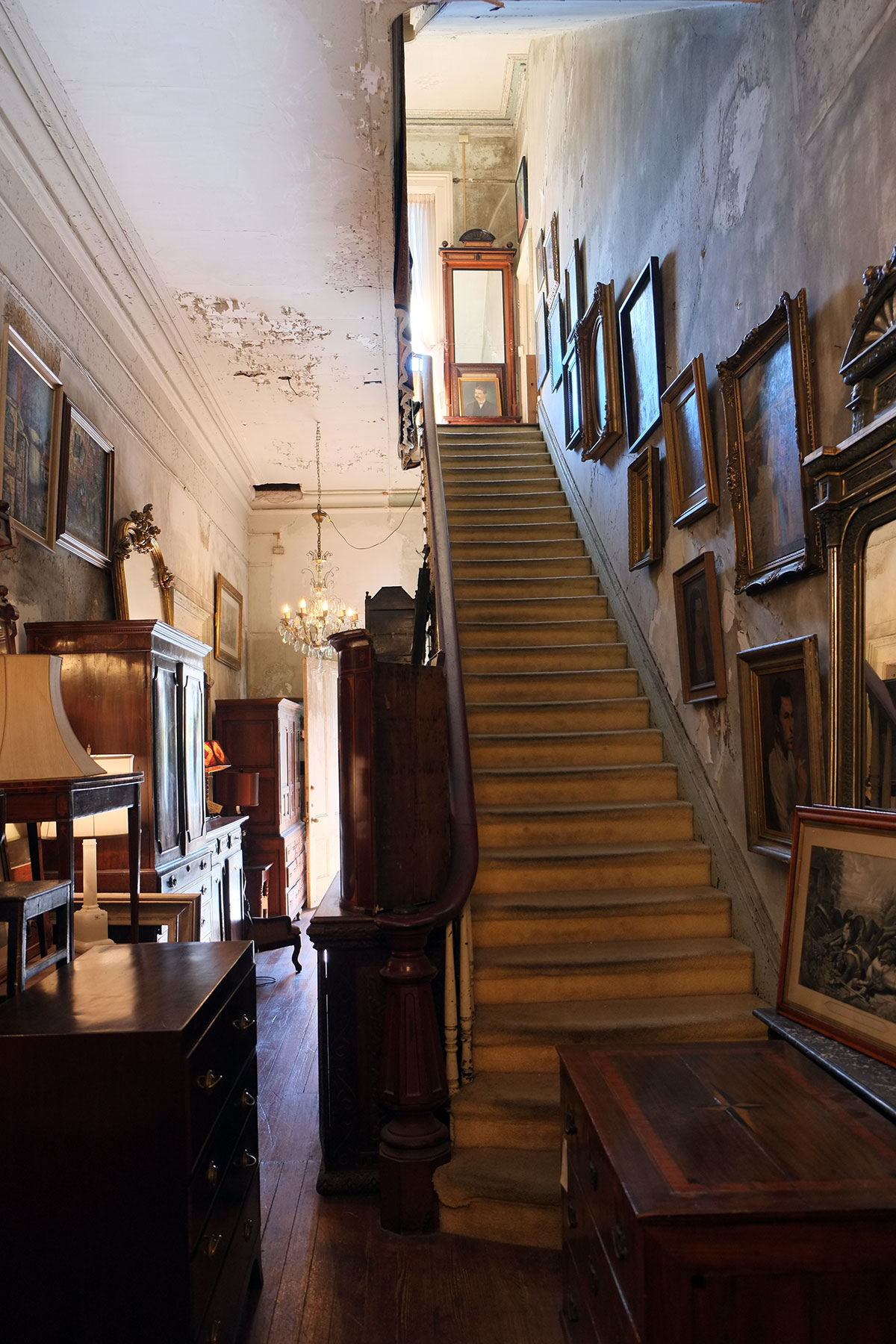
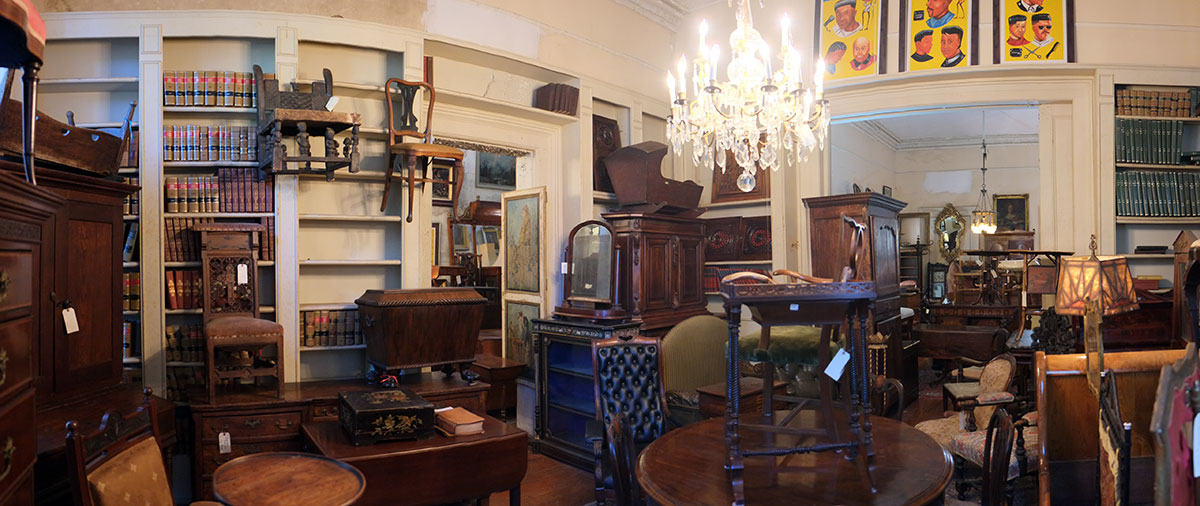
Our favorite building in Savannah is the Alex Raskin antique store.  Housed in one of the largest townhouses in the city, it is gorgeously unrestored, owned by a former New Yorker, packed with furniture and cool stuff, and gives you a free glimpse of what such a house is like inside.  Partial as I am to Southern decay, I like seeing a house that isn’t all tastefully tricked-out, and where you have to listen to a guide drone on about genealogy.  DSCF9706  DSCF9708

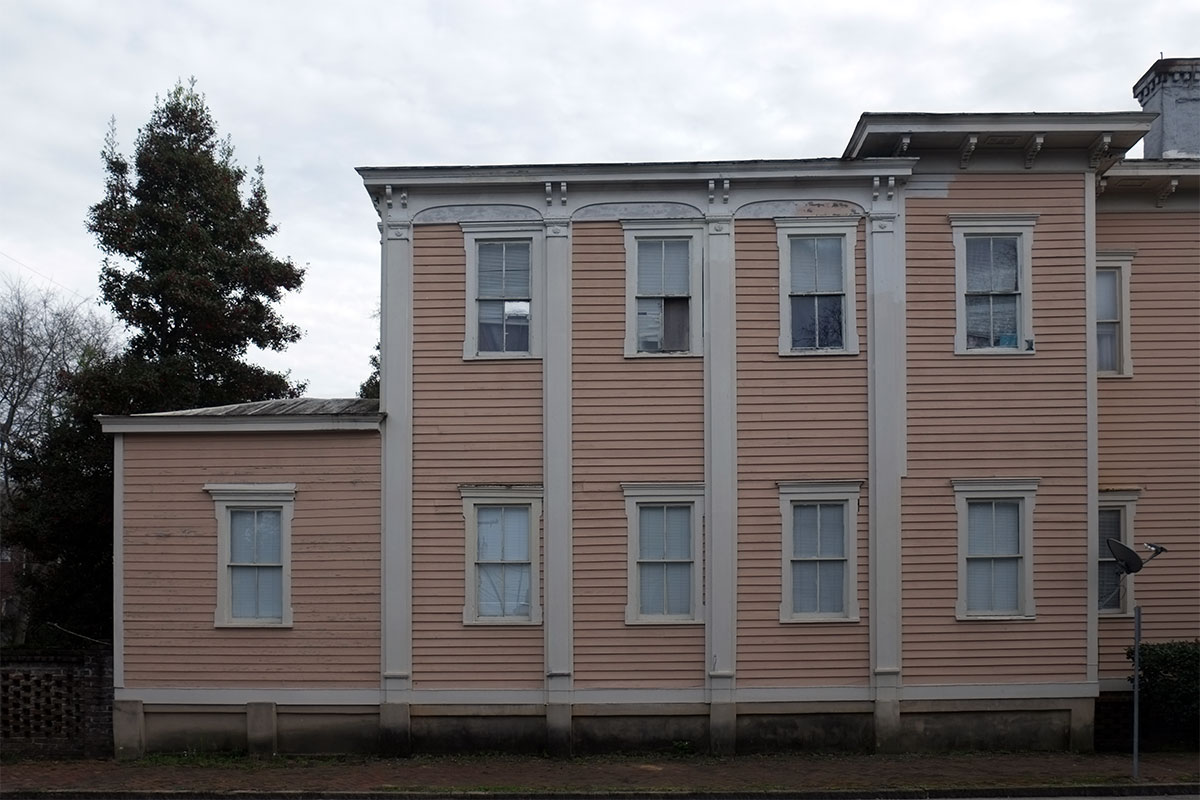
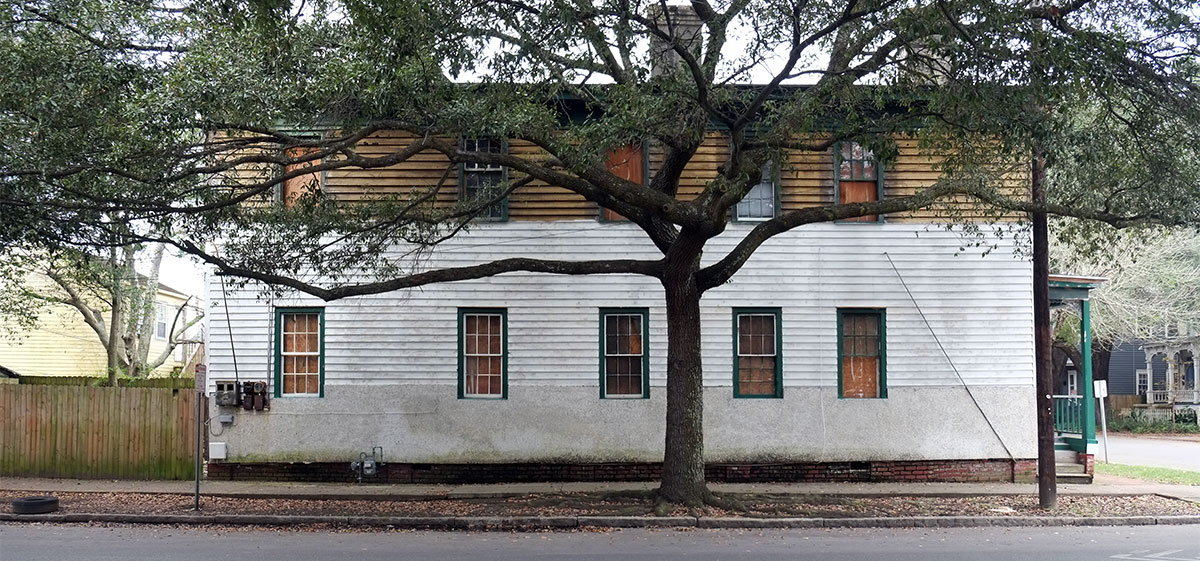
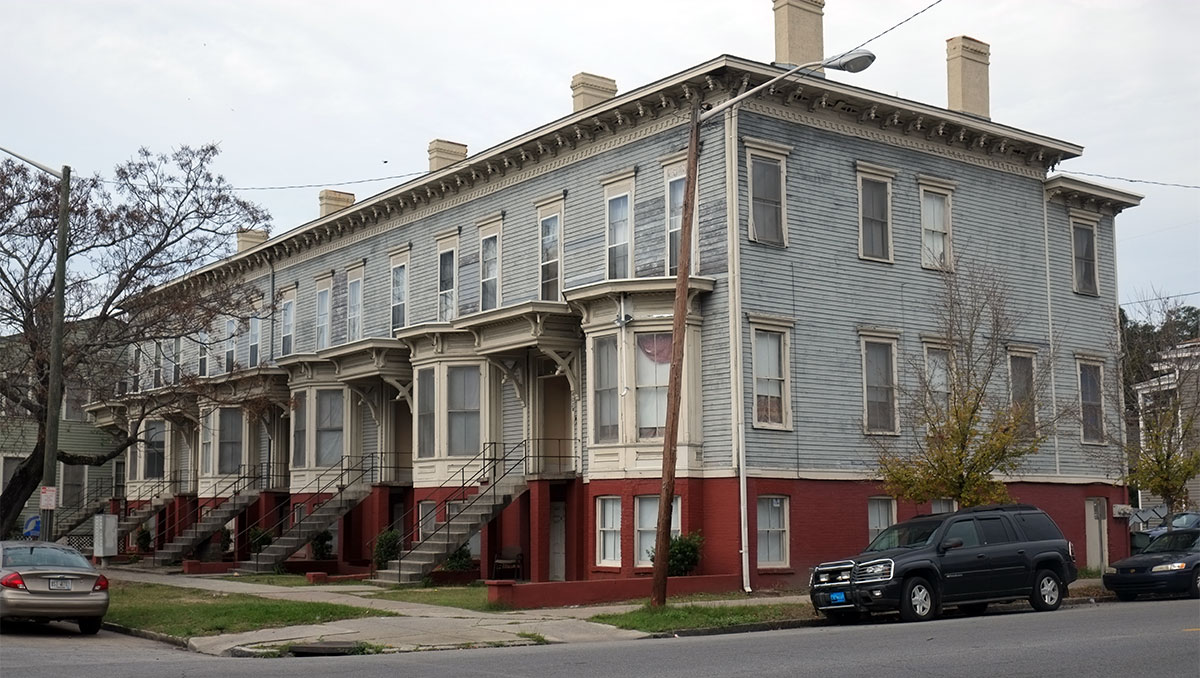
We also walked through many of the 19th-century neighborhoods which flank the large city park to the south of the historic core.  They don’t have the same ward system with squares, but they are good neighborhoods with a variety of styles of frame buildings.  DSCF9506  DSCF9485Older housing is being restored in these neighborhoods (for those priced out of the core), and new buildings are being built in historicist styles.DSCF9489

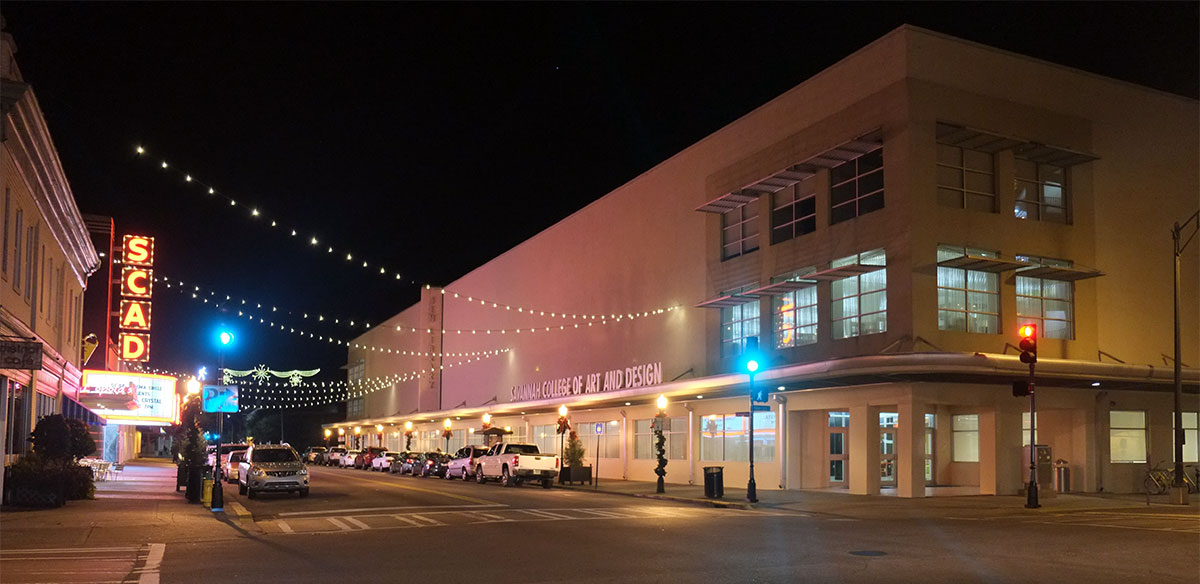
Savannah isn’t completely frozen in time.  SCAD, the Savannah College of Art and Design, has purchased many old buildings throughout the city to house its scattered-site school, and the presence of the school really contributes to the vitality of the city (especially compared to all the other beautiful southern cities which seem to be inhabited solely by affluent retirees).DSCF9839

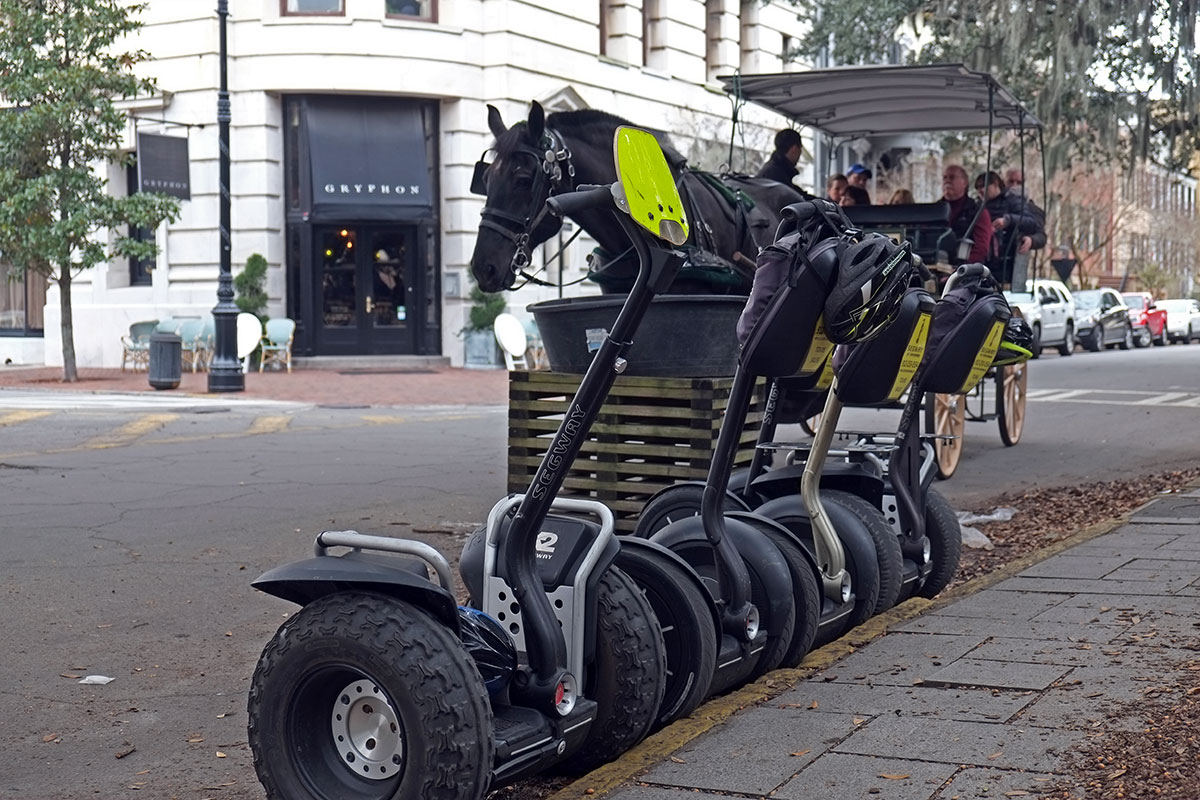
And new transportation technologies are competing with the old.  DSCF9543

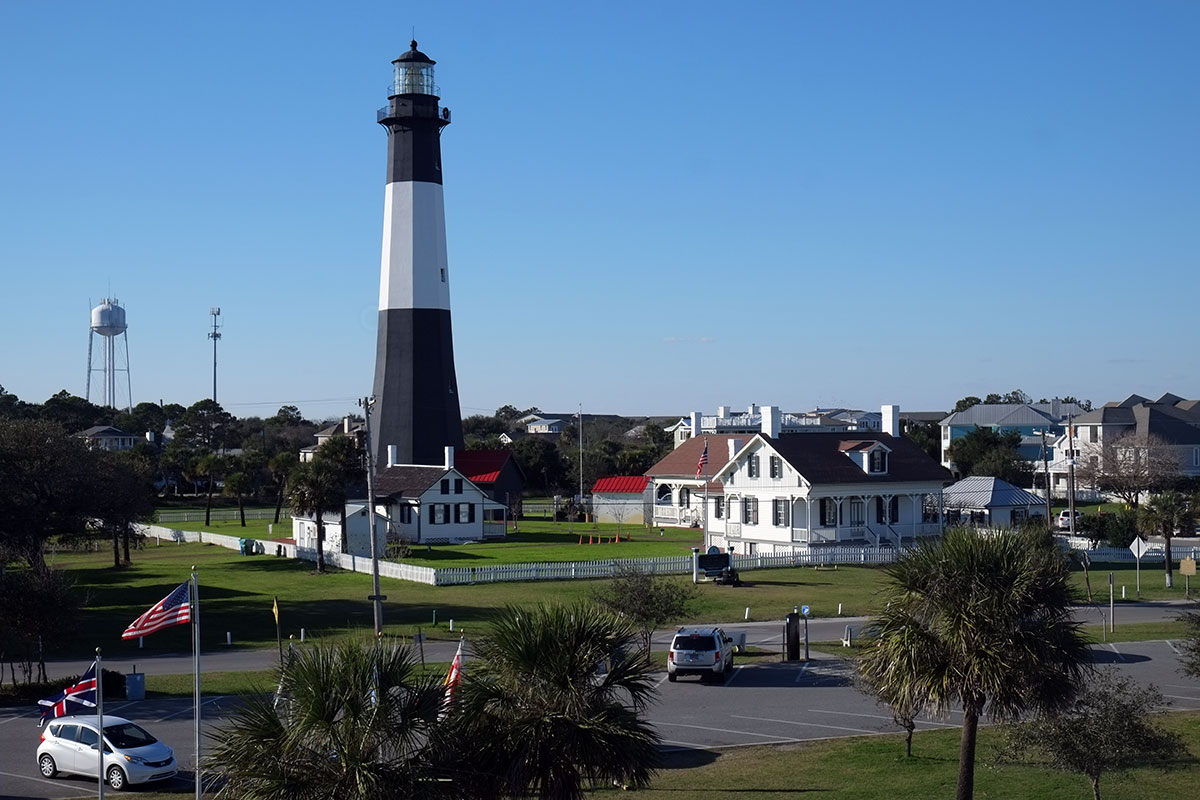
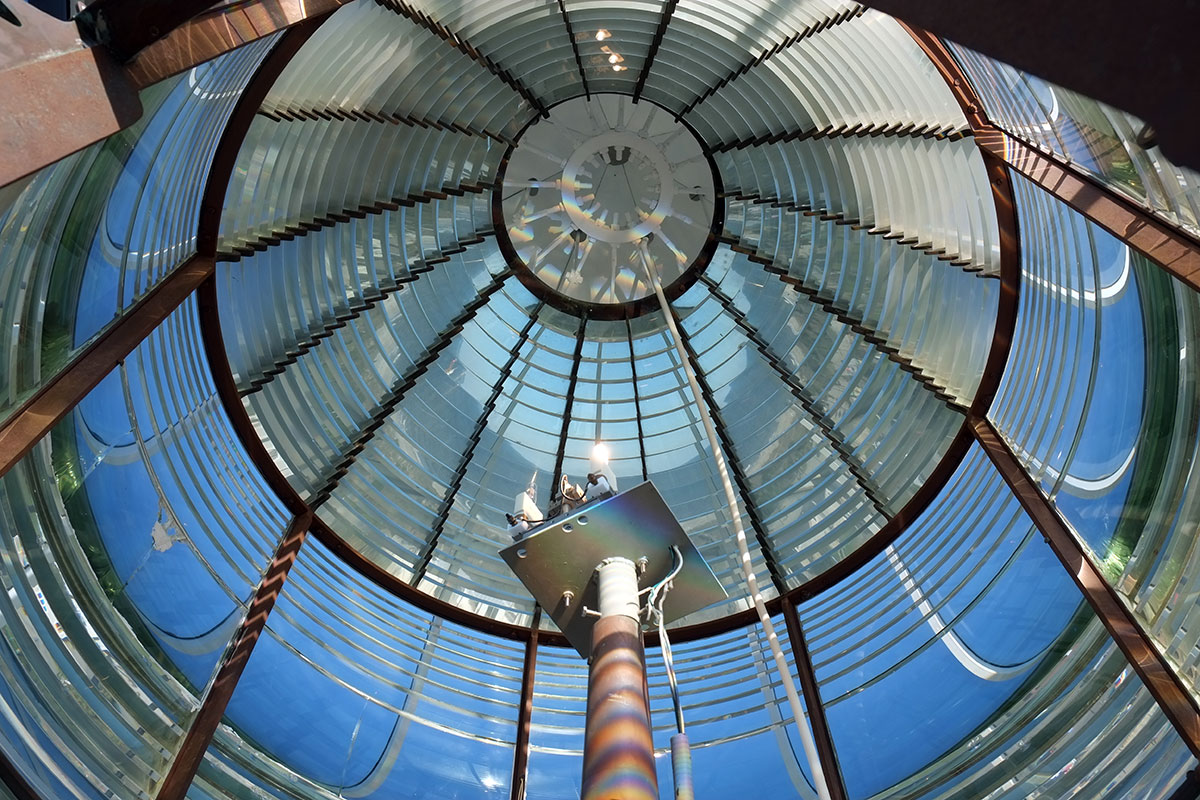
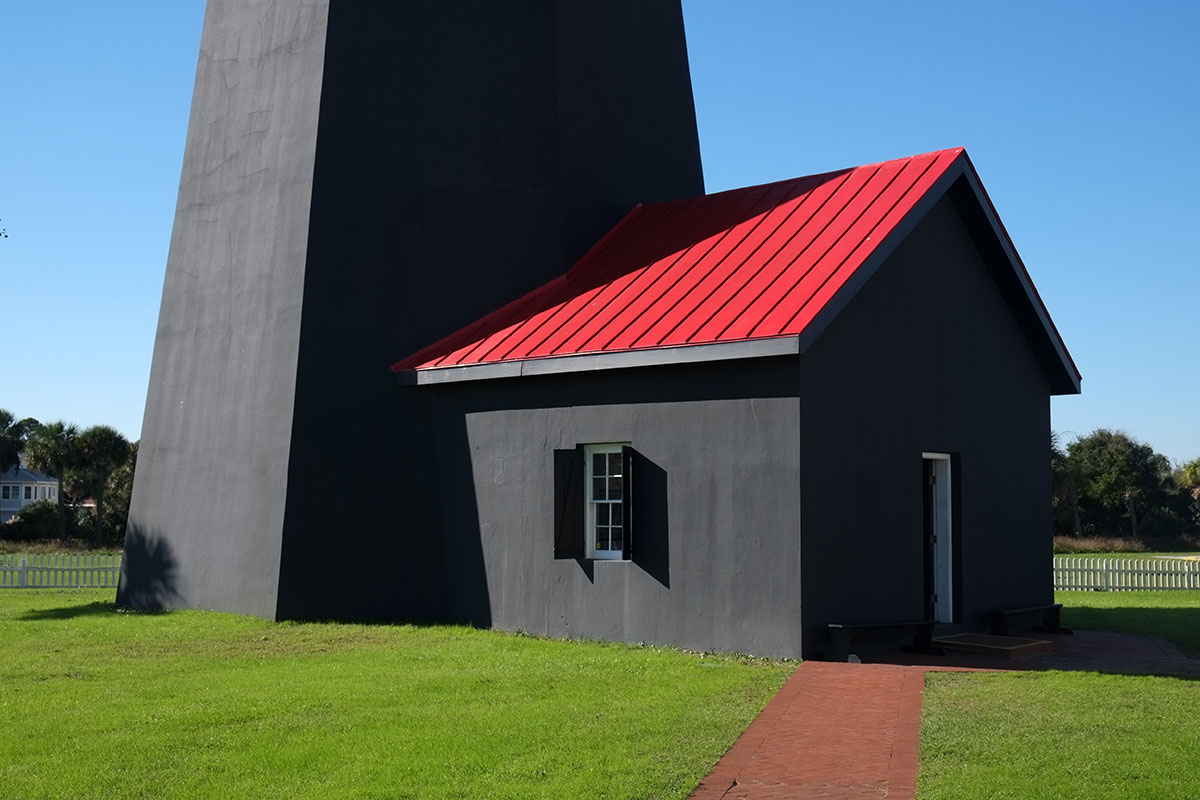
Having covered the core of the city on several trips, we ventured out to the coast this time, to Tybee Island, an interesting beachfront town that used to be a prominent resort area.  The lighthouse at the mouth of the Savannah River seemed very tall to us Northwesterners, used to short lighthouses on tall cliffs.  DSCF9654  DSCF9621  DSCF9603

Our march through beautiful old Southern cities continues, with several more yet to come.

UO grads

Visiting your former grad students is different from visiting friends you knew earlier in life.  High school friends were really just kids, so seeing those friends four decades later is somewhat hilarious – you can’t believe they’re really grown-up, with grandkids and such; you keep expecting them to burst out laughing that they’ve been putting you on.  College friends are not quite as unbelievable, as you knew them as they were starting to invent their grown-up personas.  But seeing my former students as grown-ups doesn’t seem weird at all – they were already young adults in grad school, and they often were pretty far into setting their life’s course.  So seeing them on this trip just feels like touching base with a more experienced version of the person you already knew.

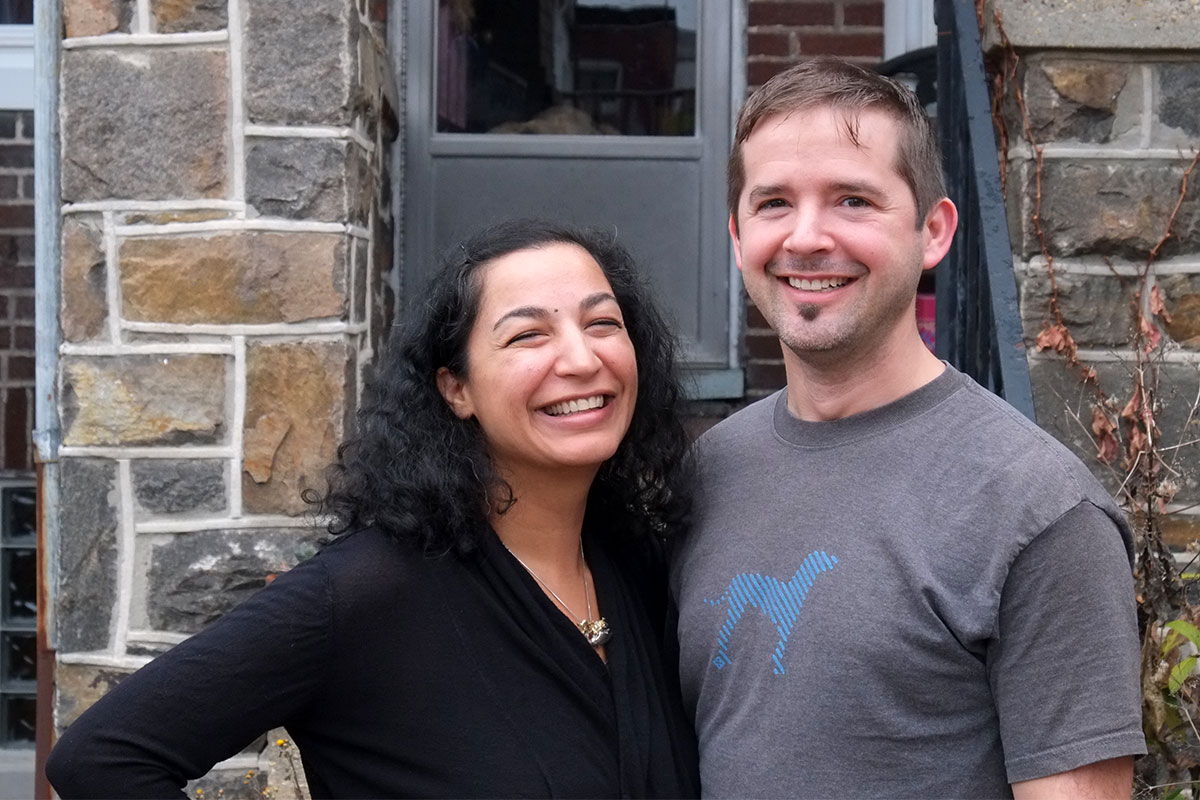
DSCF5927I first met Neelab Mahmoud when she was a GTF in our big lecture class on Place and Culture.  She led undergraduate discussion sections, where she was a great teacher, and helped us think through assignments and directions for the course.  Neelab’s input always had a wisdom and thoughtfulness that belied her relatively young age – she was very open to everyone else’s perspectives, and was great at making connections amongst them.  As I got to know her better I started to understand where these traits came from – her family had been refugees from Afghanistan when she was a child, and settled near Washington DC.  Neelab had the insights that can come from being between two cultures, and the need to make your way in a very foreign place.  She understood the relativity of many things others take for granted, and was superb at getting her students (and professors) out of their comfortable boxes.  In the nicest way possible.

Neelab was in my housing thesis studio the next year, where her work was visionary.  Her background had been in biology – so it was clear the rational and analytical side of design would be taken care of – allowing her to focus on the more expressive and intuitive aspects.  She was willing to follow a train of thought without knowing where it would lead – a remarkably confident way to work.  In the end her project was beautiful, accommodating and appropriate.  Not exactly the kind of work that tends to get built, but the best kind to pursue in school, where you can explore ideas that you can later put into practice.  The only problem with having Neelab in studio was that she was just too interesting to talk with about many things, and it made focussing just on architecture difficult.

After school Neelab and her husband Ben moved to San Francisco, where she worked for Pyatok Architects, a leading housing design firm.  They then moved to Baltimore so Ben could attend engineering grad school at Johns Hopkins, and it’s there they’ve stayed.  Neelab has her own practice, Studio Marmalade, and has been teaching a wide range of courses as an adjunct at Morgan State University for six years.

DSCF5924

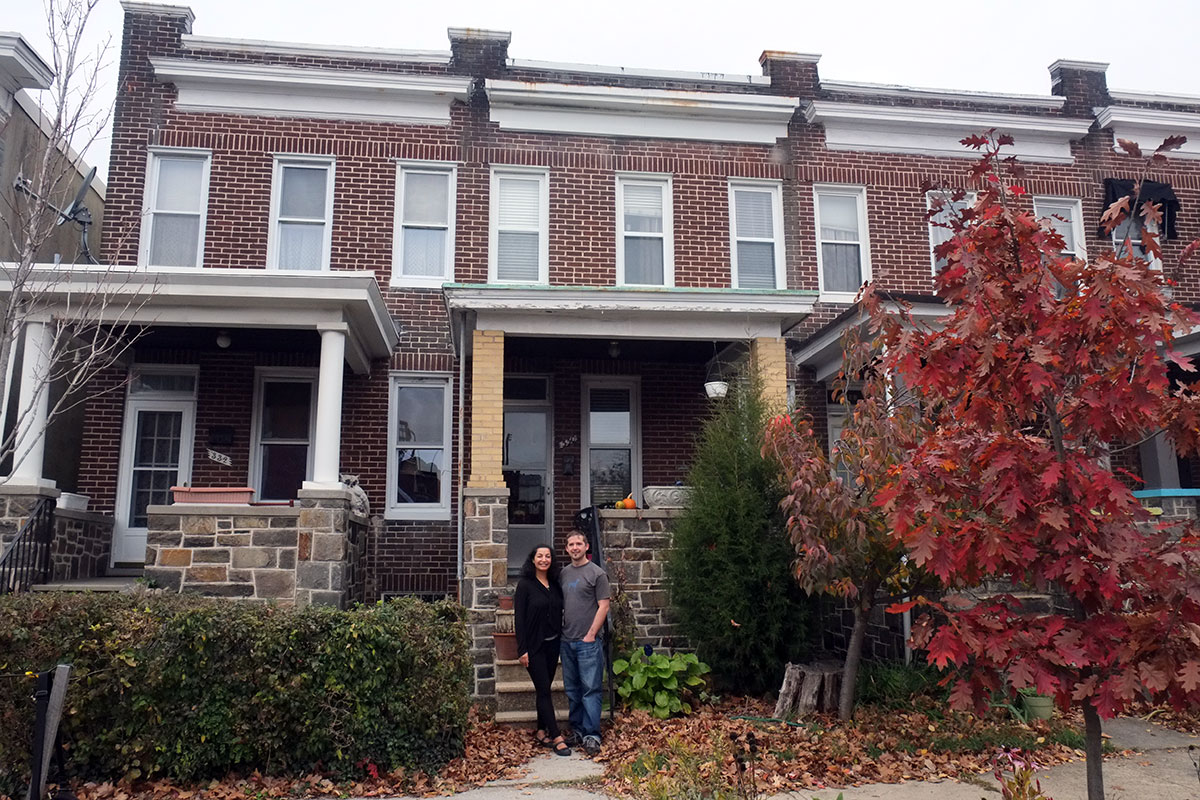
We stayed with Neelab and Ben in their classic Baltimore rowhouse, north of downtown towards Johns Hopkins.  It was interesting to hear about their decision to live in a central city location, their commitment to the city and to their neighborhood and schools.  I was a little apprehensive about parking the trailer in a big, tough, eastern city (as I’ve noted, most of my understanding of Baltimore comes from The Wire), but Neelab just said, In case you get there before me, I’ll leave the key in the mailbox, and don’t worry about the dog – he barks ferociously, but he’ll just lick you once you come in.  A somewhat crazy middle-aged Deadhead chatted with us about our trailer as we parked it, and the nice, very old man on the porch next door conversed with us about the weather as we fished out the key,  Jeti the dog did indeed lick us, and everything was copacetic.

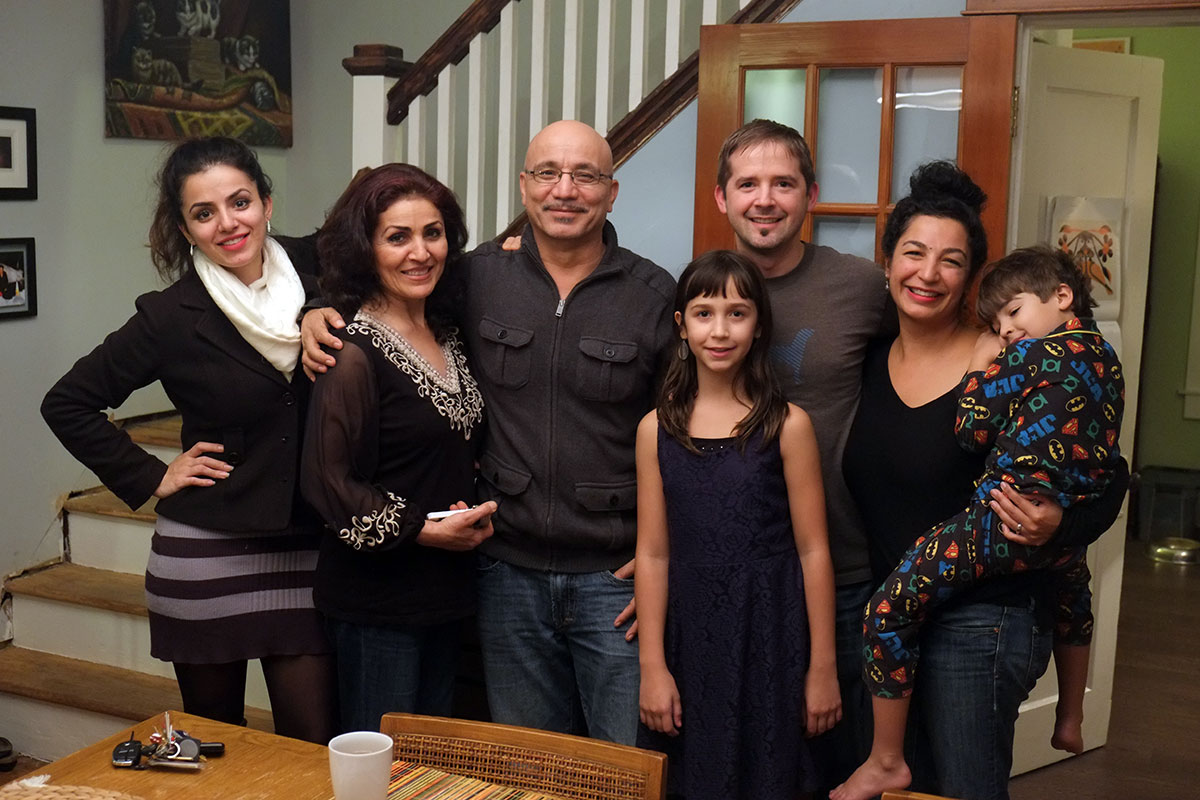
The coolest thing about staying with Neelab and Ben was getting to meet their kids.  I’d watched Ava and Kai grow up on Facebook, so I thought they’d be great, but they were just a pleasure every minute.  Greta and Ava clicked in about two minutes, recognizing each other as members of that same sorority of cool smart girls who read all the time.  (Greta is keeping a scoreboard from this trip.)  And Kai is perhaps the sweetest five-year-old boy I’ve ever met (but I’m partial to little kids who want to hug me after knowing me for a couple of hours.)  Greta and I both seem to need a fix of little kids every once in a while – staying in campgrounds in the off-season, you are hanging with old people.DSCF5910We really enjoyed meeting even more of Neelab’s extended family.  Her cousin Rahiba was staying with them too as she settled in to Baltimore, and we spent an engaging evening drinking Manhattans and talking.  This was when the news about the refugee crisis in the Mediterranean was peaking, and I learned a lot from the perspective of two young women whose families had both been immigrants to this country, at different times.  The next night Rahiba’s parents came by, and we had supper with them all.  It was a lot like graduation, when you get to meet your students’ families, but a lot more fun and intense.  We had a great time with Neelab and all her family members, and were sorry to leave as winter pushed us southwards.

Chris Harnish graduated from the UO a couple of years before Neelab.  I never had him in studio, but he was in my housing course after I moved back to Eugene from Portland.   But more than in class, you got to know Chris from wandering Lawrence Hall.  There are some people who are just a presence in a place – outgoing personalities, rapid-fire thinking, a strong sense of humor, and into everything.  Chris was one of these, so getting to know him was more a series of chance encounters and random conversations.

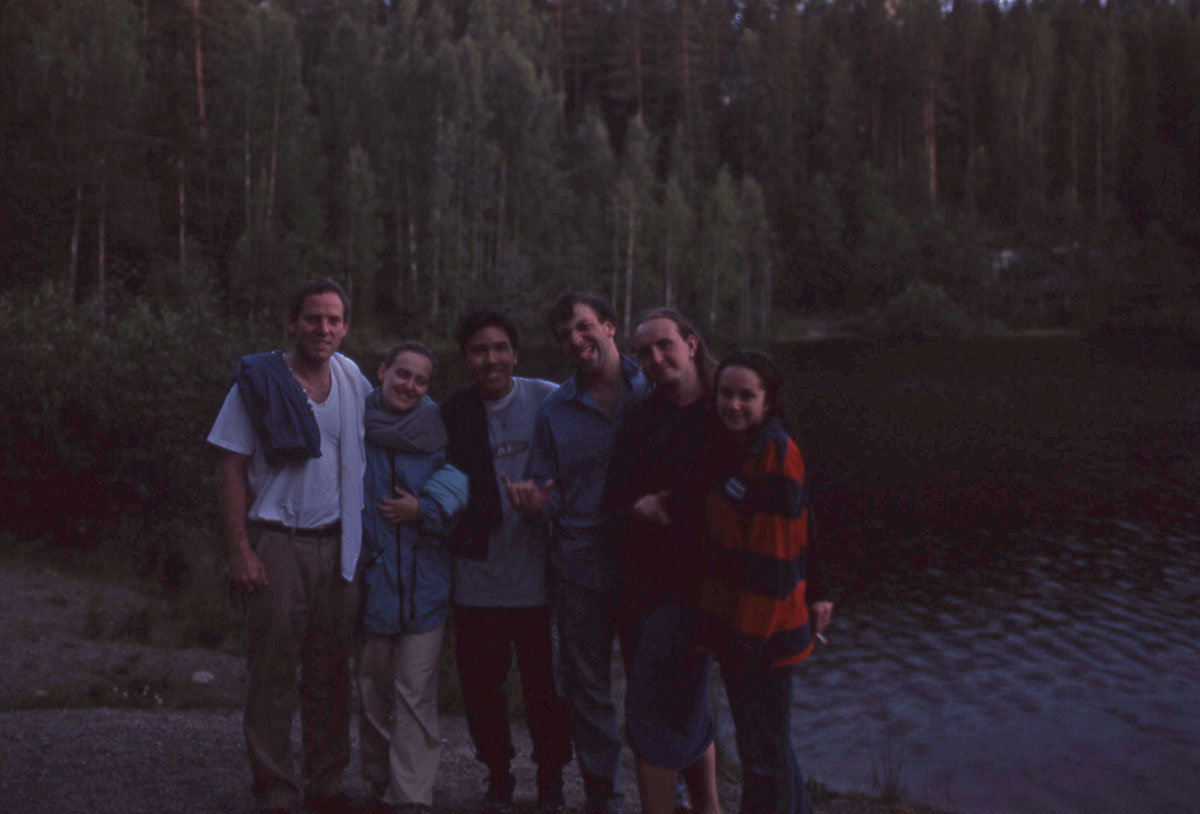
My quintessential Chris story comes from when Linda and I were travelling through Scandinavia on a bus with students from the summer architecture program at the DIS in Copenhagen.  Chris was part of the group, an enjoyable companion for such events as sauna-sitting and lake-jumping in the middle of the night in Jyvaskyla. DIS104aThe tour visited Alvar Aalto’s summer house at Muuratsalo, and on our way to the house, we passed by the sauna, a simple vernacular structure, not a modernist icon.  As we continued on to the house, we heard a large splash, and turning back, found Chris in the lake.  He smiled up at us and said, Aalto swam here, I have to swim here.

After school Chris moved to New York and worked for Deborah Berke’s excellent firm for about five years.  He then joined up with Architecture for Humanity and went off to work in South Africa.  This started him on what has continued as a significant part of his career, and he has maintained his connections there and continued to visit and work on projects.  During this same time he moved to Philadelphia, and began teaching at Philadelphia University, with a focus on sustainable and community-focussed design.  He and his wife spend their time renovating an old townhouse in downtown, and we caught him for a quick couple of drinks as we breezed through Philadelphia.DSCF5681

It was fun hearing about his recent life, and his experiences in teaching.  Learning about your former students’ work in architecture is great, and it helps keep me in touch with what is happening in the profession.  But spending time with those such as Chris, Neelab and Lynne Dearborn, who have gone on to teaching careers, is a different experience.  (I guess this is how most professors feel about their grad students, who are all aiming at academic careers, but in architecture, very few students are.)  So talking with those who’ve somewhat followed in your footsteps is very gratifying, and I like to think that the experiences they had at the UO might have helped make them the teachers they are today.

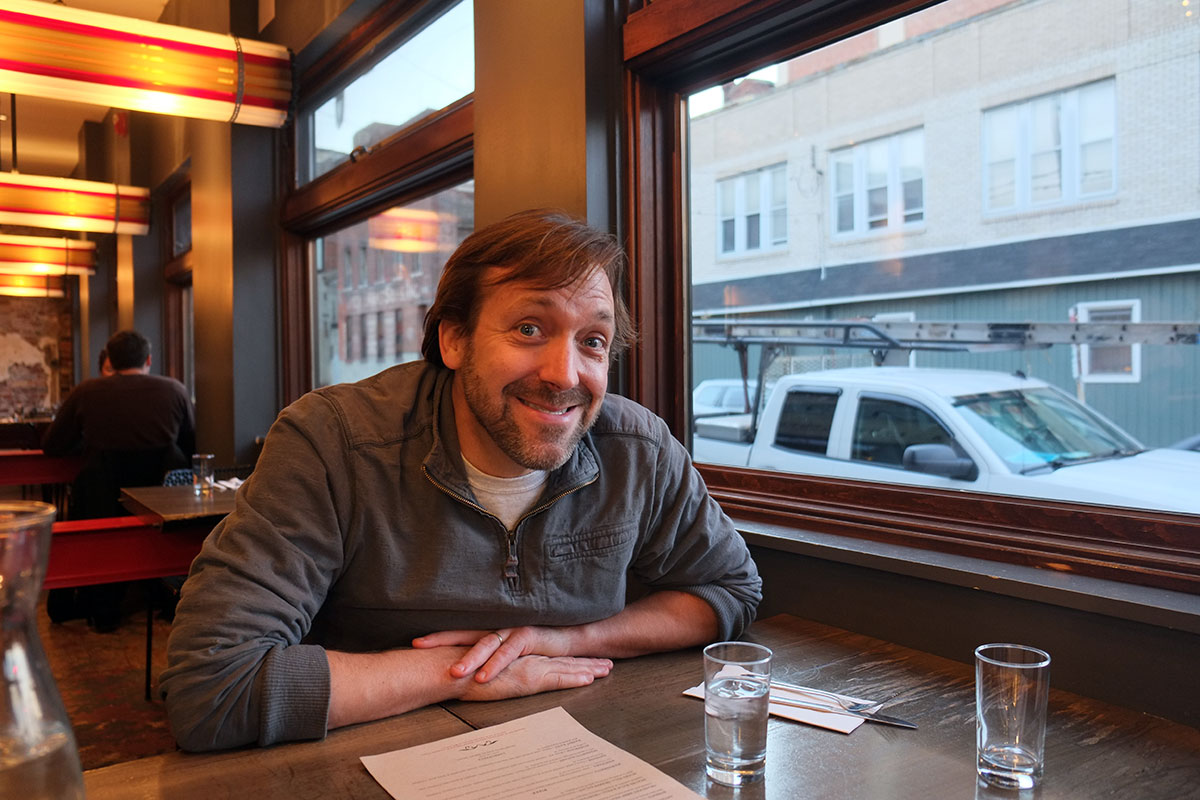
Evan Goodwin is of a different generation from the previous two grads. Evan was in my housing thesis studio this past year, so while in Savannah we got to check up on his transition to the outside world.  Evan grew up in South Carolina and went to Clemson as an undergrad, where he developed some of the most remarkable graphic abilities I’ve seen in years.  The first thing I noticed about Evan (besides his charming personality) were his drawings, a predominantly pen-and-ink style that made me think he was the reincarnation of a 1970s architectural illustrator (all this is visible on his website at evanrgoodwin.com).  The second thing that struck me about Evan was the rigor of his thinking, as he applied these graphic skills in series of small-scale typological studies that systematically explored a range of spatial concepts.  Seeing clear thinking beautifully presented is one of the pleasures of being an architecture professor.

Evan did great work in my studio and elsewhere in the department (he was also in Linda’s furniture studio), but he didn’t neglect the social aspects of grad school life.  He lived with a large contingent of his classmates (I could never figure out exactly how many) in a big house right down the hill from ours, which seemed to become the center of social life for a large part of his cohort, both grad and undergrad.  I’ve gotten old enough that students don’t invite me to parties very often anymore, but Evan and his crew would, and I finally went to their graduation blow-out, which was a much better party than we ever had in grad school.

DSCF9838After graduation Evan decided to move back to South Carolina, and he lives and works in Bluffton, a town on the coast outside Savannah, near Hilton Head.  He’s enjoying the work with his firm, but we could tell he misses the good times in Eugene – social opportunities are minimal in a small town full of retirees.  We dragged Evan into Savannah for dinner at Treylor Park, Greta’s favorite restaurant, where we eventually found out that our waitress was a recent graduate in architecture from SCAD.  Greta and I both liked her, so before we departed, we tried to make sure that Evan had left enough intriguing contact information so that his chances for social interaction might be increased.

Treylor Park

Treylor Park in Savannah, GA has actually accomplished the spectacular feat of replacing Velvet Taco in Chicago as the best food I have eaten on this trip, and second only to Fish Sauce in Portland as my favorite restaurant.  Like VT, it puts a spin on classic foods, like wings or once again, tacos. Everything on the menu sounded so good that we intentionally ordered too much, so we could bring it back to our own trailer park for dinner. This place broke out of the bar food box so spectacularly that it deserved fireworks.

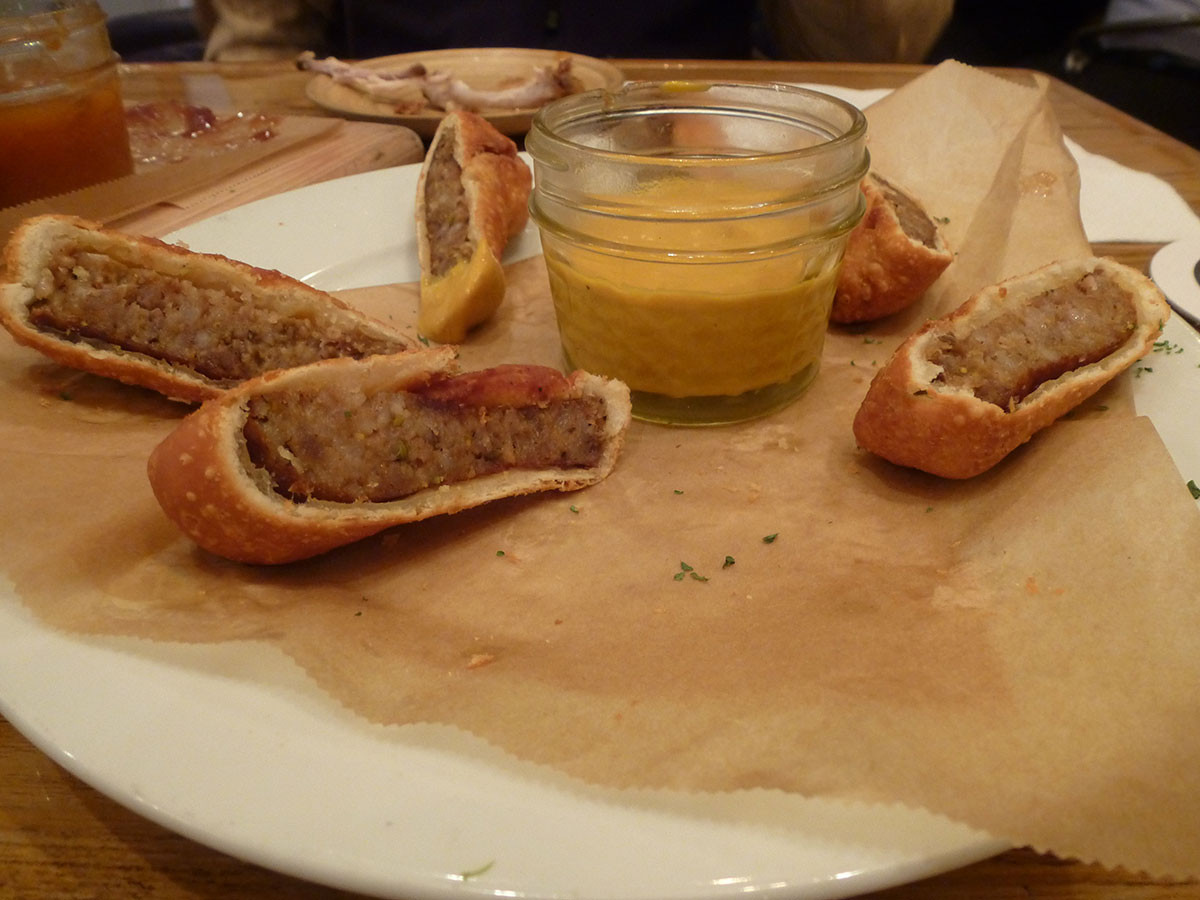
The first thing we tried was pigs in a blanket made with artisanal sausages and dipped in mustard sauce. The biscuit blanket was crispy on the outside, and soft around the meat, which was intensely flavored and delicious. The mustard was the best part in my opinion.

Pigs in a Blanket

Pigs in a Blanket

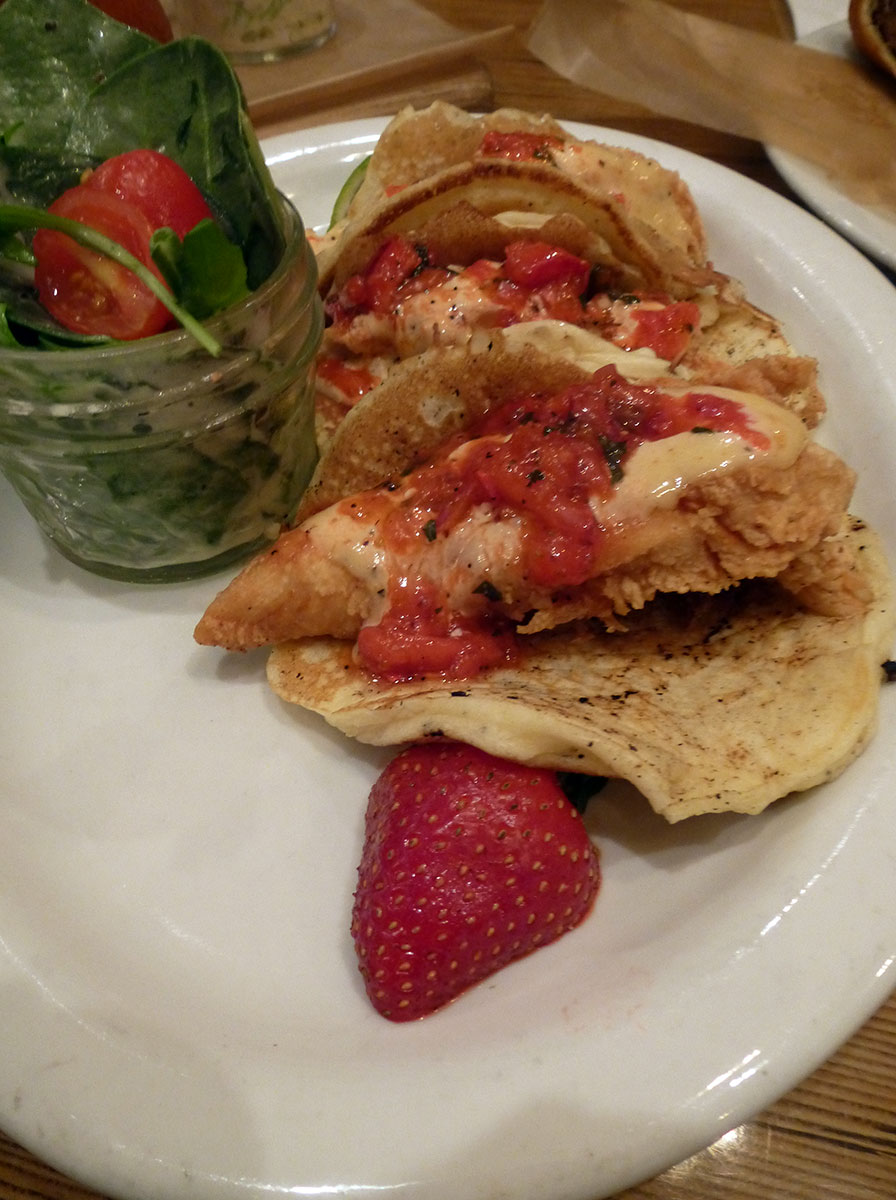
My second favorite dish was the chicken pancake tacos. Lightly fried chicken, slathered with pepper sauce and strawberry salsa, and wrapped in a soft but stable pancake. Sweet was countered with spice, and soft by crunch, all together in the perfectly balanced food.

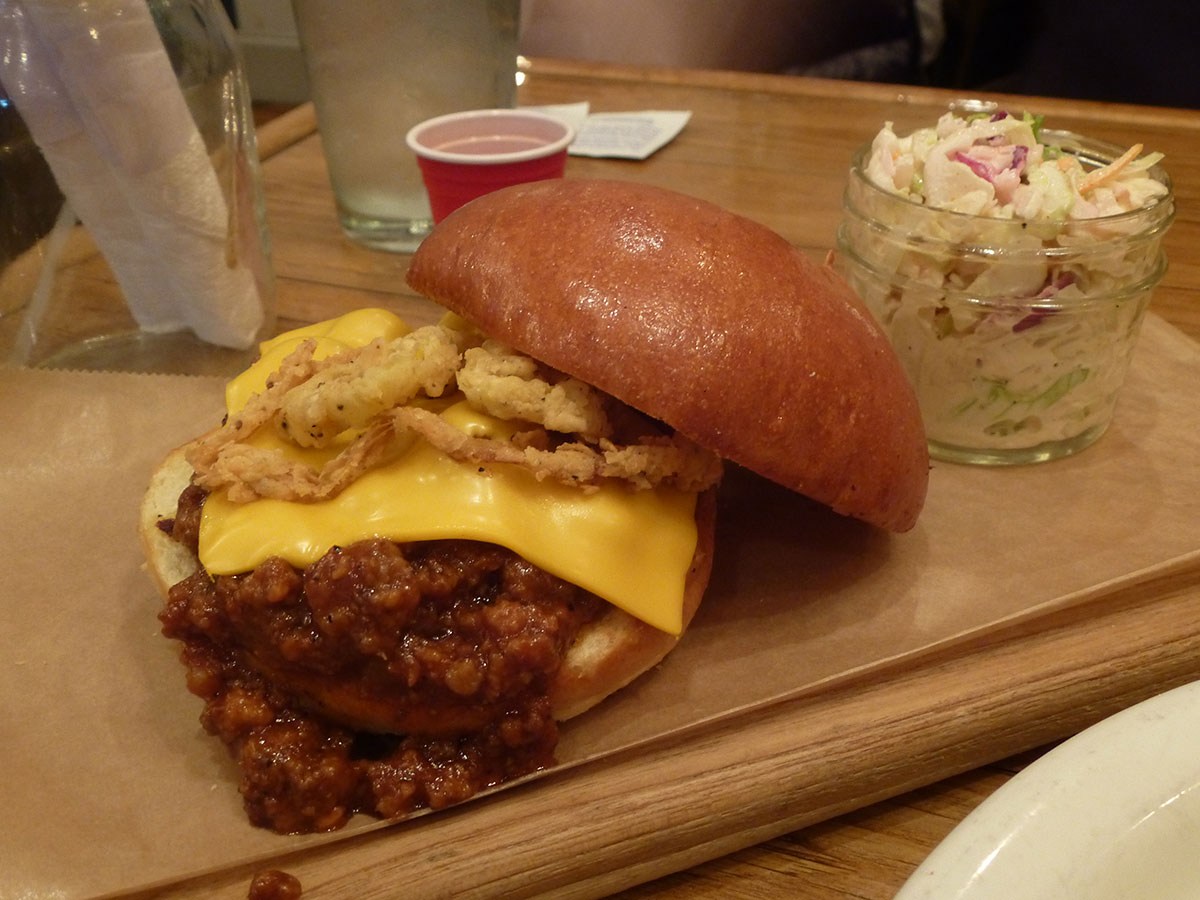
The sloppy joe was more normal, but even that was made with venison instead of beef. I was honestly expecting bleu cheese or something on top, but it only contained normal cheddar. But, the fried onions it came with were actually placed inside the bun, adding crunch to slop in continuation of the theme of balance.

Sloppy Joe

Sloppy Joe

The PB&J chicken wings may have been the most delicious thing I have ever had the pure joy of eating. I know it sounds odd, but it came highly recommended on yelp, and being the strangest thing on a menu of weirdness I felt that it was my duty to try it. I did not regret this decision. Chicken cooked to perfection, coated in a sticky but smooth peanut butter sauce, with peach jam to dip it in. The peanut sauce was so good on its own, that I almost forgot the jelly, which would have been a travesty. The sauce was already pretty sweet, but the extra kick from the jelly pushed it into the realm of gods. I think ambrosia might actually be peanut and jelly sauce.

We literally stayed in Savannah for another day, just so we could come here again. We ordered the wings and the pancake tacos again, and they were just as fabulous as before.

Having seen the nachos last time, we decided we needed some. Instead of chips, they were made with waffle fries. I think this would have been better if they burnt them a little, adding a bit of extra crunch. Softer worked with the pancake tacos because the fried chicken supplied the crunch, but with nothing doing that job here, it felt a little soggy. They also were drizzled with a vinegar sauce. This made them a little too bitter for my taste, especially at the bottom where it pooled.

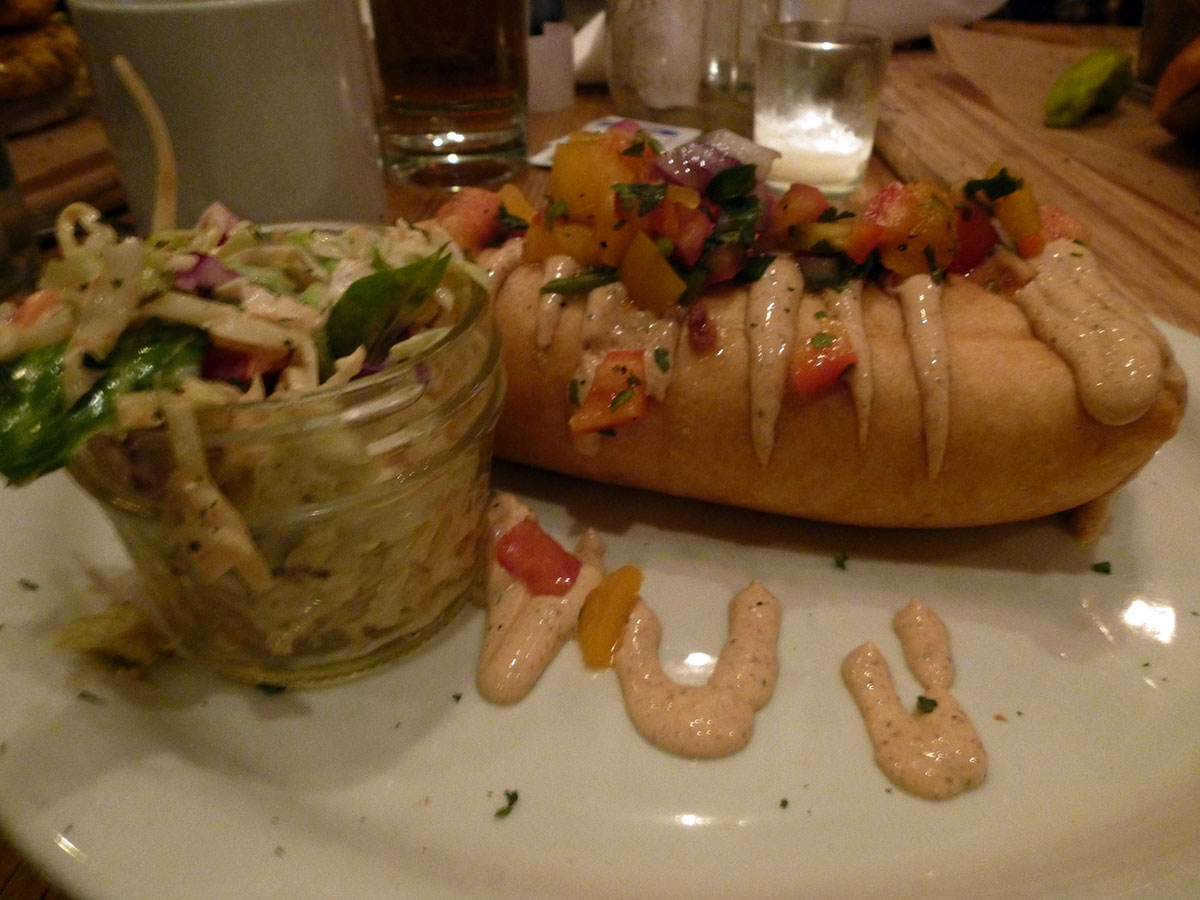
I got the Chupacabra, which I didn’t know was a burrito until it arrived. With something named after a goat-sucking cryptid, I probably should have guessed that this was a bit spicy. I didn’t particularly like it at first, and having already filled up on chicken, I ended up taking most of it back to the trailer. I discovered that it’s much better the next day, with the spices having cooled a little and leaving taste buds for the other flavors.

Chupacabra

Chupacabra

If you’re ever within a hundred miles of Savannah, COME HERE. Come once, and then be so wowed that you have to come back again and again and again. Seriously, I cannot stress this enough. Don’t fall into quaint little tourist trap restaurants like River House where you’ll pay too much for inferiority, go across the street to Treylor Park.