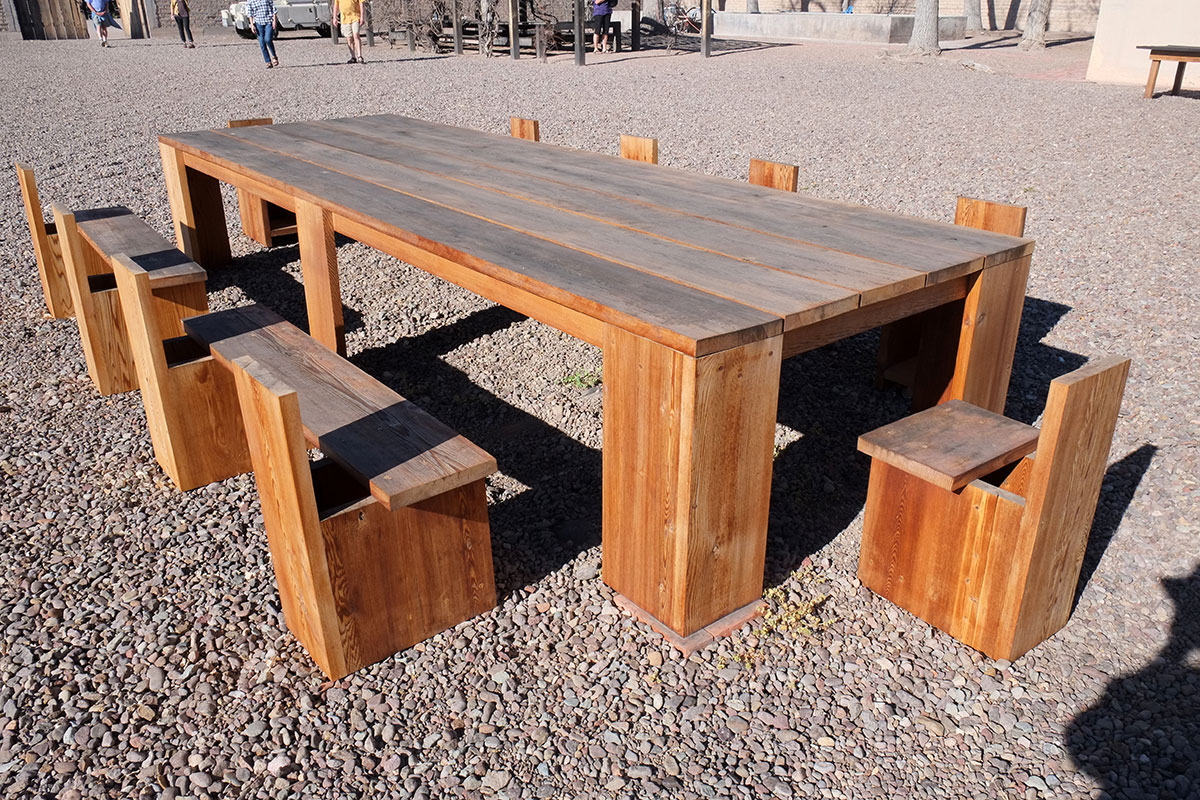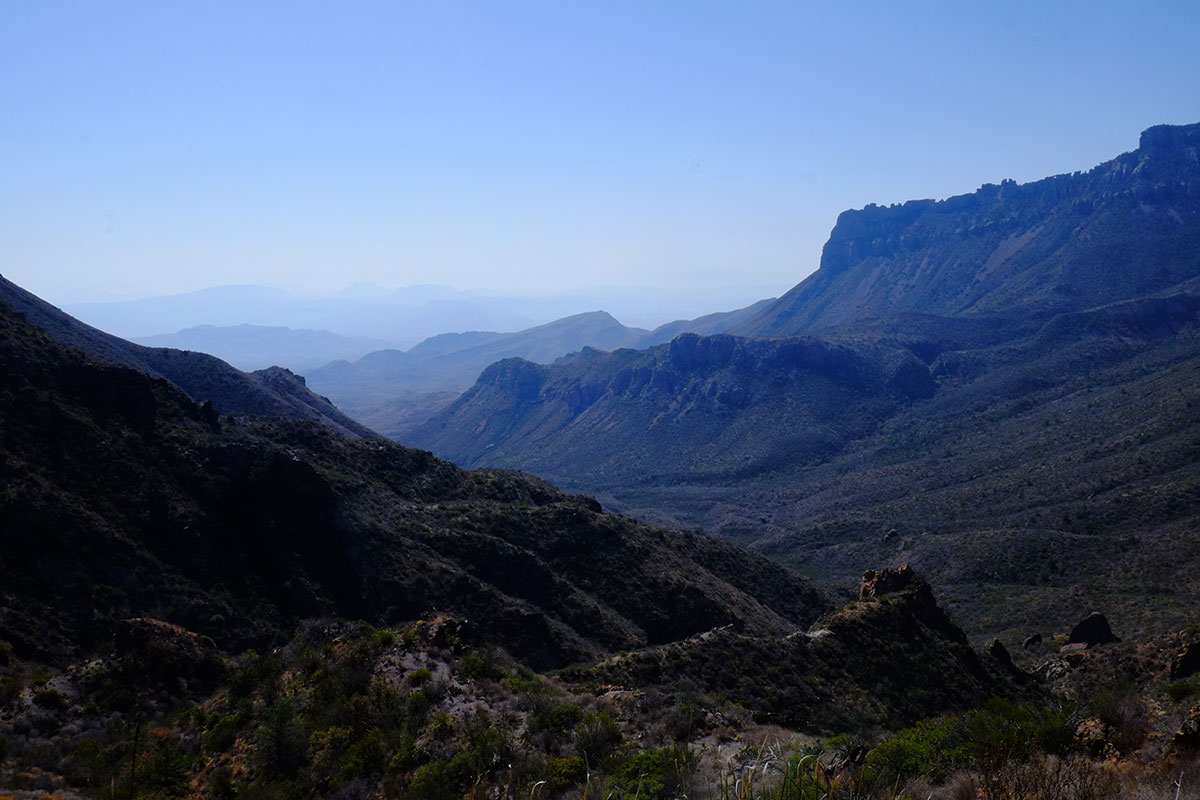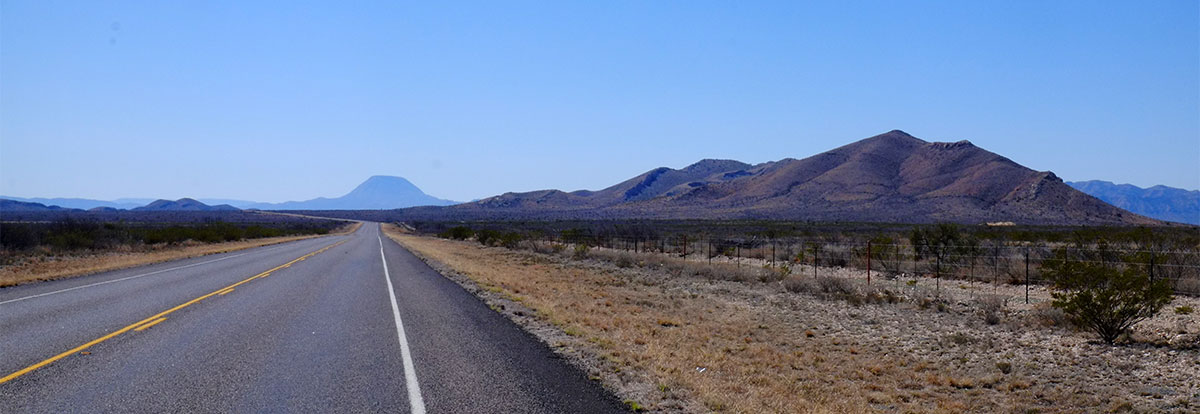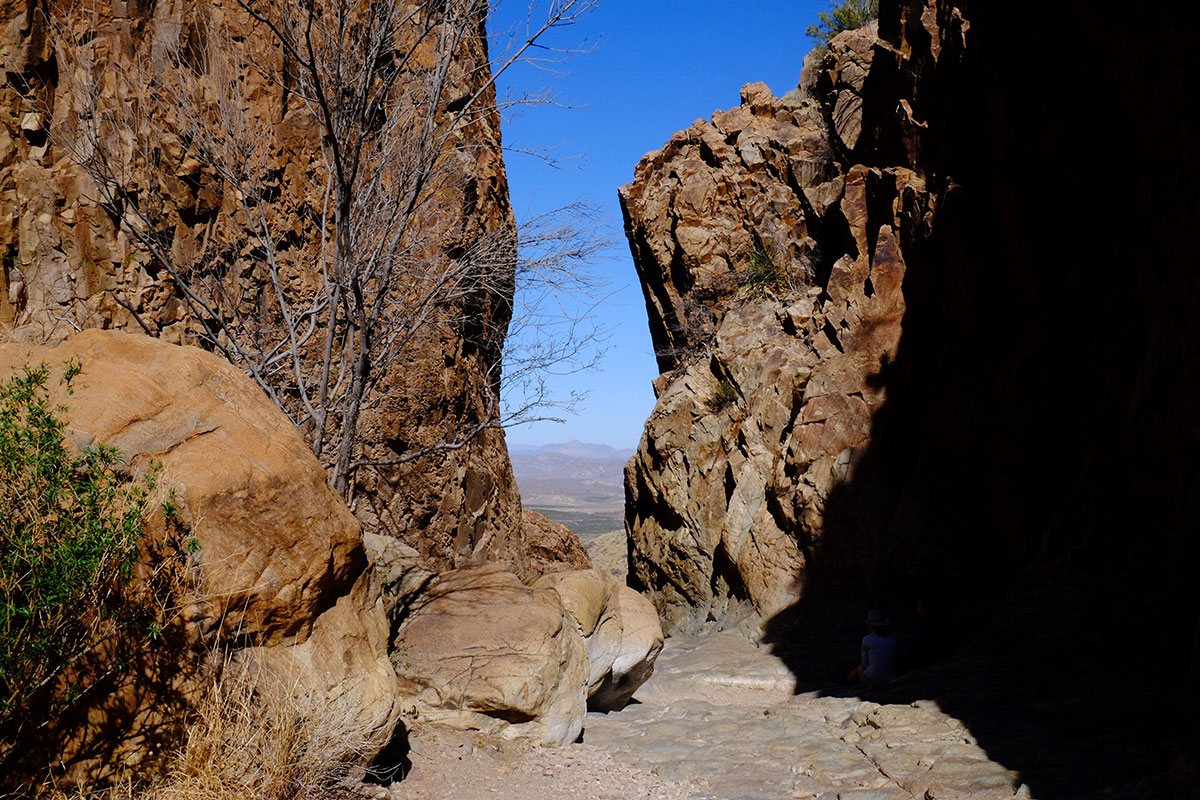
Category Archives: landscape

Saguaro National Park

We are now in the southwest, National Park heaven, where you sometimes find yourselves inside one without even trying. Big Bend was a precursor to this area for us, but now the giant crazy landforms are coming at such a pace that they’re getting their own fast-track on the blog.

Our first experience with National Parks on this trip was in Yellowstone, which we’ve come to think of as an anomaly.  Yellowstone isn’t one place, it’s a lot of distinct places in close proximity – big mountains, geysers and hot springs, wildlife, a big canyon, waterfalls, open plains and lakes, etc.  Most of the Parks in the Southwest seem to be more one-liners.  Of course there are a wide range of ways you can understand them – geologically, ecologically, culturally – but they don’t have the same breadth as Yellowstone.  Greta and I have discovered that our interest in geology lasts for about five minutes, and our interest in botany a bit longer.  We appreciate really cool looking rocks and mountains and plants, but we’re not all that interested in getting into a lot of depth about them.  For us, the distinct experiential character of each park depends upon two items:  what is the Big Concept for each (usually the reason it was seen as being significant and worth preserving), and how can we kinesthetically experience the park by hiking through it.  In the Badlands we realized that we dislike driving around and looking at scenery, but once we get out of the car, the experience of walking or climbing through the landscape is the way we come to appreciate it best.  So those readers who actually know something about rocks and plants will find my observations sophomoric (just as I would probably not be impressed with their insights into architecture).

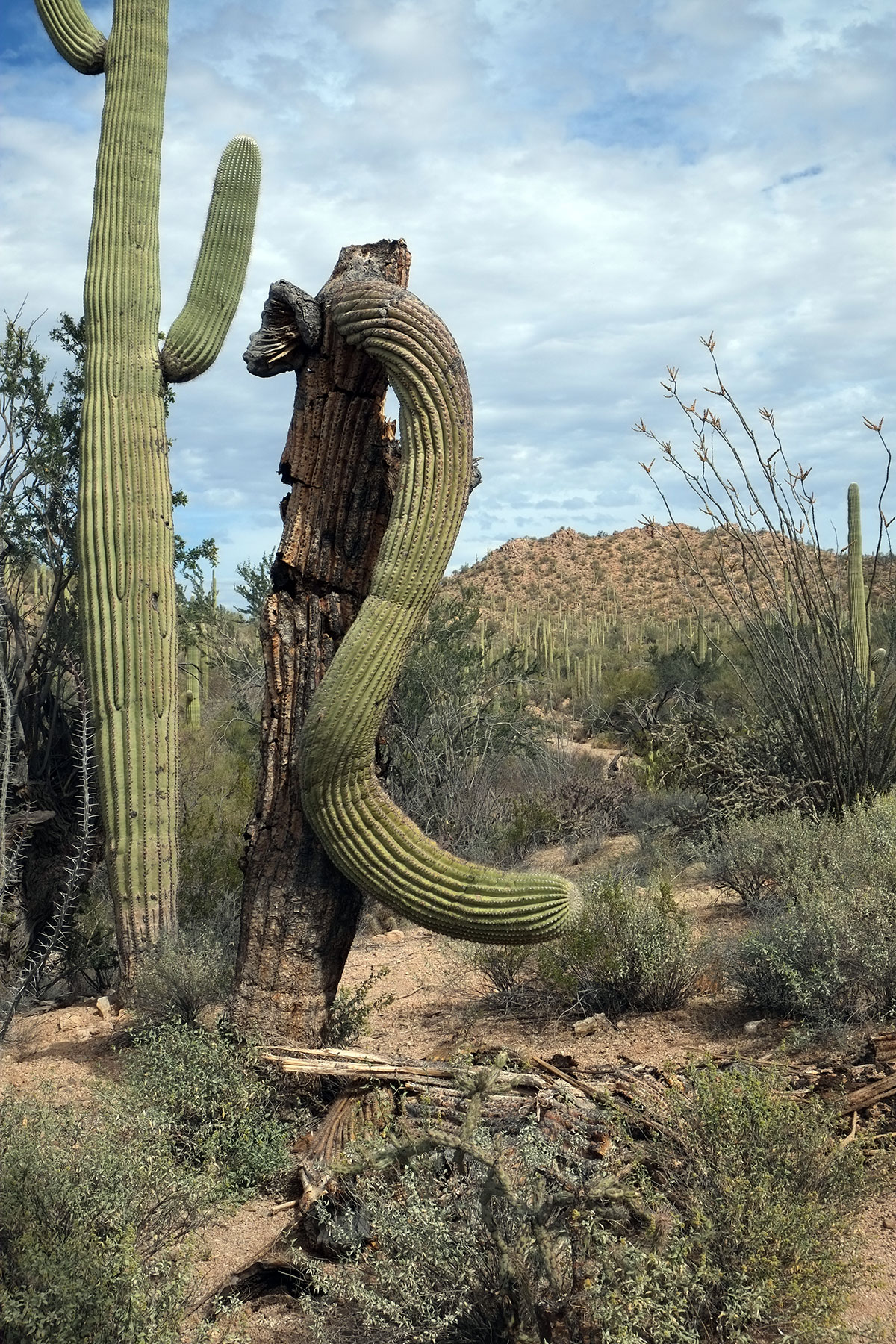
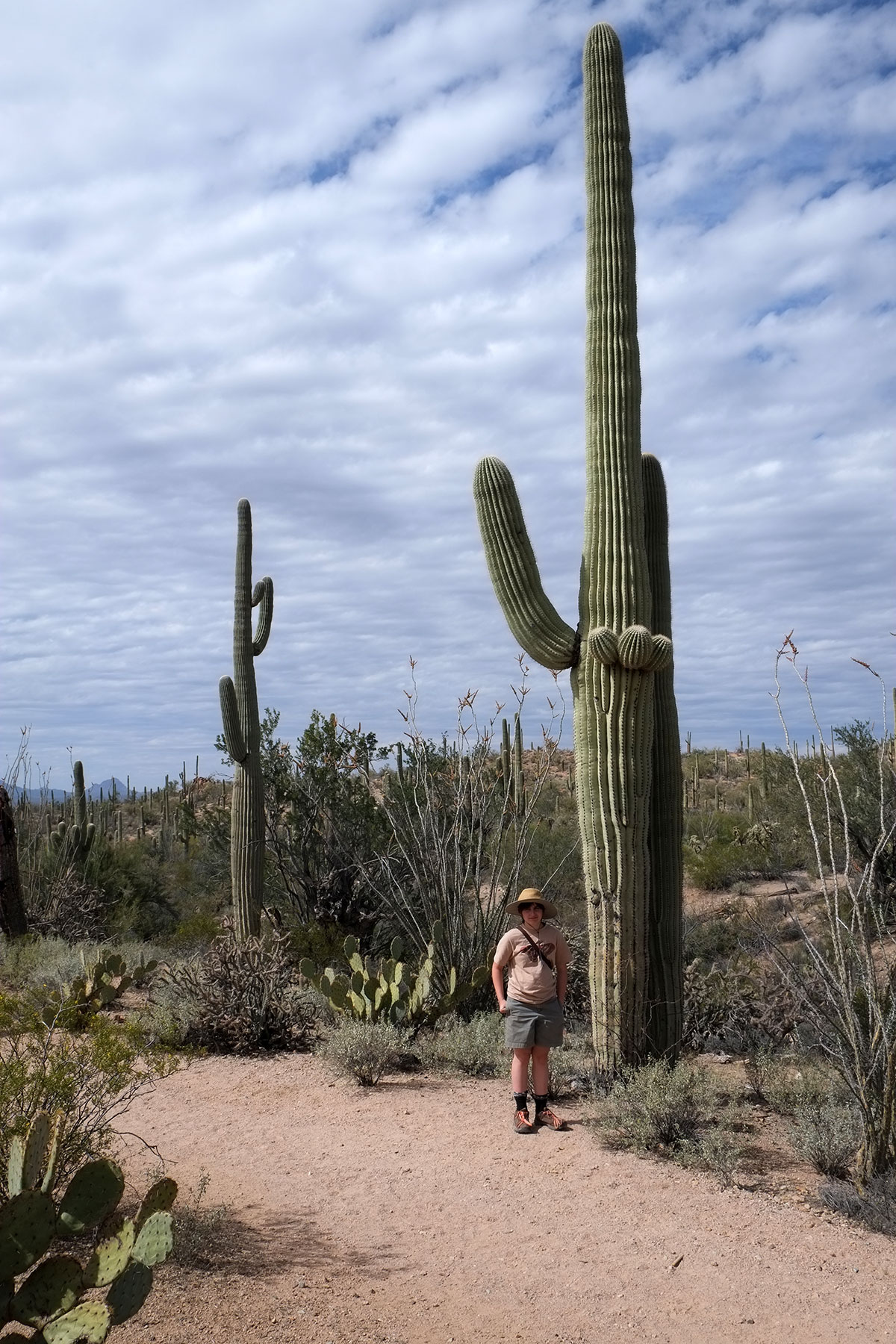
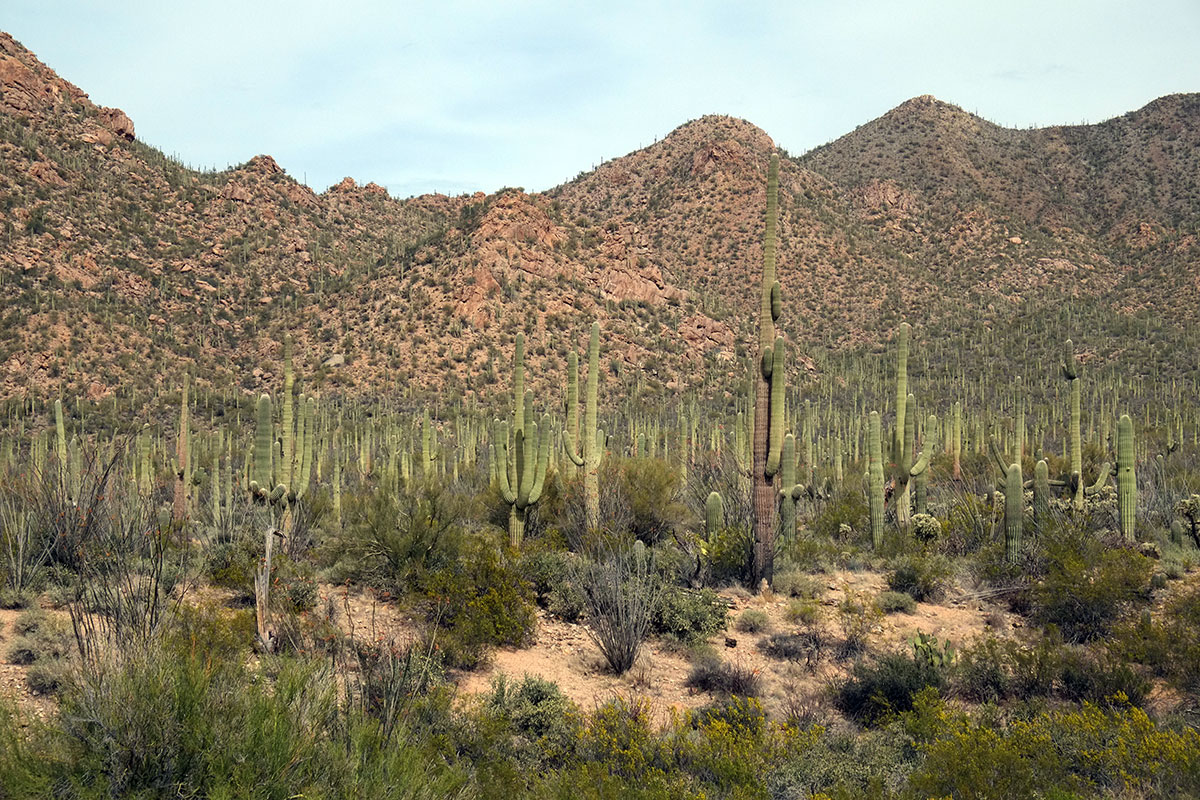
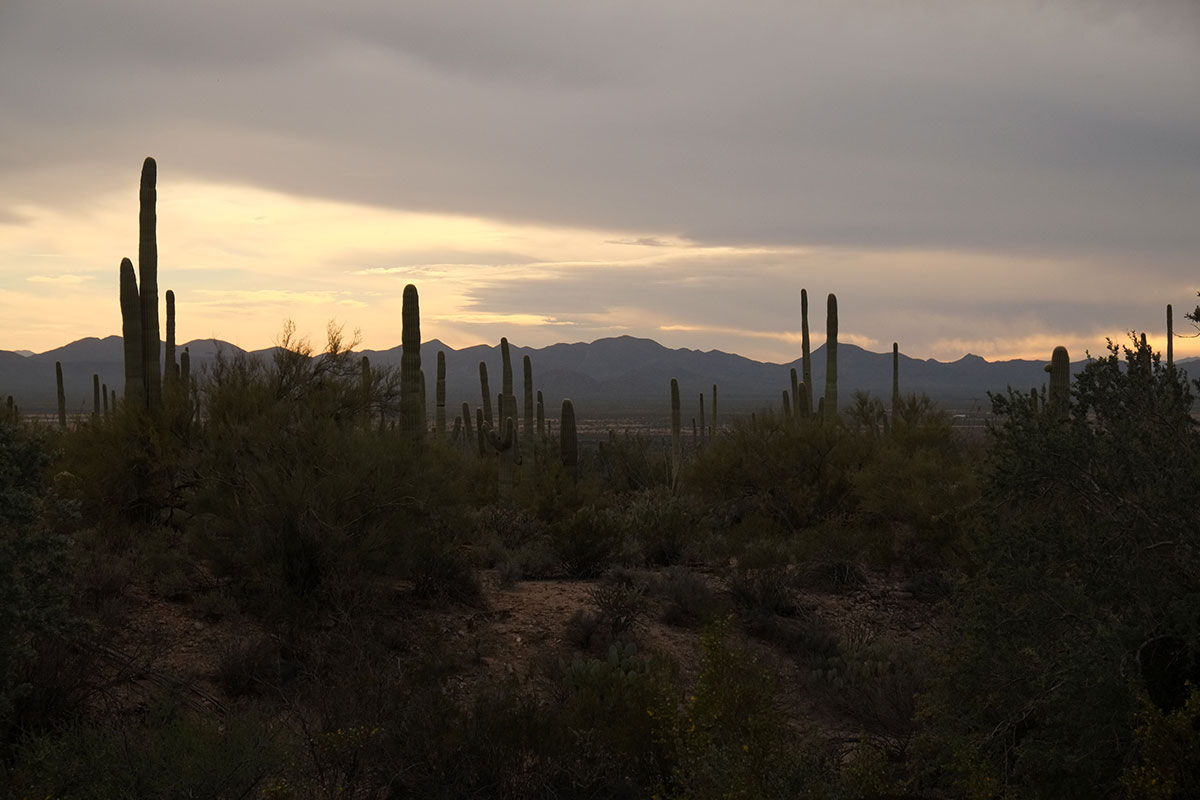
DSCF6458Saguaro National Park sits on two small mountain ranges, on either side of Tucson.  It’s quite unusual to have such wilderness in such proximity to a pretty big city.  And from what we’ve seen, it’s also an anomaly for a southwestern National Park to not be about big piles of rock in amazing shapes.  The Big Idea in Saguaro is not the landform, but the vegetation.  It is the greatest collection of bizarre plants we’ve ever seen.  None of them are familiar, and most of them seem capable of hurting you really badly.  The saguaros are the main attraction, as they apparently exist here in a profusion unlike anywhere else in the US.  They are strange, DSCF6450they are big, DSCF6449and they look just like they do in Roadrunner cartoons.  (Lots of things in the southwest look just like they do in Roadrunner cartoons.)  We just rambled around among them, soaking up the weirdness – especially the idea of a saguaro forest.DSCF6444

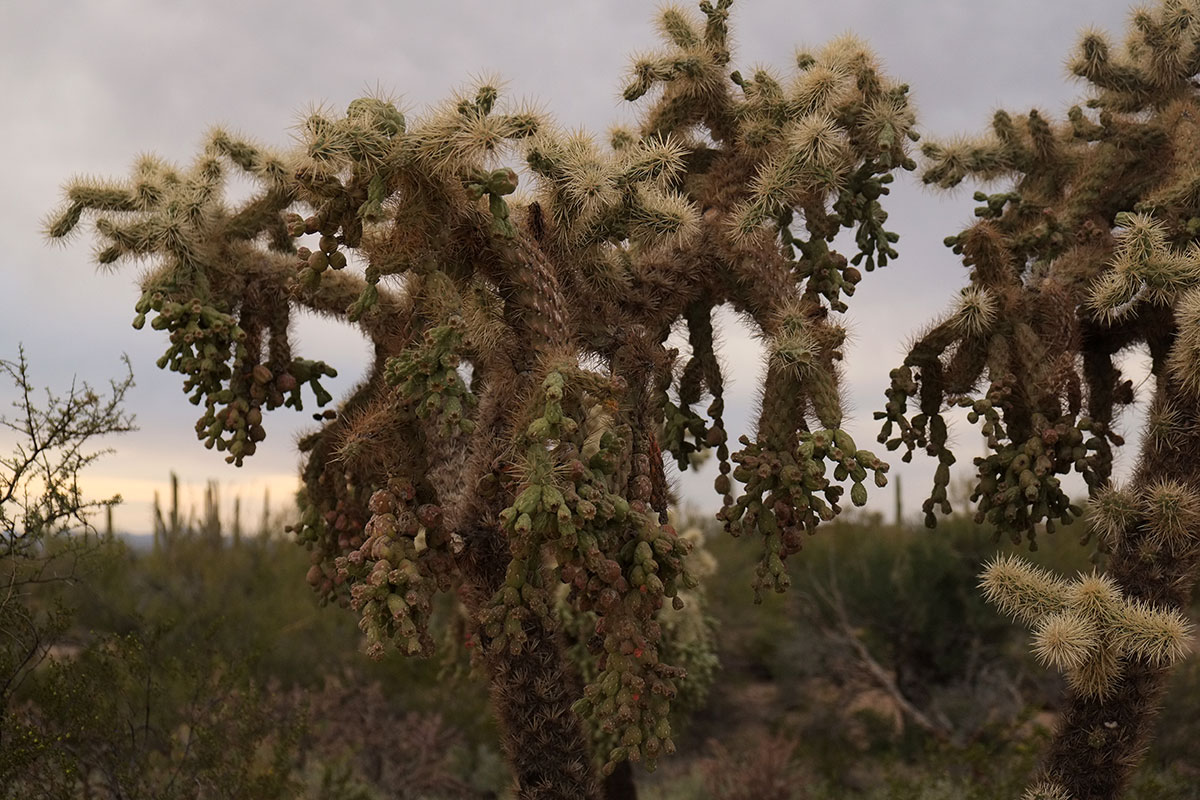
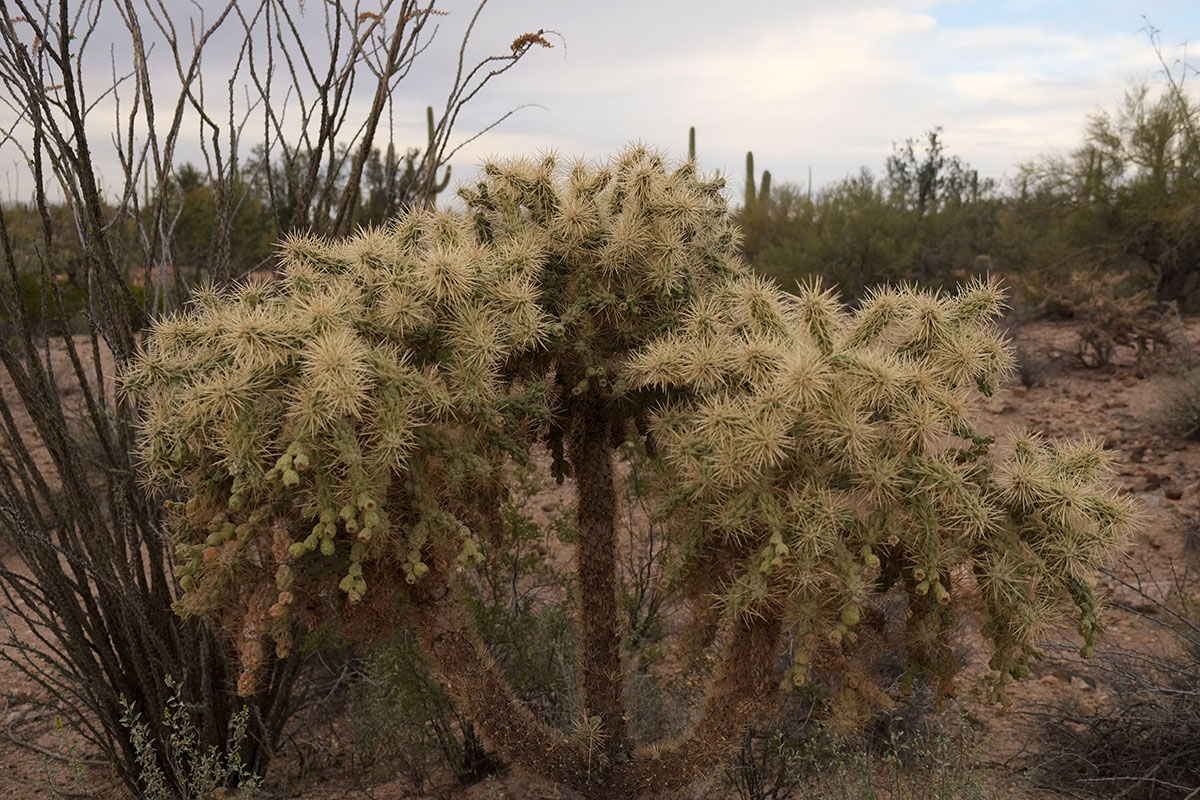
There are many other equally strange, but smaller, plants around.  Lots of cacti and yuccas and agave and such.  DSCF6423(We learn their names when we see them, and forget them within a few days.)  I am pleased when I see one that apparently has an afterlife as tequila or mescal.DSCF6417

We took some short hikes in Saguaro, and decided to not try any longer ones, as we didn’t think they’d seem very different to us.  It struck me that Saguaro is a modular place – every 50 foot by 50 foot area is incredibly interesting, in the variety and strangeness of the juxtaposed plants.  But then the next 50 by 50 foot plot is about the same.  You don’t hike to a sublime view, or have a wide variety of rock-scrambling experiences.  Our local informant in the culture assured us that changes in the environment occur when you move to higher elevations, especially in the mountains to the east of Tucson, but we were camping on the west side and didn’t feel like a drive across the metropolitan area.  So we spent our time looking more closely at what was right around us, instead of charging across the park trying to cover it all.  We camped in a fabulous county campground right next to the National Park, which was quiet and dark, and a little eerie with the howling of coyote packs throughout the night.  The serious RVers put string LED lights under their RVs at night, probably to keep the varmints away.  Lots of lizards scurrying around, and we managed to avoid the one rattlesnake we heard was near the trail up ahead of us.

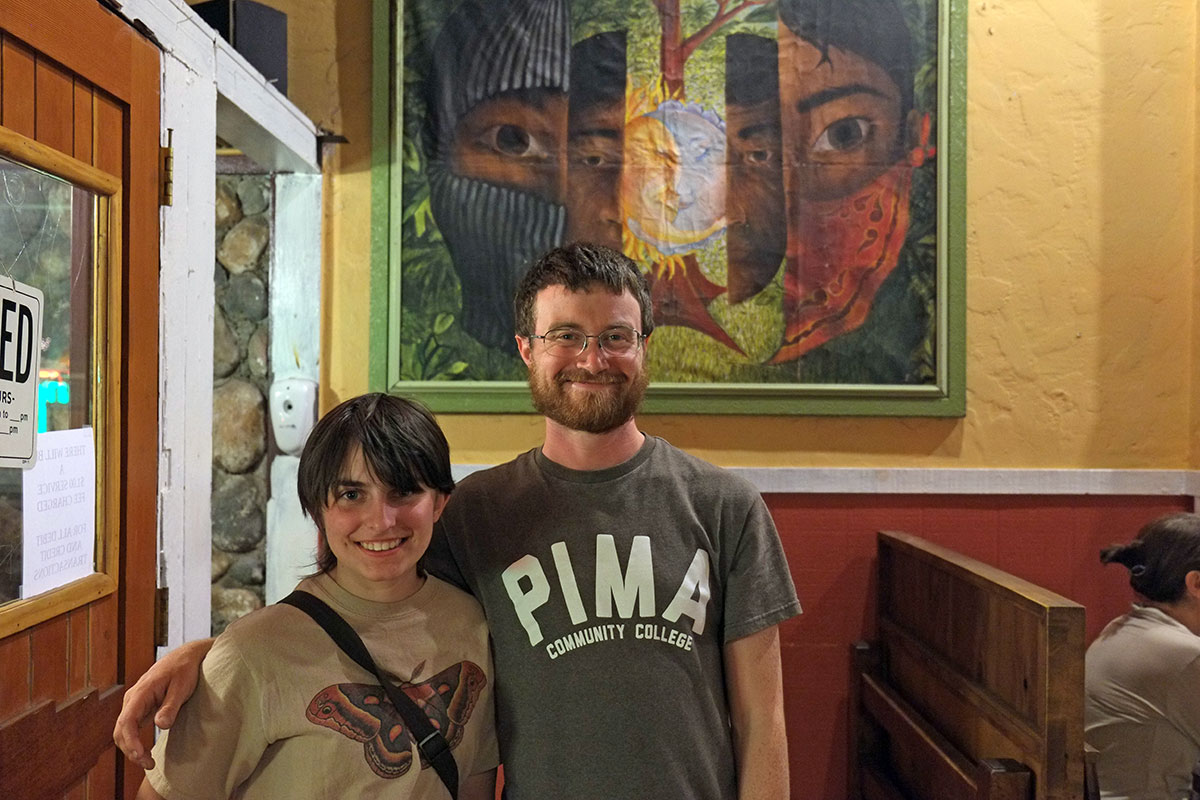
The aforementioned local informant was Daniel Beckman, the son of Bob and Susan, previously chronicled in the post college friends.  Daniel grew up outside Philadelphia, attended Brown, where he did things related to political science and theater, and then during an internship at Joshua Tree National Park, fell in love with the big spaces of The West.  He now works for the Park Service, and is involved in activities such as invasive plant eradication, while attending the local community college to learn all the applicable science he didn’t learn in college.  (We unfortunately missed seeing him in his role as the Park mascot Sunny the Saguaro, which he undertook for the Park Service 100th anniversary celebration at Saguaro one day we were there.  We think he saw us coming and hid so that I couldn’t post any photos of him in costume.)DSCF6556

We went to the neighborhood Mexican restaurant near his house (which in itself might be enough of a reason to move to the southwest), and as two East Coast refugees, we talked a lot about the the differences in living in the two different places, and how one can know when you’ve found the right place.  I was impressed with his willingness to strike out into unknown territory, to change his location, his intellectual focus, and his whole way of living – something that’s not easy to do at any age.  But Daniel seems very happy in his new life, and perhaps he has found the right place for him.DSCF6415

Carlsbad Caverns

P1080029The elevators have been broken for years. The only way in, or out, is a mile long path climbing 800 feet in elevation. This makes the numbers of visitors even more impressive, almost as impressive as the caverns themselves. Welcome to Carlsbad.

Carlsbad Caverns National Park is actually about twenty miles from Carlsbad, NM, outside of the totally touristed and tiny town of White’s City. I think the cavern itself is bigger.
P1080082

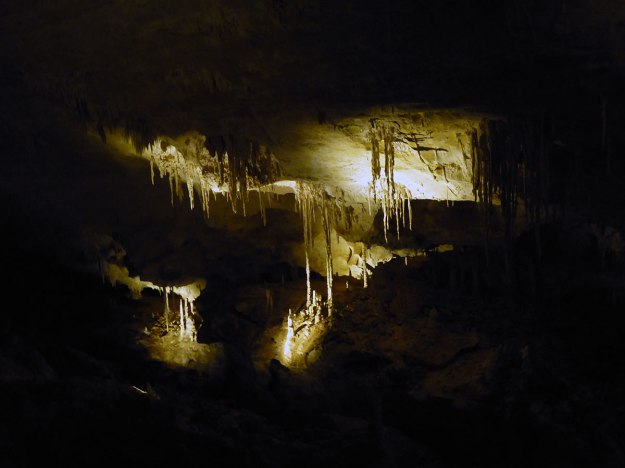
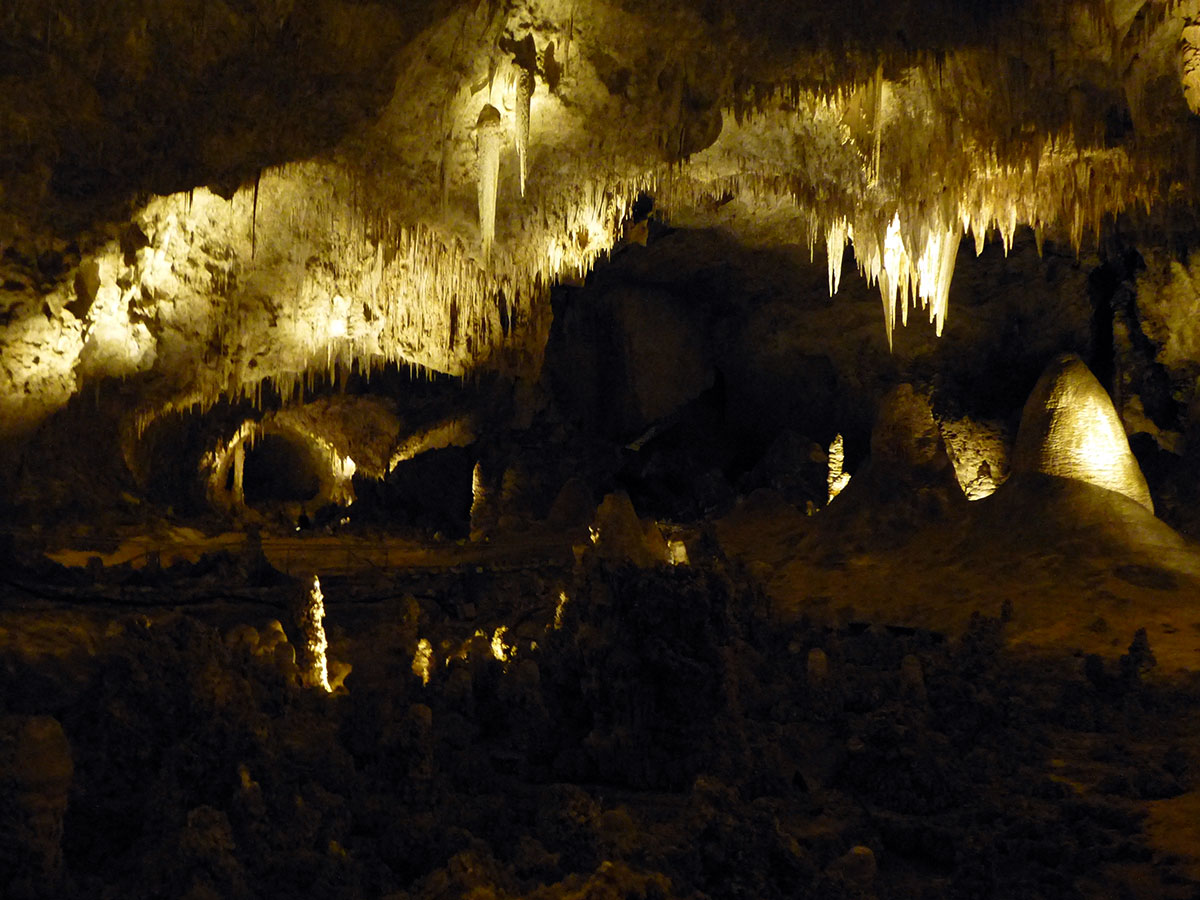
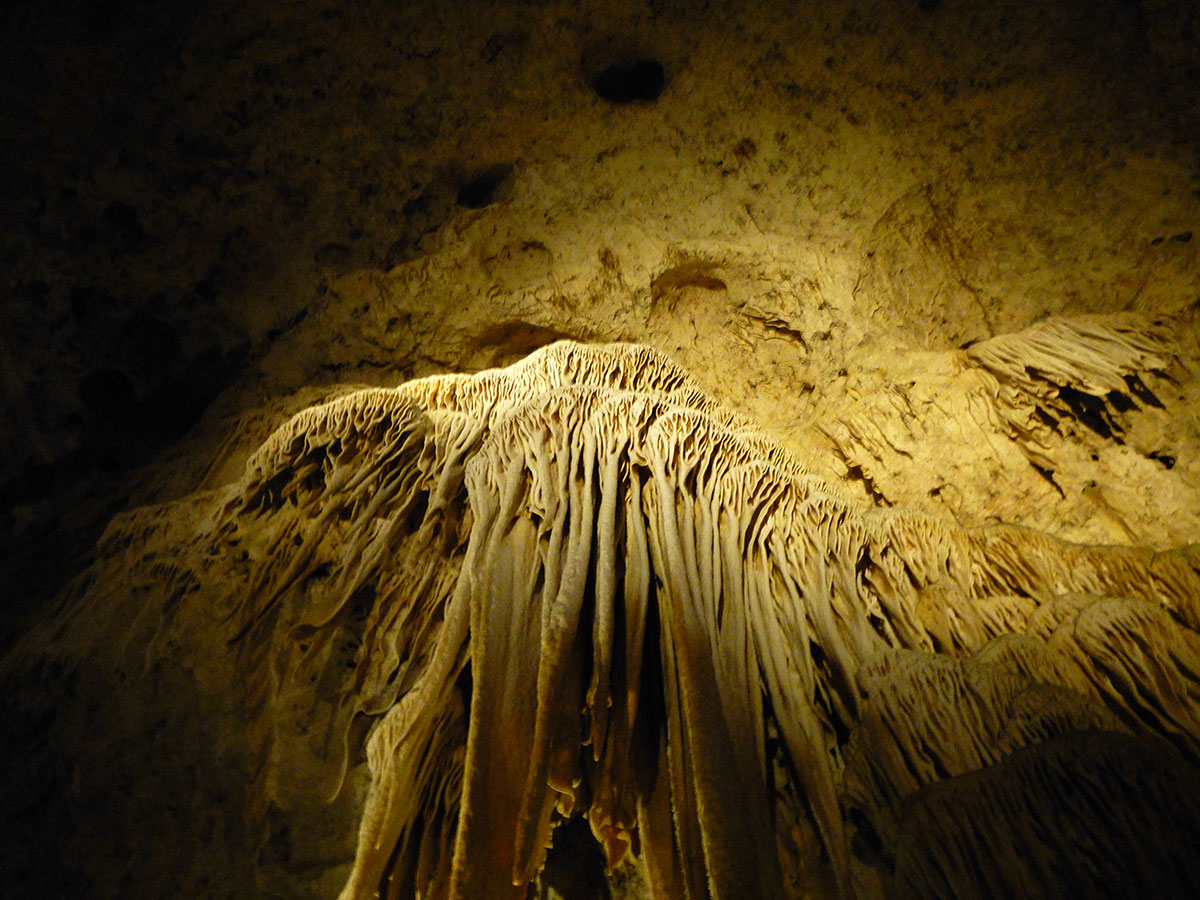
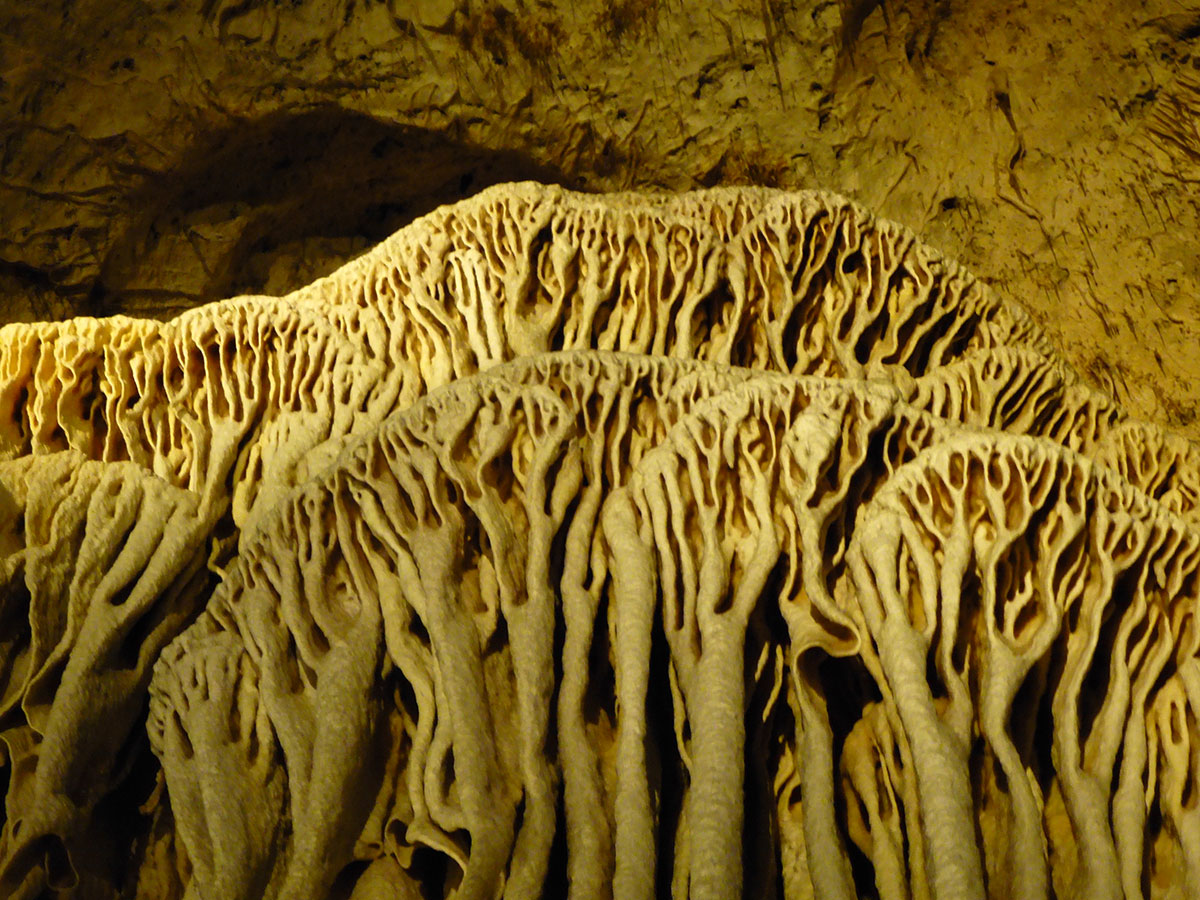
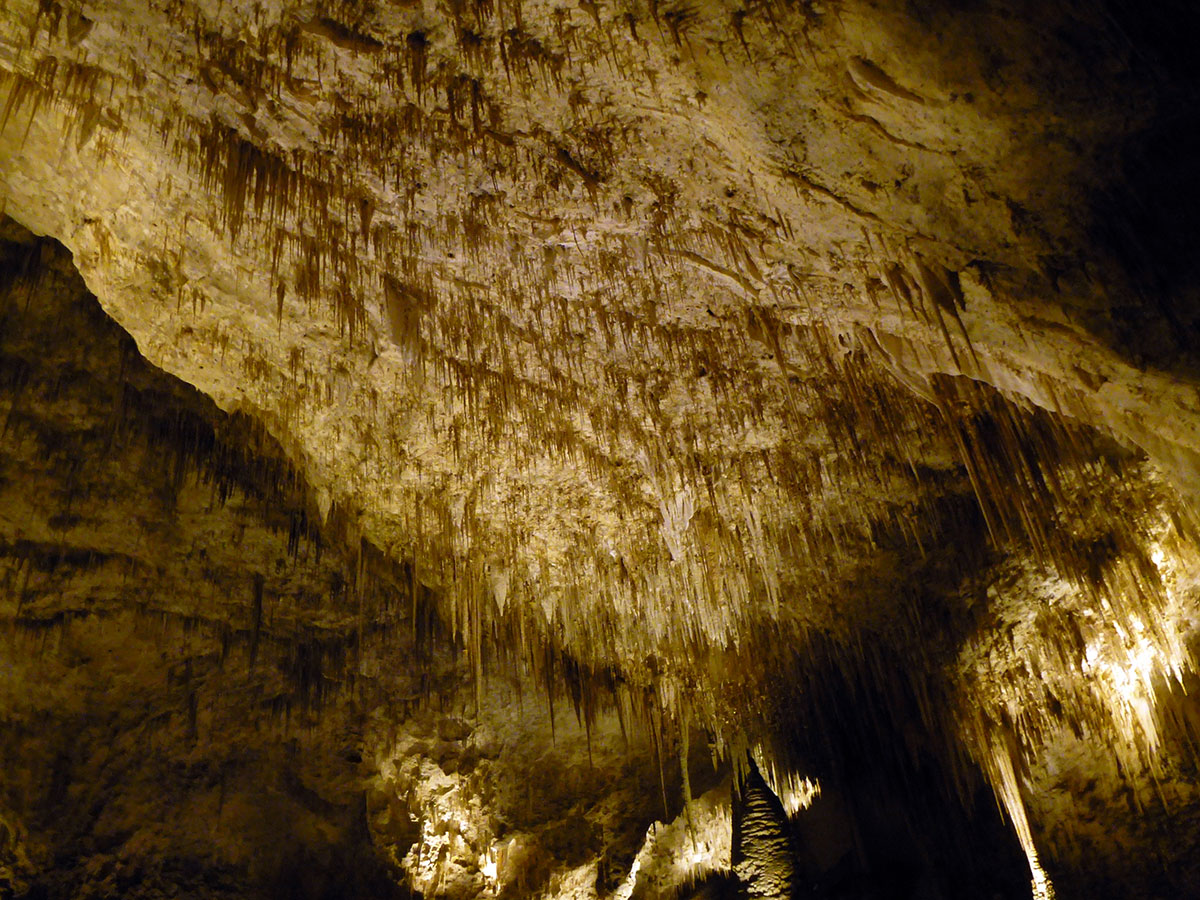
But that might not be saying a lot, because the cavern was HUGE. Fourteen acres of floor space, it’s the largest natural room in the Western hemisphere, several times bigger than Luray. And several times more impressive. P1080076The Chandelier was the most gorgeous, and the most aptly named. The nps had even strung lights up inside of it, making it glow a soft creamy gold. And some of the flows did their best to convince you they had been carved by elves.P1080115 P1080118

P1080073

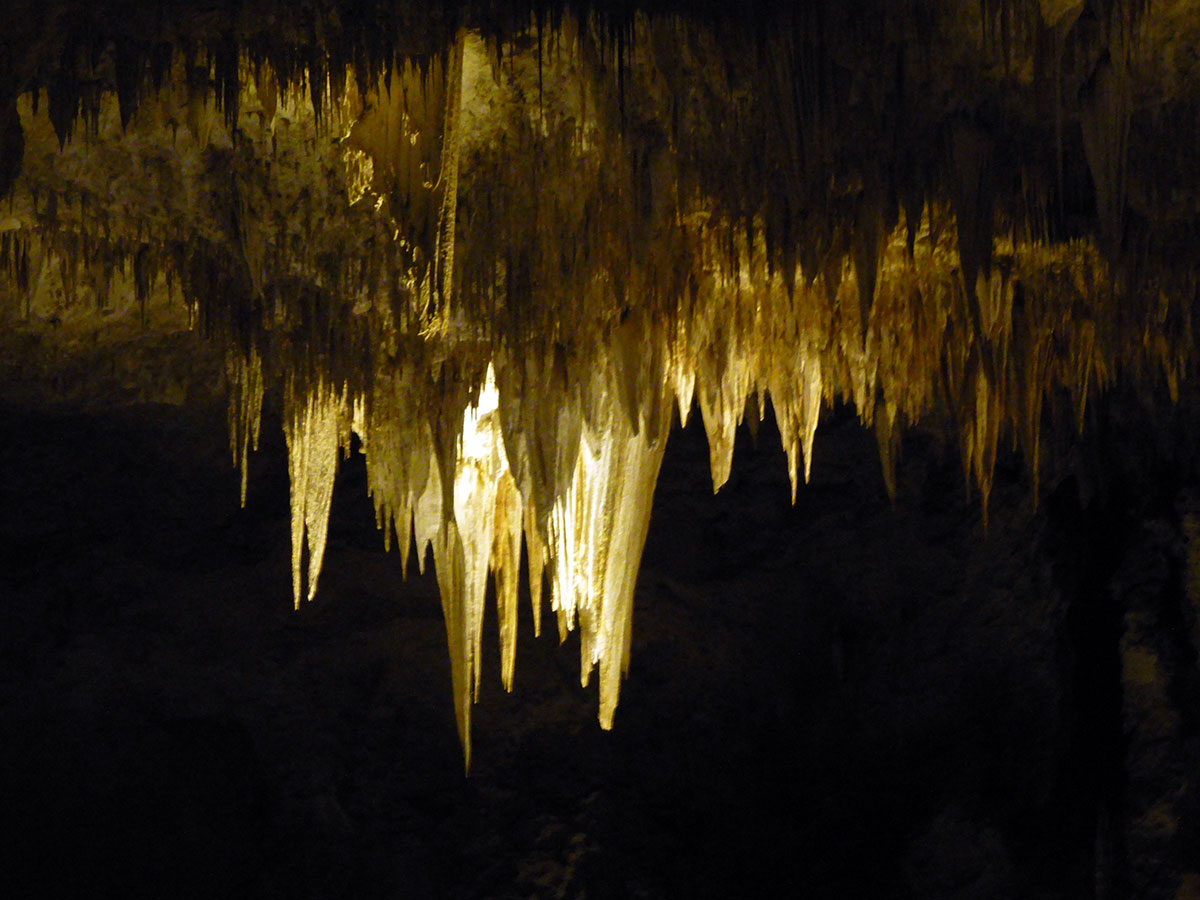
The mirroring stalactites of the fairy forest

P1080066

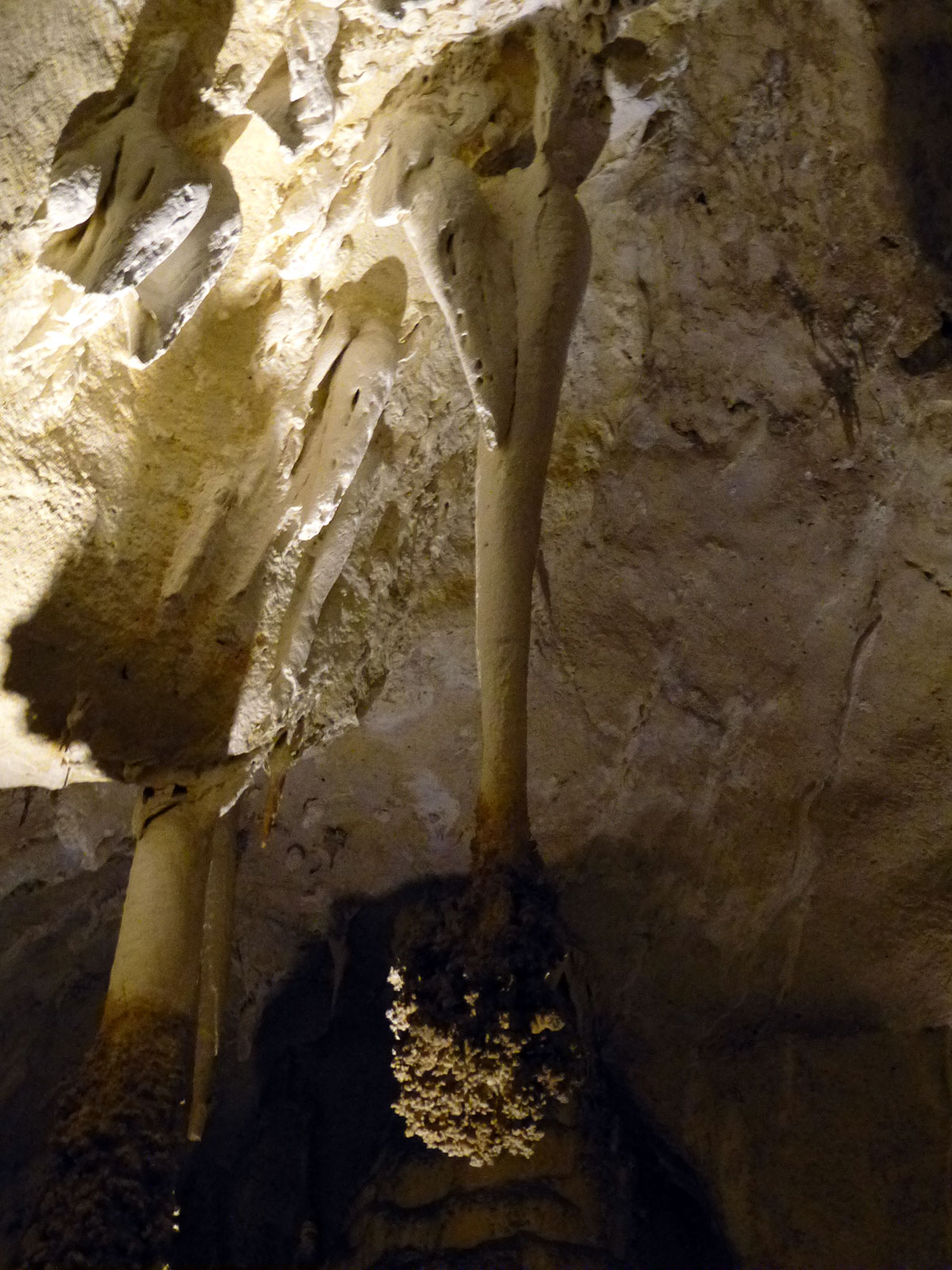
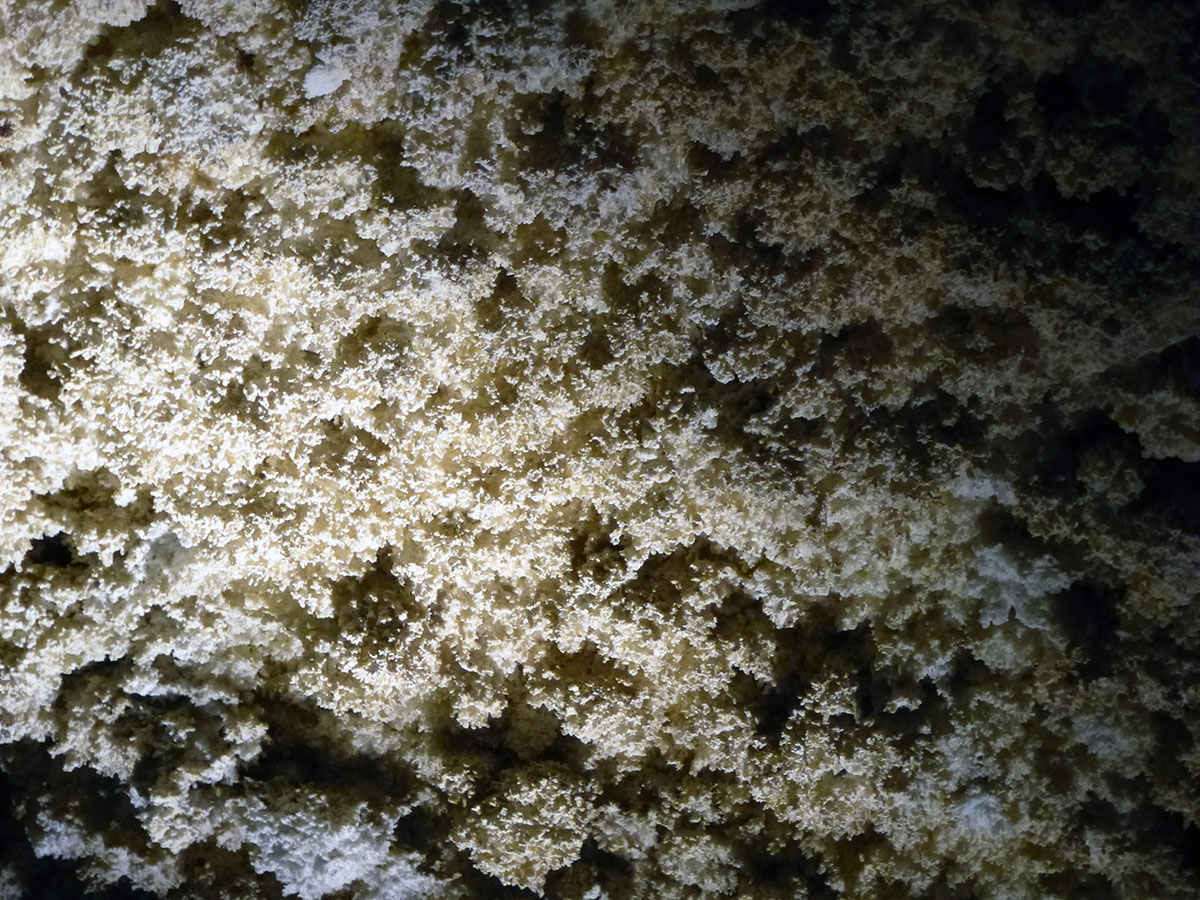
The lion’s tail and fairy forest were also pretty, but in a more rustic, popcorny way. Popcorn is a type of speleothem (rock formations caused by dripping or flowing water in caves, and my new favorite word) that looks like the movie theater snack. Surprisingly, I couldn’t find a sign or section on the brochure explaining exactly how the rough texture forms.P1080051

Despite the exquisite beauty of the cave, walking down into it felt wrong. Every instinct yelled at me, that the underground is not a place humans are not supposed to go. The bats didn’t help. We didn’t see any, because they only roosted in the caves during the summers in a part humans weren’t allowed into. However, this knowledge didn’t help much when you felt like you were descending into the Mines of Moria. Getting out felt great, but it was definitely an experience I’d repeat.

Donald Judd in Texas

DSCF6006Donald Judd, the sculptor and theorist, pretty much deserted New York for West Texas in the 1970s.  He eventually bought a 340-acre former Army base on the edge of Marfa, also acquiring the quartermaster’s post in the center of town.  Although he continued to own his building on Spring Street in Soho, for the rest of his life he mostly worked in this incredibly remote town of 2000 out in the desert.

I’ve always been intrigued by artists and writers who have achieved great success, and who then leave the cultural centers so they can continue their work, unimpeded by the distractions of social life and fame.  It’s a pretty rare phenomenon (O’Keefe, Salinger, Updike and Pynchon being recent examples);  how many people want to really be great artists, versus living the entertaining  life of a successful artist in the metropolis, especially in our current society, which seems to be driven by mainly by celebrity and money?

The really unusual thing that Judd did was not his move to the desert to create his work, but his decision to create a venue out in the desert for the permanent installation and exhibition of his own work, plus that of his friends Dan Flavin and John Chamberlain.  He thought that in big city museums, where they would be able to show at most a few pieces, the work could not be well-understood.  In Marfa, where the spaces were big and cheap, they could show a significant body of work, including large, site-specific installations where an idea could be fully developed.

Besides his sculptures, Judd was noted for his furniture design.  He had considered becoming an architect, and all of his work shows a remarkable regard for context, materials and structure. As I learned on a tour of his compound, he didn’t want to construct new buildings – he thought that developing a relationship to an existing building and site had more possibilities, and all  of his work in Marfa reflects this.

The sites in Marfa are now run by two different organizations.  The Chinati Foundation has the old army base, where Judd’s large installations, Flavin’s installations, and the work of visiting artists is shown, as well as a building downtown devoted to John Chamberlain’s sculpture.  The Judd Foundation, which is run by his children, owns the compound downtown where Judd and his children lived, and where a wide range of his individual pieces are shown.

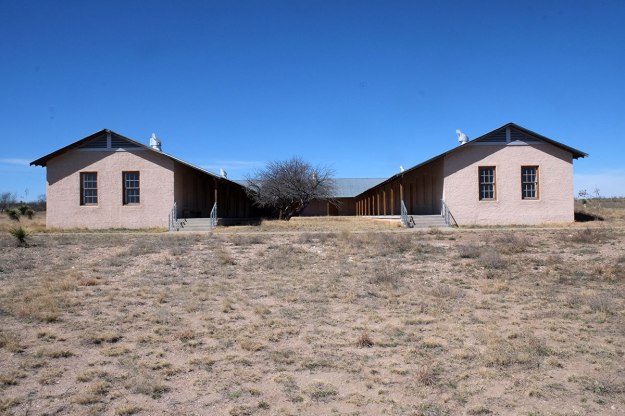
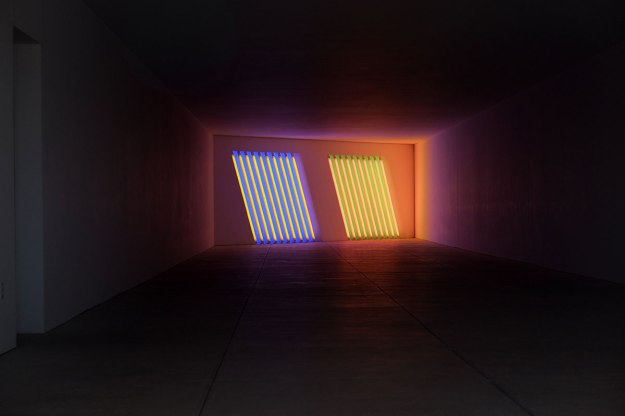
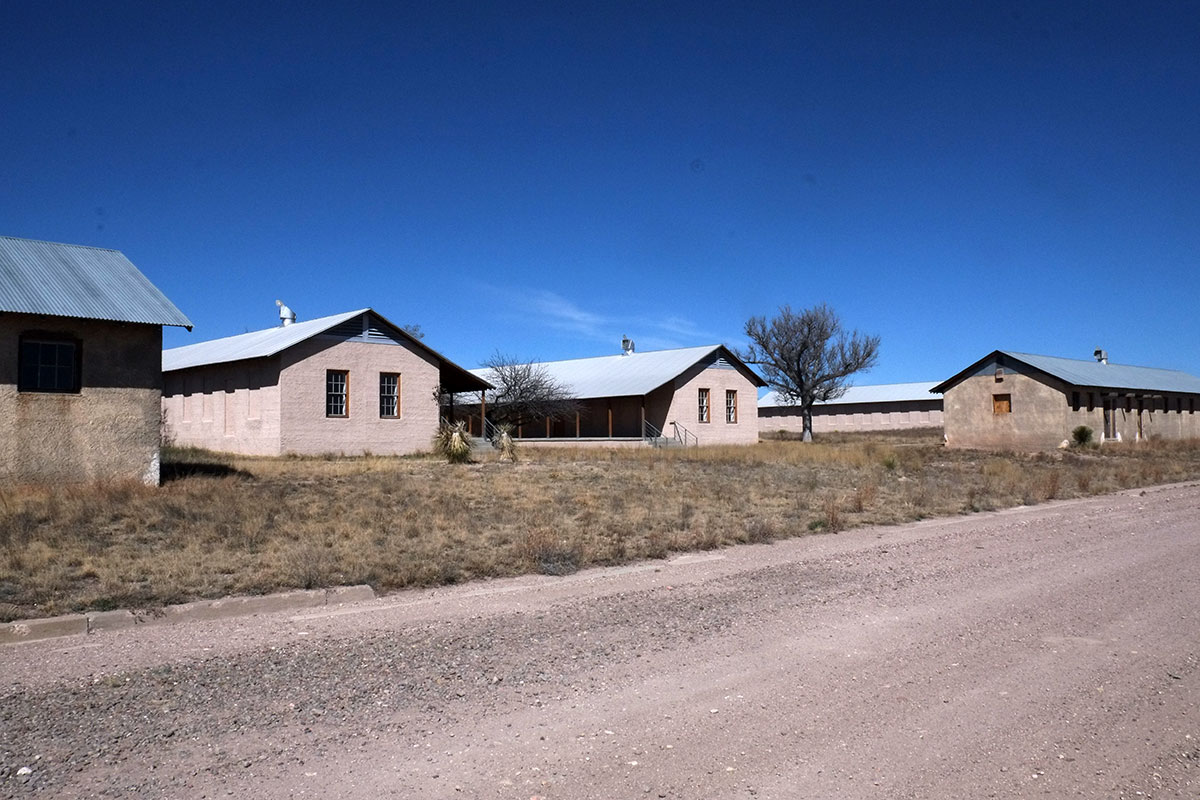
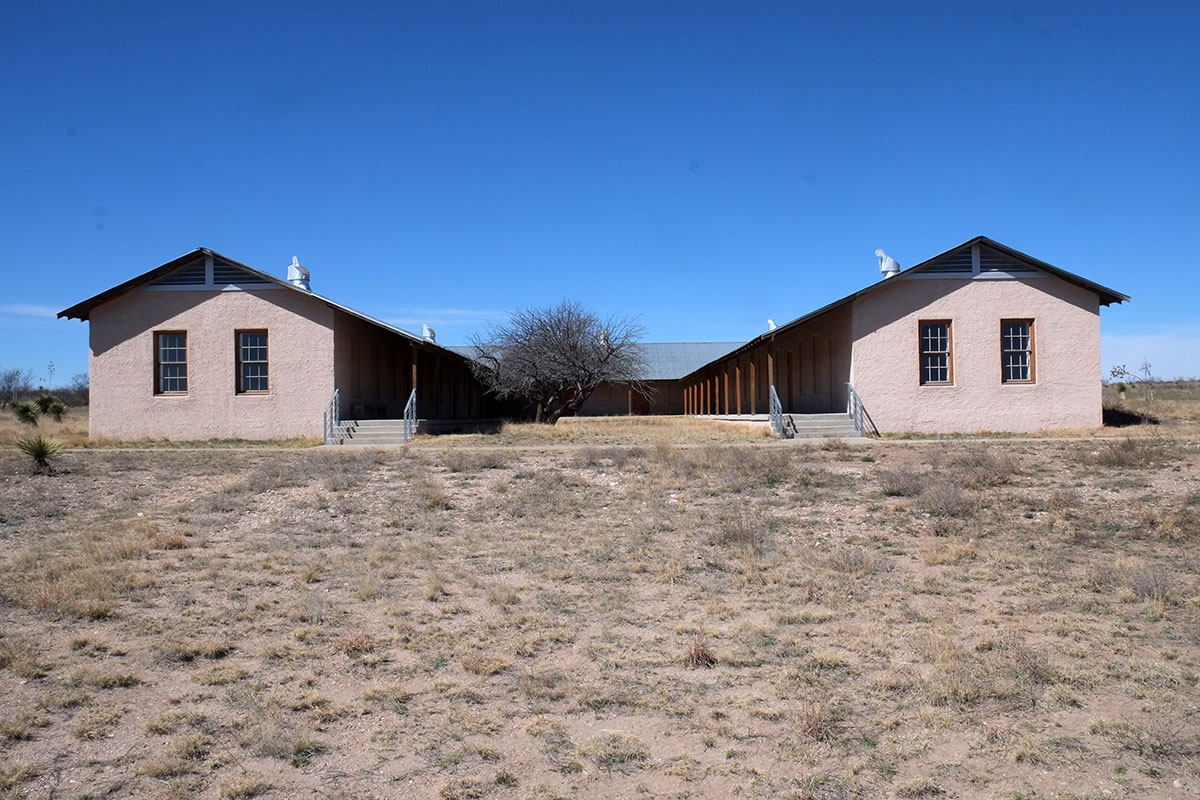
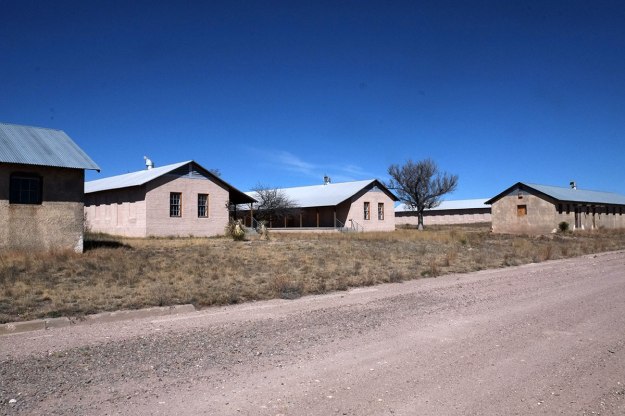
At the Chinati site, the wood-frame barracks buildings are strung along a curving walkway and road.  Dan Flavin took over six of them for an installation of his colored fluorescent tubes, with each successive building exhibiting a change in the sequence / development of the ideas from the previous ones.  DSCF6196
DSCF6190

DSCF6193

The importance of the location in Marfa can be clearly seen – if you were in a city museum, you would be lucky to see one half of one installation – they just take up a lot of room.  But here, the layouts are the same in each building, while the color arrangement changes.  You go from one building to the next, and can understand the color as the independent variable.  The rhythm of leaving one building, going out into the bright desert, and the entering the next darkened building is an important part of the sequence.

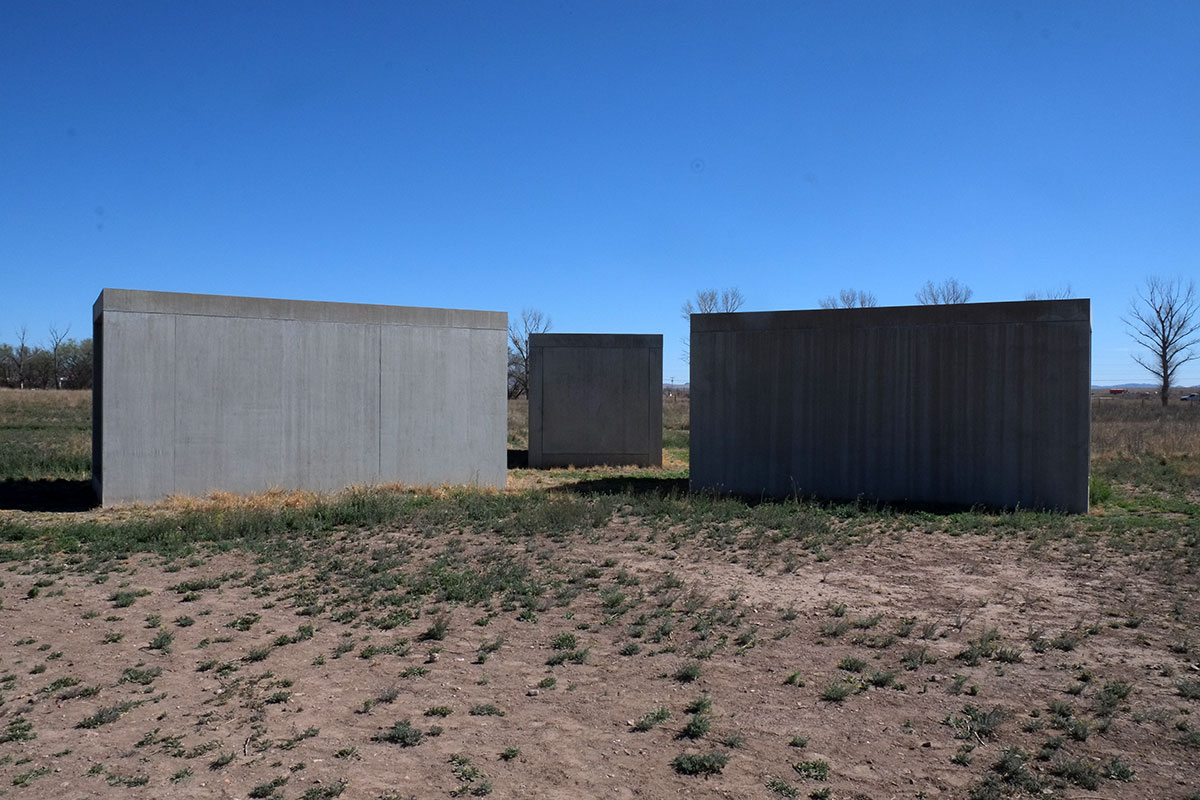
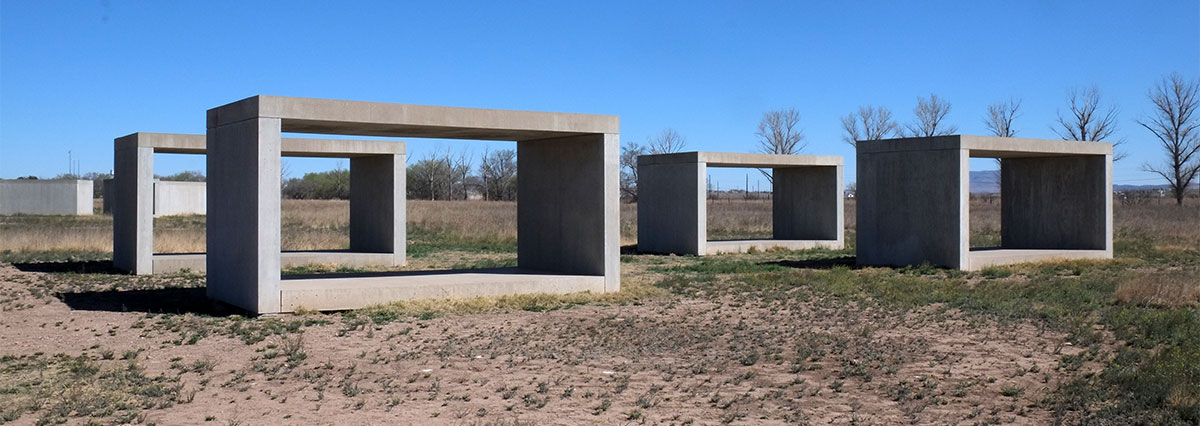
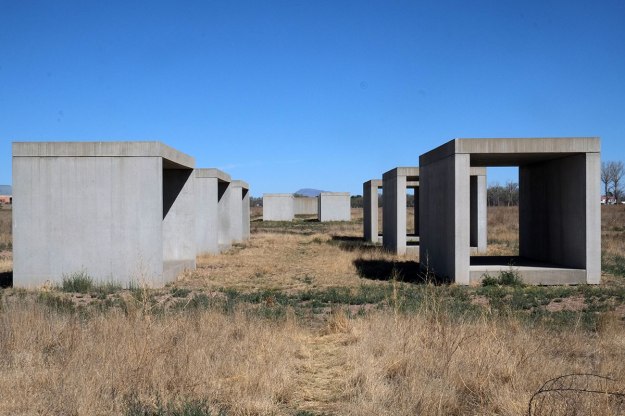
Judd created a series of large concrete box sculptures out in the landscape, which were cast in place.  The boxes are all of the same outside dimensions, but each cluster varies in degree of enclosure, number, orientation and arrangement.  DSCF6154
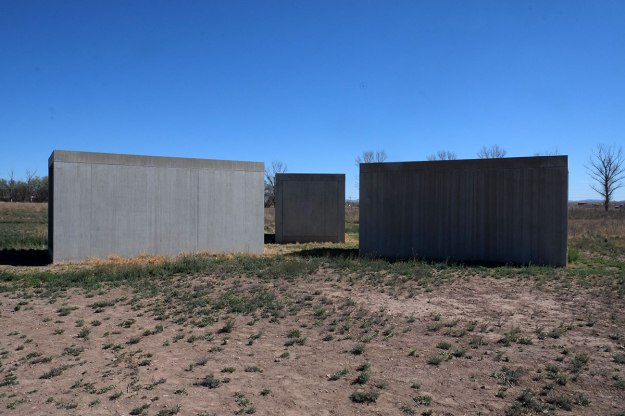
Many are orthogonally placed, but diagonal visual relationships are apparent as you walk around them.  As one of the docents on a tour pointed out,  Judd thought symmetry was critical – things should be symmetrical unless you had a specific reason to make them asymmetrical.  I was struck by the different between his thinking and current practice today, where any symmetry (or even regular geometry) evokes gasps of shock and surprise.  DSCF6158
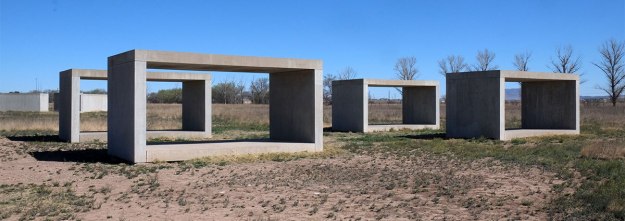
As I walked down the line, I was reminded of the Kahn buildings we’ve seen on this trip, where simple, strong forms are carefully placed in the landscape.  Forms in light, and here it is the strong, vivid light of Texas.   It reinforced Marc Treib’s idea that human interventions which manifest a clear geometry stand out in contrast to the natural world, and this contrast highlights the essential character of each and makes them more powerful.

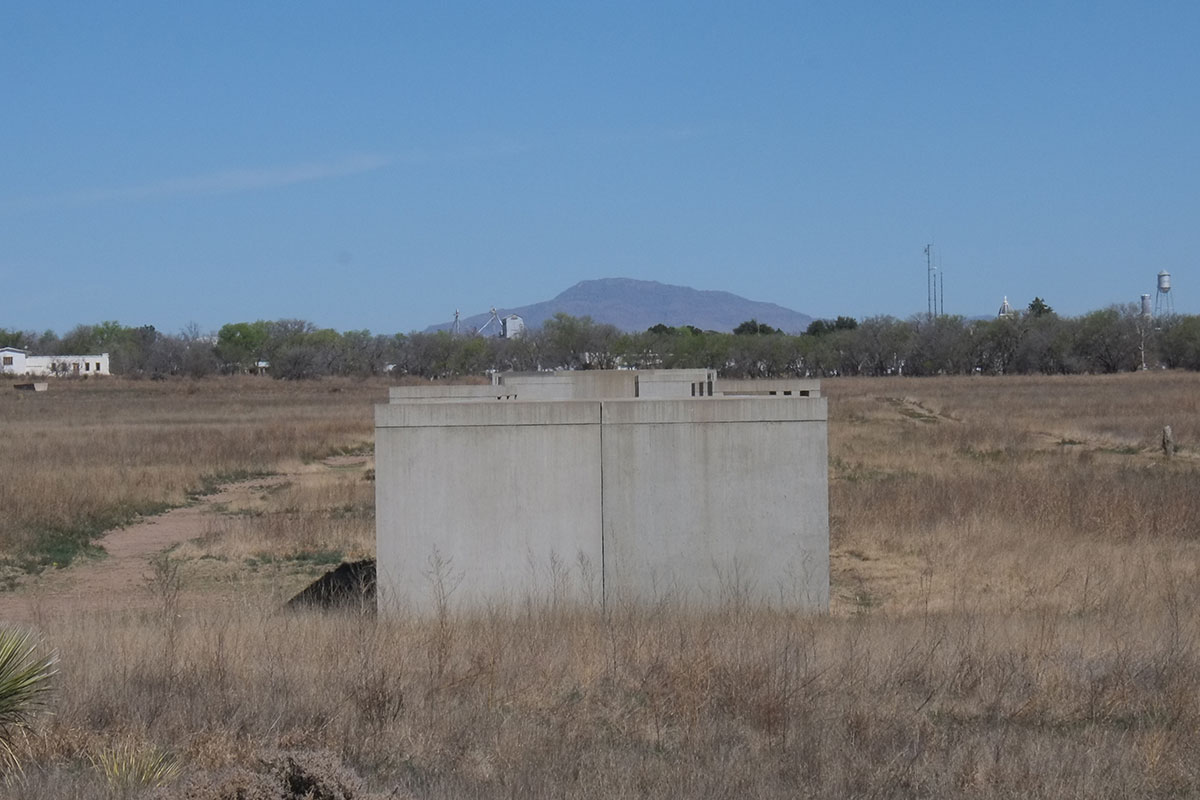
This part of the Chihuahuan Desert at first seems rather featureless, but as you look around, you notice some ordering features.  The Marfa Plateau is extremely flat, but there are individual mountains and ranges which break the horizon.  The sculptures are arranged to emphasize these distant connections.  All these sculptures are arranged on a long axis in the landscape, and as you move along, you can look back and see the termination of the axis to the north.DSCF6165
DSCF6168

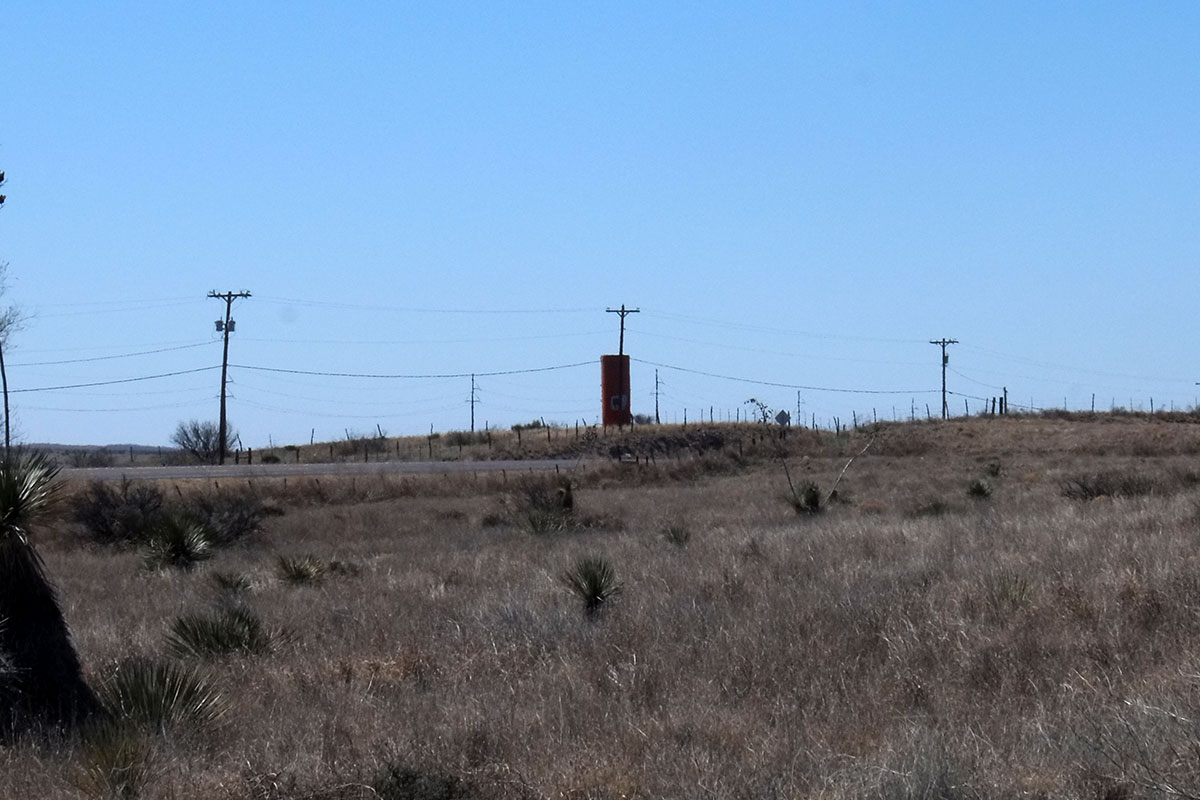
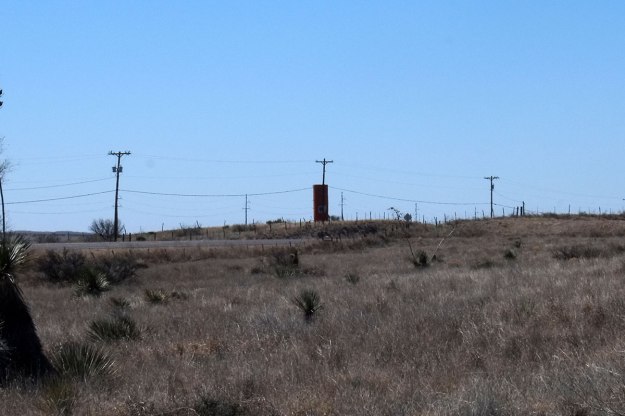
I then tried to extend the axis visually to the south, and it seems to end up here, in a water tank and three telephone poles with cross-trees.  I don’t think Judd intended to make a reference to Calvary, but nothing else in this environment seems to be unplanned or happenstance.  I think this could be the subject of at least one PhD thesis on the importance of Christian iconography in Minimalist art.DSCF6172
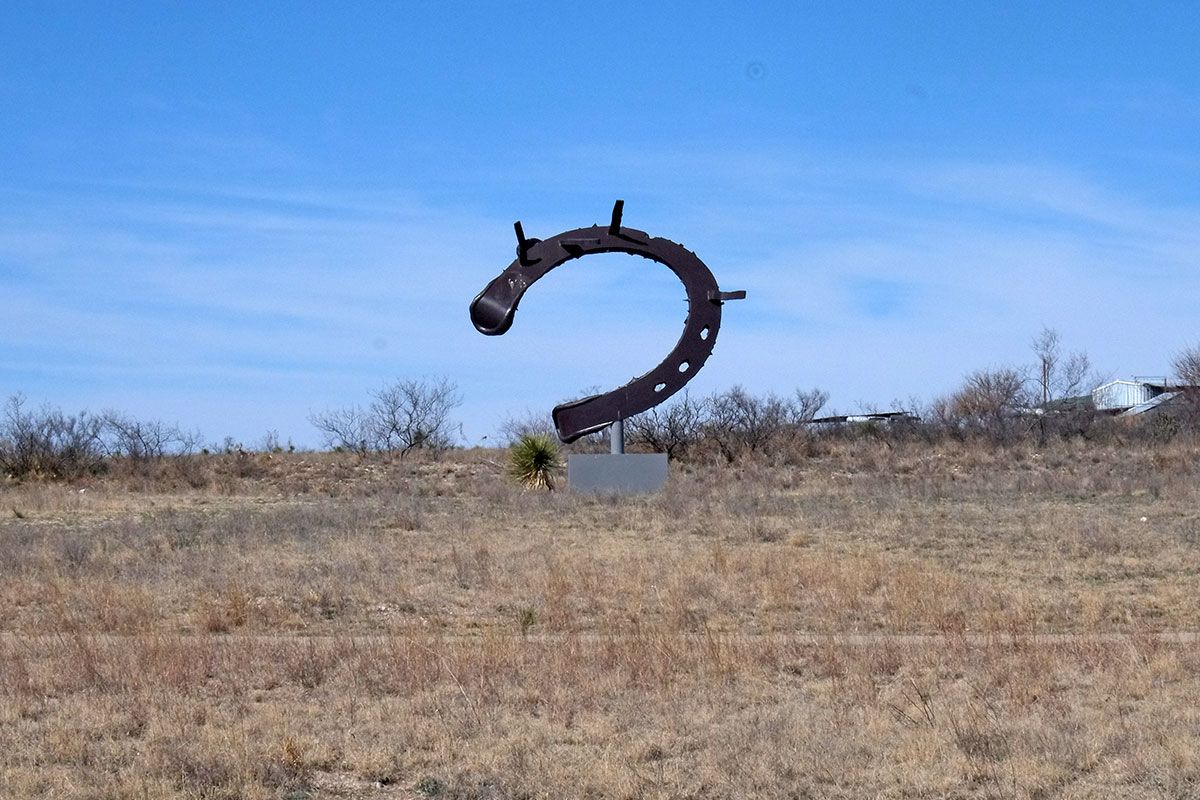
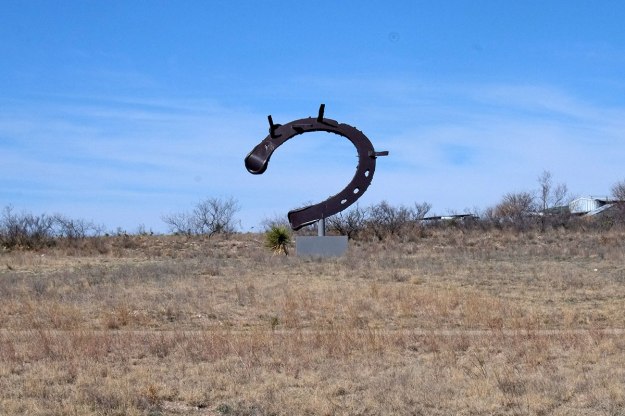
Claes Oldenburg created one large sculpture on site.  He picked up on how this was a US cavalry base, which finally ended up with one famous old horse.  Oldenburg created one giant horseshoe as a memorial, which apparently has some astronomical alignment.  DSCF6203
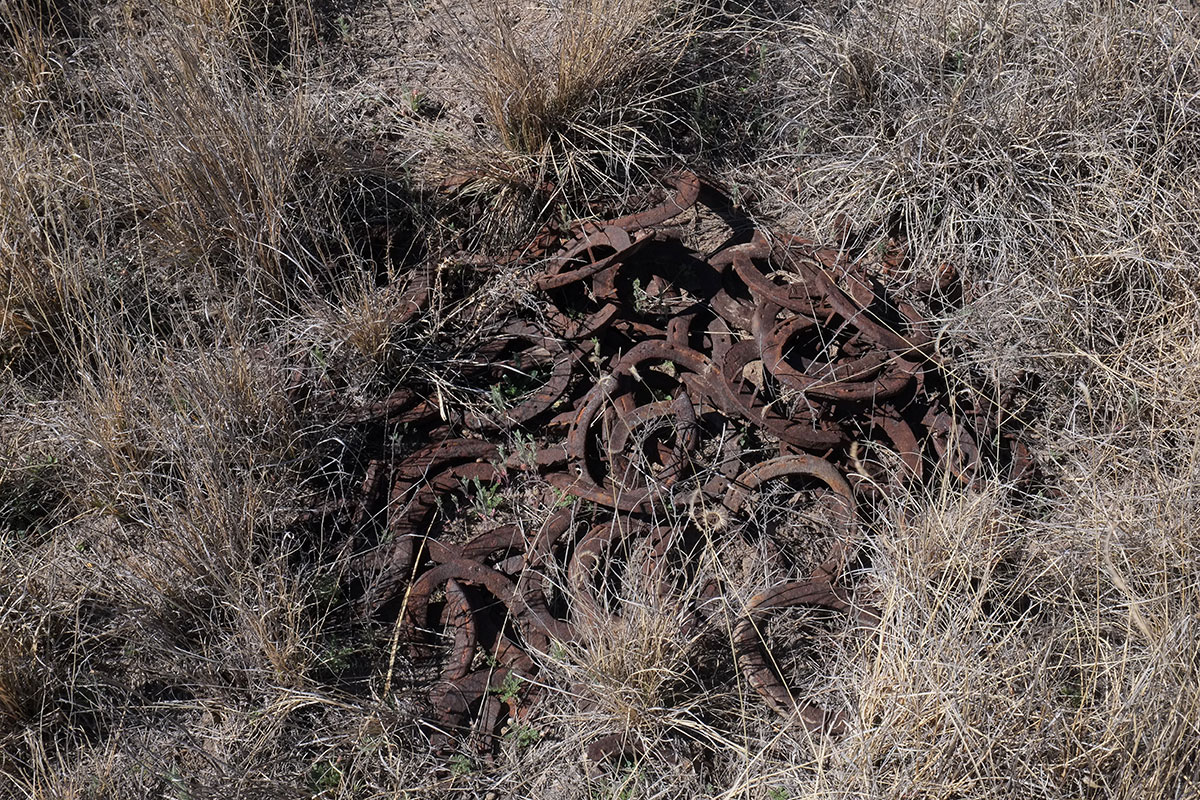
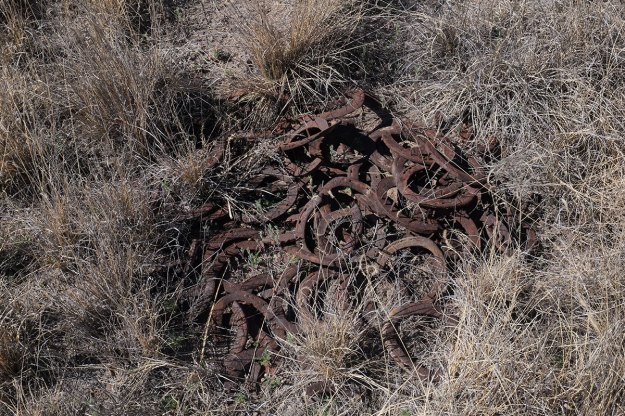
As I was walking around the site, i came across this pile of old horseshoes out in the landscape.  Was it a remnant of the days of the cavalry, or was it a subtle installation, intended to be discovered by only the most intrepid art fiend?  DSCF6180
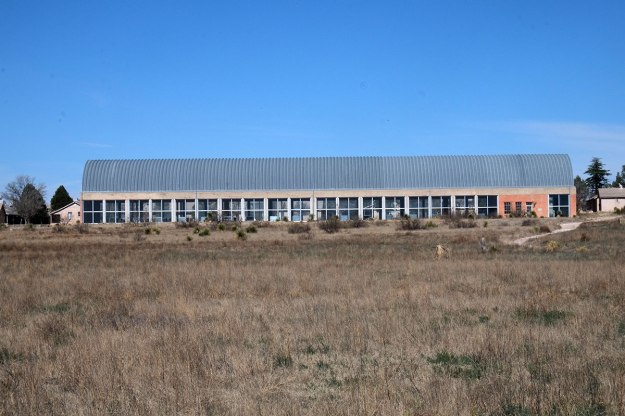
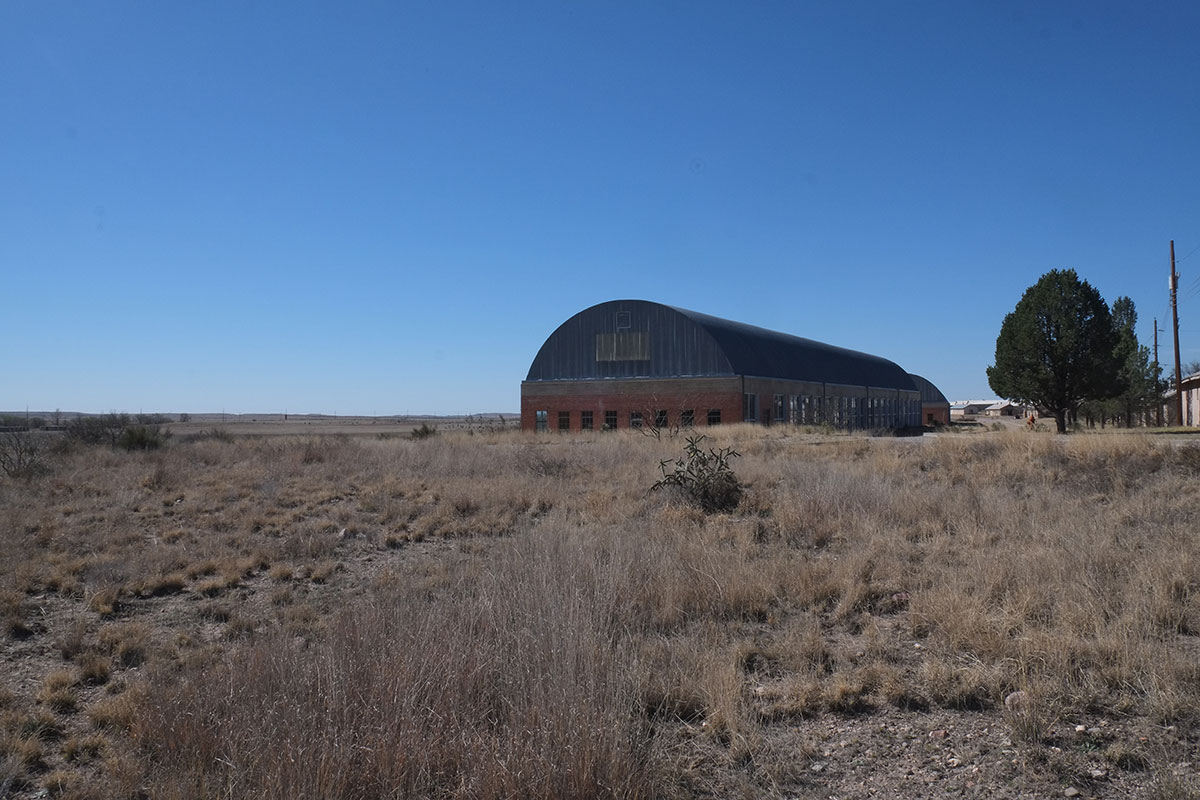
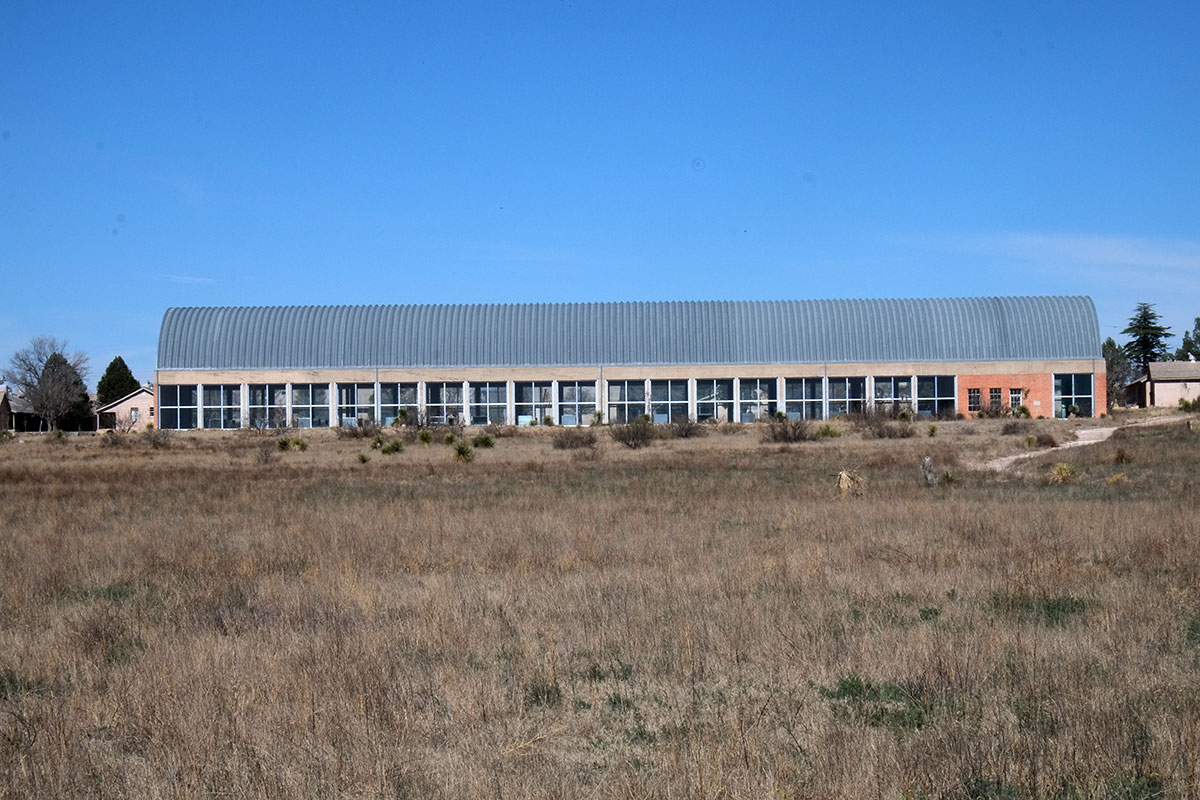
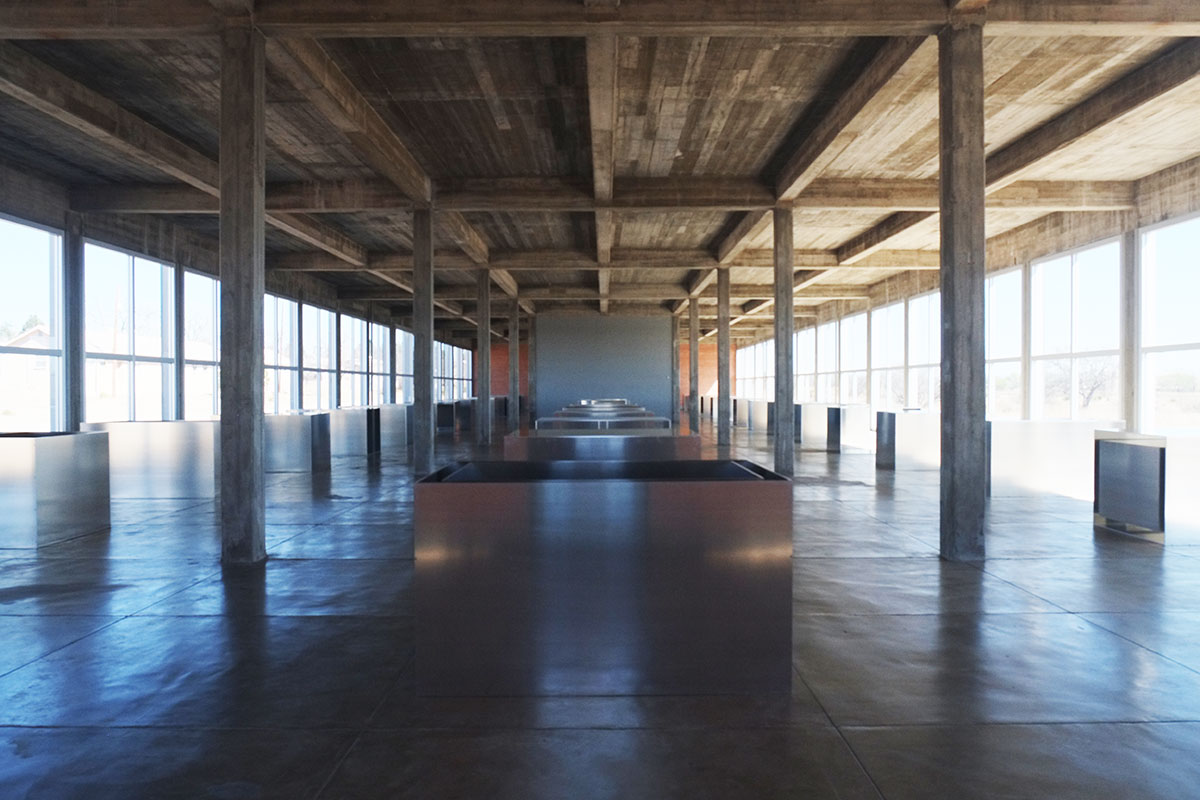
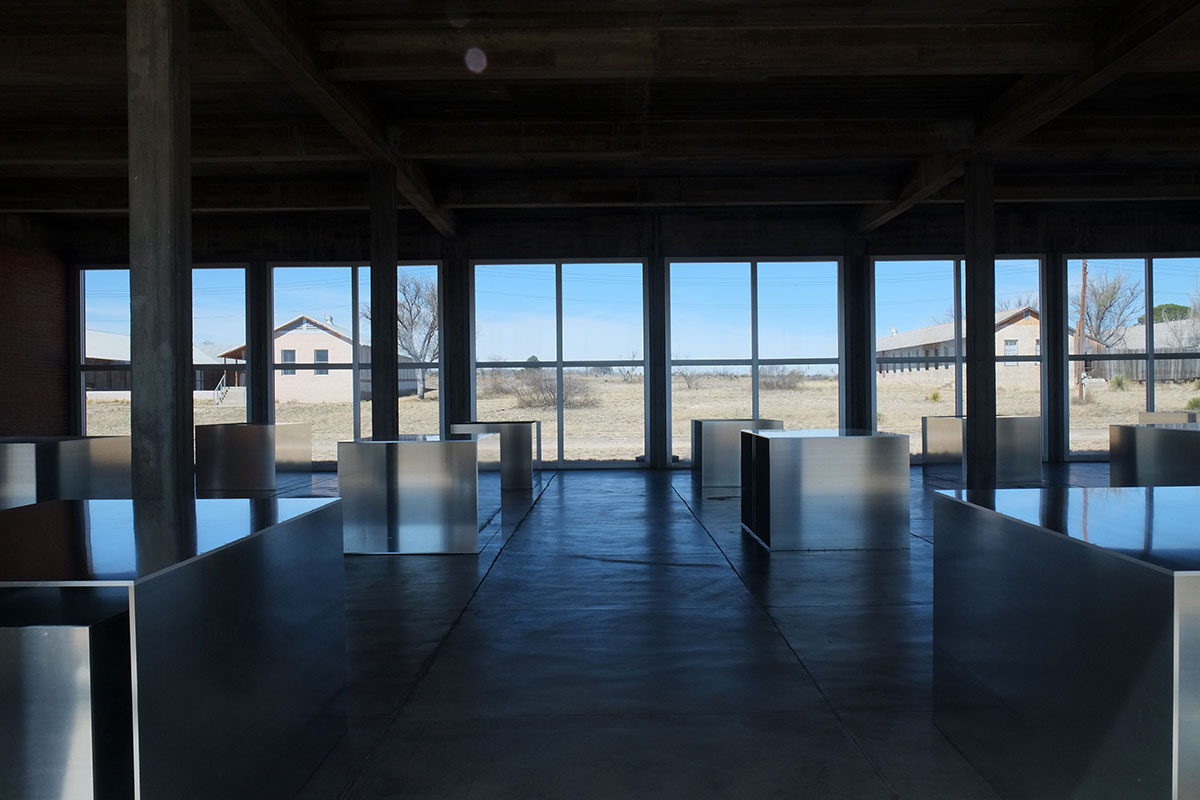
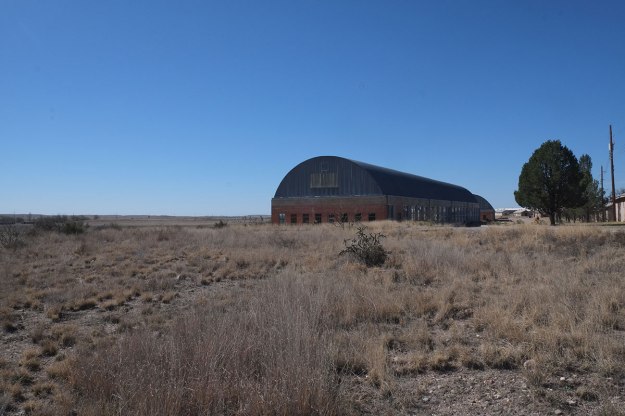
Besides the barracks, there are two large hangar-like buildings, which have been used for the installation of a series of 100 aluminum box Judd pieces.  They are quite remarkable buildings, with brick facades and a regular bay system.  Judd replaced the garage doors with glass storefront window installations.  But the biggest change he made was adding the barrel-vaulted rooves, which were previously flat.  This was done simply for visual reasons, to have the imageable building shapes stand out in the large landscape, creating iconic elements which seem to relate to the views of the distant mountains.  (Although I want to know what actually happens up in those big attics.)  DSCF6125
DSCF6153

To see the works inside at the Chinati Foundation, you have to take a tour, and you’re not allowed to take photographs inside.  They’re not worried about copyright, they just don’t want to have people running around, trying to capture the perfect image – they want people to actually experience the art.  As much as I do want the perfect image (mainly for teaching), I have to agree with this policy – when you eliminate the distractions of cameras and phones, the art is right there in front of you, and you begin to get it.  Maybe all museums should do this – no phones, and no labels.  Really look at the art.

The next day I did take a few photos through the windows when I was walking around the site,  not on the tour.  Here you can see how the pieces fit into the spaces.  DSCF6217
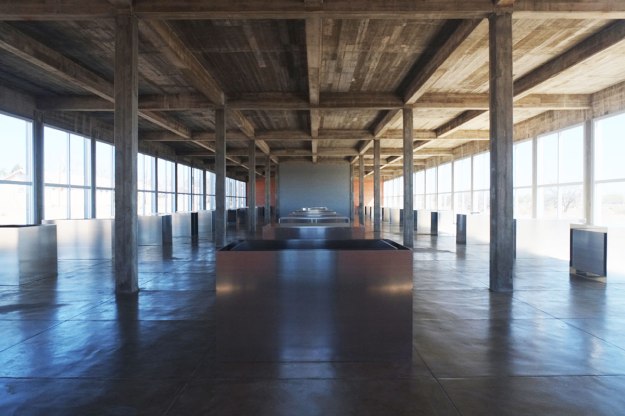
Judd adapted the placement of his works to the pre-existing division of the buildings into a few masonry-walled spaces.  But whereas the box concrete sculptures outside have varying spatial arrangements, here there is a strict alignment of the boxes in rows and columns, related to the building structural grid.  Each of the boxes has the same outside dimensions, but each has a different series of aluminum planes, and explore 100 different ways that the volume can be divided and developed.

Again, the importance of being in a large enough building to see the whole sequence was evident.  In a museum, you would see just one box, in a  gallery of work by many artists.  It becomes a checklist experience of identification – there’s the Judd – he’s making some interesting space inside an aluminum box – looks like exercises we did in first-year studio – wonder what his idea was – time to move on to the next piece in the gallery – oh it’s a Flavin.  But with a series you look at one, then you look at the next, then you think about the differences, and after you see five more an idea occurs to you, so you circle back to the first, etc.  It is similar to serial music, where the variation in the patterns is a  critical element.  (However, there is no discernible pattern in how the individual boxes are juxtaposed – you can’t see an obvious progression of an idea down a row, for example.  It’s not a matrix.)DSCF6220
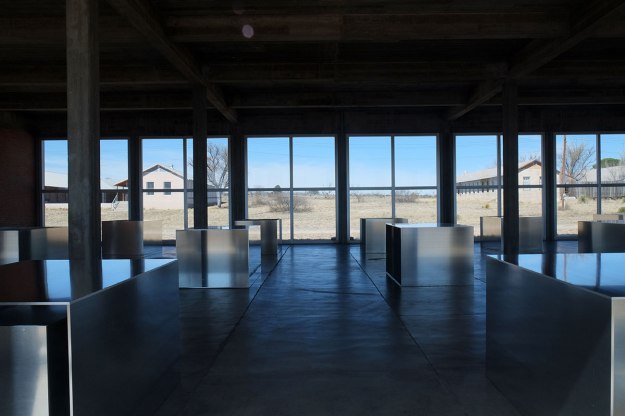
But I did discover one remarkable thing while looking at them.  The absolute precision of the geometry of each box made me wonder about the precision of their placement in the system of the repetitive building structural bays.  I sighted along a row of boxes, and discovered that they were not very well-aligned at all!  Some were shifted off the orthogonal, sometimes by inches.  Then I looked at their placement within the grid of control joints in the concrete slab, and found that they were not centered within an individual module, being clearly skewed towards one side.  This seemed so incomprehensible that I asked the guide, and she said yes, they were all moving – they had been carefully aligned and centered when they were installed decades ago, but now they were out of alignment.

I thought about it, and came up with what I thought was a reasonable explanation – large boxes made out of aluminum (which has a very high coefficient of thermal expansion), sitting in an unconditioned building in the desert.  Every day they would expand and contract with the diurnal temperature swing.  But they are sitting on an imperfect concrete slab, and so are unevenly supported, so when they expand and contract, they probably shift imperceptibly with each cycle.  After decades they have moved noticeably (about 10 inches in my estimate), and I would expect the movement among them to be random.  Then she added, they’re all moving north.  We were at a loss to explain this.  Couldn’t be magnetism.  How about the Coriolis Effect?  Maybe the janitor is actually pushing them?  The guide later mentioned that there is a 101st box, which is in the Spring Street Building in New York.  Greta theorized that they’re all trying to reunite and complete the sequence.  At which point the Hopi Corn Rocks will also fall, and the Anthropocene Era will come to an end.

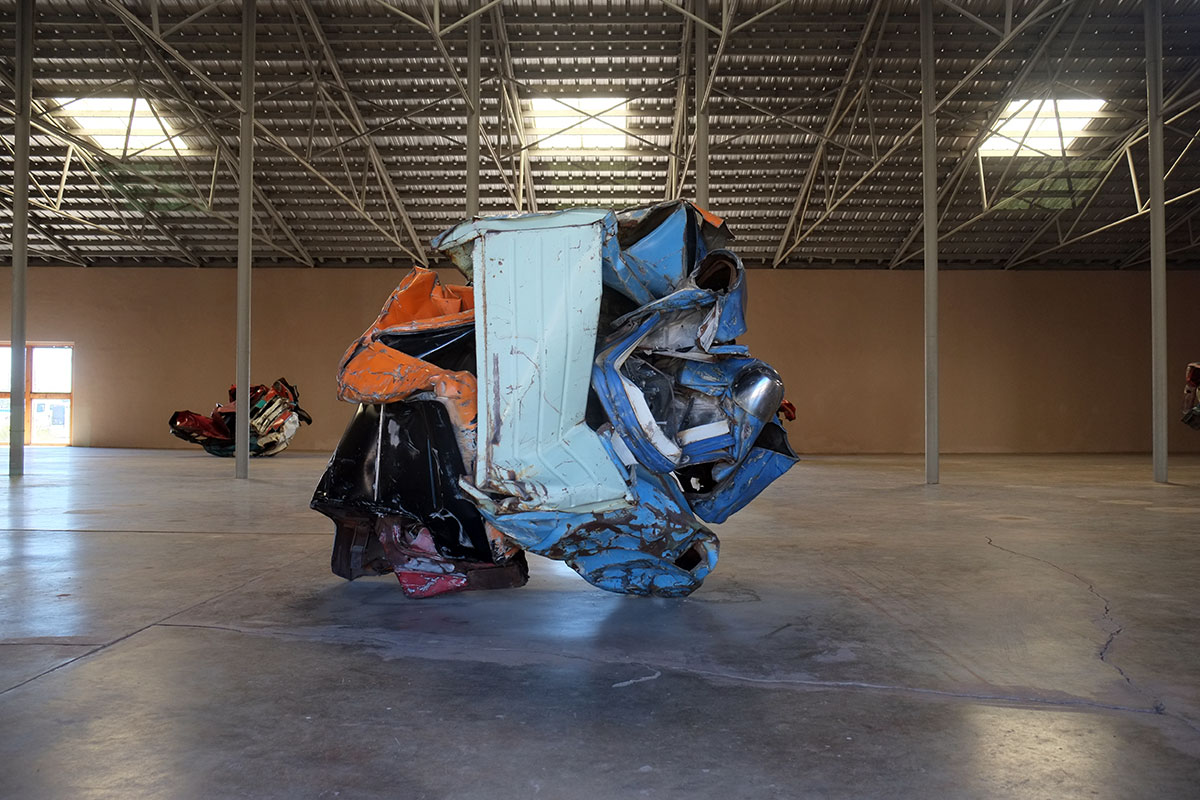
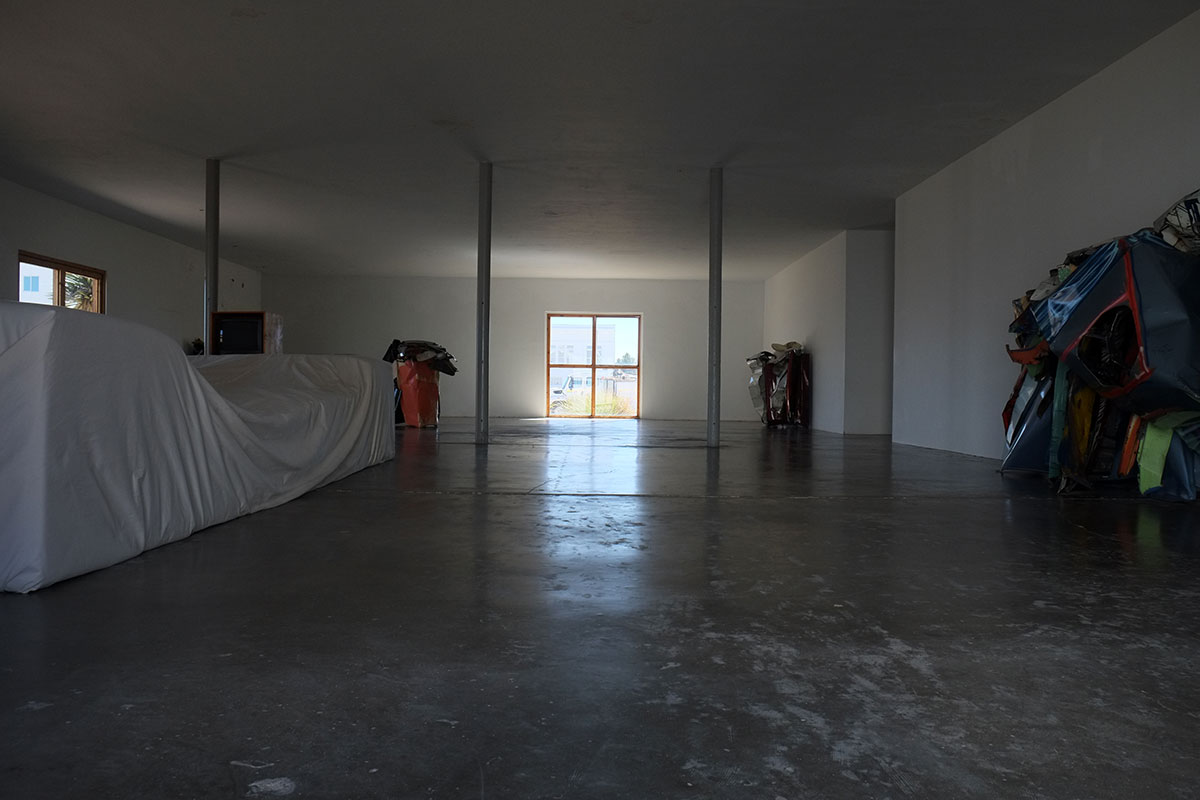
The last building of the Chinati Foundation is in downtown Marfa, which houses John Chamberlain’s sculptures made from automobile pieces.  DSCF6033
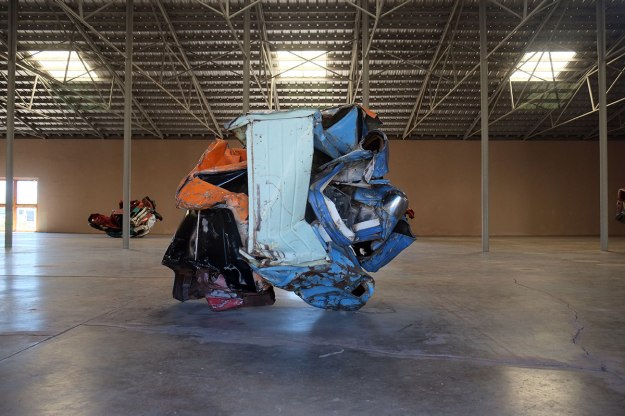
Whenever I’ve seen Chamberlains in the past, I’ve liked them but thought they were one-liners – cool idea, use old car parts.  But when you see a building full, you can see the big differences between them sculpturally and spatially.  When seen individually, his choice of material is the dominant attribute, and you see an individual sculpture as one example of the class of sculptures made out of car parts.  When you see many, the material cancels out, and you see them as individual works.  (You don’t go into a gallery of Greek sculpture and say, Oh, they’re all made out of marble.)  DSCF6035
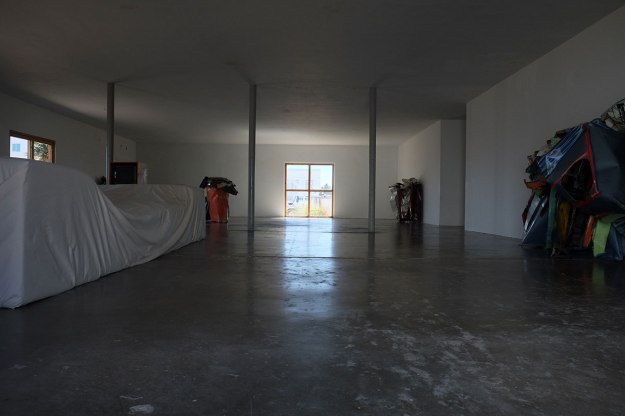
The next piece at the Chinati will be the remodel of the hospital building by Robert Irwin.  It has been in the works for years, and its completion could be the excuse for another visit there.

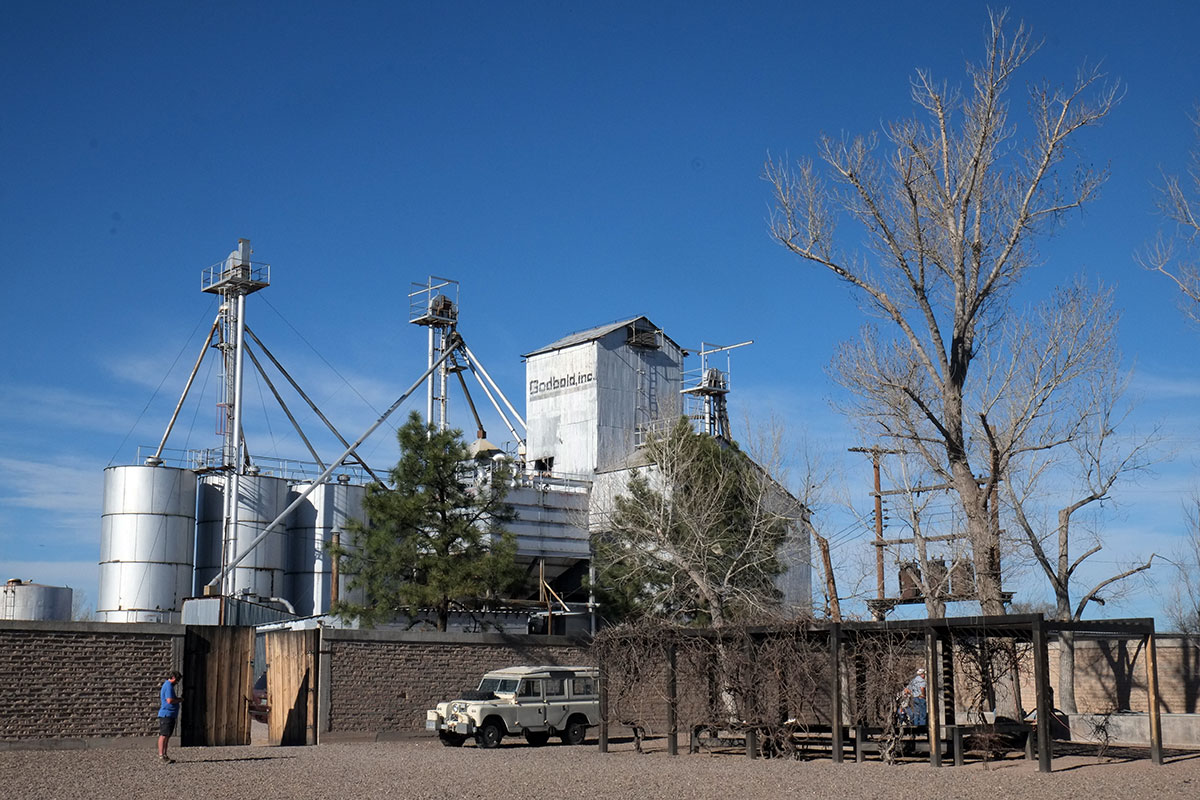
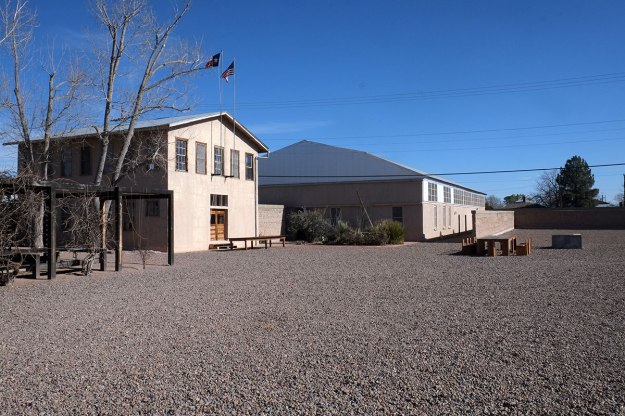
The other important site in Marfa is the compound where Judd lived and worked. DSCF6072
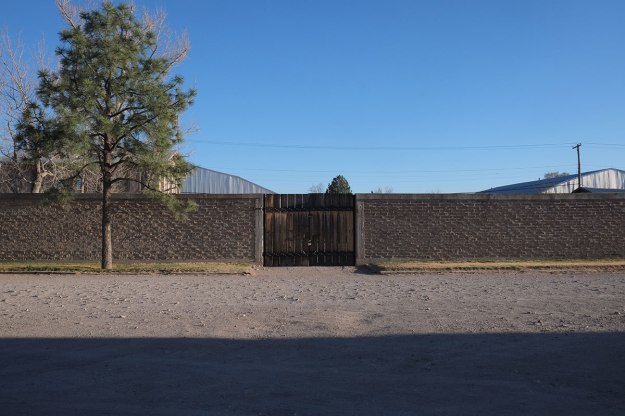
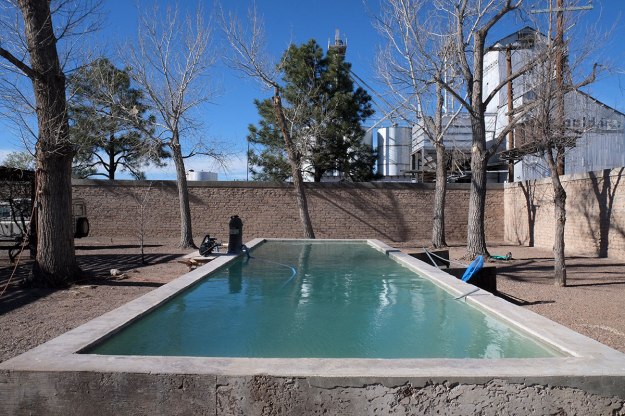
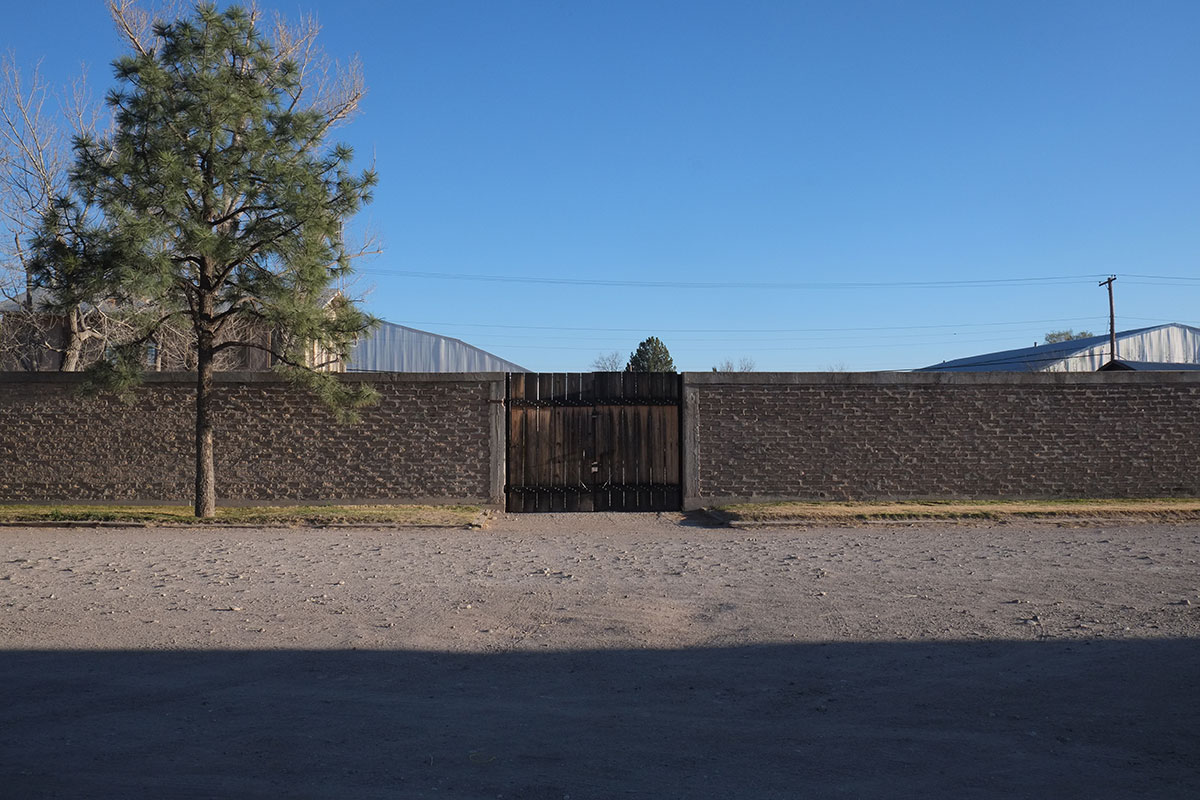
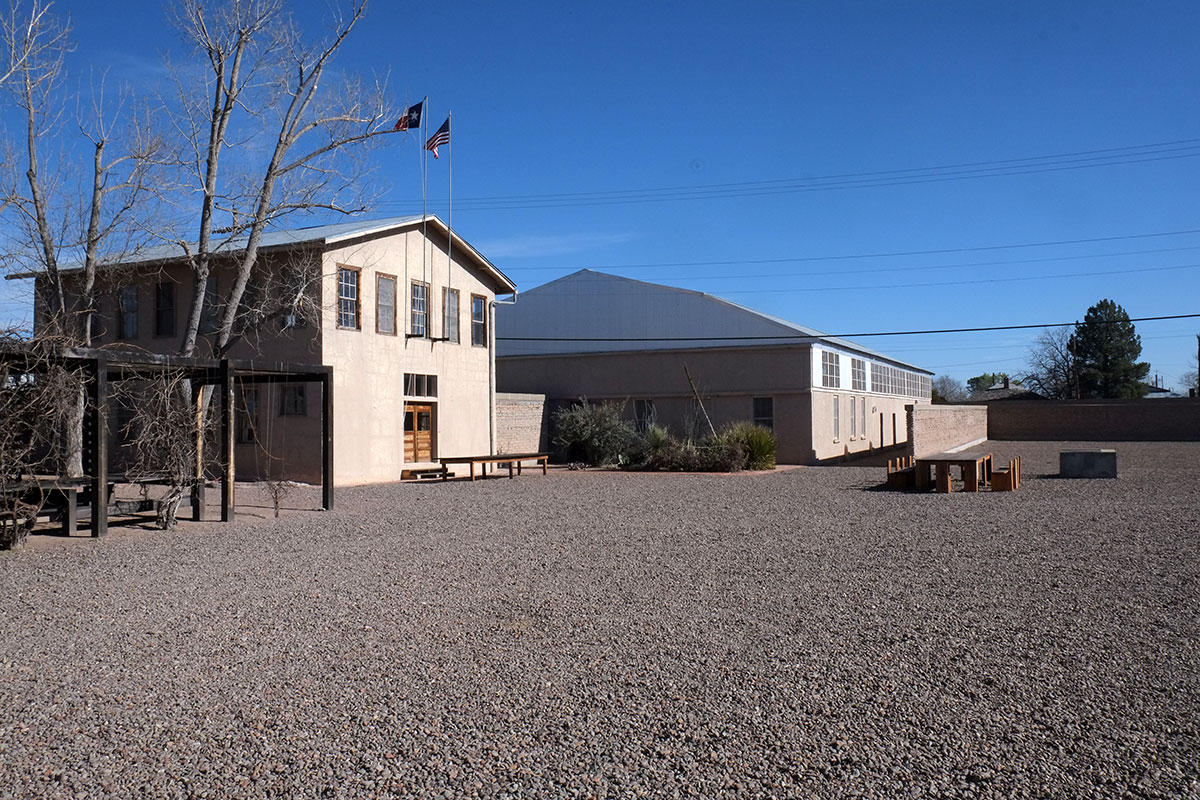
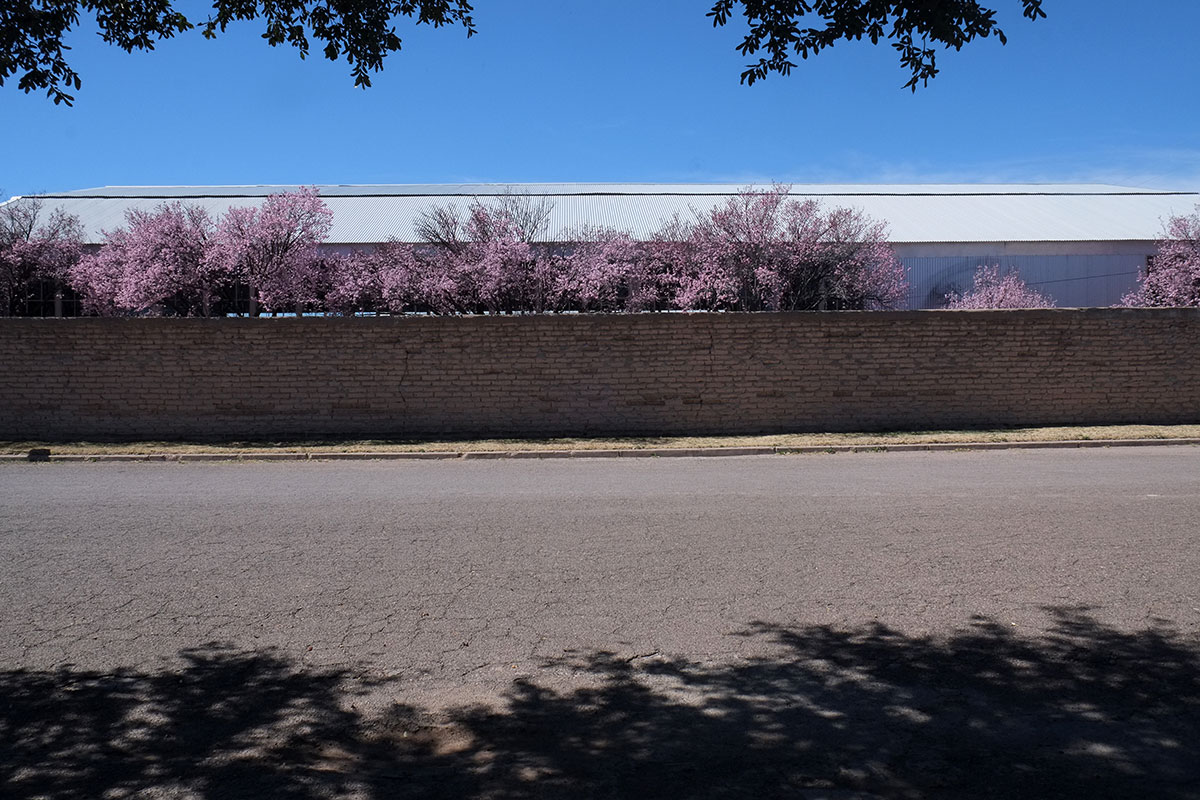
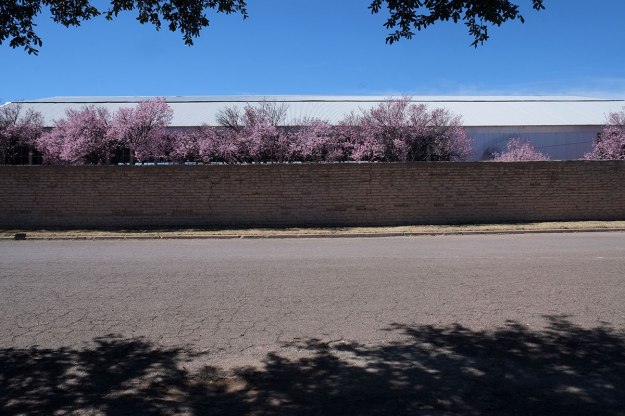
There is the original quartermaster’s house, which he remodeled, and a couple more large hangar-like buildings, which he subdivided into studios, galleries, libraries and more living space.  DSCF6041He built a big masonry wall around the whole compound, which apparently the locals were not thrilled about at the beginning, but which established the degree of privacy he needed to live and work in the center of town. DSCF6244
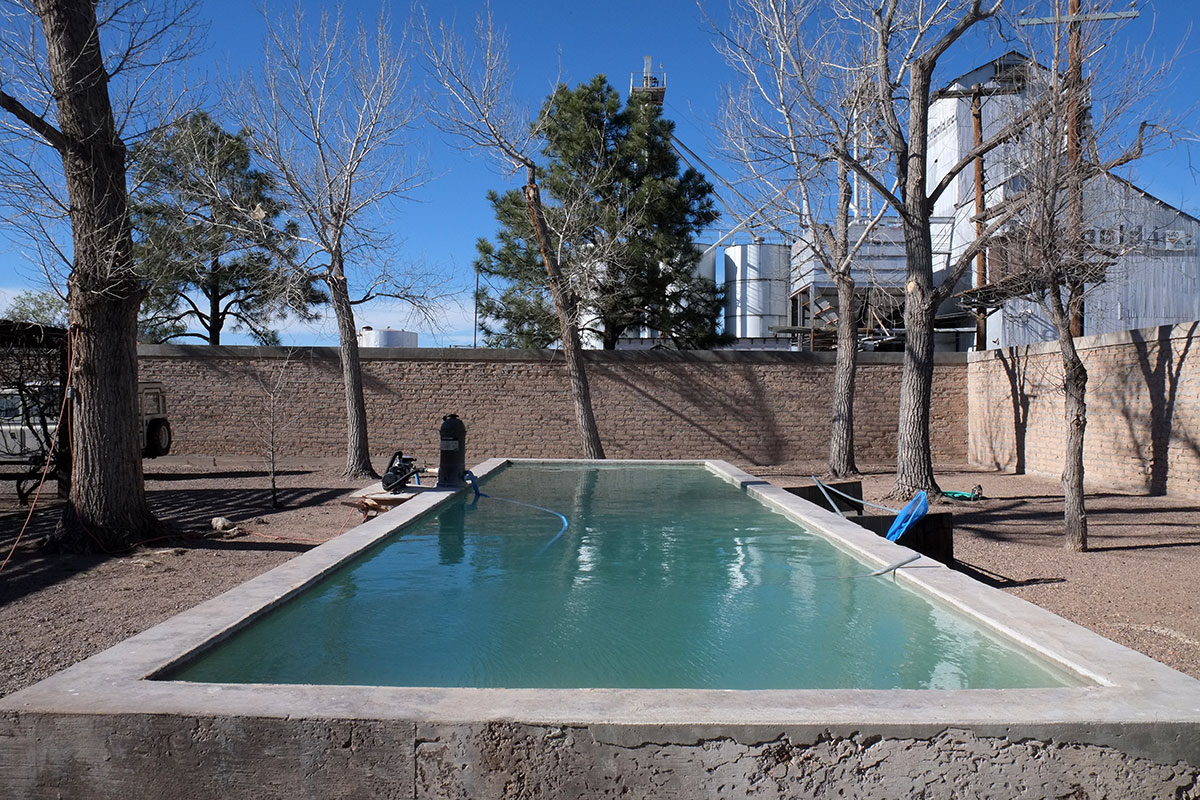
There is a fabulous swimming pool, DSCF6054

a Donald Judd personalized Land Rover,DSCF6066
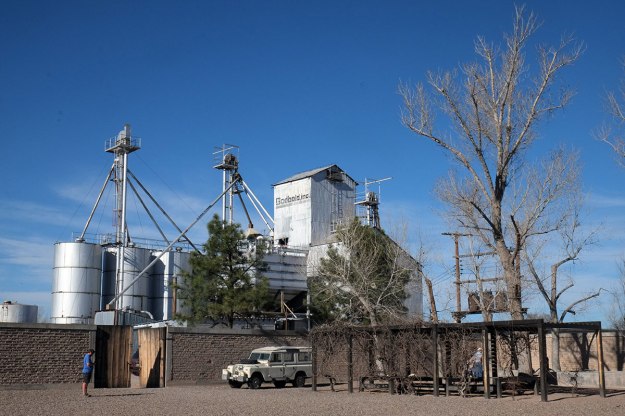
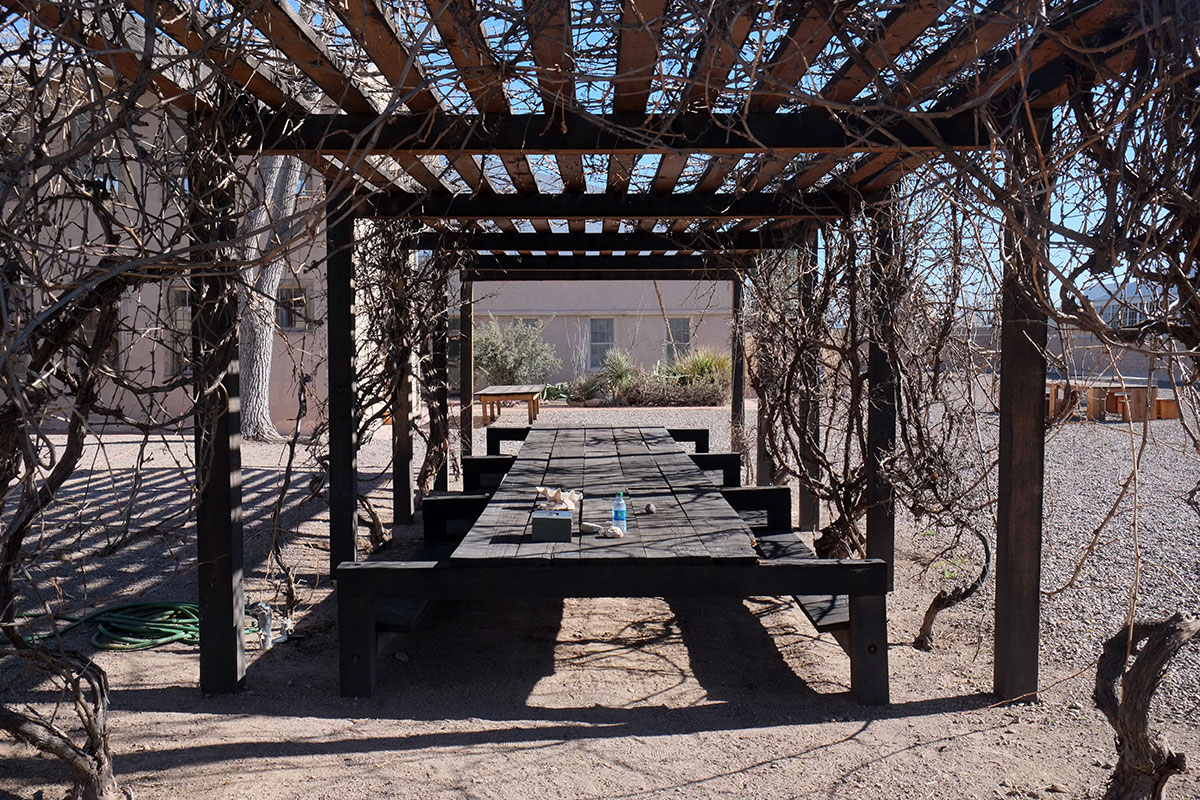
a great ramada / pergola which can seat a crowd, DSCF6057
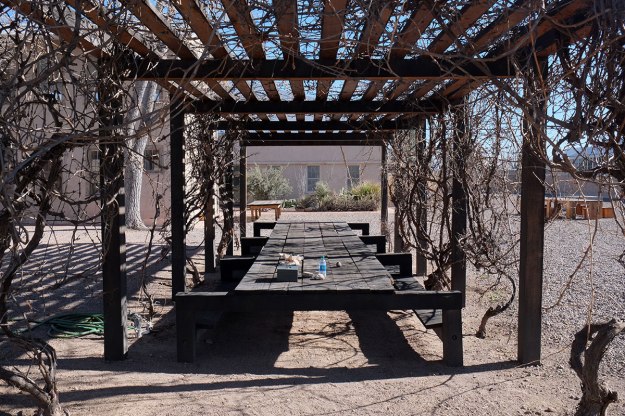
a side yard for his daughter to play in (in a rather abstract manner),DSCF6070
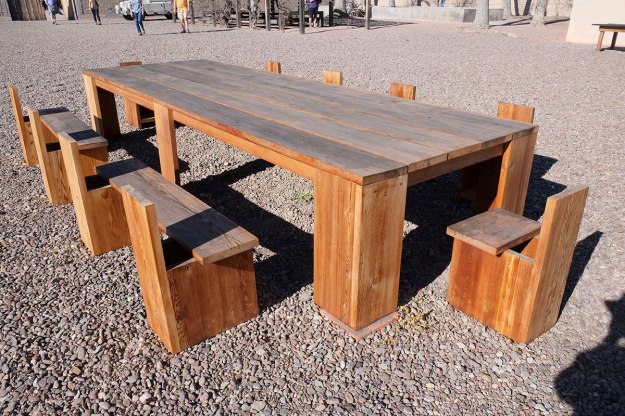
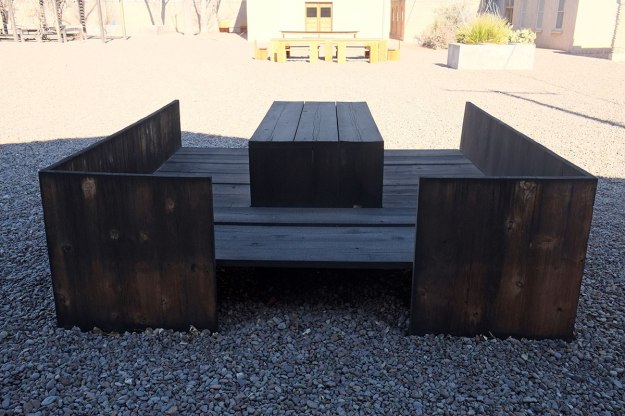
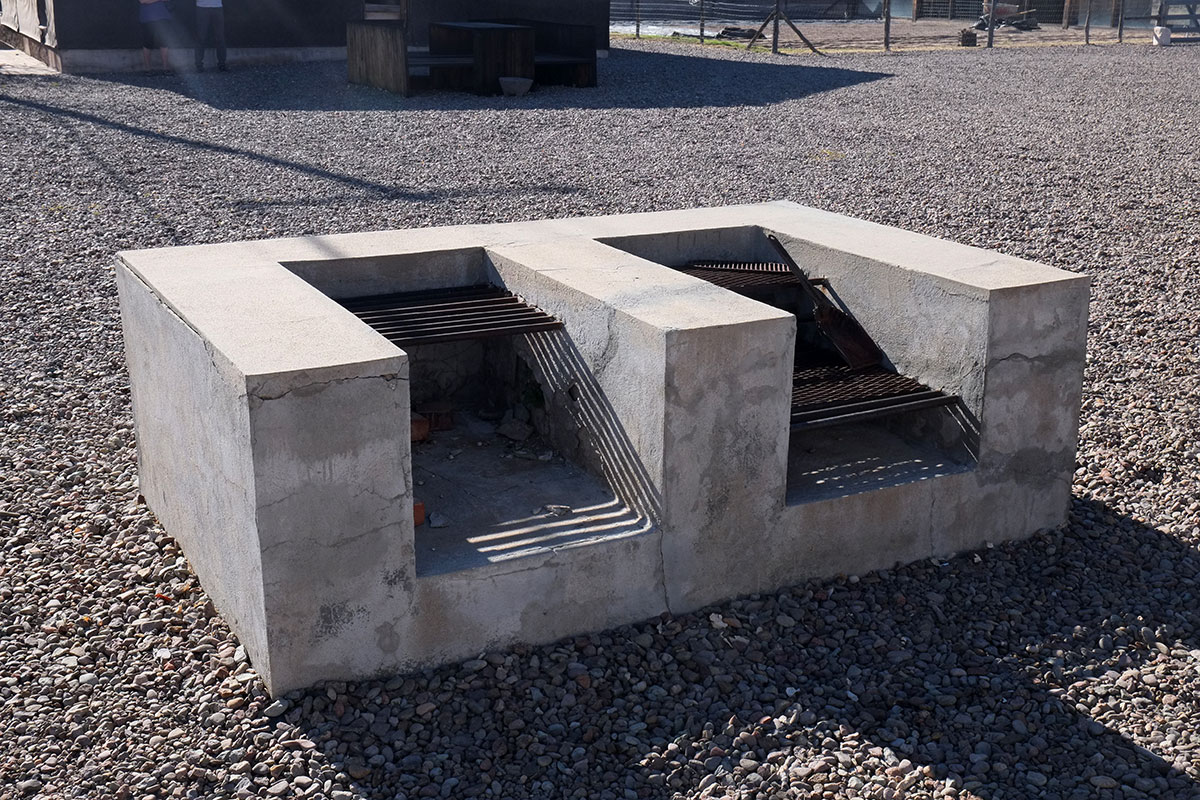
and Judd-designed outdoor living equipment, DSCF6061

and furniture.  DSCF6049

DSCF6045

The site design, building renovations and furniture all exhibit the simplicity and clarity of his sculpture.  He apparently hated the term Minimalism, and this makes it clear why.  Being minimal isn’t the goal, it is what is left when you strip away everything inessential.  Just as with Kahn’s architecture, the elemental pieces are rich in form, meaning, light, etc.  Doing something complicated is easy, doing something simple is hard.

You can’t take photos inside the buildings here either, but there are published views.  There are two gallery spaces of Judd’s work.  Whereas the work at the Chinati is for showing the rigorous development of a set of related ideas, the work here illustrates the development of his ideas throughout his career, so you can see the progression of thought.  Both types of focussed installation are critical, and something you can almost never see in a museum which has to show a range of artists.

Judd’s libraries were especially interesting.  Two big rooms, each across the width of a shop building, one with books about the modern era, and one for pre-modern.  He had 12,000 books, and his range of interests was broad.  His architecture selection was notable, spanning the range from Louis Kahn (obviously) to Christopher Alexander (less obviously).  He had a whole shelf on the design of structures.  All of his rooms had daybeds – apparently Judd liked to immerse himself in his work, and wherever he was tired he could lie down and sleep, waking back up to the matter at hand.

I had first heard about Marfa back in the 1980s.  One of my professors at Columbia, Lauretta Vinciarelli, lived with Judd in his building on Spring Street, where she was always designing things for Marfa, and helping Judd envision what the place could become – there are many published images of her designs for the courtyards there.  (Oddly, while we were in Marfa there was no mention, and apparently no knowledge, of her involvement.)  I never quite understood what was special about this one place way out in the desert, in the middle of nowhere.  I eventually began to understand the importance of isolation, but not this particular place.  But in the past two months, as we’ve wandered in the desert, it’s started to make more sense to me.  In Desert Solitaire, Edward Abbey writes:

…the strangeness and wonder of existence are emphasized here, in the desert, by the comparative sparsity of the flora and fauna:  life not crowded upon life as in other places, but scattered abroad in spareness and simplicity, with a generous gift of space for each herb and bush and tree, each stem of grass, so that each living organism stands out bold and brave and vivid against the lifeless and and barren rock.  The extreme clarity of the desert light is equalled by the extreme individuation of desert life forms…

Abbey is writing about the the natural world, but the same could be said about the artistic or intellectual ones.  Judd’s work might have developed in isolation in the Vermont woods, but the desert is especially suited to Judd’s art, with its conceptual clarity and spareness.  The work is contextual at that conceptual level, not at the more literal visual level with which we usually use the term in architecture.

I was aware of the cultural phenomenon that Marfa has become (more on that soon), and I expected that the experience of that milieu would overwhelm the experience of the art and architecture.  It didn’t.  Judd’s work speaks strongly and clearly here in a way it can’t anywhere else, and it is worth the trip to become immersed in it.  In this age of crazed, complicated, erratic, irregular, flashing imagery, coming face to face with solid, considered, elemental, quiet work is an inspiring and re-calibrating experience.

Big Bend National Park

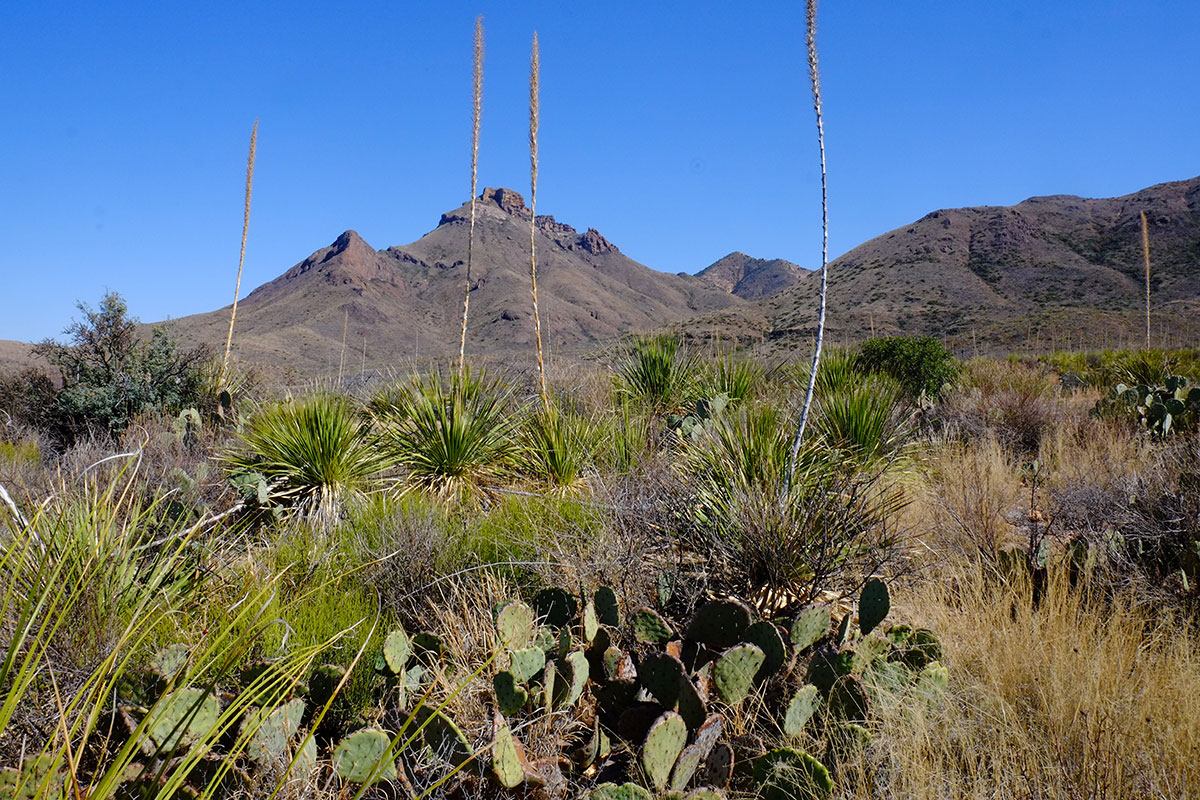
DSCF5961It turns out I have a lot more to say about cities, architecture and people than I do about nature.  This mirrors the division of labor Greta and I have when we go to a natural history museum – I look at the exhibits that involve humans and culture, she looks at the exhibits that are about the natural world.  Blog posts that are about places or people take me a lot longer to write – hence the extraordinary backlog on this blog:  we are in Bryce Canyon, but the blog is still back in New Orleans.  Since my landscape posts are mostly photos and a little narrative I can do them much faster, and in a last attempt to catch up on the blog, I’m going to change my protocol.  I’ll continue the sequential posting about cities and people, but I’m going to jump ahead on landscape posts, to catch up with where we are.  The Southwest has relatively little architecture and cities, and no friends, so it’s all going to be about landscape and parks, starting with this post about Big Bend.

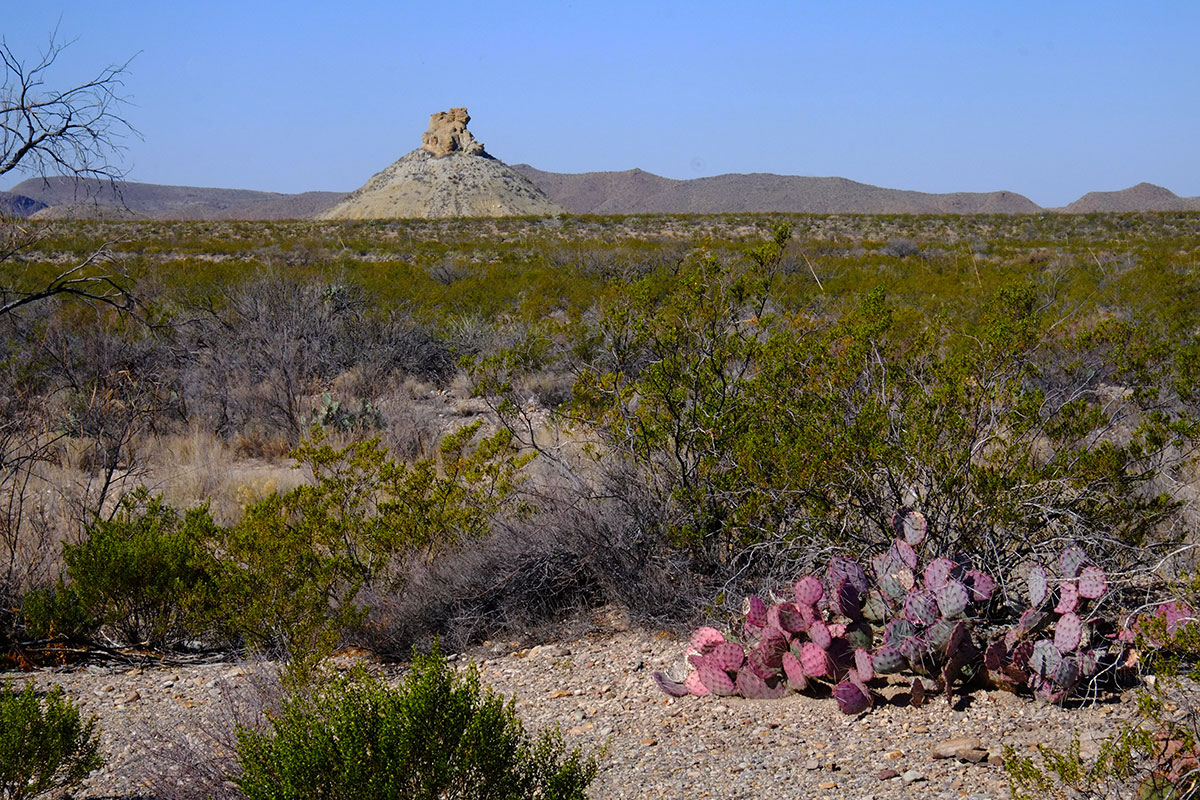
DSCF5756If you’re driving west from Dallas on I-20, and after about 400 miles you realize you are in the middle of absolutely nowhere in West Texas, just turn left, because only 150 miles to the south is Big Bend National Park.  I wondered about Big Bend the same way I’ve always wondered about Austin – is Austin really cool, or is it just cool in comparison to the rest of Texas?  Is Big Bend really beautiful, or is it only interesting after you’ve been driving for 500 miles in Texas?

My prior knowledge of Big Bend came solely from watching the movie Boyhood, but it did look cool enough to warrant a side trip.  It’s a relatively unknown National Park – they get about 300,000 visitors a year (Zion gets 4 million), because it is so far away from anything, and because it is just too hot to visit for much of the year (the visitors’ center closes in summer).  The Big Bend referred to is the big bend in the Rio Grande at the southern tip of the Texas Panhandle, so while you’re in Texas, a lot of the landscape you’re looking at is in Mexico.

You drive across the Chihuahuan Desert, and in the distance are the Chisos Mountains.  We got a campsite in the Chisos Basin – you can only get there with a trailer under 20 feet or an RV under 24, as the switchbacks into the Basin are steep and tight.  The campground is at 5400 foot elevation, surrounded by mountains over 8000. Here is a photo taken from 6500 feet or so, pointing out our trailer in the campground.  The scale is enormous, and it is remarkable to sit at your campsite, looking at beautiful mountains in every direction.DSCF5975

The size restriction keeps out the monster RVs, which inherently changes the types of campers and the social dynamic.  There are no people who are bringing their whole house with them (while towing an SUV), and sitting inside watching TV at night.  Everyone here has come for the experience of the place, and as the sky darkens (in what is probably one of the least light-polluted parts of the country), everyone sits outside and looks at the stars.  We saw stars we’d never seen before.  I remembered from books that Orion is a hunter and has a bow, but I’m not sure I’d actually ever clearly seen that bow before.

We also met some lovely people in the Chisos Basin.  Patty and Danny, two young retirees (and Patty a refugee from academia) were from the Carolinas, travelling in a small Airstream.  They had the site next to ours, and we got to know them after hearing Danny pull out his banjo in the evening.  On the Lost Mine Trail one morning, we met another couple from Dallas, and had a running conversation with them as we crossed paths (literally) a few times throughout the day.  (We’ve noticed that when they learn that you’re not from Texas, reasonable Texans emit a subtle signal to indicate that they are not crazy like most of the state.  If you respond with the secret handshake, you get the inside scoop on life in Texas.)  Then there was the couple from California, with whom we turned out to have mutual friends in Eugene.  I’ve always been wary of getting old and hanging around mainly with older people, but the older people we’ve been meeting in National Parks have been great.  I want to be that 85-year-old slowly climbing that mountain trail.

The trails in the Chisos Mountains and Basin were fantastic, with astounding rock formations and long vistas over the desert.  DSCF5981  DSCF5991

DSCF5962

DSCF5990

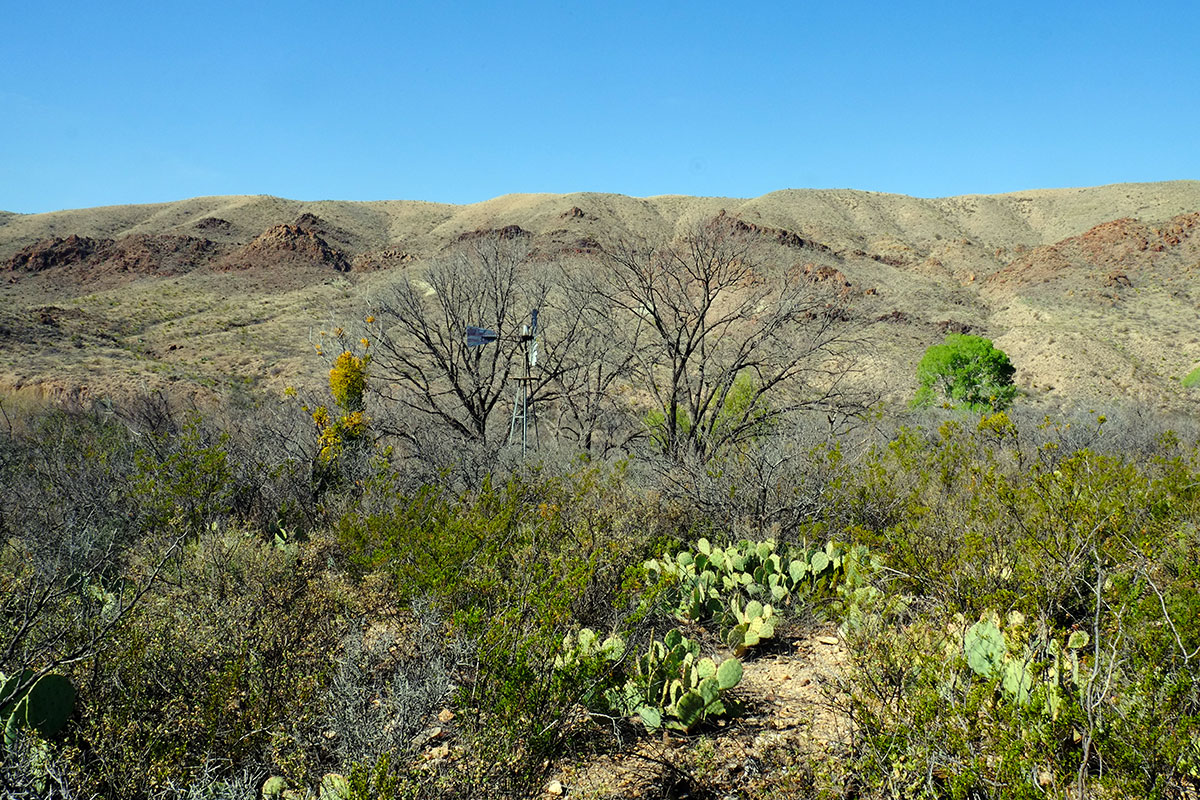
The desert itself had a range of flora we’d never seen before, and the remnants of 100-year-old ranches and cotton farming settlements (which had been irrigated by the Rio Grande).  DSCF5762  DSCF5790DSCF5802

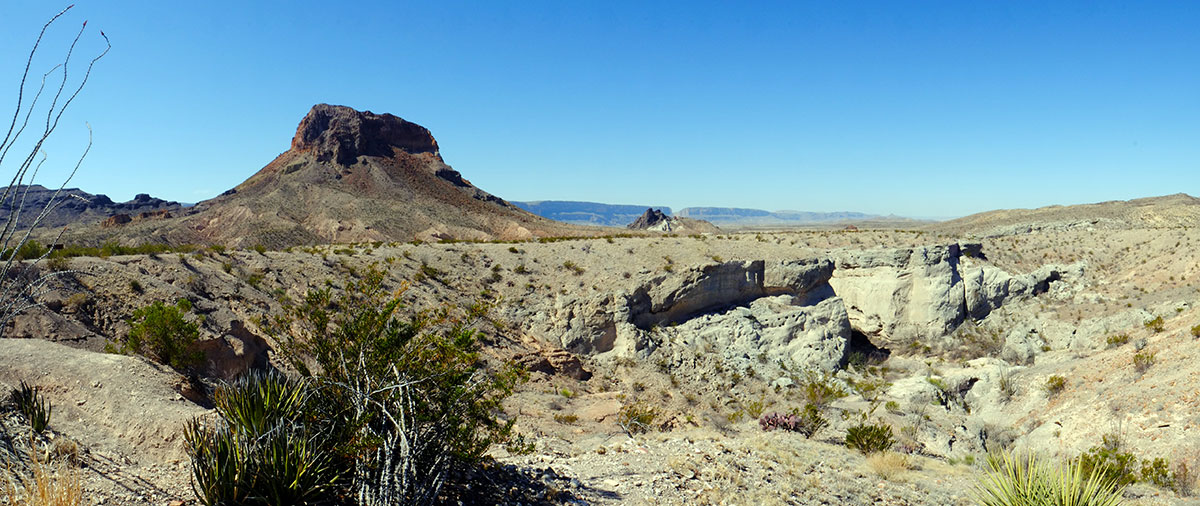
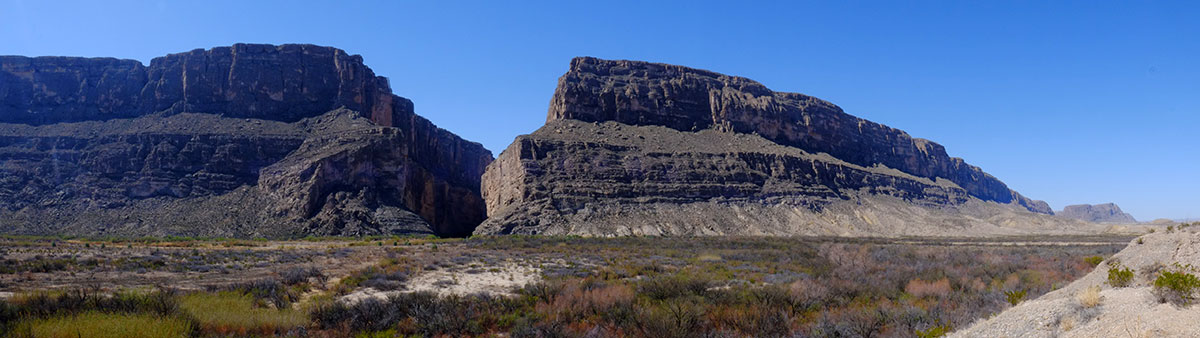
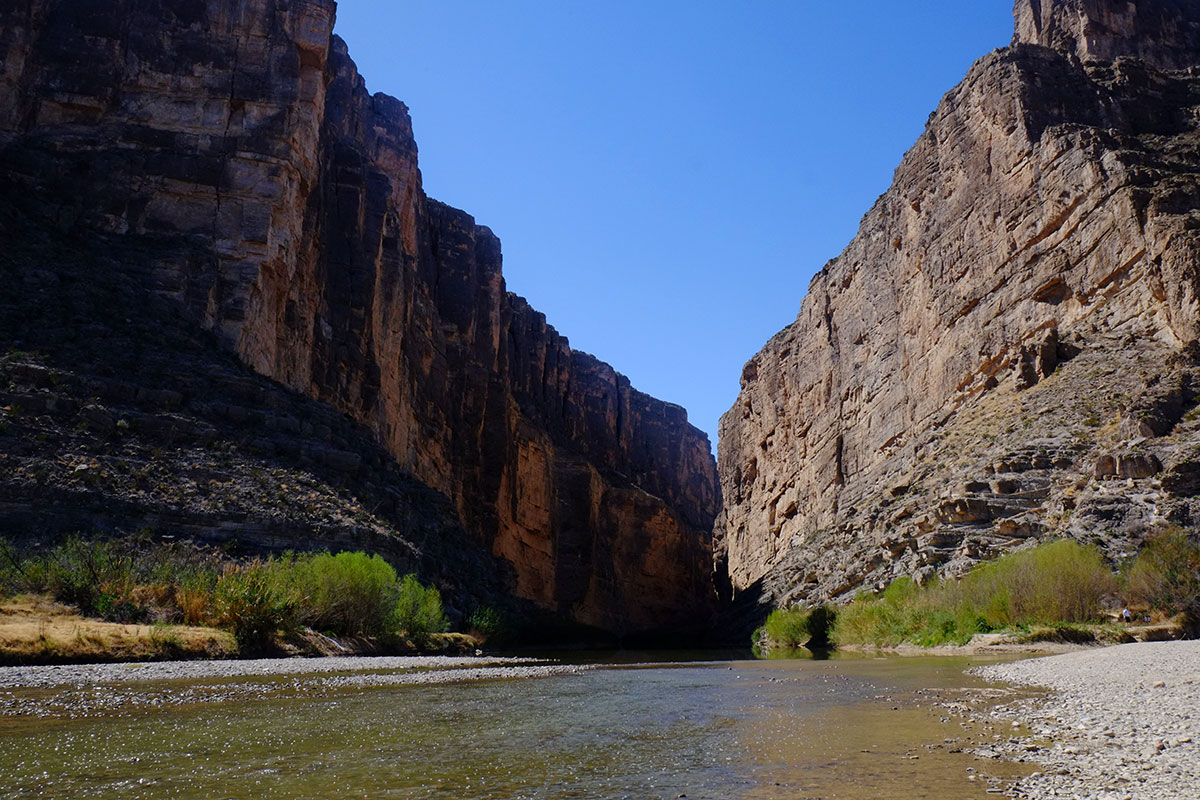
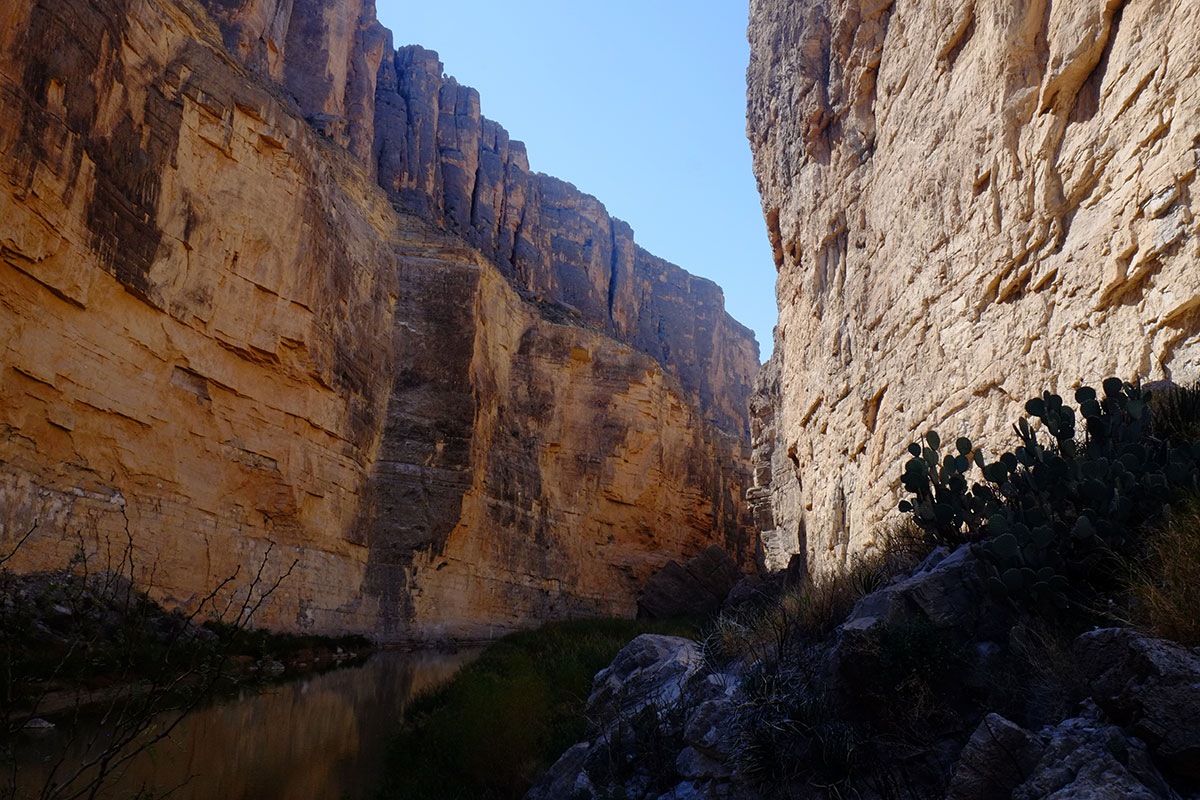
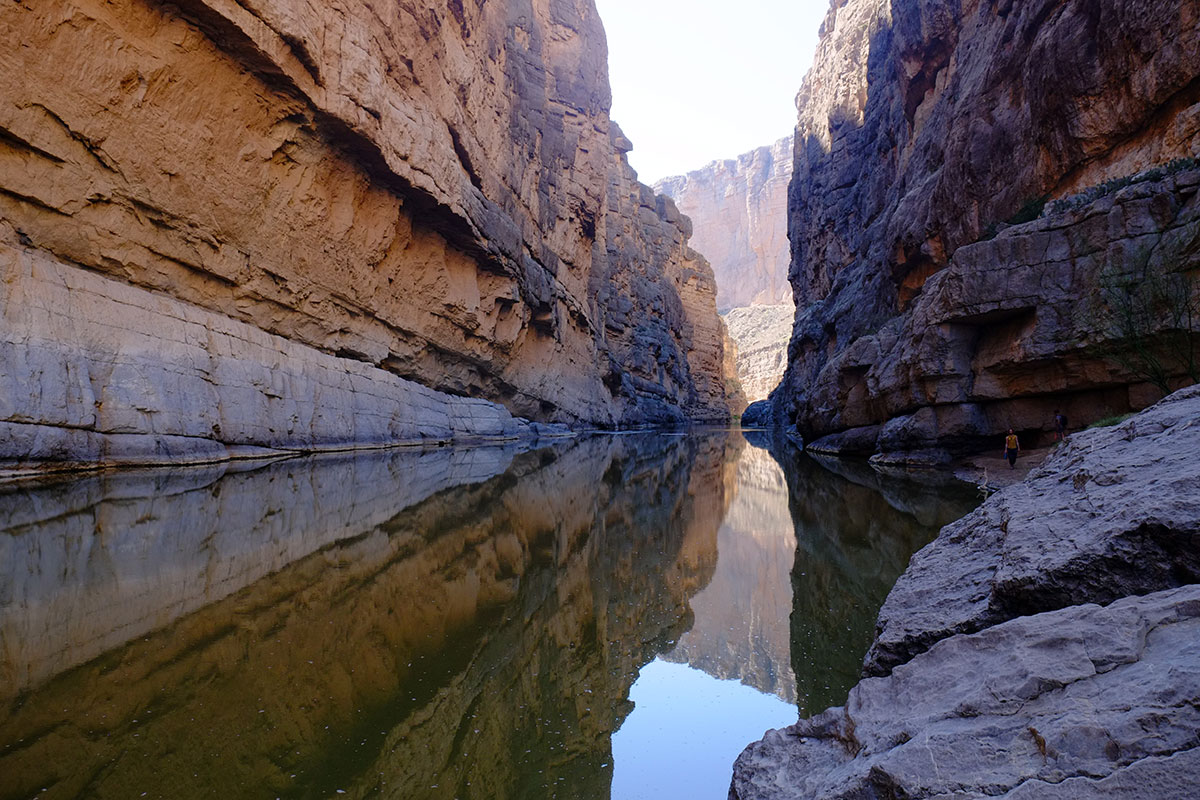
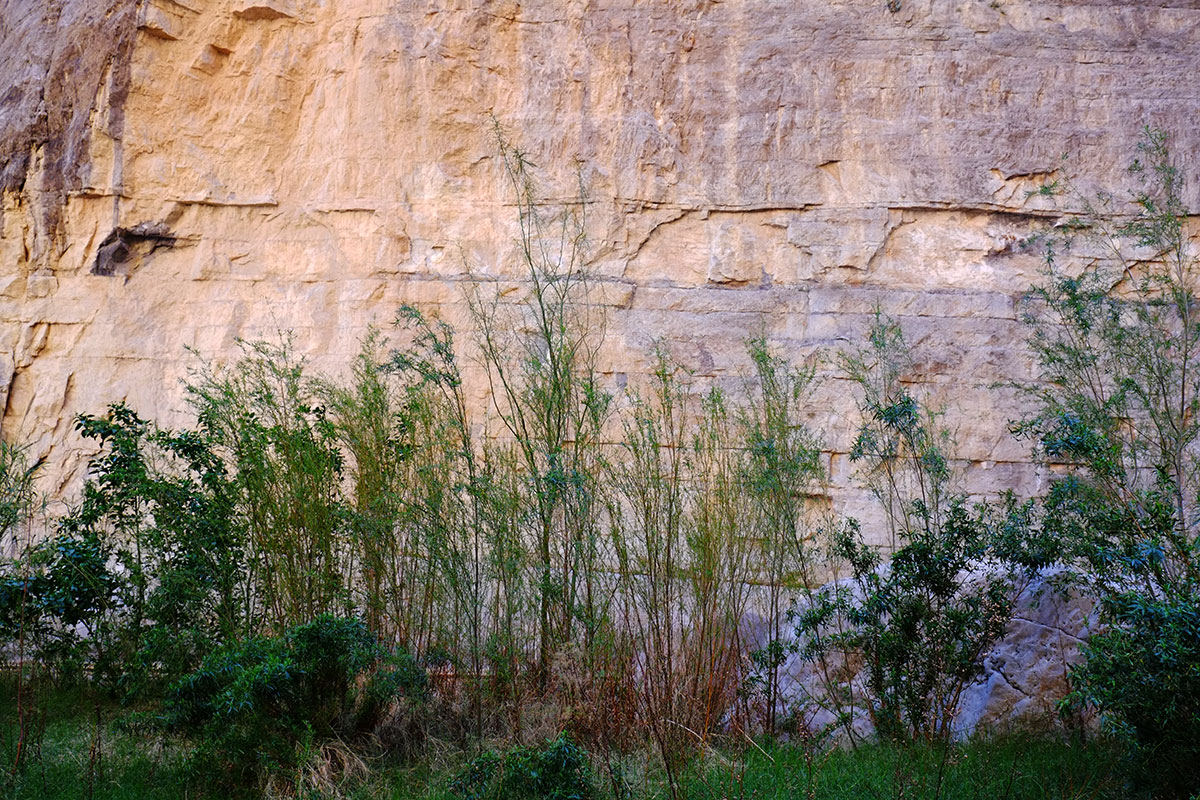
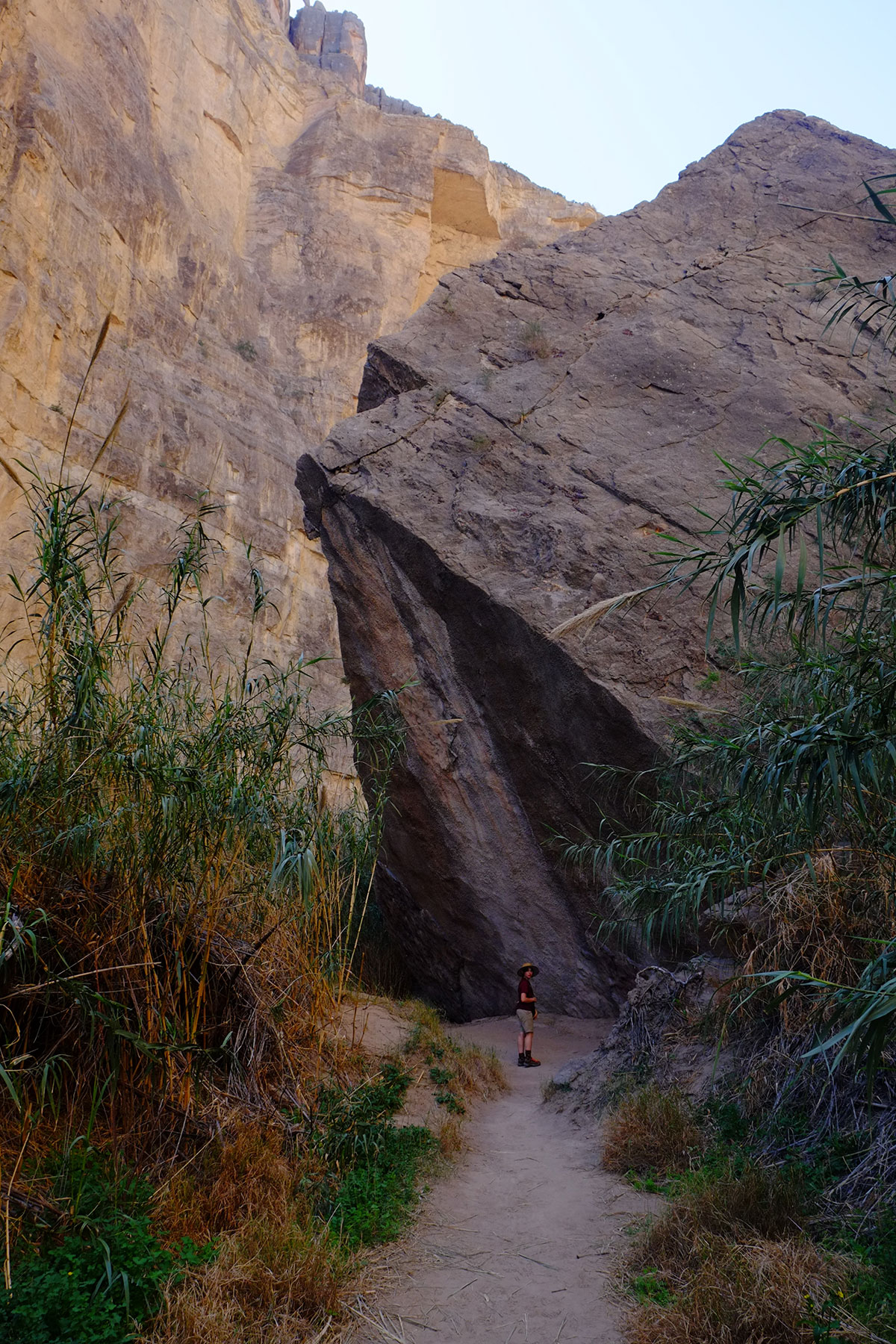
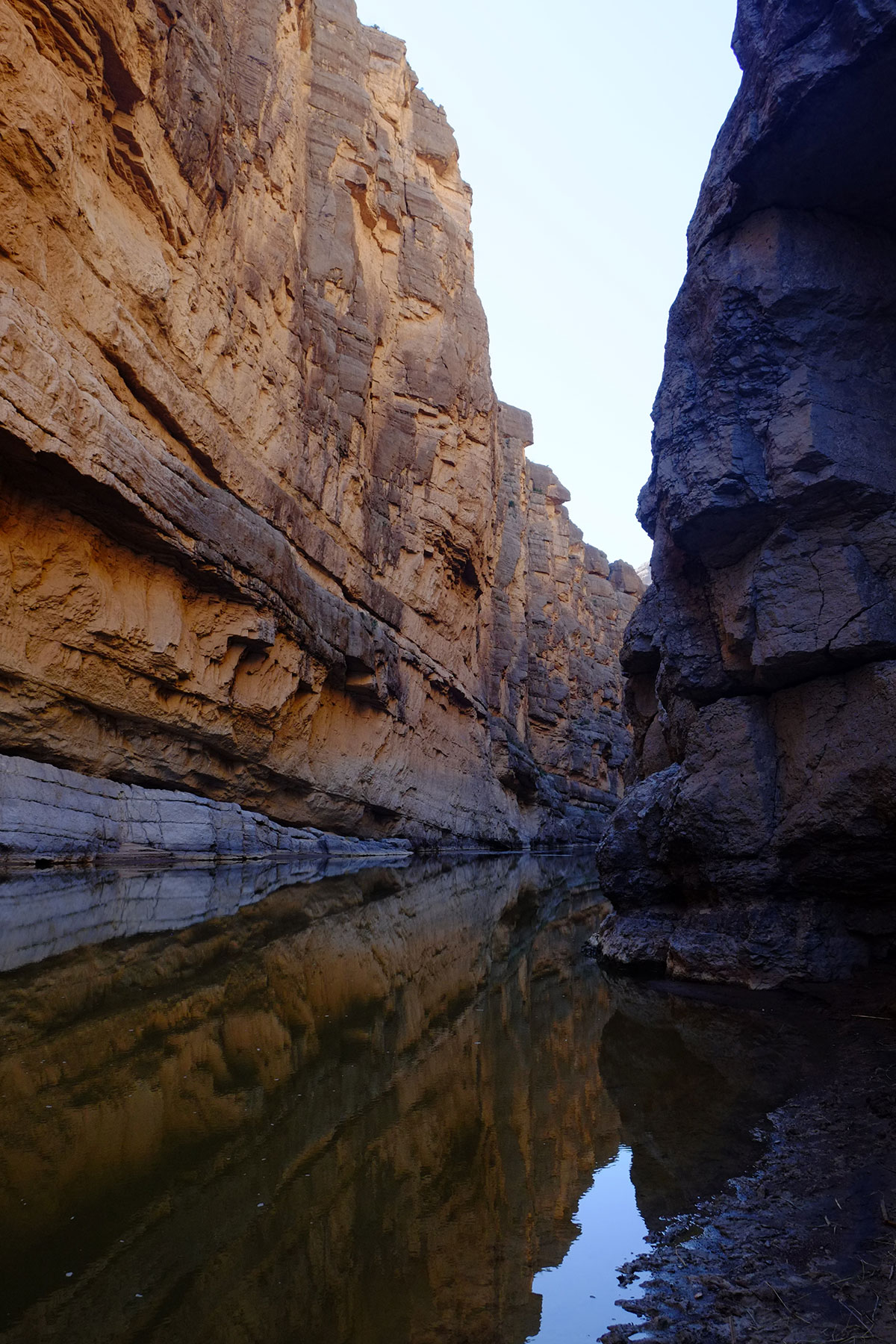
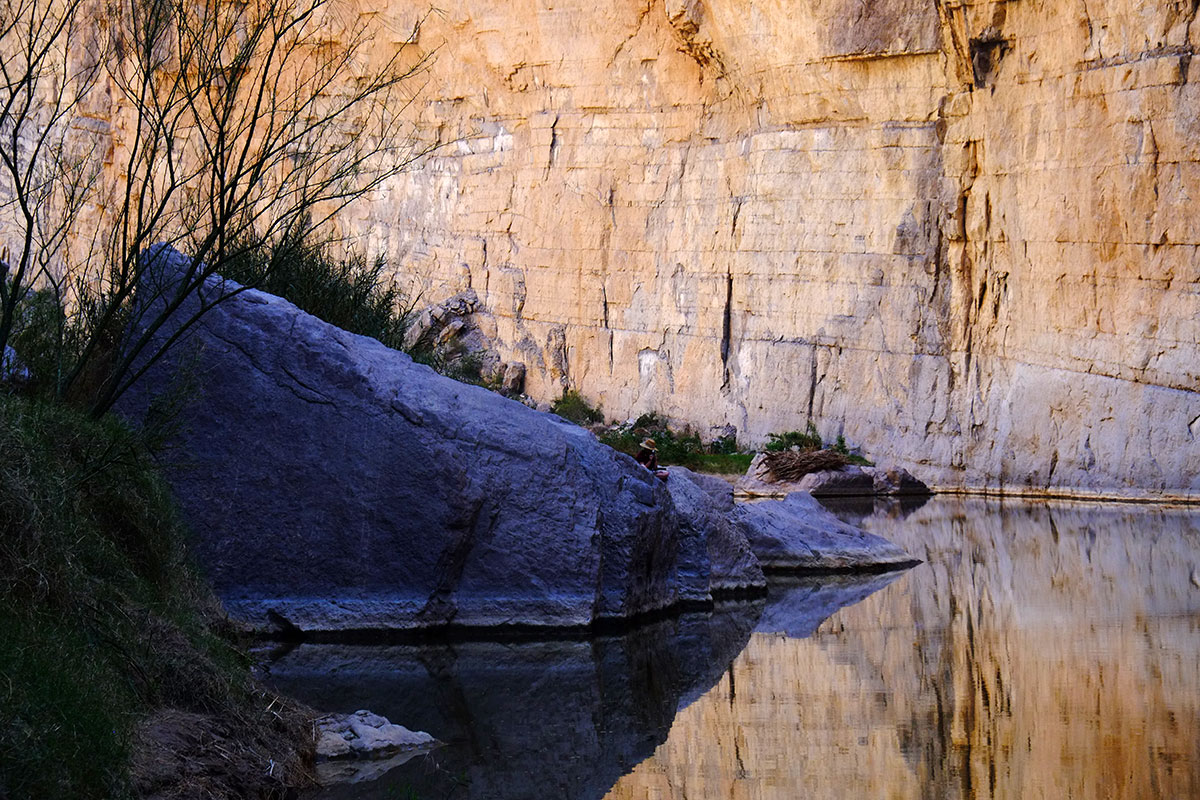
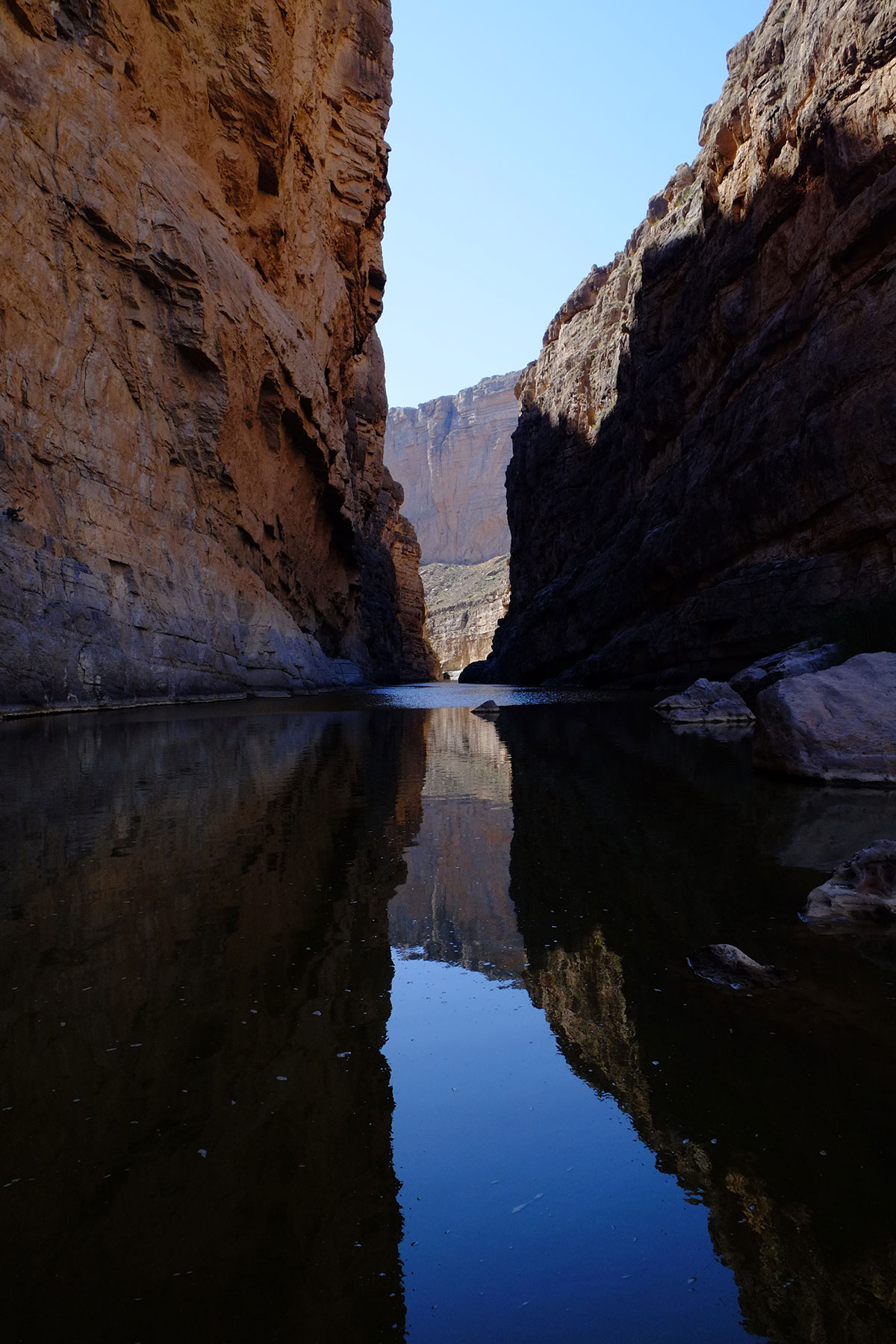
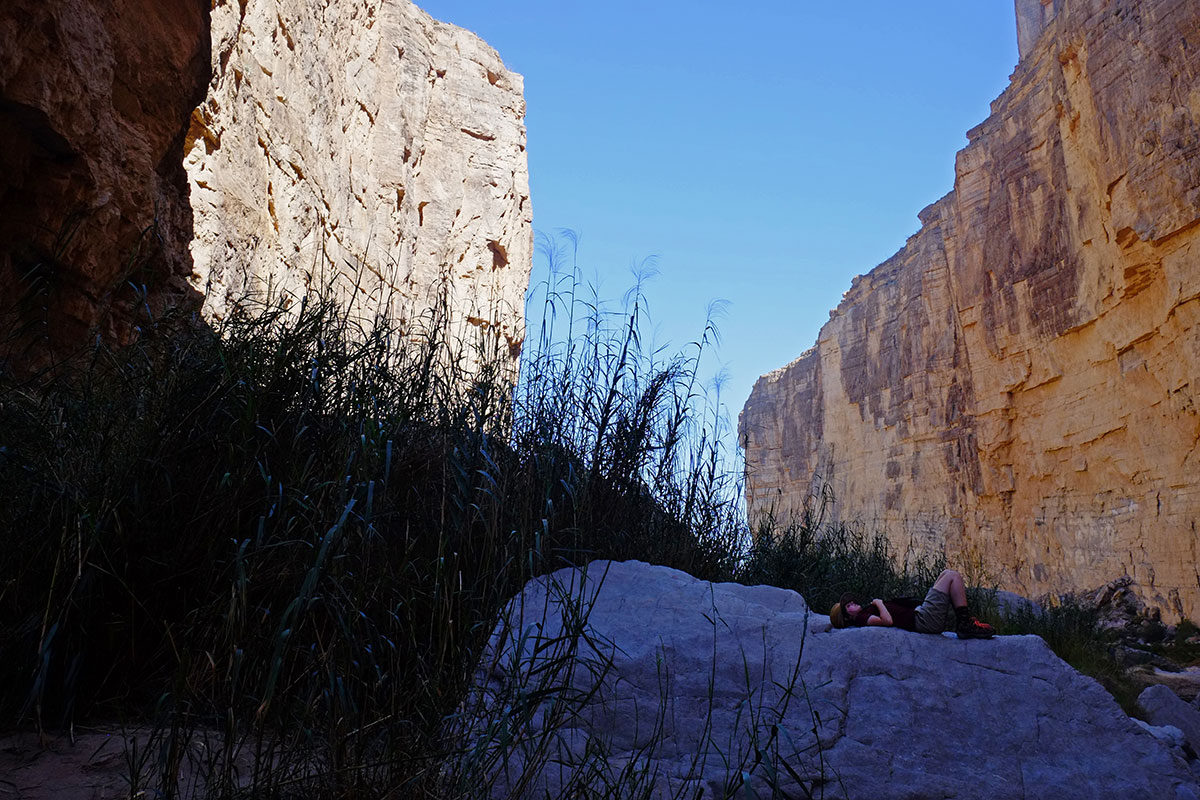
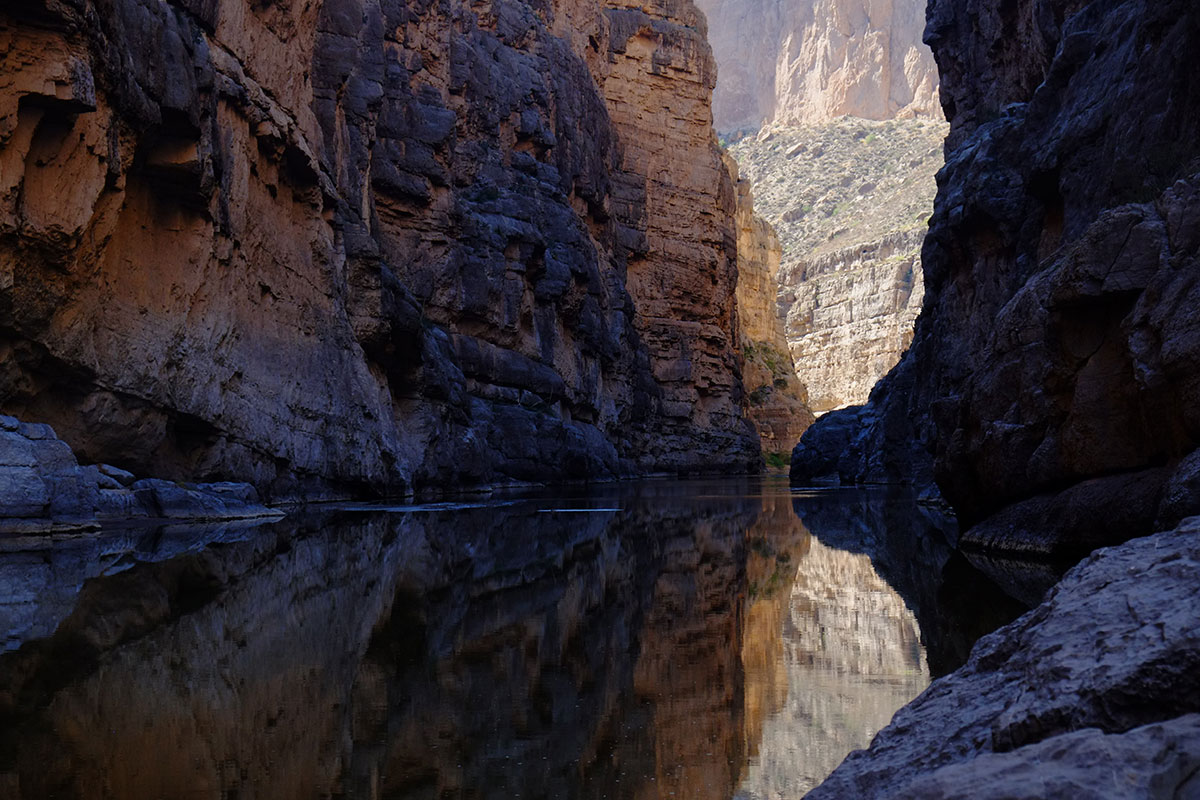
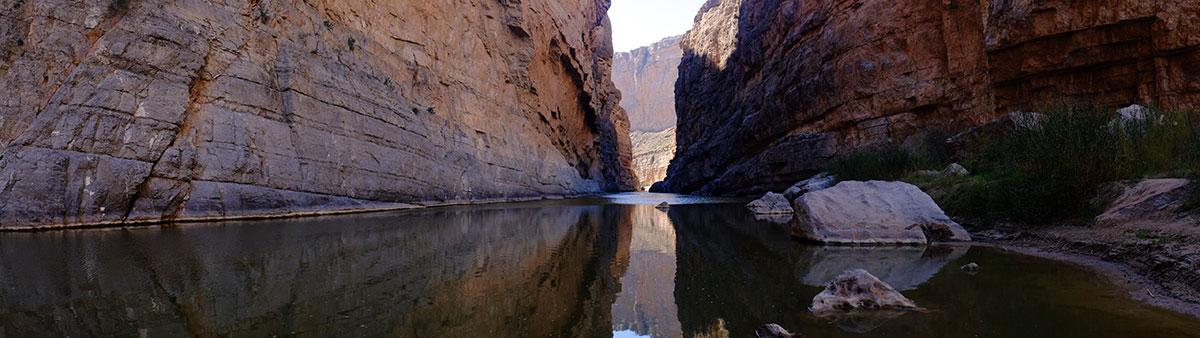
But the most spectacular spot is the Santa Elena Canyon.  You drive south across the desert towards the Rio Grande, and a 1500-foot tall continuous rock cliff appears off in the distance.DSCF5822 As you get close, you notice a notch in the cliff. DSCF5834You leave the car, and walk across the desert that is blazing hot even in February. DSCF5844A short climb up some switchbacks and you are in paradise. DSCF5867The Rio Grande (which is awfully small for such a name) has cut this narrow canyon through the cliff. You can throw a rock into Mexico.  You wind along a path for a mile or so until the whole width of the canyon is the river. DSCF5904It is quiet and cool, with lush vegetation (including invasive species such as bamboo). DSCF5881You walk around huge boulders that have fallen from above. DSCF5880The water is a mirror, until broken by a canoe trip gliding past.  DSCF5885 We strolled there for hours, stopping every few feet to appreciate the different elements in the view.   DSCF5891  DSCF5911DSCF5903    DSCF5896DSCF5916

Finally we had to leave, and we emerged back into the blinding West Texas desert, even hotter than when we had entered.  It would be a long way to the next oasis.

Northern Louisiana

Northern Louisiana seems to be a different world from the coastal region.  We drove north from New Orleans along the Mississippi on River Road, where two different eras collide: there are the ante-bellum plantations, and there is the modern industrial landscape.  But you can never actually see the river – the levee forms a wall along the road that’s probably 40 feet tall. You see ships looming over it, so you know that there must be a river there somewhere.

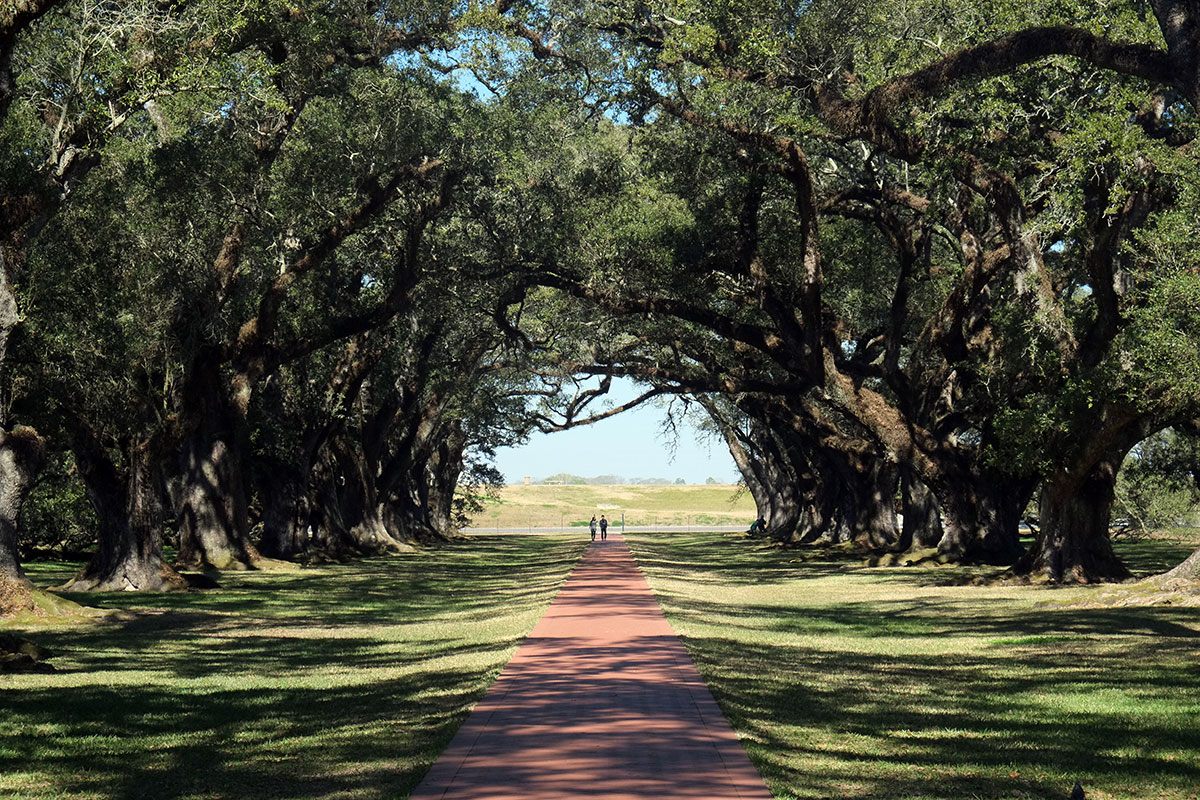
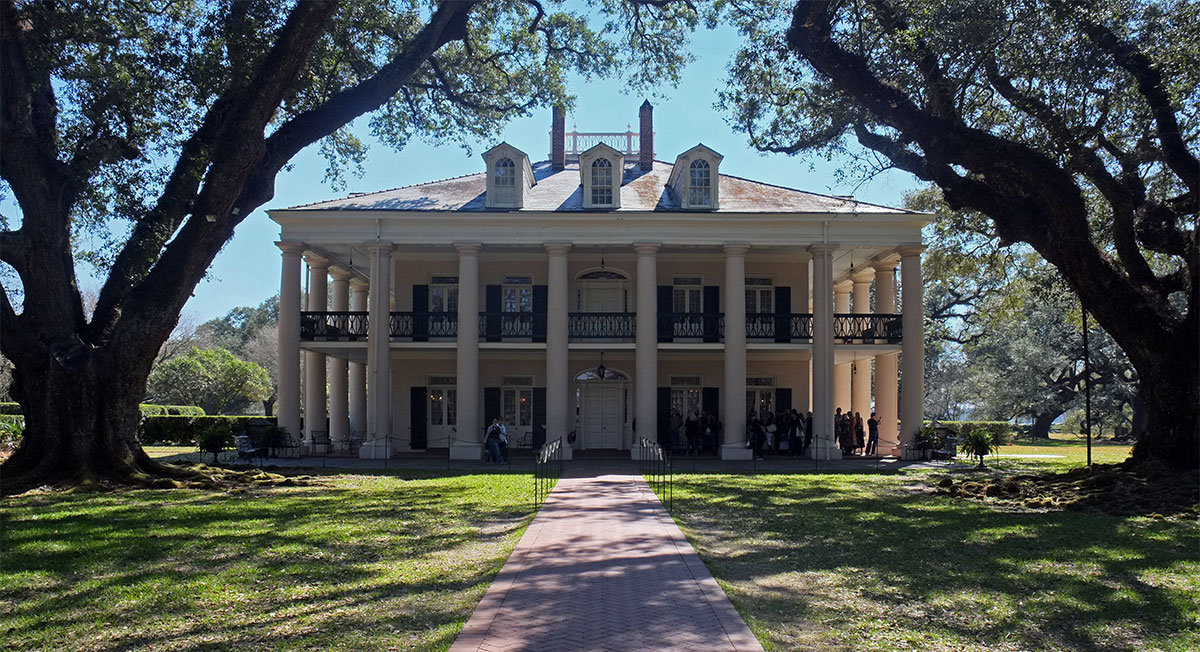
DSCF3963Among the many plantations around, we decided to go to Oak Alley, as we had been told it had the quintessential allee from the river to the house.  As in all houses we’ve toured in the South, the family who built this plantation was very important, with lots of governors and senators etc., but we promptly forget all this family stuff after hearing it (another reasons we could never be southerners).  We’re just here for the architecture, which did not disappoint.

The allee is spectacular, and must have been more so when there wasn’t a levee at the end.  DSCF3891

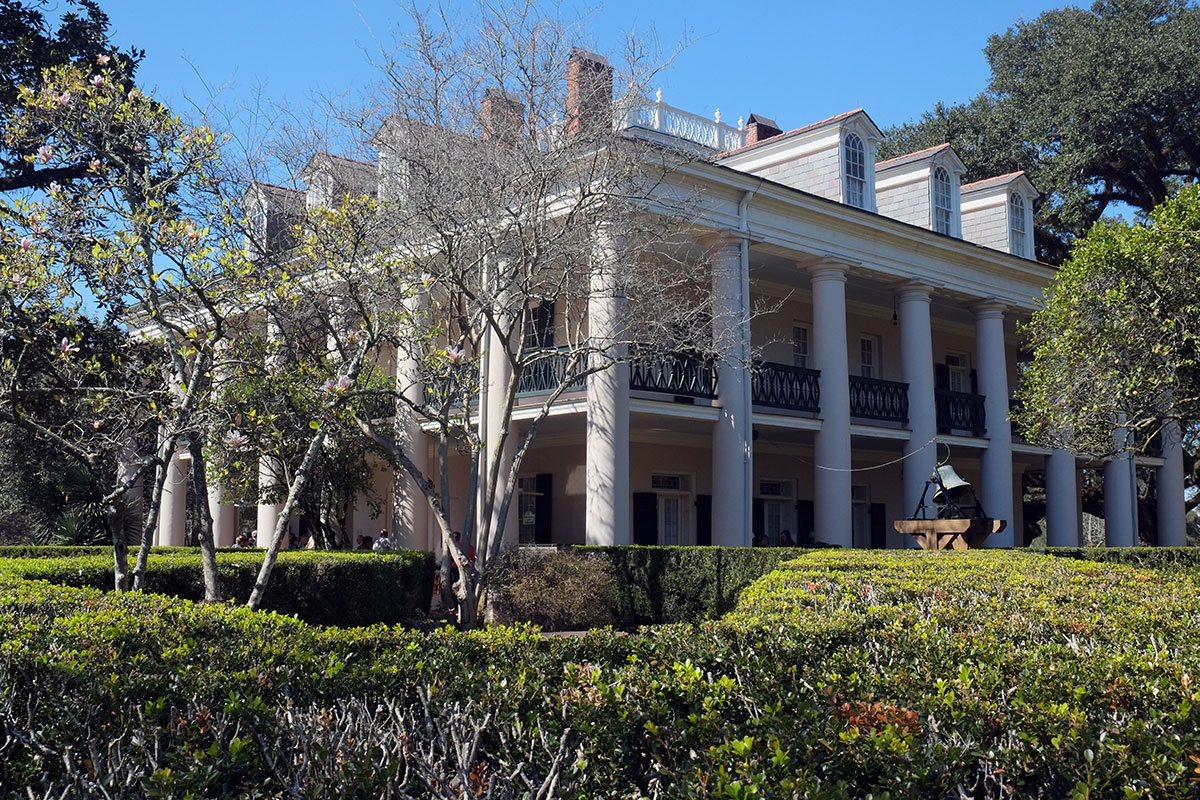
The Greek Revival style is done beautifully, well-proportioned and straightforward.  DSCF3969  DSCF3951

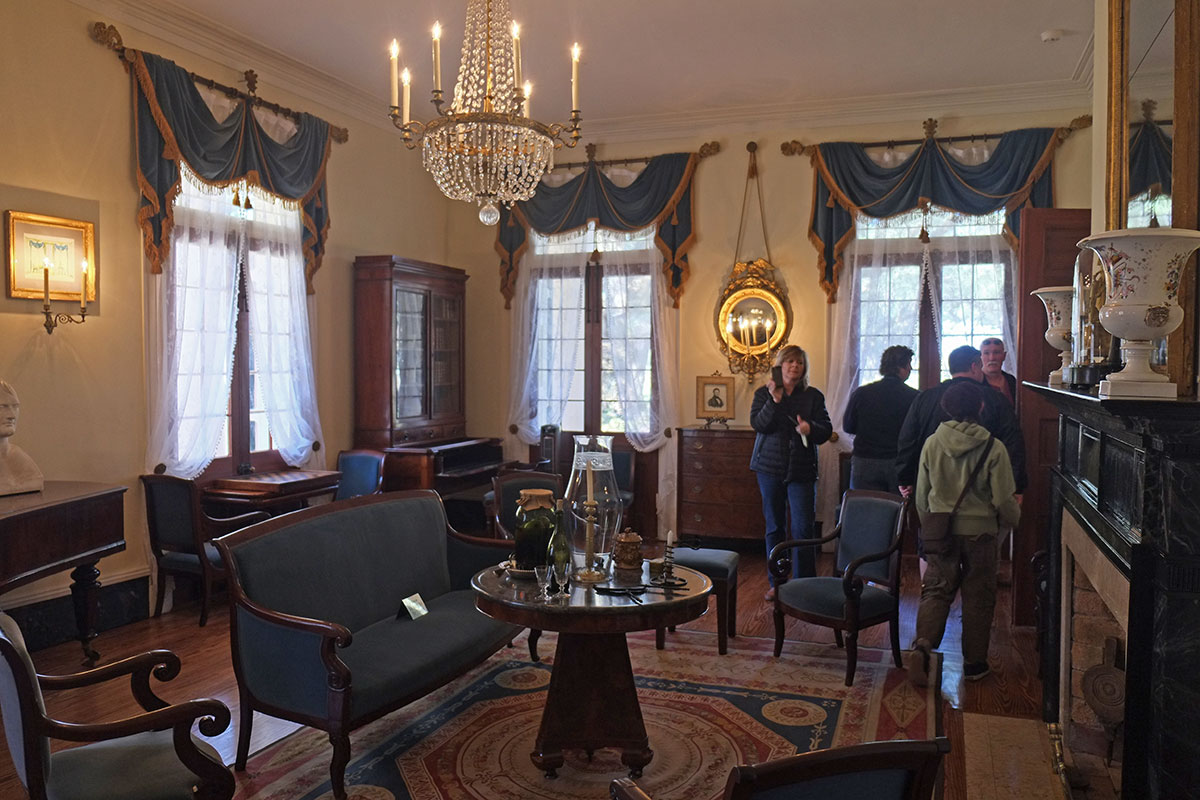
The main rooms are all large and beautifully lit, being always on a corner.  DSCF3898

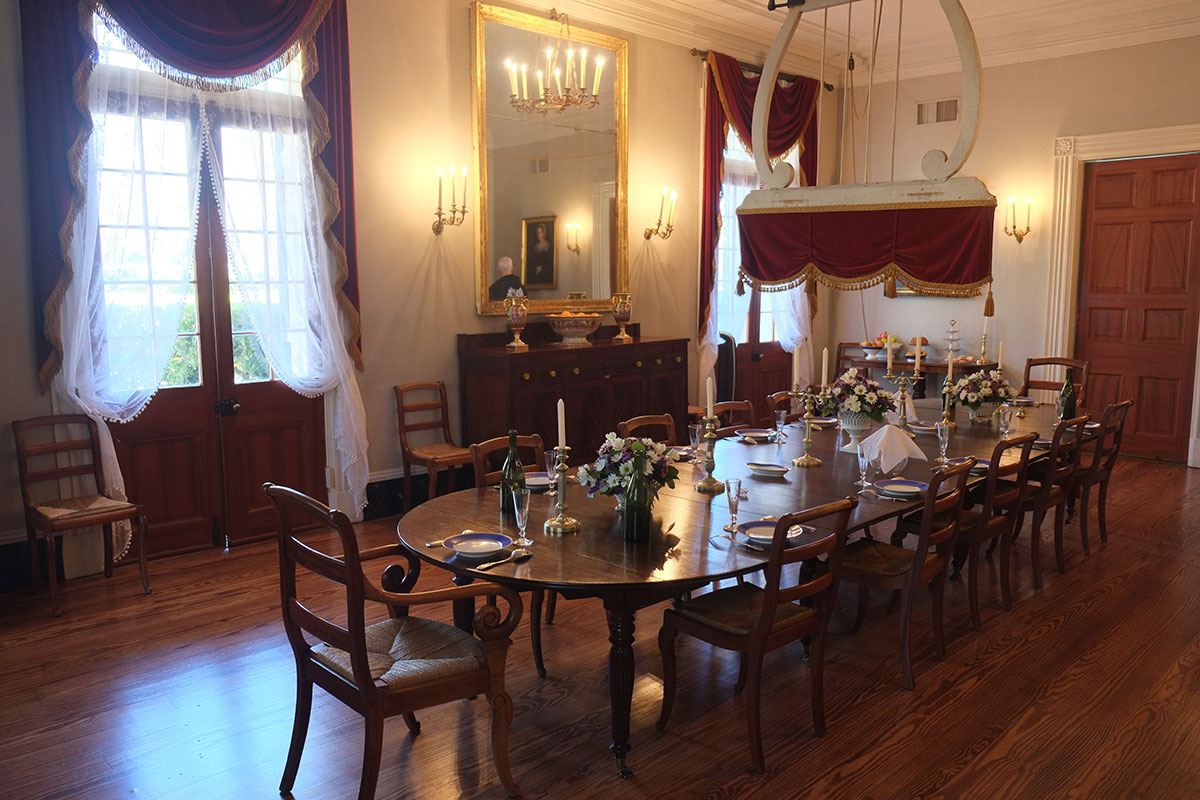
The word thing hanging over the dining room table is for shooing the flies away.  A young slave would have sat in the corner of the room pulling on the rope to make it swing.  DSCF3905

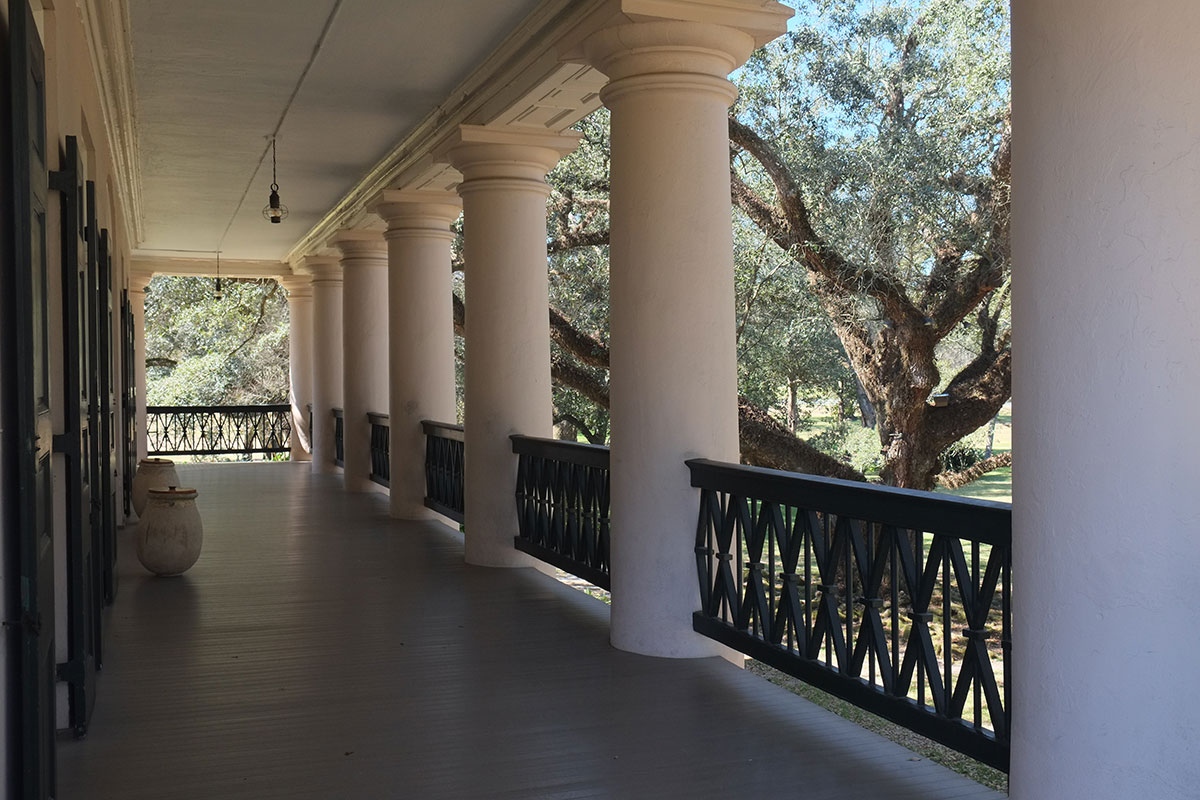
The two-story verandah on all sides was exactly where you’d want to hang out. DSCF3941 Having now seen examples in Florida, Mississippi and Louisiana, the essence of the type is pretty clear, and it is a very straightforward and sensible reaction to the climate, which must be unbearable in the summer (we were there in February and it was quite warm).

As with all plantations we’ve visited, the paramount question is how the history of slavery is treated.  As we toured the house, surrounded by tourists oohing and ahhing, we were feeling pretty weird – the architecture is fabulous, but it’s pretty hard to listen to stories about this family and think about the basis for all this wealth.  (We decided it would be like going to Auschwitz to see the commandant’s quarters.)  However, compared to what we’ve heard about other plantations, we thought Oak Alley did a good job of presenting the reality of the history.

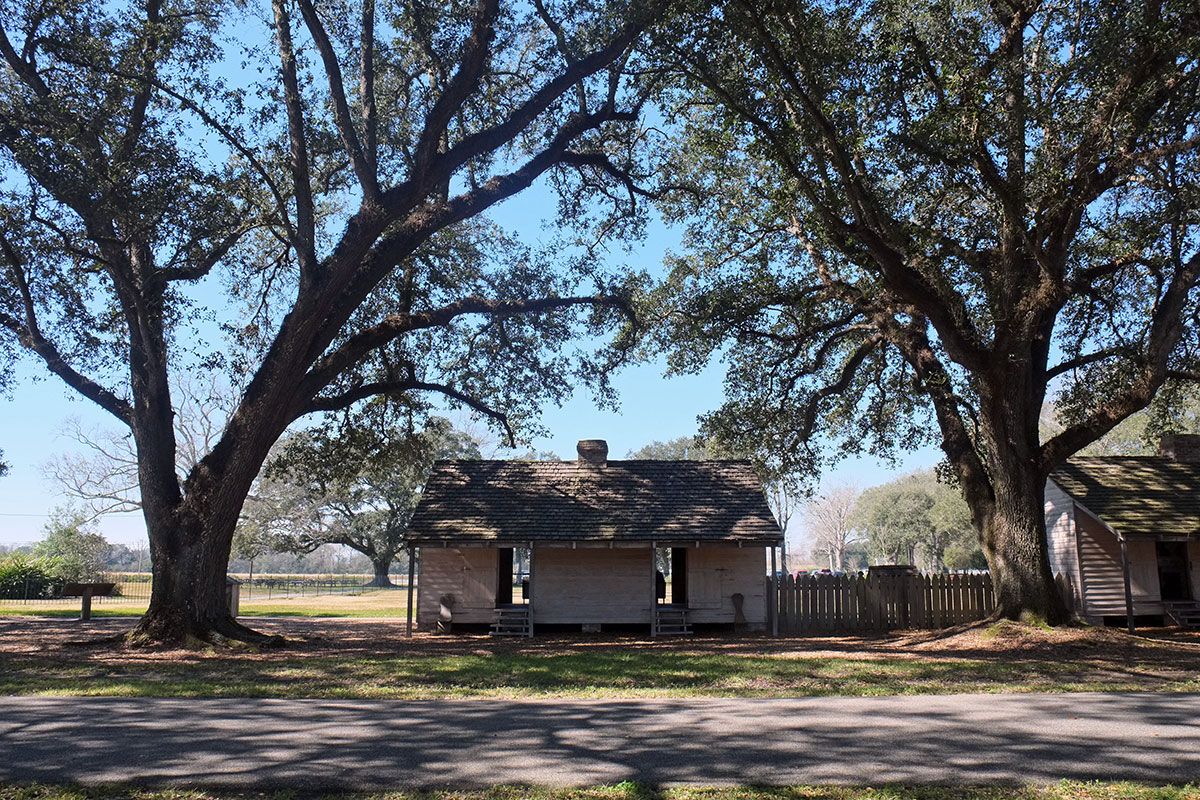
The slave quarters here were located on along the central axis, but to the rear of the house, and along another oak alley.  DSCF3884

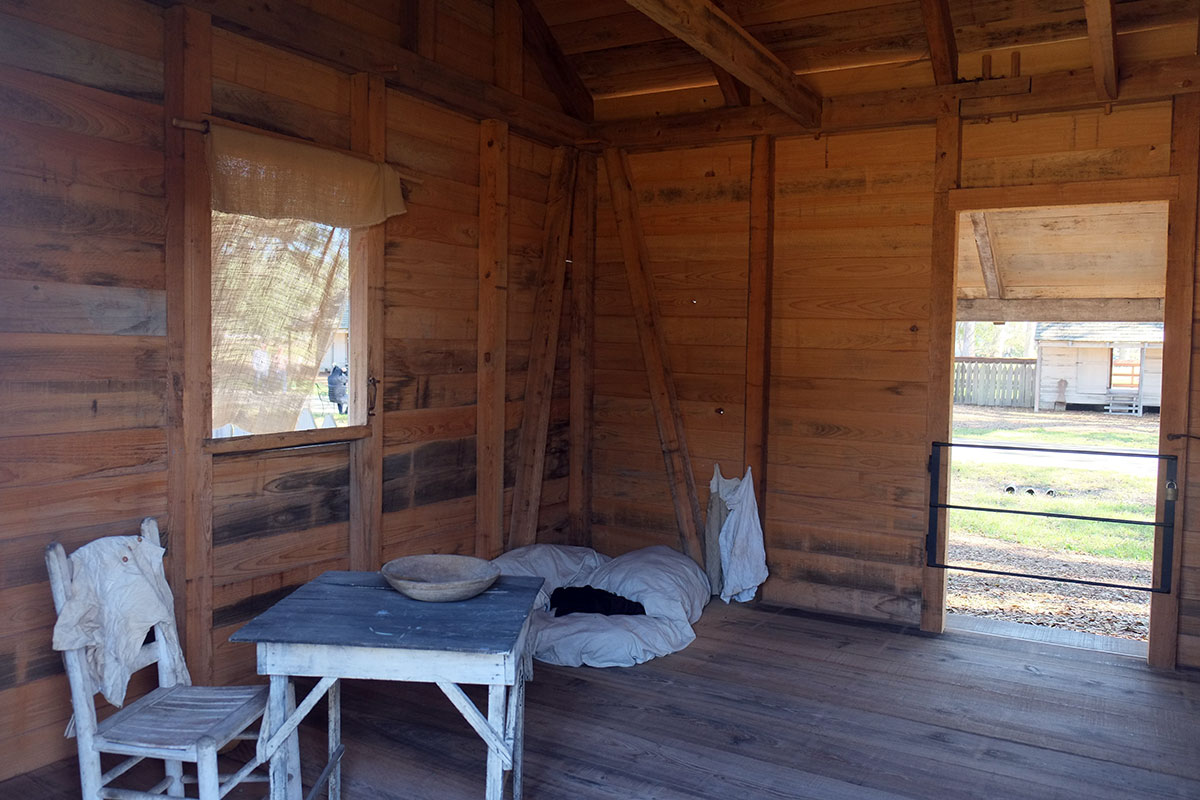
This arrangement, and their proximity to the main house, was very unusual.  The quarters had obviously not been as carefully preserved, but enough remained, and there was also documentation of them and how they had been transformed after the Civil War, when they were occupied by paid hands (who might have been the same people, just no longer enslaved).  Based upon this evidence, all the slave quarters had been reconstructed, showing how they were furnished in different eras.  DSCF3880

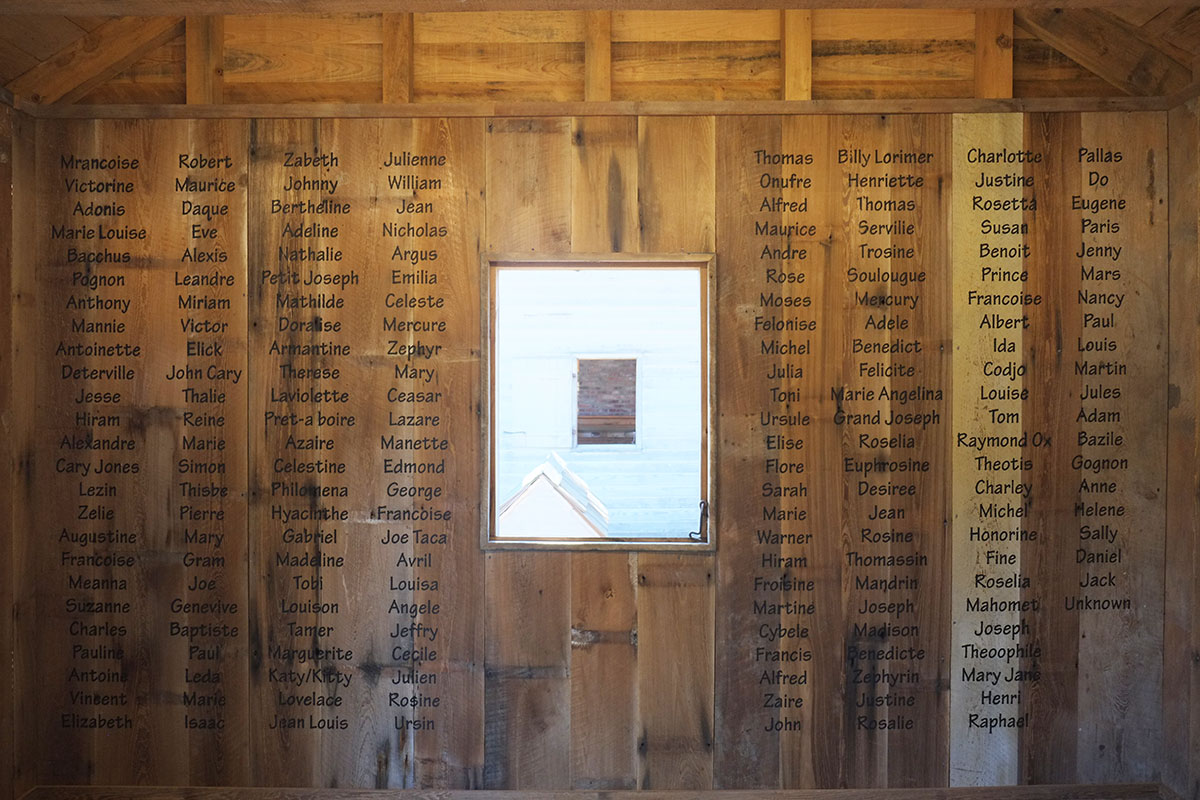
The plantation records had also been searched, and a list was compiled of all the slaves whose names could be found.  In one of the cabins, where there was a detailed exhibit on what is was like to be a slave, and how the slaves were treated, the names of the slaves from this plantation were inscribed on the end wall.  We thought it was a dignified and fitting memorial – acknowledging the individuals as best they could, working in the vernacular materials that reflected the physical surroundings and reality of these persons’ lives.DSCF3886

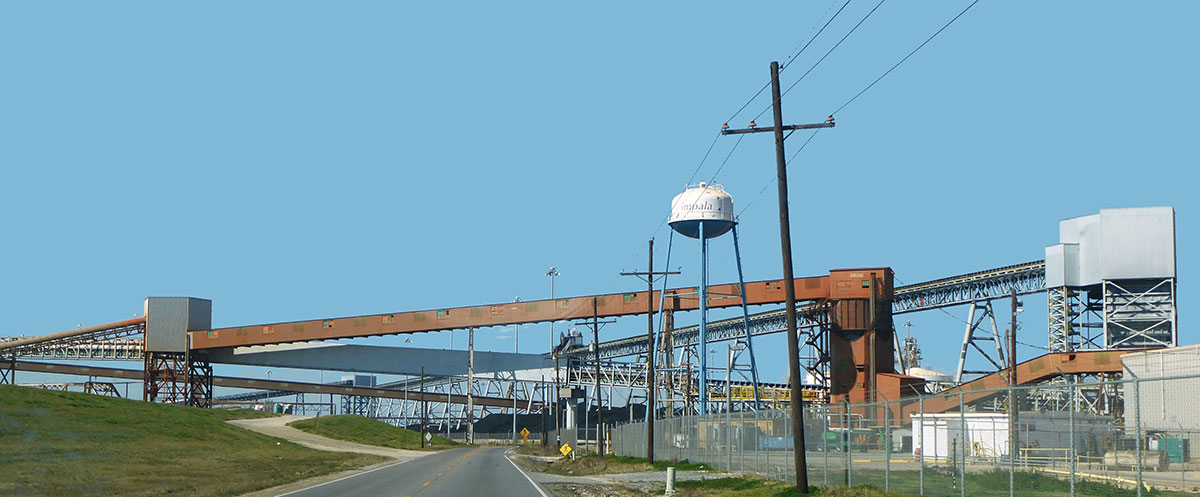
Most of the drive was through the oil and chemical industries’ landscape.  Very large facilities and big things, which we enjoy seeing.  Just glad we didn’t have to live there.  P1070311a

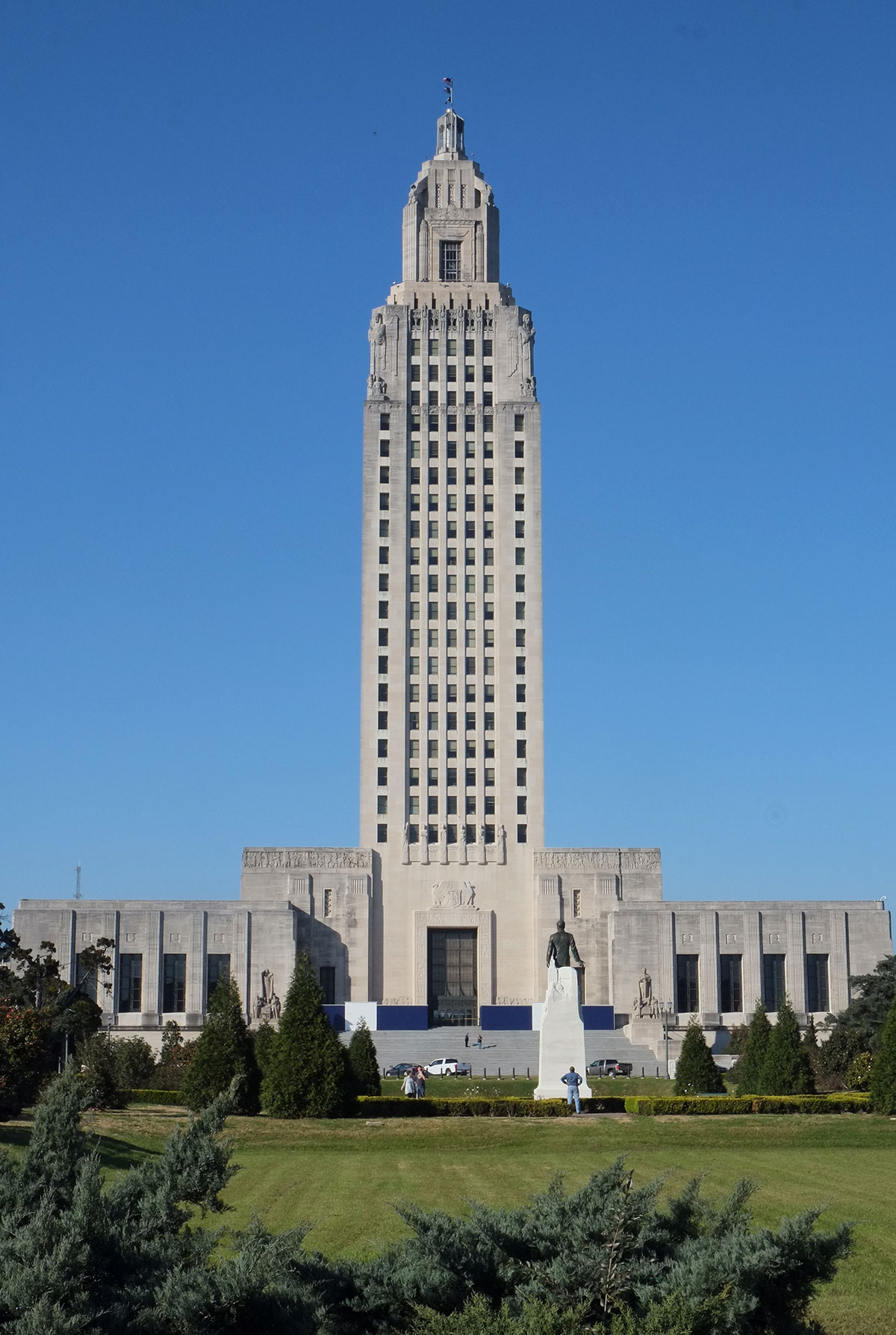
Our visit to Baton Rouge was stymied by a cell phone charger in the truck which we thought was working, but was not.  So just as we hit a major city, our phones went dead and we were navigating by instinct.  The downtown seemed to be having some kind of festival, coinciding with lots of streets being closed for construction, which made it even more difficult.  We passed by the state capitol (a pretty good one we thought, in the rare genre of capitol-as-tower), DSCF3972but mainly we spent a lot of time trying to find a store to buy a charger, before realizing that all stores like that are way out in the edge sprawl.  We gave up Baton Rouge, crossed the river and found a Walmart, and continued on our way.

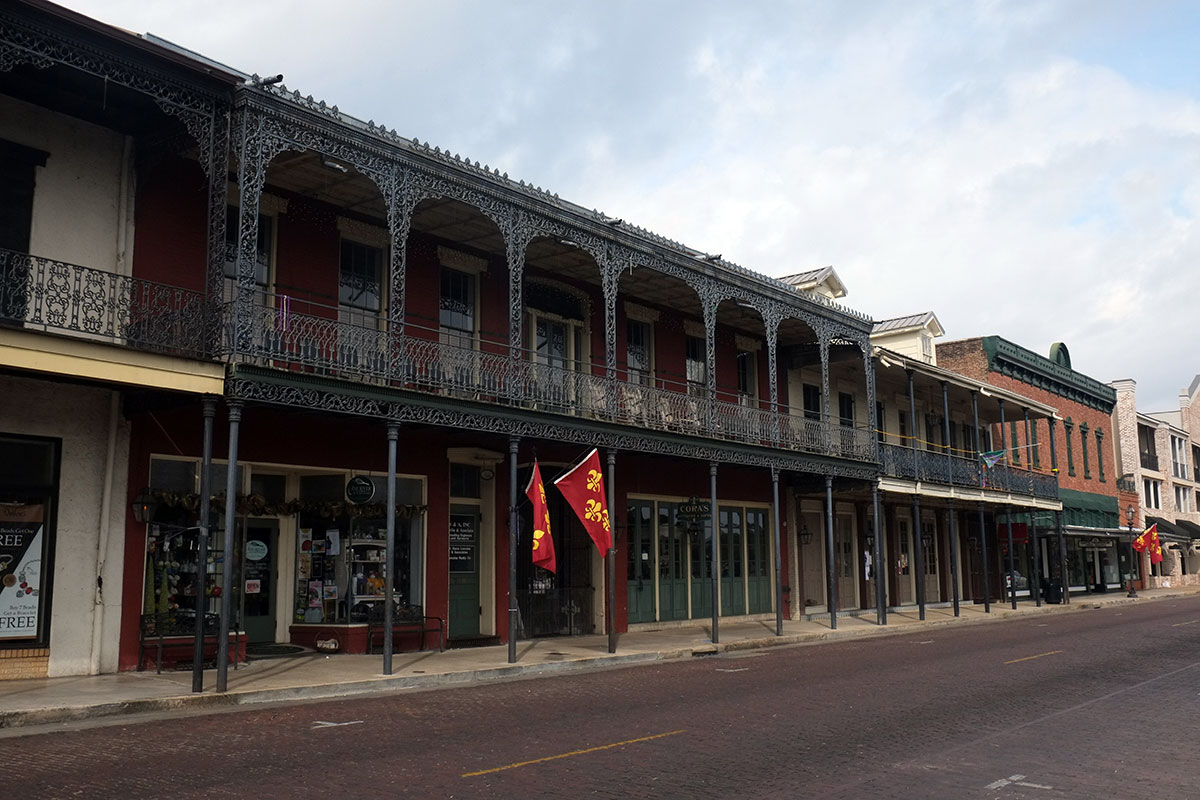
We left the Mississippi and crossed the Atchafalaya Swamp towards Lafayette, and headed up the Red River to Natchitoches (which is pronounced Nack-a-dosh), an important French colonial town.  It has a few streets of nice old commercial buildings, some of which have been excessively cute-ified for the tourists, but many of which are fine. DSCF3982

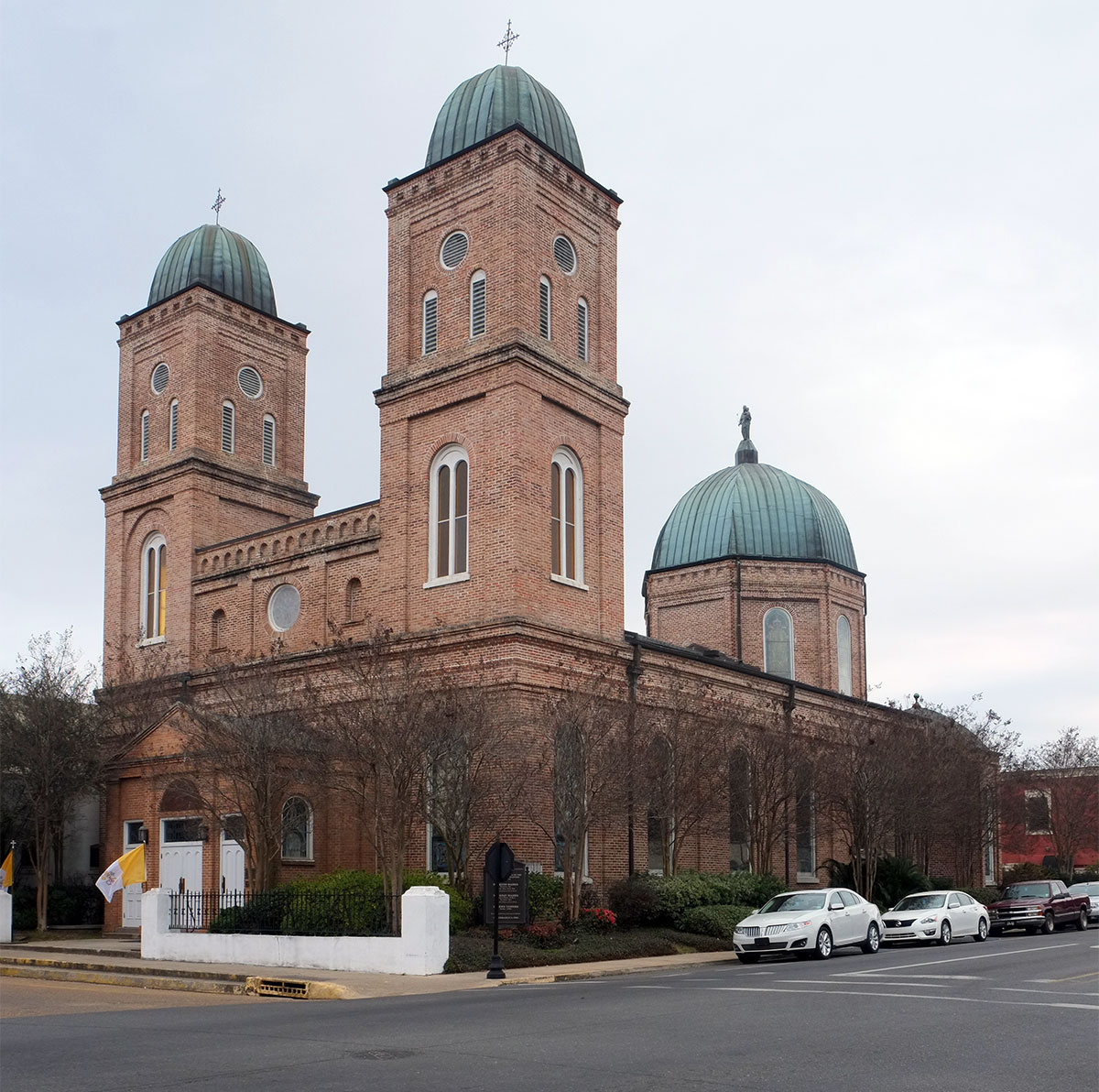
There is an excellent Catholic church. DSCF4012

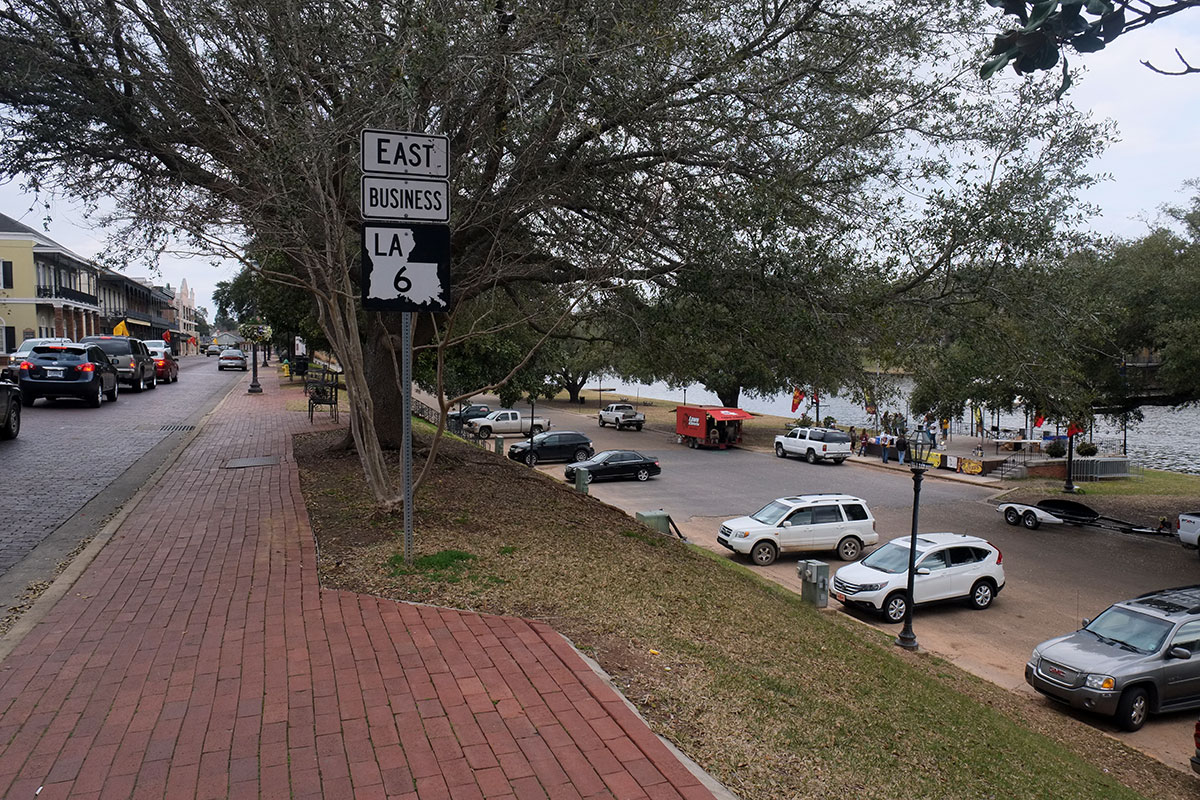
The river flows through the center of town, with the buildings sitting on the higher ground above the floodway.  The lower area by the river is used for a park, parking, and river access, a really nice way to make an open space while acknowledging that this will flood.  (A few weeks after our visit this area did indeed have some major flooding, but I wasn’t able to find out how the town fared.)DSCF3978

Not all the buildings are old and quaint – it is the home of the Northwest Louisiana History Museum, which was for some reason combined with the Louisiana Sports Hall of Fame.  DSCF3993

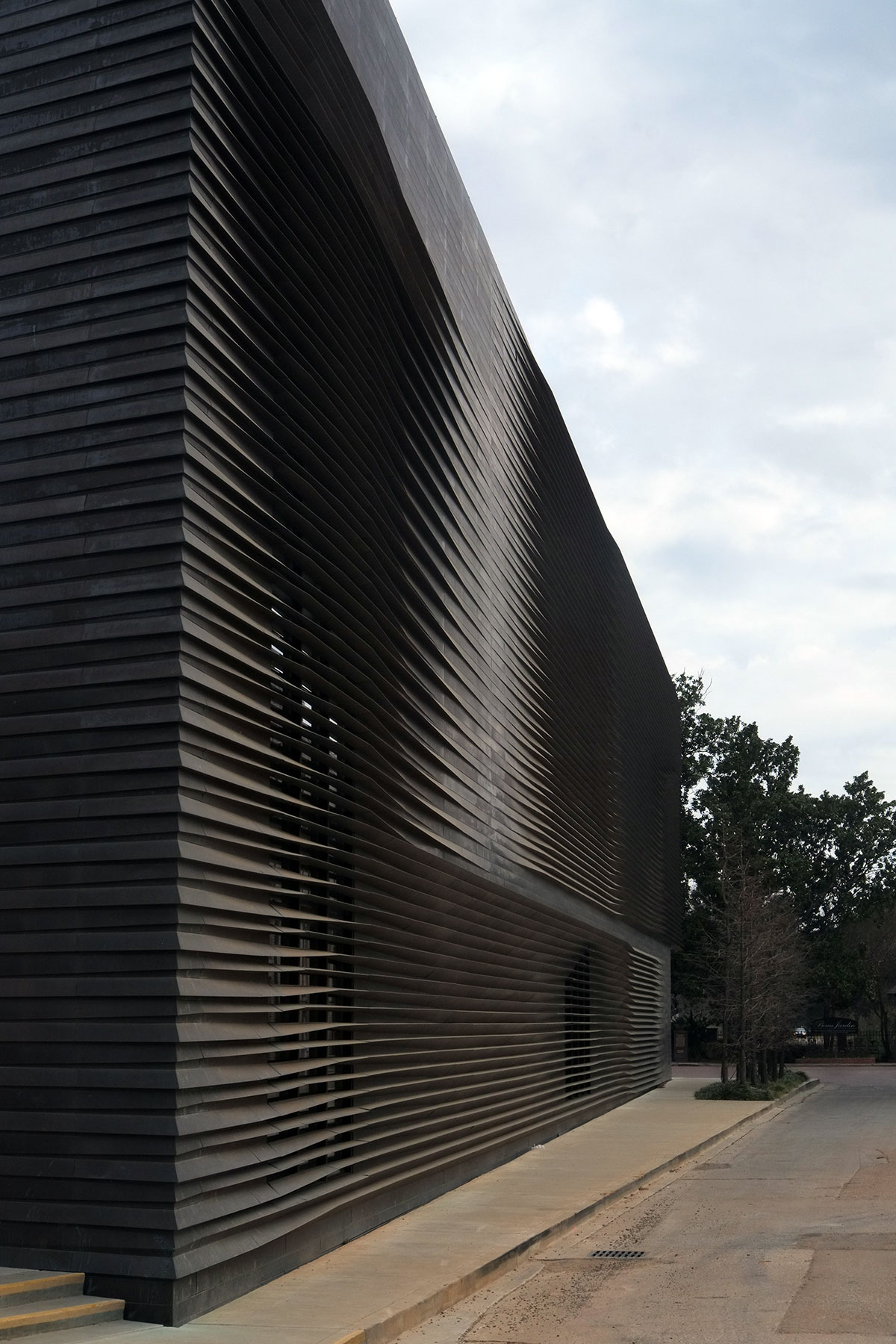
I was very surprised to find such an edgy building in such a location – the folks at Trahan Architects have clearly been reading their magazines, and the skin was the hippest we’d seen since Miami.  DSCF3998

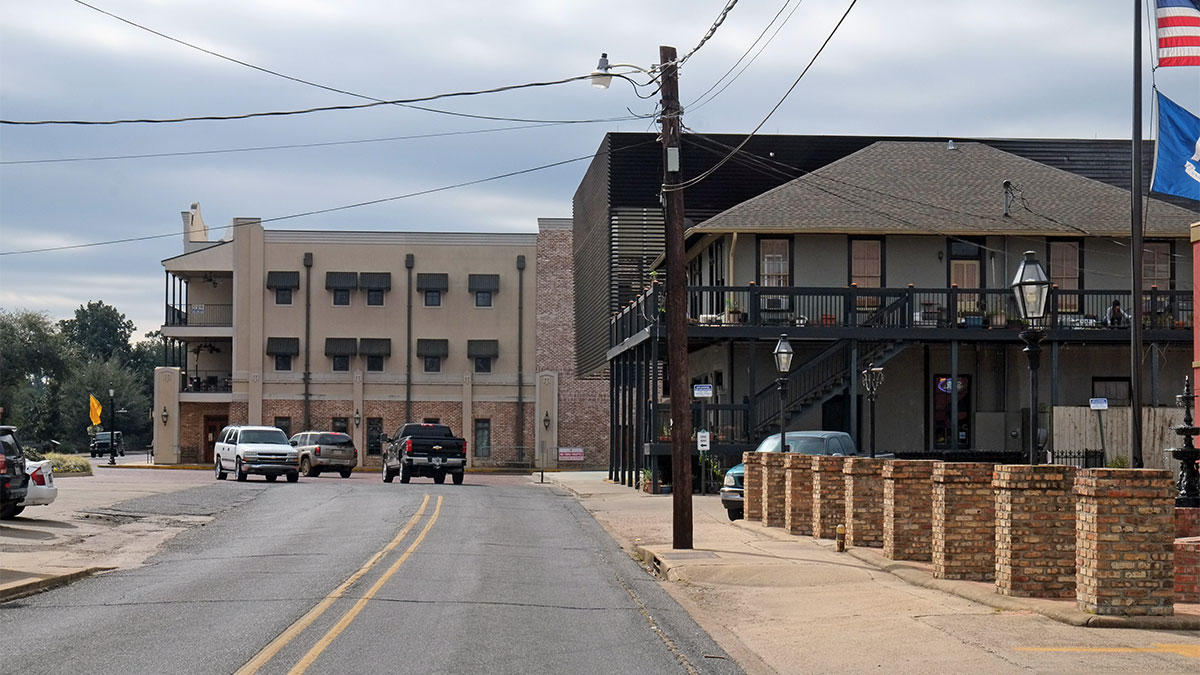
Strangely, it looked pretty darn good in the town – the massing is simple and in scale with the surroundings, the entry space under the floating screen wall relates to the verandah architecture of the nearby commercial buildings,DSCF4003 it’s dark-colored, and it anchors a funny shifting intersection.  On the whole, it was much better than the pseudo-historicist buildings we saw there (such as the one beyond it).  It was Sunday so we couldn’t get inside, which was too bad, as Glen and Michelle had designed some of the exhibits.

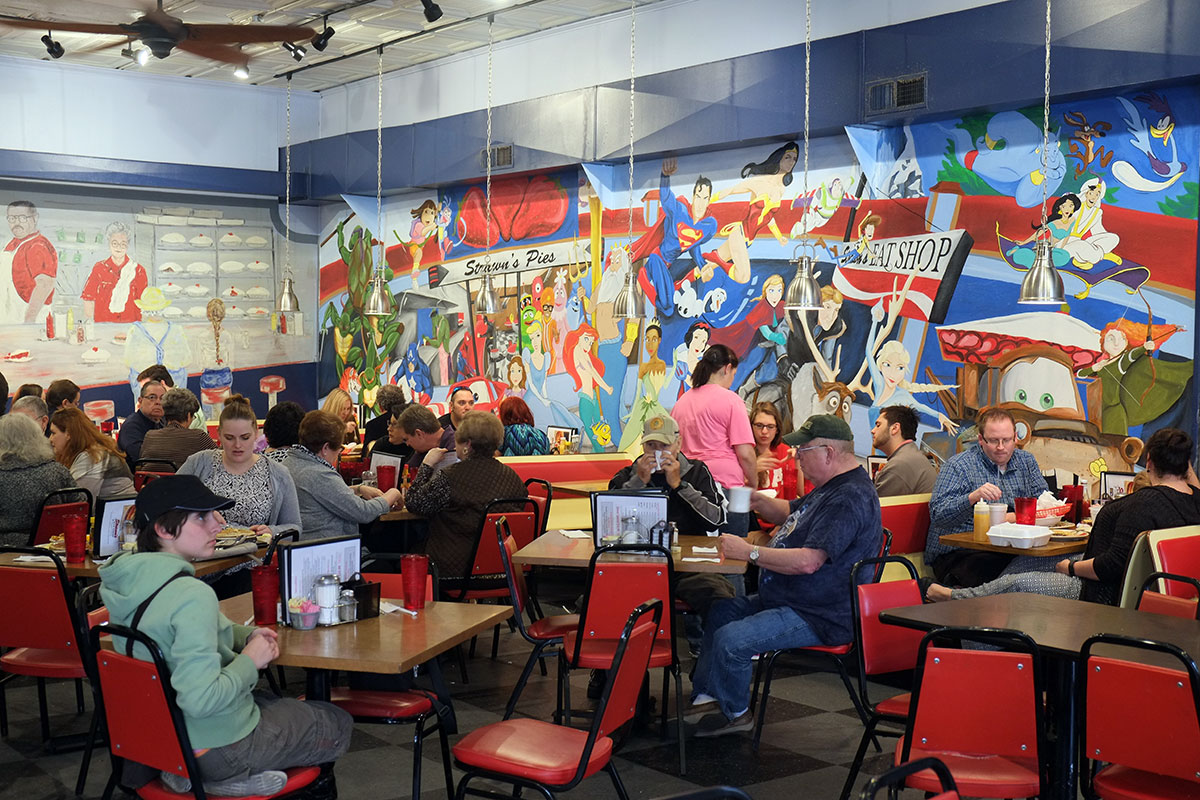
We hadn’t heard great things about Shreveport, but we enjoyed it.  We stopped for lunch at Strawn’s Eat Shop (we found it through Roadfood.com, and couldn’t resist the name).  Food not worth blogging about, but we liked the ambience.  DSCF4029

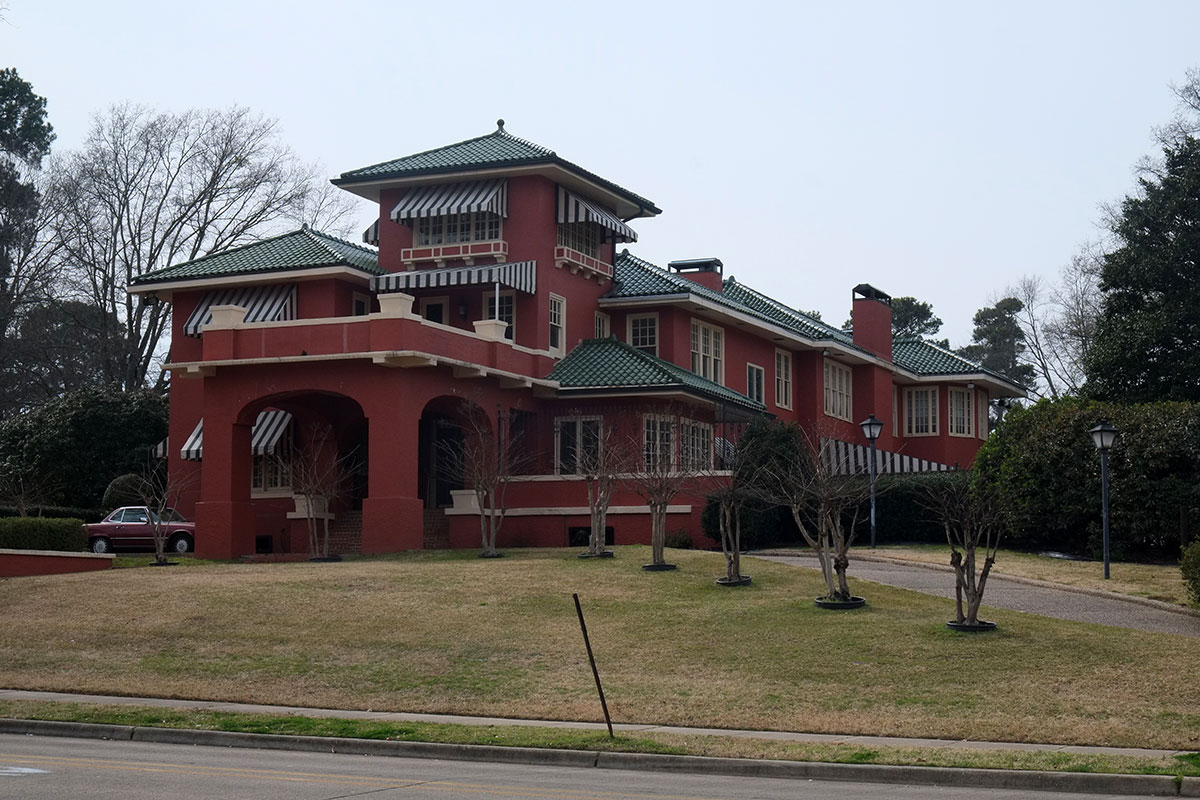
We saw what was clearly the older expensive neighborhood, DSCF4032

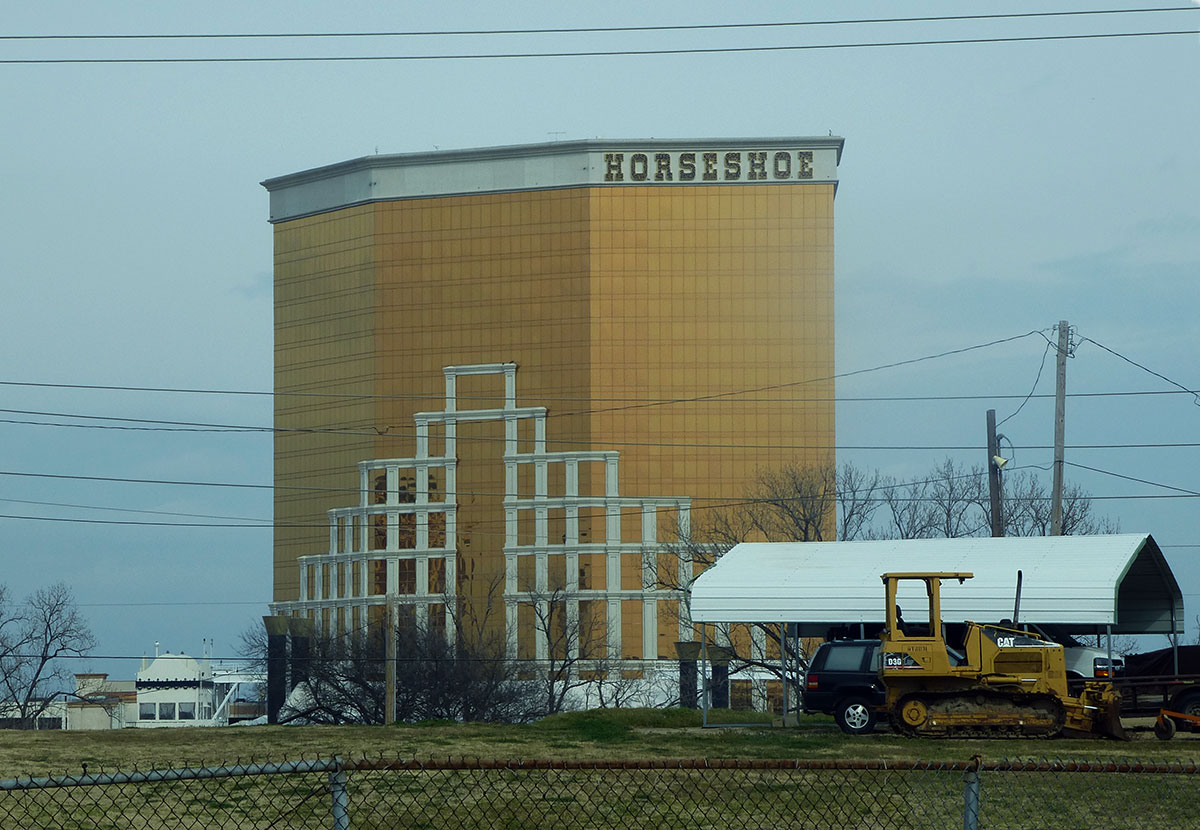
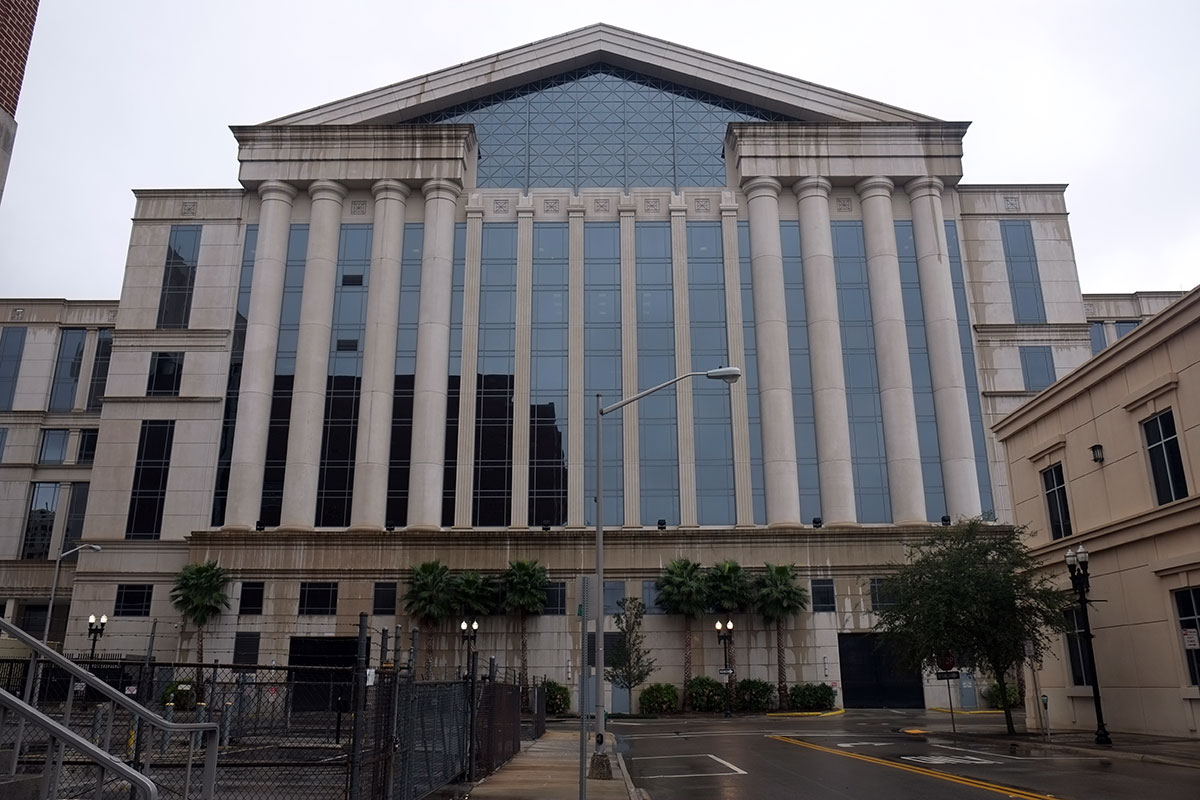
and then perhaps the worst Pomo building in the world, even uglier than the Jacksonville courthouse.  Casino architecture is inherently strange, but cheap casino architecture may be the most depressing stuff around.P1070328a

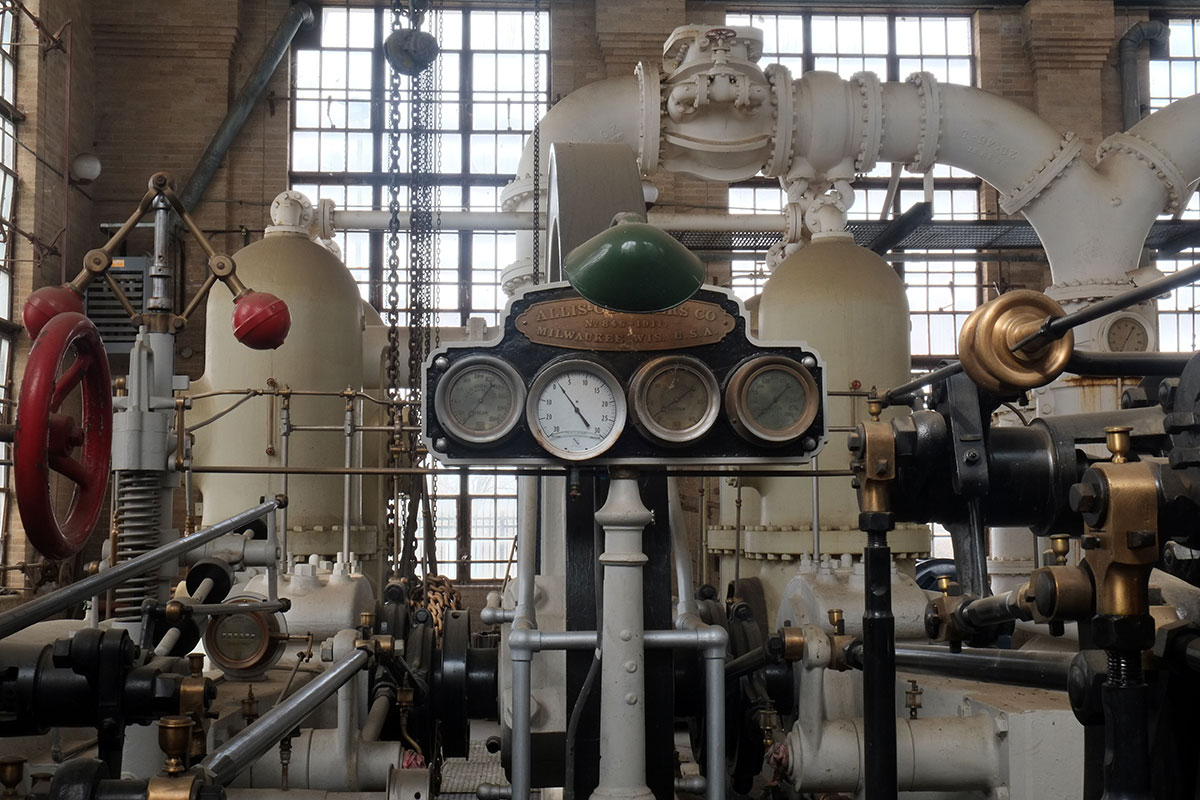
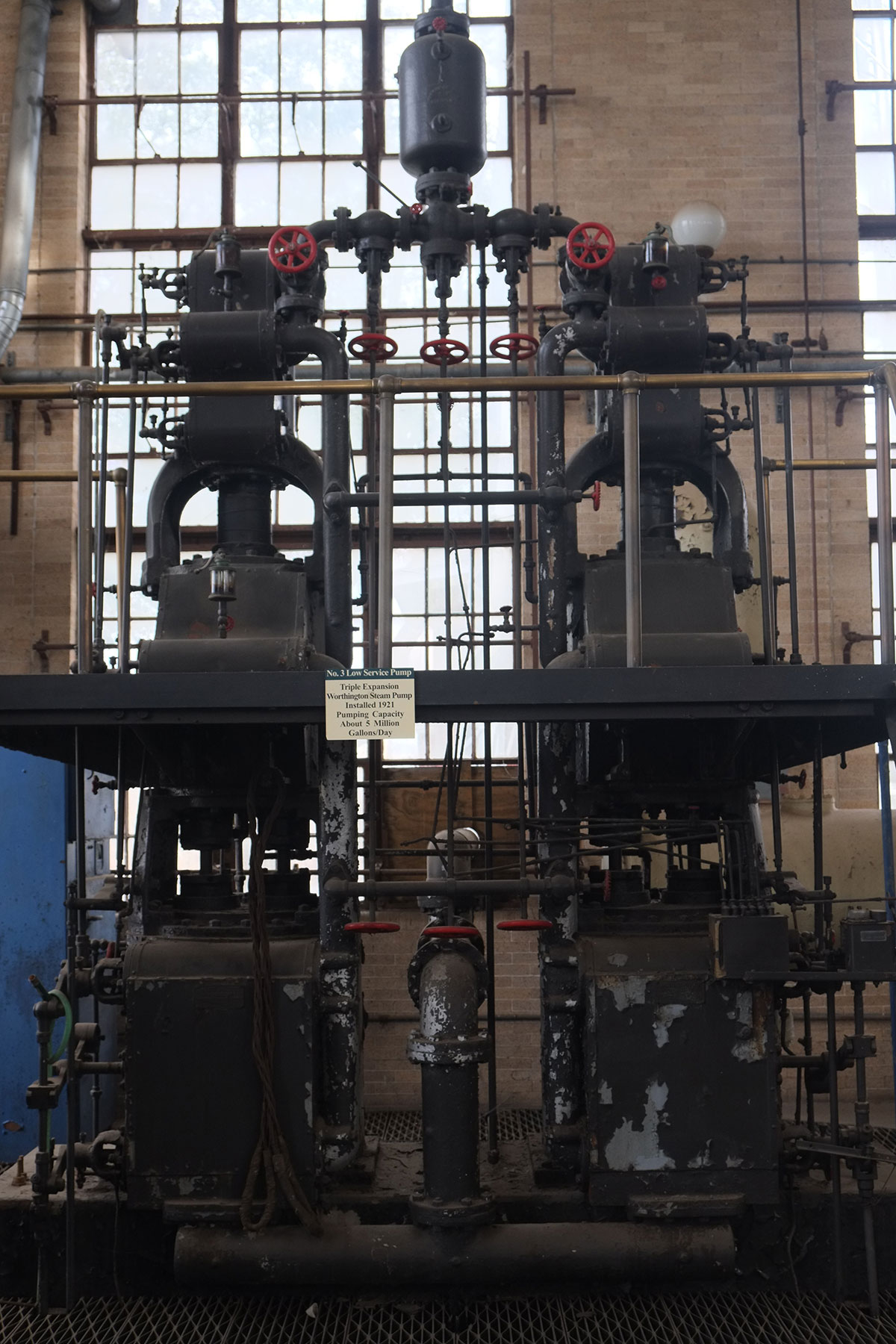
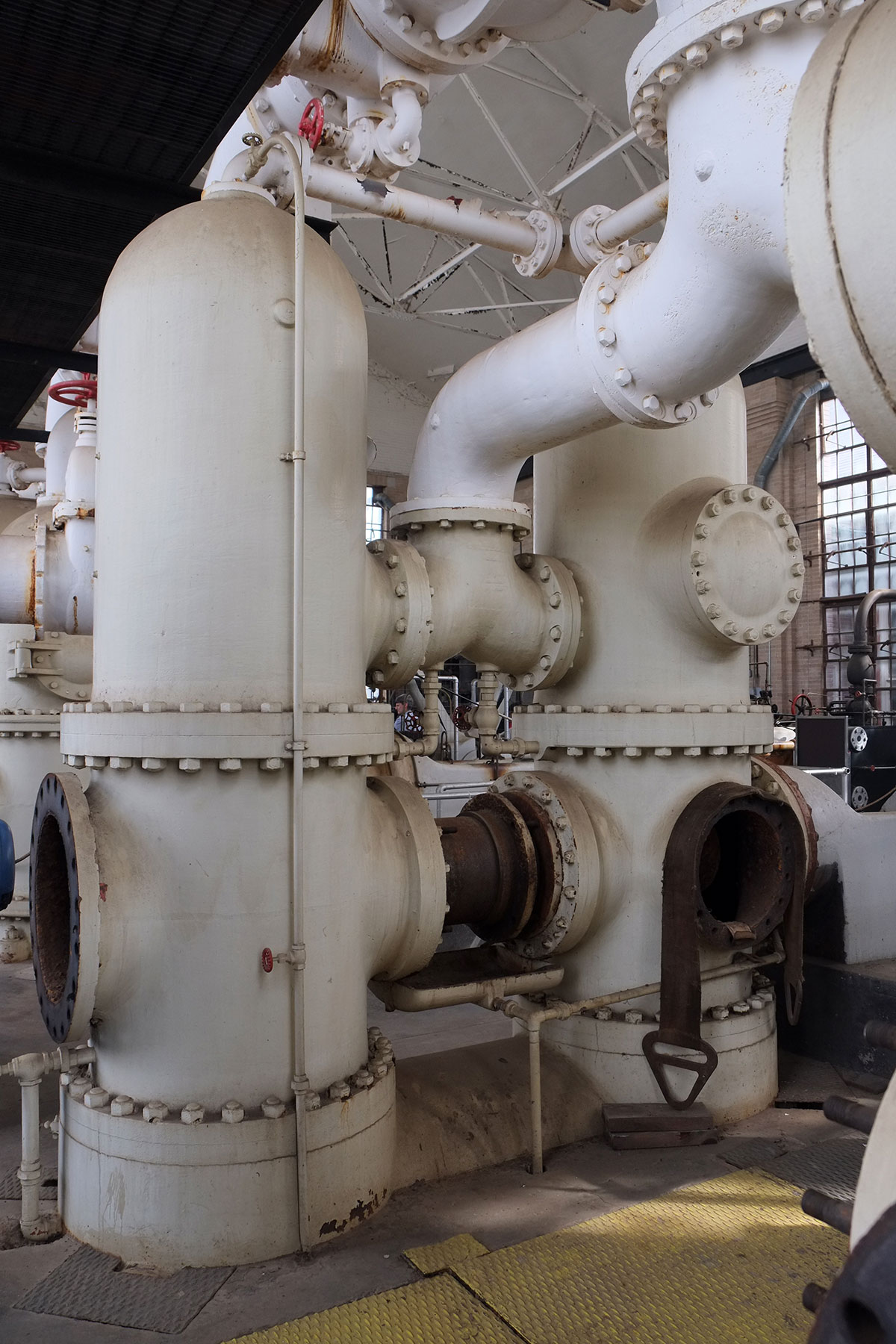
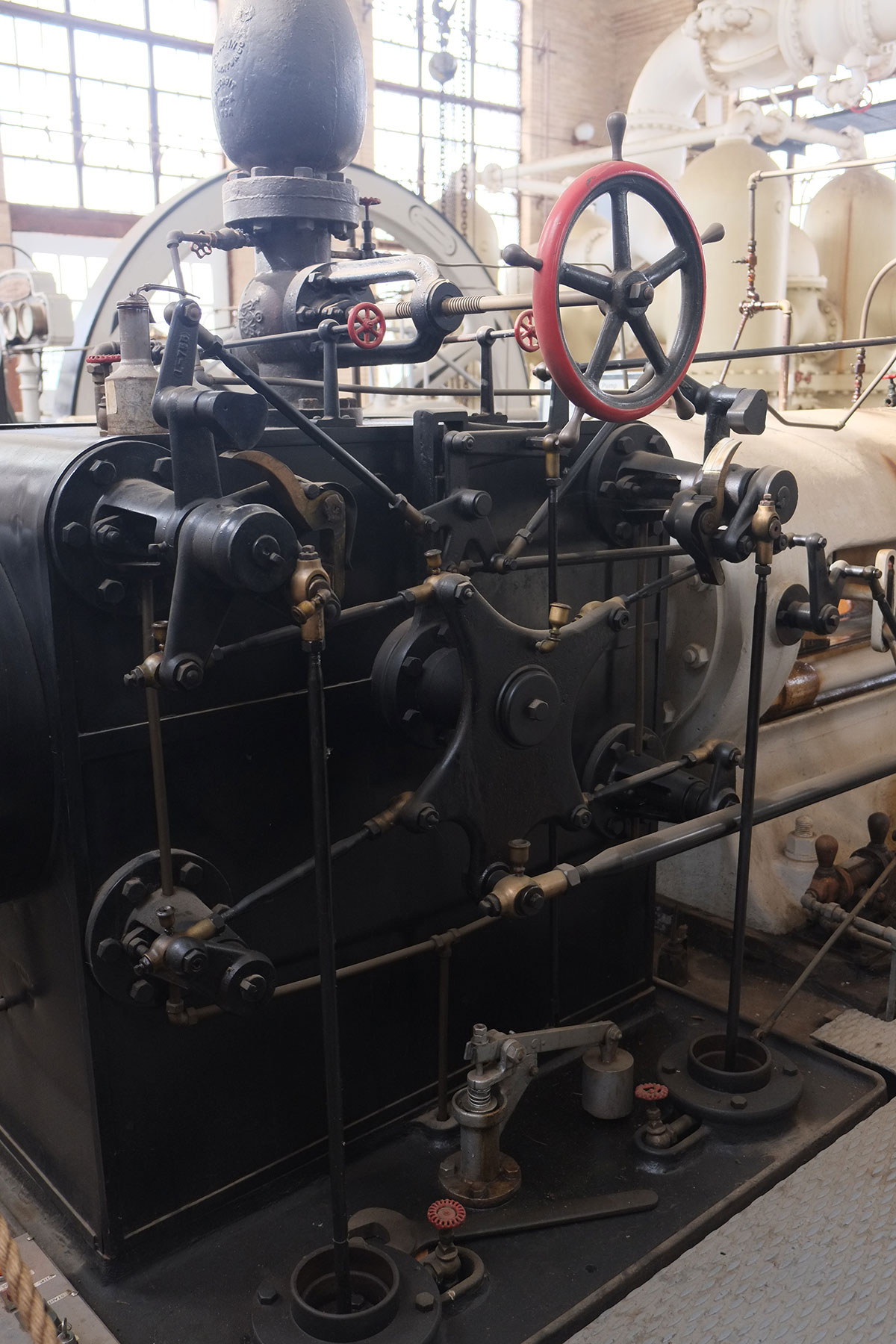
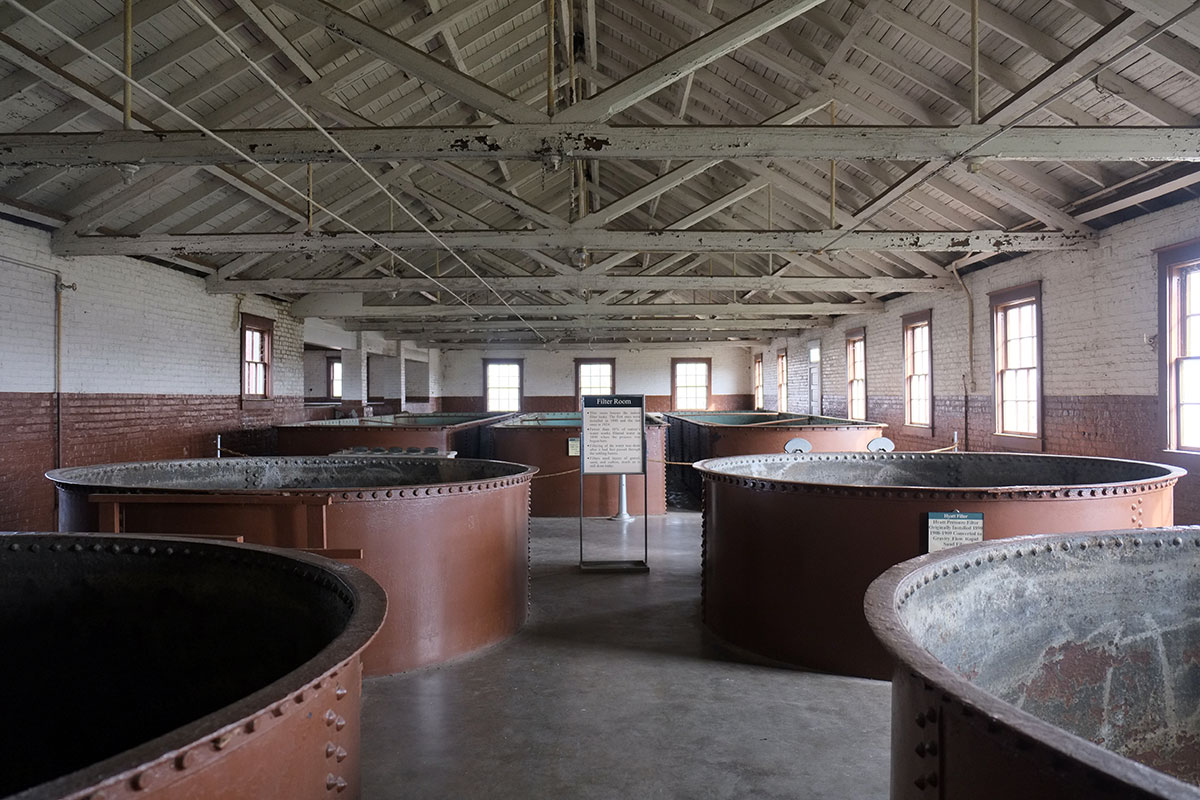
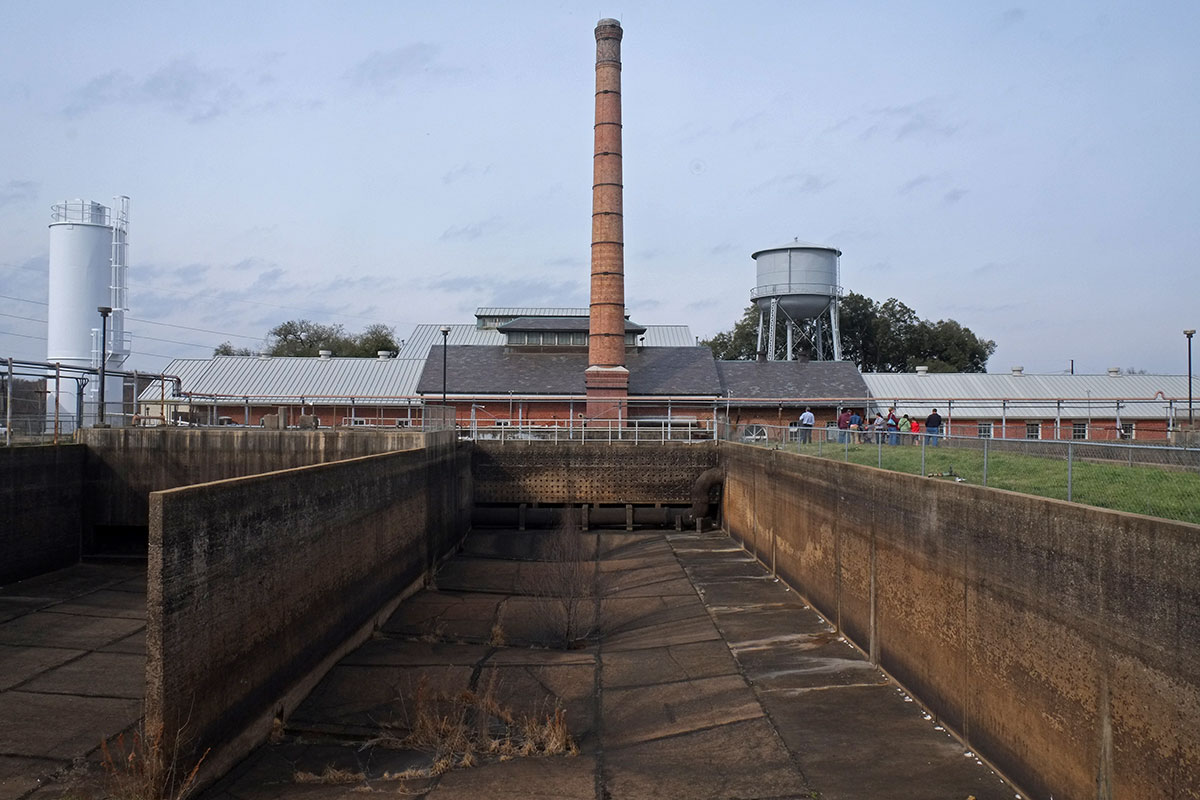
But by far the highlight of Shreveport was the Waterworks Museum. DSCF4053

They ran their municipal water system on steam power until 1980, and then when they revamped it all, they preserved the whole earlier plant, with boilers, pumps, controls, settling tanks, labs, etc.  It was superb. DSCF4046  DSCF4058   DSCF4050  DSCF4092  DSCF4079We randomly arrived on a Sunday afternoon, and were able to join a tour with a group of cub scouts, which had an excellent guide who clearly loved the place.  As I’ve mentioned, neither of us especially likes visiting historical places where something once happened, but there’s no visible evidence.  We like seeing real stuff ([preferably Steanmpunk stuff), and this was about the best industrial archaeology we’ve seen on the whole trip.

On the bayou

DSCF2794There’s an image of the bayou that’s common among us non-southerners, and it probably comes from popular music.  We imagine a picturesque swamp, with Spanish moss hanging down to the water, alligators and cottonmouths everywhere, and small settlements randomly distributed throughout a trackless labyrinth of channels and backwaters, but where the exotic inhabitants enjoy great music, food and beer.  This was certainly the image I had when Glen told me back in college that he had grown up in Cut Off, on Bayou LaFourche.  It turns out that my misunderstanding of the bayou was in keeping with my general lack of knowledge of everything about Louisiana.

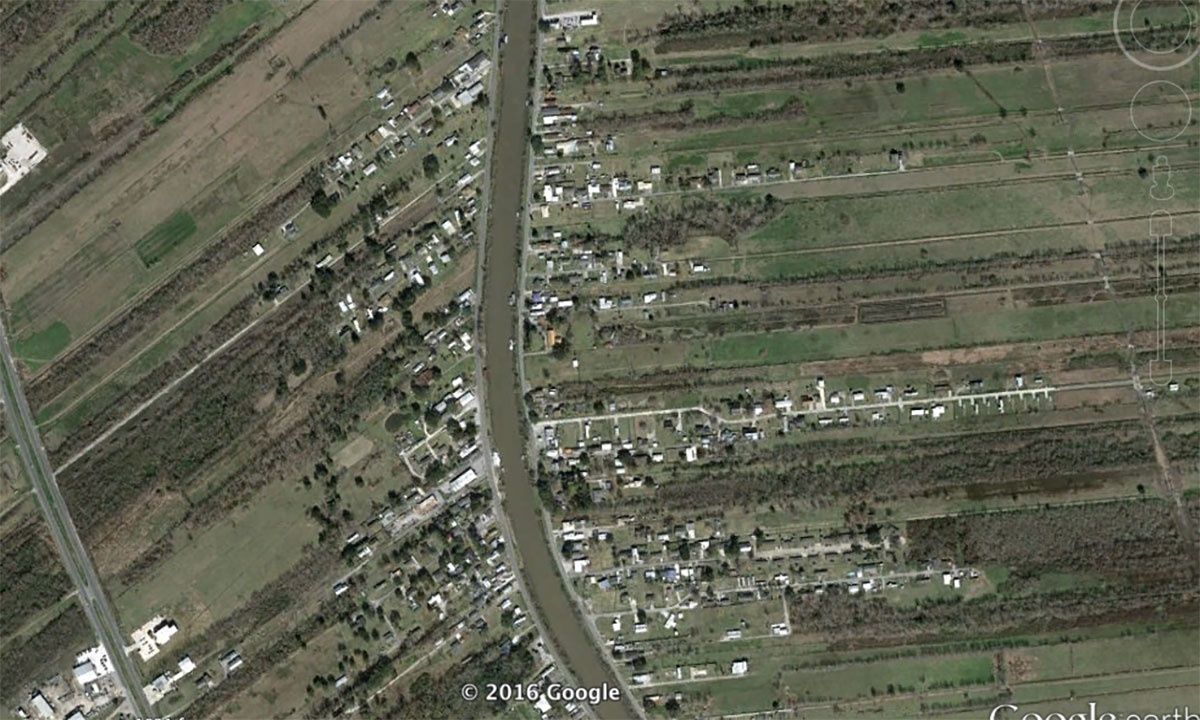
Bayous are actually the linear bodies of water which flow through (and organize) the low-lying coastal region along the Gulf.  As in New Orleans, the highest land is usually along the waterway, as soil from upstream is deposited there.  This natural feature combines with the cultural feature of how land tenure was set up in Louisiana – people owned a length of waterfront, and then had deep lots that ran back from the water.  Later, these large parcels were sometimes subdivided, so you get the pattern you can see here in Cut Off – Bayou LaFourche in the center, a main road flanking it on each side, and then dead end roads perpendicular to those.  Screen-Shot-2016-04-13-at-1.43.14-PM

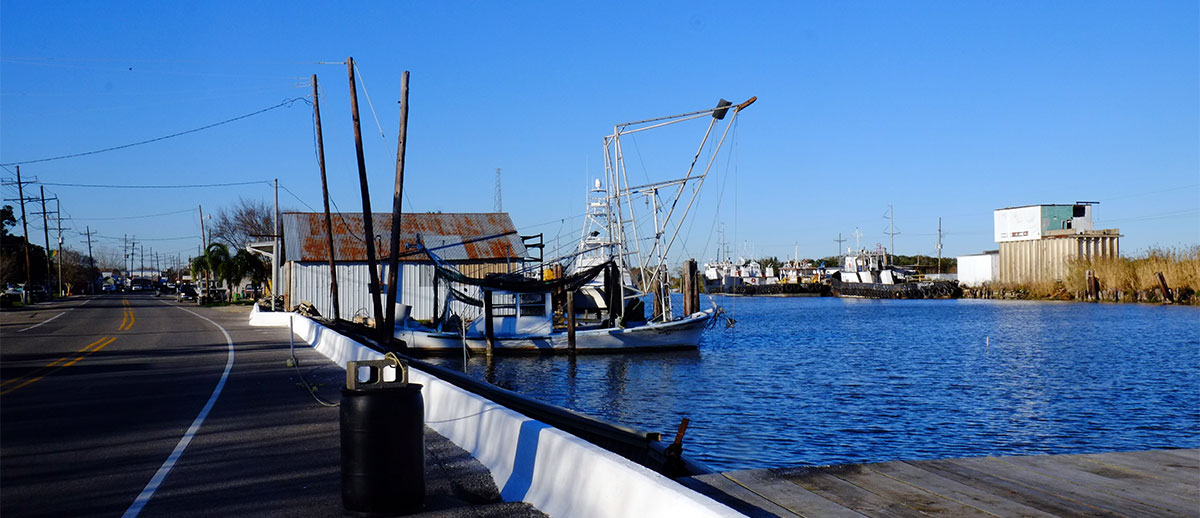
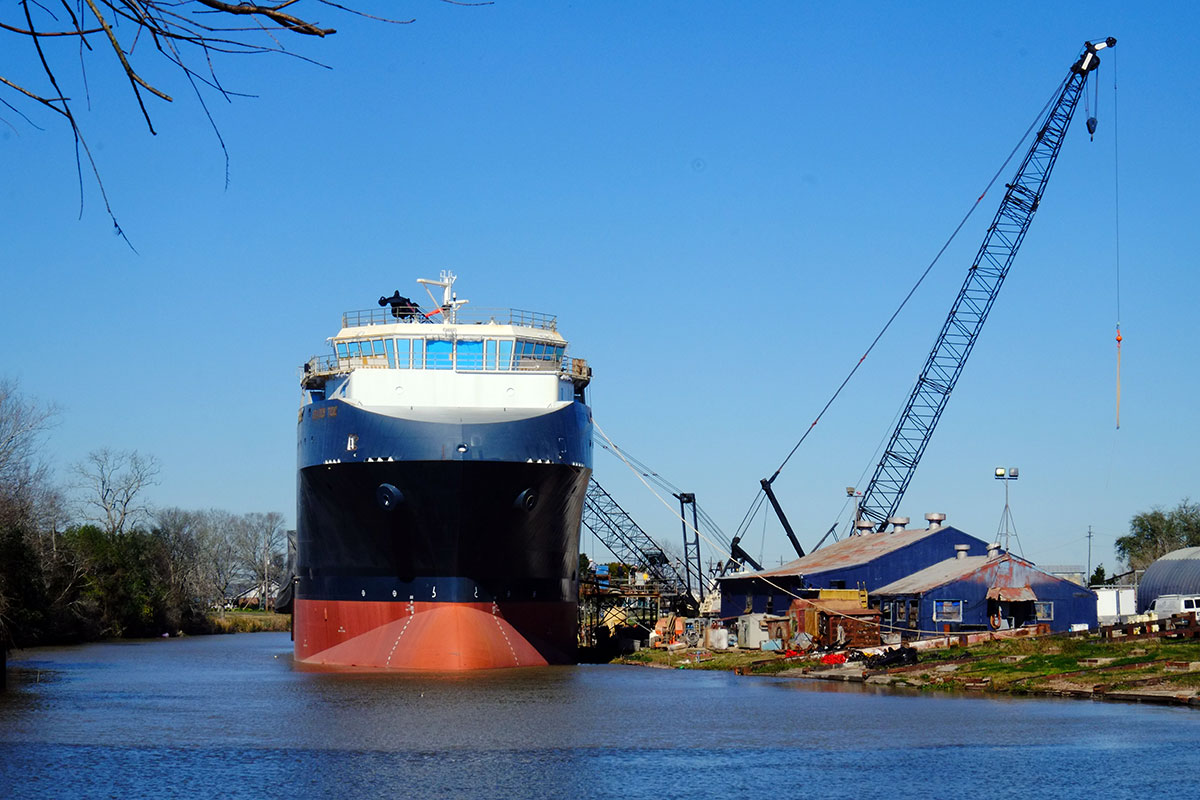
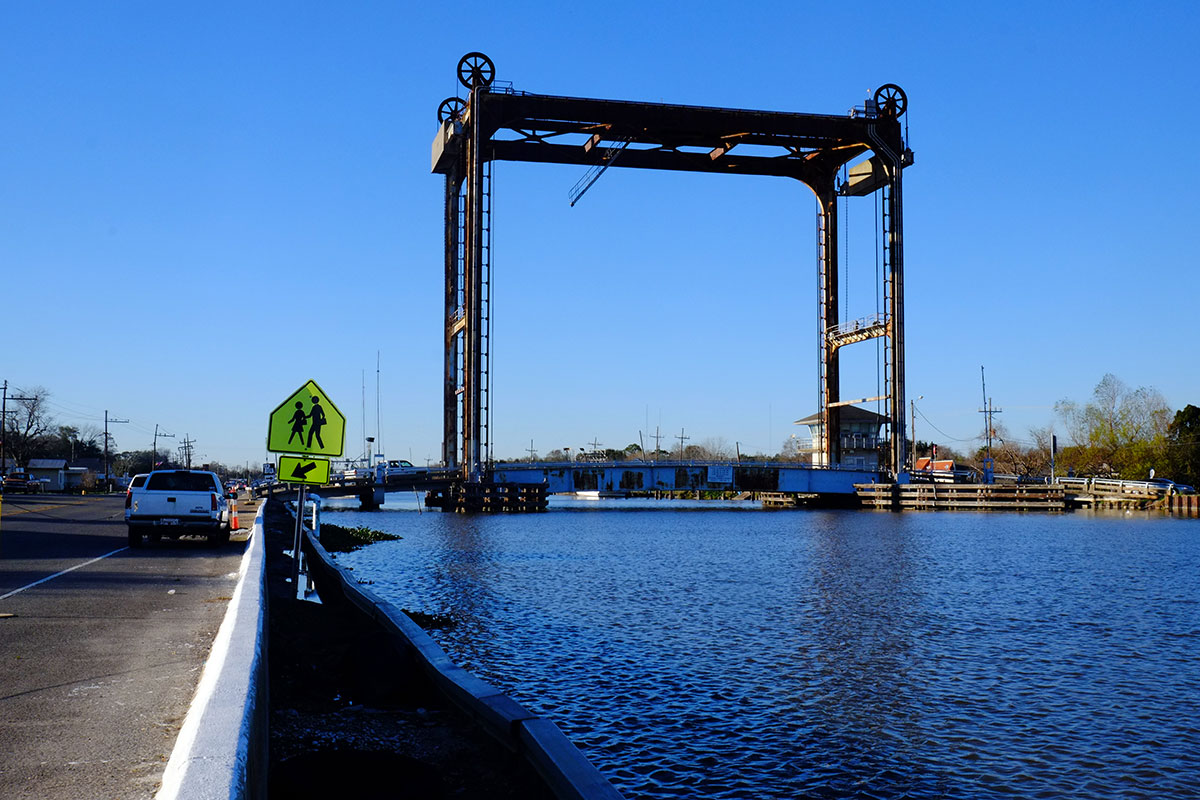
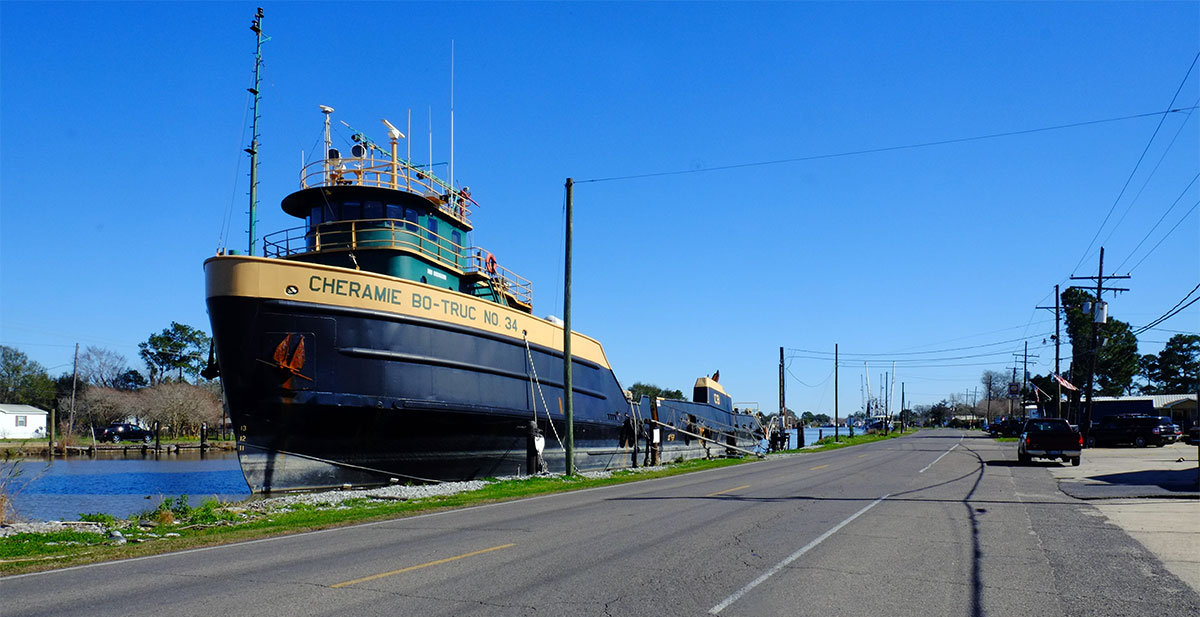
This way of making a linear settlement pattern has interesting consequences.  When people got around mainly on the water, having a bayou in the middle of your town wasn’t a problem.  But when cars became more dominant, frequent bridges became more necessary.  But then a conflict arises with boats:  the Gulf Coast has a few enormous bays and natural harbors, but otherwise doesn’t have the same frequent occurrence of small harbors, as in the northeast.  The bayous are the long, linear harbors for the coast, so big ships frequently head up these small channels, as here in Lockport (which is over 40 miles from open water).  DSCF2744

So the bridges in the middle of towns have to be pretty big.  DSCF2798

Another interesting consequence relates to cars – Glen said the car they own now in New Orleans is the first one he’s had with electric windows.  When there’s a reasonable chance that the car you’re in might end up in the water, you want to make sure you can always roll those windows down.

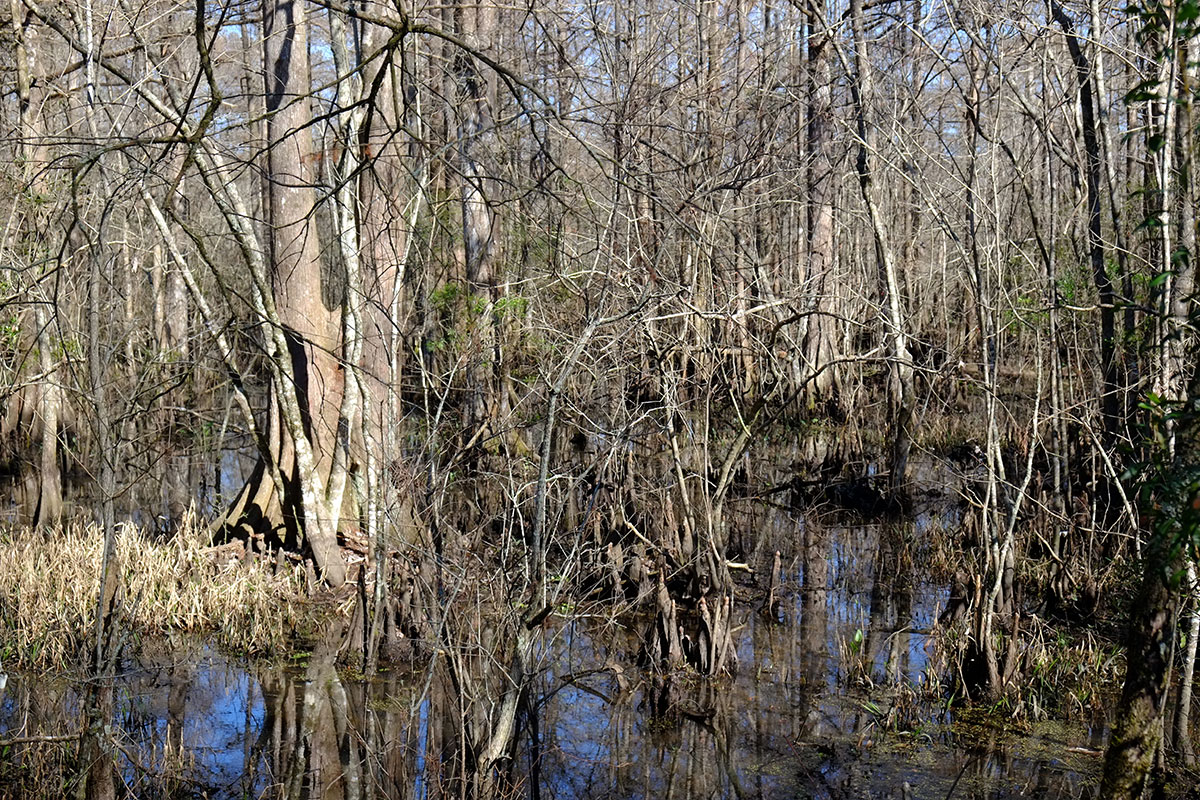
A highlight of our trip was heading down Bayou LaFourche with Glen to see his hometown.  First we stopped at a nature preserve / swamp, which is actually what I assumed all of it would be like.  DSCF2737

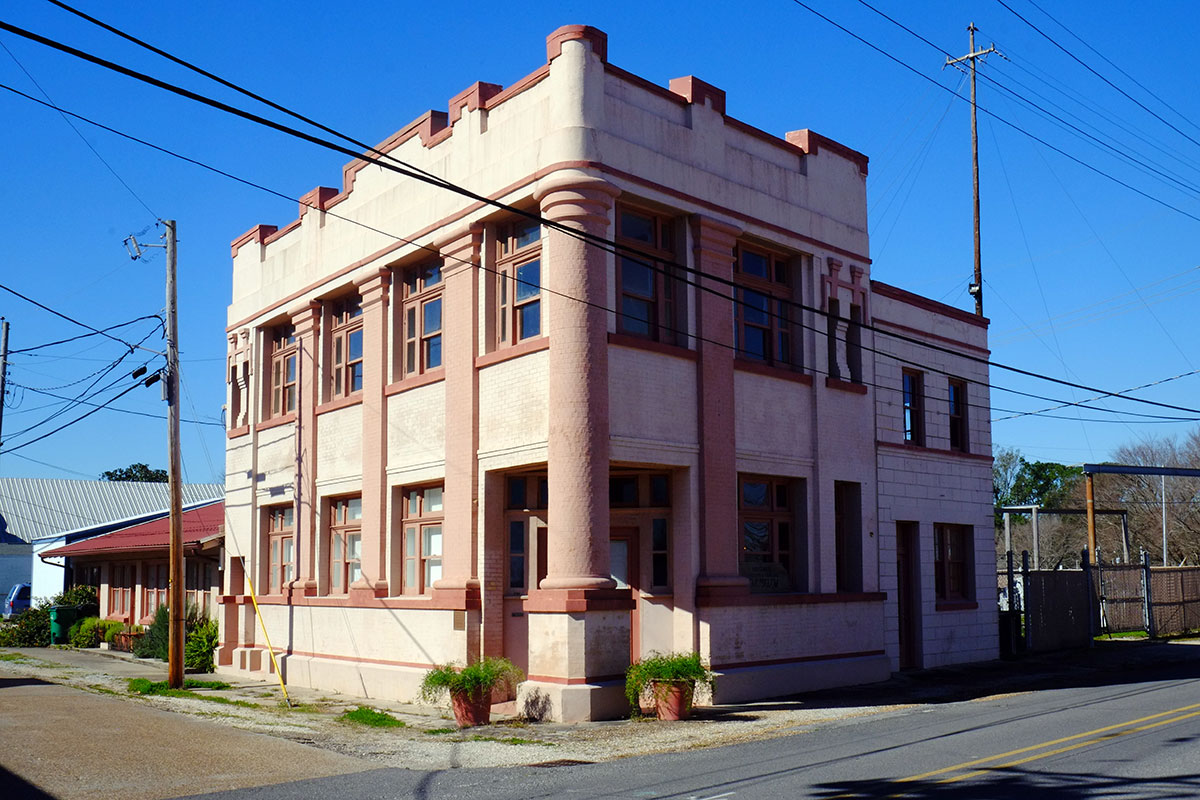
We then went through Lockport, where an east-west canal intersects the bayou.  The town bank was converted to a local history museum (Glen and Michelle designed the exhibits), and Glen asked me what style the building was.  I had to say eclectic – it was a pretty sophisticated and amusing little building to find there – a late 19th century commercial building / castle with influences from Furness?  DSCF2749

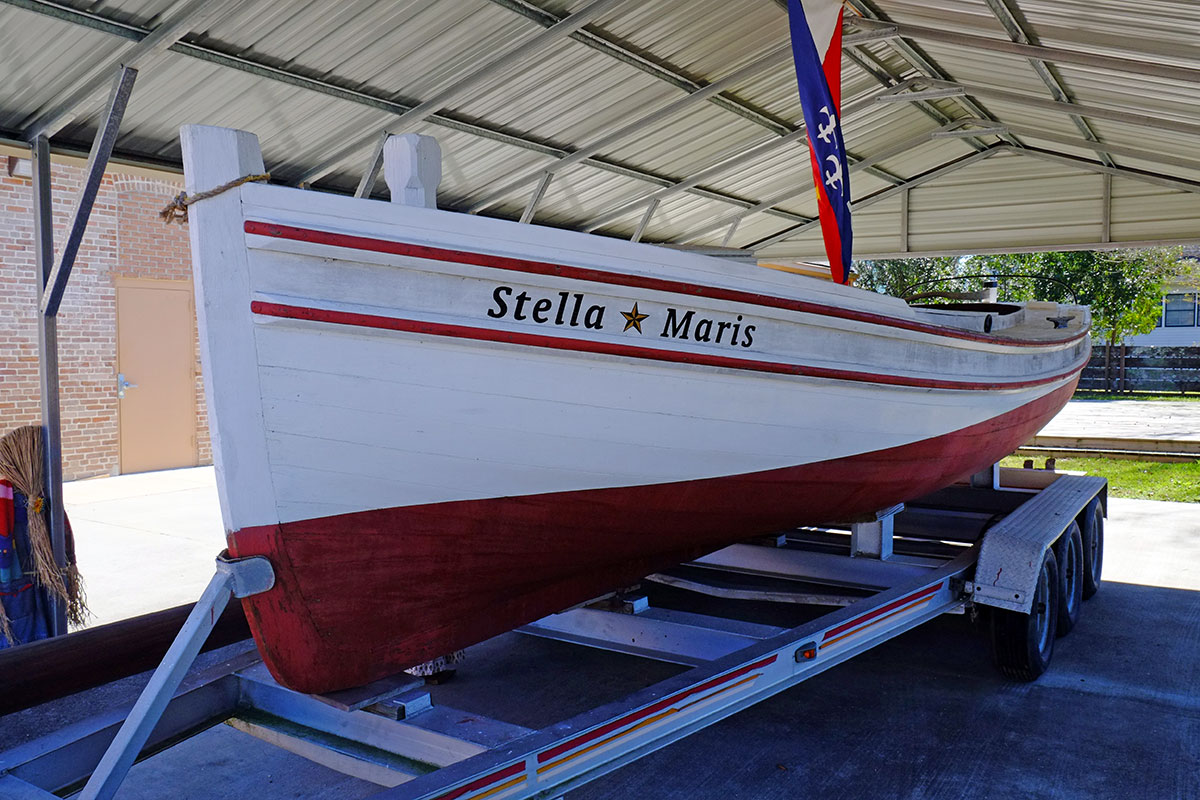
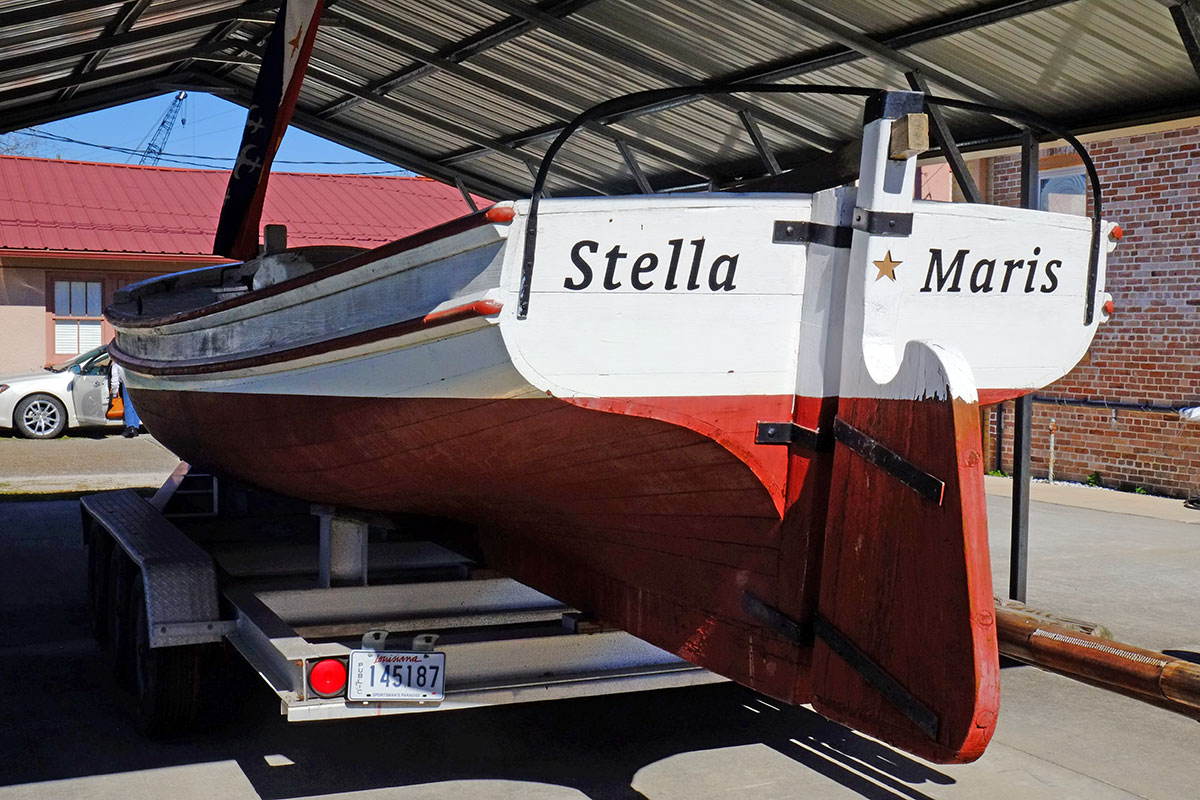
Across the street was a watercraft museum, which was unfortunately closed, but around back we found this fishing boat:  DSCF2743

What amazed me was how much it resembles my own boat – a cat ketch rig (the masts were down on deck, with a plumb bow, flat run and a broad stern with a transom-hung rudder.  DSCF2742

It’s the closest historical precedent I’ve come cross, although the freeboard is a lot less (better for hauling in the catch, worse for accommodations below) – so I’m afraid it’s a lot better-looking than my boat.

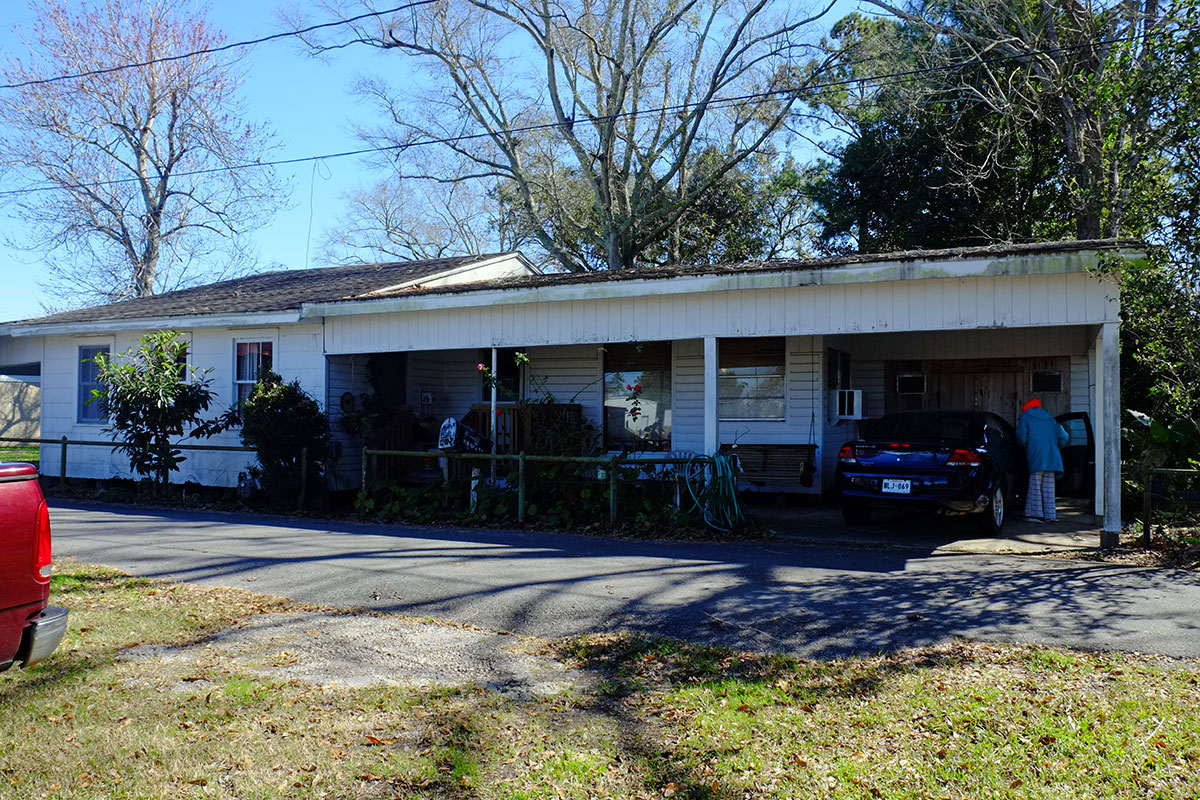
Glen’s mom had invited us to lunch at their family home, which was really enjoyable.  She grew up in Cut Off, and has spent her whole life there, although being 90 she now sometimes stays in New Orleans with Glen and Michelle.  I loved hearing about how Glen’s father built the house himself.  It started out relatively small, but as the family grew he just added more rooms.  DSCF2754One day when he was fishing in the Gulf he came across a floating section of wharf that had broken loose from someplace – which provided enough wood to build a new kitchen and dining room.  Glen also mentioned that for about 20 years his dad had been working on a 40-foot fishing boat in the yard made out of old steel cisterns, which never got finished.  I met Glen’s dad once in college, and now I realize how well we would have gotten along.

We saw a few other sights in Cut Off, but unfortunately the dance hall where Glen’s parents met had closed.  (I remembered the stories he had told of that in college, of how every person in town, no matter what age, showed up there on Friday night for a dance.)

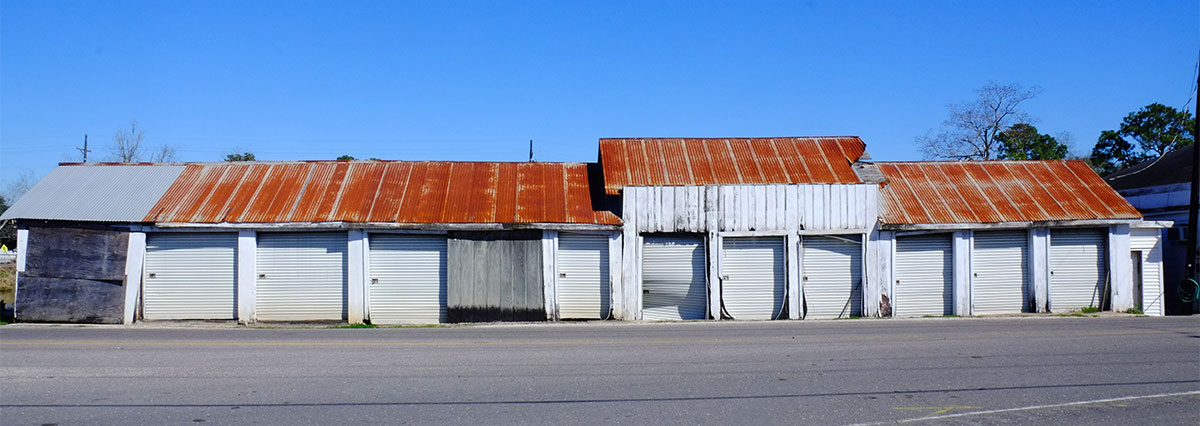
Glen stayed in Cut Off to finish up a project, and Greta and I continued south.  Driving along the bayou was endlessly fascinating – working buildings and big boats everywhere.  DSCF2753

DSCF2757

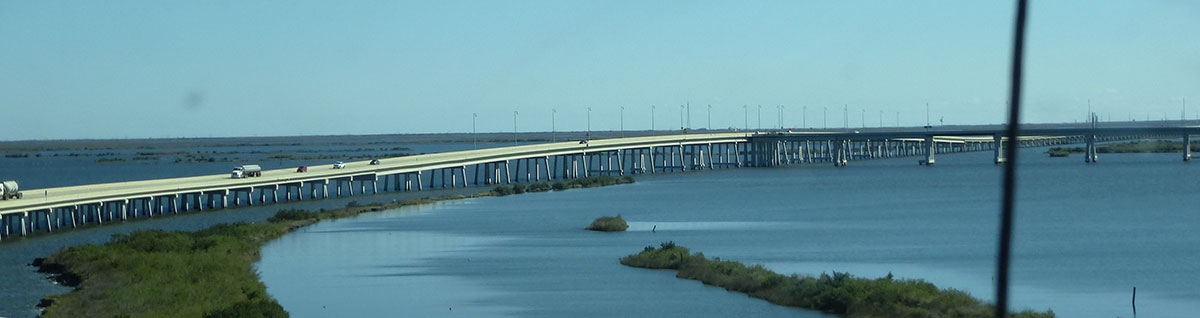
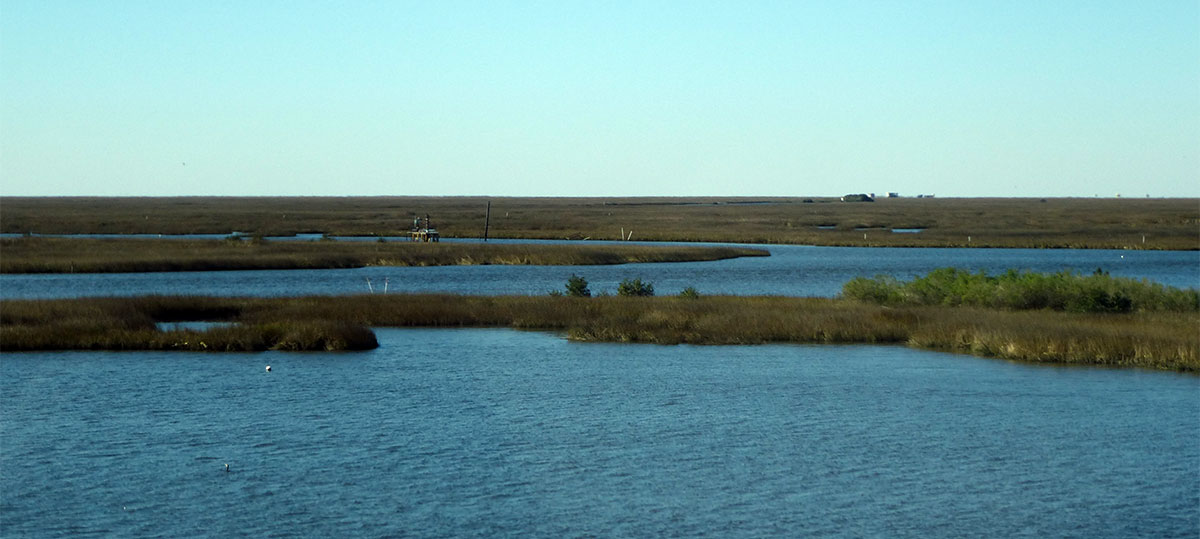
As we approached the Gulf, the road went onto a causeway, and the solid land gave way to more frequent marshes.  P1070092

P1070088  Glen’s mom told us that when she was young, the dirt road to Grande Isle ran on solid land all the way.  Southern Louisiana is disappearing at the rate of 3 acres per hour – a combination of subsidence, the levees along the rivers and bayous keeping the particles in the water from replenishing the land, and climate change.

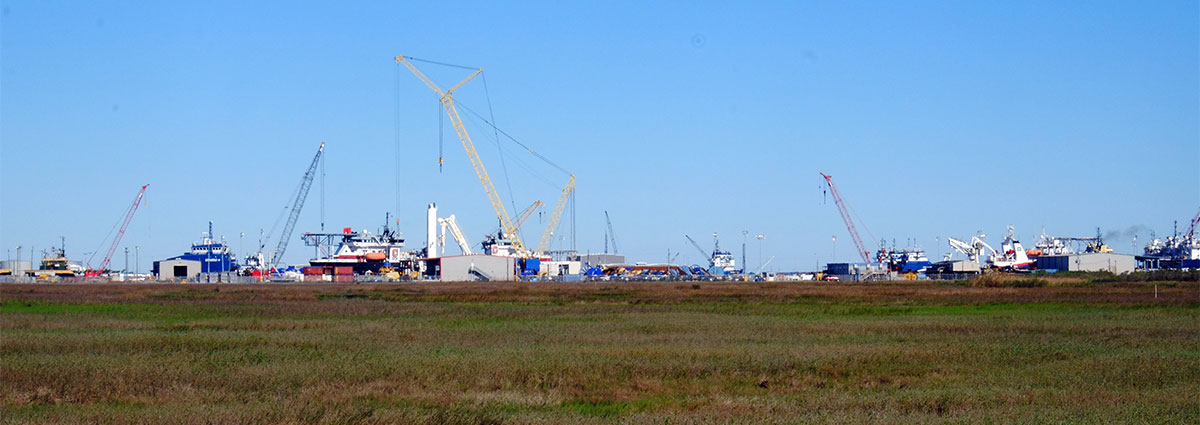
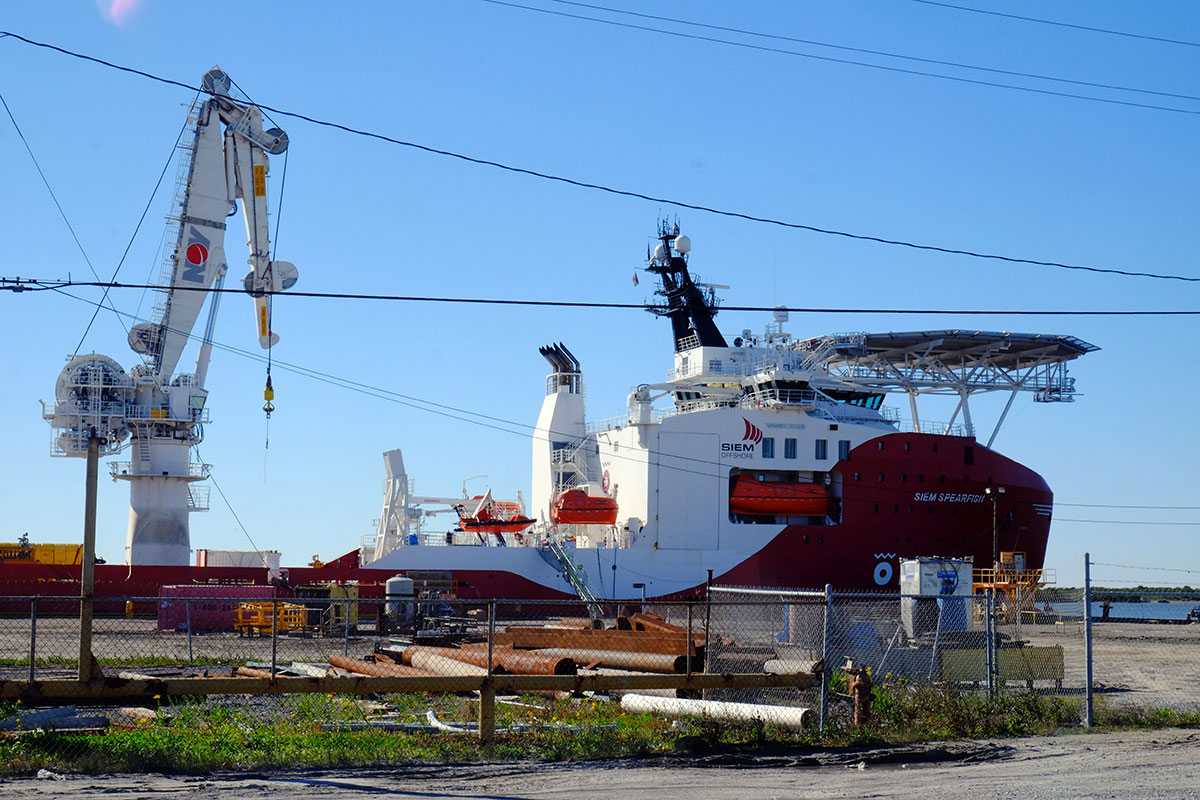
The causeway was built to service the new port at Fourchon.  With the growth of the offshore oil rig industry, a deep water, larger port was needed, so Fourchon was enlarged to accommodate the shipping.  It is the weirdest port I’ve ever seen – you can barely see the water.  The access roads are lined with large commercial shipping facilities, and you can see the ships beyond, which appear to be stuck in the marshes.  DSCF2778  DSCF2766It is completely different from what I’m used to as a large harbor on either the east or west coasts, continuing my general disorientation that began as soon as we hit New Orleans.

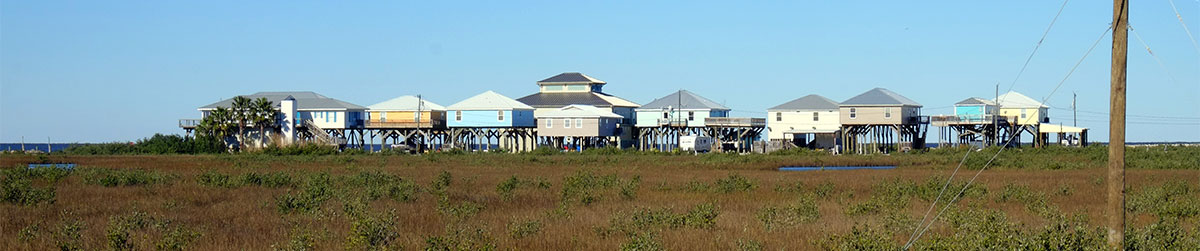
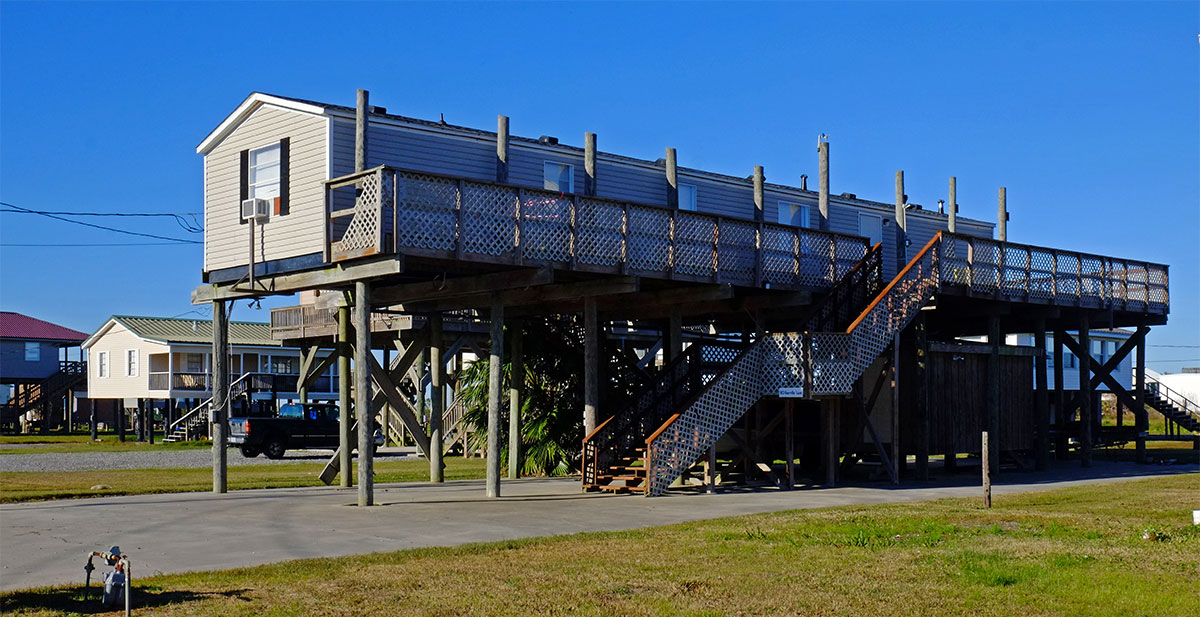
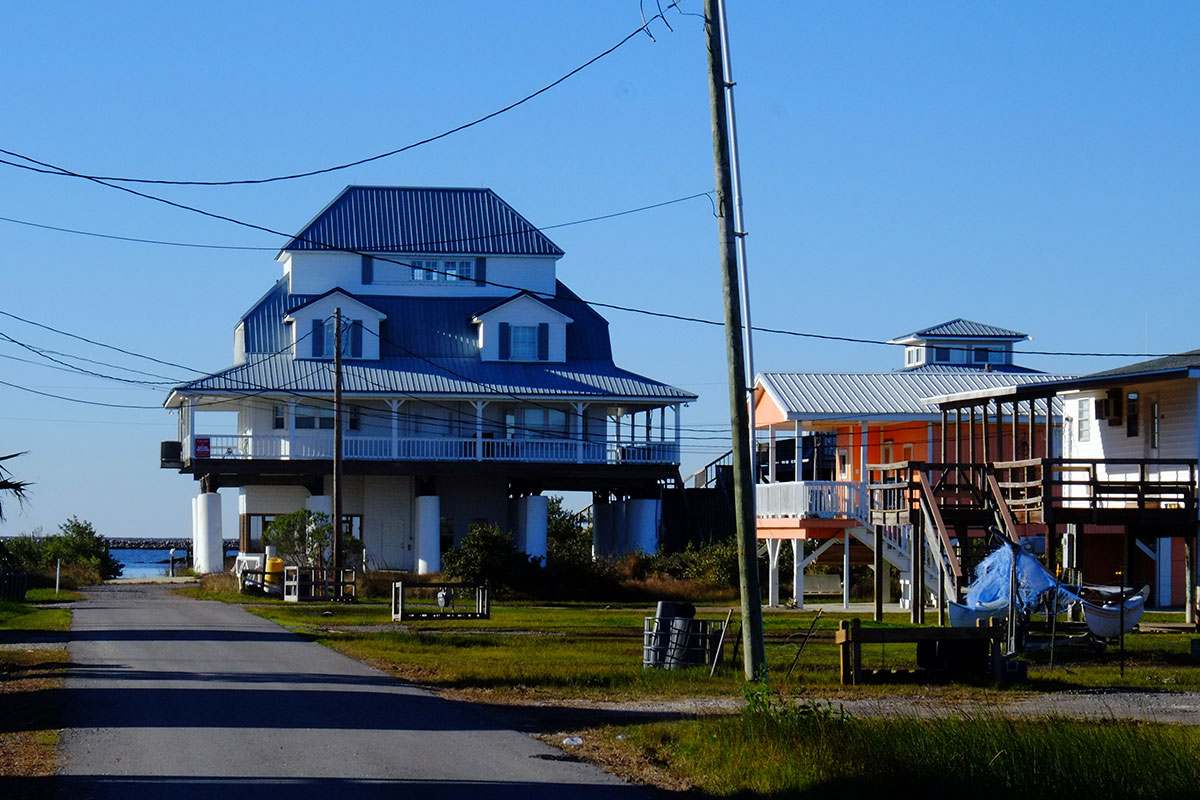
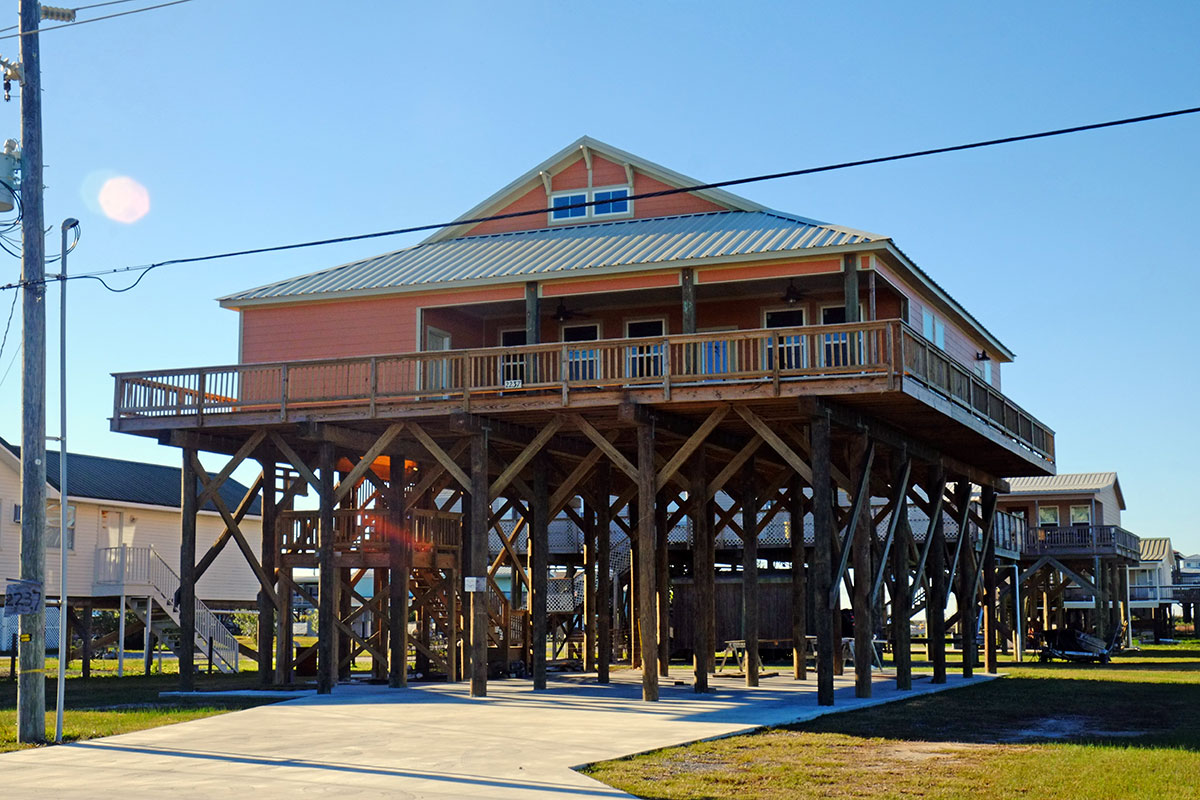
We finally arrived at Grande Isle, a old resort town which is apparently the only Gulf beach in Louisiana which can be reached by a road.  It’s been hit by many hurricanes and floods, and the new building type reflects this history (not many old buildings left):DSCF2789  DSCF2780
Even the single-wides get raised.  DSCF2790
This expensive house on the water was for sale, and one of the advertised features was “no gypsum board”.  When the floodwaters recede, you don’t want to be demoing all the sodden sheetrock.  DSCF2791

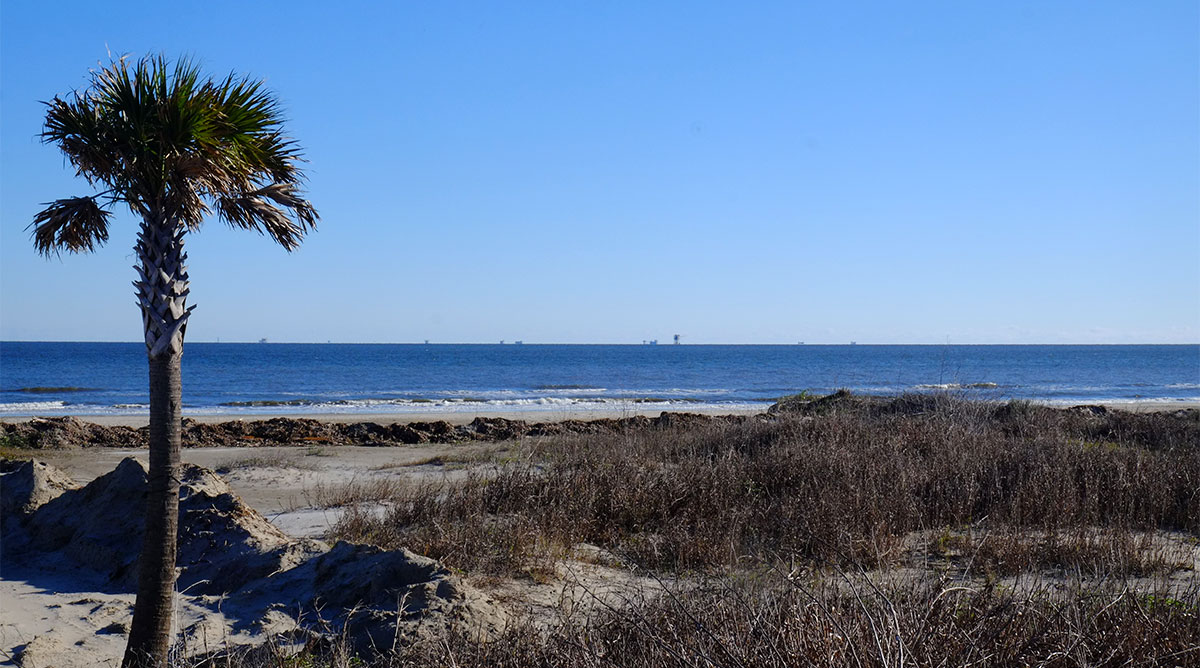
Grande Isle has a typical, beautiful Gulf beach, with white sand and palm trees, and lots of odd bumps on the horizon.  DSCF2782

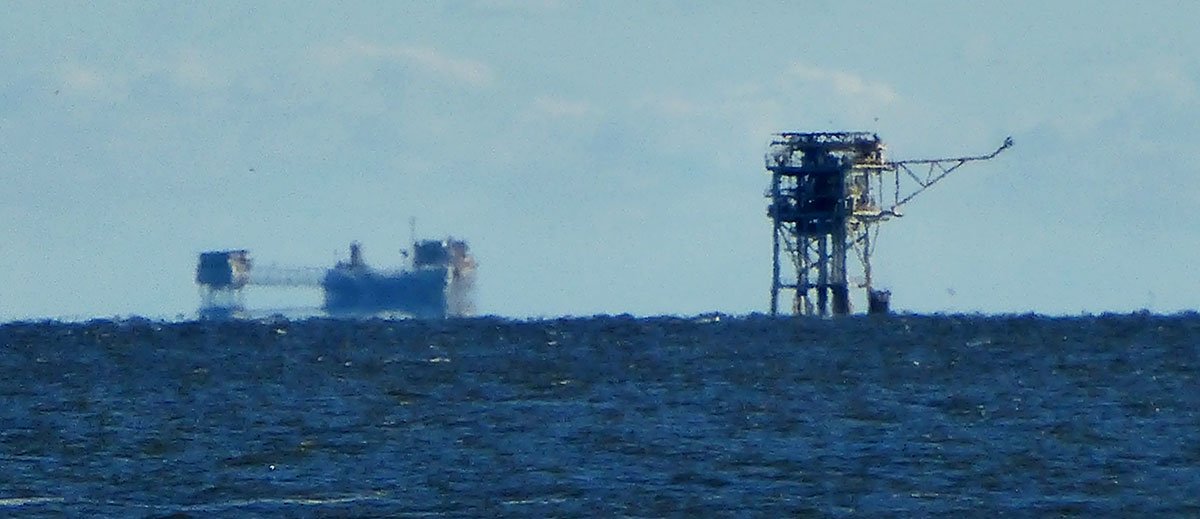
These are some of the 600 offshore oil platforms within 40 miles of Fourchon (with the lower part of the platform under the horizon).  P1070096

As we stood on the beach looking at this scene, the insane irony of southern Louisiana was apparent.  The oil and gas industry is the mainstay of the Louisiana economy, both these offshore rigs and refineries located up the Mississippi.  The burning of fossil fuels is primarily responsible for climate change, and the rising of sea levels.  This is already being seen locally, and the $350 million causeway was necessary to ensure that the traffic thats services the industry could still reach Fourchon as water levels rise and the land disappears, so the oil and gas could still be pumped.  It’s a vicious circle that will play out until it just can’t work anymore, and the traditional landscape of the bayou will disappear, along with many other places.  One of the themes of this trip has been the Climate-Change-Farewell-Tour;  we haven’t been to a place yet where this has been more evident.

Alabama

DSCF1149Traveling across the Deep South was not one of the goals of our trip, but if we wanted to skip winter weather as we went from Florida to New Orleans, Alabama and Mississippi were unavoidable.  We realized that there’s not a lot of great architecture or notable cities to see (and the ones there are happen to be in the Piedmont far north of our route), the landscape is monotonous, and the prevailing culture is as far from our normal milieu as can be found in this country.  (There had been an op-ed in the Times a few days earlier on how hard it was to be a liberal native Alabaman, returning to the state after 20 years in New York.)  Greta pointed out that the only common element in our value system and theirs is appreciation of barbecue.  So with minor trepidation we headed into Alabama.

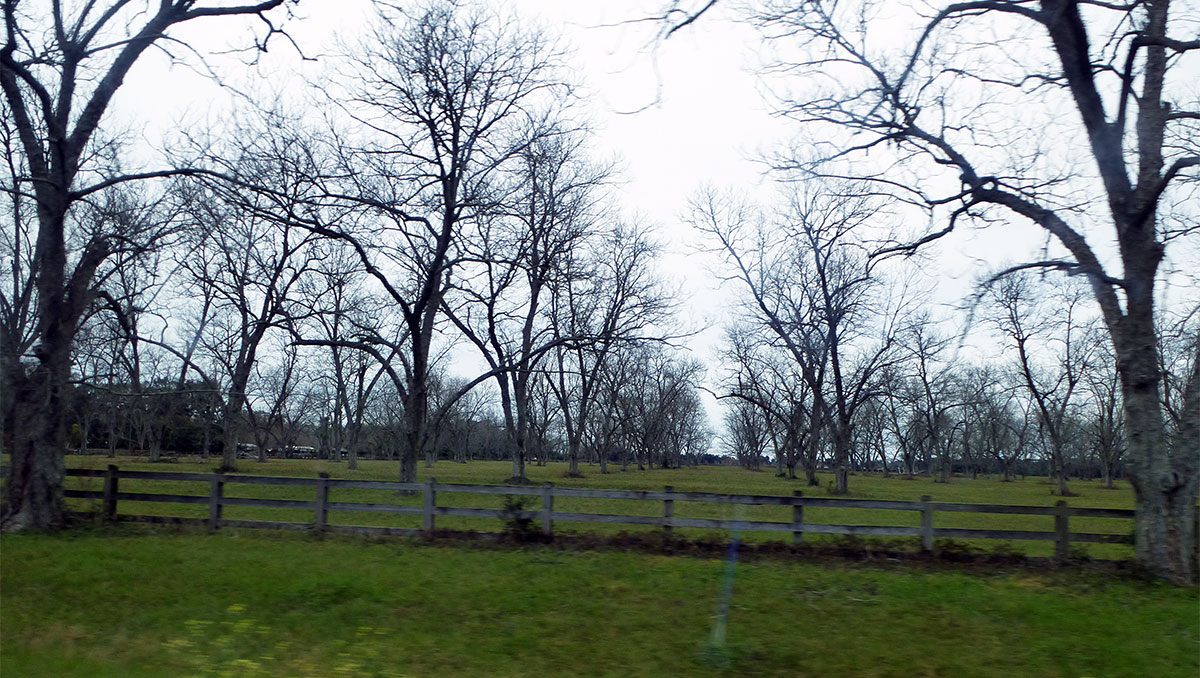
If you’re taking the coastal route, you only hit the little tab of Alabama that surrounds Mobile Bay, and the drive across is under 100 miles.  The coastal plain is indeed monotonous, but very pleasant – we were mostly in a landscape of pecan groves and small towns.P1060792

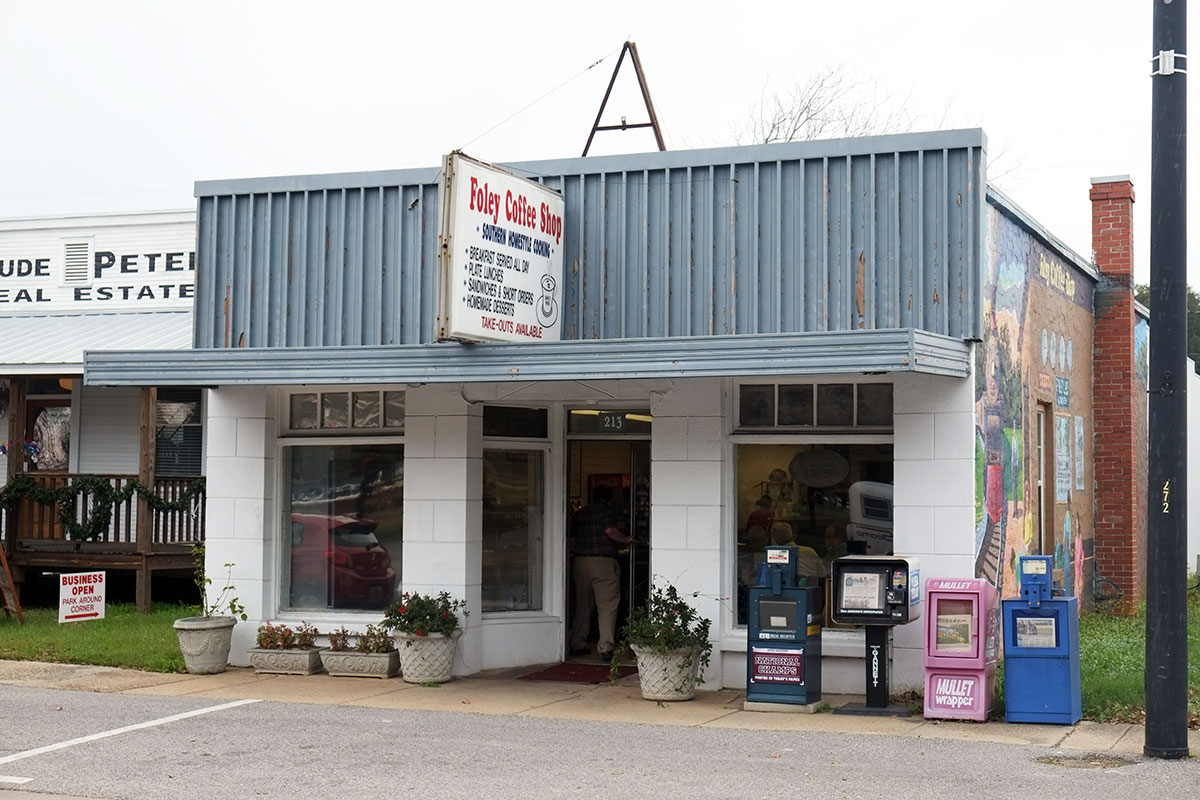
The biggest disappointment on our travels in the South has been the displacement of barbecue joints.  Every little town or city you pass is full of chain fast food places, which seem to have squeezed the barbecue out – as Calvin Trillin noted last fall in the New Yorker, the future of barbecue seems to be heading into the cities, where it is appreciated by yuppie connoisseurs.  So at lunchtime we turned to the excellent database compiled by the folks at Roadfood.com, which directed us to the Foley Coffee Shop, in the charming small city of Foley, Alabama.  Greta isn’t blogging about this as it wasn’t necessarily a culinary awakening, but it was a cultural one.  DSCF1130

As we stepped through the front door, we were transported back 50 years in time.  A wall of conversation hit us, as the place was full of locals of all types – old folks, office and construction workers, families, etc.  A short movie best conveys the ambience:

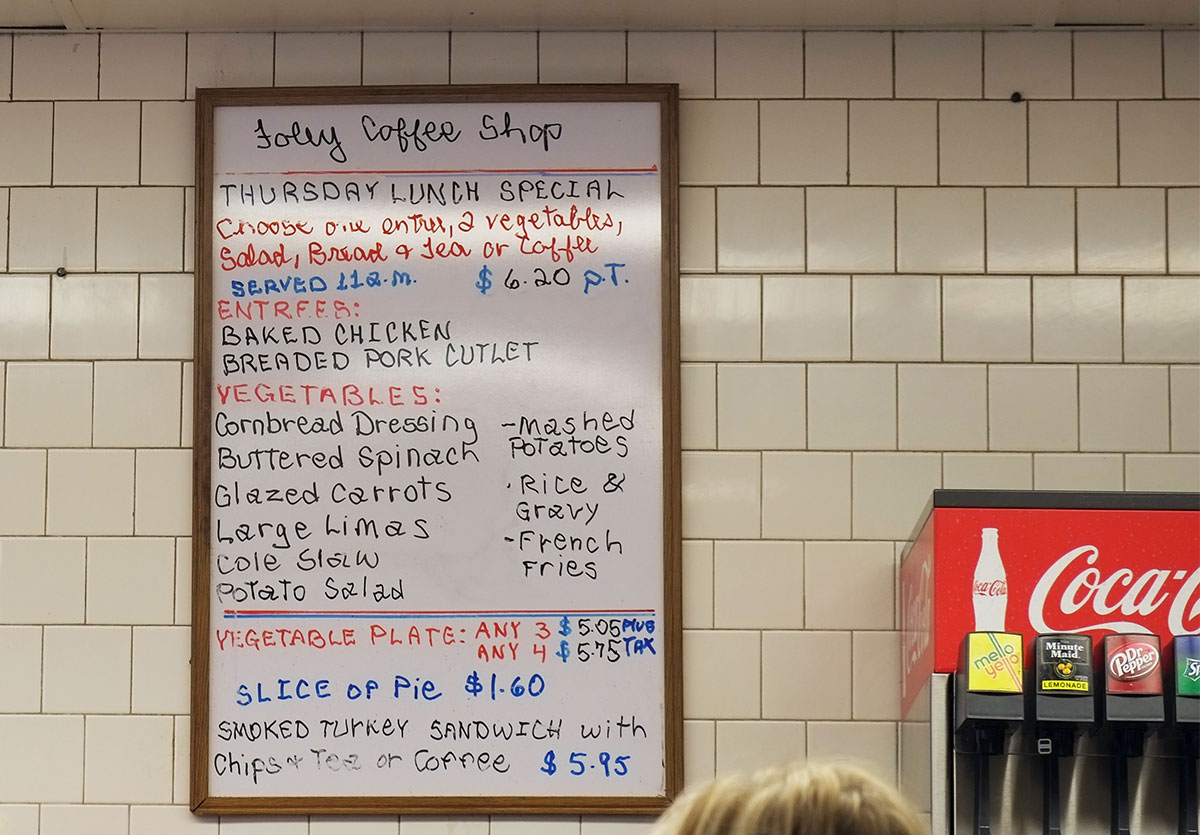
Our charming waitress, a friend of the owner’s daughter, confirmed that nothing had really changed since the 1960s.  It seemed to us that the prices were within this category too – “entree, 2 vegetables, salad, bread, & tea or coffee” for $6.20 (with a choice of 9 vegetables).  Take that, McDonalds.  DSCF1128

The food was fresh and good, the people we talked to were gregarious and lovely, and the sense of community was palpable.  This wasn’t just a place for the efficient satisfaction of nutritional needs, but one that helped maintain the culture of the city.  At first we felt like visiting anthropologists, but we appreciated how we were welcomed in for our brief glimpse.

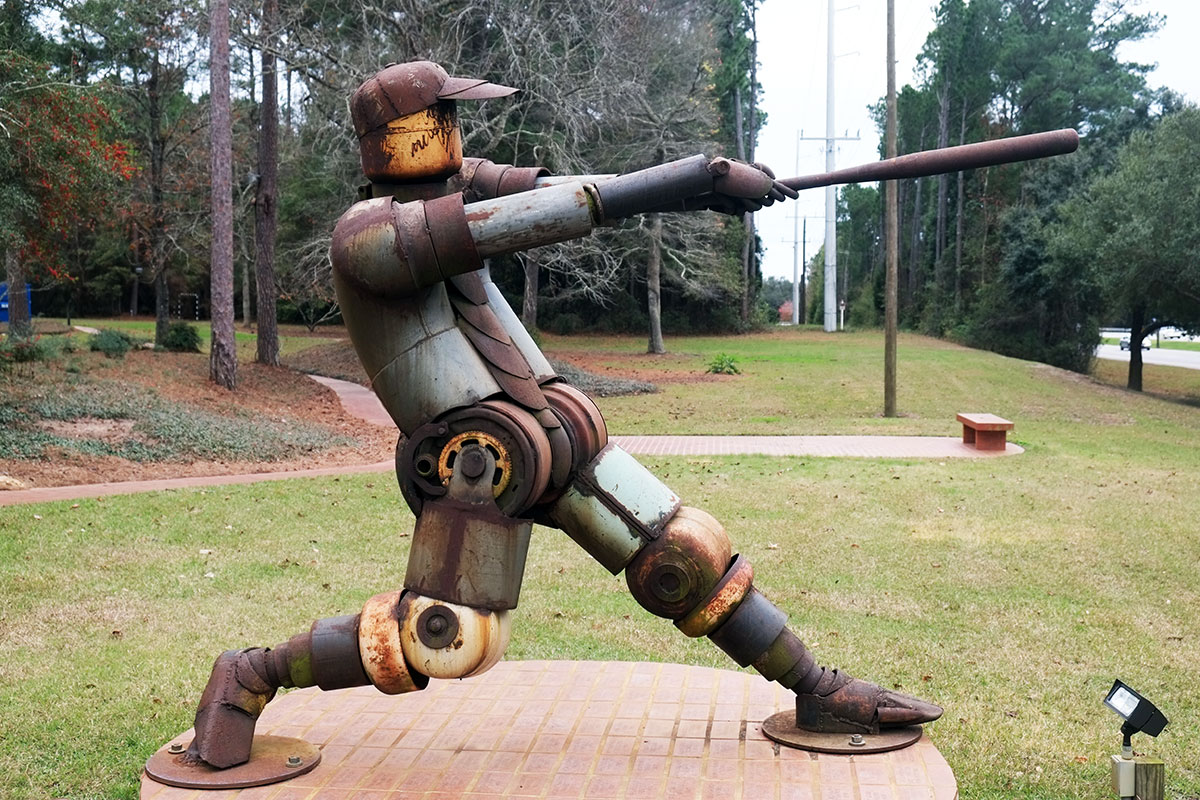
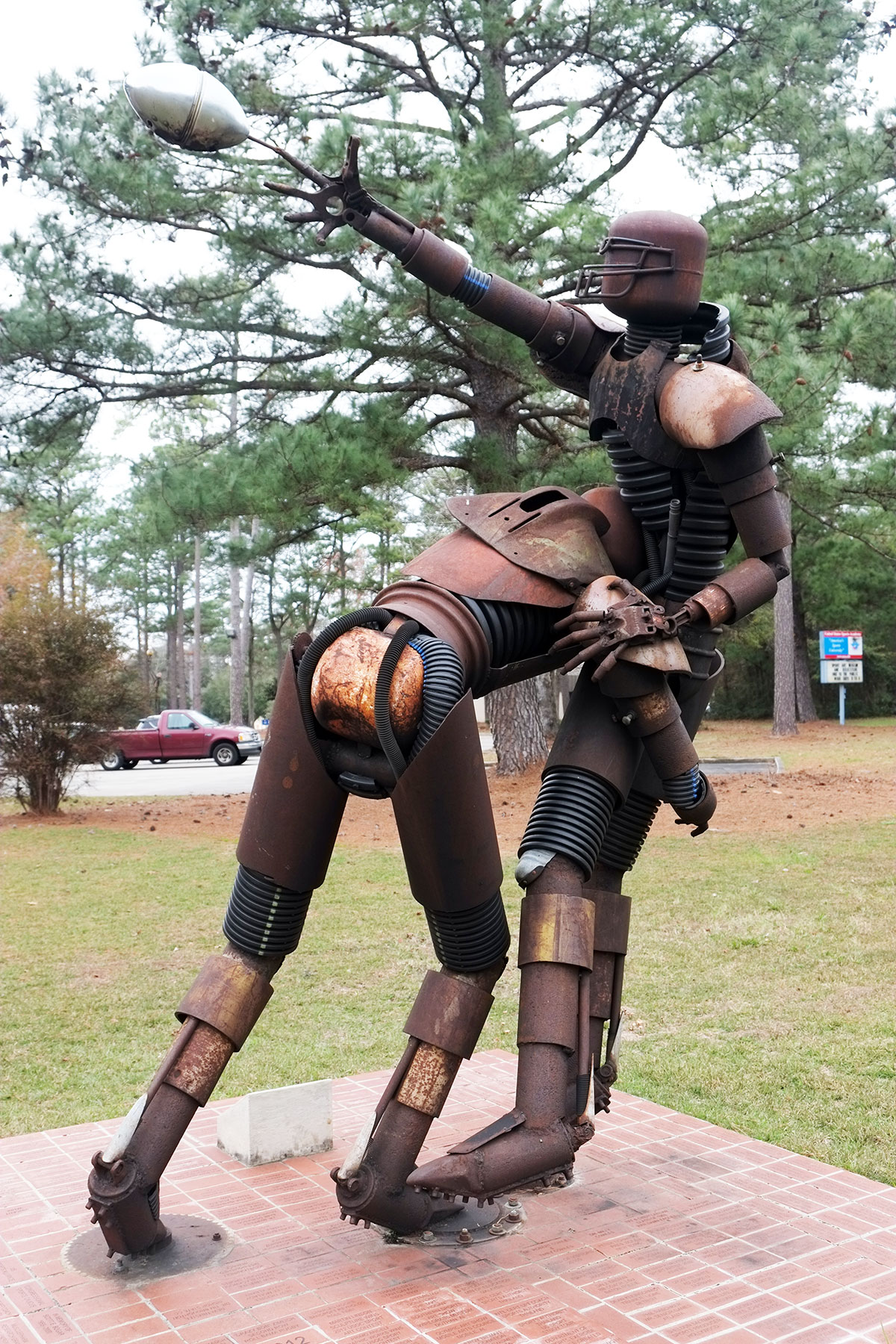
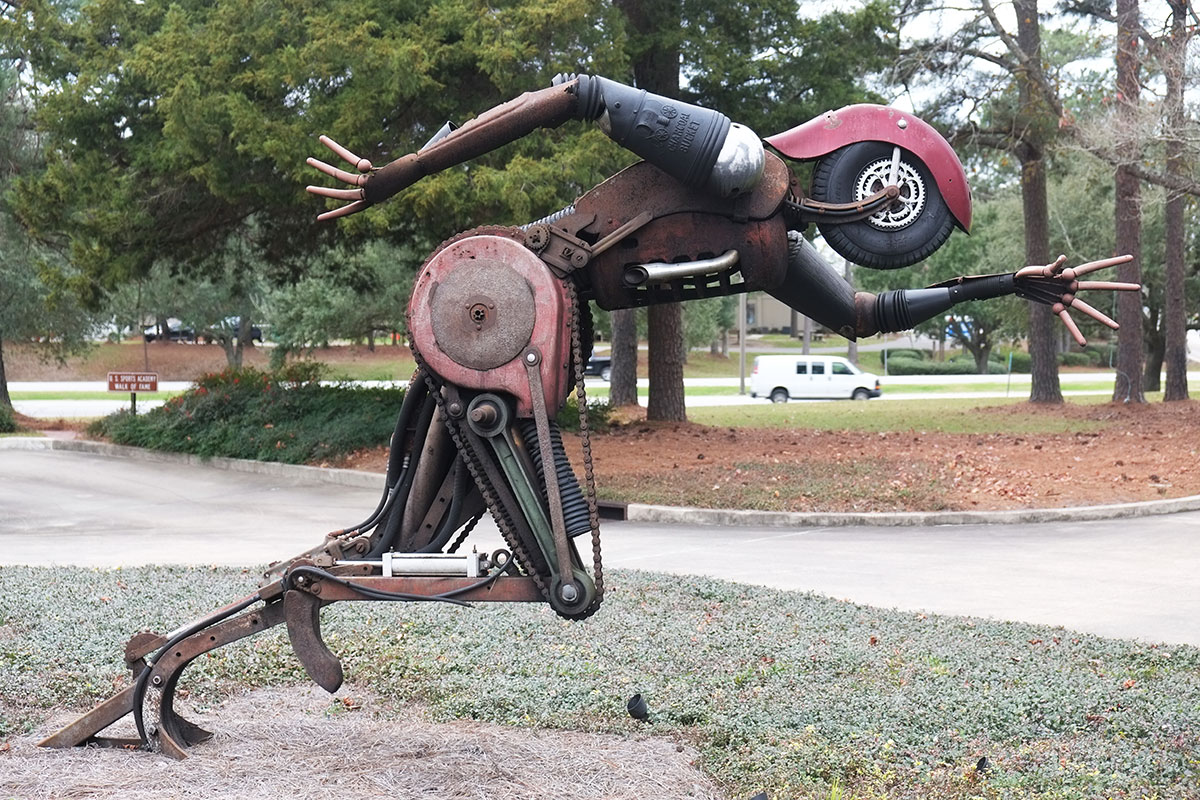
The other great cultural mainstay of Alabama is football, so guided by the map at RoadsideAmerica.com, we stopped at the US Sports Academy in Daphne, to see the sports sculptures made of junk metal by Bruce Larsen.  (Unmediated football doesn’t interest us, but representations might.)  They are remarkable, using rigid materials to convey a sense of movement, power and tension.  Greta liked them because they were so Steampunk.  DSCF1132  DSCF1152

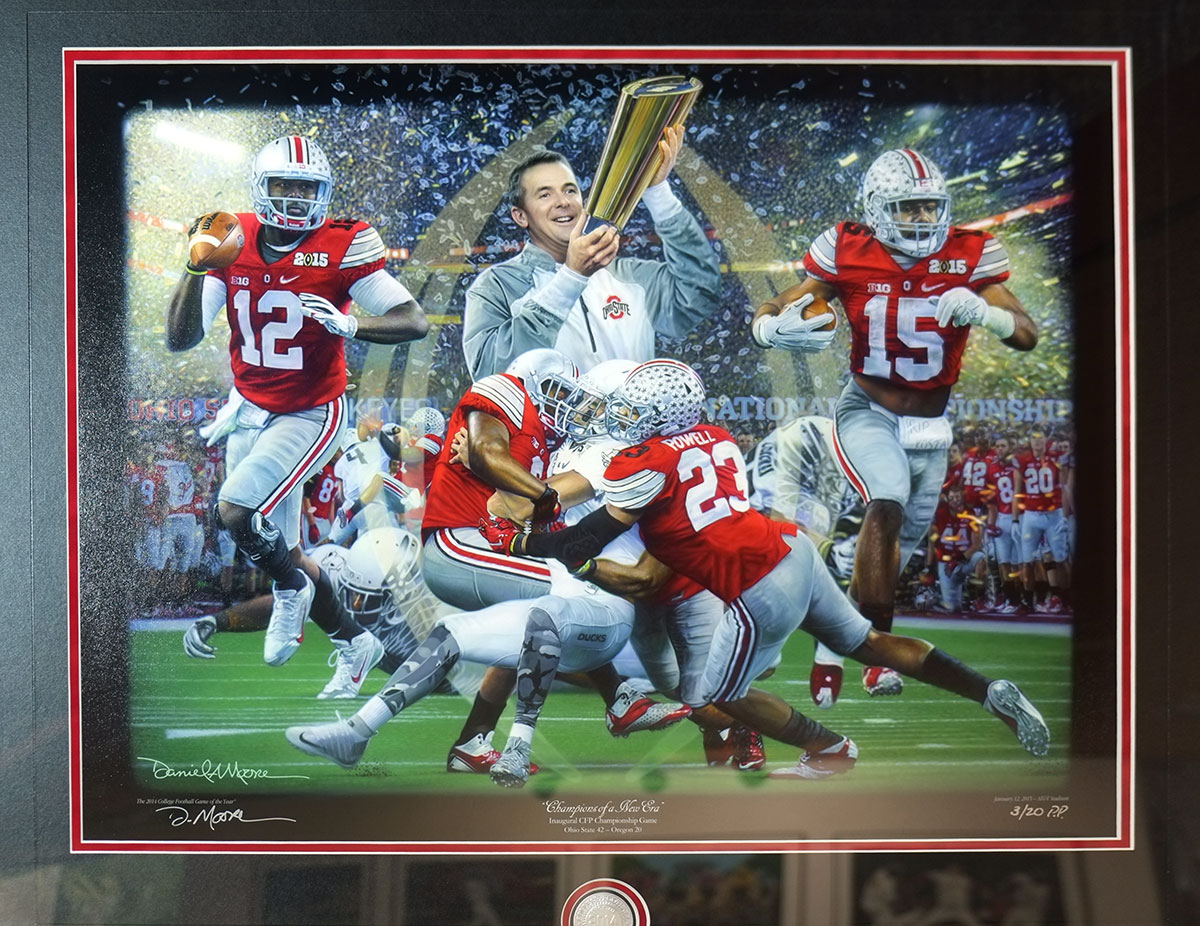
Heading to the building interior and its extended art collection, we came across this print which we had never seen before in Oregon.  DSCF1157pIt is apparently one in a series celebrating the “College Football Game of the Year”, and in its depiction of the inaugural CFP Championship game almost exactly one year earlier, it showed Marcus Mariota getting sacked by a swarm of Ohio State players.  We left in a huff.

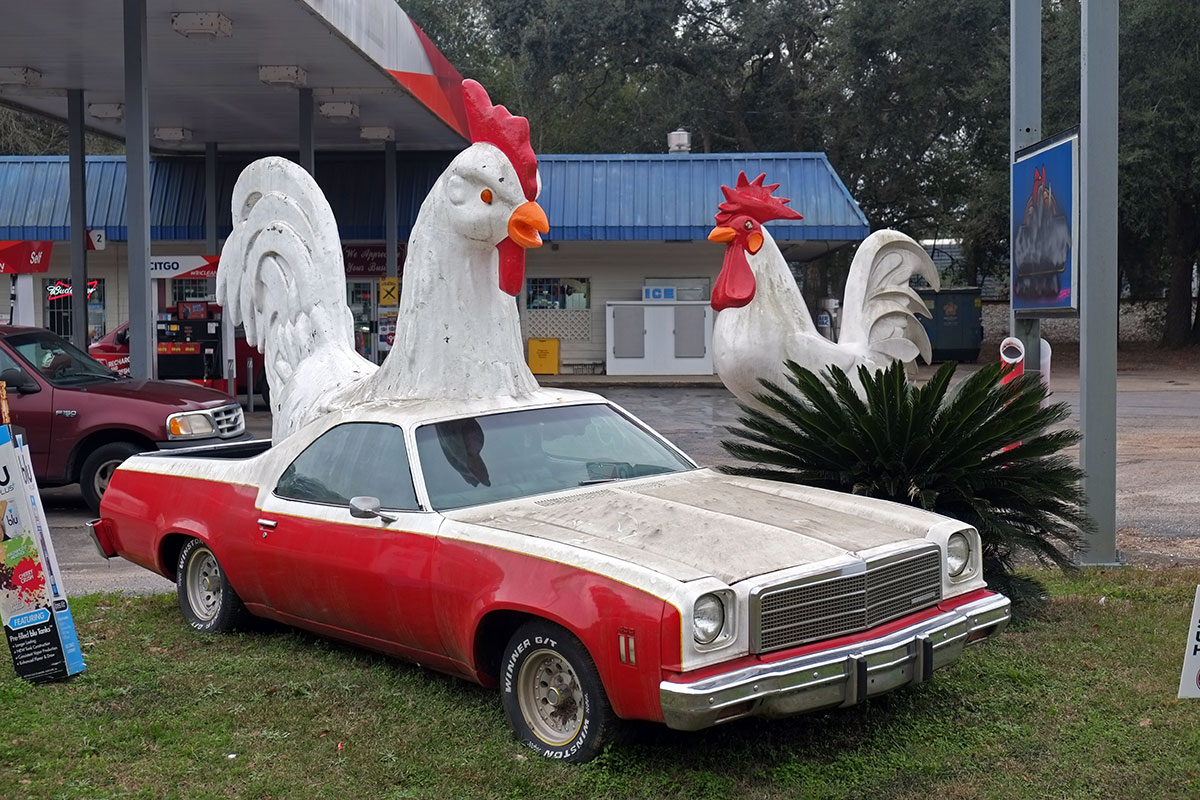
We cruised through Mobile, which did nothing to grab our attention, as we had one more goal in sight that afternoon:  once again, guided by RoadsideAmerica, we reached the El Camino chickens.DSCF1166

A local man saw me taking photos and called out to me:

“Do you like those chickens?”
“I love the chickens.  And my wife loves El Caminos, so I’m taking pictures for her.  I read that this used to be a fried chicken stand, is that true?”
“I’m not sure, the chickens have been here as long as I can remember, and whatever store is here has always sold some chicken, though.  Where you folks from?”
“Oregon.”
“I hear it’s beautiful there, but I’ve never been. Actually, I’ve never really been anywhere.  Never got too far away from these chickens.”

We know that our five hours there didn’t give us a nuanced view of Alabama, but overall, it was more positive than we had been expecting.

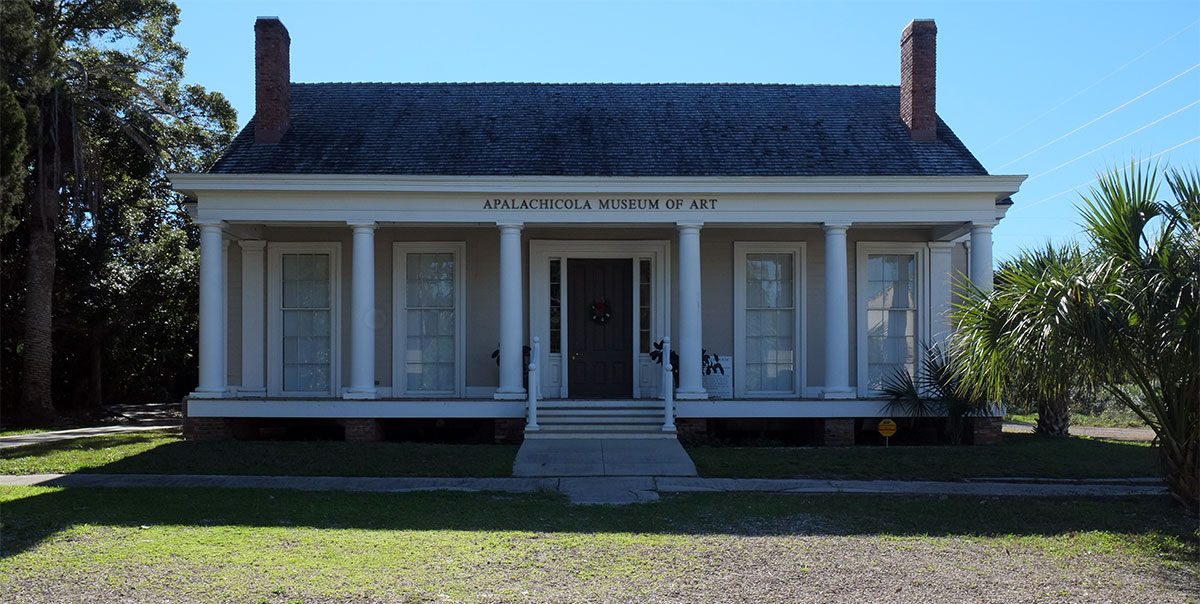
Apalachicola and the roots of the New South

DSCF0467Apalachicola has more going for it than its cool name.  Like Fernandina Beach, it’s a place where a succession of industries has sustained the local economy, and each has left its mark on the form of the town.  And in a strange way, events that transpired in Apalachicola may be responsible for the manner in which our country (and much of the rest of the world) has developed in the postwar era, and possibly responsible for our current national political alignment.

Apalachicola was first an important cotton port.  But similar to the fate of New Orleans, with the opening of the Erie Canal and the advent of the railroad, that industry declined.  You can see its influence in the width of the downtown streets, which were to accommodate the movement of cotton bales.  DSCF0479

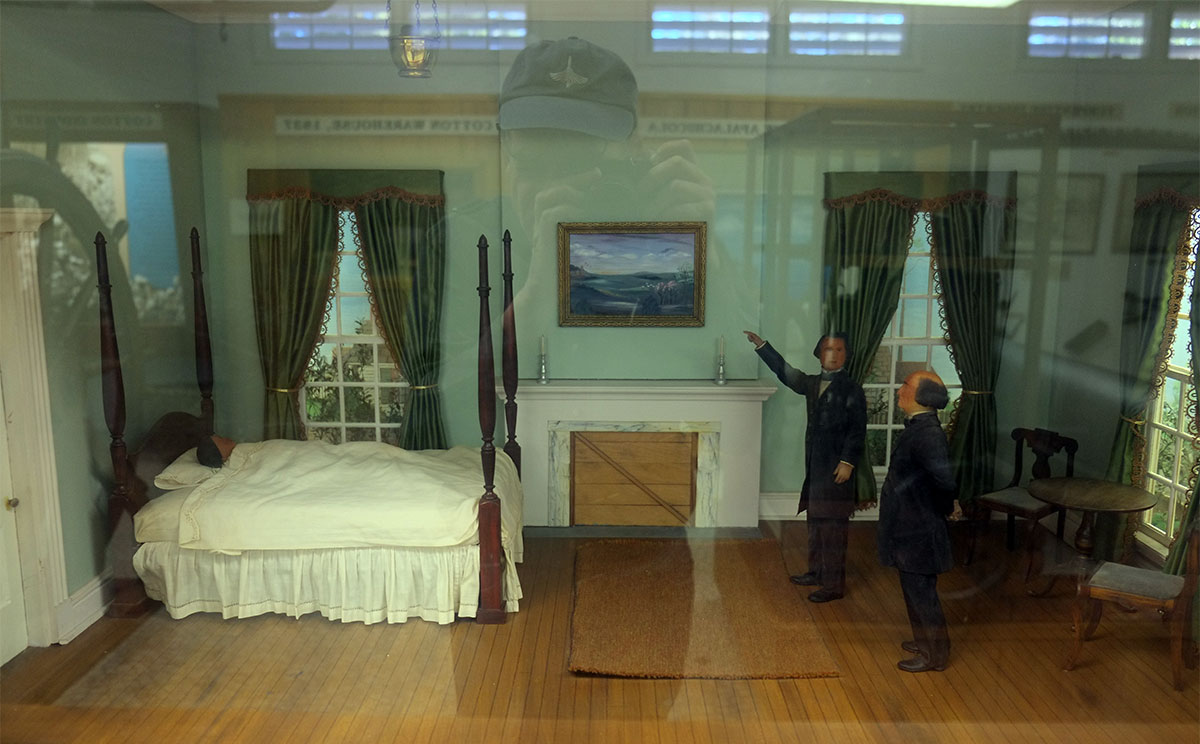
We are suckers for local museums, and Apalachicola has a good one.  We were particularly struck by this pre-digital interactive display, which shows the life of the port in this era.

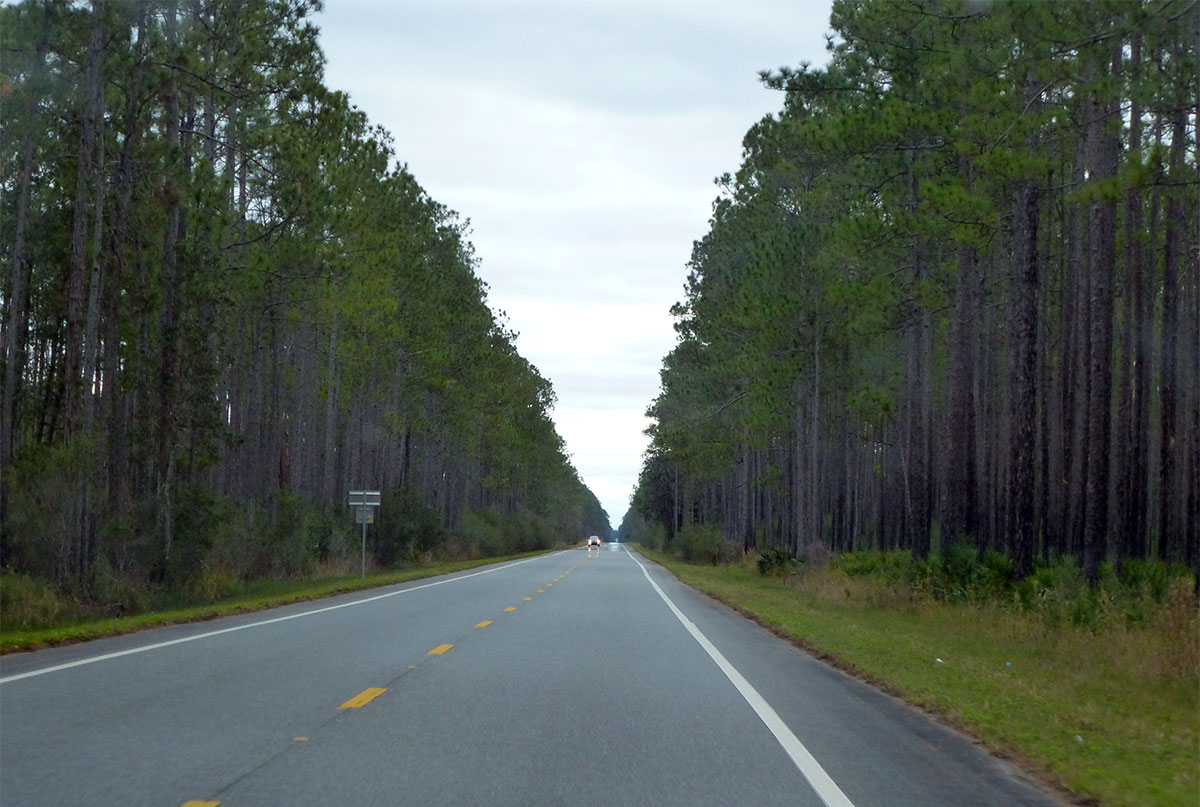
To get to Apalachicola, we drove through Tate’s Hell State Forest, the most appropriately named place we’ve ever been, the apotheosis of the relentlessly boring southern coastal plain pine forest.P1060708

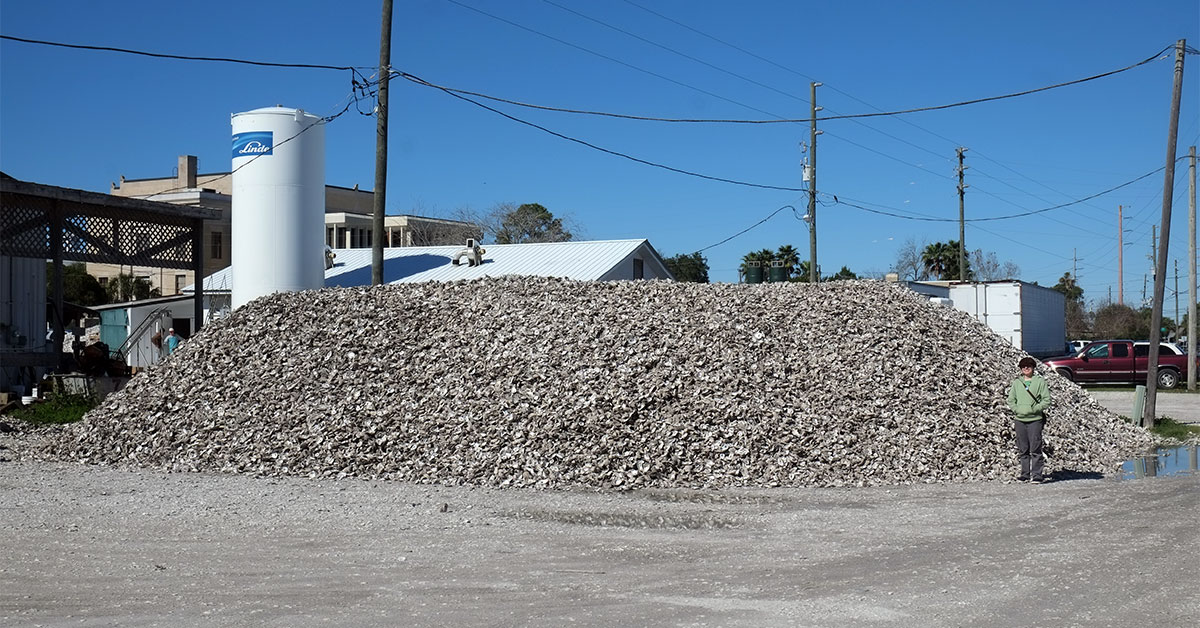
But it did bring the home the extent of the second of Apalachicola’s industries – as a port for shipping out the long leaf pine harvested upriver.  After the forests were logged off, economic activity shifted towards fishing, and especially oystering.  This industry, along with tourism, sustains the city today.  The oyster haul is impressive:  DSCF0442

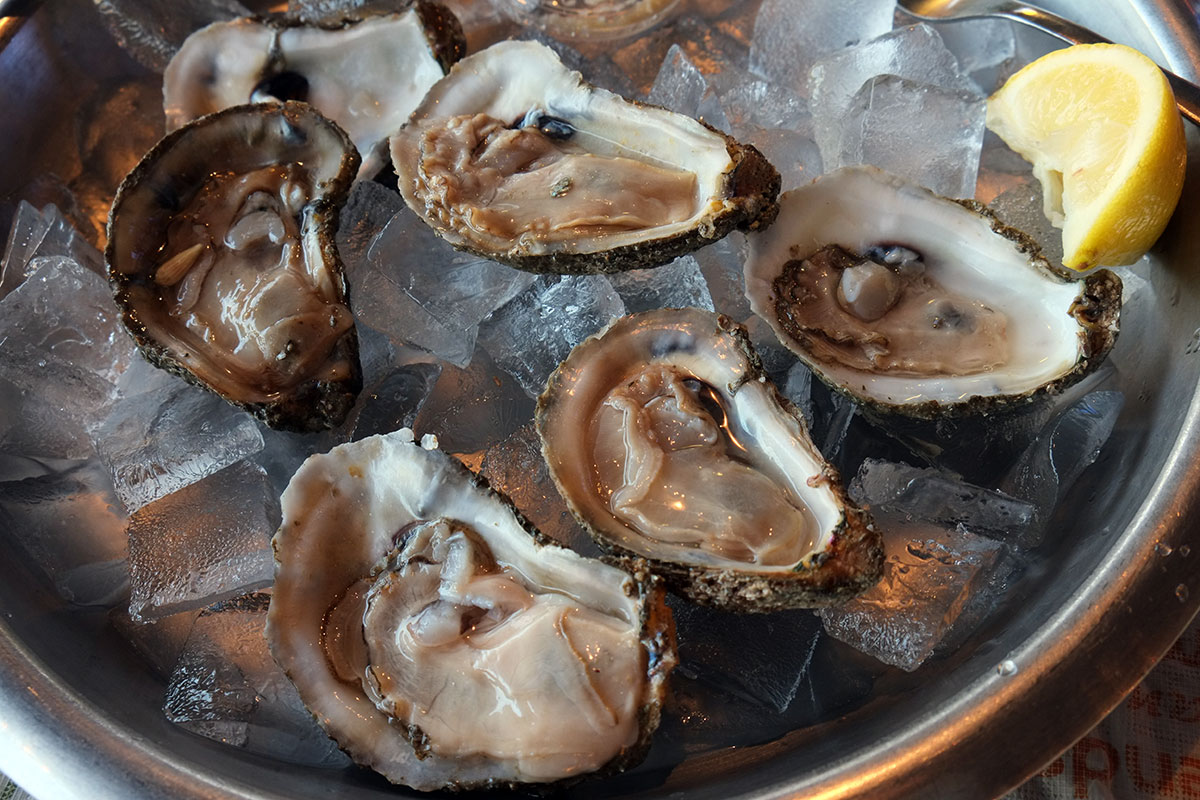
and tasty.DSCF0611

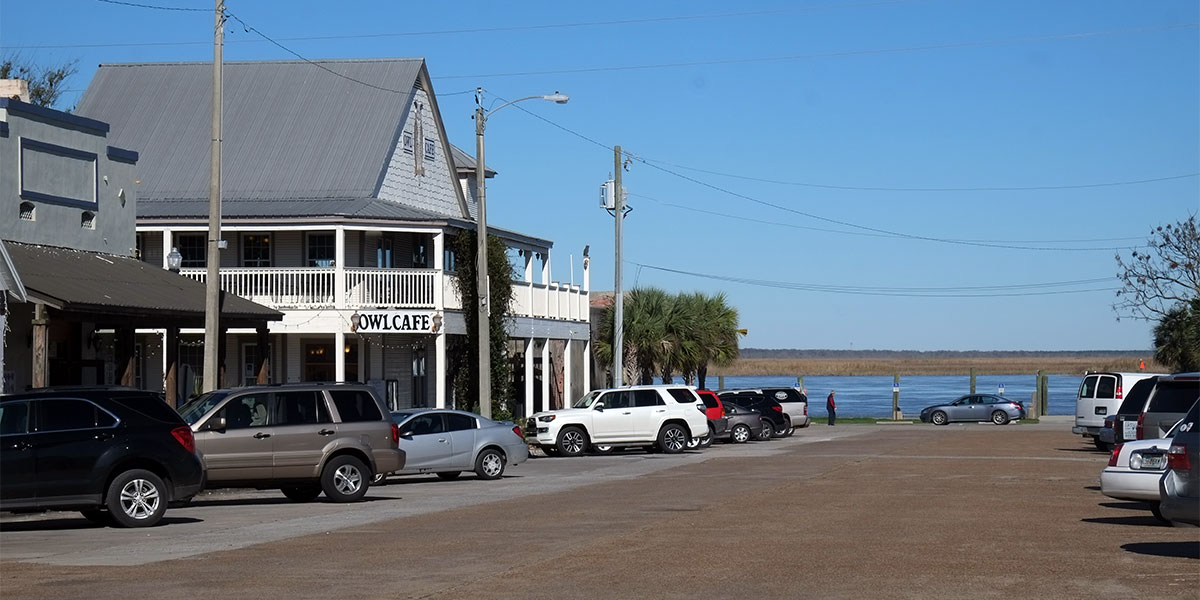
For me, one of the big attractions is seeing a town where the waterfront is still active, not just a show-piece for tourists.  Any place where there’s a boat at the end of the main street is a good thing.  DSCF0472

And there are lots of funky, functional buildings along the waterfront, not all turned into boutiques yet.  DSCF0465  DSCF0477

As well as a few interesting hybrid business ventures.  DSCF0463

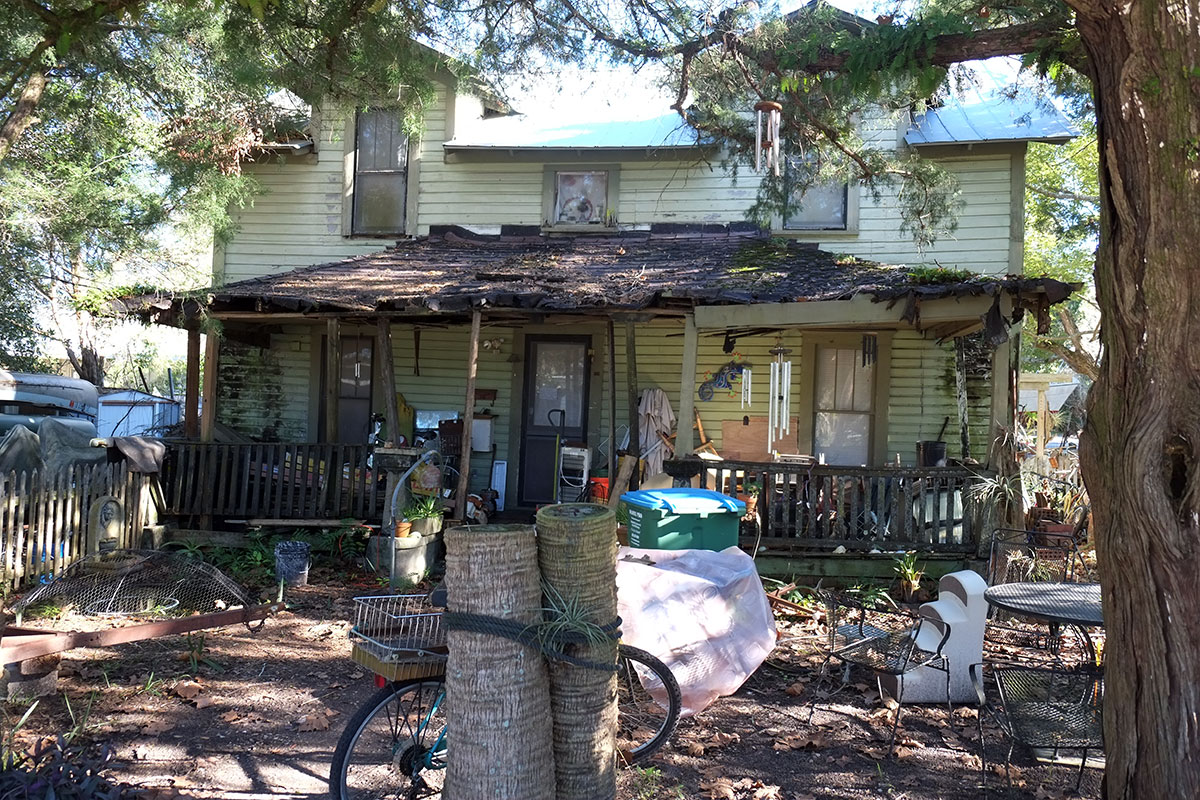
The residential districts are all 19th century wood frame, of varying styles, and again, the funky mixes with the hyper-restored.  DSCF0489  DSCF0603  DSCF0508  DSCF0493  DSCF0587  DSCF0505  DSCF0498

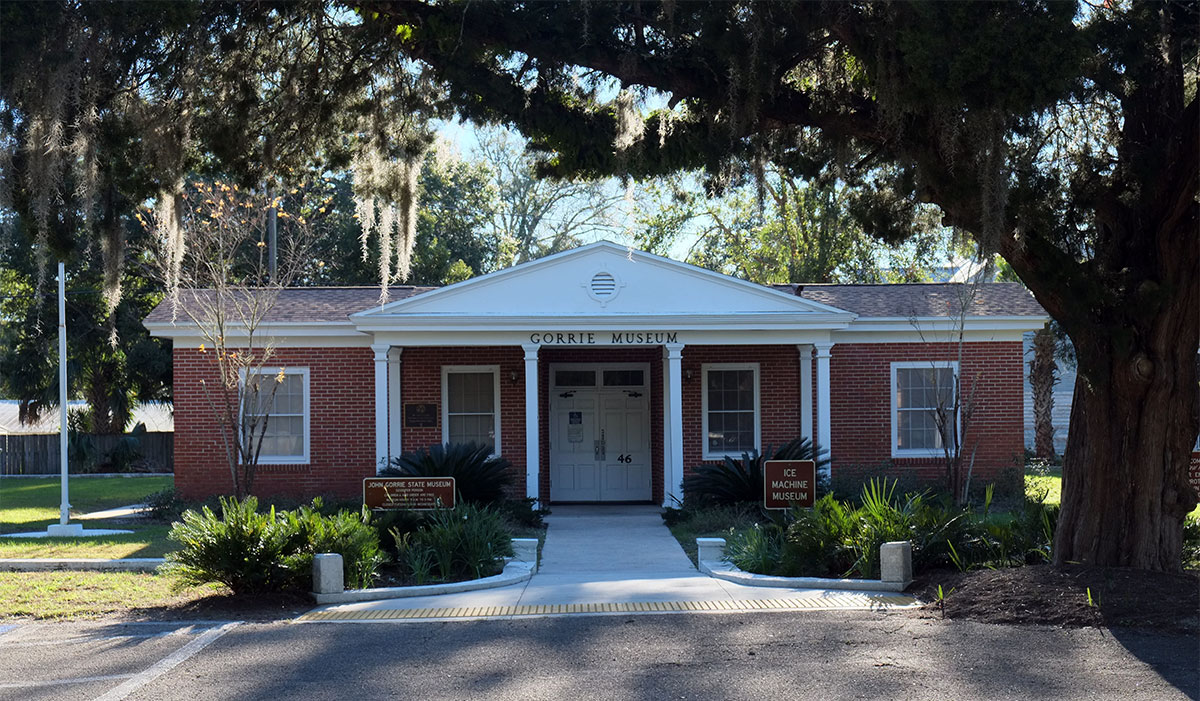
The crowning glory of Apalachicola (for us), is the aforementioned local museum, the Gorrie Museum.  Who is this Gorrie, you may ask?DSCF0529

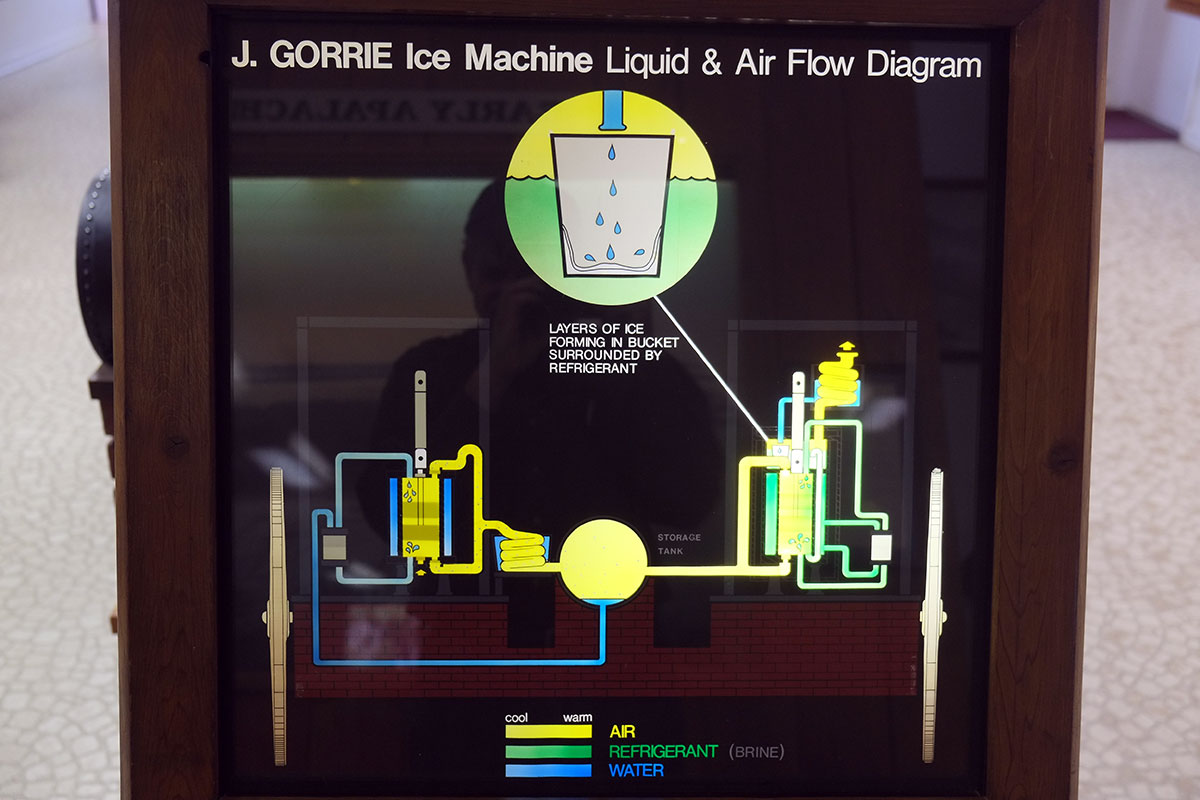
In the 19th century, Yellow Fever was a huge problem here, as it was in many other tropical locations.  John Gorrie, a local doctor, believed that if he could get his patients through the peak of the fever, they could be saved.  He devised a way to keep them cool, by hanging ice above the bed in a patient’s room and drawing air across it.DSCF0521

But where to get the ice in Florida?  Gorrie delved into research related to thermodynamics and the refrigeration cycle, and designed and built the first effective mechanical cooler.  He made ice to cool his patients, and on one notable occasion, cooled the champagne that was served by the French consul at his Bastille Day party.  DSCF0517

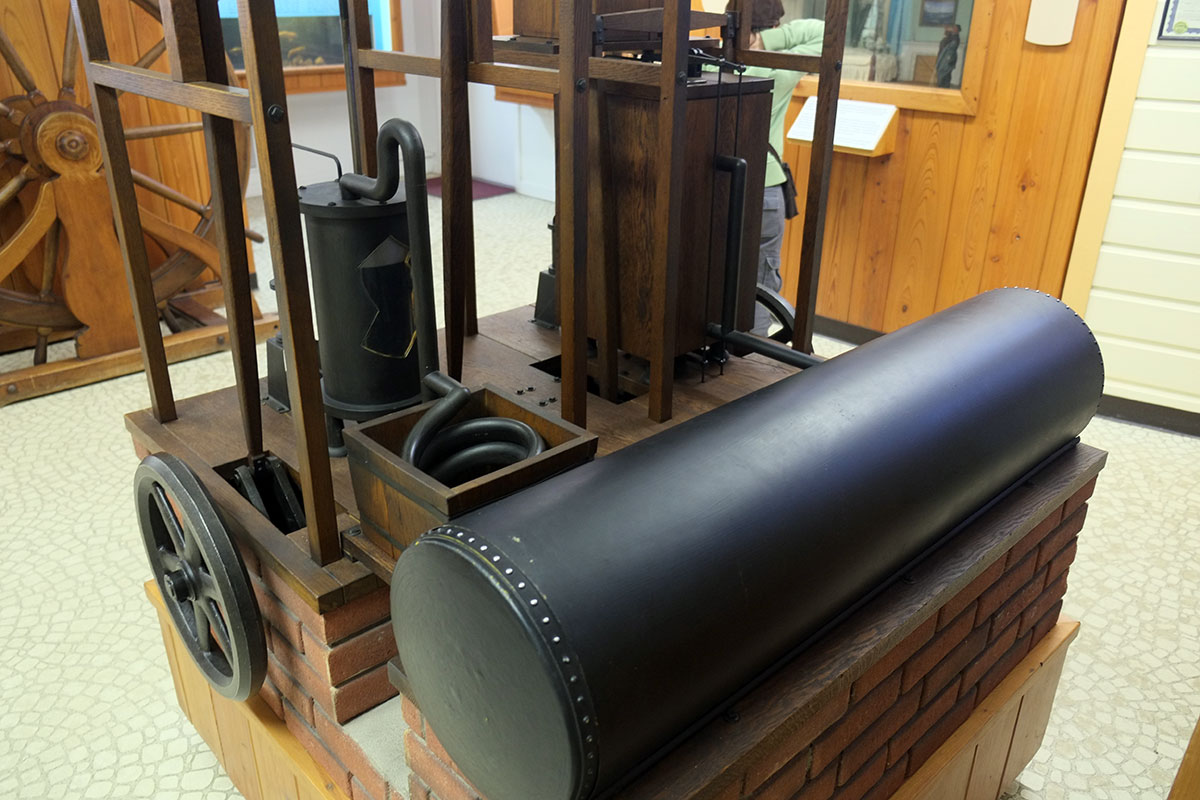
A model of his machine.  The original is in storage at the Smithsonian, and if this museum can upgrade its climate-control system (ironic, isn’t it?) to the Smithsonian’s standards, the original may return here.  DSCF0520

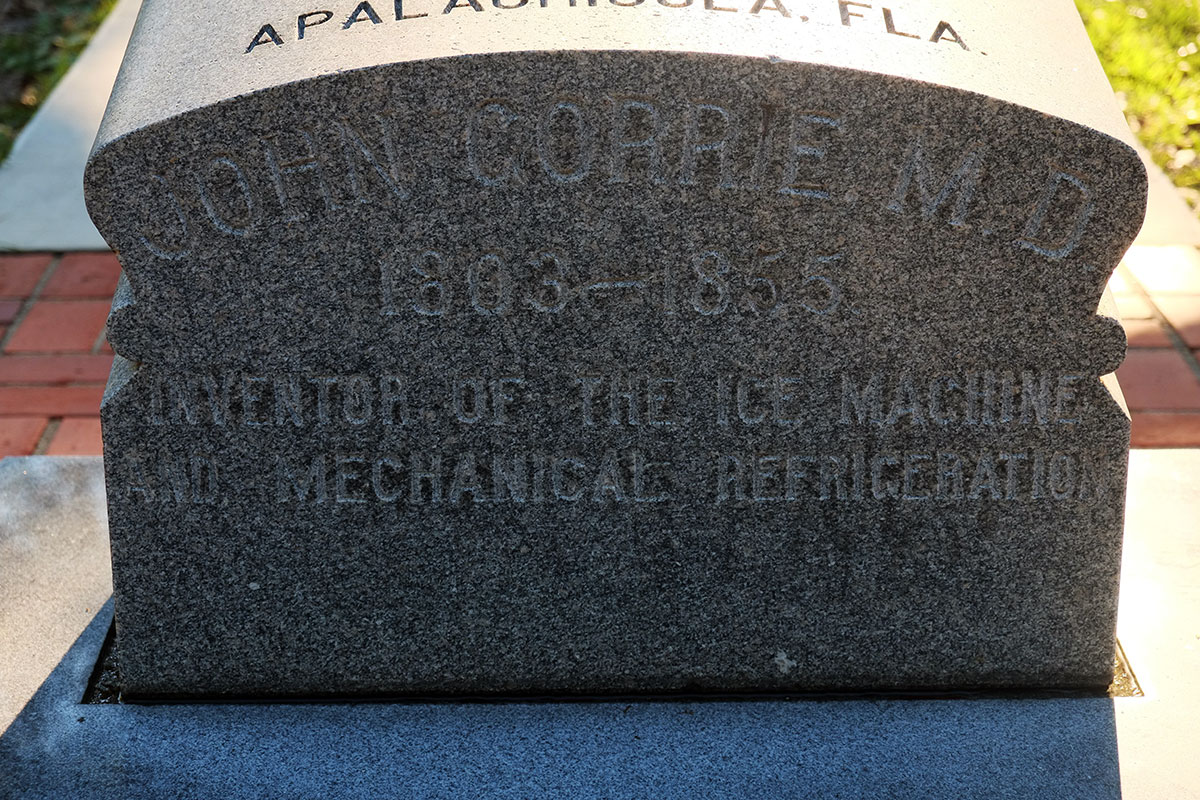
His headstone notes his accomplishment:DSCF0525

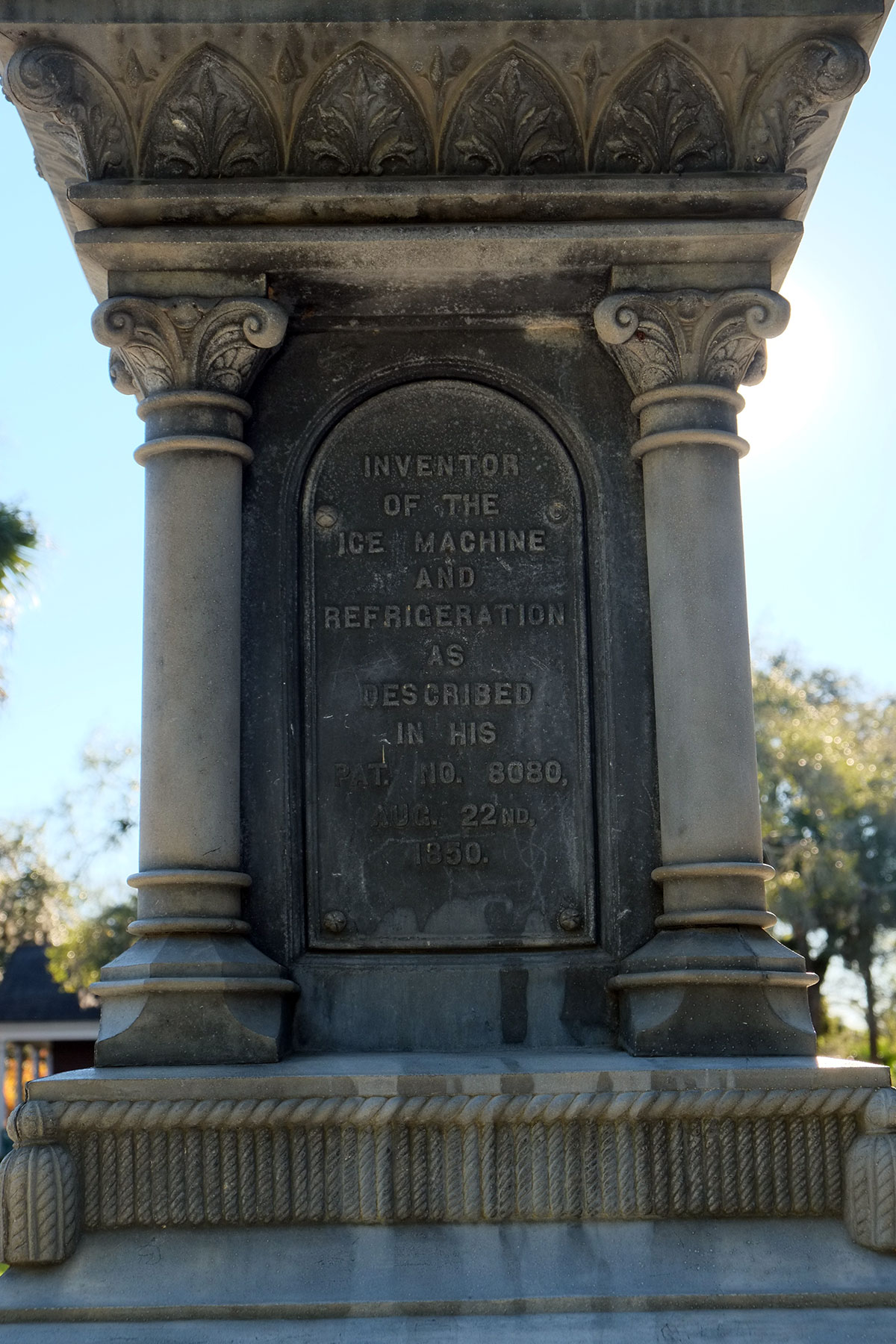
Another monument, erected by the Southern Ice Exchange in 1899.  I’ve never before seen a memorial with a patent number on it.  DSCF0538

The most amusing aspect of his story for me is that he wanted cool his patients, so he invented a machine to make ice to cool them.  Of course, he had just built an air conditioner, so the ice production was an unnecessary intermediate step.

But the most profound aspect of his invention is the effect it has had upon modern civilization.  There are obviously many positive aspects of refrigeration and air conditioning.  But without air conditioning, we wouldn’t have the development pattern of sprawl that we have today – people wouldn’t be willing to sit for hours in traffic.  We wouldn’t build low-mass wooden boxes for housing in hot climates.  There wouldn’t be massive office towers with giant floor plates, nor big box retailers.  Phoenix would still have about 20,000 residents.  In fact, the whole American south would be as sparsely populated as it was 100 years ago.  There would be no New South;  there would never have been the shift of economic and political power to the Sunbelt.  Power in this county would have remained in those areas which can actually be inhabited in the summer.  So while Dr. Gorrie may have alleviated his patients’ suffering and made our lives more pleasant, he must also be seen as fundamentally responsible for the rise of Ted Cruz and his ilk.  I’m not sure it was worth the trade-off.

Jacksonville – Timucuan Reserve and Kingsley Plantation

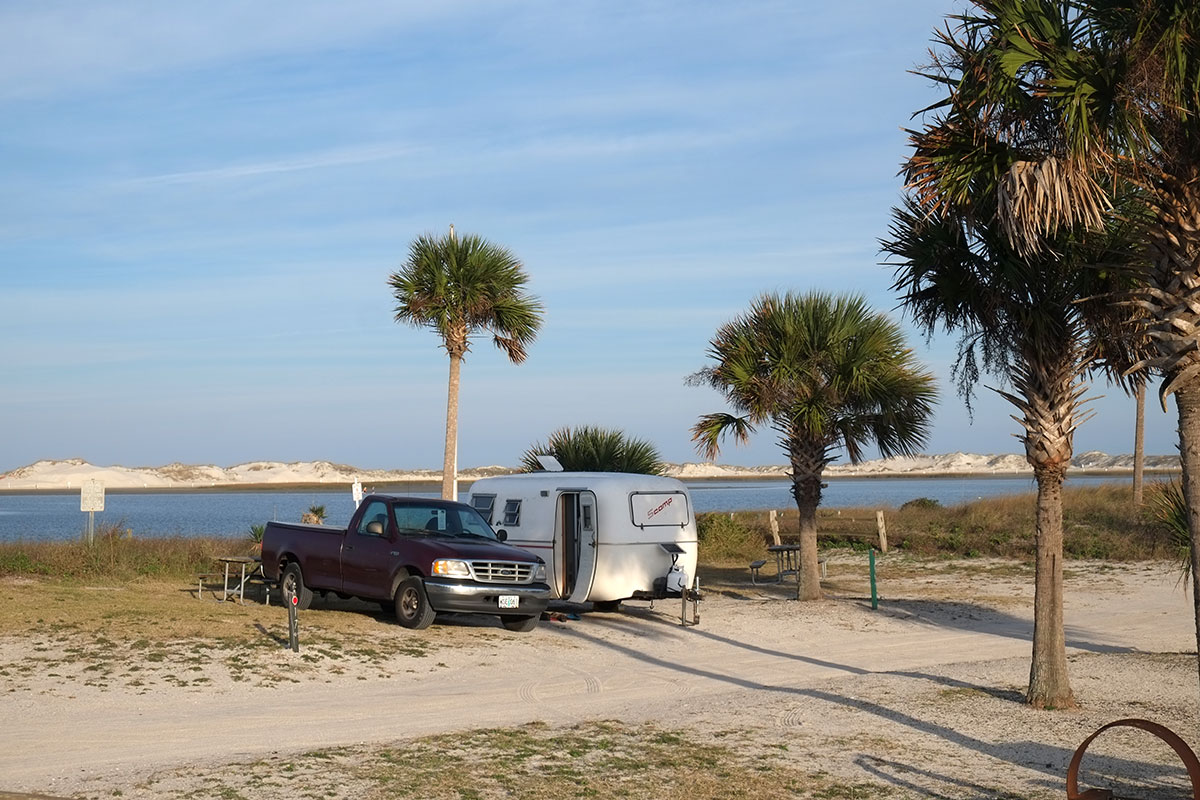
DSCF8519Before taking the plunge into southern Florida, we spent some time around Jacksonville, which is part of the South in a way the area south of Orlando isn’t.  We focussed in on the Timucuan Ecological and Historic Preserve, which is administered by the National Park Service, similar to our own Ebey’s Landing National Historic Reserve on Whidbey Island.  There are several parts to the Reserve, extending from Amelia Island through a few other islands and across the St. Johns River (which is the entry to the harbor at Jacksonville), and it is “one of the last unspoiled coastal wetlands on the Atlantic Coast”.   We stayed in an amazing campground in a city park, on a spit where the river meets the ocean.  Camping right on the beachDSCF8544

overlooking a bay where people were fishing with netsDSCF8562

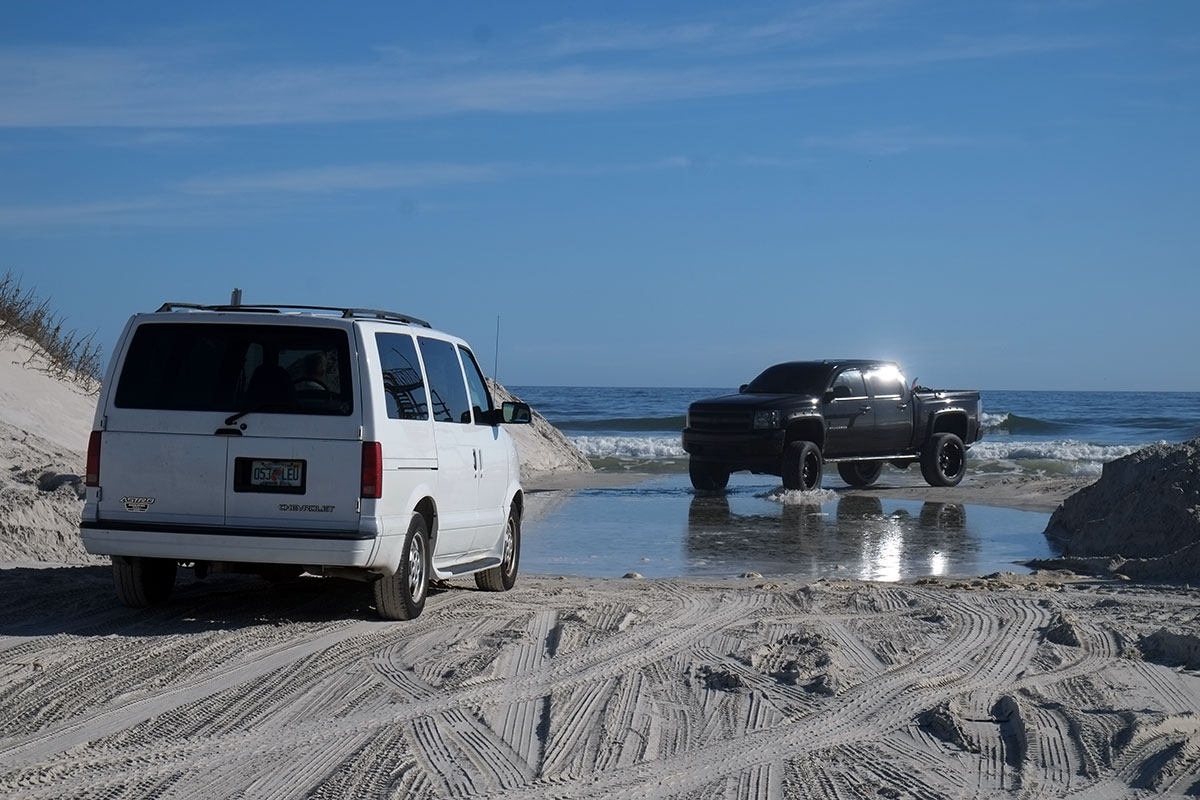
and one of the few beaches in Florida where vehicles are still allowed to drive (when the tide is lower).DSCF8563

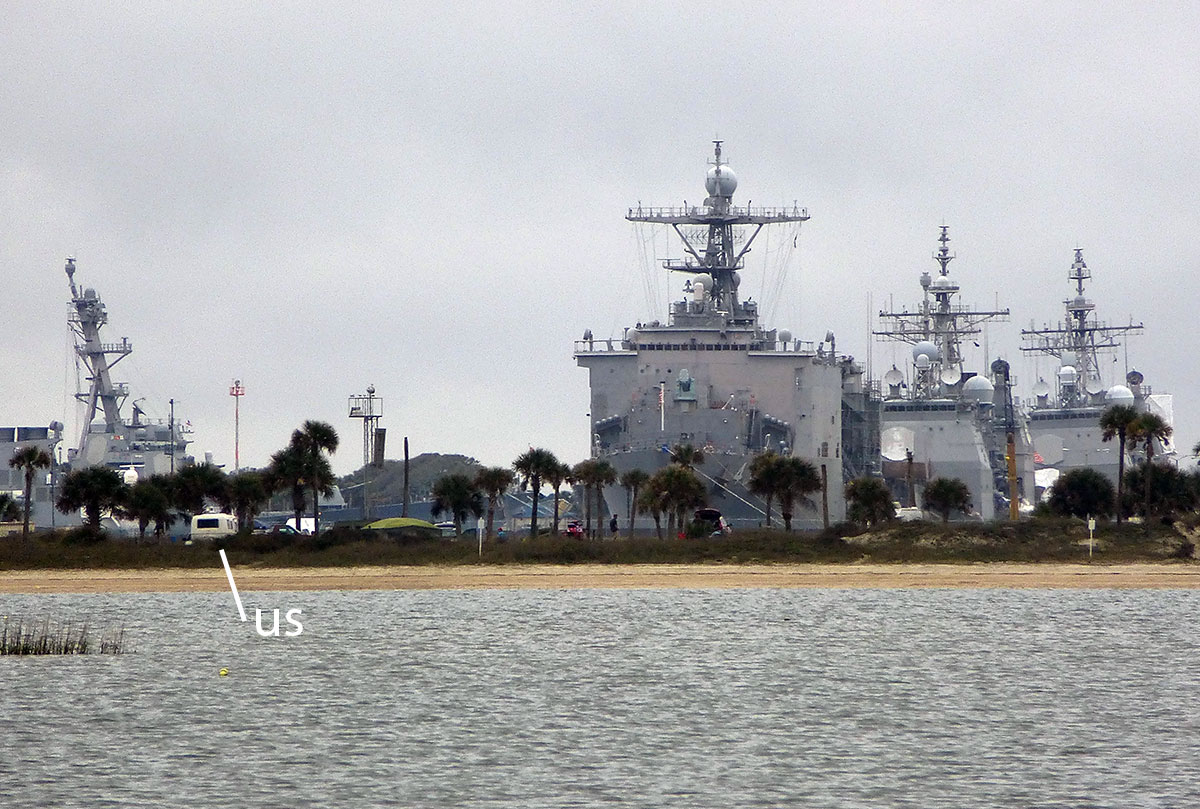
The channel to the harbor was full of large ship traffic, and across the mouth of the river is the Naval Station Mayport, the third largest naval facility in the country.  Here is a nice scale comparison between our trailer and the ships a mile beyond in the port:
P1060636

As we are finding across the southeast, the number of different cultures which have laid claim to this area in the past 500 years is very confusing to someone who comes from a place where the English displaced the natives, end of story.  The Reserve is named for the Timucuan people, the tribe who inhabited the area before colonization.  The visitors center has artifacts from their culture (some of disputed origin), but there is not a lot beyond that.  The Huguenots landed here in the 16th century, quickly gave up, came back a few years later, and then were all killed by the Spanish.  Under Spanish rule a widespread plantation system developed, part of which can be seen today at the Kingsley Plantation, settled in the early 19th century, and owned over time by a few different families.  The house is quite intactDSCF8489

with some late-19th century modifications.DSCF8485

opening onto the channel that connects to the present-day Intercoastal WaterwayDSCF8470

The grounds contain various outbuildings, most dating from the late 19th century.DSCF8504

The most interesting part of the history was learning how the legal status of different groups varied under the Spanish or American systems.  Kingsley bought a slave from Senegal, and married her.  When she turned 18, he freed her, and she could then own property herself – including her own plantations and slaves.  The Kingsleys prospered, eventually owning four major plantations of over 32,000 acres.  When Florida became a US territory, her rights, both as a freed slave and a woman, would have been greatly reduced, so the Kingsleys moved to Haiti to avoid this, but were involved in legal disputes over this fortune for decades after.

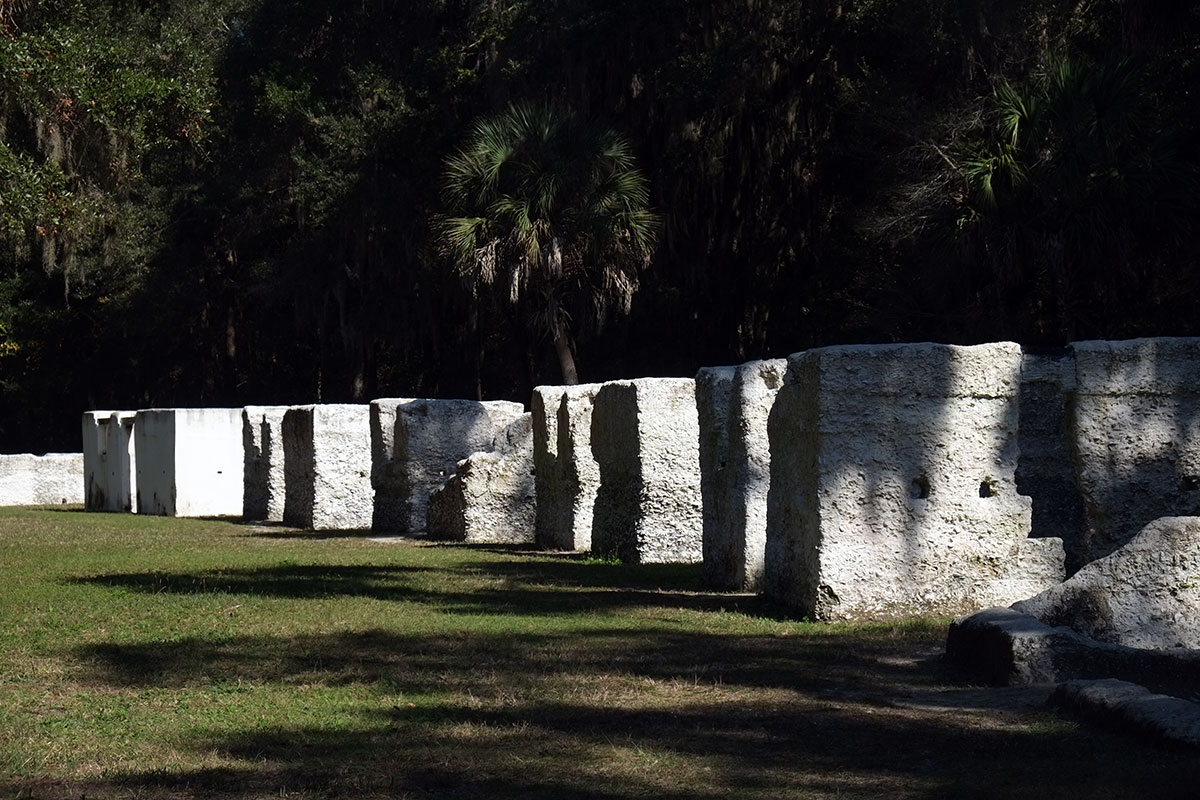
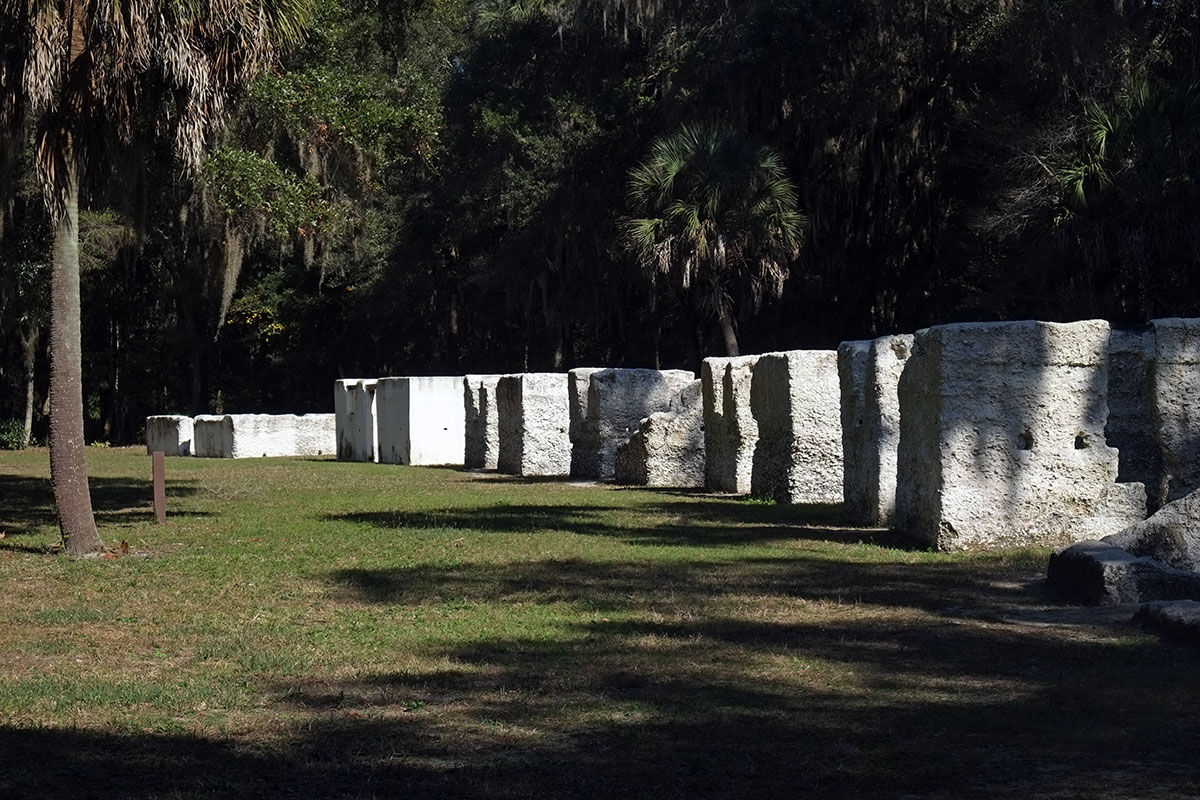
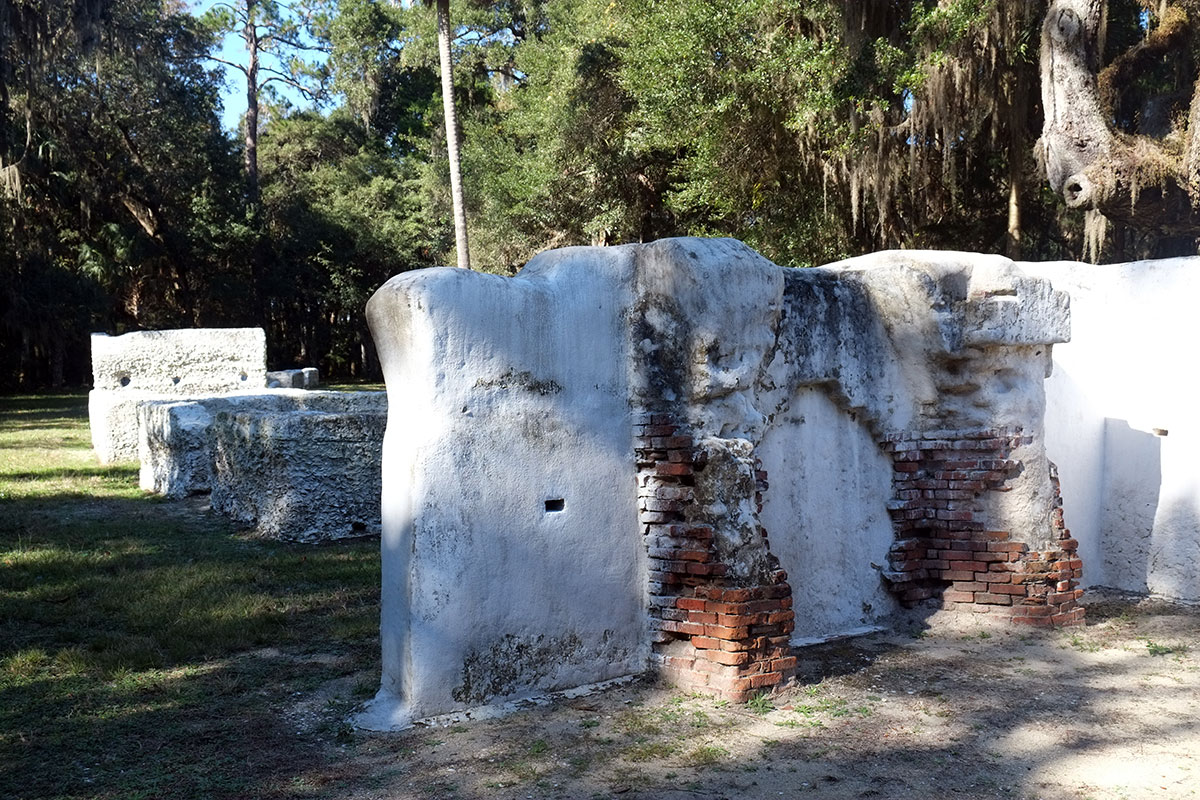
This history was remarkable, as are the remains of the slave quarters.  Whereas most slave houses in the south were wooden and so haven’t survived, the walls of the houses here were made of tabby – a kind of concrete made with oyster shells, where a catalytic reaction from the shells takes the place of Portland cement.  DSCF8528The roofs are gone, and the walls are slowly deteriorating, but seeing the 27 houses in an arc at the edge of the fields was amazing.
DSCF8518

DSCF8523

The walls are tabby, while the brickwork shows the location of the fireplace.
DSCF8508

We had a few unusual experiences here – such as spending New Year’s Eve in the campground on the beach –  but the most bizarre was while driving on a dirt road in the Reserve, and Greta spotted a dead armadillo by the side of the road.  We got out to look at it, just as the owner of an adjacent house came over too.  It turns out that he lives in his obviously expensive and well-tended house out in the woods, but the armadillos come out and night and plow up his lawn, looking for bugs to eat.  So he sits up at night with his .22 and shoots the armadillos, and he had just come out to move the body of this one.  We couldn’t get the image of this out of our heads – an old guy with a rifle who decided to build his house in the middle of the woods on an island, and then spends his retirement fighting a losing war with the armadillos.
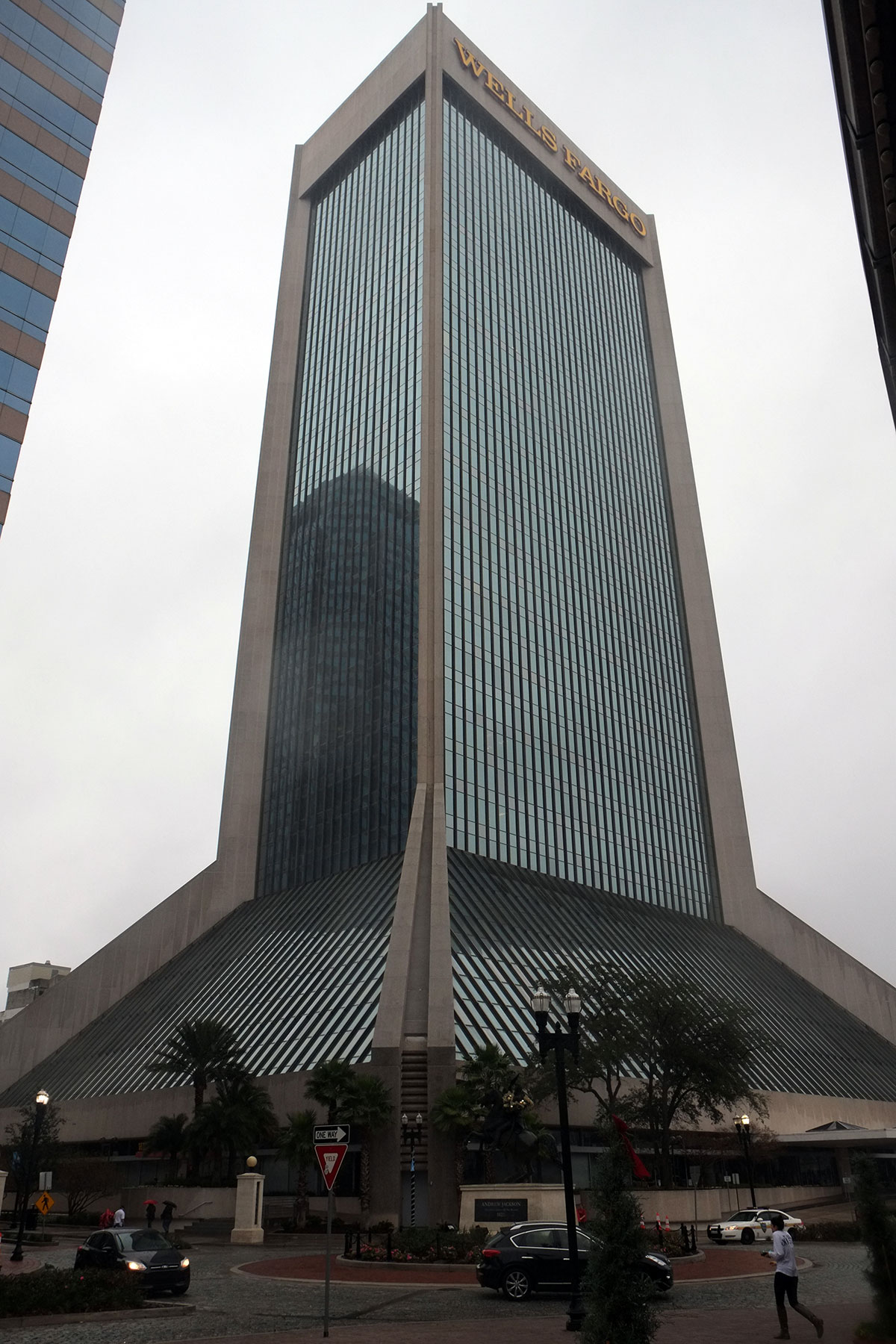
Passing back through the area at the end of the year, we spent some more time in Jacksonville, which has some of the weirdest office buildings I’ve ever seen, including this one from the heroic era of late modernism
DSCF9302

and this court building, which exhibits all the characteristics of a bad modern building in postmodern drag:DSCF9274

There is a waterfront food court / gathering spot, which was actually pretty good for a festival marketplace type of building,DSCF9290

and which was the site of a pep rally for Penn State and Georgia, the day before they were going to play in some bowl game.  We watched a full line-up of high school bands and cheerleaders, all performing in a cold downpour.
Jacksonville

The fantastic Georgia marching  band performed, which was fun until it suddenly became rather jarring.  Apparently, at some point in the past, the University of Georgia took the tune of the Battle Hymn of the Republic and turned it into their football fight song.  I looked around at the crowd to see if anyone else’s reaction was “huh?”, but they were all signing along.  No one but us seemed to think that turning an abolitionist hymn into a football song at a university in the former confederacy was weird.  Reflecting on this and the armadillos, this was when we started to feel we were in a very different part of the country.
 

Middleton Place

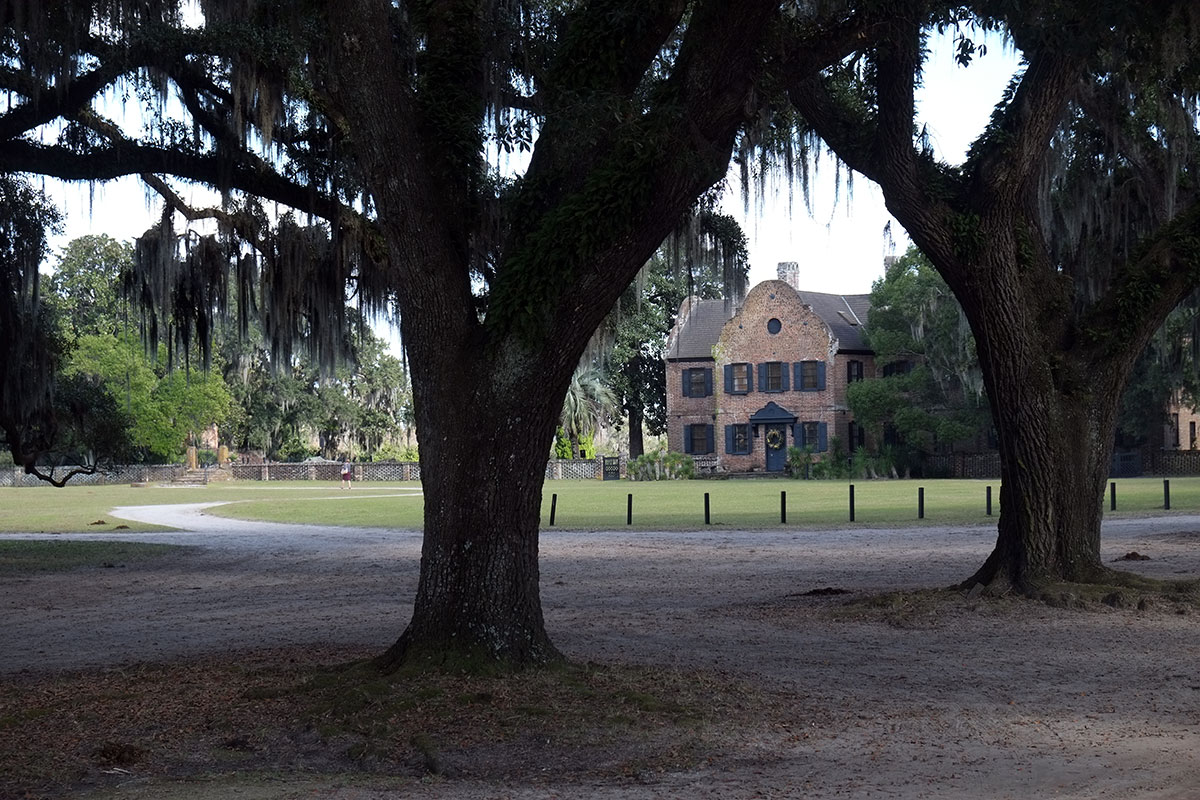
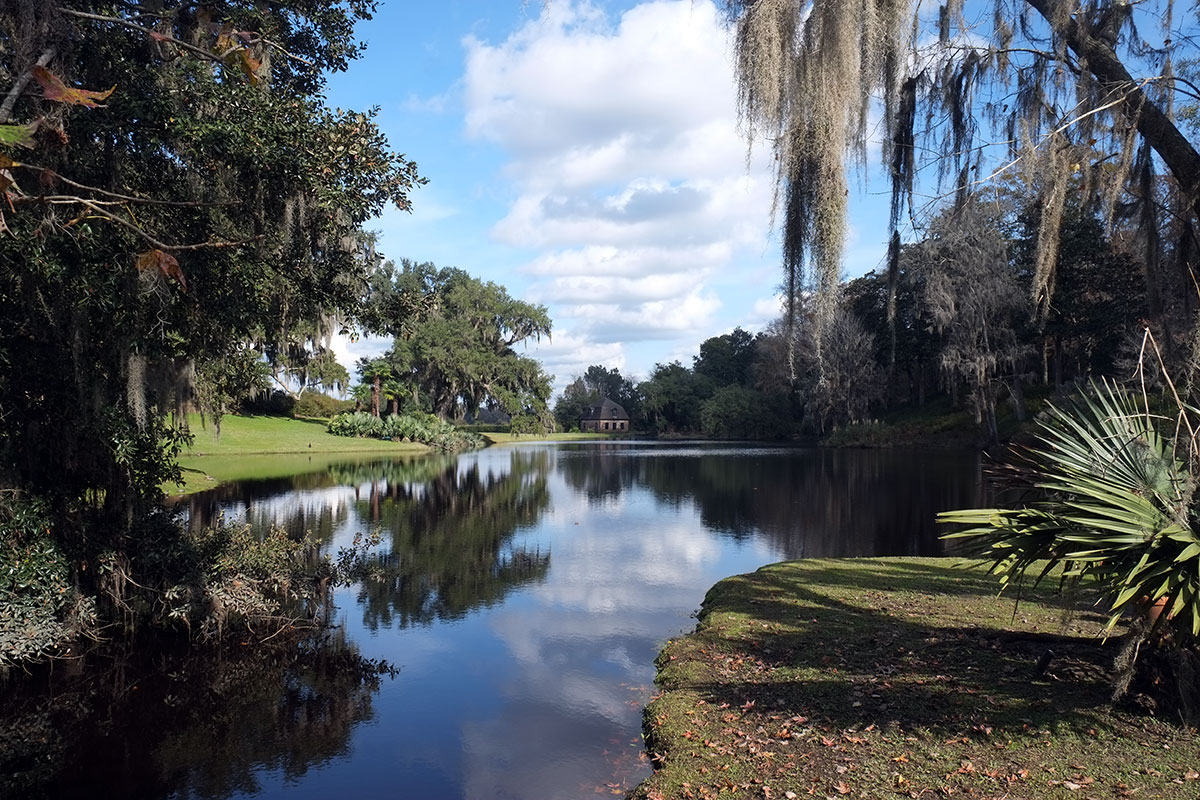
DSCF8411Located up the Ashley River from Charleston, Middleton Place is an 18th century plantation that is known for having the first designed, landscaped gardens in America.  Successive generations of Middletons lived here and modified the landscape (when they weren’t busy running the Continental Congress or signing the Declaration of Independence), but also lived resided in their Charleston townhouse.  (Both Middleton Place and the Edmonston-Alston townhouse are owned by the same foundation, but despite the best efforts of the genealogy-obsessed docent, we couldn’t quite figure out the family relationships.)  Our colleague Roxi Thoren has been doing research on its history for a while, so I won’t embarrass myself by trying to sound too knowledgeable about its history or meaning.

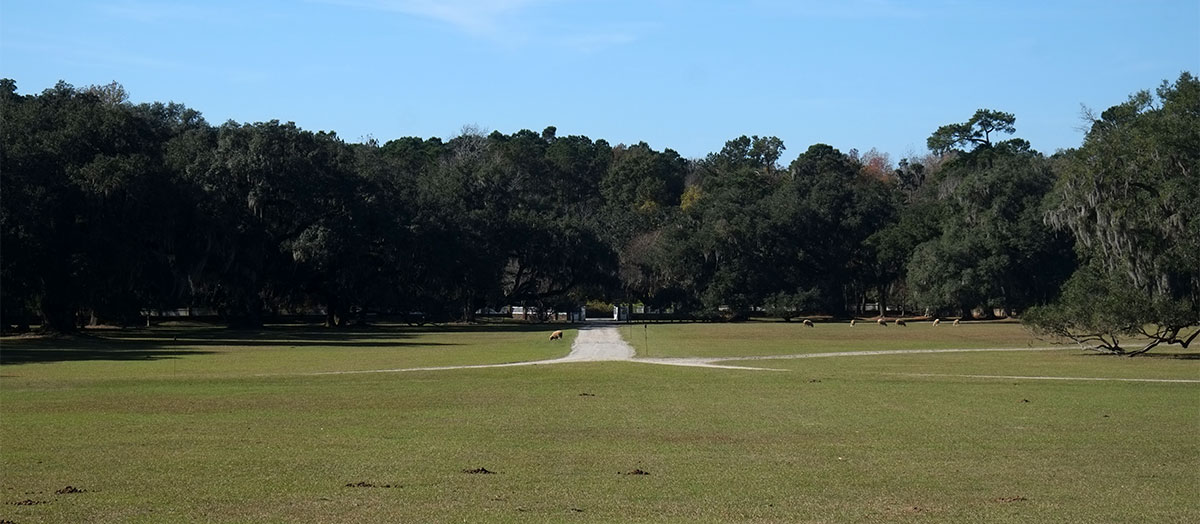
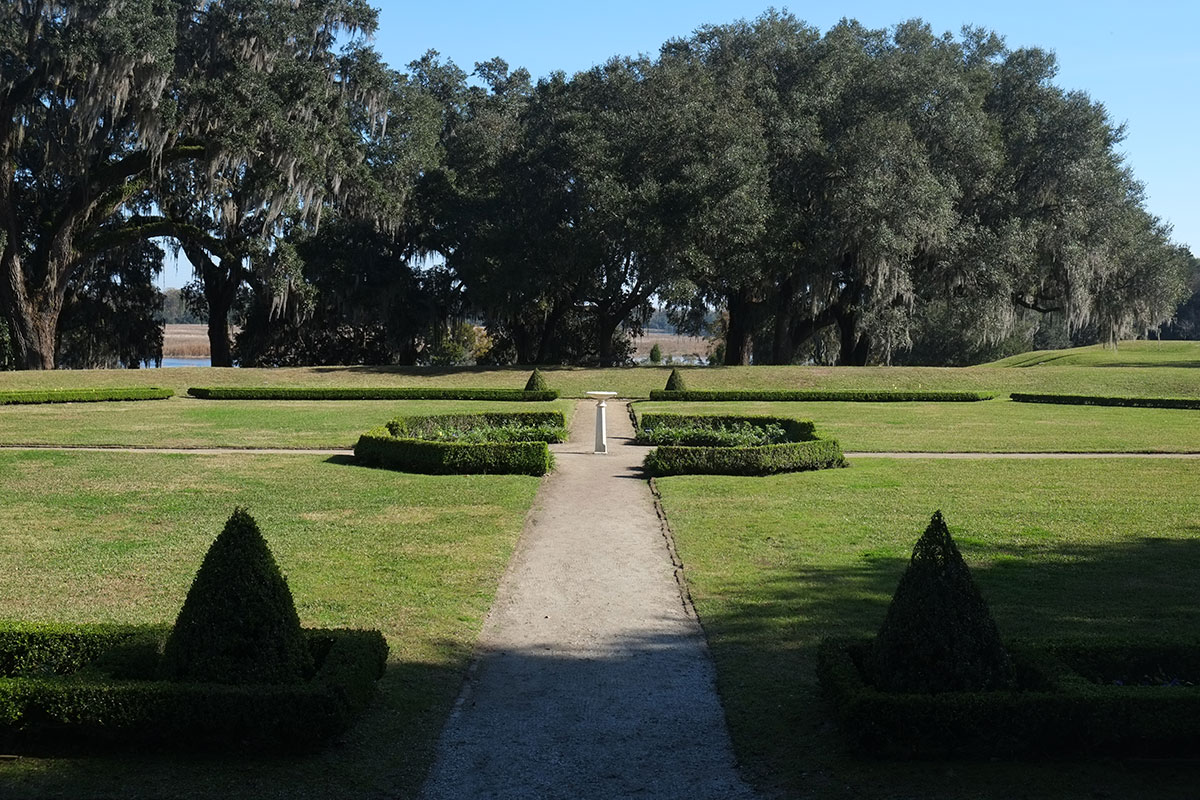
The original intent in the early 1700s was to have a country residence, which was transformed into a plantation later in the century.  The main house was located on a long axis that stretched from the house to the main road on one side:DSCF8314

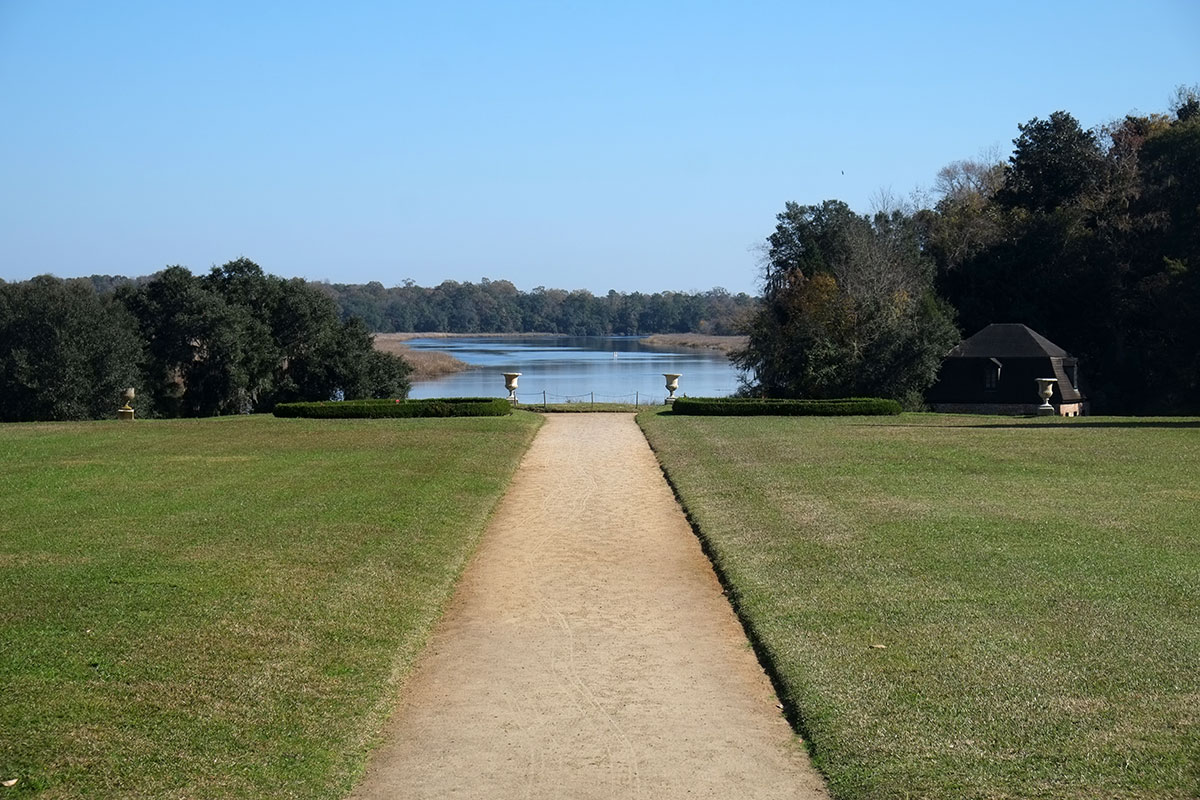
and to the river on the other:DSCF8319

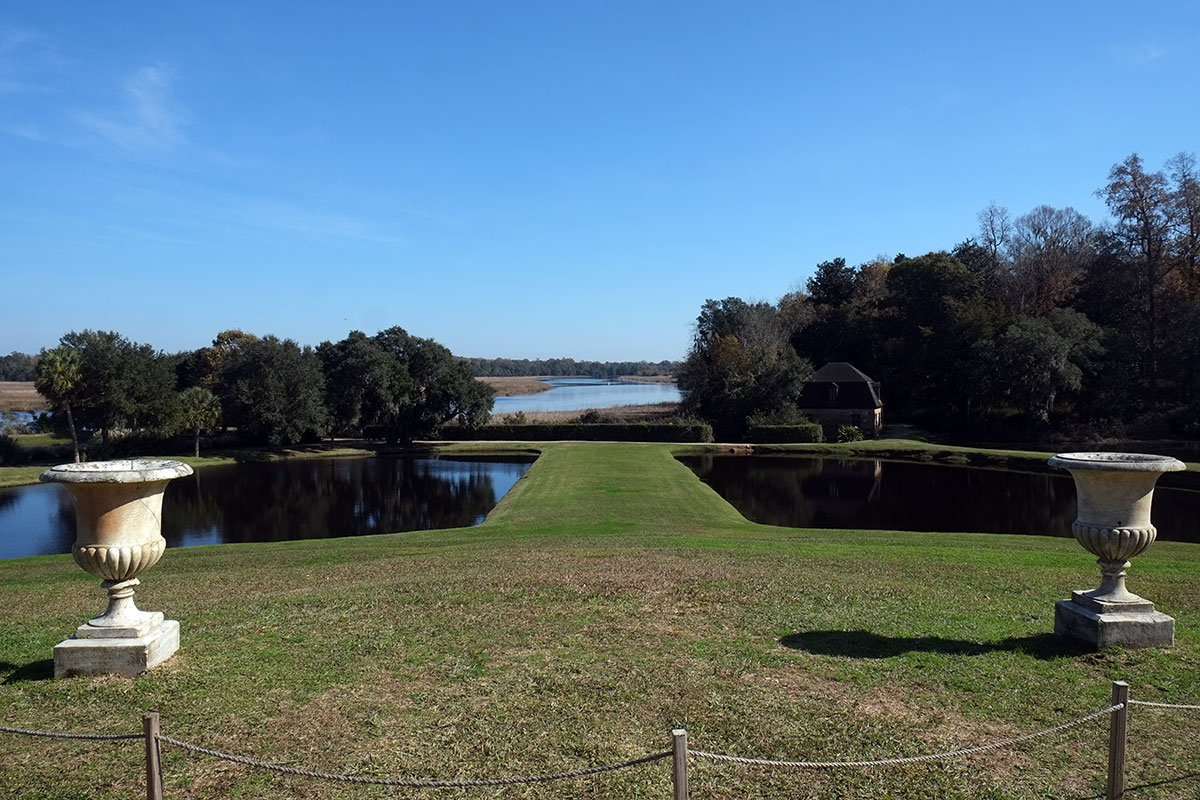
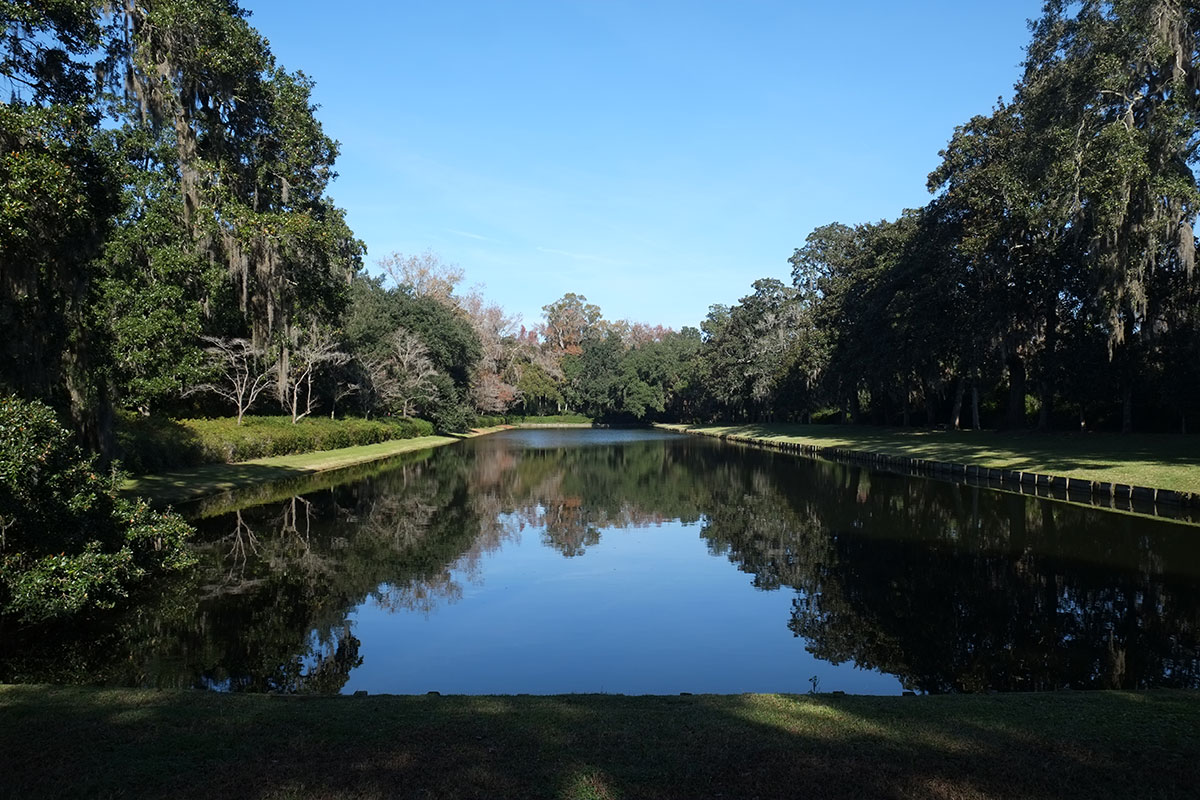
There are a series of parterres stepping down to the river landing, with constructed lakes flanking the axis.DSCF8328

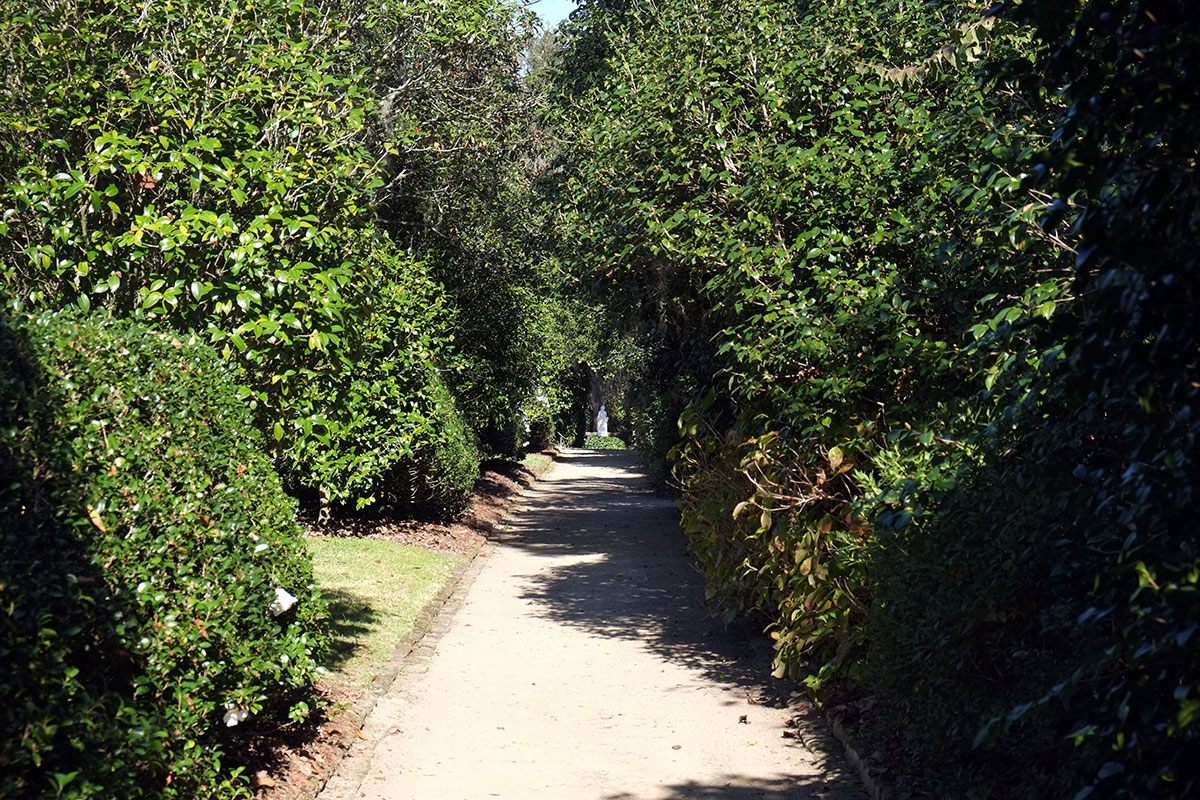
Upriver from the house are formal gardens – a gridded landscape of allees and outdoor rooms DSCF8279  DSCF8307

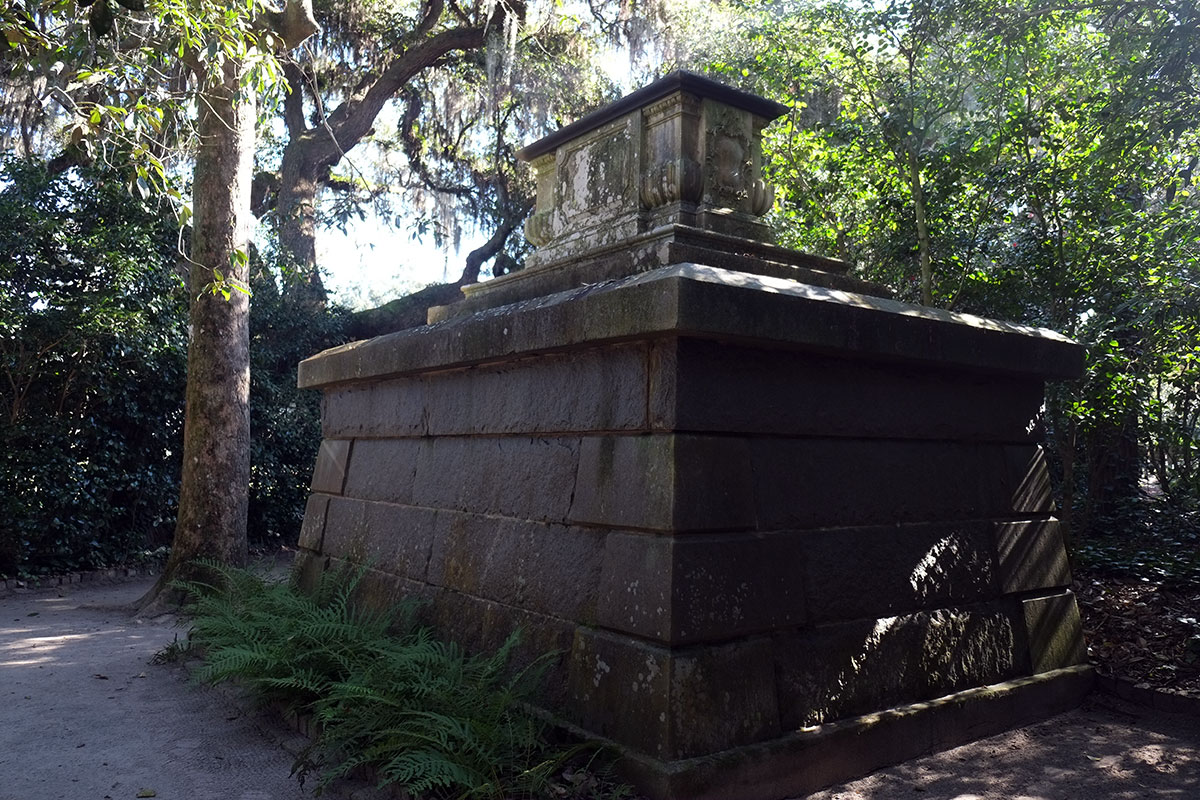
one of which contains the Middleton family grave, DSCF8301

and culminating in a long reflecting pool.  All of this would have been for the strolling pleasure of the Middletons and their guests, with many quiet places t sit and talk, similar to country houses on the continent.  DSCF8272

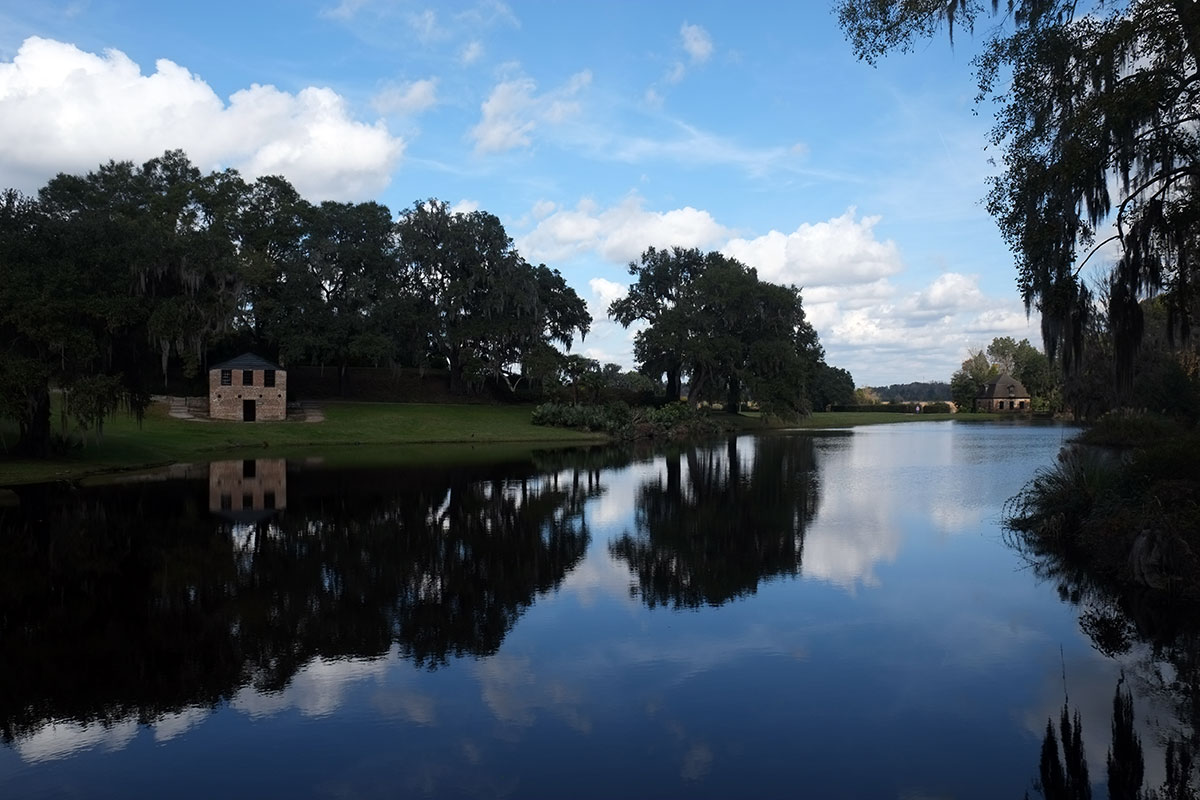
Beyond this end of the plantation, a more natural swamp and lake area remains.  DSCF8454

What I found most remarkable was the river’s edge, where the juxtaposition of the natural marsh landscape DSCF8450

with the formal built landscape is handled beautifully, allowing you to move along the edge and experience both:DSCF8448

DSCF8443

The main section of the house was destroyed by Union troops in the Civil War, and after this the Middletons, in straightened circumstances, modified the remaining side pavilion to be the main house (so it is not situated across the main axis.)  DSCF8381

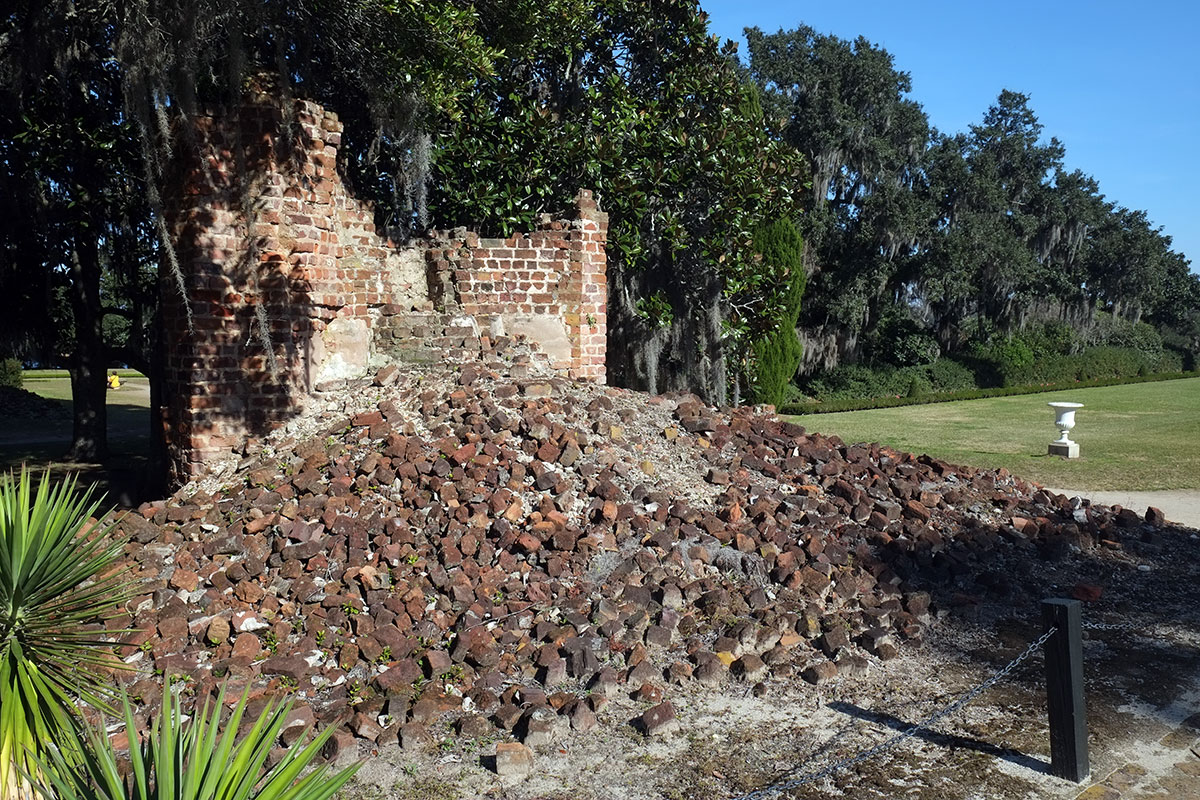
The remains of the house were knock down by an earthquake, and were either used to build a new stable and farmyard, or were left in a pile:DSCF8315

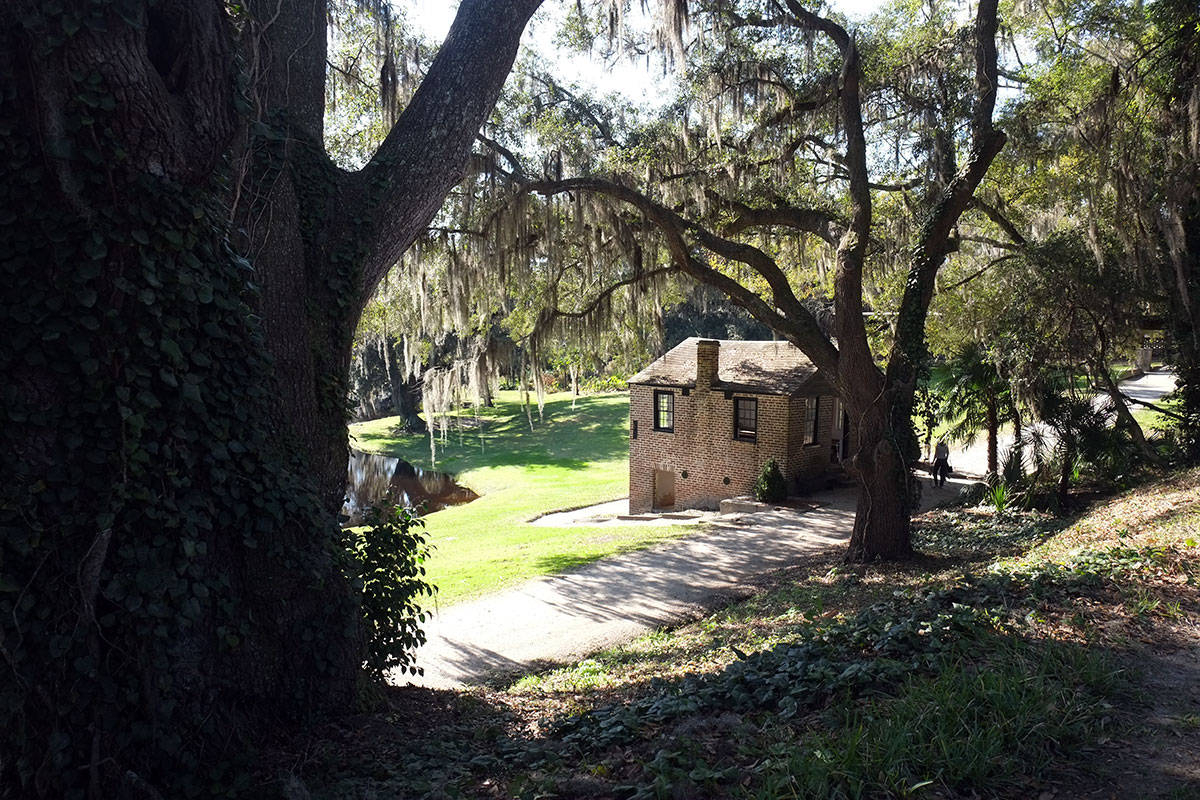
Near the house are some remaining older buildings – the original spring house, which later had a chapel added above: DSCF8335

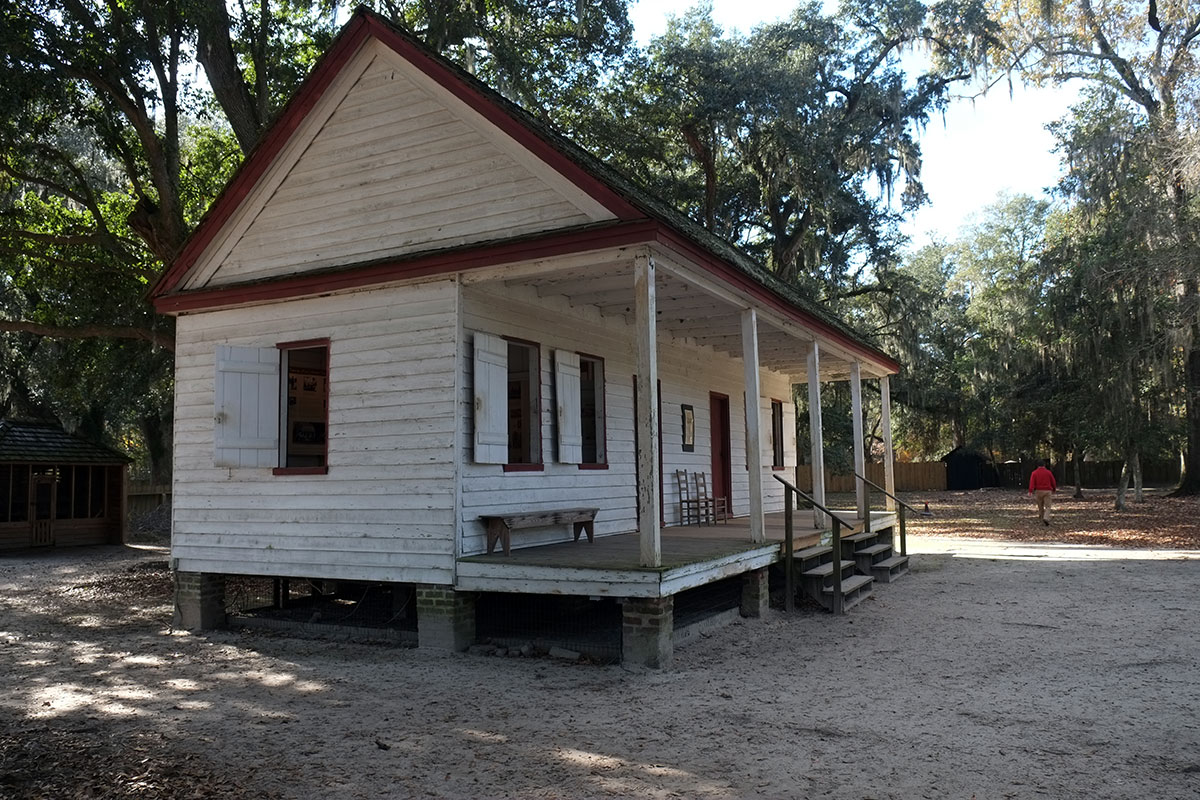
and a freedman’s double house from around 1870.  (The original slave quarters no longer exist, and from what we’ve learned at other plantations, these freedman’s houses would be notably larger and better than what the enslaved people lived in.)  DSCF8385

The other side of the axis from the formal gardens is a landscape more in the romantic tradition, with picturesque vistas and winding paths.  DSCF8407

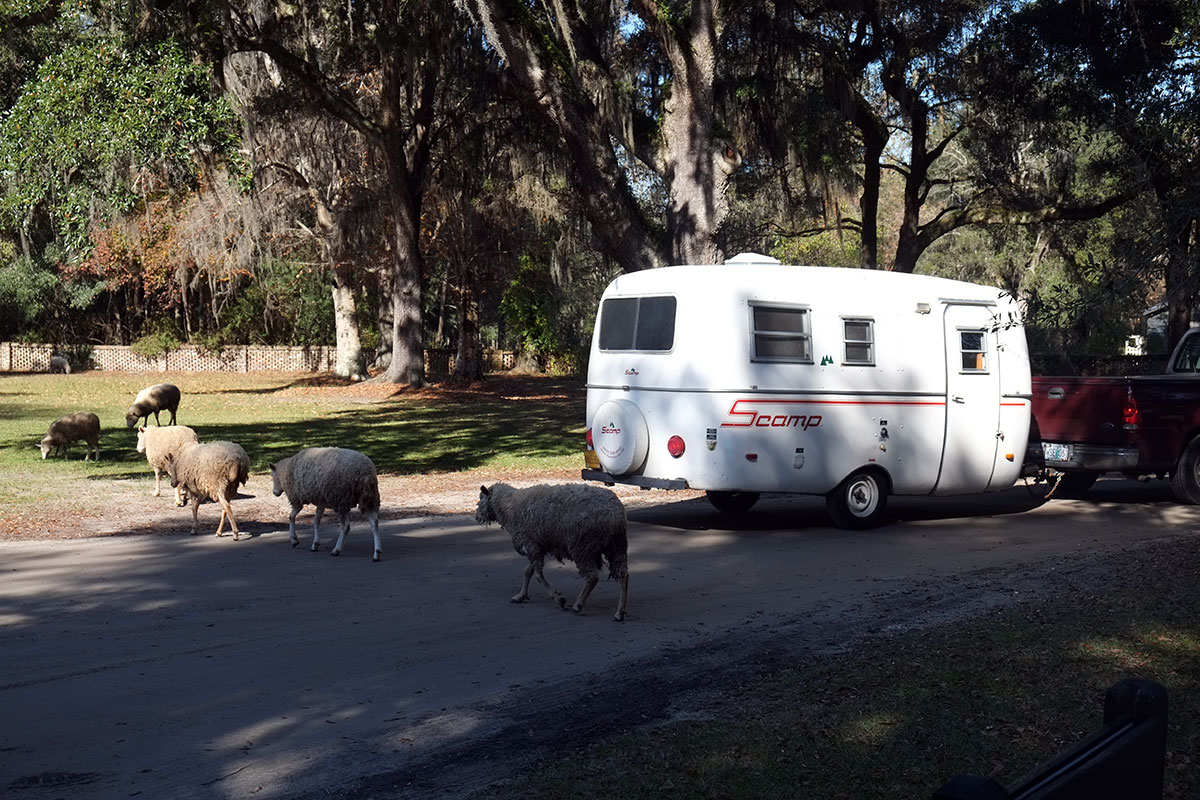
It’s a beautiful place, where the intelligence, complexity and importance of the planning is probably not explcitly apparent to the many visitors who come to see the plantings in the gardens.  Greta enjoyed the relative lack of architecture (hooray for the Union, she cried), and even the time she had to spend appreciating the landscape was enhanced by a reasonable amount of interesting livestock. DSCF8267