Monthly Archives: May 2016

The Promised Land

108. Carmel002DSCF0779

After two months in the desert, it was hard to believe that this scene was real.

California is the mythic landscape of America. Before we are even conscious of it as a real place, its landscapes and views and cities are implanted in our brains through movies and television. It has been such a magical place in our mass culture for so long, and through so many different versions, that it’s sometimes hard to remember it is actual.

The first time I travelled to California was on the road trip with Norman and Dan after college. We drove down the Oregon coast and through Humboldt County (which is really Baja Oregon), then cut inland on 101 around the Lost Coast. At the first opportunity we got onto Highway 1, threaded our way through the coastal range (on what I can now reconfirm is indeed the twistiest highway in America), and returned to the Pacific Ocean, emerging from the hills and woods at this point:DSCF1837
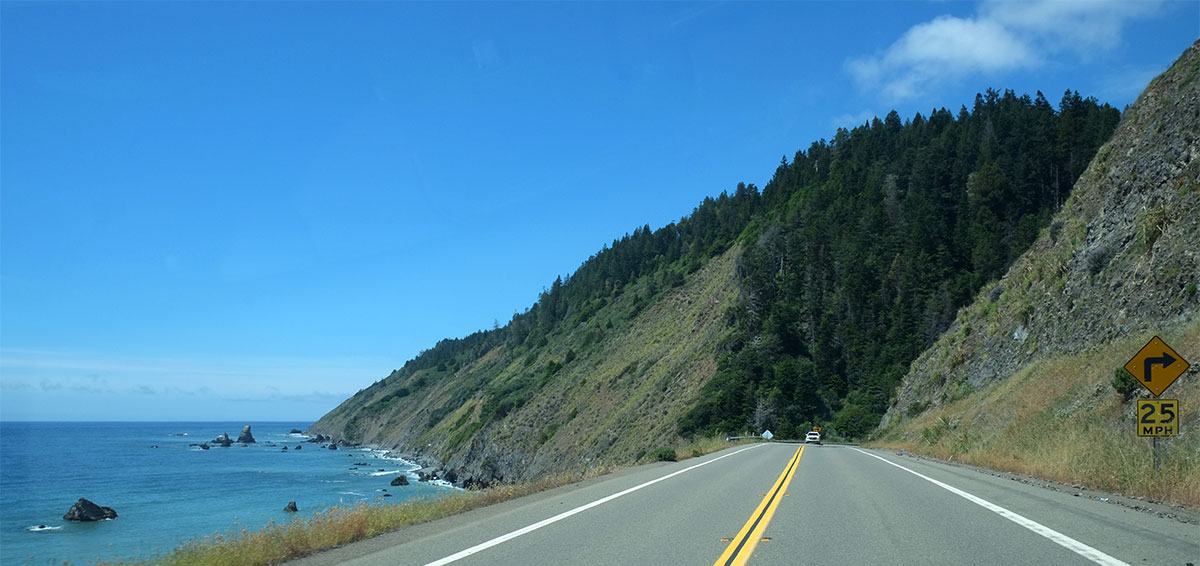
I thought I was home. It was the most beautiful landscape I’d ever seen, even better than the imagery in the movies. Research in landscape preference has shown that for almost all people, no matter where they’re from, the two favorite landscape elements are water and savannah. Oregon had its awesome cliffs, but this landscape was more deeply appealing, a landscape where humans could imagine themselves dwelling, similar to the canyon oases in the desert. (Vancouver had a similar reaction to the landscape around Pt. Townsend on the Olympic Peninsula – the wild landscape seemed to embody the pastoral ideal, and was more welcoming than the alpine terrors of Desolation Sound.)

In later years, California maintained this magical aspect for me. I’d fly in from wintry New York on a business trip, and be met by friends in shirtsleeves who offered the options of wandering around San Francisco or driving up Mt. Tamalpais. When I moved to Oregon, suddenly California was just a day’s drive away, and I had some time to explore more of the vast landscape. Six years ago, Linda and Greta and I had spent two weeks of spring break driving around northern California, which was the best trip of my life, and the first time the then eight-year-old really got into travelling.

This landscape would be the penultimate destination on our trip this year – we had driven east until we ran into the Atlantic on Cape Cod, then south until we got to the Gulf of Mexico in southern Florida, then we were going to drive west until we hit the Pacific, at which point we’d turn north for home.

But first we had to get there. We didn’t finish our southwestern wanderings as we had originally anticipated, at Las Vegas – as we circled back and around, avoiding the wintry April weather on the Colorado Plateau, we’d ended up at Mesa Verde, 1000 miles from the Pacific. And while all our previous entries into California had been from an airport or from the north, this one meant driving across a succession of deserts almost all the way – a very different trajectory from which to approach California, but one that was probably closer to that of most historical visitors and migrants.

We plotted several routes, and had hoped to spend a little time in Death Valley, but the weather was already too hot in May, and with its proximity to the population centers of California, campgrounds had been booked solid way in advance. We also realized we had had enough desert for a while – we’d save Death Valley for a winter trip in a later year, when the ultimate desert experience could be better appreciated by soggy Oregonians. We tried to plot out an itinerary that would lead us by Sequoia and Yosemite, but the late winter conditions in the Sierras made that iffy, and the campground situation at Yosemite was even more ridiculous; our play-it-by-ear approach to this trip doesn’t mesh well with how most Americans plot out their vacations. So we chose a reasonably direct route west, one that would allow us to revisit some spots Greta had loved – the campground at Lake Powell with its jackrabbits, Oscar’s restaurant outside Zion – as well as some inevitable locations that are on no one’s bucket list, such as Bakersfield.

Things went well until we left Lake Mead to head into the Mojave Desert. We stopped for a bite in Primm, Nevada, which is really just a couple of casinos and an outlet mall located on the California border, a place so horrifying and soul-deadening that it makes you regret every decision you’ve made in your life that caused you to end up there.DSCF0589
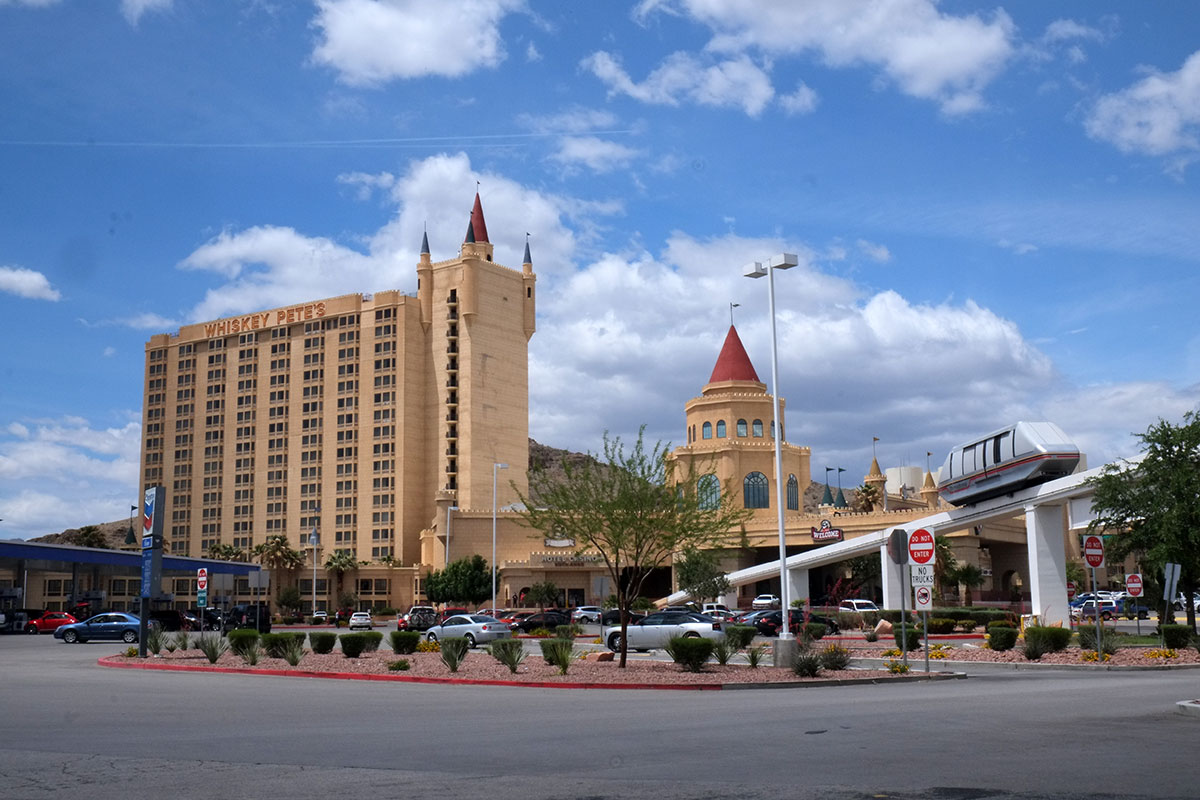
Glad to be leaving this tawdry corner of Nevada, we slapped in the appropriate Joni Mitchell CD as we crossed the border, and entered the 36th state of our trip. We were in California, one of our favorite places, and there were giant solar collector farms on the side of the highway, harbingers of the progressive region where we belonged!

But once across the border, a different aspect of California emerged. We encountered the worst traffic jam of the whole trip, 100 miles of bumper-to-bumper driving across the Mojave, until Barstow, where the Angelenos turned south to go home. (When we eventually reached San Luis Obispo, Brian paled when he heard that we’d tried to drive west from Las Vegas on a Sunday afternoon.) We continued towards Bakersfield on Route 58, in a semi-industrialized desert landscape (mines and air bases) that rivaled the west Texas area around Pecos for Most Unpleasant Landscape of the trip. Then twelve miles west of Boron, we blew a tire on the truck (doubtless caused by the residual minimalist art juju from seeing Double Negative the day before). I changed the tire only to discover that the spare was too low on air to use, so we spent a couple of hours making phone calls, finally convincing some guys from a tire store to drive out and pump it up for us. We limped into Bakersfield quite late.

The next morning, I stepped out of the trailer right next to a rotting orange on the ground. I was surprised to see this garbage in what had seemed to be a rather well-groomed campground. Then as I walked to the bathroom, I spotted more oranges lying around. I looked up, and realized the campground was in an orange grove. In the dark we had crossed out of the Mojave and into the Central Valley, one of the places where human intention has had the most extreme effect upon the environment, turning an arid valley into the major food-producing region of the country. We knew that this was an artificial creation, and the Central Valley was on our checklist for the Climate Change Farewell Tour, as in the next century it will most likely be radically transformed by aquifer salinization, mega-drought and climate change. But at that moment, after two months in the arid Southwest, the orange grove looked pretty good.

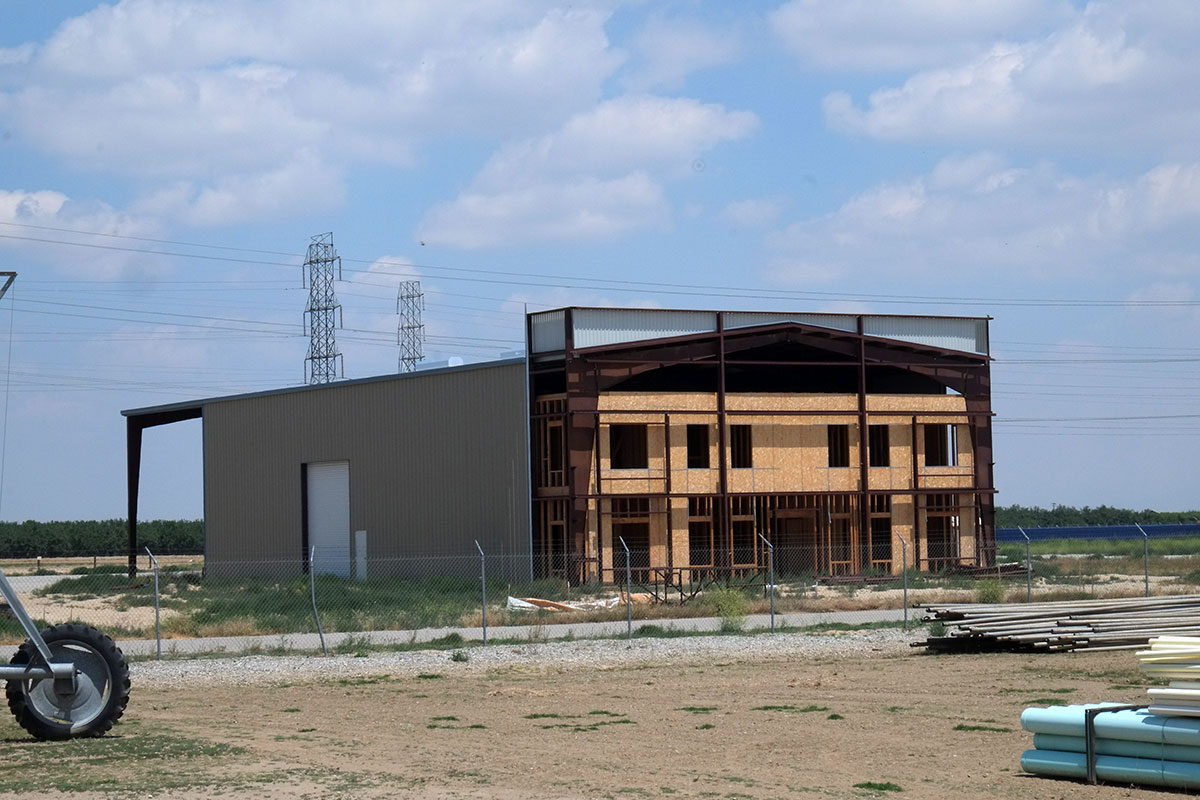
We drove under I-5, and realized we’d hit the bail-out point – for the first time in eight months, if we wanted to head home, it was just one long day’s drive away.  We spent the morning driving through the agricultural area, vast orchards of almond trees, and some of the strangest buildings we’d seen. DSCF0600
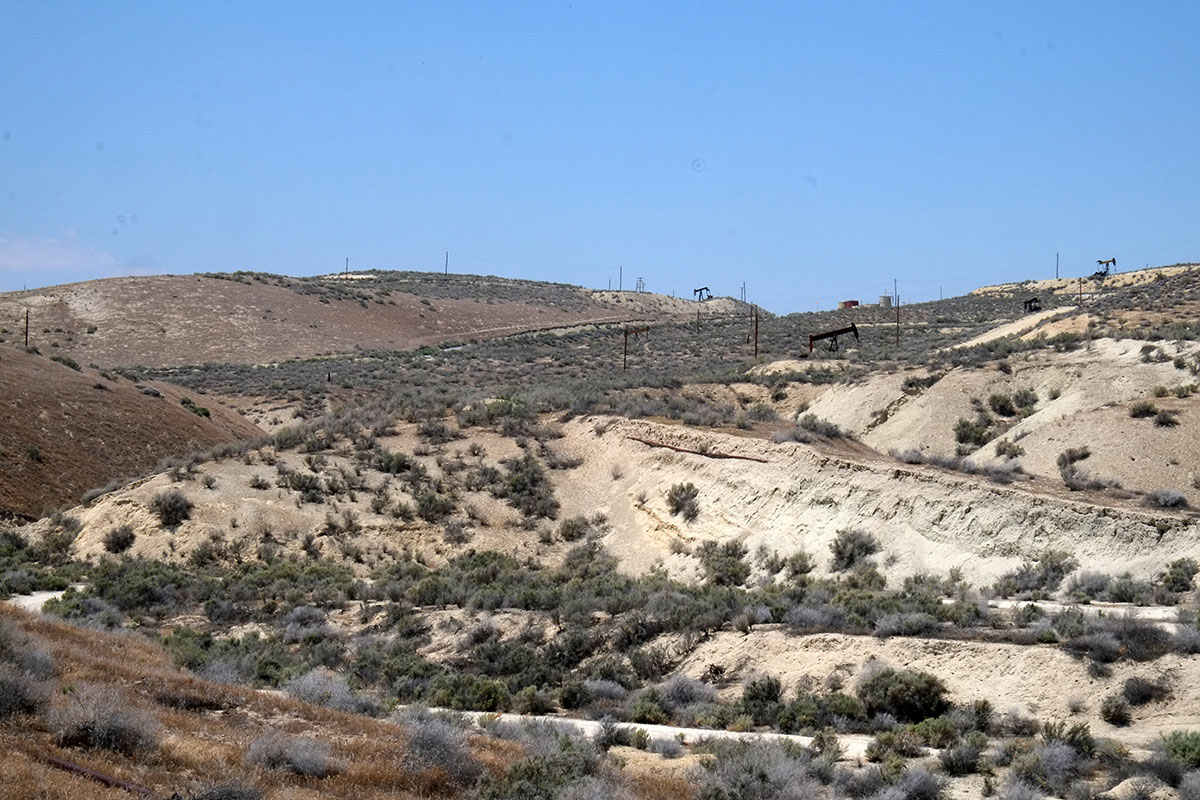
The highway climbed out of the valley, passing through a low-level petro-landscape (another part of California we lose sight of). The only other vehicles we passed were white pickups driven by guys working for oil or utility companies.DSCF0602
Finally, in the distance we could see hills covered with grasslands,DSCF0603
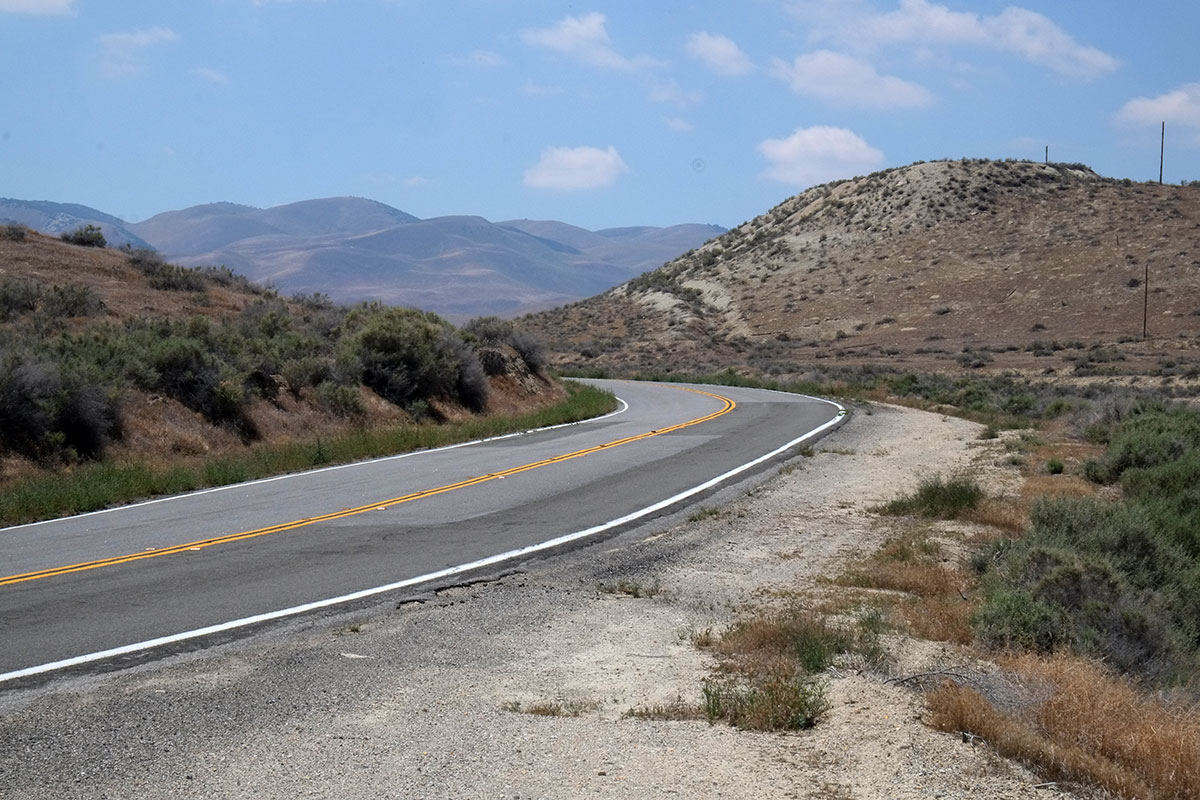
and even some trees.DSCF0611

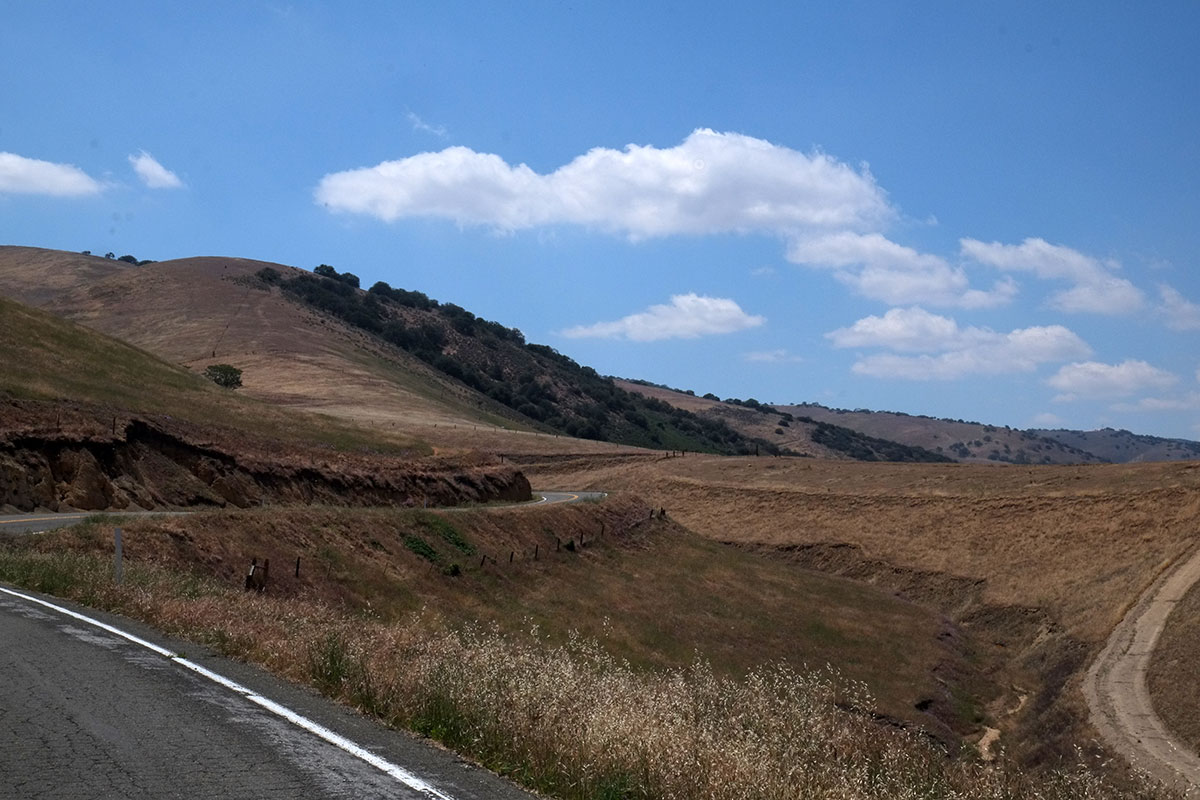
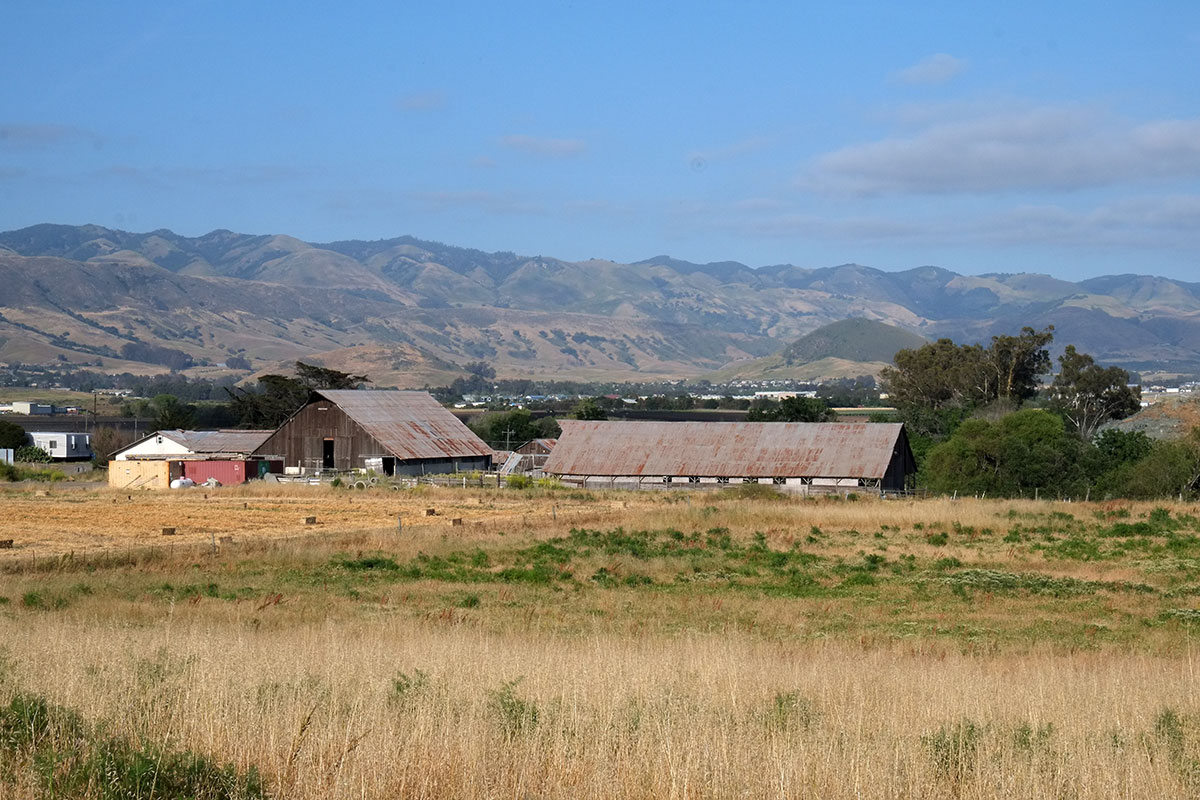
After the jagged slickrock canyons of the Southwest, this valley of gentle hills with grazing cattle was surreal – it looked like an illustration in a children’s book. Coming out of the desert, even this semi-arid landscape felt lush, a place where you could let down your guard and not worry that the environment had it in for you personally. We wondered about the feelings of the migrants coming into California this way, the Dust Bowl refugees spotting the first sign of the coast that lay ahead.DSCF0612
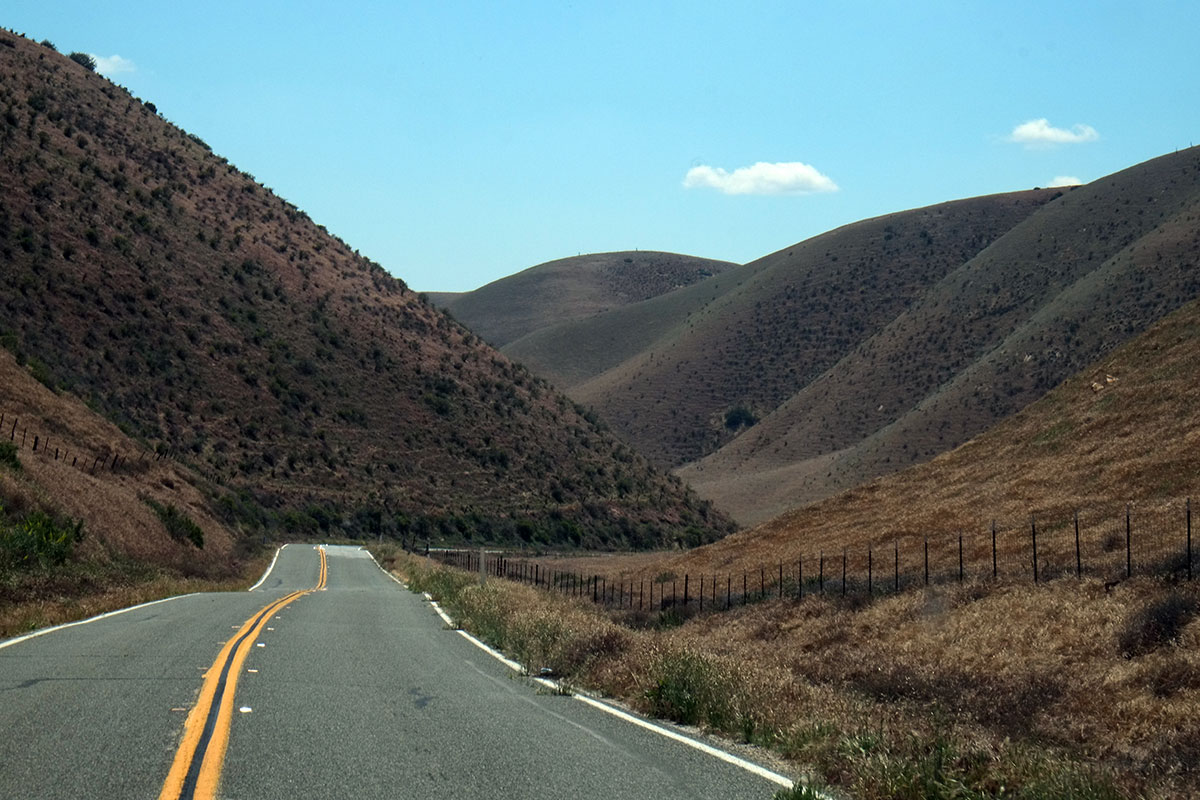
We crossed the hills into San Luis Obispo, and the next day Brian and Karen drove us to the Pacific. At Montaña de Oro State Park, we reached the ocean,105. San Luis Obispo002DSCF0622
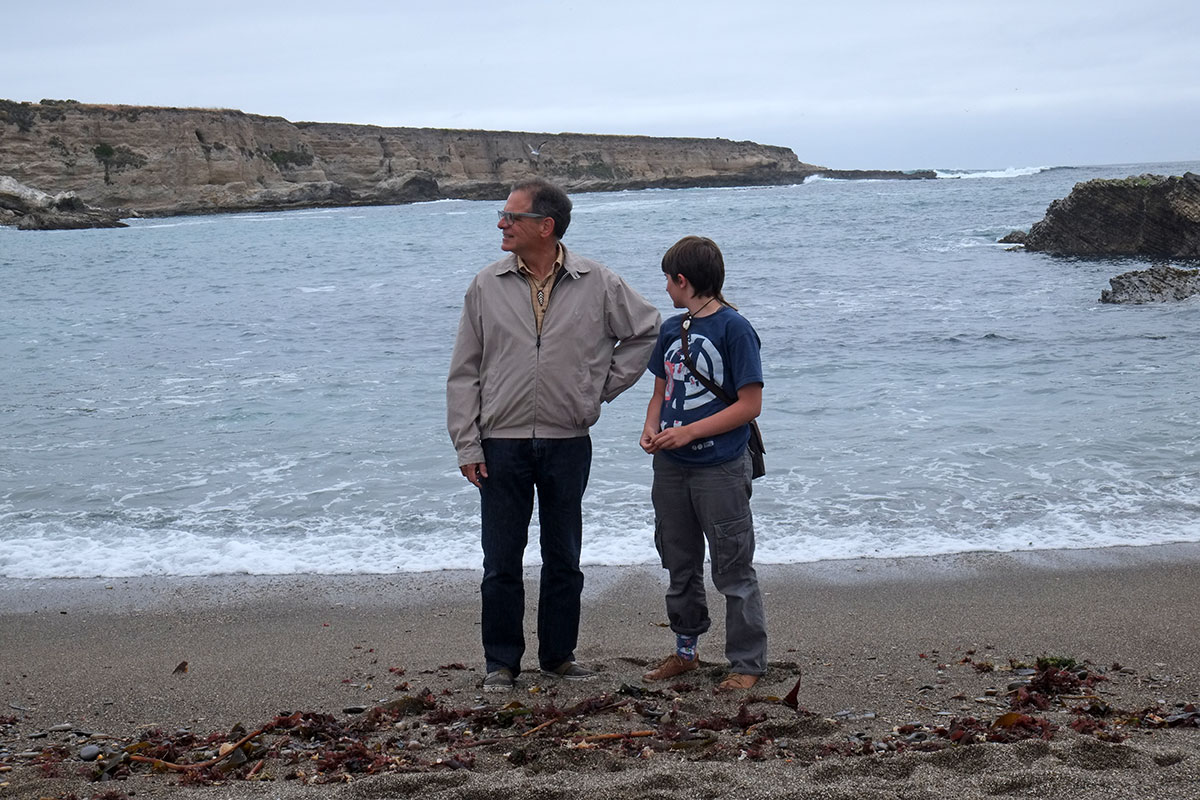
and explored on a beach covered with small rocks which had had holes bored in them by piddocks , and which Greta realized would make excellent necklaces.DSCF0627
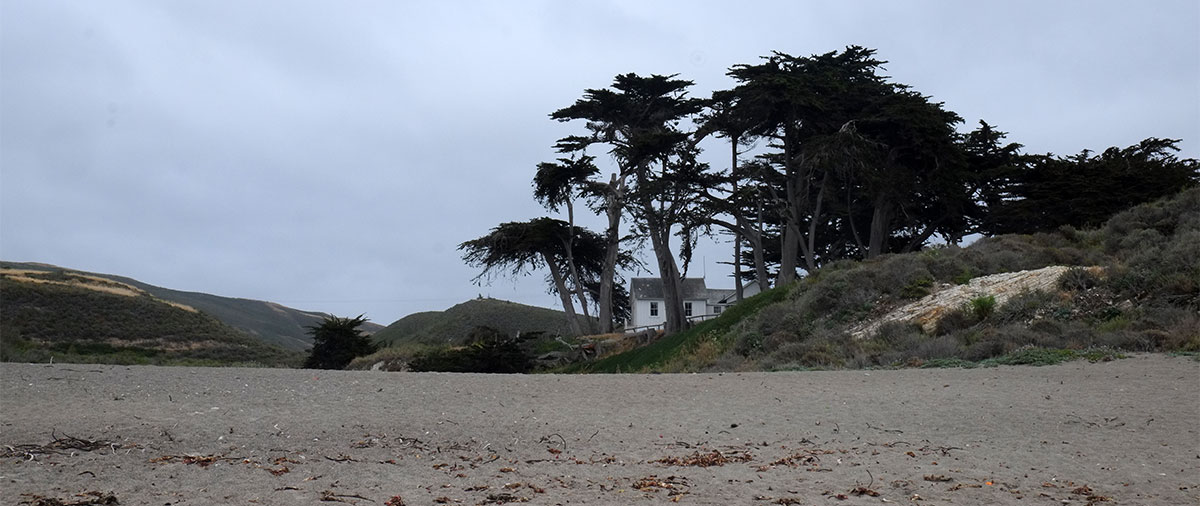
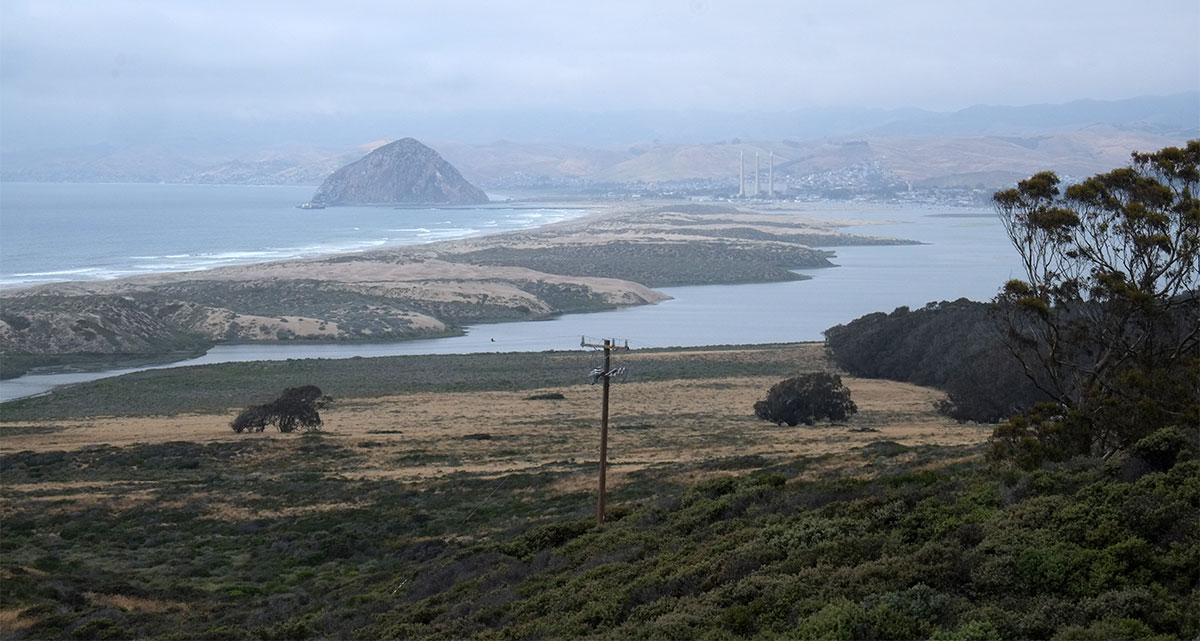
At Morro Bay, our first glimpse of the misty, overcast coast. It seemed so familiar to us, and we realized that coming home is a series of recognitions. We are so used to airplanes – where we travel great distances and pop out into a different world – that we think of returning as something that happens all at once. But when you travel great distances on land at a slower speed, there are incremental changes in the environment, each of which triggers a reaction, filling in pieces of the picture that you eventually recognize as home. Even though we were still 1100 miles from Eugene, this was the first place in eight months that fell within the outer circle of home, the first place that we felt was ours.105. San Luis Obispo003DSCF0632
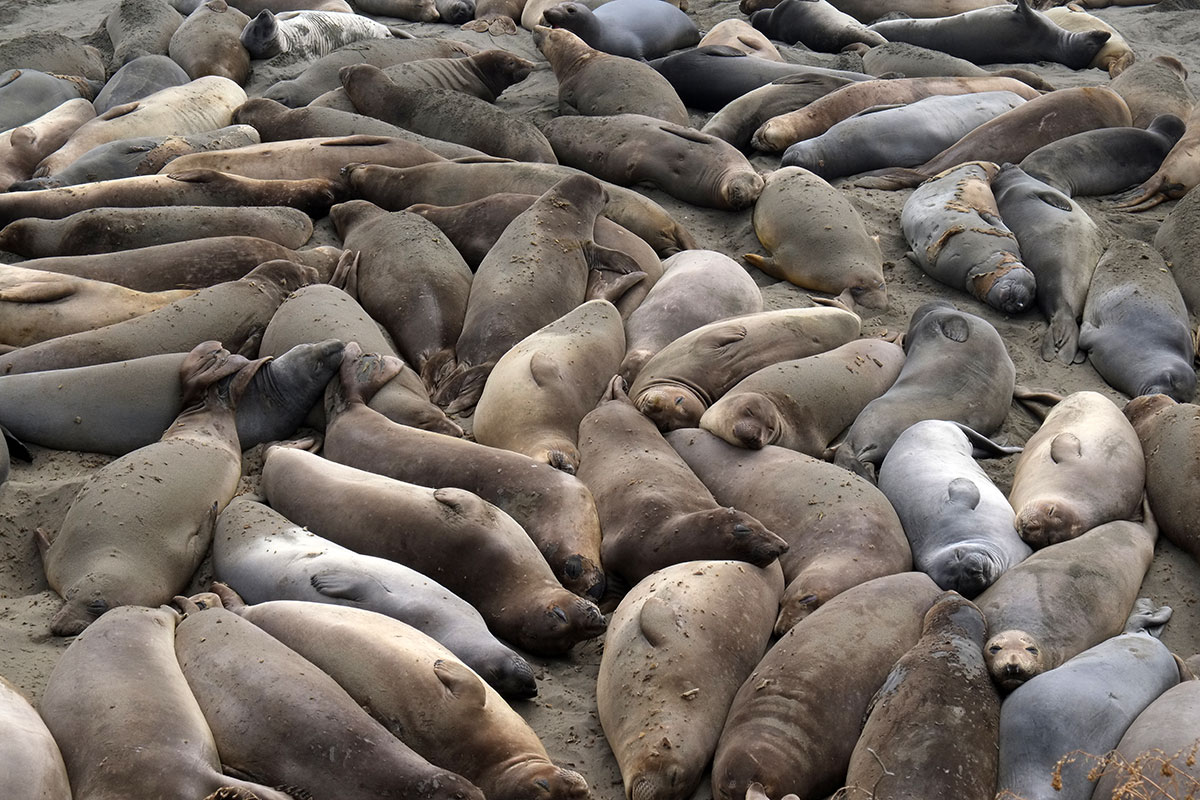
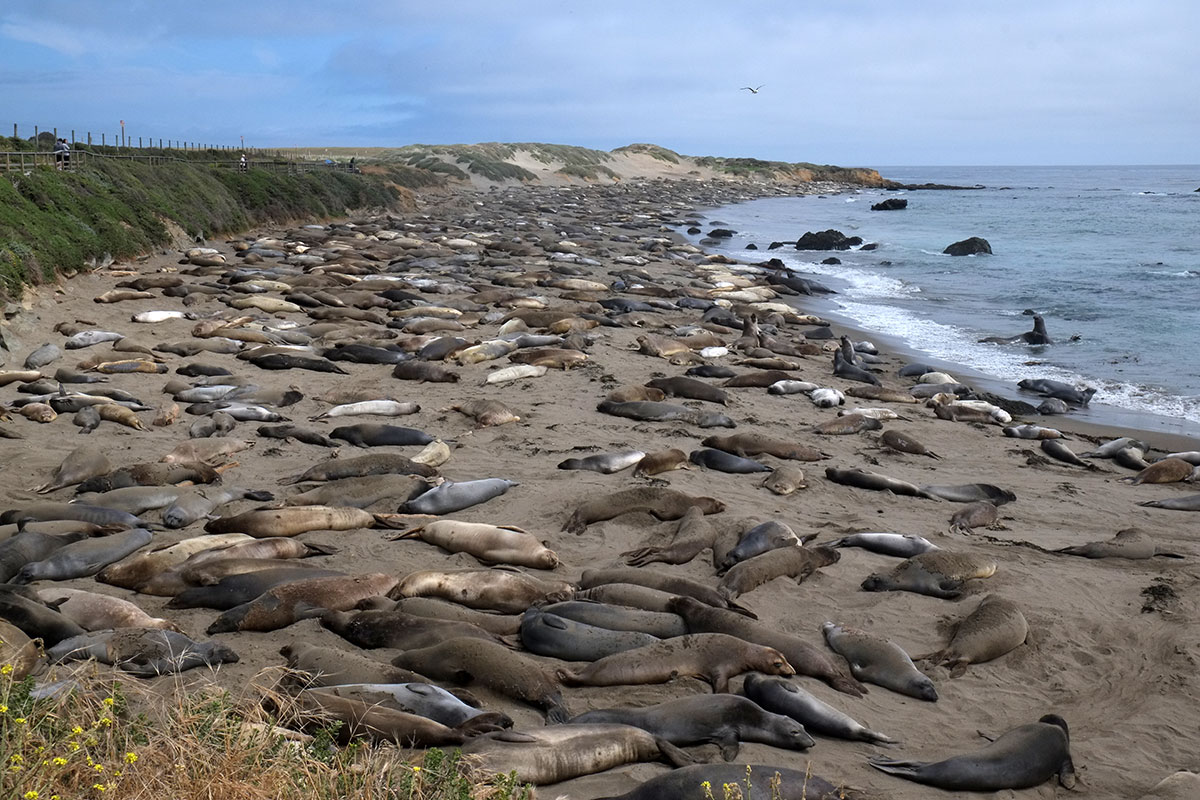
After a few days we headed north, to the elephant seal beach at San Simeon. Sea mammals, another familiar piece – although there were a lot more of them and they were all much bigger than we are used to in the Northwest.106. Coast050DSCF0651
106. Coast051DSCF0654

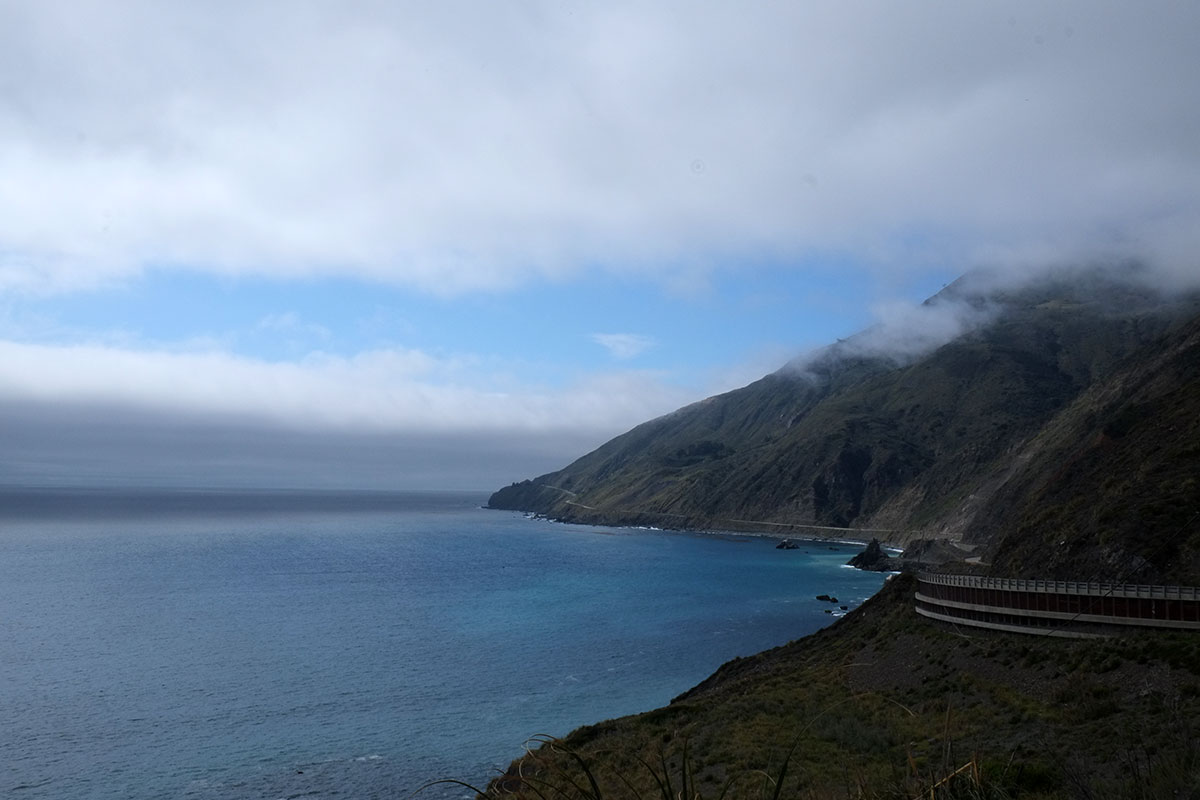
Big Sur, on an overcast day, had a different quality than we’d experienced on previous trips, but still astounding. After the washboard dirt roads of the Southwest, seeing such a smooth asphalt highway built in such impossible terrain was incredible; this must be a very rich place, we thought. We had just spent so much time in spectacular southwestern desert landscapes that we had a heightened awareness of both the contrasts and similarities – the landforms, the scale, the water, the sky, the vegetation, the humidity, the road itself. We wondered what the Hopi teenager we had met would make of this.106. Coast052DSCF0655
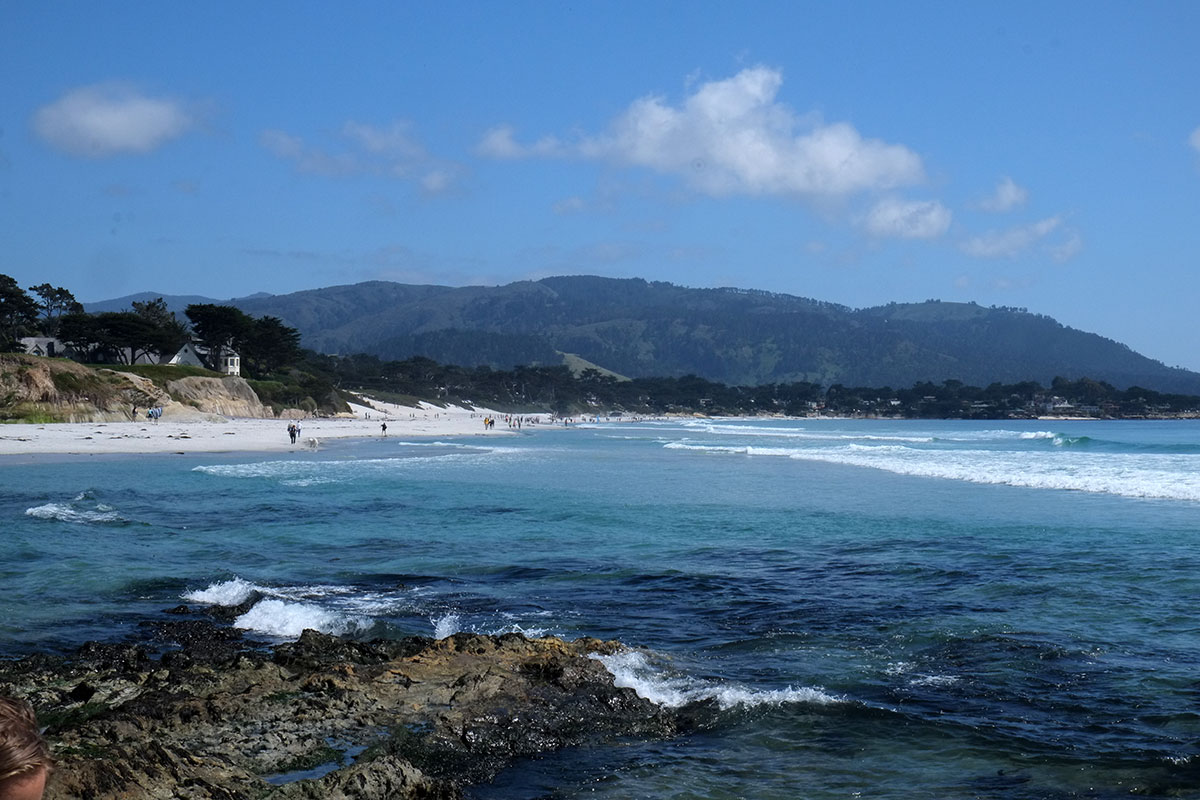
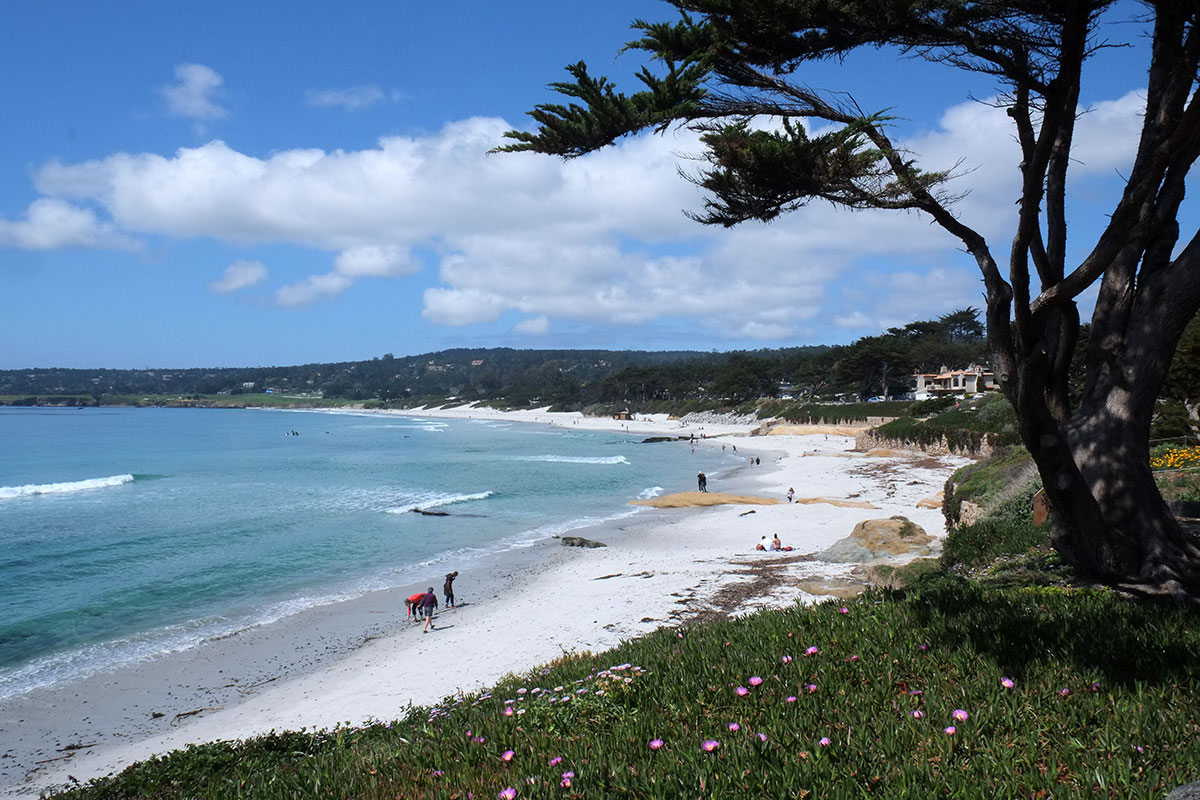
And at the end of Big Sur, the beach at Carmel. With the absence of cliffs, we were able to recognize this place as the antithesis of the southwestern desert in every way. Our acclimatization for the past week had been gradual, but here it hit us with full force. This was the promised land at the end of the road. Greta and I just sat and stared, not quite able to process the reality, beauty and meaning of such a place. Rob Peña and I used to talk about whether you could ever feel truly at home in a landscape that was completely unlike that where you had grown up, whether certain landscapes were imprinted on your brain. As he had grown up in Los Alamos, he feels at home in the Southwest in a way we never can. Greta and I had loved the desert, but it could only ever be as a visitor – it would never feel like home to us. Although I had grown up in the Northeast, there were enough common elements here – ocean, sky, beach, trees – that it felt familiar, and for Greta it was even closer to her ideal (although perhaps a bit too sunny).DSCF0769
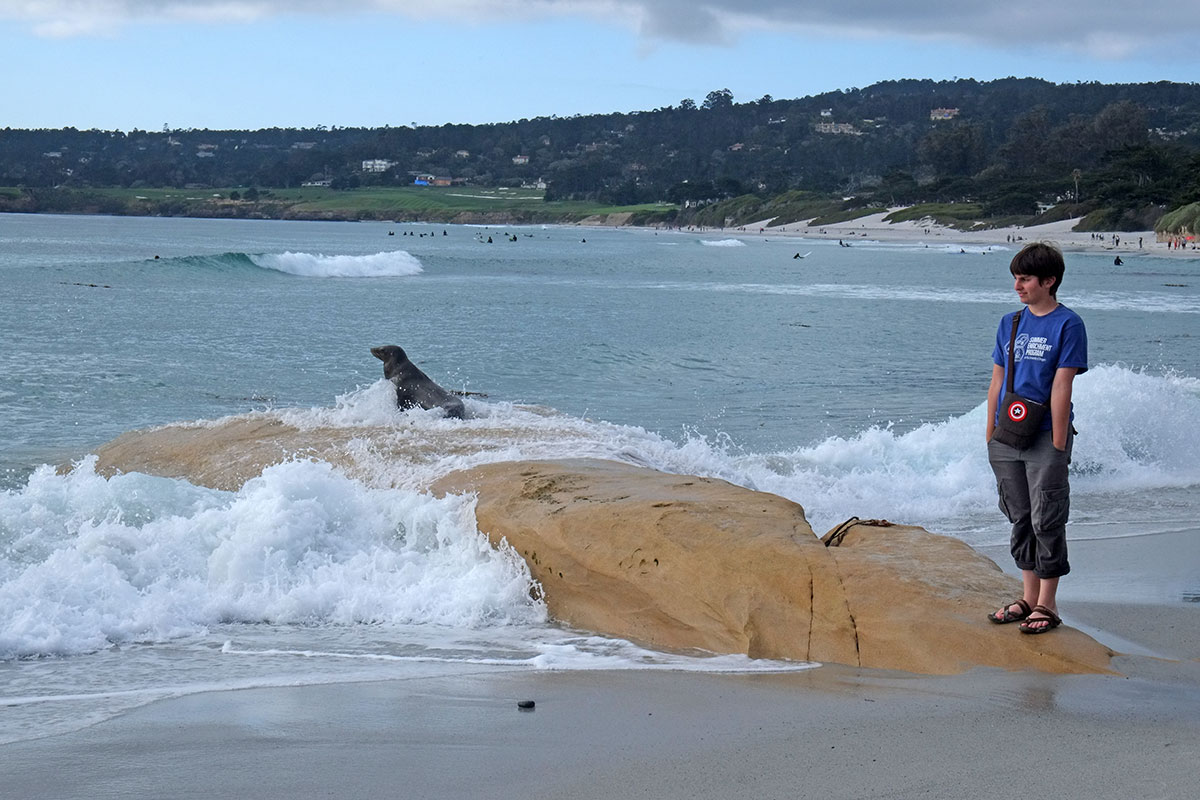
We luxuriated in this benign environment, where the local wildlife isn’t something that can kill you, but instead is happy to pose for a photo. There’s a reason why California is the fabled land of America, why it was irresistible to so many people in the past century; we were almost giddy with its attractiveness. We wondered why, if this place actually exists, people live in places like Phoenix instead of here. And then we looked around Carmel and said, Oh yeah, you can’t afford to live here.108. Carmel003DSCF0802
Monterey Bay Aquarium

P1090708
P1090695
P1090694
P1090689
P1090684
P1090655
When I was little, my dad recorded Nature videos for me, including one about Monterey Bay. Having watched it a million times, I’m rather knowledgeable, and only a little obsessed.

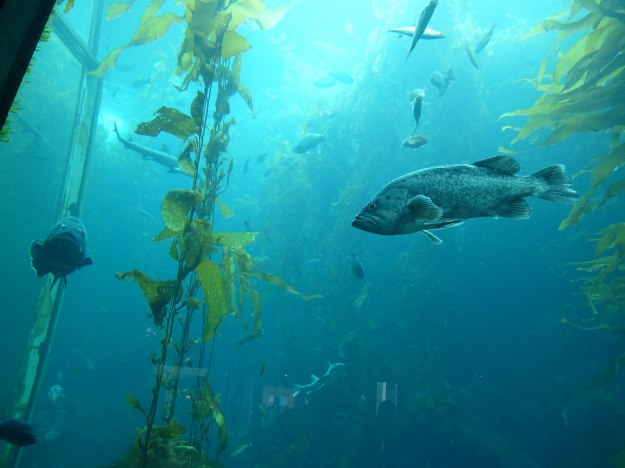
The most unique exhibit is the kelp forest. Kelp, thirty or more feet tall and capable of growing a foot a day in optimum conditions, is notoriously hard to keep, needing a constant supply of seawater. To combat this, they designed and installed a giant pump that continuously pushes water through the exhibit. P1090616
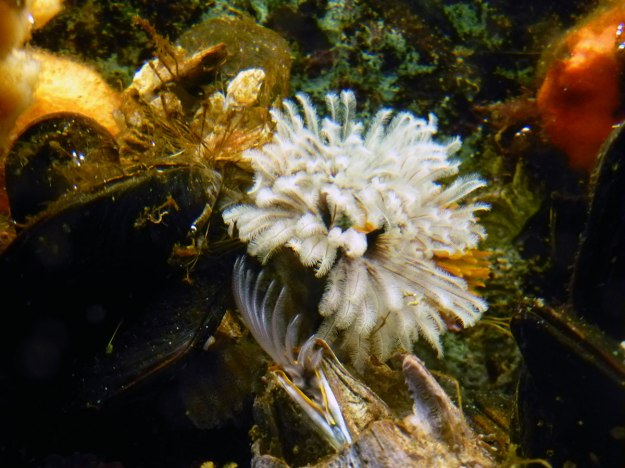
On the way out, it also goes through the tidal exhibits, and over the big tunnel that kids love to scream in.P1090651

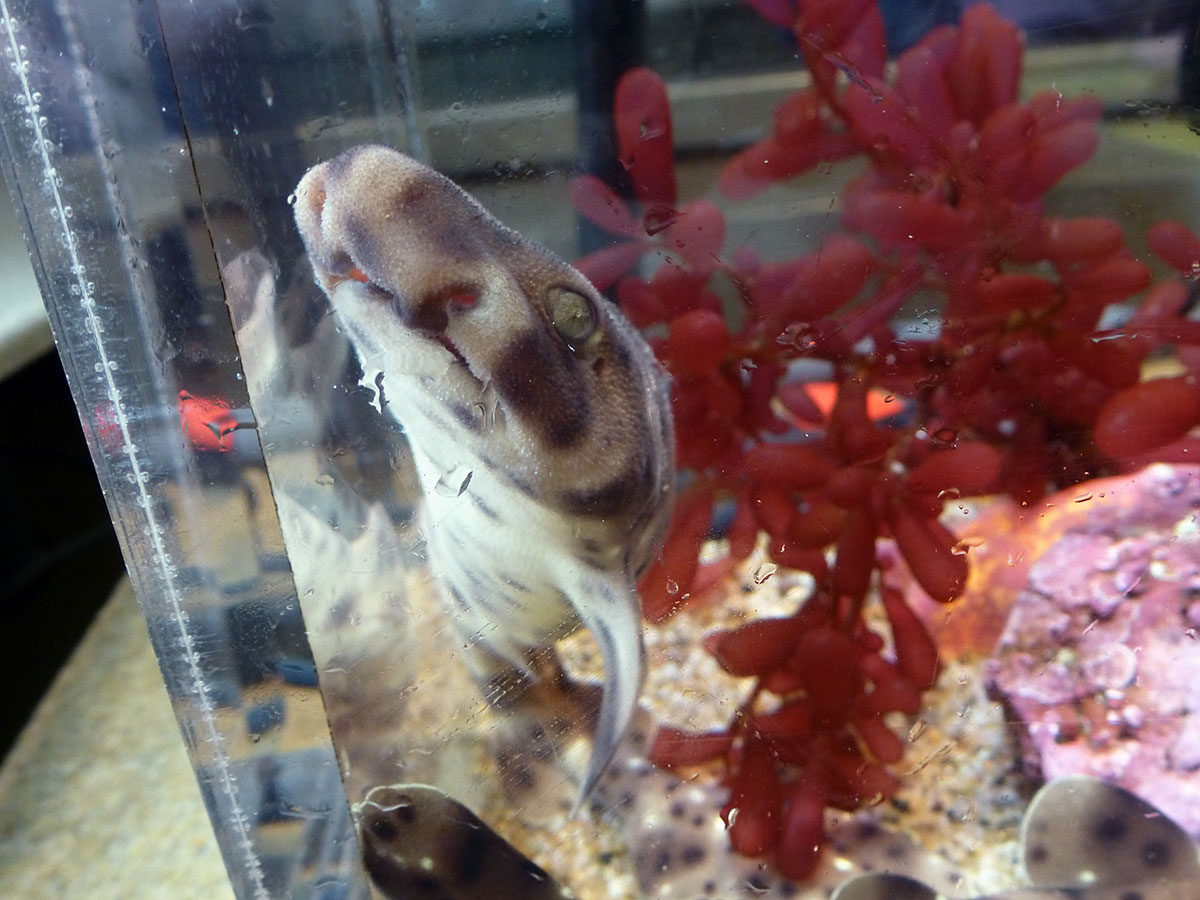
The shark and tuna exhibit had the largest single pane of aquarium glass in the world until it was topped by one in Japan. Then that broke, raining broken glass and sharks down on onlookers, and the one in Monterey Bay was back to being the largest. Sitting there in front of that giant portal into another world, I was struck by how large tuna can grow, unconstrained by gravity. They were much larger than the sharks, although they didn’t look as funny as the hammerheads, or even this baby leopard shark.P1090741

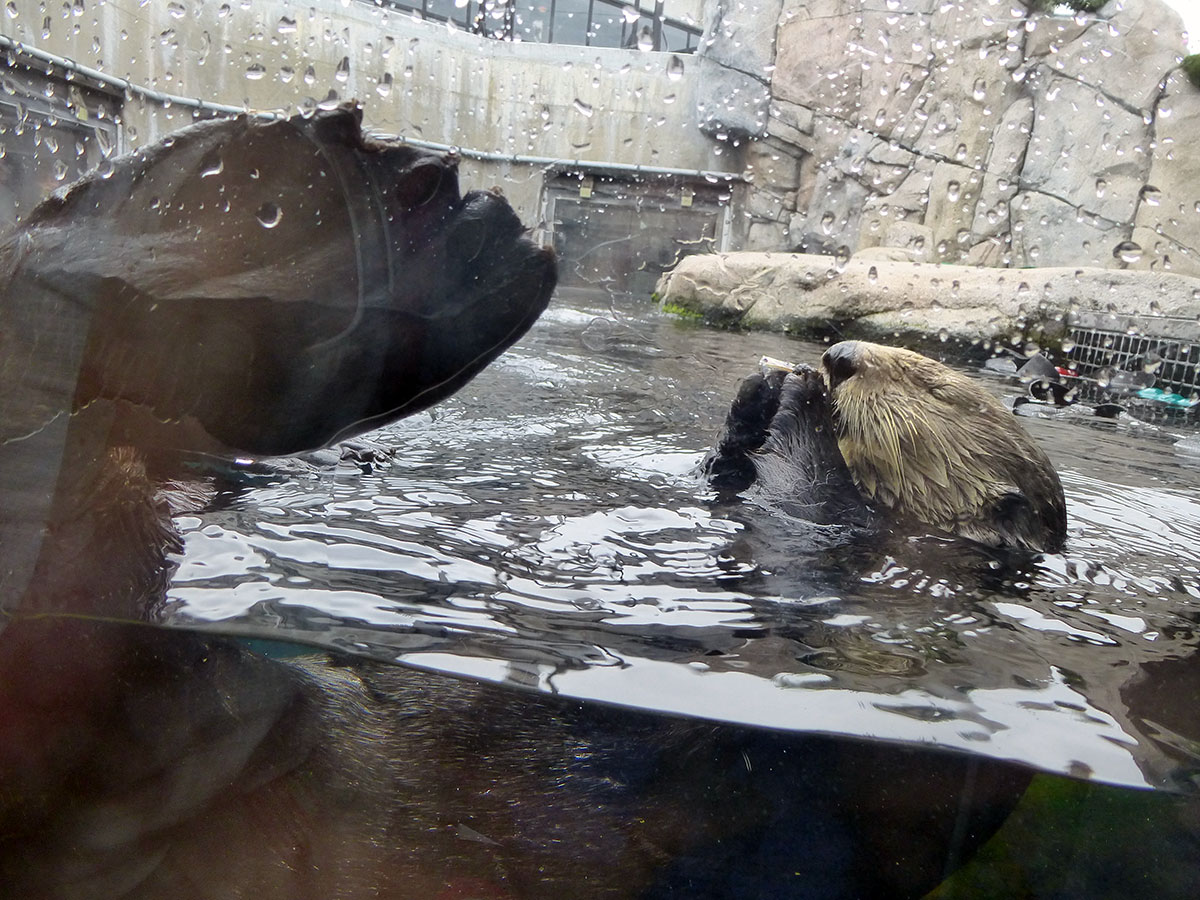
I was honestly less impressed with their jellyfish. Monterey Bay was the first aquarium to learn how to cultivate and display jellies, but they didn’t have the same variety as the special exhibit in Baltimore. That being said, the sea nettles were as beautifully backlit as always. P1090794The famous sea otters were the central exhibit, the first thing you see when you walk under the fiberglass orcas hanging from the ceiling. The four females, Rosa, Abby, Kit, and Gidget, frolic under the awed gaze of visitors. Their fur, thickest in the world with over a million hairs per square inch, more than humans have on our entire bodies, keeps them dry in the cold water, but without blubber, they still have to eat up to a quarter of their body weight each day to stay warm. I’d highly recommend going to watch when they’re fed, but if you want a good view, get there at least five minutes before the scheduled time.P1090771

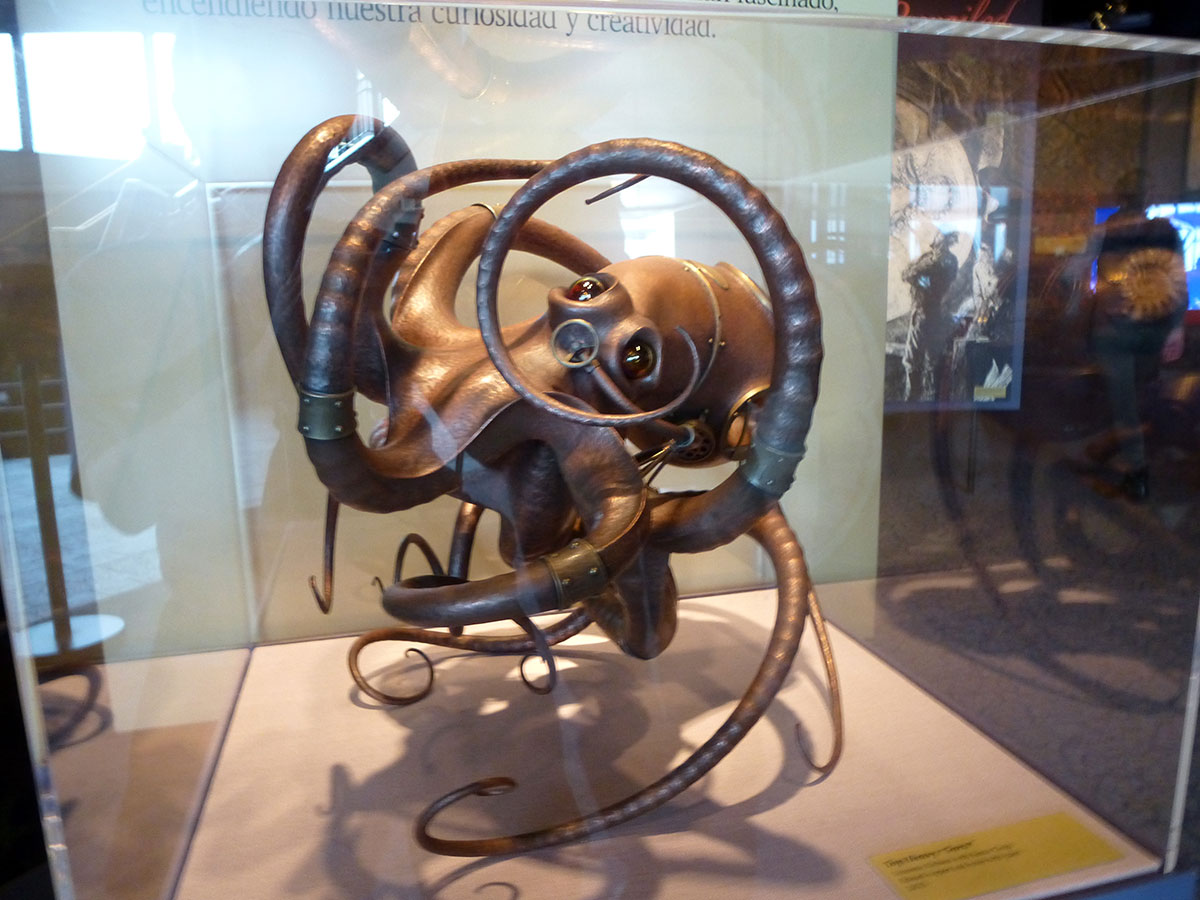
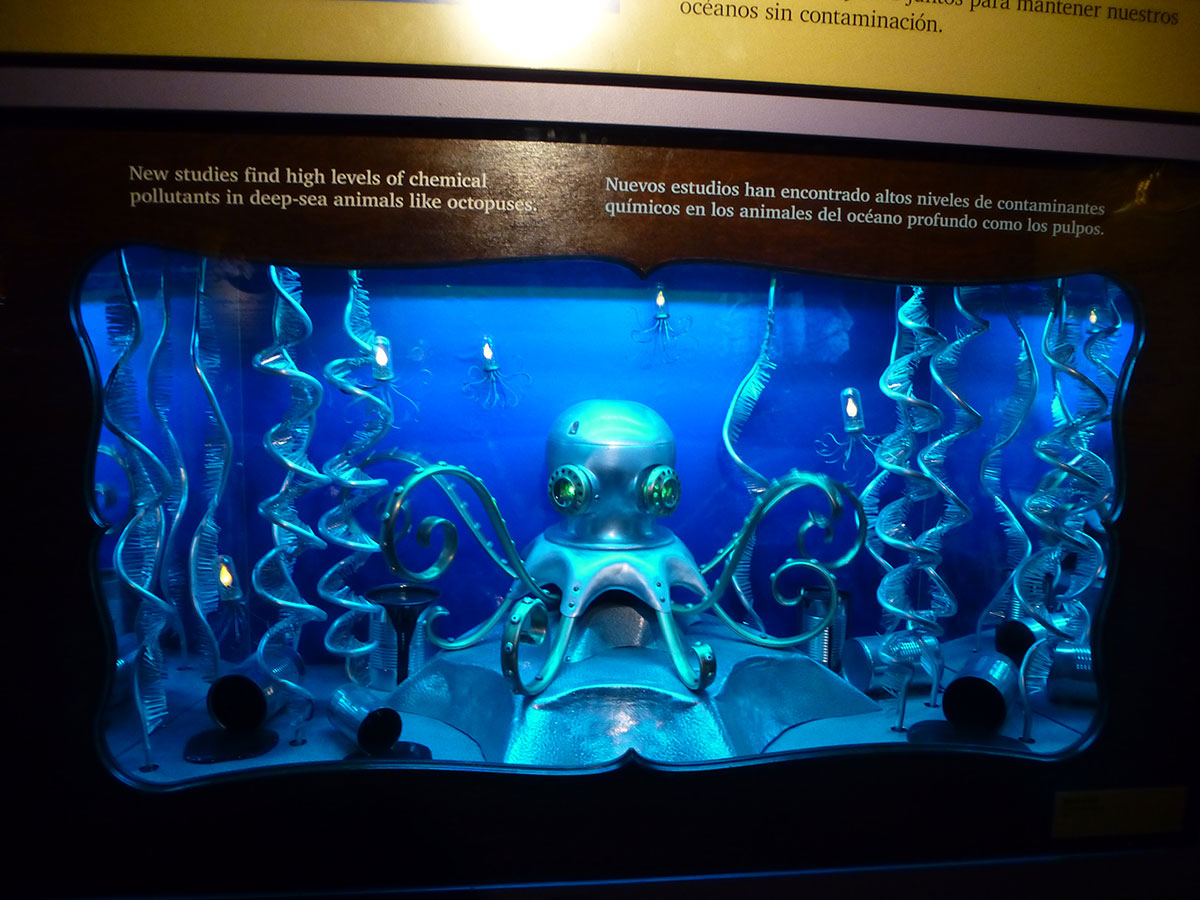
Despite their adorability, they weren’t my favorite exhibit. Once again, a temporary show takes the cake; Tentacles, the cephalopods. In the kelp forest area, the aquarium had two giant pacific octopodes (It isn’t octopi. That’s the Latin pluralization, and the word is Greek.), who weren’t hiding in some crevice for once, were cool, but paled in comparison to the variety of this exhibit. As well as the creatures themselves, it had art featuring the charismatic molluscs, including a drawing of the infamous ship-eating Kraken, painted octopus pots dating back to the twelfth century, and, personal favorite, an octopus shaped diving helmet.P1090817As cool as that was though, as soon as I spotted the squid tank at the end of the hall, I was lost to the air-breathing world. The only real squid I’d seen before were either dissected in fifth grade, or fried and delicious. Out of its class, squid are the masters of mobility. Streamlined bodies allow great speeds through the simple act of siphoning air in and shooting it back out into the ocean. There was even a fake tank where you could pump a handle and make a model squid spin around.P1090824

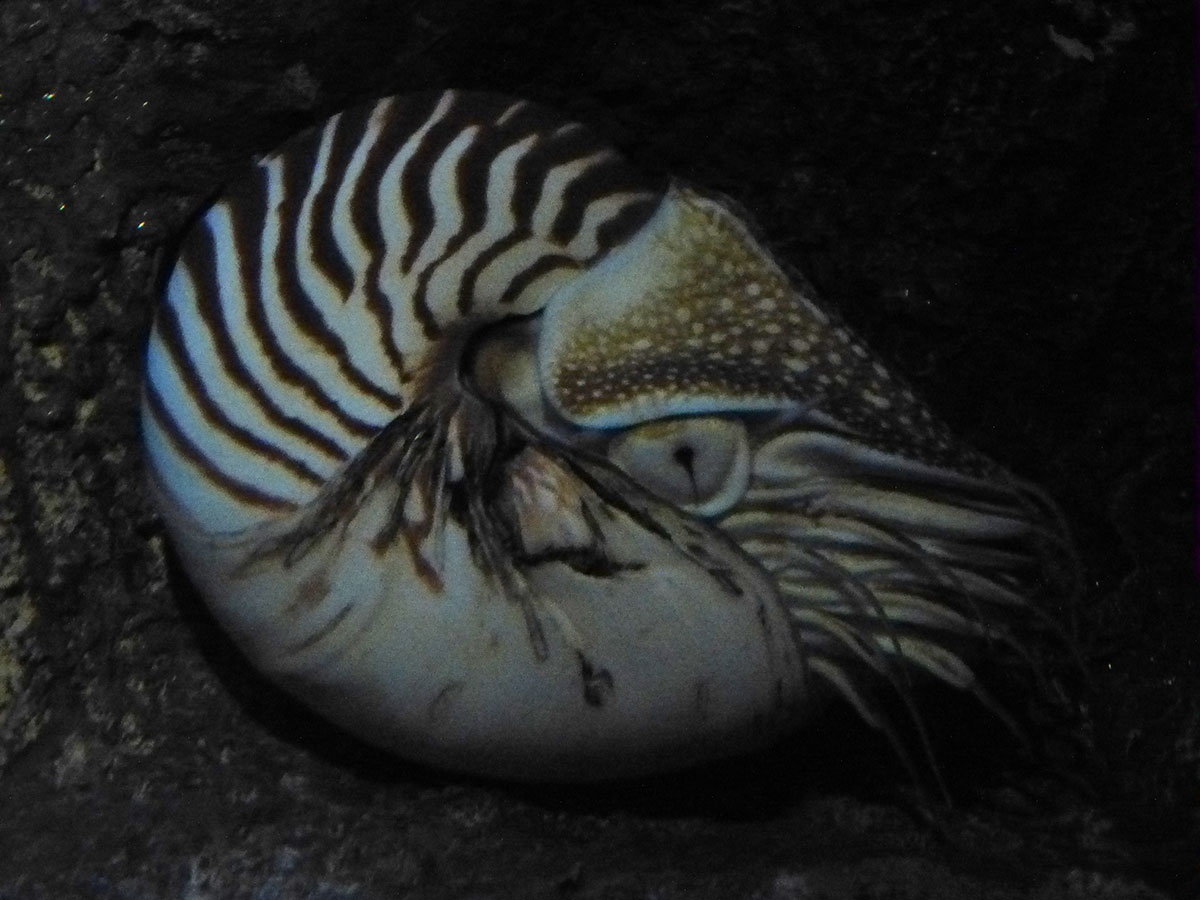
Nautiluses, the only shelled cehpalopod, haven’t changed much since the days when they were called ammonites. Large eyes allow them to see in the low light of the twilight zone, where they spend the daylight hours. At night, some ascend to the upper levels of the ocean, filling the pockets in their shell with air so they bob upward, and no one really knows why. Cephalopods are a mysterious group.P1090849

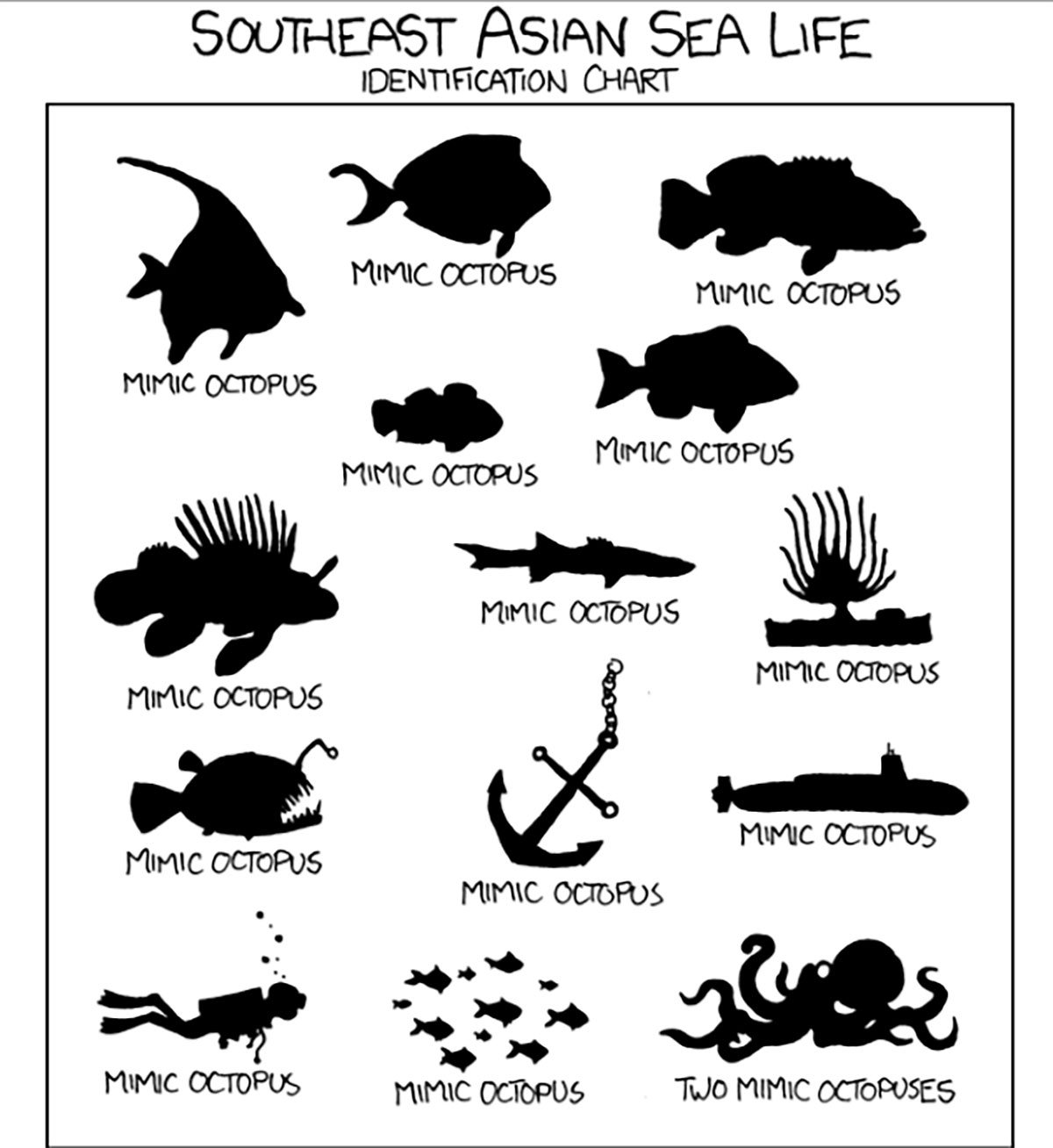
Octopuses (the most common and also correct pronunciation) are revered for their brains and their escape artist abilities. Sadly, I was not witness to any of this. My disappointment was lightened by the mimic octopus, whose long limbs and chromatophores allow it to disguise itself as almost any animal. Once again though, I was not privy to the octopuses’ secrets.P1090840Screen-Shot-2016-05-14-at-9.35.50-AM
P1090843

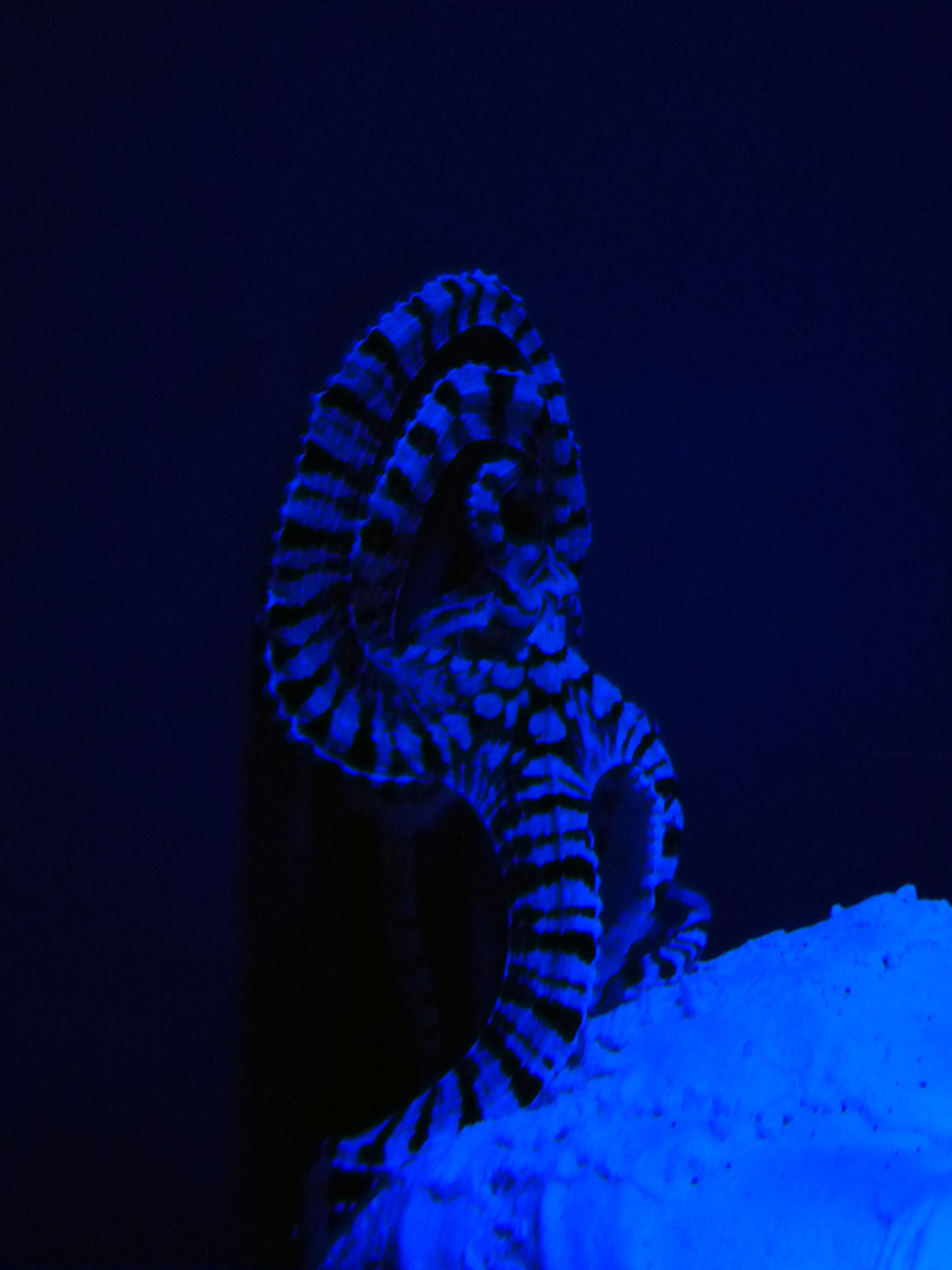
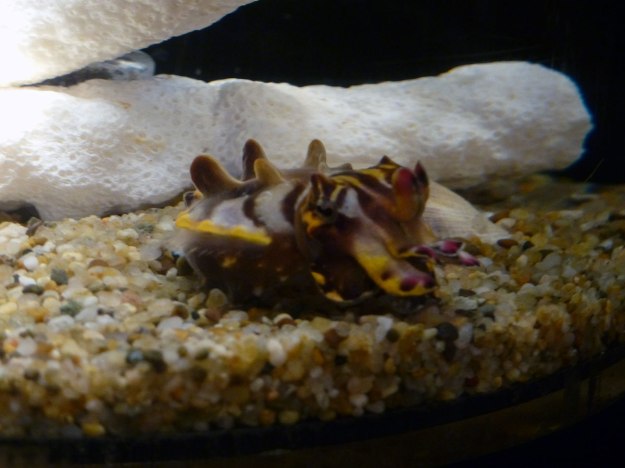
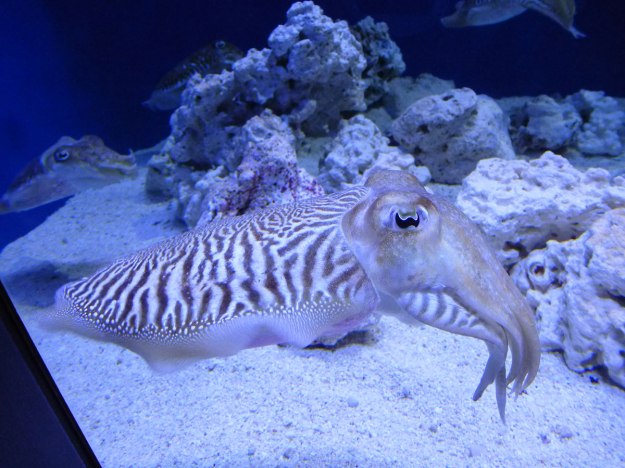
The cuttlefish though were proud to show off. Especially the appropriately-named flamboyants. Rainbow zebra stripes raced down their bodies from their mantle towards their rather stubby but no less colorful arms. P1090852Their eyes only added to the alien qualities, W-shaped pupils observing us as they wait patiently for the takeover. P1090867Flashing patterns can be used for communication, as well as hiding from predators andstunning potential prey, so it isn’t unreasonable to assume that cephalopods have an ocean-spanning network of spies and soldiers waiting to swarm into our cities when they flood.The most interesting things in the world are often also some of the scariest, and these ancient, plotting, shapeshifting buglers who can grow to enormous sizes are no exception. It’s no wonder to me that sailors feared the Kraken.
Even if the cephalopods have moved on by the time you go, don’t miss the Monterey Bay Aquarium if you’re ever in the area. Tickets are expensive, but for good reason. A single sea otter eats $15,000 worth of seafood every year, and the other exhibits aren’t cheap to maintain either. Don’t miss out on anything this aquarium has to offer, from otters to touch pools to penguins and octopuses and beyond.

Corkscrew

In my experience at least, Carmel Valley is prettier, less pretentious, and has better food than Carmel-by-the-Sea, although that macaroon we got after walking on the beach was delicious.  Despite its name, there is much more than wine to be enjoyed at Corkscrew.  A waiter greeted us while we were still admiring the brick pizza oven and the tantalizing aromas drifting out of it.  The best way to keep a customer, they seem to have found out, is to make your restaurant smell too good for them to even consider leaving.  Our table was by a bay window, from which we had views of both the green valley and the pizza oven door, which, for someone who likes being able to track their pizza like an impatient shopper will track an Amazon delivery, was a definite plus.

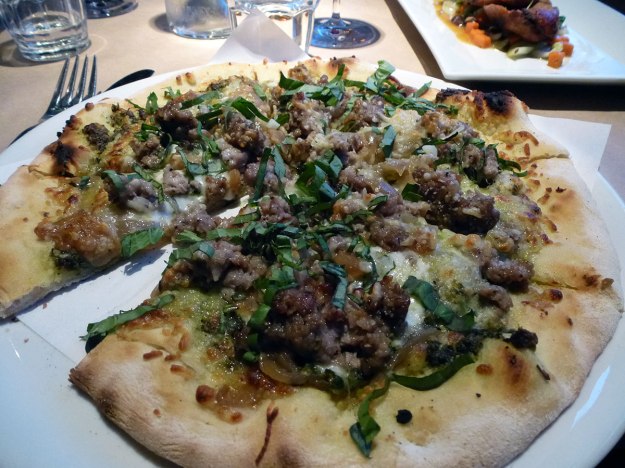
Pizza wasn’t the only thing on the menu, but for a teenager, there is really no other option.  And with ingredients like sausage, carmelized onions, and arugula, how could I resist?  The crust was crisp, and the meat flavorful, everything you want in a pizza.P1090888

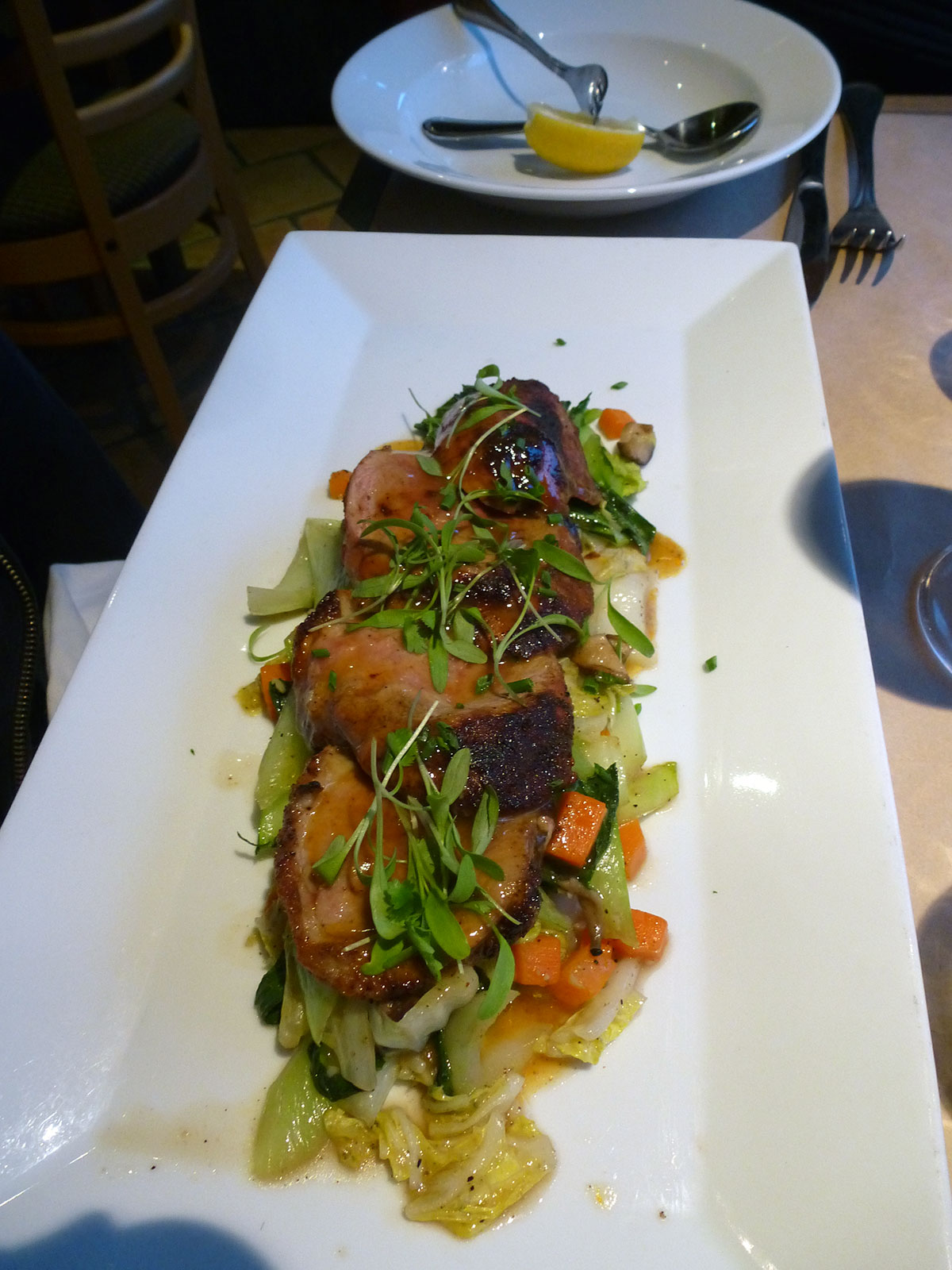
Two things I have learned to love on this trip: duck, and having a dad who lets me sample/devour some of his duck.  Smeared with a citrus glaze, which I’m finding is a common and good way to prepare it, it was deliciously moist and succulent. P1090887

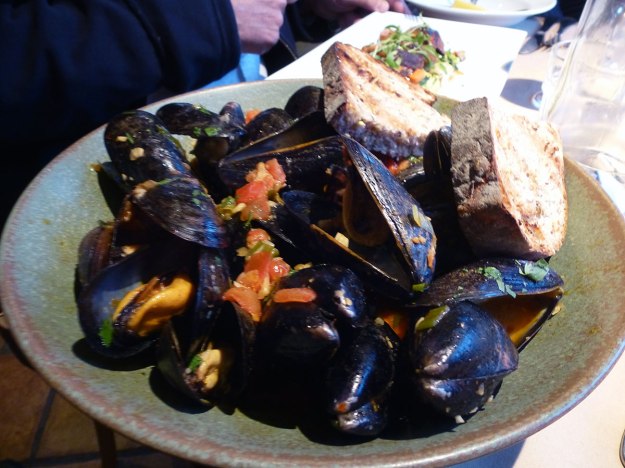
Despite being raised in Canada instead of Penn Cove, the mussels were fabulous. They were much larger than I was used to, but for their size they lost none of their flavor. Steamed and served in a simple broth with butter and garlic, much like we make them at home, they were delicious, and suffered little from being maybe not quite as fresh.P1090889

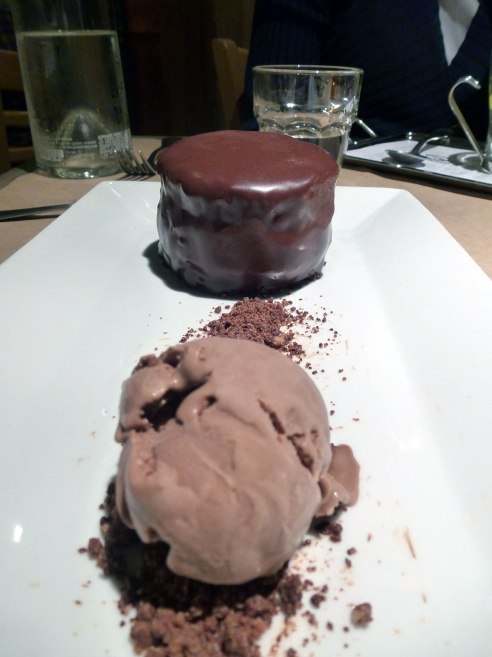
Our dessert experience was in no way undermined by already having had a slice of cafeteria chocolate cake at the aquarium for lunch.  I tried coffee ice cream for the first time in a few years, and actually liked it.  But the killer was this little tiny chocolate cake, smothered by more chocolate.  It somehow managed to be both rich and light and fluffy.P1090890

So if you’re in Carmel, don’t miss a drive down the valley.  And if you happen to be there around dinner time, well, now you know a good place to go.

Brian Leverich

105. San Luis Obispo005DSCF0646

The first Westerner I ever got to know was Brian Leverich. He lived down the hall from us in Hurlbut Hall, that “…dorm full of eccentrics, misfits and savants…” where I first encountered so many of my best college friends. Brian’s family was from Oklahoma, or Colorado, or some other vague place west of the Eastern Seaboard that I couldn’t quite place. Having spent my whole life in the New York metropolitan area, at first I couldn’t figure him out at all – he talked slowly and softly, with significant pauses, when you couldn’t tell if he was done speaking. In my world, talking in this manner was generally taken as an indication of mental deficiency, but after a little while hanging out with Brian, I realized that he was actually very smart, and often subtly funny. In retrospect, being friends with Brian was the beginning of the acculturation process that prepared me for marrying a woman from Kansas, and spending most of my adult life in Oregon.

The other weird thing about Brian was that he was a conservative, a Goldwater Republican. Even though I came from markedly Republican stock myself, this was the mid-1970s, at Harvard, where the acceptable range of Republicanism ran from the patrician Cabot Lodge pole to the liberal Edward Brooke end of the spectrum. I had never before met an actual, libertarian-leaning, Western Republican, and I began to suspect he might have fired a gun at some point in his life. But just as I came to understand his intellect, I also learned that his political beliefs were reasonable, in that they derived from reason, and not just a knee-jerk anti-gummint answer to every question in life. Brian didn’t unthinkingly parrot the beliefs of his tribe, in an era when dogmatic certainty was the norm. (Once, when I had the audacity to question some left-wing shibboleth in a letter to the Crimson, an angry response referred to me as the “Spiro Agnew of Harvard.”) Brian was comfortable and rational in his opinions, and enjoyed poking at the liberal verities with which he was surrounded.

Sophomore year we moved into different Houses, and saw each other intermittently throughout college, then completely lost touch afterwards. Brian continued his studies in engineering at Stanford, but after a few years there realized it wasn’t a good fit. However, while there he did meet his future wife, Karen Isaacson, who was also a grad student at Stanford, so those years were not wasted. Brian began a career which I can’t comprehend in detail, but it involved working as consultant on public policy / engineering-related issues (often defense policy), flitting in and out of the Rand Corporation, and at some point getting his PhD from the Rand Graduate School. These were the heady years of the Republican ascendancy, and Brian was there as the New World Order led to the End of History.

During this period, Karen had developed an interest in genealogy, and she and Brian were perfectly situated, as engineering nerds with a clear understanding of the potential of the emerging interwebs, to be among the first to see how genealogy could be brought into the modern world of technology. They were living in their little cabin up in the mountains of southern California, from where they were able to put their work up online. A major commercial genealogical venture, Ancestry.com, was developing at the same time, but Karen and Brian seemed to be able to do on their own just about what Ancestry was doing with a big company. Tired of the pesky little competitor, Ancestry bought out their company – Rootsweb.com – and Karen and Brian moved on.

105. San Luis Obispo004DSCF0635

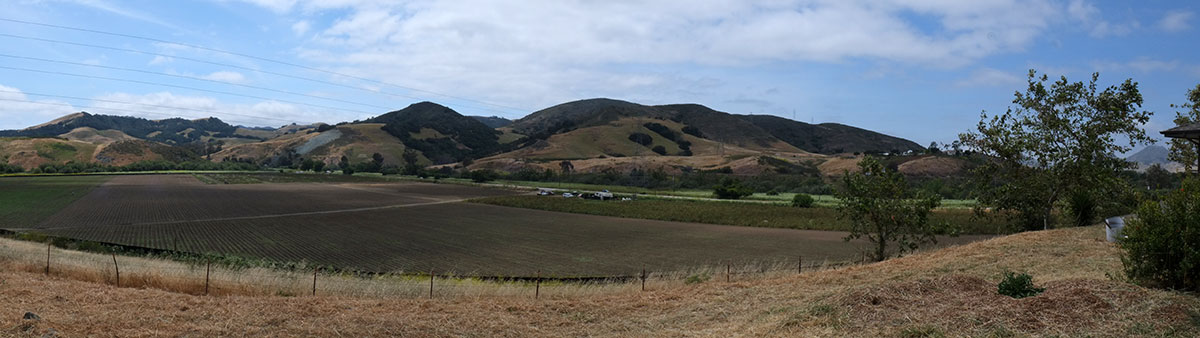
They eventually settled in San Luis Obispo, and a few years ago bought a fantastic place about two miles south of downtown. It sits up on a little ridge in the middle of farmland near the airport, with panoramic views in every direction.DSCF0617

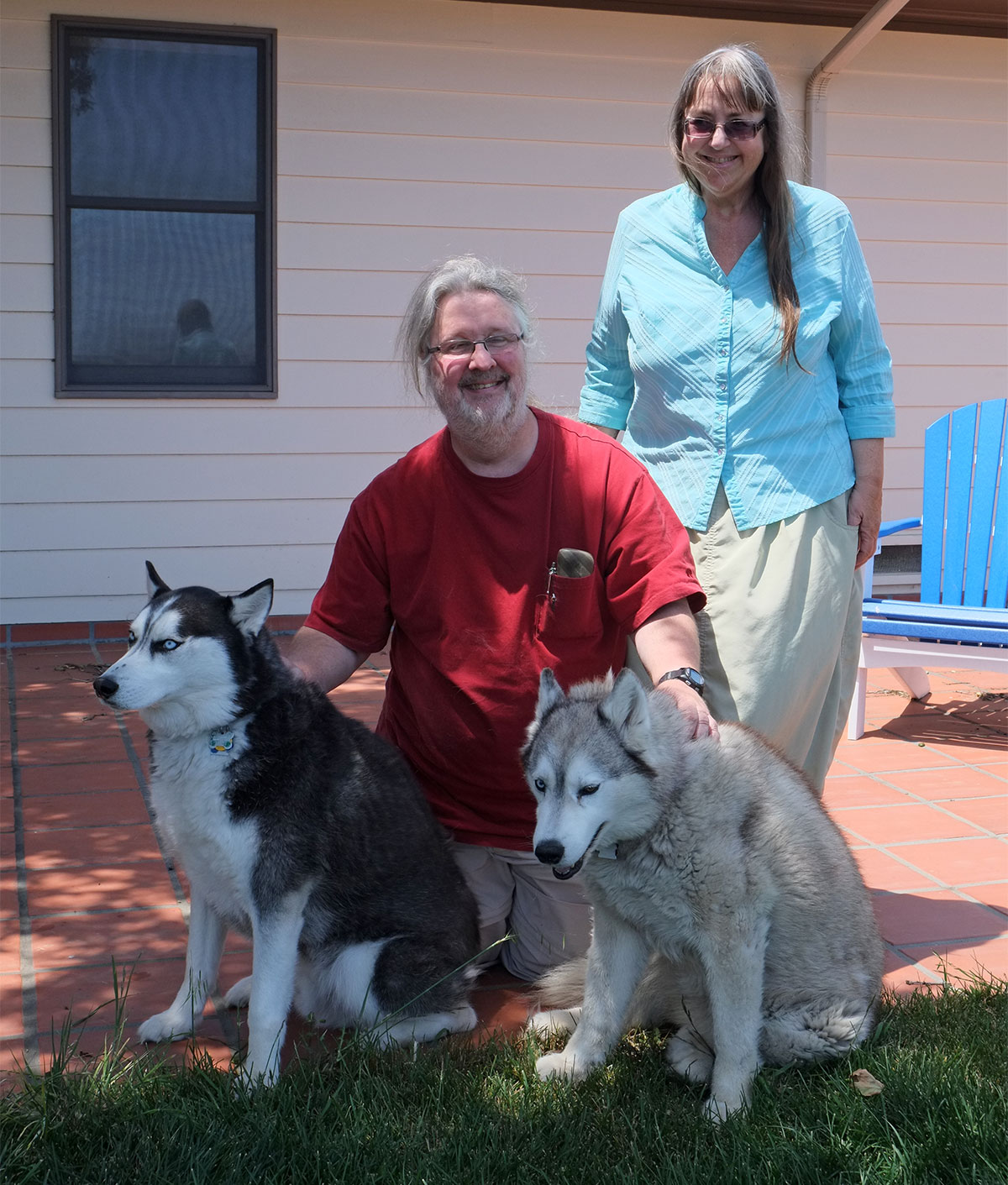
Here they continue to pursue their many interests – genealogy through their new venture, Linkpendium.com, and participation in genealogical associations, extensive hiking in the mountains of the West, ham radio activity (Brian is currently trying to figure out the precise best place for a 60-foot aerial on their ridge), and hanging out with their huskies. Pictured above are McKinley and Denali, two charming dogs who are very highly placed on Greta’s list of Best Vicarious Pets of the trip, for their combination of liveliness and calm. Unfortunately, Denali died suddenly shortly after our visit, and Brian and Karen are now up to their eyeballs with a new huskie puppy.

As with many of my long-lost friends whom we’ve visited on this trip, Brian and I reconnected through Facebook several years ago. I’ve really learned a lot from his posts in recent years – he understands the worlds of economics, public policy and politics as a professional, and amazingly after all his years in the trenches, he still has the same integrity and thoughtfulness I noticed over 40 years ago. Brian has stayed true to his core principles, and has been aghast as the Republican party has marched off the cliff into know-nothingness and licking the boots of the Masters of the Universe. His arguments are about the most cogent I’ve seen in any online discussion – not assertions of moral superiority and self-righteousness, but clearly-reasoned positions based upon a wide-ranging base of facts and knowledge. He hasn’t quite converted me to being a Goldwater Republican, although I have come to recognize that I’ve always been an Eisenhower Republican at heart (and hence almost a Socialist in our current mileu.) As a way out of our current horrific political polarization and stalemate, the best option I’ve been able to come up with is to put Brian in charge.

Greta has always enjoyed my nerdy and amusing college friends, so she was really looking forward to meeting Brian and Karen. We had a great time with them, hanging around drinking and eating, seeing the sights of the greater SLO area (including our first sight of the Pacific in eight months at Morro Bay and Montaña de Oro State Park). But perhaps the best group activity (certainly for the nerdy end of the spectrum) was going to the movies. Greta had been counting the days until the opening of the Captain America Civil War movie, but our plans to see it the opening weekend in Bakersfield were dashed by the blown-out tire in the Mojave. When we inquired about possible movie venues upon our arrival in SLO, Brian’s eyes lit up. He too had been eagerly anticipating the movie, but despaired of finding an appropriate viewing companion, one who would have the requisite detailed knowledge and appreciation of the complex Marvel movies universe (MCU), and so be able to meaningfully participate in the critical post-movie analysis and discussion. We all enjoyed the movie (sitting in our electrically-controlled chaise-lounges with drink and popcorn holders, ahh California!), but the young and the old nerd were in heaven, continuing the discussion into the next evening back at home, when other DVDs in the series were pulled out, to bring the complete experience to a sense of closure.
Karen grew up in Oregon, and her mom lives in Vancouver, Washington, so they do pass by our neck of the woods from time to time. We’re counting on seeing them again soon (just as we hope all of the friends we visited will now come see us), perhaps coordinated with the release of the next Marvel movie.

Christine Theodoropolous

photo from CAED

Christine Theodoropoulos joined our department in Eugene in the mid-1990s, coming from a prior teaching position in southern California.  Our department has an unusual criterion when we are searching for new faculty members: everyone who will teach courses in the department should also teach design studios.  We don’t want some faculty (especially those who teach technical courses) to be isolated in their specialties; since architecture is all about integrating an incredibly wide range of scales and issues into a design project, we think it is important that specialized knowledge and different approaches be brought into the studio, and we want our faculty to always be thinking about how their particular focus and expertise contributes to the design process.  Christine was a perfect faculty candidate from this perspective. She had an undergraduate engineering degree from Princeton, then a masters in architecture from Yale (where she was friends with Mark Rylander, another factor to her credit).  She left LA and moved to Eugene with her husband Mark (who had extensive experience working as a construction manager on the Getty, among other projects), and her two young sons.

From the beginning, working with Christine was a pleasure. She was a thoughtful and smart design teacher, and with her structural engineering colleagues, fundamentally changed the way we teach structures, shifting it more towards how architects actually apply structural concepts in the design process, rather than just the learning of abstract structural principles (which was certainly the way I was taught).  But more than that, she was a good friend and the definition of collegiality – someone who more than pulled her own weight, who was always searching for simple solutions, and who didn’t feel the need to belabor the obvious (not a common characteristic in academia).  Once when she and I were on a faculty search committee together, she walked into a meeting and said, These are the three candidates whom I think are clearly the best.  I said I completely agreed, and she said let’s just invite them to campus.  We then adjourned what was probably the shortest committee meeting ever held.

Given these qualities, she was a natural for the thankless job of being department head.  When we needed to find a new head in the early 2000s, Christine and I were both mid-career faculty and likely candidates, so I did a quick survey of our relative qualifications, which immediately convinced me that Christine was much better suited for the job.  Happily Christine and the rest of the faculty concurred, and Christine took on the position, eventually agreeing to re-up for two more three-year terms.

As always, these were years of tumult and straitened circumstances at the university, but Christine strategically navigated them with tremendous steadiness, integrity, and innovative thinking.  She had enough experience and wisdom to keep things in perspective, and she quietly accomplished a lot, with a minimum of fuss.  My favorite moment was when I had attended a meeting with many other faculty from across the university, and found that they were all freaking out about some directive out of the provost’s office.  They were having meetings, plotting strategies, writing memos and letters.  One colleague asked me how our department was dealing with this, and I said that I hadn’t heard anything about this before; she just stared at me in disbelief.  I went back to Lawrence Hall and asked Christine about this crisis.  She said, Oh, I just don’t think this has reached the level yet where we have to pay any attention to it.  She was right – it never became a big issue for us, and she saved us weeks of worry and unnecessary dithering by just quietly tracking it herself.

Christine’s sterling qualities were noticed not just by us, so four years ago she moved off to San Luis Obispo to be the dean of the School of Architecture and Environmental Design at Cal Poly.  It is an excellent school, with a very large undergraduate architecture program that is consistently ranked the best in the country.  Christine and Mark moved into a cool rowhouse/loft unit in a hip new mixed-use building downtown (their boys are grown and off on their own), where they are enjoying the down-sized simplicity and urban pleasures of life in SLO, after the years of suburban family domesticity in Eugene.

We had a lovely dinner visiting with Christine, catching up on family and friends, hearing about her life at Cal Poly and in the more general world of architectural education in the US, and some interesting adventures she’d had in consulting on architecture programs in the Mideast. But as always with Christine, much of the conversation was about how things and people were doing in Oregon, and how we had been faring on our trip; even after years in her new life, Christine still hasn’t let go of the habits of caring about and strategizing for all of us back in her old home.

Double Negative

The natural world and the ancient human world dominated our experience of the Southwest. The desert is almost empty of people, and those places where people have clustered – such as Phoenix and Las Vegas – were places we wanted to leave as quickly as possible, to head back into the vast spaces, silence and beauty of the desert. My friends Pam and Chuck once remarked, after their first trip through Oregon, that they were struck by the contrast between the incredible grandeur of the landscape, and the utter crap that had been built in it everywhere. I think this is true of the West as a whole, but Greta and I were more aware of it in the Southwest, as long residence in the Northwest had accustomed us to both its astounding landscapes and its crappy built environment. In the Southwest we were awed by the alien landscape, and able to see the tawdriness of the built landscape with new eyes.

At a simplistic level, it appeared that everything natural was beautiful (or at least impressive), and everything we built was terrible. But the remains of the older civilizations countered this – they had the beauty of vernacular buildings, being of the local materials and responsive to the demands of the environment. They showed how humans could inhabit a place without destroying it, and by reconciling human needs with natural conditions, create a place that was even more meaningful to us than the natural world alone. Obviously there were recent human interventions that took care to work with this local context (Arcosanti and some buildings in Tucson came to mind from our recent travels), but we wondered about seeing places where recent human action actually enhanced our understanding of the world, as the primal qualities of cliff dwellings did.

This brought us to the artwork in the region – perhaps conscious interventions devoid of pragmatic considerations would show that people could comprehend the essential qualities of this place, and contribute to that understanding. Our first experience of this had been in Marfa, with Donald Judd’s work. Some of the work at the Chinati Foundation seemed disconnected from the place – object sculptures that could be understood on their own, that had just come to rest in that location. Other works seemed related to the built environment there – such as Judd’s aluminum boxes in the big artillery buildings, or Flavin’s installations in the series of barracks buildings. But other works connected directly to the landscape – most notably Judd’s 15 large concrete sculptures, out in the desert, creating an axis that terminated in a mountain.

After learning about the celestial alignments at Chaco, James Turrell’s Roden Crater came to mind, where he has been manipulating a volcanic mountain for decades, creating passages and rooms whose location and alignment enhance the experience of celestial and environmental events. But Turrell is still at work on Roden Crater, and it’s not open to the public. Then I realized that when we left Las Vegas, heading northeast towards Zion, Michael Heizer’s Double Negative would be only 20 miles or so off our route. I had always liked his sculpture at the IBM building in New York, and Double Negative struck me as the most spatially and topographically interesting of all the earth art from the 70s.

103. Double Negative050DSCF0527

We put it on our itinerary, and one morning we rolled out of our Lake Mead campground, headed back to the desert to see big art and huge landscapes, and immediately got a flat tire on our trailer. This derailed our plans for half the day – changing the flat, and then driving into Vegas to find a tire store to buy a couple of spares. At one point, Greta looked over at me and observed that our one previous blowout on the trip had occurred in Alpine, Texas, as we were hurrying to Marfa for a tour of Donald Judd’s downtown compound. She wondered if there were some necessary connection between going to see conceptual art and blowing out tires. We discussed causation versus correlation, but it did seem weird that both times we had headed off to see art in the West, we had been thwarted. I regretted the lost opportunity, but it was just too late in the day to begin a long detour on desert dirt roads, and we headed off to Utah.

A month later, as we wound our way back west after two storm-caused changes of plans and directions, I realized one of our possible routes led back through Zion and Las Vegas, and we could attempt the Double Negative trip once more (and stop again at Oscar’s in Springdale, for lunch, which secured Greta’s buy-in). So north of Lake Mead we turned off the highway, headed down the Moapa Valley to Overton. Double Negative is hard to find – six miles out of town on a badly-marked road which winds through sparse residential settlement. We got to the end of the pavement, looked ahead at the rough dirt road and the steep slope onto Mormon Mesa, and left the trailer behind. The road was fine until we got to the route up the wall of the mesa, which we could see would be impassable if it were raining. But the clouds looked far off, so we drove up and across the mesa. We arrived at the cattle guard and turn-off for the last leg, and after 50 feet we turned the truck around, as the road was just too rough for a two-wheel drive pickup with normal tires. As we assessed the gathering clouds and assembled our gear for a hike, we heard the whine of motorcycles behind us. Images from all the bad biker movies I had ever seen came back to me, as they approached us in this isolated location, five miles out from civilization in the desert. It turned out to be three teenagers riding their dirt bikes out for an afternoon in the adjacent Virgin River Canyon, and as this probably-Mormon biker gang circled past us, we wondered if they would ply us with brochures and try to convert us.

DSCF0526

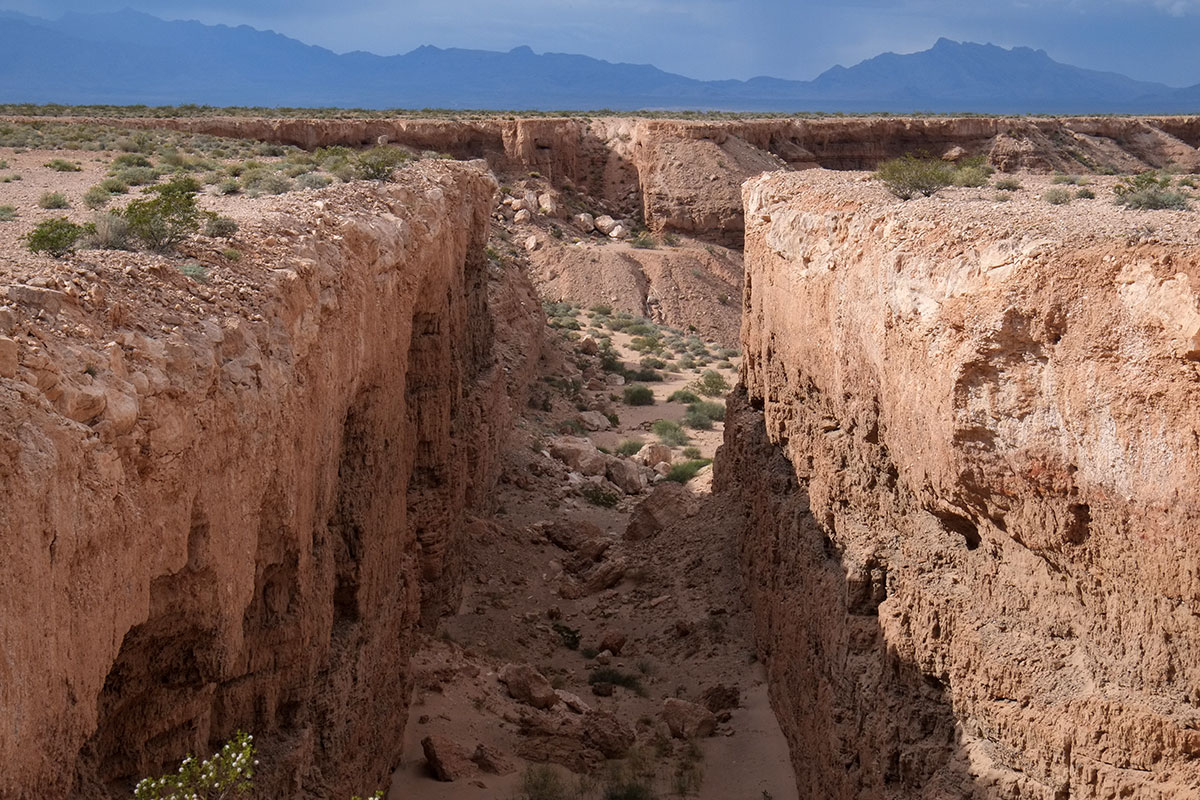
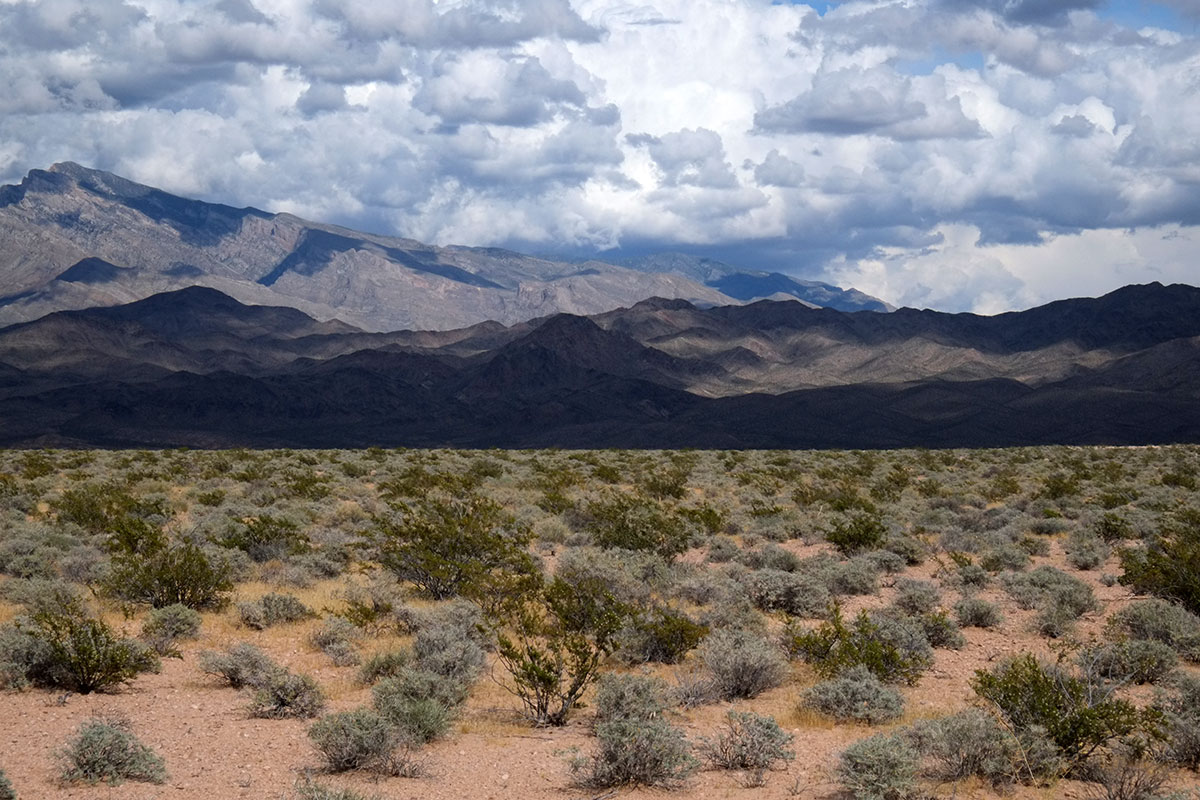
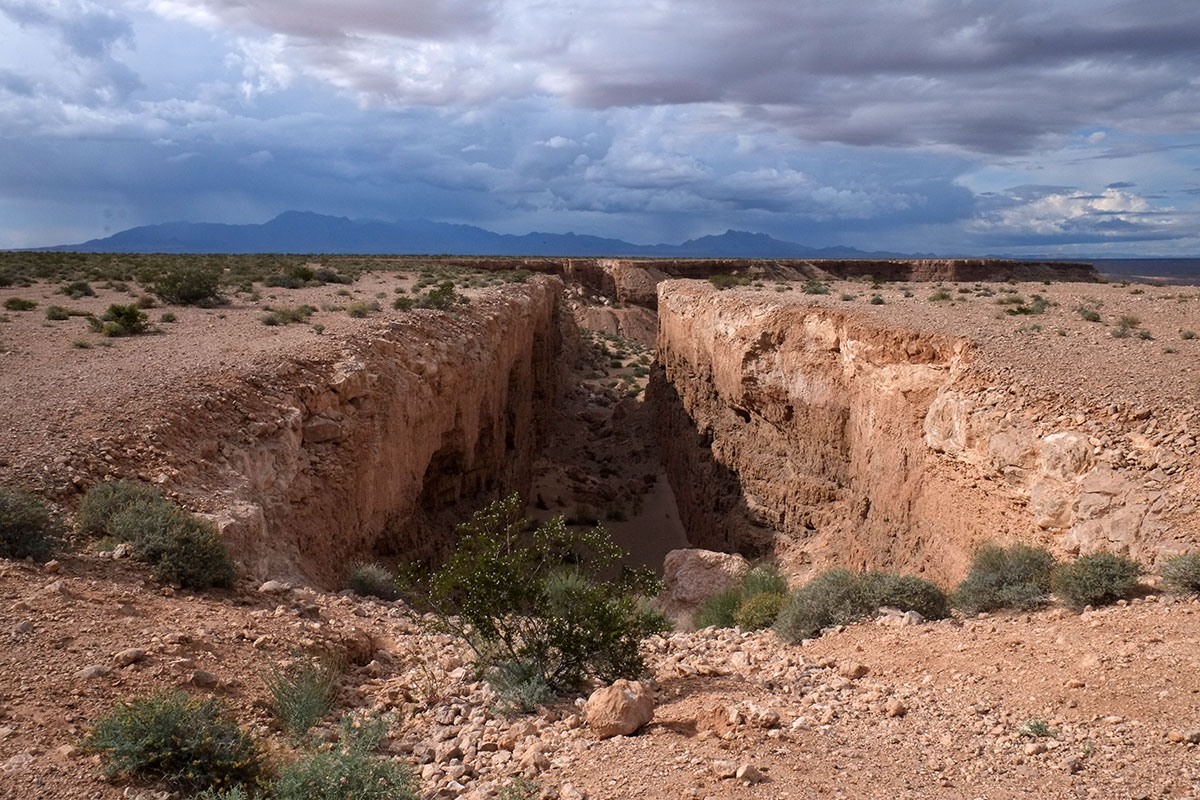
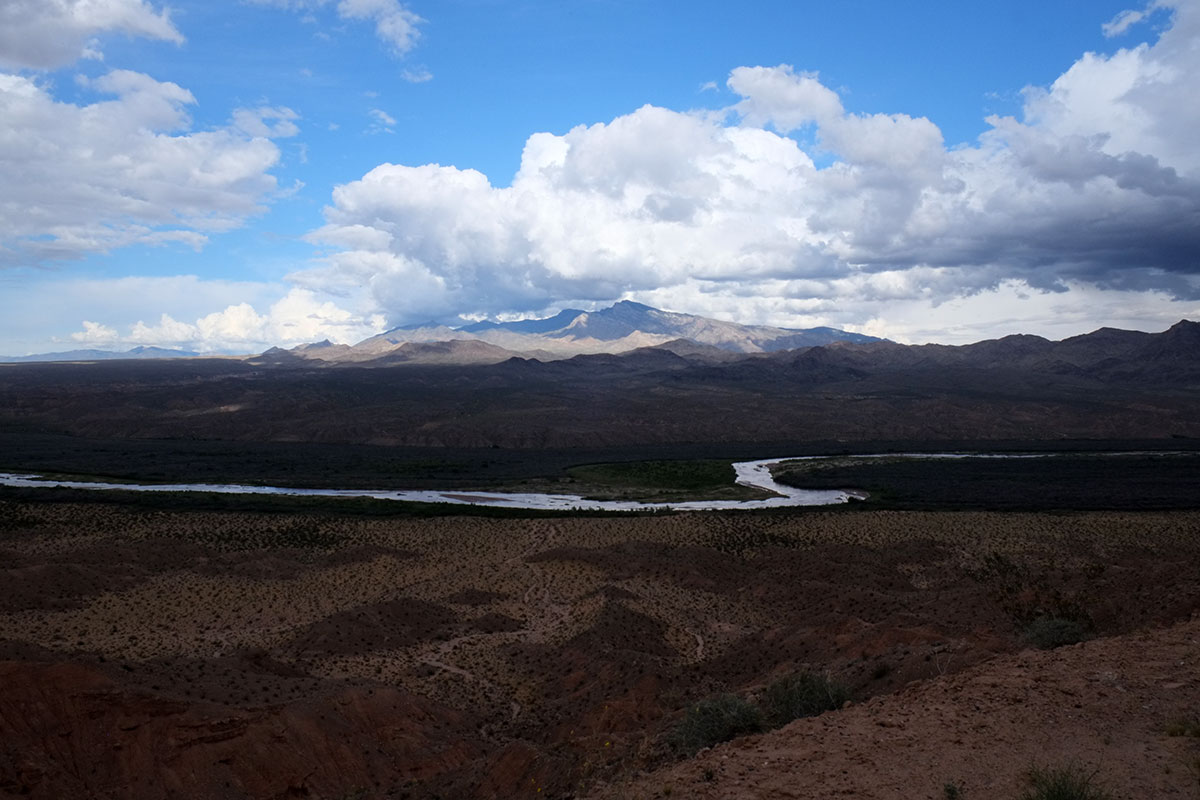
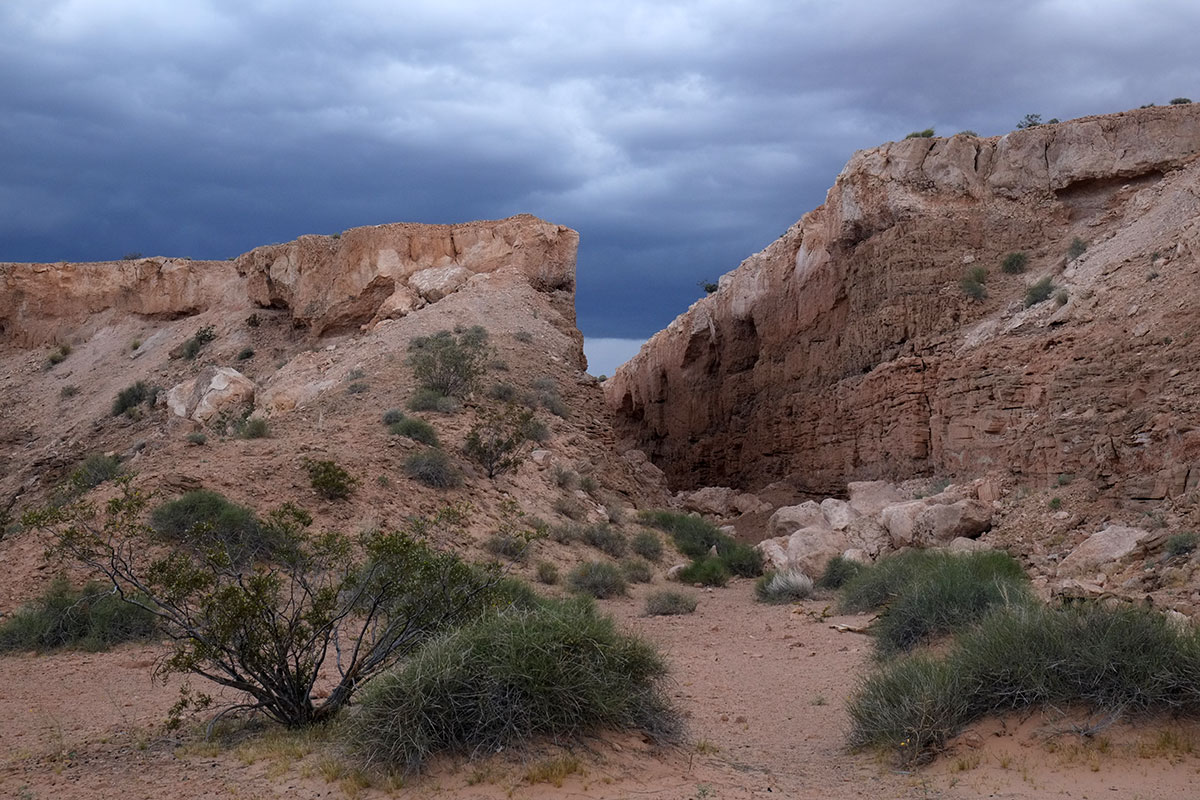
We hiked the last mile or two, looking across the mesa to the distant mountains. It was an incredible, big landscape, seen from a mesa in the middle of a basin that was about 40 miles across. To the east the mesa dropped abruptly down to the Virgin River (the same river which runs through Zion), and there are a few short canyons which cut west into the mesa from this edge. Double Negative is at the head of one of these canyons. It comprises two sloping trenches, running north-south, aligned across the head of the canyon.DSCF0528

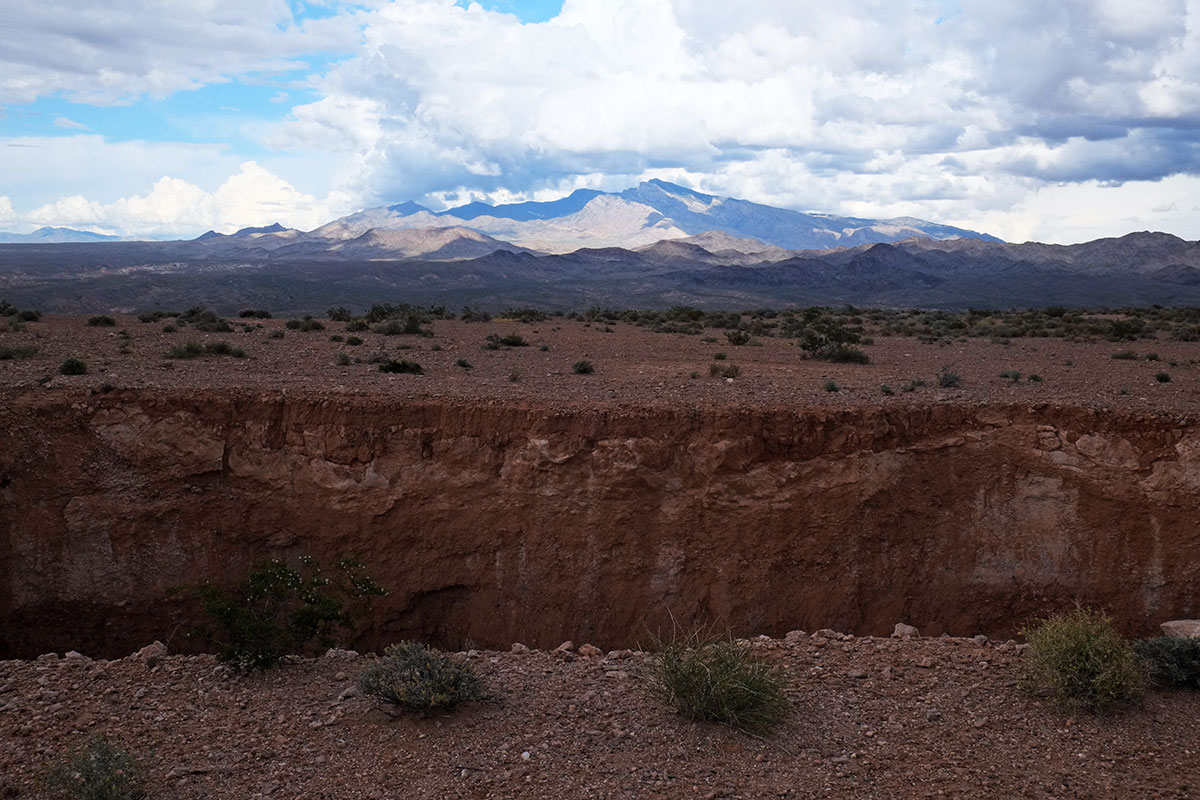
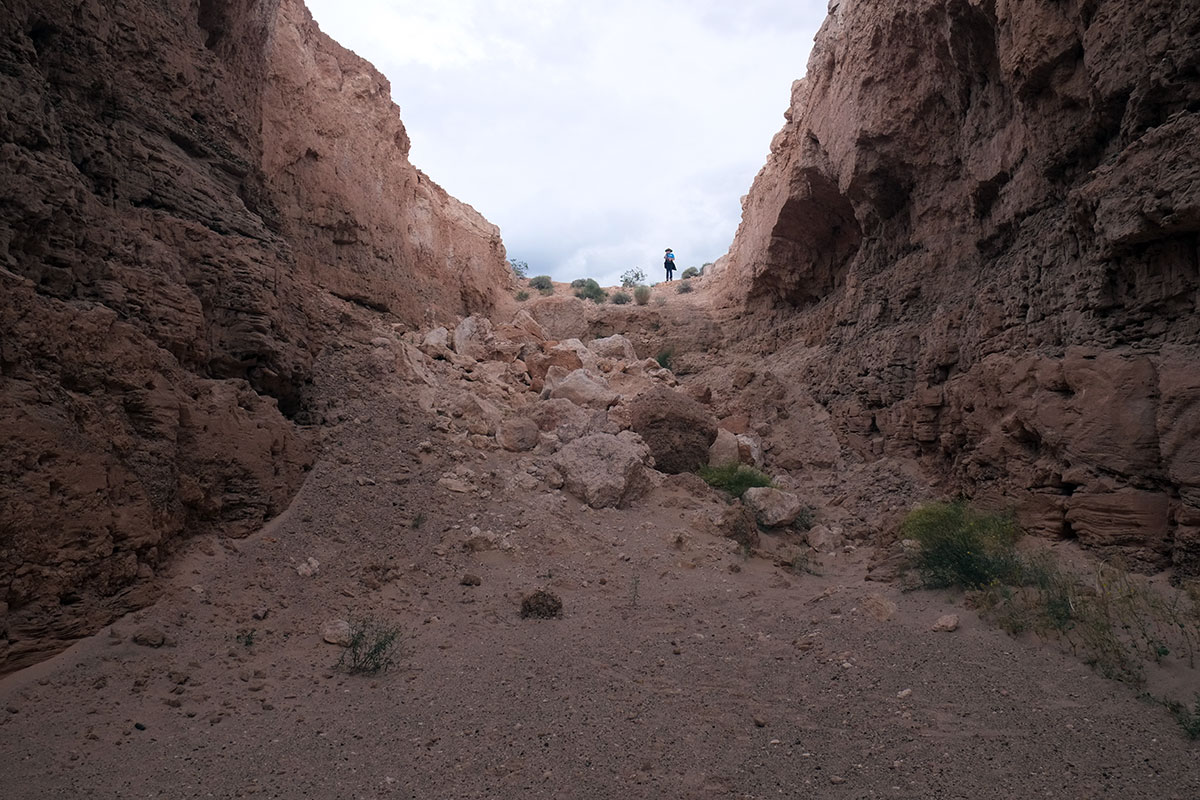
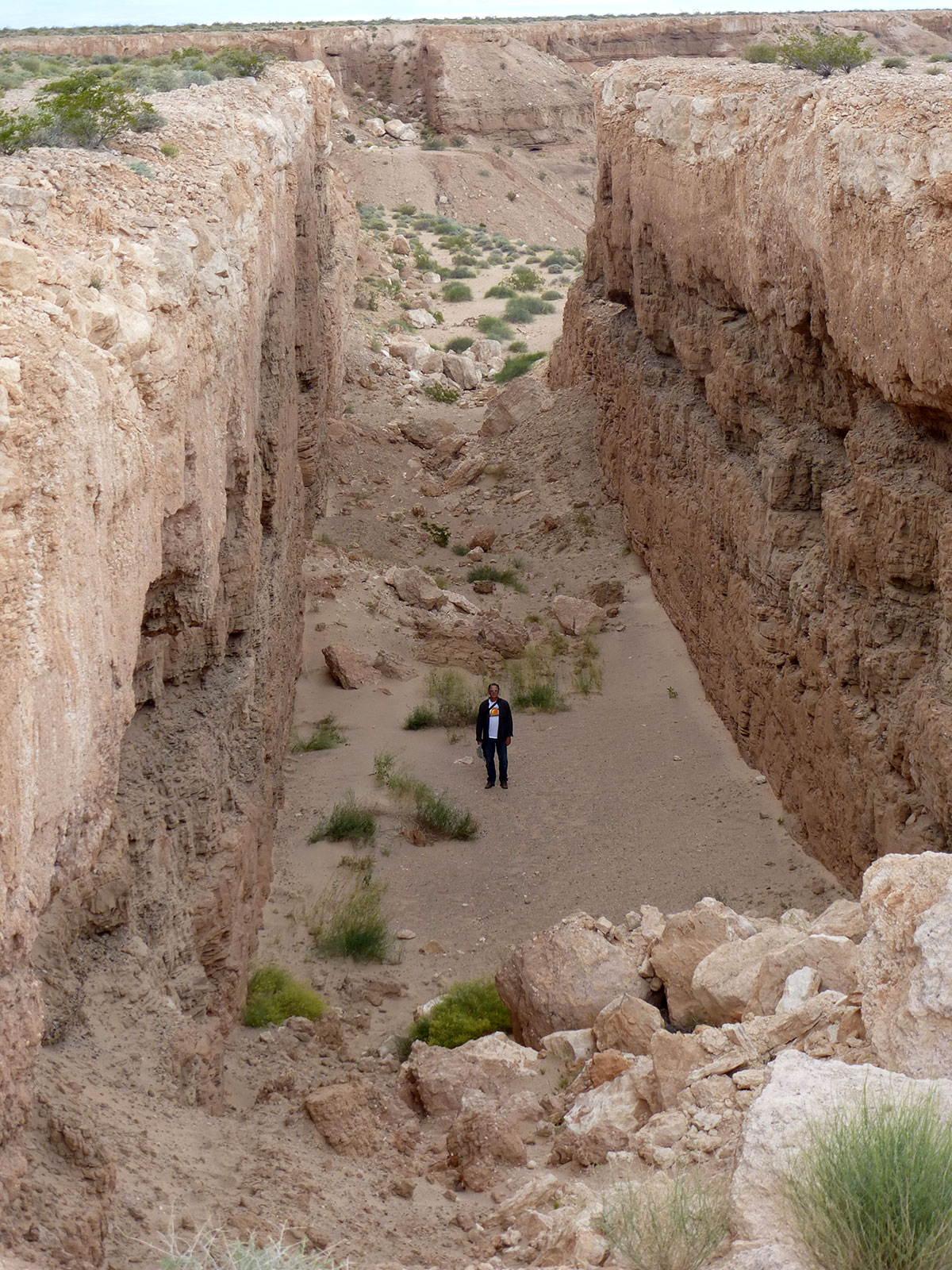
At the north and south ends, the trenches meet grade at the mesa top. The trenches slope down into the ground, until the side walls are 50-feet high. Walking along the side of a trench, you see it as a void, not perceiving just how deep it is. It could be relatively shallow, as here, or it could be a mile down, as at the Snake River Canyon – there is no way to tell until you walk right up to the edge.103. Double Negative051DSCF0543

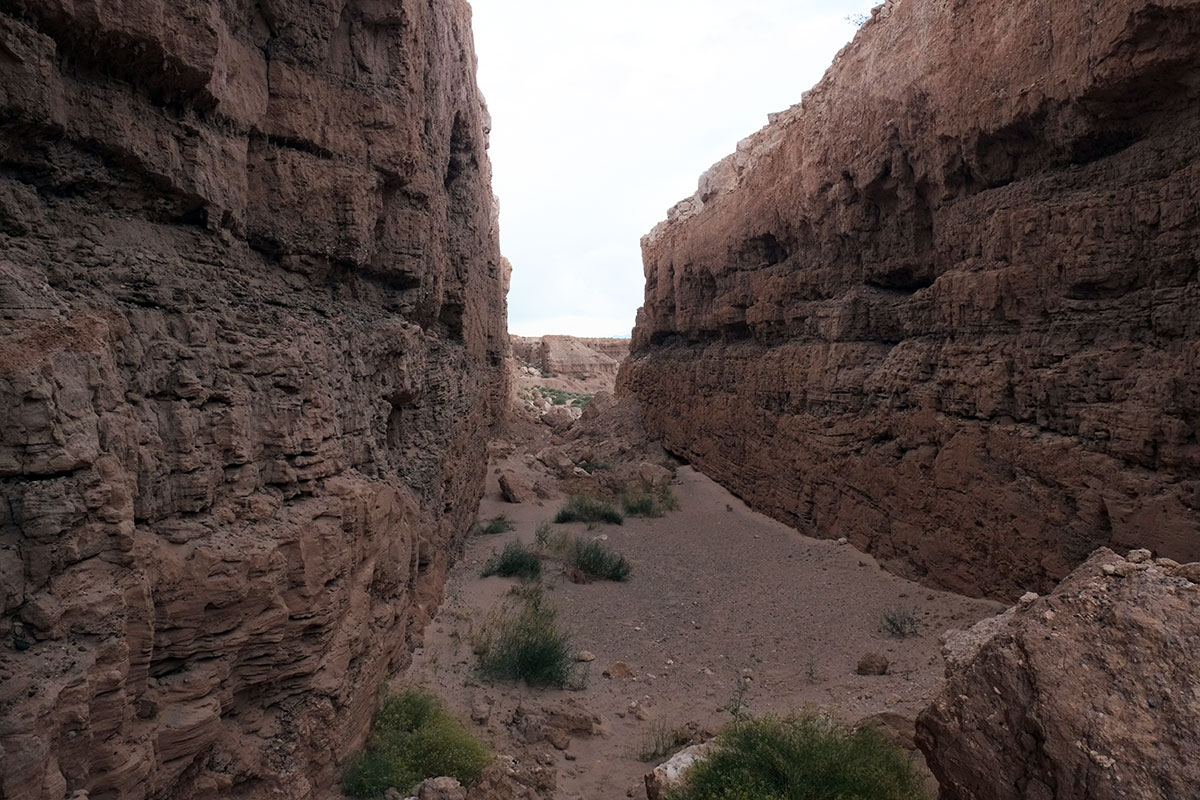
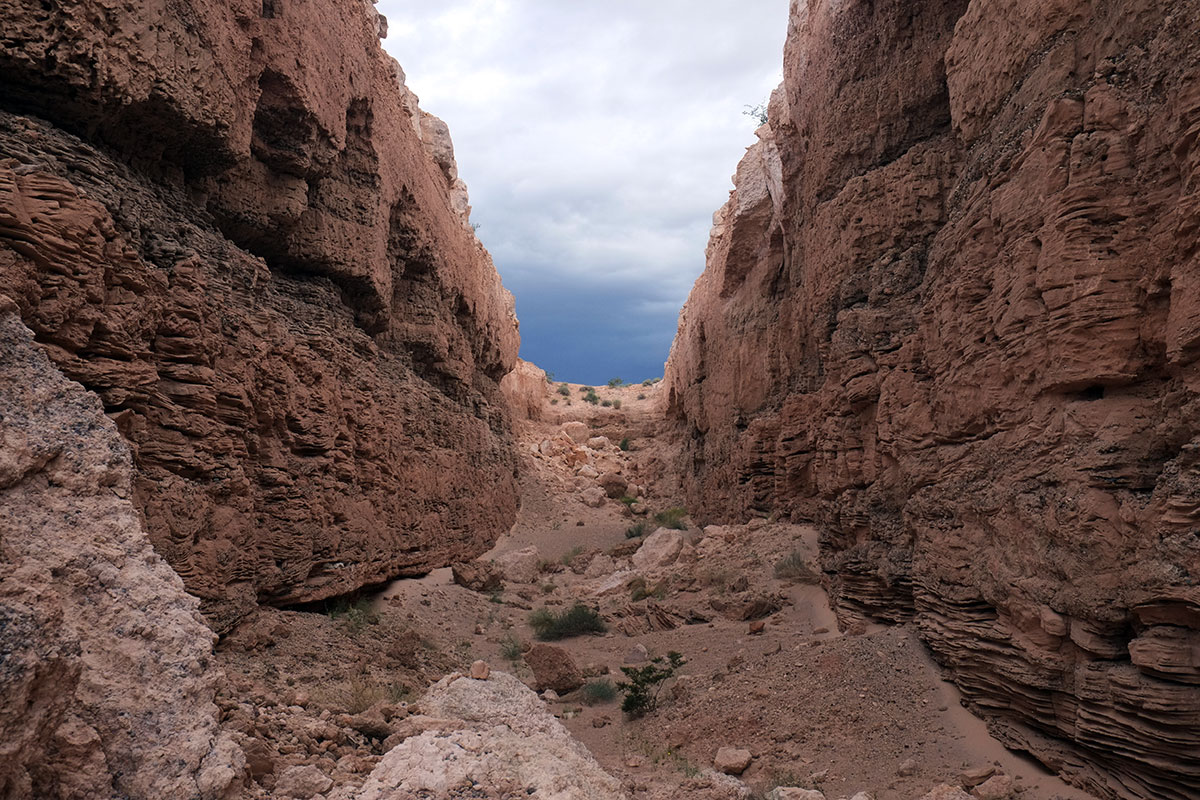
As you walk down the slope to the flat bottom, your view is narrowed to just the perspective at the end of the slot, where you look across a flat area where the floor of the canyon has climbed up to that level, and across that, to the mouth of the opposite trench. The feeling of descent was much like what we had experienced at other canyons – you start on the rim, in the wide open spaces of the desert, but as soon as you go down past the rim, everything changes. You are in a bounded space – sometimes a mile across, sometimes 30 feet, as here.DSCF0545

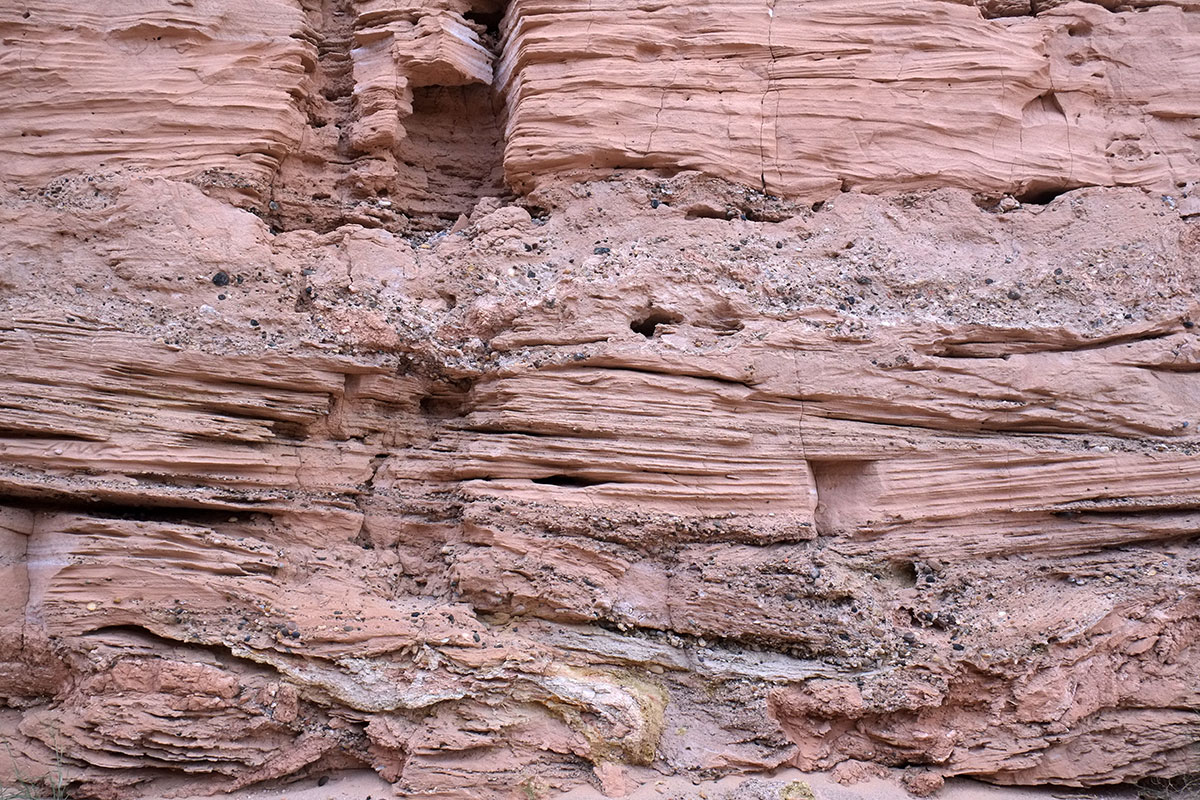
The walls looked much like those of other canyons, with strata of sandstone and other rock types (just a little more regular).DSCF0562

I looked back at Greta, who wasn’t that interested in climbing down, as she thought the trench looked like prime snake territory. Outlined against the sky, the amount of erosion and collapse that had happened in the past 45 years was apparent. This trench is an artificial construction (or destruction), but then the natural forces take over. Boulders that were embedded in the ground are loosened and fall. The crisp edges of the cut become more irregular.DSCF0547

It is a man-made canyon, distinguished from natural canyons by its geometry (the meaningful contrast discussed by Marc Treib in his “Traces upon the Land” essay) but as the piece ages, this contrast will become less and less clear. Perhaps thousands of years in the future, archaeologists will discover these two aligned trenches, realize that they had been intentionally created, and ponder what their purpose might have been.
You emerge from the trench, turn 90 degrees, and are confronted by this view. The little canyon being traversed aligns with a prominent bend in the Virgin River, and with the highest peak in the mountains to the east. It is clear that this axis was critical in setting the location of the piece (why this particular canyon?), and the piece frames and emphasizes the view along the axis in a way that is invisible from the top of the mesa – the piece essentially establishes the axis, selecting this one perspective from the infinite number available from the mesa top.DSCF0553

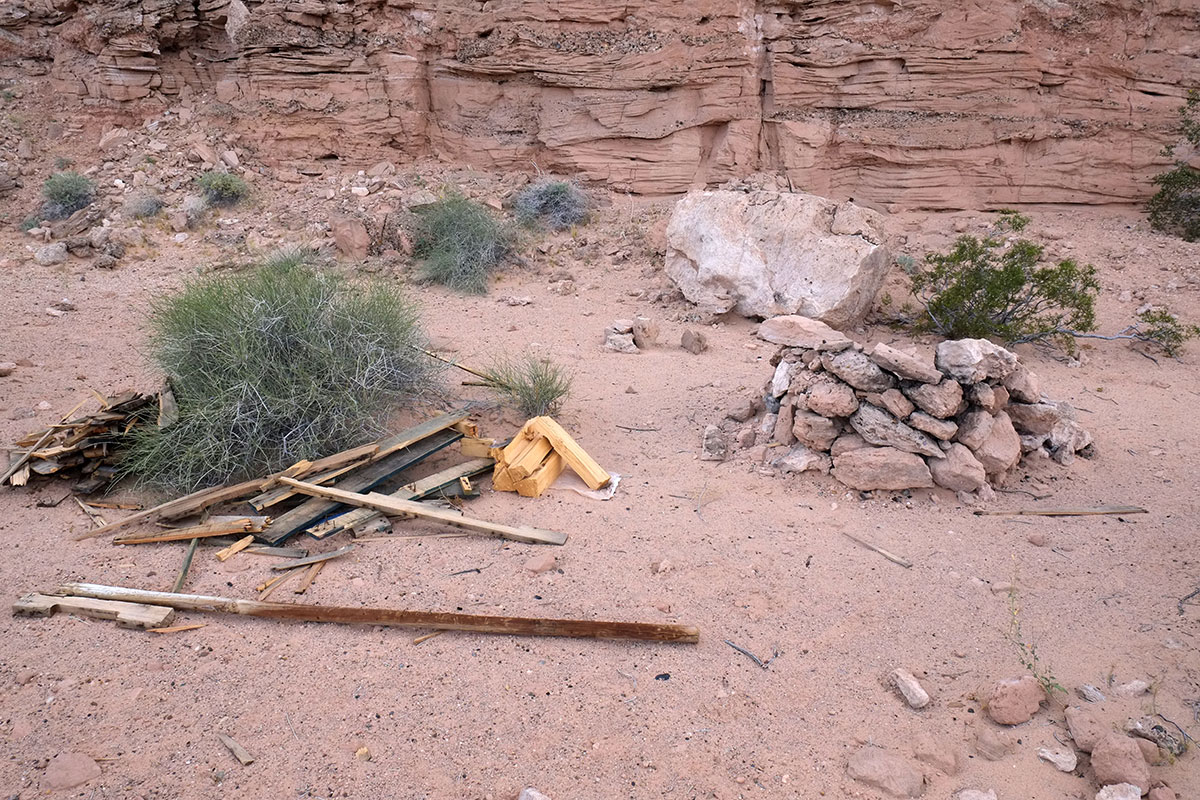
The space in the middle between the two trench openings is an important place, and it clearly has attracted prior visitors, building their ritual fires.DSCF0551

Turning back towards the trench, the opening presents a powerful image for something so small.DSCF0555

It reminded me of the Santa Elena Canyon opening out to the desert in Big Bend, but there the canyon walls are 1500 feet high – how can a 50-foot high opening have a similar effect?DSCF5833

It may be due to the scalelessness of the desert – with the lack of markers of humans or trees, it is the form and not the size that we focus upon. As soon as you insert a person, the illusion is revealed.P1090542
Heading back up the trench the experience was even more dramatic, as the view through the gap was filled with sky and not with ground.103. Double Negative053DSCF0563
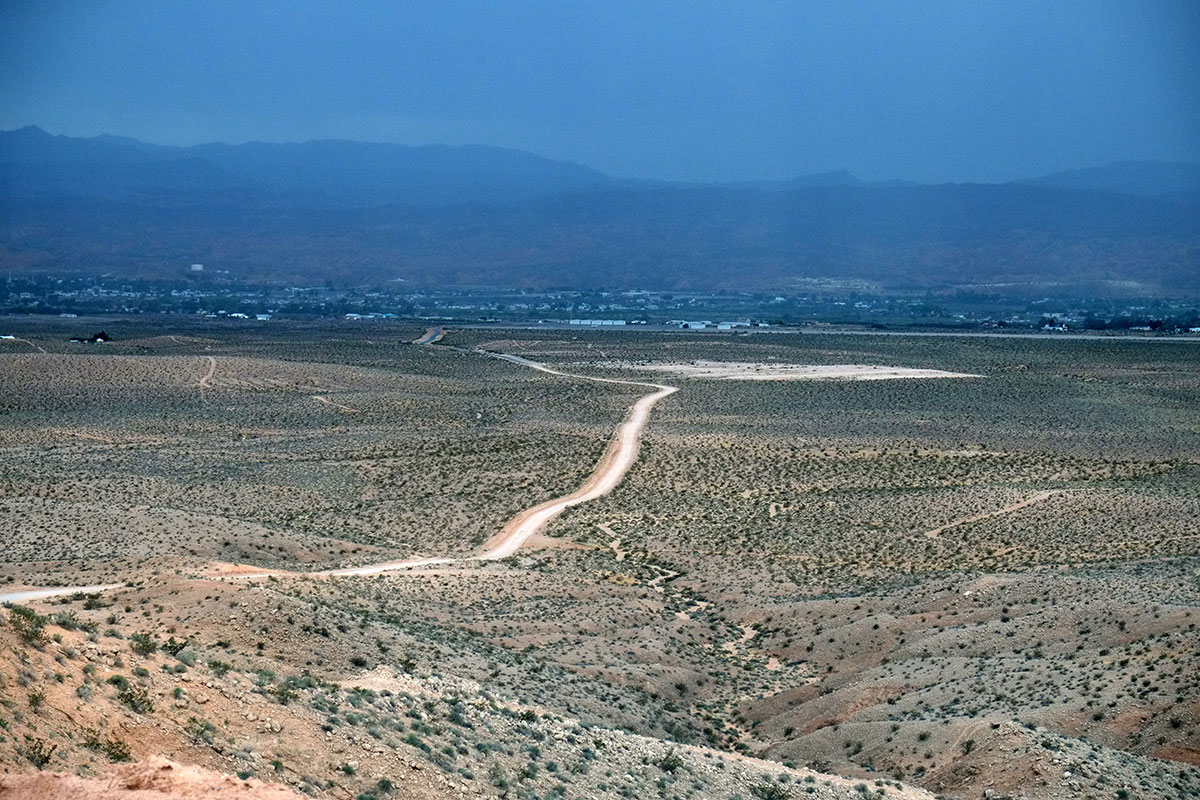
Back on the mesa top, the panoramic view reiterated the scale comparison. Double Negative is huge by the standards of art – 1500 feet long, 50 deep, 30 wide. But compared to anything else in this landscape, it is tiny. Trying to locate it in the aerial photos in Google Earth took a long time – two narrow shadows in alignment, in the middle of hundreds of square miles of desert.

Before we visited, I had appreciated the conceptual clarity of Double Negative. But like all good art, there was more to the piece than just the idea behind it. It is on the border between sculpture and landscape architecture, as the movement through it is essential to the experience. It engages and orders the larger landscape in a way I had never heard explained before. It engaged issues of scale and form, organic versus geometric, natural and built. At the time it was made, it pushed against the boundary of What Is Art – but that boundary has moved so far now that that the issue seems moot. The underlying ideas were strong, but the interaction of these ideas with the physical context was more powerful than I expected.

After this intellectual and aesthetic experience down in the trenches, I looked up to notice that the clouds that were looming earlier had gathered and headed our way, moving to the northeast against the wind. We hustled through this primal scene back to the truck, with lightning strikes getting closer and closer.DSCF0574

At the edge of the mesa we spotted our trailer out on the road,DSCF0579

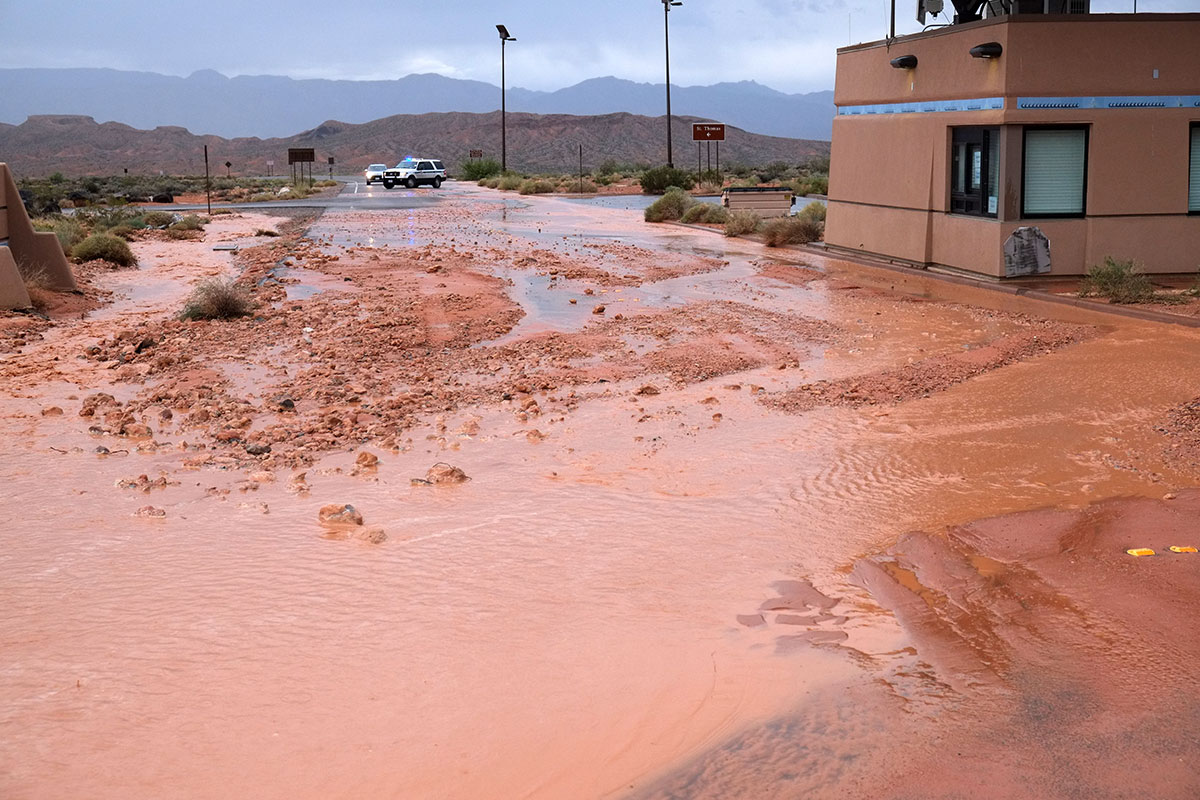
drove back down the dirt road and headed south, crossing flash floods from the storm along the way.DSCF0584

The next day we left our Lake Mead campground again, and drove out into the Mojave Desert, where we blew out a tire on the truck.

Cliff dwellings

Dwelling – home – place: the cliff dwellings of the ancient Southwestern peoples strongly evoke these associations in most contemporary observers. How is it that the ruins of a civilization from 700 years ago resonate so intensely with us now, when our lives and our world in no way resemble theirs? The initial hook for me at Chaco was the plan – how the architectural order visible in that plan was riveting. But cliff dwellings appeal to normal people – not just architects – and this appeal comes from the image, not from the plan.

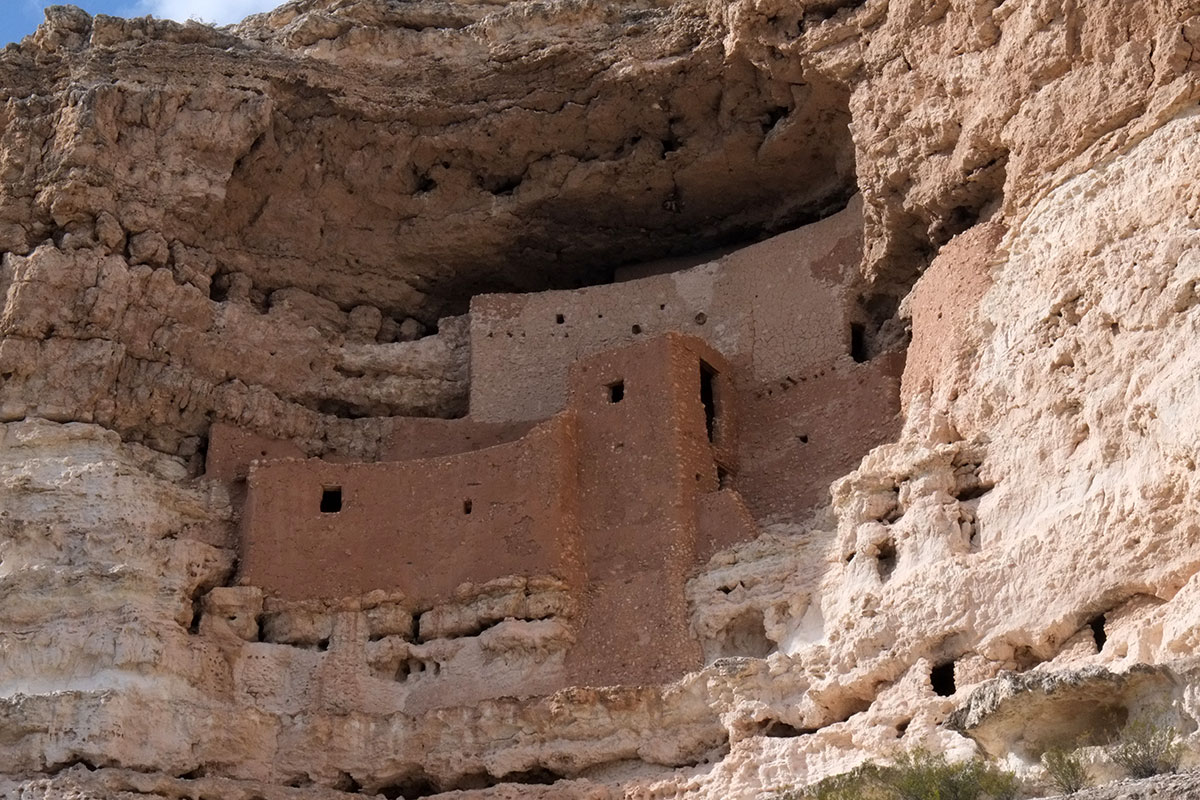
The first cliff dwelling I ever saw was Montezuma’s Castle (about an hour north of Phoenix), twenty years ago. It is the picture-perfect cliff dwelling, the small enclave for a few families, tucked into a small arch in a canyon wall. Different buildings have differently-colored masonry, so it is easy to imagine them as individual houses, rather than one large complex. Montezuma’s Castle is the dollhouse version of a cliff dwelling, the one a small child might draw.DSCF6944

The cliff dwelling itself is intriguing, and the surrounding environment is gorgeous. You are traveling in the high fringes of the Sonoran Desert, and you then descend into a narrow canyon of the Green River. The desert is replaced by an oasis – a lush riverbottom of grasslands and shrubs, with cottonwoods lining the river.IMG_6203

It is cool and green, sheltered from the sun and wind – it feels like a tended garden more than a natural environment. I think this is much of the appeal of cliff dwellings – humans belong here. While we may appreciate the stark beauty of the desert – mainly because we know we can escape it back to our civilized comforts at a moment’s notice – we know at a visceral level that it is not a place for us, that we couldn’t last a day there unsheltered. The desert inspires awe, a word which in its original usage was understood to include a dose of terror. The canyon evokes a sense of relief, shelter from the heat, a “place” in the trackless wastes of the desert, where humans can abide.

It is physical shelter due to the change in microclimate, but also psychic shelter due to the sense of enclosure. The horizon out on the desert can be a hundred miles away – here the canyon is just a few hundred yards wide, putting a boundary around the inhabitation that sets it off from the infinite spaces above.

You can also see the harmony between the natural world and the built world. The cliff dwelling is the accent which marks our fitting into this environment. JB Jackson defined landscape as the sum of the natural environment plus the built environment, and nowhere is this more archetypally visible than here. Humans haven’t dominated the place – they have recognized the qualities of the natural world which will nurture them, and have built a small dwelling which enhances their viability functionally. It has been done so perfectly that it is apparent to all on a deeply intuitive level. Tourists stand quietly, marveling at the ruins above them.DSCF6946

We returned there one winter when Greta was three years old, and she was fascinated by it, wandering along the river path and gazing up at the ruin. This year, as we approached Montezuma’s Castle again, I asked Greta whether she remembered it. She said she did, vaguely. But as we entered the canyon, specific spots triggered strong memories for her. The path paralleling the river by the cottonwoods, the opening in the woods approaching the cliff, the view of the houses themselves – they all came back to her as they appeared. This place had been so different from anything she’d seen in her short life that these vivid impressions had been filed away, ready to emerge when seen again. A little, primal human responding to the primal, archetypal elements

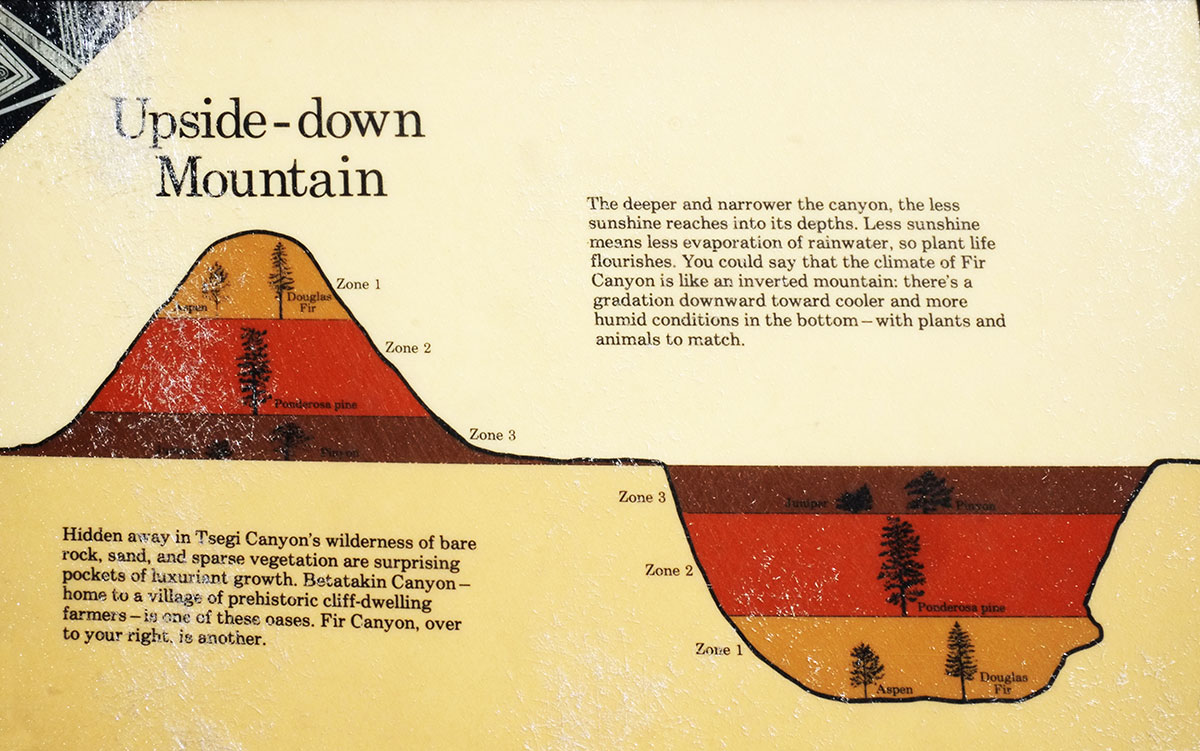
At Navajo National Monument we saw the remains of Betatakin from across the canyon. We weren’t allowed to enter the canyon, but even looking at it from above, the importance of the canyon microclimate was apparent.DSCF8099

As usual, the Park Service had an excellent sign explaining this – showing how the climate zones in a canyon were inverted from those seen on a mountainside, with the cooler weather, alpine vegetation at the bottom.DSCF8087Navajo-NM001

The village itself was tiny, tucked beneath the large arch across the canyon, exposed to the warming spring sun.DSCF8097

I started to wonder why we call these places cliff dwellings – canyon dwellings might be more accurate. They were never located on mountain cliffs looking across the desert, always in canyon walls.

The cliff-dwelling civilization followed the era that was centered at Chaco Canyon. A variety of reasons have been proposed for the change – the climate becoming more severe, with persistent drought requiring dispersal to locations with more reliable water supplies; attacks from other tribes leading to building more defensible villages; a breakdown in the social order, etc. No one knows the main reason, and some archaeologists think it is most likely a combination of many of these reasons.

The primacy of the canyon location became even more clear at Tsegi (Canyon de Chelly), where the Antelope House is located at the foot of a cliff, but on the canyon floor, not in a recess. We wondered about its risk of being flooded, but if the buildings have been there for hundreds of years, they must have called that one right.95. Tsegi176DSCF8691

Just as no one has the definitive reason as to why people left Chaco-era settlements, no one knows exactly why these villages were built in canyon cliffs. They have many advantages – shelter from the high summer sun while being exposed to the warming winter sun, easily defensible from attackers, always located with a good water source, where groundwater seeped out from cracks in the cliffs, overlooking a canyon bottom where crops could be grown, or slightly below the canyon rim, giving access to farmland above. Again, probably a combination of these reasons.

Access was Important – often from below as here at Mummy Cave at Tsegi. The “tower” form is apparent, although it is not known whether the tower function was critical, or whether it was just a vertical stack of rooms.DSCF8706MummyCave004

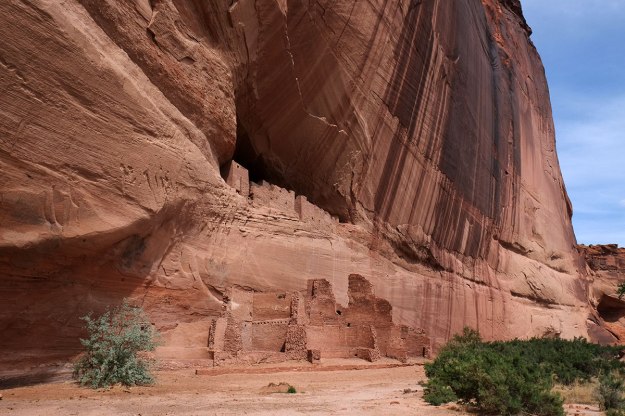
White Cliff House at Tsegi shows both ways the village on the canyon floor could be built – either in a arch above, or directly on the floor. There are a lot of these bottom-access villages at Tsegi – perhaps that meant that the canyon as a whole was defensible, and they didn’t have to rely on the inaccessibility of individual clusters.95. Tsegi185DSCF8814

(Tsegi was one of the most extraordinary places we visited – for many reasons beyond the cliff dwellings – so I will put up a post just about it.)

There are no cliff dwellings at the Grand Canyon – perhaps because it was just too big and deep to furnish the necessary microclimate that came with a smaller canyon. But there were ancient people there, dwelling in pit houses near the top of the rim. The Tusayan Museum has artifacts from this era thousands of years ago, including fetish animals made from reeds and willow twigs. They were simple and powerful, and again we northwesterners were astonished to see unrotted plant material that old.DSCF8611

We finally arrived at Mesa Verde, which was the center of the post-Chaco civilization. I knew some vague things about Mesa Verde before visiting, but I was unprepared for its extent. Within the Park boundaries, there are 4500 archaeological sites – cliff dwellings, pit-house villages, farms, and great houses which resemble those left behind at Chaco. It is only 100 miles from Chaco, but it is located in a very different environment, a series of branching canyons on a ridge of the Rocky Mountains, versus the desert plain at Chaco.

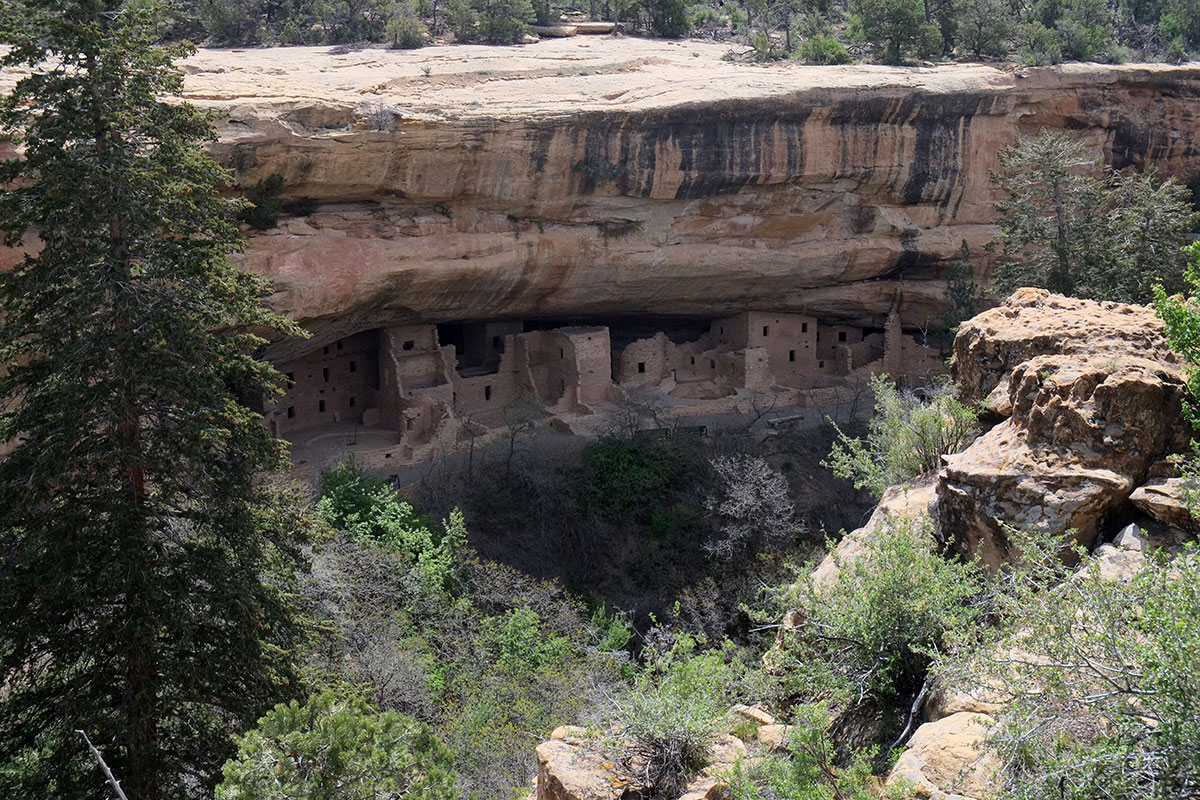
The most-visited ruin is Spruce Tree House, misnamed after the large trees which grew in front of and sheltered it, which were actually Douglas Firs (obvious to northwesterners). The pit house settlements at Mesa Verde were on the canyon rim, and the cliff villages are right below the rim, and accessed from above. Normally one can hike through this village, but a large piece of stone detached from the arch a little while ago, and so we couldn’t go in.DSCF0353SpruceTree002

The Square Tower House.102. Mesa Verde047DSCF0457

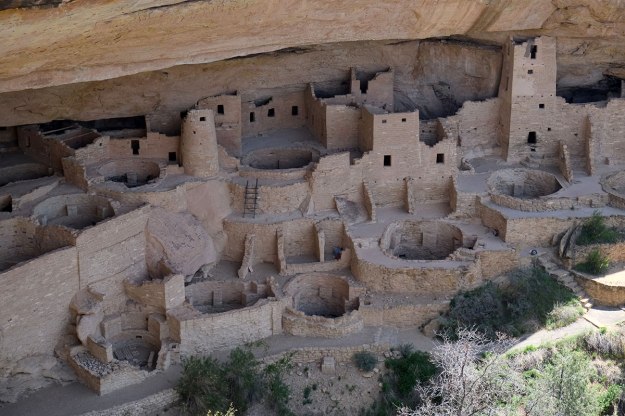
The nearby Cliff Place is the largest of the villages. You can see the pattern of plazas and paths, square rooms (probably private or used for storage, as at Chaco), and the round rooms, which are now thought to be shared, living and working rooms, rather than just used as ceremonial kivas. There are square and round towers.102. Mesa Verde044DSCF0371

102. Mesa Verde043DSCF0360

The most surprising experience was coming to this viewpoint and realizing how many cliff dwellings could be seen from one point – I have put yellow circles below the clusters, both above and below the rim.DSCF0462FireNew002m

This area comprises the Fire House and New Fire House to the left, with several other village in sight on the far canyon wall. Some of these are accessed from the rim, but the ones to the left also connect to the canyon floor, where it climbs higher.

Montezuma’s Castle is a relatively isolated village – certainly in communication with other villages, but alone in its own canyon. Mesa Verde is clearly an organized metropolitan area, with a system of villages and dwellings located at appropriate sites, all within close proximity. The Sun Temple is marked by the yellow dot just below the rim – it is a Chaco-style great house, and probably served as the center for all the villages in the area.

I began to wonder if the transition from Chaco to Mesa Verde might reflect some of the same processes that were seen in Europe in the Dark Ages. Did the environmental, social and political forces at the time make large, centralized settlements unsustainable, and so a smaller, decentralized village-based system sprang up? Or, closer to home, as some archaeologists have speculated that Chaco was the ancient version of Las Vegas, I wondered if Mesa Verde represents ancient sprawl?

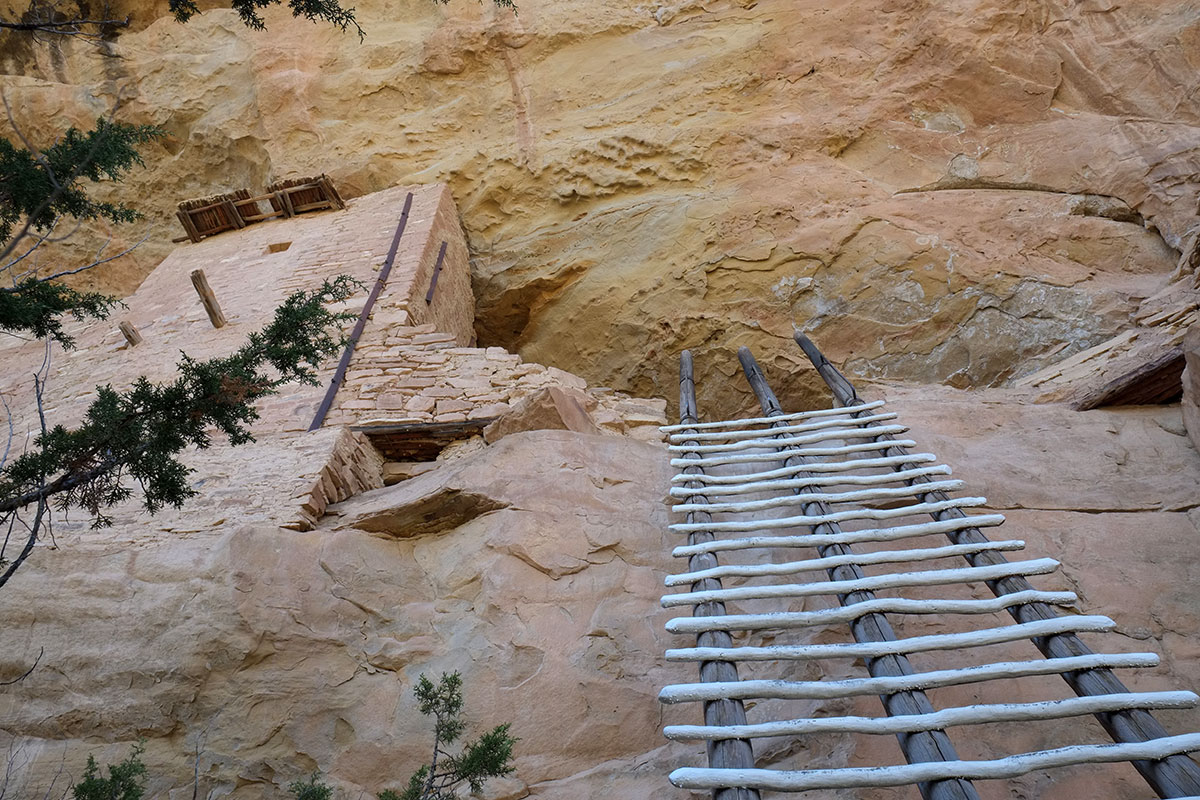
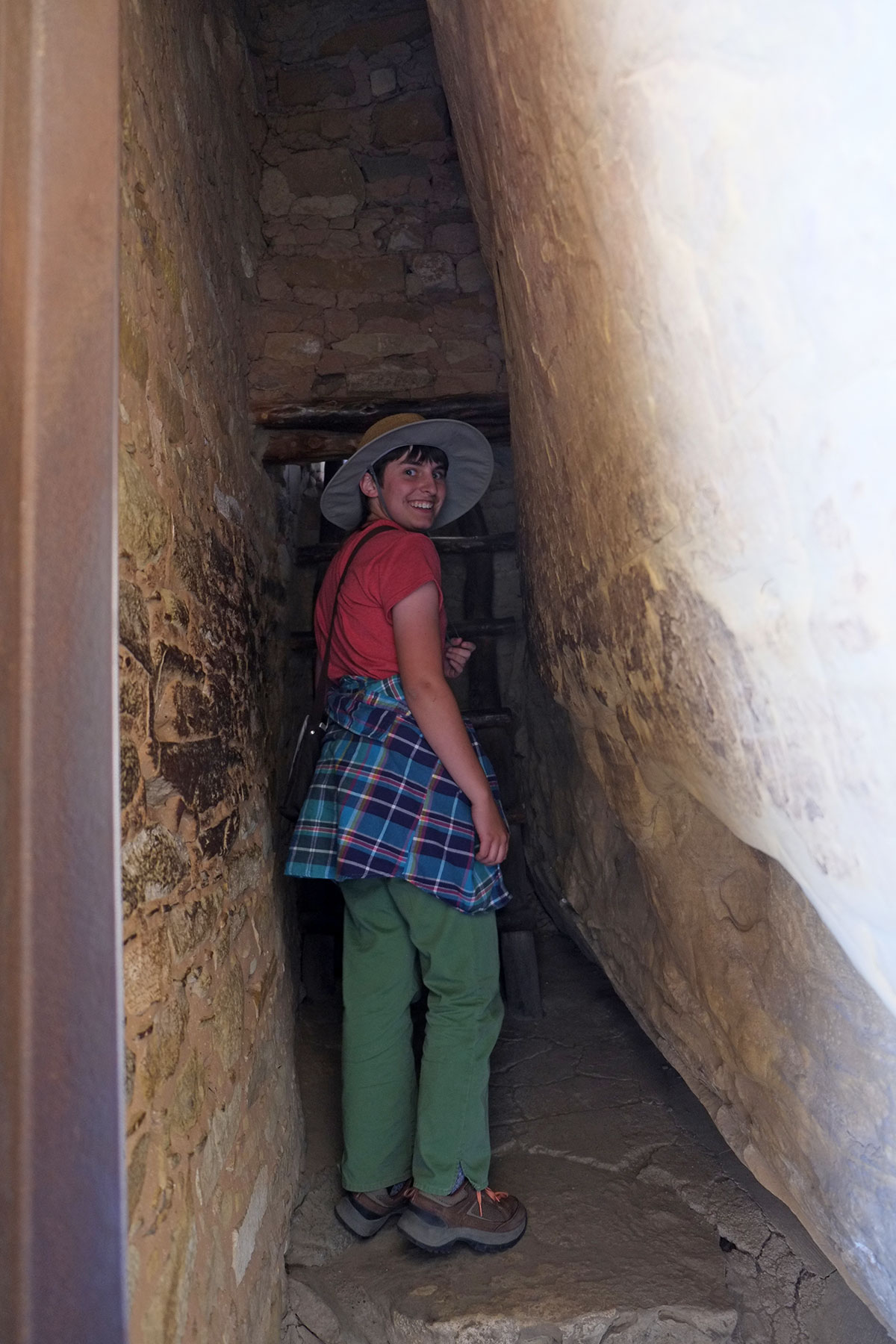
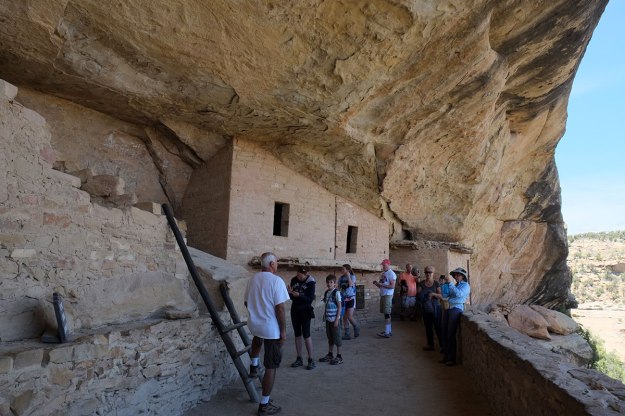
The most amazing thing at Mesa Verde is the chance to actually climb through a cliff dwelling. Unfortunately, three of the accessible villages only open after Memorial Day, but we were able to visit the Balcony House. We were part of a large group of tourists led by a ranger. When you buy your tickets, they are very explicit about the obstacles that you will encounter – after walking down metal stairs attached to the canyon wall for five stories, you hike along a path and approach a 32-foot tall ladder up to the village (marked in yellow on the right side of the photo below). When exiting the village, you have to climb through a 12-foot long tunnel/chamber, which at its tightest point is 18 inches wide and 27 inches high. Then you climb another ladder, up to footholds cut into the cliff, with a chain to hold onto and a steel fence to keep you from falling to your death (marked in yellow on the left side of the photo below). Given my claustrophobia and Greta’s fear of heights we carefully considered it, and decided we just couldn’t pass it up. When we joined out group, we thought that if we were worried, these people should have thought about it a lot more -there were quite a few typical American tourists, overweight and out of shape and very casually dressed (rock climbing in sandals?), and we wondered if some of them would actually be able to fit through the tunnel.DSCF0449BalconyHouse074p

This is the first ladder, leading to the village:DSCF0385BalconyHouse012

We got past that fine, surrounded by people who were determinedly not looking down. Next was the narrow, defensible entryway.DSCF0387BalconyHouse014

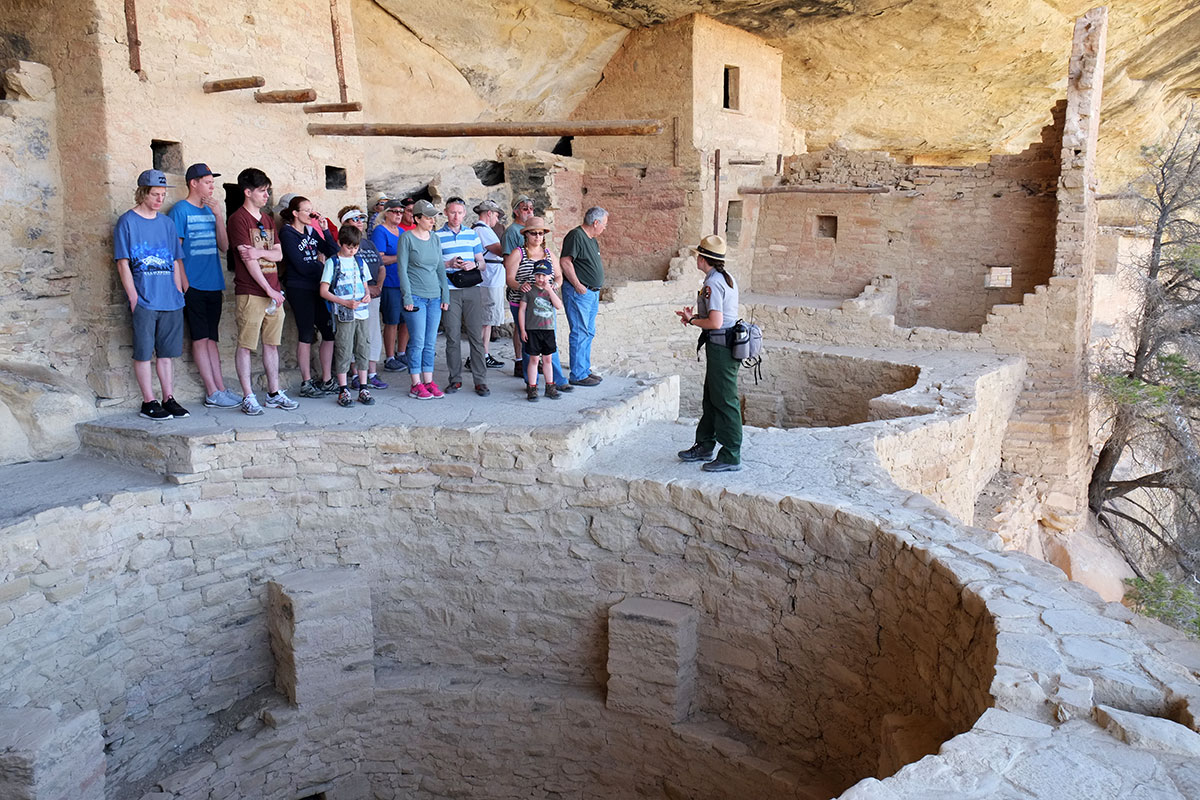
Which led to the first of two plazas – surrounded by buildings under the overhang on three sides, and open to the canyon to the east.102. Mesa Verde045DSCF0397

DSCF0393BalconyHouse020

It was incredible to be standing there, knowing that 1000 years ago the residents had been right there, going about their business of grinding meal, cleaning animal carcasses, living normal lives. In the second courtyard, there is a large beam cantilevered out from a building – it is thought that this was used for hanging carcasses to dry, away from vermin (and res dogs).DSCF0429BalconyHouse056

The group is standing beside one of the round rooms in the plaza – entered from above, probably better heated due to its shape and location, and perhaps used for daily activities.DSCF0399BalconyHouse026

The view from the second plaza – across Soda Canyon. We don’t know if the Ancestral Puebloans appreciated views, but the modern Americans certainly did. Beyond the beauty, this picture points out another of the reasons we find cliff dwellings so meaningful – refuge and prospect. These factors probably come from a time in our evolution when they were critical to our survival – the knowledge that you were in a safe, protected spot, and able to see things coming from a ways off – either things you might eat, or things that might attack you. We may not have quite the same primal requirement for these conditions, but modern humans tend to really like places with these qualities. We wondered whether the Park Service might initiate some Air Bnb opportunities in their cliff dwellings.DSCF0412BalconyHouse039

The way out: it wasn’t a tunnel so much as a small chamber, with narrow deep doorways at each end. Here is 100-pound Greta squeezing through, and when I followed her I had to twist my torso to fit my shoulders through. We had made sure we were near the front of the line, as I had no desire to be in the middle when some large people got stuck ahead and behind me. Everyone made it through, but it was quite a while before some of them emerged.DSCF0440BalconyHouse066

This is looking down at the final ladder and the hewn footholds in the cliff. This was the most terrifying part for many people, and the camaraderie exhibited, as people in distress were exhorted and cheered on, was very commendable. We didn’t leave anyone behind.DSCF0445BalconyHouse071

The Southwest had many highlights for us – the landscapes and National Parks, the ancient ruins, some of the towns, the pueblos – and one of the best parts has been acquiring a rudimentary understanding on how all of this fits together. It is wholly different from where we have ever lived – climatically, culturally, historically – and by seeing these cliff dwellings within their environmental and historical context, it all started to make sense. 20 years ago I had visited the Hopi reservation, seeing villages that were, unimaginably, 700 years old. But now, seeing how humans have lived here through different eras even further in the past, the more recent settlements and cultures make more sense. There is an astounding, unbroken chain of people moving from somewhere else to construct the Chaco culture, then on to the cliff dwelling era, and then on to the pueblos, which remain into our time.

More Pueblos

DSCF0290The Hopi Pueblo is extremely isolated – in the middle of the Navajo reservation in northeast Arizona – but most of the other pueblo villages are more accessible, clustered near the Rio Grande valley in northeastern New Mexico. Since this area also contains the population center of New Mexico – from Albuquerque through Santa Fe to Taos – these pueblos attract many more tourists, and they have clearly learned how to manage this tourist influx to their benefit – providing income for the tribe, while minimizing the intrusion upon their way of life.

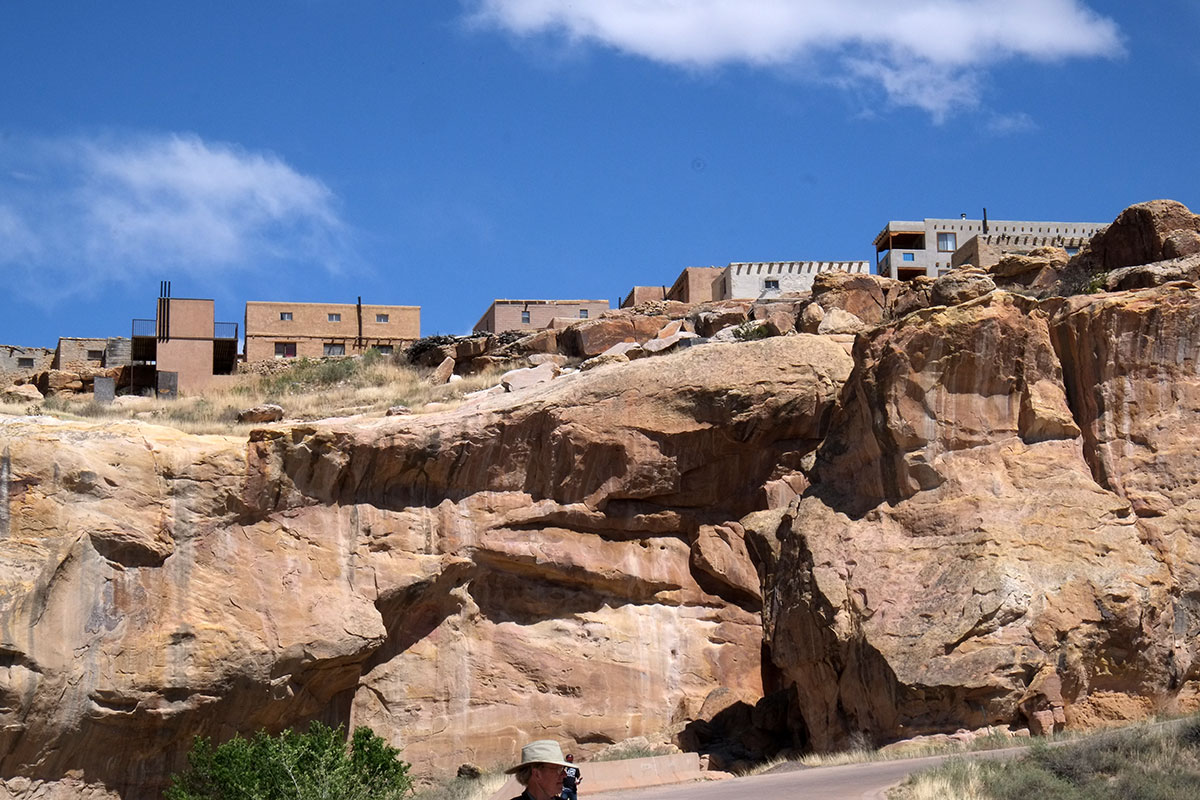
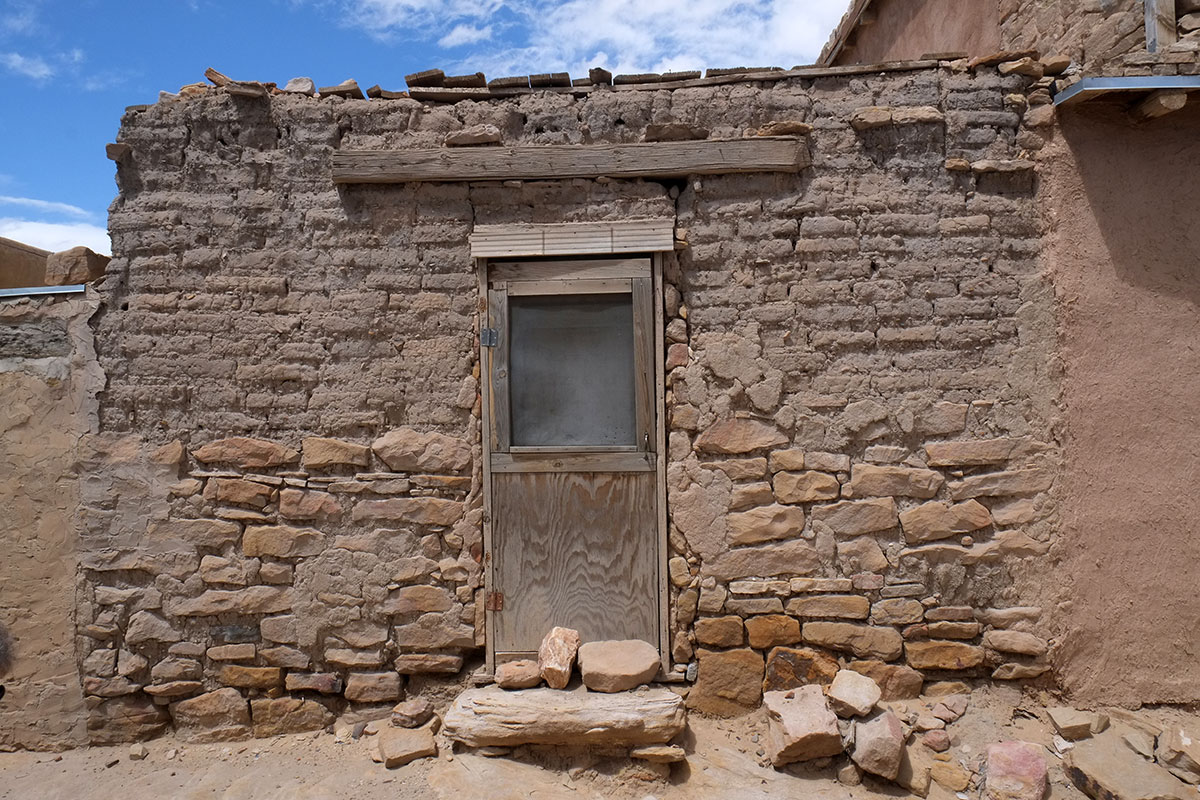
Acoma Pueblo is about 60 miles west of Albuquerque, and their village on top of a mesa, “Sky City” (they clearly hired a branding consultant before the other pueblos) has many similarities to the Hopi mesa villages – masonry and adobe houses tightly clustered around plazas, with a very defensible location hundreds of feet above the valley floor. There has been this ongoing dispute between Acoma and Walpi, as to which is the oldest existing settlement in the US, or the oldest continuously-inhabited, etc. The different clans own the houses in Acoma, just as in Walpi, but Acoma seems to have a more organized approach to actually living there. All the members of the tribe have more modern houses in the valley, but they sign up to be in residence on the mesa top for a year or so, living without running water or modern utilities.

98.Acoma018DSCF9655

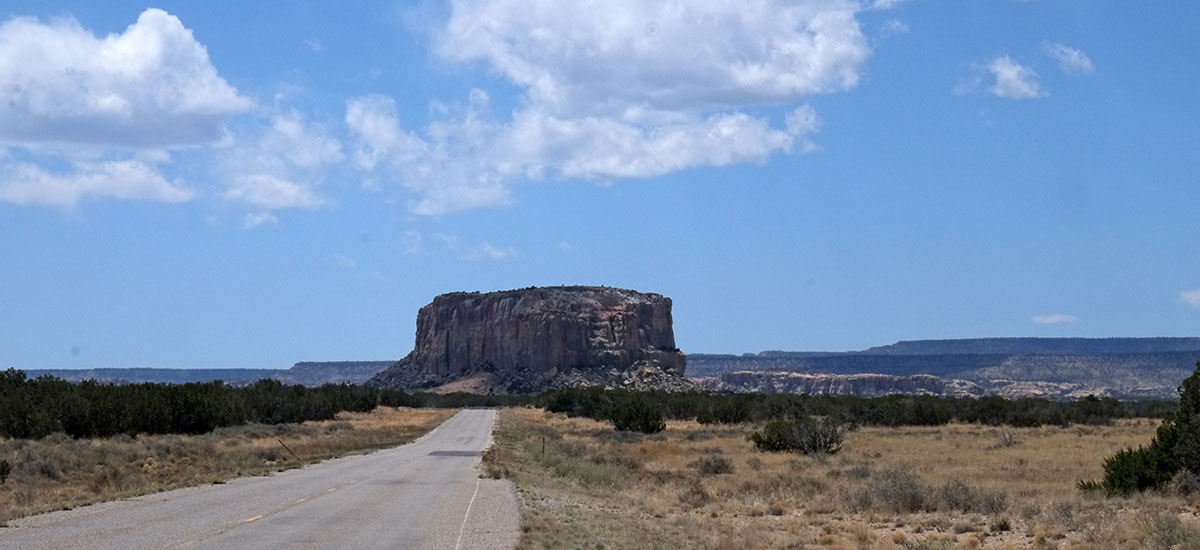
As you enter the Acoma reservation, you first spot this mesa ahead, a striking and isolated element in the horizontal landscape. We were told that the Acoma people first considered this as the site for their village, but that two people were struck by lightning after climbing the mesa, and this was not taken as a good sign.DSCF9488

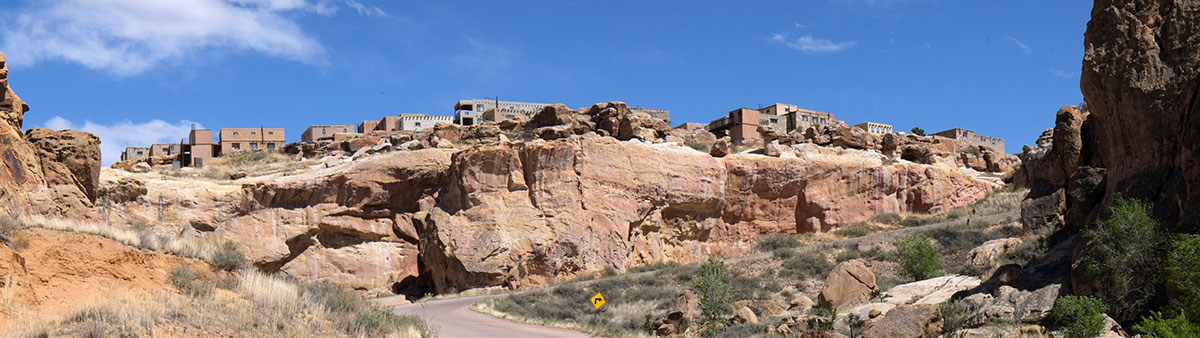
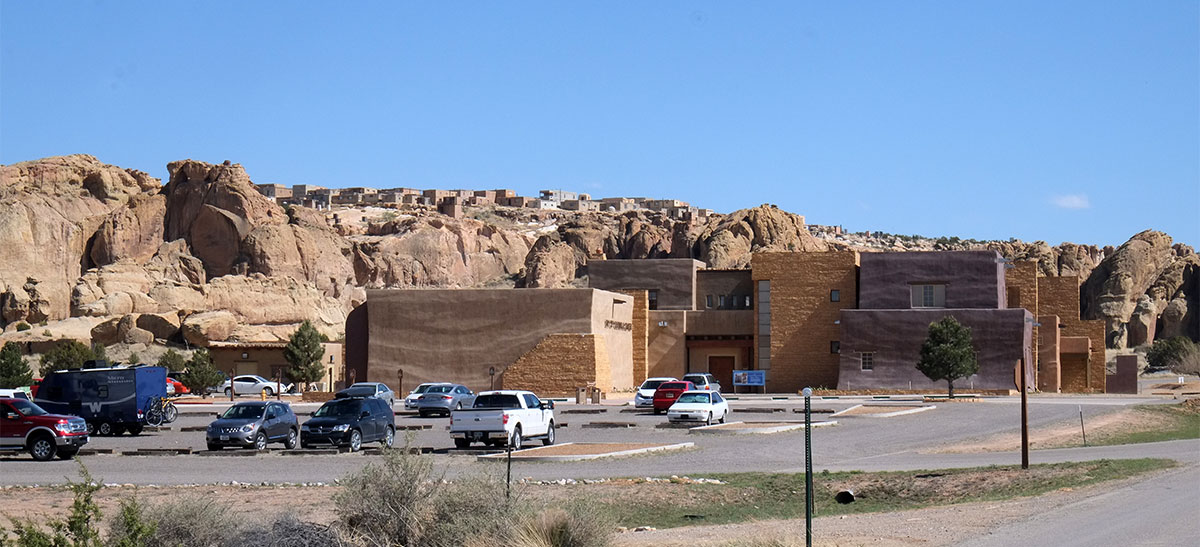
To visit Acoma you head to the Sky City Cultural Center, a new building at the foot of the mesa, which has a museum, meeting center, café and gift shop. The architecture is based upon the traditional Puebloan forms, with a series of boxy volumes that contrast in size and color. It is at a much bigger scale than the adobe buildings, and reminded me of some of the recent National Park buildings which work in the local vernacular, in a much more thoughtful way than you see in commercial buildings ineptly imitating the style.DSCF9672

You must visit the village as part of a tour group, and take a bus ride up the road to the top.98.Acoma019DSCF9652

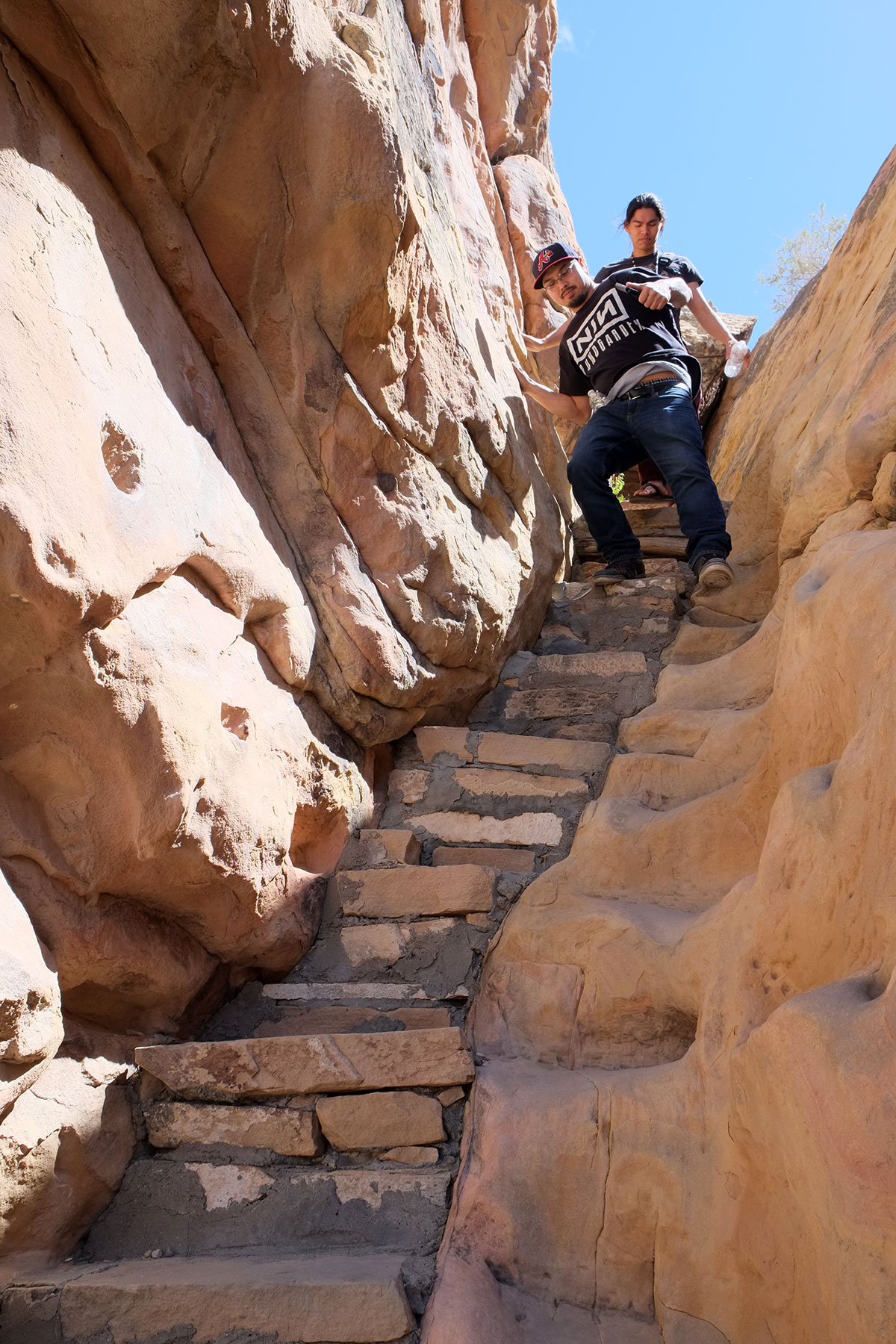
However, visitors are allowed to walk back down the ancient pathway at the end of the tour if they wish. It is easy to see how defensible this route is, and also how tiresome it would be to carry everything up.98.Acoma020DSCF9643

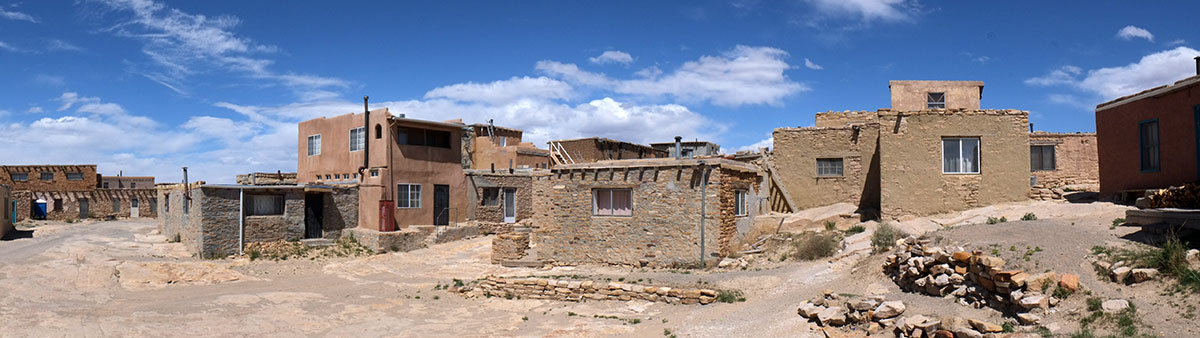
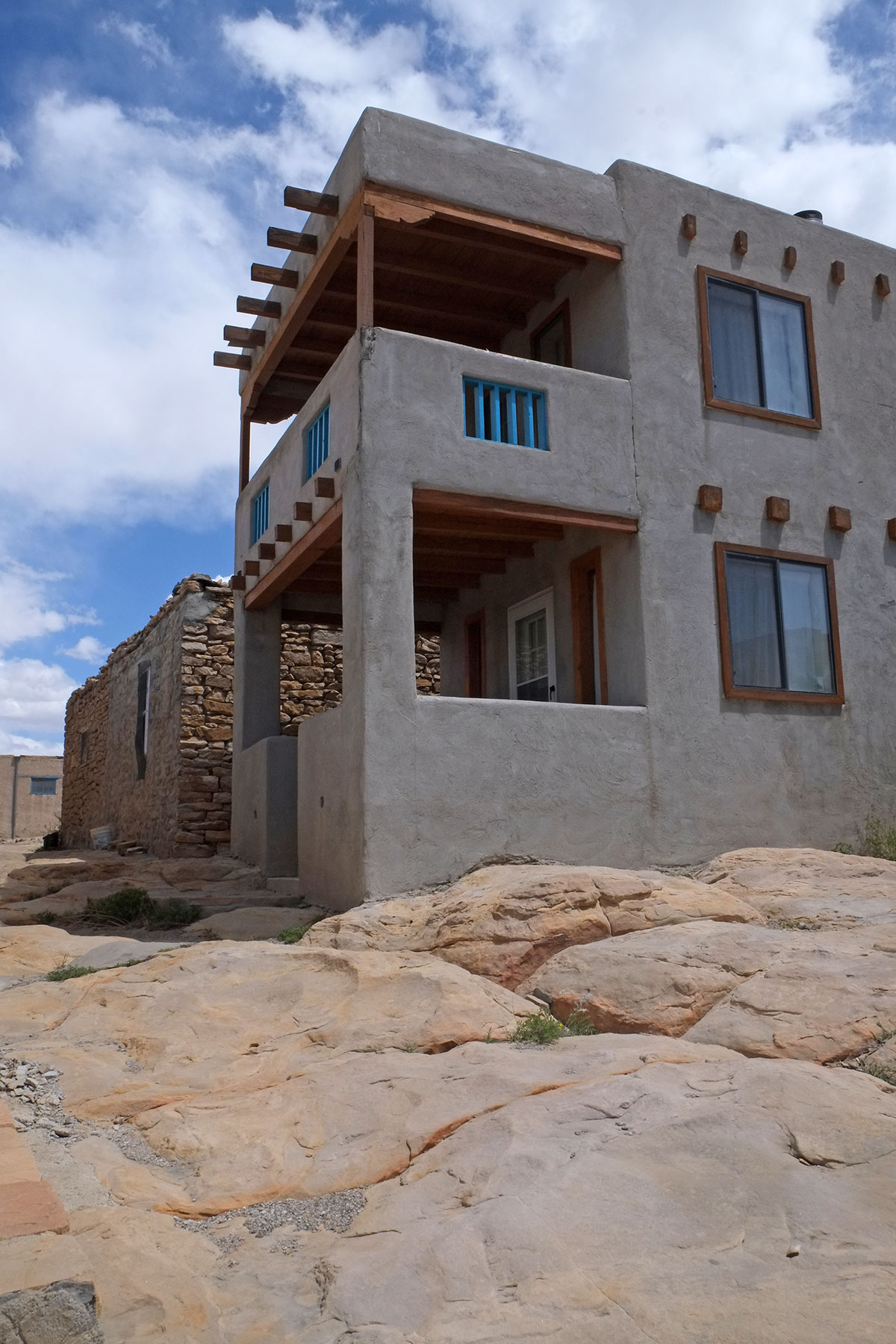
The houses are set around medium-sized plazas, and most are in very good shape, with a combination of older building fabric and newer elements, such as windows.DSCF9633

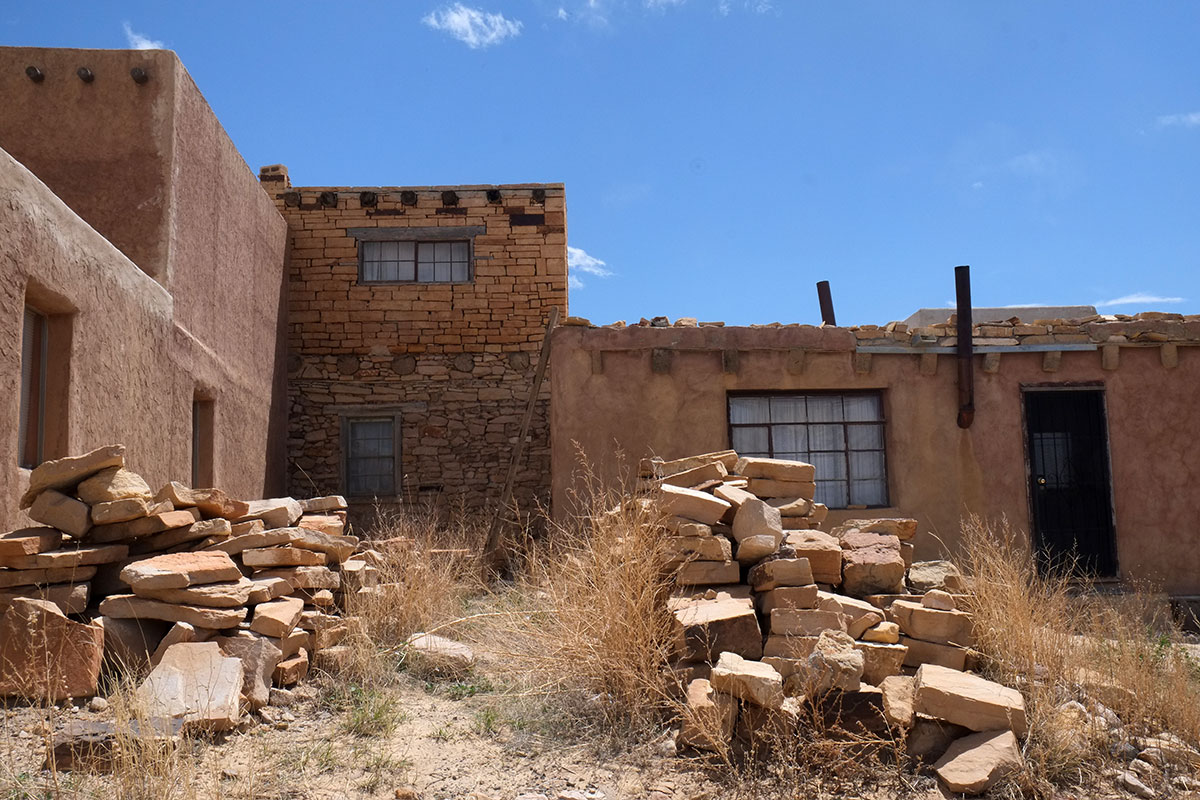
There was a lot of construction going on while we were there, and in a very organized manner. It is clear that there is much greater concern for the historical integrity of the new building than at Walpi, and this might be directly due to the huge numbers of tourists who visit here. The tourists are probably much more interested in seeing authentic-looking buildings (rather than ones with obvious Simpson Strong-Tie connectors), and the tourist income can pay for those careful renovations.98.Acoma022DSCF9542

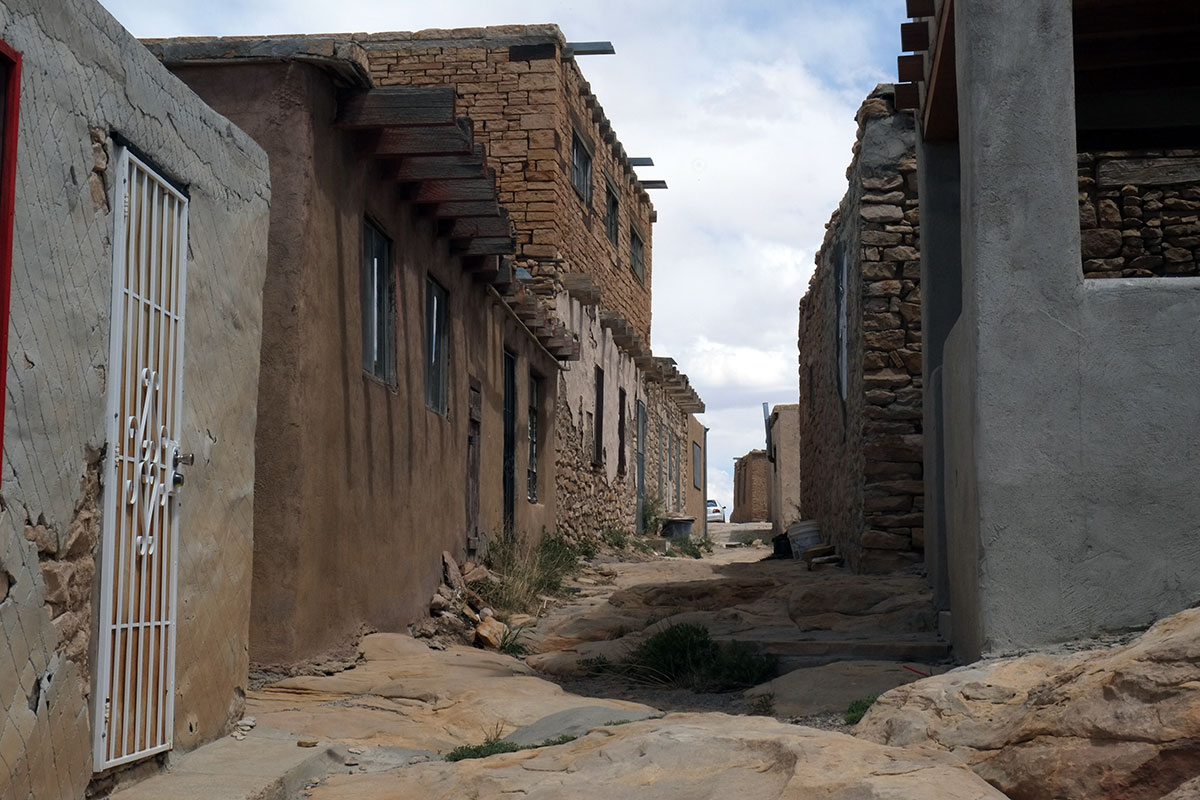
Narrow streets run between the plazas in the village. The Hopi mesas are pretty narrow, and small villages are very near each other, whereas Acoma is one, much bigger settlement (Sky City, not Sky Village).98.Acoma021DSCF9532

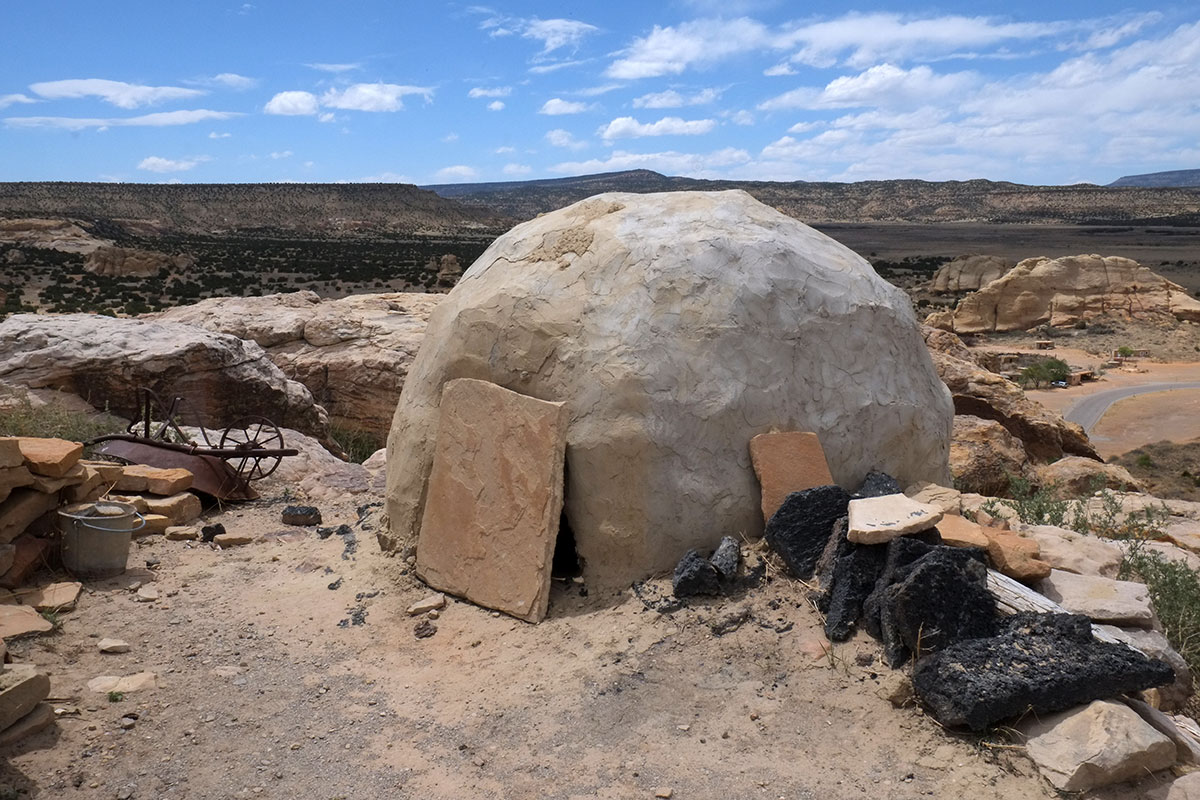
The traditional ovens were everywhere on the edge of the village.DSCF9528

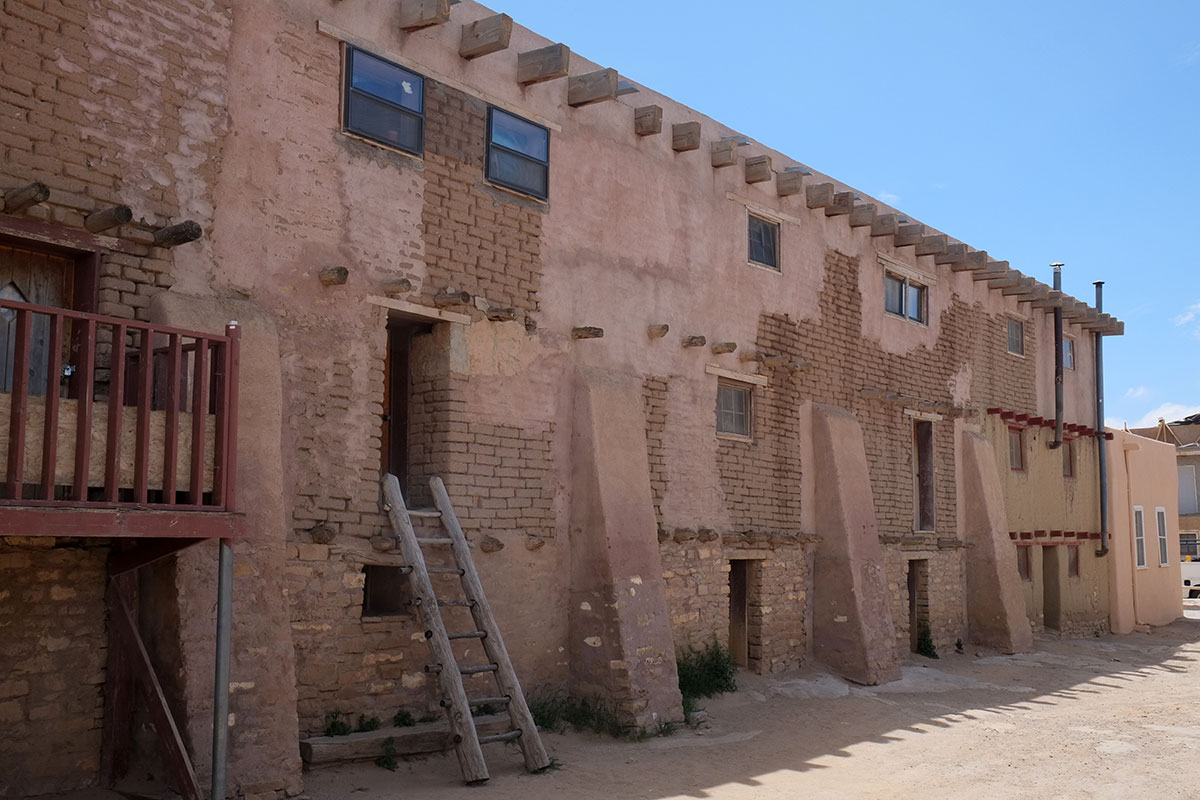
Acoma is noted for its multi-story construction. This is the back side of the biggest building, facing onto a street, while the other side faces a plaza, and is stepped back with roof-top terraces.DSCF9575

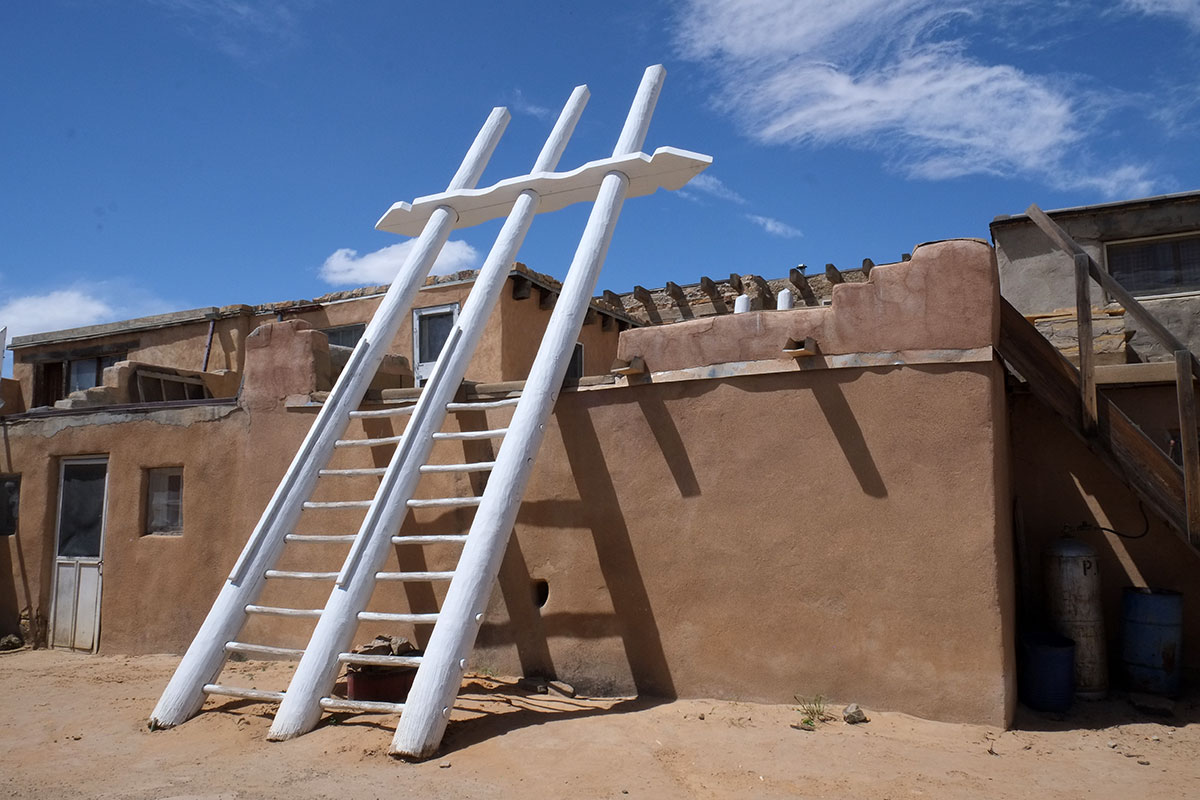
The mesa is a big solid rock, so excavating kivas into the ground would have been difficult. So here they are built of masonry above ground, but still entered in the traditional way through the roof. These ladders are a recent reconstruction – when the native religion was being actively suppressed by the Spanish and the Americans, the big ceremonial ladders were a tip-off to the authorities, as well as a visible symbol. So the residents used less conspicuous ladders that could be hidden, and posted a lookout.98.Acoma023DSCF9600

Most of the buildings show the wear of time,DSCF9544

but there are some new buildings. They are clearly based upon the same premises as the old style, but are not pretending to be ancient. Acoma felt more like a European village, where you can sometimes see this blending of old and new in a vernacular tradition.DSCF9534

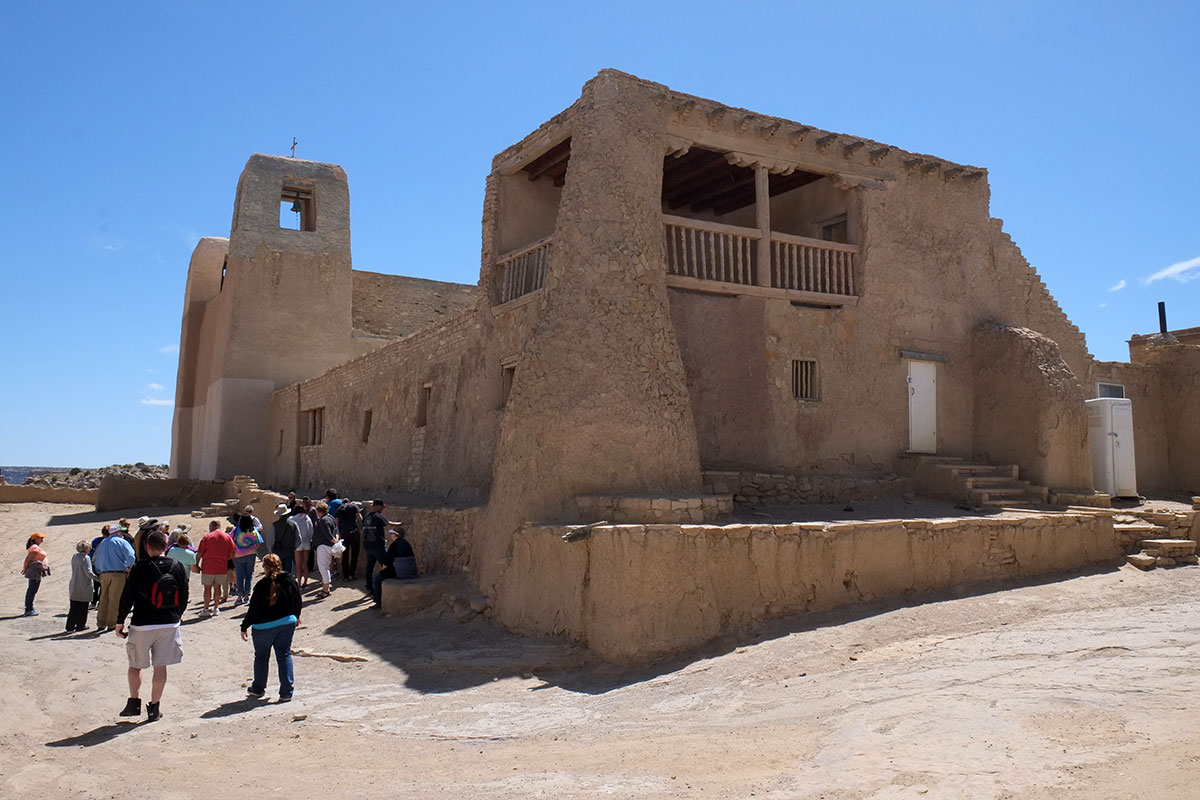
The Catholic church, San Esteban del Rey from 1640, is by a large plaza and cemetery on one side of the mesa. While we were told the church is not used for any religious services, our guide was clear that we couldn’t take photos of the church interior, or of the cemetery, and implied that most of the current tribe members shunned the Church in favor of their traditional beliefs. When she was pressed by a tourist for some more detail on this, she just said, We don’t talk about that. It seemed to me that there was a big difference between Hopi and Acoma here – they didn’t want to discuss their beliefs, but they were generally unconcerned about photographs in the village, whereas with the Hopi it was the opposite. (The Hopi talk about their legends to a certain degree, but obviously there are many secret parts they’re not mentioning.)DSCF9621

The questions of the tourists strongly reflected the preoccupations of modern Americans – sex and money. Acoma Pueblo is matrilineal, so the tourists were very interested in how that affected marriage conventions, divorce, and especially, disposition of property after a divorce. What struck me as strange was that all of these questions about Acoma society could be answered by reading a book, whereas the one aspect of their culture that required a visit to comprehend was the nature of their physical settlement. Yet I didn’t hear one question about the village or its buildings, which reinforced my feeling that Americans are generally completely oblivious to the meaning of the built environment around them, focussing more upon the more abstract organizational and relationship issues. Americans don’t really care about the house as a physical artifact, they just want to understand what it’s worth and who gets it after the divorce.

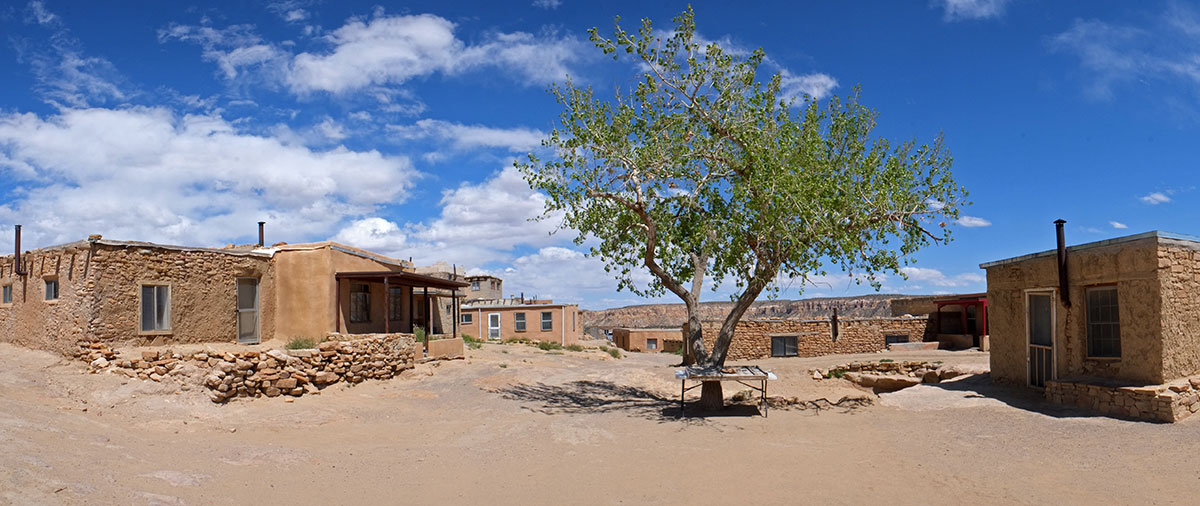
One of the larger plazas was remarkable in that it had a tree, the first one we had seen on any mesa top. It was the urbanized version of all the garden valleys in the desert we had been seeing, the organic surrounded by mineral. It is adjacent to a small pool, which acts as a cistern.DSCF9612


Santa Clara Pueblo is located on the Rio Grande River, between Santa Fe and Taos, in what might be called the Pueblo Belt – many different, distinct reservations are adjacent here. We were attracted to this pueblo by their renowned, abstract black-on-black pottery, and we stumbled upon a small gallery run by a potter of about my age, who showed us his and a few others’ work. He took the time to explain how their firing process worked, which was amazing in the contrast between simple and rather ad hoc facilities they used and the incredible sophistication of the final products. They don’t have large, permanent kilns, but rather build a small one every time out of rocks and metal sheets, achieving the black finish not though a glaze, but by packing the kiln shut with dirt at the right time, so the fire is dampened and the pots are smoked. They then burnish the pots with a stick to get the shiny surface. It must have taken generations to get that process right, a process that must be learned by every new potter. The approach relies upon a complex series of steps that must be guided by experience and judgement, rather than complicated tools or equipment. We leaned a lot, and once again we found that buying some art (in this case a couple of extraordinary small pots for Linda) gave us a great excuse to spend time talking to some wonderful people.

The pueblo is not set on a mesa or hill, but right alongside the river. The buildings were adobe rather than stone, but still had the characteristic masonry forms, organized around plazas.DSCF0094

Being in a river valley there was much more use of organic material in the built environment,DSCF0102

and there was a relatively lush landscape everywhere. There was a newer part of town immediately adjacent to the old village, with schools, administrative buildings and detached houses. Some of the older houses were in disrepair and boarded up, but others had been recently rebuilt. Santa Clara doesn’t get the tourist throngs of Acoma, as it more resembles a normal western town, and isn’t the anomaly of a Sky City. But its location right on the Albuquerque-Taos axis makes it much easier for the residents to participate in the larger economy off the reservation, and so rather than the large-scale and highly-coordinated renovations we saw at Acoma, the work we saw here was at the level of the individual house, probably based on what one family was able to accomplish.DSCF0108

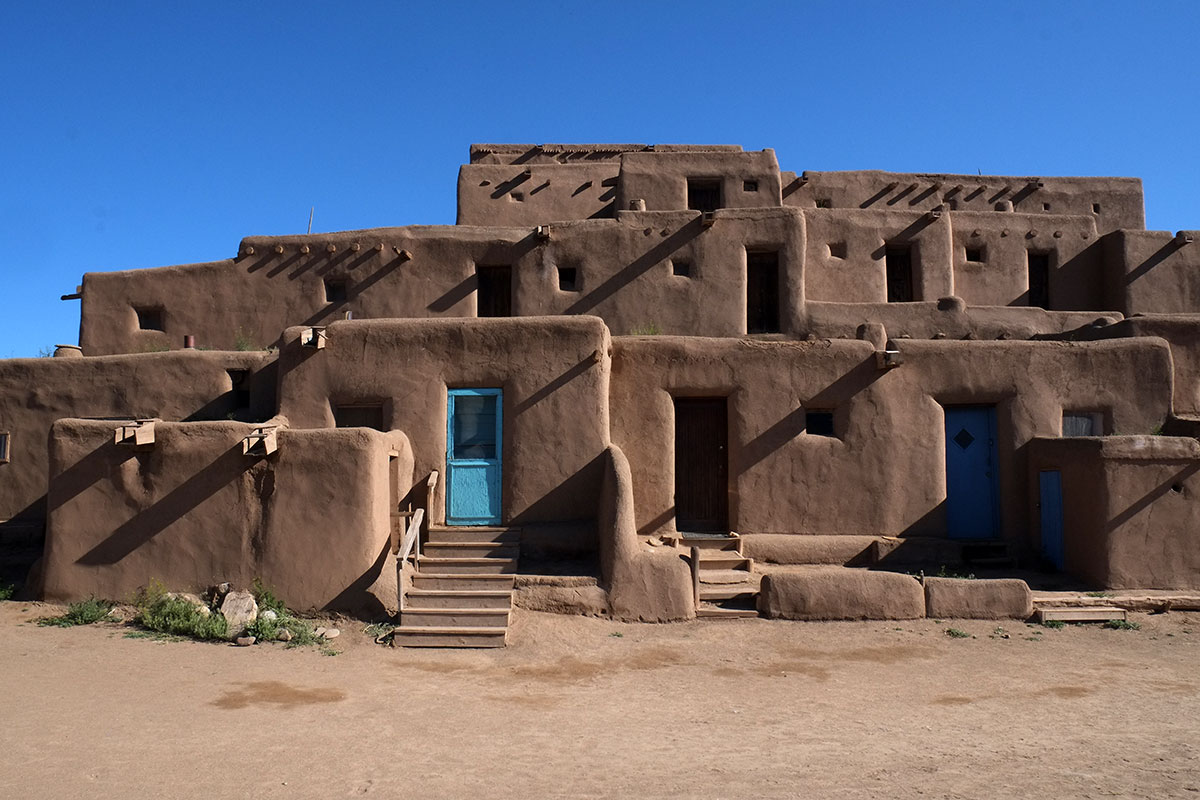
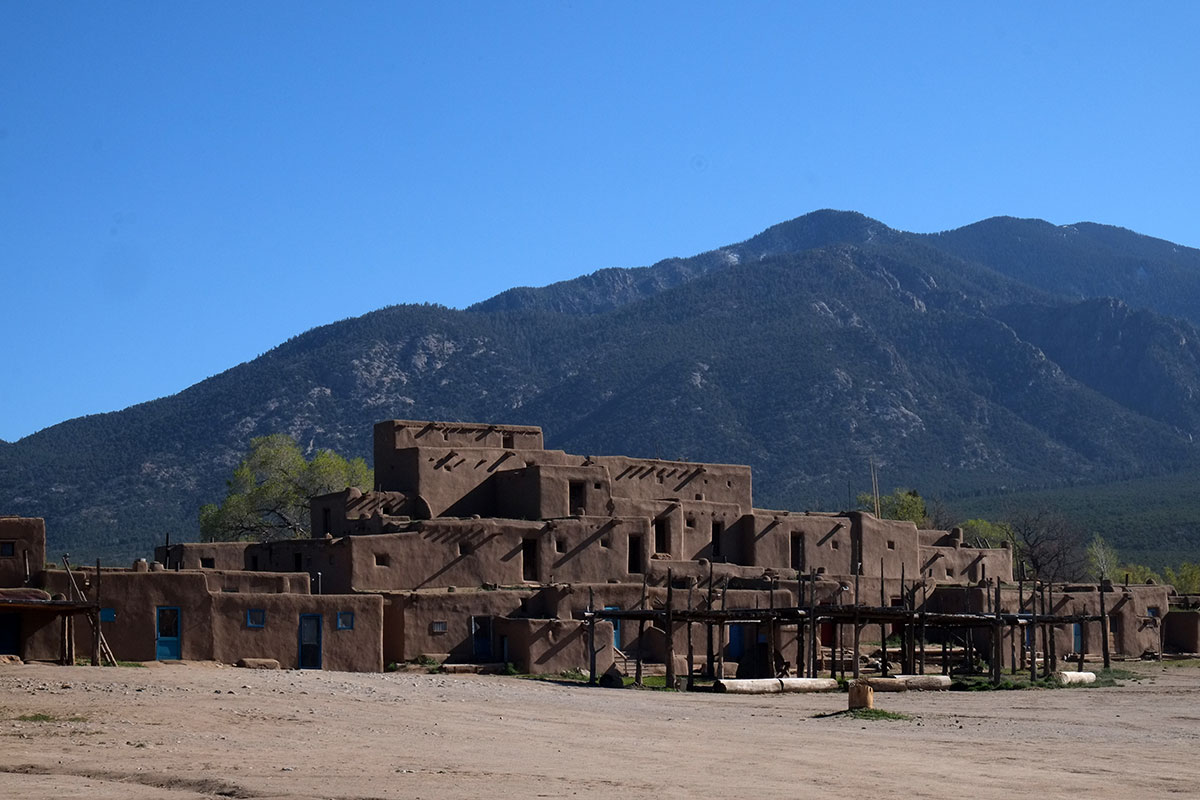
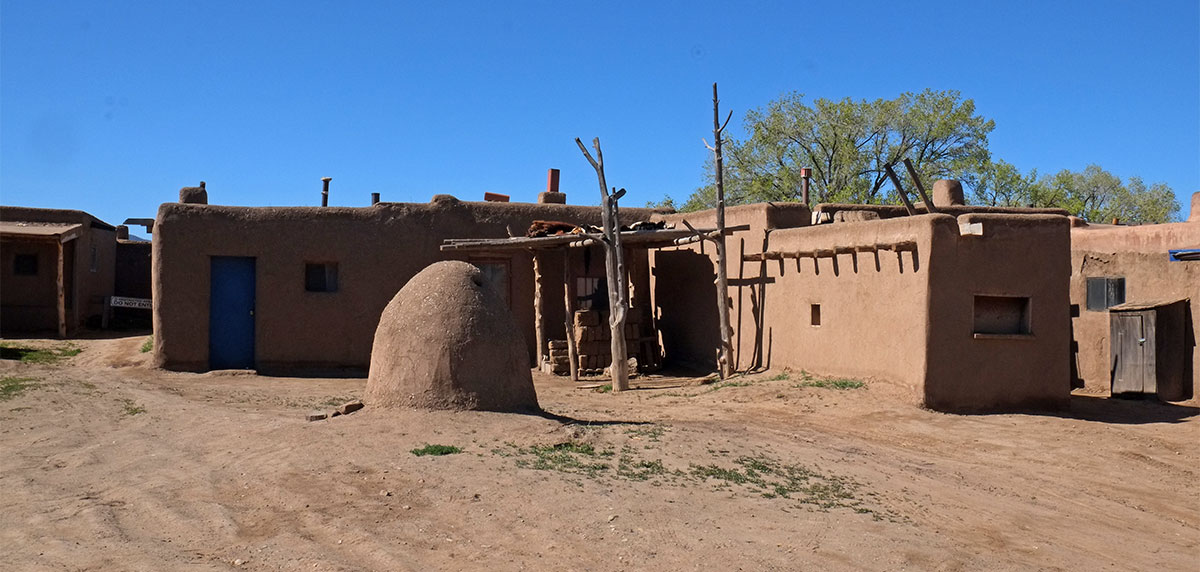
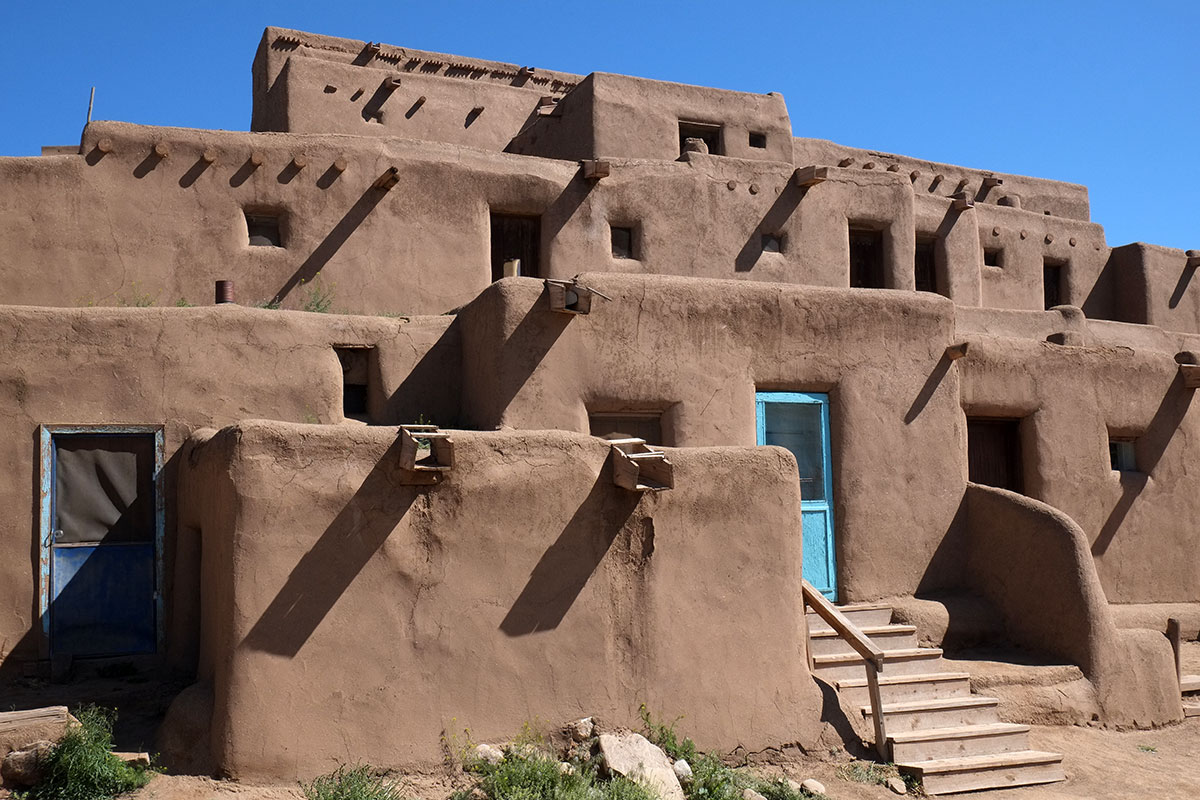
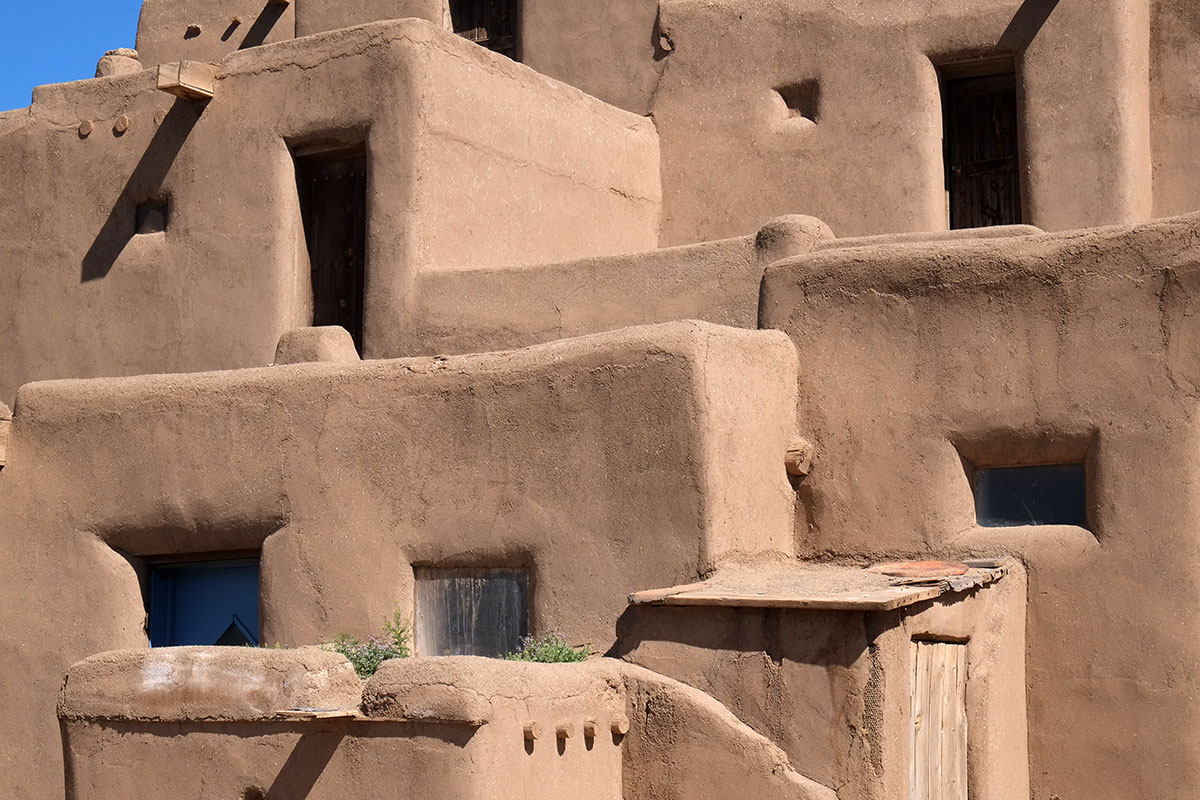
Finally we visited Taos Pueblo, a UNESCO World Heritage site located north of the city of Taos, which is the Mecca of pueblos for architects. It is mainly known for the large building on the north side of the village, a multi-story complex which antedates our own multi-family condos by at least 600 years. Architects tend to respond to the simple cubic forms – the irregular but similar volumes based upon the construction system with bearing walls and the span of small trees.DSCF0185

Everywhere I’ve travelled in the past 35 years, I’ve noticed a bias inherent in how architects and historians think about and document important places: there is always an emphasis upon the building as an object, but a relative disregard for the importance of the setting, whether urban or natural. The north building at Taos is truly remarkable, an incredible pile of abstract forms that gets at the primal idea of dwelling in the same way as do the cliff dwellings, but the natural setting is no less incredible.

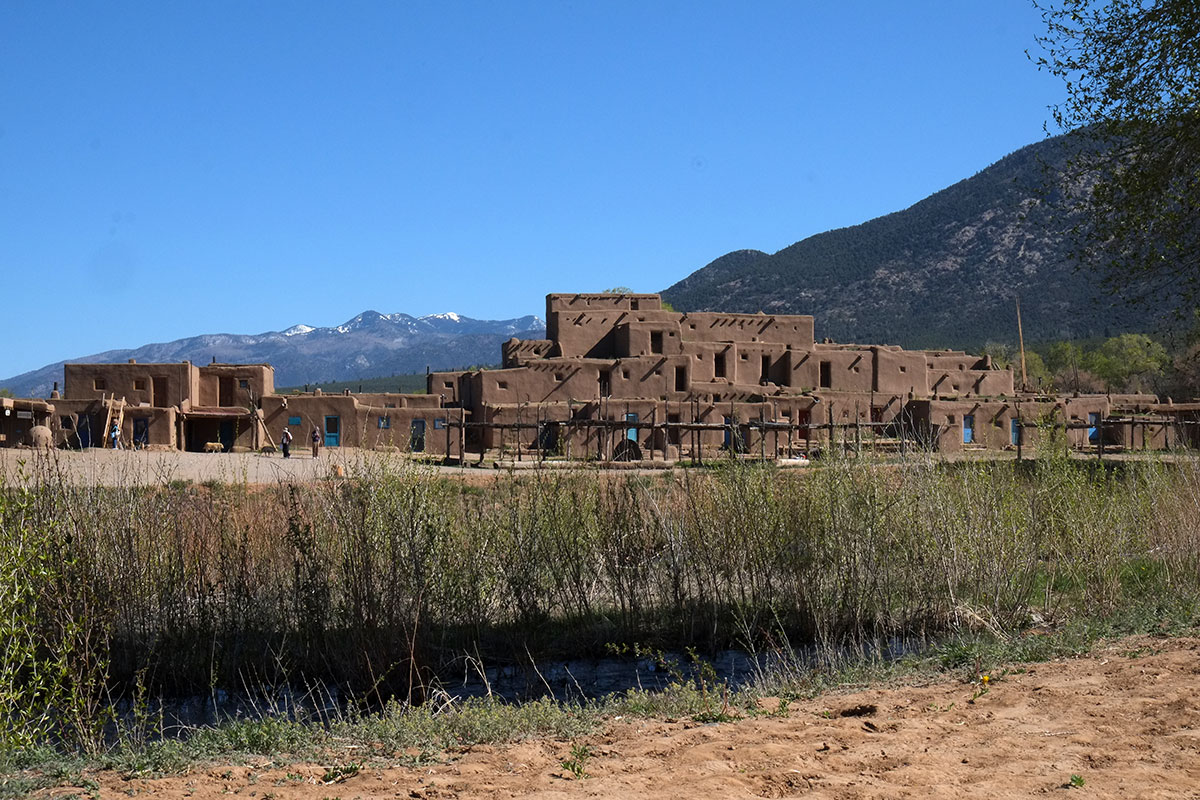
When we first arrived at Taos, I couldn’t believe the backdrop of the mountains.100. Taos035DSCF0032

In the Northwest we’re used to seeing big mountains from in town, but those mountains are usually 50 miles away from the cities, which are set on the water. In all the cities in northeastern New Mexico, the cities are right at the base of the mountains, and their visual presence dominates the place. This is even stronger at Taos Pueblo, and not just due to proximity. These mountains were the traditional preserve of the Pueblo, containing their sacred Blue Lake, but they ended up being part of the National Forest system. The Taos Indians fought a protracted legal battle to get them back, which they eventually won in 1970. So the overwhelming beauty of the city of Taos has really been preserved by the Pueblo, which has kept the mountains free of development (or logging).

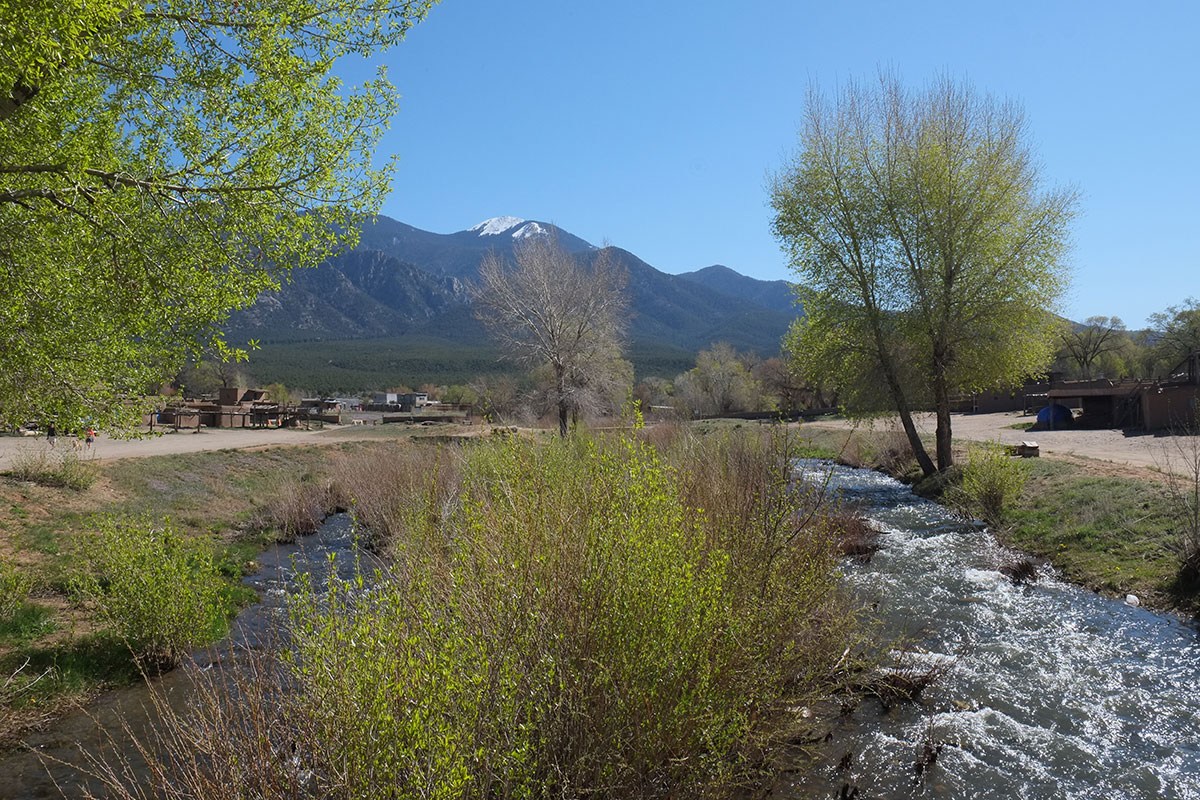
When we see the mountains behind the pueblo, it is not merely the visual background/foreground relationship which gives it power. It is knowing that there is a deep cultural connection between the natural world and the built world, that the pueblo was built where it was to have that relationship to the mountains.100. Taos037DSCF0173

This relationship is then strengthened by the stream that comes from the mountains, and runs through the center of the pueblo. There are obviously great practical benefits to having a stream in the middle of your village, but once again, the power derives more from the symbolic relationship than the pragmatics. The mountain – the stream – the people: the primal aspect of dwelling in a specific place on earth couldn’t be made any stronger.DSCF0199

As with any great work of art, analysis can’t begin to capture the multiple layers of meaning implicit in the work itself. You can dissect the pieces to try to explicitly understand what is going on, but you just experience it more directly. Taos Pueblo is simply one of the most beautiful places built by humans I’ve ever seen, and we wandered around happily for hours, soaking up every aspect and detail.

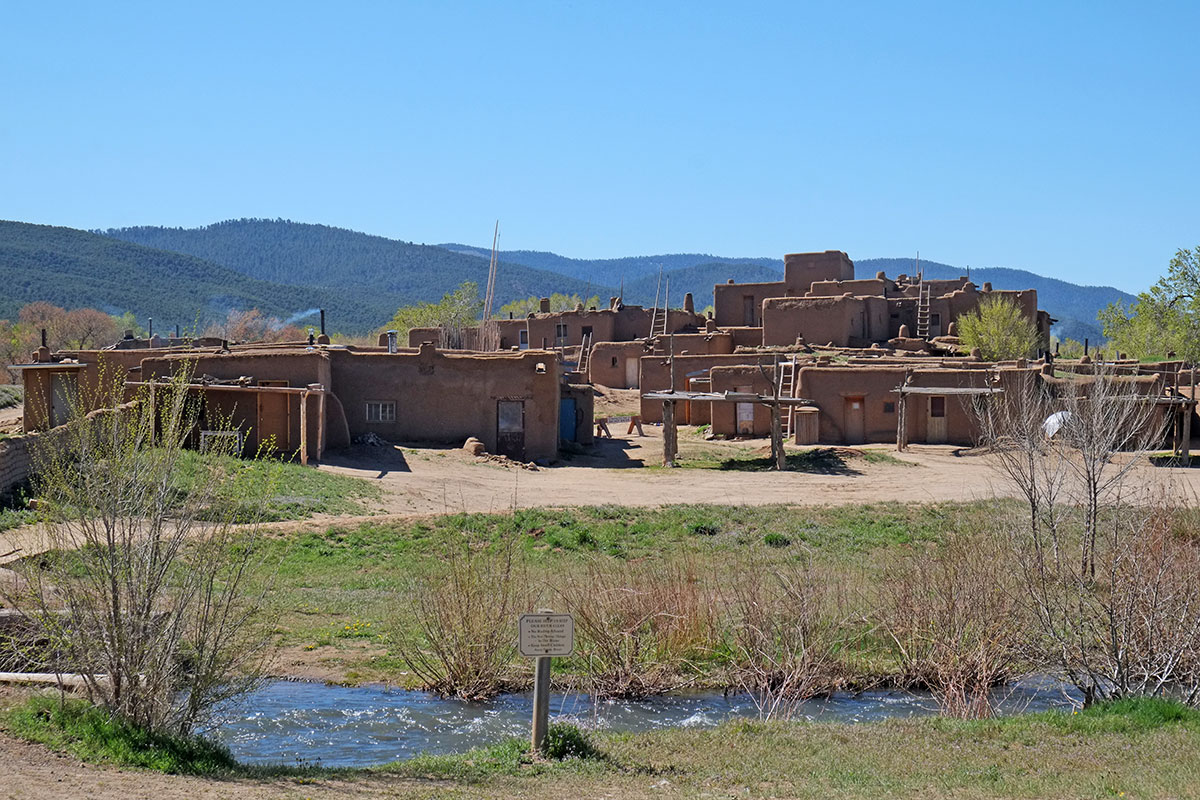
Across the steam is the southern side of the village, which is not a monolithic wall, but a more typical pueblo arrangement of low houses around small streets and plazas.DSCF0242

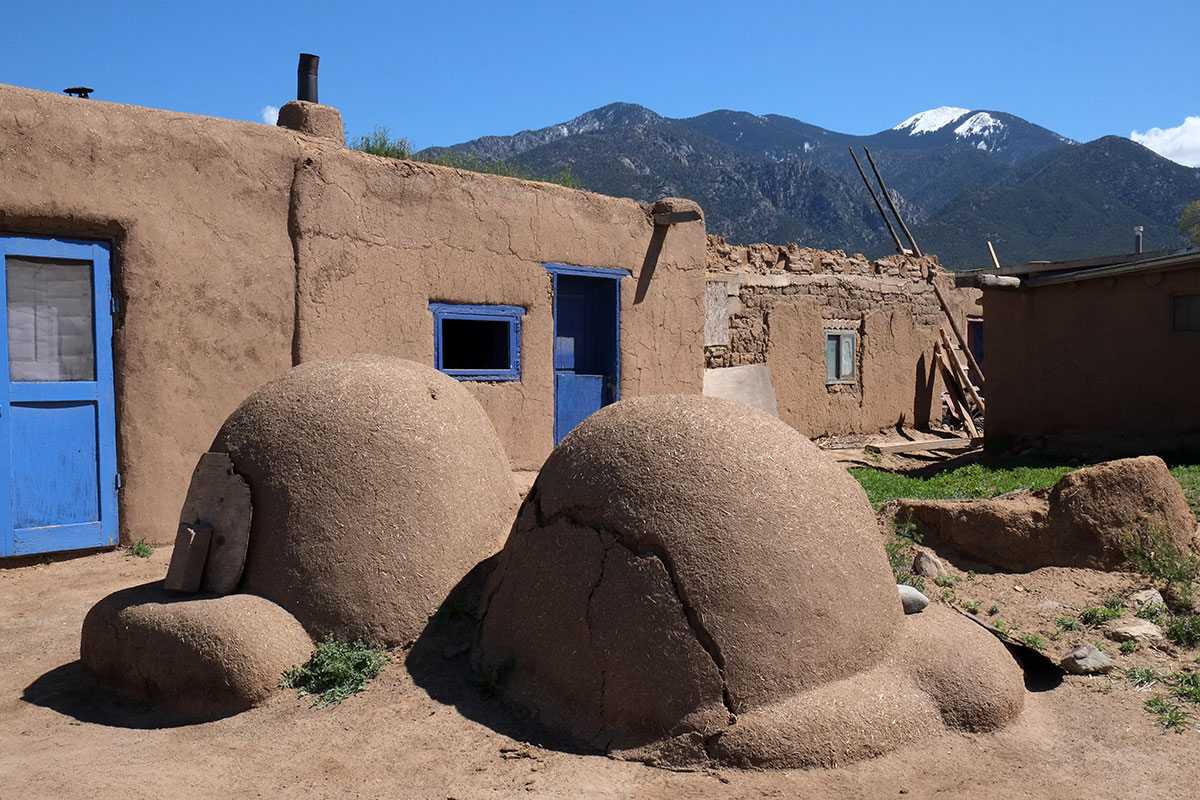
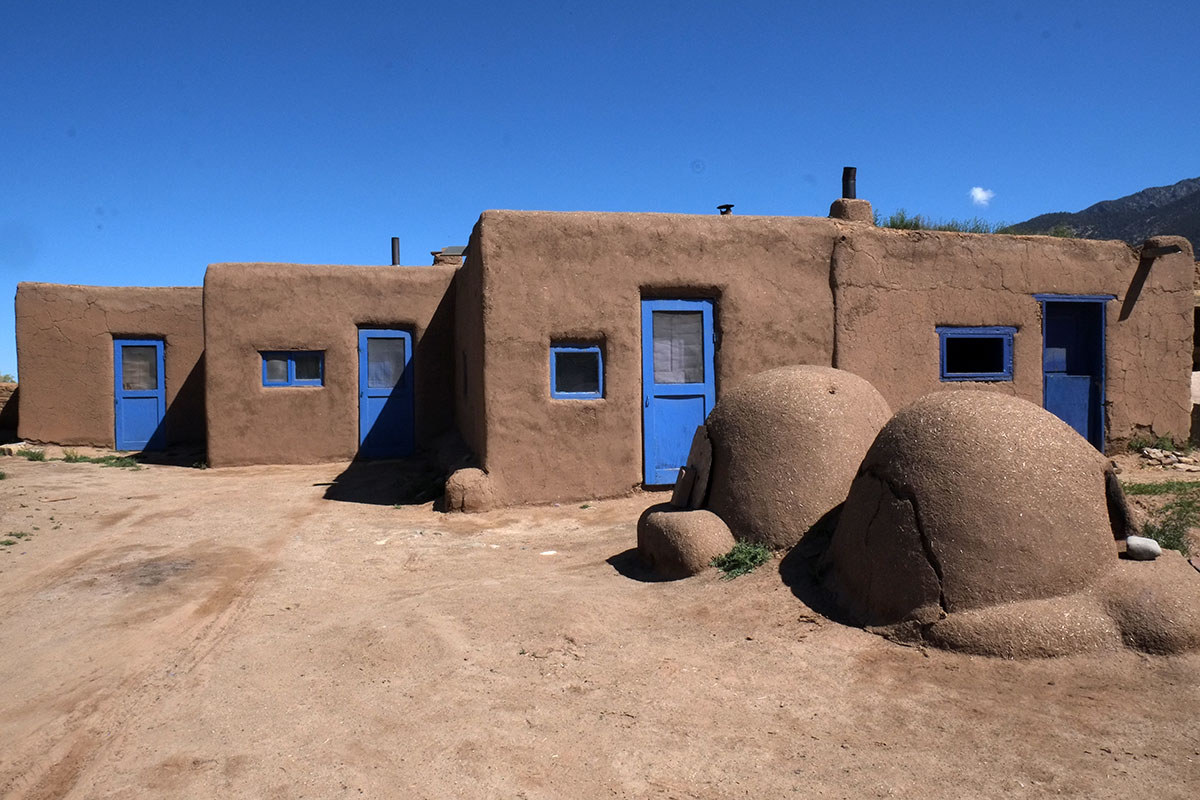
The smaller-scale elements of day-to-day life are apparent – doorsteps, ovens, raised platforms used to keep carcasses and animal hides away from vermin and dogs.DSCF0209

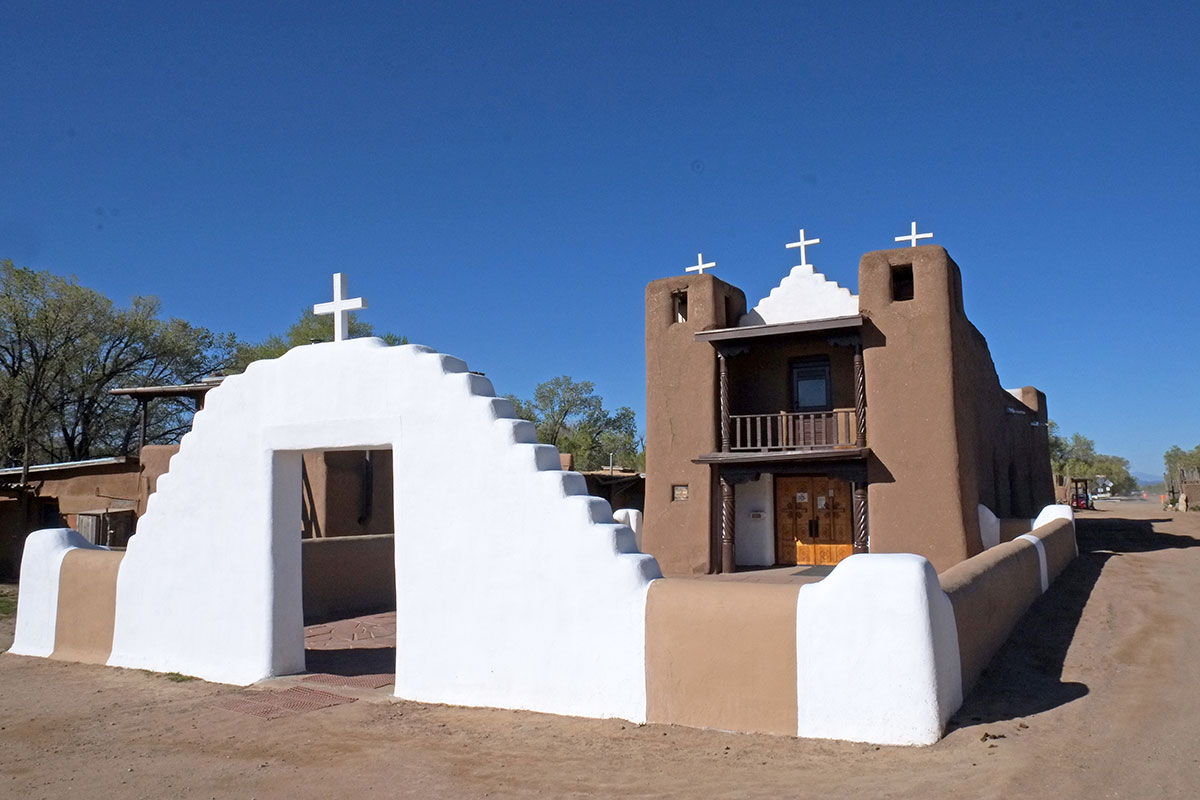
There is a church near the stream too, which seems to be more active and integrated into the life of the village than at Acoma.DSCF0172

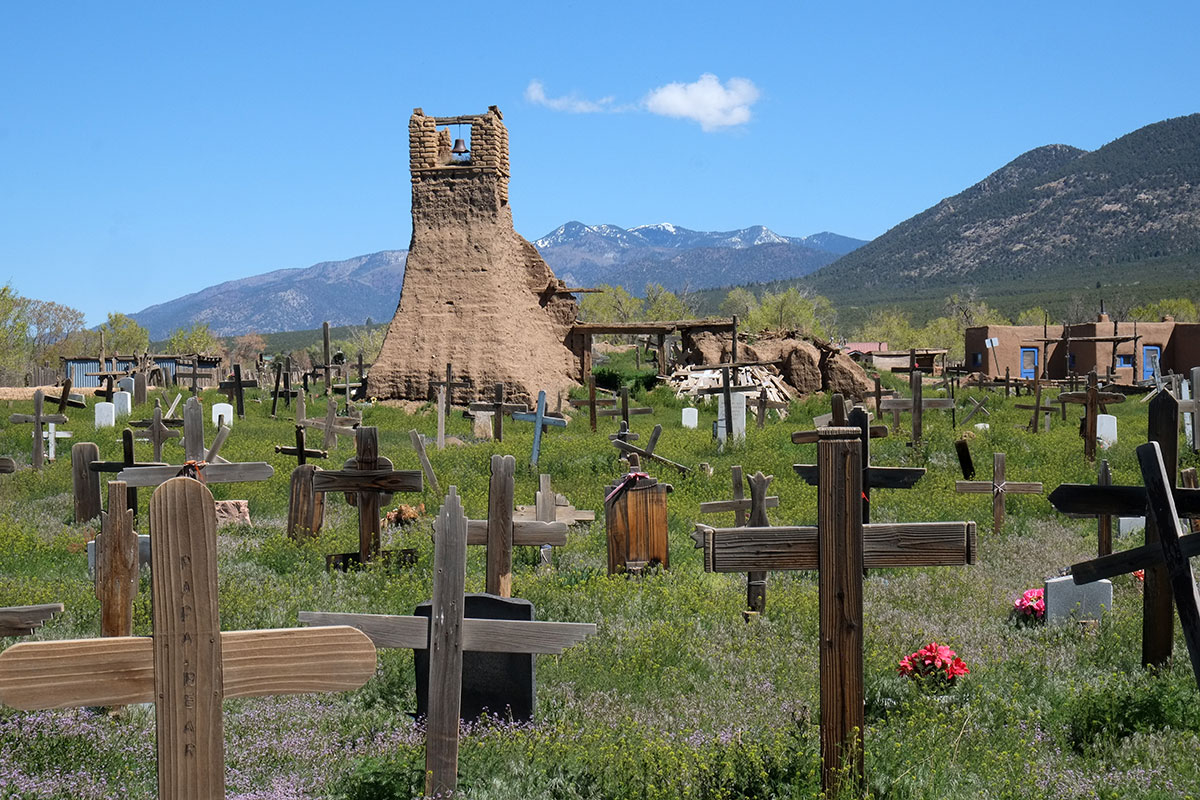
However, this is a newer church, built in 1850. The first church was destroyed in the Pueblo Revolt of 1680, and the remains of the second can be seen below, standing in the middle of the cemetery. Taos was the center of a revolt resisting the transfer of power of when the territory was ceded to the US in 1847. The governor was killed, and the rebels retreated to this church, which was destroyed in a bombardment, killing all those within. The ruins now stand as a simple memorial.DSCF0298

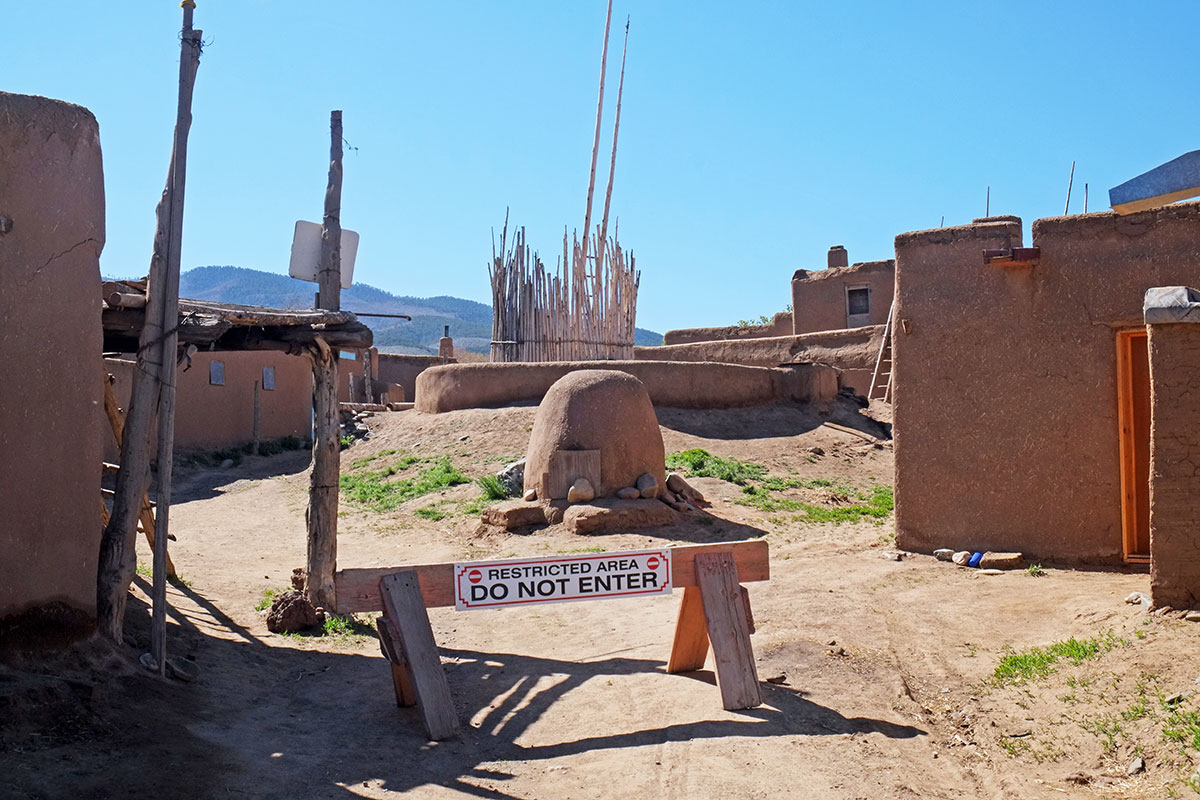
The kivas and traditional ceremonial spaces are located towards the edge of the village, on both the north and south sides. Taos gets a lot of visitors, and they are explicit about which areas are off limits.DSCF0225

I haven’t seen many places in this country where there is such a complete or beautiful expression of people inhabiting a place, with their complex culture and history being made visible, accomplished with an abstract, built formalism that clearly says that residents are claiming this place,100. Taos038DSCF0262

DSCF0289

DSCF0259

while also integrating so seamlessly into the natural world.DSCF0201

Taos was right up there with the places we most wanted to visit on this trip, but the experience of seeing it was so much better than we anticipated. And seeing several pueblos led to a much better understanding of them all – before visiting we mainly could see the similarities among them, but now it is apparent how they are all clear and vivid places, something you have to directly experience to understand.

Taos

100. Taos035DSCF0032

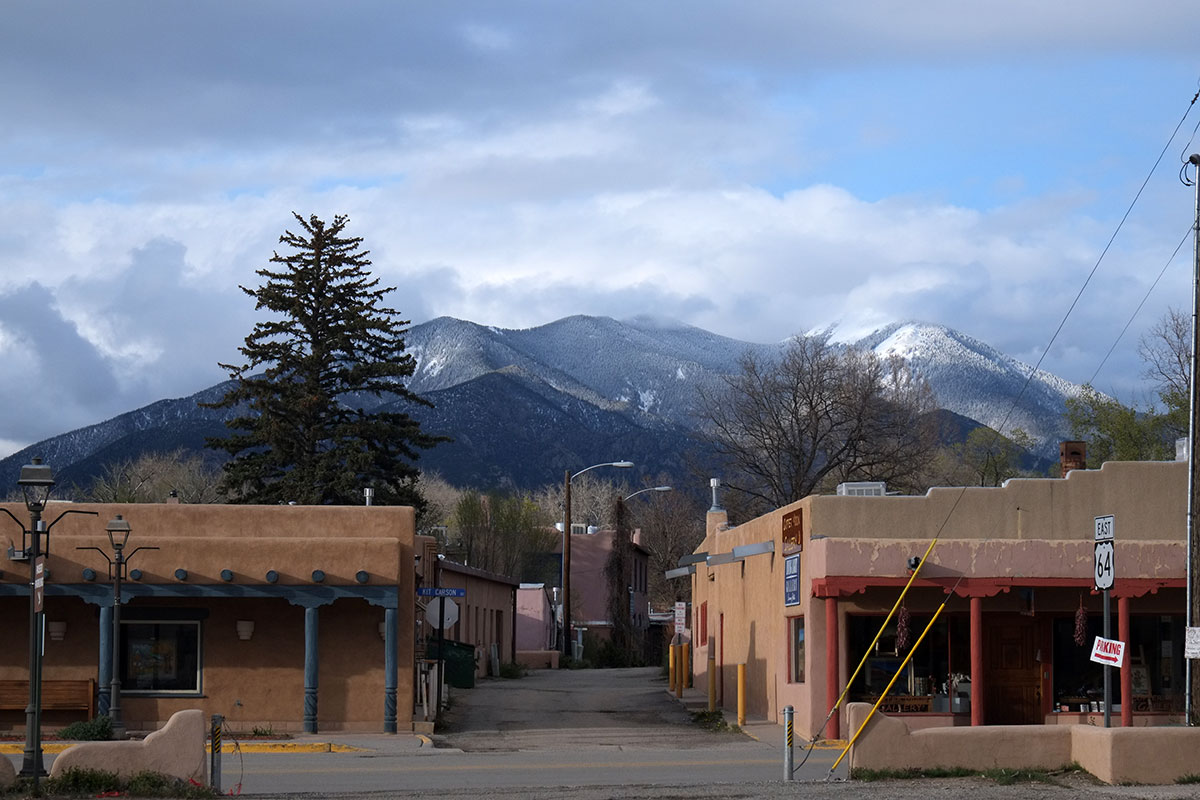
The urbanized corner of northeastern New Mexico (the part of New Mexico that has three actual cities) affords a pretty wide range of urban experience, given how small the cities are. Earlier in our trip, we’d gotten pretty blasé about medium-sized cities American cities – they started looking more like examples of a standard type, rather than really distinct places (JB Jackson’s essay on “The Stranger’s Path” comes to mind again). The major independent variable seemed to be the ratio of pre-war size to current size, with the cities that were bigger in the past often having a historic core that gave them some character, whereas the cities dominated by post-war growth all just looked alike. The New Mexico cities have all kept their pre-war cores, and they maintain a strong identity despite the more recent sprawl. Most interestingly, they are all really different from each other. Albuquerque is the relatively big, diverse city. Santa Fe is the boutique city of government, arts and wealthy visitors. Taos is the funkier town up in the mountains, which has its overlay of tourism and artiness, but in a less rarified way than Santa Fe. It also has the outdoor-activity jumping-off place feel to it, but at a lower level than places like Moab and Jackson. And with the Taos Pueblo just north of town, the native culture is more noticeable than in the bigger cities.

100. Taos034DSCF0040

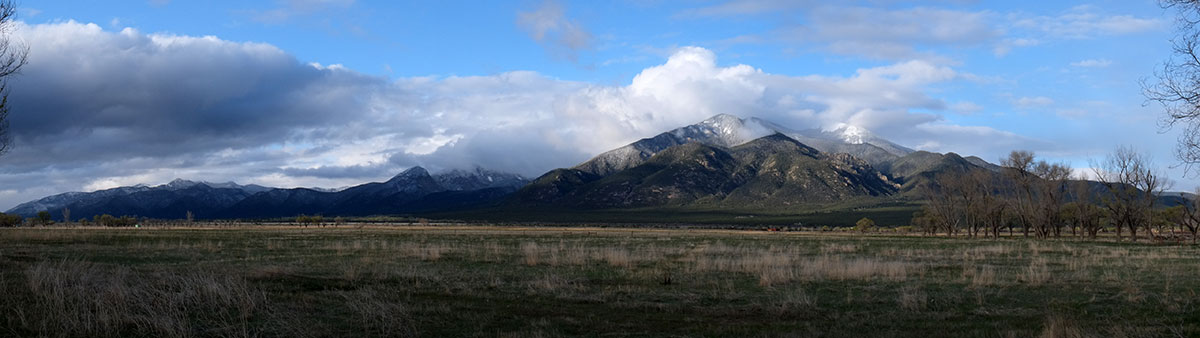
Each of these cities sits right where the high desert meets a mountain range, but in Taos the contrast is stronger and the connection to the mountains feels more immediate. Taos Mountain, at the end of the Sangre de Christo Mountains, dominates the views in the area, including the downtown. After a couple of months in the dry and usually hot Southwest, Taos felt different to us – a high-elevation city in the Rockies, near the desert, rather than a desert city from which you can see the mountains. It might have been the altitude, or the fact that it was cold and snowing, in May.

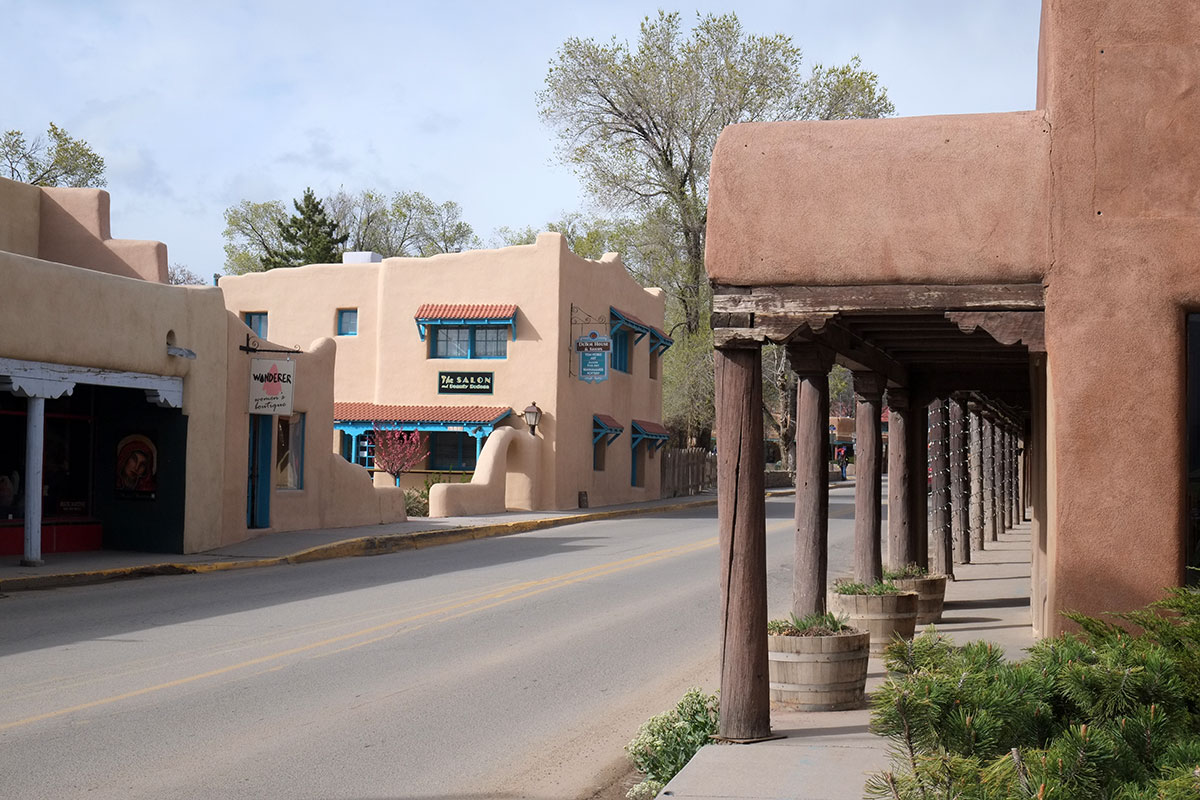
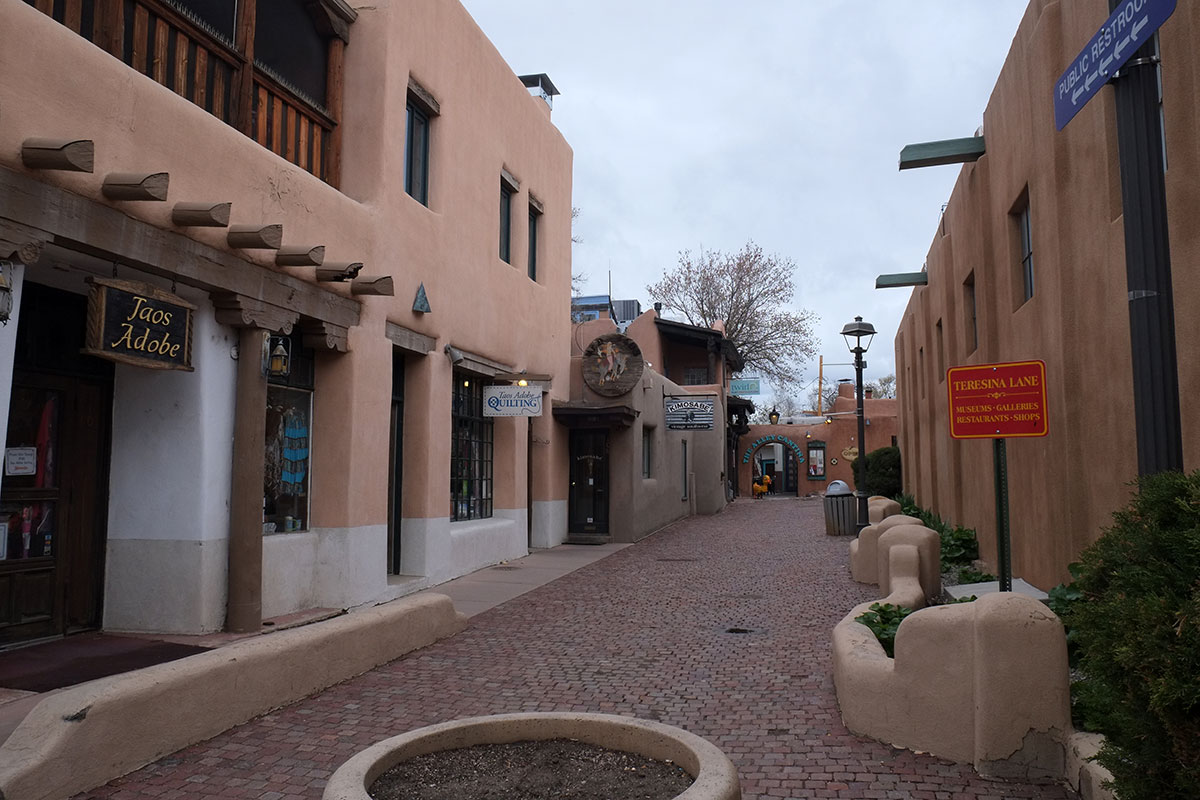
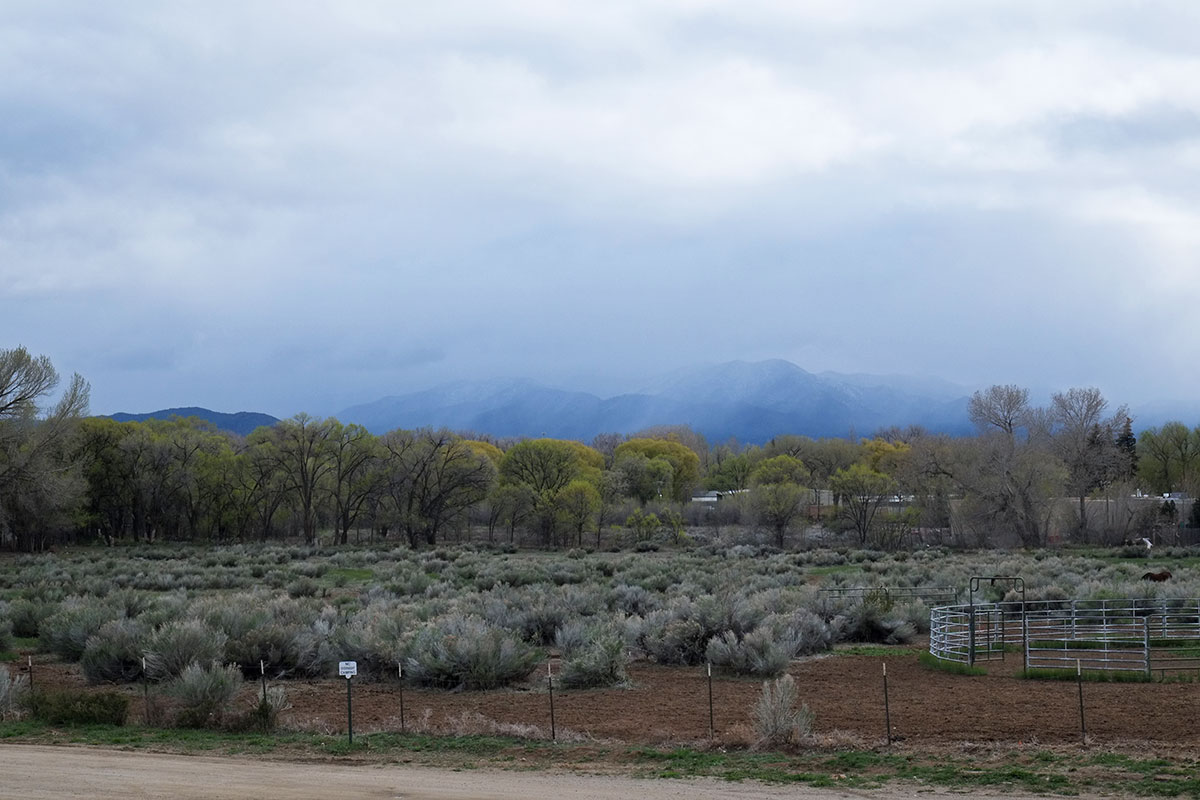
The downtown architecture is similar to that in Santa Fe, with a mixture of adobe and faux-dobe. The atmosphere is probably regulated as closely as in Santa Fe, but without the overlay of serious wealth, it doesn’t feel as precious.DSCF0014

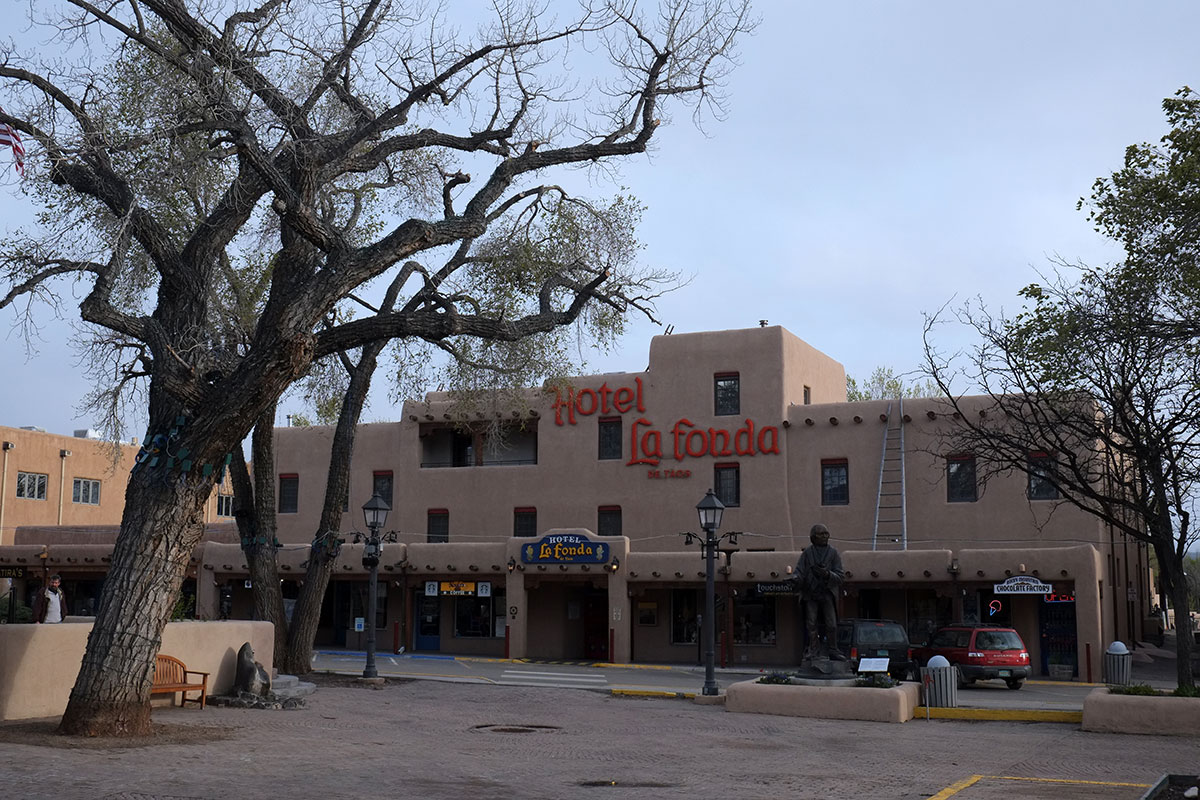
The historic plaza is surrounded by shops selling Indian crafts, outdoor equipment and a nice hotel. On a cold Sunday afternoon, it was deserted. We assume that in the summer, it and the surrounding shopping streets would be full of tourists.DSCF0034

DSCF9970

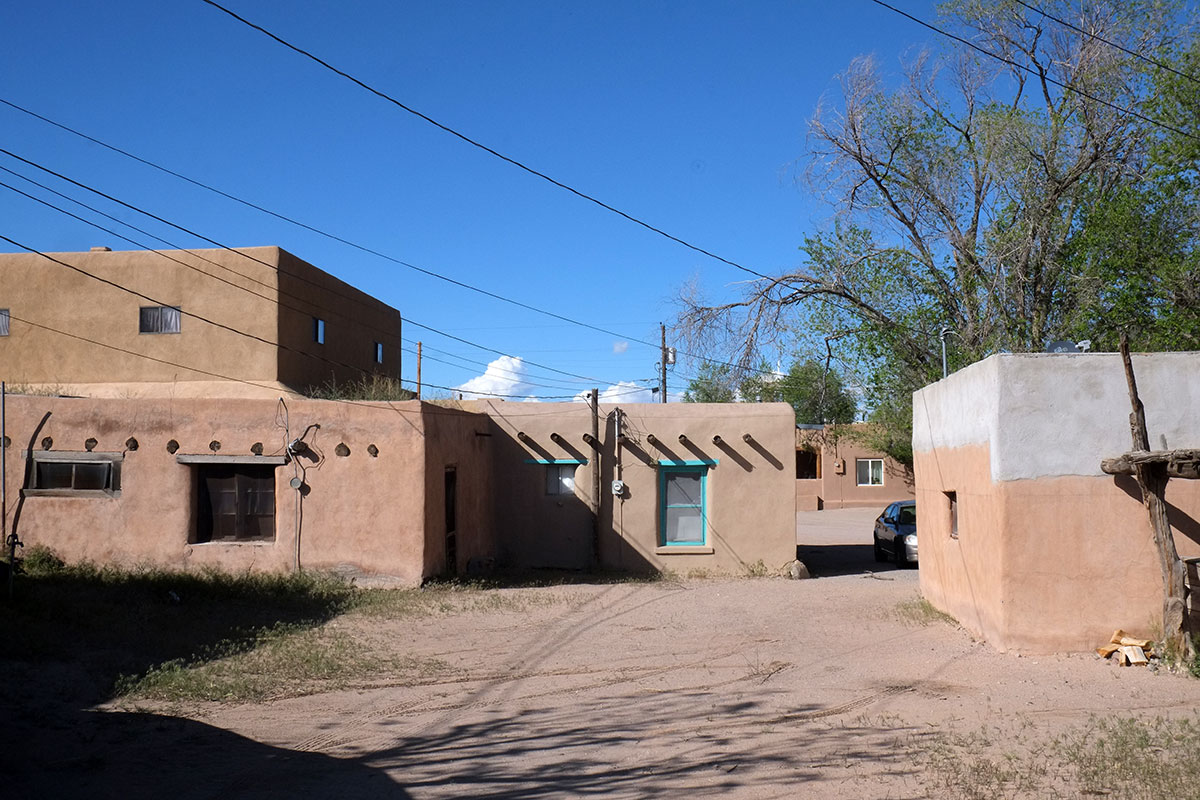
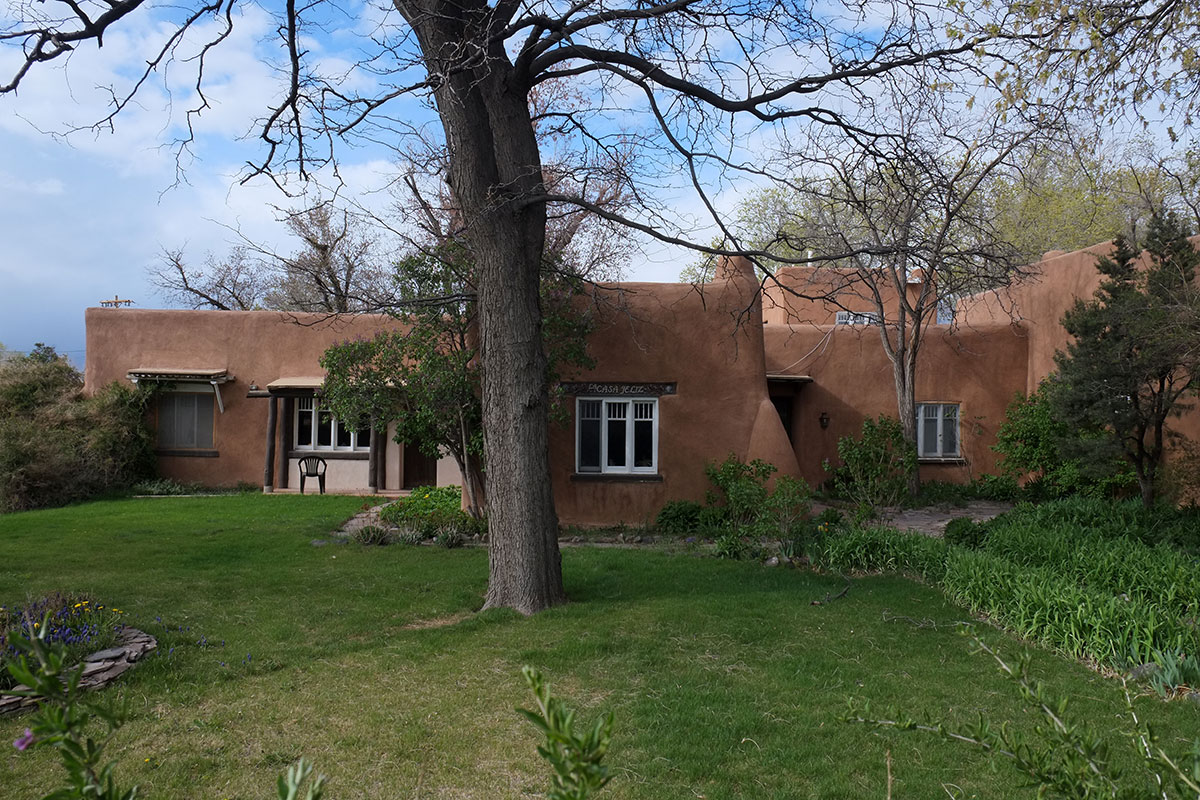
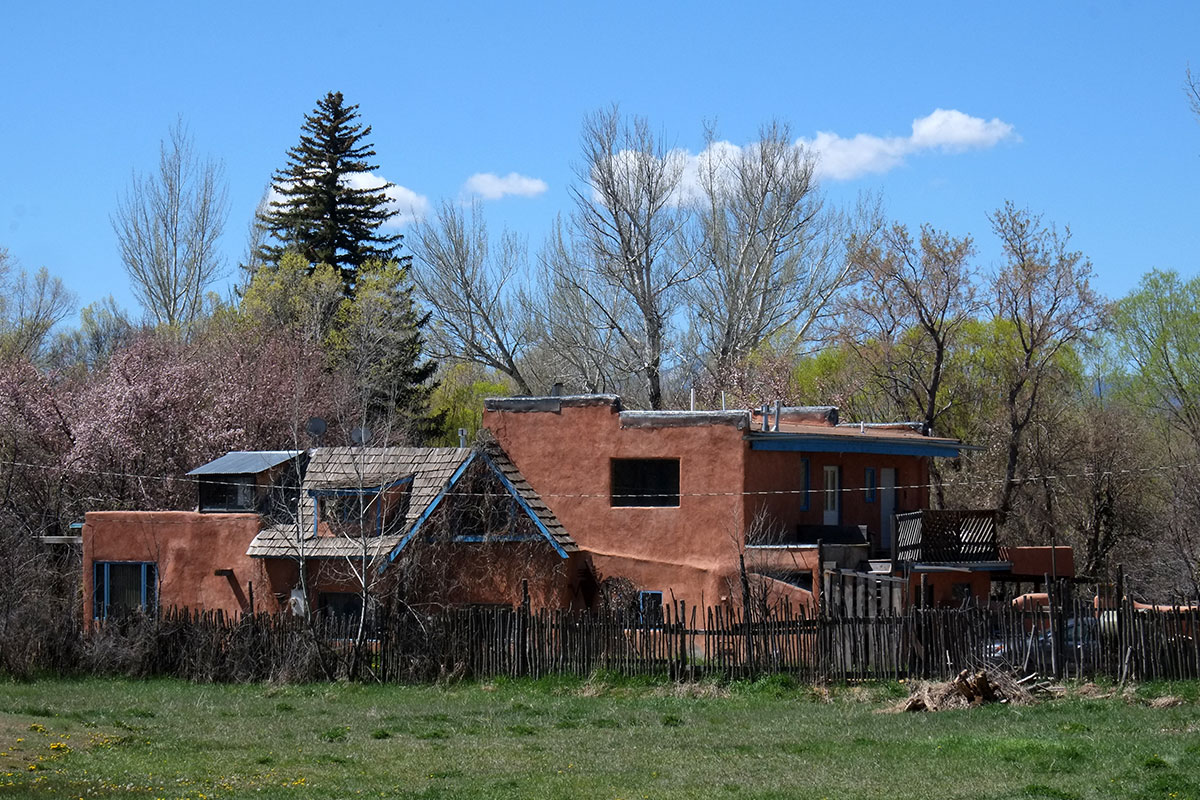
Moving away from the commercial core into the residential areas, there are some beautiful places, with adobe houses set in a landscape with trees and grass, something we found really appealing at this point.DSCF0020

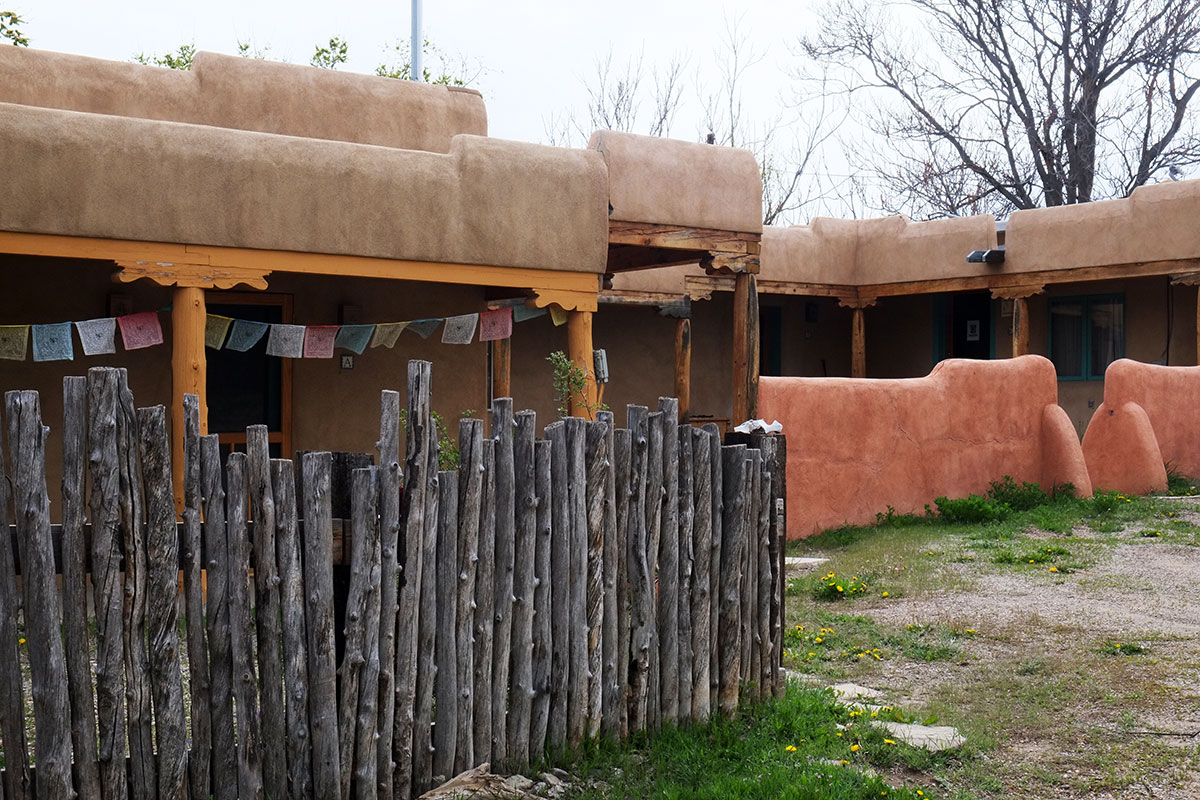
Once again the simple vocabulary of the Puebloan style allows for variety of expression within the few rules, the elevations respond to interior needs, and the casual arrangement of the whole is held together by the discipline of the style.DSCF0004

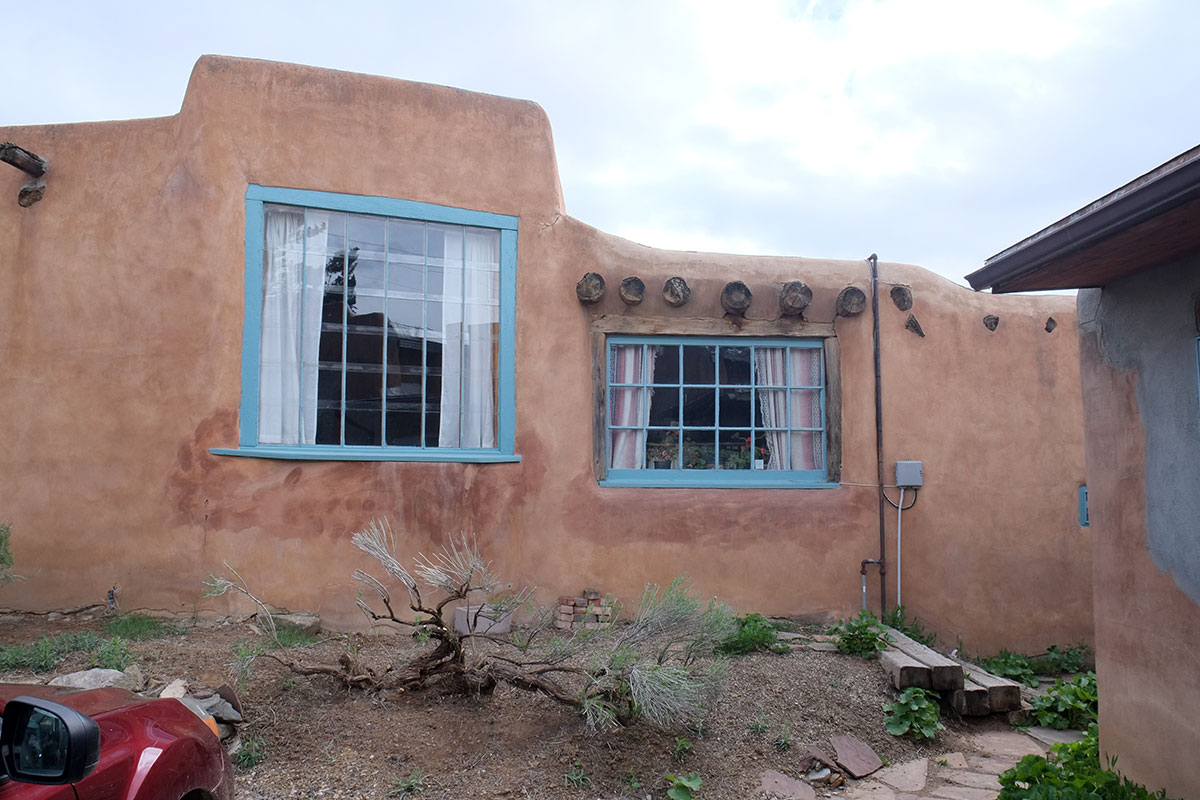
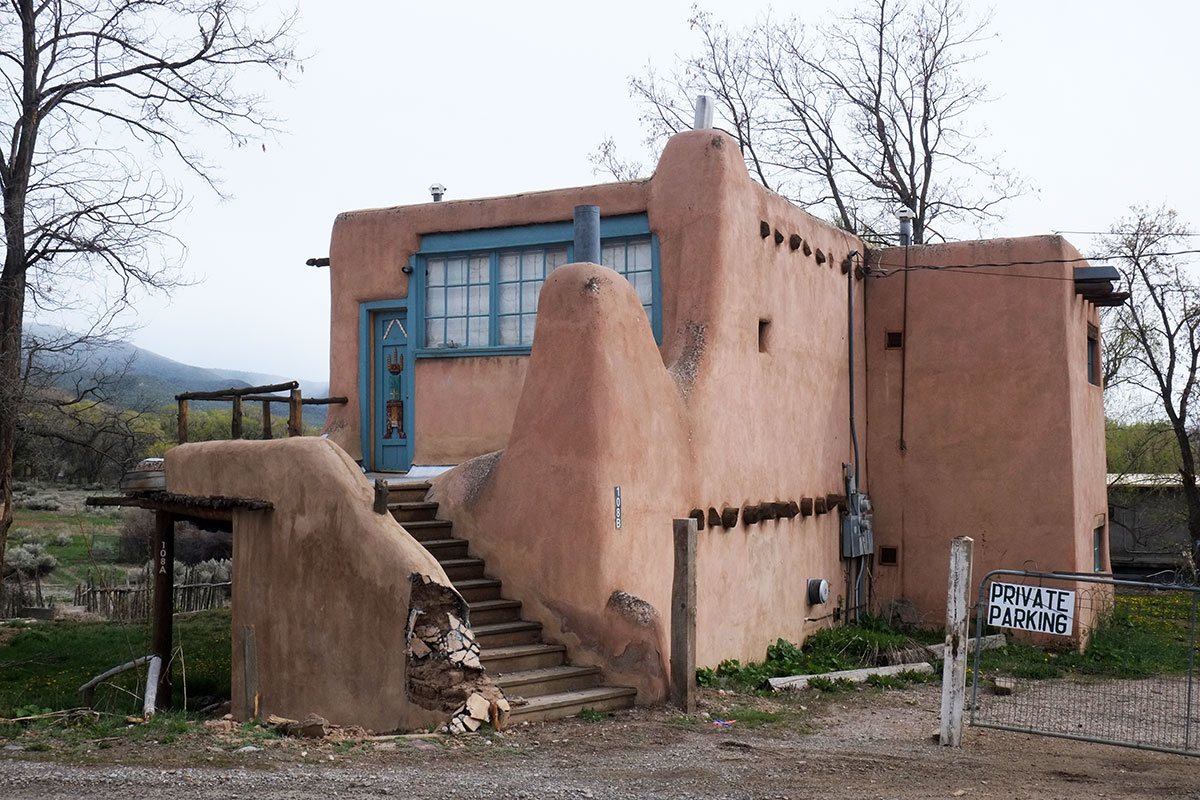
There were older houses where the plasticity of the material was exploited – I became very fond of lumpy, curvy architecture with little attached blobs. Making these forms out of adobe and stucco makes a lot more sense than going to the extreme lengths current high-style architecture does, with its torturing of steel frames and metal panels into curvilinear forms which are only obtainable through the application of advanced computer modeling technology, computer-controlled fabrication, and tons of money. Here, there was probably a rough sketch from the architect, and a couple of good masons.DSCF9981

DSCF9991

From everywhere in town, there were these intermittent views out to the landscape, such as here across a pasture to the smaller mountains to the south.DSCF0001

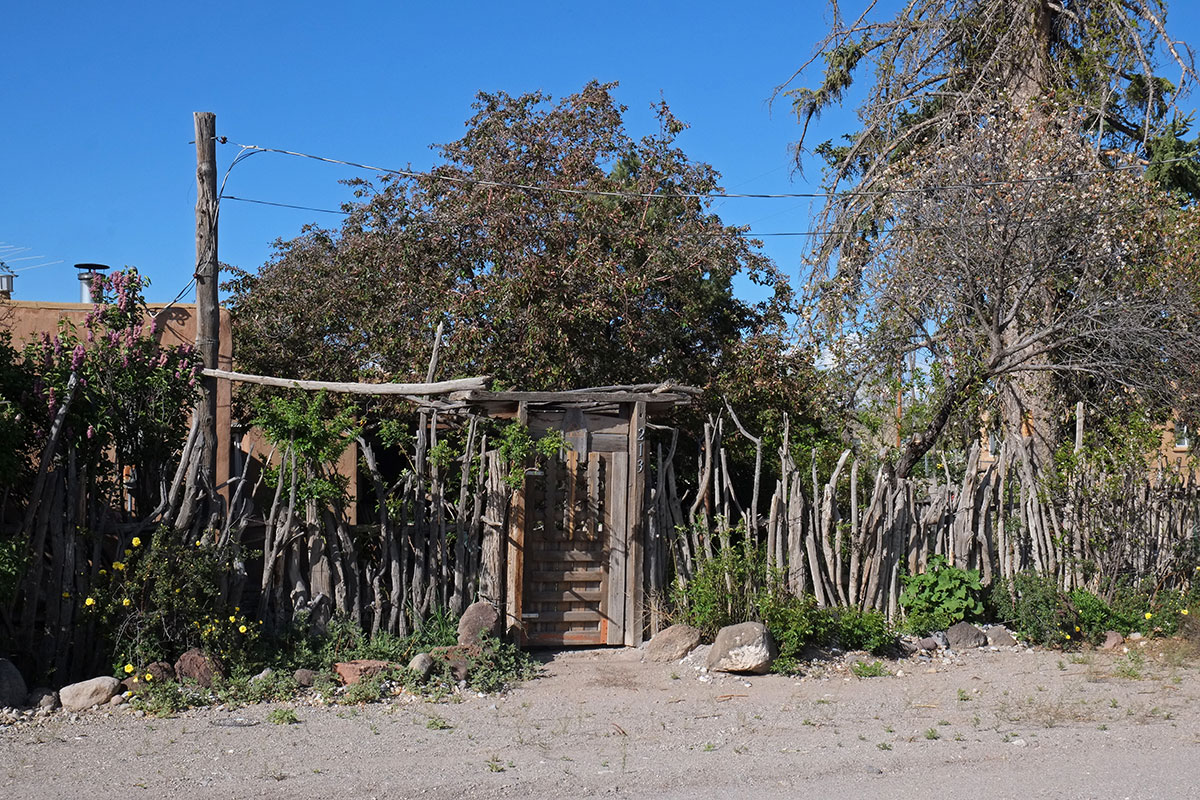
And then there were the random building agglomerations which made us feel that we were back in Eugene, but with stucco.DSCF0306

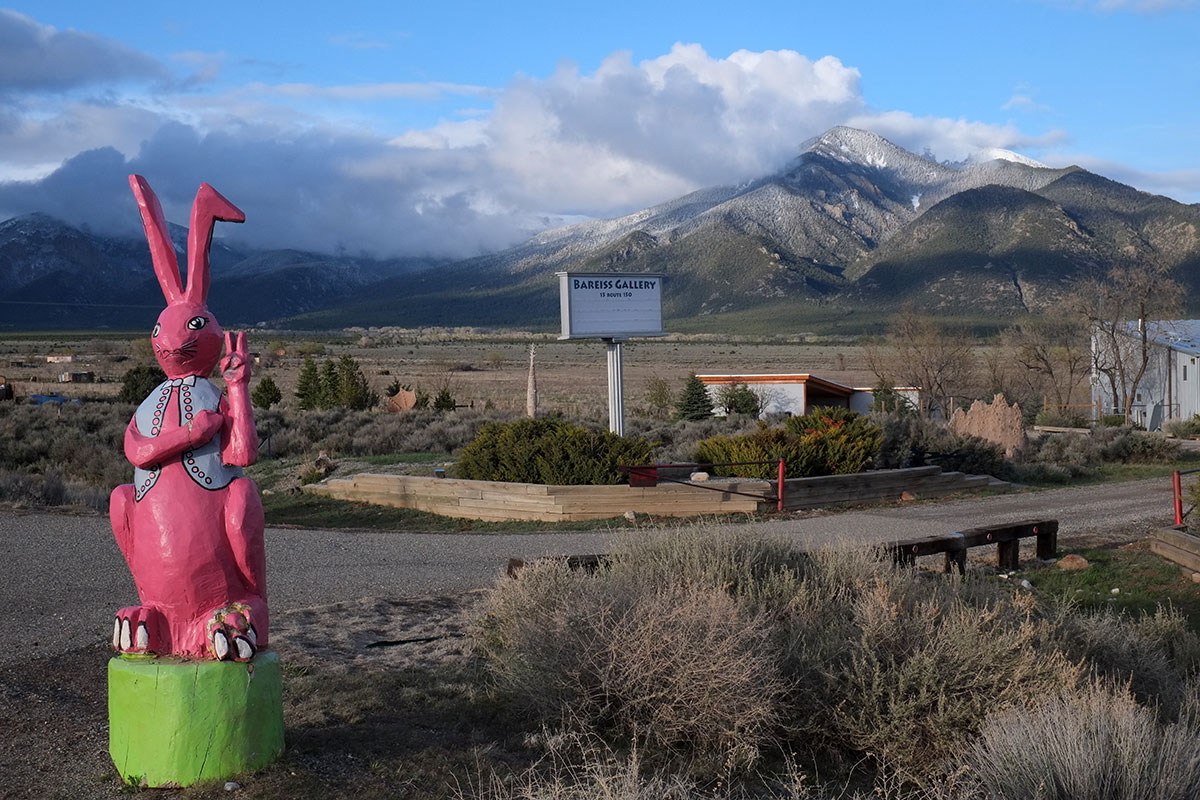
That feeling continued into the art world. Santa Fe had lots of outdoor art, all of which tried to seem very serious, even when it was pretentious and bad. Taos had more of the funky sculptor-puts-things-in-front-yard aspect to it, and the contrast between the sublime and the ridiculous again made us feel at home.DSCF0048

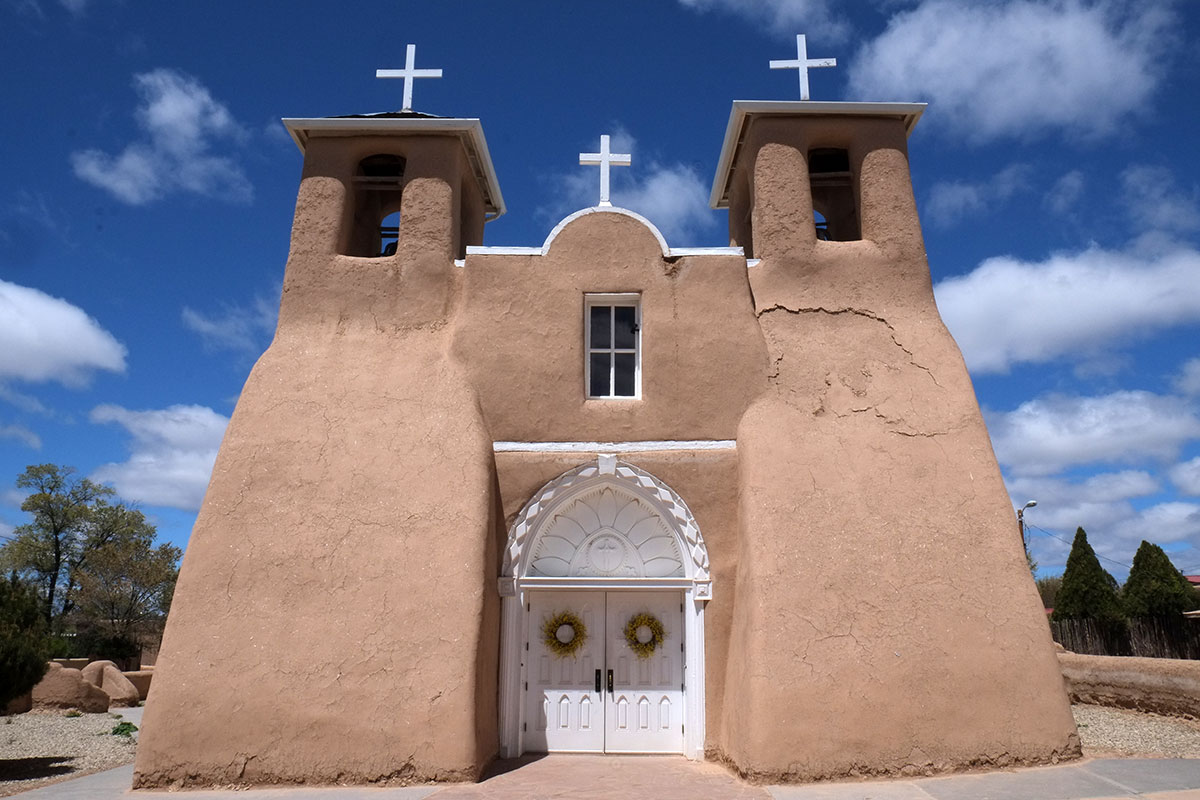
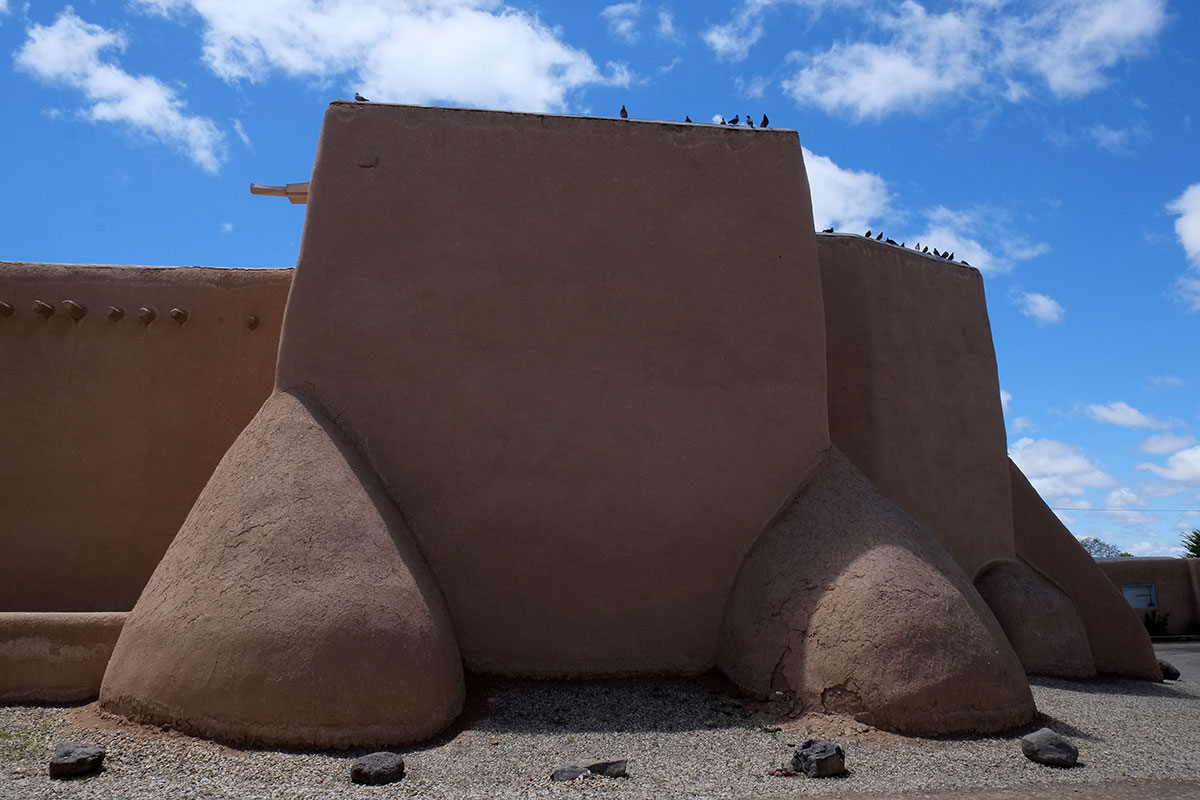
At Rancho de Taos, just south of the city proper, we saw the mission church made famous by Georgia O’Keefe.DSCF0059

Even 100 years after this was discovered by O’Keefe and other modernists, and even after knowing what to expect from seeing their representations, the church is riveting in its stark, geometric forms. The simple shapes, the play of light and shadows over the surfaces – it’s obvious why it was a revelation and inspiration to them. The clarity present here, due to the demands of the material and the vision of the artisans who knew how to use that material, stands in contrast to the self-conscious striving for technical difficulty and obscure meaning in the current milieu. Our appreciation of this architecture may sometimes be overly naïve and romantic, but seeing this church in person reinforced how powerful simple and clear forms can be.DSCF0052

100. Taos036DSCF0069

Taos is in an incredible landscape, so we spent a couple of days exploring outside the city. We took the much-recommended “high road” back south towards Santa Fe, which was a combination of broad perspectives over the high country of mountains and ranchland,DSCF0075

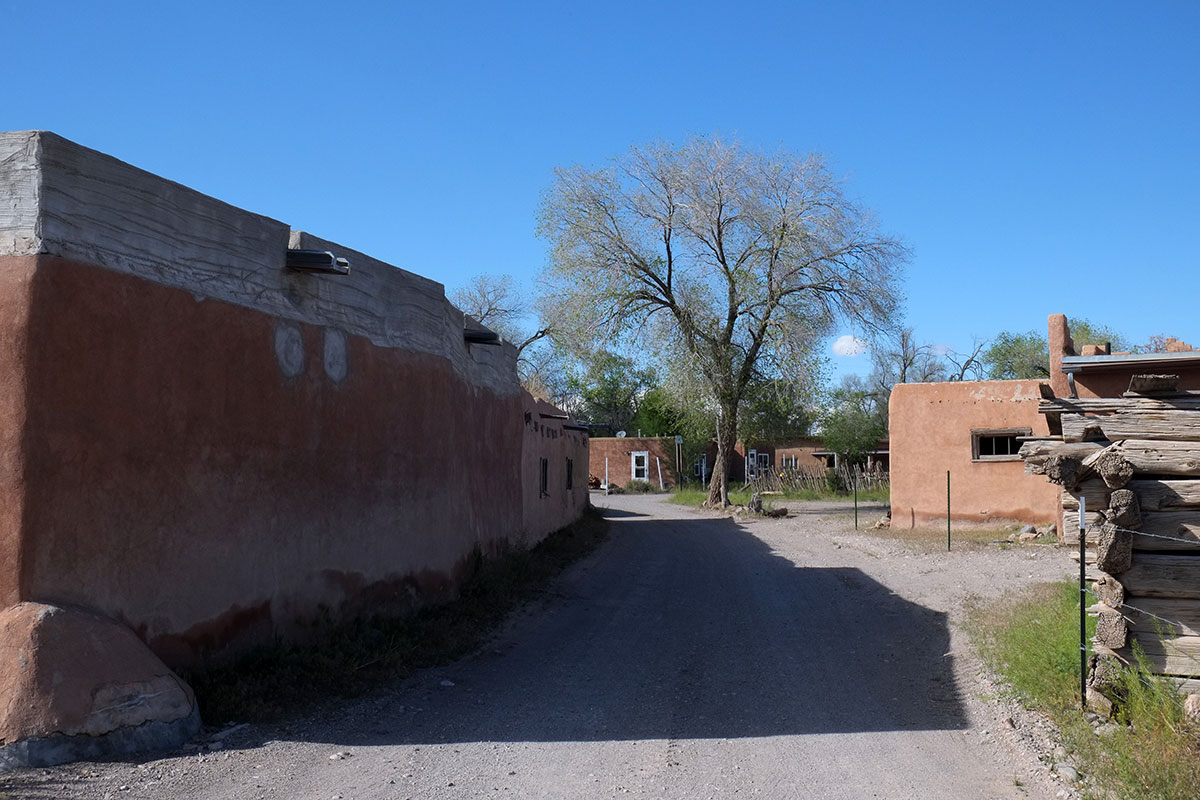
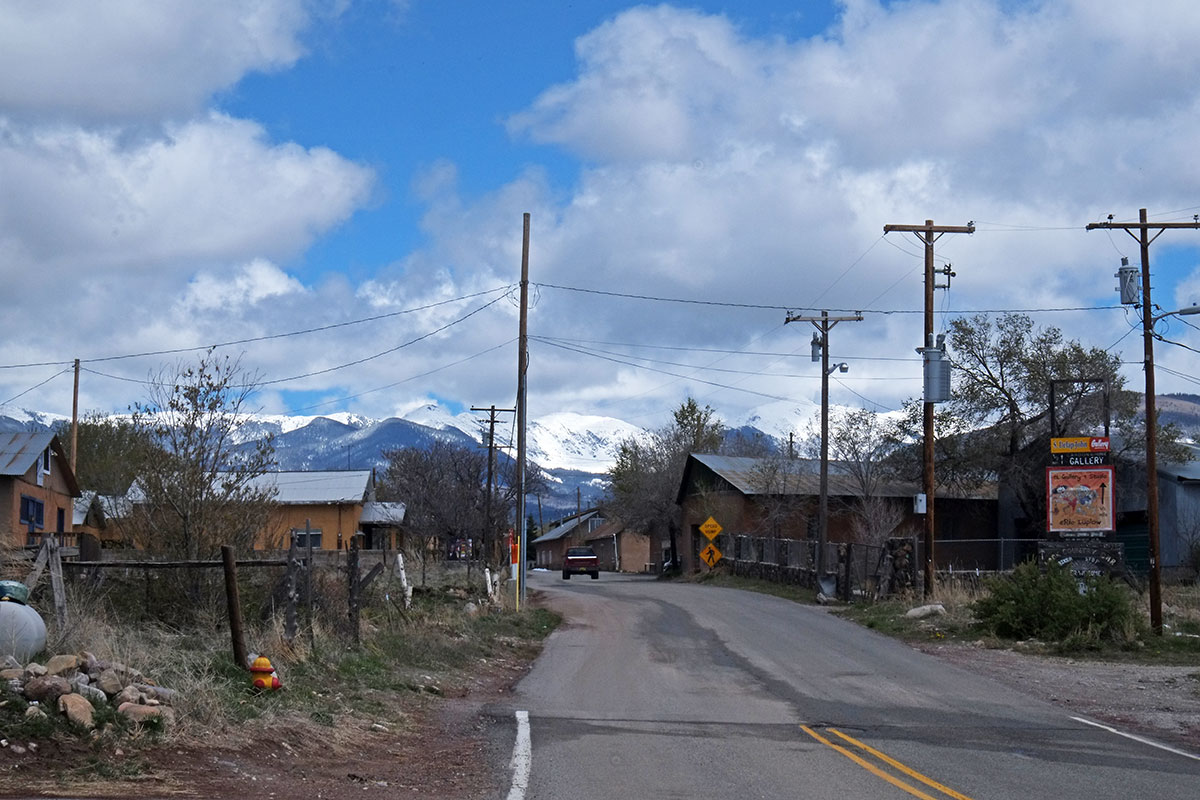
and small towns that at first glance were completely casual and untouched by the larger regional culture, but if you looked more closely you could always find a few artists’ studios mixed in.DSCF0078

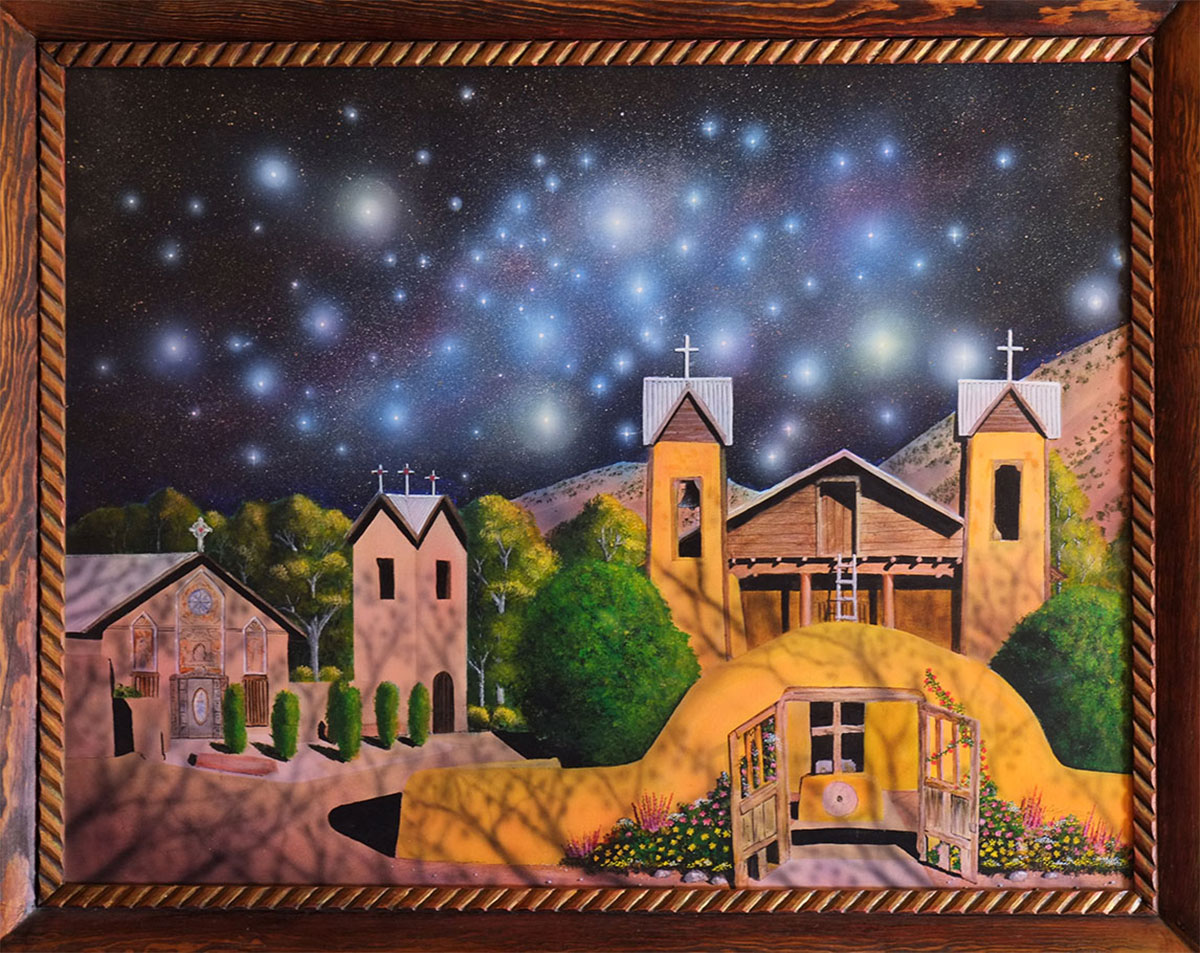
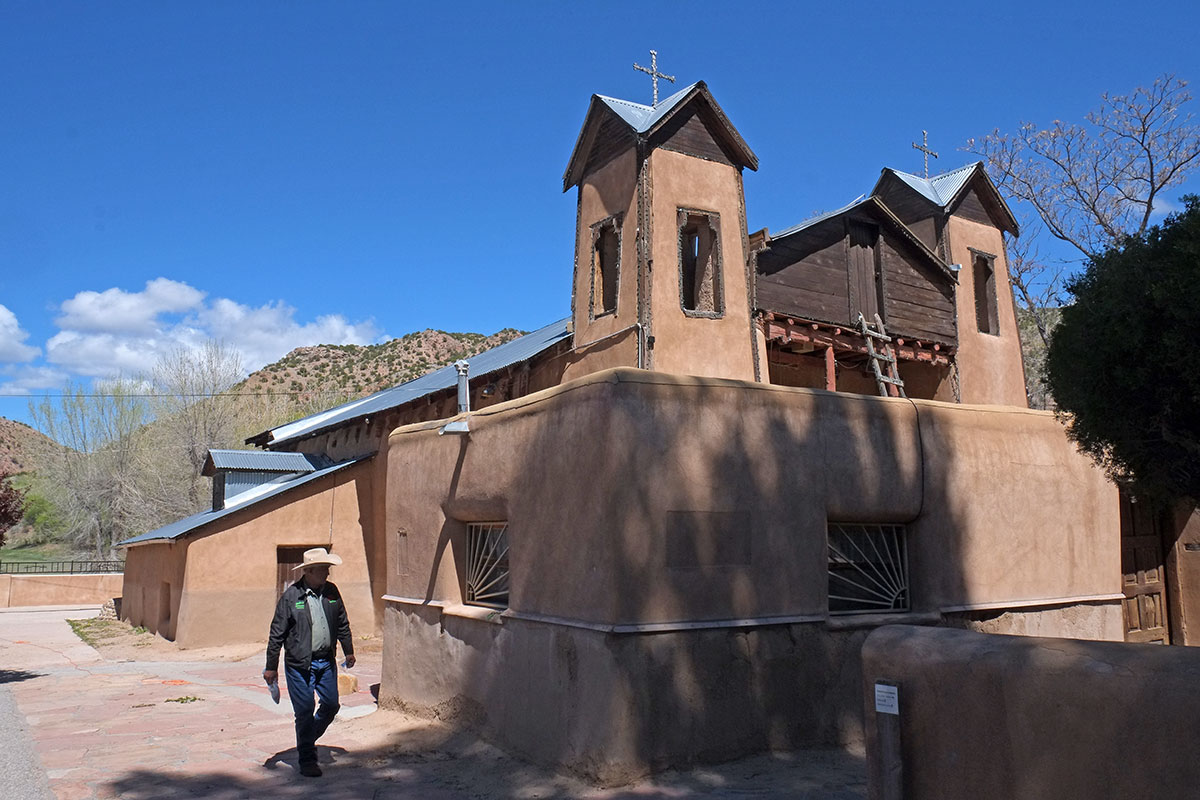
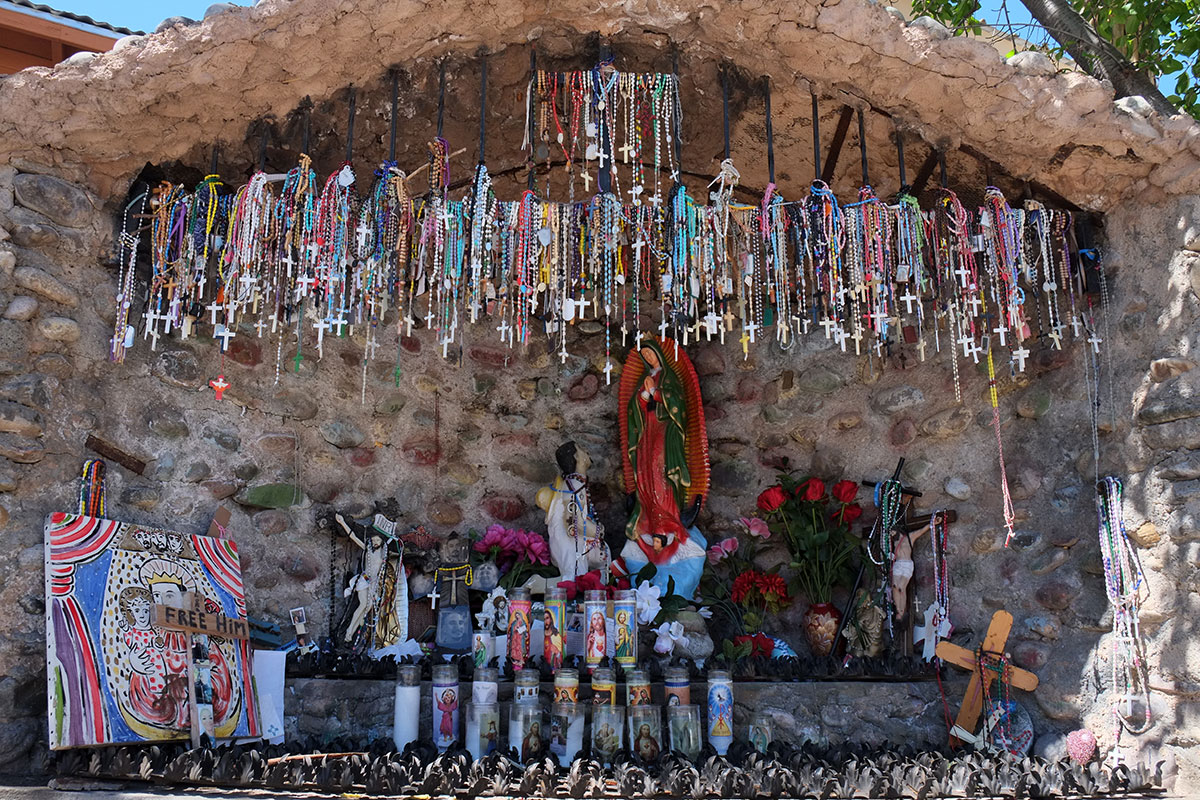
Santuario de Chimayo is an old mission church, which is reputed to have holy soil with curative powers. We read some disclaimers from the Church on how the soil doesn’t have any power beyond its ability to focus believers’ faith in God’s power to heal, and so only indirectly leads to miraculous recoveries, etc. But everywhere we looked there was lots of evidence of a strange, fantastic mysticism,DSCF0089

with shrines that showed the devotions of Hispanic pilgrims,DSCF0086

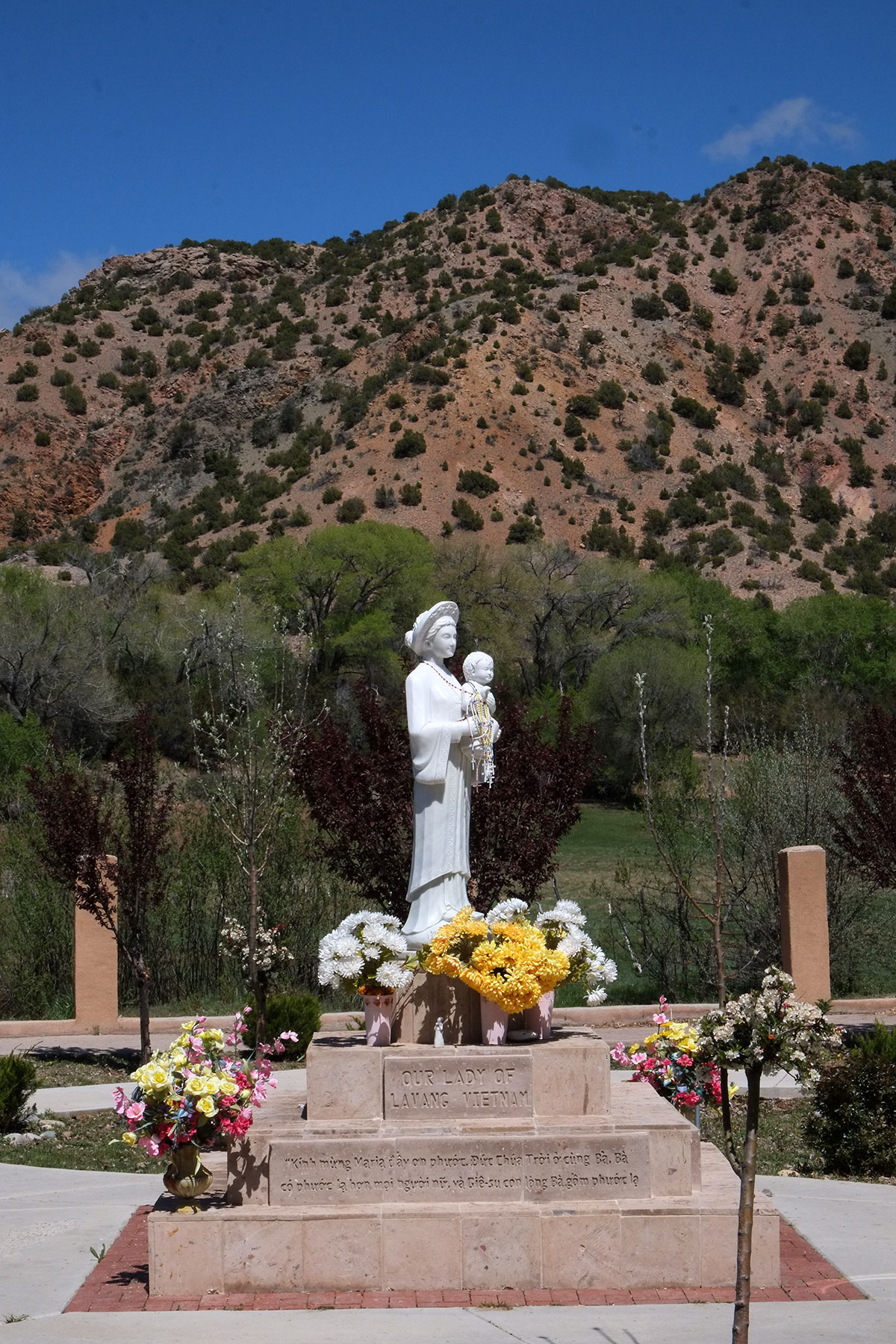
and even those originally from Viet Nam, now living in this very different world.DSCF0085

Greta was nonplussed by all of this. Even I, who went to Catholic school for 12 years and was quite used to little old ladies lighting devotional candles at Our Lady of Sorrows, found this strangely alien and fetishistic, having more in common with the traditional practices we’d been coming across at the pueblos than with doctrinaire Catholicism. We’d been hearing about the syncretism in Southwestern religious beliefs, but this was the evidence we’d seen that this was a living system, not just a curious bit of history. Greta is a child of the Enlightenment and lives in the secular atmosphere of one of the most irreligious states; most of what she knows about Christianity has come from watching Monty Python’s Life of Brian, and she had no idea what this was all about. Like many teenagers these days, she reads a lot of fantasy, but coming face-to-face with actual, iconic expressions of non-rational religious faith (that weren’t in a folk art museum), was completely outside of her prior experience. But we both really liked this painting of the Mission which was in the lobby; probably we’re both more comfortable with magical realism than mystical religion.DSCF0087

While the high road to Taos is relentlessly beautiful mountain terrain, we found the “low road” to be equally beautiful. It goes through the more densely populated corridor along the Rio Grande, and provides access to many pueblos (and casinos). When the main highway and the river diverge, we turned off onto a dirt road along the river, the lower reaches of which were peaceful and calm, with a range of good camping opportunities.DSCF0136

DSCF0138

Eventually the road climbed up the western canyon wall, and we hiked into the canyon on an escarpment, leading to this view. We then realized that this was the second time we’d hiked into a deep canyon on the Rio Grande – the first was two months earlier, in Big Bend, way downstream.DSCF0144

The road climbs up to the desert plain above, until it reaches this bridge which spans the Rio Grande, and we then took the highway which led back into Taos.DSCF0157

Taos was our gateway back into high mountain country. We hadn’t seen what we westerners would call real mountains since Big Bend a couple of months before, and we hadn’t been in the Rockies since leaving Yellowstone in September. When we left we drove north and west towards Mesa Verde, and truly appreciated the landscape of mountains, conifers and snow.DSCF0310

DSCF0313

We crossed a mountain pass at 10,000 feet, and went through small towns and ranchland nestled in the foothills, an amazingly different environment from the one in which we’d spent the past few months. We would soon head back through the desert on our way west, but for a few days we were back in the more familiar and comparatively lush world of precipitation, vegetation, and snow-capped mountains.DSCF0316