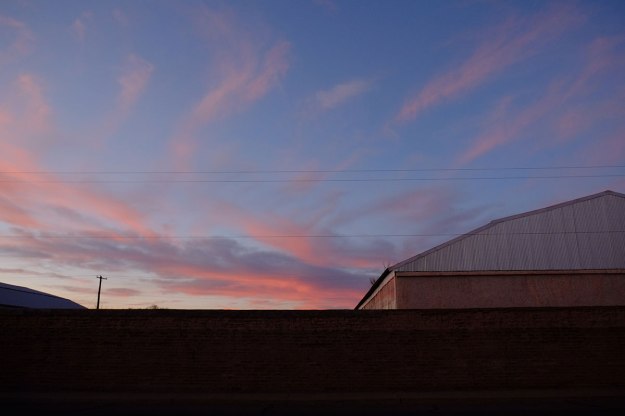
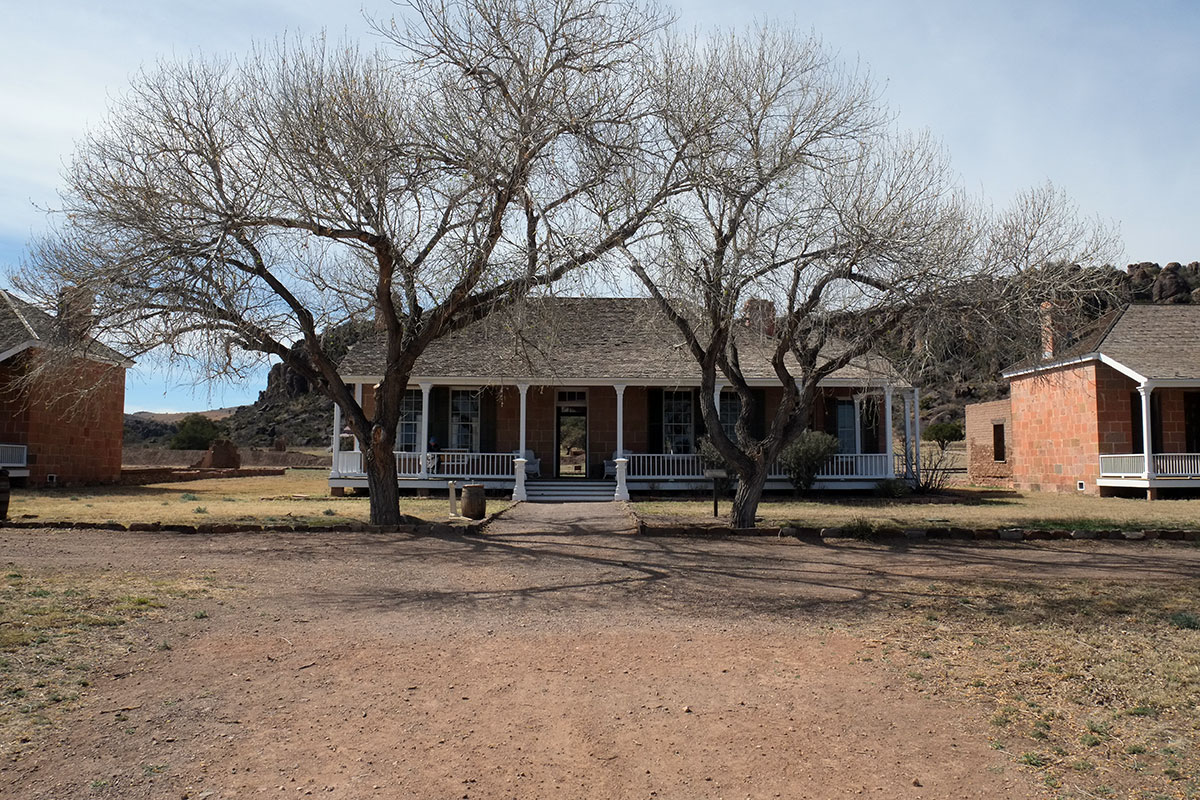
 Donald Judd, the sculptor and theorist, pretty much deserted New York for West Texas in the 1970s. He eventually bought a 340-acre former Army base on the edge of Marfa, also acquiring the quartermaster’s post in the center of town. Although he continued to own his building on Spring Street in Soho, for the rest of his life he mostly worked in this incredibly remote town of 2000 out in the desert.
I’ve always been intrigued by artists and writers who have achieved great success, and who then leave the cultural centers so they can continue their work, unimpeded by the distractions of social life and fame. It’s a pretty rare phenomenon (O’Keefe, Salinger, Updike and Pynchon being recent examples); how many people want to really be great artists, versus living the entertaining life of a successful artist in the metropolis, especially in our current society, which seems to be driven by mainly by celebrity and money?
The really unusual thing that Judd did was not his move to the desert to create his work, but his decision to create a venue out in the desert for the permanent installation and exhibition of his own work, plus that of his friends Dan Flavin and John Chamberlain. He thought that in big city museums, where they would be able to show at most a few pieces, the work could not be well-understood. In Marfa, where the spaces were big and cheap, they could show a significant body of work, including large, site-specific installations where an idea could be fully developed.
Besides his sculptures, Judd was noted for his furniture design. He had considered becoming an architect, and all of his work shows a remarkable regard for context, materials and structure. As I learned on a tour of his compound, he didn’t want to construct new buildings – he thought that developing a relationship to an existing building and site had more possibilities, and all of his work in Marfa reflects this.
The sites in Marfa are now run by two different organizations. The Chinati Foundation has the old army base, where Judd’s large installations, Flavin’s installations, and the work of visiting artists is shown, as well as a building downtown devoted to John Chamberlain’s sculpture. The Judd Foundation, which is run by his children, owns the compound downtown where Judd and his children lived, and where a wide range of his individual pieces are shown.
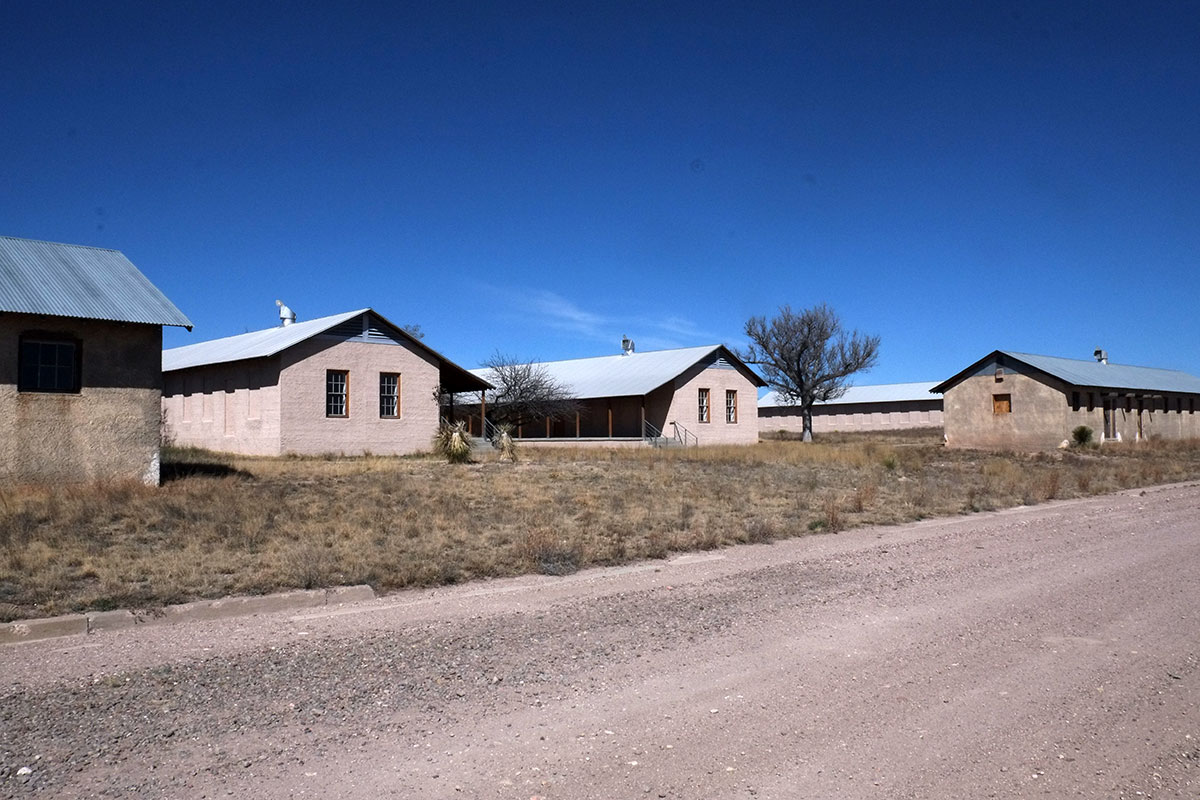
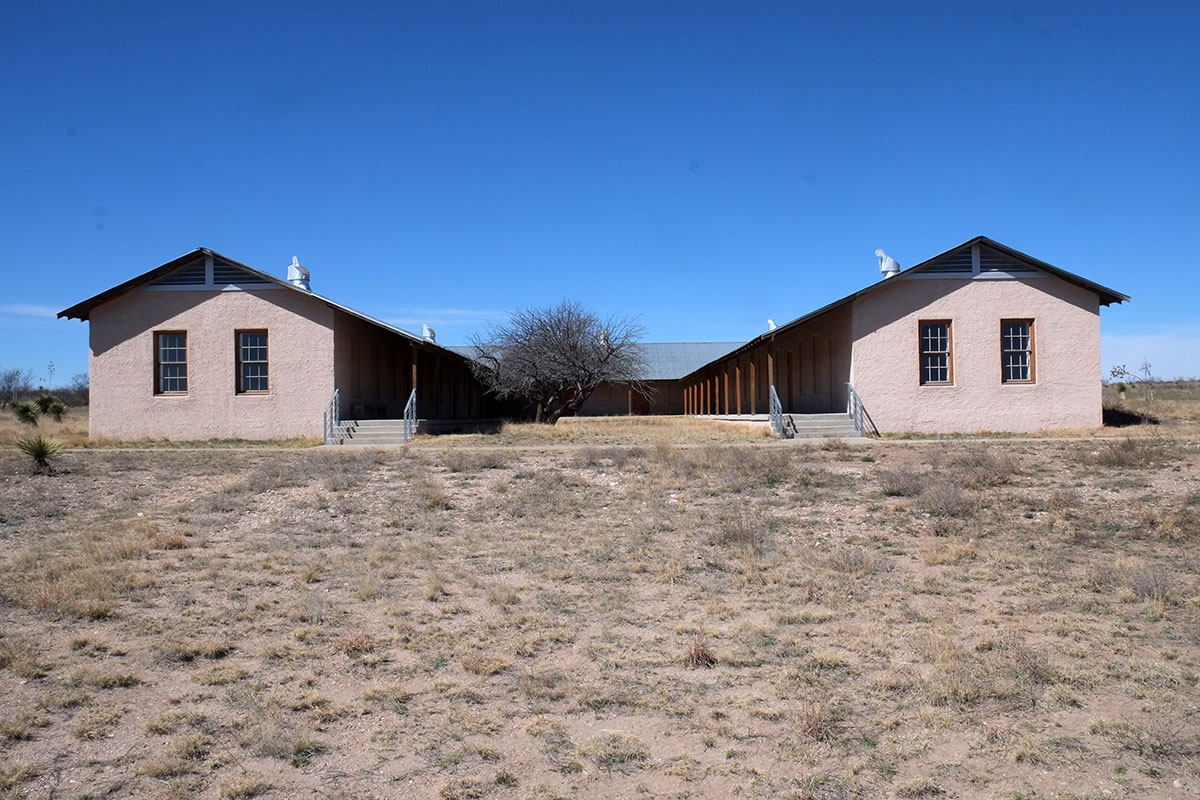
At the Chinati site, the wood-frame barracks buildings are strung along a curving walkway and road. Dan Flavin took over six of them for an installation of his colored fluorescent tubes, with each successive building exhibiting a change in the sequence / development of the ideas from the previous ones. 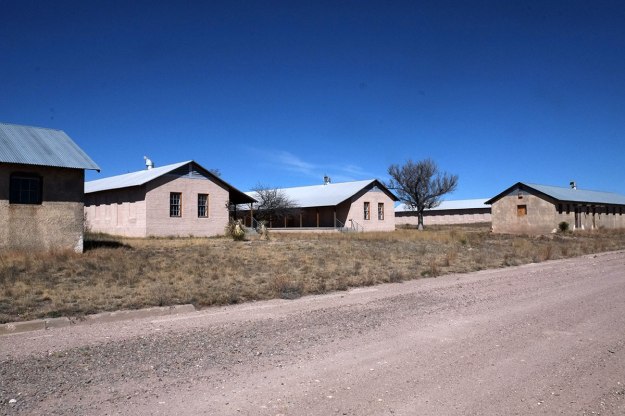
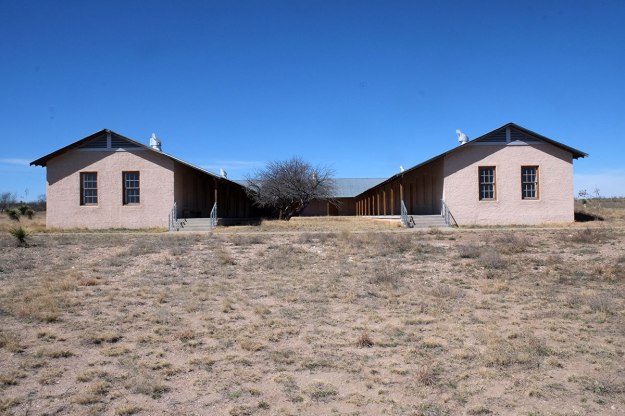
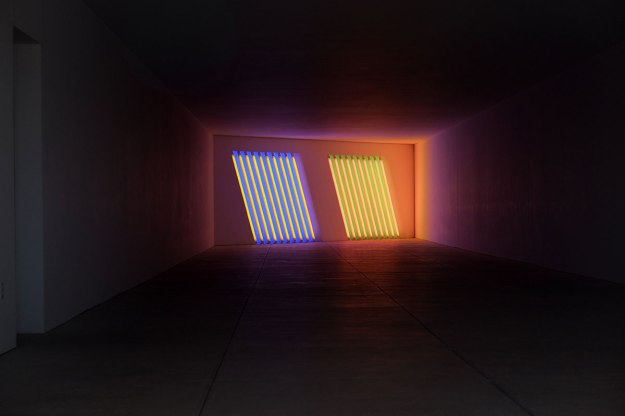
The importance of the location in Marfa can be clearly seen – if you were in a city museum, you would be lucky to see one half of one installation – they just take up a lot of room. But here, the layouts are the same in each building, while the color arrangement changes. You go from one building to the next, and can understand the color as the independent variable. The rhythm of leaving one building, going out into the bright desert, and the entering the next darkened building is an important part of the sequence.
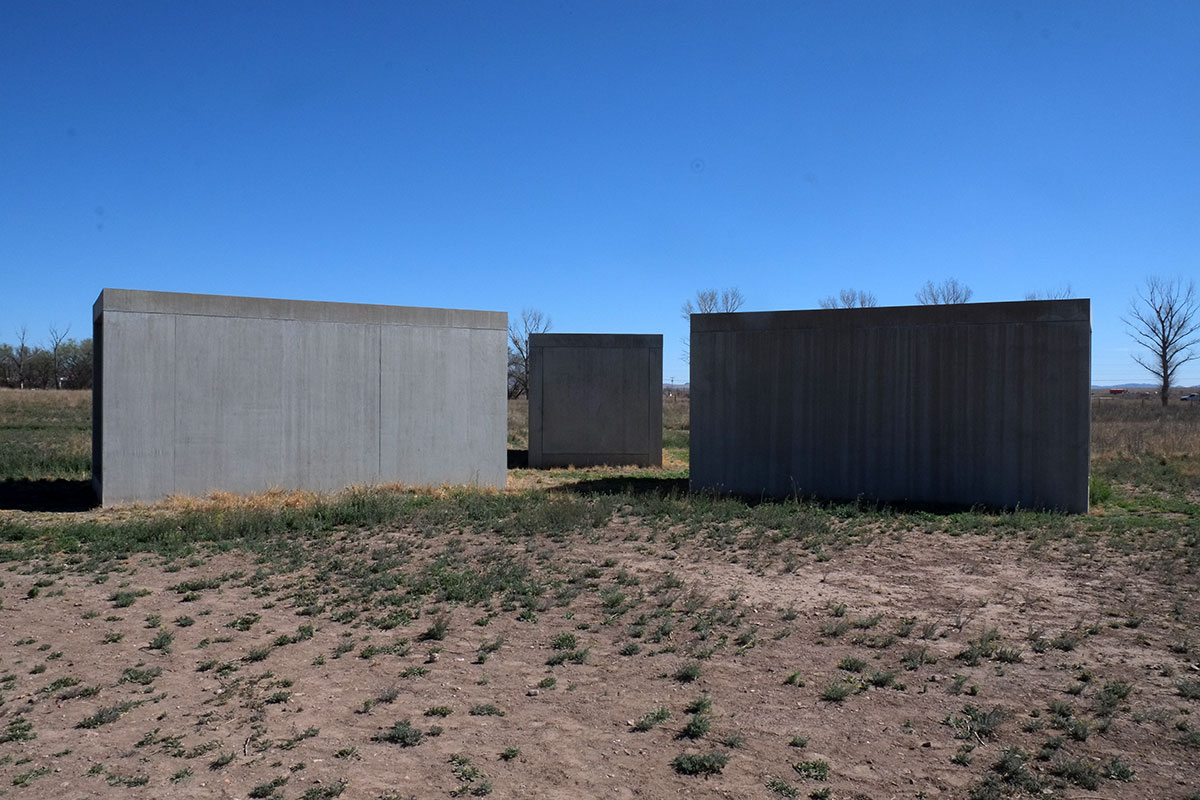
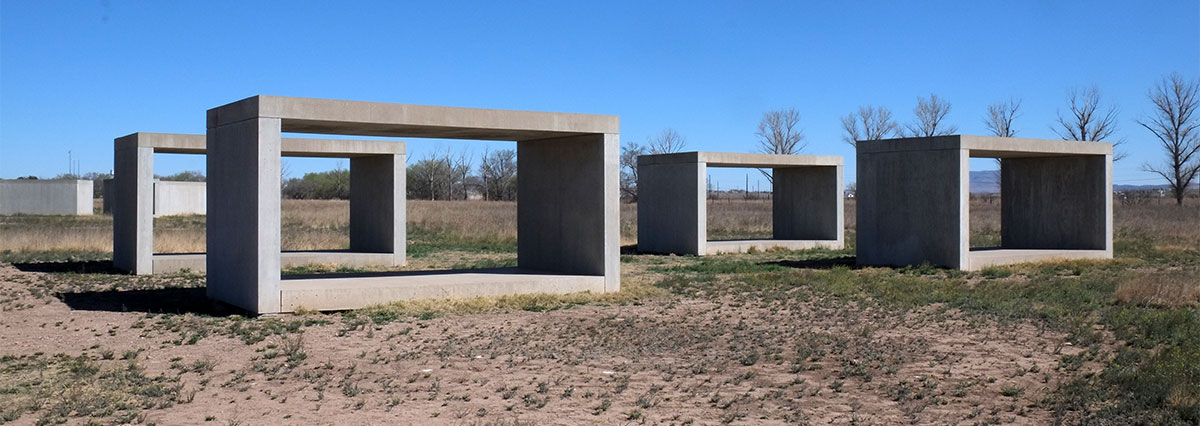
Judd created a series of large concrete box sculptures out in the landscape, which were cast in place. The boxes are all of the same outside dimensions, but each cluster varies in degree of enclosure, number, orientation and arrangement. 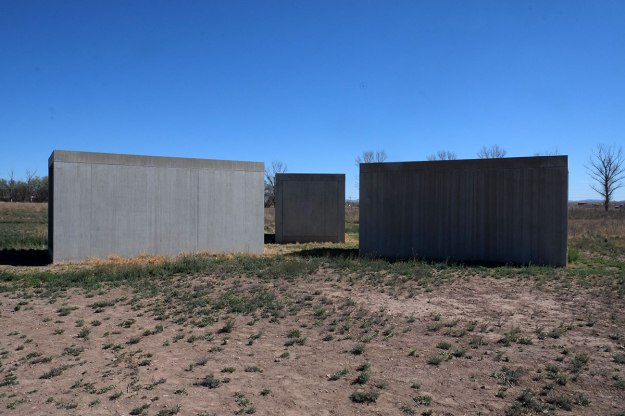
Many are orthogonally placed, but diagonal visual relationships are apparent as you walk around them. As one of the docents on a tour pointed out, Judd thought symmetry was critical – things should be symmetrical unless you had a specific reason to make them asymmetrical. I was struck by the different between his thinking and current practice today, where any symmetry (or even regular geometry) evokes gasps of shock and surprise. 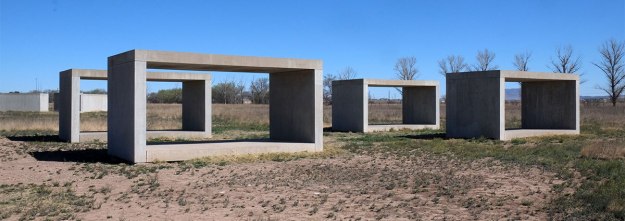
As I walked down the line, I was reminded of the Kahn buildings we’ve seen on this trip, where simple, strong forms are carefully placed in the landscape. Forms in light, and here it is the strong, vivid light of Texas. It reinforced Marc Treib’s idea that human interventions which manifest a clear geometry stand out in contrast to the natural world, and this contrast highlights the essential character of each and makes them more powerful.
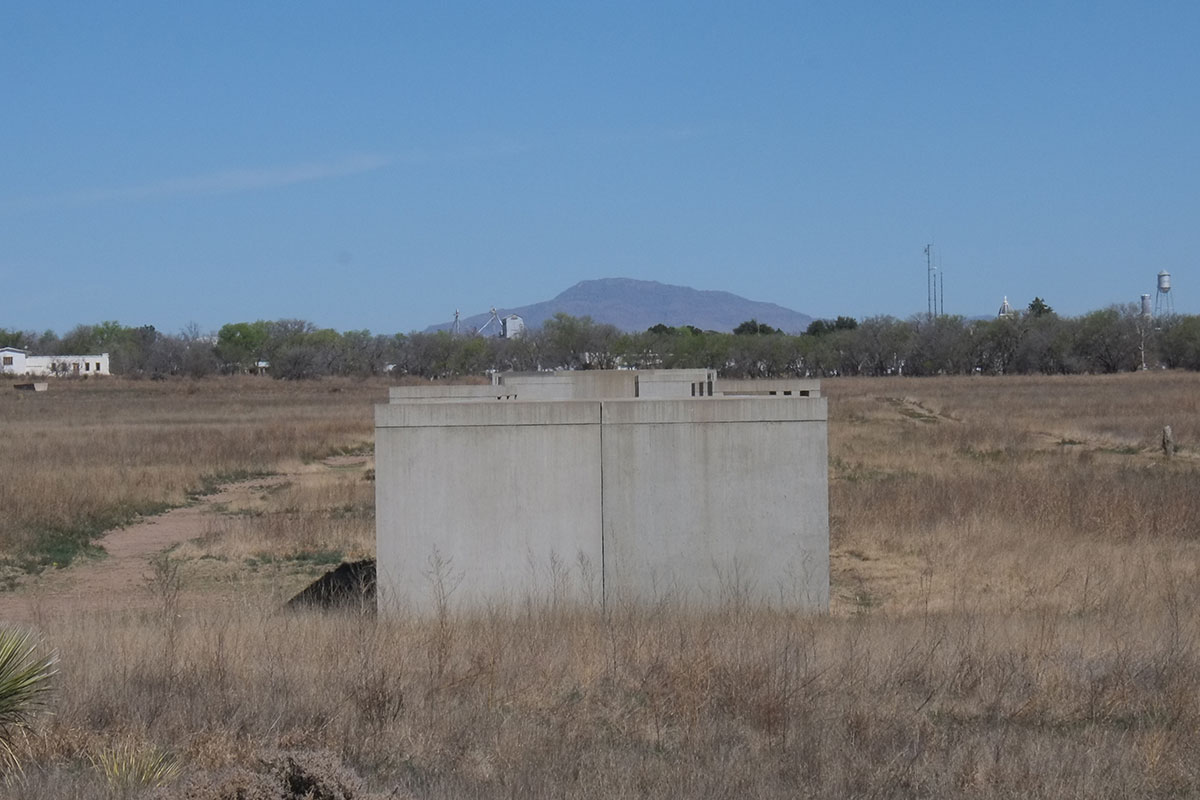
This part of the Chihuahuan Desert at first seems rather featureless, but as you look around, you notice some ordering features. The Marfa Plateau is extremely flat, but there are individual mountains and ranges which break the horizon. The sculptures are arranged to emphasize these distant connections. All these sculptures are arranged on a long axis in the landscape, and as you move along, you can look back and see the termination of the axis to the north.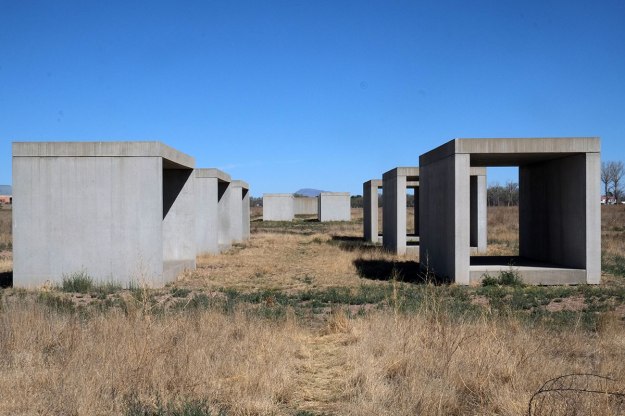

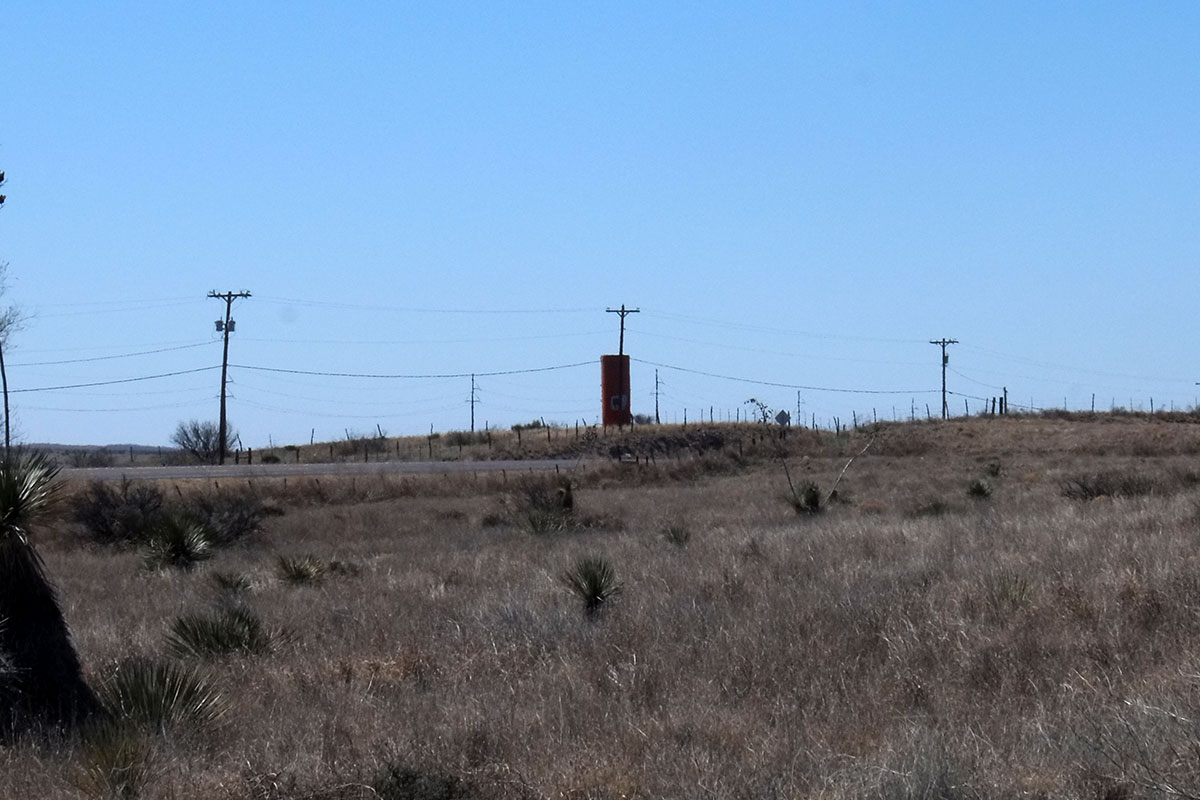
I then tried to extend the axis visually to the south, and it seems to end up here, in a water tank and three telephone poles with cross-trees. I don’t think Judd intended to make a reference to Calvary, but nothing else in this environment seems to be unplanned or happenstance. I think this could be the subject of at least one PhD thesis on the importance of Christian iconography in Minimalist art.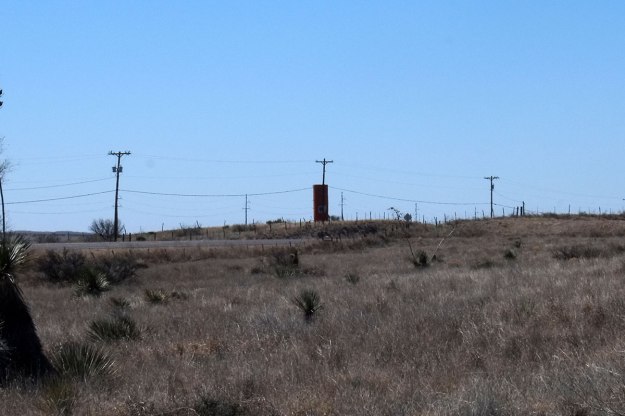
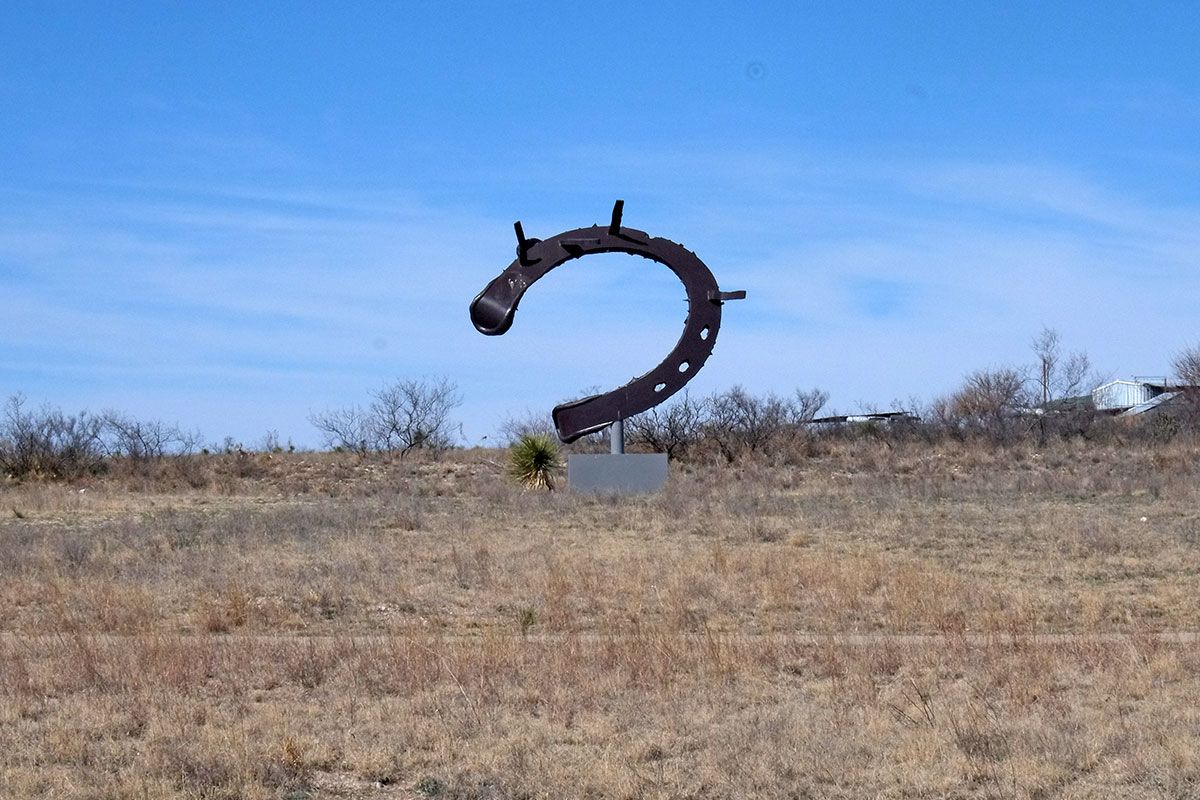
Claes Oldenburg created one large sculpture on site. He picked up on how this was a US cavalry base, which finally ended up with one famous old horse. Oldenburg created one giant horseshoe as a memorial, which apparently has some astronomical alignment. 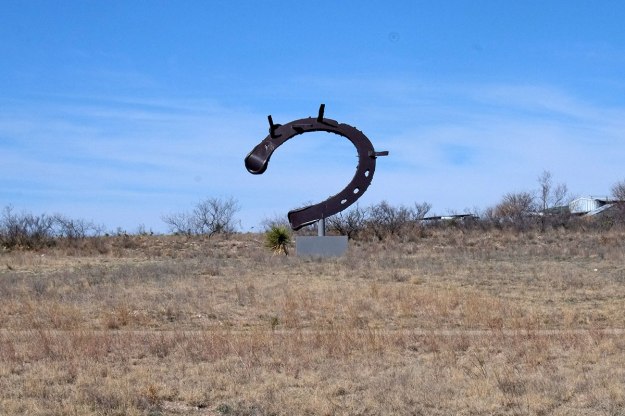
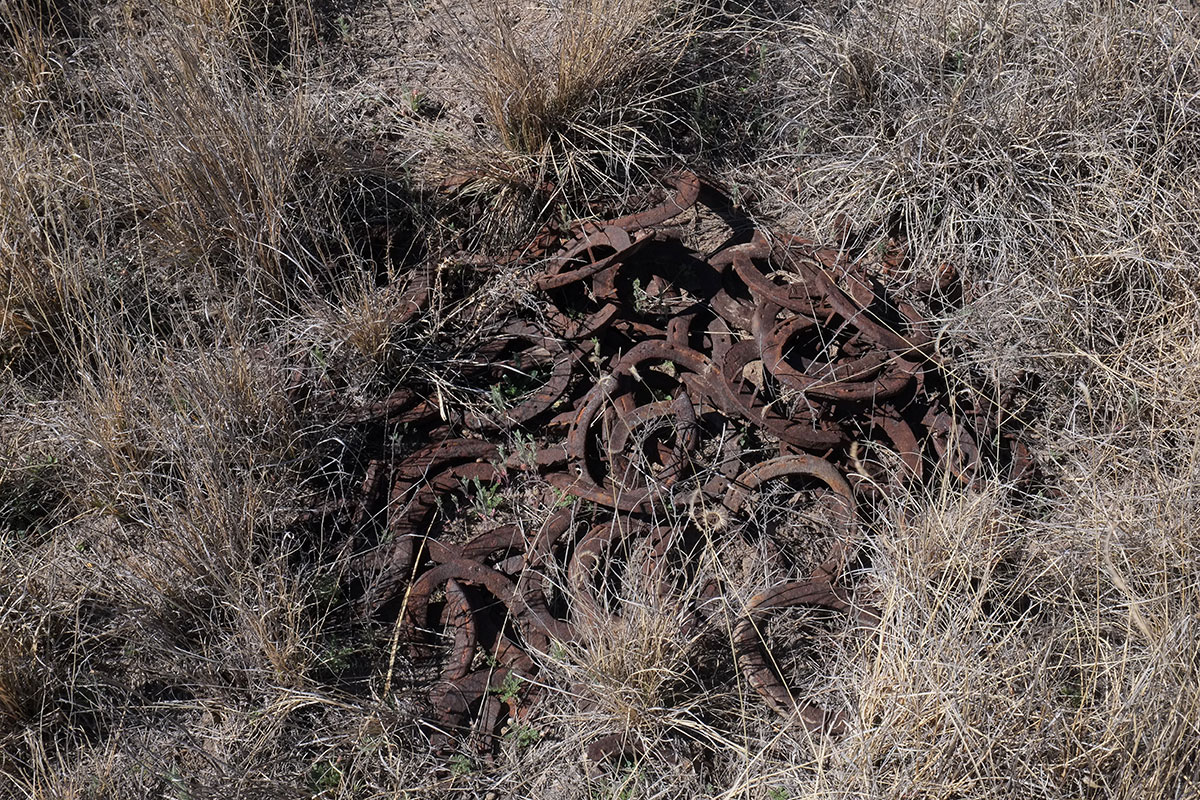
As I was walking around the site, i came across this pile of old horseshoes out in the landscape. Was it a remnant of the days of the cavalry, or was it a subtle installation, intended to be discovered by only the most intrepid art fiend? 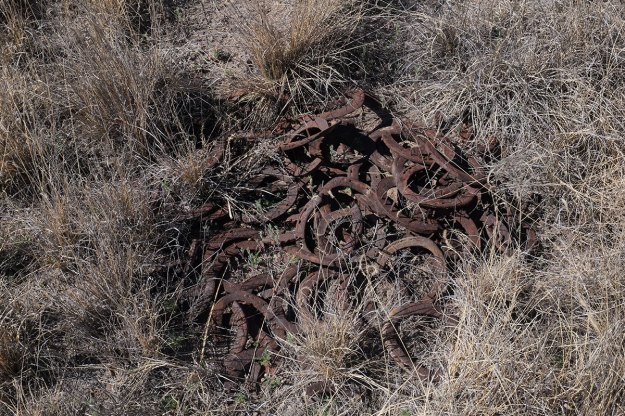
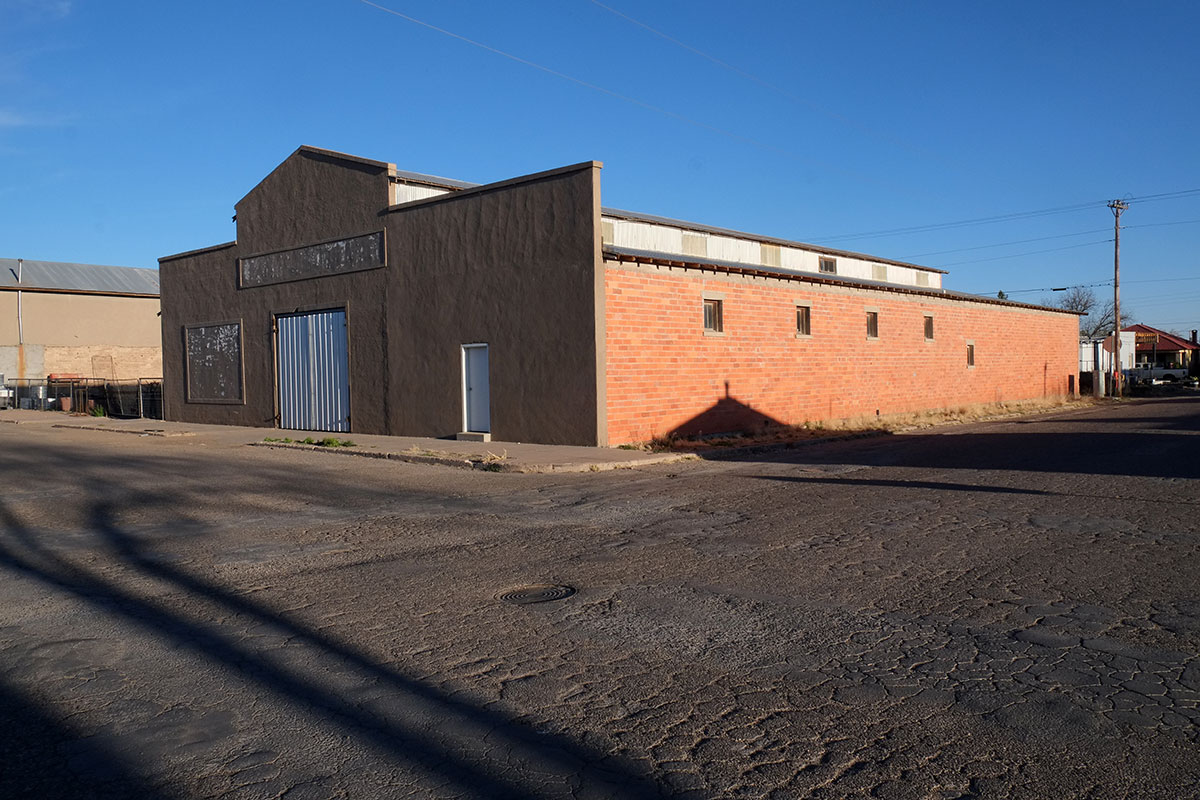
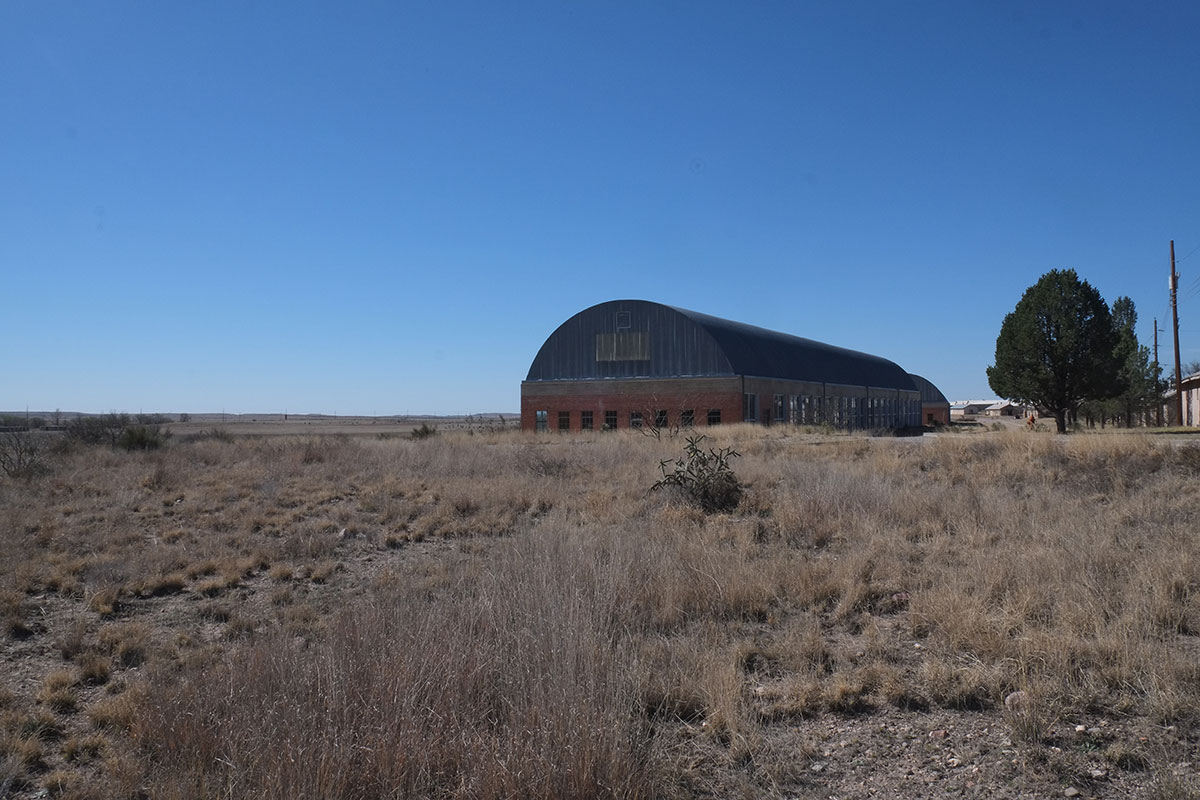
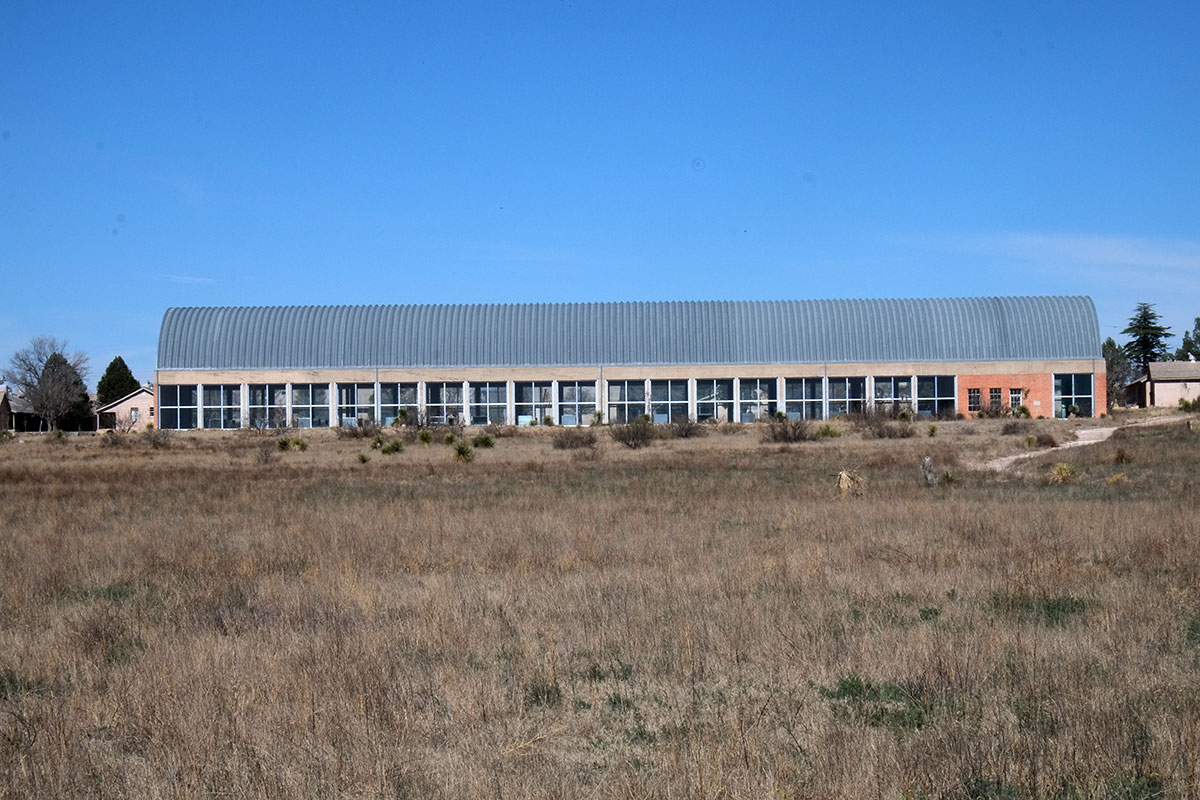
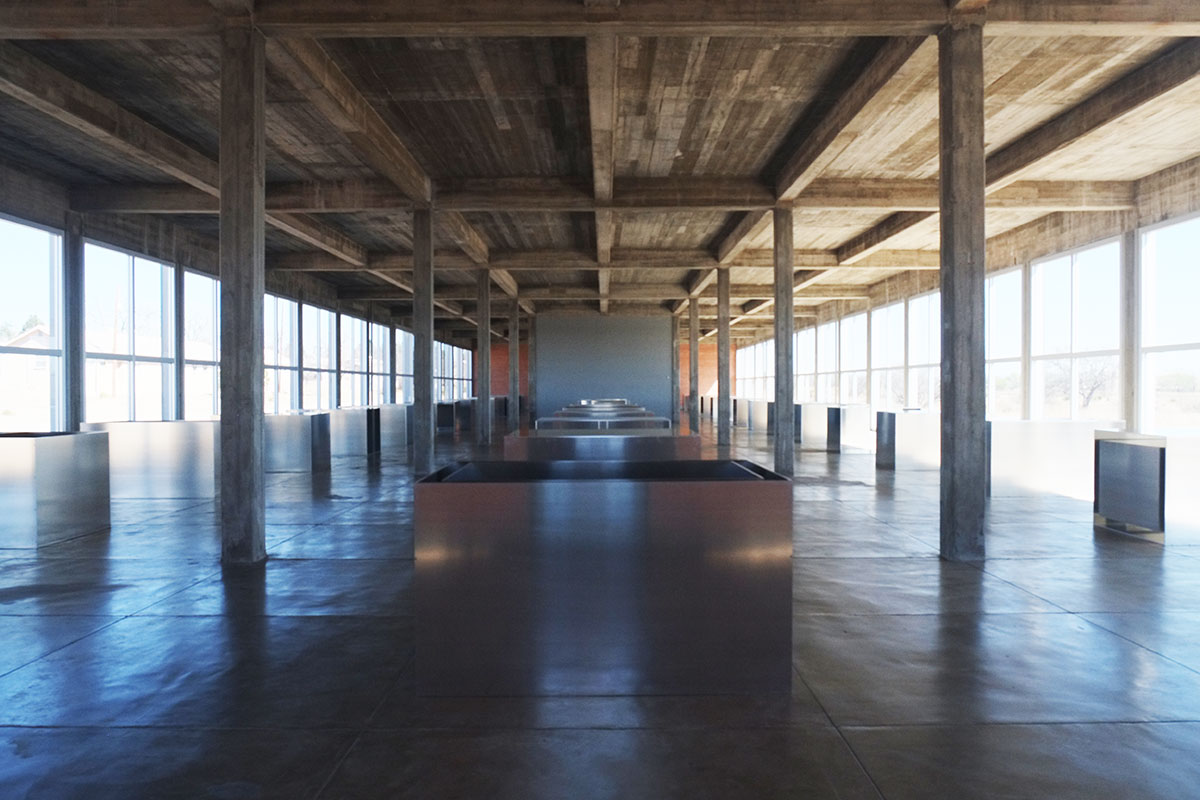
Besides the barracks, there are two large hangar-like buildings, which have been used for the installation of a series of 100 aluminum box Judd pieces. They are quite remarkable buildings, with brick facades and a regular bay system. Judd replaced the garage doors with glass storefront window installations. But the biggest change he made was adding the barrel-vaulted rooves, which were previously flat. This was done simply for visual reasons, to have the imageable building shapes stand out in the large landscape, creating iconic elements which seem to relate to the views of the distant mountains. (Although I want to know what actually happens up in those big attics.) 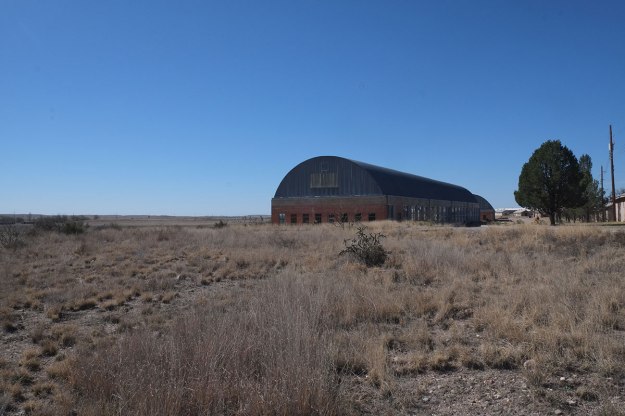
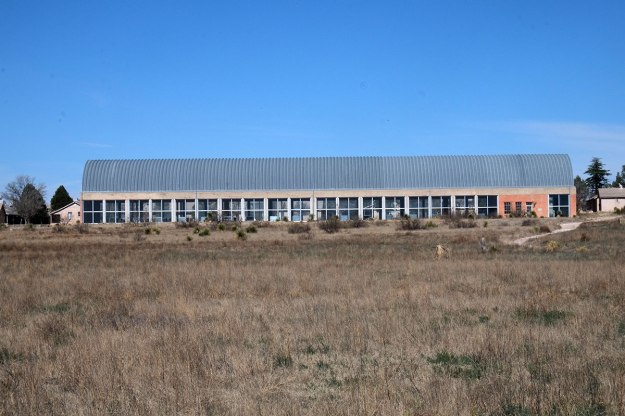
To see the works inside at the Chinati Foundation, you have to take a tour, and you’re not allowed to take photographs inside. They’re not worried about copyright, they just don’t want to have people running around, trying to capture the perfect image – they want people to actually experience the art. As much as I do want the perfect image (mainly for teaching), I have to agree with this policy – when you eliminate the distractions of cameras and phones, the art is right there in front of you, and you begin to get it. Maybe all museums should do this – no phones, and no labels. Really look at the art.
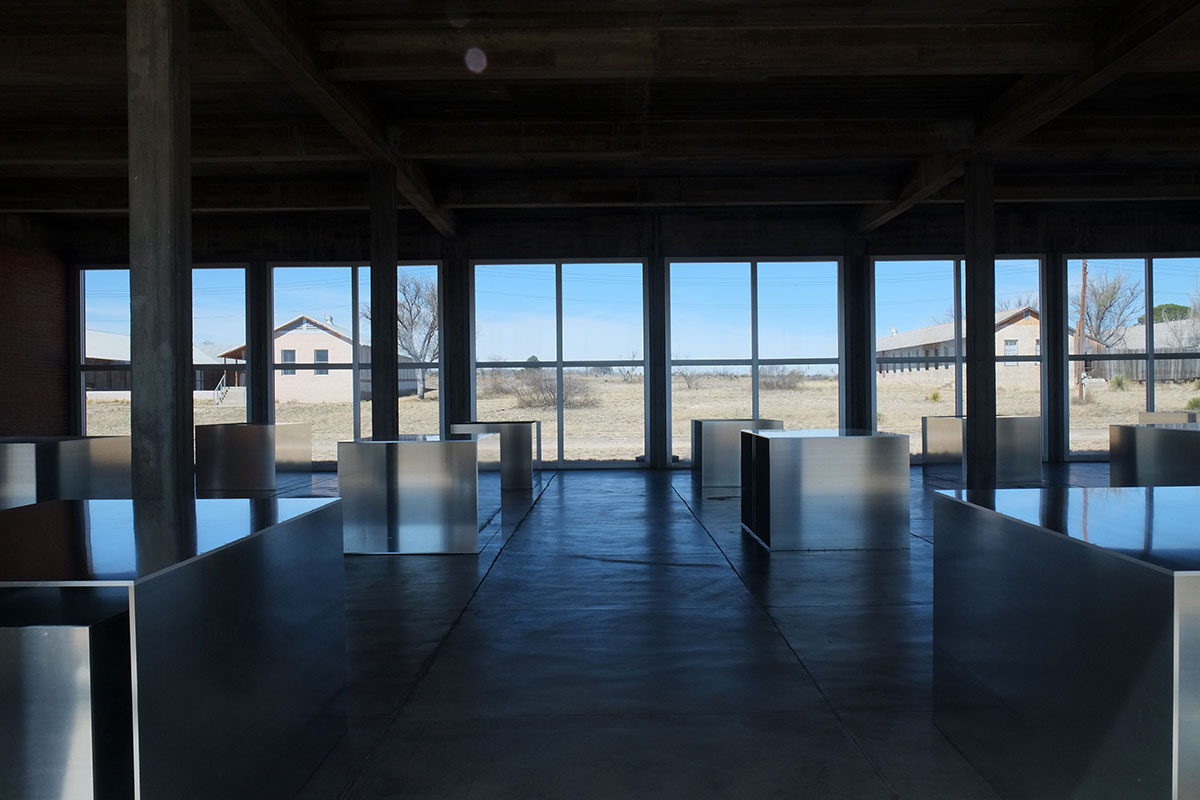
The next day I did take a few photos through the windows when I was walking around the site, not on the tour. Here you can see how the pieces fit into the spaces. 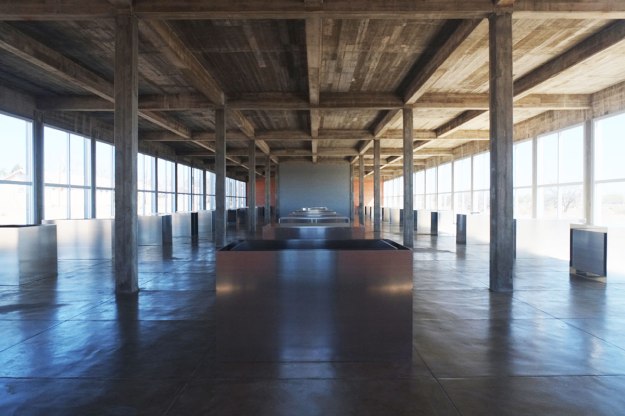
Judd adapted the placement of his works to the pre-existing division of the buildings into a few masonry-walled spaces. But whereas the box concrete sculptures outside have varying spatial arrangements, here there is a strict alignment of the boxes in rows and columns, related to the building structural grid. Each of the boxes has the same outside dimensions, but each has a different series of aluminum planes, and explore 100 different ways that the volume can be divided and developed.
Again, the importance of being in a large enough building to see the whole sequence was evident. In a museum, you would see just one box, in a gallery of work by many artists. It becomes a checklist experience of identification – there’s the Judd – he’s making some interesting space inside an aluminum box – looks like exercises we did in first-year studio – wonder what his idea was – time to move on to the next piece in the gallery – oh it’s a Flavin. But with a series you look at one, then you look at the next, then you think about the differences, and after you see five more an idea occurs to you, so you circle back to the first, etc. It is similar to serial music, where the variation in the patterns is a critical element. (However, there is no discernible pattern in how the individual boxes are juxtaposed – you can’t see an obvious progression of an idea down a row, for example. It’s not a matrix.)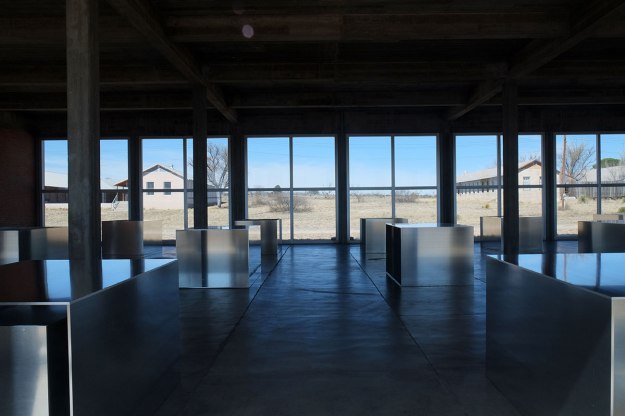
But I did discover one remarkable thing while looking at them. The absolute precision of the geometry of each box made me wonder about the precision of their placement in the system of the repetitive building structural bays. I sighted along a row of boxes, and discovered that they were not very well-aligned at all! Some were shifted off the orthogonal, sometimes by inches. Then I looked at their placement within the grid of control joints in the concrete slab, and found that they were not centered within an individual module, being clearly skewed towards one side. This seemed so incomprehensible that I asked the guide, and she said yes, they were all moving – they had been carefully aligned and centered when they were installed decades ago, but now they were out of alignment.
I thought about it, and came up with what I thought was a reasonable explanation – large boxes made out of aluminum (which has a very high coefficient of thermal expansion), sitting in an unconditioned building in the desert. Every day they would expand and contract with the diurnal temperature swing. But they are sitting on an imperfect concrete slab, and so are unevenly supported, so when they expand and contract, they probably shift imperceptibly with each cycle. After decades they have moved noticeably (about 10 inches in my estimate), and I would expect the movement among them to be random. Then she added, they’re all moving north. We were at a loss to explain this. Couldn’t be magnetism. How about the Coriolis Effect? Maybe the janitor is actually pushing them? The guide later mentioned that there is a 101st box, which is in the Spring Street Building in New York. Greta theorized that they’re all trying to reunite and complete the sequence. At which point the Hopi Corn Rocks will also fall, and the Anthropocene Era will come to an end.
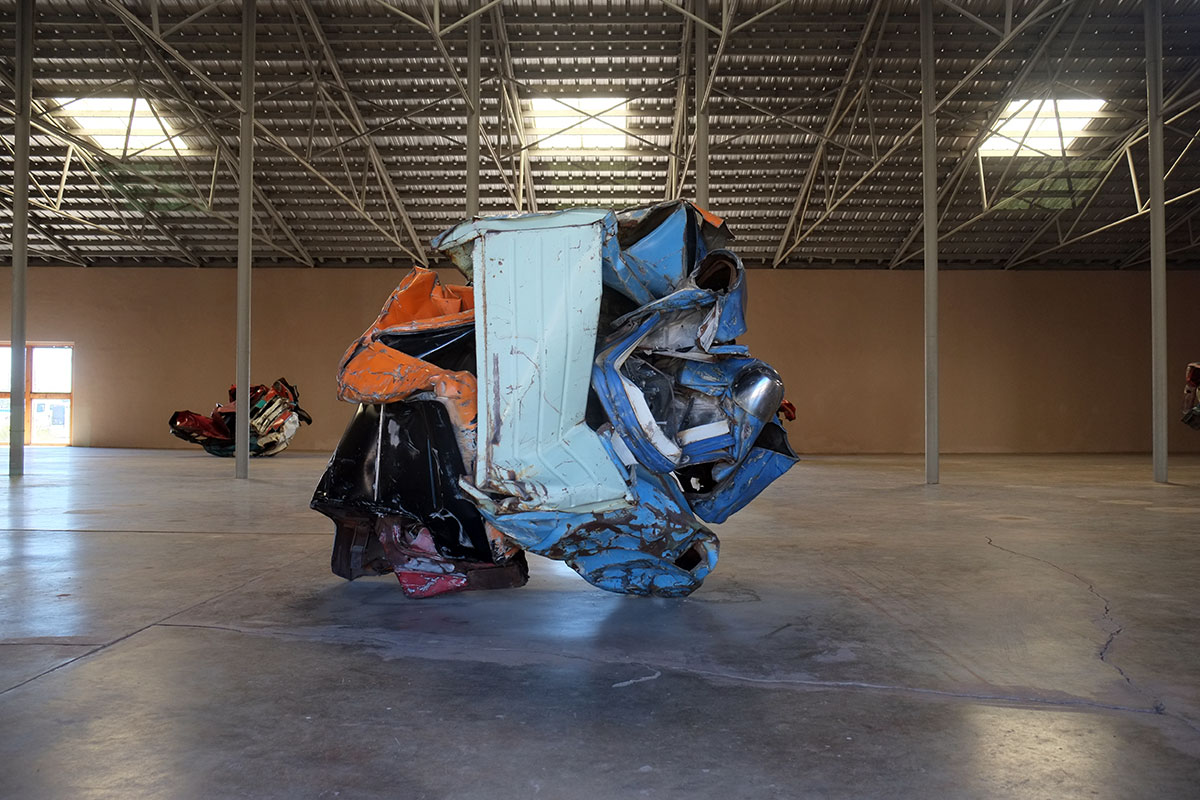
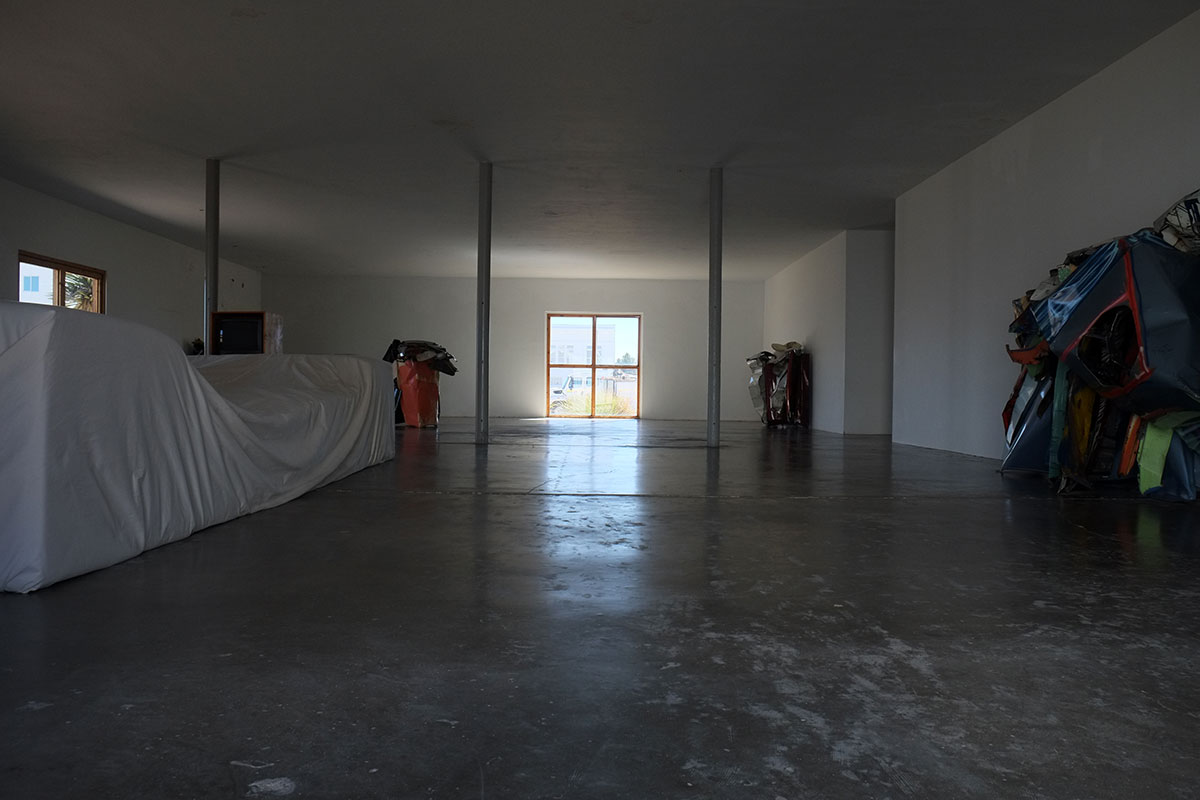
The last building of the Chinati Foundation is in downtown Marfa, which houses John Chamberlain’s sculptures made from automobile pieces. 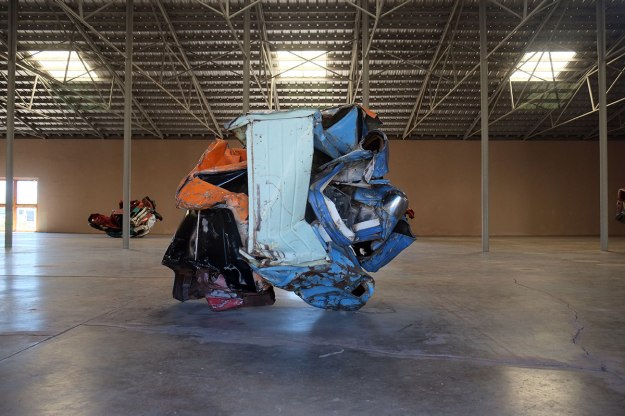
Whenever I’ve seen Chamberlains in the past, I’ve liked them but thought they were one-liners – cool idea, use old car parts. But when you see a building full, you can see the big differences between them sculpturally and spatially. When seen individually, his choice of material is the dominant attribute, and you see an individual sculpture as one example of the class of sculptures made out of car parts. When you see many, the material cancels out, and you see them as individual works. (You don’t go into a gallery of Greek sculpture and say, Oh, they’re all made out of marble.) 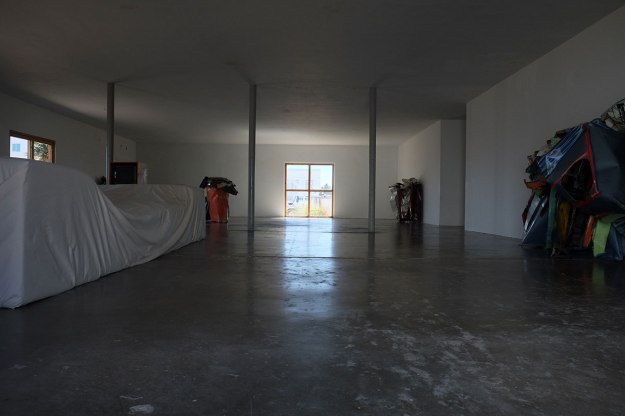
The next piece at the Chinati will be the remodel of the hospital building by Robert Irwin. It has been in the works for years, and its completion could be the excuse for another visit there.
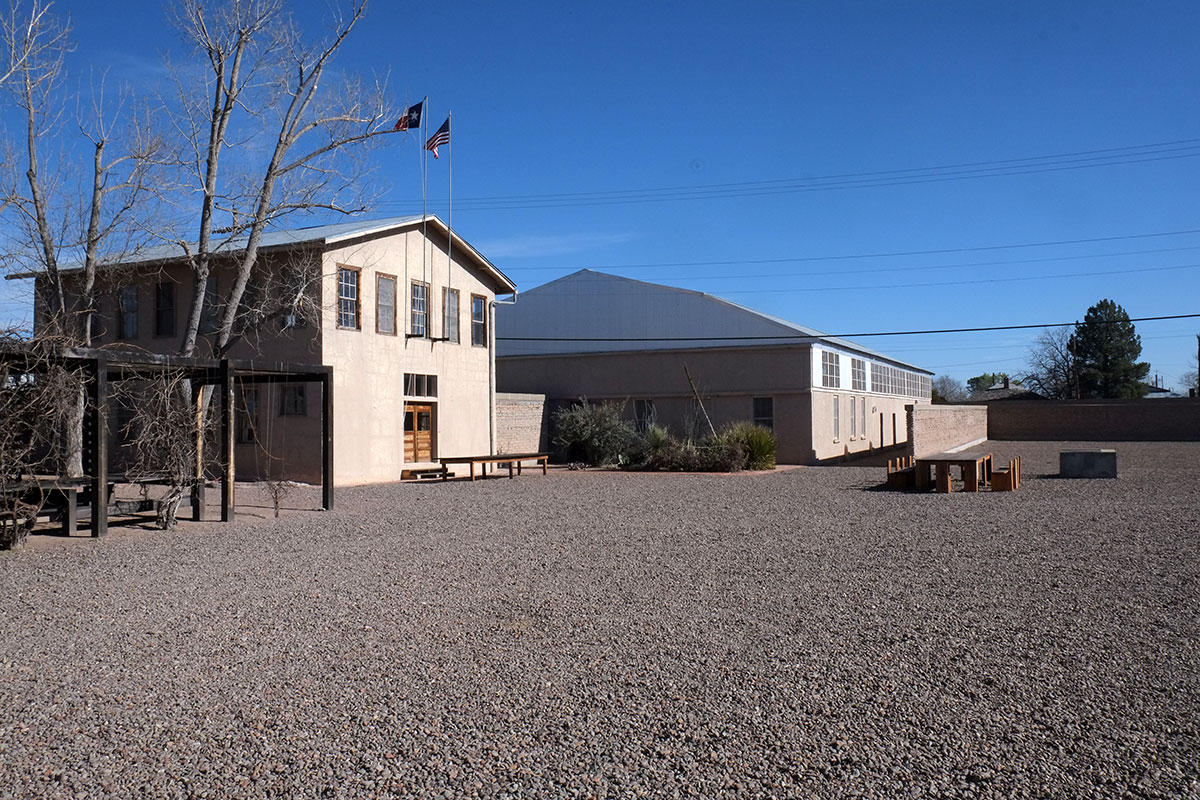
The other important site in Marfa is the compound where Judd lived and worked. 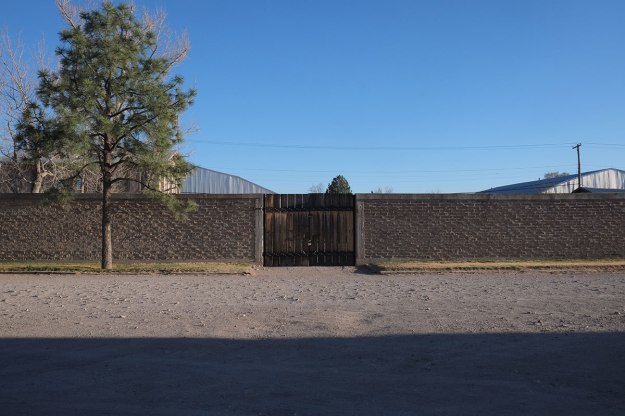
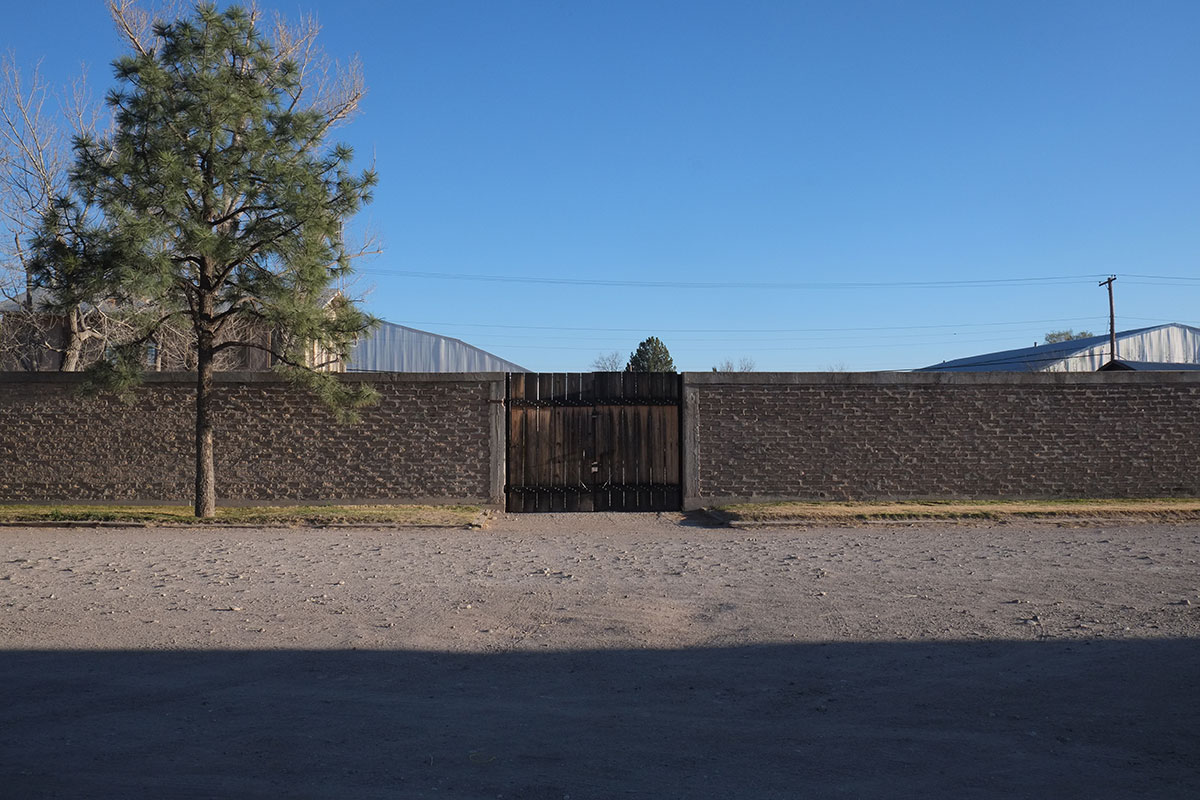
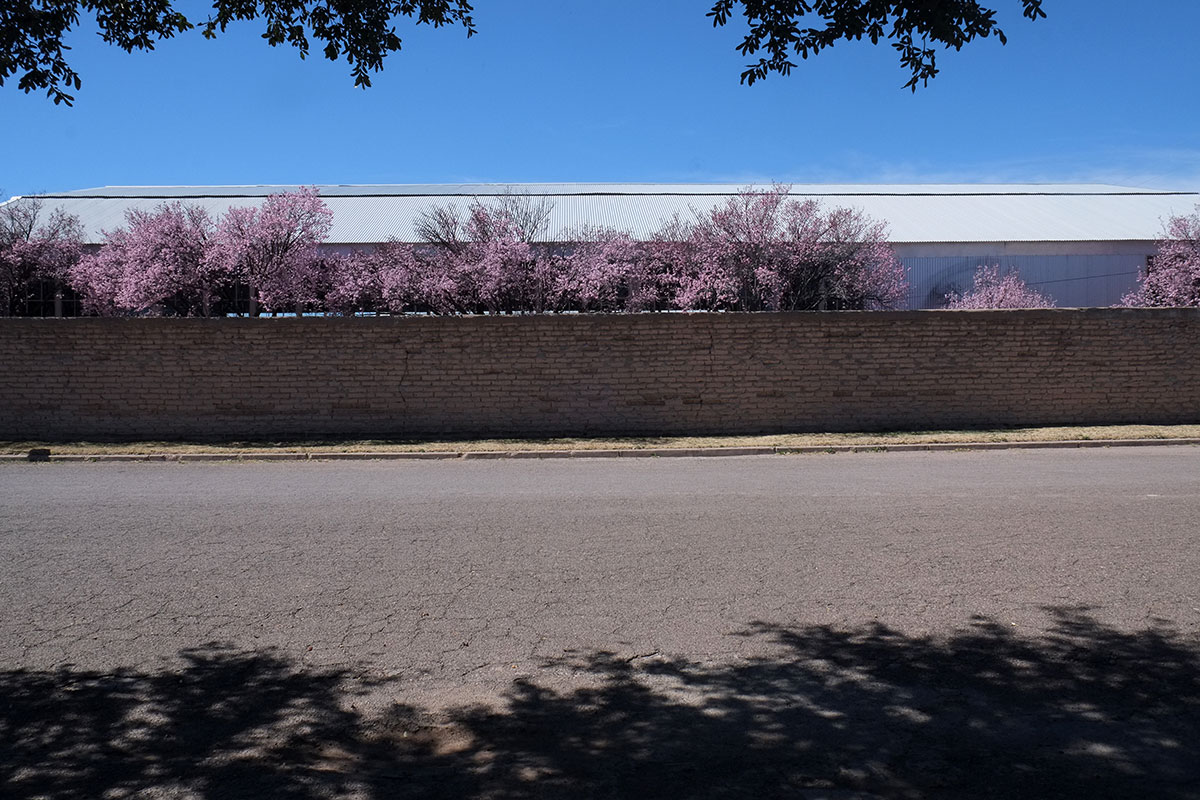
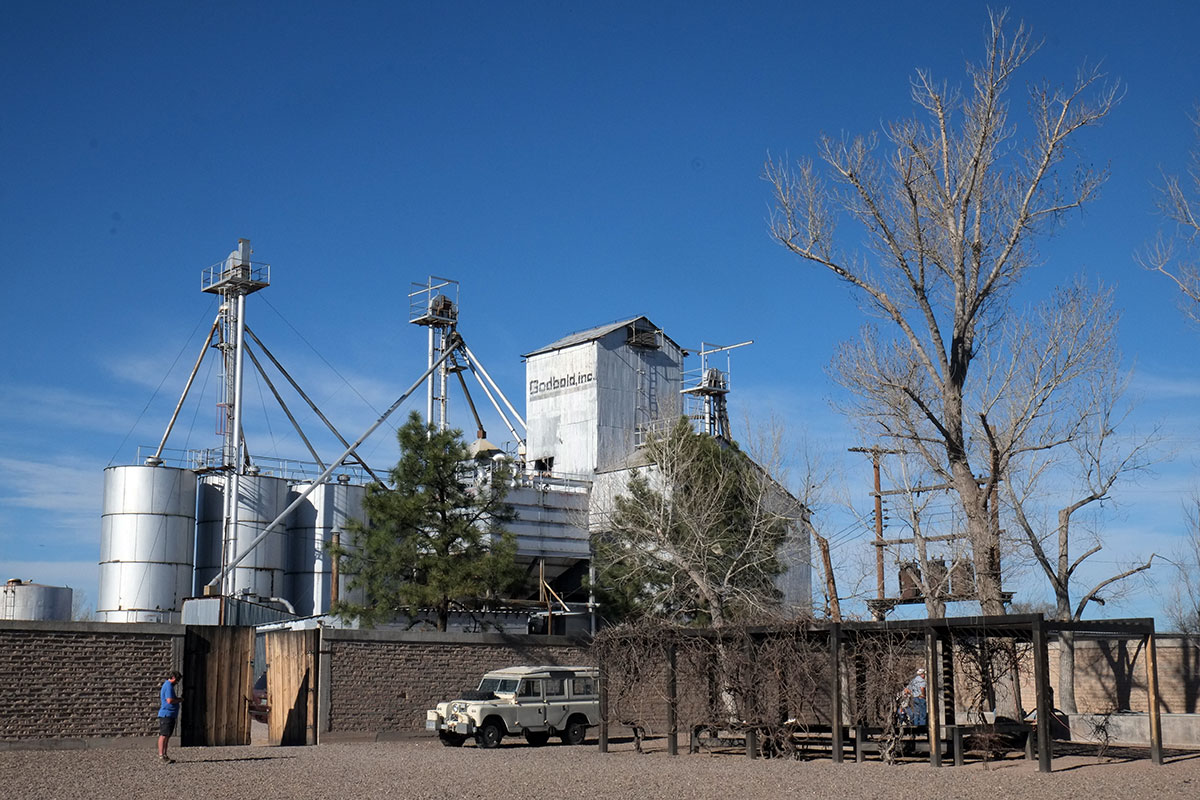
There is the original quartermaster’s house, which he remodeled, and a couple more large hangar-like buildings, which he subdivided into studios, galleries, libraries and more living space. 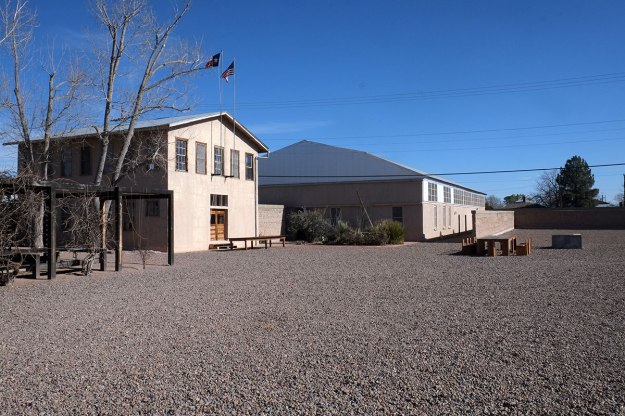 He built a big masonry wall around the whole compound, which apparently the locals were not thrilled about at the beginning, but which established the degree of privacy he needed to live and work in the center of town.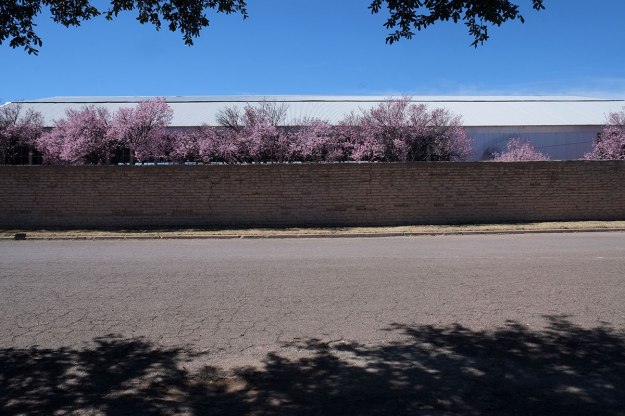
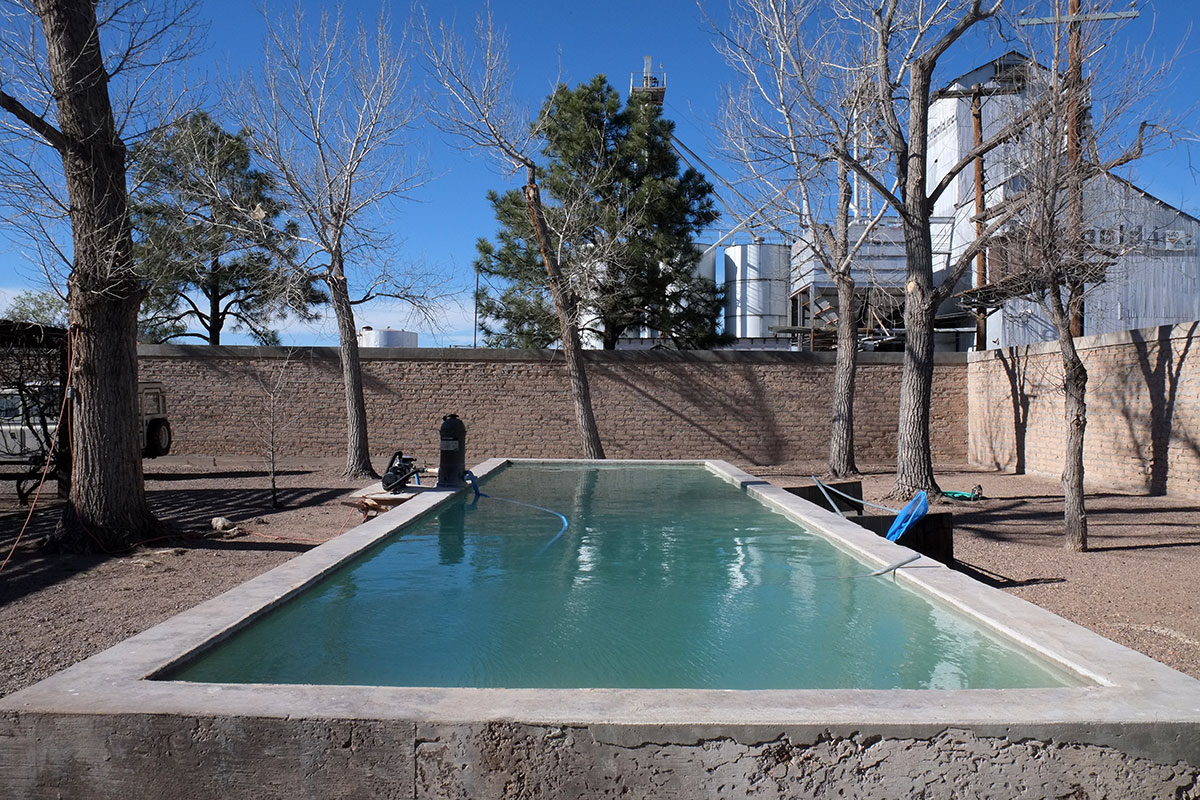
There is a fabulous swimming pool, 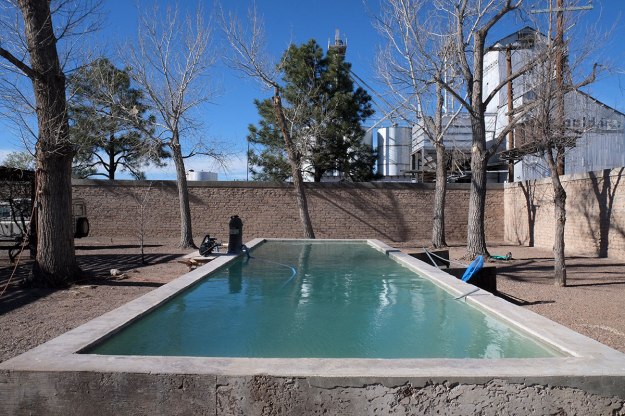
a Donald Judd personalized Land Rover,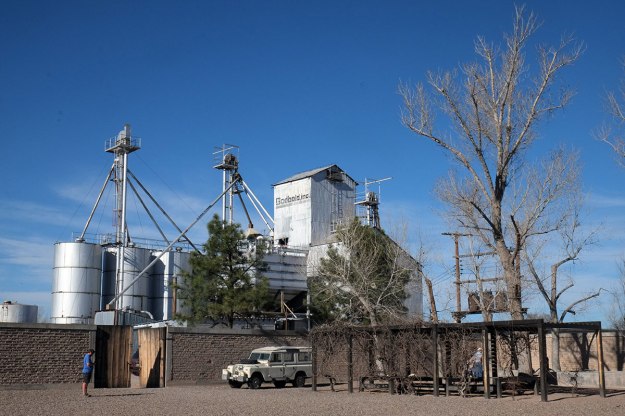
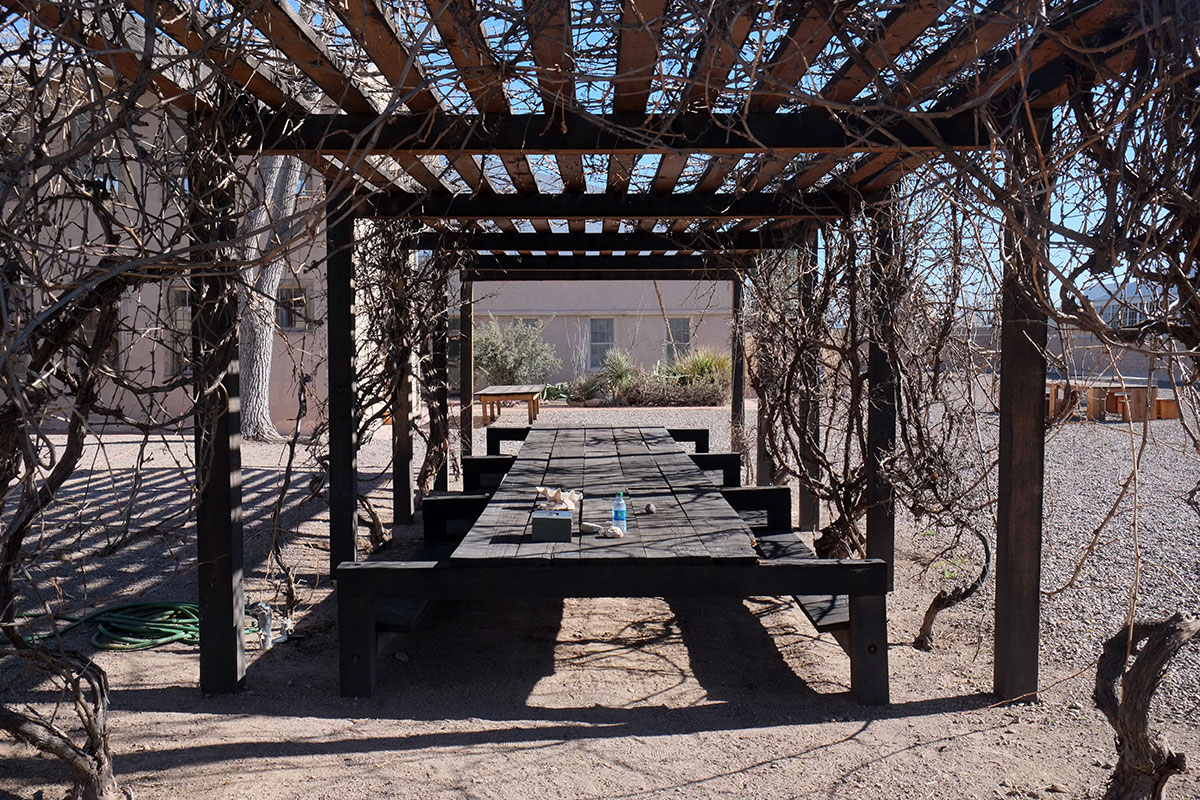
a great ramada / pergola which can seat a crowd, 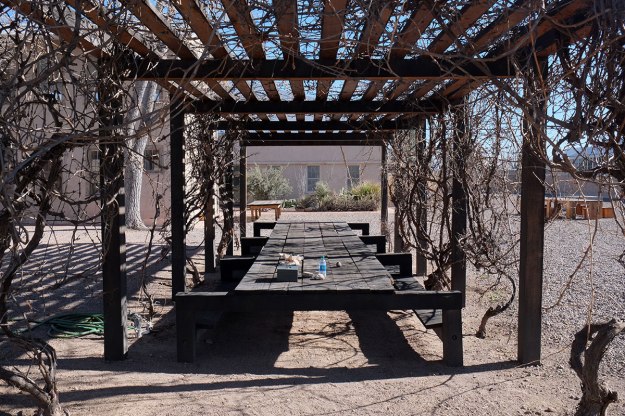
a side yard for his daughter to play in (in a rather abstract manner),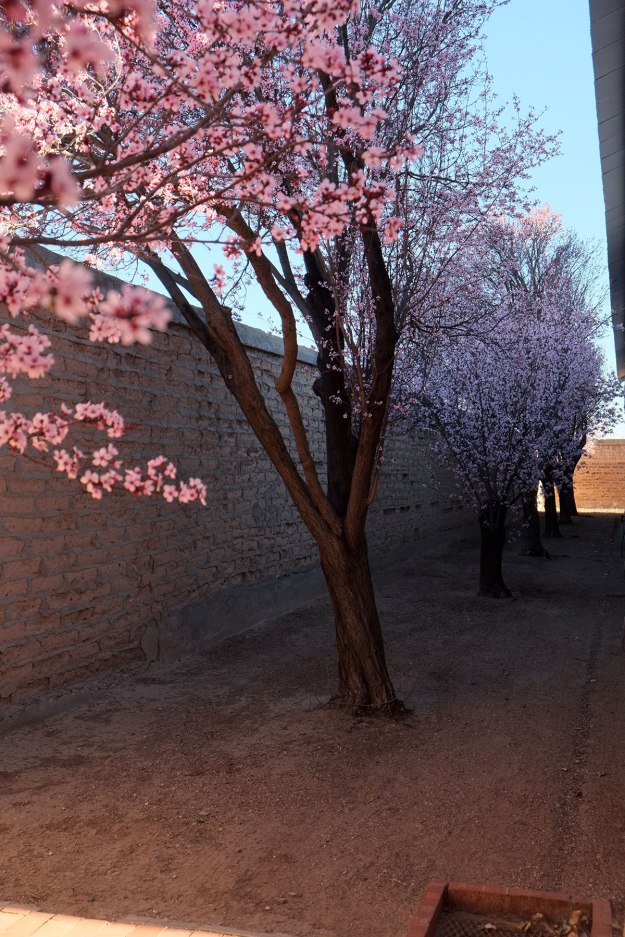
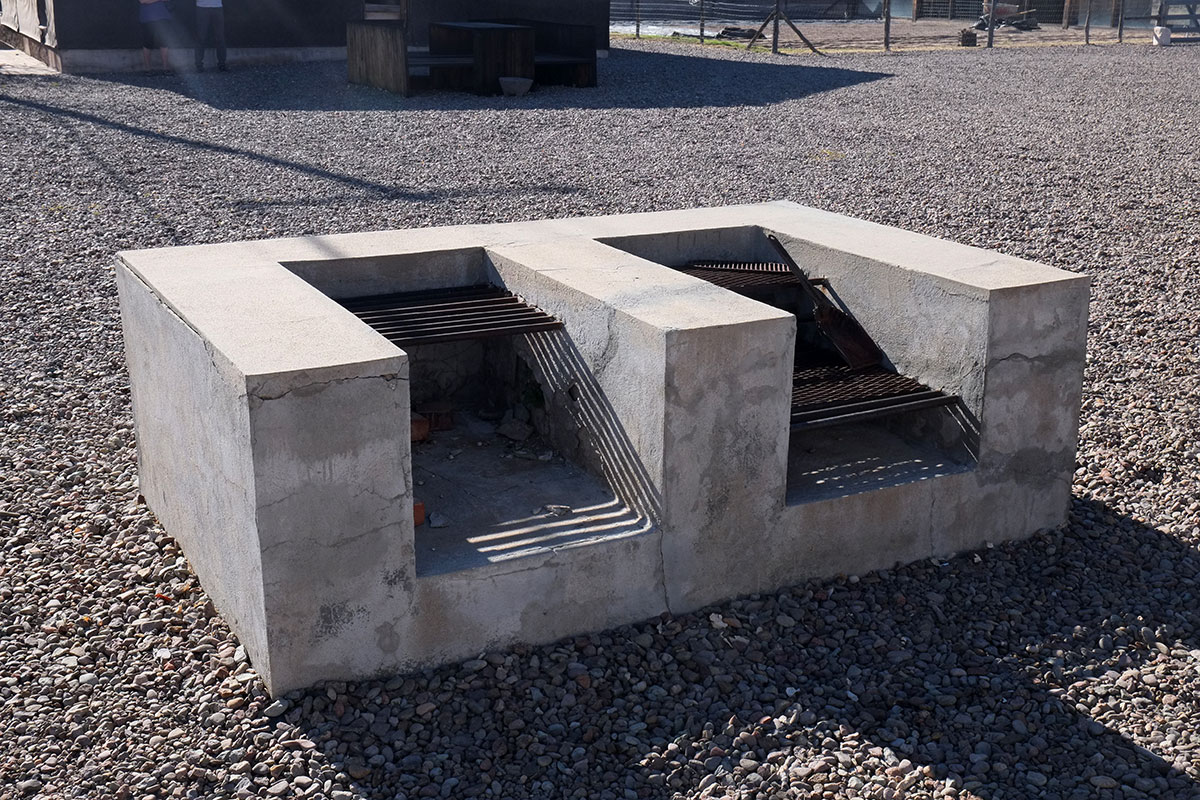
and Judd-designed outdoor living equipment, 
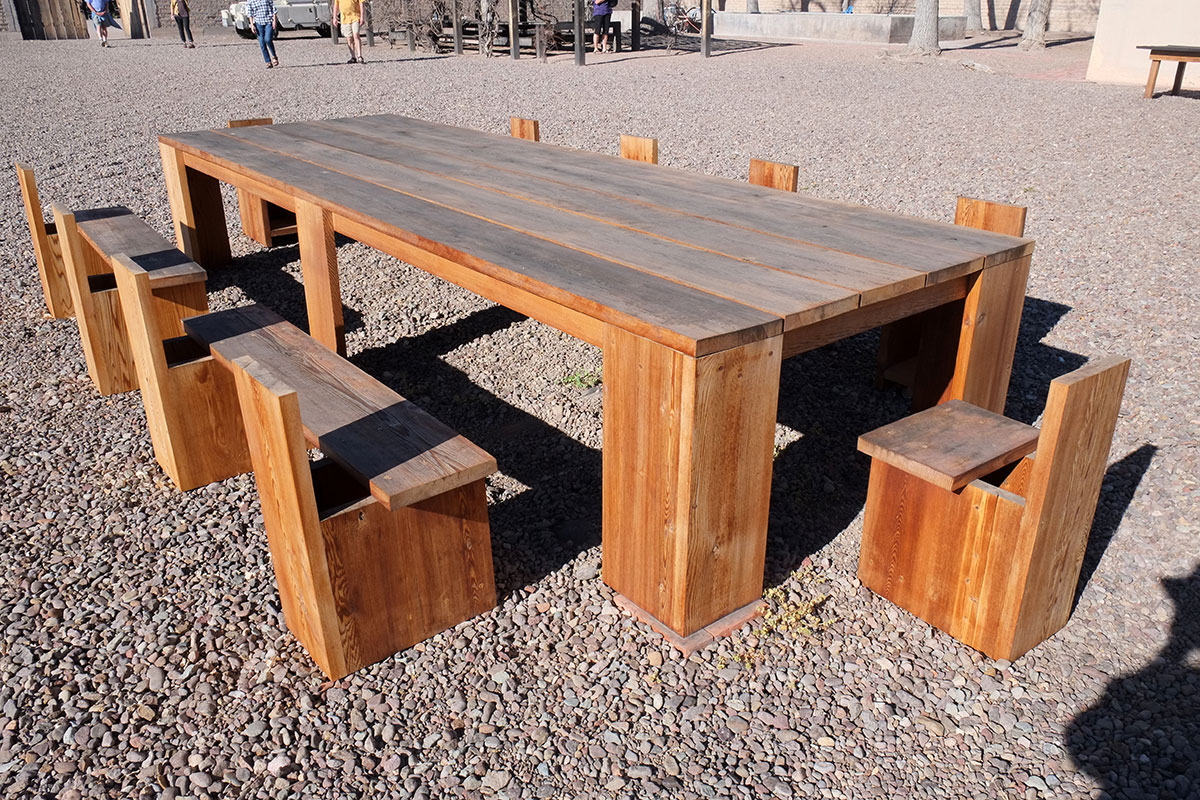
and furniture. 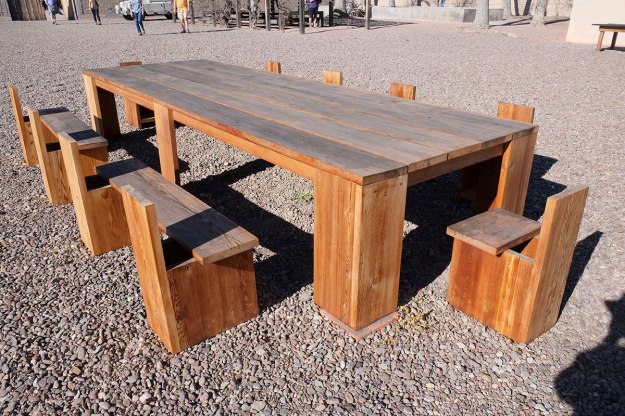
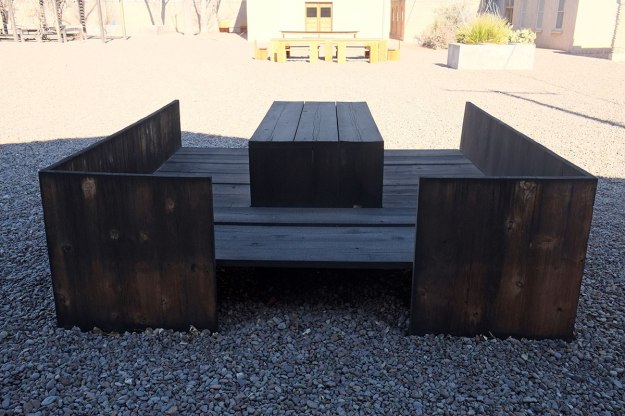
The site design, building renovations and furniture all exhibit the simplicity and clarity of his sculpture. He apparently hated the term Minimalism, and this makes it clear why. Being minimal isn’t the goal, it is what is left when you strip away everything inessential. Just as with Kahn’s architecture, the elemental pieces are rich in form, meaning, light, etc. Doing something complicated is easy, doing something simple is hard.
You can’t take photos inside the buildings here either, but there are published views. There are two gallery spaces of Judd’s work. Whereas the work at the Chinati is for showing the rigorous development of a set of related ideas, the work here illustrates the development of his ideas throughout his career, so you can see the progression of thought. Both types of focussed installation are critical, and something you can almost never see in a museum which has to show a range of artists.
Judd’s libraries were especially interesting. Two big rooms, each across the width of a shop building, one with books about the modern era, and one for pre-modern. He had 12,000 books, and his range of interests was broad. His architecture selection was notable, spanning the range from Louis Kahn (obviously) to Christopher Alexander (less obviously). He had a whole shelf on the design of structures. All of his rooms had daybeds – apparently Judd liked to immerse himself in his work, and wherever he was tired he could lie down and sleep, waking back up to the matter at hand.
I had first heard about Marfa back in the 1980s. One of my professors at Columbia, Lauretta Vinciarelli, lived with Judd in his building on Spring Street, where she was always designing things for Marfa, and helping Judd envision what the place could become – there are many published images of her designs for the courtyards there. (Oddly, while we were in Marfa there was no mention, and apparently no knowledge, of her involvement.) I never quite understood what was special about this one place way out in the desert, in the middle of nowhere. I eventually began to understand the importance of isolation, but not this particular place. But in the past two months, as we’ve wandered in the desert, it’s started to make more sense to me. In Desert Solitaire, Edward Abbey writes:
…the strangeness and wonder of existence are emphasized here, in the desert, by the comparative sparsity of the flora and fauna: life not crowded upon life as in other places, but scattered abroad in spareness and simplicity, with a generous gift of space for each herb and bush and tree, each stem of grass, so that each living organism stands out bold and brave and vivid against the lifeless and and barren rock. The extreme clarity of the desert light is equalled by the extreme individuation of desert life forms…
Abbey is writing about the the natural world, but the same could be said about the artistic or intellectual ones. Judd’s work might have developed in isolation in the Vermont woods, but the desert is especially suited to Judd’s art, with its conceptual clarity and spareness. The work is contextual at that conceptual level, not at the more literal visual level with which we usually use the term in architecture.
I was aware of the cultural phenomenon that Marfa has become (more on that soon), and I expected that the experience of that milieu would overwhelm the experience of the art and architecture. It didn’t. Judd’s work speaks strongly and clearly here in a way it can’t anywhere else, and it is worth the trip to become immersed in it. In this age of crazed, complicated, erratic, irregular, flashing imagery, coming face to face with solid, considered, elemental, quiet work is an inspiring and re-calibrating experience.
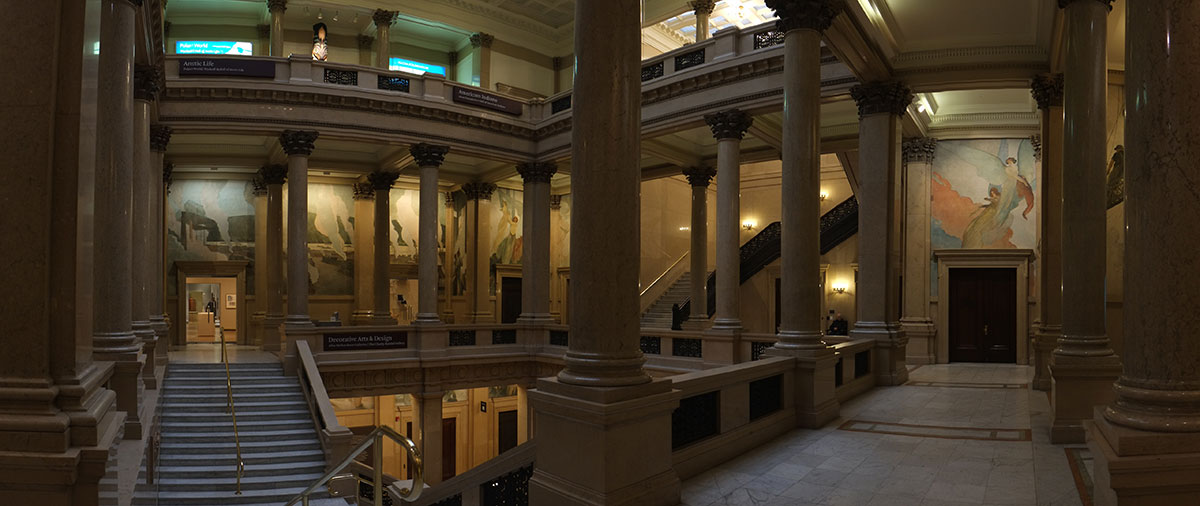
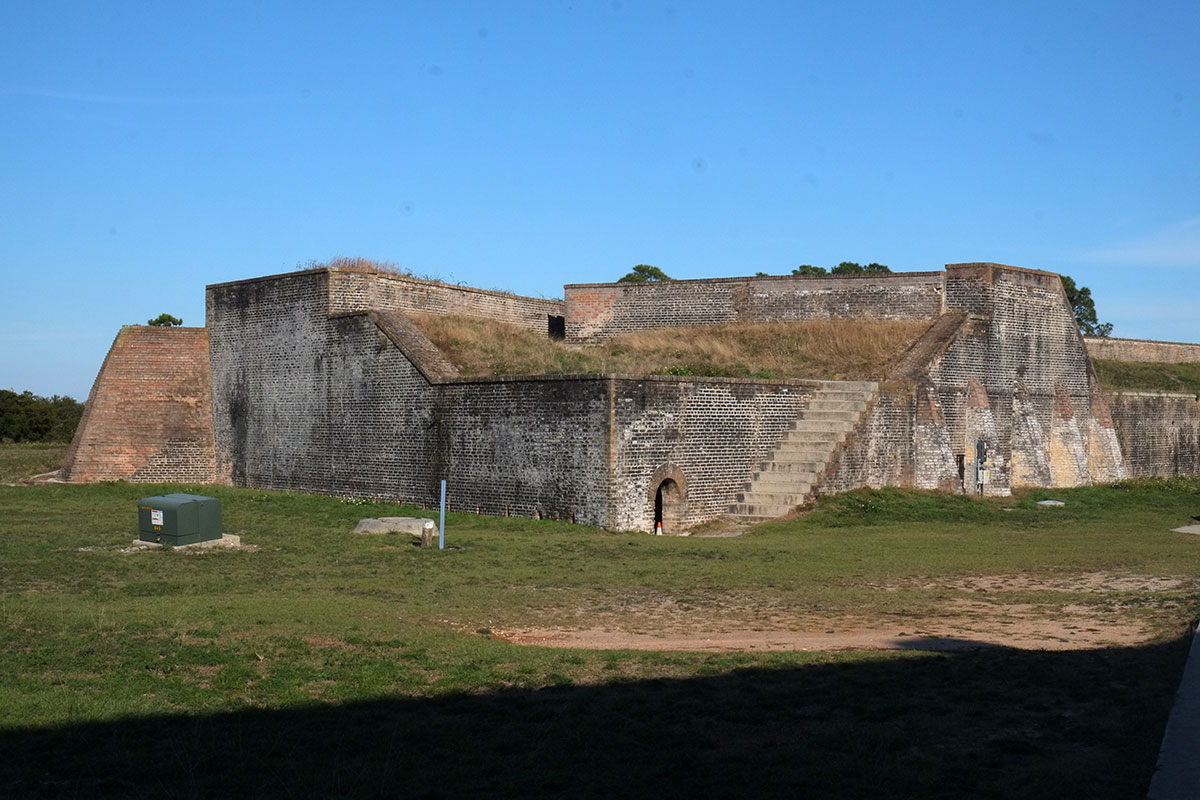
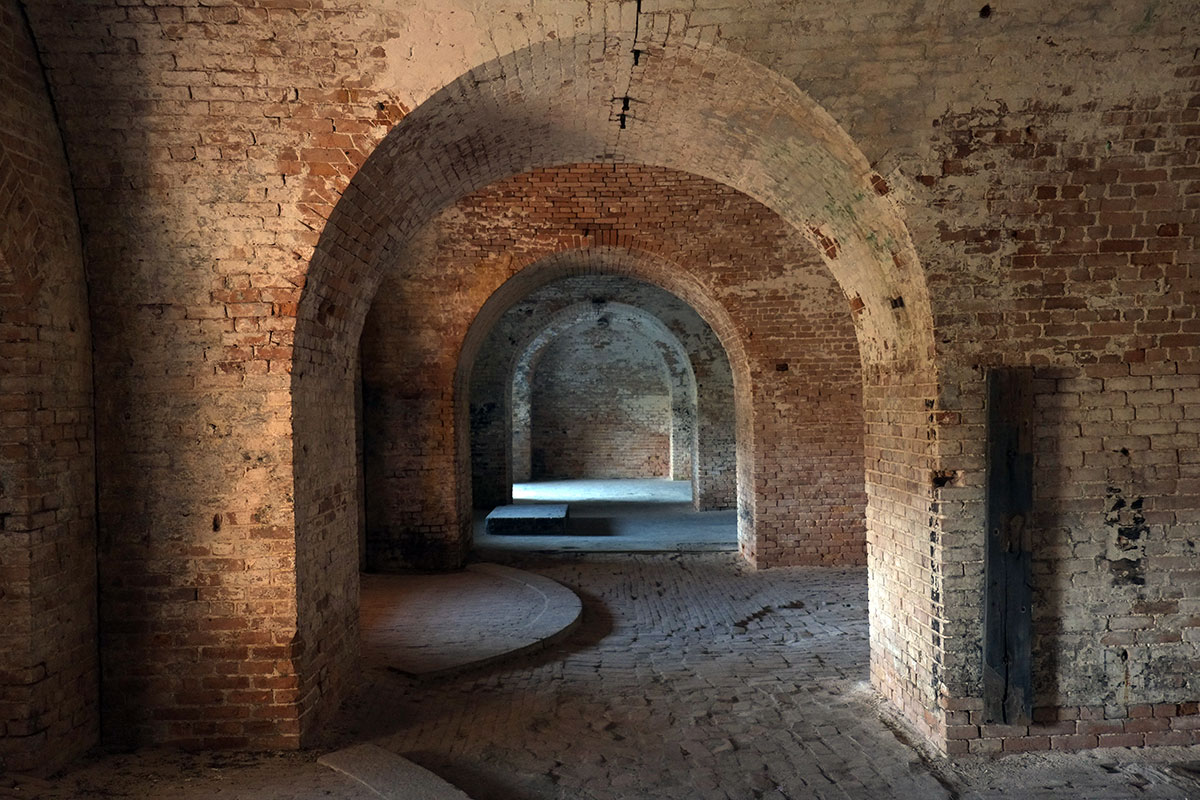
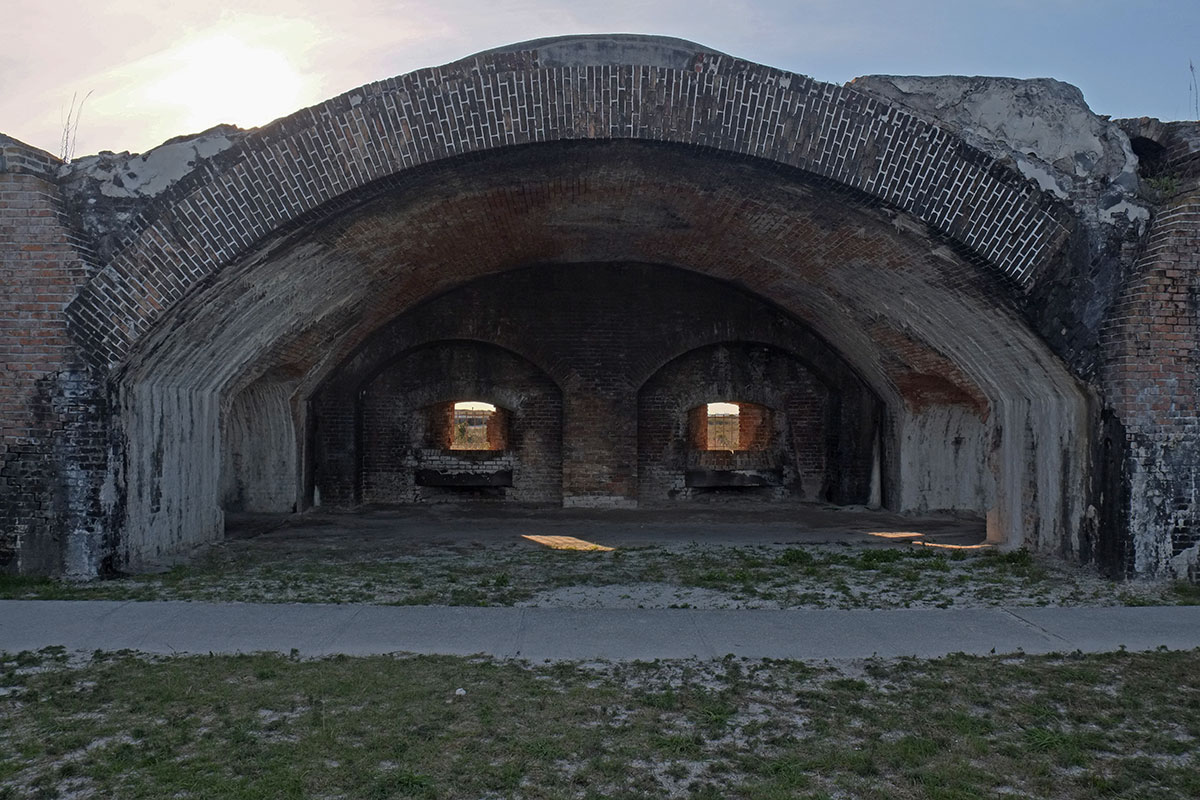
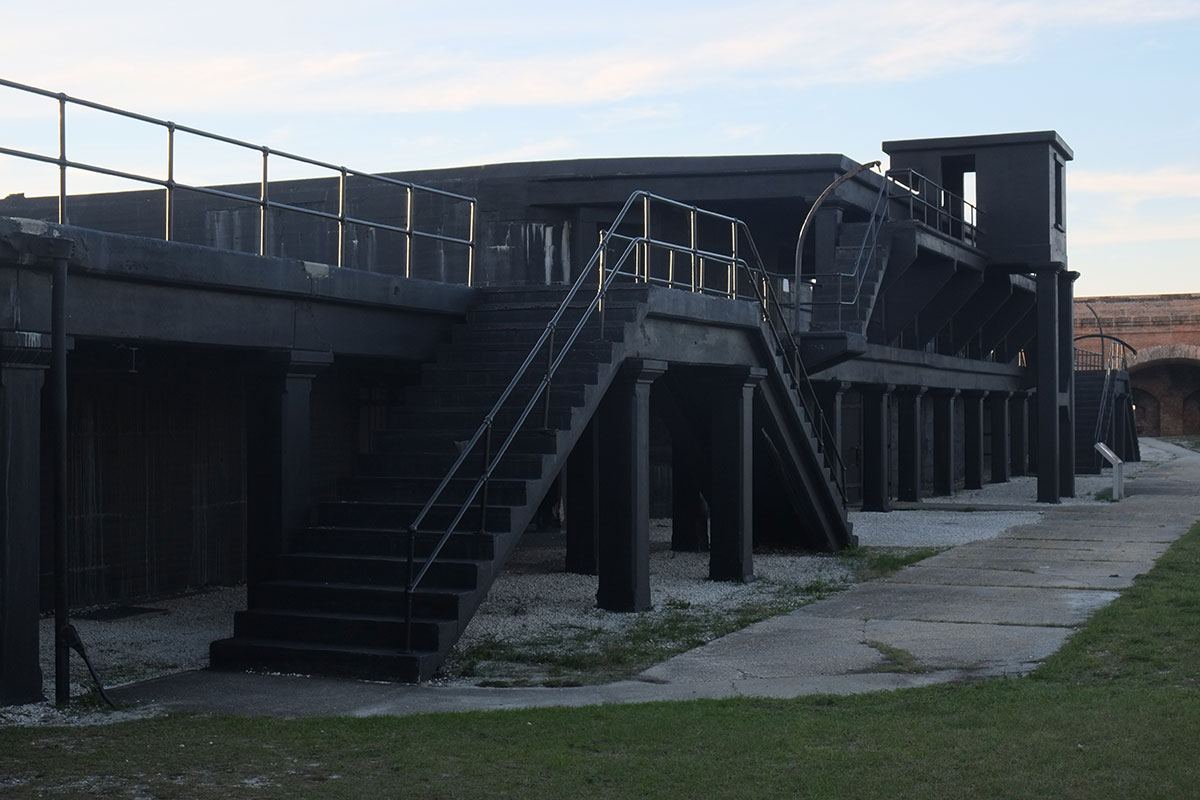
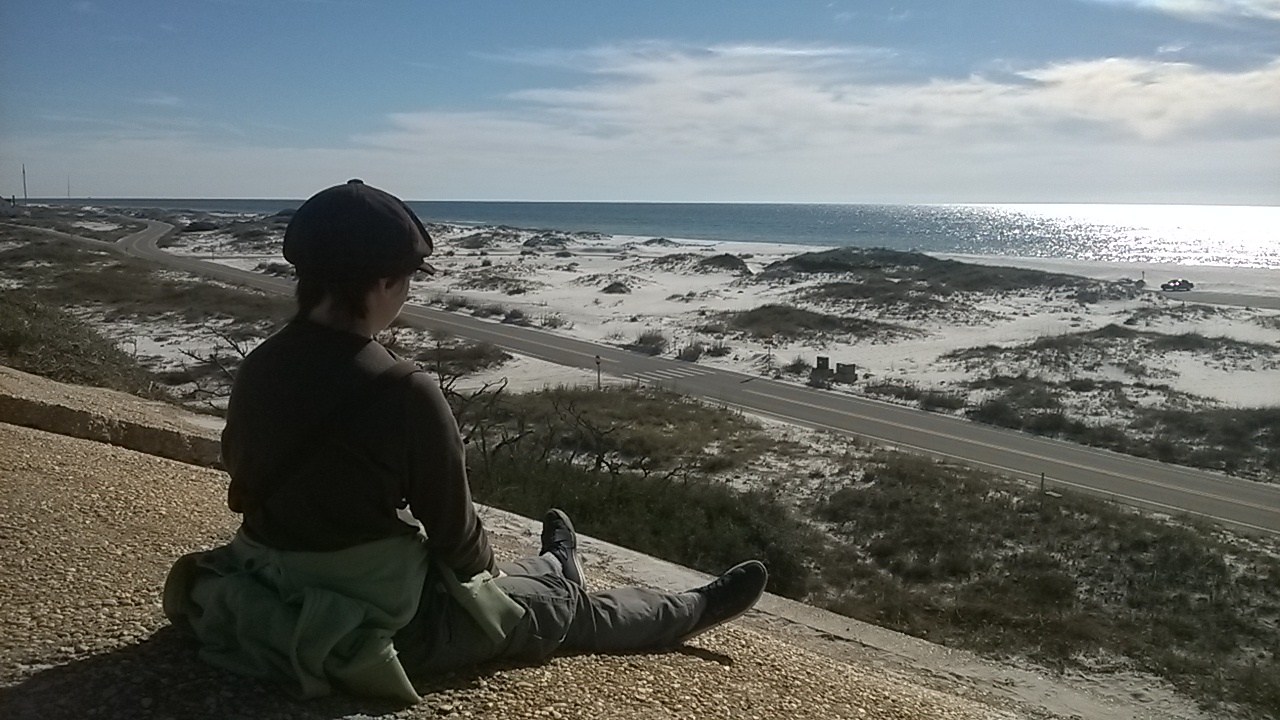
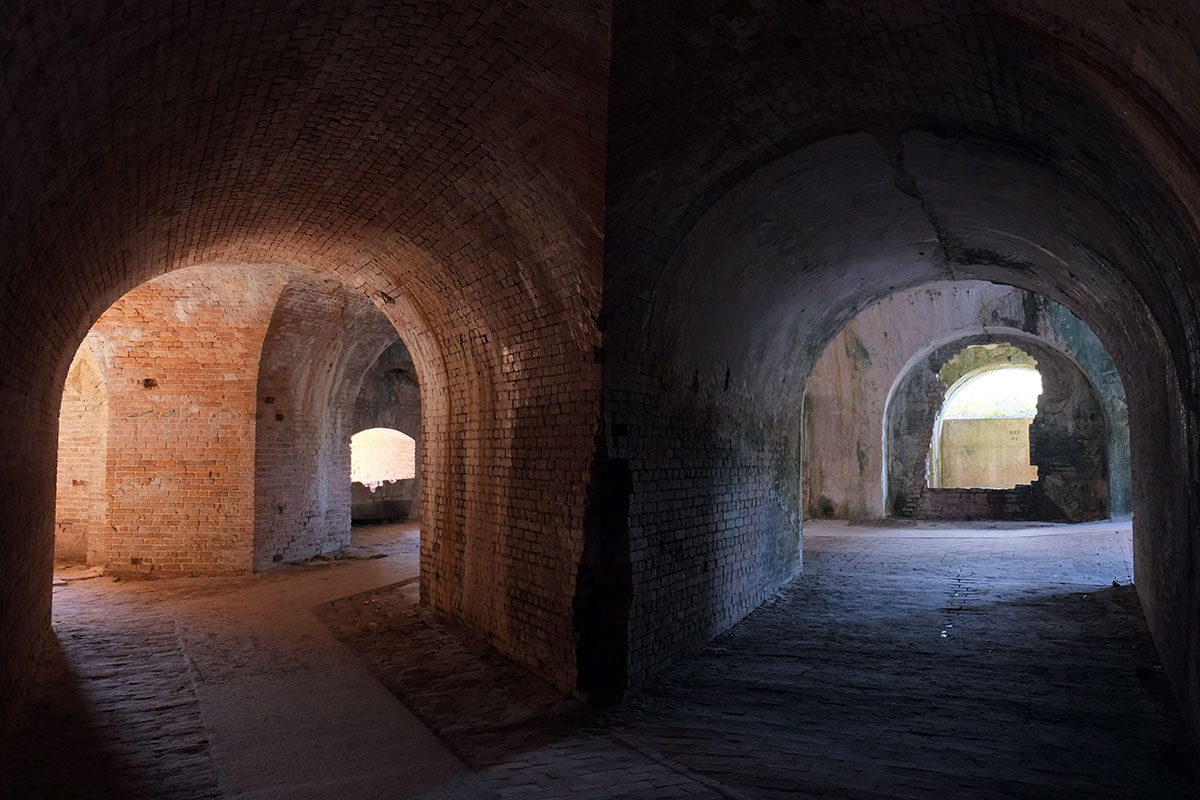 Ft. Pickens was the largest fort built to defend Pensacola Bay. It is located at the tip of Santa Rosa Island, and is now part of the Gulf Island National Seashore. Built largely with slave labor, it was finished in 1834. It is of the type known as a Third System Fortification, unified forts with extensive earthworks to resist naval bombardment, and containing large guns to shell ships that attempted to enter the bay.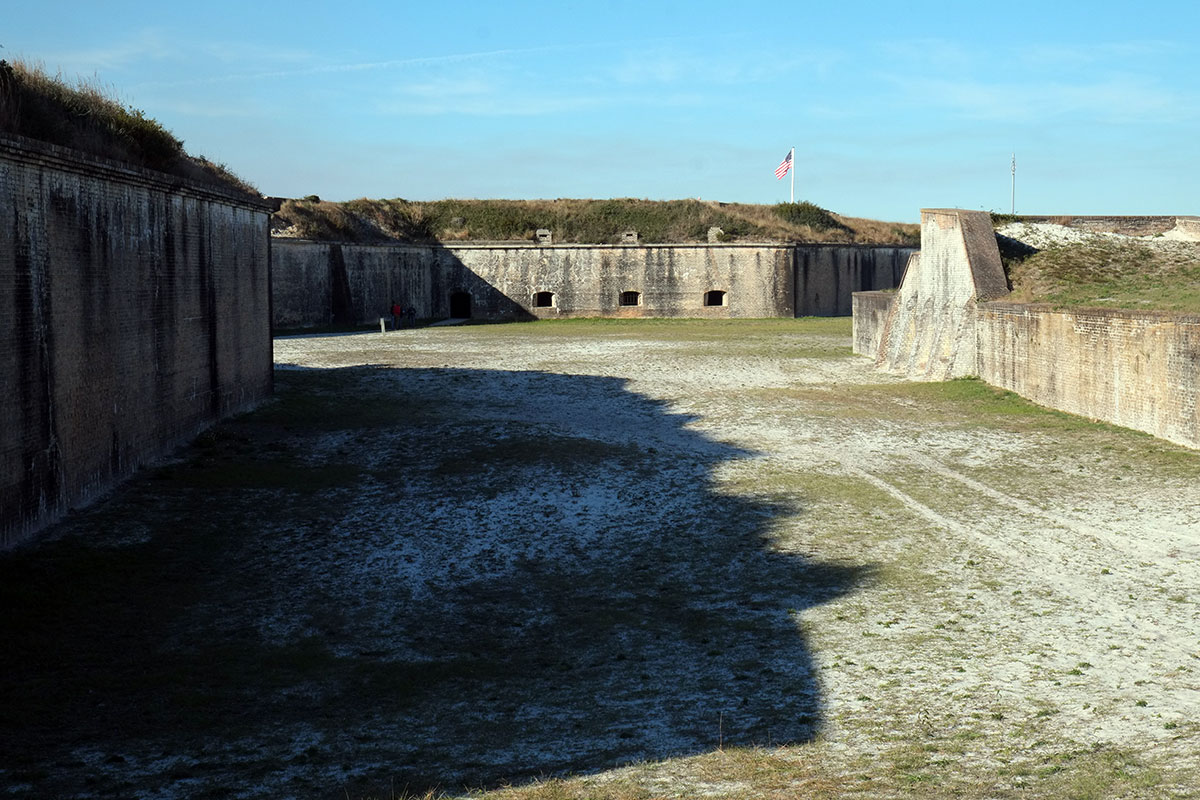













 Peregrine nation