We saw Garrison Keillor at party last weekend, but didn’t talk to him, following a general principle of leaving celebrities alone unless you really have something to say. The next day I regretted this, as it occurred to me that while I may not have had much to contribute beyond the appreciation of a fan, he might have enjoyed talking to Greta, the apprentice writer. So today when we turned onto Chartres St. in the French Quarter and saw him leaving his hotel, I shamelessly buttonholed him and introduced him to Greta.
They had a wonderful conversation, as he talked about his own early forays into writing, and how writers need to write – you have to get up and do it every day. Over the past few months many people have suggested that I should write a book about this trip, but I’ve always felt that Greta should write it, not me. As Greta talked a bit about the trip, you could see the wheels turning in his head, and the two of them started to rough out the premise for the book (which he thought should be a novel, not a memoir – I’ll leave off any more discussion of its direction to avoid being a spoiler.) He was just very engaged and thoughtful, and when we sat down for lunch, Greta wrote down all of his advice.
As we walked off I had my own literary déjà vu. In his first novel, The Moviegoer, Walker Percy’s protagonist is walking down the street in New Orleans, and sees the actor William Holden up ahead of him. Holden asks a young honeymooner for a light, and afterwards he can see the change in the young man, as the brush with celebrity has brought him out of his humdrum experience, making his own life somehow more real. As with so much else in New Orleans, it’s hard to distinguish art from reality.
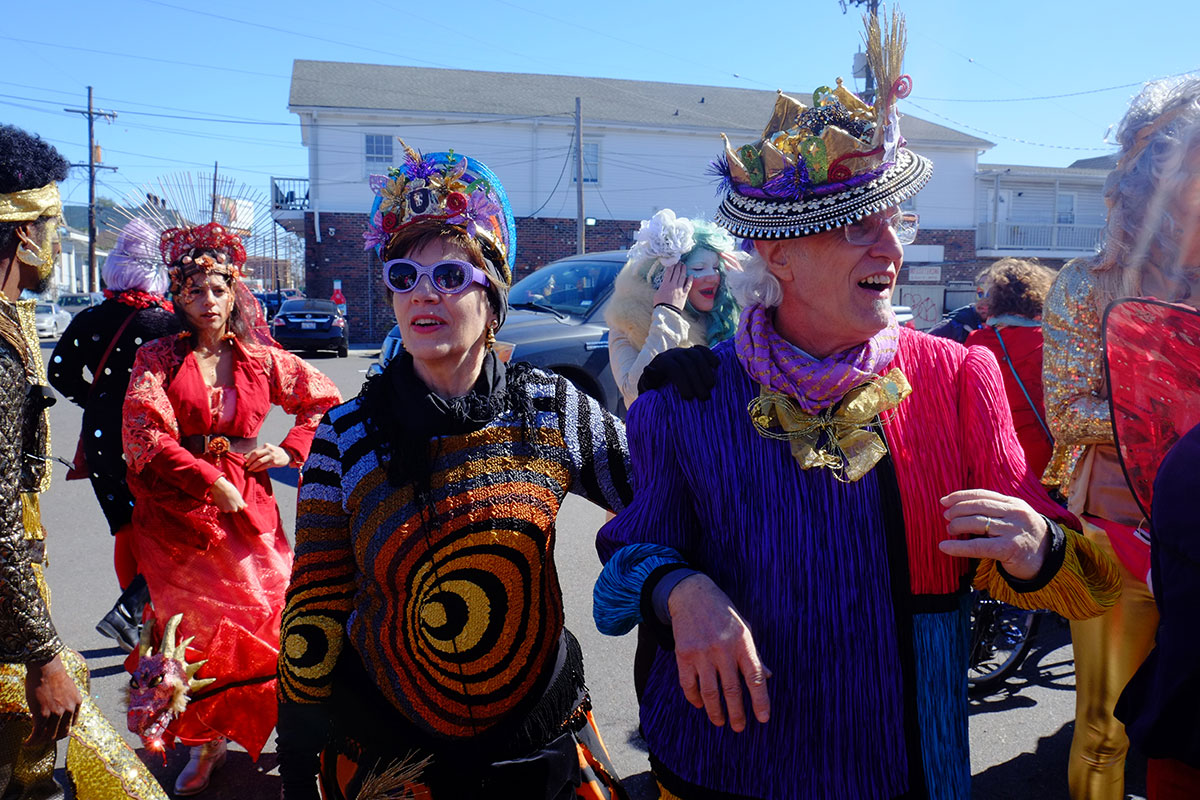
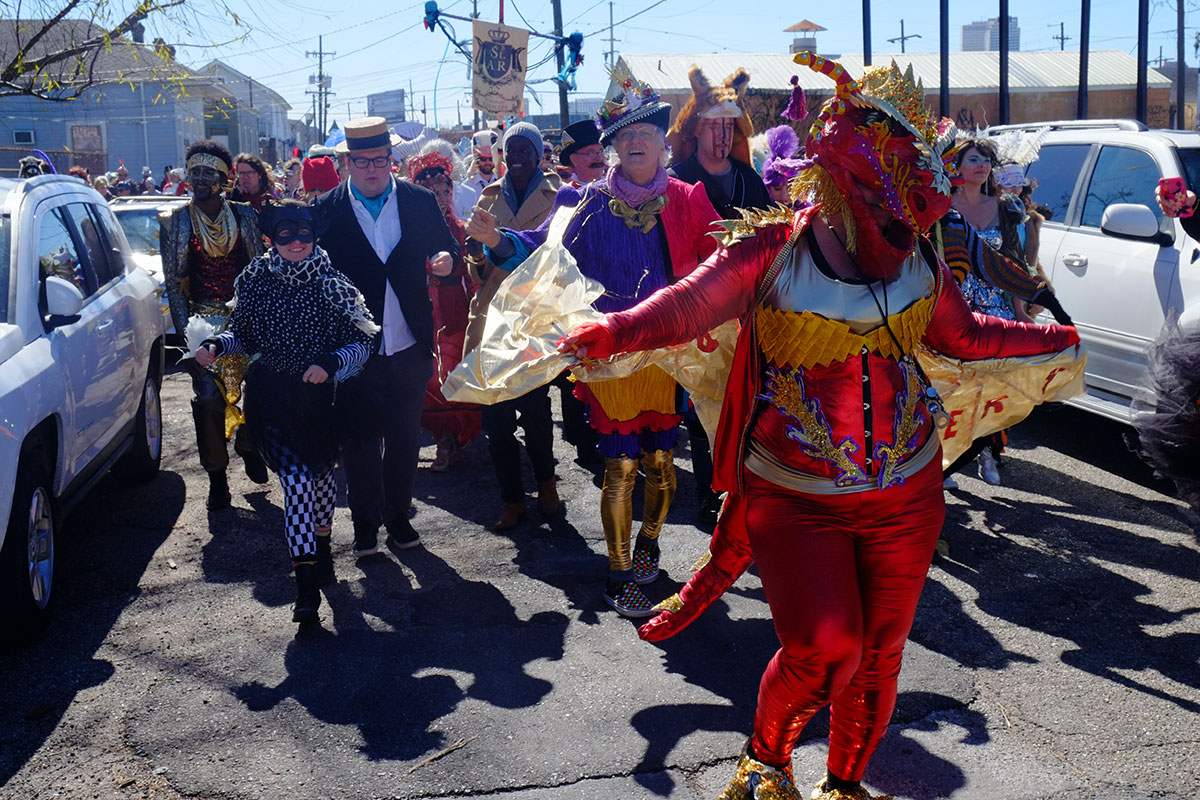
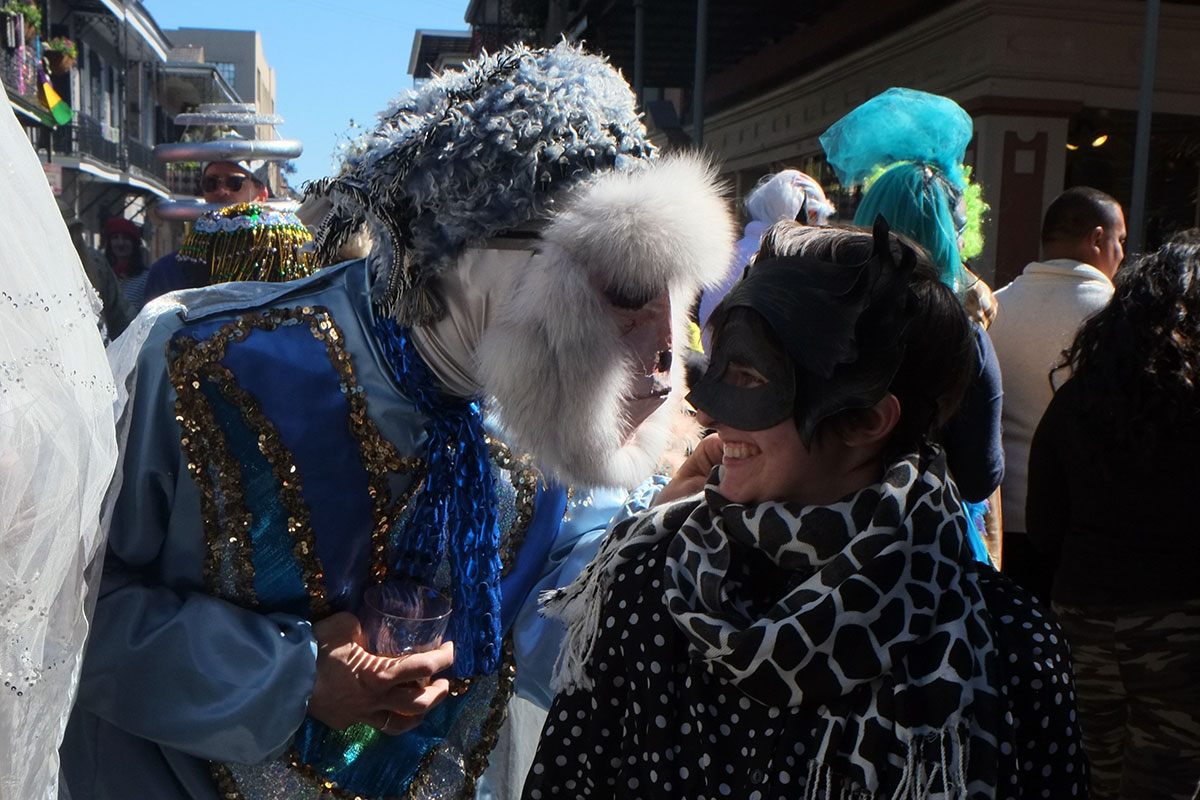
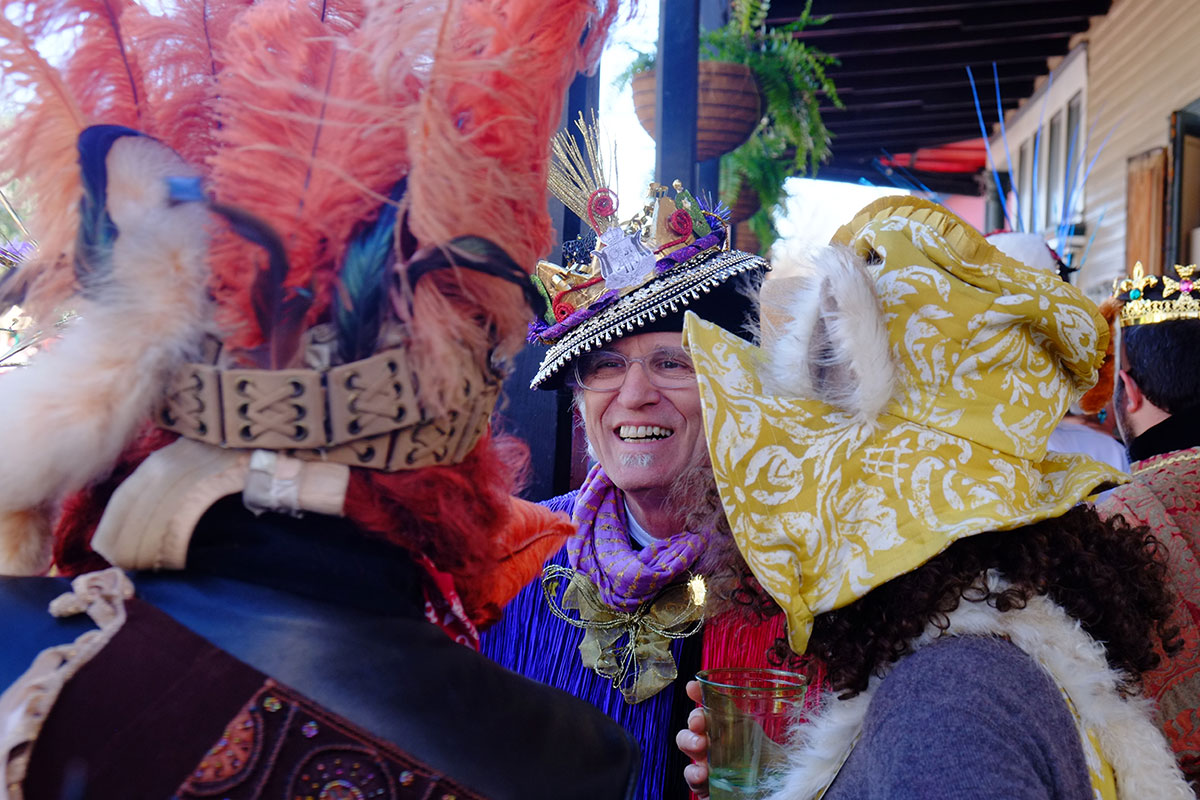
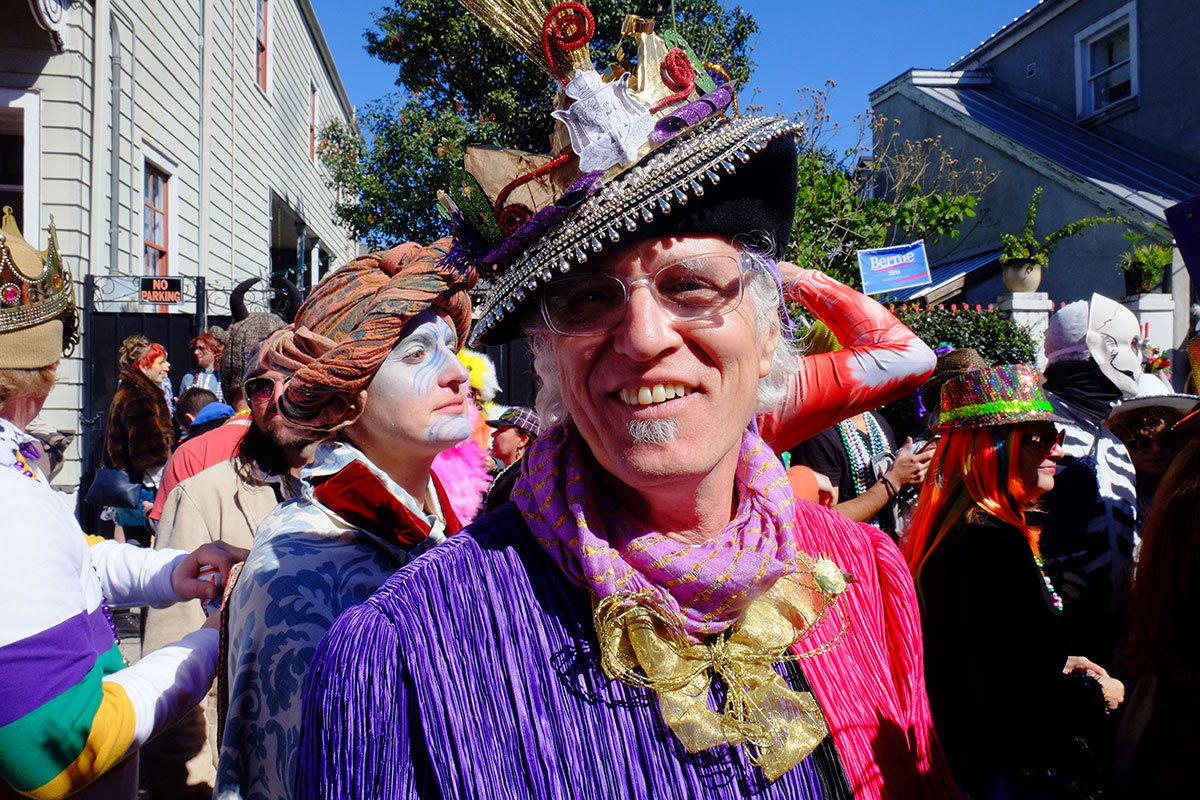
New Orleans has been amazing in every way, but perhaps the most fun we’ve had was marching with the St. Anthony Ramblers on Mardi Gras. I posted some photos to show what the costumes were like, but a huge part of the experience was the music of the Panorama Jazz Band. (http://panoramajazzband.com/bio/) I’d never been in New Orleans before, but an image that always intrigued me was that of a jazz band marching down the street with a krewe of revelers (or mourners) behind it. So being in that krewe behind a great band was a fantastic experience for both of us. I apologize for the lousy quality of the videography (I’m not a videographer, my camera is notably terrible for video, and the drinking started very early in the day), but the beauty of the music comes through.
Here they are while the Ramblers take a break at the first bar stop:
The Ramblers regrouped and marched on, with Greta, Glen, Michelle and Stephen near the van.
The Ramblers march by:
At the second bar stop:
And a final song from the Panorama Jazz Band in the French Quarter before we headed off to the party.
We had a great time, with a lot of interesting and fun people. And the next day, as we walked down Royal St., we realized that we’d never be able to recognize any of them again.
We’ve been here in New Orleans for a few weeks, staying with our friends Glen and Michelle in the Marigny. There will be many blog posts about this, but I thought we should get today’s photos of Mardi Gras up now.
The day started with the gathering of the St. Anthony Ramblers at Glen and Michelle’s firehouse, then a parade with the Krewe and the Panorama marching band through the neighborhood and the French Quarter.
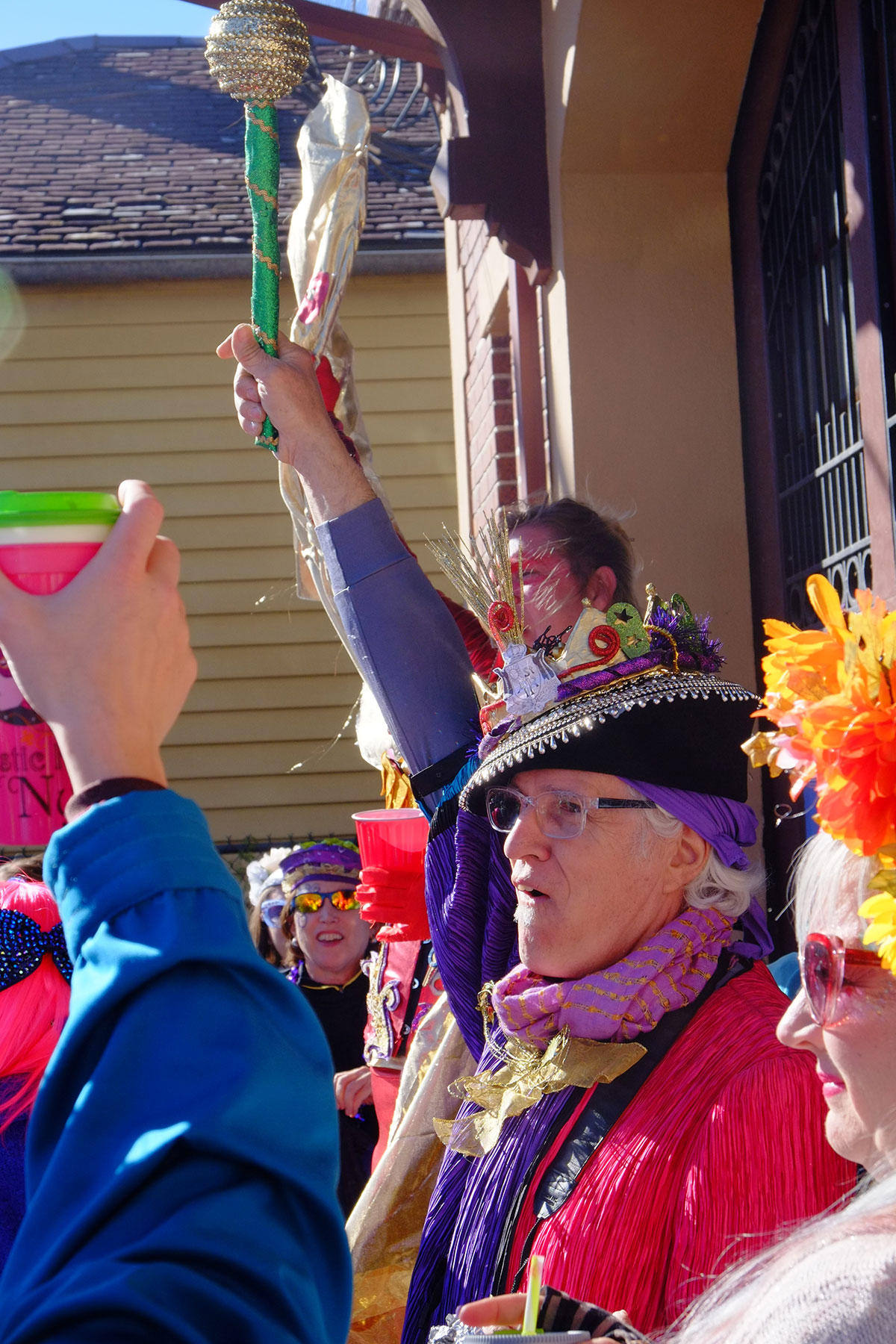
Glen receives his scepter as the King of St. Anthony’s
and the Krewe lines up by the scamp for one last bathroom visit before the parade
Glen and Michelle, the King and Queen
Tommy and Rita, Jenny and Gordon – old friends of Glen’s
Greta leading the Krewe
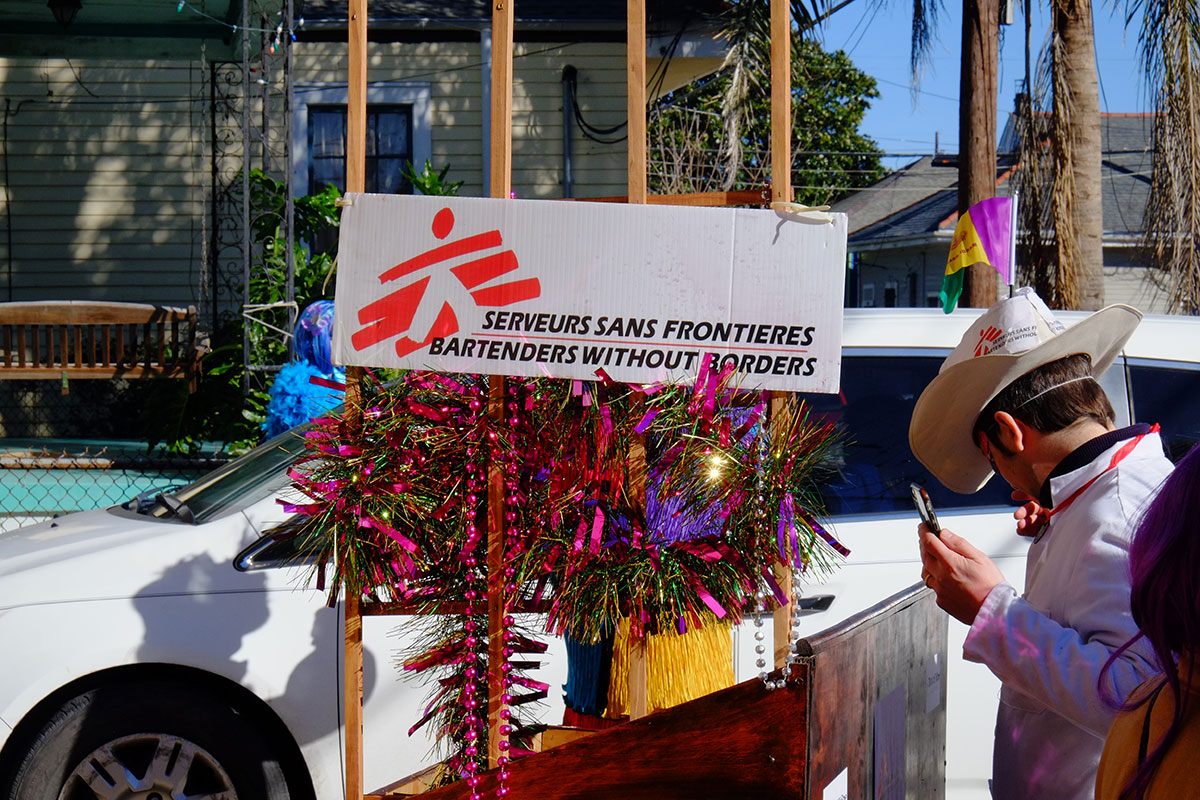
and the important humanitarian groups
the amazing Panorama marching band
Greta meets the monkey king as we cross Bourbon Street.
The king taking a beverage break
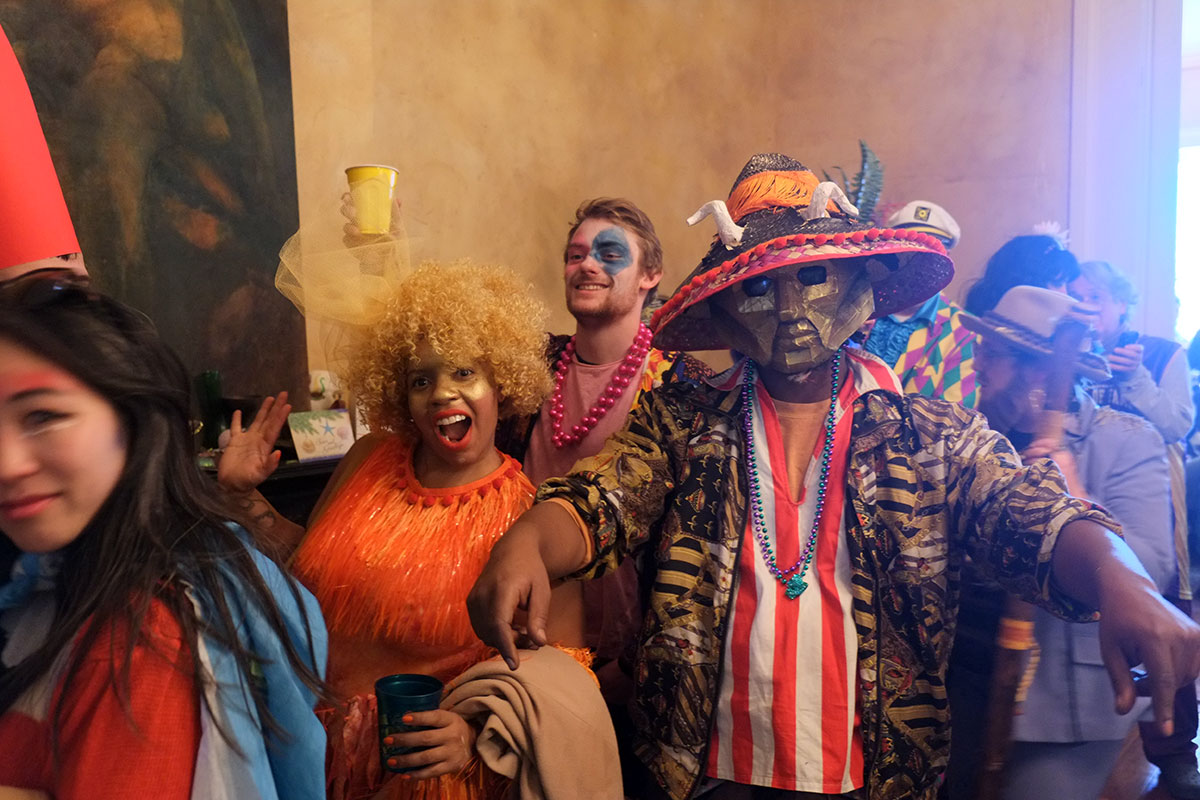
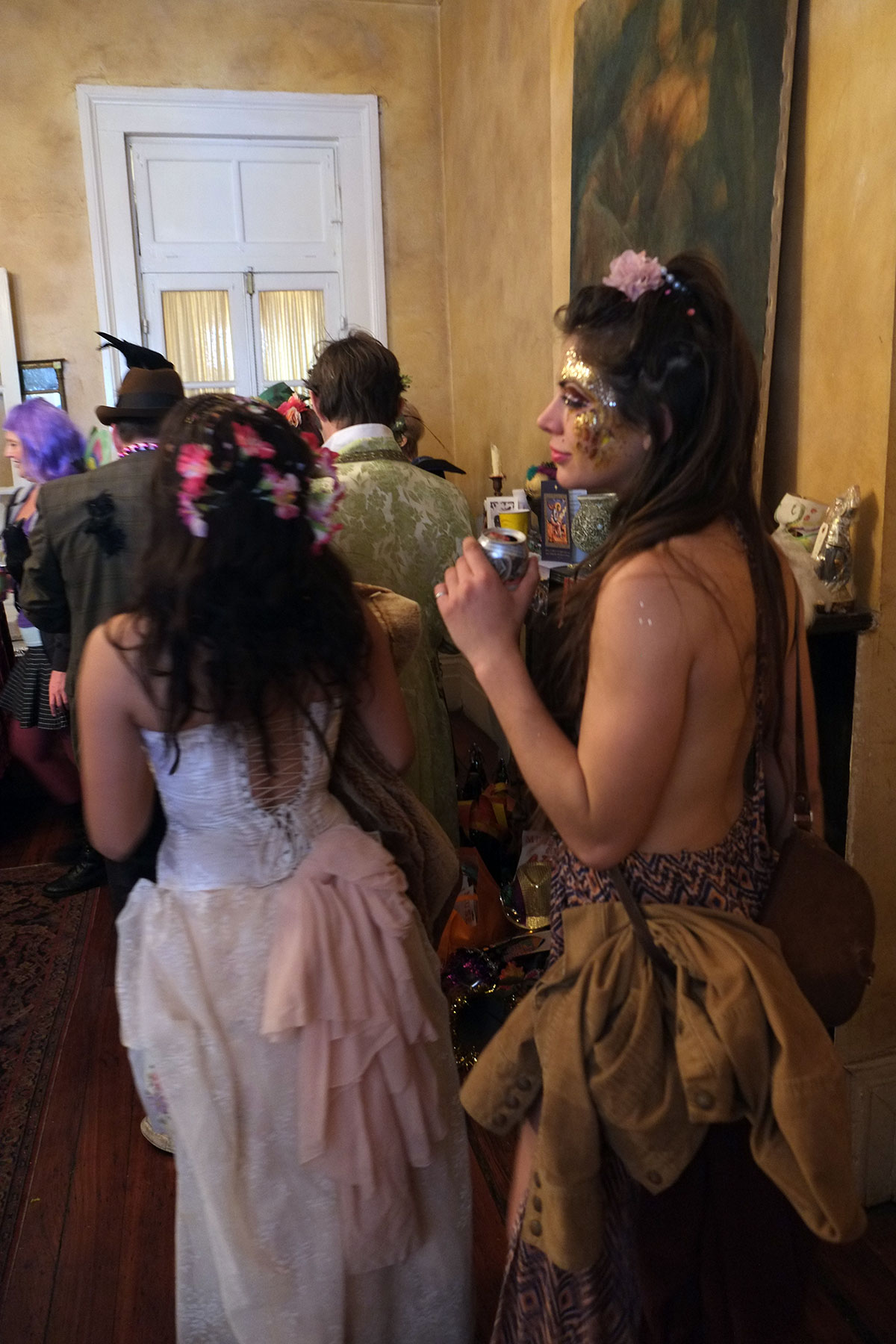
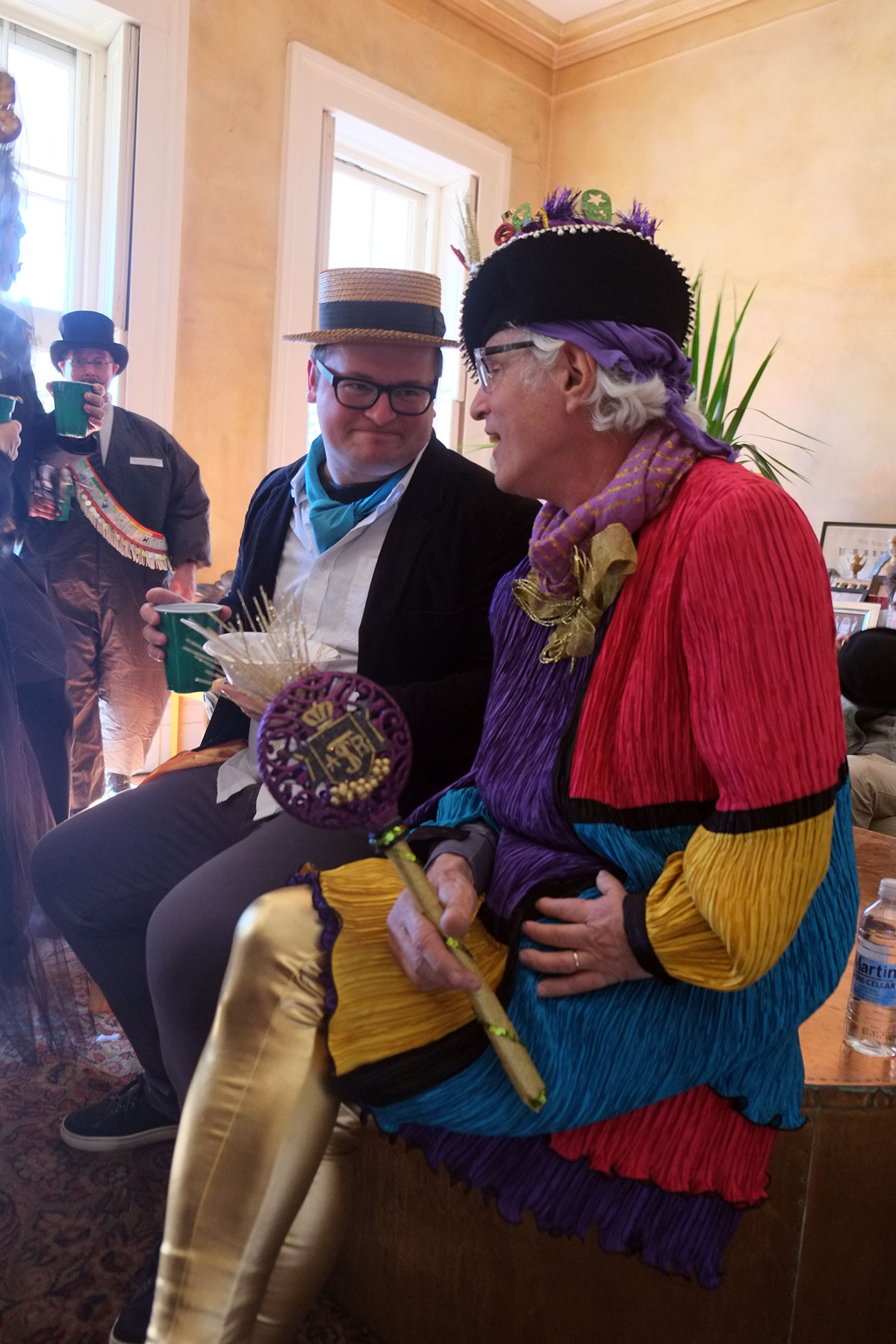
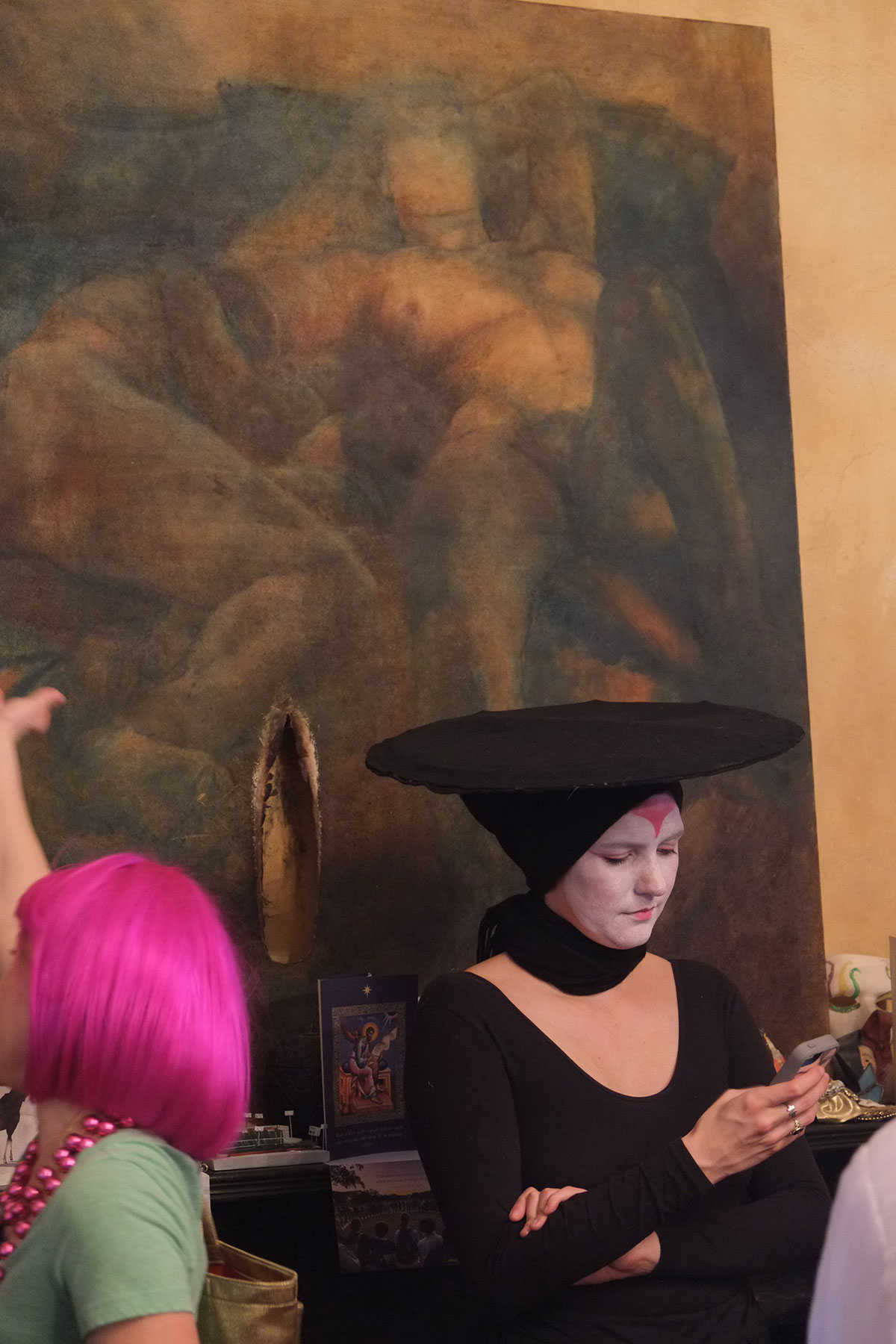
We arrive at their friend Constantine’s on Jackson Square for a fabulous party
Traveling across the Deep South was not one of the goals of our trip, but if we wanted to skip winter weather as we went from Florida to New Orleans, Alabama and Mississippi were unavoidable. We realized that there’s not a lot of great architecture or notable cities to see (and the ones there are happen to be in the Piedmont far north of our route), the landscape is monotonous, and the prevailing culture is as far from our normal milieu as can be found in this country. (There had been an op-ed in the Times a few days earlier on how hard it was to be a liberal native Alabaman, returning to the state after 20 years in New York.) Greta pointed out that the only common element in our value system and theirs is appreciation of barbecue. So with minor trepidation we headed into Alabama.
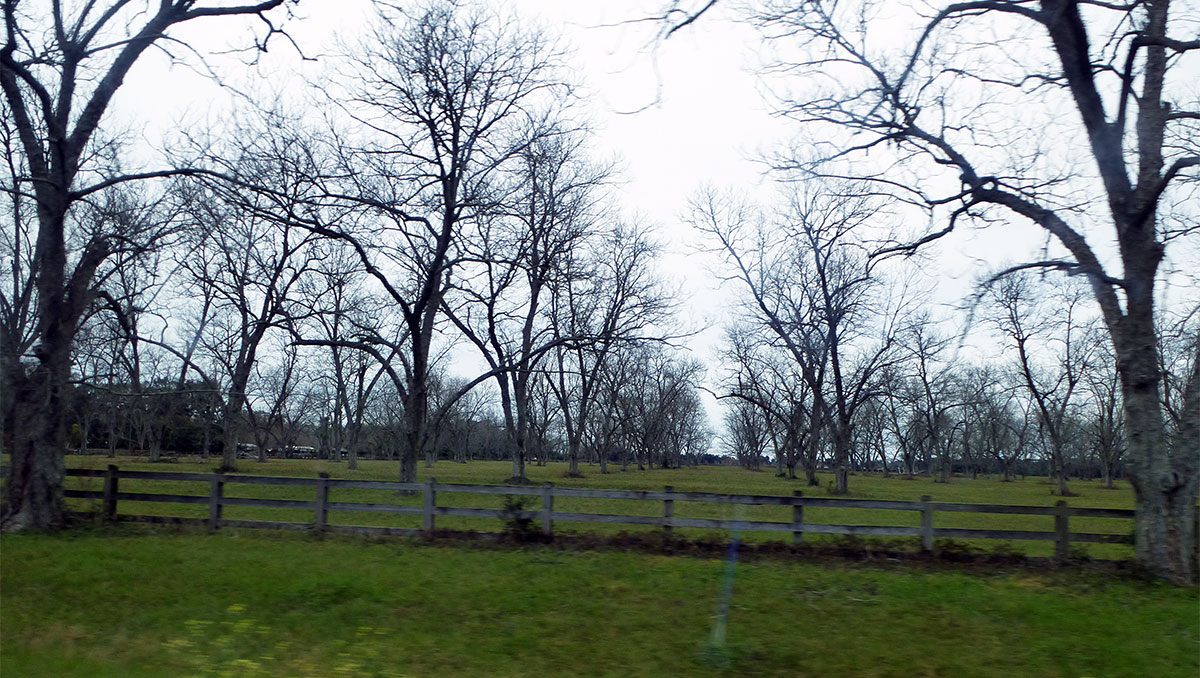
If you’re taking the coastal route, you only hit the little tab of Alabama that surrounds Mobile Bay, and the drive across is under 100 miles. The coastal plain is indeed monotonous, but very pleasant – we were mostly in a landscape of pecan groves and small towns.
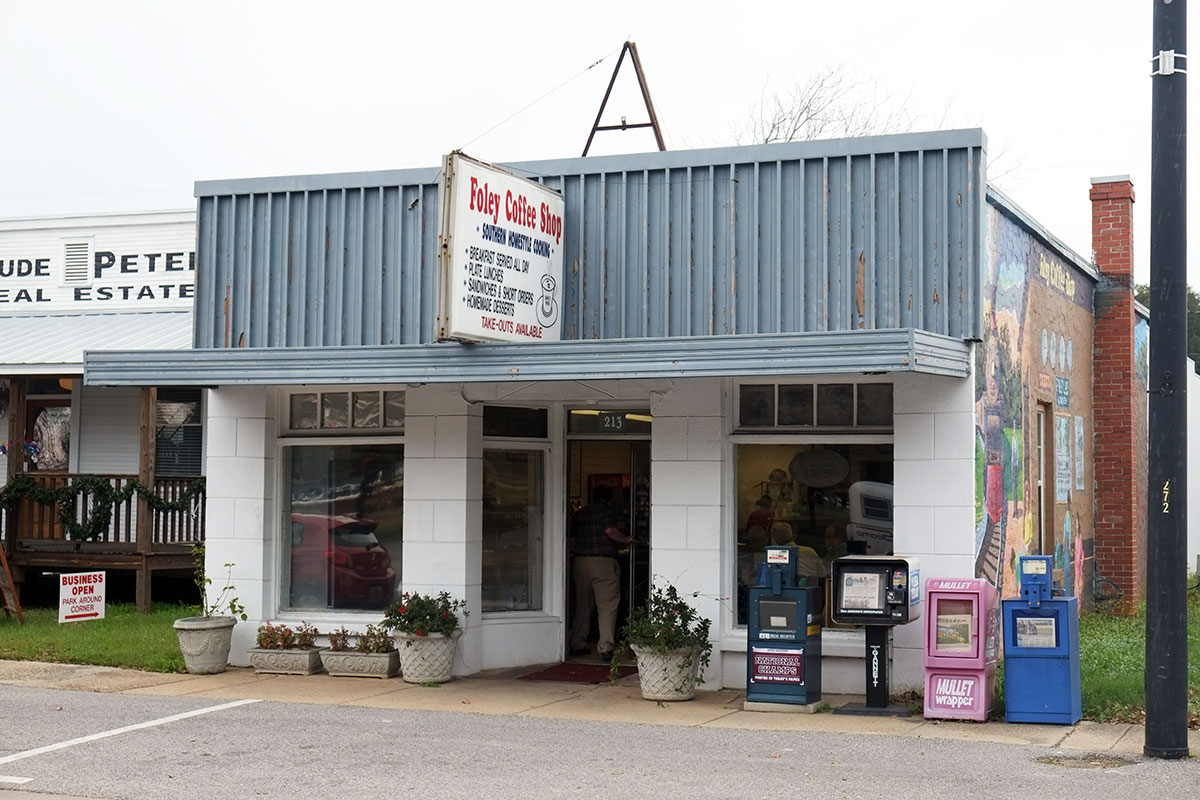
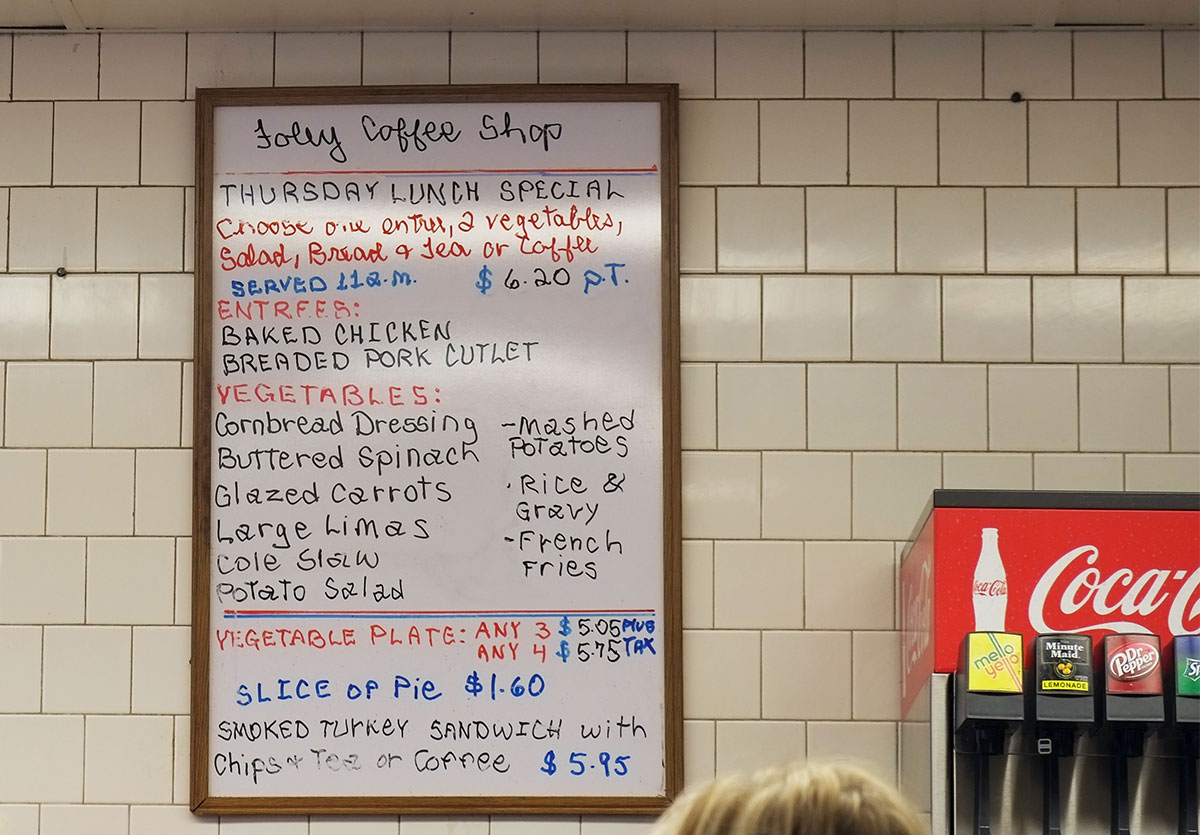
The biggest disappointment on our travels in the South has been the displacement of barbecue joints. Every little town or city you pass is full of chain fast food places, which seem to have squeezed the barbecue out – as Calvin Trillin noted last fall in the New Yorker, the future of barbecue seems to be heading into the cities, where it is appreciated by yuppie connoisseurs. So at lunchtime we turned to the excellent database compiled by the folks at Roadfood.com, which directed us to the Foley Coffee Shop, in the charming small city of Foley, Alabama. Greta isn’t blogging about this as it wasn’t necessarily a culinary awakening, but it was a cultural one.
As we stepped through the front door, we were transported back 50 years in time. A wall of conversation hit us, as the place was full of locals of all types – old folks, office and construction workers, families, etc. A short movie best conveys the ambience:
Our charming waitress, a friend of the owner’s daughter, confirmed that nothing had really changed since the 1960s. It seemed to us that the prices were within this category too – “entree, 2 vegetables, salad, bread, & tea or coffee” for $6.20 (with a choice of 9 vegetables). Take that, McDonalds.
The food was fresh and good, the people we talked to were gregarious and lovely, and the sense of community was palpable. This wasn’t just a place for the efficient satisfaction of nutritional needs, but one that helped maintain the culture of the city. At first we felt like visiting anthropologists, but we appreciated how we were welcomed in for our brief glimpse.
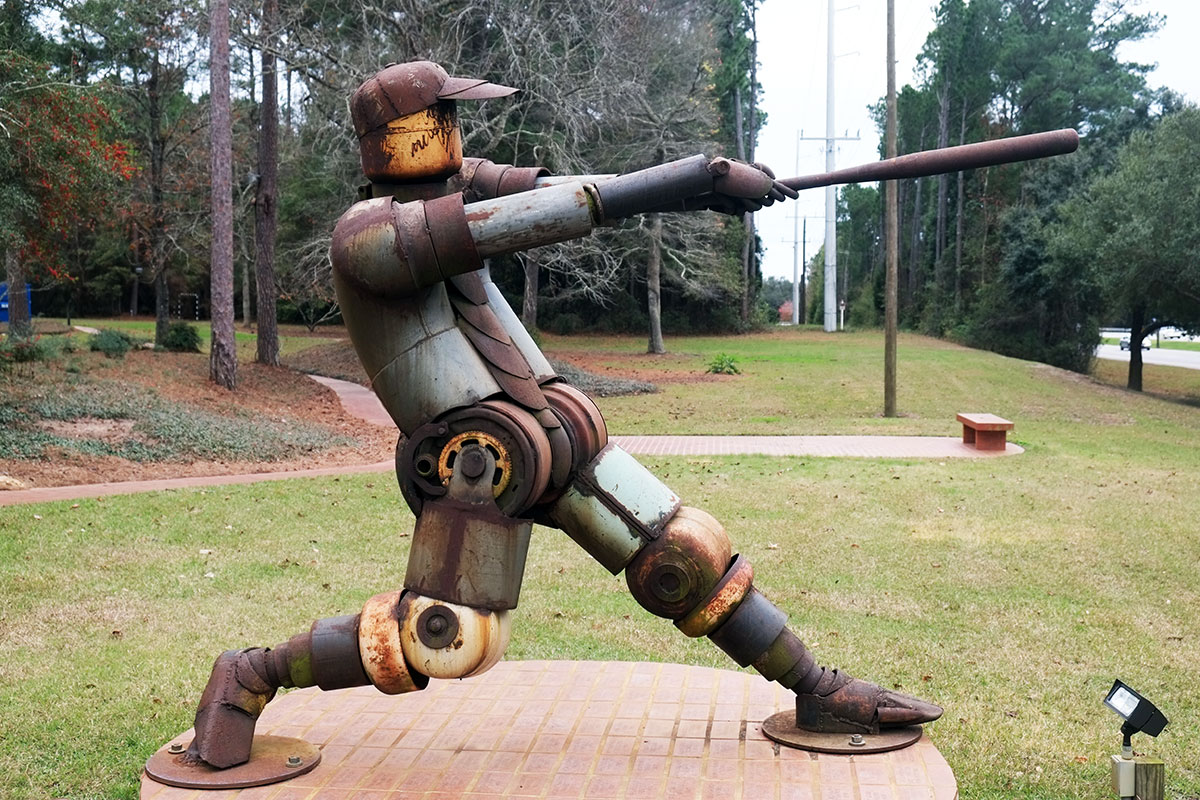
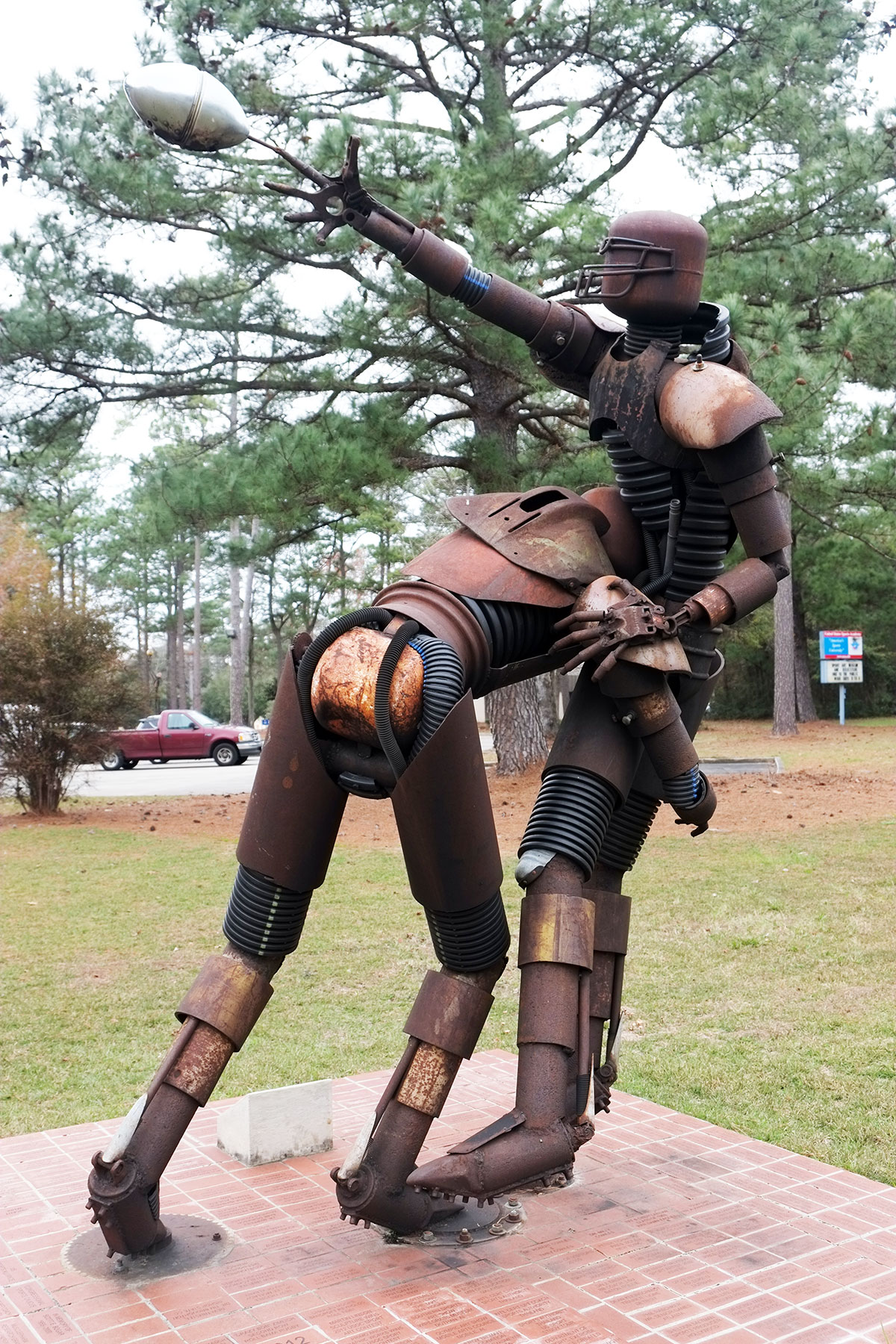
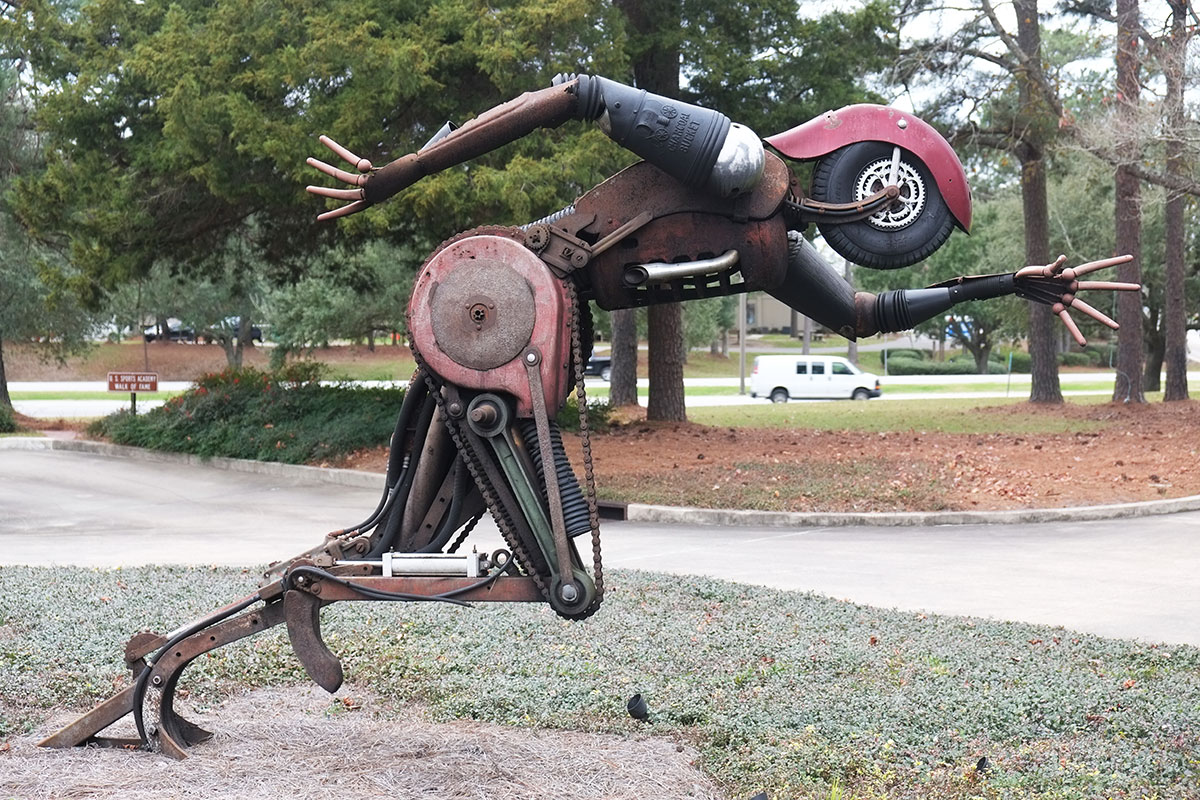
The other great cultural mainstay of Alabama is football, so guided by the map at RoadsideAmerica.com, we stopped at the US Sports Academy in Daphne, to see the sports sculptures made of junk metal by Bruce Larsen. (Unmediated football doesn’t interest us, but representations might.) They are remarkable, using rigid materials to convey a sense of movement, power and tension. Greta liked them because they were so Steampunk.
Heading to the building interior and its extended art collection, we came across this print which we had never seen before in Oregon. It is apparently one in a series celebrating the “College Football Game of the Year”, and in its depiction of the inaugural CFP Championship game almost exactly one year earlier, it showed Marcus Mariota getting sacked by a swarm of Ohio State players. We left in a huff.
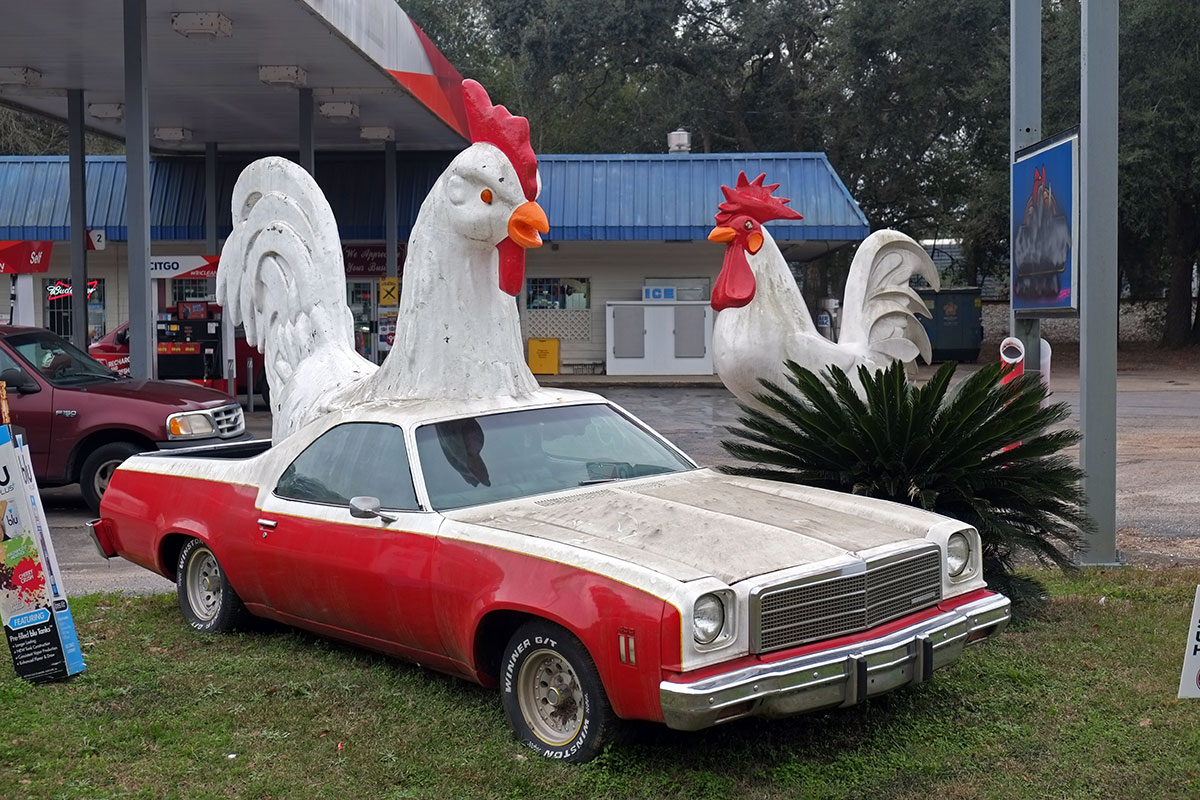
We cruised through Mobile, which did nothing to grab our attention, as we had one more goal in sight that afternoon: once again, guided by RoadsideAmerica, we reached the El Camino chickens.
A local man saw me taking photos and called out to me:
“Do you like those chickens?”
“I love the chickens. And my wife loves El Caminos, so I’m taking pictures for her. I read that this used to be a fried chicken stand, is that true?”
“I’m not sure, the chickens have been here as long as I can remember, and whatever store is here has always sold some chicken, though. Where you folks from?”
“Oregon.”
“I hear it’s beautiful there, but I’ve never been. Actually, I’ve never really been anywhere. Never got too far away from these chickens.”
We know that our five hours there didn’t give us a nuanced view of Alabama, but overall, it was more positive than we had been expecting.
Since our blog is always weeks behind, many of our readers are getting confused about where we really are. So I am going to start putting a short daily summary in the Current Location page on the blog, which will keep everyone who cares better informed.
FYI, we are now in Charleston, going to see Navy ships today, after a day of Too Much Architecture for Greta. Tomorrow we will head south towards Jacksonville and the Timucuan Ecological and Historic Preserve, run by the National Park Service, and camping on the beach. We have packed the winter coats away, and are pulling out the bathing suits. (Sorry, Oregonians.)
Most of my blog posts are pretty pedantic and focussed, so I’ve decided I should sometimes just post photos that aren’t part of a larger polemic. Plus I don’t have to write as much.
Our faithful followers have no doubt noticed a serious slowdown in the blogging activity on Peregrine nation in the past couple of weeks. This has three causes:
Greta flew back to Eugene for a week to see Linda, celebrate her birthday, and undertake her final Halloween trick or treat before starting high school. Her focus shifted on to seeing people in Eugene, and she didn’t have me to goad her.
Second, since the beginning of the month, Greta has been participating in NaNoWriMo, National Novel Writing Month. (http://nanowrimo.org). The goal is to write 50,000 words of fiction during November. This has taken up most of her writing energy, plus she has made friends with a bunch of Australians she met in a NaNoWriMo chat room, and she spends time messaging them. But she has already written 45,000 words, will doubtless meet her goal this weekend, and will be in high gear for writing, able to crank out a backlog of food and museum reviews.
Third, our day-to-day life in the Northeast has been just too full in the last month. When we were out out west, we spent our days driving and seeing things, and our evenings in the trailer in a campground, blogging away. But once we got to the Northeast, our days have been even more full of things and places, and in the evenings we’ve been staying with a succession of family and good friends, sometimes catching up with people I haven’t seen in 15 to 40 years. Blogging actually takes more time than I anticipated, and it’s hard for me to be productive when there’s conversation to be had and whiskey to be drunk.
Our blog is currently stuck in Boston, but we are physically in Charlottesville. We will probably slow down a bit in our travels now, and we will have to time to update our adventures in Lowell, New Hampshire, New York, Paterson, Philadelphia, Baltimore, Annapolis, Washington DC, Harpers Ferry and the Shenandoah Valley. So keep your eyes peeled, and a happy Thanksgiving to all!
If being in Boston felt familiar, Cambridge and Somerville felt much more so. I was at Harvard for four years, and then spent two years living in Somerville while I worked for an architecture firm in Boston. In retrospect, I spent the vast majority of my college years on campus, as it was intense and time-consuming, venturing into Boston for frequent field trips and museum visits related to my major in art history. After college I spent a lot more time wandering around Boston, due to more free time, being in Boston every day anyway, and living in a crummy apartment in Somerville that encouraged one to get out more.
If Boston seems to change less than other places, Cambridge is even more extreme. Returning alums bemoan the loss of old standbys like Cronins or Elsie’s, but there were certainly more than enough nostalgia-triggers around to drive Greta crazy, as she had to listen to stories in front of each (although I restrained myself from breaking into Illegitimum non Carborundum). Random highlights follow:
Harvard Square struck me as much the same, thought perhaps more sedate. Certainly the pedestrians are less militant than they were.
While Joyce Chen’s was arguably one of the first restaurants to introduce authentic Chinese food to America, Yenching will always be remembered as the harbinger of the Great Szechuan Revolution in Cambridge, the place which inspired our subsequent lifelong predilection for excellent Chinese food.
Pinocchio’s pizza is still going strong, although it now has pictures of Mark Zuckerberg prominently displayed. I had forgotten how much Boston pizza differs from New York – not least in that it is made by Greeks – but I’ll leave the review of it to Greta. But perhaps the most inexplicable survivor was:
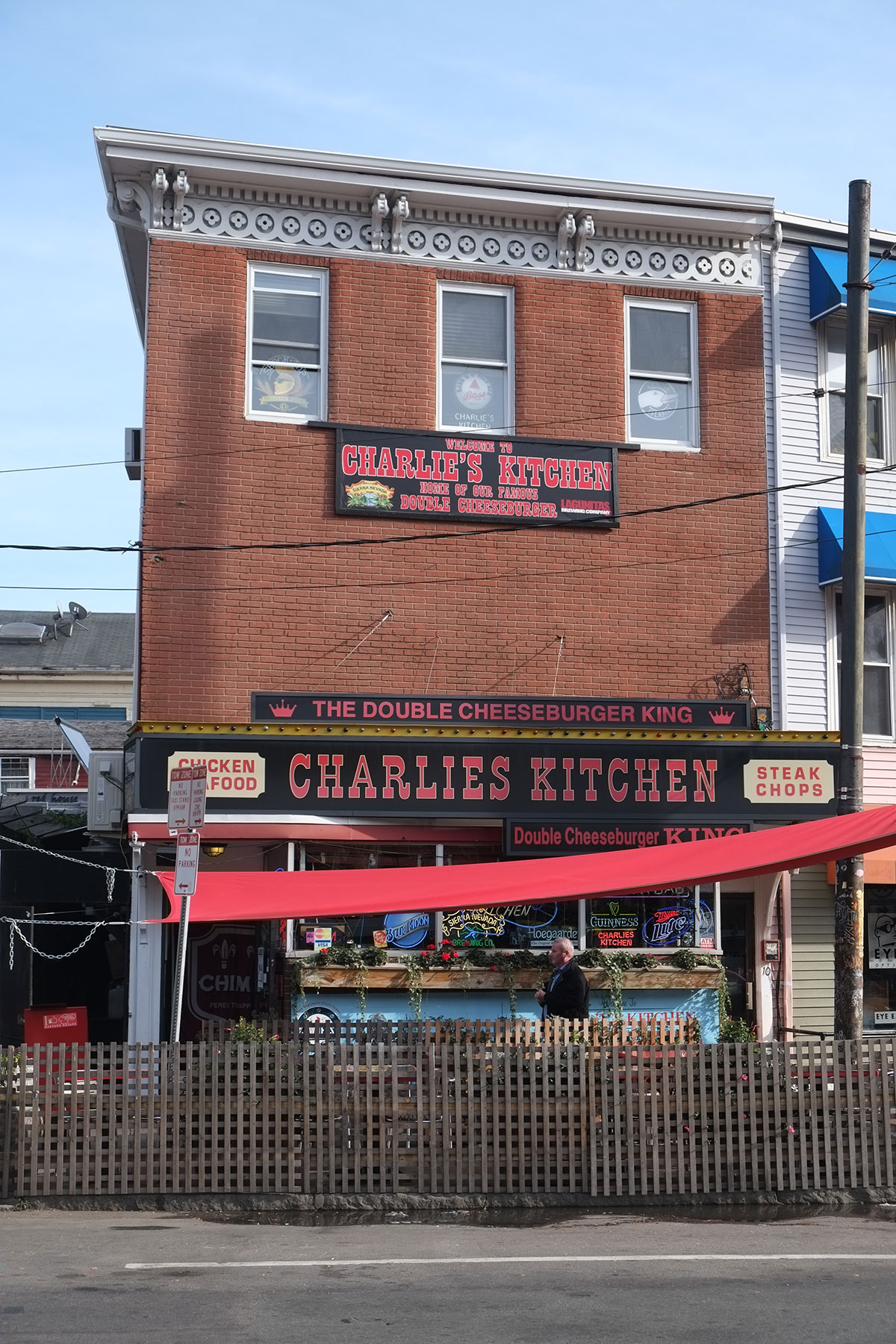
Charles Kitchen, purveyor of thoroughly mediocre double cheeseburger specials and cheap beer. I know that the culinary proclivities of undergraduates probably haven’t changed that much, but I was still surprised that it hadn’t been displaced by a higher-end establishment, until a local informant told me that it is owned by the Mafia and probably fills some other role in the underground economy.
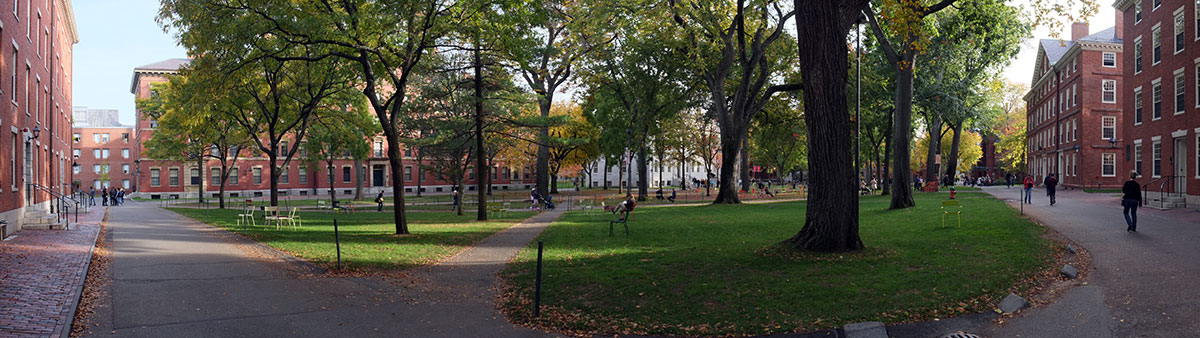
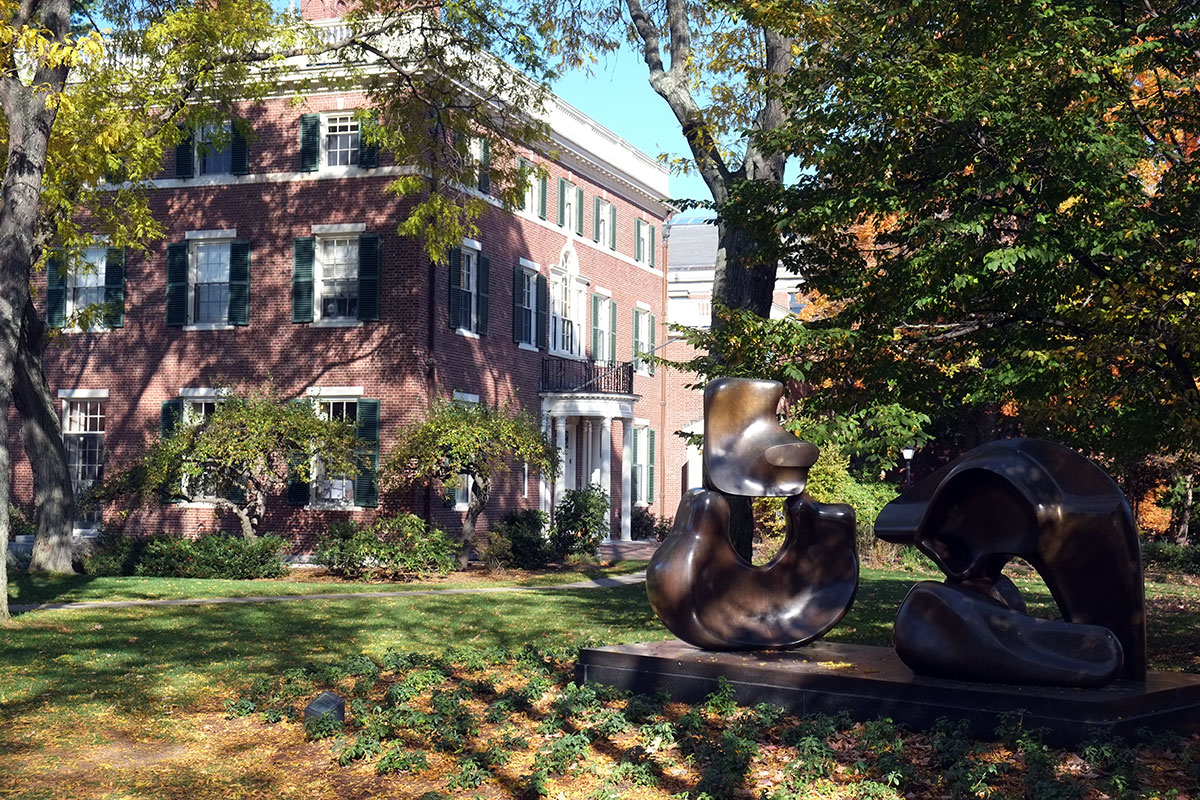
Harvard Yard is of course the same, except for the now huge crowds of international tourists and the chairs scattered around. Crowd control has become an issue, and there are signs everywhere telling you not to enter the buildings or bug the students. But once you get out of the Old Yard, the Tercentenary Theatre and the small courts are still relatively sedate.
Massachusetts Hall, the oldest academic building on campus, from 1720.
The President’s House
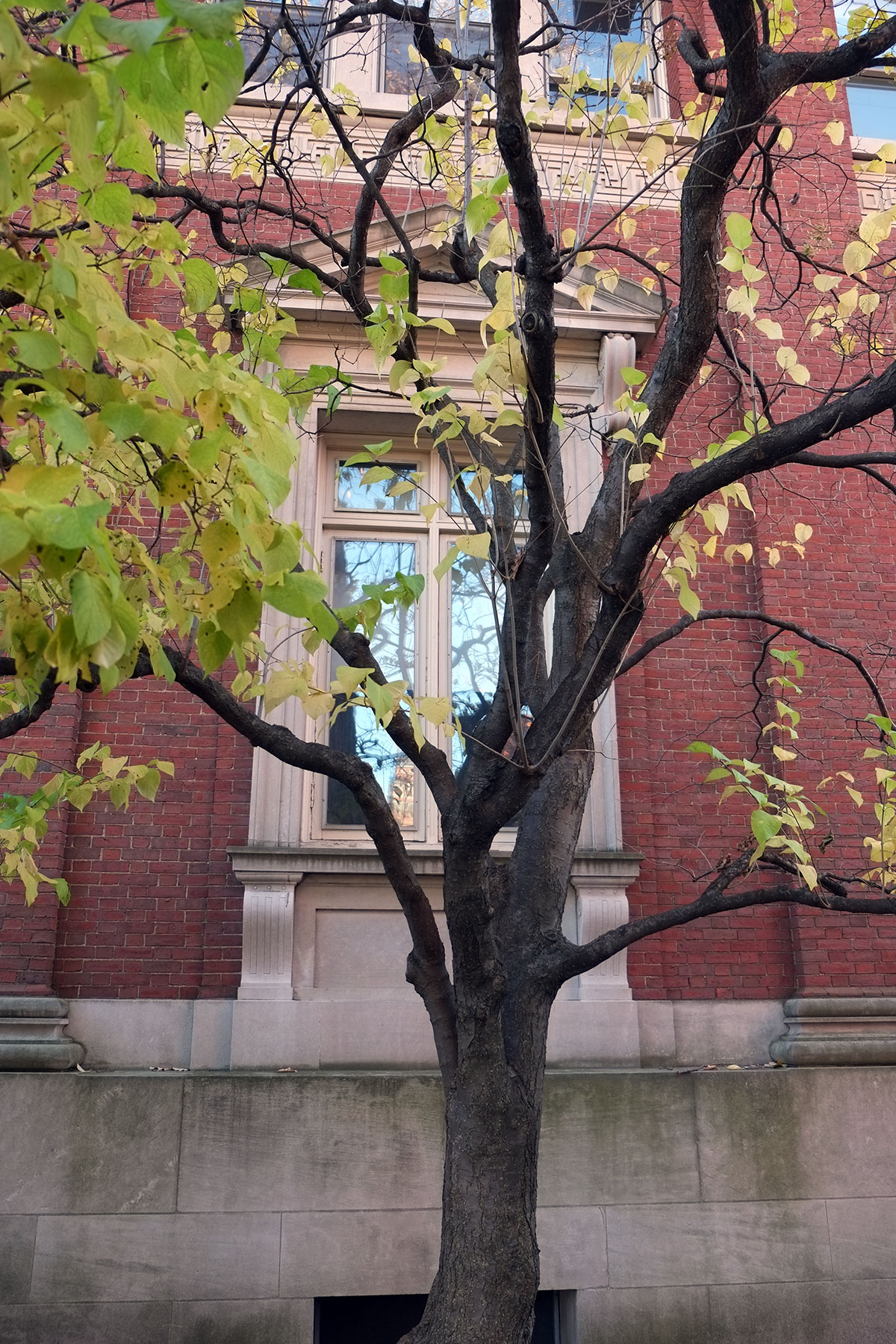
The window in Emerson, from which I gazed during Soc Stud 10 lectures on Marx (when I was a Soc Stud major before switching), and the tree I gazed upon.
Architecturally, we went by old favorites to photograph them, as I just hadn’t taken enough slides back in the pre-digital days.
the Lampoon and Adams House
the alley by Lowell House. An interesting development has been the replacement of the Fly Club garden by a new building for Hillel.
the view of Mem Hall from the GSD library, my preferred reading and late-afternoon dozing spot. The tower has been reconstructed, and it is now used as the freshman dining hall, after the desecration of the Freshman Union 20 years ago.
Becoming an architect has given me a new appreciation for buildings I didn’t particularly like as a student. I still understand their shortcomings as seen by laypeople, but as an architect I am bound to defend their architectonic qualities. First there is Sert:
the Science Center
Peabody Terrace, which I no longer feel the desire to bombard with paint balloons.
the Holyoke Street side of Holyoke Center, which is extremely nuanced in how it addresses its different orientations.
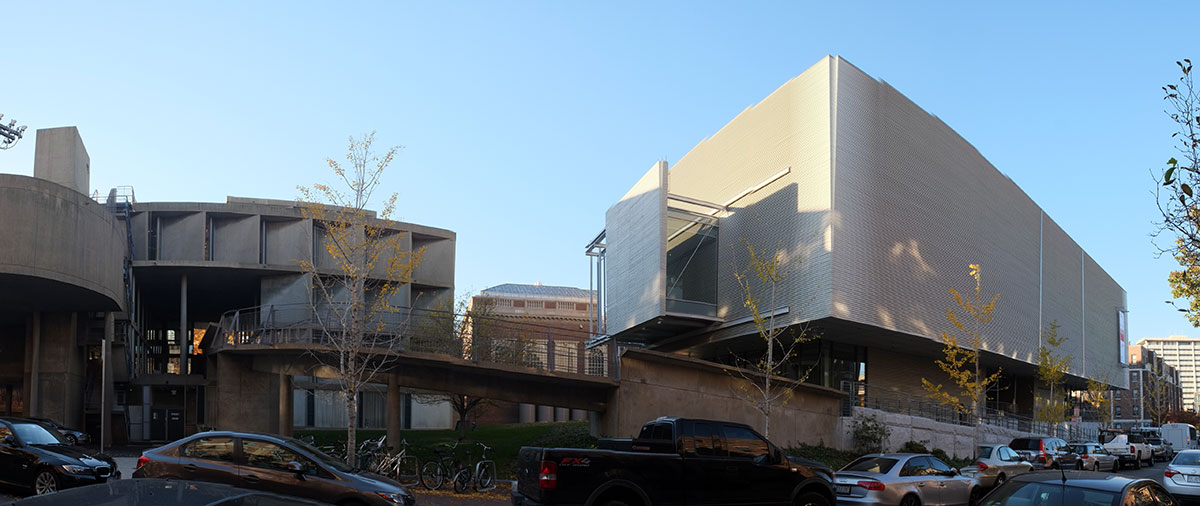
and of course Corbu’s Carpenter Center, which I now appreciate much more, and find its stand-off with Piano’s new museum quite entertaining (more on this to come).
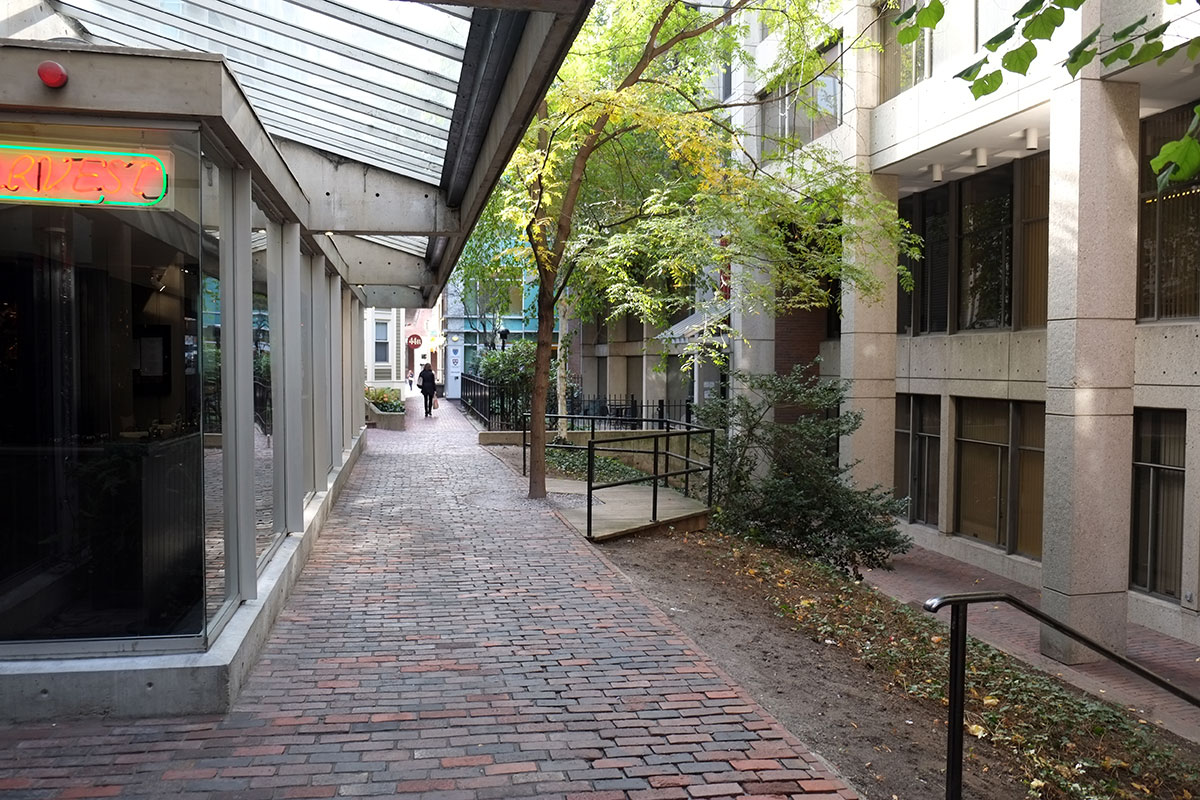
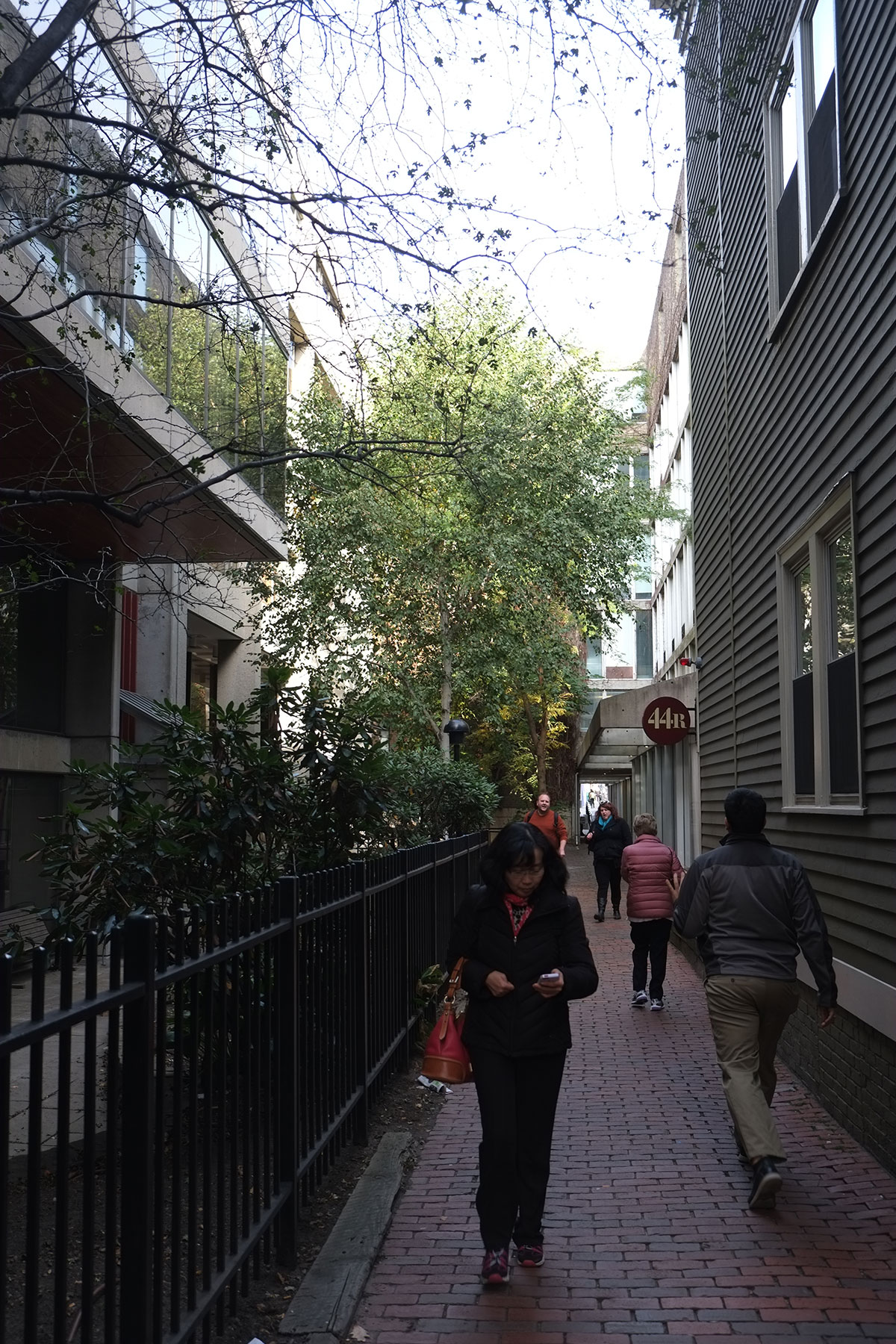
Perhaps the most striking place was the pedestrian alley and courtyard at 44 Brattle Street, (behind the Design Research building designed by Ben Thompson). The buildings were by Sert, Earl Flansburgh and TAC, who all had offices there, and collaborated on the design of the passage to the interior of the block. I have never seen another pedestrian passage in this country that is this successful – the materials, the scale, the spatial sequence – all have combined to create a vibrant, pleasant and well-used alley. It has become a commonplace that modernist object buildings ignored the context and destroyed the city; it is instructive to see spaces like this and understand how the best modernist architects were highly sensitive to these issues.
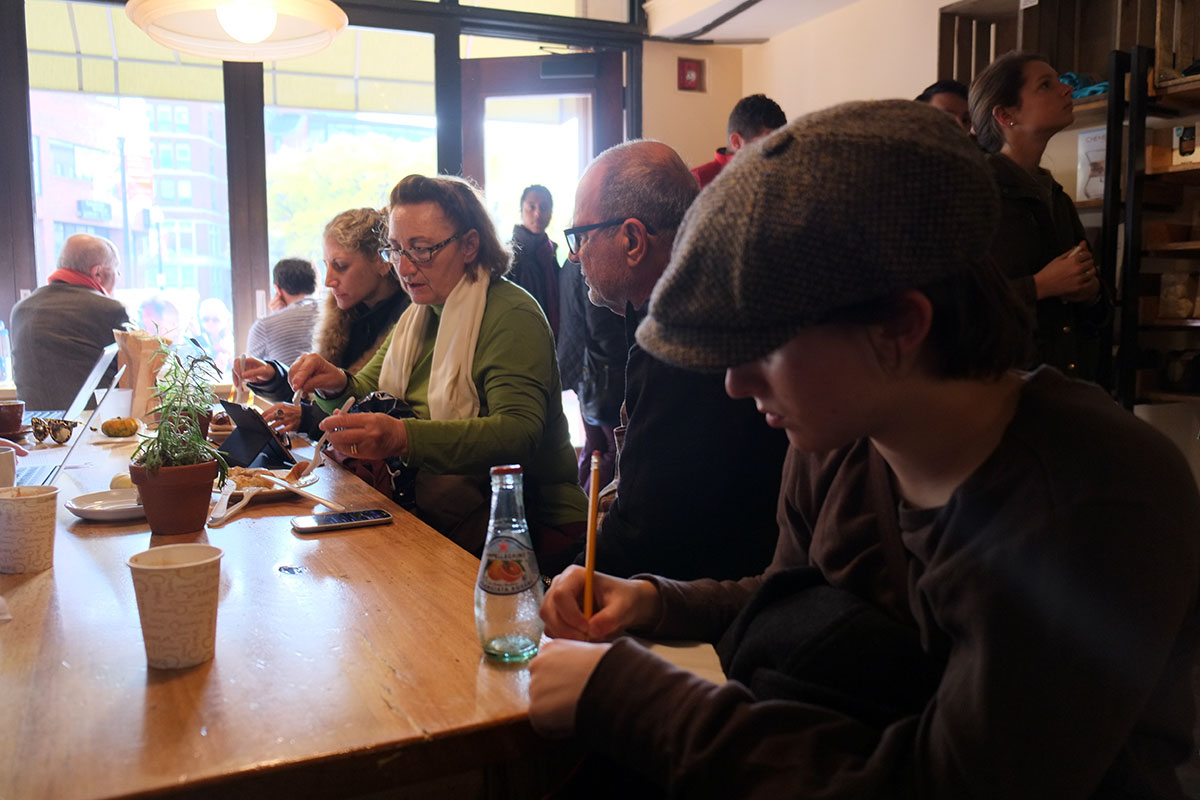
At the end of the day, Greta was more taken with Cambridge than she had thought she would be, and immediately fell into the role of serious author writing in a crowded cafe.
Revisiting a city where you’ve spent a lot of time is always a strange experience. On the one hand, you immediately notice how it’s changed, all the new construction and the lack of familiar faces. It doesn’t seem like the city you knew, and you realize it is no longer yours, that life here has gone on without you and that it now belongs to a whole new generation of people. But then you start to see beyond that, and you’re surprised by how many things you knew still remain.
I lived in the Boston area for six years, leaving in 1980, and I hadn’t been back since 1997. I’ve gotten used to western cities, where everything is new, and to New York, where change is more rapid and extreme. Boston has many new things (more on this in a later post), but all the old streets and places felt very familiar – I didn’t need a map, I always knew what would be around the next corner. This is the first place we’ve visited on this trip where I had lived, and it was strange to be in these old places with Greta, who belongs to a very different part of my life.
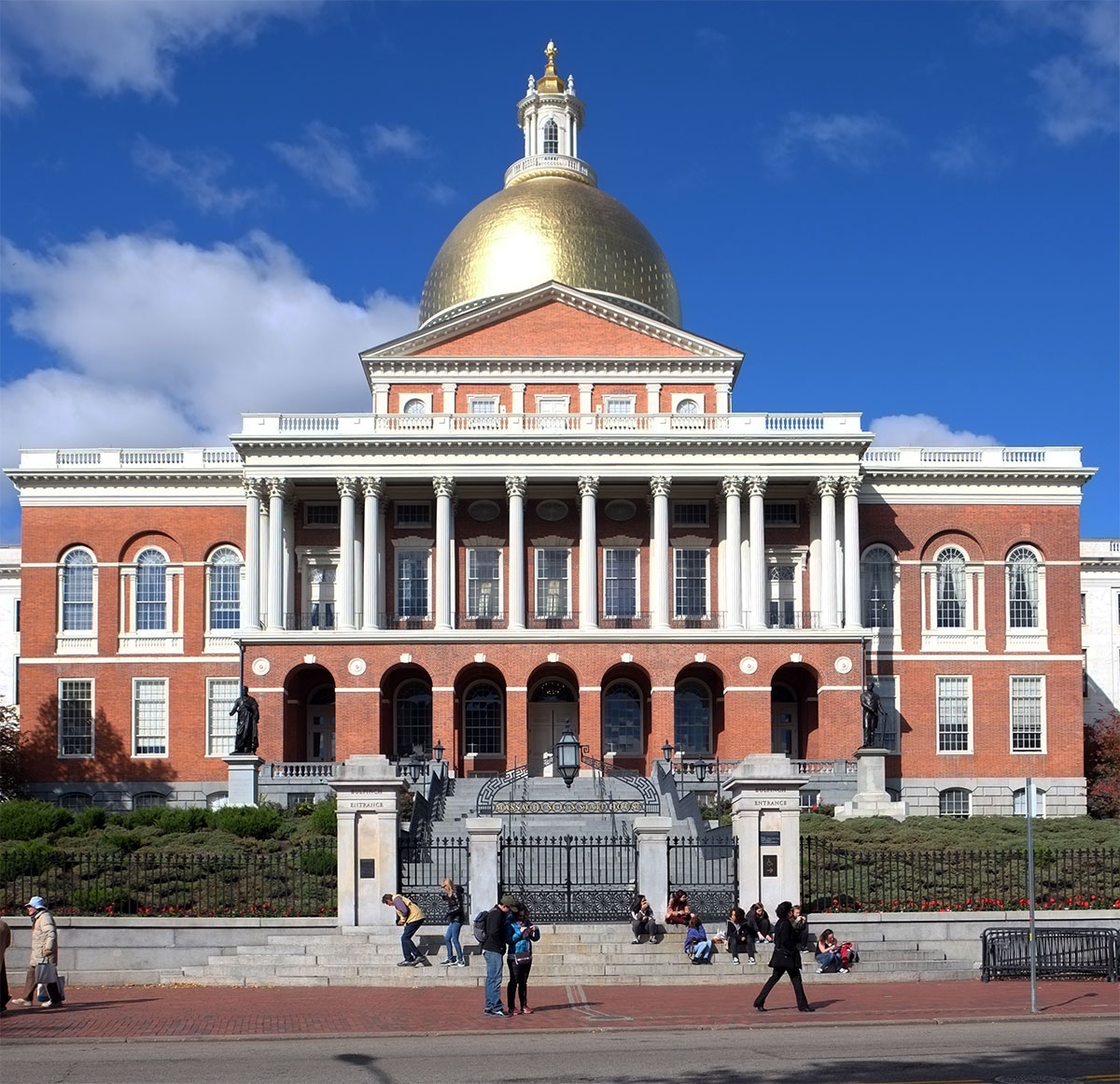
perhaps the most beautiful state house in the country
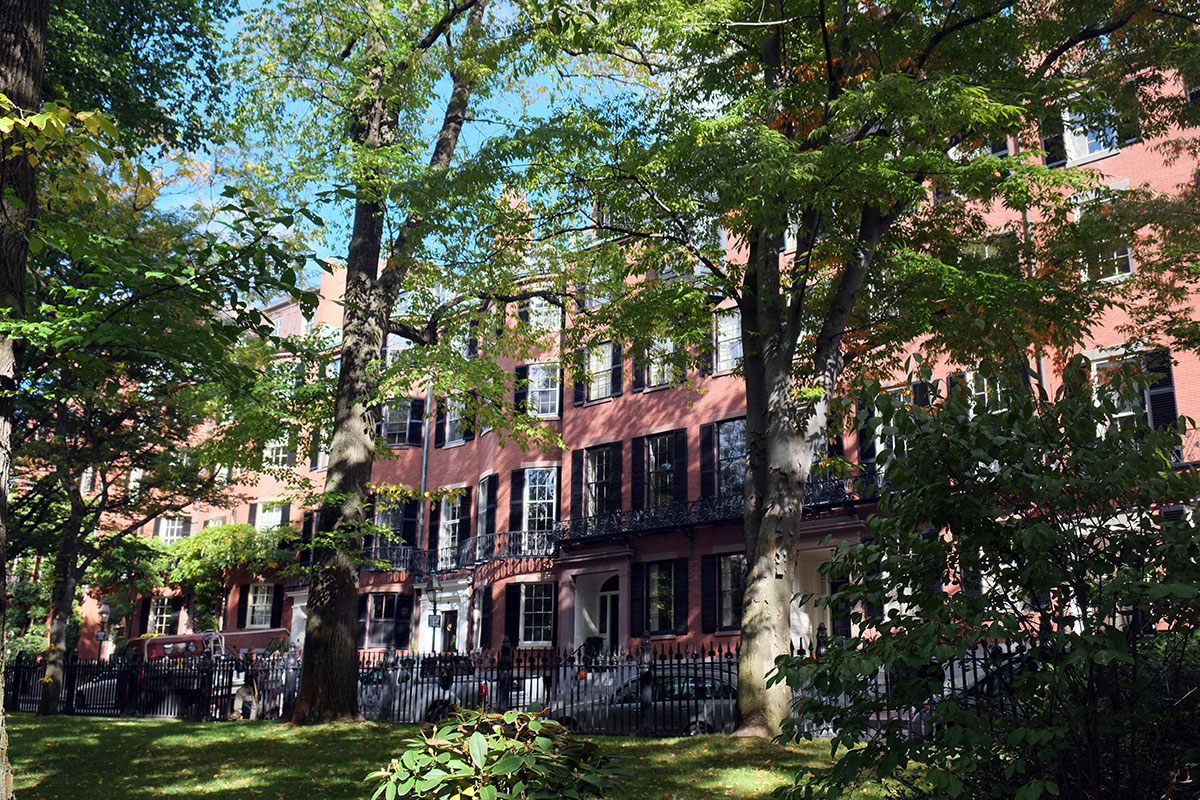
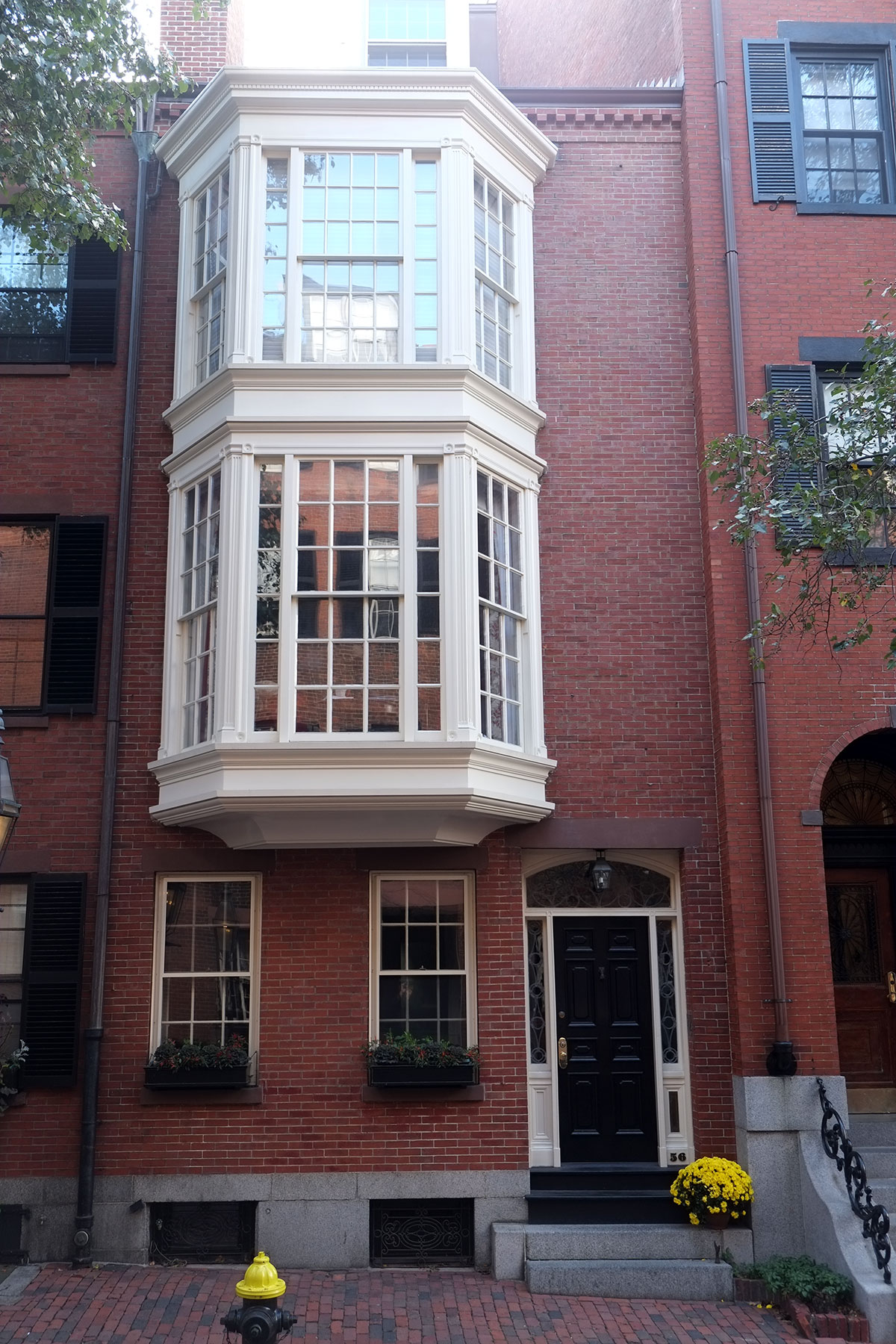
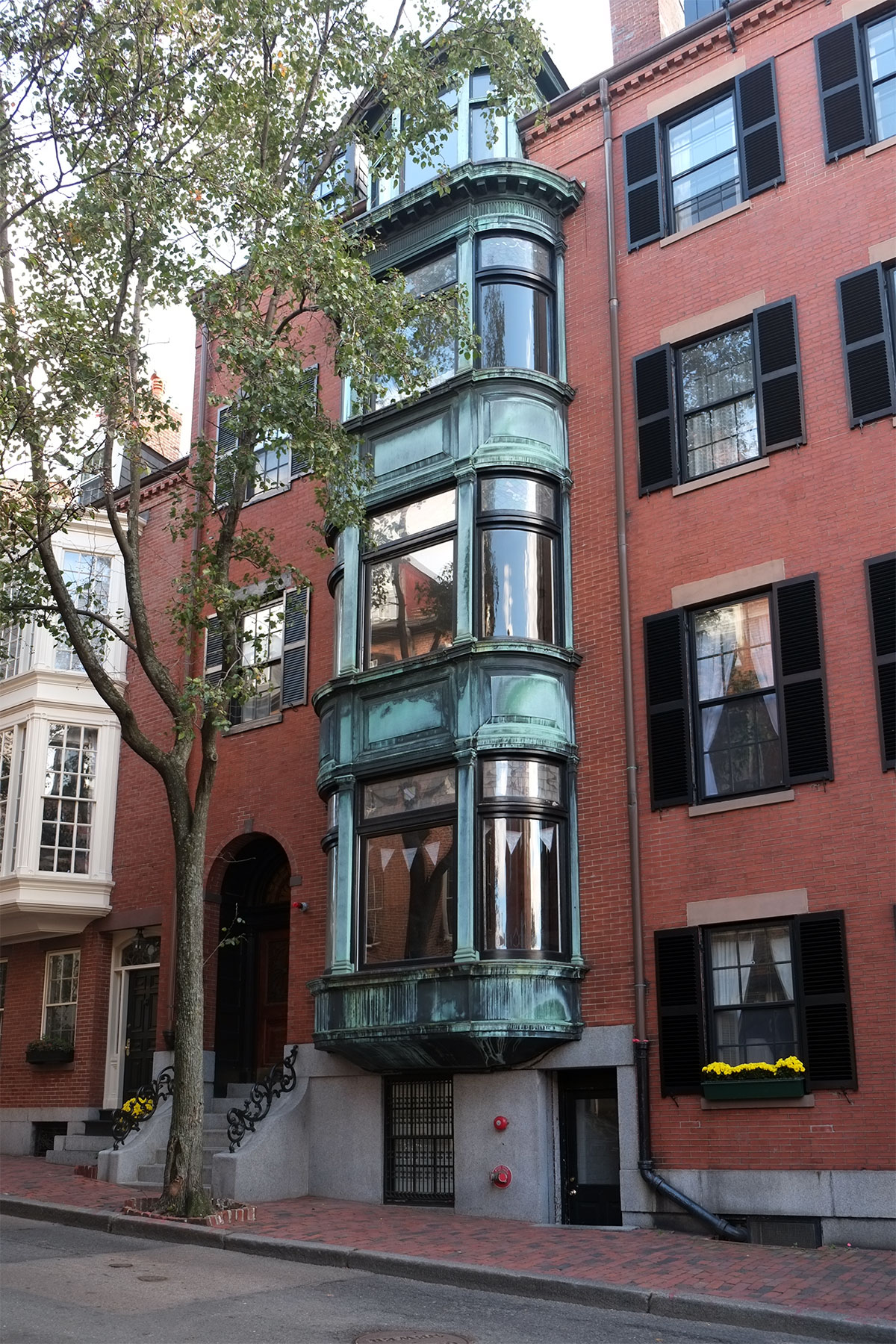
Beacon Hill, the pleasure of a quiet, Federalist neighborhood in the center of the city.
Louisburg Square
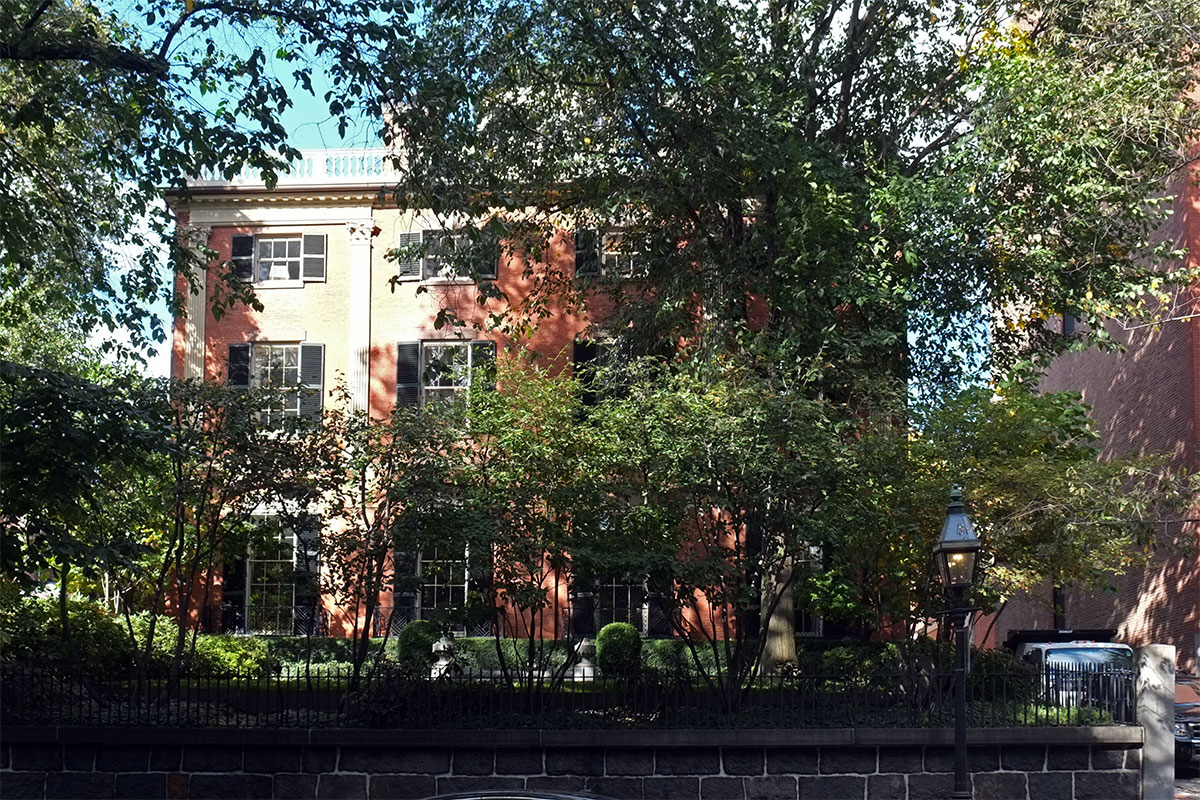
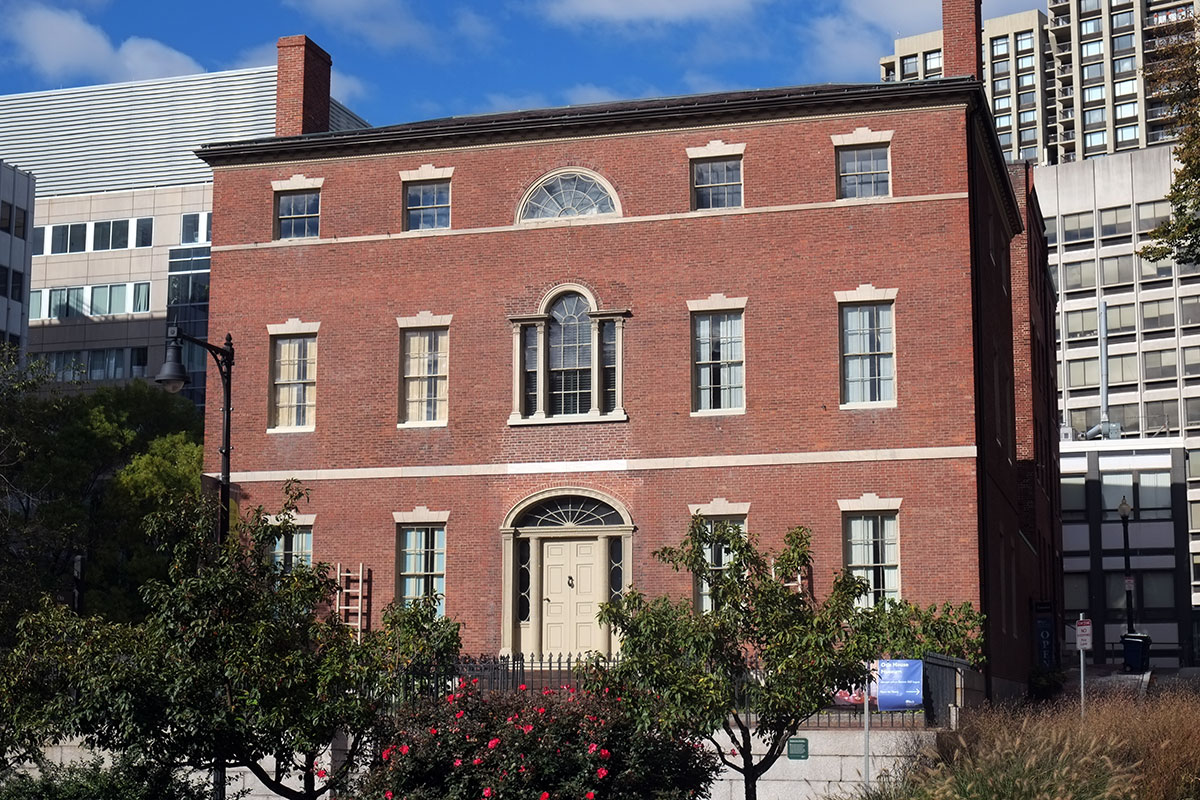
the second Harrison Gray Otis house
Mt. Vernon St.
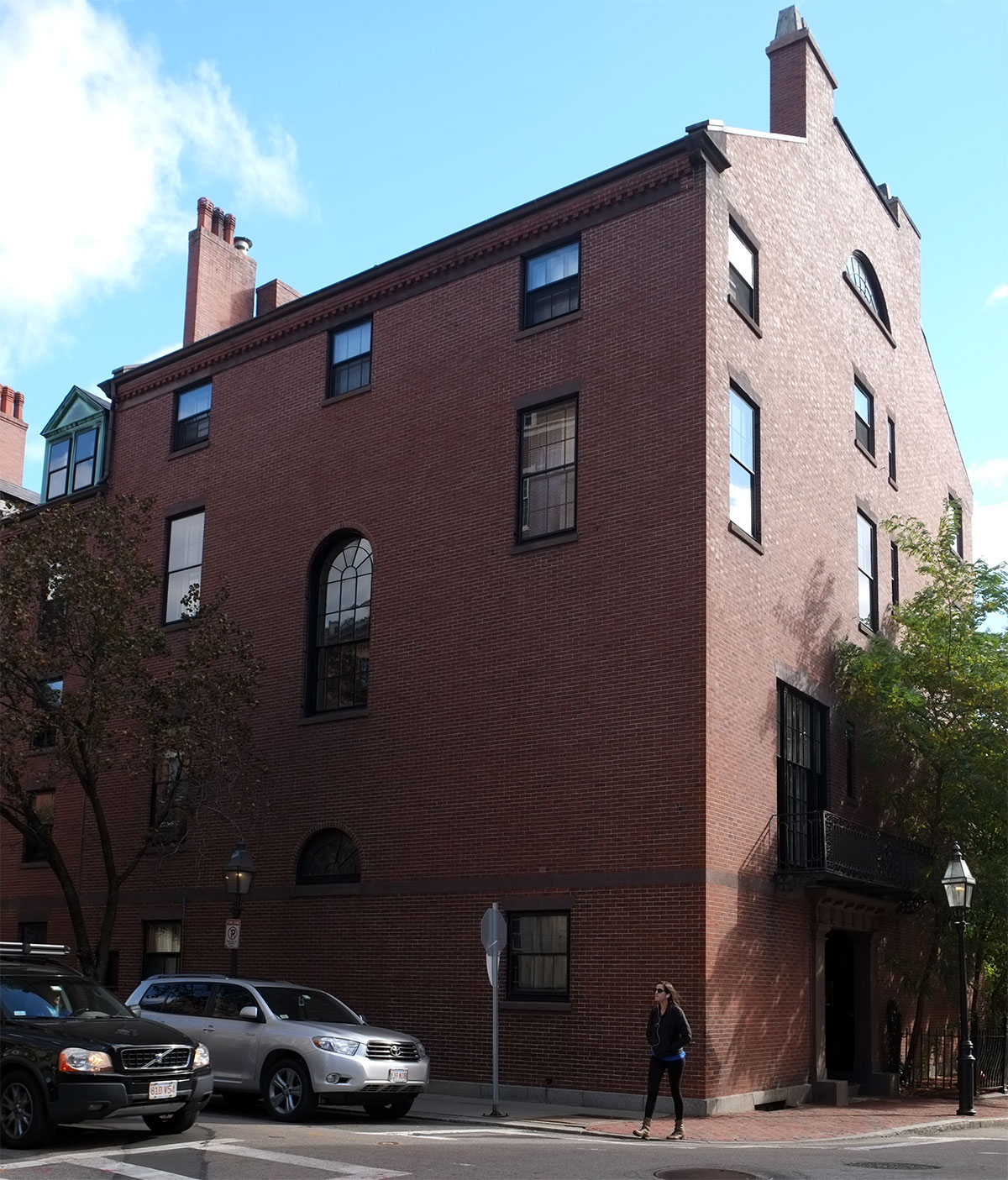
one of my favorite houses, at the corner of Mt. Vernon and Joy Streets
the first Harrison Gray Otis house, on Cambridge St.
The newer houses on Pinckney looked very good – as the rules were relaxed and architects had some fun.
Pinckney St.
Pinckney St.
Greta has remarkably little interest in conventional history, and we intersected with the Freedom Trail once in a while rather than following it.
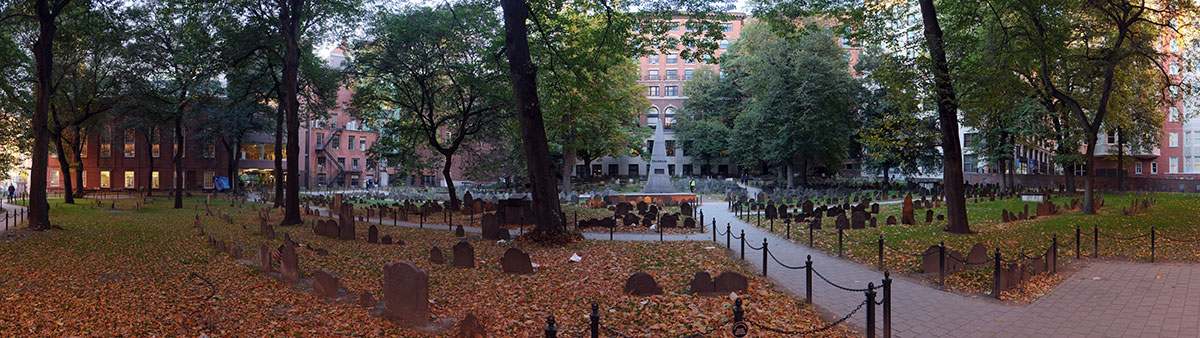
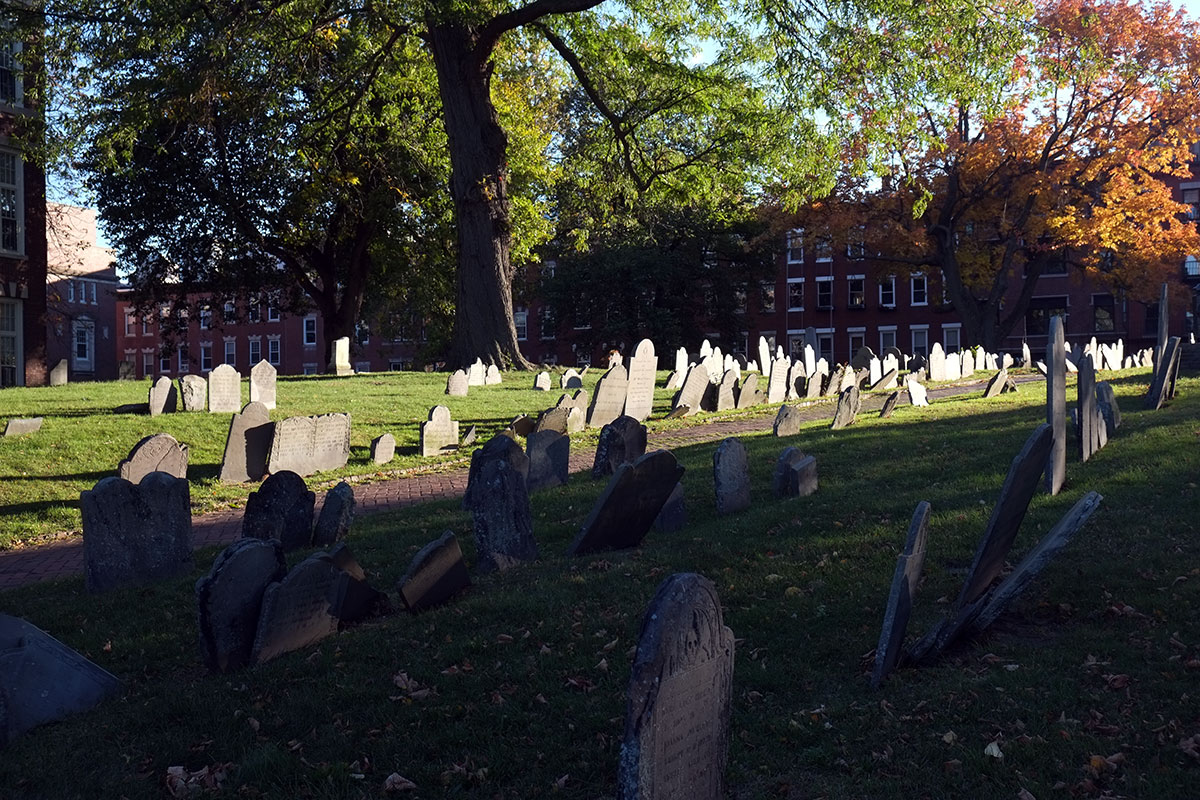
the Granary Burying Ground, on Tremont
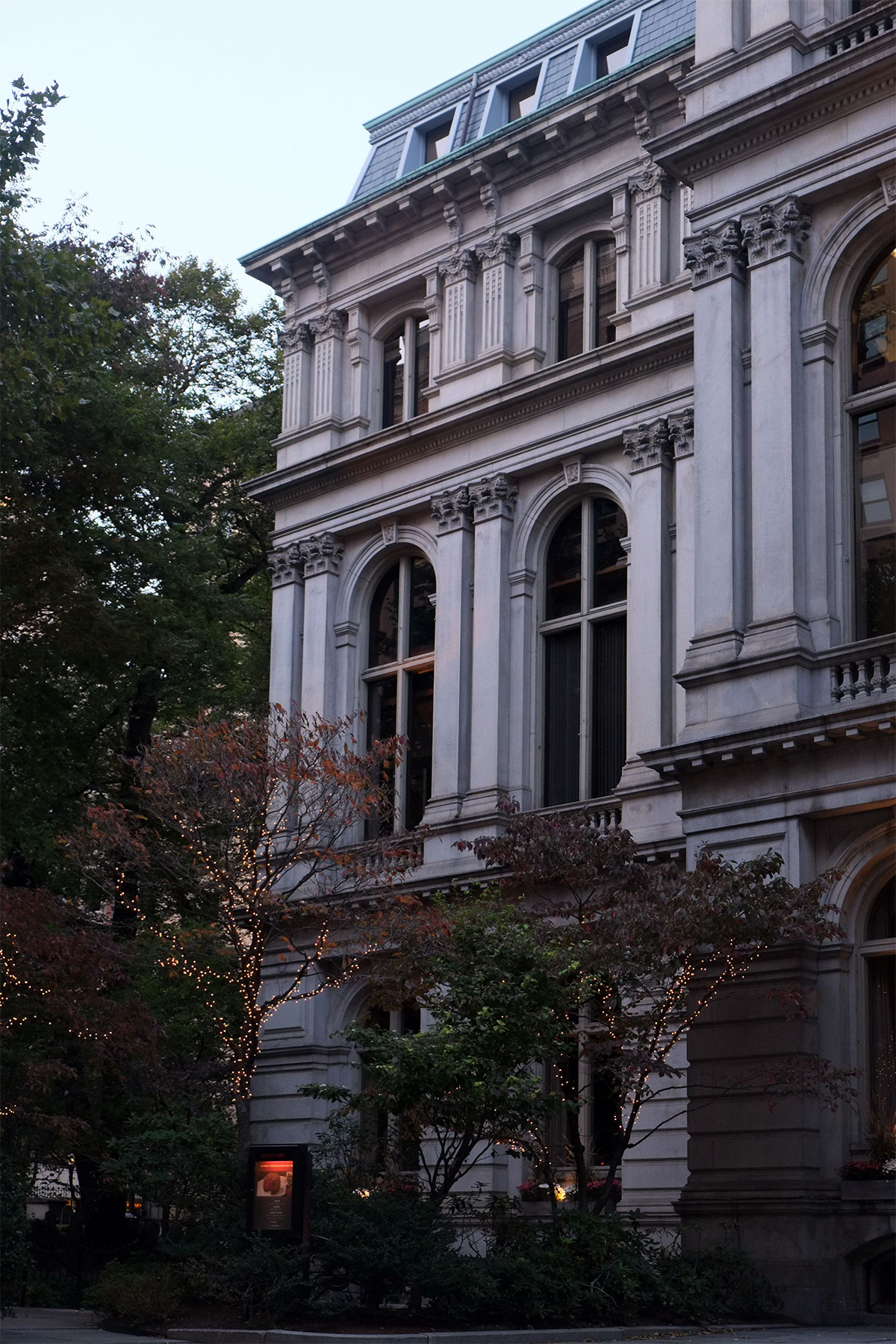
the Old City hall
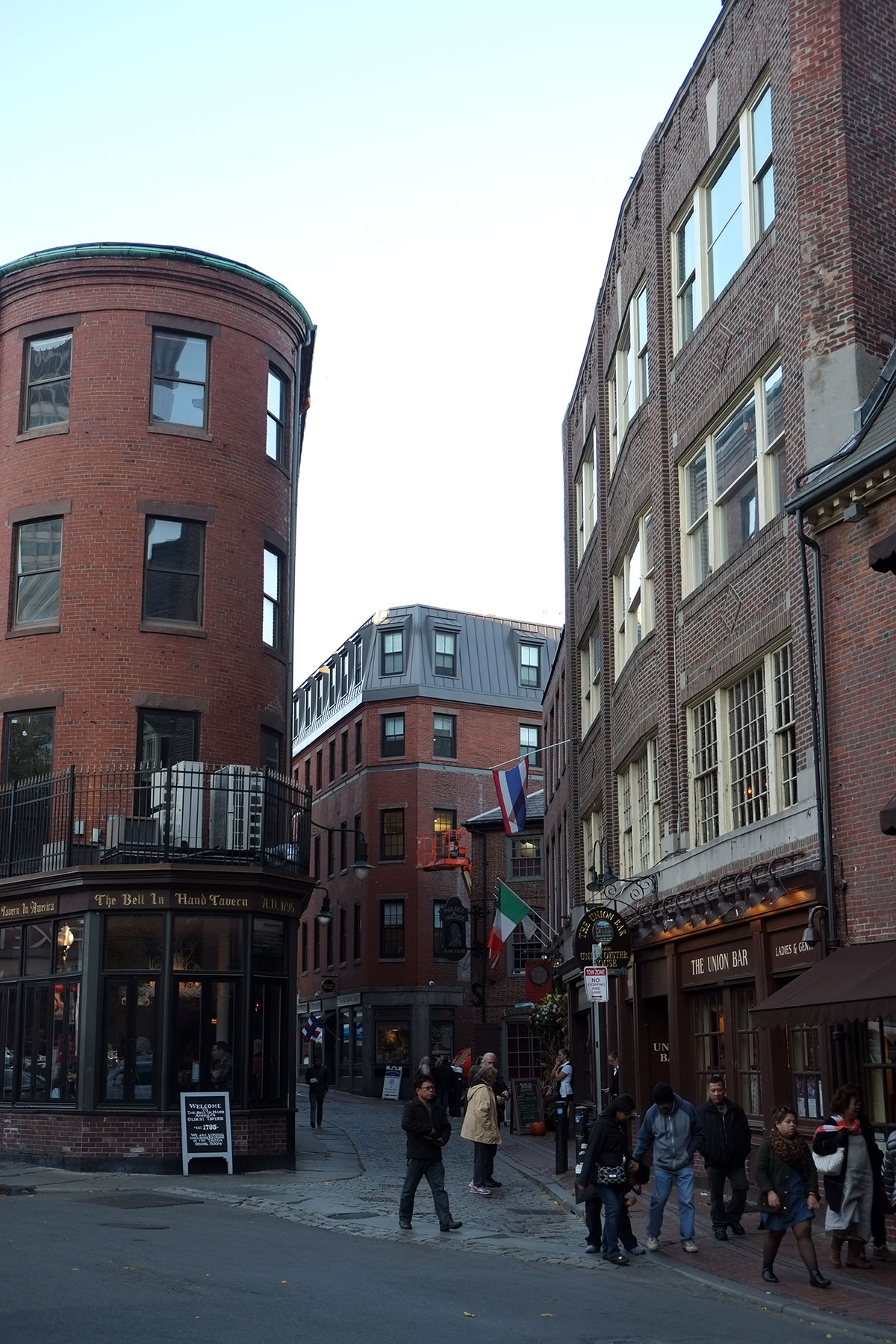
Marshall St., one of the few near Dock Square left unscathed by the Central Artery and Government Center
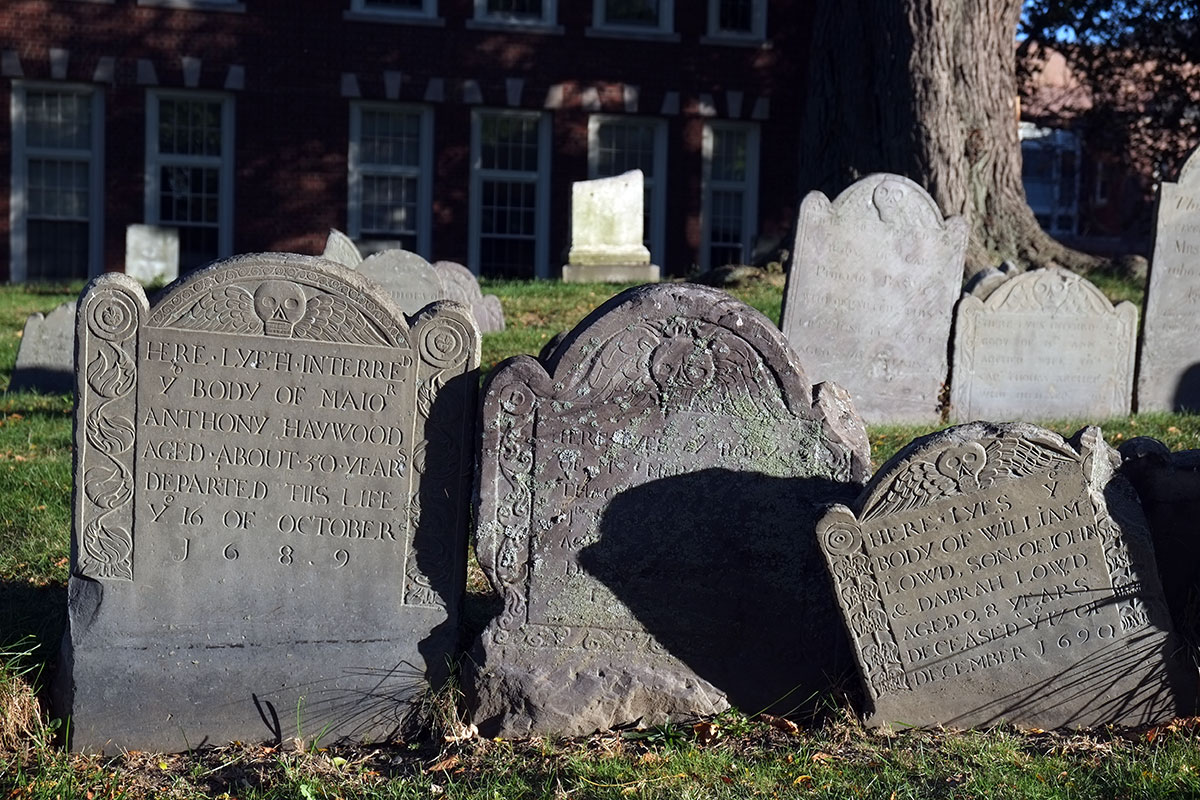
Copping Hill burial ground
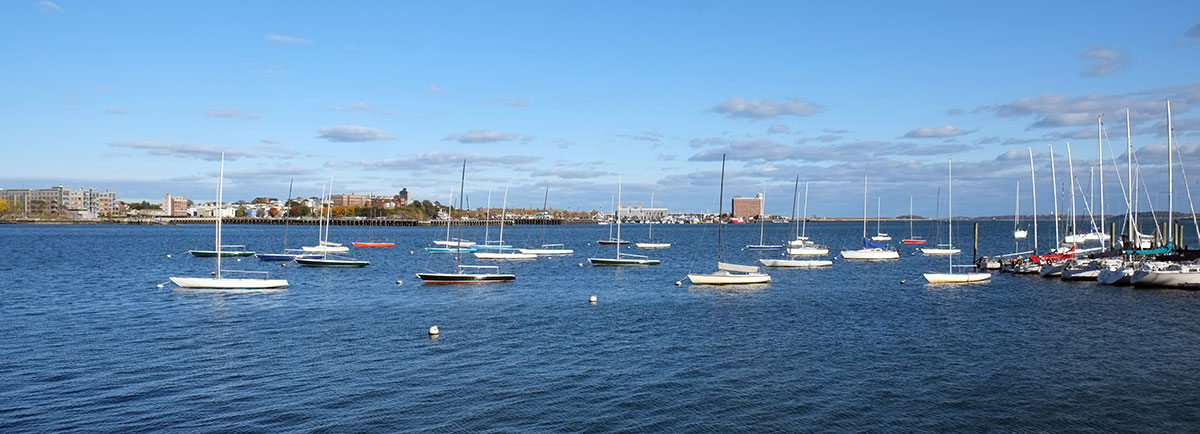
Boston’s unwillingness to discard the old was very evident at the Boston Sailing Center. Even though they had added some new boats, it appears that all the Solings I sailed when I belonged in 1979 are still there
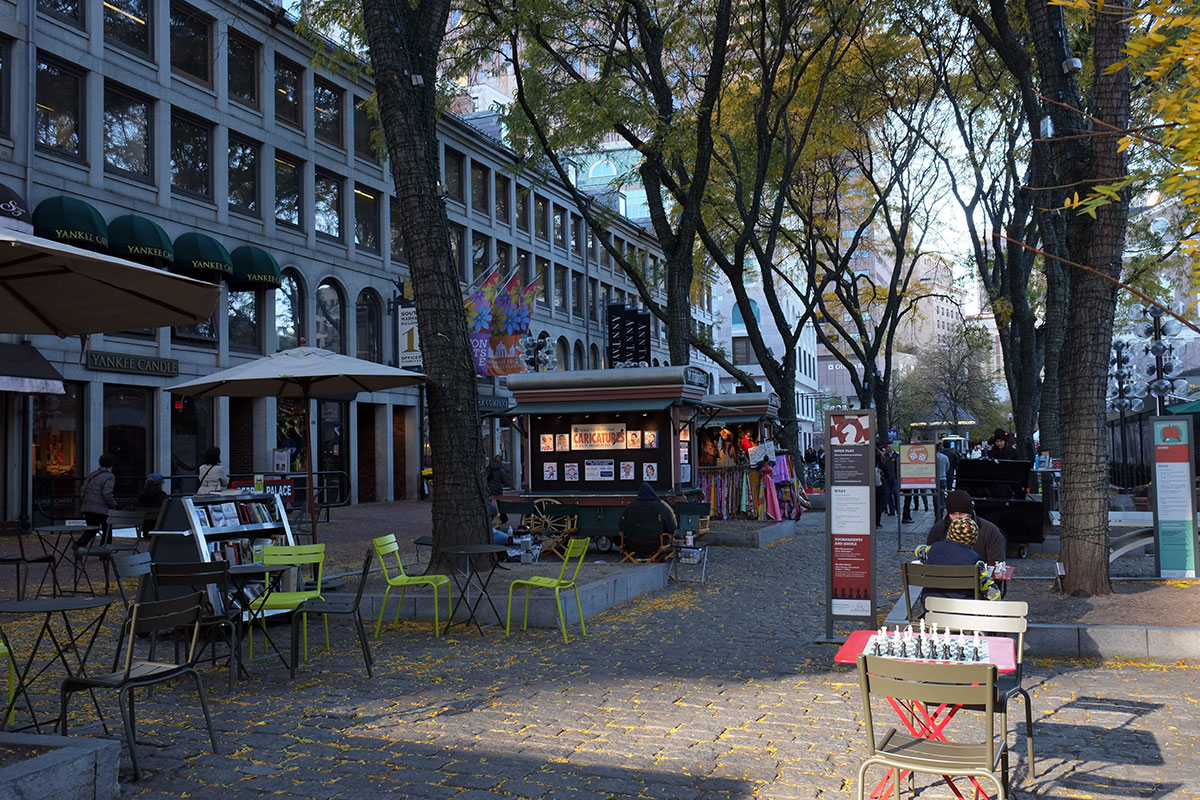
Quincy Market, with the same bunch of tourists
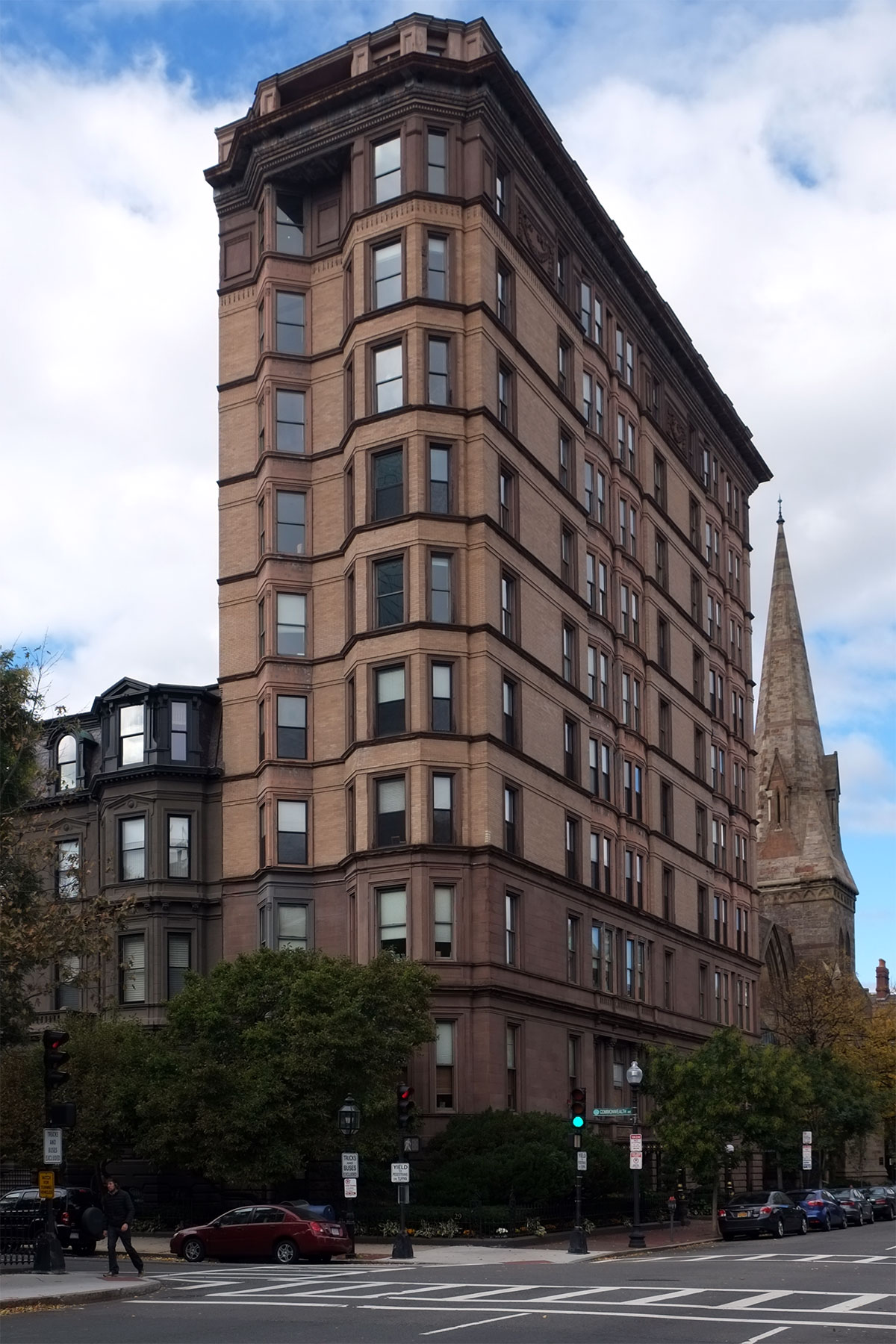
on Comm Ave
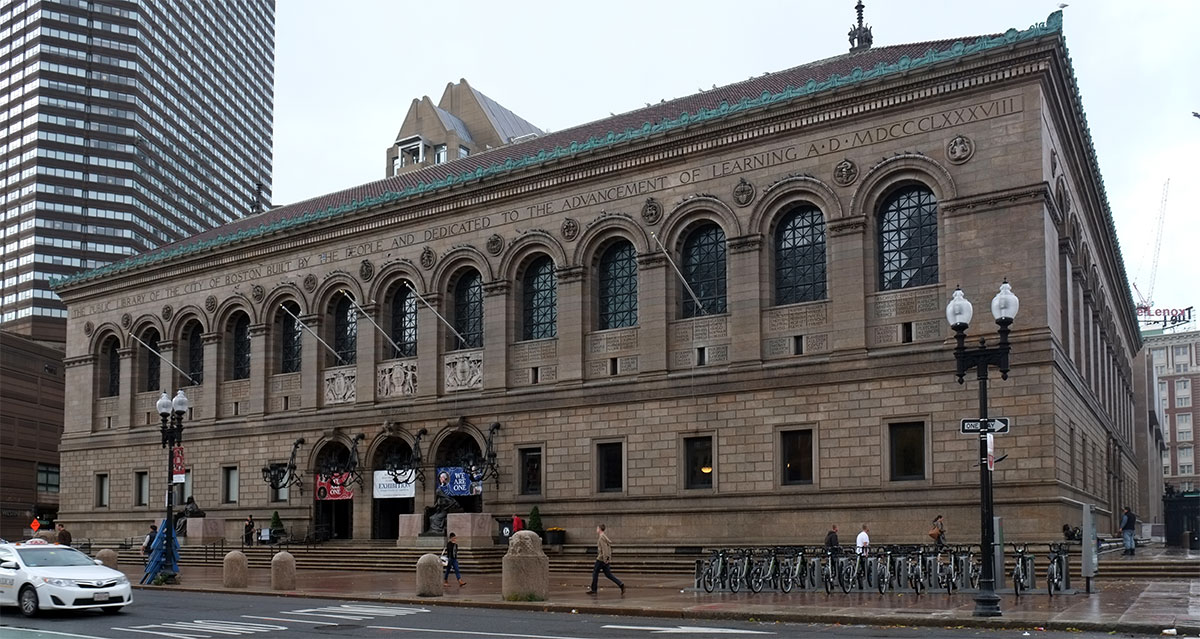
the Boston Public Library, McKim Mead and White, one of the greatest public buildings in the country
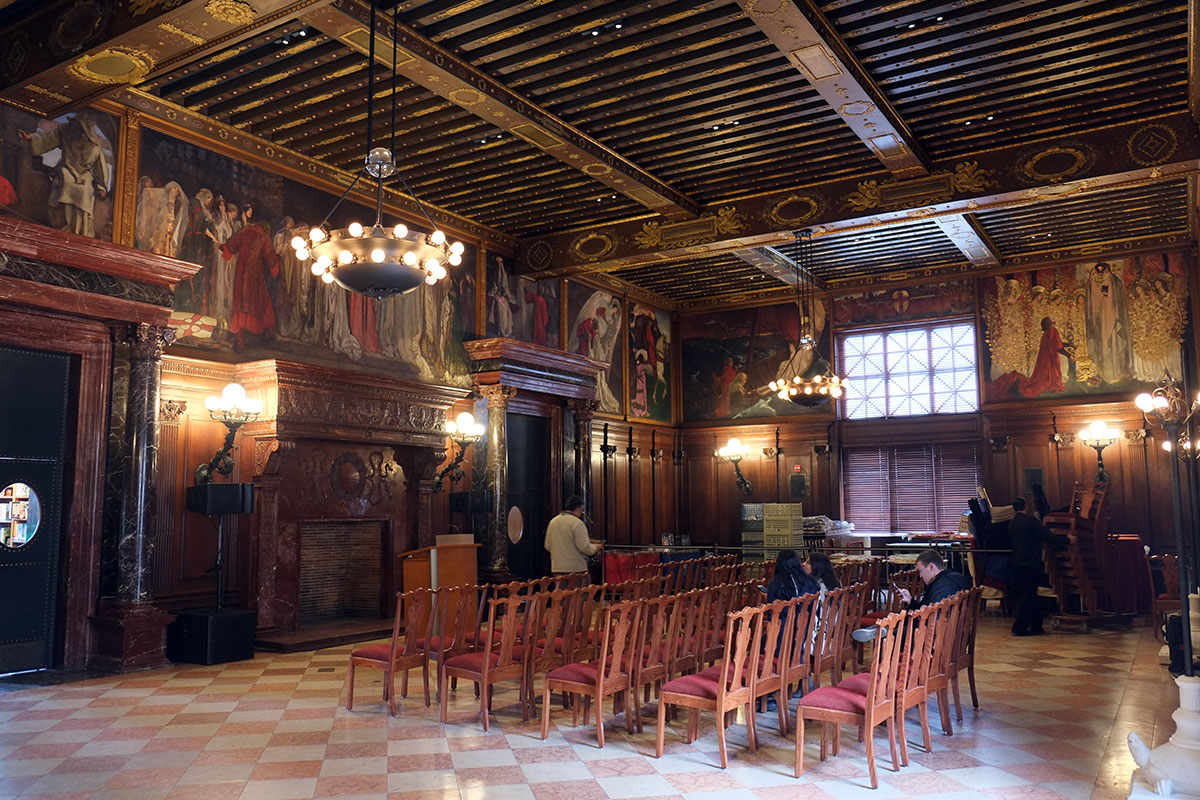
the Abbey mural room at the BPL
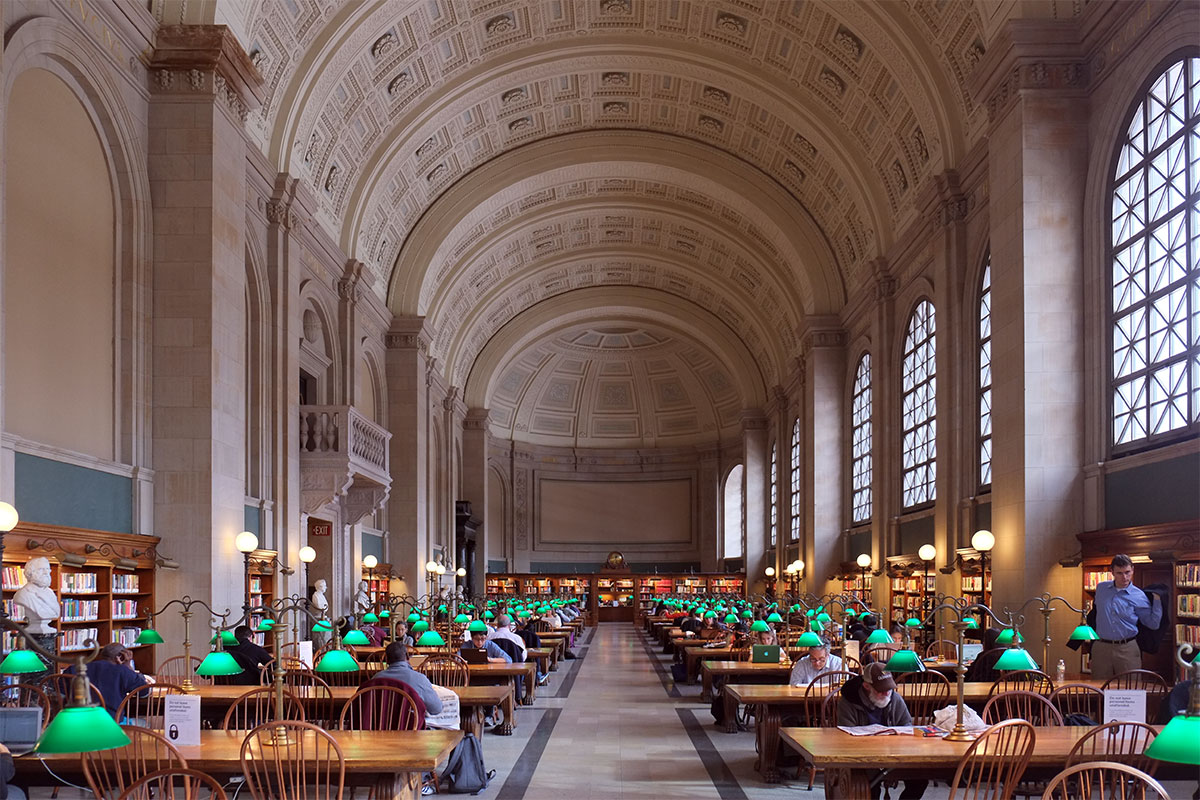
the BPL reading room
And then there are many parts of the city which are not really that old, but they were there when you were, so they too are bathed in the glow of memory.
Trigger warning: I decided to separate the mostly personal from the mostly professional in my blogging about Cambridge. The following post is about revisiting the places I lived while there, and may trigger recovered memories or waves of unanticipated nostalgia.
We started at the beginning: Hurlbut Hall, my freshman dorm by the Union, which was full of misfits, eccentrics and savants. It had a high percentage of single rooms, usually filled with those the authorities deemed too off-beat to share a suite in the Yard. I pointed out the various rooms where I and my friends and lived, and once again repeated my warning that you have to be careful to whom you speak the first day at college, as you may be stuck with them for the rest of your life.
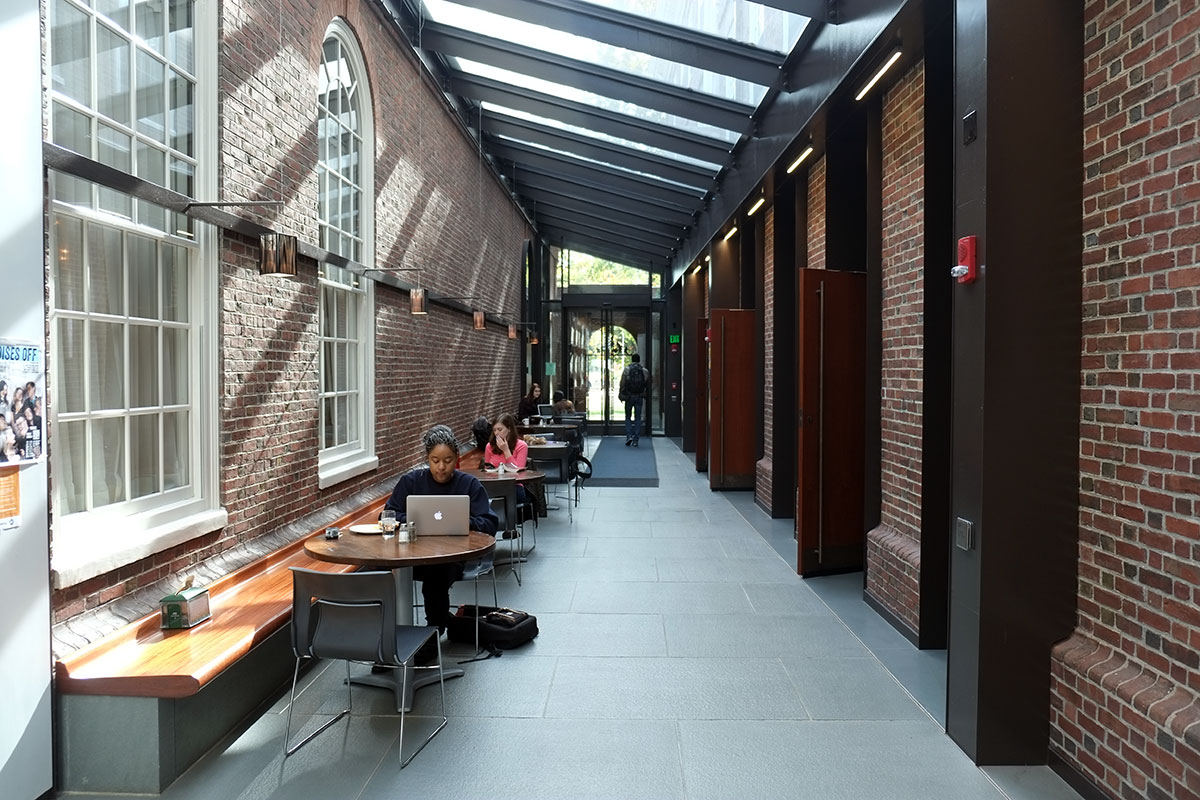
I then dragged Greta to see the residential colleges, especially Leverett House, where I lived for three years. McKinlock Hall (the older part) had recently undergone a major remodel designed by Kieran Timberlake, which I wanted to see. Paul Hegarty, the building manager, took the time to take us on complete tour, so we got to see the excellent conversion of a former dead-pigeon space between the dining hall and the residential wing into a new entry/commons/lobby for meeting rooms,
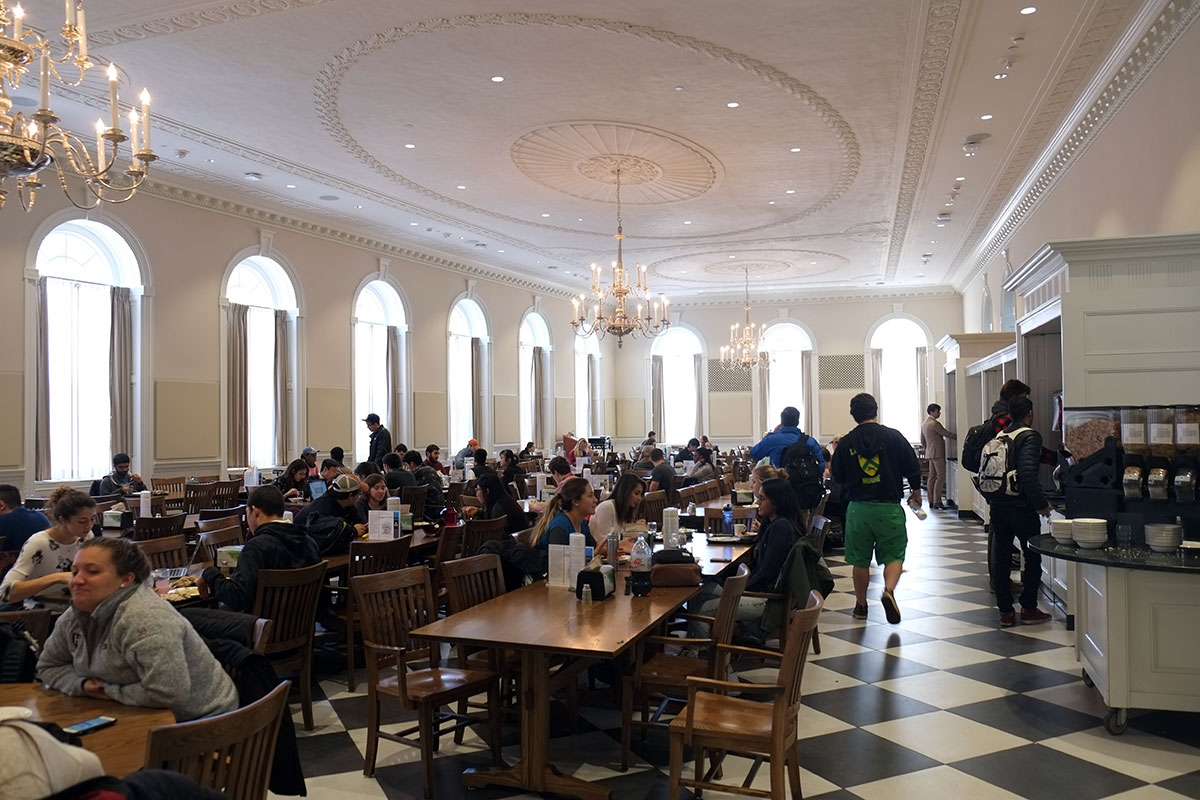
the stately dining room, which was largely the same,
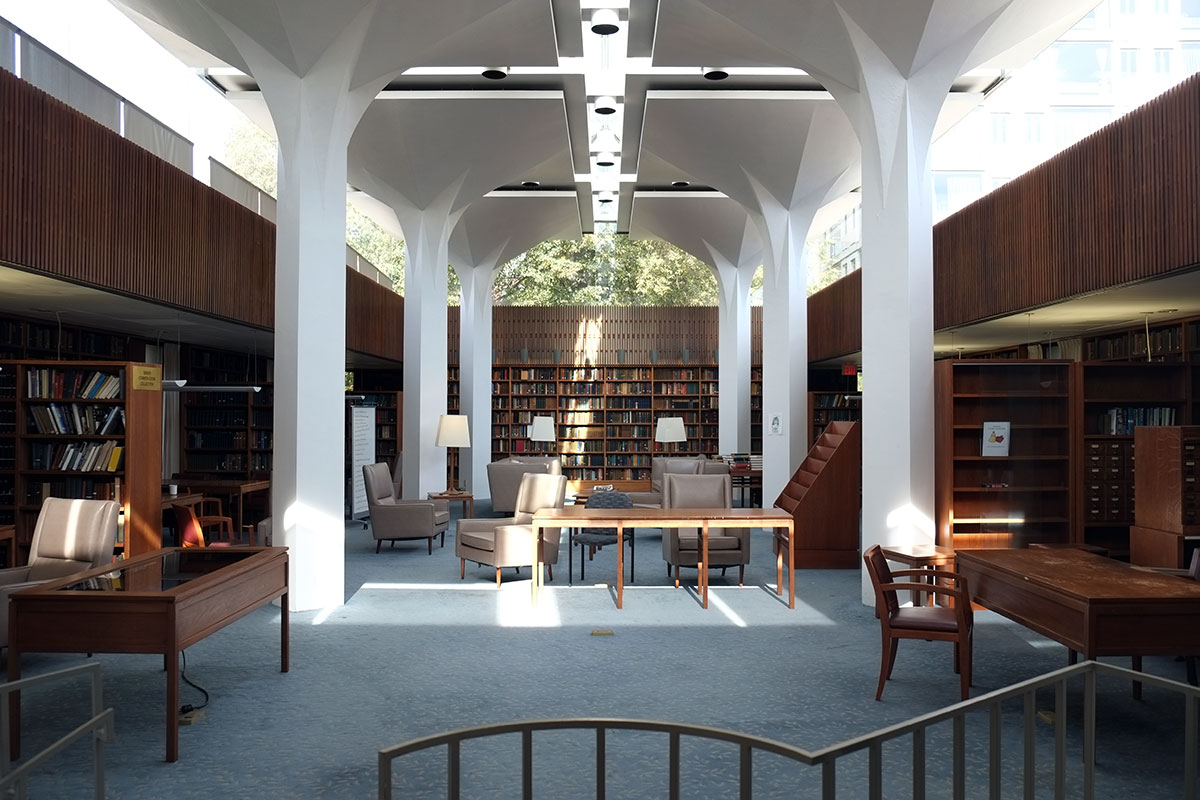
and the library in the new (1960) section, a serene space by Shepley Bullfinch, whose quality I had forgotten. Greta got a gold star for spontaneously stating that the structure reminded her of the Johnson Wax headquarters.
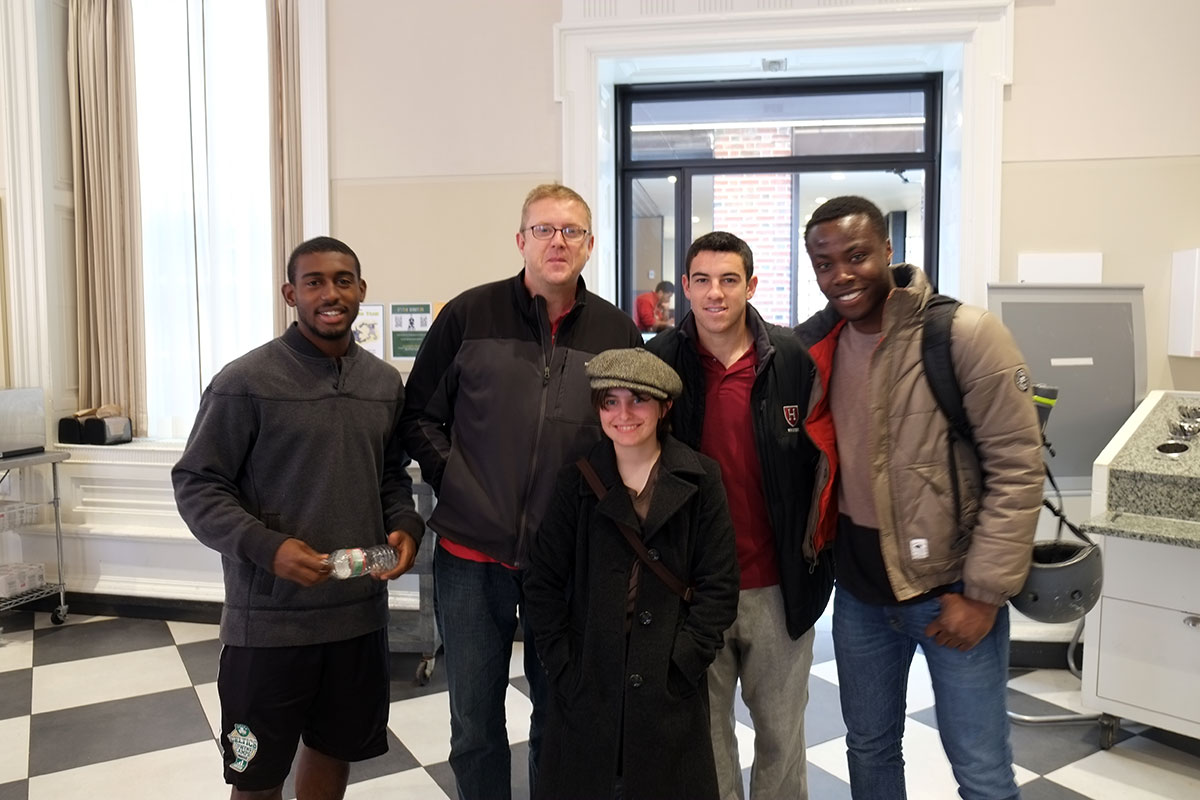
Paul also introduced us to a lot of undergrads, and it was a pleasure to find that they were largely as I remembered from my day – funny and smart, and not all on the fast track to Wall St., as had been rumored.
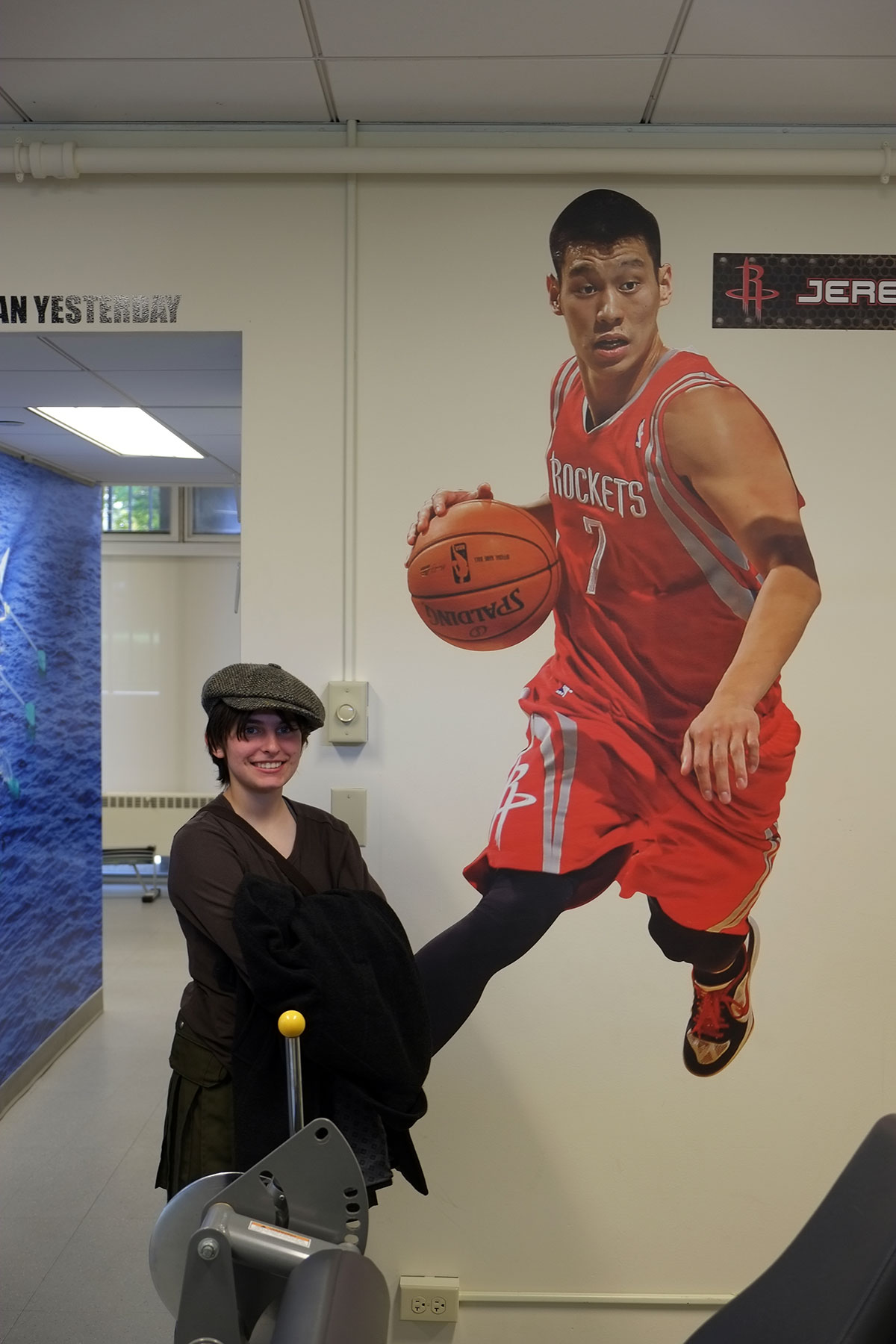
Greta was especially pleased to meet a pre-med varsity football player, who averred that he didn’t know much about UO football, as he just wasn’t that into collegiate sports. On the other hand, I was pleased to see that Jeremy Lin was a Leverett alumnus.
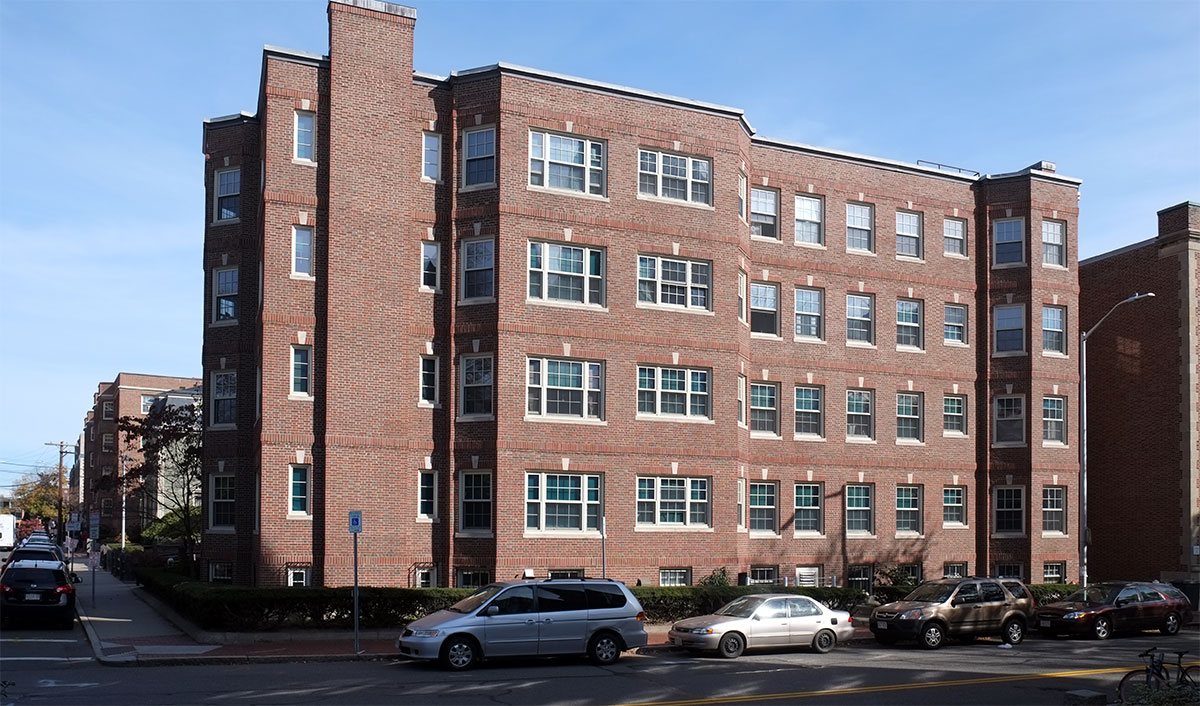
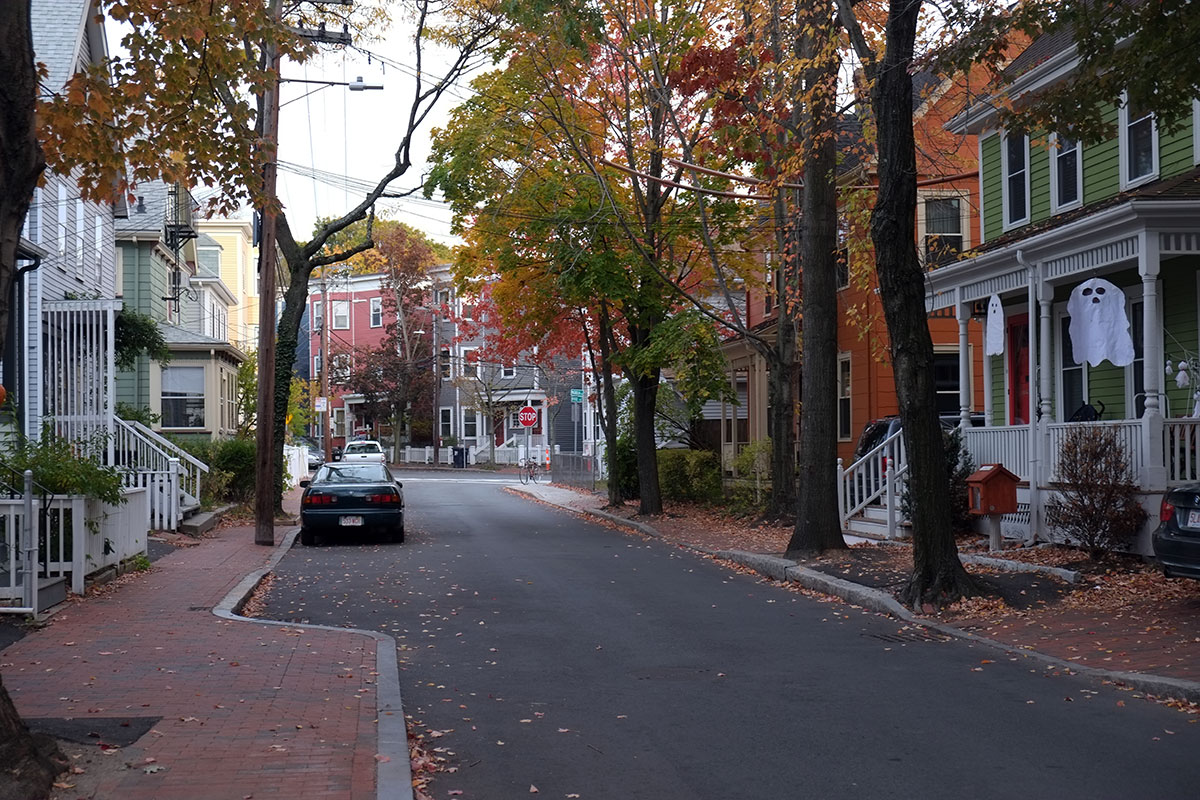
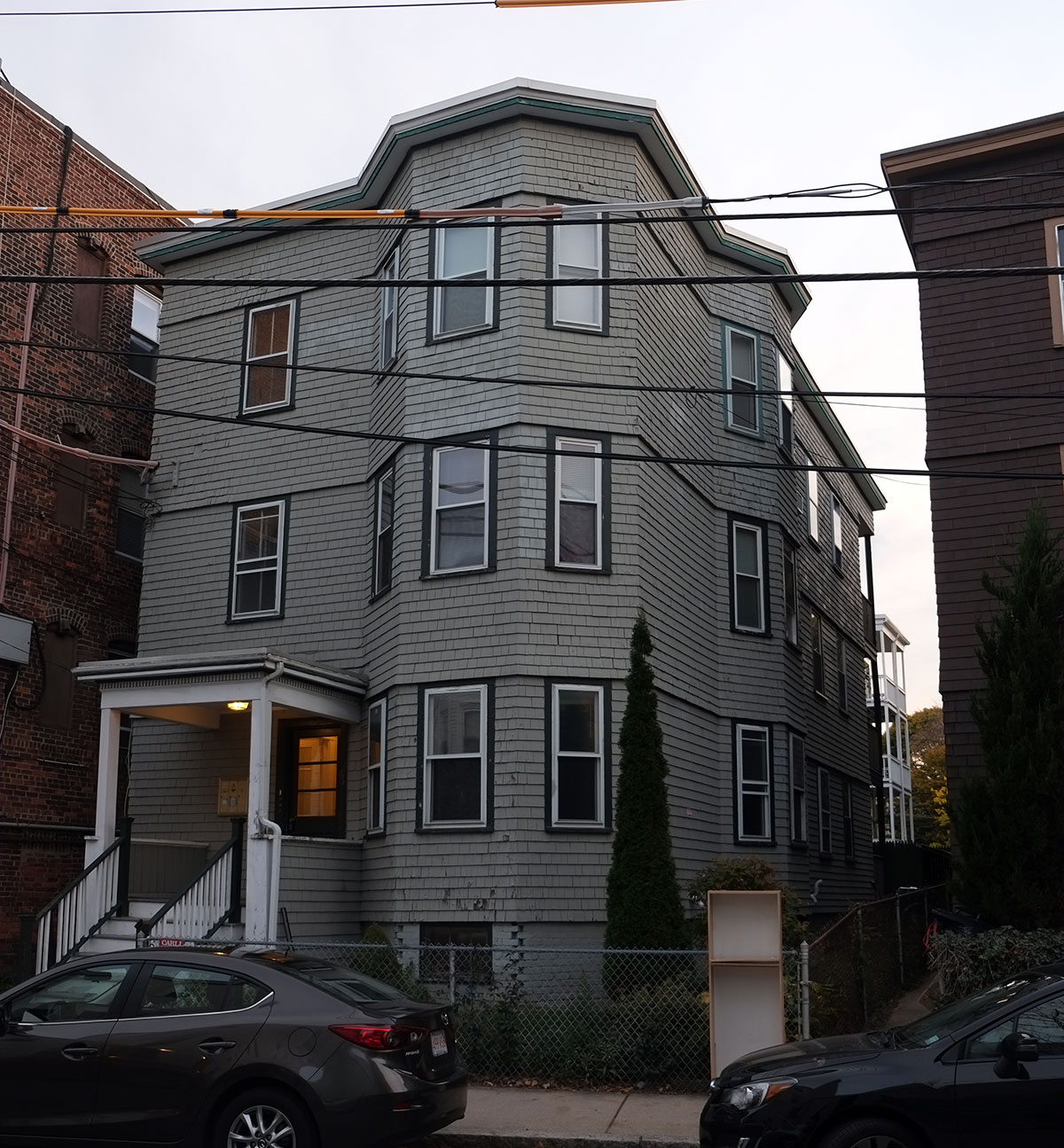
Then we moved on to Somerville, where I lived for two years after college. The area in Cambridge near the Somerville line (Myrtle and Line Streets) was actually nicer than I remembered – well-maintained triple-deckers and houses on quiet tree-lined streets.
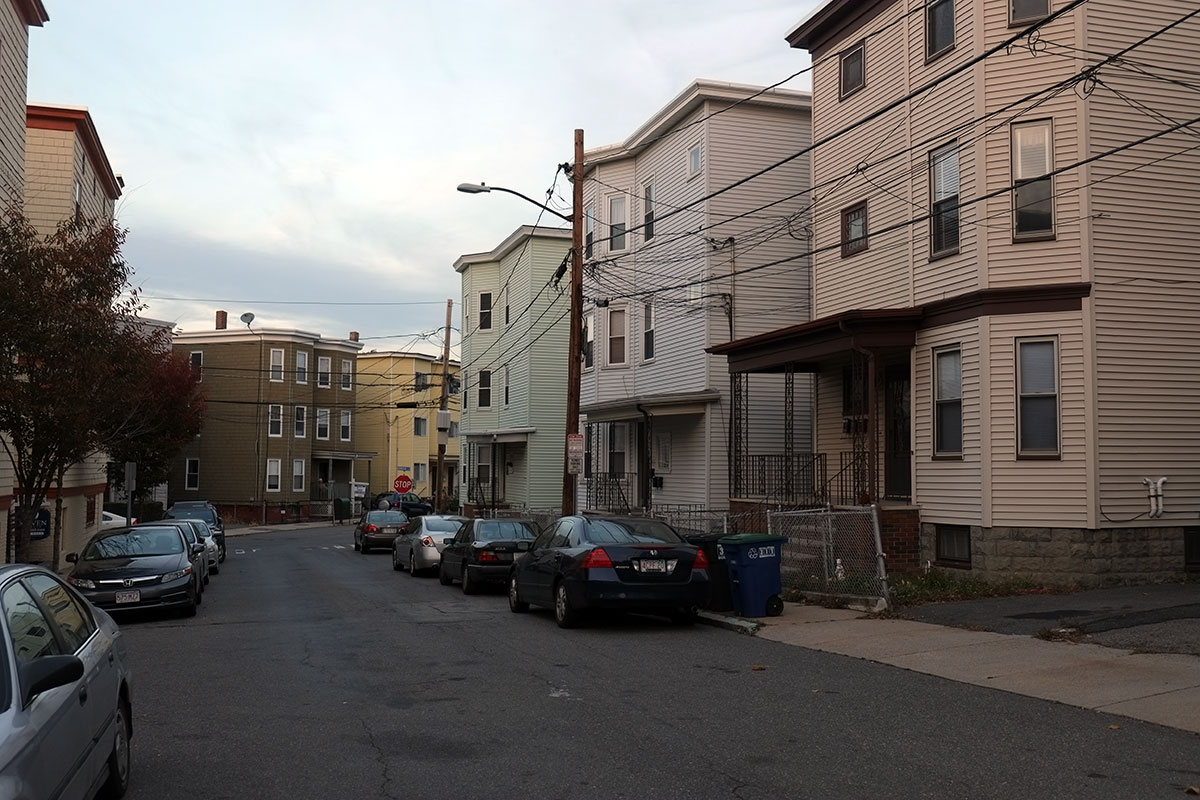
But then I crossed Beacon Street to Somerville. I had heard that Somerville had gentrified; perhaps the rents have risen (we paid $220 per month for a floor in a triple-decker), but the streetscape was as depressing as I remembered.
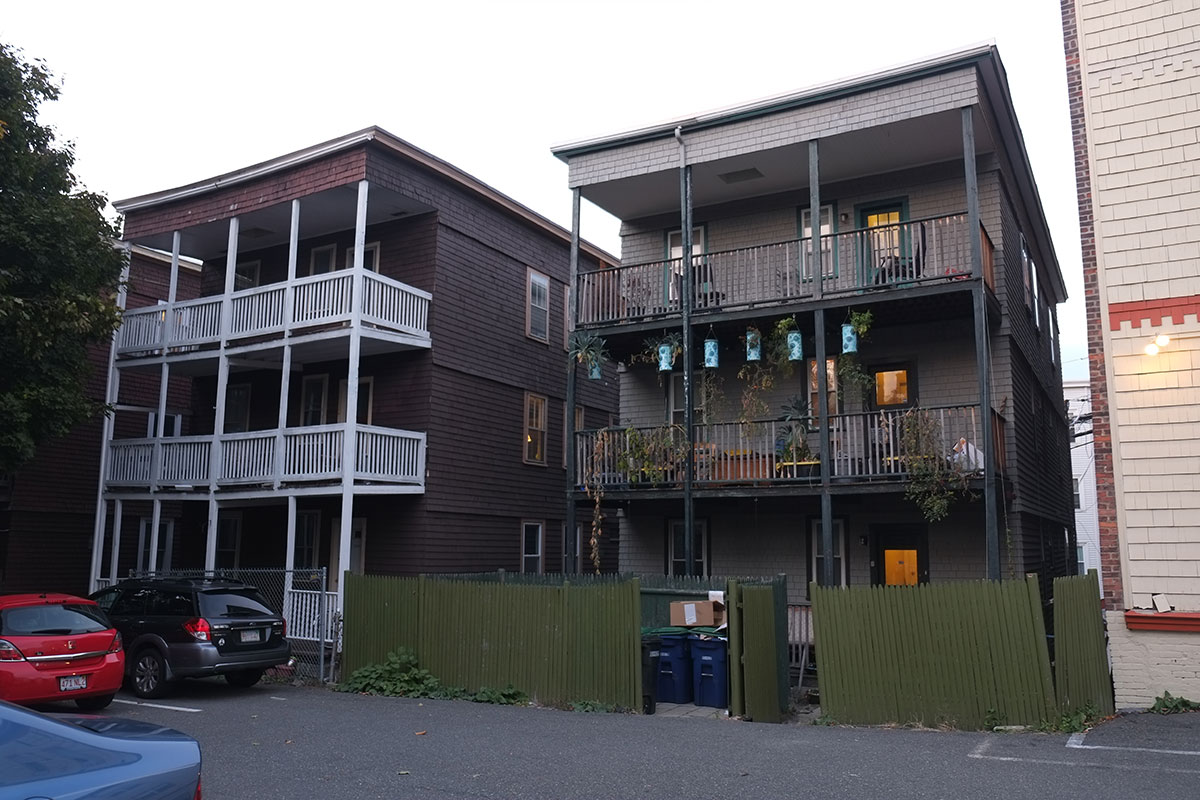
A few more trees would help. And then on to 66 Dimick, home to generations of friends:
our back porch, second floor on the right, hung with many string hammocks in the 70s.
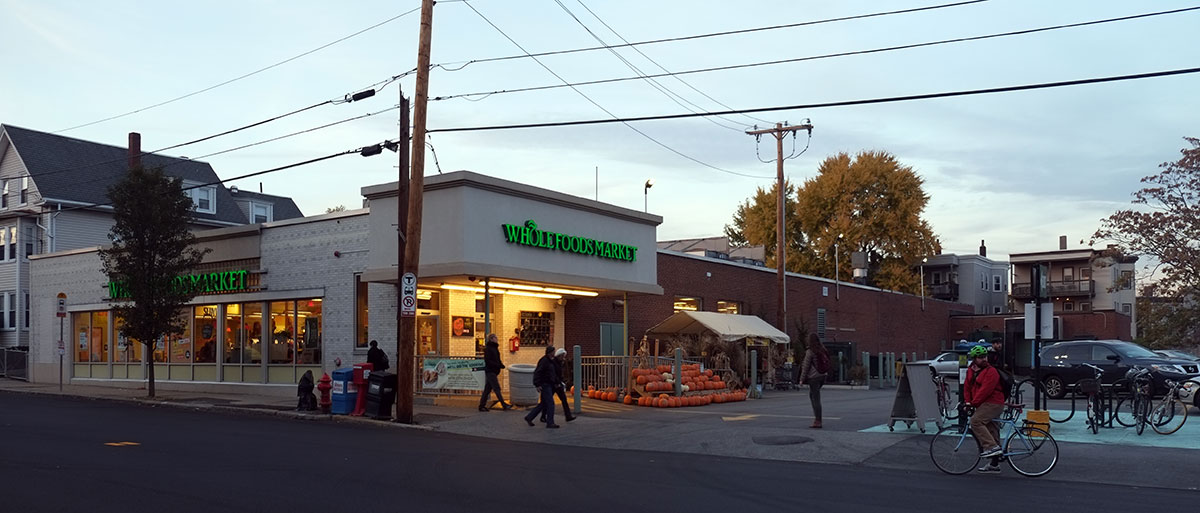
The neighborhood was still unattractive, still full of graduate students, but there was one major, emblematic change:Johnny’s Foodmaster, one of the worst supermarkets on the planet, had been transformed into a Whole Foods. Goodbye Slummerville.
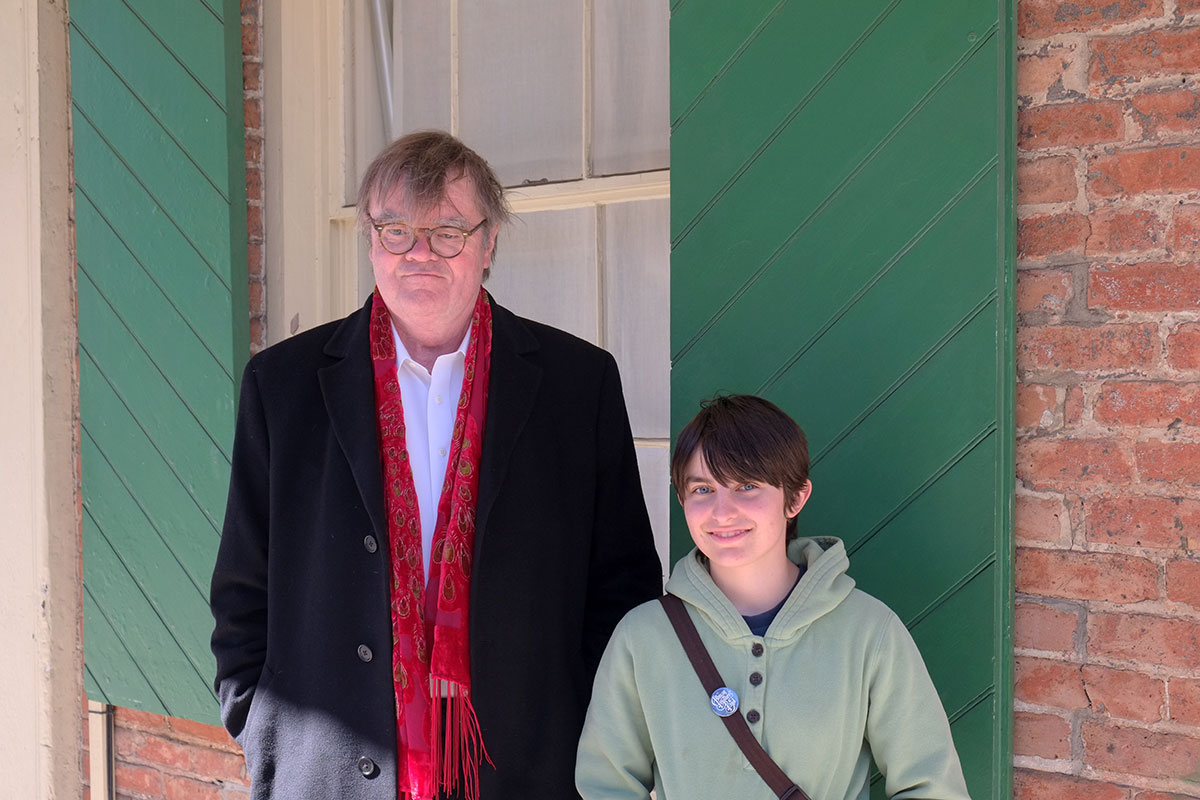 We saw Garrison Keillor at party last weekend, but didn’t talk to him, following a general principle of leaving celebrities alone unless you really have something to say. The next day I regretted this, as it occurred to me that while I may not have had much to contribute beyond the appreciation of a fan, he might have enjoyed talking to Greta, the apprentice writer. So today when we turned onto Chartres St. in the French Quarter and saw him leaving his hotel, I shamelessly buttonholed him and introduced him to Greta.




















 Peregrine nation