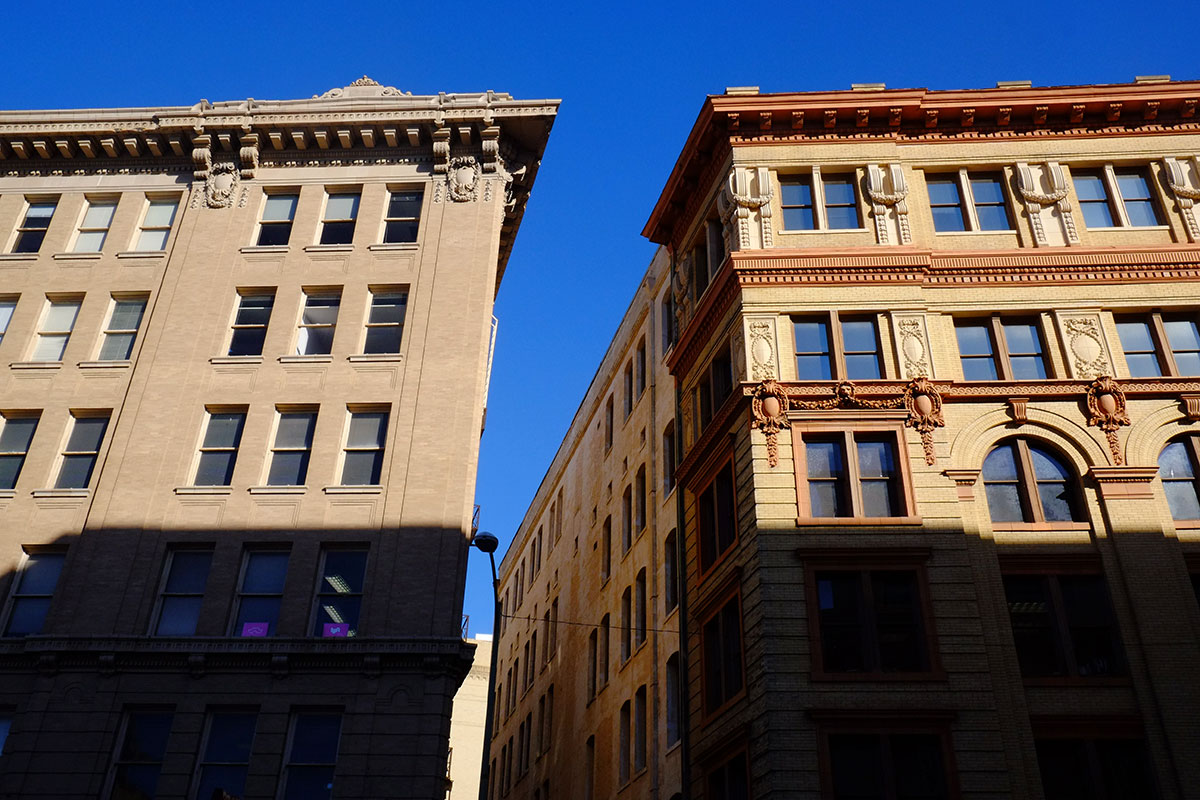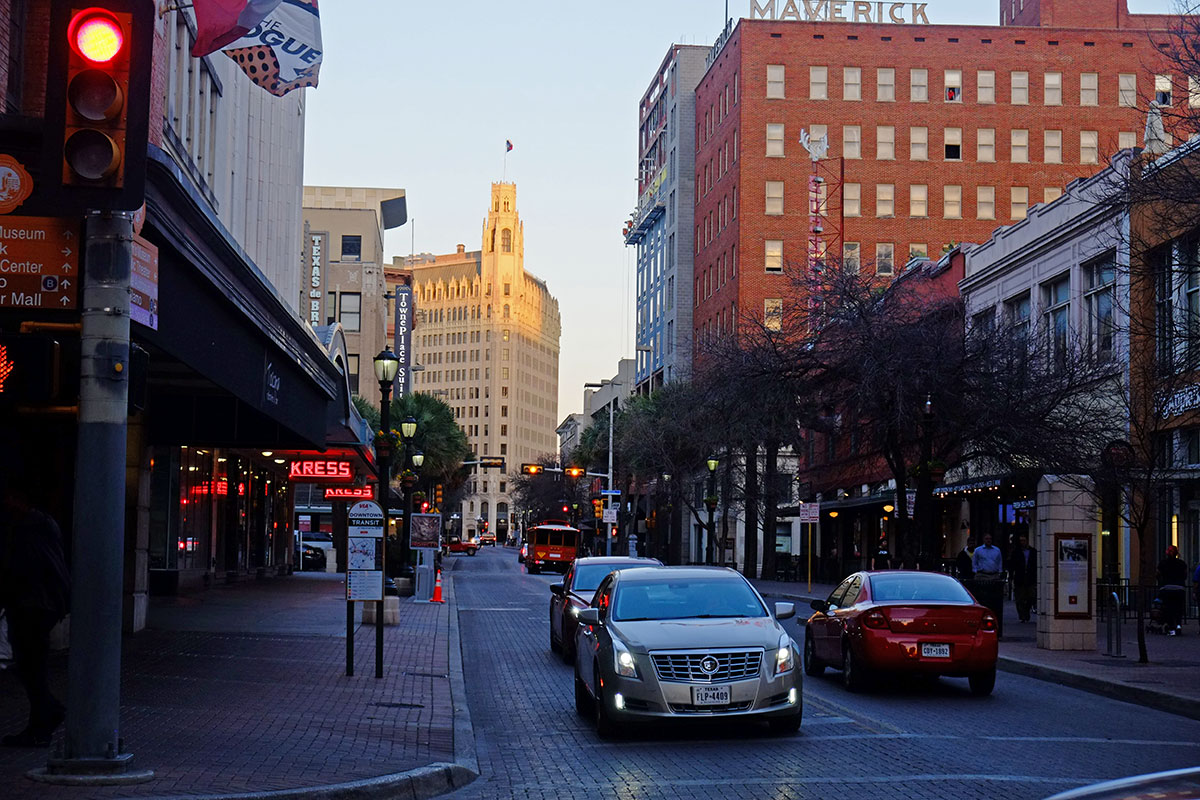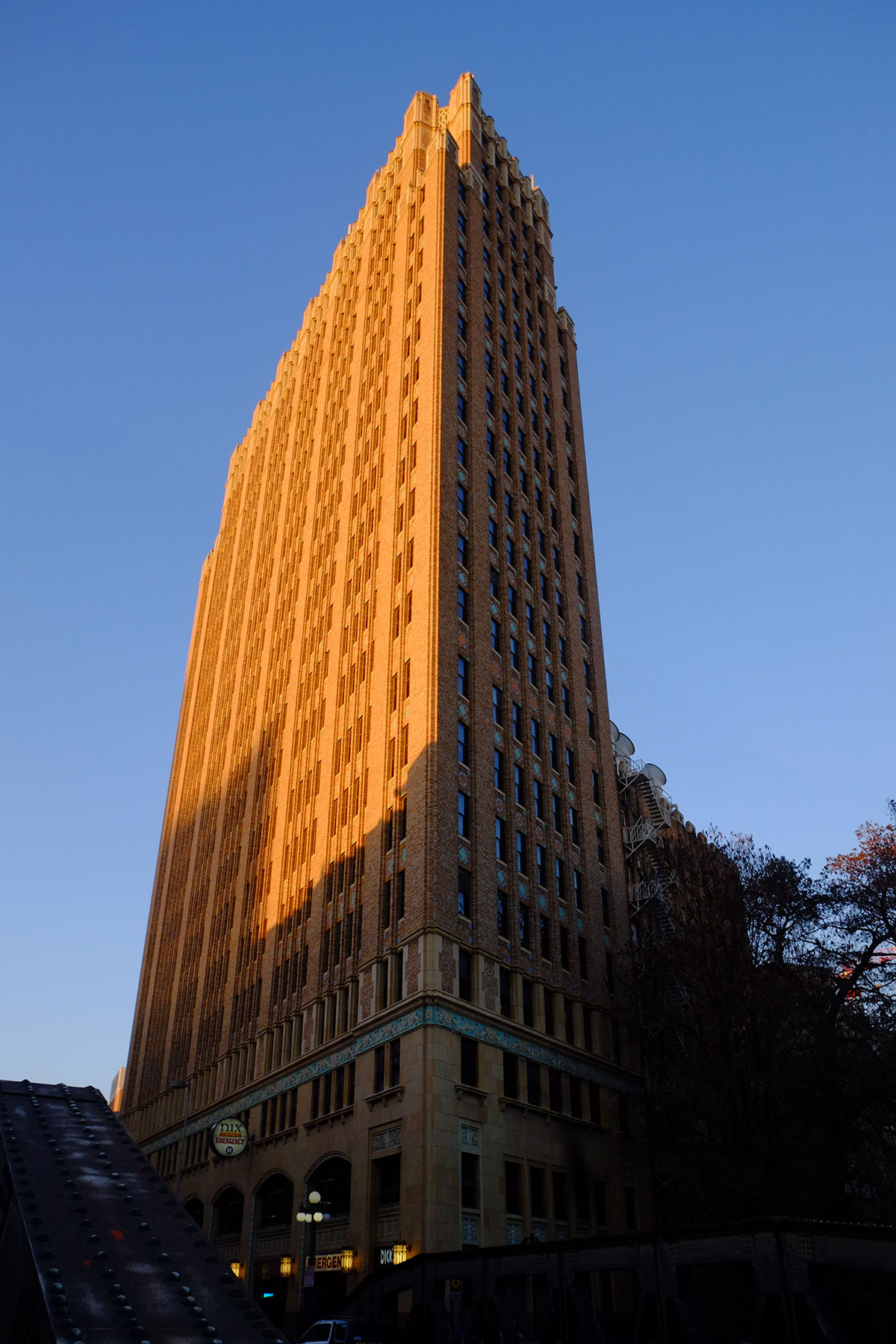
Category Archives: cities

Arcosanti

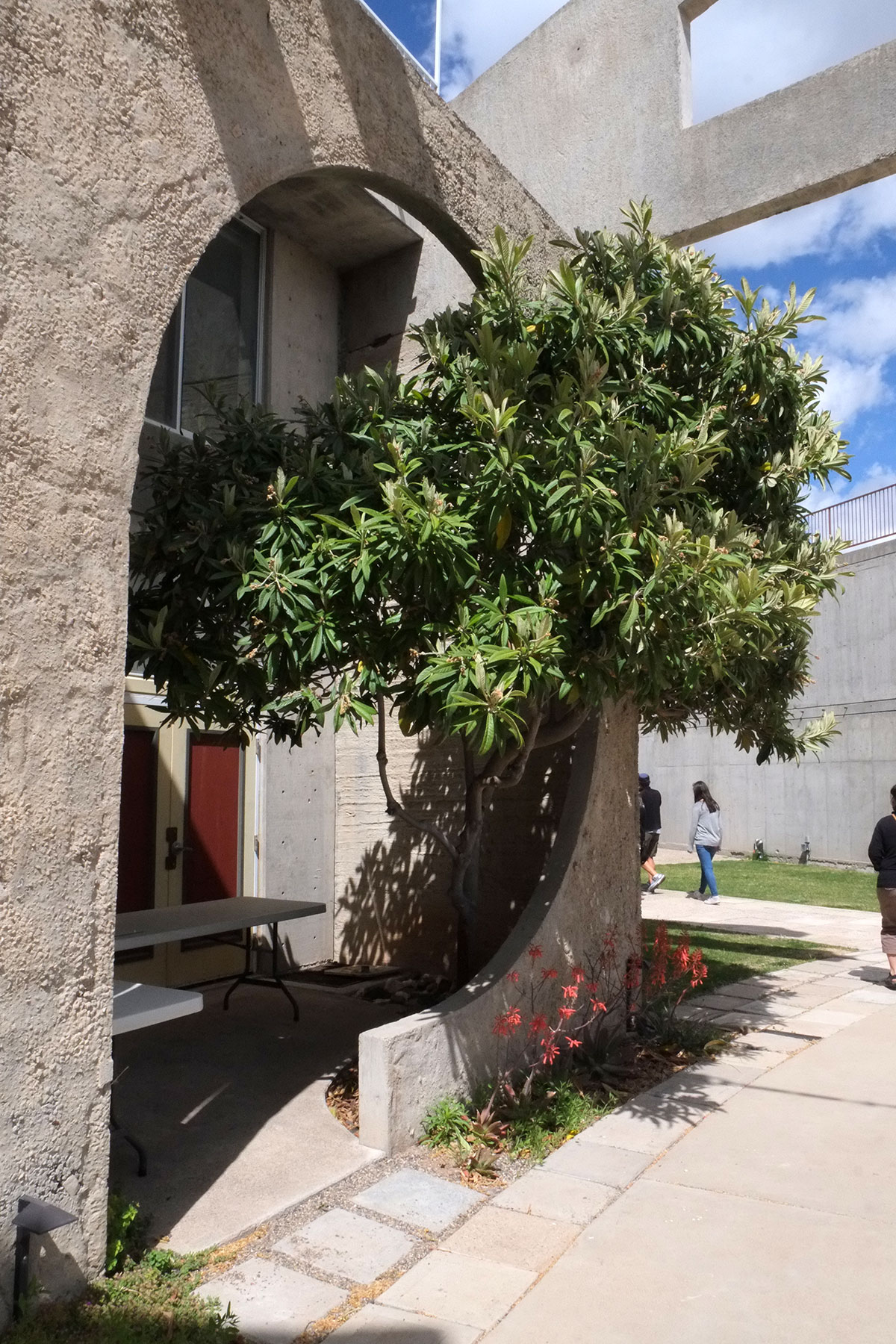
One of our goals in the Southwest was to visit relics from past ages – ancestral Puebloan ruins and cliff dwellings, and the more recent Pueblos – which date back up to 700 years.  We started with a visit to Arcosanti, which I thought of as a relic from a prior age that can feel almost as remote  to us now  – the 1970s.DSCF6862
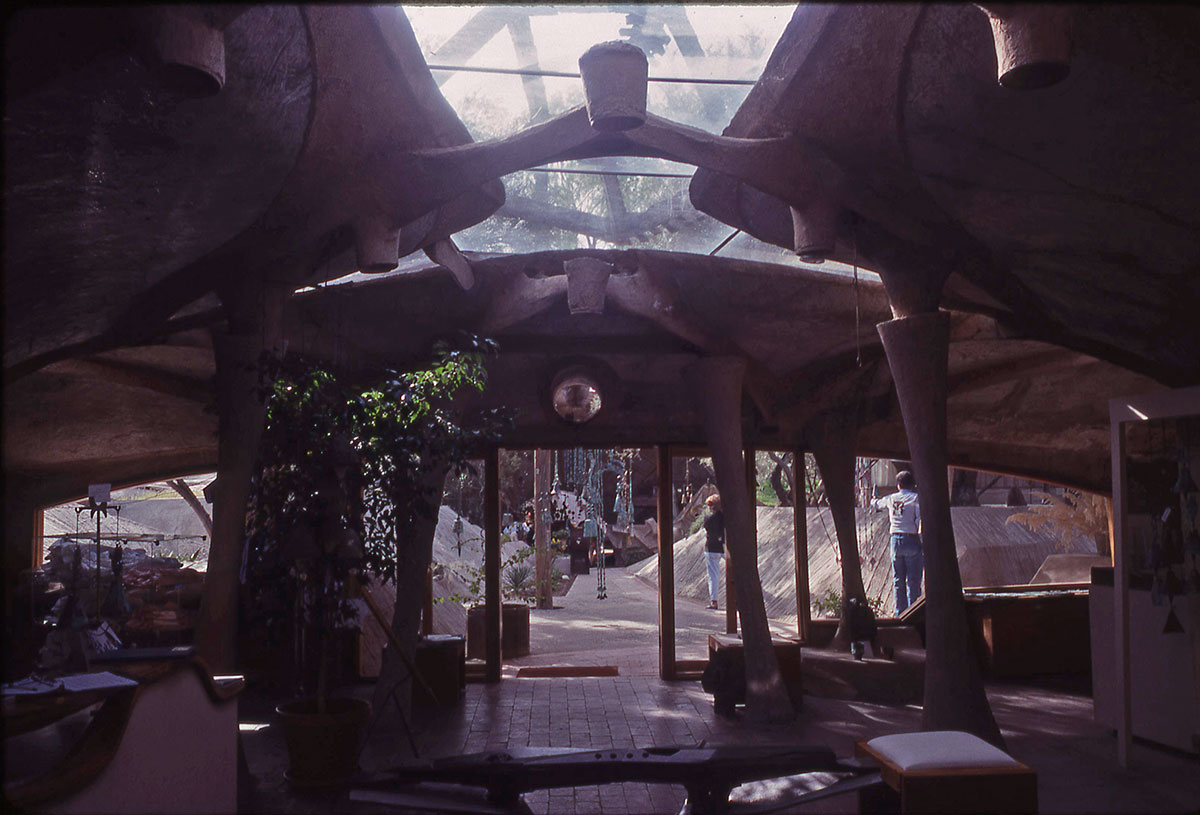
Paolo Soleri was a visionary Italian architect who came to America in the 1940s to study with Frank Lloyd Wright.  He eventually settled in Scottsdale, and began applying techniques he had learned for casting ceramics at the architectural scale.  His compound in Scottsdale – Cosanti – is a truly beautiful place, where dirt was piled up in mounds to make formwork, then concrete was poured on top, and the dirt scooped out to leave domes. Cosanti017However, Soleri was thinking at larger scale the whole time, and laid out his thinking in Arcology, which combined architecture and ecology.  In an age when Americans were happy to build endless sprawl, Soleri recognized the consequences of this pattern, for both the natural environment and human society.  He bought property 70 miles north of Phoenix to begin his prototype urban community, Arcoscanti, in 1970.
Construction has proceeded intermittently since then, with much of Arcosanti’s current fame resting on their production of bronze bells and wind chimes, usually bought as souvenirs of a southwestern vacation to manifest good taste and seriousness.  I had first visited Arcosanti about 20 years ago, and found it a little depressing – a small group of inhabitants who were living in the remnant concrete buildings from the 1970s, making wind chimes and chilling out in the desert, while Soleri mainly lived in Scottsdale.  But Soleri had retired (and subsequently died in 2013), and has been succeeded by Jeff Stein, a Boston architect who had run the architecture programs at Wentworth Institute and the BAC for many years.  I had met Jeff many years ago, and more recently at a HOPES conference in Eugene.  He struck me as a thoughtful and serious person, and so I was curious as to how things might be changing at Arcosanti.

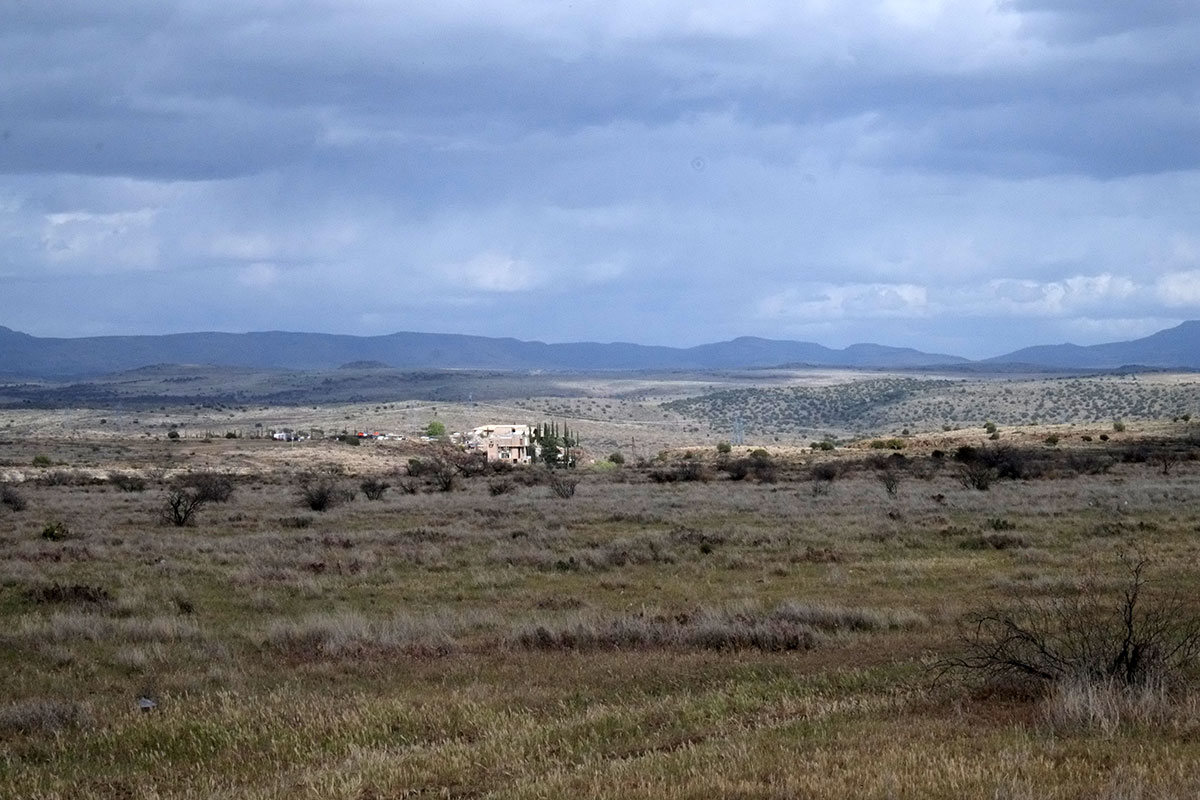
Arcosanti sits isolated out in the desert, on the edge of a small canyon (not unlike the cliff dwellings we’d be seeing).  However, it is connected to Phoenix by Interstate 17, although it is isolated by two miles of very rough dirt road (which did cause every screw in our trailer to come loose).  DSCF6943
The complex faces south, and is mostly constructed of concrete.  The visitors’ building is to the right, and the housing and production buildings to the left.  DSCF6942
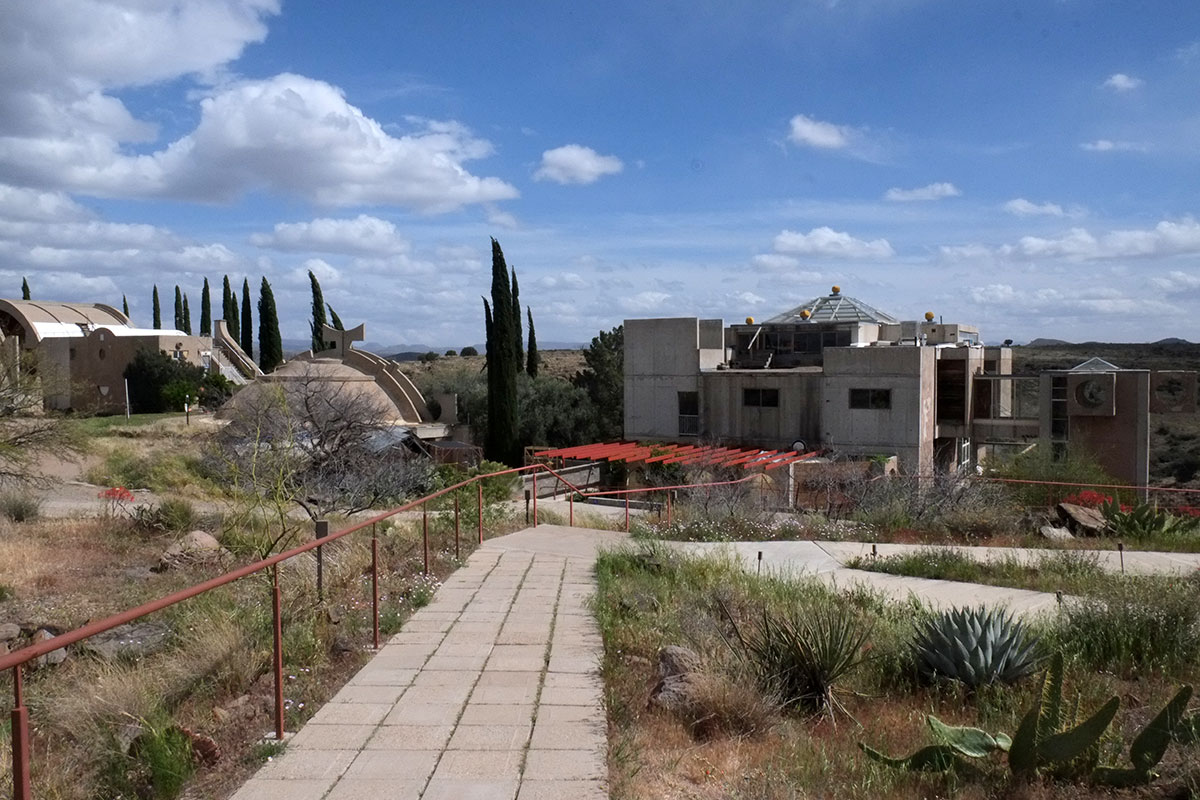
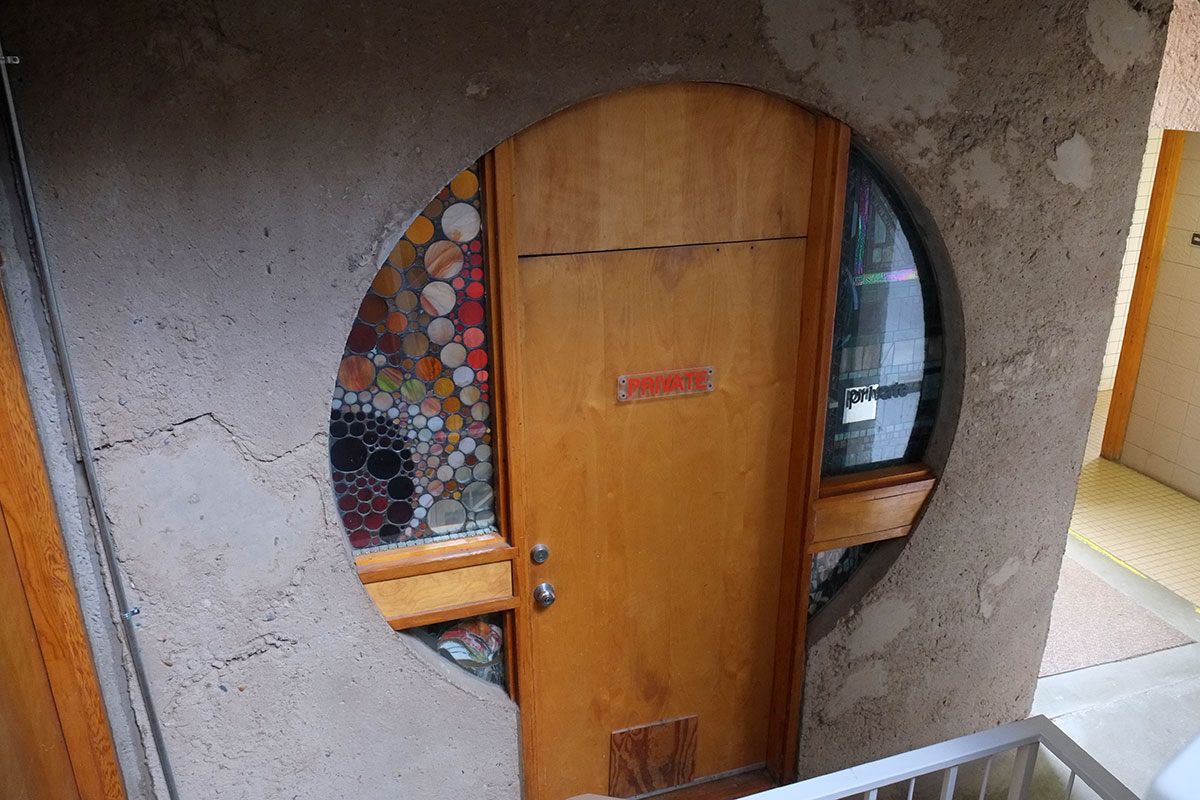
The visitors’ building houses exhibits, a store, and a restaurant.  The concrete on the exterior here is showing its age, with some spalling and exposed large aggregate.  DSCF6941
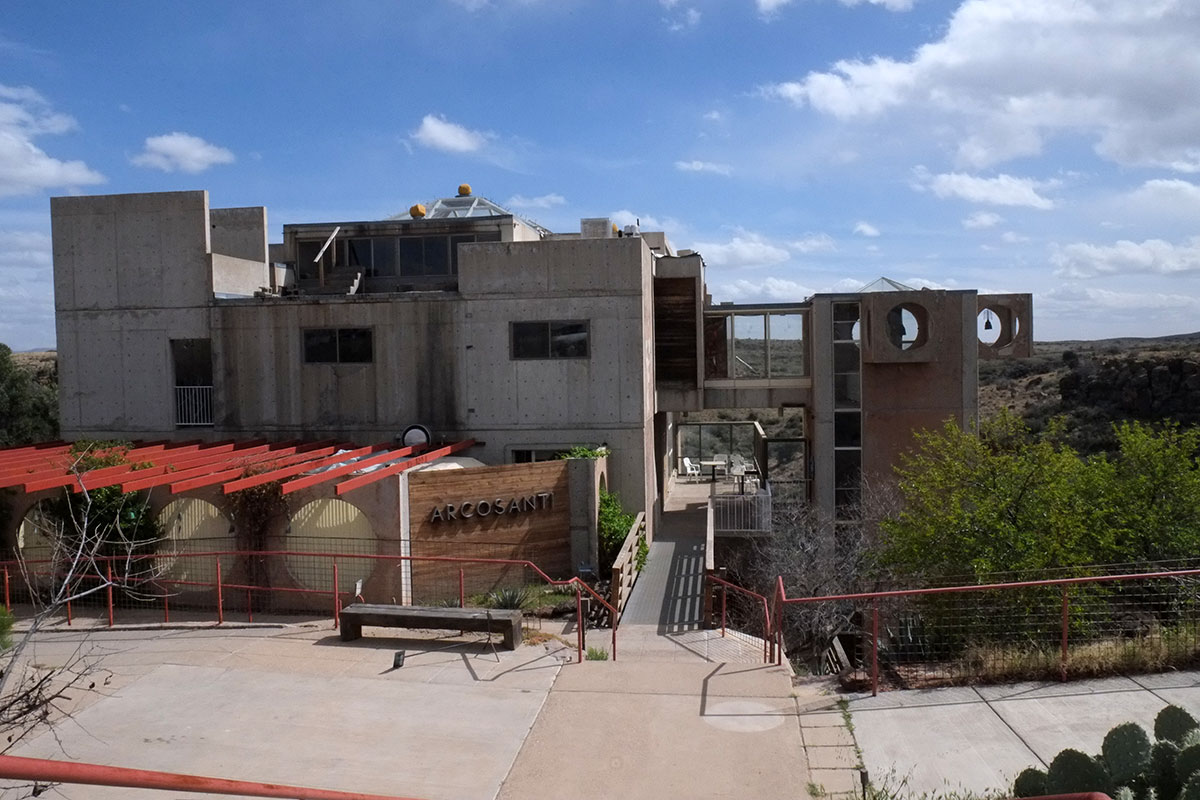
It’s a really clear Brutalist building, showing that Soleri wasn’t an iconoclastic hermit out in the desert, but was in sync with other architects of his era, such as Kahn.  DSCF6917
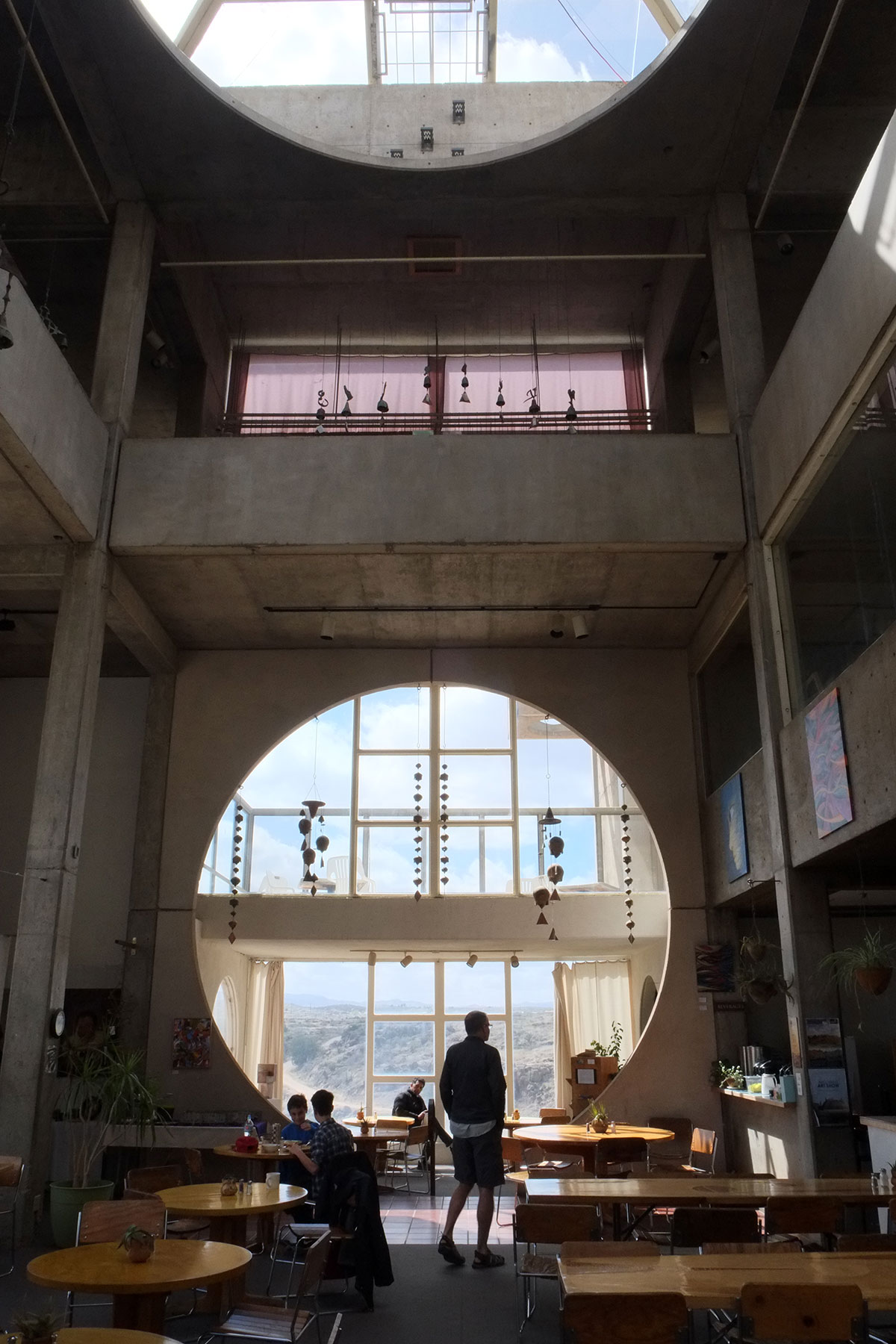
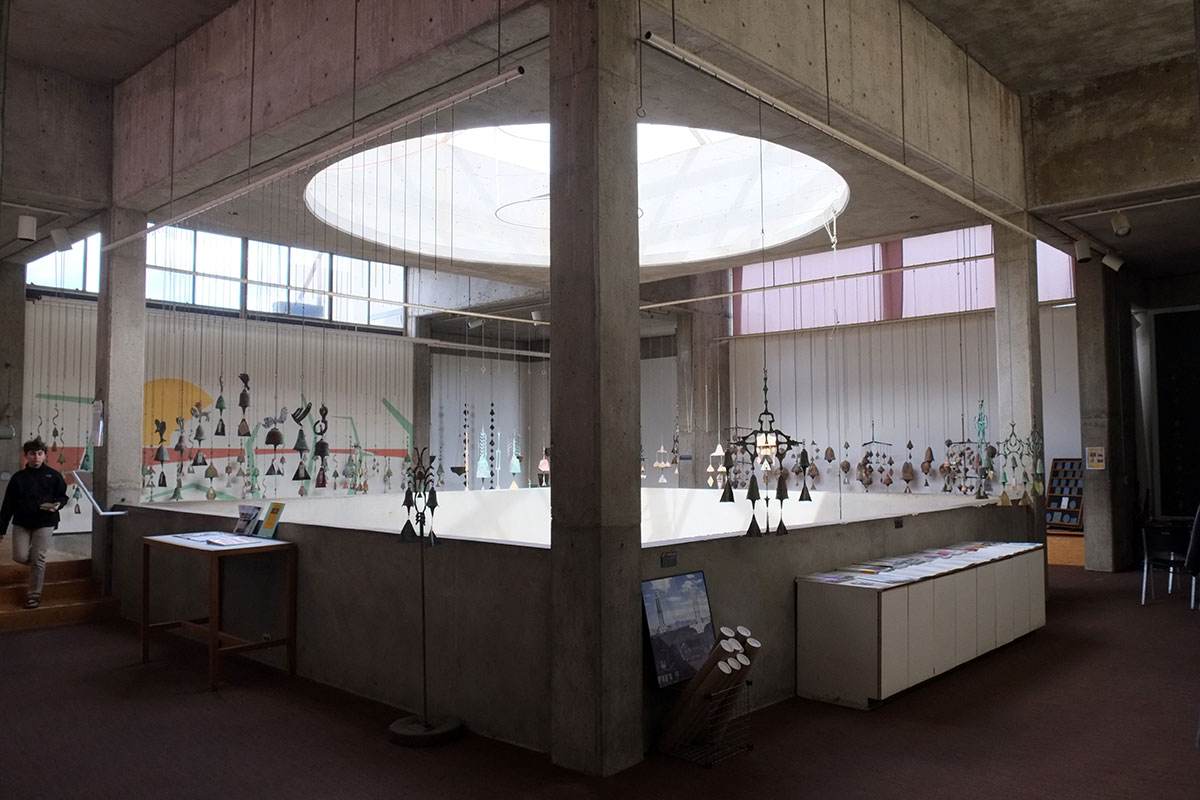
The shop where they sell the bells (now you recognize them).  DSCF6935
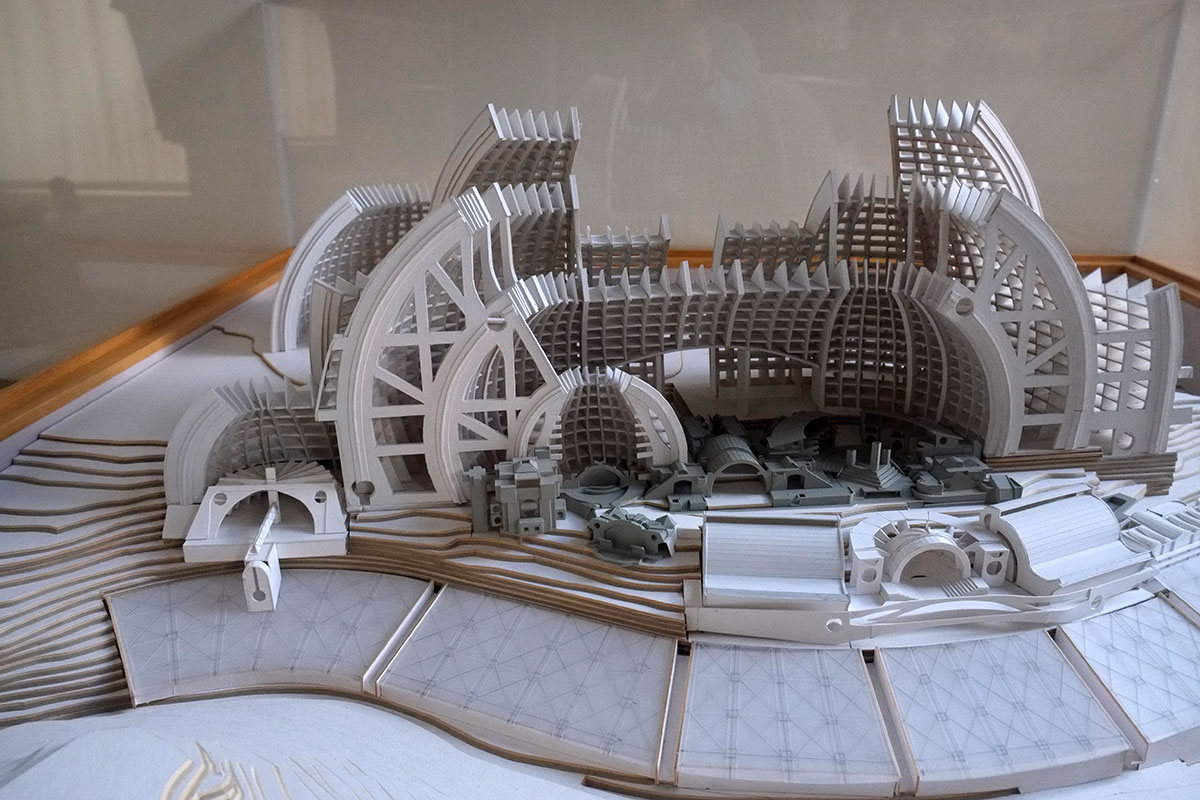
There are some gorgeous models located throughout the complex.  This one shows one conception of the final state of Arcosanti – a series of large apses facing south, which contain community spaces and are ringed by housing units.  For a scale comparison, the parts of Arcosanti which have been already built are shown in grey in the middle of the model – the planned pieces are shown in white.  DSCF6821
A tour brought us through the complex to the ceramic production areaDSCF6827
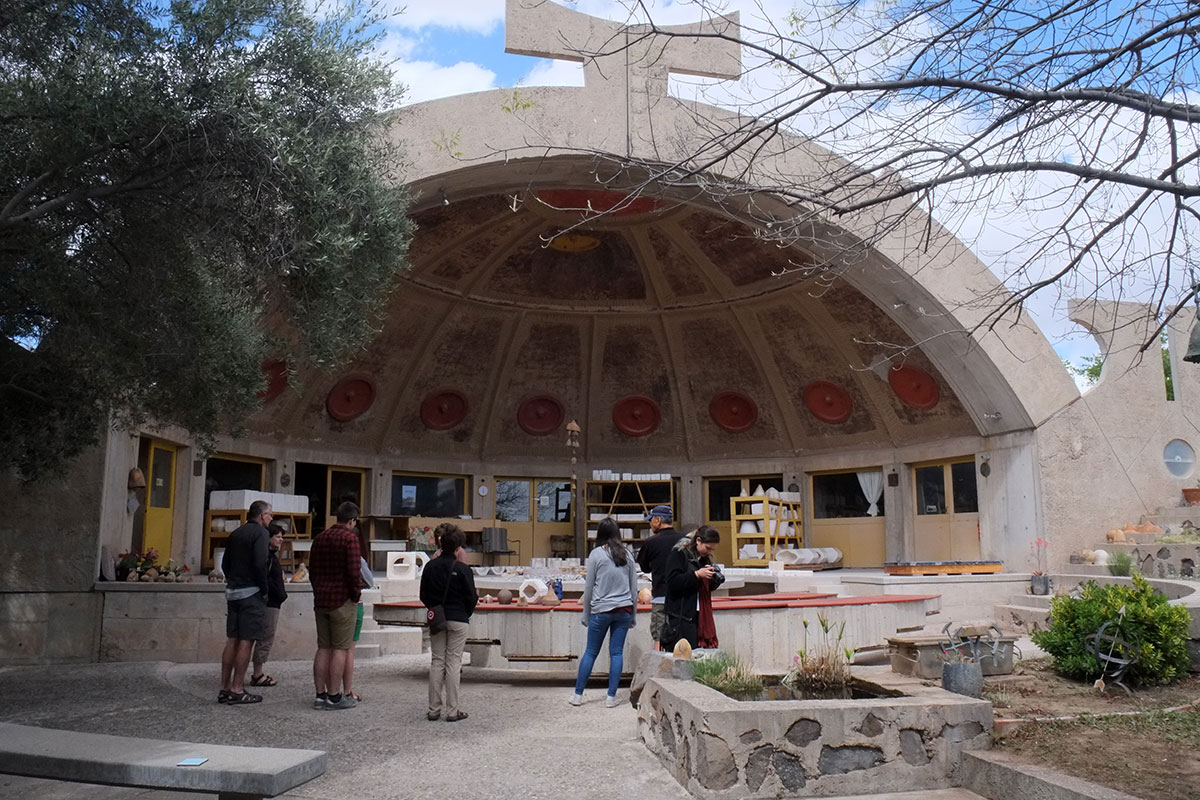
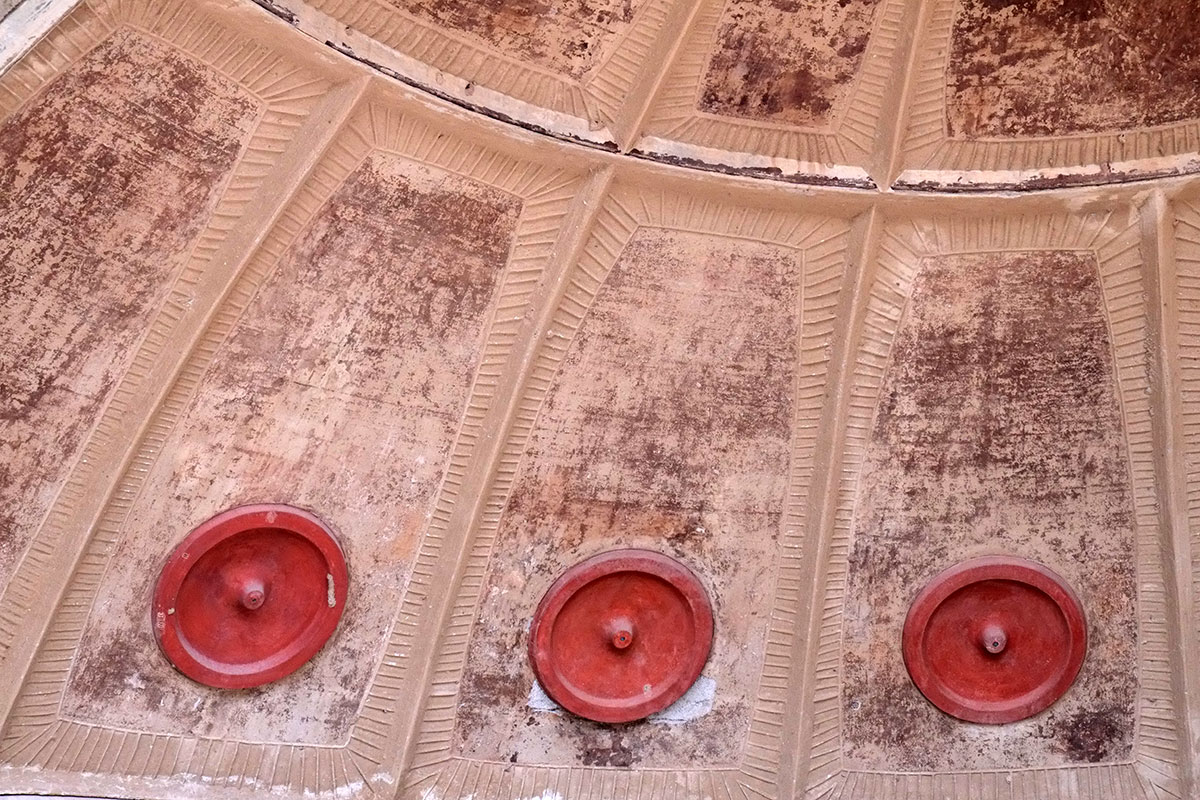
where you can see how the processes used to form the ceramics and bronzes are very similar to the processes used to form the architecture.  The level of detail possible with this sand-sculpting in the formwork is notable.  DSCF6832
DSCF6898

The bronze foundry:  DSCF6910DSCF6909  DSCF6905

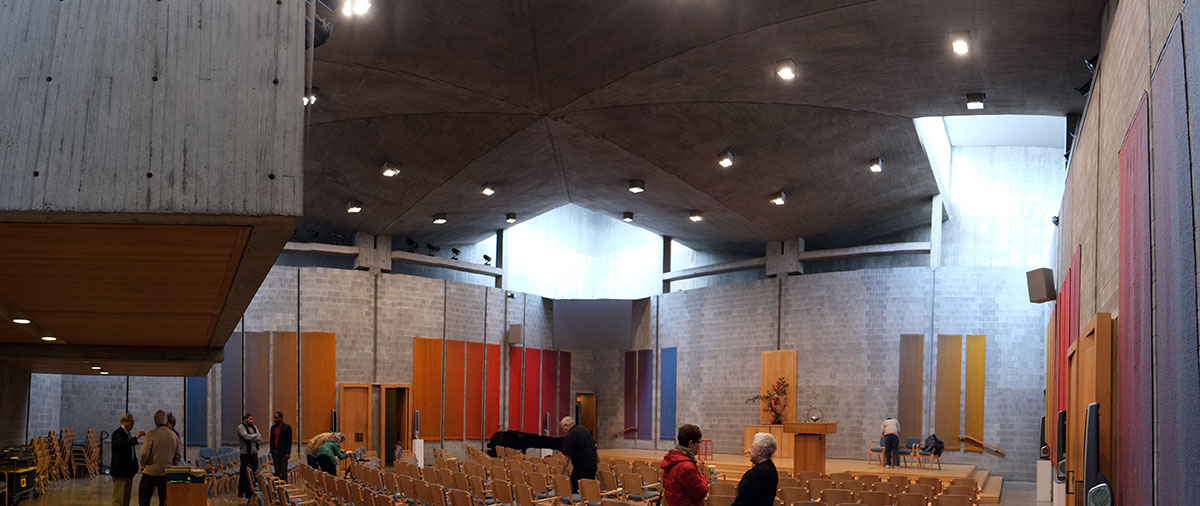
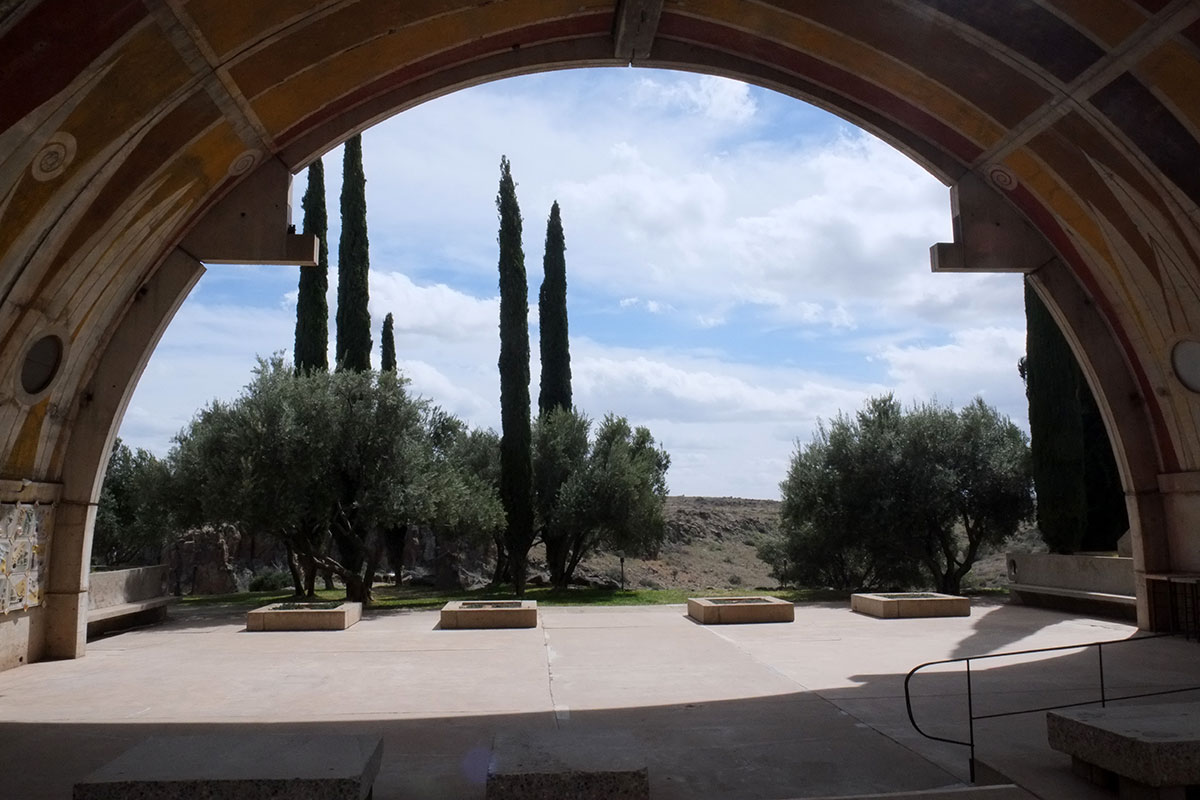
There is a large vault, which can be used for gatherings and performances (and basketball).  DSCF6848
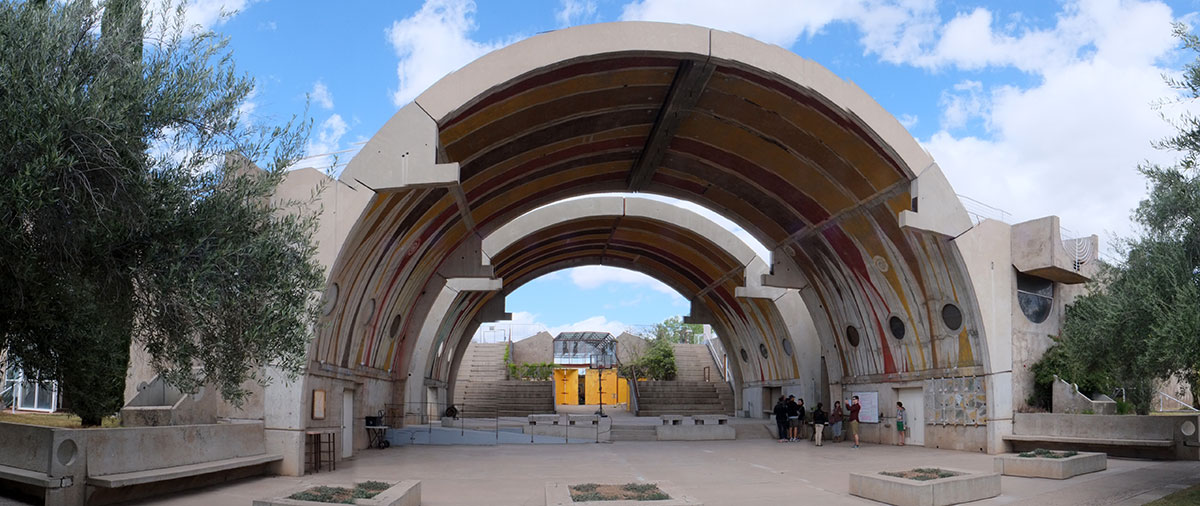
and which opens out to the canyon to the south.  DSCF6857
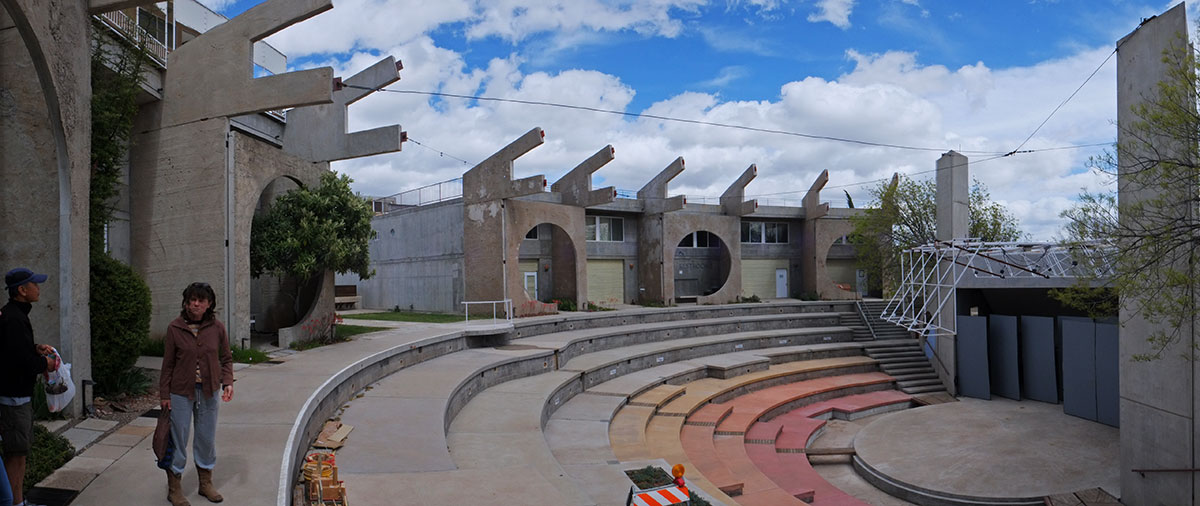
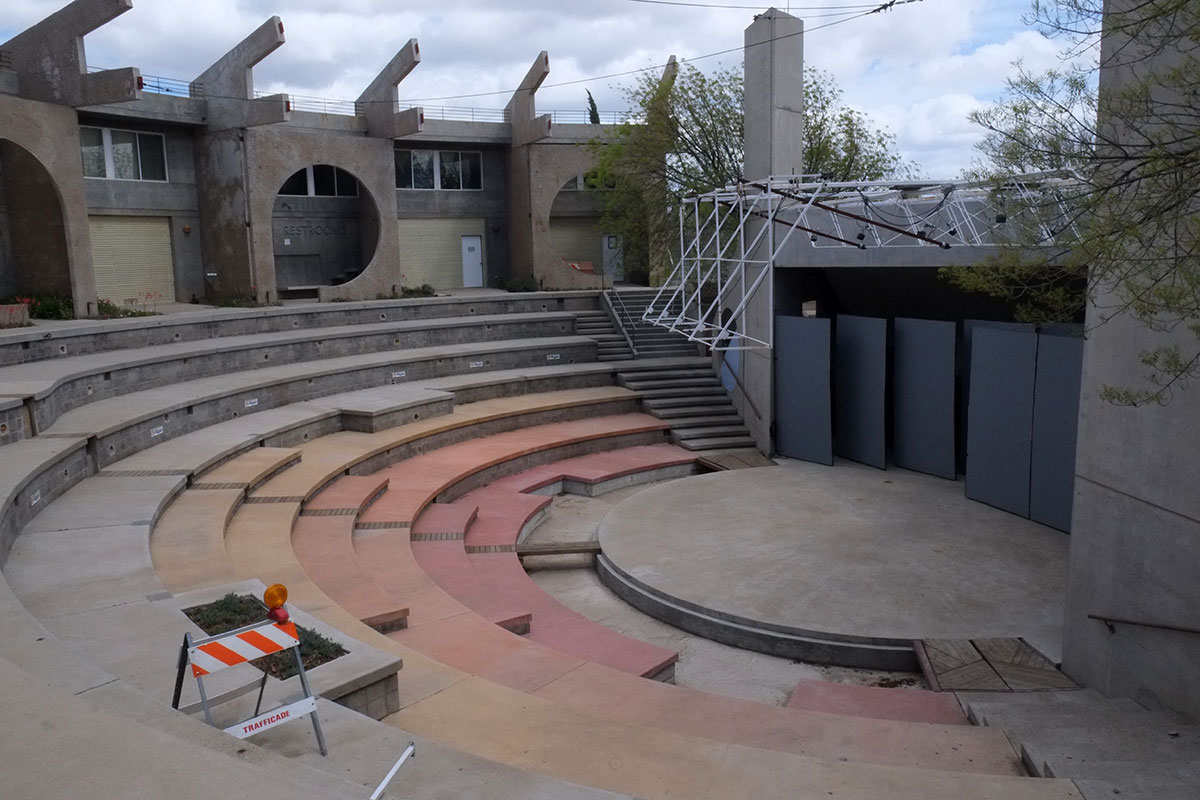
An amphitheater is surrounded by housing, some of which is for permanent residents, and a few of which are Air Bnbs.  DSCF6864  DSCF6865
When I visited here in the 1990s, it all seemed rather low-energy and unfocussed.  It reminded me of Taliesin, where the impetus and vision came from the founder, and the followers were just hanging on to that revealed truth, always wondering WWFLWD when confronted with a new challenge, and eking out a meager living from the legacy.

Arcoscanti feels very different now.  There are constant workshops being offered, which bring in short-term students to learn about Arcology and construction.  There are performances and events, which can bring in attendees from the Phoenix megalopolis.  There are approximately 100 full-time residents, some of whom live in the Camp area, detached houses closer to the farm at the bottom of the canyon.  Construction is moving ahead on some of the concrete buildings.

Soleri’s vision seems even more relevant now than in the 70s. His basic principle is that of building dense, energy-efficient human settlements, which don’t sprawl across the landscape, and so preserve land for agriculture and other uses.  In a very different form, this set of ideas underlays New Urbanism, and various principles which have become conventional planning in the past 30 years.

Millennials are showing a notable preference for denser urban living, often staying in our traditional city cores rather than moving back to the suburbs to spawn.  There are not many models for new urban development at this point – we have accepted the traditional city form and are designing new buildings to fit into that context.  Soleri’s morphology may not be the ultimate solution, but it is a remarkably clear proposal, one which proceeds from first principles and not just an imitation of older forms.  In this way it does resemble Corbusier’s urban proposals, as he laid out his understanding of modern civilization, and tried to come up with a new form that fit those changed conditions.  Soleri stared with a very different set of underlying conditions (recognizing the importance of the environment before most of his contemporaries), and proposed this new model.  Perhaps most encouragingly, the ideas have not remained static:  a newer book, Lean Linear City:  Arterial Arcology, was written by Soleri and some of his followers, showing the development of concepts to fit changing conditions.

Visiting Arcosanti doesn’t feel like visiting the remnants of yet another failed agrarian utopia, which collapsed after the dogma-driven urbanites got bored and went back home.  It is not a rapidly-developing alternative city (probably because no one has figured out to make a lot of money from it), but it is a serious testing ground for a larger vision.  We now recognize the scale of the ecological crisis we are facing as a society, but so far our efforts to correct our course are puny and completely ineffectual.   We keep proposing tweaks around the edges of the existing system.  Arcology may not be the complete solution, but it is one of the few models out there of what a vision for the whole might be, one where the scale of the solution is within an order of magnitude of the problem.
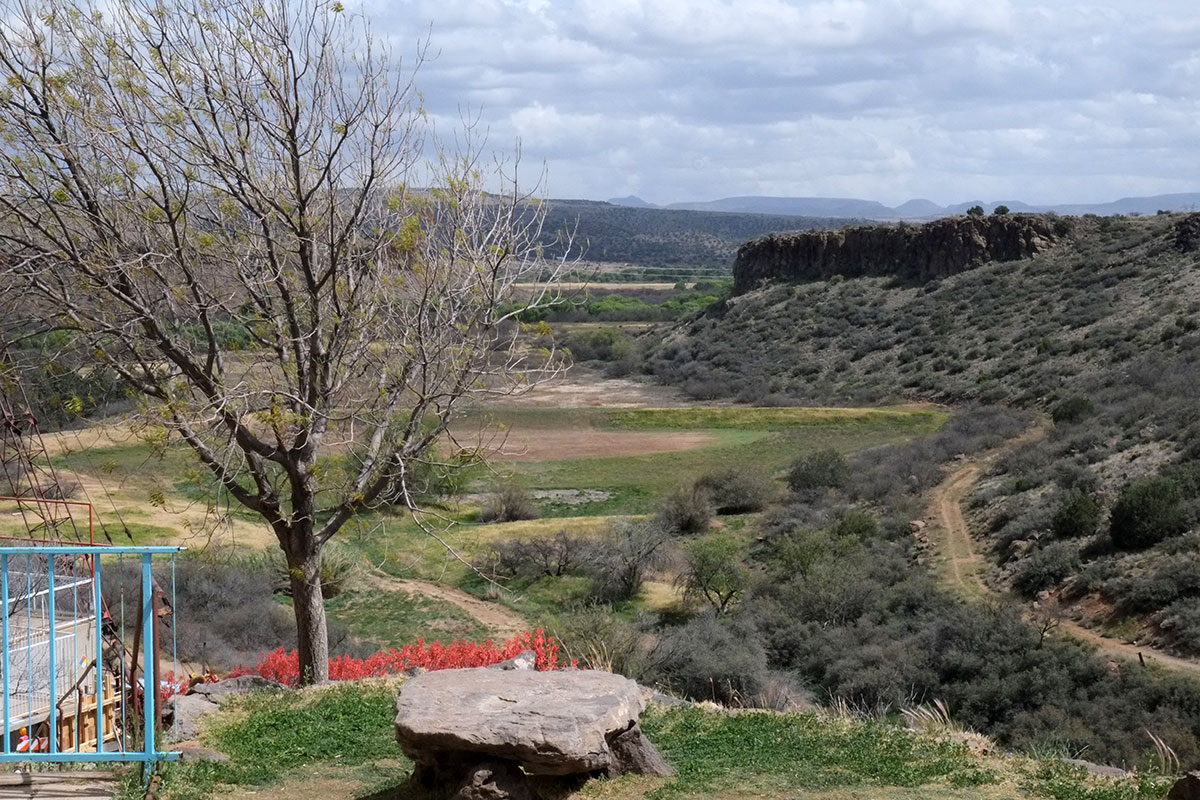
DSCF6881The biggest problem with Arcosanti is its location:  with the likely consequences of climate change in the next century, the edge of the Sonoran Desert is not where you want to be.  Agriculture will not be possible here, as most climate models are predicting a mega-drought this century, similar to the one that contributed to the Ancestral Puebloans abandonment of their settlements 1000 years ago.  Soleri didn’t foresee this, but then neither did anyone else.  He began a small experimental community for up to 5000 people that might have to be abandoned;  we built Phoenix, which with its 4,000,000 residents that will also be gone soon.  At least the Arcosanti residents will be able to hold on longer, as their buildings will shield them in a way that the Phoenix buildings will not.

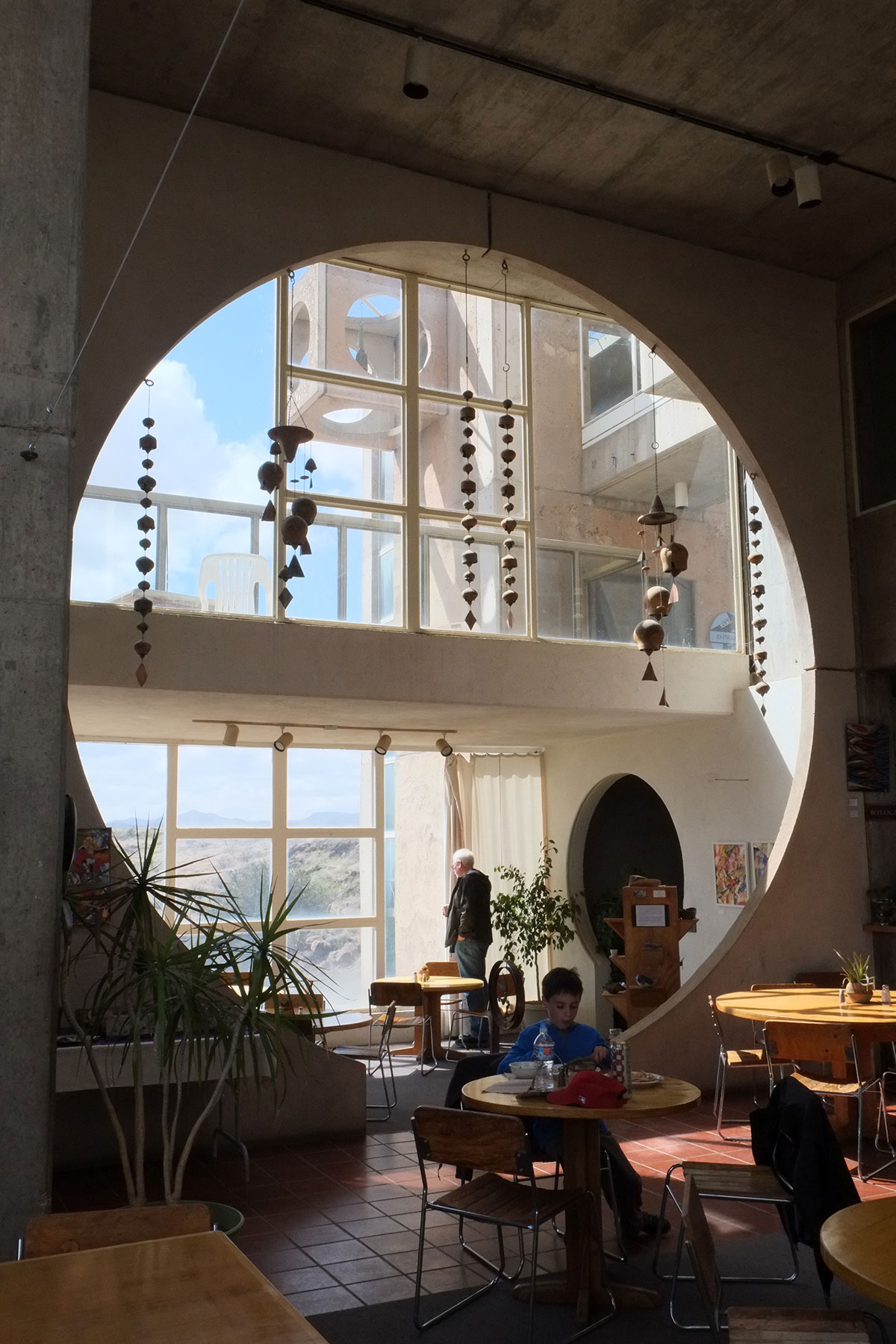
Even if its geographic location may not endure, the ideas of Arcosanti can still provide a useful model for our society.  I arrived there thinking about the big ideas of cities and ecology and human settlement and the landscape, but the experience quickly shifted my thinking to that of the smaller scales of buildings and spaces.  I hadn’t expected it to be so beautiful.  DSCF6923
DSCF6937

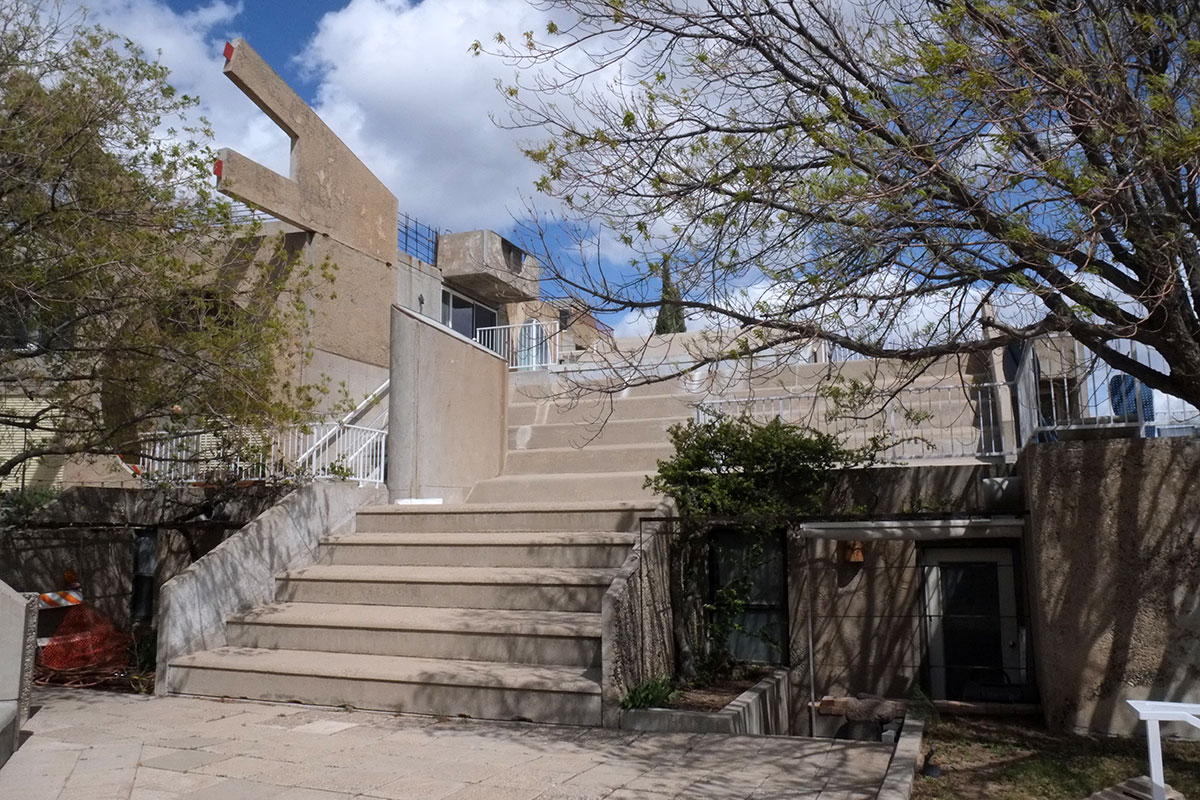
The quality of the architectural design and the integration with the outdoor spaces is comparable to an Italian hill town, or as I would discover, some of the Pueblos of the Southwest.    It is architecture and urban design for a new age, but it draws heavily on the best precedents from our past.DSCF6873
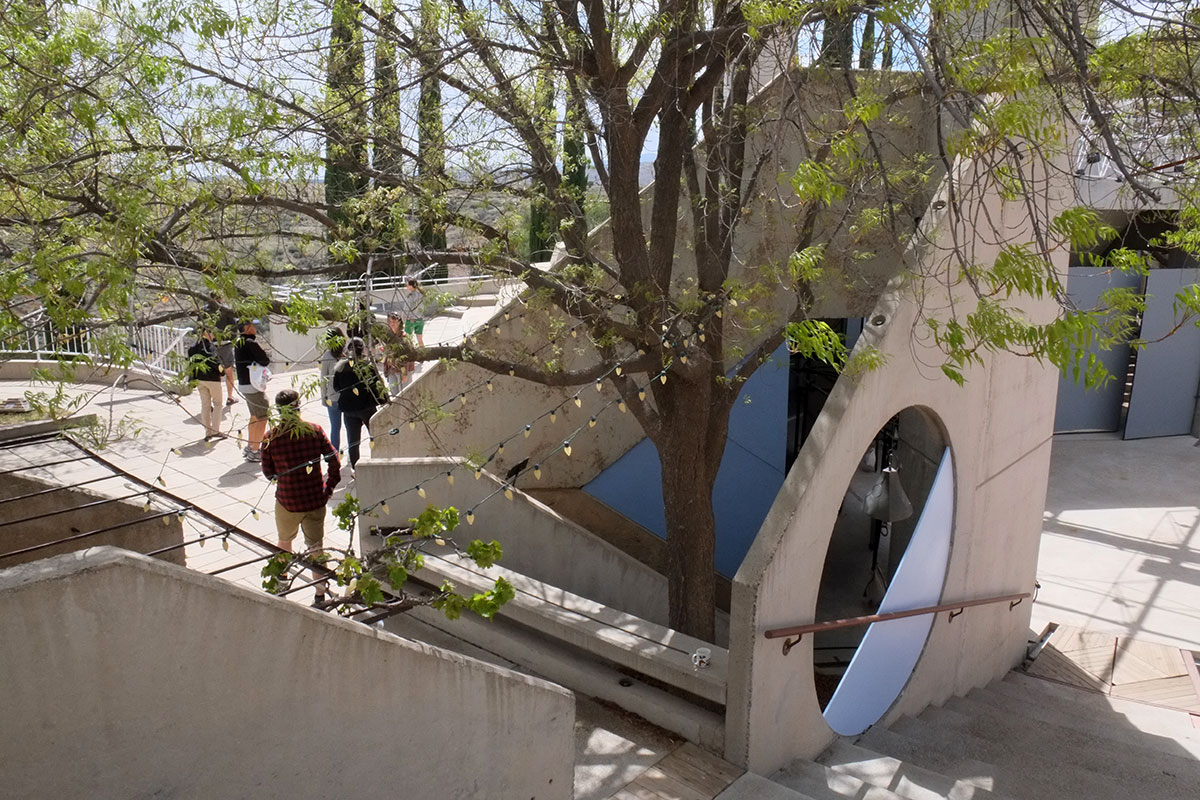
Arcosanti wasn’t conceived by a dry planning theorist, but by an artist.  If you have never looked at Soleri’s drawings in Arcology, you should;  Soleri’s vision is right up there with that of other acclaimed visionary architects, such as Lebbeus Woods, but his visions are grounded in an understanding of the fundamental conditions human society is facing, rather than operating at the level of metaphor, or as projections of a purely personal, hermetic vision.   DSCF6885
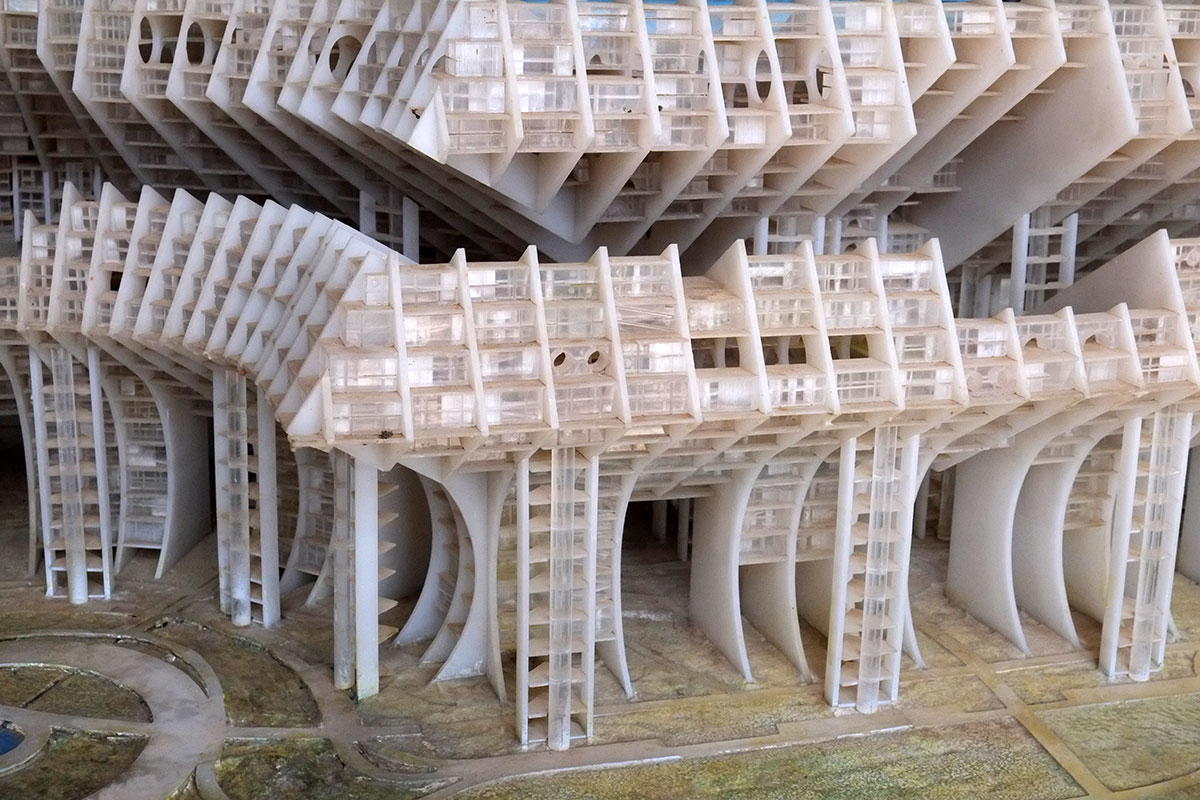
Soleri also took the great leap of trying to build this vision;  in our recent fascination with paper (or now digital) architecture, we don’t seem to care whether or not a beautiful vision can be built at all – we are happy to bask in the imaginary.  Thom Mayne once pointed out that the quality of architectural rendering would soon reach the point where architects would establish their reputations without ever having to build anything.  Ten years later, we seem to have reached that point.

Or maybe it’s even worse – we are so cynical about ever being able to redirect our profit-driven building-production system that we satisfy our idealistic (yet rational) urges with fantastical imagery.  Soleri didn’t spend thirty years making pretty pictures hoping that eventually some developer would adapt them for a shopping mall (cf. Liebeskind’s building in Las Vegas);  he saw the vision as deriving from the conditions we are facing, and proposed a solution to those problems that, like most brilliant, integrative solutions, was also beautiful and enriching as well as pragmatic.  He thought like an architect, never abandoning his dedication to the larger community, rather than just pursuing his personal vision.

Perhaps in the future we’ll visit Arcosanti as we now visit the abandoned cliff-dwellings, recognizing it as a harbinger, a place where the changing conditions of our world were first recognized and engaged.  DSCF6878
Phoenix

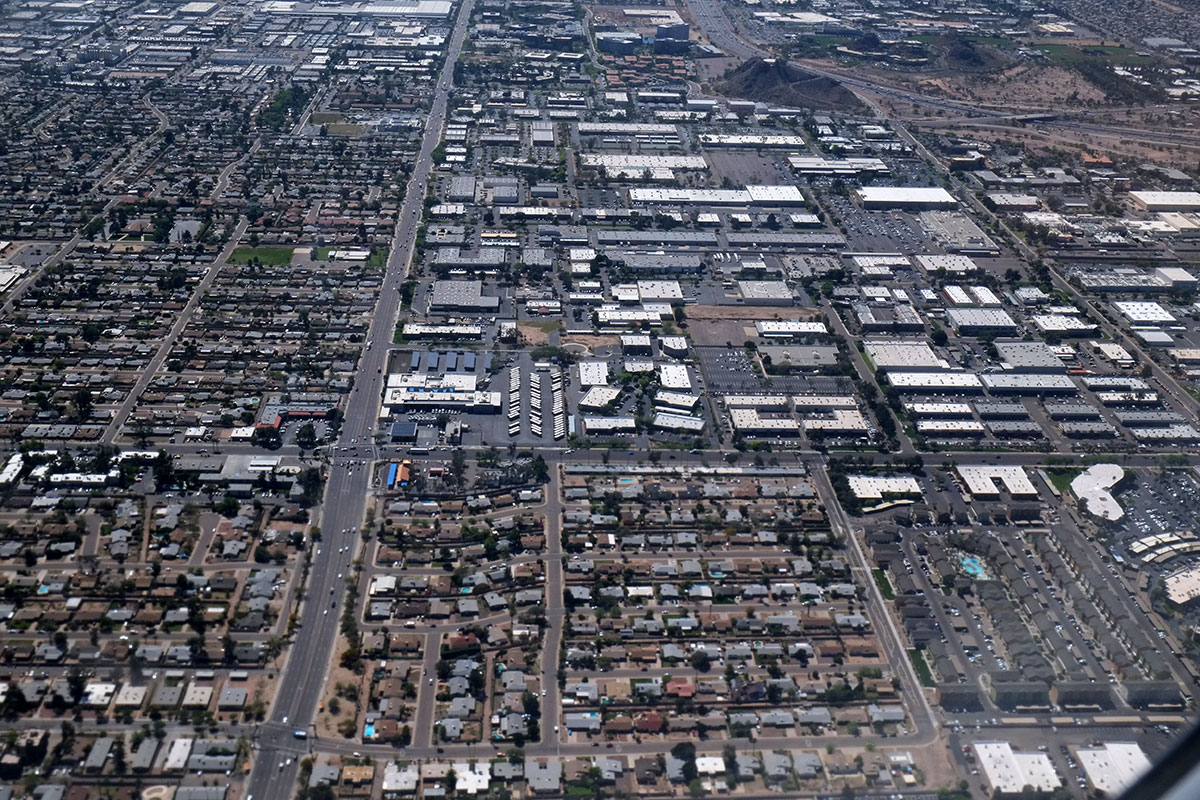
Phoenix is where you can see the Platonic ideal of sprawl – what low-density, car-based development looks like when there is no pre-existing central city to get in the way. To paraphrase Lou Kahn, I asked the sprawl what it wanted to be, and it said Phoenix.

The large cities of the east and midwest existed before cars, and a system of highways and roads had to be retrofitted in and around them to support the new means of transport.  Sub-urbia, as it was then conceived, implied a relationship to a central city.

Los Angeles was not a very big place in the 19th century, and its growth paralleled the rise of the automobile in the pre-war era.  It became the new paradigm for the American city in the early 20th-century.  Los Angeles is our most important car-based megalopolis, and it came to represent the image of sprawl in our collective imagination, with its highways, drive-ins and congestion.

But suburban growth and sprawl really took off in the post-war era. 19th-century cities acquired rings of highways and suburbs, and early 20th-century cities did the same.  American metropolitan areas became almost uniformly low-density around a central city, but with other centers in the region too, as nearby cities were subsumed in the sprawl.

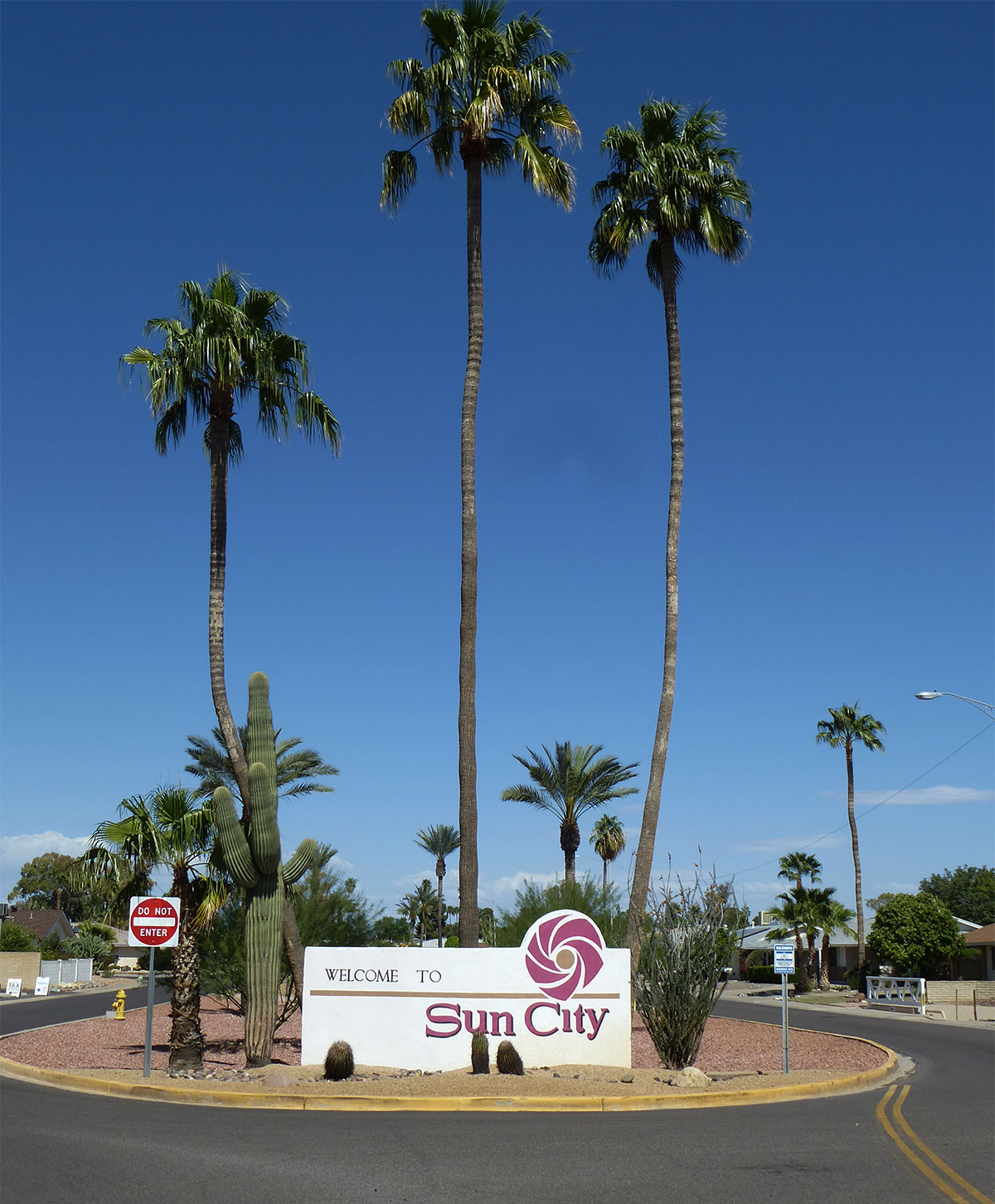
Phoenix exemplifies the new, post-war city.  There was almost nothing there before WWII – it had around 100,000 residents in 1950 (with some more in places like Tempe and Scottsdale). The exponential growth began when developers such as Del Webb realized it could become the retirement center of the west (with its warm weather and vast expanses of cheap land), matching Florida’s role in the east.  P1080263Like southern Florida, the Phoenix economy has been largely based upon people moving there and then selling them houses and stuff.  And like every other place in the South or Sun Belt, its habitability is based upon the automobile, air conditioning and television.  Before the widespread adoption of these technologies, there was a sharp limit on how many people would live in a place like Phoenix.

There are several key differences in the urban and regional form of a city like Phoenix and older cities.  Since there was not a high-density central city to and from and through which large numbers of cars had to be moved,  a comprehensive system of high-capacity, limited-access highways was not developed.  (This may also be partly due to Phoenix not existing as a large city when the interstate highway system was initiated in 1956.)  Phoenix is the largest American city I’ve seen where the highway system is not relevant to car circulation in much of the city.

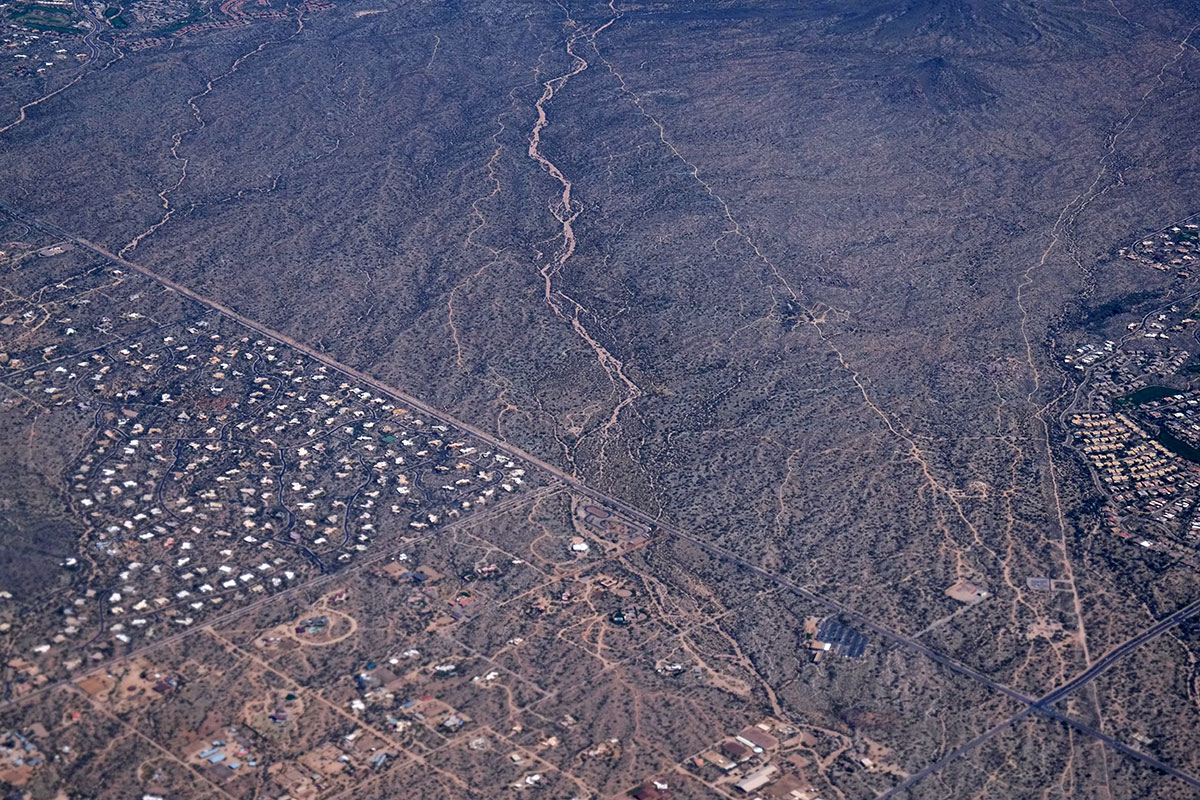
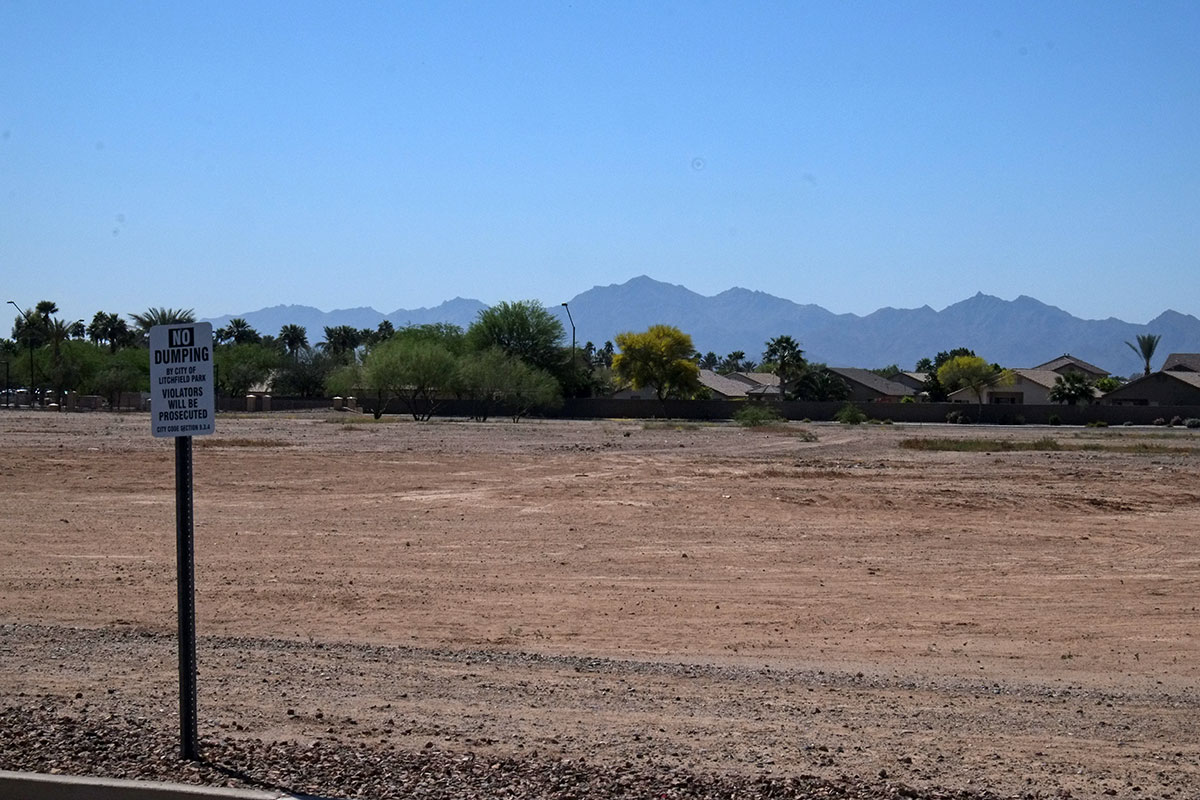
Phoenix didn’t exist in a region of small towns and cities – which then had the spaces between them filled with suburbia until they formed one large metropolitan region – as happened in older regions.  There was some irrigation-based agriculture, and there was a system of canals to serve this, but there wasn’t a significant concentration of population anywhere.  Growth did not happen incrementally or through infill.   A district in Phoenix is usually either a desert, or it is completely developed all at once. DSCF6567

A common sight is moving along an arterial, looking across a desert, seeing another parcel of completed development – and knowing that the desert in the middle will be developed fairly soon.  DSCF6592

The street pattern of Phoenix is based upon the national grid of townships, with major arterial roads occurring every mile.  Since the density of the metropolitan area is fairly uniform, the roadway system can be sized to accommodate the corresponding uniform density of traffic.  Phoenix is a gridded network, not a branching-tree hierarchical system as is seen in much of the rest of the country.  Since the land was undeveloped before WWII, there was no pre-existing system of undersized farm roads which had to either retrofitted with difficulty, or supplanted by the highway system.  So as the districts developed all at once, the roadways could be built at the appropriate size for the ultimate density  80. Phoenix047DSCF6562

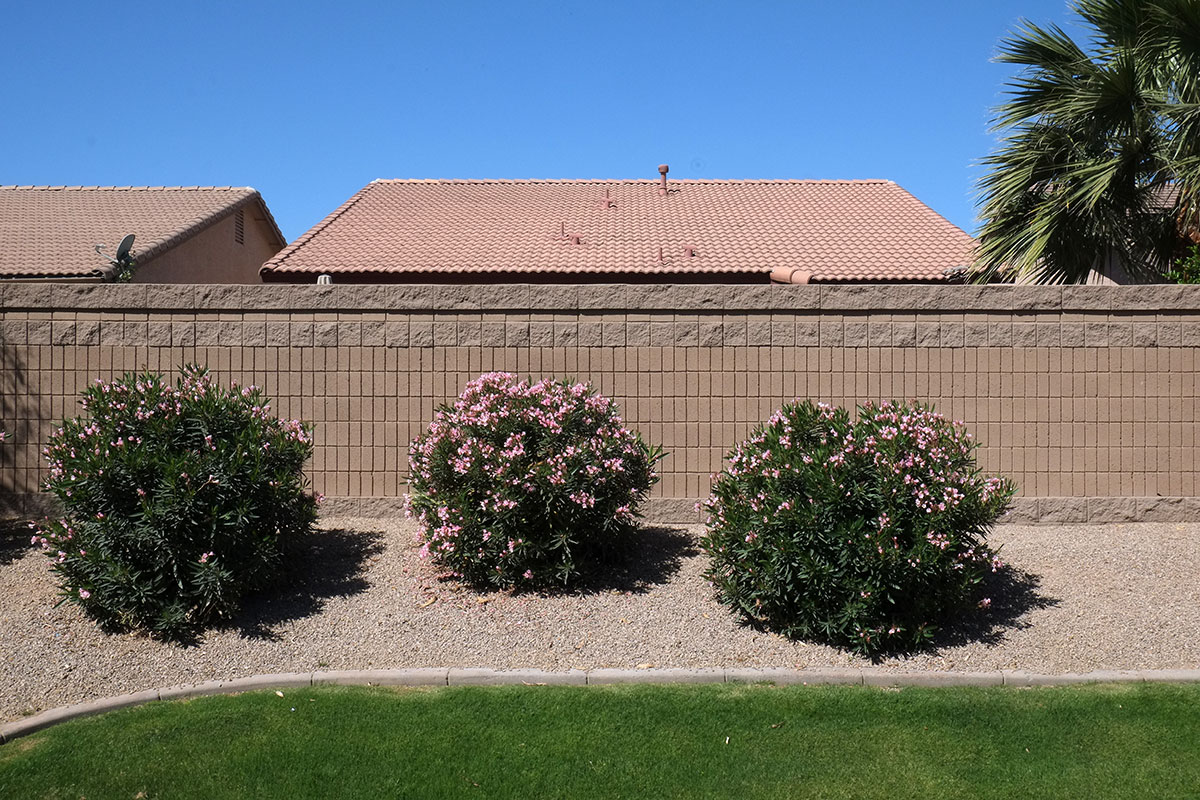
This is a  typical view while driving an arterial in Phoenix – with the neighborhood behind shielded by sound walls.  And while the arterial system is a repetitive grid, the street network within the grid is configured to be as confusing and disconnected as possible – the better to thwart drivers looking for shortcuts across your domain.  80. Phoenix048DSCF6595

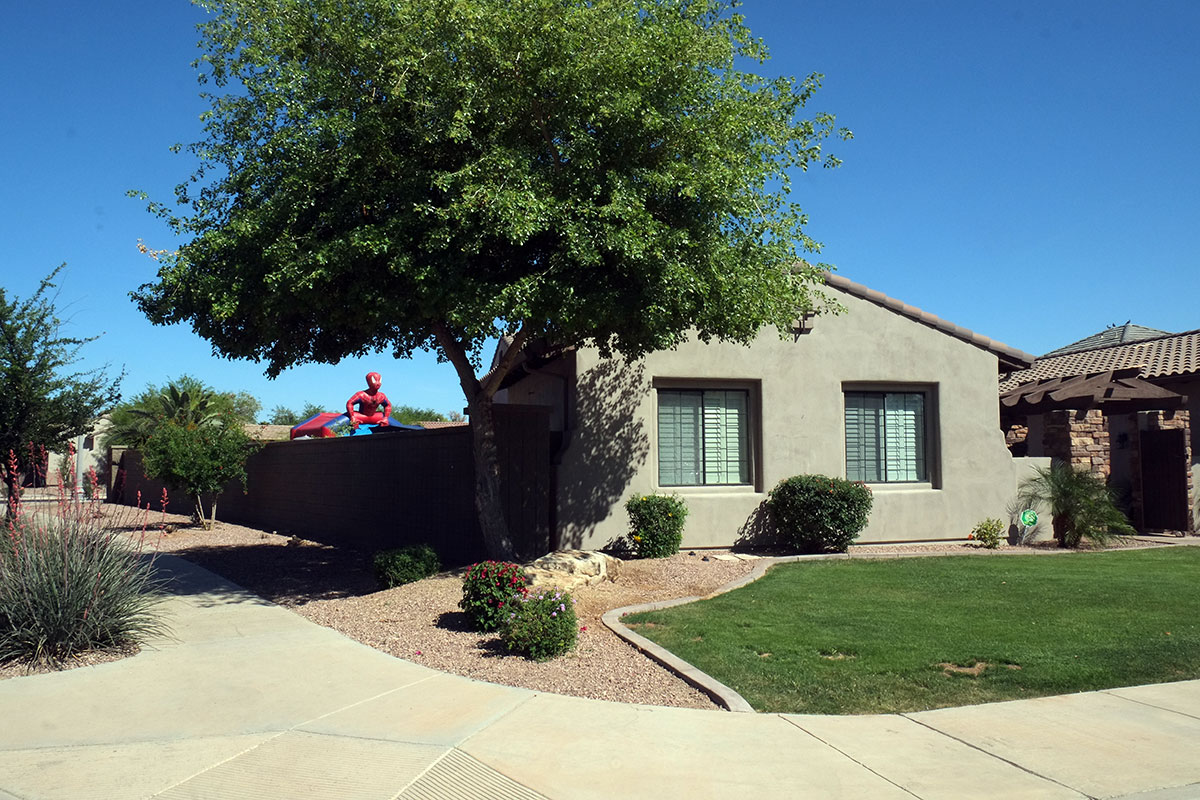
The residential neighborhoods are basically all new, roughly in successive rings out from the center, although leapfrogging development is not uncommon.  Each is completely homogeneous, having been built in large parcels by one builder.  Stylistically, they are all very similar, in a vague southwestern faux-adobe or stucco – it appears that a crop-dusting plane flies over each neighborhood every five years, spraying everything with a coat of Dryvit.  In layout they are more similar to tract houses of their era in other parts of the country than to older houses in the region (following the rule that in a mass culture things vary by time but not by location).  They are walled-off from the street more frequently than is normal in other parts of the country, and you can never be sure what is going on behind those walls.  80. Phoenix049DSCF6600

There is some isolated great architecture in Phoenix – Taliesin West, Will Bruder’s library, the Arizona Biltmore, etc., but we didn’t see them on this trip.  I had seen them fairly recently, and after getting dragged all around Texas cities, Greta had reached her limit on architecture, and just wanted to blow out of town and get back to the desert as quickly as possible.  I was also daunted but the prospect of slogging through Phoenix traffic – we were staying on the western edge of the region, and most of the architecture was far to the east.  We did brave the Sunday traffic, and I dragged Greta through the downtown, and then lured her to Tempe with the prospect of good food.

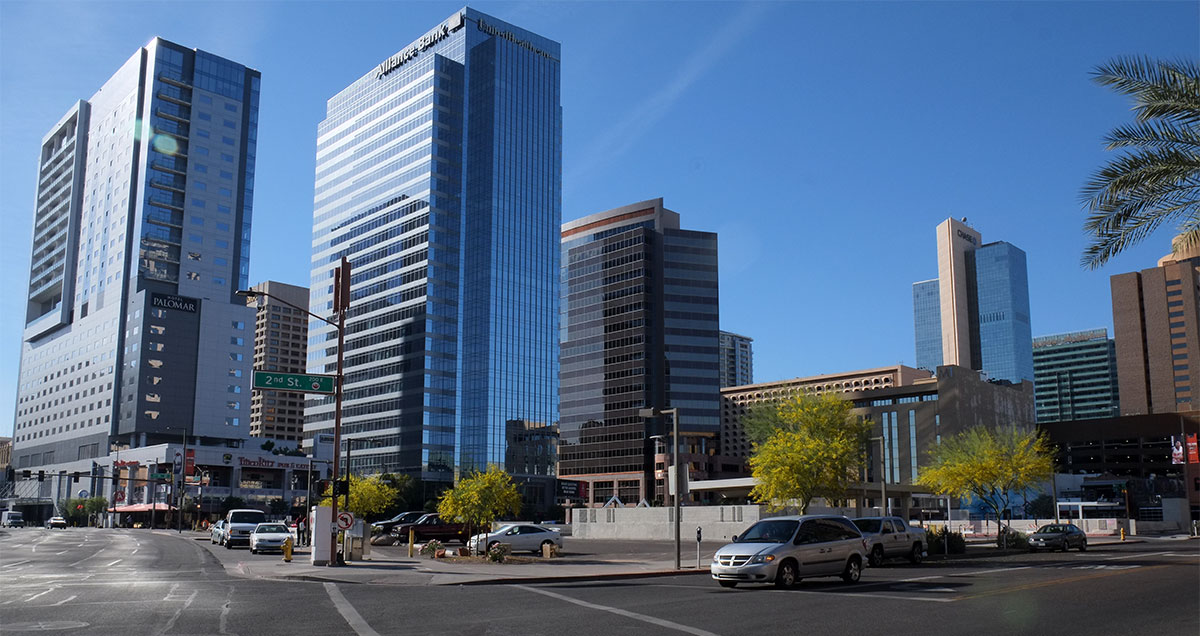
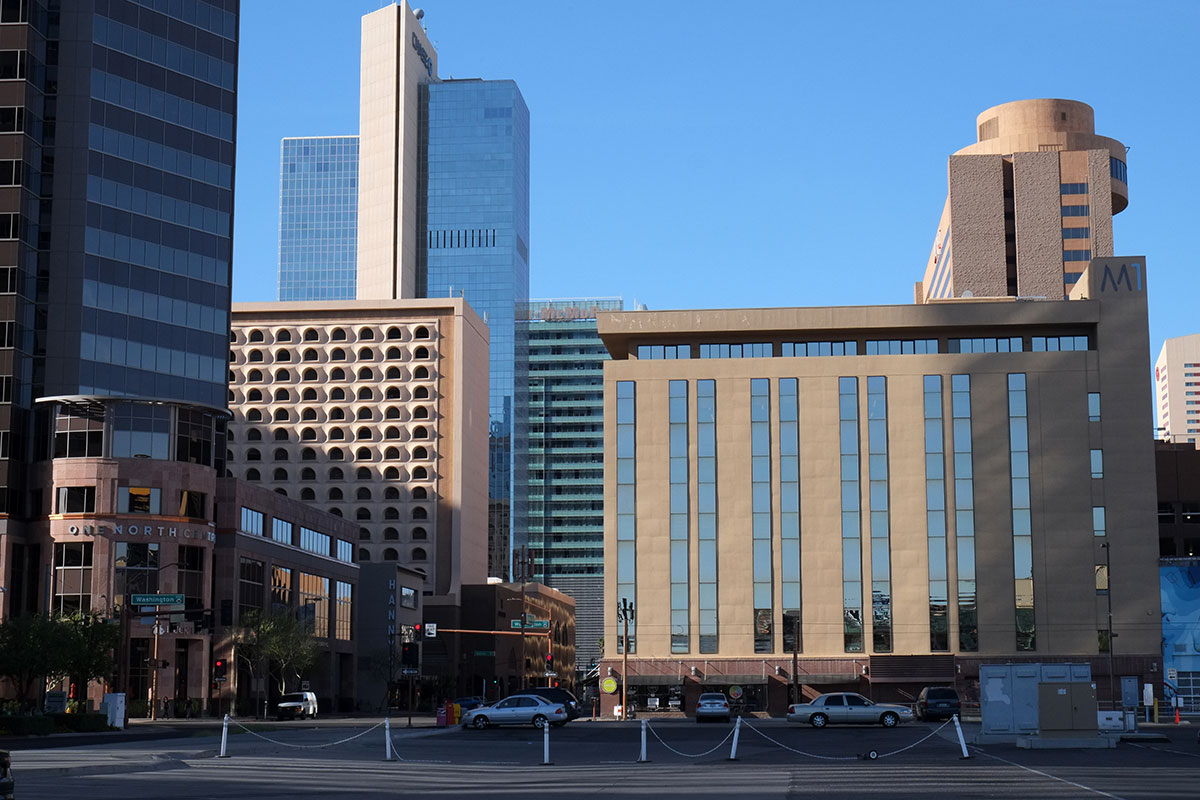
Phoenix has two distinct clusters of density.  The region around Camelback is the center of retail, while the downtown is for business, branches of the major universities, and large events – conventions, major league sports and performing arts.  It is nothing like a traditional downtown, more closely resembling an edge city office cluster.  This makes sense, as its history is nothing like a traditional city’s.  Whereas older cities usually have downtowns that retain older buildings and districts, Phoenix has none of this – we found one older building.  The strange inversion of Phoenix is that the downtown is newer than the sprawl.  It’s like the city reached a certain size and then made a decision to have a more dense downtown, and so redeveloped the whole area.

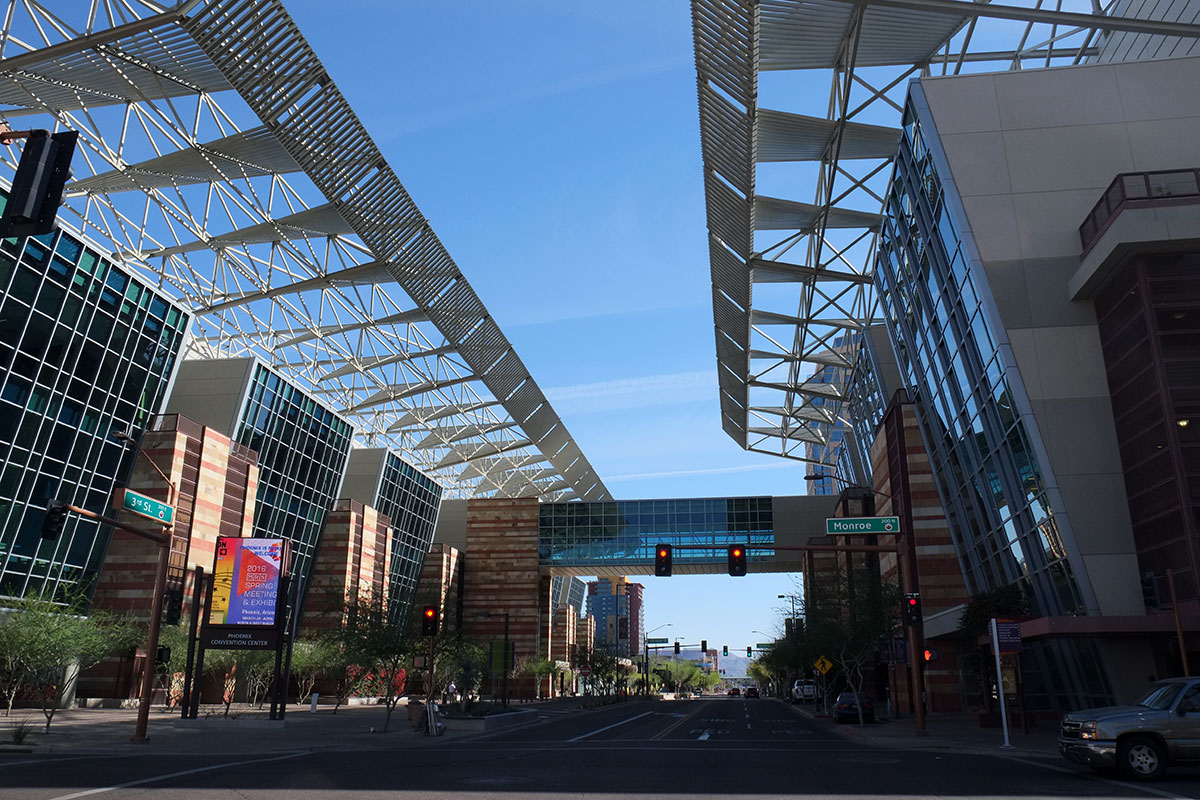
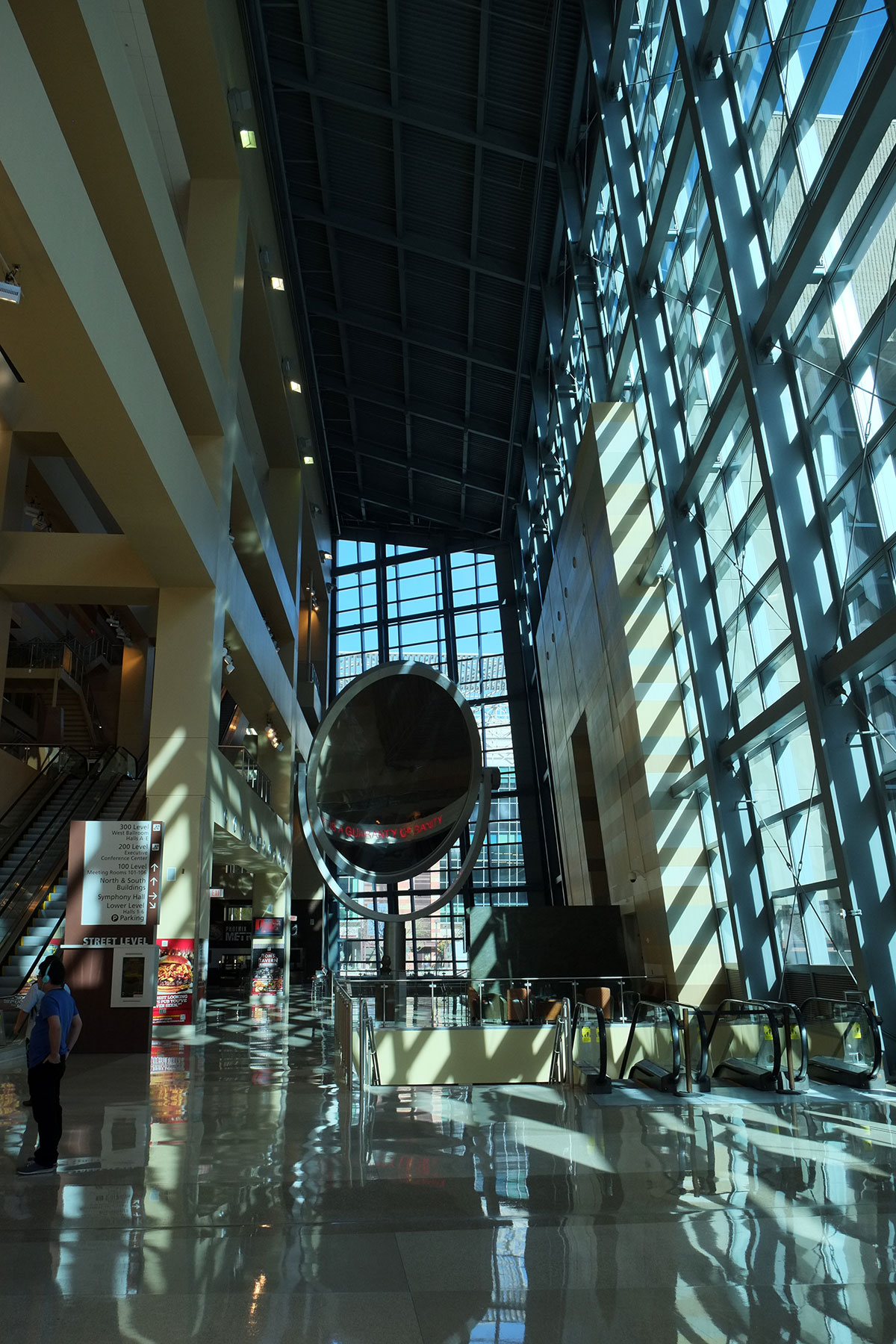
There is a large convention center, which has replicated itself across the street.  DSCF6634

80. Phoenix058DSCF6655

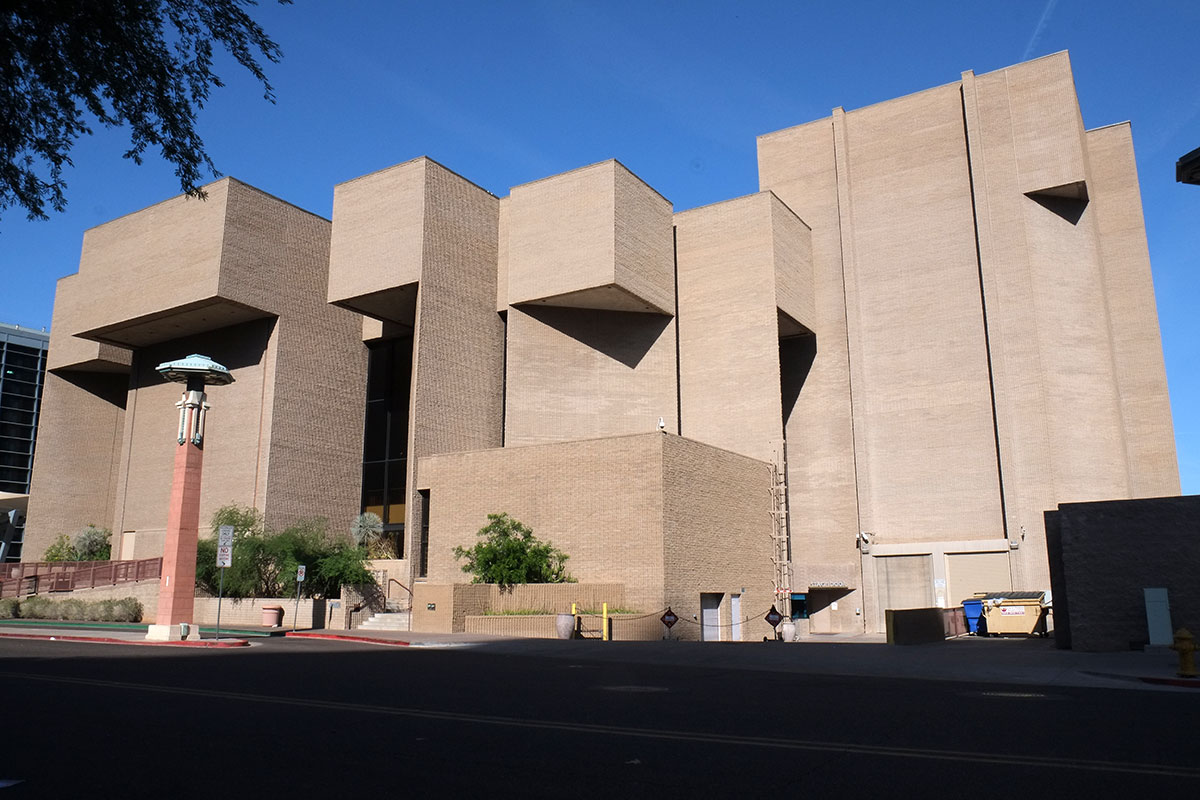
Next door is the Symphony Hall from 1972, the lone institution downtown which exhibits the local solid masonry wall tectonic, a not-inappropriate reference to vernacular pueblo architecture, before it was supplanted by the hegemony of the glass curtain wall (in the desert).  80. Phoenix057DSCF6651

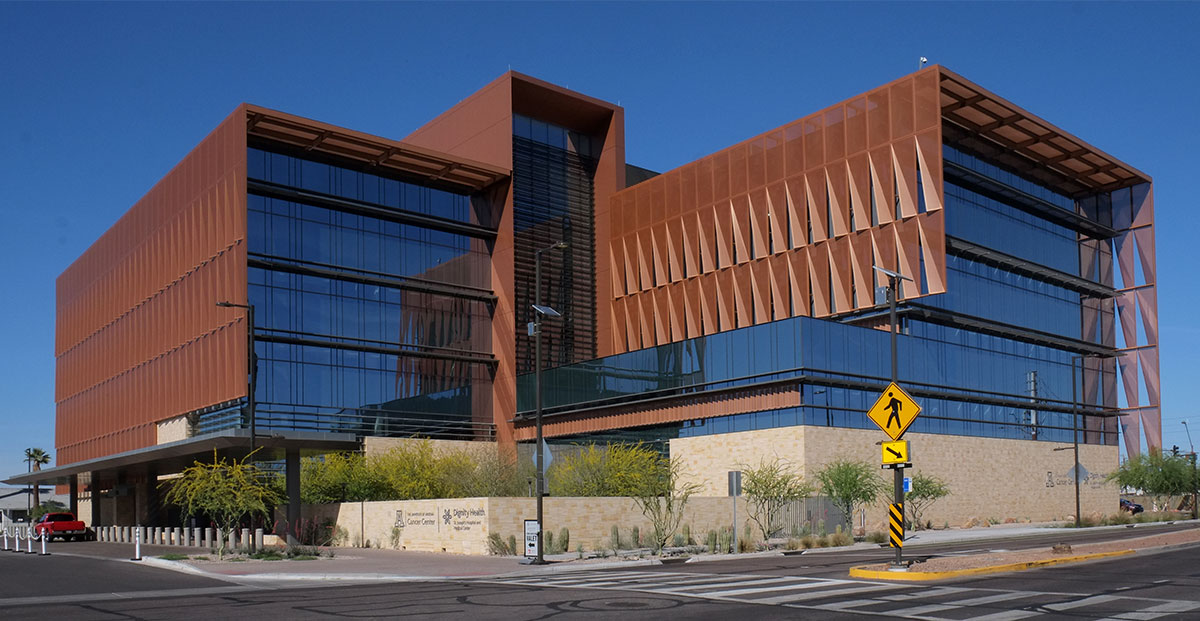
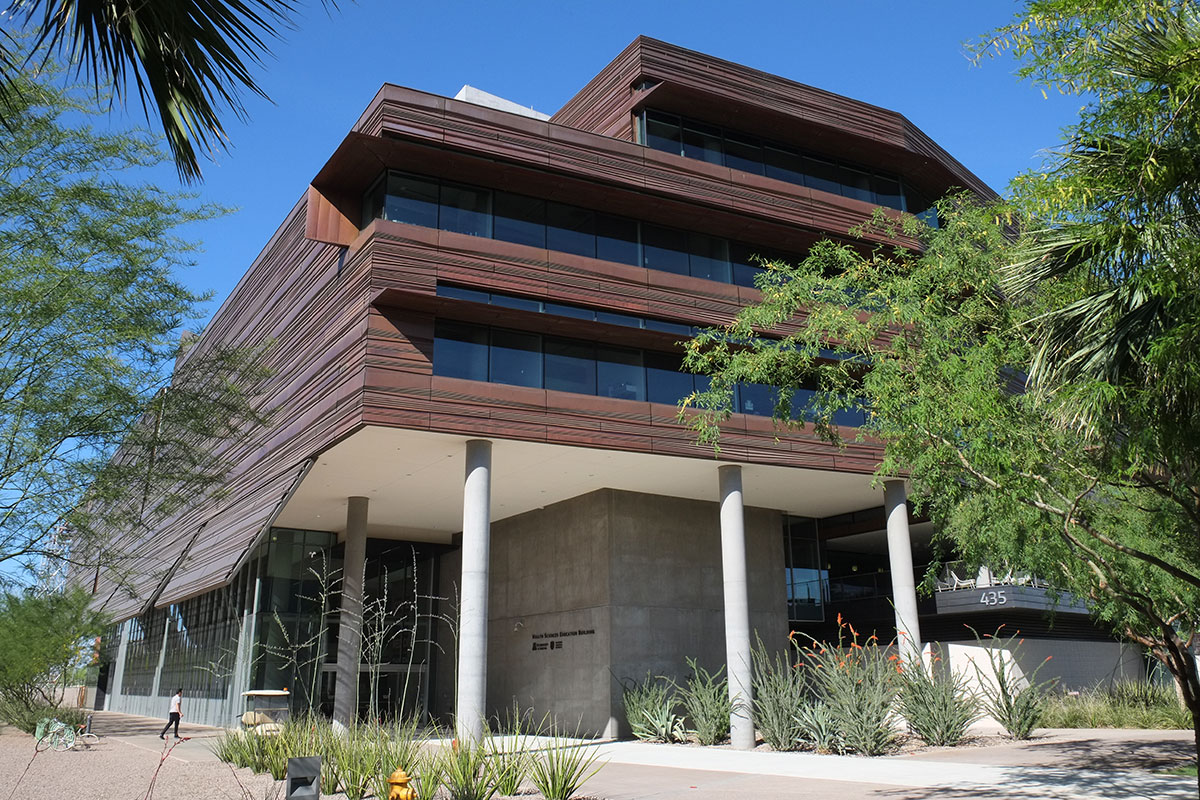
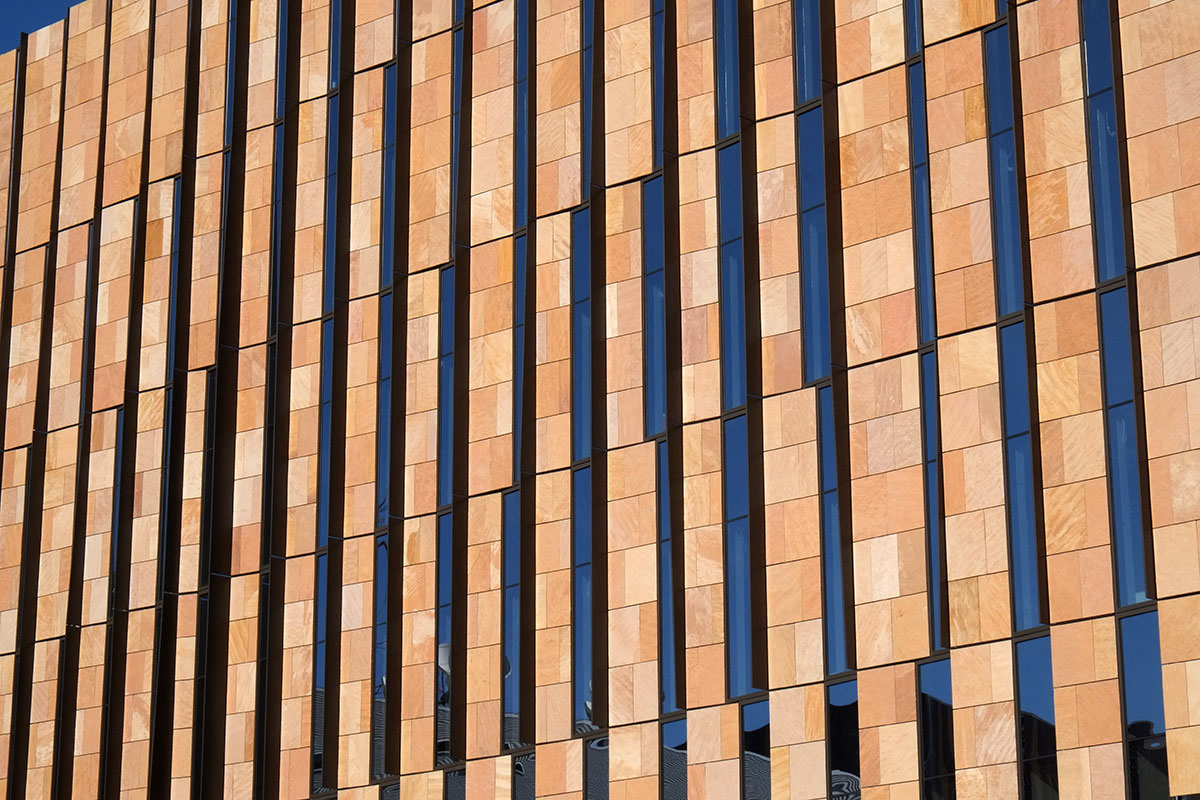
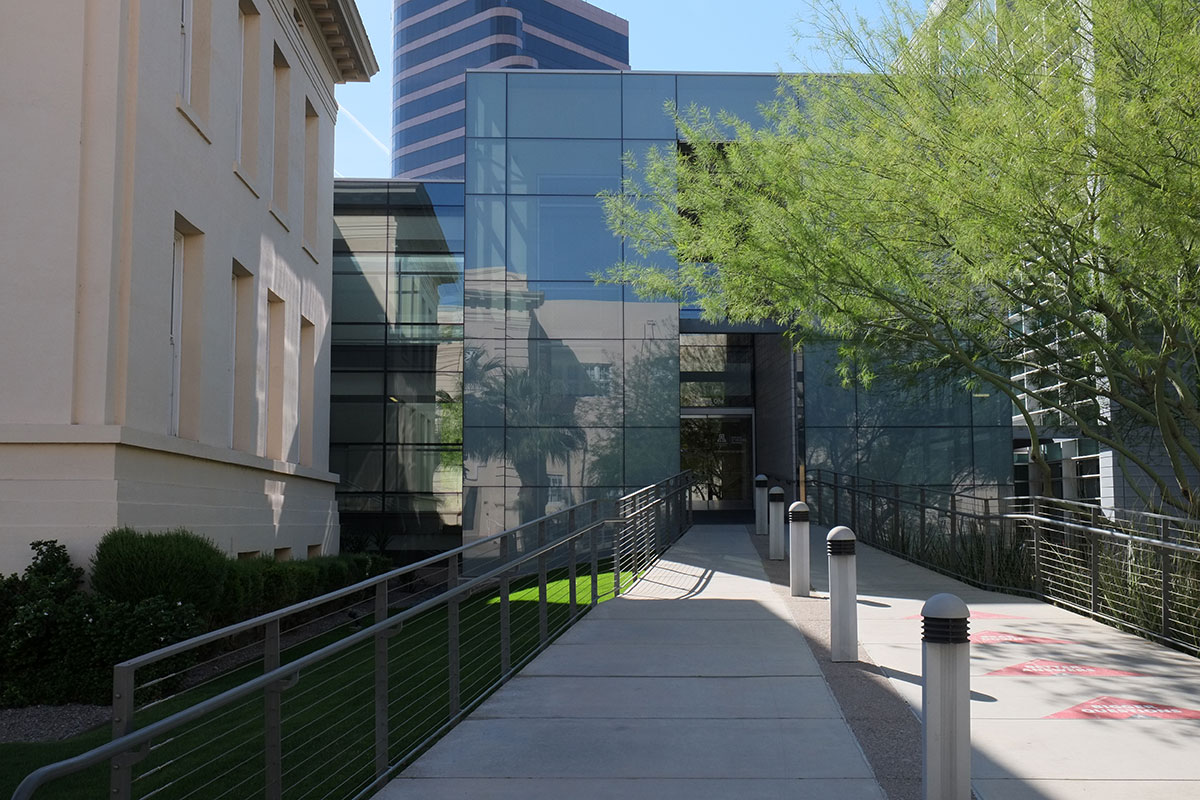
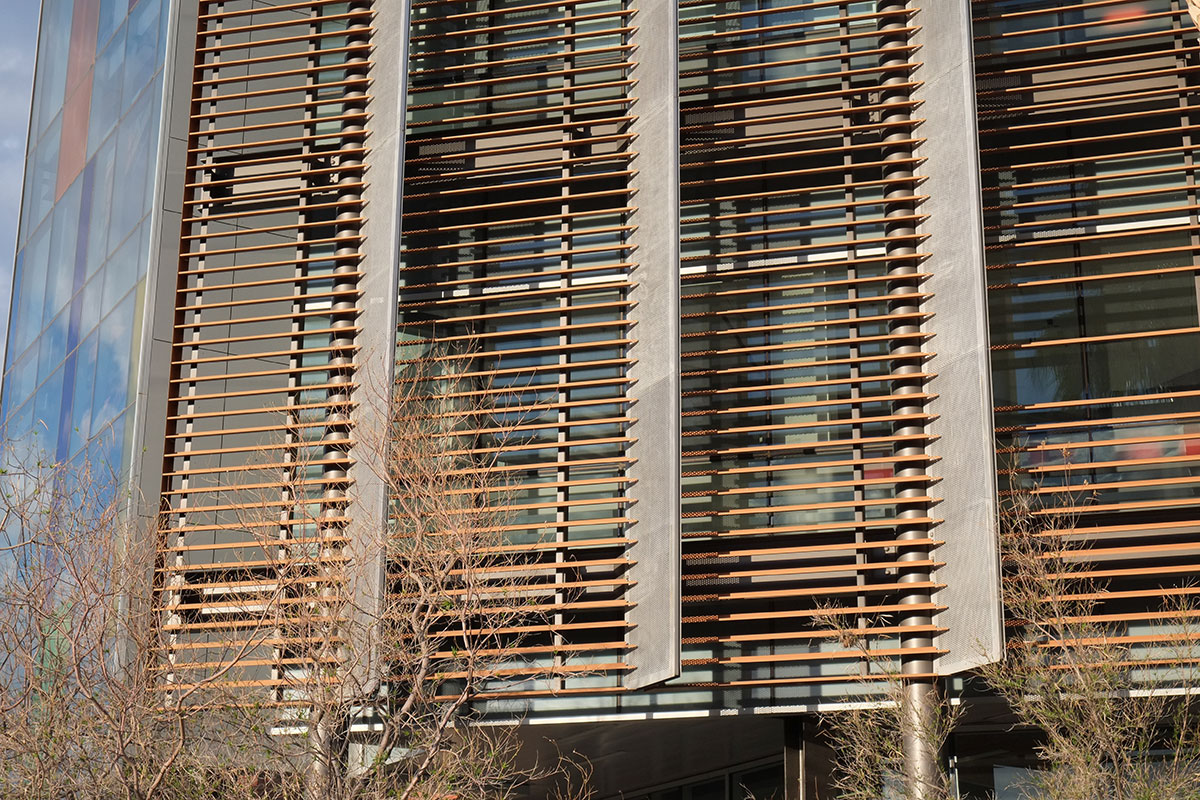
Arizona State and other universities have opened branch campuses downtown, mostly serving their professional schools and medical complexes.  They are good individual buildings, which are paying a lot of attention to sun screening, and getting a lot of expressive mileage out of that strategy.  80. Phoenix051DSCF6609

80. Phoenix052DSCF6619

80. Phoenix066DSCF6703

80. Phoenix053DSCF6621

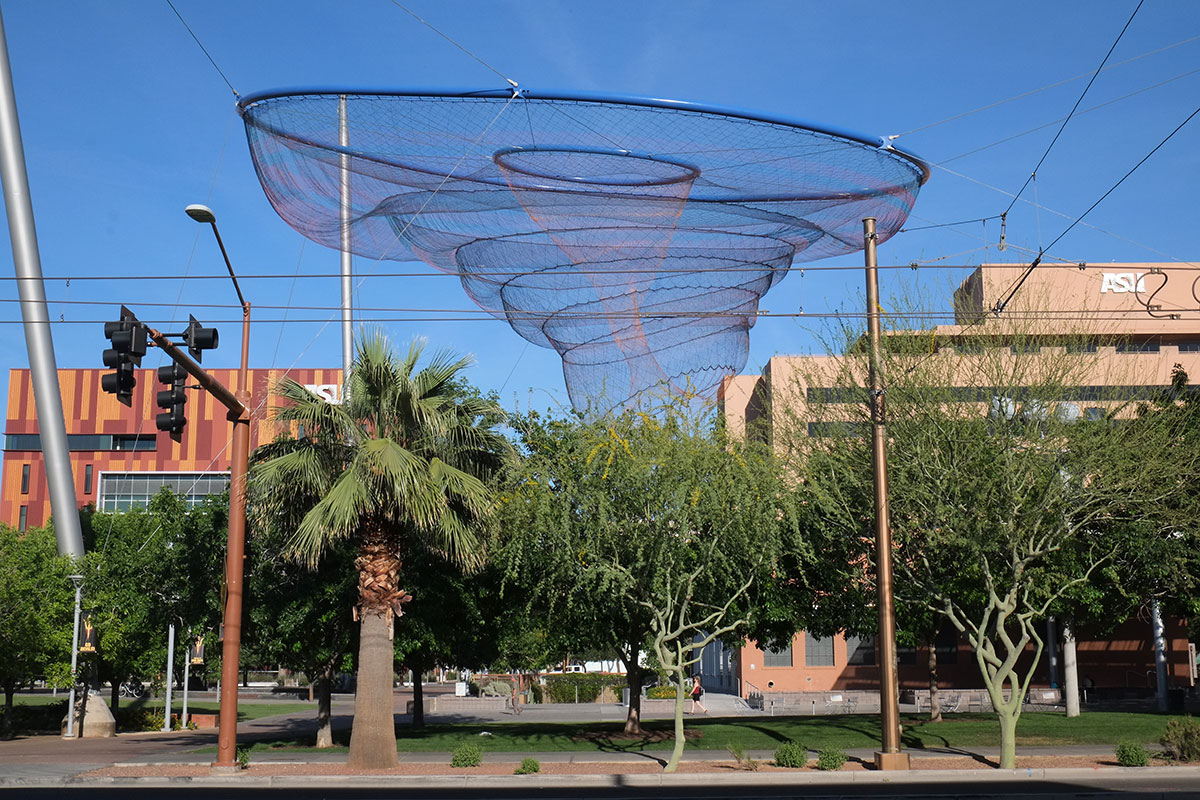
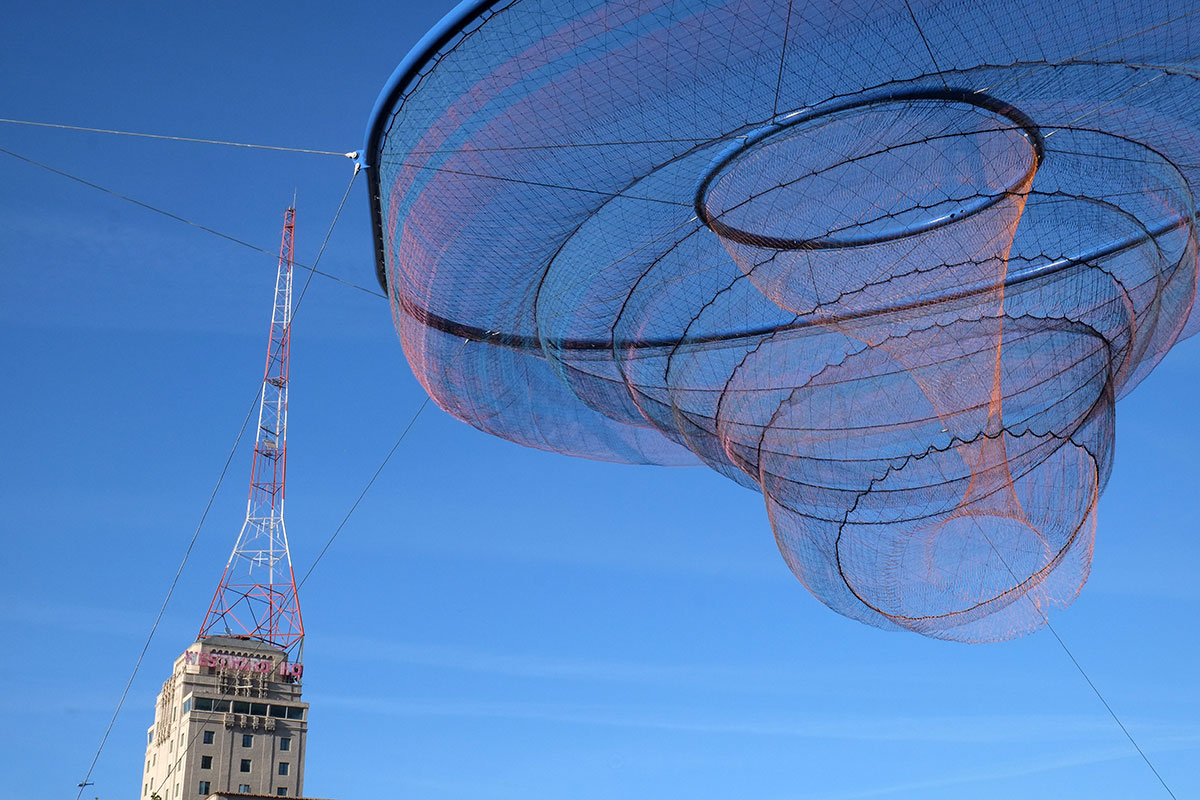
The Arizona State campus contains our favorite thing in the city – a huge cone of net, floating above a plaza, by the artist Janet Echelman (and completed with our colleague Philip Speranza as a consultant).  It really is beautiful, and provides visual entertainment, as you lie in the grass, soaking up the sun.  80. Phoenix068DSCF6720

80. Phoenix069DSCF6734

Beyond the universities, there are a lot of generic office buildings.  80. Phoenix060DSCF6662

80. Phoenix061DSCF6672

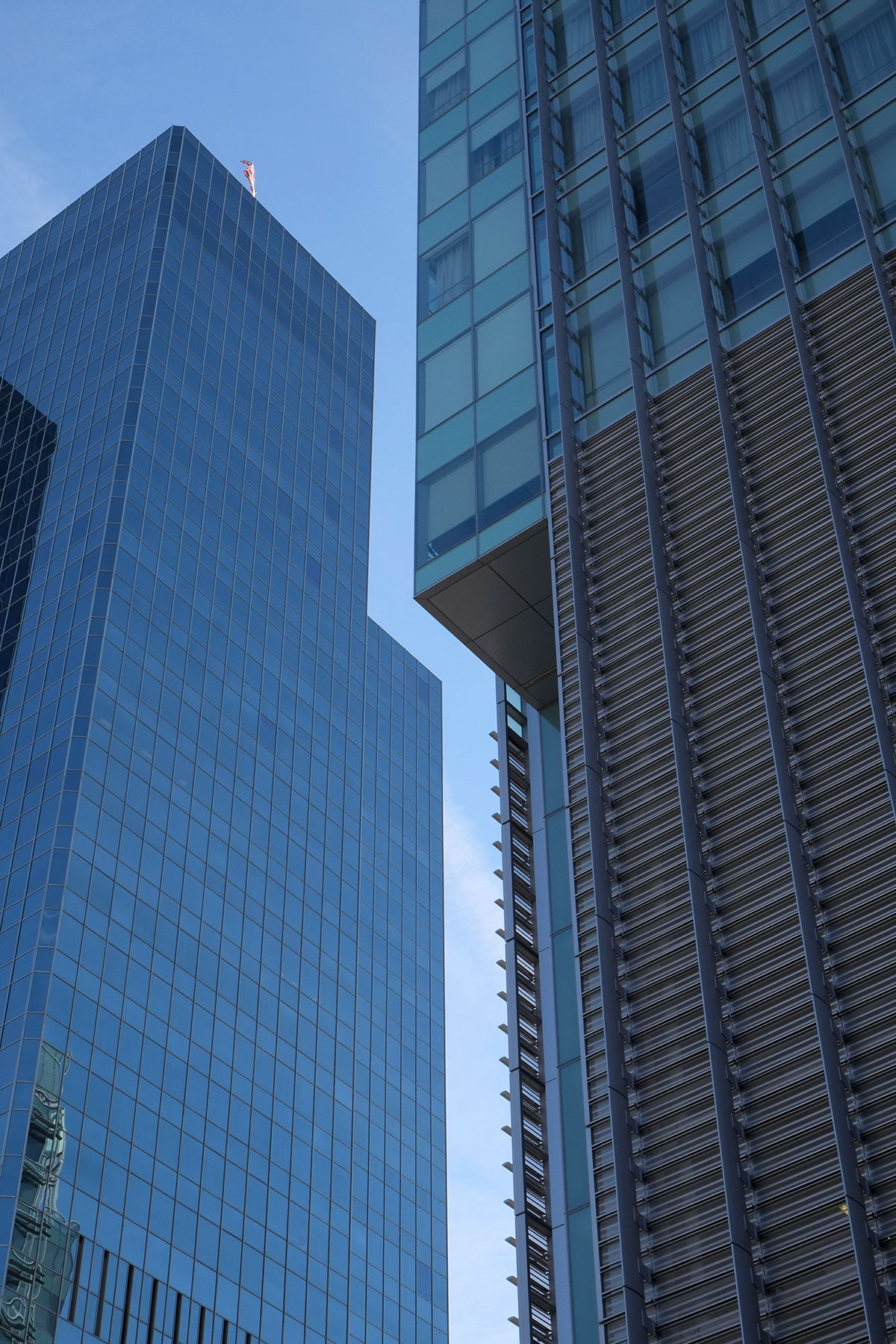
Leading to the usual Plays with Facades.  80. Phoenix065DSCF6697

80. Phoenix064DSCF6688

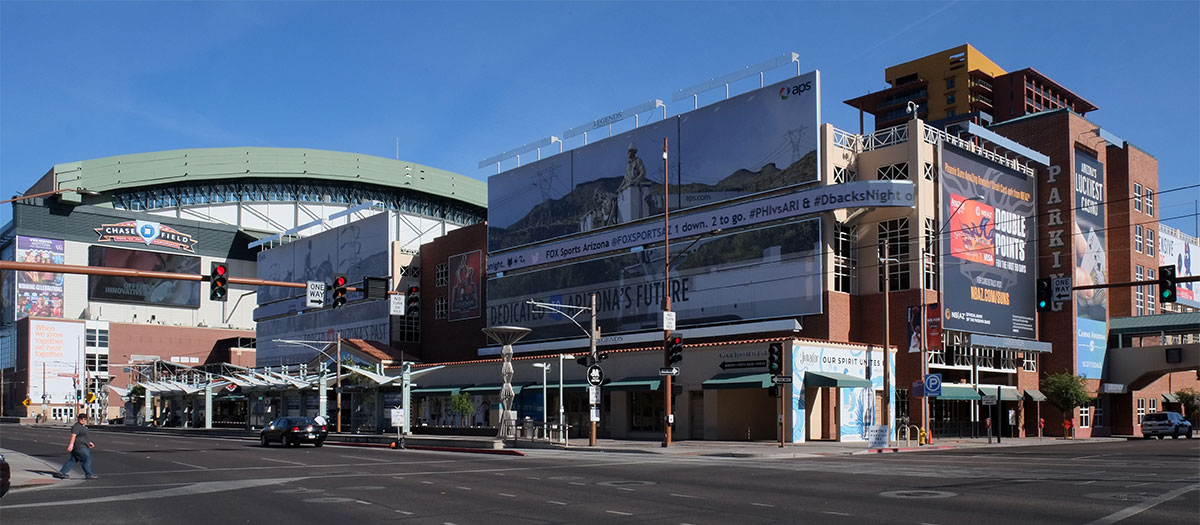
There is a sports district on the south side of the downtown, apparently a baseball stadium and a basketball arena, although it’s hard to tell.  I can’t remember their corporate sponsorship names (but that doesn’t matter, as they will certainly be renamed soon.)  They are in the style that might be called Faux Old Timey, or Times Square Wannabe.  Sports venues used to be Ducks (exhibiting their function in their form).  Now they are often Decorated Sheds, with the exterior being covered with some 21st century architect’s evocation of what the era of urban vitality used to look like.  The exuberance of the facades contrasts with the utter desolation of the streetscape – not a pedestrian to be seen, except when there is a sporting event.  Many cities now have equally dead sports zones, but few go to such elaborate lengths to try to disguise the inherent death of real street life.  80. Phoenix059DSCF6657

Downtown Phoenix is not very coherent as a city center, but it does have some good buildings.  It was notable that all the interesting architecture has been built by the universities, whereas the more typical downtown buildings of offices and hotels are completely banal.

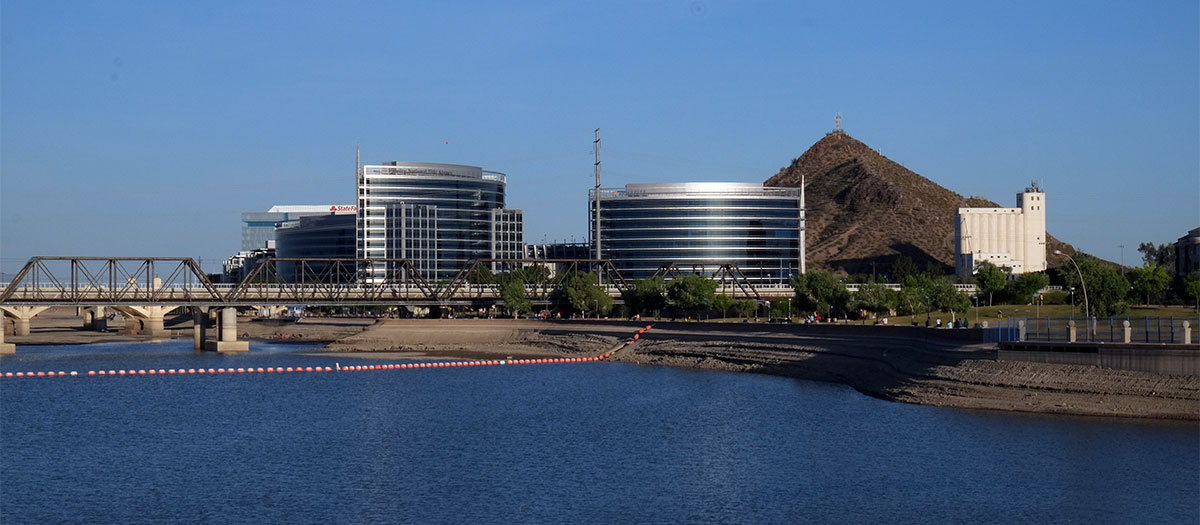
We moved on to Tempe, looking for the gastropub Greta had selected.  One the way, we discovered some interesting things.  Tempe may have generic buildings too, but everything looks better when you add in a river (dammed at this point to create a wider body of water) and have a butte in the near distance to give the city some scale.80. Phoenix070DSCF6761

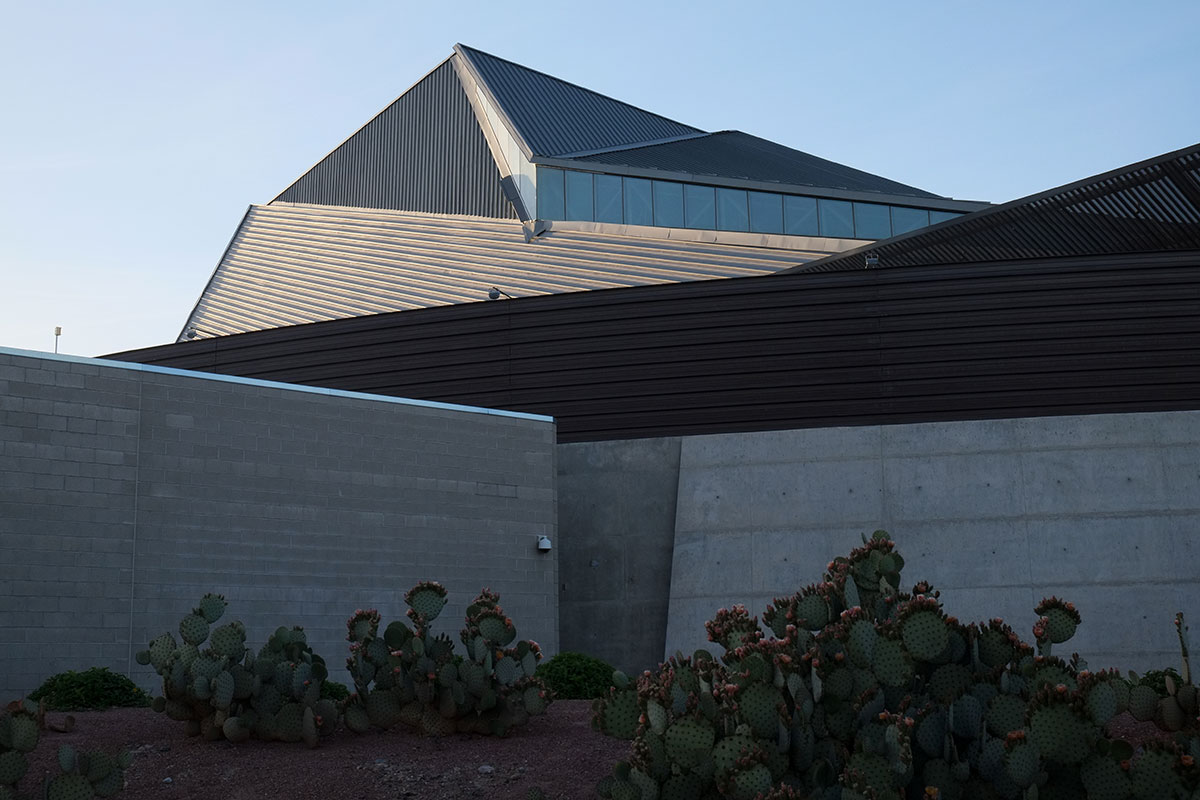
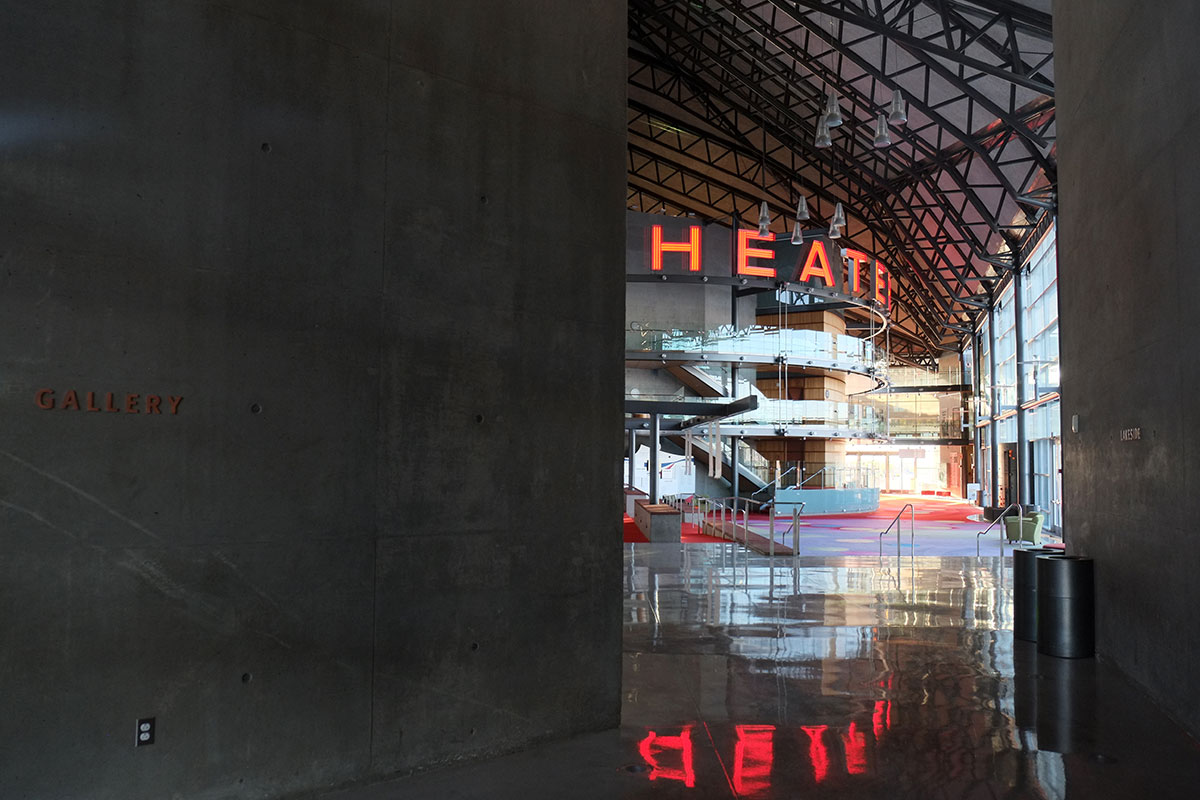
We also visited the Tempe Center for the Arts along the river, designed by Barton Myers, clearly referring to the history of FLW and his followers being active in this area.  It is a very nice building, with simple planes of solid panels and selective use of glazing to open the lobby up to the river on the north.  80. Phoenix072DSCF6783

80. Phoenix071DSCF6776

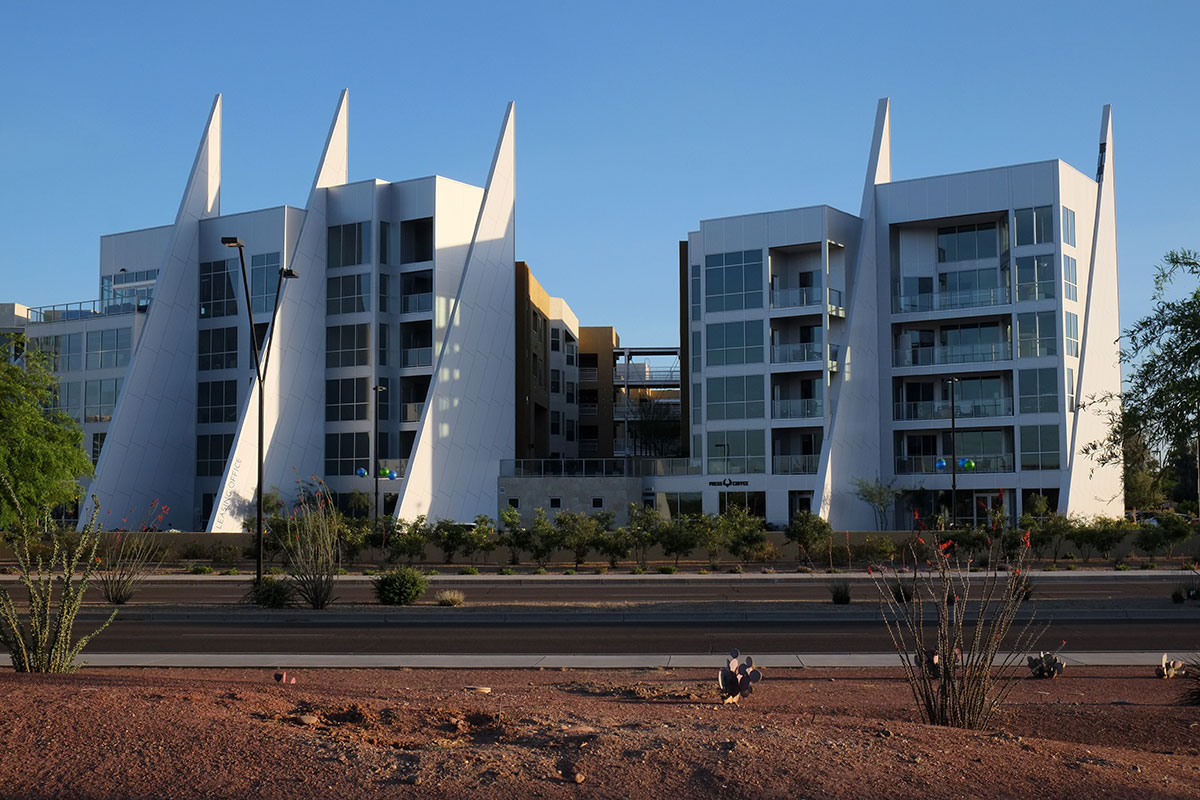
Across the street there was a hip new housing development. I’ve never seen apartment buildings before with tail fins.  80. Phoenix073DSCF6784

The fundamental question about Phoenix (and other late 20th century cities) is whether their character has been inexorably formed by the new way they came into being – sprawl before core – or whether their current character is mainly the result of their being so new.  Will they become more like older cities as they age, or is there something permanently different about them?  We may never see the answer to this in Phoenix.  With NASA’S prediction of a mega-drought occurring in the Southwest in this century, it seems likely that Phoenix will become uninhabitable before it has the opportunity to evolve.  Our trip theme of climate-change-farewell-tour has usually focussed on what will be changing in the natural environment, but the changes that will be coming to cities have become more apparent as we have traveled through Miami, New Orleans and Phoenix.

Tucson

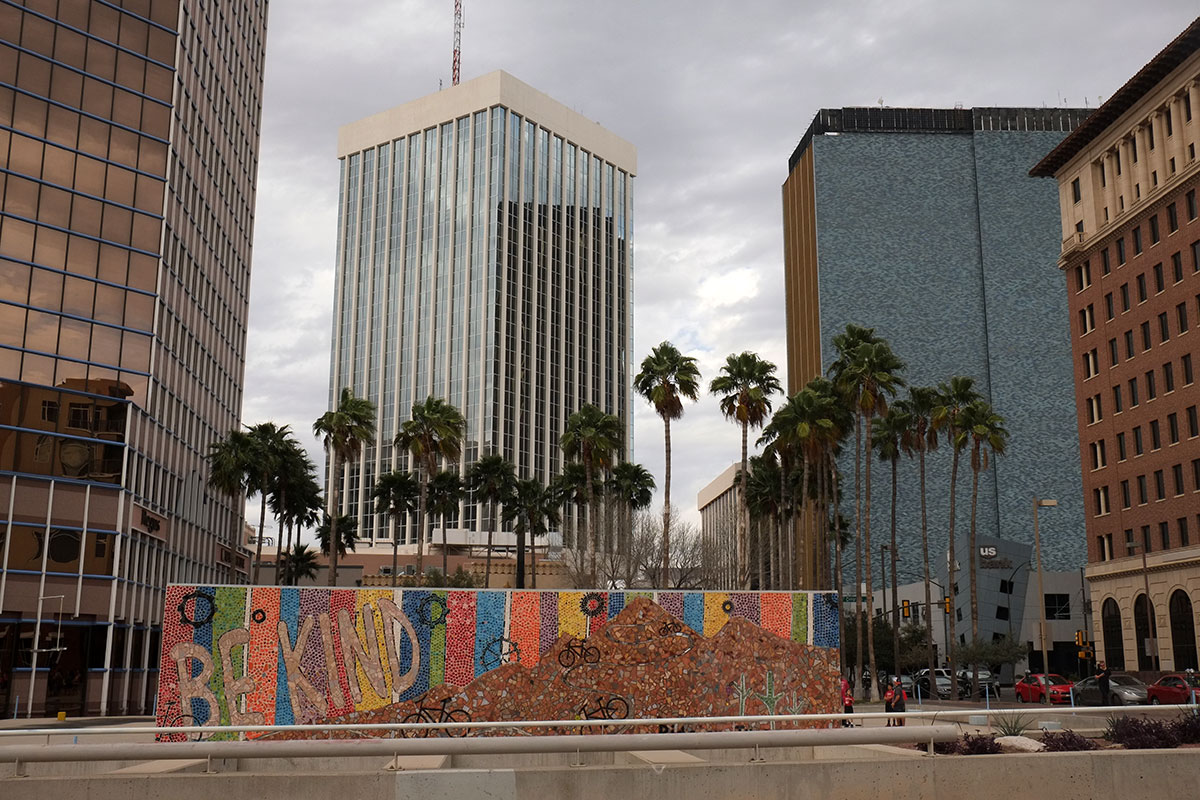
DSCF6506If you haven’t travelled extensively in an area, you still have many preconceptions about it, formed through what you’ve heard or read or seen on TV – some of which may actually turn out to be true.  Texas was where this became most apparent to me, as I had an abundance of received cultural knowledge and opinions about it, even though I had never before ventured out of DFW.  Although I had travelled through the Southwest a few times, I had never been south of Phoenix, so my opinion of Tucson was similarly secondhand.  All I knew was the syllogism – Tucson:Phoenix as Austin:Houston.  Just as Austin is the place in Texas distinguished by being nothing like the rest of Texas, Tucson is the place in Arizona that symbolically stands in contrast to the horrors of Phoenix.

Tucson is one of those mid-sized American cities (metropolitan area population under one million) which is livable and pleasant due to its not being within the ambit of the flow of global capital, nor prosperous enough recently to have grown exponentially in the past 30 years, when the homogeneous American sprawlscape reached its true apotheosis, and when the banal behemoths of recent skyscrapers have overwhelmed older downtowns.

Tucson also is fortunate in its limiting geography:  just as Portland is hemmed in by the west hills and the rivers, Tucson has mountain ranges to the east and west, so the sprawl in those directions is finite.  Also luckily, large areas of both those mountain ranges have been set aside, both as part of Saguaro National Park, and as other state and local preserves.  We stayed in a county campground adjacent to Saguaro on the west side, one which was so quiet and dark that we could watch the stars and listen to the coyote packs at night;  this is within ten miles of the city.  Phoenix has the misfortune to be in a much larger valley, so the sprawl can go on unimpeded for fifty miles in each direction, while Tucson is about twelve miles wide.  Aerial photos confirm that Tucson hasn’t sprawled very much in the past 30 years, so its suburbs exhibit a blend of the old and the new that can also be seen in its downtown, and which may be the key factor in whether a district has any character or not.  (cf. jane Jacobs again.)

Both cities are college towns, and while the much larger Arizona State dominates the cityscape around Tempe, it feels like a more local phenomenon within Phoenix’s four-million metro area.  The University of Arizona is still large (about 32,000 students), and it seems to be more central to the character of the whole city, as it is less than a mile from the downtown.

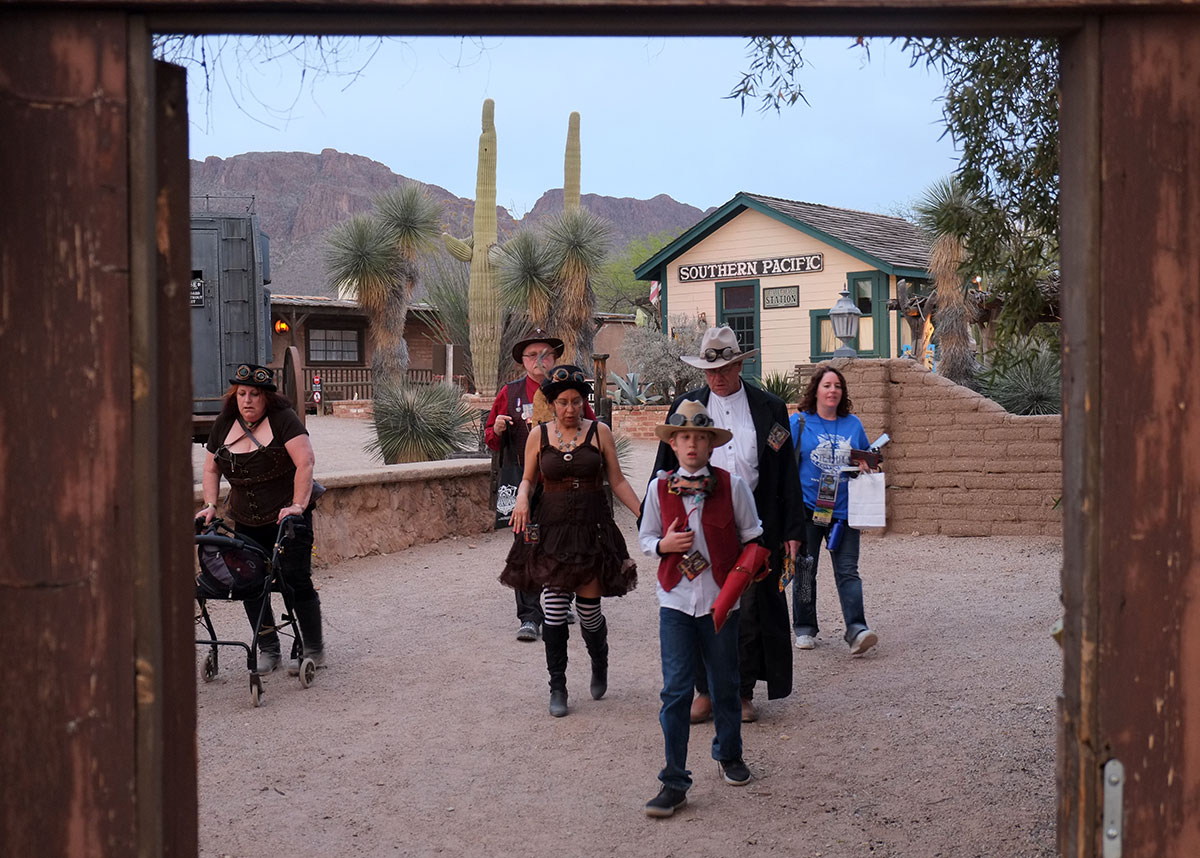
We cruised through the suburbs on our way to and from the mountains, and swung by something called Old Tucson, which started out as a movie set back in the 30s, but which is now a western theme park.  We arrived at the end of the day, just as the Wild, Wild West Steampunk convention crowd was leaving.  It was a little scary, and seems to have knocked Greta out of her steampunk fascination, as she has seen the future and it’s not a pretty sight.  DSCF6437

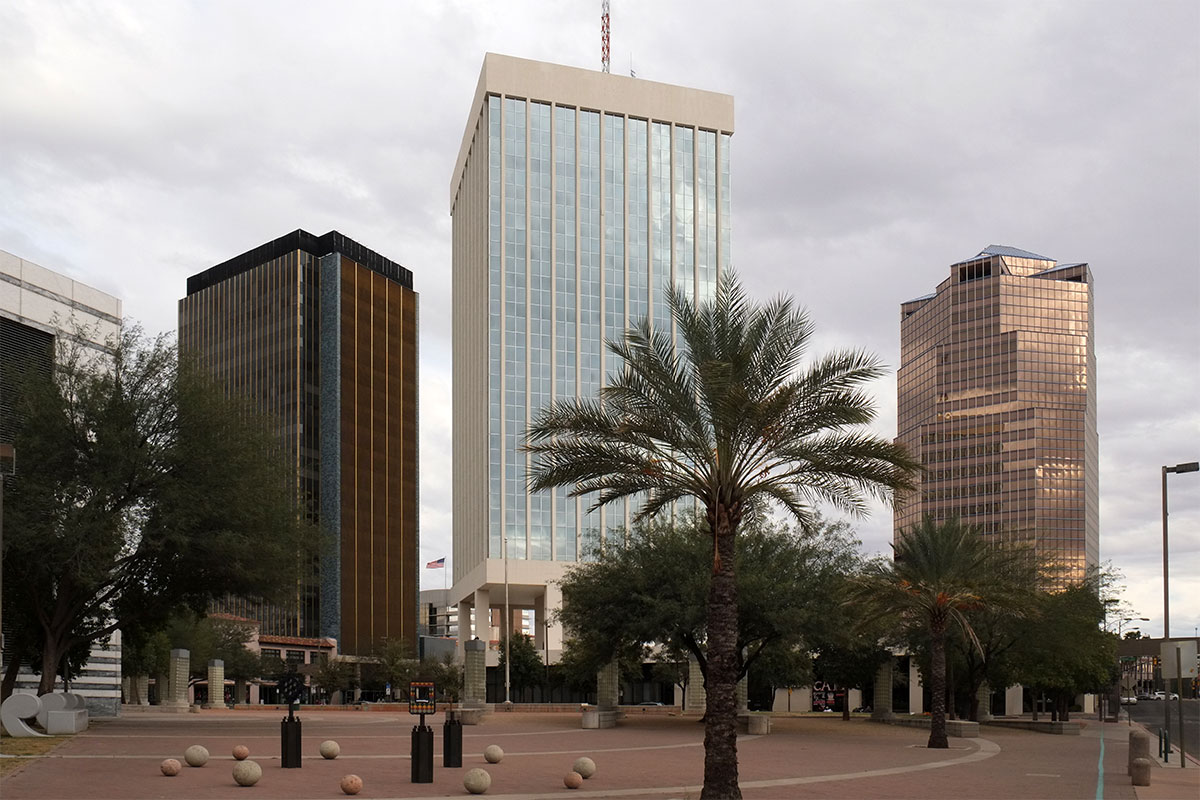
We spent more time in the city core.  The downtown has a lot of buildings from the 60s and 70s, DSCF6470

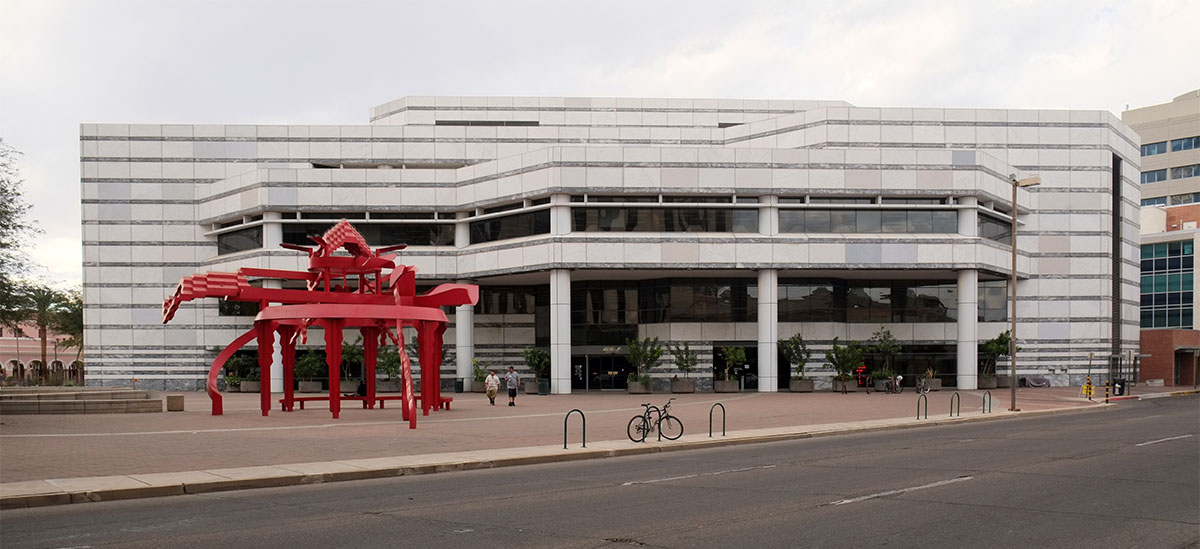
which are not gorgeous, but at least they’re not too big.  There are also some not-great institutions, such as the library DSCF6464

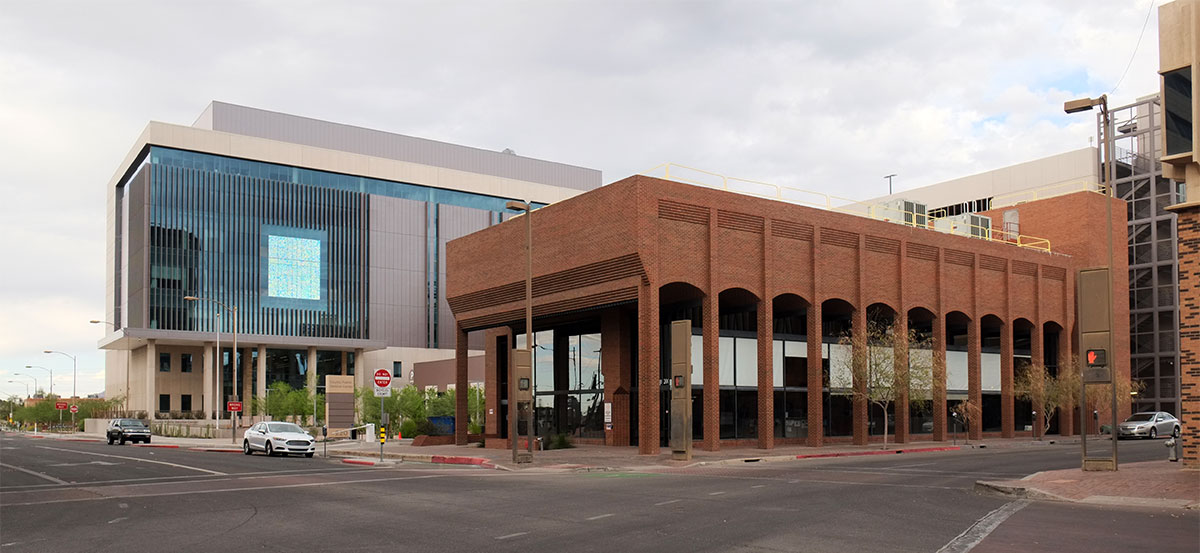
and some newer buildings which aren’t much better.  DSCF6466

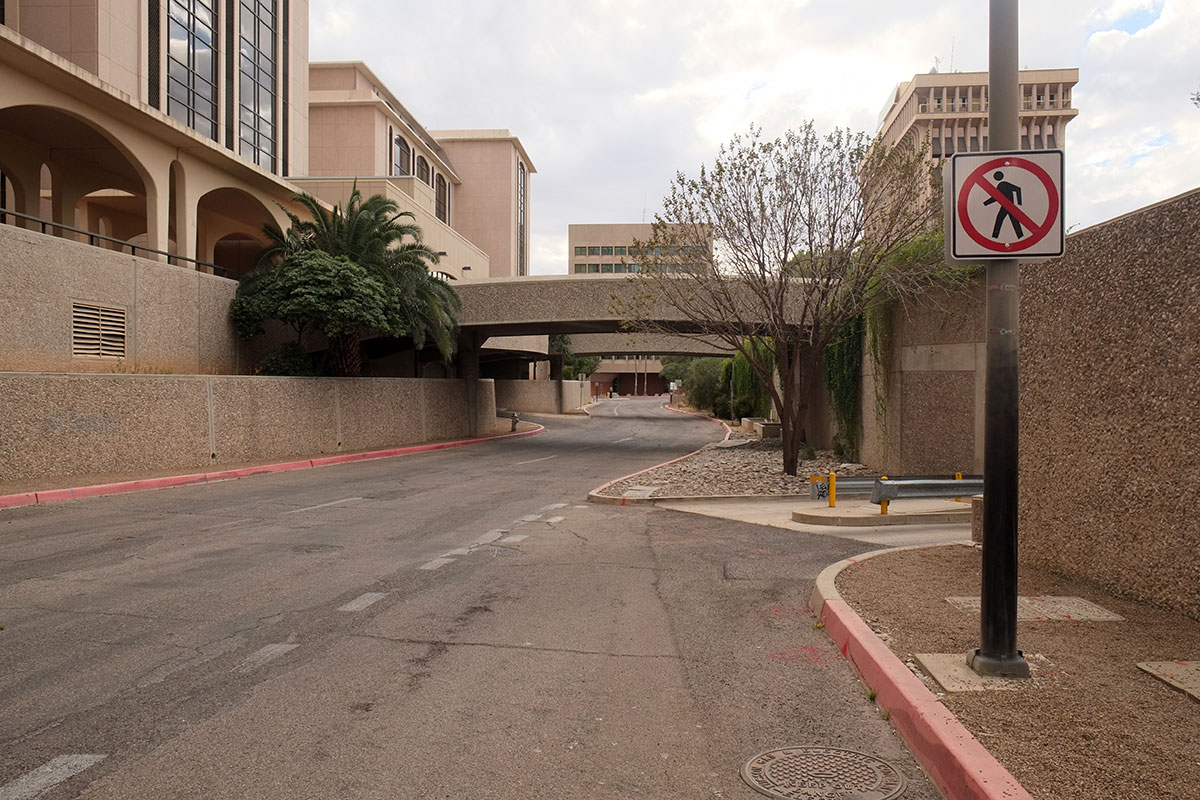
The Tucson downtown can’t seem to make up its mind – is it a city downtown, where fabric buildings define the public spaces of the streets and squares, or is it an edge city office park, where object buildings sit isolated in a sea of parking and undefined open space?  The open spaces are just too big, the developable lots are too big, and while the object buildings cry out for attention, they’re really not very good.  Tucson committed only one ghastly error, creating a superblock around their county government campus, where a subterranean parking level may hide a lot of cars, but which disrupts the street pattern and channelizes traffic onto a few big arterials.  The no pedestrian sign is the tip-off of the portal to this netherworld.DSCF6474

I don’t know the history, but it looks like they urban-renewed (bulldozed) their old downtown (or an adjoining neighborhood, probably “blighted”) during the 60s, and replaced it with these towers (versus Eugene which bulldozed its downtown and forgot to build anything new).  And then probably having overbuilt their office market, things ground to a halt.  It’s not great, but it’s fixable. DSCF6460

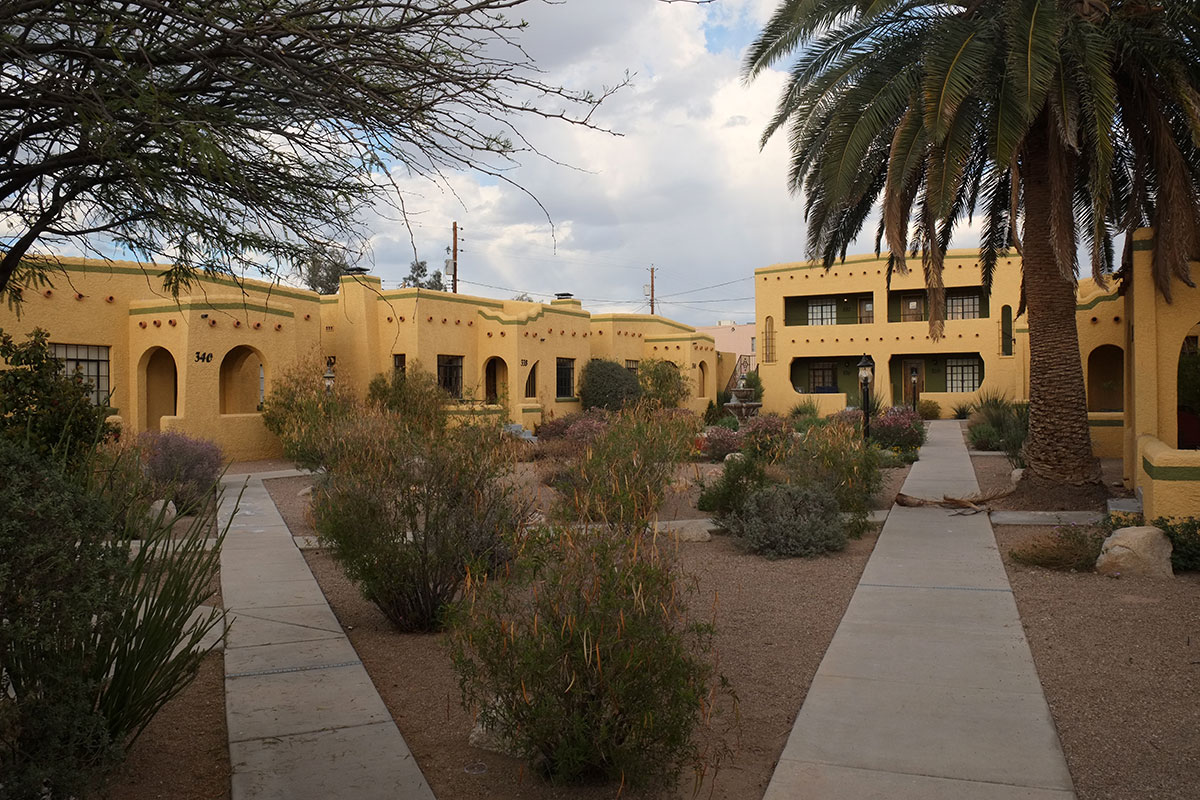
The good news is that the adjacent neighborhoods – Barrio Viejo, Armory Park and Iron Horse – were largely left alone.  Today they are the usual mix of gentrifying bungalows, small multi-family projects, light industrial and new commercial that can be seen in many other older city first-ring cores.  There was a reasonable amount of street life in all these areas, even on a Sunday.  The damage was limited to the one core area, and even that is better than many we’ve seen.

The university area, which is surrounded by low-scale residential neighborhoods, felt familiar.  A nice mix of small-scale, old multi-family: DSCF6479

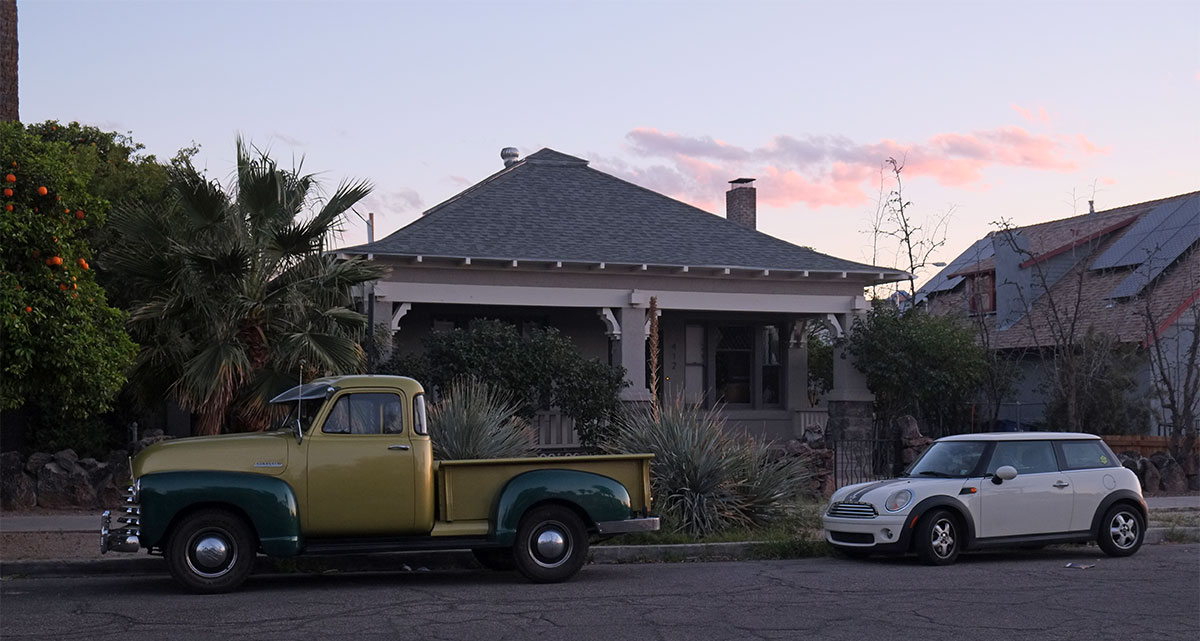
and upscaling bungalows (the Mini being the universal sign of this), although they are getting some large, privately-developed student housing, just as in Eugene.  DSCF6554

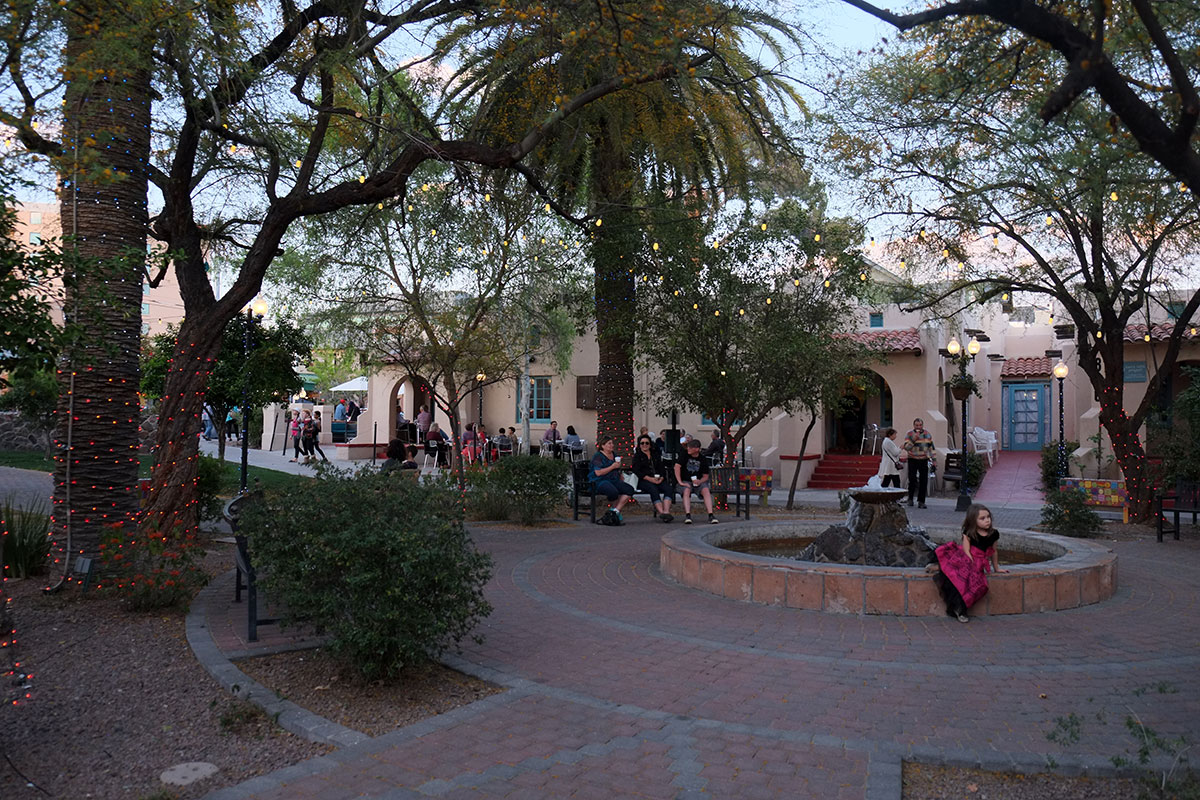
The college-town commercial area is very lively, with many open-air cafes, such as in  this lovely courtyard development.  DSCF6547

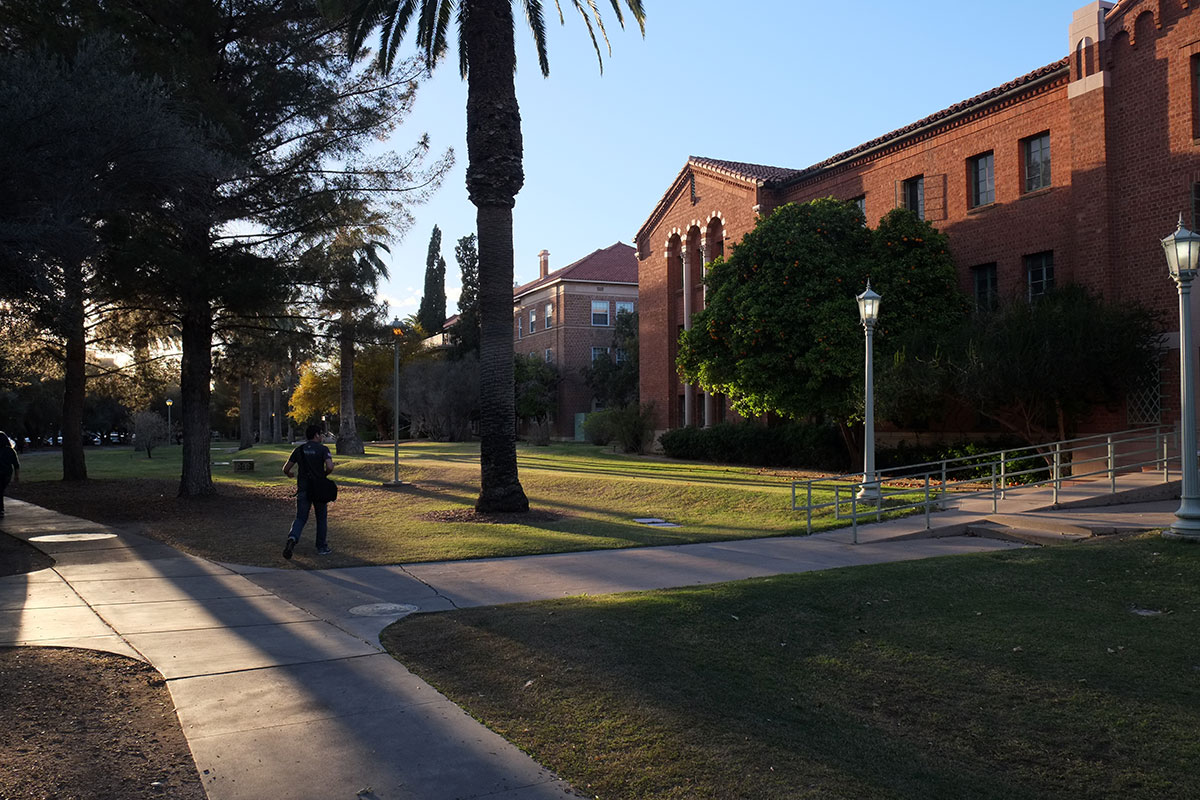
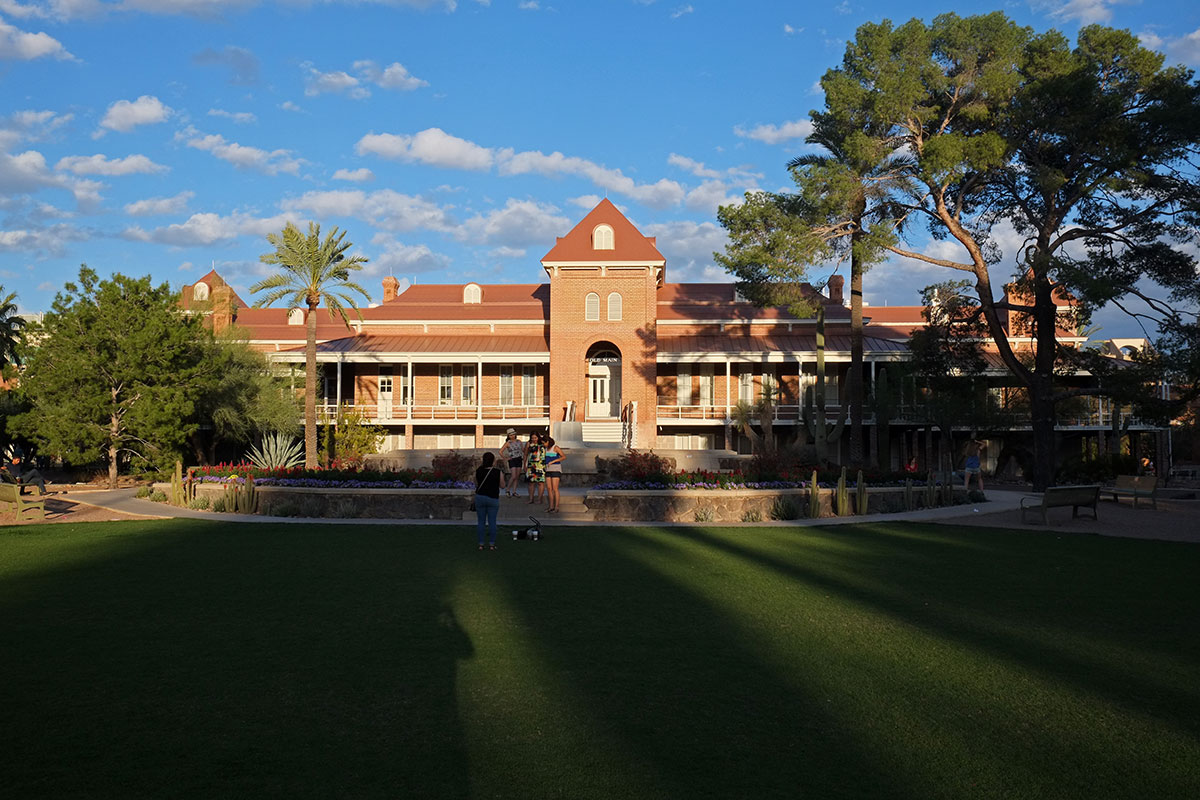
The campus itself is beautiful.  It is similar to the University of Oregon, being within a city but with a distinct campus edge, rather than blending into the city fabric.  Also similarly, the campus has a well-landscaped core, with elegant old buildings, all variants on a brick/southwest style, set in manicured lawns.  DSCF6516

DSCF6513

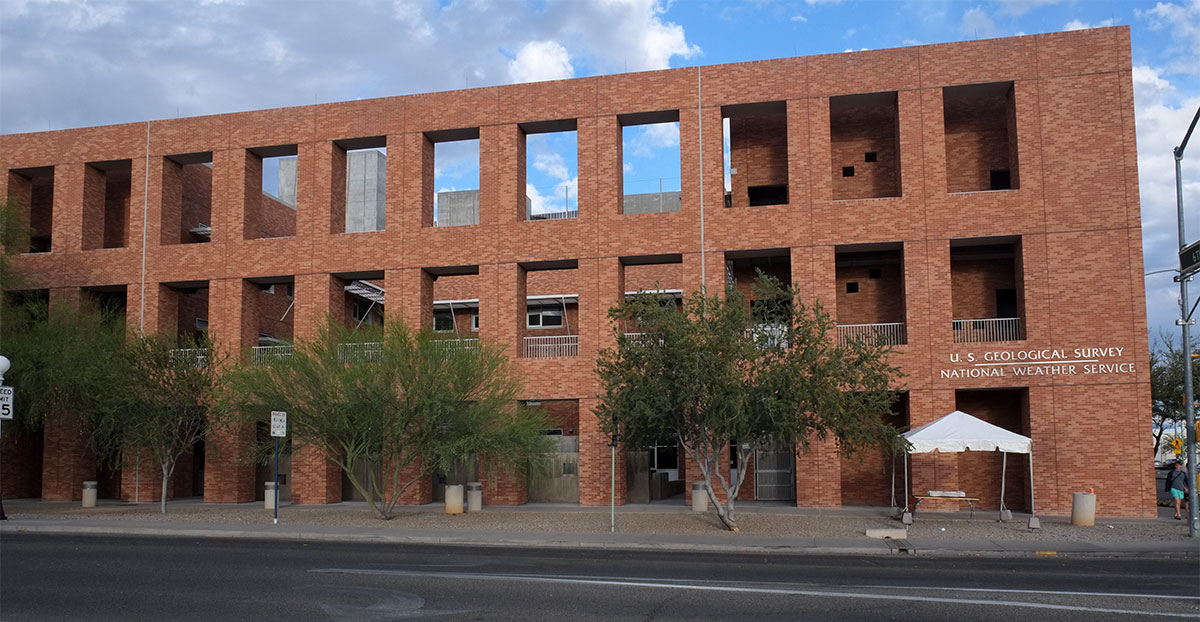
But the recent development is the most interesting.  They have done a fantastic job of fitting relatively large, new buildings into the existing framework, not overwhelming the scale of the campus, nor adhering slavishly to stylistic prescriptions (both of which happened at the University of Texas).  The buildings themselves are also good to excellent, and are notable for the uniformity with which they have addressed environmental issues (primarily sun-shading) in this desert environment.  An older US government building on the edge of the campus has a screen wall which defines a courtyard:DSCF6485

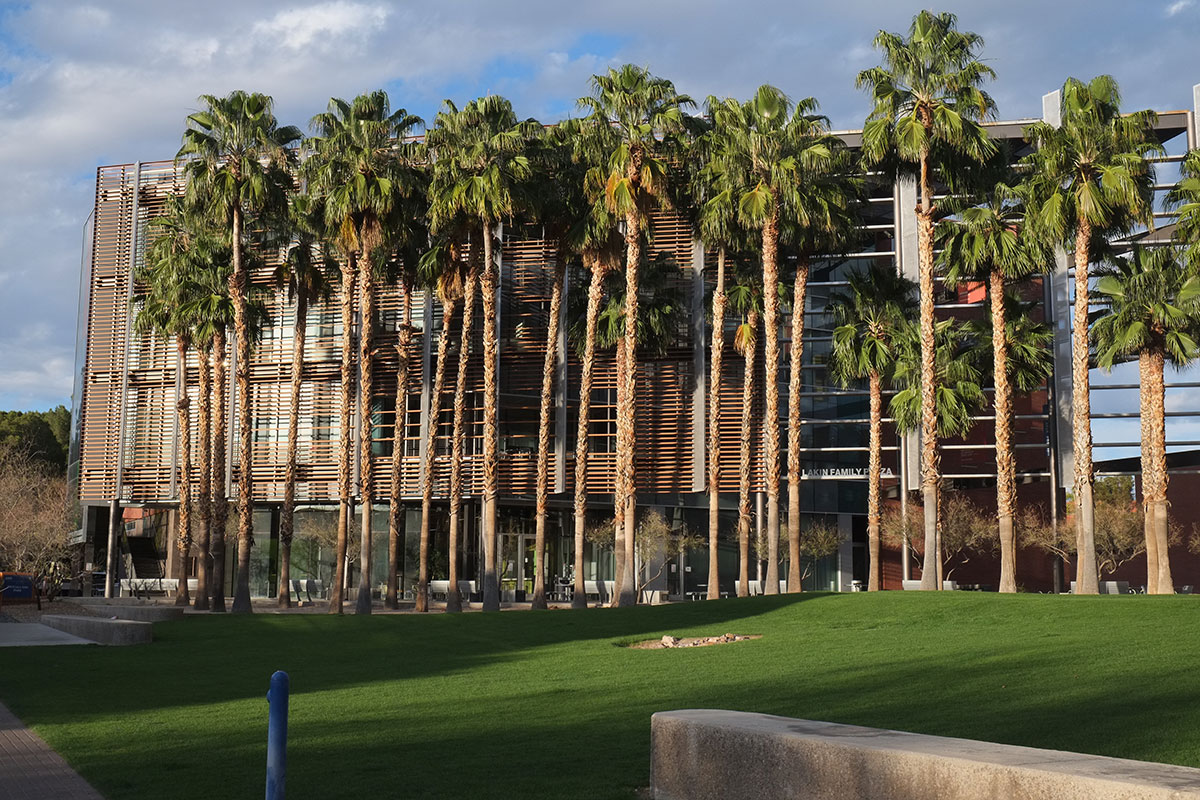
A new building at the business school has a south-facing facade which utilizes both palm trees and a sophisticated brise-soleil for shading.  DSCF6503

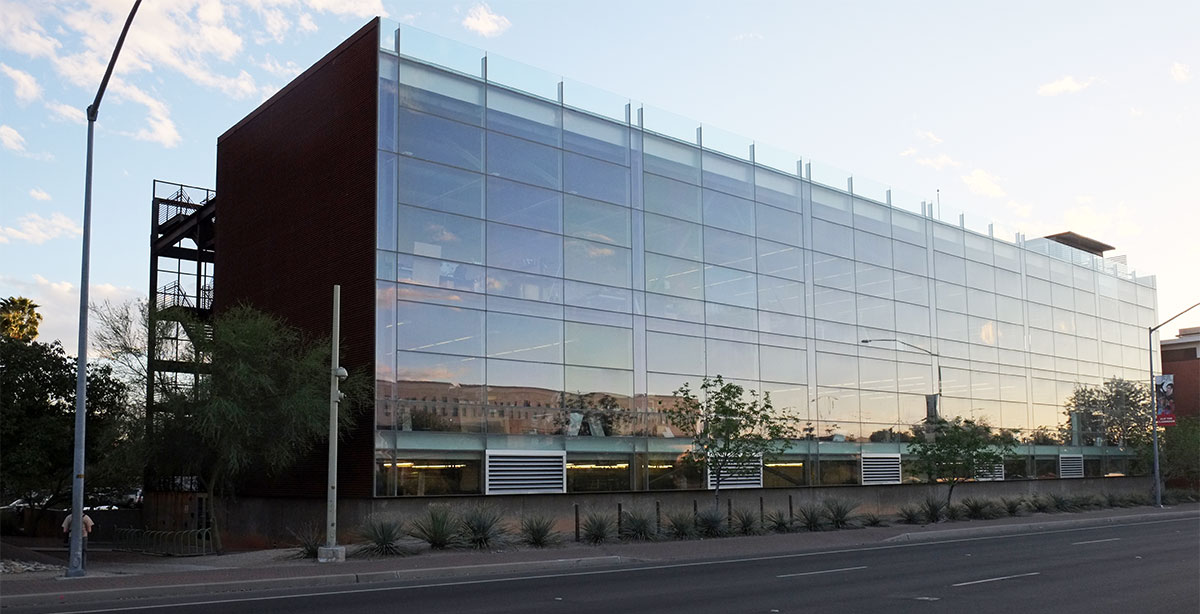
Even spotted from a long way across campus, my instincts told me that this was the architecture school.  It is in fact a large addition to design college (CAPLA), designed almost ten years ago by Jones Studio, in Tempe.  The environmentally-responsive diagram is completely straightforward:  a long east-west bar, with extensive and deep shading on the south side.  DSCF6520

There are architectural shading elements, as well as a framework for plants, and a garden area where a native landscape is nurtured and used for installations. DSCF6528  DSCF6524

The east and west walls are mostly blank, with circulation DSCF6531

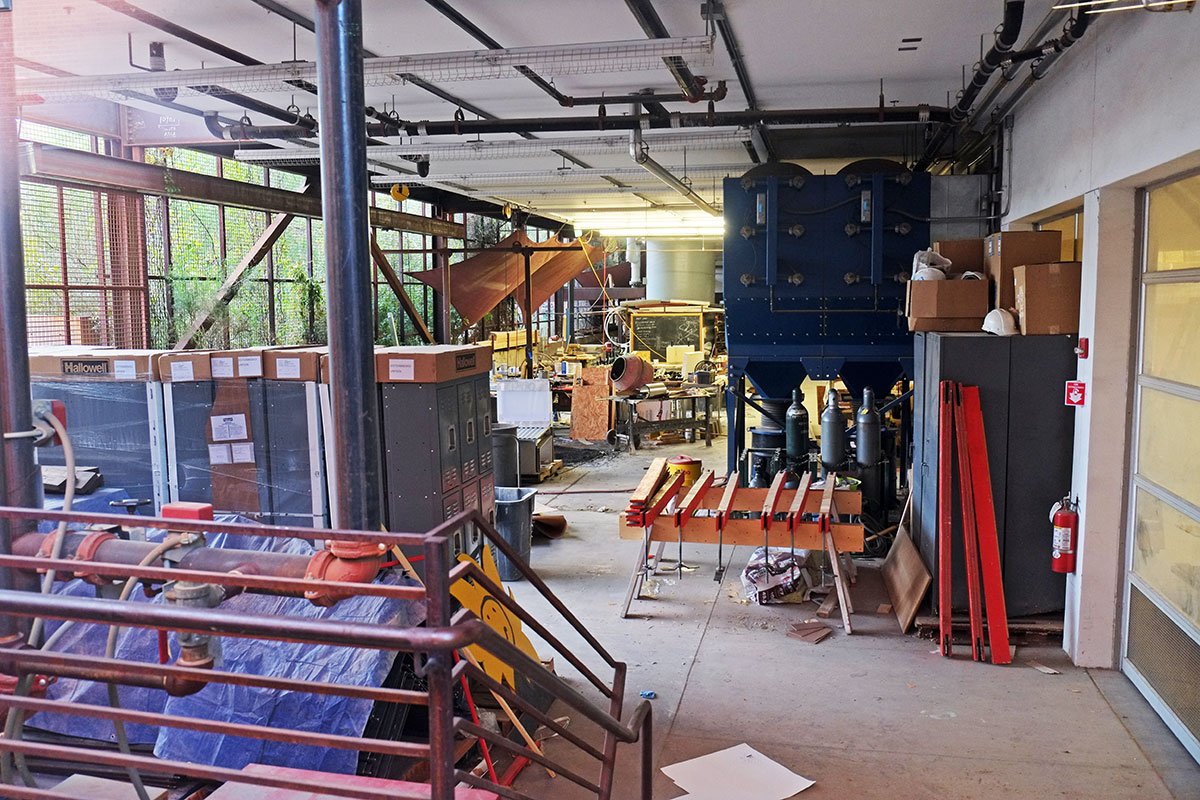
and access into an openable shop on the ground floor.  DSCF6533

The north side, which faces a major arterial, is glazed for daylighting the studios.  DSCF6535

An excellent building, which takes it cues from the strong determinative forces of climate and program, and which articulates those in a systems-driven building with elegant detailing.  It is a truism that in most places, the new architecture building is usually the worst building on campus – architects seem to feel the need to make a design  “statement” when given such a visible project.  It was a pleasure to see Jones Studio take an opposite tack, and do all the sensible moves really well, illustrating what an architecture driven by substantive ideas rather than style can be like.

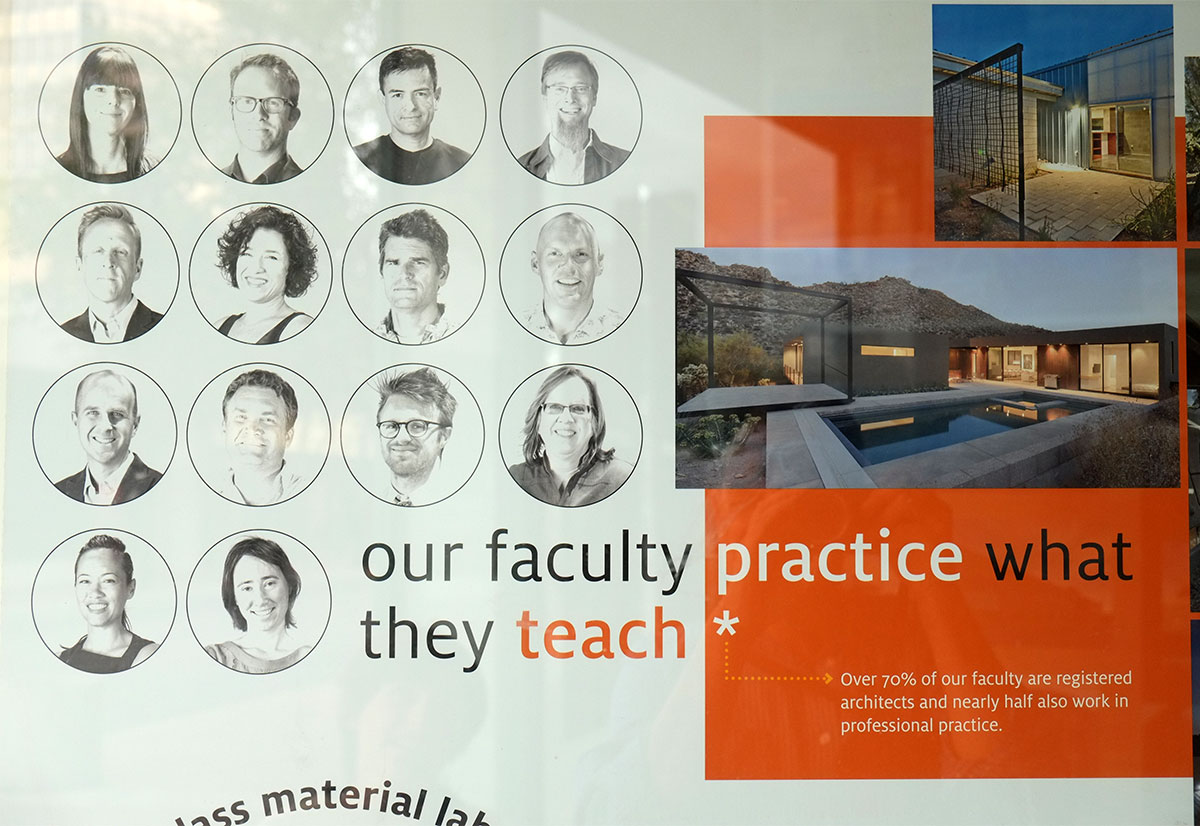
I don’t know much about the architecture department at the university, but outside the university’s downtown center, I spotted this amazing sign:  DSCF6462

They seem to think that it is a good idea for their faculty to be involved in the design of architecture;  in fact, they celebrate it!  This is probably good for their accreditation, and even good for their students’ education, but I don’t know how they can maintain this attitude within the confines of a big research university, where the preference for the written article over the designed building has become almost universal.  (If it hadn’t been a Sunday I might have dropped in to explore job opportunities, as they appear to be deficient in the proportion of cranky old guys on their faculty.)

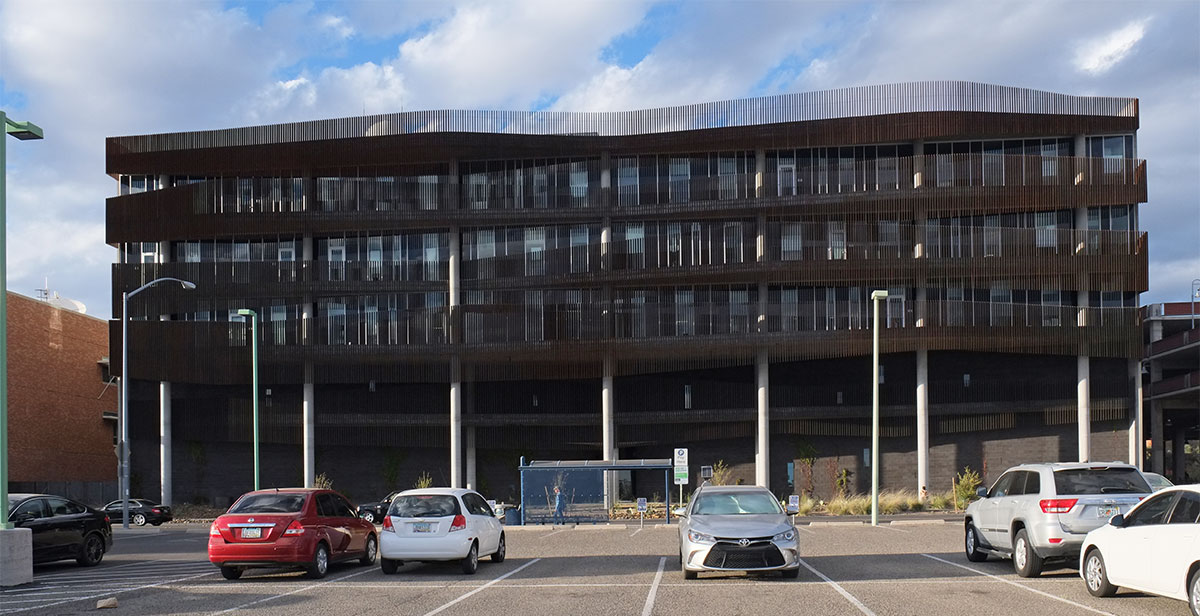
There is an even newer, bigger showcase building on the south edge of campus – the Engineering and Natural Resources Building 2, designed by Richärd+Bauer and GLHN, both from Phoenix.  It opened last year, and has been lauded for its sustainability performance and its support for interdisciplinary efforts.  The south elevation has a functional yet expressive shading system,DSCF6491

with an occupiable colonnade tucked under the building edge, offering respite from the busy arterial.  DSCF6483

The north facade has a thinner variant on the shading system.  DSCF6499

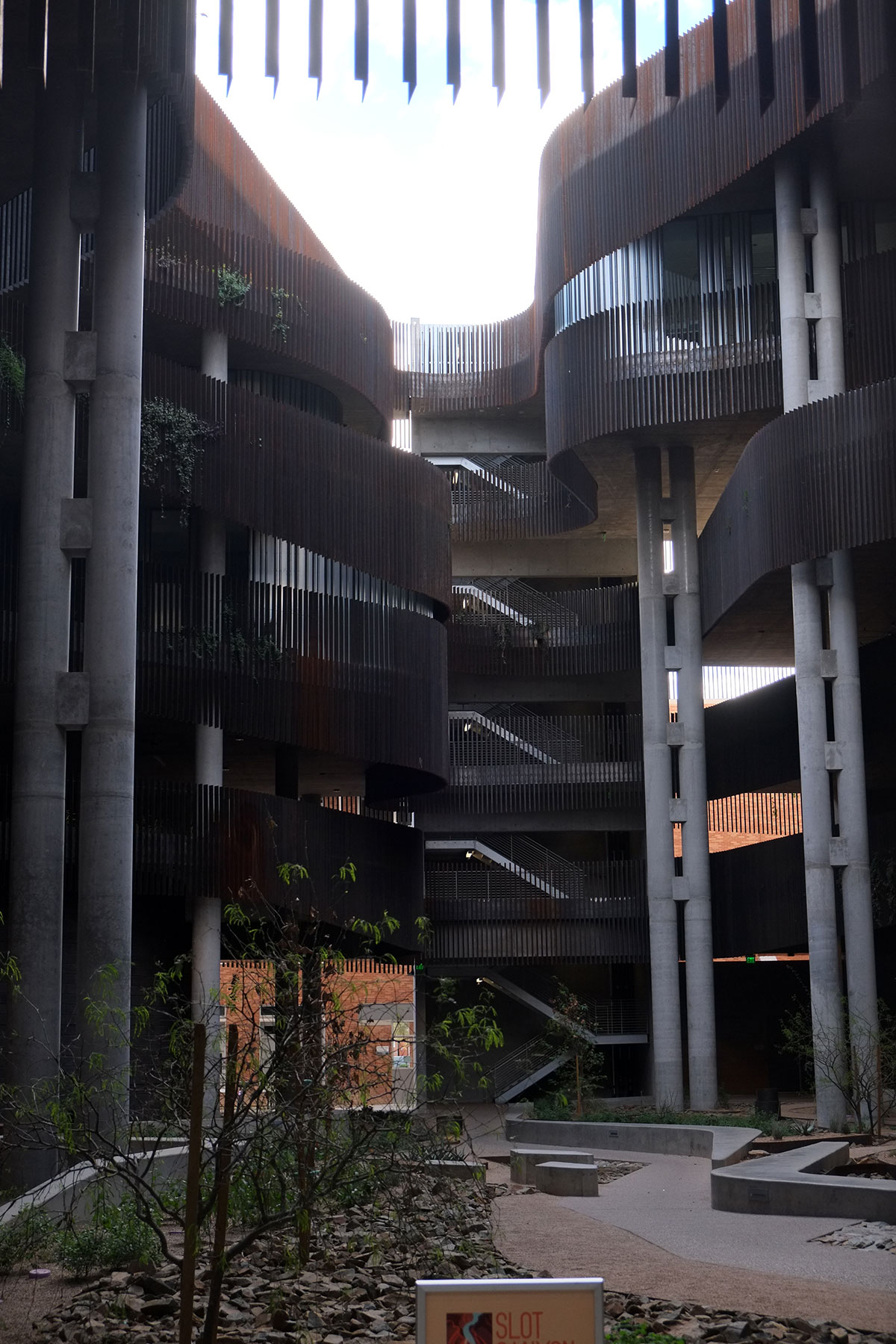
The middle of the building is a deep courtyard, which supports daylighting and ventilation strategies, and which works metaphorically as a slot canyon.  DSCF6495

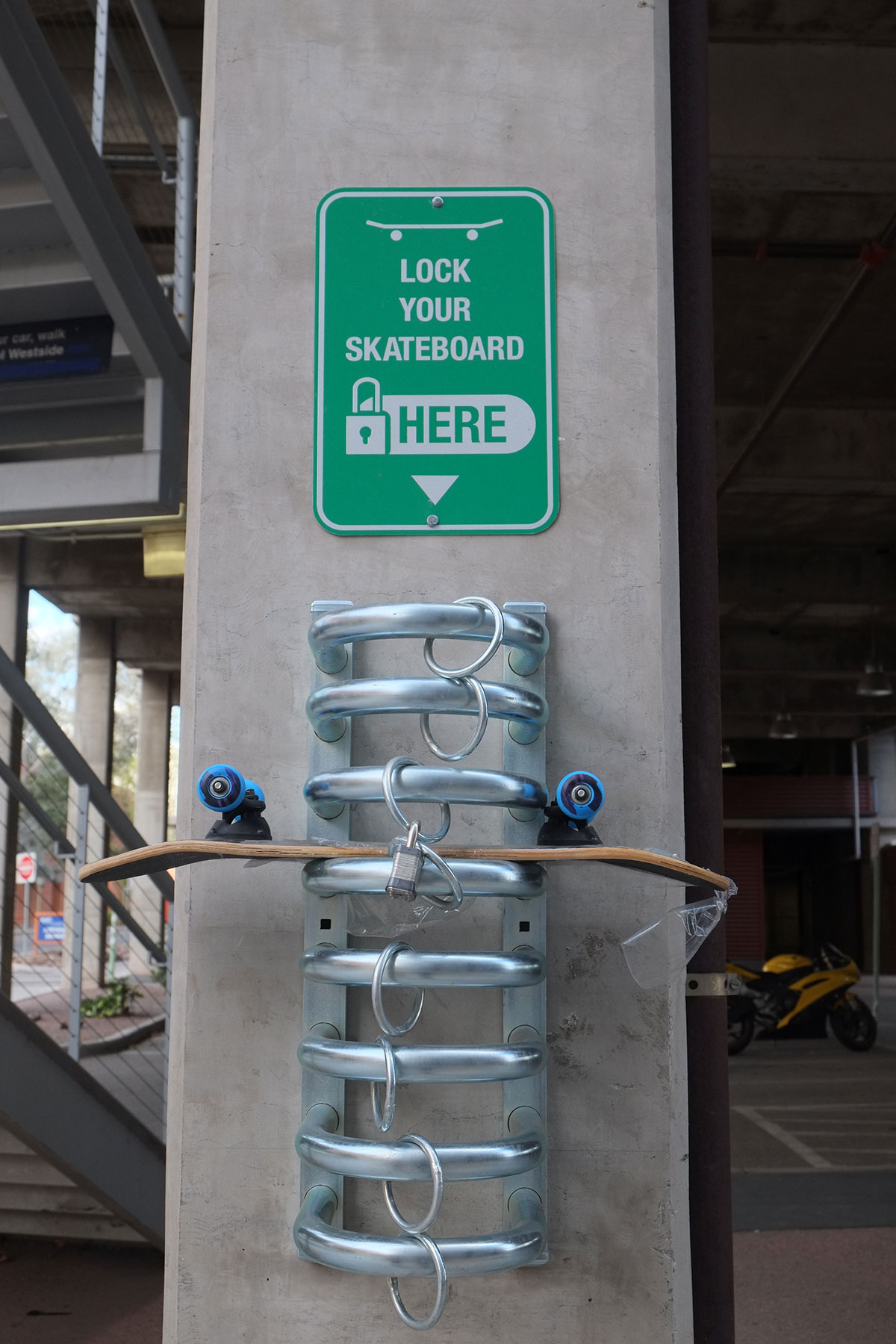
Another building where the ideas of building performance drive the architectural expression;  something is clearly going on in the university culture, if they are producing so many fine buildings.  We saw one more element, which simultaneously puts the University of Arizona at the forefront of sustainability, livability and hipness:DSCF6496

There are lessons we could learn from this university, and lessons both positive and negative at the city scale.  I had my limited preconceptions about Tucson before we visited, but the reality turned out to be even more interesting.

Marfa, Texas

DSCF6004Marfa is a small West Texas town where the level of irony, postmodernism, contextual intervention, self-consciousness, and appropriation is so high that you can’t tell if it’s a real town, or the largest conceptual art installation in the world.  It was probably a straightforward, small town on the main railroad line until Donald Judd put it on the art map.  Now it has hip art-tourists coming through to see the work at the Chinati Foundation, and a permanent population of arty types, together forming a mini-Santa Fe for West Texas.  These people require services not typical for small western towns, and it was there that we found the first clues to what was really going on.

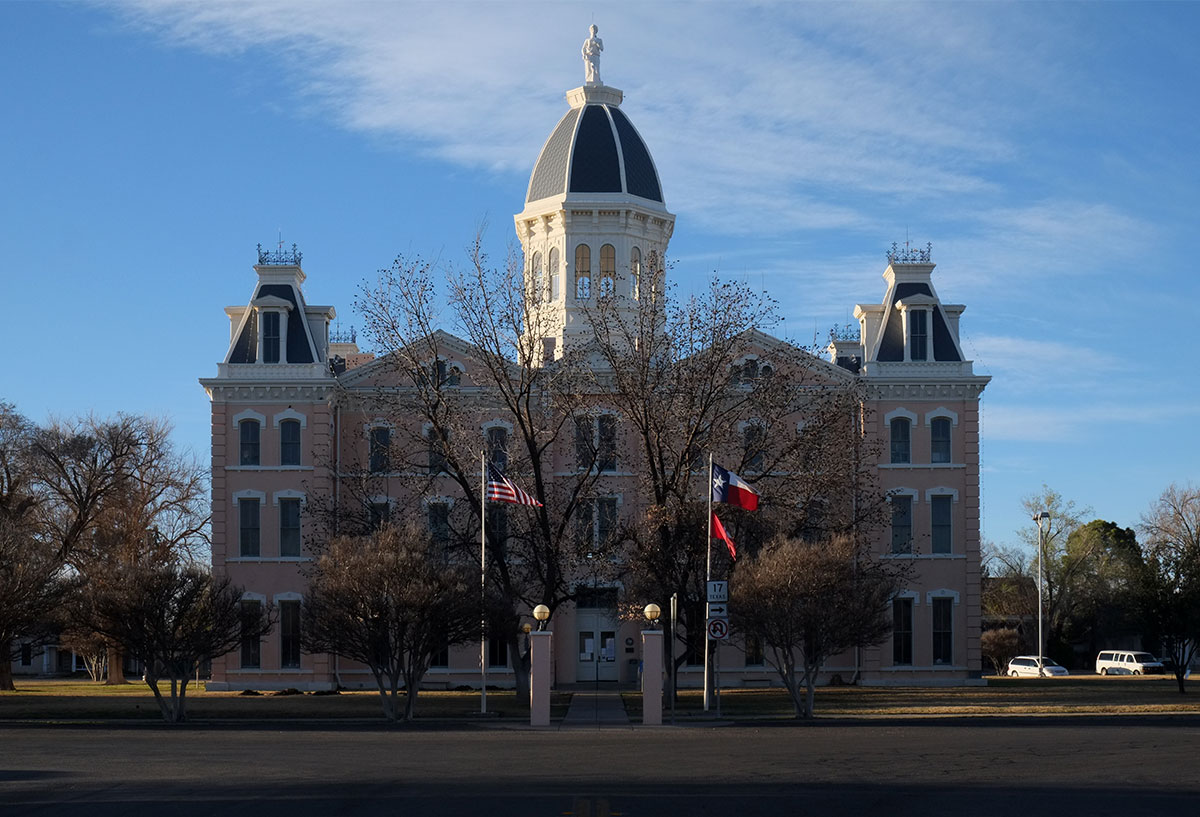
The original town is great – maybe this is why Donald Judd ended up here    The county courthouse is grander than some state capitols (such as Oregon’s), and occupies a full-block site in the middle of the north-south axis.   Many years ago JB Jackson wrote about western courthouses as the center of small-city civic life, but this trip was my first exposure to the classic ones.   (Other notable ones we’ve seen in Texas are in Lockhart and Ft. Davis).  DSCF6086

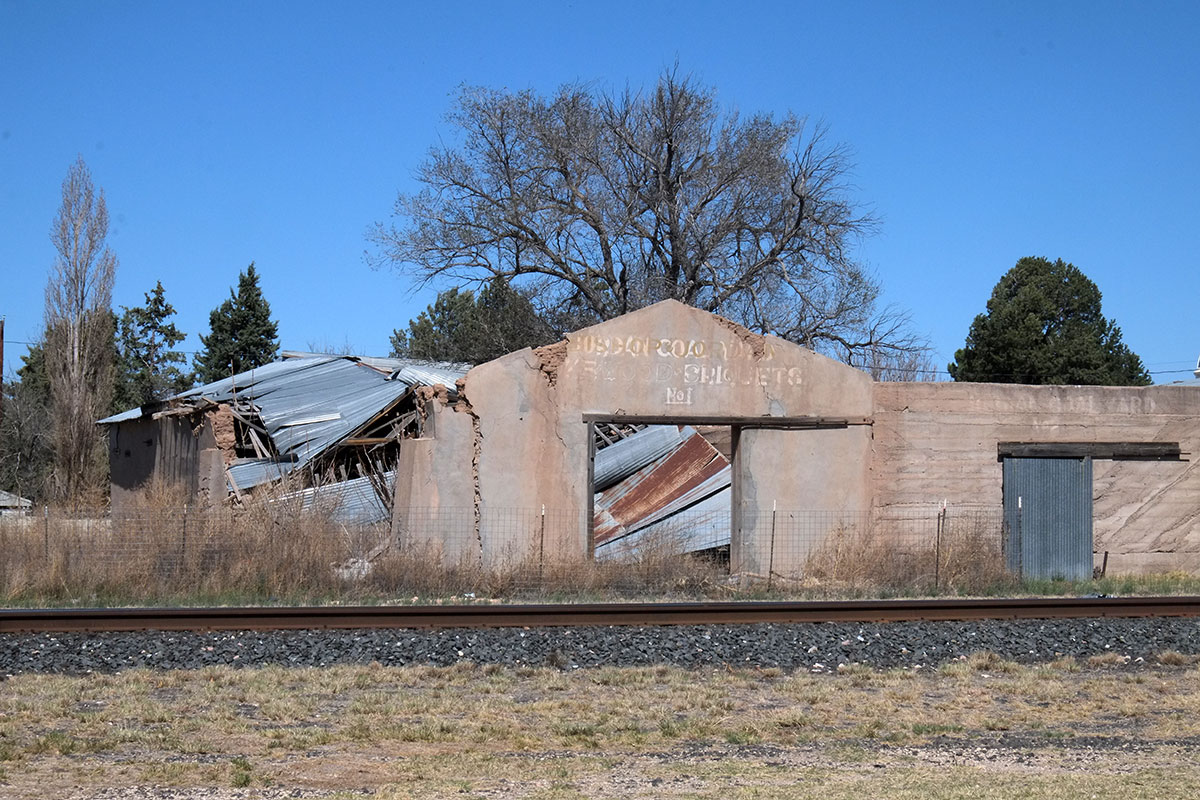
Marfa began as a watering station on the railroad, and as it grew, many buildings were built right on the line.  DSCF6040

DSCF6031

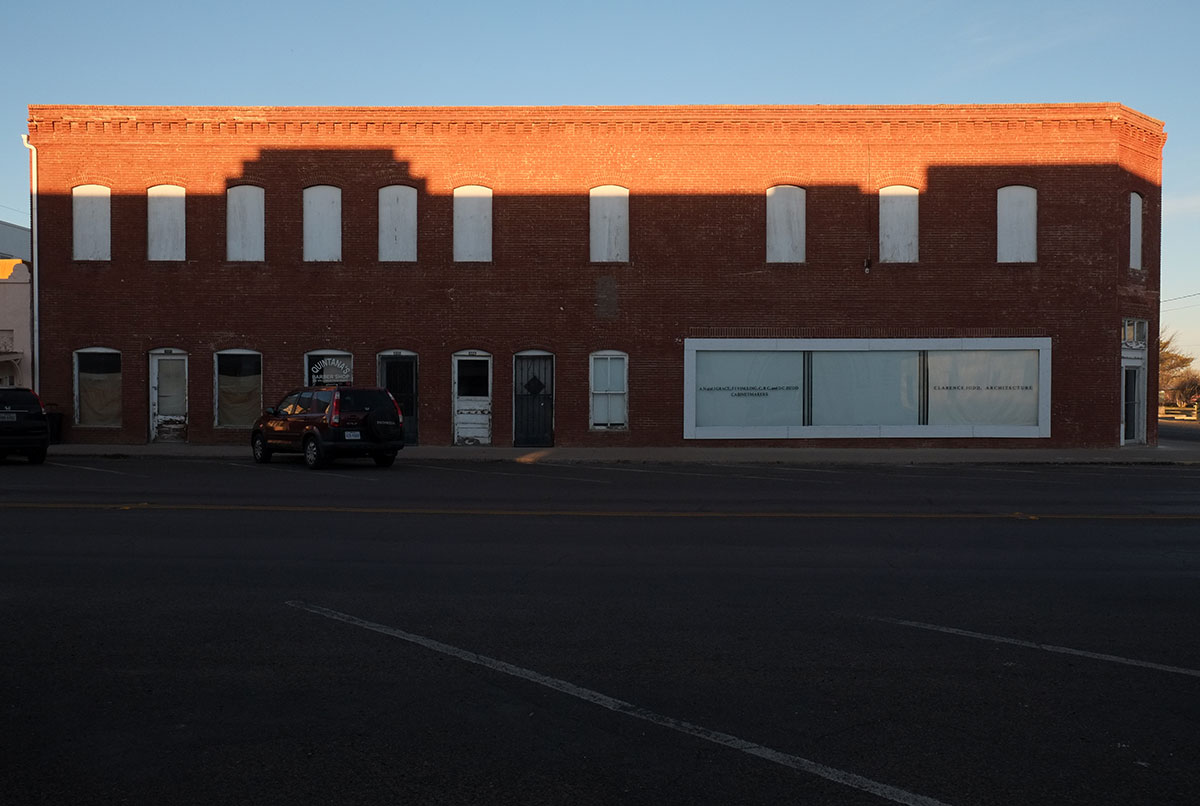
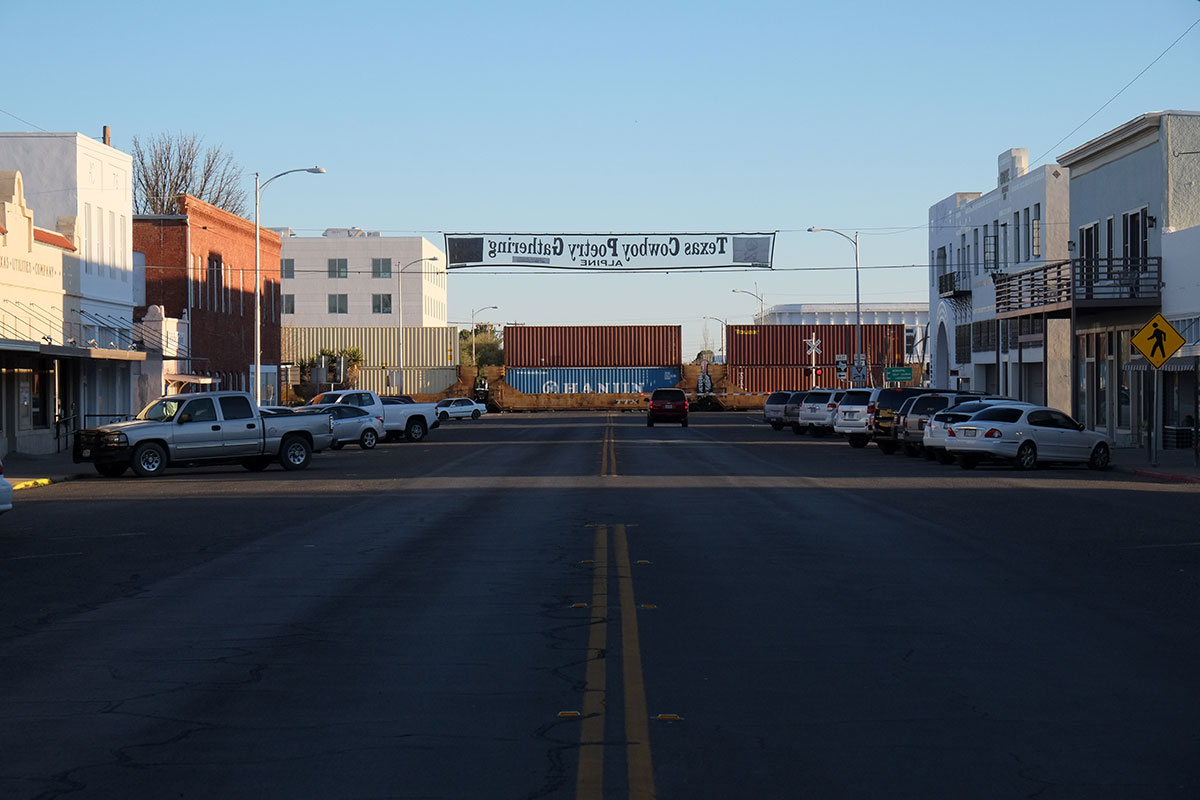
The main commercial street runs south from the courthouse to intersect the RR and US 90, the main highway to San Antonio (400 miles away).  It has classic early-20th century commercial buildings, and remarkably few later additionsDSCF6085

DSCF6108

At the Judd Foundation compound, our excellent guide had pointed to one sculpture – identical metal boxes aligned vertically, with the exact same amount of space between them.  He mentioned that this was the iconic Judd piece, variations of which are seen in museums around the world.  I had wondered why that piece resonated so far, and where Judd had come up with the idea.  Then we left the compound and turned left on to the main street:DSCF6099

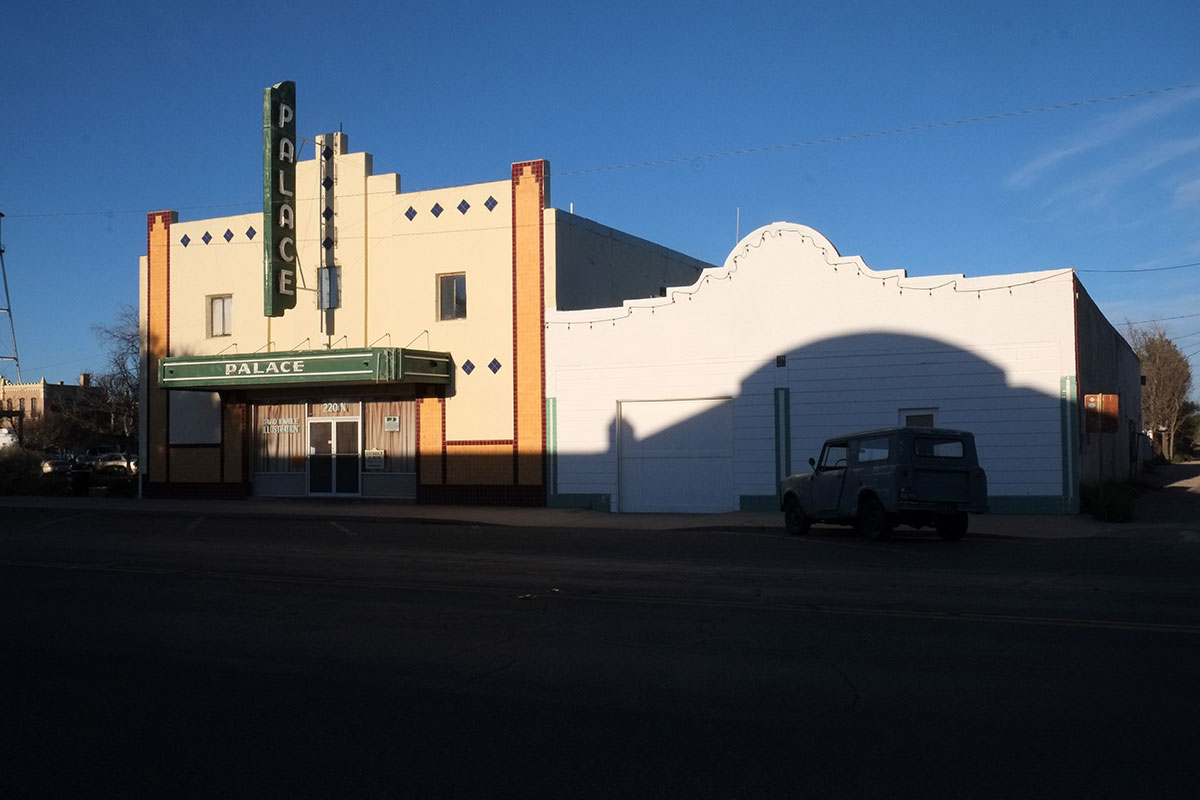
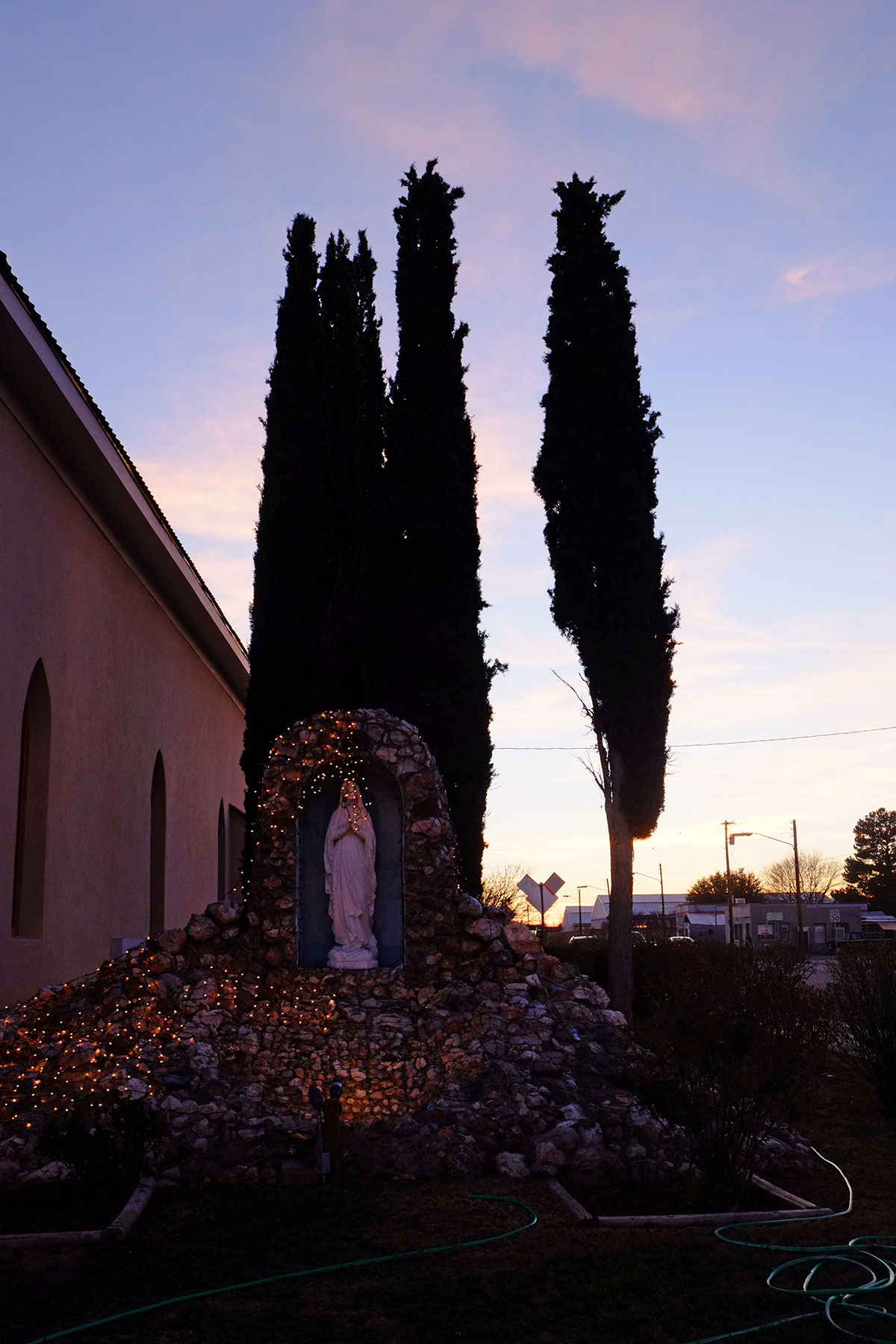
We began to notice what was missing in Marfa – mainly, the very recent roadside commercial stuff that seems to have squeezed out everything older everywhere else in the South.  There is a Dairy Queen in Marfa, but no other chains.  Perhaps two old gas stations.  No modern motel chains.  It felt like a time warp – we’ve been traveling along Route 66 in the Southwest often recently, and every town through which it passes makes a big deal out of the older, retro, roadside remains.  But in all of those towns, the hip retro stuff is wedged between the usual bad new stuff.  Marfa has been magically protected.  The intersection between the old and the quirky reigns, as in this LED-enhanced grotto at the Catholic church, right on Highway 90.DSCF6005

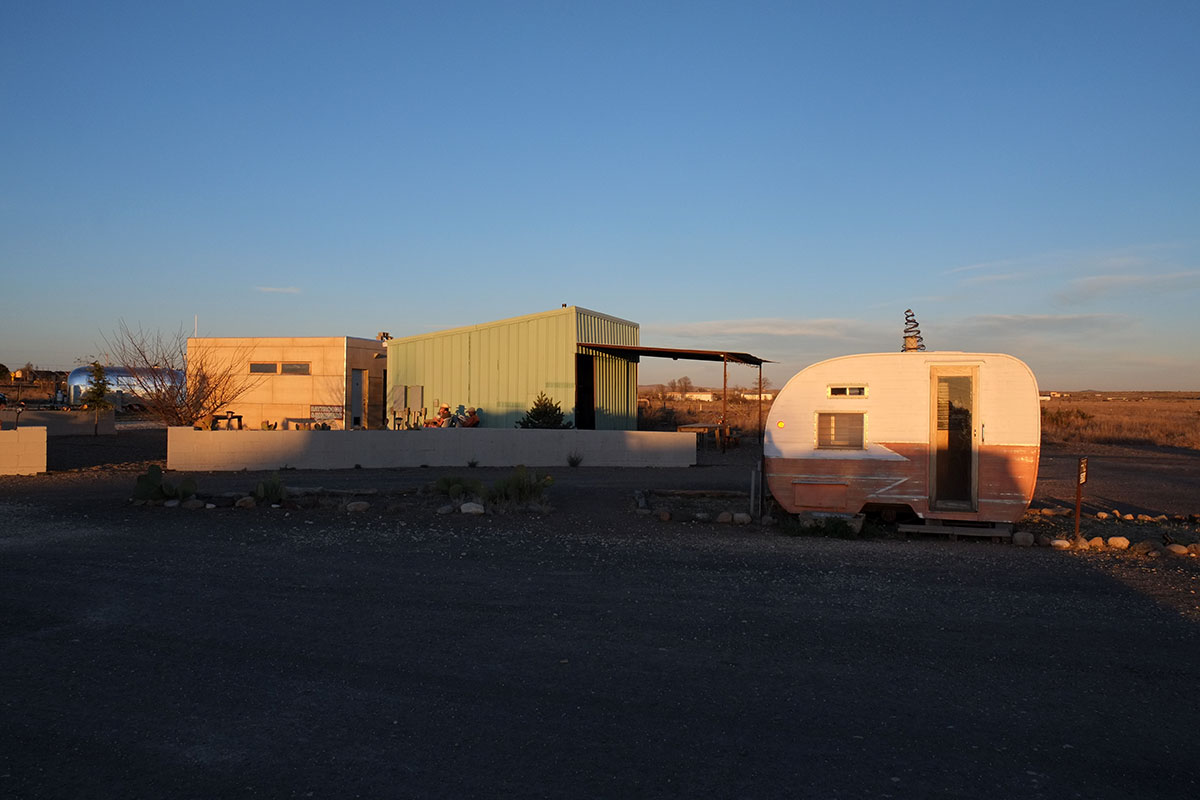
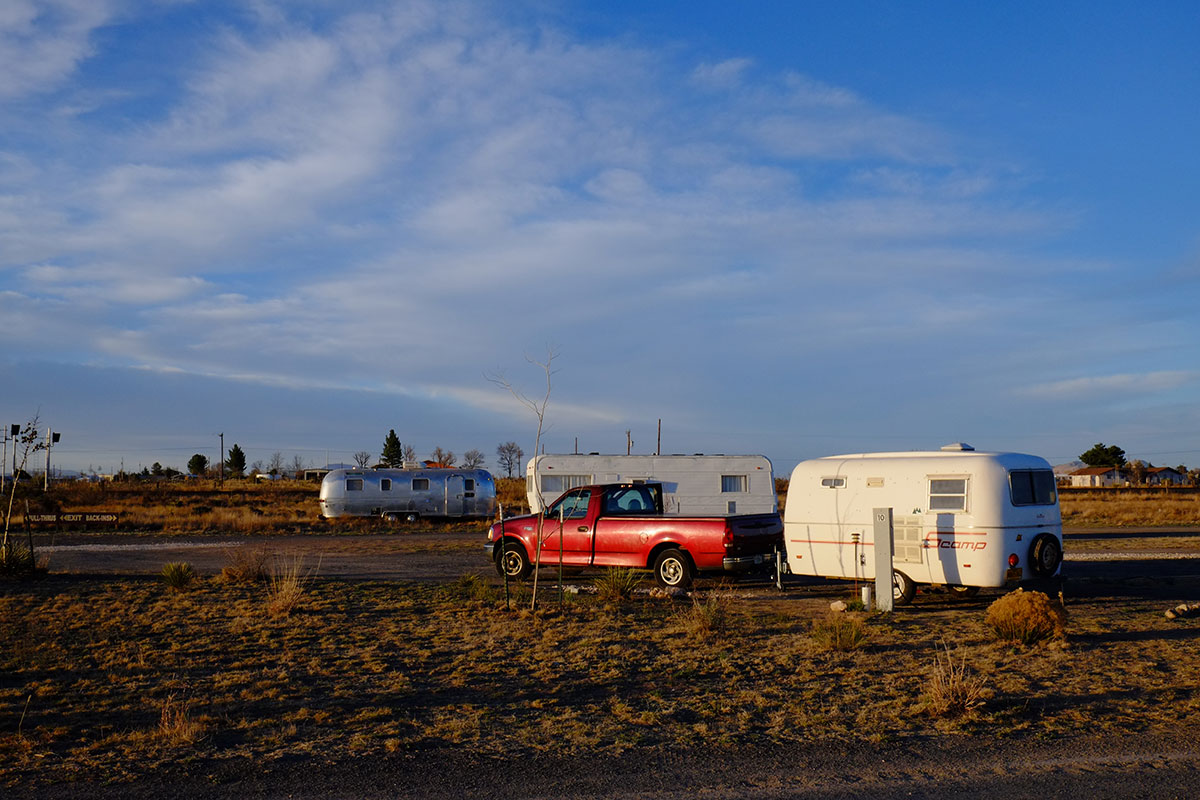
As we looked for a campground, we found two listed in town.  There is El Cosmico, which felt a little self-consciously retro – you can rent an old trailer from them, or a teepee, and there are hip cultural events taking place there.  But strangely, no accommodations for you bringing your own little trailer.  So we went to the Tumble In, out on the highway, where the campground self-register office is in a small trailer, and the common space and bathrooms are in the de rigeur hip/retro/industrial vernacular. DSCF6120

The Scamp fit in amongst the Airstreams and vintage 60s trailers, which seemed to be all occupied by Buddy Holly lookalikes with mangy dogs.  DSCF5999

Outside of Marfa proper, there are two notable attractions. The first is the Marfa Lights, a phenomenon supposedly visible from Highway 90 ten miles east of town.  For decades, people have reported seeing strange moving lights in the desert to the southwest.  The town even acquired funds to build a combination viewing platform / bathroom building out there to accommodate the believers.  We read a bunch of articles online about it, and Greta found the ones that debunked the stories – claiming that they were simply perceptions of highway lights on Route 67 winding through slight hills – to be most convincing.  Given the choice between sitting out in the desert night waiting for a possible hokey paranormal experience, and sitting in the trailer, getting online for the first time after about a week in the wifi-free zone of the Chihuahuan Desert, Greta opted for the internet.

The other attraction in the desert is the Marfa Prada store, 35 miles to the west.  A small building filled with Prada products has been built on a lonely stretch of highway 90, where it is an illuminated icon of First World consumerism to the immigrants crossing the Chihuahuan Desert.  The punchline is that the store cannot be entered – one can only look through the store window.  We’d seen the images, and a friend had recently reported that it was full of flies that had found a way in.  We had experienced enough irony for one day, so we decided to forego that attraction too.

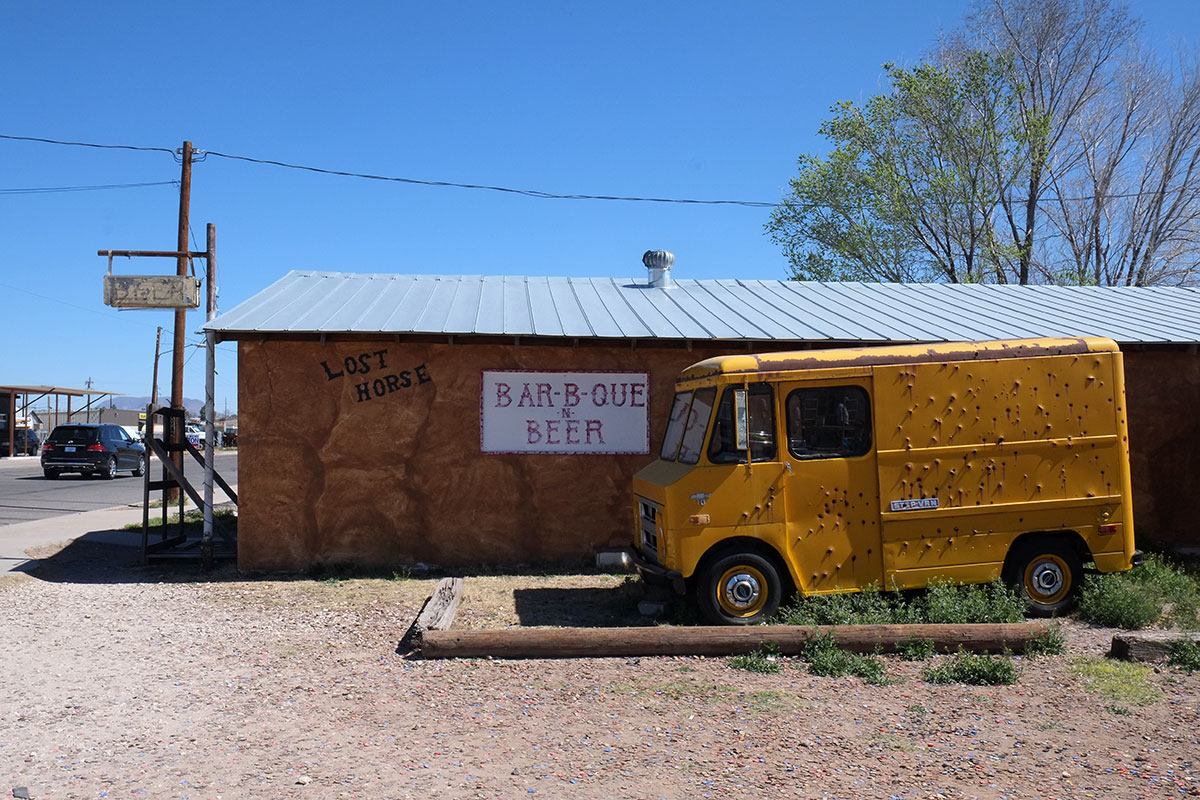
The lack of the normal sprawlscape means that other options for meals had to be be sought.  I had expected that with the influx of arty tourists, Marfa would be well-supplied with hip dining venues.  Greta jumped on Yelp and found a bunch of quirky, highly-rated restaurants and carts, so we headed out.  The Lost Horse turned out to be closed (and riddled with bullet holes).  DSCF6021

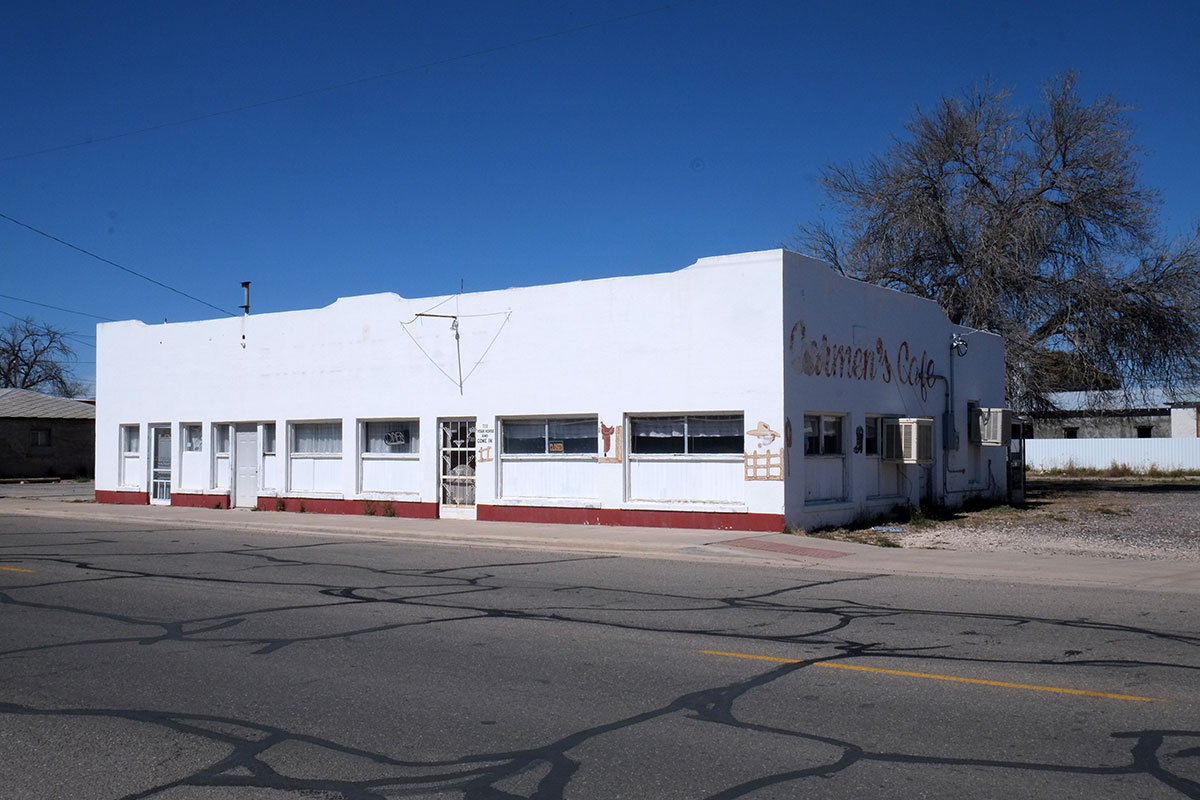
Carmen’s Cafe appeared to be defunct.DSCF6019

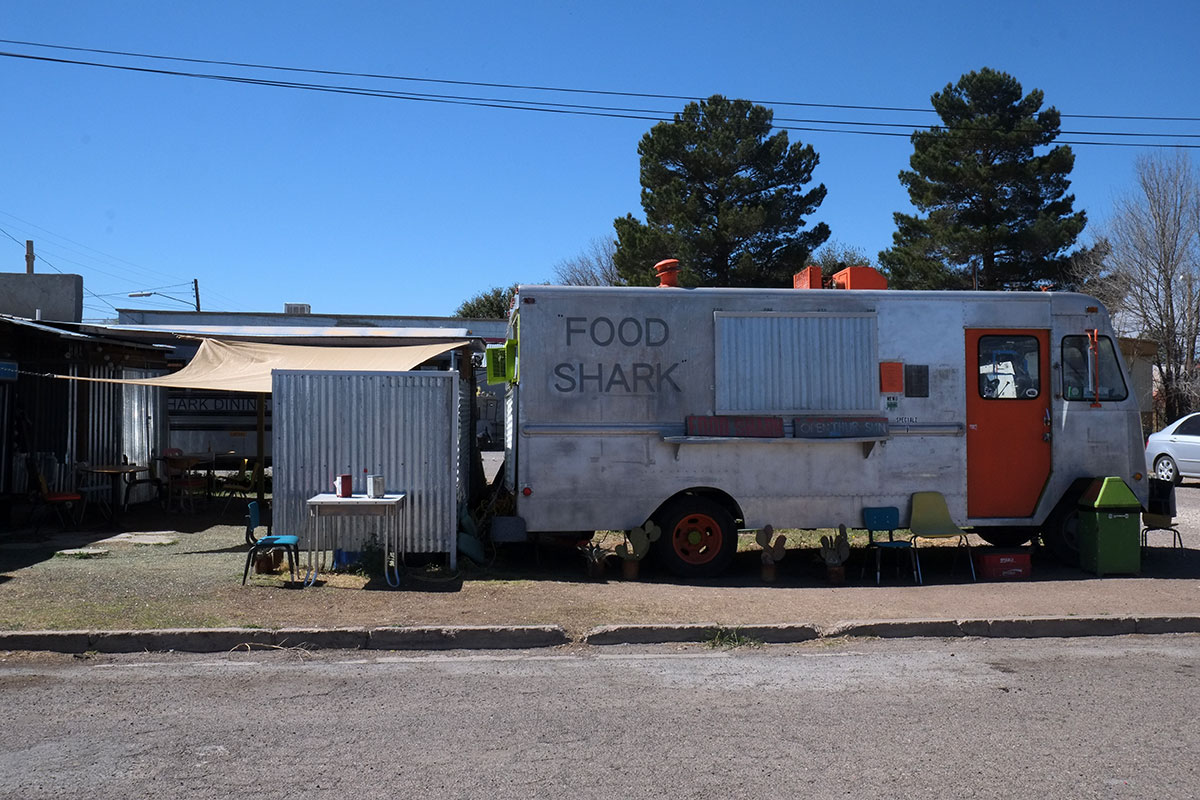
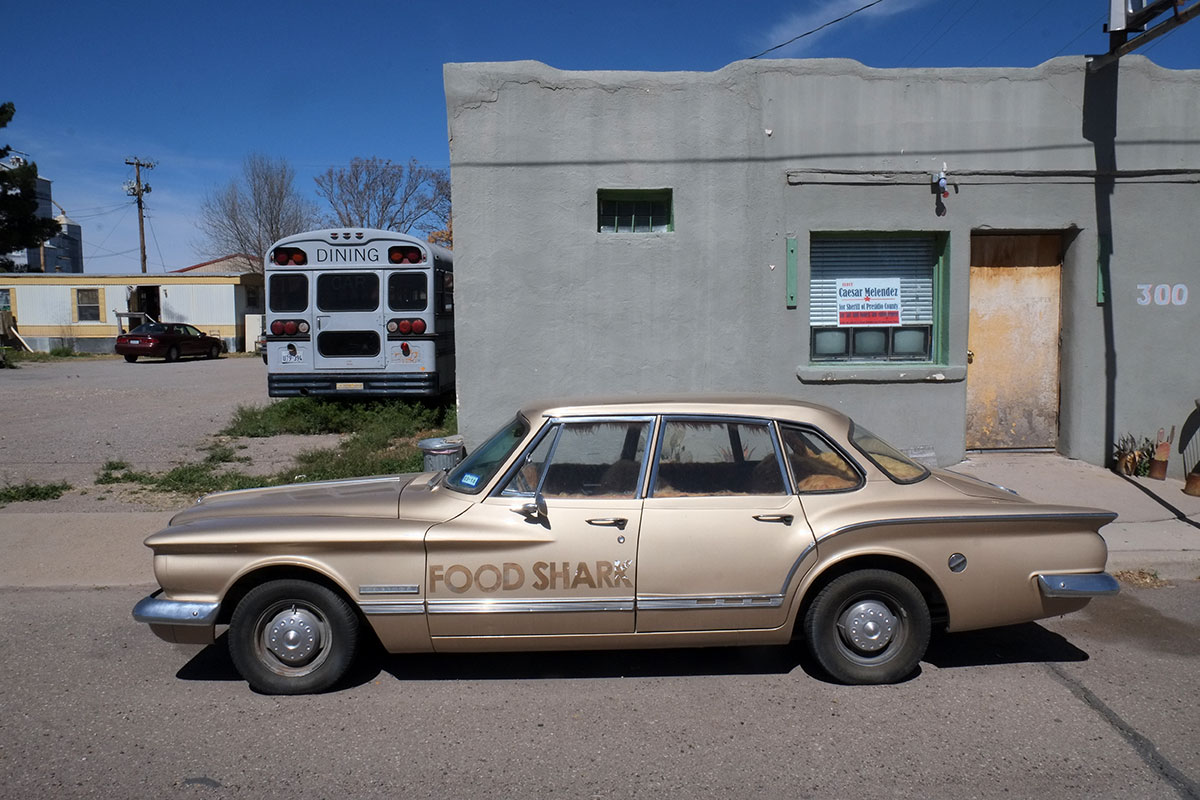
Food Shark, highly-recommended, was closed too.  DSCF6027

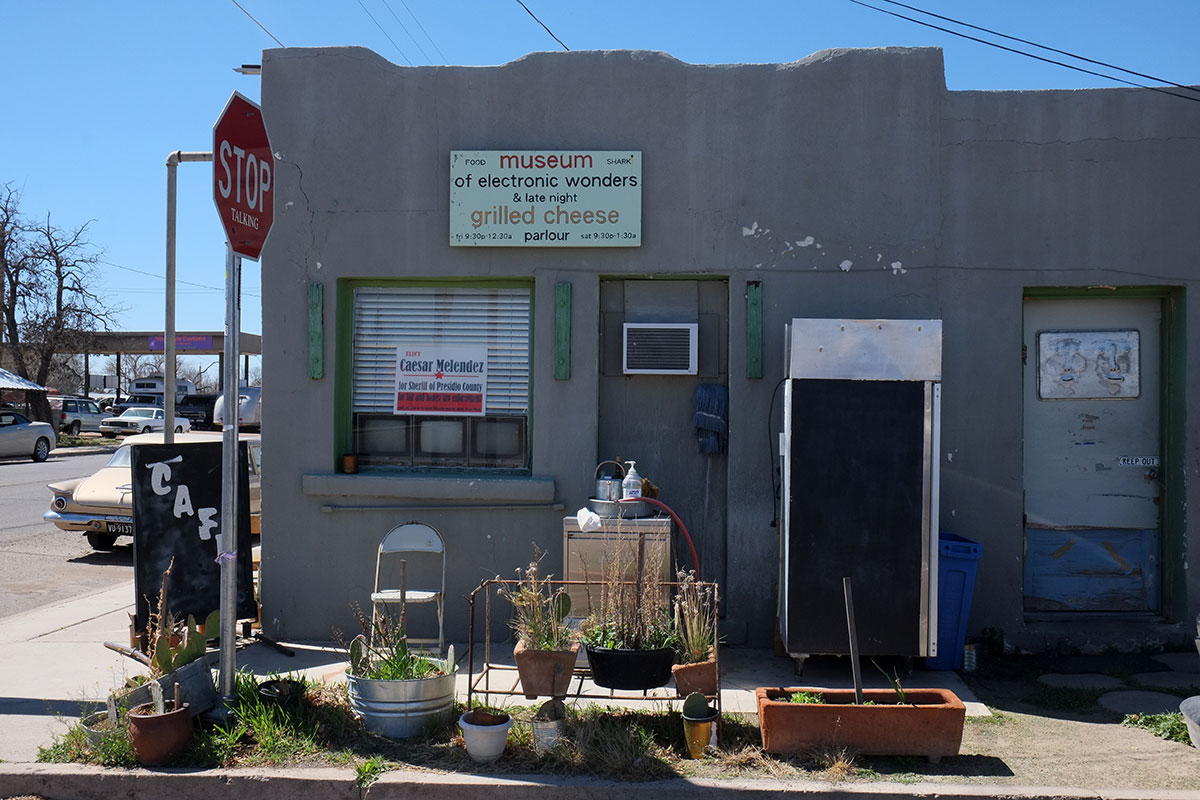
As was the Museum of Electronic Wonders & Late Night Grilled Cheese next door.  DSCF6028

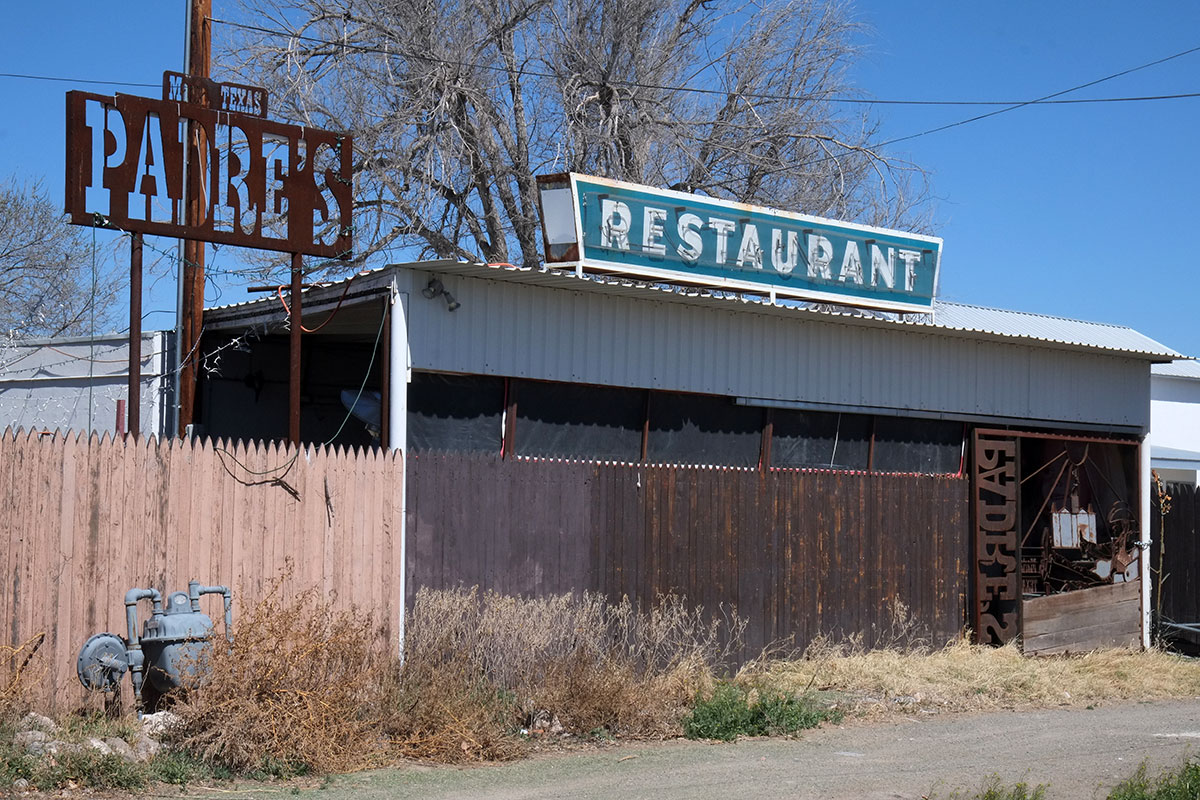
Padre’s had a sign proclaiming it would open at 5:00, but they lied.DSCF6030

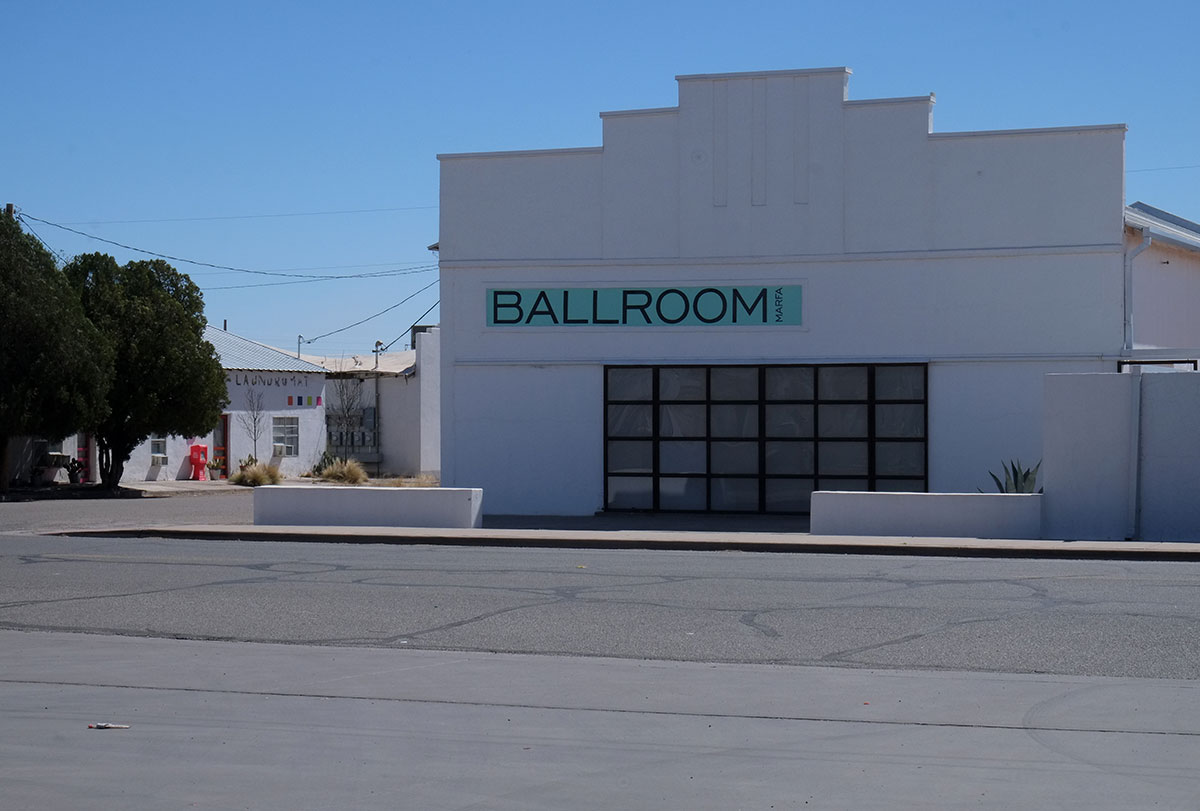
The Ballroom showed no sign of life.DSCF6258

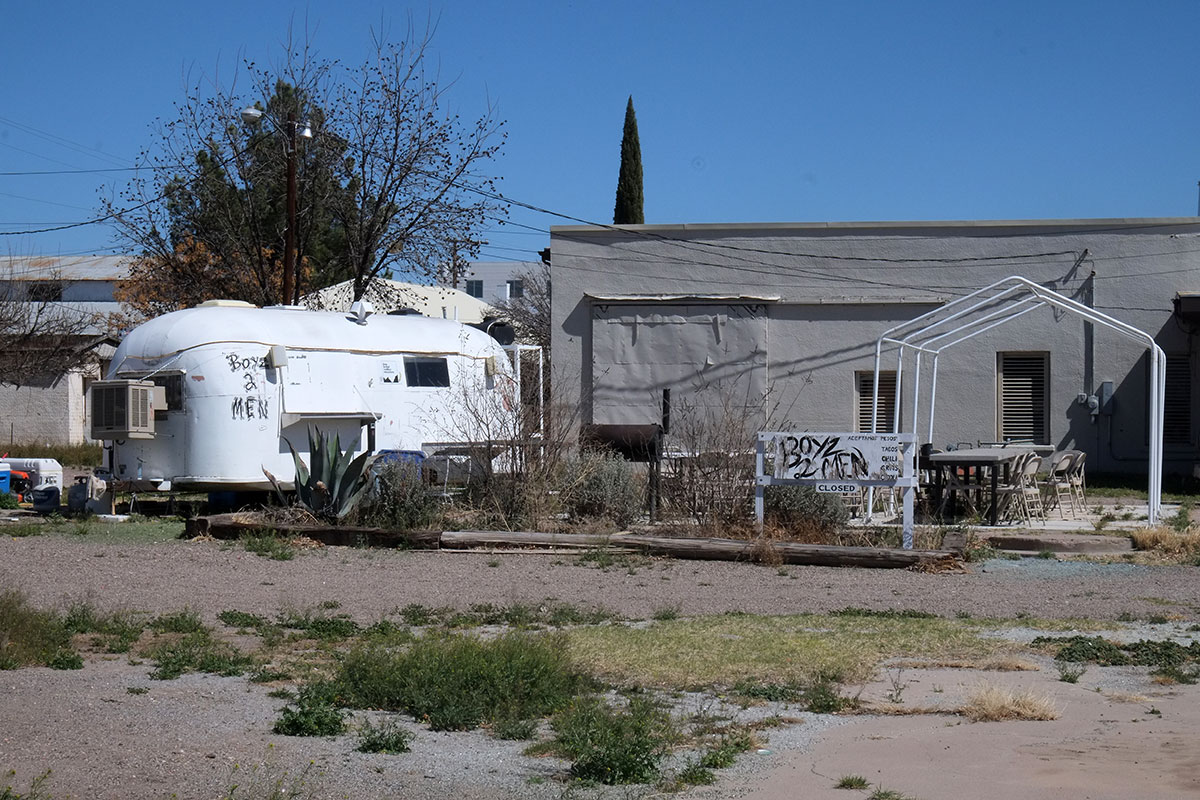
Boyz 2 Men, which is supposedly noted for the banter of its employees, was calm.  DSCF6029

Finally we went looking for Cochineal, which the reviews said was overpriced and not as good as they seemed to think it was.  We wandered down the street, but couldn’t find it where it was supposed to be.  We encountered an artsy type from LA, who said he had reservations to meet a friend there, but he couldn’t find it either  He called them, and confirmed that their address was 107 West San Antonio Street.  We all walked along the block, past 103, to 131, then carefully looked along the property line between them. Nothing.  We broadened our search, and finally found number 107 further down the block, next to number 149.  We started to think Marfa was in the Twilight Zone, a town which appears normal at first glance, but where nothing is quite right.

We ended up at Capri, a hip new restaurant serving elf food.  Though they had a very limited menu, the pleasant young waitress couldn’t explain a single thing on it, and would giggle nervously and apologize before scurrying off to find someone who could answer.  We suspected that she was not really a waitress, had never done this before in her life, and that again, the whole set-up was a performance piece.  DSCF6008

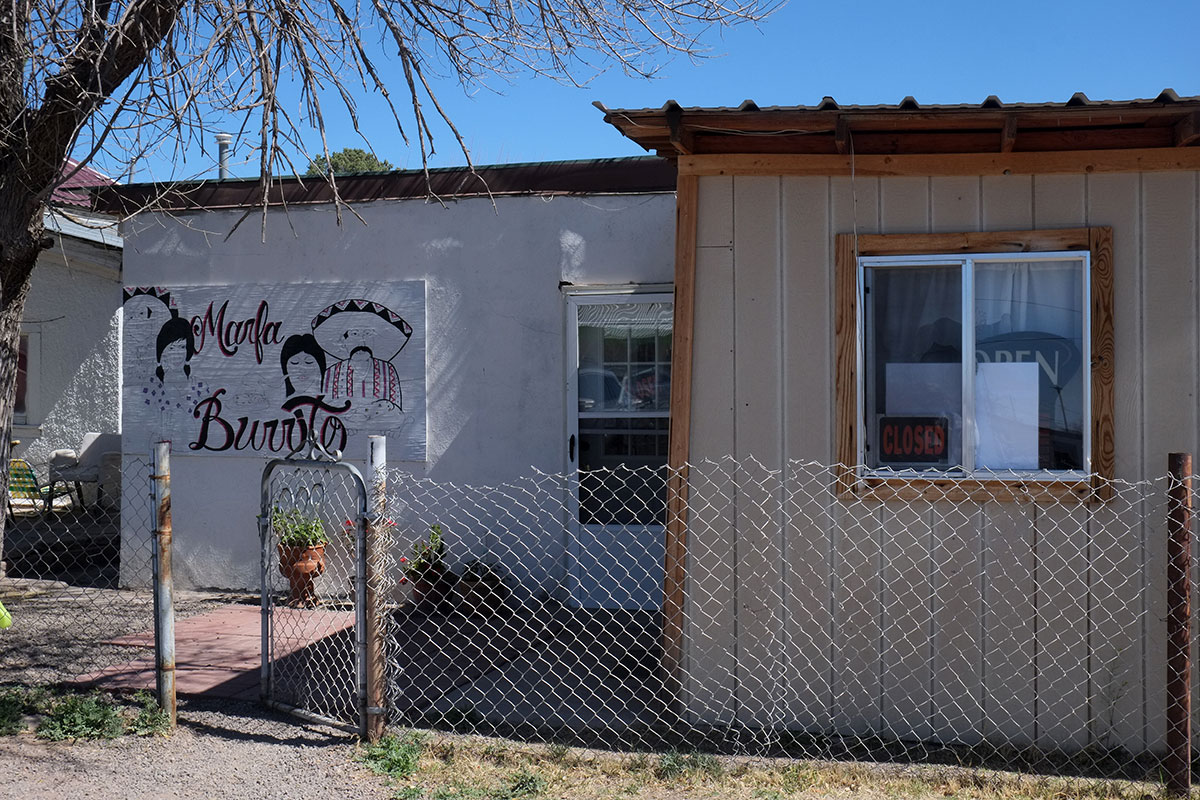
The next day was a repeat.  Our guide at the foundation told us that she had driven by Marfa Burrito, the proprietor was there, and it was certainly open.  We arrived to find that it was not.  DSCF6013

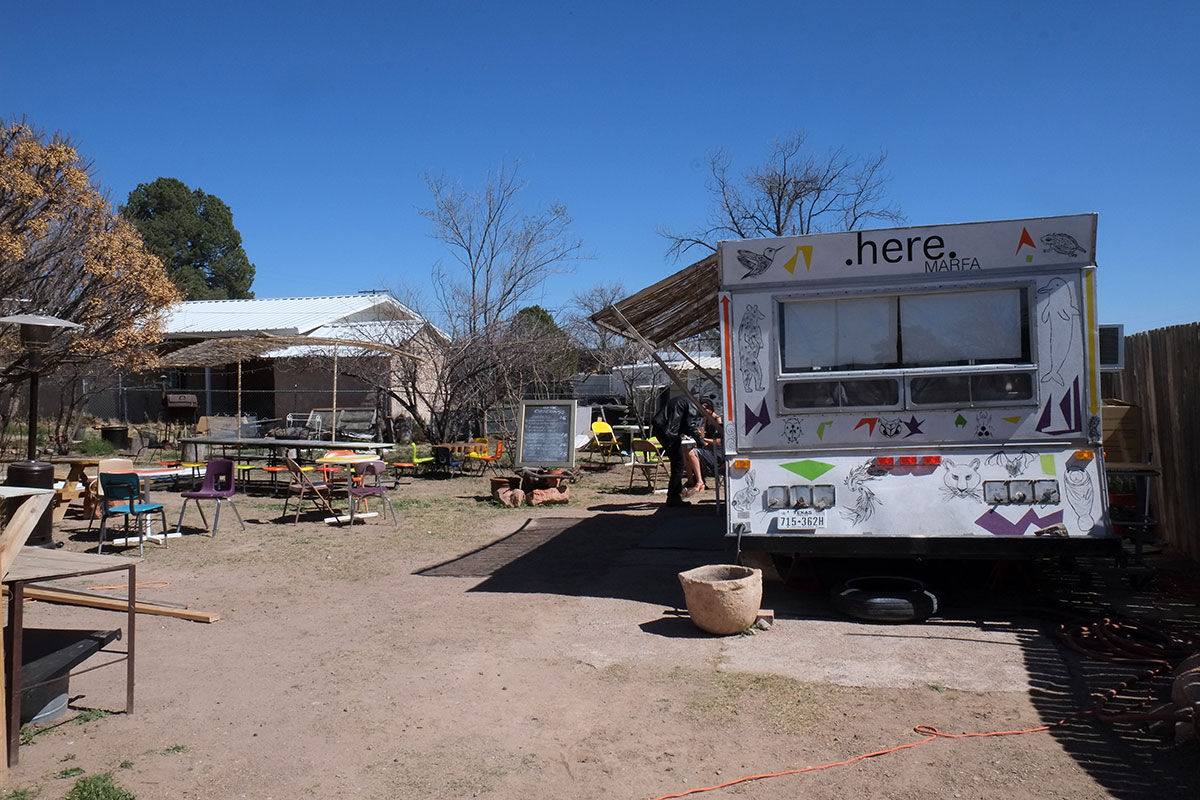
However, when we saw people walking around behind the building, we followed them, and found this food cart.  We hurried over and scanned the menu.  But after re-reading the lists of ingredients several times, I had to ask them what the noun was:  there were many ingredients, but what form did they take all together, perhaps a burrito?  The woman in the trailer answered that they served nutrient-dense food.  I persisted, and she handed out a sample, which was a tiny cup with a thick, green liquid in it, announcing it as a nut-kale smoothie.  I gave it to Greta, who gamely sipped it, and managed to politely suppress her honest reaction.  DSCF6012As we took our leave, we realized that the Prada store supplied the primary metaphor for all of Marfa – it is all about desire and frustration.  We began to wonder whether any of these establishments were real.  Greta had me listening to her favorite podcast, Welcome to Nightvale, about a town in the desert where strange occurrences are common.  It all started to feel familiar.  We finally found an open taco cart, Salsa Puedes, which had good food, and where I had a conversation with a cowboy while we waited.  Maybe we were imagining things.

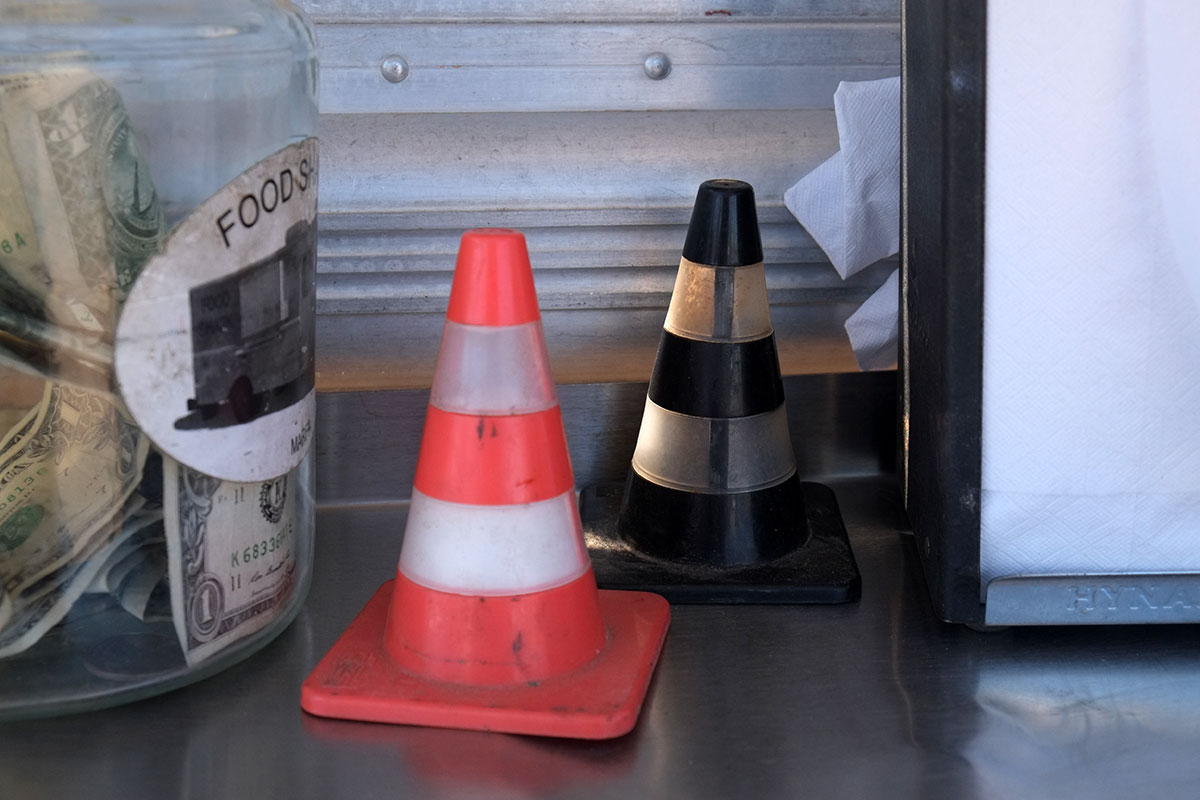
But the pattern repeated the next day.  As we drove by, we saw that Food Shark was open, and we had a fabulous meal.   But I spotted their salt and pepper shakers, and knew that they were on to us;  this couldn’t be a coincidence.  DSCF6232As we were eating, we realized the pattern:  at any mealtime, there was exactly one establishment open in Marfa – a different one every time.  Maybe there was only one person in town who could cook, and she randomly picked a different place every day.  It was a town where people just drove around until they spotted the place that was open.

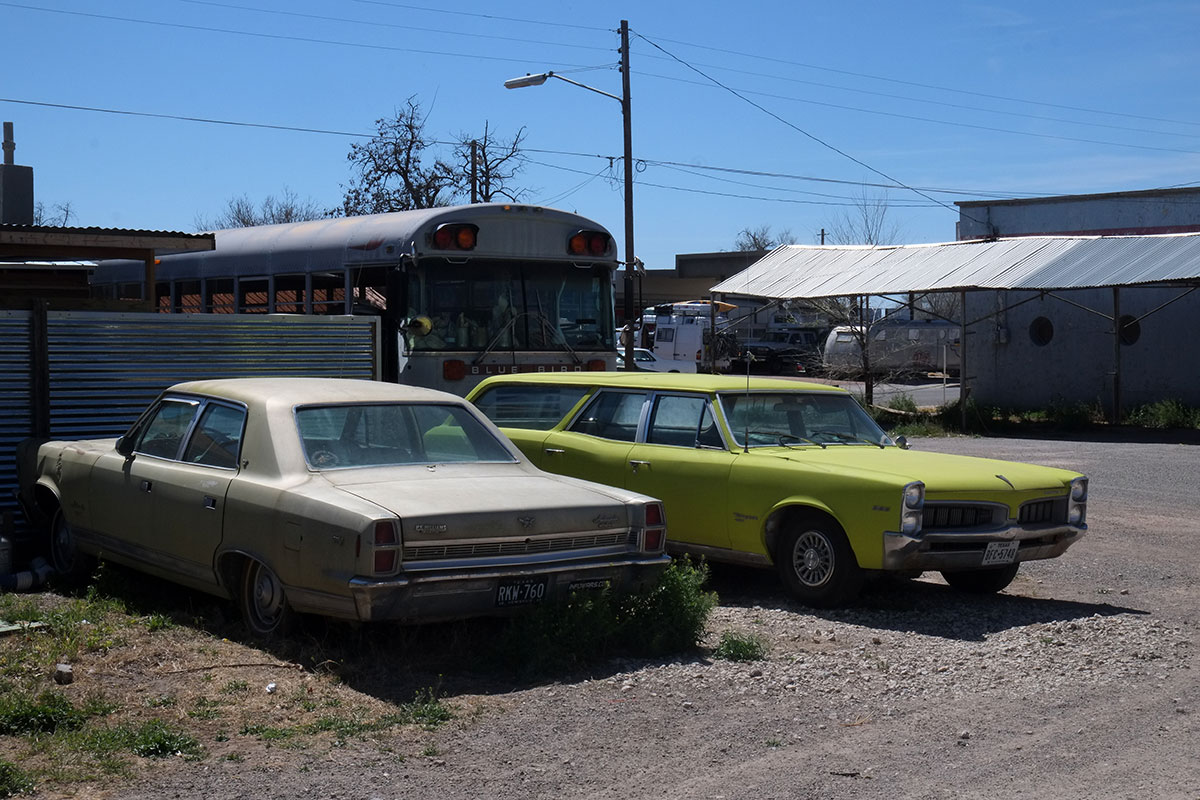
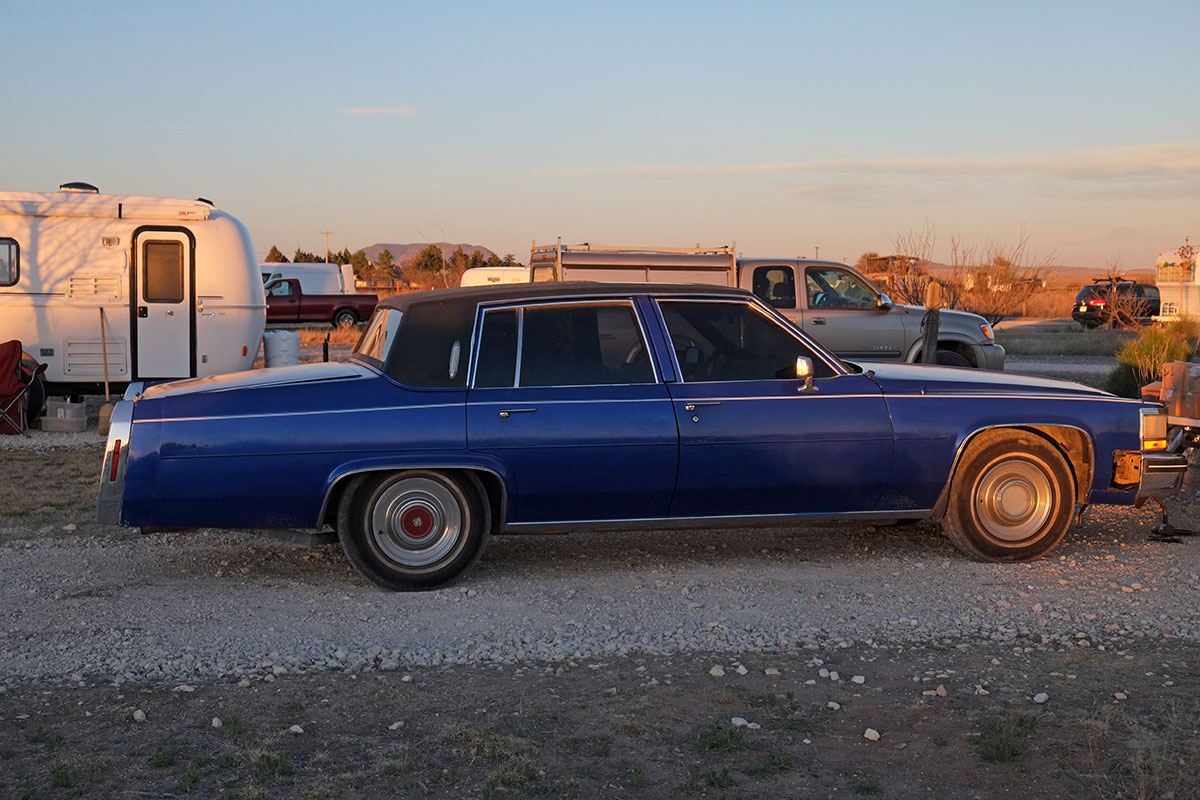
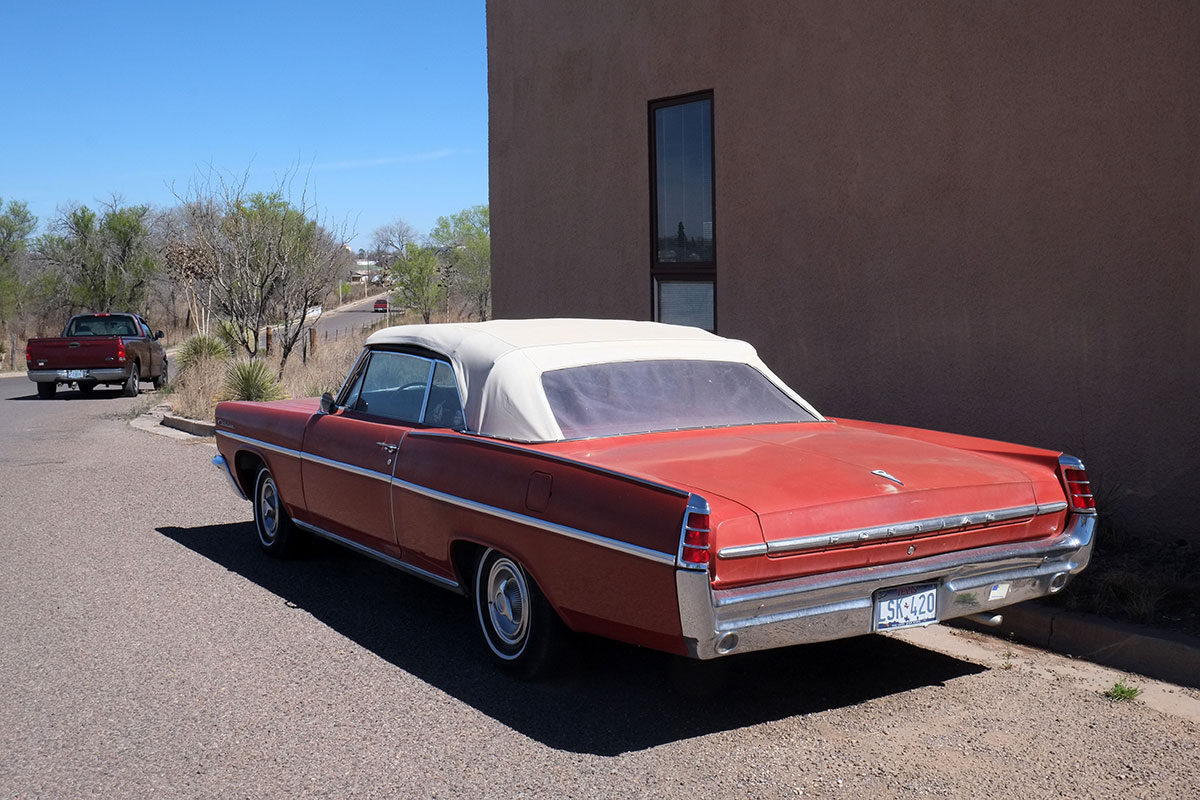
Other weird patterns emerged.  A concentration of very old American cars.  Types that I barely remembered and Greta had never seen.  Some in suspiciously good condition.  DSCF6251
DSCF6256

DSCF6123

DSCF6231

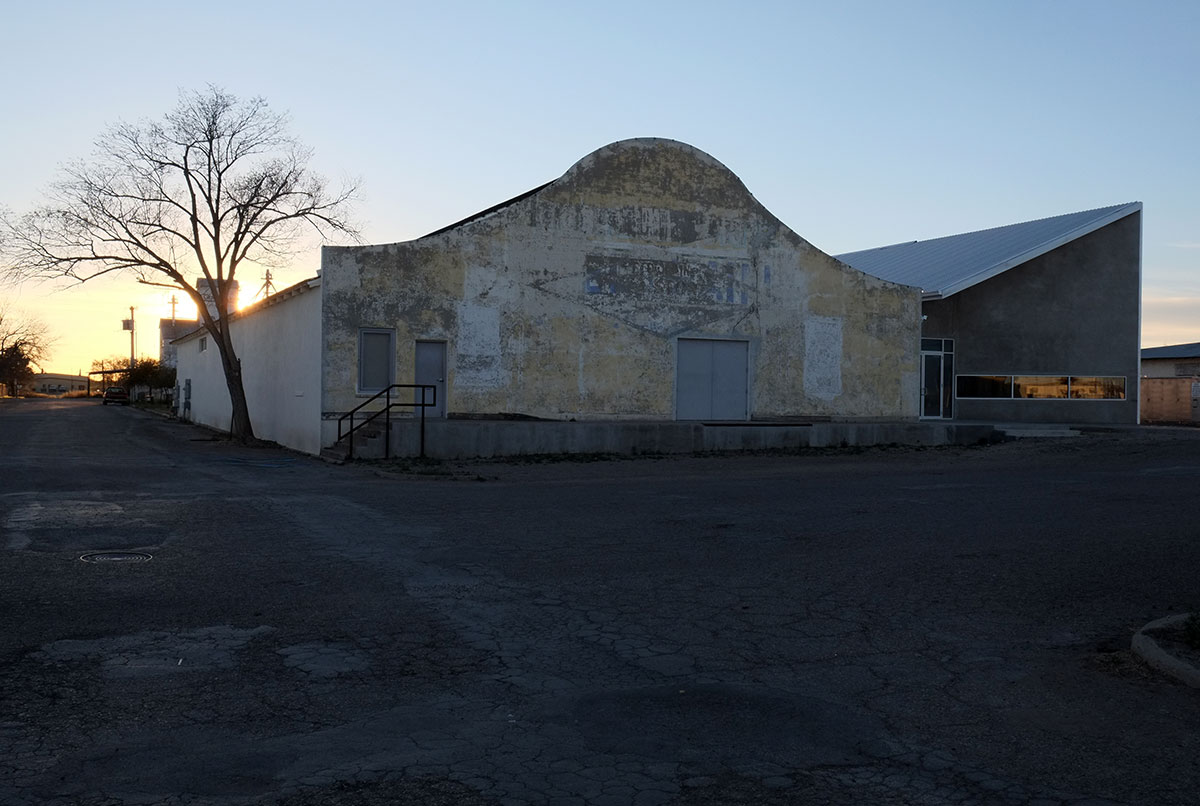
We noticed older buildings sprouting strange new additions.  What was really going on behind those grimy facades that could cause such bizarre new growth?DSCF6115

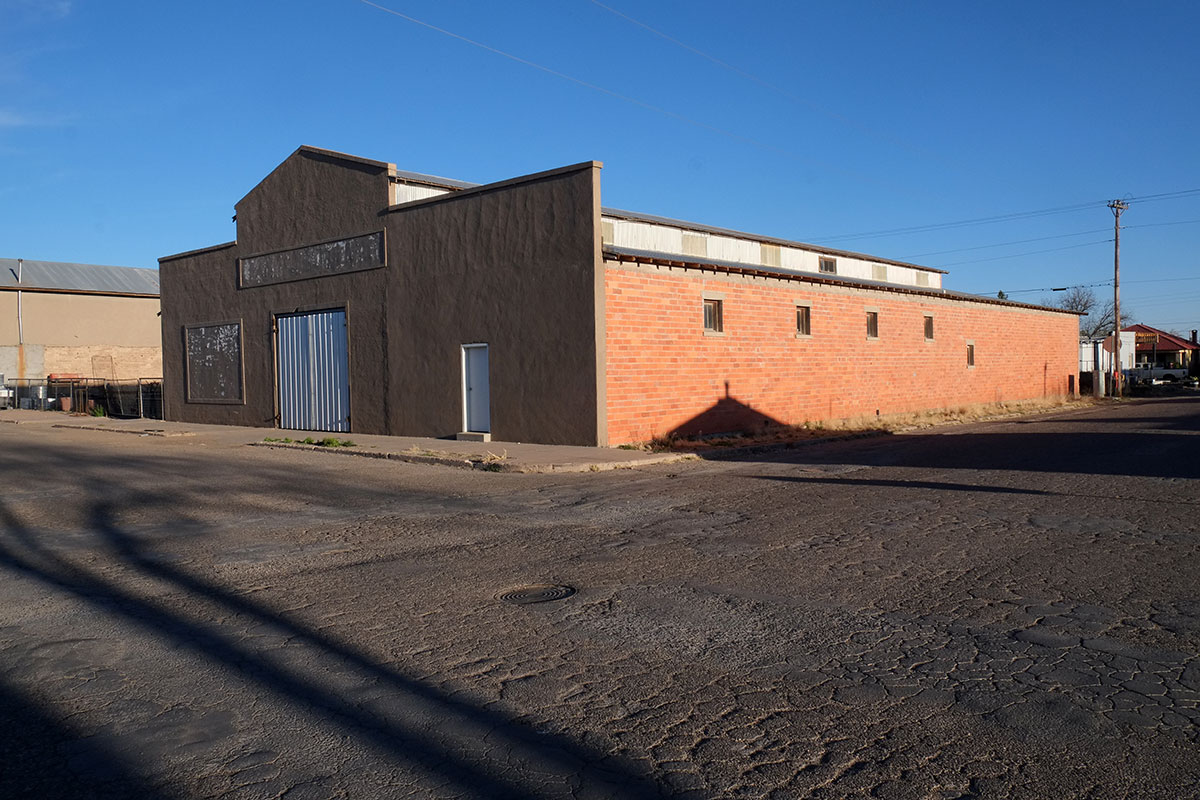
We began to look suspiciously at buildings that had appeared innocuous to us the day before – what activities were they hiding inside?DSCF6080

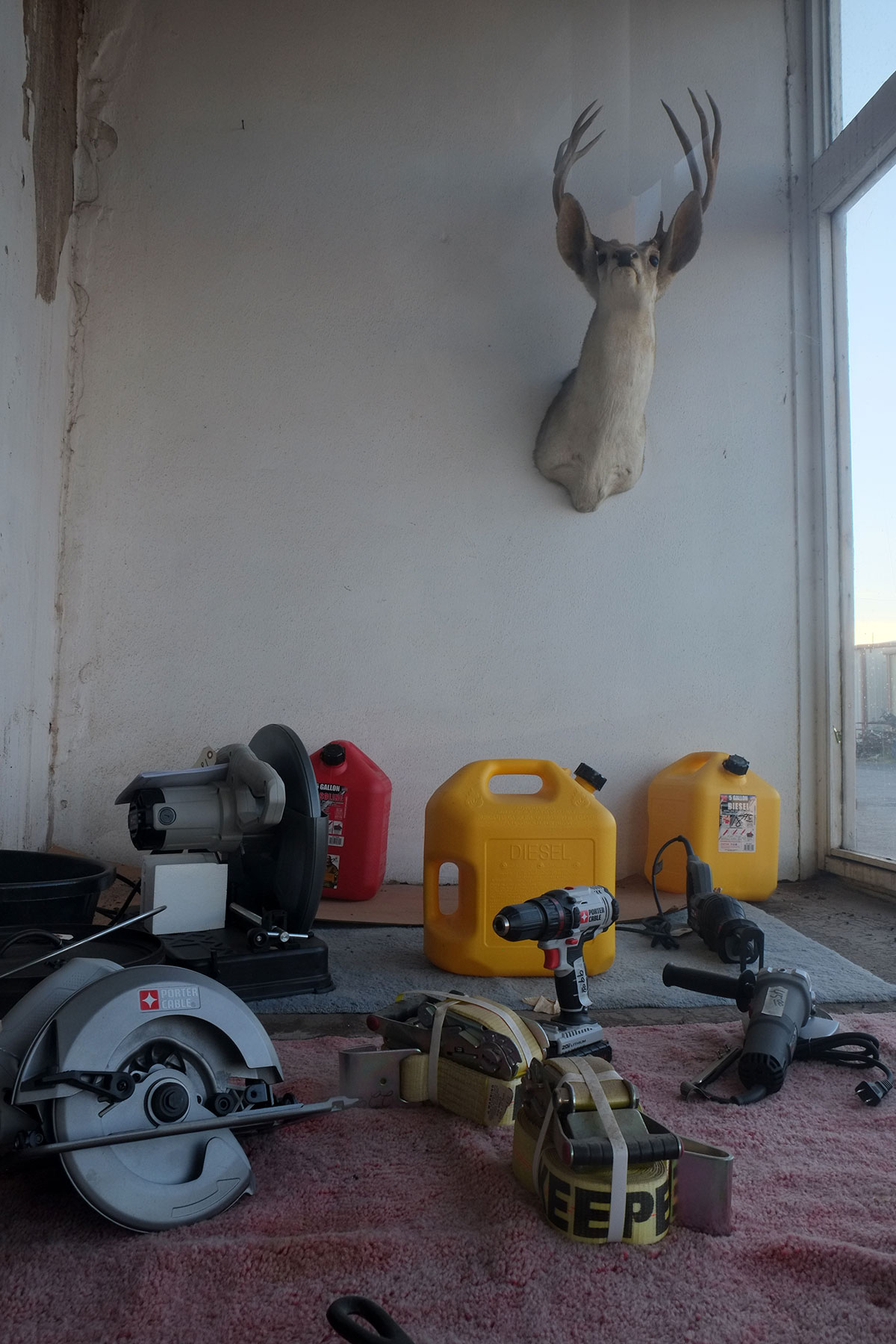
Then we came upon the local hardware store and looked in the window to find this disturbing tableaux.    DSCF6114

All became clear.  This couldn’t be a display of goods for sale, this could be nothing other than an MFA thesis installation.  We really were unwitting participants in a performance piece at the scale of a town.

We headed north across the desert, away from the Lights, trying to reach New Mexico before dark.

San Antonio

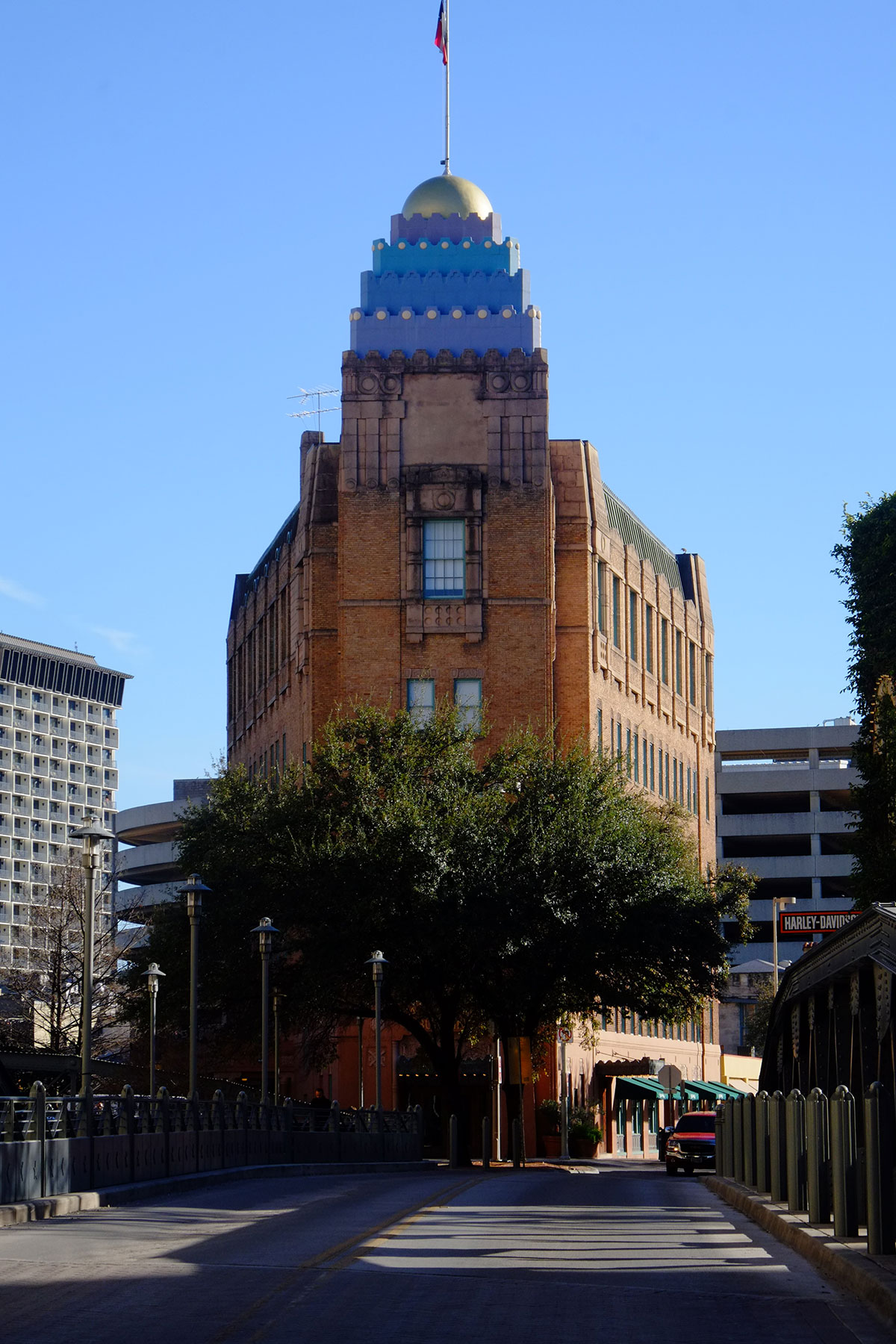
DSCF5662Continuing with our string of Texas surprises:  San Antonio.  All I had ever heard about in San Antonio was the Alamo and the Riverwalk, a downtown redevelopment along an old waterway, which had spawned a district of restaurants bars, etc.  I expected a 1980s, James Rouse style, River “Place” development, with a Hard Rock Cafe, TGI Fridays, etc., that lured timid suburbanites and tourists into the one part of downtown that wasn’t a disaster.  So when we arrived in San Antonio, I wasn’t in any hurry to see it;  I figured if everyone else in America liked it, I probably wouldn’t.

rodeoAt our urban campground (fabulously located right on a small river park with a bike path through the city), we discovered that the San Antonio Rodeo (the largest indoor rodeo in the country) was taking place a mile away.  In fact, almost everyone else in the campground was working at the rodeo, and the campground was full of big rigs and horse trailers.  Fresh from our Mardi Gras experience, we realized cultural immersion was the way to go on this trip, so we went to our first rodeo.  Walking around the grounds before the main event of bronco-busting etc., we discovered that it was a combination rodeo/state fair, with lots of animals and competitions in every way.  It was really fun, and Greta will blog about it if she ever gets it together.DSCF5444

The next day we started with the San Antonio Missions National Historical Park.  The Alamo in downtown San Antonio is the northernmost of the five missions strung along the San Antonio River, and all the others still exist in various states of preservation or reconstruction.  The drive south of the city along the river is a pleasure, and each of the missions is quite different from the others.

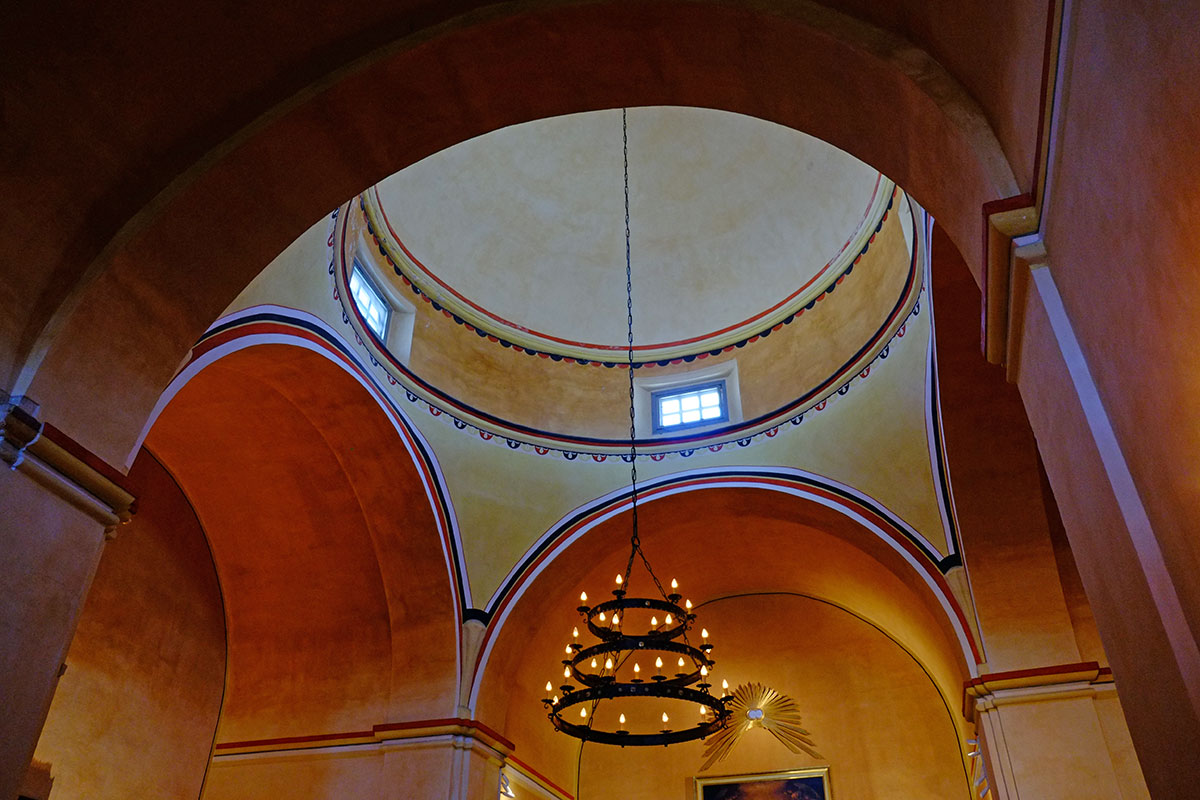
Mission Concepcion has the best-preserved church, with intact architecture and original interior paintings.  DSCF5509  DSCF5497

DSCF5491

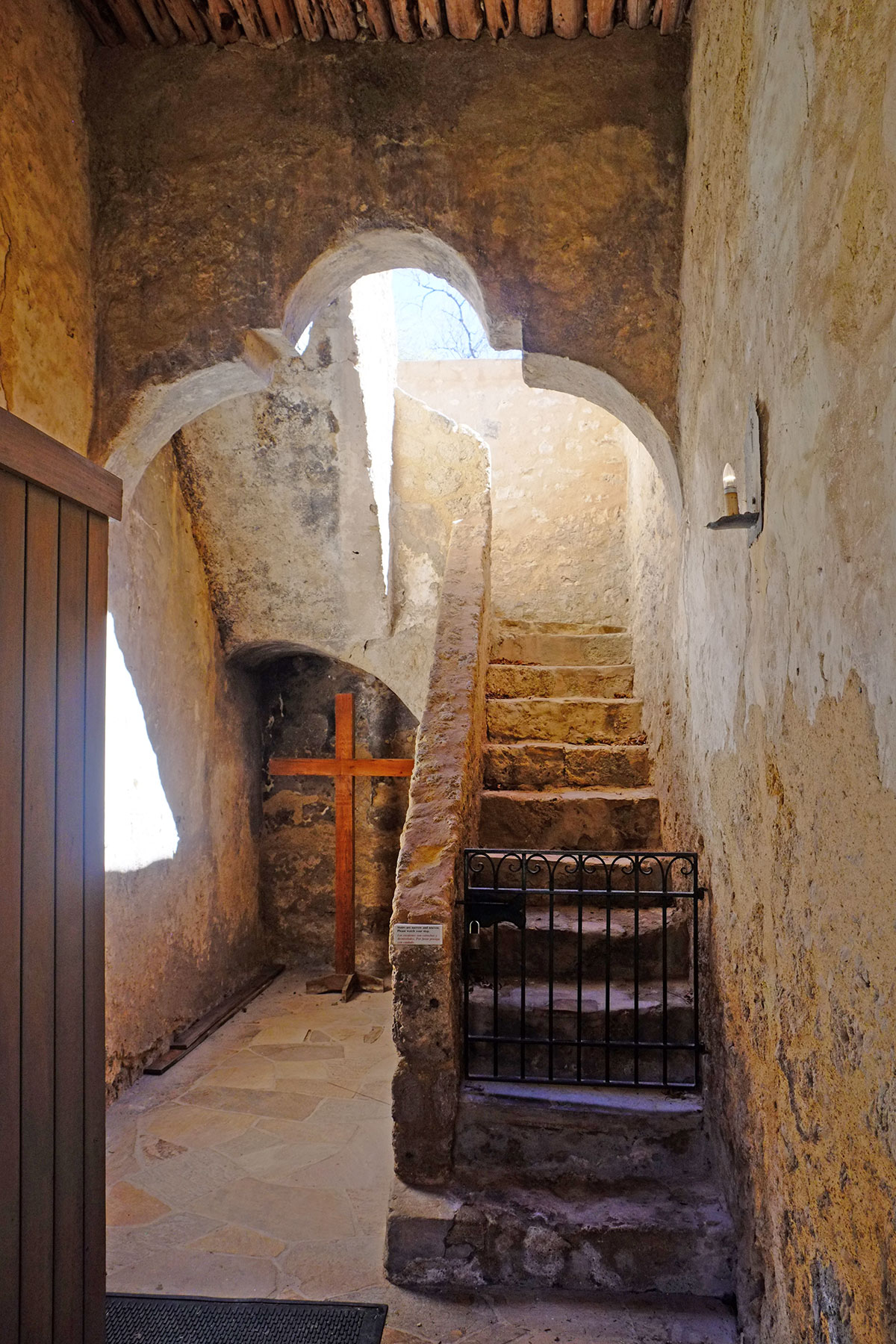
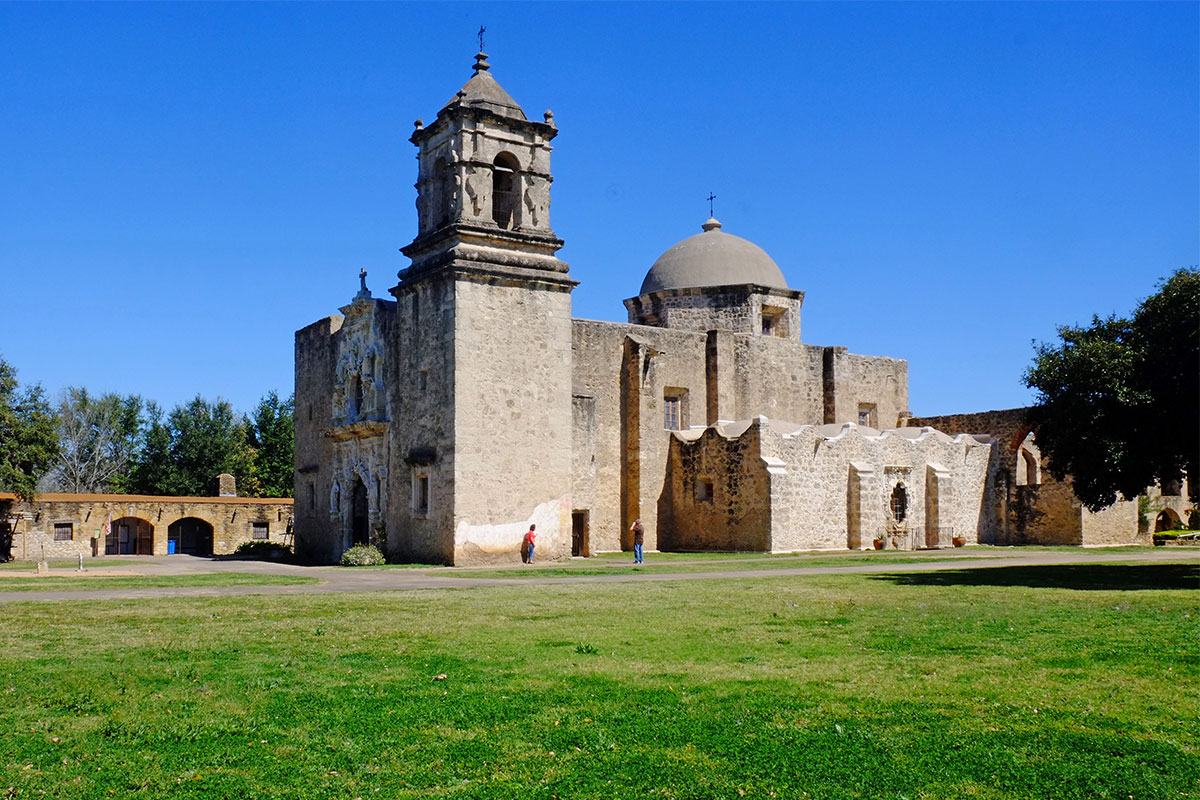
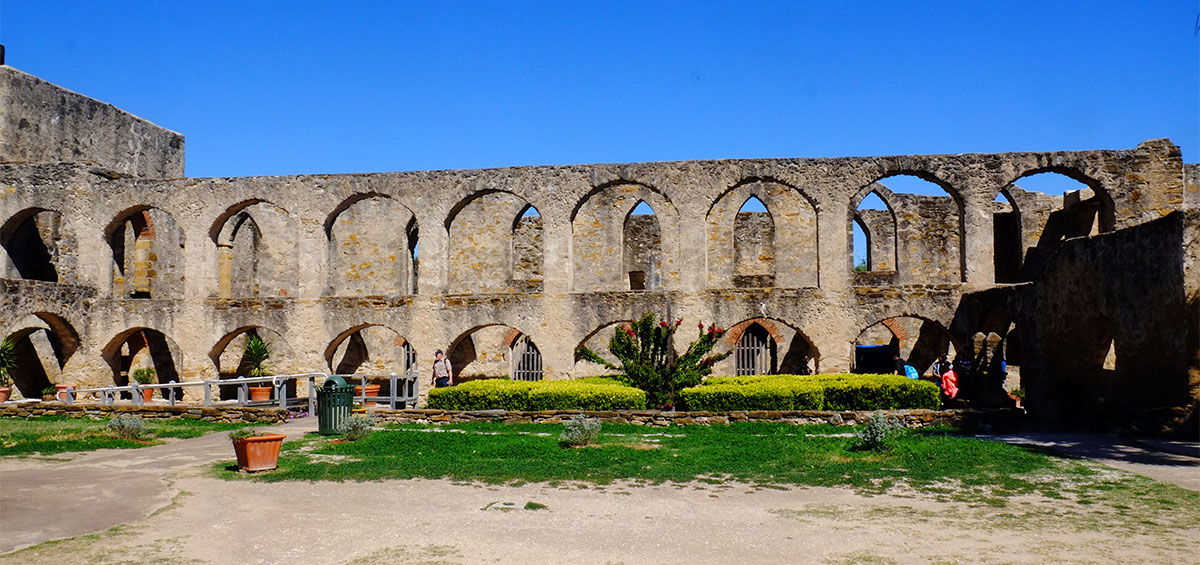
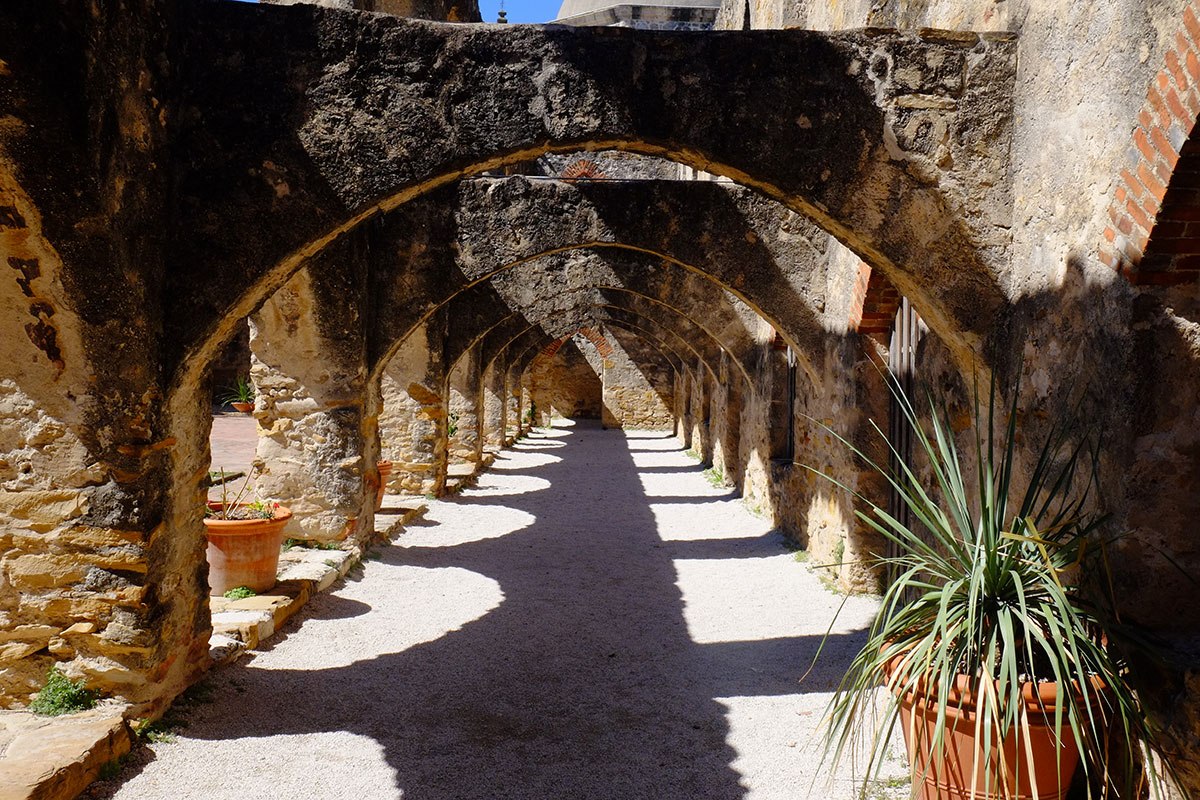
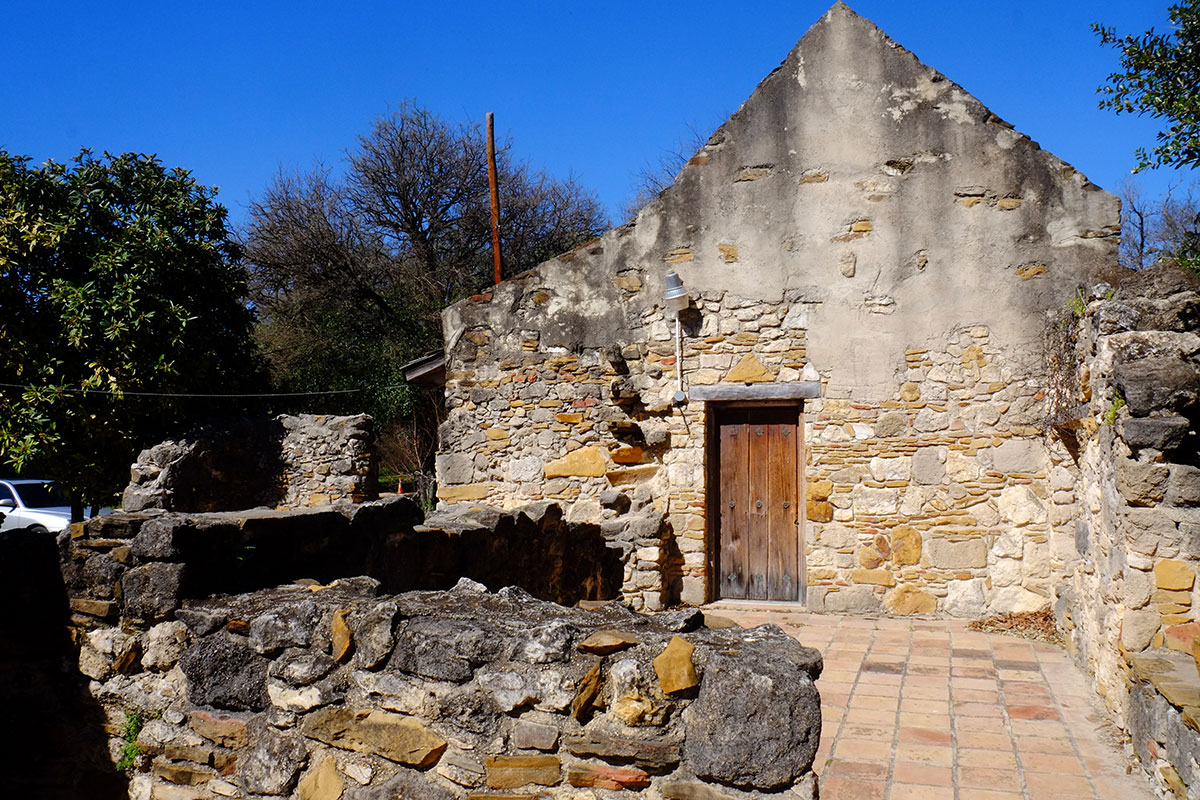
The church at Mission San Jose was extensively reconstructed from ruins in the early 20th century, but it is the best example of a whole mission compound, with the extensive walls in place, and many perimeter dwellings built into the walls, giving the best illustration of a complete mission complex.  DSCF5547

DSCF5522

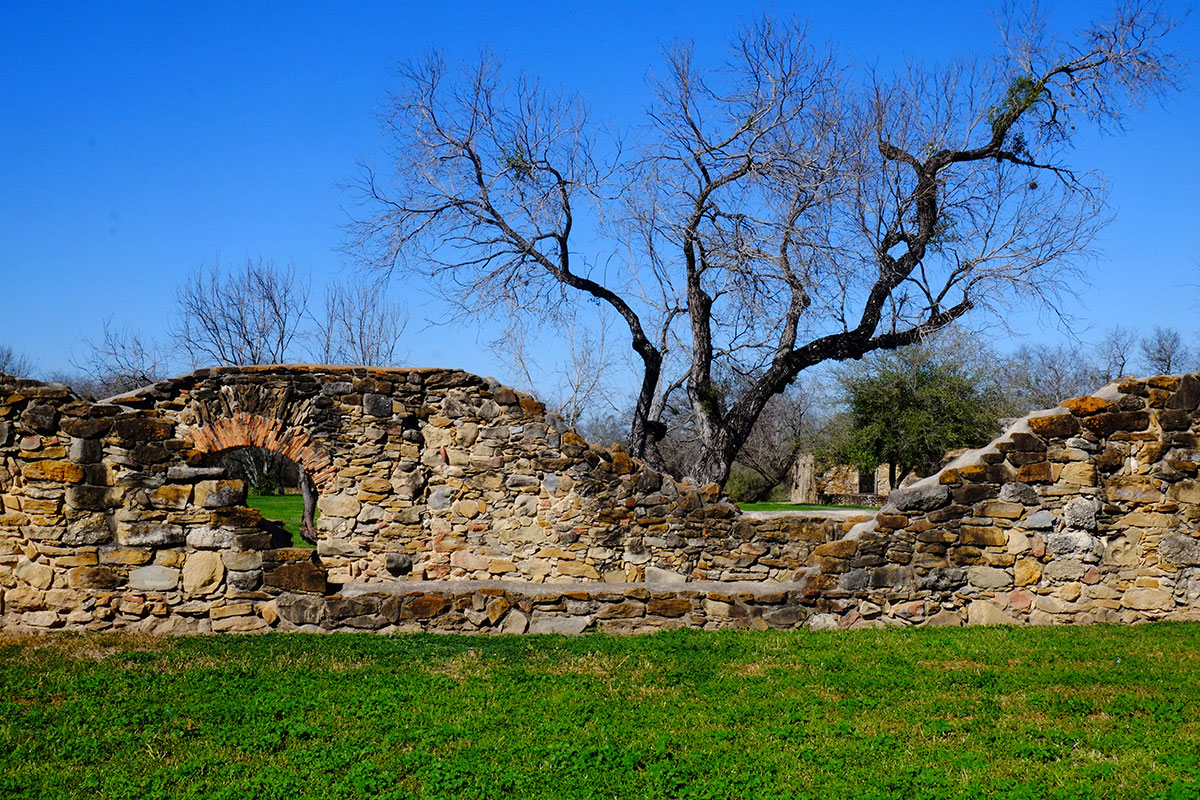
The ruins of the monastery have been left unrestored, a remarkable two-story masonry structure.  DSCF5510

DSCF5557

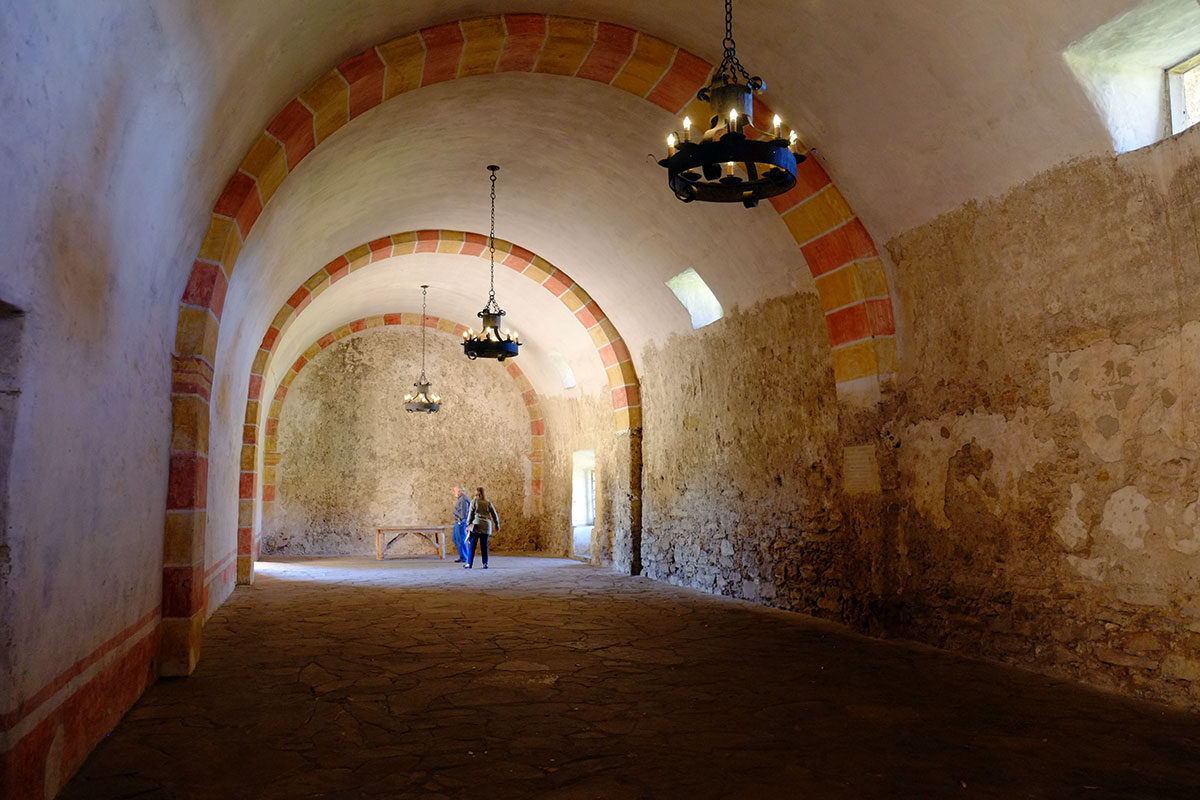
The refectory is vaulted, with flying buttresses on the exterior.  DSCF5536

DSCF5537

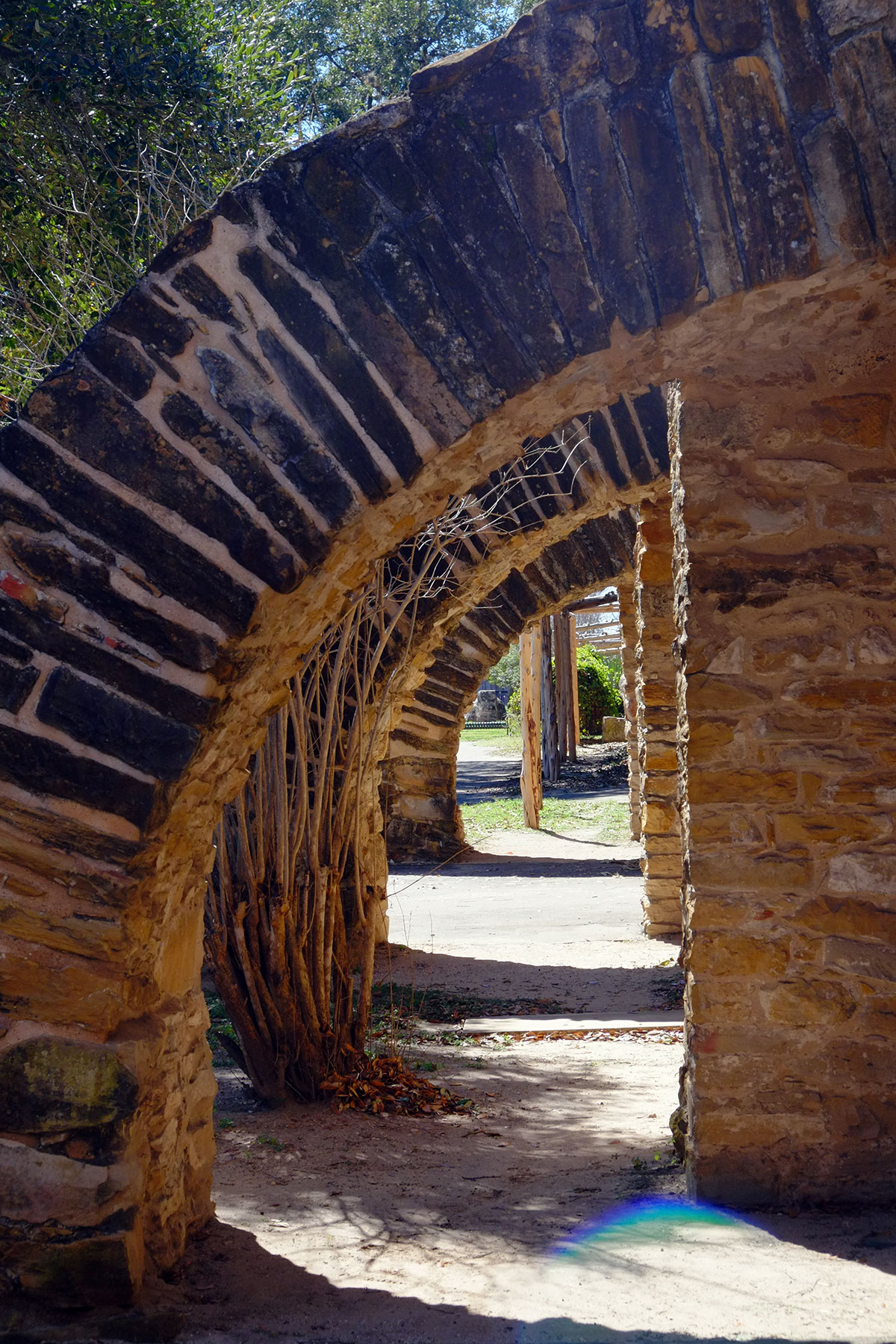
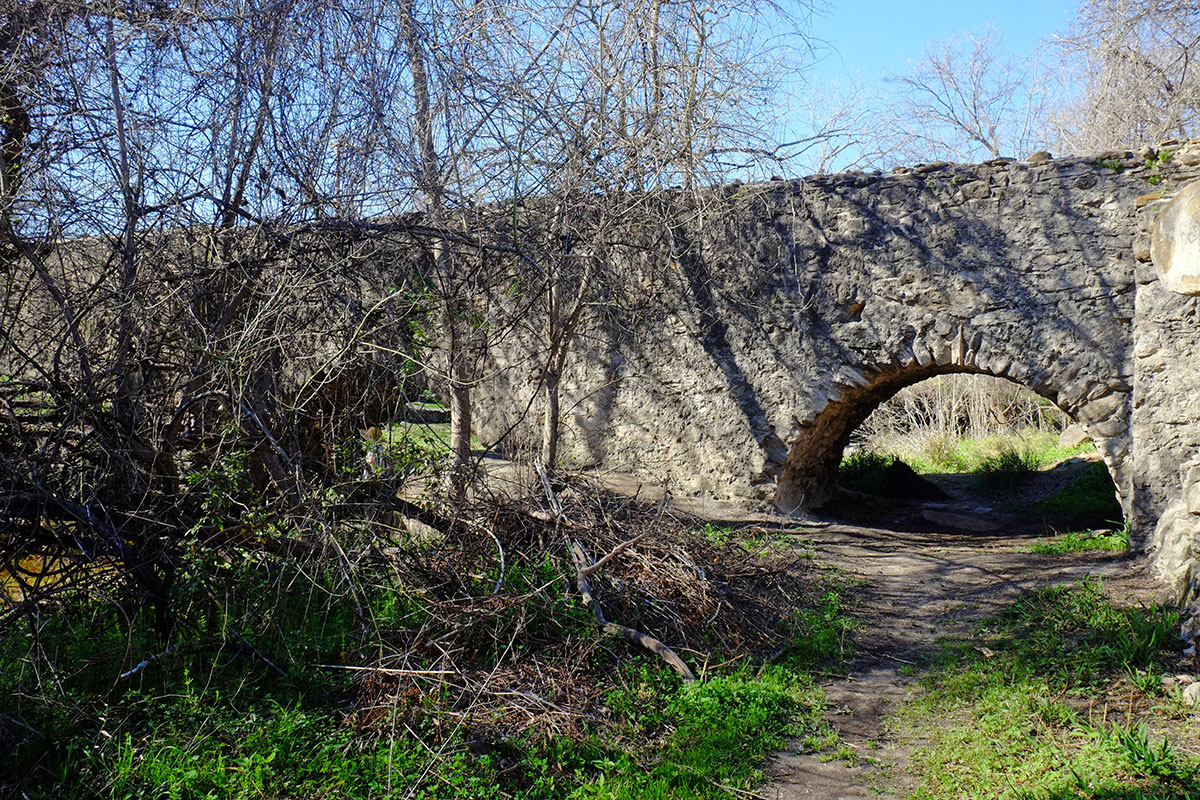
All of these missions were supported by agriculture, which was dependent upon irrigation from the river.  Dams, and even aqueducts were constructed to channel the water.  DSCF5606

Mission San Juan is in a less-restored state, and shows later additions completed in the 19th century.  DSCF5572

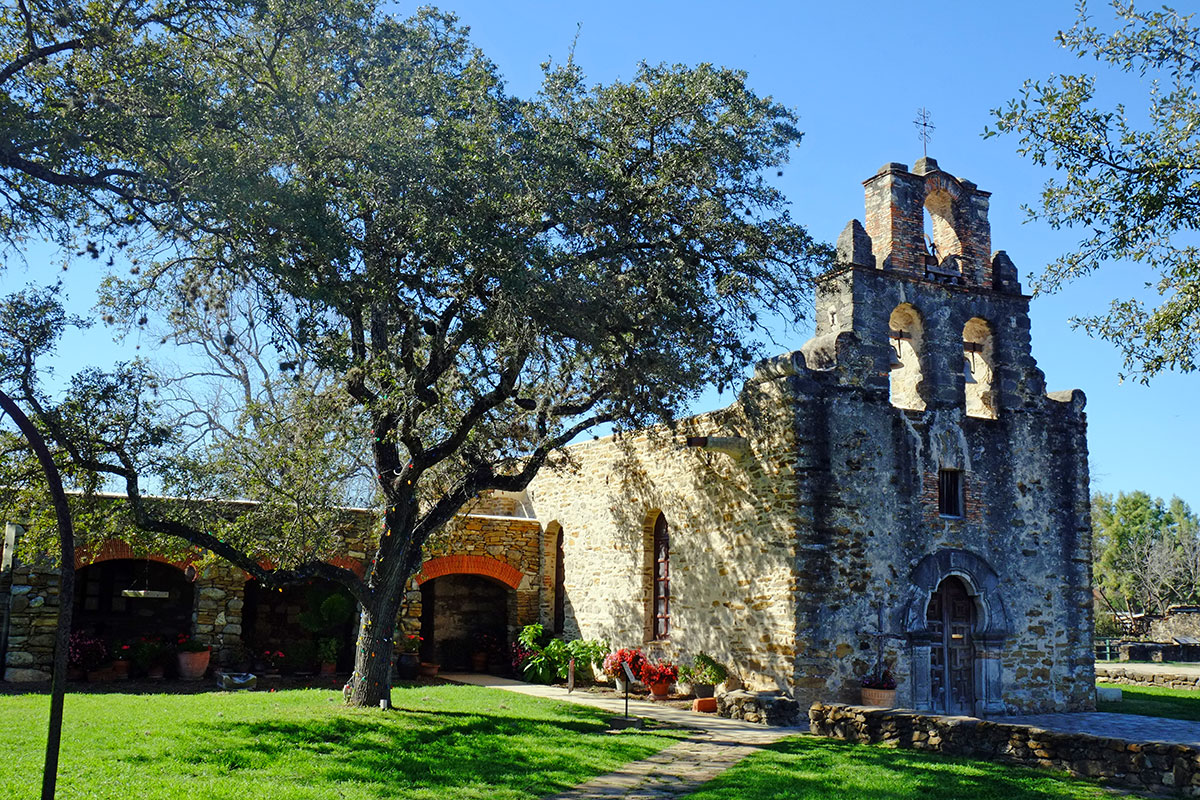
Mission Espada is the furthest out of town (although still within the San Antonio ring road), with a small church and an unreconstructed compound.  DSCF5586

DSCF5601

With typical National Park Service expertise, the scattered-site park holds together as an experience and a narrative  The River ties it all together, and at the end you have a remarkably nuanced understanding of how the missions operated as an integrated system in the 18th century.

We headed for the center if town, and were immediately shocked.  Everywhere we looked, there were beautiful older buildings.  DSCF5617
Somehow San Antonio didn’t destroy its past.  Of course, there are banal newer buildings, as in every other large American city, DSCF5622

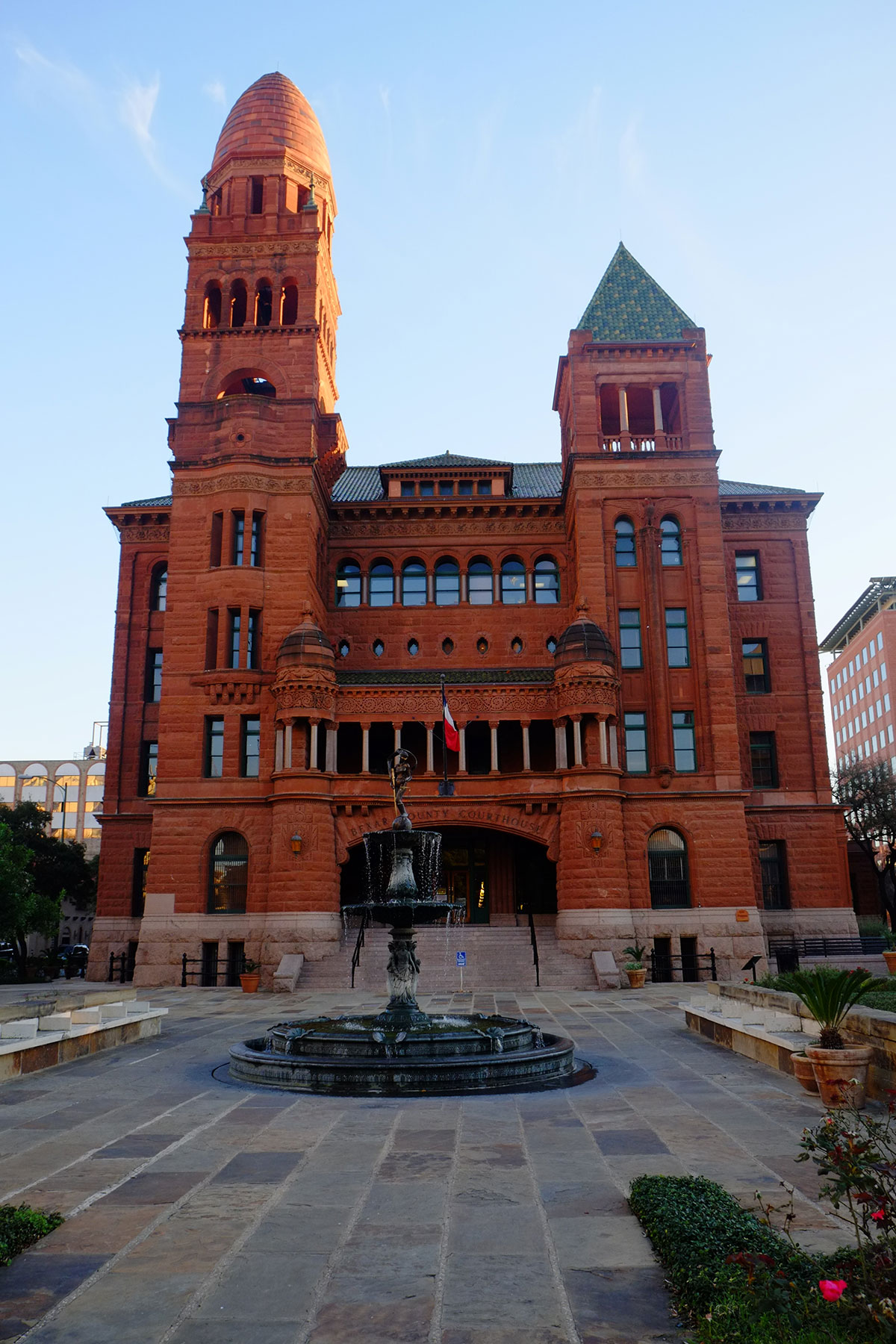
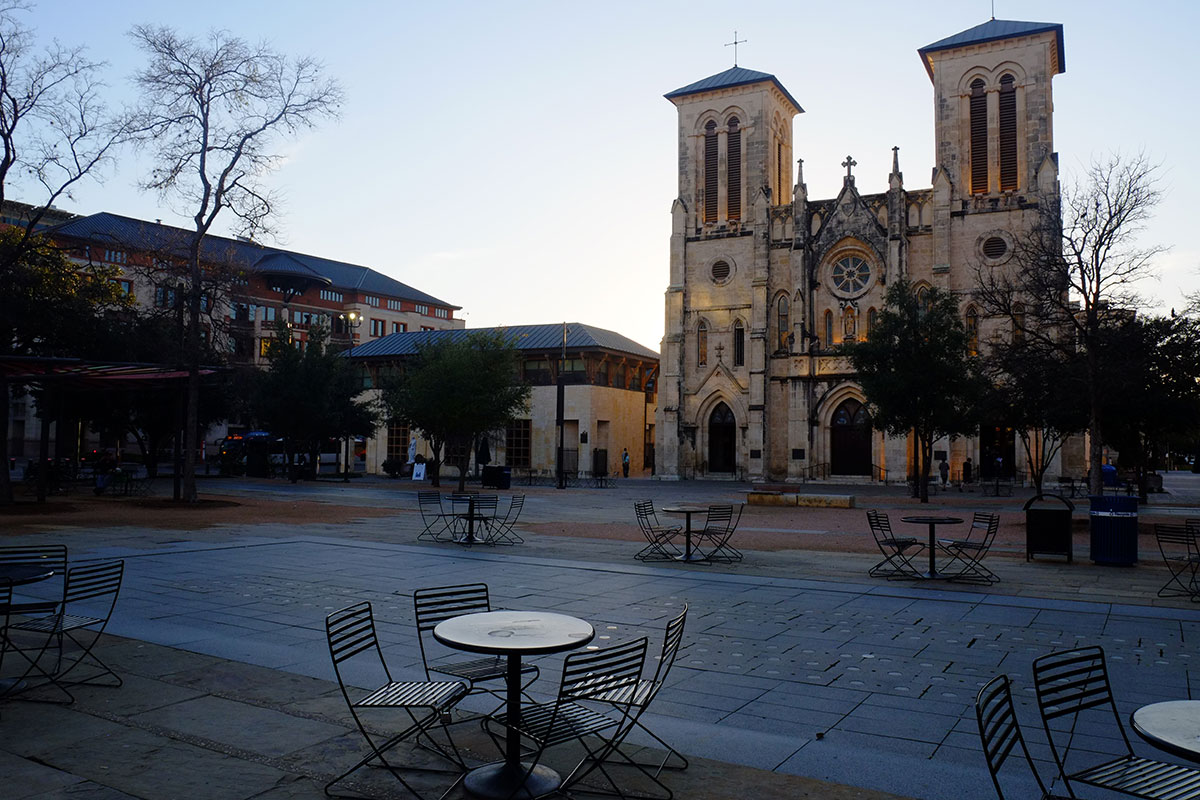
but they don’t dominate.  In the core of the downtown, the new and the old are intermixed in a wonderful way.  Dallas has old buildings, but they are all in one district, while the modernist skyscrapers have taken over most of the city center.  In San Antonio, the mix is much finer-grained.  The civic center, with the city hall, courts and cathedral, is intact, with a full-block plaza at the center.  DSCF5692
DSCF5696

Streets are lively, the streetscape has been carefully tuned, and the urban fabric is a blend of old and new, large and small.  Retail is everywhere.  DSCF5715DSCF5711

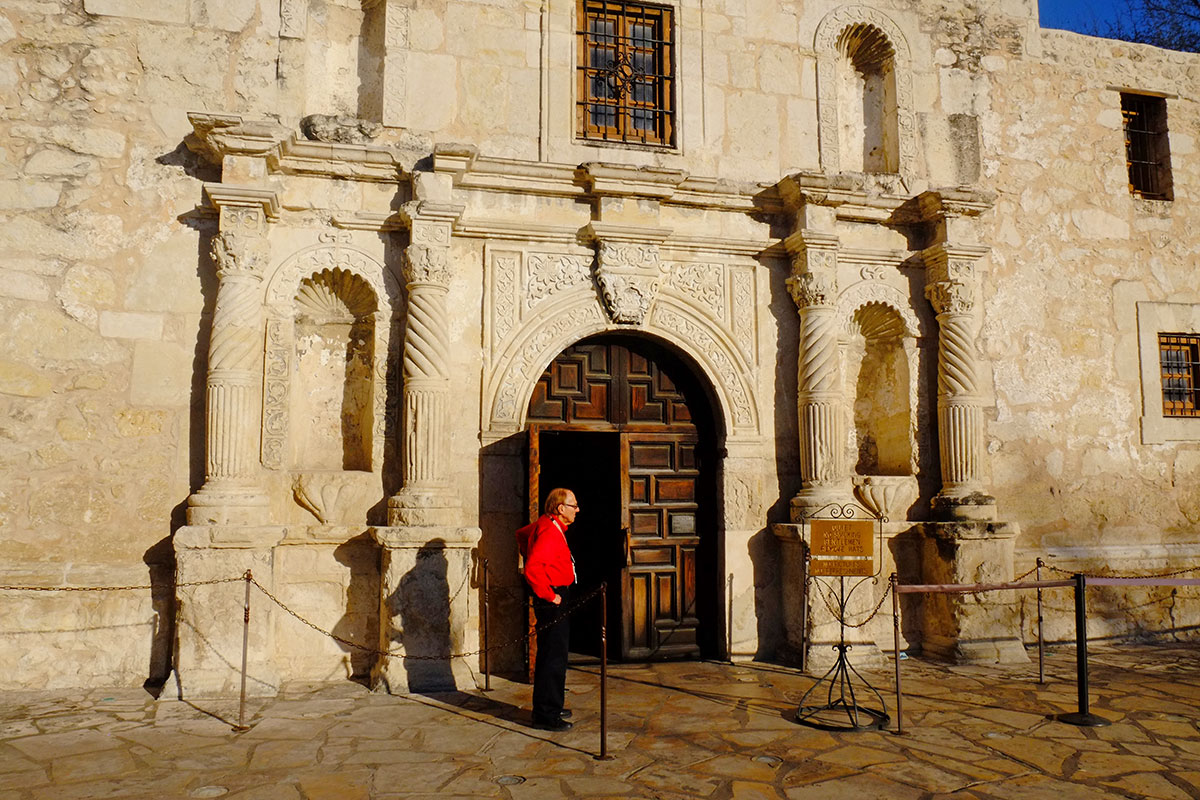
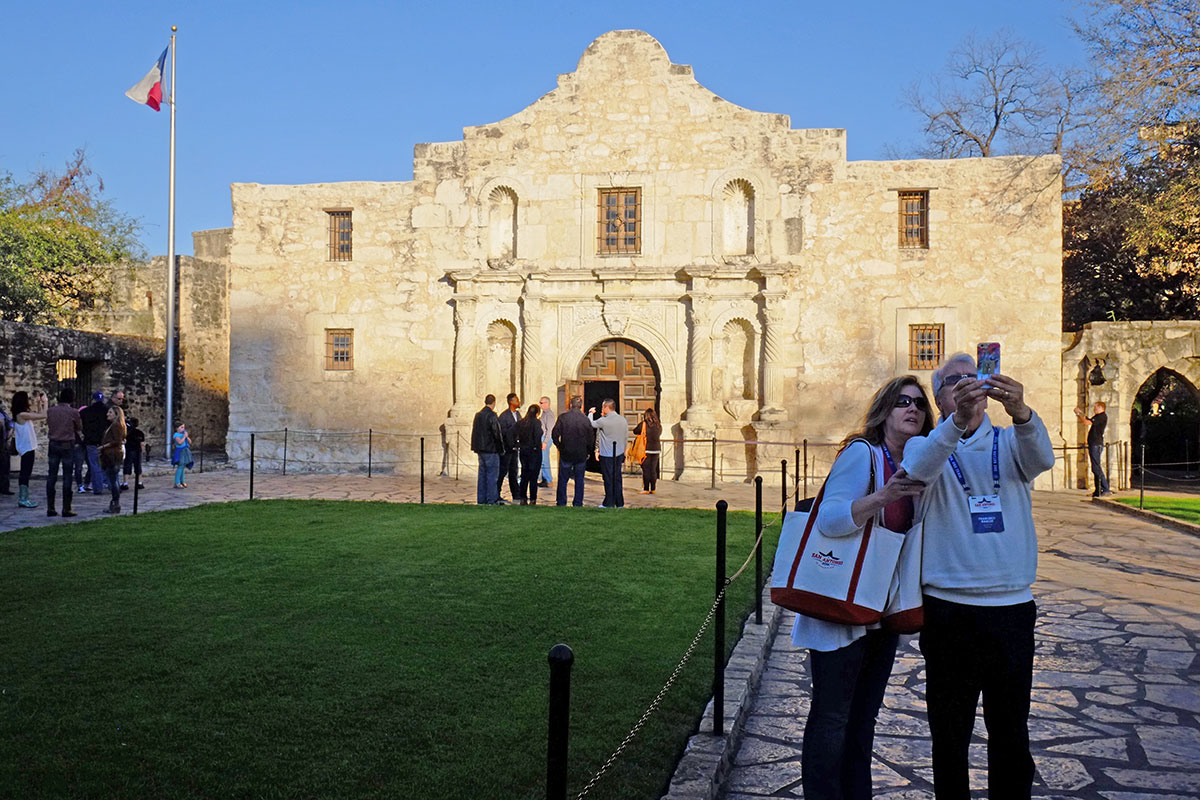
The Alamo is the major tourist attraction.  It is quite small, and actually a lovely building.  You can’t take photos inside, and you realize that you are in the secular mother church of Texas, surrounded by reverent Texas tourists taking selfies and intently examining all the artifacts related to their fundamental combination creation / hero myth.  DSCF5668

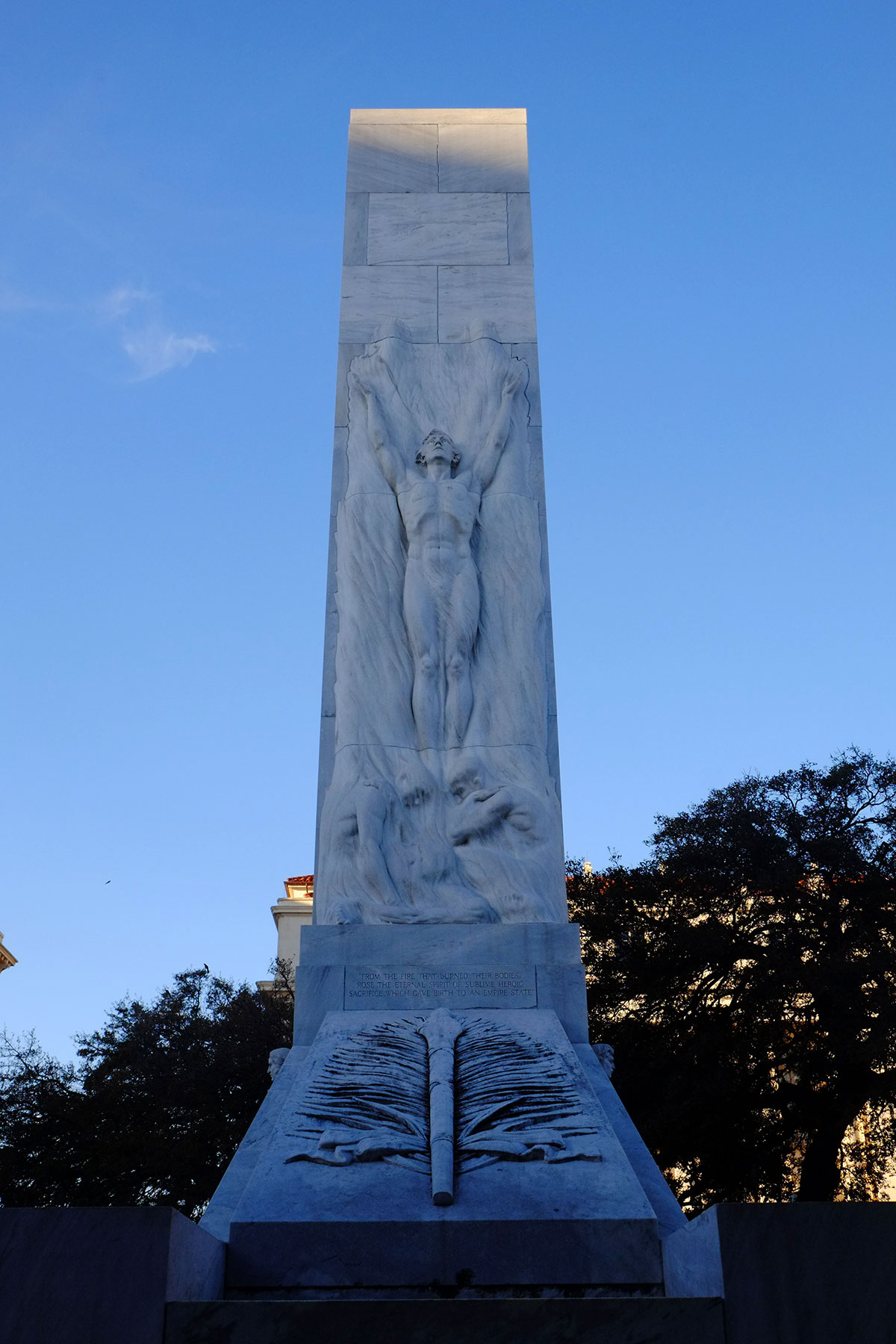
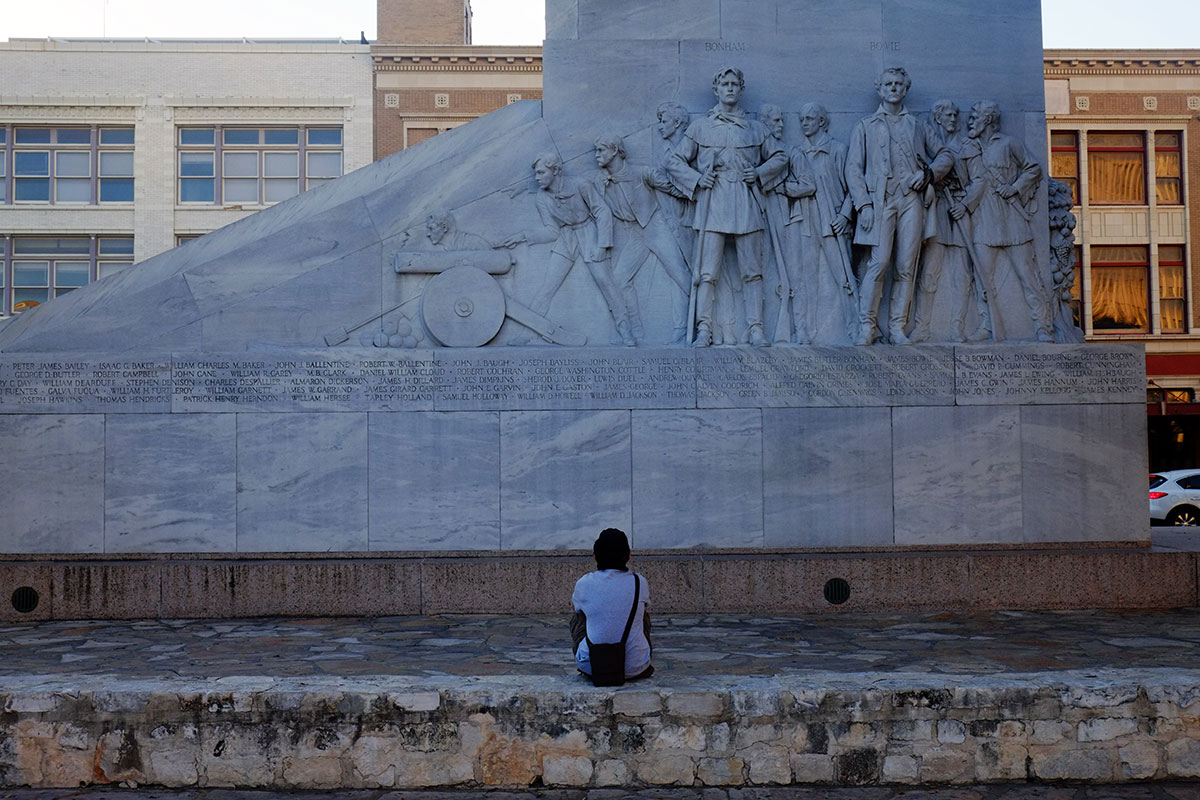
The Alamo is at the core of this, but then it is also surrounded by other monuments to the Alamo.  It is like a religious pilgrimage site, where there is a multiplication of chapels and statues, as each generation feels the need to add their particular expression of piety to the complex.  The weirdest is this gigantic, Art Deco statue / bas-relief / monument.   A central naked figure representing something, DSCF5674

and then a Pan-Texan Procession on the bar, depicting all the famous people who died at the Alamo.  DSCF5673

We did not notice any similar monuments to the heroes of the Civil War who died to end slavery, such as we saw in Boston.  We realized that we would could never truly appreciate this primary expression and apotheosis of Texas identity, so we moved on.

DSCF5709

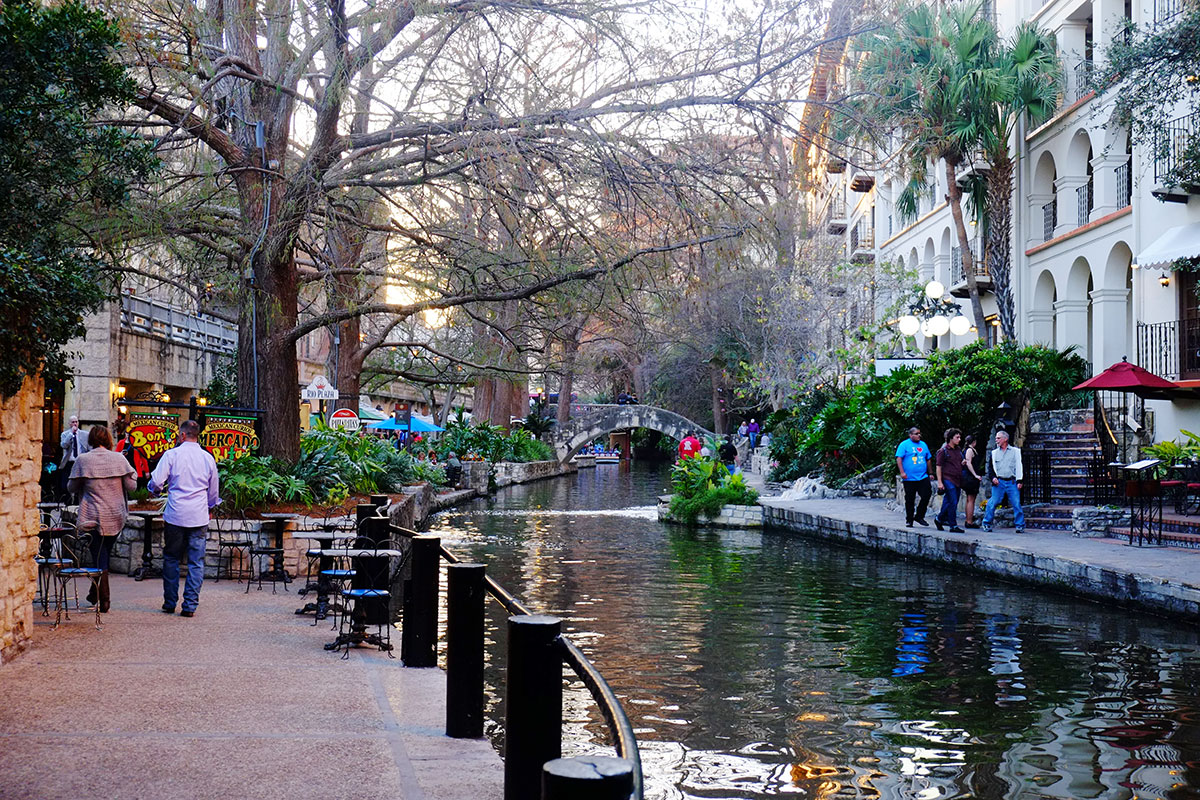
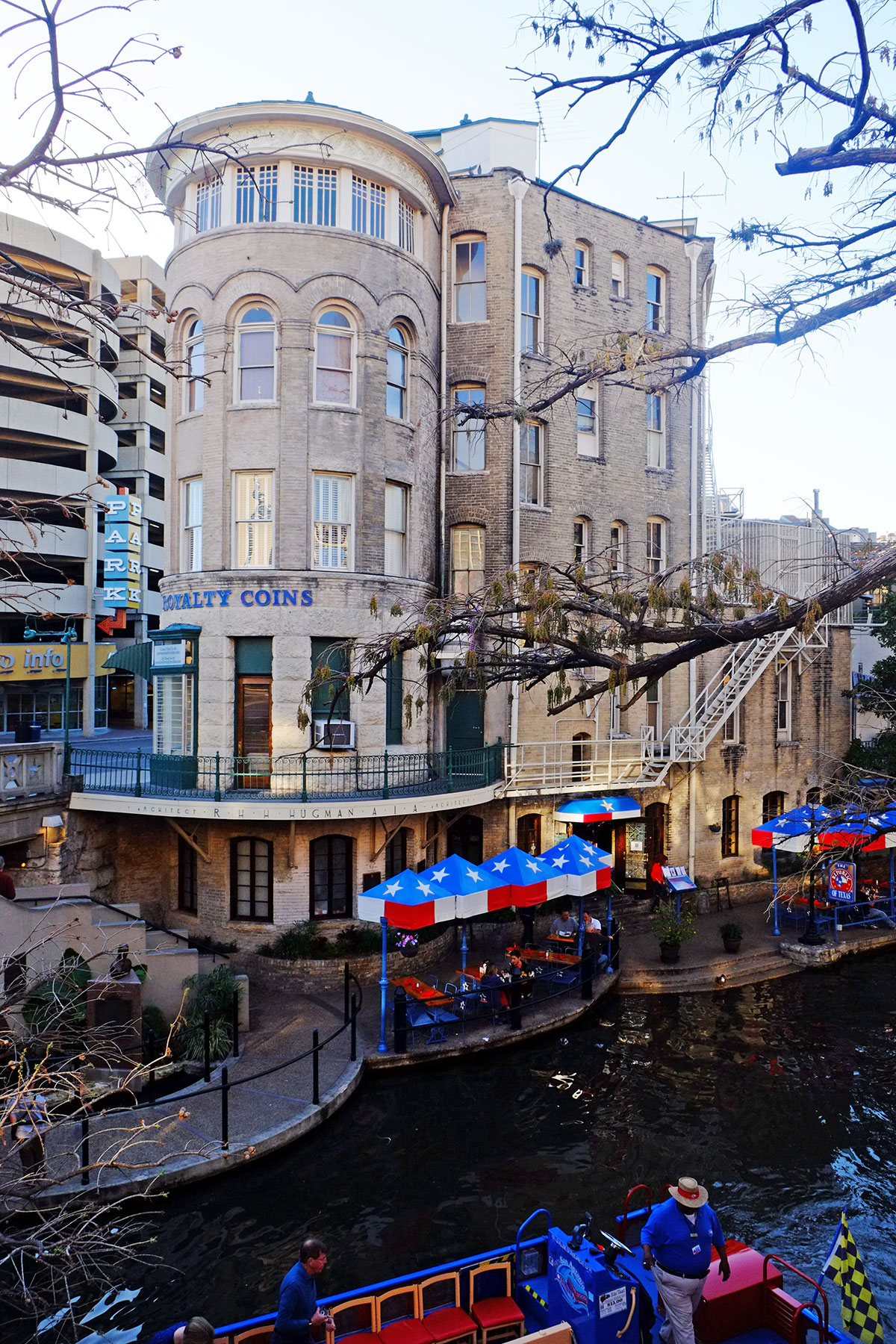
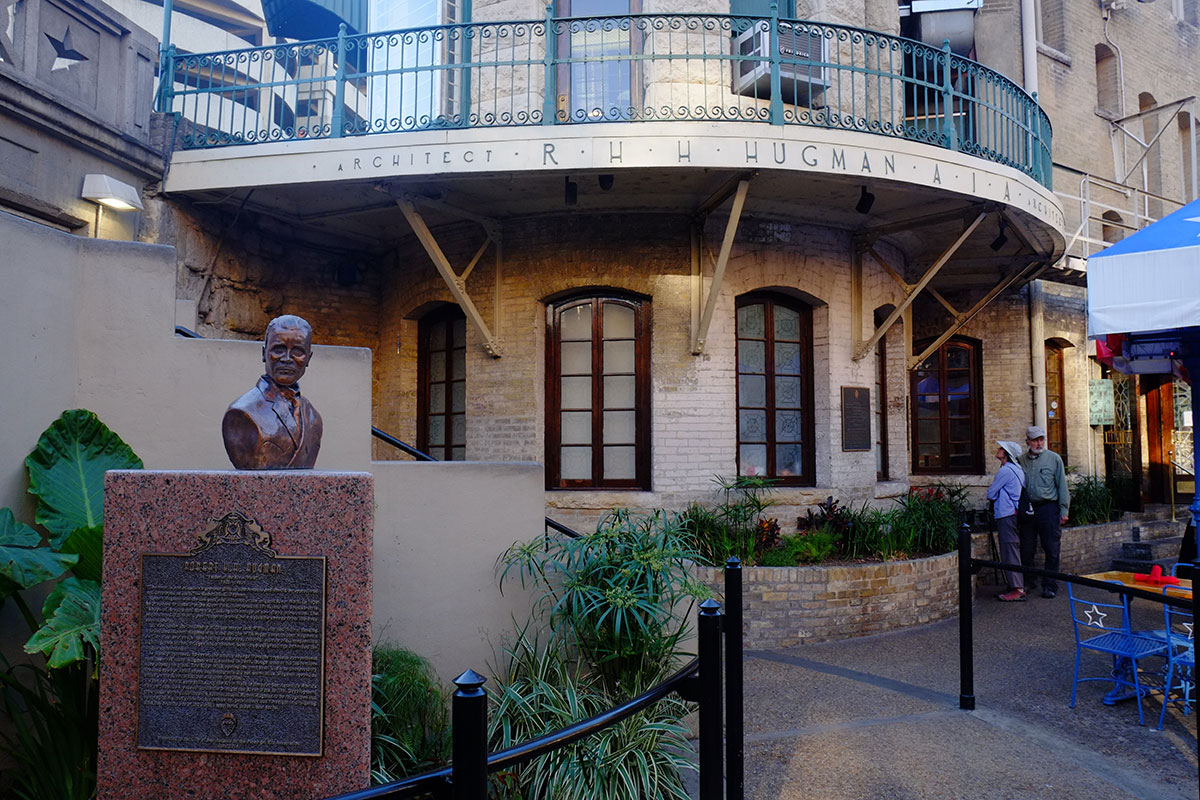
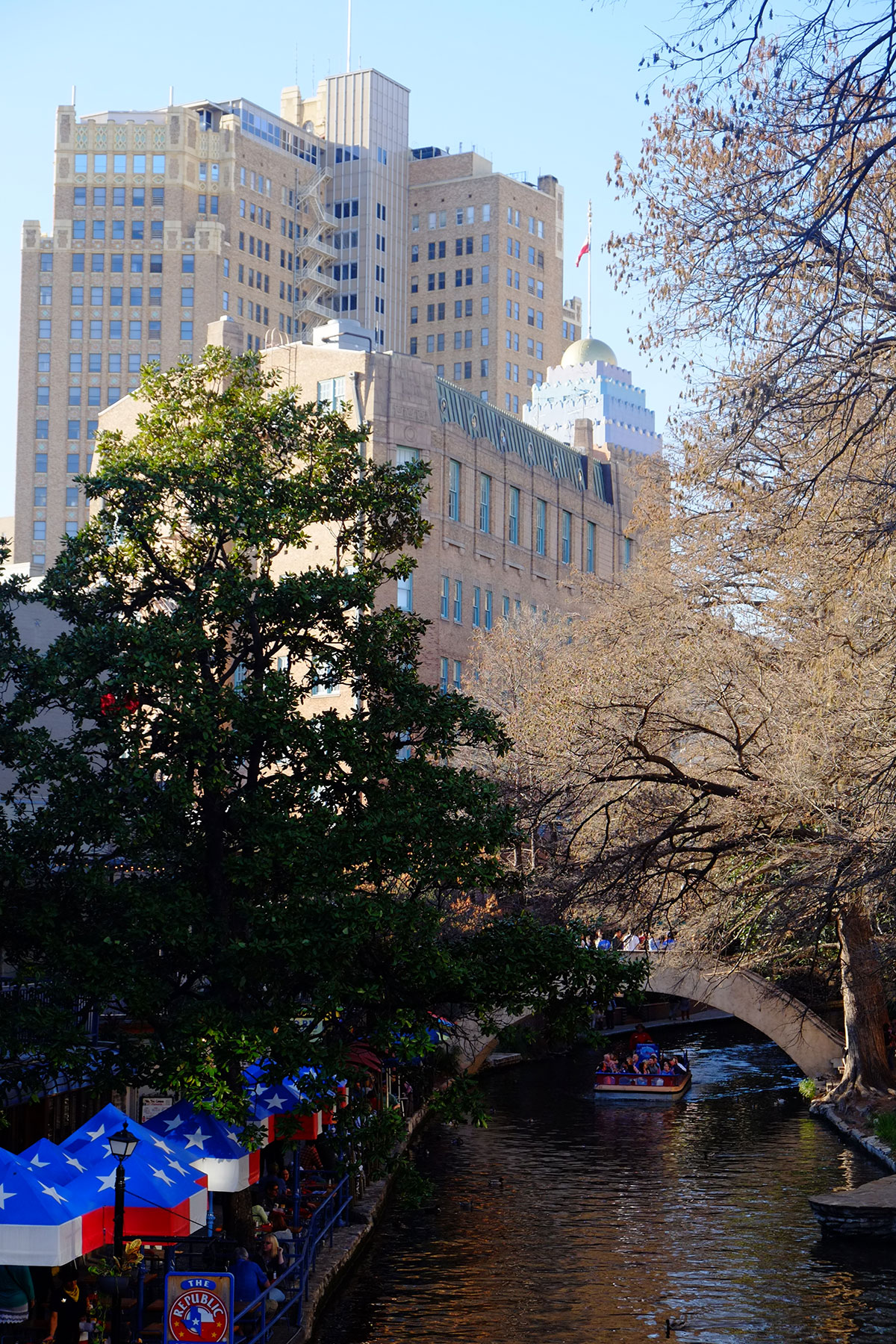
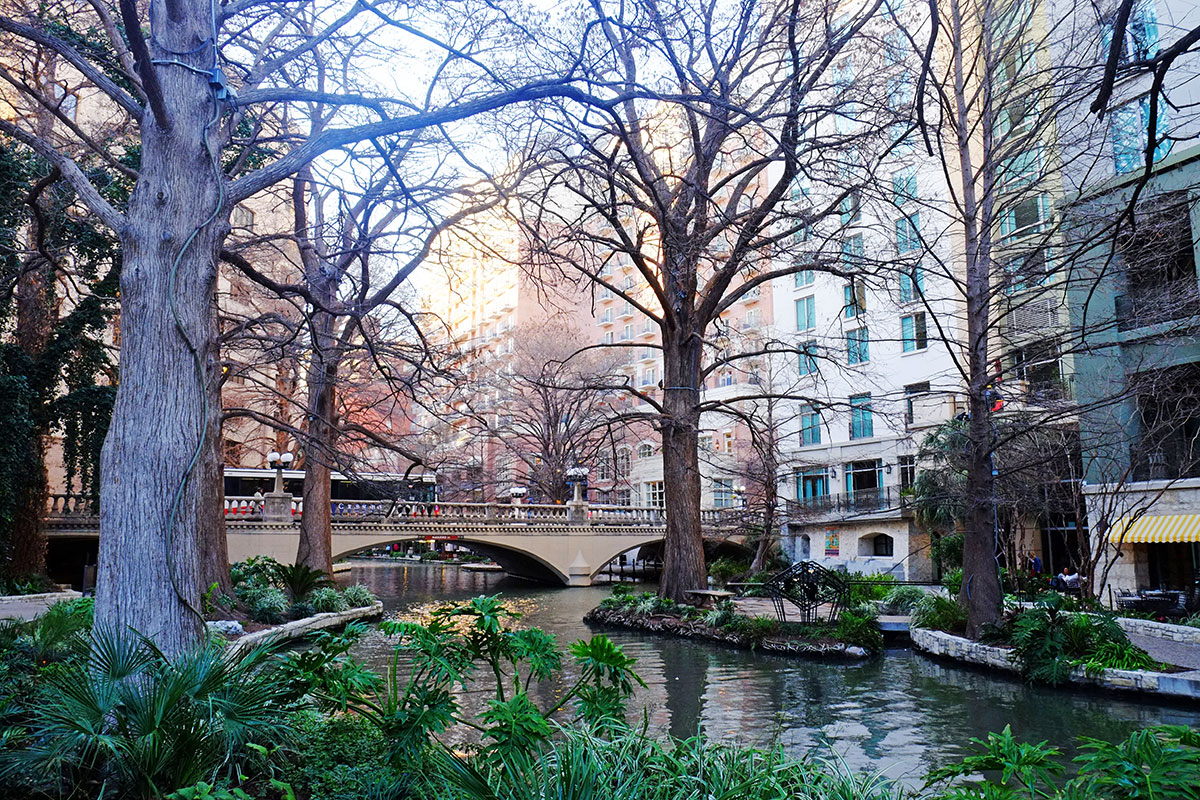
The Riverwalk was amazing.  It is not a phony, recent, focus-group tested, marketing ploy.  It was a loop in the canal / water control system in the downtown that was redeveloped beginning in the 1930s.  It was largely the vision of a local architect, Robert H.H. Hugman, who in the 1920s began pushing the idea of re-using the canal that ran along the backside of downtown buildings.  He built his own office there at the canal level, which bridges the upper world of the street and the lower world of the canal.  DSCF5650Outside it stands a statue and memorial to him.  DSCF5649

He emphasized that the redevelopment of the downtown should preserved much of the past, rather than clearing the city for the big new ideas.  There are several other plaques scattered around in his memory;  I have only seen one other city (Amsterdam) where the role of the visionary architect is even acknowledged, much less celebrated the way it is here.

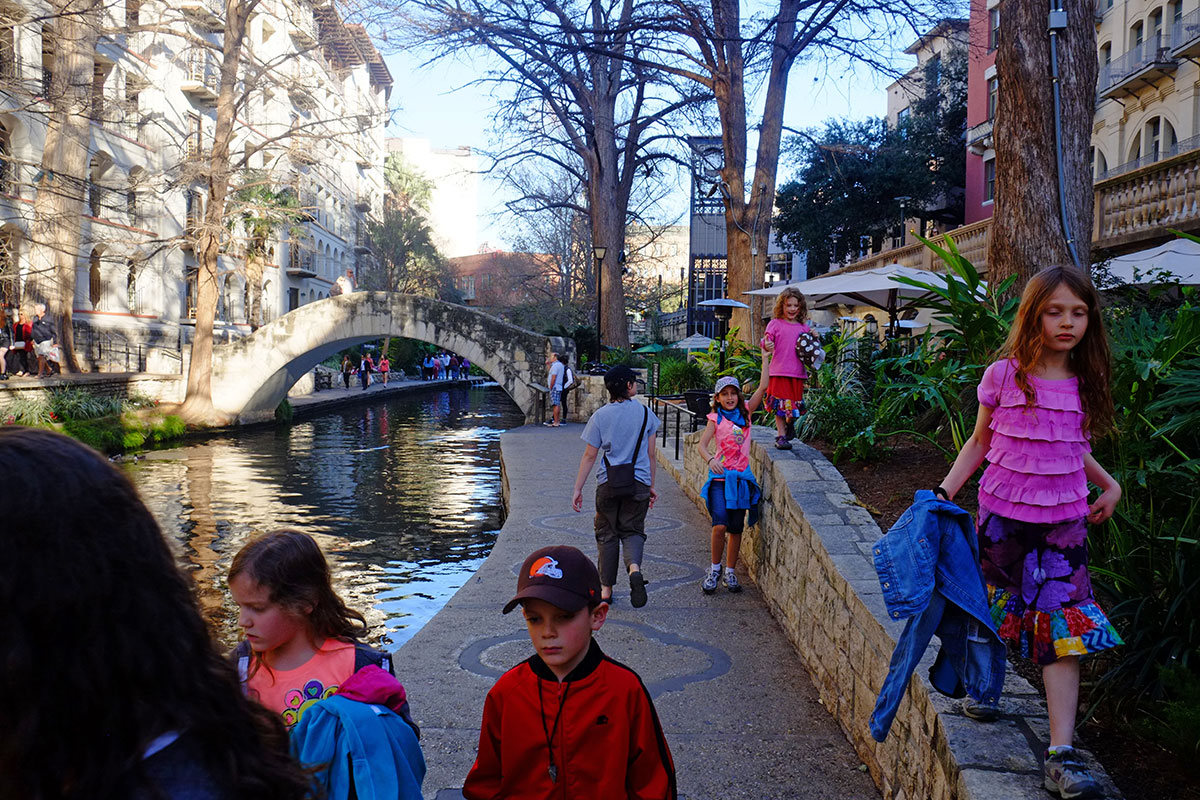
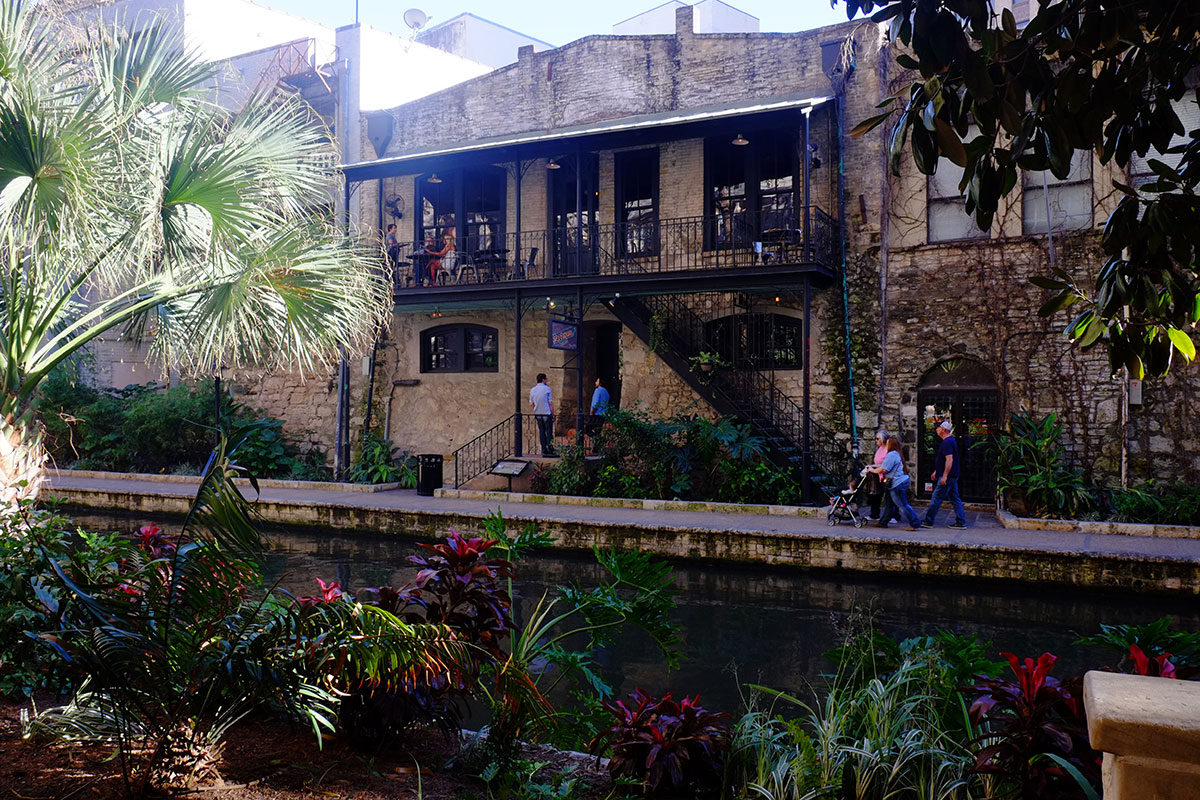
The canal is lined with restaurants, cafes, hotels and stores.  There is a range of prices, and there are plenty of public amenities – it doesn’t feel like a corporate “plaza” where the public is grudgingly admitted if it is dressed right.  There are tourists, locals, kids, yuppies, etc.  DSCF5636

DSCF5631

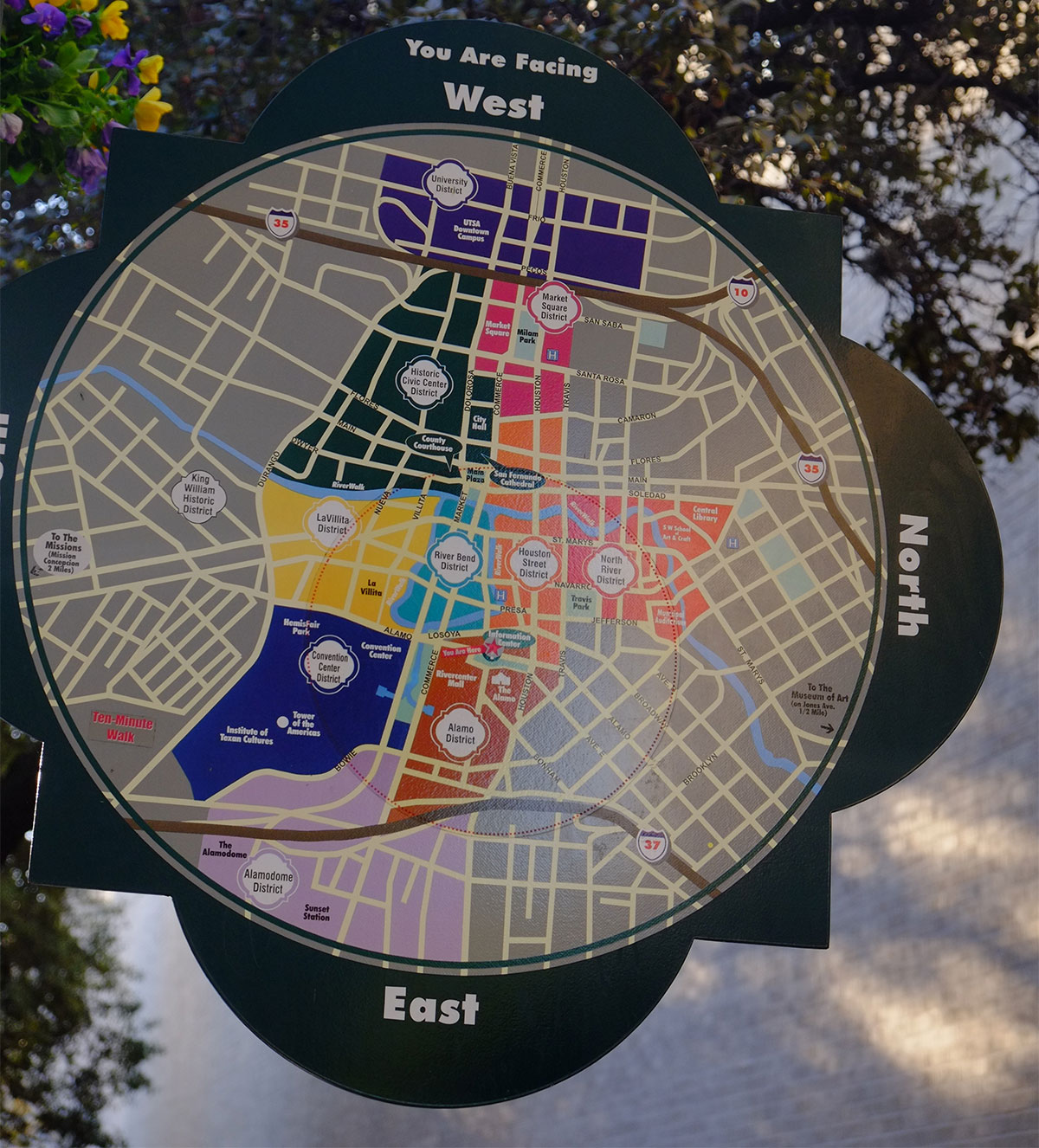
It is a big curve through the downtown, and this exaggerates one of the strangest aspects of San Antonio:  outside of Boston, it is the most confusing downtown of an American city I have ever seen.  Most of the west is gridded, and sometimes there are colliding grids.  Eventually you figure out the system and can find your way around.  But the center of San Antonio seems to be unplanned in the way that the old part of Boston and New York are, and then various grids collide into it on all sides, most of which are deformed themselves.  The dislocation is so severe that there are map signs everywhere downtown to help people orient themselves.  DSCF5678And then added to this general confusion is the Riverwalk, which is a loop off the main canal.  (in the map above, it circles the light blue area in the middle.), which is probably the path that most visitors are going to follow.  Since the Riverwalk is a separate system (similar to the way the street and canal systems in Venice are separate), and since it is behind the major buildings, it is almost invisible from street level, except that a view and access point appears every once in a while.  And when you are on the Riverwalk, you barely notice the streets passing over you now and then.  If you do ascend to street level, you have no idea where you are, and you have to start looking for one of those maps.  San Antonio takes the concept of Chutes and Ladders to the urban scale.

In practice, this is all wonderful.  The problem with the big, gridded cities of the West is that they are often boring – every point on the grid is the equivalent of every other.  (Even the pedestrian Mecca of Portland suffers from this.)  The downtown of San Antonio is a labyrinth, and you wander happily through it.  When you need to actually get somewhere, there is a map to help you.  But rather than navigating by an abstract geometric system, San Antonio can be navigated by landmarks.  Some wonderful buildings have been designed which bridge the two worlds, and are imageable places.  Hugman’s office is one, the Casino Club Building is another.  At street level, it marks the corner of a major intersection at the end of a bridge.DSCF5620

At the canal level, it is a landmark purely through its design.  DSCF5655

One leg of the Riverwalk is lined with newer buildings.  These are larger, and the edge of the canal does not have the density of visitor-friendly venues that the older part does.  It feels more modern, institutional  and empty – the scale is off.DSCF5686

But even this is quite beautiful.  Perhaps they were right to not try to mimic the character of the older section that comes from the scale of the older buildings.  Perhaps the infrastructure is there, and the intensity of use can develop as needed.
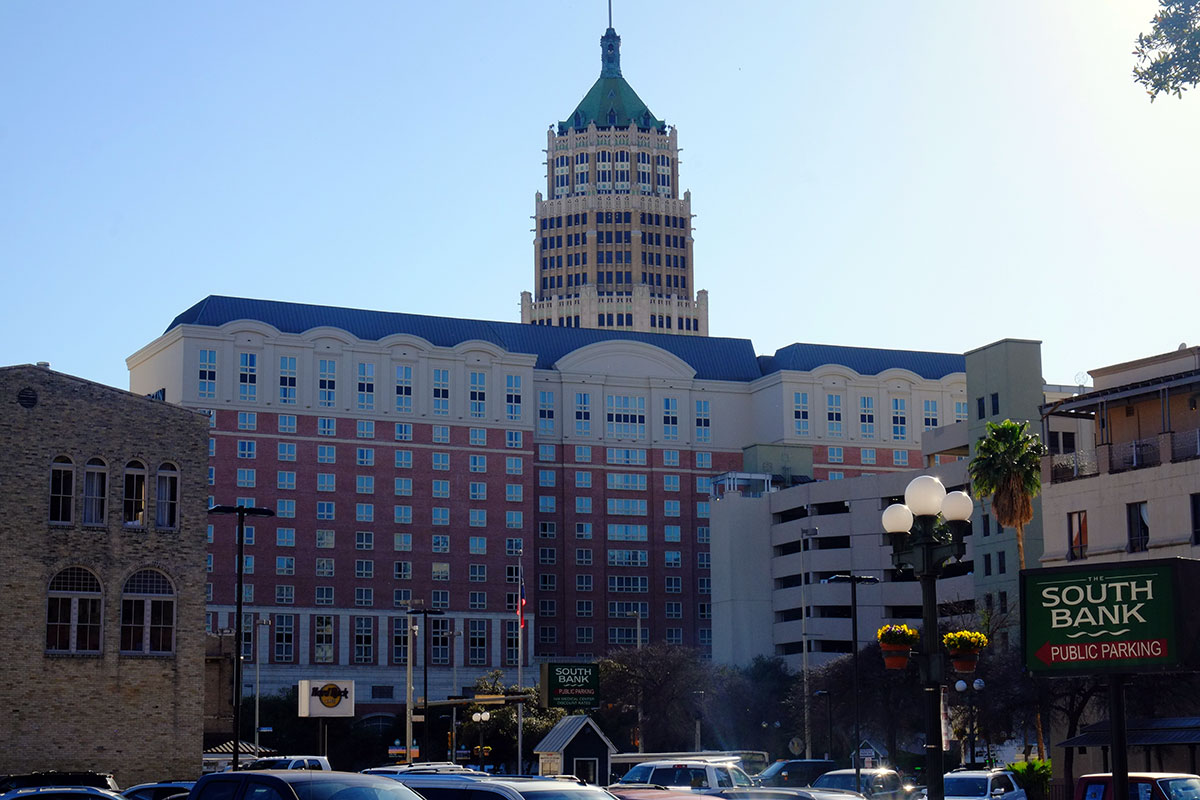
So once again, Texas surprised us.  San Antonio doesn’t just have the best downtown in Texas, it is one of the best I’ve seen in this country.  And it’s not just a downtown for architects or tourists – from what I could see, it illustrates that if a city has a good downtown, it will be cherished and used by its citizens.

Austin

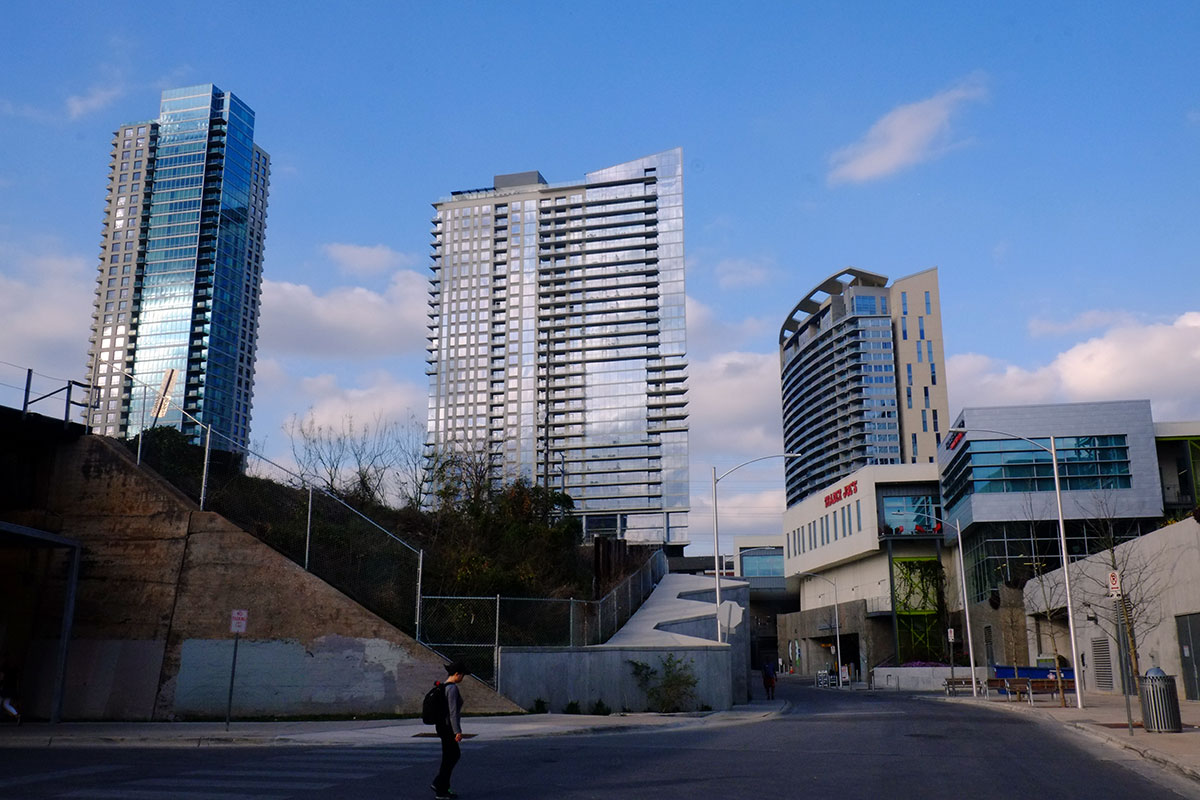
We had heard two things about Austin before we got there – it is the cool, hip place in Texas, and the traffic is terrible.  After being surprised by Dallas, and horrified by Houston, we were prepared to love Austin.  So we were again surprised, finding it to be basically a good, big, fairly typical American city for its size, but one that didn’t wow us in its physical attributes.  On the other hand, clearly it is the place in Texas where you’d want to live.  The people are interesting, and the neighborhoods, restaurants and ambience are cool.  There are just a few parts of it you have to avoid, such as everything connected to the state government, and the UT campus.

DSCF5314Compared to Houston, the downtown is a wonder.  It is a good mix of early 20th century commercial buildings, stores, new offices, yuppie towers, DSCF5281nightlife districts, etc.  There are people on the streets, even on the weekend.  They didn’t demolish their city, and it is big and varied enough to accommodate changing needs and cultures.  It just didn’t strike us as very interesting physically – no especially beautiful buildings, or urban spaces, just good, solid, 20th-century, American gridded city fabric.  It reminded me of Raleigh, or Buffalo (but without Buffalo’s great architecture).  Greta and I have gotten pretty blasé about typical American downtowns, and we can usually knock them off in a couple of hours.  So we did that in Austin and moved on to look at the more atypical parts.
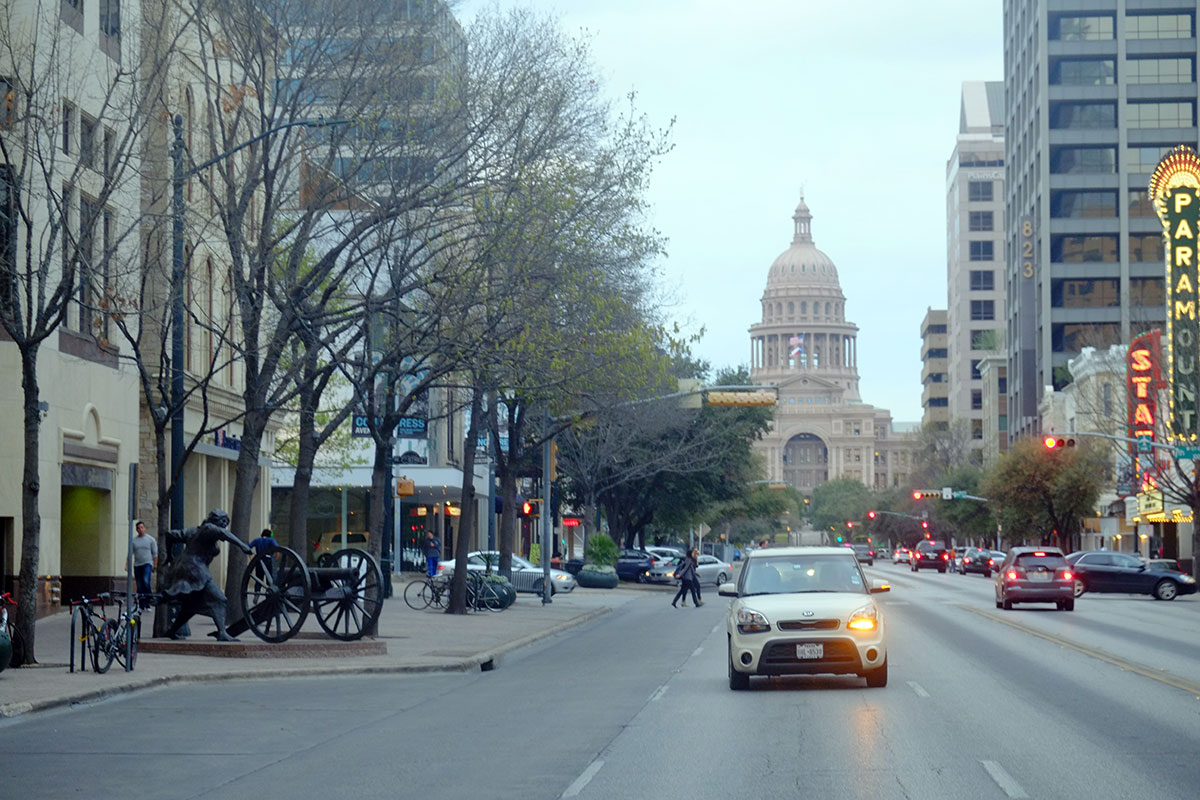
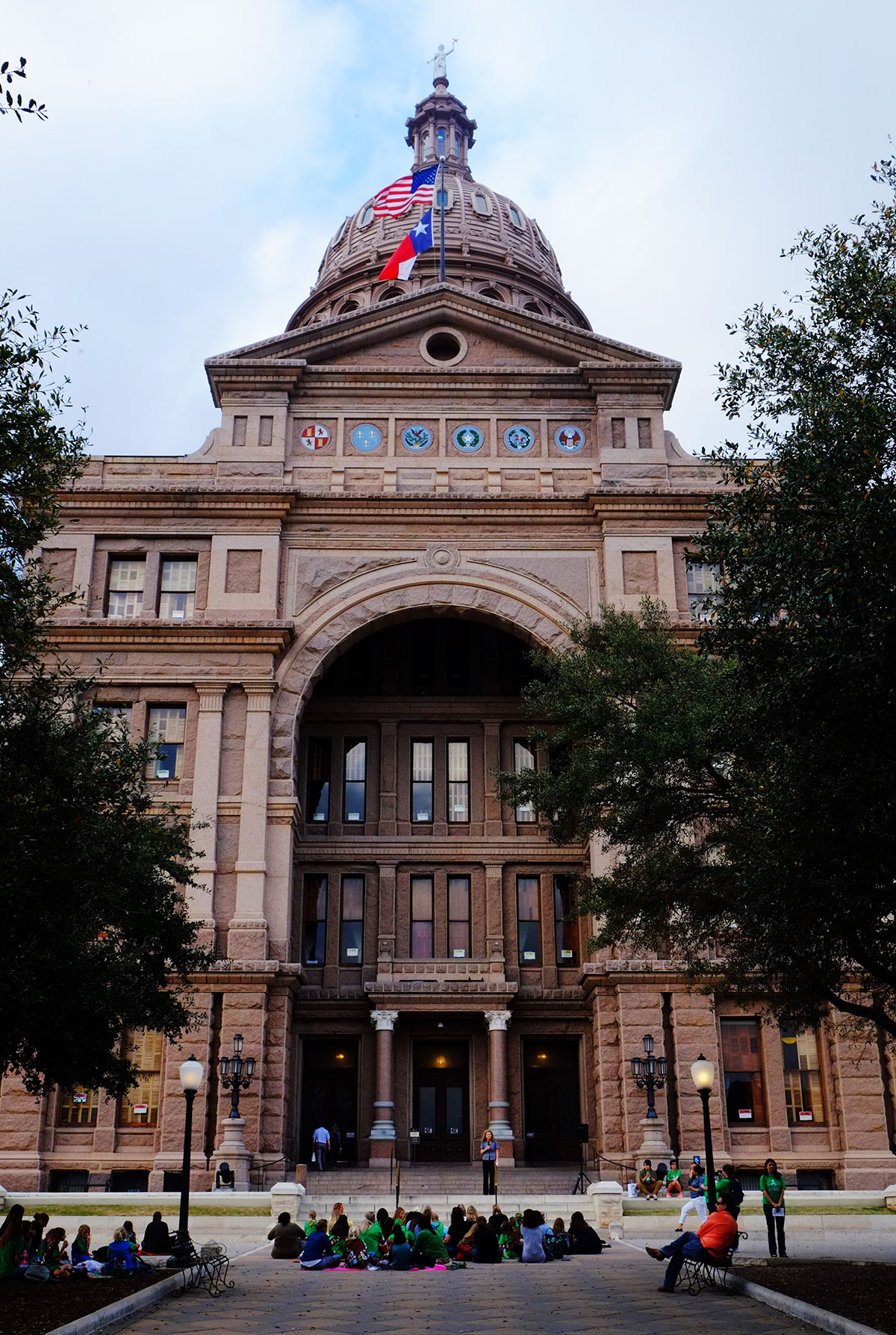
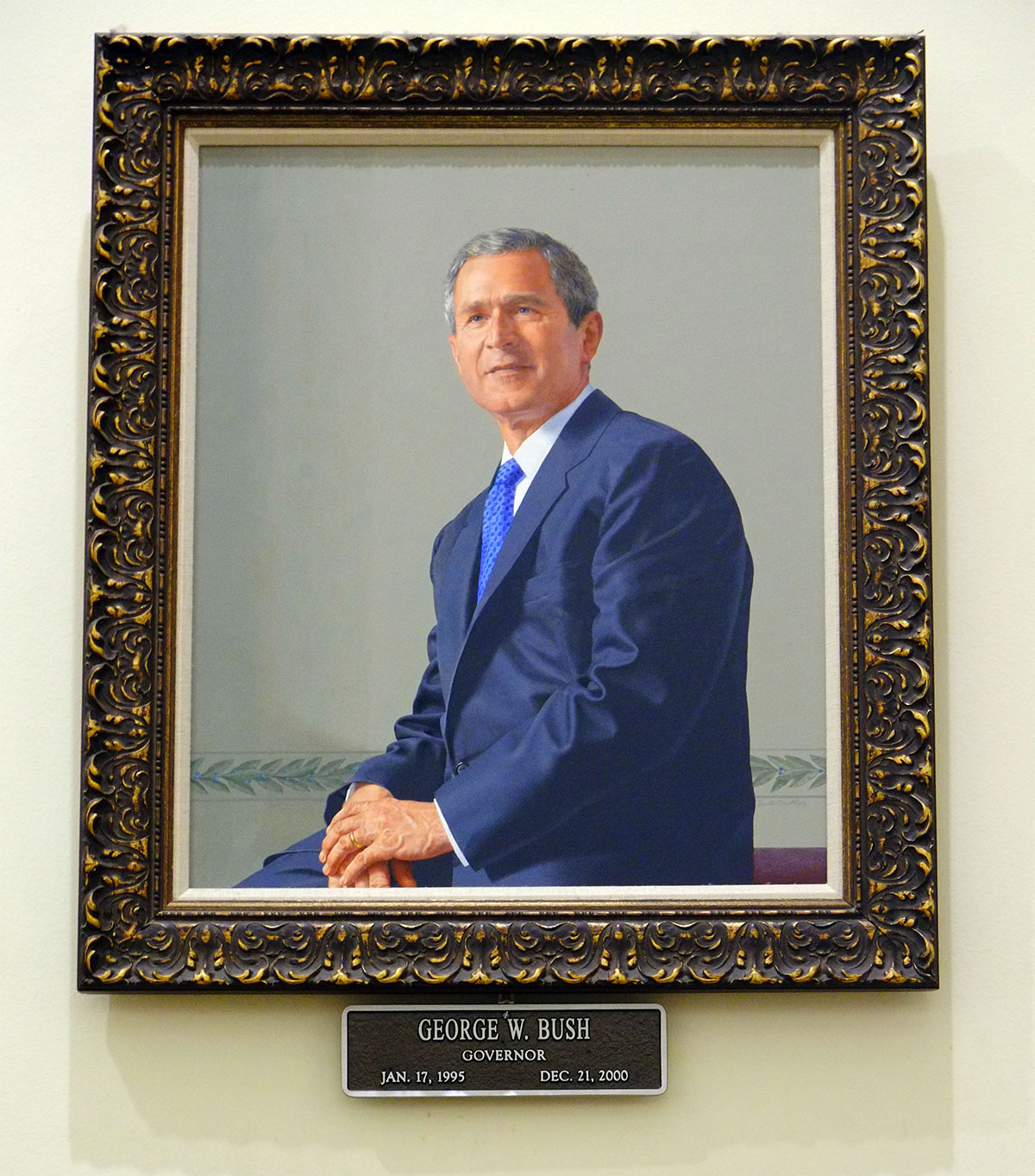
The state capitol is probably what we should have expected.  Very, very big compared to other state capitols, highly derivative, and not especially interesting. DSCF5290 It looms over the town on its hill, reminding Austinites of the power of all the crazy people in Texas.  DSCF5292

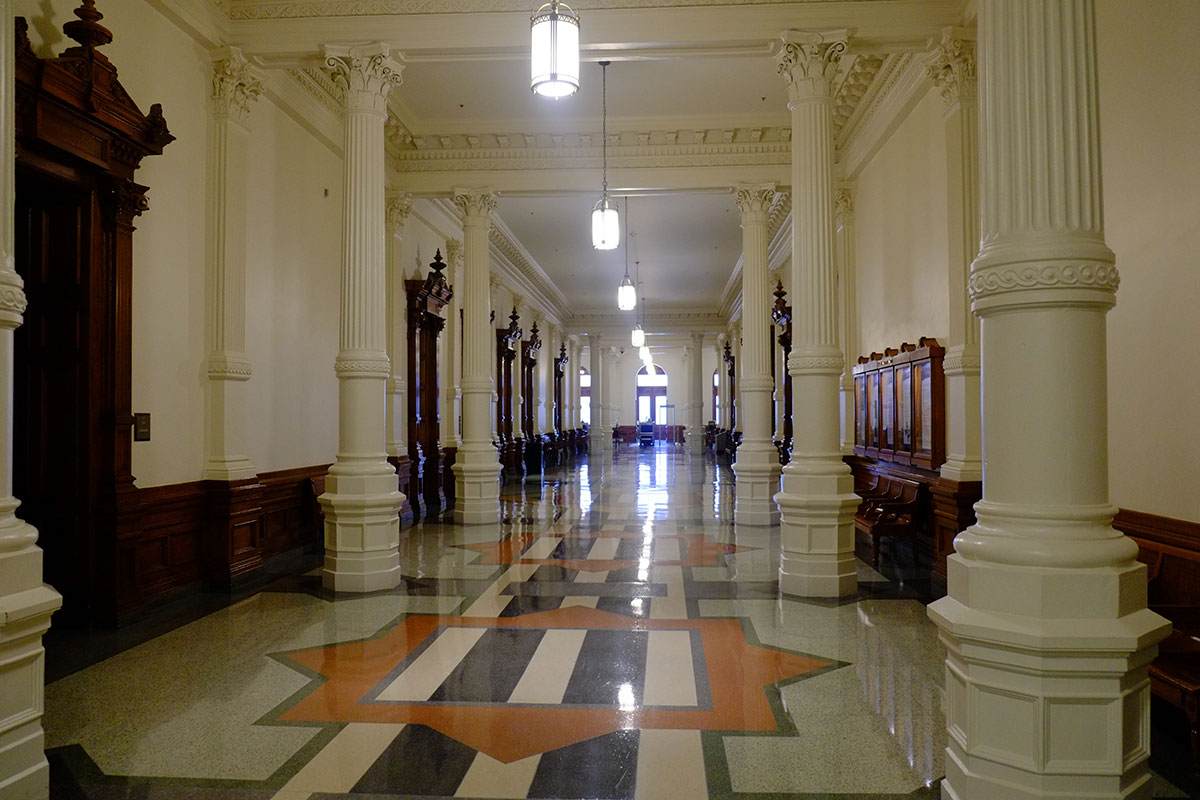
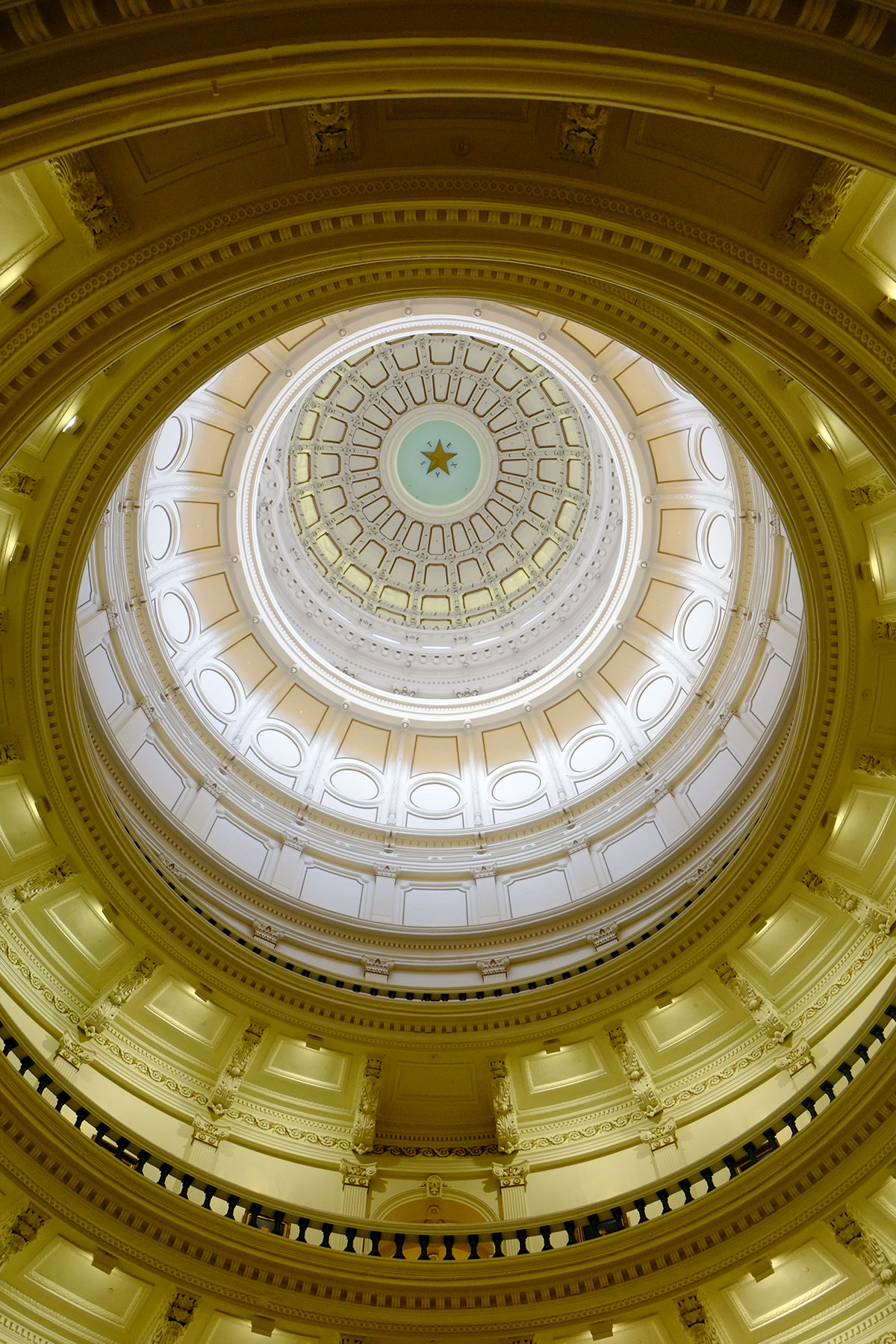
The interior has some points.  Again, it is all very big , beaux-arts rational, and impersonal, with long hallways DSCF5299and a really big domeDSCF5295

where the high points of Texas politics are immortalized.  DSCF5298

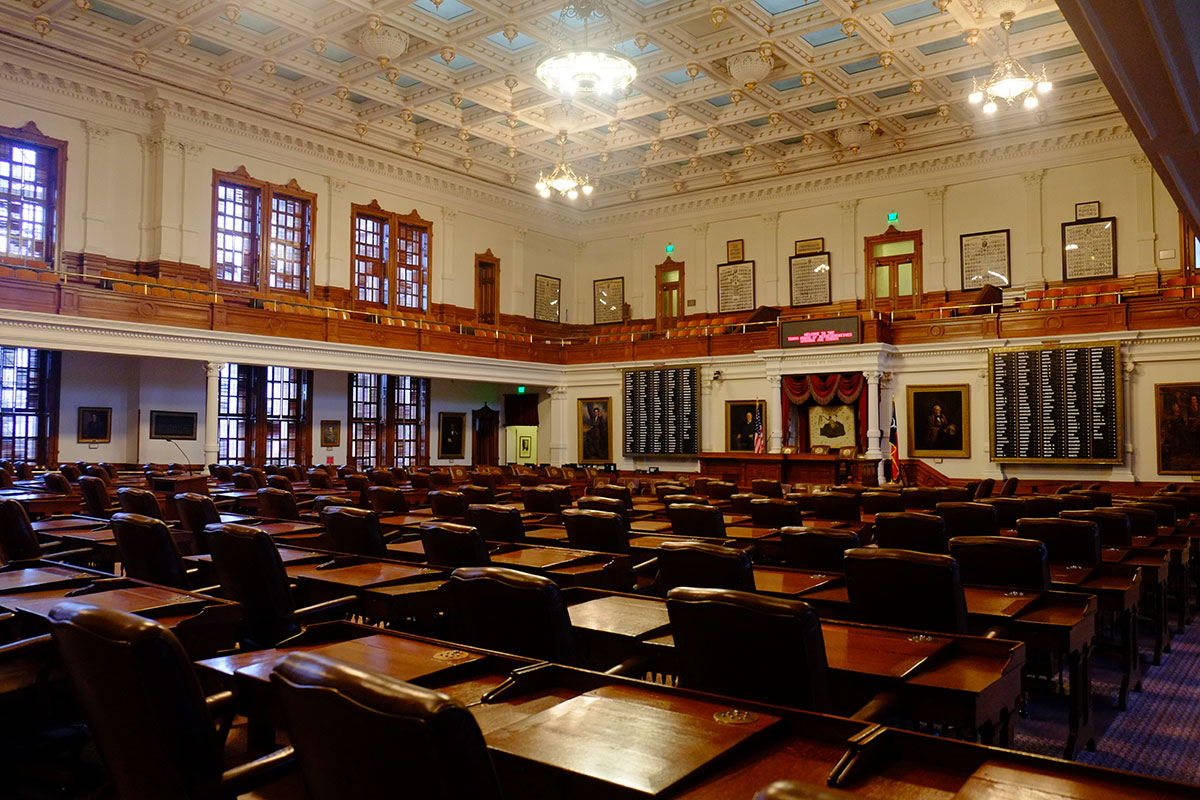
The legislative chambers match the rest of the building in their size and mediocrity,DSCF5306

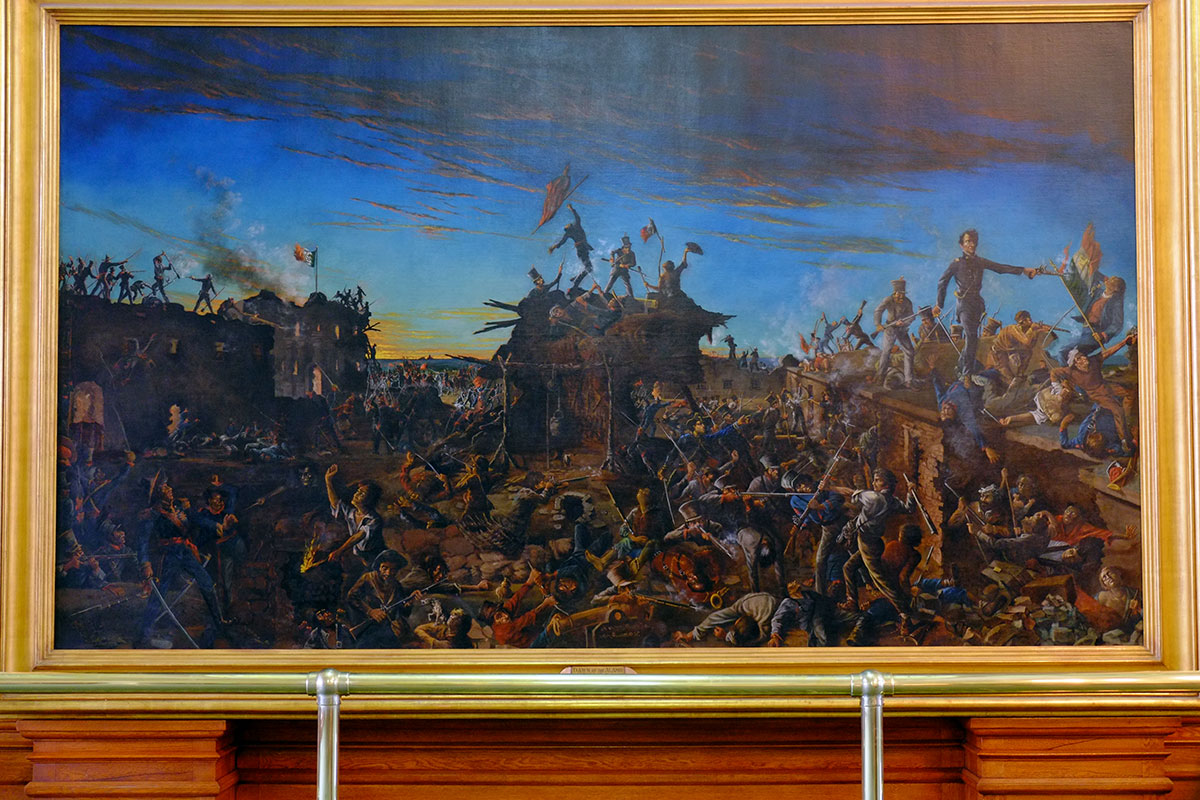
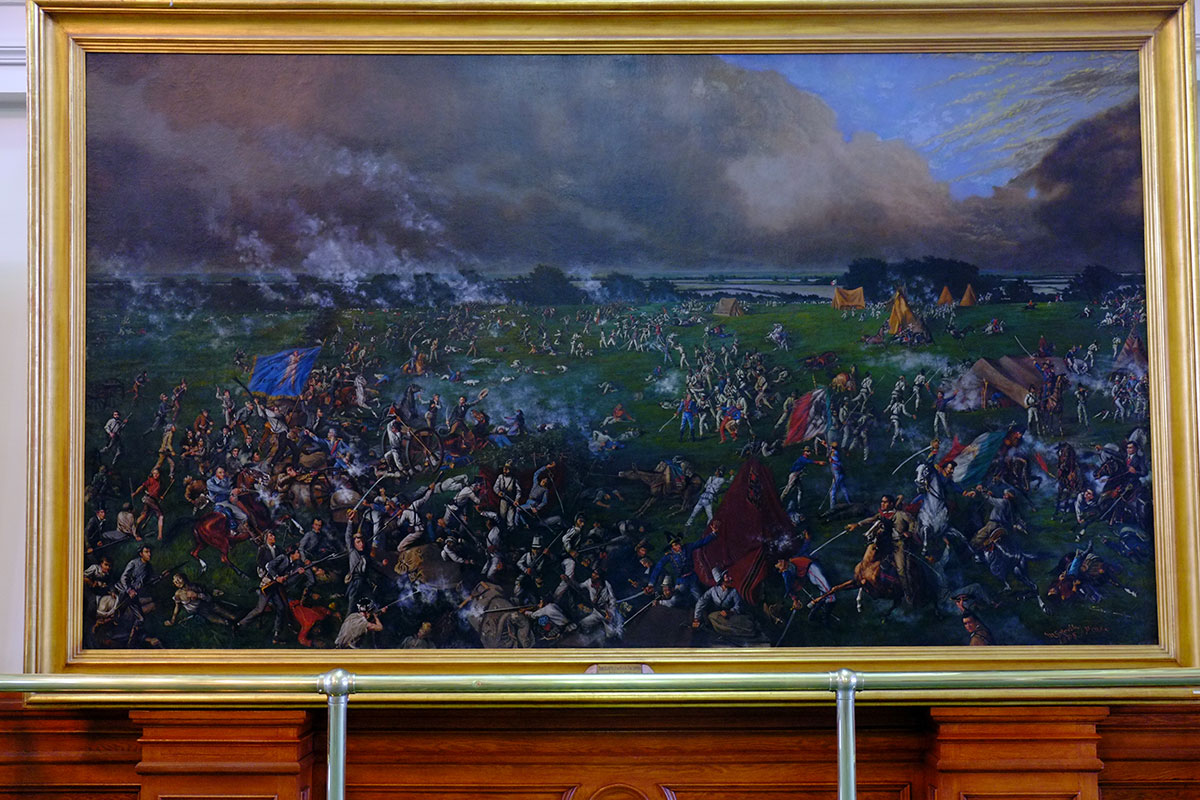
but are worth visiting to see these two paintings, which depict the battles of the Alamo and San Jacinto.  DSCF5302Painted by Henry Arthur McArdle, they are truly two of the biggest, and most ghastly (in both subject matter and aesthetics) paintings in the world.  DSCF5300

I considered trying to count the number of dead or soon-to-be-dead bodies in them, but we didn’t have the time.  McArdle is the Hieronymus Bosch of Texas, without the talent or subtlety.  I have never seen such a detailed depiction of mayhem and gore, and you start to understand the Texas mentality when you see these depictions of its foundational mythology.

Being a giant state, Texas has a giant state government, which spawned a vast district of banal bureaucratic boxes, typical of most state capitals.  DSCF5308It doesn’t have the fascination of the disaster of Albany, and it makes one yearn for the wisdom of Annapolis, where they kept their beautiful capitol and pushed the bureaucracies out to the edge of the city.

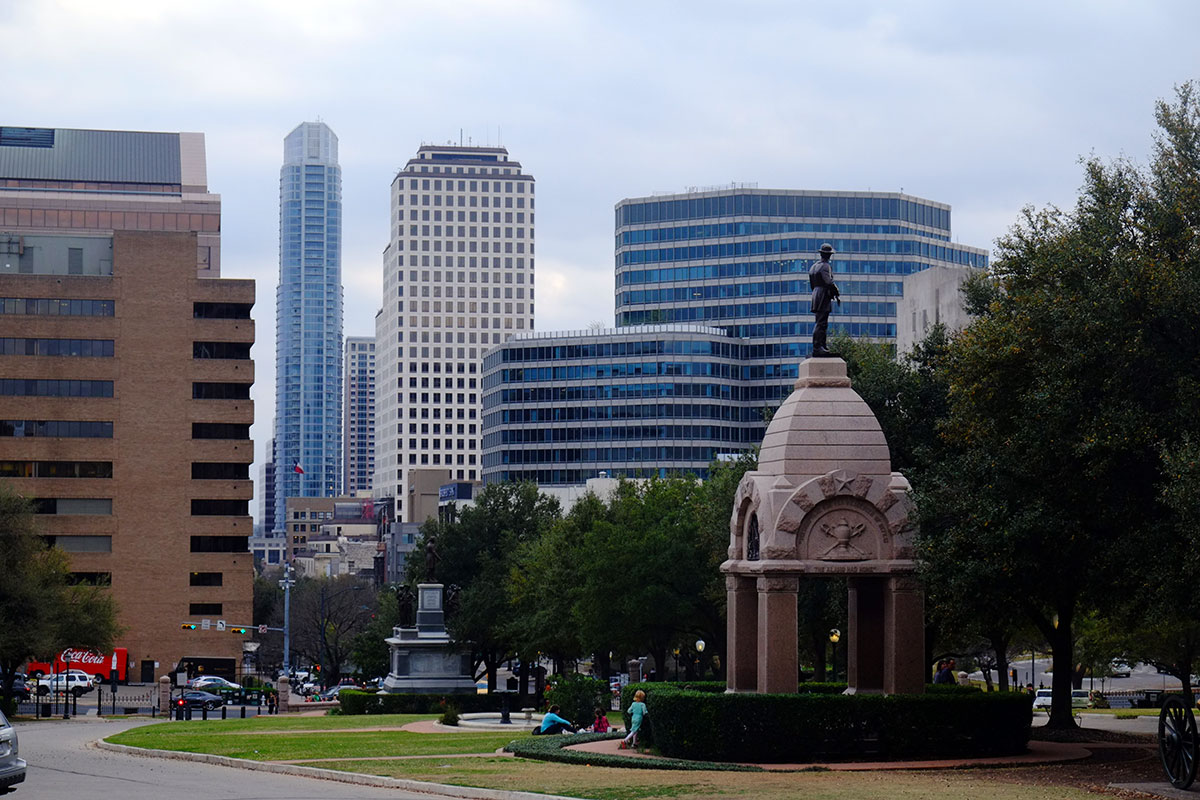
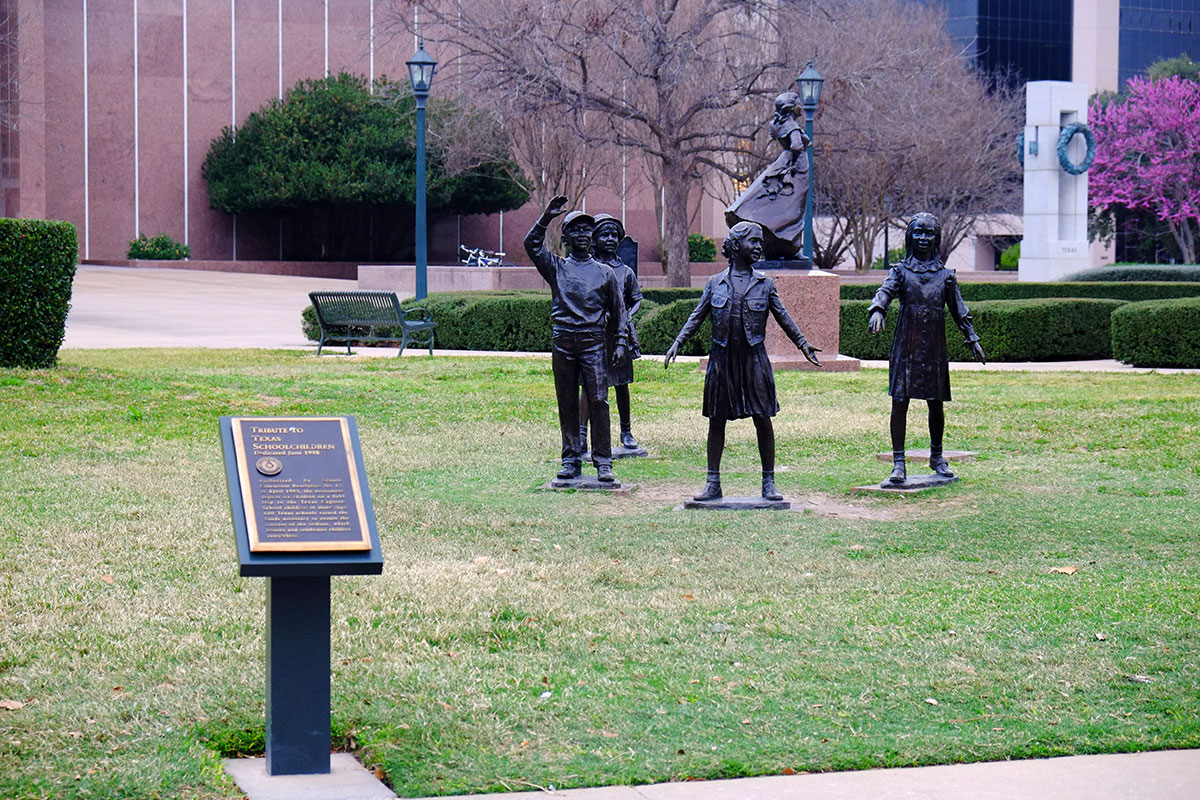
The capitol grounds are a weird agglomeration of formal landscape and a plethora of monuments.  A really stupid one to the Children of Texas – you can imagine the degree of political pandering which brought such a piece of kitsch into existence.  DSCF5309

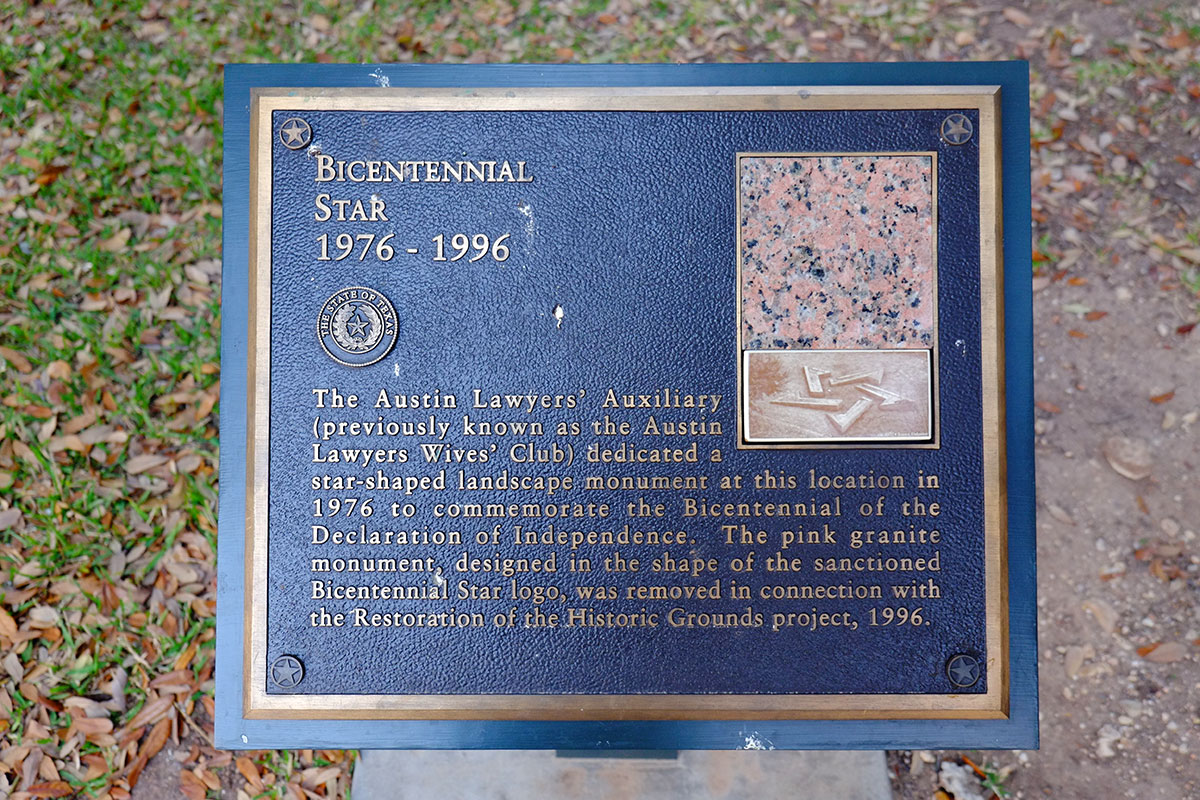
But my favorite was this – a monument to a removed monument.  Again, political pandering to the forefront, unwilling to offend a minor constituency (the Austin Lawyers Wives’ Club) in the tiniest way.  DSCF5311It’s clear that the physical environment barely registers with these people – they are politicians, and all other realms are just instrumental in their service to politics.

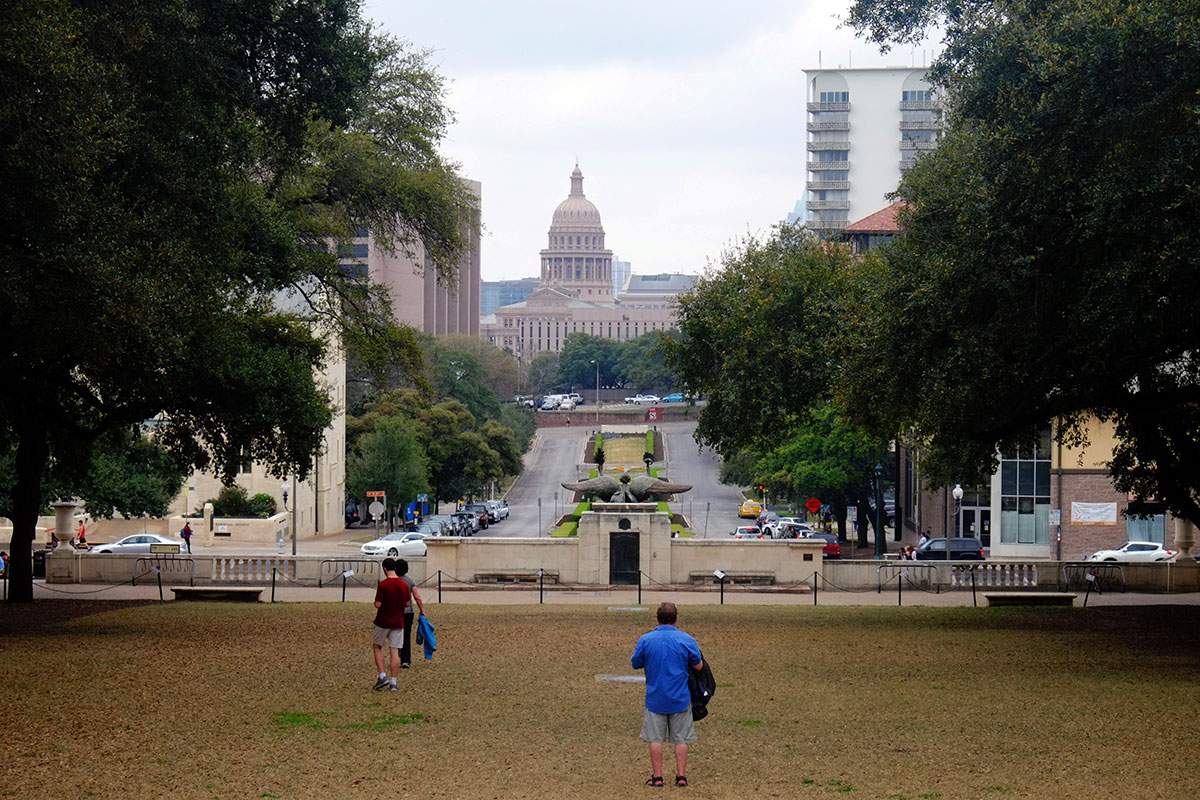
The University of Texas campus was also a huge disappointment.  It sits further uphill from the capitol, along a not-quite-straight axis.  DSCF5233

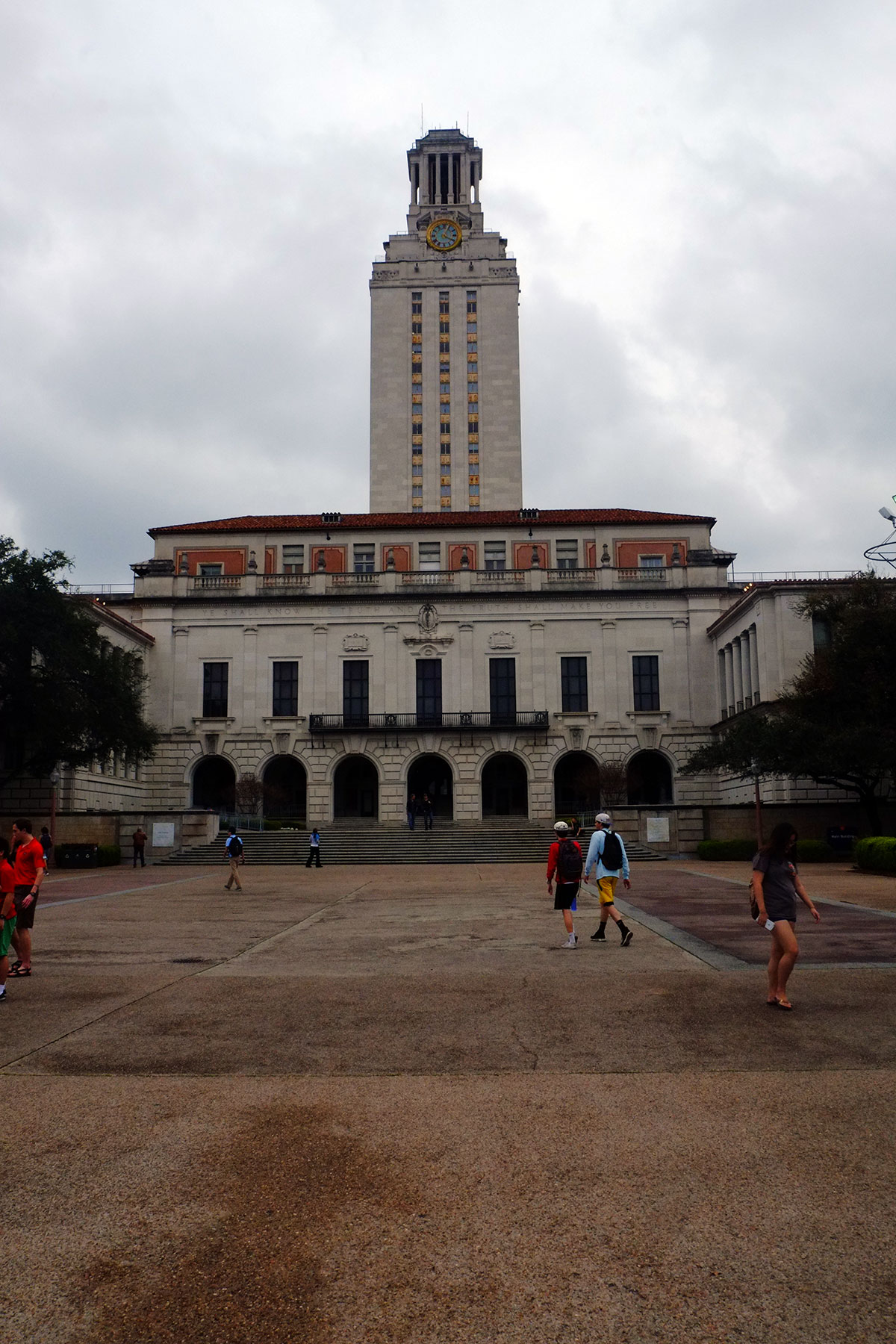
It is huge, with around 50,000 students, and the central campus is pretty dense by American standards.  The buildings are again big and banal, and the open spaces are devoid of charm.  The Main building (the famous tower from which one of our first mass shootings was perpetrated in 1966) is dreadful.  Designed by Paul Cret, who has a good reputation (which may be derived from his having employed Louis Kahn), it is an eclectic pastiche,DSCF5232that brings Moscow University to mind.  It is the worst thing on this campus, so in balance, this may be the best:  DSCF5236

But they point out the common problem of the campus – everything is in the same mostly Neo-Renaissancey, a little Missiony, ponderous, style.  Just as the Capitol is meant to manifest the Power of Texas, the campus is meant show that this is a Serious Institution of Higher Education;  take that, all you snooty East Coast schools, we have a bigger endowment.  It was oppressive and devoid of life.

So what did we like in Austin?  The neighborhoods.  Austin is a really weird place – you have the presence of a truly regressive state government.  You have a big grandiose university.  And somehow a hipster and yuppie community has sprouted here (probably grounded historically in the student population), which is known for its music, food, nightlife, progressive politics, etc.  Austinites must have signed a mutual nonaggression pact, otherwise I don’t know how they can all co-exist in this place.

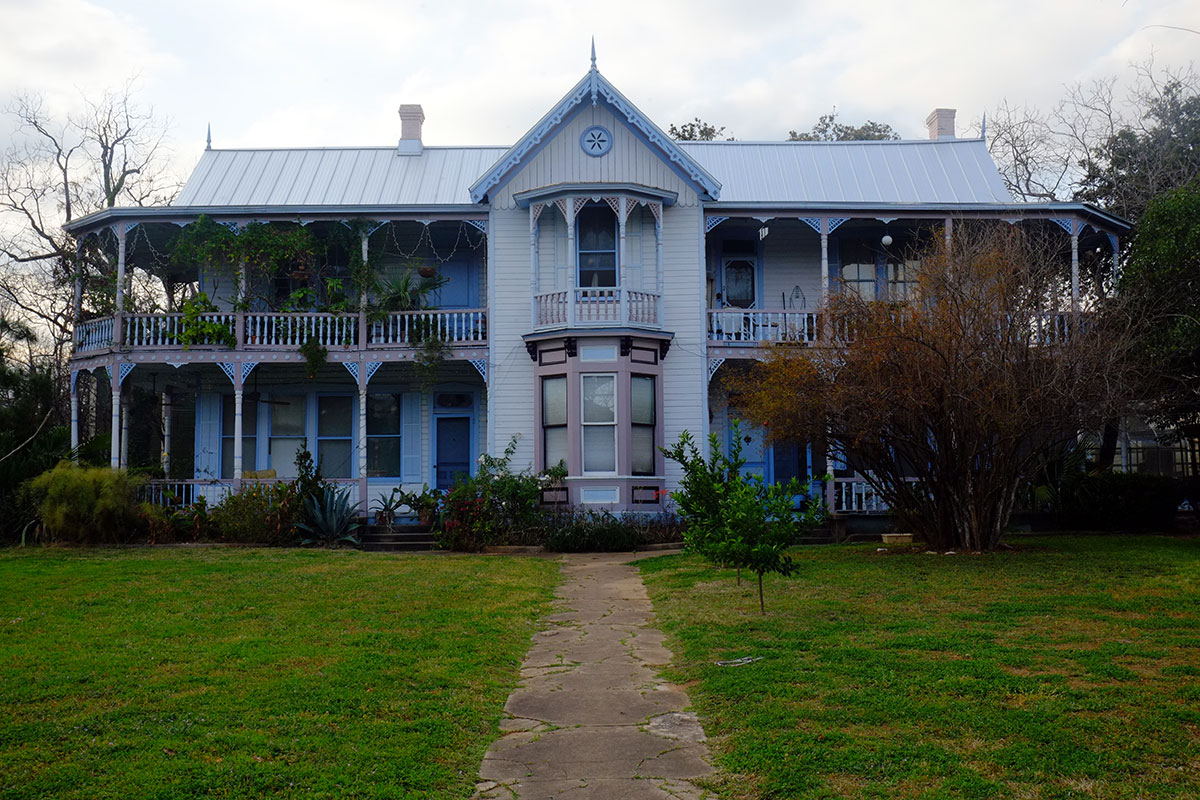
We cruised through what was obviously the old, expensive neighborhood on the hill to the west side of downtown.  Mostly stately and restrained, but with some nice little apartments mixed in.  DSCF5284

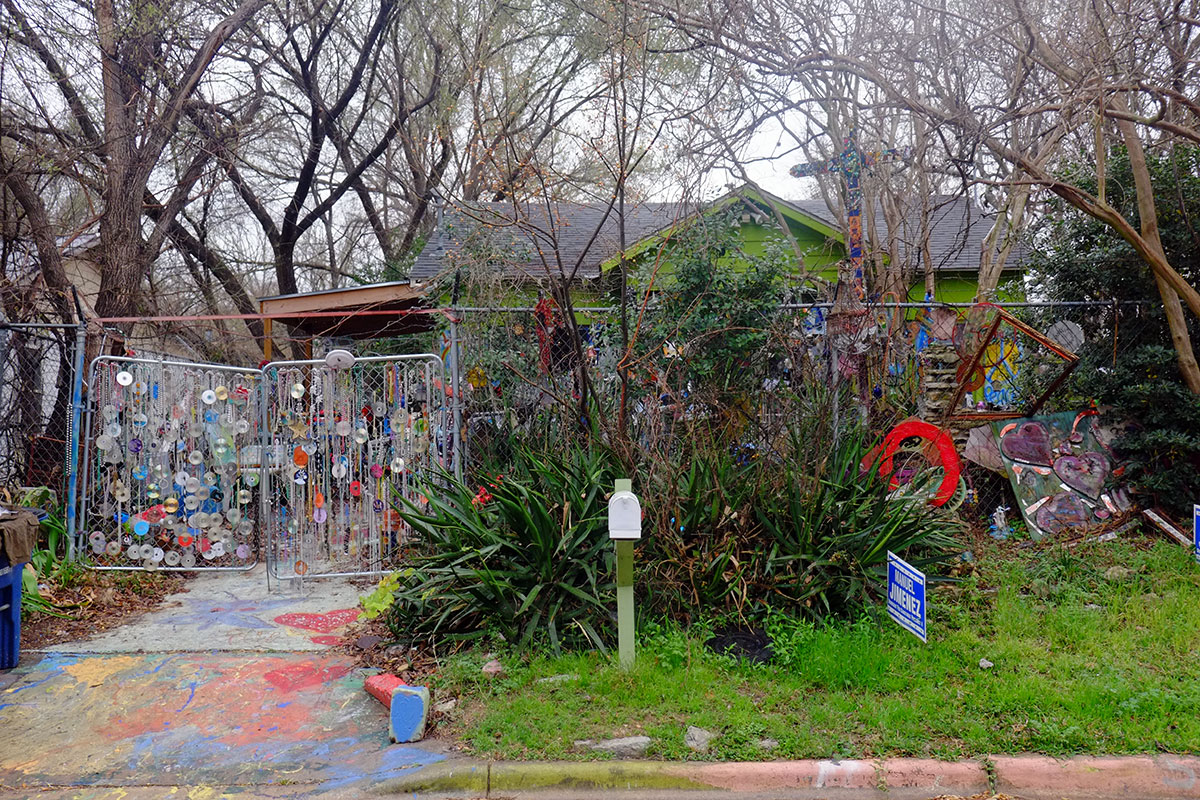
Roberto’s neighborhood on the south side of the river was really fun.  Very casual and funky, with some places bizarre even by Eugene standards.  DSCF5209  DSCF5221We liked the anarchic quality, which extended to houses with vast armies of unconfined dogs roaming the streets.

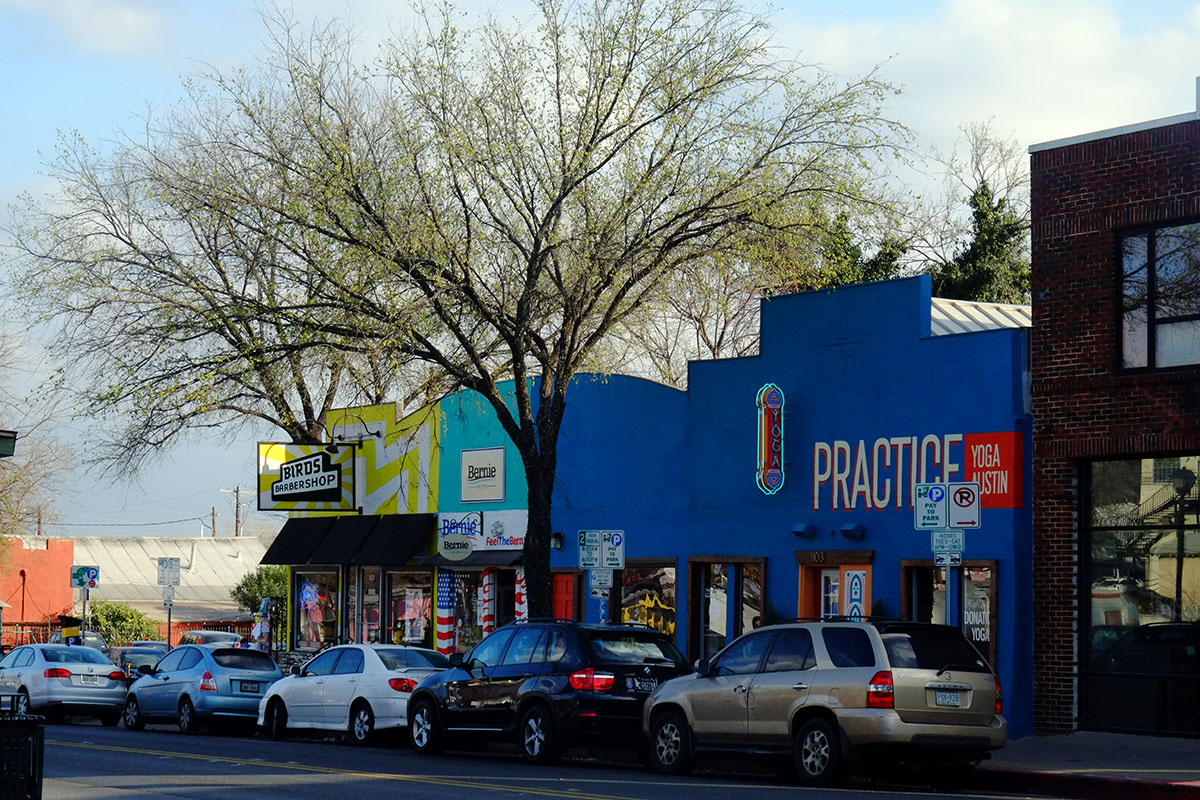
We also checked out the East Side, which is another funky place in the process of gentrifying.  This is the part of Austin with the Portland vibe – street carts, bikes, old houses, Bernie Sanders headquarters, expensive new infill, etc.  DSCF5275      DSCF5240I went to Birds hipster barbershop, where I got my choice of canned beer with the haircut.  (I appreciated this, as I had missed getting my hair cut in New Orleans at the bar in the Marigny which offered a haircut with a shot for $10 on Monday nights.)  DSCF5280

These two new buildings will enter my curriculum as providing the clearest illustration of the differences between Ducks and Decorated Sheds.  DSCF5265  DSCF5264

Austin is a city about which we were wildly ambivalent.  There is the part of the city which is a product of the power of the state, which is big, pretentious and boring, designed mainly to awe.  There is the downtown, which is solid and good, but nothing to write home about.  There is the sprawl (which we almost completely avoided), which is probably like the sprawl everywhere else, and which must account for Austin’s bad rep on traffic. (We found it to be like Portland here too – if you go out to the periphery, the traffic is hell, but if you stay in the core of the city, it’s fine, as everyone takes Über.)

Then there are the people, the food, the music, the lifestyle.  This was all very familiar to us, feeling much like Portland or a big-city Eugene.  I ended up thinking about Austin much the same way I do about Eugene – it’s not the most exciting place to visit, but I’d like to live there.  DSCF5315

Houston

DSCF5096Every incorrect preconception I had about Dallas turned out to be true about Houston.  It sprawls further than Phoenix.  It has the most inhumanly-scaled and corporatized downtown I’ve ever seen.  If it had a decent, older part of downtown, either I couldn’t find it, or it was knocked down to build the current crop of hellish corporate headquarters.  I think it is my second least favorite American city, after Phoenix.

Houston is the largest city in the country without zoning, and I was curious to see how this affects the form of the city.  I think it actually isn’t that important.  One of my suspicions about zoning is that it merely codifies current practices.  We have perfected how to build placeless sprawl, and Houston follows these precepts – the conventions are so strong it doesn’t need explicit rules.  I couldn’t tell the difference between the sprawly parts of Houston, Dallas, Washington DC, or Atlanta.  It’s just that Houston has more of it – about 50 miles across in each direction.

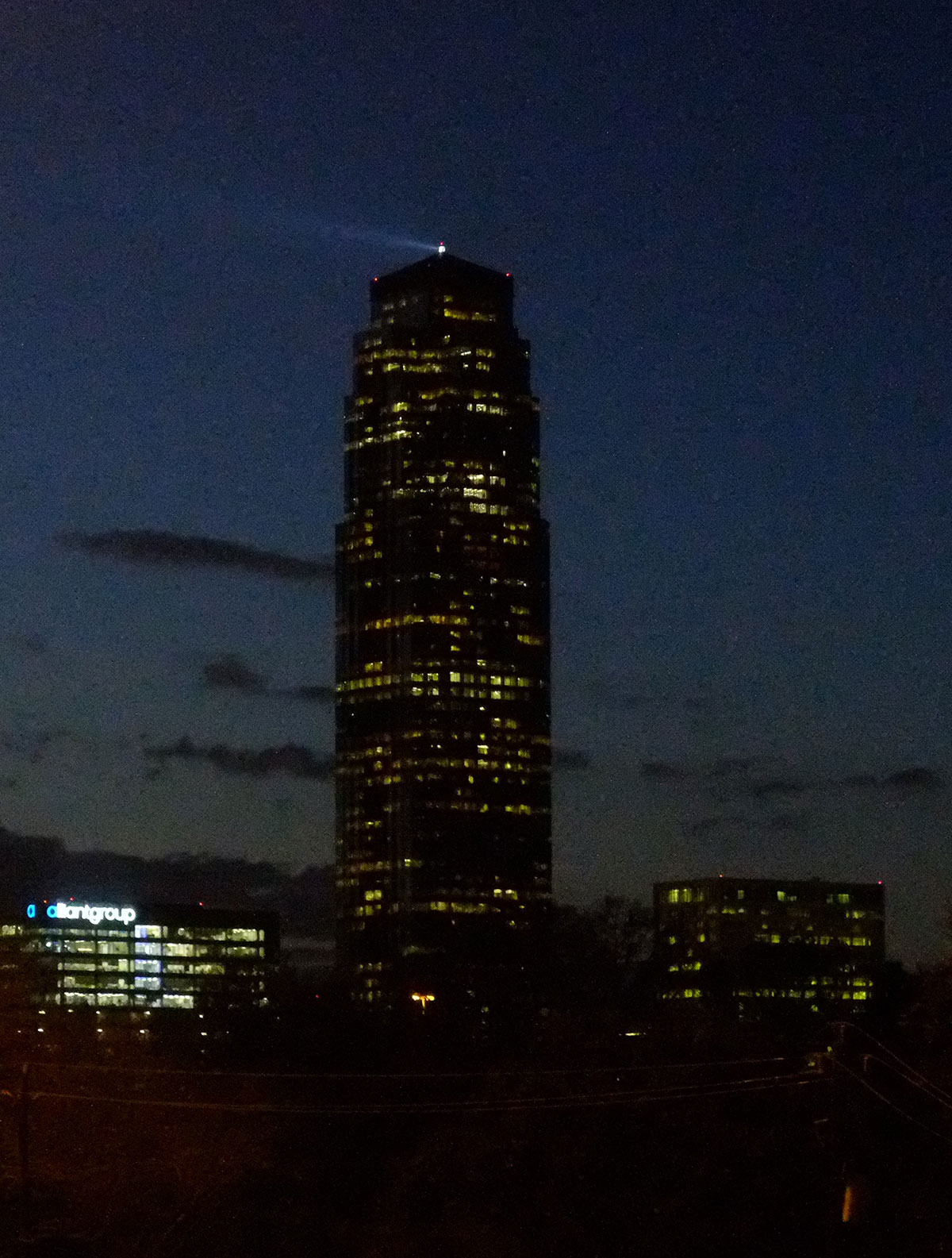
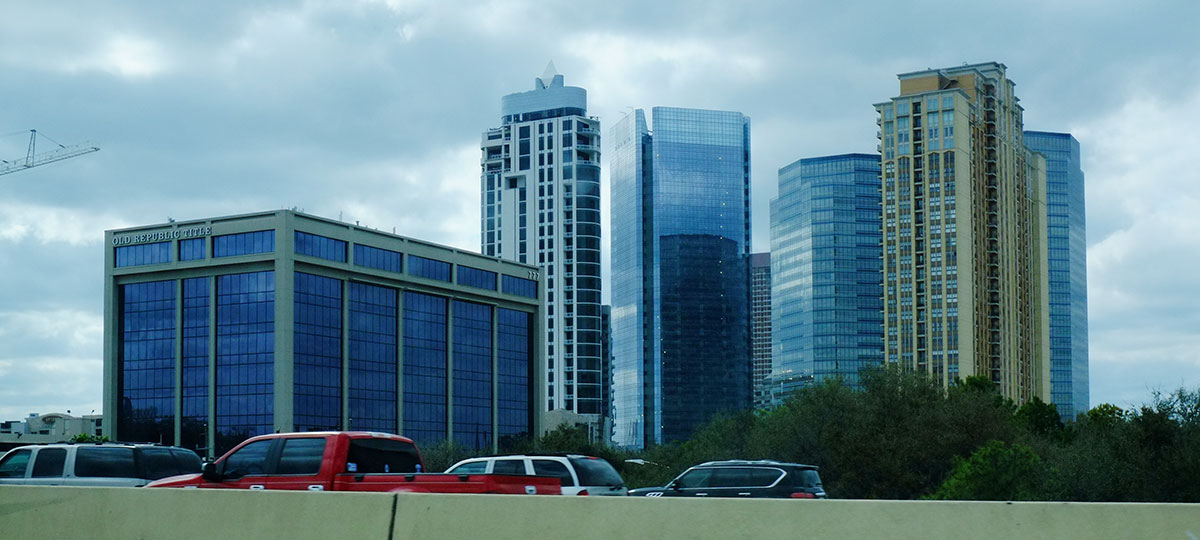
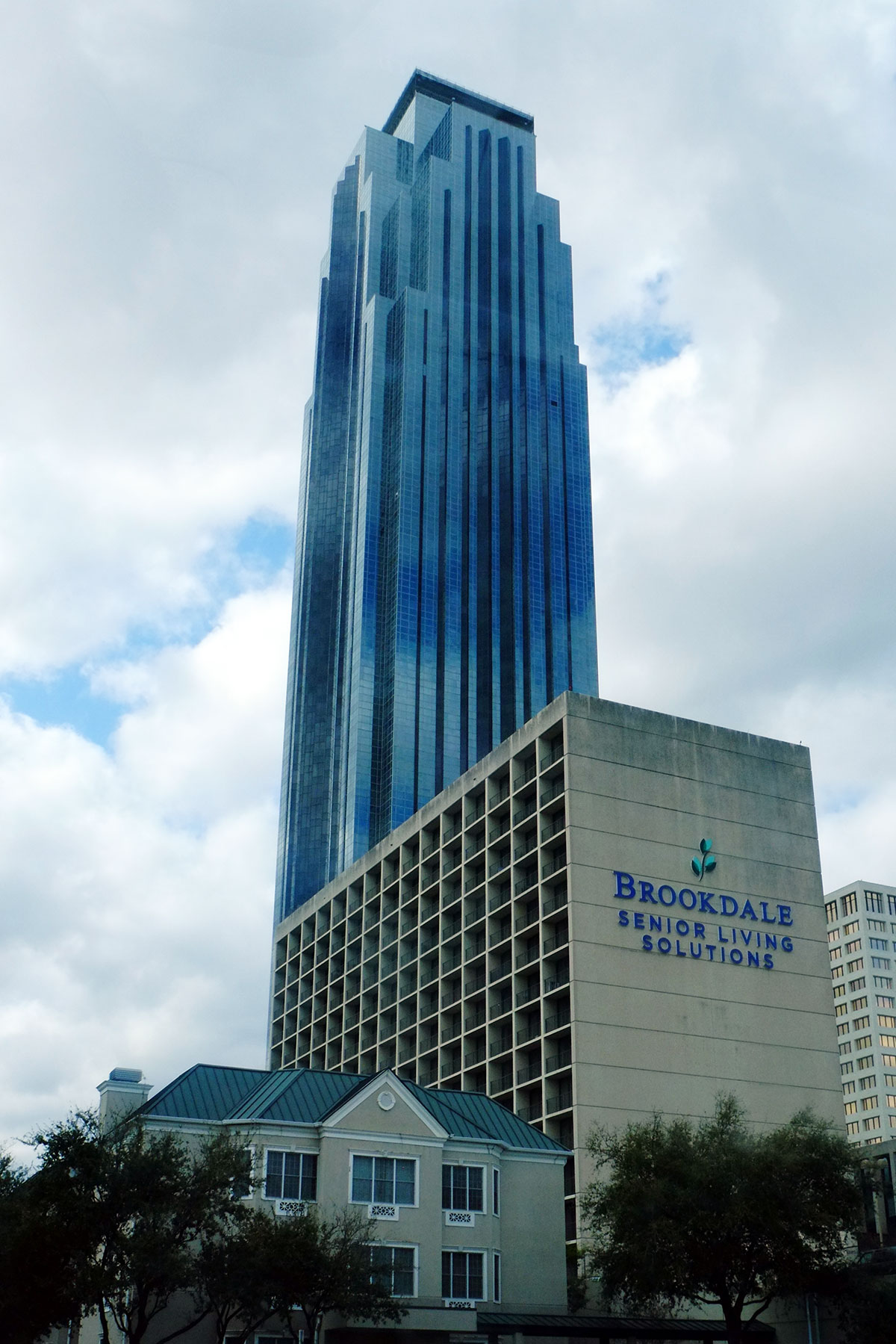
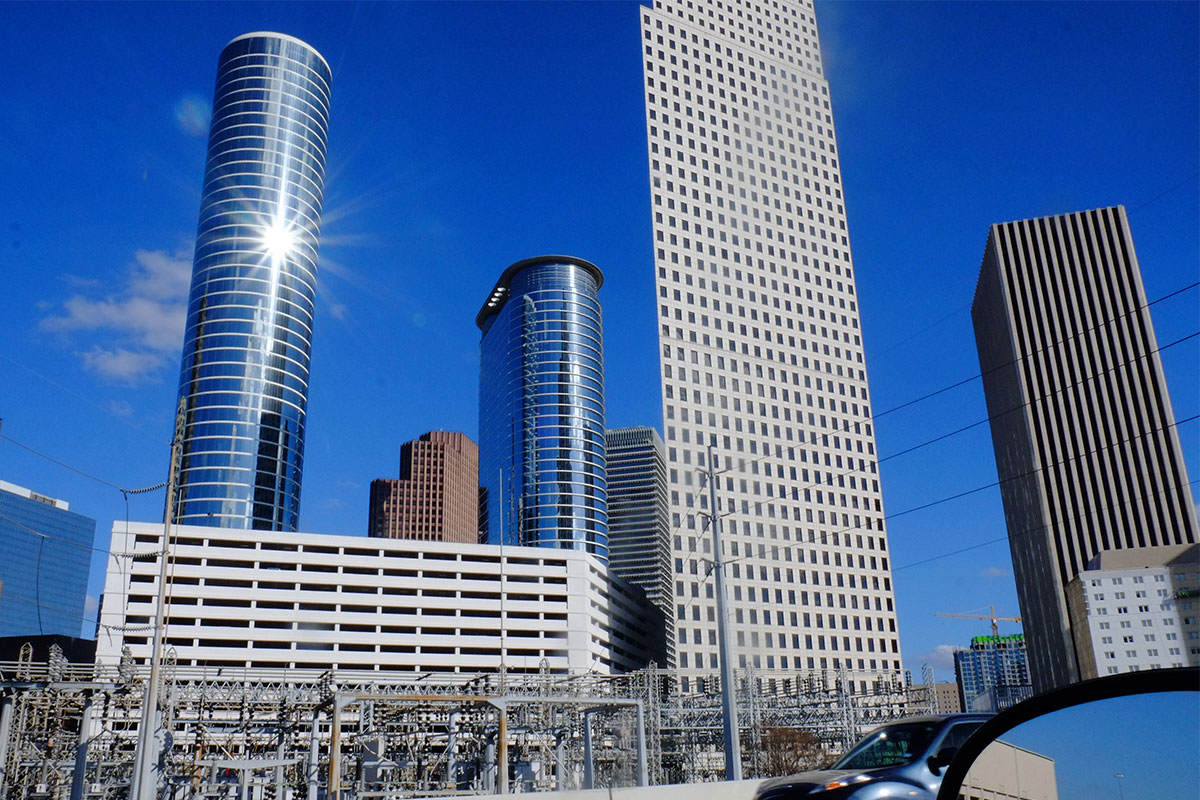
The one noticeable difference is that the Edge City centers out there in the sprawl are bigger, and the buildings at their centers are much bigger than anywhere else in the country.  DSCF5086Whereas much commercial development in Edge City is subject to height restrictions, in Houston it is not, and so skyscrapers that would be considered large in downtowns happen out there on the edge.  This is probably a good thing.  Many large metro areas are developing secondary centers now – the Puget Sound region has about eight, Portland has consciously designated Regional Centers.  So if Houston ever begins to redevelop a sense of urbanity in these places, it will have some serious density at those centers, versus the midrise buildings in most of Edge City elsewhere. DSCF5202

This is the Building-Formerly-Known-as-Transco, the biggest.  (I don’t even want to guess what “Senior Living Solutions” entail.)  DSCF5197

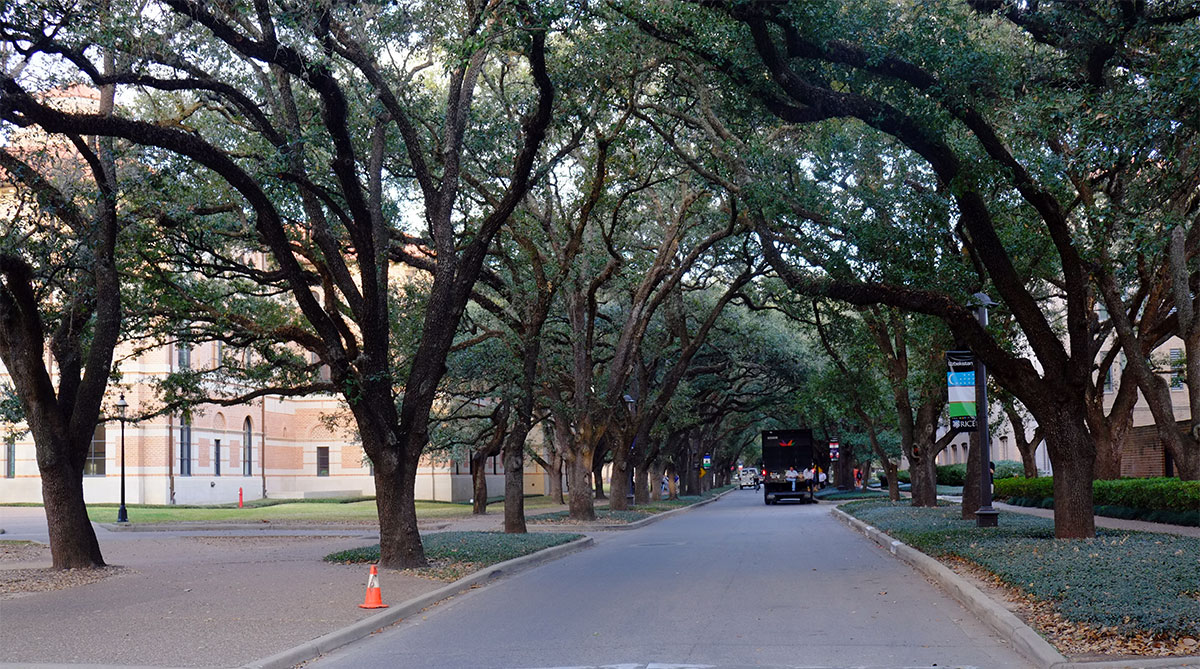
There are certainly some nice parts of Houston – we saw some pleasant residential areas, the Menil Collection is a wonderful complex (to be blogged separately), and Rice University is beautiful.  DSCF5079Unfortunately, this is all I can post about Rice.  Houston is a city where you have to drive, and it is really not possible to park anywhere near Rice unless you have a permit or are willing to take out a second mortgage.  So we just drove through it a few times.  I don’t blame them for restricting cars, but I regret not being able to see more of the campus.

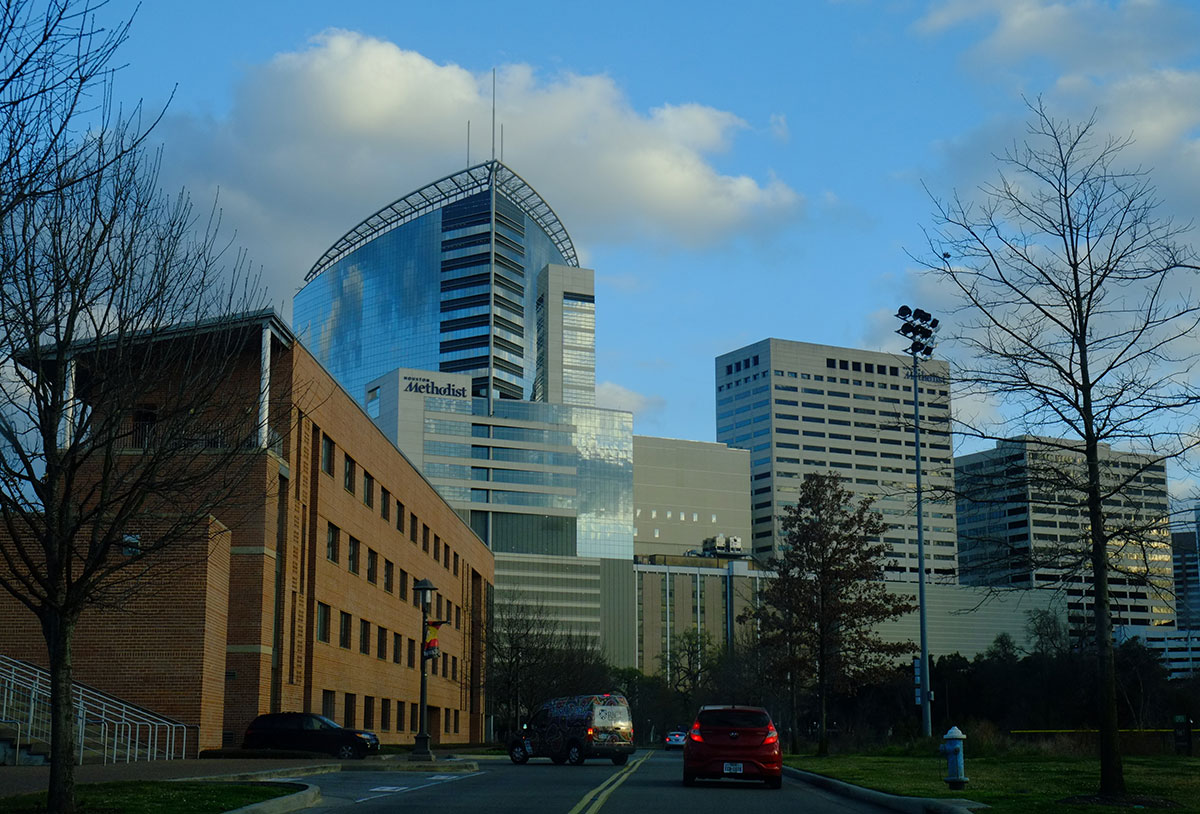
Near Rice is another amazing center, the Texas Medical Center, which reportedly has 54 different institutions.  DSCF5081I have seen some pretty big medical districts in other cities, but nothing like this.  It is the hospital as city.  Not being a patient, I don’t know whether having a medical complex organized on city streets in separate buildings increase or decreases the dysfunctionality of wayfinding here – it’s like the O’Hare vs. JFK paradigms.  Maybe it’s better being able to drive from building to building, rather than having to walk down endless hallways.

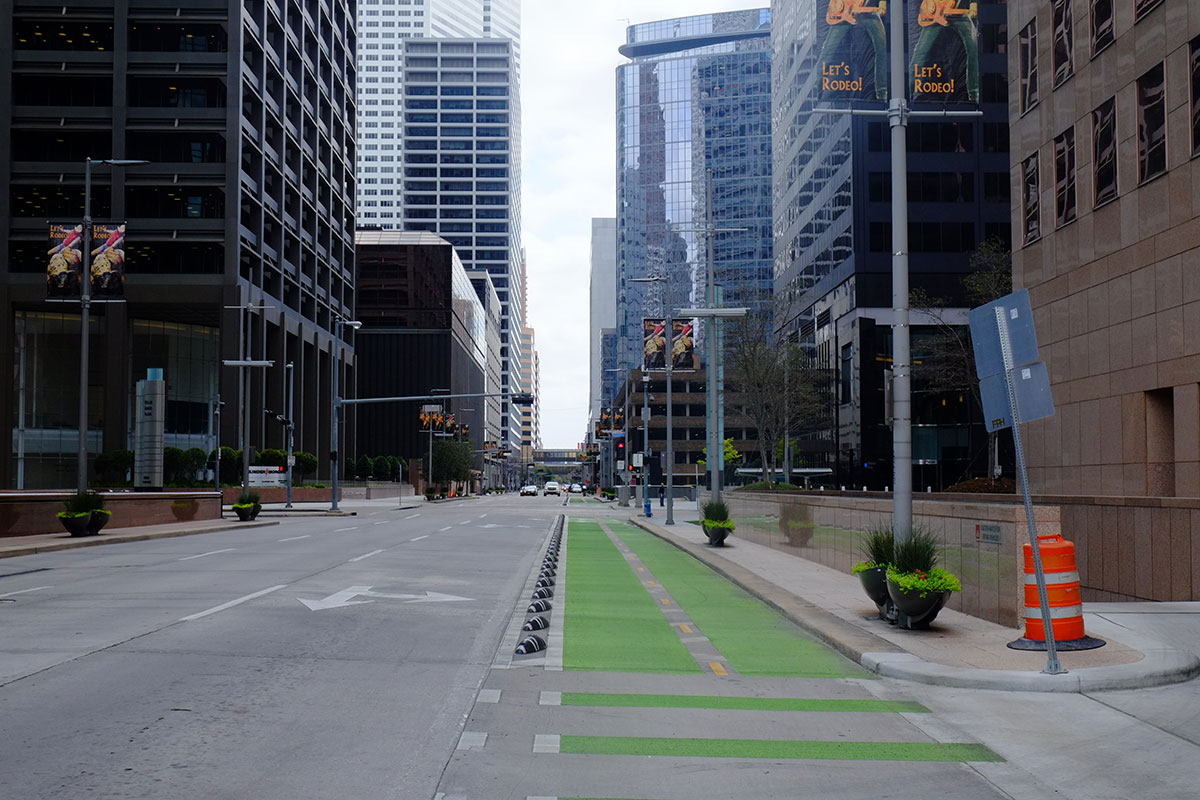
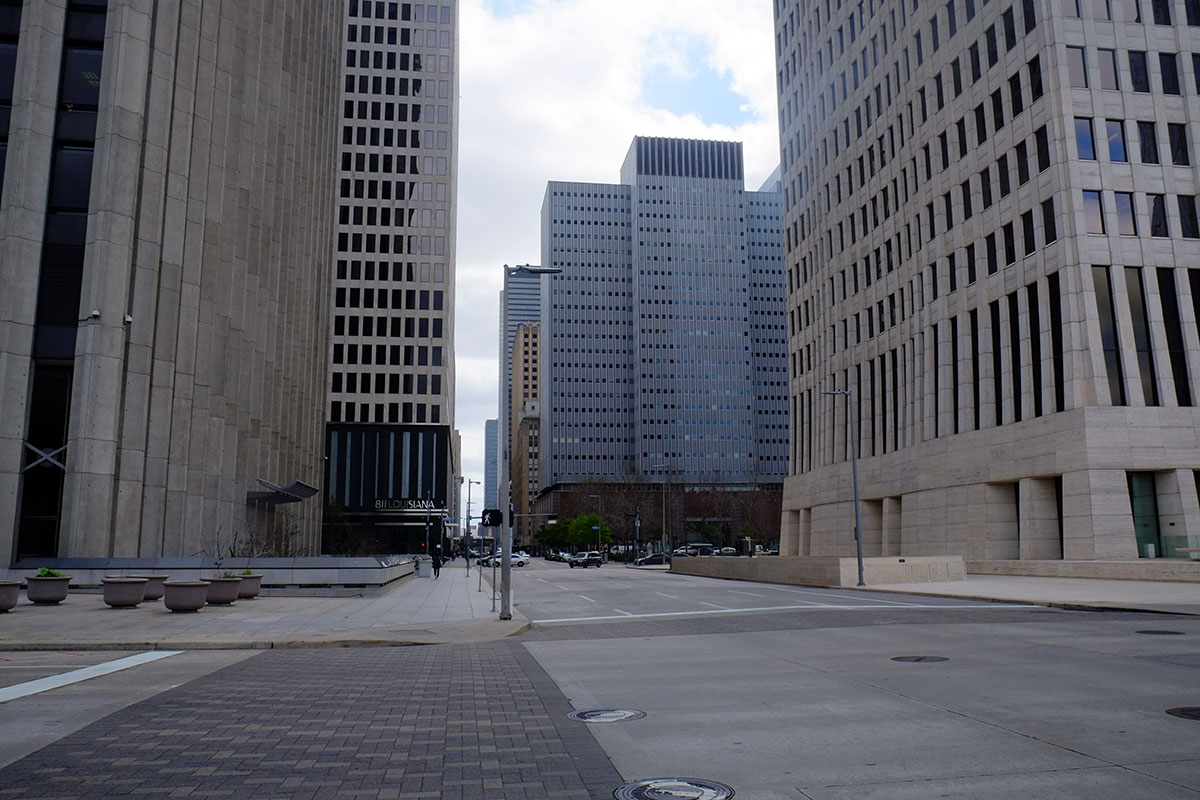
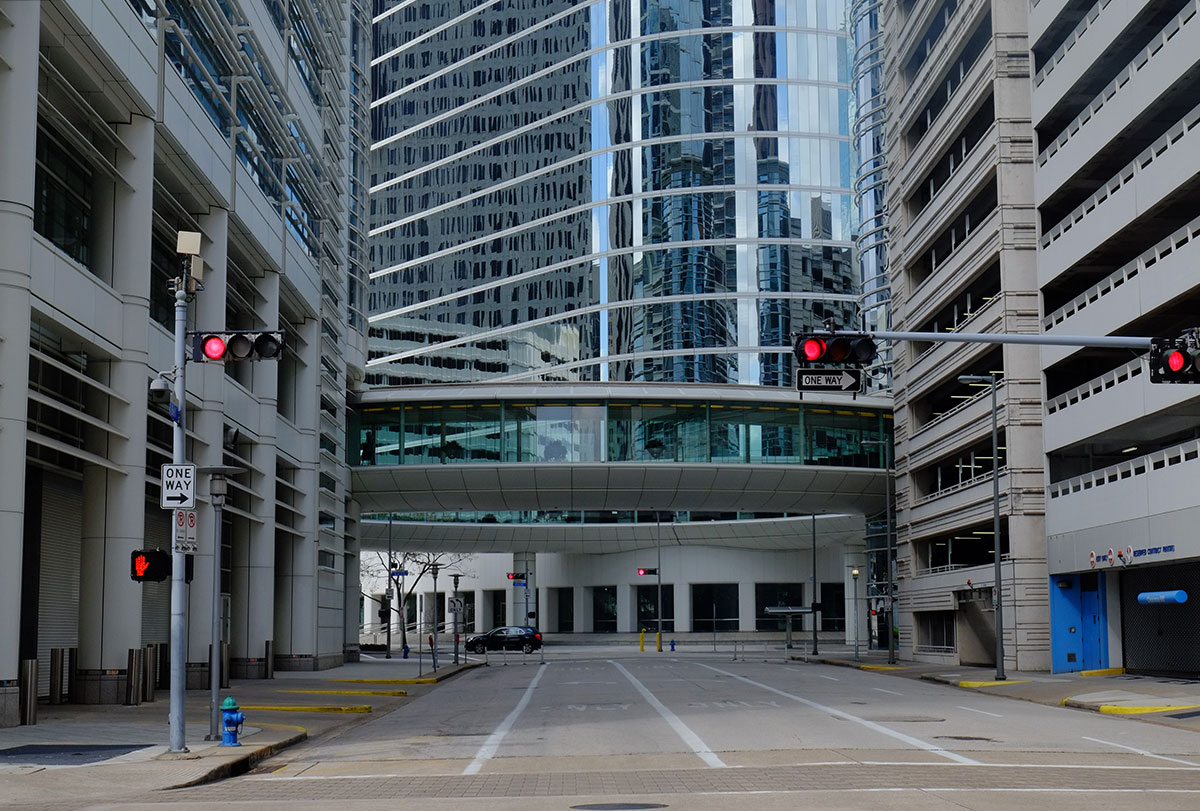
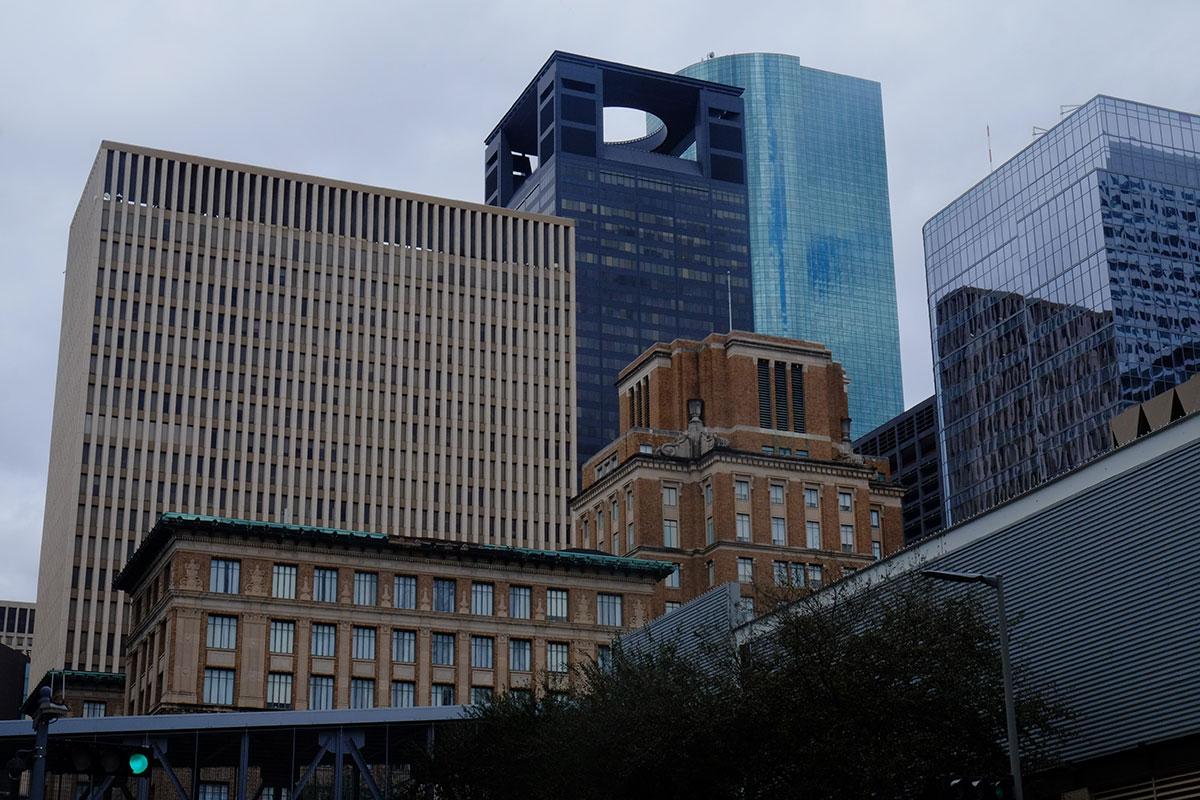
We took a good look at the downtown, and were appalled.  Granted, we were seeing it on a weekend, when it didn’t have surging crowds of urbanites on the sidewalks, but I get the feeling that still doesn’t happen.  Why would you walk here?  The streets are the most car-oriented, overscaled and boring I have ever seen, and that pattern goes on and on.  Many blocks are given over to corporate headquarters, with desolate plazas and parking garage ramps occupying the periphery.  DSCF5113

DSCF5124

DSCF5187

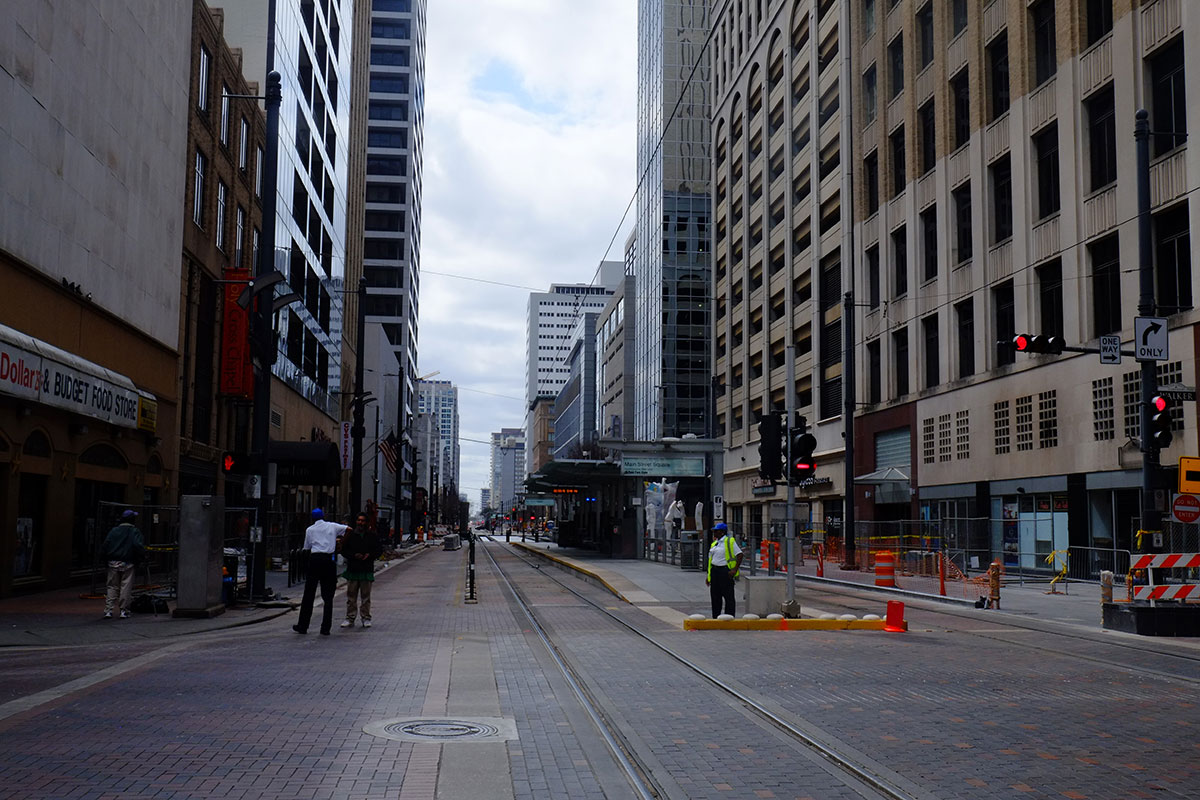
There are almost no stores, there is no smaller scale, there is nothing for the pedestrian to do but hurry to the end of the block.  The one exception seems to be Main Street, which has stores, a median with a light rail track (running in the middle of a lagoon) and some attempts at design of the public realm.  DSCF5182

It ain’t great, but it’s as good as it gets.  Unfortunately, we came across this monument there: DSCF5186We can only hope that no one took this seriously, and that this too will someday pass.

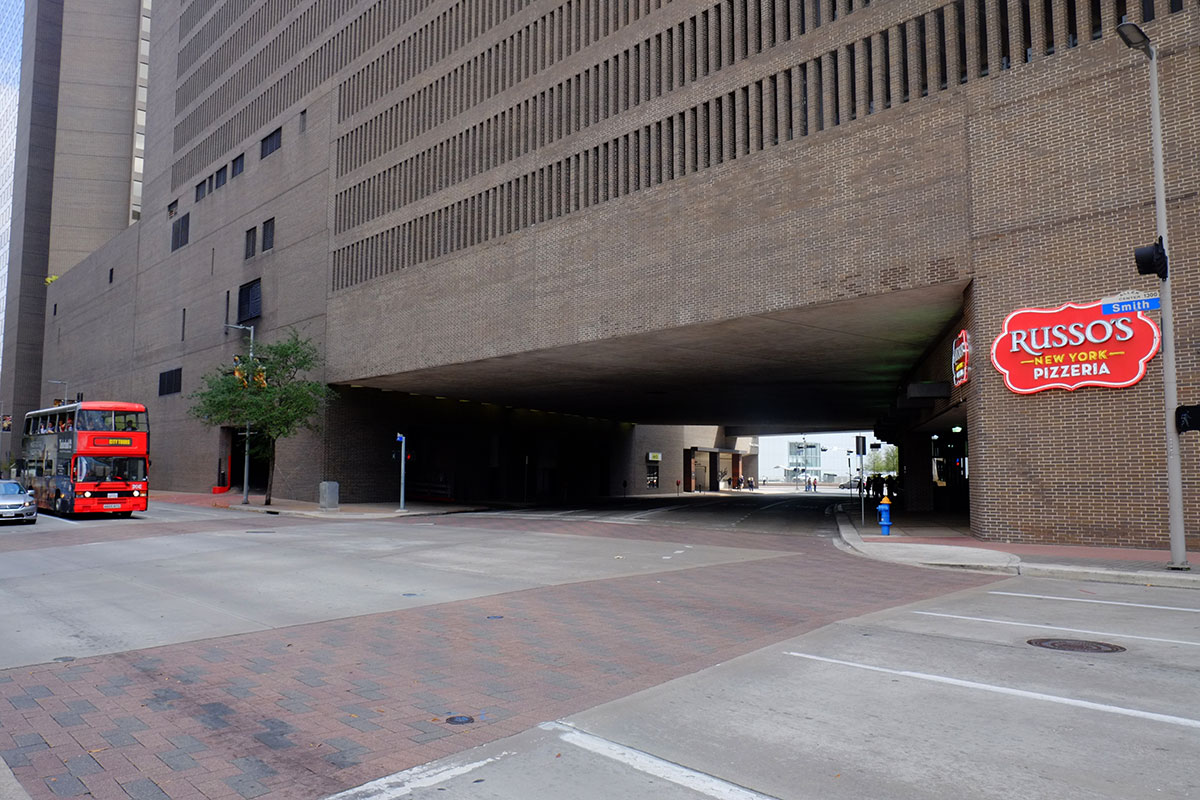
We came across what must be the biggest parking garage in the world, blocks-long, ironically juxtaposed with iconic elements from real cities.  DSCF5107

The shiny street of parking garage entries:DSCF5101

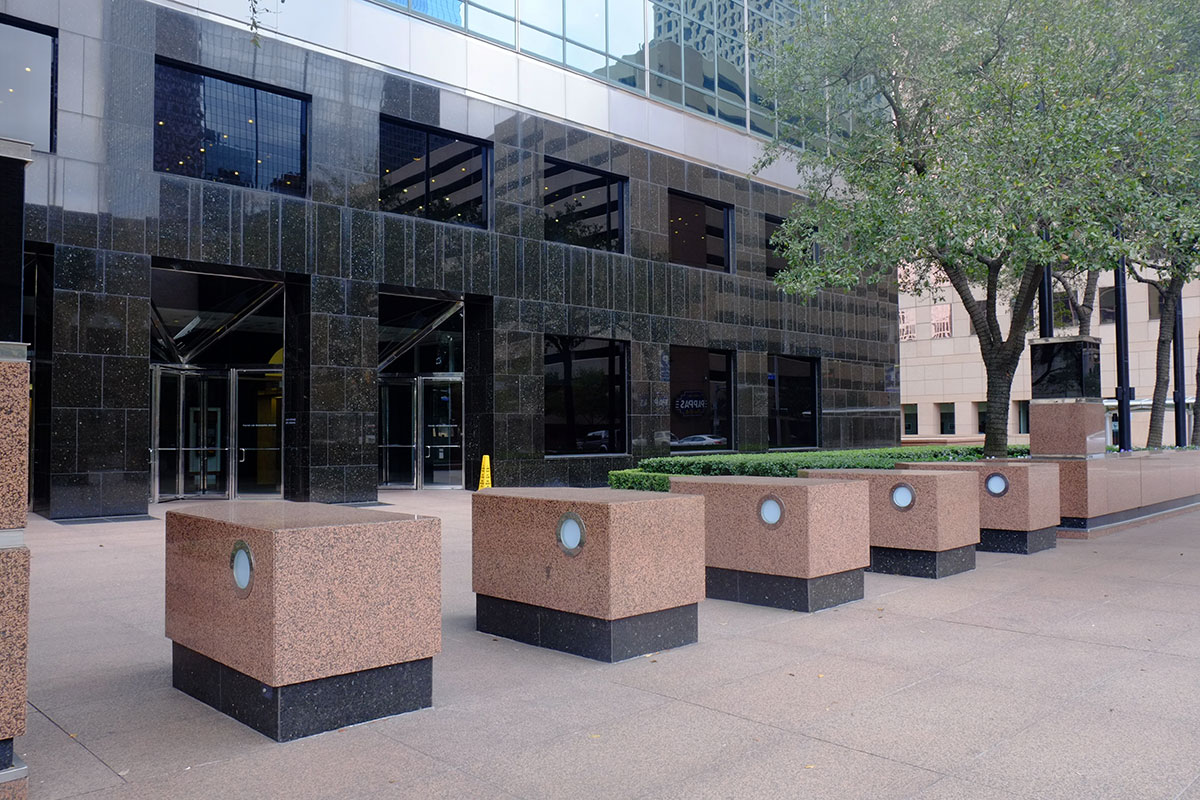
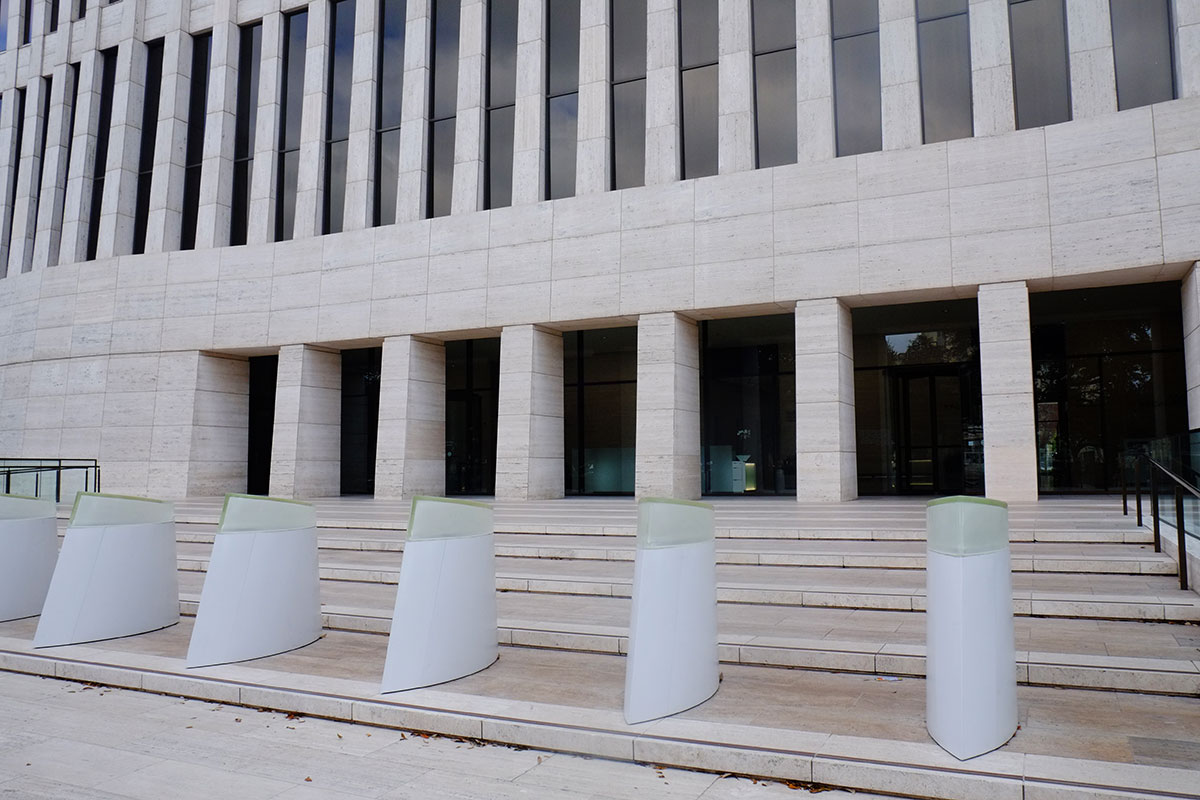
And then, in our post-911, corporate paranoia, the car-bomb bollards everywhere.  DSCF5114

DSCF5118

These epitomize the Corporate Private City. We came across one park downtown, and it was full of homeless people hanging around.  It is probably the one place in the downtown where they can sit down without being shooed away by guards.

(While not directly related to the terrible downtown, the state of the streets in Houston might be another indicator of the general lack of civic- or commonwealth-mindedness.  Without a doubt, they are the worst maintained streets in America. You really can not ride a bicycle in Houston as the streets are so potholed and rutted as to be impassable;  we didn’t see a worse road until we took the 20-mile dirt road into Chaco Canyon.  Just another way that this is the ultimate city for elevating private, individual interests above common ones.)

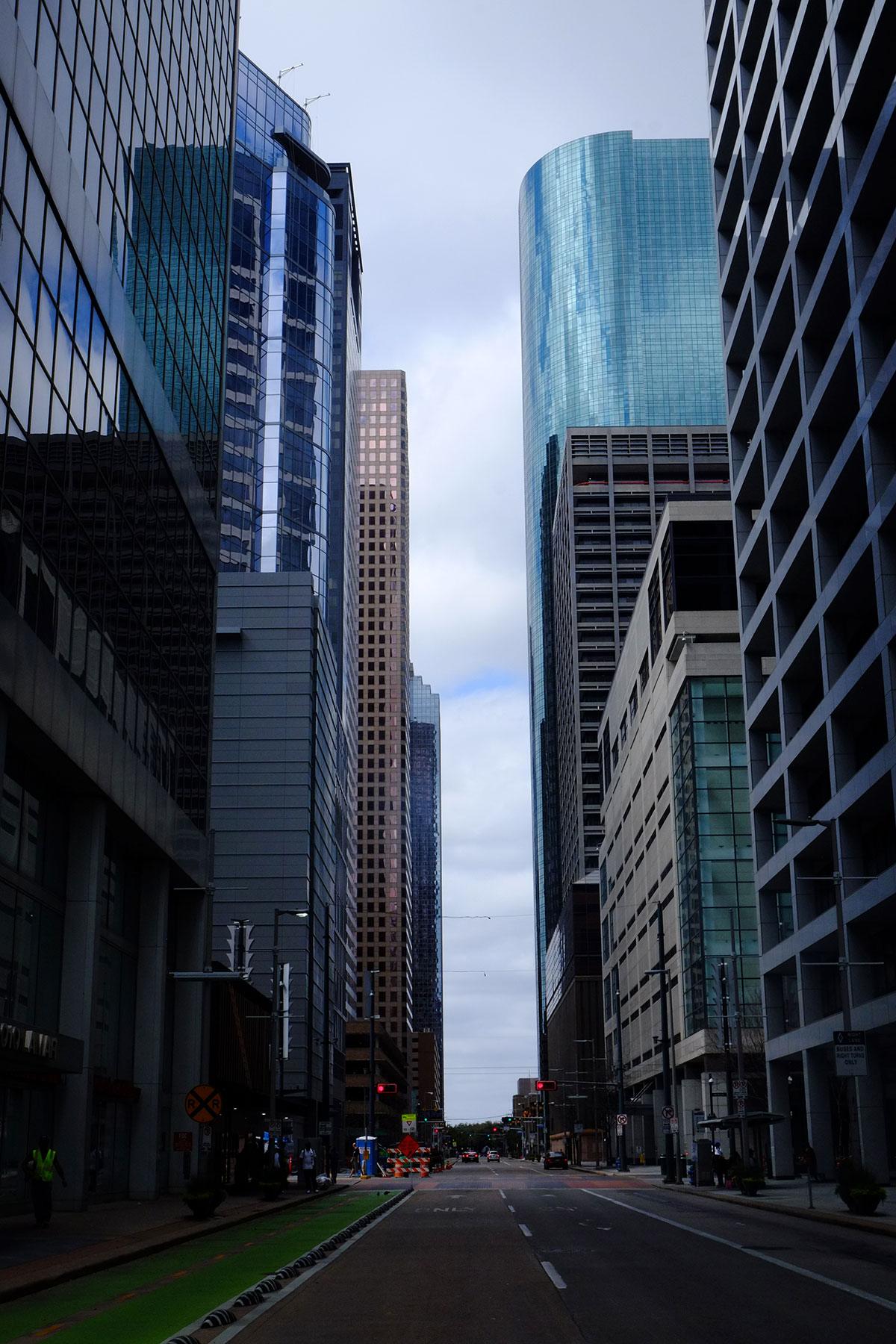
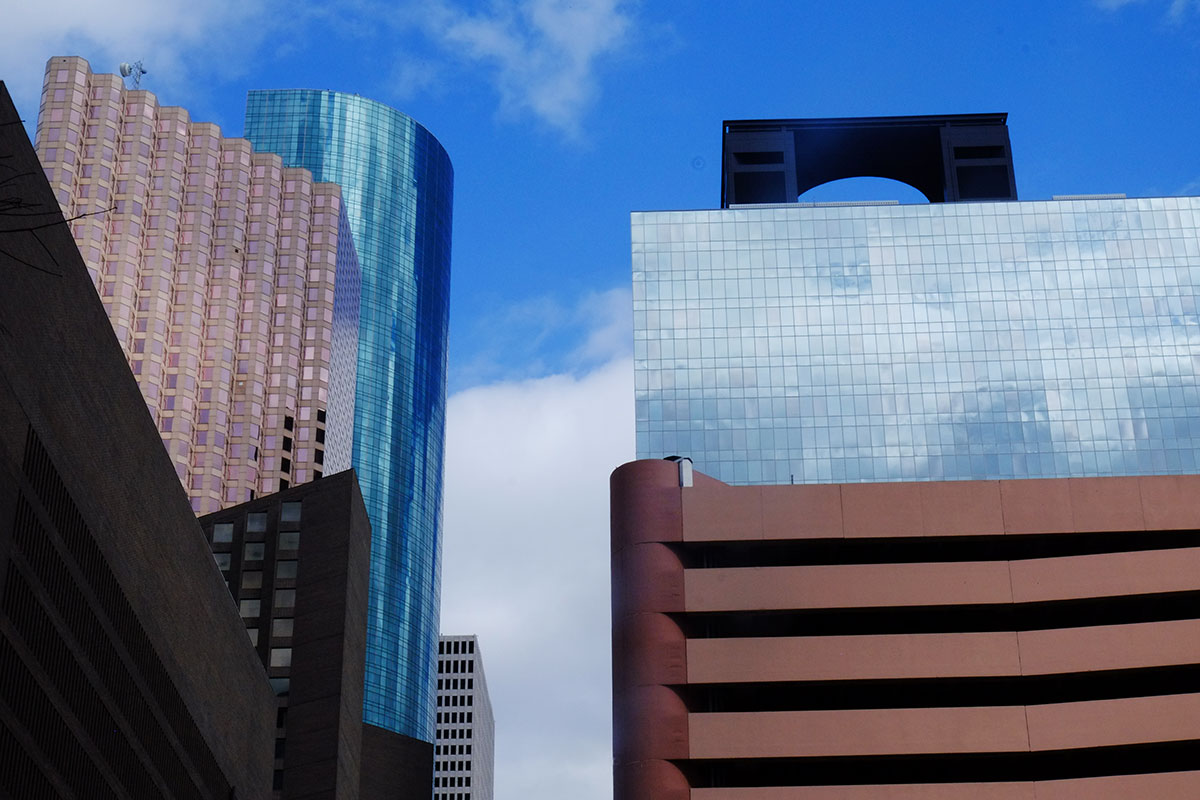
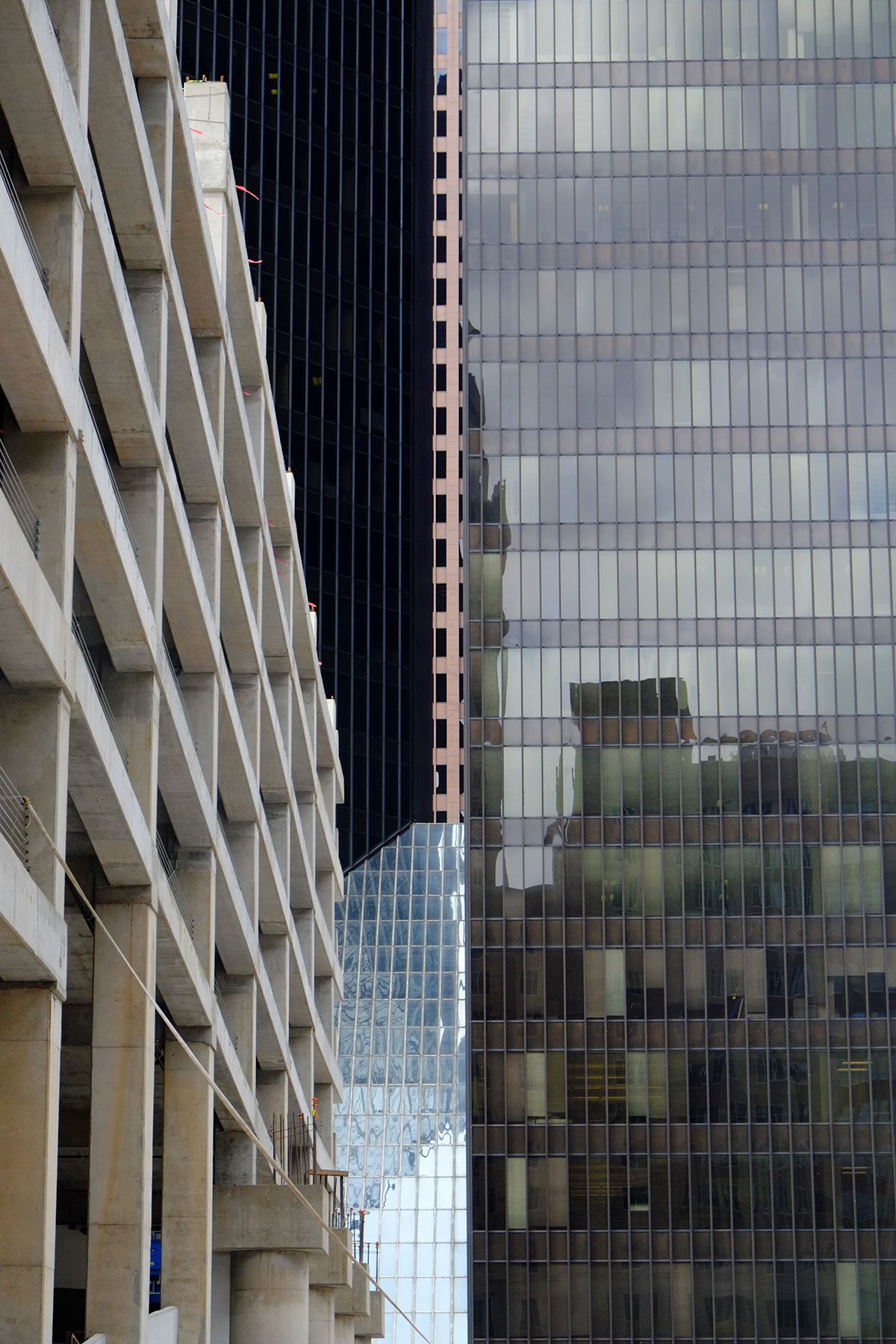
Eventually, contemplating the streetscape became just too depressing, so I started looking at the building skins.  I’ve been shooting these curtain wall juxtaposition photos in every city, and Houston abounds in them.  When all else fails, fall back on abstraction.DSCF4989

DSCF5157

DSCF5103

DSCF5175DSCF5082

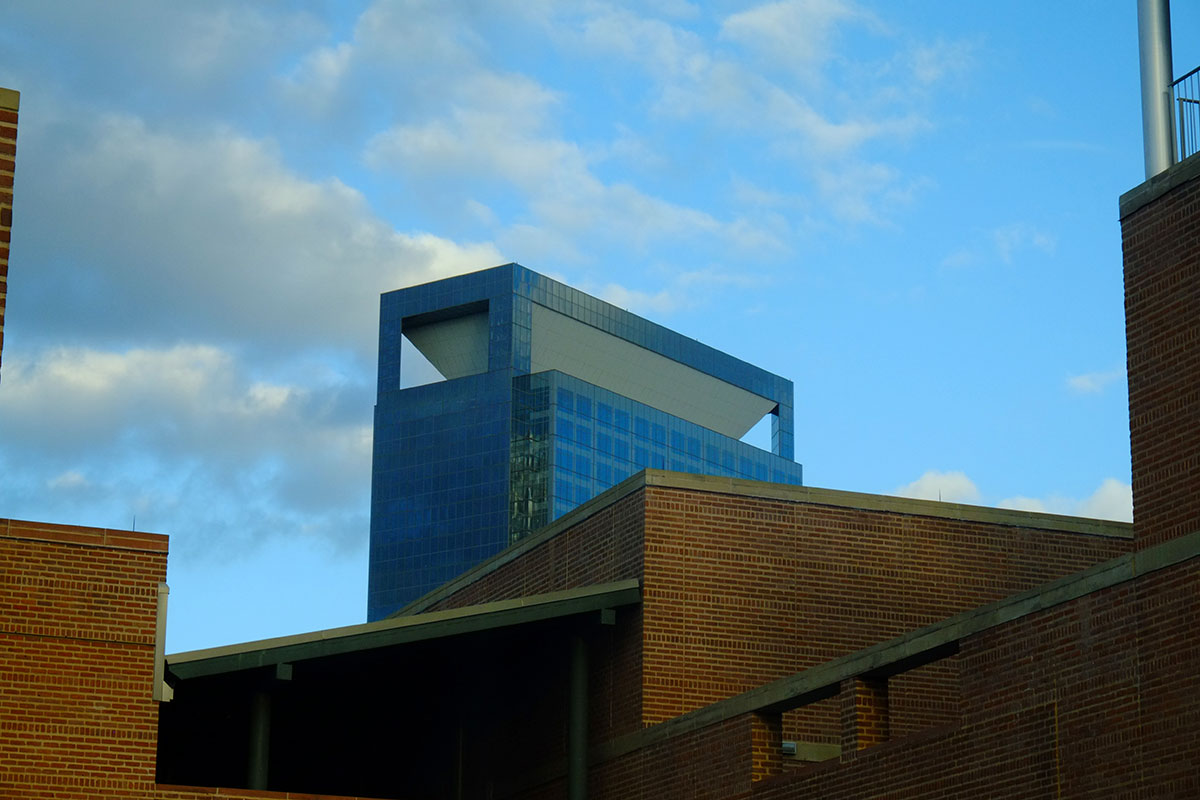
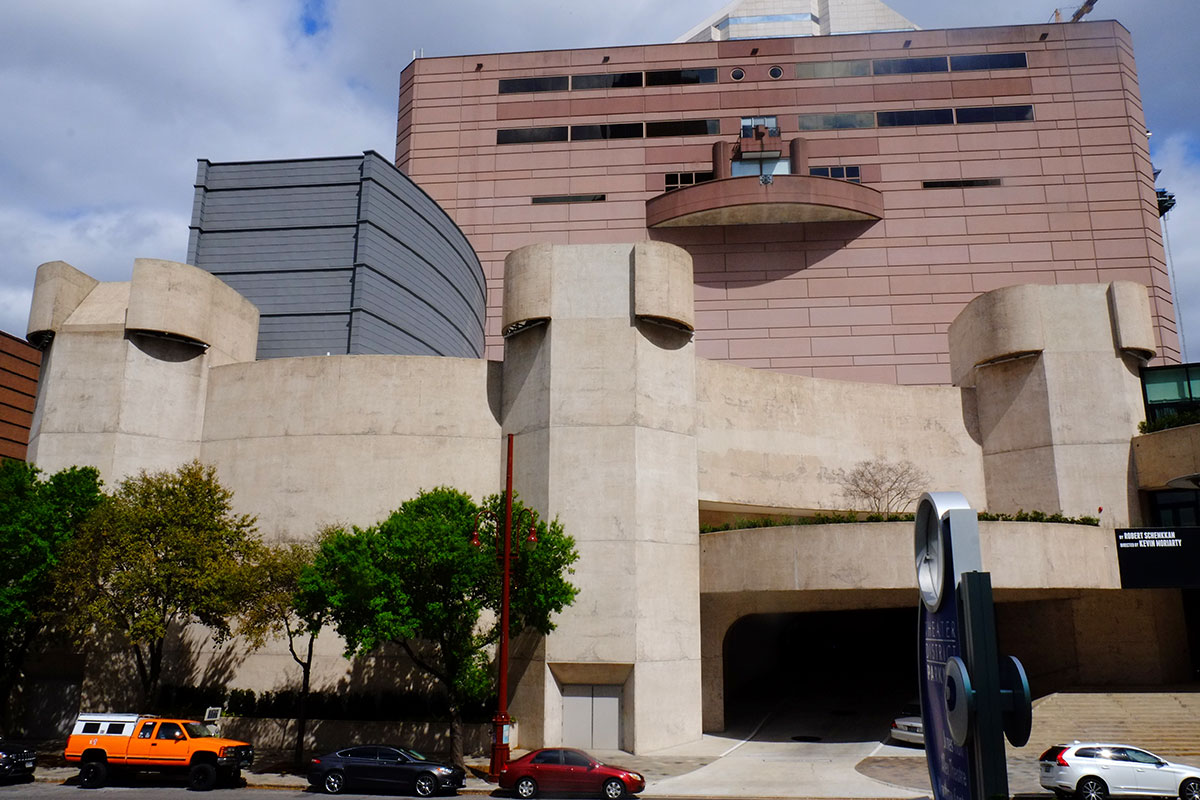
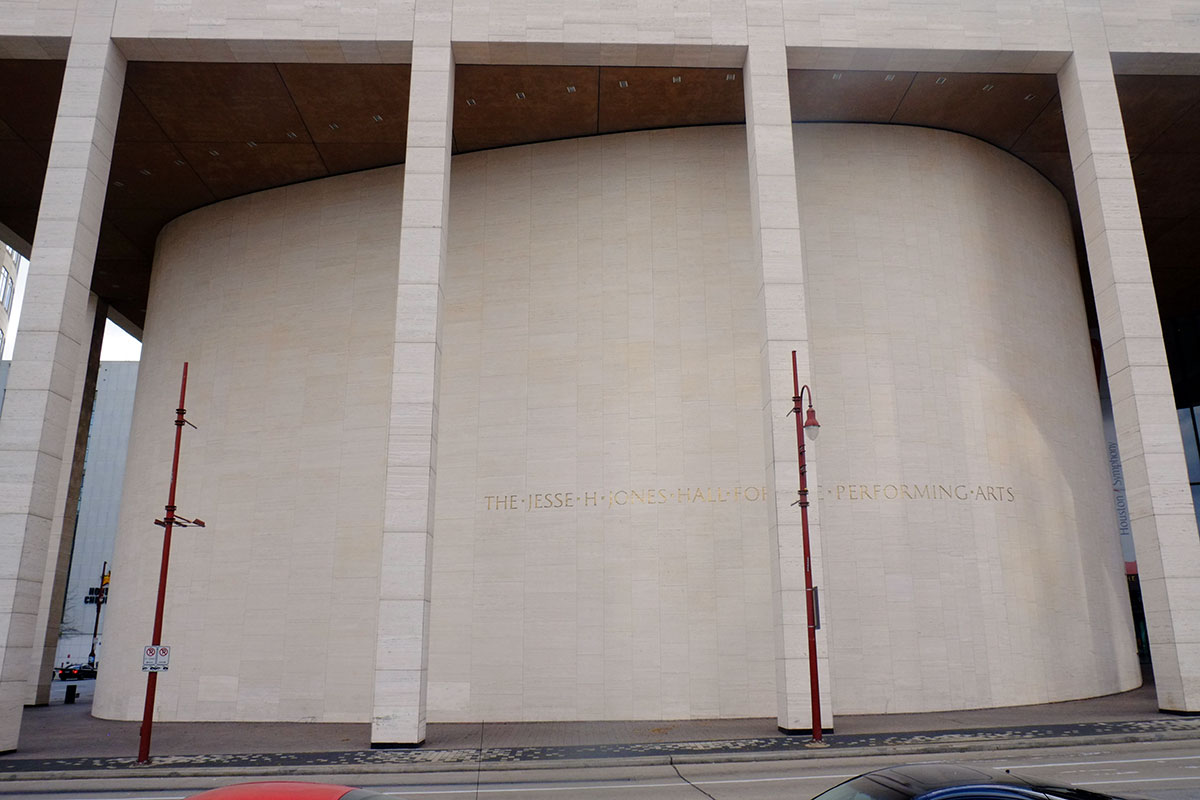
They also have a cluster of deeply awful cultural institutions.  Why are they so bad here and so good in Dallas?  DSCF5140

DSCF5146

Houston’s entry in the Ugliest Postmodern Building in the World Contest.  I think this may win.DSCF4986

And of course, there is the requite Philip Johnson excrescence.  This one may be a little better than the PPG building in Pittsburgh in building design, DSCF5152but it loses a lot of points for how it interacts with the street.  The corporate headquarters as fortress has never been better expressed.  DSCF5155

When they try to address the pedestrian realm, it ends up looking like this.  (The irony of the name must be unintentional.)  DSCF5188I can’t quite place what movie this is from.  When the Earth Stood Still?  Pacific Rim?  Independence Day?  Transformers?

I did find one building which seems to indicate that human beings inhabited this area before 1960.  DSCF5192

Overall, a truly terrible place.  And we were there in February – I can’t imagine what kind of special hell this must be in the summer.

Dallas

DSCF4234The biggest shock of this whole trip: I liked Texas.

I expected to hate everything in Texas except Austin.  To a northerner, Texas is crazy right-wing politicians and endless sprawl (and beef barbecue, not pork).  After three weeks in Texas, I can report that those preconceptions were proved to be true (except that they do serve some pork ribs), but they obviously don’t cover the whole range of what Texas is like.  You hear about the politics and the sprawl, but you don’t hear about the light and the trees and the qualities of the cities.

I wasn’t looking forward to travelling across Texas, but I regarded it as my duty – it is a big, important and powerful place, and I thought that on this trip we should try to see what the rest of the country is really like, even parts that might make us uncomfortable.  (My whole prior experience of Texas was restricted to DFW, but we knew that very well: once during a long layover, Greta and I had walked every inch of it – about five miles).  So when we got to Dallas and immediately started seeing places that were interesting and beautiful, I was nonplussed but pleased – maybe our time in Texas wouldn’t be a dutiful slog for 1000 miles, maybe we would actually have fun.

We were staying with our friend Kathy in the Lakewood neighborhood, and that was the first surprise – a postwar neighborhood about six miles from downtown, to which it is connected by both a bike corridor and a light rail line. The houses were traditional and unpretentious, and the landscape was beautiful – everywhere there were fabulous trees, which in February gave a wonderful dappled quality to this intensely clear light. DSCF4117We walked along the lake and saw houses that ranged from modest to imposing, but with none of the grandiosity and kitsch that I had expected. (Obviously, this is because we were seeing older, closer-in neighborhoods, not the sprawling horrors of the rumored outer suburbs, such as Plano.)   I didn’t go looking for the bad parts of the Dallas-Ft. Worth megalopolis, but I did see enough of them while driving across the area. ( Most notably, the George W. Bush Library at SMU. beautiful sited above a freeway:)DSCF4969c

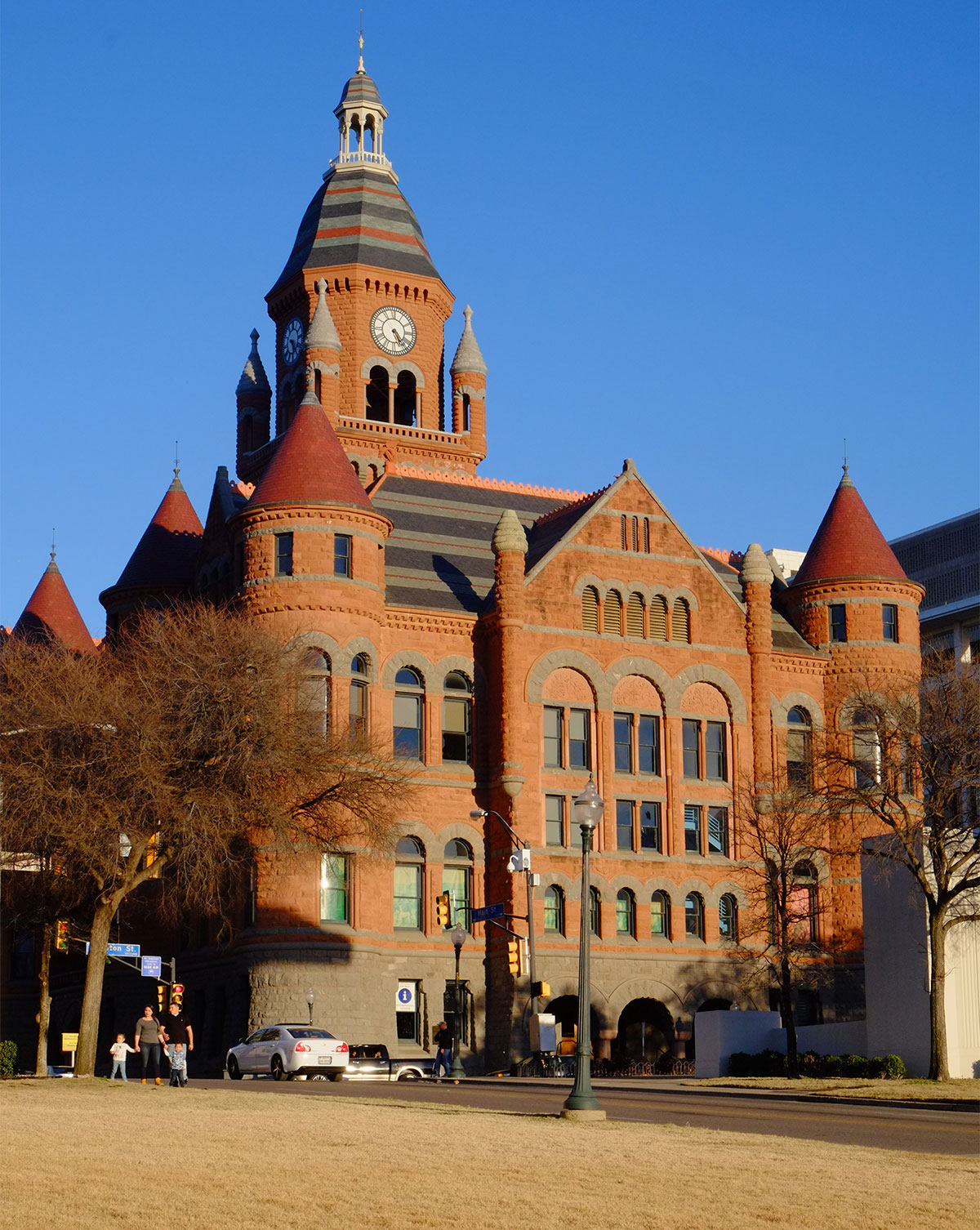
If the residential neighborhoods were the first surprise, the downtown was the second. Like many American cities, it is surrounded by gigantic highways – elevated, surface, depressed – every way possible. It is also completely cut off from the riverfront. However, within the two grids and four square miles of the downtown, there is a wide range of building types and ages, and evidence that the city is really thinking about urban design (and willing to spend some money on it).

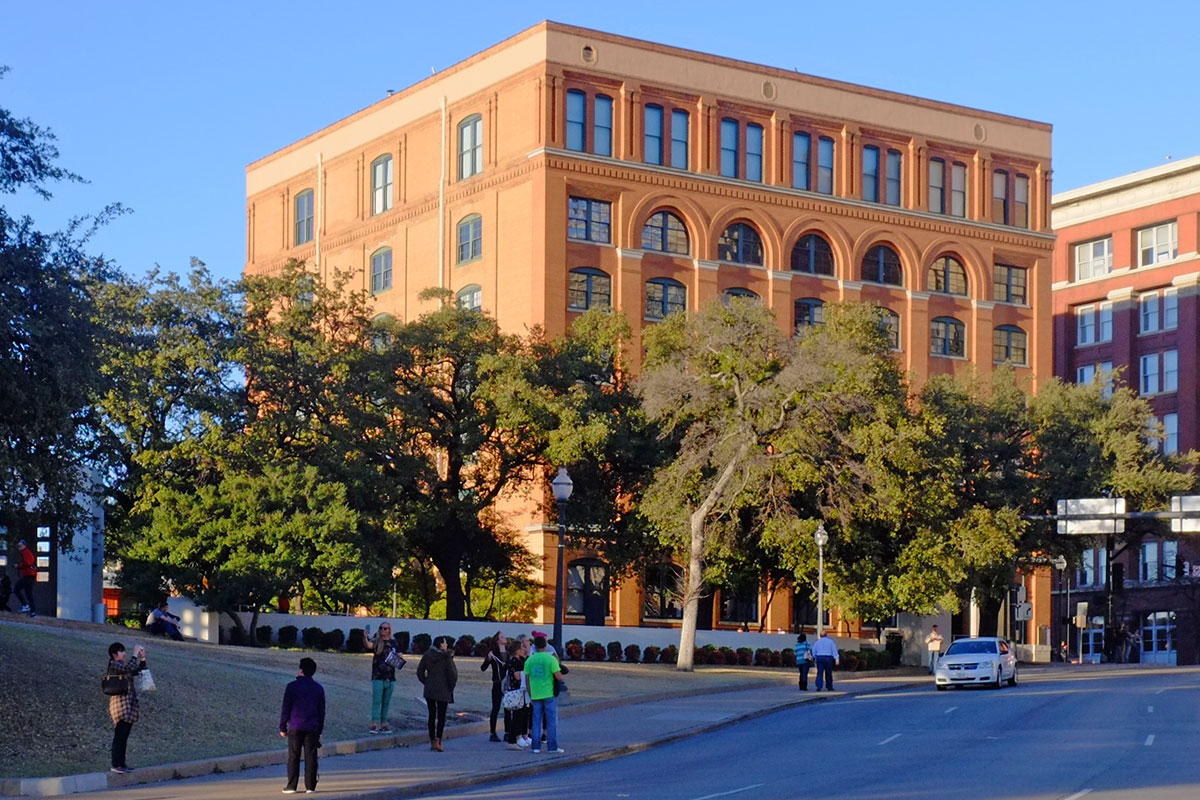
The West End is full of 19th- and early 20th-century brick commercial and government buildings.  Dealey Plaza is here, and the infamous Texas Book Depository.  There is a Sixth Floor Museum, and it struck us as pretty ghoulish.  DSCF4361

But it is an intact, coherent district, full of people and businesses – in much better shape than most such districts in other American cities.DSCF4362

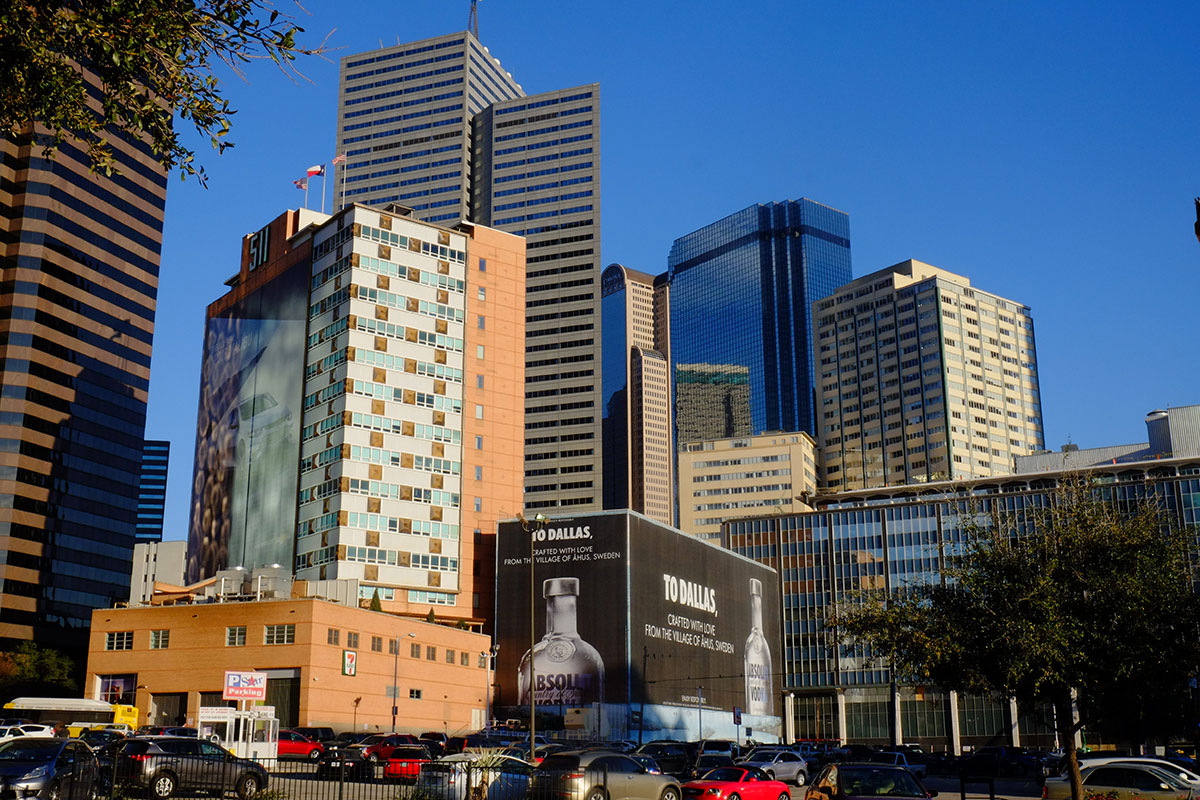
Dallas has had sustained growth throughout the postwar period, which is reflected in the juxtaposition of buildings from different eras.  DSCF4948  DSCF4949  DSCF4873  It’s an entertaining mix, although there are definitely the goofball, Worlds-Fairy buildings too.DSCF4363

And another strong contender for Worst PoMo Building Ever (Gigantic Building subcategory). DSCF4871

But Dallas has more than its share of serious buildings by well-known architects, most of them built fairly recently.  For some reason the culture seems to support this in a way that other cities (such as Houston), don’t.  Some are really good and some fall short, but they all show a commitment to architecture beyond the functional and economically viable.  Seeing so many together in one downtown is very surprising.

There is a Calatrava bridge, which if you’re determined to have a Calatrava, is probably a smarter thing to get than a building.  It’s a beautiful object, it doesn’t have the problems of not fitting into an urban context the way his buildings don’t, and it doesn’t matter if it leaks.  DSCF4123

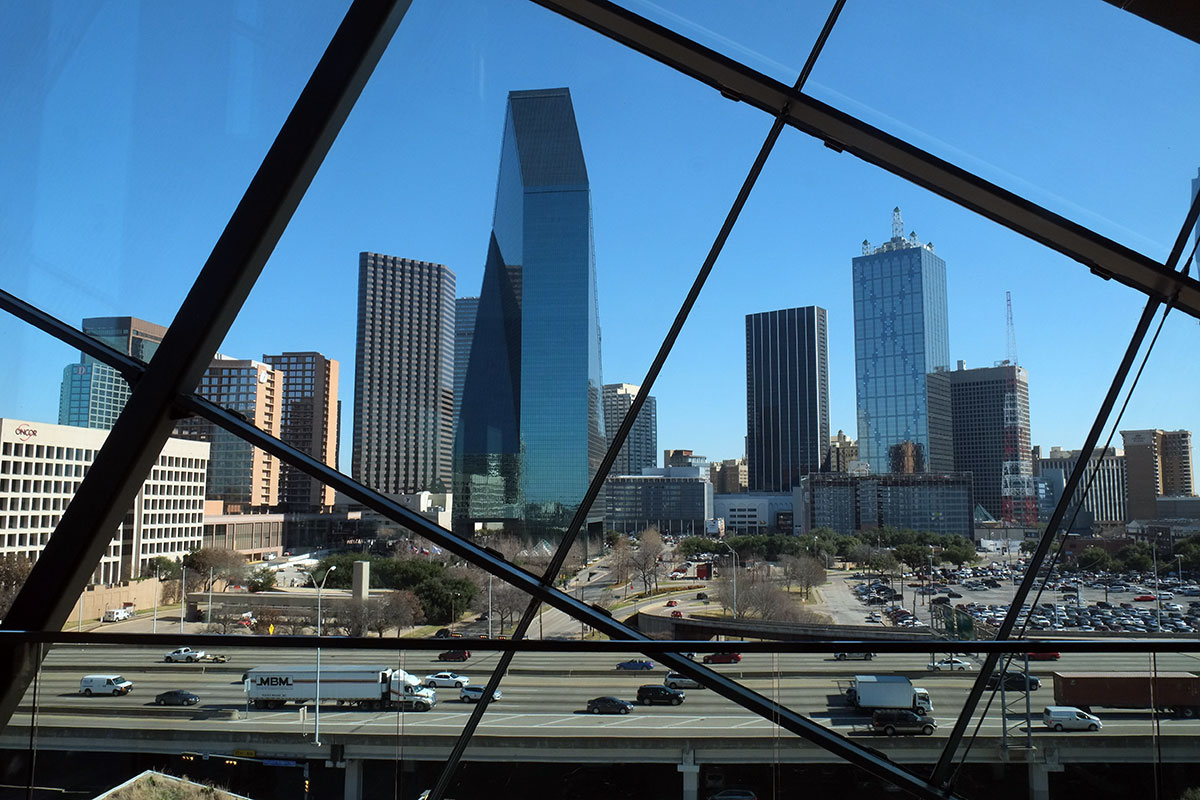
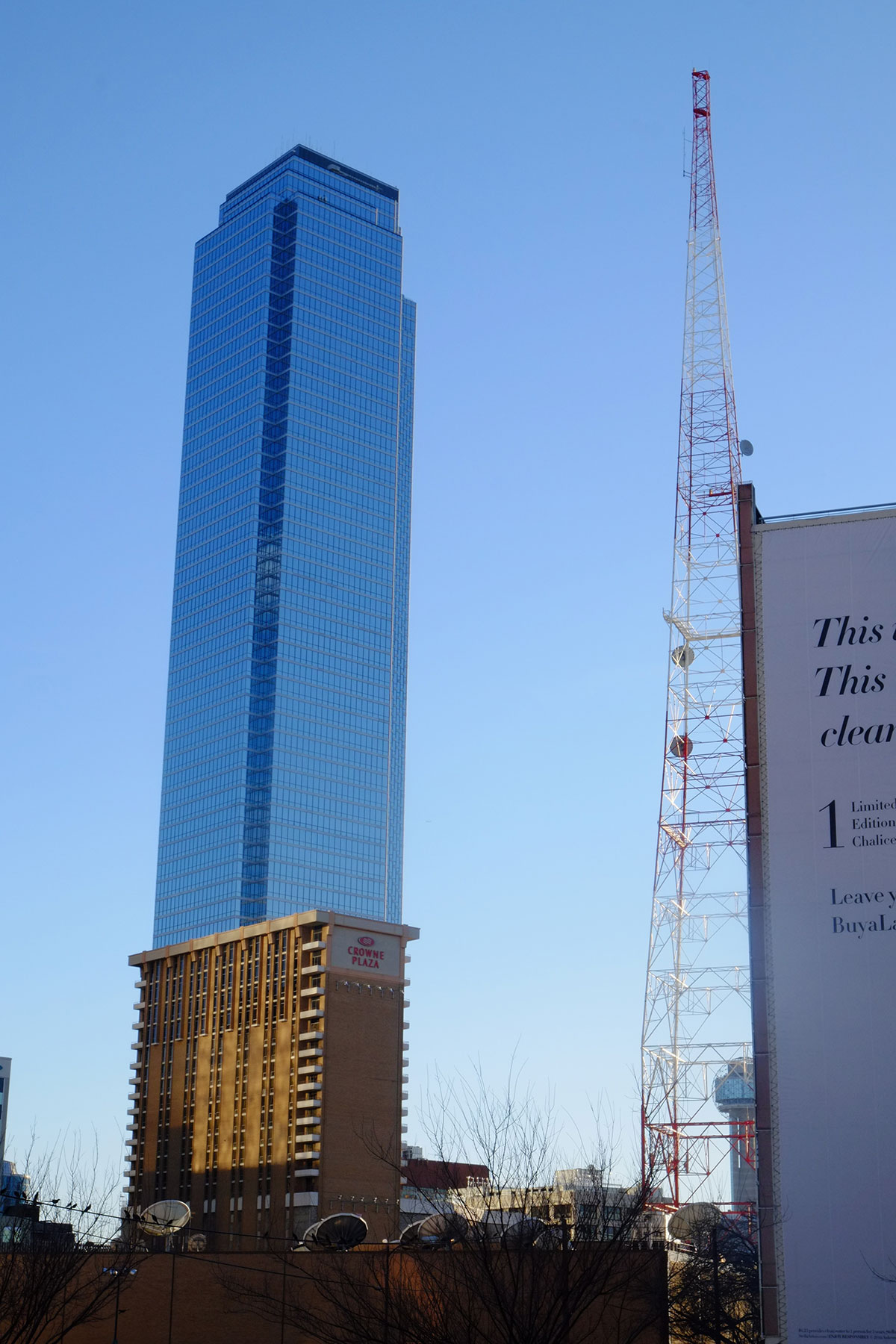
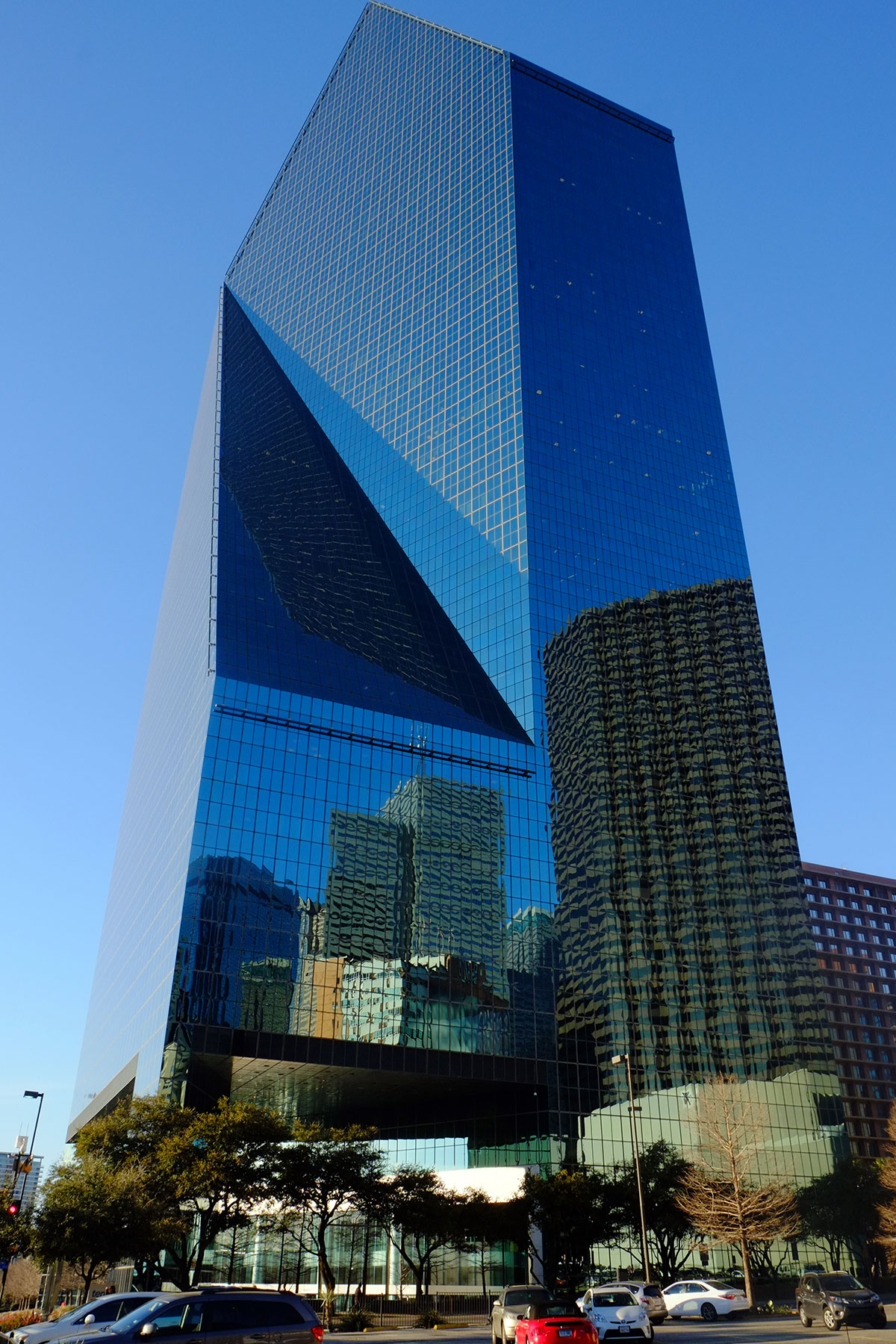
Still dominating the skyline is Pei’s Fountain Place.  It is a really big glass tower, but it doesn’t seem so, as it isn’t a box.  The seemingly simple prismatic shape is constantly changing as you move around it,  and it works much the same way the Hancock Tower does – sort of there, sort of not-there, hiding anything that gives it scale, meeting the ground well and somehow inconspicuously, abstraction at its best.  DSCF4950

Most of the cool new architecture is clustered in the Arts District, at the north end of downtown.  It begins at the Dallas Museum of Art, and an avenue lined with cultural institutions leads north from there.  The Nasher sculpture museum is on the left, by Renzo Piano.

DSCF4778

It’s simple, with a series of repeating structural bays, and typical Piano detailing.  DSCF4773

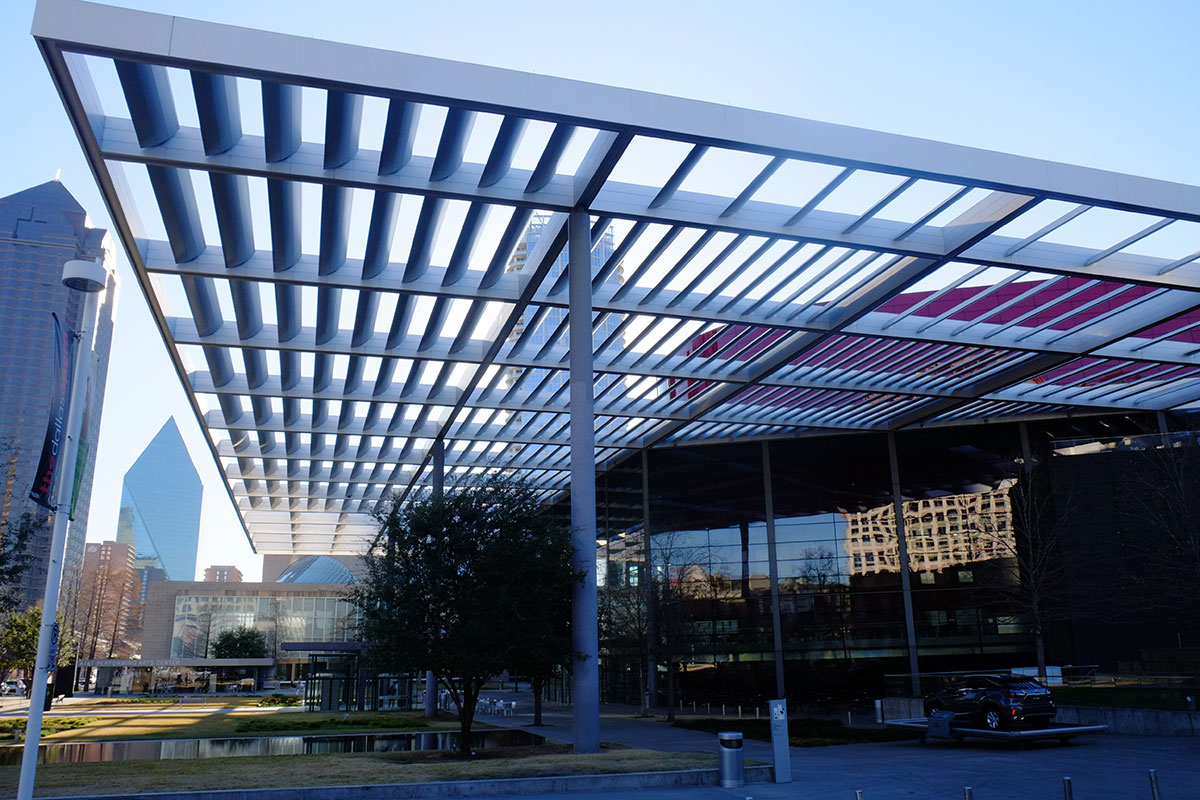
The Winspear Opera House, by Foster+Partners, is hard to see as a building, and impossible to photograph.  It is basically a full-block shading device, with a relatively small opera house in the middle.  This is a view of the outdoor amphitheater on one side of it.  DSCF4932

DSCF4894The strategy is pretty wonderful – here is this enormously hot city, where people probably won’t venture out of their air-conditioning for much of the year.  This big screen shades huge outdoor areas, with plazas, entries, cafes, sitting areas, etc., and i would think that it keeps people from just driving their cars into the basement parking garage and taking the elevator to the opera. For something so big, it’s pretty self-effacing – the image of the building is the gesture of the big roof, and the opera house reads as a pavilion under it.

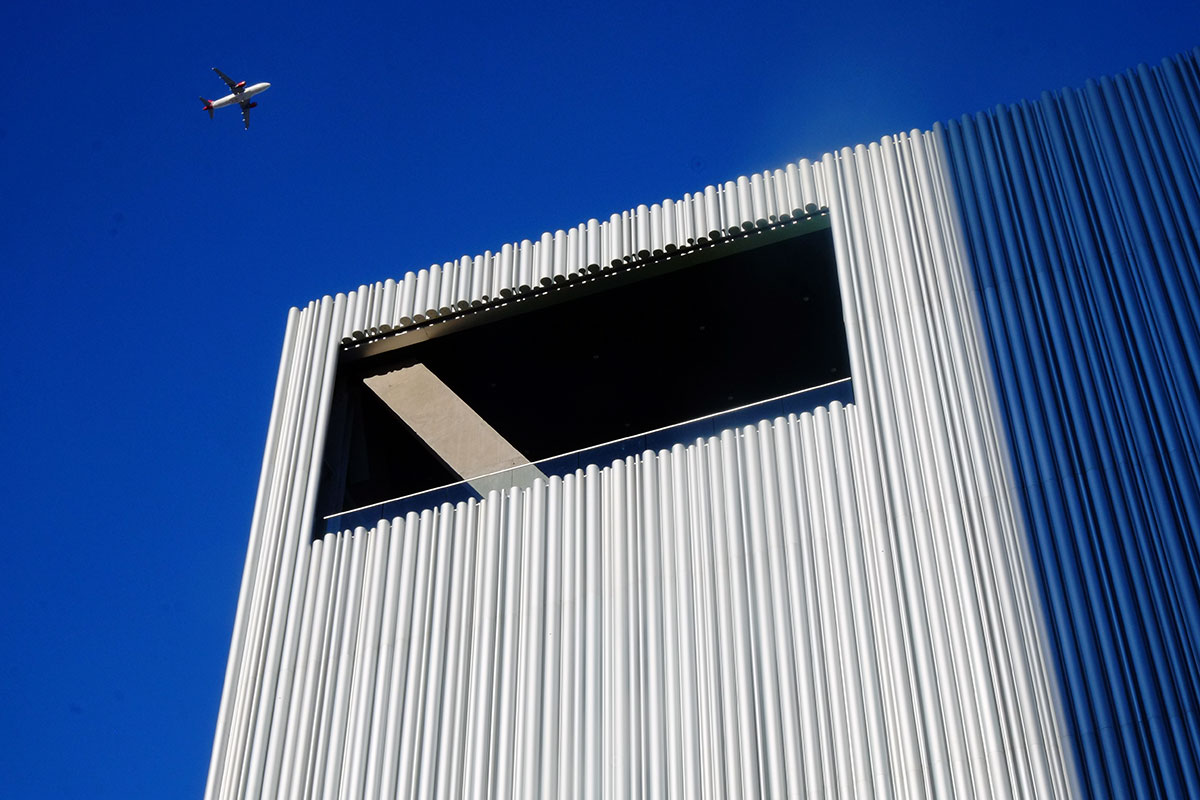
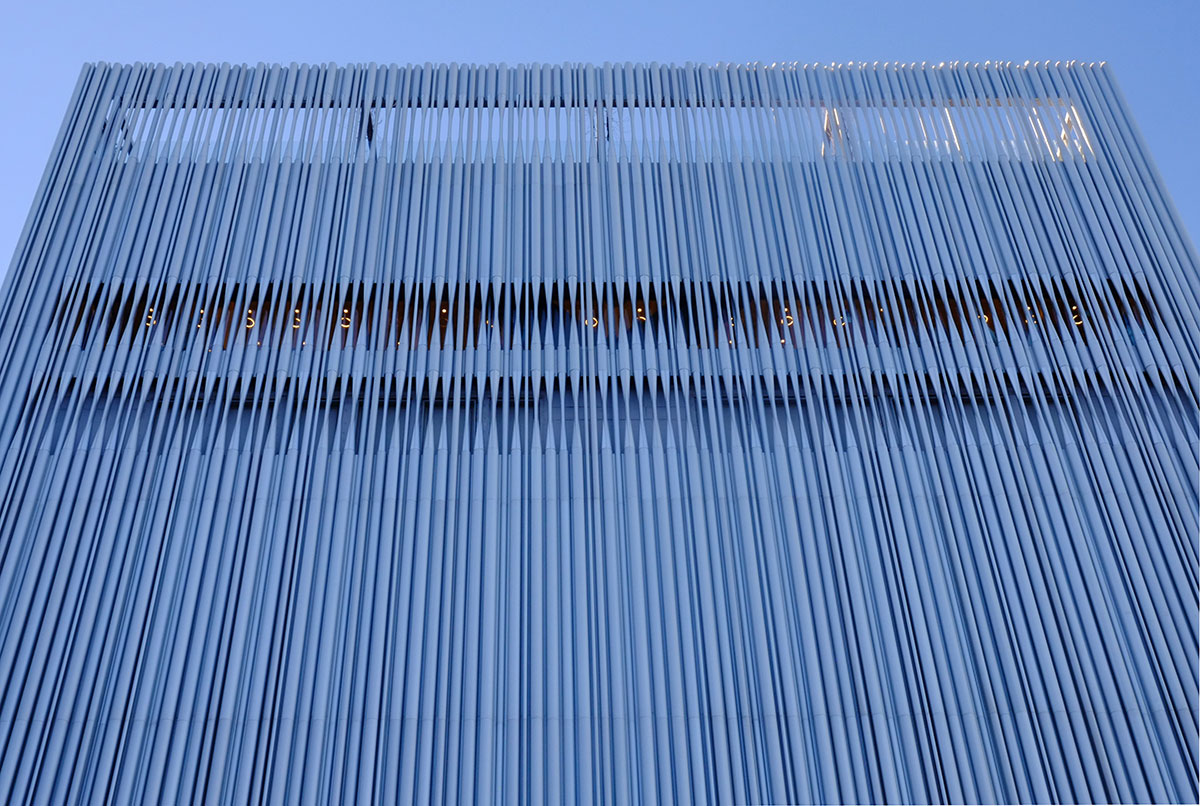
Across the way is the Wyly Theatre, by REX / OMA – purportedly by  Joshua Prince-Ramus, with an assist from Koolhaas.  I couldn’t get inside, but the skin is notable.  DSCF4879

DSCF4884a

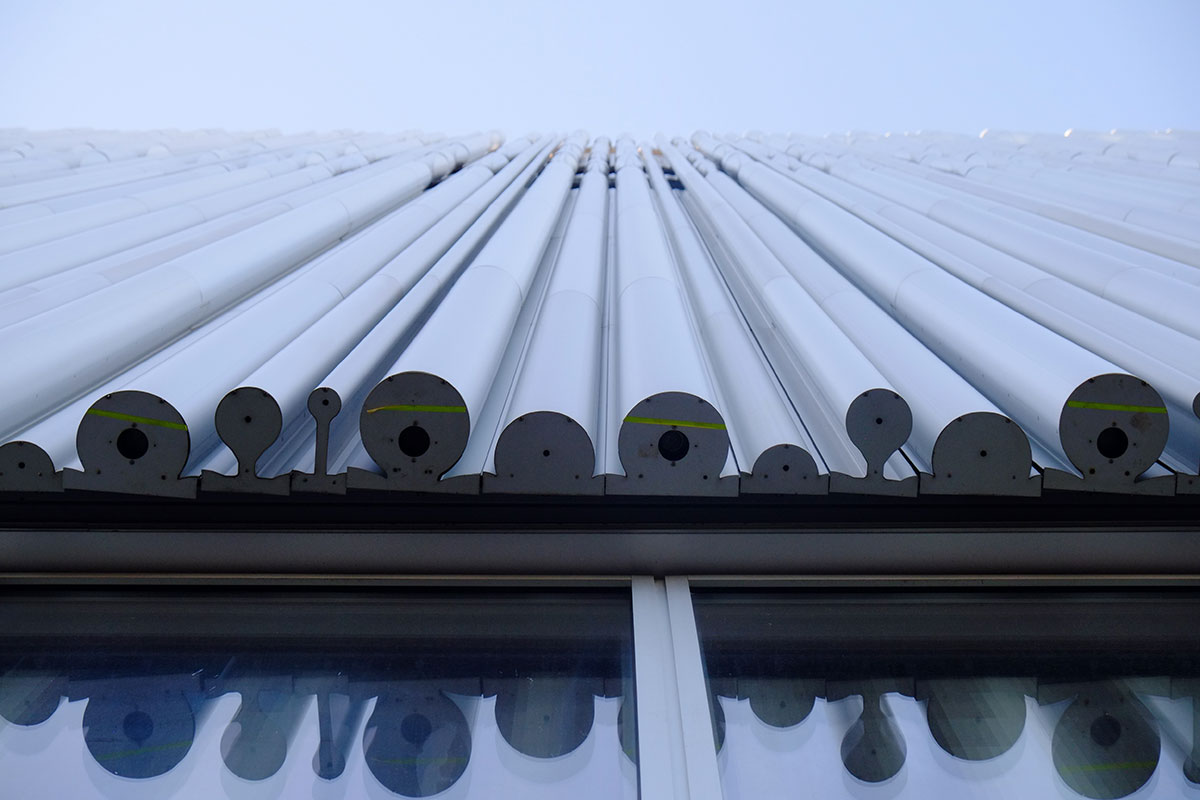
It’s intriguing, and from a distance you can’t figure out how they made this shimmering screen wall.  Then you get up close.  DSCF4886

I’d love to know what this cost.  There is one side of it where some building elements are exposed, and you can understand it better as a building.  DSCF4891

In contrast to these buildings, the Booker T. Washington High School, by Allied Works, across the street is an anomaly – it looks like a relatively normal building.  Building volumes and fenestration reveal the uses within. DSCF4897 DSCF4914It’s beautifully detailed and proportioned.  There’s a stepped central courtyard around the which the school wraps, which is good for daylighting and building depth, but I can’t imagine it being occupied often in the Dallas sun – it may need to be under Foster’s roof.  But in the midst of showmanship, it has the virtue of restraint – it’s not a one-liner building.

These buildings have many fine qualities, but it’s hard to see how they make up a city.  It’s the Lincoln Center phenomenon, but on an even bigger scale.  There is no finer grain to the city, just discrete institutions that sit near each other, most of them vying for attention for themselves, or their patrons.  (There are more I haven;t mentioned, such as an execrable Trammel museum of Asian art and a symphony hall that looks strangely dated already.)  They enfront the arts axis, but they all have some seriously weird back sides, where collisions like this happen.  DSCF4924On one side these back up against major arterials and freeways, but the other side forms a strange wall where it’s hard to see city fabric adhering.

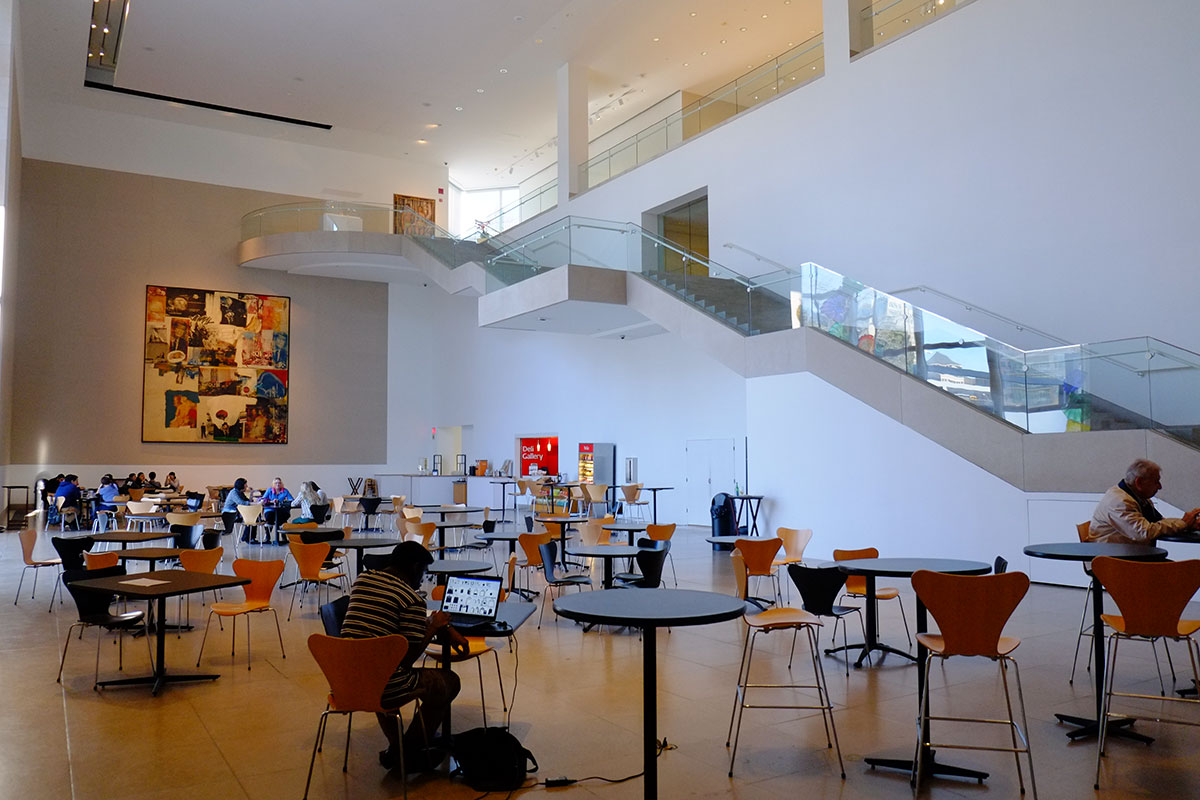
I think the best part of this district is the oldest piece, the Dallas Museum of Art.  It has a very good, very big collection, and the building is by Edward Larrabee Barnes. The parti is similar to his Walker Art Center in Minneapolis – a processional through galleries and up major stairs-as-rooms from level to level.  DSCF4819

It has good moments, but it doesn’t work.  The Walker is relatively small;  even if you’re disoriented, you can just give up control and follow the path, and it all comes out right in the end.  The DMA is so much bigger that there are several of these wandering paths, and you get completely lost.  When I lived in New York, I knew every inch of the Met, and could show someone the best way to the bathroom from the medieval armor across the central axis and behind the furniture galleries;  this place had me stymied.  Once you venture above the ground floor it is a labyrinth, and determined as I was to make sense of it, I eventually had to ask directions on how to get out and take an elevator.

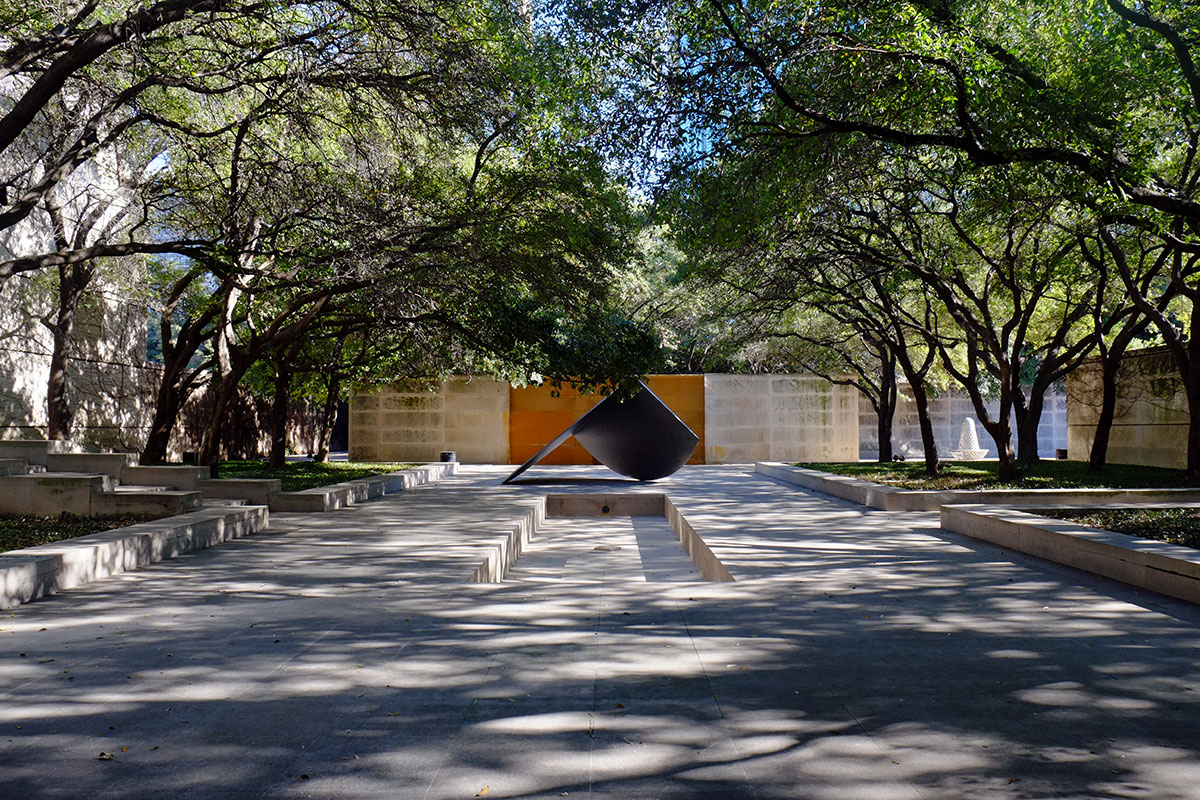
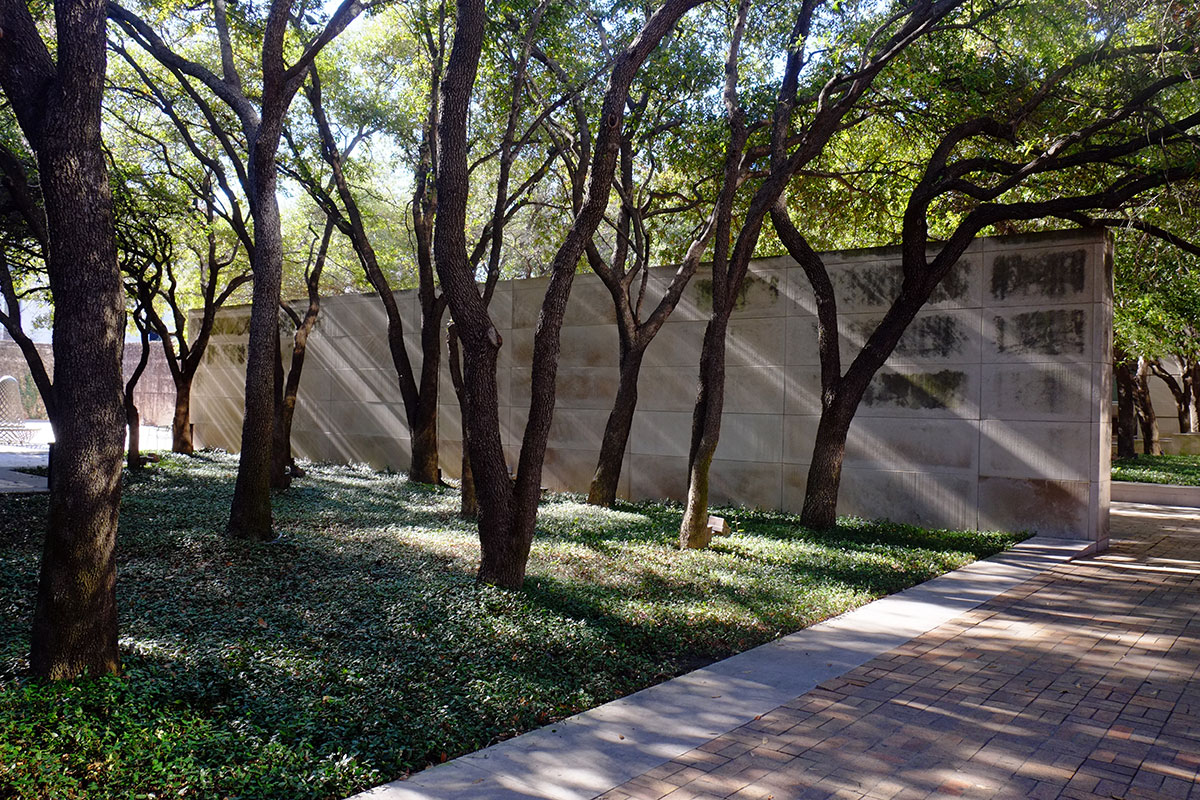
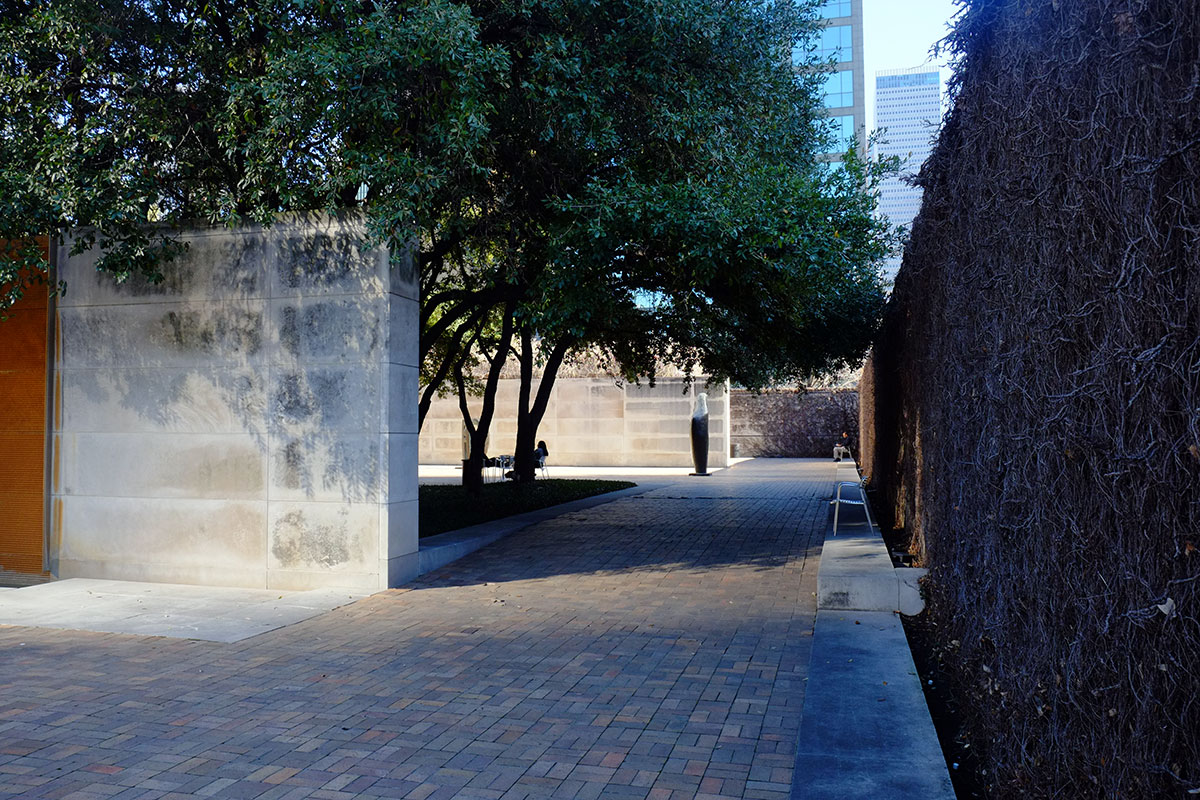
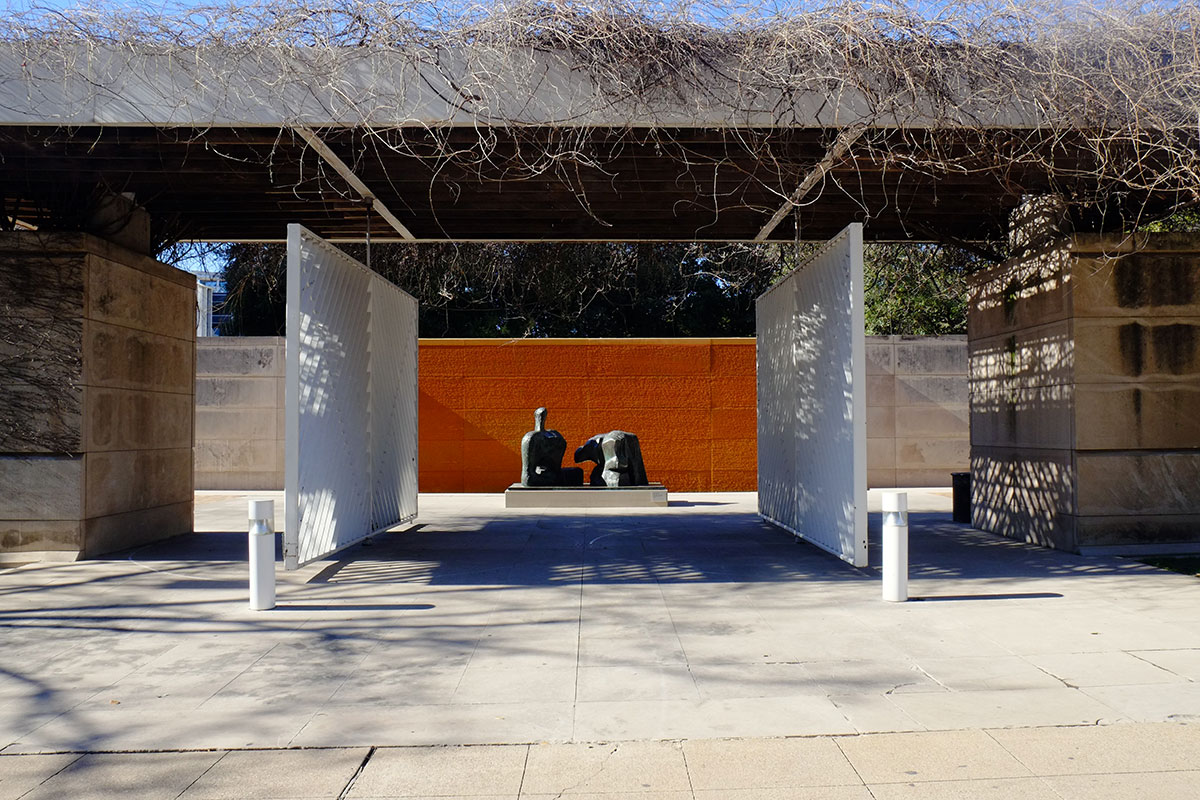
So why is the DMA my favorite one of the lot?  The sculpture garden.  It was designed by Dan Kiley, the great modernist landscape architect (something I could sense from the moment I spotted it).  I caught a glimpse of it from a ground floor lobby and was irresistibly drawn outside.  DSCF4808

We sometimes talk about whether a new museum is a good place to view art, or whether it’s something that exists mainly for itself, highlighting the architecture.  The same question could be raised about this garden.  The sculpture and  its placement are fine, but to me the overwhelming point is the landscape and the space itself.  A series of shifting, off-center axes.  Live oak trees filtering the clear Texas light.  Strict rectilinear geometry allowing for diagonal glimpses into adjoining spaces.  DSCF4807A series of wall planes with varied materials and textures around which your path threads.   Light and shadow and color.DSCF4795 Open places, secluded places.  Symmetry used to emphasize entry.  DSCF4802

It was so good I could have spent the whole day there, but I had other things to see.

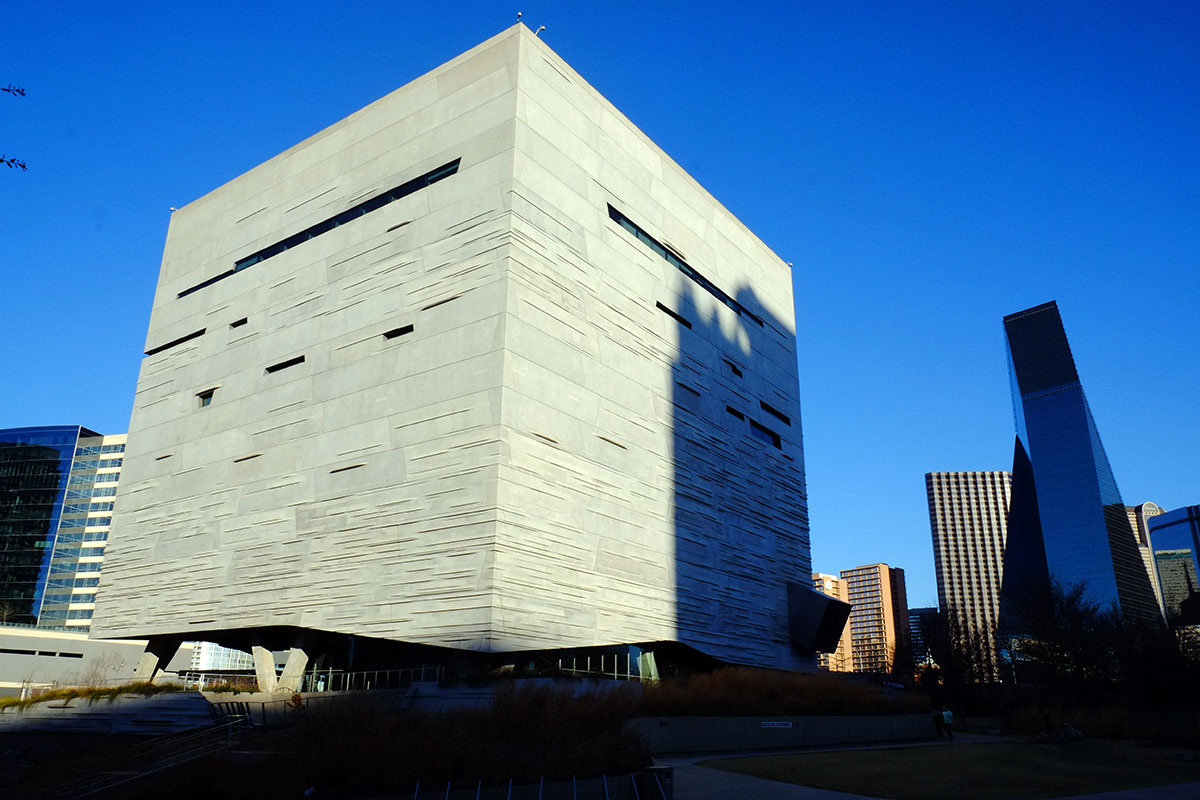
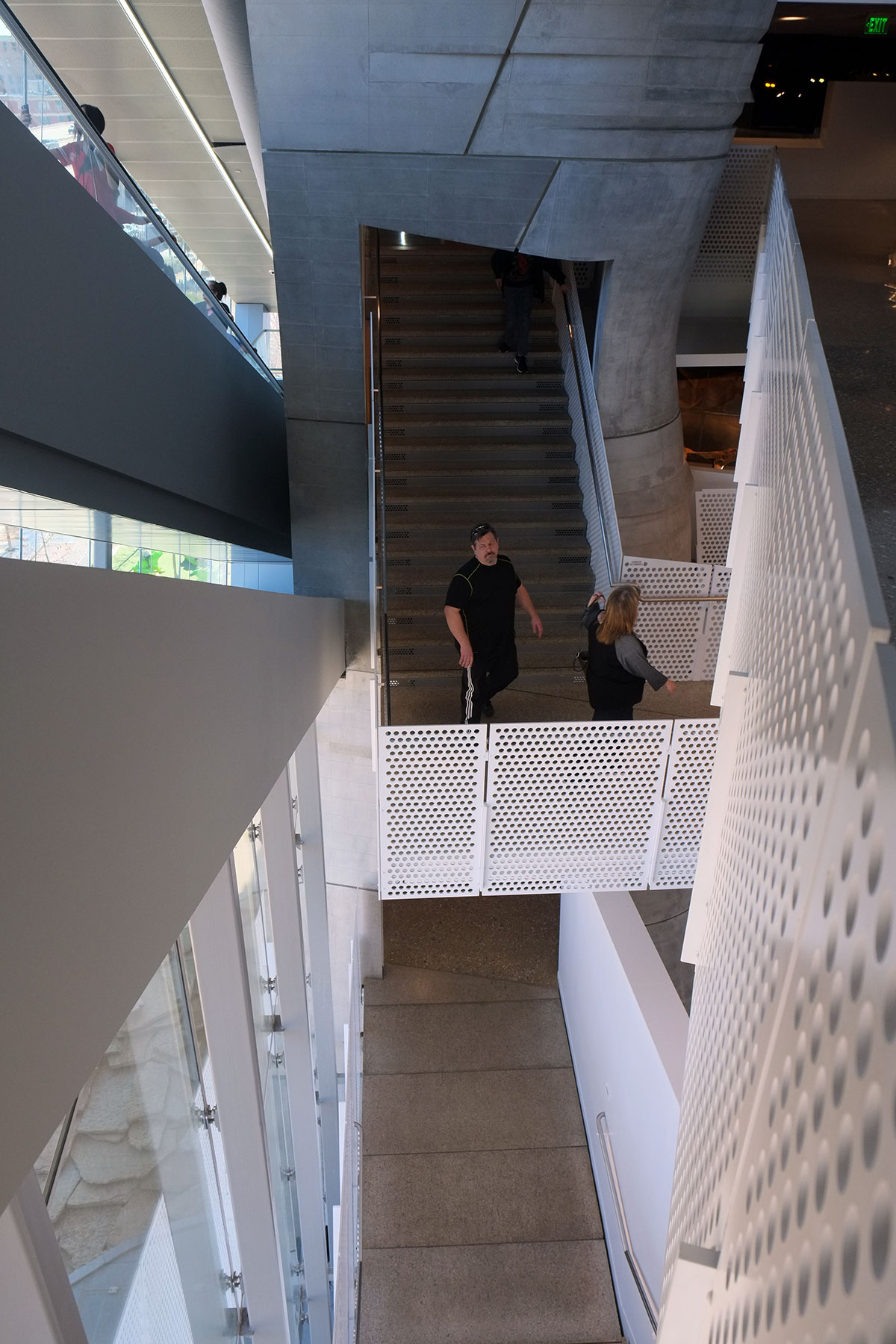
The new Perot science museum by Morphosis is the ideal building for us on this trip – Greta gets to look at science and natural history (which she has already written about), and I get to look at architecture.  Like most Morphosis buildings, it’s deceptively simple and functional.  Ten years ago, Thom Mayne explained how they designed the Eugene courthouse – they arrive at a simple plan, get everyone to buy in on the scheme, and then spend their effort elaborating  and finding the richness within the simple parti.  You can see that here too.  A science museum wants to be a black box for the exhibit designers.  They got that here, and it was then clad in a varied, textured skin which doesn’t try to disguise the essential boxiness of it.  DSCF4337

The skin is lifted up at points to reveal the lobby below, and afford views out into the landscape.DSCF4760

The other major element of the museum is the circulation system, which must draw people in, move them efficiently through the building from floor to floor, and perhaps provide the architects some latitude for spatial and tectonic excitement that they have been denied in the box.  And as many the patrons will be children, allow them some room to play and run and have fun too.

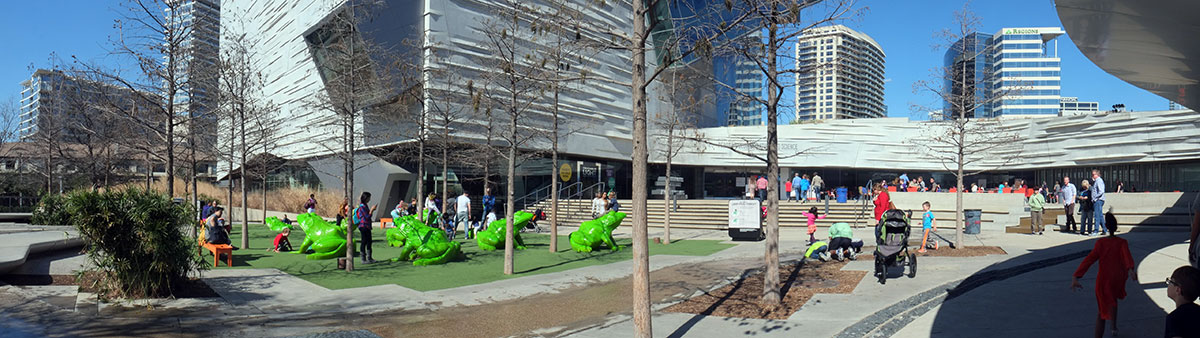
The system starts outside, drawing people up a ramp from the street into a large entry and cafe plaza.  DSCF4142

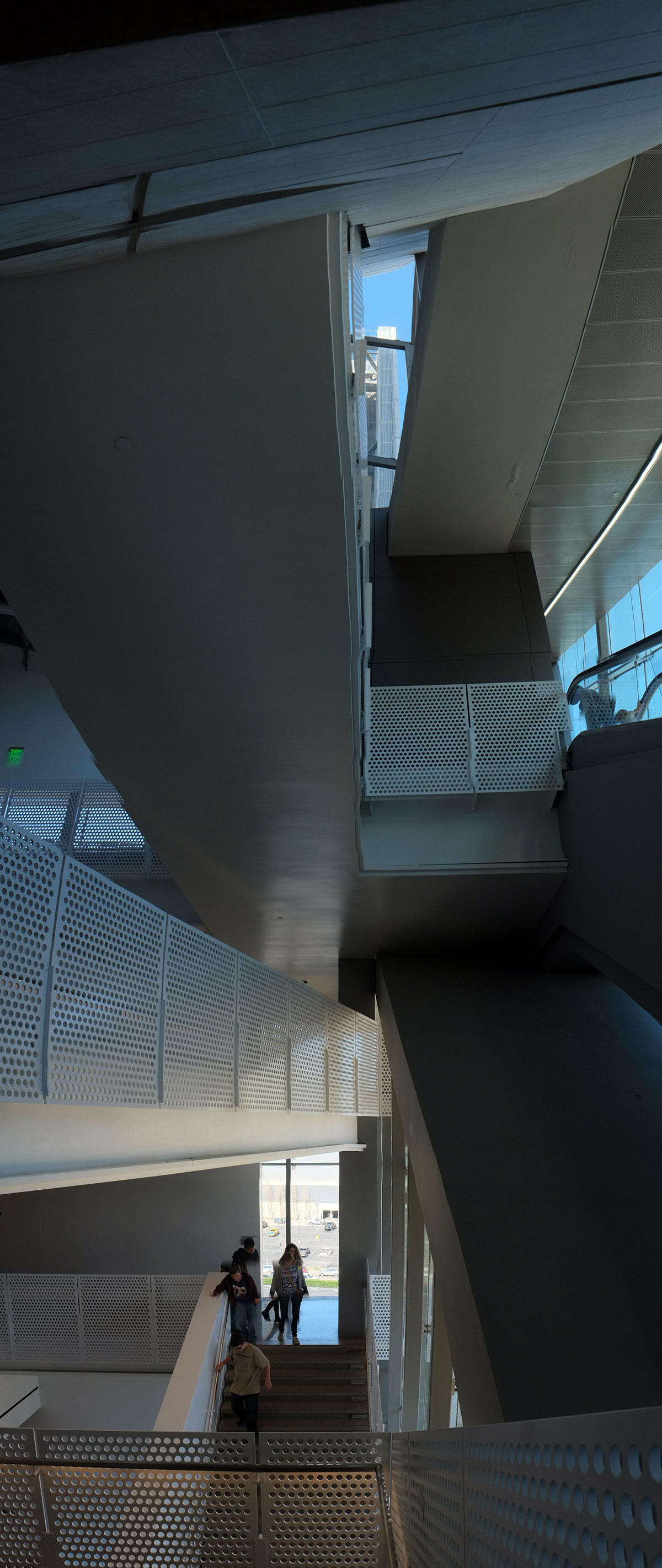
On the inside, there follows a series of spatial expansions, compressions, shifts, revealed yet inaccessible destinations, etc., which I can’t document in detail, there is just too much going on.  But you never feel lost – there is one predetermined path, and your experience is modulated as you move along it.

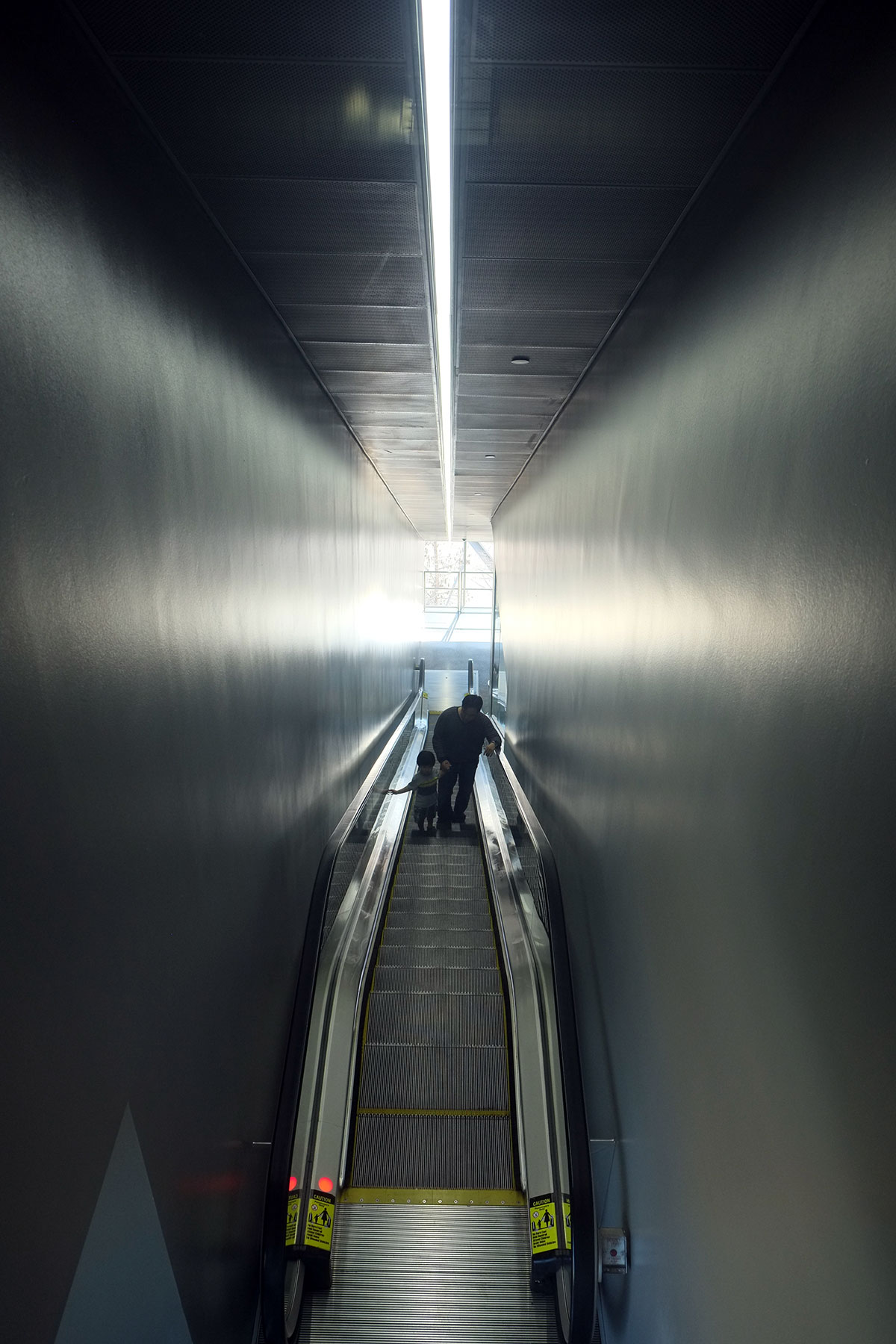
The pathway is to get visitors to the top, then have them walk down.  This is accomplished by a series of escalators.  On the outside, you can see the homage to to the primal gerbil tubes of the Pompidou Center, but eschewing the tubularity.  DSCF4147

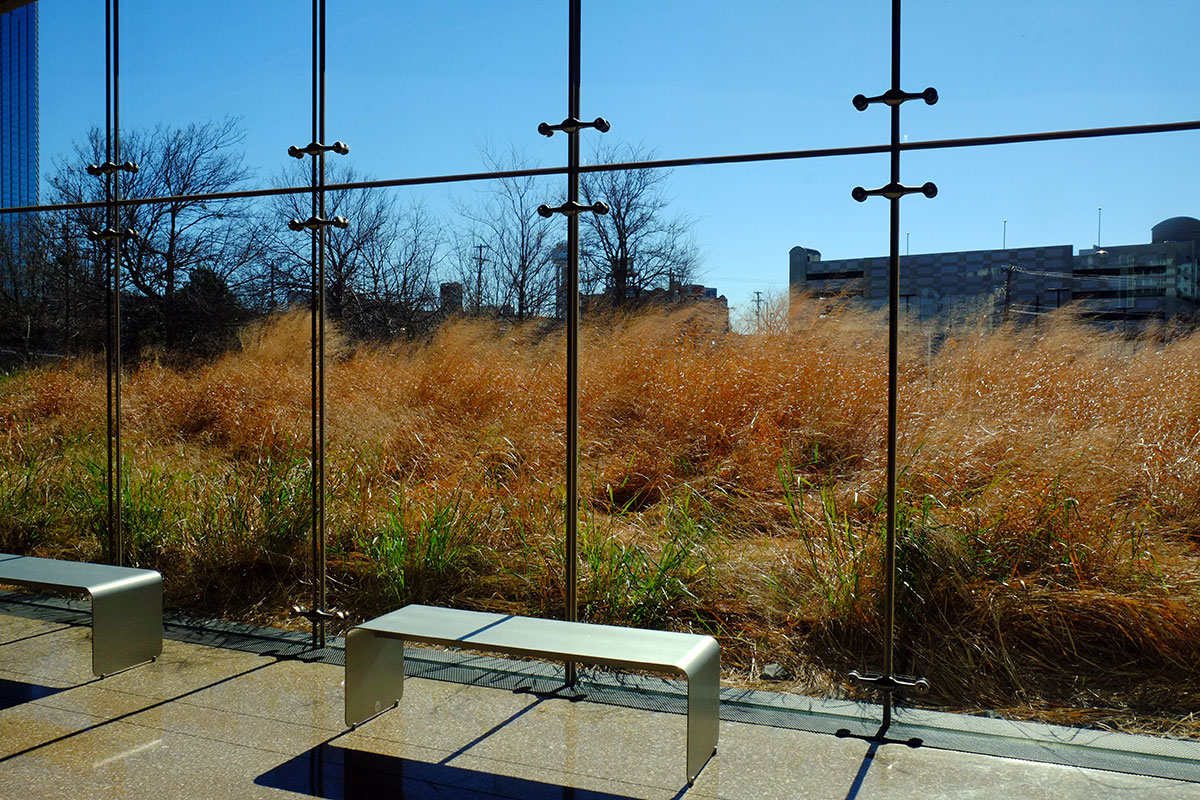
The skin is cracked at the northeast corner, and the circulation core behind is exposed.  It feels like a canyon inside, and the non-repetitive circulation system provides endless variety of movement and views.  Random photos:  DSCF4174  DSCF4191  DSCF4258  DSCF4273  DSCF4279  DSCF4285

It is playful, it is intriguing, it draws you in and it doesn’t get you lost.  And it provides a great connection to the city across the freeway, in a way not unlike Piano’s outdoor terraces at the Whitney in New York.  DSCF4234It’s a remarkably clear building, one where every part is fulfilling its intention, and the quality of the architecture enhances one’s enjoyment of the museum.

Beyond the buildings, the attention to urban design in Dallas was notable.  Of course there are giant streets dominated by cars, but somehow as a pedestrian I didn’t feel intimidated.  There was a pedestrian scale to all the downtown streets, crossings were frequent and non-threatening.  The light rail transit corridor is efficient and pleasant through the heart of downtown.  DSCF4953

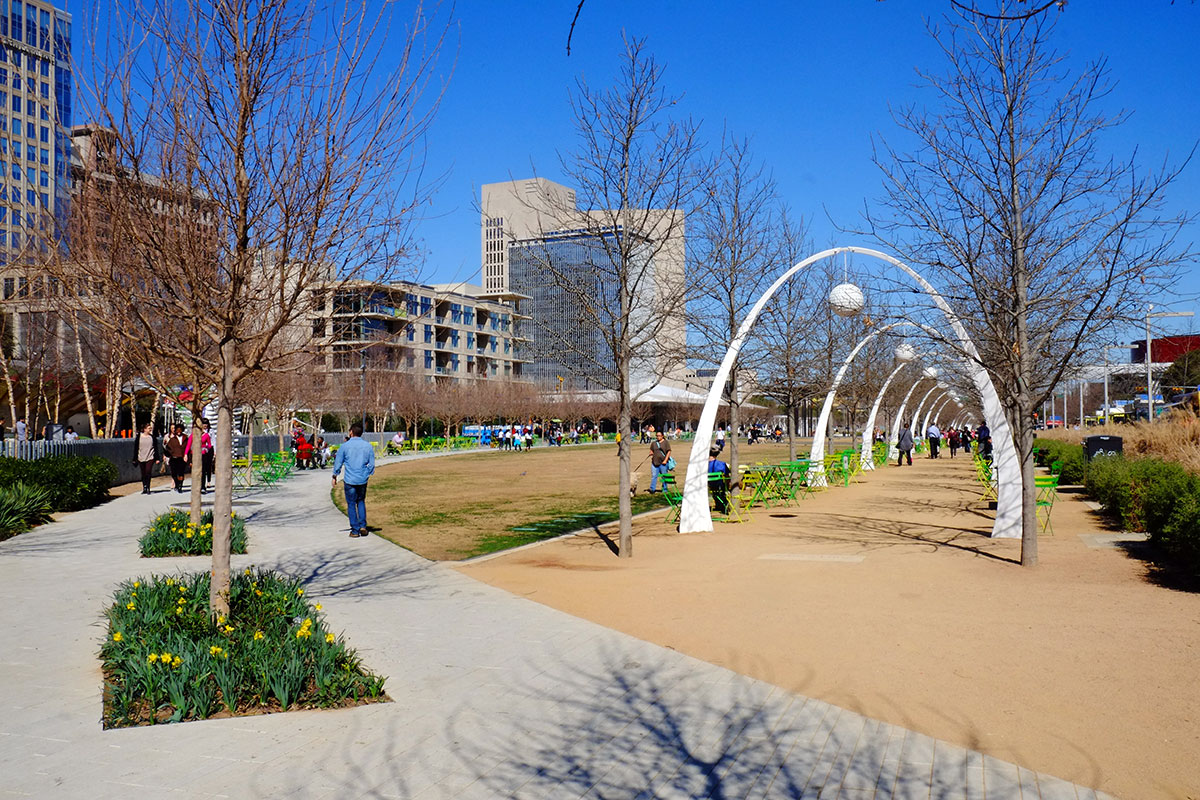
A welcome new feature is Klyde Warren Park, built over three blocks of the depressed freeway on the west side of downtown, and providing needed connection across.  Designed by James Burnett, it has lots of open spaces, seating, a playground, walkways, food, etc.  DSCF4739

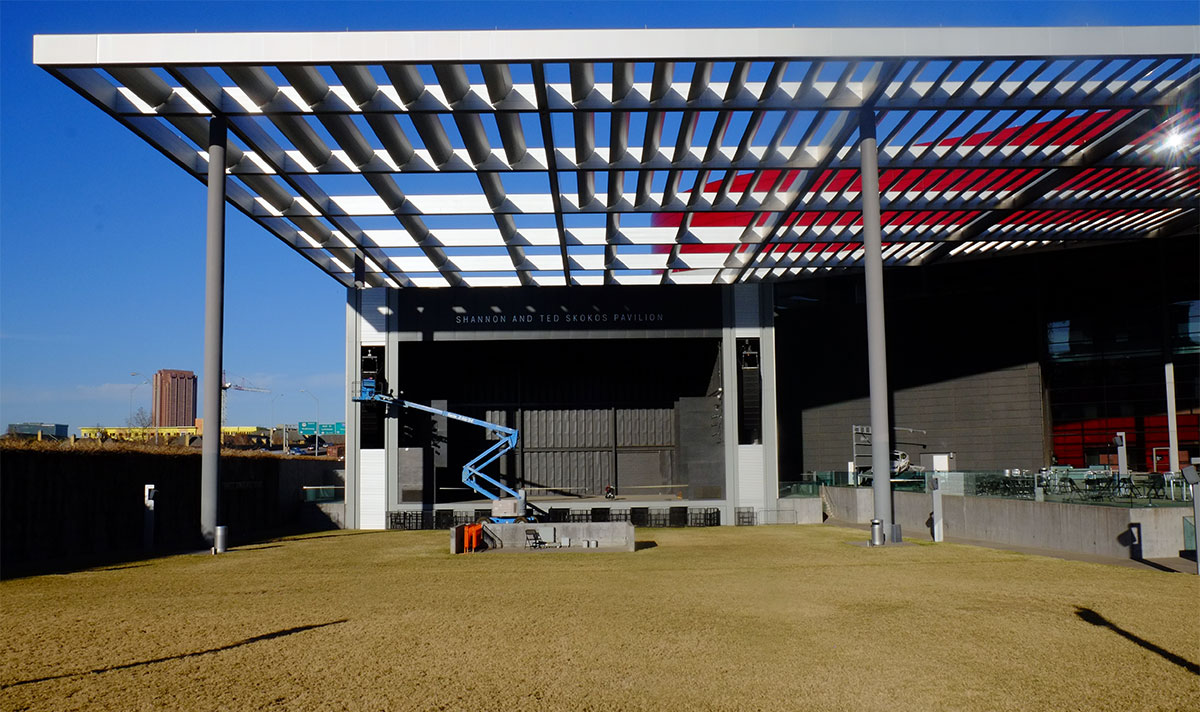
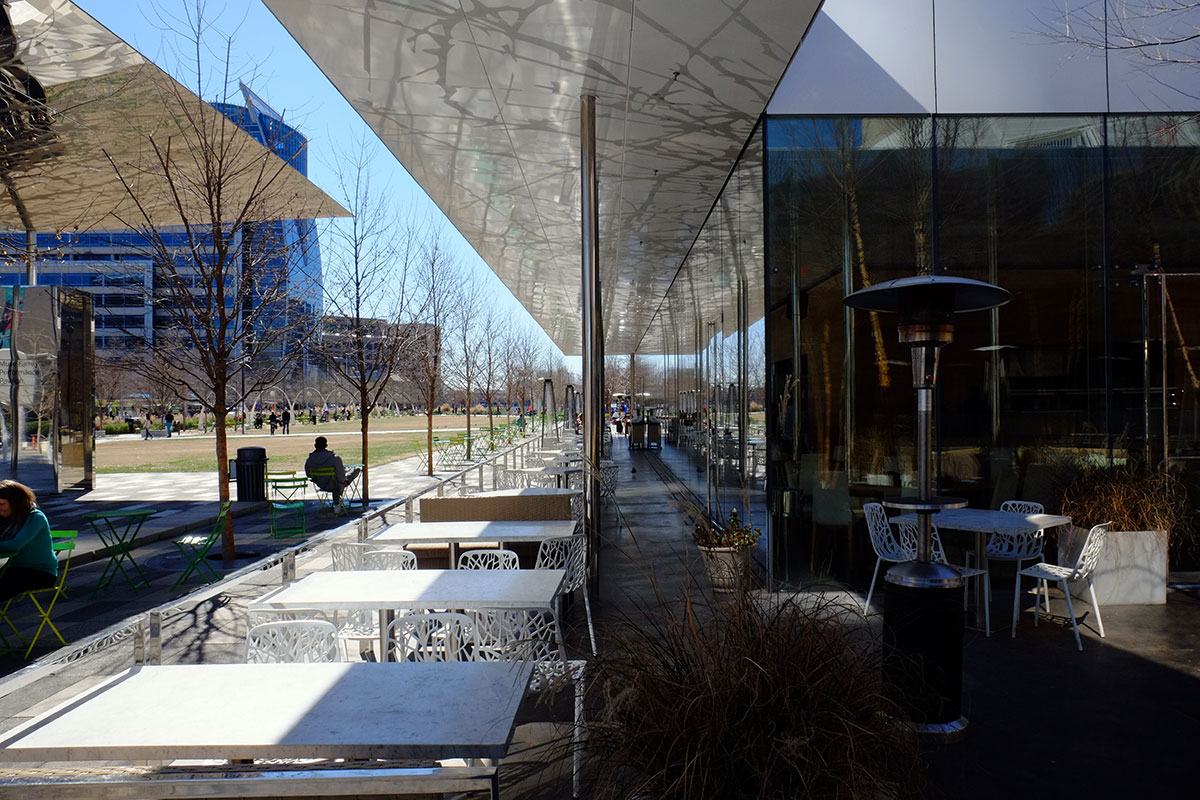
It’s pretty straightforward, not a design tour-de-force like the High Line, but it is incredibly pleasant on a sunny day, and draws lots of users.  There is a restaurant, cafe and performance pavilion by Thomas Phifer, in what I’m coming to recognize as his light and white, Miesian style.  DSCF4747

It’s very elegant and exquisitely detailed (with James Turrell-like knife-edges corners) providing that food-oriented catalyst for a park that William Whyte promoted.

As in many other places on this trip, I wish I’d had more time in Dallas.  It was a good introduction to Texas – it knocked me out of my preconceptions, being so much better than I had expected.   i could have tracked down the sprawling nightmare of the exurbs, but I could have found similar bad parts in any other major city in the country.  To paraphrase Tolstoy, all sprawl is alike, each good city is good in its own way.

Northern Louisiana

Northern Louisiana seems to be a different world from the coastal region.  We drove north from New Orleans along the Mississippi on River Road, where two different eras collide: there are the ante-bellum plantations, and there is the modern industrial landscape.  But you can never actually see the river – the levee forms a wall along the road that’s probably 40 feet tall. You see ships looming over it, so you know that there must be a river there somewhere.

DSCF3963Among the many plantations around, we decided to go to Oak Alley, as we had been told it had the quintessential allee from the river to the house.  As in all houses we’ve toured in the South, the family who built this plantation was very important, with lots of governors and senators etc., but we promptly forget all this family stuff after hearing it (another reasons we could never be southerners).  We’re just here for the architecture, which did not disappoint.

The allee is spectacular, and must have been more so when there wasn’t a levee at the end.  DSCF3891

The Greek Revival style is done beautifully, well-proportioned and straightforward.  DSCF3969  DSCF3951

The main rooms are all large and beautifully lit, being always on a corner.  DSCF3898

The word thing hanging over the dining room table is for shooing the flies away.  A young slave would have sat in the corner of the room pulling on the rope to make it swing.  DSCF3905

The two-story verandah on all sides was exactly where you’d want to hang out. DSCF3941 Having now seen examples in Florida, Mississippi and Louisiana, the essence of the type is pretty clear, and it is a very straightforward and sensible reaction to the climate, which must be unbearable in the summer (we were there in February and it was quite warm).

As with all plantations we’ve visited, the paramount question is how the history of slavery is treated.  As we toured the house, surrounded by tourists oohing and ahhing, we were feeling pretty weird – the architecture is fabulous, but it’s pretty hard to listen to stories about this family and think about the basis for all this wealth.  (We decided it would be like going to Auschwitz to see the commandant’s quarters.)  However, compared to what we’ve heard about other plantations, we thought Oak Alley did a good job of presenting the reality of the history.

The slave quarters here were located on along the central axis, but to the rear of the house, and along another oak alley.  DSCF3884

This arrangement, and their proximity to the main house, was very unusual.  The quarters had obviously not been as carefully preserved, but enough remained, and there was also documentation of them and how they had been transformed after the Civil War, when they were occupied by paid hands (who might have been the same people, just no longer enslaved).  Based upon this evidence, all the slave quarters had been reconstructed, showing how they were furnished in different eras.  DSCF3880

The plantation records had also been searched, and a list was compiled of all the slaves whose names could be found.  In one of the cabins, where there was a detailed exhibit on what is was like to be a slave, and how the slaves were treated, the names of the slaves from this plantation were inscribed on the end wall.  We thought it was a dignified and fitting memorial – acknowledging the individuals as best they could, working in the vernacular materials that reflected the physical surroundings and reality of these persons’ lives.DSCF3886

Most of the drive was through the oil and chemical industries’ landscape.  Very large facilities and big things, which we enjoy seeing.  Just glad we didn’t have to live there.  P1070311a

Our visit to Baton Rouge was stymied by a cell phone charger in the truck which we thought was working, but was not.  So just as we hit a major city, our phones went dead and we were navigating by instinct.  The downtown seemed to be having some kind of festival, coinciding with lots of streets being closed for construction, which made it even more difficult.  We passed by the state capitol (a pretty good one we thought, in the rare genre of capitol-as-tower), DSCF3972but mainly we spent a lot of time trying to find a store to buy a charger, before realizing that all stores like that are way out in the edge sprawl.  We gave up Baton Rouge, crossed the river and found a Walmart, and continued on our way.

We left the Mississippi and crossed the Atchafalaya Swamp towards Lafayette, and headed up the Red River to Natchitoches (which is pronounced Nack-a-dosh), an important French colonial town.  It has a few streets of nice old commercial buildings, some of which have been excessively cute-ified for the tourists, but many of which are fine. DSCF3982

There is an excellent Catholic church. DSCF4012

The river flows through the center of town, with the buildings sitting on the higher ground above the floodway.  The lower area by the river is used for a park, parking, and river access, a really nice way to make an open space while acknowledging that this will flood.  (A few weeks after our visit this area did indeed have some major flooding, but I wasn’t able to find out how the town fared.)DSCF3978

Not all the buildings are old and quaint – it is the home of the Northwest Louisiana History Museum, which was for some reason combined with the Louisiana Sports Hall of Fame.  DSCF3993

I was very surprised to find such an edgy building in such a location – the folks at Trahan Architects have clearly been reading their magazines, and the skin was the hippest we’d seen since Miami.  DSCF3998

Strangely, it looked pretty darn good in the town – the massing is simple and in scale with the surroundings, the entry space under the floating screen wall relates to the verandah architecture of the nearby commercial buildings,DSCF4003 it’s dark-colored, and it anchors a funny shifting intersection.  On the whole, it was much better than the pseudo-historicist buildings we saw there (such as the one beyond it).  It was Sunday so we couldn’t get inside, which was too bad, as Glen and Michelle had designed some of the exhibits.

We hadn’t heard great things about Shreveport, but we enjoyed it.  We stopped for lunch at Strawn’s Eat Shop (we found it through Roadfood.com, and couldn’t resist the name).  Food not worth blogging about, but we liked the ambience.  DSCF4029

We saw what was clearly the older expensive neighborhood, DSCF4032

and then perhaps the worst Pomo building in the world, even uglier than the Jacksonville courthouse.  Casino architecture is inherently strange, but cheap casino architecture may be the most depressing stuff around.P1070328a

But by far the highlight of Shreveport was the Waterworks Museum. DSCF4053

They ran their municipal water system on steam power until 1980, and then when they revamped it all, they preserved the whole earlier plant, with boilers, pumps, controls, settling tanks, labs, etc.  It was superb. DSCF4046  DSCF4058   DSCF4050  DSCF4092  DSCF4079We randomly arrived on a Sunday afternoon, and were able to join a tour with a group of cub scouts, which had an excellent guide who clearly loved the place.  As I’ve mentioned, neither of us especially likes visiting historical places where something once happened, but there’s no visible evidence.  We like seeing real stuff ([preferably Steanmpunk stuff), and this was about the best industrial archaeology we’ve seen on the whole trip.

New Orleans – the newer city

One of the reasons that New Orleans is so different from other American cities is that has always been constrained.  Surrounded by Lake Ponchartrain (to the north) and low-lying swamps and marshes in every other direction, the whole metropolitan area encompasses only around 200 square miles, with a population of 1.2 million – approximately half that of Portland’s.  The constraints on New Orleans used to be even more extreme – the originally-settled areas on the ridges (about eight feet high) were only later supplemented by the close-in drained-swamp residential areas in the 19th century, and the more extensive sprawl (such as it is) is all from the postwar era.  So the center of the city feels compact and manageable, while having very imageable, distinct districts.

When the Americans began to move in after the Louisiana Purchase, they mainly left the Vieux Carre alone, and settled upriver, across Canal St.  Canal St. never had a canal, but it was planned for one, and so it is immensely wide.  It is a wonderful contrast to the rest of the city – you emerge from the narrow confines of the French Quarter to the bright, open expanse of Canal.     DSCF2648

The buildings form a continuous wall, there are streetcar tracks up the center, and a double row of palm trees.  Bright lights, traffic, tourist attractions and hotels – it is an entertaining and exciting space, one that says, this is a big city.  Also a tropical city – with its white facades and palm trees, Canal feels very different from the grey avenues of the north.  DSCF2041p  One of the two streetcar lines runs up Canal, and it is a joy.  The old cars are fabulous, and here as on St. Charles, you ride along experiencing the city as it goes by.  DSCF2034DSCF2822

Canal really comes into its own on Mardi Gras – all the large parades end up here, heading up one side of the neutral ground (median) and back down the other.  The scale of the street works with the large crowds and floats – it reminded me of Broadway in New York with the Thanksgiving parade.  DSCF2277  DSCF2265  DSCF2267

The end of Canal at the River is the center of tourist / convention madness.  Hotels, convention center, casino, aquarium – all the overscaled and blank buildings are here.  It works pretty well- these fairly standard dreadful buildings are clustered and have a minimal impact on the other neighborhoods.  You can just ignore this part of town if you don’t have to go there.  DSCF2032  DSCF2098

The rest of the downtown is blend of good old commercial buildings and standard mid-century towers.  DSCF2537DSCF3789

The more recent towers, spawned by the oil boom, are clustered upriver along Poydras Street.  DSCF3792  DSCF2058Overall, there is balance between the old and the newer – there are not many places where the gigantism and banality of recent decades takes over.  Although New Orleans’s first skyscraper, the Plaza Tower, is truly inept.  It is now empty, with asbestos and mold issues, and lawsuits apparently flying in every direction.  It’s so bad it might be worth keeping.  DSCF2626

Poydras St. is also the location of Charles Moore’s Piazza d’Italia. It’s a funny little thing – filling in an open space between a skyscraper and a parking lot.  Moore was obviously trying to construct  a place that could be inhabited, unlike the empty modernist plazas built to satisfy zoning ordinances, but the cards were stacked against him.  If the city fabric grew up densely around it, so that you emerged from a street into the plaza, it might work.  But the towers are pulled back, and one sees the Piazza from the outside as a disconnected object, not just as a surrounding screen from the inside.  DSCF2075The detailing is over-the-top Pomo, and is perhaps our best remnant of the movement spinning out of control.  DSCF2077

The elevated highways that ring the business district have done their damage, as everywhere else. The neighborhood of Treme was decimated, and the Uptown area to the west is cut off by a no-man’s land around the freeway.  DSCF2628

While the central business district has largely wiped out the early 19th century buildings there, some do survive, DSCF2633and the mix of old and new shifts as you move uptown, through the Lower Garden District and Central City areas into the Garden District.  DSCF1627

This side of town is served by the other streetcar line, along St. Charles.  The old cars are in fabulous condition, and a miles-long ride is one of the best ways to see the city.  DSCF2858This area is remarkable.  In some ways it looks more like other American cities, in that styles that were current in the late 19th century are all visible, but they are adapted to New Orleans.  There are a lot of Greek Revival houses, their large porticos well-suited to the climate.    DSCF1629DSCF1638  DSCF1657  DSCF1659 The wealth of the builders is apparent – whereas most of New Orleans’s older dense residential neighborhoods were working class in origin, in uptown there are many areas with large houses and big yards.

In general, as you move out from the city center in any direction, the density decreases, as neighborhoods begin to look more like those in other parts of the country, with detached houses sitting on lots of varying widths.  This happens in places as different as Mid-City,DSCF3558

in 20th century parts of GentillyDSCF3568

and in the Lower Ninth Ward.  DSCF1763

It’s a commonplace that New Orleans is unlike anywhere else in the US;  this difference is seen most clearly when you’re near the city center – the house types, the block organization, the streetscapes – these are most different in the Vieux Carre, built before it was part of the US, and in the early 19th-century districts, when the local influences were most strong, and a national building culture hadn’t yet asserted itself.  The outskirts of the city are physically much like other old metropolitan areas, with ranch houses and strip centers.  But the New Orleans difference is apparent in another important way, even out in these newer areas:  in the culture of the city and the tenor of social life.  The way people live here is unlike anywhere else, even out on the edge.  They may have a Costco, but that Costco has an excellent liquor selection.