Category Archives: architecture

Las Vegas

84. Las Vegas106DSCF7085

If South Dakota is the epicenter of kitsch, the Southwest is the center of the surreal.  There are the surreal natural landscapes, such as Bryce and Antelope Canyons.  There are the surreal sprawl-cities, such as Phoenix.  And then there is Las Vegas, which is competing with Dubai to be the world capital of surreal architecture.

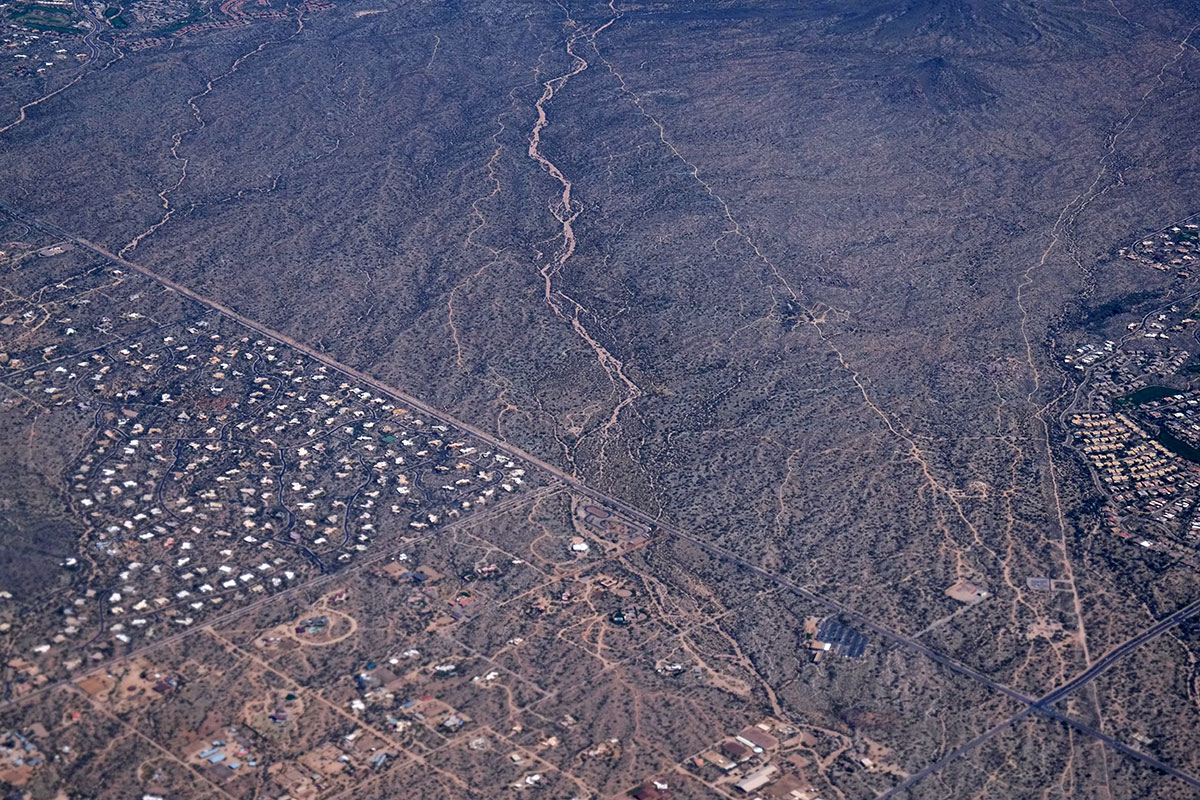
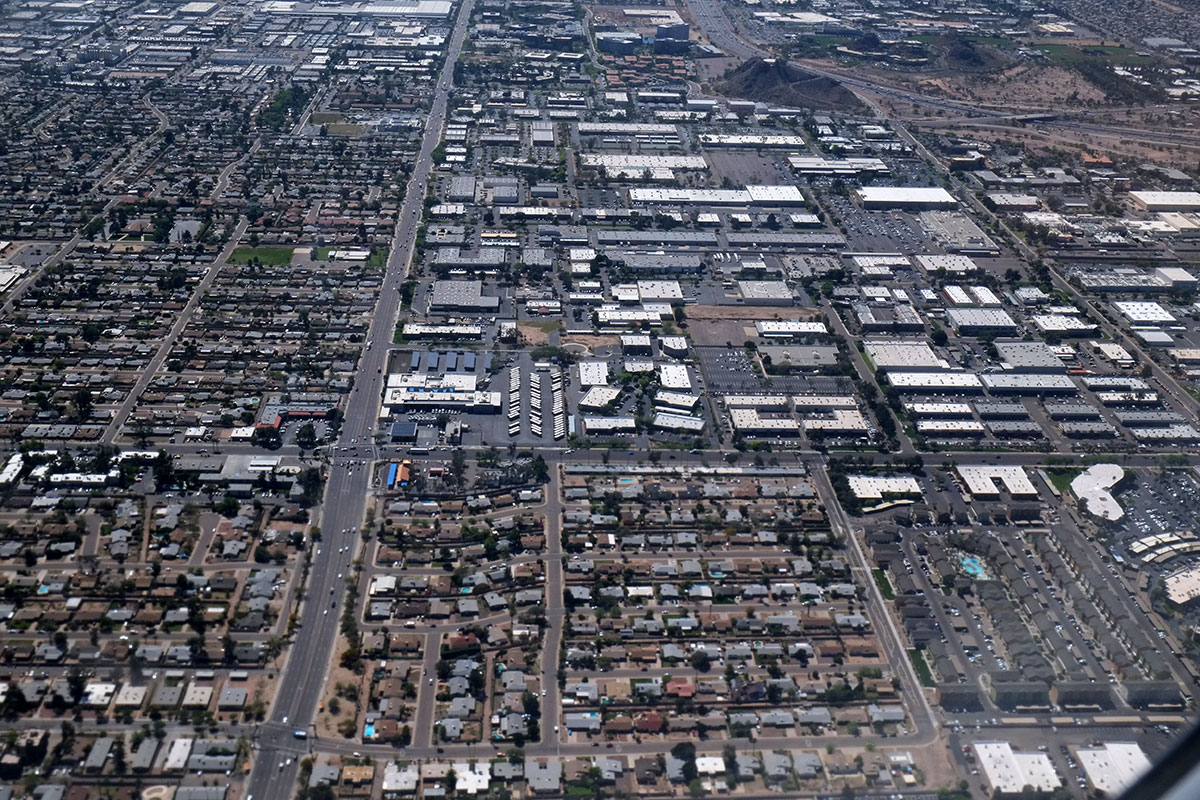
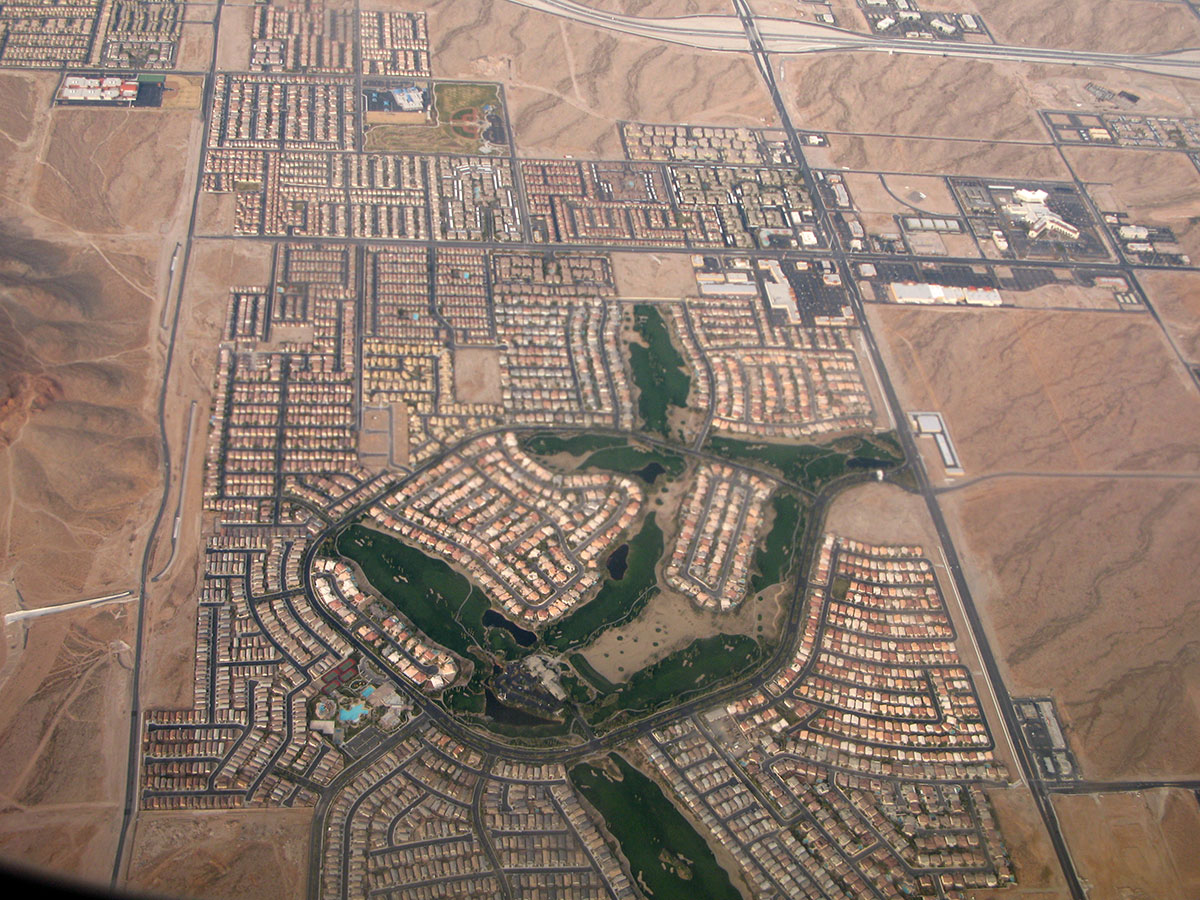
As a city, Las Vegas is just a smaller version of Phoenix – gridded sprawl, completely dependent on cars and air conditioning.  From the air, Las Vegas is more comprehensible than Phoenix.  Phoenix is so big that you get glimpses of parts, and have to assemble an understanding of the region in your mind.  But the Las Vegas metro area has around 2 million inhabitants, and you can see the whole area dwarfed by the surrounding desert landscape.  As in Phoenix, the visual contrast between the developed areas and the desert is vivid – nowhere can you see a better illustration of the power of our technology to dominate nature.  These desert mega-cities are like space ships – life is possible, even enjoyable.  But if the power goes off for a couple of days, everyone dies.  IMG_5722I would have liked to explore the mundane side of Las Vegas, which seems to be a sadder version of Phoenix, but I was traveling with a child who has spent her life in a small city in the Northwest, and so has almost no experience and even less tolerance of sprawl or traffic.  So given how much Greta had hated driving around Phoenix, and the limited doses of architecture I could force upon her, we headed right for the Strip.  She still whined, but I placated her with the promise of good food.
My one prior trip to Vegas had been at the tail end of my post-college cross-country drive with Norman and Dan.  Norman and I had been camping out in the desert, and we detoured down the Strip, seeing the classic casinos and hotels of the 50s and 60s.  It all seemed so horrible, tawdry and boring that we didn’t even stop – the contrast between the grandeur of the landscape and the cheesiness of the built environment was overpowering.  (I had already heard Denise Scott Brown lecture on Learning from Las Vegas, and I figured that the drive-by was all the  extra exposure I needed).  We drove right out to Lake Mead and went for a swim, cleansing ourselves in the desert.

But as the nostalgia for Mid-Century Modern – even the kitsch of Las Vegas and Miami Beach – has swept us up in recent decades, I had come to retrospectively appreciate the stylistic qualities of this period.  So we visited some of those classic casinos, such as the Tropicana, and were struck by their simplicity and clarity.  They are glitzy (by the standards of their day), but they are also quite small, clearly laid-out, spatially interesting, and rather sedate, redolent of the longer attention spans of the pre-digital age.   As one of my classmates (Alan Gerber) once described one of his own exuberant projects, It’s just the Maison Domino with special effects.DSCF7275
We visited other older casinos that were less elegant – I don’t even remember what this one was called – Camelot, or Dungeons and Dragons or whatever – that seems to be from the 80s.  From the outside, bad cartoon buildings apparently made out of Legos.  DSCF7251
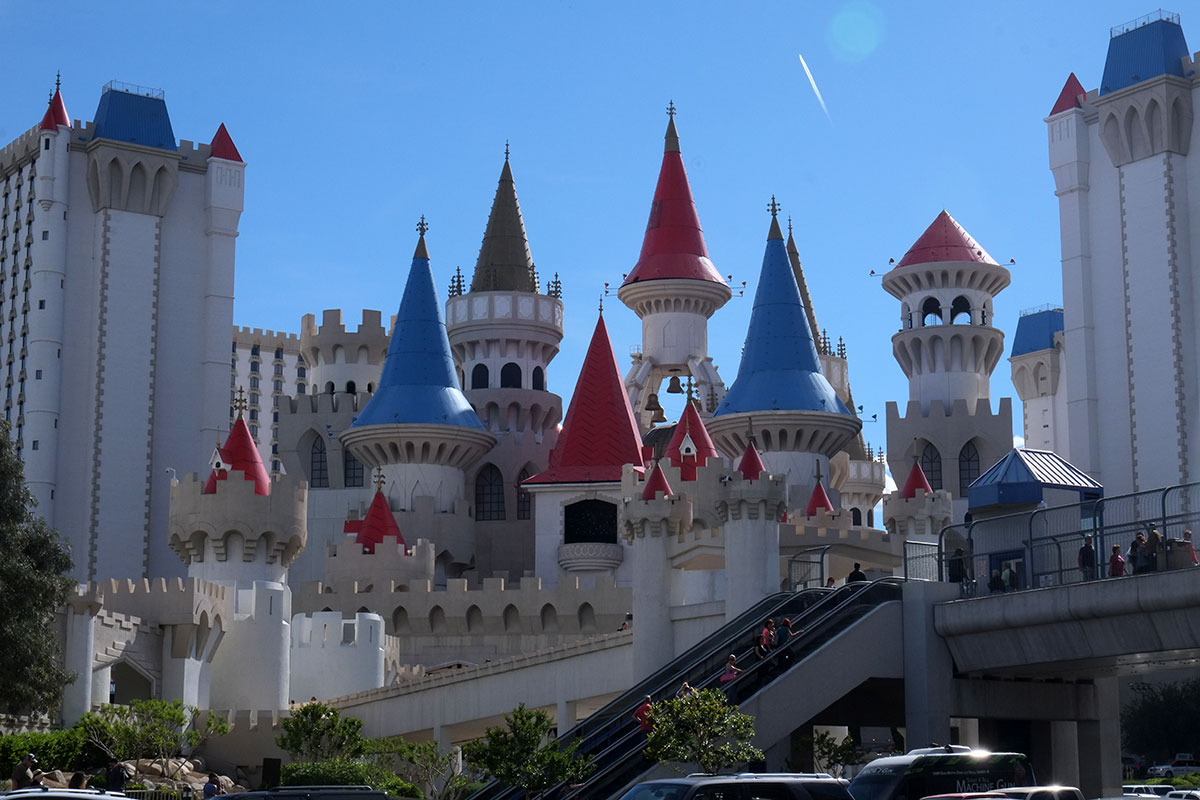
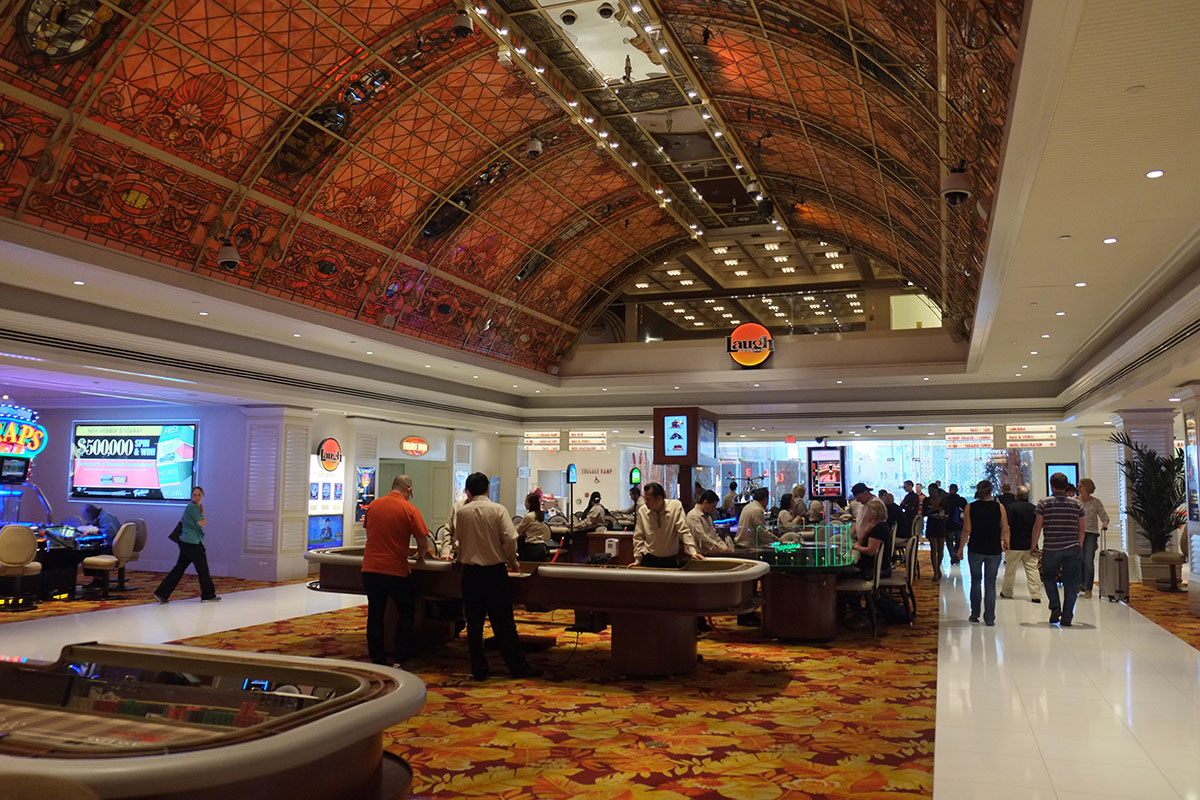
On the inside, equally cheesy, coarse, inept and depressing.  What Venturi and Scott Brown referred to as the Big Low Space.  A cheap neutral shell smeared with a pastiche of banal allusions and signs, with the sole purpose of separating you from your money.  The clear Modernist design of the older casinos was banished – if you knew where you were, you might leave and stop losing money, so the newer casinos became labyrinths of alcoholic confusion.  DSCF7260This is the Vegas I had imagined from countless TV shows and reading Fear and Loathing – a place where all the worst aspects of American mass culture are on exhibit – avarice, commercialized lust, emptiness, loneliness, superficiality.  It had lost the cool of the classic Rat Pack era – the allure of sin was no longer elegant, it was just cheap and obvious.
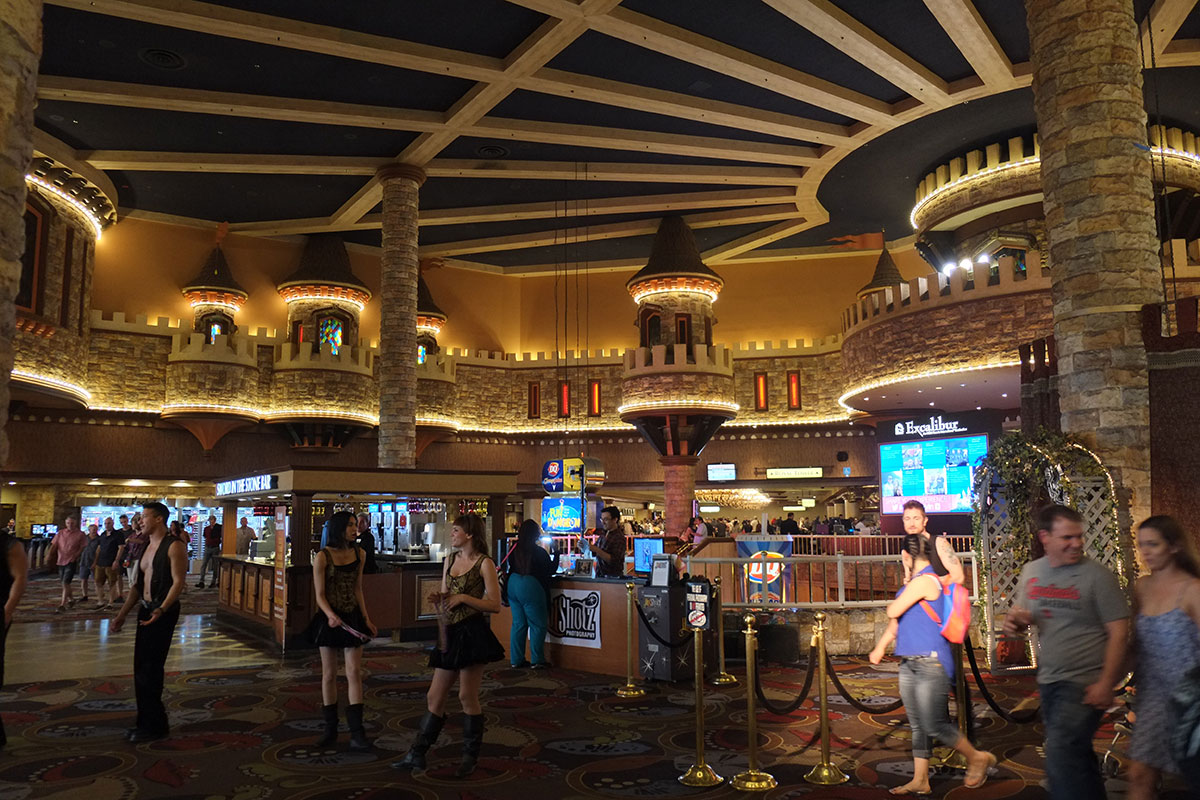
I had also heard rumors of the transformation of Vegas in the 90s – how it had become an upscaled family vacation destination, how the gambling was something you did after a day shopping, or at the pool with the kids.  We arrived at Caesar’s Palace, a legendary resort which had apparently made this transformation.  I expected to find it all howlingly kitschy, and one can indeed sneer at the craziness of hotel slabs cloaked in classical drag.84. Las Vegas100DSCF7065
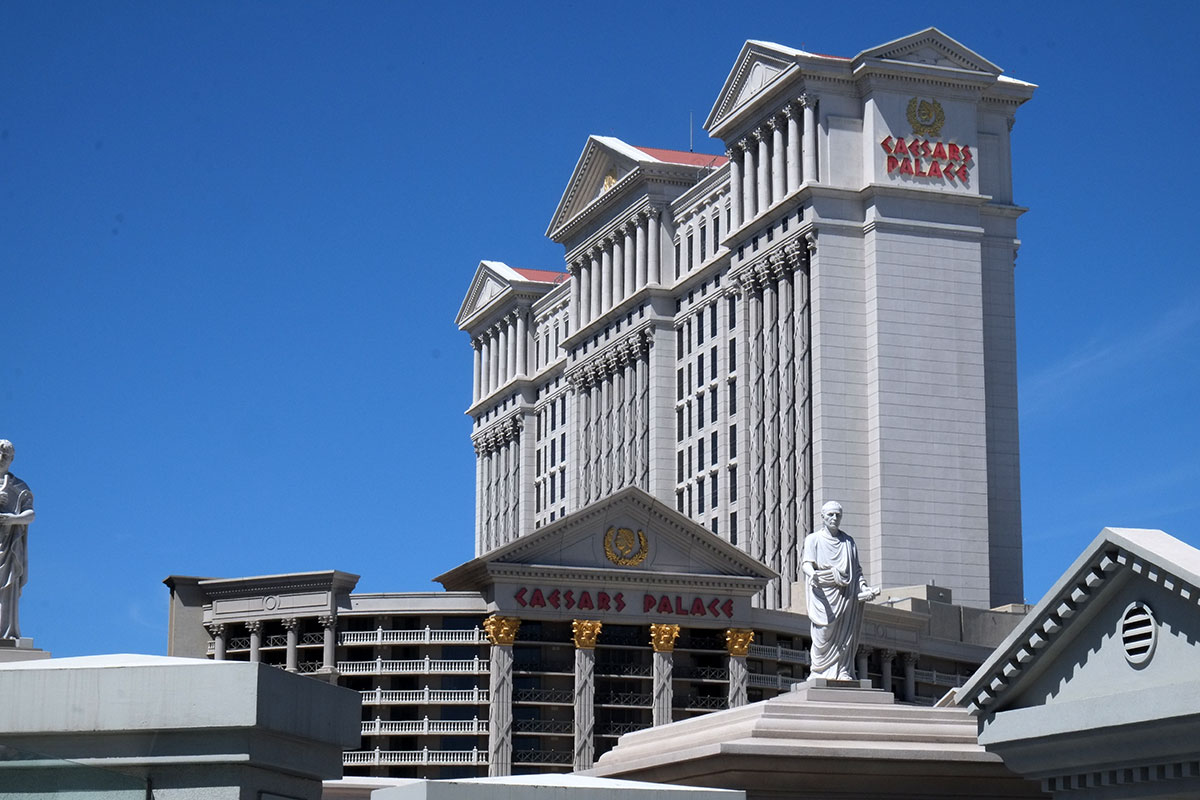
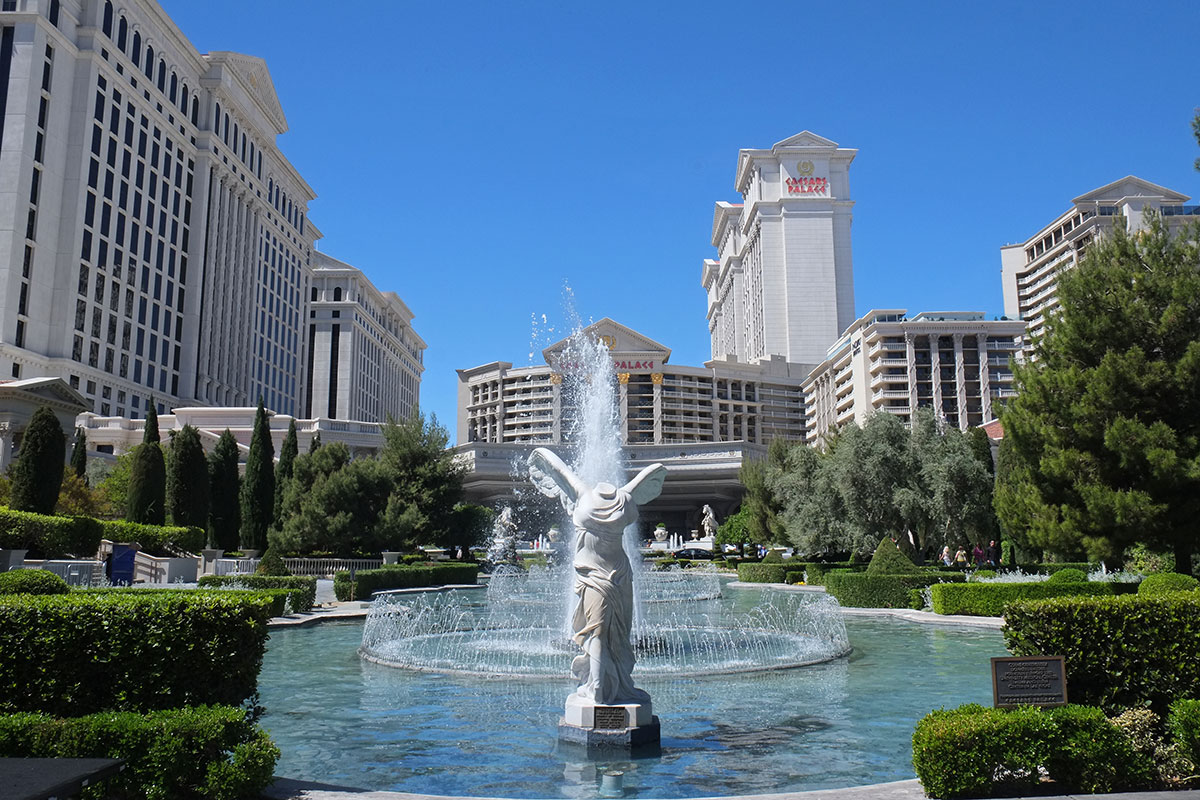
But I had to admit, it was masterfully done.  These weren’t just blank boxes covered with ugly motifs, someone had actually drawn these facades and thought about proportion, hierarchy, detailing, and rhythm.  On a warm March afternoon, the gardens were lovely.  The vistas were extraordinary – seeing the copy of the Nike of Samothrace here is not quite the same as seeing it at the top of the stairs in the Louvre, but is its appropriation really that different from seeing it on axis at Wright’s Darwin D. Martin house?  The designers may have been landscape architects, but even more importantly, they’d learned from movie set design.  I felt that we were in Ben Hur, or a Star Wars prequel, or Game of Thrones.  Obviously few of the visitors have been to the ruins of ancient civilizations;  our “knowledge” of these eras is completely mediated by Hollywood, and the designers here were having a good time recreating this image in real, three-dimensional space.  I began to wonder how much of it was naive, and how much archly self-conscious.  84. Las Vegas103DSCF7075
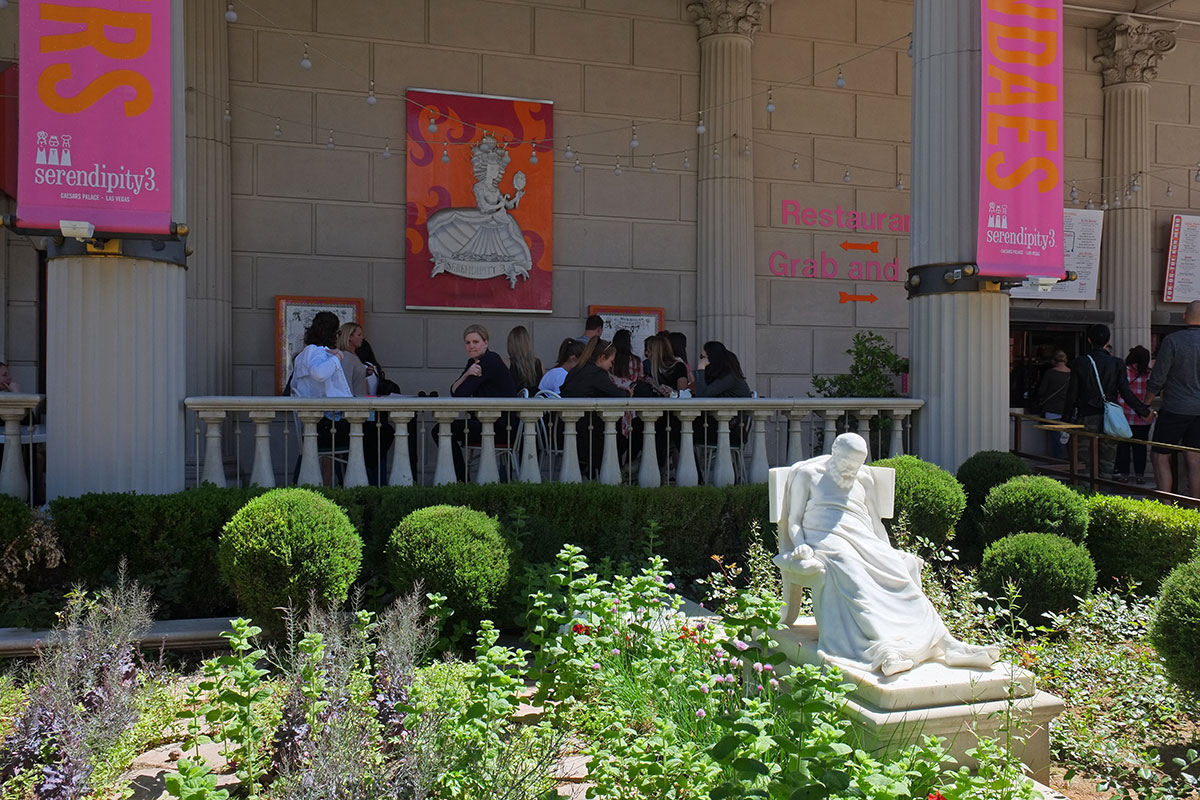
I got my answer around the corner.  Near a busy plaza, where tourists were lining up for Grab-and-Go lunches, there was this quiet, off-axis statue.  The subject matter is immediately obvious, if you happen to be paying attention to anything besides getting your next drink.  It is the Death of Socrates (a copy of the work by Mark Antolkolski).  I can just imagine the pleasure the designer must have derived from this subtle commentary on the culture swirling around it.  84. Las Vegas101DSCF7071
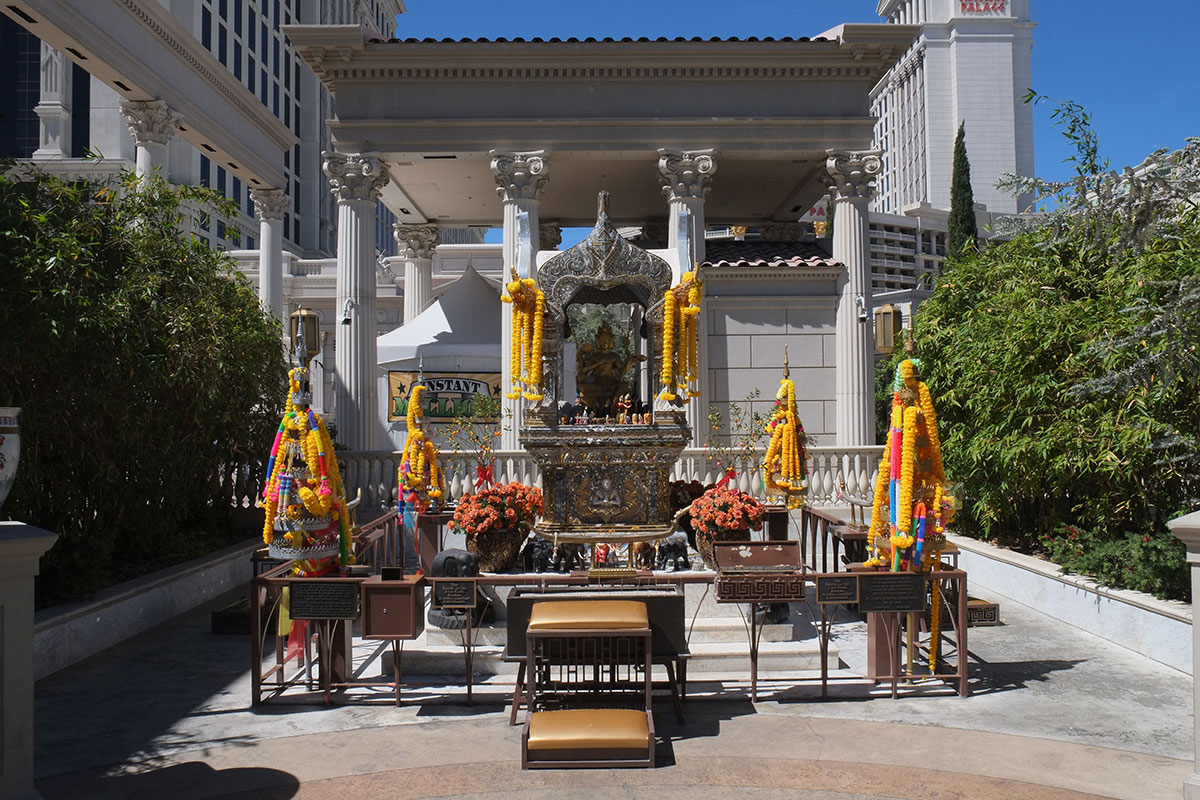
Nearby was a puzzling installation – a Buddhist shrine set in a Roman temple.  I can only imagine that this is an accommodation of our global tourist culture.  There are probably enough wealthy Japanese tourists coming here who might be confused or disoriented by the profusion of classical Western iconography, and who might be glad to see that people from their own culture are equally welcome to lose money in this unfamiliar venue.  84. Las Vegas102DSCF7073
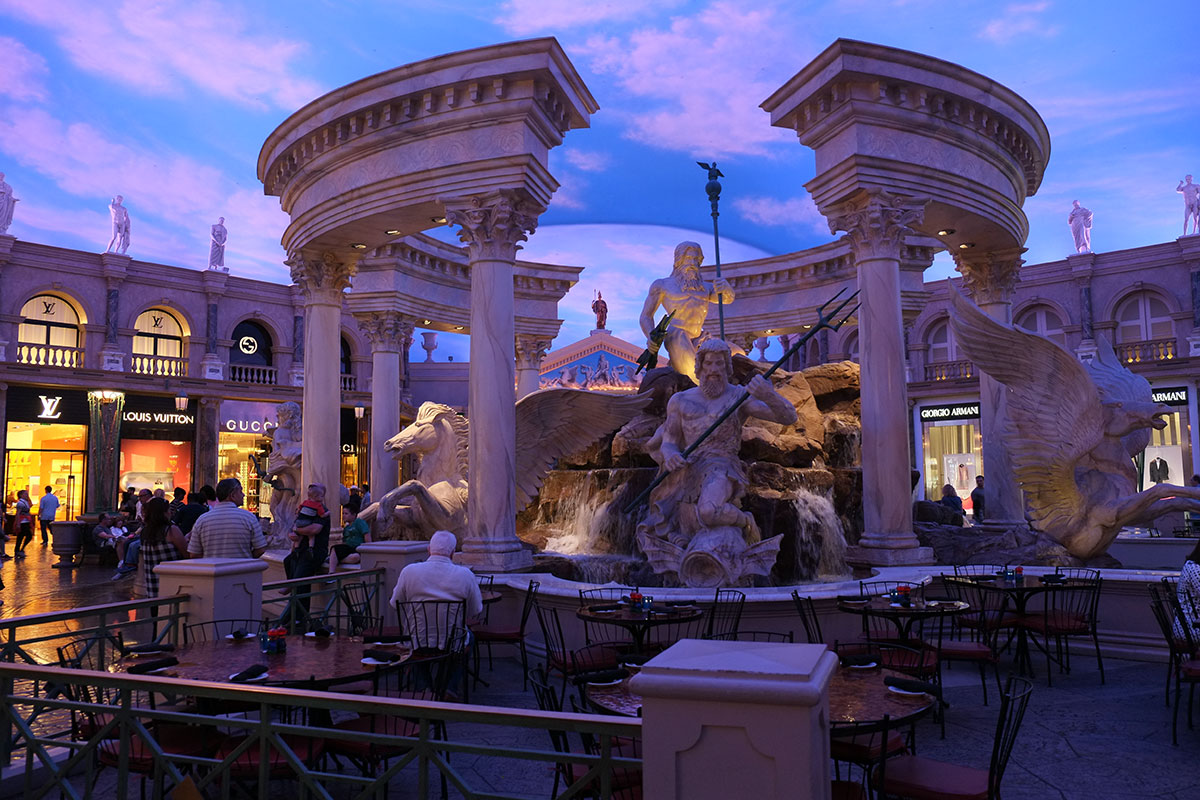
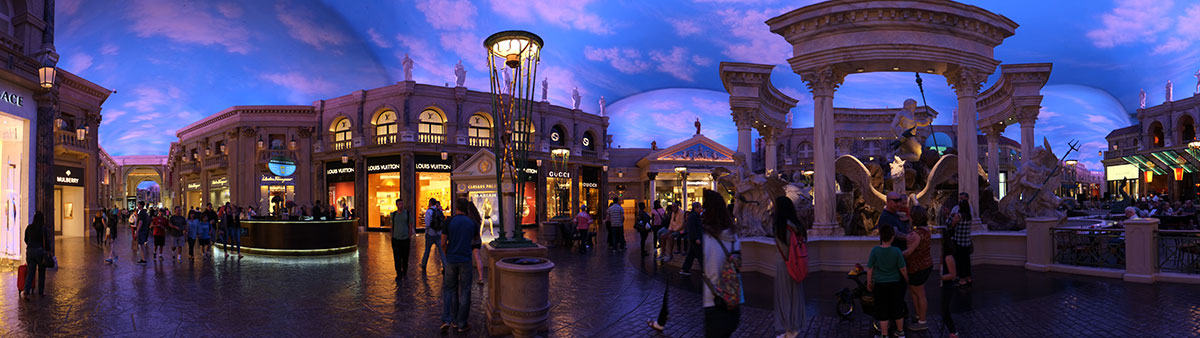
We moved inside to the shopping concourse, and I was flabbergasted.  It was absurd, it was ridiculous, it was bizarrely over-the-top, and I just loved it.  Any architect who came of age in the Postmodern 80s (and especially one who had studied under Bob Stern), had to feel right at home and simultaneously be amazed by the incredible audacity of this, an appropriation of the language of the Roman Empire to serve the mercantile needs of the globalized web of corporate tourism and commerce.  It captures the atmosphere of Fear and Loathing in Las Vegas without needing the LSD.84. Las Vegas107DSCF7086There continues to this day a dead-end branch of 1980s Postmodern Classicism, one that I thought mainly lived on in Eugene, but which I found alive and unwell in other architectural backwaters, such as in the deep South. It is usually a sad, ill-proportioned collection of disconnected references covering a mediocre building, the last refuge of the scoundrel architect.  it exists at the level of sign, doing nothing to enhance one’s actual experience.  (Bad architects can learn from Venturi too.)  So to come to Las Vegas, and see it all handled magnificently was a complete shock.  The scale of Roman streets and piazzi brought indoors to create scenography for the shopping mall.  Astoundingly accurate elements and details rendered in God-knows-what materials.  An evocation of the desert twilight in the superbly lit and painted trompe-l’oeil ceiling.  If you want to build simulacra of classical Rome, this is the way to do it.
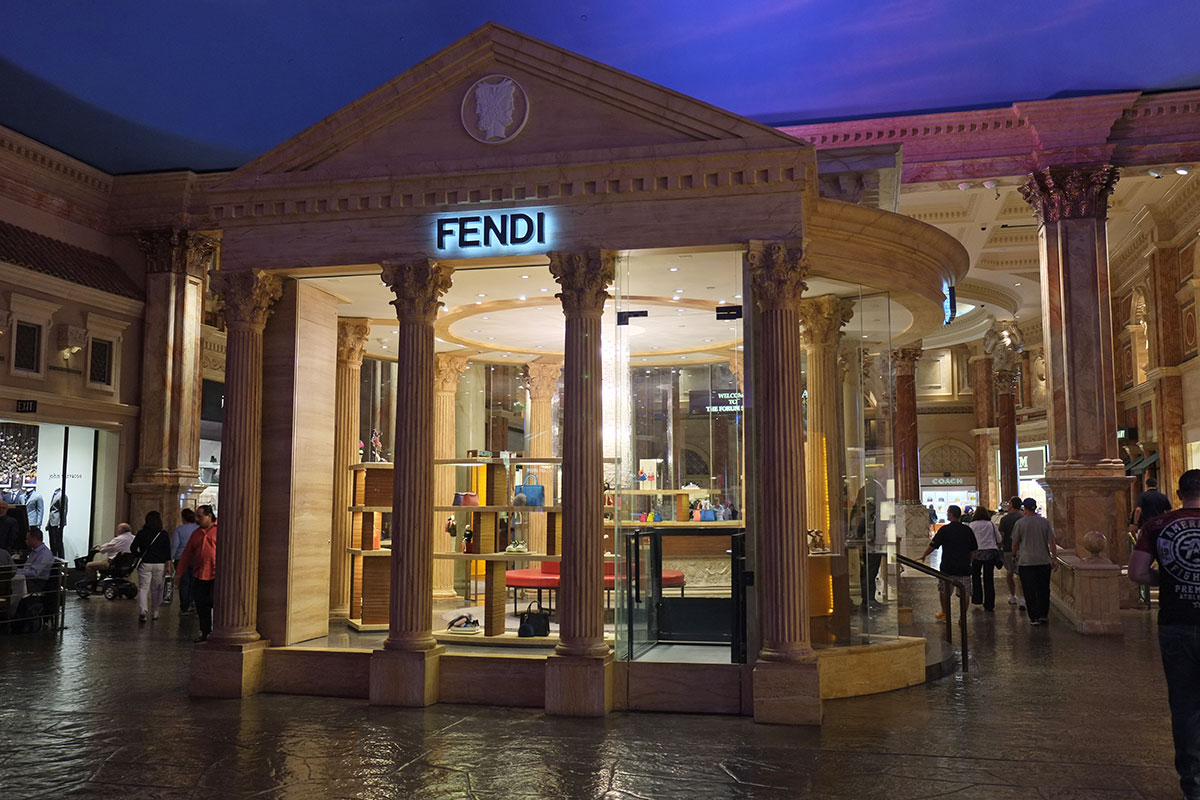
And as with Socrates outdoors, the irony continued.  Certainly a PhD dissertation would be required to suss out all the layers of meaning in a Temple of Fendi, the God of Haute Couture.  DSCF7095
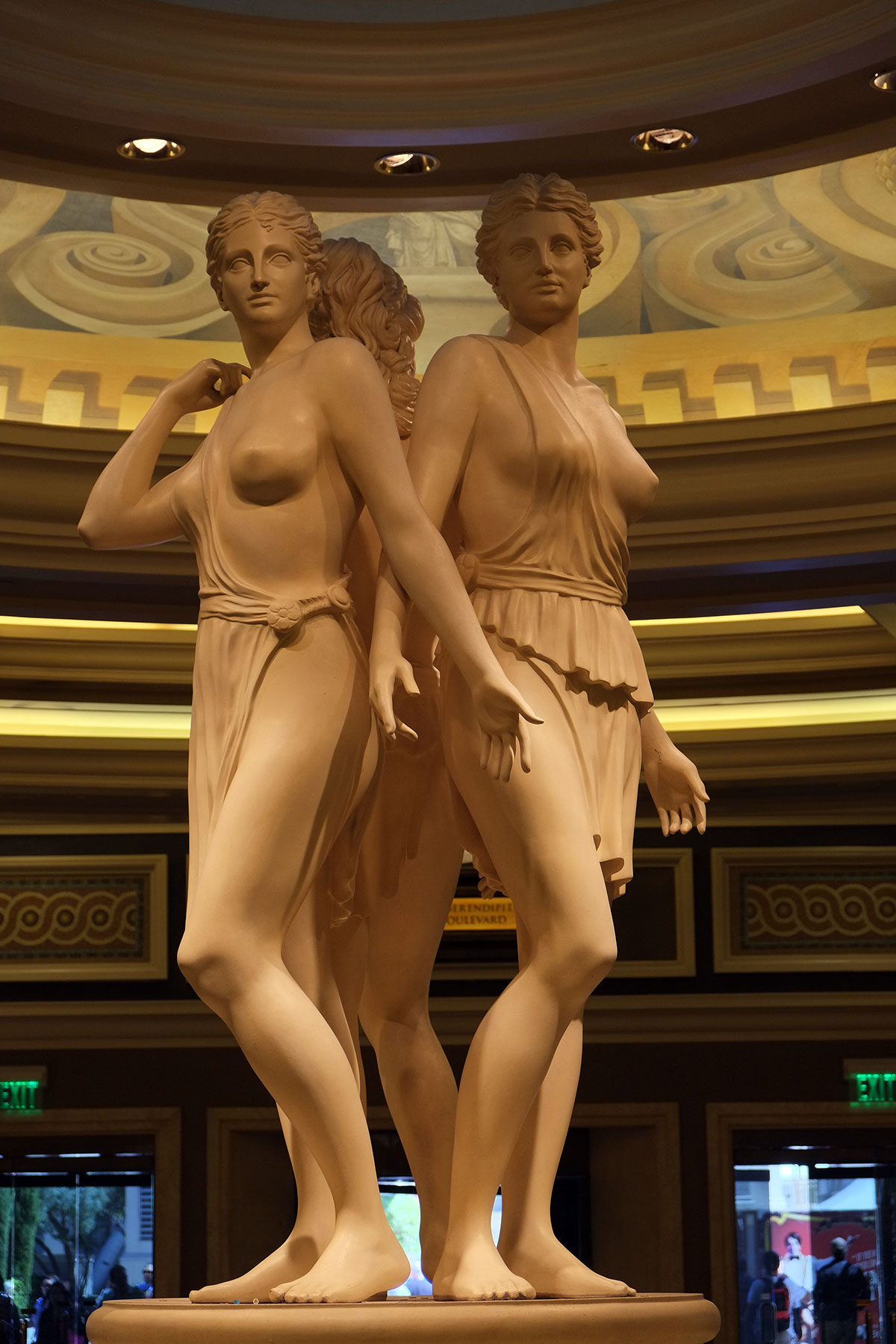
In the hotel lobby, the collision of classical and contemporary culture continued.  Classicial busts grafted onto bodies with Playboy busts.  84. Las Vegas109DSCF7100
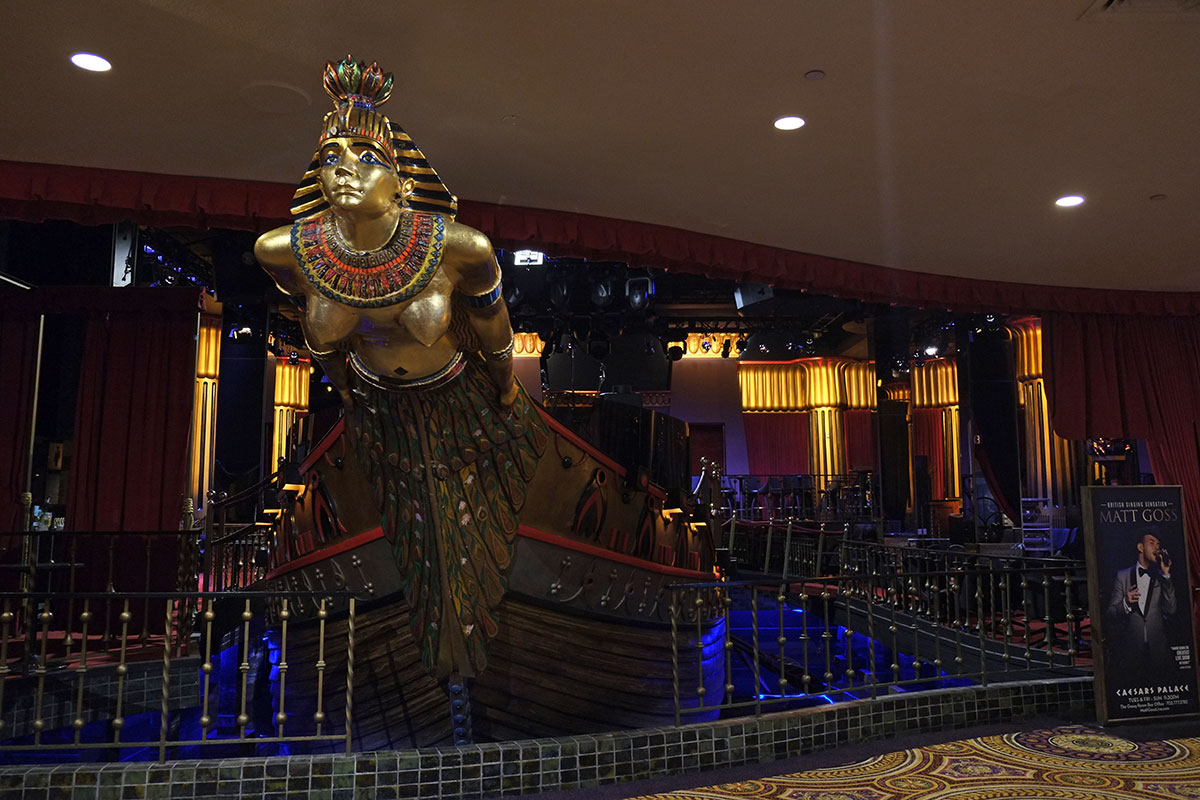
Tutankhamen as a galley’s figurehead, heralding a cocktail bar.  Look upon my drinks, ye Mighty, and despair!  84. Las Vegas104DSCF7081
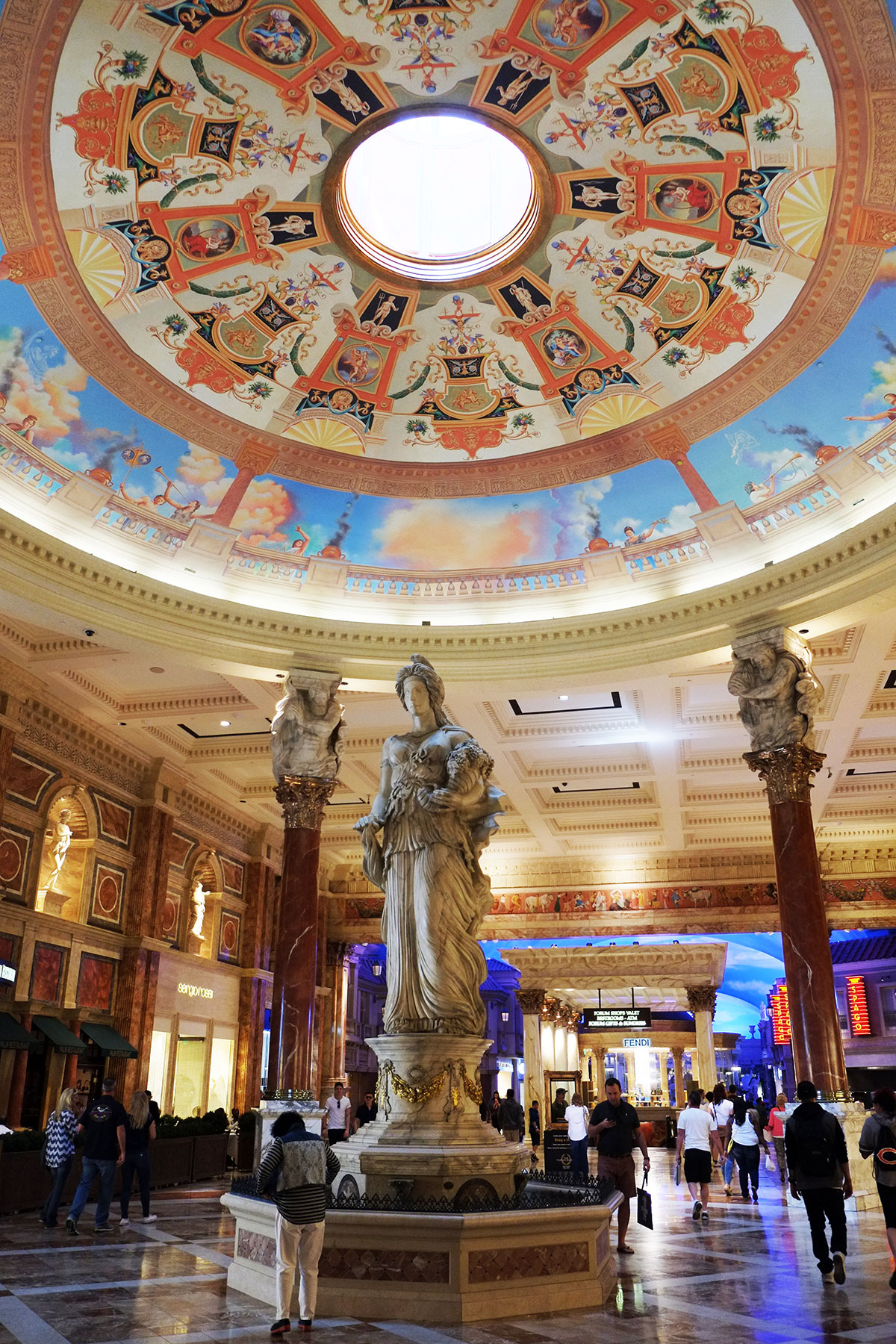
The spatial sequence was exquisitely tuned – there were shopping corridors scaled as streets, punctuated with domed piazzi.  Ceilings where Tiepolan perspective meets Pompeian painting motifs in a Pantheonic dome (that doesn’t leak), surrounded by a Corinthian colonnade with Roman fountain-derived caryatids inserted above the capitals, all bathed in an ethereal light.84. Las Vegas105DSCF7083
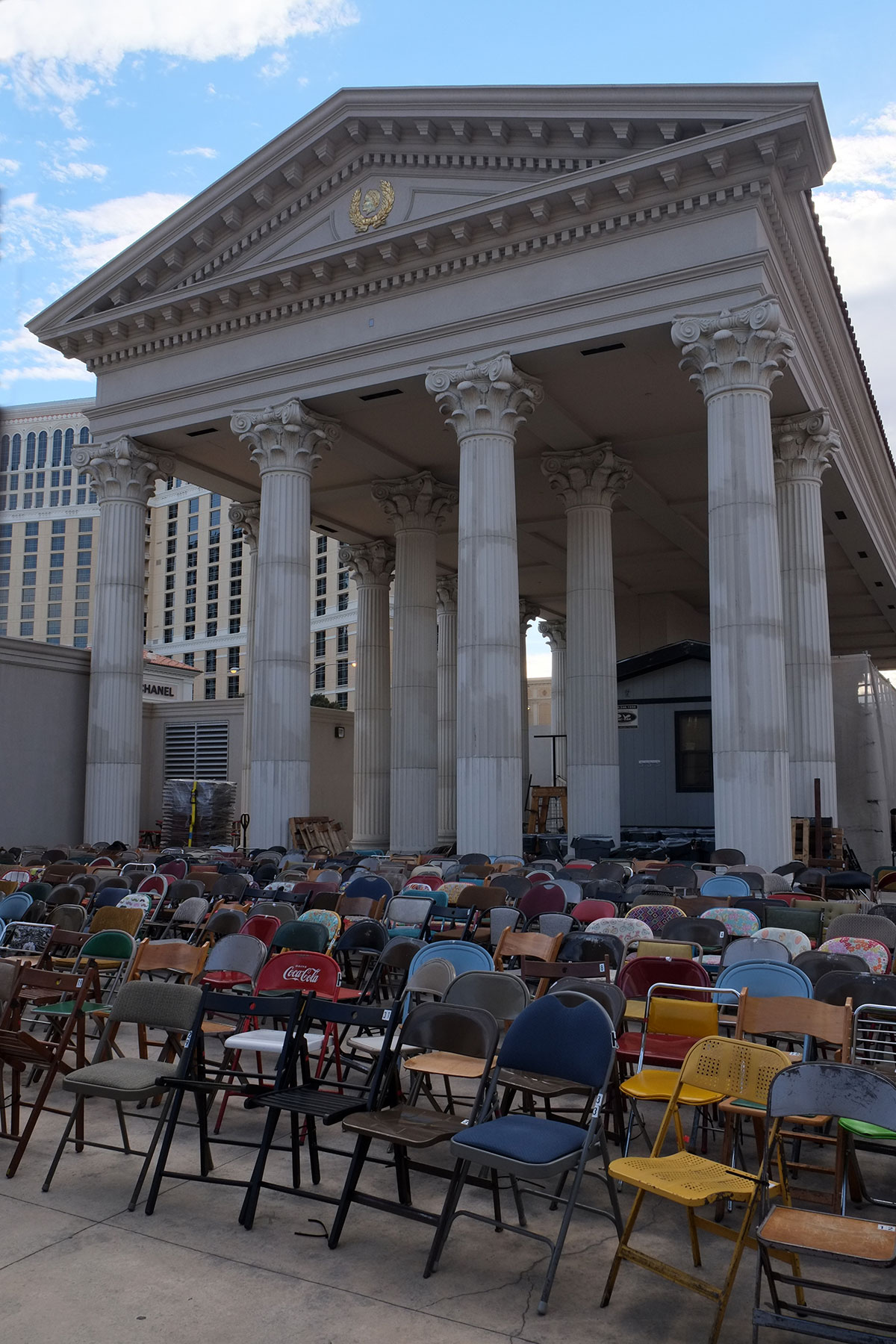
I could have stayed for days, wandering this Postmodernist Xanadu, but the ticking clock of Greta’s attention span drew me back outdoors, away from the timeless world of the Caesars.  As we moved through the transitions in place and time, we came across one final tableau that epitomized our return to the mundane world.DSCF7341
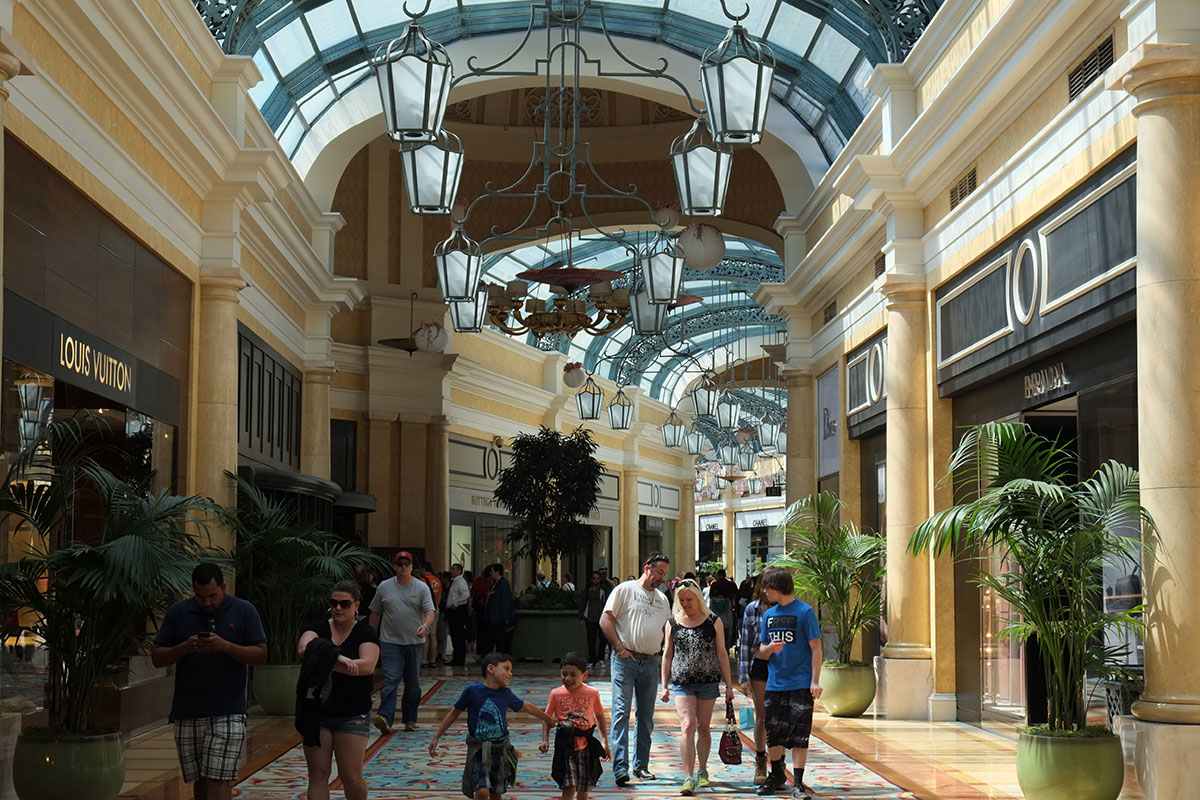
But not for long:  we were immediately drawn into the Renaissance (and 19th-century descendant) fantasia of the Bellagio.  The Galleria of Milan, complete with American tourists.  84. Las Vegas111DSCF7108
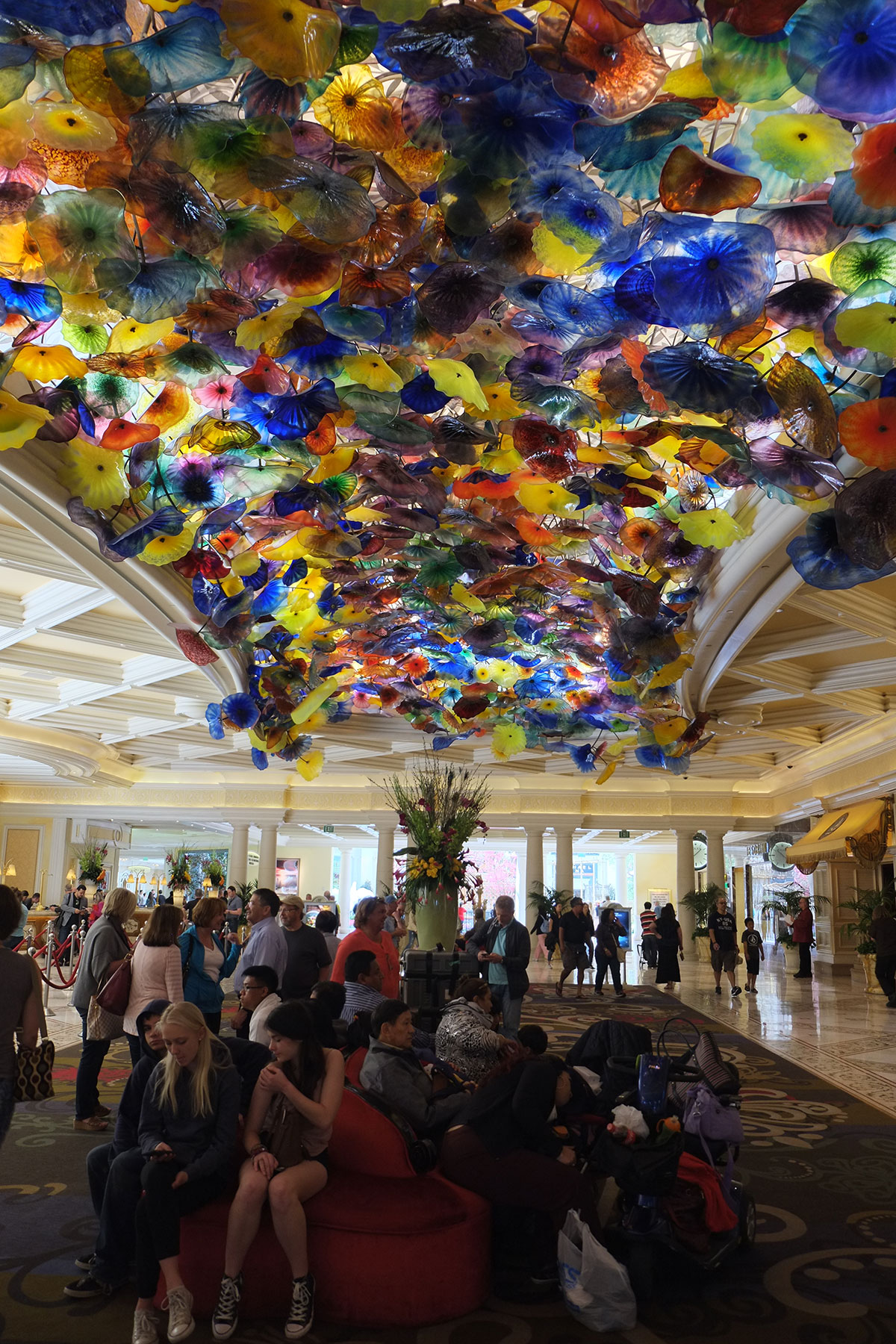
A hotel lobby with a massive installations of Chihulys, which seem to have achieved their apotheosis in this grandiose Baroque installation.  84. Las Vegas112DSCF7112
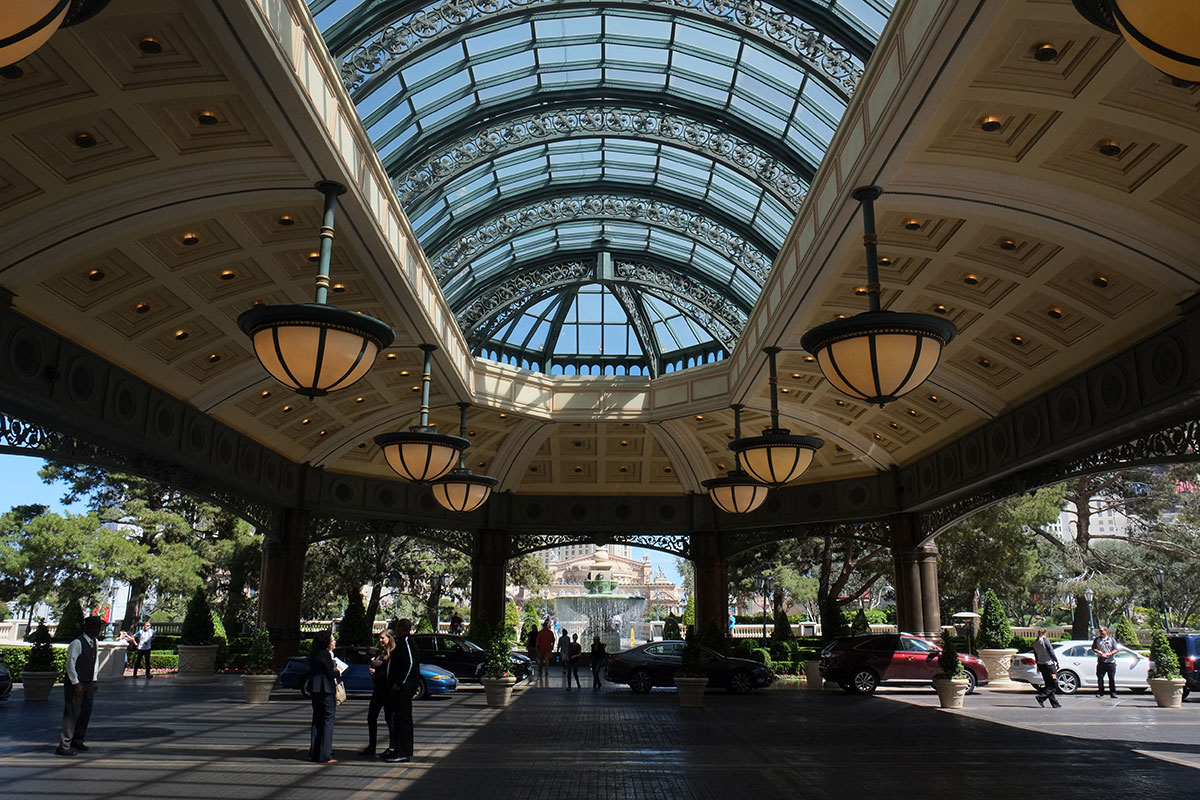
A porte-cochere worthy of the greatest Hummer limo that Vegas has to offer.  84. Las Vegas114DSCF7129
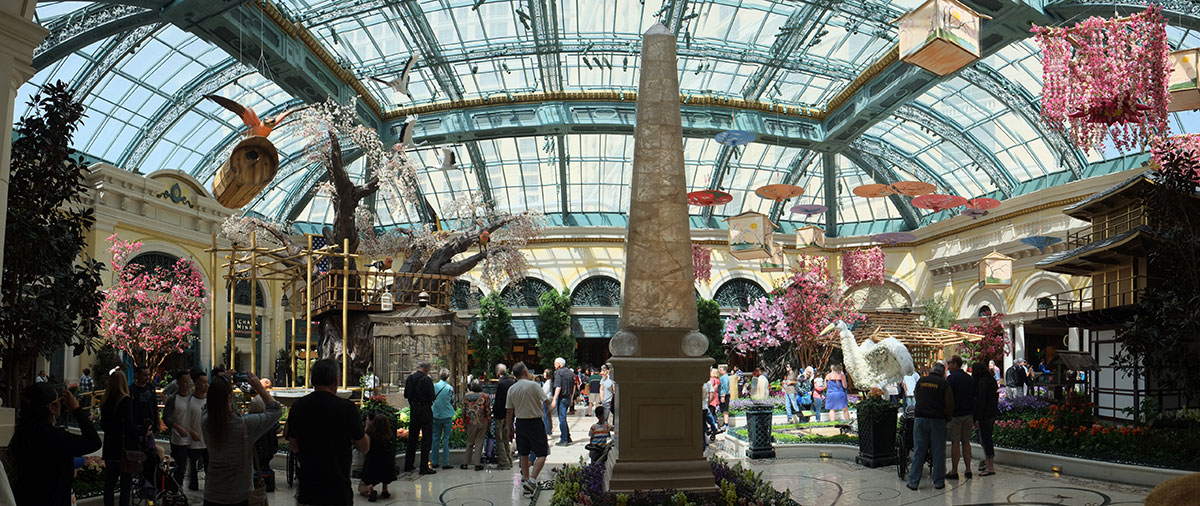
A magnificent palm court, that appears to be furnished in giant Japanese plastic toys designed by Jeff Koons.  84. Las Vegas113DSCF7121
By this point we were reeling from the juxtapositions of imagery and eras, as swoopy Hadidian forms competed with Venetian arches.  84. Las Vegas110DSCF7102
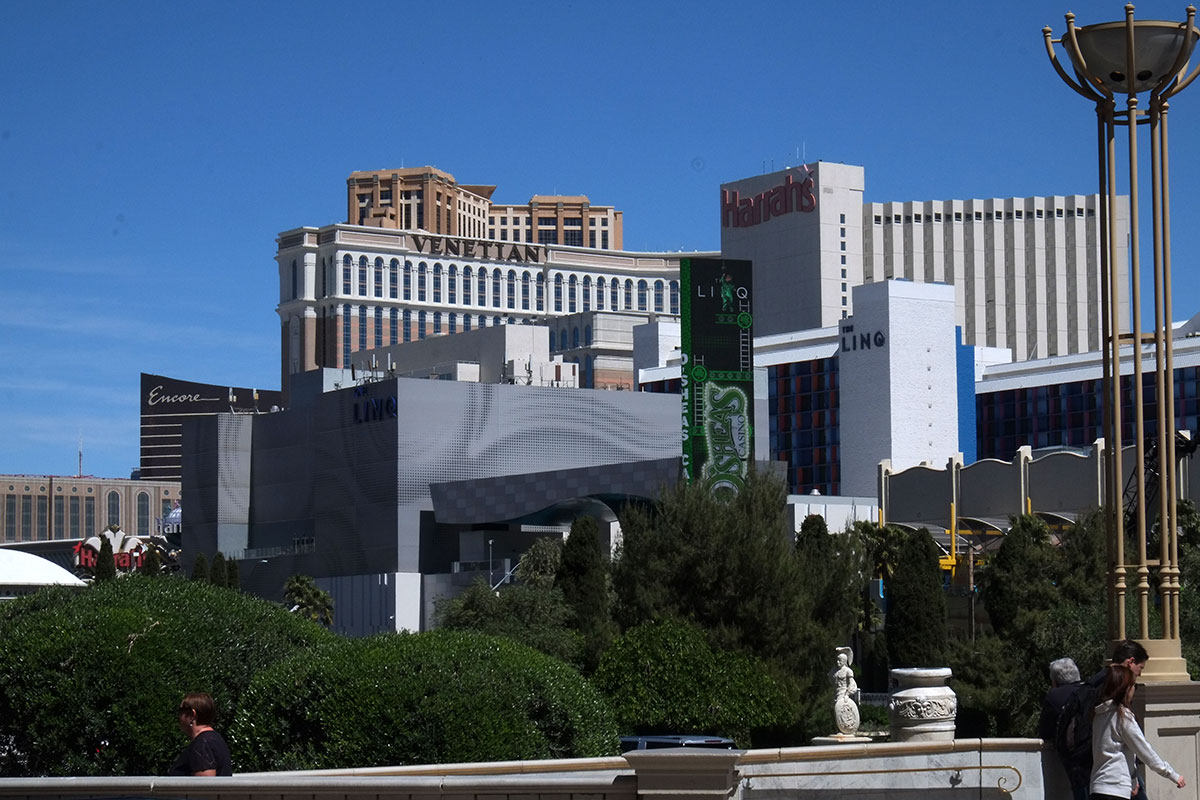
84. Las Vegas130DSCF7338

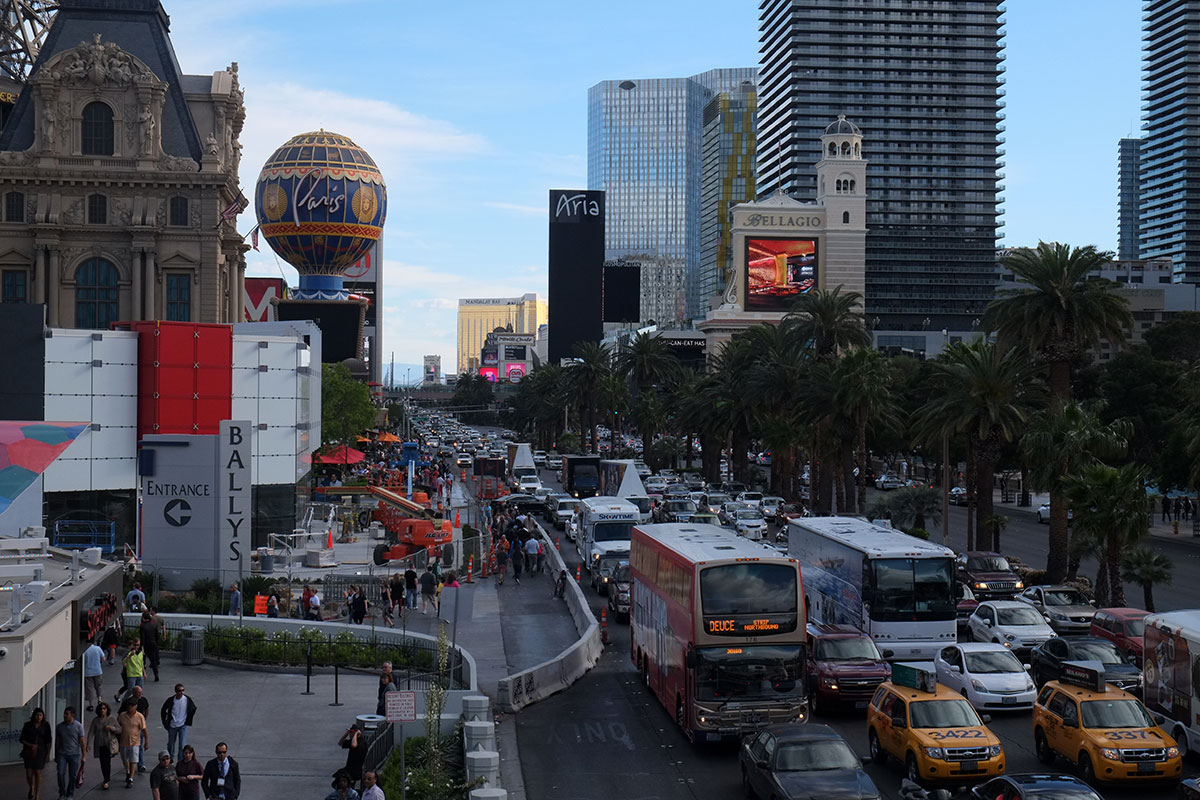
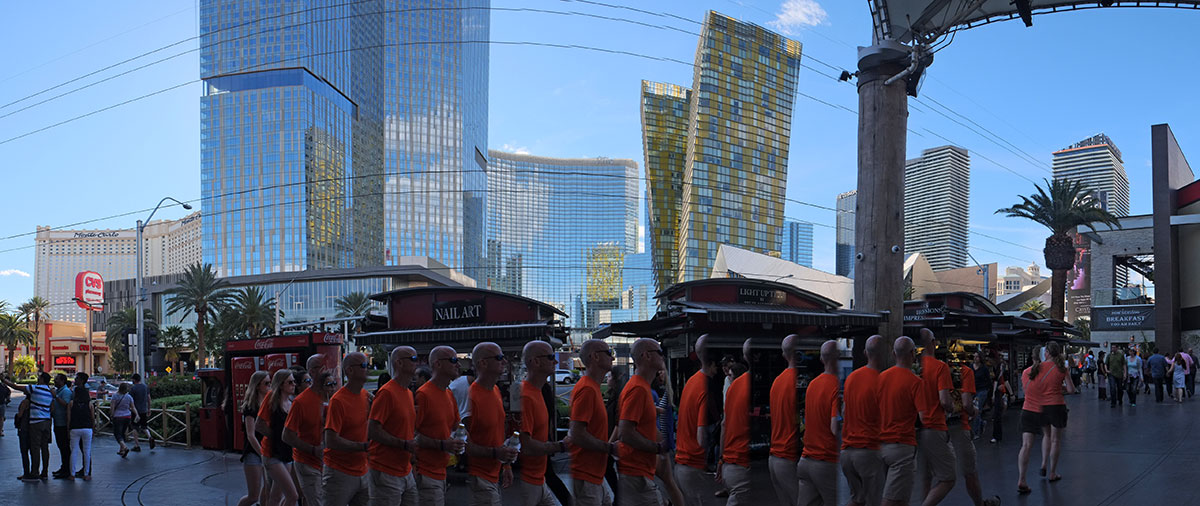
The strip itself was more lively than I expected, with hordes of tourists walking from attraction  to attraction.  I had thought that the hermetically-sealed atmosphere of the casino and mall – where the whole point is to keep the visitor disoriented in time and space – would be more dominant.  But Vegas is not Disneyworld, a total environment controlled by one corporate entity.  When you are within a casino complex, the experience is controlled to the nth degree, with every vista, movement and pause choreographed.  But when you leave that world, you are out on a messy, noisy, exuberant street, where the “high” culture (or at least the expensive culture), meets the low culture.  84. Las Vegas124DSCF7276
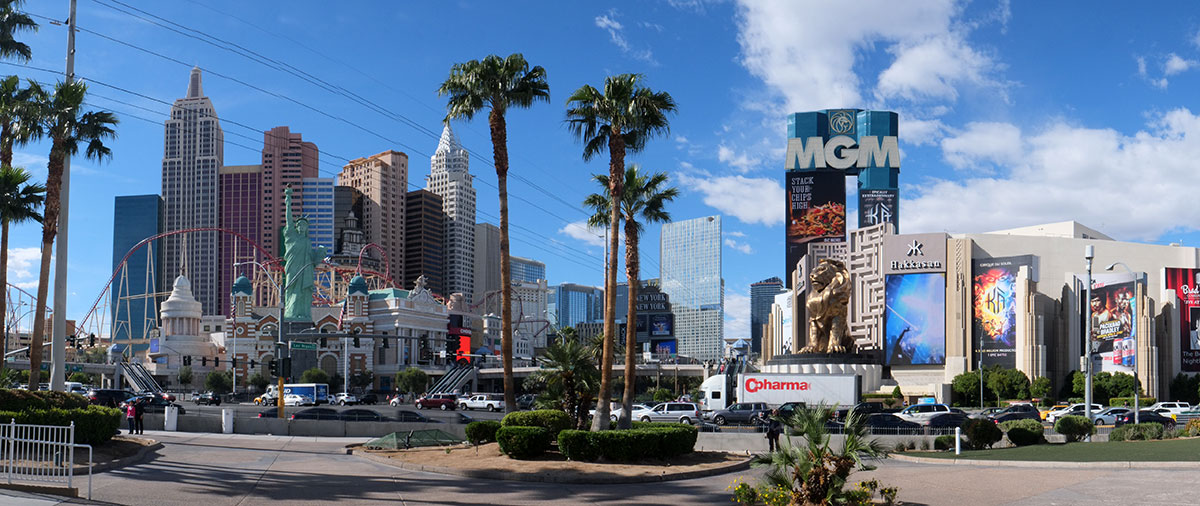
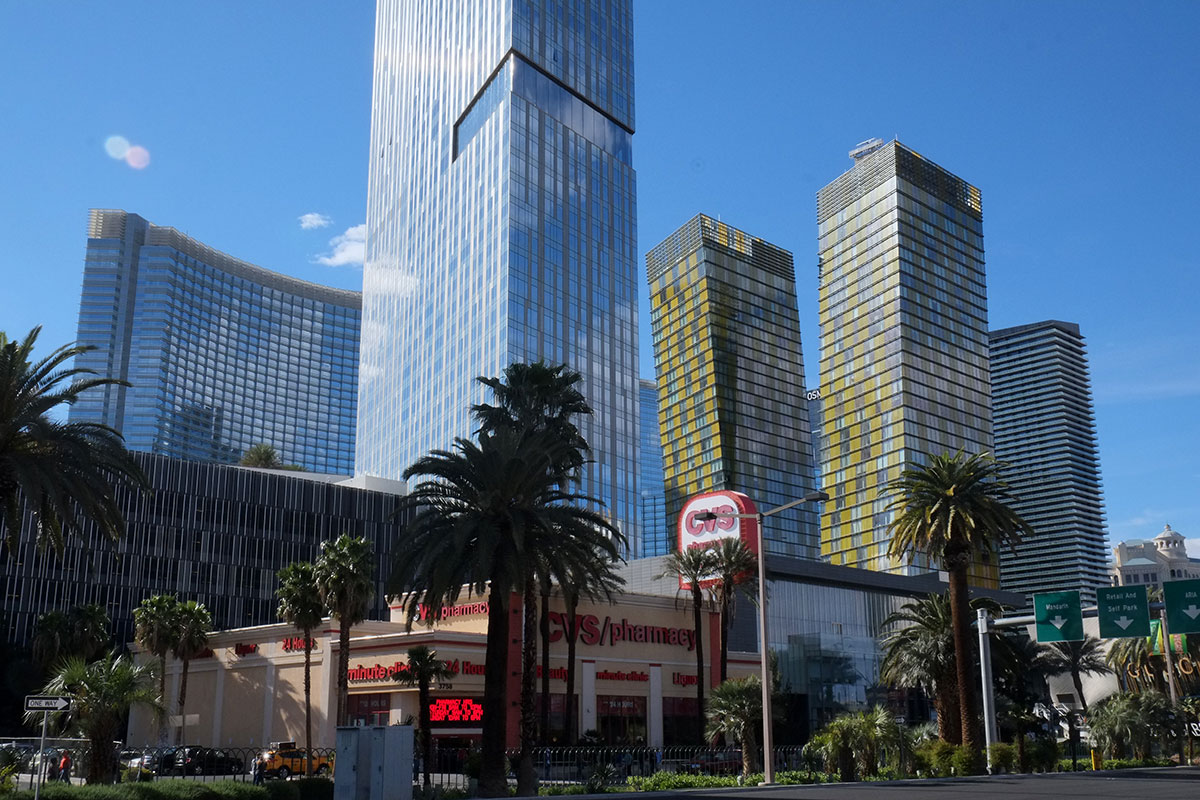
There is the noted crazy variety in architectural and cultural reference, but there is also the juxtaposition of the fantastical with the everyday architecture of American life.  In this way, it is actually like a city – where within the boundaries of property lines each owner decides what to build;  there is no architectural review board in Las Vegas which demands that your new casino must respond to the style of the Tropicana next door.  You may build the tasteful $1.1 billion City Center project, but someone will stick a standard sprawl-city CVS on the corner if you haven’t acquired that property.  84. Las Vegas125DSCF7290
I began to enjoy the madness of it all.  84. Las Vegas128DSCF7323
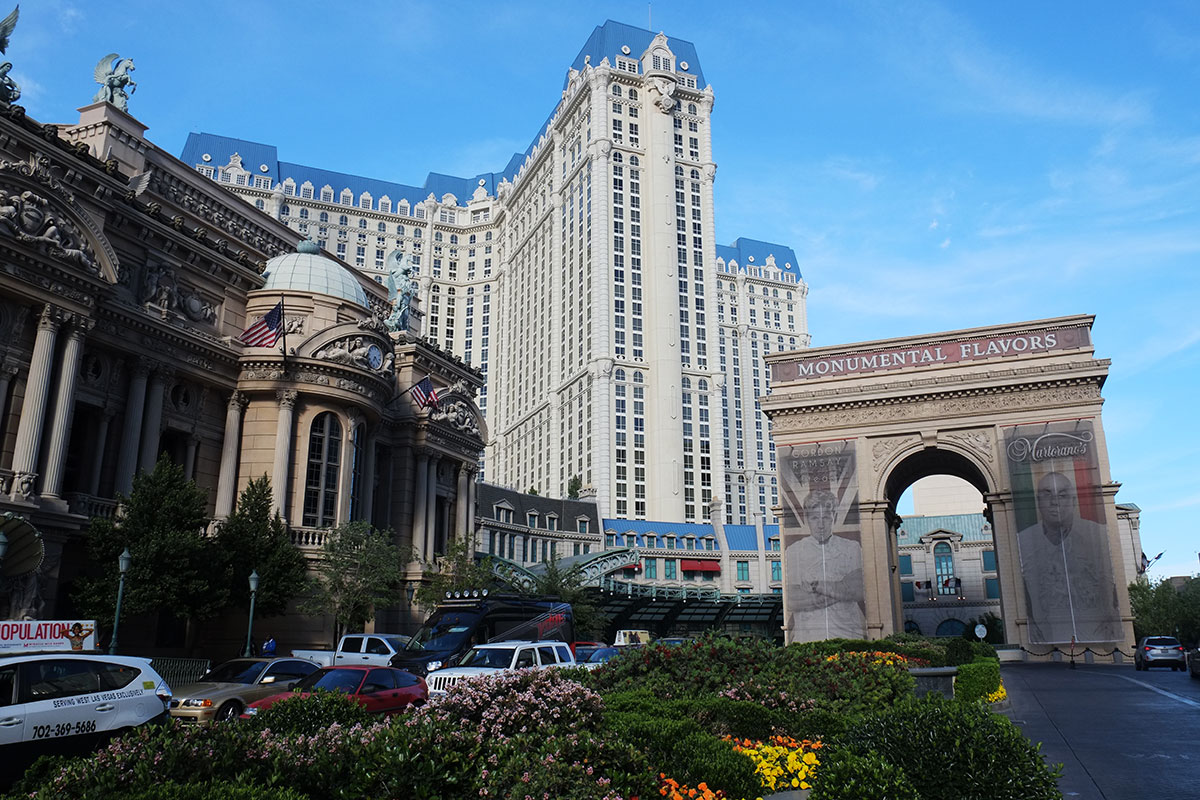
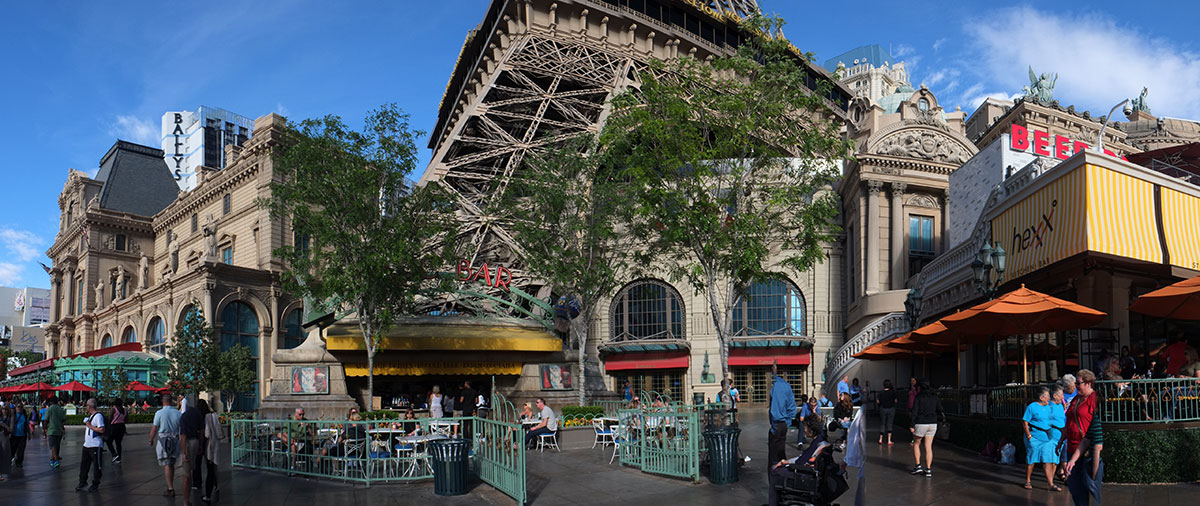
where no arresting idea, such as having the Eiffel Tower crash into an amalgam of Second Empire buildings, is ruled out.  84. Las Vegas129DSCF7325
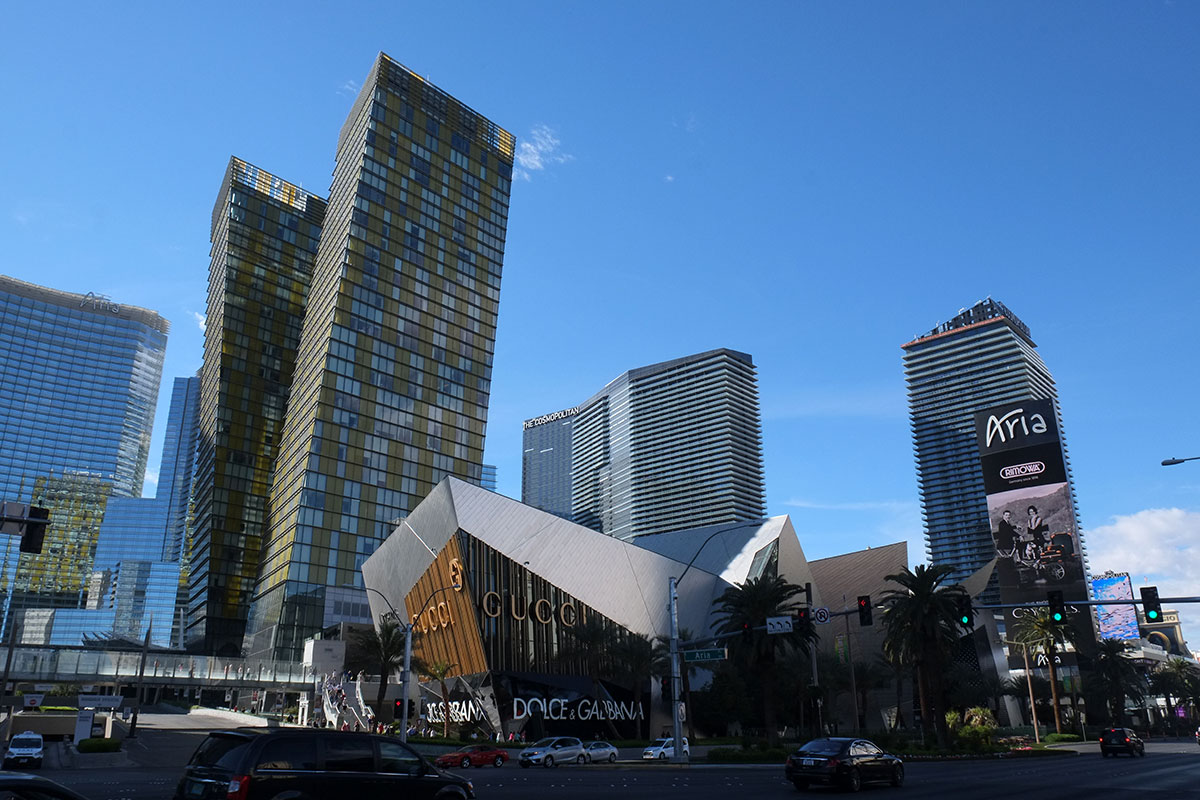
The newest, and most different, addition to the Strip is the aforementioned City Center project, a 76-acre, 17 million sf, $1.1 billion, integrated mixed-use development, with hotels, casino, condos, retail and entertainment.  Over the years I had heard about this project from the father of one of our recent grad students, who was the construction manager for the whole project.  The scale of the undertaking was unbelievable – he had 250 people working for him in CM, coordinating with about 50 different design firms, and building at the rate of $30 million of construction per month.

It follows the model that everything within the property line is under the control of one entity, but rather than turning it all over to one of the firms that specializes in Vegas-scale development (firms of which you’ve never heard), a master plan was designed by Ehrenkrantz Eckstut Kuhn, and noted architects were hired to design each of the component buildings.  These architects – including Gensler, Foster, Jahn, KPF, Pelli, Rockwell, Viñoly and Liebeskind – did something unique in Las Vegas – they designed buildings that look like buildings.
DSCF7296

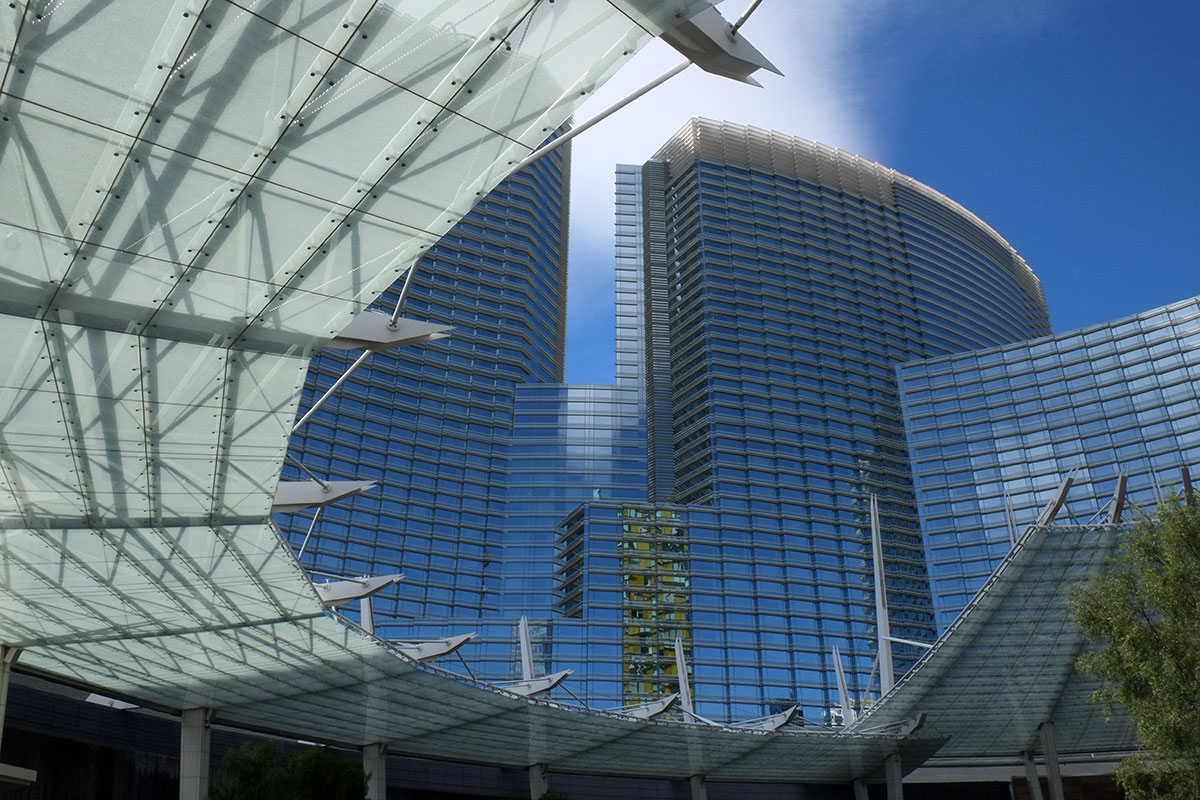
All prior buildings in Vegas really exist at two levels – there is the functional building, which is then overlaid with the exterior and interior design trappings that connote a historical epoch or style.  They are essentially “romantic” buildings, depending upon association to derive their meaning.  The City Center buildings are more “classical” buildings, manipulating the primary elements of architecture – space, light, movement, mass, materials – so that your understanding comes from the direct experience of those elements, rather than filtering that experience through prior associations.  (Of course, this is what we think now;  in the future, will people understand these buildings through their association with yet another historical style label, such as Decon architecture?)

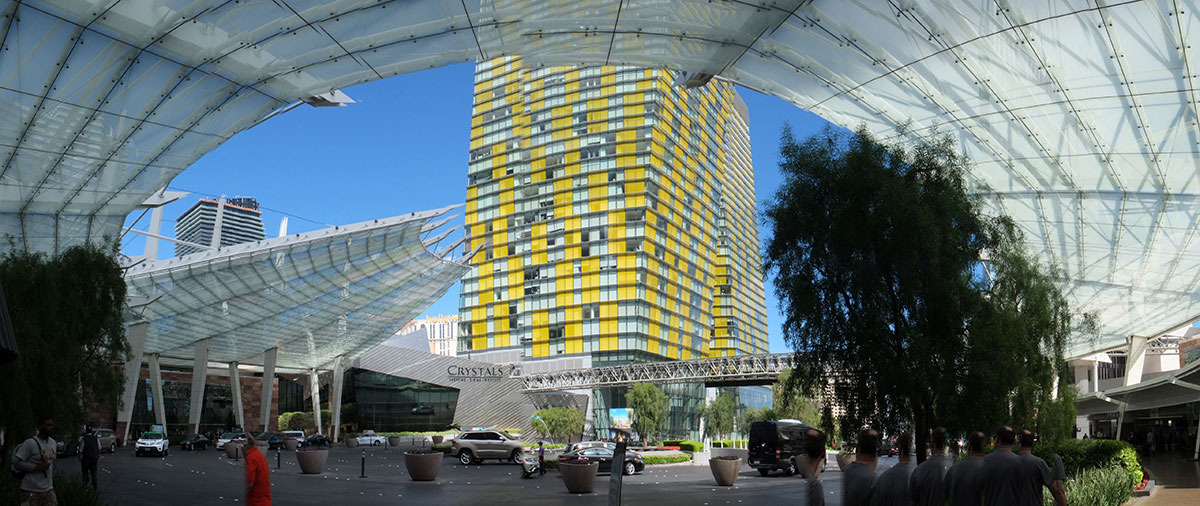
The big urbanistic difference with the project is how it extends the depth of exterior space back from the Strip.  With most casino complexes, there is a big porte-cochere and entry near the street, and the whole complex is essentially interior.  But because this is such a deep lot, this car-entry zone is pulled into the middle of the block, creating a huge circle that feels more like an airport drop-off, which serves several buildings.  It is a very grand space, beautifully detailed, and almost impossible to photograph.  DSCF7213
The sleekness, tectonic expressiveness and minimalist opulence of the pieces show the increasing sophistication of the Las Vegas market.  The well-done but still kitschy ambience of even the high-end, newer casinos of past decades appeals to the nouveau-riche, suburban middle classes:  they may not understand serious cosmopolitan design, but they do see a difference between the older, cheap and tacky complexes, and the more expensively-built, “nicer”, elegant, extravagant projects.  But if Las Vegas is to attract a clientele from the higher echelons of the globalized economy – say minor Russian oligarchs, Saudi princes or Chinese entrepreneurs – the architecture here must begin to exhibit the same degree of sophistication, and be designed by the same name architects, as they have seen in real cities, such as New York, London and Hong Kong.  City Center represents the first attempt in Las Vegas to attract this market, with architecture that can be appreciated in a non-condescending, unironic way, by people with sophisticated and very expensive tastes.  The emphasis in Las Vegas may be shifting away from the free drinks and buffet meals which supported the gambling middle class, to extremely high-end dining and (tax-free) shopping for the 1/10 of the 1%, who may begin to see Vegas real estate as a place to park some capital.
84. Las Vegas122DSCF7220

The interiors at City Center are striking, making much more use of daylighting and actual architectural elements than anywhere else in Vegas, 84. Las Vegas118DSCF7195
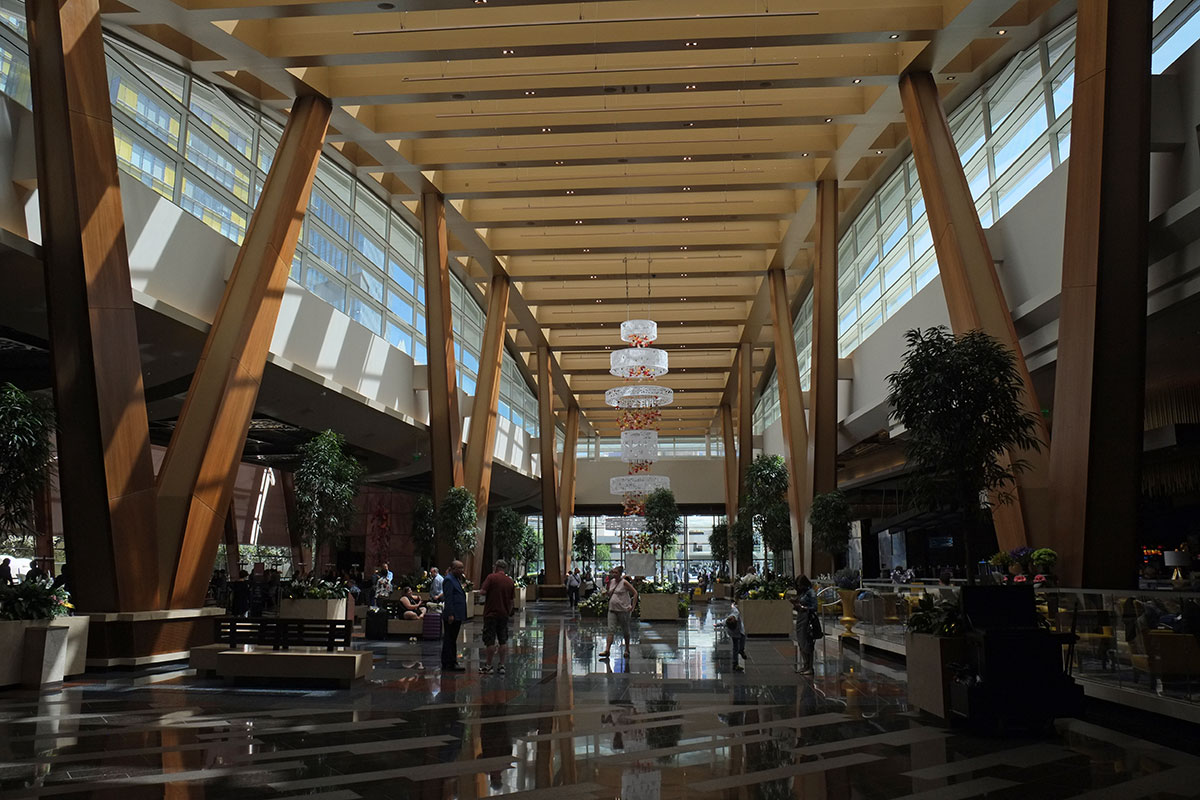
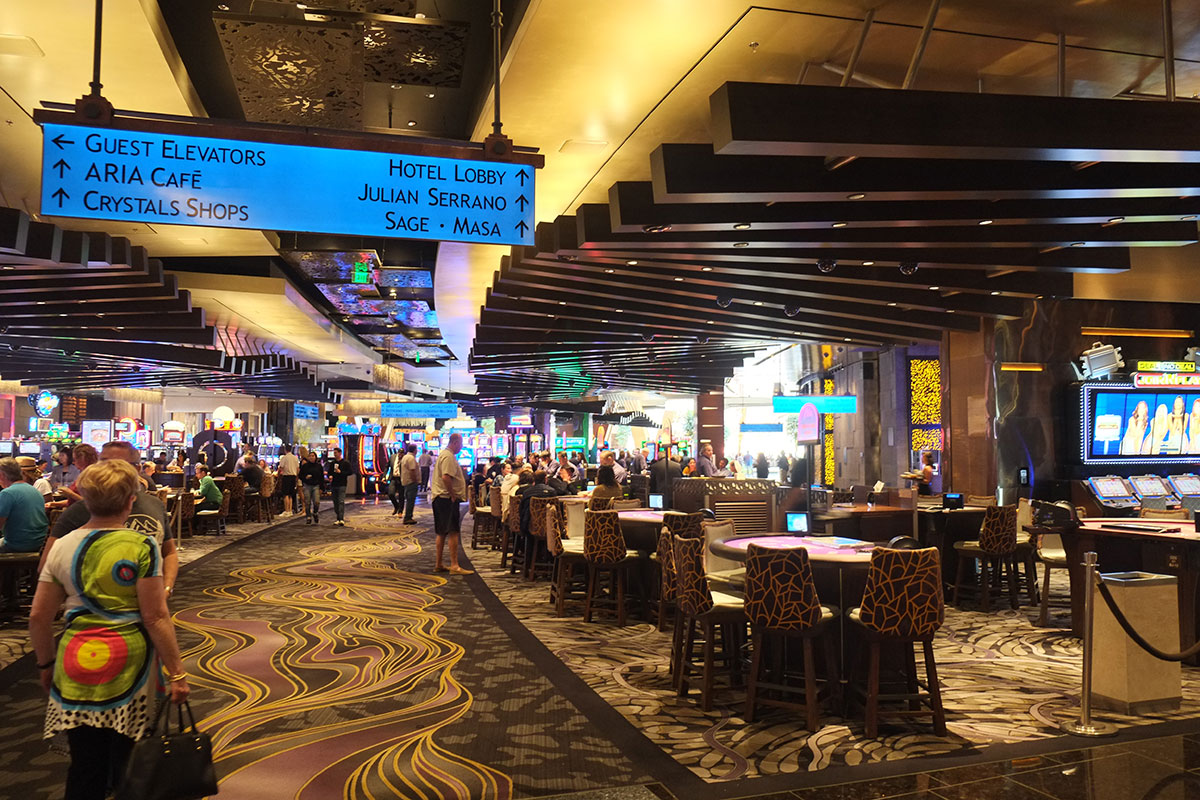
although the actual casino rooms are still variants on the Big Low Space.  Casino designers know what aspects cause people to stay inside and gamble, and no architect is going to mess with that fundamental part of the financial equation.  84. Las Vegas120DSCF7205
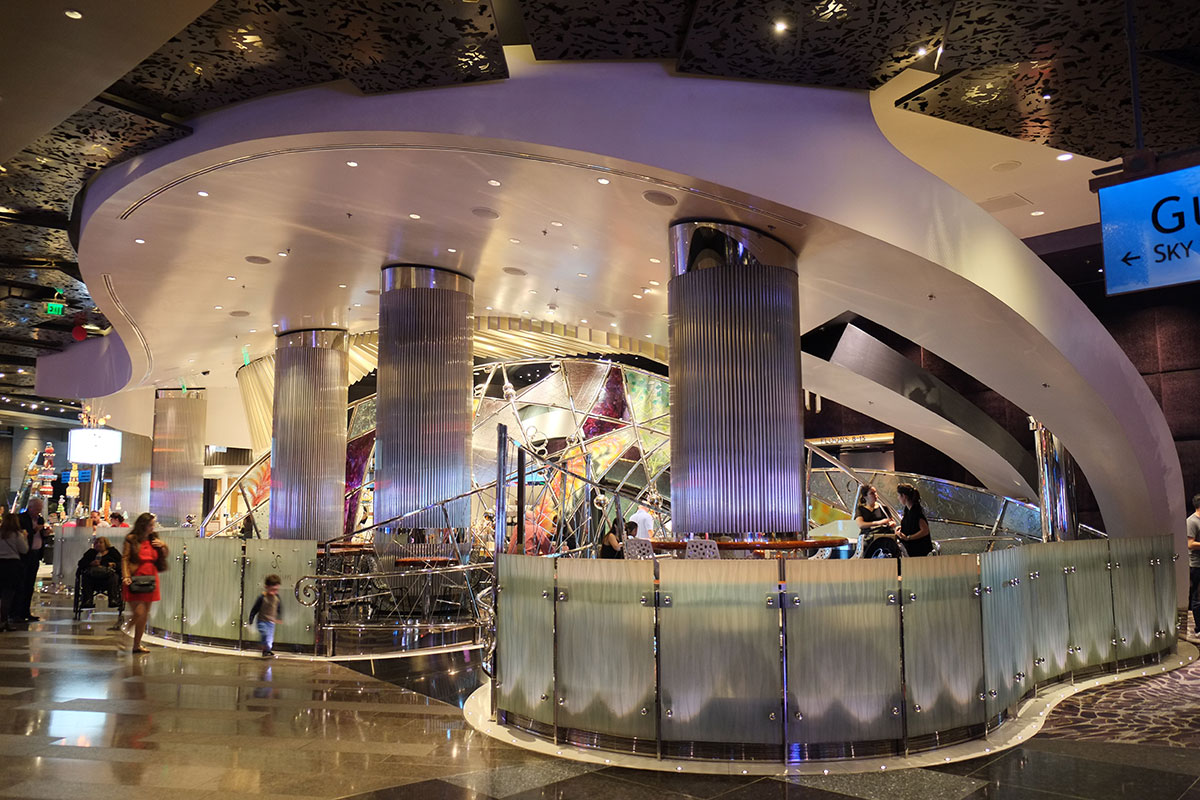
The level of extravagance and Shiny Object detailing is amazing.  This is a little cafe where we grabbed some gelato.  84. Las Vegas119DSCF7198
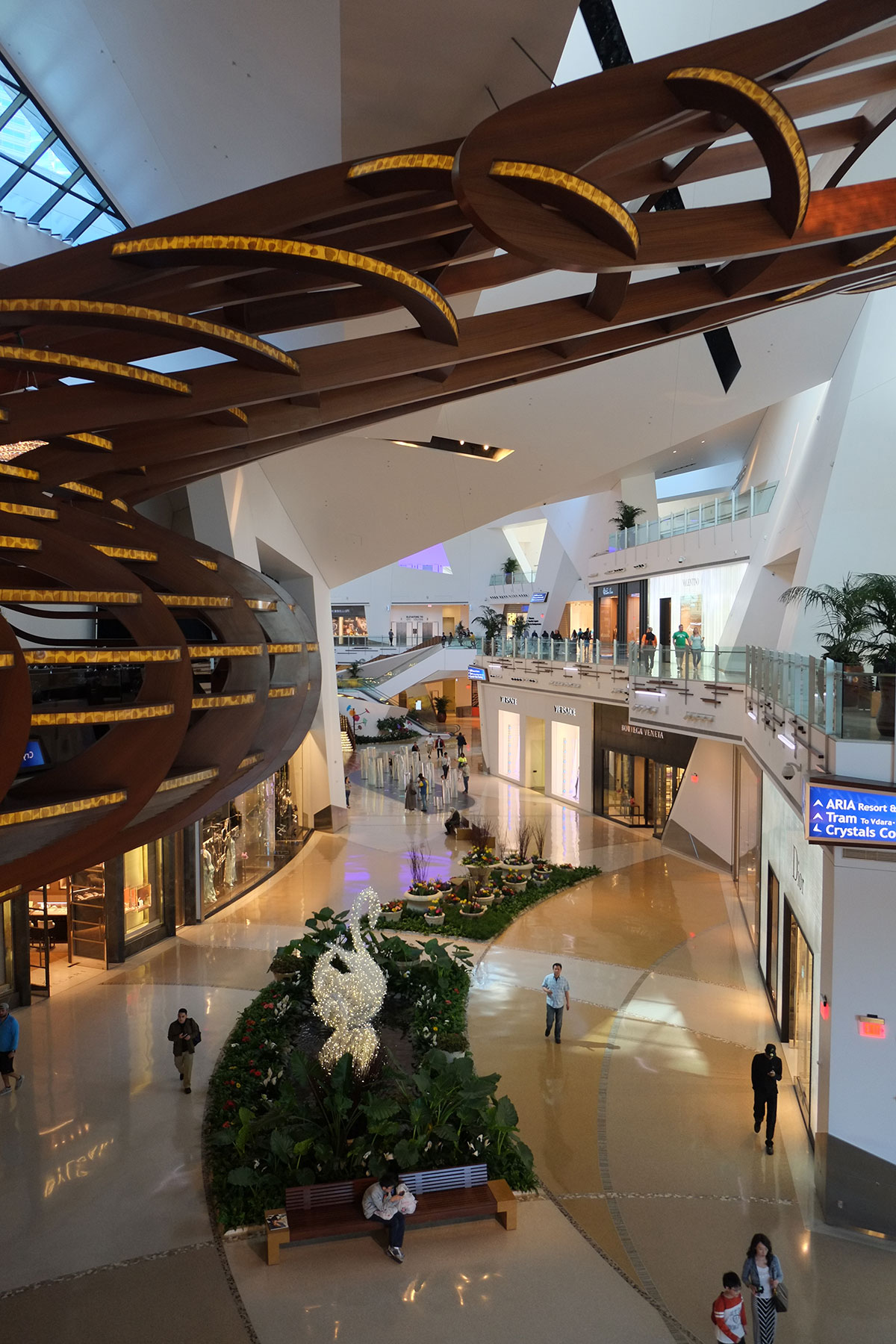
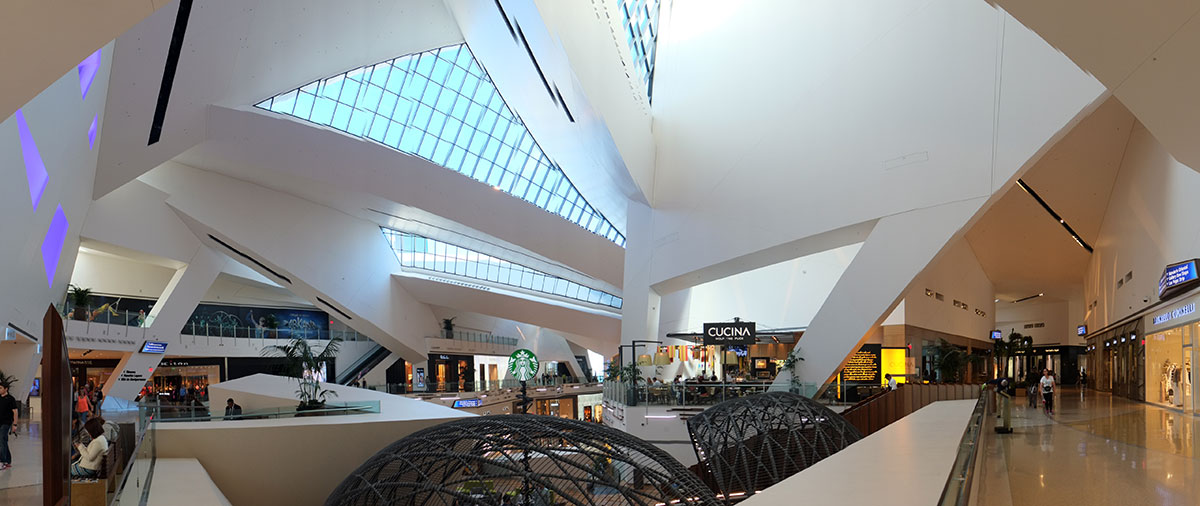
Perhaps the strangest part is a high-end shopping mall designed by Daniel Liebeskind.  We became used to seeing his jagged buildings serving as museums and other cultural institutions over the past 15 years, and his style has become completely recognizable – you can spot a Liebeskind just as you can a Gehry or a Zaha Hadid.  Often these spatial and formal special effects are said to represent our zeitgeist, to show how an artist has insight into the deep structure of our globalized culture and can embody those precepts in architectural form.

So to see the same forms used to house the likes of Prada and Vuitton is more than little bizarre at first.  Do these forms have inherent meaning (I don’t think they really do), or have they just evolved into the latest hip visual vocabulary, one that will look as dated as bad Postmodernism in just a few years?  DSCF7160
I think that when avant-garde architects are young (under 50), they push the theoretical underpinnings of their work to justify it, and to explain why none of it ever gets built.  It is all revolutionary, and will undermine the civil as well as architectural edifice of our society, etc.  Then when they are older and the visual culture has caught up with their aesthetic, they start getting work, and eventually end up designing shopping malls (just strange, jagged ones).  I’m not sure that most of them ever really started with serious theoretical positions (architects tend to not be deep intellectuals, but rather, talented manipulators of three-dimensional reality), but even if they were, it is almost impossible to resist the temptation to actually build, and inevitably, any architectural movement that might have begun with a serious polemic and intentions just ends up as another style in the service of the globalized corporate hegemony.  84. Las Vegas116DSCF7170
There is a long history to this.  Before the valorization of the avant-garde, architects saw themselves solidly within the power structure of a society, and knew their role in it.  (HH Richardson once said, The first principle of architecture is to get the job.)  But since Ruskin and the subsequent pretensions of the Modern movement to represent a moral as well as architectural critique of prior eras, architects have felt the need to cloak themselves in revolutionary rhetoric, which starts to sound pretty silly when they start designing shopping malls.

In my youth I worked for some firms that designed shopping malls and department stores, so once I got over the strangeness of this one being by Liebeskind, I was able to evaluate the shopping mall qua shopping mall.  And on those terms, it’s a good one.  The curving corridors allow you to see storefronts and signs ahead of you, rather than always to the side as you walk by.  The big spatial nodes create destinations at the ends of the corridors, which in a traditional mall would be the locations of the anchor department stores.  These large spaces then accommodate big inserted architectural elements, which are the bars and cafes.  The high volumes give relief from the Big Low Spaces of the rest of Vegas, bringing in abundant daylight that makes strolling through the mall a pleasant experience. The architecture says, we don’t have to trick you into staying indoors and spending money, we assume that you are so rich that you just spend lots of money whenever you feel like it, and are used to doing this in a beautiful place.  Frank Gehry went from being a straightforward mall architect to being Frank Gehry;  maybe Daniel Liebeskind should try the reverse.

Las Vegas was like Texas for me – I had a lot more fun than I expected to.  I thought all the pleasures would be snarky, slumming my way disdainfully through the cheesy excesses, getting into the Fear and Loathing mindset as much as I could with a 14-year-old in tow (I had learned how far that was at Mardi Gras).  But the beauty of Las Vegas is that you can see larger currents in the global architectural and economic worlds writ large.  There is not much subtlety here.  Paradigms of different eras are juxtaposed, as are the aspirations of different strata of society.  I had expected the complete unreality of the total fantasy environment, but evidence of the irresistible forces of global society were everywhere.

People go to Las Vegas as an escape, for a willing suspension of participation in the reality of the outside world of jobs, sprawl and daily life.  I did the same – not gambling and drinking and going to shows, but allowing myself to experience it on its own terms, enjoying the architectural special effects and admiring the skill of those who created this artifice.  But as we drove back out to our campground at Lake Mead, and once again contemplated that 150-drop in the water level, reality set back in.  The high temperature in Las Vegas today will be 108 degrees.  No one will be walking along the Strip. The parallels with the Roman Empire are more than architectural, and it’s hard to think that when Greta retraces this trip with her own kids in 30 or so years, that they will actually be able to visit Vegas.
84. Las Vegas126DSCF7299

Arcosanti

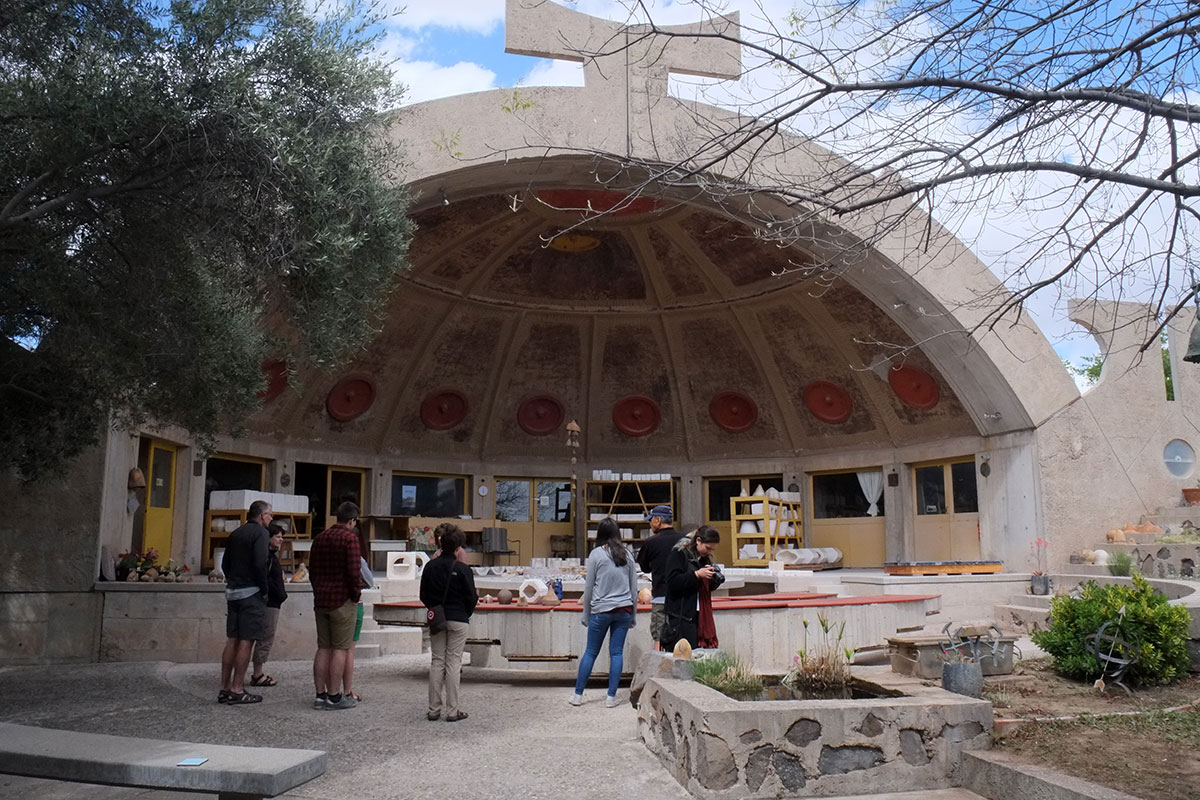
One of our goals in the Southwest was to visit relics from past ages – ancestral Puebloan ruins and cliff dwellings, and the more recent Pueblos – which date back up to 700 years.  We started with a visit to Arcosanti, which I thought of as a relic from a prior age that can feel almost as remote  to us now  – the 1970s.DSCF6862

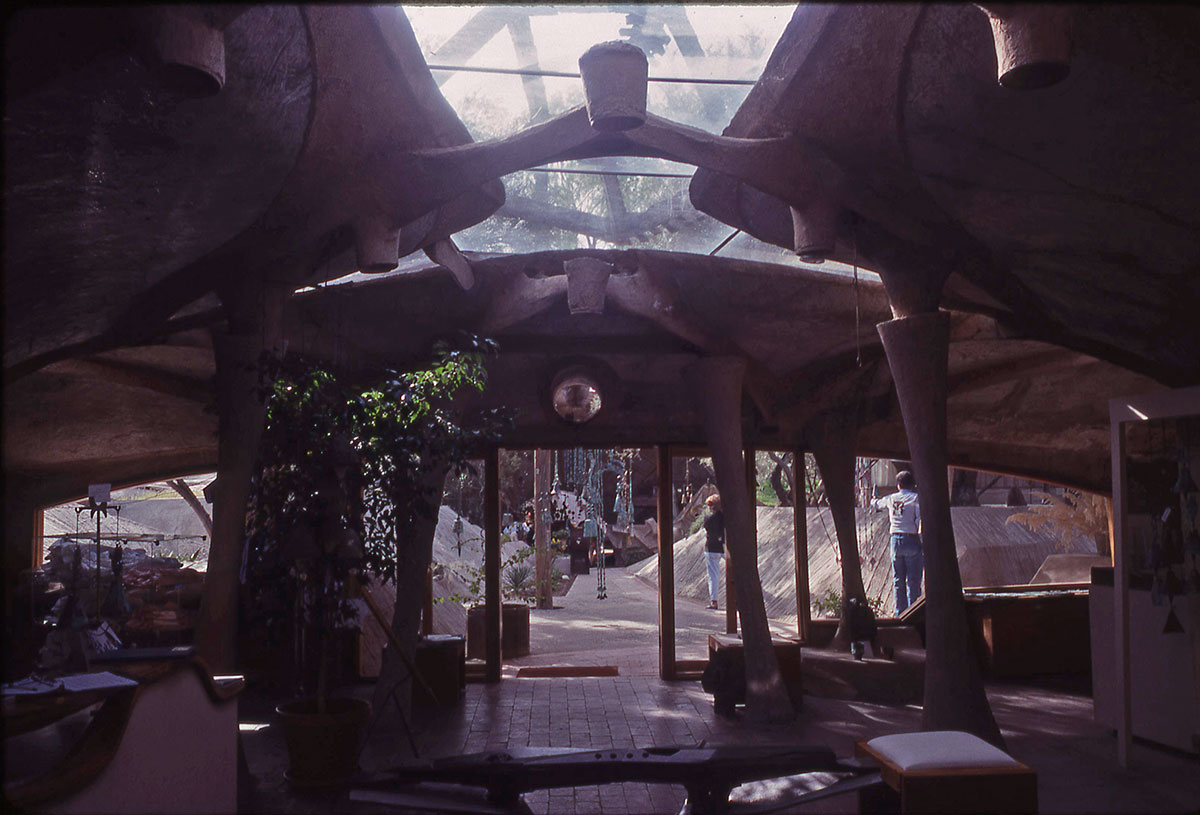
Paolo Soleri was a visionary Italian architect who came to America in the 1940s to study with Frank Lloyd Wright.  He eventually settled in Scottsdale, and began applying techniques he had learned for casting ceramics at the architectural scale.  His compound in Scottsdale – Cosanti – is a truly beautiful place, where dirt was piled up in mounds to make formwork, then concrete was poured on top, and the dirt scooped out to leave domes. Cosanti017However, Soleri was thinking at larger scale the whole time, and laid out his thinking in Arcology, which combined architecture and ecology.  In an age when Americans were happy to build endless sprawl, Soleri recognized the consequences of this pattern, for both the natural environment and human society.  He bought property 70 miles north of Phoenix to begin his prototype urban community, Arcoscanti, in 1970.

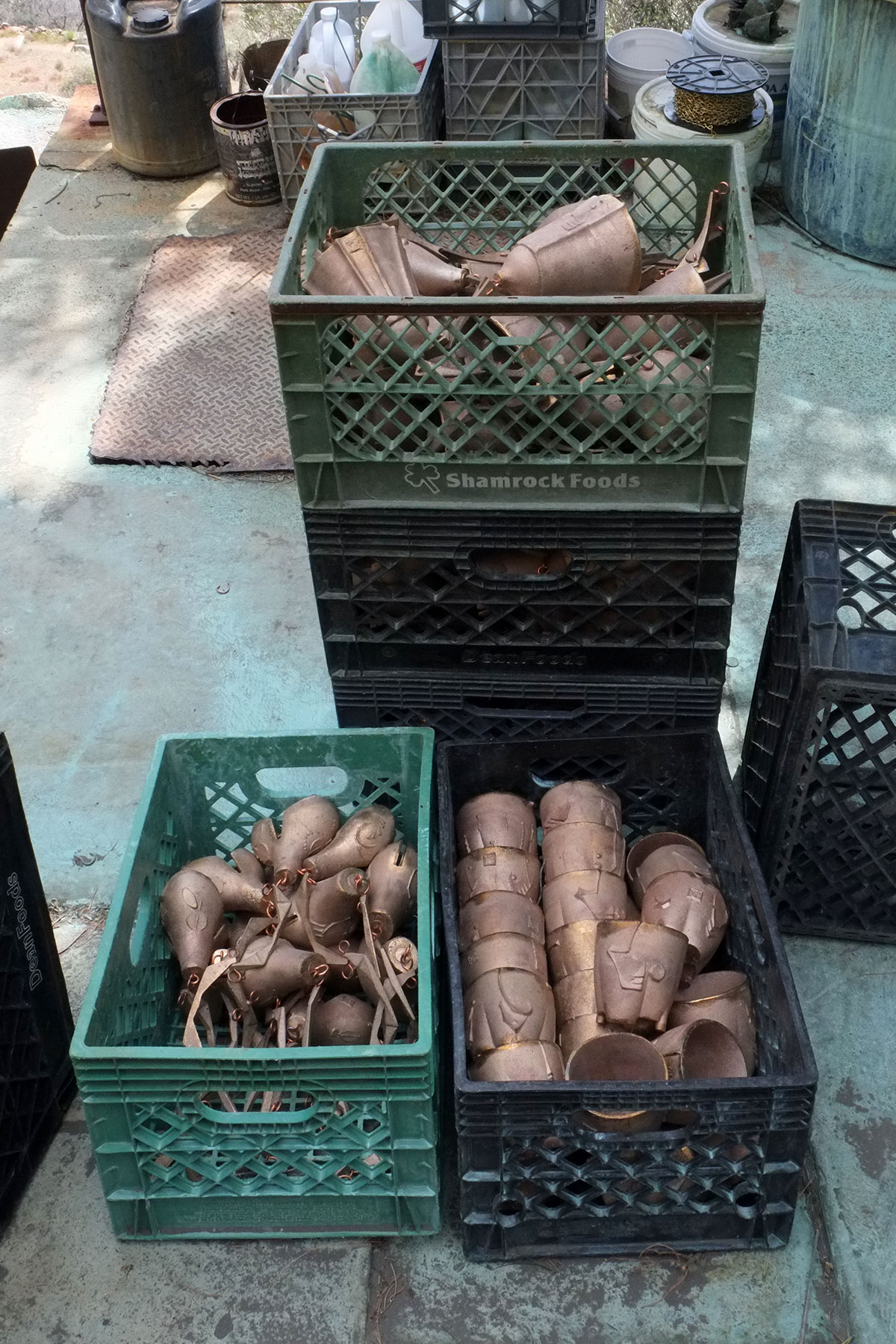
Construction has proceeded intermittently since then, with much of Arcosanti’s current fame resting on their production of bronze bells and wind chimes, usually bought as souvenirs of a southwestern vacation to manifest good taste and seriousness.  I had first visited Arcosanti about 20 years ago, and found it a little depressing – a small group of inhabitants who were living in the remnant concrete buildings from the 1970s, making wind chimes and chilling out in the desert, while Soleri mainly lived in Scottsdale.  But Soleri had retired (and subsequently died in 2013), and has been succeeded by Jeff Stein, a Boston architect who had run the architecture programs at Wentworth Institute and the BAC for many years.  I had met Jeff many years ago, and more recently at a HOPES conference in Eugene.  He struck me as a thoughtful and serious person, and so I was curious as to how things might be changing at Arcosanti.

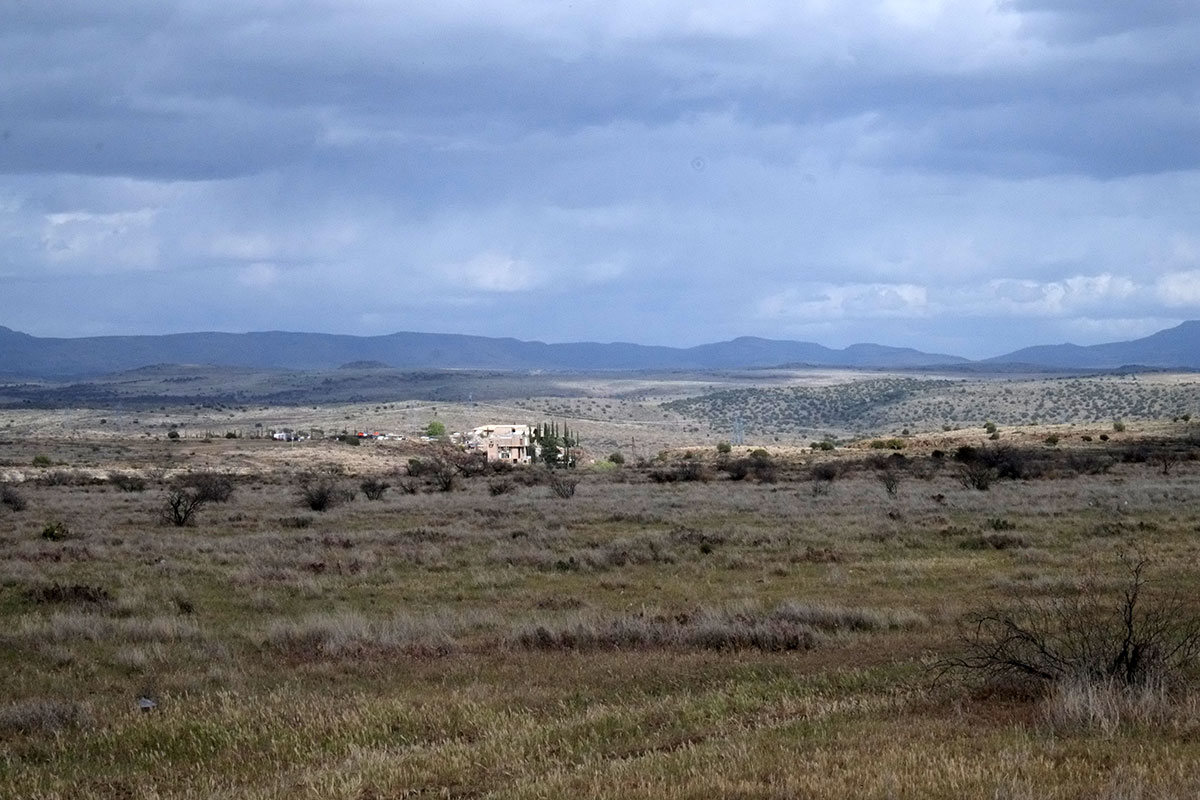
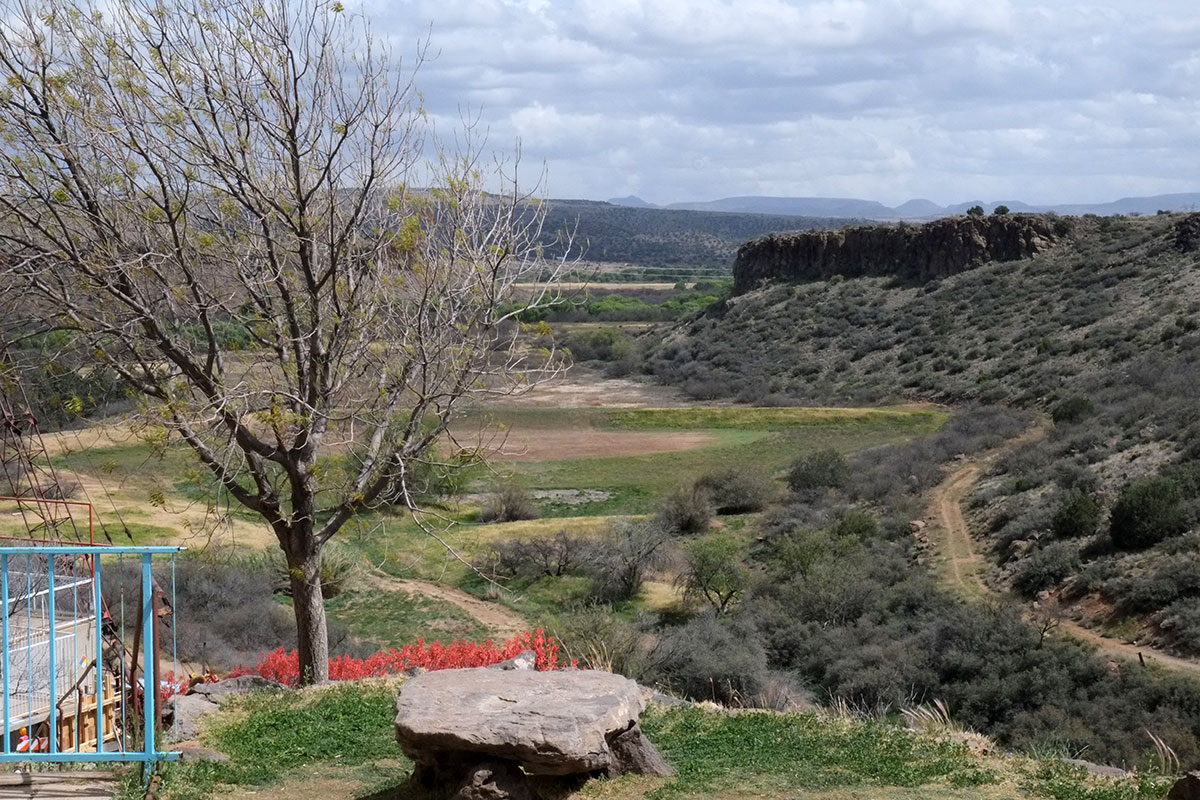
Arcosanti sits isolated out in the desert, on the edge of a small canyon (not unlike the cliff dwellings we’d be seeing).  However, it is connected to Phoenix by Interstate 17, although it is isolated by two miles of very rough dirt road (which did cause every screw in our trailer to come loose).  DSCF6943

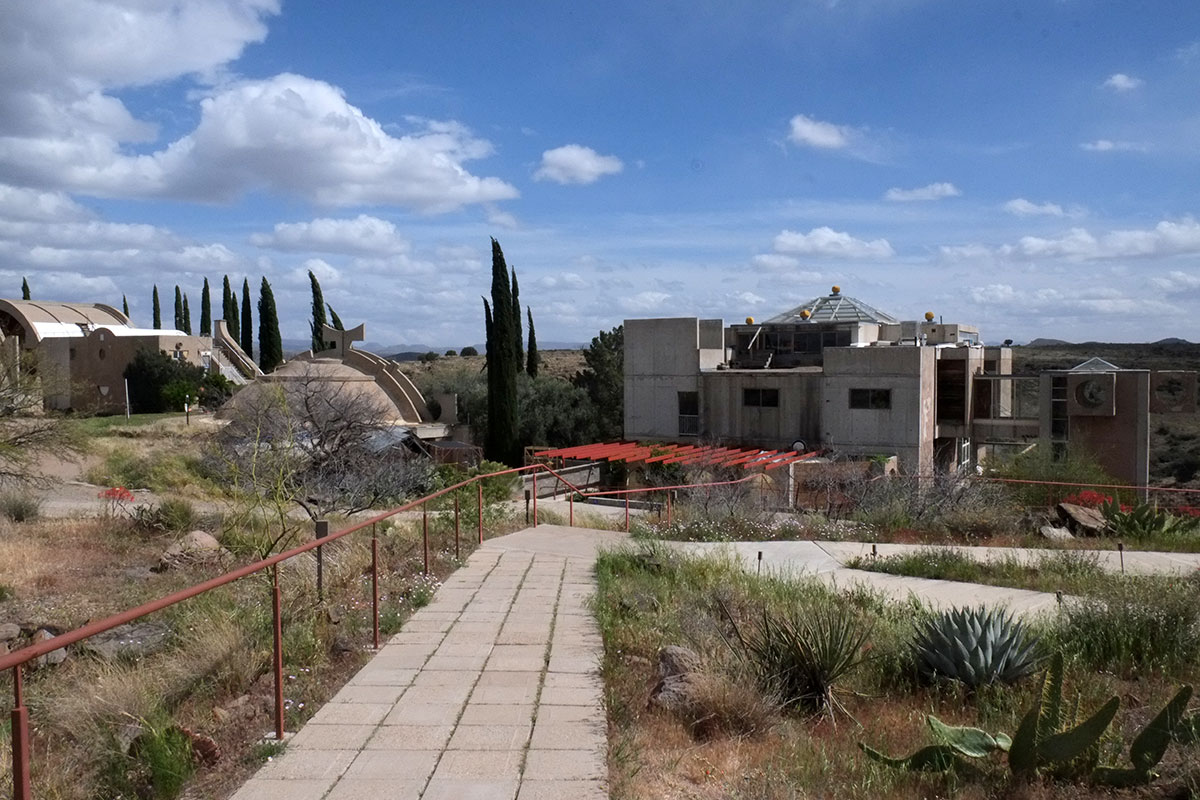
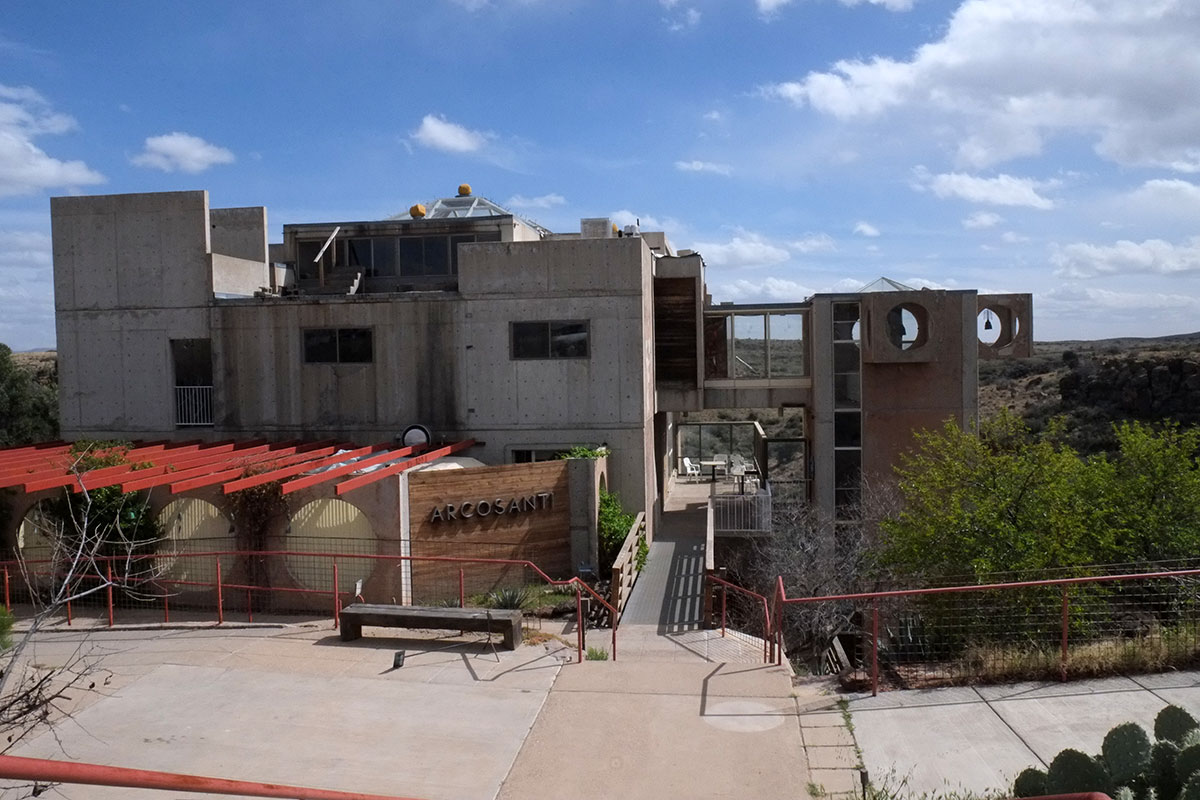
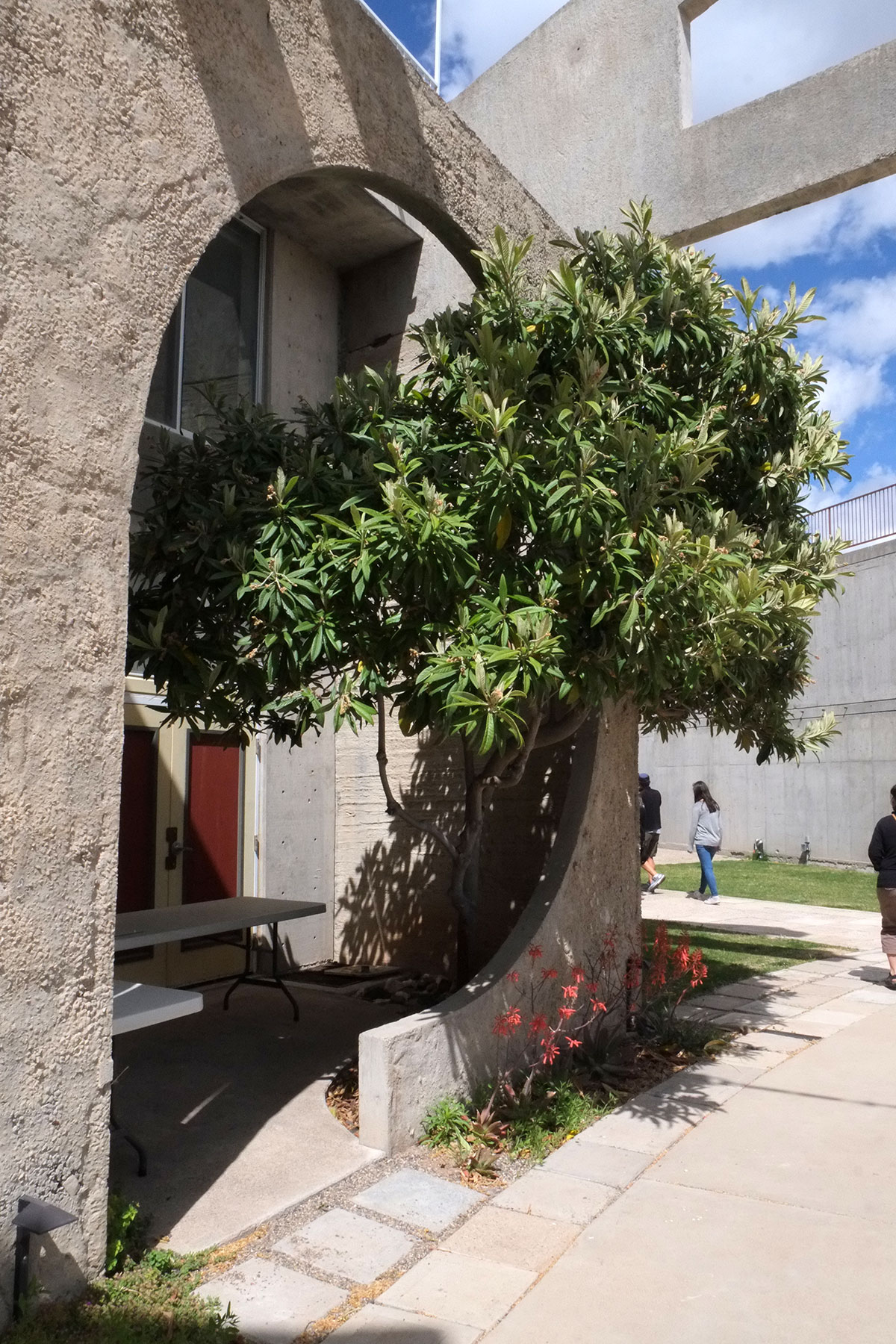
The complex faces south, and is mostly constructed of concrete.  The visitors’ building is to the right, and the housing and production buildings to the left.  DSCF6942

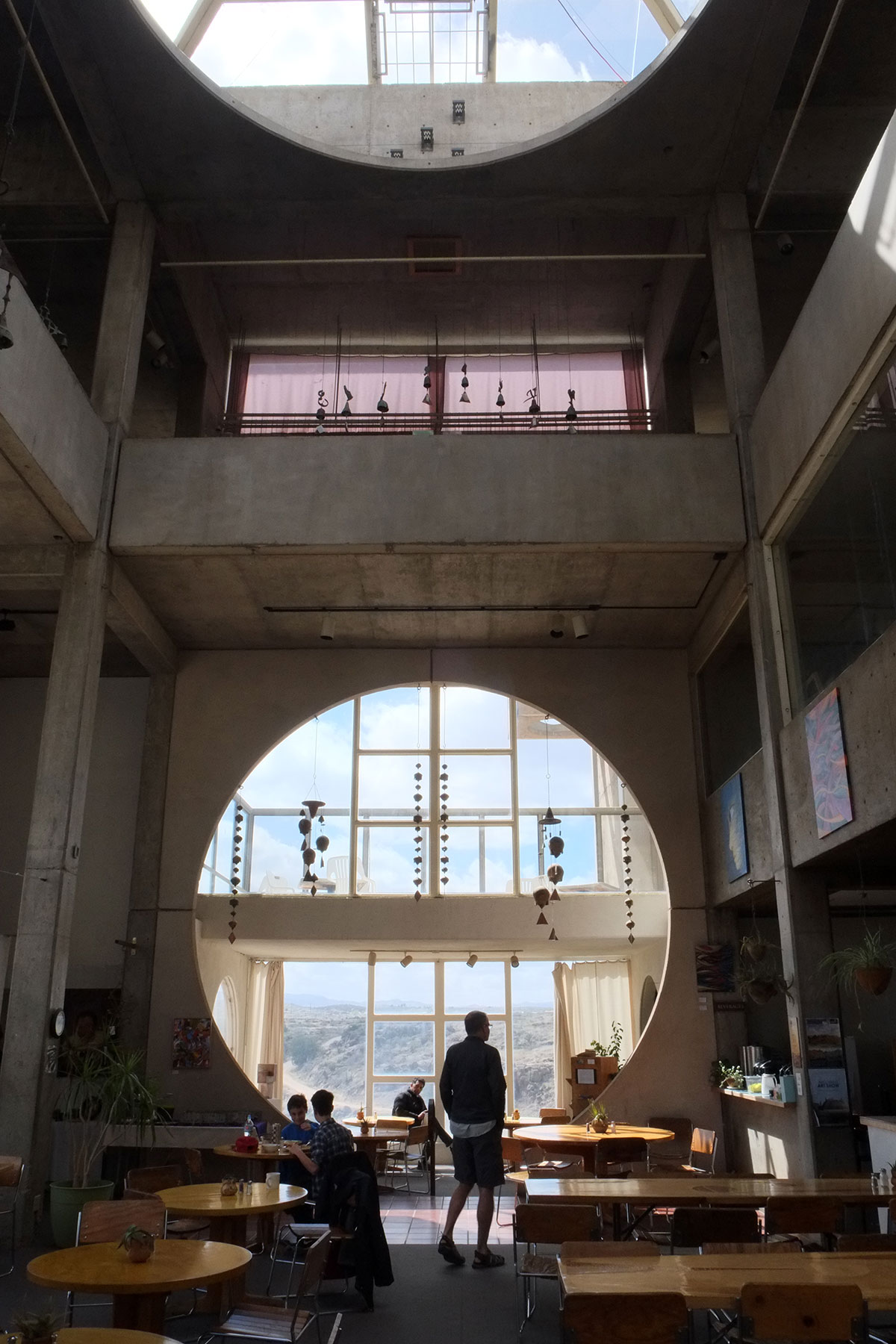
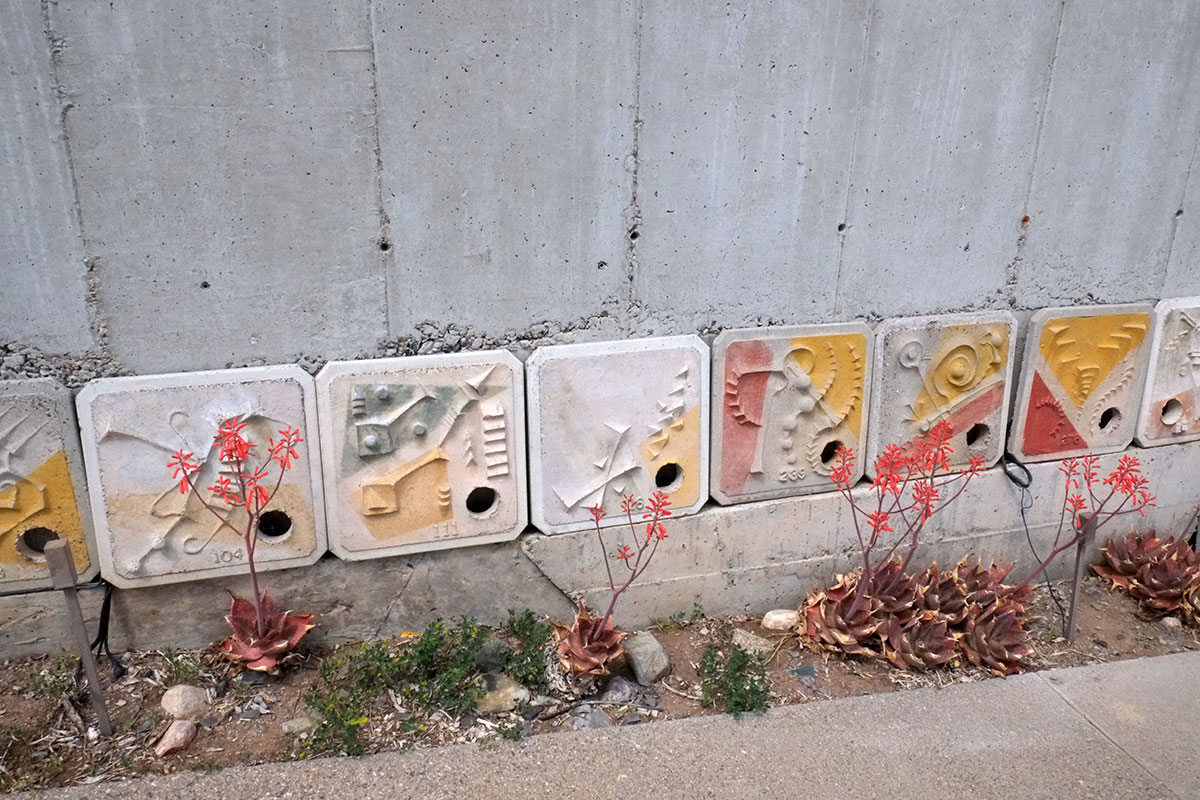
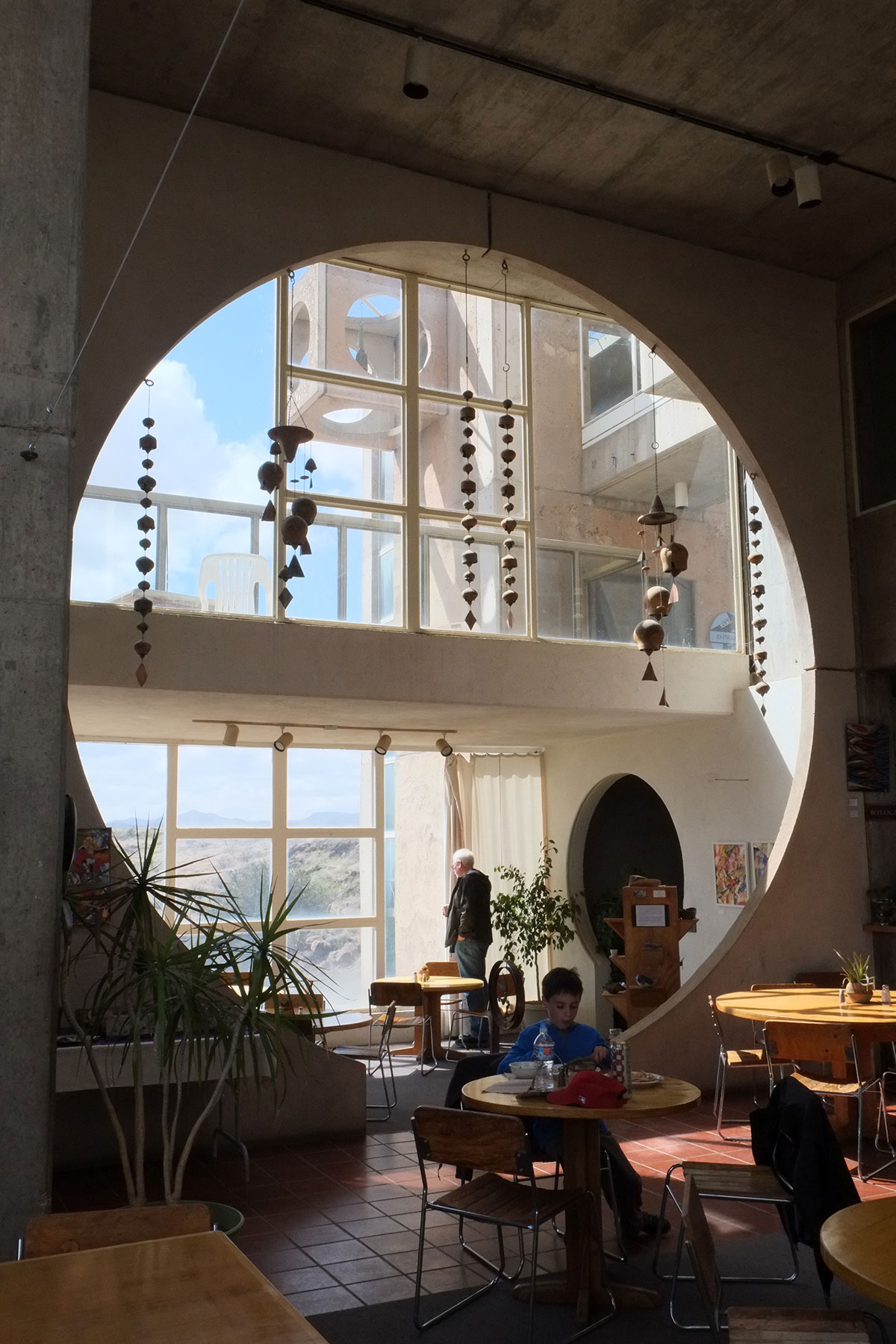
The visitors’ building houses exhibits, a store, and a restaurant.  The concrete on the exterior here is showing its age, with some spalling and exposed large aggregate.  DSCF6941

It’s a really clear Brutalist building, showing that Soleri wasn’t an iconoclastic hermit out in the desert, but was in sync with other architects of his era, such as Kahn.  DSCF6917

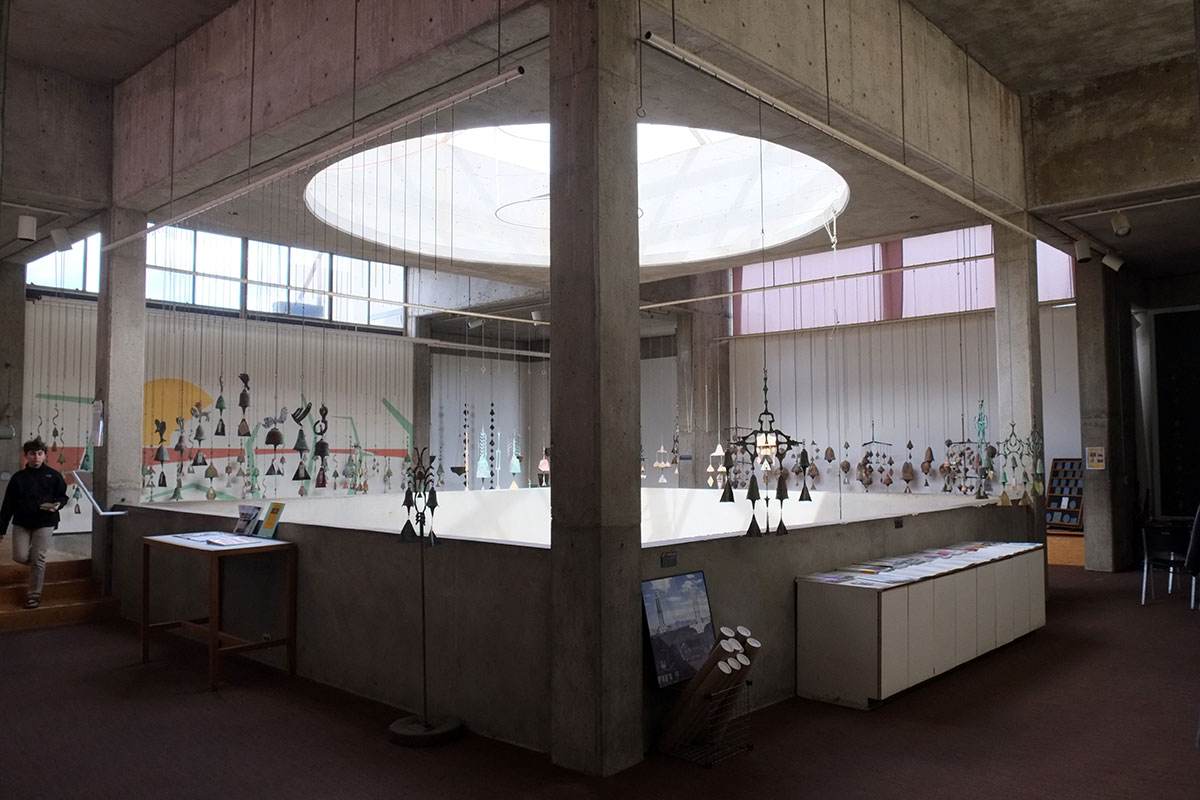
The shop where they sell the bells (now you recognize them).  DSCF6935

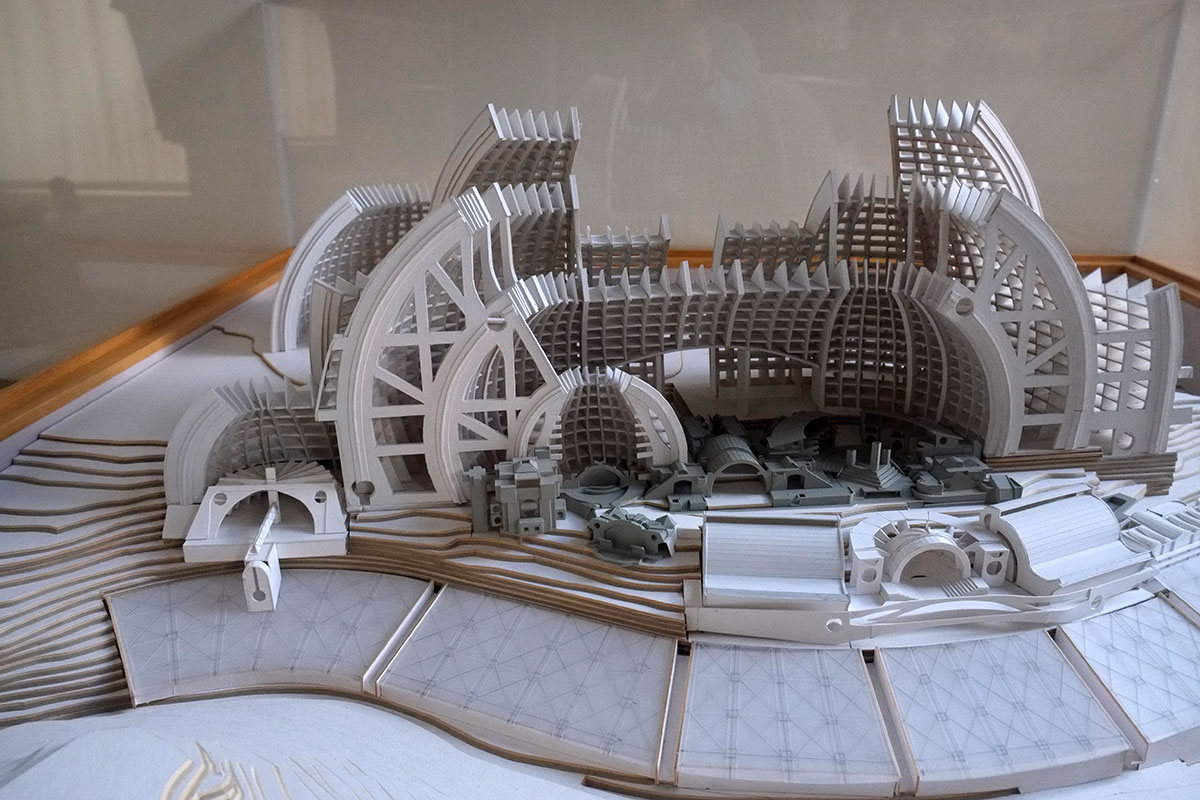
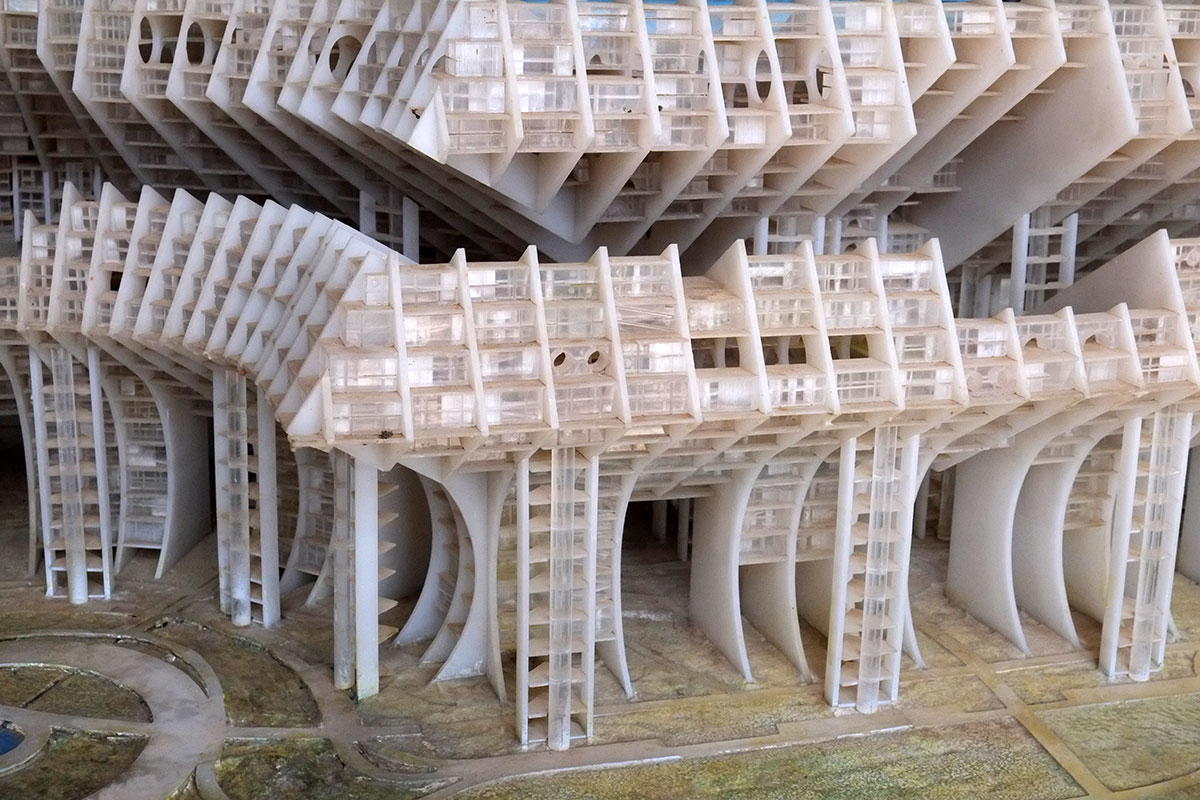
There are some gorgeous models located throughout the complex.  This one shows one conception of the final state of Arcosanti – a series of large apses facing south, which contain community spaces and are ringed by housing units.  For a scale comparison, the parts of Arcosanti which have been already built are shown in grey in the middle of the model – the planned pieces are shown in white.  DSCF6821

A tour brought us through the complex to the ceramic production areaDSCF6827

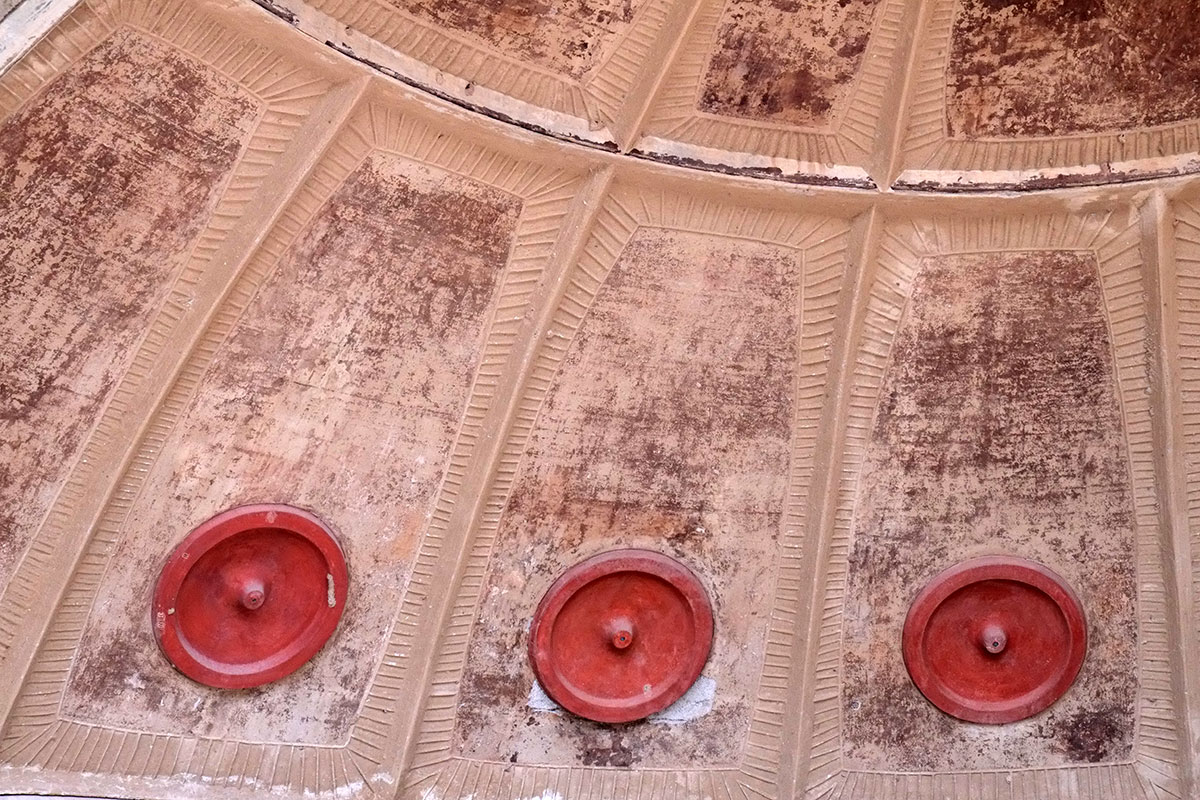
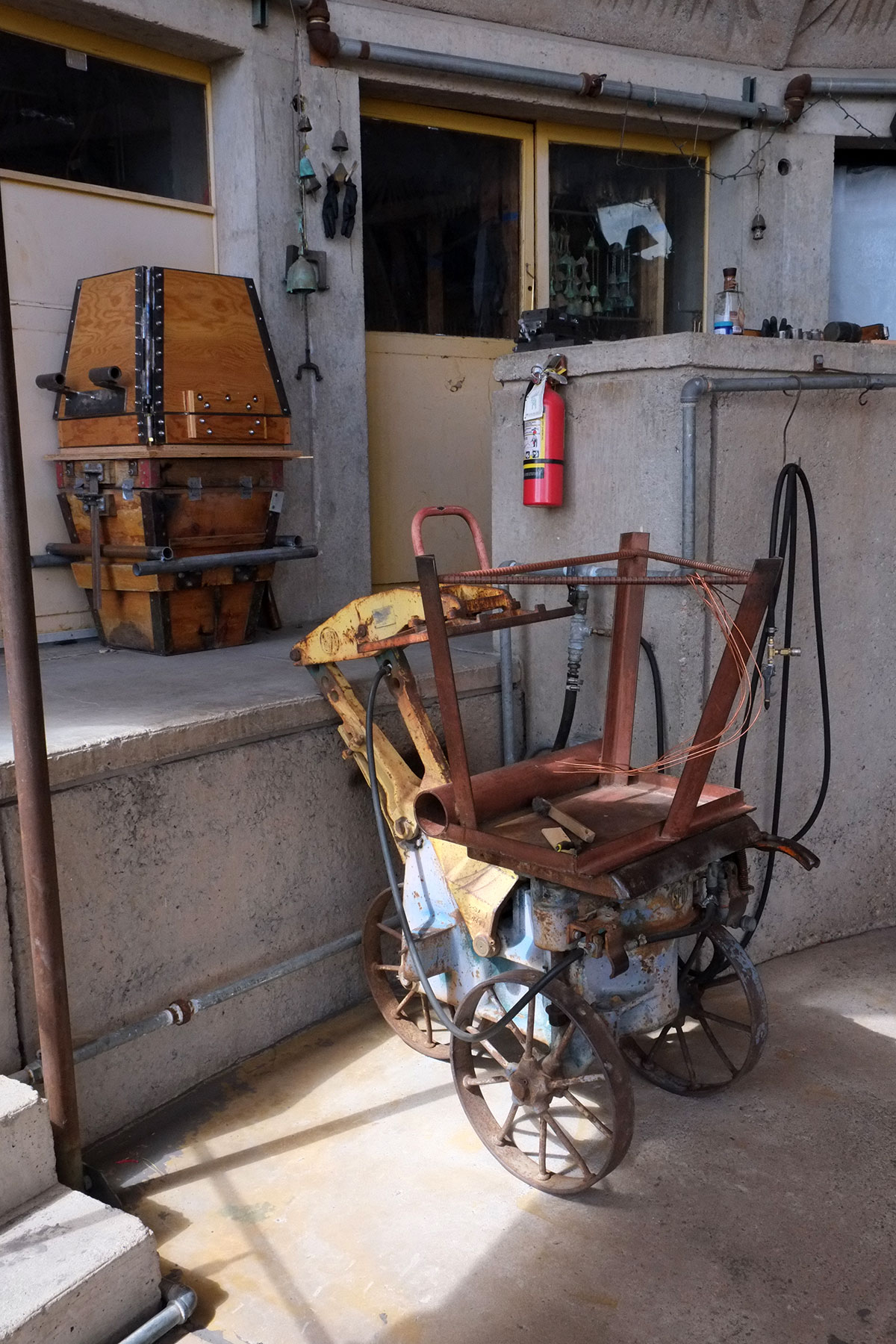
where you can see how the processes used to form the ceramics and bronzes are very similar to the processes used to form the architecture.  The level of detail possible with this sand-sculpting in the formwork is notable.  DSCF6832

DSCF6898

The bronze foundry:  DSCF6910DSCF6909  DSCF6905

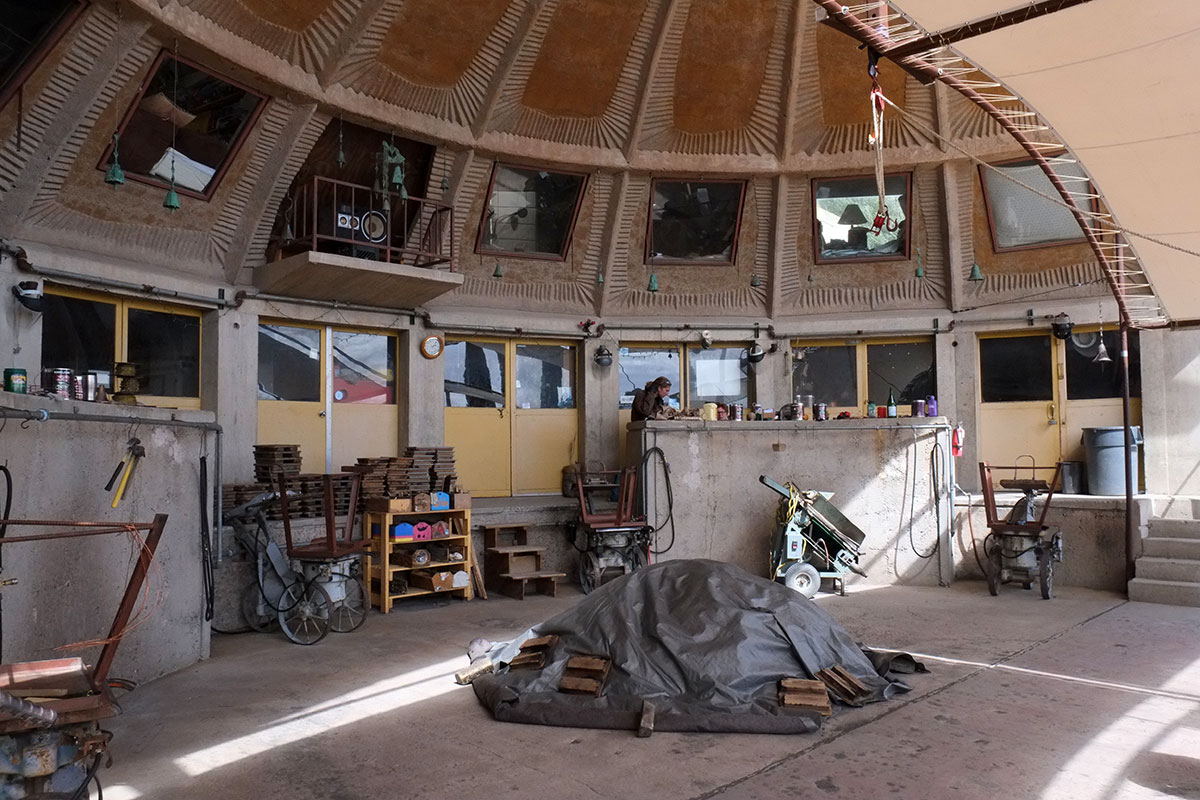
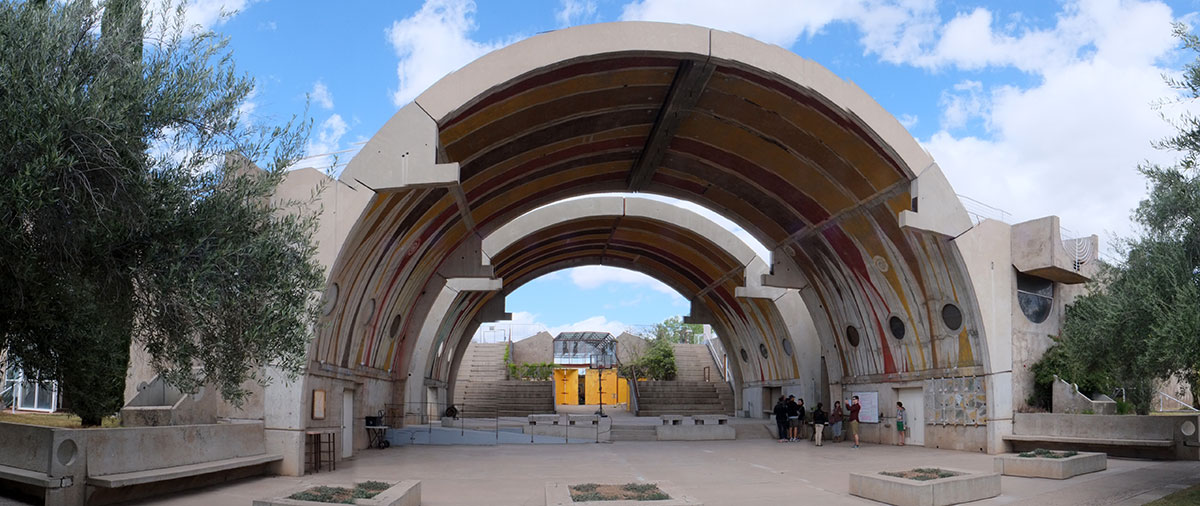
There is a large vault, which can be used for gatherings and performances (and basketball).  DSCF6848

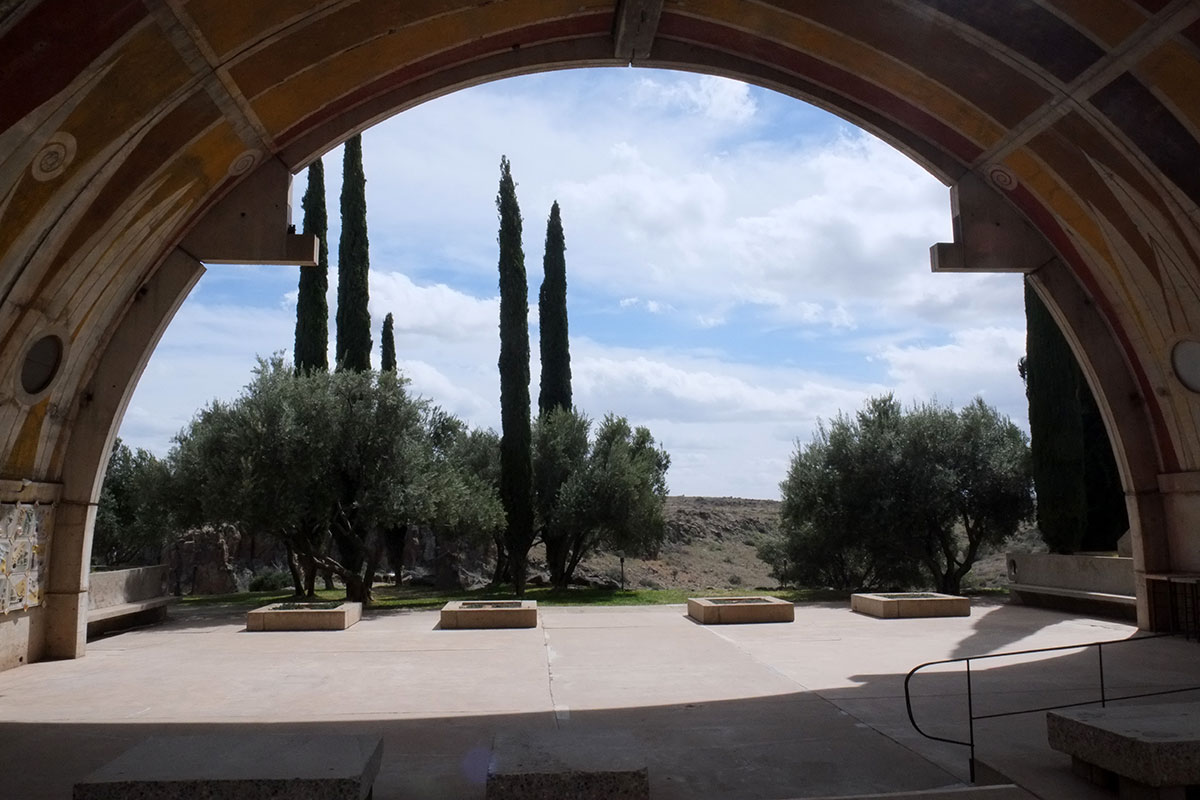
and which opens out to the canyon to the south.  DSCF6857

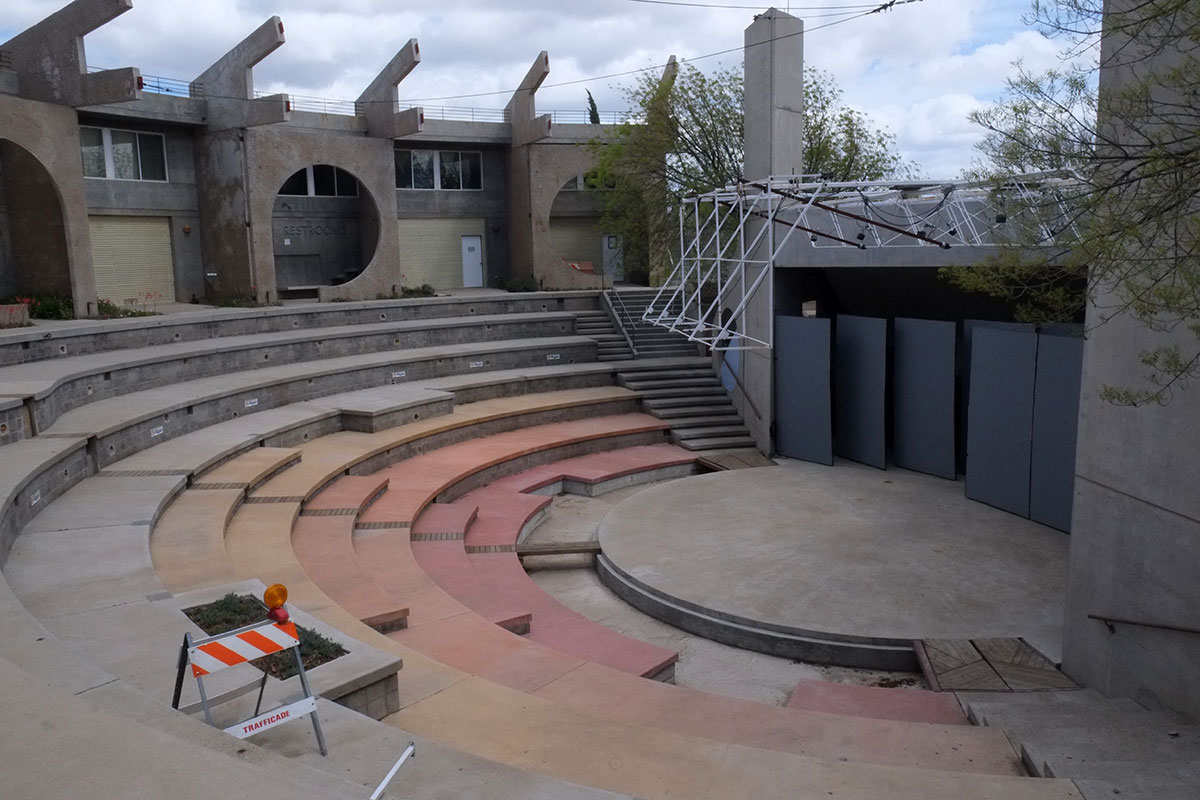
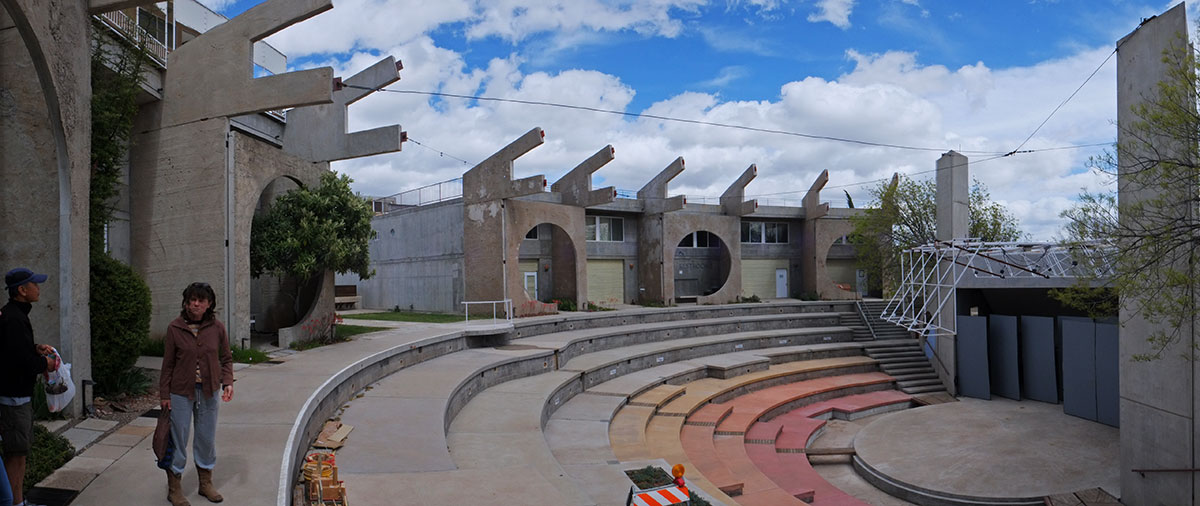
An amphitheater is surrounded by housing, some of which is for permanent residents, and a few of which are Air Bnbs.  DSCF6864  DSCF6865

When I visited here in the 1990s, it all seemed rather low-energy and unfocussed.  It reminded me of Taliesin, where the impetus and vision came from the founder, and the followers were just hanging on to that revealed truth, always wondering WWFLWD when confronted with a new challenge, and eking out a meager living from the legacy.

Arcoscanti feels very different now.  There are constant workshops being offered, which bring in short-term students to learn about Arcology and construction.  There are performances and events, which can bring in attendees from the Phoenix megalopolis.  There are approximately 100 full-time residents, some of whom live in the Camp area, detached houses closer to the farm at the bottom of the canyon.  Construction is moving ahead on some of the concrete buildings.

Soleri’s vision seems even more relevant now than in the 70s. His basic principle is that of building dense, energy-efficient human settlements, which don’t sprawl across the landscape, and so preserve land for agriculture and other uses.  In a very different form, this set of ideas underlays New Urbanism, and various principles which have become conventional planning in the past 30 years.

Millennials are showing a notable preference for denser urban living, often staying in our traditional city cores rather than moving back to the suburbs to spawn.  There are not many models for new urban development at this point – we have accepted the traditional city form and are designing new buildings to fit into that context.  Soleri’s morphology may not be the ultimate solution, but it is a remarkably clear proposal, one which proceeds from first principles and not just an imitation of older forms.  In this way it does resemble Corbusier’s urban proposals, as he laid out his understanding of modern civilization, and tried to come up with a new form that fit those changed conditions.  Soleri stared with a very different set of underlying conditions (recognizing the importance of the environment before most of his contemporaries), and proposed this new model.  Perhaps most encouragingly, the ideas have not remained static:  a newer book, Lean Linear City:  Arterial Arcology, was written by Soleri and some of his followers, showing the development of concepts to fit changing conditions.

Visiting Arcosanti doesn’t feel like visiting the remnants of yet another failed agrarian utopia, which collapsed after the dogma-driven urbanites got bored and went back home.  It is not a rapidly-developing alternative city (probably because no one has figured out to make a lot of money from it), but it is a serious testing ground for a larger vision.  We now recognize the scale of the ecological crisis we are facing as a society, but so far our efforts to correct our course are puny and completely ineffectual.   We keep proposing tweaks around the edges of the existing system.  Arcology may not be the complete solution, but it is one of the few models out there of what a vision for the whole might be, one where the scale of the solution is within an order of magnitude of the problem.

DSCF6881The biggest problem with Arcosanti is its location:  with the likely consequences of climate change in the next century, the edge of the Sonoran Desert is not where you want to be.  Agriculture will not be possible here, as most climate models are predicting a mega-drought this century, similar to the one that contributed to the Ancestral Puebloans abandonment of their settlements 1000 years ago.  Soleri didn’t foresee this, but then neither did anyone else.  He began a small experimental community for up to 5000 people that might have to be abandoned;  we built Phoenix, which with its 4,000,000 residents that will also be gone soon.  At least the Arcosanti residents will be able to hold on longer, as their buildings will shield them in a way that the Phoenix buildings will not.

Even if its geographic location may not endure, the ideas of Arcosanti can still provide a useful model for our society.  I arrived there thinking about the big ideas of cities and ecology and human settlement and the landscape, but the experience quickly shifted my thinking to that of the smaller scales of buildings and spaces.  I hadn’t expected it to be so beautiful.  DSCF6923

DSCF6937

The quality of the architectural design and the integration with the outdoor spaces is comparable to an Italian hill town, or as I would discover, some of the Pueblos of the Southwest.    It is architecture and urban design for a new age, but it draws heavily on the best precedents from our past.DSCF6873

Arcosanti wasn’t conceived by a dry planning theorist, but by an artist.  If you have never looked at Soleri’s drawings in Arcology, you should;  Soleri’s vision is right up there with that of other acclaimed visionary architects, such as Lebbeus Woods, but his visions are grounded in an understanding of the fundamental conditions human society is facing, rather than operating at the level of metaphor, or as projections of a purely personal, hermetic vision.   DSCF6885

Soleri also took the great leap of trying to build this vision;  in our recent fascination with paper (or now digital) architecture, we don’t seem to care whether or not a beautiful vision can be built at all – we are happy to bask in the imaginary.  Thom Mayne once pointed out that the quality of architectural rendering would soon reach the point where architects would establish their reputations without ever having to build anything.  Ten years later, we seem to have reached that point.

Or maybe it’s even worse – we are so cynical about ever being able to redirect our profit-driven building-production system that we satisfy our idealistic (yet rational) urges with fantastical imagery.  Soleri didn’t spend thirty years making pretty pictures hoping that eventually some developer would adapt them for a shopping mall (cf. Liebeskind’s building in Las Vegas);  he saw the vision as deriving from the conditions we are facing, and proposed a solution to those problems that, like most brilliant, integrative solutions, was also beautiful and enriching as well as pragmatic.  He thought like an architect, never abandoning his dedication to the larger community, rather than just pursuing his personal vision.

Perhaps in the future we’ll visit Arcosanti as we now visit the abandoned cliff-dwellings, recognizing it as a harbinger, a place where the changing conditions of our world were first recognized and engaged.  DSCF6878

Phoenix

Phoenix is where you can see the Platonic ideal of sprawl – what low-density, car-based development looks like when there is no pre-existing central city to get in the way. To paraphrase Lou Kahn, I asked the sprawl what it wanted to be, and it said Phoenix.

The large cities of the east and midwest existed before cars, and a system of highways and roads had to be retrofitted in and around them to support the new means of transport.  Sub-urbia, as it was then conceived, implied a relationship to a central city.

Los Angeles was not a very big place in the 19th century, and its growth paralleled the rise of the automobile in the pre-war era.  It became the new paradigm for the American city in the early 20th-century.  Los Angeles is our most important car-based megalopolis, and it came to represent the image of sprawl in our collective imagination, with its highways, drive-ins and congestion.

But suburban growth and sprawl really took off in the post-war era. 19th-century cities acquired rings of highways and suburbs, and early 20th-century cities did the same.  American metropolitan areas became almost uniformly low-density around a central city, but with other centers in the region too, as nearby cities were subsumed in the sprawl.

Phoenix exemplifies the new, post-war city.  There was almost nothing there before WWII – it had around 100,000 residents in 1950 (with some more in places like Tempe and Scottsdale). The exponential growth began when developers such as Del Webb realized it could become the retirement center of the west (with its warm weather and vast expanses of cheap land), matching Florida’s role in the east.  P1080263Like southern Florida, the Phoenix economy has been largely based upon people moving there and then selling them houses and stuff.  And like every other place in the South or Sun Belt, its habitability is based upon the automobile, air conditioning and television.  Before the widespread adoption of these technologies, there was a sharp limit on how many people would live in a place like Phoenix.

There are several key differences in the urban and regional form of a city like Phoenix and older cities.  Since there was not a high-density central city to and from and through which large numbers of cars had to be moved,  a comprehensive system of high-capacity, limited-access highways was not developed.  (This may also be partly due to Phoenix not existing as a large city when the interstate highway system was initiated in 1956.)  Phoenix is the largest American city I’ve seen where the highway system is not relevant to car circulation in much of the city.

Phoenix didn’t exist in a region of small towns and cities – which then had the spaces between them filled with suburbia until they formed one large metropolitan region – as happened in older regions.  There was some irrigation-based agriculture, and there was a system of canals to serve this, but there wasn’t a significant concentration of population anywhere.  Growth did not happen incrementally or through infill.   A district in Phoenix is usually either a desert, or it is completely developed all at once. DSCF6567

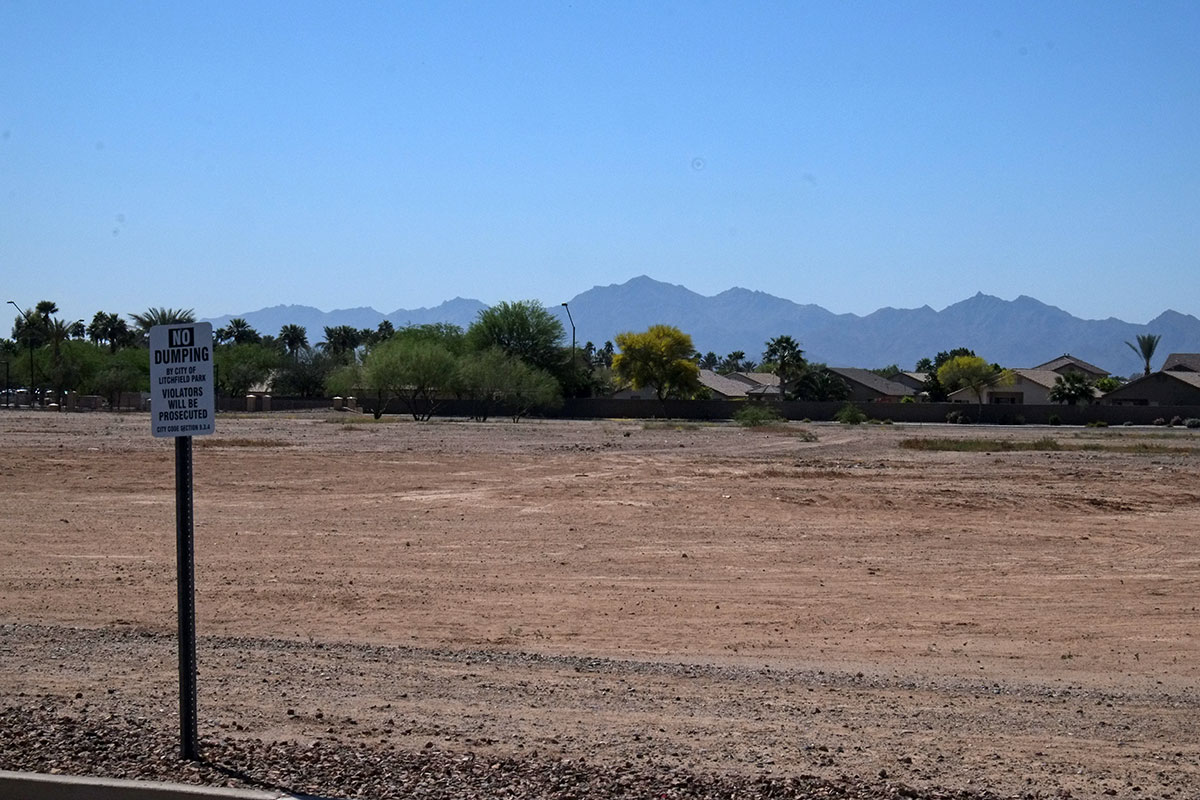
A common sight is moving along an arterial, looking across a desert, seeing another parcel of completed development – and knowing that the desert in the middle will be developed fairly soon.  DSCF6592

The street pattern of Phoenix is based upon the national grid of townships, with major arterial roads occurring every mile.  Since the density of the metropolitan area is fairly uniform, the roadway system can be sized to accommodate the corresponding uniform density of traffic.  Phoenix is a gridded network, not a branching-tree hierarchical system as is seen in much of the rest of the country.  Since the land was undeveloped before WWII, there was no pre-existing system of undersized farm roads which had to either retrofitted with difficulty, or supplanted by the highway system.  So as the districts developed all at once, the roadways could be built at the appropriate size for the ultimate density  80. Phoenix047DSCF6562

This is a  typical view while driving an arterial in Phoenix – with the neighborhood behind shielded by sound walls.  And while the arterial system is a repetitive grid, the street network within the grid is configured to be as confusing and disconnected as possible – the better to thwart drivers looking for shortcuts across your domain.  80. Phoenix048DSCF6595

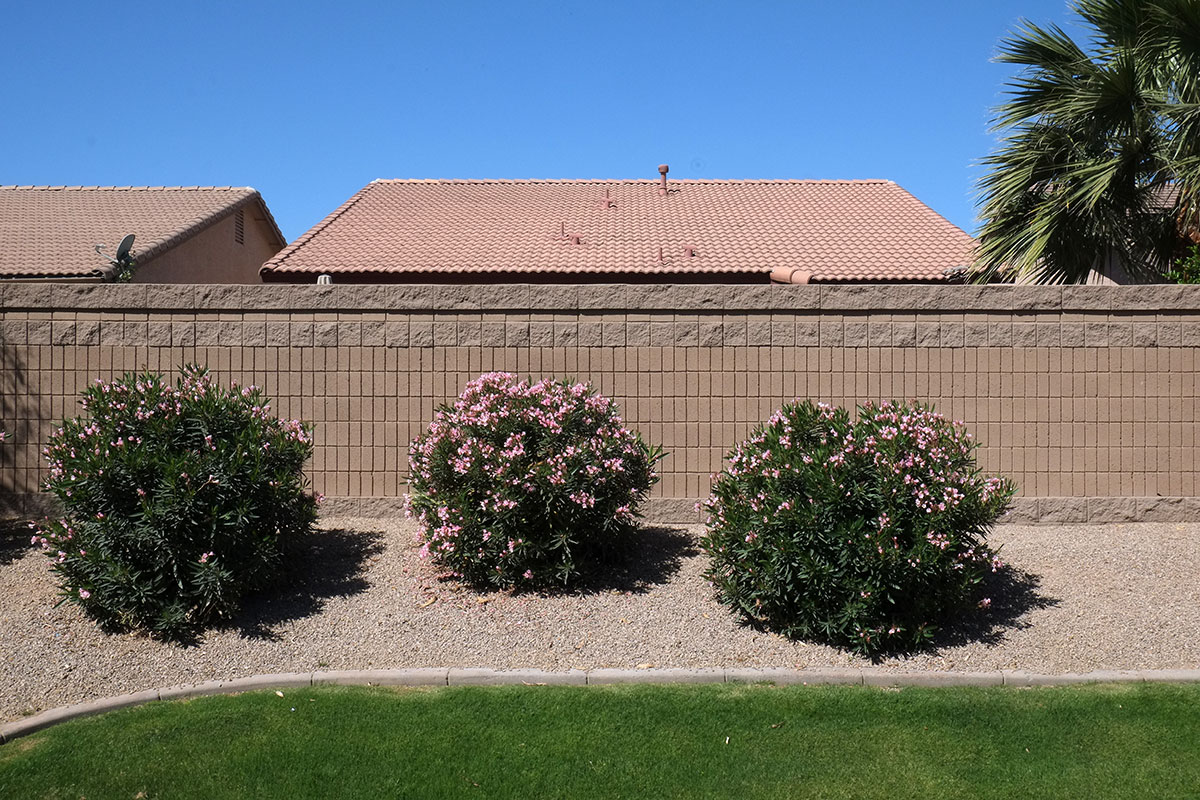
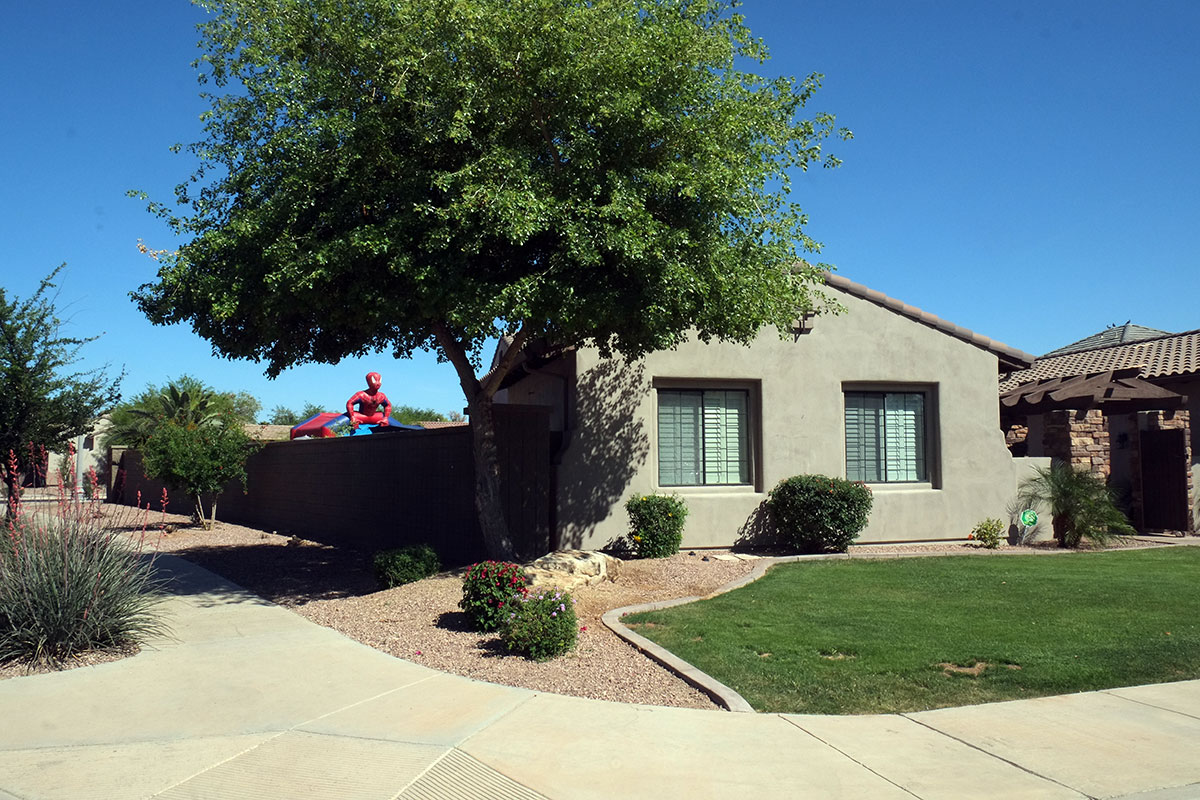
The residential neighborhoods are basically all new, roughly in successive rings out from the center, although leapfrogging development is not uncommon.  Each is completely homogeneous, having been built in large parcels by one builder.  Stylistically, they are all very similar, in a vague southwestern faux-adobe or stucco – it appears that a crop-dusting plane flies over each neighborhood every five years, spraying everything with a coat of Dryvit.  In layout they are more similar to tract houses of their era in other parts of the country than to older houses in the region (following the rule that in a mass culture things vary by time but not by location).  They are walled-off from the street more frequently than is normal in other parts of the country, and you can never be sure what is going on behind those walls.  80. Phoenix049DSCF6600

There is some isolated great architecture in Phoenix – Taliesin West, Will Bruder’s library, the Arizona Biltmore, etc., but we didn’t see them on this trip.  I had seen them fairly recently, and after getting dragged all around Texas cities, Greta had reached her limit on architecture, and just wanted to blow out of town and get back to the desert as quickly as possible.  I was also daunted but the prospect of slogging through Phoenix traffic – we were staying on the western edge of the region, and most of the architecture was far to the east.  We did brave the Sunday traffic, and I dragged Greta through the downtown, and then lured her to Tempe with the prospect of good food.

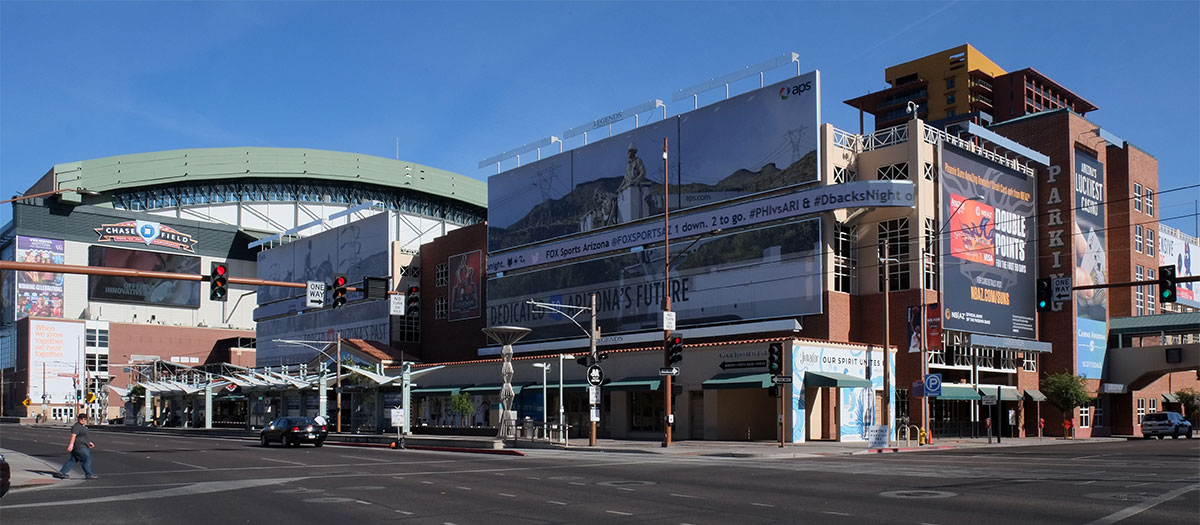
Phoenix has two distinct clusters of density.  The region around Camelback is the center of retail, while the downtown is for business, branches of the major universities, and large events – conventions, major league sports and performing arts.  It is nothing like a traditional downtown, more closely resembling an edge city office cluster.  This makes sense, as its history is nothing like a traditional city’s.  Whereas older cities usually have downtowns that retain older buildings and districts, Phoenix has none of this – we found one older building.  The strange inversion of Phoenix is that the downtown is newer than the sprawl.  It’s like the city reached a certain size and then made a decision to have a more dense downtown, and so redeveloped the whole area.

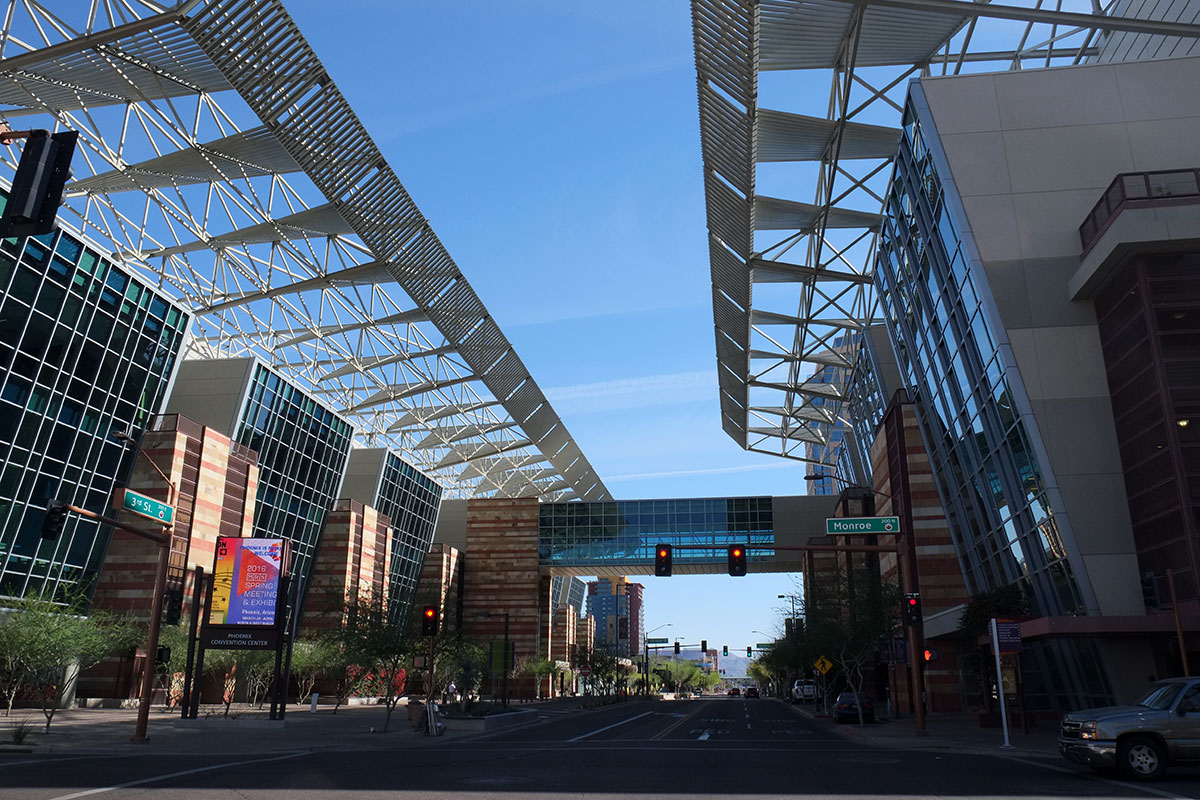
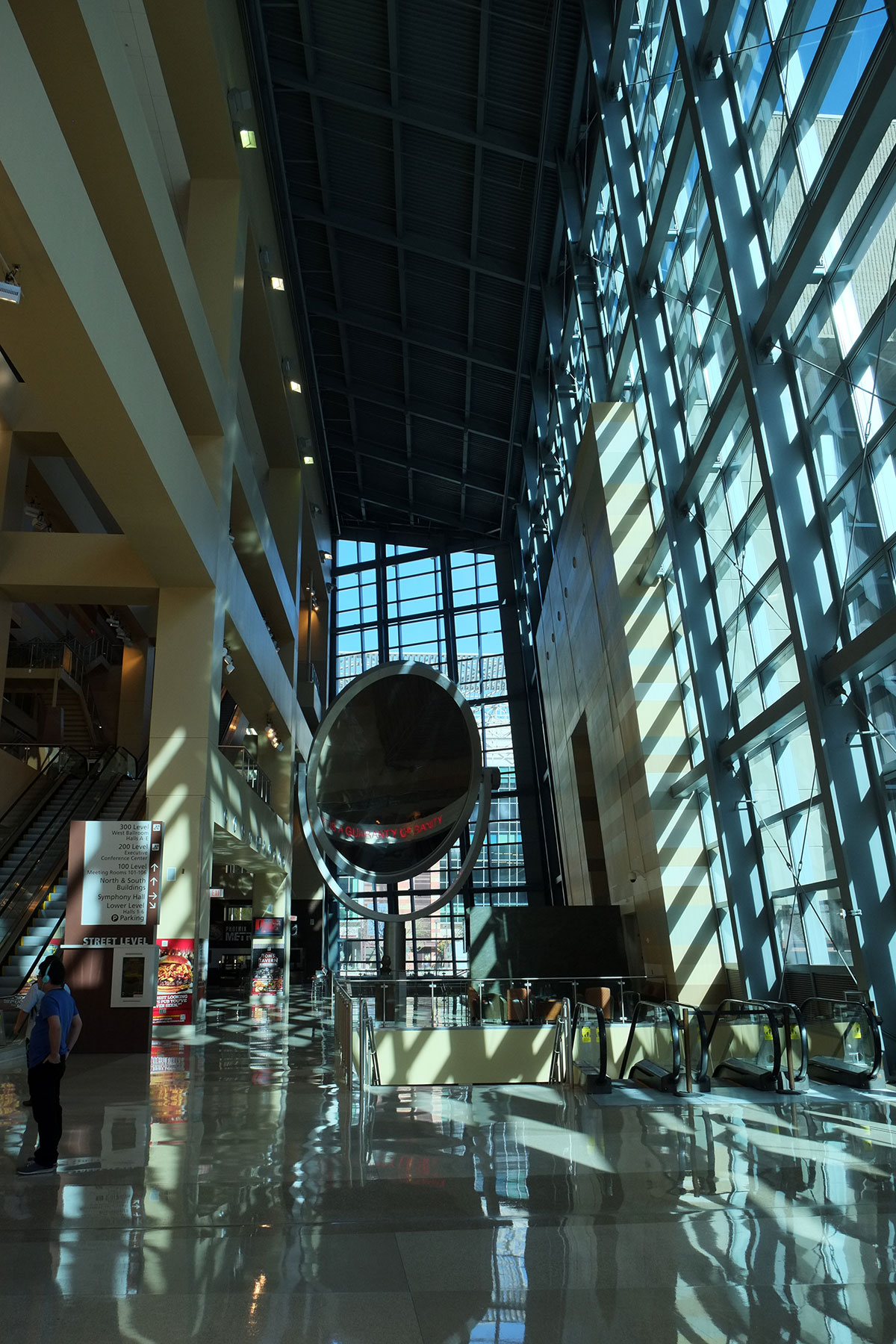
There is a large convention center, which has replicated itself across the street.  DSCF6634

80. Phoenix058DSCF6655

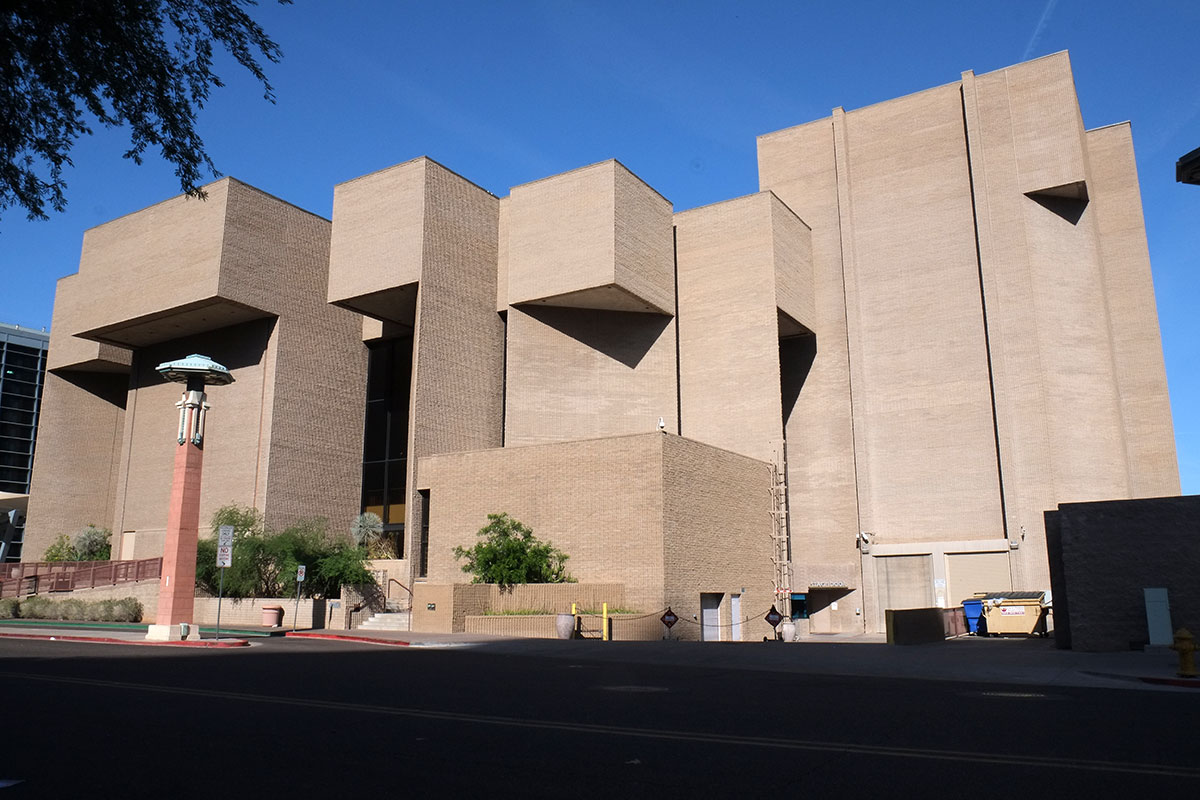
Next door is the Symphony Hall from 1972, the lone institution downtown which exhibits the local solid masonry wall tectonic, a not-inappropriate reference to vernacular pueblo architecture, before it was supplanted by the hegemony of the glass curtain wall (in the desert).  80. Phoenix057DSCF6651

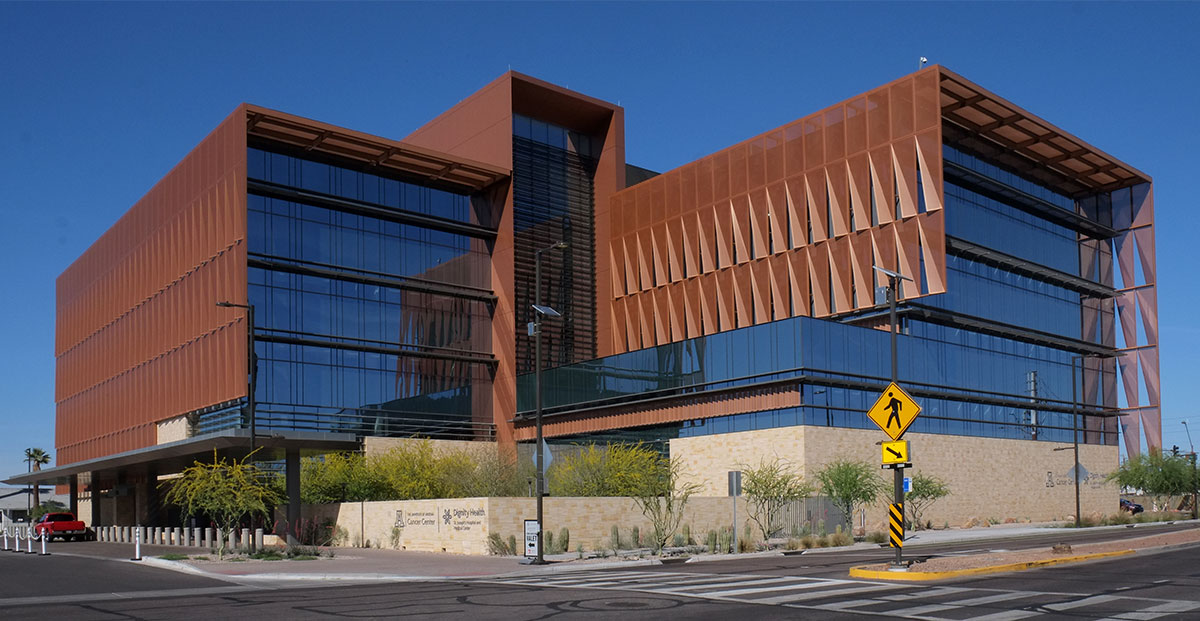
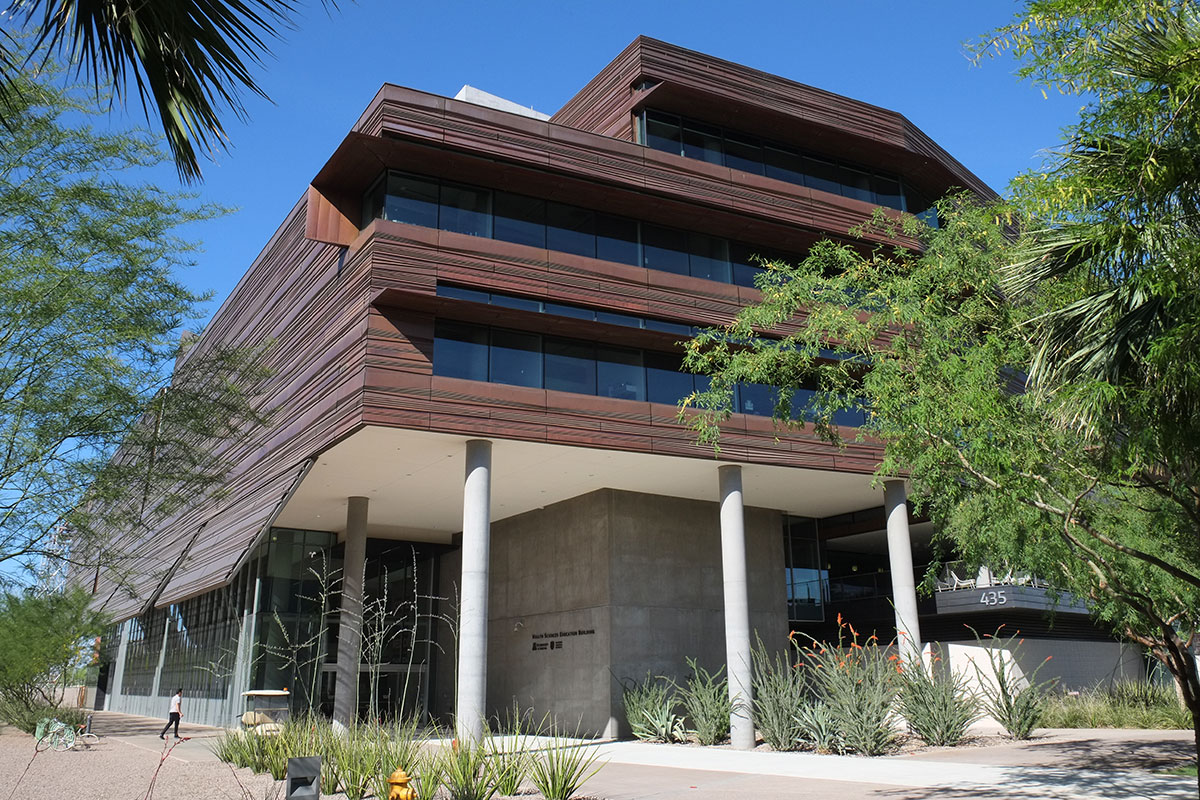
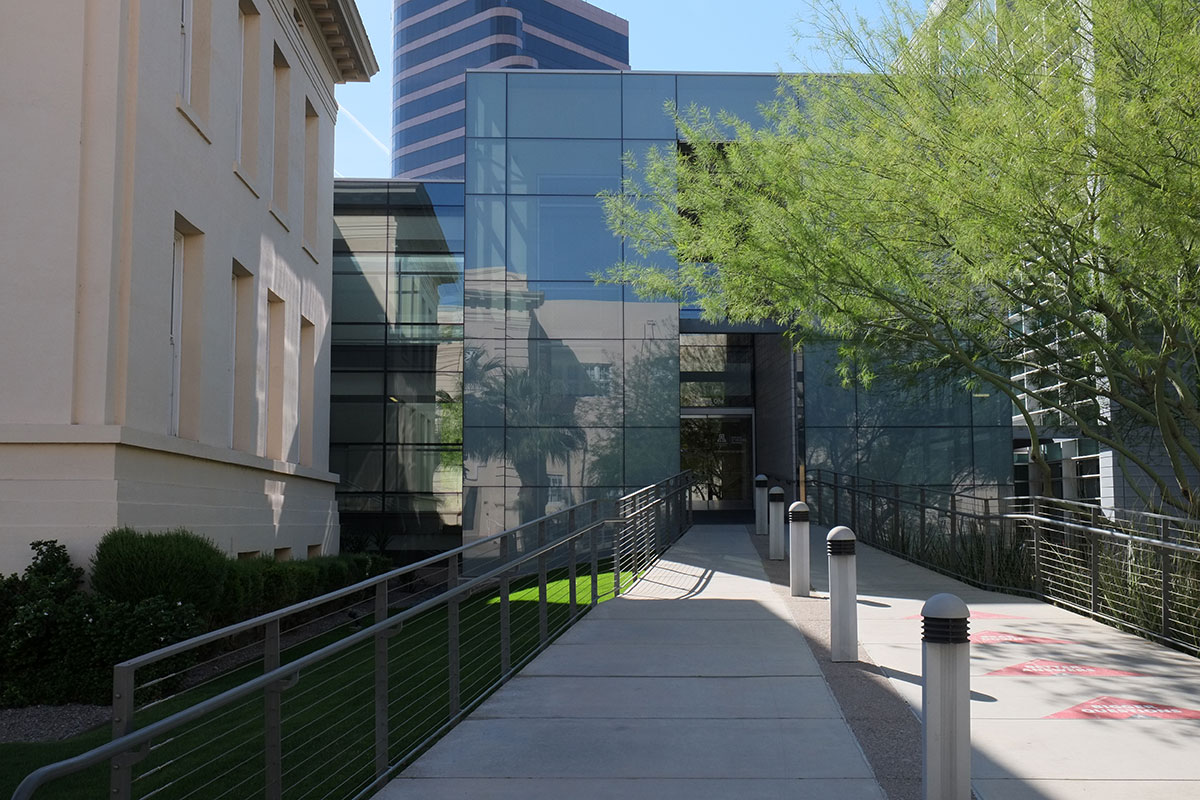
Arizona State and other universities have opened branch campuses downtown, mostly serving their professional schools and medical complexes.  They are good individual buildings, which are paying a lot of attention to sun screening, and getting a lot of expressive mileage out of that strategy.  80. Phoenix051DSCF6609

80. Phoenix052DSCF6619

80. Phoenix066DSCF6703

80. Phoenix053DSCF6621

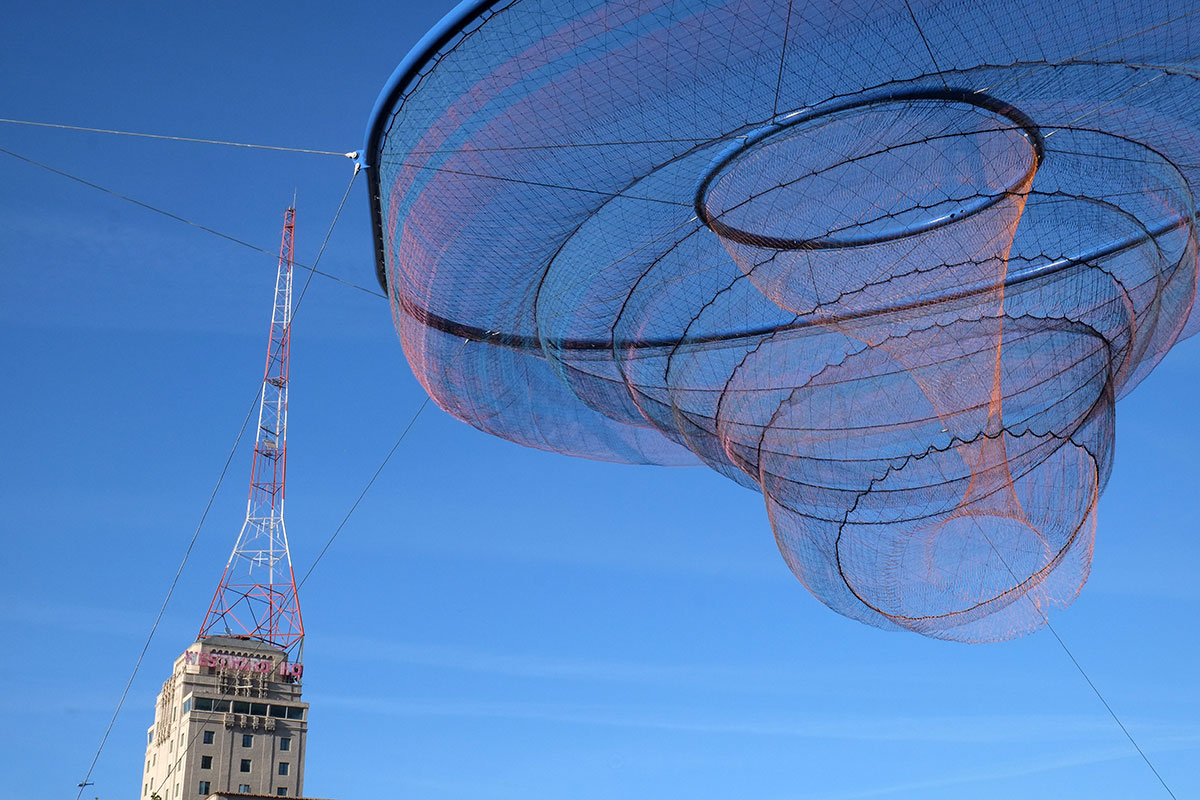
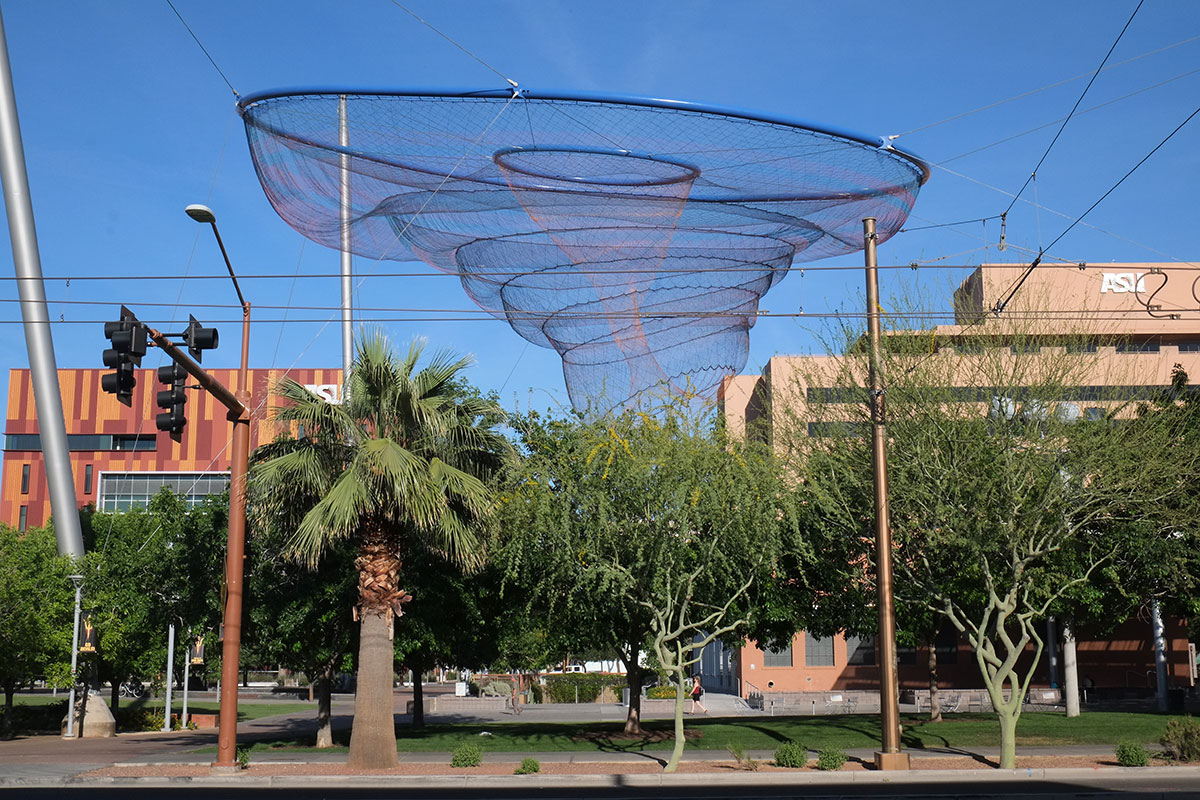
The Arizona State campus contains our favorite thing in the city – a huge cone of net, floating above a plaza, by the artist Janet Echelman (and completed with our colleague Philip Speranza as a consultant).  It really is beautiful, and provides visual entertainment, as you lie in the grass, soaking up the sun.  80. Phoenix068DSCF6720

80. Phoenix069DSCF6734

Beyond the universities, there are a lot of generic office buildings.  80. Phoenix060DSCF6662

80. Phoenix061DSCF6672

Leading to the usual Plays with Facades.  80. Phoenix065DSCF6697

80. Phoenix064DSCF6688

There is a sports district on the south side of the downtown, apparently a baseball stadium and a basketball arena, although it’s hard to tell.  I can’t remember their corporate sponsorship names (but that doesn’t matter, as they will certainly be renamed soon.)  They are in the style that might be called Faux Old Timey, or Times Square Wannabe.  Sports venues used to be Ducks (exhibiting their function in their form).  Now they are often Decorated Sheds, with the exterior being covered with some 21st century architect’s evocation of what the era of urban vitality used to look like.  The exuberance of the facades contrasts with the utter desolation of the streetscape – not a pedestrian to be seen, except when there is a sporting event.  Many cities now have equally dead sports zones, but few go to such elaborate lengths to try to disguise the inherent death of real street life.  80. Phoenix059DSCF6657

Downtown Phoenix is not very coherent as a city center, but it does have some good buildings.  It was notable that all the interesting architecture has been built by the universities, whereas the more typical downtown buildings of offices and hotels are completely banal.

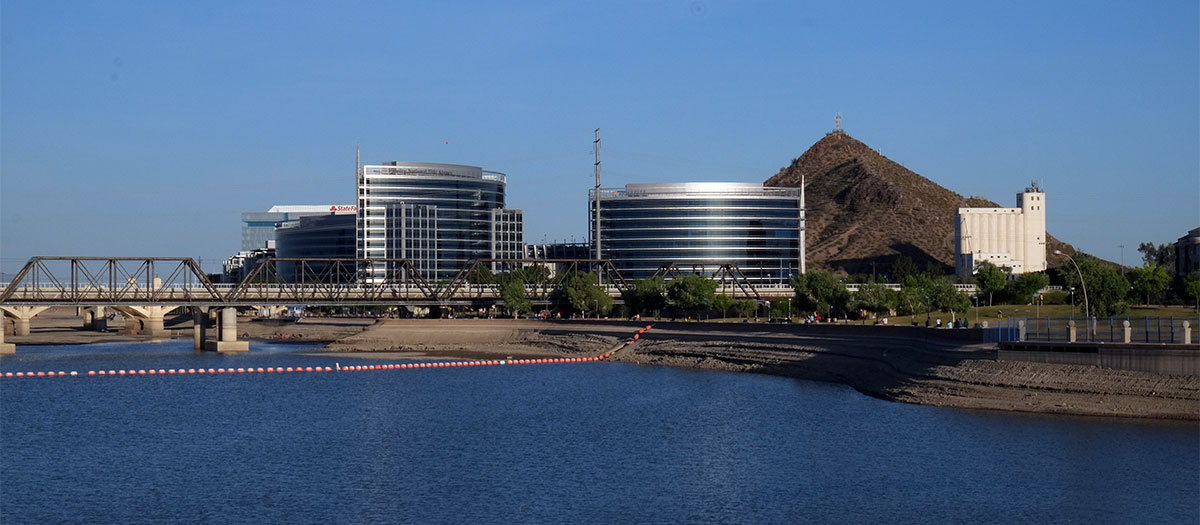
We moved on to Tempe, looking for the gastropub Greta had selected.  One the way, we discovered some interesting things.  Tempe may have generic buildings too, but everything looks better when you add in a river (dammed at this point to create a wider body of water) and have a butte in the near distance to give the city some scale.80. Phoenix070DSCF6761

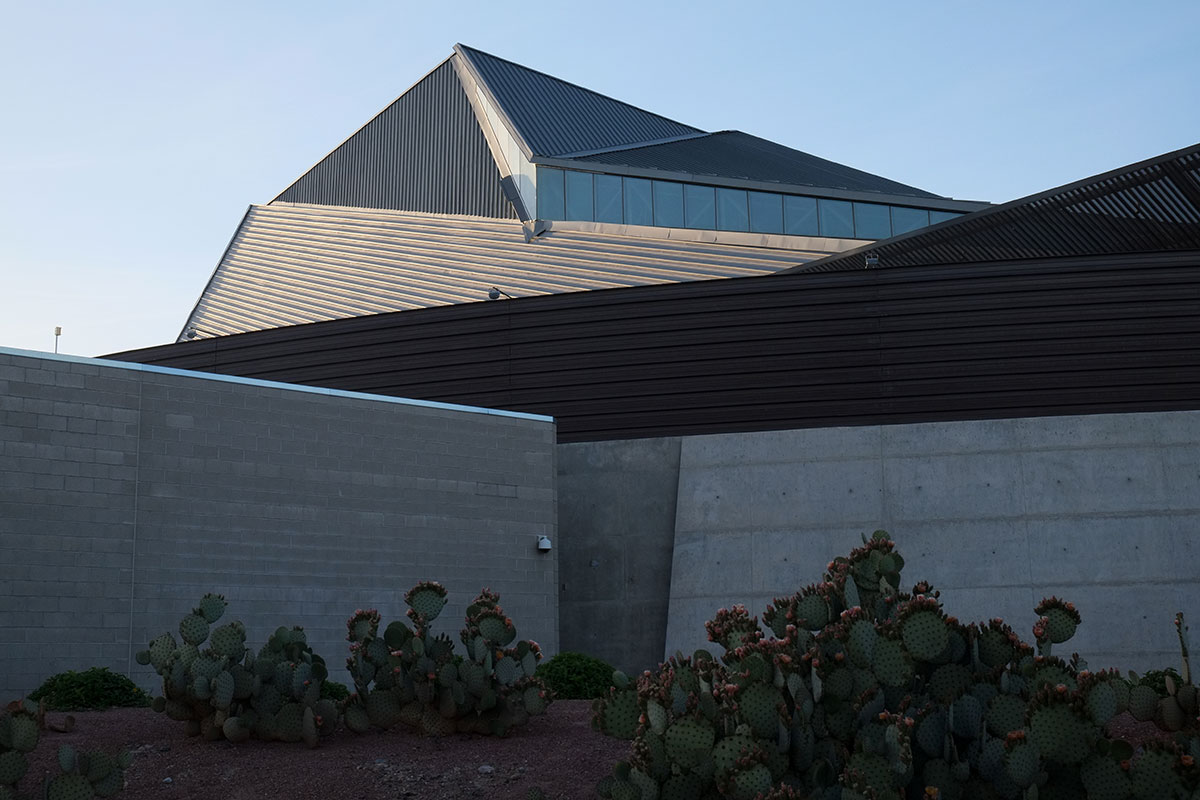
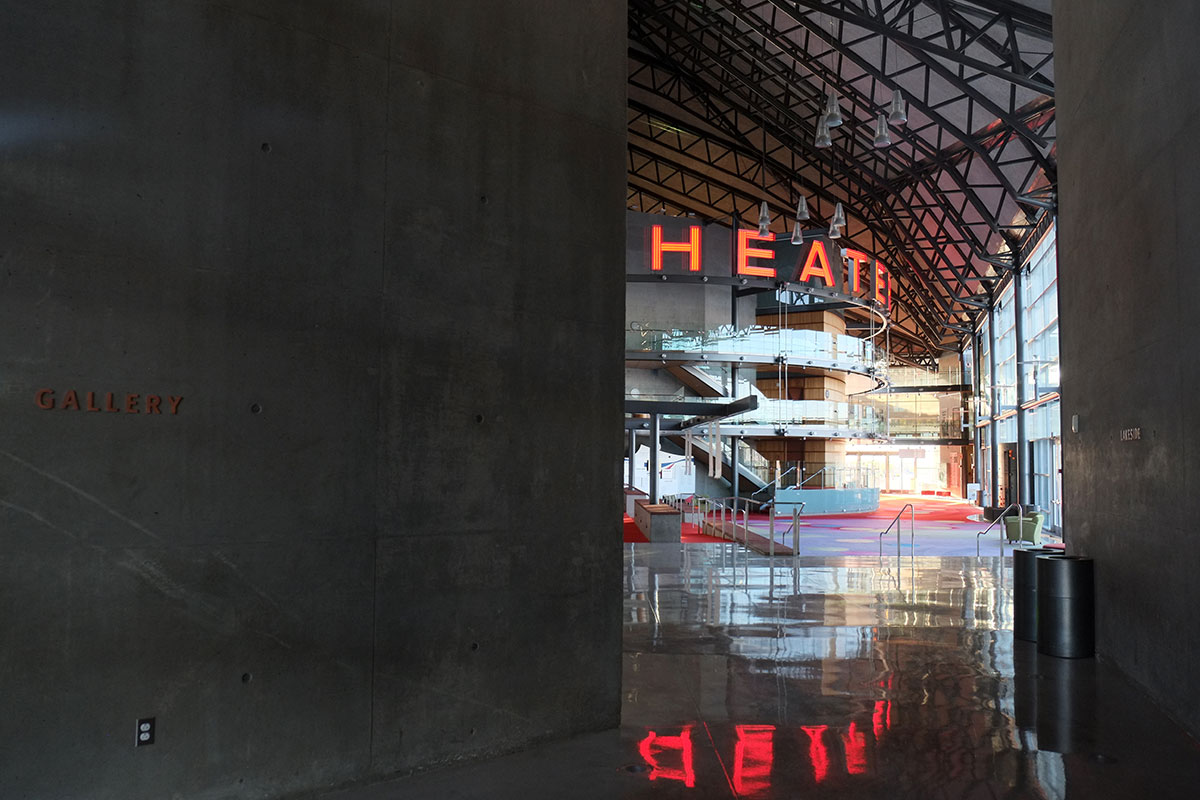
We also visited the Tempe Center for the Arts along the river, designed by Barton Myers, clearly referring to the history of FLW and his followers being active in this area.  It is a very nice building, with simple planes of solid panels and selective use of glazing to open the lobby up to the river on the north.  80. Phoenix072DSCF6783

80. Phoenix071DSCF6776

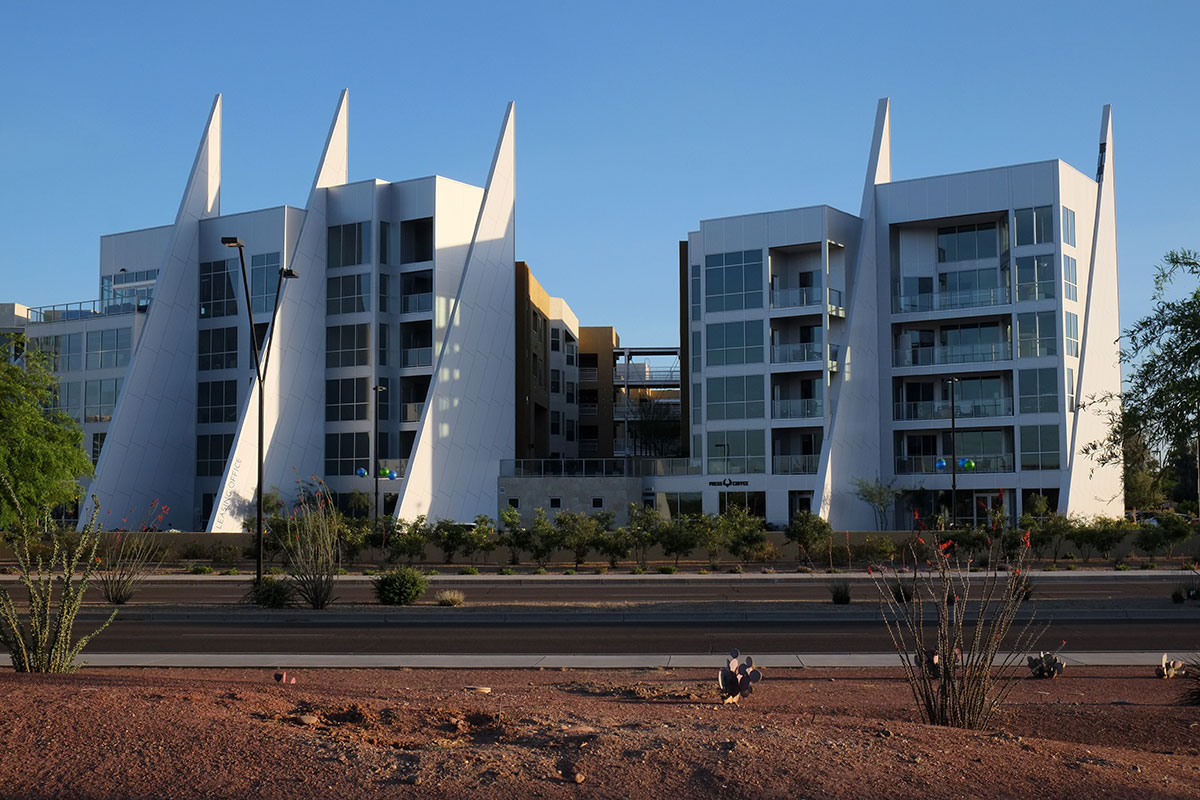
Across the street there was a hip new housing development. I’ve never seen apartment buildings before with tail fins.  80. Phoenix073DSCF6784

The fundamental question about Phoenix (and other late 20th century cities) is whether their character has been inexorably formed by the new way they came into being – sprawl before core – or whether their current character is mainly the result of their being so new.  Will they become more like older cities as they age, or is there something permanently different about them?  We may never see the answer to this in Phoenix.  With NASA’S prediction of a mega-drought occurring in the Southwest in this century, it seems likely that Phoenix will become uninhabitable before it has the opportunity to evolve.  Our trip theme of climate-change-farewell-tour has usually focussed on what will be changing in the natural environment, but the changes that will be coming to cities have become more apparent as we have traveled through Miami, New Orleans and Phoenix.

Tucson

DSCF6506If you haven’t travelled extensively in an area, you still have many preconceptions about it, formed through what you’ve heard or read or seen on TV – some of which may actually turn out to be true.  Texas was where this became most apparent to me, as I had an abundance of received cultural knowledge and opinions about it, even though I had never before ventured out of DFW.  Although I had travelled through the Southwest a few times, I had never been south of Phoenix, so my opinion of Tucson was similarly secondhand.  All I knew was the syllogism – Tucson:Phoenix as Austin:Houston.  Just as Austin is the place in Texas distinguished by being nothing like the rest of Texas, Tucson is the place in Arizona that symbolically stands in contrast to the horrors of Phoenix.

Tucson is one of those mid-sized American cities (metropolitan area population under one million) which is livable and pleasant due to its not being within the ambit of the flow of global capital, nor prosperous enough recently to have grown exponentially in the past 30 years, when the homogeneous American sprawlscape reached its true apotheosis, and when the banal behemoths of recent skyscrapers have overwhelmed older downtowns.

Tucson also is fortunate in its limiting geography:  just as Portland is hemmed in by the west hills and the rivers, Tucson has mountain ranges to the east and west, so the sprawl in those directions is finite.  Also luckily, large areas of both those mountain ranges have been set aside, both as part of Saguaro National Park, and as other state and local preserves.  We stayed in a county campground adjacent to Saguaro on the west side, one which was so quiet and dark that we could watch the stars and listen to the coyote packs at night;  this is within ten miles of the city.  Phoenix has the misfortune to be in a much larger valley, so the sprawl can go on unimpeded for fifty miles in each direction, while Tucson is about twelve miles wide.  Aerial photos confirm that Tucson hasn’t sprawled very much in the past 30 years, so its suburbs exhibit a blend of the old and the new that can also be seen in its downtown, and which may be the key factor in whether a district has any character or not.  (cf. jane Jacobs again.)

Both cities are college towns, and while the much larger Arizona State dominates the cityscape around Tempe, it feels like a more local phenomenon within Phoenix’s four-million metro area.  The University of Arizona is still large (about 32,000 students), and it seems to be more central to the character of the whole city, as it is less than a mile from the downtown.

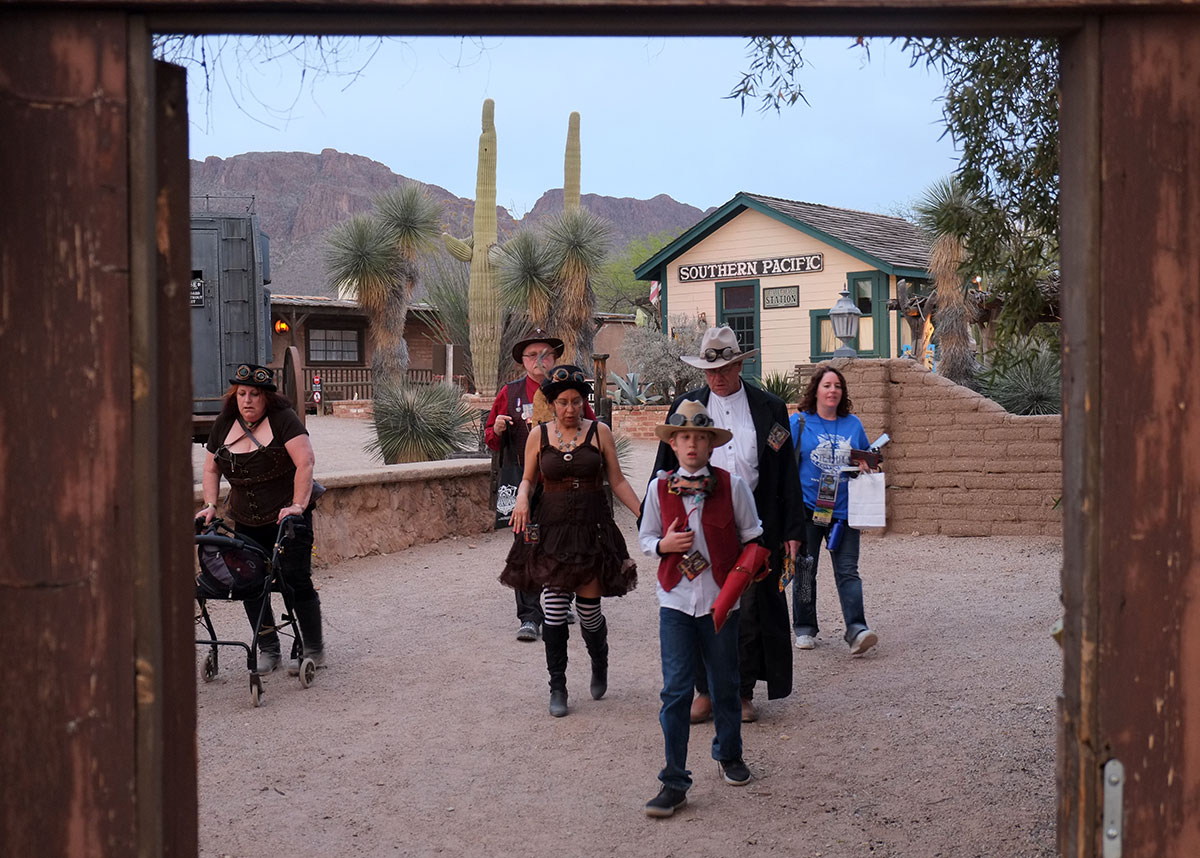
We cruised through the suburbs on our way to and from the mountains, and swung by something called Old Tucson, which started out as a movie set back in the 30s, but which is now a western theme park.  We arrived at the end of the day, just as the Wild, Wild West Steampunk convention crowd was leaving.  It was a little scary, and seems to have knocked Greta out of her steampunk fascination, as she has seen the future and it’s not a pretty sight.  DSCF6437

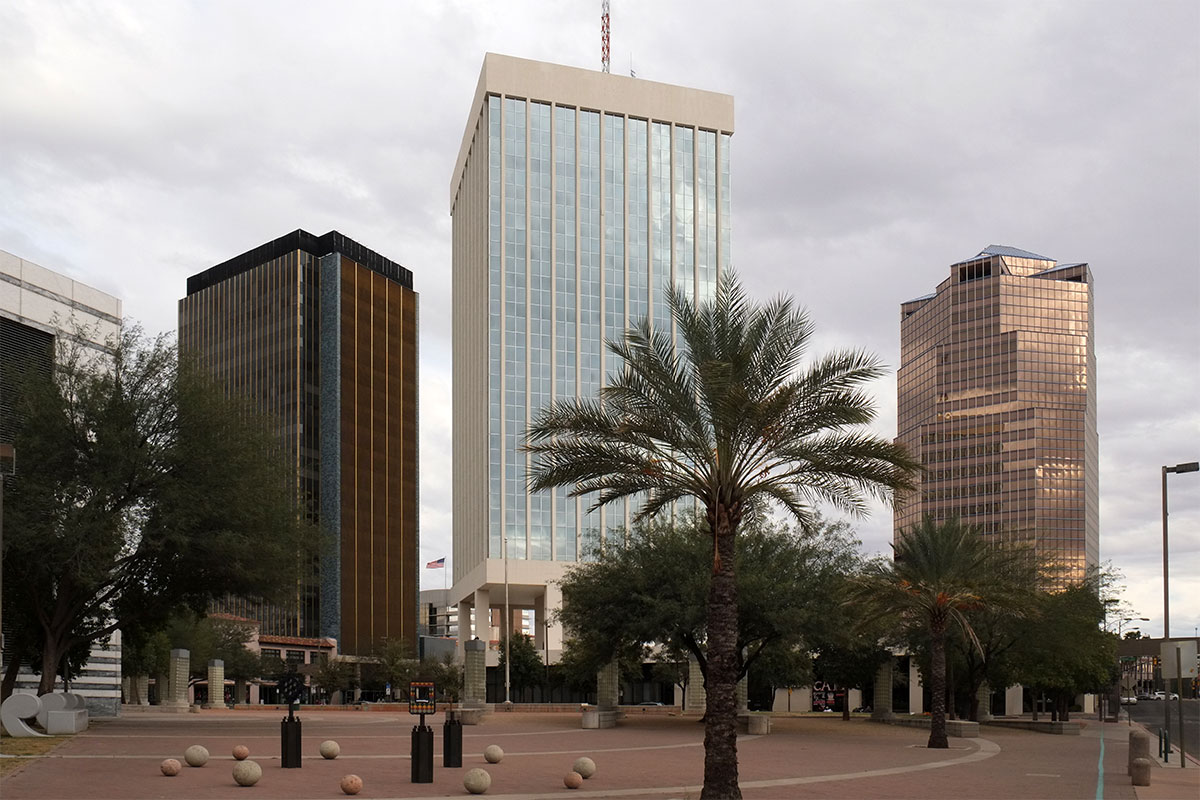
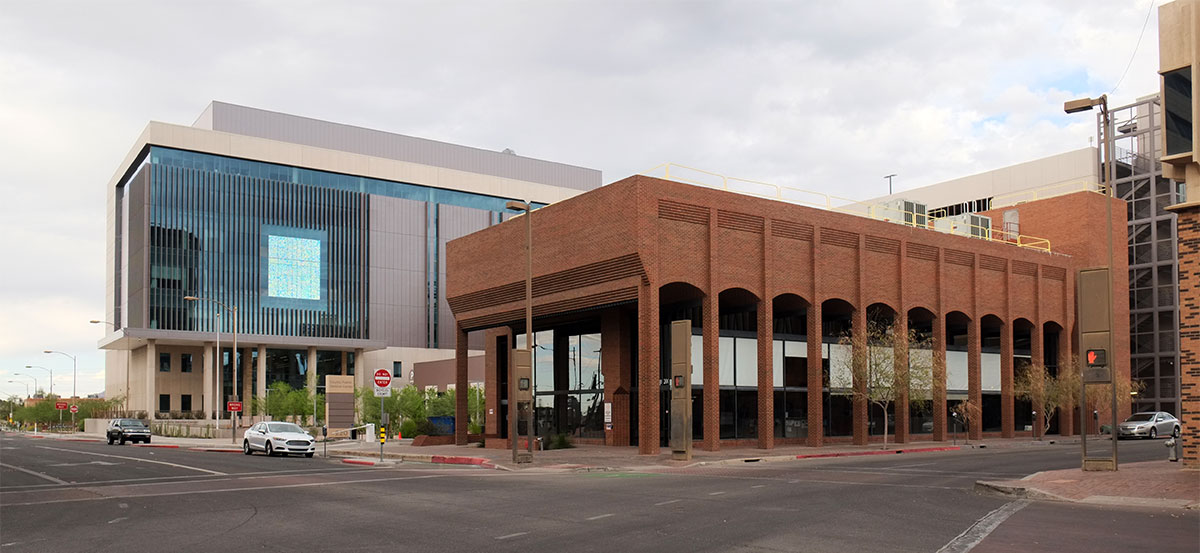
We spent more time in the city core.  The downtown has a lot of buildings from the 60s and 70s, DSCF6470

which are not gorgeous, but at least they’re not too big.  There are also some not-great institutions, such as the library DSCF6464

and some newer buildings which aren’t much better.  DSCF6466

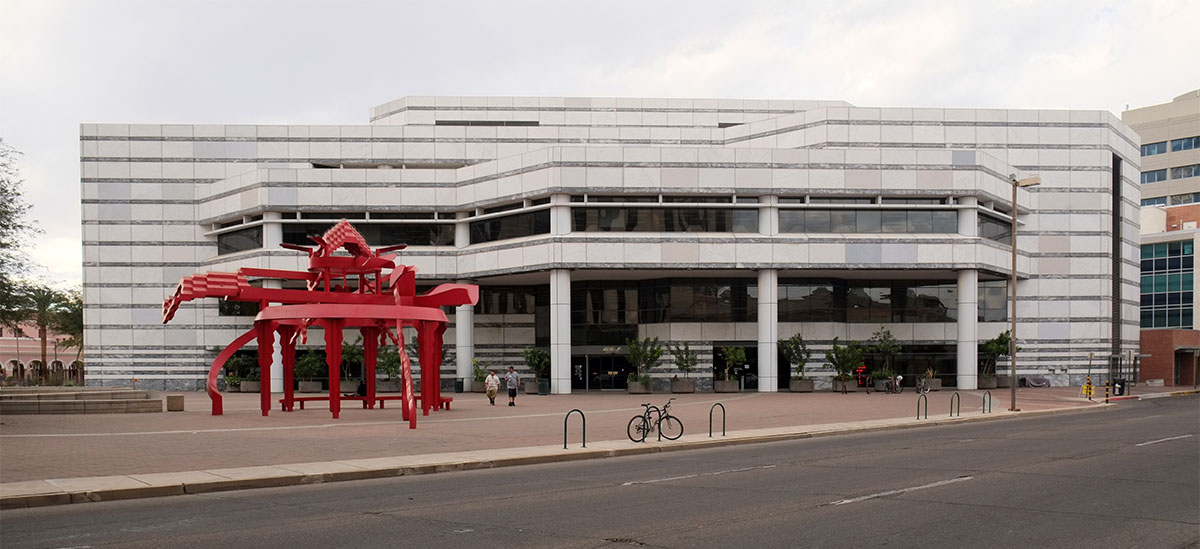
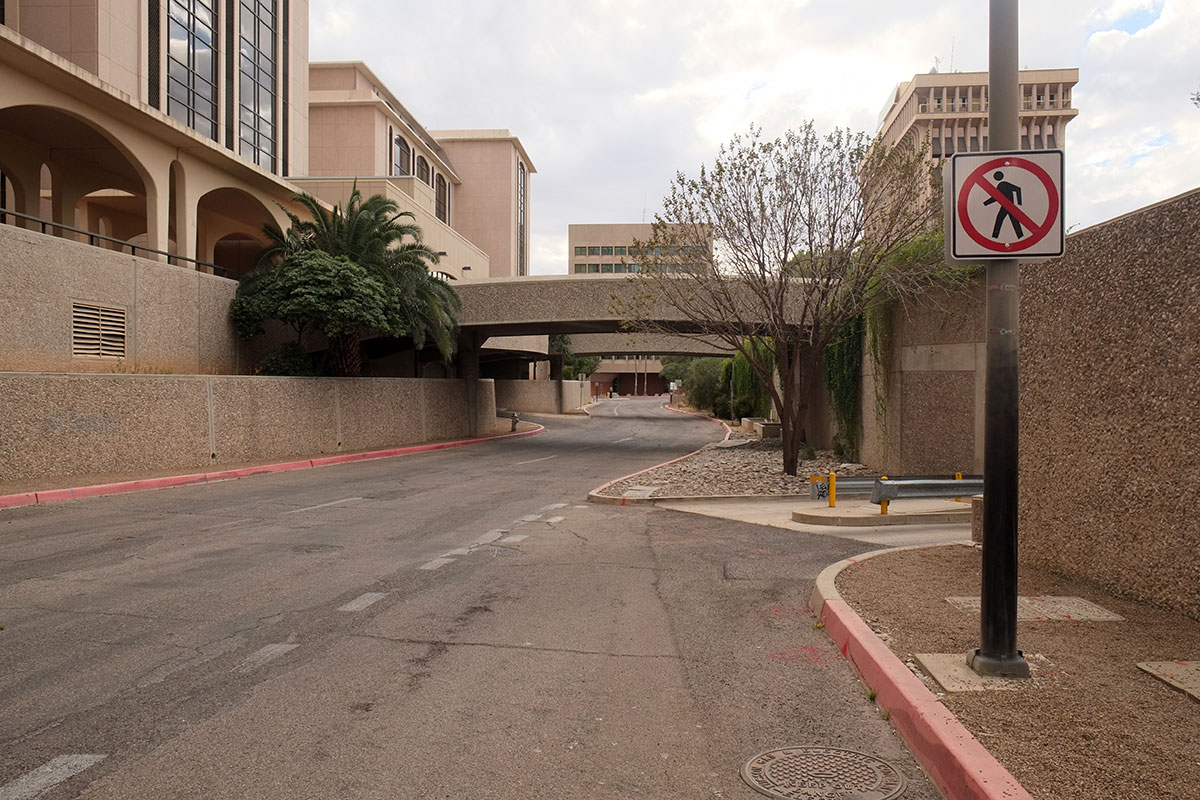
The Tucson downtown can’t seem to make up its mind – is it a city downtown, where fabric buildings define the public spaces of the streets and squares, or is it an edge city office park, where object buildings sit isolated in a sea of parking and undefined open space?  The open spaces are just too big, the developable lots are too big, and while the object buildings cry out for attention, they’re really not very good.  Tucson committed only one ghastly error, creating a superblock around their county government campus, where a subterranean parking level may hide a lot of cars, but which disrupts the street pattern and channelizes traffic onto a few big arterials.  The no pedestrian sign is the tip-off of the portal to this netherworld.DSCF6474

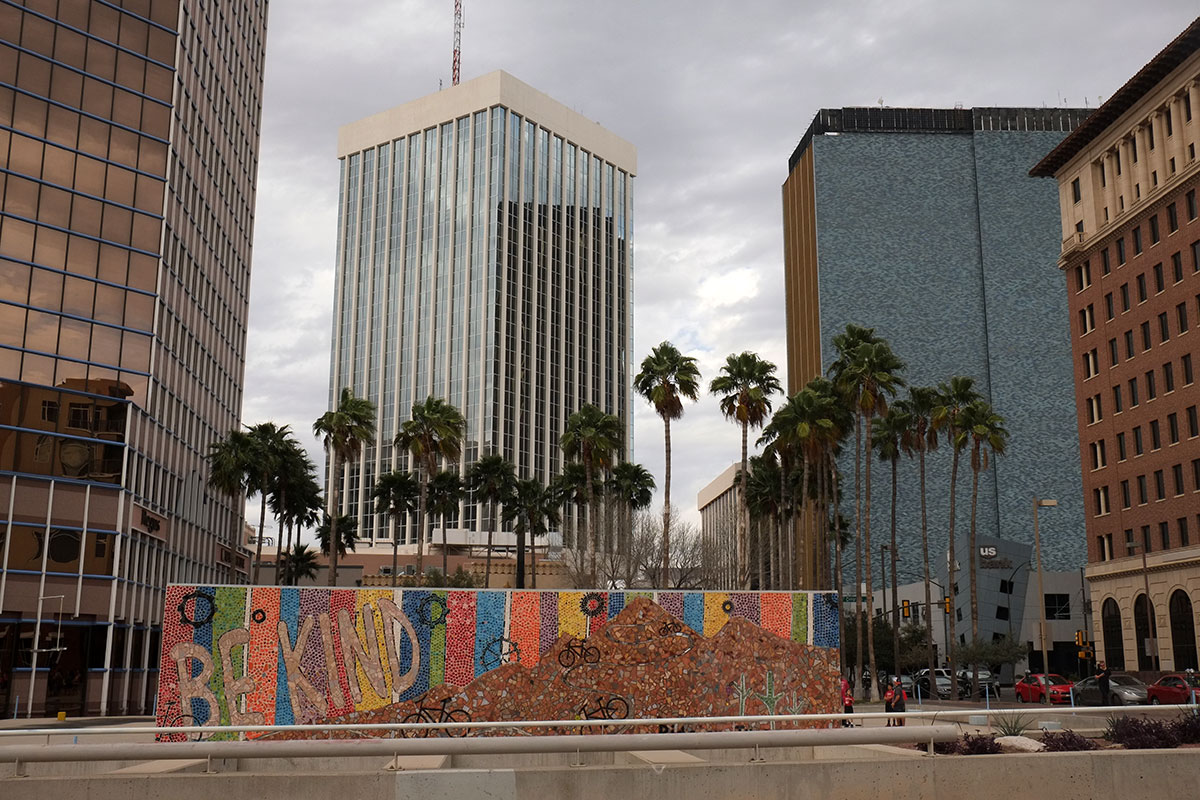
I don’t know the history, but it looks like they urban-renewed (bulldozed) their old downtown (or an adjoining neighborhood, probably “blighted”) during the 60s, and replaced it with these towers (versus Eugene which bulldozed its downtown and forgot to build anything new).  And then probably having overbuilt their office market, things ground to a halt.  It’s not great, but it’s fixable. DSCF6460

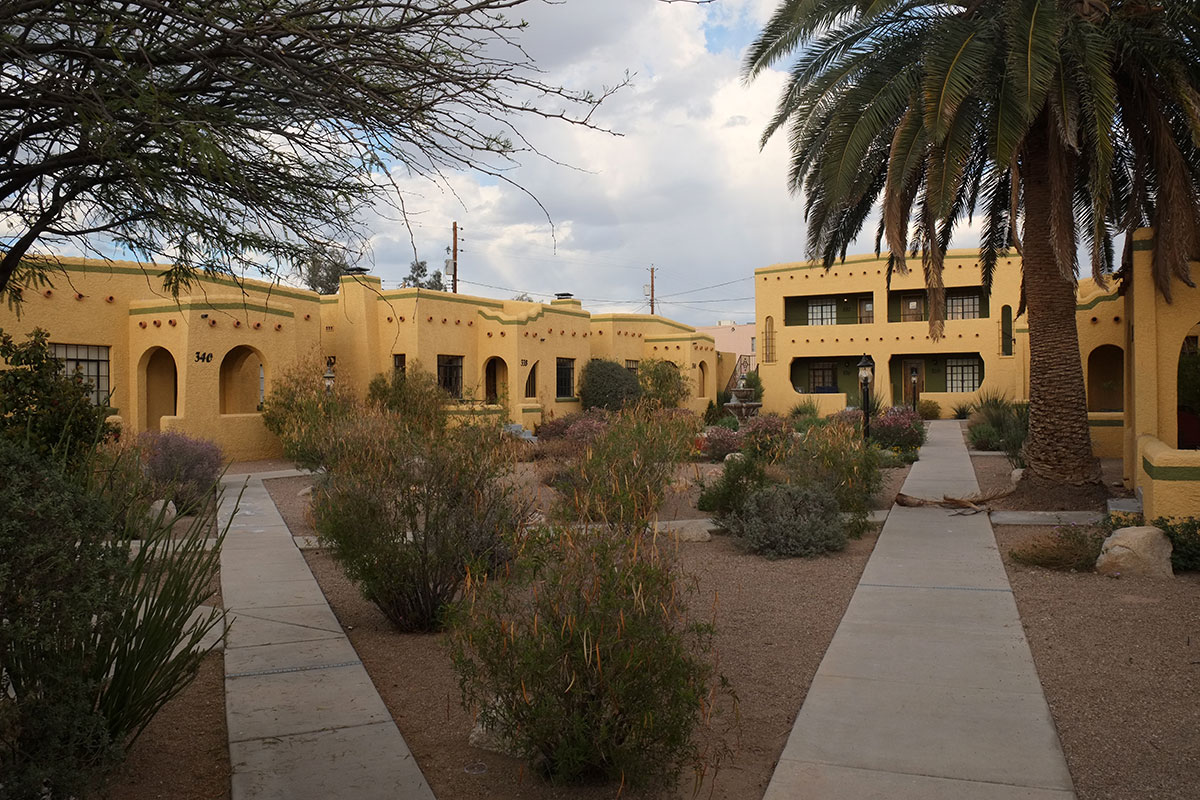
The good news is that the adjacent neighborhoods – Barrio Viejo, Armory Park and Iron Horse – were largely left alone.  Today they are the usual mix of gentrifying bungalows, small multi-family projects, light industrial and new commercial that can be seen in many other older city first-ring cores.  There was a reasonable amount of street life in all these areas, even on a Sunday.  The damage was limited to the one core area, and even that is better than many we’ve seen.

The university area, which is surrounded by low-scale residential neighborhoods, felt familiar.  A nice mix of small-scale, old multi-family: DSCF6479

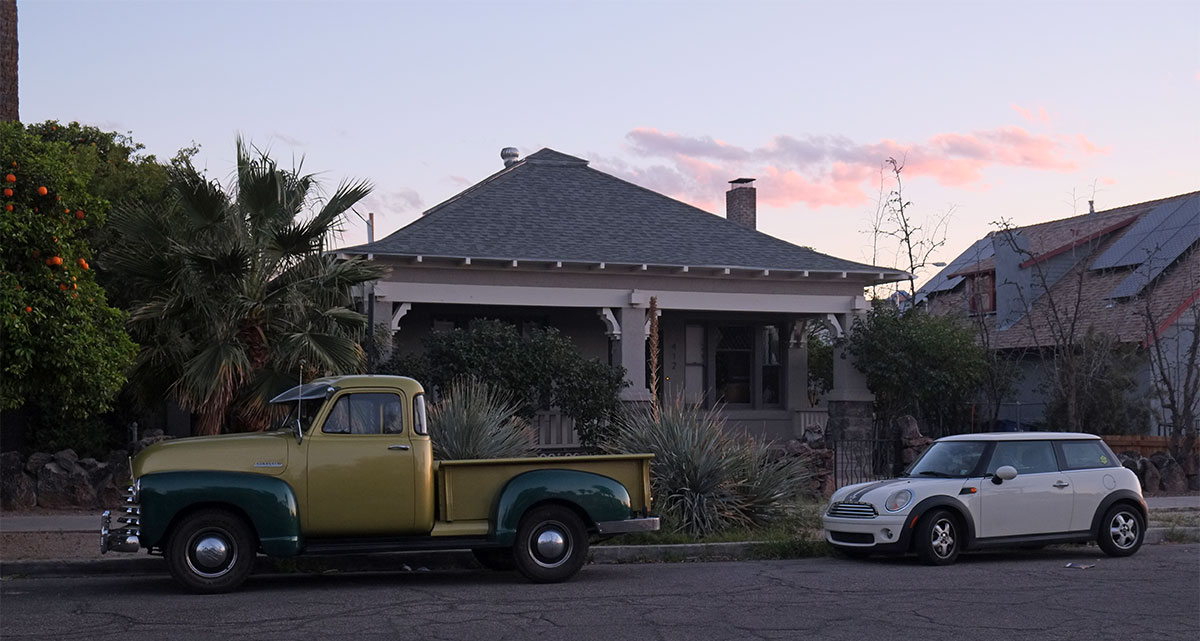
and upscaling bungalows (the Mini being the universal sign of this), although they are getting some large, privately-developed student housing, just as in Eugene.  DSCF6554

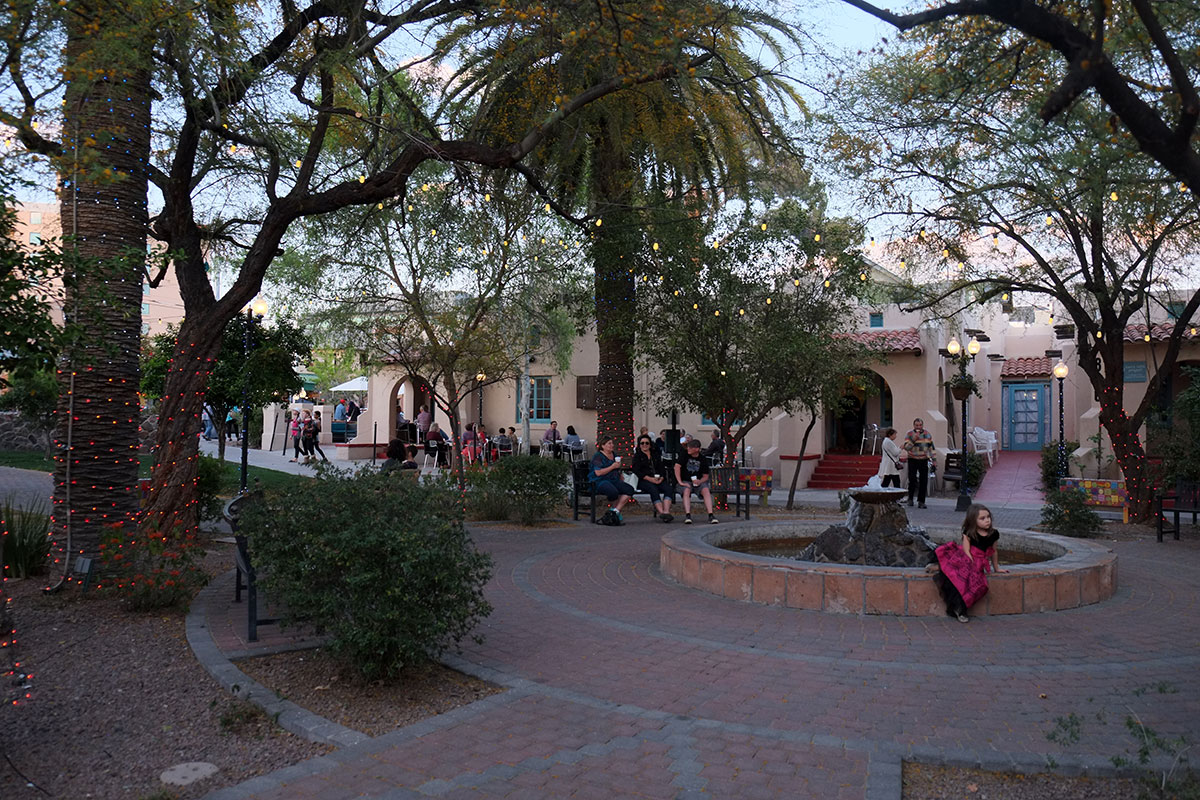
The college-town commercial area is very lively, with many open-air cafes, such as in  this lovely courtyard development.  DSCF6547

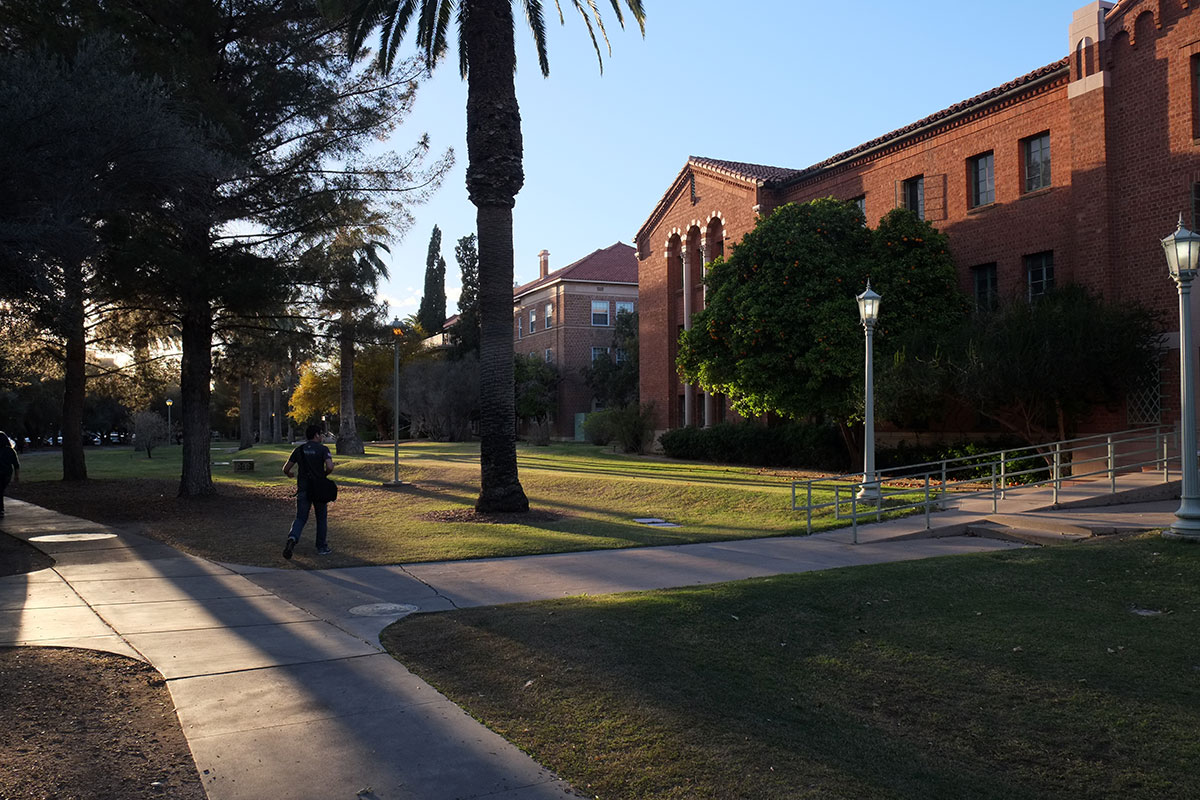
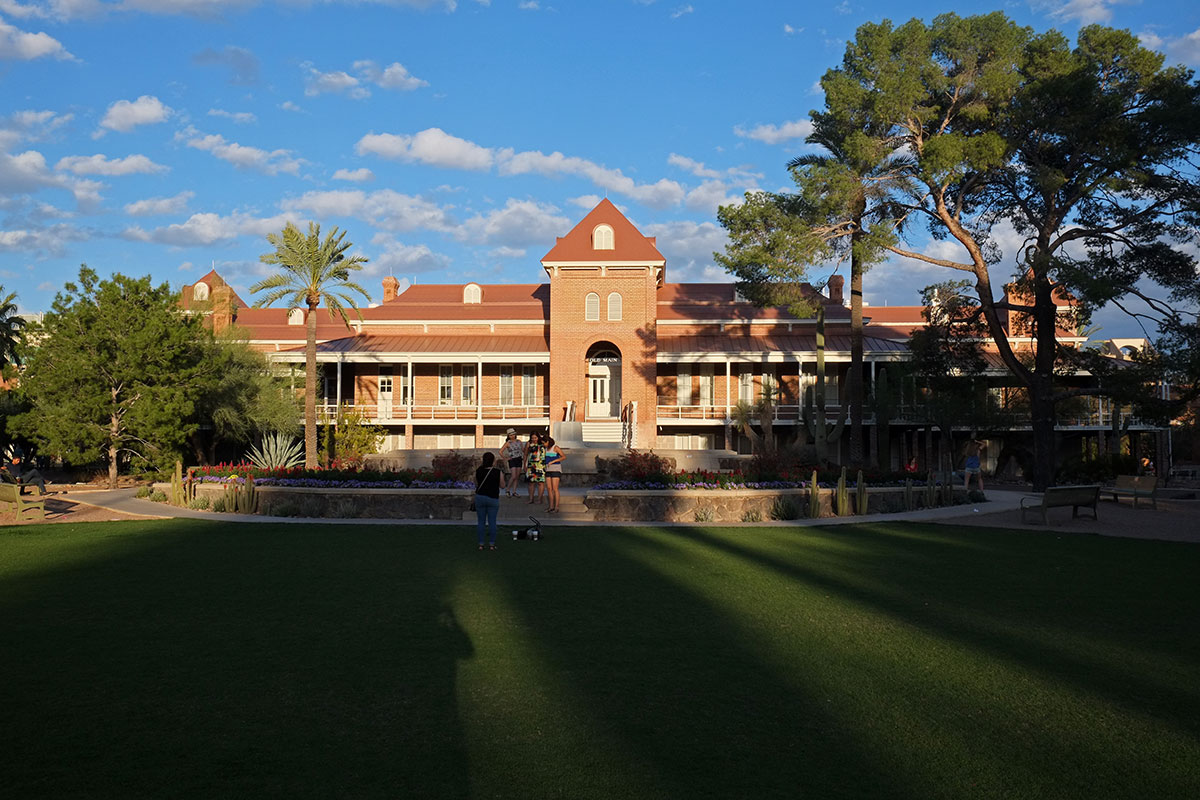
The campus itself is beautiful.  It is similar to the University of Oregon, being within a city but with a distinct campus edge, rather than blending into the city fabric.  Also similarly, the campus has a well-landscaped core, with elegant old buildings, all variants on a brick/southwest style, set in manicured lawns.  DSCF6516

DSCF6513

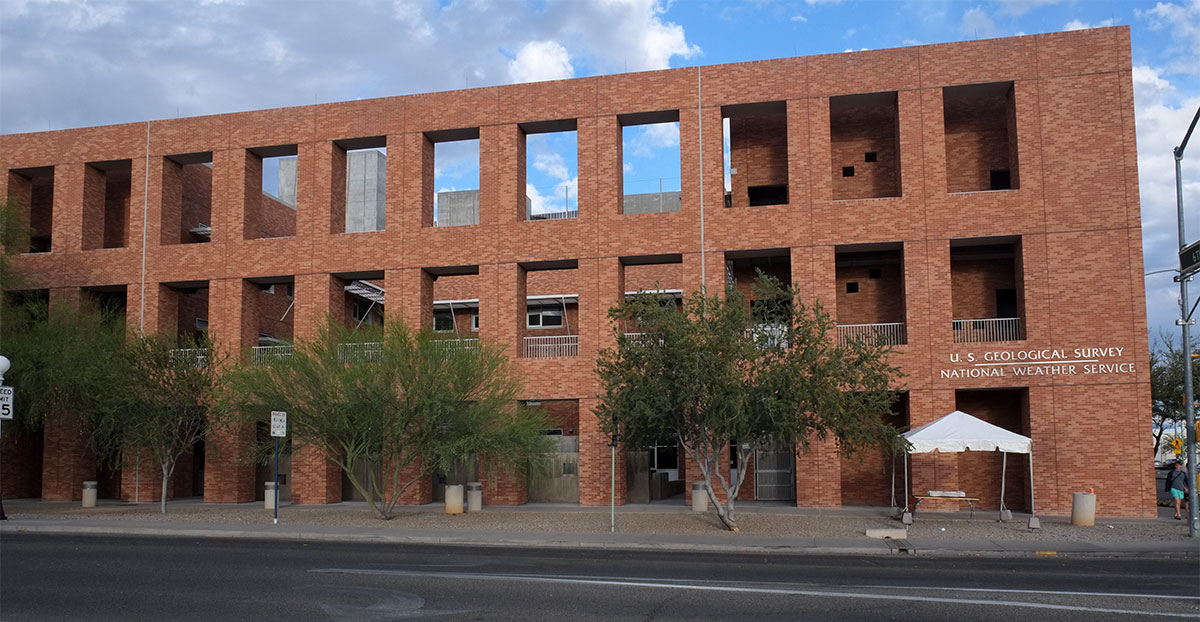
But the recent development is the most interesting.  They have done a fantastic job of fitting relatively large, new buildings into the existing framework, not overwhelming the scale of the campus, nor adhering slavishly to stylistic prescriptions (both of which happened at the University of Texas).  The buildings themselves are also good to excellent, and are notable for the uniformity with which they have addressed environmental issues (primarily sun-shading) in this desert environment.  An older US government building on the edge of the campus has a screen wall which defines a courtyard:DSCF6485

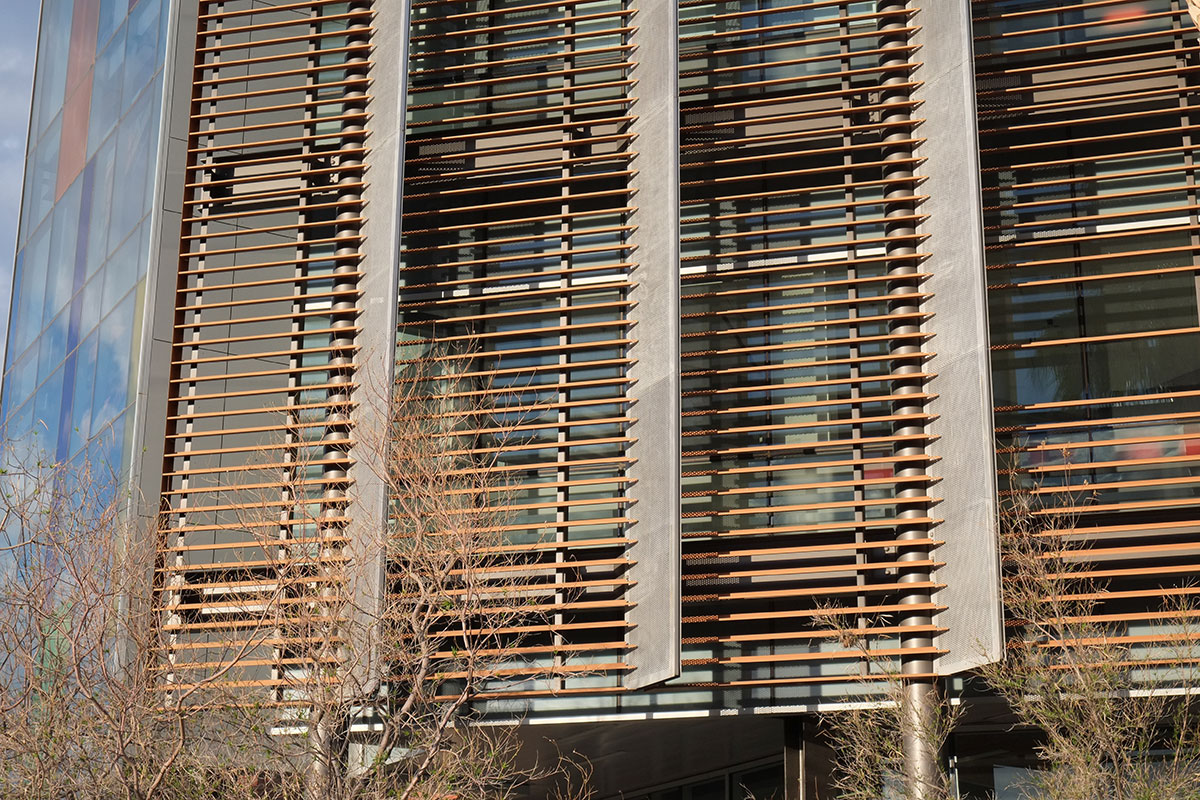
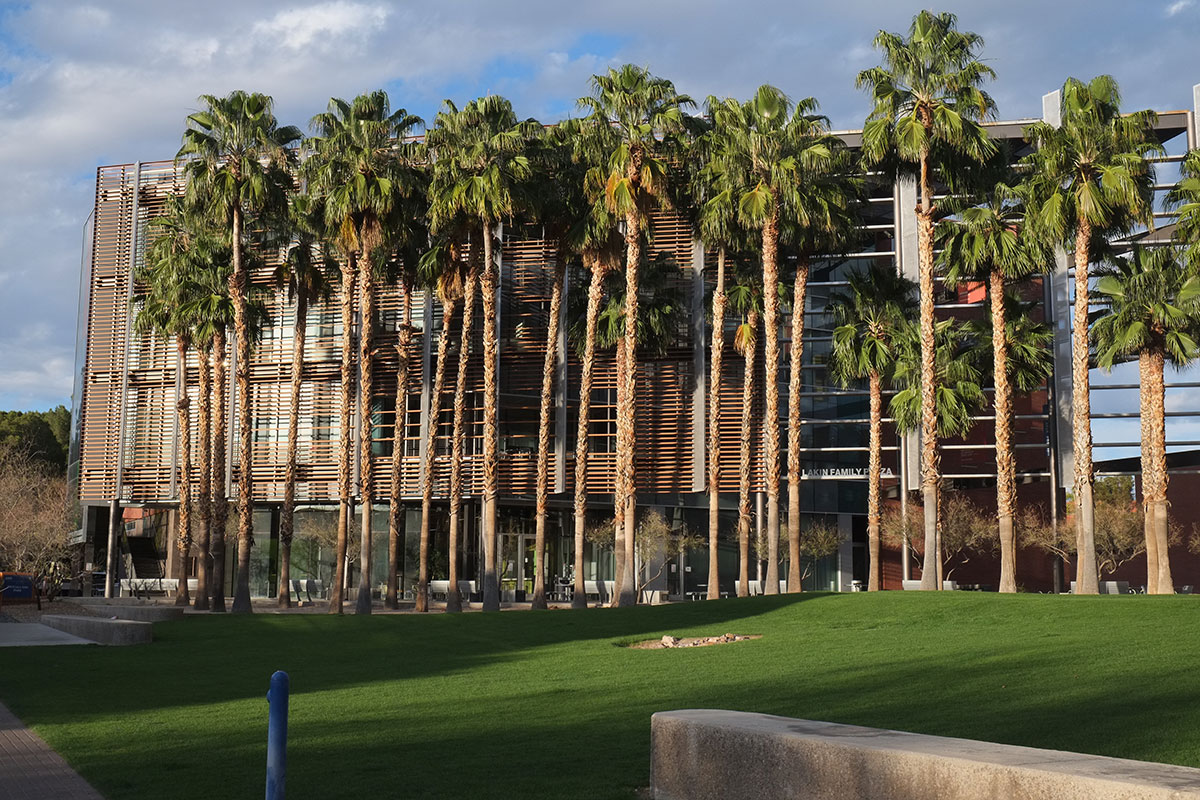
A new building at the business school has a south-facing facade which utilizes both palm trees and a sophisticated brise-soleil for shading.  DSCF6503

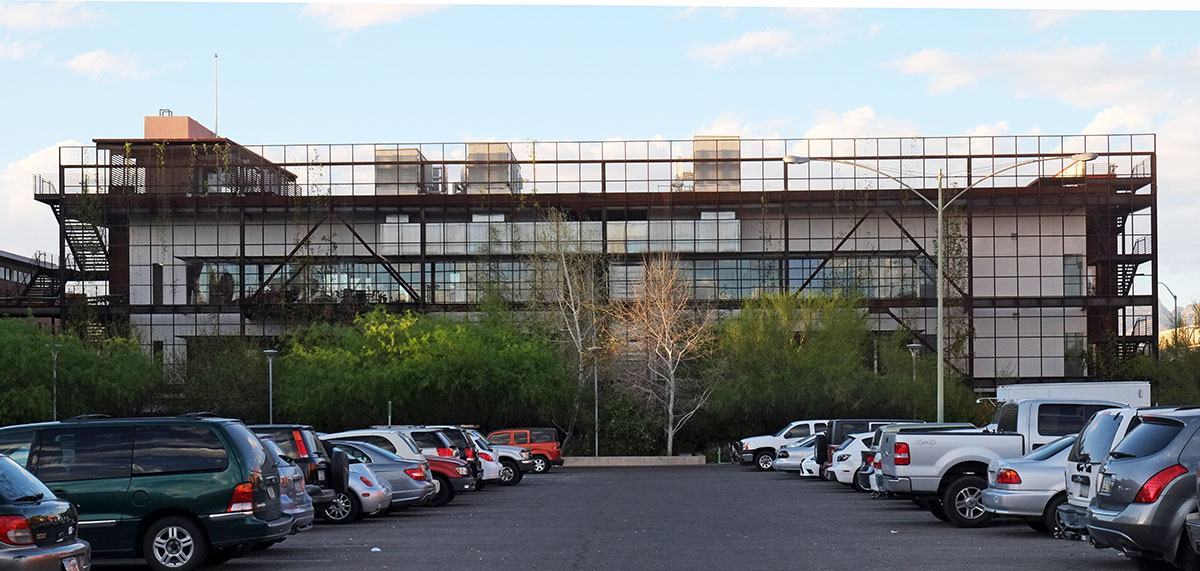
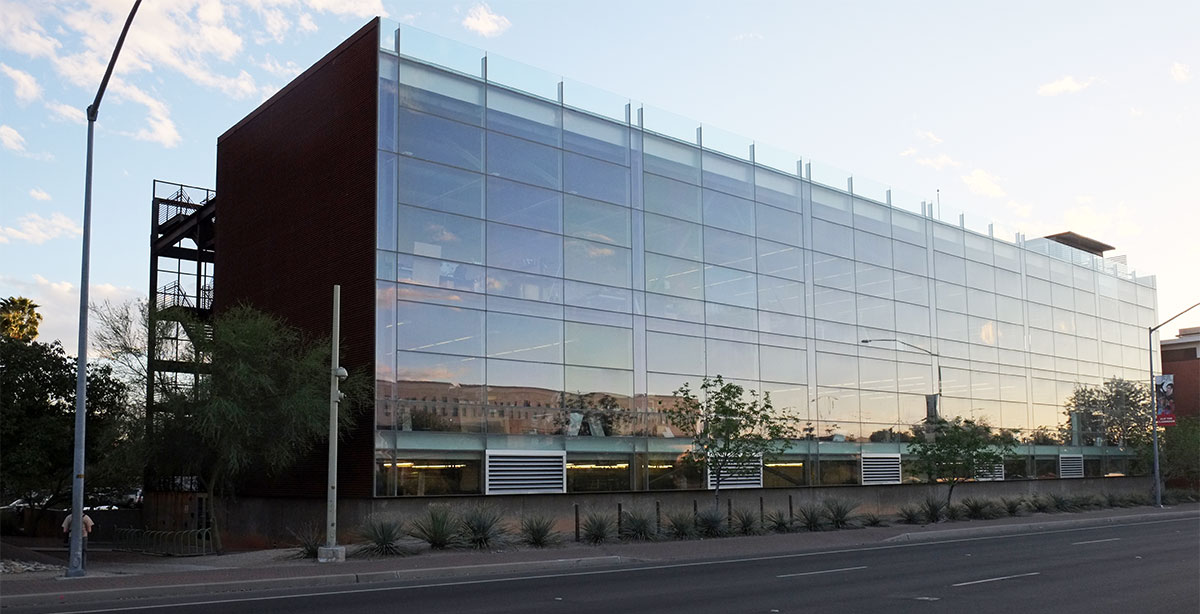
Even spotted from a long way across campus, my instincts told me that this was the architecture school.  It is in fact a large addition to design college (CAPLA), designed almost ten years ago by Jones Studio, in Tempe.  The environmentally-responsive diagram is completely straightforward:  a long east-west bar, with extensive and deep shading on the south side.  DSCF6520

There are architectural shading elements, as well as a framework for plants, and a garden area where a native landscape is nurtured and used for installations. DSCF6528  DSCF6524

The east and west walls are mostly blank, with circulation DSCF6531

and access into an openable shop on the ground floor.  DSCF6533

The north side, which faces a major arterial, is glazed for daylighting the studios.  DSCF6535

An excellent building, which takes it cues from the strong determinative forces of climate and program, and which articulates those in a systems-driven building with elegant detailing.  It is a truism that in most places, the new architecture building is usually the worst building on campus – architects seem to feel the need to make a design  “statement” when given such a visible project.  It was a pleasure to see Jones Studio take an opposite tack, and do all the sensible moves really well, illustrating what an architecture driven by substantive ideas rather than style can be like.

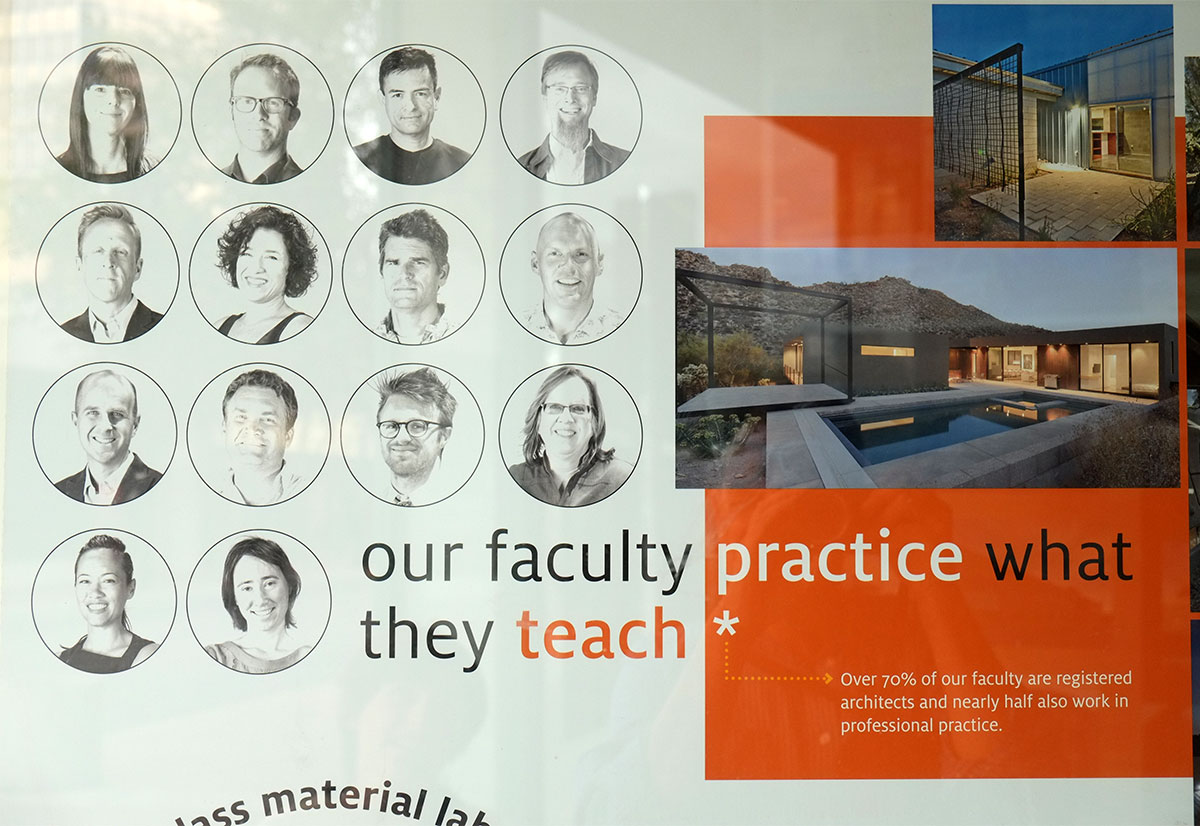
I don’t know much about the architecture department at the university, but outside the university’s downtown center, I spotted this amazing sign:  DSCF6462

They seem to think that it is a good idea for their faculty to be involved in the design of architecture;  in fact, they celebrate it!  This is probably good for their accreditation, and even good for their students’ education, but I don’t know how they can maintain this attitude within the confines of a big research university, where the preference for the written article over the designed building has become almost universal.  (If it hadn’t been a Sunday I might have dropped in to explore job opportunities, as they appear to be deficient in the proportion of cranky old guys on their faculty.)

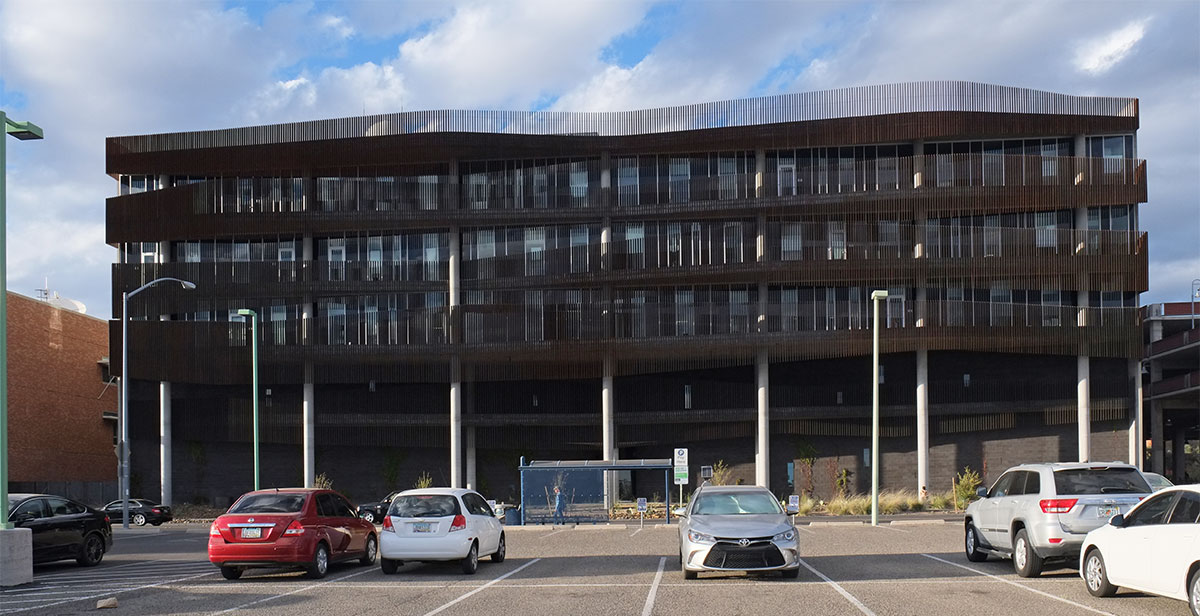
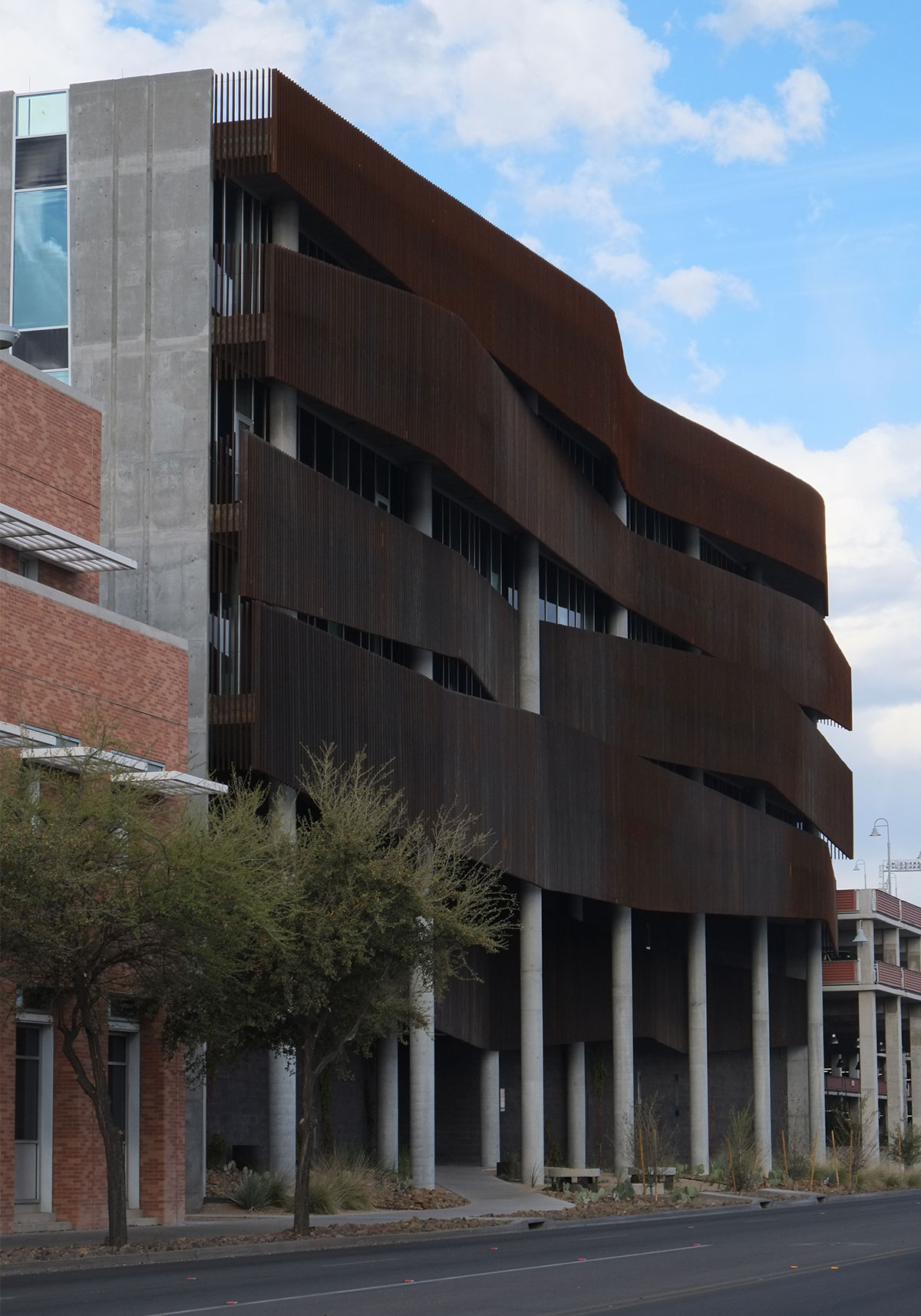
There is an even newer, bigger showcase building on the south edge of campus – the Engineering and Natural Resources Building 2, designed by Richärd+Bauer and GLHN, both from Phoenix.  It opened last year, and has been lauded for its sustainability performance and its support for interdisciplinary efforts.  The south elevation has a functional yet expressive shading system,DSCF6491

with an occupiable colonnade tucked under the building edge, offering respite from the busy arterial.  DSCF6483

The north facade has a thinner variant on the shading system.  DSCF6499

The middle of the building is a deep courtyard, which supports daylighting and ventilation strategies, and which works metaphorically as a slot canyon.  DSCF6495

Another building where the ideas of building performance drive the architectural expression;  something is clearly going on in the university culture, if they are producing so many fine buildings.  We saw one more element, which simultaneously puts the University of Arizona at the forefront of sustainability, livability and hipness:DSCF6496

There are lessons we could learn from this university, and lessons both positive and negative at the city scale.  I had my limited preconceptions about Tucson before we visited, but the reality turned out to be even more interesting.

19th-century forts

We haven’t been following a military history agenda on this trip, but when an intact installation  appears, we check it out.   We came across two forts in Florida and Texas, which were built for very different circumstances, but which had an interesting connection.

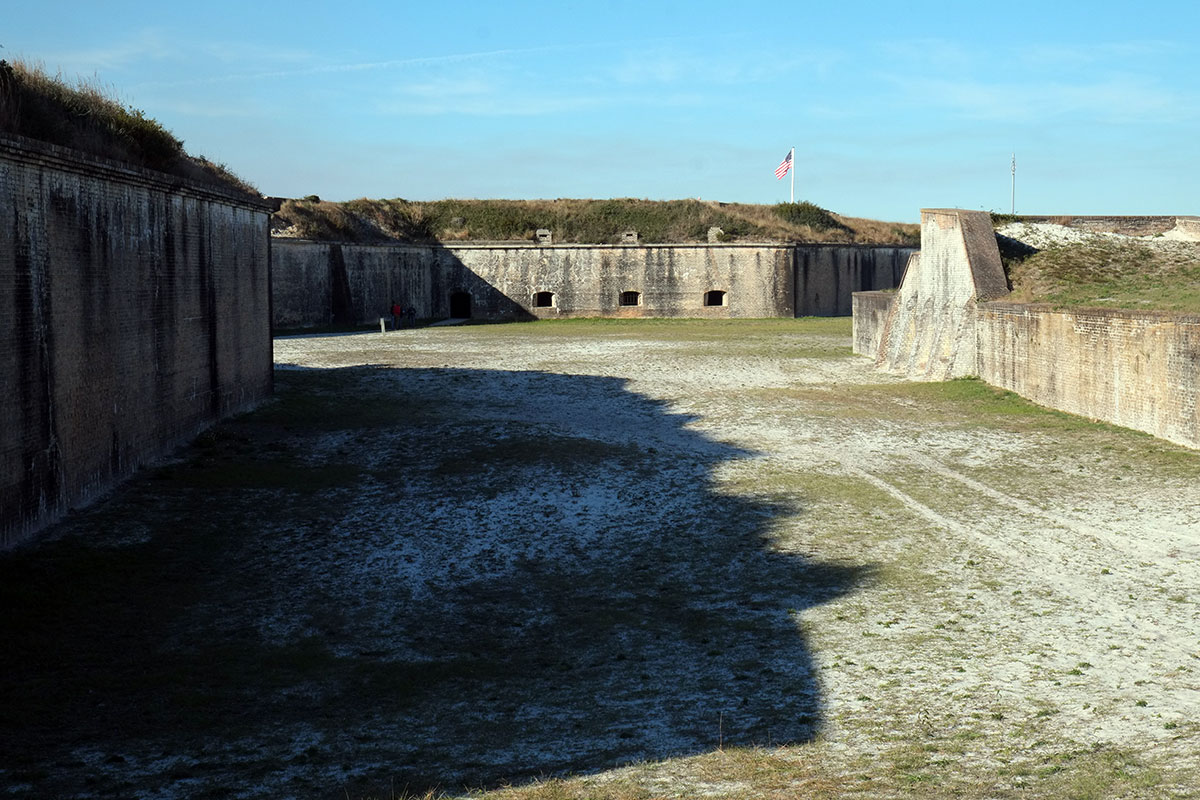
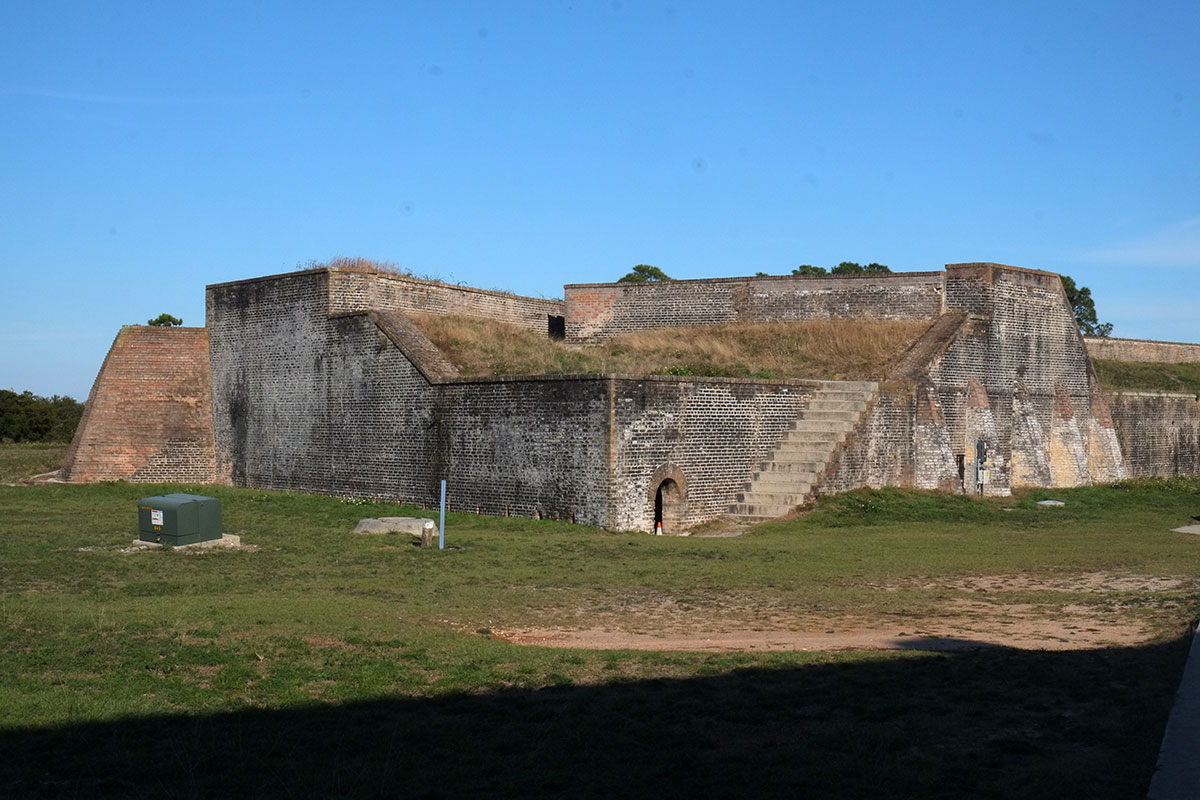
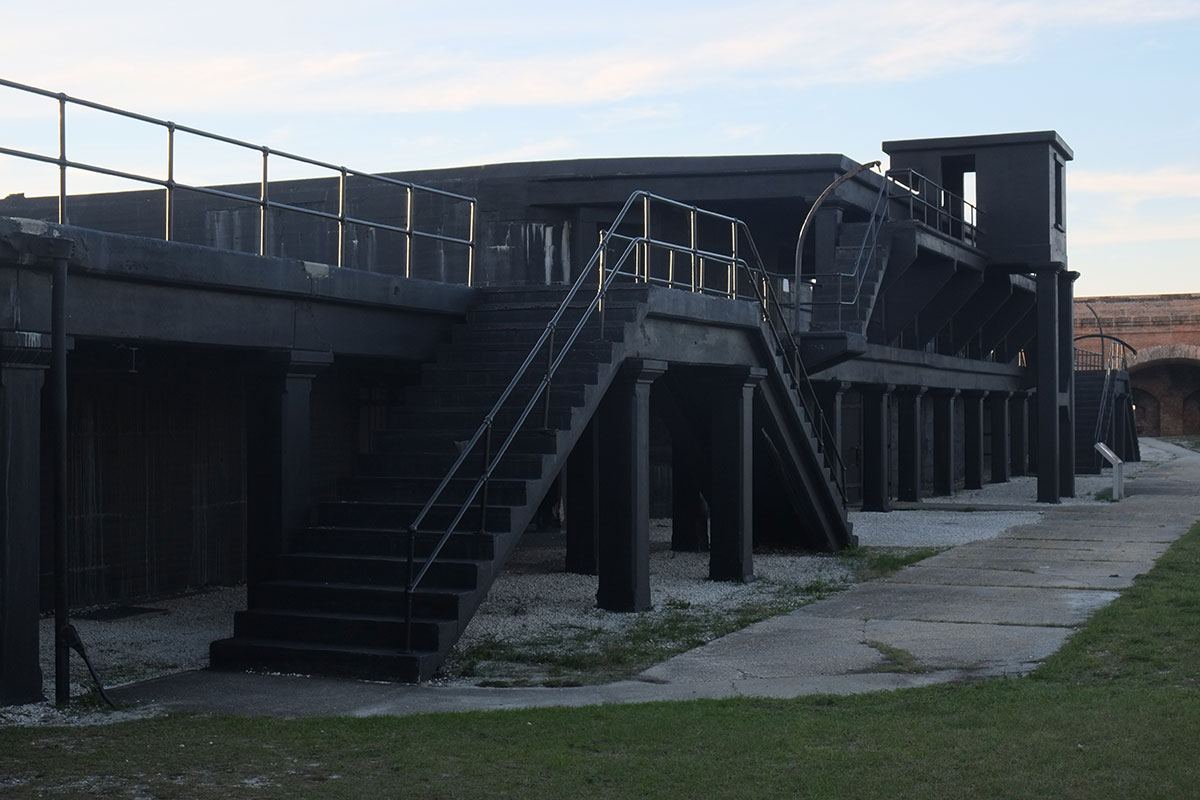
DSCF0996Ft. Pickens was the largest fort built to defend Pensacola Bay.  It is located at the tip of Santa Rosa Island, and is now part of the Gulf Island National Seashore.  Built largely with slave labor, it was finished in 1834.  It is of the  type known as a Third System Fortification, unified forts with extensive earthworks to resist naval bombardment, and containing large guns to shell ships that attempted to enter the bay. DSCF0953  DSCF0965

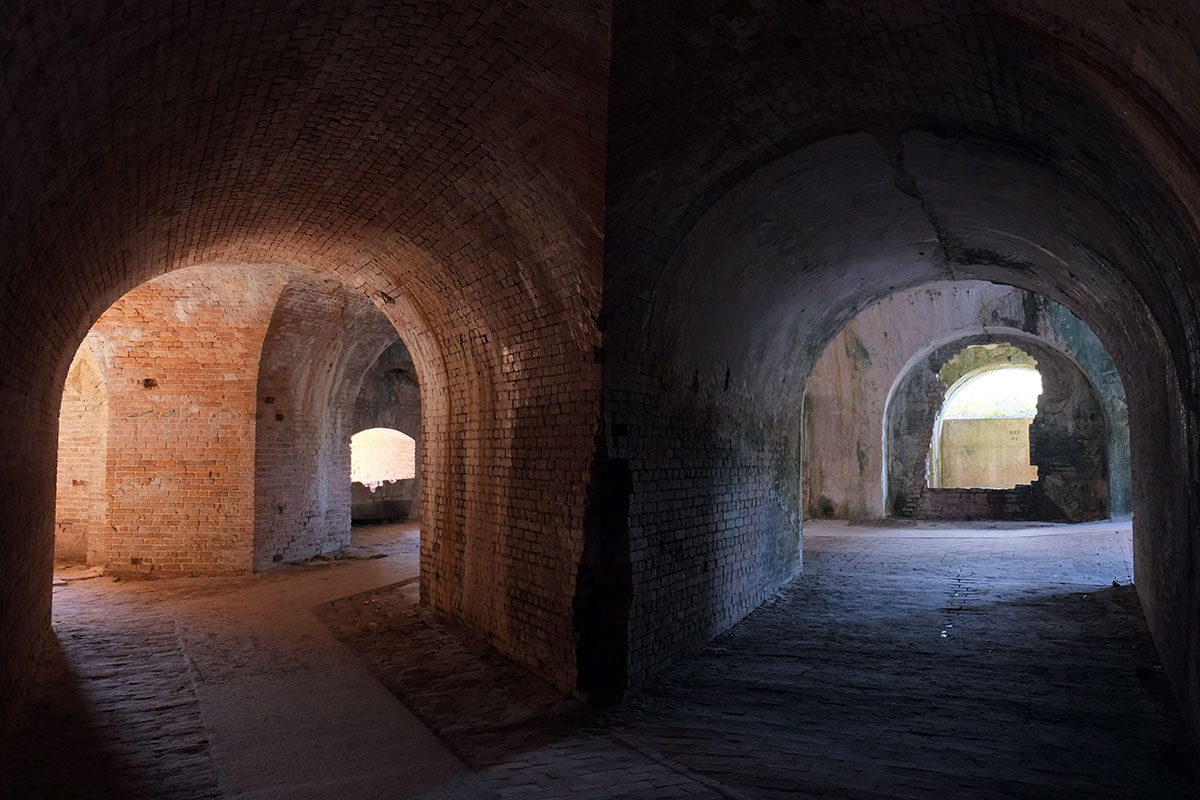
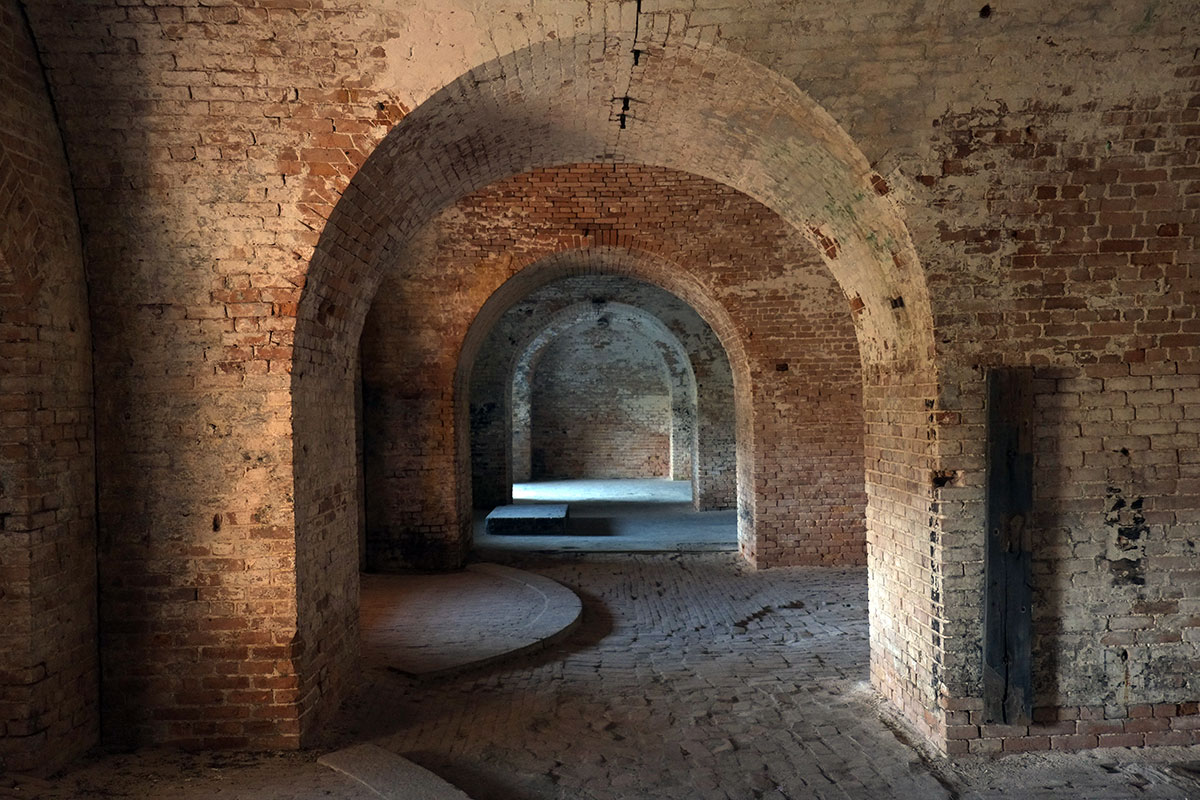
It was never involved in a battle until the Civil War, when the Union troops defended it from a Confederate attack, and then held it for the whole war, effectively eliminating Pensacola as a useful Confederate naval base.  The most interesting parts to see are the brick vaults that housed the guns, munitions and personnel, underneath the earthworks.  DSCF0985  DSCF1005  DSCF1004

The masonry is fantastic, definitely looking at Roman architecture (and anticipating Lou Kahn).  DSCF1010  DSCF1012

We’ve discovered that Greta likes tight little caves and tunnels such  as these, which are under the outer ramparts.  During a battle these could be filled with explosives, so if the fort were being overrun, the tunnels could be blown up under the enemy troops.  DSCF0978

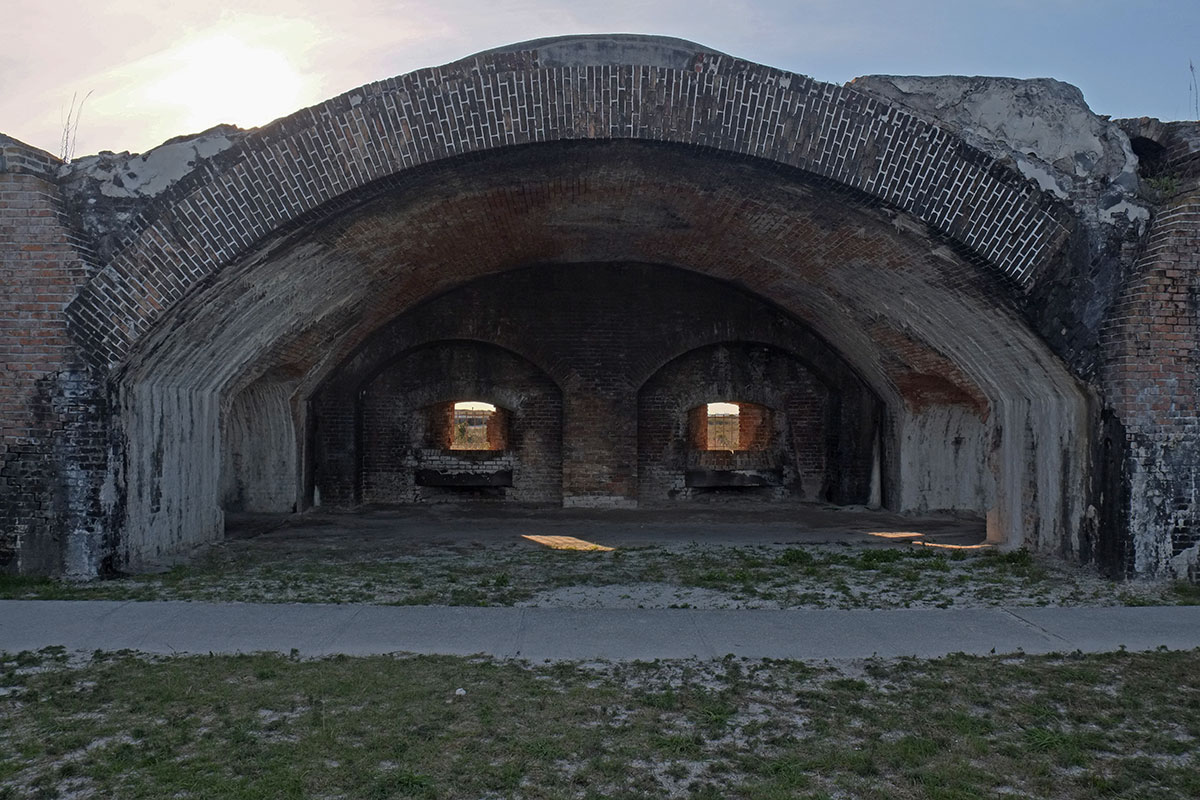
Around the Spanish American War, a new battery of concrete and steel was built within the older fort, to house the enormous new guns of the era.  Very similar to Ft. Casey on Whidbey Island.  DSCF1037

The Gulf barrier islands have beautiful beaches, with the softest, whitest sand we’ve seen anywhere.  But as you look across the beach, something catches your eye.  DSCF0942

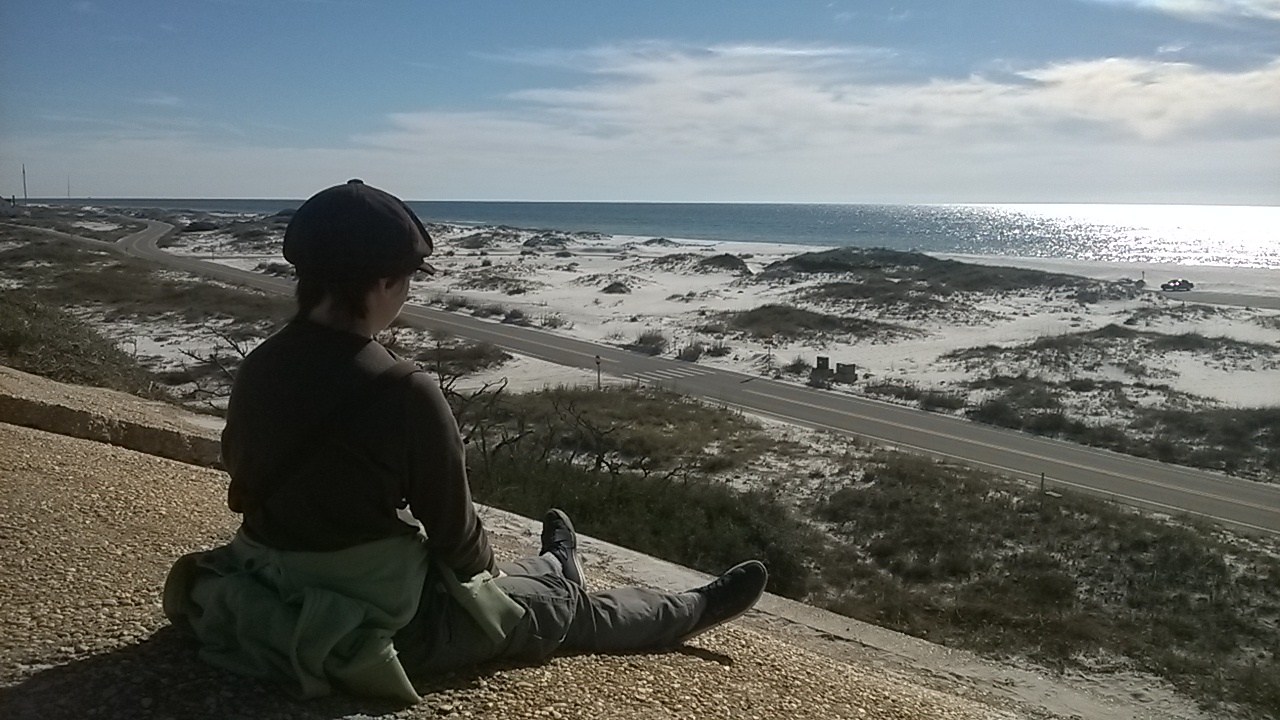
It’s part of the third phase of armaments installed here, in the 20th century.  Since the guns had come so enormous and had a range of up to 25 miles, it made no sense to try to shield them in a central location.  So instead they were dispersed into hidden bunkers scattered around the island.DSCF0944

Which also make excellent viewing platforms. Created with Nokia Smart Cam

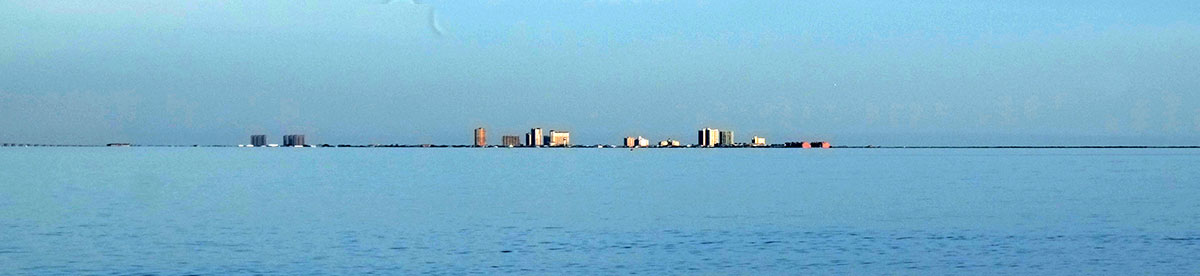
The barrier islands have afforded protection not only to naval operations and the harbor, but obviously also to the whole coastline and its ecosystem.  As you look at them (Pensacola Beach in this photo) in this era of climate change, it seems likely that they won’t be fulfilling this role for much longer.  That has been one of the themes of this trip – a Climate Change Farewell Tour of sorts – much of what we’re seeing will be radically changed during Greta’s lifetime, so I thought she should see it before.  DSCF1047a

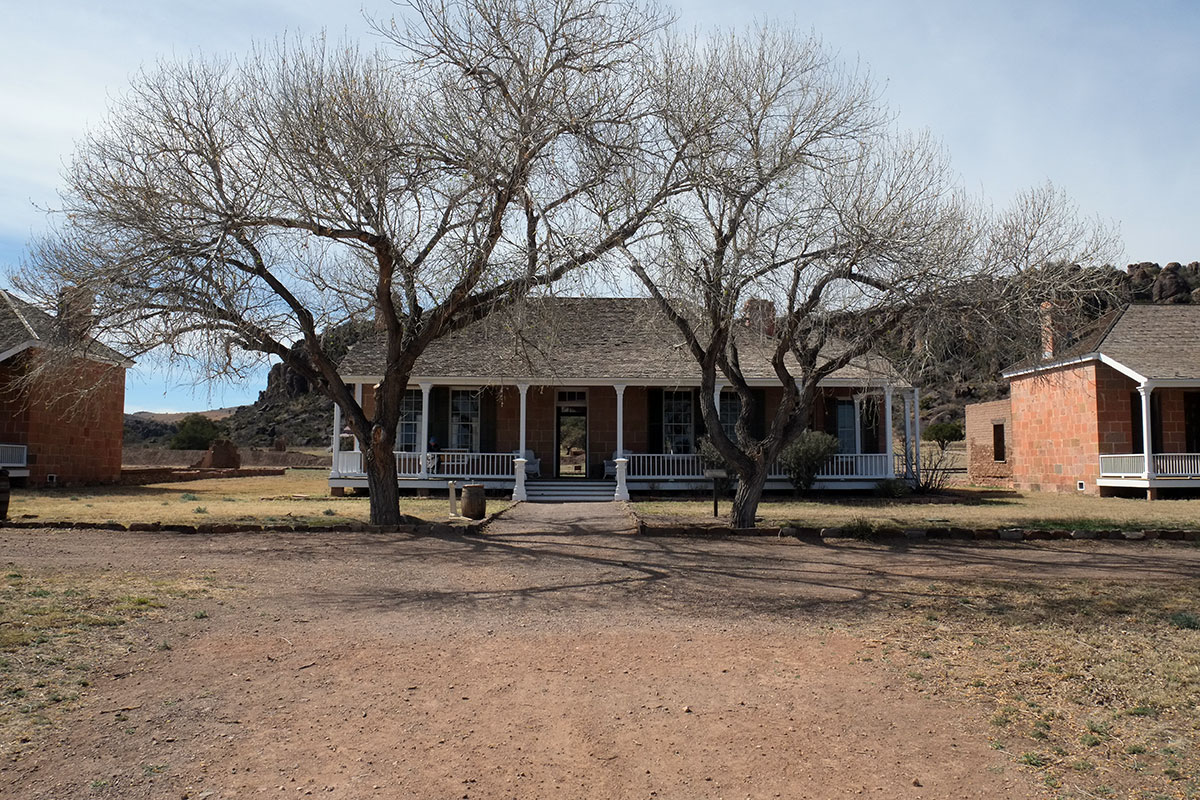
In West Texas we visited Fort Davis (in Jeff Davis County, within the Davis Mountains), built in 1854 and named after the then-Secretary of War, later President of the Confederacy.  (No discussion about renaming any of these that we heard.)  Its function was to protect traffic along the El Paso road and the Chihuahua Trail, and it was also involved in the wars with the Comanche and Apache tribes.  It must have been a pretty desolate, end-of-world posting.  DSCF6295

Many of the buildings have been preserved and are being restored, such as this barracks.  After the Civil War, this fort was largely manned by Buffalo Soldiers, regiments solely of African-Americans, including Lieutenant Henry Ossian Flipper, the first African- American graduate of West Point.  DSCF6325  DSCF6286

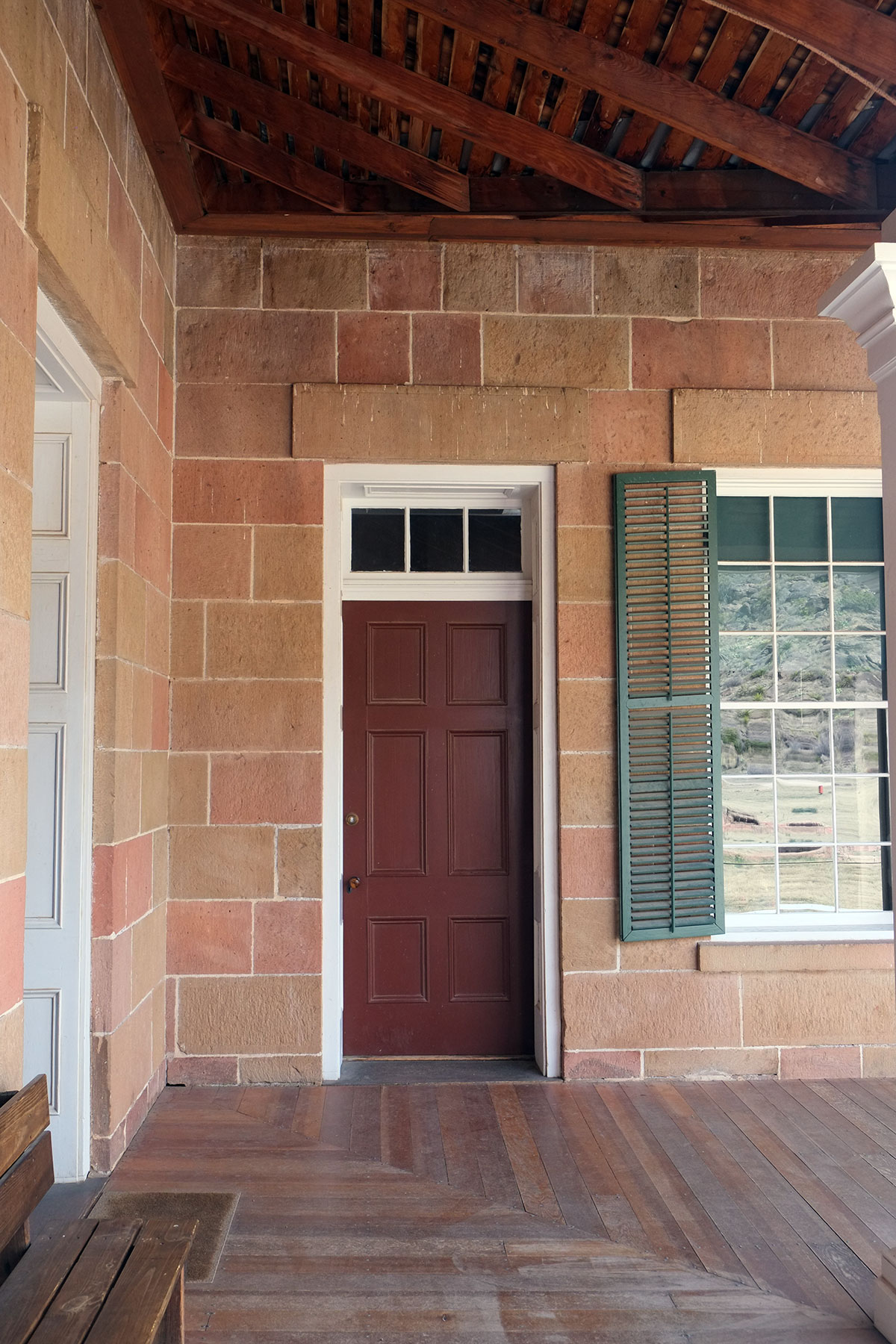
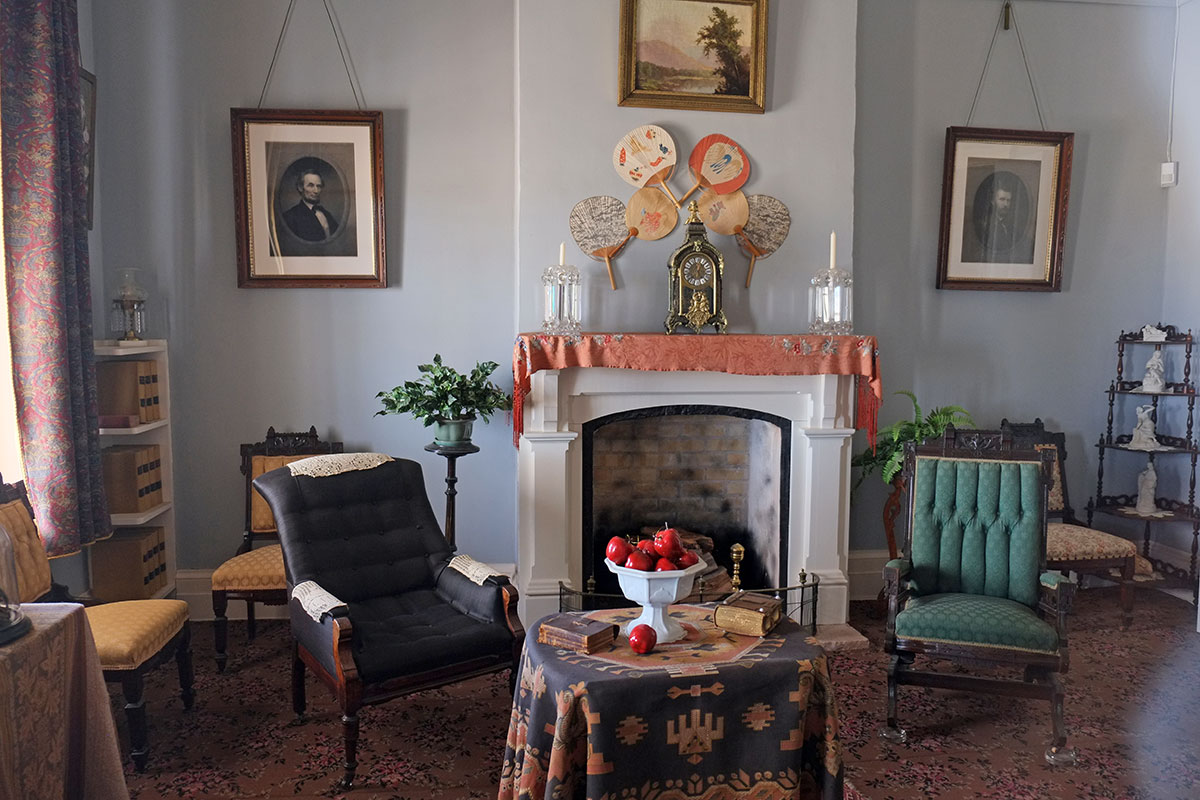
The officers had quarters for their families, beautifully built out of local stone, including the commander’s residence:  DSCF6296  DSCF6304

While we might be inclined towards residences that echoed the stark simplicity and elemental qualities of the environment, the inhabitants favored interiors that mimicked the current styles of the east as closely as possible. DSCF6298

West Texas is a vivid place, with a scale and and emptiness that is beautiful but forbidding.   There is a strict geometric order to this fort, which stands in stark contrast to the huge space of the landscape, a contrast which is still striking when seen today, as not that much has grown up around it.  While the ordering of the place might have had specific military or organizational reasons, the ability of this geometry to represent the projection of American power into the natives’ land is palpable.  DSCF6283  DSCF6282

As we went through the museum at the fort, we came across a photo we’d seen before.  It was of a band of Apaches who had been captured in this area.  We recognized Geronimo sitting near the front and remembered where we had seen it:  at Fort Pickens.  This band was then transported east away from their land, and were imprisoned for several years at Fort Pickens.

Marfa, Texas

DSCF6004Marfa is a small West Texas town where the level of irony, postmodernism, contextual intervention, self-consciousness, and appropriation is so high that you can’t tell if it’s a real town, or the largest conceptual art installation in the world.  It was probably a straightforward, small town on the main railroad line until Donald Judd put it on the art map.  Now it has hip art-tourists coming through to see the work at the Chinati Foundation, and a permanent population of arty types, together forming a mini-Santa Fe for West Texas.  These people require services not typical for small western towns, and it was there that we found the first clues to what was really going on.
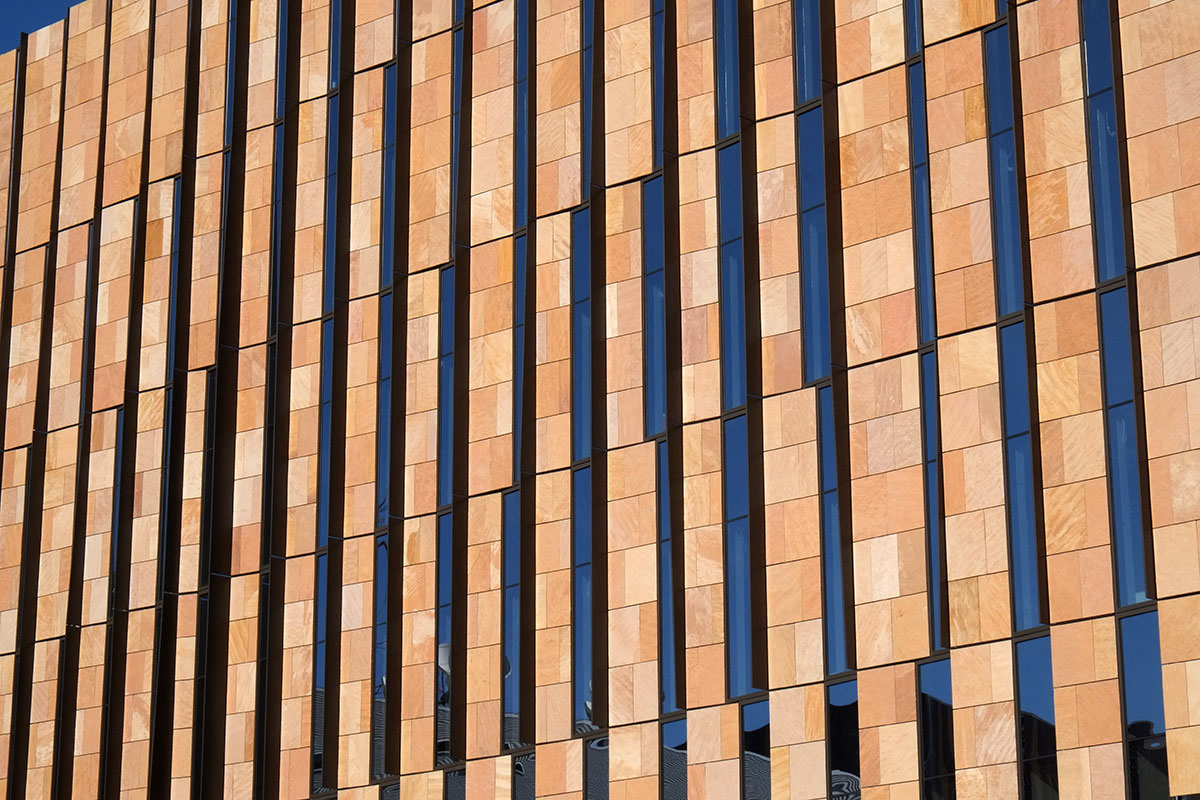
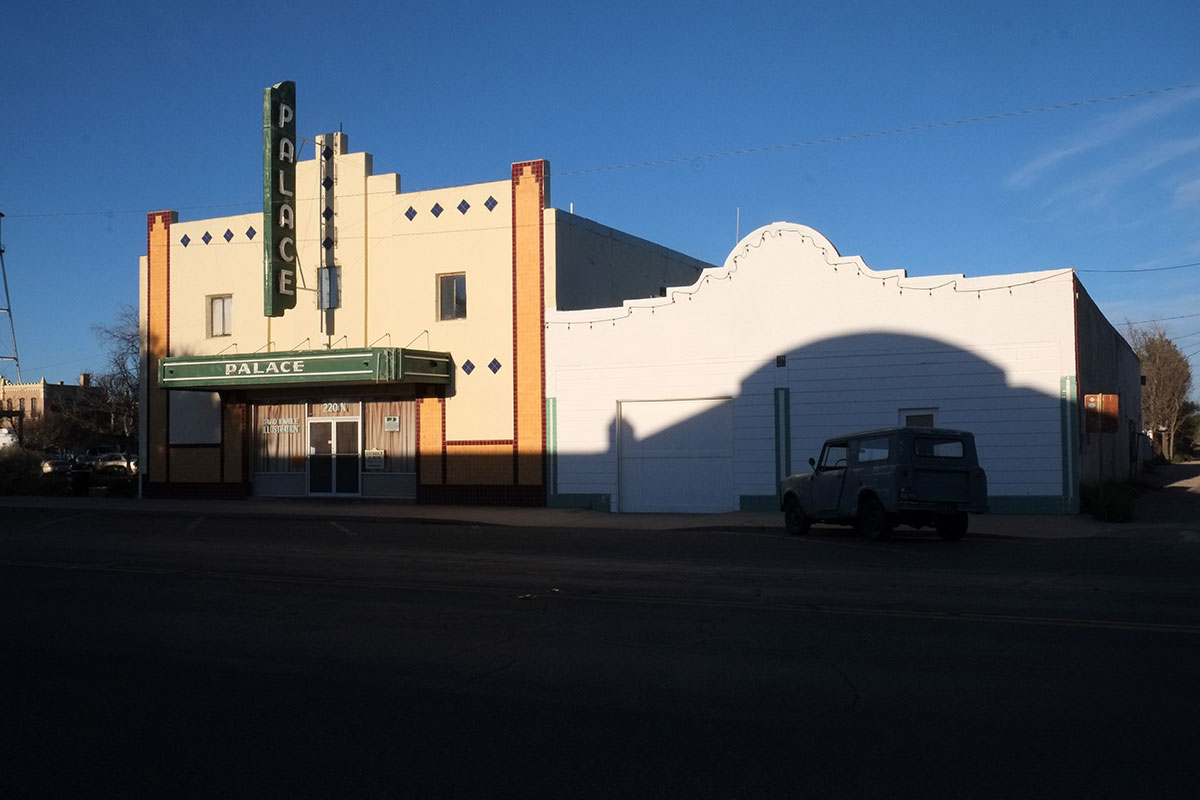
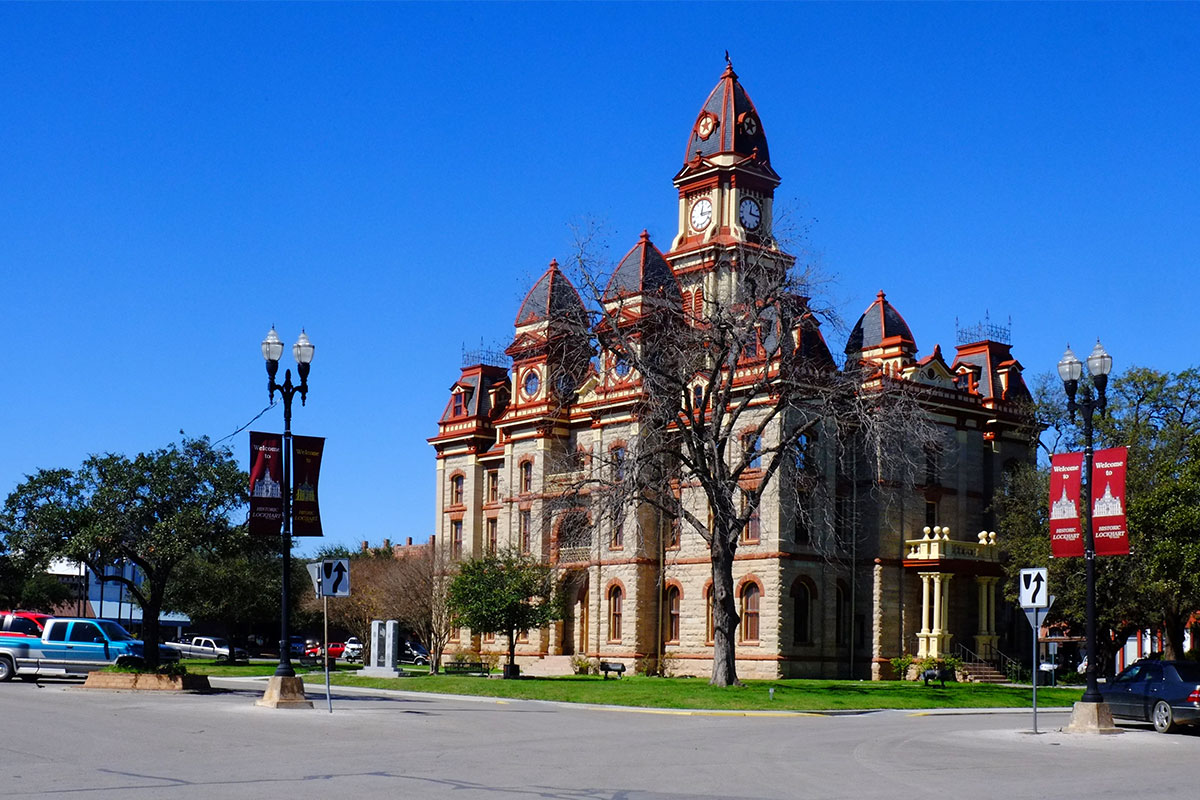
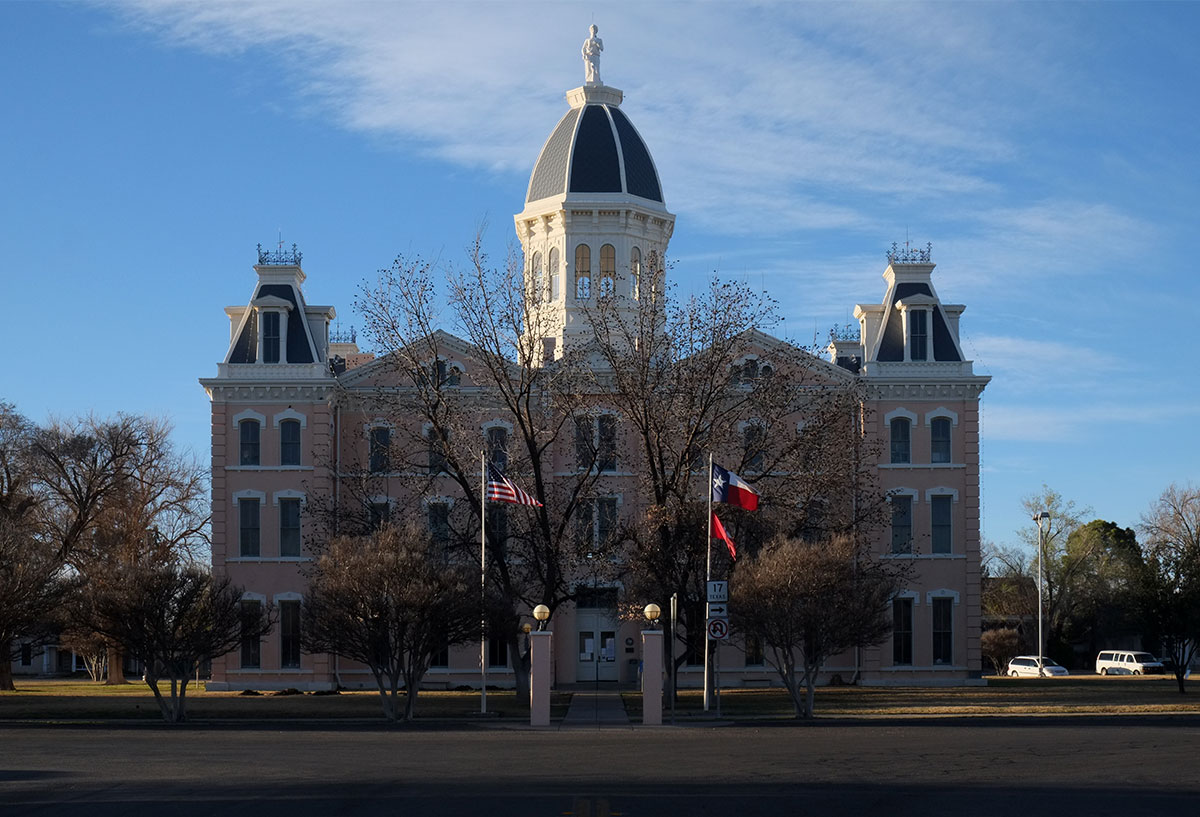
The original town is great – maybe this is why Donald Judd ended up here    The county courthouse is grander than some state capitols (such as Oregon’s), and occupies a full-block site in the middle of the north-south axis.   Many years ago JB Jackson wrote about western courthouses as the center of small-city civic life, but this trip was my first exposure to the classic ones.   (Other notable ones we’ve seen in Texas are in Lockhart and Ft. Davis).  DSCF6086
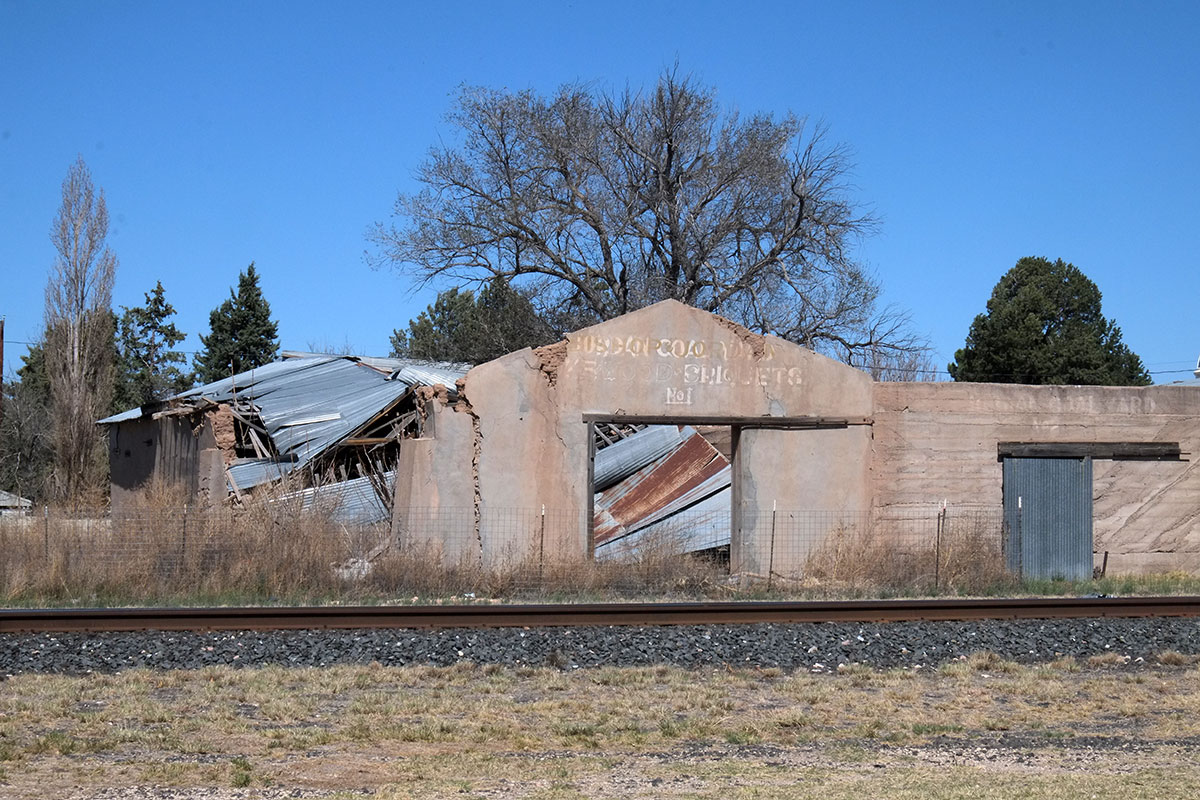
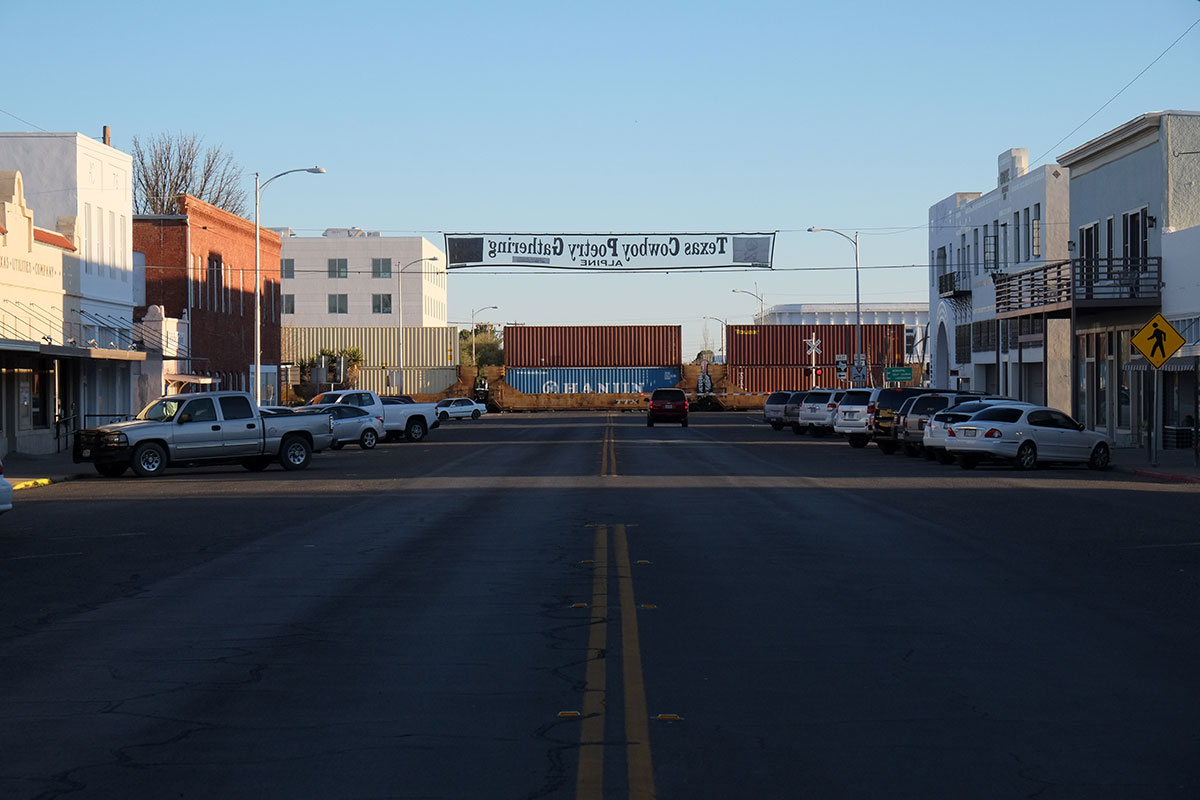
Marfa began as a watering station on the railroad, and as it grew, many buildings were built right on the line.  DSCF6040

DSCF6031

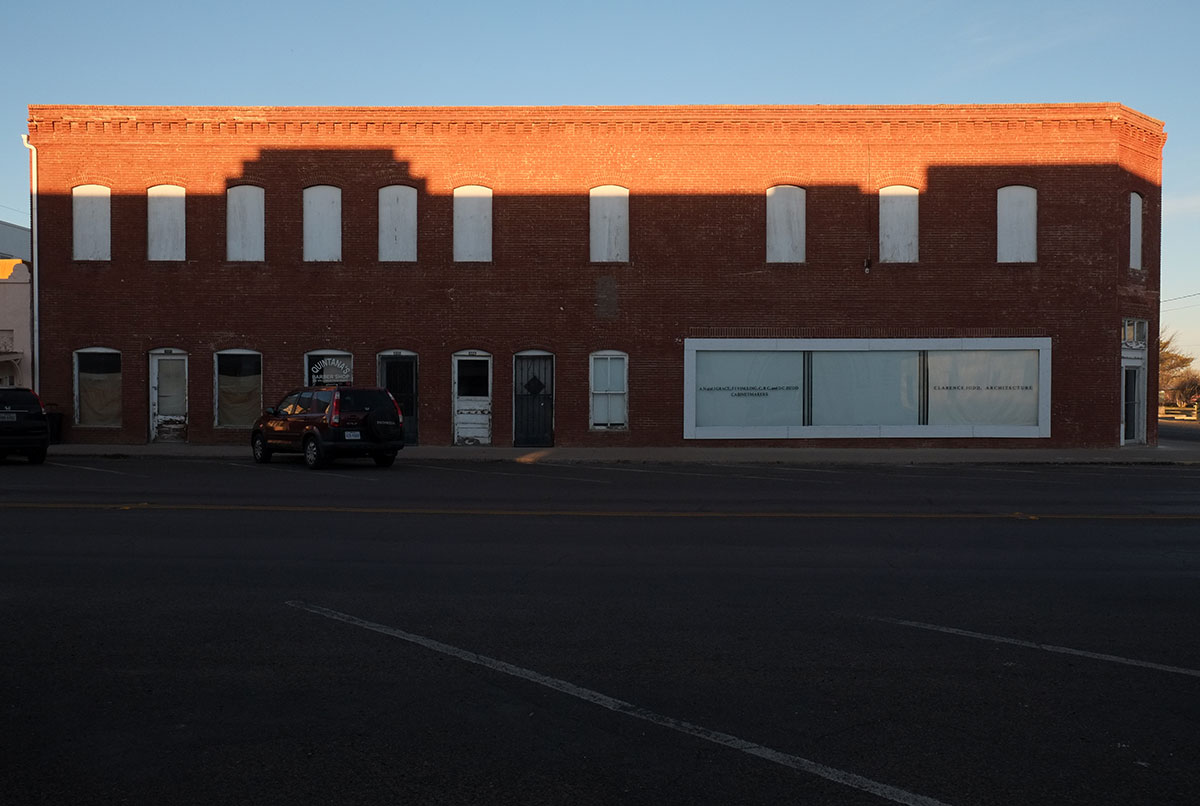
The main commercial street runs south from the courthouse to intersect the RR and US 90, the main highway to San Antonio (400 miles away).  It has classic early-20th century commercial buildings, and remarkably few later additionsDSCF6085

DSCF6108

At the Judd Foundation compound, our excellent guide had pointed to one sculpture – identical metal boxes aligned vertically, with the exact same amount of space between them.  He mentioned that this was the iconic Judd piece, variations of which are seen in museums around the world.  I had wondered why that piece resonated so far, and where Judd had come up with the idea.  Then we left the compound and turned left on to the main street:DSCF6099

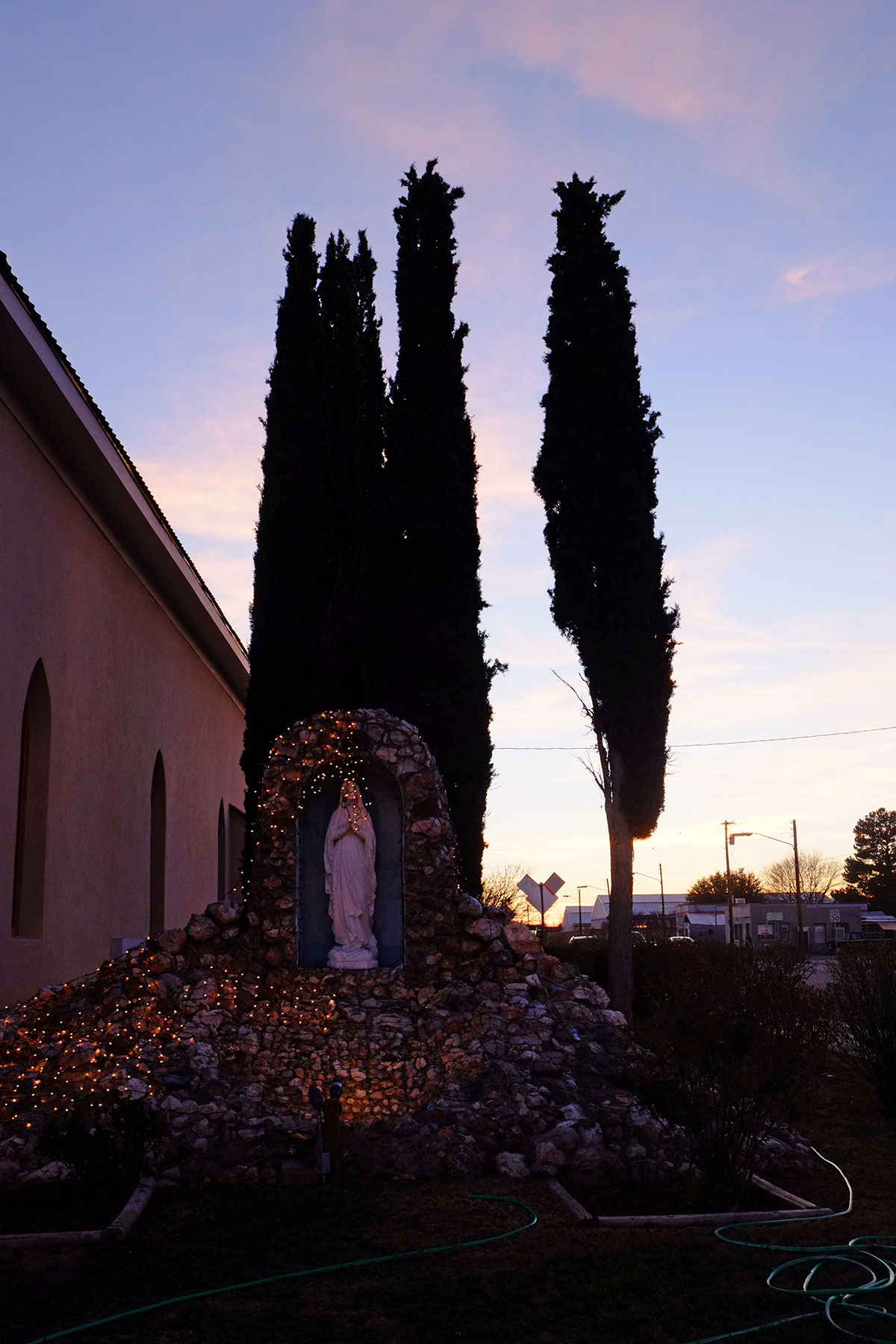
We began to notice what was missing in Marfa – mainly, the very recent roadside commercial stuff that seems to have squeezed out everything older everywhere else in the South.  There is a Dairy Queen in Marfa, but no other chains.  Perhaps two old gas stations.  No modern motel chains.  It felt like a time warp – we’ve been traveling along Route 66 in the Southwest often recently, and every town through which it passes makes a big deal out of the older, retro, roadside remains.  But in all of those towns, the hip retro stuff is wedged between the usual bad new stuff.  Marfa has been magically protected.  The intersection between the old and the quirky reigns, as in this LED-enhanced grotto at the Catholic church, right on Highway 90.DSCF6005

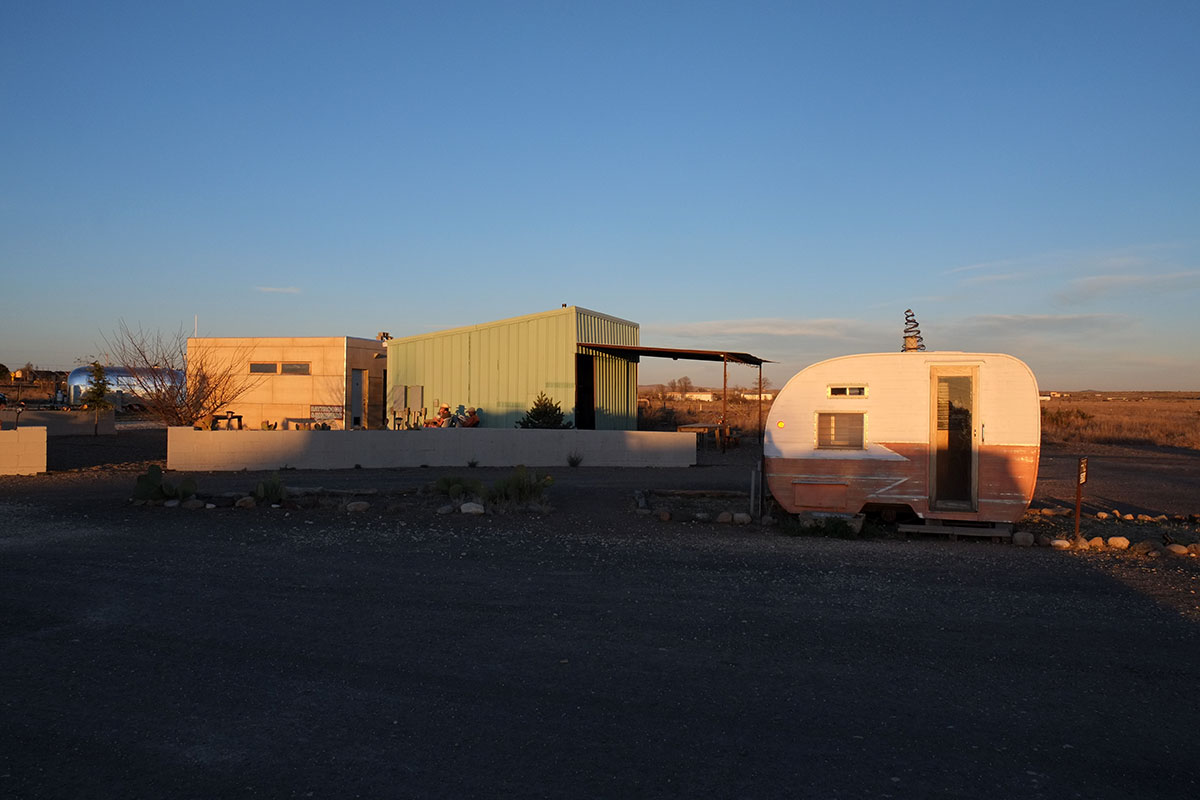
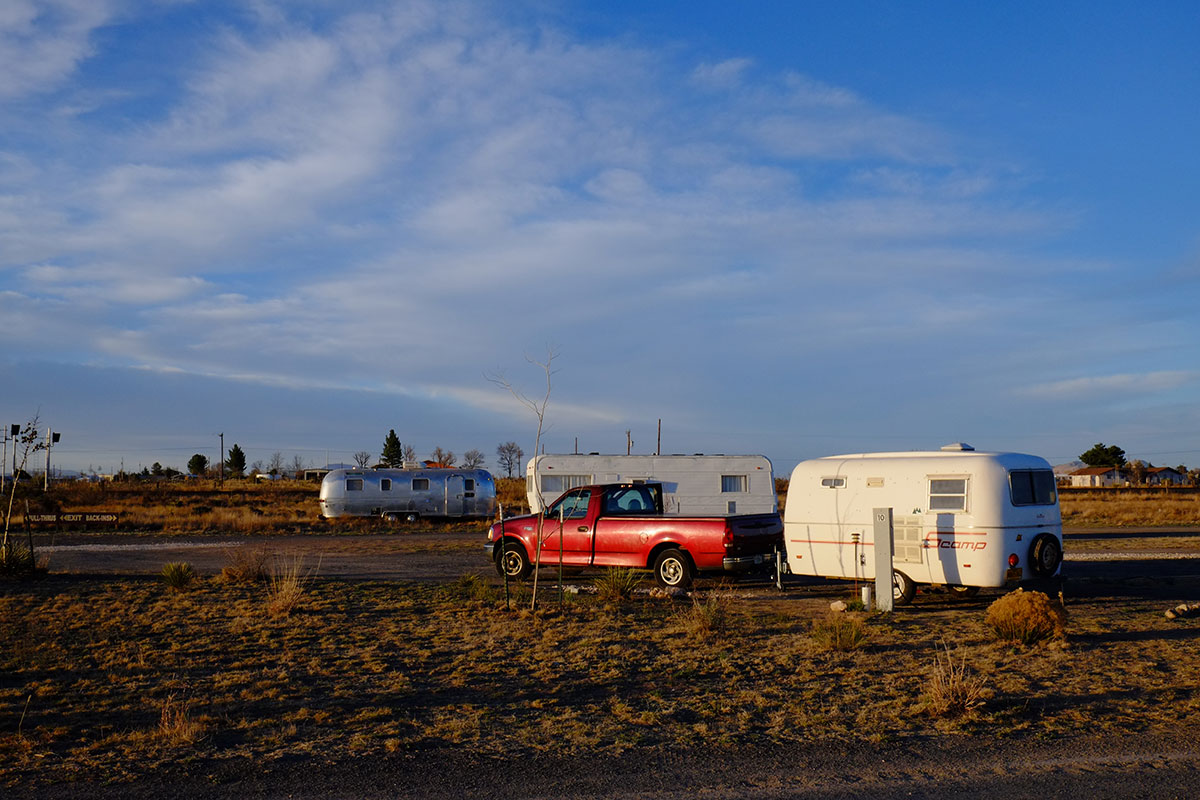
As we looked for a campground, we found two listed in town.  There is El Cosmico, which felt a little self-consciously retro – you can rent an old trailer from them, or a teepee, and there are hip cultural events taking place there.  But strangely, no accommodations for you bringing your own little trailer.  So we went to the Tumble In, out on the highway, where the campground self-register office is in a small trailer, and the common space and bathrooms are in the de rigeur hip/retro/industrial vernacular. DSCF6120

The Scamp fit in amongst the Airstreams and vintage 60s trailers, which seemed to be all occupied by Buddy Holly lookalikes with mangy dogs.  DSCF5999

Outside of Marfa proper, there are two notable attractions. The first is the Marfa Lights, a phenomenon supposedly visible from Highway 90 ten miles east of town.  For decades, people have reported seeing strange moving lights in the desert to the southwest.  The town even acquired funds to build a combination viewing platform / bathroom building out there to accommodate the believers.  We read a bunch of articles online about it, and Greta found the ones that debunked the stories – claiming that they were simply perceptions of highway lights on Route 67 winding through slight hills – to be most convincing.  Given the choice between sitting out in the desert night waiting for a possible hokey paranormal experience, and sitting in the trailer, getting online for the first time after about a week in the wifi-free zone of the Chihuahuan Desert, Greta opted for the internet.

The other attraction in the desert is the Marfa Prada store, 35 miles to the west.  A small building filled with Prada products has been built on a lonely stretch of highway 90, where it is an illuminated icon of First World consumerism to the immigrants crossing the Chihuahuan Desert.  The punchline is that the store cannot be entered – one can only look through the store window.  We’d seen the images, and a friend had recently reported that it was full of flies that had found a way in.  We had experienced enough irony for one day, so we decided to forego that attraction too.

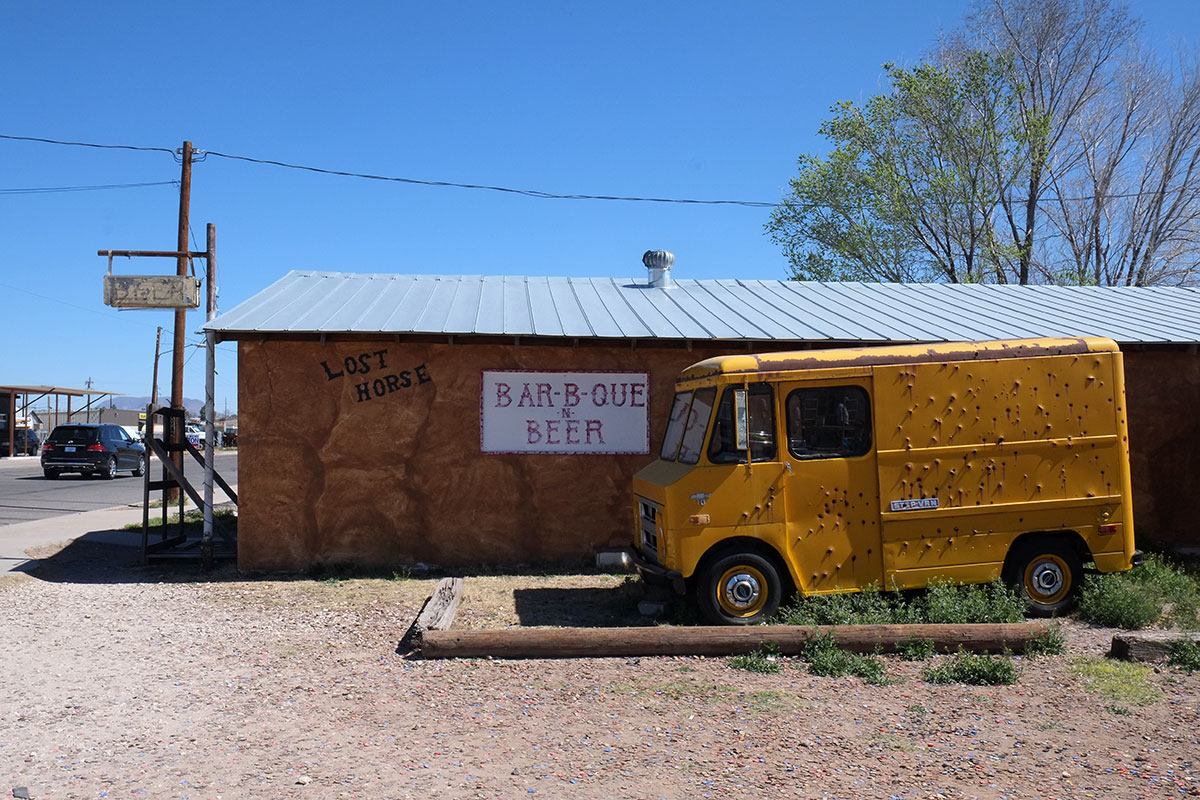
The lack of the normal sprawlscape means that other options for meals had to be be sought.  I had expected that with the influx of arty tourists, Marfa would be well-supplied with hip dining venues.  Greta jumped on Yelp and found a bunch of quirky, highly-rated restaurants and carts, so we headed out.  The Lost Horse turned out to be closed (and riddled with bullet holes).  DSCF6021

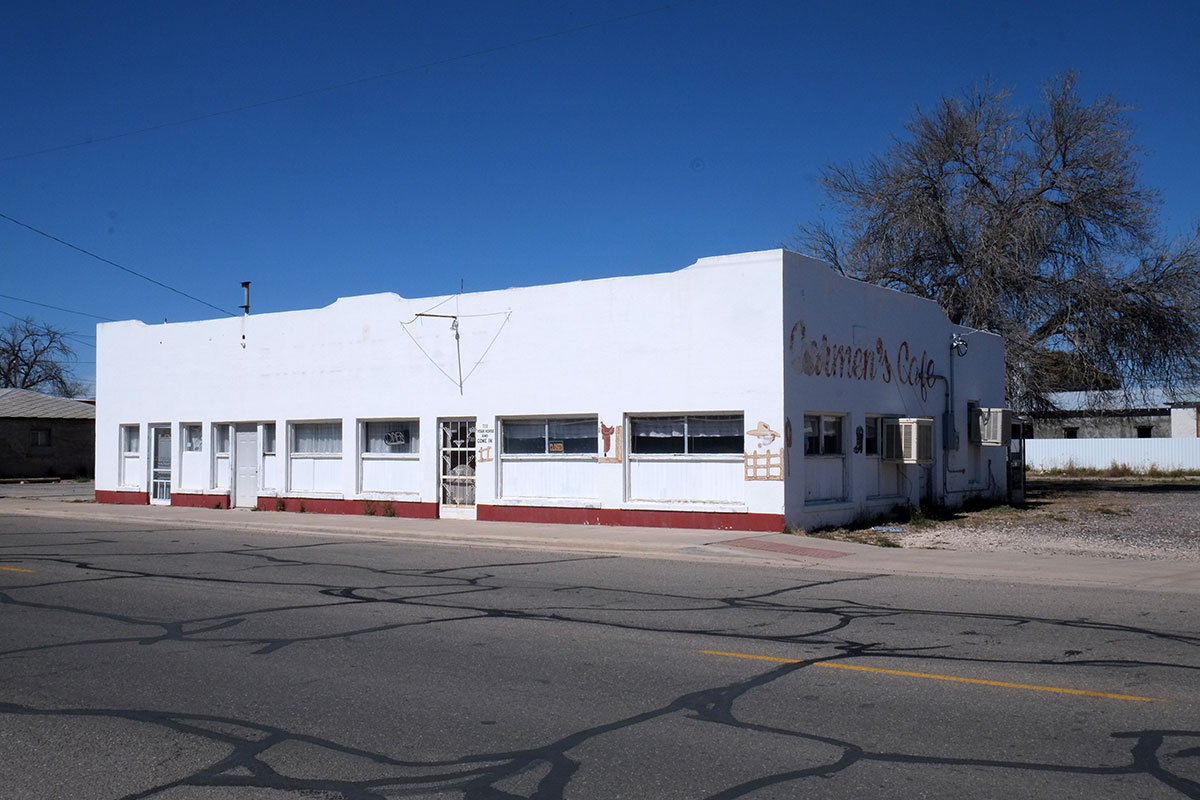
Carmen’s Cafe appeared to be defunct.DSCF6019

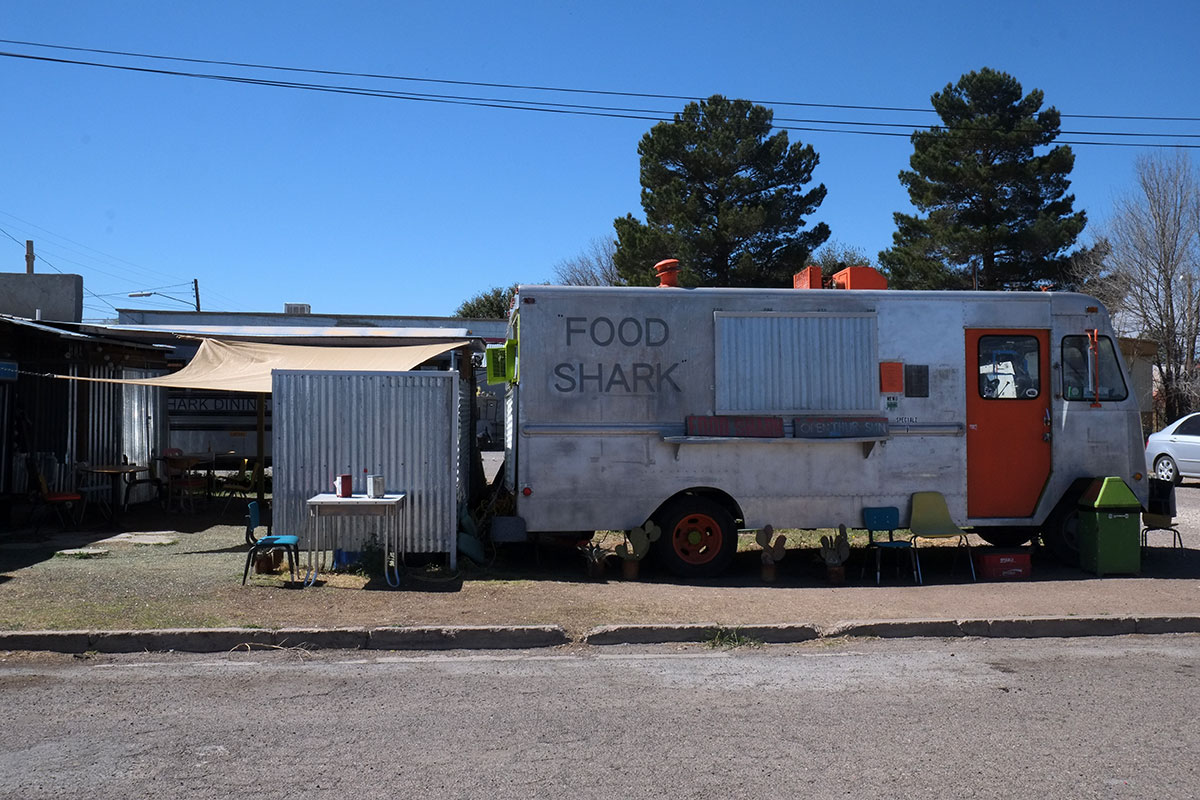
Food Shark, highly-recommended, was closed too.  DSCF6027

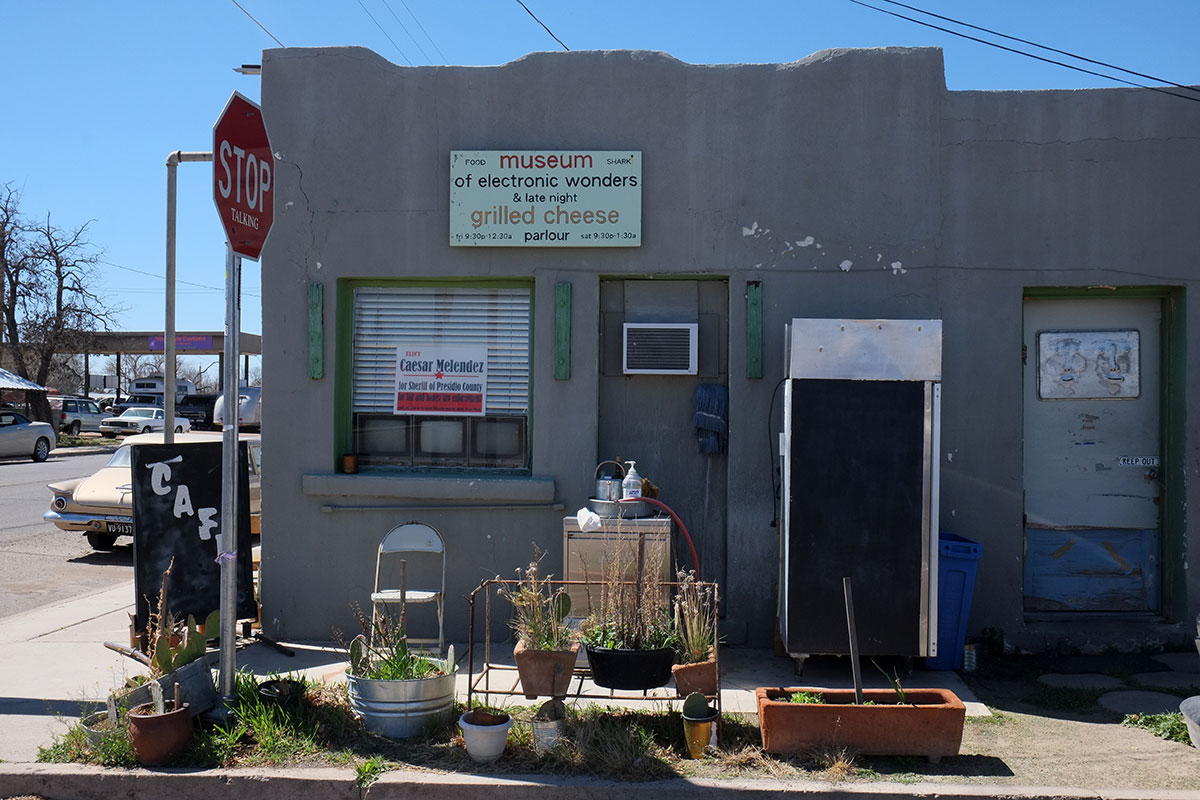
As was the Museum of Electronic Wonders & Late Night Grilled Cheese next door.  DSCF6028

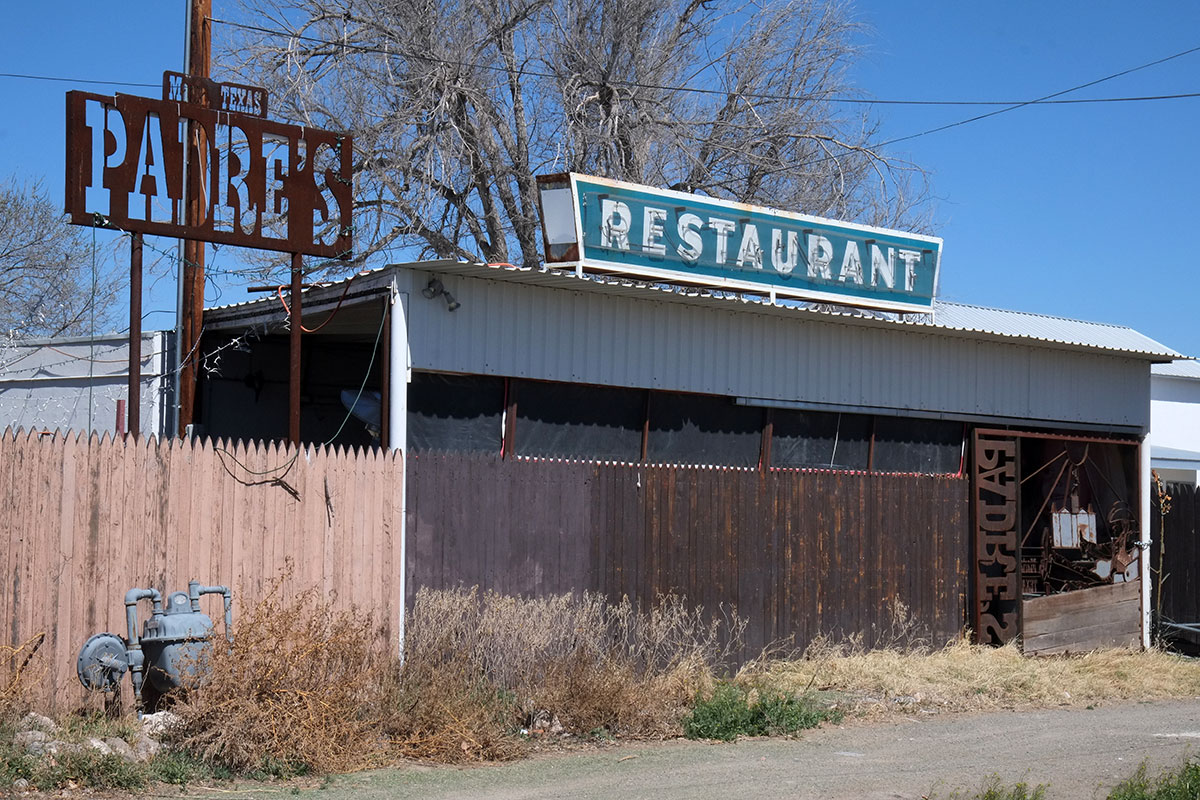
Padre’s had a sign proclaiming it would open at 5:00, but they lied.DSCF6030

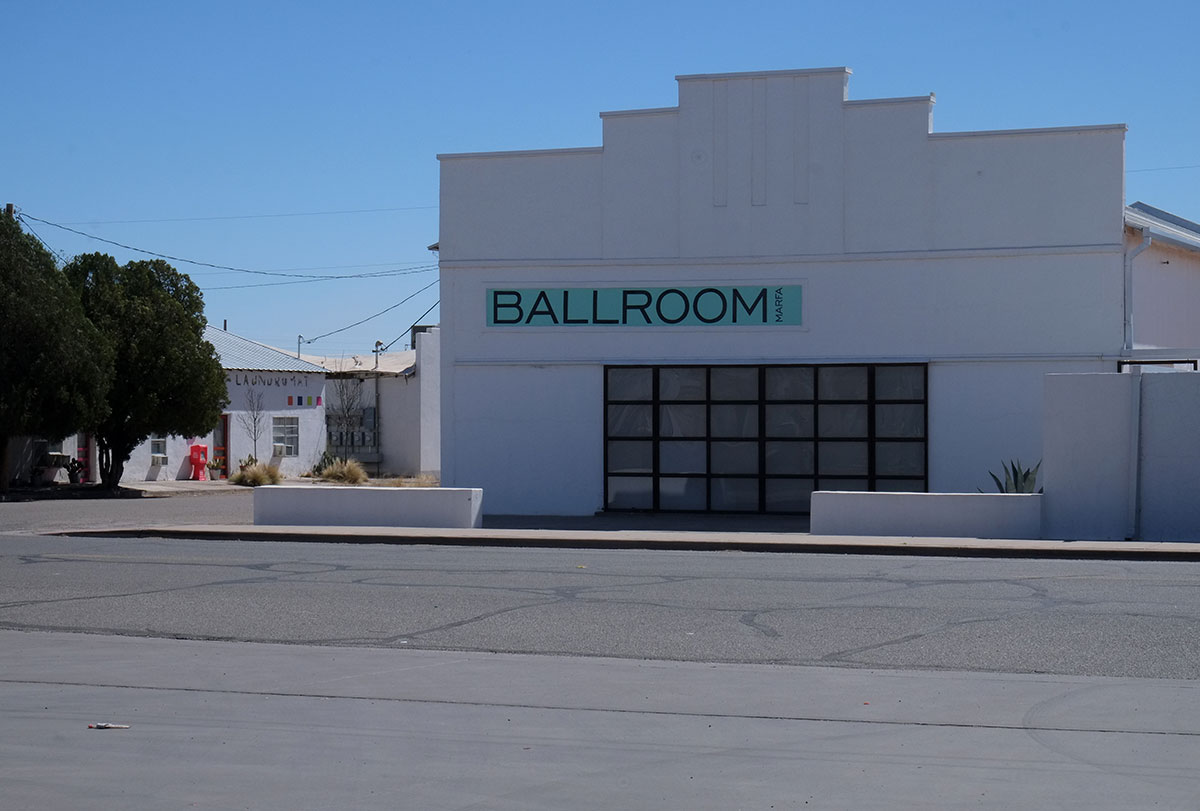
The Ballroom showed no sign of life.DSCF6258

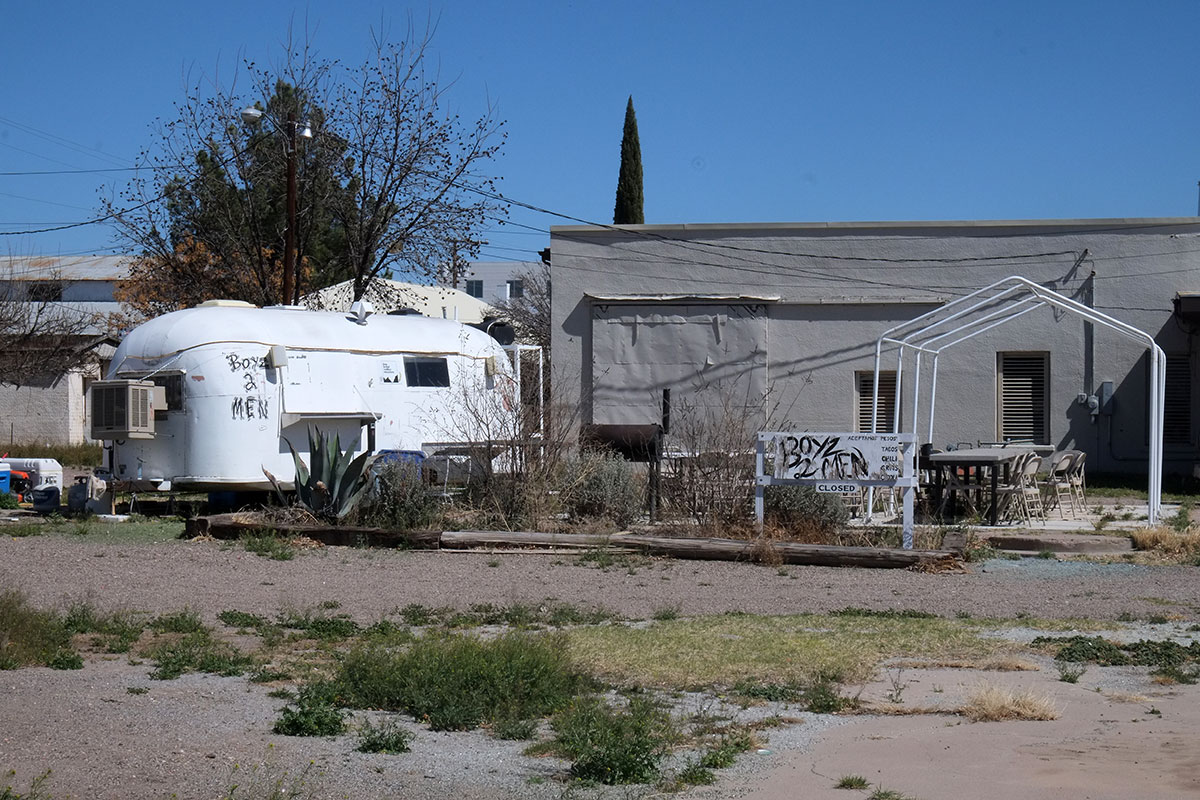
Boyz 2 Men, which is supposedly noted for the banter of its employees, was calm.  DSCF6029

Finally we went looking for Cochineal, which the reviews said was overpriced and not as good as they seemed to think it was.  We wandered down the street, but couldn’t find it where it was supposed to be.  We encountered an artsy type from LA, who said he had reservations to meet a friend there, but he couldn’t find it either  He called them, and confirmed that their address was 107 West San Antonio Street.  We all walked along the block, past 103, to 131, then carefully looked along the property line between them. Nothing.  We broadened our search, and finally found number 107 further down the block, next to number 149.  We started to think Marfa was in the Twilight Zone, a town which appears normal at first glance, but where nothing is quite right.

We ended up at Capri, a hip new restaurant serving elf food.  Though they had a very limited menu, the pleasant young waitress couldn’t explain a single thing on it, and would giggle nervously and apologize before scurrying off to find someone who could answer.  We suspected that she was not really a waitress, had never done this before in her life, and that again, the whole set-up was a performance piece.  DSCF6008

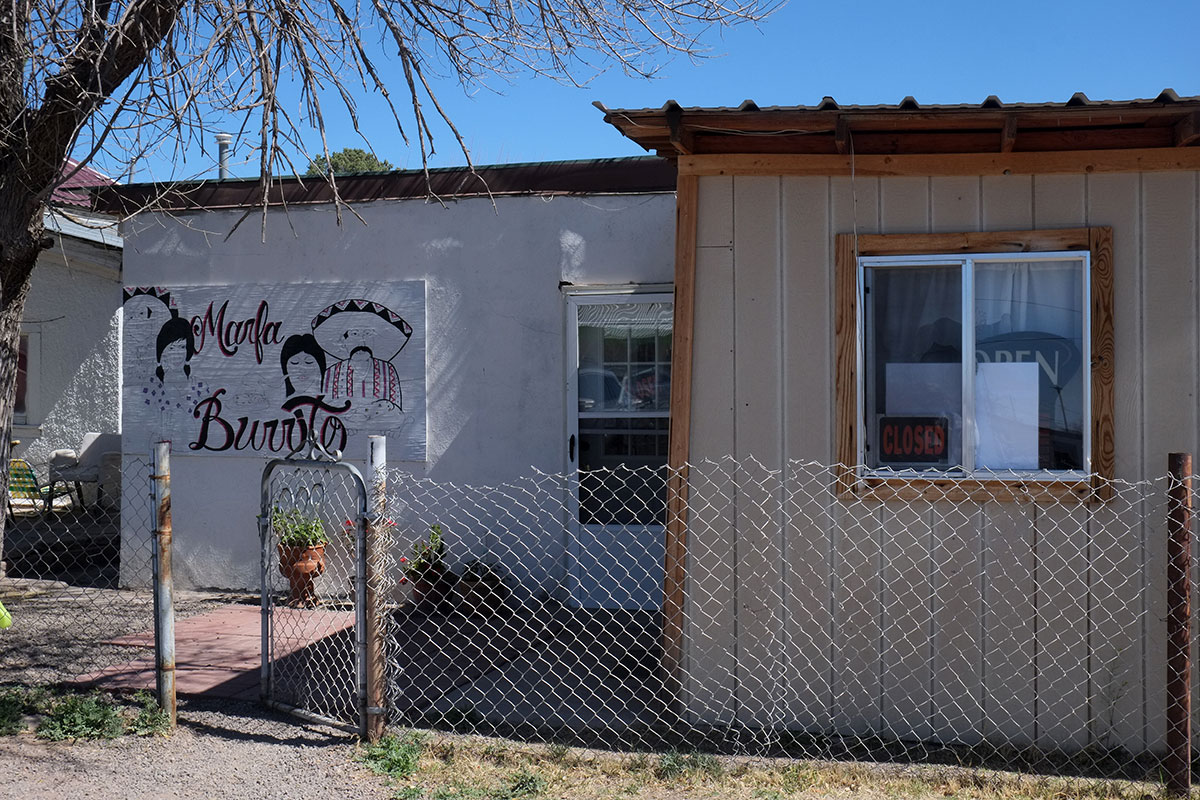
The next day was a repeat.  Our guide at the foundation told us that she had driven by Marfa Burrito, the proprietor was there, and it was certainly open.  We arrived to find that it was not.  DSCF6013

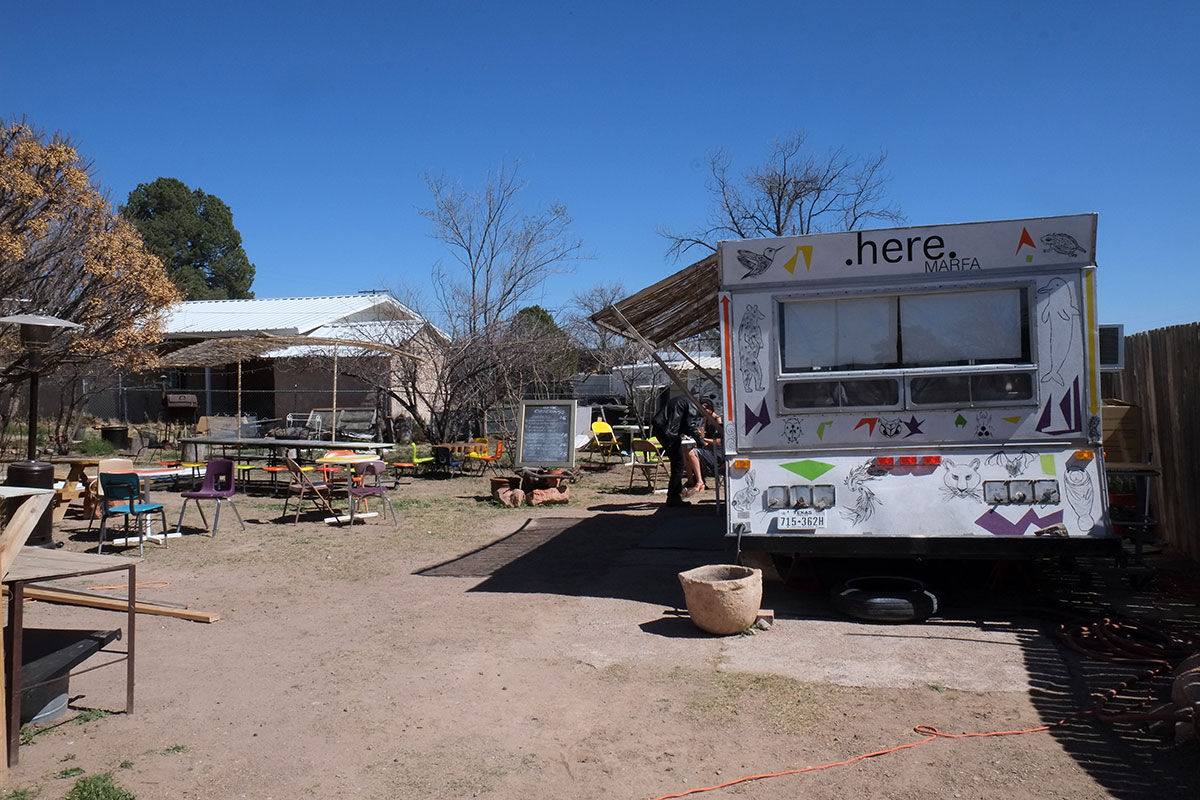
However, when we saw people walking around behind the building, we followed them, and found this food cart.  We hurried over and scanned the menu.  But after re-reading the lists of ingredients several times, I had to ask them what the noun was:  there were many ingredients, but what form did they take all together, perhaps a burrito?  The woman in the trailer answered that they served nutrient-dense food.  I persisted, and she handed out a sample, which was a tiny cup with a thick, green liquid in it, announcing it as a nut-kale smoothie.  I gave it to Greta, who gamely sipped it, and managed to politely suppress her honest reaction.  DSCF6012As we took our leave, we realized that the Prada store supplied the primary metaphor for all of Marfa – it is all about desire and frustration.  We began to wonder whether any of these establishments were real.  Greta had me listening to her favorite podcast, Welcome to Nightvale, about a town in the desert where strange occurrences are common.  It all started to feel familiar.  We finally found an open taco cart, Salsa Puedes, which had good food, and where I had a conversation with a cowboy while we waited.  Maybe we were imagining things.
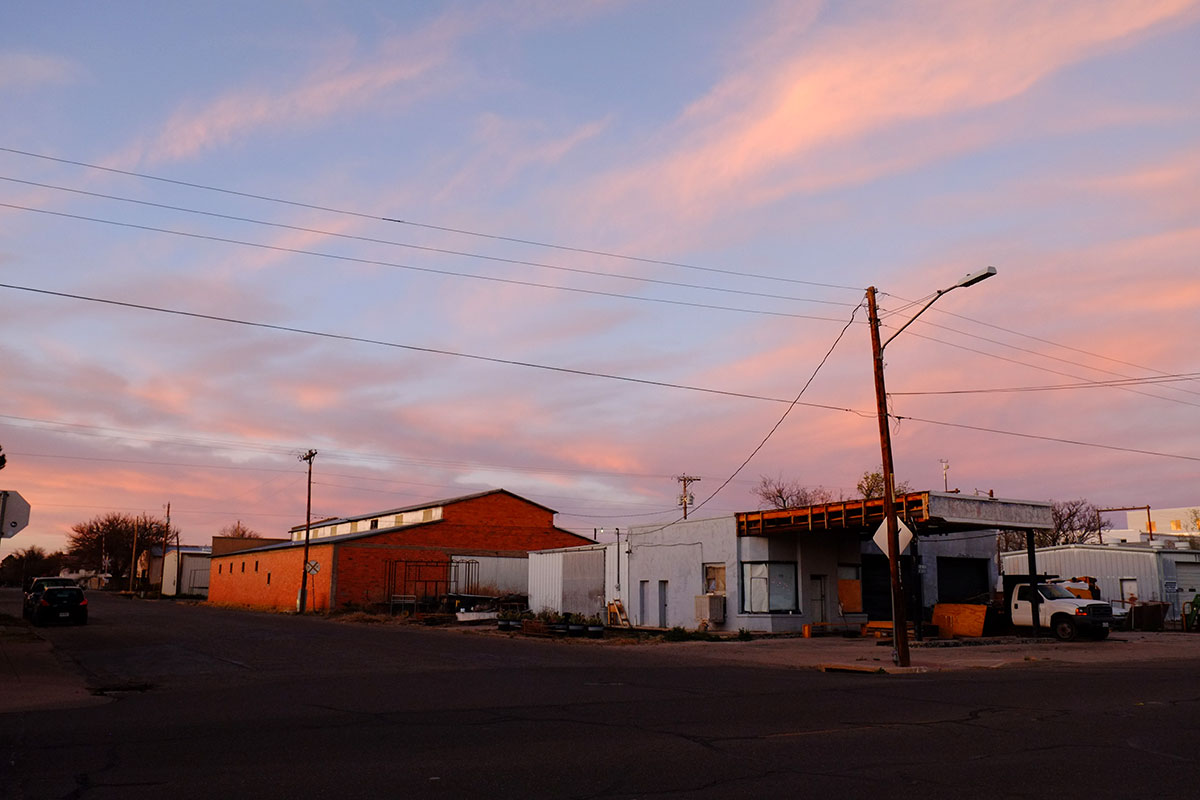
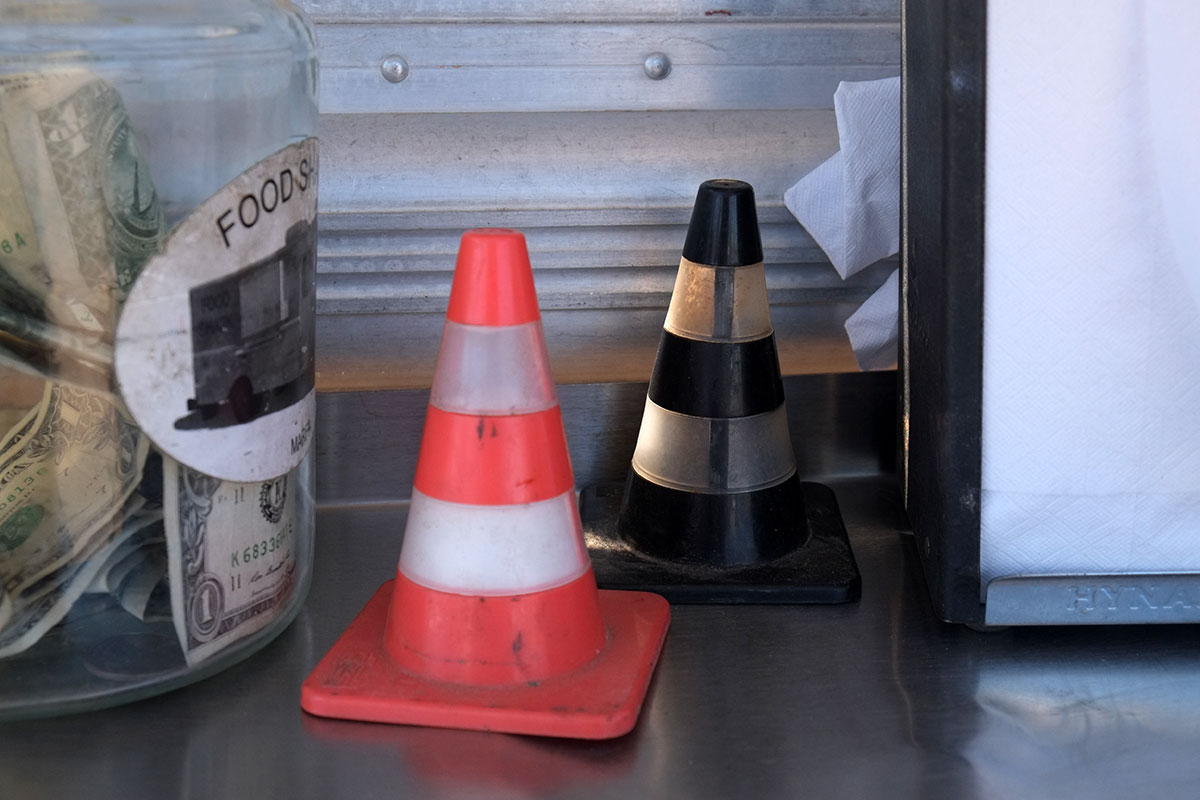
But the pattern repeated the next day.  As we drove by, we saw that Food Shark was open, and we had a fabulous meal.   But I spotted their salt and pepper shakers, and knew that they were on to us;  this couldn’t be a coincidence.  DSCF6232As we were eating, we realized the pattern:  at any mealtime, there was exactly one establishment open in Marfa – a different one every time.  Maybe there was only one person in town who could cook, and she randomly picked a different place every day.  It was a town where people just drove around until they spotted the place that was open.
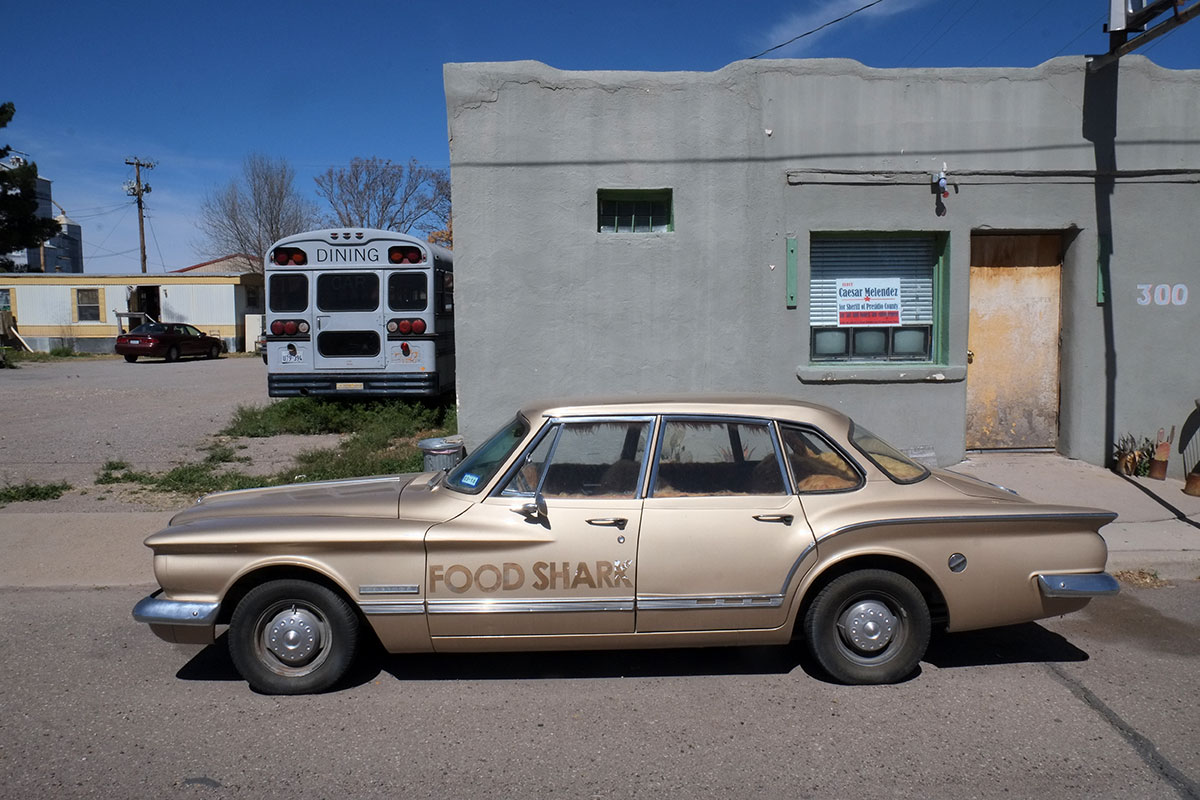
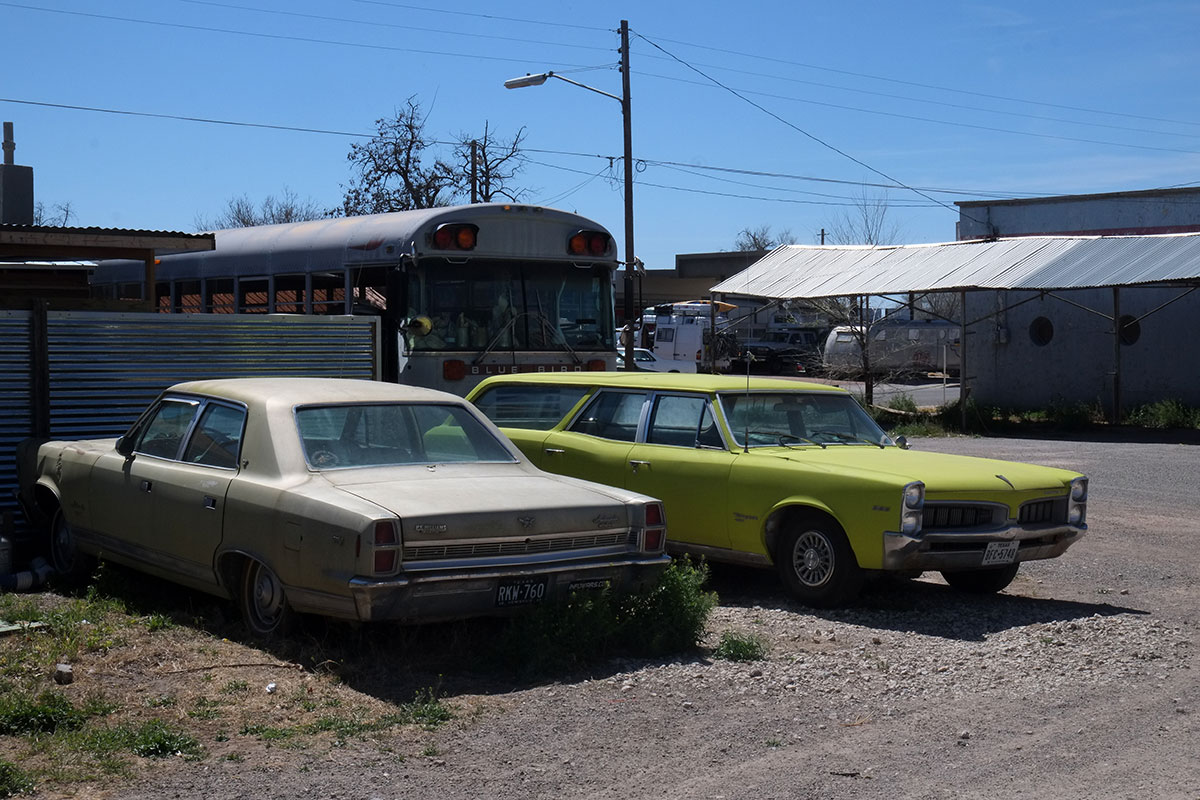
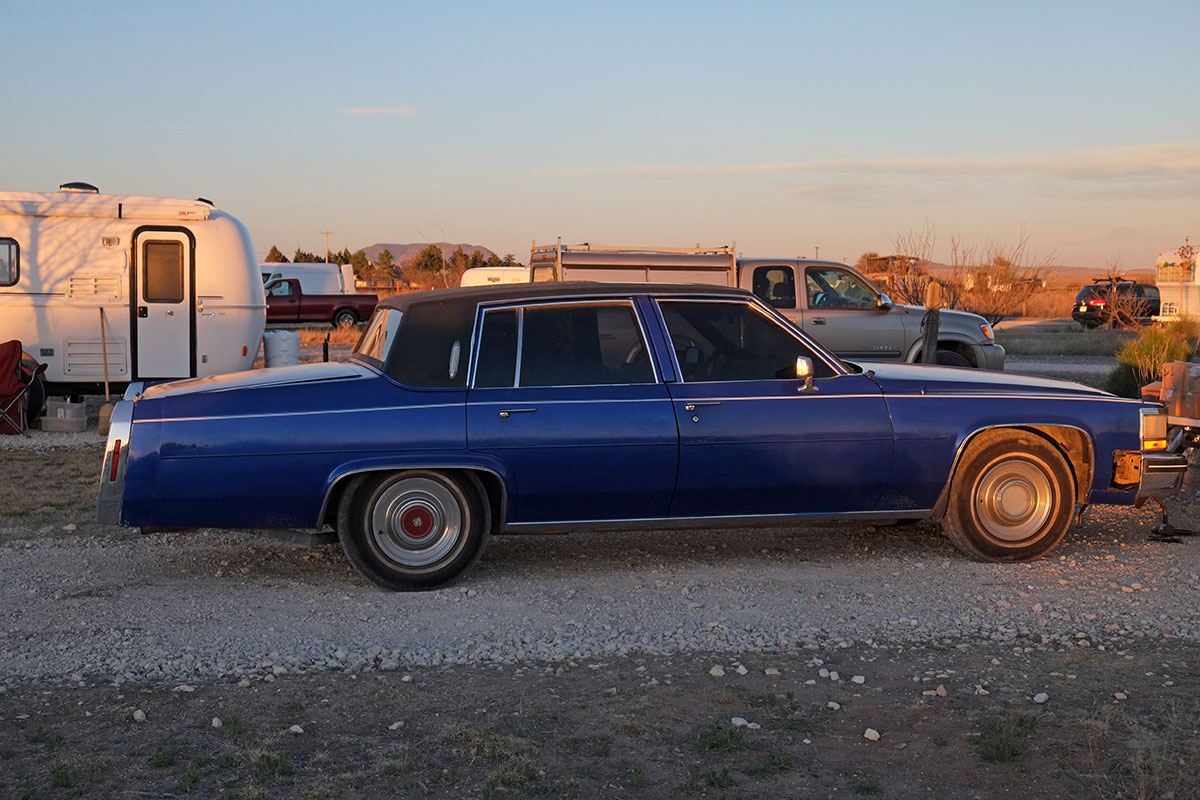
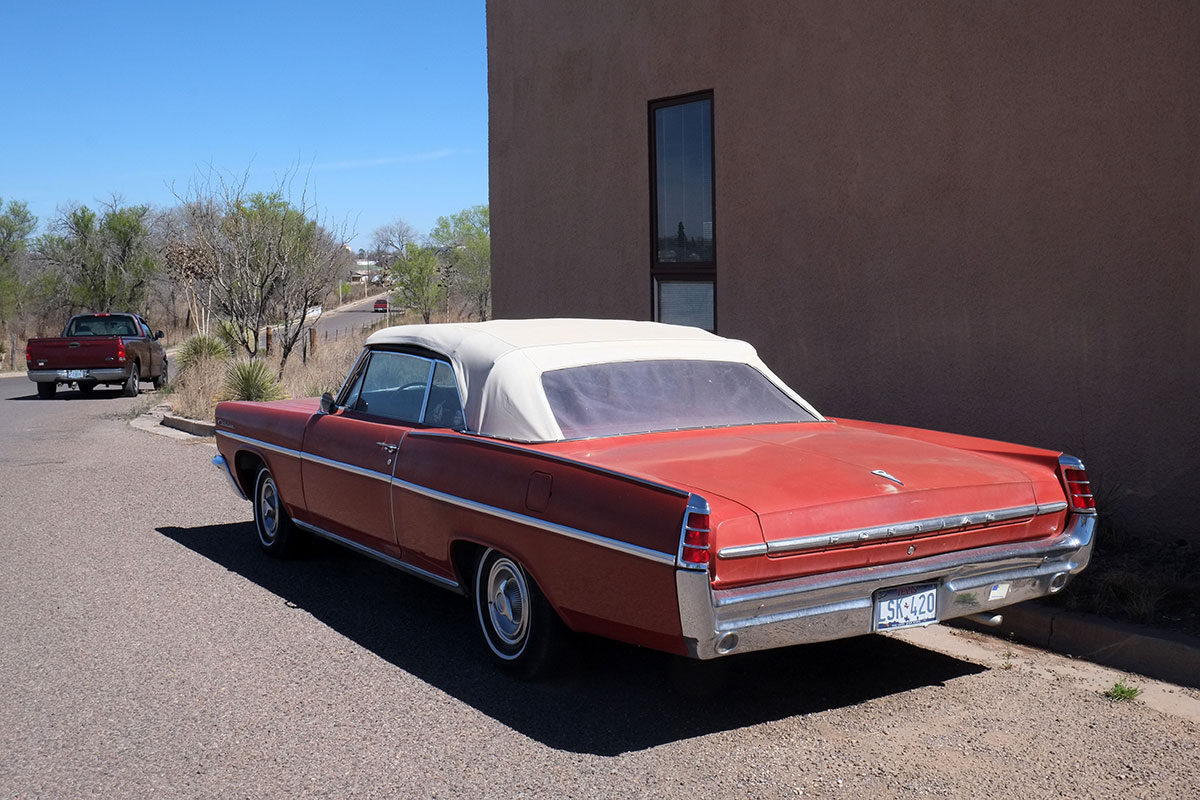
Other weird patterns emerged.  A concentration of very old American cars.  Types that I barely remembered and Greta had never seen.  Some in suspiciously good condition.  DSCF6251

DSCF6256

DSCF6123

DSCF6231

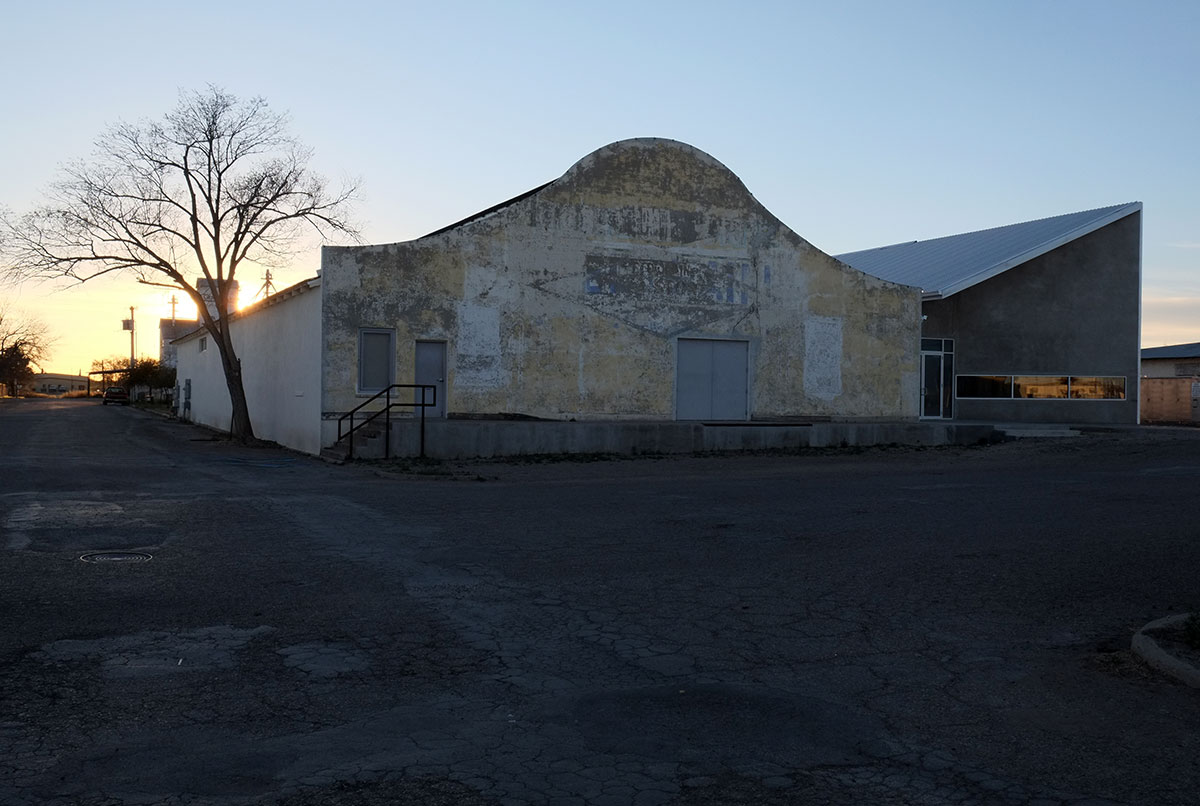
We noticed older buildings sprouting strange new additions.  What was really going on behind those grimy facades that could cause such bizarre new growth?DSCF6115

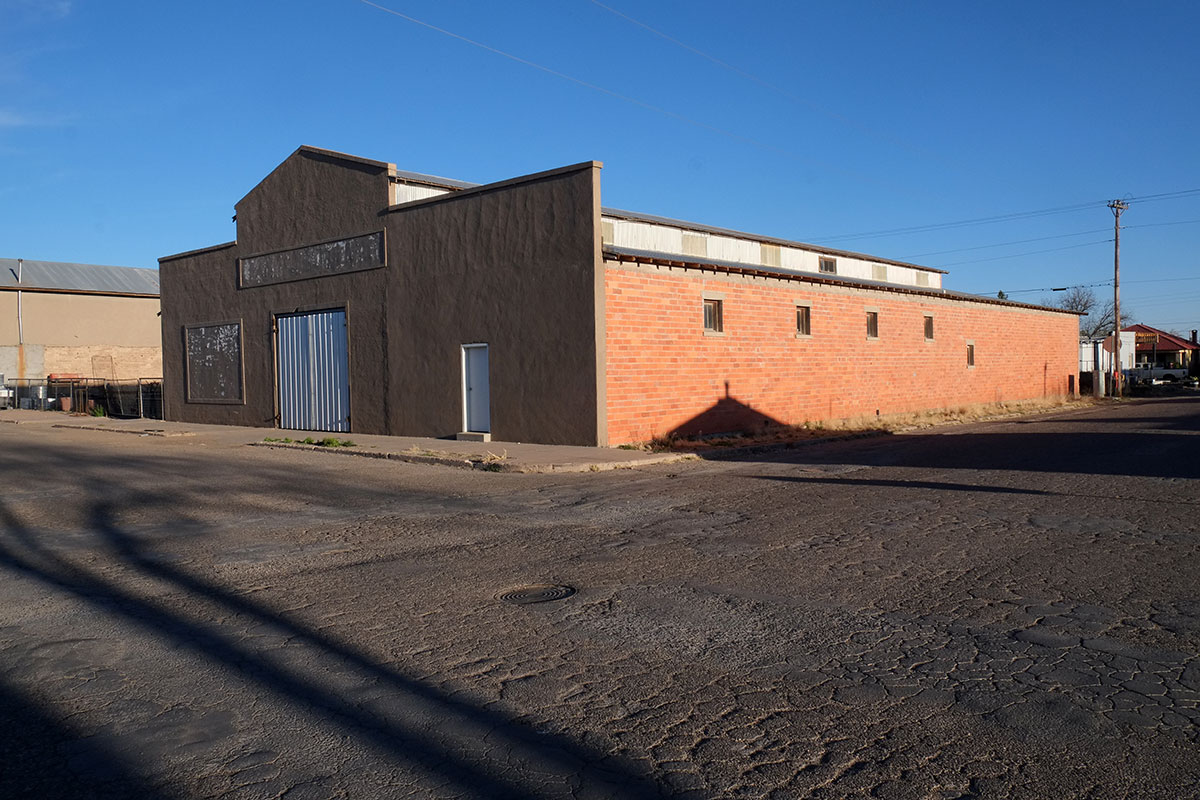
We began to look suspiciously at buildings that had appeared innocuous to us the day before – what activities were they hiding inside?DSCF6080

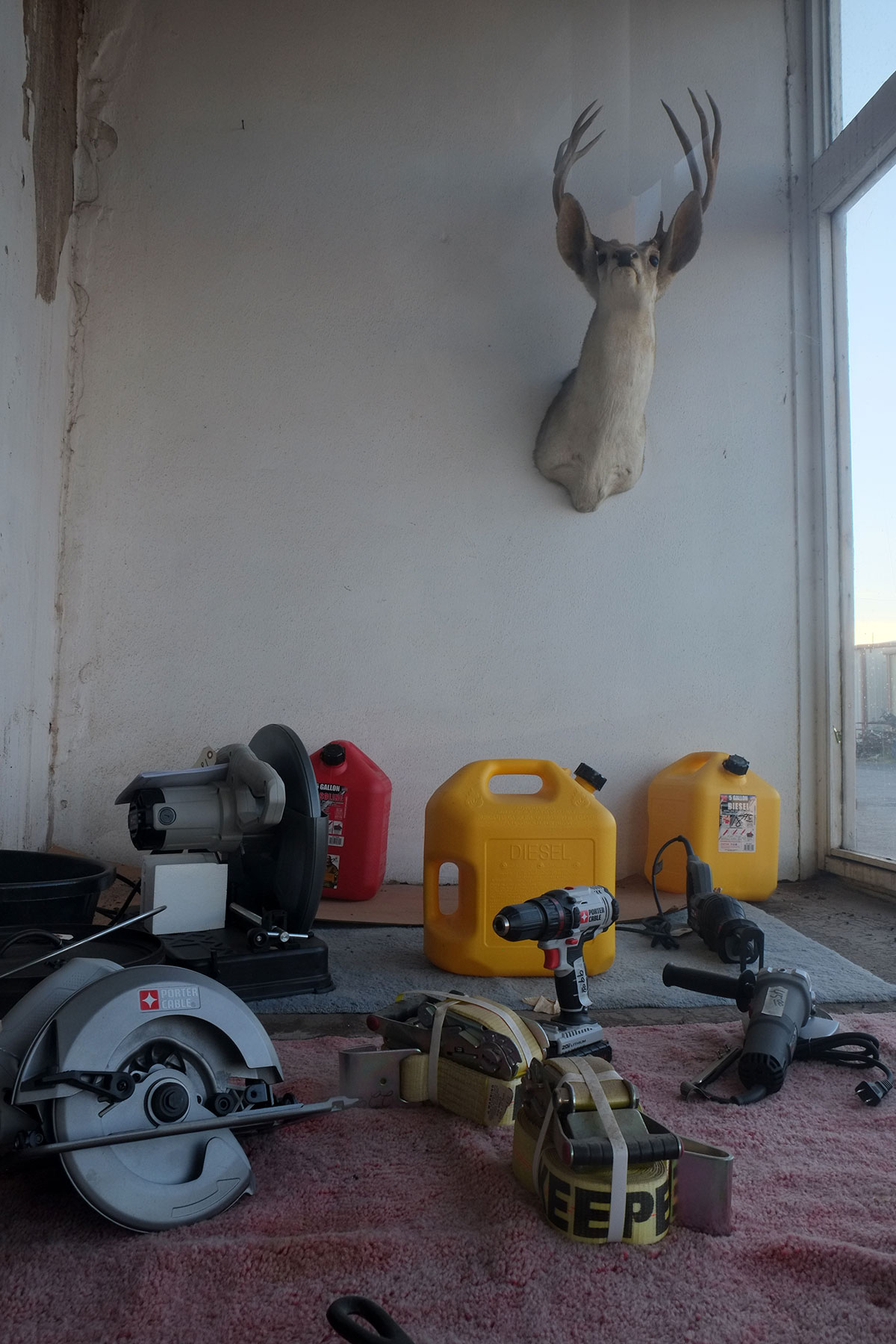
Then we came upon the local hardware store and looked in the window to find this disturbing tableaux.    DSCF6114

All became clear.  This couldn’t be a display of goods for sale, this could be nothing other than an MFA thesis installation.  We really were unwitting participants in a performance piece at the scale of a town.

We headed north across the desert, away from the Lights, trying to reach New Mexico before dark.

Donald Judd in Texas

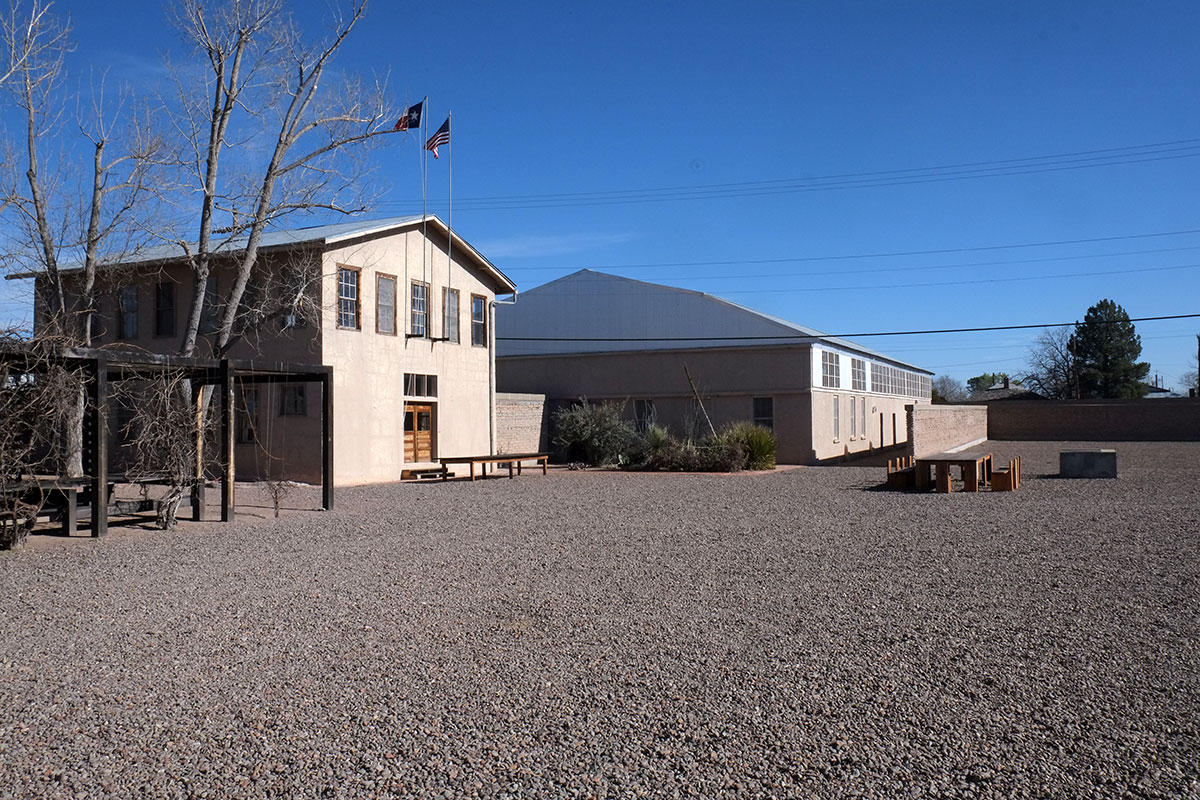
DSCF6006Donald Judd, the sculptor and theorist, pretty much deserted New York for West Texas in the 1970s.  He eventually bought a 340-acre former Army base on the edge of Marfa, also acquiring the quartermaster’s post in the center of town.  Although he continued to own his building on Spring Street in Soho, for the rest of his life he mostly worked in this incredibly remote town of 2000 out in the desert.

I’ve always been intrigued by artists and writers who have achieved great success, and who then leave the cultural centers so they can continue their work, unimpeded by the distractions of social life and fame.  It’s a pretty rare phenomenon (O’Keefe, Salinger, Updike and Pynchon being recent examples);  how many people want to really be great artists, versus living the entertaining  life of a successful artist in the metropolis, especially in our current society, which seems to be driven by mainly by celebrity and money?

The really unusual thing that Judd did was not his move to the desert to create his work, but his decision to create a venue out in the desert for the permanent installation and exhibition of his own work, plus that of his friends Dan Flavin and John Chamberlain.  He thought that in big city museums, where they would be able to show at most a few pieces, the work could not be well-understood.  In Marfa, where the spaces were big and cheap, they could show a significant body of work, including large, site-specific installations where an idea could be fully developed.

Besides his sculptures, Judd was noted for his furniture design.  He had considered becoming an architect, and all of his work shows a remarkable regard for context, materials and structure. As I learned on a tour of his compound, he didn’t want to construct new buildings – he thought that developing a relationship to an existing building and site had more possibilities, and all  of his work in Marfa reflects this.

The sites in Marfa are now run by two different organizations.  The Chinati Foundation has the old army base, where Judd’s large installations, Flavin’s installations, and the work of visiting artists is shown, as well as a building downtown devoted to John Chamberlain’s sculpture.  The Judd Foundation, which is run by his children, owns the compound downtown where Judd and his children lived, and where a wide range of his individual pieces are shown.

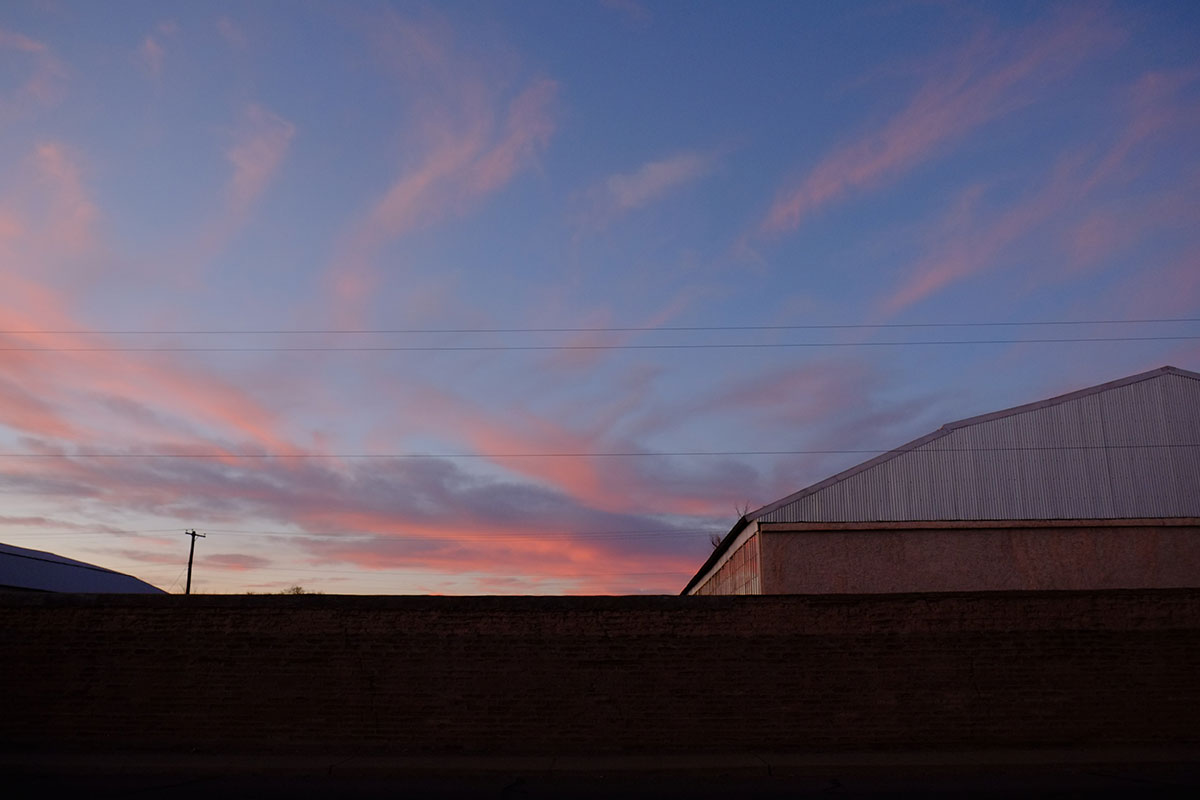
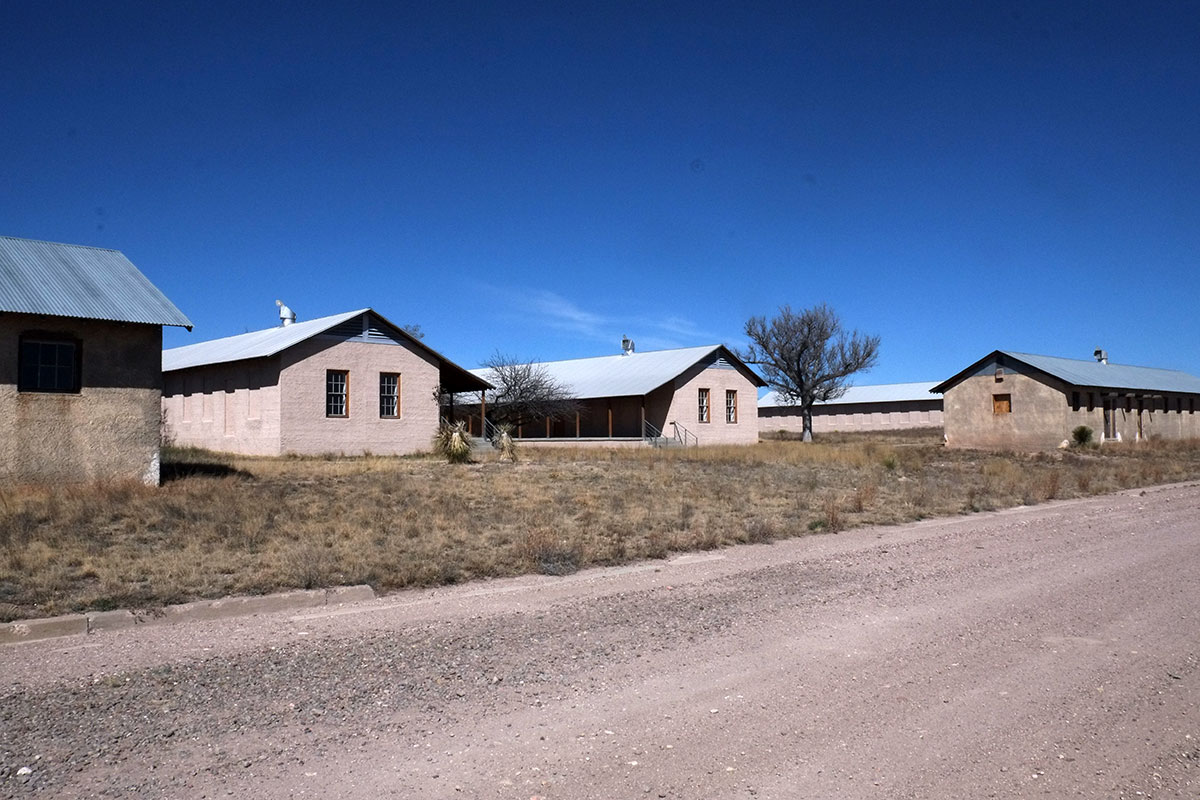
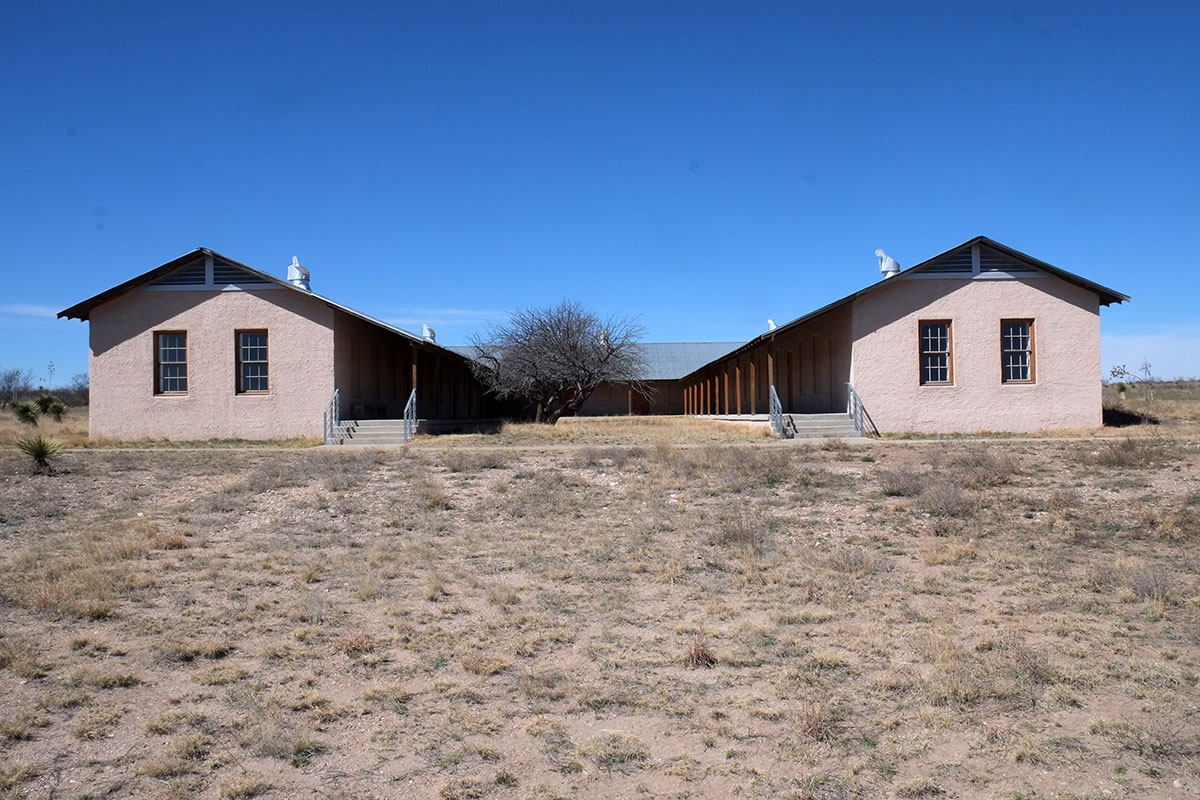
At the Chinati site, the wood-frame barracks buildings are strung along a curving walkway and road.  Dan Flavin took over six of them for an installation of his colored fluorescent tubes, with each successive building exhibiting a change in the sequence / development of the ideas from the previous ones.  DSCF6196

DSCF6190

DSCF6193

The importance of the location in Marfa can be clearly seen – if you were in a city museum, you would be lucky to see one half of one installation – they just take up a lot of room.  But here, the layouts are the same in each building, while the color arrangement changes.  You go from one building to the next, and can understand the color as the independent variable.  The rhythm of leaving one building, going out into the bright desert, and the entering the next darkened building is an important part of the sequence.

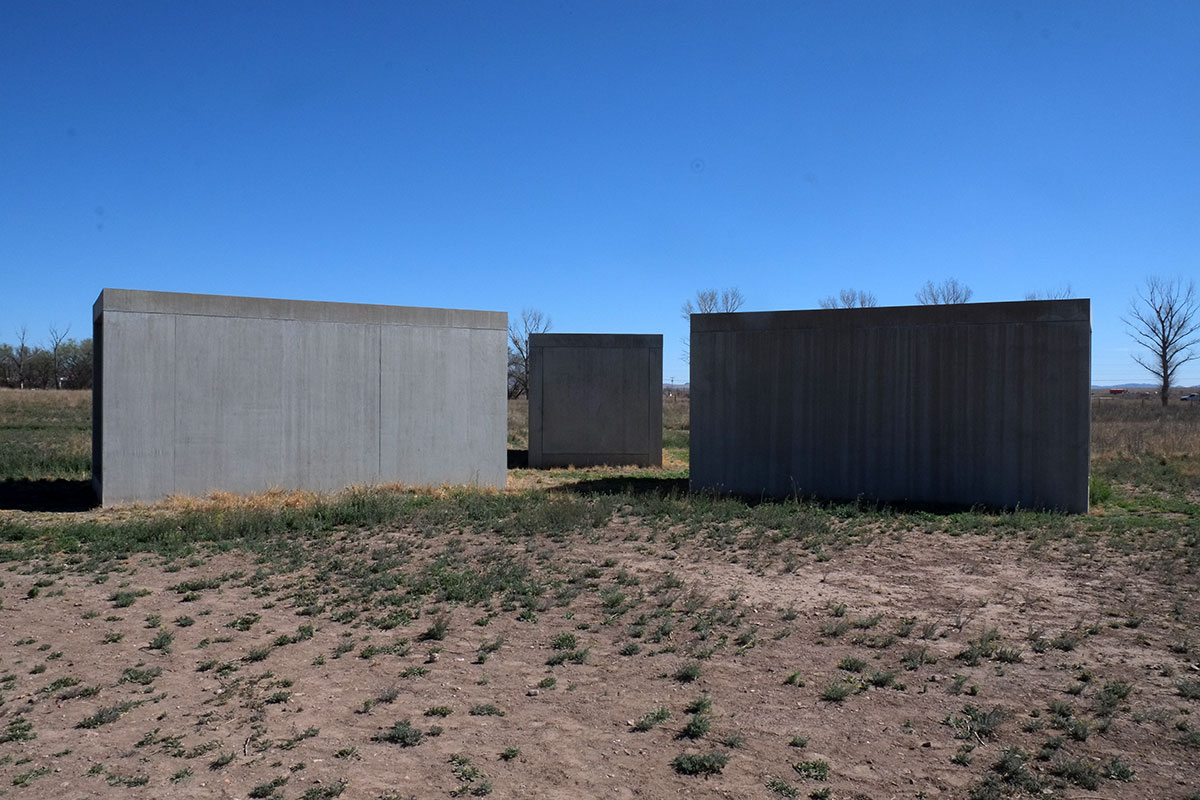
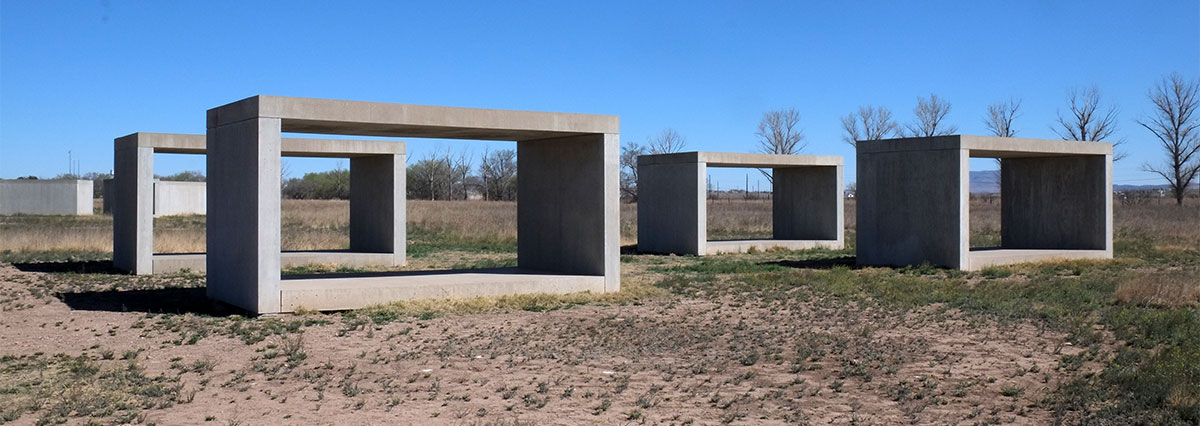
Judd created a series of large concrete box sculptures out in the landscape, which were cast in place.  The boxes are all of the same outside dimensions, but each cluster varies in degree of enclosure, number, orientation and arrangement.  DSCF6154

Many are orthogonally placed, but diagonal visual relationships are apparent as you walk around them.  As one of the docents on a tour pointed out,  Judd thought symmetry was critical – things should be symmetrical unless you had a specific reason to make them asymmetrical.  I was struck by the different between his thinking and current practice today, where any symmetry (or even regular geometry) evokes gasps of shock and surprise.  DSCF6158

As I walked down the line, I was reminded of the Kahn buildings we’ve seen on this trip, where simple, strong forms are carefully placed in the landscape.  Forms in light, and here it is the strong, vivid light of Texas.   It reinforced Marc Treib’s idea that human interventions which manifest a clear geometry stand out in contrast to the natural world, and this contrast highlights the essential character of each and makes them more powerful.

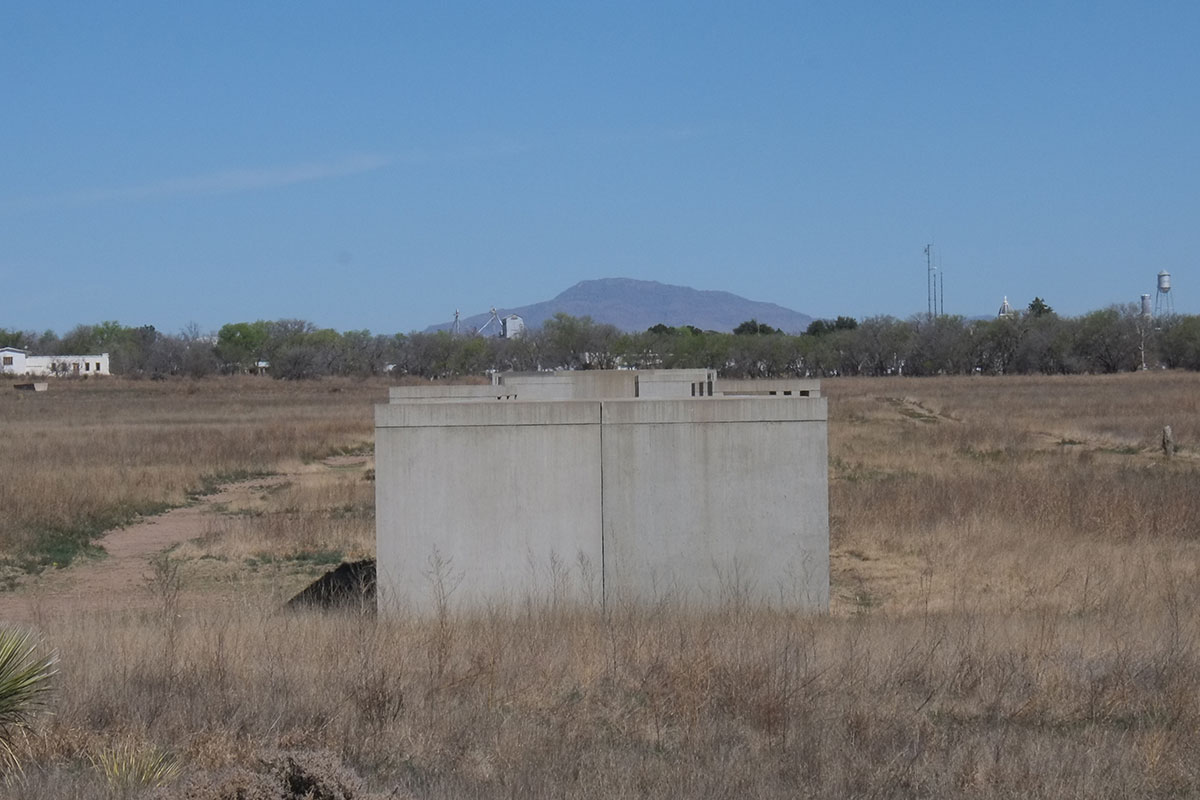
This part of the Chihuahuan Desert at first seems rather featureless, but as you look around, you notice some ordering features.  The Marfa Plateau is extremely flat, but there are individual mountains and ranges which break the horizon.  The sculptures are arranged to emphasize these distant connections.  All these sculptures are arranged on a long axis in the landscape, and as you move along, you can look back and see the termination of the axis to the north.DSCF6165

DSCF6168

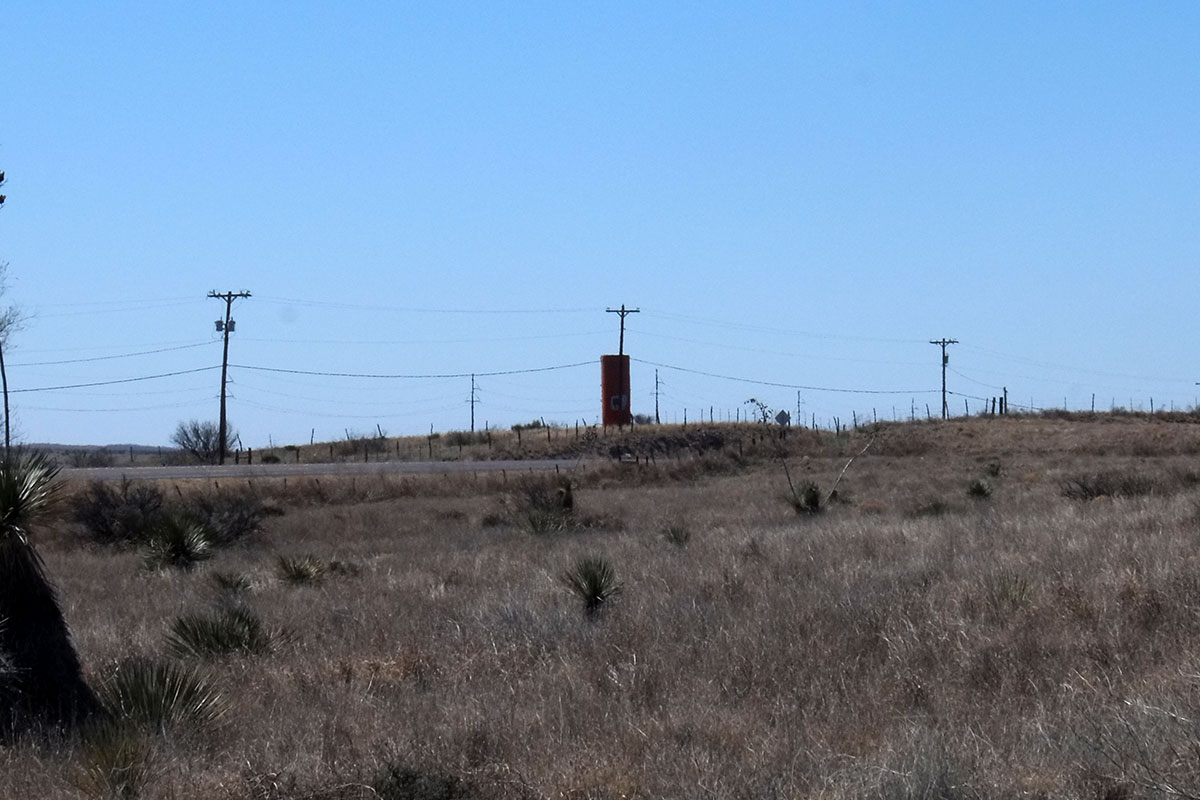
I then tried to extend the axis visually to the south, and it seems to end up here, in a water tank and three telephone poles with cross-trees.  I don’t think Judd intended to make a reference to Calvary, but nothing else in this environment seems to be unplanned or happenstance.  I think this could be the subject of at least one PhD thesis on the importance of Christian iconography in Minimalist art.DSCF6172

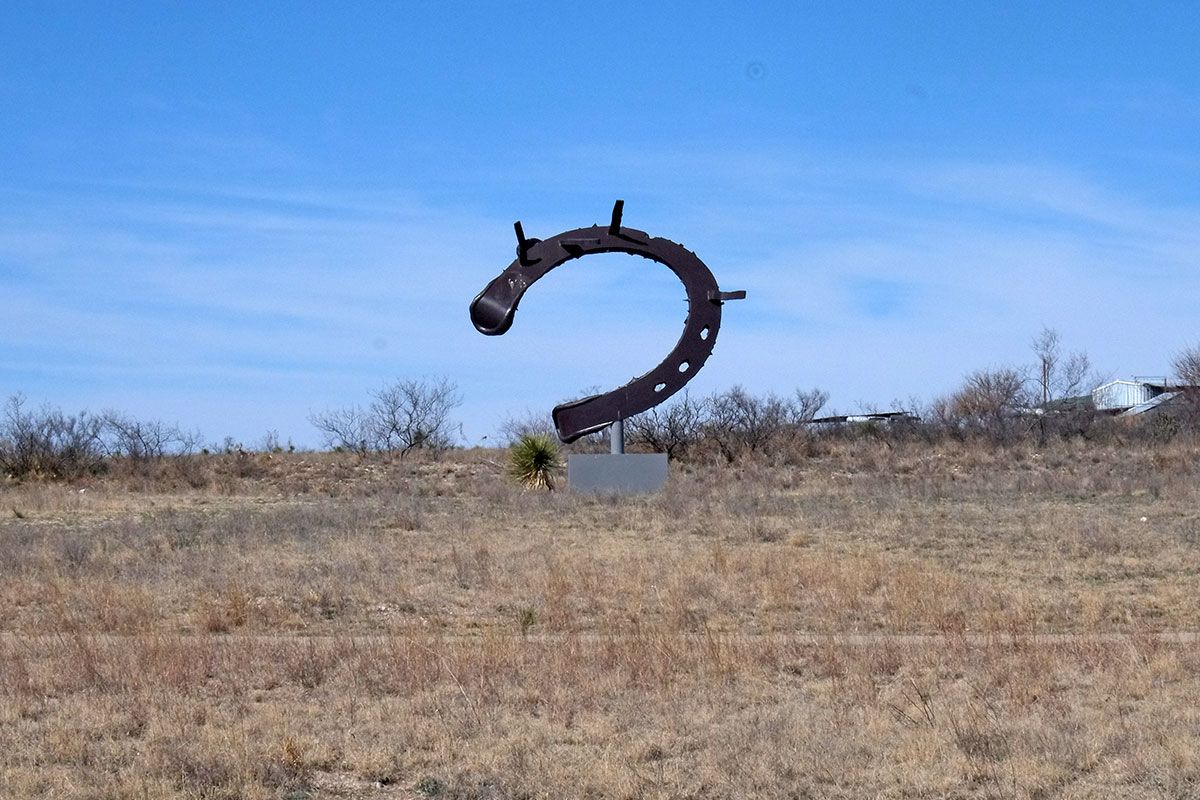
Claes Oldenburg created one large sculpture on site.  He picked up on how this was a US cavalry base, which finally ended up with one famous old horse.  Oldenburg created one giant horseshoe as a memorial, which apparently has some astronomical alignment.  DSCF6203

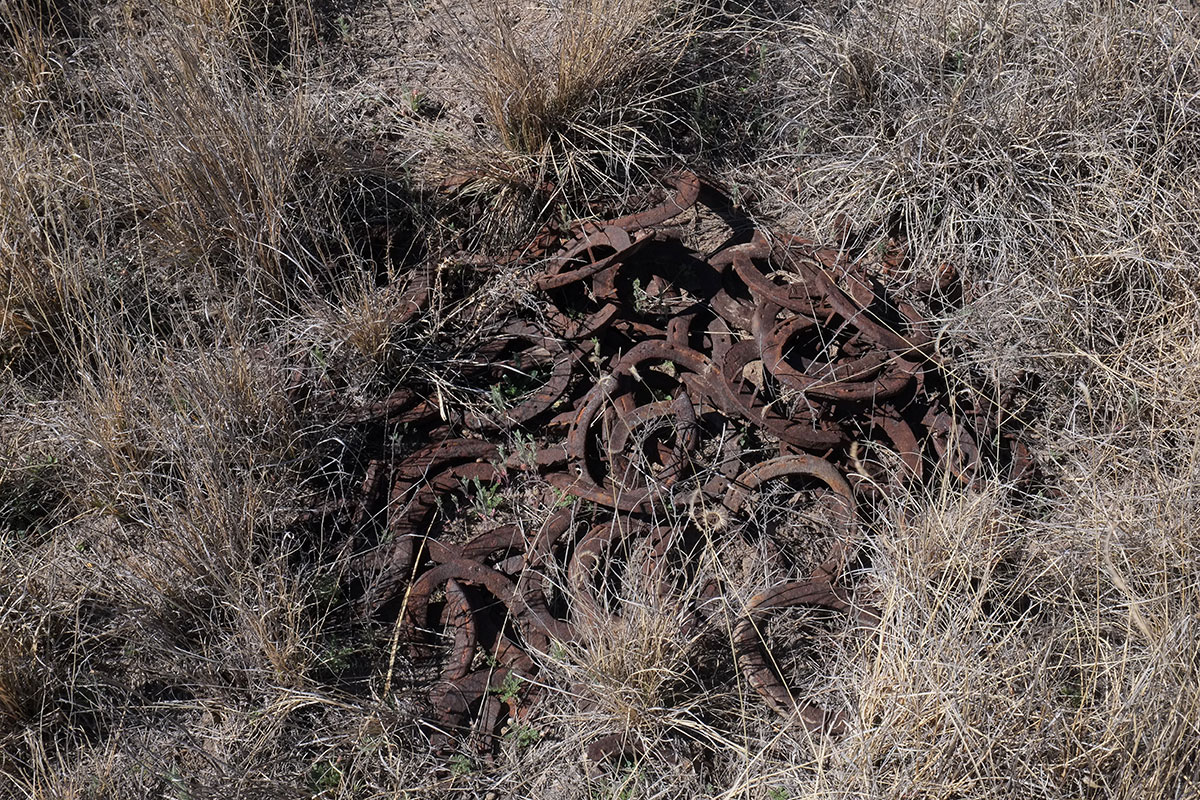
As I was walking around the site, i came across this pile of old horseshoes out in the landscape.  Was it a remnant of the days of the cavalry, or was it a subtle installation, intended to be discovered by only the most intrepid art fiend?  DSCF6180

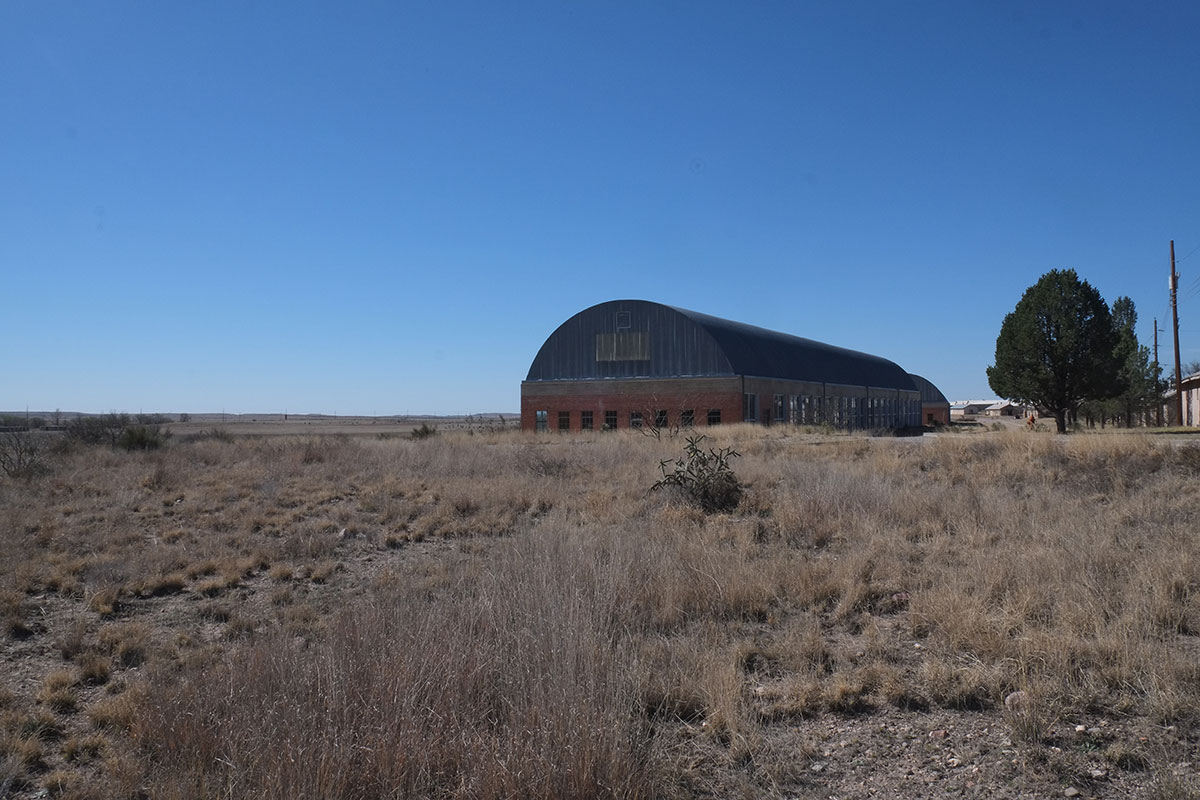
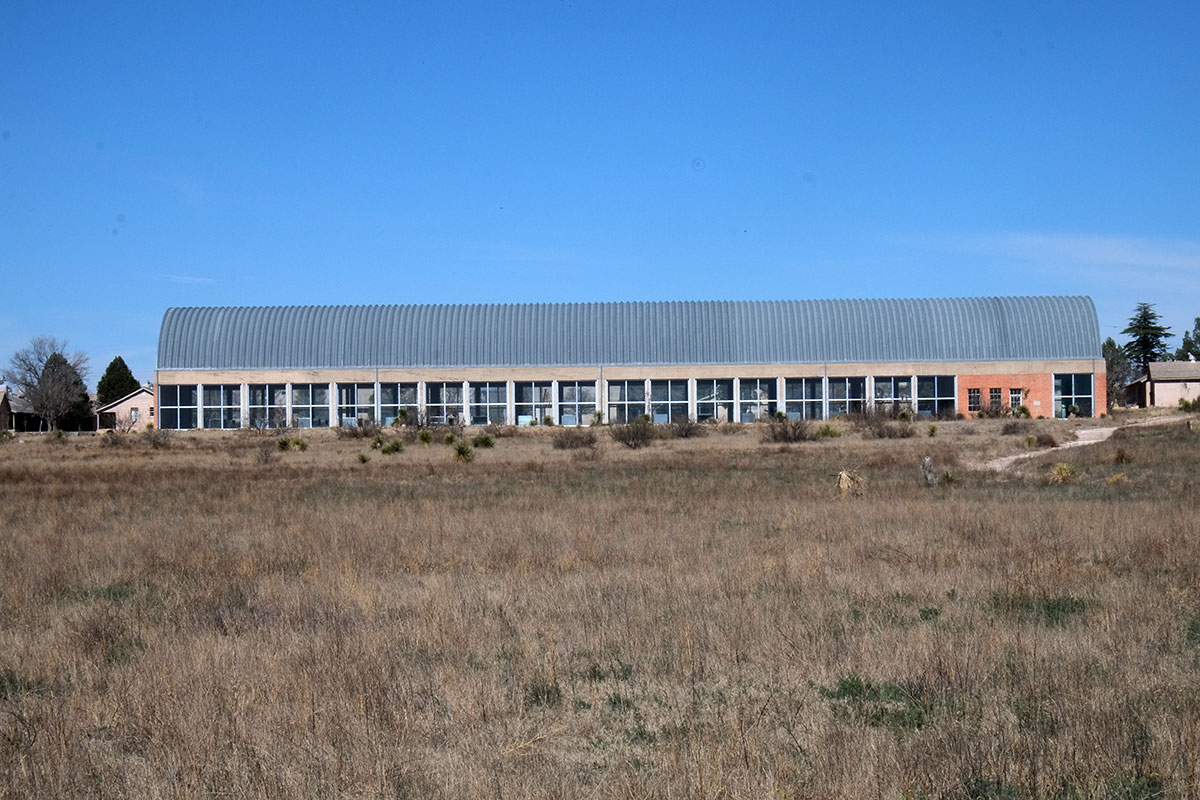
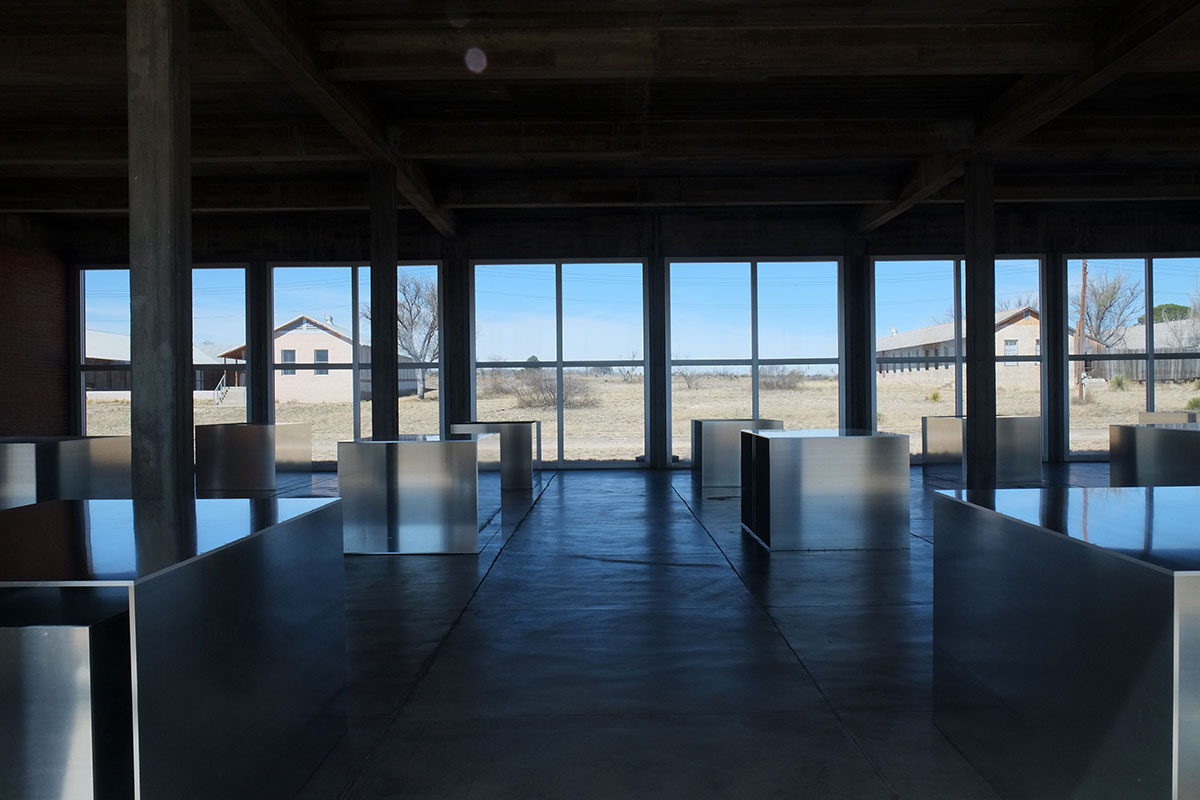
Besides the barracks, there are two large hangar-like buildings, which have been used for the installation of a series of 100 aluminum box Judd pieces.  They are quite remarkable buildings, with brick facades and a regular bay system.  Judd replaced the garage doors with glass storefront window installations.  But the biggest change he made was adding the barrel-vaulted rooves, which were previously flat.  This was done simply for visual reasons, to have the imageable building shapes stand out in the large landscape, creating iconic elements which seem to relate to the views of the distant mountains.  (Although I want to know what actually happens up in those big attics.)  DSCF6125

DSCF6153

To see the works inside at the Chinati Foundation, you have to take a tour, and you’re not allowed to take photographs inside.  They’re not worried about copyright, they just don’t want to have people running around, trying to capture the perfect image – they want people to actually experience the art.  As much as I do want the perfect image (mainly for teaching), I have to agree with this policy – when you eliminate the distractions of cameras and phones, the art is right there in front of you, and you begin to get it.  Maybe all museums should do this – no phones, and no labels.  Really look at the art.

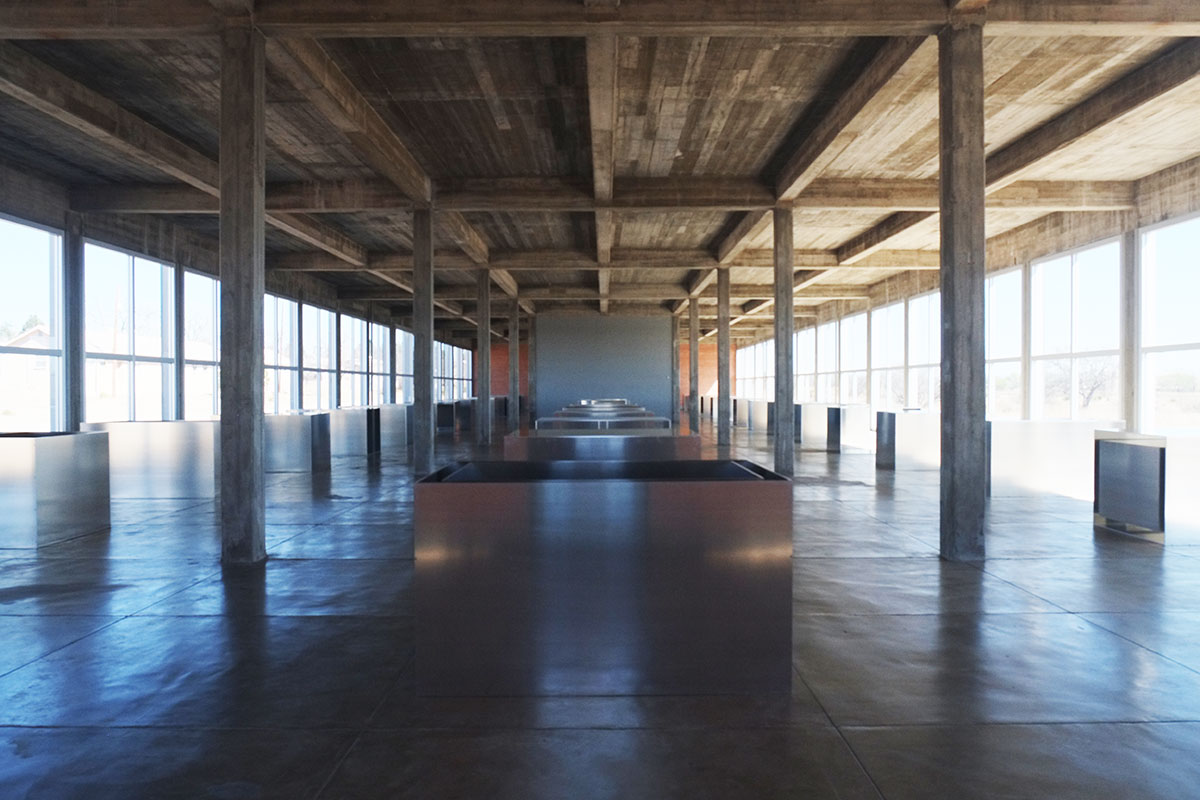
The next day I did take a few photos through the windows when I was walking around the site,  not on the tour.  Here you can see how the pieces fit into the spaces.  DSCF6217

Judd adapted the placement of his works to the pre-existing division of the buildings into a few masonry-walled spaces.  But whereas the box concrete sculptures outside have varying spatial arrangements, here there is a strict alignment of the boxes in rows and columns, related to the building structural grid.  Each of the boxes has the same outside dimensions, but each has a different series of aluminum planes, and explore 100 different ways that the volume can be divided and developed.

Again, the importance of being in a large enough building to see the whole sequence was evident.  In a museum, you would see just one box, in a  gallery of work by many artists.  It becomes a checklist experience of identification – there’s the Judd – he’s making some interesting space inside an aluminum box – looks like exercises we did in first-year studio – wonder what his idea was – time to move on to the next piece in the gallery – oh it’s a Flavin.  But with a series you look at one, then you look at the next, then you think about the differences, and after you see five more an idea occurs to you, so you circle back to the first, etc.  It is similar to serial music, where the variation in the patterns is a  critical element.  (However, there is no discernible pattern in how the individual boxes are juxtaposed – you can’t see an obvious progression of an idea down a row, for example.  It’s not a matrix.)DSCF6220

But I did discover one remarkable thing while looking at them.  The absolute precision of the geometry of each box made me wonder about the precision of their placement in the system of the repetitive building structural bays.  I sighted along a row of boxes, and discovered that they were not very well-aligned at all!  Some were shifted off the orthogonal, sometimes by inches.  Then I looked at their placement within the grid of control joints in the concrete slab, and found that they were not centered within an individual module, being clearly skewed towards one side.  This seemed so incomprehensible that I asked the guide, and she said yes, they were all moving – they had been carefully aligned and centered when they were installed decades ago, but now they were out of alignment.

I thought about it, and came up with what I thought was a reasonable explanation – large boxes made out of aluminum (which has a very high coefficient of thermal expansion), sitting in an unconditioned building in the desert.  Every day they would expand and contract with the diurnal temperature swing.  But they are sitting on an imperfect concrete slab, and so are unevenly supported, so when they expand and contract, they probably shift imperceptibly with each cycle.  After decades they have moved noticeably (about 10 inches in my estimate), and I would expect the movement among them to be random.  Then she added, they’re all moving north.  We were at a loss to explain this.  Couldn’t be magnetism.  How about the Coriolis Effect?  Maybe the janitor is actually pushing them?  The guide later mentioned that there is a 101st box, which is in the Spring Street Building in New York.  Greta theorized that they’re all trying to reunite and complete the sequence.  At which point the Hopi Corn Rocks will also fall, and the Anthropocene Era will come to an end.

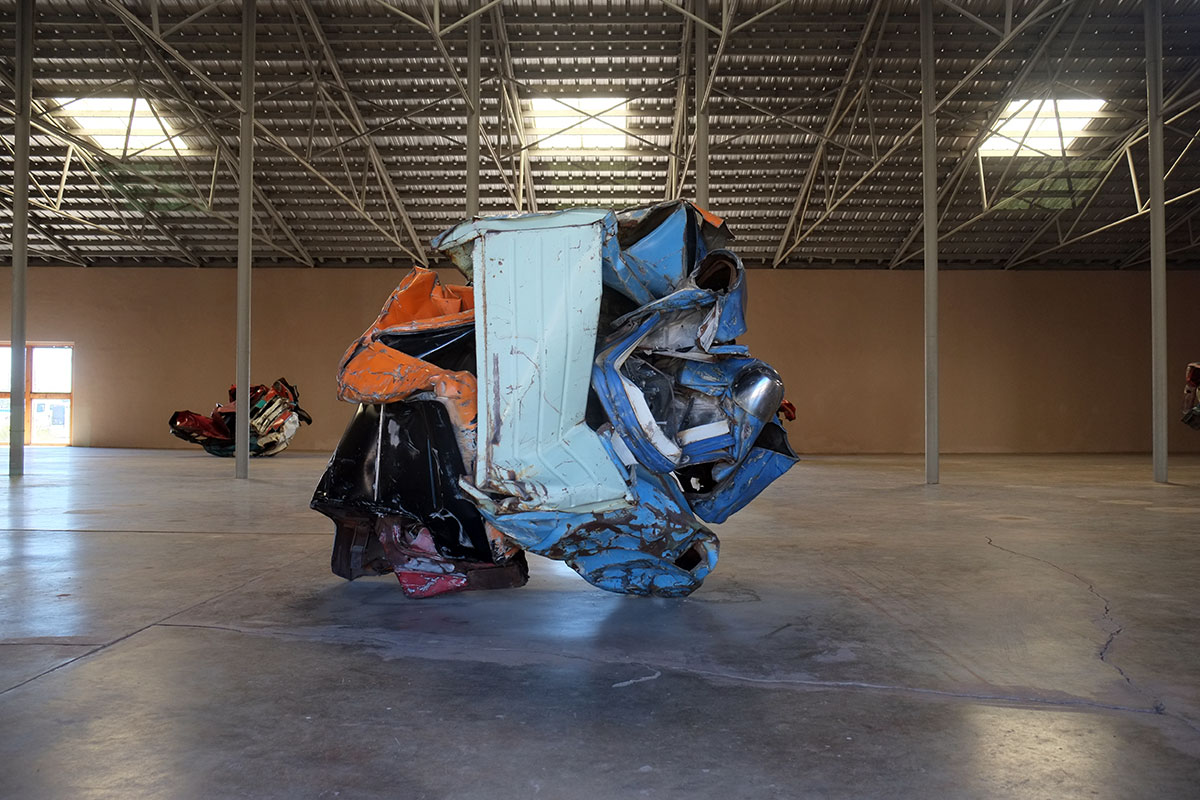
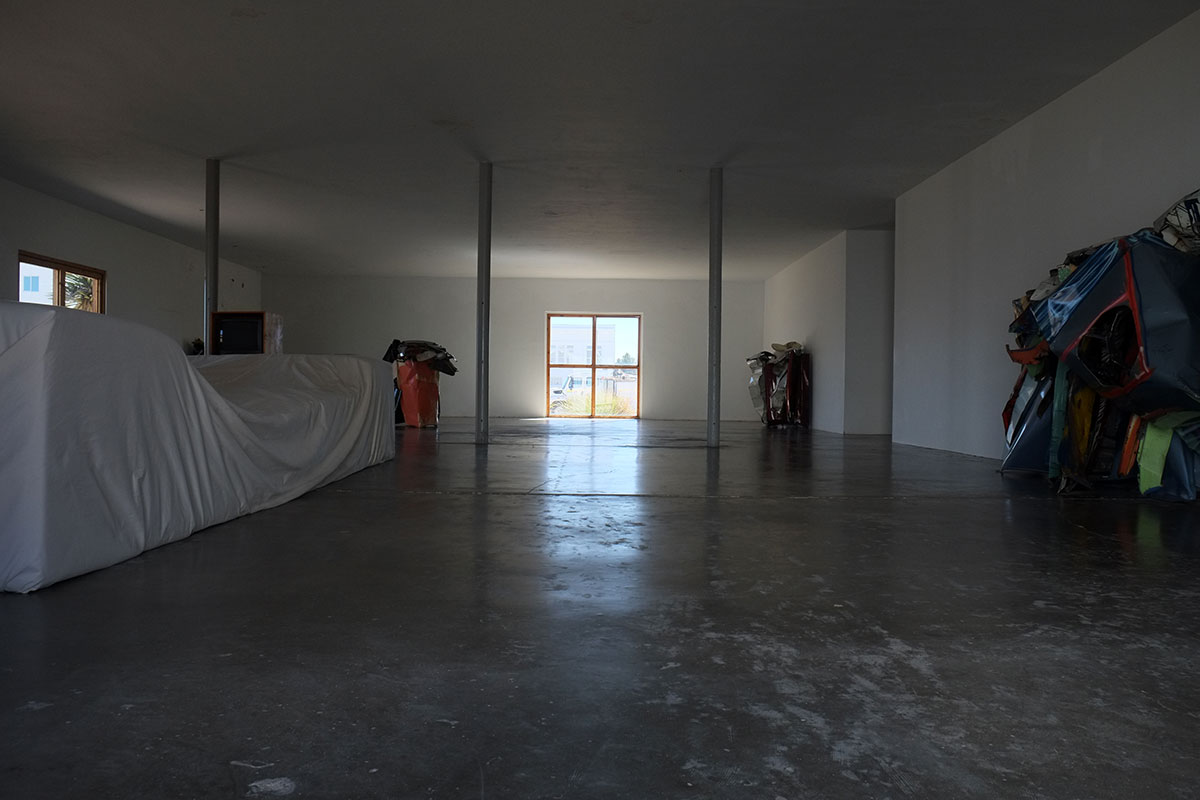
The last building of the Chinati Foundation is in downtown Marfa, which houses John Chamberlain’s sculptures made from automobile pieces.  DSCF6033

Whenever I’ve seen Chamberlains in the past, I’ve liked them but thought they were one-liners – cool idea, use old car parts.  But when you see a building full, you can see the big differences between them sculpturally and spatially.  When seen individually, his choice of material is the dominant attribute, and you see an individual sculpture as one example of the class of sculptures made out of car parts.  When you see many, the material cancels out, and you see them as individual works.  (You don’t go into a gallery of Greek sculpture and say, Oh, they’re all made out of marble.)  DSCF6035

The next piece at the Chinati will be the remodel of the hospital building by Robert Irwin.  It has been in the works for years, and its completion could be the excuse for another visit there.

The other important site in Marfa is the compound where Judd lived and worked. DSCF6072

There is the original quartermaster’s house, which he remodeled, and a couple more large hangar-like buildings, which he subdivided into studios, galleries, libraries and more living space.  DSCF6041He built a big masonry wall around the whole compound, which apparently the locals were not thrilled about at the beginning, but which established the degree of privacy he needed to live and work in the center of town. DSCF6244

There is a fabulous swimming pool, DSCF6054

a Donald Judd personalized Land Rover,DSCF6066

a great ramada / pergola which can seat a crowd, DSCF6057

a side yard for his daughter to play in (in a rather abstract manner),DSCF6070

and Judd-designed outdoor living equipment, DSCF6061

and furniture.  DSCF6049

DSCF6045

The site design, building renovations and furniture all exhibit the simplicity and clarity of his sculpture.  He apparently hated the term Minimalism, and this makes it clear why.  Being minimal isn’t the goal, it is what is left when you strip away everything inessential.  Just as with Kahn’s architecture, the elemental pieces are rich in form, meaning, light, etc.  Doing something complicated is easy, doing something simple is hard.

You can’t take photos inside the buildings here either, but there are published views.  There are two gallery spaces of Judd’s work.  Whereas the work at the Chinati is for showing the rigorous development of a set of related ideas, the work here illustrates the development of his ideas throughout his career, so you can see the progression of thought.  Both types of focussed installation are critical, and something you can almost never see in a museum which has to show a range of artists.

Judd’s libraries were especially interesting.  Two big rooms, each across the width of a shop building, one with books about the modern era, and one for pre-modern.  He had 12,000 books, and his range of interests was broad.  His architecture selection was notable, spanning the range from Louis Kahn (obviously) to Christopher Alexander (less obviously).  He had a whole shelf on the design of structures.  All of his rooms had daybeds – apparently Judd liked to immerse himself in his work, and wherever he was tired he could lie down and sleep, waking back up to the matter at hand.

I had first heard about Marfa back in the 1980s.  One of my professors at Columbia, Lauretta Vinciarelli, lived with Judd in his building on Spring Street, where she was always designing things for Marfa, and helping Judd envision what the place could become – there are many published images of her designs for the courtyards there.  (Oddly, while we were in Marfa there was no mention, and apparently no knowledge, of her involvement.)  I never quite understood what was special about this one place way out in the desert, in the middle of nowhere.  I eventually began to understand the importance of isolation, but not this particular place.  But in the past two months, as we’ve wandered in the desert, it’s started to make more sense to me.  In Desert Solitaire, Edward Abbey writes:

…the strangeness and wonder of existence are emphasized here, in the desert, by the comparative sparsity of the flora and fauna:  life not crowded upon life as in other places, but scattered abroad in spareness and simplicity, with a generous gift of space for each herb and bush and tree, each stem of grass, so that each living organism stands out bold and brave and vivid against the lifeless and and barren rock.  The extreme clarity of the desert light is equalled by the extreme individuation of desert life forms…

Abbey is writing about the the natural world, but the same could be said about the artistic or intellectual ones.  Judd’s work might have developed in isolation in the Vermont woods, but the desert is especially suited to Judd’s art, with its conceptual clarity and spareness.  The work is contextual at that conceptual level, not at the more literal visual level with which we usually use the term in architecture.

I was aware of the cultural phenomenon that Marfa has become (more on that soon), and I expected that the experience of that milieu would overwhelm the experience of the art and architecture.  It didn’t.  Judd’s work speaks strongly and clearly here in a way it can’t anywhere else, and it is worth the trip to become immersed in it.  In this age of crazed, complicated, erratic, irregular, flashing imagery, coming face to face with solid, considered, elemental, quiet work is an inspiring and re-calibrating experience.

San Antonio

DSCF5662Continuing with our string of Texas surprises:  San Antonio.  All I had ever heard about in San Antonio was the Alamo and the Riverwalk, a downtown redevelopment along an old waterway, which had spawned a district of restaurants bars, etc.  I expected a 1980s, James Rouse style, River “Place” development, with a Hard Rock Cafe, TGI Fridays, etc., that lured timid suburbanites and tourists into the one part of downtown that wasn’t a disaster.  So when we arrived in San Antonio, I wasn’t in any hurry to see it;  I figured if everyone else in America liked it, I probably wouldn’t.

rodeoAt our urban campground (fabulously located right on a small river park with a bike path through the city), we discovered that the San Antonio Rodeo (the largest indoor rodeo in the country) was taking place a mile away.  In fact, almost everyone else in the campground was working at the rodeo, and the campground was full of big rigs and horse trailers.  Fresh from our Mardi Gras experience, we realized cultural immersion was the way to go on this trip, so we went to our first rodeo.  Walking around the grounds before the main event of bronco-busting etc., we discovered that it was a combination rodeo/state fair, with lots of animals and competitions in every way.  It was really fun, and Greta will blog about it if she ever gets it together.DSCF5444

The next day we started with the San Antonio Missions National Historical Park.  The Alamo in downtown San Antonio is the northernmost of the five missions strung along the San Antonio River, and all the others still exist in various states of preservation or reconstruction.  The drive south of the city along the river is a pleasure, and each of the missions is quite different from the others.

Mission Concepcion has the best-preserved church, with intact architecture and original interior paintings.  DSCF5509  DSCF5497

DSCF5491

The church at Mission San Jose was extensively reconstructed from ruins in the early 20th century, but it is the best example of a whole mission compound, with the extensive walls in place, and many perimeter dwellings built into the walls, giving the best illustration of a complete mission complex.  DSCF5547

DSCF5522

The ruins of the monastery have been left unrestored, a remarkable two-story masonry structure.  DSCF5510

DSCF5557

The refectory is vaulted, with flying buttresses on the exterior.  DSCF5536

DSCF5537

All of these missions were supported by agriculture, which was dependent upon irrigation from the river.  Dams, and even aqueducts were constructed to channel the water.  DSCF5606

Mission San Juan is in a less-restored state, and shows later additions completed in the 19th century.  DSCF5572

Mission Espada is the furthest out of town (although still within the San Antonio ring road), with a small church and an unreconstructed compound.  DSCF5586

DSCF5601

With typical National Park Service expertise, the scattered-site park holds together as an experience and a narrative  The River ties it all together, and at the end you have a remarkably nuanced understanding of how the missions operated as an integrated system in the 18th century.

We headed for the center if town, and were immediately shocked.  Everywhere we looked, there were beautiful older buildings.  DSCF5617

Somehow San Antonio didn’t destroy its past.  Of course, there are banal newer buildings, as in every other large American city, DSCF5622

but they don’t dominate.  In the core of the downtown, the new and the old are intermixed in a wonderful way.  Dallas has old buildings, but they are all in one district, while the modernist skyscrapers have taken over most of the city center.  In San Antonio, the mix is much finer-grained.  The civic center, with the city hall, courts and cathedral, is intact, with a full-block plaza at the center.  DSCF5692

DSCF5696

Streets are lively, the streetscape has been carefully tuned, and the urban fabric is a blend of old and new, large and small.  Retail is everywhere.  DSCF5715DSCF5711

The Alamo is the major tourist attraction.  It is quite small, and actually a lovely building.  You can’t take photos inside, and you realize that you are in the secular mother church of Texas, surrounded by reverent Texas tourists taking selfies and intently examining all the artifacts related to their fundamental combination creation / hero myth.  DSCF5668

The Alamo is at the core of this, but then it is also surrounded by other monuments to the Alamo.  It is like a religious pilgrimage site, where there is a multiplication of chapels and statues, as each generation feels the need to add their particular expression of piety to the complex.  The weirdest is this gigantic, Art Deco statue / bas-relief / monument.   A central naked figure representing something, DSCF5674

and then a Pan-Texan Procession on the bar, depicting all the famous people who died at the Alamo.  DSCF5673

We did not notice any similar monuments to the heroes of the Civil War who died to end slavery, such as we saw in Boston.  We realized that we would could never truly appreciate this primary expression and apotheosis of Texas identity, so we moved on.

DSCF5709

The Riverwalk was amazing.  It is not a phony, recent, focus-group tested, marketing ploy.  It was a loop in the canal / water control system in the downtown that was redeveloped beginning in the 1930s.  It was largely the vision of a local architect, Robert H.H. Hugman, who in the 1920s began pushing the idea of re-using the canal that ran along the backside of downtown buildings.  He built his own office there at the canal level, which bridges the upper world of the street and the lower world of the canal.  DSCF5650Outside it stands a statue and memorial to him.  DSCF5649

He emphasized that the redevelopment of the downtown should preserved much of the past, rather than clearing the city for the big new ideas.  There are several other plaques scattered around in his memory;  I have only seen one other city (Amsterdam) where the role of the visionary architect is even acknowledged, much less celebrated the way it is here.

The canal is lined with restaurants, cafes, hotels and stores.  There is a range of prices, and there are plenty of public amenities – it doesn’t feel like a corporate “plaza” where the public is grudgingly admitted if it is dressed right.  There are tourists, locals, kids, yuppies, etc.  DSCF5636

DSCF5631

It is a big curve through the downtown, and this exaggerates one of the strangest aspects of San Antonio:  outside of Boston, it is the most confusing downtown of an American city I have ever seen.  Most of the west is gridded, and sometimes there are colliding grids.  Eventually you figure out the system and can find your way around.  But the center of San Antonio seems to be unplanned in the way that the old part of Boston and New York are, and then various grids collide into it on all sides, most of which are deformed themselves.  The dislocation is so severe that there are map signs everywhere downtown to help people orient themselves.  DSCF5678And then added to this general confusion is the Riverwalk, which is a loop off the main canal.  (in the map above, it circles the light blue area in the middle.), which is probably the path that most visitors are going to follow.  Since the Riverwalk is a separate system (similar to the way the street and canal systems in Venice are separate), and since it is behind the major buildings, it is almost invisible from street level, except that a view and access point appears every once in a while.  And when you are on the Riverwalk, you barely notice the streets passing over you now and then.  If you do ascend to street level, you have no idea where you are, and you have to start looking for one of those maps.  San Antonio takes the concept of Chutes and Ladders to the urban scale.

In practice, this is all wonderful.  The problem with the big, gridded cities of the West is that they are often boring – every point on the grid is the equivalent of every other.  (Even the pedestrian Mecca of Portland suffers from this.)  The downtown of San Antonio is a labyrinth, and you wander happily through it.  When you need to actually get somewhere, there is a map to help you.  But rather than navigating by an abstract geometric system, San Antonio can be navigated by landmarks.  Some wonderful buildings have been designed which bridge the two worlds, and are imageable places.  Hugman’s office is one, the Casino Club Building is another.  At street level, it marks the corner of a major intersection at the end of a bridge.DSCF5620

At the canal level, it is a landmark purely through its design.  DSCF5655

One leg of the Riverwalk is lined with newer buildings.  These are larger, and the edge of the canal does not have the density of visitor-friendly venues that the older part does.  It feels more modern, institutional  and empty – the scale is off.DSCF5686

But even this is quite beautiful.  Perhaps they were right to not try to mimic the character of the older section that comes from the scale of the older buildings.  Perhaps the infrastructure is there, and the intensity of use can develop as needed.

So once again, Texas surprised us.  San Antonio doesn’t just have the best downtown in Texas, it is one of the best I’ve seen in this country.  And it’s not just a downtown for architects or tourists – from what I could see, it illustrates that if a city has a good downtown, it will be cherished and used by its citizens.

Barbecue and the sublime

DSCF5368Peter:  I first learned about barbecue from reading a Calvin Trillin article in the New Yorker.  Trillin is one of the best food writers ever, and having grown up in Kansas City, he extolled the primacy of Arthur Bryant’s, with which I fully agree.  (One of the readers of this blog from KC characterized our search for barbecue on this trip as, So you’re looking for the second best barbecue place in the country?)   Trillin also used to write “American Stories” in the New Yorker, which were frequently about crime.  For me, the best Trillin articles were the ones which combined food and crime, such as one I vaguely remember about a convicted felon who made the best fried chicken.

On this trip, I have been writing about architecture, while Greta blogs about food.  We do overlap in our interests sometimes – I always care about the food, and every once in a while, we see a building that Greta admits is kind of interesting.  But we have never before written a blog post together which combined architecture and food;  we’ve mainly been eating in cheap places with good food, and the architecture has not been noticeable.  And with barbecue, there is a fundamental rule on the inverse relationship between the quality of the barbecue and the establishment:  the grubbier the joint, the better the barbecue.  (A corollary states that the quality of the barbecue is also related to the number of smiling pigs that can found around the place, but that’s another post.)   We have driven past many a barbecue joint, given it the once-over, and decided it just looked too nice.  The architecture is just a sign for the food, with no
significance beyond that.

As an architect, I’d sometimes wondered about this.  Eating good barbecue is a sublime experience, and wouldn’t it be possible to eat barbecue in a place which was also sublime, without necessarily being too fancy (or even bourgeois)?  It seemed unlikely that this ideal existed, and then we got to Lockhart, Texas.  Even in Texas, Lockhart is legendary.  It is home to three or four superb barbecue places, and we had been advised to go there by any number of foodies and food reviews.  The big problem with eating barbecue in Lockhart is deciding where to eat.  (Some people have decided they have to try it all, but on this trip we have learned the dangers of overindulging while trying to stay on the move.)  There’s Kreuz Market, Smitty’s Market, Black’s Barbecue, and Chisholm Trail.  It all sounded great, so we decided to just roll into town and see what happened.

Driving into Lockhart from Austin on Route 130, we passed the Kreuz Market on the outskirts.  It looked like a new building, and even though we knew it was great, we just couldn’t overcome our predilections.  So we drove to the center of town, near the spectacular Caldwell County Courthouse, DSCF5367and while looking around the square, we noticed the smell of barbecue in the air.  Everywhere.  Following our noses, we came to this yard of stacked wood,  DSCF5366

and around the corner was Smitty’s Market.  DSCF5380

It was a little confusing, with the storefront on the left just selling meat and sausages, but then we found the double doors that led in to the barbecue joint.  We stepped from the bright Texas midday sun into a long, dark corridor, with a few locals in the distance.  DSCF5379

At the end of the hall, there was the glow of a wood fire on the floor, DSCF5375

and around the corner was another room, with more fires, and men tending the pits. DSCF5374

The dim light filtered through the smoke that filled the room.  The fires were laid right on the floor, with most of the smoke being drawn into hoods that led to the pits, but some rising to the roof high above.  DSCF5370

Two guys tended the pits and chopped the meat, while a woman took orders and sold the barbecue.  The menu on the wall was confusing – we were there for brisket, and were surprised to see pork ribs in Texas, but what was a cold ring or a hot ring?  We asked the guys in front of us, and they said it was the sausage – you could get it from the pit (hot), or you could get it uncooked to take home (cold).  DSCF5373

As we waited in line, the ambience of the space had its effect upon us.  The room was a sanctuary of barbecue, a dim world of fire and smoke and meat, where people carried on the primal cooking rituals of their ancestors.  It was barbecue as essence, and the elemental qualities of the architecture – space, darkness, fire, smoke, aroma, masonry, steel – induced a feeling of reverence;  the people in line were fairly quiet, and there were a few old guys just sitting along the walls.  It reminded me of a medieval church, where the sensory experience takes you out of the normal world, and allows you to contemplate the sublime.

You order, pay cash, and get your meat wrapped up in butcher paper – no credit cards, plastic trays or styrofoam boxes here.  Then you take your food through the doors into the separate dining room, where you can buy sides and drinks – the purity of the barbecue pit is unsullied by potato salad or sodas.  Passing through those doors was like moving from the sacred to the profane.  The dining room was the day-to-day world, with bright fluorescent lights, an ATM, televisions and crummy metal chairs.  But even though you had been rudely ejected into the harsh light of modern banality, you carried with you a small package that contained the essence of that other, deeper world.

DSCF5371Greta:  They did try to keep the modern world from entirely polluting the bbq, by banning forks. You could get a spoon for coleslaw and potato salad, but nothing was supposed to get between you and the meat.

And oh what meat. Why would anyone get cold rings, when they could order them hot and smoky? Why would anyone want side dishes, when there were ribs to gorge on?  For that matter, why would you devote an inch of stomach space to anything other than the brisket?

That isn’t to say the sausage and and ribs weren’t good. The sausage crumbled in your mouth once the skin was broken, exposing you to all the wonderful flavors within. The ribs rivaled BBQ Exchange’s in terms of rub, and Slap Ya Momma’s in texture.

But this is beef country, and no one has ever made brisket that could compare to this. The fat  gave it an almost buttery flavor  that at first I couldn’t tell whether was from the beef or the bread I was eating it on. It was somehow chewy and soft at once,  which allowed you to savor it longer, like bbq taffy. I’ve learned that describing the taste of beef is nigh on impossible, but it suffices to say that this was fabulous. To cover this wonder with sauce with be worse than gilding a lily, it would be a travesty of the highest order.  Not even Arthur Bryant’s sauce could improve this, and I mean that in a good way.

The small sadness I felt while eating this came from knowing unless I return someday to Texas, I will never have it again. The vegan Eugenian population could never support a truly fabulous bbq restaurant unless they also had bbq tofu, which belongs sorely in the domain of the profane.  Plus, with modern building codes and air quality regulations, another building will never be built with the same potential for greatness. There has never been a better reason to move to Texas than to gorge like a starving wolf at Smitty’s.

Roberto Cipriano

DSCF5346

This is a big country, with a lot of people, who live lives that are quite different from one another’s.  We live in Eugene – a weird yet relatively homogeneous place – so another theme of this trip has been to get out there and let Greta see a wider range of possible lives.  We’ve been in towns full of rich people, neighborhoods and whole regions full of poor people, very white places, very diverse places, native American reservations, small Southern towns, endless sprawl, and cabins in the woods.  In these places, we’ve met or visited people who have constructed very different lives for themselves – big city professionals, farmers on the plains, corporate employees, retirees in RVs, academics, musicians, tech entrepreneurs, artists, park rangers, writers, craftspeople.  It’s been fascinating to see the variety of lives that people have arrived at, and Greta certainly has a lot of new models to consider as she moves ahead with her life.  But if I had to select an alternative life for myself from all the people we’ve visited, I might go with Roberto’s.  I probably appreciated it in that there are similarities in interests and occupations to my own life, but he seems to have put a wide variety of avocations together in a very integrated and satisfying way.

Roberto was an architecture student at the UO about 20 years ago.  He was in my second year studio (both his second year in school and my second year teaching).  Even at this early age he was clearly different from his classmates – he was somewhat older, had lived in different places around the country, and had already developed atypical interests – such as his expertise in magic and his running a magic store.  I had some of the same problem with Roberto that I’ve had throughout my life with many other classmates and students – there were just too many interesting topics to discuss with him, and it was hard to limit the discussion to architecture.

I lost touch with Roberto after his graduation (as I did with most students in the pre-Facebook era), but we later reconnected, and I’ve followed his exploits with interest.  He ended up in New York, where he lived in a loft in Brooklyn (back when one might still be able to do this without a hedge fund manager’s income), and he worked in Deborah Berke’s office for many years, where he became friends with Chris Harnish.  (It’s rare when you hear uniformly good things about an architectural office from separate sources, and it’s good to know that the quality of the firm matches up to the quality of the built work.)

Throughout this time Roberto continued to develop his other interests – he is a serious bicyclist, musician, and craftsman of all types – mechanic, builder, instrument-maker.  He went off to southeast Asia for a year, working to build a health clinic in a rural area.  At this point he had some doubts about staying in the architecture profession, as years of experience tend to make one aware of its shortcomings, and he spent some time taking care of the prerequisites for applying to medical school.  But through a complex series of events and circumstances, he didn’t make this radical shift, and instead changed his focus within the field.

Roberto moved back to Texas, where he had previously lived, and settled in Austin.  He has worked for and on a number of endeavors – architectural practice, construction, modular production, and musical instrument fabrication.  He is currently working in the design/build mode, on his own while we were visiting, but now seemingly with a larger enterprise (according to recent FB posts).

The example of his work that we experienced most thoroughly was his own house, which is located in an older neighborhood south of the river in Austin.  It is high-quality new construction, yet somehow it fits into this funky context just fine – with no pretensions, no screaming architectural indulgences, and a thoughtful use of vernacular materials.  DSCF5335

It is even a vernacular type – a dogtrot house, with an screened porch between the enclosed spaces – living and eating one one side, bedroom and bathroom on the other.  The porch is perfect for this environment, with shaded, ventilated living space in the summer.  (And privacy enhanced by the subtle layering from the street side.)  This passive feature, plus the extensive PV array on the roof make this house extremely energy-efficient.  DSCF5338

The interiors shows off his craftsman’s sensibility, with a smart combination of off-the-shelf items (including exposed gang-nail roof trusses), and hand-crafted details (such as the pantry door and hardware).  DSCF5339

There is a second building in the backyard – a capacious shop building, which is on axis, and so defines both the extent of the visual space of the dogtrot, and the outdoor terrace area.  In this era of willful, extravagant, often-meaningless exuberant shapes, it is a joy to see a simple, elegant building, one which works with ideas of symmetry vs. asymmetry, rhythm, axes, facades with a skillful interplay of materials, and complex spaces made wth simple forms.  Overall, there is a tremendous sense of architectural order, and staying here was a pleasure – everything just felt right. DSCF5344

Even more fun than being ensconced in Roberto’s physical environment was being welcomed into his life.  We picked up the conversation from 20 years ago, and sat around for hours talking about architecture, practice, building, New York, bicycling, and the meaning of life.  For two people who have lived very different lives in different places, our ideas were in remarkable consonance.

We also got to spend time with Roberto’s amazing companion, Carolyn Cohagan.  She has had a long career all over the world as a writer, performer, comic, and producer in theater and film.  More recently, Carolyn returned to her hometown of Austin, and has just published her second novel, Time Zero , which is receiving great reviews everywhere.  The book takes on the issues of fundamentalism and women rights in a dystopian New York of the future.  (One brilliant innovation is that every dogmatic restriction portrayed in the story is actually in place somewhere in the world today, and is footnoted.)   Hearing from Roberto that Greta was a writer, Carolyn sent her a pre-publication pdf so she could read it while we were on the road.  Greta posted a review on goodreads; I’m pleased to see that Greta’s growing obsession with food on this trip has not rendered her incapable of writing thoughtfully about other subjects.  We both really enjoyed hanging out with Carolyn, and I think she will be a big influence on Greta’s life.  Throughout this trip Greta has been fortunate to to spend time and talk with a number of writers – Bill McGowan, Glen and Michelle, Garrison Keillor – but Carolyn’s trajectory is one that Greta can probably imagine for herself.  Plus Greta just thought she was one of the coolest people she’s ever met.

Roberto also took us by the studio run by his friend Joseph Kincannon, a stonevcarver.  Joseph came from New England, and had spent years working on the recommenced construction of St. John the Divine in New York, during some of the same years I was walking past it every day on my way to Columbia.  It was fascinating to talk to him and see them at work with both hand and power tools, perhaps the most extraordinary craftsmanship we’ve seen on this trip.  Joseph and I reminisced about the good old bad old days in New York in the 80s, and both recalled the peacocks at the cathedral, Philippe Petit’s tightrope walk across Amsterdam, and the parties thrown by the somewhat wild daughter of the dean of the cathedral.

DSCF5324

Austin didn’t strike us as the most beautiful city in Texas, but through hanging around with Roberto and his friends, we came to see what is unique there – the people and the culture.  I felt about it the way I do about Eugene – it isn’t the physical attributes of the place that make it attractive, it is the quality of life there.  It seems to be full of interesting and fun people, art and music and the enjoyment of life.  San Antonio is gorgeous, but I’d choose to live in Austin.

DSCF5341

Throughout this trip, Greta has been taking care of her missing-pet jones by hanging out with the pets of our friends along the way.  There have been some pretty great dogs (Jeti, Ace, Harry and Monty come to mind), but Roberto’s dog Woody takes first prize (although Carolyn’s dog was pretty cool too).  Woody has a lovely disposition – fun and exuberant without being annoying, happy to sit with Greta on the couch while she was reading, and damn cute.  The people and the food and the culture in Austin were great, but In Greta’s view, Woody might be enough of a reason to live there.