Mexican Food 1

This is going to be page one of a very long list.

Tacos Mi Ranchito
Ontario, ID
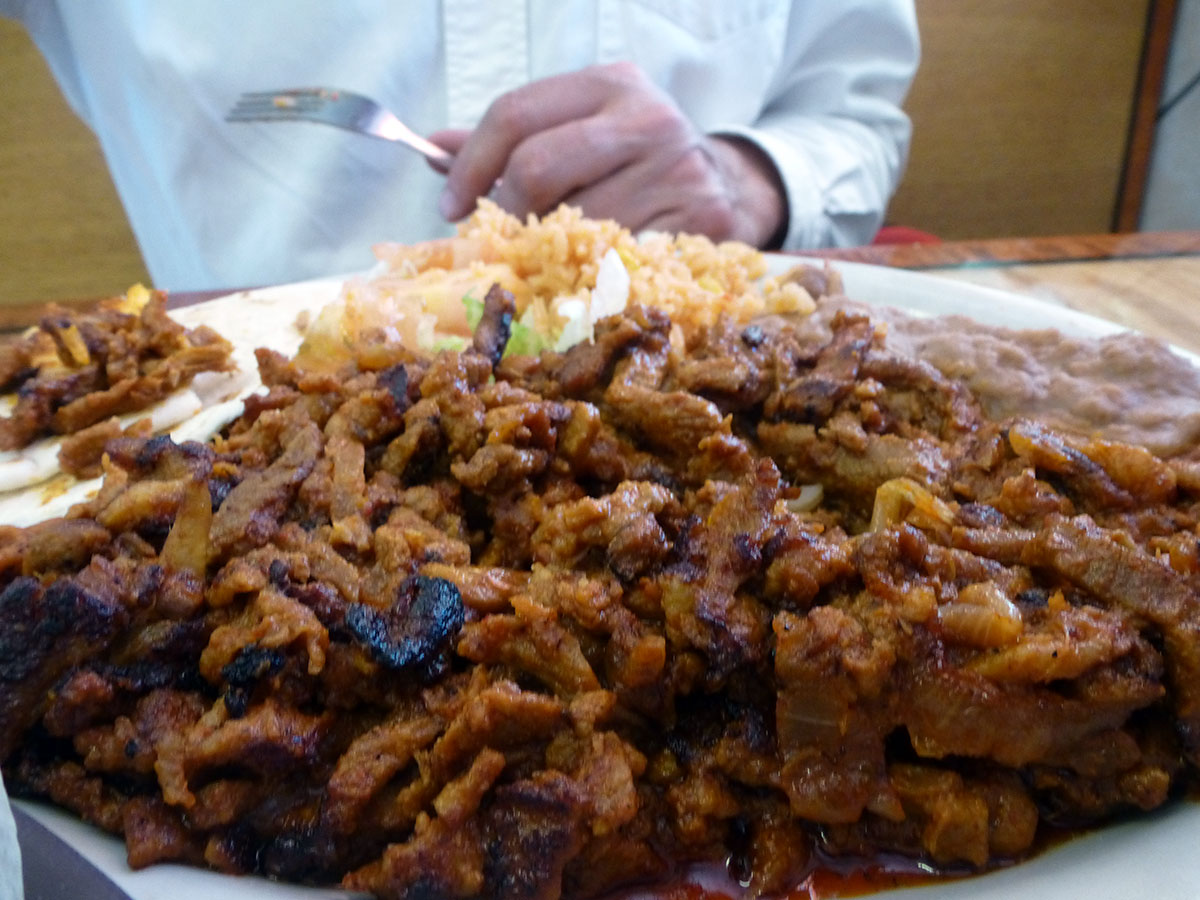
A little agricultural town just west of the Oregon border, Ontario’s main street was lined with Mexican restaurants. We figured that this guaranteed the quality, as anything bad would be laughed out of town, so we picked the one with easiest parking. The tv in the corner showed a soccer game between Portugal and Peru. The food was simple and good, with the succulent carne asada burrito being wrapped up in foil, and stored for a latter snack.

Clavel
Baltimore, ML
Clavel had fantastic, fresh queso, salsas, and guacamole, but tacos made up the main meal. As well as beef, chicken, and pork, it had more unusual things, like corn mold and goat. I was already stuffed, but thankfully we were there with Ava, the growing nine-year old with a bottomless stomach and taste for adventure. She assures me that the second, more unique course was just as good as the first.

Rolling Fatties
New Orleans, LA
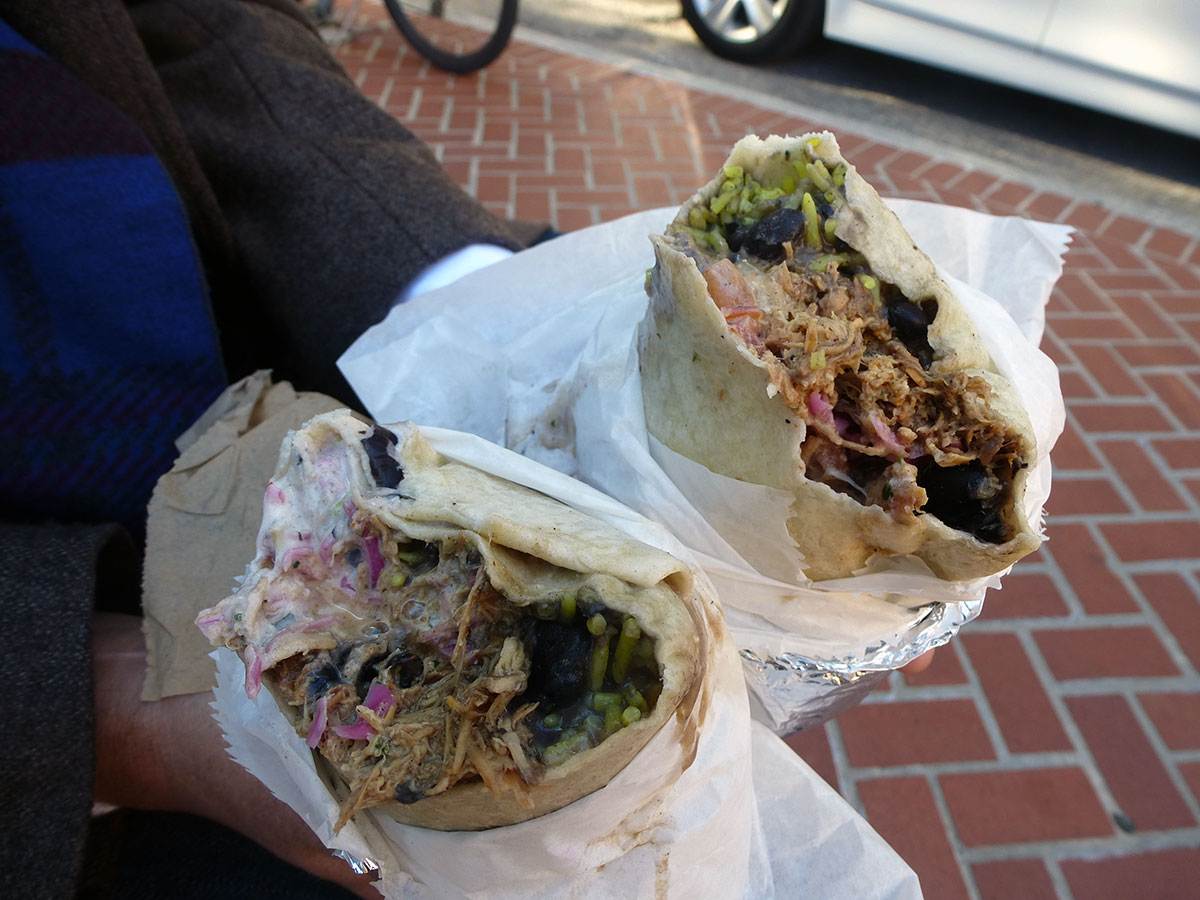
A food cart parked outside the medical complex, it delivered fast and simple burritos, tacos, and nachos. The most unusual thing was the rice, which was green. Not like an icky moldy green; a bright, intentional lime green. I don’t know what it was, but it was very soft and tasty.P1060854

La Condesa
Austin, TX
La Condesa is much more hip than the places we usually visit, and it violated my rule of never going to a Mexican restaurant where the first language I hear inside isn’t Spanish. Upon tasting the guacamole sampler, however, this rule dissolved a little bit. Garlic, jalapeno, and mustard sat alongside normal guac, and with a never ending supply of chips, I could have easily, and almost did, fill up on the appetizers.

La Perla de Jalisco
San Antonio, TX
This is the cheapest meal we’ve had on this trip. Dad got the daily special, with was beef, rice and bean, and a drink for six dollars, and I got a burrito for five. It wasn’t the best Mexican food we’ve had on this trip, but for the price, it was fantastic. Unlike La Condesa, it was difficult to pick out someone speaking English in the crowded dining room.
P1070698

Salsa Puedes
Marfa, TX
Searching for lunch in the performance piece called the Marfa food scene, we discovered that there were two food carts open, and one served kale smoothies. I’m actually glad that Salsa Puedes was the only reasonable option, because it would have been a shame to miss it.  It made simple tacos, really well. There was plenty of seating as well, which can be a downside to food carts.

Old Pueblo
Phoenix, AZ
In the “food desert” of west Phoenix, Yelp came through again. Their barbacoa provided us with not only dinner, but airplane lunch the next day. It also came with the largest tortilla you will ever see outside a Guinness World Record book, over a foot and a half in diameter.P1080272

Tacos los Altos
Flagstaff, AZ
The food was good, but not the best part of the meal. Yelpers had recommended the aguas frescas, the fresh fruit drinks, which were sitting in big coolers on the counter. Ladled into the big cup that lasted me three meals, the watermelon drink actually tasted like the fruit, and not the artificial mimicry of it.

Arcosanti

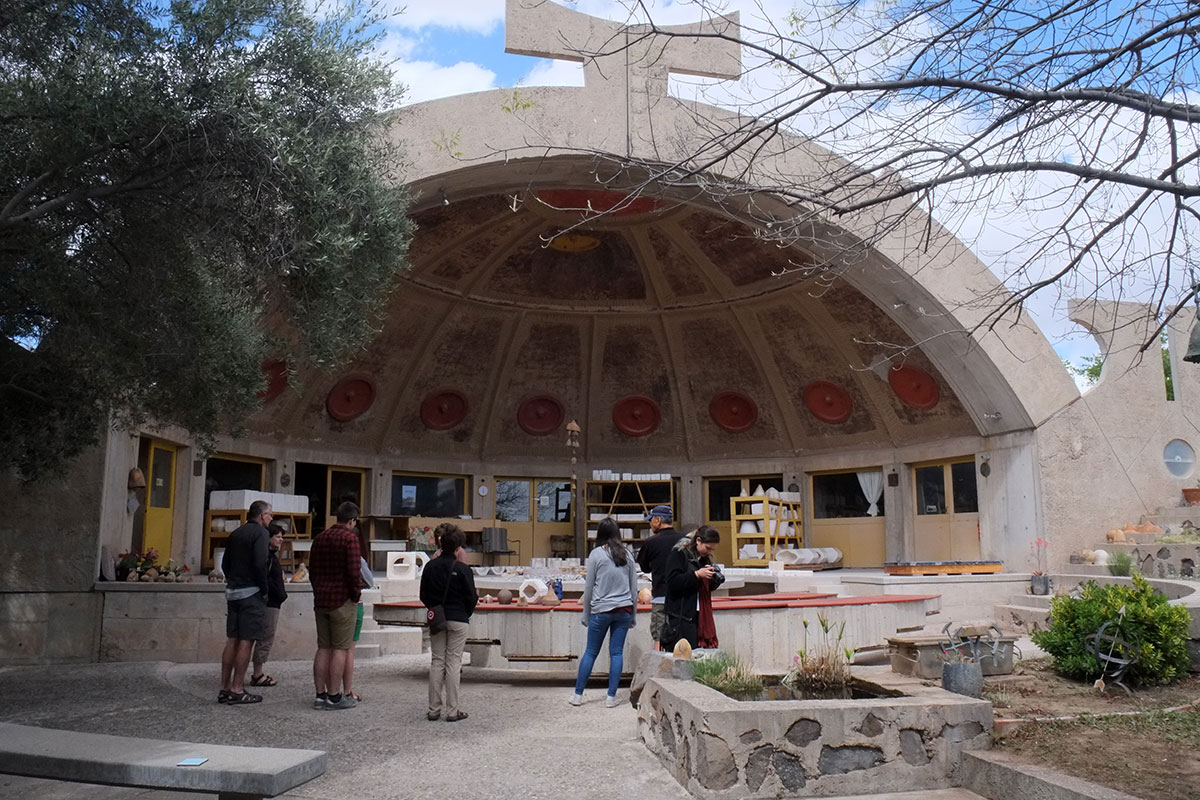
One of our goals in the Southwest was to visit relics from past ages – ancestral Puebloan ruins and cliff dwellings, and the more recent Pueblos – which date back up to 700 years.  We started with a visit to Arcosanti, which I thought of as a relic from a prior age that can feel almost as remote  to us now  – the 1970s.DSCF6862

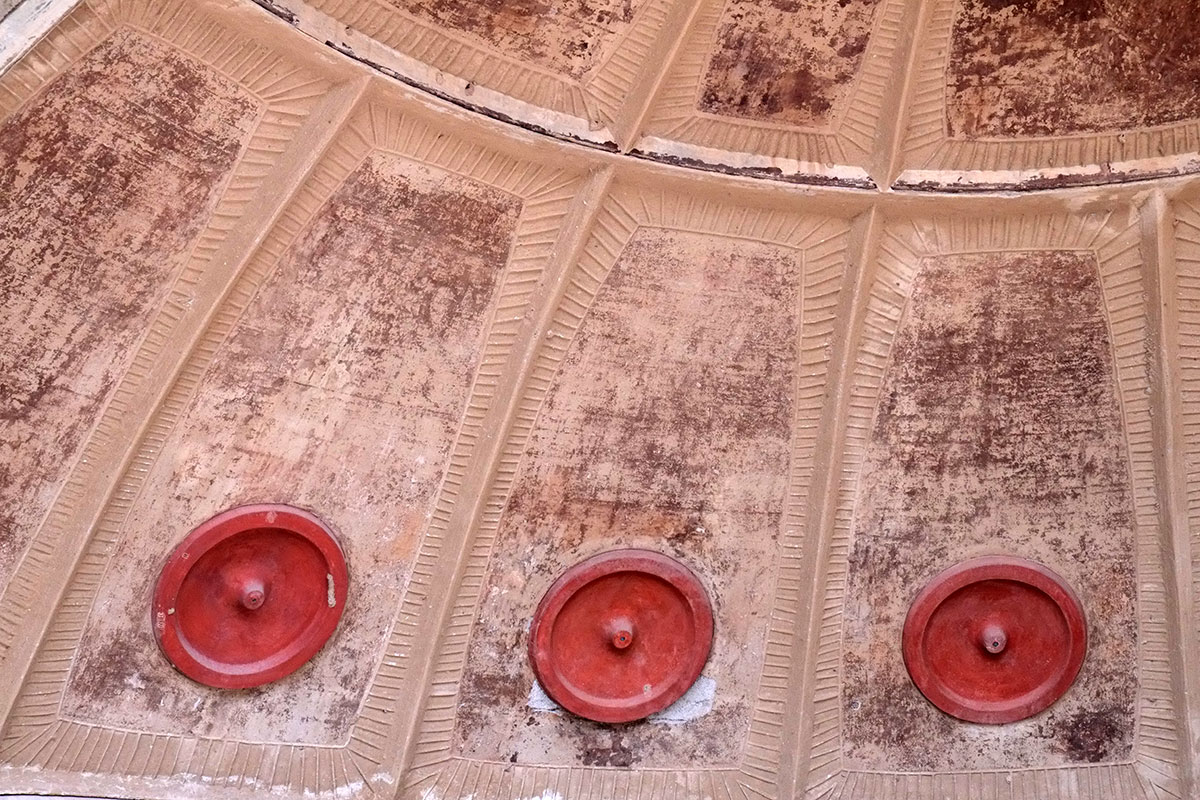
Paolo Soleri was a visionary Italian architect who came to America in the 1940s to study with Frank Lloyd Wright.  He eventually settled in Scottsdale, and began applying techniques he had learned for casting ceramics at the architectural scale.  His compound in Scottsdale – Cosanti – is a truly beautiful place, where dirt was piled up in mounds to make formwork, then concrete was poured on top, and the dirt scooped out to leave domes. Cosanti017However, Soleri was thinking at larger scale the whole time, and laid out his thinking in Arcology, which combined architecture and ecology.  In an age when Americans were happy to build endless sprawl, Soleri recognized the consequences of this pattern, for both the natural environment and human society.  He bought property 70 miles north of Phoenix to begin his prototype urban community, Arcoscanti, in 1970.

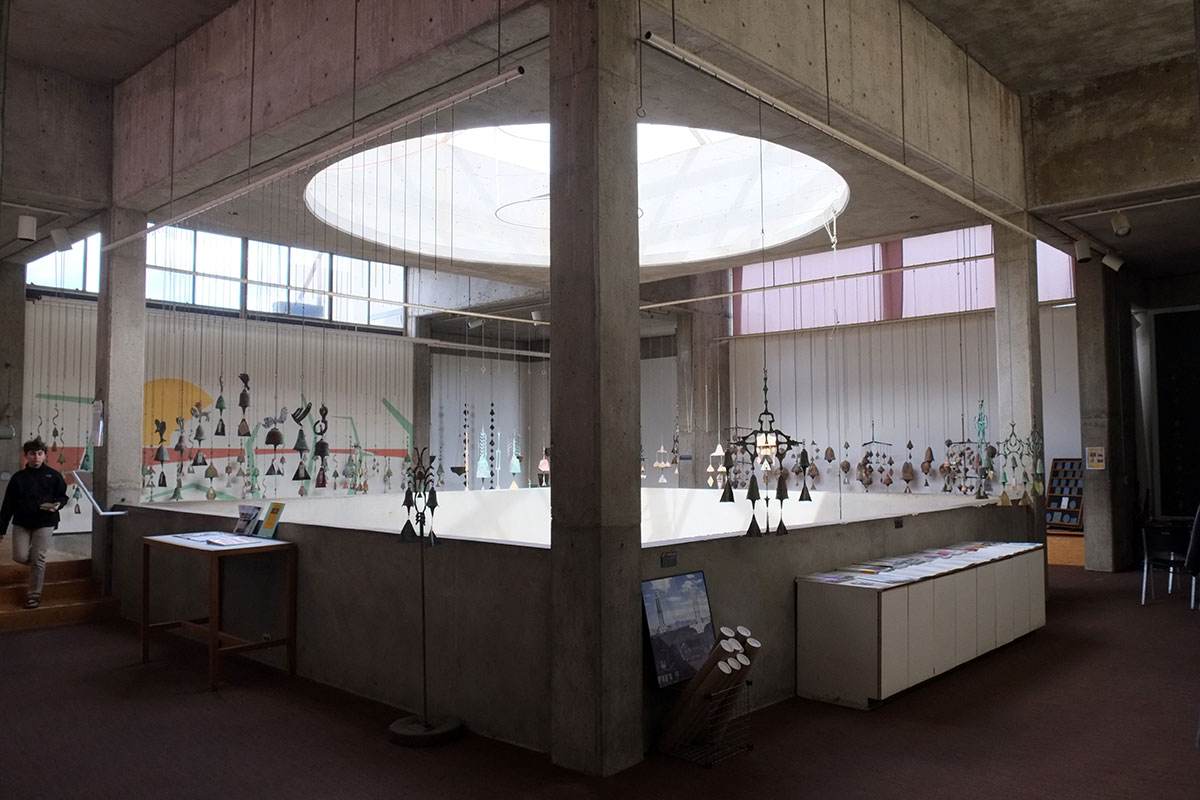
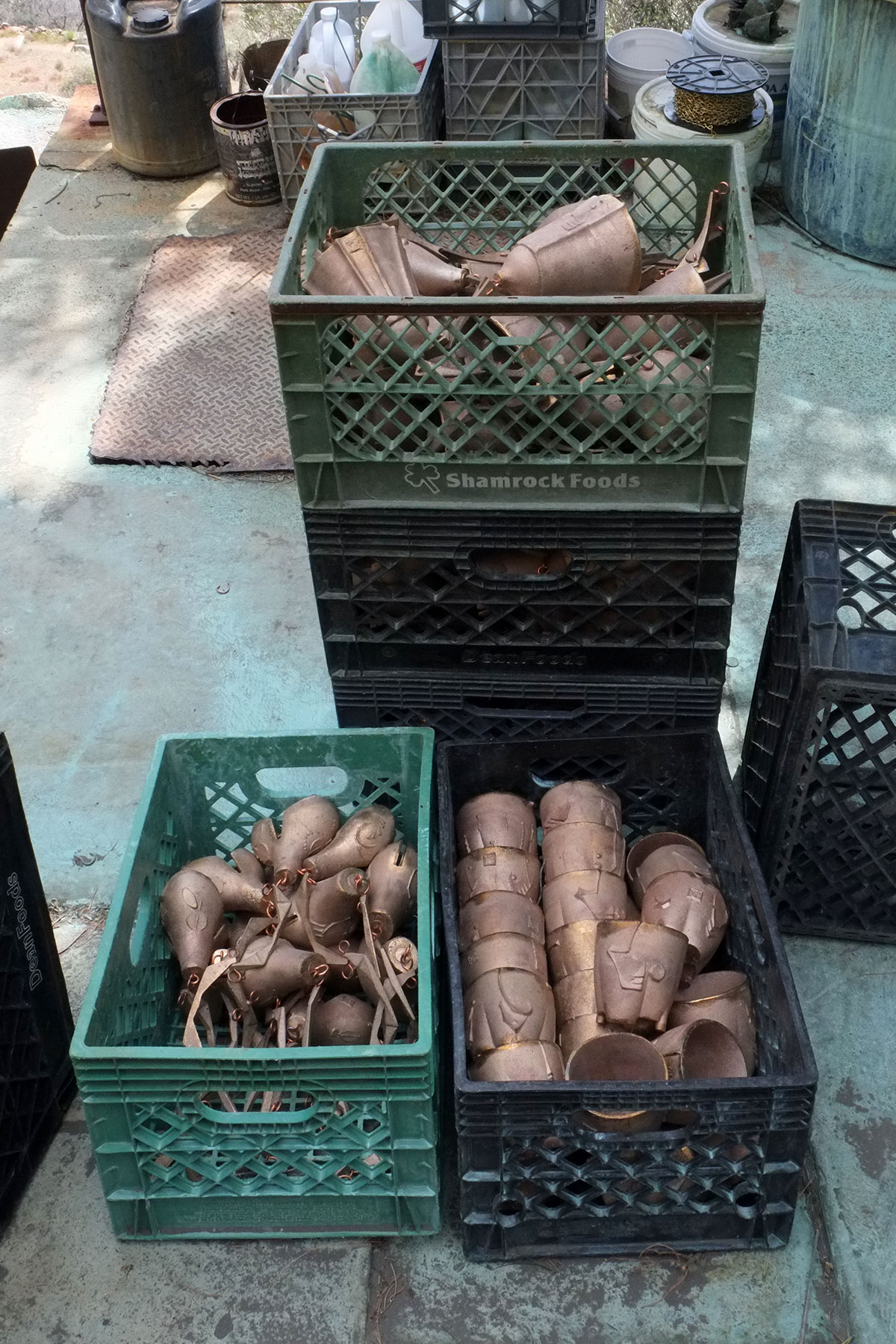
Construction has proceeded intermittently since then, with much of Arcosanti’s current fame resting on their production of bronze bells and wind chimes, usually bought as souvenirs of a southwestern vacation to manifest good taste and seriousness.  I had first visited Arcosanti about 20 years ago, and found it a little depressing – a small group of inhabitants who were living in the remnant concrete buildings from the 1970s, making wind chimes and chilling out in the desert, while Soleri mainly lived in Scottsdale.  But Soleri had retired (and subsequently died in 2013), and has been succeeded by Jeff Stein, a Boston architect who had run the architecture programs at Wentworth Institute and the BAC for many years.  I had met Jeff many years ago, and more recently at a HOPES conference in Eugene.  He struck me as a thoughtful and serious person, and so I was curious as to how things might be changing at Arcosanti.

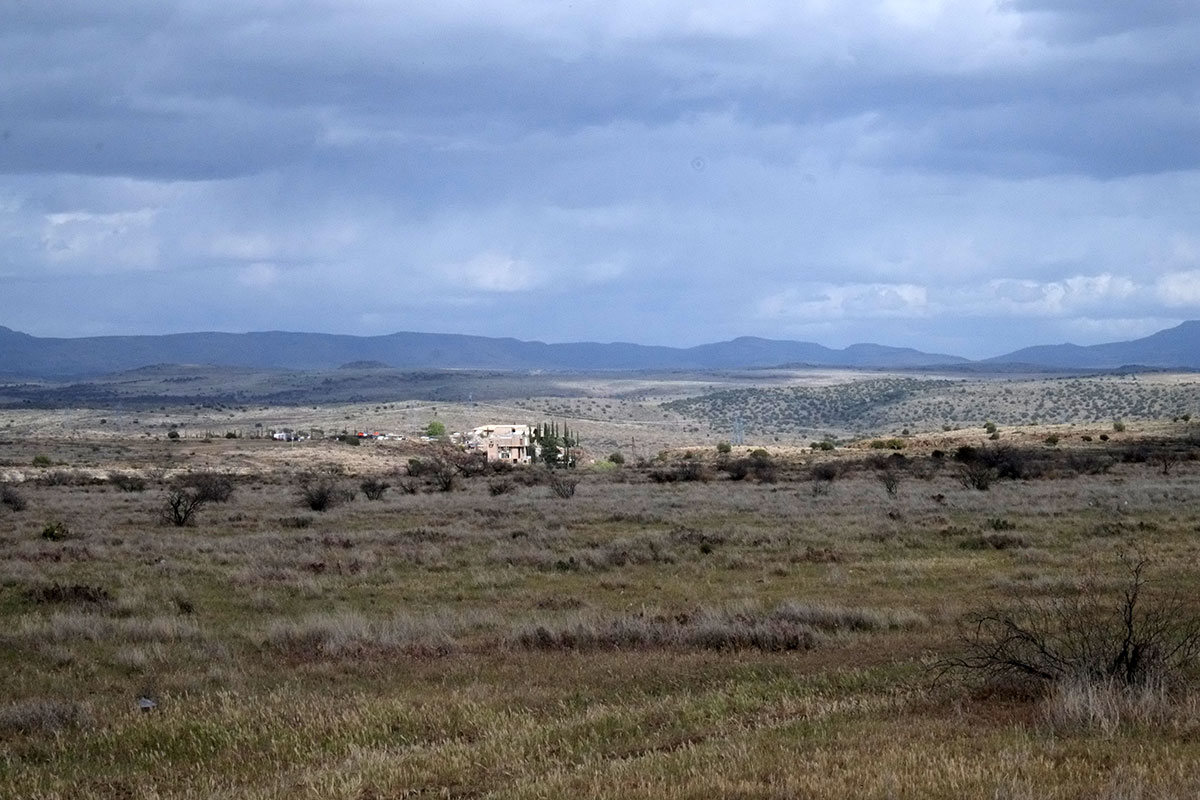
Arcosanti sits isolated out in the desert, on the edge of a small canyon (not unlike the cliff dwellings we’d be seeing).  However, it is connected to Phoenix by Interstate 17, although it is isolated by two miles of very rough dirt road (which did cause every screw in our trailer to come loose).  DSCF6943

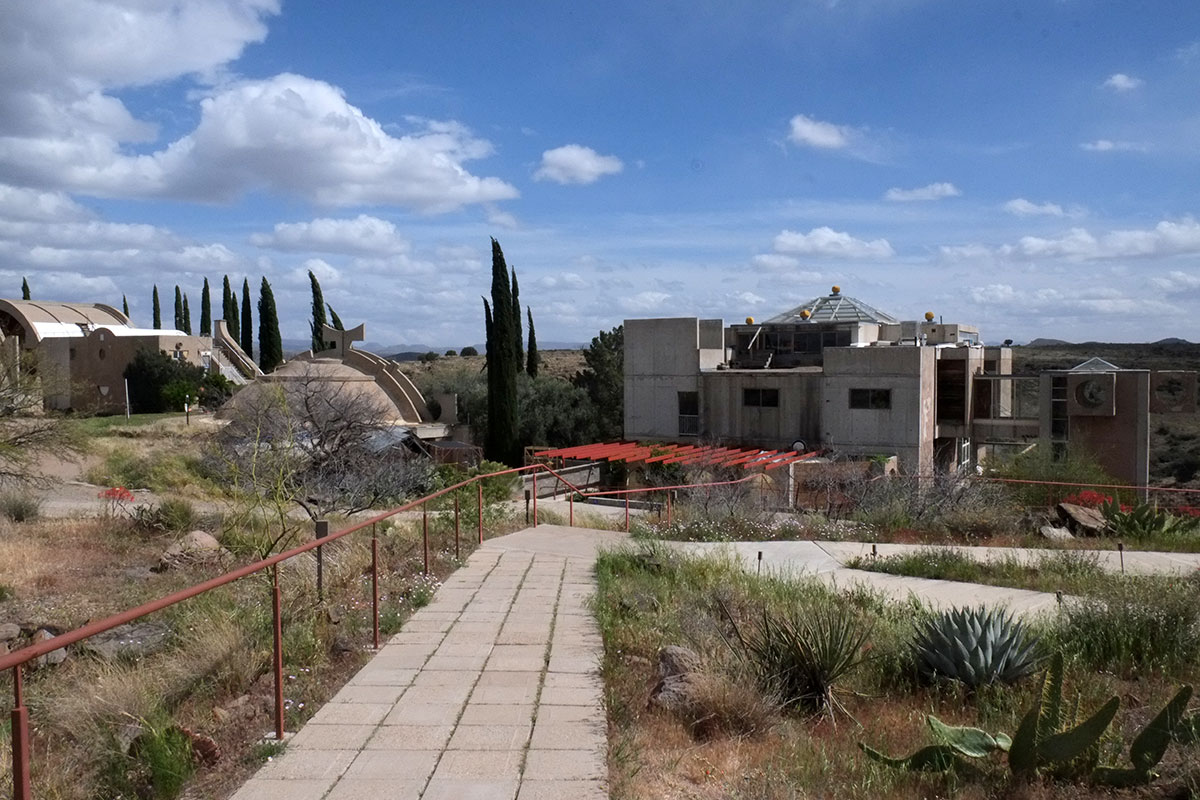
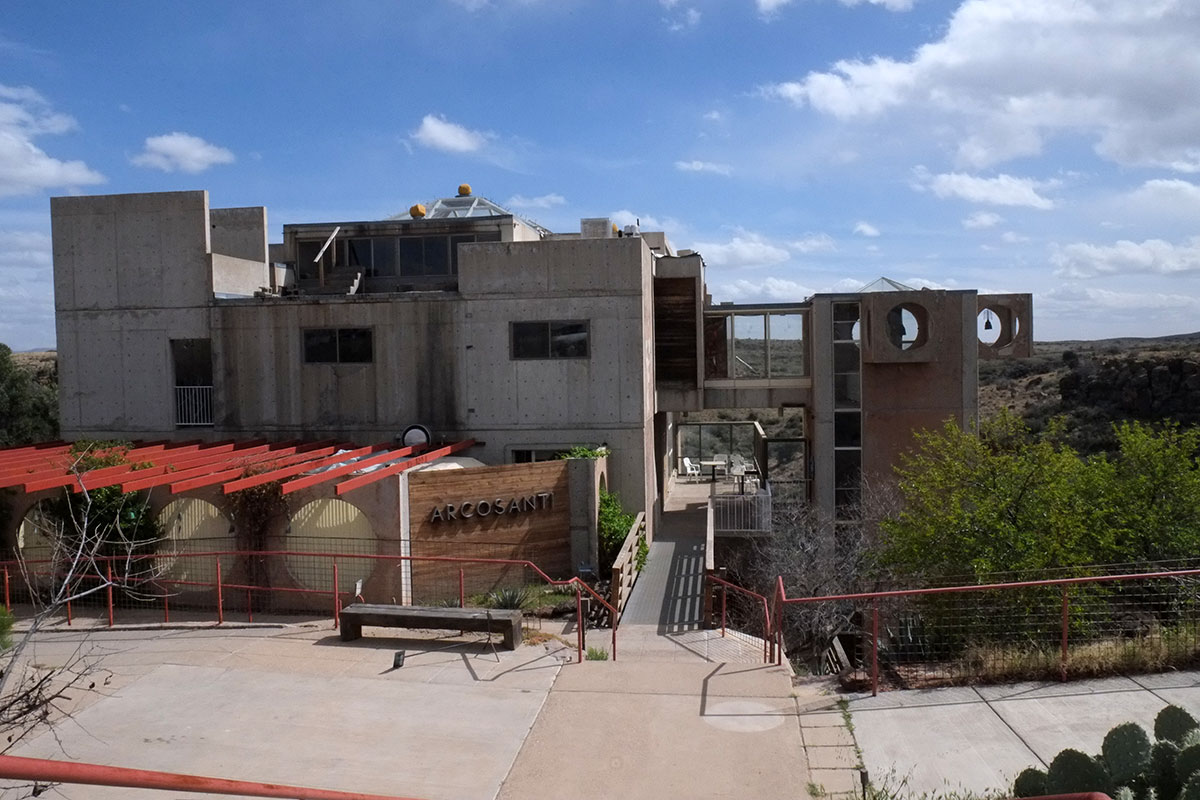
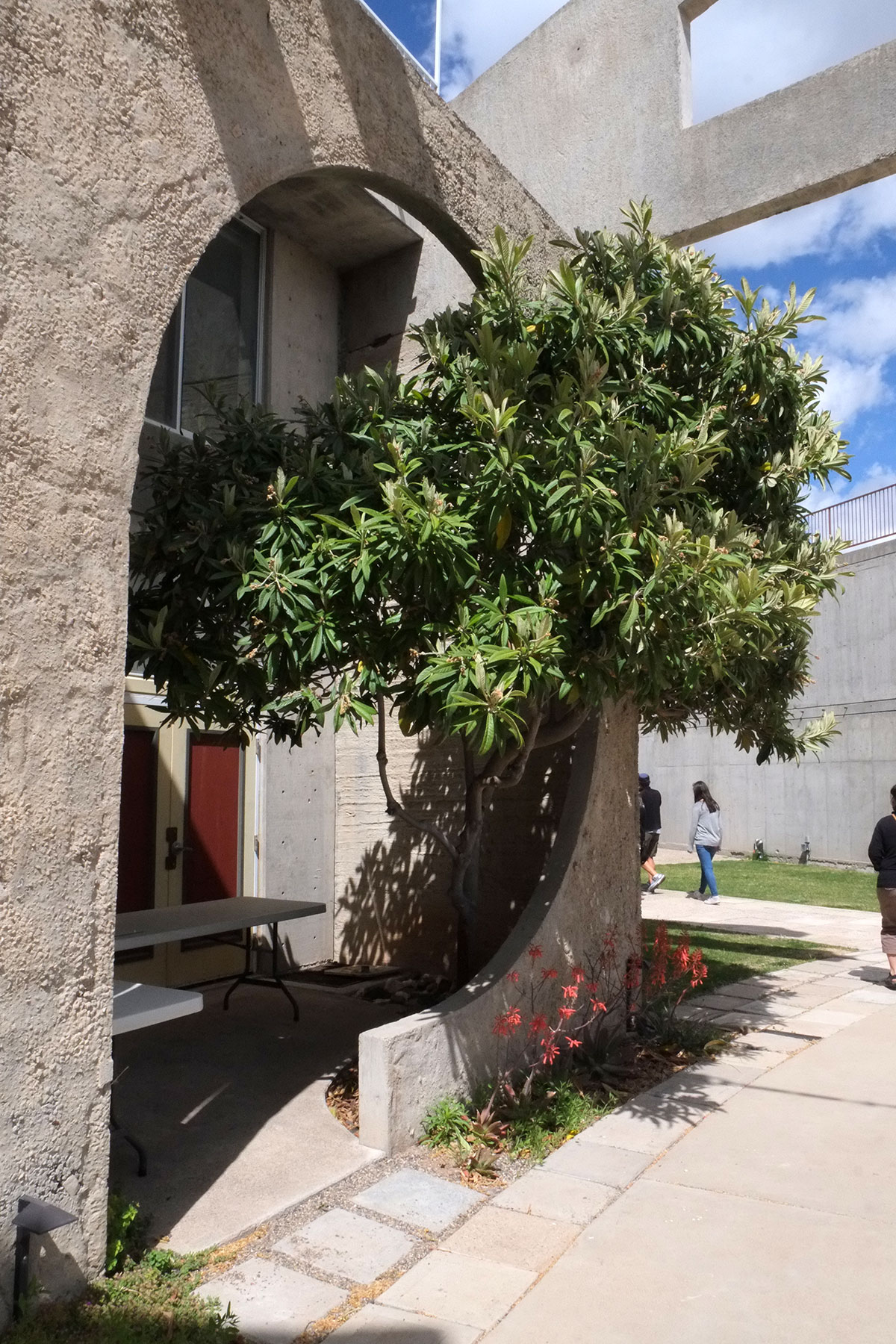
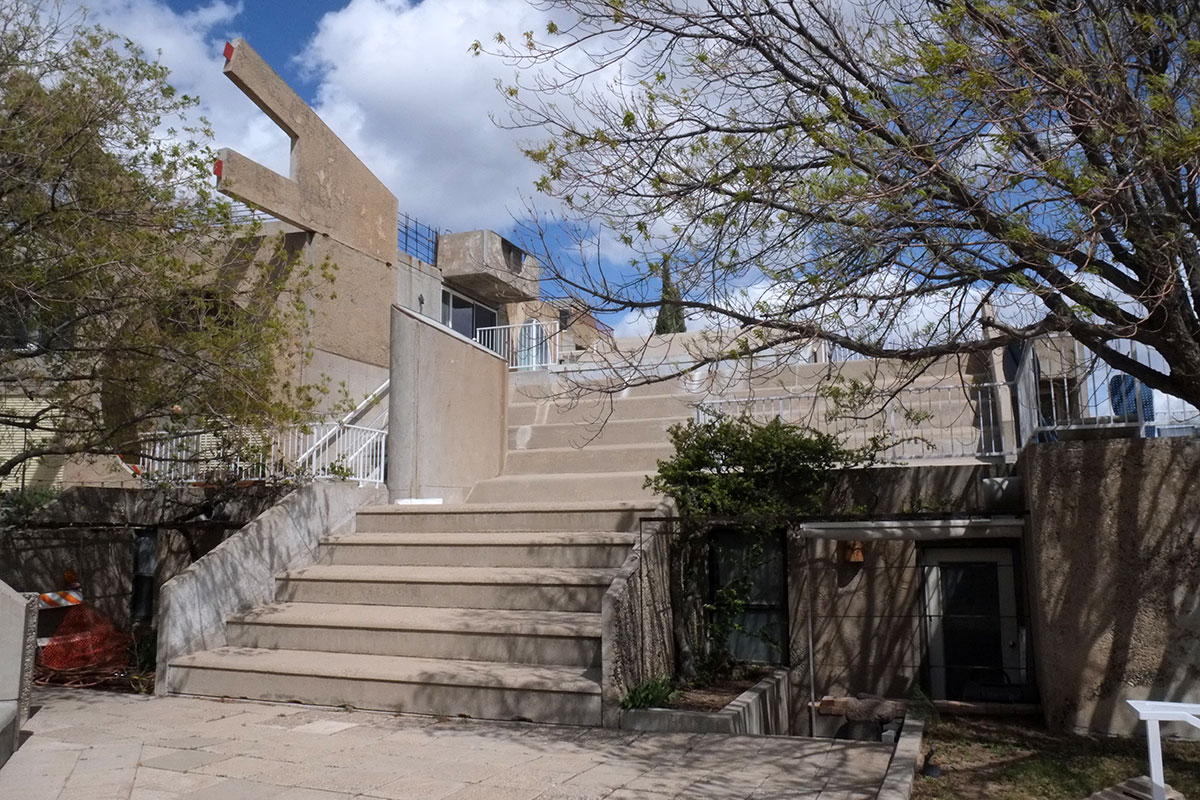
The complex faces south, and is mostly constructed of concrete.  The visitors’ building is to the right, and the housing and production buildings to the left.  DSCF6942

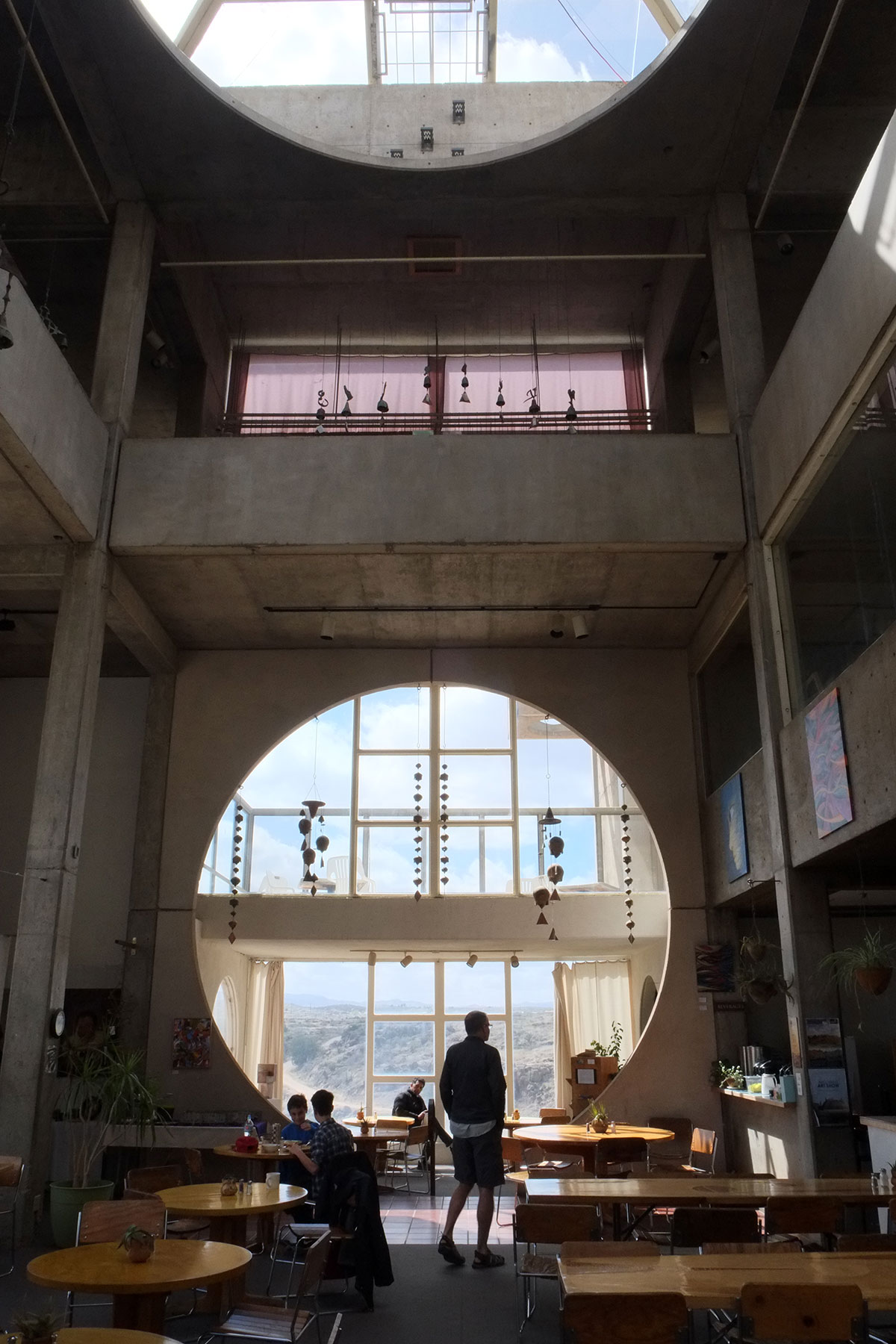
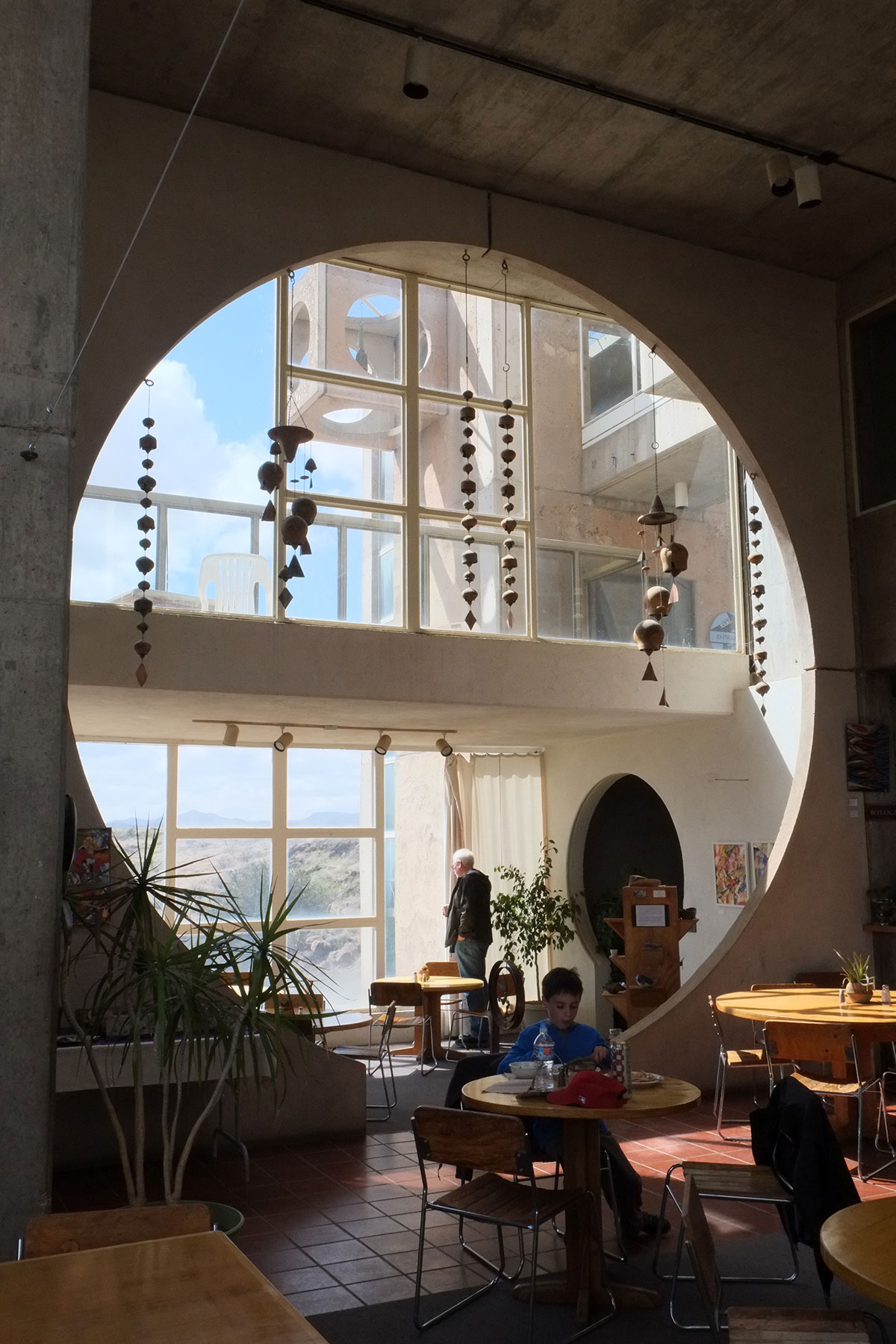
The visitors’ building houses exhibits, a store, and a restaurant.  The concrete on the exterior here is showing its age, with some spalling and exposed large aggregate.  DSCF6941

It’s a really clear Brutalist building, showing that Soleri wasn’t an iconoclastic hermit out in the desert, but was in sync with other architects of his era, such as Kahn.  DSCF6917

The shop where they sell the bells (now you recognize them).  DSCF6935

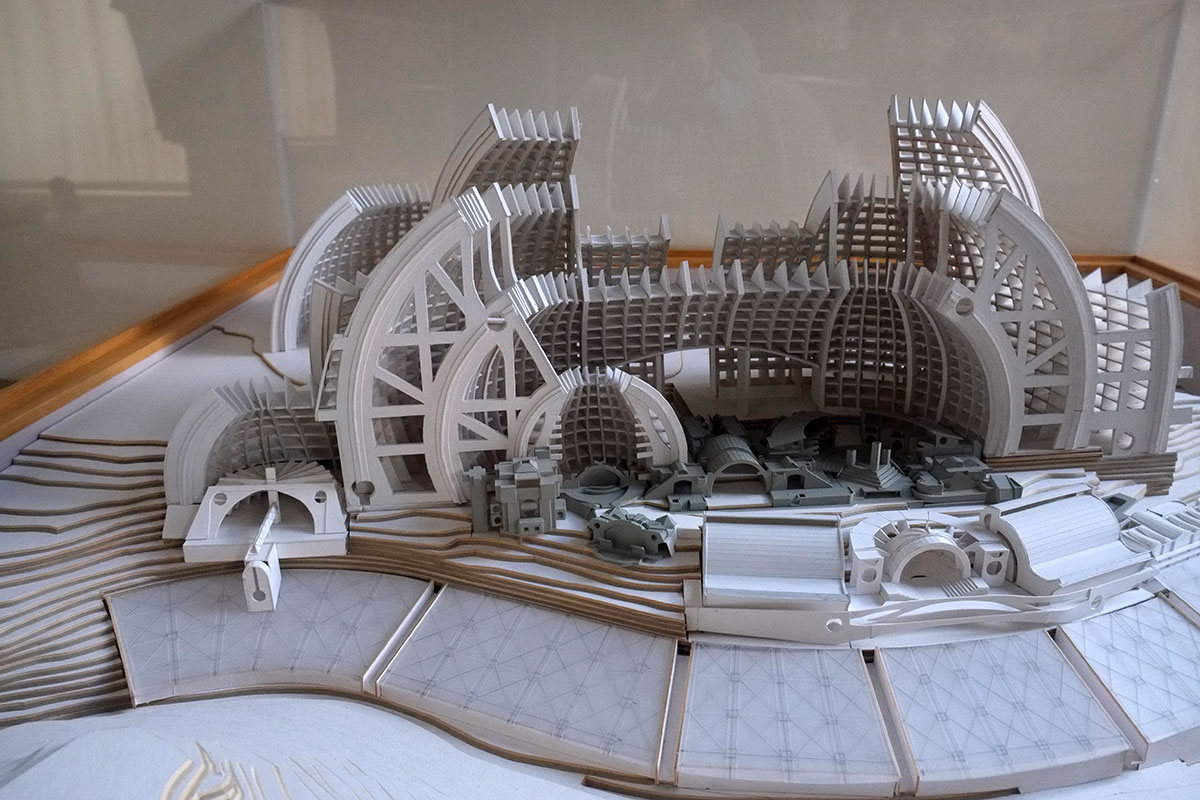
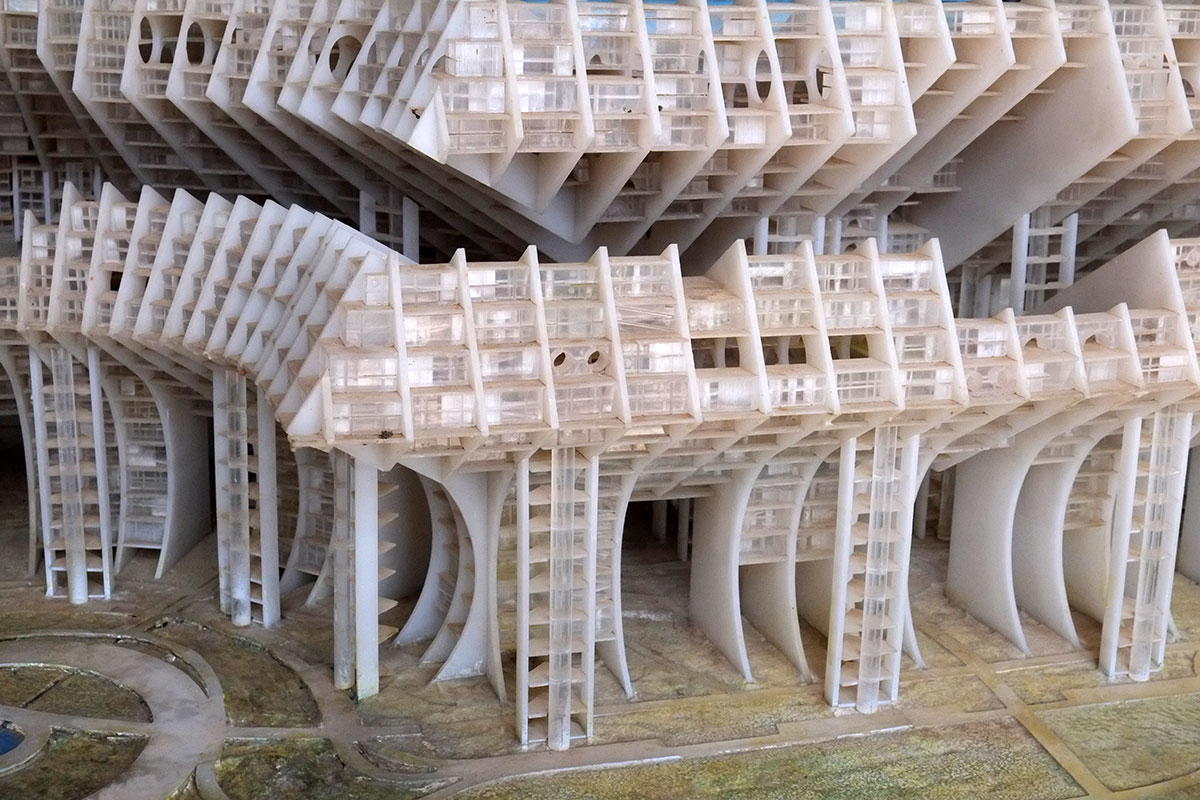
There are some gorgeous models located throughout the complex.  This one shows one conception of the final state of Arcosanti – a series of large apses facing south, which contain community spaces and are ringed by housing units.  For a scale comparison, the parts of Arcosanti which have been already built are shown in grey in the middle of the model – the planned pieces are shown in white.  DSCF6821

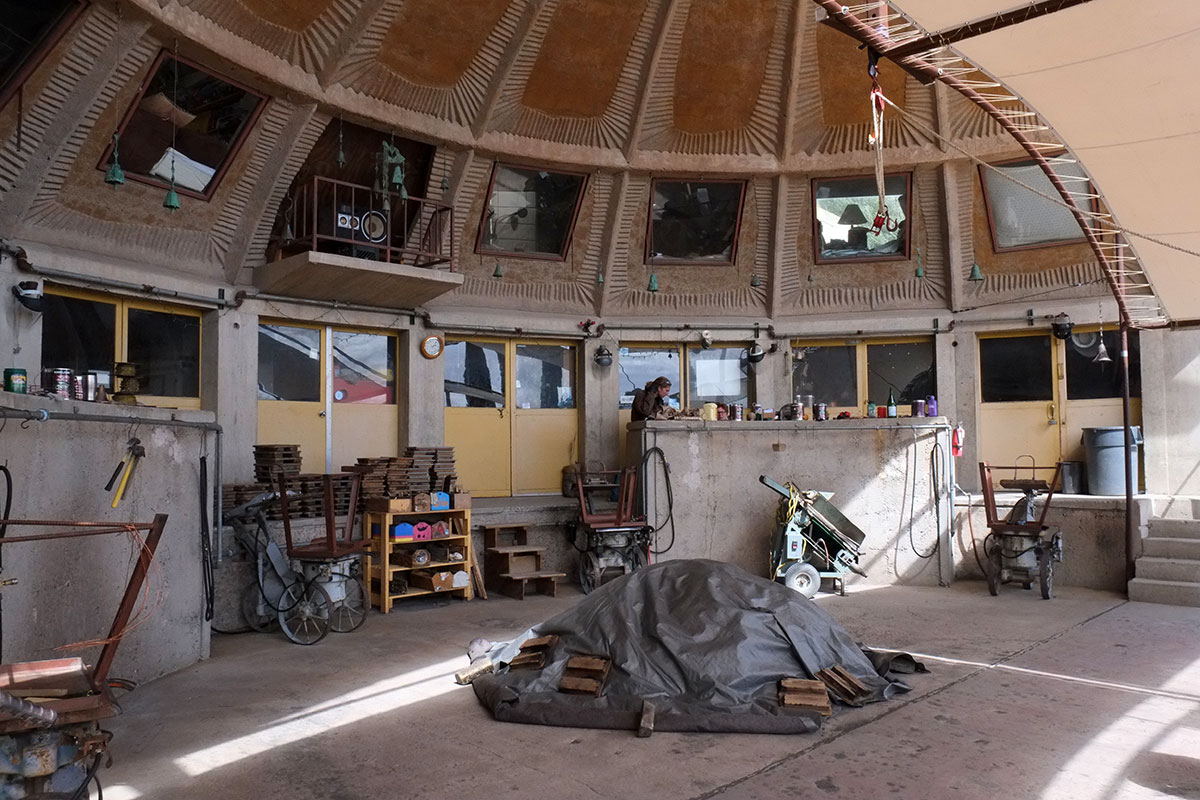
A tour brought us through the complex to the ceramic production areaDSCF6827

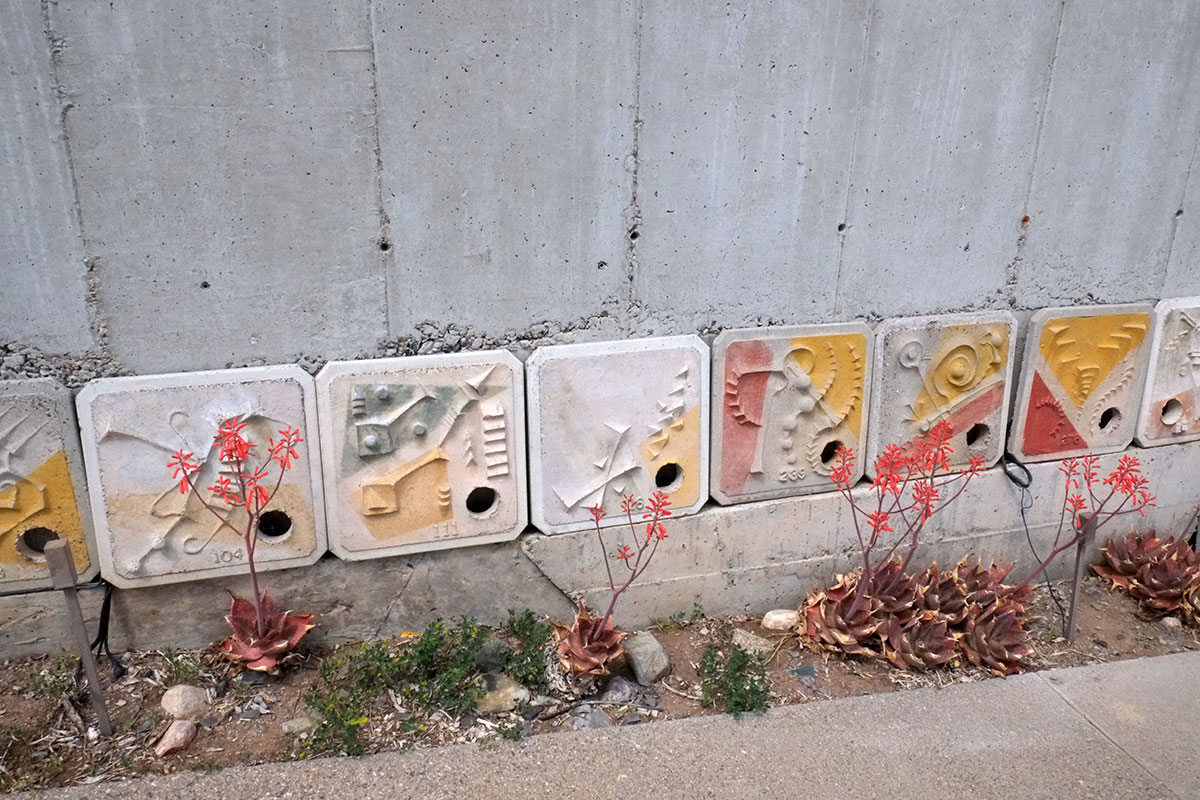
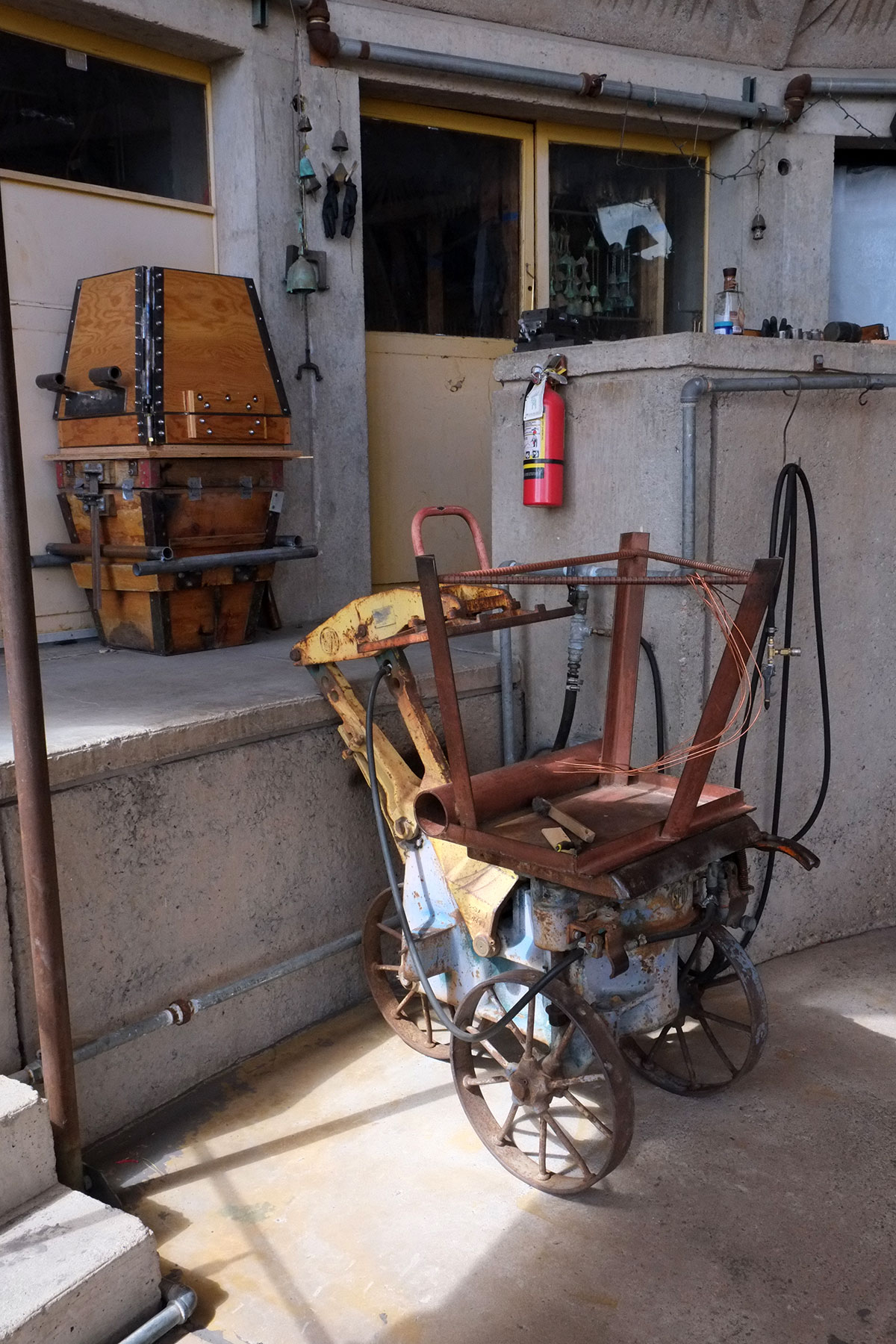
where you can see how the processes used to form the ceramics and bronzes are very similar to the processes used to form the architecture.  The level of detail possible with this sand-sculpting in the formwork is notable.  DSCF6832

DSCF6898

The bronze foundry:  DSCF6910DSCF6909  DSCF6905

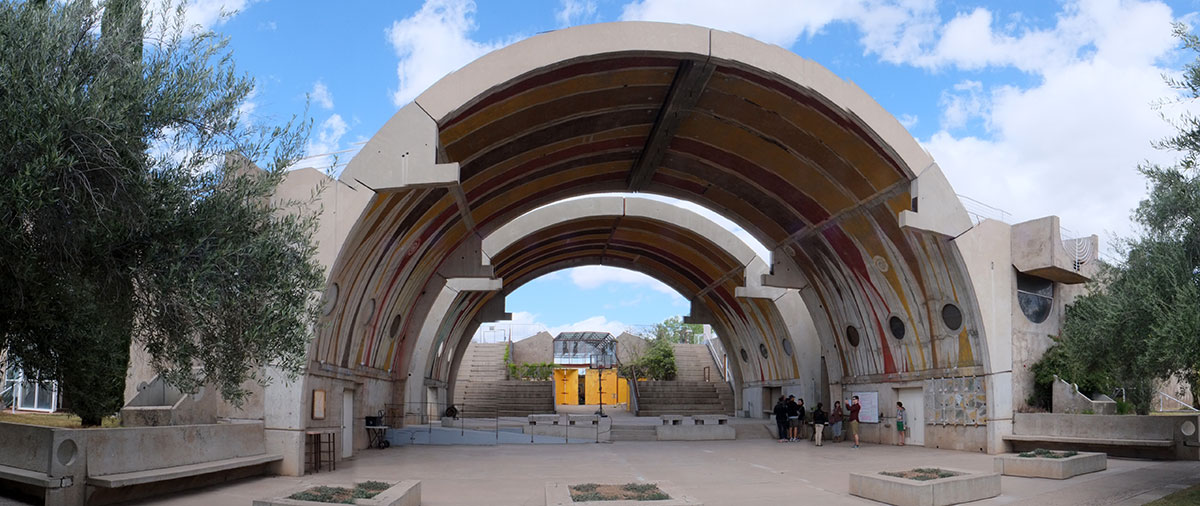
There is a large vault, which can be used for gatherings and performances (and basketball).  DSCF6848

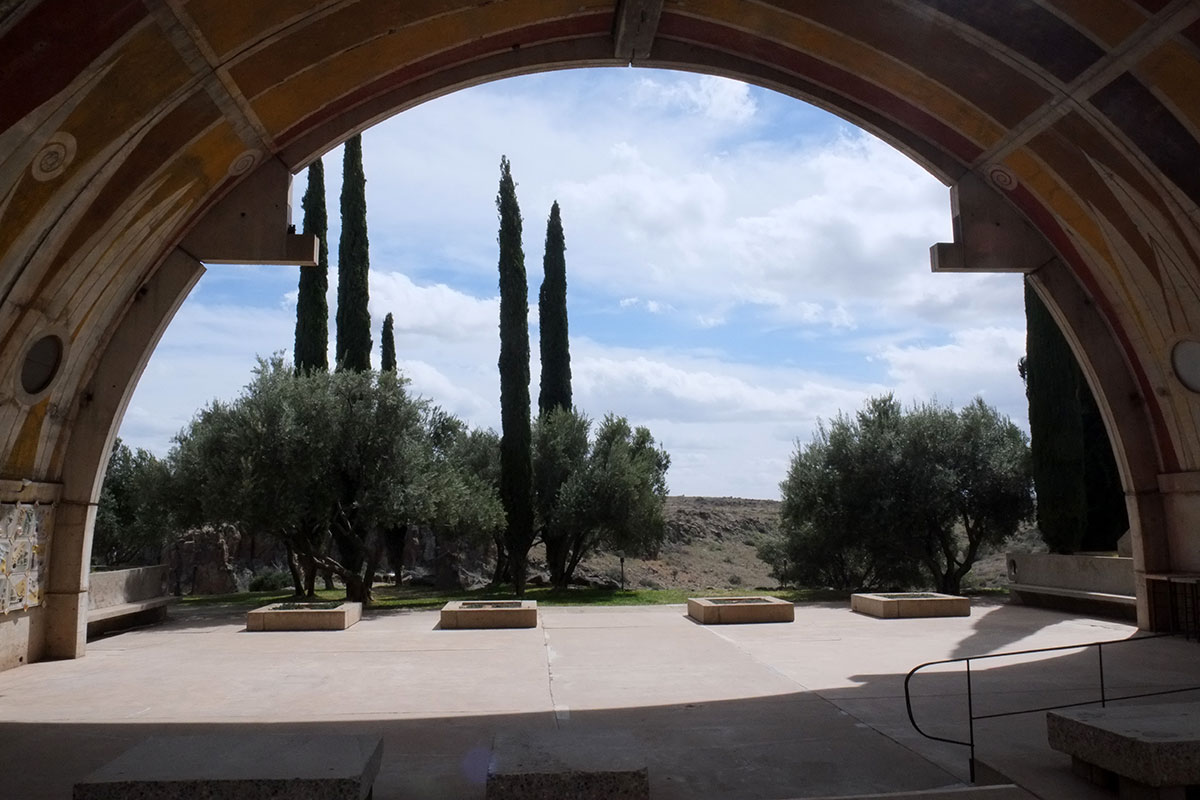
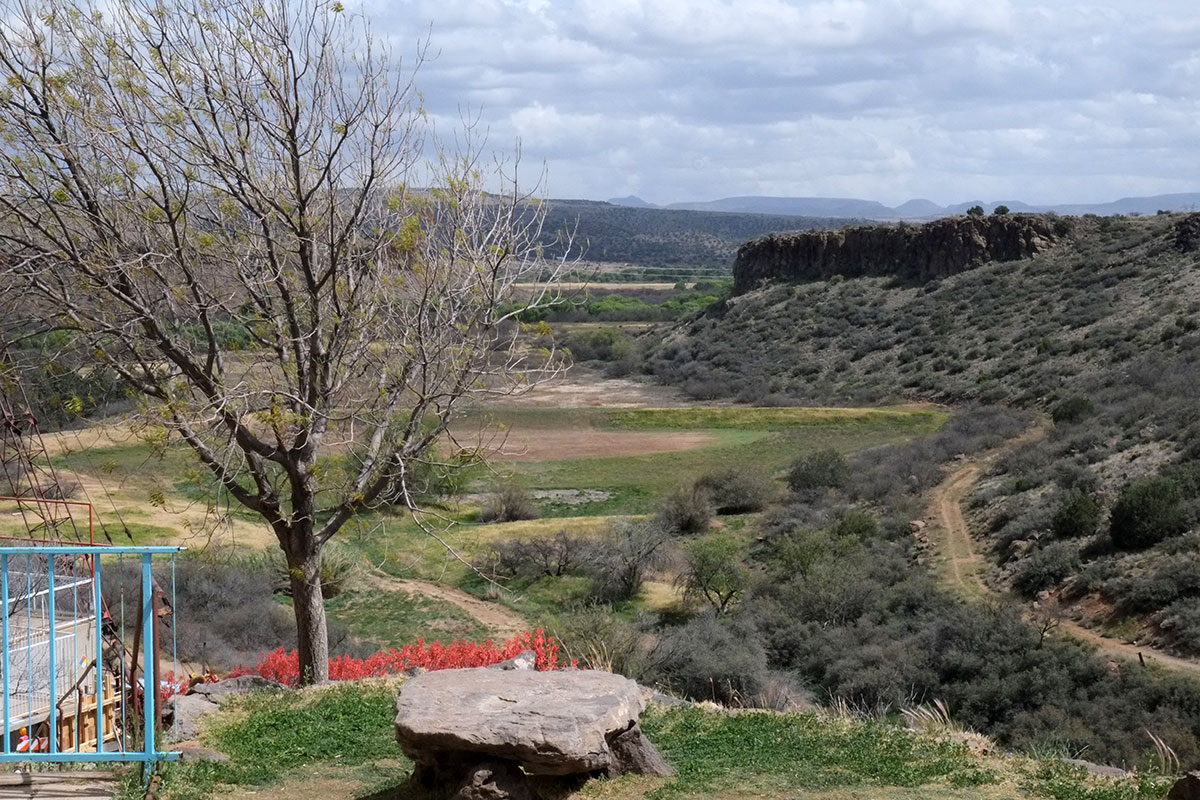
and which opens out to the canyon to the south.  DSCF6857

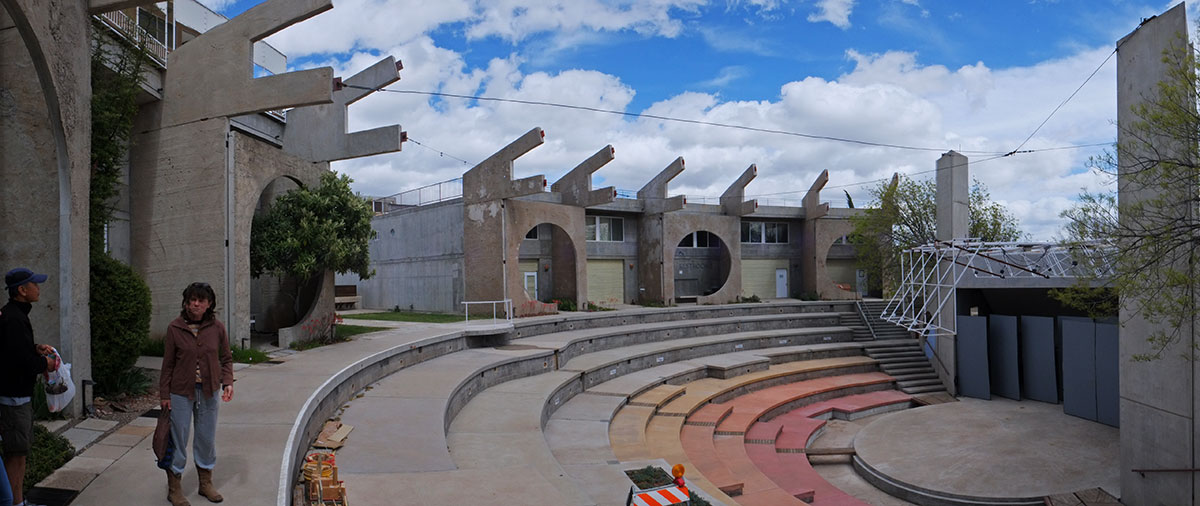
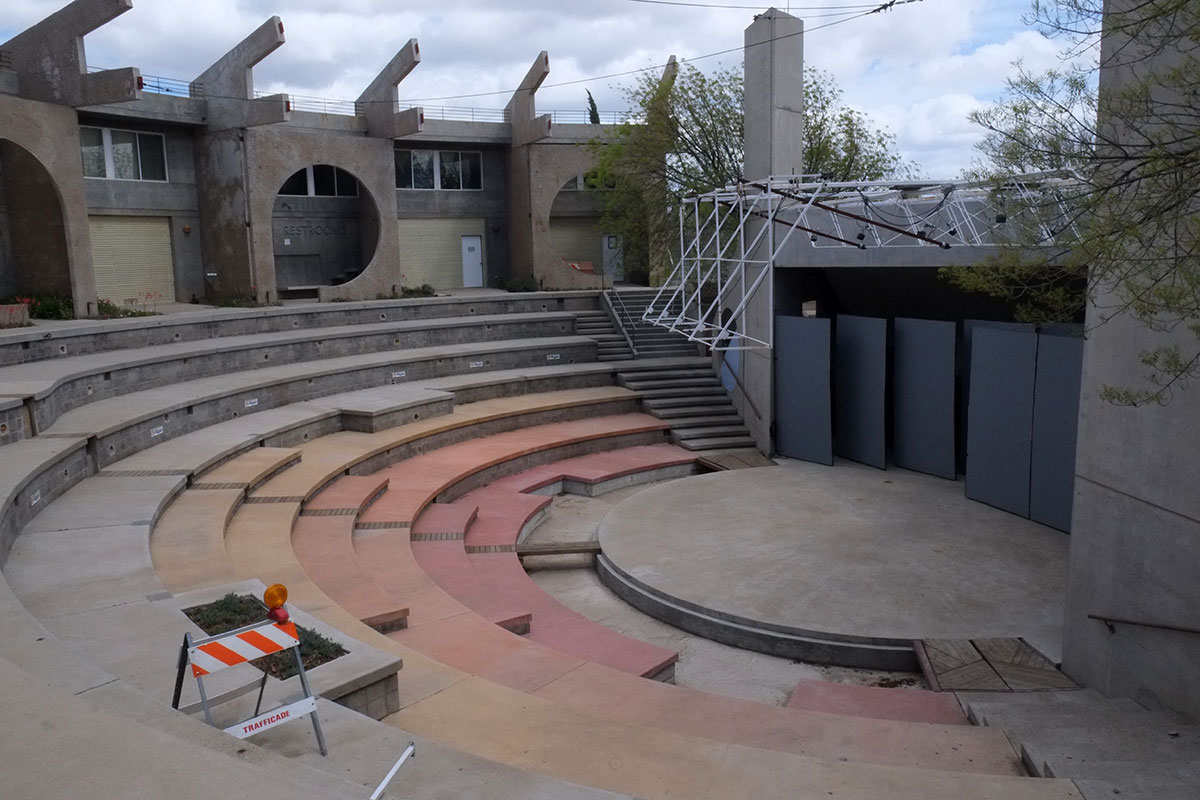
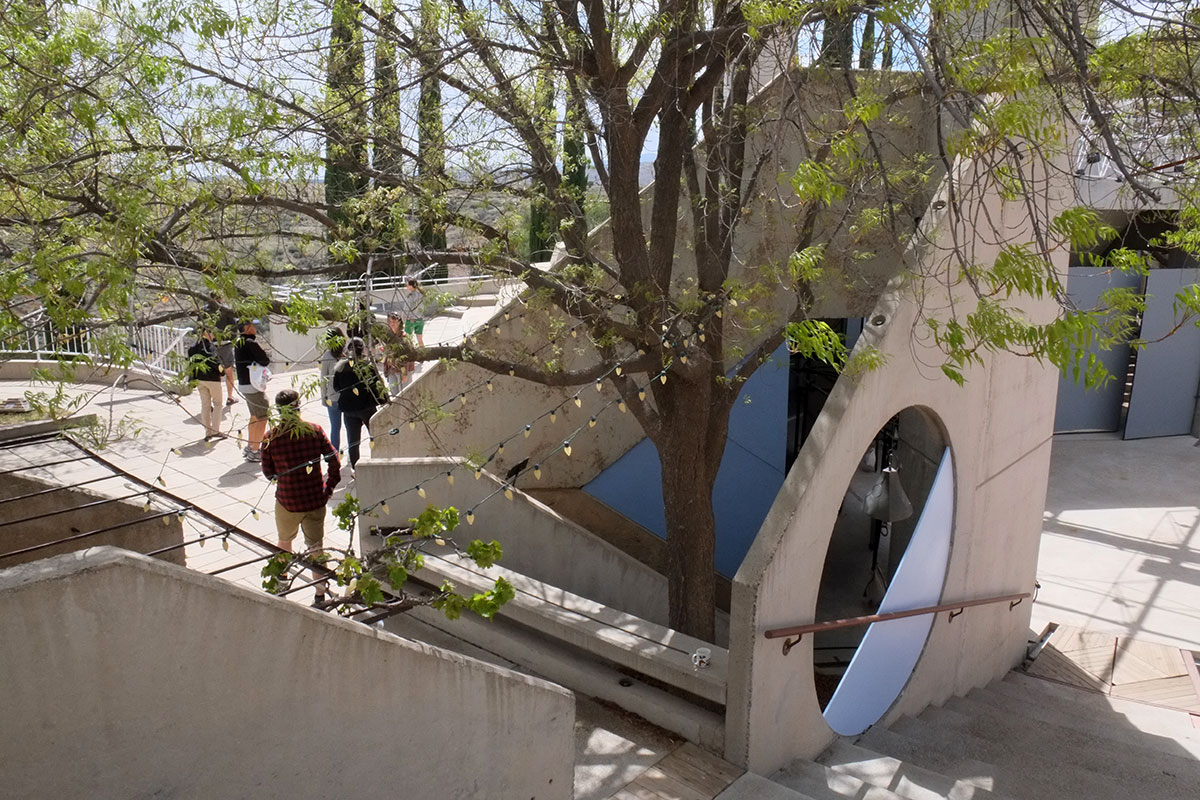
An amphitheater is surrounded by housing, some of which is for permanent residents, and a few of which are Air Bnbs.  DSCF6864  DSCF6865

When I visited here in the 1990s, it all seemed rather low-energy and unfocussed.  It reminded me of Taliesin, where the impetus and vision came from the founder, and the followers were just hanging on to that revealed truth, always wondering WWFLWD when confronted with a new challenge, and eking out a meager living from the legacy.

Arcoscanti feels very different now.  There are constant workshops being offered, which bring in short-term students to learn about Arcology and construction.  There are performances and events, which can bring in attendees from the Phoenix megalopolis.  There are approximately 100 full-time residents, some of whom live in the Camp area, detached houses closer to the farm at the bottom of the canyon.  Construction is moving ahead on some of the concrete buildings.

Soleri’s vision seems even more relevant now than in the 70s. His basic principle is that of building dense, energy-efficient human settlements, which don’t sprawl across the landscape, and so preserve land for agriculture and other uses.  In a very different form, this set of ideas underlays New Urbanism, and various principles which have become conventional planning in the past 30 years.

Millennials are showing a notable preference for denser urban living, often staying in our traditional city cores rather than moving back to the suburbs to spawn.  There are not many models for new urban development at this point – we have accepted the traditional city form and are designing new buildings to fit into that context.  Soleri’s morphology may not be the ultimate solution, but it is a remarkably clear proposal, one which proceeds from first principles and not just an imitation of older forms.  In this way it does resemble Corbusier’s urban proposals, as he laid out his understanding of modern civilization, and tried to come up with a new form that fit those changed conditions.  Soleri stared with a very different set of underlying conditions (recognizing the importance of the environment before most of his contemporaries), and proposed this new model.  Perhaps most encouragingly, the ideas have not remained static:  a newer book, Lean Linear City:  Arterial Arcology, was written by Soleri and some of his followers, showing the development of concepts to fit changing conditions.

Visiting Arcosanti doesn’t feel like visiting the remnants of yet another failed agrarian utopia, which collapsed after the dogma-driven urbanites got bored and went back home.  It is not a rapidly-developing alternative city (probably because no one has figured out to make a lot of money from it), but it is a serious testing ground for a larger vision.  We now recognize the scale of the ecological crisis we are facing as a society, but so far our efforts to correct our course are puny and completely ineffectual.   We keep proposing tweaks around the edges of the existing system.  Arcology may not be the complete solution, but it is one of the few models out there of what a vision for the whole might be, one where the scale of the solution is within an order of magnitude of the problem.

DSCF6881The biggest problem with Arcosanti is its location:  with the likely consequences of climate change in the next century, the edge of the Sonoran Desert is not where you want to be.  Agriculture will not be possible here, as most climate models are predicting a mega-drought this century, similar to the one that contributed to the Ancestral Puebloans abandonment of their settlements 1000 years ago.  Soleri didn’t foresee this, but then neither did anyone else.  He began a small experimental community for up to 5000 people that might have to be abandoned;  we built Phoenix, which with its 4,000,000 residents that will also be gone soon.  At least the Arcosanti residents will be able to hold on longer, as their buildings will shield them in a way that the Phoenix buildings will not.

Even if its geographic location may not endure, the ideas of Arcosanti can still provide a useful model for our society.  I arrived there thinking about the big ideas of cities and ecology and human settlement and the landscape, but the experience quickly shifted my thinking to that of the smaller scales of buildings and spaces.  I hadn’t expected it to be so beautiful.  DSCF6923

DSCF6937

The quality of the architectural design and the integration with the outdoor spaces is comparable to an Italian hill town, or as I would discover, some of the Pueblos of the Southwest.    It is architecture and urban design for a new age, but it draws heavily on the best precedents from our past.DSCF6873

Arcosanti wasn’t conceived by a dry planning theorist, but by an artist.  If you have never looked at Soleri’s drawings in Arcology, you should;  Soleri’s vision is right up there with that of other acclaimed visionary architects, such as Lebbeus Woods, but his visions are grounded in an understanding of the fundamental conditions human society is facing, rather than operating at the level of metaphor, or as projections of a purely personal, hermetic vision.   DSCF6885

Soleri also took the great leap of trying to build this vision;  in our recent fascination with paper (or now digital) architecture, we don’t seem to care whether or not a beautiful vision can be built at all – we are happy to bask in the imaginary.  Thom Mayne once pointed out that the quality of architectural rendering would soon reach the point where architects would establish their reputations without ever having to build anything.  Ten years later, we seem to have reached that point.

Or maybe it’s even worse – we are so cynical about ever being able to redirect our profit-driven building-production system that we satisfy our idealistic (yet rational) urges with fantastical imagery.  Soleri didn’t spend thirty years making pretty pictures hoping that eventually some developer would adapt them for a shopping mall (cf. Liebeskind’s building in Las Vegas);  he saw the vision as deriving from the conditions we are facing, and proposed a solution to those problems that, like most brilliant, integrative solutions, was also beautiful and enriching as well as pragmatic.  He thought like an architect, never abandoning his dedication to the larger community, rather than just pursuing his personal vision.

Perhaps in the future we’ll visit Arcosanti as we now visit the abandoned cliff-dwellings, recognizing it as a harbinger, a place where the changing conditions of our world were first recognized and engaged.  DSCF6878

Phoenix

Phoenix is where you can see the Platonic ideal of sprawl – what low-density, car-based development looks like when there is no pre-existing central city to get in the way. To paraphrase Lou Kahn, I asked the sprawl what it wanted to be, and it said Phoenix.

The large cities of the east and midwest existed before cars, and a system of highways and roads had to be retrofitted in and around them to support the new means of transport.  Sub-urbia, as it was then conceived, implied a relationship to a central city.

Los Angeles was not a very big place in the 19th century, and its growth paralleled the rise of the automobile in the pre-war era.  It became the new paradigm for the American city in the early 20th-century.  Los Angeles is our most important car-based megalopolis, and it came to represent the image of sprawl in our collective imagination, with its highways, drive-ins and congestion.

But suburban growth and sprawl really took off in the post-war era. 19th-century cities acquired rings of highways and suburbs, and early 20th-century cities did the same.  American metropolitan areas became almost uniformly low-density around a central city, but with other centers in the region too, as nearby cities were subsumed in the sprawl.

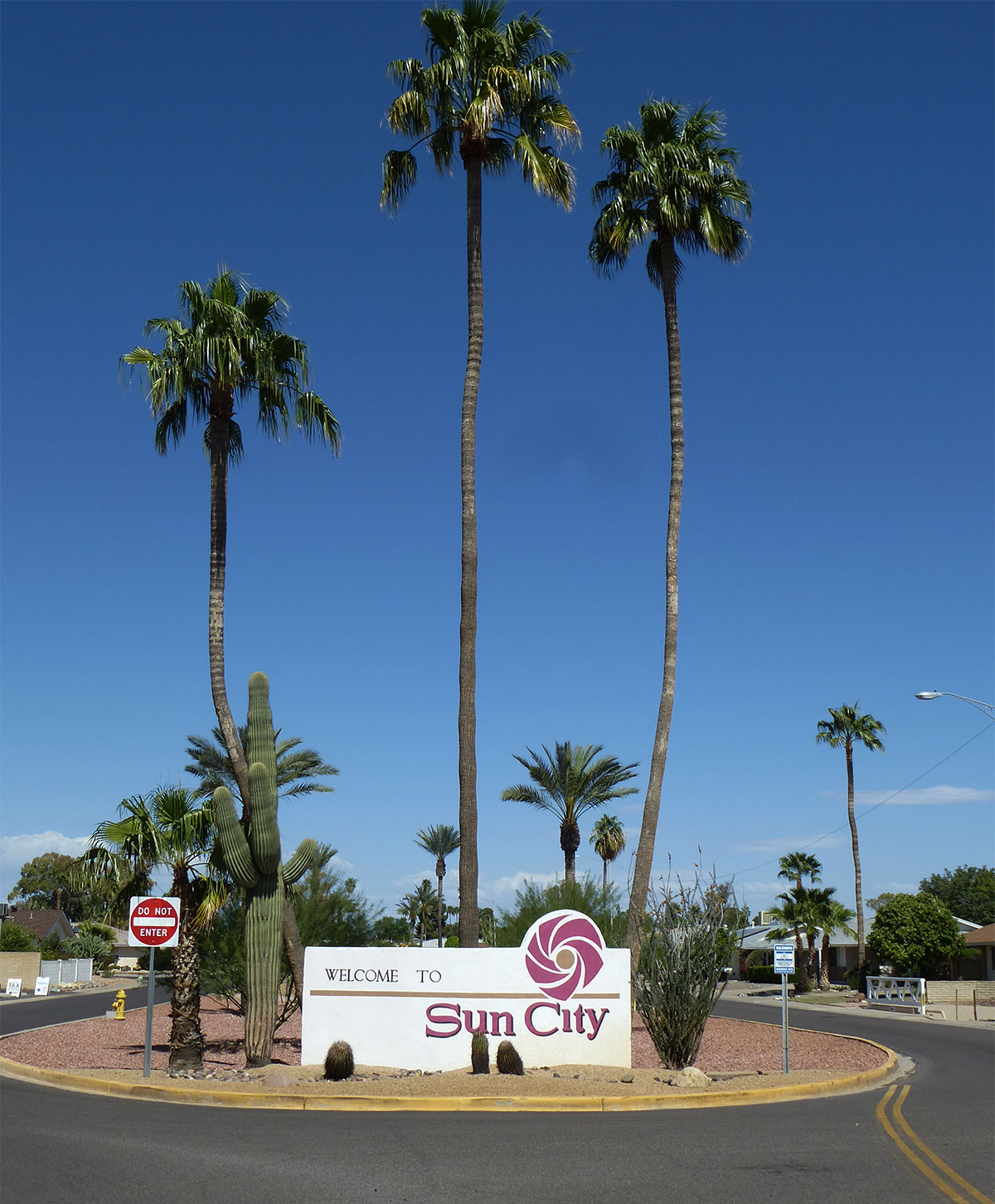
Phoenix exemplifies the new, post-war city.  There was almost nothing there before WWII – it had around 100,000 residents in 1950 (with some more in places like Tempe and Scottsdale). The exponential growth began when developers such as Del Webb realized it could become the retirement center of the west (with its warm weather and vast expanses of cheap land), matching Florida’s role in the east.  P1080263Like southern Florida, the Phoenix economy has been largely based upon people moving there and then selling them houses and stuff.  And like every other place in the South or Sun Belt, its habitability is based upon the automobile, air conditioning and television.  Before the widespread adoption of these technologies, there was a sharp limit on how many people would live in a place like Phoenix.

There are several key differences in the urban and regional form of a city like Phoenix and older cities.  Since there was not a high-density central city to and from and through which large numbers of cars had to be moved,  a comprehensive system of high-capacity, limited-access highways was not developed.  (This may also be partly due to Phoenix not existing as a large city when the interstate highway system was initiated in 1956.)  Phoenix is the largest American city I’ve seen where the highway system is not relevant to car circulation in much of the city.

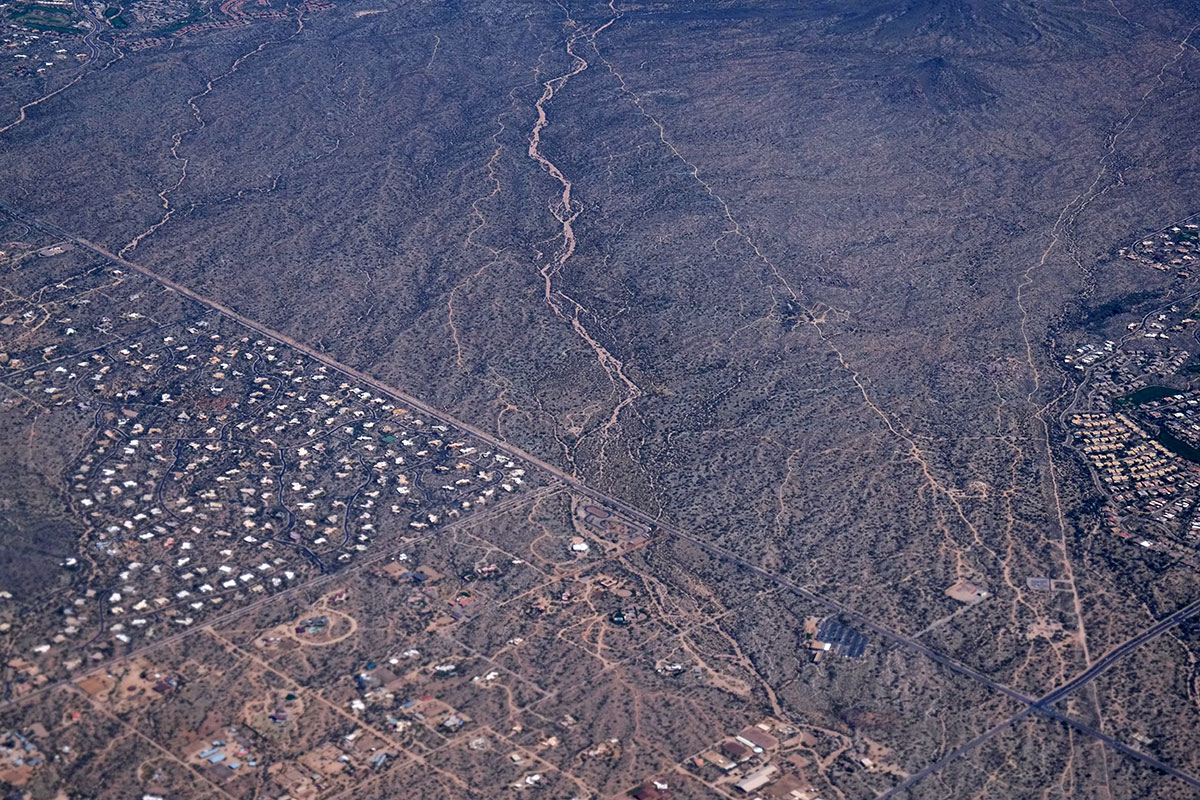
Phoenix didn’t exist in a region of small towns and cities – which then had the spaces between them filled with suburbia until they formed one large metropolitan region – as happened in older regions.  There was some irrigation-based agriculture, and there was a system of canals to serve this, but there wasn’t a significant concentration of population anywhere.  Growth did not happen incrementally or through infill.   A district in Phoenix is usually either a desert, or it is completely developed all at once. DSCF6567

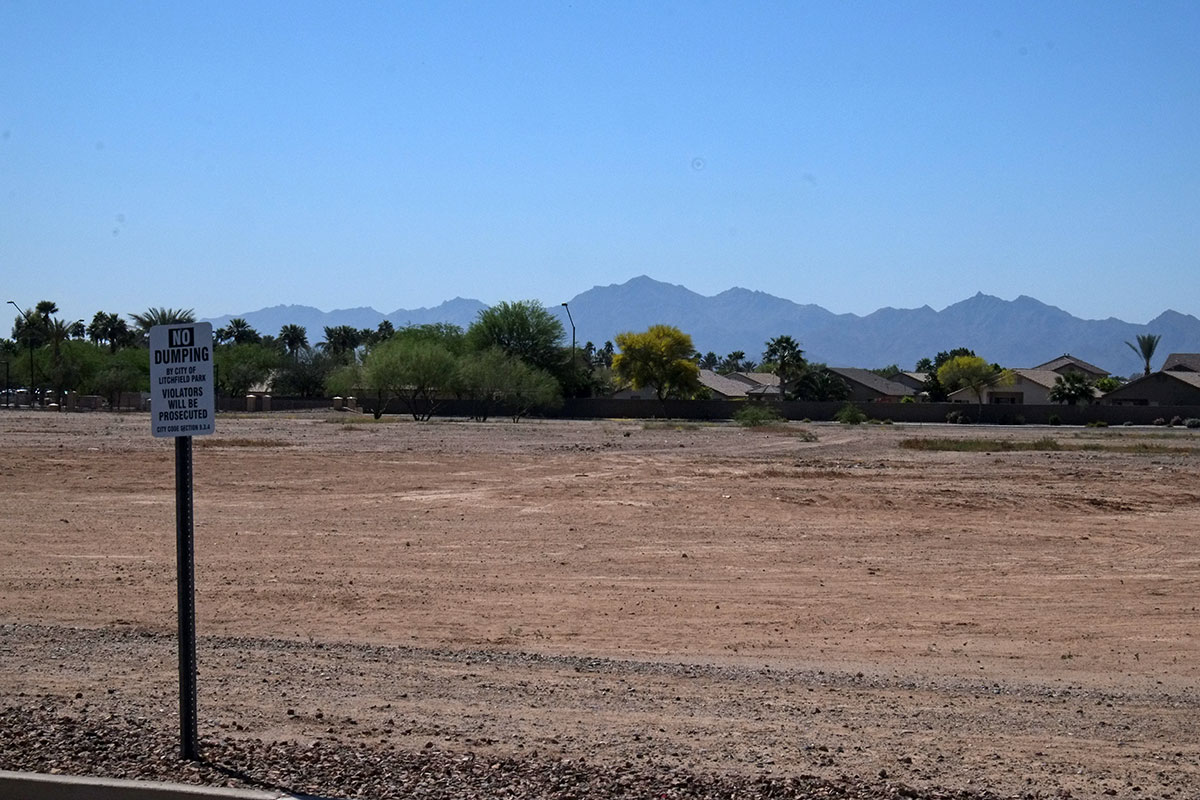
A common sight is moving along an arterial, looking across a desert, seeing another parcel of completed development – and knowing that the desert in the middle will be developed fairly soon.  DSCF6592

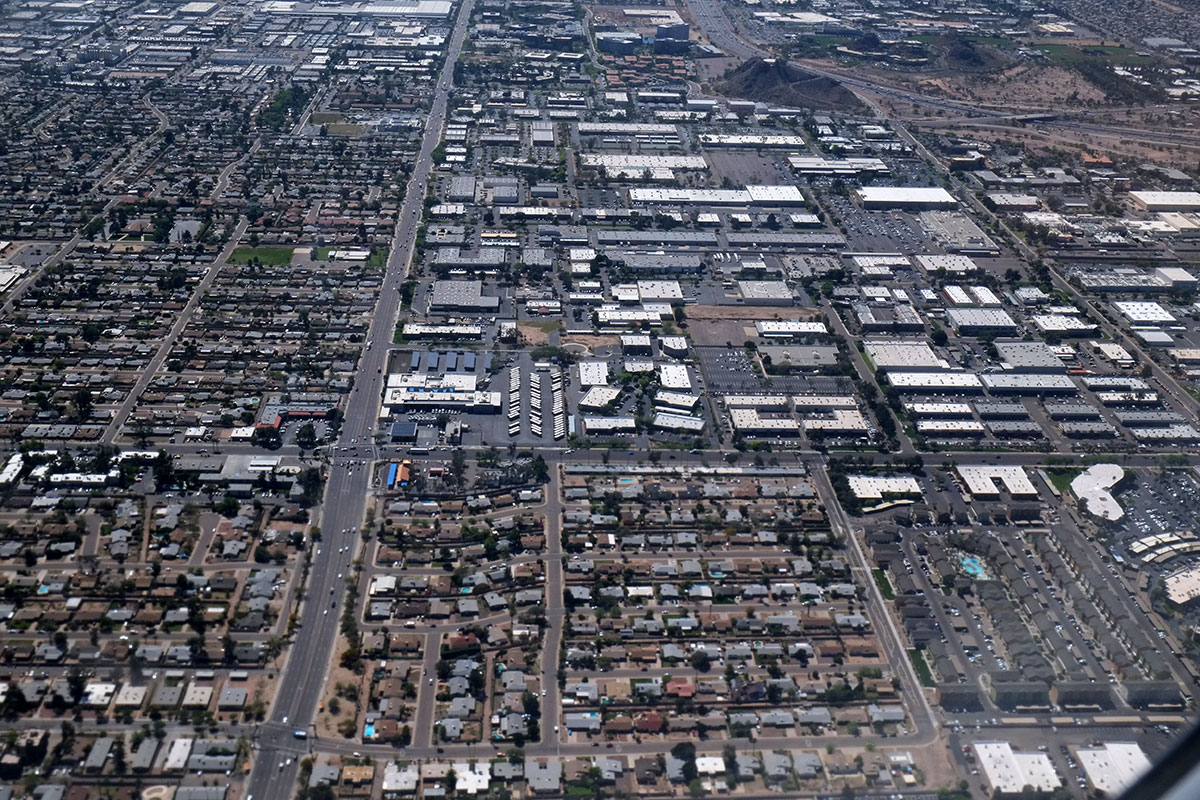
The street pattern of Phoenix is based upon the national grid of townships, with major arterial roads occurring every mile.  Since the density of the metropolitan area is fairly uniform, the roadway system can be sized to accommodate the corresponding uniform density of traffic.  Phoenix is a gridded network, not a branching-tree hierarchical system as is seen in much of the rest of the country.  Since the land was undeveloped before WWII, there was no pre-existing system of undersized farm roads which had to either retrofitted with difficulty, or supplanted by the highway system.  So as the districts developed all at once, the roadways could be built at the appropriate size for the ultimate density  80. Phoenix047DSCF6562

This is a  typical view while driving an arterial in Phoenix – with the neighborhood behind shielded by sound walls.  And while the arterial system is a repetitive grid, the street network within the grid is configured to be as confusing and disconnected as possible – the better to thwart drivers looking for shortcuts across your domain.  80. Phoenix048DSCF6595

The residential neighborhoods are basically all new, roughly in successive rings out from the center, although leapfrogging development is not uncommon.  Each is completely homogeneous, having been built in large parcels by one builder.  Stylistically, they are all very similar, in a vague southwestern faux-adobe or stucco – it appears that a crop-dusting plane flies over each neighborhood every five years, spraying everything with a coat of Dryvit.  In layout they are more similar to tract houses of their era in other parts of the country than to older houses in the region (following the rule that in a mass culture things vary by time but not by location).  They are walled-off from the street more frequently than is normal in other parts of the country, and you can never be sure what is going on behind those walls.  80. Phoenix049DSCF6600

There is some isolated great architecture in Phoenix – Taliesin West, Will Bruder’s library, the Arizona Biltmore, etc., but we didn’t see them on this trip.  I had seen them fairly recently, and after getting dragged all around Texas cities, Greta had reached her limit on architecture, and just wanted to blow out of town and get back to the desert as quickly as possible.  I was also daunted but the prospect of slogging through Phoenix traffic – we were staying on the western edge of the region, and most of the architecture was far to the east.  We did brave the Sunday traffic, and I dragged Greta through the downtown, and then lured her to Tempe with the prospect of good food.

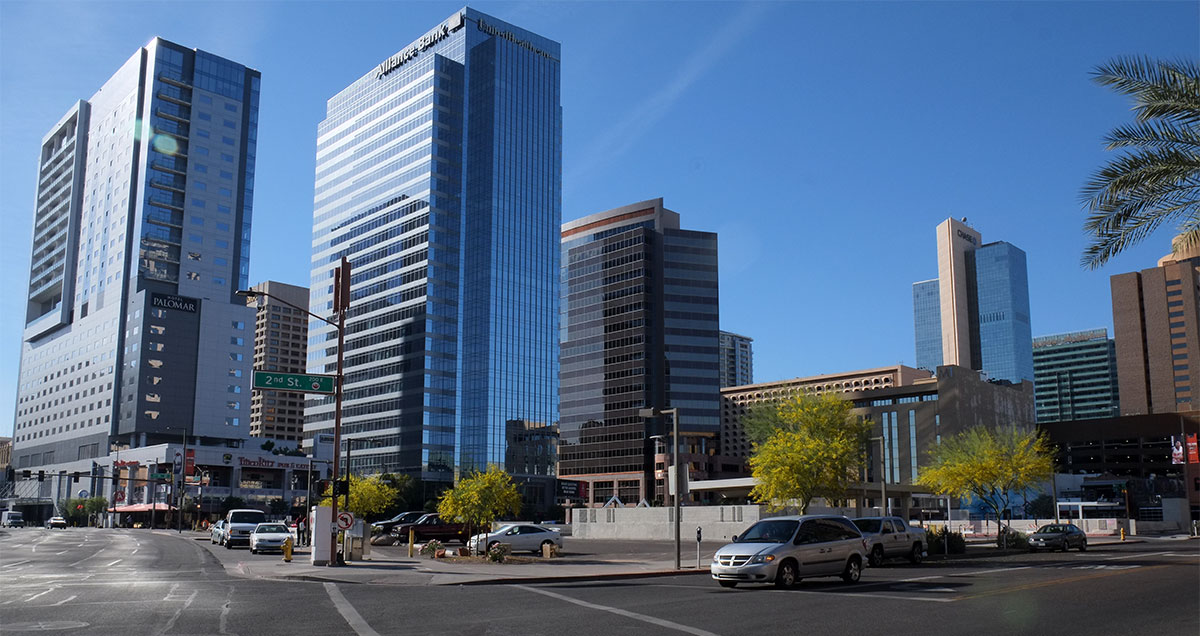
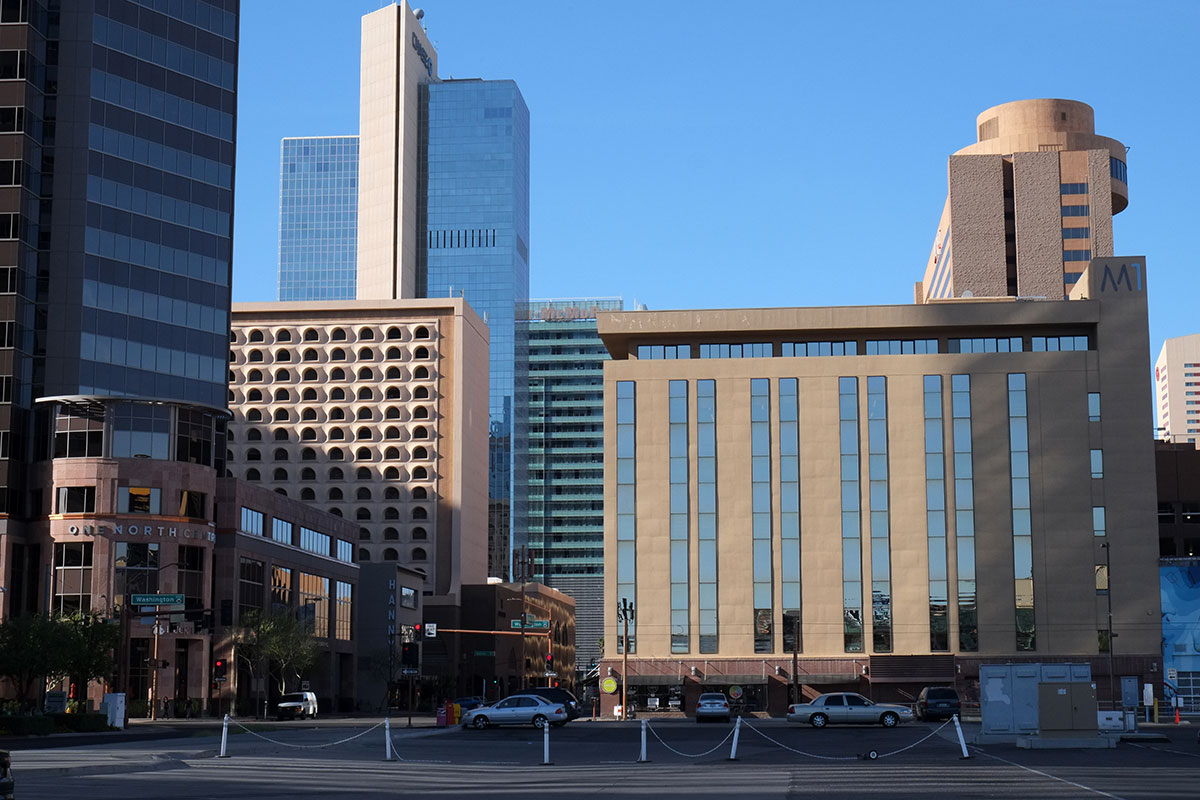
Phoenix has two distinct clusters of density.  The region around Camelback is the center of retail, while the downtown is for business, branches of the major universities, and large events – conventions, major league sports and performing arts.  It is nothing like a traditional downtown, more closely resembling an edge city office cluster.  This makes sense, as its history is nothing like a traditional city’s.  Whereas older cities usually have downtowns that retain older buildings and districts, Phoenix has none of this – we found one older building.  The strange inversion of Phoenix is that the downtown is newer than the sprawl.  It’s like the city reached a certain size and then made a decision to have a more dense downtown, and so redeveloped the whole area.

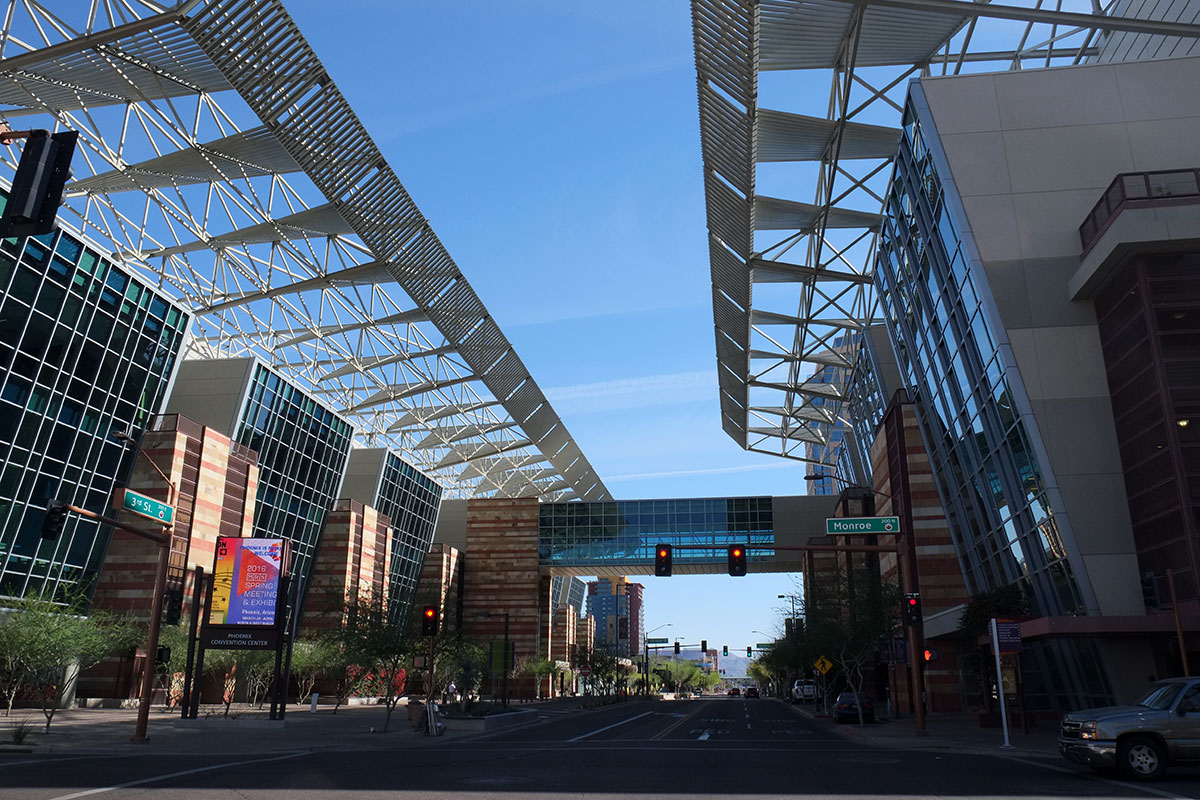
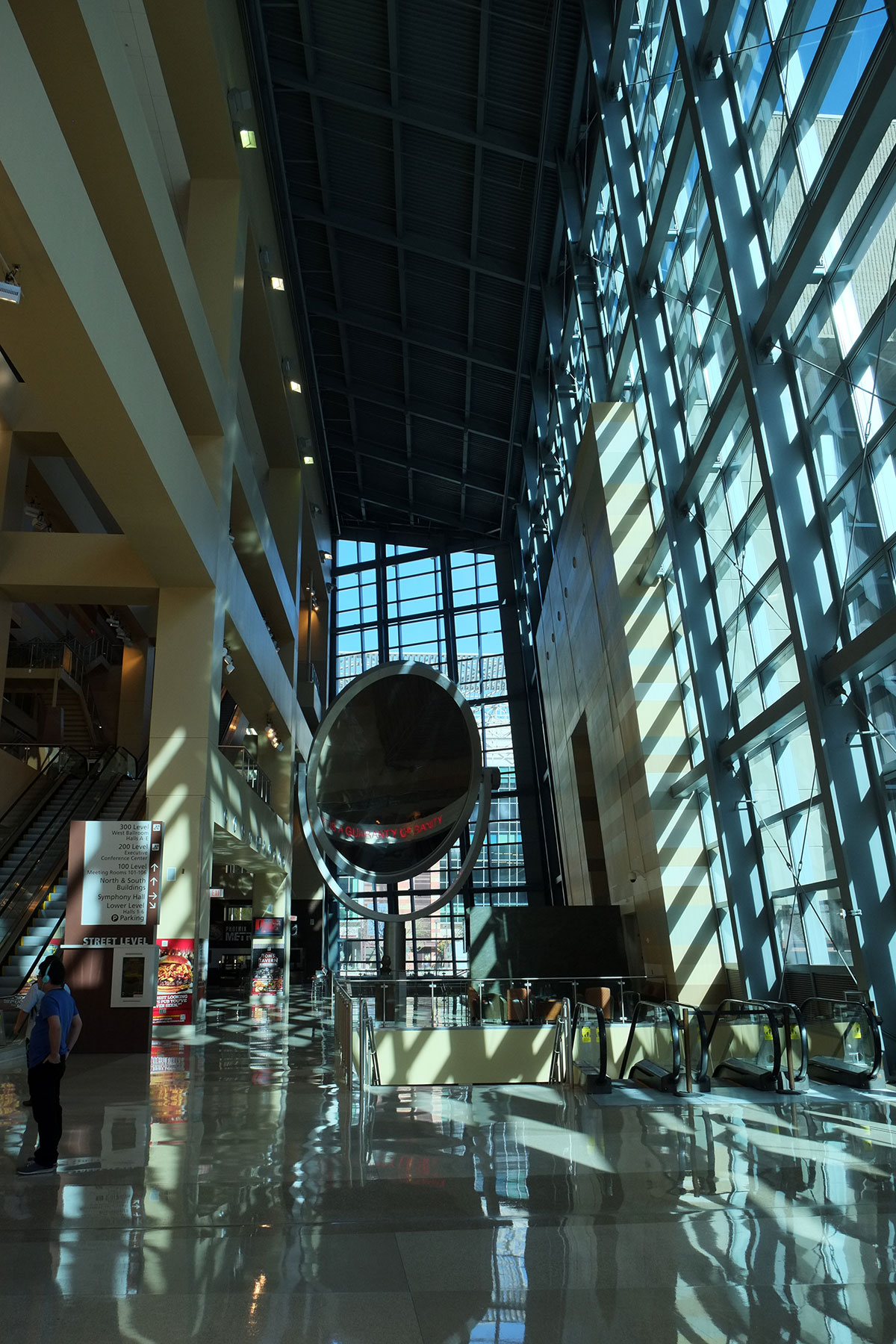
There is a large convention center, which has replicated itself across the street.  DSCF6634

80. Phoenix058DSCF6655

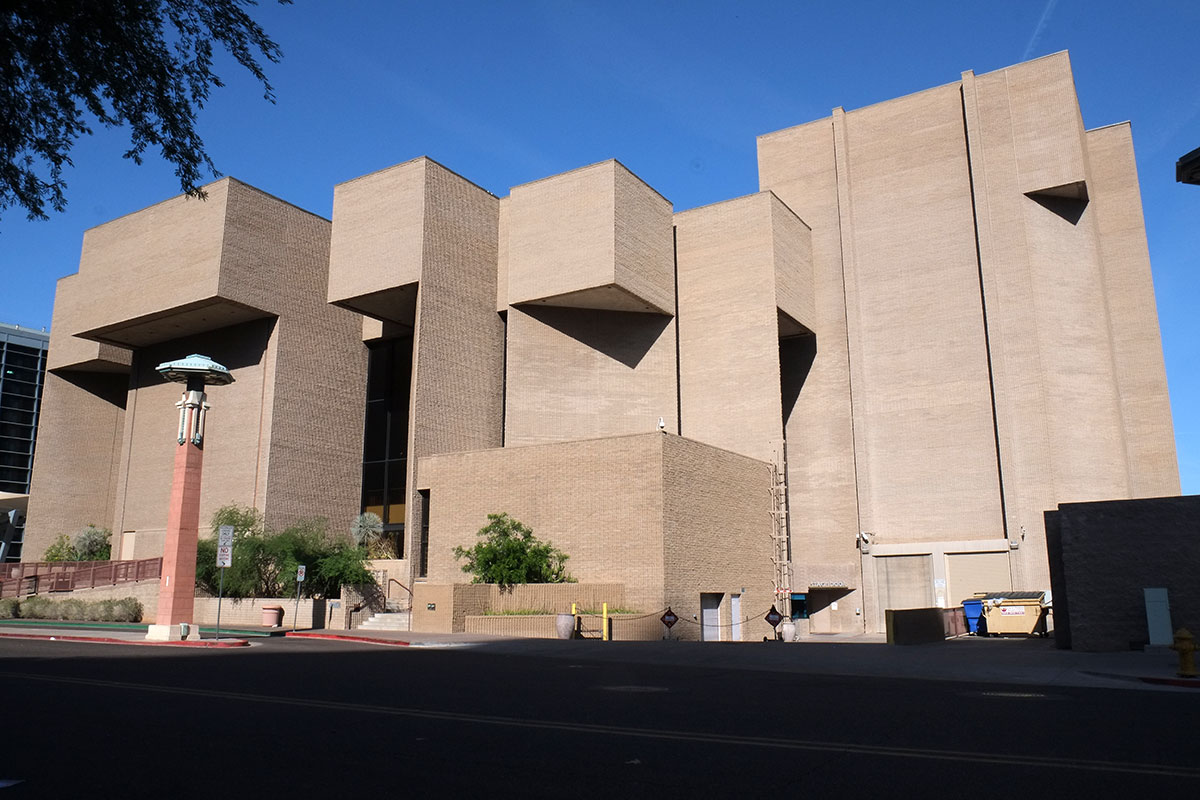
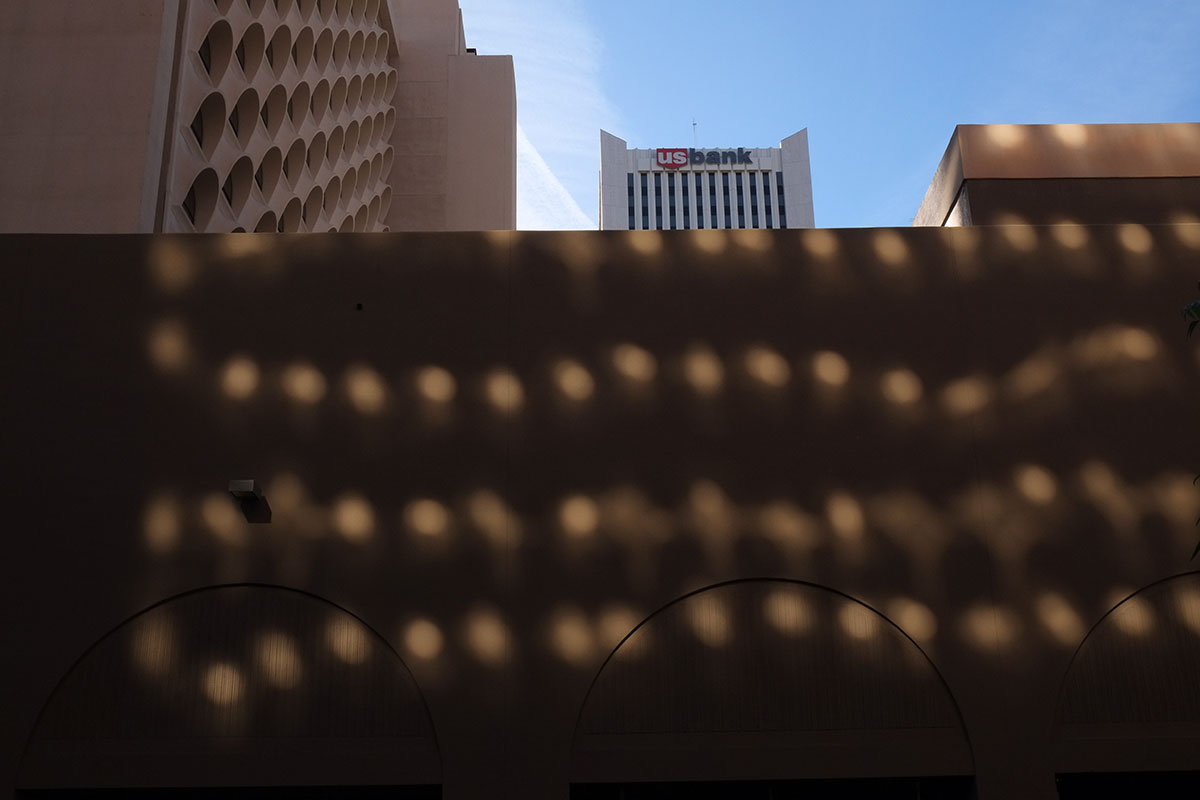
Next door is the Symphony Hall from 1972, the lone institution downtown which exhibits the local solid masonry wall tectonic, a not-inappropriate reference to vernacular pueblo architecture, before it was supplanted by the hegemony of the glass curtain wall (in the desert).  80. Phoenix057DSCF6651

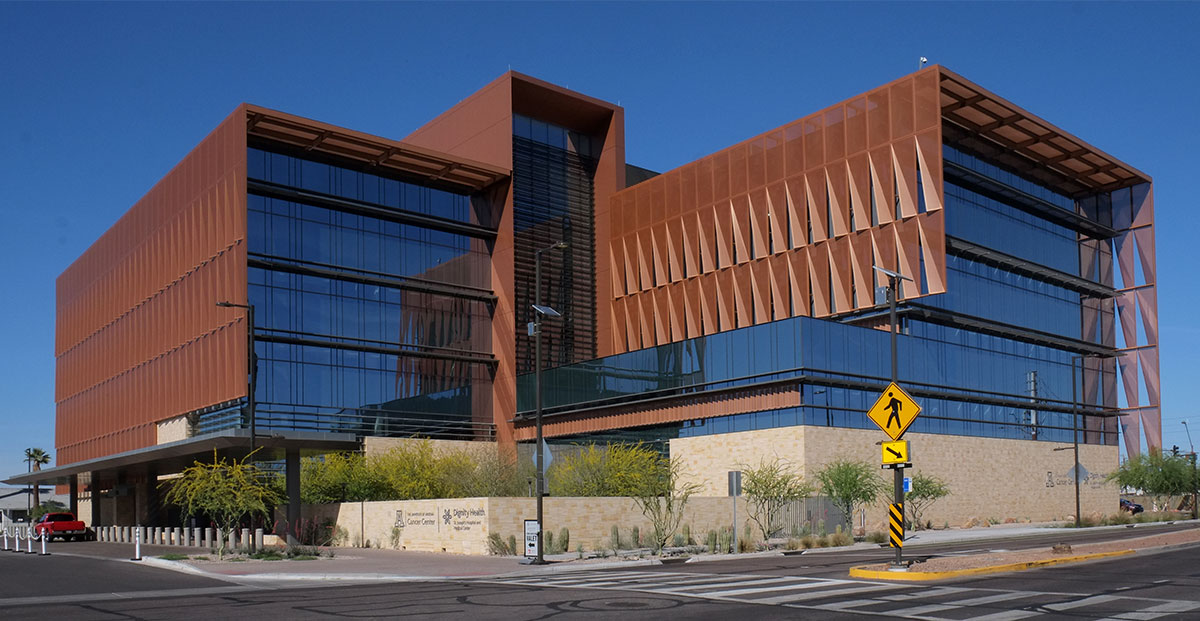
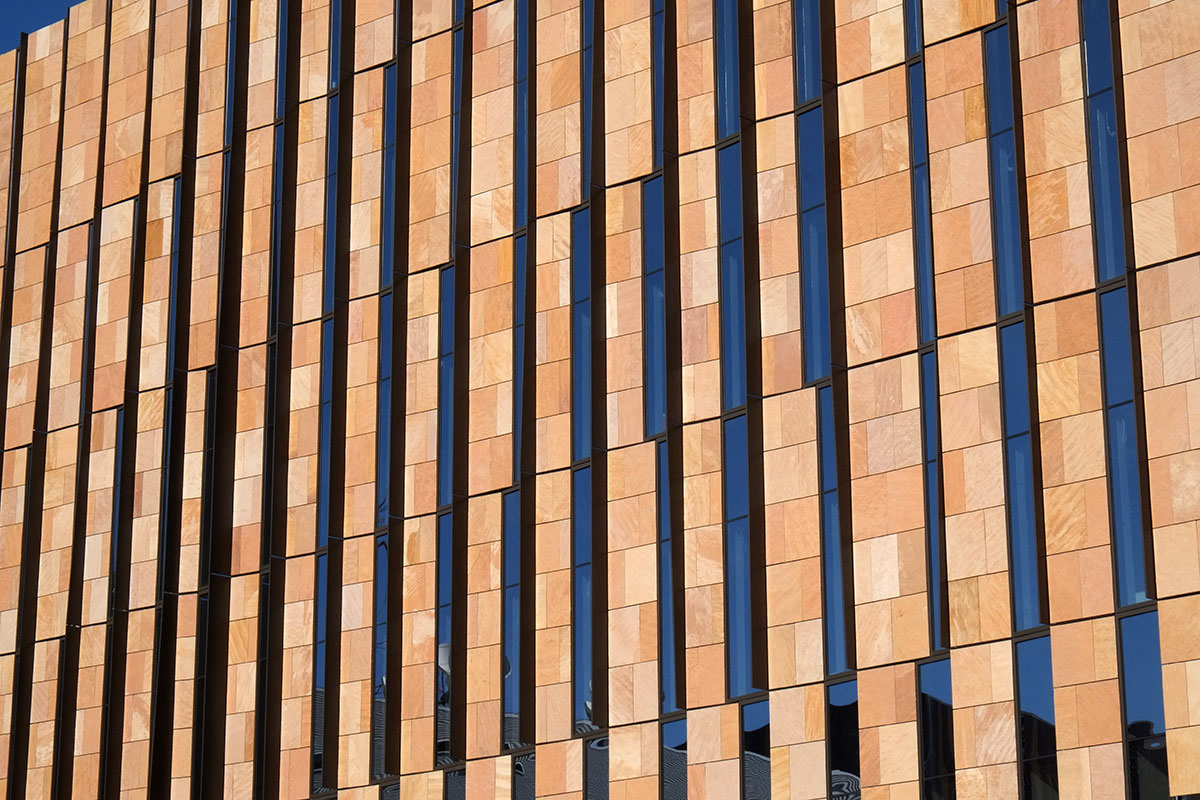
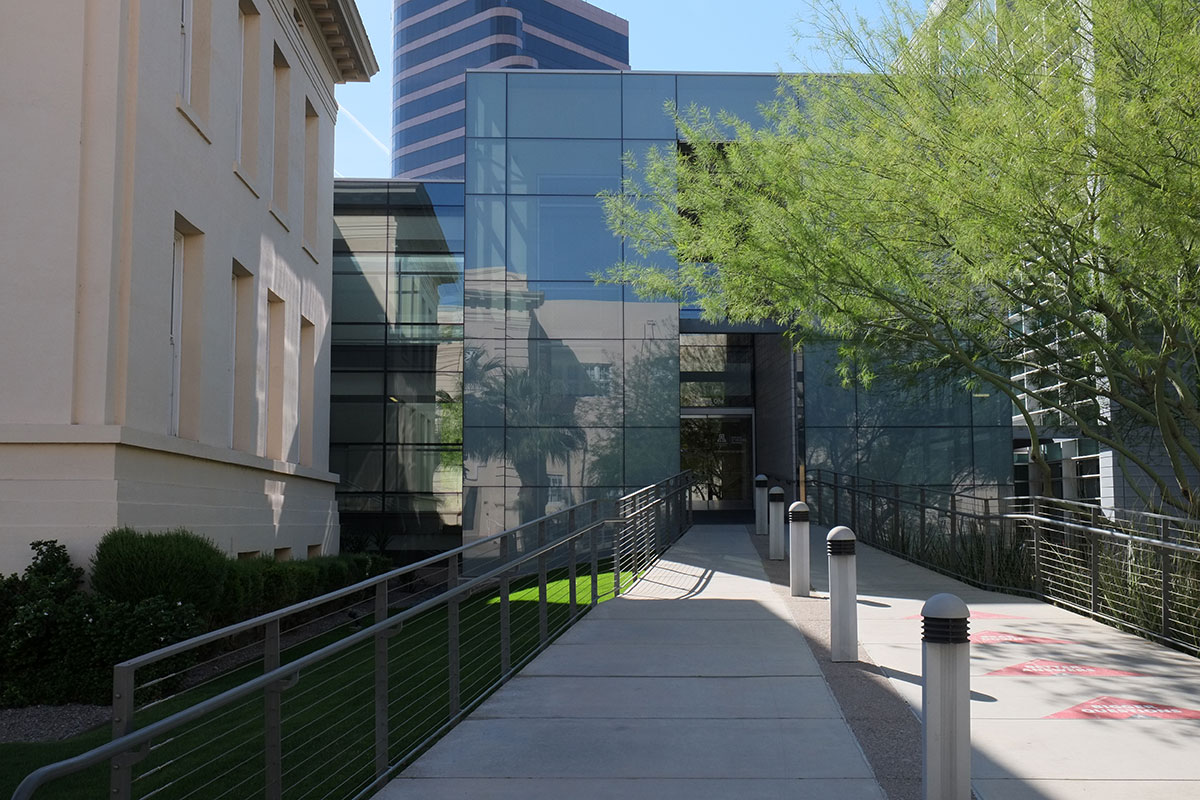
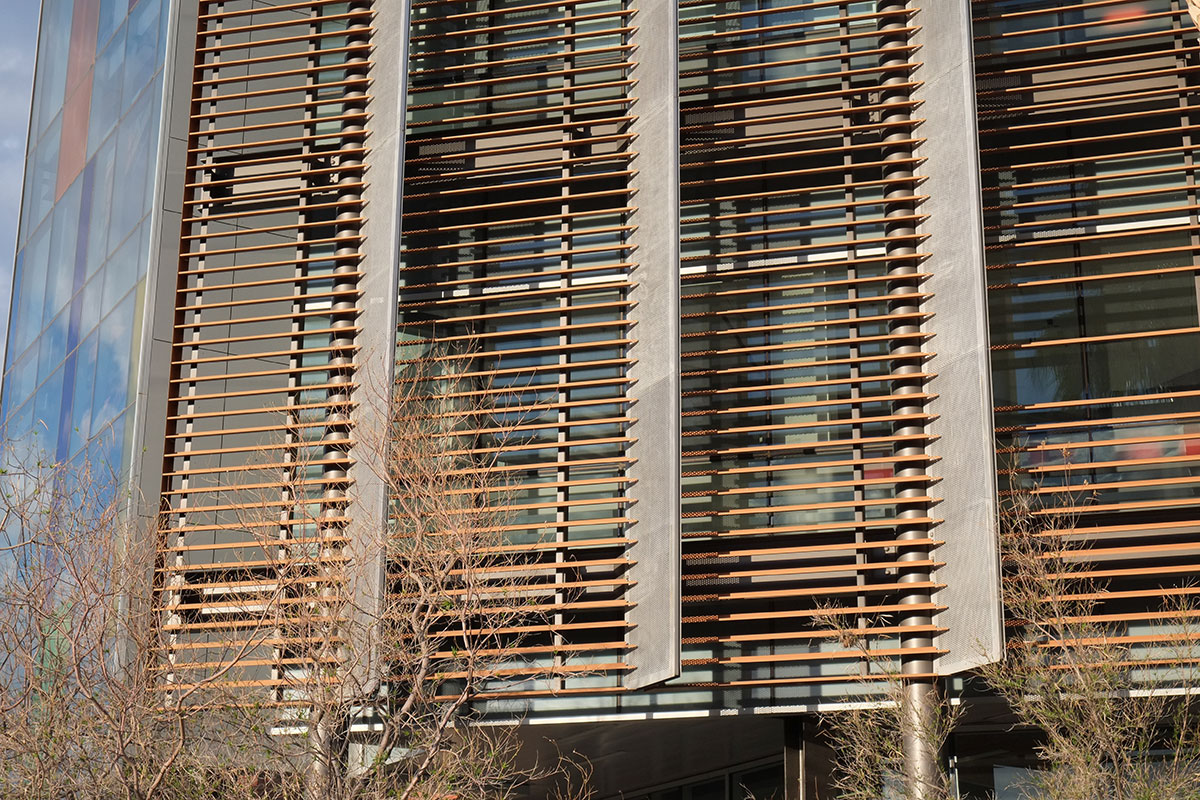
Arizona State and other universities have opened branch campuses downtown, mostly serving their professional schools and medical complexes.  They are good individual buildings, which are paying a lot of attention to sun screening, and getting a lot of expressive mileage out of that strategy.  80. Phoenix051DSCF6609

80. Phoenix052DSCF6619

80. Phoenix066DSCF6703

80. Phoenix053DSCF6621

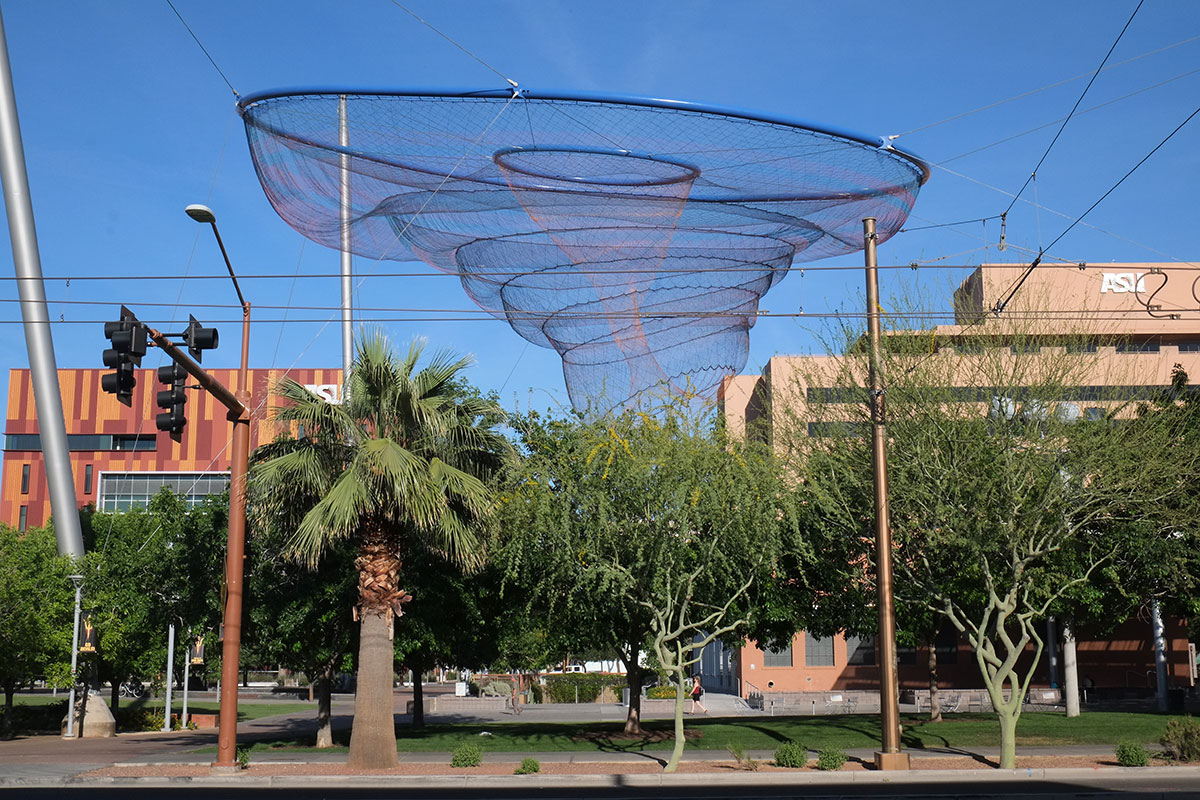
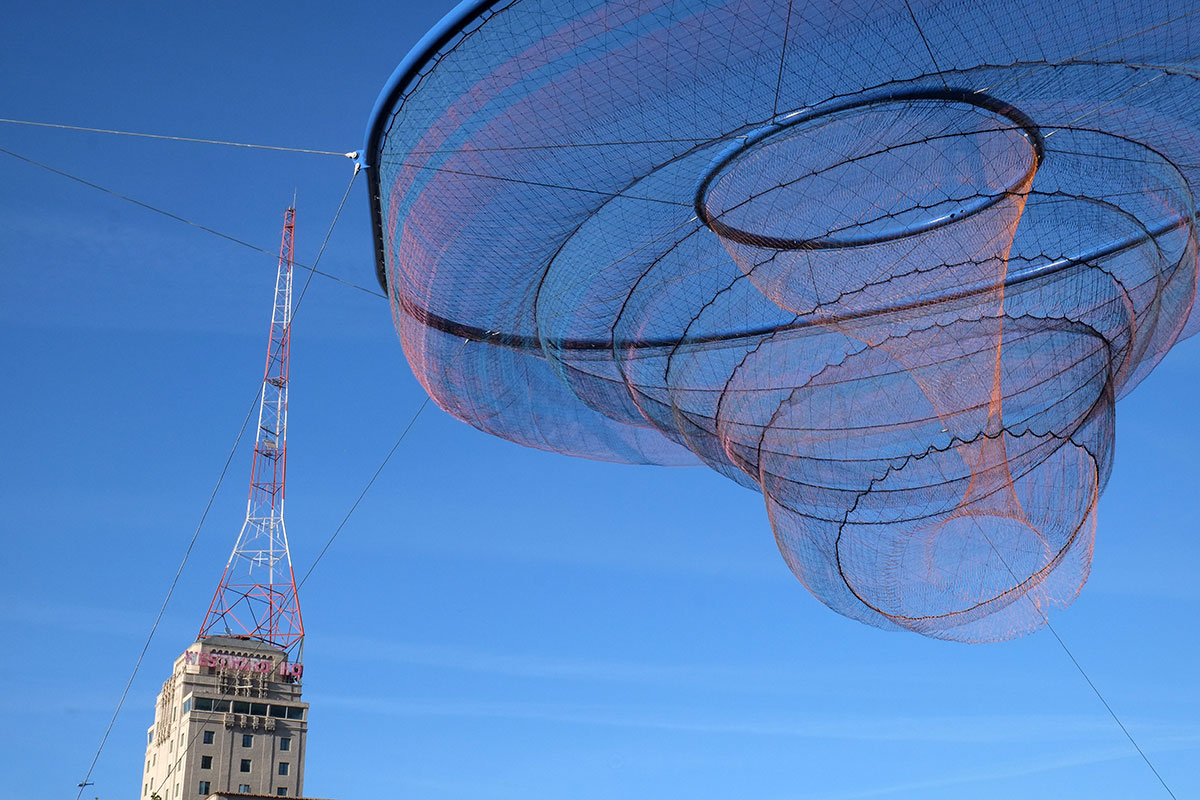
The Arizona State campus contains our favorite thing in the city – a huge cone of net, floating above a plaza, by the artist Janet Echelman (and completed with our colleague Philip Speranza as a consultant).  It really is beautiful, and provides visual entertainment, as you lie in the grass, soaking up the sun.  80. Phoenix068DSCF6720

80. Phoenix069DSCF6734

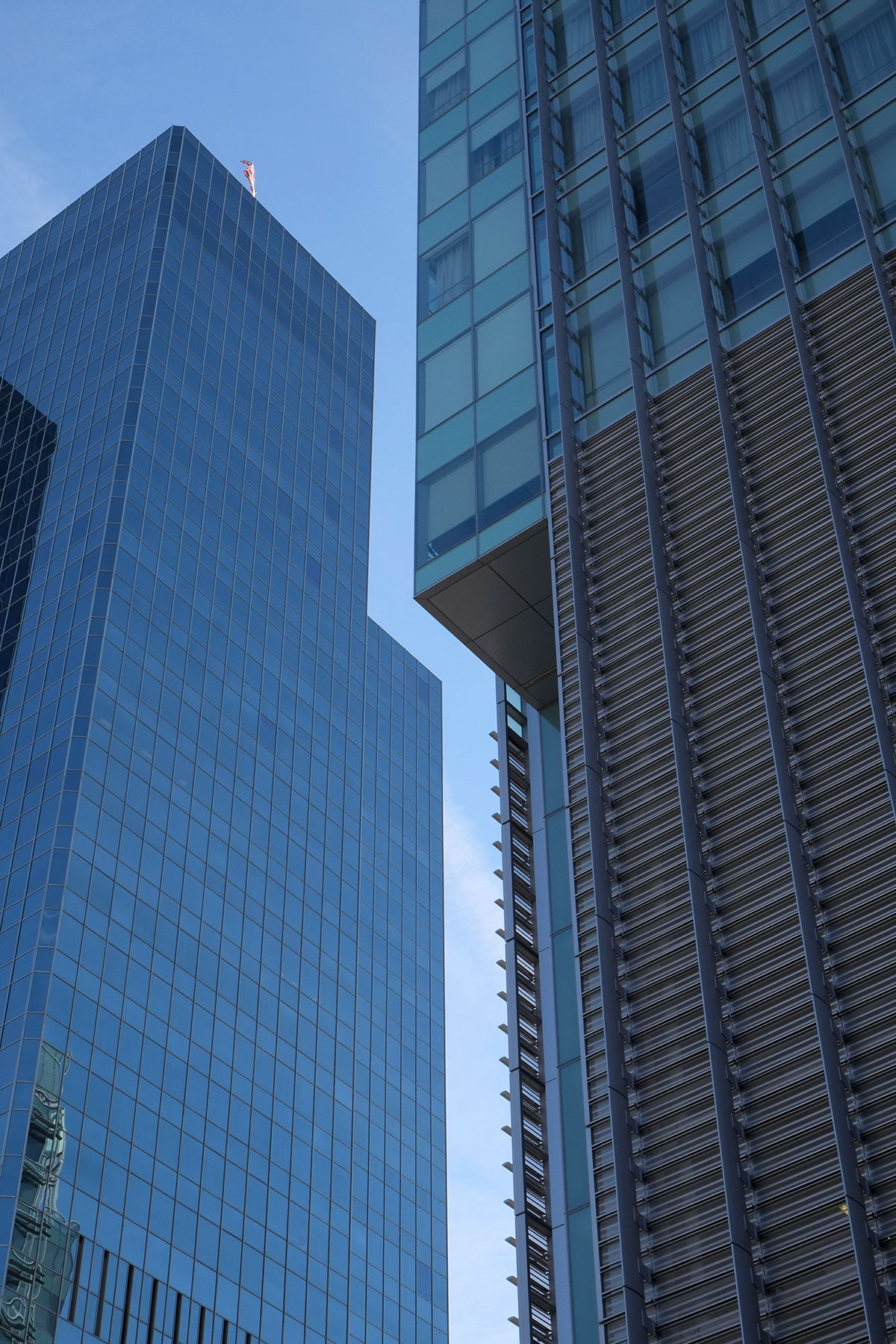
Beyond the universities, there are a lot of generic office buildings.  80. Phoenix060DSCF6662

80. Phoenix061DSCF6672

Leading to the usual Plays with Facades.  80. Phoenix065DSCF6697

80. Phoenix064DSCF6688

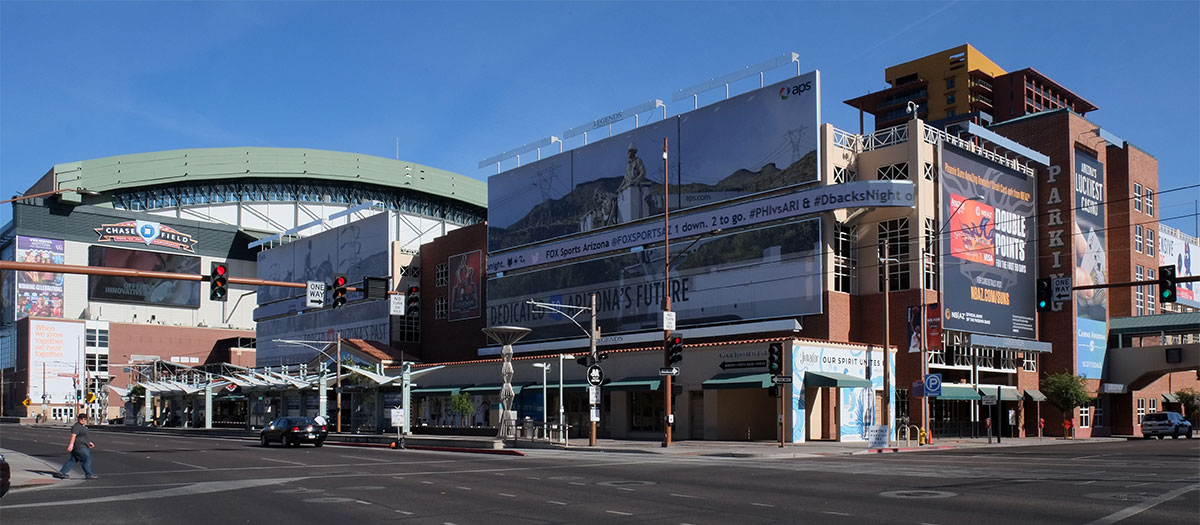
There is a sports district on the south side of the downtown, apparently a baseball stadium and a basketball arena, although it’s hard to tell.  I can’t remember their corporate sponsorship names (but that doesn’t matter, as they will certainly be renamed soon.)  They are in the style that might be called Faux Old Timey, or Times Square Wannabe.  Sports venues used to be Ducks (exhibiting their function in their form).  Now they are often Decorated Sheds, with the exterior being covered with some 21st century architect’s evocation of what the era of urban vitality used to look like.  The exuberance of the facades contrasts with the utter desolation of the streetscape – not a pedestrian to be seen, except when there is a sporting event.  Many cities now have equally dead sports zones, but few go to such elaborate lengths to try to disguise the inherent death of real street life.  80. Phoenix059DSCF6657

Downtown Phoenix is not very coherent as a city center, but it does have some good buildings.  It was notable that all the interesting architecture has been built by the universities, whereas the more typical downtown buildings of offices and hotels are completely banal.

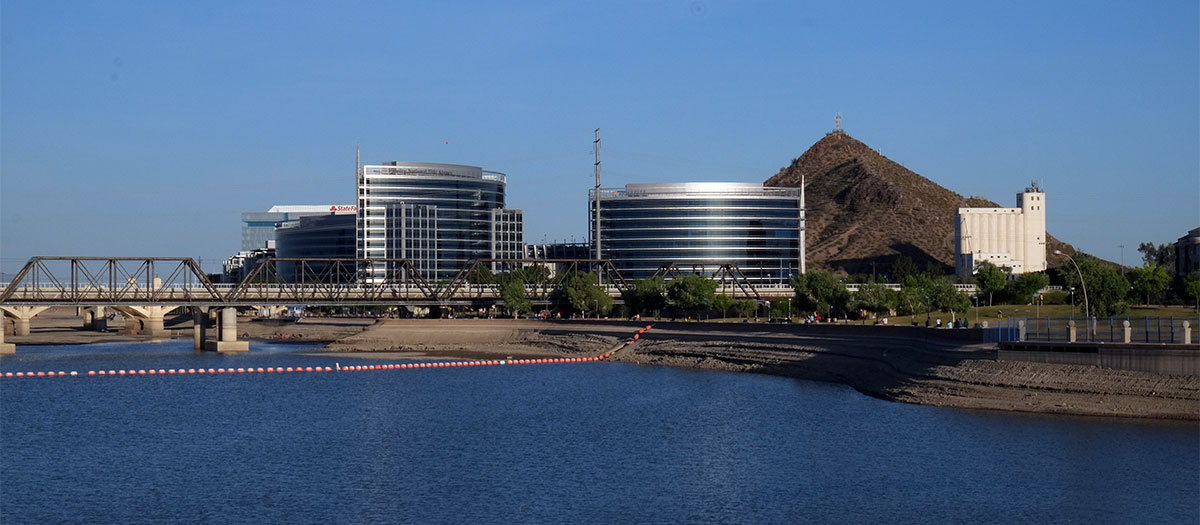
We moved on to Tempe, looking for the gastropub Greta had selected.  One the way, we discovered some interesting things.  Tempe may have generic buildings too, but everything looks better when you add in a river (dammed at this point to create a wider body of water) and have a butte in the near distance to give the city some scale.80. Phoenix070DSCF6761

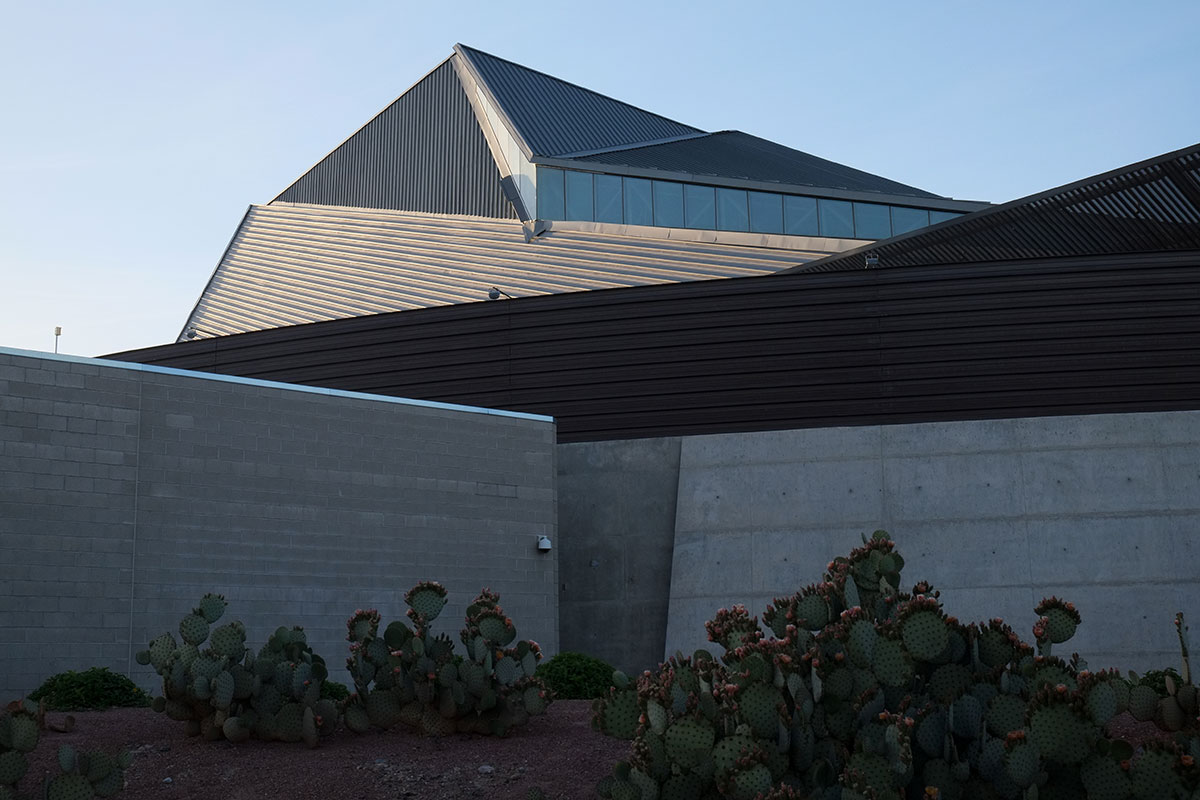
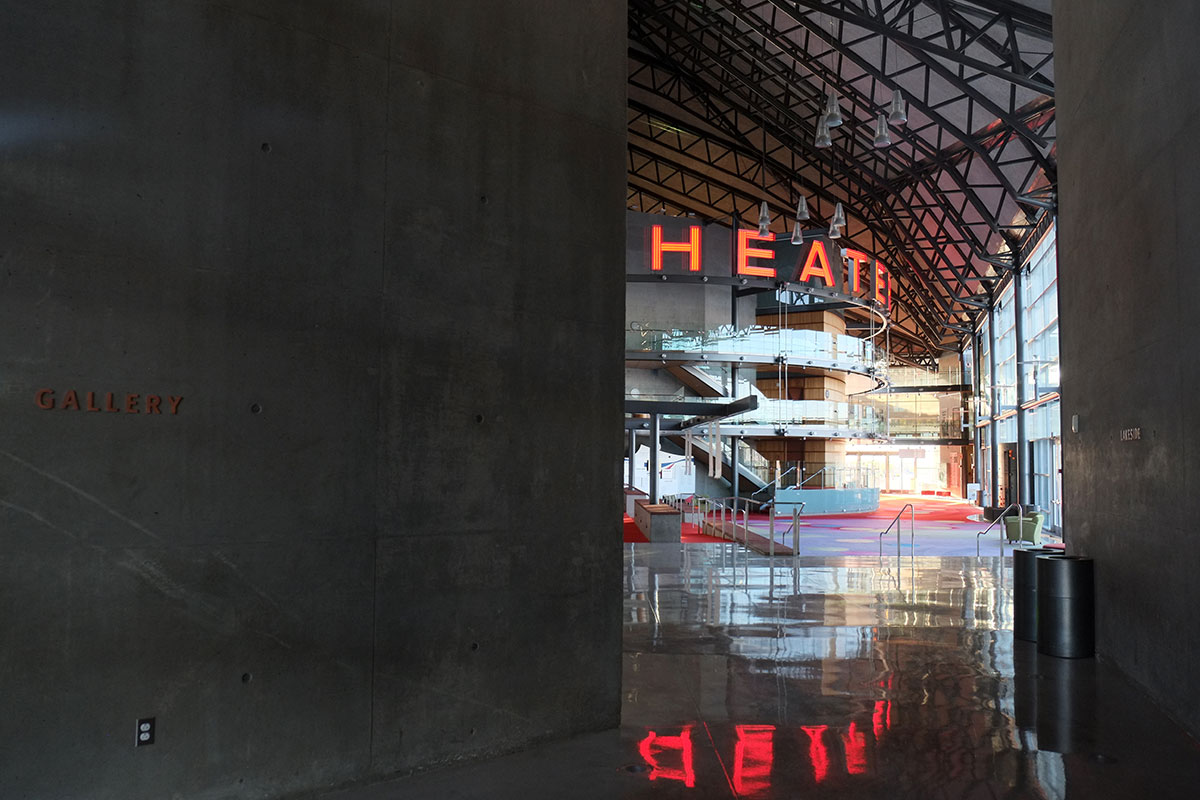
We also visited the Tempe Center for the Arts along the river, designed by Barton Myers, clearly referring to the history of FLW and his followers being active in this area.  It is a very nice building, with simple planes of solid panels and selective use of glazing to open the lobby up to the river on the north.  80. Phoenix072DSCF6783

80. Phoenix071DSCF6776

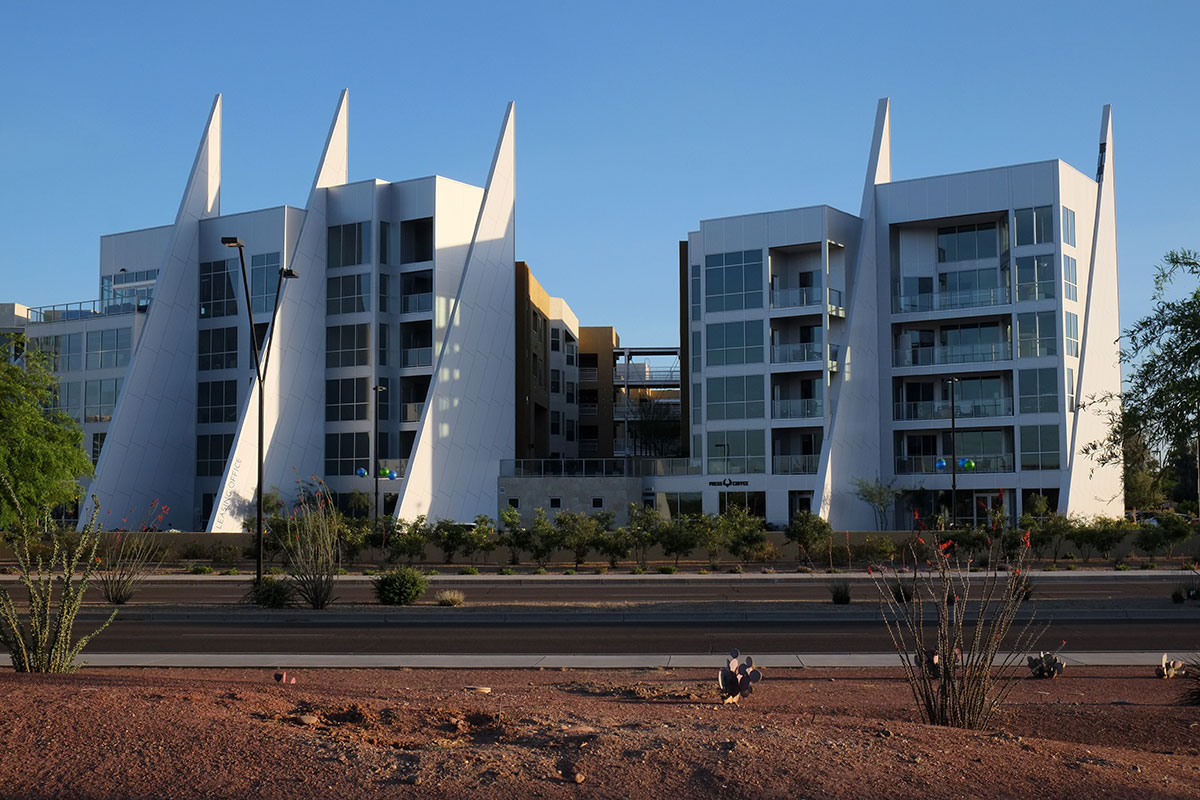
Across the street there was a hip new housing development. I’ve never seen apartment buildings before with tail fins.  80. Phoenix073DSCF6784

The fundamental question about Phoenix (and other late 20th century cities) is whether their character has been inexorably formed by the new way they came into being – sprawl before core – or whether their current character is mainly the result of their being so new.  Will they become more like older cities as they age, or is there something permanently different about them?  We may never see the answer to this in Phoenix.  With NASA’S prediction of a mega-drought occurring in the Southwest in this century, it seems likely that Phoenix will become uninhabitable before it has the opportunity to evolve.  Our trip theme of climate-change-farewell-tour has usually focussed on what will be changing in the natural environment, but the changes that will be coming to cities have become more apparent as we have traveled through Miami, New Orleans and Phoenix.

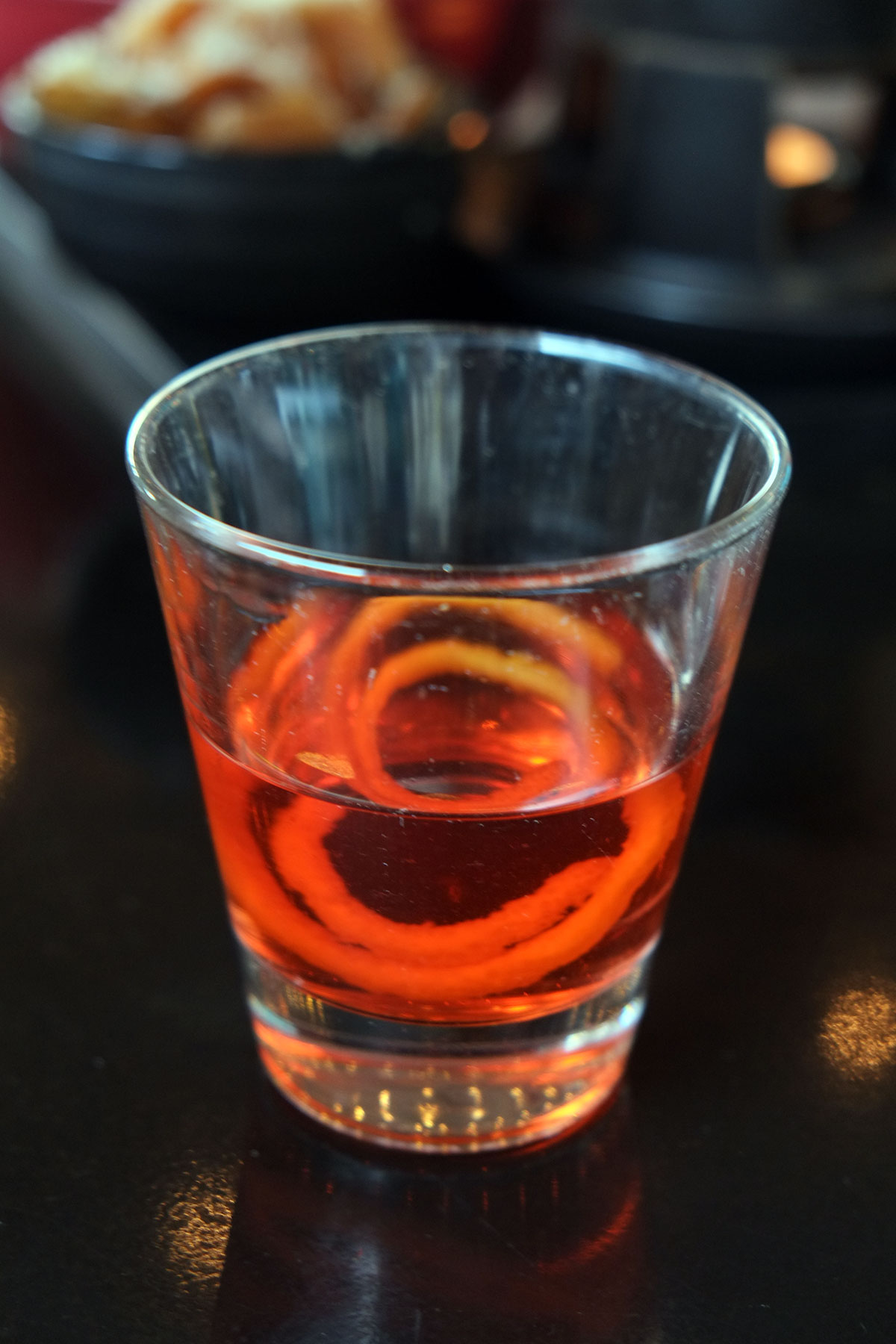
Culinary Dropout’s Operation Domino

DSCF6803

When we left home in September, I said farewell to my bar, and figured that while this year would be rich in many experiences, elaborate cocktails would not be a particular focus.  (As I said to Linda, if you’ve just spent the day hiking in Yellowstone and you need a drink, there’s something wrong.)  That has largely been true (except for Mardi Gras).  I thought I could get by with the occasional drink in a restaurant, but after having the worst Manhattan ever made in a Chinese restaurant in Framingham, I decided that that approach was just too risky, and I’ve been keeping the necessary ingredients for an excellent Manhattan in the back of the truck ever since.  ( I think that walking into a friend’s house with a portable Manhattan bar has been a major reason we’ve been welcomed everywhere, along with Greta’s sterling personality.)

There have been some memorable drinks along the way (Boston, Charlottesville, New Orleans, Dallas, Austin come to mind), but in all those cases, it’s really been the quality of the company I remember more than the drinks.   However, in Tempe Arizona, I came across the first cocktail that made me sit up and pay attention.

DSCF6812

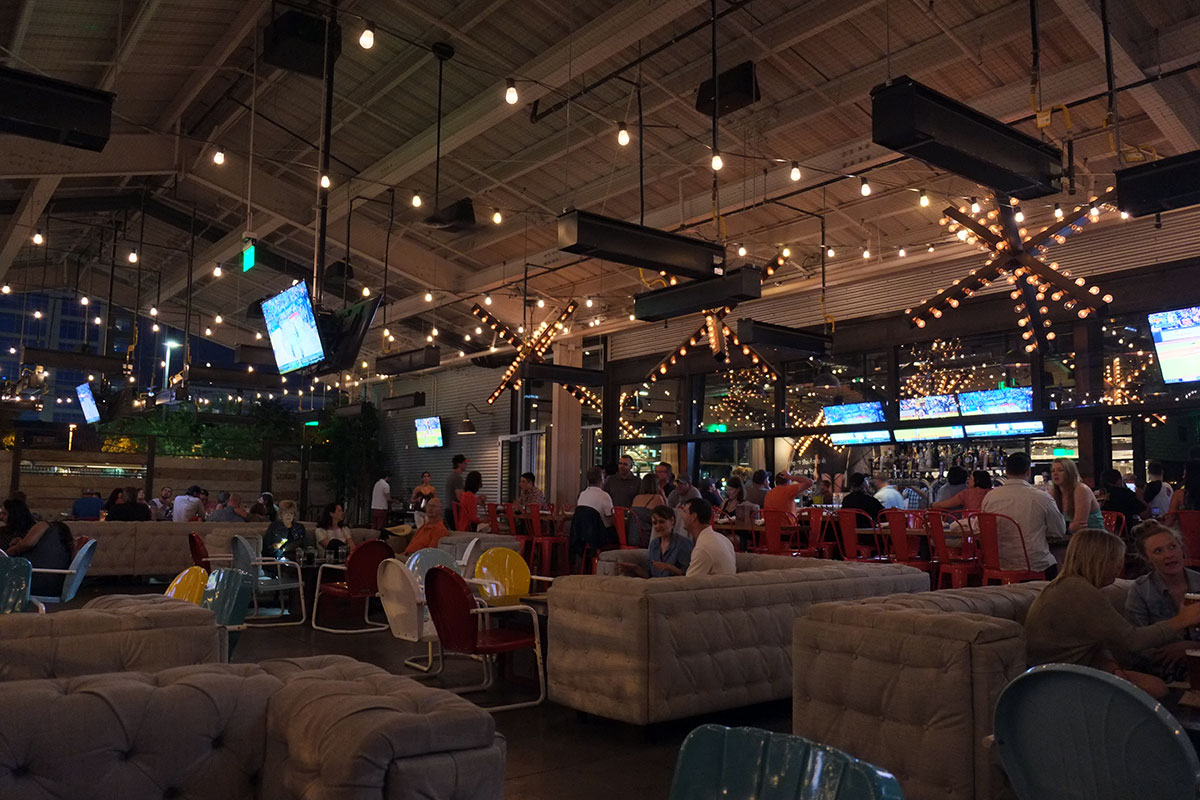
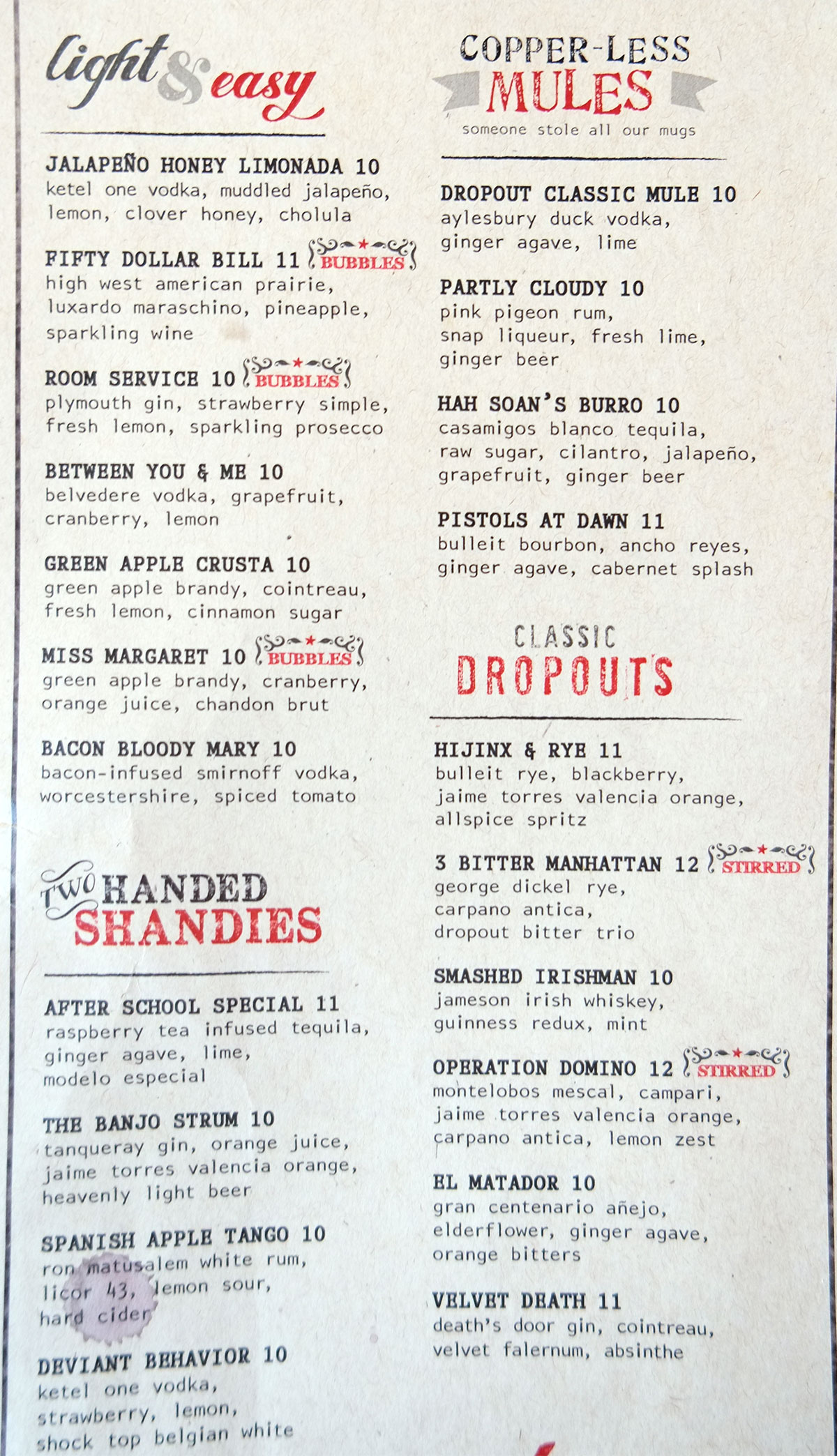
We were having Easter dinner at Culinary Dropout, a gigantic, relatively new gastropub located  in some big old shed buildings.  Greta had found it on Yelp, where the reviews were uniformly good (she’ll be blogging about the food at some point).  When I looked at the menu and saw Carpano Antica being used, I realized that the bartender knew a thing or two.

DSCF6801After trying to gauge my comfort level (did I like sweety drinks, or did I like mescal?), our knowledgeable waitress recommended the Operation Domino.  I am a big believer in drinking the local stuff, so mescal sounded right for Tempe (and their Manhattan sounded too much like my own.)  The ingredients are:  Montelobos mescal, Campari, Jaime Torres Valencia Orange (a Spanish orange brandy liqueur) Carpano Antica sweet vermouth, and a lemon twist.

It was superb.  The smokiness and depth of the mescal was apparent, but beyond that, nothing dominated.  The bitterness of the Campari balanced the sweetness of the vermouth and orange liqueur perfectly.  If I had to compare it to another drink, I’d say it was like a Boulevardier, with overtones of the orange.

Greta is such a better writer about flavors than I am, that I got her to smell it, but she was too absorbed with the soft pretzel / provolone fondue to care.  So I’ll just stop here with the description.  I can only hope that Minott has the proportions on this one worked out by the time I get back to Oregon.

Culinary Dropout

A little surprisingly, we did not come to regret our dining decision that was based more off the name than anything else. That isn’t to say that Culinary Dropout didn’t have favorable yelp reviews, which were extremely helpful in choosing from their remarkably diverse menu. A casual atmosphere of shuffleboard and couches in a covered terrace was well complemented by the wide variety of comfort foods served. It is not a place for vegans or diets.

For a not-barbeque joint, their ribs were good. I don’t think they had been smoked, and they had fallen into the normal trap of relying too much on the sauce, which was a little too sweet. That being said, they had a nice crispiness to them without being dry, and the sauce was spiced as well as sugary.

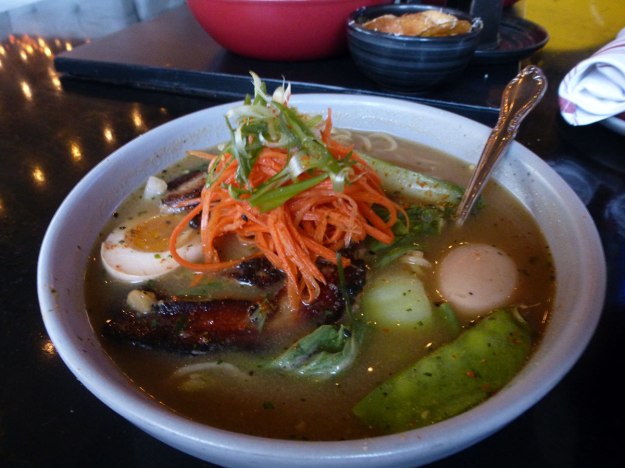
The pork belly ramen was great. The broth was second only to Bao and Noodle, which is a great honor to be compared to, even negatively. Chewy generally isn’t a term of endearment for meat, but for pork belly, it’s fantastic. It was better then some ramen shops I’ve been to.P1080295

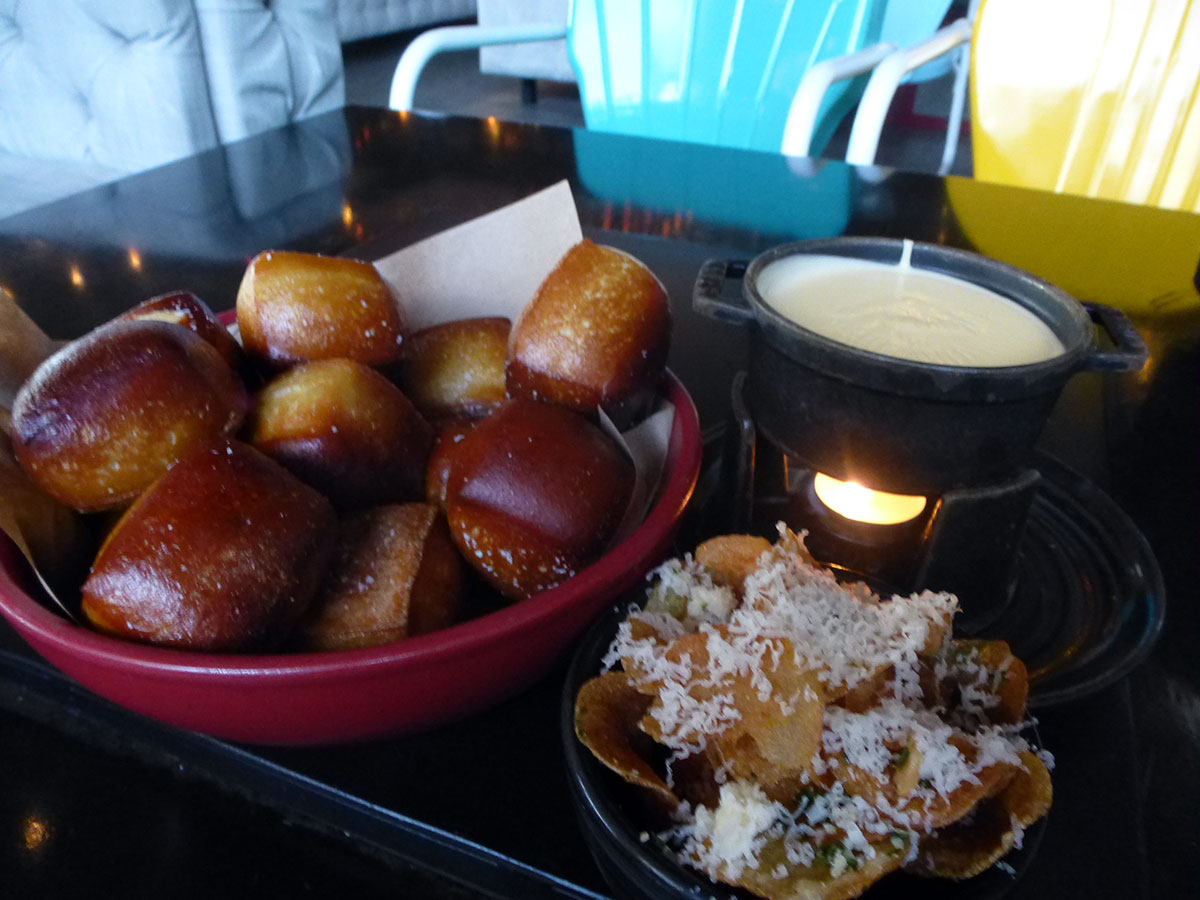
However, the first dish we had was by far the best. Provolone fondue with pretzel rolls. There may not be anything better in this world than melted cheese, and I didn’t even really like provolone before this dish. Pretzel rolls, soft and chewy, are so much better than bread. Unlike many chips and dips or fondues, they had the exact right proportions of liquid to solid.P1080293

For Phoenix’s size, no one has ever said that it has great cuisine. Culinary Dropout is actually in Tempe, along with most of the highly rated inexpensive restaurants. But don’t worry about the drive, the food is well worth it.

Displaced persons

Before we began this trip I plotted out where all our friends lived that we might be able to visit. But serendipitously, we also managed to rendezvous with some friends who were away from their homes, but managed to be in the same location as us.

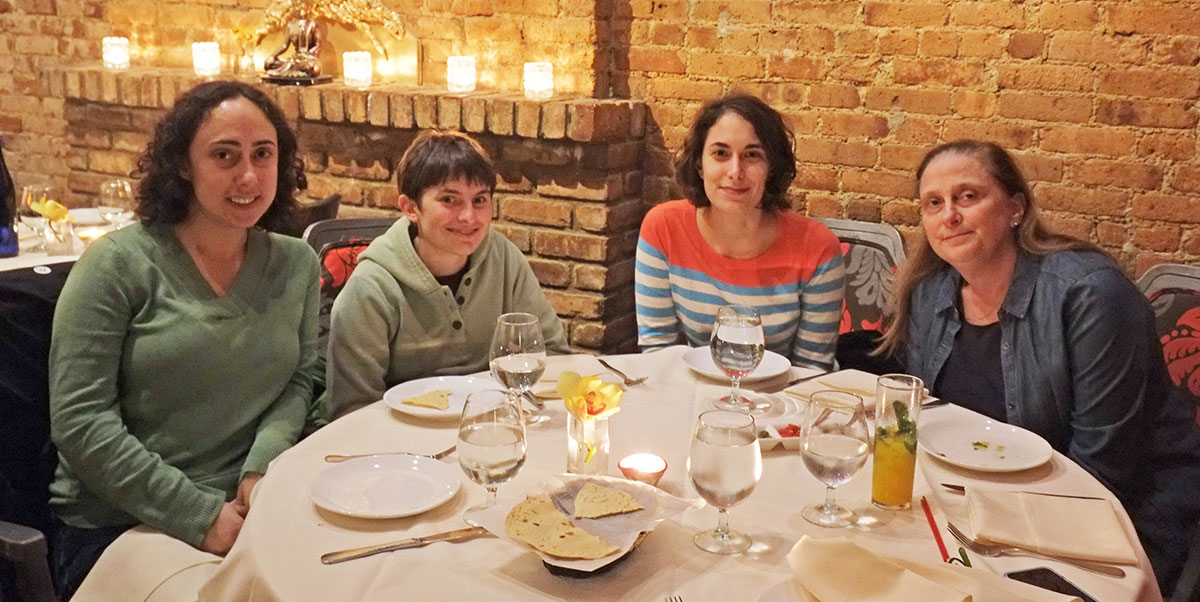
In New York a small crowd (which ranged from the truly to the slightly displaced) assembled for dinner with us. Marley Zeno (in the middle) came all the way in from her home in Brooklyn, but we think of her as being even more displaced than that, as to us she is fundamentally a Seattleite. She grew up in Kirkland, the daughter of our friends Mike and Karen, and left the Northwest to go to school at Oberlin. Eventually she found her way to New York, where she entered a program through which she earned her masters in education at Hunter, while teaching second grade and living in Bedford Stuyvesant. (One of the weirdest things about visiting New York now is discovering that neighborhoods I wouldn’t even walk through when I lived there are now pretty gentrified and expensive.) Marley is having one of those young adult experiences in New York that I remember fondly, but the big question is whether she will stay; we’ve found that the call of the Northwest is strong for those raised here, and even if life in the big city is fun, they eventually start missing the rain and the gloom.DSCF5137

Marley’s sister Rachel (on the left) was completely displaced, visiting Marley from her home in Seattle. I’ve known Rachel since she was an infant, and I’m technically her godfather, even though we’ve never exactly figured out what that entails since the Zenos are Jewish. But she’s been an important part of my life, back from when I lived in New York and would go to Seattle to visit them. Rachel went to college at Pomona, and after considering several life options, headed back to Seattle, as the lure of the Northwest was already at work on her. She has yet another of those jobs where I don’t really understand what she does, but I think it involves being a well-rounded person in a high-tech firm, where she can put her broader viewpoint and interpersonal skills to work as an interface between the techie types and more normal people. We saw Rachel on this trip in New York, and then we narrowly missed her a few more times: while we were driving west through Kayenta, she was 20 miles north camping in the Valley of the Gods. Then while we were in Palo Alto, Rachel was at a meeting in San Jose. But we finally managed to reconnect with her last weekend, at her wedding in Seattle. It was a really beautiful service as she and Tim got married, we reconnected with lots of old friends and Rachel’s extended family members we get to see at major life events, but I still couldn’t figure out what my role was as godfather.

We really enjoyed seeing the Zeno girls on this trip, especially as we have come to think of Greta as the third Zeno girl. She is uncannily like them in many ways – smart, outgoing, mature, talented, kind of nerdy, concerned with social justice, and unfailingly nice. (Whenever we can’t quite figure out some new aspect of Greta’s developing personality, we then think, oh yeah, she’s a Zeno girl.) These two (along with their younger brother Ben) are also the prime examples of a phenomenon that’s become apparent as our friends’ children have grown up: we don’t think of them as our friends’ children, we think of them as our friends. It is definitely harder to make new friends as you get older, and we are very grateful to our friends for raising a whole new generation of them for us.

The third person rounding out this group is Pam Shipley, who has been one of my best friends for the past 35 years or so. Pam’s state of displacement is often in flux, as it was at the time of this dinner, and it seems to have grown even more since then. I met Pam in Cambridge during college, when she was going out with one of my friends, and we didn’t get along all that well. She had grown up in Manhattan, gone to a couple of prep schools, and was in the middle of a college career which spanned a range of schools from Evergreen to Sarah Lawrence. I thought she was pretty flaky, and she thought I was pretty annoying, both of which were mostly true. We lost touch, and then one late night in New York, as I was walking home down Broadway from Columbia, I ran into Pam. We had a chat, she invited me to her birthday party the next week, and we’ve been friends ever since.

We spent a lot of time hanging out in the 80s, doing that single young person lifestyle in New York that Marley’s doing now – going to concerts, movies and parties, walking around, eating in cheap restaurants, and complaining about the people we were dating. Pam got her masters in education at Teachers’ College, and since then has been working as a private tutor, for high school, prep school and college students. It’s been an interesting career, and she ends up becoming more involved in many of her students’ lives than many regular teachers do, as the relationship usually extends for years. Pam certainly helps her students with their academic issues, but even more, I think she provides them with some grounding and wisdom that they need. Pam is noted for intermittently coming up with theories that explain important aspects of human behavior, such as Tomato Theory, Clipboard Theory, and the concepts of Paying Someone So You Can Do Their Job for Them, and Why You Should Never Go Out with Anyone to Whom You’re Attracted.

Towards the end of the decade Pam did meet someone about whom she didn’t complain, and since she and Chuck got married, he’s been a very good friend also. Chuck grew up outside Buffalo, went to Cornell, and his career has bounced among the poles of railroads, wine, and sustainability (it’s confusing). Their daughter Sophie was born in New York, but after they spent a few years upstate, she was mainly raised on the Philadelphia Main Line. (At some point Sophie also adopted me as her godfather, but then as she came to understand that we shared a fundamental disbelief, I became her anti-godfather.) Once Sophie was off to college, Pam and Chuck increased their degree of displacement, as they shifted their careers back towards New York, and for years they’ve maintained a small place on the Main Line, while also having a studio in New York. After dinner, Pam and I walked around Tudor City, where they were contemplating getting a bigger apartment. However, in subsequent months, as the increasingly annoying process of buying real estate in New York devolved, they finally said the hell with it, and the last I heard, they were buying a rowhouse in Philadelphia. On our next big trip we will certainly visit them there, but this year it seemed that they were even more adrift than we were.

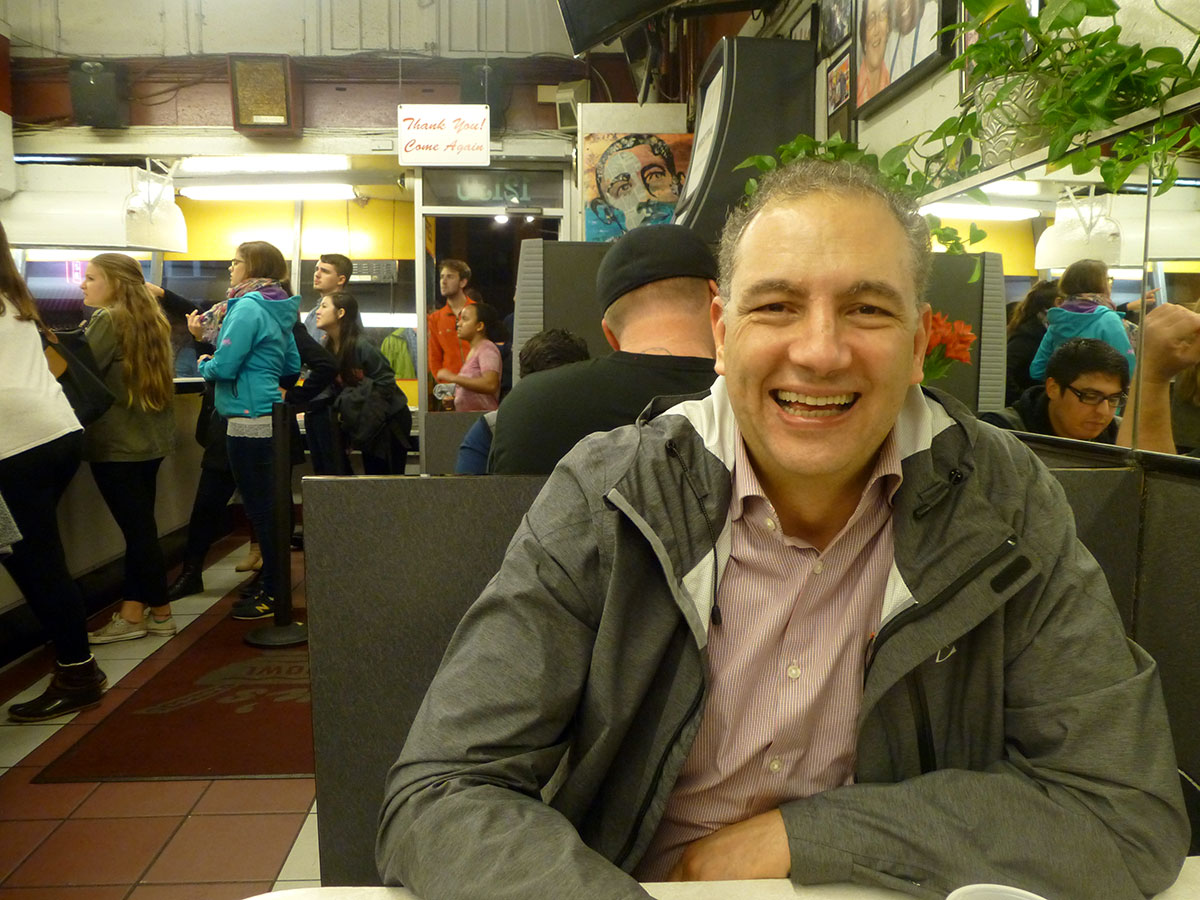
Ihab Elzeyadi is our colleague in the architecture department at the UO, but he was following our blog and figured out we might overlap in Washington DC. Ihab grew up and went to college in Egypt, then came to the US to get his PhD at UW Milwaukee, and after working in California, joined our faculty in the late 90s. Ihab is an expert on high performance building enclosures, and also the relationship between building design and the performance of the building inhabitants, whether they are students or office workers (he was recently extensively quoted in the Times article about the new Amazon headquarters). He is one of the core members of our faculty who carries on our reputation as the leading school for sustainability and environmental architecture.44. DC 029P1050512

When we interviewed Ihab for the job many years ago, I thought he was going to be a classic ASHRAE geek, but there are many more aspects to his personality and expertise than I expected. He is a fabulous design teacher, and he knows a lot about historic preservation. (A number of years ago he taught a studio looking at remodelling a historic complex in Cairo, and brought many of his students along on a site visit.) Ihab lives with his wife and son in Eugene, and somehow manages to get impressive amounts of work done while still being a super-engaged dad.

Ihab was in Washington for a conference when we arrived there, and he took us out for dinner at the famous Ben’s Chili Bowl (the president was not there that night). We had been on the road for a couple of months at that point, and it was good to have someone fill us in on what had been going on back home (before we learned to just live in the moment and forget about Eugene). It was also a nice reminder that we had left many good friends back in Oregon, and we’d be happy to see them when we returned.

Chris Ramey was the only person we unexpectedly ran into on this whole nine-month trip. (We had run into my cousin Jim McCarthy in Harvard Yard, but we knew he was on campus and we were already planning on looking him up.) Strangely, Linda and I had once before run into Chris and his family while on our honeymoon in Victoria (there’s a data point).   I’ve known Chris since I arrived many years ago at the UO. His title seemed to change with administrative regularity, but his job description stayed pretty much the same – whether he was head of campus planning, or a vice president, or campus architect, Chris has been in charge of the UO campus for decades. Chris had grown up in Eugene, then studied architecture at the UO, and after working in professional offices, returned to work in campus planning.80. Phoenix079DSCF6559

Over the years I’ve worked with Chris a lot, on various planning committees and projects, through various positions in university governance, and also when he’s come to reviews in our department. Most recently we spent a lot of time at meetings together as the university has undertaken a long-range visioning process, something we’d been advocating for years. An important thing I’ve appreciated about Chris is that in the world capital of passive-aggressive behavior, Chris is always willing to engage in a substantive argument about ideas and principles. He and I have often agreed on issues, but when we have disagreed, we have argued our points forcefully, and haven’t taken it personally afterwards. (This is not normal procedure in Oregon, where conflict resolution proceeds on one of two levels – indirect passive aggression, or the nuclear option.)

Chris has recently retired from his position at the UO, and is continuing his work as a planning consultant. He had been attending a campus planning conference, where he was presenting an overview of the UO vision process, and we ran into him at the Phoenix airport. We were on our way back to the Northwest for a brief spring break hiatus, and chatting with Chris in the airport helped with the re-acculturation process.

At the end of the trip, I was surprised at how few displaced persons we saw, and how there was only one true random meeting; I’ve had a lot more on other trips in my life, mostly in airports, big cities, and European destinations. I attribute this to our often being in pretty out-of-the-way places, and mostly staying out of airports. Not many of our friends seem to be staying in trailer parks in the off-season, but that may change as we age.

Saguaro National Park

We are now in the southwest, National Park heaven, where you sometimes find yourselves inside one without even trying. Big Bend was a precursor to this area for us, but now the giant crazy landforms are coming at such a pace that they’re getting their own fast-track on the blog.

Our first experience with National Parks on this trip was in Yellowstone, which we’ve come to think of as an anomaly.  Yellowstone isn’t one place, it’s a lot of distinct places in close proximity – big mountains, geysers and hot springs, wildlife, a big canyon, waterfalls, open plains and lakes, etc.  Most of the Parks in the Southwest seem to be more one-liners.  Of course there are a wide range of ways you can understand them – geologically, ecologically, culturally – but they don’t have the same breadth as Yellowstone.  Greta and I have discovered that our interest in geology lasts for about five minutes, and our interest in botany a bit longer.  We appreciate really cool looking rocks and mountains and plants, but we’re not all that interested in getting into a lot of depth about them.  For us, the distinct experiential character of each park depends upon two items:  what is the Big Concept for each (usually the reason it was seen as being significant and worth preserving), and how can we kinesthetically experience the park by hiking through it.  In the Badlands we realized that we dislike driving around and looking at scenery, but once we get out of the car, the experience of walking or climbing through the landscape is the way we come to appreciate it best.  So those readers who actually know something about rocks and plants will find my observations sophomoric (just as I would probably not be impressed with their insights into architecture).

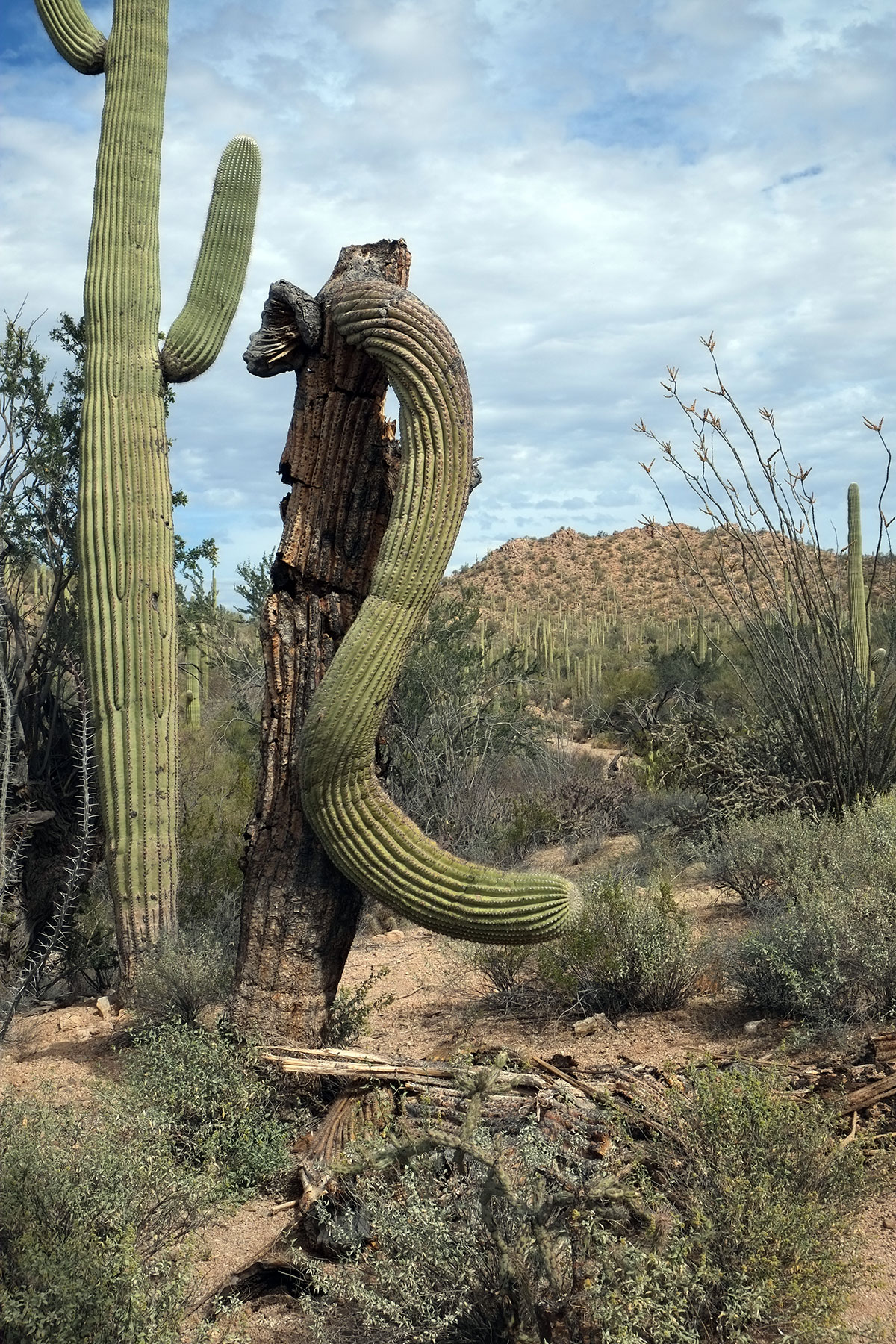
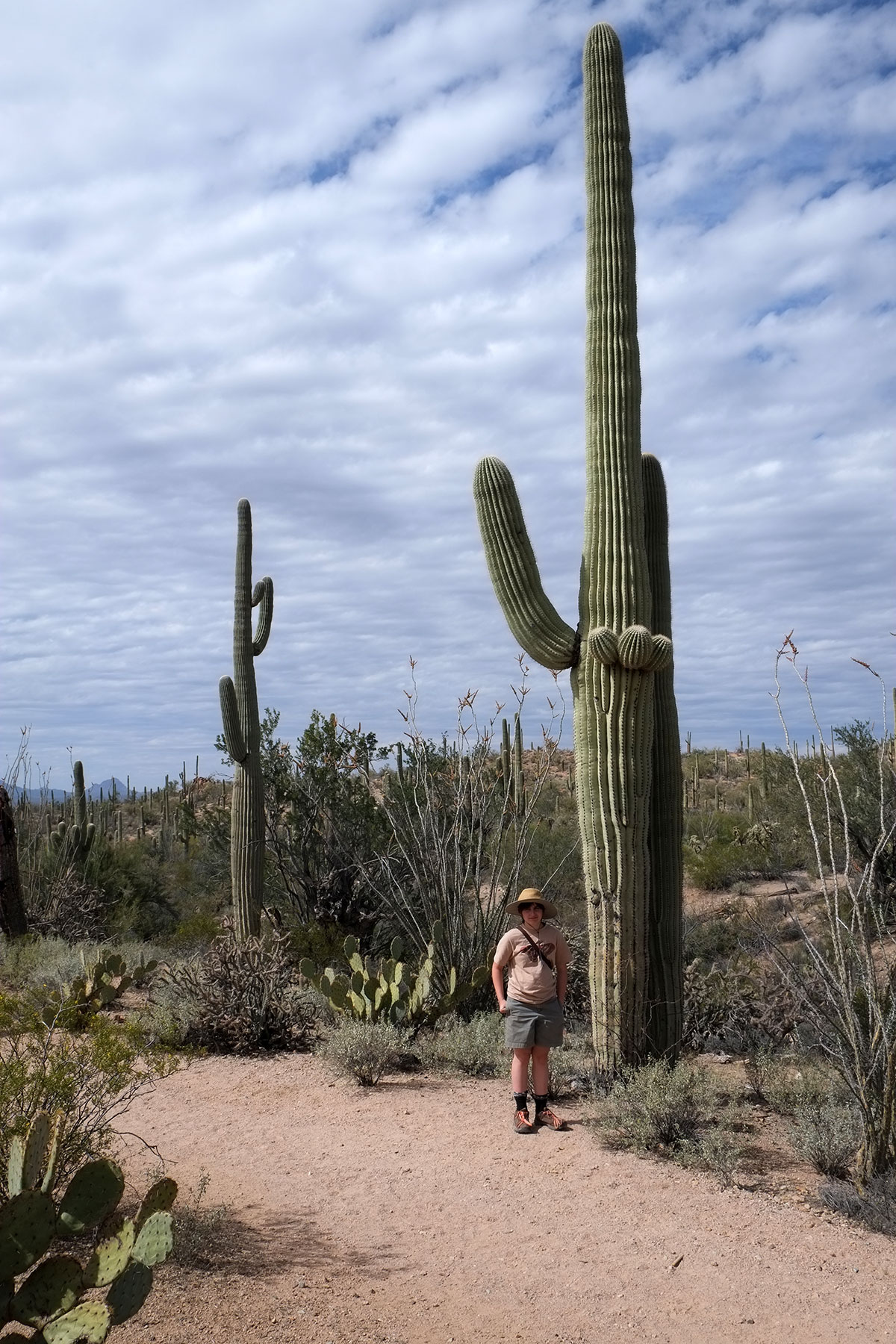
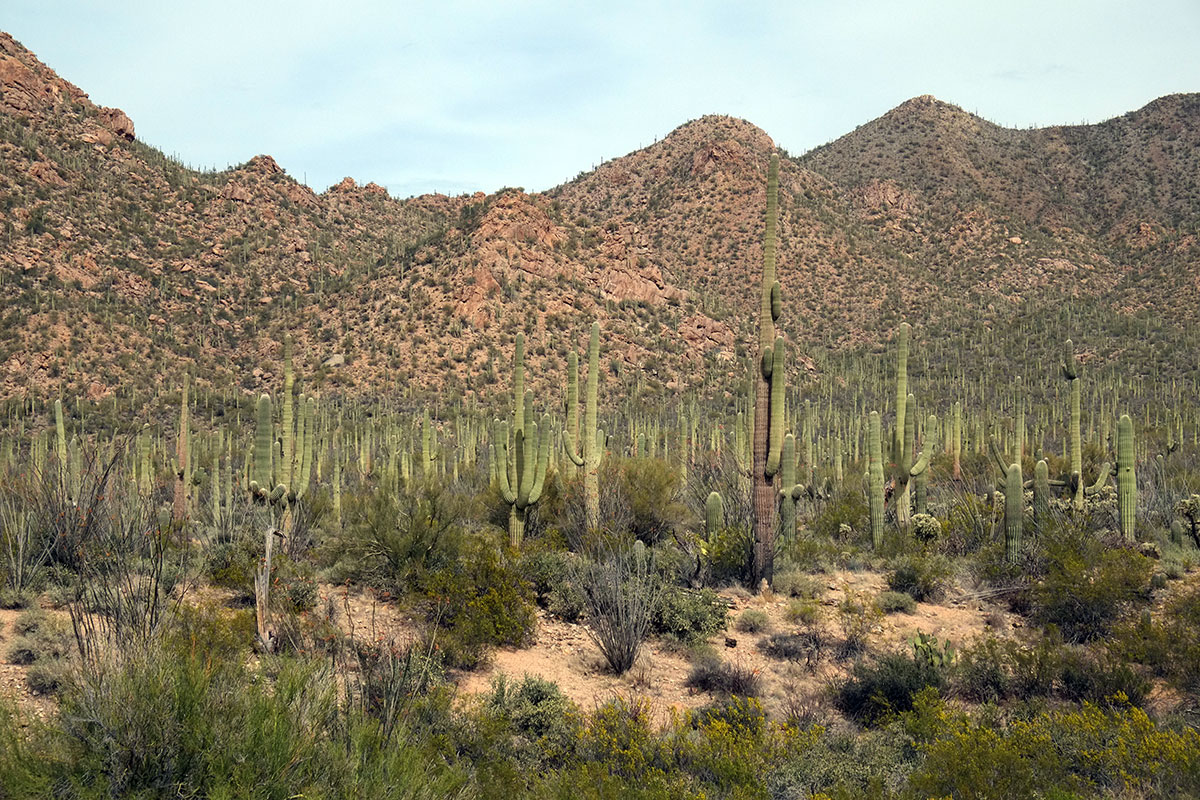
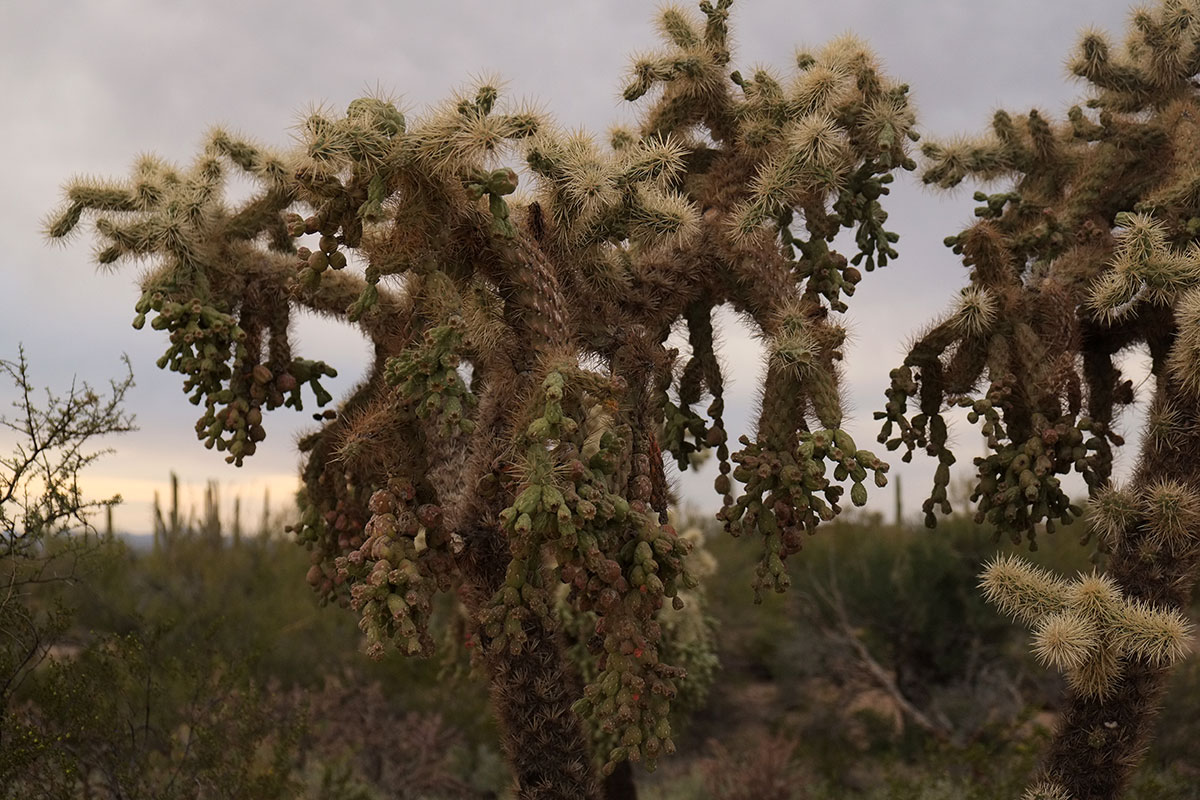
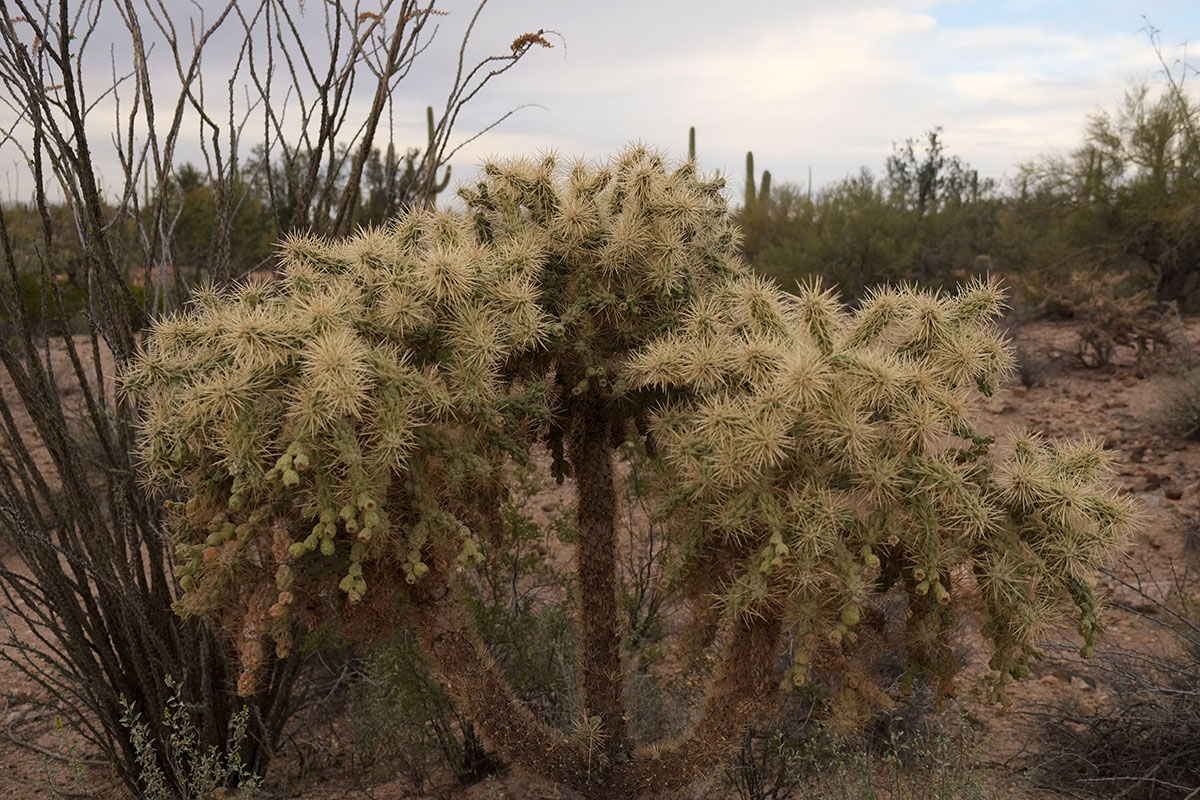
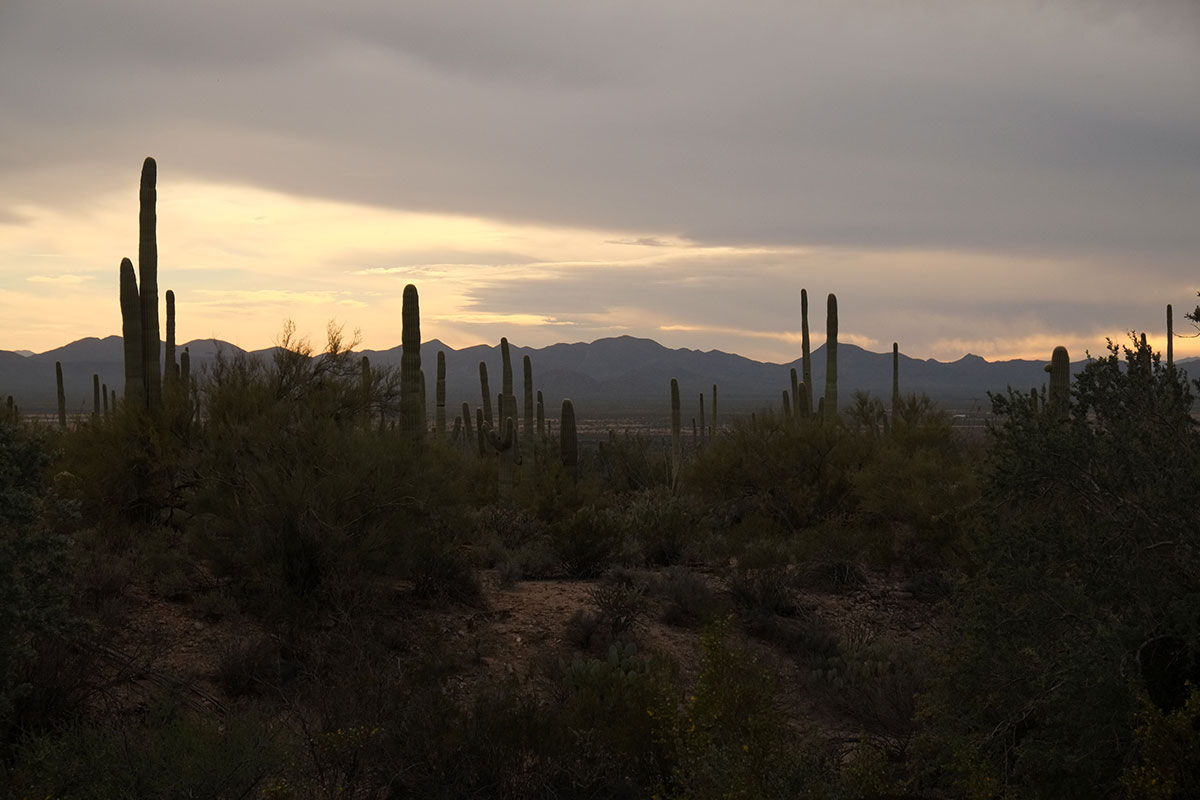
DSCF6458Saguaro National Park sits on two small mountain ranges, on either side of Tucson.  It’s quite unusual to have such wilderness in such proximity to a pretty big city.  And from what we’ve seen, it’s also an anomaly for a southwestern National Park to not be about big piles of rock in amazing shapes.  The Big Idea in Saguaro is not the landform, but the vegetation.  It is the greatest collection of bizarre plants we’ve ever seen.  None of them are familiar, and most of them seem capable of hurting you really badly.  The saguaros are the main attraction, as they apparently exist here in a profusion unlike anywhere else in the US.  They are strange, DSCF6450they are big, DSCF6449and they look just like they do in Roadrunner cartoons.  (Lots of things in the southwest look just like they do in Roadrunner cartoons.)  We just rambled around among them, soaking up the weirdness – especially the idea of a saguaro forest.DSCF6444

There are many other equally strange, but smaller, plants around.  Lots of cacti and yuccas and agave and such.  DSCF6423(We learn their names when we see them, and forget them within a few days.)  I am pleased when I see one that apparently has an afterlife as tequila or mescal.DSCF6417

We took some short hikes in Saguaro, and decided to not try any longer ones, as we didn’t think they’d seem very different to us.  It struck me that Saguaro is a modular place – every 50 foot by 50 foot area is incredibly interesting, in the variety and strangeness of the juxtaposed plants.  But then the next 50 by 50 foot plot is about the same.  You don’t hike to a sublime view, or have a wide variety of rock-scrambling experiences.  Our local informant in the culture assured us that changes in the environment occur when you move to higher elevations, especially in the mountains to the east of Tucson, but we were camping on the west side and didn’t feel like a drive across the metropolitan area.  So we spent our time looking more closely at what was right around us, instead of charging across the park trying to cover it all.  We camped in a fabulous county campground right next to the National Park, which was quiet and dark, and a little eerie with the howling of coyote packs throughout the night.  The serious RVers put string LED lights under their RVs at night, probably to keep the varmints away.  Lots of lizards scurrying around, and we managed to avoid the one rattlesnake we heard was near the trail up ahead of us.

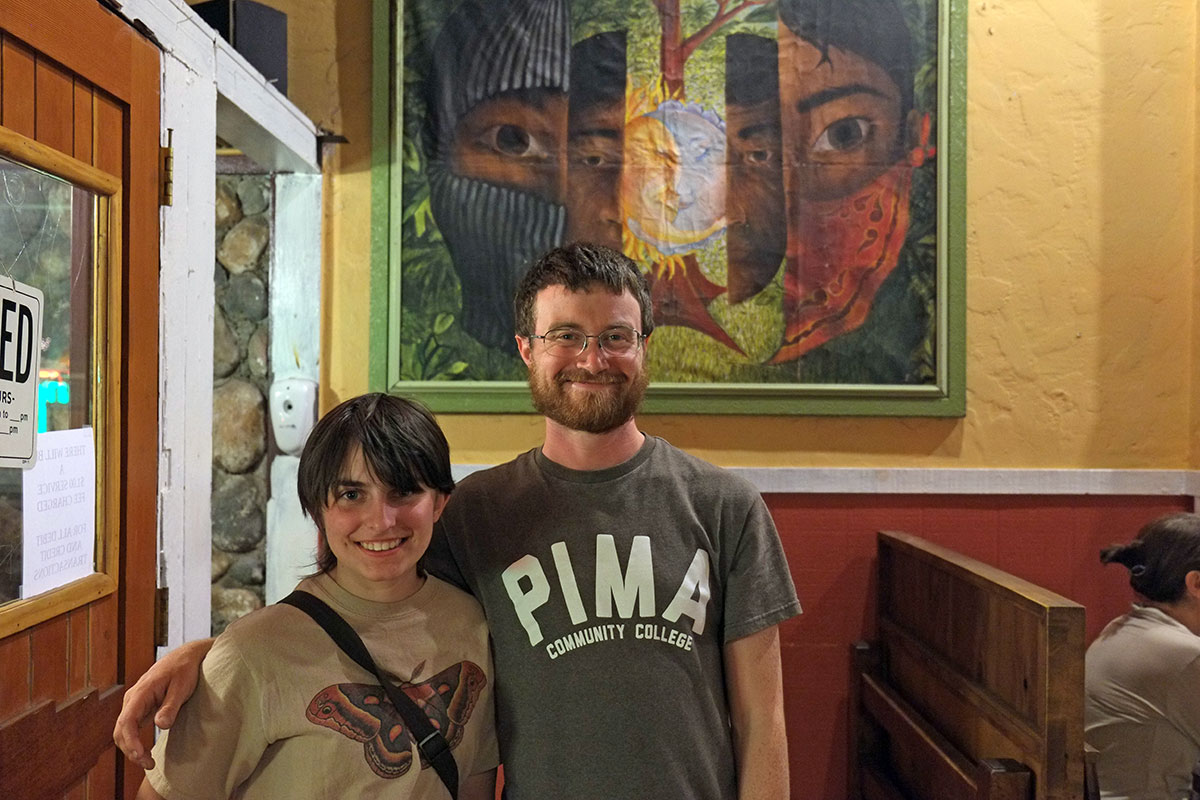
The aforementioned local informant was Daniel Beckman, the son of Bob and Susan, previously chronicled in the post college friends.  Daniel grew up outside Philadelphia, attended Brown, where he did things related to political science and theater, and then during an internship at Joshua Tree National Park, fell in love with the big spaces of The West.  He now works for the Park Service, and is involved in activities such as invasive plant eradication, while attending the local community college to learn all the applicable science he didn’t learn in college.  (We unfortunately missed seeing him in his role as the Park mascot Sunny the Saguaro, which he undertook for the Park Service 100th anniversary celebration at Saguaro one day we were there.  We think he saw us coming and hid so that I couldn’t post any photos of him in costume.)DSCF6556

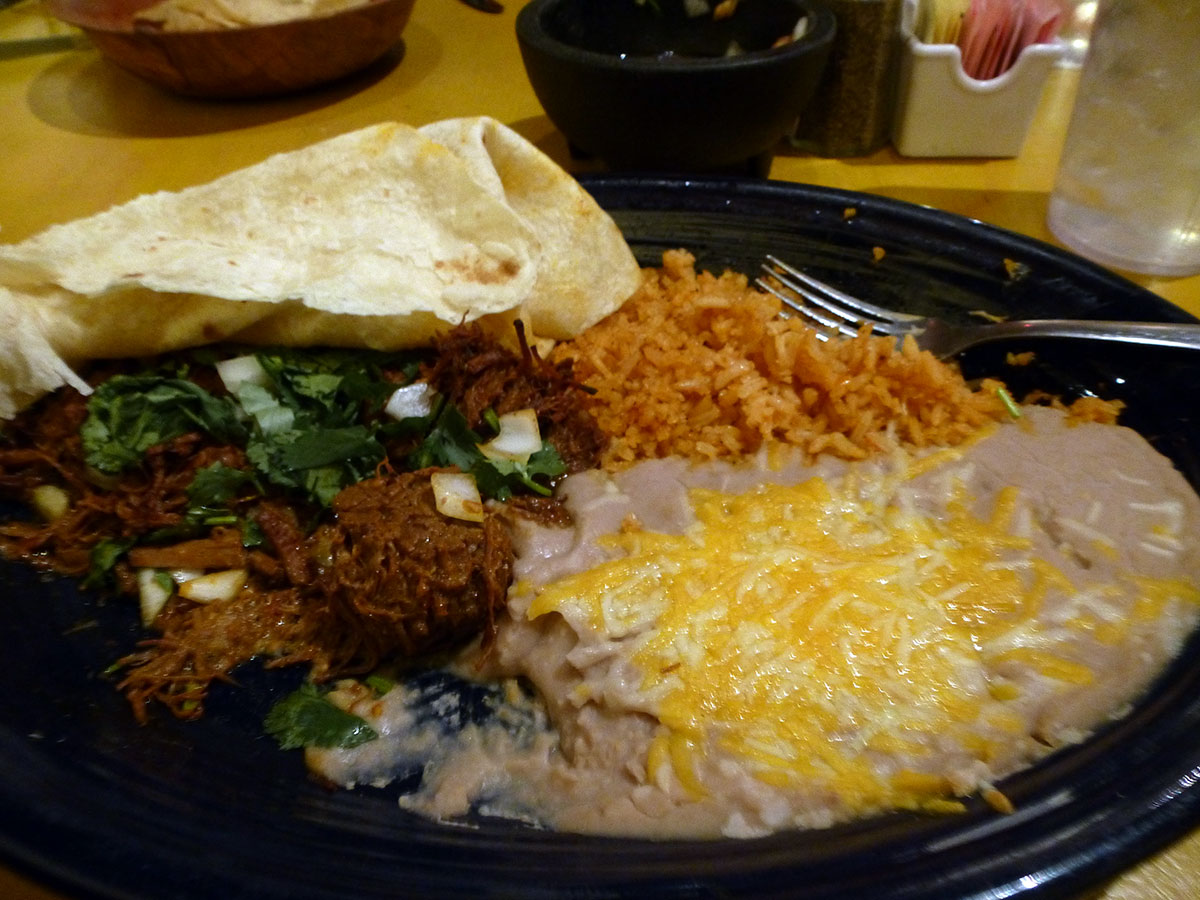
We went to the neighborhood Mexican restaurant near his house (which in itself might be enough of a reason to move to the southwest), and as two East Coast refugees, we talked a lot about the the differences in living in the two different places, and how one can know when you’ve found the right place.  I was impressed with his willingness to strike out into unknown territory, to change his location, his intellectual focus, and his whole way of living – something that’s not easy to do at any age.  But Daniel seems very happy in his new life, and perhaps he has found the right place for him.DSCF6415

Tucson

DSCF6506If you haven’t travelled extensively in an area, you still have many preconceptions about it, formed through what you’ve heard or read or seen on TV – some of which may actually turn out to be true.  Texas was where this became most apparent to me, as I had an abundance of received cultural knowledge and opinions about it, even though I had never before ventured out of DFW.  Although I had travelled through the Southwest a few times, I had never been south of Phoenix, so my opinion of Tucson was similarly secondhand.  All I knew was the syllogism – Tucson:Phoenix as Austin:Houston.  Just as Austin is the place in Texas distinguished by being nothing like the rest of Texas, Tucson is the place in Arizona that symbolically stands in contrast to the horrors of Phoenix.

Tucson is one of those mid-sized American cities (metropolitan area population under one million) which is livable and pleasant due to its not being within the ambit of the flow of global capital, nor prosperous enough recently to have grown exponentially in the past 30 years, when the homogeneous American sprawlscape reached its true apotheosis, and when the banal behemoths of recent skyscrapers have overwhelmed older downtowns.

Tucson also is fortunate in its limiting geography:  just as Portland is hemmed in by the west hills and the rivers, Tucson has mountain ranges to the east and west, so the sprawl in those directions is finite.  Also luckily, large areas of both those mountain ranges have been set aside, both as part of Saguaro National Park, and as other state and local preserves.  We stayed in a county campground adjacent to Saguaro on the west side, one which was so quiet and dark that we could watch the stars and listen to the coyote packs at night;  this is within ten miles of the city.  Phoenix has the misfortune to be in a much larger valley, so the sprawl can go on unimpeded for fifty miles in each direction, while Tucson is about twelve miles wide.  Aerial photos confirm that Tucson hasn’t sprawled very much in the past 30 years, so its suburbs exhibit a blend of the old and the new that can also be seen in its downtown, and which may be the key factor in whether a district has any character or not.  (cf. jane Jacobs again.)

Both cities are college towns, and while the much larger Arizona State dominates the cityscape around Tempe, it feels like a more local phenomenon within Phoenix’s four-million metro area.  The University of Arizona is still large (about 32,000 students), and it seems to be more central to the character of the whole city, as it is less than a mile from the downtown.

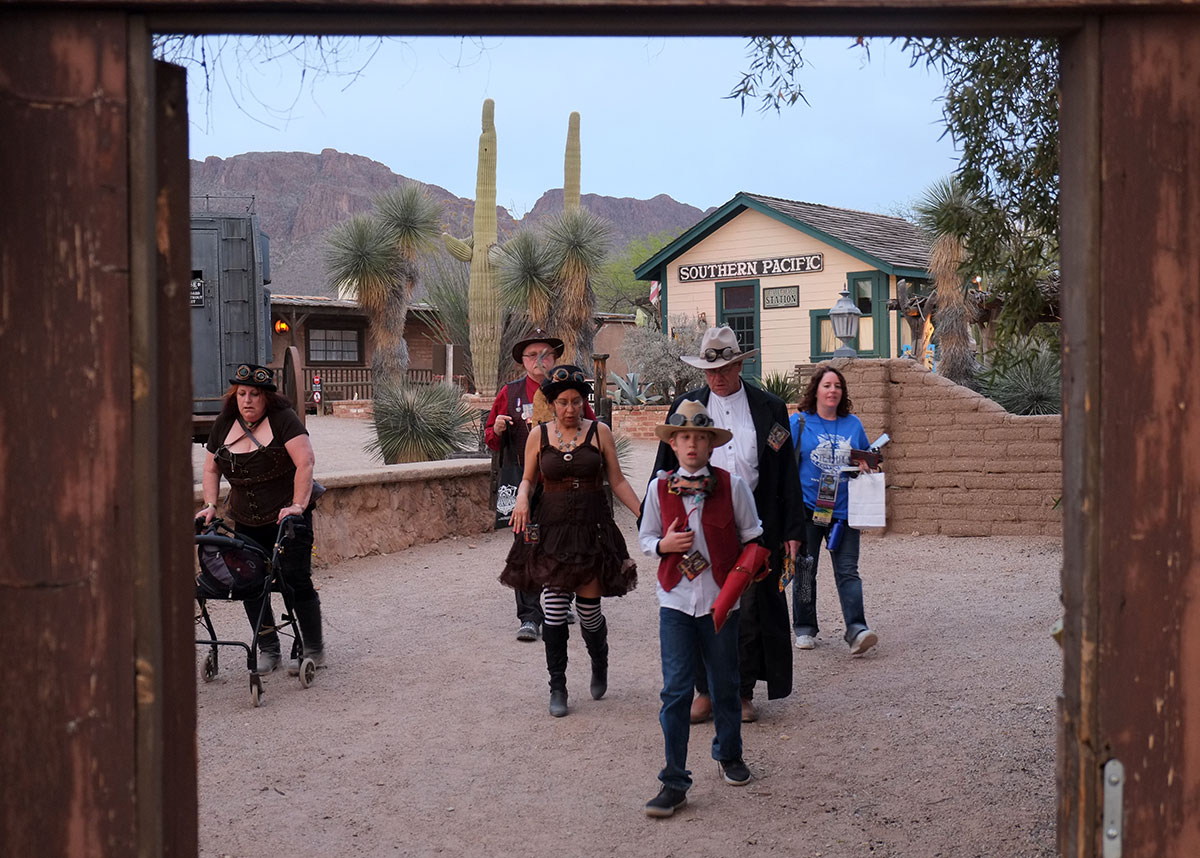
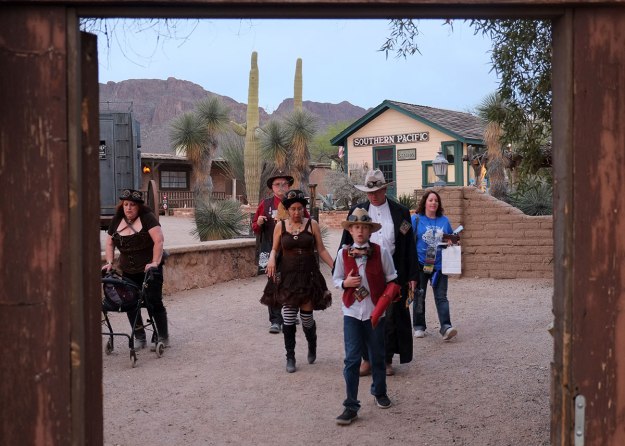
We cruised through the suburbs on our way to and from the mountains, and swung by something called Old Tucson, which started out as a movie set back in the 30s, but which is now a western theme park.  We arrived at the end of the day, just as the Wild, Wild West Steampunk convention crowd was leaving.  It was a little scary, and seems to have knocked Greta out of her steampunk fascination, as she has seen the future and it’s not a pretty sight.  DSCF6437
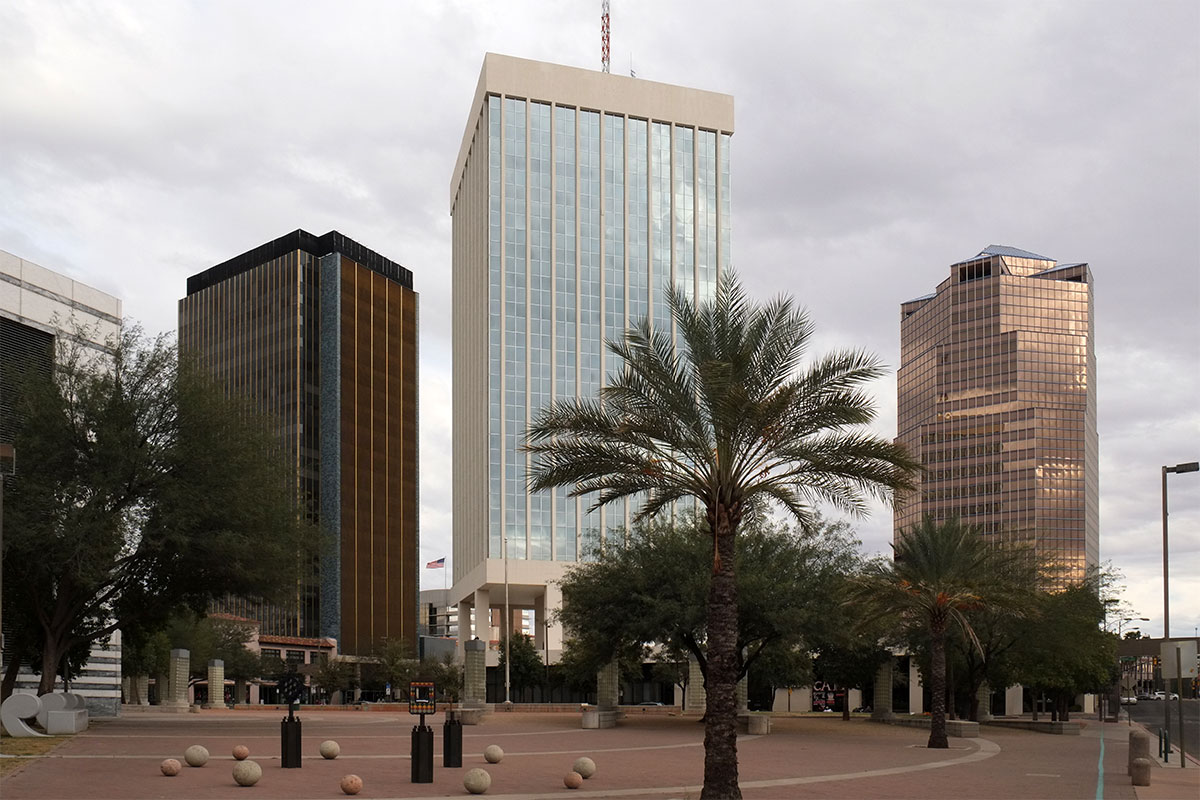
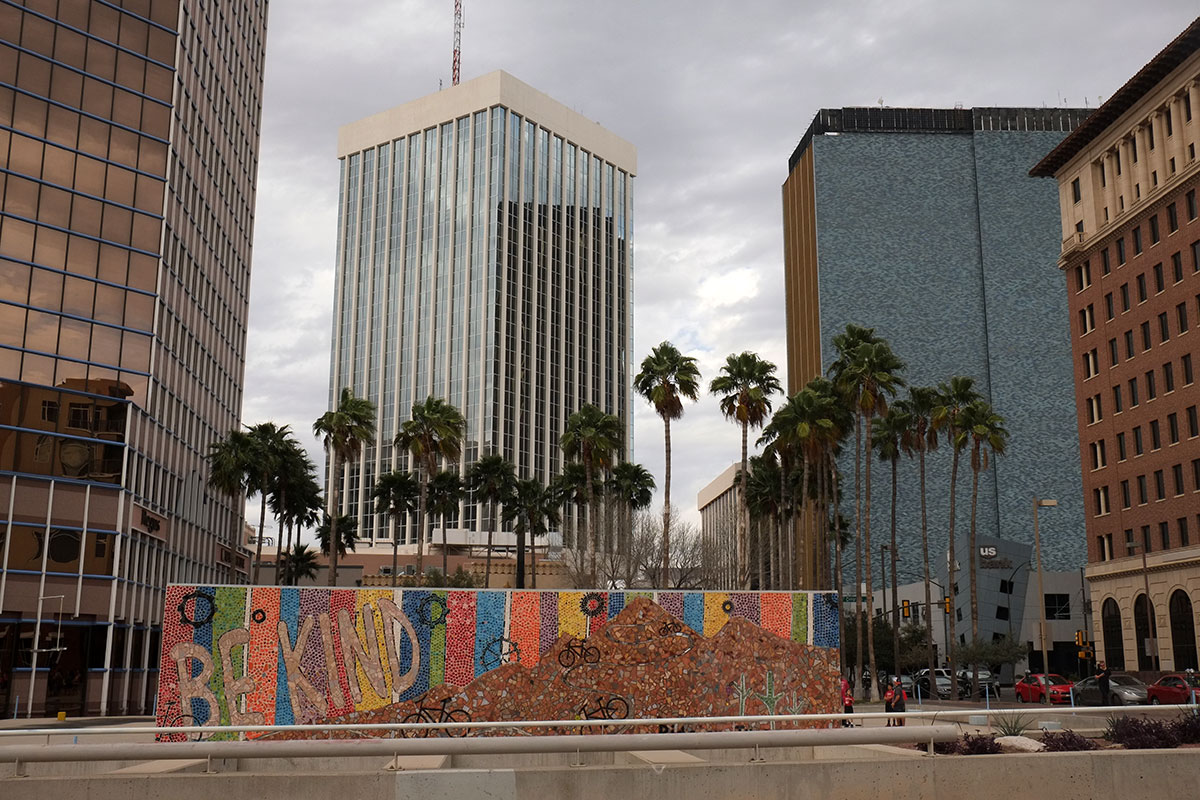
We spent more time in the city core.  The downtown has a lot of buildings from the 60s and 70s, DSCF6470
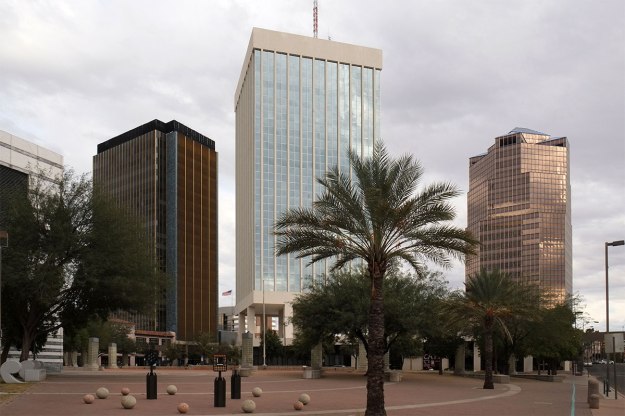
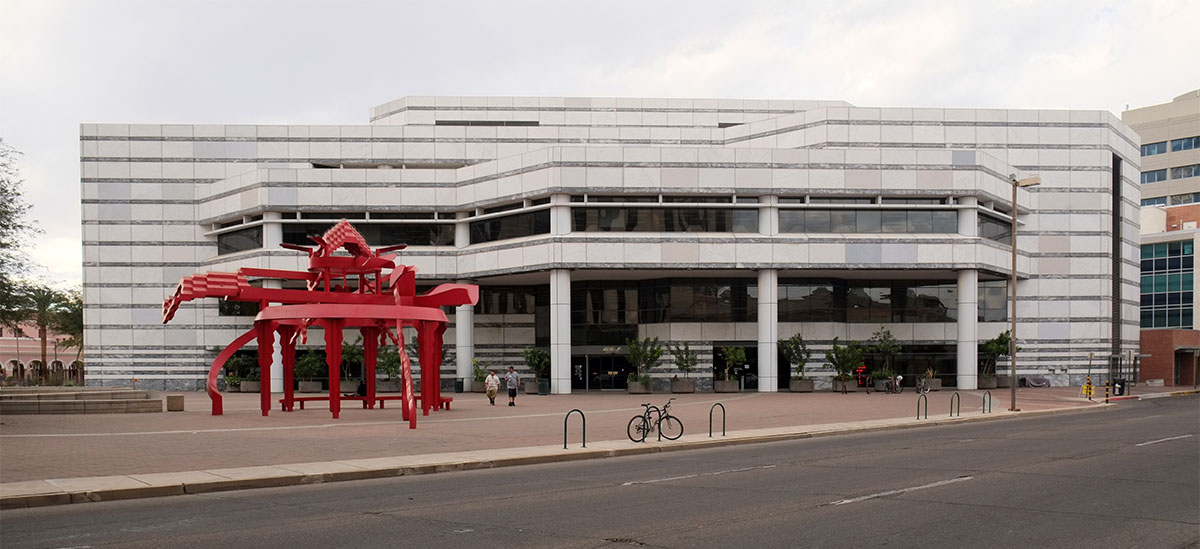
which are not gorgeous, but at least they’re not too big.  There are also some not-great institutions, such as the library DSCF6464
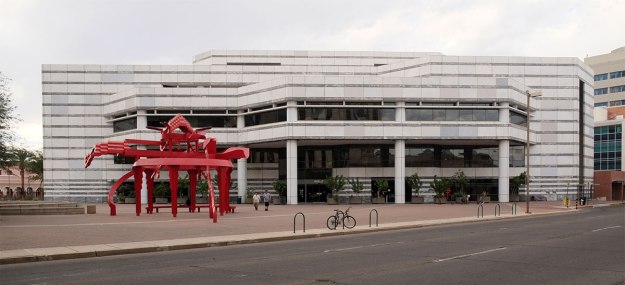
and some newer buildings which aren’t much better.  DSCF6466

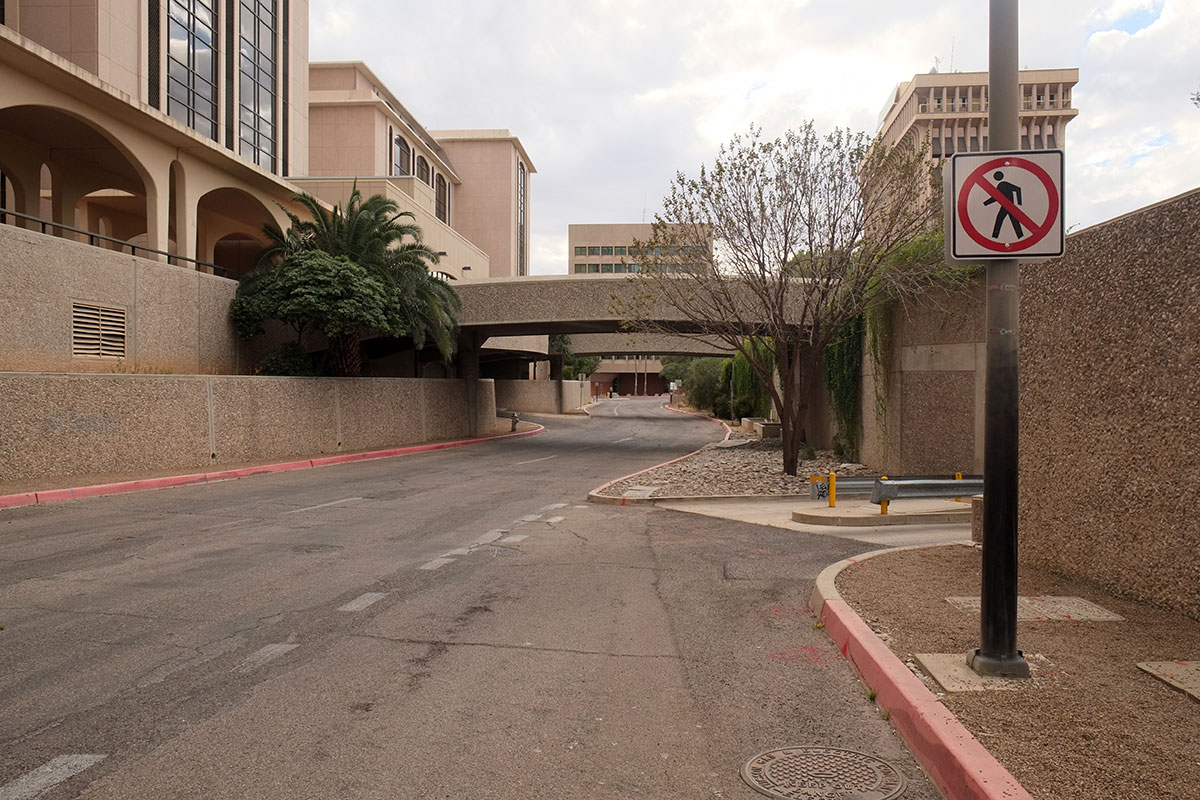
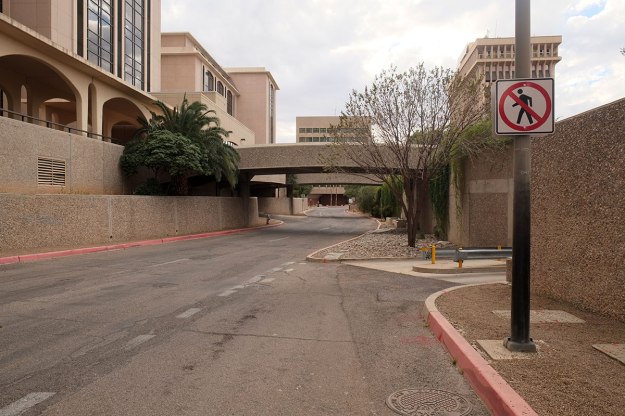
The Tucson downtown can’t seem to make up its mind – is it a city downtown, where fabric buildings define the public spaces of the streets and squares, or is it an edge city office park, where object buildings sit isolated in a sea of parking and undefined open space?  The open spaces are just too big, the developable lots are too big, and while the object buildings cry out for attention, they’re really not very good.  Tucson committed only one ghastly error, creating a superblock around their county government campus, where a subterranean parking level may hide a lot of cars, but which disrupts the street pattern and channelizes traffic onto a few big arterials.  The no pedestrian sign is the tip-off of the portal to this netherworld.DSCF6474
I don’t know the history, but it looks like they urban-renewed (bulldozed) their old downtown (or an adjoining neighborhood, probably “blighted”) during the 60s, and replaced it with these towers (versus Eugene which bulldozed its downtown and forgot to build anything new).  And then probably having overbuilt their office market, things ground to a halt.  It’s not great, but it’s fixable. DSCF6460
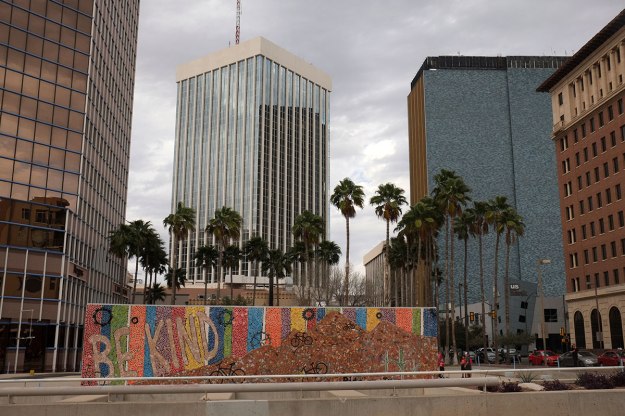
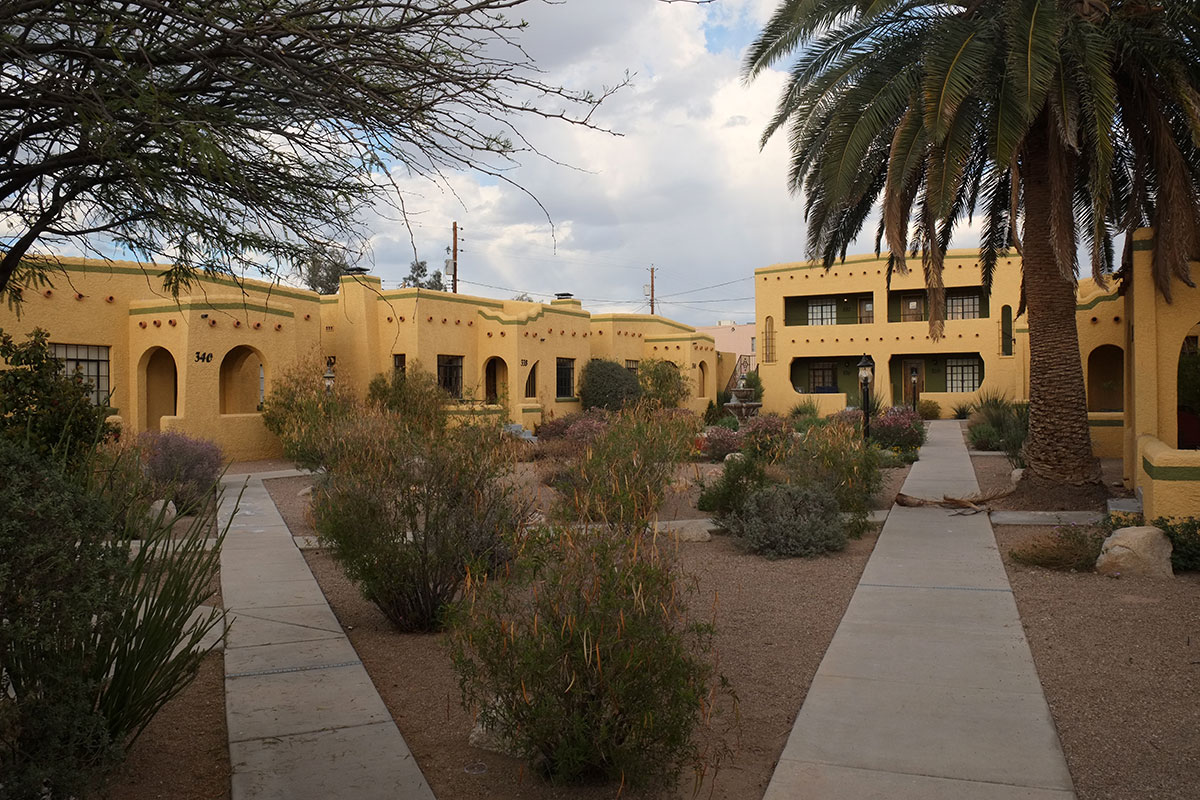
The good news is that the adjacent neighborhoods – Barrio Viejo, Armory Park and Iron Horse – were largely left alone.  Today they are the usual mix of gentrifying bungalows, small multi-family projects, light industrial and new commercial that can be seen in many other older city first-ring cores.  There was a reasonable amount of street life in all these areas, even on a Sunday.  The damage was limited to the one core area, and even that is better than many we’ve seen.

The university area, which is surrounded by low-scale residential neighborhoods, felt familiar.  A nice mix of small-scale, old multi-family: DSCF6479
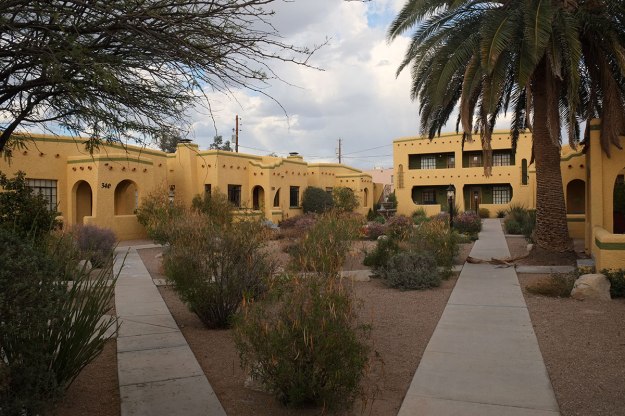
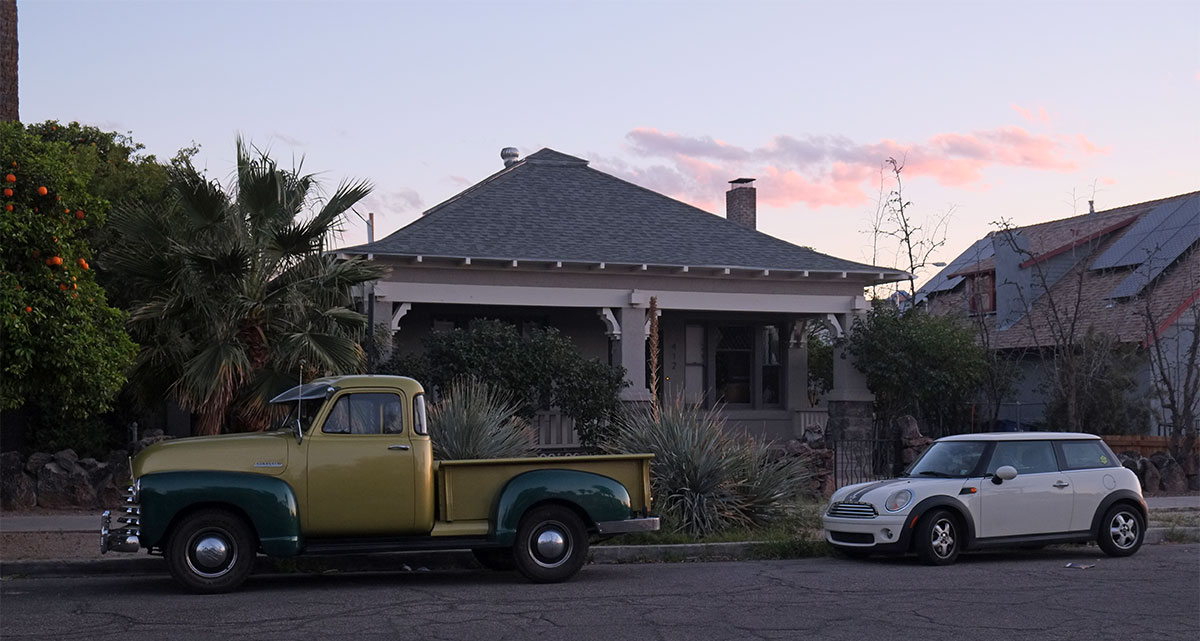
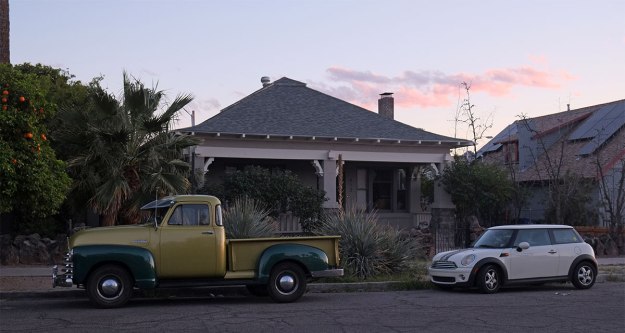
and upscaling bungalows (the Mini being the universal sign of this), although they are getting some large, privately-developed student housing, just as in Eugene.  DSCF6554
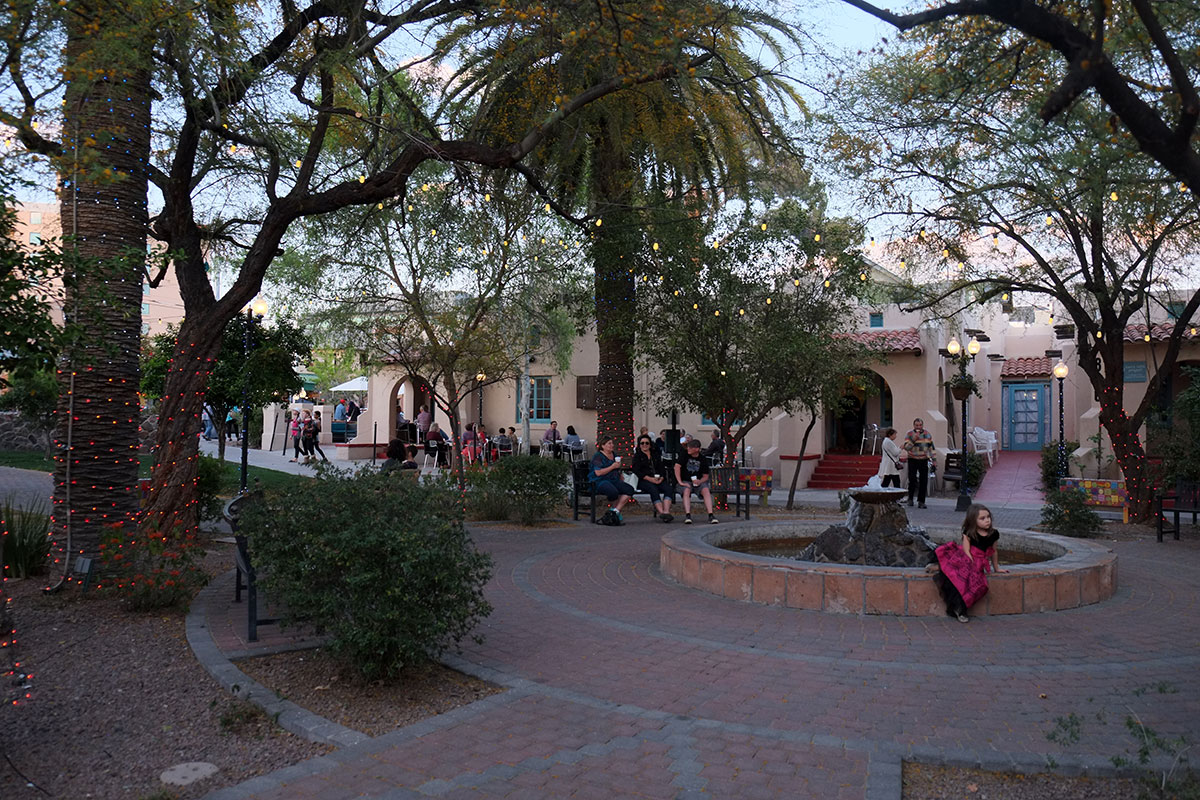
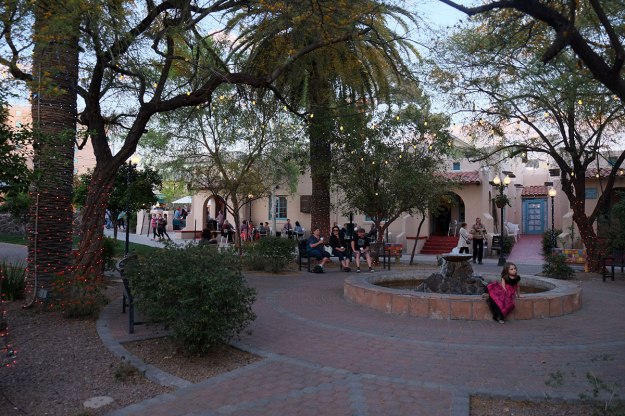
The college-town commercial area is very lively, with many open-air cafes, such as in  this lovely courtyard development.  DSCF6547
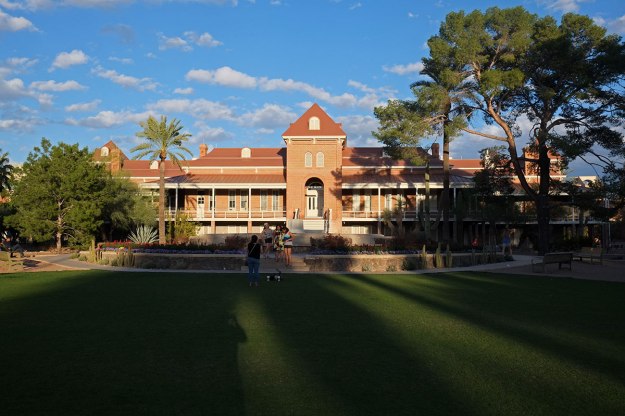
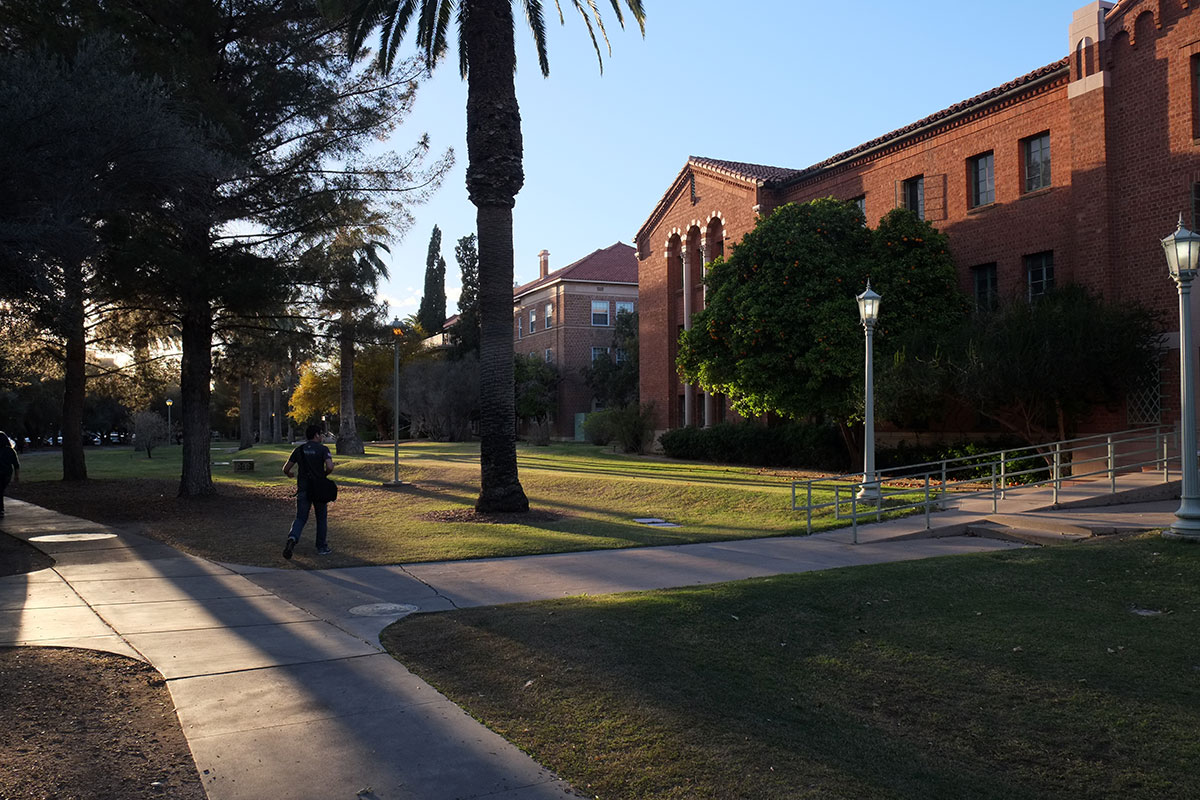
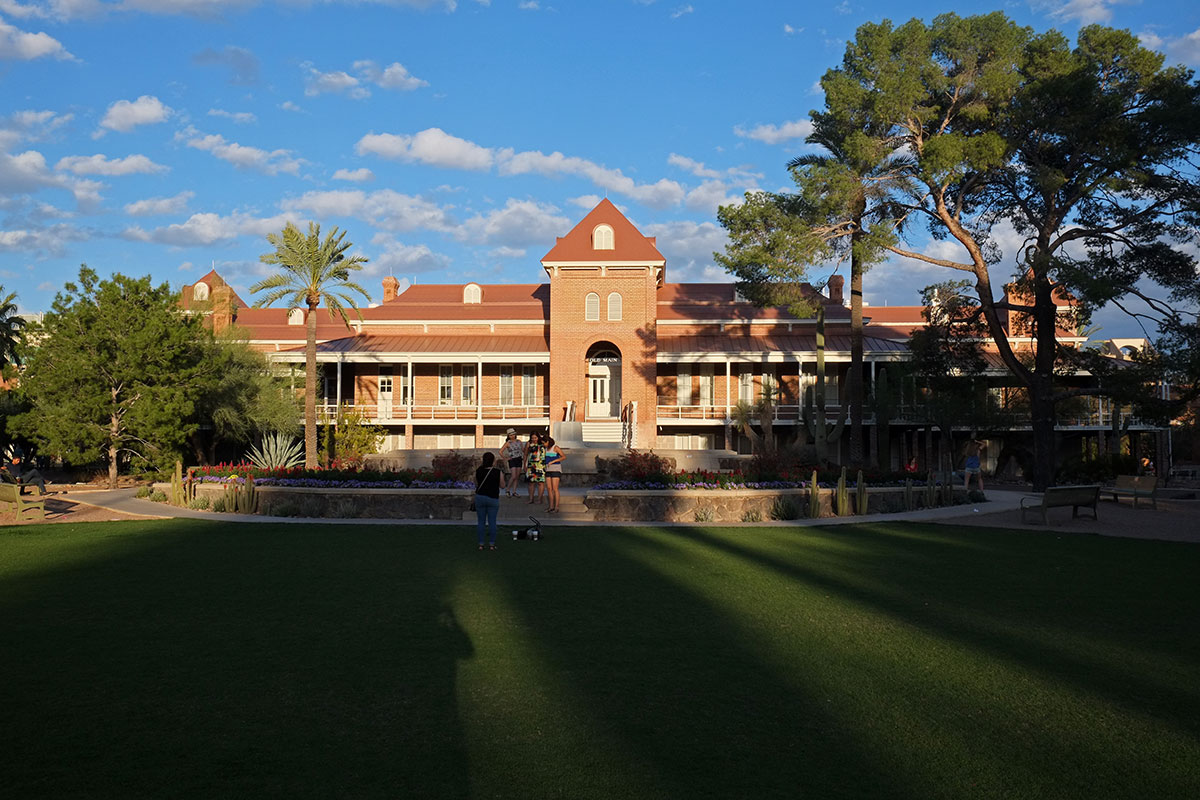
The campus itself is beautiful.  It is similar to the University of Oregon, being within a city but with a distinct campus edge, rather than blending into the city fabric.  Also similarly, the campus has a well-landscaped core, with elegant old buildings, all variants on a brick/southwest style, set in manicured lawns.  DSCF6516
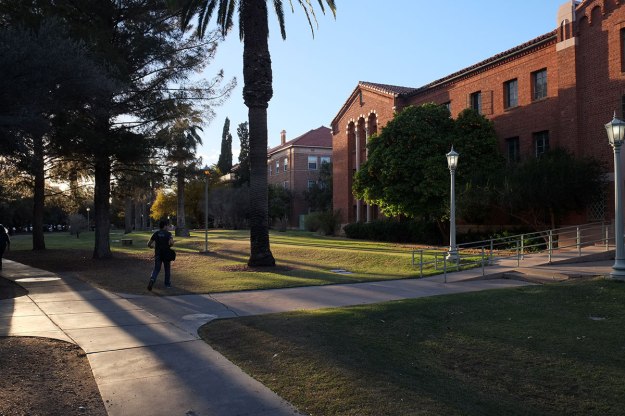
DSCF6513

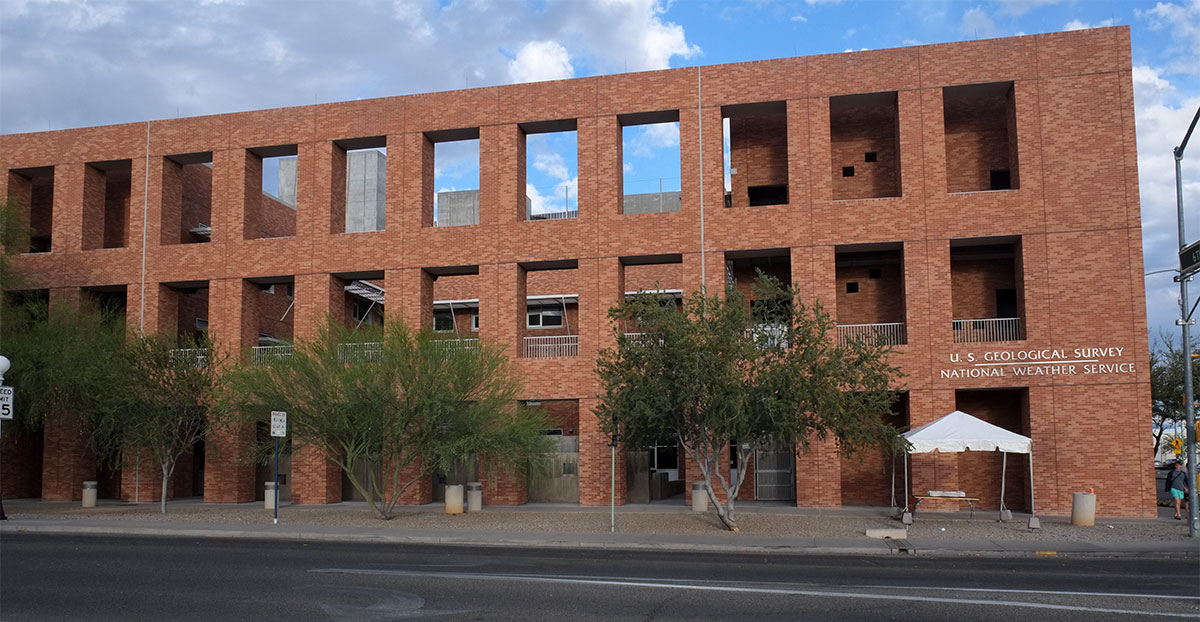
But the recent development is the most interesting.  They have done a fantastic job of fitting relatively large, new buildings into the existing framework, not overwhelming the scale of the campus, nor adhering slavishly to stylistic prescriptions (both of which happened at the University of Texas).  The buildings themselves are also good to excellent, and are notable for the uniformity with which they have addressed environmental issues (primarily sun-shading) in this desert environment.  An older US government building on the edge of the campus has a screen wall which defines a courtyard:DSCF6485

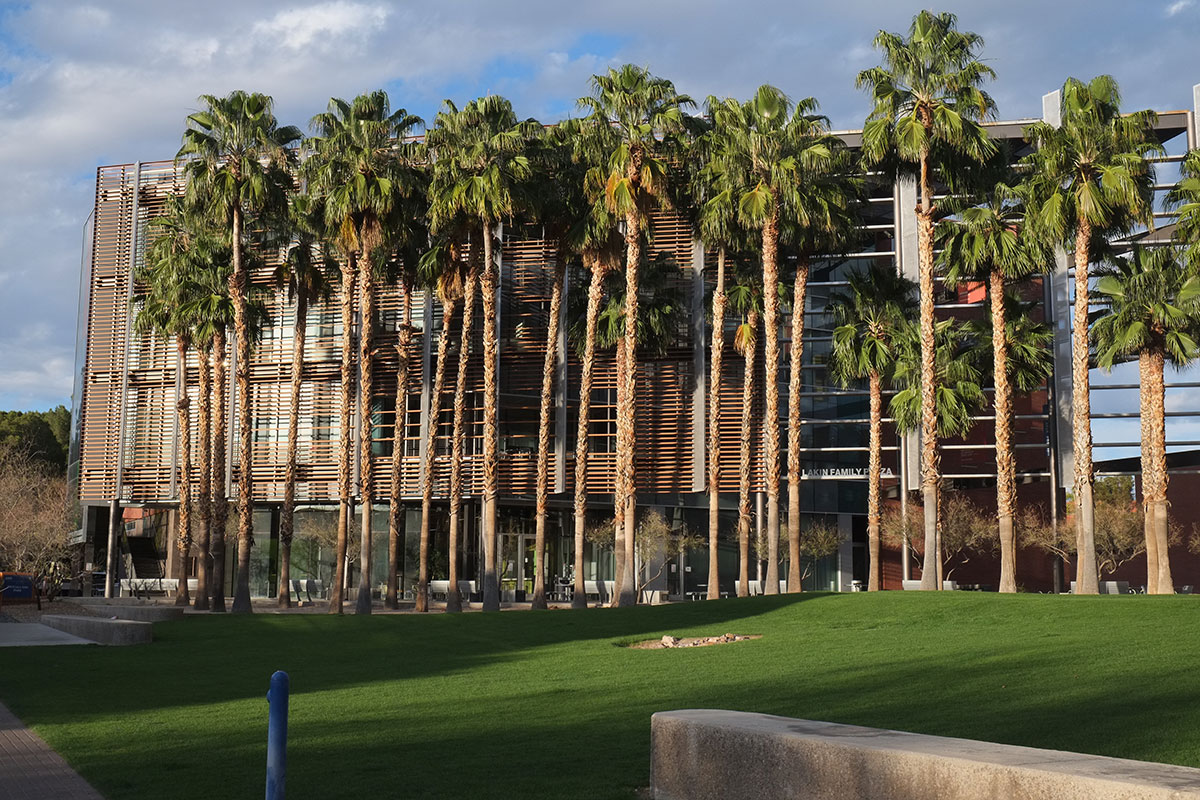
A new building at the business school has a south-facing facade which utilizes both palm trees and a sophisticated brise-soleil for shading.  DSCF6503
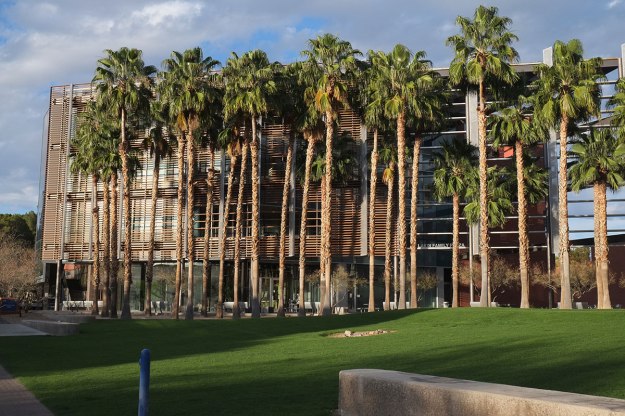
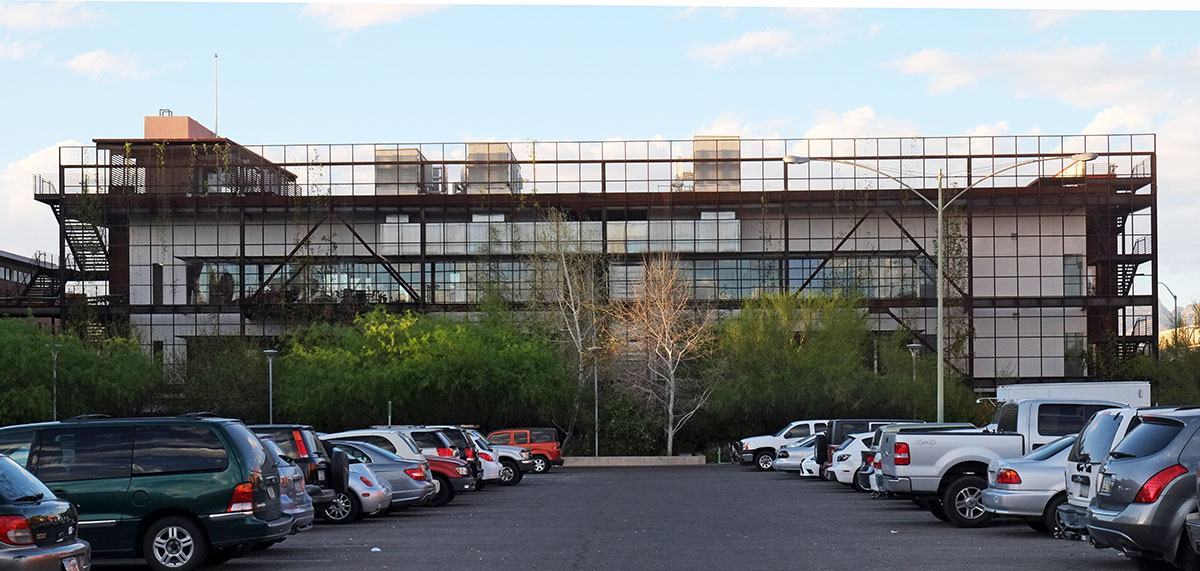
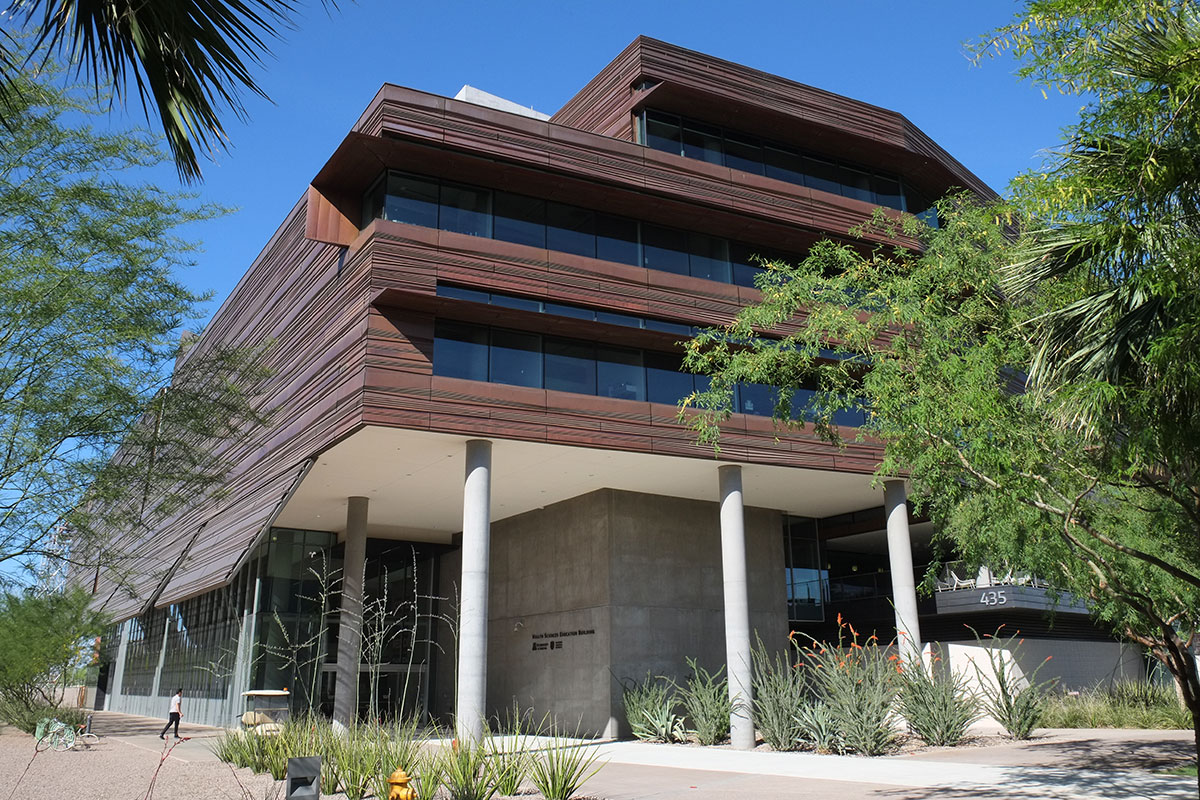
Even spotted from a long way across campus, my instincts told me that this was the architecture school.  It is in fact a large addition to design college (CAPLA), designed almost ten years ago by Jones Studio, in Tempe.  The environmentally-responsive diagram is completely straightforward:  a long east-west bar, with extensive and deep shading on the south side.  DSCF6520

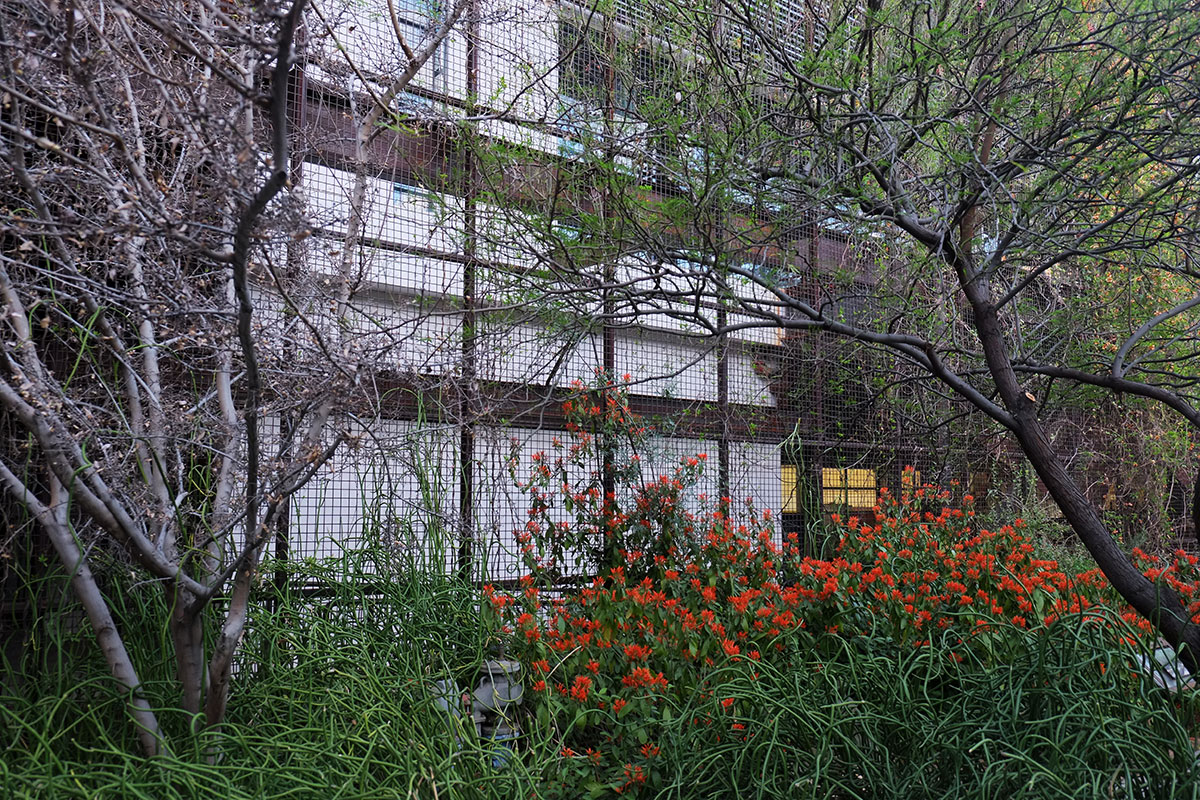
There are architectural shading elements, as well as a framework for plants, and a garden area where a native landscape is nurtured and used for installations. DSCF6528  DSCF6524
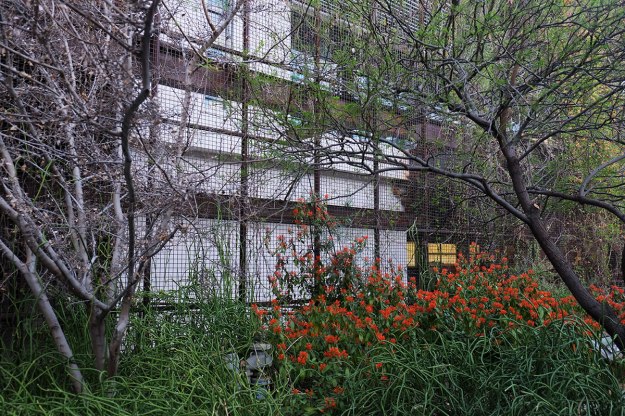
The east and west walls are mostly blank, with circulation DSCF6531
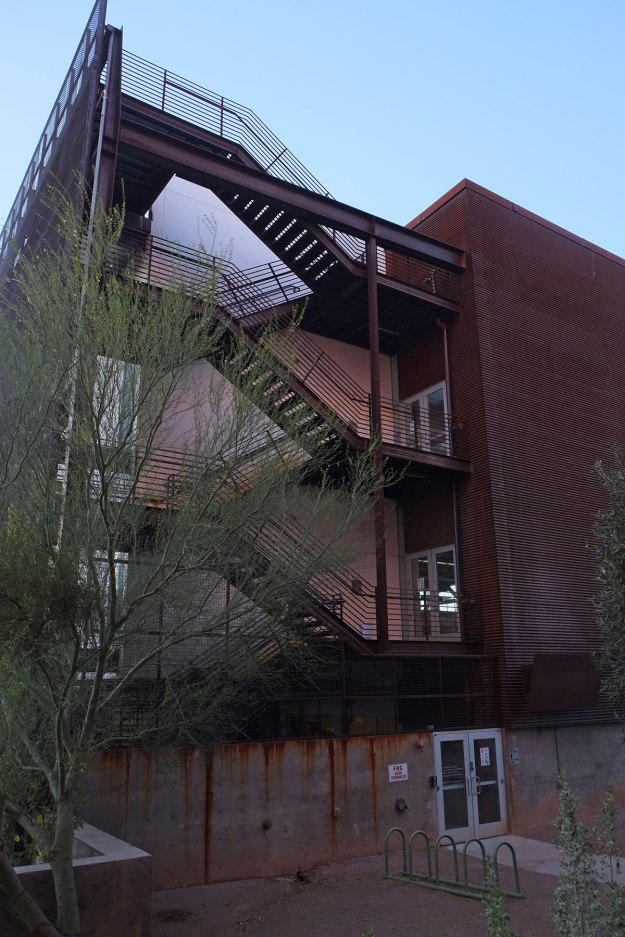
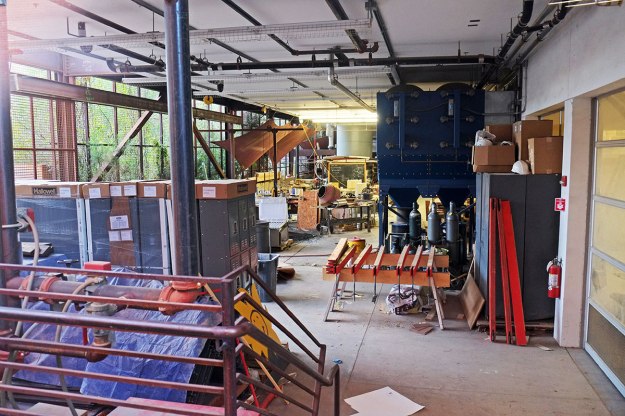
and access into an openable shop on the ground floor.  DSCF6533
The north side, which faces a major arterial, is glazed for daylighting the studios.  DSCF6535
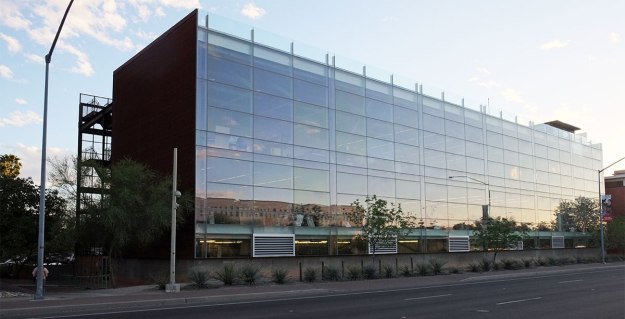
An excellent building, which takes it cues from the strong determinative forces of climate and program, and which articulates those in a systems-driven building with elegant detailing.  It is a truism that in most places, the new architecture building is usually the worst building on campus – architects seem to feel the need to make a design  “statement” when given such a visible project.  It was a pleasure to see Jones Studio take an opposite tack, and do all the sensible moves really well, illustrating what an architecture driven by substantive ideas rather than style can be like.

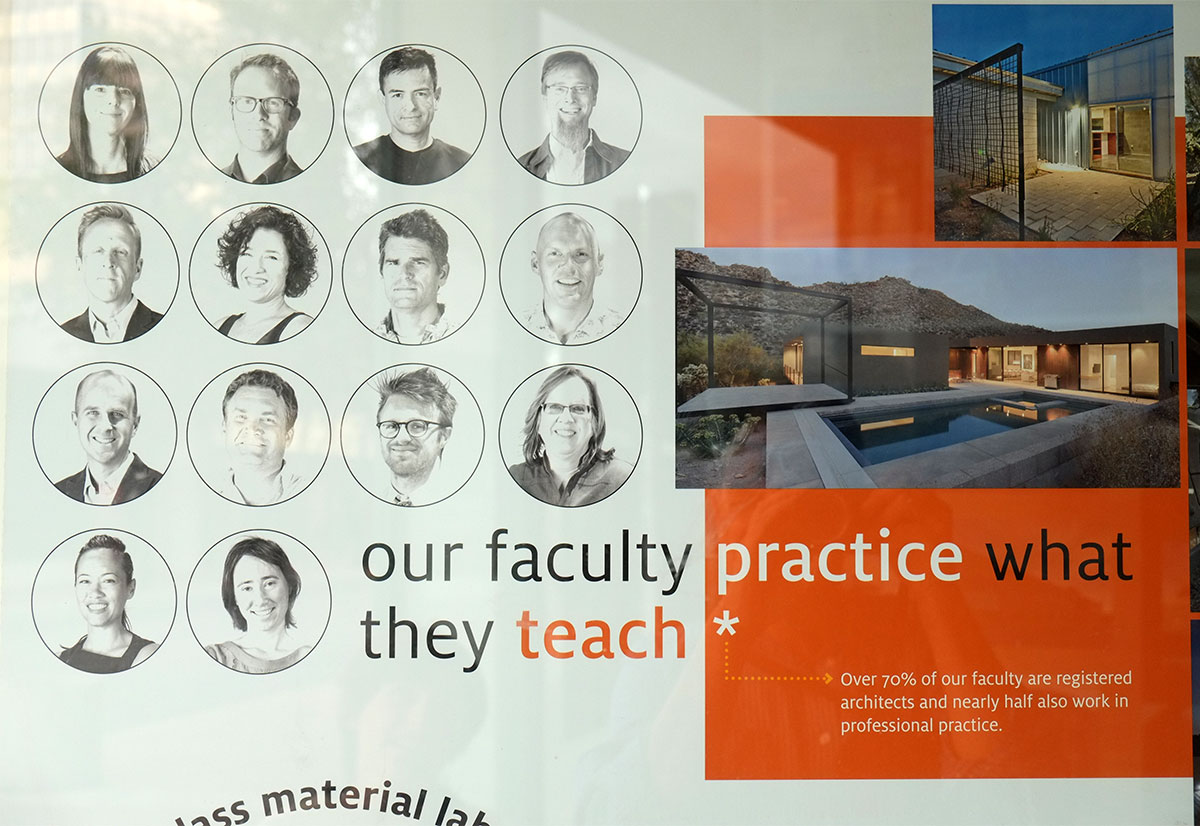
I don’t know much about the architecture department at the university, but outside the university’s downtown center, I spotted this amazing sign:  DSCF6462
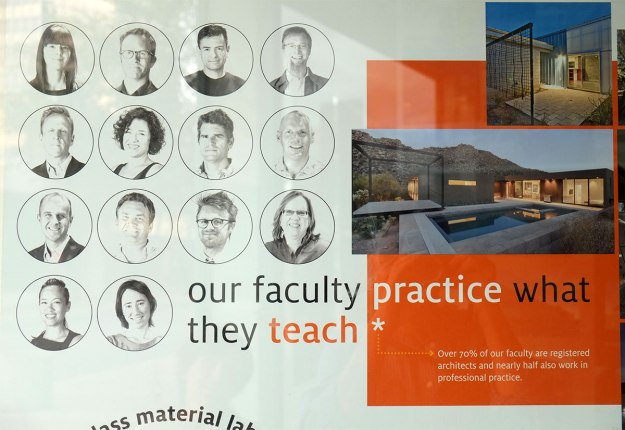
They seem to think that it is a good idea for their faculty to be involved in the design of architecture;  in fact, they celebrate it!  This is probably good for their accreditation, and even good for their students’ education, but I don’t know how they can maintain this attitude within the confines of a big research university, where the preference for the written article over the designed building has become almost universal.  (If it hadn’t been a Sunday I might have dropped in to explore job opportunities, as they appear to be deficient in the proportion of cranky old guys on their faculty.)

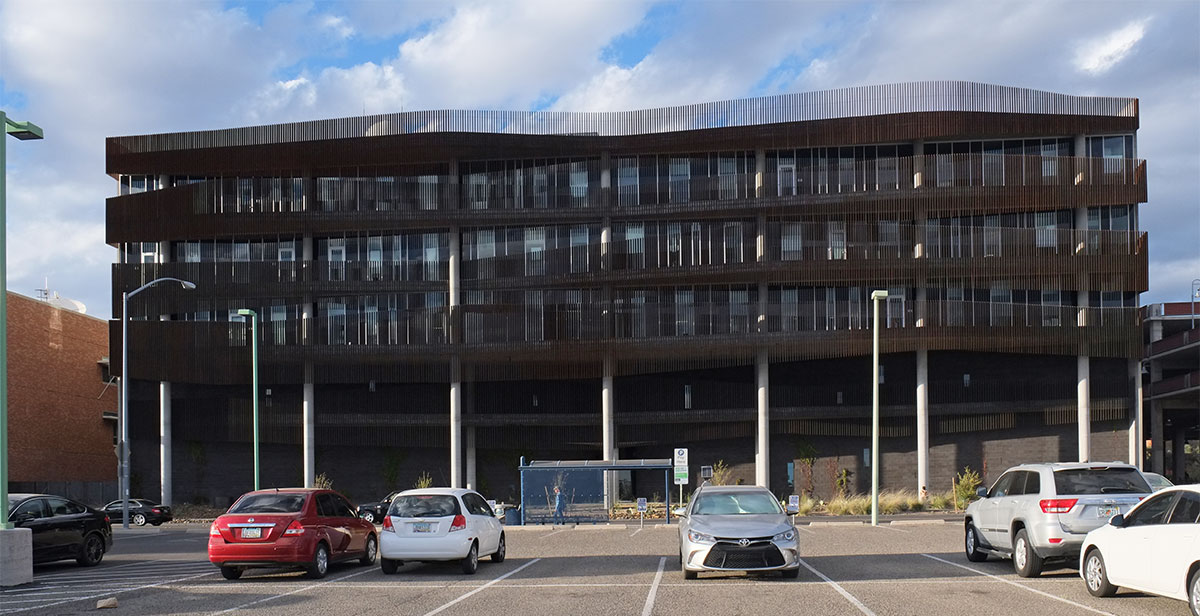
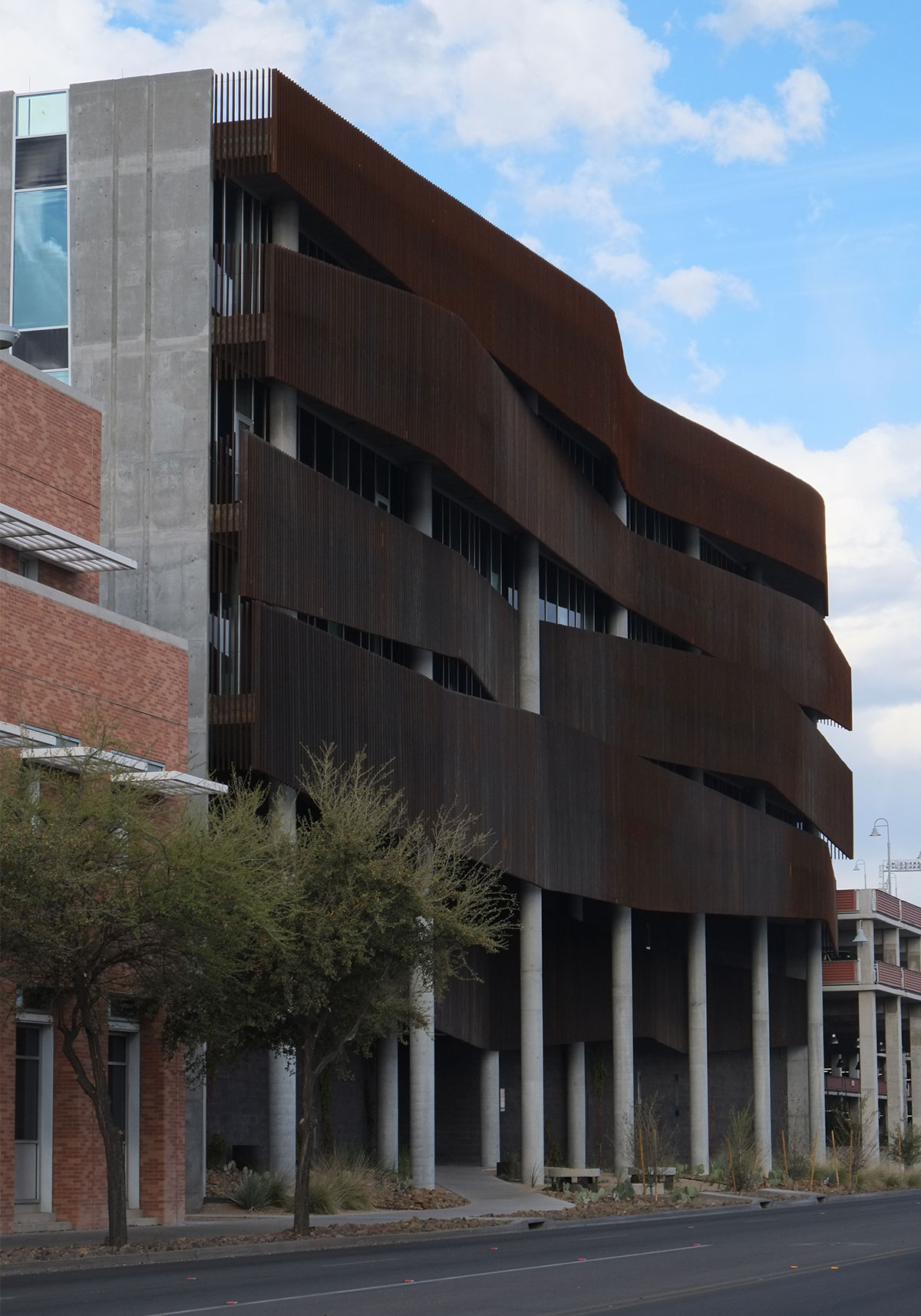
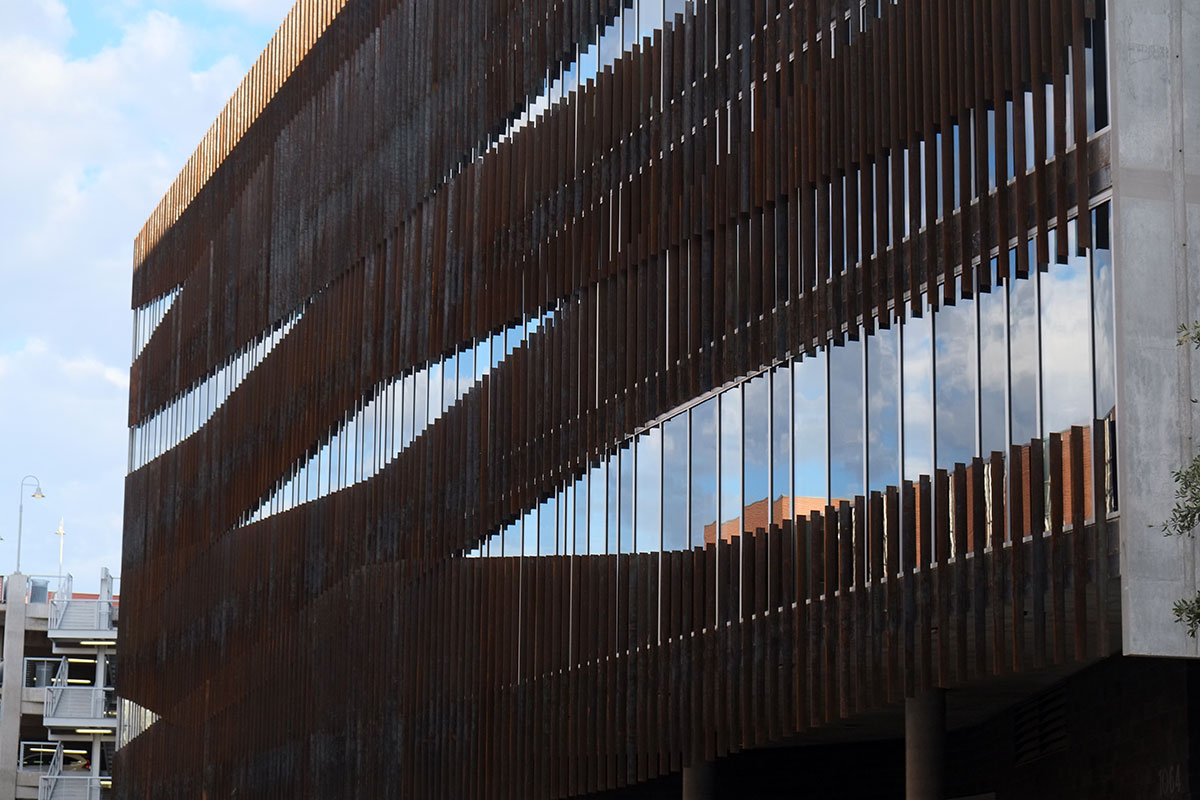
There is an even newer, bigger showcase building on the south edge of campus – the Engineering and Natural Resources Building 2, designed by Richärd+Bauer and GLHN, both from Phoenix.  It opened last year, and has been lauded for its sustainability performance and its support for interdisciplinary efforts.  The south elevation has a functional yet expressive shading system,DSCF6491

with an occupiable colonnade tucked under the building edge, offering respite from the busy arterial.  DSCF6483
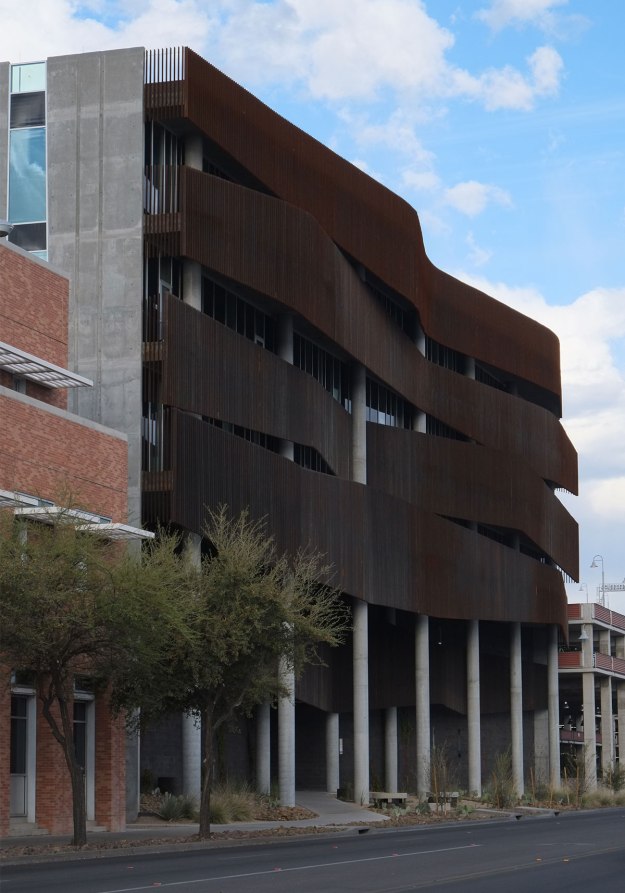
The north facade has a thinner variant on the shading system.  DSCF6499

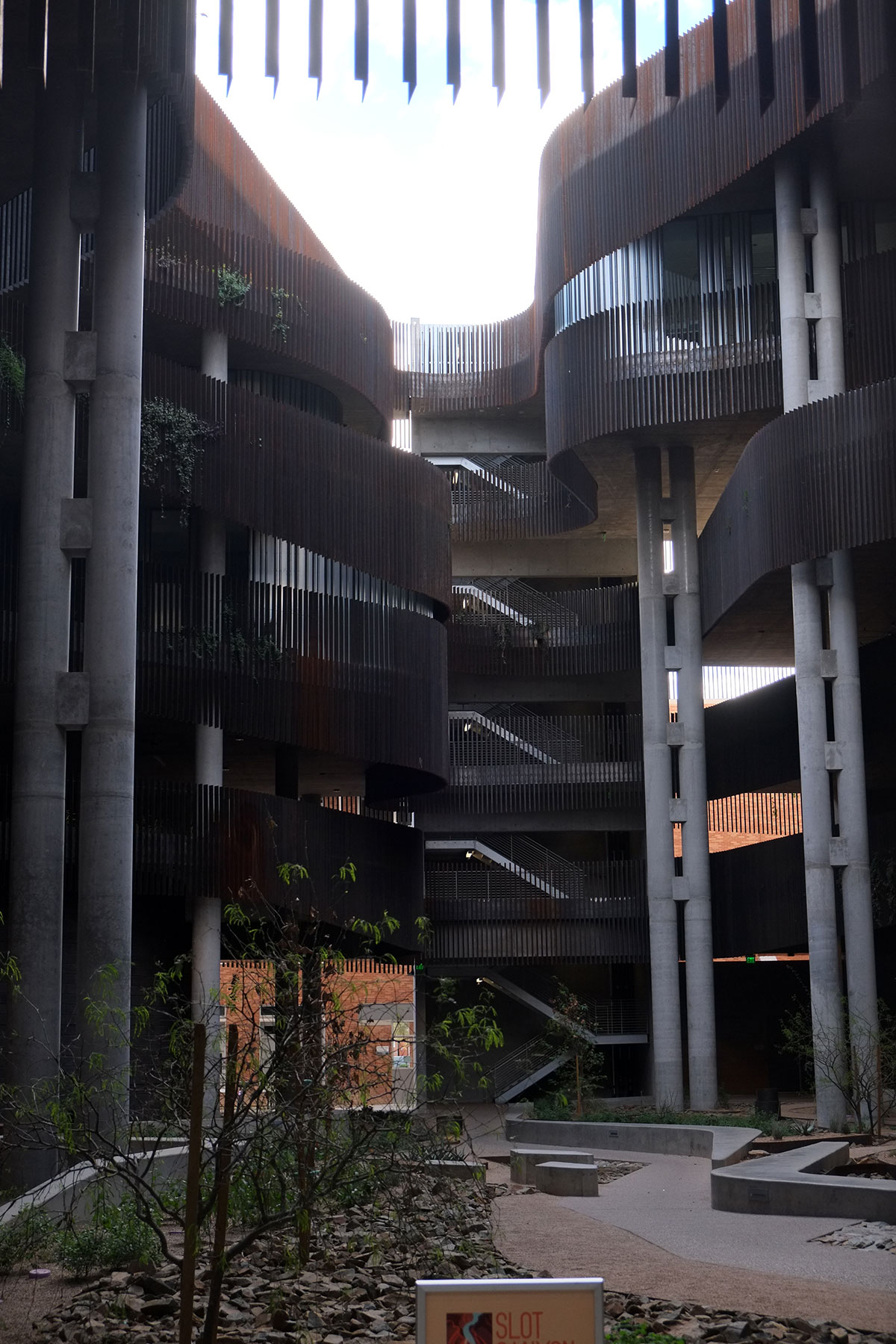
The middle of the building is a deep courtyard, which supports daylighting and ventilation strategies, and which works metaphorically as a slot canyon.  DSCF6495
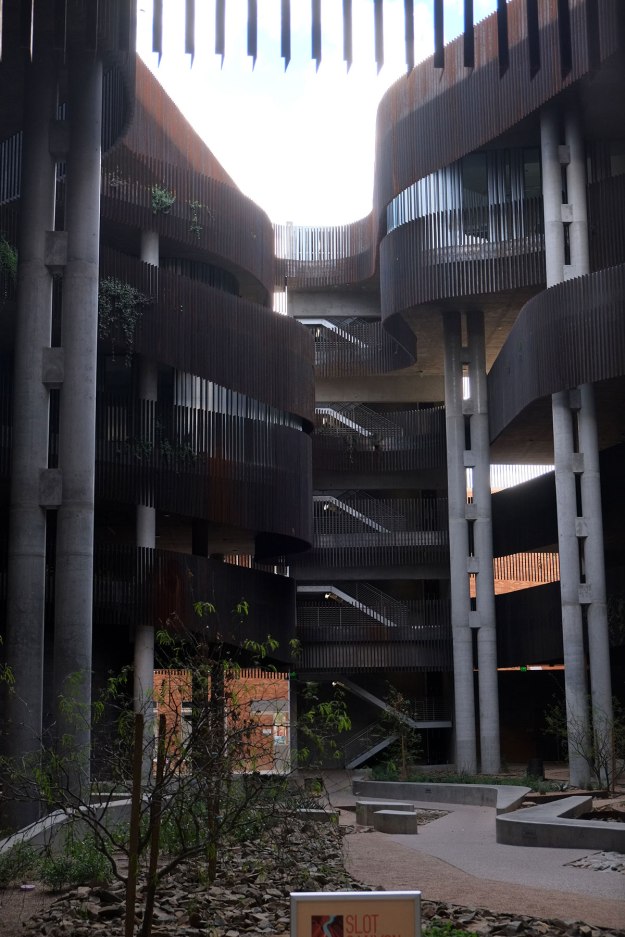
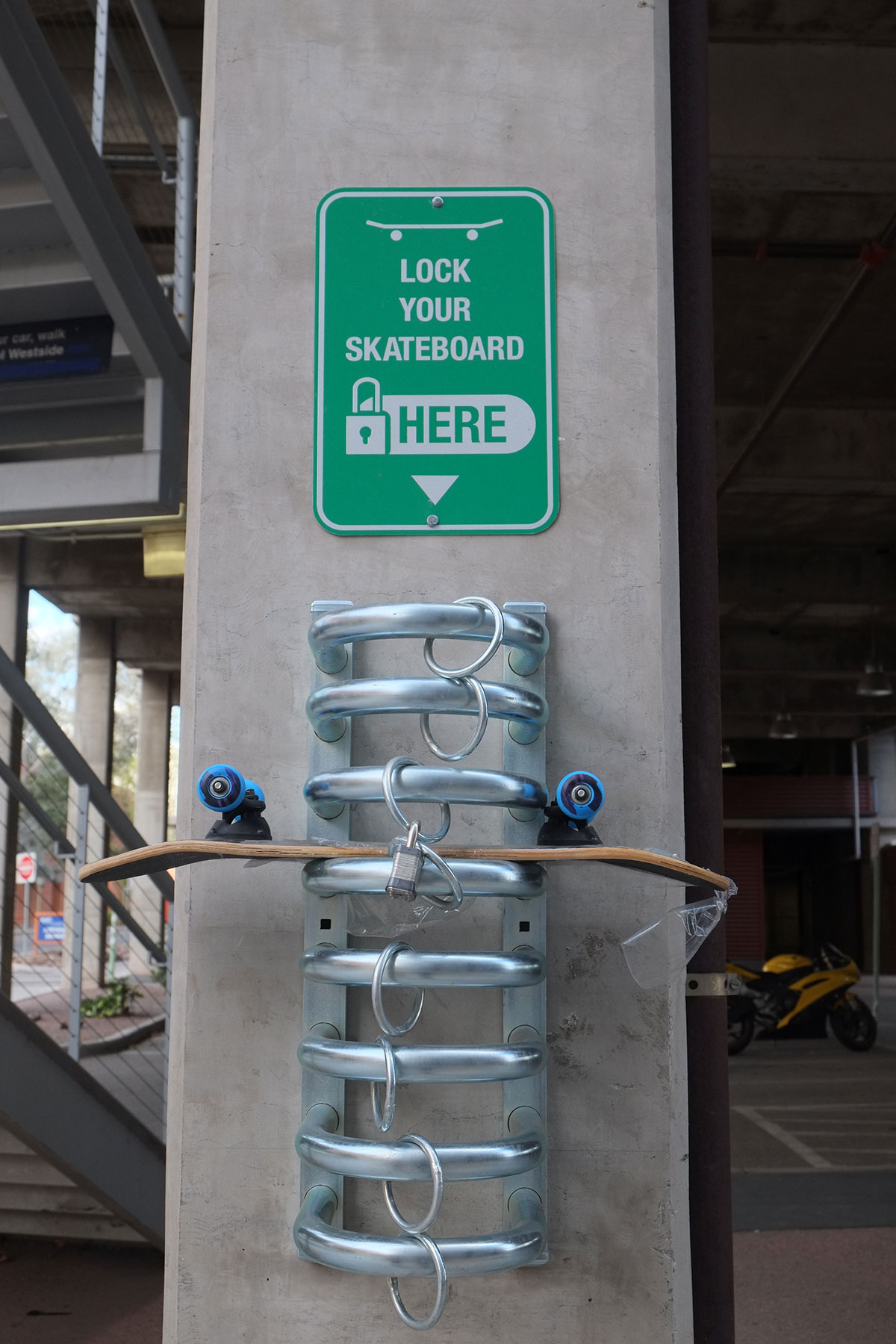
Another building where the ideas of building performance drive the architectural expression;  something is clearly going on in the university culture, if they are producing so many fine buildings.  We saw one more element, which simultaneously puts the University of Arizona at the forefront of sustainability, livability and hipness:DSCF6496
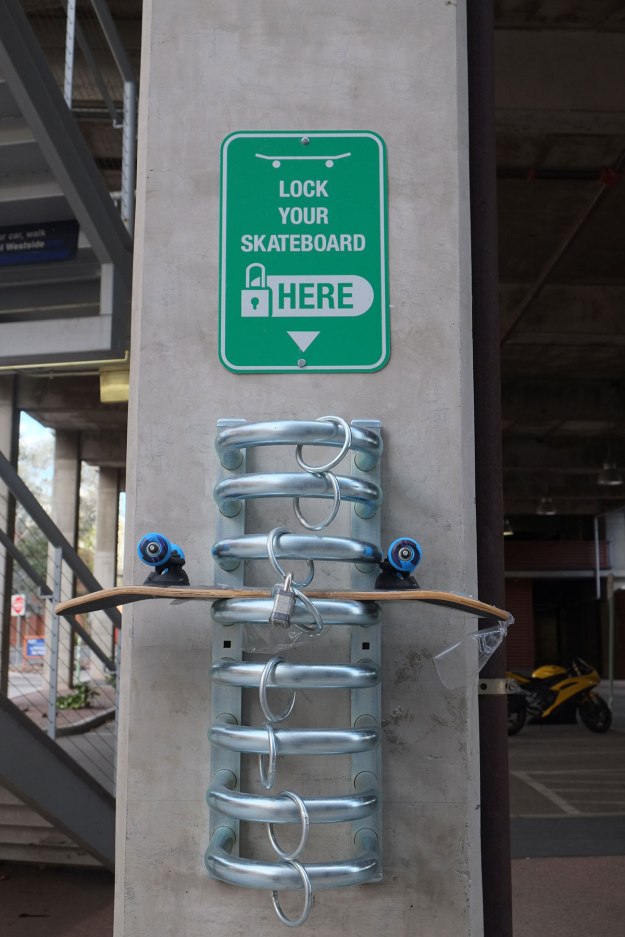
There are lessons we could learn from this university, and lessons both positive and negative at the city scale.  I had my limited preconceptions about Tucson before we visited, but the reality turned out to be even more interesting.
Carlsbad Caverns

P1080029The elevators have been broken for years. The only way in, or out, is a mile long path climbing 800 feet in elevation. This makes the numbers of visitors even more impressive, almost as impressive as the caverns themselves. Welcome to Carlsbad.

Carlsbad Caverns National Park is actually about twenty miles from Carlsbad, NM, outside of the totally touristed and tiny town of White’s City. I think the cavern itself is bigger.
P1080082

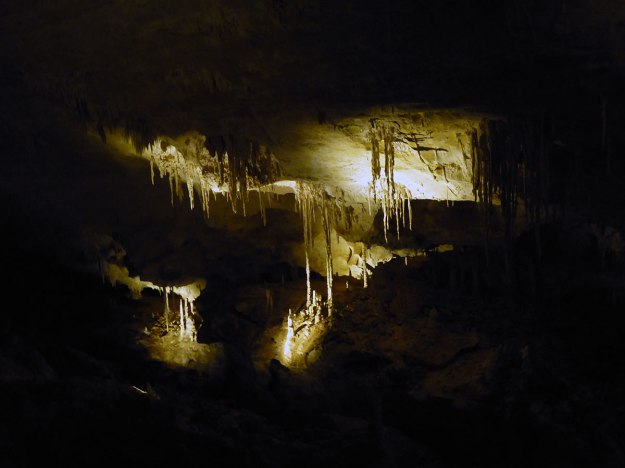
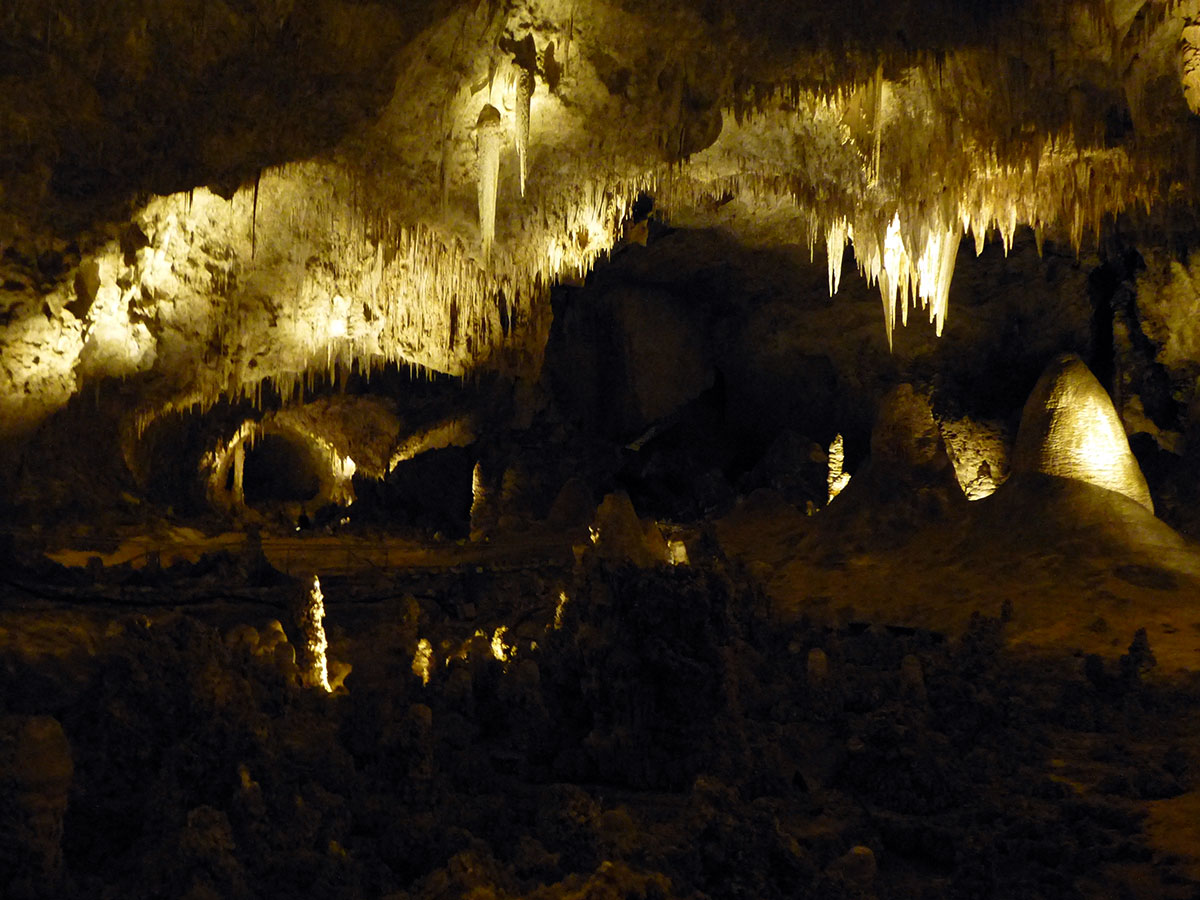
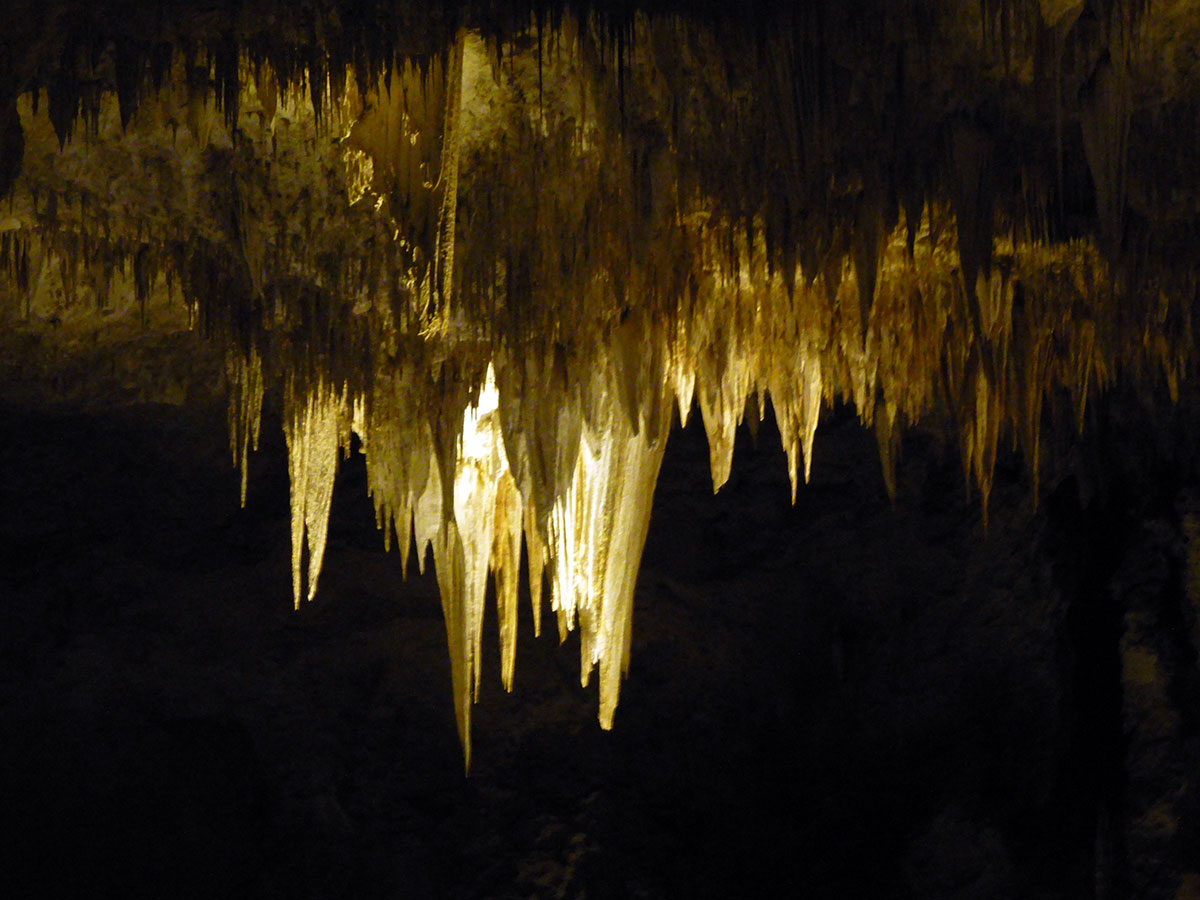
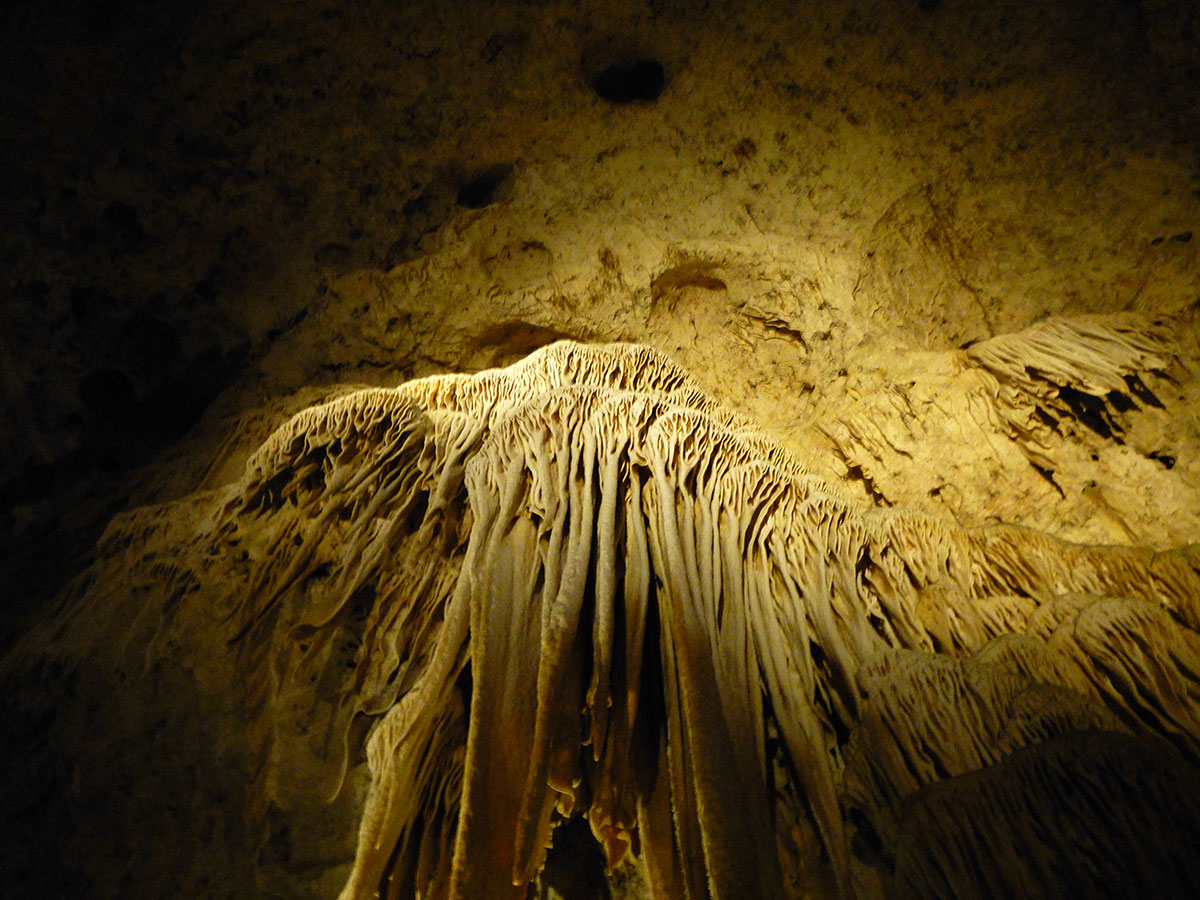
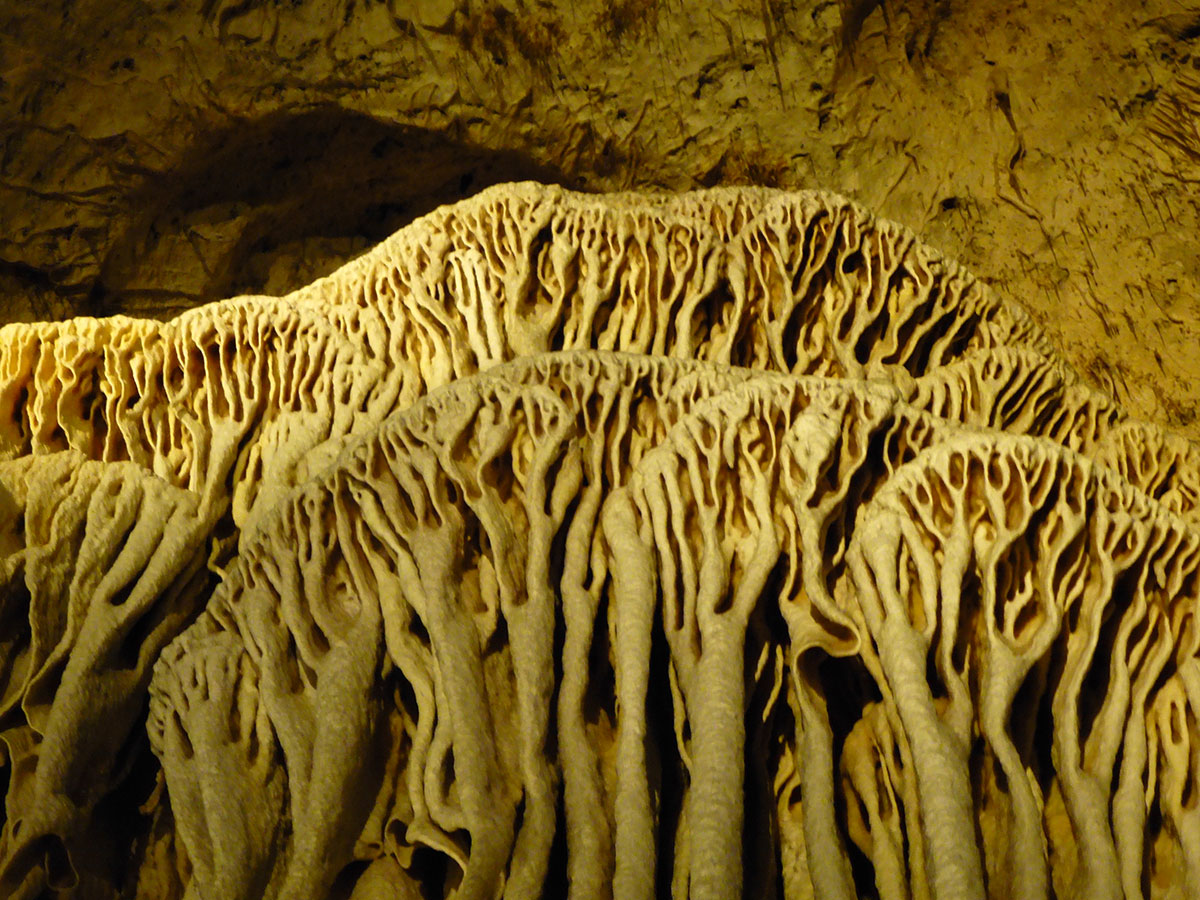
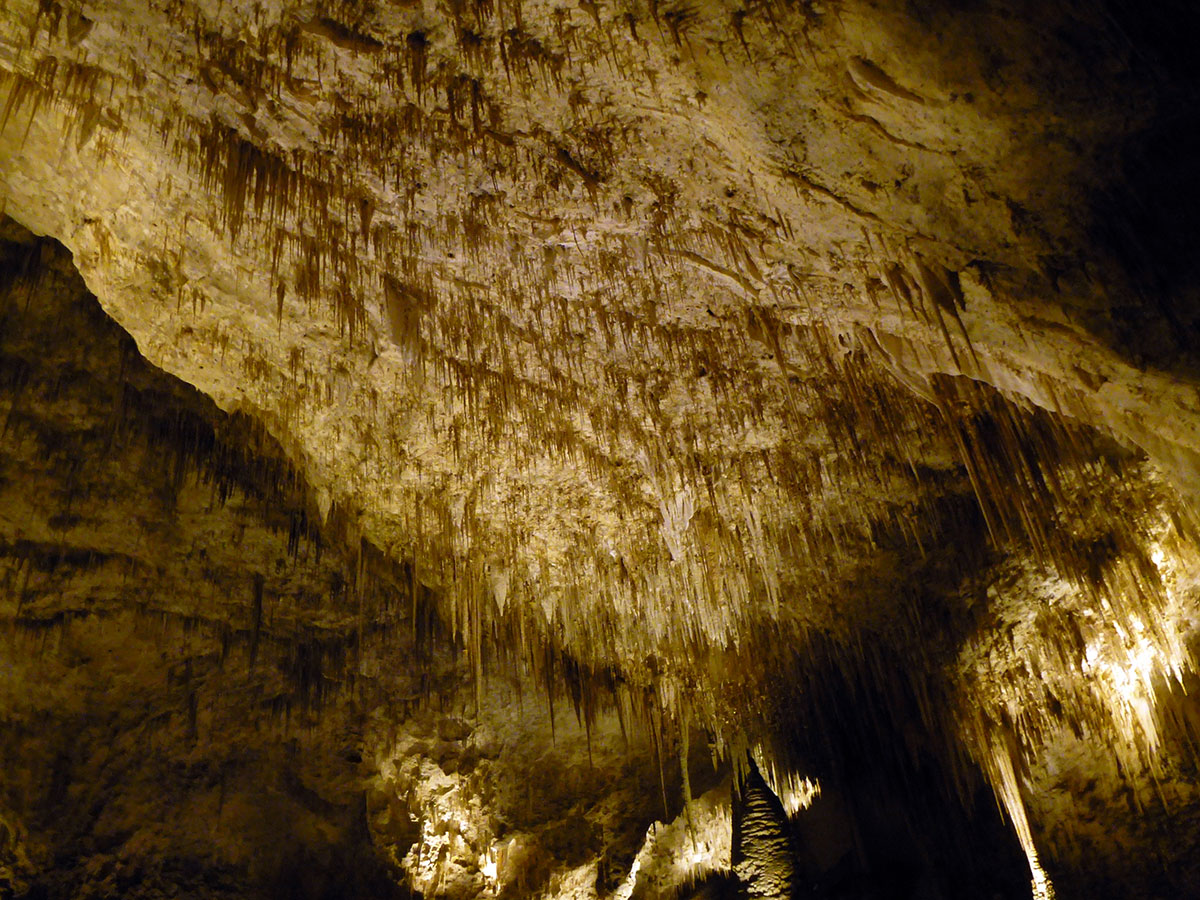
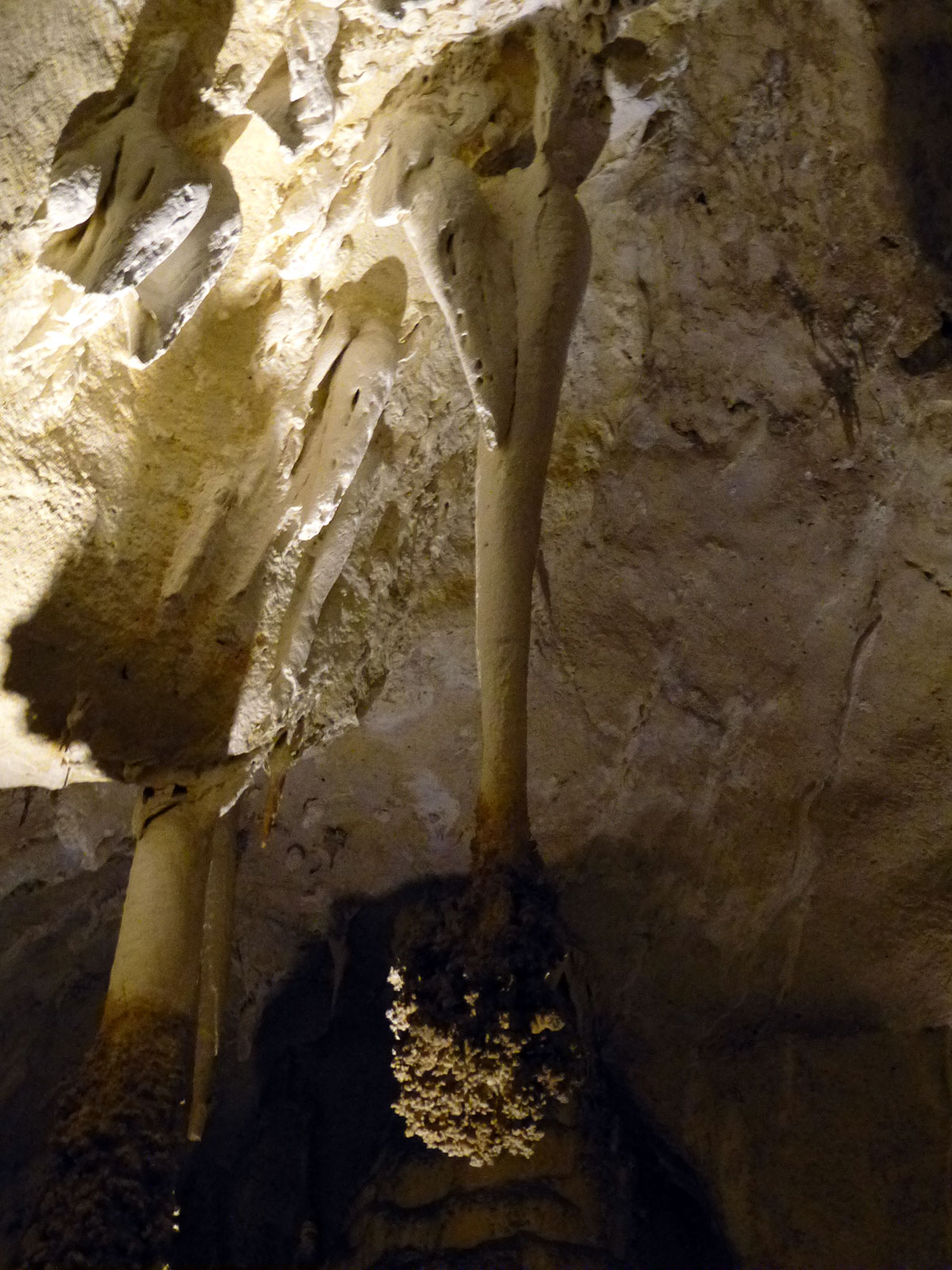
But that might not be saying a lot, because the cavern was HUGE. Fourteen acres of floor space, it’s the largest natural room in the Western hemisphere, several times bigger than Luray. And several times more impressive. P1080076The Chandelier was the most gorgeous, and the most aptly named. The nps had even strung lights up inside of it, making it glow a soft creamy gold. And some of the flows did their best to convince you they had been carved by elves.P1080115 P1080118

P1080073

The mirroring stalactites of the fairy forest

P1080066

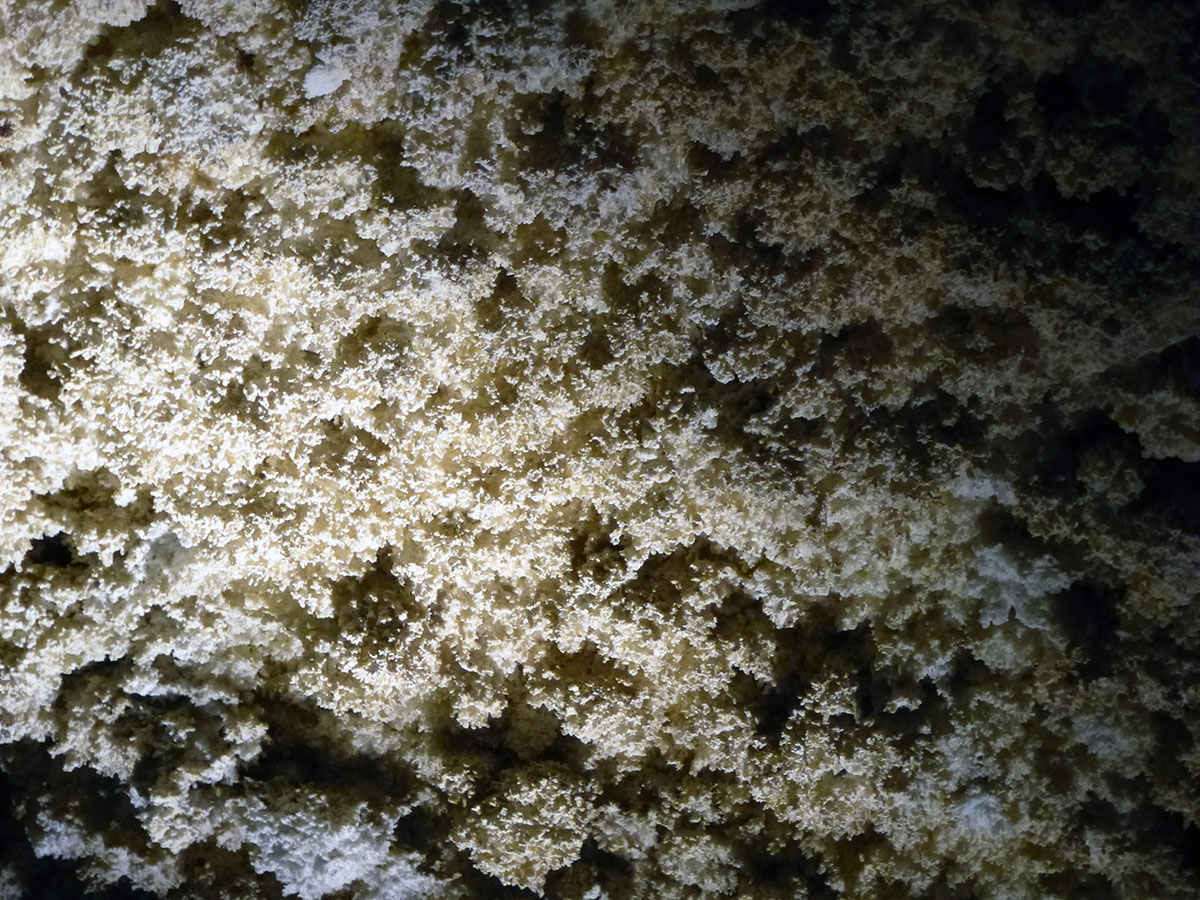
The lion’s tail and fairy forest were also pretty, but in a more rustic, popcorny way. Popcorn is a type of speleothem (rock formations caused by dripping or flowing water in caves, and my new favorite word) that looks like the movie theater snack. Surprisingly, I couldn’t find a sign or section on the brochure explaining exactly how the rough texture forms.P1080051

Despite the exquisite beauty of the cave, walking down into it felt wrong. Every instinct yelled at me, that the underground is not a place humans are not supposed to go. The bats didn’t help. We didn’t see any, because they only roosted in the caves during the summers in a part humans weren’t allowed into. However, this knowledge didn’t help much when you felt like you were descending into the Mines of Moria. Getting out felt great, but it was definitely an experience I’d repeat.

19th-century forts

We haven’t been following a military history agenda on this trip, but when an intact installation  appears, we check it out.   We came across two forts in Florida and Texas, which were built for very different circumstances, but which had an interesting connection.

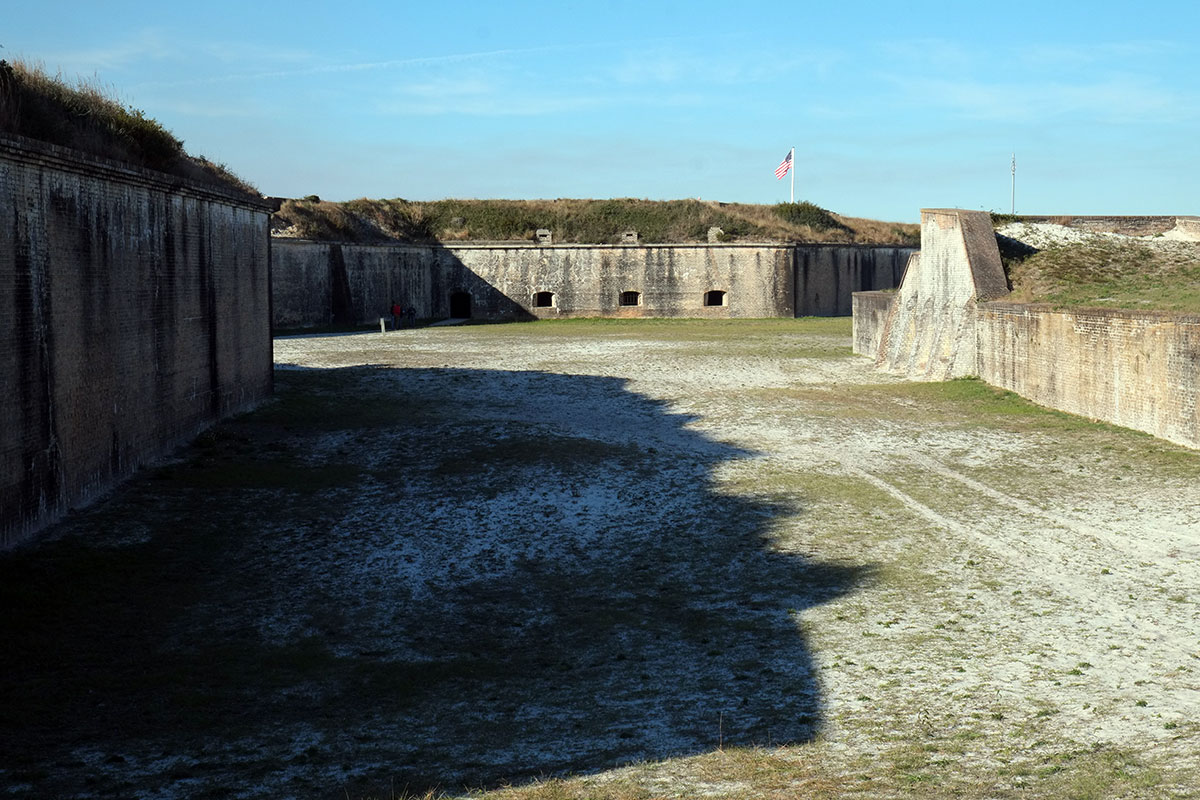
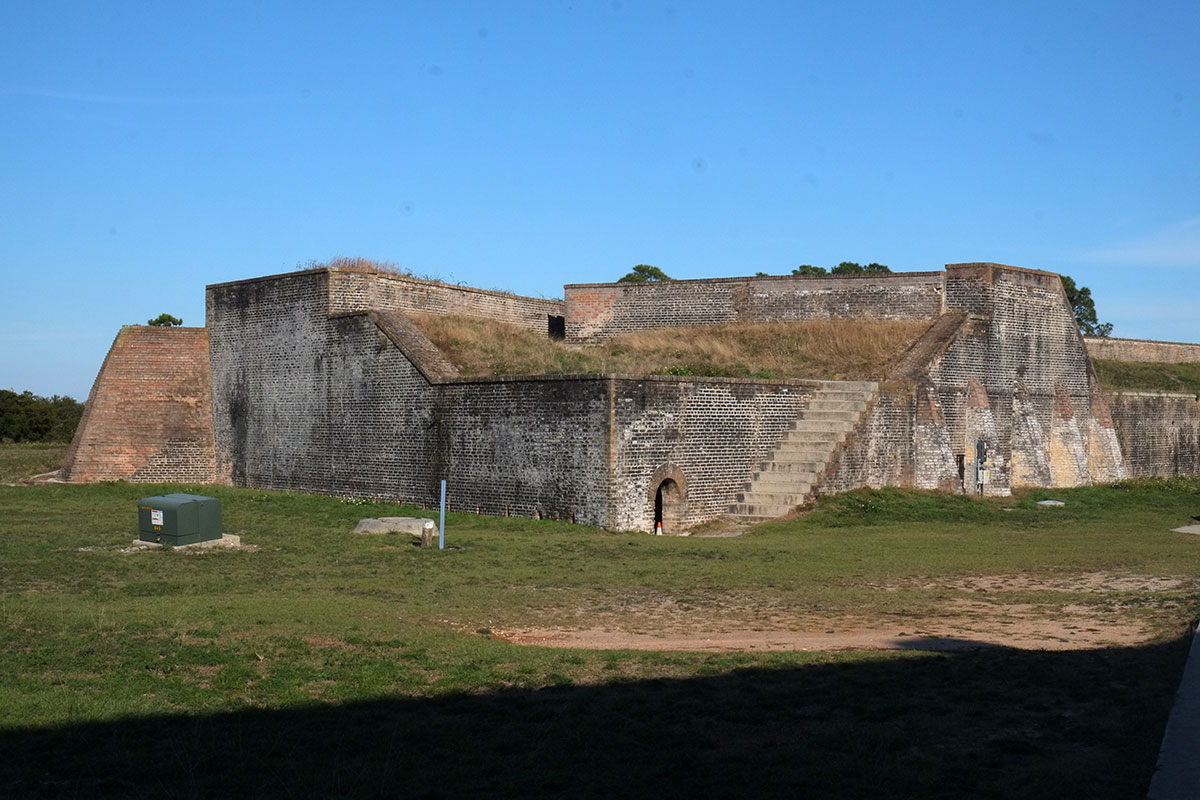
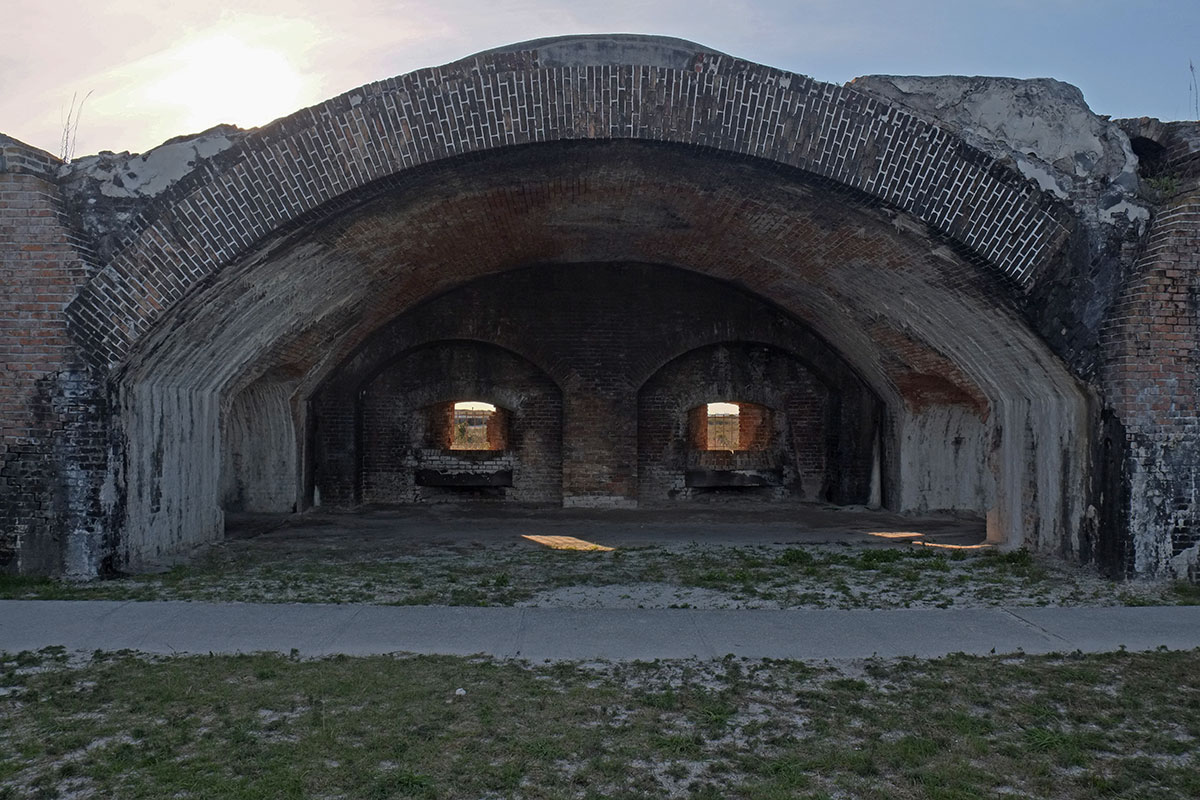
DSCF0996Ft. Pickens was the largest fort built to defend Pensacola Bay.  It is located at the tip of Santa Rosa Island, and is now part of the Gulf Island National Seashore.  Built largely with slave labor, it was finished in 1834.  It is of the  type known as a Third System Fortification, unified forts with extensive earthworks to resist naval bombardment, and containing large guns to shell ships that attempted to enter the bay. DSCF0953  DSCF0965

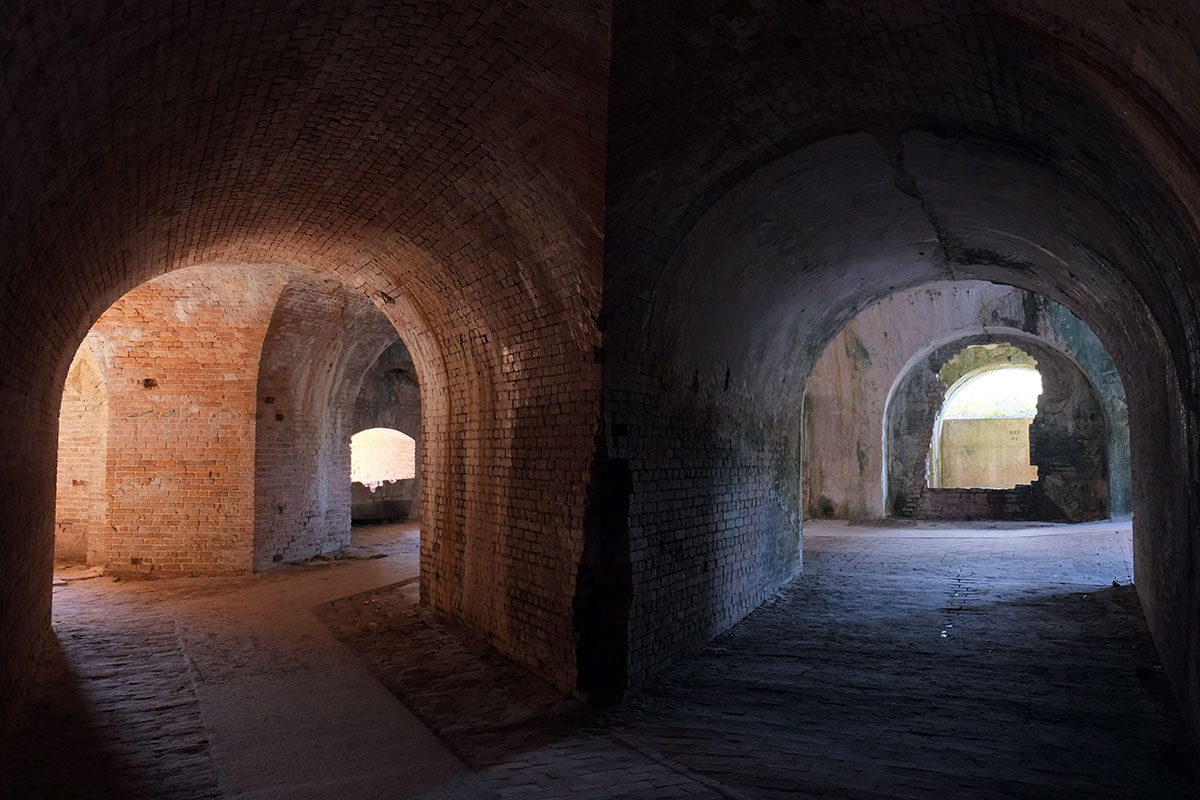
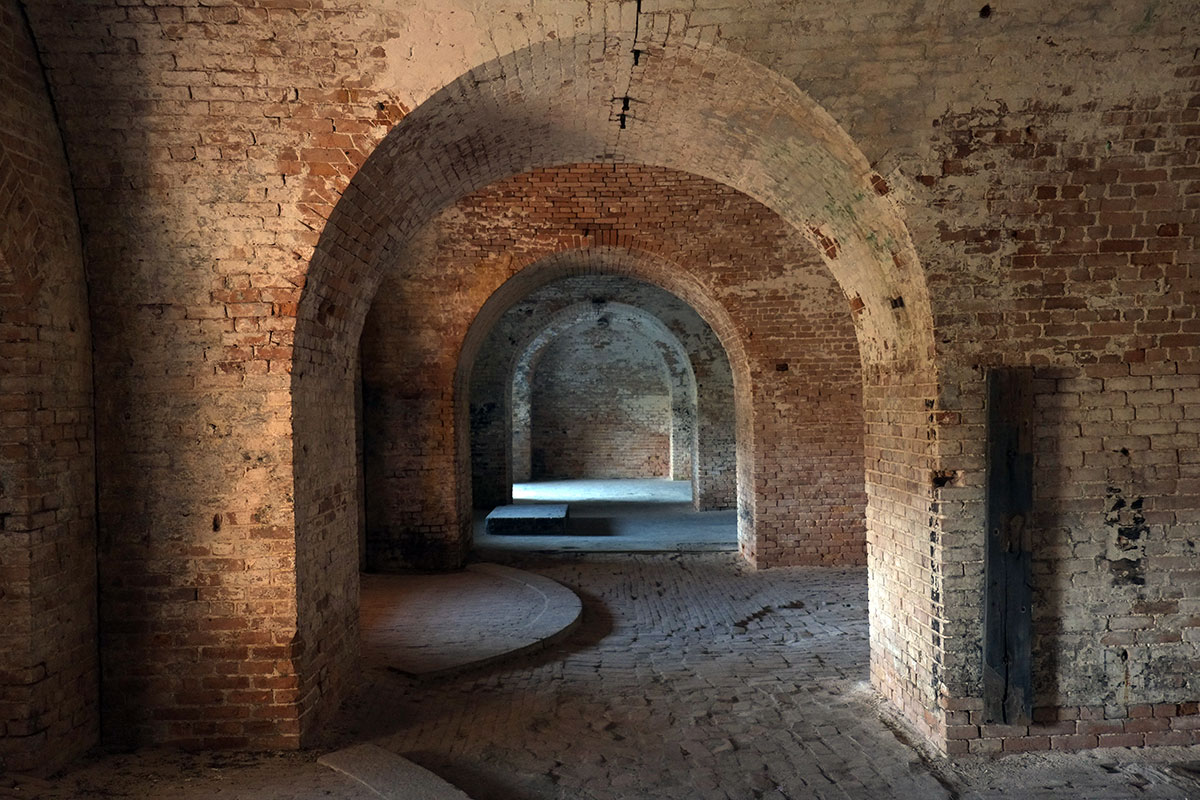
It was never involved in a battle until the Civil War, when the Union troops defended it from a Confederate attack, and then held it for the whole war, effectively eliminating Pensacola as a useful Confederate naval base.  The most interesting parts to see are the brick vaults that housed the guns, munitions and personnel, underneath the earthworks.  DSCF0985  DSCF1005  DSCF1004

The masonry is fantastic, definitely looking at Roman architecture (and anticipating Lou Kahn).  DSCF1010  DSCF1012

We’ve discovered that Greta likes tight little caves and tunnels such  as these, which are under the outer ramparts.  During a battle these could be filled with explosives, so if the fort were being overrun, the tunnels could be blown up under the enemy troops.  DSCF0978

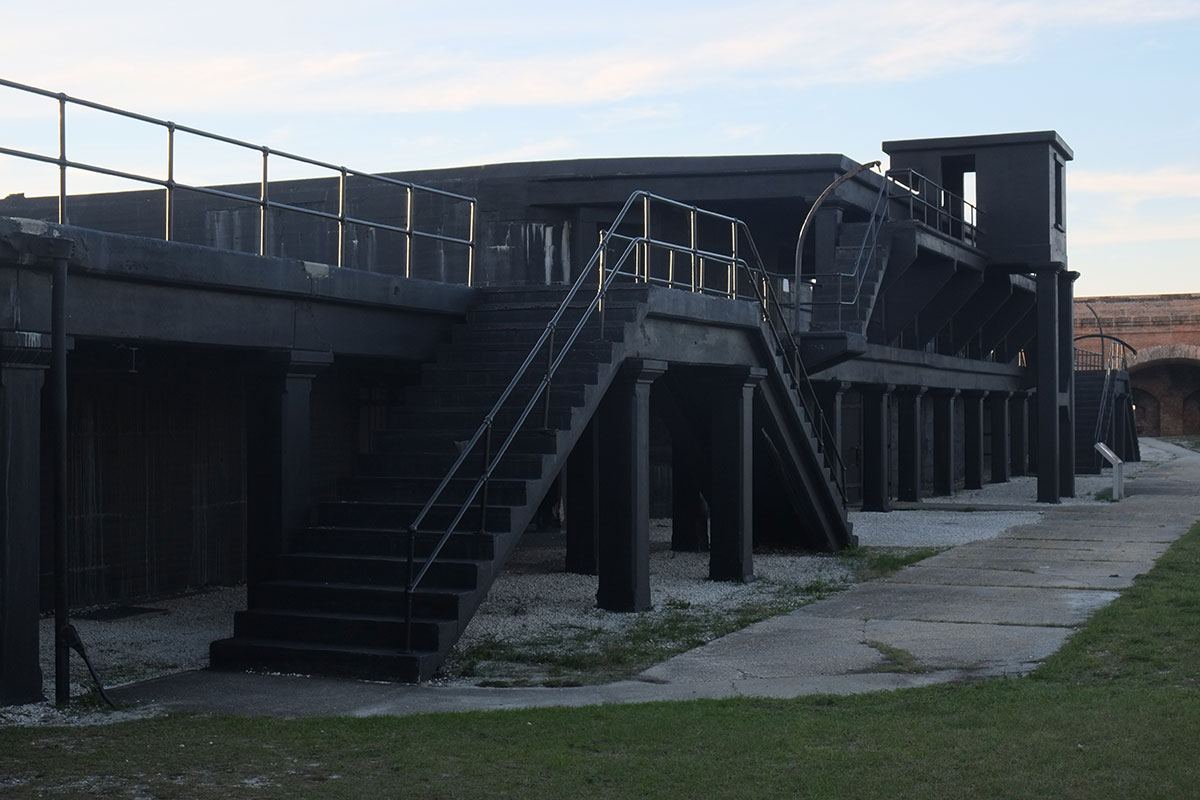
Around the Spanish American War, a new battery of concrete and steel was built within the older fort, to house the enormous new guns of the era.  Very similar to Ft. Casey on Whidbey Island.  DSCF1037

The Gulf barrier islands have beautiful beaches, with the softest, whitest sand we’ve seen anywhere.  But as you look across the beach, something catches your eye.  DSCF0942

It’s part of the third phase of armaments installed here, in the 20th century.  Since the guns had come so enormous and had a range of up to 25 miles, it made no sense to try to shield them in a central location.  So instead they were dispersed into hidden bunkers scattered around the island.DSCF0944

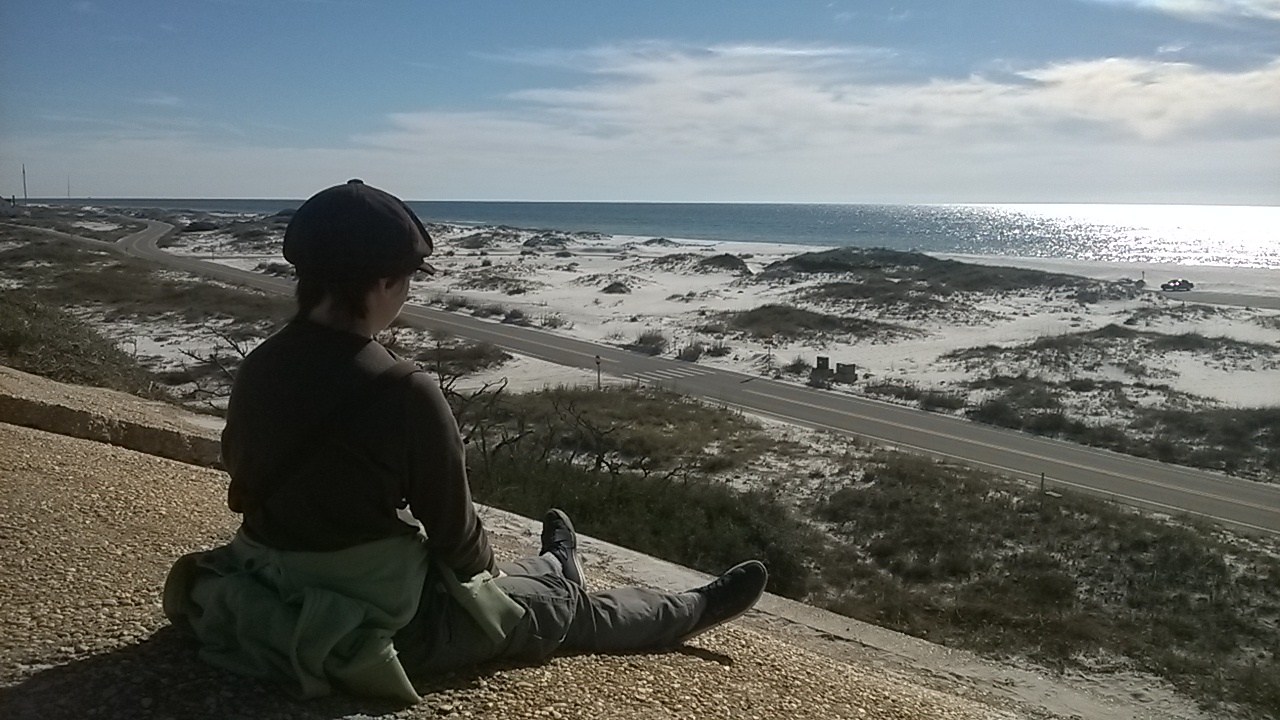
Which also make excellent viewing platforms. Created with Nokia Smart Cam

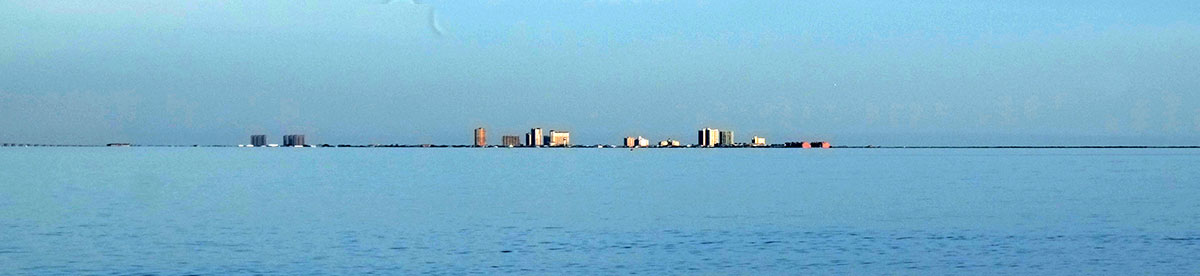
The barrier islands have afforded protection not only to naval operations and the harbor, but obviously also to the whole coastline and its ecosystem.  As you look at them (Pensacola Beach in this photo) in this era of climate change, it seems likely that they won’t be fulfilling this role for much longer.  That has been one of the themes of this trip – a Climate Change Farewell Tour of sorts – much of what we’re seeing will be radically changed during Greta’s lifetime, so I thought she should see it before.  DSCF1047a

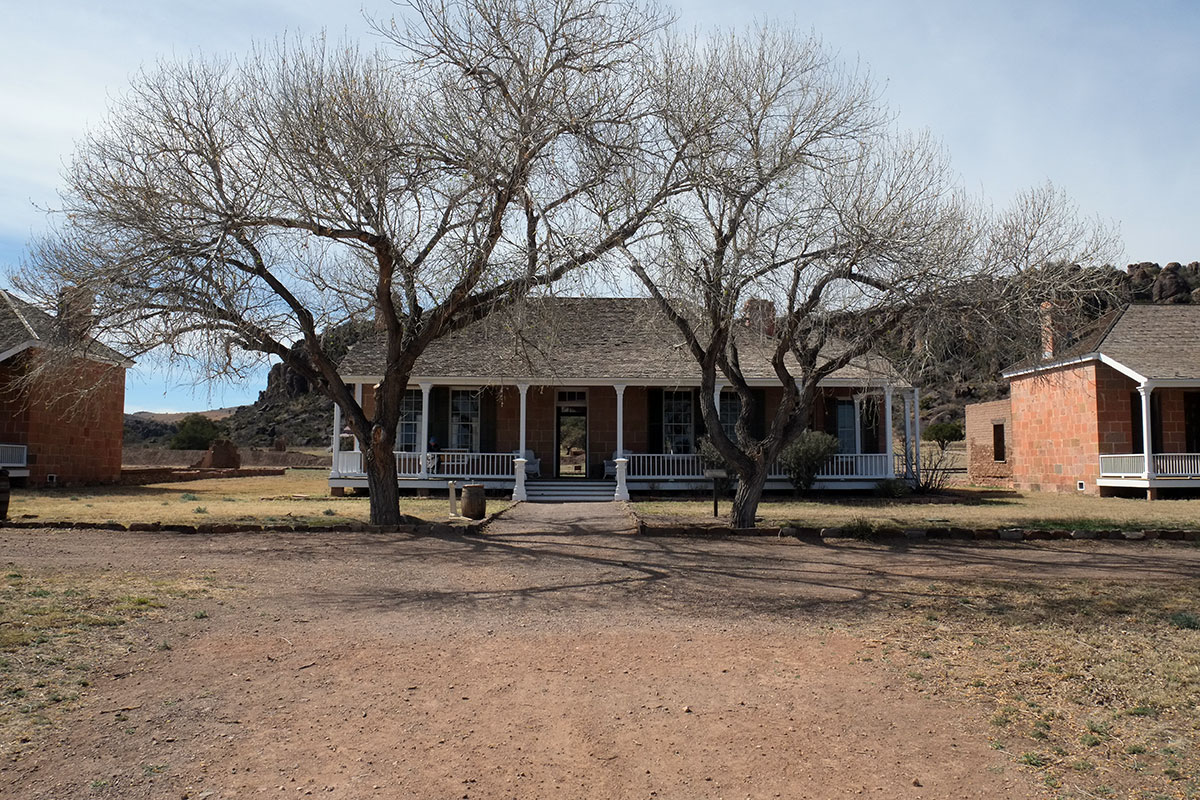
In West Texas we visited Fort Davis (in Jeff Davis County, within the Davis Mountains), built in 1854 and named after the then-Secretary of War, later President of the Confederacy.  (No discussion about renaming any of these that we heard.)  Its function was to protect traffic along the El Paso road and the Chihuahua Trail, and it was also involved in the wars with the Comanche and Apache tribes.  It must have been a pretty desolate, end-of-world posting.  DSCF6295
Many of the buildings have been preserved and are being restored, such as this barracks.  After the Civil War, this fort was largely manned by Buffalo Soldiers, regiments solely of African-Americans, including Lieutenant Henry Ossian Flipper, the first African- American graduate of West Point.  DSCF6325  DSCF6286

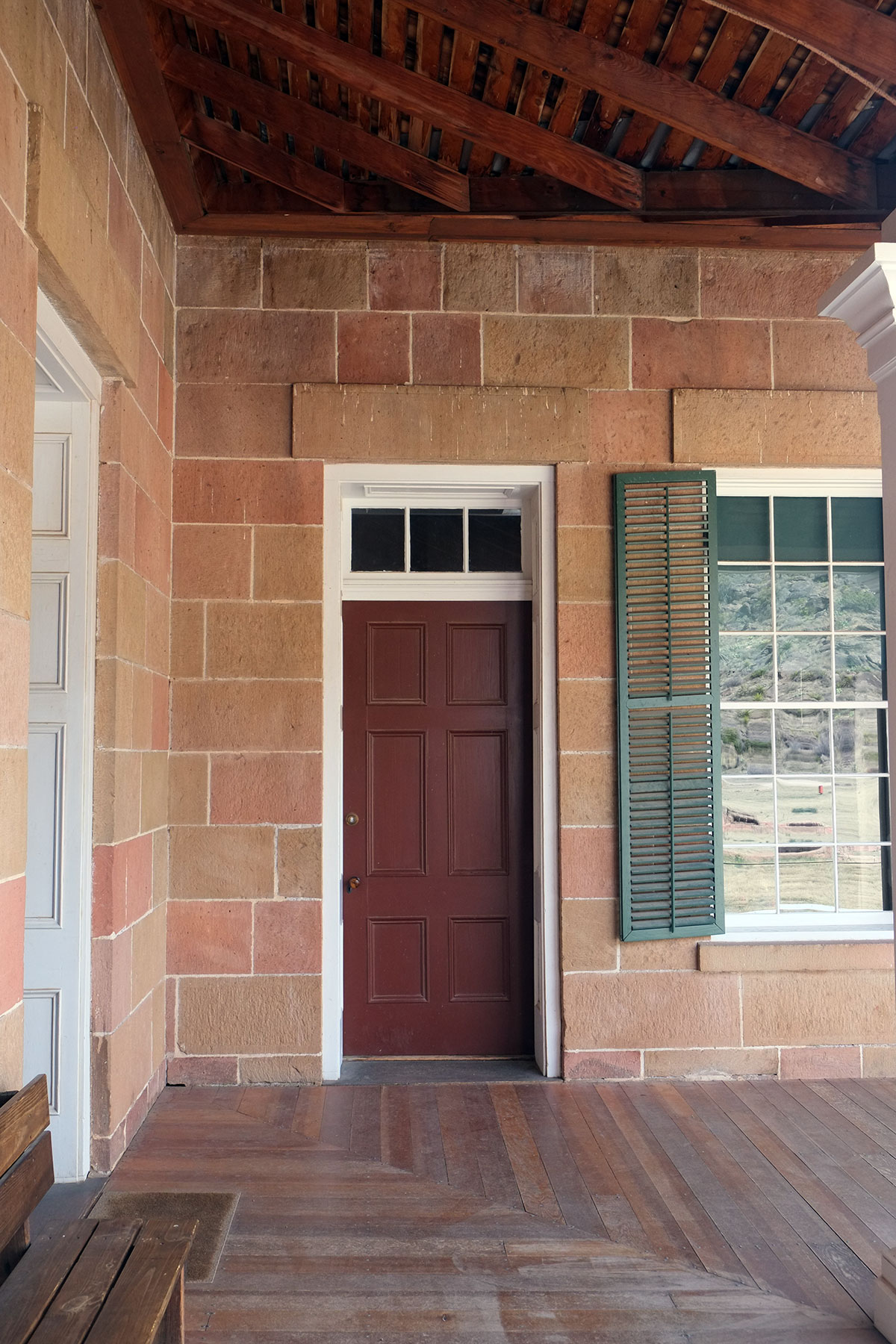
The officers had quarters for their families, beautifully built out of local stone, including the commander’s residence:  DSCF6296  DSCF6304

While we might be inclined towards residences that echoed the stark simplicity and elemental qualities of the environment, the inhabitants favored interiors that mimicked the current styles of the east as closely as possible. DSCF6298

West Texas is a vivid place, with a scale and and emptiness that is beautiful but forbidding.   There is a strict geometric order to this fort, which stands in stark contrast to the huge space of the landscape, a contrast which is still striking when seen today, as not that much has grown up around it.  While the ordering of the place might have had specific military or organizational reasons, the ability of this geometry to represent the projection of American power into the natives’ land is palpable.  DSCF6283  DSCF6282
As we went through the museum at the fort, we came across a photo we’d seen before.  It was of a band of Apaches who had been captured in this area.  We recognized Geronimo sitting near the front and remembered where we had seen it:  at Fort Pickens.  This band was then transported east away from their land, and were imprisoned for several years at Fort Pickens.