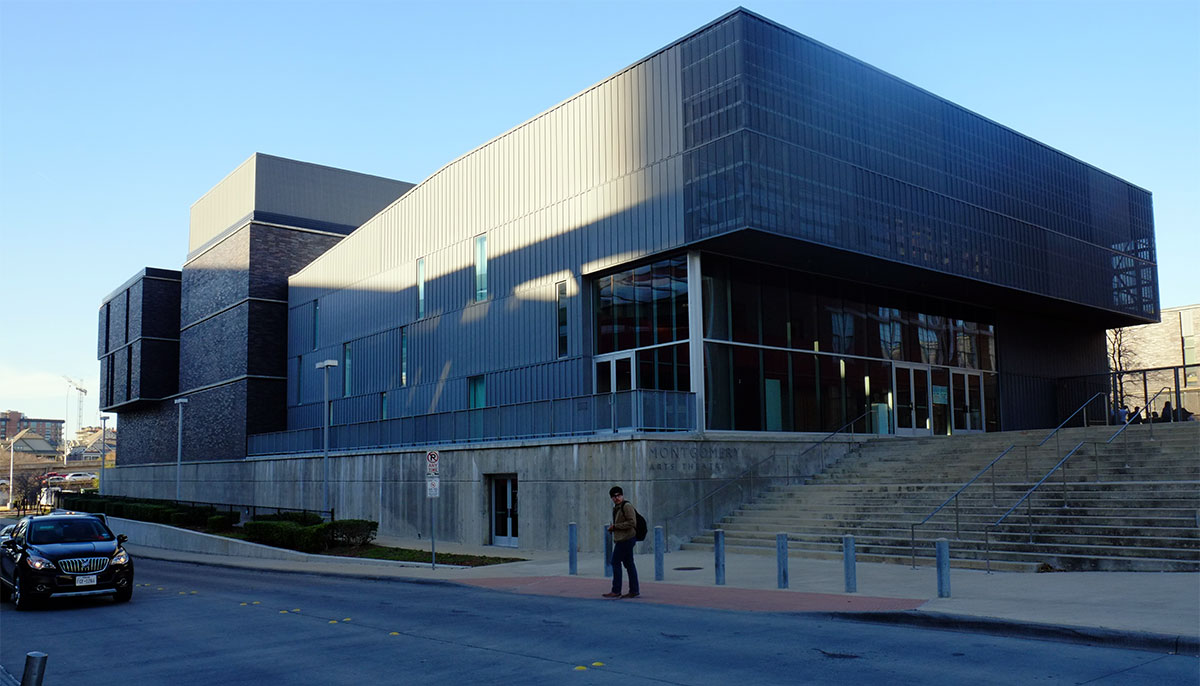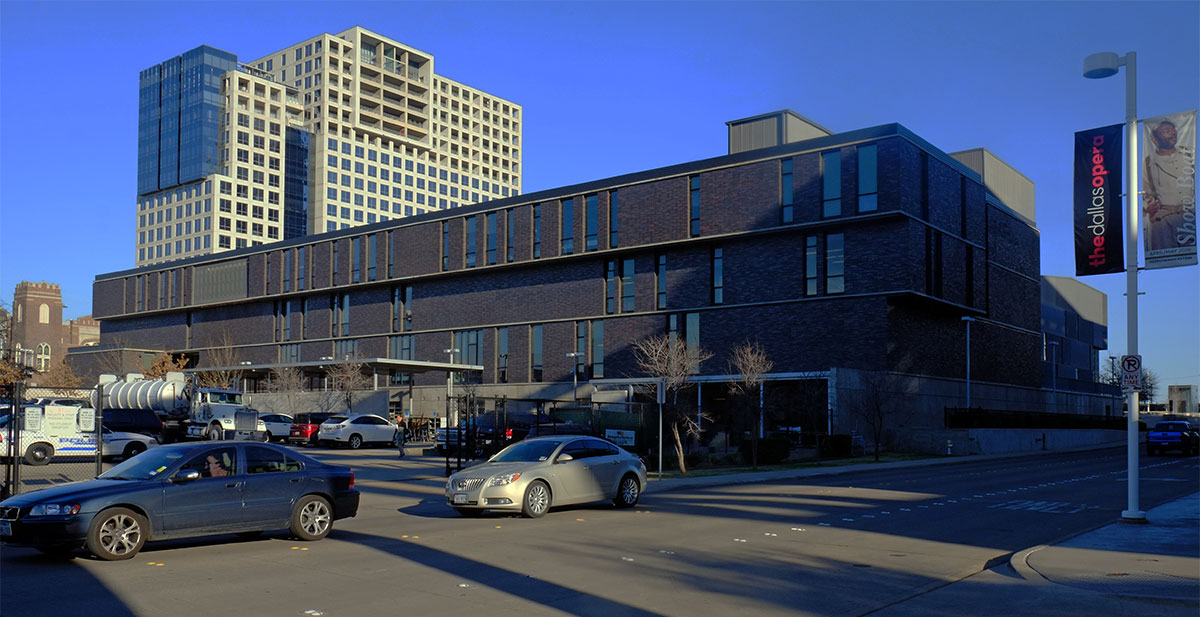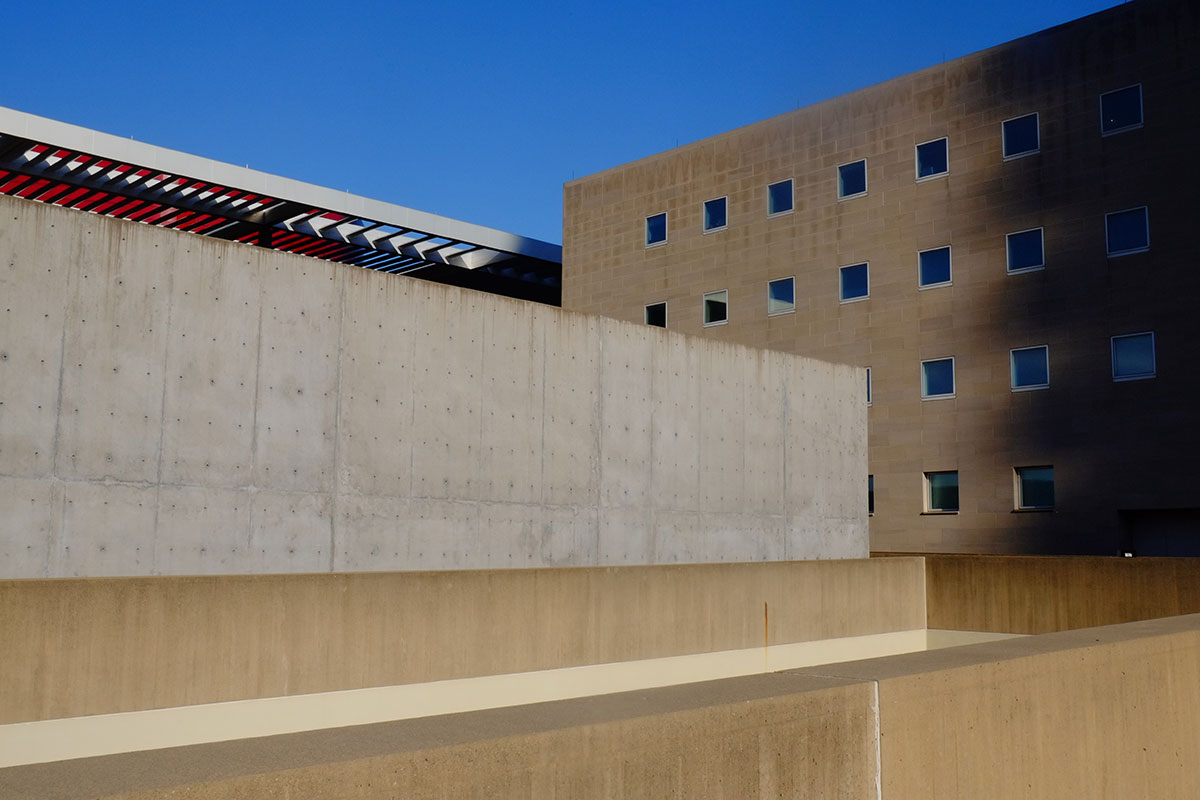
Texas engineering cousins

Yes, that really is a category in our family. For some reason, three of Greta’s cousins have gone into engineering and ended up in Texas, and we got to visit them all.

Our first stop was in Houston, where Joe Ballard is an engineering major at Rice. Joe grew up in Manhattan, Kansas, where Linda and four of her sisters went to Kansas State. Her youngest sister Becky married Steve Ballard, a local boy, and they stayed in Manhattan and raised their three kids. (We missed seeing Joe’s big sister Audrey in Chicago as she had to prepare for a meeting and couldn’t come out to play.)

Joe was a serious football player in high school, but missed his senior year due to a knee injury. So with a year of eligibility, he went to prep school in Connecticut for a year, then matriculated at Rice.  He’s been playing mostly on special teams (I hope that is the right term, says the blogger who watches 0.5 football games per year), and is in his junior year as a mechanical engineering major.

Joe lives with three of his teammates, and when I asked his advice on where we should stay in Houston, he said we should just park in their driveway.  I loved the idea, and figured this would probably be the most unusual accommodations Greta would experience on the whole trip.

We arrived at Joe’s and were having a beer to celebrate Greta’s having navigated us through Houston Friday rush hour traffic on her own, when cousin Sam Adams showed up.  Sam grew up in Indianapolis, the older son of Dawn and Bill (previously profiled here).  Sam went to a Spanish immersion school, and continued his language focus with French, eventually studying abroad in France, and ending up being practically adopted into a French family, whom his family stills sees often.  Sam arrived at Rice a year before Joe, and is a chemical engineering major.

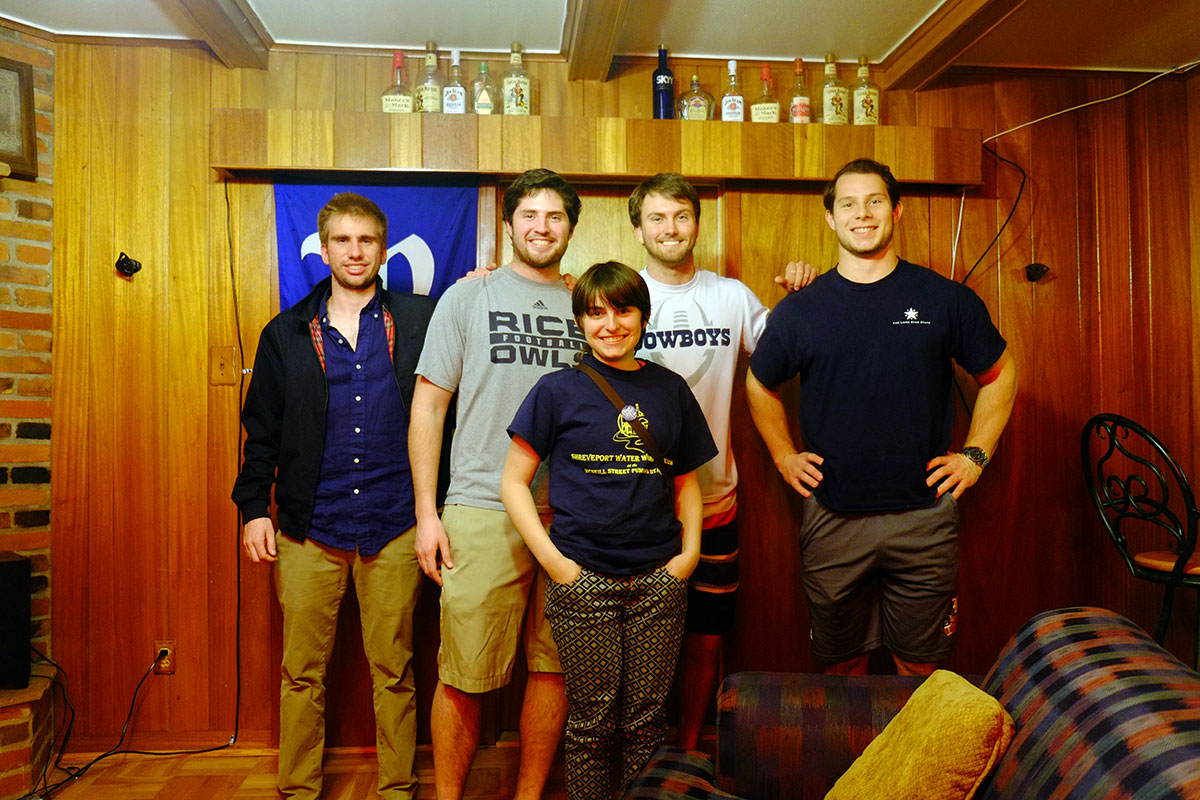
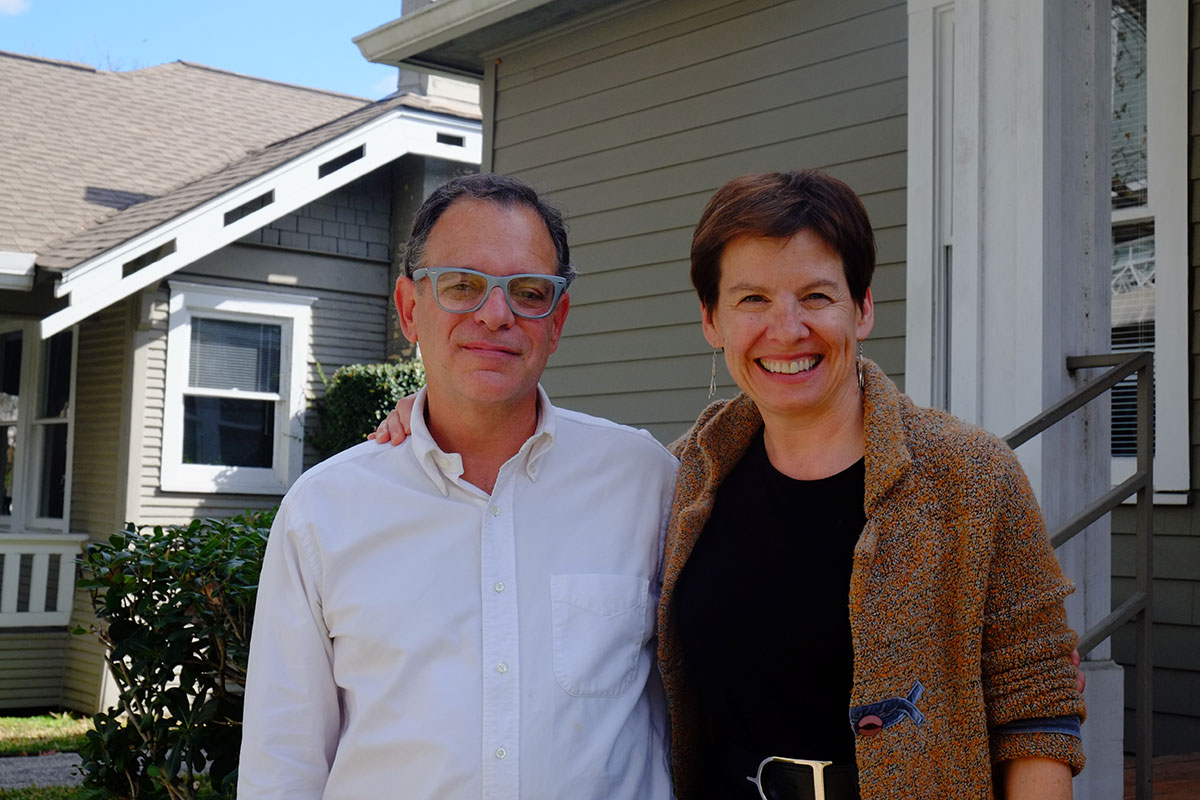
Greta and I went out for tacos with the cousins, then came back to Joe’s where we hung out with the roommates. I guess my expectations for a houseful of football players had been shaped by being at the UO for so long, but these guys didn’t meet those preconceptions at all. First, although large, they were still within one standard deviation of normal-sized human beings.  Second, they were all very smart and engaging, and as charming as we had come to expect Southerners to be.  We had a great time talking and drinking beer – which was the third surprise, as all of them had no more than one, as they had practice at 6:00 the next morning. (Sam had a bit more, being the non-teammate who could sleep in.)  They are pictured below with Greta as the five-foot scale figure: Sam on the left, Joe next to him, then Cole and Nick. Not pictured is Robby (who gave us excellent advice on camping in the Chisos Basin at Big Bend), and Cole’s lovely girlfriend Maddy.

DSCF4991

While the college boys didn’t meet expectations, their house did. A combination of second-hand furniture and beer brand décor, it showed one major innovation since my days of living in such a household – there were screens everywhere. The living room had two big TVs, in case you needed to watch two games at one time, or watch one game while playing video games on the other. Despite this change, it felt just like all the roommate guy apartments I’d ever lived in, and gave Greta some idea of what environments lay in her future.

We had Vietnamese food with the cousins the next night and really enjoyed ourselves. My first memories of Sam and Joe are as part of a pack of five little boy cousins, running through large family parties wreaking havoc. And even as they’ve grown up, I’ve tended to still think of them that way, as that pack became high school boys and retreated to the nearest basement man-cave, only to emerge for feedings. So spending two evenings with them without any other family around was enlightening. They have both turned onto thoughtful, smart and entertaining young men. Joe still has a year left in school, and so is not planning too far ahead now. Sam is graduating this spring, and is planning on joining the Navy, training to be a submariner. After basic training and OCS he’ll send a year in submarine training in Charleston (Greta told him about the good restaurants.) I spend a lot of my normal life with college students, and being with Joe and Sam reminded me of everything I like about them – their energy, enthusiasm, insights, humor, idealism. It was fun for us both seeing these guys, and seeing the young men they’ve turned into.

We moved on to Houston, where we saw Ben Robinson. Ben’s mom is Linda’s sister Paula, whom we had visited in St. Petersburg (profiled here). Ben grew up outside Dallas and in Louisville, but the family roots in Kansas were strong, and he returned to Kansas State for both his undergraduate and masters’ degrees. During those years Ben saw a lot of the world – his mom was living in Shanghai, and Ben would visit her there for extended periods, or else they would meet up in some other cool place.

Ben moved to Houston, where he now has another one of those jobs I can’t understand.  As far as I can tell, his engineering company makes products used by other engineering companies, both hardware and software.  Ben is involved in developing and marketing those things.

We went over to Ben’s apartment (which showed he had definitely moved beyond the frat-boy collegiate decor), and met his roommate, a veterinarian from Oregon City.  We asked how he could stand the Houston weather after growing up in Oregon, and he said he had moved to Houston partly because of the weather;  we’ve never gotten that response before.

Ben is enjoying the young professional life in Austin, and gave us some insight into what that is all about, placing it squarely on the Portland-Brooklyn axis of hipness.  (Ben intermittently sports a man-bun these days.)   One gets old and forgets that there are just good places to Iive as a young person, surrounded by lots of peers and lots of things to do.

I didn’t get a picture of Ben, nor do I have a lot of conversation to recall.  While we were at his apartment, I started to feel really sick, so I just went back to the trailer and crashed while Ben took Greta out to dinner at his favorite joint.  She said they had a good time, talking about our trip and other cousinly things.  We have to thank Ben for providing this opportunity for Greta, which led to her feeling very mature, sitting in a hip restaurant with her cousin, without any of the parental generation in sight.

The Menil Collection

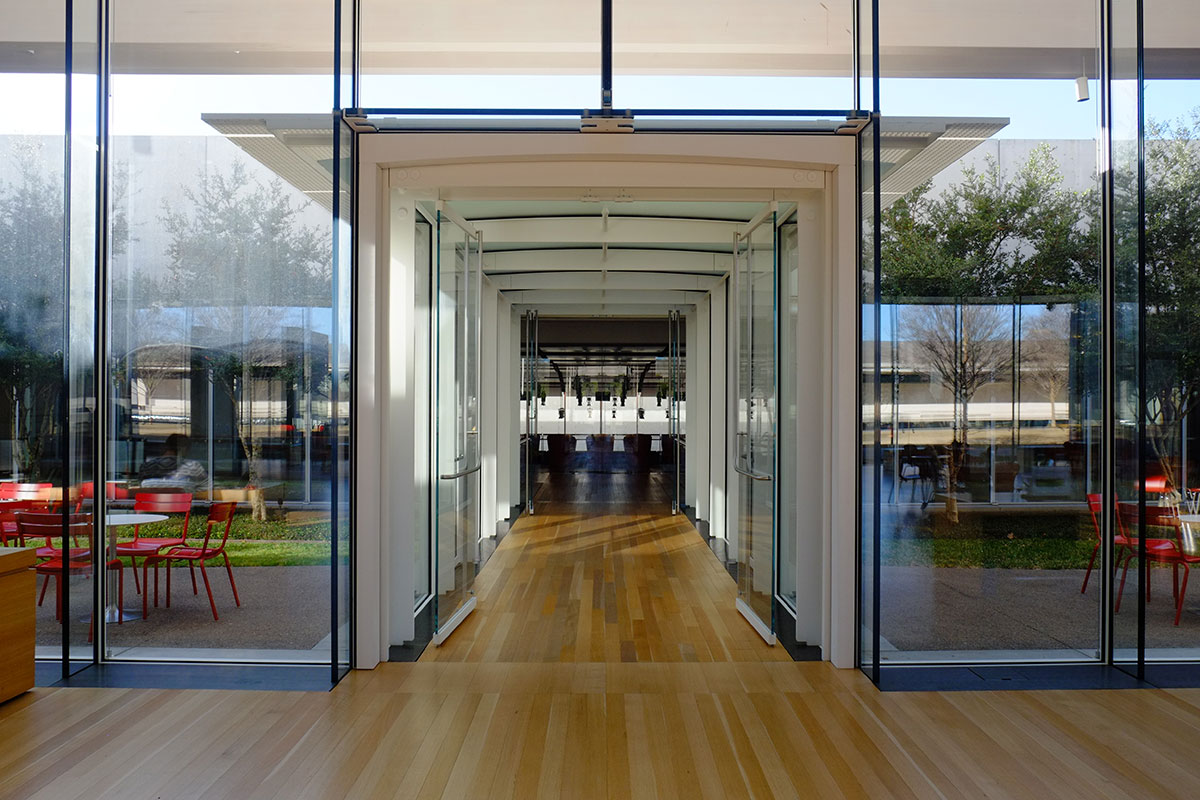
DSCF5005The architectural high point of Houston is definitely the Menil Collection.  After seeing so many Renzo Piano museums on this trip, it was instructive to visit his first in this country, from the mid 1980s.  The overwhelming impression is that of simplicity and clarity, which sometimes has gotten obscured in his more recent buildings by all the fancy parts.

I still remember being fascinated by this building when it was first published.  In a decade when major public works were either the last gasps of expressive late modernism, or the equally histrionic statements of Postmodernism in the ascendant, Piano designed a simple grey and white box.  The architect who, along with his then-partner Richard Rogers, had provoked the whole architectural world with the Pompidou, was now working in an almost classical mode, reminiscent of Mies and Kahn.  Museums want to be simple boxes with carefully-designed lighting, and Piano did this literally –  a grey box with white colonnades all around.

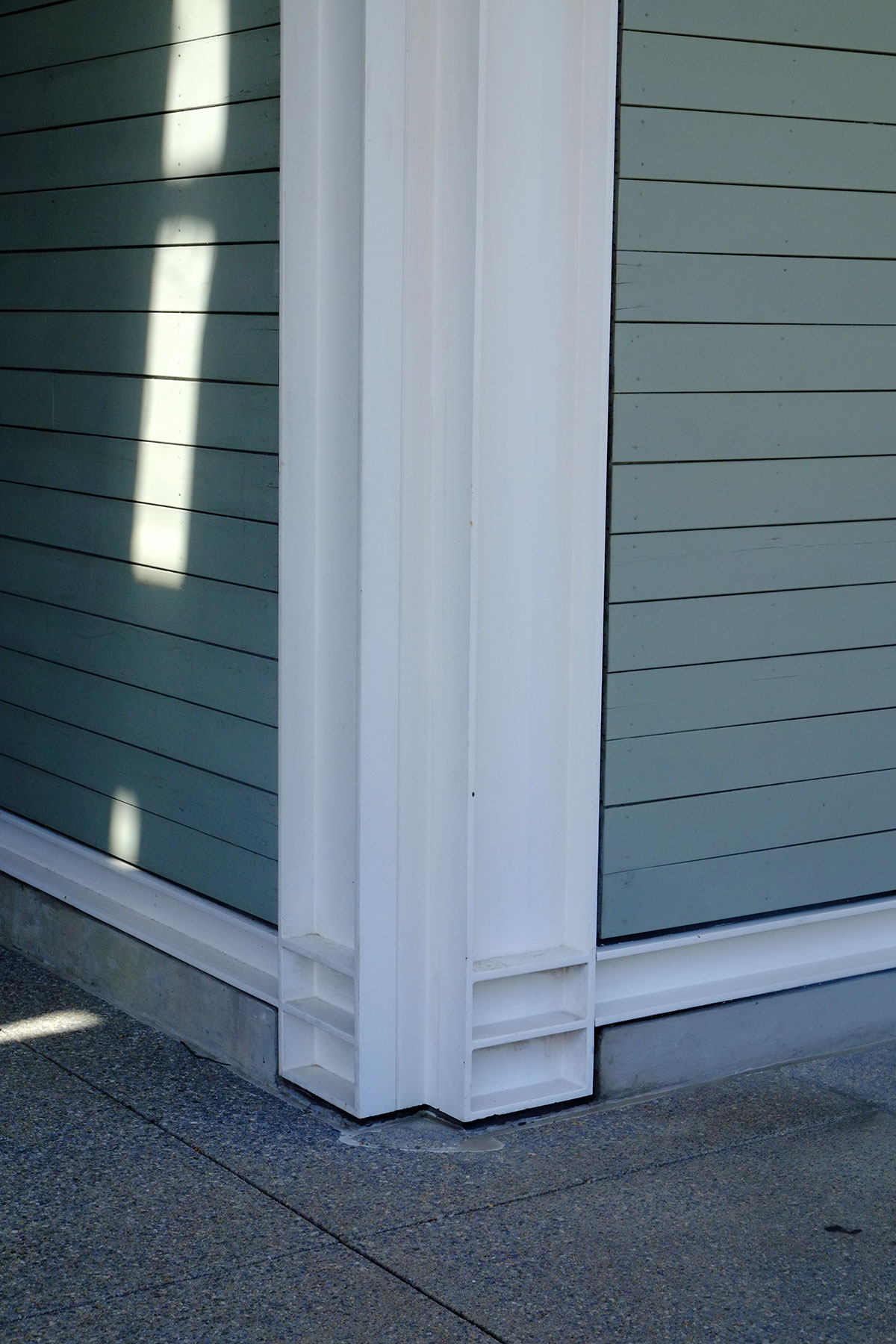
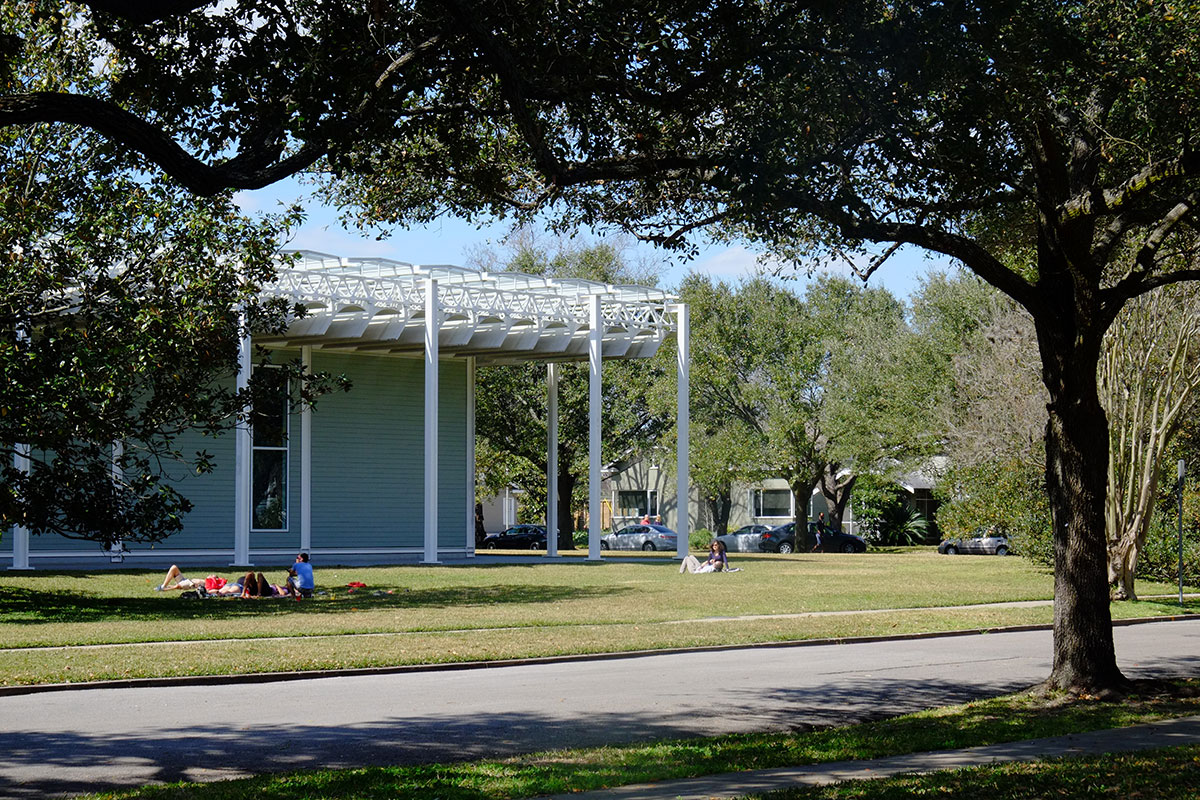
What most impressed me then and now is how this large building fits into a residential neighborhood of small bungalows.  The museum had been buying up those bungalows for a while, and then plunked this museum down in the middle of them, on a full-block site. They still own all the houses across the streets surrounding the museum, and they have been remodelled to house functions such as offices, the bookstore and a new cafe.  DSCF5040They are all painted the same shade of grey, and the landscaping of lawn and trees reinforces the residential scale.  I always go back to Howard Davis’s response when a student asked him how much a building had to resemble its surroundings in order to fit in, and Howard said “about 30%”.  A funny answer, which I think may be true (Howard now swears he said 50%).  The Menil resembles its context in color, material (wood siding), simple flat walls, individual windows instead of curtain walls, steel channel detailing which refers to wood trim,DSCF5012 porches, and a lawn.  Somehow this keeps the building from overwhelming everything around it.  I like it that he made a building that feels monumental yet accessible, a temple with a colonnade that also reads as a big wood-framed house.

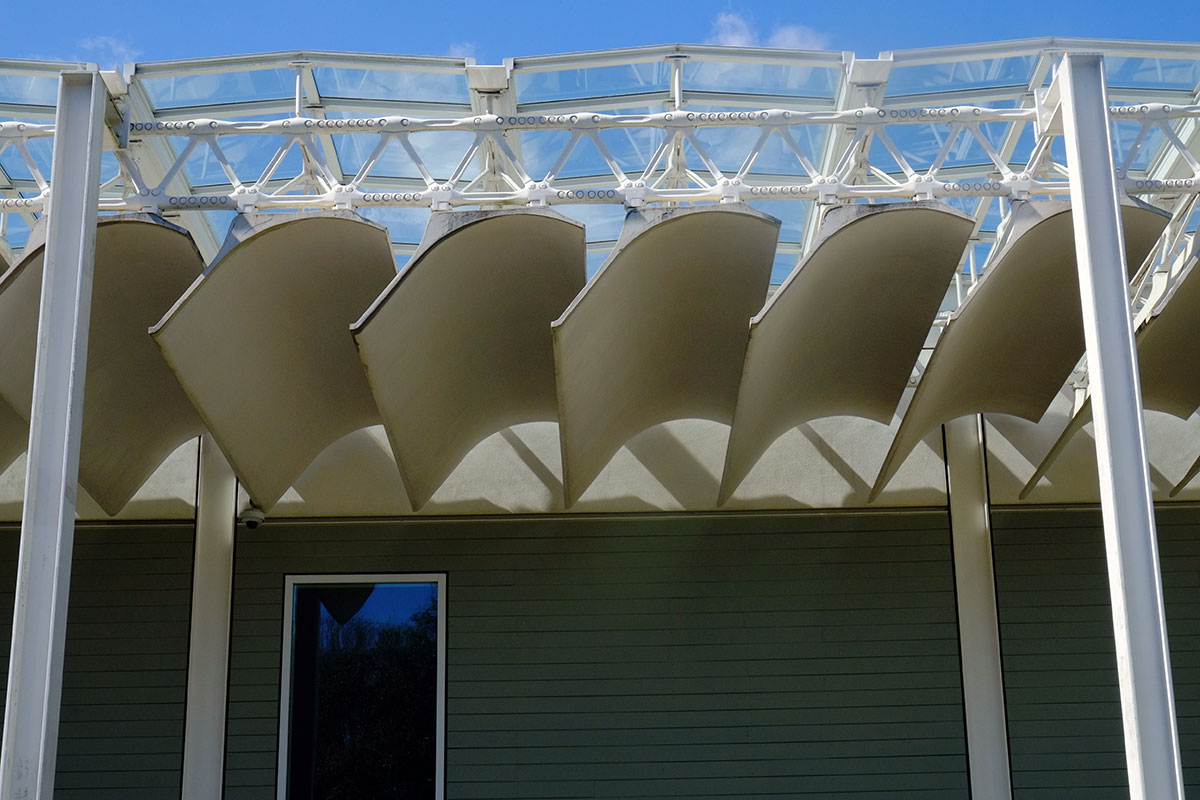
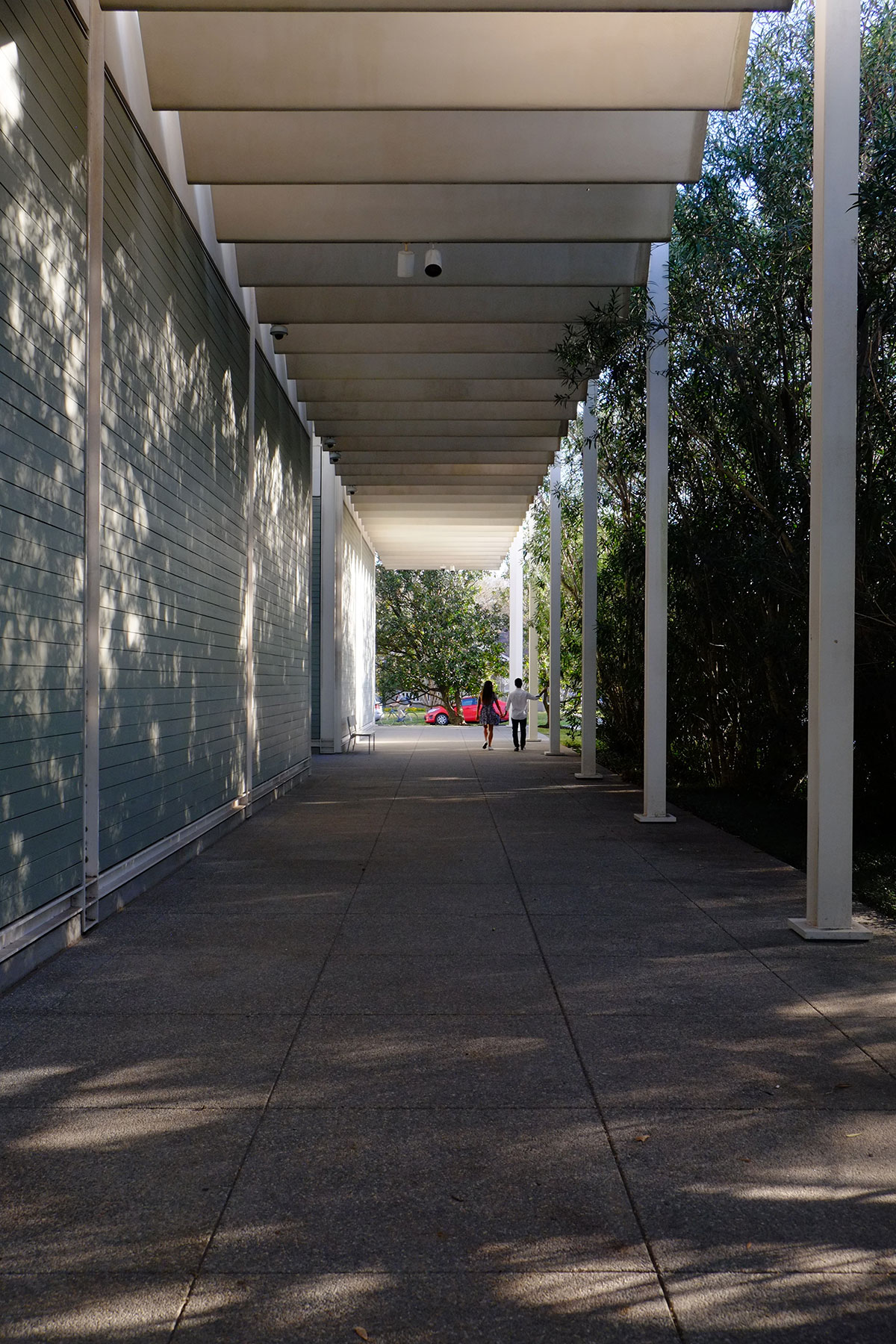
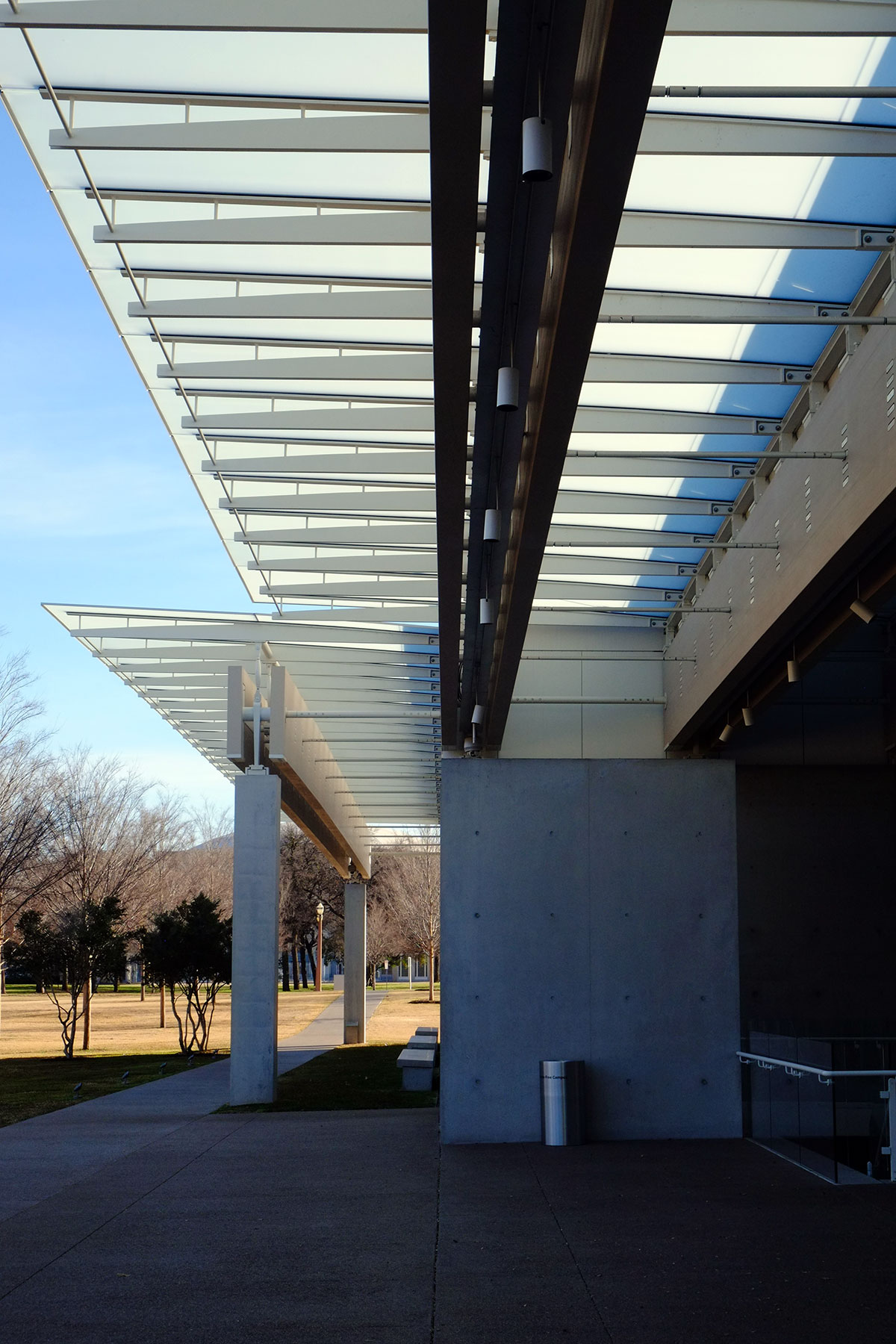
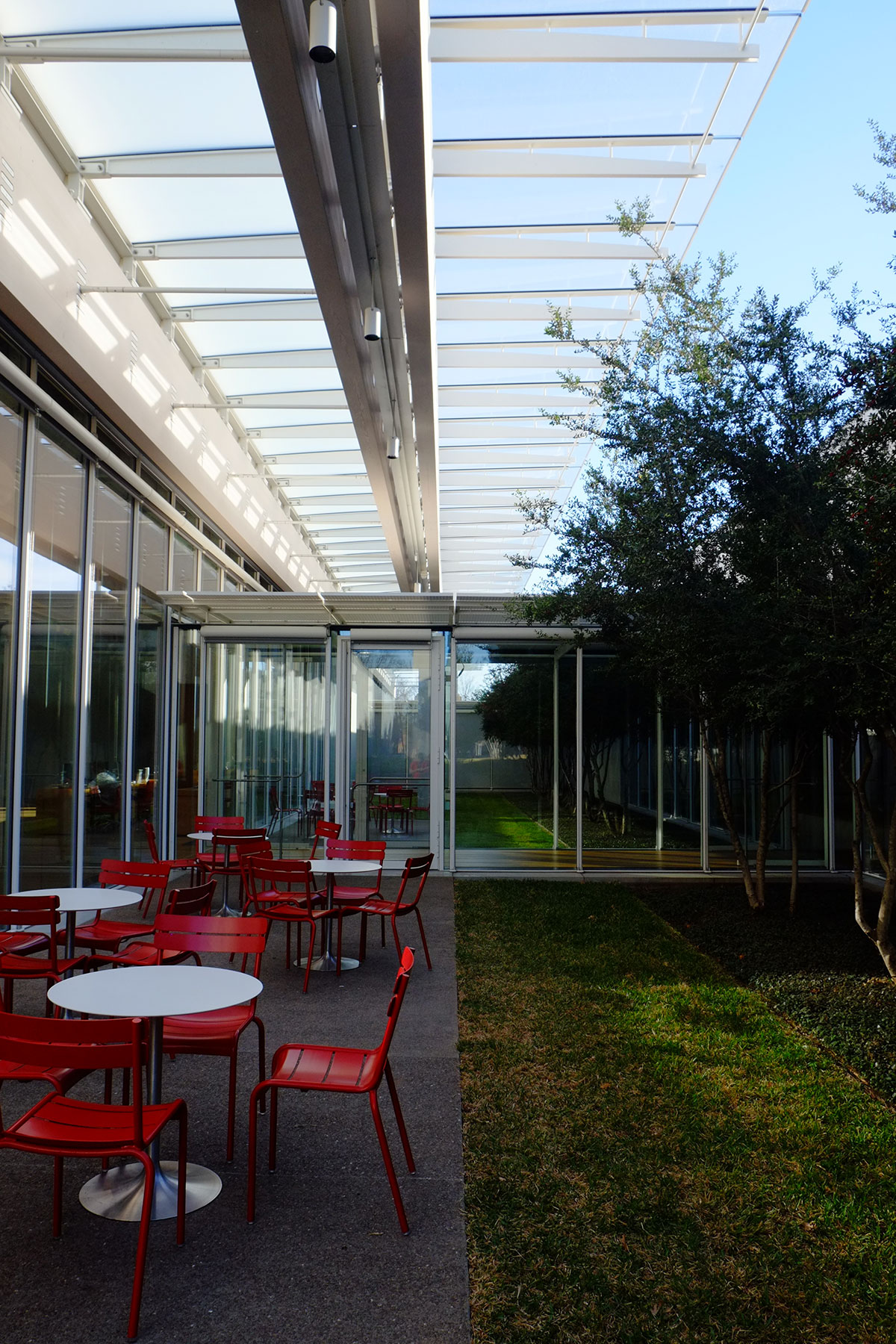
The colonnades surrounding the building show Piano’s first design for complex shading / daylighting devices.  They are beautiful as objects, and they work very well at bouncing and modulating the light.  DSCF5014

One could argue that this refined design isn’t necessary on the exterior – you just need a sunshade.  But this roof is carried into the interior, where it daylights the circulation spaces and many of the galleries.  The use of them on the exterior is a way to tie the building together, and state the key move of the building where all can see it.  (And without them, it would just be big box.)  They also create a gracious walkway around the building, a very pleasant place to stroll. The scale is intentionally deceptive – using wood cladding and a white porch makes one think the building is residential in scale, but the bays are actually very wide, and the columns are over two stories tall.  Piano reinvents the colossal order.  DSCF5075

People were using the grounds as a park – reading in the grass, letting little kids play – another way in which the building is an amenity in the neighborhood.DSCF5048

So the big problem with this post is that you can’t take pictures inside the museum.  Too bad, as it is worth looking at.  The plan is absurdly simple – a cross axis for entry in the middle of the two long sides, and a longitudinal hallway down the center which ends in a big window in a recess at each end.  DSCF5011

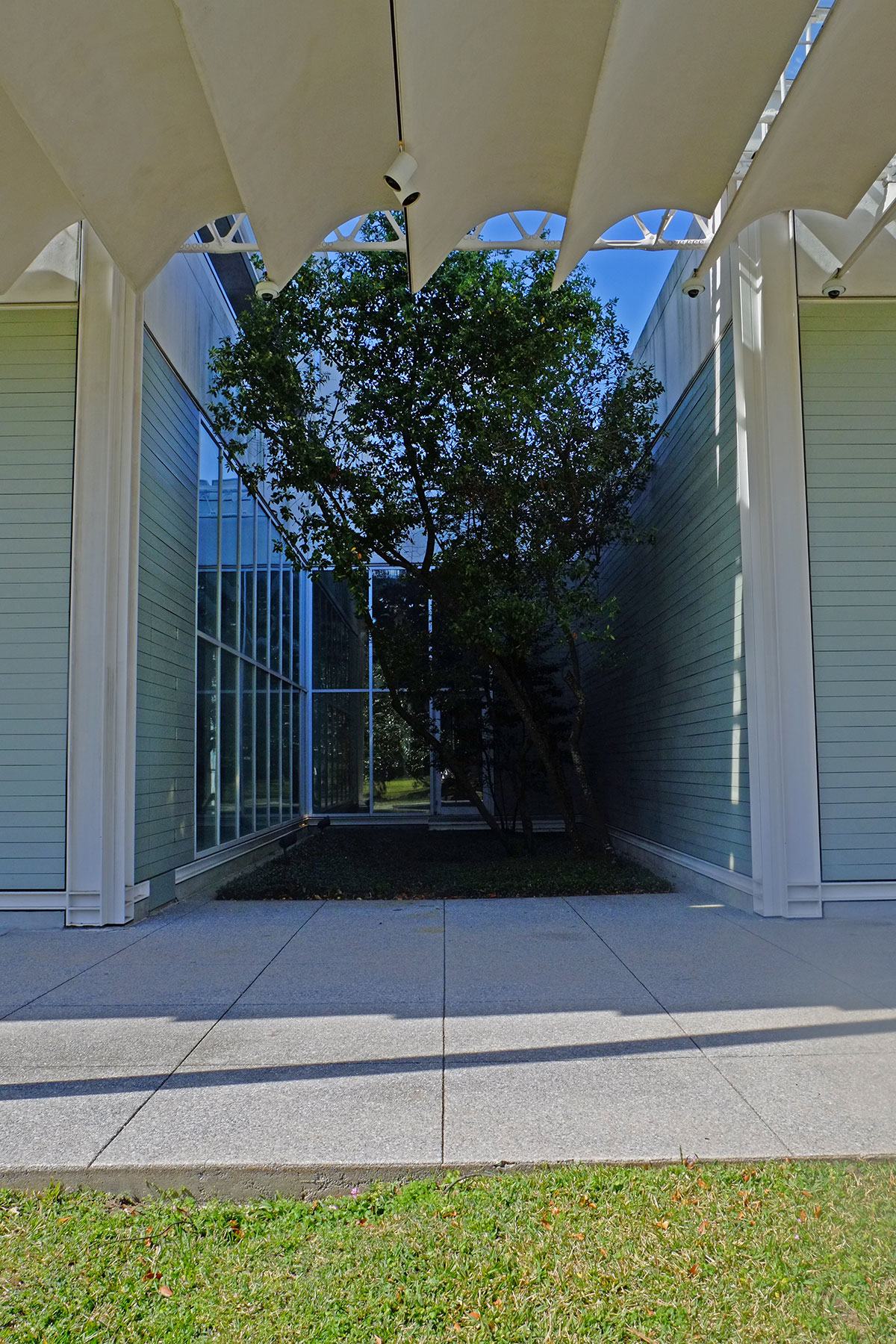
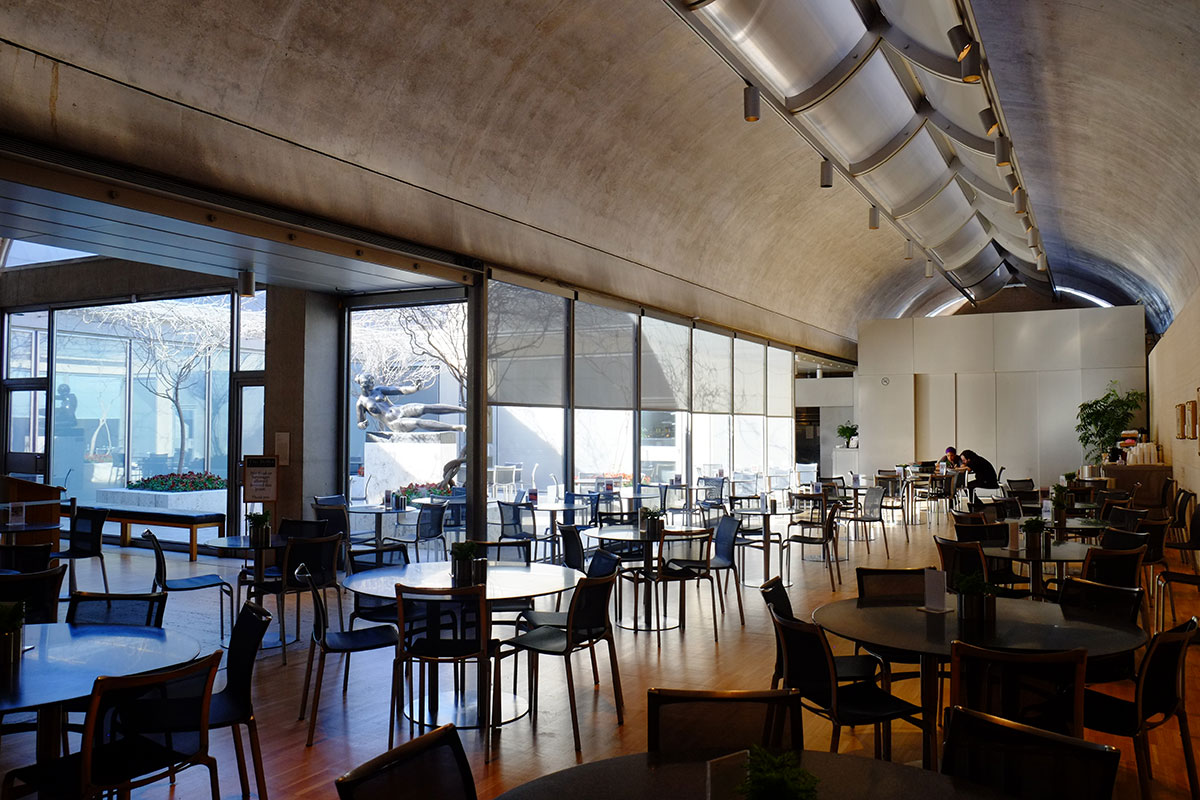
The galleries are to either side of the hallway, and are emphatically separated from it – no open plan here.  it succeeds because of the light – the indirect light from the monitors above, and the big windows at the ends.  The galleries themselves can be rearranged within this modular system, and the daylighting tuned to meet the needs of the current exhibit.  The most interesting spaces architecturally were the galleries around an internal courtyard, which was very similar to Kahn’s Kimbell.  A few bays of the grid are simply left open, the light comes down from above into a planted court, and the galleries around it have glazed walls.  (These galleries house sculpture and other works which can tolerate these light levels.)  Amusingly, this courtyard isn’t in the middle of the building, but is directly behind one of the exterior walls – you have to look hard on the exterior to see any indication of it.

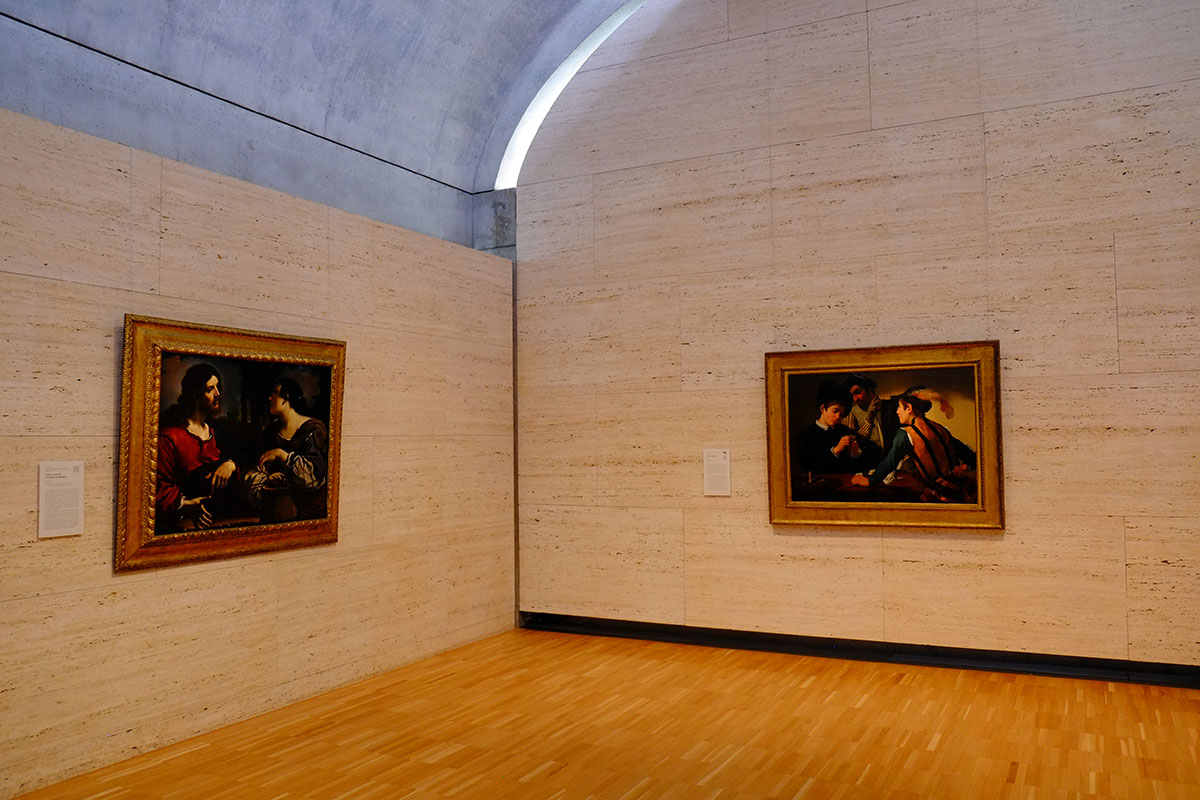
As at the Kimbell, the quality of the collection is a distraction from the architecture.  It is a wide-ranging and excellent museum in many ways, but the Surrealist collection is astonishing.  After walking through it all, I was having a hard time remembering any Surrealist masterpieces that weren’t here.  Our favorite part was the room where they showed objects of tribal and folk art with had influenced the Surrealists.  In any other museum, this work would be displayed in a scholarly manner, arranged according to place and time of origin and annotated with long, detailed labels.  But the Surrealists didn’t really care about all that, they just thought these were really cool things that they found visually and conceptually appealing.  So they are all mixed up in the gallery, with wildly varied objects juxtaposed and crammed together.  It is fun, and it helps you understand their artistic processes.

The Menil has a few other buildings – a lovely, small Piano building housing a permanent installation of Cy Twombly paintings, and one with a Dan Flavin installation.  It has also spun off two other buildings in the district – one that used to house Byzantine frescoes (long story), and the Rothko Chapel (a building which I found to be as uninteresting as the Rothkos;  I’m a philistine).    I think this little bit of Houston is better than all the rest of Houston put together.

DSCF5050The other great thing about visiting the Menil Collection was seeing my old friend and classmate Sheryl Kolasinski, who is the deputy director and COO.  Sheryl majored in art history at Brown, and then we attended grad school at Columbia together, where we formed the Ivy League art history cabal.  She worked as an architect for a while, then joined the NYC government, where she eventually ended up as head of design and construction for all the city’s cultural institutions.  She moved on to the Smithsonian for about 20 years, where she was deputy director for operations, and oversaw $1.5 billion in construction.  She didn’t come out and say it, but I have to guess she got a little burnt out by the size of the operation (overseeing 1900 employees) and the range of issues she had to deal with, which was getting pretty far away from architecture.  So she moved to a much smaller institution, where she can have a really direct effect upon its future,  Sheryl is in charge of implementing the Menil’s masterplan, the next phase of which is a 30,000 sf drawing center for works on paper.

We had a great, short visit, catching up on the past 30 years or so, and talking about all the different directions in which an architectural career can veer.  I’ve always thought that architects tend to have a breadth of vision and a skill set that’s often way out of proportion to the scale of projects they are called upon to administer, and it was wonderful to see how Sheryl’s talents have been recognized and appreciated, allowing her to accomplish a lot in an important context.  And from now on, when someone says something snide about what you can do with an art history degree, I’ll just say that you could do something like manage the Smithsonian.

Houston

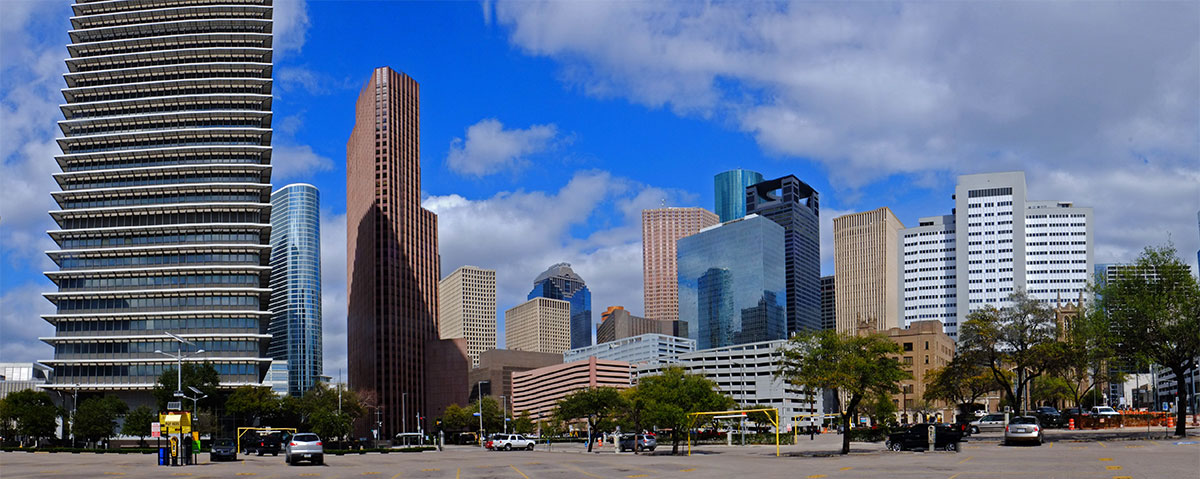
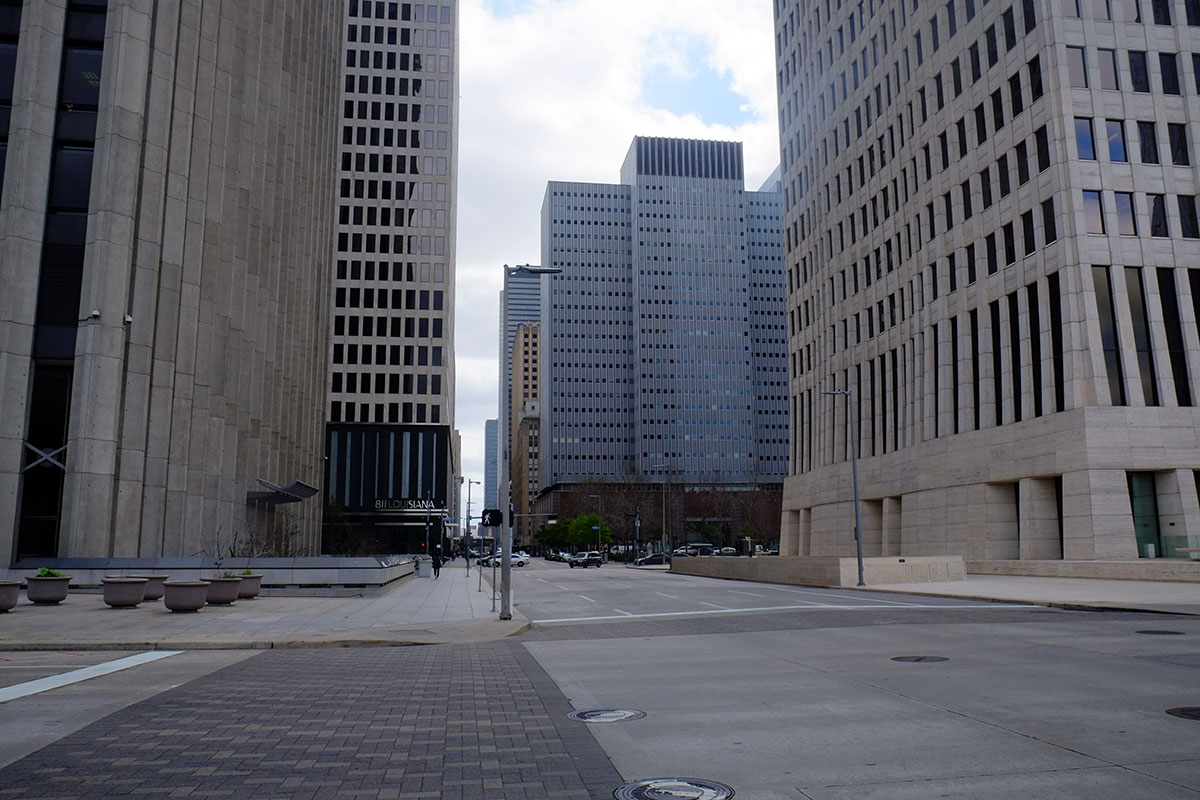
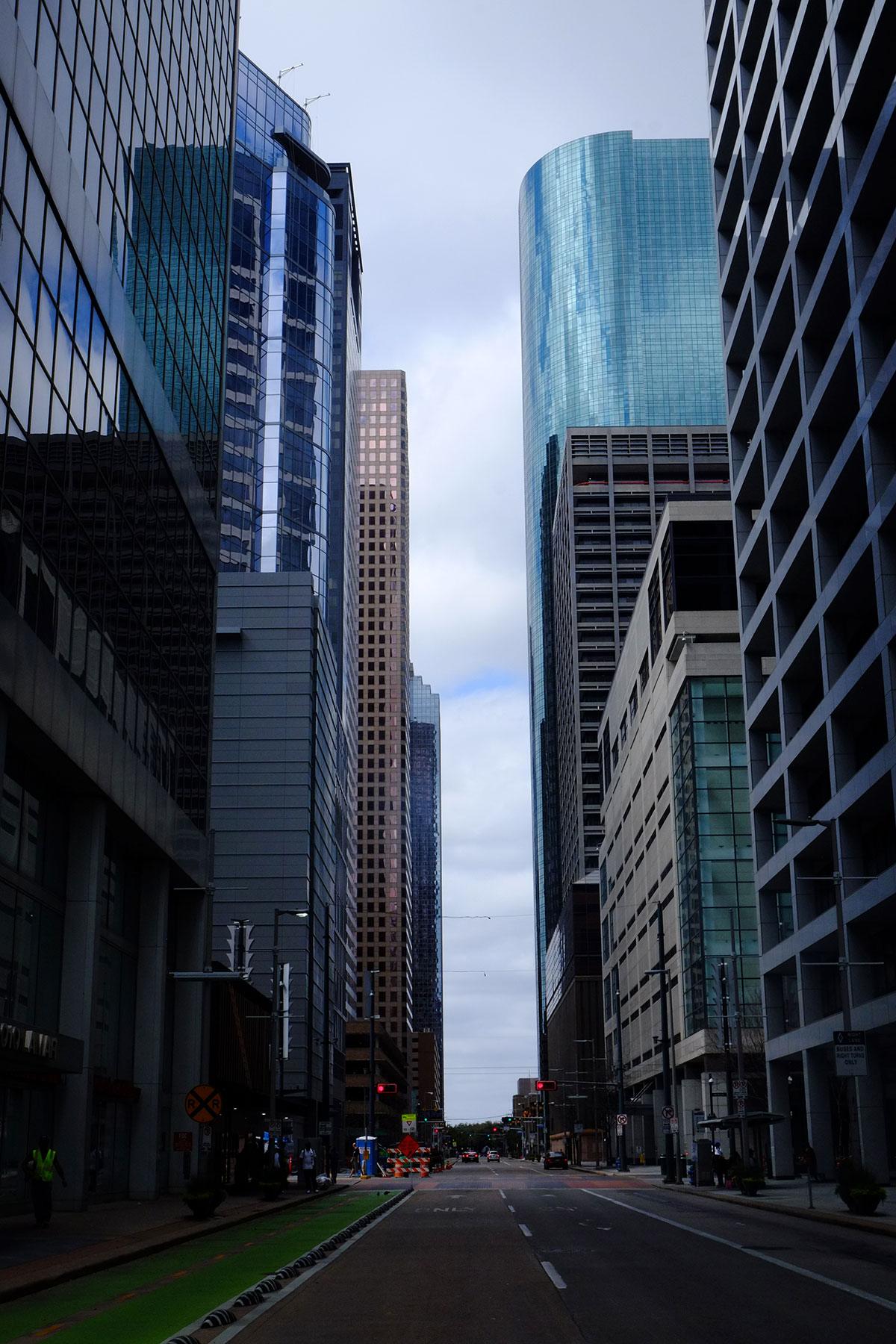
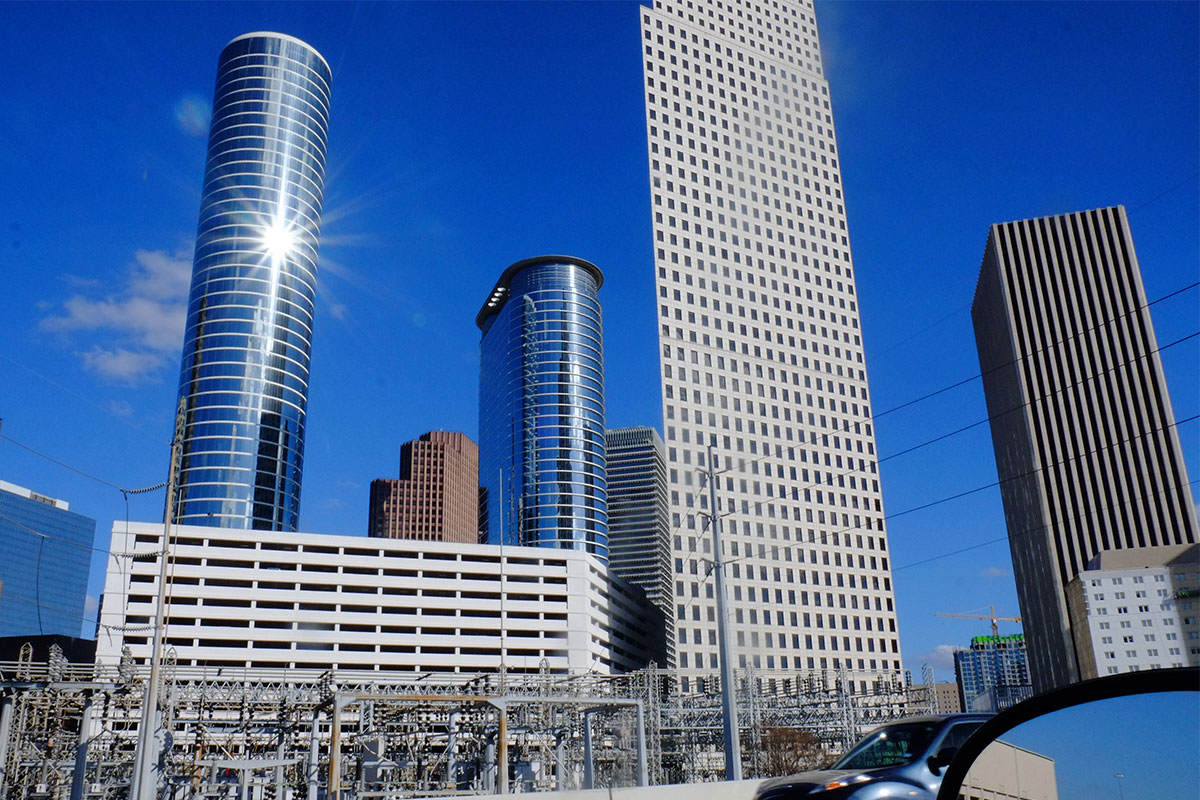
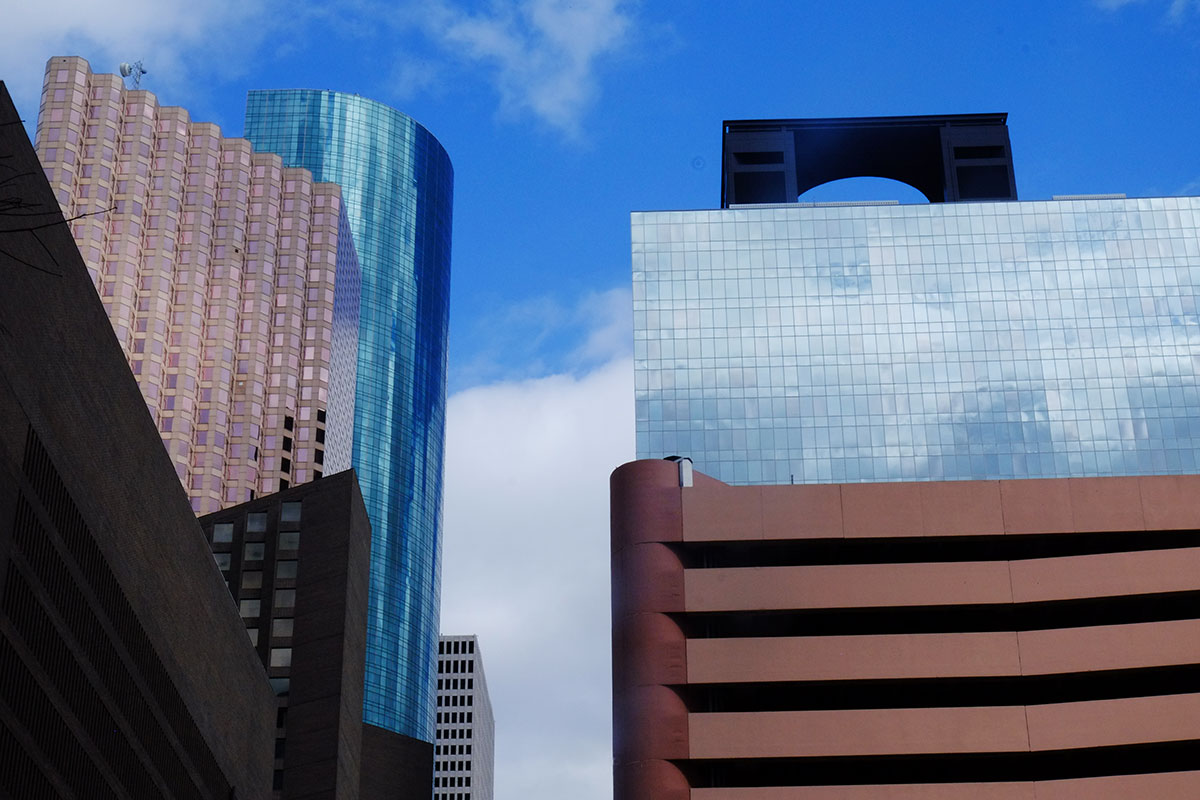
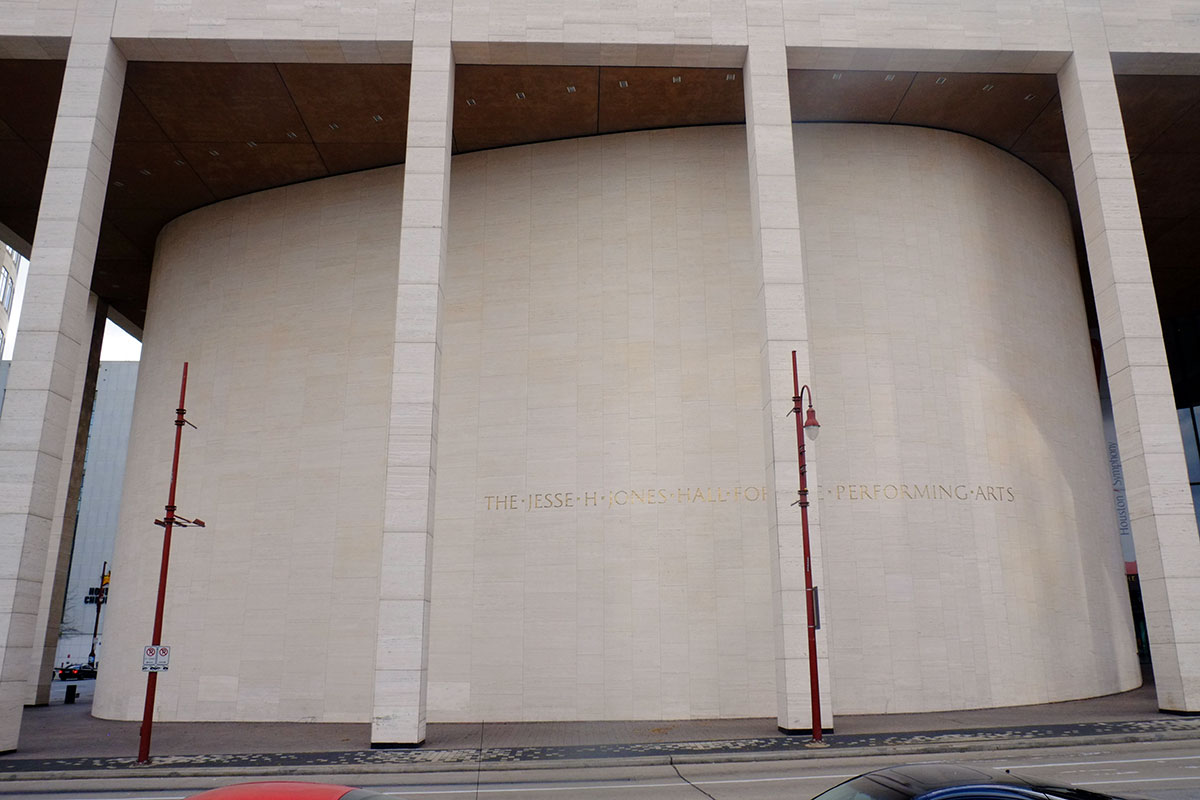
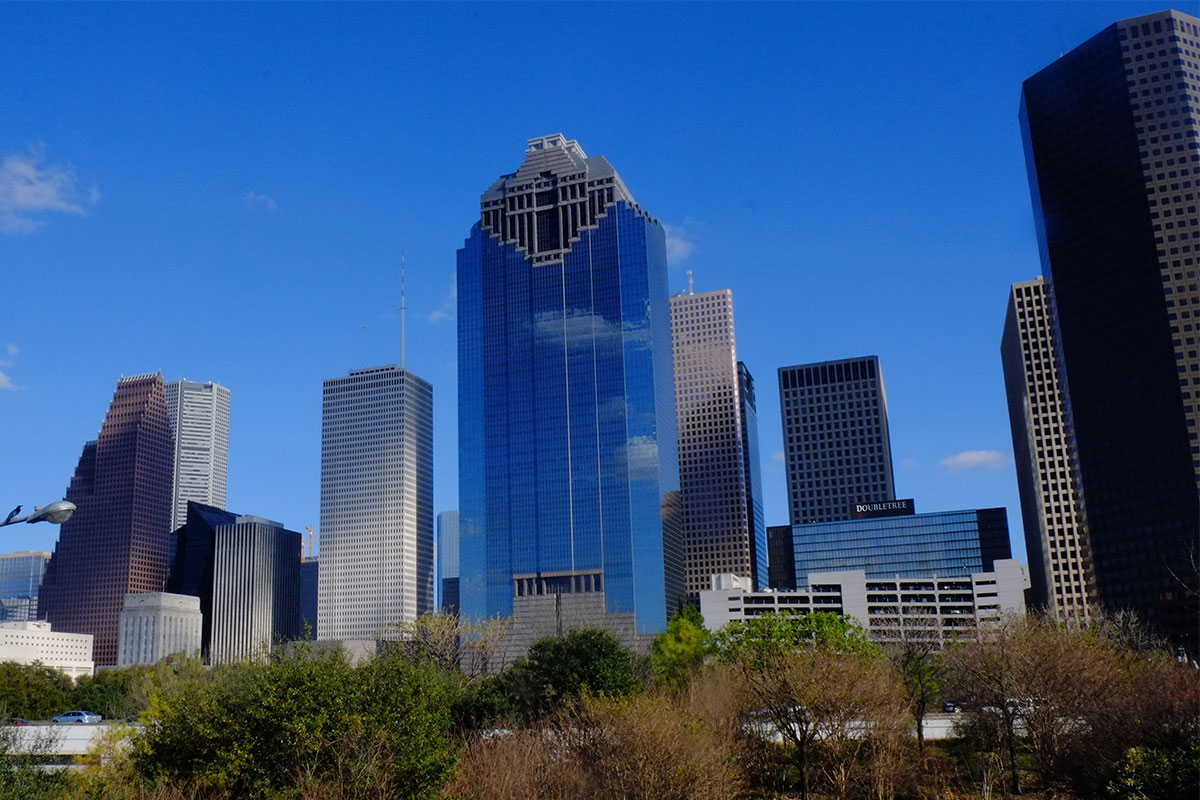
DSCF5096Every incorrect preconception I had about Dallas turned out to be true about Houston.  It sprawls further than Phoenix.  It has the most inhumanly-scaled and corporatized downtown I’ve ever seen.  If it had a decent, older part of downtown, either I couldn’t find it, or it was knocked down to build the current crop of hellish corporate headquarters.  I think it is my second least favorite American city, after Phoenix.

Houston is the largest city in the country without zoning, and I was curious to see how this affects the form of the city.  I think it actually isn’t that important.  One of my suspicions about zoning is that it merely codifies current practices.  We have perfected how to build placeless sprawl, and Houston follows these precepts – the conventions are so strong it doesn’t need explicit rules.  I couldn’t tell the difference between the sprawly parts of Houston, Dallas, Washington DC, or Atlanta.  It’s just that Houston has more of it – about 50 miles across in each direction.

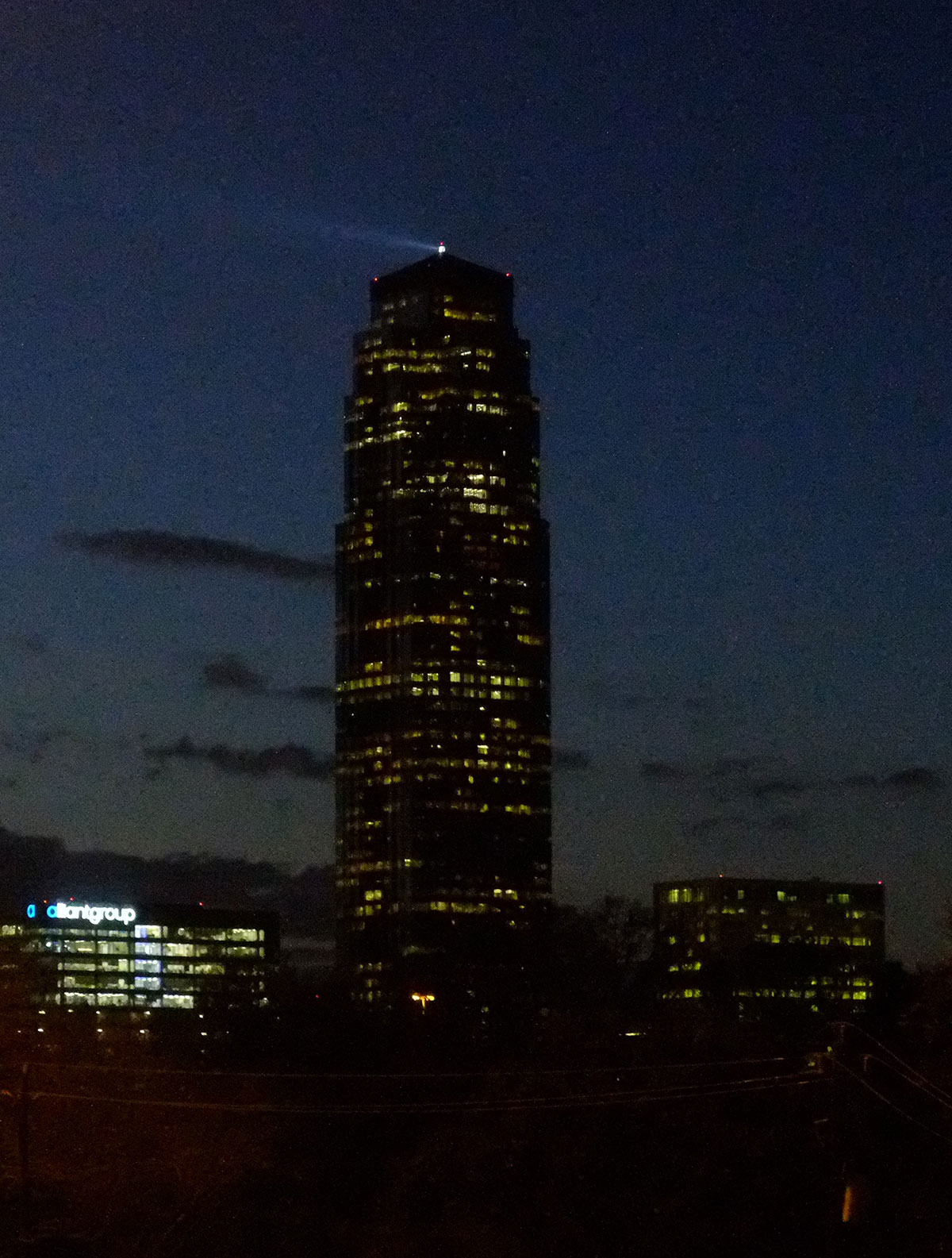
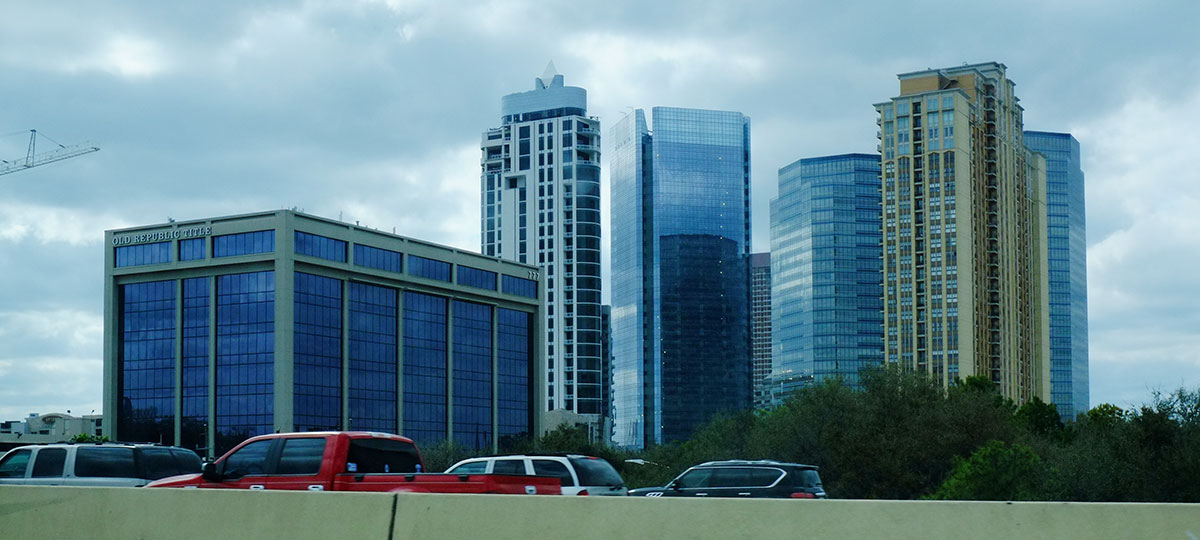
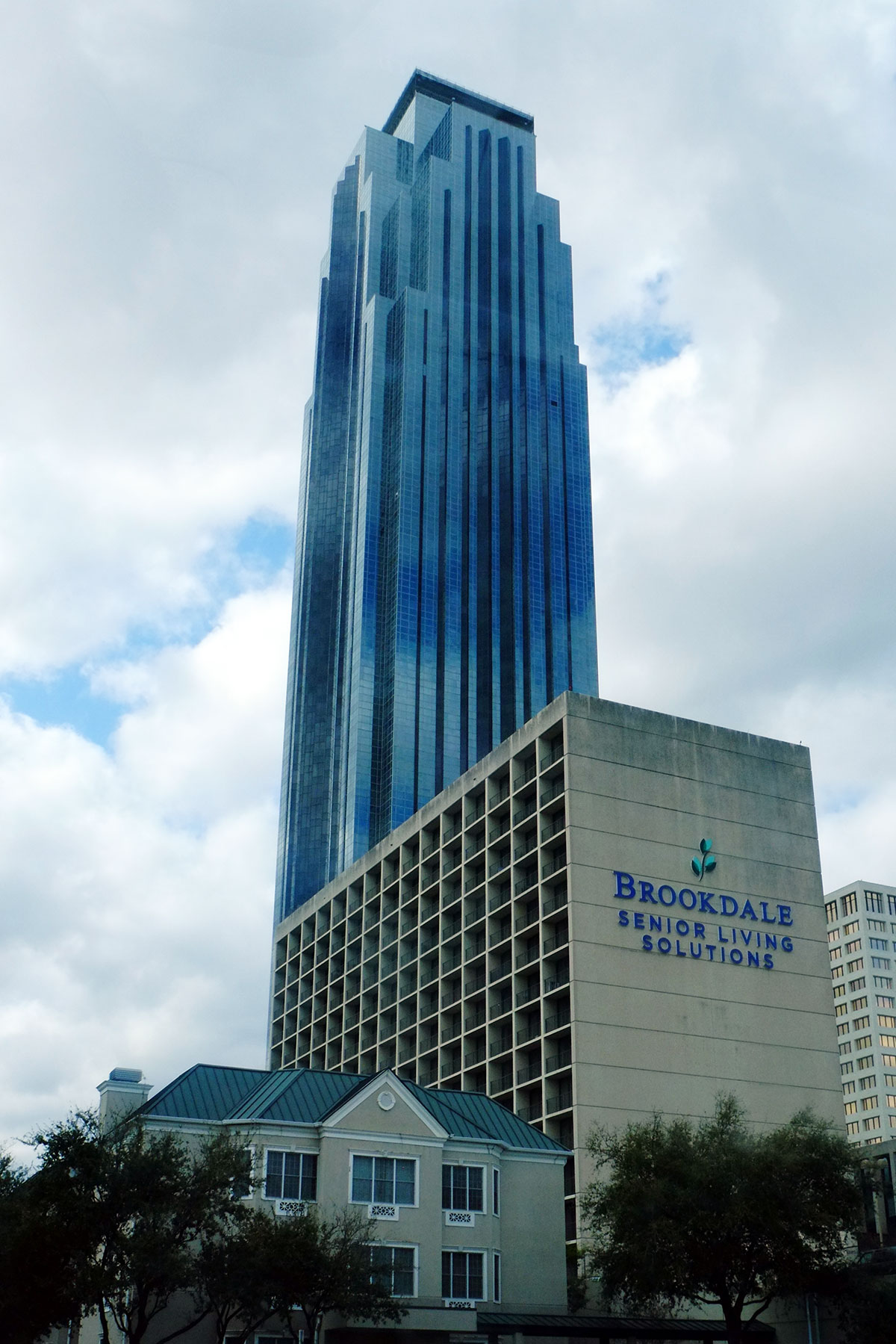
The one noticeable difference is that the Edge City centers out there in the sprawl are bigger, and the buildings at their centers are much bigger than anywhere else in the country.  DSCF5086Whereas much commercial development in Edge City is subject to height restrictions, in Houston it is not, and so skyscrapers that would be considered large in downtowns happen out there on the edge.  This is probably a good thing.  Many large metro areas are developing secondary centers now – the Puget Sound region has about eight, Portland has consciously designated Regional Centers.  So if Houston ever begins to redevelop a sense of urbanity in these places, it will have some serious density at those centers, versus the midrise buildings in most of Edge City elsewhere. DSCF5202

This is the Building-Formerly-Known-as-Transco, the biggest.  (I don’t even want to guess what “Senior Living Solutions” entail.)  DSCF5197

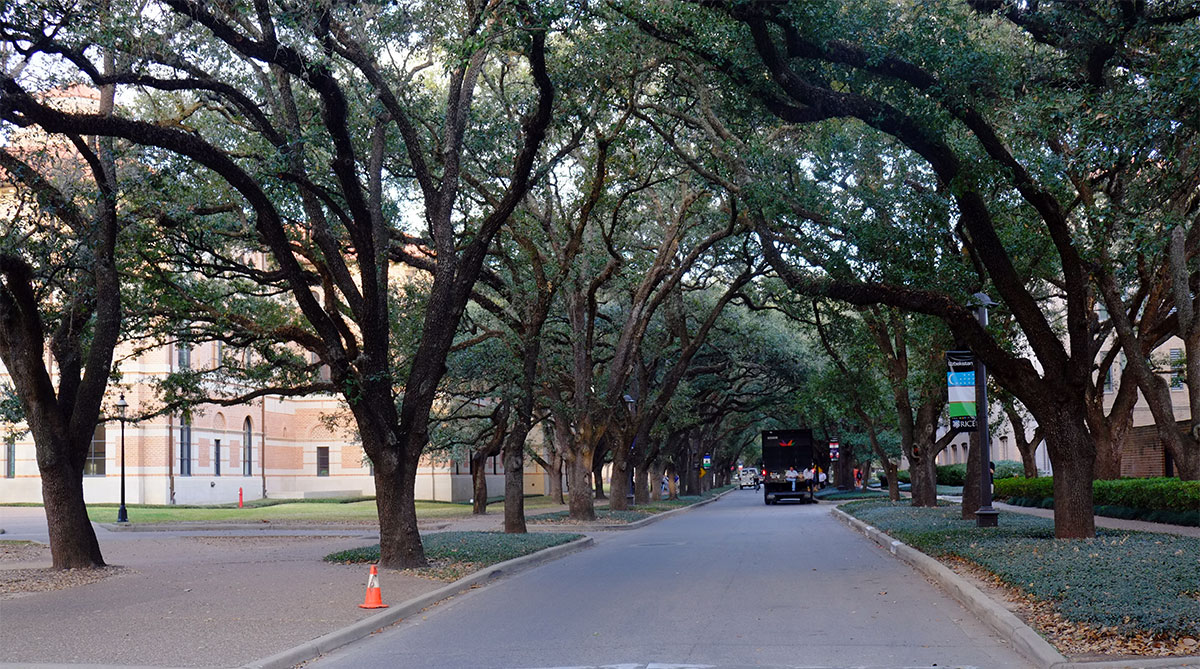
There are certainly some nice parts of Houston – we saw some pleasant residential areas, the Menil Collection is a wonderful complex (to be blogged separately), and Rice University is beautiful.  DSCF5079Unfortunately, this is all I can post about Rice.  Houston is a city where you have to drive, and it is really not possible to park anywhere near Rice unless you have a permit or are willing to take out a second mortgage.  So we just drove through it a few times.  I don’t blame them for restricting cars, but I regret not being able to see more of the campus.

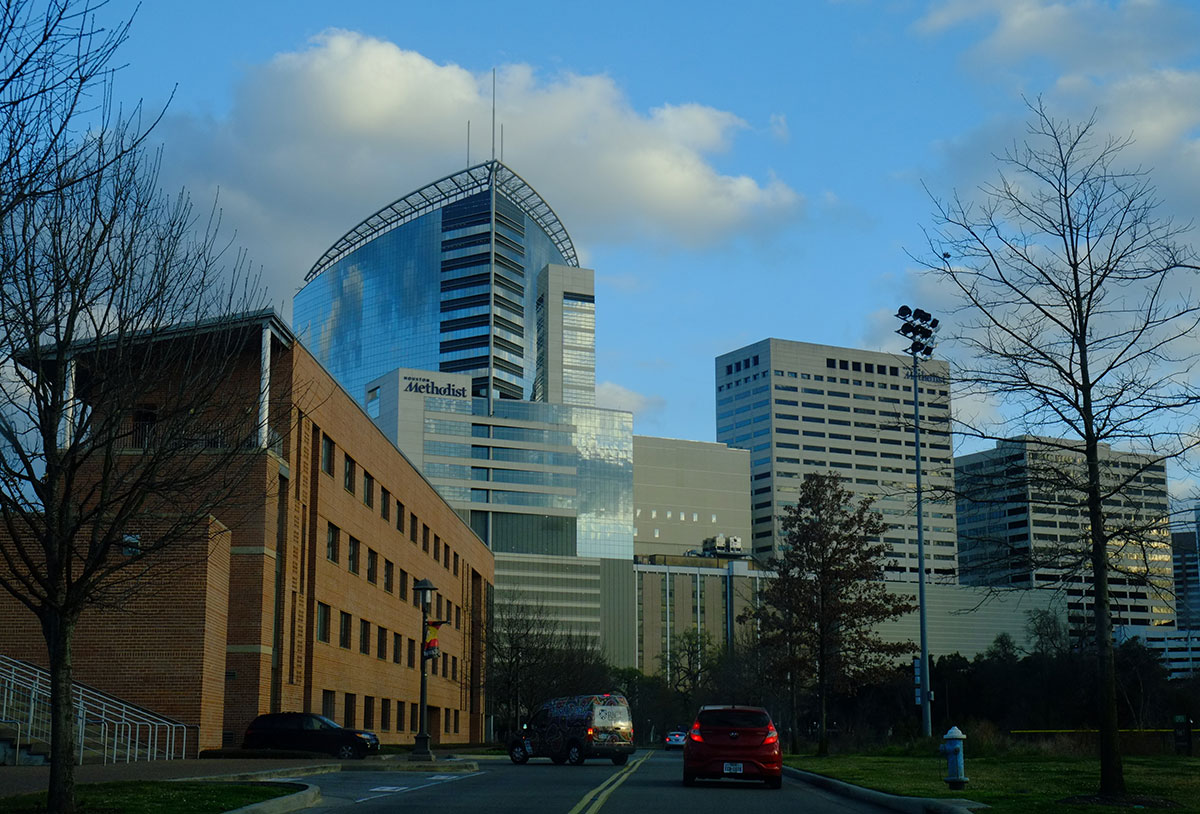
Near Rice is another amazing center, the Texas Medical Center, which reportedly has 54 different institutions.  DSCF5081I have seen some pretty big medical districts in other cities, but nothing like this.  It is the hospital as city.  Not being a patient, I don’t know whether having a medical complex organized on city streets in separate buildings increase or decreases the dysfunctionality of wayfinding here – it’s like the O’Hare vs. JFK paradigms.  Maybe it’s better being able to drive from building to building, rather than having to walk down endless hallways.

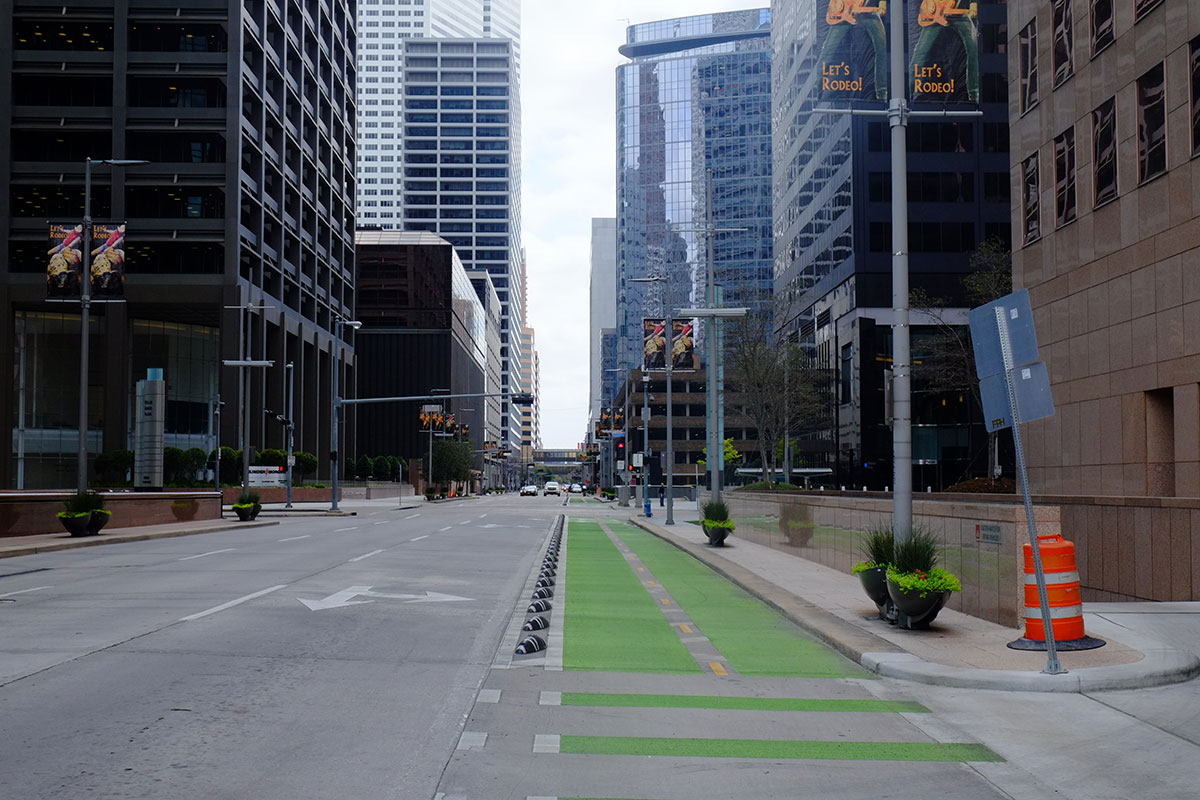
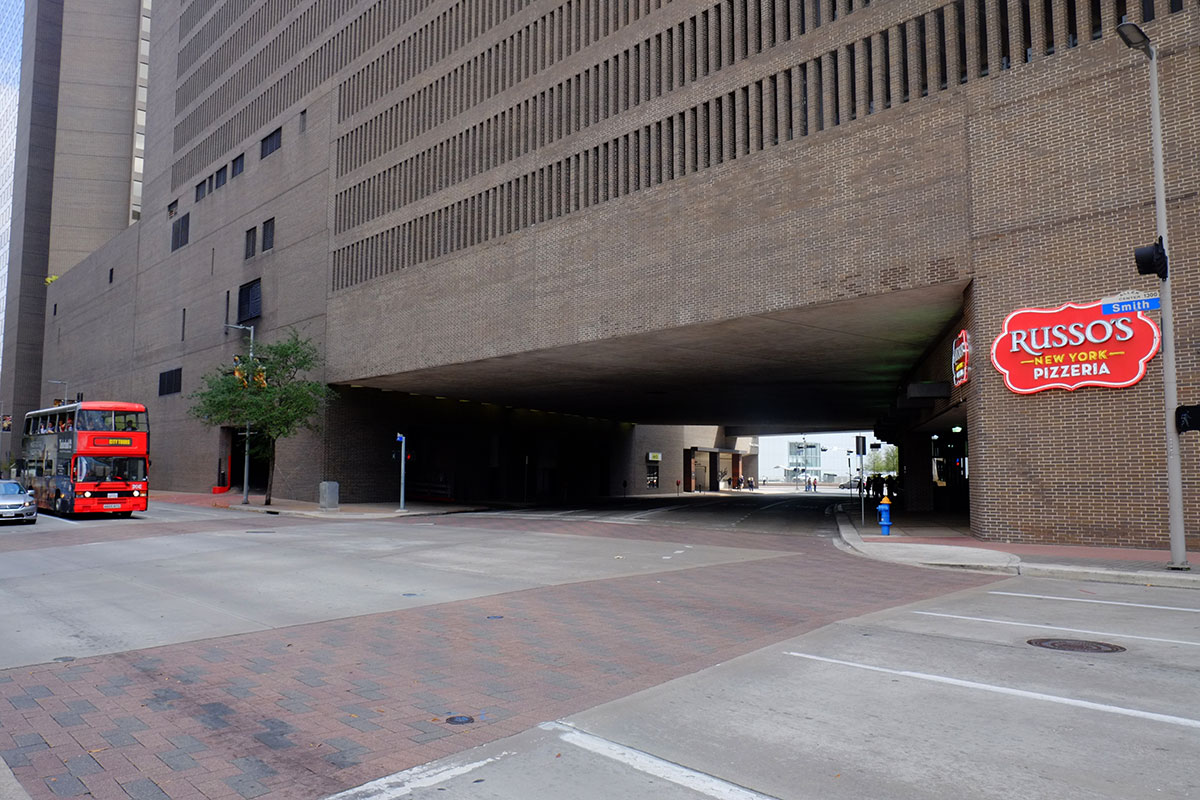
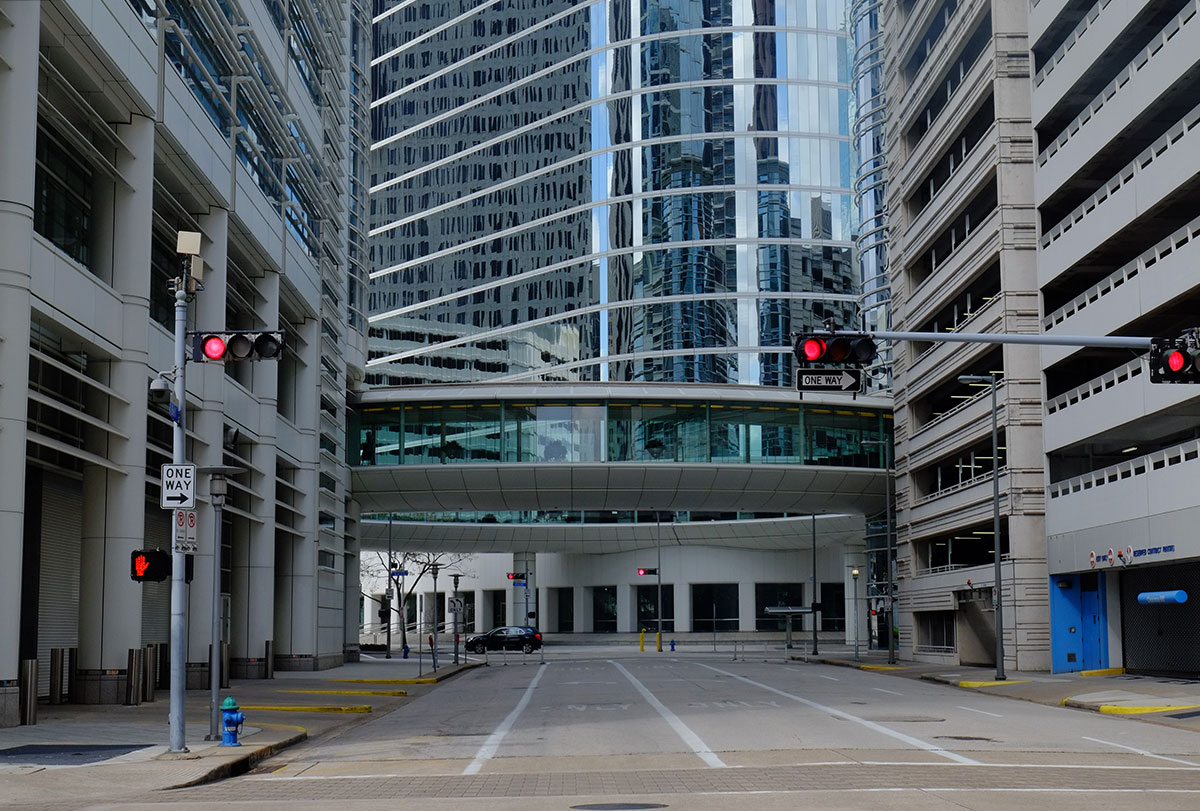
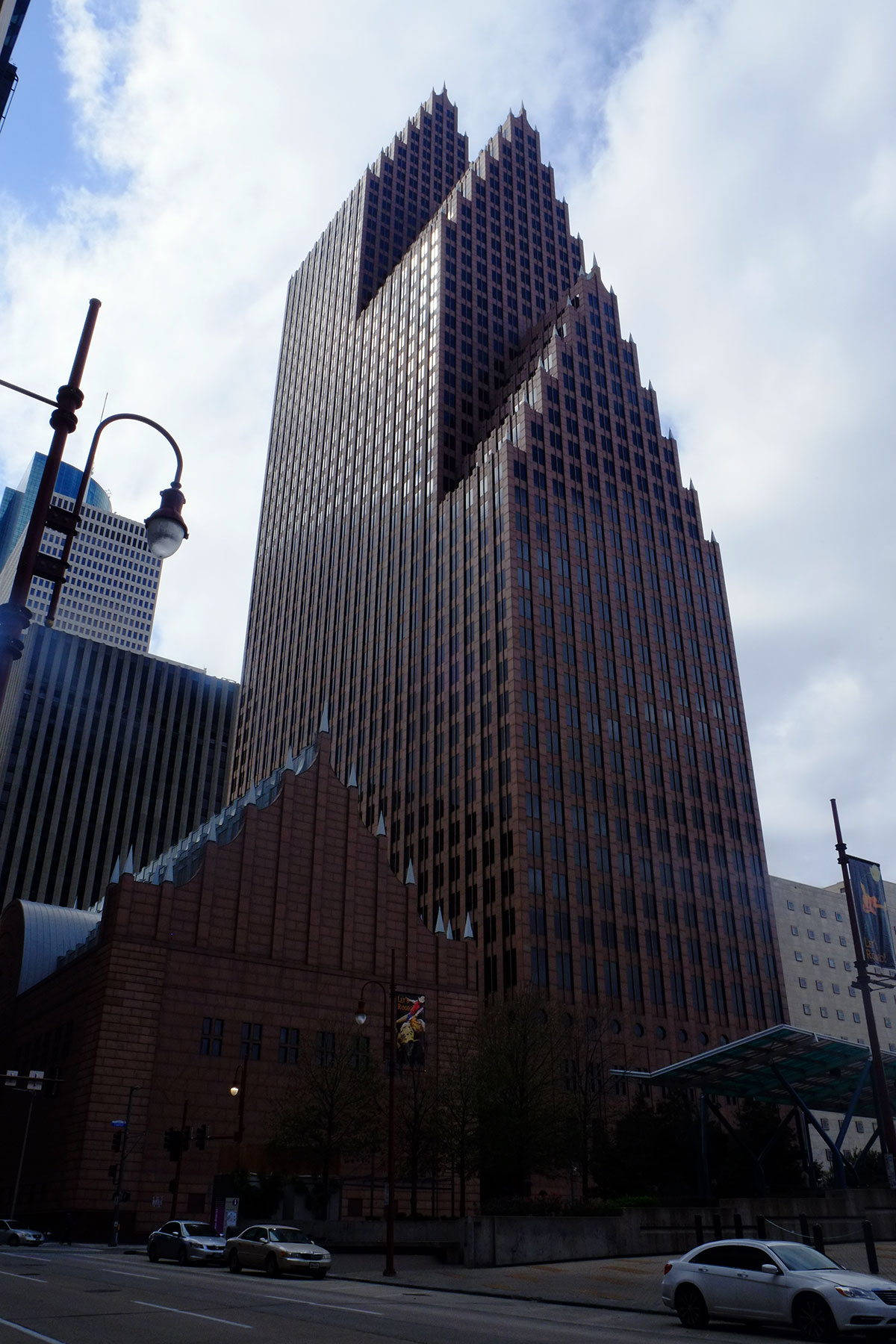
We took a good look at the downtown, and were appalled.  Granted, we were seeing it on a weekend, when it didn’t have surging crowds of urbanites on the sidewalks, but I get the feeling that still doesn’t happen.  Why would you walk here?  The streets are the most car-oriented, overscaled and boring I have ever seen, and that pattern goes on and on.  Many blocks are given over to corporate headquarters, with desolate plazas and parking garage ramps occupying the periphery.  DSCF5113

DSCF5124

DSCF5187

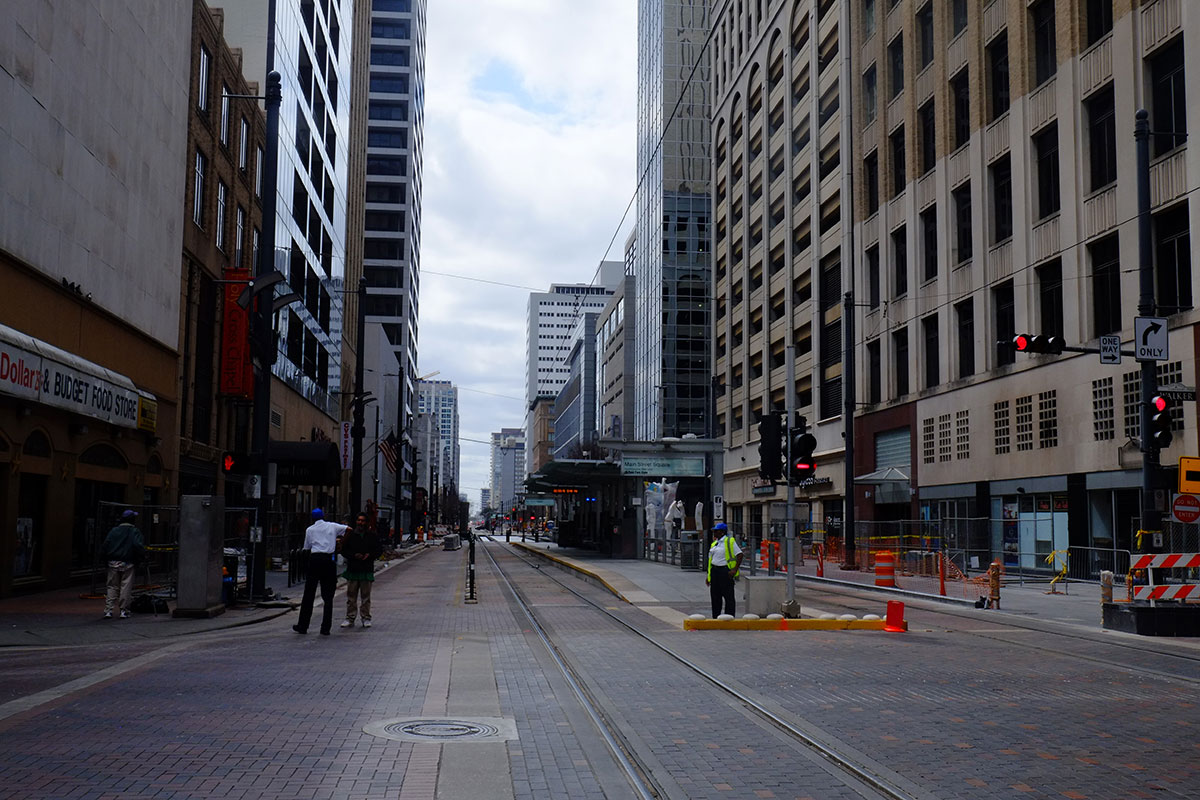
There are almost no stores, there is no smaller scale, there is nothing for the pedestrian to do but hurry to the end of the block.  The one exception seems to be Main Street, which has stores, a median with a light rail track (running in the middle of a lagoon) and some attempts at design of the public realm.  DSCF5182

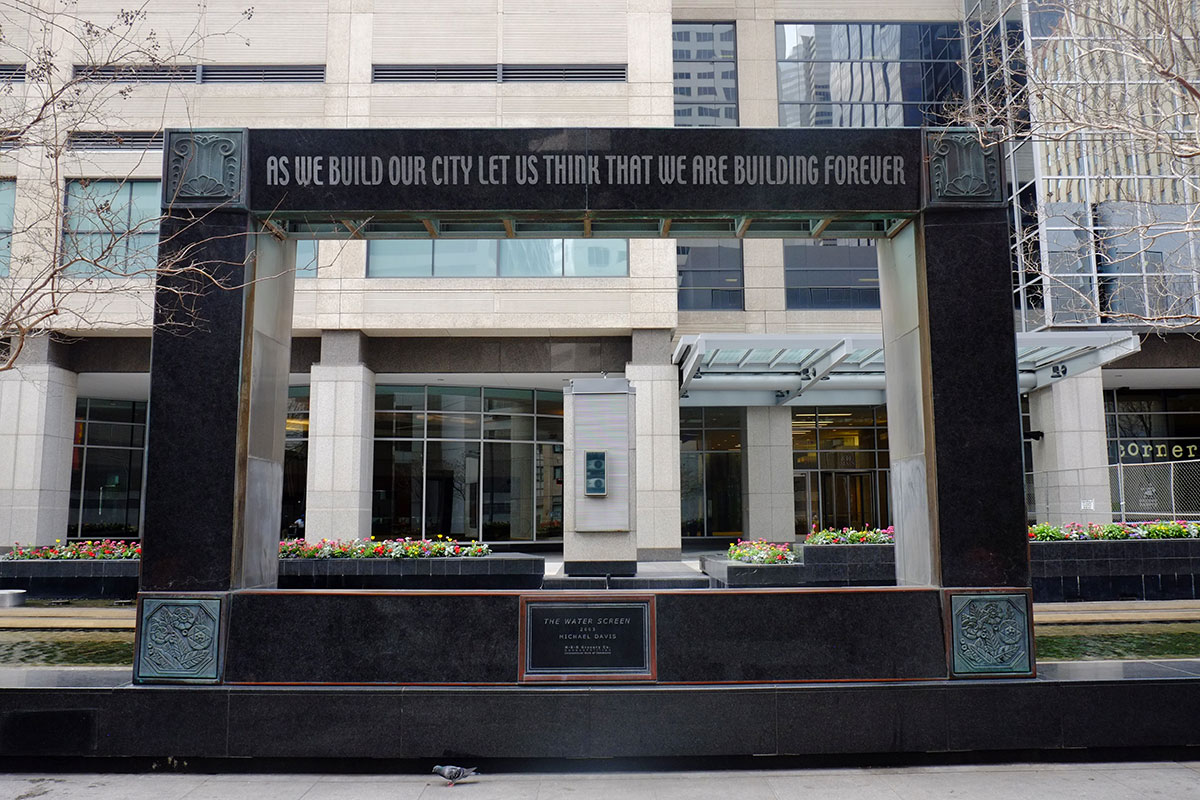
It ain’t great, but it’s as good as it gets.  Unfortunately, we came across this monument there: DSCF5186We can only hope that no one took this seriously, and that this too will someday pass.

We came across what must be the biggest parking garage in the world, blocks-long, ironically juxtaposed with iconic elements from real cities.  DSCF5107

The shiny street of parking garage entries:DSCF5101

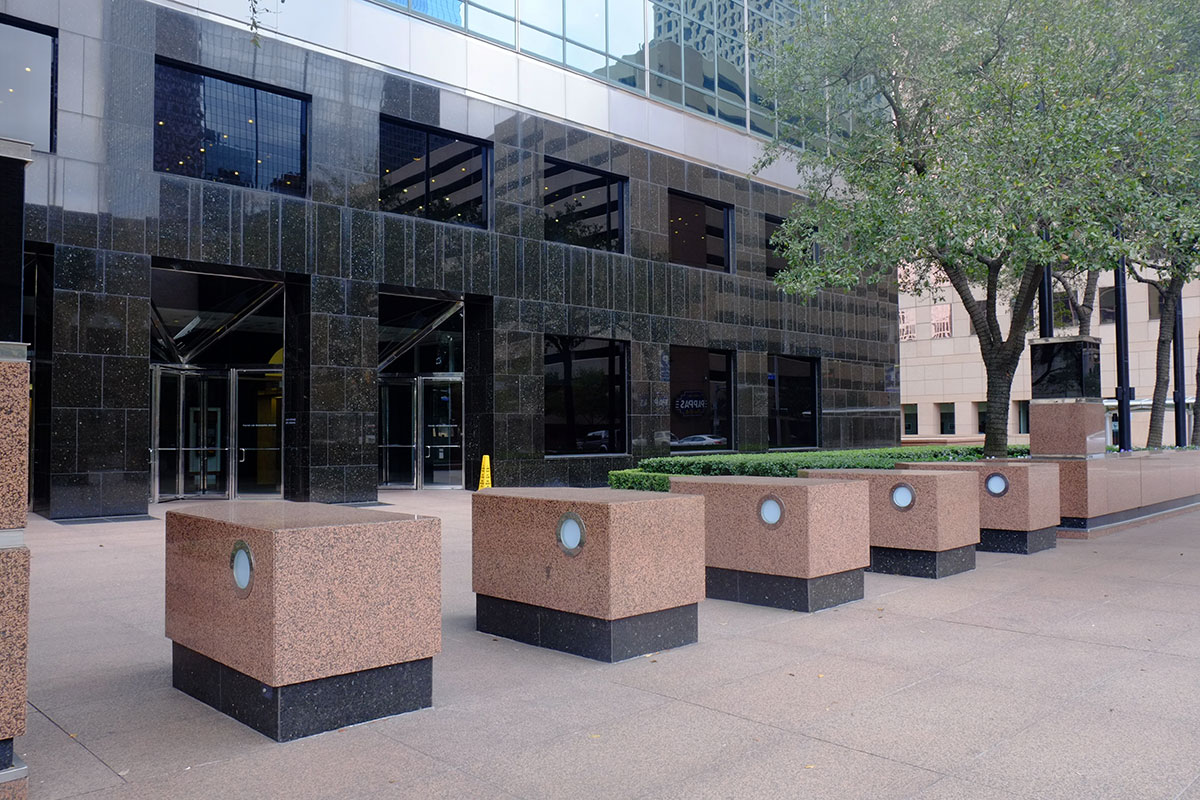
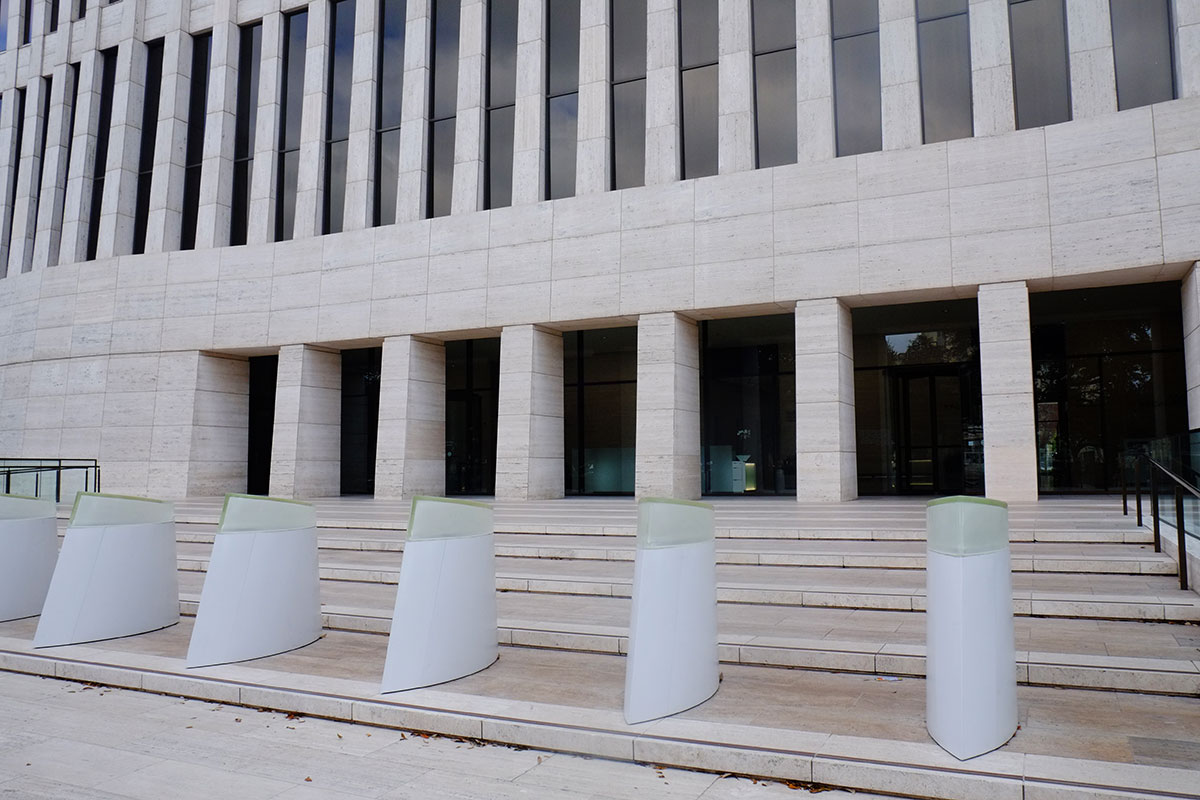
And then, in our post-911, corporate paranoia, the car-bomb bollards everywhere.  DSCF5114

DSCF5118

These epitomize the Corporate Private City. We came across one park downtown, and it was full of homeless people hanging around.  It is probably the one place in the downtown where they can sit down without being shooed away by guards.

(While not directly related to the terrible downtown, the state of the streets in Houston might be another indicator of the general lack of civic- or commonwealth-mindedness.  Without a doubt, they are the worst maintained streets in America. You really can not ride a bicycle in Houston as the streets are so potholed and rutted as to be impassable;  we didn’t see a worse road until we took the 20-mile dirt road into Chaco Canyon.  Just another way that this is the ultimate city for elevating private, individual interests above common ones.)

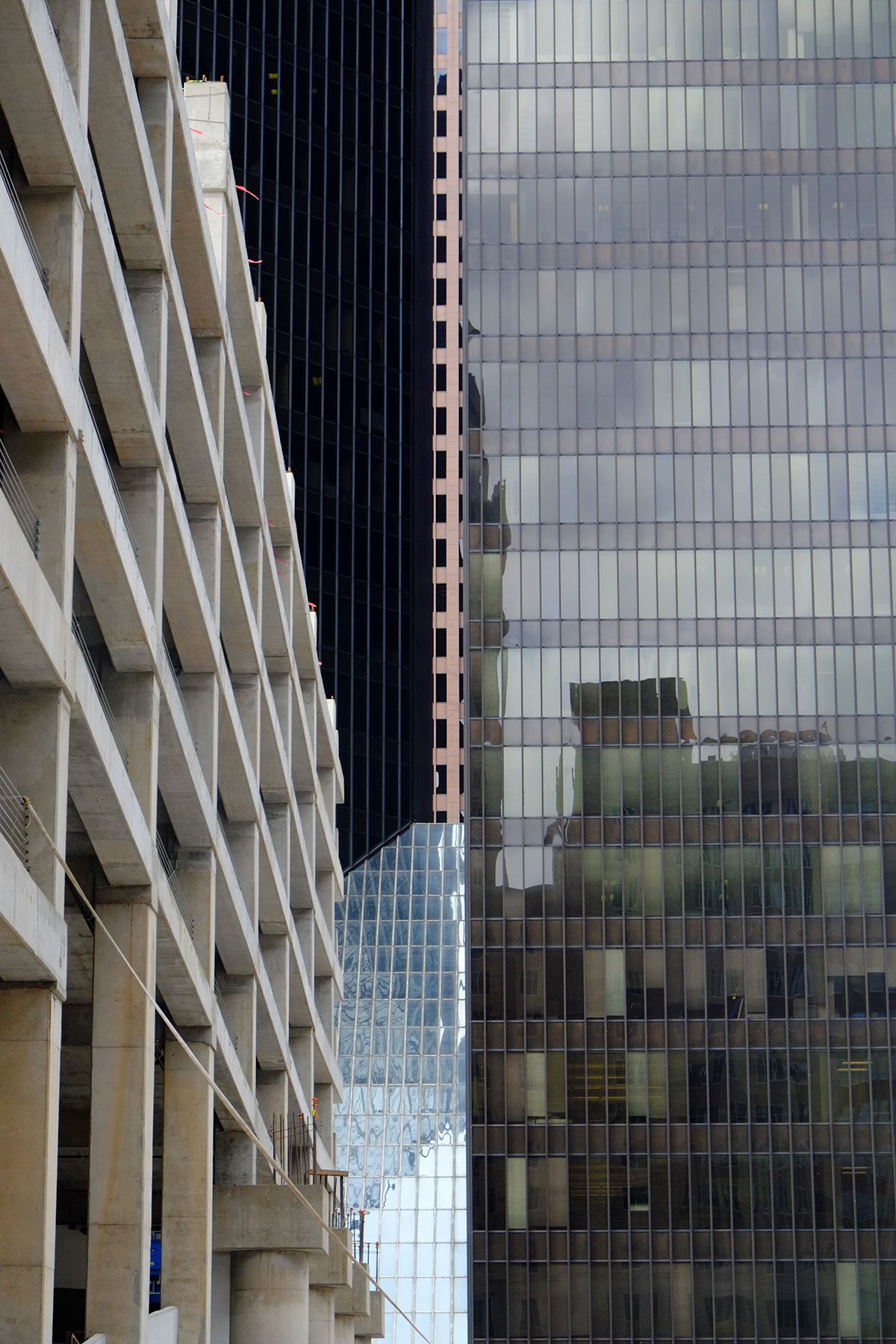
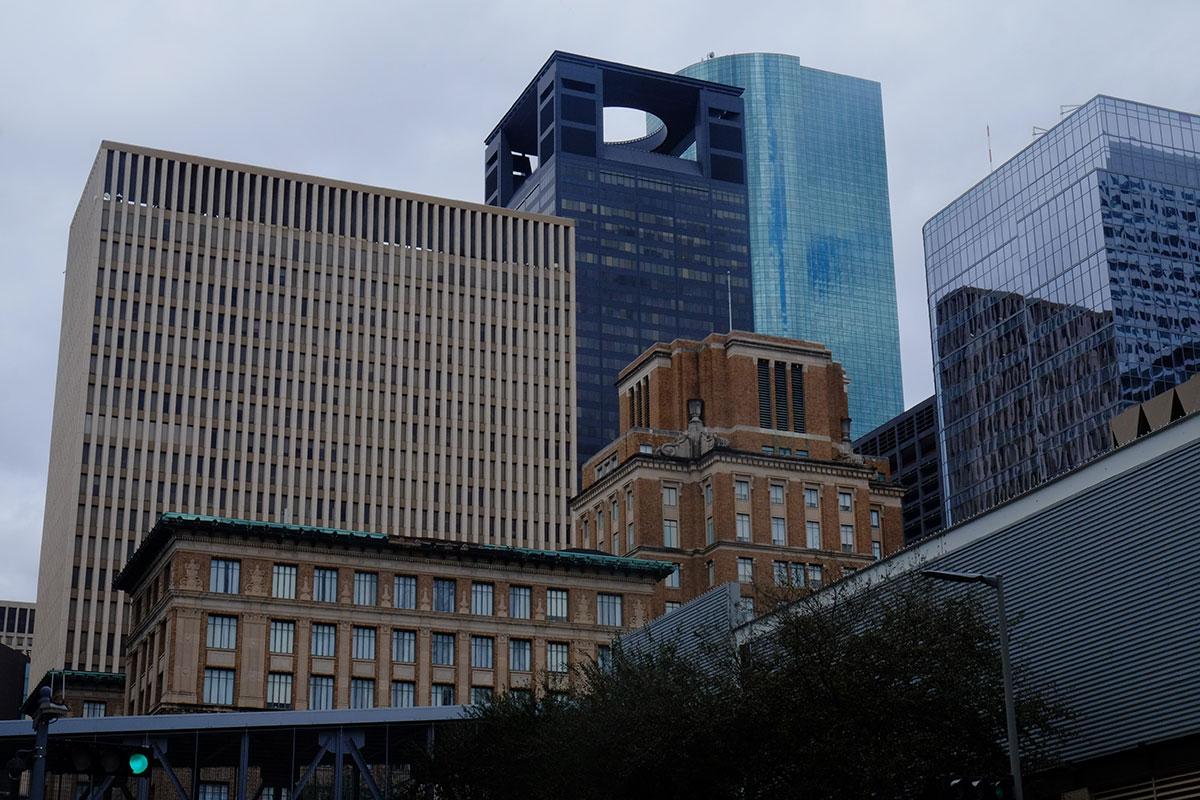
Eventually, contemplating the streetscape became just too depressing, so I started looking at the building skins.  I’ve been shooting these curtain wall juxtaposition photos in every city, and Houston abounds in them.  When all else fails, fall back on abstraction.DSCF4989

DSCF5157

DSCF5103

DSCF5175DSCF5082

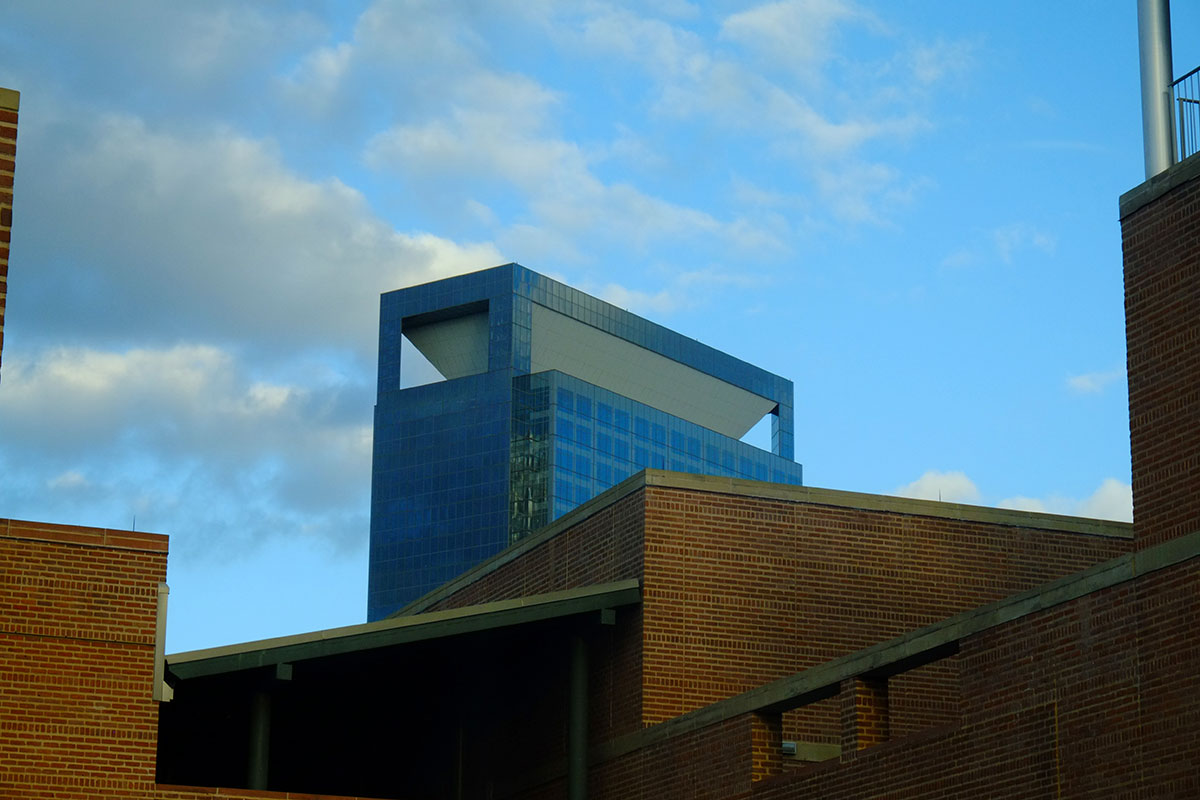
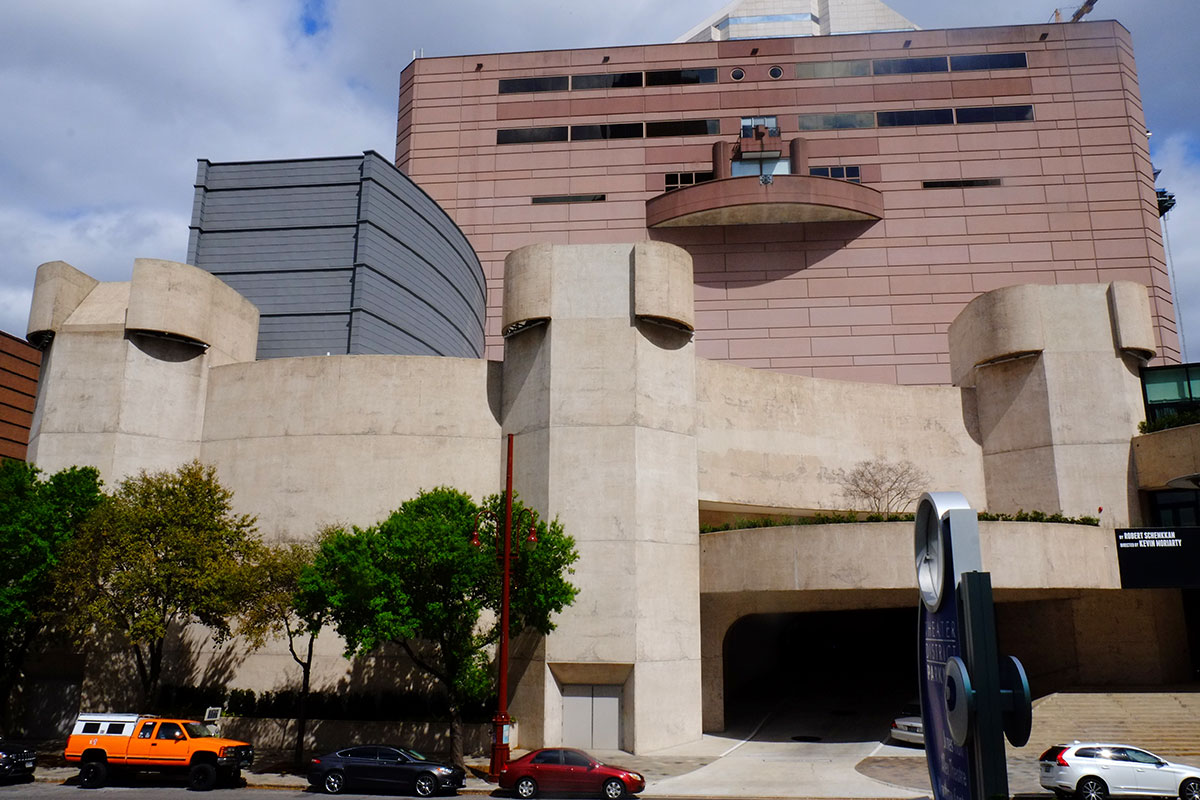
They also have a cluster of deeply awful cultural institutions.  Why are they so bad here and so good in Dallas?  DSCF5140

DSCF5146

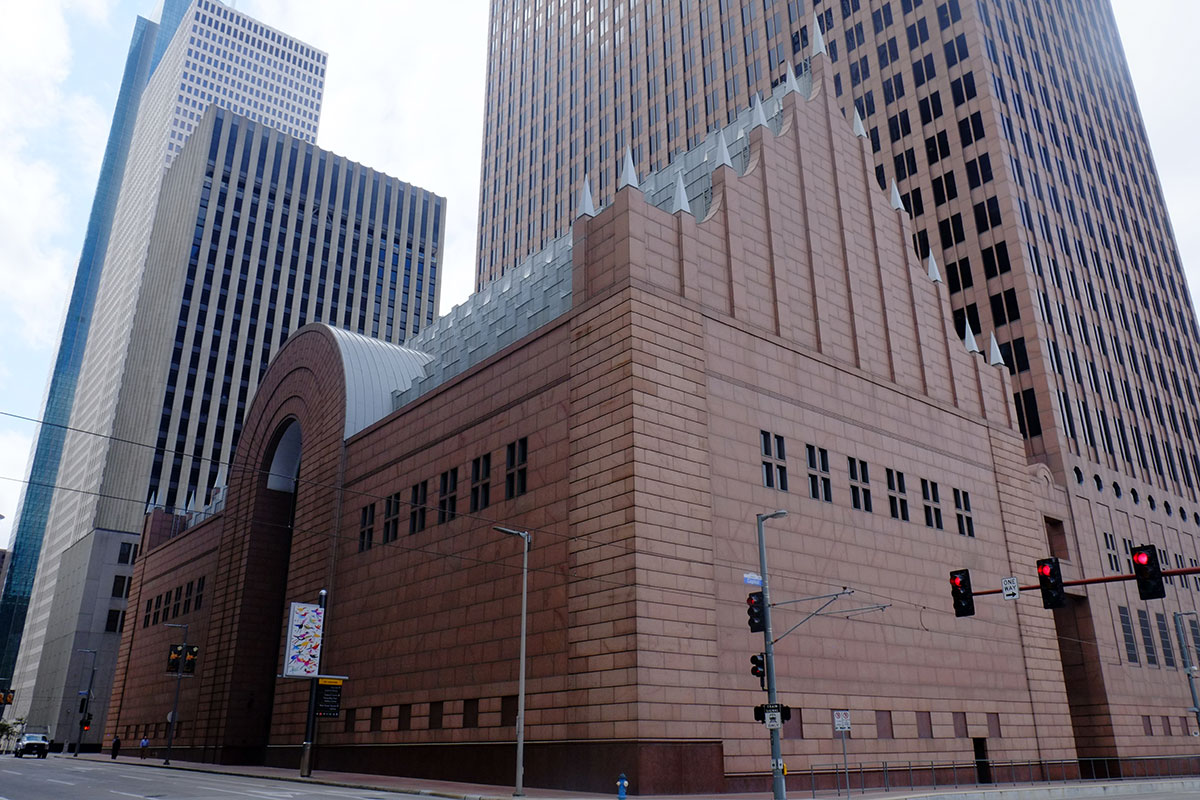
Houston’s entry in the Ugliest Postmodern Building in the World Contest.  I think this may win.DSCF4986

And of course, there is the requite Philip Johnson excrescence.  This one may be a little better than the PPG building in Pittsburgh in building design, DSCF5152but it loses a lot of points for how it interacts with the street.  The corporate headquarters as fortress has never been better expressed.  DSCF5155

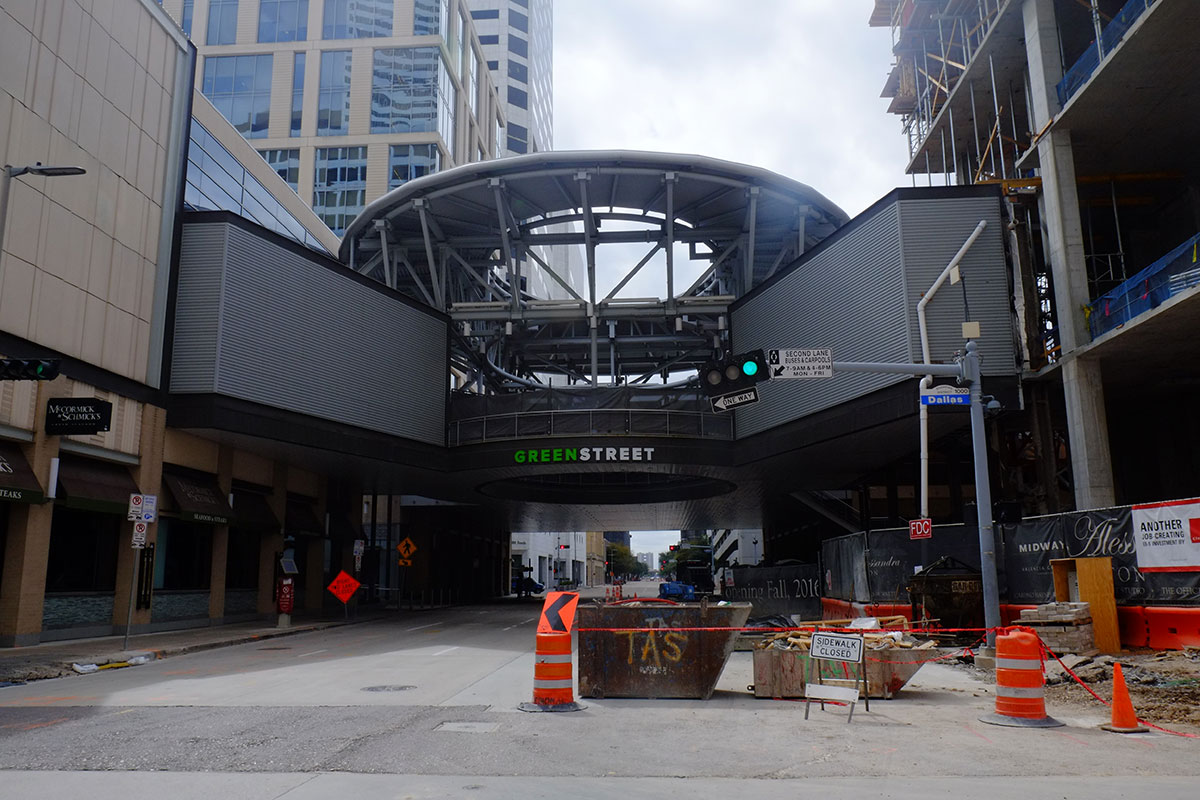
When they try to address the pedestrian realm, it ends up looking like this.  (The irony of the name must be unintentional.)  DSCF5188I can’t quite place what movie this is from.  When the Earth Stood Still?  Pacific Rim?  Independence Day?  Transformers?

I did find one building which seems to indicate that human beings inhabited this area before 1960.  DSCF5192

Overall, a truly terrible place.  And we were there in February – I can’t imagine what kind of special hell this must be in the summer.

Kathy Armstrong

On this trip we’ve been visiting a lot of my family and friends, but not so many of Linda’s. It’s not that we don’t like them, it’s that most of them live in the big middle of the country that we’ve been circumnavigating.  But in Dallas we finally found a friend of Linda’s who’s moved out towards the periphery.

Kathy Armstrong was an interior design major at Kansas State with Linda, and they’ve been friends ever since.  Before last year I had only met Kathy at our wedding, so we obviously didn’t know each other well.  Kathy and I became Facebook friends several years ago – I think she decided to do this once she realized Linda never posts anything upon FB, and if she wanted any news from our family, she’d have to rely on me.  We’ve had this online conversation since then, and it is remarkable how you can get to know someone that way – I quickly learned that Kathy has a great sense of humor and a sense of the absurd, although I sometimes think that now she mainly wants to be my friend so she can read the comments from my friend Dan.

Last summer Kathy came to visit us on Whidbey Island, and we had a blast.  We didn’t do anything extraordinary, just walking around town, cooking and drinking and talking. Kathy has this ability to really enjoy the ordinary occurrences of life, and in thoughtful way – a meal isn’t just enjoyed, but it is thought about and planned and discussed.  I realized during her visit how much she brings a designer’s sensibility to everything.  I tell my students that designers may work intuitively, but then we always have to slip into analytical mode, to understand what is going on that made a design turn out the way it did.  Kathy is that way with almost everything – not just looking at buildings.  Although she is not what I’d consider a semi-pro cocktail drinker, we had great discussions of the nuances of drinks that I was proposing.

DSCF4110Greta and I got to Dallas after a long drive from Louisiana, and Kathy had a wonderful dinner waiting for us.  But most importantly, we got to meet Monty and Harry, Kathy’s beloved Scottie and Westie.  I must admit I was a little nervous about meeting them – I had seen their exploits on FB, and I was worried that they might fall into the category of amusing yet crazed house dogs who spend lots of time alone, and who therefore drive all possible sources of engagement and amusement crazy.  But they were not at all like this – they were very chill, happy to see us and hang out, with really charming personalities.  Greta has been relying on our friends to provide intermittent substitute pet experiences on this trip, and Harry and Monty fit the bill perfectly, lying around with her while she was reading.  We did watch the Westminster dog show on TV with them one night, pulling for the terriers.

DSCF4974We also got to spend time with Kathy’s boyfriend Greg, and with his son Harry.  Greg is also an architect, and his perspective reinforced the good things I’ve heard about graduates from Arkansas.  Greg has returned from years working in China, and he and Kathy met when he began working at her firm.  Kathy and Greg suggested several of their favorite restaurants, and we spent several evenings talking over drinks and meals.  To Greta’s dismay, the conversation often drifted into professional matters, and I was struck by their insights and wisdom into the profession.  I most often find myself in professional conversations with people in my profession – academics – and we talk about our world, which is very different from the world of professional practice.  So spending time with two people who each have over 30 years experience in very varied careers was enlightening.  I still retain enough knowledge of that world to understand it, but I was struck by how much they had experienced, knew and understood about it.

DSCF4963One day Greta and took the light rail from downtown to Kathy’s office, which was in an interesting mixed-use node of redeveloped industrial buildings and new construction.  She works for Leo Daly, a multi-city interiors firm, where she specializes in hospitality projects, once of the few building types about which I know absolutely nothing.  Their office is really appealing, on the top floor of a remodelled building.  Kathy runs projects all over the country and internationally, and travels pretty frequently for site visits and project meetings.  We talked about how she had consciously chosen this type of career, and how she had gotten to see a lot of the world, meet a lot of people, and have a wide range of experiences in different places.  I vaguely remember having a life somewhat like this, before I settled into relative isolation in Eugene, and we enjoyed comparing and contrasting our lives.  Part of the agenda for this trip has been for Greta to see the different ways people live, and I was glad that she got to see Kathy’s life, and understand how that path can be enjoyable and fulfilling.

Kathy is not from Texas, being most recently from St. Louis, so she was able to provide the non-native’s perspective on her new home – appreciative of all that is good about the area, but without the native Texan’s starry-eyed chauvinism.  This was invaluable, and she really helped orient us to what was to be a very different cultural experience in the coming weeks.  We had a great time hanging out with her and Greg and the dogs, and it was really good to spend time with a friend who made us feel at home in a strange new land.

Dallas

DSCF4234The biggest shock of this whole trip: I liked Texas.

I expected to hate everything in Texas except Austin.  To a northerner, Texas is crazy right-wing politicians and endless sprawl (and beef barbecue, not pork).  After three weeks in Texas, I can report that those preconceptions were proved to be true (except that they do serve some pork ribs), but they obviously don’t cover the whole range of what Texas is like.  You hear about the politics and the sprawl, but you don’t hear about the light and the trees and the qualities of the cities.

I wasn’t looking forward to travelling across Texas, but I regarded it as my duty – it is a big, important and powerful place, and I thought that on this trip we should try to see what the rest of the country is really like, even parts that might make us uncomfortable.  (My whole prior experience of Texas was restricted to DFW, but we knew that very well: once during a long layover, Greta and I had walked every inch of it – about five miles).  So when we got to Dallas and immediately started seeing places that were interesting and beautiful, I was nonplussed but pleased – maybe our time in Texas wouldn’t be a dutiful slog for 1000 miles, maybe we would actually have fun.

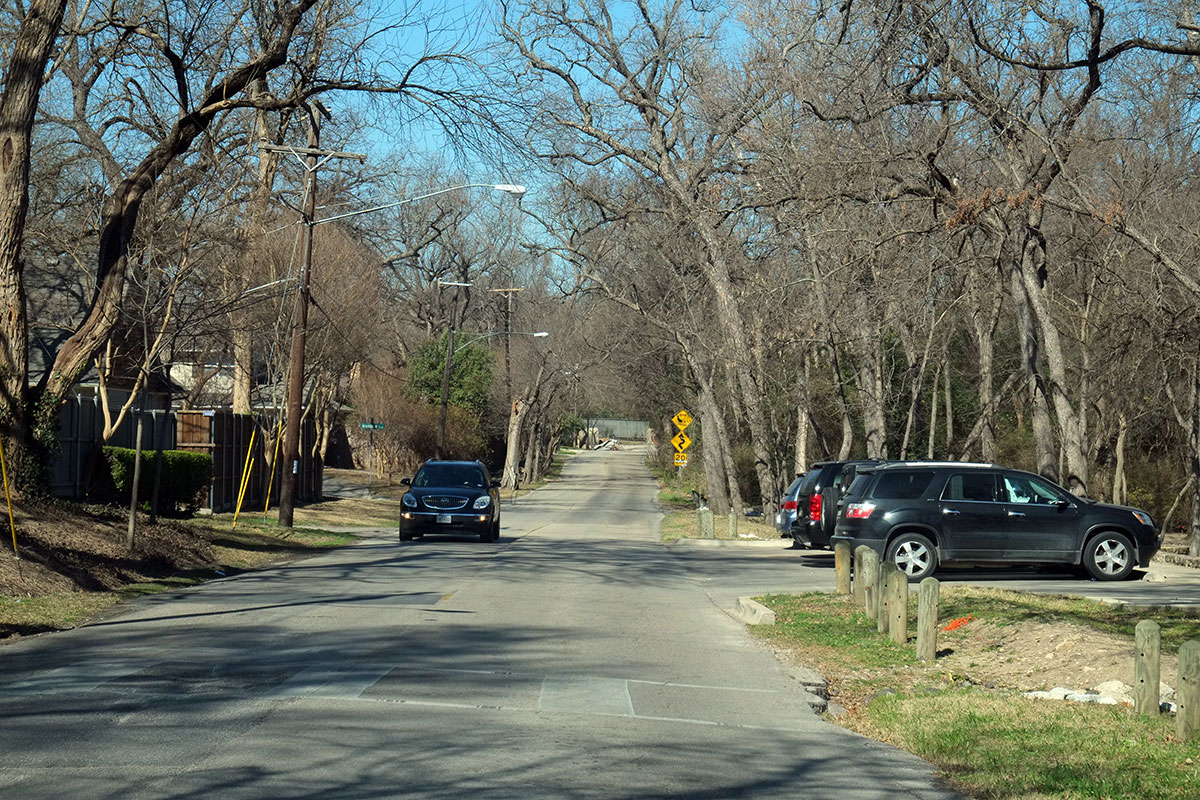
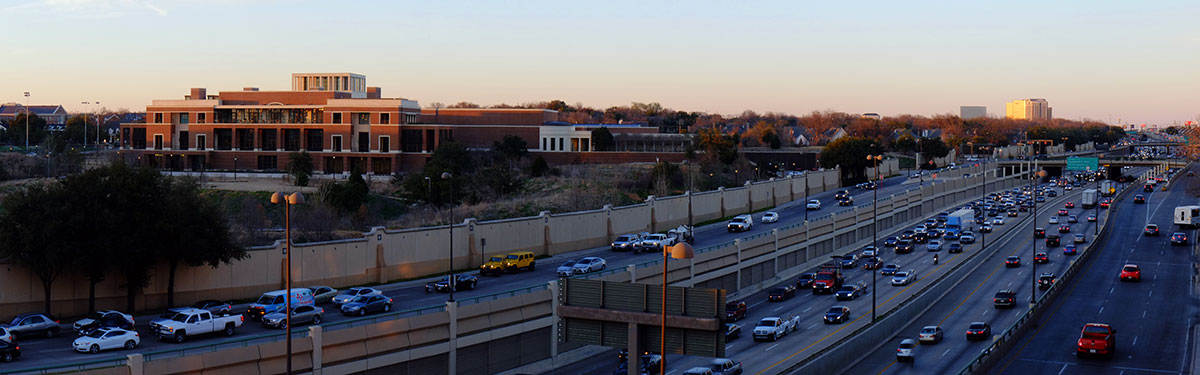
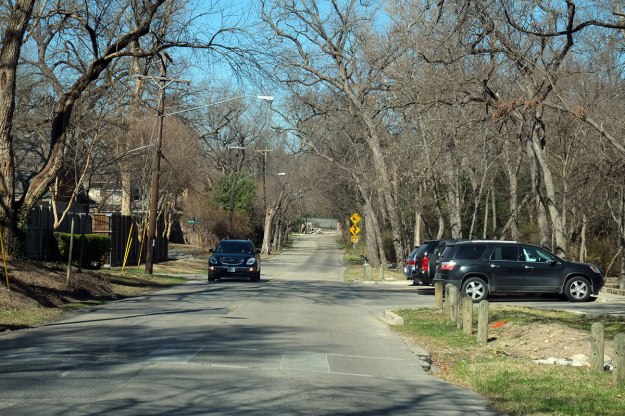
We were staying with our friend Kathy in the Lakewood neighborhood, and that was the first surprise – a postwar neighborhood about six miles from downtown, to which it is connected by both a bike corridor and a light rail line. The houses were traditional and unpretentious, and the landscape was beautiful – everywhere there were fabulous trees, which in February gave a wonderful dappled quality to this intensely clear light. DSCF4117We walked along the lake and saw houses that ranged from modest to imposing, but with none of the grandiosity and kitsch that I had expected. (Obviously, this is because we were seeing older, closer-in neighborhoods, not the sprawling horrors of the rumored outer suburbs, such as Plano.)   I didn’t go looking for the bad parts of the Dallas-Ft. Worth megalopolis, but I did see enough of them while driving across the area. ( Most notably, the George W. Bush Library at SMU. beautiful sited above a freeway:)DSCF4969c
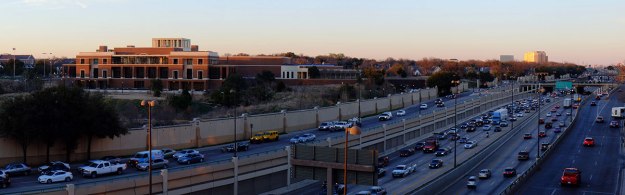
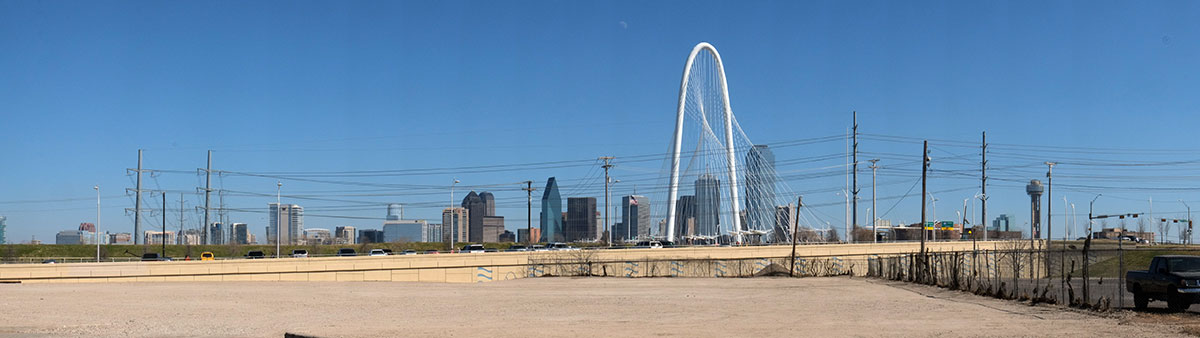
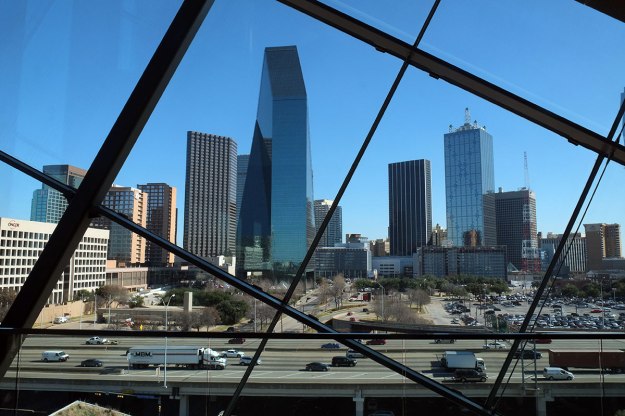
If the residential neighborhoods were the first surprise, the downtown was the second. Like many American cities, it is surrounded by gigantic highways – elevated, surface, depressed – every way possible. It is also completely cut off from the riverfront. However, within the two grids and four square miles of the downtown, there is a wide range of building types and ages, and evidence that the city is really thinking about urban design (and willing to spend some money on it).

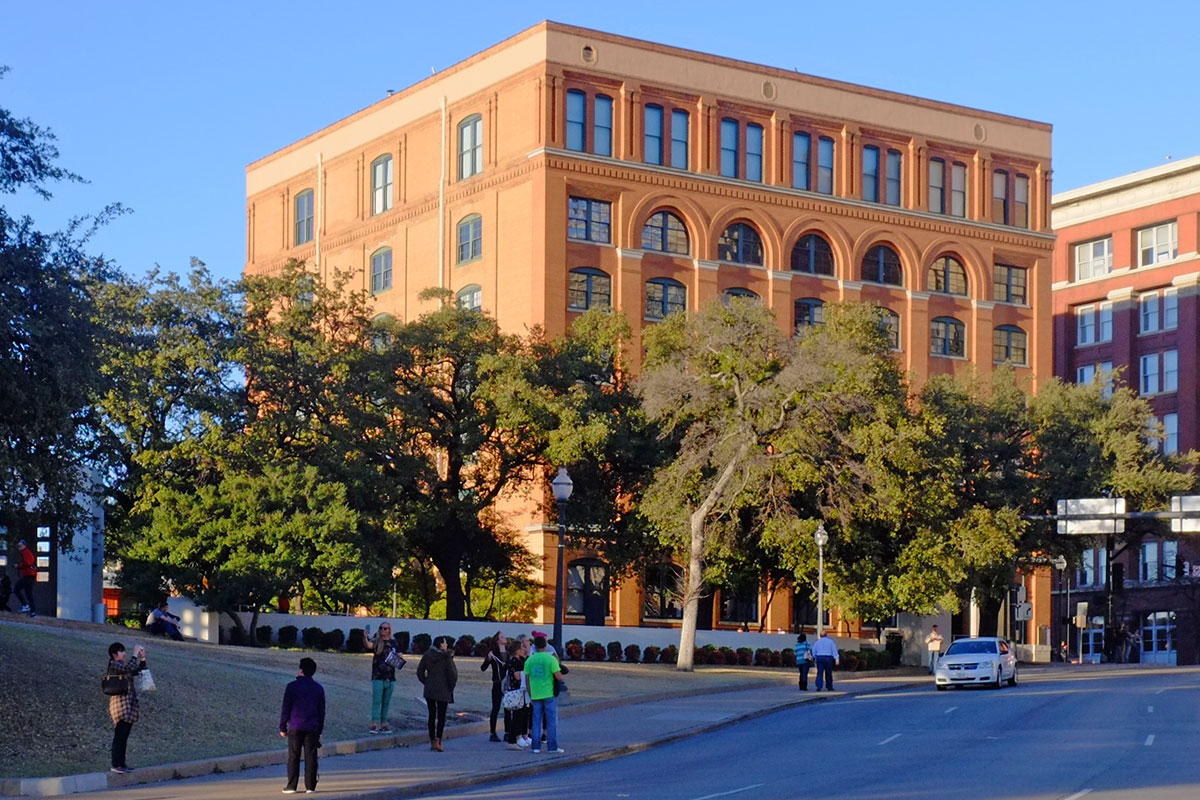
The West End is full of 19th- and early 20th-century brick commercial and government buildings.  Dealey Plaza is here, and the infamous Texas Book Depository.  There is a Sixth Floor Museum, and it struck us as pretty ghoulish.  DSCF4361
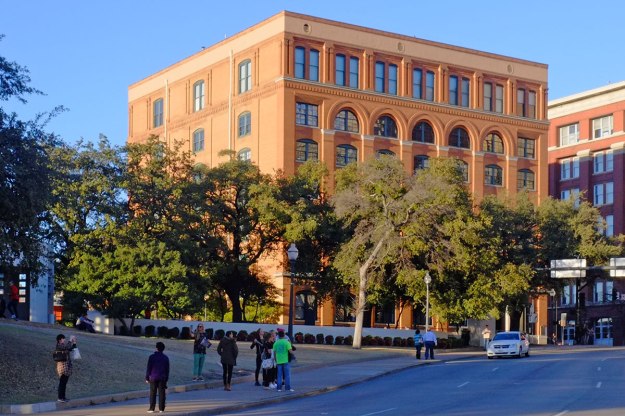
But it is an intact, coherent district, full of people and businesses – in much better shape than most such districts in other American cities.DSCF4362
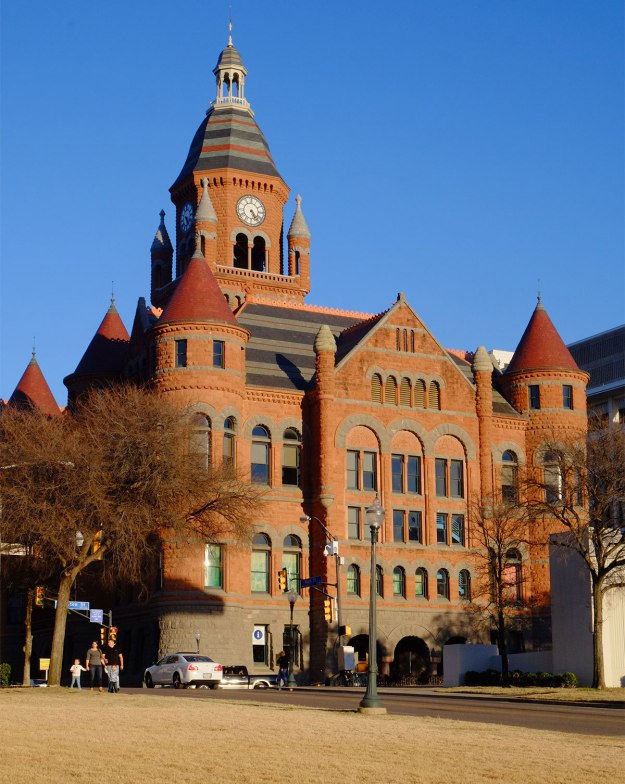
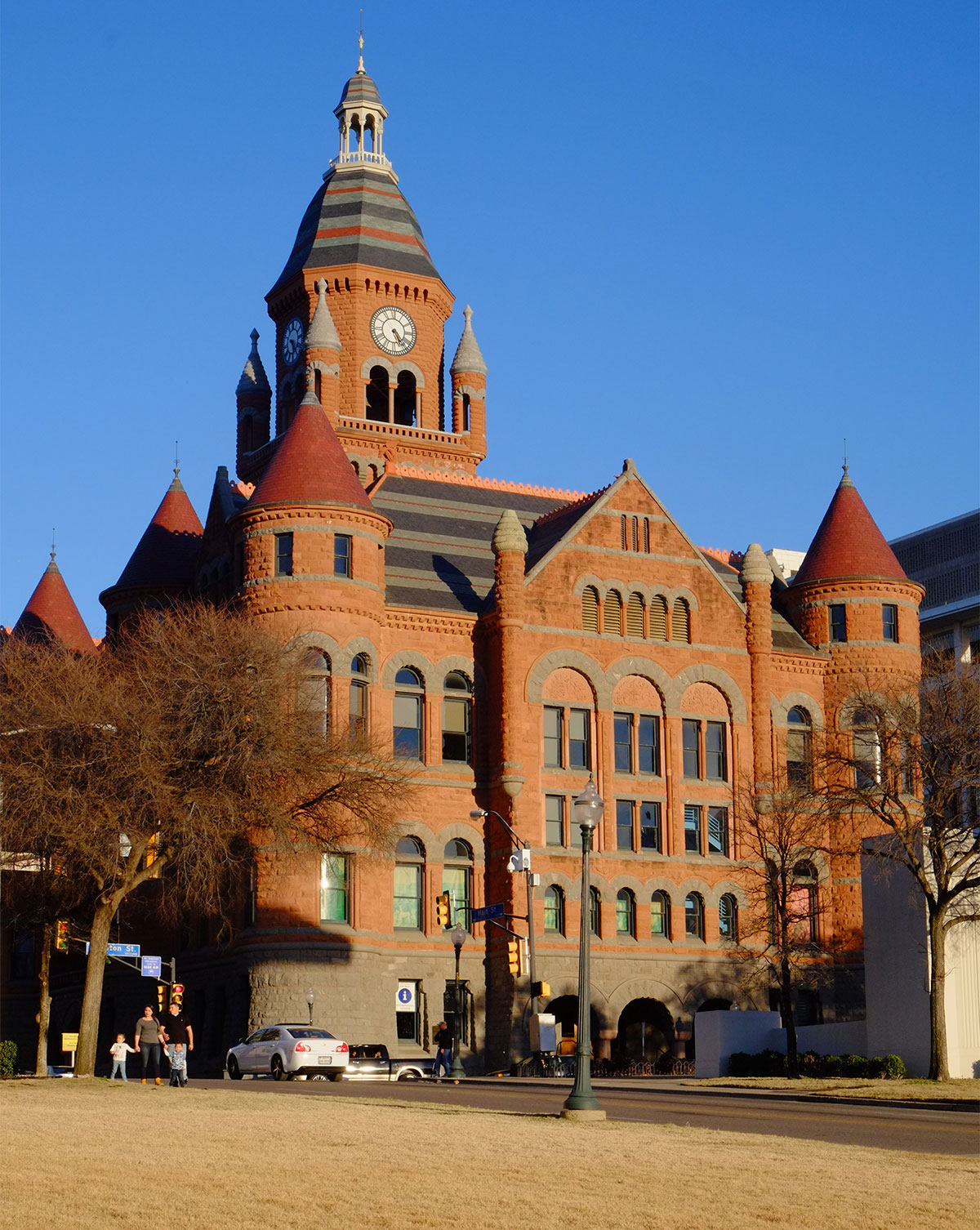
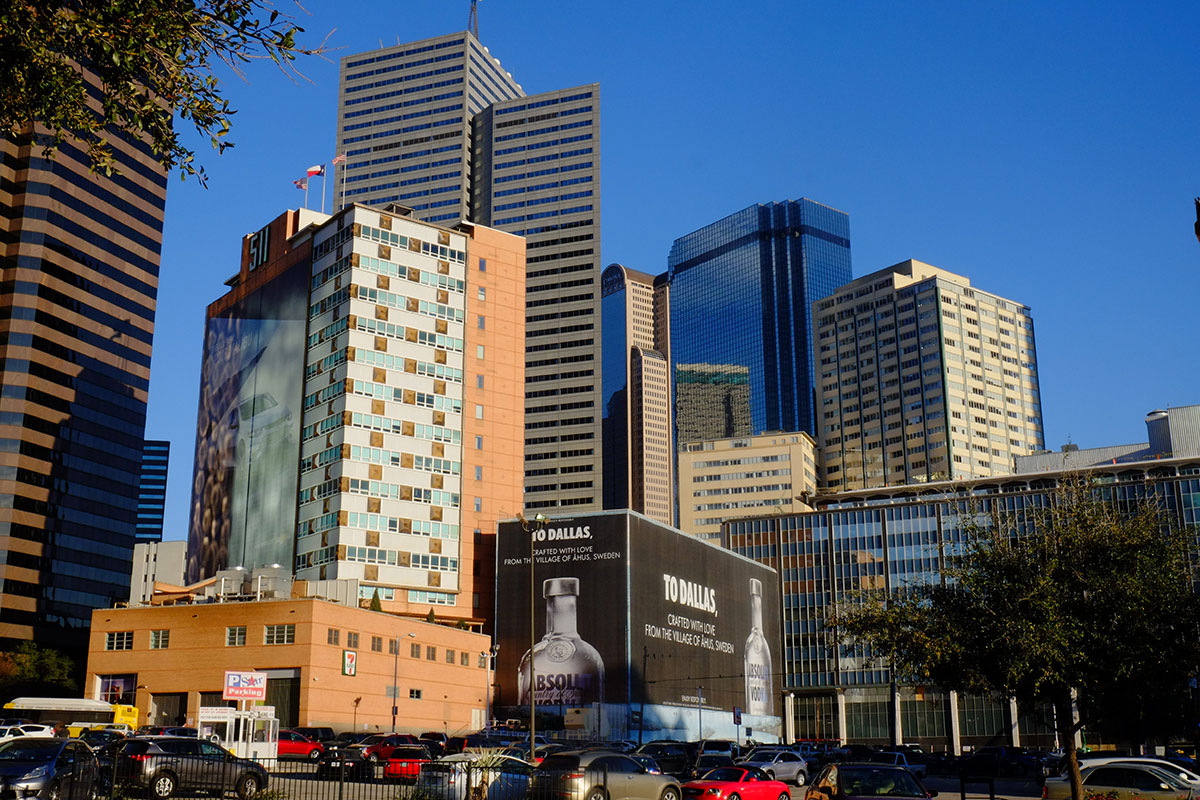
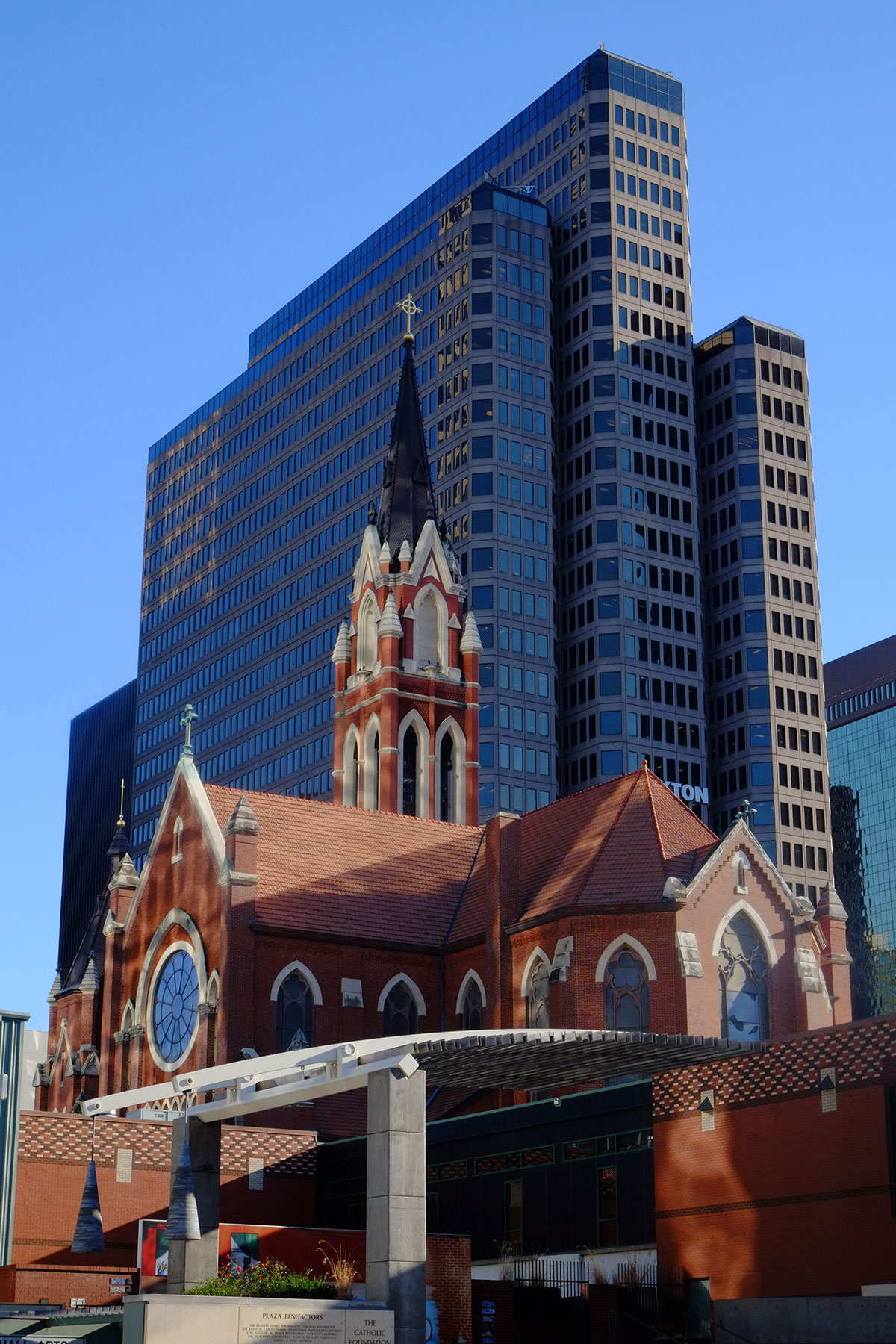
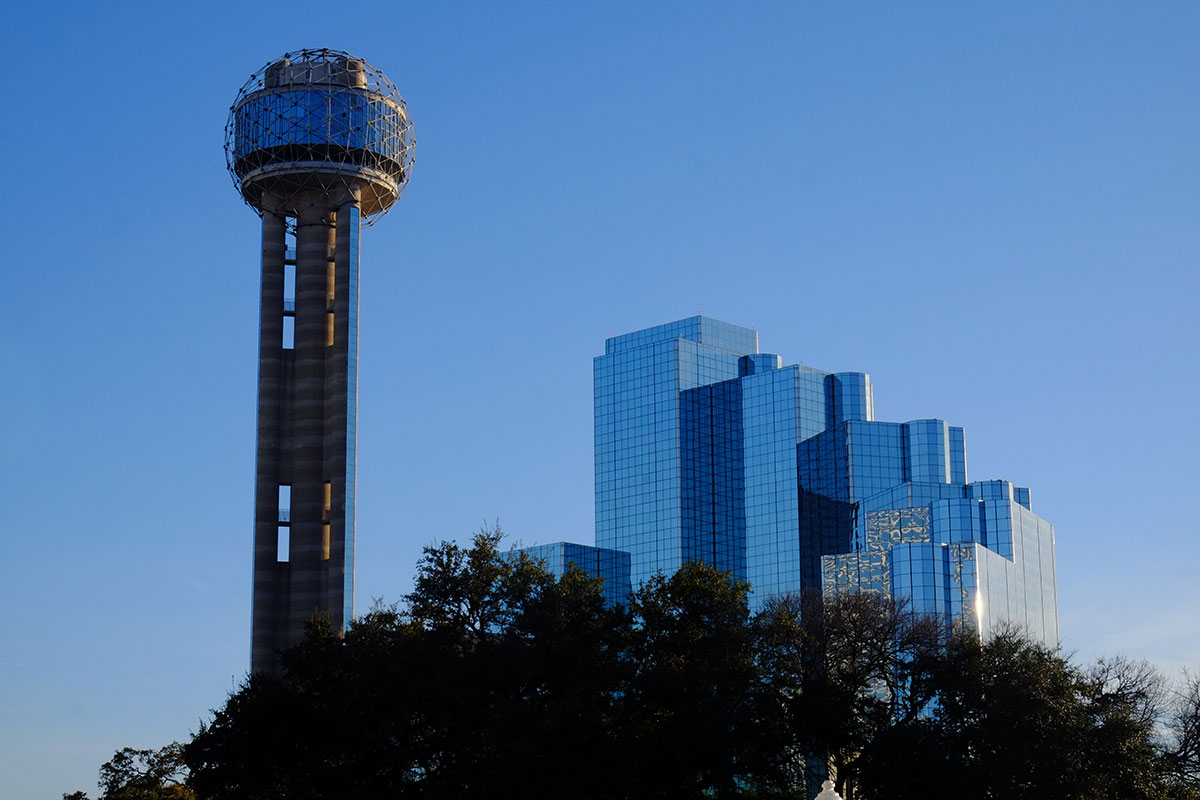
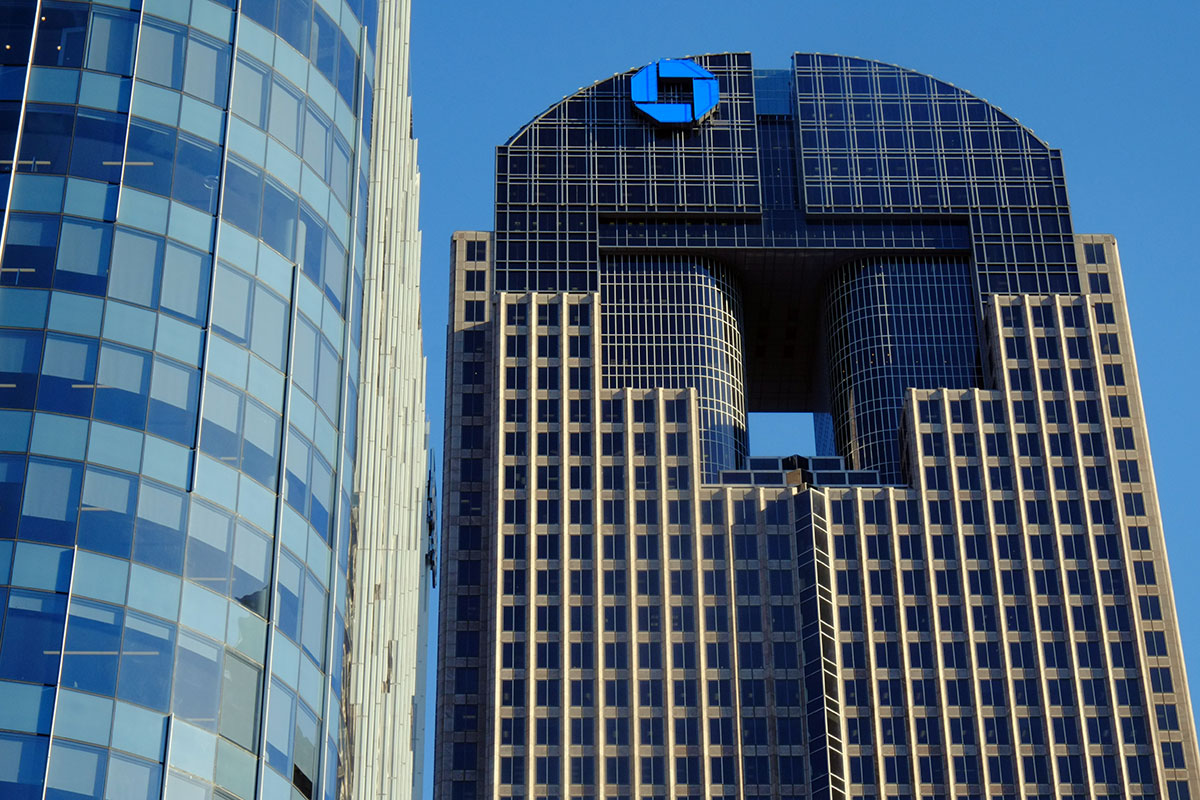
Dallas has had sustained growth throughout the postwar period, which is reflected in the juxtaposition of buildings from different eras.  DSCF4948  DSCF4949  DSCF4873  It’s an entertaining mix, although there are definitely the goofball, Worlds-Fairy buildings too.DSCF4363
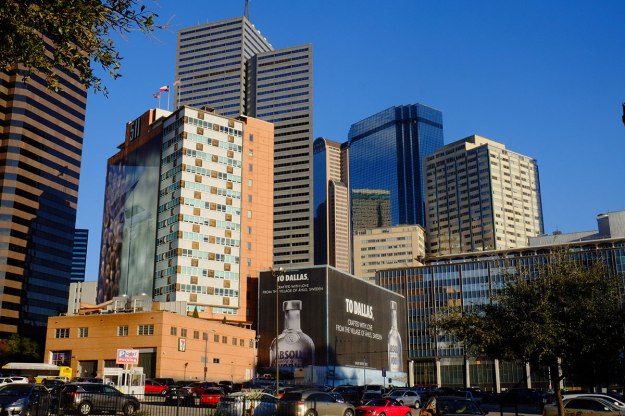
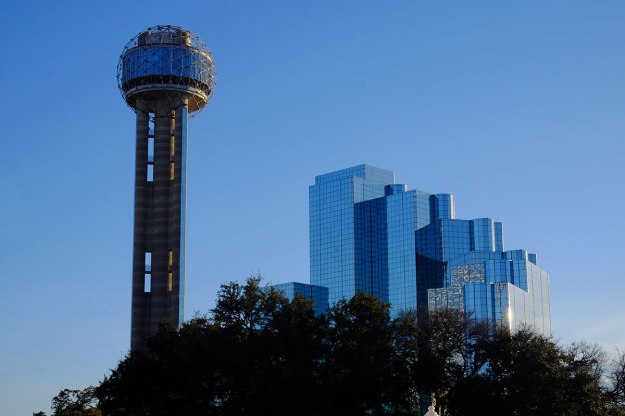
And another strong contender for Worst PoMo Building Ever (Gigantic Building subcategory). DSCF4871
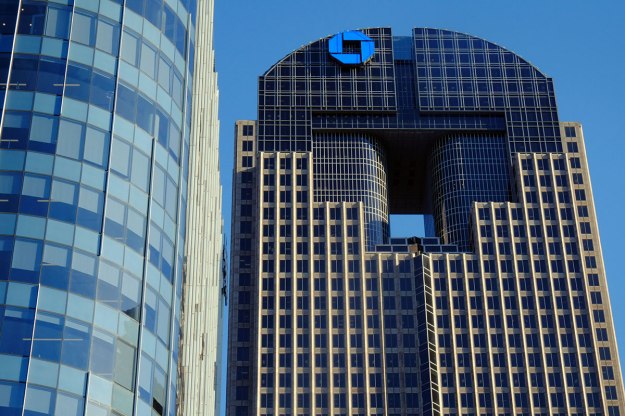
But Dallas has more than its share of serious buildings by well-known architects, most of them built fairly recently.  For some reason the culture seems to support this in a way that other cities (such as Houston), don’t.  Some are really good and some fall short, but they all show a commitment to architecture beyond the functional and economically viable.  Seeing so many together in one downtown is very surprising.

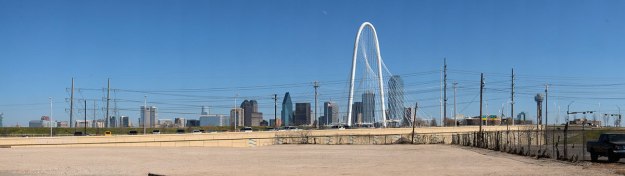
There is a Calatrava bridge, which if you’re determined to have a Calatrava, is probably a smarter thing to get than a building.  It’s a beautiful object, it doesn’t have the problems of not fitting into an urban context the way his buildings don’t, and it doesn’t matter if it leaks.  DSCF4123
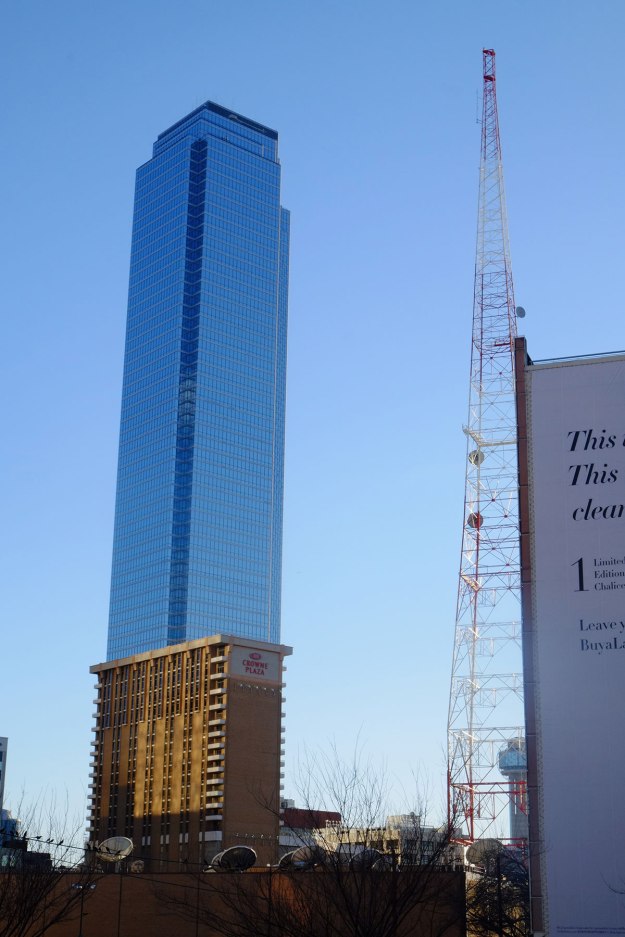
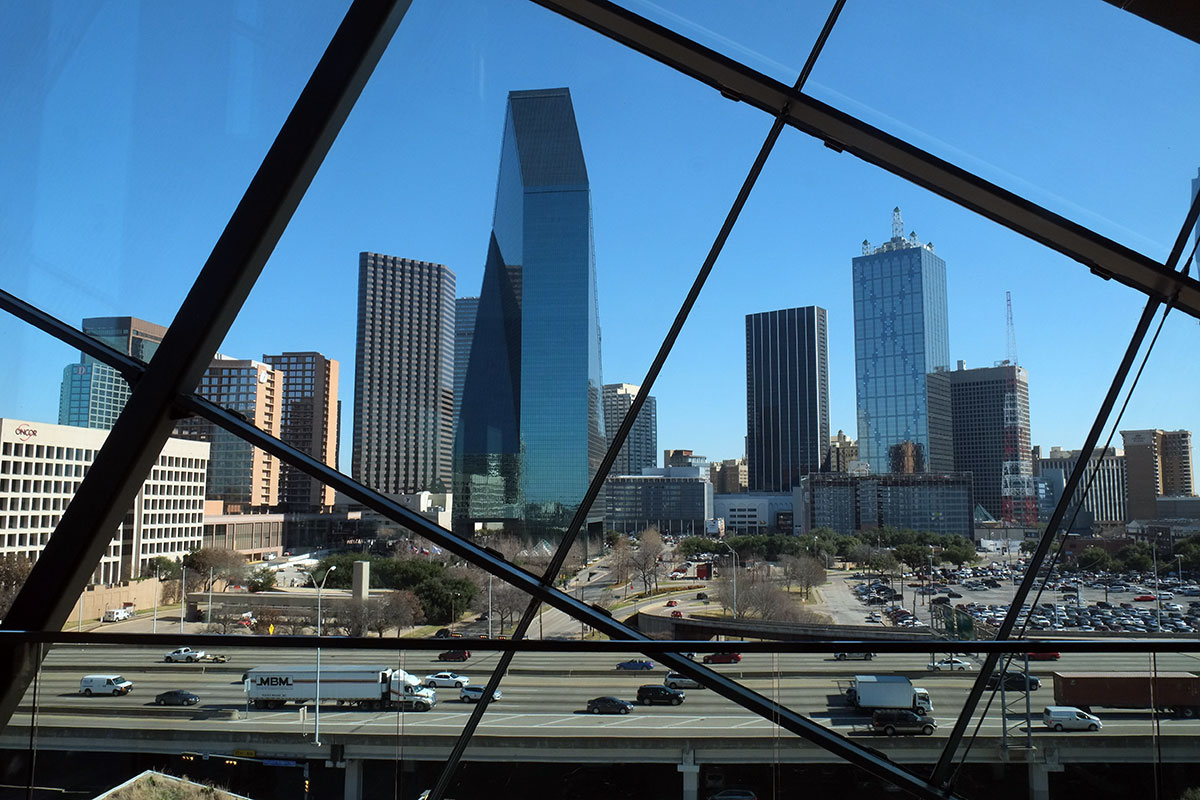
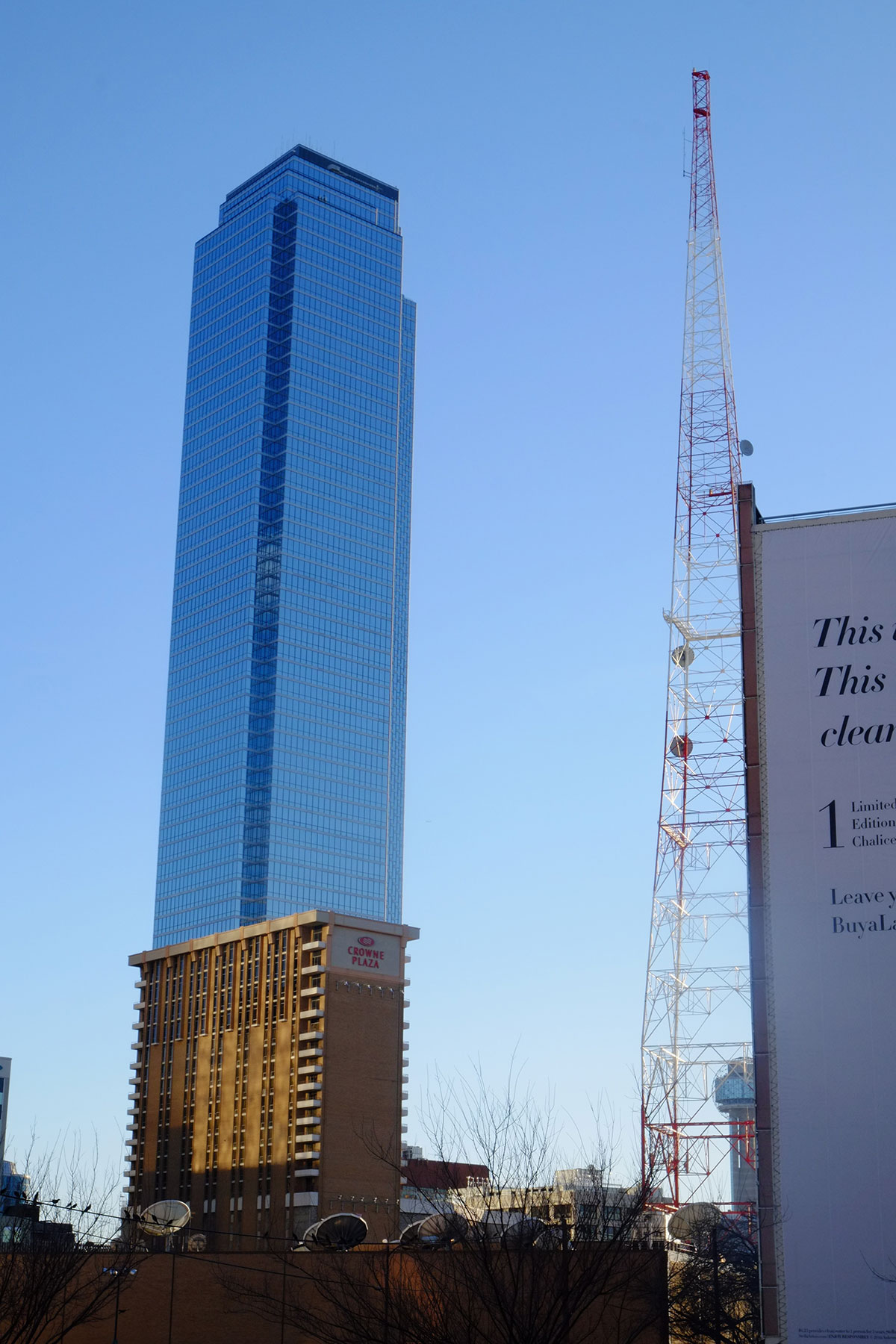
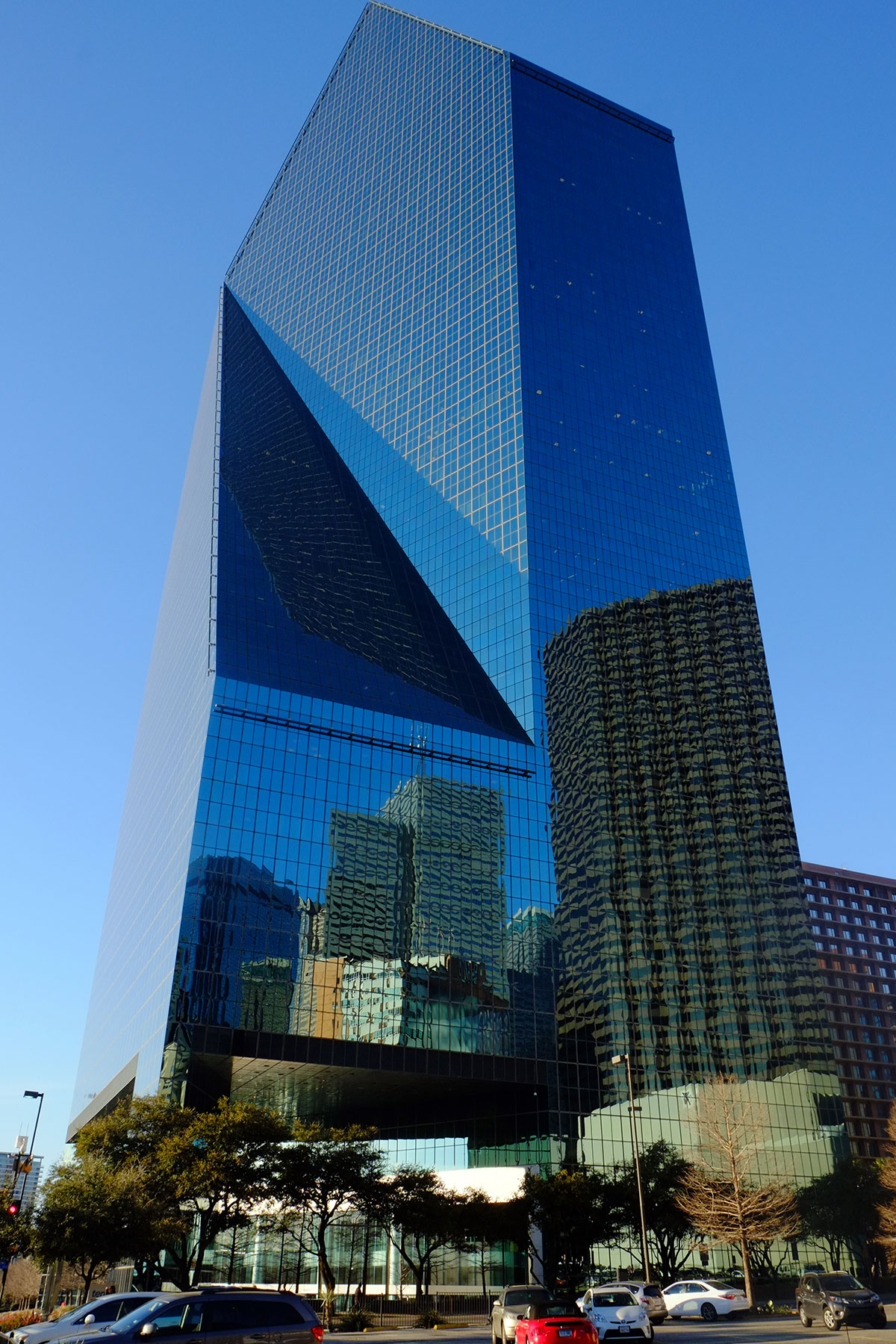
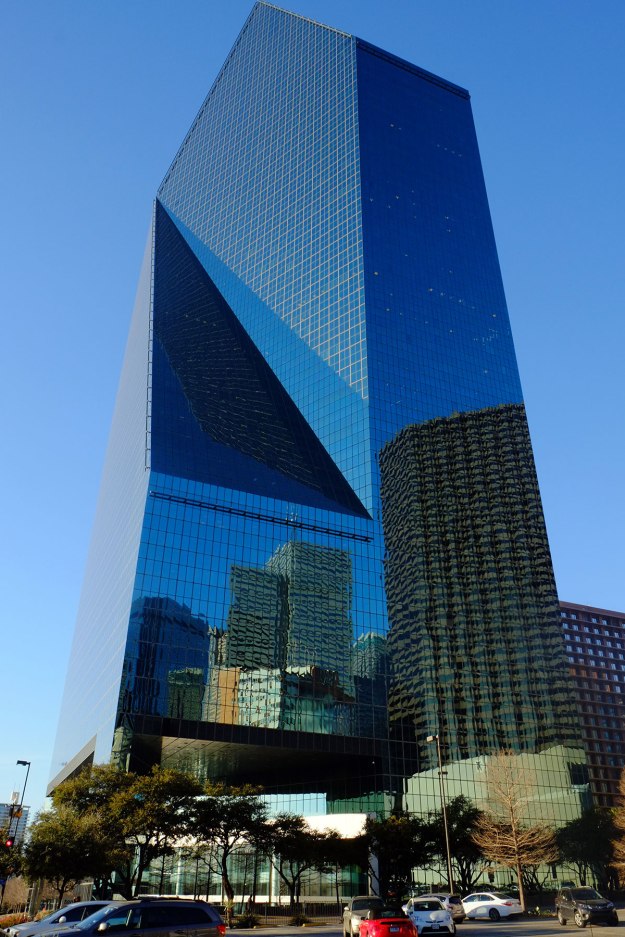
Still dominating the skyline is Pei’s Fountain Place.  It is a really big glass tower, but it doesn’t seem so, as it isn’t a box.  The seemingly simple prismatic shape is constantly changing as you move around it,  and it works much the same way the Hancock Tower does – sort of there, sort of not-there, hiding anything that gives it scale, meeting the ground well and somehow inconspicuously, abstraction at its best.  DSCF4950
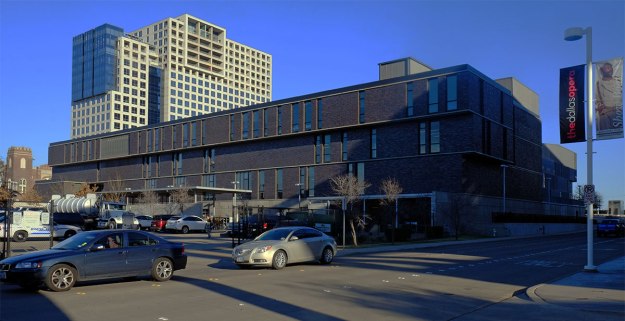
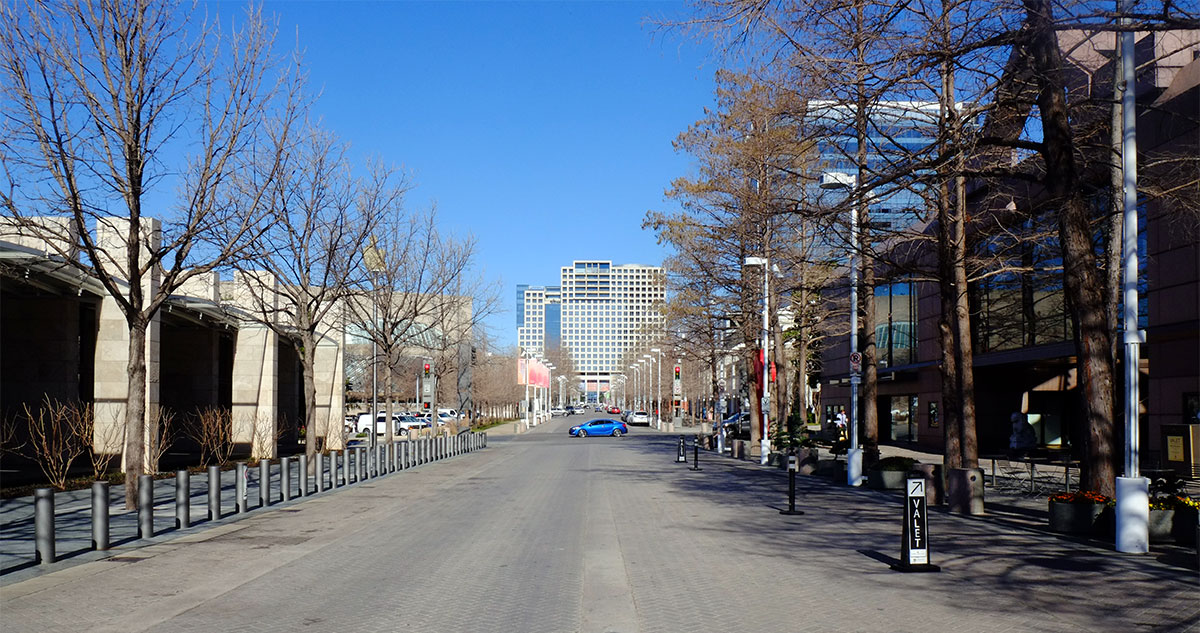
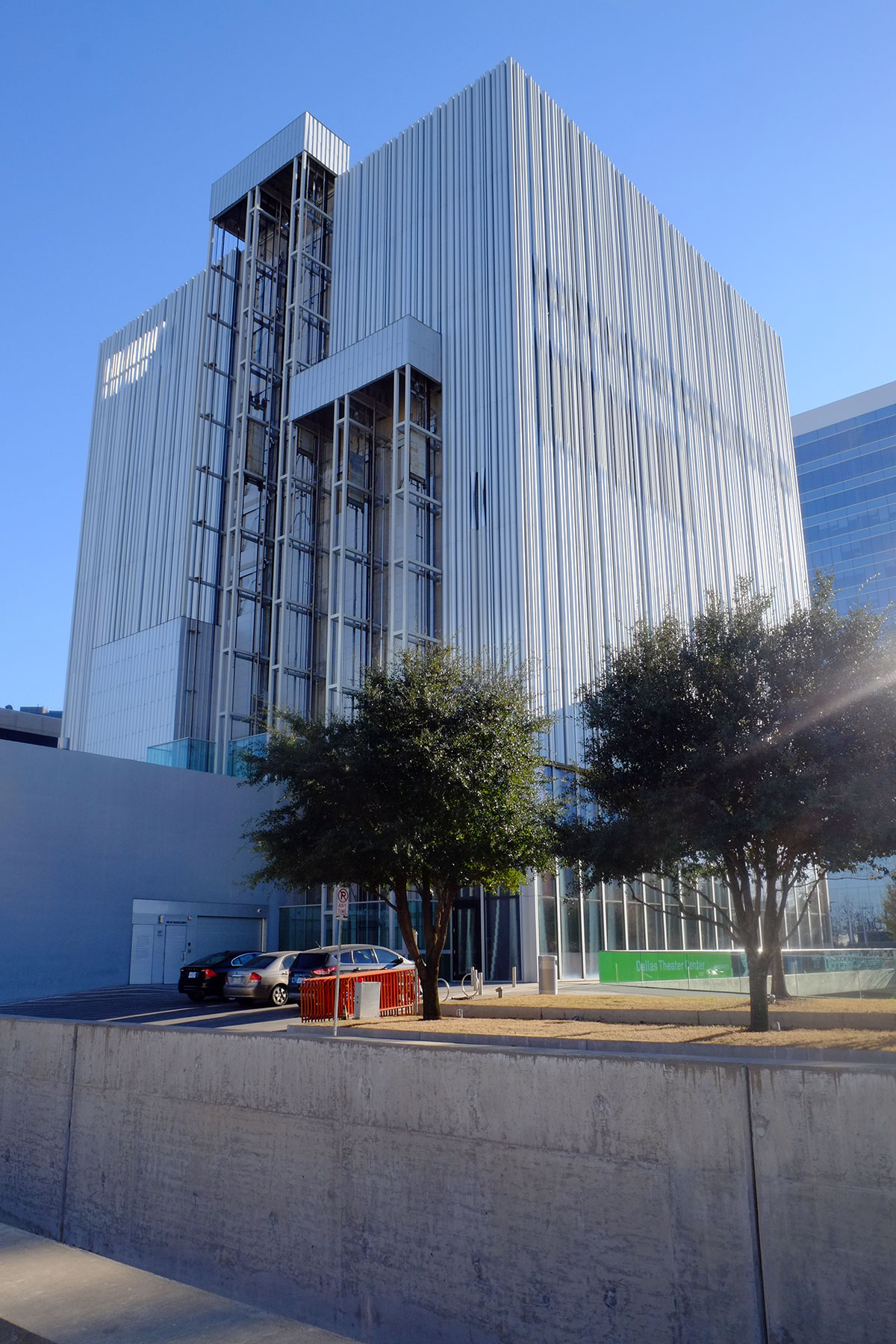
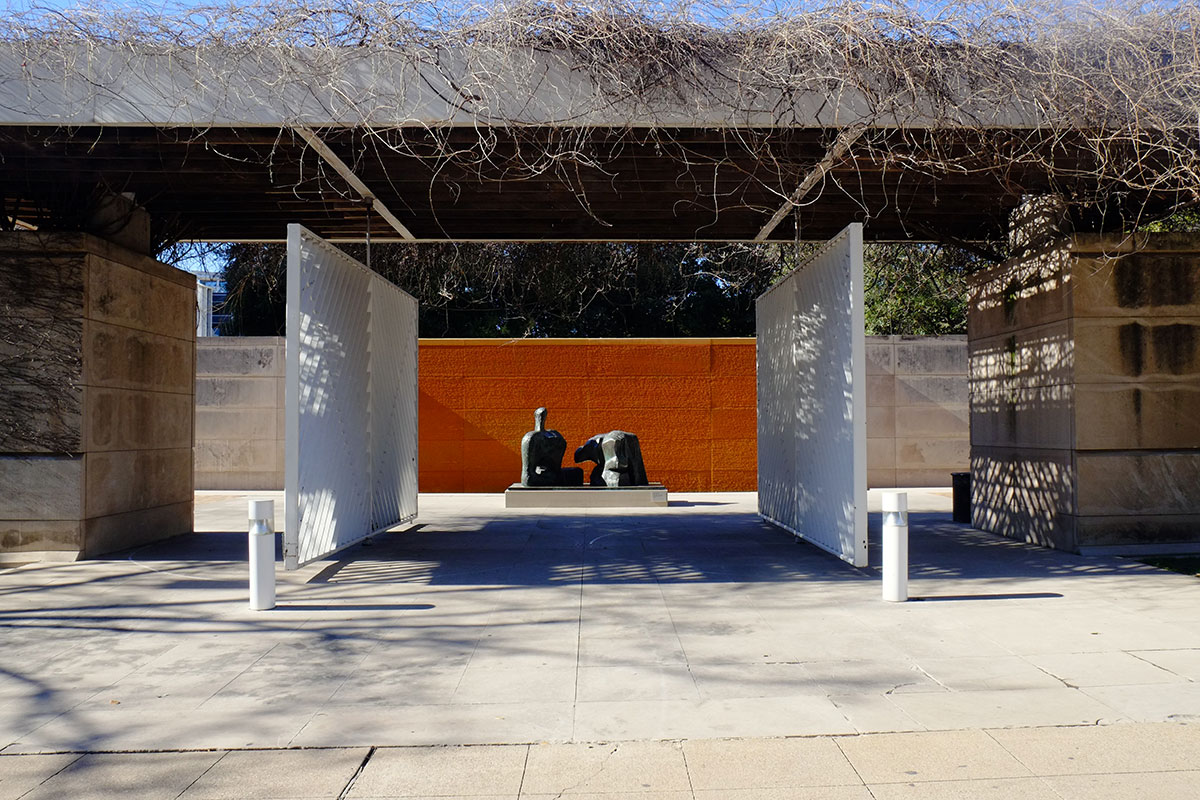
Most of the cool new architecture is clustered in the Arts District, at the north end of downtown.  It begins at the Dallas Museum of Art, and an avenue lined with cultural institutions leads north from there.  The Nasher sculpture museum is on the left, by Renzo Piano.
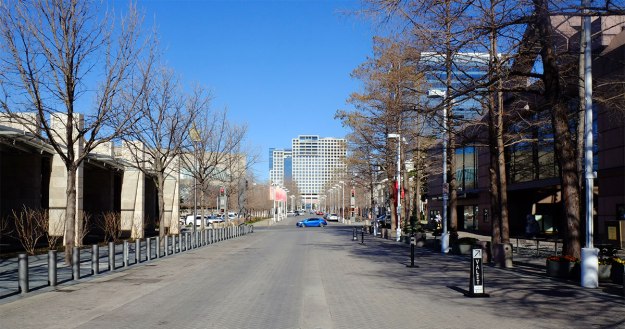
DSCF4778

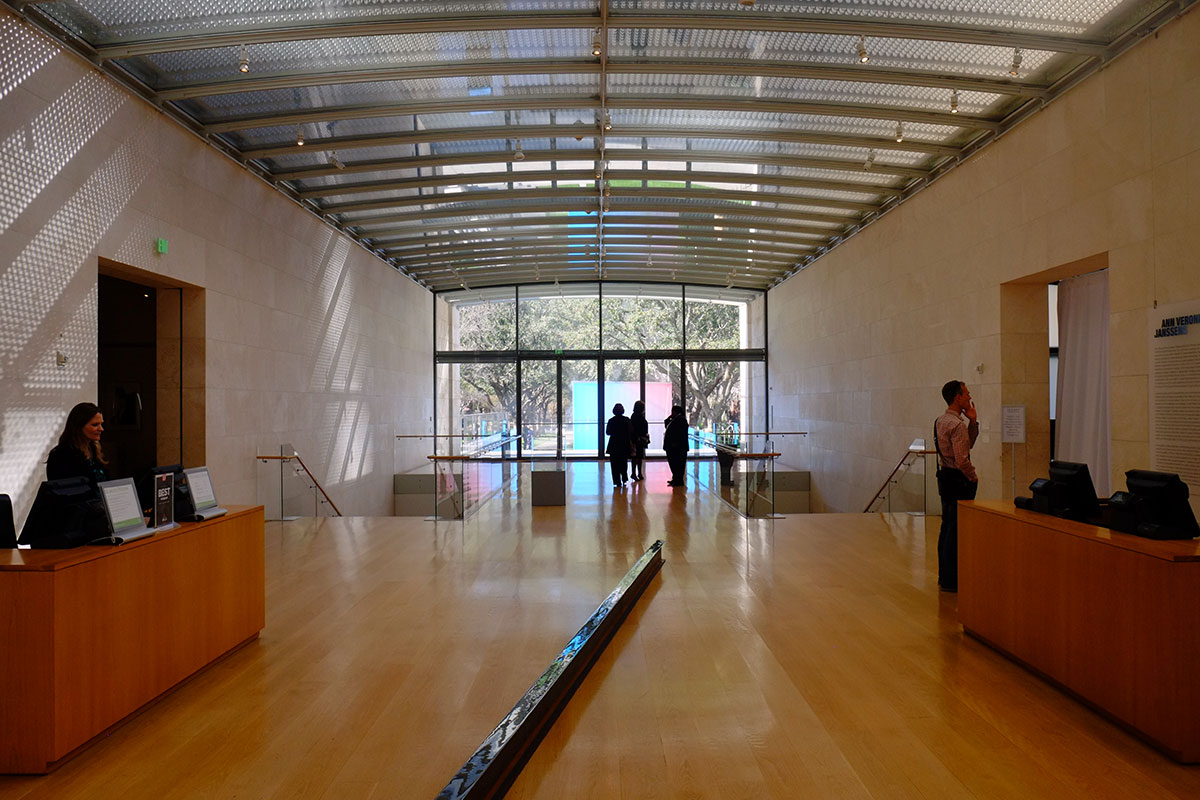
It’s simple, with a series of repeating structural bays, and typical Piano detailing.  DSCF4773
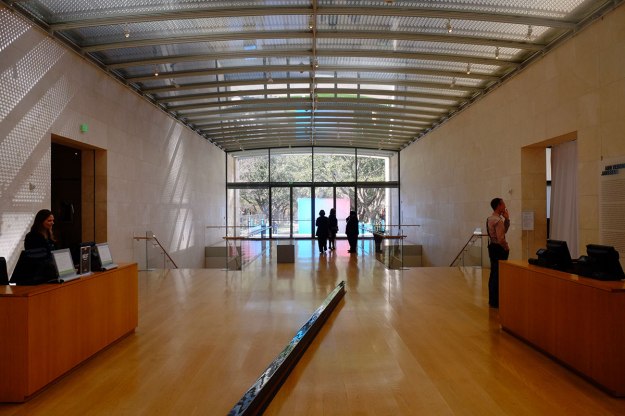
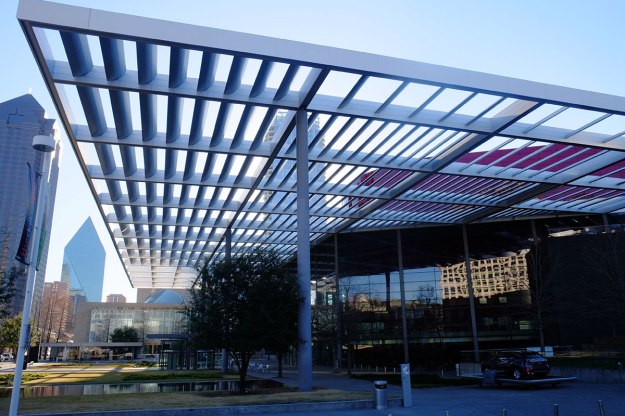
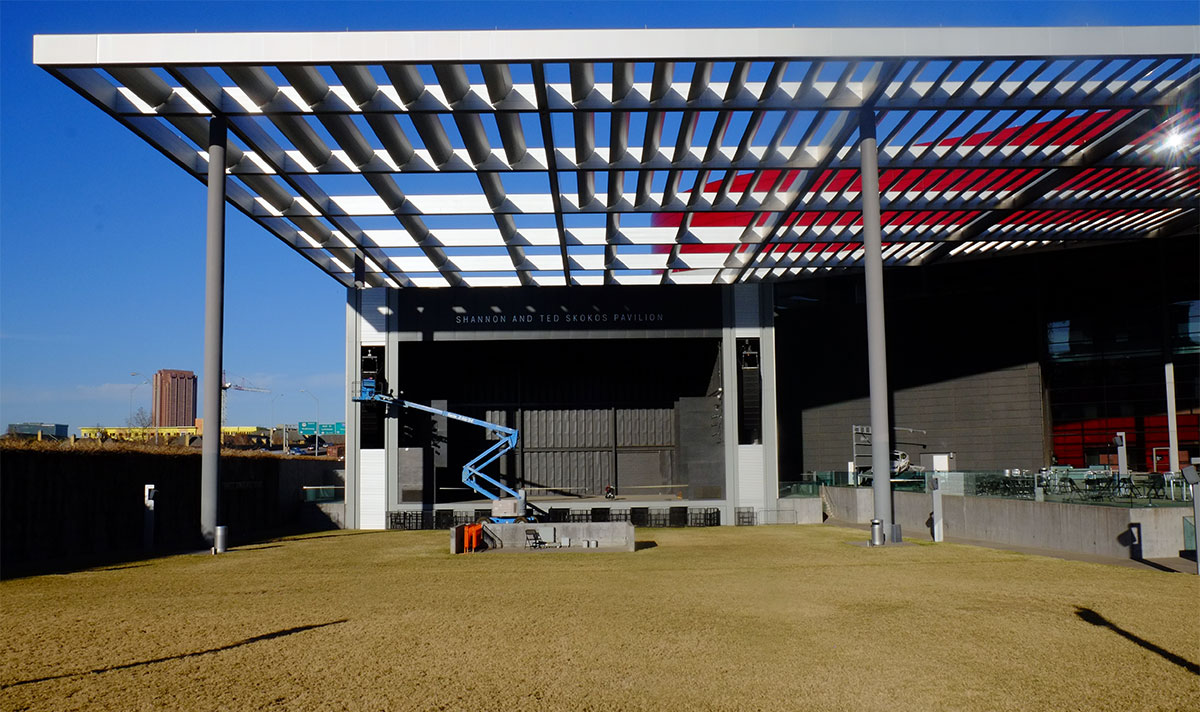
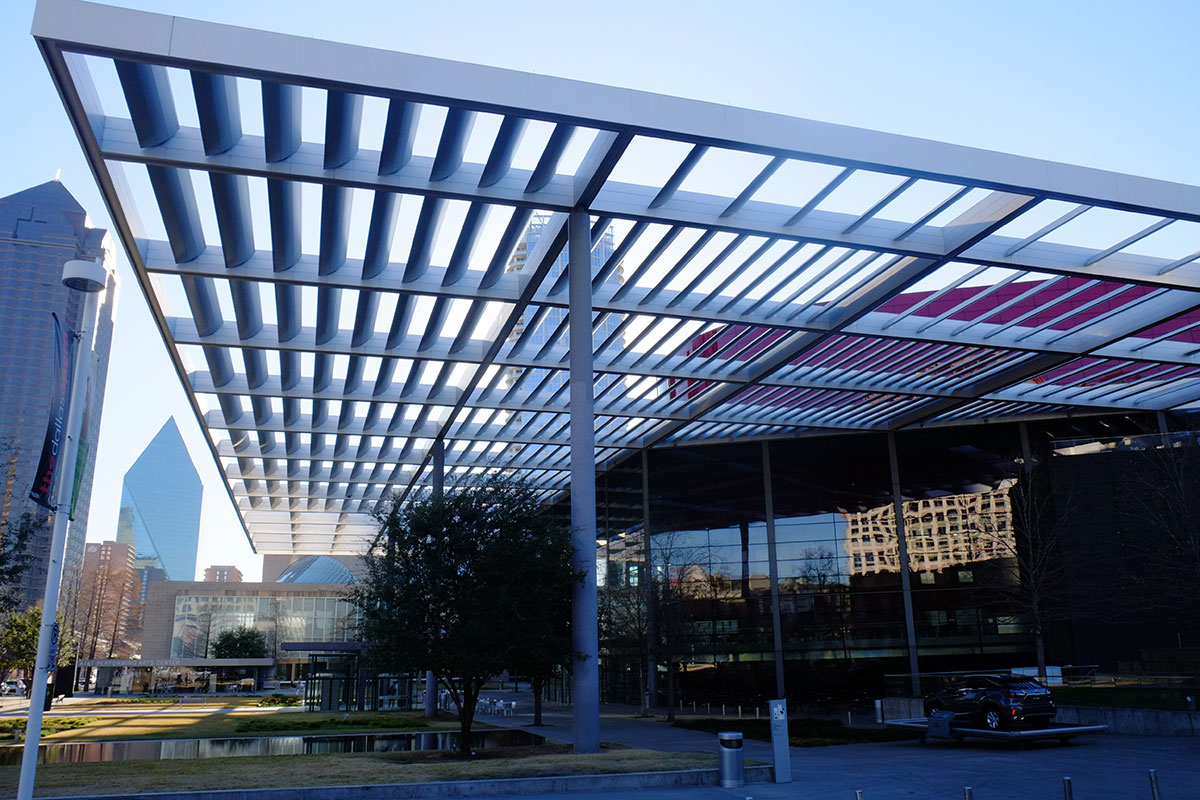
The Winspear Opera House, by Foster+Partners, is hard to see as a building, and impossible to photograph.  It is basically a full-block shading device, with a relatively small opera house in the middle.  This is a view of the outdoor amphitheater on one side of it.  DSCF4932
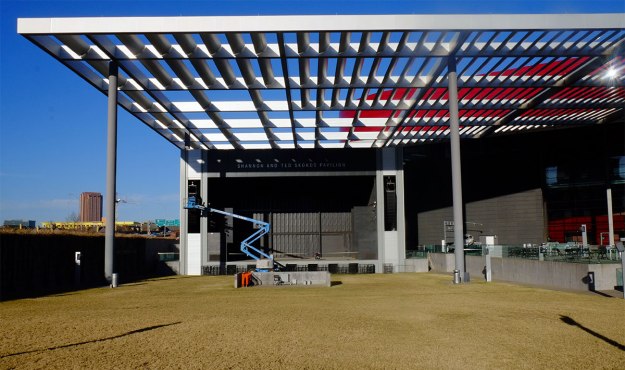
DSCF4894The strategy is pretty wonderful – here is this enormously hot city, where people probably won’t venture out of their air-conditioning for much of the year.  This big screen shades huge outdoor areas, with plazas, entries, cafes, sitting areas, etc., and i would think that it keeps people from just driving their cars into the basement parking garage and taking the elevator to the opera. For something so big, it’s pretty self-effacing – the image of the building is the gesture of the big roof, and the opera house reads as a pavilion under it.

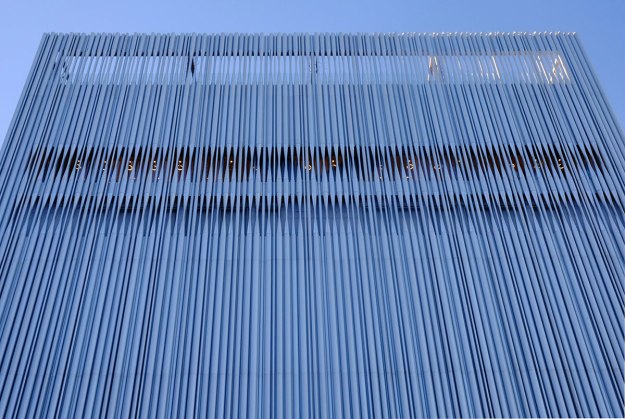
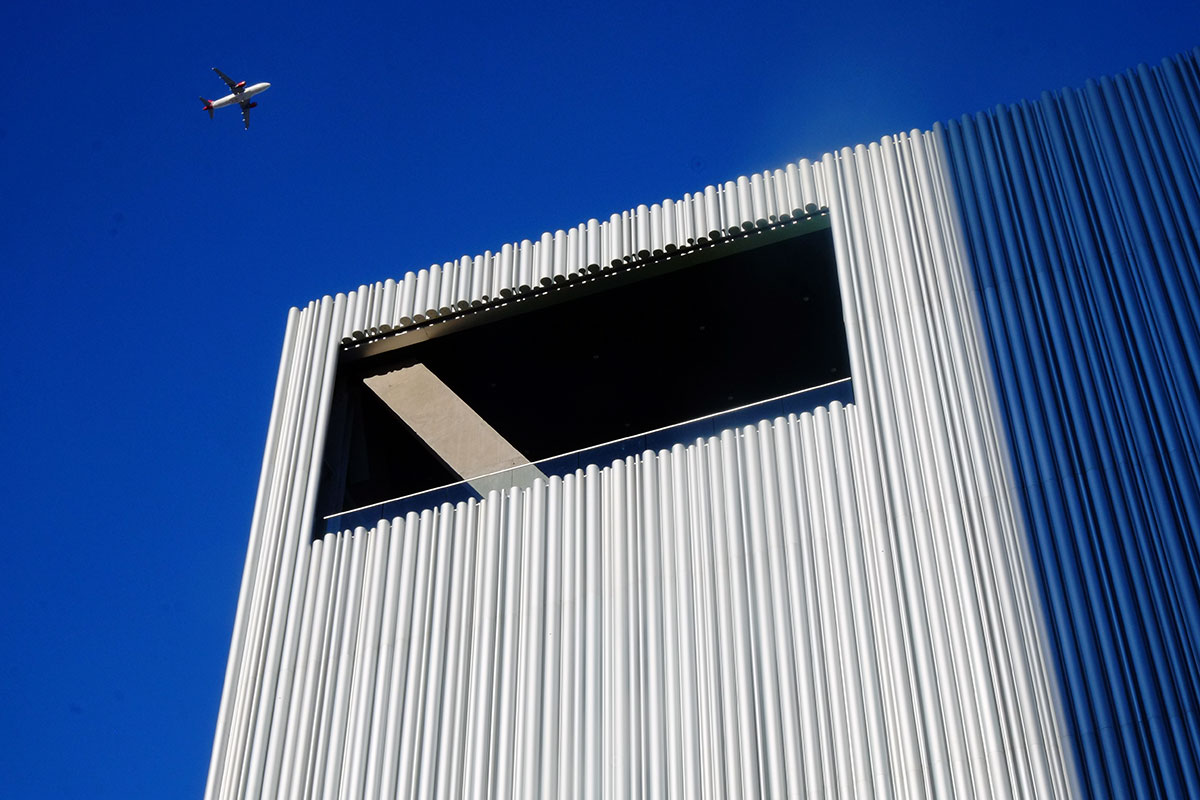
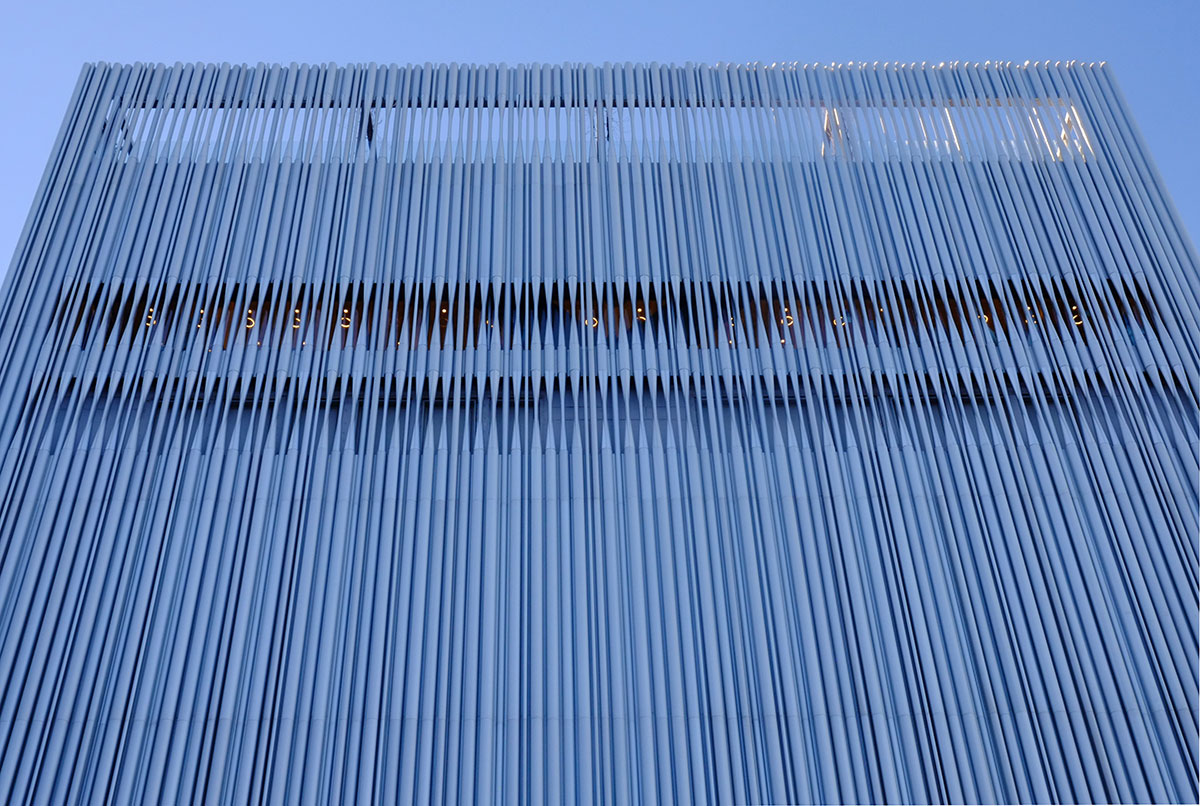
Across the way is the Wyly Theatre, by REX / OMA – purportedly by  Joshua Prince-Ramus, with an assist from Koolhaas.  I couldn’t get inside, but the skin is notable.  DSCF4879
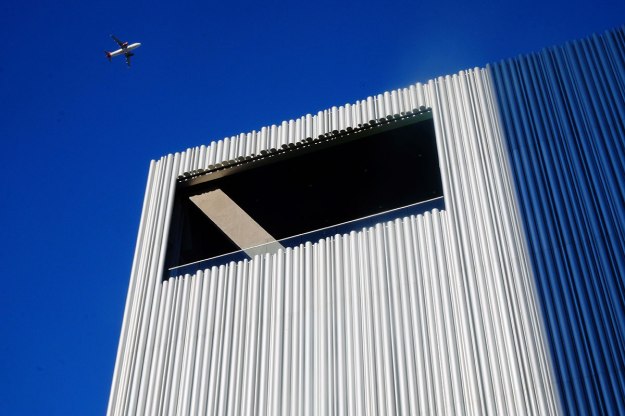
DSCF4884a

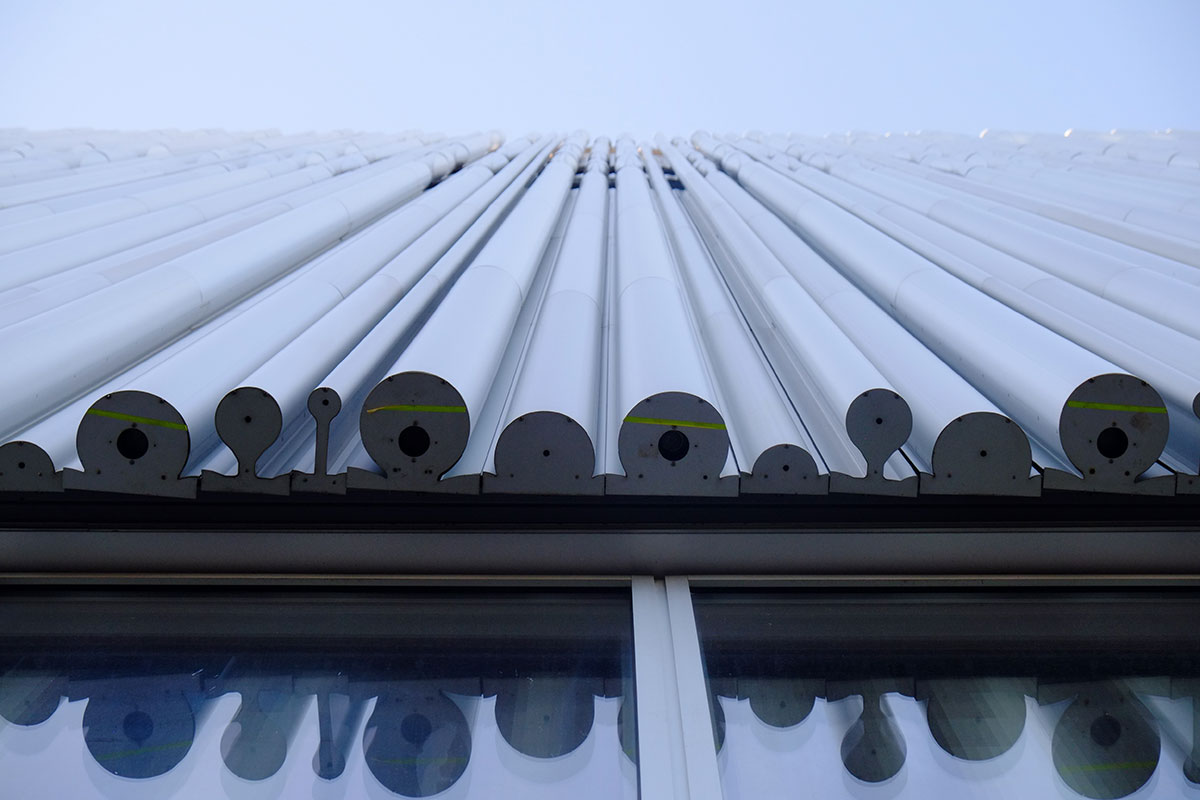
It’s intriguing, and from a distance you can’t figure out how they made this shimmering screen wall.  Then you get up close.  DSCF4886
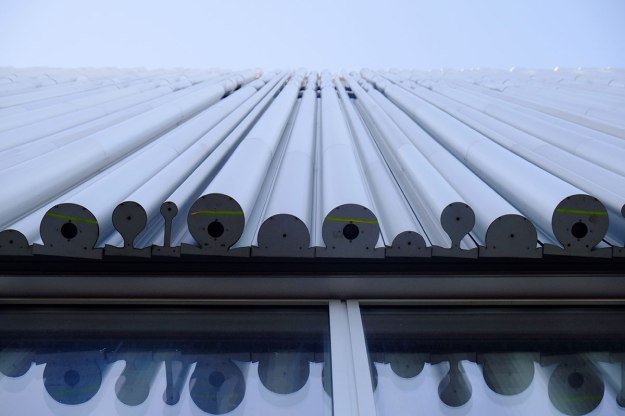
I’d love to know what this cost.  There is one side of it where some building elements are exposed, and you can understand it better as a building.  DSCF4891
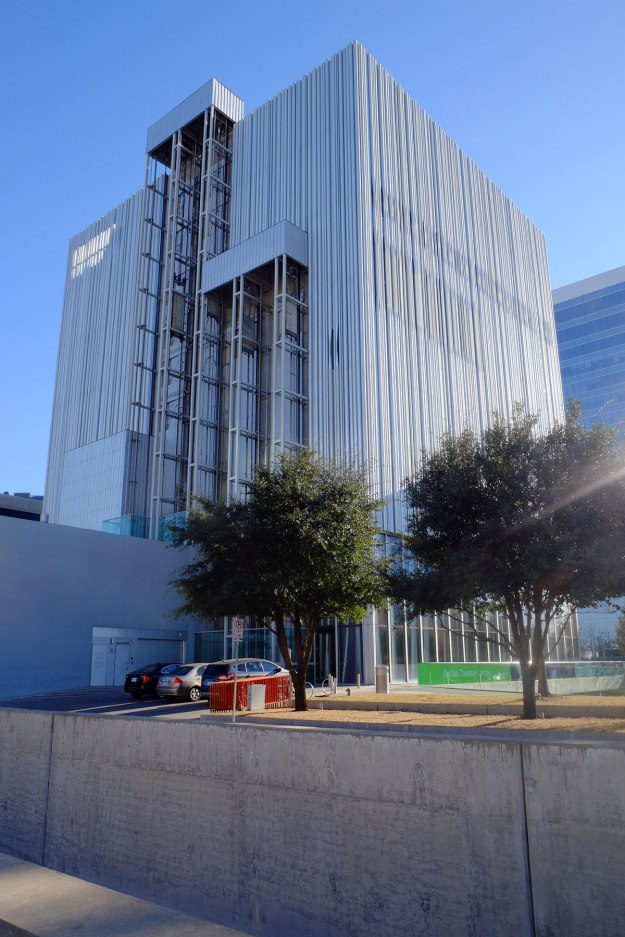
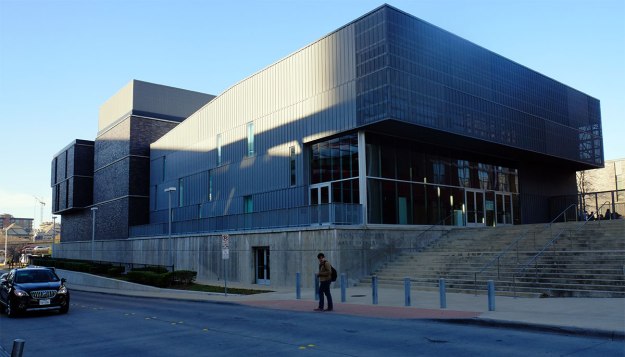
In contrast to these buildings, the Booker T. Washington High School, by Allied Works, across the street is an anomaly – it looks like a relatively normal building.  Building volumes and fenestration reveal the uses within. DSCF4897 DSCF4914It’s beautifully detailed and proportioned.  There’s a stepped central courtyard around the which the school wraps, which is good for daylighting and building depth, but I can’t imagine it being occupied often in the Dallas sun – it may need to be under Foster’s roof.  But in the midst of showmanship, it has the virtue of restraint – it’s not a one-liner building.
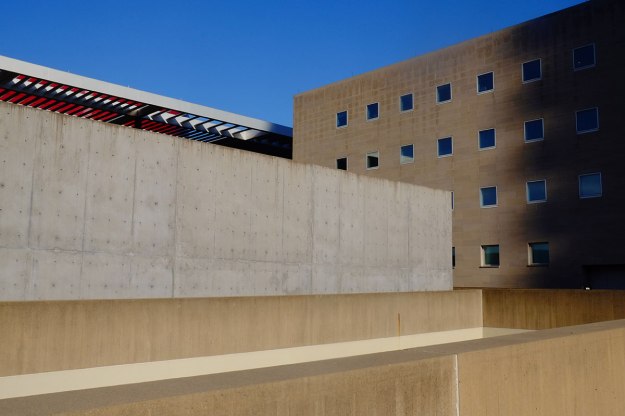
These buildings have many fine qualities, but it’s hard to see how they make up a city.  It’s the Lincoln Center phenomenon, but on an even bigger scale.  There is no finer grain to the city, just discrete institutions that sit near each other, most of them vying for attention for themselves, or their patrons.  (There are more I haven;t mentioned, such as an execrable Trammel museum of Asian art and a symphony hall that looks strangely dated already.)  They enfront the arts axis, but they all have some seriously weird back sides, where collisions like this happen.  DSCF4924On one side these back up against major arterials and freeways, but the other side forms a strange wall where it’s hard to see city fabric adhering.
I think the best part of this district is the oldest piece, the Dallas Museum of Art.  It has a very good, very big collection, and the building is by Edward Larrabee Barnes. The parti is similar to his Walker Art Center in Minneapolis – a processional through galleries and up major stairs-as-rooms from level to level.  DSCF4819
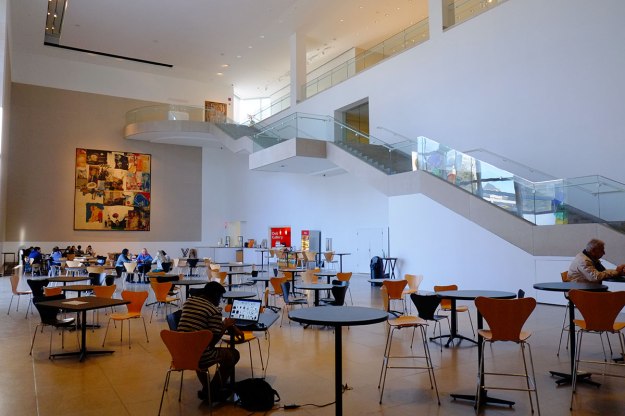
It has good moments, but it doesn’t work.  The Walker is relatively small;  even if you’re disoriented, you can just give up control and follow the path, and it all comes out right in the end.  The DMA is so much bigger that there are several of these wandering paths, and you get completely lost.  When I lived in New York, I knew every inch of the Met, and could show someone the best way to the bathroom from the medieval armor across the central axis and behind the furniture galleries;  this place had me stymied.  Once you venture above the ground floor it is a labyrinth, and determined as I was to make sense of it, I eventually had to ask directions on how to get out and take an elevator.

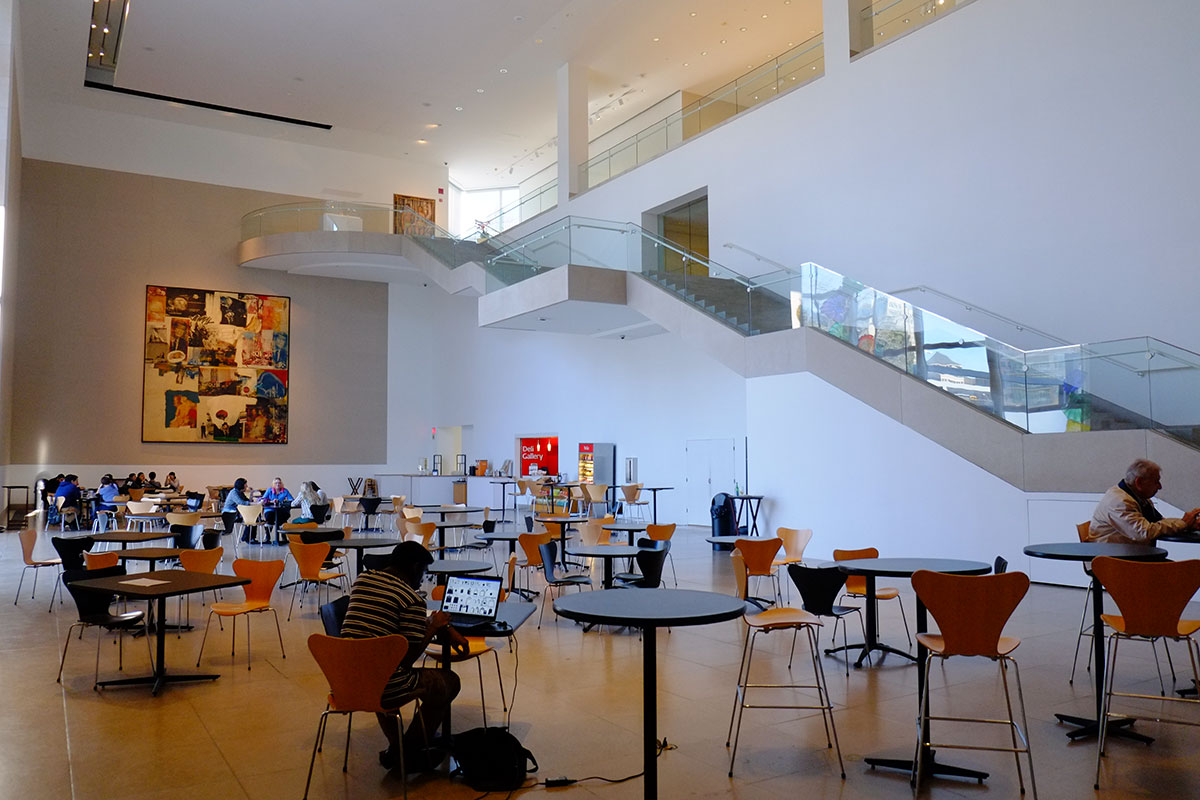
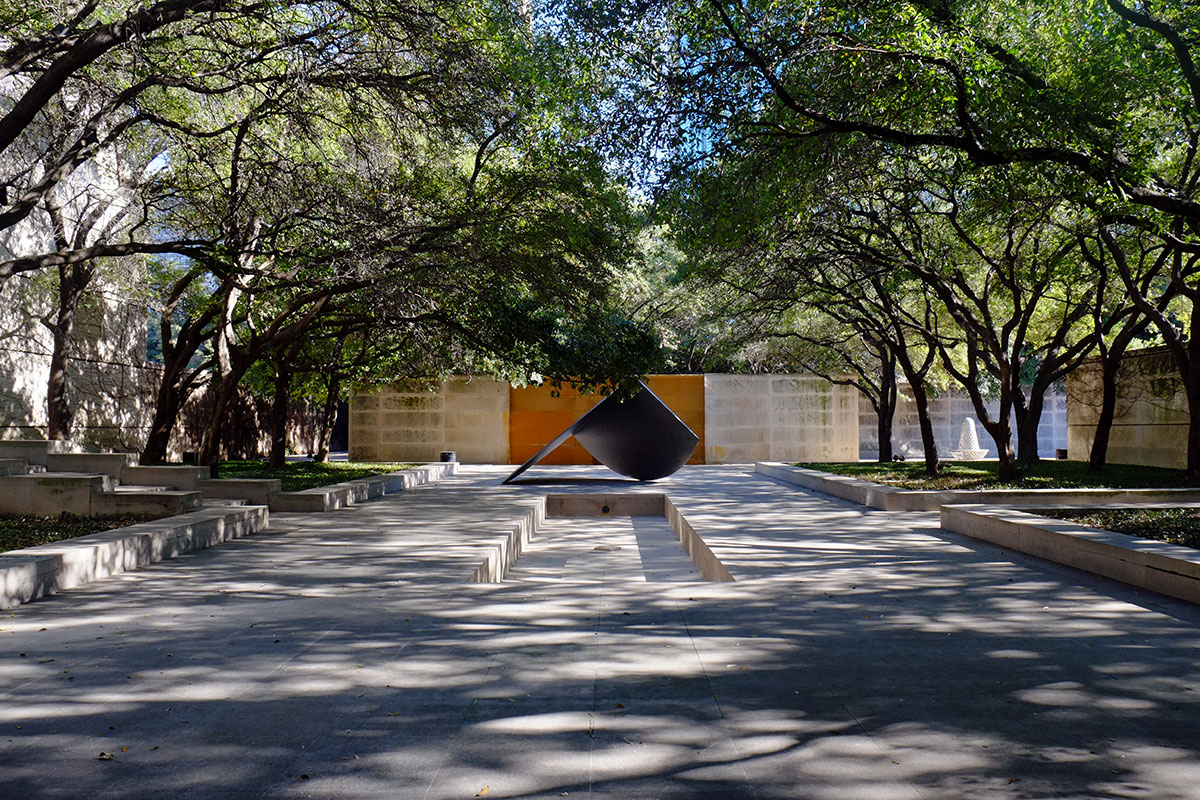
So why is the DMA my favorite one of the lot?  The sculpture garden.  It was designed by Dan Kiley, the great modernist landscape architect (something I could sense from the moment I spotted it).  I caught a glimpse of it from a ground floor lobby and was irresistibly drawn outside.  DSCF4808
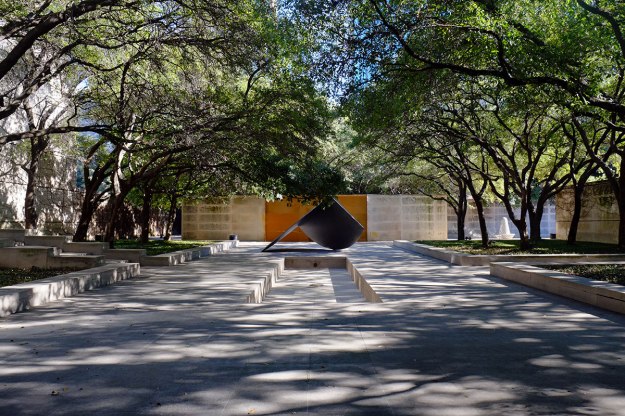
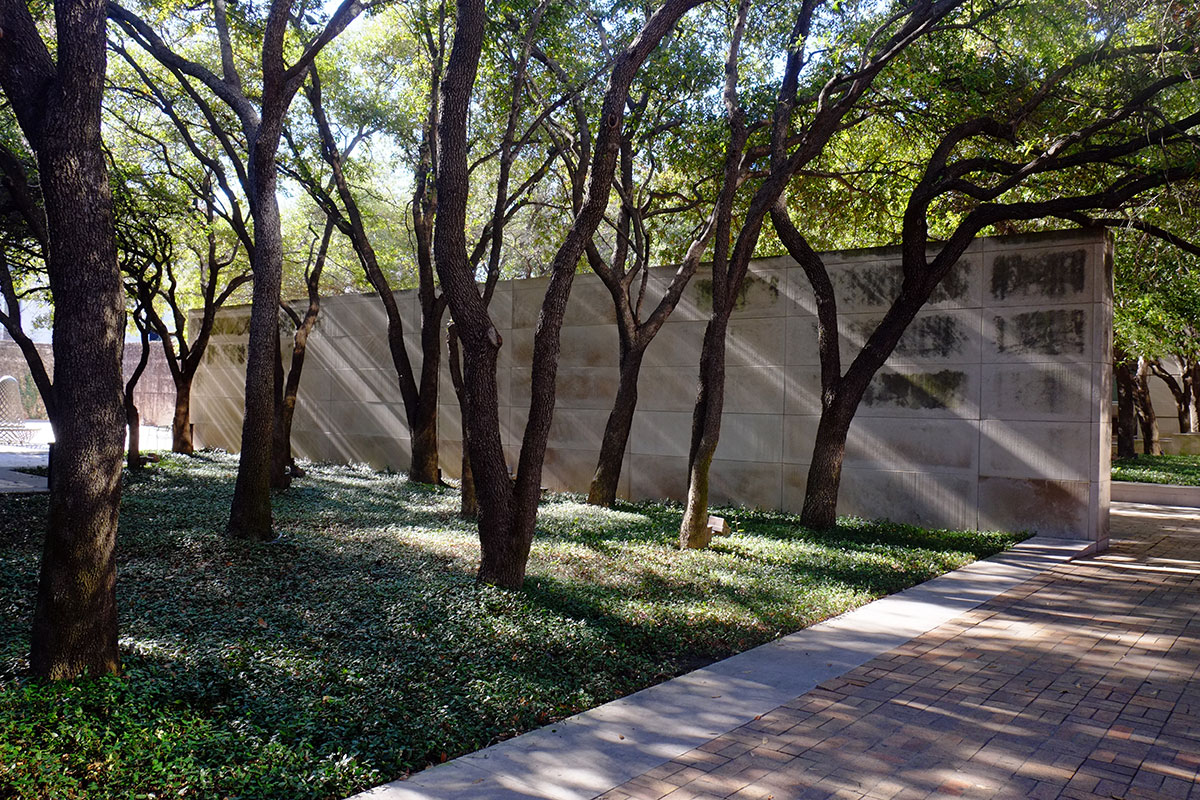
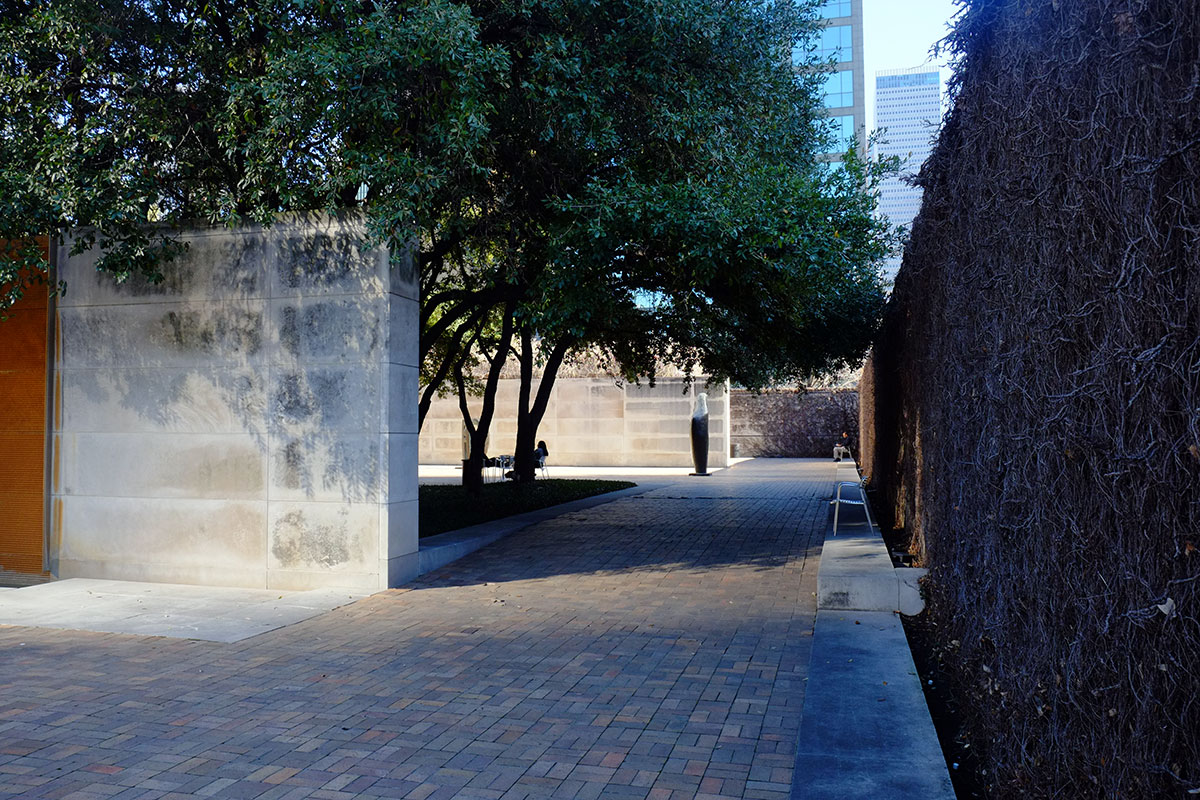
We sometimes talk about whether a new museum is a good place to view art, or whether it’s something that exists mainly for itself, highlighting the architecture.  The same question could be raised about this garden.  The sculpture and  its placement are fine, but to me the overwhelming point is the landscape and the space itself.  A series of shifting, off-center axes.  Live oak trees filtering the clear Texas light.  Strict rectilinear geometry allowing for diagonal glimpses into adjoining spaces.  DSCF4807A series of wall planes with varied materials and textures around which your path threads.   Light and shadow and color.DSCF4795 Open places, secluded places.  Symmetry used to emphasize entry.  DSCF4802
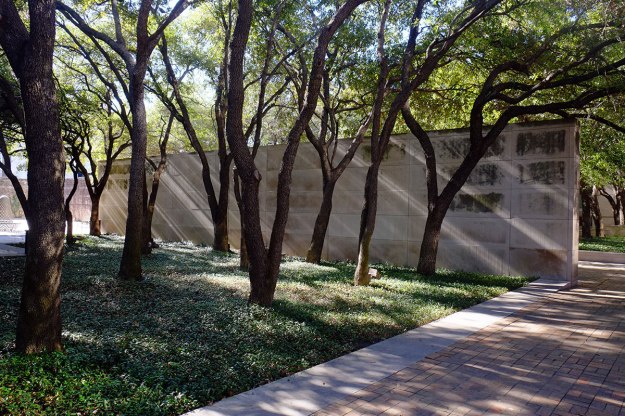
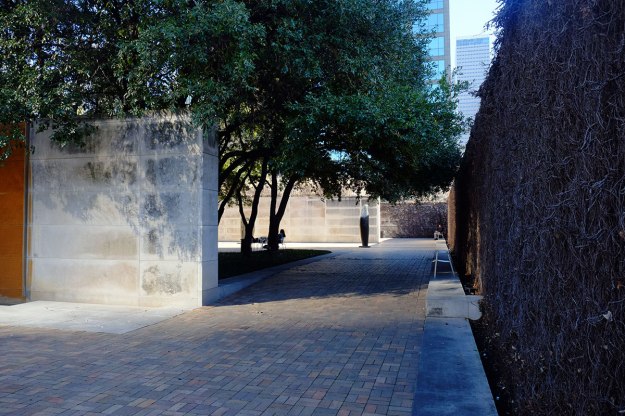
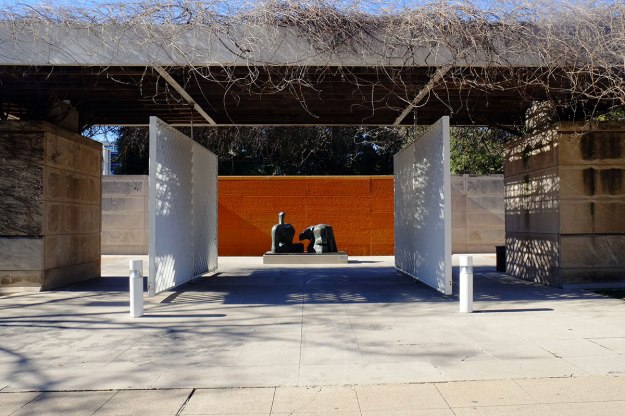
It was so good I could have spent the whole day there, but I had other things to see.

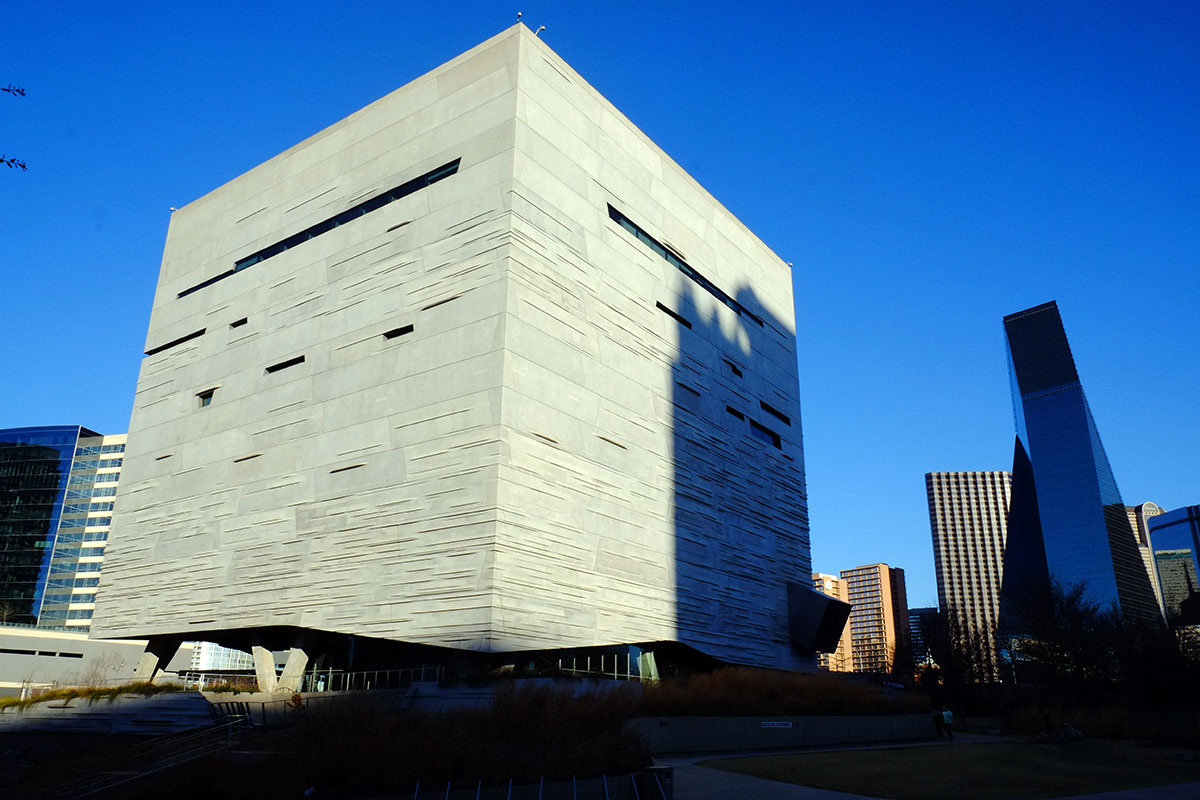
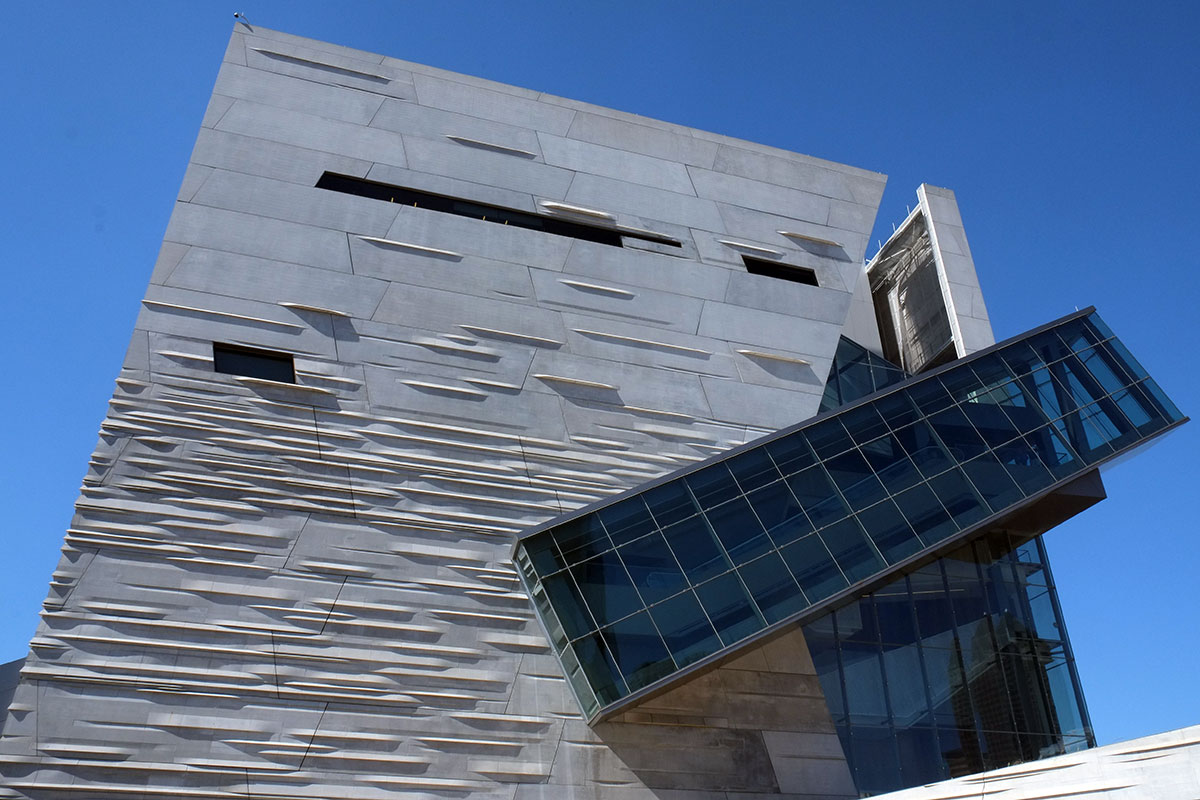
The new Perot science museum by Morphosis is the ideal building for us on this trip – Greta gets to look at science and natural history (which she has already written about), and I get to look at architecture.  Like most Morphosis buildings, it’s deceptively simple and functional.  Ten years ago, Thom Mayne explained how they designed the Eugene courthouse – they arrive at a simple plan, get everyone to buy in on the scheme, and then spend their effort elaborating  and finding the richness within the simple parti.  You can see that here too.  A science museum wants to be a black box for the exhibit designers.  They got that here, and it was then clad in a varied, textured skin which doesn’t try to disguise the essential boxiness of it.  DSCF4337
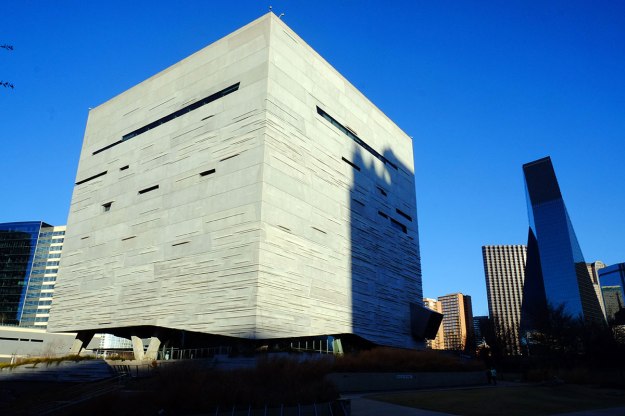
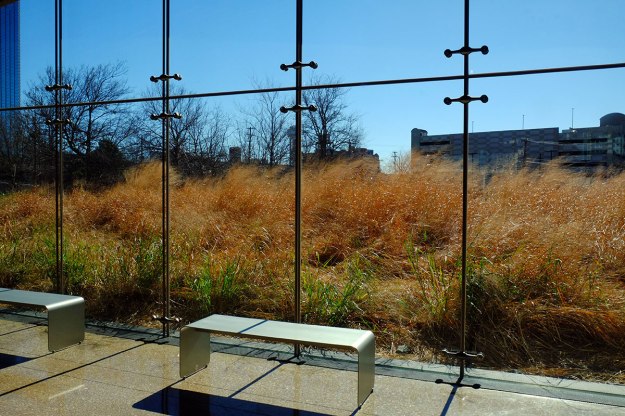
The skin is lifted up at points to reveal the lobby below, and afford views out into the landscape.DSCF4760
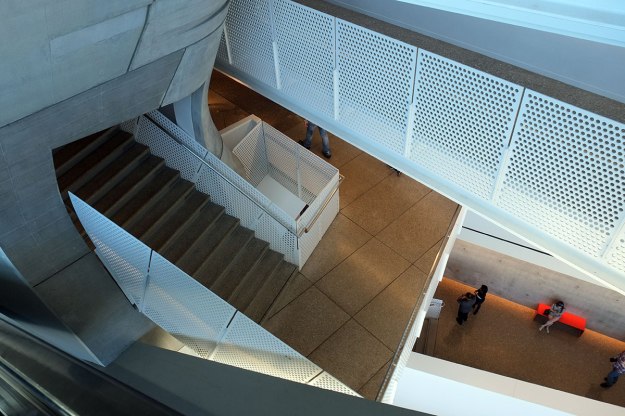
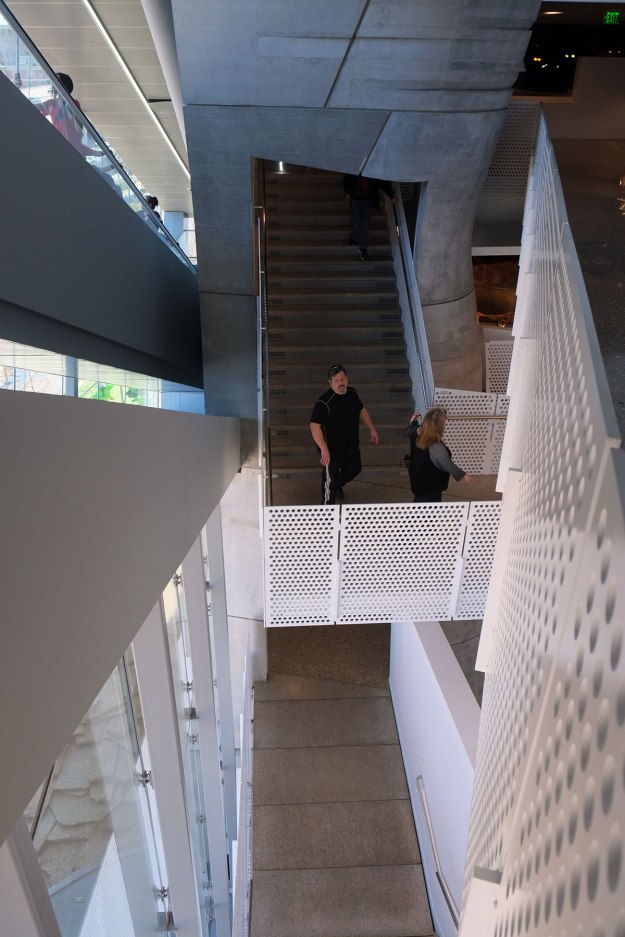
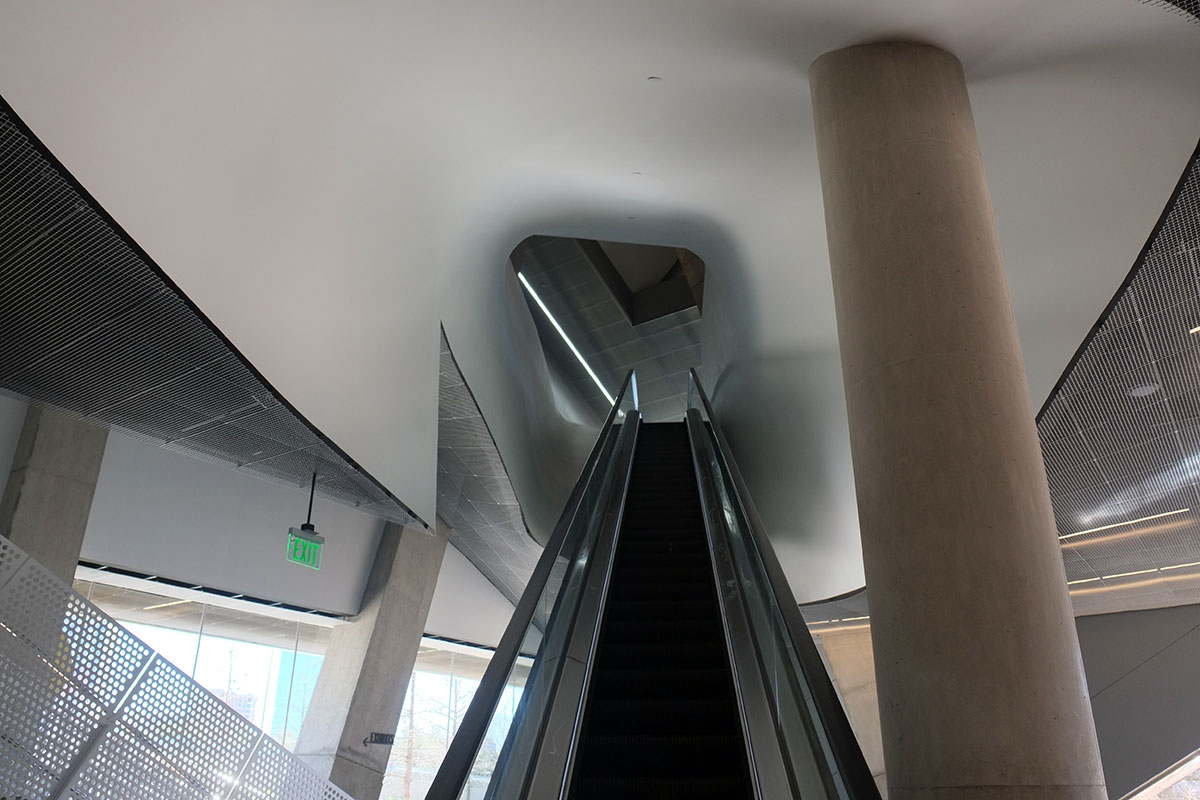
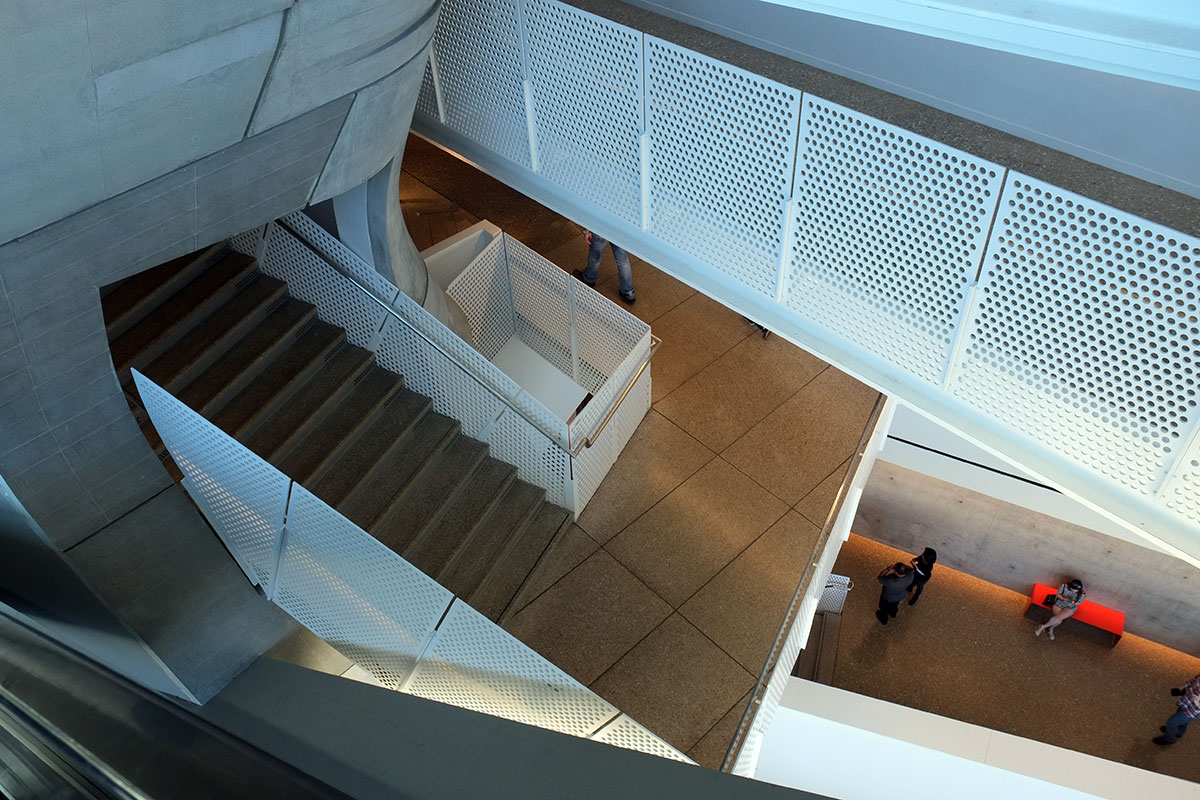
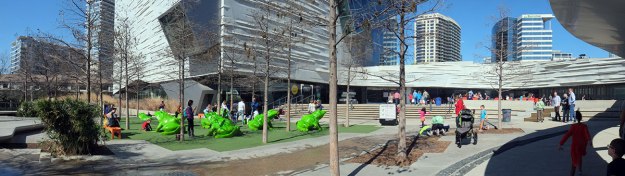
The other major element of the museum is the circulation system, which must draw people in, move them efficiently through the building from floor to floor, and perhaps provide the architects some latitude for spatial and tectonic excitement that they have been denied in the box.  And as many the patrons will be children, allow them some room to play and run and have fun too.

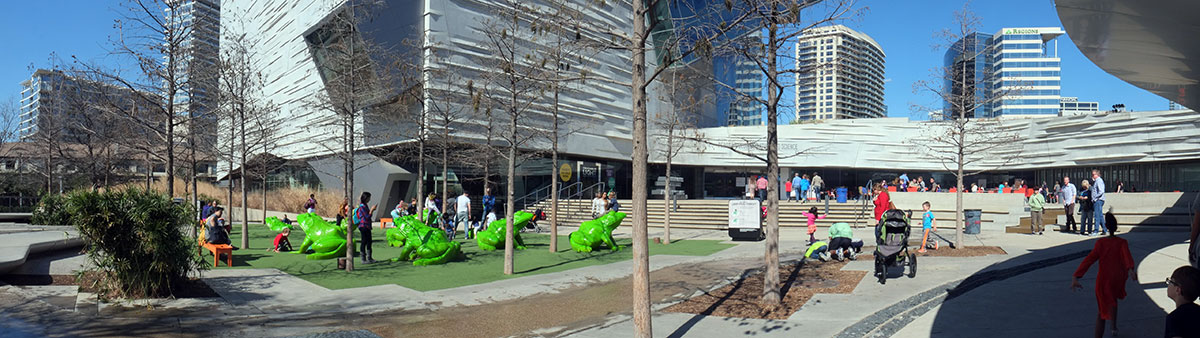
The system starts outside, drawing people up a ramp from the street into a large entry and cafe plaza.  DSCF4142
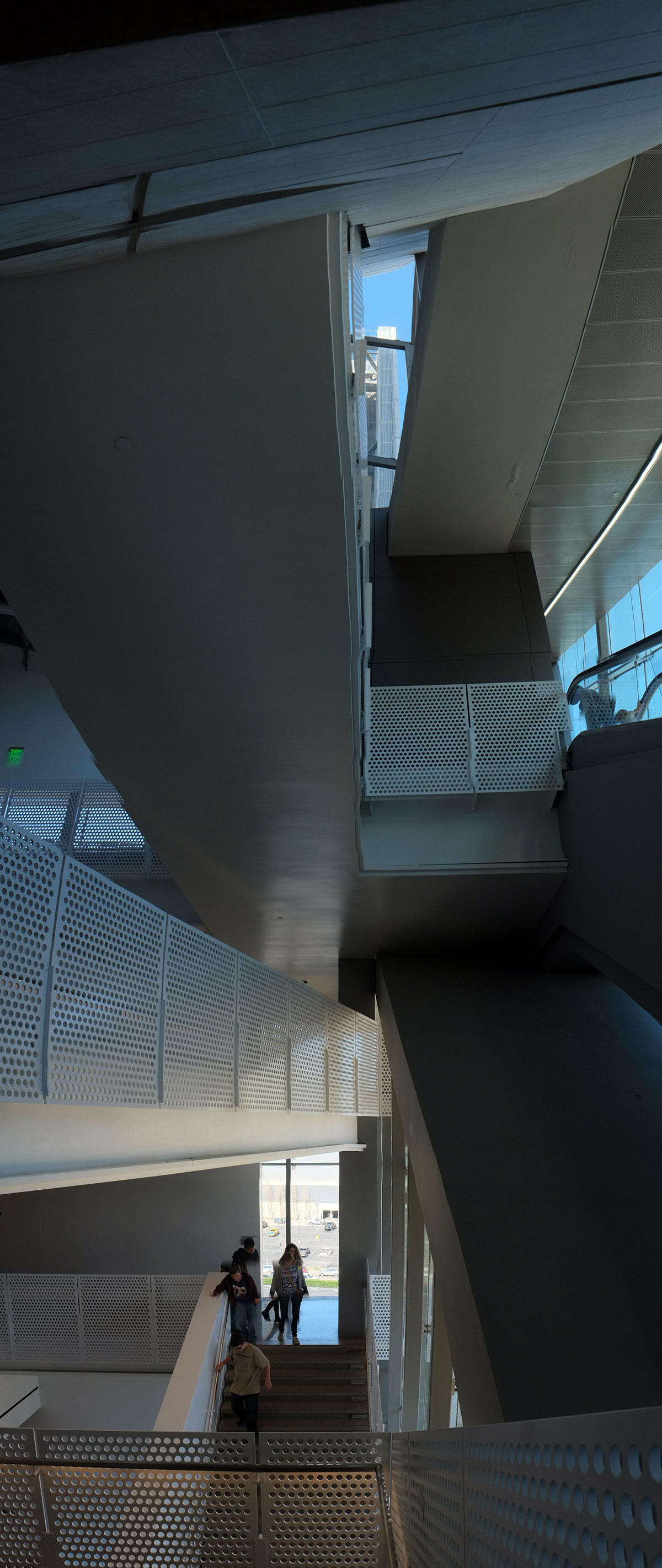
On the inside, there follows a series of spatial expansions, compressions, shifts, revealed yet inaccessible destinations, etc., which I can’t document in detail, there is just too much going on.  But you never feel lost – there is one predetermined path, and your experience is modulated as you move along it.

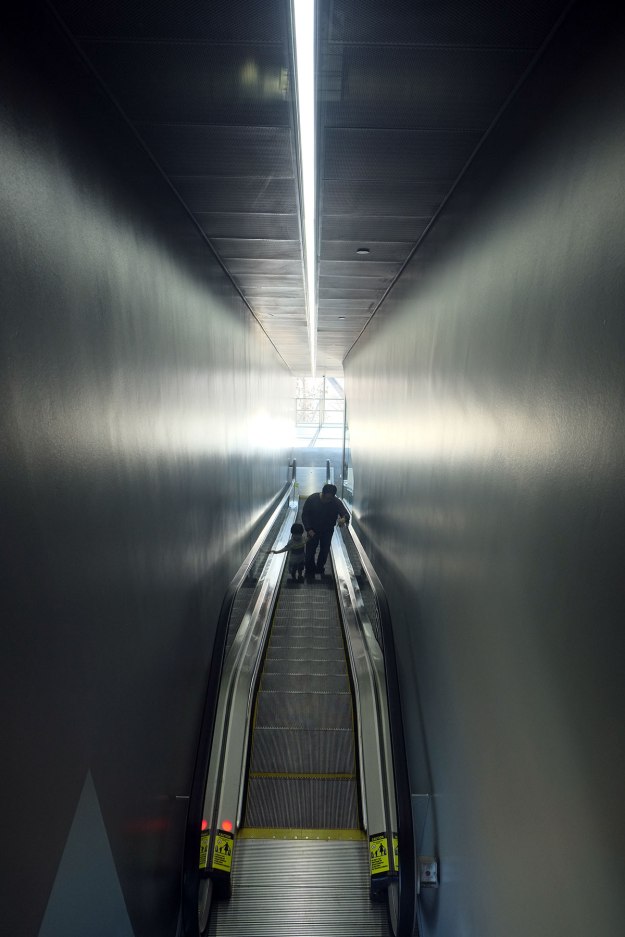
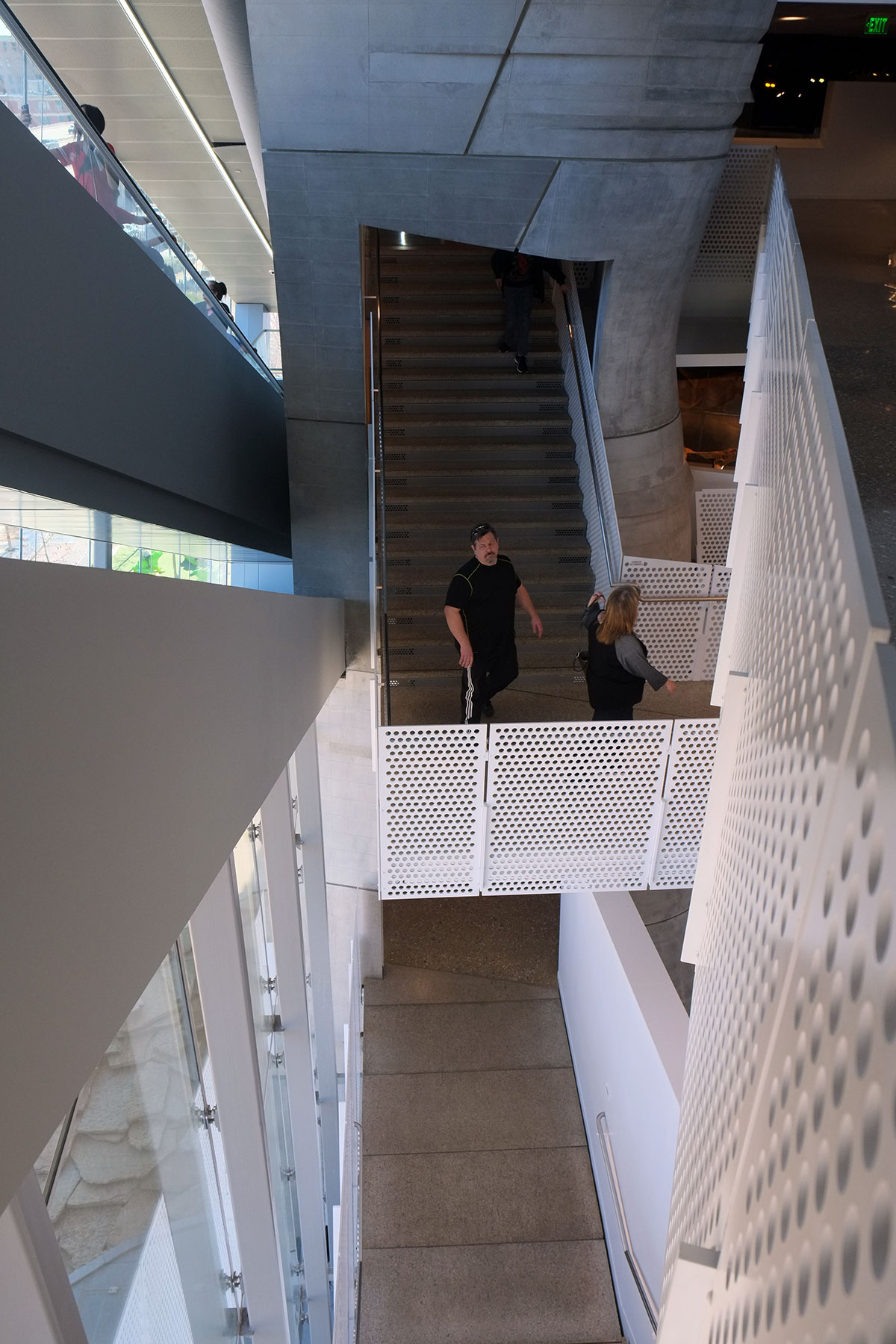
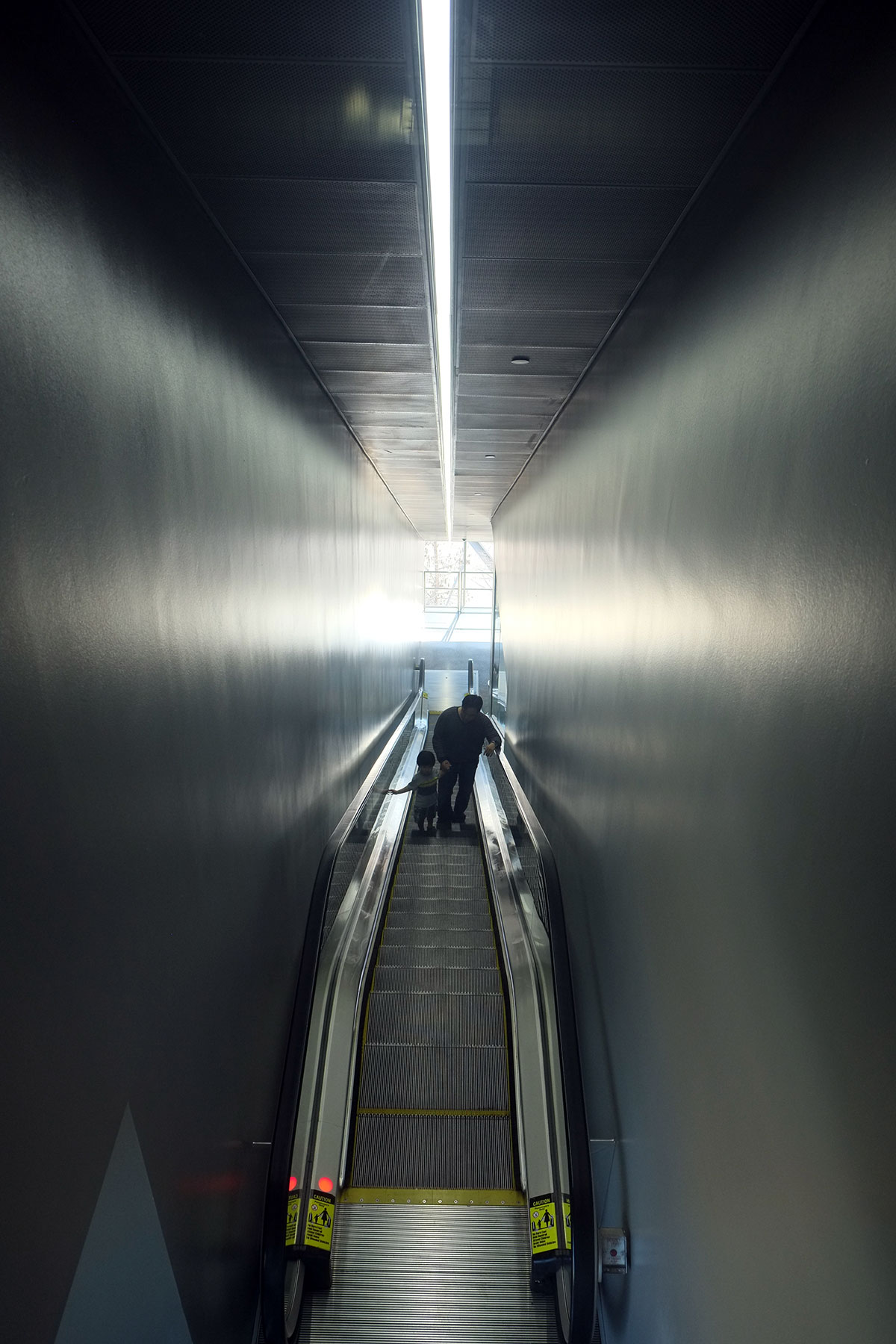
The pathway is to get visitors to the top, then have them walk down.  This is accomplished by a series of escalators.  On the outside, you can see the homage to to the primal gerbil tubes of the Pompidou Center, but eschewing the tubularity.  DSCF4147
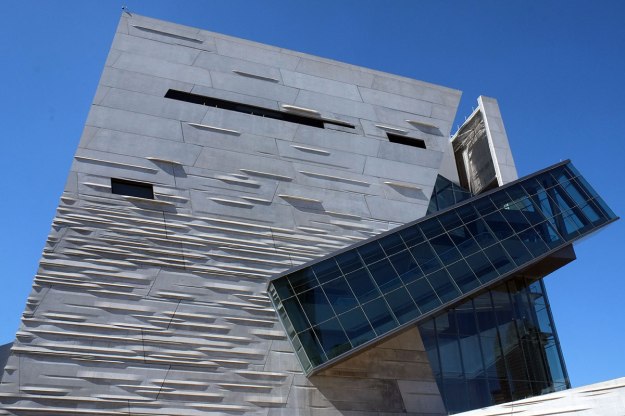
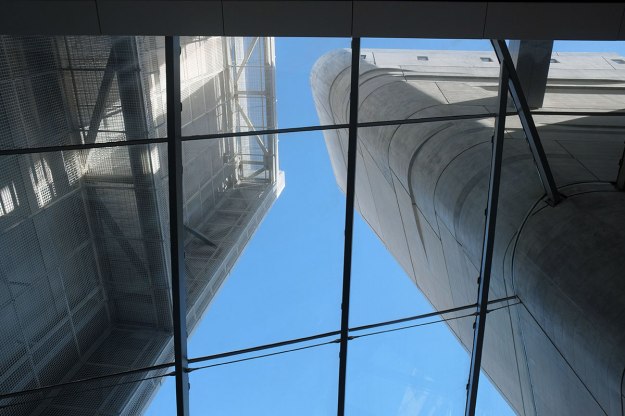
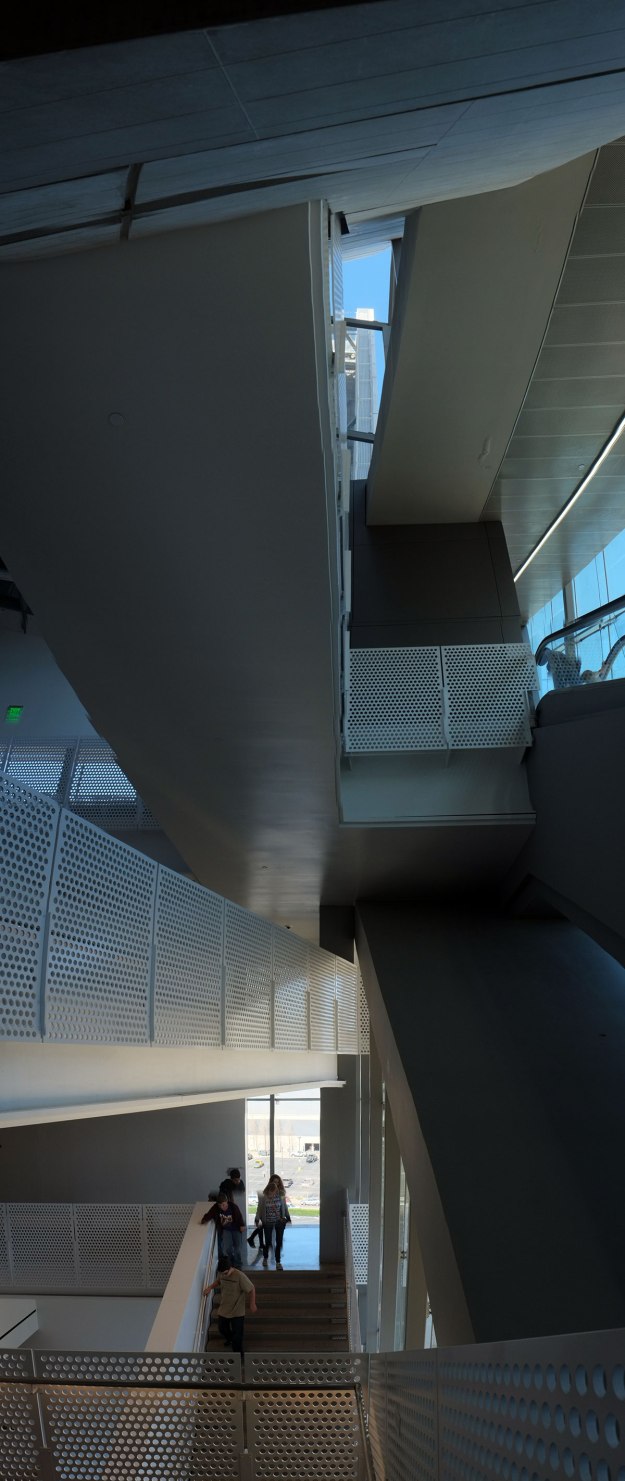
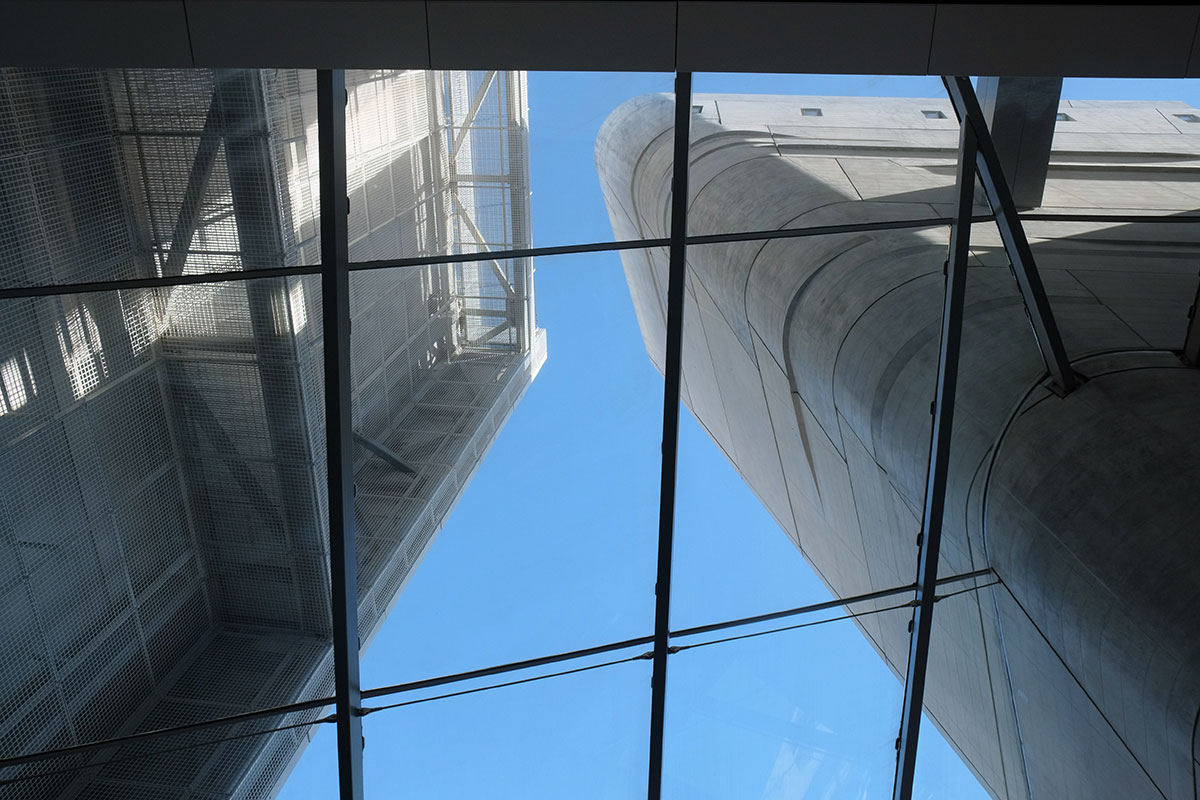
The skin is cracked at the northeast corner, and the circulation core behind is exposed.  It feels like a canyon inside, and the non-repetitive circulation system provides endless variety of movement and views.  Random photos:  DSCF4174  DSCF4191  DSCF4258  DSCF4273  DSCF4279  DSCF4285
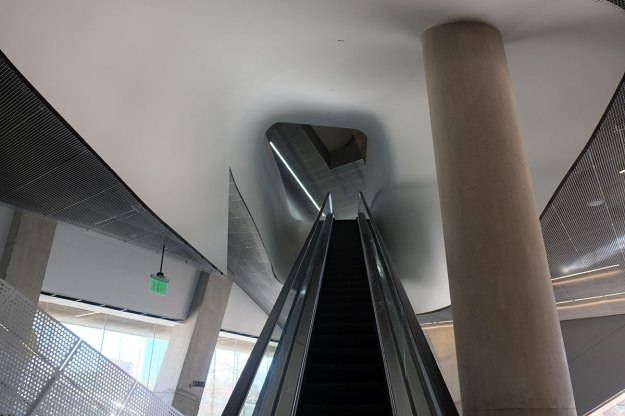
It is playful, it is intriguing, it draws you in and it doesn’t get you lost.  And it provides a great connection to the city across the freeway, in a way not unlike Piano’s outdoor terraces at the Whitney in New York.  DSCF4234It’s a remarkably clear building, one where every part is fulfilling its intention, and the quality of the architecture enhances one’s enjoyment of the museum.

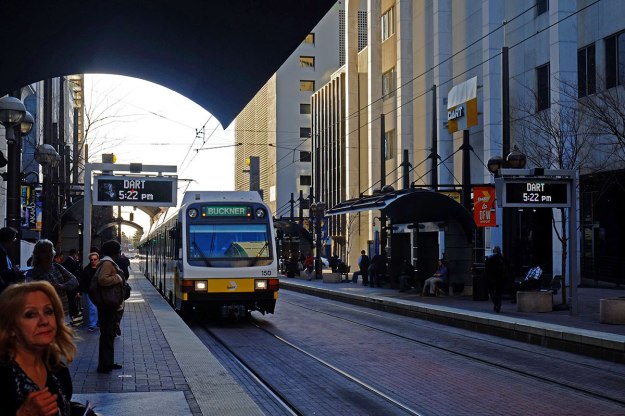
Beyond the buildings, the attention to urban design in Dallas was notable.  Of course there are giant streets dominated by cars, but somehow as a pedestrian I didn’t feel intimidated.  There was a pedestrian scale to all the downtown streets, crossings were frequent and non-threatening.  The light rail transit corridor is efficient and pleasant through the heart of downtown.  DSCF4953
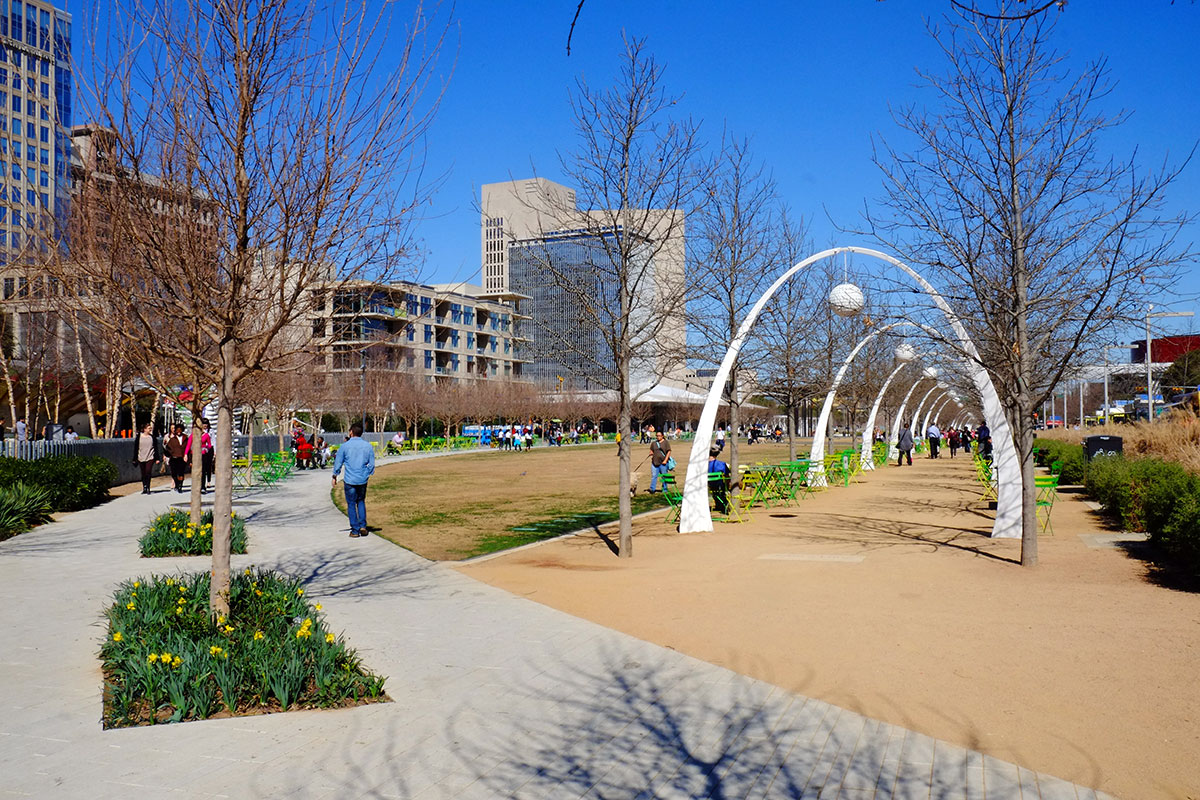
A welcome new feature is Klyde Warren Park, built over three blocks of the depressed freeway on the west side of downtown, and providing needed connection across.  Designed by James Burnett, it has lots of open spaces, seating, a playground, walkways, food, etc.  DSCF4739
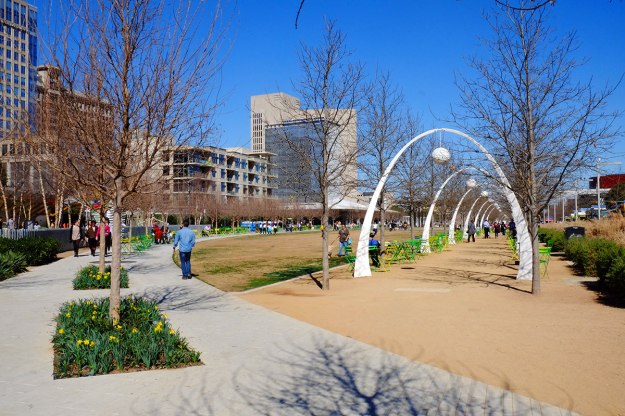
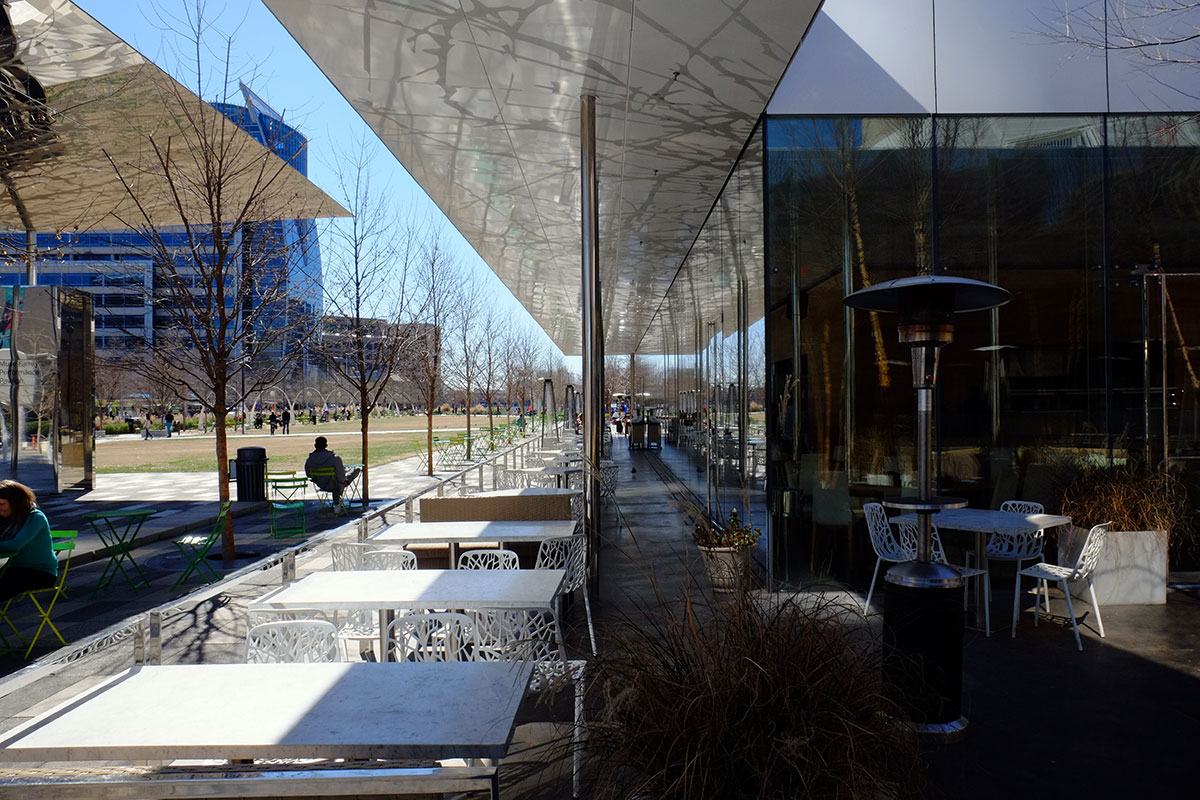
It’s pretty straightforward, not a design tour-de-force like the High Line, but it is incredibly pleasant on a sunny day, and draws lots of users.  There is a restaurant, cafe and performance pavilion by Thomas Phifer, in what I’m coming to recognize as his light and white, Miesian style.  DSCF4747
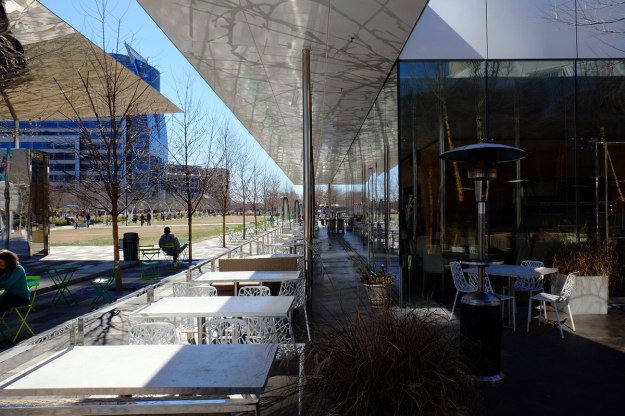
It’s very elegant and exquisitely detailed (with James Turrell-like knife-edges corners) providing that food-oriented catalyst for a park that William Whyte promoted.

As in many other places on this trip, I wish I’d had more time in Dallas.  It was a good introduction to Texas – it knocked me out of my preconceptions, being so much better than I had expected.   i could have tracked down the sprawling nightmare of the exurbs, but I could have found similar bad parts in any other major city in the country.  To paraphrase Tolstoy, all sprawl is alike, each good city is good in its own way.

Perot Museum of Science

P1070453

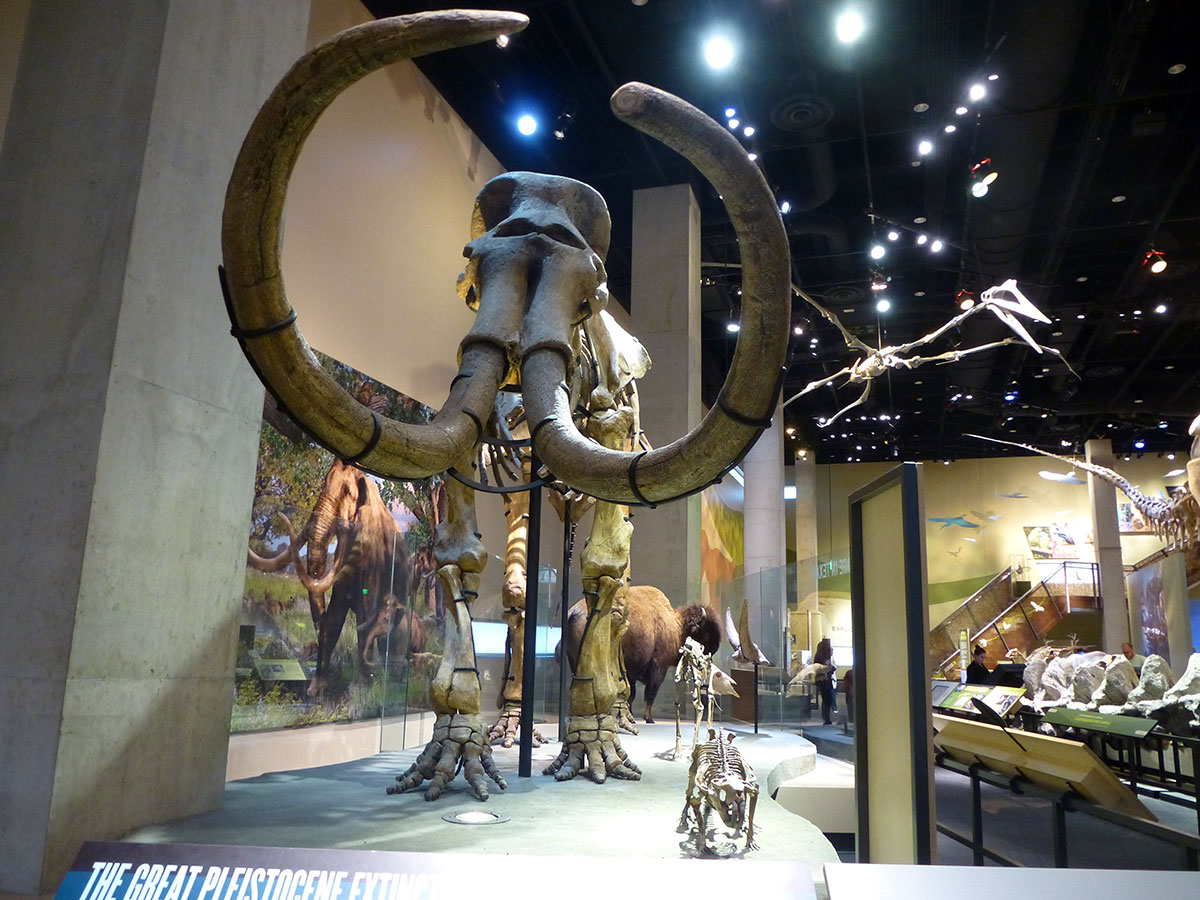
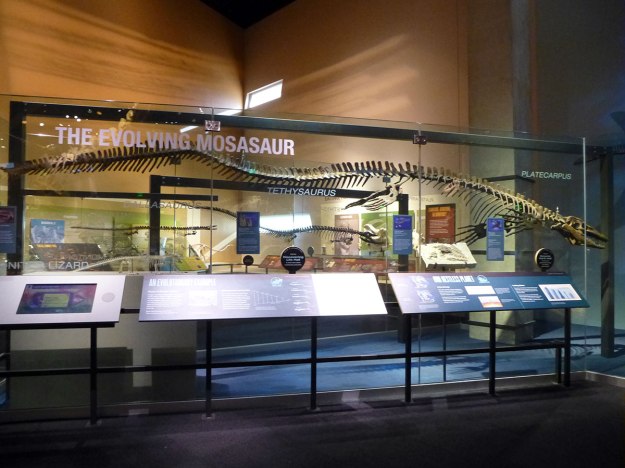
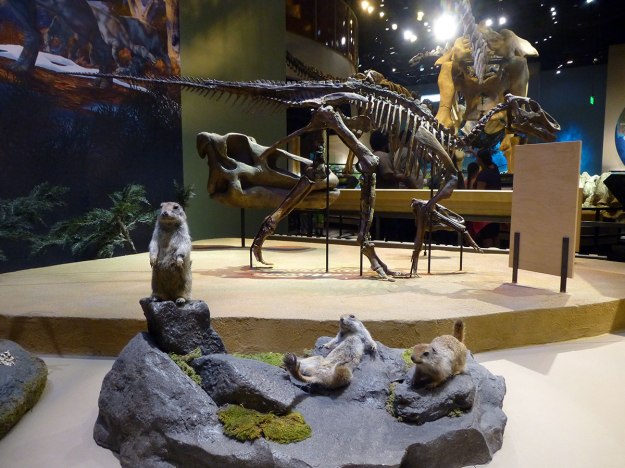
P1070410I wasn’t expecting much from the Perot Museum in Dallas, TX. It was described to me as a highly interactive science museum, so I was thinking it would aimed mostly towards, and dumbed down for, little kids. To a certain degree it was, but there was a lot for children of all ages to explore and learn.And when I say a lot, I mean three full floors plus a mezzanine level and traveling exhibits in the basement. The exhibit when I was there was about bioluminescence, which persists in being both one of my favorite words and one of my favorite things in biology. Mostly I learned about the habits of fireflies. Did you know that female fireflies have learned the flash patterns that attract males of different species, and when the guys come down looking to mate, the girls eat them? And that male fireflies sometimes band together and sync up their flash patterns to become a great pulsing bush that’s impossible to miss?The fossils on the top floor were great. Texas is prime bone-hunting country, and a good number of their dinosaurs are natives to the state. Nanuqsaurus, meaning “polar bear lizard”, is a clear exception. The mosasaurs however, were not. P1070399Most of the animals in the exhibit showing how these giant water monsters evolved were found in the Southwestern United States, which was once covered by an inland sea. It was called the Western Interior Seaway, which provides backing to Keyes’s Law. “Anyone with the authority to name anything by definition lacks the creativity to call it something cool.”

P1070421

This law was disproved only minutes later, by Gomez’s Hamburger in the Space Hall. This hall didn’t have any real stuff, that’s all at the Smithsonian, but it did have a lot of cool graphics explaining stuff in space and physics. Any kid who went to school after 1990 has seen the video about orders of magnitude where it zooms in or out through our universe. This exhibit had a different version of that running, but you could control it with a dial, and this one had cool things on it, like Gomez’s Hamburger.

The third floor housed the geological and weather science. There was a platform that simulated an earthquake, proving that we’re all doomed if the megaquake hits the northwest. Like the Museum of Science and Industry in Chicago, they had an artificial tornado. It was a bit smaller, but the exhibit did a better job explaining how they form.

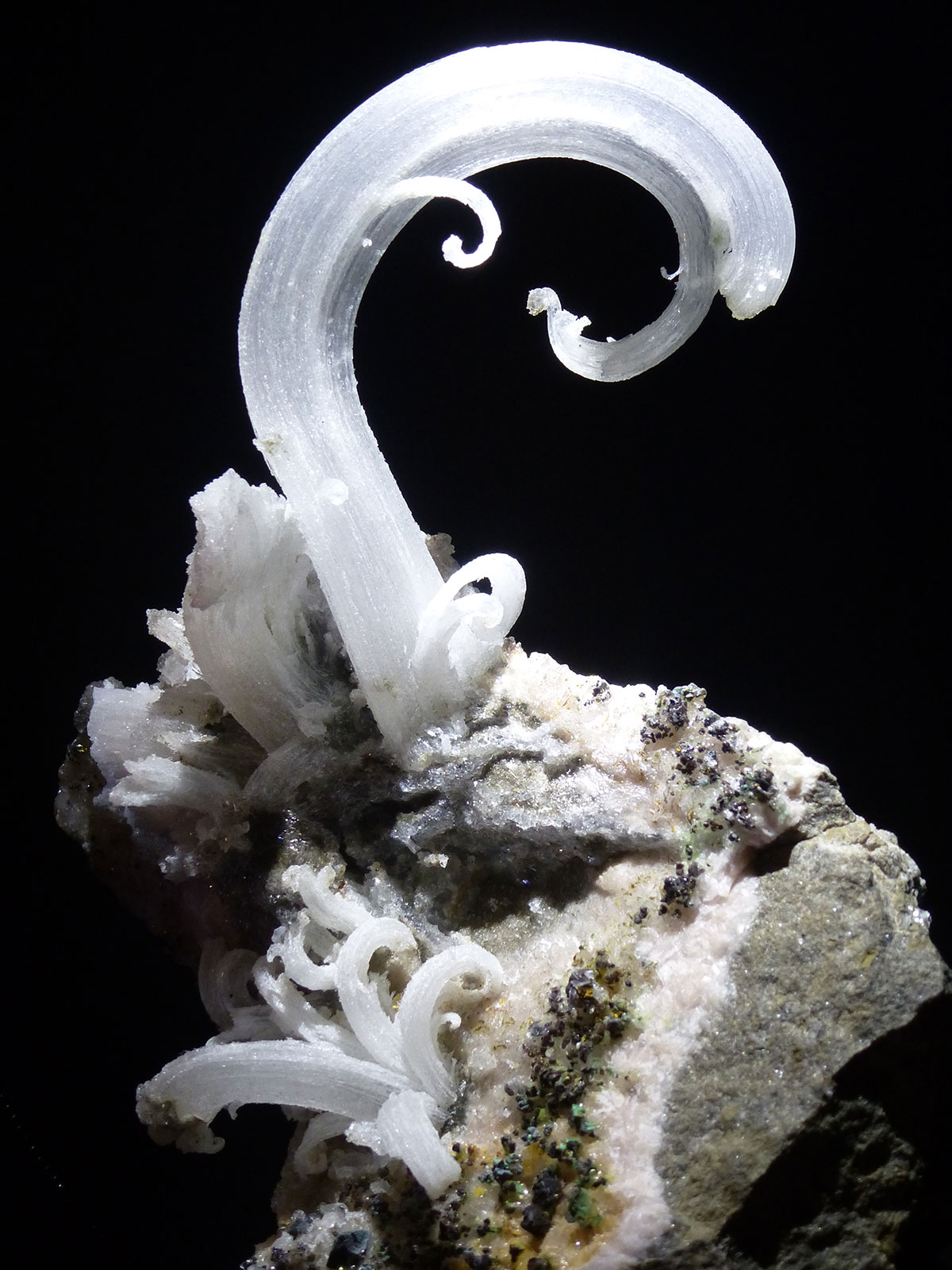
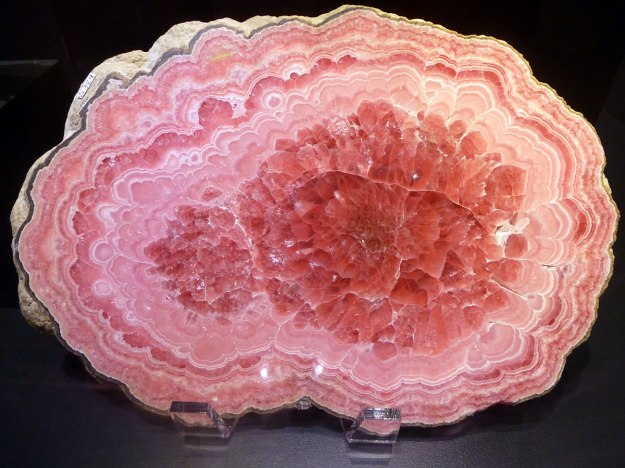
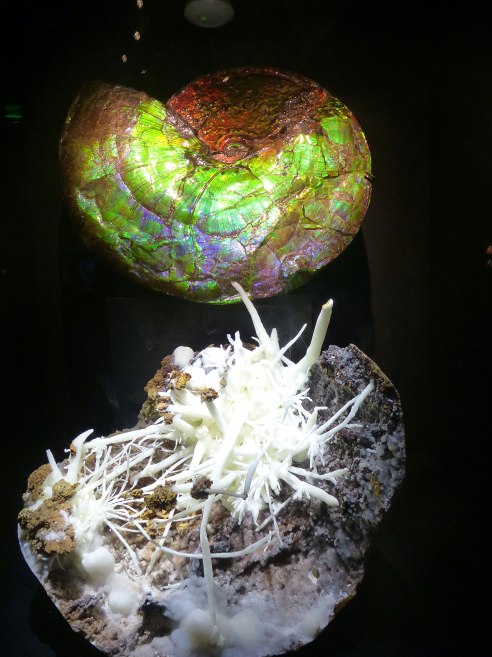
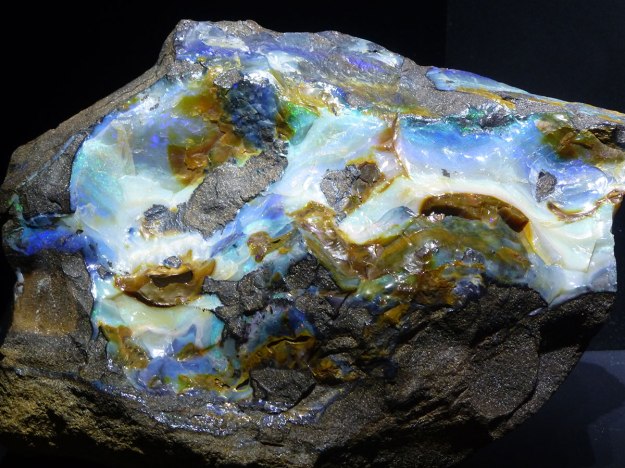
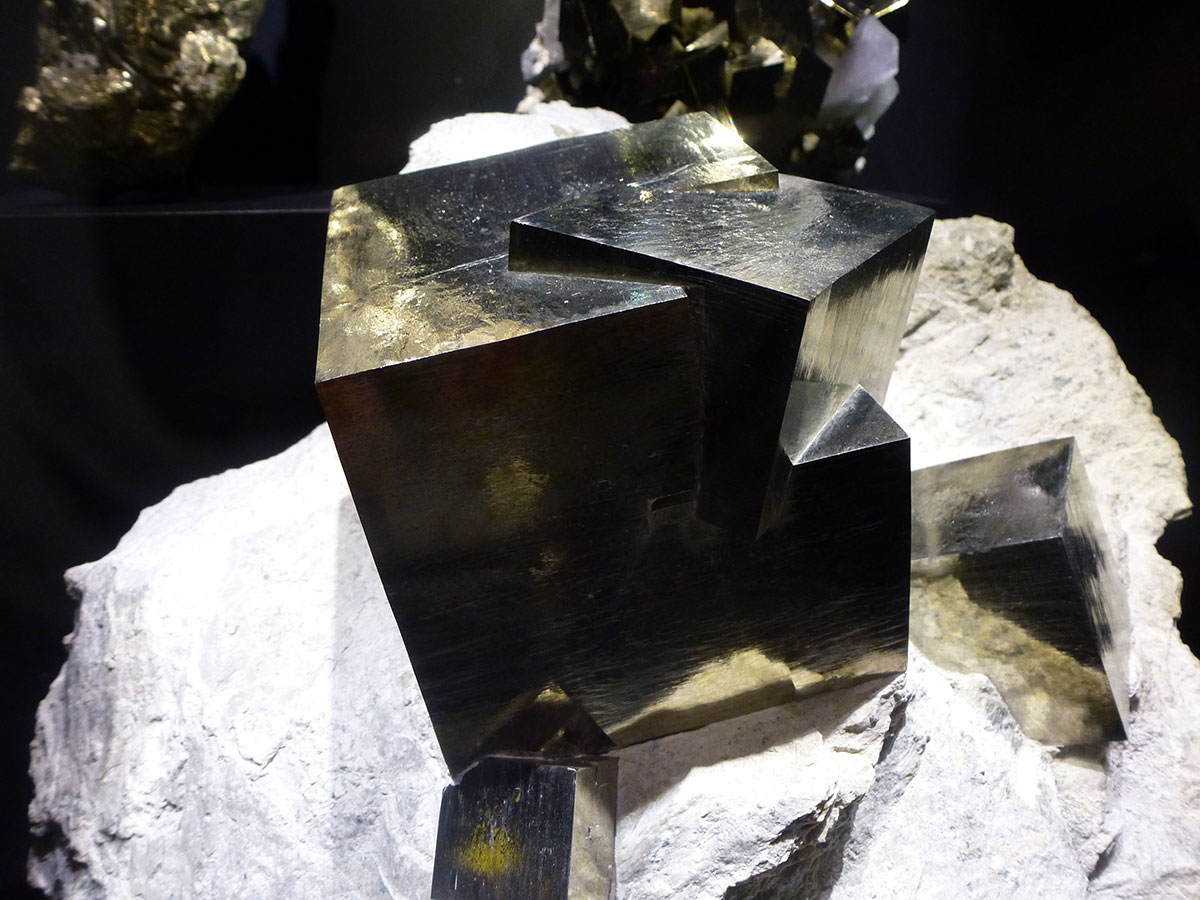
Behind this was the mineral hall. Scientists are often thought of as calculating and analytical, but I bet that all mineralogists are swayed by how cool rocks can look. P1070438P1070447P1070464

And this being Texas, they had a big exhibit on oil and how it’s procured. But to my surprise, it also talked about the dangers and problems with fracking and oil in general, and explained a little about alternative energy sources.

Downstairs from that was the life and biology exhibits. This had a good deal of taxidermy, with a card by each animal stating a cool adaptation it has, or something about how it evolved. Like other small museums we’ve been to, its dioramas featured the landscapes and wildlife native to the region.

The really interactive exhibits for kids were behind that, mostly about robotics and the human body. The coolest thing was this rod that was laced with LEDs and programed to show a picture when it spun. Look up “You won’t believe your eyes”-Smarter Every Day 142 for more information on how it works.

I think that if you already knew everything that was in the museum, it could feel a bit trivial. But with the level of science education most kids get in school, it think there’s stuff to be learned from it up through high school. So if you’re a kid interested in science in the vicinity of Dallas, you should come here. And if you’re like me and have to read every sign, come early.
P1070452

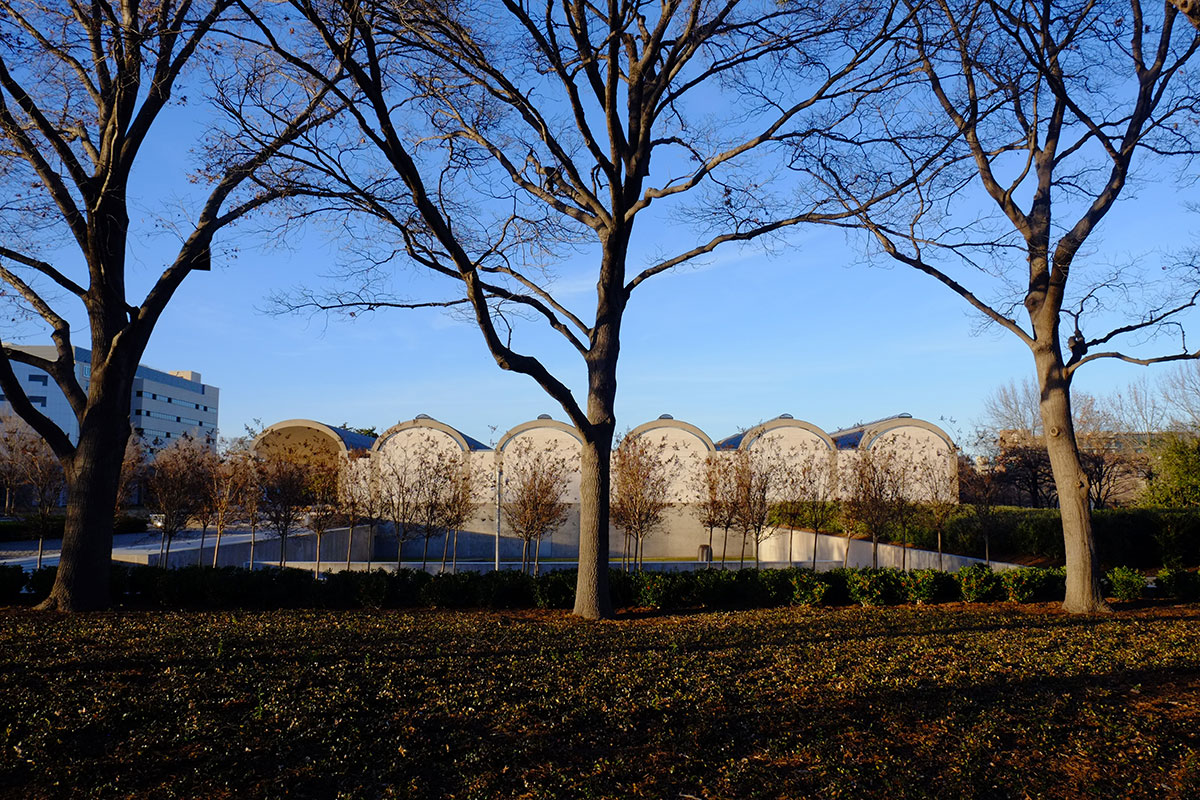
The Kimbell

One of the goals of this trip was seeing the Kahn buildings in out-of-the-way places that I had not seen before.  An unintended theme that developed has been seeing most of the Piano museums across the country.  The Kimbell is where these two came together, in what must be the ultimate compare-and-contrast question for a modern architectural history exam.  After seeing the two together, I’m more convinced than ever that having Piano design the addition to Kahn’s Kimbell was the best possible choice.  There is no other living architect whose work could pay homage to Kahn without imitating him, and who could simultaneously complement Kahn’s work while taking an archetypally different tectonic approach.

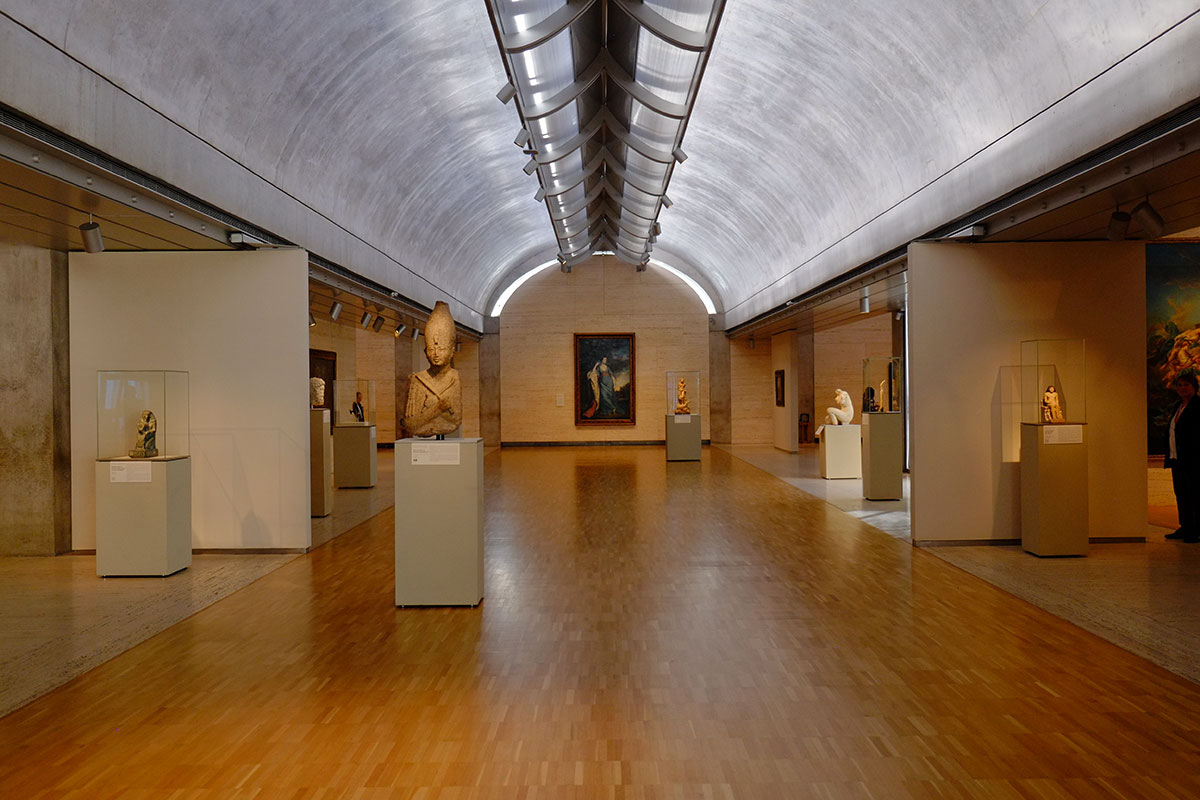
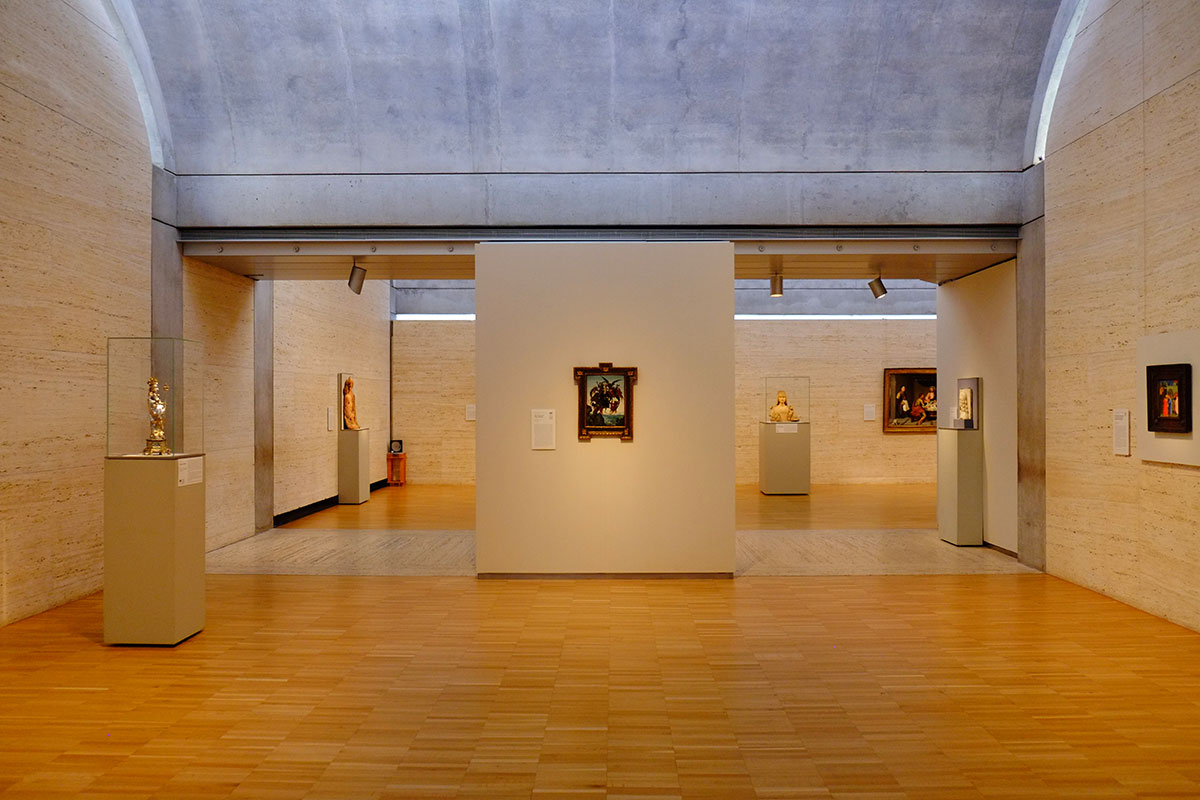
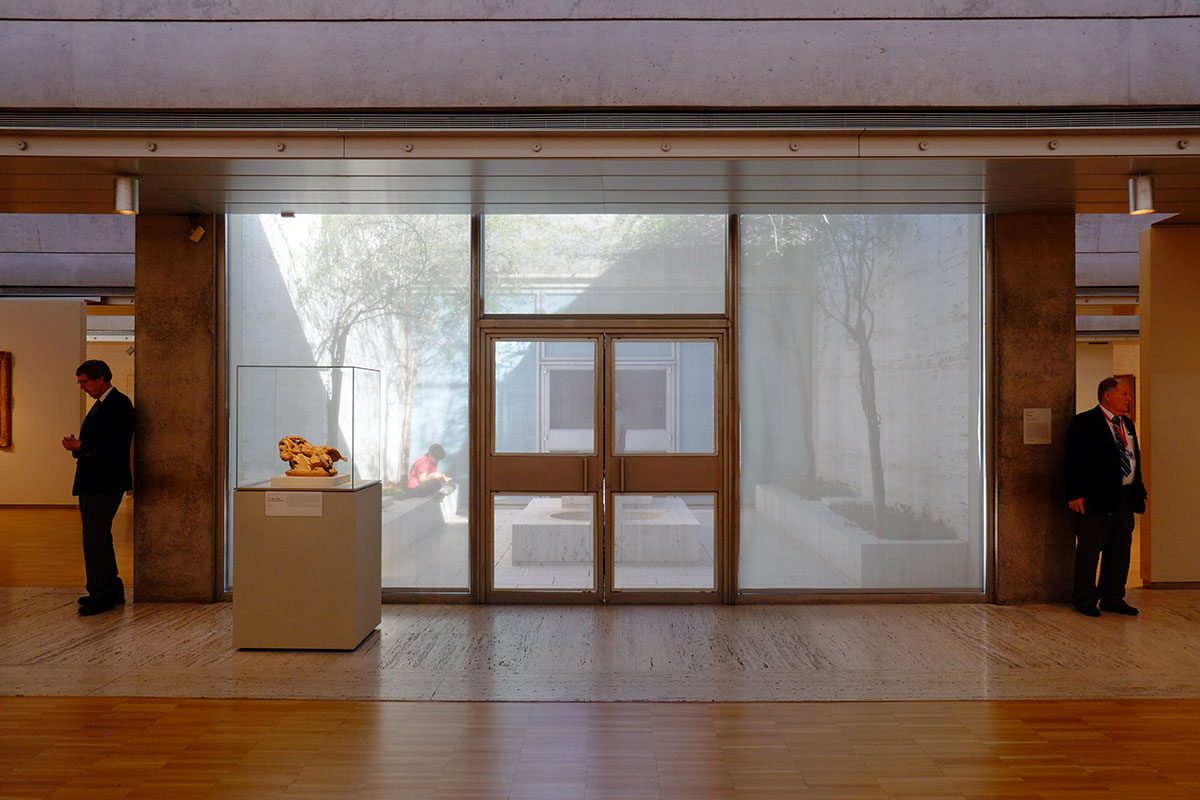
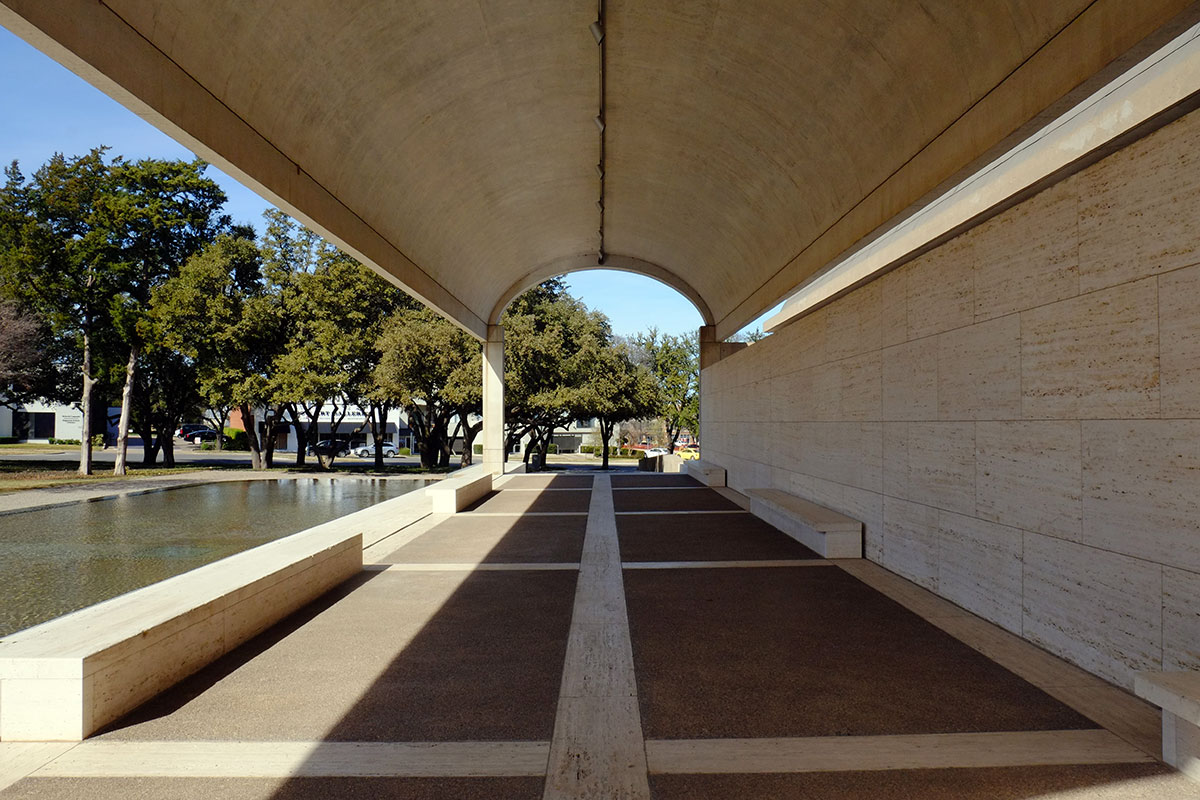
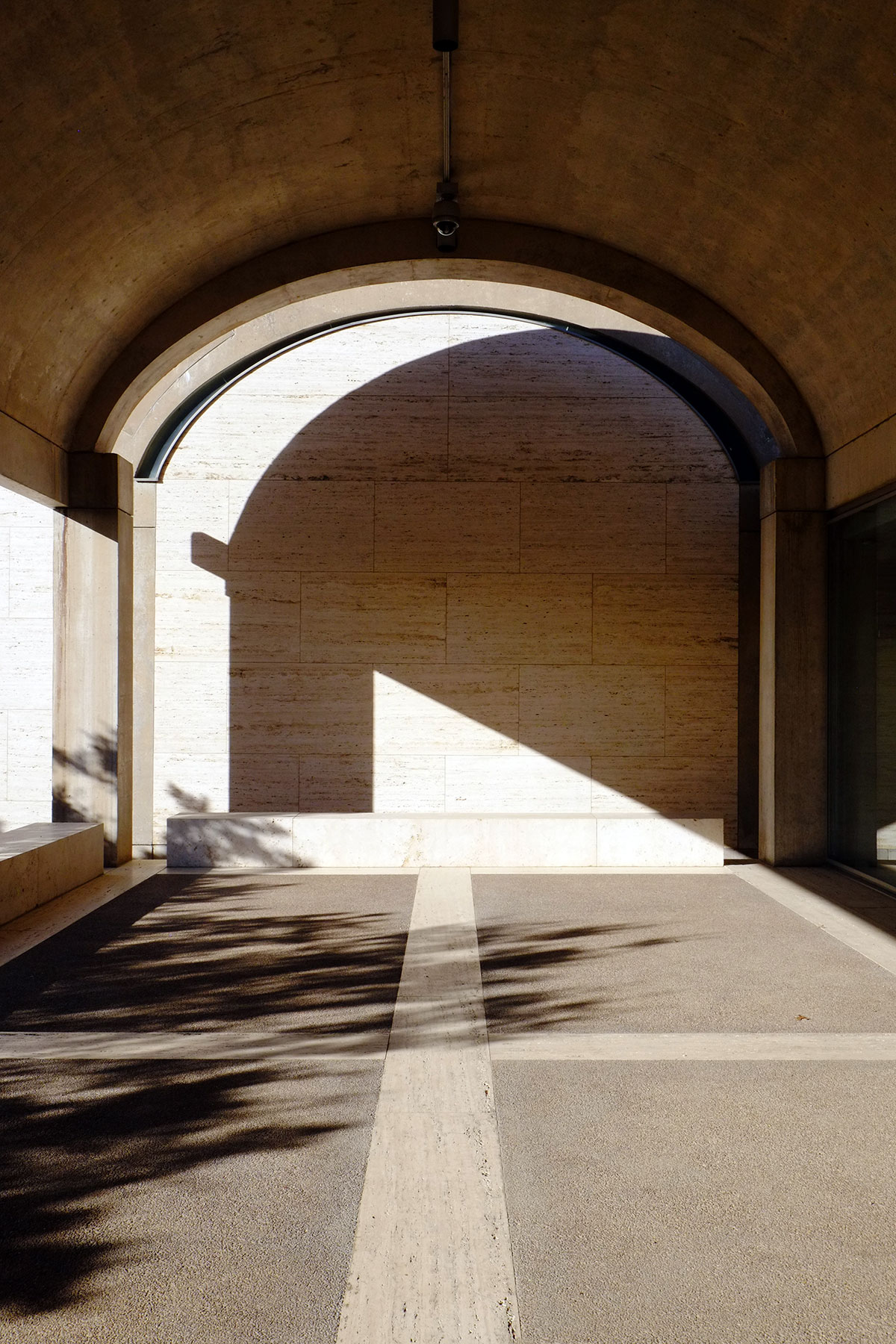
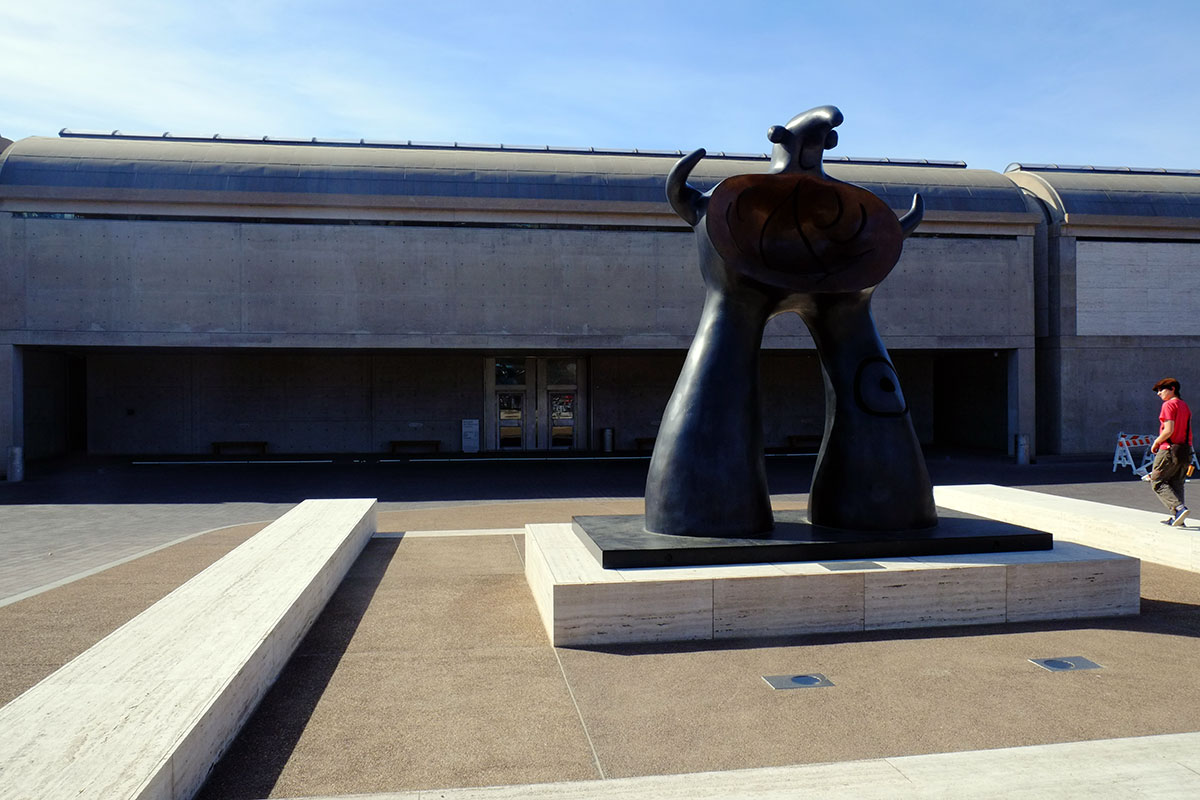
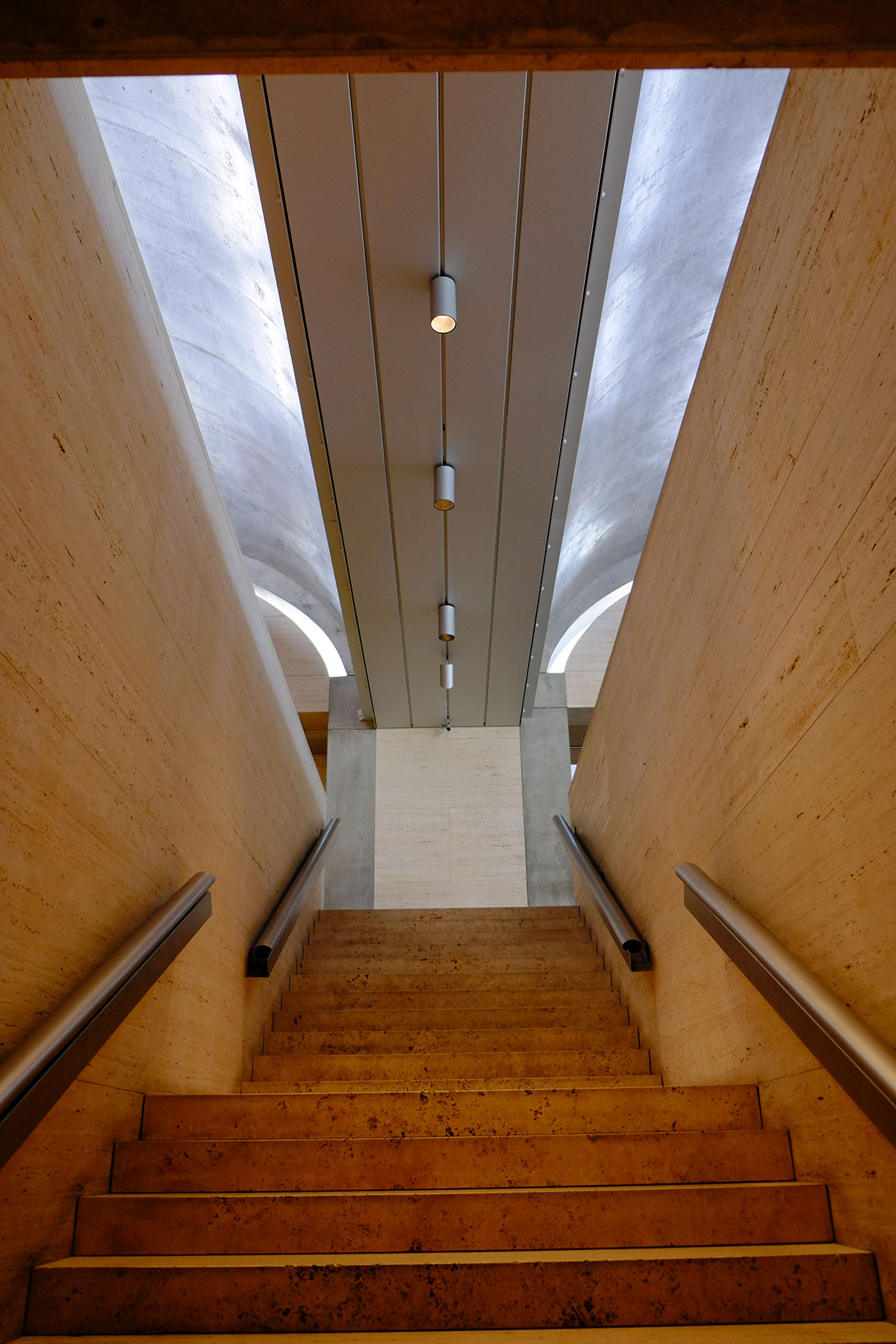
DSCF4433Of all of Kahn’s major works, the Kimbell was the one I always found least interesting.  It just seemed too simple – come up with a bay cross-section that’s supposedly good for daylighting, extrude it to an absurd length, then repeat that bay module in a slightly-varied way.  Of course it’s rigorous, it’s subtle, it’s beautifully-detailed, but I thought the spatial experience would just be too uniform.  I was wrong.  It is the perfect example of how playing within a strictly-controlled system can lead to a lot of richness and experiential variety.  The modules are used to make long rooms and short rooms, narrow rooms or wide rooms, they open up at the end or the side, they are left out and so create spaces not strictly within the system – such as the entry court or the small internal courtyards.  Or walls are left off and it becomes a loggia.  DSCF4434
DSCF4471

DSCF4446

DSCF4482

DSCF4395

DSCF4501

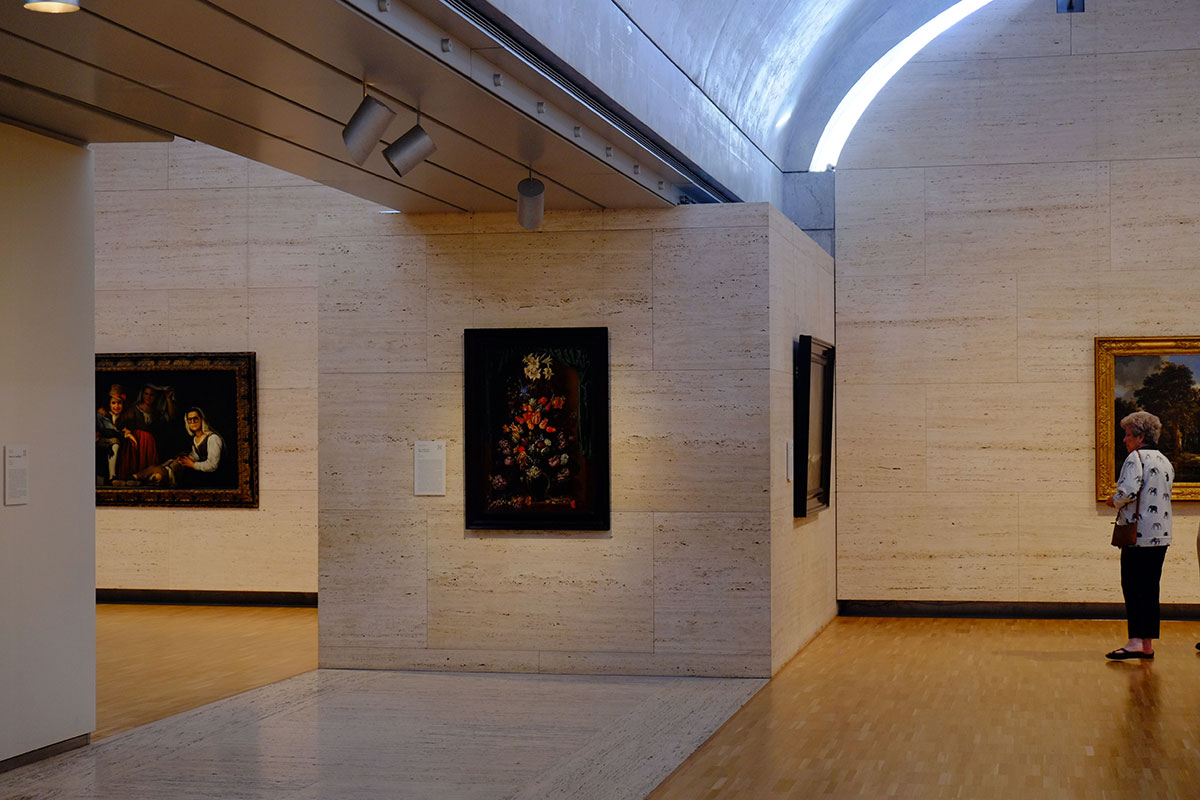
Of course, the building is about the light, something you have to go there to see.  My prior reaction was entirely too conceptual, thinking about this parti versus the partis of other Kahn buildings.  Kahn buildings seem simple when you study them, but when you visit you are overwhelmed by the experiential richness.  The Kimbell is the most extreme example of this.

it’s a remarkably calm building, and even though it’s brilliant, it can recede into the background, allowing you to focus on the art – the spaces are comfortable, bathed in the wonderful light, and movement among the galleries is clear and effortless.  So here is the biggest problem I had with the Kimbell, compared to the Yale British Art Center – the collection is just too good.  The British Art Center is full of ghastly English paintings, all giant Stubbs with horses, etc., nothing to distract you from looking at the building except the Turners.  The Kimbell collection is superb – who else has a small painting done by the 12-year-old Michelangelo?  The Renaissance art is great, as is the modernist work – I now have a new favorite Munch.  As much as I wanted to think about the building, the art kept pulling me away.
I do have some niggling problems with it.  The intended main entry was from the lawn and grove on the west side, but I bet it wasn’t much used.  In a car-dominated environment like Ft. Worth, the entry sequence is from the car.  It is like the current American house – you’re supposed to enter through the grand entry hall, but everyone comes through the garage door into the kitchen.  The default entry, from the small car court, is pretty uninviting – and this is the street facade.  It is severe, almost like a service entry.  The sculpture doesn’t even help.DSCF4418

The stairs from here up to the gallery level are okay, slowly revealing the essence of the design as you ascend, DSCF4431

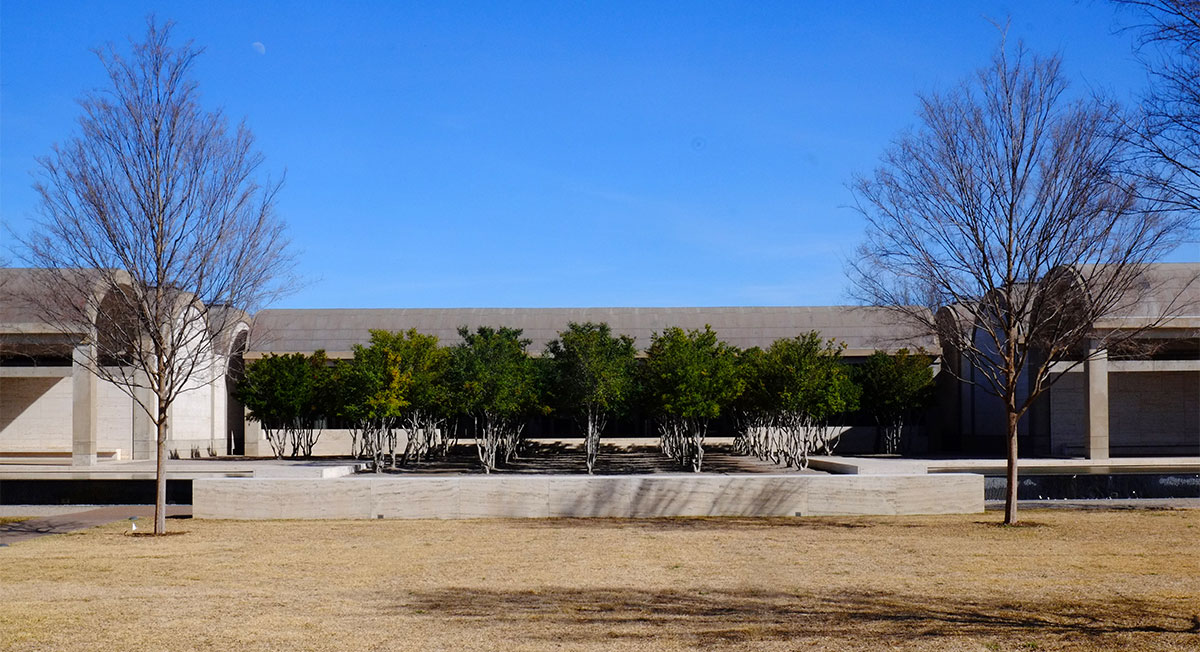
but they then drop you at kind of a funny point – facing a wall not quite in the museum, sort of in the bookstore, looking across to the courtyard area facing west.  It’s a problem with a modular building – how do you emphasize entry or centrality, when every bay is equal?  The new entry sequence from the Piano building is much better – after parking under the building, you head up a new funny little stair, not unlike Kahn’s, then turn, and see the Kahn building across the lawn.  This is the intended main entry, but it took the Piano addition to get you there.  DSCF4389

This movement across the lawn and through the grove / allee is wonderful.  Entering either building from its own parking area below is bad, so the sequence now should be: park under Piano, come up the Piano stairs, see the Kahn building and go there, and then later recross the lawn to the Piano building.  They probably wouldn’t let Piano design a stair up that was any nicer than Kahn’s.

There are a few things that seem a little unsystematic, such as the fire stairs.  The vaults meet at a relatively narrow channel/beam, which doesn’t provide enough width for services such as fire stairs.  So Kahn sticks the stairs  at the end of the building, poking out a bit, and then tries to hide them with travertine.  DSCF4472They just bugged me – kind of awkward, and not in the system of how he’s using travertine in other places.  Also not in the vocabulary of how he’s using this in-between zone elsewhere.

And be aware that if you make big reveals between parts in your system, the staff will pile things in these places that theoretically should be empty.DSCF4478

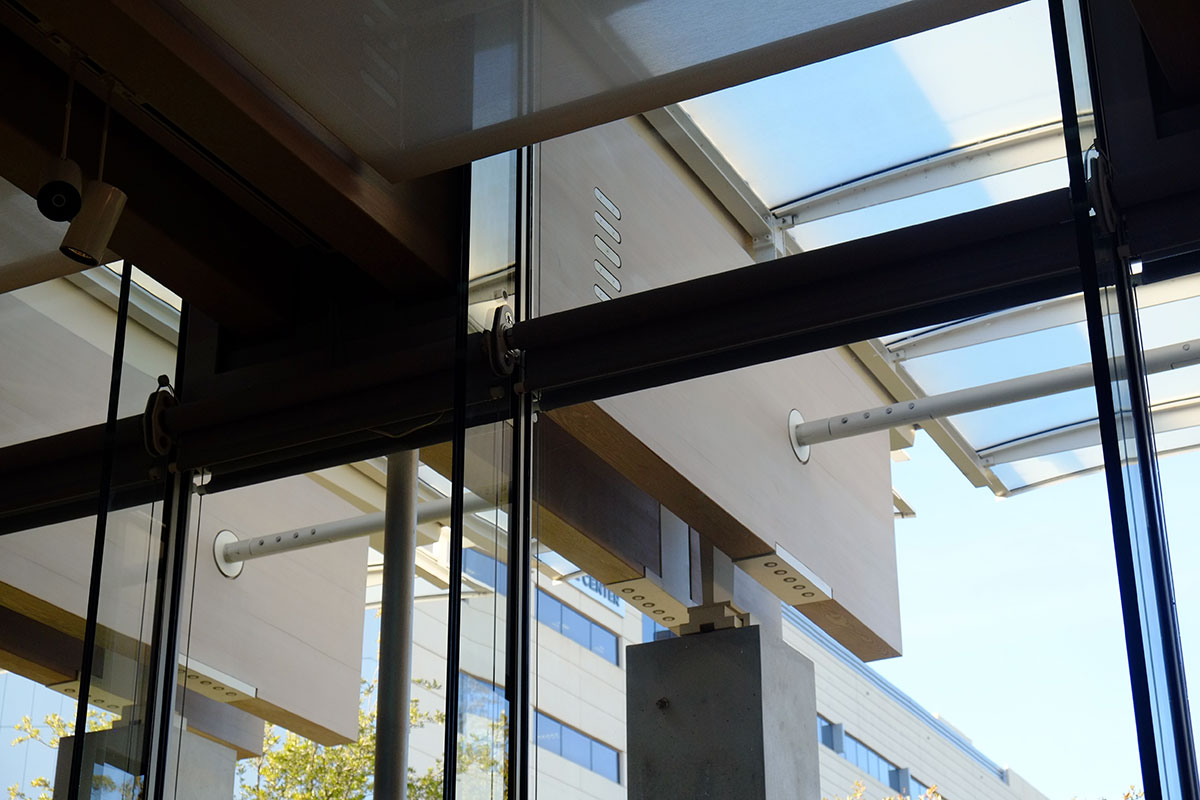
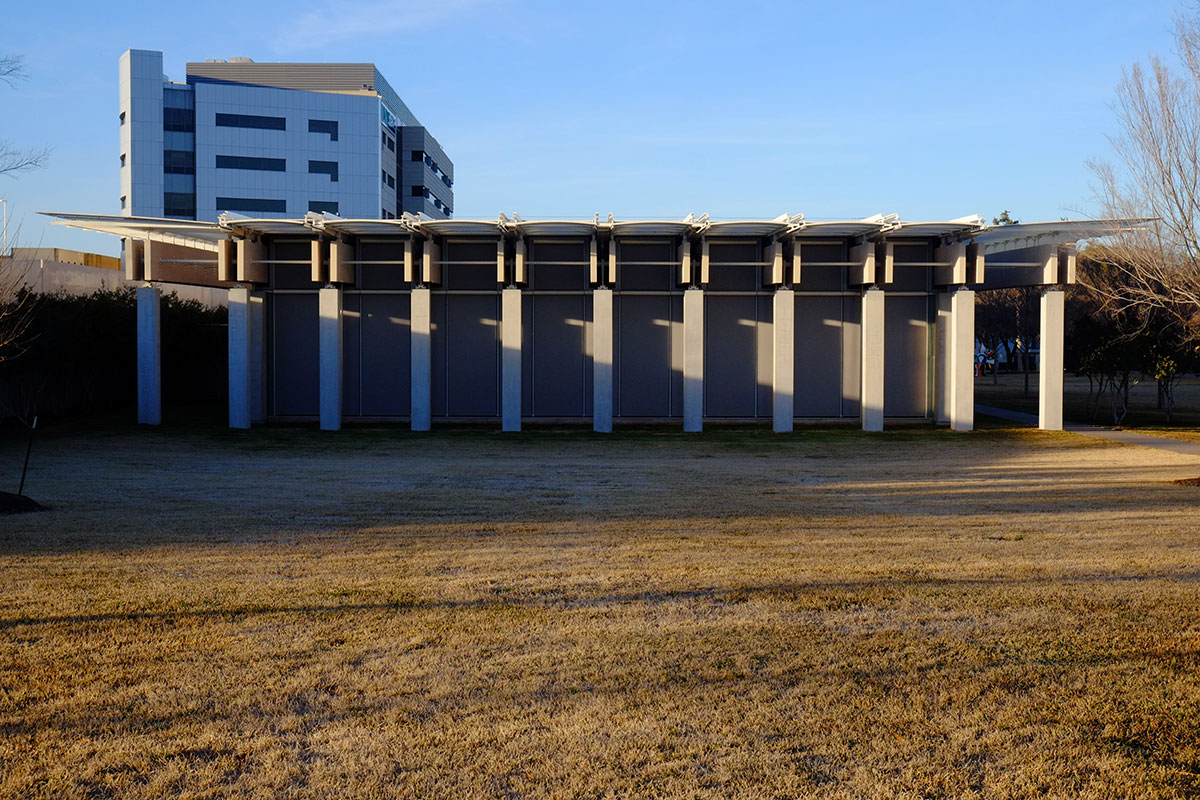
Kahn had the advantage here of working sui generis, whereas everything Piano subsequently did has to be seen in relationship to Kahn’s building.  The basic dichotomy is great, and plays to Piano’s strengths:  if Kahn’s building is about mass, walls and vaults, Piano’s building will be about frames, panels, joints and beams.  His building mirrors Kahn’s across the lawn in  its north-south linear bays, its use of the east-west cross axis for entry, and in its symmetry.  But then everything about the tectonics is different, and in the typical Piano vocabulary.  DSCF4510

Neither building can be said to have a facade that really addresses the lawn between – the north-south walls are the side elevations where the logic of the linear bays plays out.  The Piano entry hall also mirror Kahn’s across the axis, but this time done with paired glu-lam beams instead of post-tensioned vaults.  DSCF4603

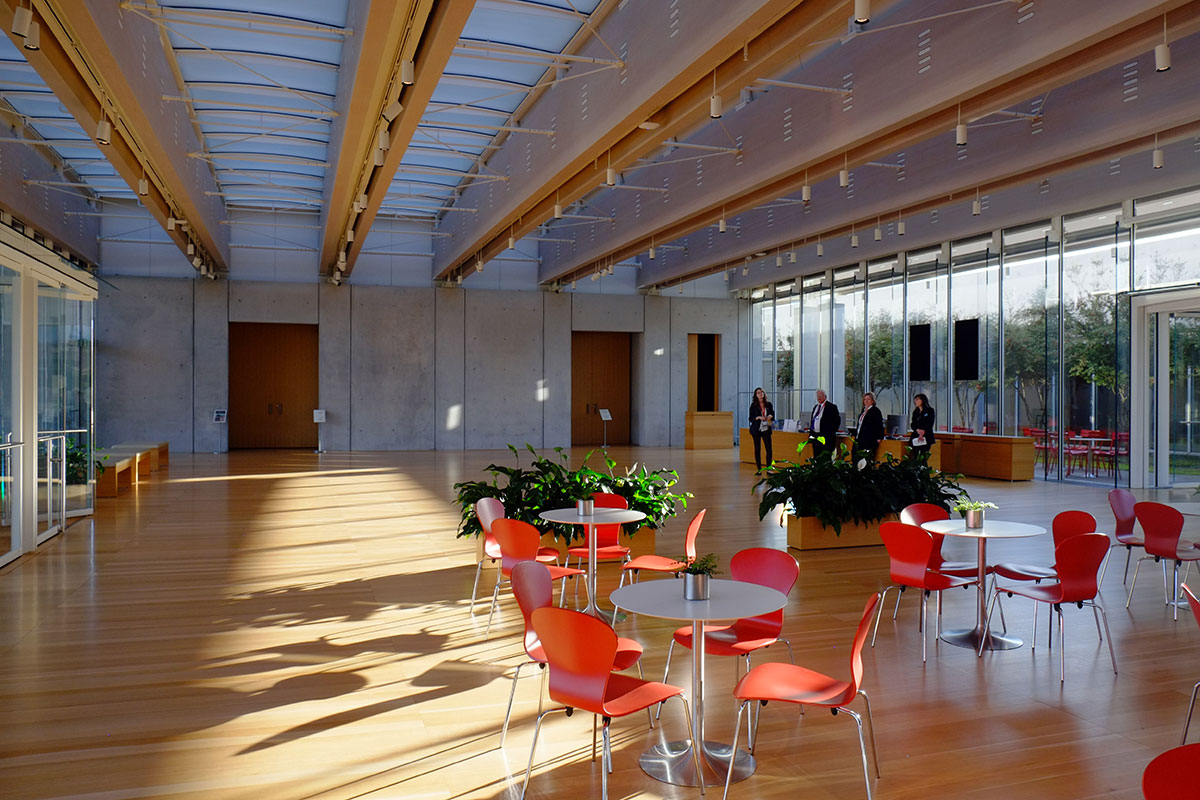
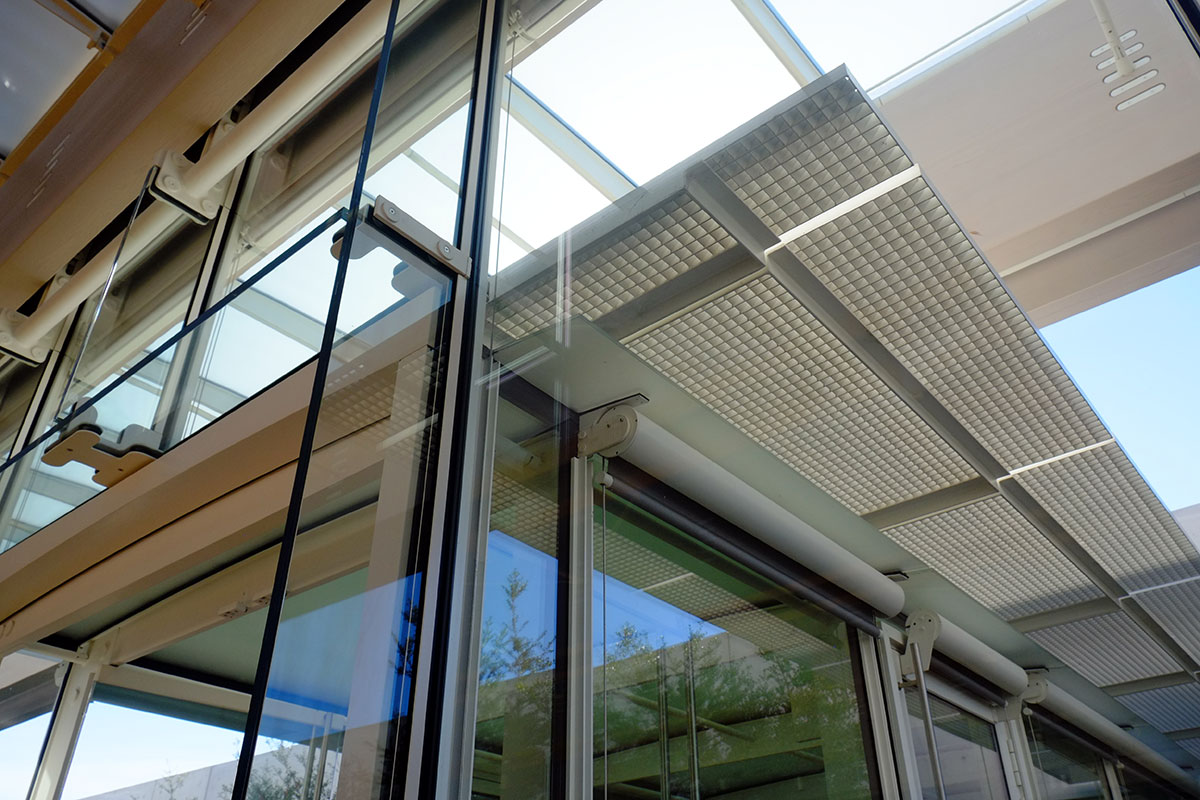
The Piano light scoops and shades are in full play, fitting in a building which plays off the iconic American daylighting masterpiece across the way.  The main galleries are to the north and south, and are beautifully lit and proportioned.  DSCF4580
The east-west axis is very transparent, with a glazed corridor continuing the axis to the second part of the building between two small internal courtyards, which separate the building into two bars.  The view is terminated by a daylit concrete wall.  DSCF4530  DSCF4534

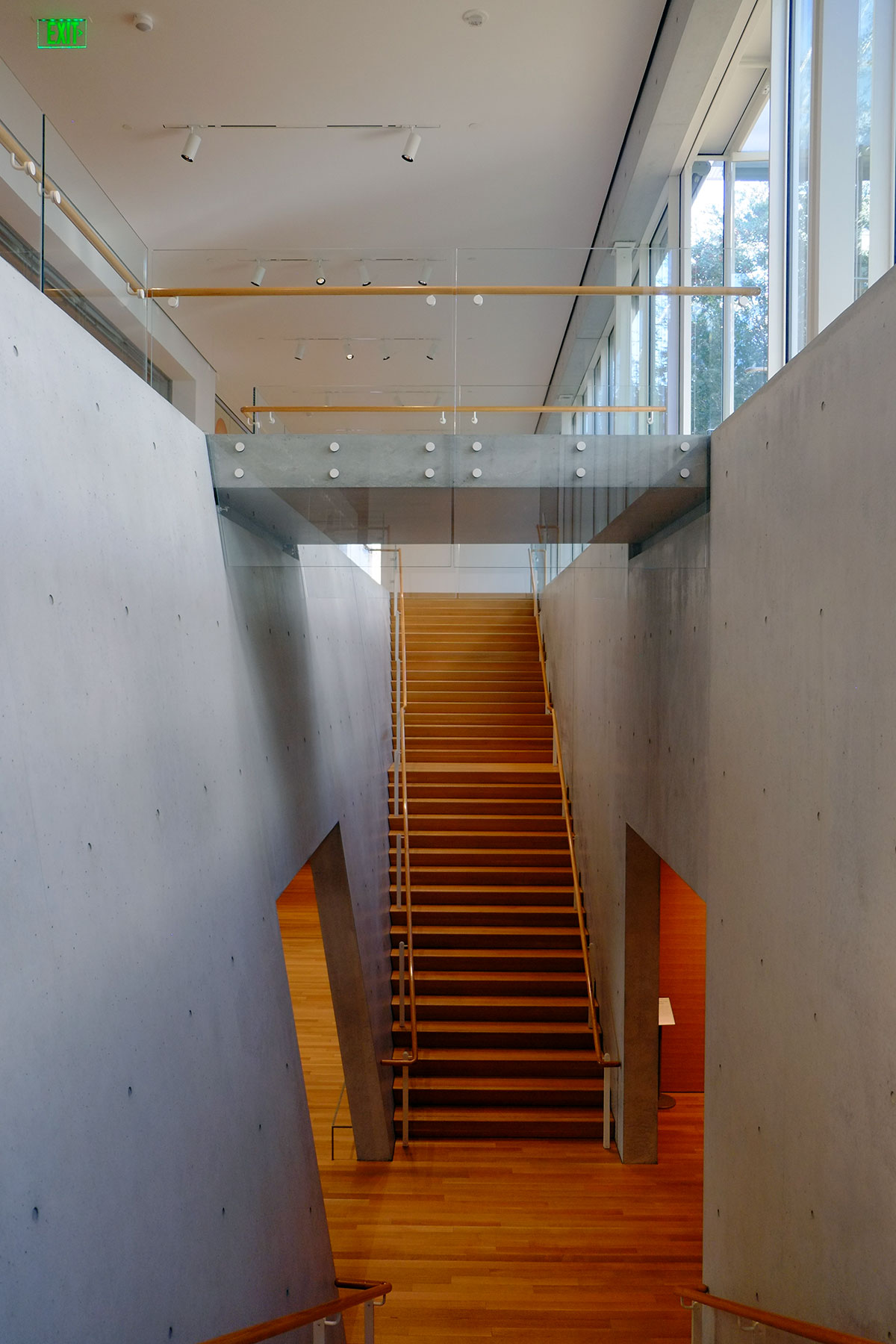
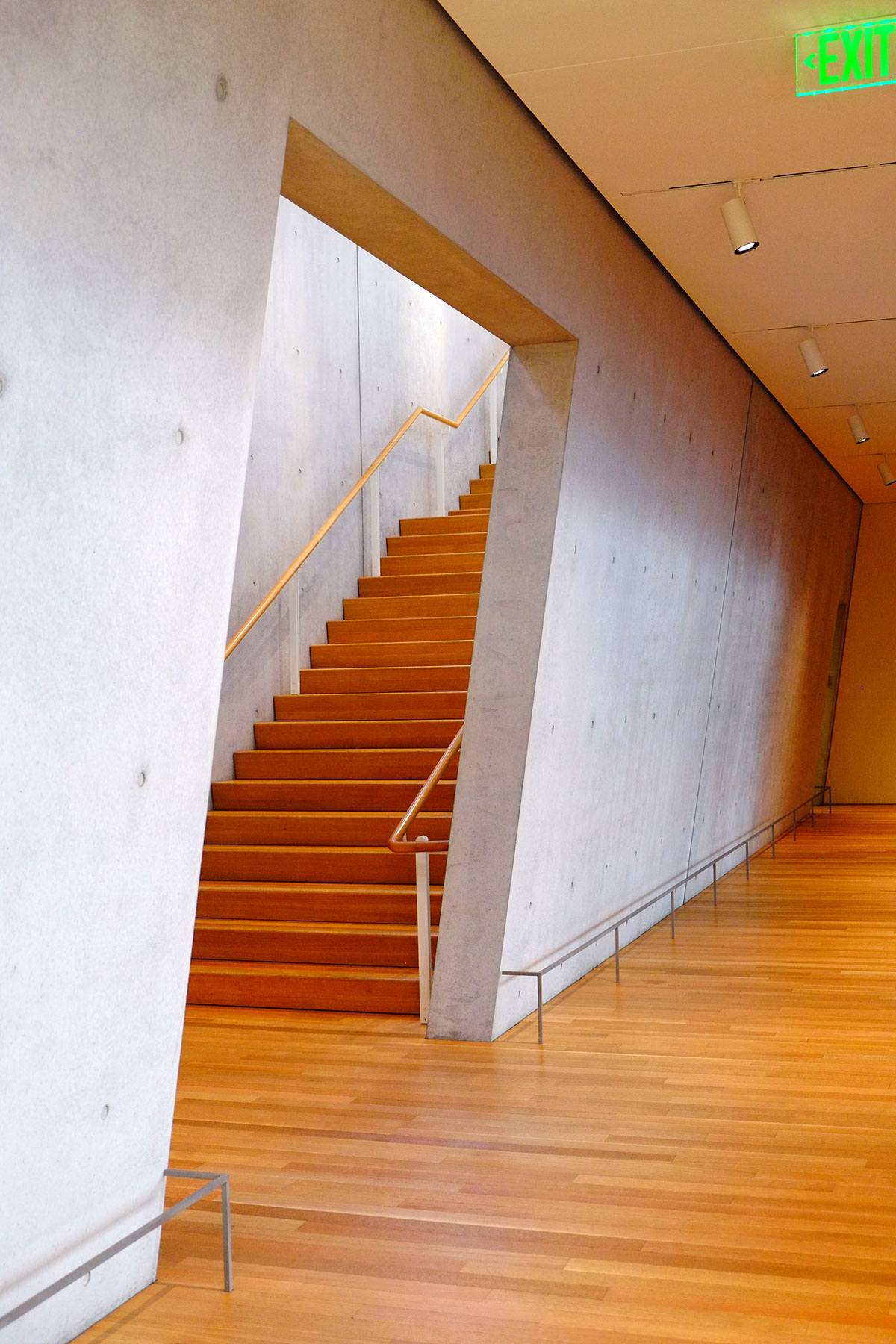
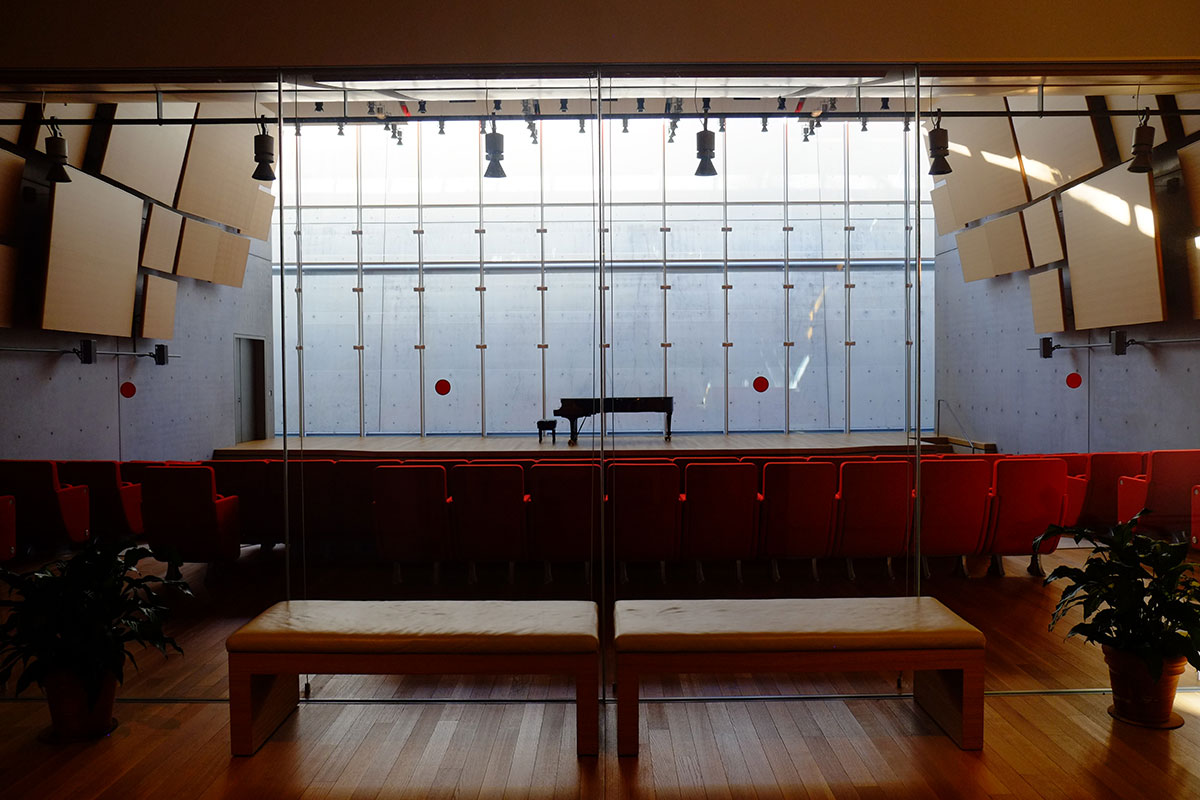
The second bar of the building contains some more gallery space, offices and support spaces, and a large auditorium.  Most of these spaces are at the lower level, which is reached by symmetrical stairs on the longitudinal axis.  DSCF4544

DSCF4555

They are bound by two massive concrete walls, one of which is tilted.  This being Renzo Piano, there must be reason for it (with most other architects these days, I wouldn’t even bother to ask why), but I couldn’t figure out what the reason was.

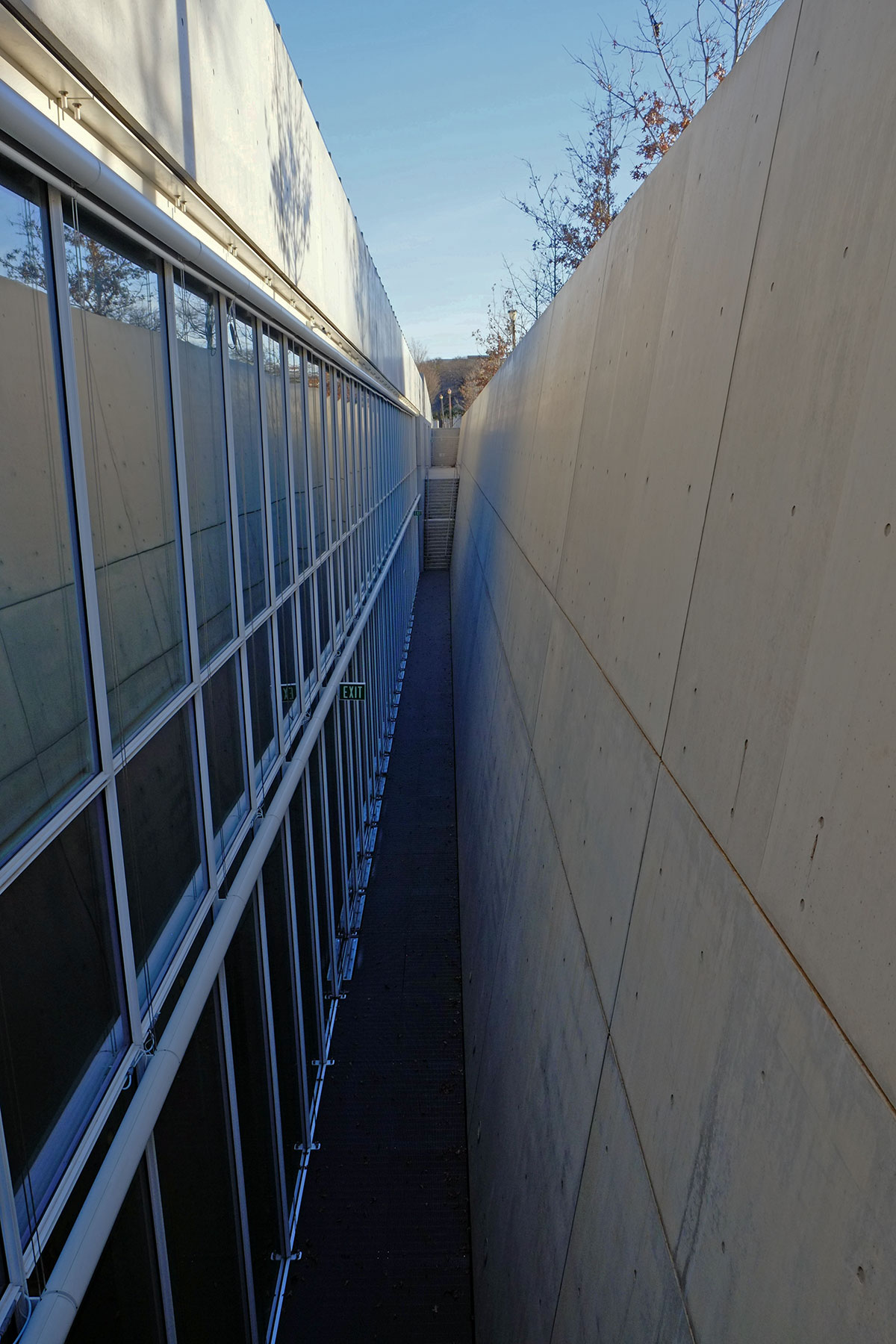
The auditorium is a two-story volume, the west wall of which is completely glazed, with light bouncing off another concrete wall outside.  DSCF4549I was curious about the space between the glazing and the concrete, so I went around the back and found that a sloping lawn extends over the roof of this bar, and you can look down into the most elegant dead-pigeon space ever built.  DSCF4643

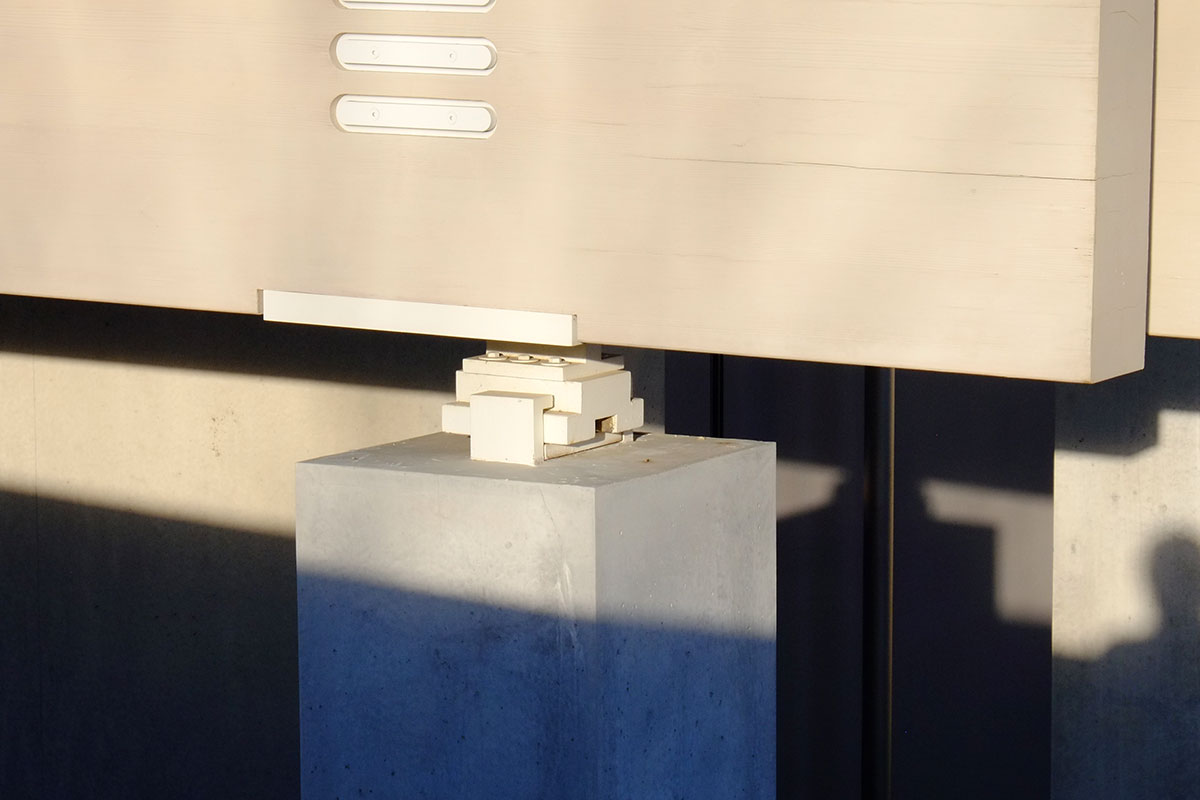
This green roof also allows you a close-up view of the roof structure of the front bar.  I wish Simpson would bring out a Renzo Piano line of framing connectors.  DSCF4627

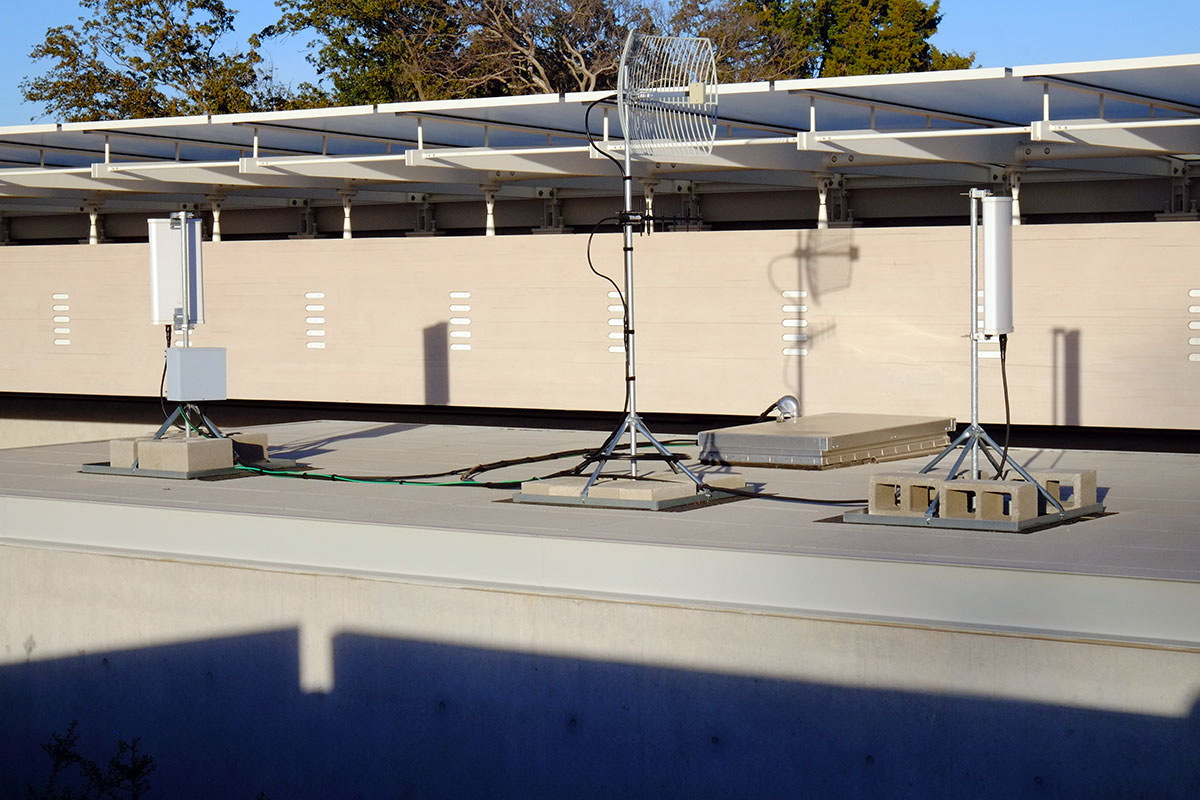
There are also some antennae on the roof, which they clearly did not want to anchor through the roof membrane, so they attached them to metal pans which are then weighted down.  Notice that the one on the left is weighted with standard concrete blocks with the cells facing upward, the one on the right uses concrete blocks with the cells facing sideways, and the one in the middle has thinner, solid blocks (probably concrete pavers). The amount of care that Piano’s office takes with such detailing decisions is truly staggering – every different condition is thought through carefully and resolved.    DSCF4638

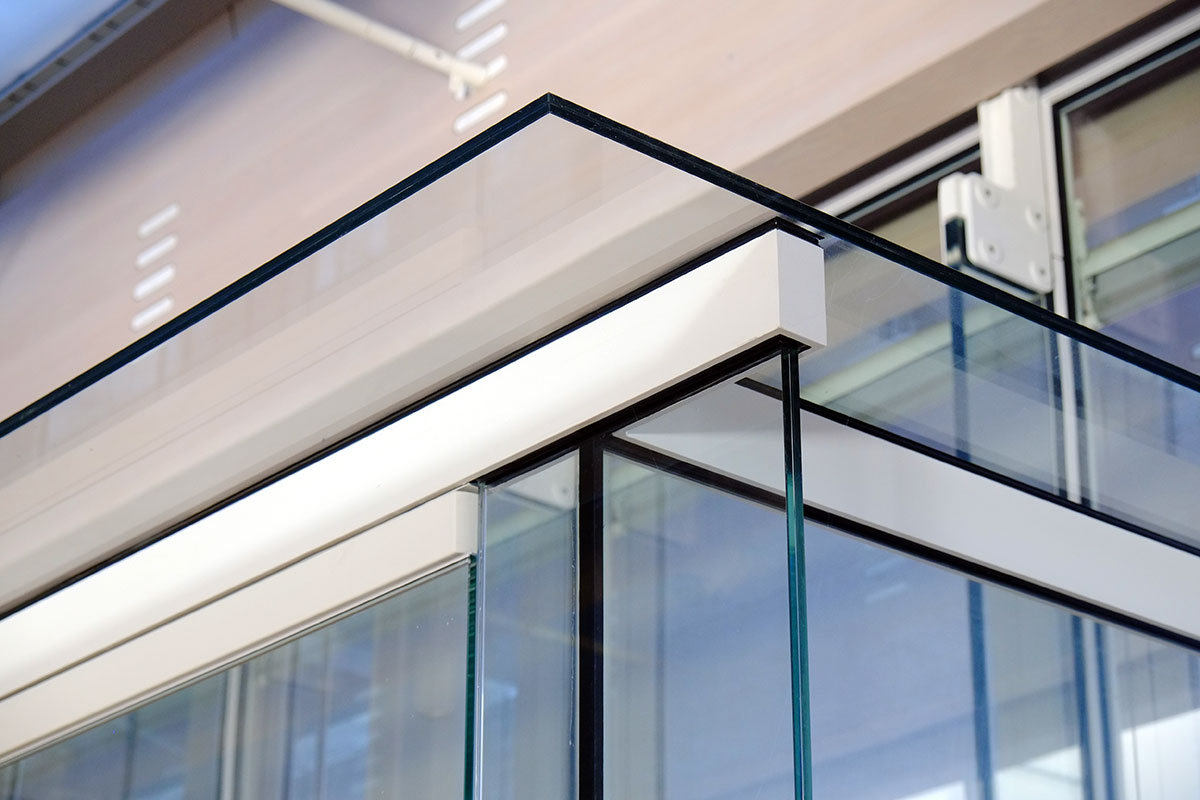
As always, all the detailing is scrupulous.  The logic of each piece is worked out to the nth degree, and then no expense is spared to fabricate the perfect element.  This is the detailing at the entry vestibule upper corner:  DSCF4524

Ordinarily I revel in Piano’s detailing – following the logic to understand the form is an intellectual pleasure that really only we architects get to share, eh?  But something was nagging me here;  after seeing Kahn’s building, parts of Piano’s seems a little fussy, perhaps baroque?  DSCF4593

Compared to:  DSCF4397

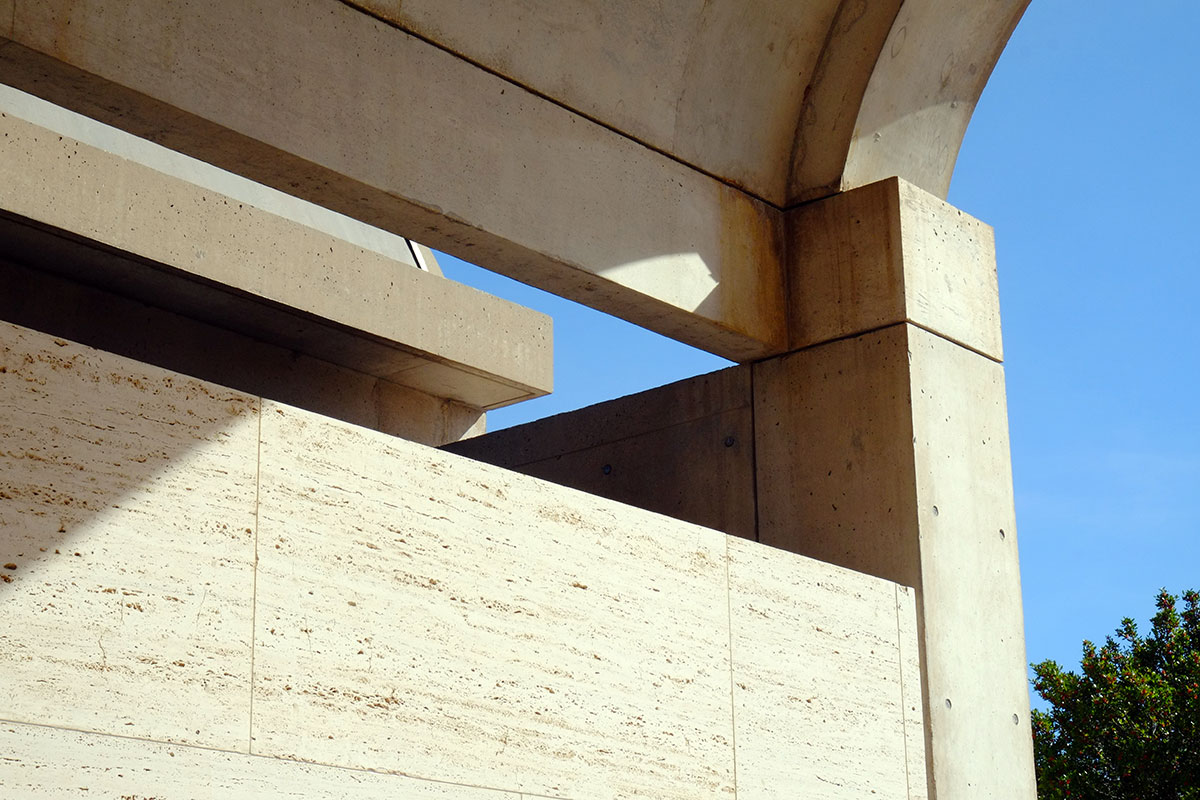
The contrast is revealing.  Kahn’s work may be tectonic, in that the columns, vaults, infill panels, etc., are all expressed and articulated, but when you look closely, you have to admit that there is a lot going under the skin that you don’t see.  That isn’t a travertine wall, it is a concrete block wall covered in travertine.  He is not trying to fabricate a completely abstract surface, such as in the work of other architects the period, but neither does he want you to see the real guts of the building.

Piano wants you to see the guts, but actually only the really good-looking guts –DSCF4531you certainly don’t see any conduit running around – in fact, you don’t even see any ductwork.

Kahn is reducing the complexity of the tectonics to the big, elemental, iconic pieces of Architecture, while Piano is taking those big iconic pieces and breaking them into as many little beautiful parts as he can.  They are both masters at what they’re doing, and being able to see these buildings together makes you think about the two approaches much more than if you saw one at a time.

A comparison of the end elevations is also revealing.  Each has the problem of how to end a modular building – essentially you are chopping it off at the bay line, revealing the cross section.  The Kahn building is more elegant than I thought it would be – the rhythm of the vaults and the interstitial spaces is is powerful, like an aqueduct running across the landscape.DSCF4653

In constrast, I thought the end elevation of the Piano building was its weakest point.  DSCF4652

It feels lugubrious and too dense, with too many big pieces too close together.  Paradoxically, Kahn, the master of mass and masonry, uses concrete and stone to make a facade which feels light and reflective, while Piano, the master of transparency and ethereal steel fabrications, uses frame elements to make a facade which feels heavy and clumsy.

The Kimbell was always an important destination for architects, but with the Piano addition, it has an even stronger attraction, as a complex which makes you think, and not just enjoy.
Barbecue 3

Pleasant’s Barbecue
Ocean Springs, MS
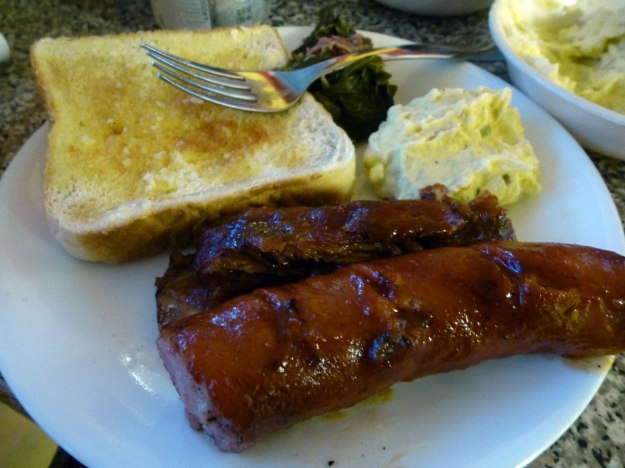
The best ribs I have ever had. The best ribs I have ever had. Soft and succulent. Delightfully smoky. We had to ask their secret. The owner, Micheal, revealed to us that they only cook their ribs for four hours, a fraction of what many restaurants claim. But for the second two hours, they shut off all the heat, and just let it circulate in the smoke. Be careful not to eat the bones. I mean that seriously. They were soft and smoky, and if they weren’t so dry I might have eaten them willingly.P1060849

The Joint
New Orleans, LA
Not one of my favorite places, I must say. Everything was fine, and the atmosphere was cozy, but I guess my standards have gone up over the course of this trip. It was good, so don’t protest if your friend suggests going there, but maybe suggest Bao and Noodle (next blog) instead.

Railhead Smokehouse
Fort Worth, TX
Entering Texas, we have left the land of pork in favor of beef. Part of me feels sorry for the poor people who don’t get real ribs, and try to substitute them with beef ribs, which in any circumstance are inferior. But, they do make damn good brisket.

Northern Louisiana

Northern Louisiana seems to be a different world from the coastal region.  We drove north from New Orleans along the Mississippi on River Road, where two different eras collide: there are the ante-bellum plantations, and there is the modern industrial landscape.  But you can never actually see the river – the levee forms a wall along the road that’s probably 40 feet tall. You see ships looming over it, so you know that there must be a river there somewhere.

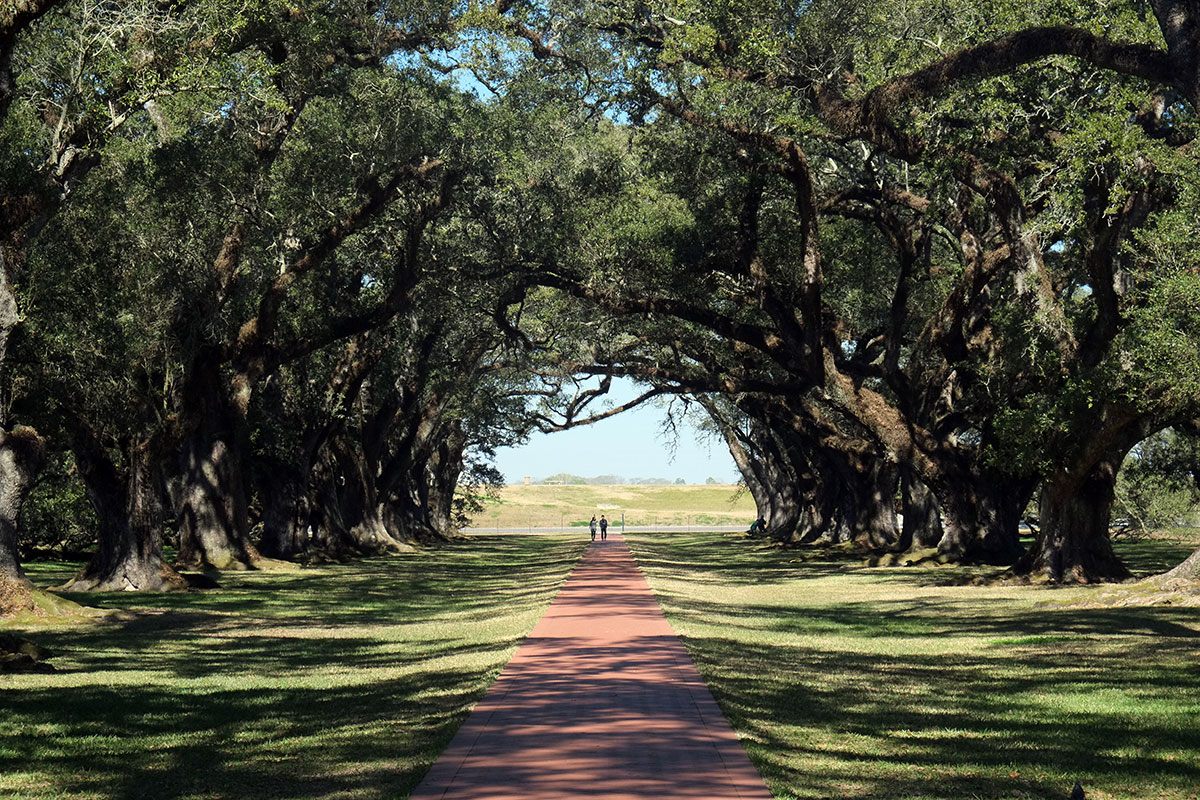
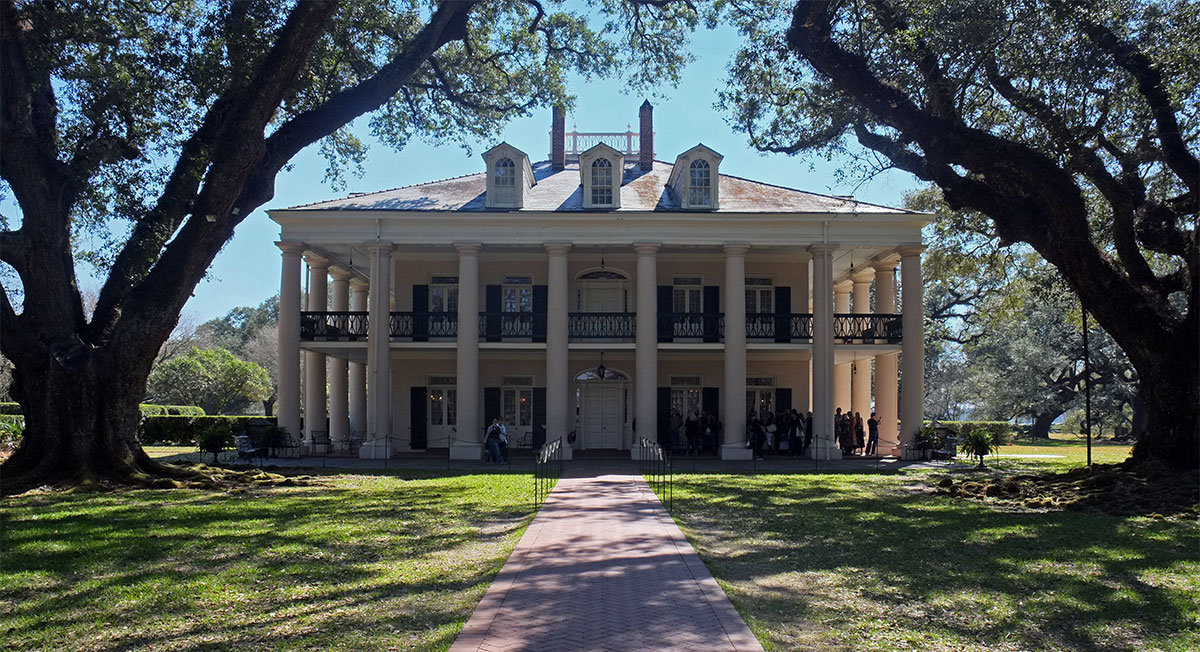
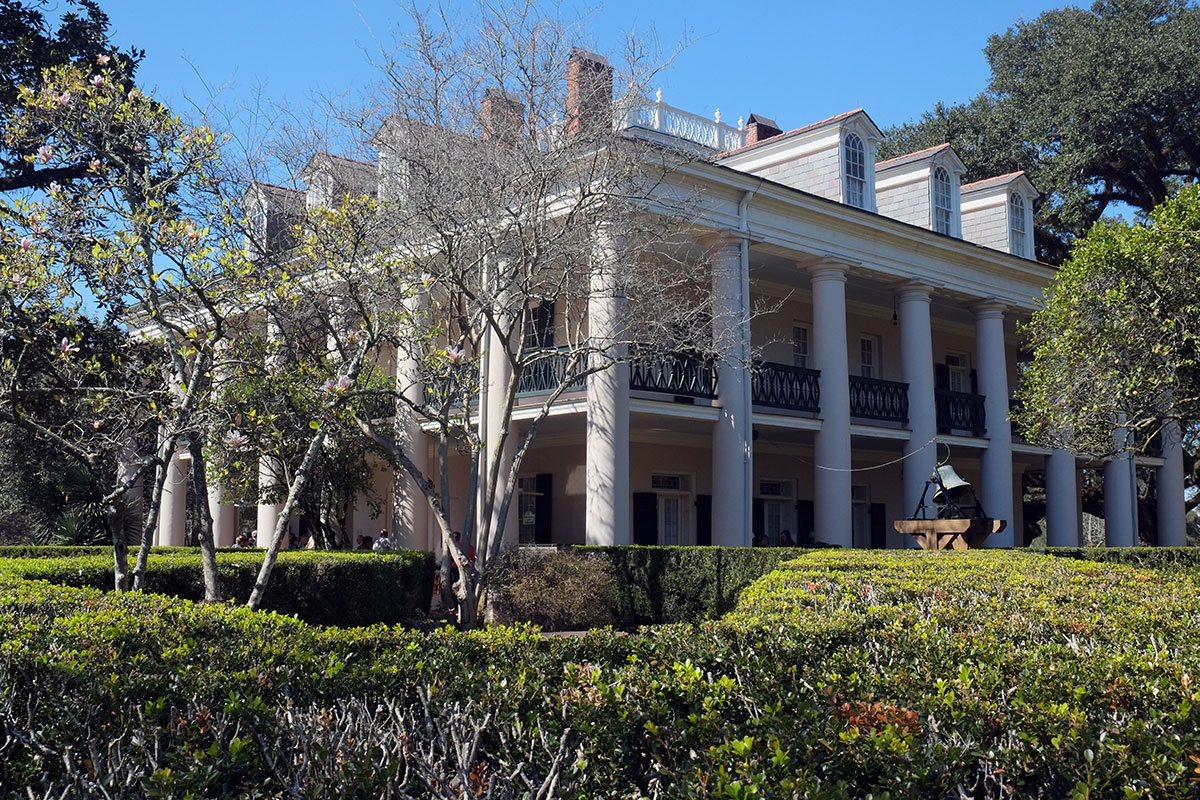
DSCF3963Among the many plantations around, we decided to go to Oak Alley, as we had been told it had the quintessential allee from the river to the house.  As in all houses we’ve toured in the South, the family who built this plantation was very important, with lots of governors and senators etc., but we promptly forget all this family stuff after hearing it (another reasons we could never be southerners).  We’re just here for the architecture, which did not disappoint.

The allee is spectacular, and must have been more so when there wasn’t a levee at the end.  DSCF3891

The Greek Revival style is done beautifully, well-proportioned and straightforward.  DSCF3969  DSCF3951

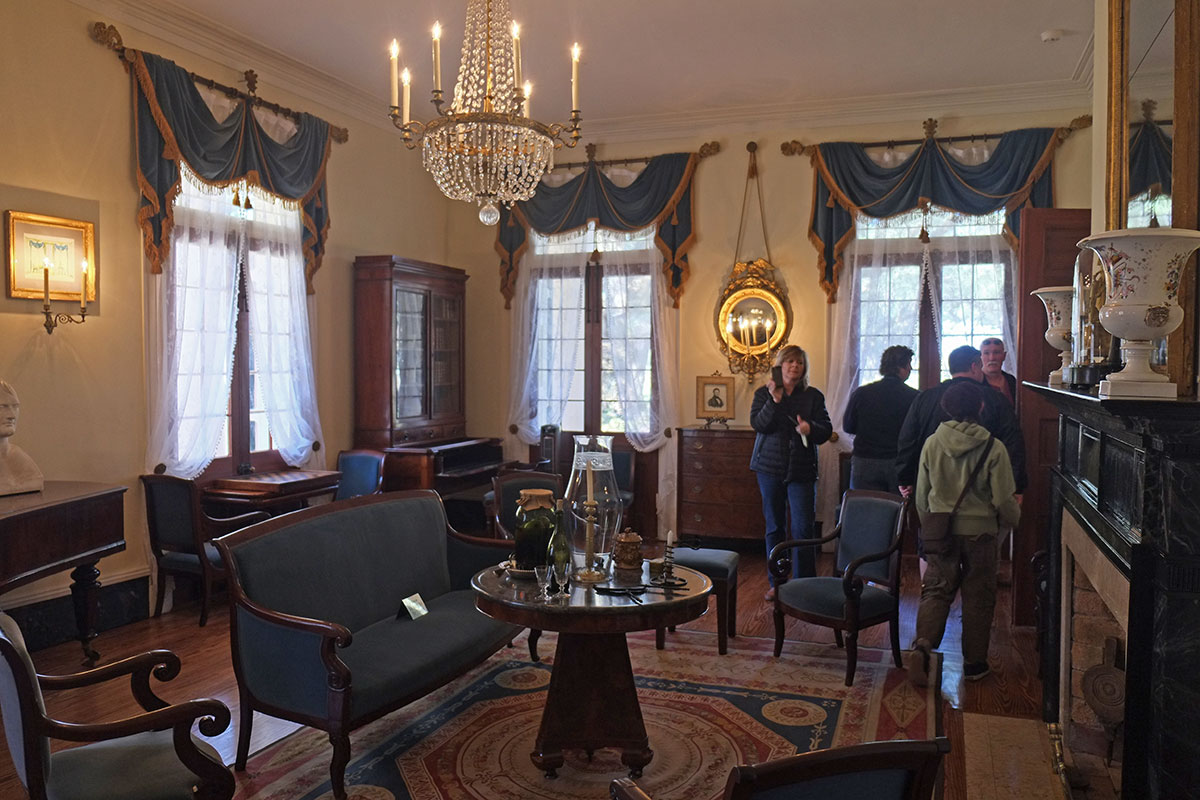
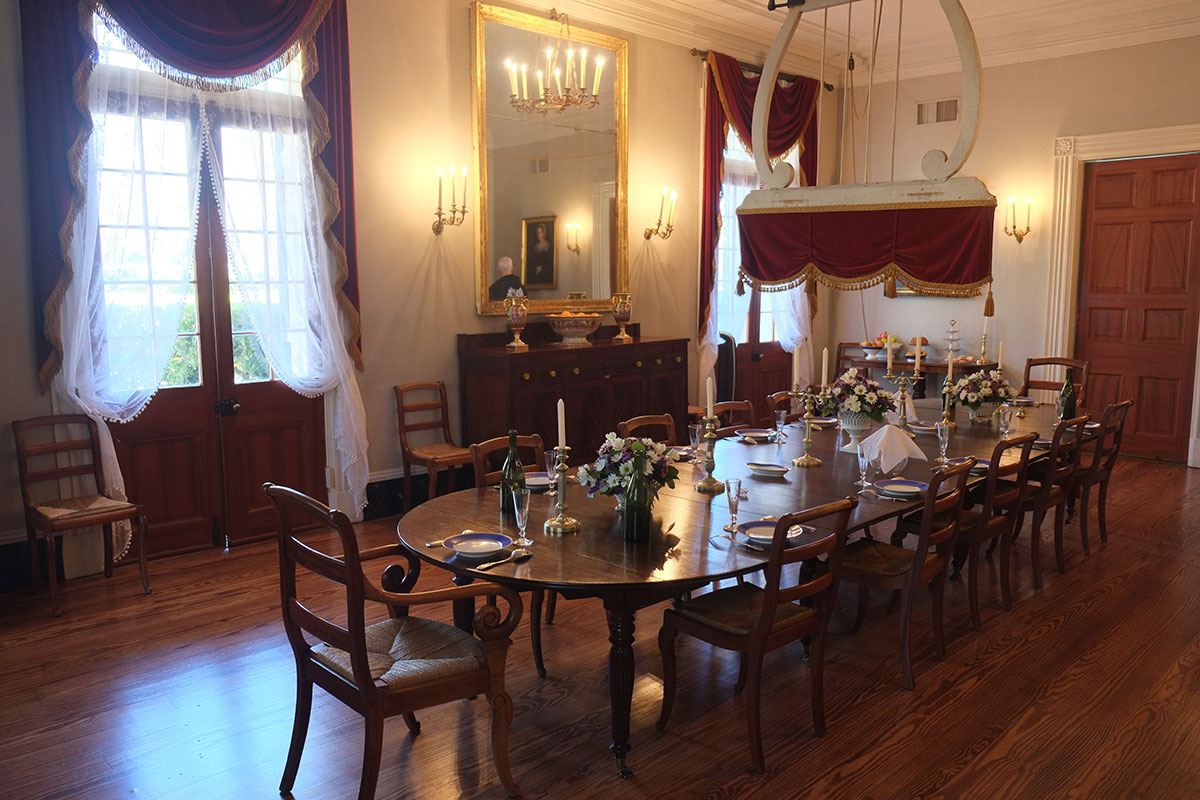
The main rooms are all large and beautifully lit, being always on a corner.  DSCF3898

The word thing hanging over the dining room table is for shooing the flies away.  A young slave would have sat in the corner of the room pulling on the rope to make it swing.  DSCF3905

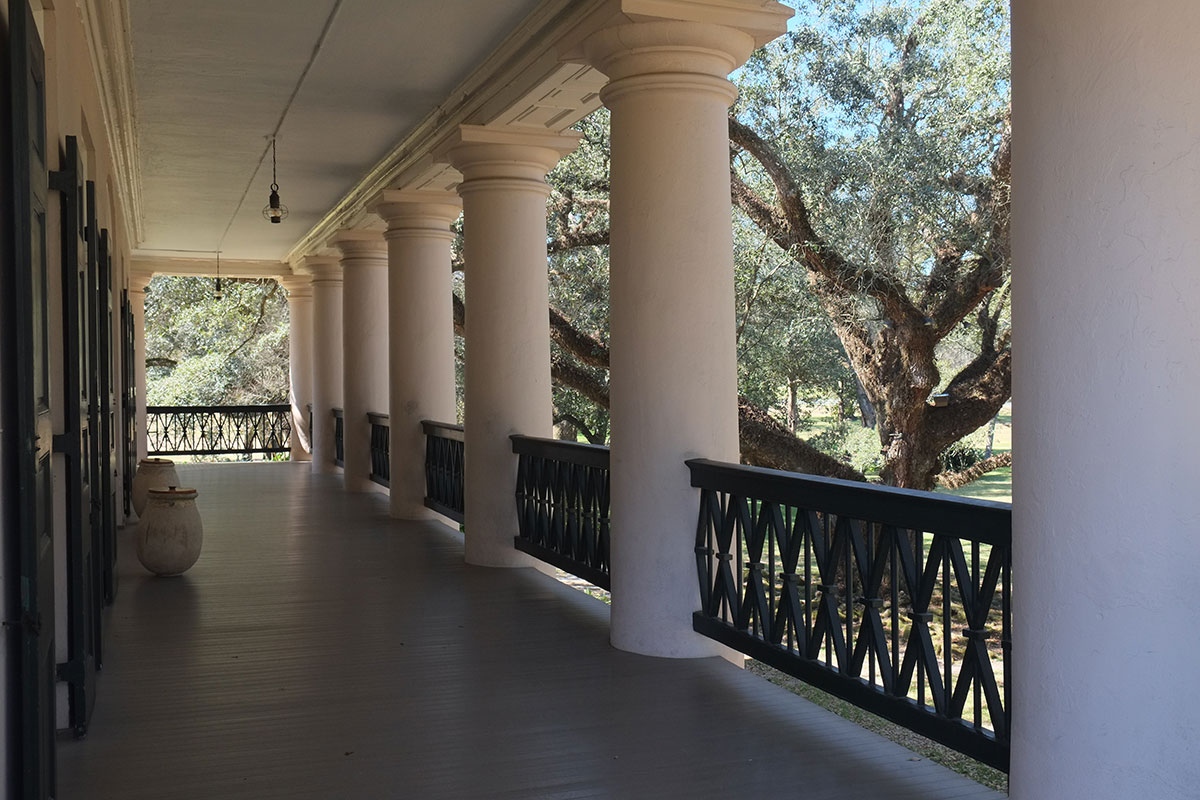
The two-story verandah on all sides was exactly where you’d want to hang out. DSCF3941 Having now seen examples in Florida, Mississippi and Louisiana, the essence of the type is pretty clear, and it is a very straightforward and sensible reaction to the climate, which must be unbearable in the summer (we were there in February and it was quite warm).

As with all plantations we’ve visited, the paramount question is how the history of slavery is treated.  As we toured the house, surrounded by tourists oohing and ahhing, we were feeling pretty weird – the architecture is fabulous, but it’s pretty hard to listen to stories about this family and think about the basis for all this wealth.  (We decided it would be like going to Auschwitz to see the commandant’s quarters.)  However, compared to what we’ve heard about other plantations, we thought Oak Alley did a good job of presenting the reality of the history.

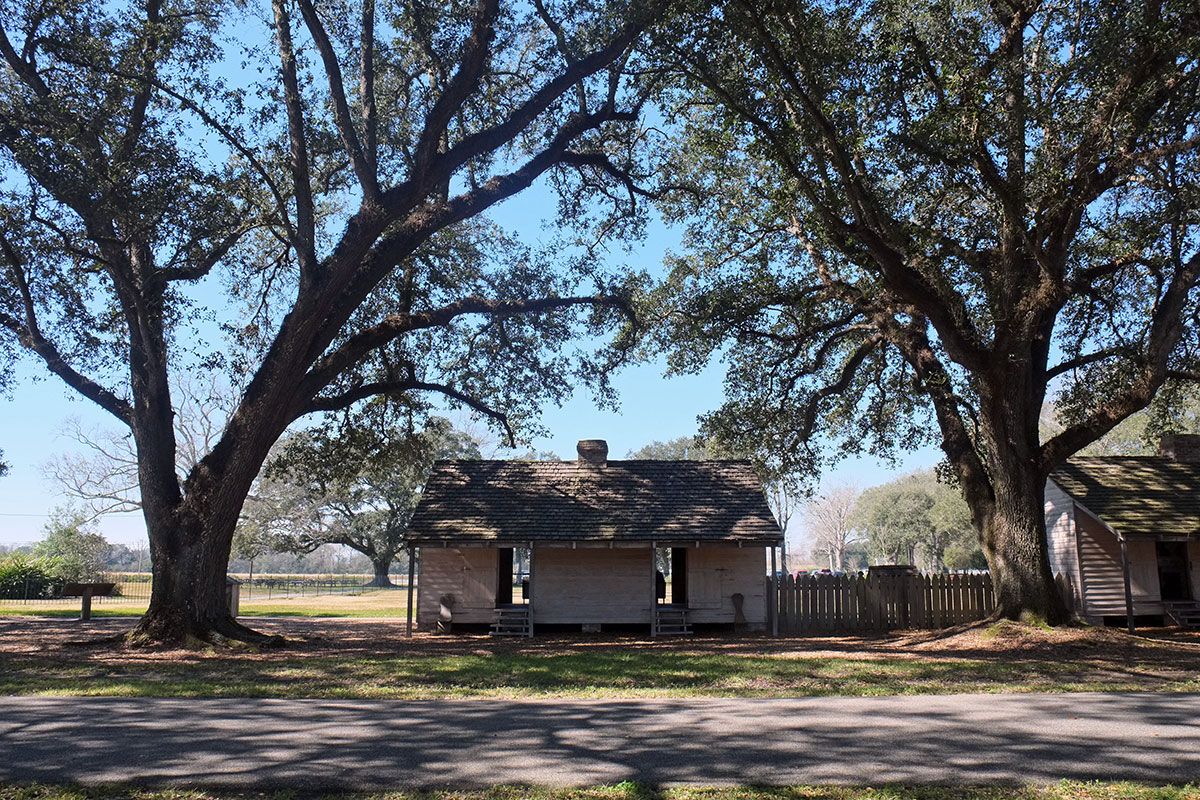
The slave quarters here were located on along the central axis, but to the rear of the house, and along another oak alley.  DSCF3884

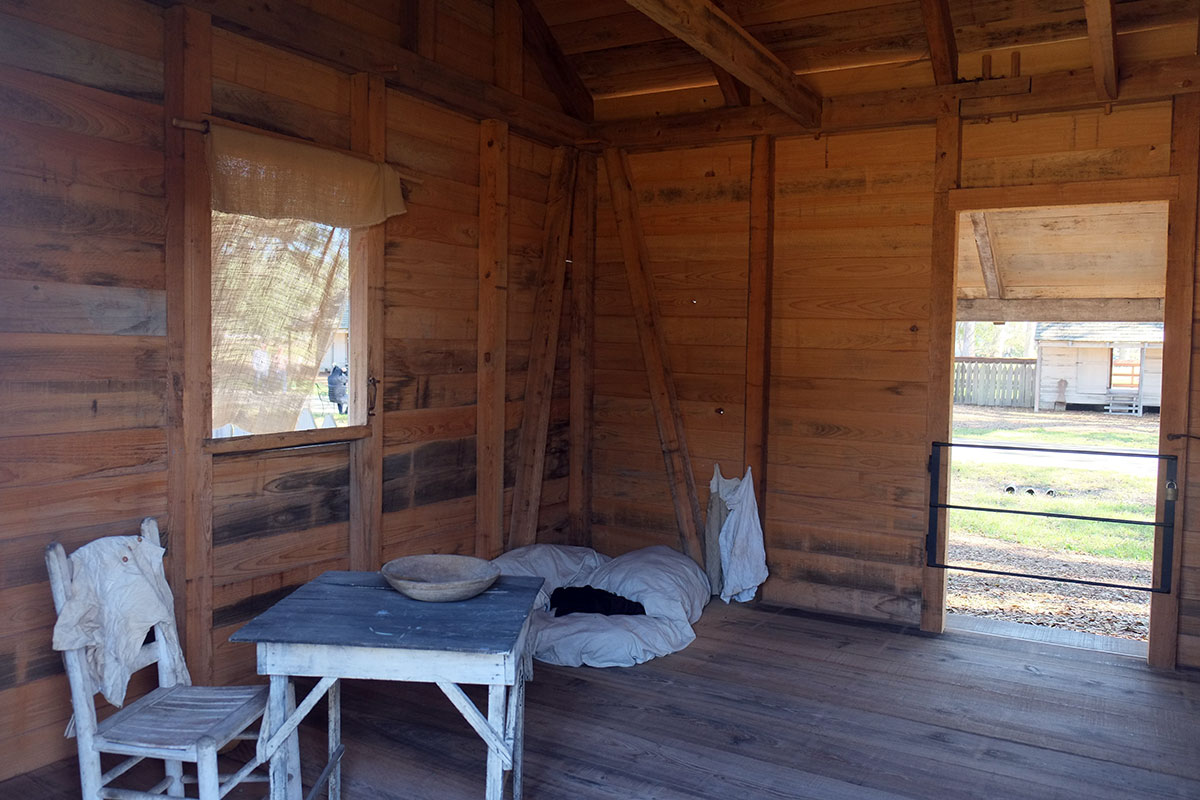
This arrangement, and their proximity to the main house, was very unusual.  The quarters had obviously not been as carefully preserved, but enough remained, and there was also documentation of them and how they had been transformed after the Civil War, when they were occupied by paid hands (who might have been the same people, just no longer enslaved).  Based upon this evidence, all the slave quarters had been reconstructed, showing how they were furnished in different eras.  DSCF3880

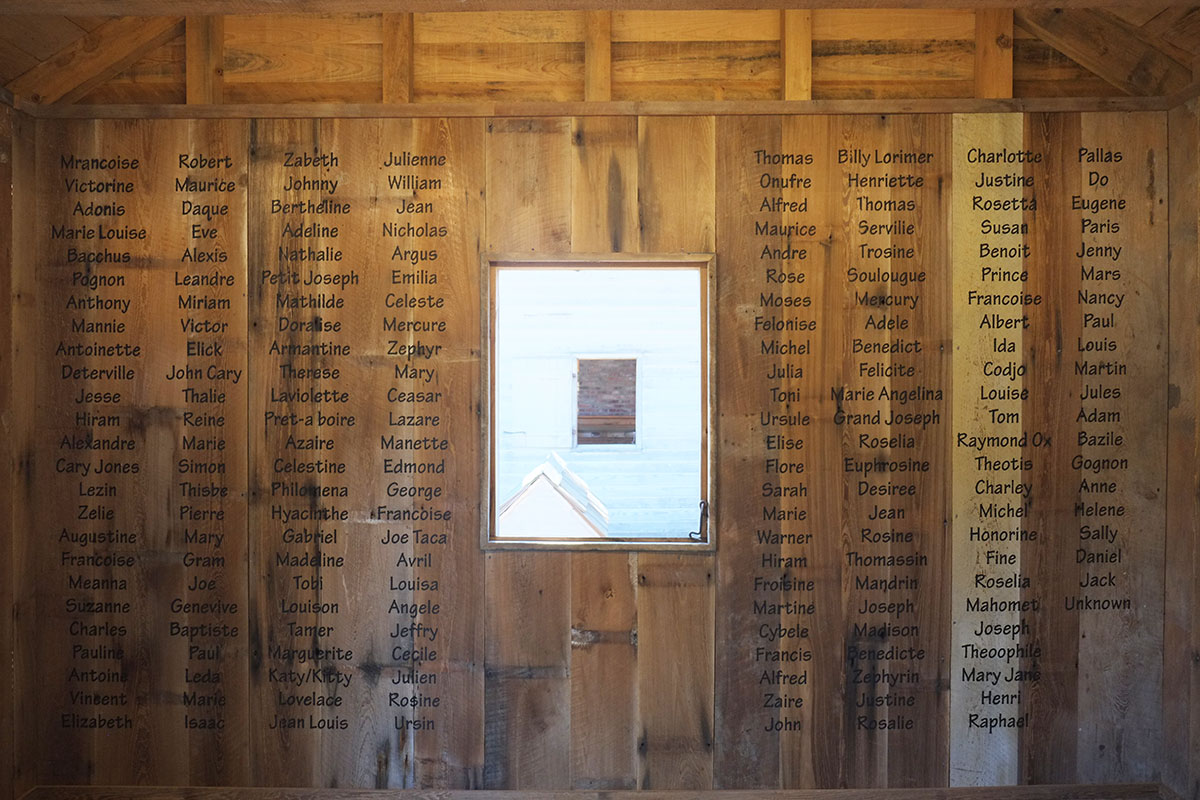
The plantation records had also been searched, and a list was compiled of all the slaves whose names could be found.  In one of the cabins, where there was a detailed exhibit on what is was like to be a slave, and how the slaves were treated, the names of the slaves from this plantation were inscribed on the end wall.  We thought it was a dignified and fitting memorial – acknowledging the individuals as best they could, working in the vernacular materials that reflected the physical surroundings and reality of these persons’ lives.DSCF3886

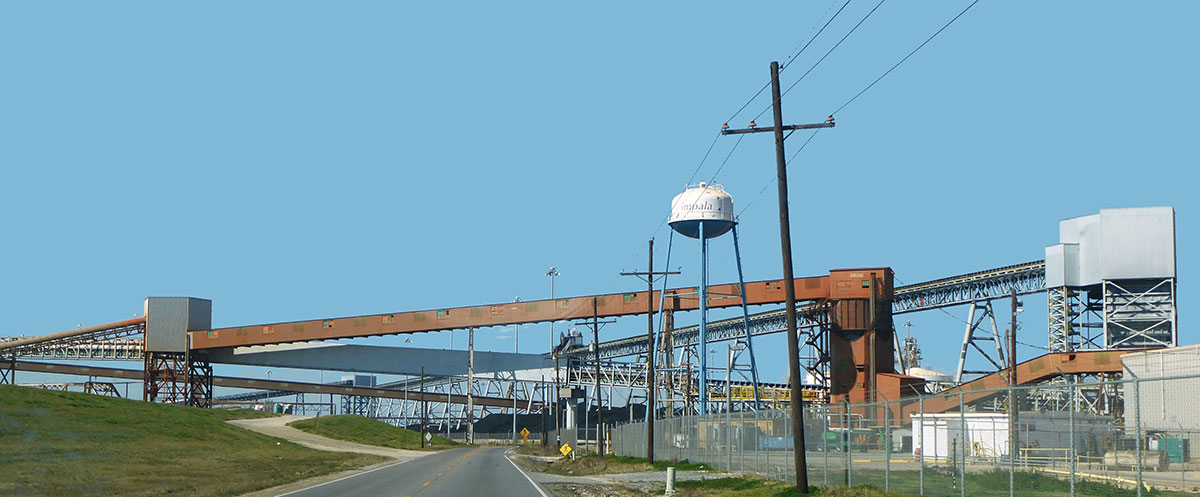
Most of the drive was through the oil and chemical industries’ landscape.  Very large facilities and big things, which we enjoy seeing.  Just glad we didn’t have to live there.  P1070311a

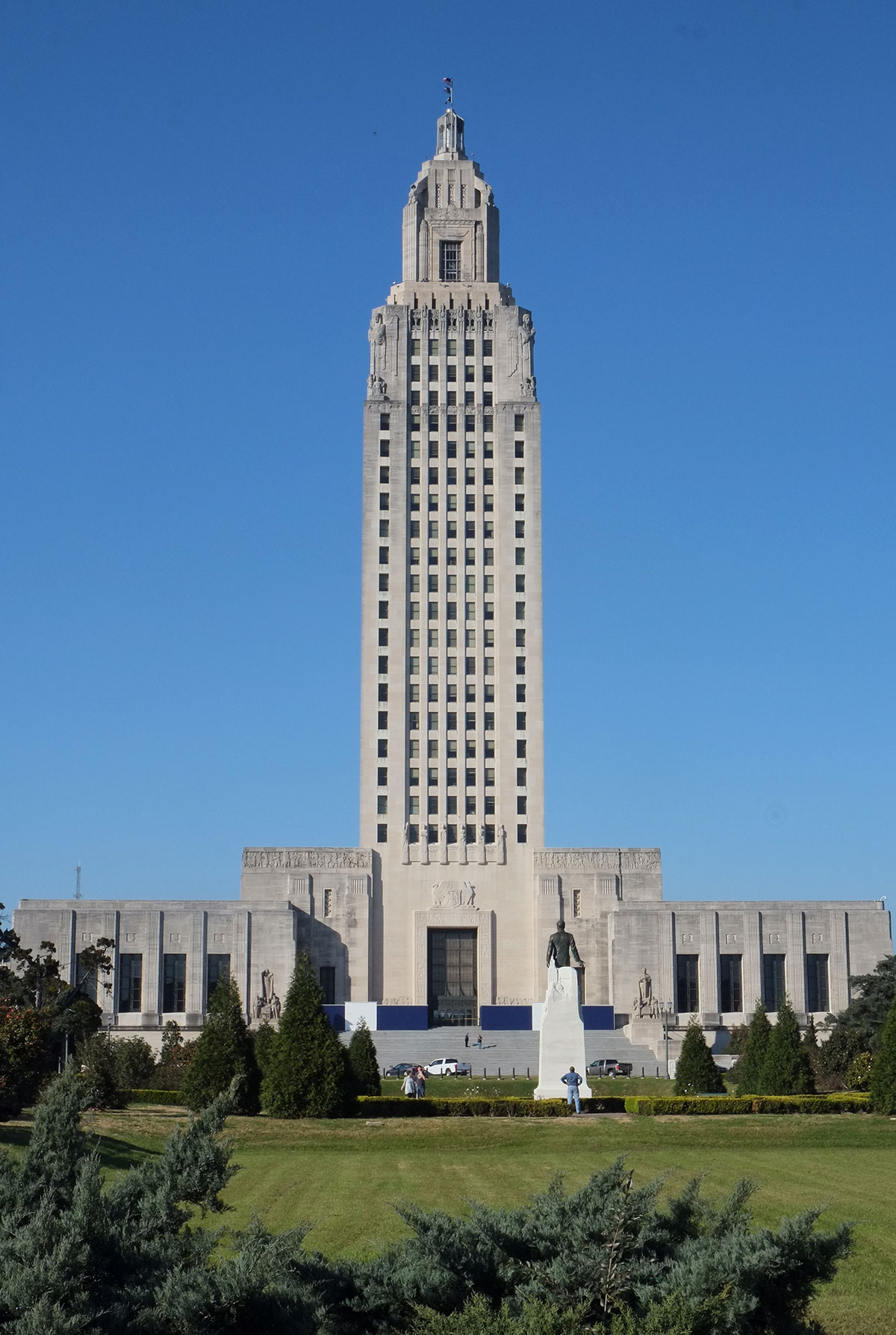
Our visit to Baton Rouge was stymied by a cell phone charger in the truck which we thought was working, but was not.  So just as we hit a major city, our phones went dead and we were navigating by instinct.  The downtown seemed to be having some kind of festival, coinciding with lots of streets being closed for construction, which made it even more difficult.  We passed by the state capitol (a pretty good one we thought, in the rare genre of capitol-as-tower), DSCF3972but mainly we spent a lot of time trying to find a store to buy a charger, before realizing that all stores like that are way out in the edge sprawl.  We gave up Baton Rouge, crossed the river and found a Walmart, and continued on our way.

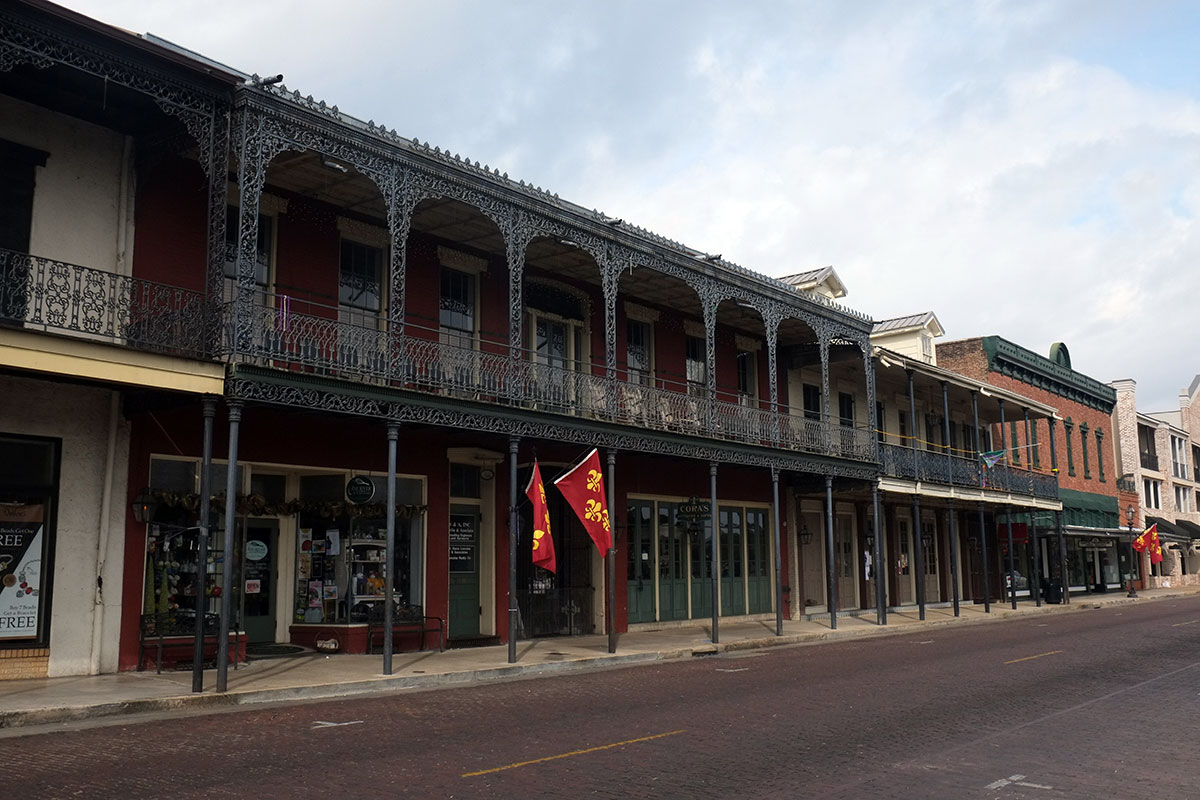
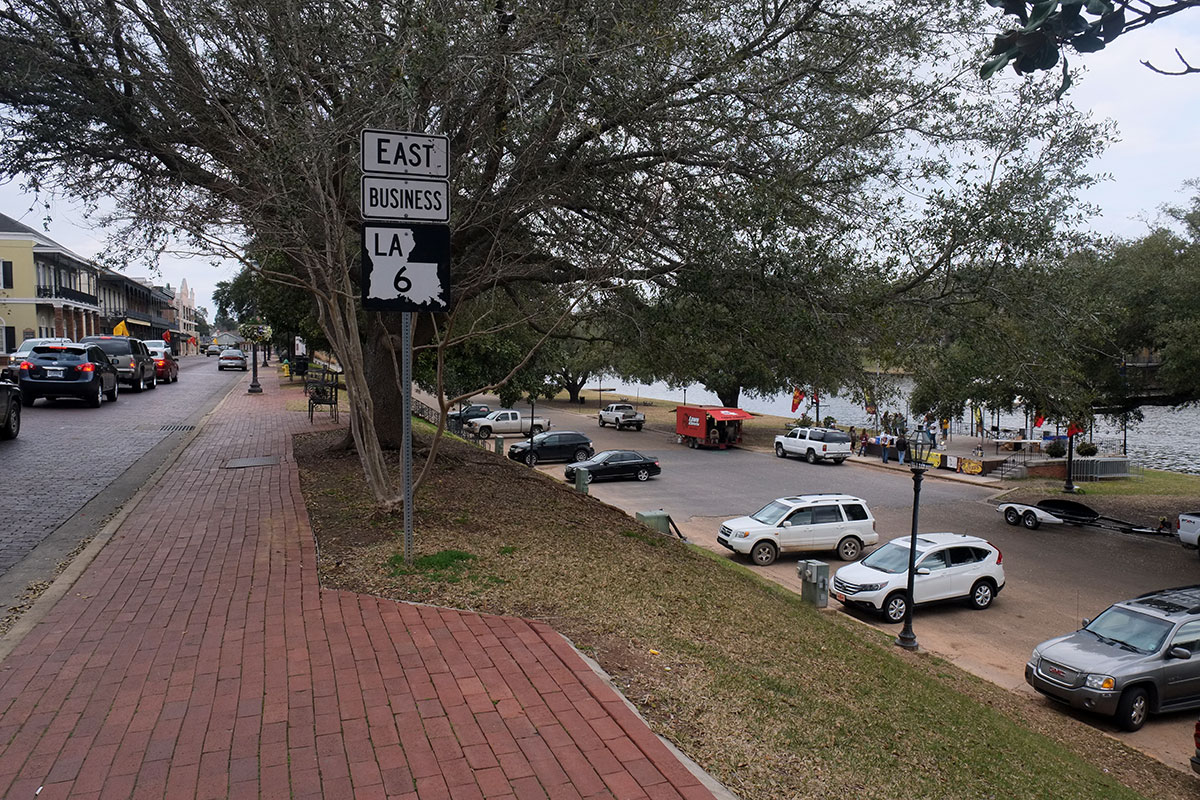
We left the Mississippi and crossed the Atchafalaya Swamp towards Lafayette, and headed up the Red River to Natchitoches (which is pronounced Nack-a-dosh), an important French colonial town.  It has a few streets of nice old commercial buildings, some of which have been excessively cute-ified for the tourists, but many of which are fine. DSCF3982

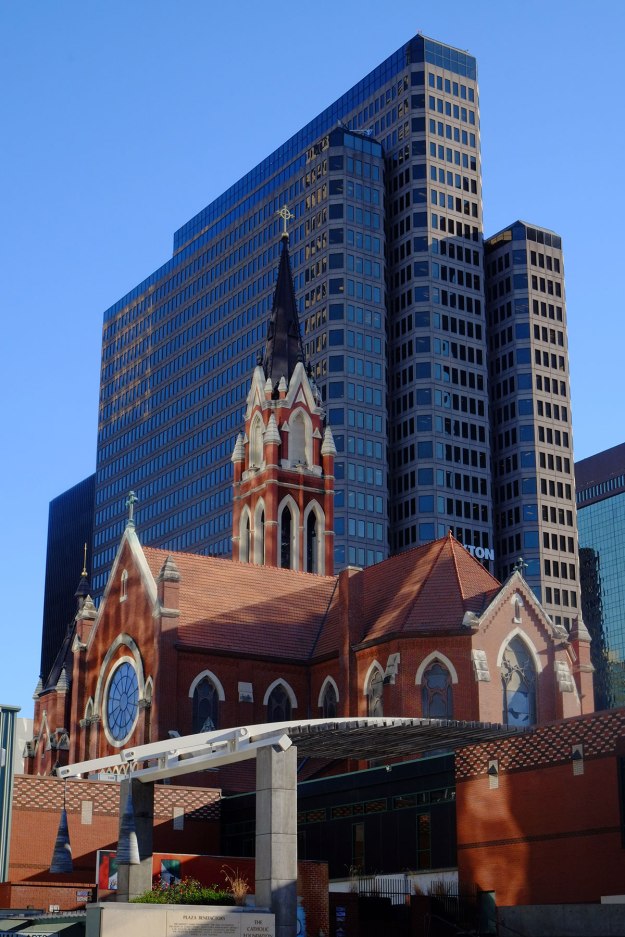
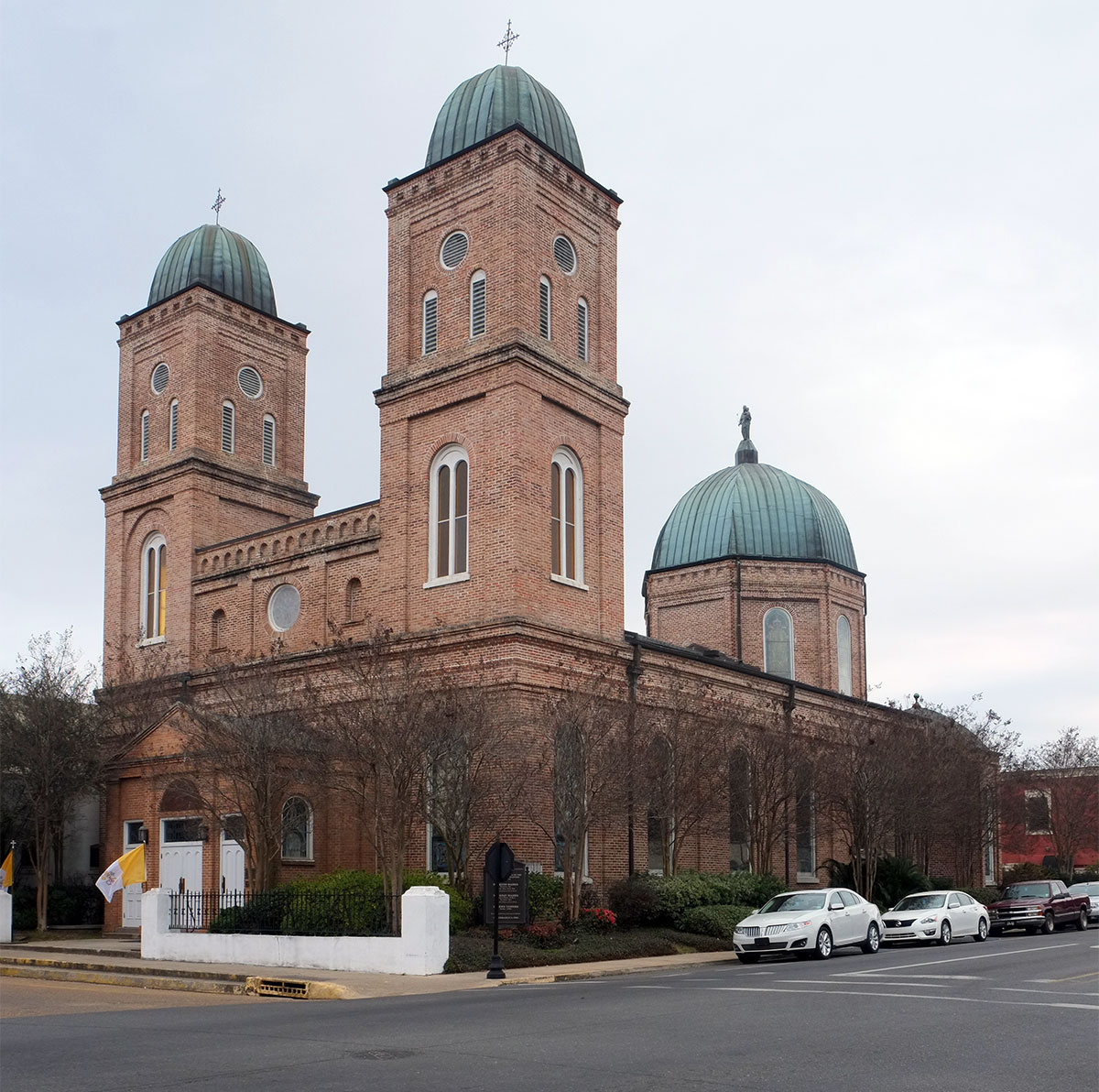
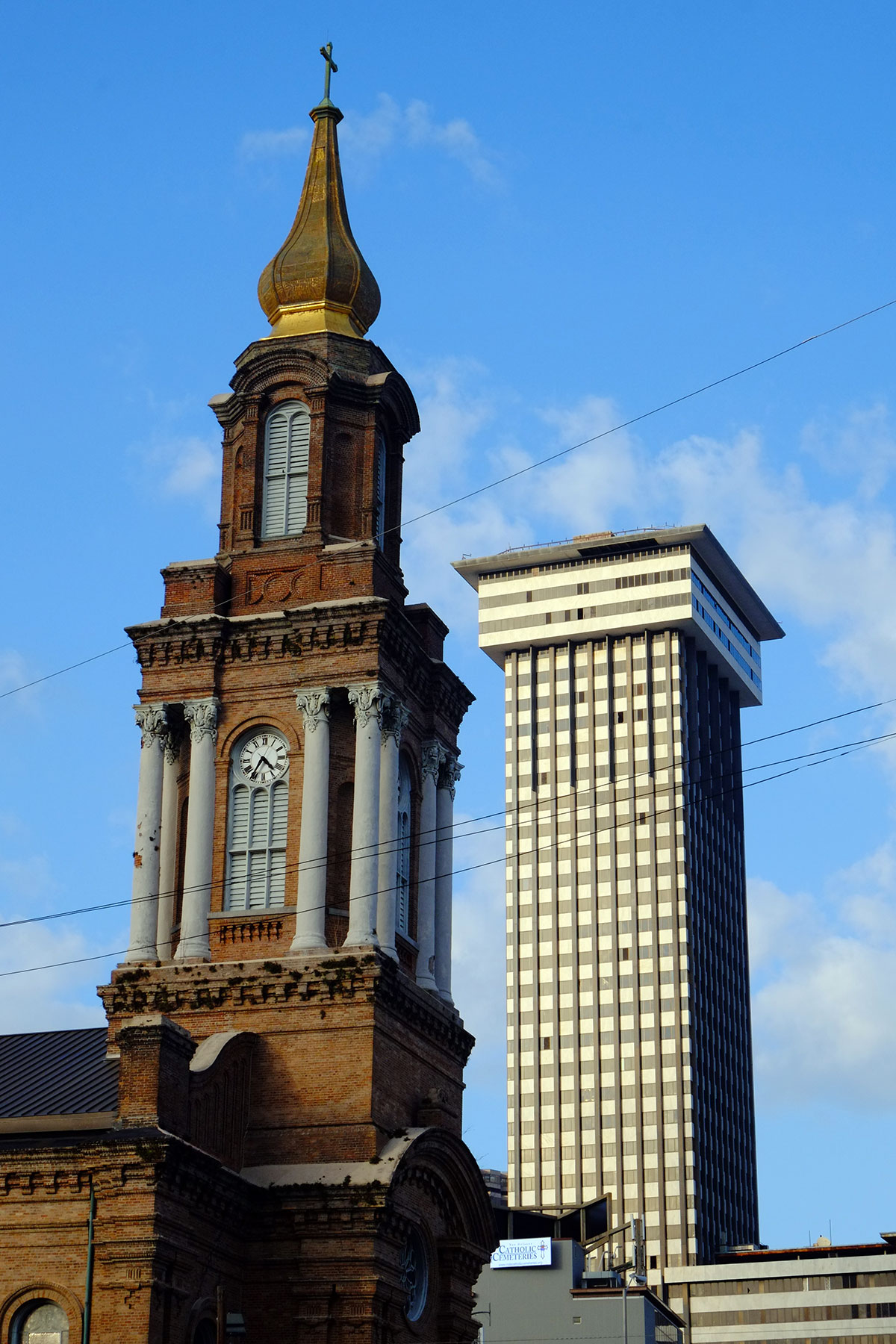
There is an excellent Catholic church. DSCF4012

The river flows through the center of town, with the buildings sitting on the higher ground above the floodway.  The lower area by the river is used for a park, parking, and river access, a really nice way to make an open space while acknowledging that this will flood.  (A few weeks after our visit this area did indeed have some major flooding, but I wasn’t able to find out how the town fared.)DSCF3978

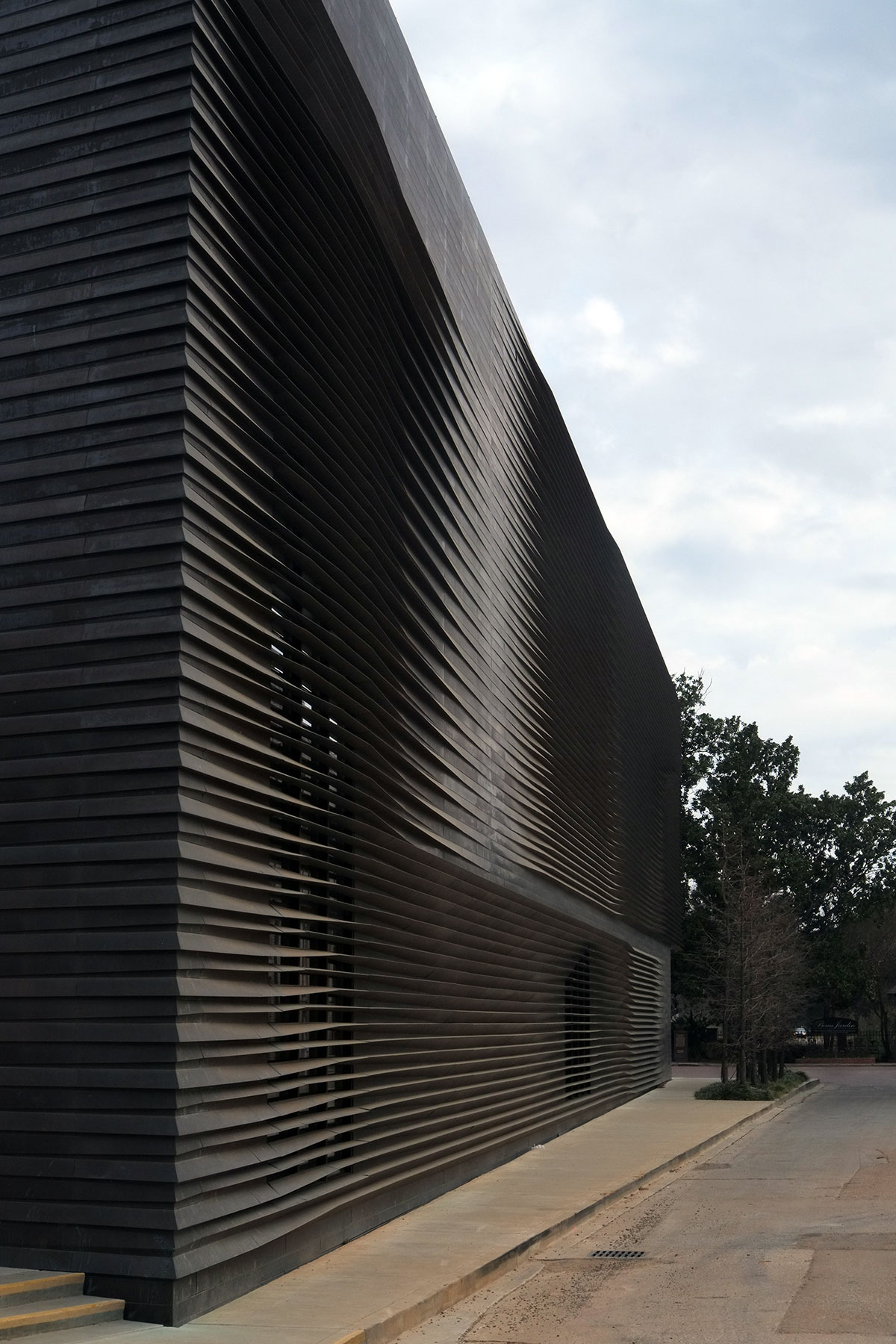
Not all the buildings are old and quaint – it is the home of the Northwest Louisiana History Museum, which was for some reason combined with the Louisiana Sports Hall of Fame.  DSCF3993

I was very surprised to find such an edgy building in such a location – the folks at Trahan Architects have clearly been reading their magazines, and the skin was the hippest we’d seen since Miami.  DSCF3998

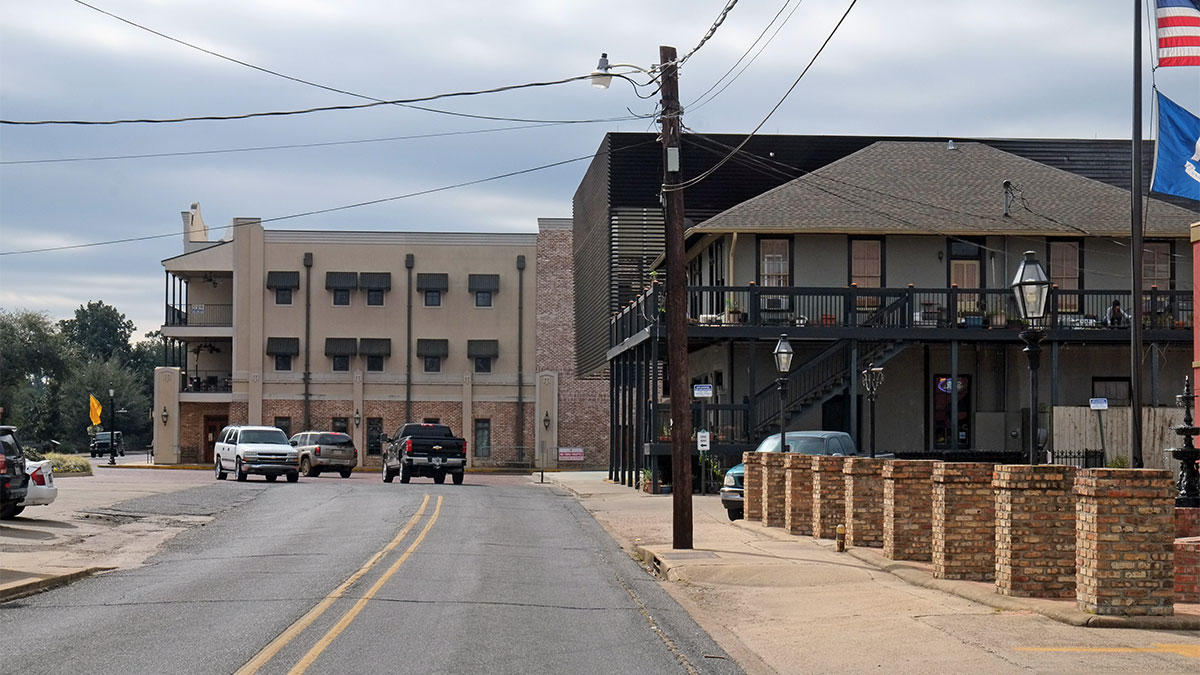
Strangely, it looked pretty darn good in the town – the massing is simple and in scale with the surroundings, the entry space under the floating screen wall relates to the verandah architecture of the nearby commercial buildings,DSCF4003 it’s dark-colored, and it anchors a funny shifting intersection.  On the whole, it was much better than the pseudo-historicist buildings we saw there (such as the one beyond it).  It was Sunday so we couldn’t get inside, which was too bad, as Glen and Michelle had designed some of the exhibits.

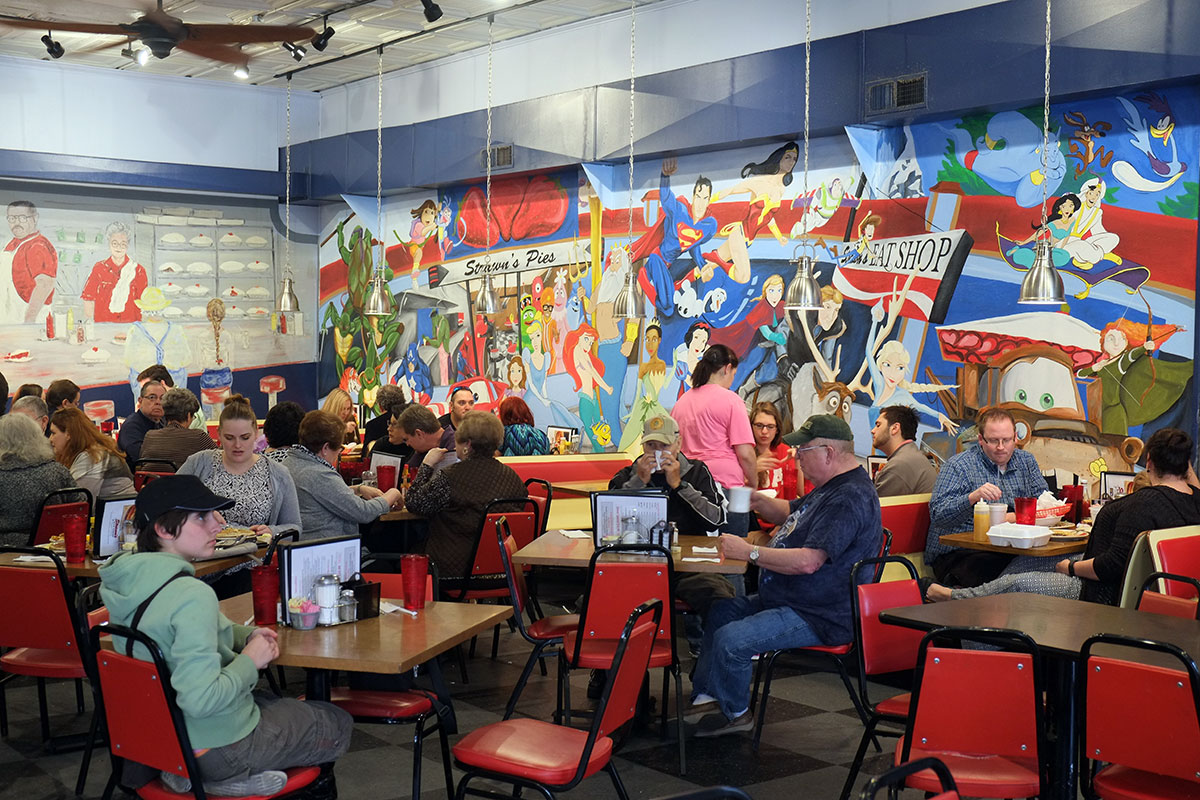
We hadn’t heard great things about Shreveport, but we enjoyed it.  We stopped for lunch at Strawn’s Eat Shop (we found it through Roadfood.com, and couldn’t resist the name).  Food not worth blogging about, but we liked the ambience.  DSCF4029

We saw what was clearly the older expensive neighborhood, DSCF4032

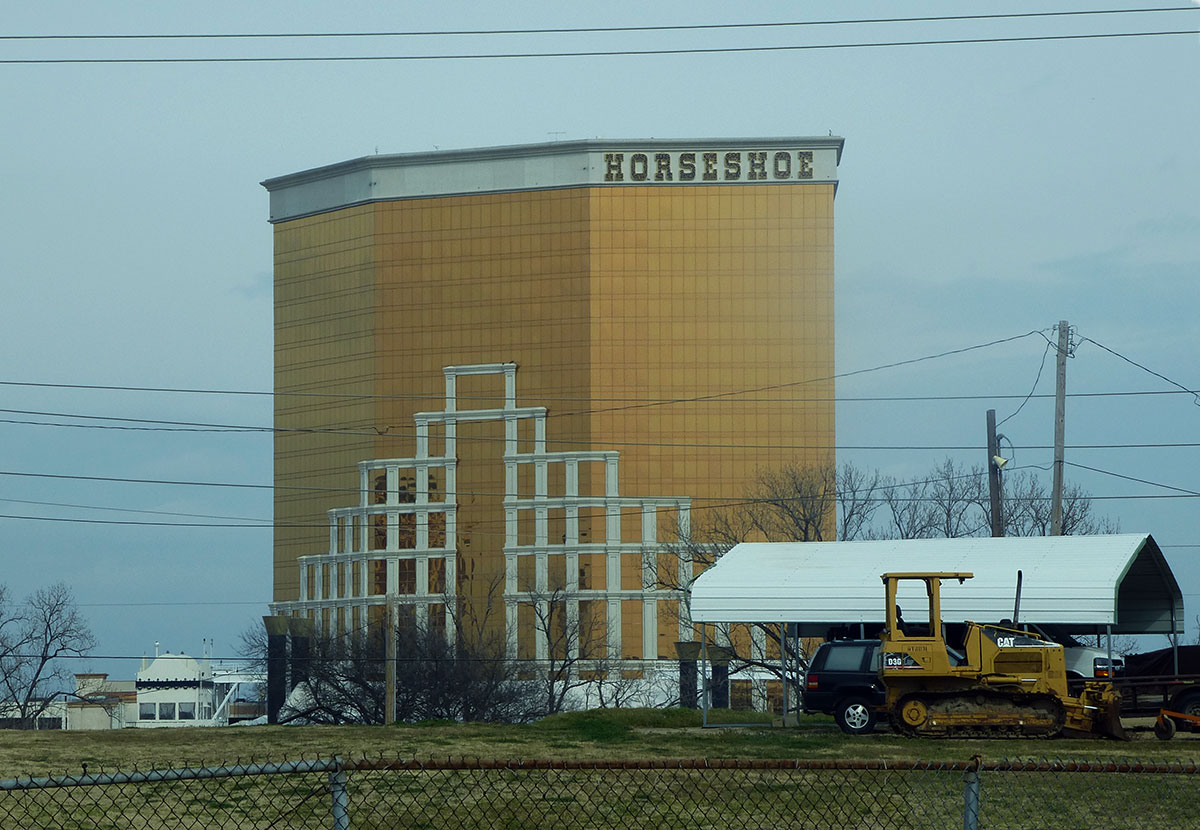
and then perhaps the worst Pomo building in the world, even uglier than the Jacksonville courthouse.  Casino architecture is inherently strange, but cheap casino architecture may be the most depressing stuff around.P1070328a

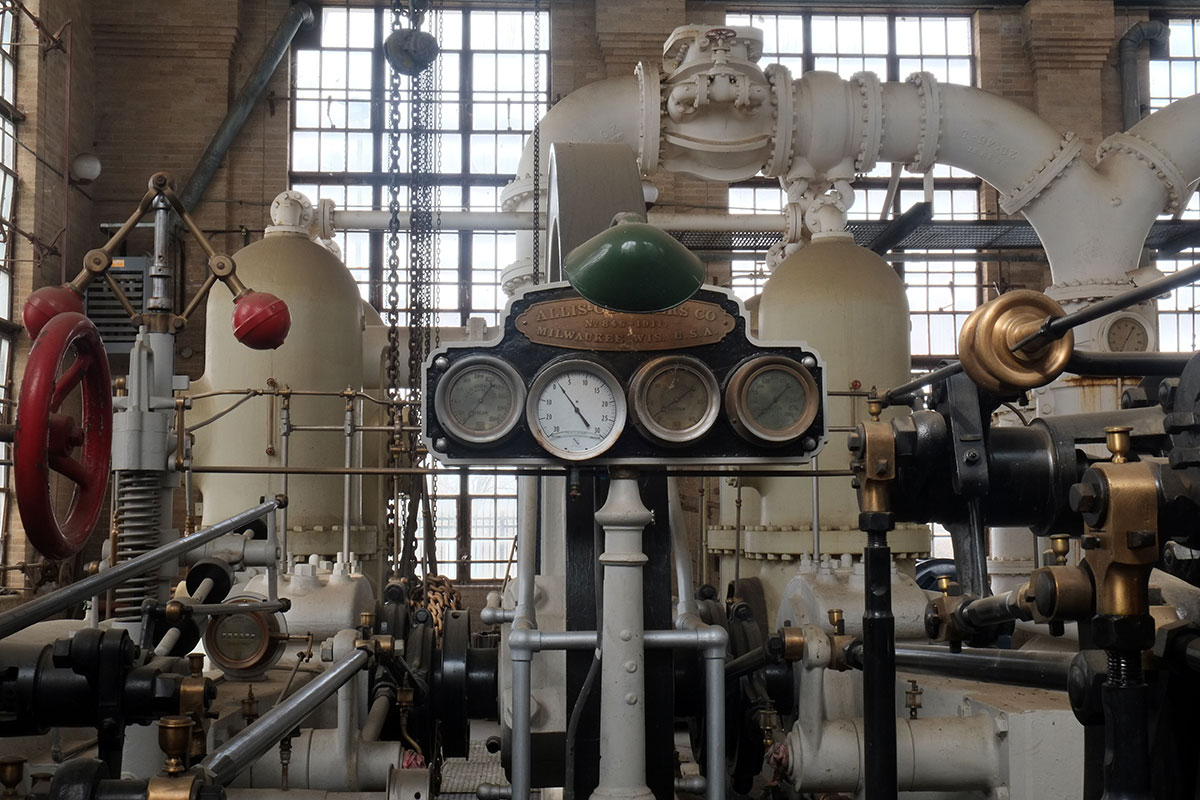
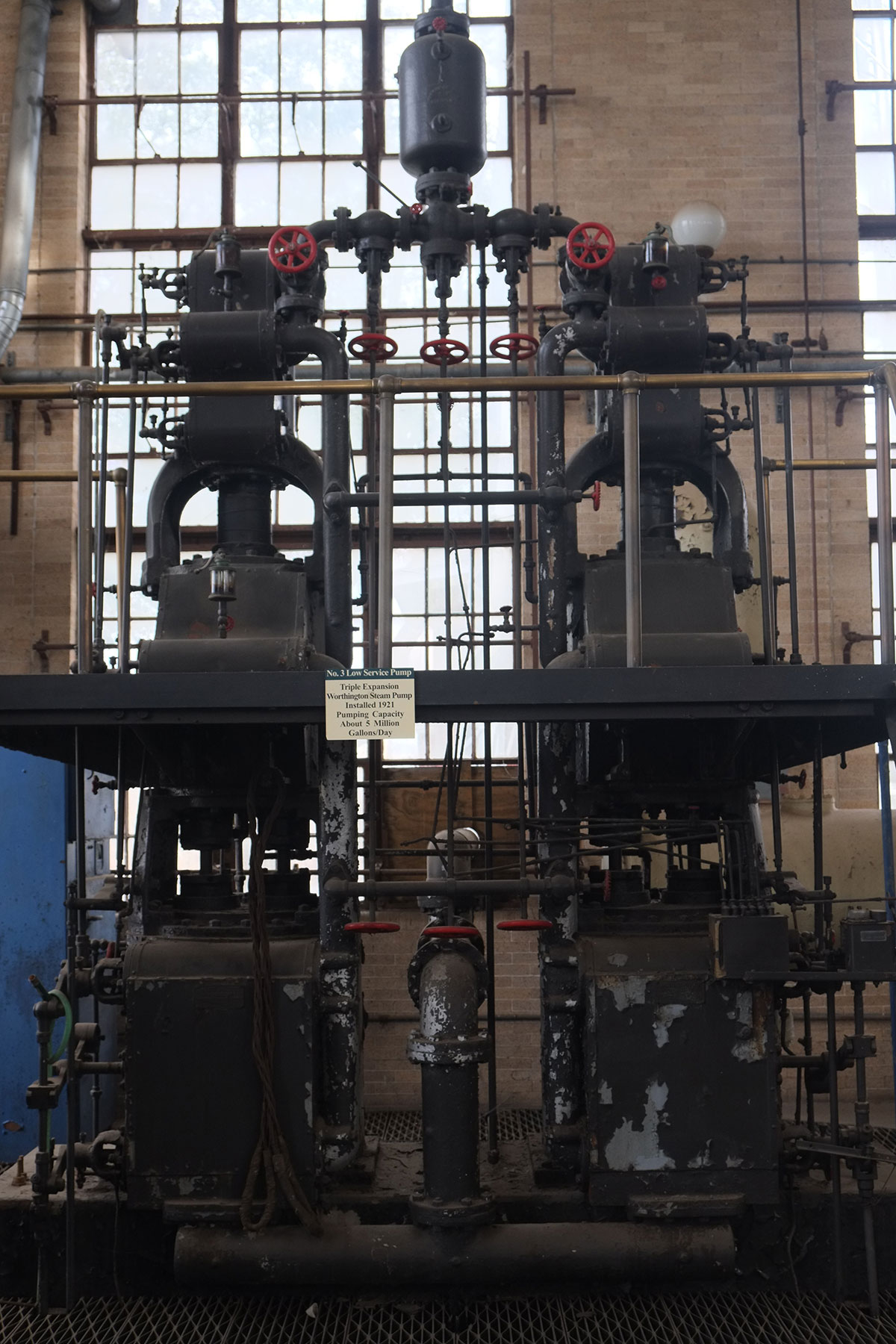
But by far the highlight of Shreveport was the Waterworks Museum. DSCF4053

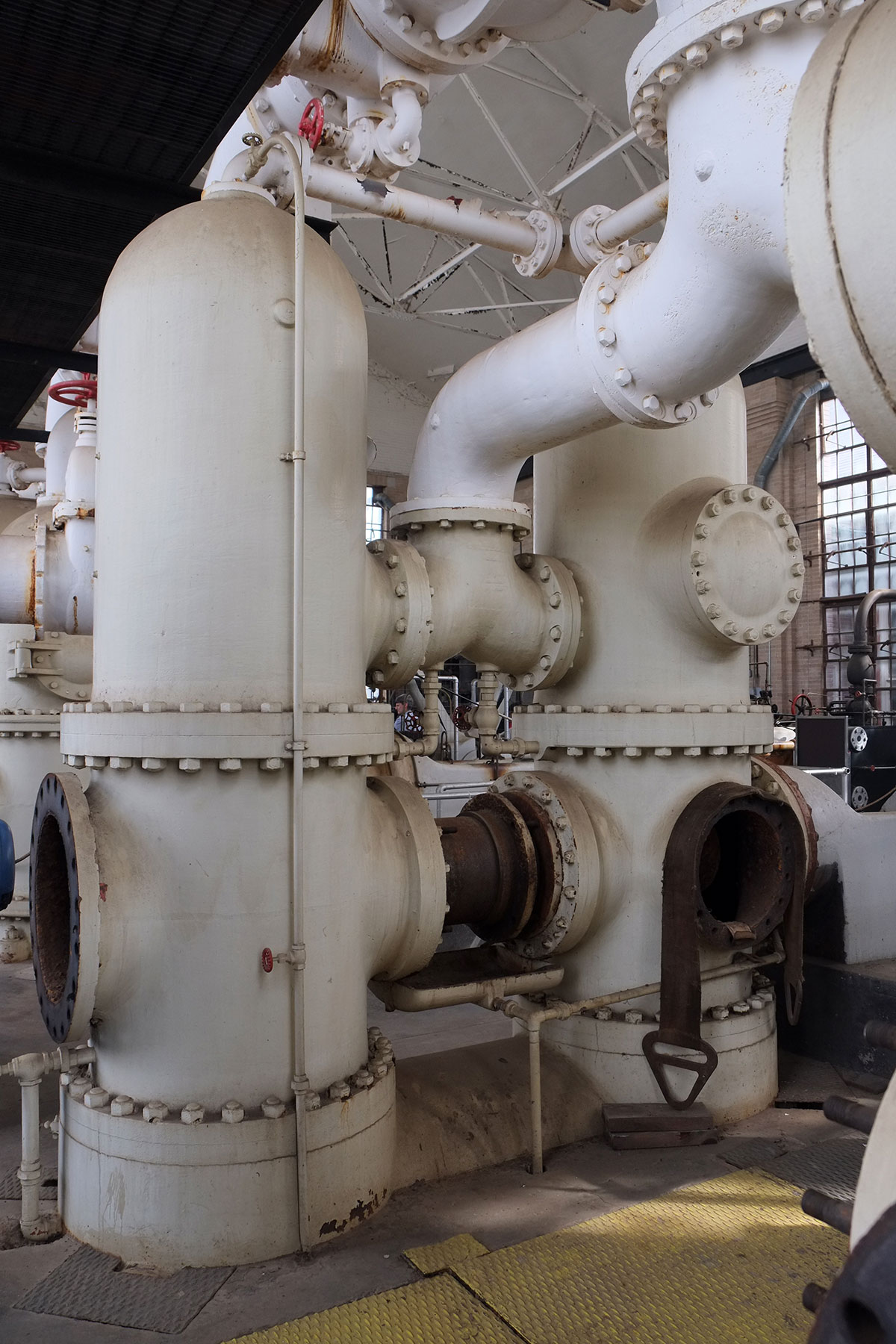
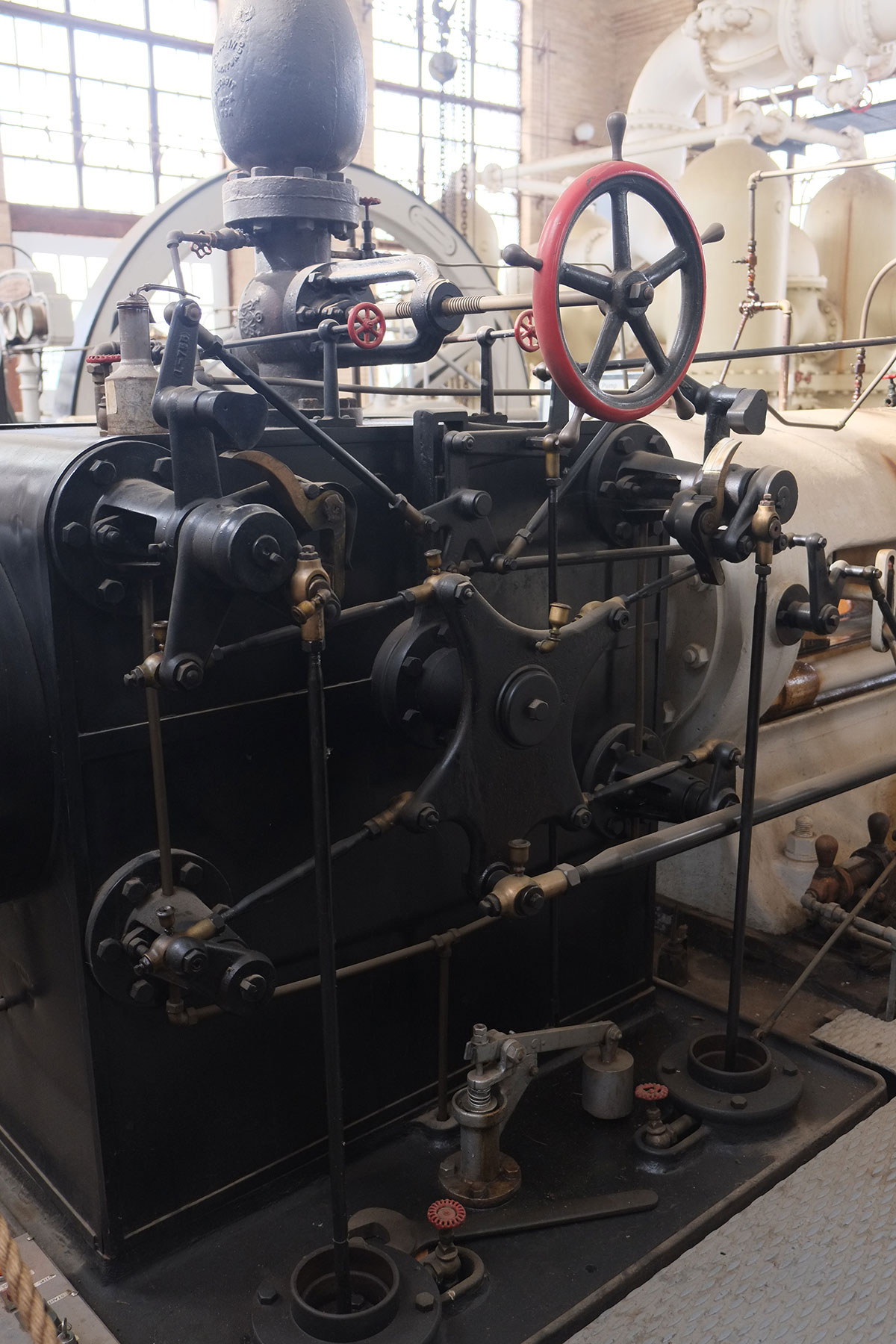
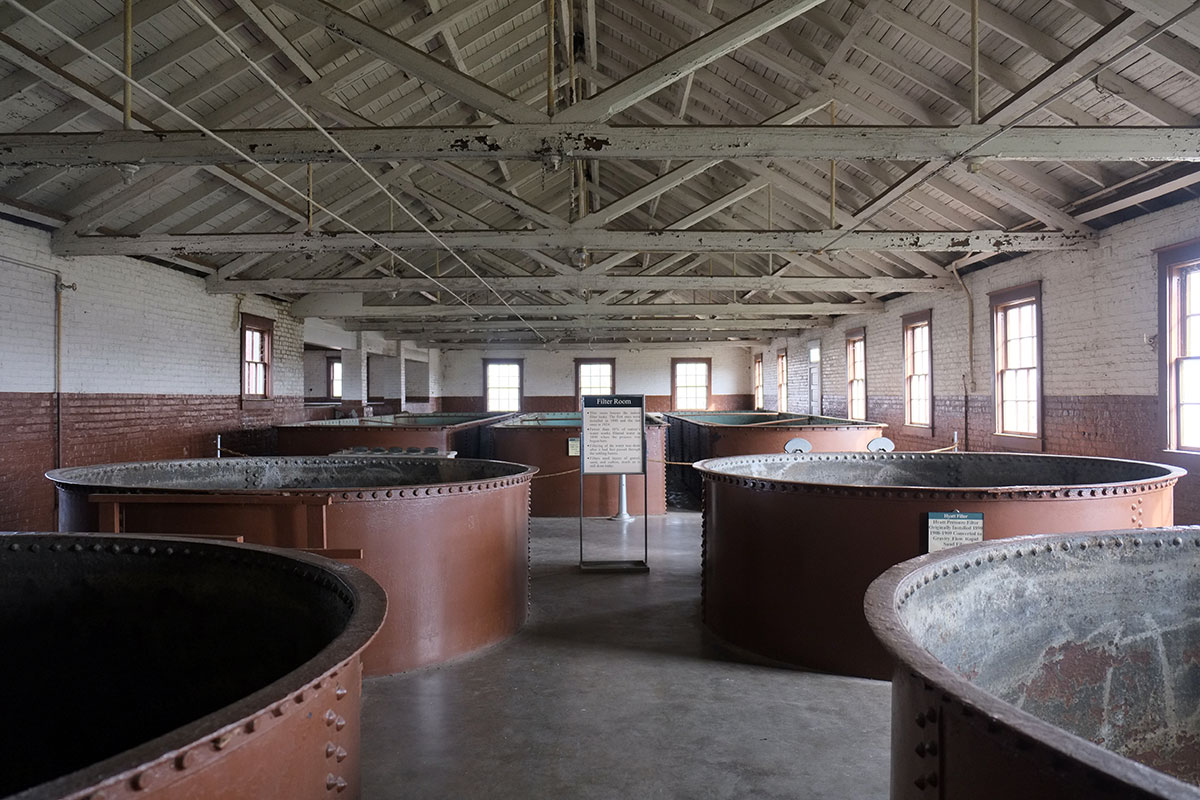
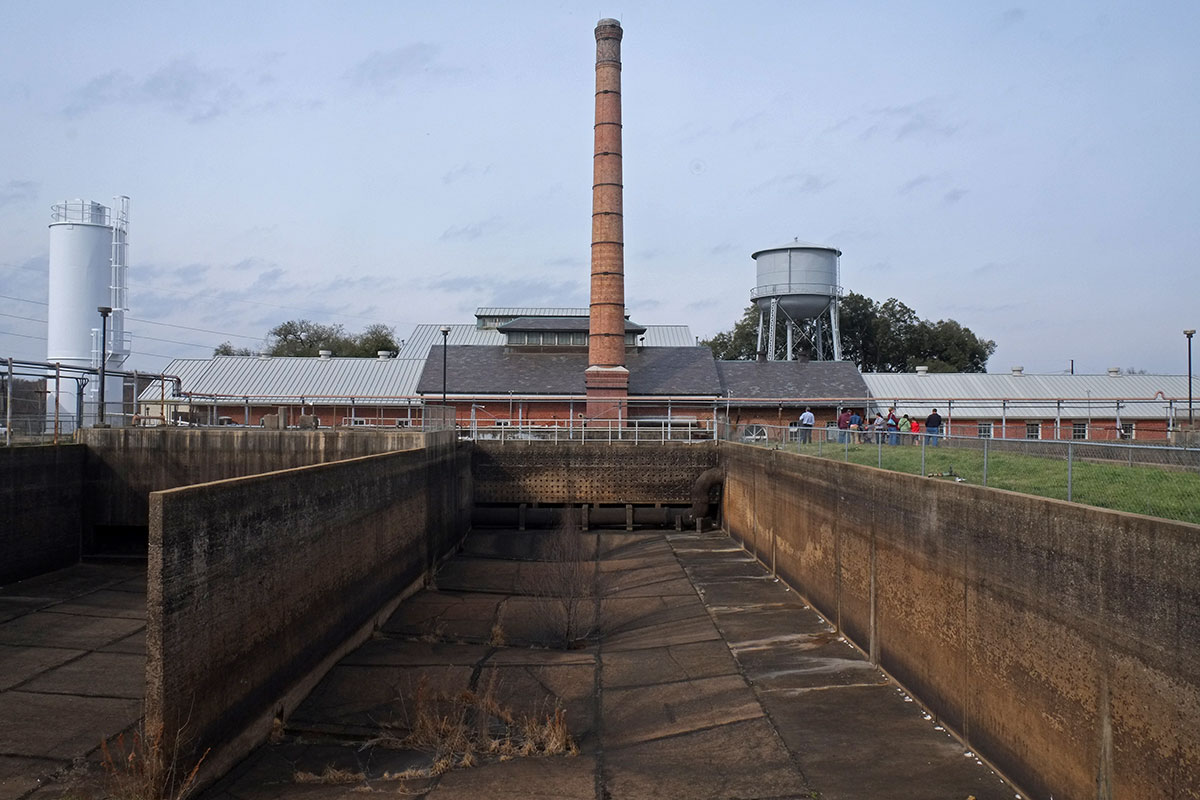
They ran their municipal water system on steam power until 1980, and then when they revamped it all, they preserved the whole earlier plant, with boilers, pumps, controls, settling tanks, labs, etc.  It was superb. DSCF4046  DSCF4058   DSCF4050  DSCF4092  DSCF4079We randomly arrived on a Sunday afternoon, and were able to join a tour with a group of cub scouts, which had an excellent guide who clearly loved the place.  As I’ve mentioned, neither of us especially likes visiting historical places where something once happened, but there’s no visible evidence.  We like seeing real stuff ([preferably Steanmpunk stuff), and this was about the best industrial archaeology we’ve seen on the whole trip.

New Orleans – the newer city

One of the reasons that New Orleans is so different from other American cities is that has always been constrained.  Surrounded by Lake Ponchartrain (to the north) and low-lying swamps and marshes in every other direction, the whole metropolitan area encompasses only around 200 square miles, with a population of 1.2 million – approximately half that of Portland’s.  The constraints on New Orleans used to be even more extreme – the originally-settled areas on the ridges (about eight feet high) were only later supplemented by the close-in drained-swamp residential areas in the 19th century, and the more extensive sprawl (such as it is) is all from the postwar era.  So the center of the city feels compact and manageable, while having very imageable, distinct districts.

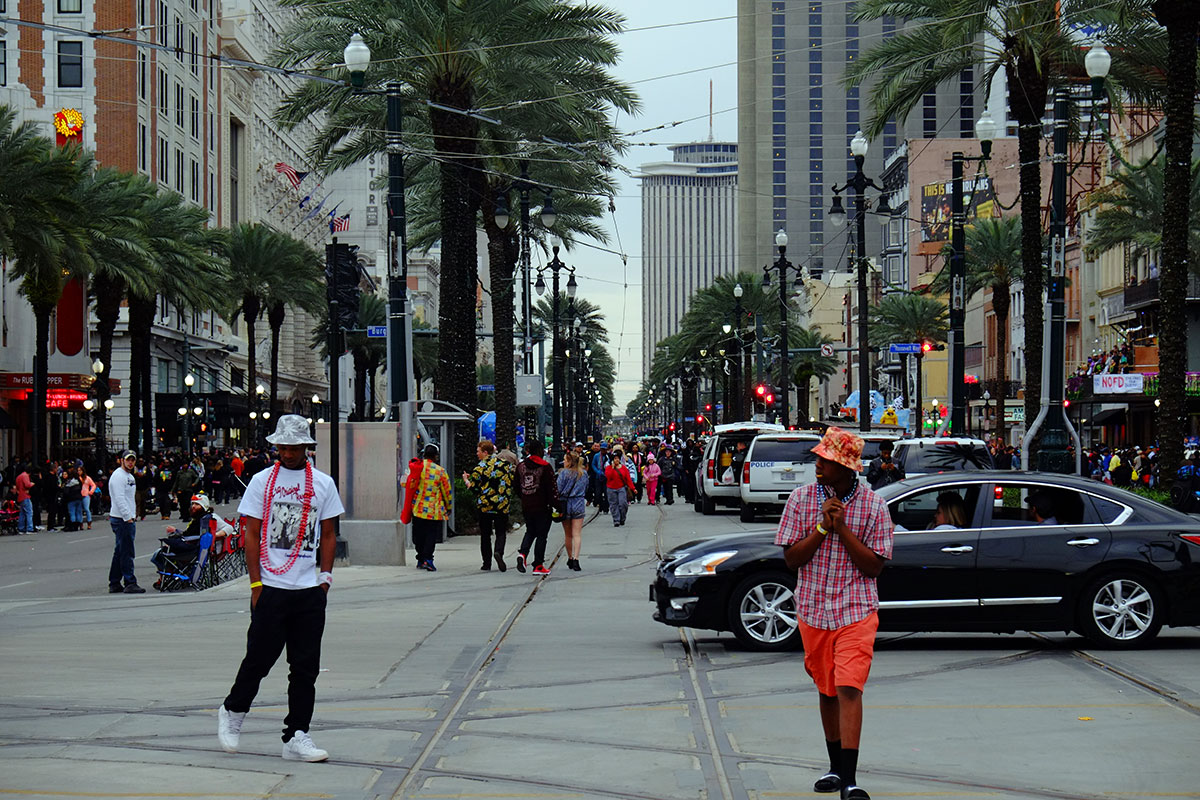
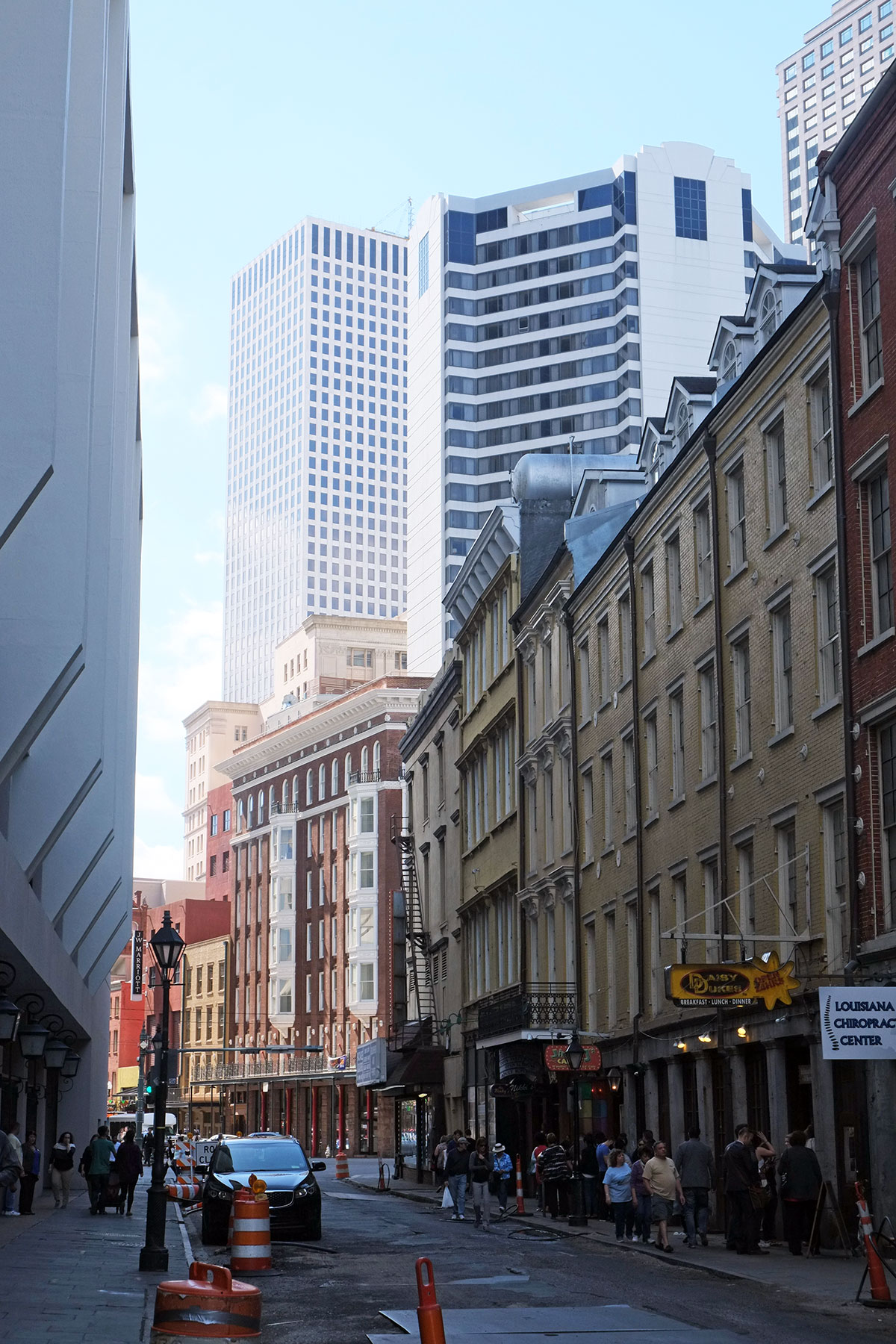
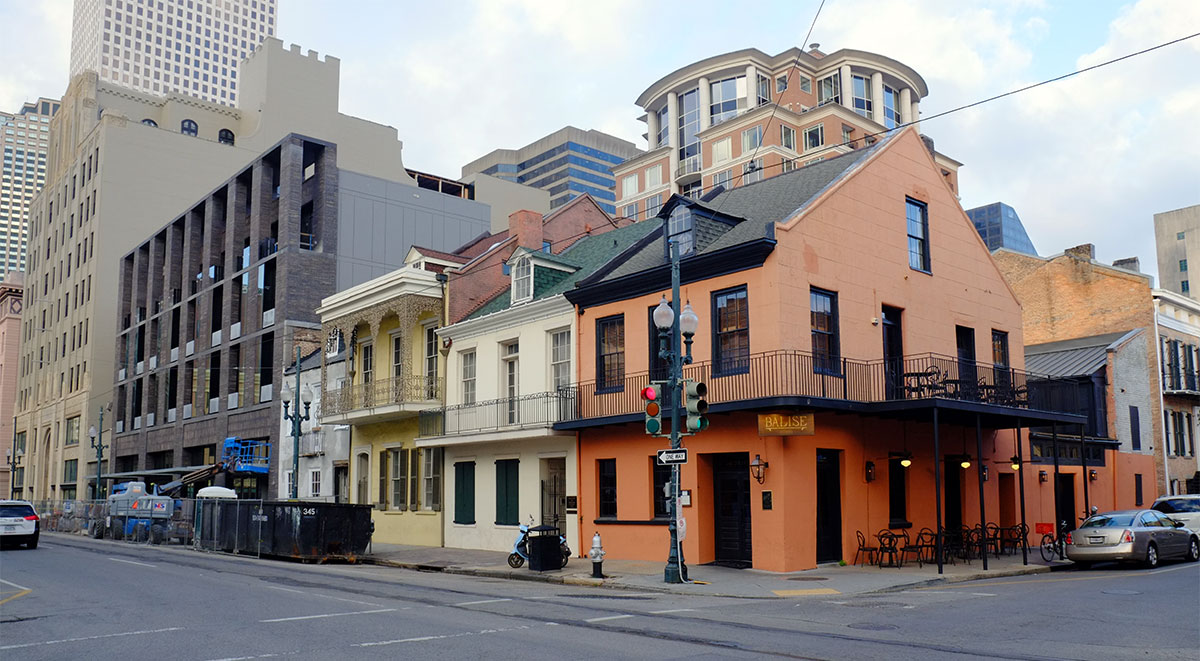
When the Americans began to move in after the Louisiana Purchase, they mainly left the Vieux Carre alone, and settled upriver, across Canal St.  Canal St. never had a canal, but it was planned for one, and so it is immensely wide.  It is a wonderful contrast to the rest of the city – you emerge from the narrow confines of the French Quarter to the bright, open expanse of Canal.     DSCF2648

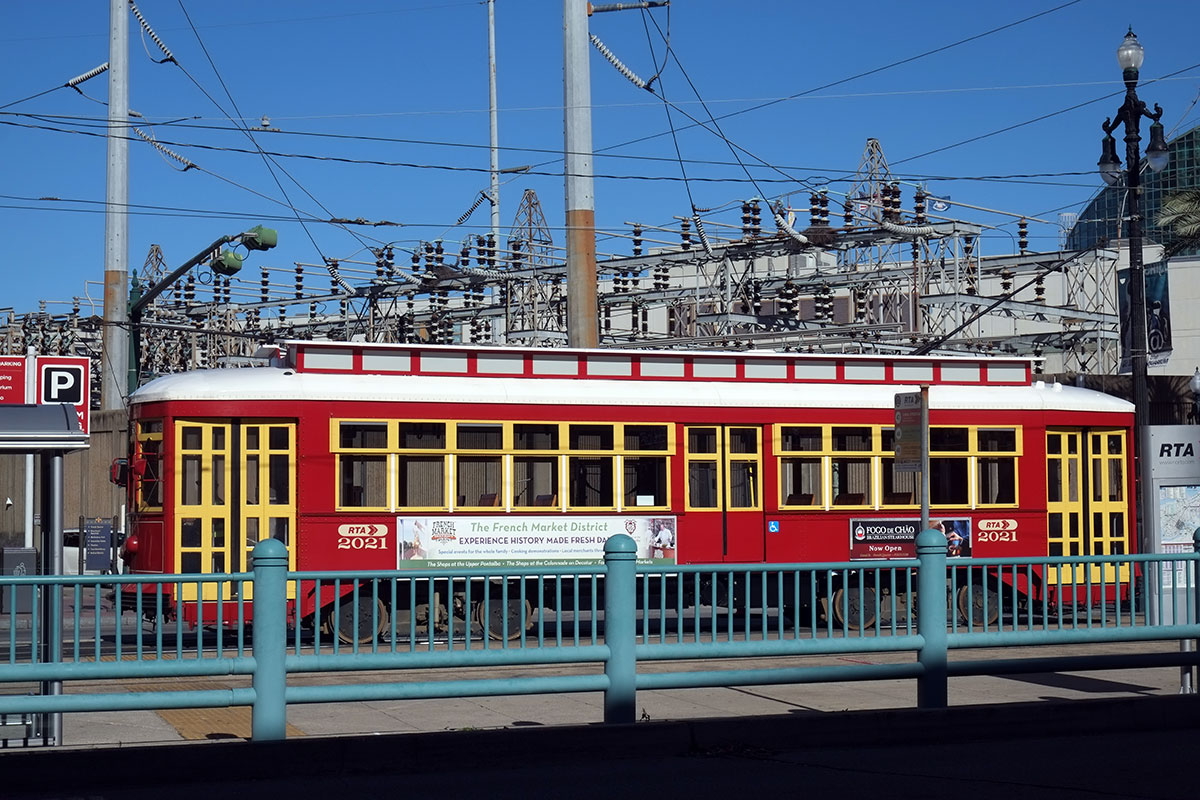
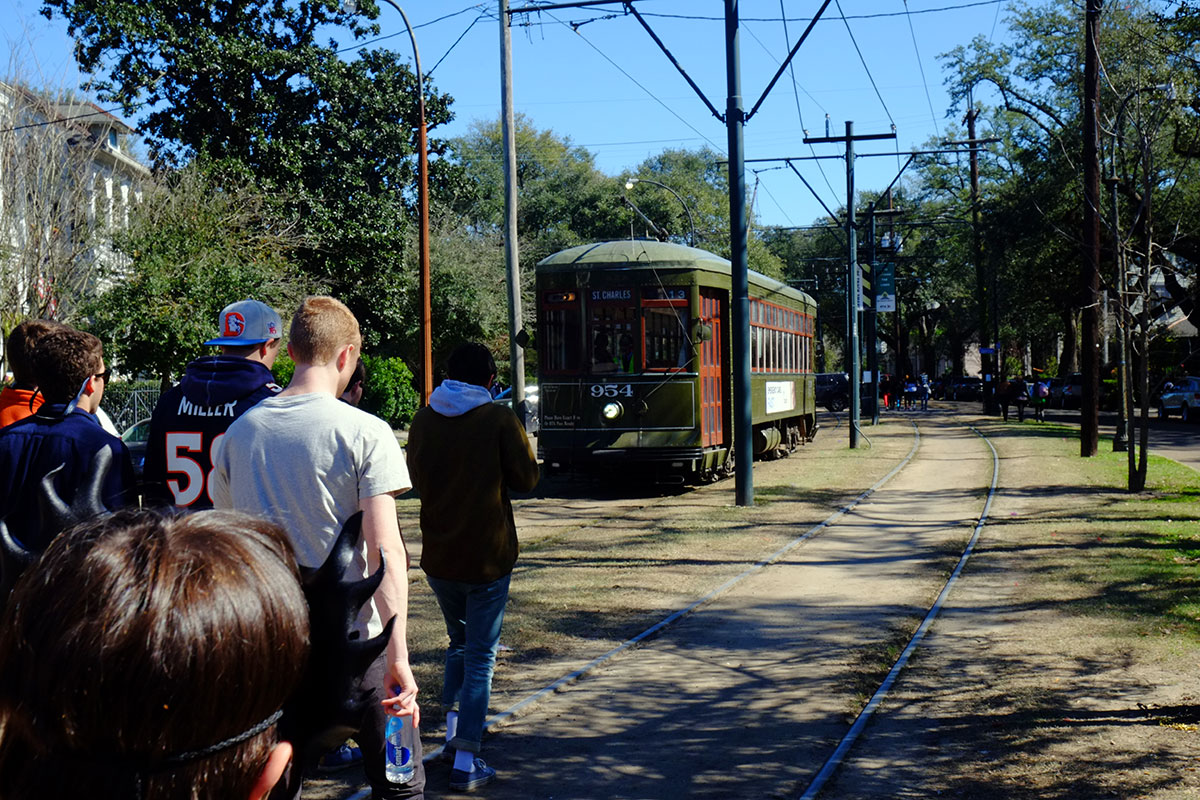
The buildings form a continuous wall, there are streetcar tracks up the center, and a double row of palm trees.  Bright lights, traffic, tourist attractions and hotels – it is an entertaining and exciting space, one that says, this is a big city.  Also a tropical city – with its white facades and palm trees, Canal feels very different from the grey avenues of the north.  DSCF2041p  One of the two streetcar lines runs up Canal, and it is a joy.  The old cars are fabulous, and here as on St. Charles, you ride along experiencing the city as it goes by.  DSCF2034DSCF2822

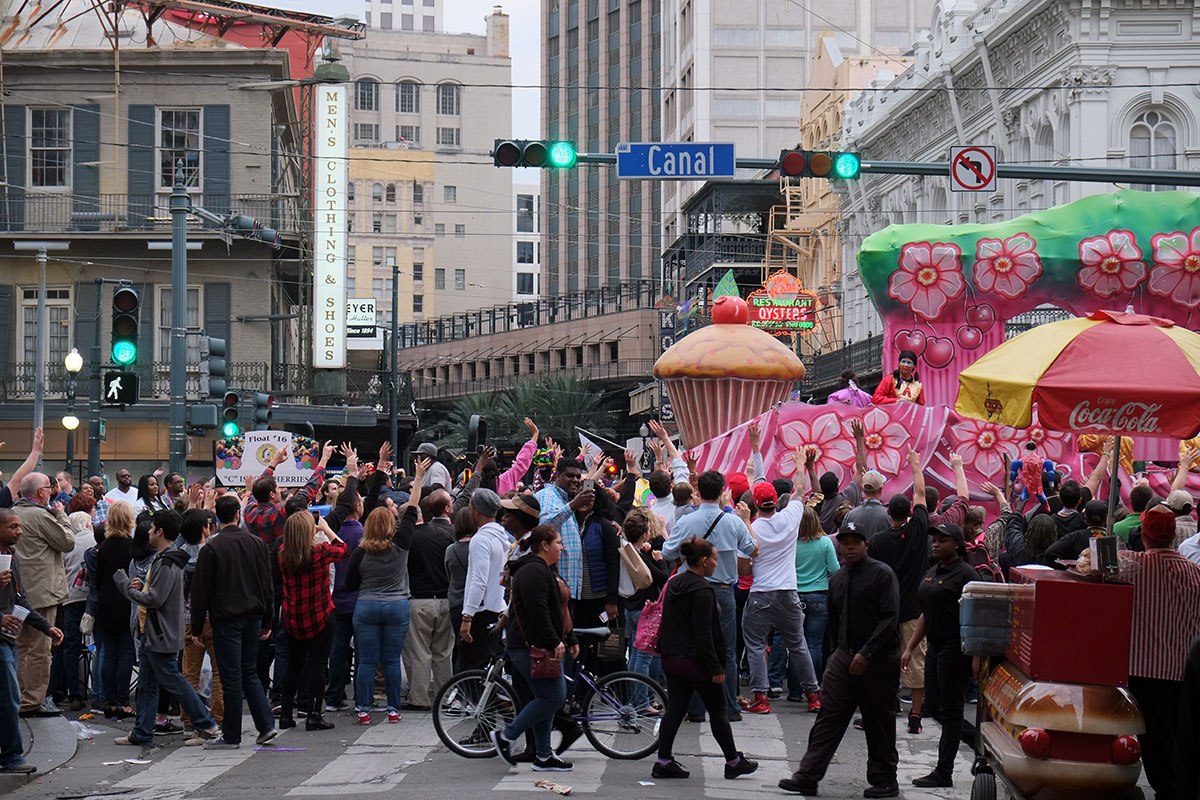
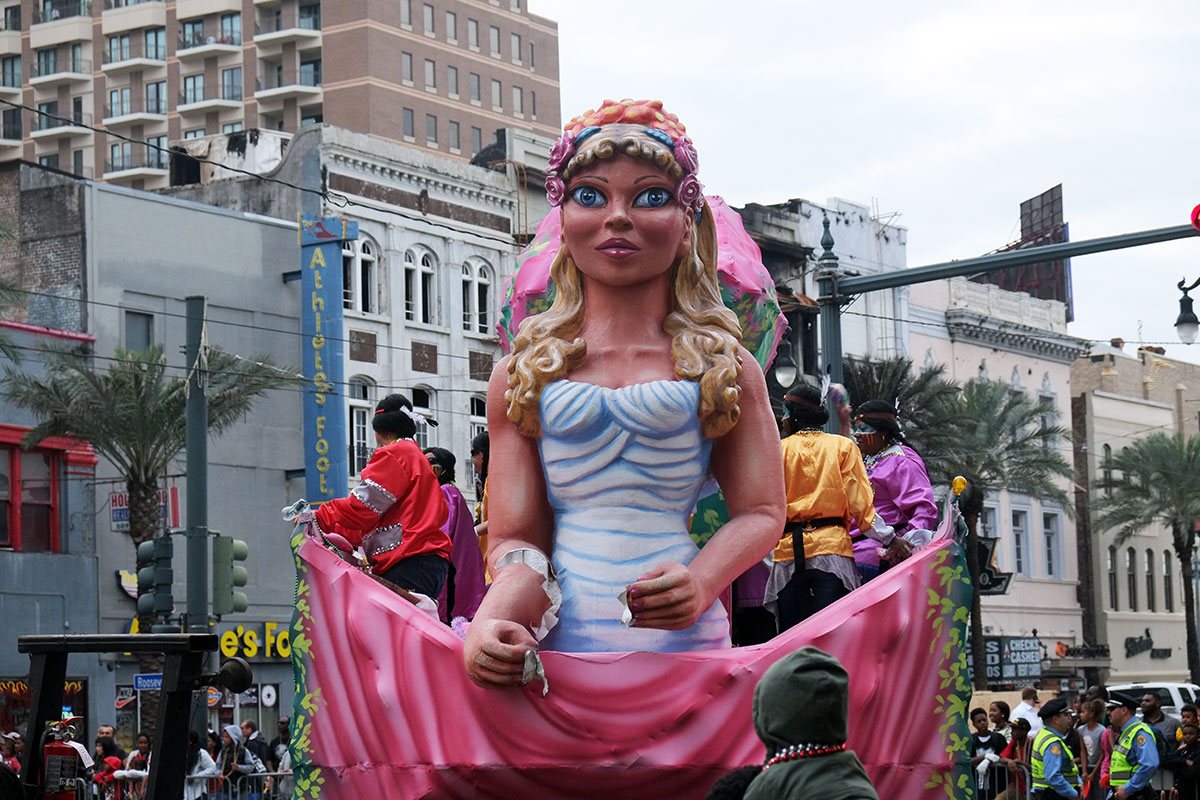
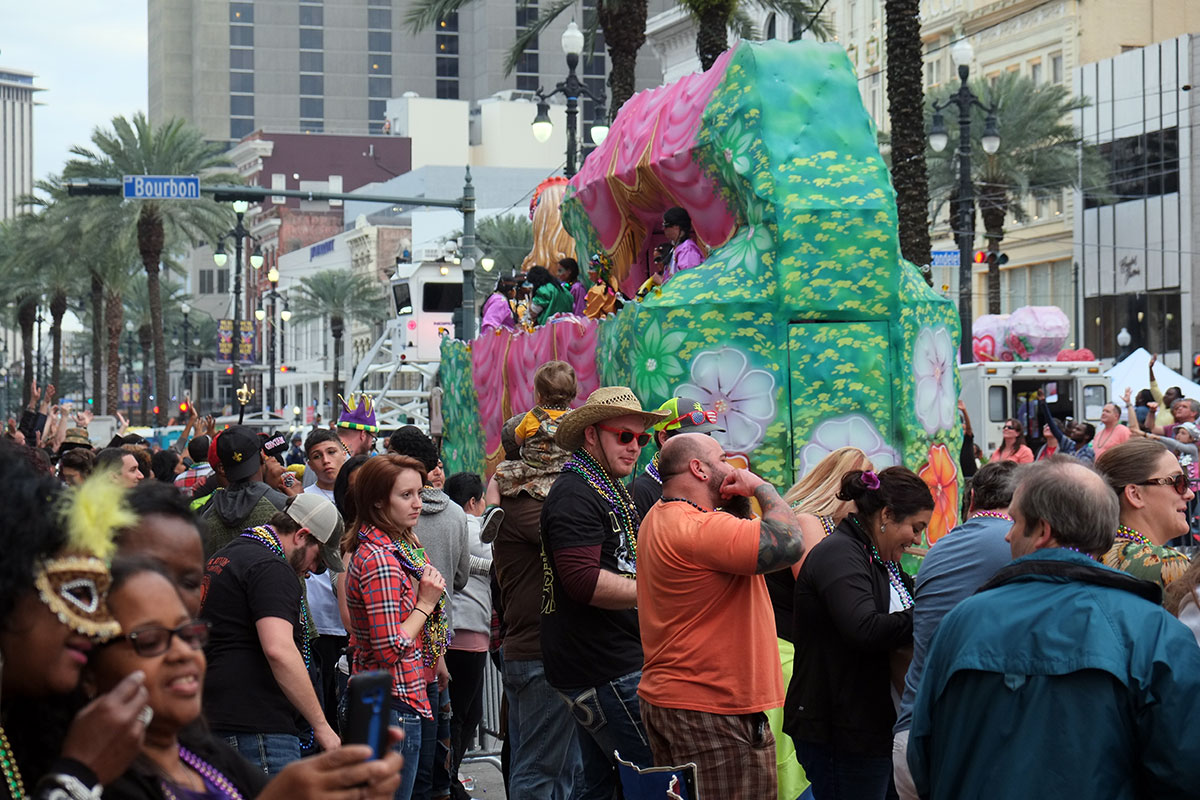
Canal really comes into its own on Mardi Gras – all the large parades end up here, heading up one side of the neutral ground (median) and back down the other.  The scale of the street works with the large crowds and floats – it reminded me of Broadway in New York with the Thanksgiving parade.  DSCF2277  DSCF2265  DSCF2267

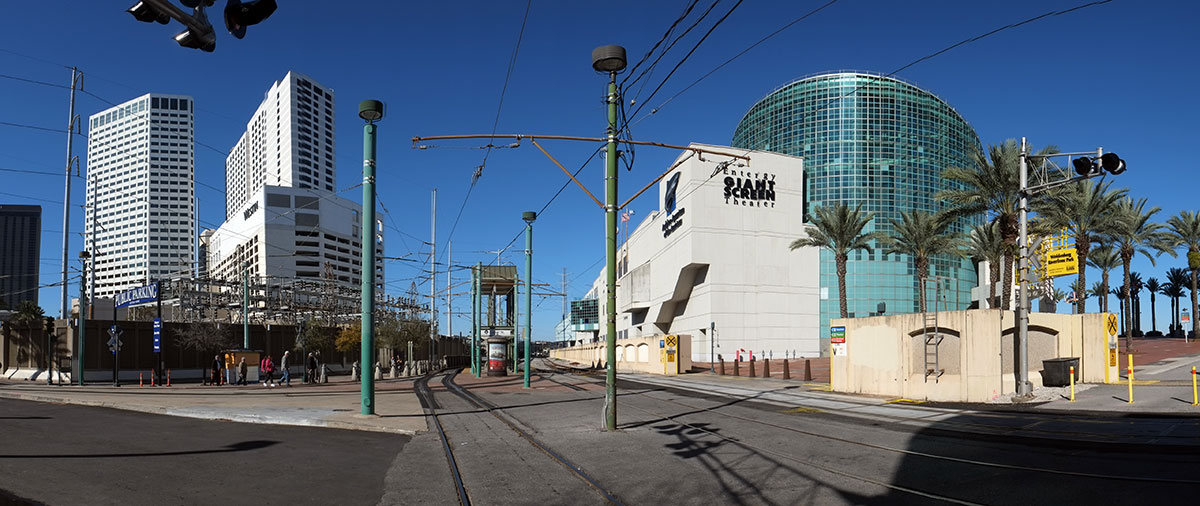
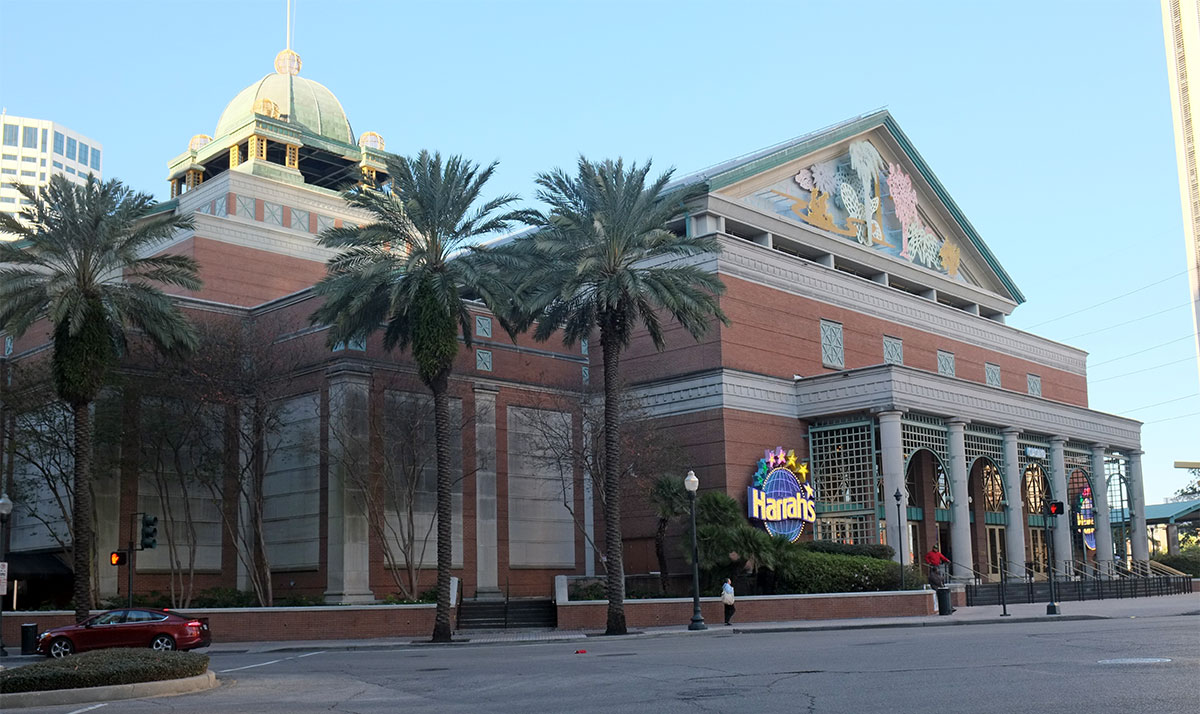
The end of Canal at the River is the center of tourist / convention madness.  Hotels, convention center, casino, aquarium – all the overscaled and blank buildings are here.  It works pretty well- these fairly standard dreadful buildings are clustered and have a minimal impact on the other neighborhoods.  You can just ignore this part of town if you don’t have to go there.  DSCF2032  DSCF2098

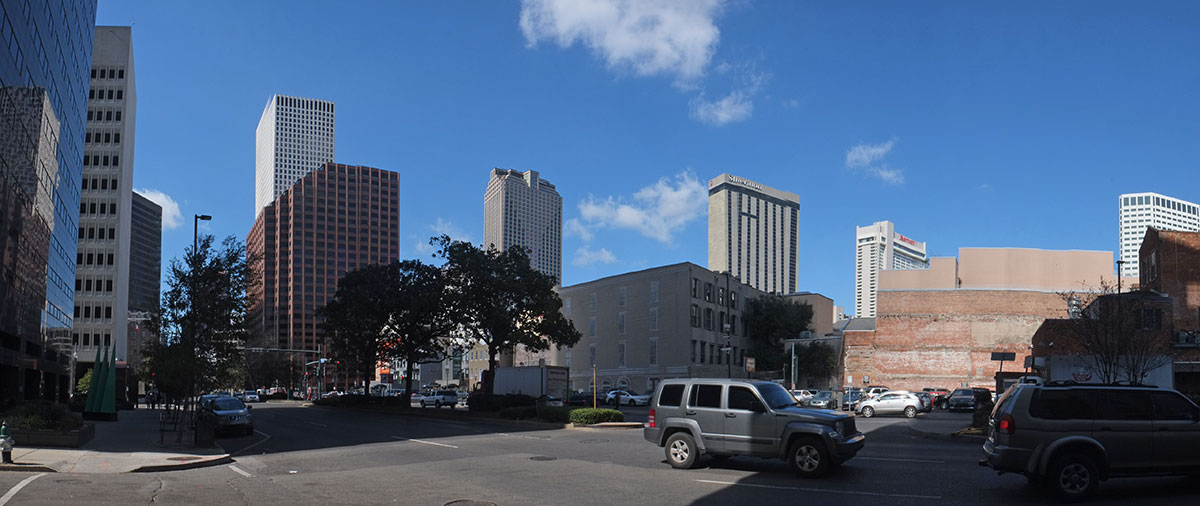
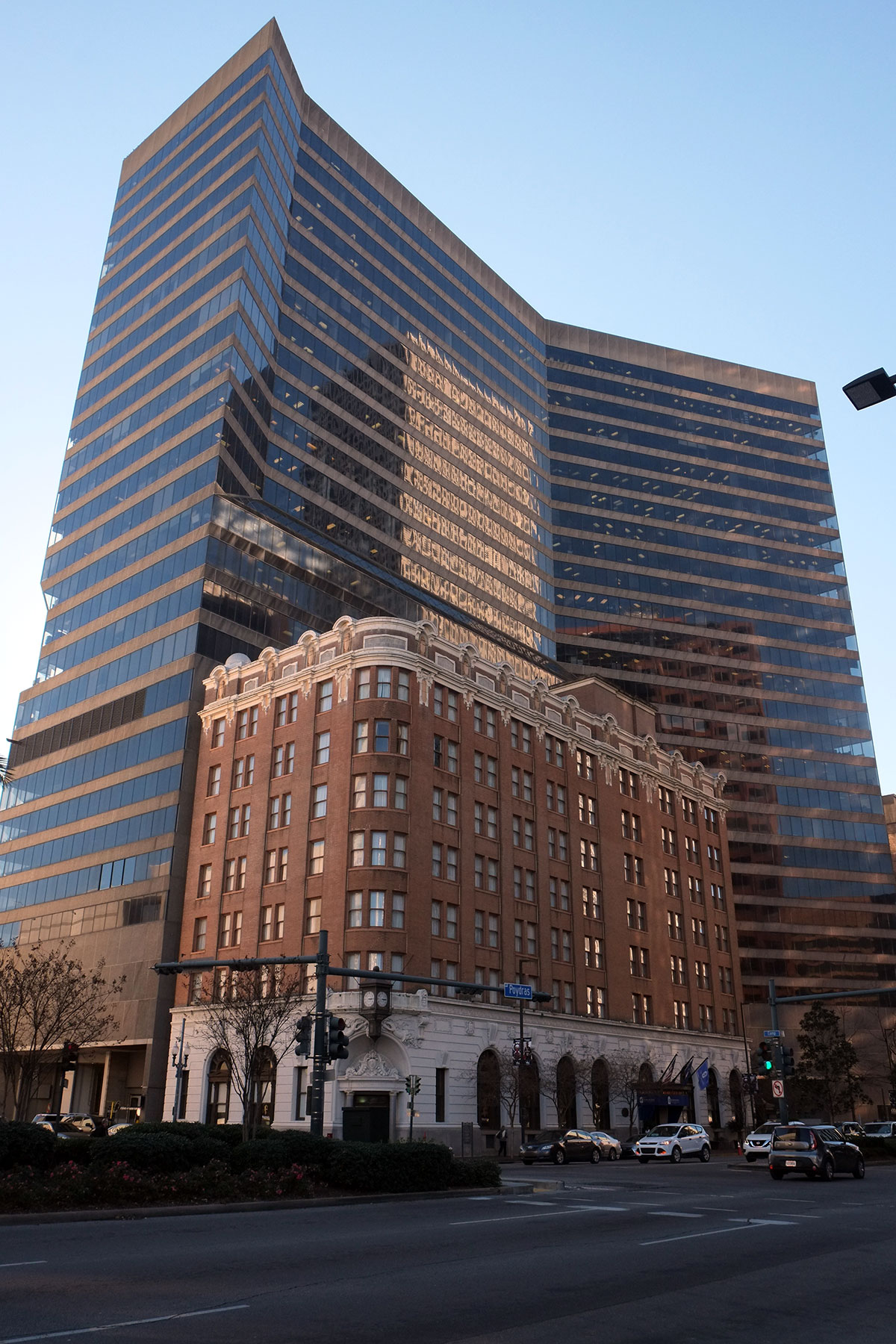
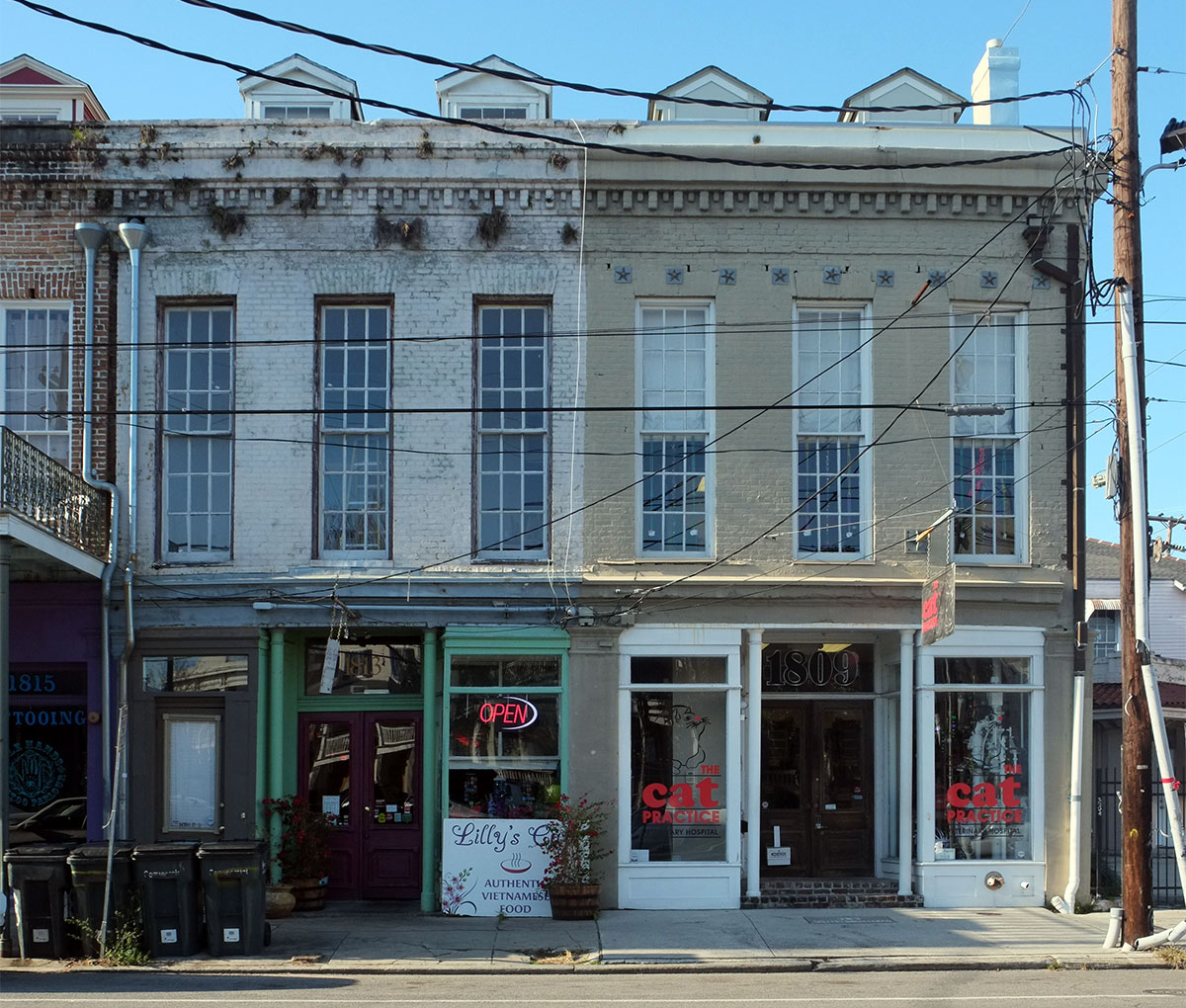
The rest of the downtown is blend of good old commercial buildings and standard mid-century towers.  DSCF2537DSCF3789

The more recent towers, spawned by the oil boom, are clustered upriver along Poydras Street.  DSCF3792  DSCF2058Overall, there is balance between the old and the newer – there are not many places where the gigantism and banality of recent decades takes over.  Although New Orleans’s first skyscraper, the Plaza Tower, is truly inept.  It is now empty, with asbestos and mold issues, and lawsuits apparently flying in every direction.  It’s so bad it might be worth keeping.  DSCF2626

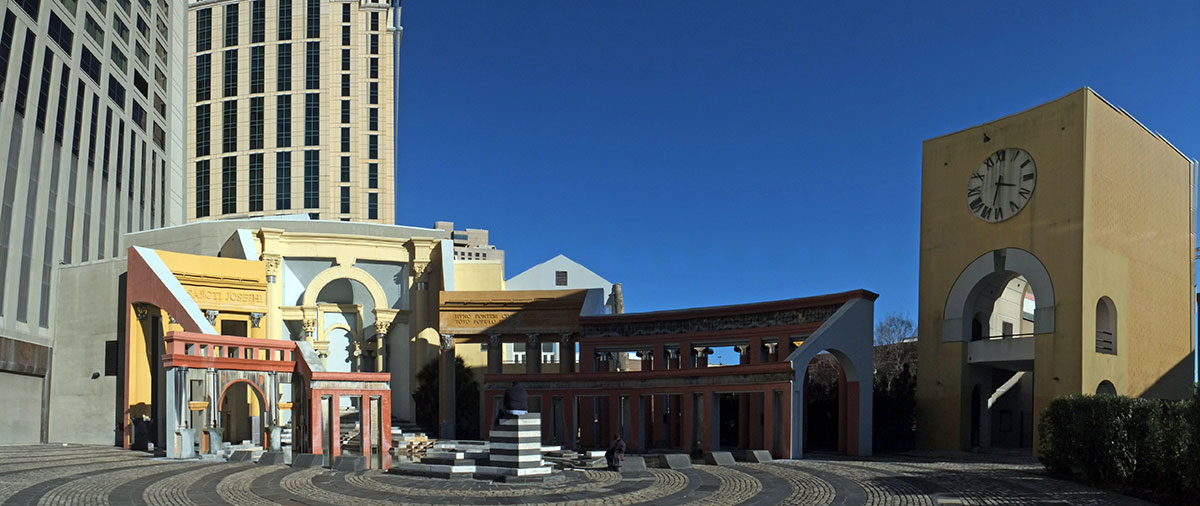
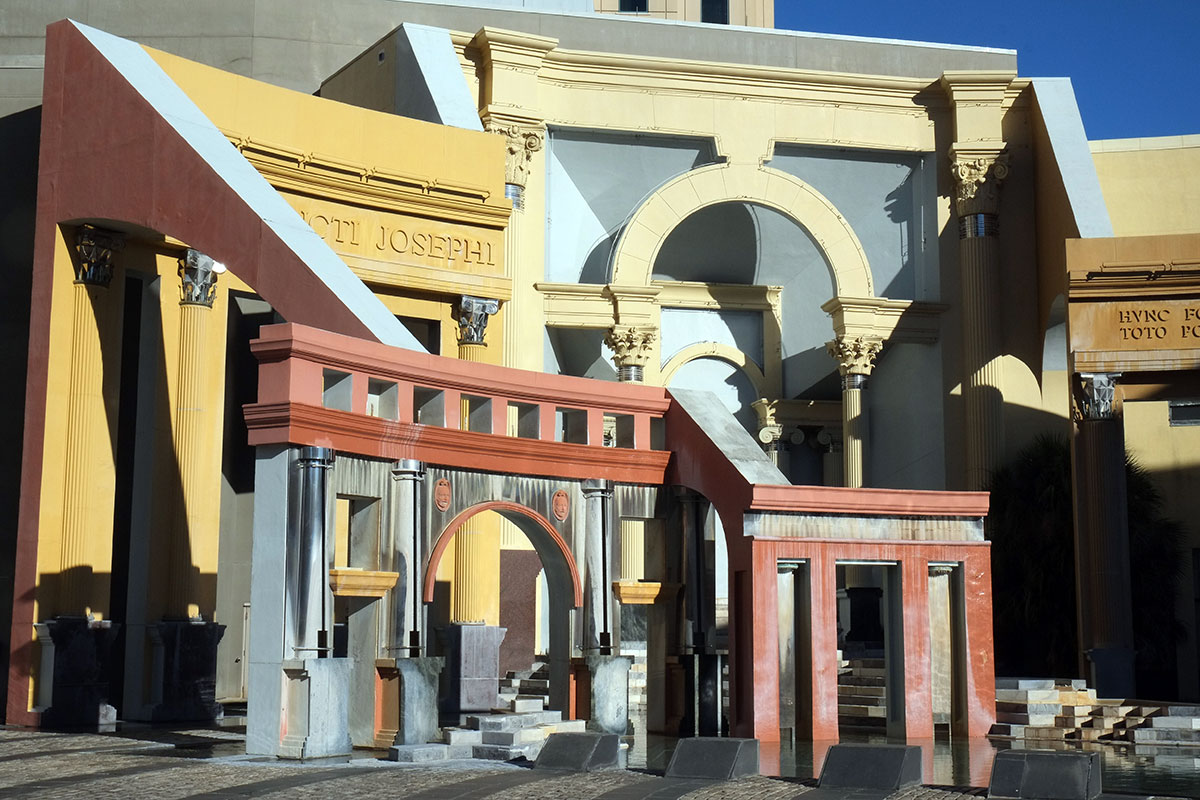
Poydras St. is also the location of Charles Moore’s Piazza d’Italia. It’s a funny little thing – filling in an open space between a skyscraper and a parking lot.  Moore was obviously trying to construct  a place that could be inhabited, unlike the empty modernist plazas built to satisfy zoning ordinances, but the cards were stacked against him.  If the city fabric grew up densely around it, so that you emerged from a street into the plaza, it might work.  But the towers are pulled back, and one sees the Piazza from the outside as a disconnected object, not just as a surrounding screen from the inside.  DSCF2075The detailing is over-the-top Pomo, and is perhaps our best remnant of the movement spinning out of control.  DSCF2077

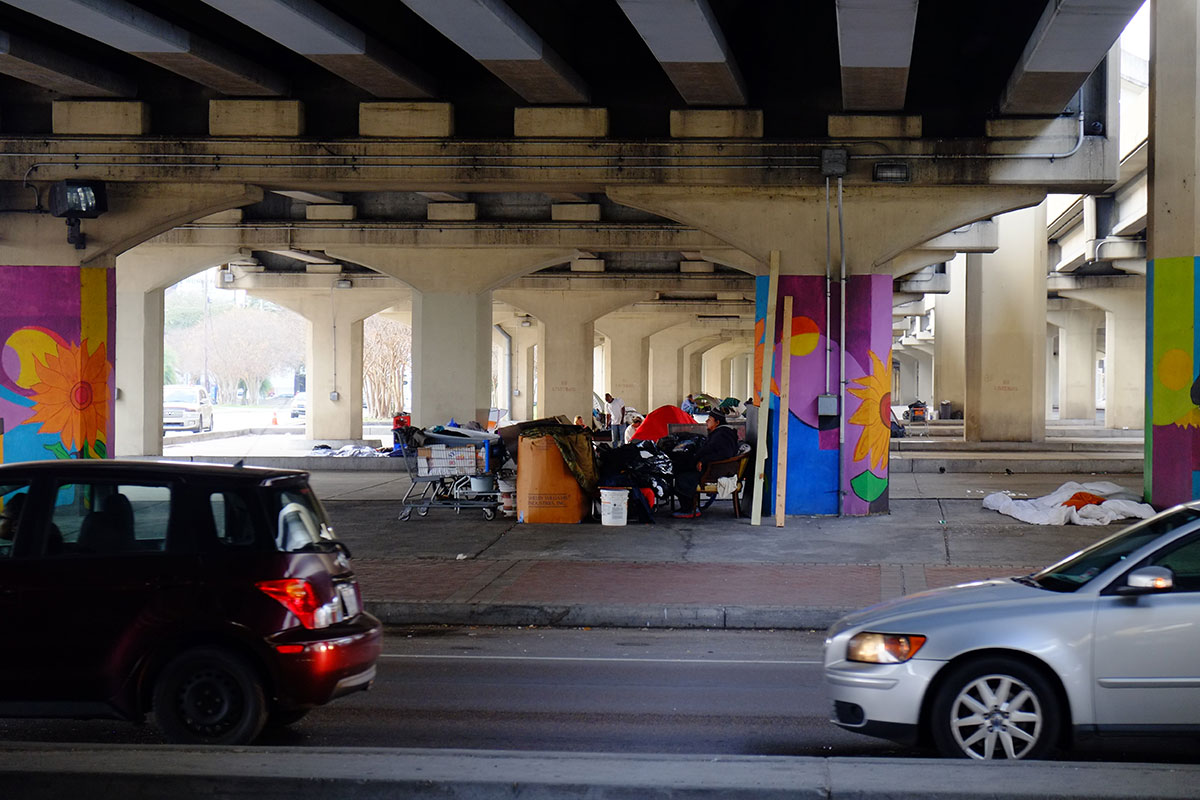
The elevated highways that ring the business district have done their damage, as everywhere else. The neighborhood of Treme was decimated, and the Uptown area to the west is cut off by a no-man’s land around the freeway.  DSCF2628

While the central business district has largely wiped out the early 19th century buildings there, some do survive, DSCF2633and the mix of old and new shifts as you move uptown, through the Lower Garden District and Central City areas into the Garden District.  DSCF1627

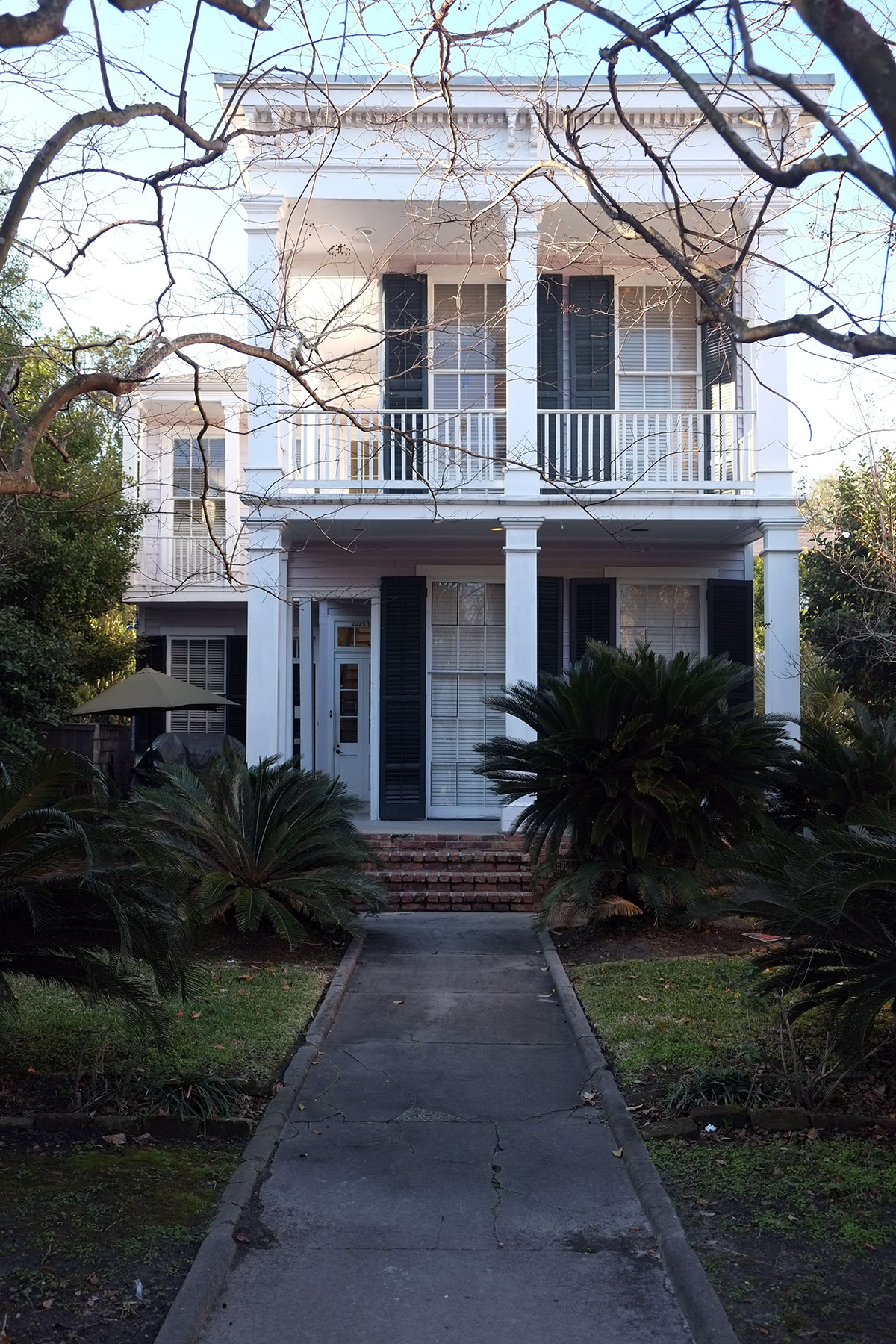
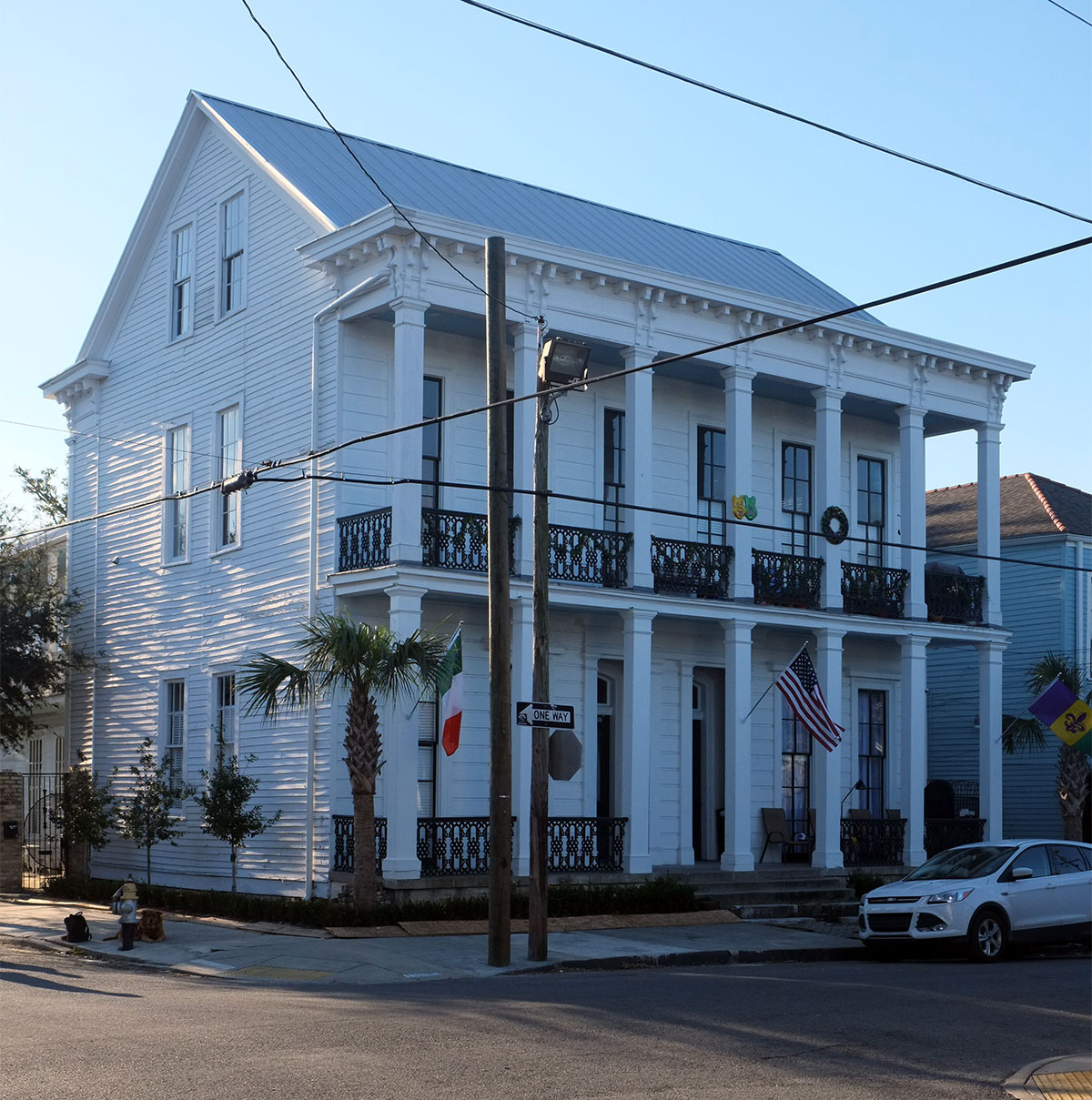
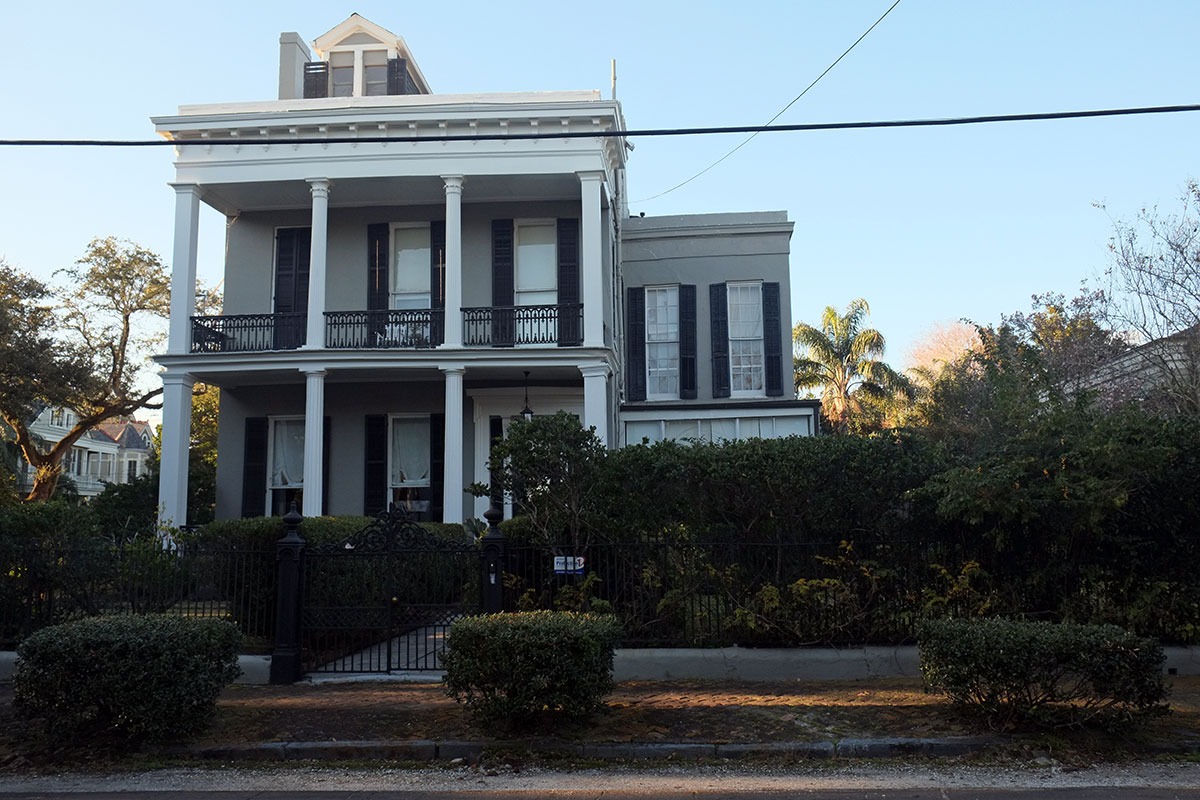
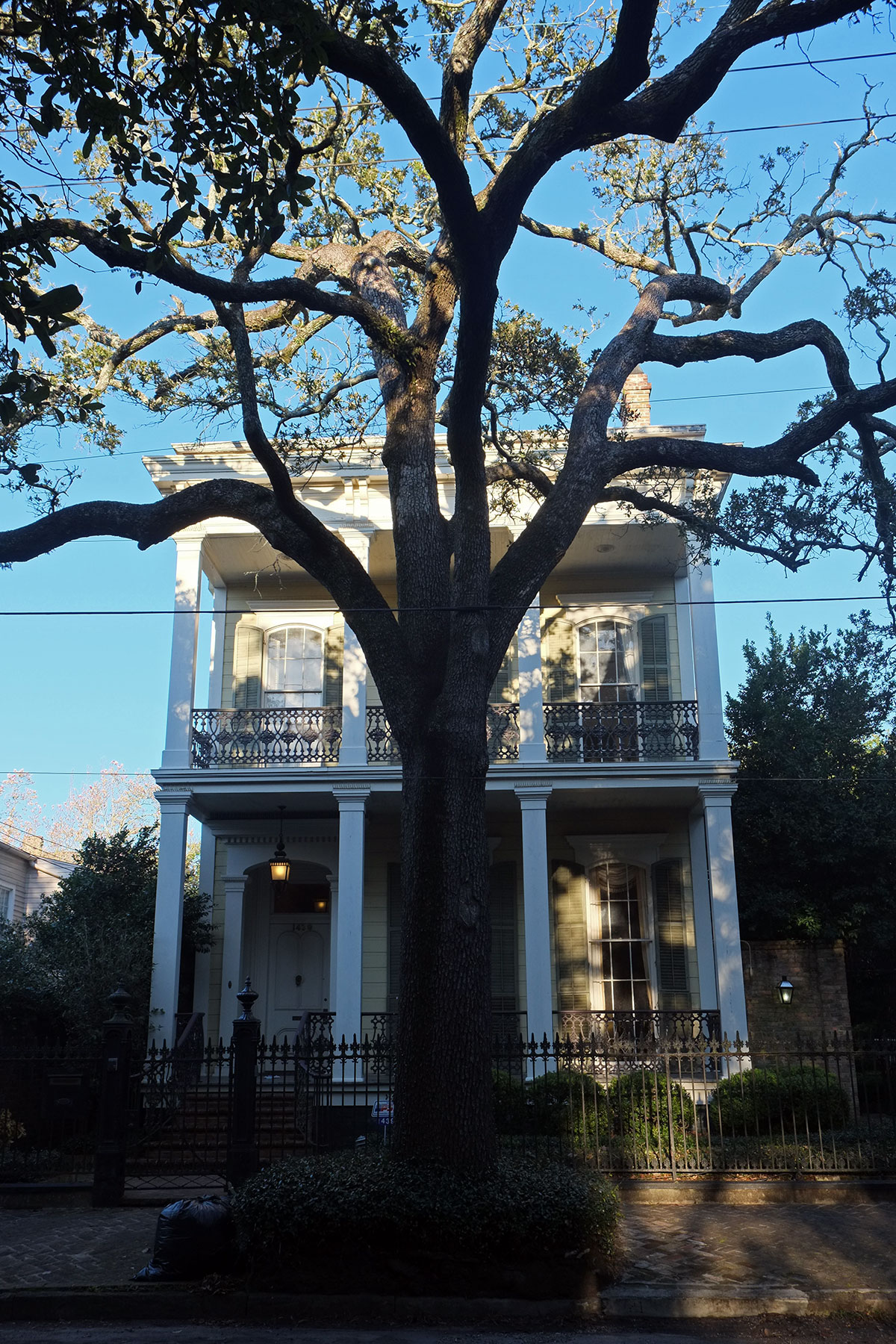
This side of town is served by the other streetcar line, along St. Charles.  The old cars are in fabulous condition, and a miles-long ride is one of the best ways to see the city.  DSCF2858This area is remarkable.  In some ways it looks more like other American cities, in that styles that were current in the late 19th century are all visible, but they are adapted to New Orleans.  There are a lot of Greek Revival houses, their large porticos well-suited to the climate.    DSCF1629DSCF1638  DSCF1657  DSCF1659 The wealth of the builders is apparent – whereas most of New Orleans’s older dense residential neighborhoods were working class in origin, in uptown there are many areas with large houses and big yards.

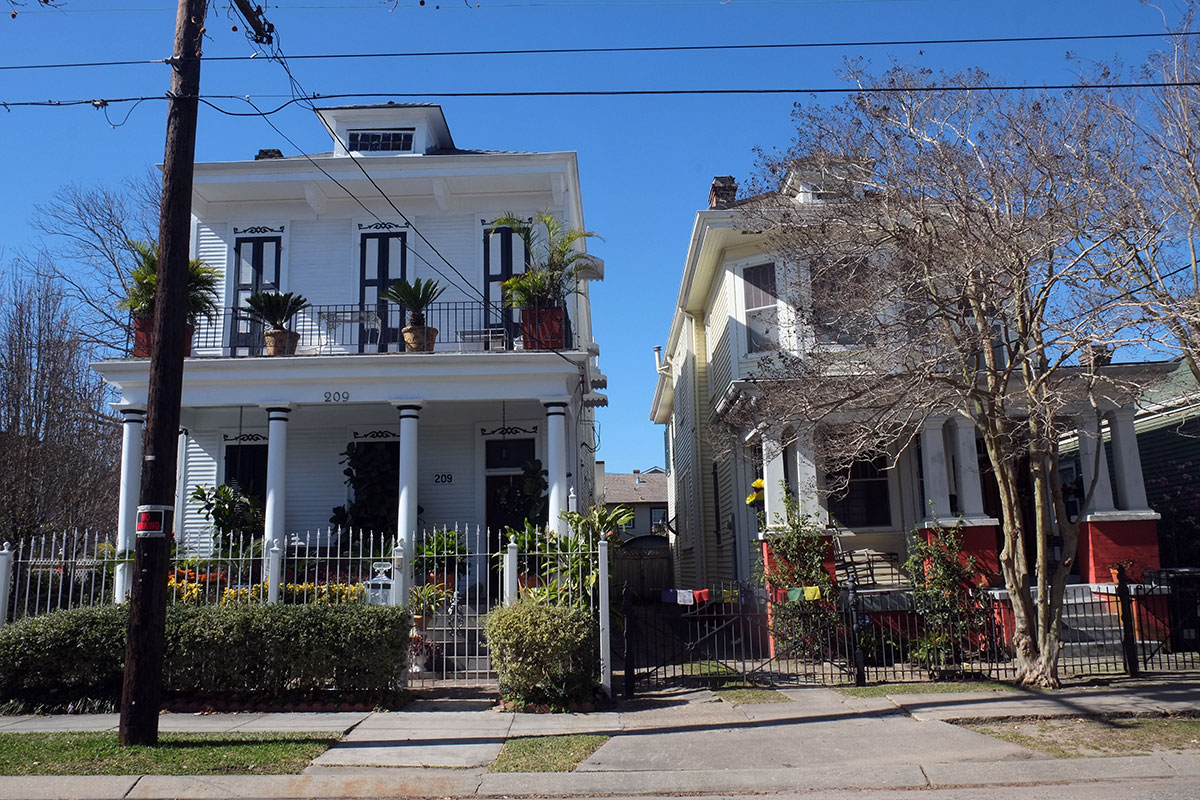
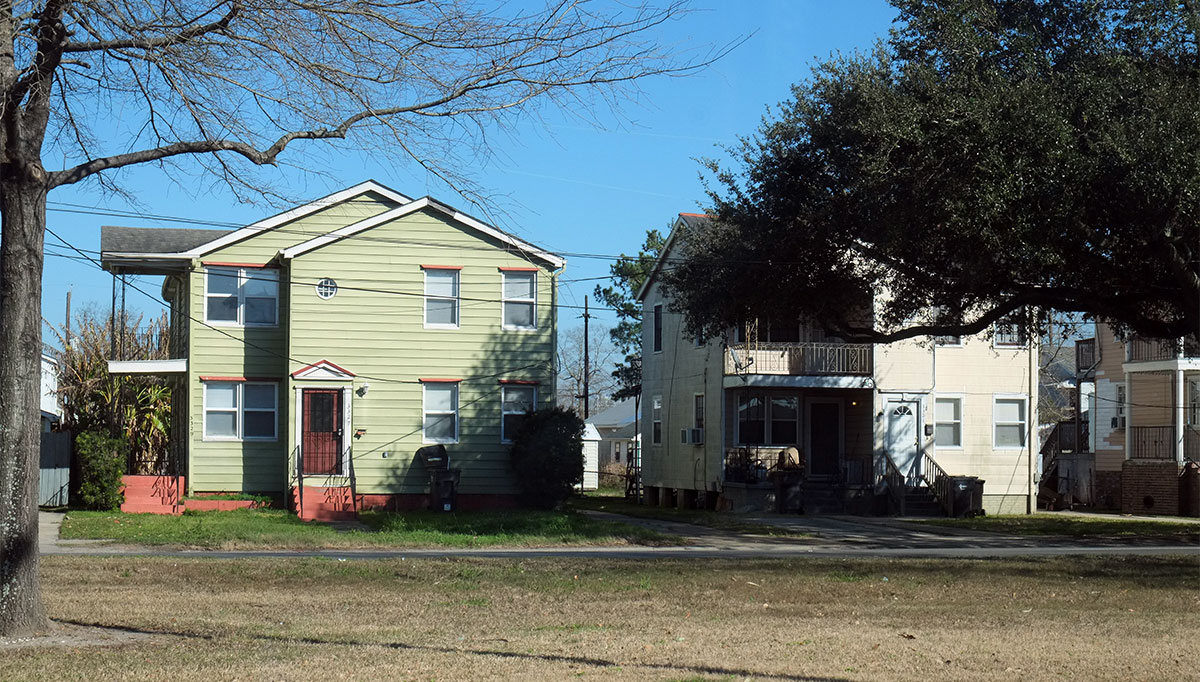
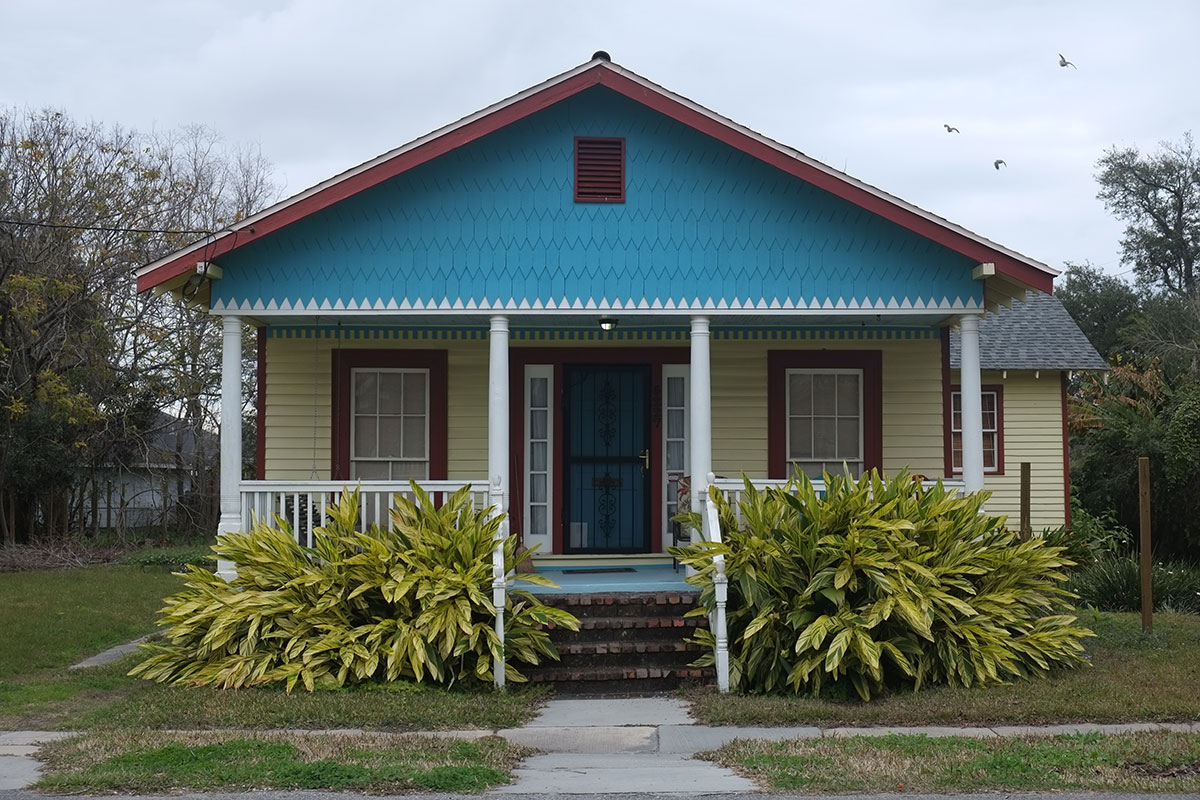
In general, as you move out from the city center in any direction, the density decreases, as neighborhoods begin to look more like those in other parts of the country, with detached houses sitting on lots of varying widths.  This happens in places as different as Mid-City,DSCF3558

in 20th century parts of GentillyDSCF3568

and in the Lower Ninth Ward.  DSCF1763

It’s a commonplace that New Orleans is unlike anywhere else in the US;  this difference is seen most clearly when you’re near the city center – the house types, the block organization, the streetscapes – these are most different in the Vieux Carre, built before it was part of the US, and in the early 19th-century districts, when the local influences were most strong, and a national building culture hadn’t yet asserted itself.  The outskirts of the city are physically much like other old metropolitan areas, with ranch houses and strip centers.  But the New Orleans difference is apparent in another important way, even out in these newer areas:  in the culture of the city and the tenor of social life.  The way people live here is unlike anywhere else, even out on the edge.  They may have a Costco, but that Costco has an excellent liquor selection.